Category Archives: Vermont Homefront

1864: Mary L. Lewis to Maria Sally Lewis

The following letter was written by Mary L. Lewis, a student at Union High School in Rutland, Vermont, at the time she put pen to paper in mid-March 1864, just before the close of the spring term. Unfortunately, I’ve not been able to learn anything more about her through census, cemetery, or newspaper records. Her letter gives us a hint of the early-day attempts to advance the cause of Temperance and Ladies’ Rights in Vermont.

Fred Alfred Field (1850-1935) as drawn in 1897, Vermonter Magazine.

Most of Mary’s four-page letter is devoted to describing her current beau named “Fred” who worked as a clerk in the Post Office in Rutland. She never reveals his last name but I believe it was Frederick Alfred Field (1850-1935) of Rutland. He was the son of William Morton Field (1813-1890) and Minerva Kimball Davenport (1816-1886). His father was sheriff of Rutland county and also served as the president of the Rutland Savings Bank. In the 1870 US Census, Fred was still enumerated in his parent’s Rutland home and his occupation was given as “clerk” in the Post Office—the same position identified by Mary in her letter. Fred was married in 1873 to Lillie Clark (1854-1942), the daughter of Henry and Henrietta Clark of Poultney, and the description of his wedding confirms that he still held a “responsible position in the Rutland Post Office” at that time. His obituary, published in the Burlington Daily News in 1935 states that he had long been affiliated with the Rutland Post Office as a clerk, inspector, and eventually as postmaster—appointed by President Harrison in 1889. He later went into the insurance and real estate business.

Mary wrote the letter to Maria Sally Lewis (1845-1914), the daughter of Jonathan Lewis (1793-1870) and Amanda Wiggin (1797-1852) of Williamstown, Vermont. We learn that Mary and Maria had become friends while attending school together in Rutland. Maria married Herbert Proctor Martin (1842-1905) on 5 November 1865. Maria’s family papers were donated in 1996 to the Vermont Historical Society, see—Martin Family Papers.

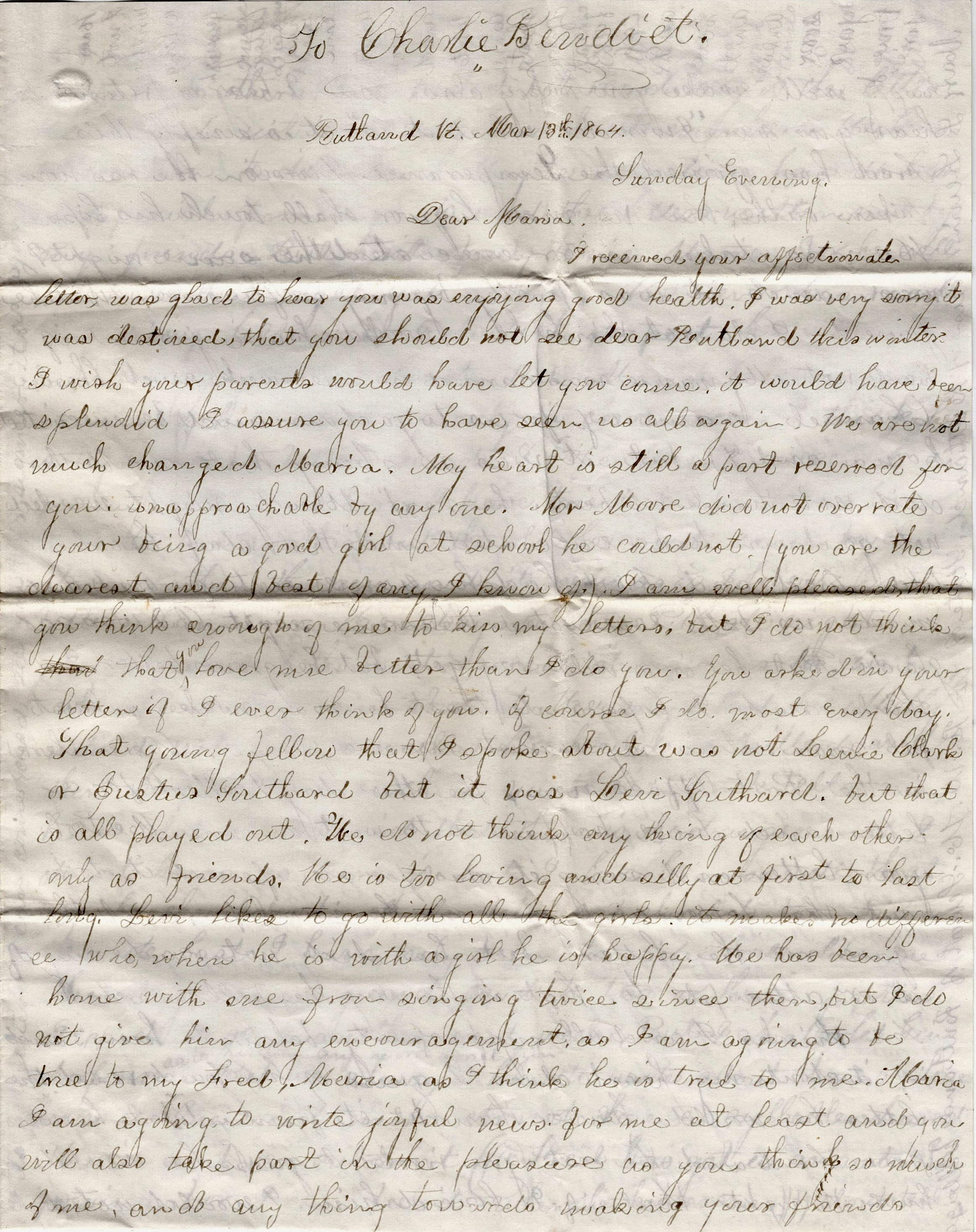
T R A N S C R I P T I O N
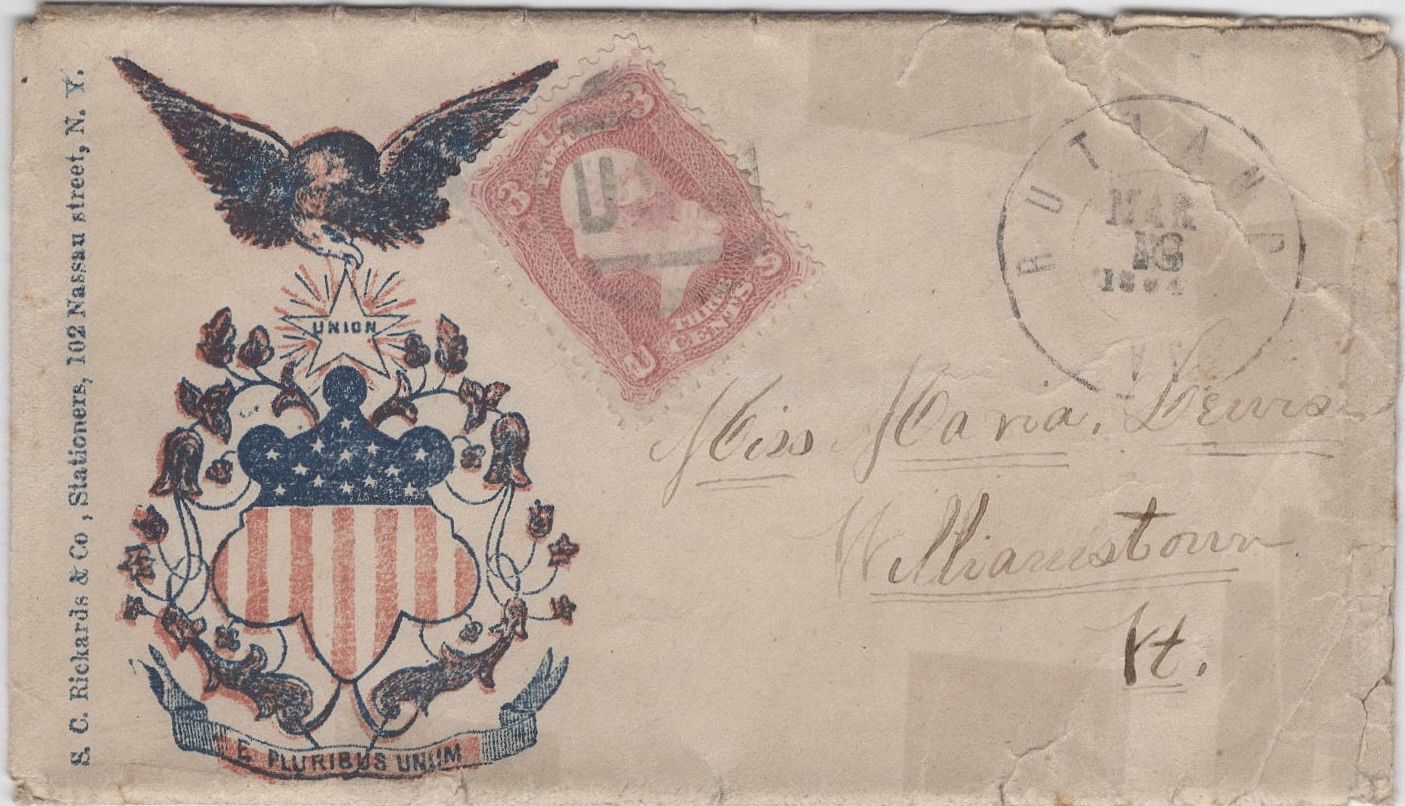
Rutland, Vermont
Sunday evening, March 13th 1864

Dear Maria,

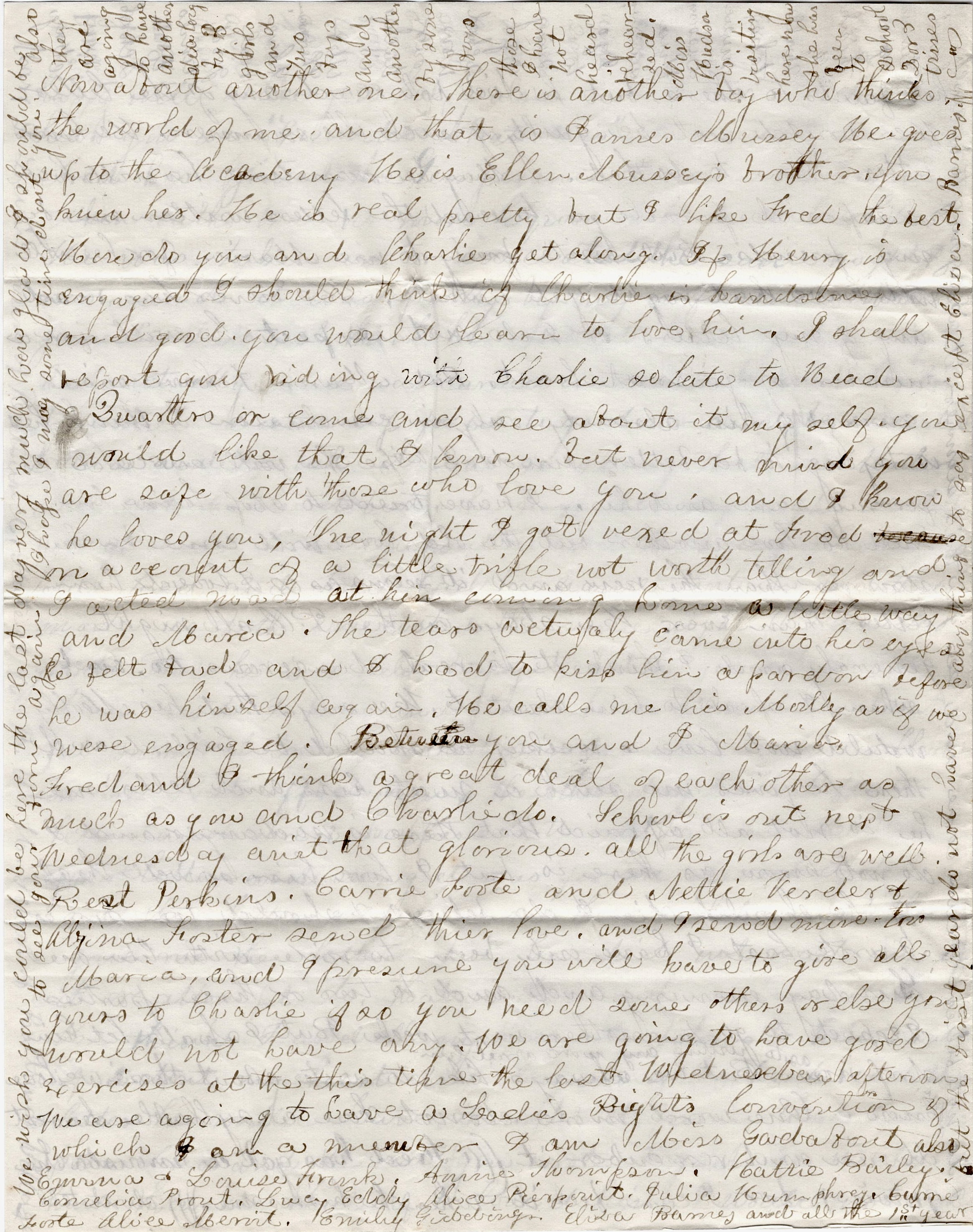
I received your affectionate letter. Was glad to hear you was enjoying good health. I was very sorry it was destined that you should not see dear Rutland this winter. I wish your parents would have let you come. It would have been splendid, I assure you. to have seen us all [together] again. We are not much changed, Maria. My heart is still a part reserved for you, unapproachable by anyone. Mr. [Davis Graham] Moore 1 did not overrate your being a good girl at school. He could not. (You are the dearest and best of any I know of.) I am well pleased that you think enough of me to kiss my letters, but I do not think that you love me better than I do you. You asked in your letter if I ever think of you. Of course I do—most every day. That young fellow that I spoke about was not Lewis Clark or Justus Southard—but it was Levi Southard. 2 But that is all played out. We did not think anything of each other, only as friennds. He is too loving and silly at first to last long. Levi likes to go with all the girls—it makes no difference who. When he is with a girl, he is happy. He has been home with me from Singing [School] twice since then but I do not give him any encouragement as I am agoing to be true to my Fred, Maria, as I think he is true to me.

Maria, I am agoing to write joyful news—for me at least—and you will also take part in the pleasure as you think so much of me, and anything towards making your friends happy will make you happy also. Well I hear, or pretend to hear you say, “I wonder what that is?” It is simply this. Fred has joined the Temperance Division. He has now taken oath that no more liquor shall touch his lips. He was taken in or initiated the same night I was and it was partly by my influence that he’s joined. I do not think he would have joined if I had not. My name was carried in one week and Charlie Channell 3 came up for us to go down and be initiated (Lorna and I) but it was so stormy that our Mothers did no tthink it best. The next Monday night, we did not go down to be initiated and that day Charlie told Fred and Fred has his name sent in and that made us both initiated the same night. Oh! I was so glad. But he is a wild boy yet but he grows better, I think, and I hope and trust he may make a trustful man. It is my earnest, sincere prayer.

He is clerk in the Post Office now. The other day I called for a letter and Fred happened to wait on me. He took out the letter and seeing it was for me, opened it, took out the letter and gave me the envelope, and then gave me the letter. But he did not read any of it or attempt to. That is the way the fellow acts. He thinks I and all my property belong to him and if it don’t, my heart does. I guess if he had read the letter, he would have thought it funny that he was “poor Fred” and the rest you wrote. I guess he would have thought that if I loved him, I would not write his faults to others. But he did not read any of the letter. He would not be guilty of such ill manners. He knows better than to do that. Maybe sometime he will have an especial privilege to read the letters written me by my friends. But write freely to me Maria for he will not have that right yet awhile. He never has read any of my letters or I do not expect he will for a number of years at least.

But Maria, I have said enough of him already, only in conclusion I think he is trying to be better and I hope he will succeed for my sake and his. I have tried to stop loving him, tried to love another, but the old love will come back stronger than the new and it seems as if I loved him better than ever. He stays in the Post Office all night generally and I think it is real dangerous too and when I speak to him about it, he says that his Molly would not live a week if he should be killed and then he gives me such a sweet kiss and tells me he is not [at] all afraid—that there is no danger, and I don’t know as there is but I love him so well that if he should die, I do believe I should too. 4

Since I wrote last, I have only been to ride with him one Sunday evening and to two or three parties. I expect to go to another next week. But I shall let him drop now (as to writing any more about him). But we always like to write about those we love, you know. One word more, do not lose a syllable, dearest Maria, and remember it. (Oh, Fred has got a moustache growing for I can feel it when he kisses me!) Don’t tell.

Now, about another one. There is another boy who thinks the world of me and that is James Mussey. 5 He goes up to the Academy. He is Ellen Mussey’s brother. You knew her. He is real pretty but I like Fred the best.

How do you and Charlie get along? If Henry is engaged, I should think if Charlie is handsome and good, you would learn to love him. I shall you riding with Charlie so late to Head Quarters or come and see about it myself. You would like that, I know. But never mind, you are safe with those who love you and I know he loves you. One night I got vexed at Fred on account of a little trifle not worth telling and I acted mad at him coming home a little way, and Maria, the tears actually came into his eyes. I felt bad and I had to kiss him a pardon before he was himself again. He calls me his Molly as if we were engaged. Between you and I , Maria, Fred and I think a great deal of each other—as much as you and Charlie do.

School is out next Wednesday. Ain’t that glorious? All the girls are well. Rest Perkins, Carrie Foote, and Nettie Verder & Alzina Foster send their love and I send mine too. Maria, I presume you will have to give all yours to Charlie. If so, you need some others or else you would not have any. We are going to have good exercises at the [school?] this time the last Wednesday afternoon. We are going to have a Ladies’ Rights Convention of which I am a member. I am Miss Gadabout. Also Emma & Louise Frink, Annie Thomson, Hattie Bailey, Cornelia Prout, Lucy Eddy, Alice Pierpoint, Julia Humphrey, Carrie Foote, Alice Merit, Emily Giebeinger, Elisa Barnes, and all the 1st year but the 1st year do not have anything to say except Eliza and Barnes.

We wish you could be here the last day very much. How glad I should be to see your form again. I hope I may some time, don’t you? Also they are going to have another dialogue by three girls and two boys and another by some boys. Those I have not heard rehearsed. Miss [Lucy] Hudson is visiting here now. She has been to school two or three times.

I do not believe I can come and see you this summer. It is agoing to be such hard times. I think I shall take music lessons this summer. I go to Singing School now. Our teacher is Mr. Sherman. I have real good times to school now-a-days.

Have I not written a long enough letter this time? Write soon and write a sheet of foolscap as I have and answer soon. Your true friend, — Mary L. Lewis of Rutland, State of Vermont. R[utland] U[nion] H[igh] School of Rutland Village.


1 Davis Graham Moore was born in Keeseville, New York, on December 15, 1834, the son of Asa Davis Moore (1800-1872) and Mindia Campbell (1801-1884). After graduating from the University of Vermont in 1858, he became principal of Rutland High School, and, in 1865, he moved to Illinois. Moore was a railroad paymaster in Springfield in 1870 and spent most of the rest of his life in Danville; in the early 1880s, he worked for the Wabash, St. Louis, and Pacific Railway in Cairo. Moore married Martha Jane Hudson, a graduate of Mount Holyoke College, in 1864, and they had four children: Allen Henry (b. 1865), George D., Olie M., and Emily Lucy. Davis G. Moore died on September 13, 1919.

2 Levi B. Southard (184x-1873) and his brother Justus A. Southard (1846-1925) were the son of Lent F. Southard (1833-1900) and Susan L. Bishop (1xxx-1900) of Rutland, Vermont. Justus was married to Agnes M. Kettles (1847-1930) in 1868. Levi was married to Sarah Garr (1851-1930) in 1873 but died suddenly a few weeks later from some type of paralysis. He had been employed by the Central Vermont Railroad for three years prior to his death.

3 Charles (“Charlie”) Edward Channell (1846-1907) was the son of David Balch Channell and Calista Lucy Bowker of Rutland. He married Ida Laura Riford (1850-1914) in 1870. Charles was employed as a tinsmith for the repair department of the Rutland Railroad.

4 Mary’s concern for Fred’s safety when sleeping in the Post Office was probably well founded. Many soldiers sent their pay home in letters during the Civil War and it’s possible that at certain times the Post Office may have had hundreds or even thousands of dollars in it.

5 James B. Mussey (1848-1911) was the son of Henry Mussey (1795-1878) and Sabra A. Lawrence (1808-1900) of Rutland. His sister, Ellen A. Mussey (1844-1927) is mentioned in the letter as well. James married Frances Elizabeth Claghorn (1850-1933) in 1875. He was a farmer. We learn from the letter that he attended the Rutland Academy in 1864.
1865: Thomas Hubbard to Erastus Hubbard

Unfortunately there is no photograph of Thomas but here’s a CDV from the period of time with an unidentified gentleman approximately his age.

The following 4-page letter was written on 15 January 1865 by 54 year-old Rev. Thomas Hubbard (1811-1907) in Gaysville, Vermont (in the central part of the state) to his older brother Erastus Hubbard (1798-1877) in Franklin, Vermont (on the border with Quebec). Thomas and Erastus were the son s of Samuel Hubbard (1763-1844) and Elizabeth Swan (1767-1840). Thomas was an 1834 graduate of Middlebury College and an 1838 graduate of the Andover Theological Seminary. He then entered the pastorate of the Congregational Church and served in various pulpits throughout Vermont.

In his letter, Thomas expresses the outrage of Vermont citizenry with the notorious October 1864 Confederate raid on St. Albans and the Canadian government’s handling of the matter. The raid was conducted by 21 Confederate soldiers crossing into Vermont from Canada for the purpose of robbing banks to raise money for the Confederacy and to trick the Union army into diverting troops to defend their northern border against further raids. They got the money, killed a local, and escaped back to Canada with apparent impunity. As an unintended consequence, the raid served to turn many Canadians against the Confederacy since they felt that Canada was being drawn into the conflict without its consent.

Hubbard also conveys his anger at the British government for their actions in support of the Confederacy, mentioning specifically their association with Confederate naval vessels, including the Alabama,  which plundered Union shipping. In this regard, he specifically mentions the British Premier, Lord Palmerston, as well as the Foreign Secretary, John Russell, both of whom were ready at various times during the war to support the South (though they never formally did so). In addition he mentions Henry Ward Beecher as a source of his information as to British sentiments; Beecher being a very well-known Union preacher and writer who visited Britain in 1863 on a lecture tour, in which he encouraged British support for the Union cause. The name Beecher is actually now more frequently associated with Beecher’s sister, Harriet Beecher Stowe, who in 1852, wrote Uncle Tom’s Cabin, a book which also served to accentuate feelings against the Confederacy. 

Hubbard goes on to briefly discuss the negative response of the Vermont citizenry towards the Federal draft call of 19 December 1864 which was extremely unpopular, coming, as it did at a time when many in the Union had had enough of the war. Most of the men whose names were pulled in the draft lottery found some way out, often by purchasing a substitute, as noted in this letter, leading to charges of class favoritism by the government.

Finally, Hubbard discusses various matters of discord within the British Anglican Church and the linked American Episcopal Churches, in which considerable turmoil was present during the time of the Civil War.

[Note: This letter is from the private collection of Richard Weiner and was transcribed and published by express consent on Spared & Shared.]

Transcription

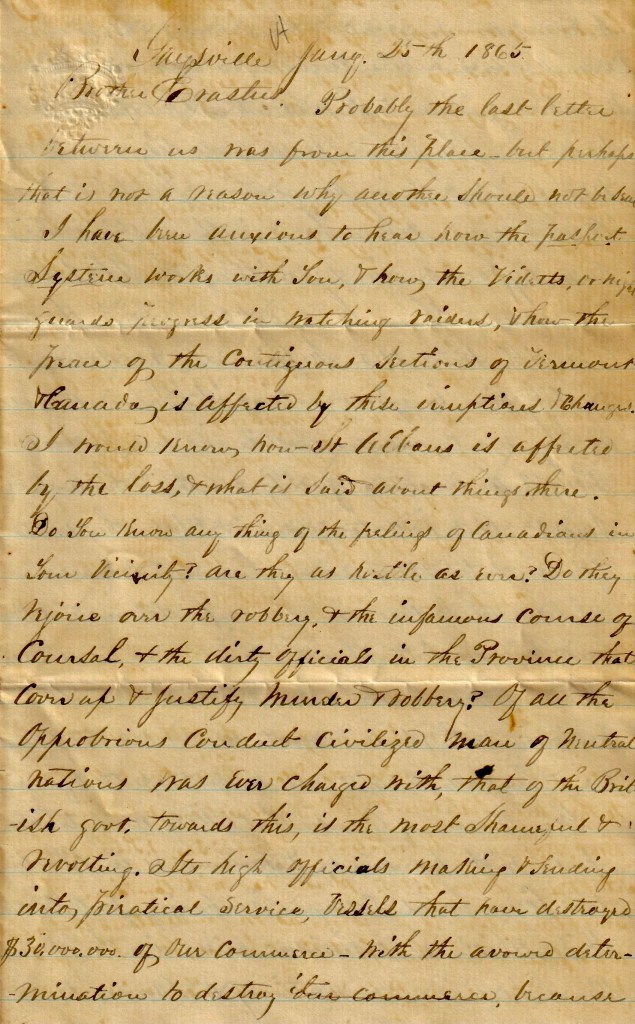
Gaysville, Vermont
January 25th 1865

Brother Erastus,

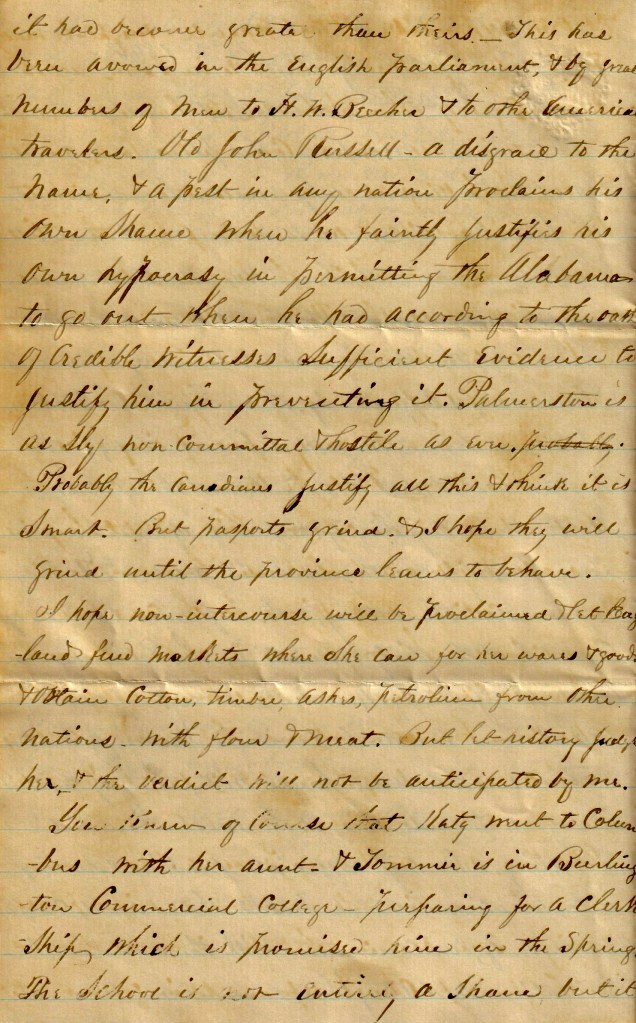
Probably the last letter between us was from this place but perhaps that is not a reason why another should not be sent. I have been anxious to hear how the passport system works with you & how the Videtts, or night guards, progress in watching raiders, & how the peace of the contiguous sections of Vermont & Canada is affected by these eruptions & changes, I would [like to] know it St. Albans is affected by the loss, & what is said about things there. Do you know anything of the feelings of Canadians in your vicinity? Are they as hostile as ever? Do they rejoice over the robbery, and the infamous course of Coursal, & the dirty officials in the Province that cover up and justify murder & robbery? Of all the opprobrious conduct civilized man of neutral nations was ever charged with, that of the British government towards this is the most shameful & revolting. Its high officials making and sending into practical service vessels that have destroyed $30,000,000 of our commerce—with the avowed determination to destroy its commence because it had become greater than theirs. This has been avowed in the English parliament & by great numbers of men to [Rev.] H. W. Beecher & to other American travelers.

Old John Russell—a disgrace to the name and a pest in any nation—proclaims his own shame when he faintly justifies his own hypocrisy in permitting the Alabama to go out when he had according to oath of credible witnesses sufficient evidence to justify him in preventing it. Palmerston is as sly noncommittal & hostile as ever. Probably the Canadians justify all this & think it is smart. But passports grind & I hope they will grind until the province learns to behave.

I hope non-intercourse will be proclaimed & let England find markets where she can for her wares & goods & obtain cotton, timber, ashes, petroleum from other nations—with flour and meat. But let history judge her & the verdict will not be anticipated by me. 

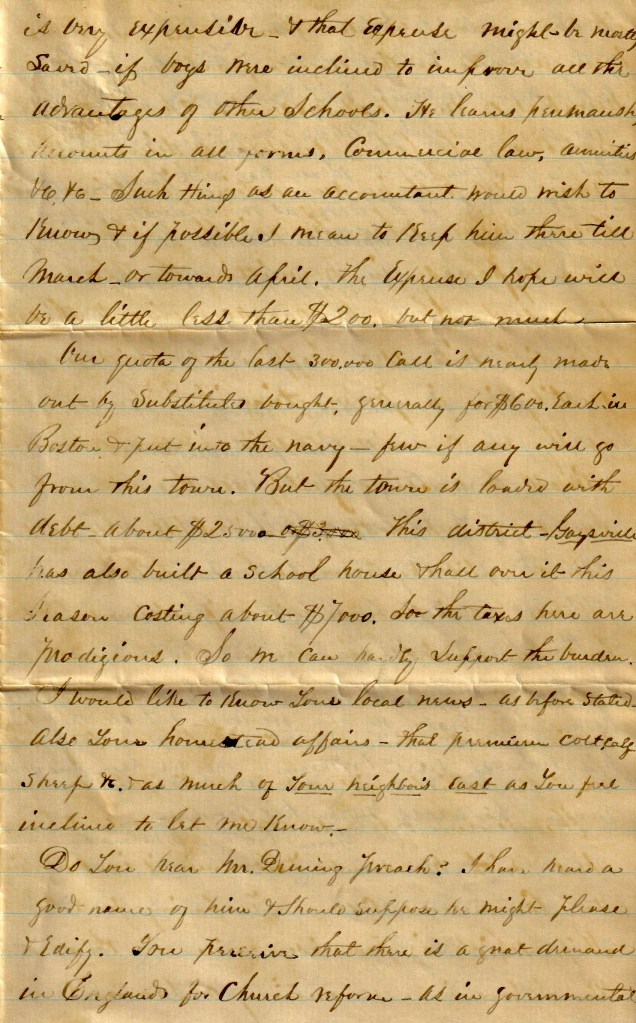
You know of course that Katy went to Columbus with her aunt & Tommie is in Burlington Commercial College preparing for a clerkship which is promised him in the spring. The school is not entirely a [    ], but it is very expensive & that expense might be mostly saved if boys were inclined to improve all their advantages of other schools. He learns penmanship, accounts in all forms, commercial law, annuities, &c. &c. Such things as an accountant would wish to know and if possible, I mean to keep him there till March, or towards April. The expense, I hope, will be a little less than $200, but not much.

Our quota of the last 300,000 call is nearly made out by substitutes bought, generally for $600 each in Boston & put into the Navy. Few if any will go from this town. But the town is loaded with debt—about $25,000. This district—Gaysville—has also built a school house, shall own it this season, costing about $7,000. So the taxes here are prodigious. So we can hardly support the burden.

I would like to know your local news, as before stated. Also your homestead affairs—that premium colt, calf, sheep, &c. and as much of your neighbors East as you feel inclined to let me know.

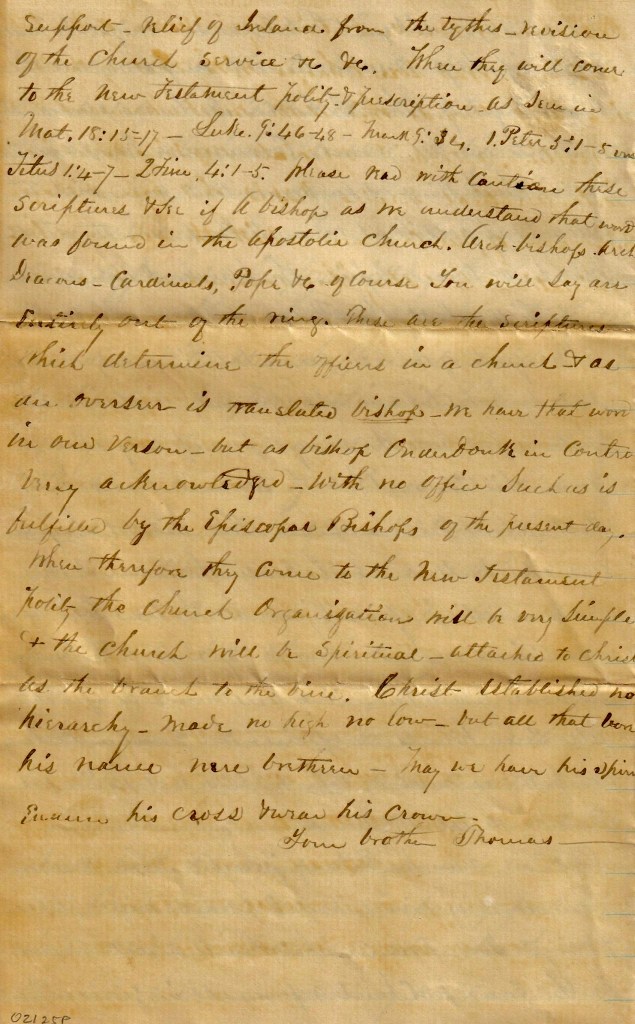
Do you hear Mr. Deming preach? I have heard a good name of him & should suppose he might please & edify. You perceive that there is a great demand in England for Church reform—as in governmental support—relief of Ireland from the tithes—revision of the church service, &c. &c. Where they will cover to the New Testament polity & prescription as seen in Mat. 18:15-17, Luke 9:46-48, Mark 9:34, 1 Peter 5:1-5, Titus 1:4-7, and 2 Fin 5:1-6/ Please read with caution these scriptures and see if a bishop as we understand that work was found in the Apostolic Church. Arch. Bishops, Arch Deacons, Cardinals, Pope, &c of course you will say are entirely out of the ring. These are the scriptures which determine the officers in a church & as an overseer is translated bishop. We hear that word in our version—but as Bishop Onderdonk in controversy acknowledged—with no office such as is fulfilled by the Episcopal Bishops of the present day. Where therefore they come to the New Testament polity the church organization will be very simple & the church will be spiritual—attached to Christ as the branch to the vine. Christ established this heirachy—made no high no low—but all that bore his name were brethren. May we hear his spirit, endure his cross, & wear his crown.

From your brother, — Thomas

1862-63: Sarah Adeline Sparks to Caroline Dame (Tibbetts) Locke

These letters were written by Sarah Adeline Sparks (1818-1895), the daughter of Ebenezer Sparks (1792-1865) and Sally Kendall (1783-1870) of East Dover, Windham county, Vermont. Sarah apparently never married; she is buried in Dover Center Cemetery.

She wrote the letters to her friend, Caroline Dame (Tibbetts) Locke (1809-1893)—the wife of Rev. William Sherburne Locke (1808-1896). Caroline was the daughter of William S. Tibbetts (1780-1857) and Jerusha Dame (1784-1820) of Kittery, Maine. Caroline’s husband, William, was enumerated as a retired Methodist minister in Manchester, Hillsborough county, New Hampshire, in 1860. 

Letter 1

Dover
February 6th 1862

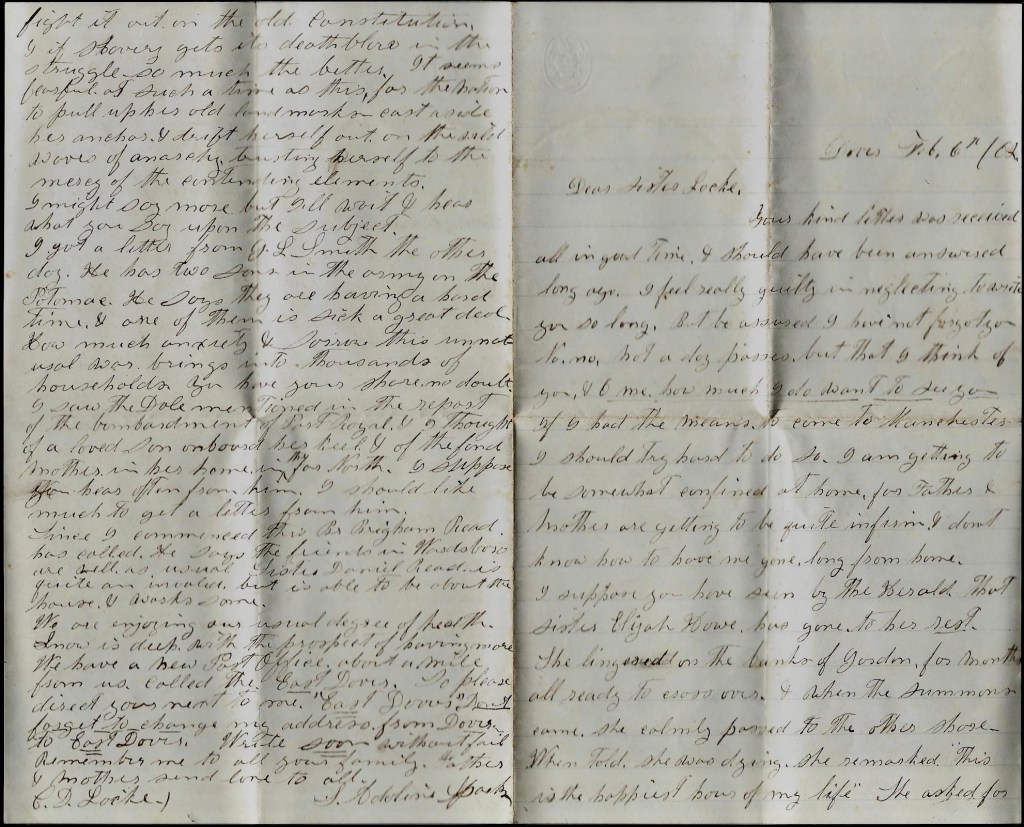
Dear sister Locke,

Your kind letter was received all in good time and I should have answered long ago. I feel really guilty in neglecting to write you so long. But be assured I have not forgotten. No, no, not a day passes but that I think of you & me. How much I do want to see you. If I had the means to come to Manchester, I should try to do so. I am getting to be somewhat confined at home for Father and Mother are getting to be quite inform. I don’t know how to have me gone long from home.

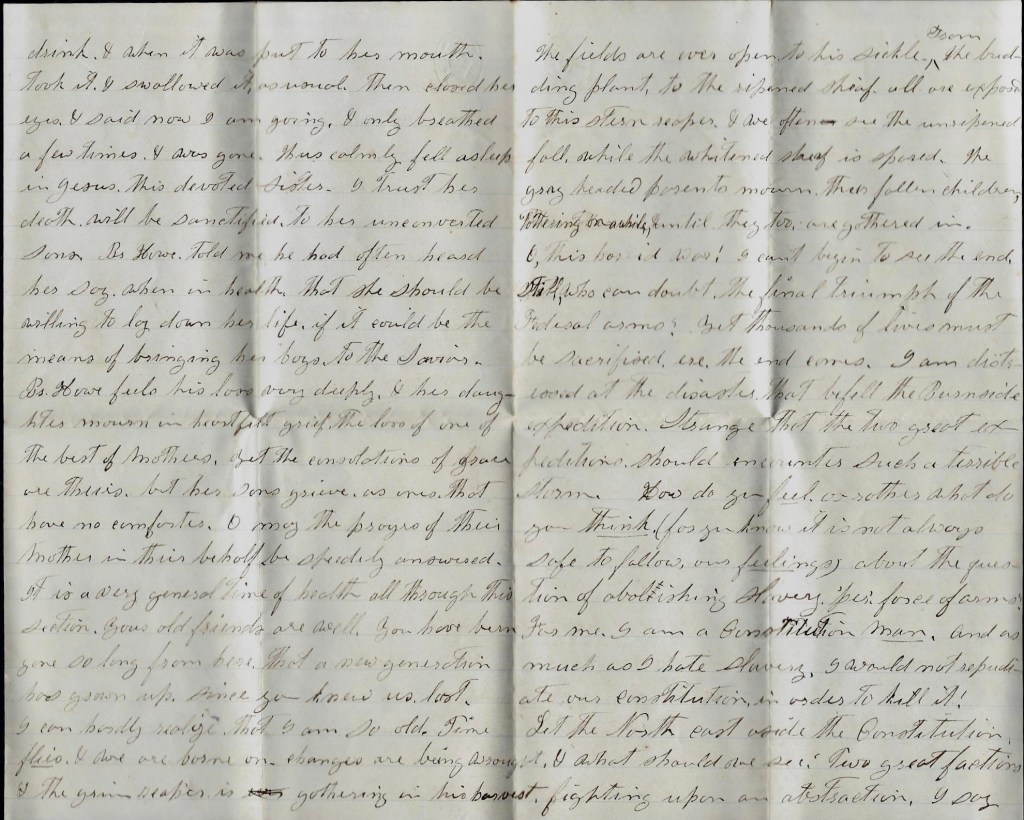
I suppose you have seen the Herald—that sister Elijah Howe has gone to her rest. She lingered on the banks of Jordan for months all ready to cross over & when the summons came, she calmly passed to the other shore. When told she was dying, she remarked, “This is the happiest day of my life.” She asked for drink and when it was put to her mouth, took it & swallowed it as usual. Then closed her eyes and said now I am going & only breathed a few times & was gone. Thus calmly fell asleep in Jesus. This devoted sister. I trust her death will be sanctified to her unconverted sons. Brother Howe told me he had often heard her say when in health that she should be willing to lay down her life if it could be the means of bringing her boys to the Savior. Brother Howe feels his loss very deeply & her daughter mourns in heartfelt grief the loss of one of the best of mothers. Yet the consolations of grace are theirs, but her sons grieve as ones that have no comforts. O may the prayers of their mother in their behalf be speedily answered.

It is a very general time of health all through the section. Your old friends are well. You have been gone so long from here that a new generation has grown up since you knew us. I can hardly realize that I am so old. Time flies & we are borne on. Changes are being wrought & the grim reaper is gathering in his harvest. The fields are ever open to his sickle from the budding plant to the ripened sheaf. All are exposed to this stern reaper and we often see the unripened fall while the whitened sheaf is spared. The gray headed parents to mourn their fallen children, tottering on awhile, until they too ar gathered in.

O, this horrid war! I can’t begin to see the end. Still, who can doubt the final triumph of the Federal arms? Yet thousands of lives must be sacrified ere the end comes. I am distressed at the disaster that befell the Burnside Expedition. Strange that the two great expeditions should encounter such a terrible storm.

How do you feel, or rather what do you think (for you know it is not always safe to follow our feelings) about the question of abolishing slavery per force of arms? For me, I am a constitution man, and as much as I hate slavery, I would not repudiate our Constitution in order to kill it! Let the North cast aside the Constitution & what should we see? Two great factions fighting upon an abstraction. I say fight it out on the Old Constitution, & if slavery gets its death blow in the struggle, so much the better. It seems fearful at such a time as this for the Nation to pull up her old landmarks, cast aside her anchor, and drift herself out on the wild waves of anarchy, trusting herself to the mercy of the contending elements. I might say more but I’ll wait & hear what you say upon the subject.

I got a letter from G. L. Smith the other day. He has two sons in the army on the Potomac. He says they are having a hard time and one of them is sick a great deal. How much anxiety & sorrow this unnatural war brings into thousands of households. You have your share, no doubt.

I saw the Dole mentioned in the report of the bombardment of Port Royal and I thought of a loved son on board her keel & of the fond mother in her home in the far North. I suppose you hear often from him. I should like much to get a letter from him.

Since I commenced this, Brother Brigham Read has called. He says the friends in Wardsboro are well as usual. Sister Daniel Read is quite an invalid but is able to be about the house and works some.

We are njoying our usual degree of health. Snow is deep with the prospect of having more. We have a new Post Office about a mile from us called the East Dover. Do n’t forget to change my address from Dover to East Dover. Write soon without fail. Remember me to all your family. Father and Mother send love to all. — S. Adoline Sparks


Letter 2

East Dover [Vermont]
March 15th 1863

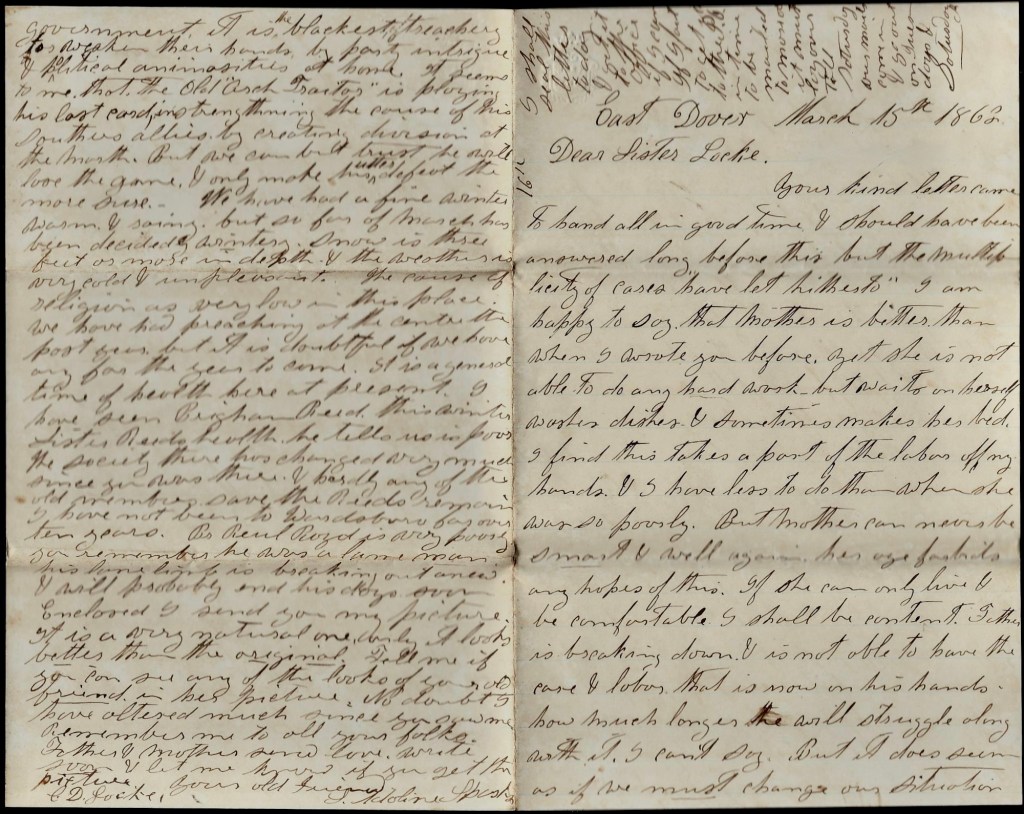
Dear Sister Locke,

Your kind letter came to hand all in good time & should have been answered long before this but the multiplicity of cares “have let hitherto.” I am happy to say that Mother is better than when I wrote you before, yet she is not able to do any hard work but wait on herself, washes dishes, and sometimes make her bed. I find this takes a part of the labors off my hands & I have less to do than when she was poorly. But Mother can never be smart & well again. Her age forbids any hopes of this. If she can only live & be comfortable, I shall be content. Father is breaking down & is not able to have the care & labor that is now on his hands. How much longer he will struggle along with it, I can’t say. But it does seem as if we must change our situation before long. I wish our farm was sold & we were on a small place—say just large enough to keep a cow & pig. But when this change will be brought about, I don’t know. It is hard for old people to leave the old homestead, you know, and nothing short of a necessity shall ever make my Father & Mother willing to do it. So how long we shall rub along, I’m sure I can’t tell.

My health is rather better than it was last fall & first of the winter. I was then pretty well worked down.

The young soldier I wrote you about that was sick with us is dead. He stayed with us & I took care of him while he lived. His uncle came for his corpse & carried it to Andover to be buried by the side of his Father. Our country!! What can we say upon this all absorbing subject! For one, I am distressed at the present state of things & had I not an unwavering confidence in the justice of our cause, and a firm trust in the God of armies, I should almost tremble for our fate. The division and rupture among our northern politicians is to be truly deplored. It really seems that a certain set of men think more of their party than they do of their country, or their God. How men can at such a time as this, when our nation is struggling for her life, when her very existence depends upon the result, how men can at such a time stop to bicker about trifles, how they can stoop to the meanness od making party issues or war measures just for the sake of building up a party, may well excite the wonder of all true patriots and the just indignation of loyal men.

When our armies have gained a few victories such as the taking of Vicksburg, Charleston, Savanah, & so on, Copperheadism will soon begin to hide its fangs, no doubt. While the brave and noble boys are suffering the privations of the camp, enduring the labors of war, and facing the dangers of the battlefield, all for the salvation of the government, it is the blackest treachery to weaken their hands by party intrigue & political animosities at home. It seems to me that the old “Arch Traitor” is playing his last card in strengthening the course of his southern allies by creating division at the North. But we can but trust he will lose the game & only make his utter defeat the more sure.

We have had a fine winter—warm and rainy—but so far of March has been decidedly wintery. Snow is three feet or more in depth & the weather is very cold & unpleasant.

The course of religion is very low in this place. We have had preaching at the centre the past year, but it is doubtful if we have any for the year to come. It is a general time of health here at present. I have seen Brigham Read this winter. Sister Read’s health, he tells us, is poor. The society there has changed very much since you was there & hardly one of the old members save the Reads remain. I have not been to Wardsboro for over ten years…

Enclosed I send you my picture. It is a very natural one only it looks better than the original. Tell me if you see any of the looks of your old friend in her picture. No doubt I have altered much since you saw me. Remember me to all your folks. Father and Mother send love. Write soon & let me know if you get the picture. Your old friend, — S. Adeline Sparks

I shall seal this letter today & get it to the post office…