I could not find an image of Charles but here is a CdV of an unidentified naval officer and possibly his wife. The LOC identifies the officer as a Third Assistant Engineer.
The following letter was written by Charles J. Henry (1829-1920) who served in the US Navy during the American Civil War. Charles was born in Weedsport, Cayuga county, New York on 13 December 1829. He was the son of Samuel Henry (1793-1841) and Harriet Peterse Voorhees (1793-1854). Now orphaned, John was married to Ruth Eliza Carter (1834-1916) on 20 December 1854 in Brewerton, Onondaga county, New York. He and Ruth had only one child—unnamed—who died at birth in mid-April 1861. In 1863, just prior to his enlistment in the Navy, Charles was employed in the manufacture of barrel staves in Brewerton—an industry that thrived at the time demanded by regional salt industry at Syracuse.
In late September 1863, Charles bid goodbye to his wife and went to the Brooklyn Navy Yard where he enlisted and was soon afterward assigned to the recently constructed side-wheel steam tugboat, USS Geranium. She had been designed for commercial use but the Navy acquired her for $13,500 on 5 September 1863 and had her commissioned on 15 October at the New York Navy Yard under Acting Ensign G. A. Winsor. She operated without armament as a support vessel. She measured 128 feet in length with a beam of 23 feet and displaced 356 tons, powered by a single beam steam engine producing 210 horsepower. During her naval career from 1863 to 1865, Geranium was assigned to Rear Admiral John A. Dahlgren’s South Atlantic Blockading Squadron, departing New York on 20 October 1863 and arriving off Charleston, South Carolina, on 4 November. She performed duties as a picket boat, dispatch vessel, and light transport, supporting operations at stations including Ossabaw Sound and the St. Johns River, while occasionally ferrying Admiral Dahlgren.
Notable actions included a July 1864 diversionary expedition up the Stono and North Edisto Rivers to disrupt Confederate rail lines, where she towed supplies, supported troops under General Birney, and engaged a Confederate battery at the Dawhoo River. In February 1865, she aided joint Army-Navy operations at Bull’s Bay, contributing to the evacuation of Charleston, and later conducted reconnaissance up the Santee River to facilitate supplies for General Sherman’s forces. After the war, she decommissioned at Washington, D. C., on 15 July 1865 and was sold to the Treasury Department on 18 October for $13,000 to join the Lighthouse Service.
In this incredible letter, written in early November 1863, Charles provided his brother-in-law William H. Carter with a detailed account of the vessel’s first voyage from New York City to the mouth of the St. Johns River in Florida. He provides us with a bystander’s view from the deck of the Geranium, inside the bar of Charleston Harbor, during the daytime shelling of Fort Sumter on November 4th and 5th 1863 as the old fort was being mercilessly reduced to a pile of rubble.
Charles’ service record indicates that the US Steamer Geranium was the only vessel her served on. He was made the Acting 2nd Assistant Engineer. He remained with her until his discharge from the Navy on 19 July 1865. After he was discharged, he lived in various localities including Albany (NY), Tunkhannock (PA), Leadville (CO), and Denver (CO) where he died in 1920. Two more children were born to the couple, in 1866 and in 1868, but neither lived more than a few months.
[Note: This letter is from the private collection of R. J. Ferry and was made available for transcription and publication on Spared & Shared by express consent.]
U. S. Steamer Geranium, launched 1863.
T R A N S C R I P T I O N
U. S. Steamer Geranium Mouth of St. Johns River, Florida November 8th 1863
Wm. H. Caiter,
Dear sir, I intended to have written you before this but when I have had a chance to send a letter I have improved it to write to my wife. I wrote her a short letter today thinking that if I occupied much time I would lose the chance. The steamer that took the letter has gone down the coast & if she calls here on the return, I will send this by her. This much in explanation of my giving more time to you than to her. Possibly she has not received all of my letters that I have written her, so I will give you a little history of occurences since we started from New York.
We left hte Brooklyn Navy Yard at 11 a.m. on the 18th of October & steamed down to Sandy Hook where we made fast to a buoy & hung on until the 20th at 11 a.m. Then started down the coast. We had a fine run, the sea being smooth & everything working well. We ran into James River & up to Newport News where we dropped anchor at 6.45 a.m. the 21st. On the 23rd we ran up to Norfolk (or Portsmouth Navy Yard) & took on coal & in the afternoon ran down to Fortress Monroe & dropped anchor.
On the 24th we started out to sea. The weather was thick and looked bad & we concluded to put back, which we did. The storm (from the N. E.) increased & we held on for it to subside. On the 29th at 2.30 a.m. we started. The wind was still fresh from the N. E. and quite a heavy sea running. Our great anxiety was to get past Cape Hatteras safely. As our boat was not intended for a sea going craft, we felt a little anxious to know how she would weather a storm, but fortune favored us & we passed the Rubicon safely, though we had some rather grand & lofty tumbling.
At 11.20 a.m. on the 30th we dropped anchor at Beaufort, North Carolina, where we remained until 6.20 a.m. on the 3rd November. At 4.15 p.m. we spoke Blockading steamer off Wilmington. On the 4th about 5 a.m. (I had just turned in and got in a fine sleep), I was awakened by the gong beating “all hands to quarters.” This was the first specimen of a warlike character that we had put on. It was brought about as follows. It appears that we were steaming along at good speed, the sea smooth & the weather a little misty, when some object was discovered ahead a little off the starboard bow. It was so indistinct that we could not make out whether it was an “Alabama” or a vessel & as a man-of-war is expected to be ready for any emergency, so we got ready.
We shortly overhauled it & found it a sailing vessel. We fired a blank cartridge aft of her & brought her to, sent a boat off to her to ascertain her character. In the meantime we were ready for a brush if she chose it. The boat returned & reported her a Sutler’s Schooner bound for Morris Island with stores, had lost her reckoning and did not know where she was. We gave her the course & then slunk away without having a fight or capturing a prize. I reckon the poor fellows on the schooner thought they were goners when we blazed away at them.
We heard firing in the direction of Charleston about 8.30 on the 4th & at 10 o’clock [Fort] Sumter was in sight. We ran down to the flag ship & reported & then steamed in over the bar & dropped anchor about 4 miles from Sumter at 11.30 a.m., the fort bearing N. W. by N. We laid there until evening. Our shore batteries were constantly shelling the fort day and night. In the evening we steamed outside to the blockade fleet. In the morning (the 5th) we ran in again. This day a couple of the monitors moved up to the attack of the first assisted by the shore batteries. We could see all the operations with the naked eye & with the aid of a glass everything was made perfectly distinct. The firing was very accurate—almost every shot striking the fort & throwing up clouds of dust. The rebel flag was flying over the fort bidding defiance to its assailants. I could not but admire the pluck of the men who so bravely stood by their flag. No men could be discovered in the fort but there must have been some there.
The walls of Sumter are very thick & as the top is toppled down the debris forms and embankment on each side which virtually strengthens the remaining portion of the wall. This powdered mass, when a shell bursts in it, is thrown into the air & much of it falls back to its original place. Some splendid shots are made by the monitors but it will requite a great deal of patience and powder to render Sumter perfectly untenable.
On the 6th, the Rebel flag was shot down & I watched to see it go up again but it was dangerous business & up to 2 p.m. no signs of the flag were visible. At 2 p.m. we were ordered away to this station to relieve a gunboat that had broken her machinery. We arrived here yesterday the 7th at 2.30 p.m., ran up the St. Johns River about 15 miles & returned to the mouth on the blockade. There is a Reb steamer up the river laden with cotton which is expected every night to try to run the blockade & we are on the watch for her. We lay with steam up all of the while ready to start at a moment’s notice & if she gets away from us, she must do some tall traveling & some fighting, but I don’t apprehend that she will do much of the latter.
Our boat is not a very fast one but we can get about 12 miles out of her. She is built very much like the Oneida, but more beam and draws more water. She is 125 feet long, 24 foot beam. Wheels 21 feet draw buckets 6 feet x 22. Engine 34 inch cylinder & 8 foot stroke. Draft of water averages 7 feet. She is not in good running trim. She is down by the head too much to run good, but when we get some of the coal out of her, she will do better. We carry 39 men & officers as follows. 1 Ensign in charge 2 Master Mates, One 2d Asst. Engineer in charge. Three 3d Assistants. Three 1st Class Firemen, Three 2nd class Firemen. Three coal heavers. One Storekeeper for Engine dept. One Paymaster’s Clerk & the balance seamen, ordinary seamen, landman, boys &c. You see that in the Engineering Department, there are 14 men. What would you think of putting that number on the Oneida to attend to her Engine Department? There are times, however, when all are needed & it would not be good policy to run short handed—especially here where if a man is sick, you can’t go ashore & pick up a man when you want one.
We can’ tell how long we shall stay here—perhaps a month & perhaps a good many of them. I have not been ashore & know but little about the country around here but I am not favorably impressed by the limited view I have from the boat. Still there are some bright spots. Fish about here. Oysters in any quantity alongside. Oranges &c. to be had close by. Money is on no use here. Once can’t spend it & in buying articles from the natives, they refuse money but will exchange for sugar, cheese, butter, or any kind of stores.
After reading this, I would be obliged to you if you would send it to my wife as my letter to her was so short owing to the hurry which it was written that I am not satisfied with it. I would be pleased to hear from you when you have leisure to write. My regards to Mrs. Carter & your family. Yours truly, Chas. J. Henry
It seems improbable that the identify of the author of this letter will never be revealed. From the content we learn that he was a resident of Georgetown, District of Columbia; that both of his parents were still living in 1861; that his father held some “office” of importance, and that he voted Republican despite having his job threatened for doing so. This implies to me that held a political patronage job in the central government. His initials appear to read “G. W.” but was it his first and last name or his first and middle name?
The author was likely affiliated with the Democratic Party and benefited from a political patronage position during the Buchanan administration; however, he assigns full responsibility to the Democratic Party for its inability to secure victory in the 1860 Presidential Election, attributing this failure to the party’s lack of unity in supporting a single candidate against the Republican nominee.
T R A N S C R I P T I O N
[Georgetown, District of Columbia] October 29th 1861
My dear Uncle,
Your welcome letter has been received. We were all delighted to hear from you & yours & that you were all well. I wrote a short time ago in regard to those articles of furniture. Do you not think it best to dispose of them? particularly the carpets? The moth will eat them up. I really do not think they will ever get them again though no one can tell. I trust they may indeed.
You wrote me word that you were going to write Cowan a letter. I think upon reflection you had better not as he threatened to have Father turned out sometime ago. He may probably do more harm than good. Is Senator Cowan of Pennsylvania a brother of his? I should like very much to have some good paying place. I think after the treatment of the Democratic Party, I ought to have something. Although holding only a temporary place under government, I voted for the opposition candidate to the Democratic & at the last election for a regular Republican, when all were told they would be removed from their office if they either time, & I boldly & fearlessly did it in both instances.
I have always bitterly opposed Democracy in every shape & form, and was delighted when they were defeated & hope & pray to God they may never have the reigns again. They have broken up the glorious Union—one which could never be surpassed in this world & one which every American should be proud to live in. I glory in the Stars & Stripes. Oh! what a shame that such a country as ours should be degraded by a civil war. Had Old Buchanan only reinforced Fort Sumter, then, in my opinion, all this would have been prevented. I should have reinforced it at all hazards had I been the President.
There is a tremendous army here and General McClellan so far has proven himself a great man. It looks very lively here in Georgetown.
There is nothing new. I trust this may find you and yours all well. All are well here except Father. He has an awful cold. I am beginning to feel uneasy about him. He is advanced in life now and of course we cannot expect him to live a great while longer. His memory is a good deal impaired. Mother is unhappy about him. Please do not name it because should he hear it, he will give me beans. I trust his memory may last as long as life lasts. Otherwise, he may lose his Office & that would be a very sad thing & a melancholy one too. He looks very well but the slightest change gives him cold.
Well, I must close. Love to all. I tell you my little growing family makes me scratch my head some now. Reply soon & believe me yours sincerely, — G. W.
Your letter postmarked the 22nd I never received until the 27th, making five days. What is the cause? I presume the times makes a difference.
The following letters were written by James Hopkins (1839-1904), the son of William Hopkins (1805-1863) and Emma Goodwyn Hopkins (1808-1868) of Richland county, South Carolina. James attended the University of Virginia and during the Civil War served in the States Rights Guards, Co. B 1 of the 9th South Carolina Infantry and Co. K of the 4th South Carolina Cavalry. He was wounded on Oct. 22, 1862, at the Second Battle of Pocotaligo and was captured at the Battle of Matadequin Creek, Va., on May 30, 1864. He was held as a prisoner of war at Point Lookout, Md., until he was exchanged in March 1865.
Mentioned in several of the letters was English Hopkins (1842-1918), a younger brother of James. English also attended the University of Virginia and served in the same regiments as his brother, though he was not an officer.
1 Co. B—the States Rights Guards (aka the Fork Troop)—was one of the three companies of the original 2nd SC Regiment (SCV) that refused to serve in Virginia during April of 1861. The men were from the lower part of Richland District, and having remained in Charleston, SC it also helped to form the nucleus of the 9th SC Regiment (SCV). While at Ridgeville, SC in Colleton District (Dorchester County today) on June 27, 1861 the men mustered into Confederate service for twelve months, effective April 8, 1861. Duncan William Ray, MD was elected Captain in State service on April 8, 1861, and was then elected Lt. Colonel of the 9th SC Regiment (SCV) on July 12, 1861. 1st Lieutenant Robert Adams was promoted to succeed him as Captain of Company B on that same date. When the 9th SC Regiment (SCV) was disbanded in April of 1862, some of the men enlisted in Company C and 2nd Company H of the 6th SC Regiment (SCV), and two (2) men joined 2nd Company A of the 5th SC Regiment (SCV).
[Note: The following letters are from a private collection (RM) and were offered for transcription and publication on Spared & Shared by express consent.]
Letter 1
Mississippi, Madison county June the 29th 1860
Dear Sir,
Yours dated the 11th inst. was received on Saturday last. I regret very much to say to you that Betsy’s child died yesterday morning. It seemed to have been doing pretty well until last Sunday evening. It taken bowel complaint and we could not with all exertions check them up. But I think its disease was an incurable one. It had ulcers broken out on it as large as a five cent piece. I took the prescription you wrote me and showed it to Doctor [William Alston] Cheek 1 and tried to get him to make up some for me to give the child but he wouldn’t agree to give it to it. I told him I would much rather he would give it. He said he would take the responsibility on himself if the child died. You must blame it on him. All of the rest is well except Old Woman Chany. She has been complaining some this week.
We have passed off another dry week. On Tuesday evening it clouded up and rained a little shower enough to run in the yard a little. It continued cloudy and threatened to rain until last night [when] it all passed off and never rained any to do any good. It will be ten weeks next Monday since we have had a full season. My cotton crop is not doing well by no means. I never in all my life saw half as many lice has been here on our cotton for the last week. I will make a finish of hauling in my oats tomorrow. I will get twelve or fifteen wagon loads. I have got all of my wheat wined over one time but I expect to clean it over again. I received the book you sent me. Yours truly, — J Hopkins
I am very much obliged to you for them.
1 Dr. William Alston Cheek (1825-1897) was born in North Carolina. In was enumerated in Beat 4, Madison county, Mississippi in the 1860 US Census. He died in Canton, MS, in 1897.
Letter 2
Mississippi, Madison county January 4, 1861
Dear Sir,
Yours dated the 24th of last month was received on last Monday. We have had a severe spell of bad weather here which has lasted nearly fifteen days. It commenced snowing here on Saturday night last and snowed until Sunday evening. In consequence of the weather being so bad, I have not done much out door work. I think in my last letter I wrote you I had received the draft you sent me. I also [think] I wrote you that the corn you ordered was shipped. I have been hauling it home this week. I have about 250 bushels home.
I see from your letter and the Columbia papers that you are all now independent—an independent state. I hope Mississippi will be out in a few days. I was down in Canton yesterday. I was told that there was a telegraph dispatch [received] there before that Mr. Buchanan was going to send an army there to whip you all back into the Union but the people of Canton don’t believe a word of it. But they say if it is true and he does what he says he will, they will come to South Carolina and help to fight. All are well. Yours truly, — J. Hopkins
N. B. I settled up for the Brown land the other day but never got the title until a few days past. All of the Legatees signed it.
Letter 3
Morris Island April 12, 1861 Five minutes to Seven a.m.
Dear Father,
Regional view of Charleston Harbor showing the city of Charleston on the Ashley and Cooper rivers, Castle Pinckney on Shute’s Folly Island, Pleasantville and Mt. Pleasant Battery, Mechanicsville and batteries on Sullivan’s Island, and the Morris and James island batteries, and their distances from Fort Sumter.
I am now encamped with the States Rights Guards on Morris Island. The batteries from Fort Moultrie have opened upon Fort Sumter. The batteries on our Island for a shot now and then. The firing was commenced about daybreak this morning and still continues. They are only firing shells. Some say that Anderson have not returned fire as yet. Others say that he has. He has not fired often for I have been looking at Fort Sumter. I do not think that Anderson can be hurt much with shells. I am quite comfortably fixed, but am afraid that I will have to move. We understood last night that Fort Sumter was to be fired upon at eight and consequently to sleep upon our arms, but the firing was delayed until this morning. Anderson can do a great deal of damage but he seems to treat our firing with silent contempt—at least so far. I have to stop now. I am called to arms. Direct to me at Morris Island, States Rights Guards. — J. Hopkins (wrong direction, you will see the right directions at the end of the letter)
April 13th 1861, 9:30 a.m. o’clock. Our batteries have fired Fort Sumter. It still burns. 1 There is some talk of storming it but I do not know whether it will be attempted or not. I stood guard last night from seven until nine, was in all of the hard rain, was relieved at nine and went back at two and was relieved at four. I slept on the ground on two boards for about a half an hour before daybreak (in the open air). I only slept a half an hour during the whole night and that was just before daybreak. I slept with my head on the breach of my musket. I got very wet. Never was so tired in all my life but I have on dry clothes this morning and none the worse—only I am very sleepy.
We have been under arms ever since we arrived expecting the landing of forces from the ships in the harbor. An attempt was made but our men were too much on the alert for the Black Republicans. We will sleep on our arms tonight. Although Fort Sumter is on fire, Anderson still has his flag up.
I lost my large valise. I think it is on the Island but have not received it and do not expect to. I have not received my uniform as yet. I cannot tell you whether I will be allowed to have a boy or not. Do not send him till I write for him. Anderson is still firing. One of his balls fell about fifty yards from us yesterday. Not a man has been killed by Anderson. A mortar bursted and kill[ed] twenty men, so says rumor.
Direct to James Hopkins, Capt. [Duncan William] Ray’s Company, 2 S. C. Volunteers, Charleston
Your affectionate son, — James Hopkins
Give my love to all. Remember me to Cousin Kizzy. I am well. — J. Hopkins
1 Most reports of the bombardment claim that a dense volume of smoke was seen suddenly to arise from Fort Sumter following at explosion around 9 o’clock a.m. of April 13th 1861.
2 Duncan William Ray, MD, (1812-1868), of Richland District, was Captain of the States Rights Guards in the original 2nd SC Regiment (SCV) that refused to march to Virginia. This Company became Company B—the Fork Troop—in this, the 9th SC Regiment (SCV). During the second election of Field Officers on July 12, 1861, he was elected Lt. Colonel of the 9th SC Regiment (SCV) in lieu of Dixon Barnes (above) who had been elected on July 5th. Dr. Duncan William Ray graduated from the University of Pennsylvania and was a well-known physician and planter in Lower Richland County, South Carolina.
Letter 4
Mississippi, Mad[ison] County May the 3rd, 1861
Dear Sir,
I have had no letter from you this week but hope to get one in the morning when I send to the office. I have been hard down all this week with my men force trying to get the old trees cut and rolled up. I have got all the timber that was blown down on my cotton land rolled up this week. I had to just cut up such trees as I could carry and pile up. Large trees I cannot do anything with them but cut up the tops for it would have been impossible to rolled them over the cotton. I wrote you last Sunday that I would cut and burn them but when I commenced working at them I found it never would do, so I just rolled them on piles and plough around them the best I could. It will take me another week with my men to get the timber piled so I can do anything with them. There is some places in the land that I cleared last winter that I cannot do anything with in consequence of so much timber being on it.
We have had more heavy rain here this year tham I ever witnessed in the spring. On Monday evening last it commenced raining and continued all night as hard as ever you heard it I recon. Yesterday we had another wet day. Our swamp has been flooded up this week so that I could do nothing but roll up logs this week. I see my cotton has not come up as well as I would like but that is very easy accounted for nothing like corn or cotton could come up with the rain that has fallen here for the last four weeks. I don’t see how I am to save my wheat & oats and take care of my corn and cotton, losing so much time now. [It] will throw me late in getting my crop worked over. But rest assured, I will do all I can to save both. I see my wheat has got the rust in it. But I only noticed it on the blades. I don’t see any on the stalk yet. I have been searching my oats to see if it had attacked them but didn’t discover any. There is a good deal of complaint in the country of the oats and wheat having the rust. I have ploughed around 160 acres of corn this week. I couldn’t get [ ] tomorrow but will finish on Monday.
I see that Old Abe has declared war and nothing else will do him but it. There was 1200 Louisiana troops passed through Canton last Tuesday for Virginia. All are well.
Yours truly, — J. Hopkins
Letter 5
[Editor’s Note:From September 14-20, 1861, the 9th SC Regiment (SCV) performed picket duty, which included light picket firing. Circa September 25th, the Regiment was again on picket duty for three (3) days near Lewinsville, then again October 5-9 at Wells Cross Roads, both in Virginia. On October 16th, the Regiment left Germantown for McLean’s Ford, VA and was engaged in picket firing the next day near the Makeley House, where it mistakenly fired on a Georgia regiment. The 9th SC Regiment (SCV) took one or two (1 or 2) prisoners only to discover they were Georgians.]
Camp near Germantown [Fairfax county, Va.] September 24th 1861
Dear Father,
We returned from picket duty last Friday night, being out ever since the Saturday before [Sept. 14-20]. The Lancaster Greys [Co. A], the rifle company on the right of our regiment, killed six or seven Yankees. One was killed in six or eight steps of one of their (Lancaster Greys) posts. Capt. Whitworth’s Company [Co. C] took one prisoner. They shot at him twice but did not hit him. He threw down his arms and ran up to them and said, “I Suderner, you Suderner.” He was a Hungarian. He wanted to make out he was a “suderner” but they took him and sent him a prisoner to Headquarters. The one that was killed so near the post of the Lancaster Greys was a Vermonter. He lived about two hours after he was shot, the bullet going through him, breaking his backbone. He said his name was W. A. Snow 1 from Vermont. Some of our men dug a grave and buried him without a coffin.
I got two shots with English’s rifle but did no harm. I crawled about a hundred and fifty yards in advance of my post and shot from the top of a hill at a fellow in a yard about two hundred and fifty yards distant. He was walking at the time. I had the sights of the rifle raised to 400 yards. Consequently, I shot over his head but he ran as if the old fellow was behind him. The second time I was on post. English saw a fellow about 400 yards off. English was terribly excited. He fired at him with a musket although I ordered him not to do it. I was fixing up the rifle at the time, it having got wet the day before. After English shot, the fellow hardly moved but raised his gun and fired at my post (I had five men at my post besides myself). Then I took a crack at him with the rifle but it snapped before it fired and I did not touch the fellow. He dodged very low as if he heard the ball above him. He fired two more shots at out post. We could hear the bullets whizzing above us plain. We could not get another shot at him on account of thick bushes between him and us.
Orders were read out on dress parade yesterday evening to the effect that we should not fire at the enemy’s pickets—only in self defense. While we were on picket, we lived mostly on roast corn and Irish potatoes without salt, and slept under the blue canopy of heaven for our shelter. The place where we were on duty is thirteen or fourteen miles from this camp. You may be certain that all were tired and a great many had sore feet. We rested about half an hour after our arrival and then the five companies on the right were ordered to go on picket, our company being the second on the right was, consequently, in for it. We came back Friday night, foot sore, wearied, and hungry sure! I could scarcely walk when I got here. English stood it very well indeed! We were very glad when we got back to camp.
I forgot to mention that Nathan Roberts, one of our company, received a slight wound on the cheek. He is about fifteen years old—a meddlesome, impudent little fellow. The ball just grazed his cheek. He bellowed and ran like a clever fellow. It was his own fault. He would not obey the sergeant in command of his post. He said he was dying, said he was shot in the heart. Everybody had laughed at him and were rather glad than sorry that he was wounded slightly. He proved himself a coward. Before he was a great brag and bother to the whole company. He behaves himself now and keeps as quiet as a mouse. You cannot see a sign of his wound now.
I am sorry to say I have not received my box. Mr. House has lost it if you sent it by him; he brought the others safe but lost mine. Send by Adams Express next time. Tell Mother just to send the rest of the shirts and socks & not to make up for those Mr. House lost. Send us some preserves and other good things. English is complaining a little about his same disease. I am quite well. Hasgow is sick with jaundice. He is better today. Send to Lee’s Pills. Our company is improving fast. All from our neighborhood are improving fast. John Coon and Jim McCrea are quite sick, the only sick cases in the company. Write soon. Remember me to all. English says he will write today. Your affectionate son, — J. Hopkins
1 James remembered his name as “W. A. Snow” but it was surely William E. Snow (1841-1861) of Co. H, 2nd Vermont Infantry. Only the 1st, 2nd, and 3rd Vermont regiments had been formed and deployed to Virginia by September 1861 and William was the only private in any of these three regiments whose first name started with a “W.” His military records indicate he was “wounded” while on picket and taken POW. He was officially removed from the muster rolls on 30 September 1861. William was the son of Lewis and Hannah (Shaw) Snow of Milton, Chittenden county, Vermont.
Letter 6
Camp of CSA June 15, 1863
Dear Mother,
Your letter was received last week. I hope sister is not seriously ill. I will excuse her for not writing to me but hope to hear from her soon. I wrote to Father yesterday and to Sallie today.
Jack Bates came to camp Friday last and returned yesterday. He was looking very bad indeed. He intends to put in a substitute. I think he is perfectly right for he is not able to stand the service. If he continues in service another year, I believe it will kill him. He did not bring the wine. He will bring it this week. He expects to bring his substitute down tomorrow or next day.
Please send me a small box with some ginger and pound cakes, a loaf of light bread, a can of butter, and about a peck of flour. We have lard. Also send a few cucumbers and squashes. Put the things in as small a box as possible. If no one at home eats the fig preserves, you had better send them to me. Please make me a bottle or two of cherry bonnce [?] and send me—that is, if you have the cherries. I left the pad that goes behind my saddle to keep my blanket off the horse’s back. Please send it to me. Have as small a box as possible. Bob has written home for two or three hams and other things. Bob has changed a great deal in his ways. I like him better than I ever did. He is very much liked by the whole company. Bob, Joel, and myself mess together. you could not find any three men who agree together more harmoniously than we do. I do not find camp life anything like as unpleasant and disagreeable as I did before I went home.
Dr. Gregorie has examined me. He says I can do camp guard and drill but I must not go on picket. I am feeling very well indeed. My wound is getting better. I believe in a few days it will be entirely healed up. Our company went on picket Saturday and returned to camp yesterday. I did not go on picket. I concluded to run the blockade and go to Savannah which I suceeded in doing safely. I got back Sunday morning nine o’clock.
We have rain nearly every day. It is very cloudy now. It will rain in few hours. I eat dinner at Mr. Gregorie’s yesterday. It is the second time I have been to see him since my return. Mrs. Gregorie sends her respects to you. Mr. Gregorie says he has not heard from father for some time and seems very anxious to hear from him. I have heard that Father has sent for his negroes. Is it so? Write soon as you can and let e know all the news. Please send the box by Express as soon as you can. Remember me to all at home and to Cousin Kizzie. I remain as ever, your affectionate son, — James Hopkins
Regrettably, the author’s identity of this unsigned essay remains a tantalizing mystery, with scant clues to piece together even a fleeting guess at authorship. If I had to wager, I’d propose it was penned by a young man from New York City—perhaps in his late teens—who harbored lofty theological ambitions and possibly attending classes in Litchfield, Connecticut. Despite my internet sleuthing, I’ve come up empty-handed; no evidence suggests this piece was ever published in a book or newspaper. My gut tells me it was likely a personal draft, perhaps intended for publication, yet its final resting place remains unknown.
Though it can’t be pinned to a specific hand, this essay vividly encapsulates the turmoil rippling through the Northern states from the moment the shots rang out over Fort Sumter until the rise of Gen. McClellan—who is described as “the gift of God to a devoted, loyal people.” Such language perfectly encapsulates the anxiety and fervor of the times, and invokes the belief that calamity will only befall a Nation that does not place its trust in God.
Transcription
New York [City] August 21, 1861
One month ago today occurred the battle and the panic of Bull’s Run and in that month thus following so great a national disaster, there has been time and cause for many hours of bitter thoughtfulness. We entered upon this serious crisis in our history with such a confidence in the right of our cause and the stability of our government that the determined effort to crush rebellion and annihilate that treasonable spirit which had been growing in our midst for years did not appear at the outset a formidable work to accomplish. But today, with no less confidence in our ultimate success and no less faith in Him who gave us the precious government for which we are contending, we are awake to the consciousness that God has given us a task to accomplish which we must perform in sorrow and the seed of which we must sow in tears. We know that we are not just passing beneath a cloud the end of which we cannot see, that in its deepest darkness there must be privations, sufferings and painful sacrifices, but we also feel with a conviction the intensity of which is sublimely prophetic that He who gave us so miraculously our existence as a Nation will never desert us in our terrible struggle to preserve that existence and that nationality under the government which He has always blessed to us.
The month just passed has seemed a breathing space in the commencement of a weary struggle. The mind has availed itself of a relief from immediate excitement to review the past few months of our eventful history and call up one by one the incidents that here give it so great an interest.
First came that Friday night on the 12th of April last when the scarcely credited intelligence fell on the ear that the bombardment of Fort Sumpter ad commenced. I went down to the news offices between 8 and 9 o’clock in the evening and read the announcement on the different bulletins with feelings strange and new. On the cars in the street, in every place of business, the expression passed from mouth to mouth, “The war has actually begun.” A nation went to a troubled slumber on that Friday night. Then followed the day of wild excitement when almost every home brought some fresh account of the disastrous and uneven siege until night closed in upon the week with the news that the gallant little garrison had been overpowered by besieging thousand and Sumpter had fallen into rebel hands. What a day was that Sabbath which followed the intense excitement of a few preceding hours. What a week did it open to an aroused and patriotic people. What a springing to arms. What an impetus towards Washington and the following Sabbath. Who ever saw a Sabbath like it in the City of New York? When the usual quietude of Sunday was broken by strains of martial music and churches were almost deserted in the eagerness to bid farewell to thousands who embarked that morning for the seat of war. I remember well the expression of our dear little pastor from the pulpit that morning: “It is hard, my brethren, for me to merge the patriot in the preacher.”
Patriotism swallowed up every other impulse on that day and those who lingered in God’s sanctuary to offer up their prayers felt as they had never felt before. How precious in the hour of peril was the “Rock of Ages” beneath which a Nation could find shelter and protection. The constant departure of regiments, the Great Union Meeting, the news of brave men cut down in the very commencement of their usefulness—Ellsworth, [ ], Greble, Withrop, and so recently, the noble Gen. Lyon. All these are fresh in our memories and our hearts.
The day that followed the battle of Bull’s Run when the news gradually reached New York was one of those the least of all likely to be forgotten. Morning brought us the news of a great victory but as the day come on, the story became reversed, a retreat in order, a complete rout, a panic, slaughter and destruction, anxious friends spoke low and tremblingly. Parents started for the Capitol. Mothers sat in tears and every face wore marks of deep anxiety. This was the most painful day of all. On the morning following I went to Litchfield and all along the route the sush for morning papers was eager and exciting. Each day succeeding brought less painful details until the public mind became possessed of every circumstance and reconciled itself to the unpleasant, unanticipated change in our affairs. And thus we stand today with a renewed confidence in the fresh leader of our forces, General McClellan, and the assurance that under his guidance, our army has now attained an almost invincible efficiency. The man seems to have risen for the emergency—the gift of God to a devoted, loyal people.
We have but one danger to guard against, a forgetfulness ofHim who alone can give us a victory. We must be Christian Patriots. We must bring our troubles and the acknowledgment of our sins to Him who will deliver us from both. We must be certain of success only through Him who alone can give it to us and with this certainty or with this Faith success is already ours. Today we stand looking into a future that must be eventful. The eyes of the world are upon us and our greatness which was never more apparent was never more strongly tested than now. At such a time there is the most urgent need and there should be the most earnest desire for the spirit of God to guide and direct us. Let us hope then that as a people we shall not be indifferent in seeking for it, or unsuccessful in obtaining it—the one being dependent upon the other, remembering always with a sacred zeal that “where the Spirit of God is, there is Liberty.” 1
1 “Where the Spirit of God is, there is Liberty.” 2 Corinthians 3:17.
The following diary was kept by William Elmer Potter (1840-1896), the son of James Boyd Potter (1796-1865) and Jane Barron (1798-1855) of Bridgeton, Cumberland county, New Jersey. After attending public schools, William attended Harmony Academy where he remained until 1854. He then became a pupil at the West Jersey Academy during its first session, under the tutorship of Professors Snyder and Stevenson, but in October of 1857, having determined upon the law as a profession, entered the office of Hon. John T. Nixon. He remained until September 9, and the same month became a student of the law school of Harvard University. From this school he graduated in January, 1861, with the degree of L.L.B., and in September of the same year entered the junior class of Princeton College.
In July 1862, William put his collegiate studies aside and accepted a commission as 2nd Lieutenant in Co. K, 12th New Jersey Infantry and mustered into the service of the United States as such Sept. 4, 1862. He was promoted to a first lieutenancy of the same company and regiment Aug. 6, 1863, and to the captaincy of Company G Feb. 4, 1864. Capt. Potter became brevet major United States Volunteers for meritorious services, May 1, 1865, by promotion of the President of the United States, and was, in 1866, commissioned aide-de-camp to Governor Marcus L. Ward, of New Jersey, with the rank of lieutenant-colonel, upon whose staff he served for three years.
During this period Col. Potter was present in the following engagements: Chancellorsville, Gettysburg, Auburn, Bristow Station, Blackburn’s Ford, Locust Grove, campaign of Mine Run, Morton’s Ford, Wilderness, Cold Harbor, Petersburg, Deep Bottom, Crater, Deep Bottom (second engagement), Reams’ Station, Boydton Road, assault and capture of Petersburg, Rice’s Station, and Appomattox Court-House. By an order from headquarters, Twenty-fourth Army Corps, in company with five other officers, he was detailed to deliver the colors surrendered by Gen. Lee’s army, seventy-six in number, to Hon. Edwin M. Stanton, of the War Department, at Washington, which ceremony occurred on May 1, 1865. He was the only New Jersey officer present on this occasion.
During the period of time that William recorded the page of the diary presented below, he appears to have been living at home in Bridgeton, Cumberland county, New Jersey, and working as a clerk in the county court house, possible for the sheriff’s department.
[Note: This diary is housed at the Princeton University Library but has not been previously transcribed and published. See William E. Potter Diary, 1859-1862]
Transcription
Monday, February 11, 1861—As usual at office. Evening call at Mrs. Reeds. She at present is in Newcastle. See Mr. & Mrs. B. F. E. Call at Dr. William Elmer’s. Ladies not at home. Call at R[obert] S[hute] Bucks’. 1 See the young ladies. Invite me to Dancing Party at their house tomorrow evening.
Tuesday, February 12—Nothing occurs. Receive today from Messrs. Cromelien & Co. account against Joshua C. Surran to collect if the thing be possible, which query? Nothing happens of moment. Do not go up to R. S. B.’s to the little assemblage this evening. Have some reading to do.
Wednesday, February 13—Day passes as usual at office. Evening call at Jonathan Elmer’s. Meet Miss S. H. B. Play backgammon and other games. Have most pleasant evening.
Thursday, February 14—Nothing unusual occures. “Sociable” meets this evening at H. B. Lupton’s. Do not go however. Play game of chess with Frank in which I am beaten. Tennessee has gone for the Union by a majority of more than fifty thousand. The home of Jackson has again proved her devotion to the Union which he loved so well. Weather most unpleasant. Walking miserable. Evening damp and disagreeable. The winter climate of South Jersey is most uncomfortable.
Friday, February 15—Day as usual at office. Nothing of importance.
Saturday, February 16—Nothing occurs worth noting. Read anatomy, &c.
Sunday, February 17—Mr. A. Bunn preaches in church in morning. Go to hear Mr. ]Joseph W.] Hubbard [Presbyterian Church] in evening. Good sermon.
Public Ledger, 19 Feb. 1861, page 3
Monday, February 18—Morning at office as usual. Read case of Arnold vs. Mandy, 1 Halsted, concerning rights of Riparian owners. Afternoon at 4 pm leave in steamer Patuxent for Philadelphia in company with C. M. R., J. H. Elmer, and others. Quite a party joins us at Greenwich, all intent on same purpose with ourselves—namely, to see Mr. Lincoln, our Executive-elect, at Trenton or Philadelphia. The passage in the boat, being a night passage, was not of the most pleasant description. The weather was quite cold and the windward side of the boat agreed with the weather. I got an hour or two’s sleep, however. We arrive in Philadelphia about 5 a.m. Elmer, Riley, and I go to the Union Hotel and to bed. Sleep until about 9 a.m. In morning call on Thompson at his offfice. Evening go to see [James Edward] Murdock play in “Elder Brother” at Walnut St. Theatre. Splendid elocutionist.
Wednesday, February 20—Morning stroll about the city. Afternoon at 3 p.m. leave Kensington Depot for Trenton. Here we find most of our Cumberland Party who had gone up in the morning train. Evening, visit those celebrated rooms of Camden & Amboy Company, Nos. 10, Trenton House, and 7, American House. Am introduced to E. H. Stevens, Esq., General Cook, Hon. T. Jones Yorke and other worthies of like or lesser ilk. Many amusing things occur during the evening and we have on the whole a very lively time.
1 Robert Shute Buck (1802-1877) of Bridgeton, Cumberland county, New Jersey, was apprenticed to a miller at an early age. At 23, he entered politics as a Whig and was elected to the office of county sheriff. He then entered into the manufacture of bone buttons, and in 1836, entered into the iron business—the Cumberland Nail & Iron Company. He was married to Caroline James and their children included Sarah (“Sallie”) Buck, born 1838, and Clara Reeves Buck, (b. 1843), both mentioned in the diary pages that follow.
Thursday, February 21—Only limited number of tickets having been issued to admit persons to the Capitol, there was of course a great demand for them. Through the kind assistance of F. F. Patterson, Esq., we were admitted as a Special Reporter, on the platform close to the chair of the President of the Senate. Adjoining me were the Philadelphia Committee who had come thus far to meet Mr. Lincoln.
Mr. Lincoln and part of his suite entered about 12:15 and was introduced to President of Senate who welcomed him in a short address. Mr. Lincoln in a finely modulated voice replied, speaking of his early interest in the revolutionary struggle in New Jersey, &c. in a speech of between five and ten minutes in length. His is a very tall man, standing if I am not mistaken about six feet three inches high. His countenance bears the impress of grave and earnest thought, as well as of great coolness and determination. But when he begins to speak, how his whole face lights up with one of the most pleasant and heartfelt smiles that we have ever seen. I pray the Supreme Being who presides over the destinies of nations, and old individuals, that this grave, earnest, thoughtful, determined man, may prove, if need be, a second Washington to our Country. If there be anything in physiognomy—and experience has proven that there is—he is the man for the present crisis.
Mr. Lincoln dined at the Trenton House. Our party left Trenton at 1:32 p.m., arriving in city about 3:30 p.m. Elmer, Riley, and I go to Continental. Mr. Lincoln arrives in Philadelphia about 4 p.m., and at Continental about 6 p.m. makes short address from balcony to vast crowd assembled in front of Hotel. Evening receives citizenry in parlor of Continental. I retire early—i. e., about 12 p.m.
Friday, February 22—This morning at sunrise, Mr. Lincoln raised American flag to staff over Independence Hall. I do not go on account of crowd. Start for home at 9 a.m. Riley and Elmer do not go. In stage, W. G. N., P. Luellam, E. M. Hood, and others. Have quite lively ride. Stars & Stripes floating at crossroads. Cheer them in one or two instances as we ride by. Arrive home about 3:30 p.m. Evening attend Celebration of Washington Society of Andeton, in their Hall at Hotel of E. Deor’s & Son. Quite a large number of their friends present. President of Society, J. Leslie Lupton, reader of Washington’s Address, Henry Jordan; Orator of evening, William Cox. Cox speaks very well. Short addresses made by Judge Elmer & Rev. Mr. Hubbard. After which we adjourn to the dining hall where we partake of elegant collation. After drinking the regular toasts, in response to a personal toast, I make the Society a little speech. Adjourn at 21 o’clock. One hundred and twenty-nine years ago this day, George Washington was born. Would to Heaven that the same fraternal feeling pervaded our land today as existed at the hour of his death.
Saturday, February 23—Nothing occurs. Evening call on H. M. E.
Sunday, February 24—Nothing happens.Church at Dr. Jones, twice.
Monday, February 25—Nothing happens. See H[enry] T. Ellett of Mi[ssissippi]. Has been appointed Postmaster General to Southern Confederacy. Reward of treason. Will find it a barren scepter.
Tuesday, February 26—J. J. Reeves leaves en route for Cambridge today. I should like very much to visit the old spot once more.
Wednesday, February 27—Nothing happens of importance. Weather remarkably warm and pleasant.
Thursday, February 28—Nothing happens. Mr. Lincoln seems to be very favorably received at Washington. The personal qualities of the man are gaining him many friends.
Friday, March 1—Brother Robert in company with others starts for Washington to be present at the Inauguration, Nothing occurs.
Saturday, March 2—Morning as usual. Afternoon the same. Evening call at Dr. Eben Elmer’s in company with Loring Kirby, Esq.
Sunday, March 3—Church as usual. Morning at Jones’. Evening at Hubbard’s Nothing happens.
Monday, March 4—Day of Inauguration of new government. Through vigilance of General Scott, everything passes off quietly, whatever may have been the event otherwise. One of the most important days in the history of the government. I trust it may be the herald of a glorious and universal dawning of peace and prosperity throughout the land. Evening attend party at R. S. Buck’s given in honor of eighteenth birthday of charming Miss Clara. Young ladies look remarkably well.
Tuesday, March 5—President Lincoln’s inaugural arrives today. It is eminently conciliatory, though firm in its tone, and seems to be received with favor by men of all parties. He takes the position that he will invade no state, but that he will collect the revenue and hold, occupy and possess the property of the United States. The address is characterized by great ability, as well as conciseness. Its general effect cannot be anything but pacific.
Wednesday, March 6—Day nothing happens. Evening call at Miss H. M. E.’s.
Thursday, March 7—Nothing occurs. Southern papers are endeavoring to consider Lincoln’s Inaugural a declaration of war. One thing is very true, that as Mr. Lincoln’s remarks—there will be no war unless the government is attacked. If humanity is to be disgraced, civilization checked and Christianity overshadowed, by an internecine war upon this continent, it should be the prayer of the good in all lands, in light or darkness, on the battlefield or in the councils, that God will defend his unalterable right. And who can doubt that such right lies upon the side of the government.
Friday, March 8—Hon. Jno. T[hompson] Nixon returns from Washington last night. Today finish [John Henry] Stephens’ [book] on Pleading[in Civil Actions]. Commenced February 25, 1861 being third time that I have red it. Evening at home.
Saturday, March 9—Day as usual. Nothing happens. Weather March-like. Write letters to R. G. Thompson and to Father. Evening call at R. S. Buck’s. Miss Clara entertains me, Sallie being out. Have a pleasant evening.
Sunday, March 10—Morning attend Mr. Hubbard’s church. Mr. Davis of Deerfield preaches good sermon. Evening Dr. Jones.’ Rumored that small pox is in town. H. E. Hughes, Esq., has the varioloid. I was vaccinated last Thursday.
Parton’s Vol. III on Andrew Jackson considered by Atlantic Monthly to be the “best biography” written in the country.
Monday, March 11—Day as usual. Do not feel very well in morning. Think that I do not exercise enough. Evening at home. Read [James] Parton’s Jackson, Vol. III., Grote’s Greece, Vol. I. Jackson’s life gives one a good insight into the political history of the country from 1823 until Jackson’s death. The critics call it the best biography written in the country. Vide Atlantic Monthly for March.
Tuesday, March 12—Day as usual at office. Evening at home. Read Parton’s Jackson, Grote’s Greece. Nothing occurs. Rumored that troops will be withdrawn from Fort Sumpter. Trust that it may be incorrect.
Wednesday, March 13—Morning at office. Afternoon meeting of congregation to decide whether we are to enlarge our old church or not. Decided so to do by vote of fifty-two to fourteen. Old subscription collected under former vote of congregation to build church on west side of creek, ordered to be annulled. Parties who paid their money in, ordered to be paid back. Amusing scenes occurred. Weather warm. Evening lecture Dr. Jones. Call afterwards in H. M. E.
Thursday, March 14—Morning as usual. Also afternoon. Day damp and cold. Nothing occurs during day. Yesterday made a most solemn vow. Evening pleasant “Sociable” at Mrs. W. G. N.’s
Friday, March 15—Day as usual. Nothing of importance occurs. Evening call with Loring Kirby, Esq., on Miss Lillie Sheppard. See herself and sister Jennie. Have pleasant chat. Afterwards call at R. S. B[uck’s]. See the two young ladies [Clara & Sallie]. Home.
Saturday, March 16—Day as usual. J. B. B[owen] returns from Philadelphia with degree of M. S. Evening call at Dr. Wm. E’s. Have not been able to read much by gas light for some days. Eyes are growing weak, I fear.
Sunday, March 17—Morning Mr. Davis of Deerfield preached at Dr. Jones’ church. Most excellent sermon. Finest by far that I have heard since my return home. Evening go to hear Mr. Hubbard.
Monday, March 18—Day as usual. Cold and in afternoon comes on to snow with every appearance of hard storm. Evening at home. J[ohn] T[hompson] Nixon leaves for Washington.
Tuesday, March 19—Snow several inches deep this morning, with every appearance of continuation. Sleighs out. Afternoon, Jno. B[uck] Bowen 1 calls after me with horses & sleigh to go sleighing with the Misses Buck. Good time but poor sleighing.
Wednesday, March 20—Morning at office. J. S. M. quite unwell. Quite busy drawing declarations, &c. &c. On looking over Curtis’ History of Constitution a few days since, with a view to ascertain Hamilton’s views on our Constitution, found that in the convention he stated his opinion to be (Vol. II, page 113): 1st, That he believed the British Constitution was the best form of government the world had then produced, citing the praise bestowed on it by Hecker “That it is the only government which unites public strength, with individual security.” 2nd, That he was equally convinced that none but a republican form could be attempted in this country, or would be adapted to our situation. 3rd, That he proposed to look to the British Constitution for nothing but those elements of stability and permanency which a republican system requires, and which may be incorporated into it, without changing its characteristic principles. Curtis gathers this summary of his opinions from the Brief of Hamilton works, Vol. II, 409., collated with Madison’s Report and Judge Yates’ Minutes,
Since Wednesday last, it has been a dark week with me. I a great trouble pressed me down. I trust that a kind and merciful God may cause it soon to pass away from our family. It is said, in old tradition, that there is a ghost in every house. This may be the mere embodiment of the idea that every family has their own peculiar subject of anxiety and distress. This last week, I shall always remember as a sad period. It has witnessed for myself, however, a most important resolution. God help me to keep it.
1 Dr. John Buck Bowen (1839-1888) was the son of Dr. William Smith Bowen (1802-1872) and Martha Hawthorn Buck (1814-1847) of Bridgeton, Cumberland county, New Jersey. John later served as an Assistant Surgeon in the 34th New Jersey Infantry.
The papers today bring the news, which is some measure rumor has forestalled, that the orders for the evacuation of Fort Sumpter have at length been issued. This will be received with sorrow by many, and can be justified on the ground that if it is done as a military move only.
Thursday, March 21—Day as usual. Snows all morning. Quite wintry for this time in March. Evening call with Jno. B. B[owen]. at Dr. Wm. Elmer’s. Also at R. S. B[uck’s]. Not able to read on account of eyes at night.
Friday, March 22—Morning as usual at office. Nothing happens of very much importance. Evening call at Charles E. Elmore’s. See himself and wife. President Lincoln has appointed Mr. [William Lewis] Dayton Minister to France. This has deservedly caused great rejoicing in New Jersey.
Saturday, March 23—Day passes at office, Nothing unusual occurs. Read Williams Exec. as usual. Afternoon in company with Jno. S. Mitchell, ride out to Wildwood. Visit Railroad which begins to assume the appearance of a reality. Evening at home.
Sunday, March 24—Church at Dr. Jones’ morning & evening. Nothing happens of importance. Sermons dullish. Weather clear.
Monday, March 25—Day as usual. Evening with article of Chronicle on the “Defect in our Government.” Take ground that its great defect is the want of internal strength. Do not read much this evening. Receive letter from Thompson.
Tuesday, March 26—Day as usual. Call on Miss Sallie B[uck] Have very pleasant evening. Nothing occurs today of importance.
Wednesday, March 27—Day as usual. Evening attend little company at Jno. B. Bowen’s. Quite a number there. Seem to enjoy themselves, one and all.
Thursday, March 28—Day as usual at office. Still reading, William’s Executors. Nothing important occurs. Evening “Sociable.” Meet at D. P. Elmer’s. I attend. Pleasant evening. Moonlight walk afterwards.
Friday, March 29—Pleasant weather. Sunshine prevails for once at least over the storm. Morning nothing occurs. Evening call in H. M. E. Lizzie L. & Maggie, Elmer call. Pleasant evening. Affairs of our Nation grow no better. The present position of an American citizen is, that he is secure under the protection of his government, all over the world, except within the borders of the United States. A loyal citizen may be murdered in South Carolina, and by the state authorities too, for expressing his allegiance to the United States, and our general government cannot punish the offenders.
Saturday, March 30—Morning as usual. Nothing happens of interest. Evening spent at Sarah’s. F. F. Westcott, Esq., of Cedarville being there. Also Miss Sallie H. B[uck]. Pleasant evening.
Sunday, March 31—Morning church at Dr. Jones.’ Take dinner at Sarah;s with F. F. W[estcott] After dinner walk out with him as far as Shiloh Bridge. Evening church at Dr. Jones.’ Have resolved today if possible to enter Princeton College in the summer. I shall regret it all my life if i enter upon the duties of my profession without a collegiate education—not that a collegiate education is indispensable to success, but because the want of it must in the nature of things, be severely felt through life. One does not feel that confidence in himself that he otherwise would. At least, such is my experience. I do not feel entitled to demand of Father, after all his kindness to me, this additional favor, but if he will send me, I will most gladly go.
Weather pleasant today, though windy as usual. Tomorrow is April 1st. The month of March has slipped by most rapidly—so rapidly indeed that it seems that one can hardly realize that it has come and gone.
Monday, April 1st—Morning as usual. Speak to Father concerning my going to college. He says he will take time to consider it. I do not know what decision he may give, but hardly think he will refuse me when he sees that I really desire to go. Rainy day. April begins in a cool, disagreeable mood.
Receive today, pamphlet from J. J. Reeves, Esq., containing Parson’s discourse on Constitution of United States delivered before Law School, March 7, 1861, as introduction to his course on Constitutional Law. Evening home.
Tuesday, April 2nd—Pleasanter than yesterday. At work nearly all day writing Sheriff’s Deeds. Evening at home. Read Parton’s Life of Jackson. Is an admirably written biography giving an insight into the political history of the country which I have obtained nowhere else.
Wednesday, April 3rd—Morning clear and bright. Have placed today in the front part of this diary the remarks of Alexander H. Stephens, V. President of the revolutionary government in the South, concerning the principles upon which said government is founded. He abandons the old untenable ground that slavery is a national institution, and lays down the proposition that under the new government, slavery is recognized as the fundamental basis of the government. He says, “that the prevailing ideas entertained by Jefferson and most of the leading statesmen at the time of the formation of the constitution, were that the enslavement of the African was in violation of the laws of nature; that it was wrong in principle, socially, morally, and politically. These ideas, however, were fundamentally wrong. Our new government is founded upon exactly the opposite idea; its foundations are laid, its cornerstone rests upon the great truth, that the negro is not equal to the white man. That slavery, subordination to the superior race, is his natural and moral condition. This, our new government, is the first in the history of the world based upon this great physical, philosophical and moral truth.”
Such is the testimony of Alexander H. Stephens, the leafing statesman of the South. The government of the United States is founded upon the eternal basis of Freedom, the revolutionary government has for its base and cornerstone the principle that human bondage is the only true condition of a perfect government. It has taken the world six thousand years to make this discovery at all, and we trust it will be longer than that ere it abandons one inch beyond its present position. The two governments are before the world, one based upon freedom, the other on slavery. Can there be any doubt concerning their future history?
Wrote to James J. Reeves at Cambridge. Evening spend with Jno. S. Mitchell at his house. We read Carlyle’s Essay on Burns—a most beautiful production. Pass an unusually pleasant evening.
Thursday, April 4th—Day opens finely, clear and bright, with just sufficient breeze to make the atmosphere bracing. How one’s pulse beats upon a morning like this when walking in the open air. How bright the future seems, how clear is the brain. So much does our intellectual, yes, even our moral feeling depend upon our physical condition. Ill health makes many a misanthrope, while on the other hand, a sound physical organization, and an abundance of animal spirits, enables many persons to exceed the great mass of their fellows in pursuits for which intellectually speaking, they are by no means peculiarly fitted. Evening attend the exhibition of the students of West Jersey Academy in Grosscup’s Hall. On the whole, the students perform well. My nephew, Boyd. N., declaims well. Bridgeton Brass Band makes its first appearance in a public meeting. They were only organized about the middle of November last and already are quite proficient, playing some thirty tunes. the Hall was much crowded with the friends of the Academy and everything passed off pleasantly.
Friday, April 5th—Morning as usual at office. Nothing happens. Afternoon 4:45 p.m., walk up to Tumbling Down with Oring Kirby. In coming down on Race side, see some ladies waving handkerchief on other sie to which we reply by waving our own. Take tea at W. G. N.’s. Evening pass at R. S. Bucks with Miss Sallie. Clara absent.
Saturday, April 6th—Morning office as usual. Pleasant day. Afternoon at office. Write letter to George T. Slack, Esq., at Cambridge. Papers today bring us the news that Government is preparing to assert and defend its rights. It has the sympathy of the civilized world and the support of eighteen millions of freemen. God grant us all the disposition, the heart and hand, to play a patriotic part in the coming struggle. Mail today to W. Cromelieu & Co., 721 Market Street, Philadelphia the account against Joshua Surran, Esq., sent me some time since for collection. Surran having no property, and not paying, it is impossible to do anything with it. Evening call with Miss S[allie] H. B[uck] and Lillie S. Very pleasant evening.
Sunday, April 7th—Church at Dr. Jones’ morning & evening. Good sermon in morning. In evening after church walk with C. M. R. as far as Academy. Nothing occurs important.
Monday, April 8th—Morning dull and cloudy. At office as usual. Evening attend the Sabbath School Concert. Afterwards walk out with H. M. E. and make a call at her house.
Tuesday, April 9th—Father gives me no answer as yet with regard to my entering college in August. Very perplexing to know what is my fate.
Wednesday, April 10th—Let this day be marked with a white stone. Father today told me to go to college if I so desired. How kind it is in my Father thus to offer me every advantage. I shall do my utmost to improve the opportunity thus given me. I feel assured that I can appreciate a college course at this time much better than ever before. Read 1st Volume of Williams’ Executors to page 267. Here most probably will begin an interruption on my legal studies. I lay them temporarily aside with regret mingling with my pleasure. I have enjoyed the study of law since my first entrance in it more than any study which I ever pursued. I feel that I have only entered the outer courts of the great temple of jurisprudence, but even here, I can discern how fair is its architecture, how magnificent its proportion’s. Evening studying at home.
Thursday, April 11th—Study morning…Evening at home.
Saturday, April 12—Morning study at home. Read thirty lines…After dinner, walk down to the wharf to witness launching of the new schooner. Through some accident, she does not go off. The papers today bring us the tidings that the rebels opened their fire upon Fort Sumpter. The war commenced upon Friday last, Who, oh who, knows the ending thereof?
Sunday, April 13th—Nothing of importance happens.
Monday, April 14th—All excitement. Fort Sumpter surrendered, or rather was evacuated after forty hours continual bombardment. The excitement in Philadelphia is terrible. All united for the government. President issues a proclamation calling for seventy-five thousand of the militia of the United States to suppress the insurrection. Response being made all over the country.
Tuesday, April 15—Excitement increasing. But one feeling in the North—to support our flag at all hazards!
Wednesday, April 16—Excitement still increasing. Volunteer companies being raised constantly. New York appropriated three millions of money and is to raise thirty thousand volunteers.
Thursday, April 17—No particular news. Excitement intense.
Friday, April 18—Massachusetts regiment arrived in Philadelphia.
Saturday, April 19—Start this morning for Philadelphia in early line to Glassboro. Arrived in Philadelphia about 10 a.m. People greatly excited about the attack made by mob in Baltimore upon Massachusetts troops. Several of Mass. troops killed. They fire upon mob killing a number. Pennsylvania troops also attacked. Being unarmed, they are forced to return to Philadelphia. The attack upon the unarmed troops has greatly excited the Philadelphians as well as the whole country. The North has become so fully aroused that nothing but the omnipotent hand of God can stay their vengeance. Evening walk about the city with Thompson and John B[uck] Bowen. J. B. B. spends the night with me at hotel.
Sunday, April 20—Morning walk about city. Afternoon go with Thompson to Jno. Chambers’ church. Evening go with Thompson and Bowen to hear Wadsworth. No being in his pulpit, we do not stay. Great excitement at Continental [Hotel]. Meet Robert there.
Rumor of arrival of three hundred thousand improved arms from Europe. Philadelphia presents today almost the appearance of a vast military camp. The public squares full of troops drilling the whole day through as also were the various [ ].
Monday, April 21—Morning do errands about the city. Afternoon at 3 p.m., start for home. Arrive per New Jersey Railroad and Glassboro stage, about 8 p.m. Find that a large meeting was held in Bridgeton on Saturday evening. Resolved to raise funds to support the families of volunteers. Company is being raised. Numbers already fifty-six men. Greatest excitement in Bridgeton that I have ever seen.
Tuesday, April 22—At home all day. Nothing of importance except the military excitement. Was measured while in the city for coat at Ethan Thompson’s. Vest & pants. At parties at southeast corner 6th & Market. Frank unwell.
From April 22nd to May 11th. Most stirring period in our country’s history. Troops called out by President. Three hundred thousand men arriving in North. Cannot recount in this diary the events.
Wednesday, May 8th—Today presentation of flag to “Cumberland Grays” by ladies of Bridgeton too place. P. T. Jones, Esq., of Philadelphia, made address in behalf of ladies. I received it on part of the company un few remarks. Grosscup’s Hall crowded. See Chronicle of May 11th.
From May 11th to June 23—Great events occurring in country. Make one or two visits to Philadelphia.
June 24, Monday—Start for Princeton to be examined for admission to Junior Class. W. E. Lufton also. J. Leslie, Superintendent for Admission to Sophomore. I stop at Philadelphia, go to Trenton at 6 P.M. Meet them there having returned from the examination.
Tuesday, June 25—Am today examined by Prof. Cameron in Greek…Latin…Mathematics. Am admitted.
Wednesday, June 26—Pass to Princeton with W. Elmer & friends. Commencement today.
Thursday, June 27—Stop in Trenton. See grand review of three regiments of volunteers at Camp Olden by Gov. Olden and staff. Stop at Continental at Philadelphia.
Friday, June 28—Reach home. Nothing new.
…..
Wednesday, July 17—Meet Wm. Keighler, Esq. of Baltimore on cars. Find his views have changed since last winter. Now almost if not entirely secessionist. Arrive in Washington at 6 p.m. Put up at Ebbitt House, not being able o get into Willard’s. Evening pass in room of Messrs. [John Thompson] Nixon and [John L. N.] Stratton. Army of Union made advance on Fairfax today.
Thursday, July 18—Pass in visiting Patent Office, Capitol, etc. In Congress, Mr. Nixon introduced us to Emerson Etheridge, [Robert] Mallory of Kentucky, Col. Crittenden of do. [Charles] Delano of Mass., Frank P. Blair of Mo., &c. Etheridge most agreeable conversationalist.
Friday, July 19—Visit Alexandria, now occupied by our troops. Deserted city. Houses closed. Grass growing in streets. Secessionists plenty but silent. Three secessionists in a Slave Pen taken night before at Bulls Run. Return to Washington, hire hack, and cross Long Bridge into Virginia. Visit Forts Runyon, Albany, and Corcoran, Arlington House, headquarters at present of New York 8th commanding beautiful view of Washington and the Potomac. Return to Washington, visit Capitol. Evening spend with Messrs. Stratton and Nixon.
Saturday, July 20th—Start for W at 4:15 a.m. Reach Philadelphia at 10:30 a.m. Start for Bridgeton at 3 p.m., arriving at home much pleased with visit at 7 p.m.
Sunday, July 21—Nothing of particular importance occurs in Bridgeton.
Monday, July 22nd—Learn that great battle occurred yesterday between our forces and the rebels. Our army after driving enemy before them until 4 p.m. were repulsed. Enemy was too much exhausted to pursue or else were not aware of our condition. Great slaughter on both sides.
Tuesday, July 23—Troops pouring into Washington from all directions. Gen. McClellan has been sent for from Western Virginia and will assume command at once. The country seems to be recovering from the first alarm, and considers our repulse in the light of salutary lesson. It appears that with a force of at most fifty thousand men under McDowell, we attacked 90,000 in their entrenchments. No wonder that we did not succeed. Yet even under these disadvantages we were nearly victorious. If the reserve of 18,000 men under Col. Miles had been ordered up promptly, we would have gained the day, for at the very time we retired, the enemy was falling back along his whole lines.
From Tuesday, July 23 to Wednesday August 13th, nothing of importance occurs to me personally. Great events are occurring with such rapidity in the country at large that I find it impossible to chronicle them here. Time passed principally in boating, riding, loafing, and other like employments. Impossible to study on vacation and under a July sun.
The following letter was written by Freeman Walker (1825-1864) who enlisted as a private in Co. K, 27th Georgia Infantry in March 1862. After he was promoted to sergeant, he was taken a prisoner in the fighting at South Mountain on 14 September 1862 and confined at Fort Delaware until 10 November 1862 when he was exchanged at Aiken’s Landing, Virginia. After returning to the regiment he was elected 2nd Lieutenant on 16 March 1863. In March 1864 he was reported as slightly wounded by a gunshot wound to his right leg. He died on 27 June 1864.
I’m reasonably confident that Freeman Walker was John Freeman Walker (b. 1825), the son of Johnson Walker (1794-1830) and Sarah Swindall (1797-1854) of Talbot county, Georgia. He had been married to Julia Ann Dixon (1825-1852) but she died in 1852, leaving him a widower with two children.
Freeman addressed his letter to Fannie. I suspect she was his older sister, Frances (“Fannie”) Walker, born 1817, and the wife of Green J. Miller.
The interior of Fort Sumter during the time Freeman Walker was there, December 1863.
Transcription
James Island [South Carolina] December 16th 1863
Dear Fannie,
As I have just returned from Fort Sumter you can account for my long silence. I started to the fort in a day or two after I wrote and remained fifteen days. I stayed three days over the usual time in consequence of high winds and rough seas, the relief boats not being able to reach the fort.
I had the good fortune to escape unhurt except a lick on the head from a brickbat which was knocked off the top of the wall by a 200 pound parrot shell. I was walking on the outside of the wall and come very near being covered up with brick. There were several killed and wounded while I was there and the day after I was relieved, the Magazine exploded killing ten and wounding thirty. Dr. [J. T.] Ford, who used to practice medicine at Pleasant Hill was killed. His body was so blackened and burnt that it was past recognition. Several of our regiment were wounded, but [only] one killed—Dr. Ford. Ab[ner] and Henry Bedell lost their blankets by the fire. They both escaped without injury. The fort is not materially injured and will soon be repaired. 1
There is nothing interest in camp. It is the impression that the siege will be raised by the enemy as they have despaired of taking Charleston.
I lost my valise coming on with my drawers and socks. I wish you would send me some of the above articles by Marion Smith when he comes back. A knife and fork also as they were in the valise and lost.
Tell the judge I will write him in a day or two as Col. Zachy returned today. My love to all. Yours, — Freeman Walker
1 In the history of the fort, it is stated that for an “unknown reason, “the small-arms magazine exploded in the officers’ quarters of a three-story building extending the entire length of the gorge on December 11, 1863, killing 11 and wounding 41 Confederates. The explosion also tilted the arch over the magazine’s entrance.”The explosion occurred at 9:30 a.m. on 11 December 1863; the cause of the explosion known only to those who perished in it. The enemy had not fired a shot for several days.
The following incredible letter was written by T. W. G. Inglet (1839-1910), the son of Mathew Wilkes Inglet (1806-1889) and Annie Baggett (1809-1873) of Bath, Richmond county, Georgia. Thomas was married to Martha Anna (“Mattie”) Palmer (1843-1916) in February 1856 when Mattie was only 16. By the time this letter was written in September 1863, 20 year-old Mattie had lost two young daughters who died within a week of each other in August 1862—probably due to some childhood illness—and her third child, Virginia (b. 18 May 1863) would die less than a year later on 28 March 1864. Thomas was a wheelwright, a trade he learned from his father.
During the Civil War, Thomas served the Confederacy by enlisting in Co. C, 28th Georgia Infantry. He was present for all of the major battle of the regiment including Williamsburg, Seven Pines, Mechanicsville, Malvern Hill, South Mountain, Boonesboro Gap, Sharpsburg, Fredericksburg, Chancellorsville and Gettysburg before this letter of 2 September 1863 when we learn that he volunteered with others of his regiment to defend Fort Sumter. It appears from his record that he was part of the Fort Sumter garrison from August through December 1863 before returning to the field and participating in the fighting in the Wilderness and defending Petersburg.
Thomas enlisted as a private on 10 September 1861. He was elected 2nd Corporal on 1 August 1863. His pension record shows he was wounded in the left hand and had two fingers amputated at Cold Harbor, Virginia, on 27 June 1862. He was wounded in the right foot at Darbytown Road, Virginia, on 7 October 1864. He was furloughed from Jackson Hospital in Richmond, Virginia, in 1864. At the close of the war he was in a hospital in Augusta, Georgia.
This letter was written from Fort Sumter in the days following Gillmore’s 7-day bombardment of the fort that had reduced it to a pile of rubble. Less than a week later, the fort withstood an amphibious assault planned for the night of September 8-9. The lack of cooperation between the Federal Army and Navy, however, resulting in poor coordination of the attack, and the “surprise” attack was foiled. The fighting lasted only twenty minutes and resulted in 124 Union casualties while the Confederate infantrymen defending the fort did not lose a single man.
Rebel occupied Fort Sumter as it looked in late August 1863 (LOC)
Transcription
Fort Sumter, S. C. September 2, 1863
My dear wife,
I will write you a few lines to let you know that I am well and I hope this may find you and the baby the same and all of the rest. My dear, I have a hope to write if the Yankees would let me write it. I am in Fort Sumter and so is Dennis and W[illiam] H[enry] [Little] 1 and L. Cliett. We all volunteered to defend it. The Yankees shell it day and night with four hundred pounders. The fort is tore all to pieces and not a gun on it for service. I don’t sleep day nor night. 2 Last night, six monitors come up and shell us all night with shells fifteen inches through but no one got hurt.
Last Sunday three got wounded but not bad. On the 29th, four monitors come up and Fort Moultrie made them draw off and we hit one of them 27 times, or that is Fort Moultrie did. Hurt one of them very bad.
Last Sunday night [1 September 1863], the 23rd Georgia Regiment and a North Carolina Regiment was coming off of Morris Island on a steamboat and got down too far towards the Yankees and Fort Moultrie fired on them and struck the boat three times and killed a good many of them and they all jumped off but a few and swam to Fort Sumter. It was a half a mile and some got drowned. 3
You must give my love to all and receive the greatest part for yourself. Direct your letters as you did before to the regiment. Goodbye my love, — T. W. G. Inglet
to his love.
W. H. Little says tell Mollie that he is well and he says tell her that he wants to see her very bad. And tell her that he is doing better than he ever did before in the war for he gets plenty to eat. He says tell her that he is so sleepy he can’t write today but he will write soon. He says give his love to all of the family and tell them to write to him. Hand this to Mollie.
William Henry Littleof Chattanooga county served in Co. K, 21st Georgia Infantry. He was wounded at Sharpsburg.
1 William Henry Little (1840-1907) was the son of William McLaws Little and Dicey Jane Rhodes of Richmond county, Georgia. He married Mary Elizabeth Inglett on July 20, 1860 in Richmond county, Georgia and was the father of 13 known children. He became a convert to the LDS church, being baptized in 1888 in Richmond county, Georgia, and was taught the gospel by missionaries Albert Smith, David Bennion, John Browning, Moroni Dunford, William Spry, and Jed Ballentyne, among others. He immigrated to Ogden, Utah with his extended family consisting of about 57 converts in early 1889. He took a second wife, Dorothea Elizabeth Anderson, a Danish convert, marrying her on April 7, 1899. That marriage was solemnized in the Salt Lake Temple on April 11, 1899. In May, 1905, he went on a mission to the Southern States with his first wife and labored in Atlanta and Augusta, Georgia. He returned home in September, 1906. He was the proprietor of the old Lincoln Hotel on 23rd Street and the Central Hotel on 25th Street in Ogden, Utah. He died at the hotel on August 27, 1907.
2 In mid-July 1863, Gen. Gillmore gave up his plans to take Battery Wagner and turned his attention on Fort Sumter. Anticipating an attack, Confederates began rapidly strengthening the fort by bringing in gangs of Negroes to place sand against the gorge and adding a second dock, while shifting the remaining guns in the fort to better positions. The attack on Fort Sumter began on 17 August 1863 and on the first day alone, some 948 projectiles were thrown at the fort, 445 of them striking inside, 233 hitting the exterior, and 270 passing over the fort. There were only 19 casualties reported inside the fort. On the second day, 876 shots were fired at the fort. On the third day, 780 shots. On the 4th day, Union forces used a 300-pounder Parrott gun to throw shells at the fort and three slightly wounded casualties were reported. The firing continued until August 24th when General Gillmore wrote Gen. Halleck that, “I have the honor to report the practical demolition of Fort Sumter as a result of our seven days of bombardment…” Immediately after this bombardment, all but one artillery company was removed from Sumter to be replaced by 150 infantry. Presumably it was at this time that Inglett entered the fort.[See “Combat History of Fort Sumter, 1863-1865” by Hobart G. Cawed (1962).
3 This incident of friendly fire casualties sustained by the Confederacy is not well known. The incident took place during the night of 30 August 1863 when the steamer Sumter was transporting Confederate troops from Morris Island to Fort Johnson. Since the tide was too low that night to go the usual route, they went in the direction of Sullivan’s Island and were fired upon by gunners at Fort Moultrie. Capt. Mitchell of Co. C, 23rd Georgia, claimed that the troops were from his regiment as well as the 20th South Carolina. He claimed the third and fourth shots sunk the steamer
Col. Charles Ray Brayton, 3rd Rhode Island Heavy Artillery
Charles R. Brayton (1840-1910) was born in Warwick, Rhode Island to William Daniel Brayton and Anna Maud (Clarke) Brayton. In 1857, his father was elected as a Republican representing Rhode Island in the U.S. Congress. In 1859, he began attending Brown University in Providence, but left in the middle of his second year to join the 3rd Rhode Island Heavy Artillery. He was commissioned as first lieutenant in 1861, promoted to lieutenant colonel in 1863, and to colonel in April 1864. He was honorably mustered out of service in October 1864. In March 1865, along with many others, he received a brevet (honorary promotion) to the rank of brigadier general. That same year, just a month before the end of the war, he married Antoinette Percival Belden.
Charles wrote the letter to Col. Edwin Metcalf of the 3rd Rhode Island Heavy Artillery. At the time of this letter, the 3rd Rhode Island Heavies were still stationed on Morris and Folly Islands near Charleston, South Carolina.
[Note: These letters are from the personal collection of Greg Herr and were transcribed and published on Spared & Shared by express consent.]
Letter 1
Headquarters Battery C, 3rd Rhode Island Vol. Artillery Morris Island, South Carolina September 14, 1863
Dear Colonel,
Thinking you would be pleased to hear from us on Morris Island and having something to say on my own account which I intended to have said to you personally before you went home, I write this epistle. You may think me presumptuous, egotistical, and inordinately ambitious for so young a man when I ask that if Frieze is removed, I may have his position as Lieut. Colonel. There are many reasons why I should not have it—my age, present position in the line, and three Majors besides. There are also others why I feel that I could fill the position as well as an officer in the regiment, certainly with as much credit and satisfaction to yourself as the present incumbent. I hardly think you would recommend any of the “Senior” Captains for the position. Neither would your judgement lead you to select either Day or Bailey for equally strong reasons.
Ames is the only Field Officer that can fill the position with any credit, either to the regiment or himself. The simple fact that he is now my Senior should not, I think, weigh against me as he entered the service as 2nd Lieutenant and I as a 1st, and owes his seniority not to any particular ability for, or claim to, the position over me, but to his good fortune in securing the vacancy. My experience is varied and my opportunities for acquiring a practical knowledge of both artillery and infantry are as great as his. How well each may have improved them is not for me to say. I know of no claim he possesses more valid than mine, provided you do not intend to promote any other officer, assuming the position to lie between us. Other have claims of rank and age, &c., which must be overlooked if Ames should be promoted for he too must “jump” as well as I to reach the position.
As far as satisfaction in the regiment goes, I think my promotion would cause less ill feeling than his for he is looked upon by some of our old Captains as an “outsider” without claims to anything higher than his present position. If I ever have a Field Position, I don’t want to be hampered by anyone. I want to be 2nd and it is just as easy to make me so as to give me any Field Position. I have written you just as I feel and just as I would talk to you were you where I could see you. Don’t think me crazy or foolish. I confess I am ambitious, inordinately so perhaps. I have a name and reputation to establish and maintain and daily see chances that I could improve were I a Field Officer. I am thrown in contact with me, much higher in rank who seem to possess but little qualifications for their positions. If their actions is a safe criterion to judge by, how easy to take the lead of such men and obtain for my regiment and myself the preferment they are too lazy to strive for.
I know I am young but that makes but little difference. I do not wish to disparage the capabilities of any officer, but am anxious to get ahead for if promotion is as slow as before, I shall be gray before I command the Army of the Potomac. I do not ask you to commit yourself, I only offer the above for your consideration—content to abide your judgement.
You have heard of the occupation of [Forts] Wagner and Gregg by our forces and the reduction of “Sumpter.” The rebels still hold it but “Sumpter” is but a shapeless, irreparable pile of masonry. Had the Navy any pluck, they would have been into Charleston before this. The Marines assaulted “Sumpter” by night and got licked like hell. They refused to cooperate with us and so Gillmore let them go it blind. We had an expedition the same night but our orders were to let the Navy take it if they got there first, which they did. I had the 24 pounder Howitzers and the Advanced boat. Could not “get in” however on account of the above order. The artillery operations are practically at an end—we having accomplished all Gillmore agreed to—the capture of Morris Island and the reduction of “Sumpter” after which the Navy said that they could take Charleston but have not done it and don’t seem inclined to try. It is disgusting to see their cowardly movements. A sharpshooter and a Coehorn Mortar will drive them anywhere except up near the Rebel Batteries and we have not any ordnance here heavy enough to do that.
Capt. Shaw assumed command of the Battalion yesterday by order of Gen. Terry to simplify office business, I suppose. All the companies have behaved well and the General is satisfied with their artillery practice. Capt. Strahan, Capt. Greene, Capt. Colwell, and Capt. Comstock took great interest in their batteries. Capt. Shaw had but one 200-pounder Parrott and thought his command not adequate to his rank and did not take the interest that the others did, although he had seven 30-pounders besides.
We have lost but few—none by carelessness. One of Co. “M” blown up by a torpedo on “Wagner” while strolling about without permission. The men are well. No epidemic having appeared. We get ice daily and the companies have ice water during the greater part of the day. Day is in command of the regiment, Frieze being on a court martial. I shall try to go back to Beaufort as it is no use staying here longer and my Battery needs drill, and the horses rest. Now is the time to start Frieze. All are disgusted with him. It will be a popular move no matter who succeeds him. No Hamilton to advise him. An intimation from you would cause him to resign, I believe. If you come back without the “conscripts,” I would like to go home in your place provided you have no one else picked out. All the officers wish to be remembered to you.
Truly yours, — C. R. Brayton
Letter 2
Headquarters Battery C, 3rd Rhode Island Vol. Artillery Morris Island, South Carolina September 24, 1863
Dear Colonel,
Yours of the 13th inst. came duly to hand by the Arago. I thank you kindly for the advice which I only wished had reached me before I was compelled to answer the Governor’s proposition without hearing from you. I knew you thought well of me and I have tried to merit your esteem and confidence, but there were so many officers senior to me that I thought my chance for further promotion distant. I have already written you my reasons for accepting the position offered and trust that all may yet be satisfactorily arranged. I shall be “mustered out” if I can so as to get home for a few days. Then the whole matter can be settled. But I assure you I do not want to leave the 3rd. My Battery never was in better condition. Have got 27 new horses, all sound and young, have a good name in the command, and as independent as I could wish to be. I know I never shall be as pleasantly situated and should leave the Battery reluctantly to take a Majority in the 3rd but feelings must be suppressed—the wisest course pursued. Was there any prospect of active service on the main land, I would not give up my company, but I see none now.
I have been compelled to perform a duty at once humiliating and imperative. I yesterday preferred charges against Lieut. Morrow for “Drunkenness on duty” while in command of a section on picket duty. He has tendered his resignation which I respectfully forwarded. It came back from Henry Metcalf for my recommendation. I endorsed it “respectfully recommended for the good of the service.” I could not approve his honorable discharge and thought I might appear to crowd him too hard did I insist on a court martial. As it is, he may be court martialed as I have not heard from the resignation and Gillmore is severe in such cases. Did I do more than my duty? No doubt of his guilt, as I brought him to camp beastly drunk. I regret that my company furnishes the first case and hope you will not consider it a fault of mine for I have ever discouraged drinking and no one ever saw me drunk or under the influence of liquor while here.
I have talked to Morrow and let him pass when my judgment told me better. I could not have been more lenient with my own brother. My duty was plain. I did it and hope you approve the course. It may save some good officers and be of great benefit to the regiment in the end. Gen. Gillmore has received his appointment as a Major General. I fired a salute of 13 guns for his yesterday on the beach where there were thousands to congratulate him by cheers.
Regulars have “played out.” I don’t associate with them now. They are beneath my notice. What have they done in the campaign thus far—nothing but growl at the manner in which matters were conducted by “damned Volunteers,” yet “Sumter” gave up the ghost, and “Wagner” yielded reluctantly to the Volunteer. I am proud of the Volunteers and glad I am one. I sed to think Regulars something wonderful but have got all over that. We have given them a blow here that staggers them. Even Henry, who talked of you at first as our “amiable Colonel, praises you to the skies.” But Colonel, he is a damned hypocrite. Don’t trust him as far as you would a thief. I ask no odds of him. He is not Brig. Gen. and if he says to me what he says to others, I will break his jaw. It makes me so mad to see “Rawson” and “Gardiner” follow him like curs—not daring to speak unless Henry says so. Damn a man that will go back on his regiment and has not the moral force to resent an insult to it—come from whom it may. But never fear but that I will hold my own. They have no Seymour, damn him, to help them in their infernal designs upon us poor Volunteers.
“Irwin” has joined Hamilton’s Battery. Am sorry for it. “Myrick” and “Brainard” have had a “row” and Brainard has gone to Beaufort to take charge of hospital. No. 2 in that Battery is going to hell fast. But let them quarrel, hoping they may come out like the “Kilkenny cats” in the end.
There is to be a Grand Review today. “Brayton’s Battery” has the “Right” of the Light Artillery. Capt. Joe Comstock is still at the [Hilton] Head awaiting transportation. You speak in your letter as though the 3rd was intolerable now. I can’t believe you really mean any such thing. Cursed we are by as miserable a lot of Field Officers (excepting yourself and Ames) as ever sapped the life of any regiment, but still we have talent among us sufficient to fill creditably any position. Our officers are far in advance of any I have seen here, take them as a class. You have no idea of the class of officers that came with those troops from Virginia. The 3rd stands well and are treated as Artillery Companies should be. They have done well. I am proud of them. If you can make a better regiment than stands out of the 4rd Rhode Island, mark out your cause and there are enough of us to support you. Only a few croakers to deal with.
Never fear about our getting into Charleston before you come back. Don’t you think me rather precocious in asking what I did. But I can’t help it for if I am left out now, I shall never command a regiment, I fear, and it is hard jumping from Major to Colonel over a Lieut. Colonel. But we will talk this over I hope before anything definite is done. I can keep my counsel—have so far—and promise you I will in future. Please excuse the emphatic remarks. Yours truly, — C. R. Brayton
Letter 3
Office of the Chief of Artillery Morris Island, South Carolina December 14, 1863
Dear Colonel,
Yours ofthe 4th and 5th (postscript) was duly received a few hours after I had mailed one for you. I think Eddy’s case settled for I well knew the Gov. had “no personal interest in the matter.” Bailey, I think, was at the bottom of the affair, put up to it by Eddy’s friends at home. If you think the matter need more attention, I will write the Governor about it, but I think it unnecessary.
Maj. Ames is in command of the Battalion. I showed him your letter about Report and Returns. Peirce of Co. D had a Descriptive List which Burton says he gave to Lamson, one having been given, the Company Commander has no right, I think, to give another.
Reenlisting is all the rage here now. Connecticut offers a bounty to Veterans which with the US Bounty, makes $792 for cash, beside aid to the families. Rhode Island should offer $500 in addition to the US Bounty of $402. This will secure all the old men of the regiment we want and many from others. Regimental commanders here have appointed Regimental Recruiting Officers to reenlist Veterans. Why not appoint some officer in the Battalion here or direct Ames to do so? It is a matter that requires immediate attention—else other regiments will get the start of us. The course is for you to appoint a Recruiting Officer here with orders to report to Lieut. Reynolds, Com. of Musters for instructions as to his duties. I have the above direct from Col. Smith.
Why not write the Governor about the Bounty and see if the $300 now paid by the State will be paid to men reenlisting in the old regiments.
There is nothing new. We have been having a heavy storm during the past week which has caused the water to encroach on the island 30 or 40 feet, completely cutting through the island just below “Wagner.” Admiral Dahlgren got caught outside and could not get into the Inlet on account of the sea on the bar. The “Weehawken” sank last week—cause unknown, so the Navy says. I saw her go down. There was a puff of smoke and she sank in less than a minute. Between 20 and 30 lives reported to have been lost.
The storm has evidently broken up the “obstructions” 1 between Sumter and Moultrie as large masses of timber, evidently links of some chain have been driven on shore. They consist of 9 sticks of 15 in. hard pine timber firmly bound together with iron hoops. Through the centre is a bar of railroad iron, on either end of which iron links have been attached so that an indefinite number of these wooden masses can be joined together and thus make a chain of great strength. The timber having buoyancy enough to support the railroad iron at all times and the iron being strong enough to prevent vessels from forcing their way past it.
Sumter was on fire in the Southwest corner during the past week—cause unknown to us. We shell the city every twenty-four hours. I will see about King’s Case Co. M today. Regards to all your officers. I pity Lanahan’s wife—she being alone at Pulaski, but Capt. Jerry is satisfied, I suppose. Write soon. Have not yet received our mail by the Arago. Can’t it be sorted at the Head some way?
Ever your sincere friend, — C. R. Brayton
1 The New York Herald of 7 April 1863 carried an article on “the obstructions” in Charleston Harbor. They were said to consist of “floating rafts, made of heavy timber, securely lashed together by cable chains, and then bolted to an upper layer of timber, which not only covers the chains, but adds a bracing strength to the structure. At a given point this bar or boom is provided with a moveable gate, which is opened to allow their own vessels to pass in and out. This place of ingress is directly under the guns of Fort Sumter and so close that it seems impossible that any vessel could pass them, A chain and a connecting seres of obstructions exist between Forts Sumter and Moultrie.”
These letters were written by Alonzo Adams Vanderford (1834-1864), the son of Charles Frederick Vanderford (1785-1845) and Eliza Duett (1815-1870) of Cheraw, Chesterfield county, South Carolina. He was married to Cynthia T. Moore and residing in Cheraw, South Carolina, earning his living as a merchant at the time of the 1860 US Census.
In December 1861, Alonzo enlisted in Co. D, 21st South Carolina as a sergeant. He was promoted to 2nd Sergeant in May 1862. His military record indicates he was wounded on 11 July 1863 in the First Battle of Fort Wagner and didn’t return to his regiment until the end of the year. He was wounded on 24 June 1864 during the siege of Petersburg and had his leg amputated in a hospital at Petersburg. He died on 28 July 1864.
Letter 1
Fort Johnson September 4th 1863
My Dear Wife,
This morning I write you a few lines to let you know that I am not very well at this time but I hope this will find you well. I have not done any duty for nearly a week and don’t expect to do any for a few days to come. I received your letter of the 1st of this month yesterday and I was glad to hear from you and to hear that you were as well as you are. After you receive this, don’t write anymore to me at this place until you hear from me for I think I will go to the City in a day or two and if I do, I may go to Columbia or to some other place and then I will write to you. Don’t be uneasy. I will take care of myself—or try to do so.
There is nothing new to write about—only I don’t think that our regiment will go back to [Fort] Wagner in some time. The health of the regiment is bad this time, Only about 200 men [are fit] for duty on account of getting wet for three days and nights and keeping on their wet clothes and there are two new Brigades here now and they are now taking their turn at [Fort] Wagner. The old place holds out yet and is still strong enough to keep the Yanks back and we all now think Charleston safe from the water side and enough of men to keep them off from the sand side. But as my house is for sale, I had better not put too good a face on it. I don’t think that they can ever take the place. They may throw shells into and burn some of the houses, but that will not be taking it.
General P. G. T. Beauregard—“the troops all have strong confidence in him.”
General Beauregard was over here the other day and seems to be very sanguine of the result but he don’t try much—just looks and thinks. I never saw him before. He is a good man, I think, and the troops all have strong confidence in him. Times look brighter now all round this place. The enemy have spent a great deal of money and lost a great many men since they come here and they have to use their guns at such long range that they don’t last long.
The Eutaw [25th S. C.] Regiment—the one that [R.] Kendrick Liles belongs to—went over to [Fort] Wagner a night or two ago and I reckon by this time he has seen something that he never saw before. I hope that they will all have good luck and none be killed. I can’t think what the reason could have been of Capt. York’s keeping the letter so long. I hope that by this time he has sent you the $210 and the salt that I think will be both enough to last you nearly a year or two. Use it first and the Liverpool salt keep it last. The suit will look very well if it is made up right. I would like to have my measure taken and a cut to suit if I can only get the right kind of buttons to put on it.
Kiss Sallie for me and tell her to be a good little girl and papa will come home again some time and see her. Tell Ma that chickens are worth $3 here now. Tell her to make all the money she can and get rich while the money is going. Tell your Pa that the insurance on the house will have to be transferred if he sells it and I will transfer to anyone for the sum amount I paid. Write as soon as hear from me again.
Your loving husband, — A. A. Vanderford
Letter 2
Image taken of the inside of Fort Sumter in 1864 when occupied by Confederates
Fort Sumpter [Sumter] March 13, 1864
My Dear Cynthia,
I am now in Fort Sumpter. We are all well and getting along very well. Duty is very heavy but we will do it cheerfully. The old fort is badly torn up but I don’t think it will come up to Wagner yet. Captain Torsh and myself are all that are here with the company. We have fifty men with us and all in good spirits. All seem to be willing to do their duty cheerfully.
The Yanks have thrown three shells into the City up to this time today, now 4 p.m. on Sunday evening. When you write again, write to me in this way: Lt. Vanderford, care of Capt. [Milford G.] Tarrh, Fort Sumpter, and write as soon as you get this for the one written on Saturday will not reach me in several days to come.
I have no news to tell you—only I wish that our time was nearly out so that I could go home again. We have a plenty to eat here now but I have to cook it myself. Will get a cook on tomorrow. Our cook started with us but did not get on the boat at Fort Johnson.
This is a torn up place, I tell you, but I have seen worse I think. You must keep cheerful. I will write to you everyday while we remain here and I will advise you of all. I will have to quit writing very soon and go in the bomb proof and take a nap [to] get ready for tonight. Some say that we will have to stay here 12 days. Some say 20 days and others say 24 days.
Some company from our regiment will relieve us and I think in 12 days—that is long enough for anyone to stay here, I think. But others have the thinking to do. I will miss getting my crops cut now until I get out of this place.
Kiss little Sallie for me and write to me as soon as you get this letter and direct to me in care of Capt. Tarrh, Co. D, 21st South Carolina Volunteers, Fort Sumpter, Charleston, and then I will get it the next morning after you write it.
I am well. Nothing more at this time. Love to all at home.
Your loving husband, — A. A. Vanderford
Interior of Fort Sumter in 1864 when occupied by Confederates

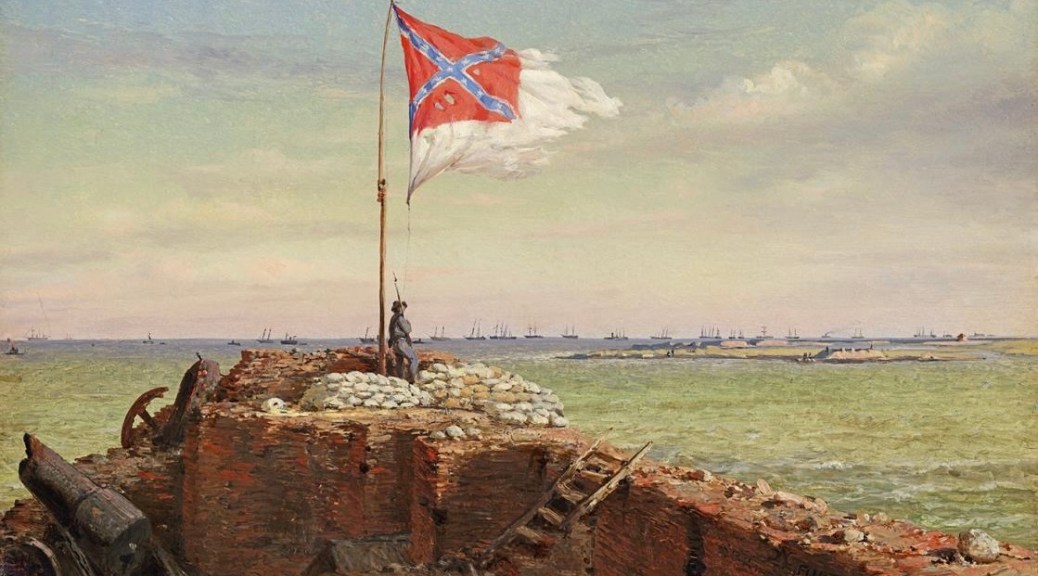
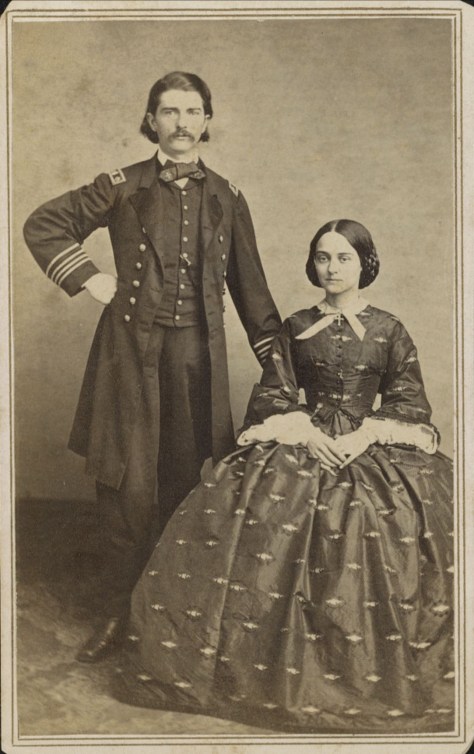
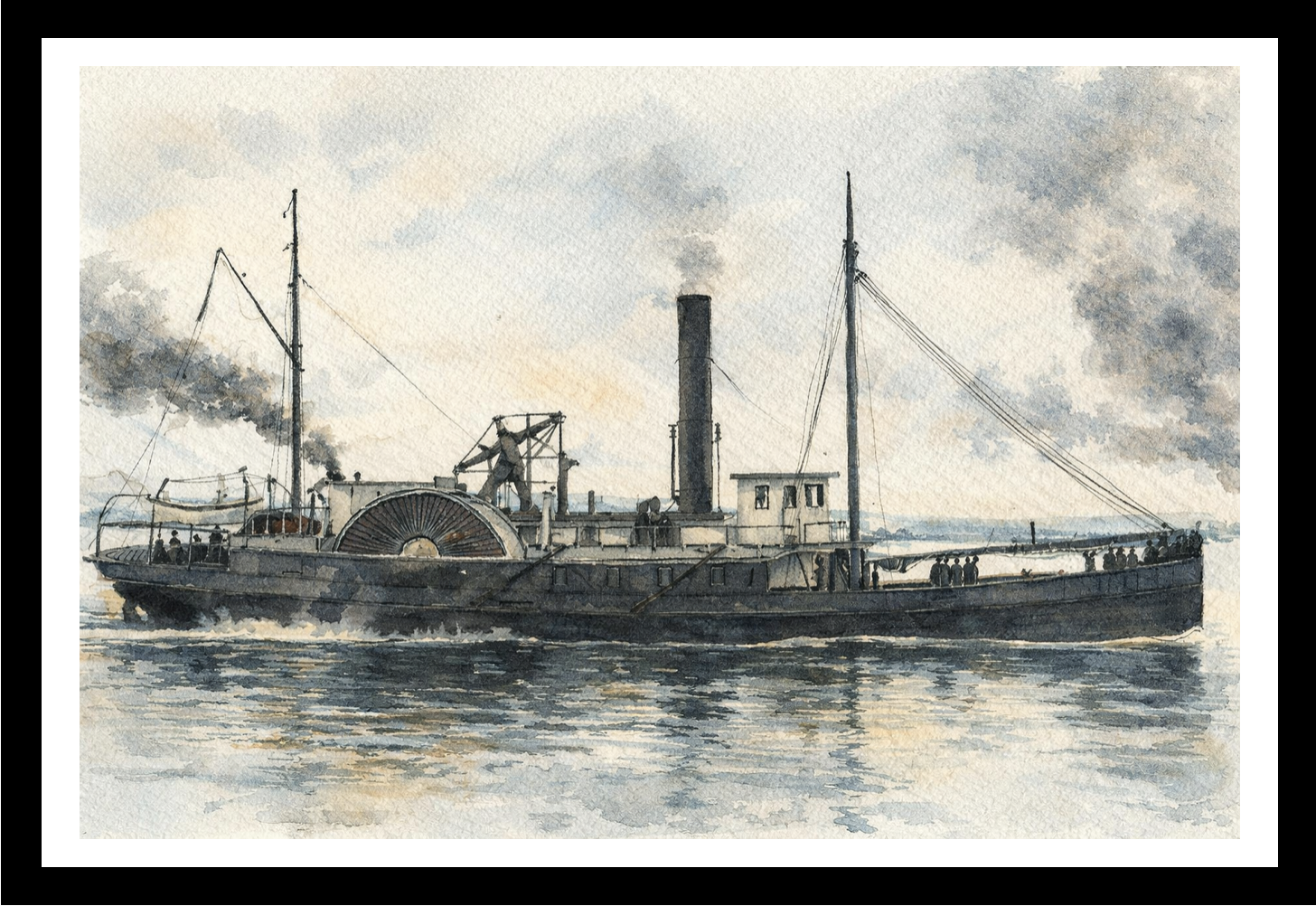
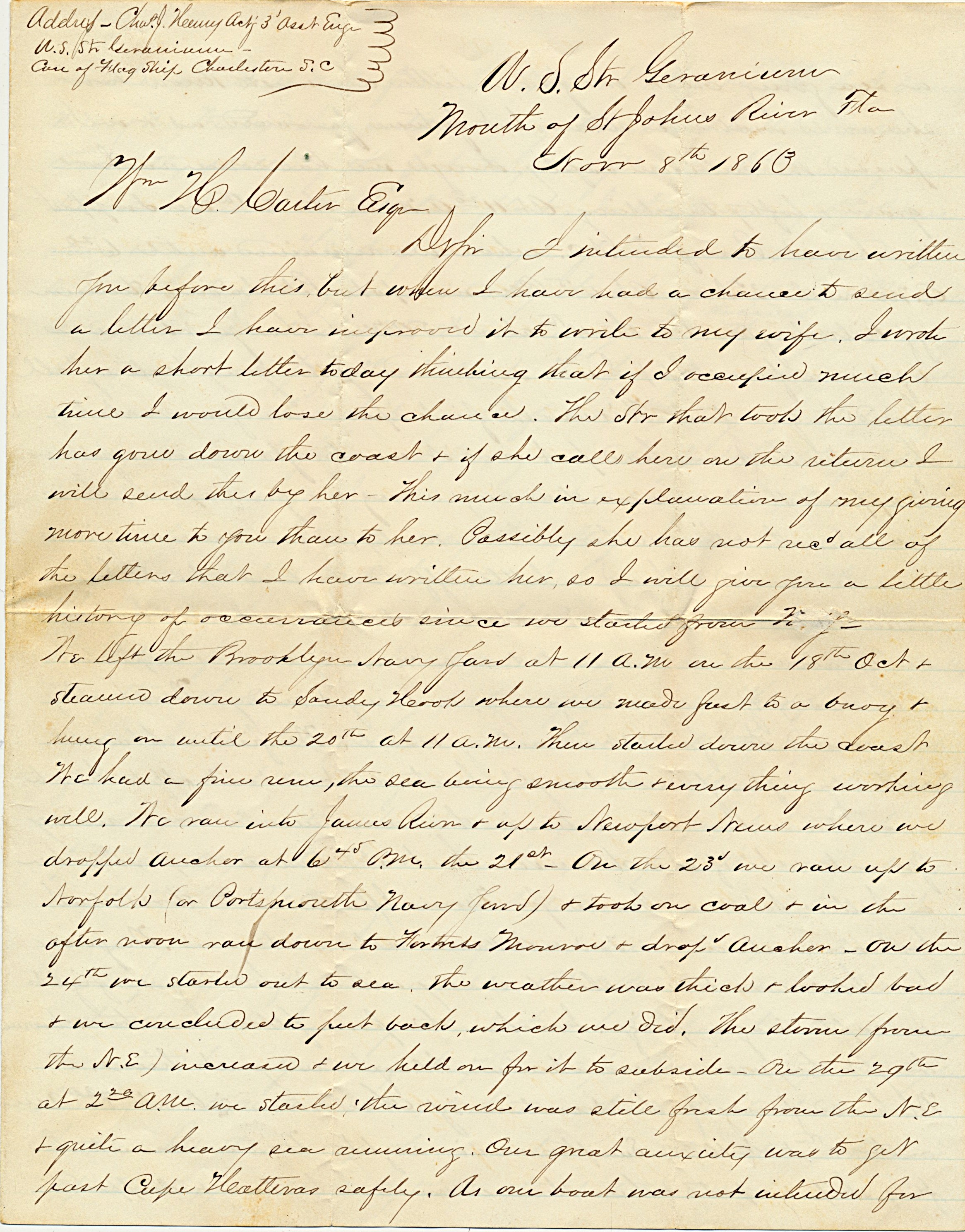
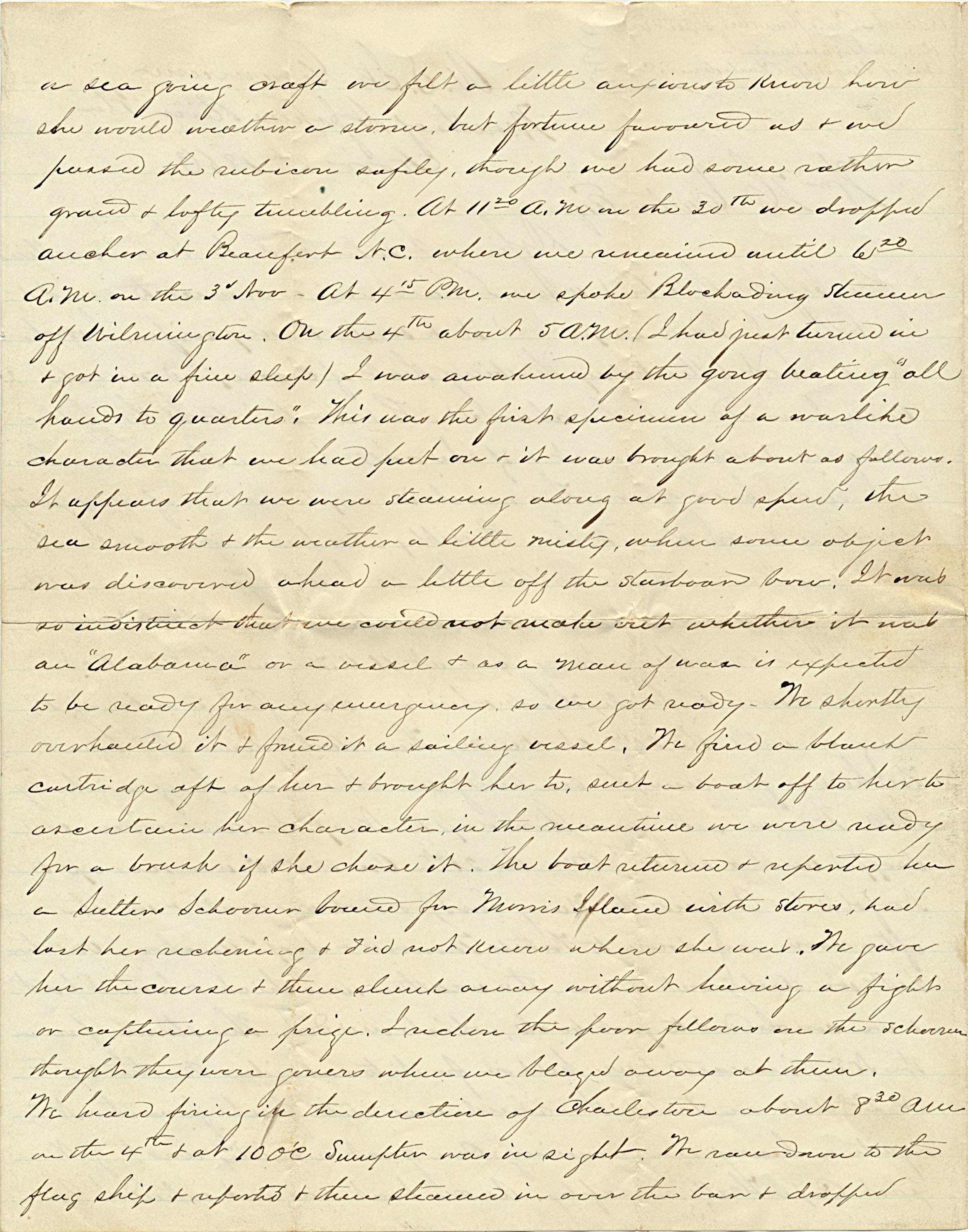
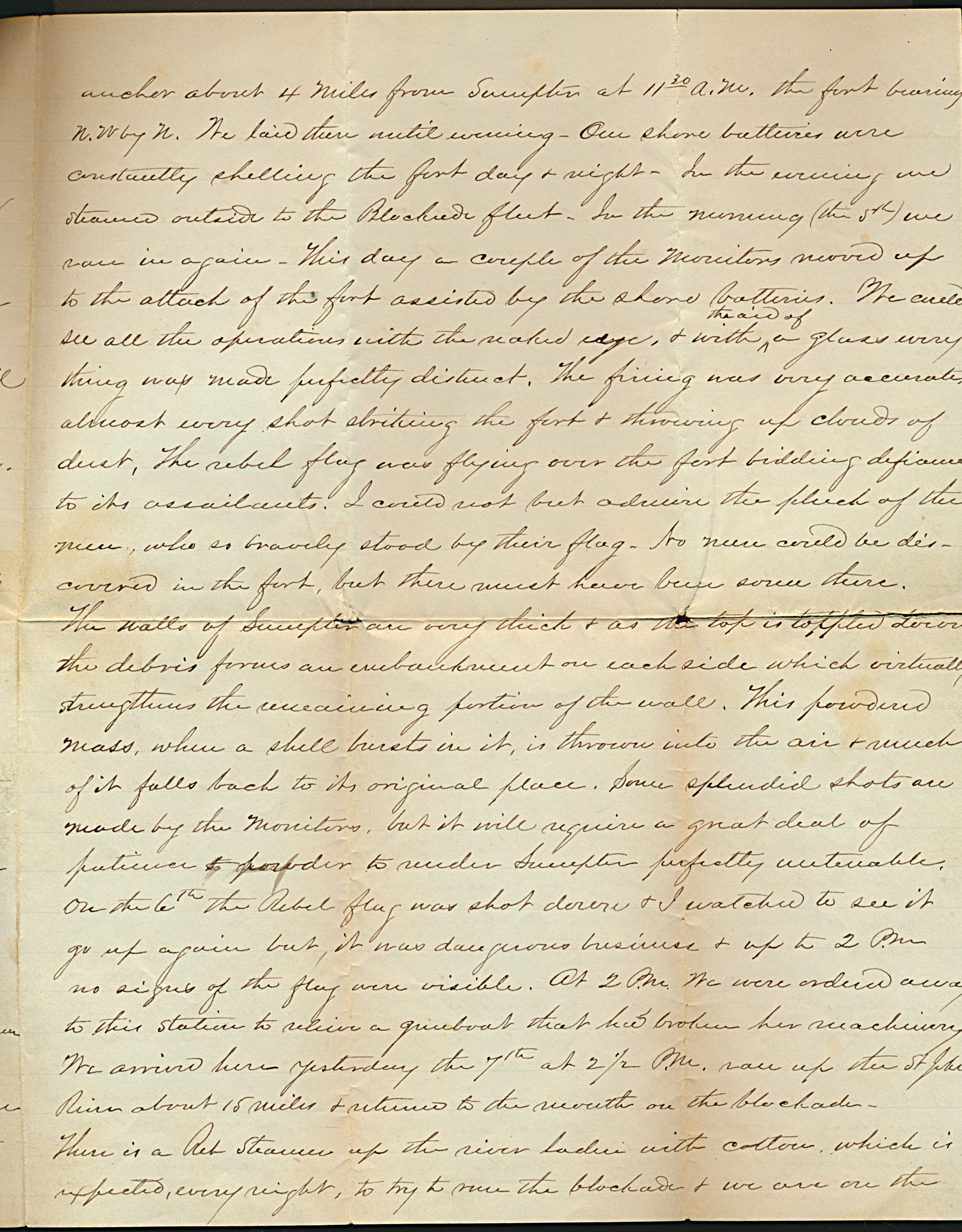
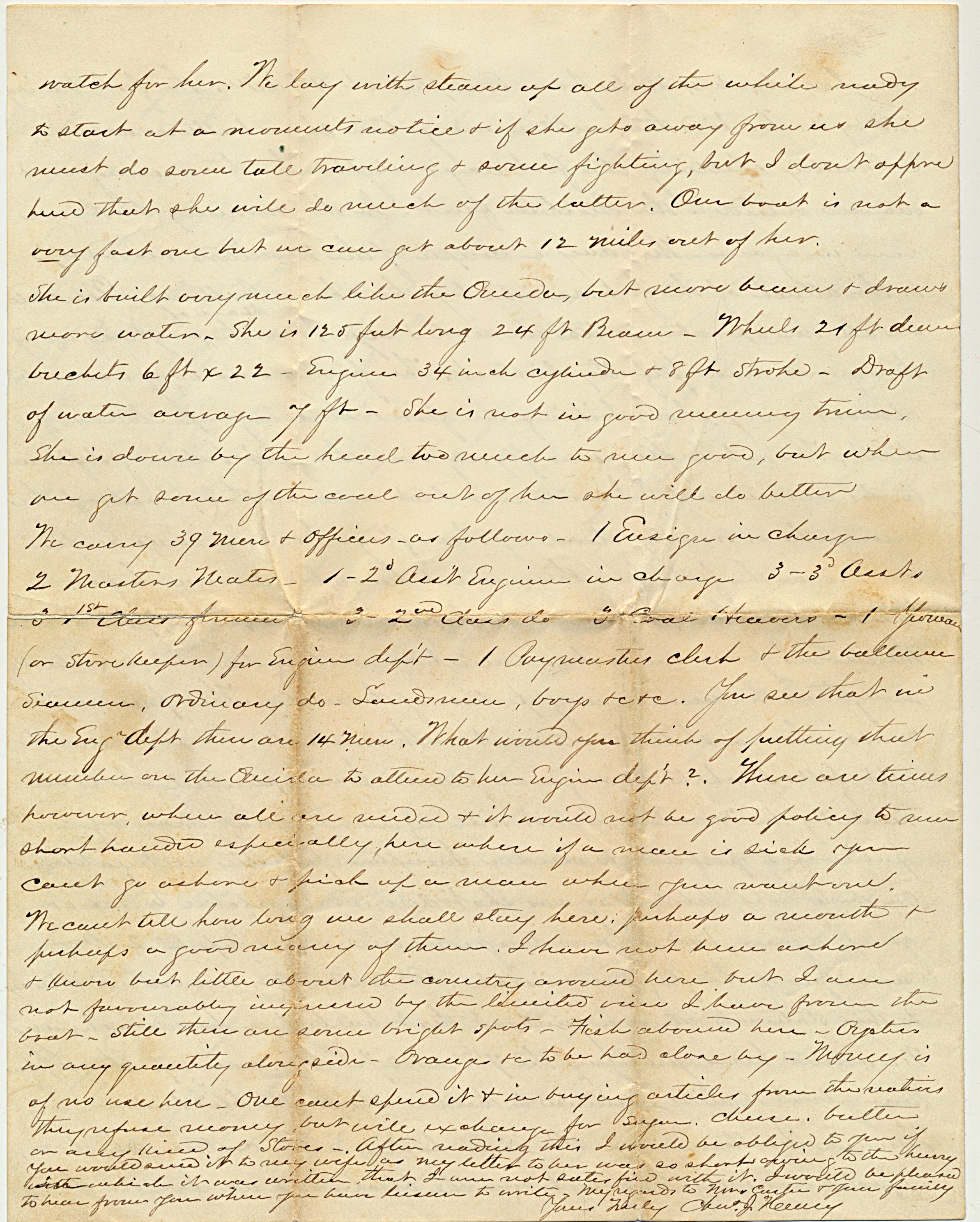


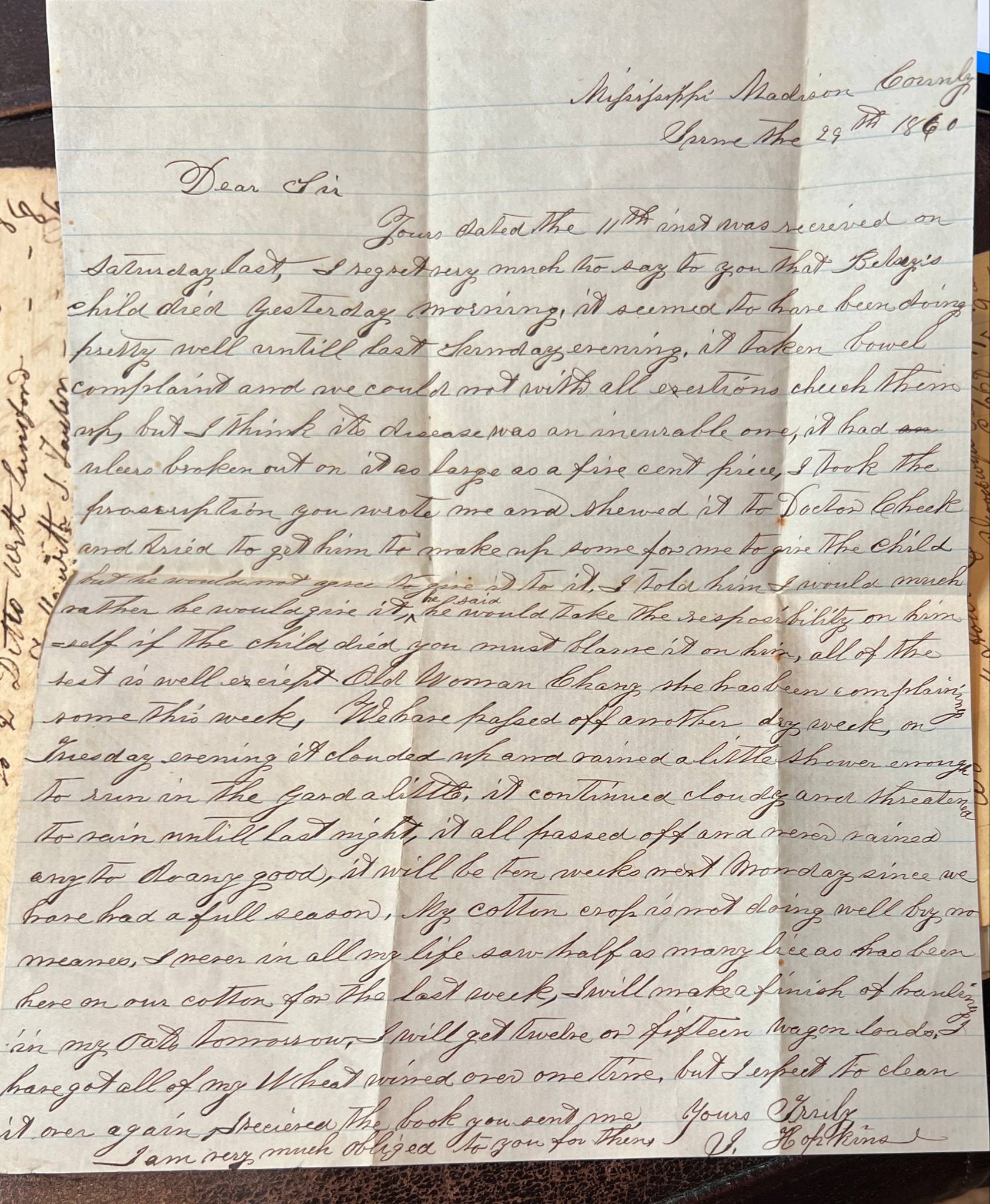
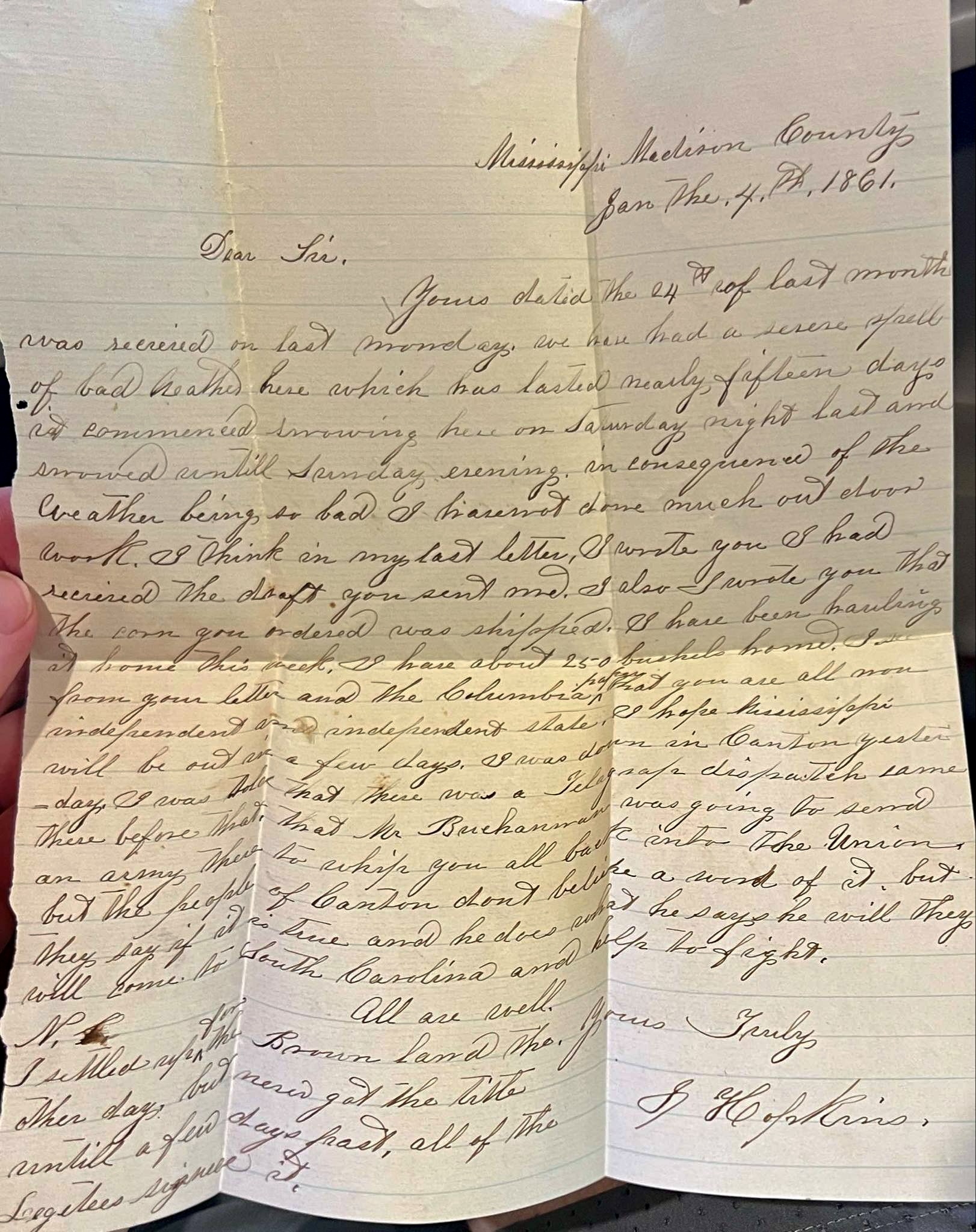
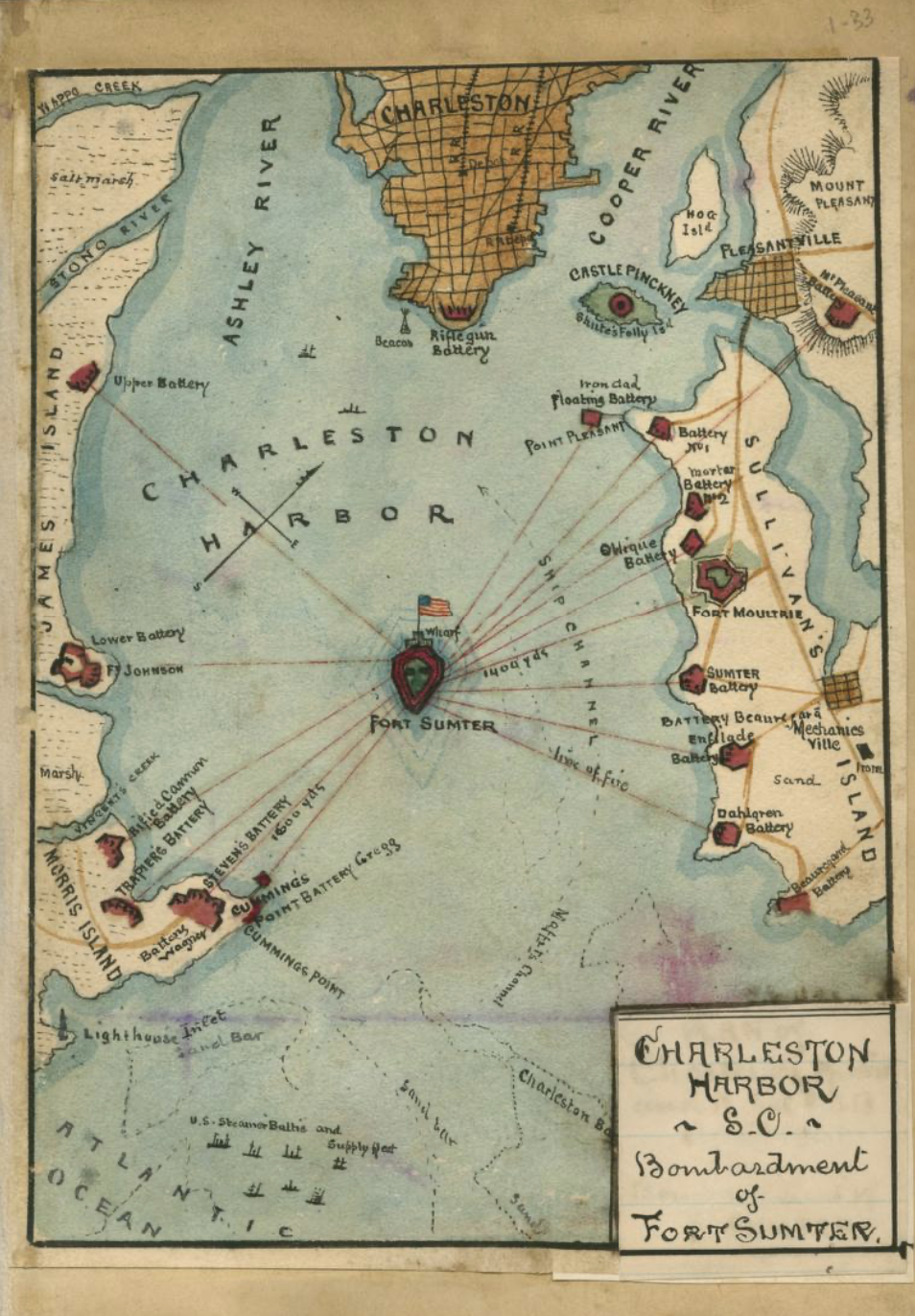
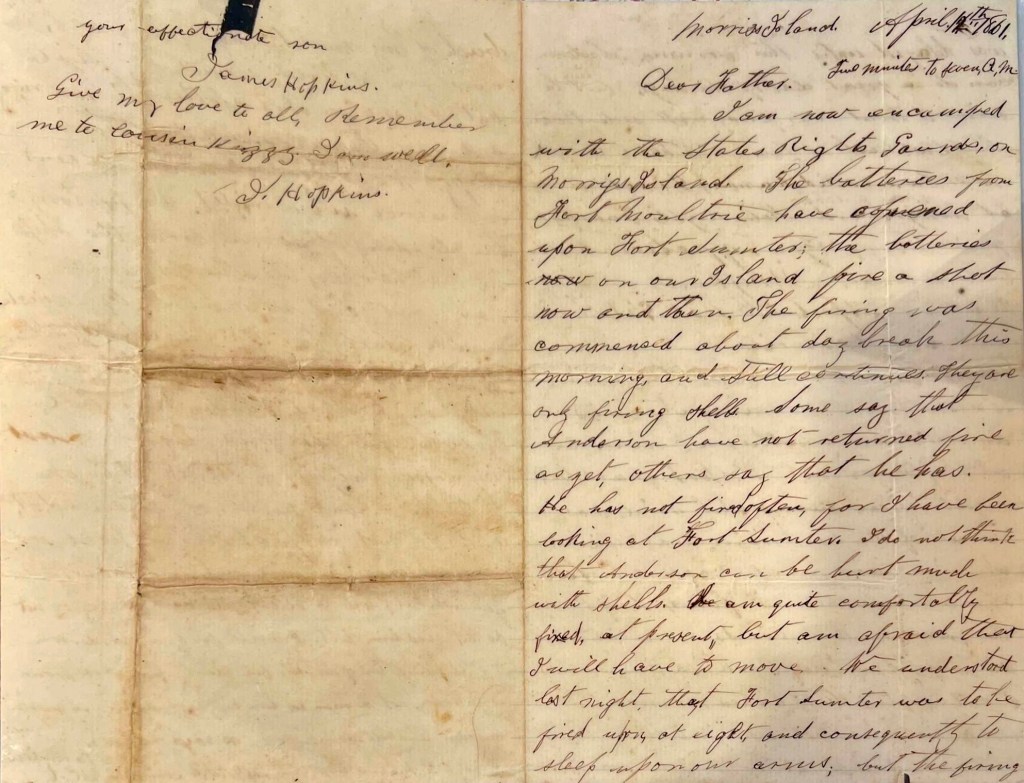


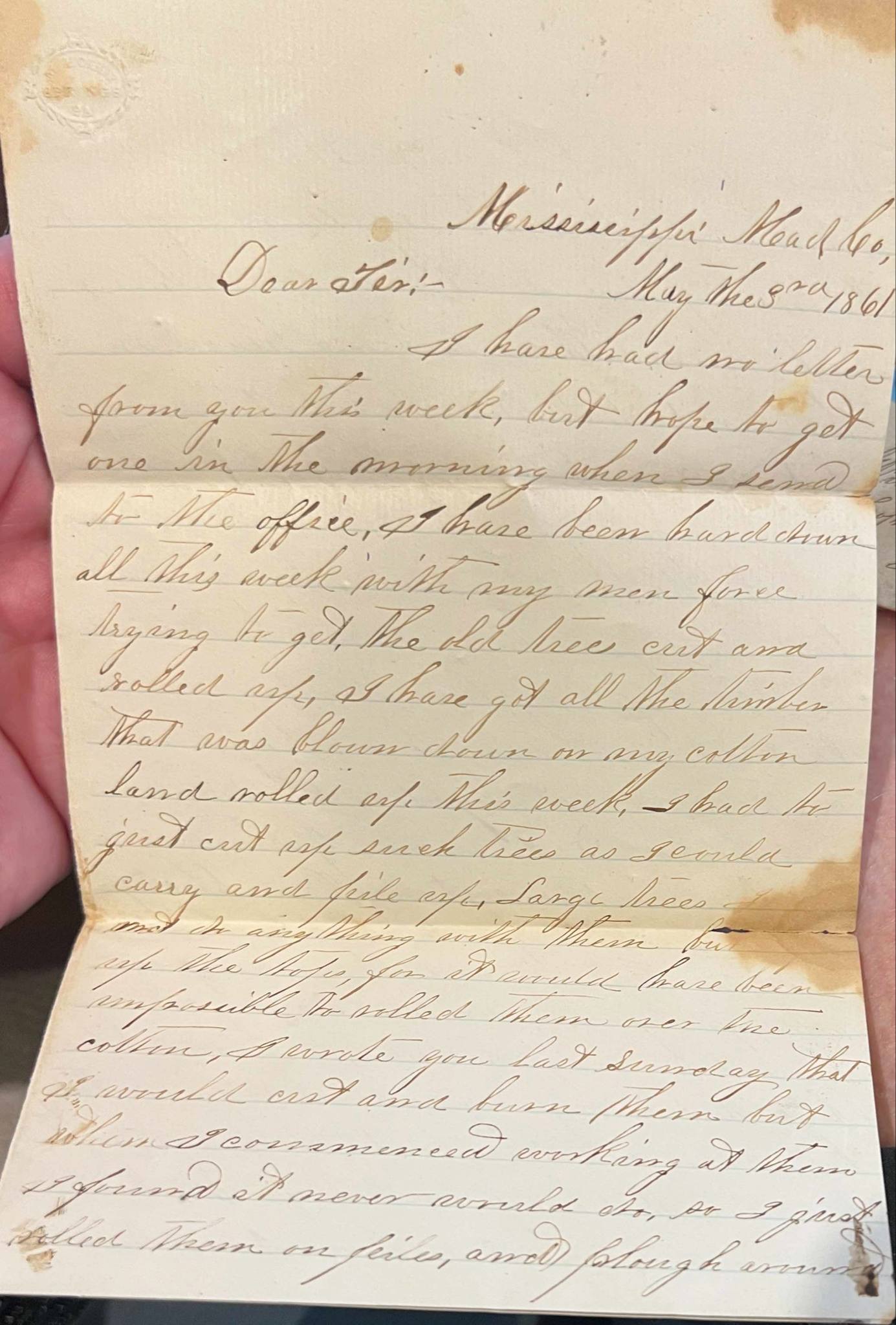

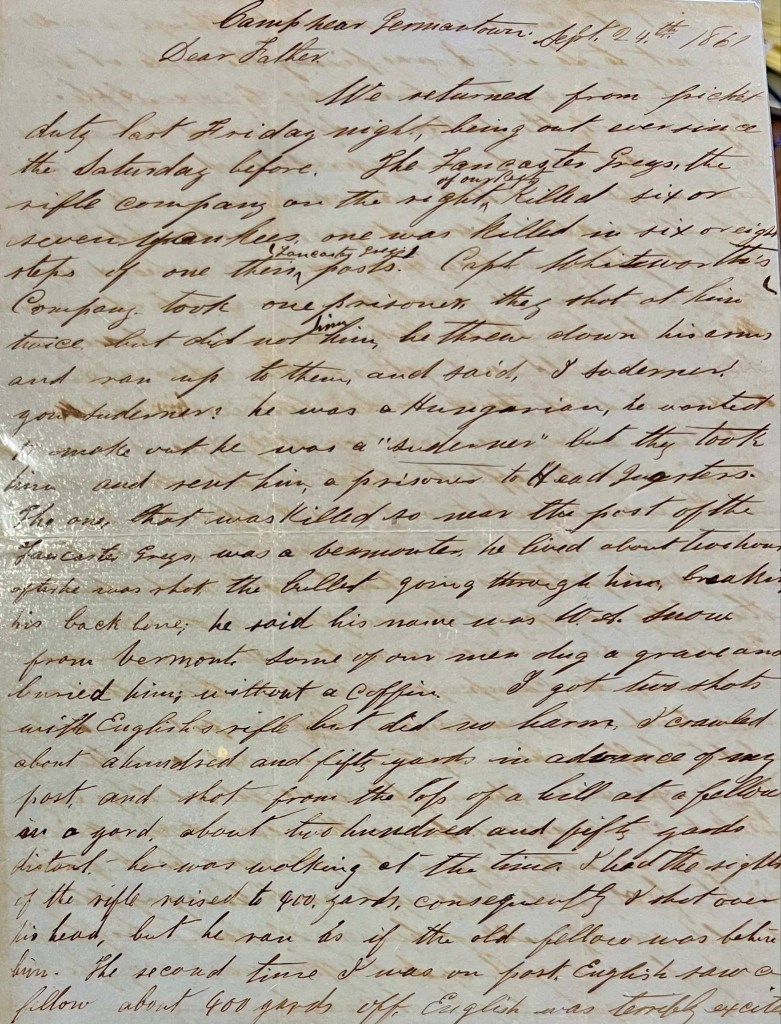
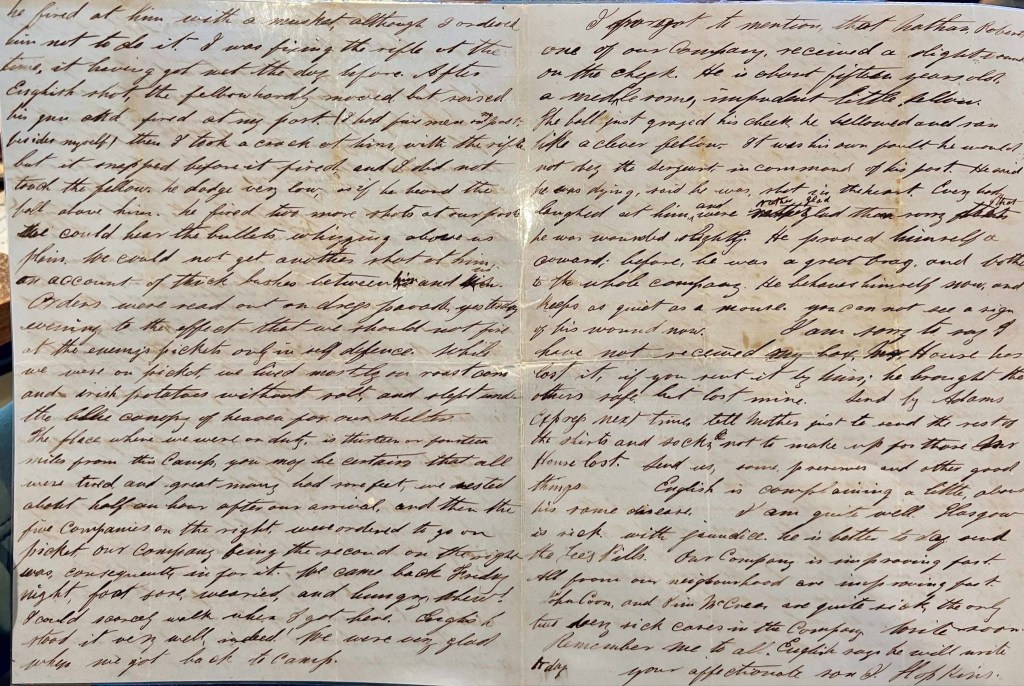

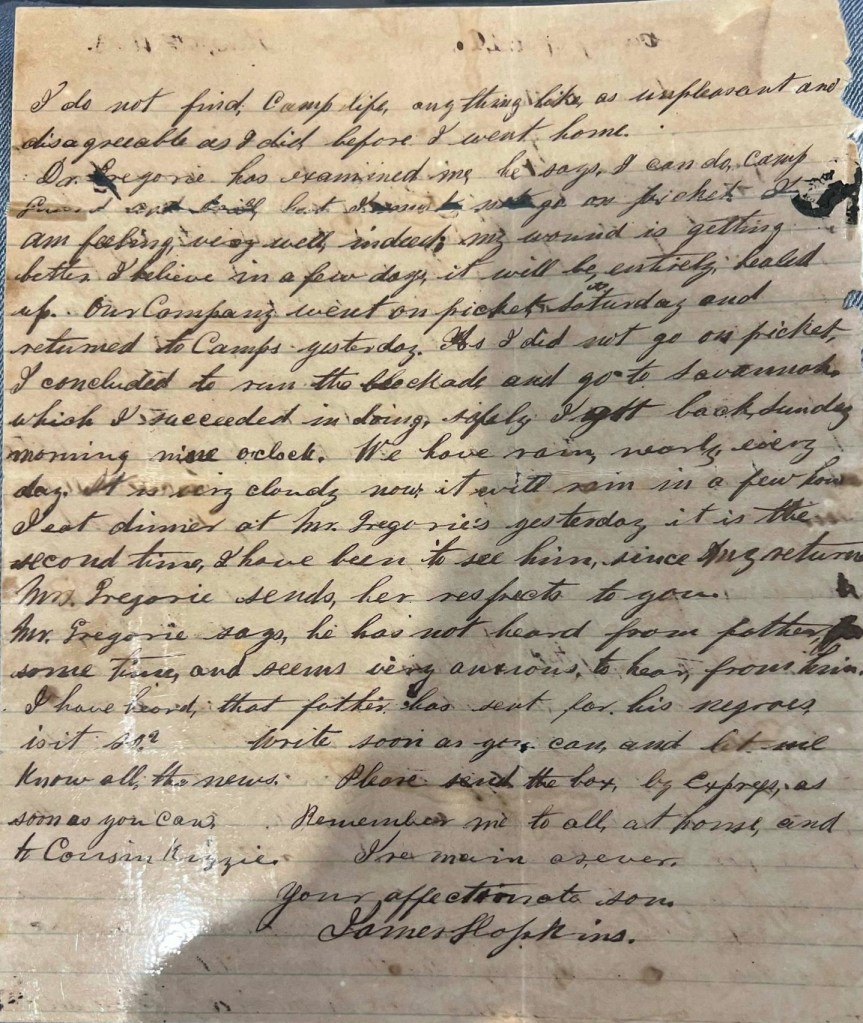


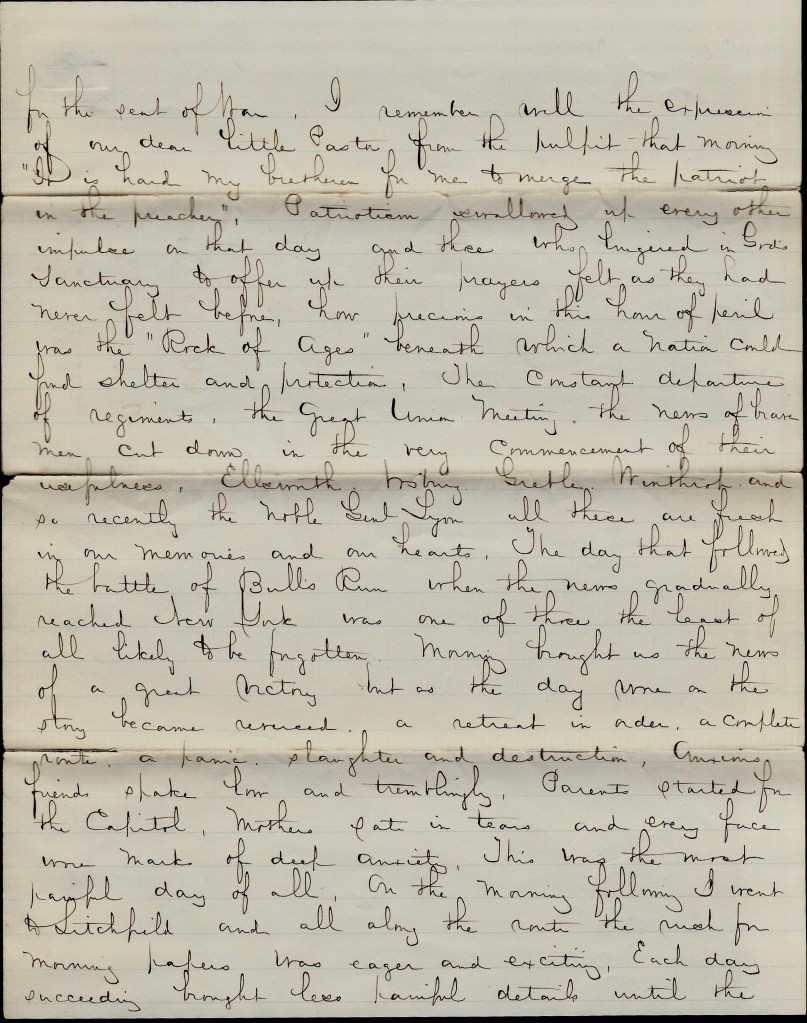
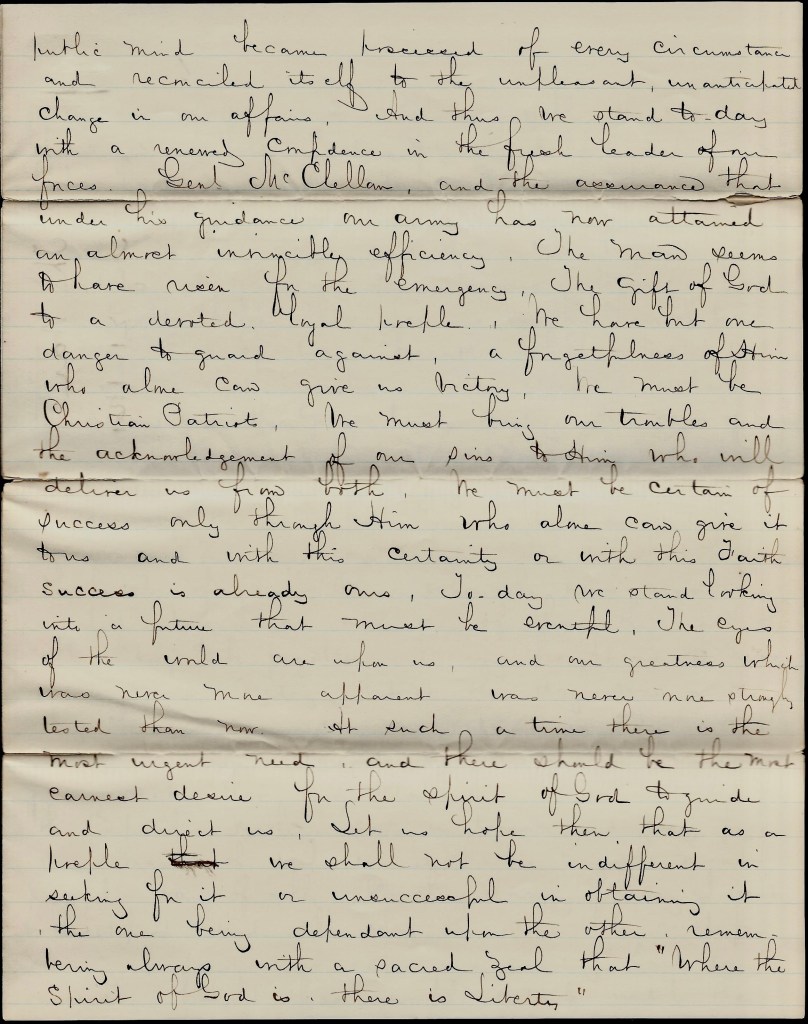
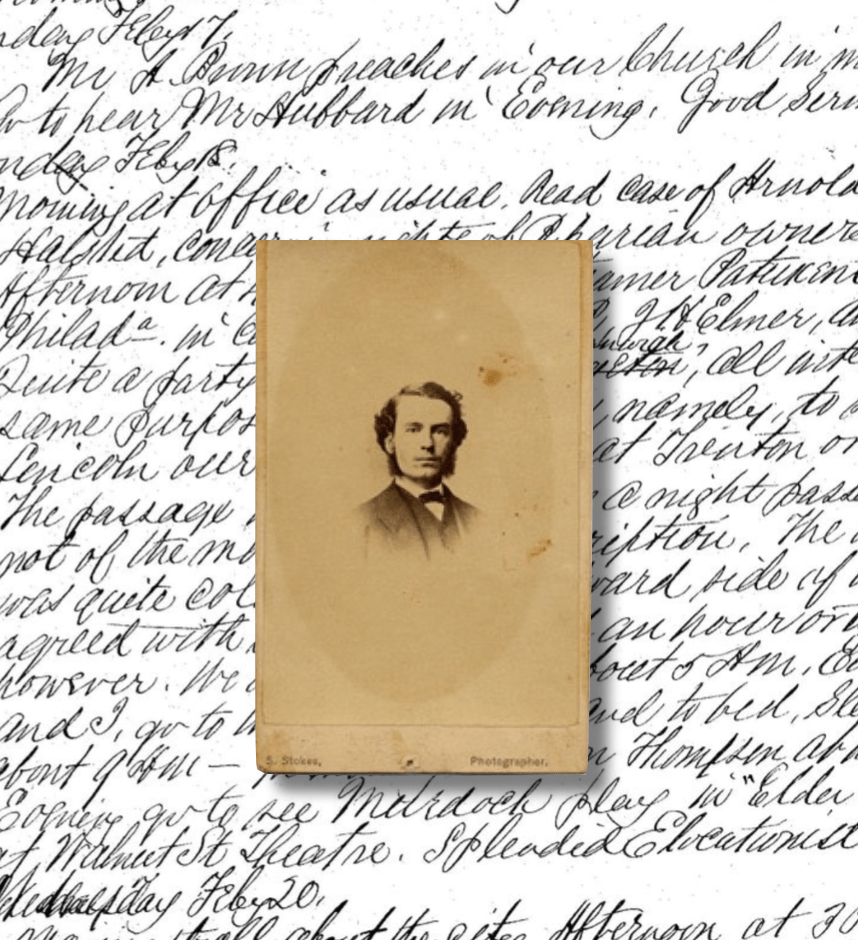
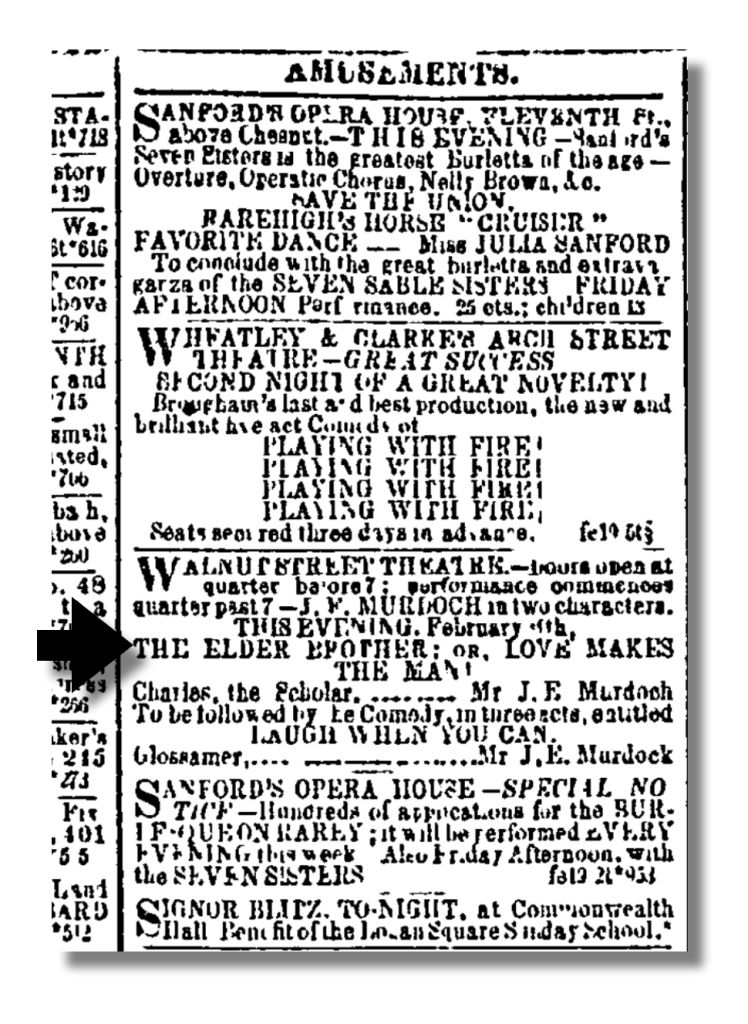


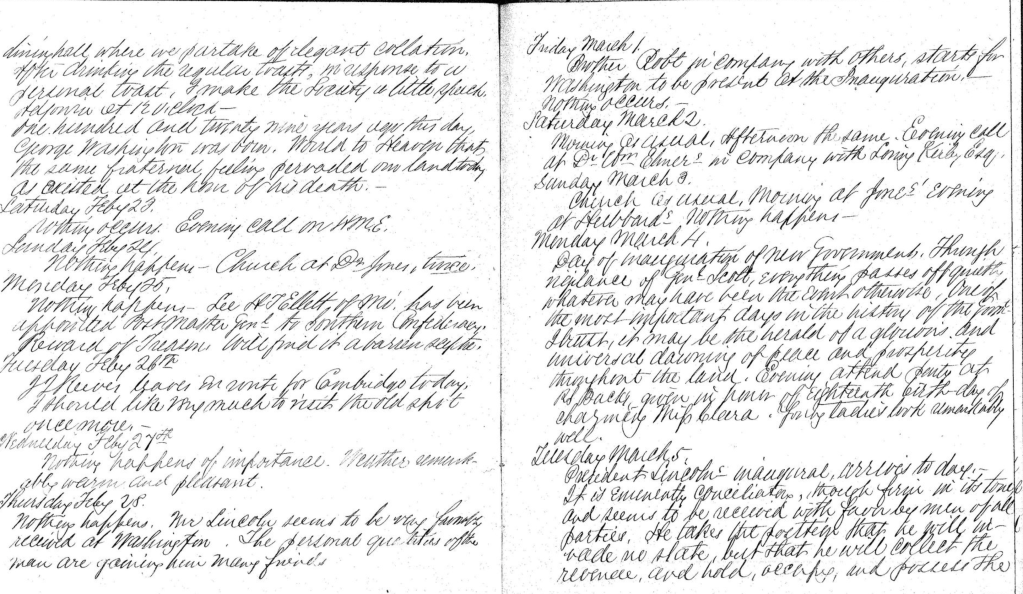



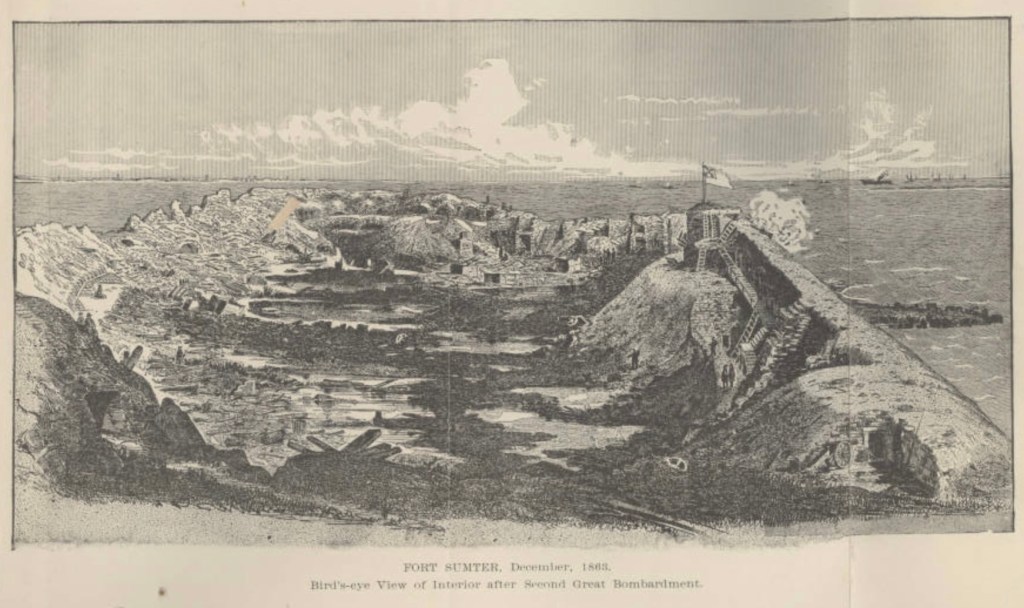
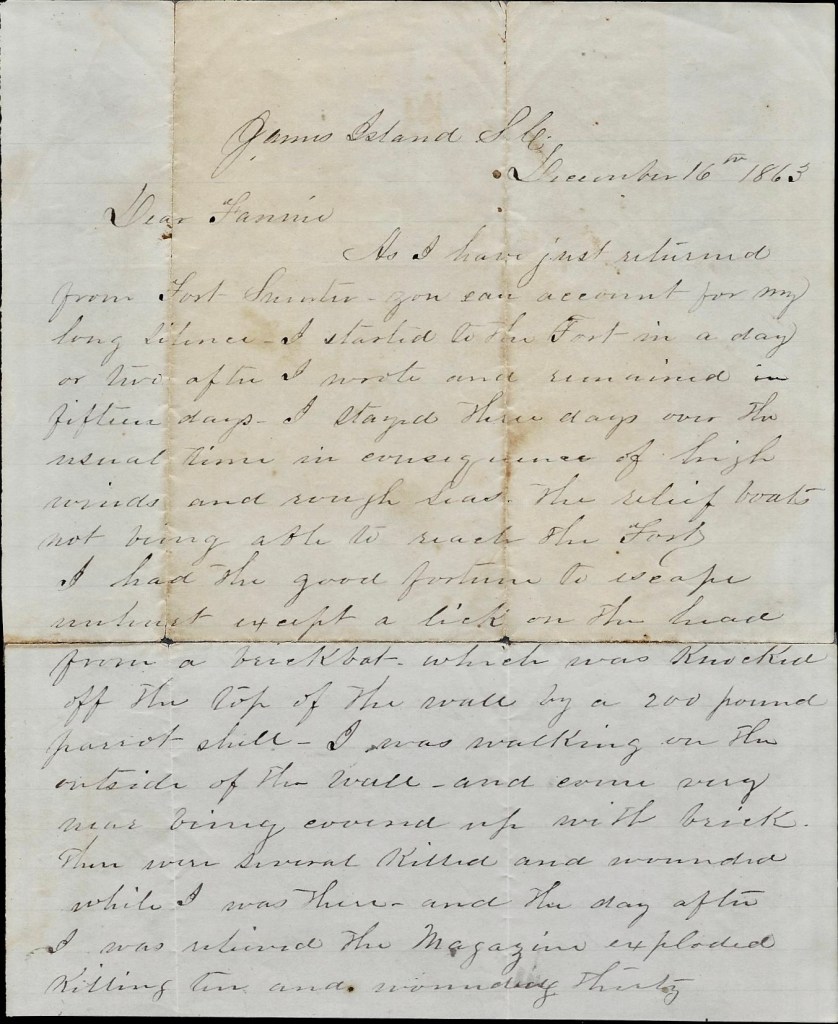
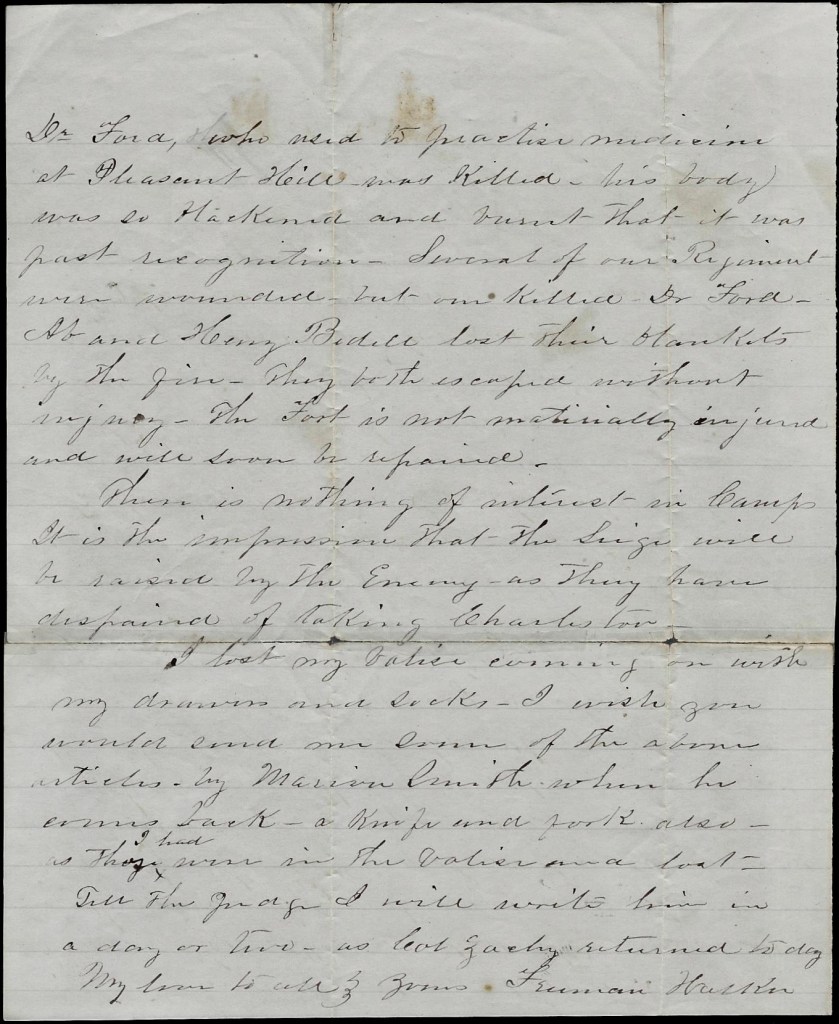
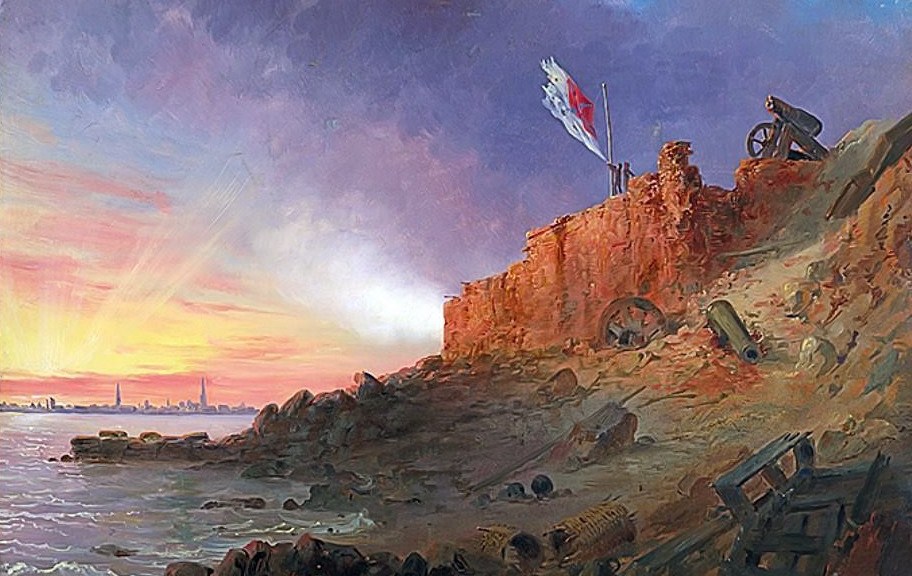
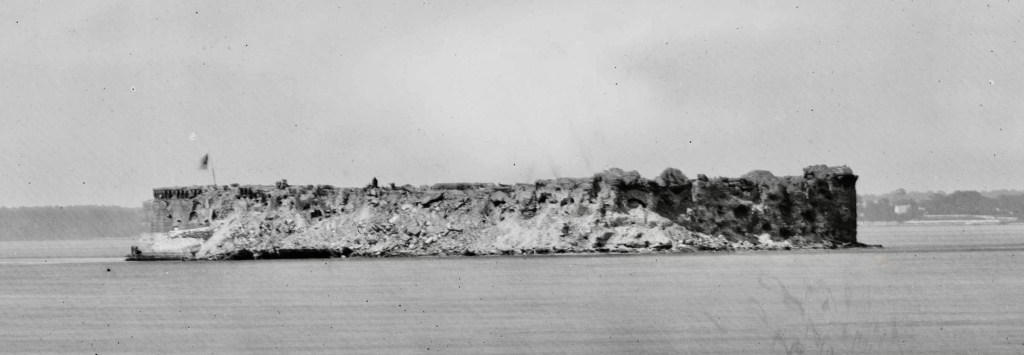
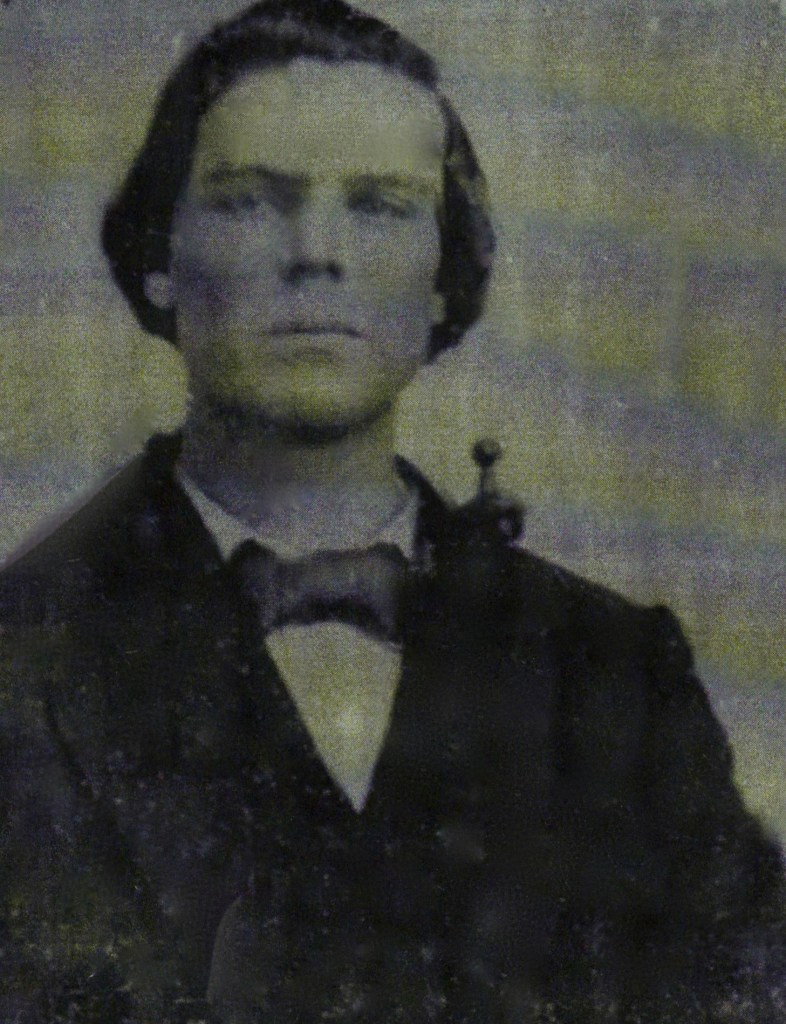
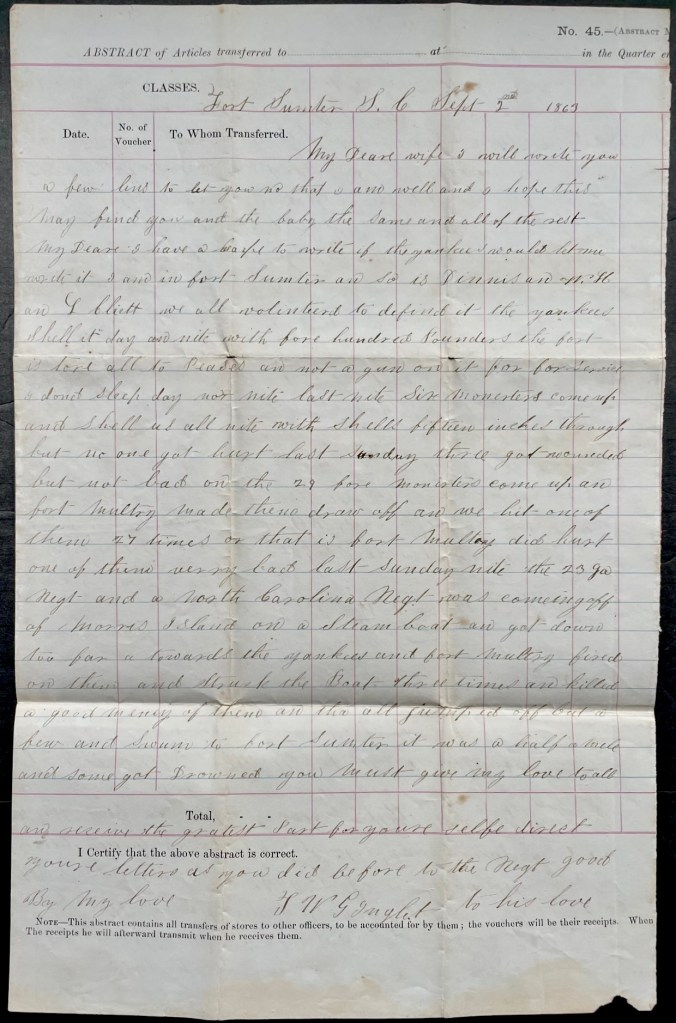
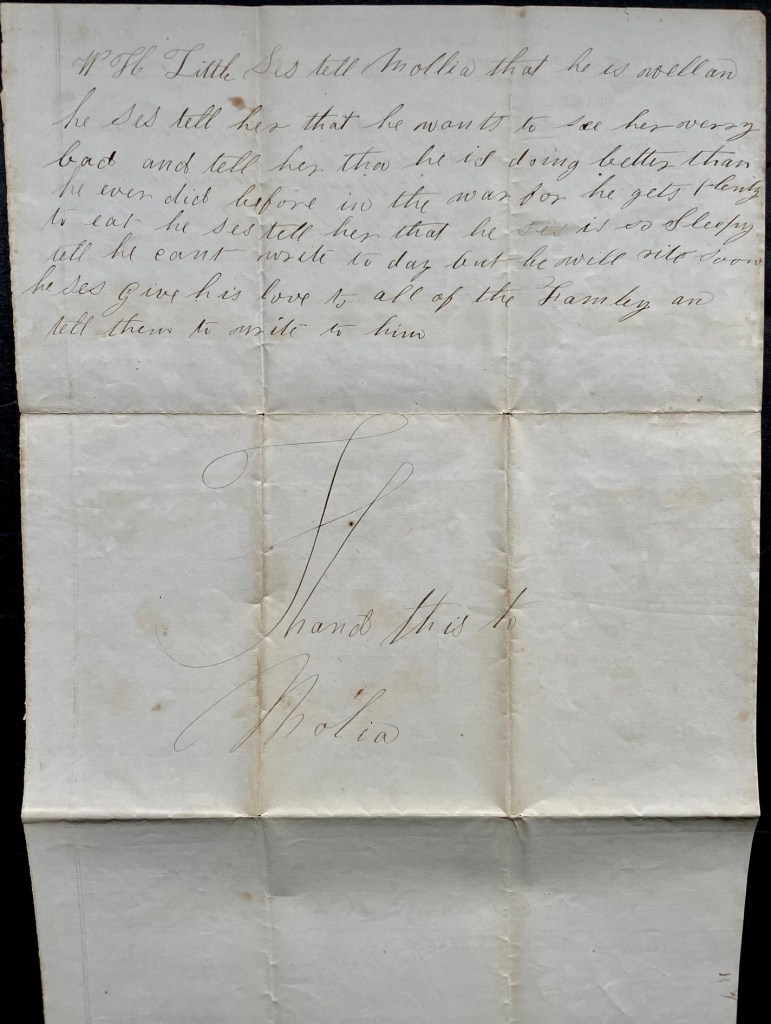
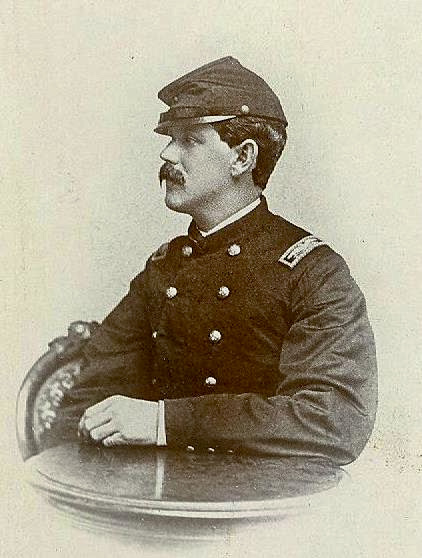

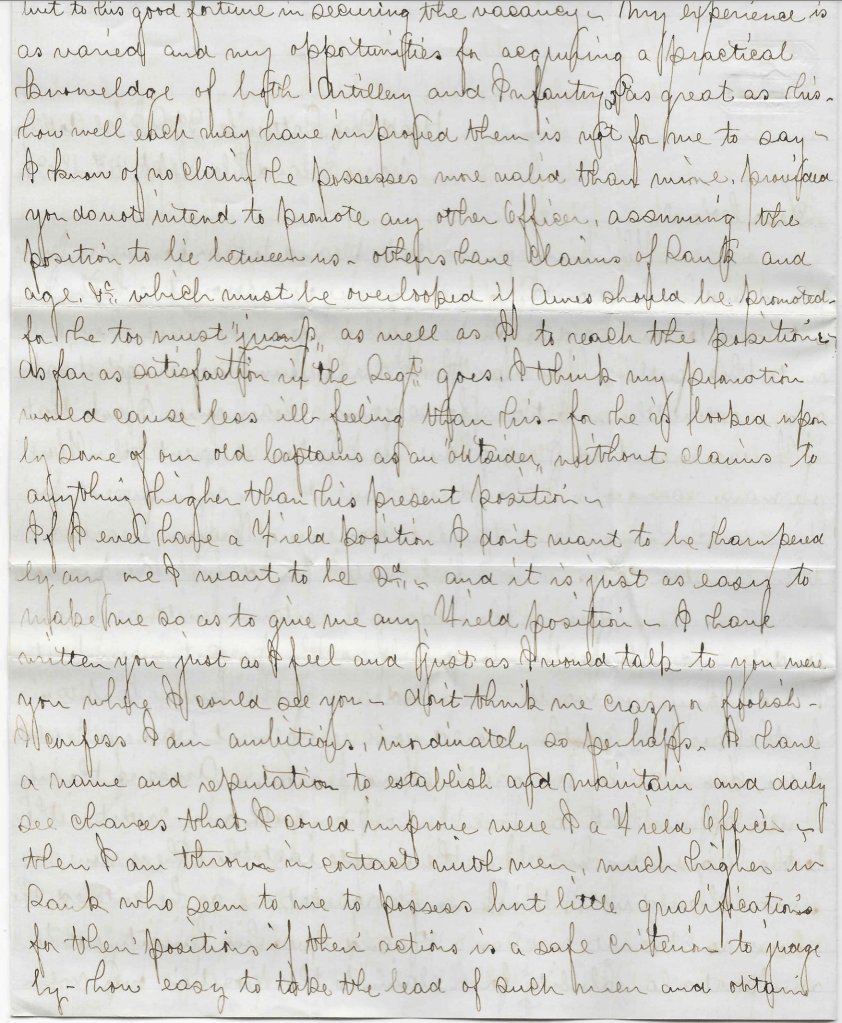
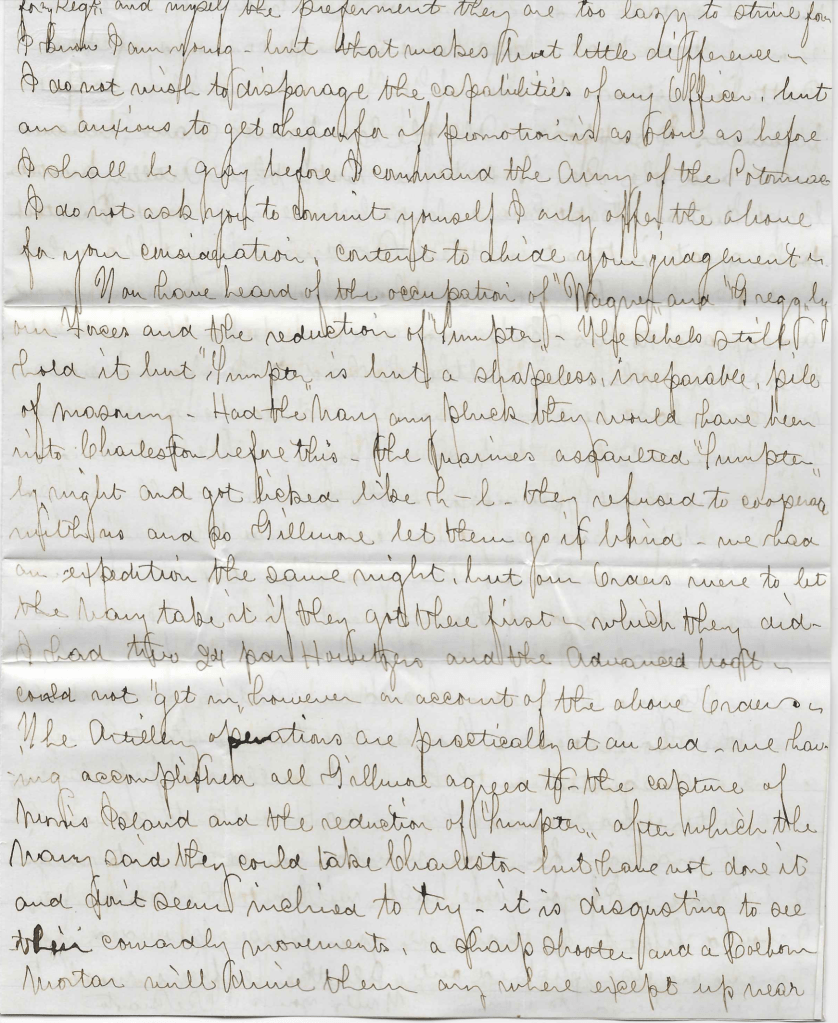
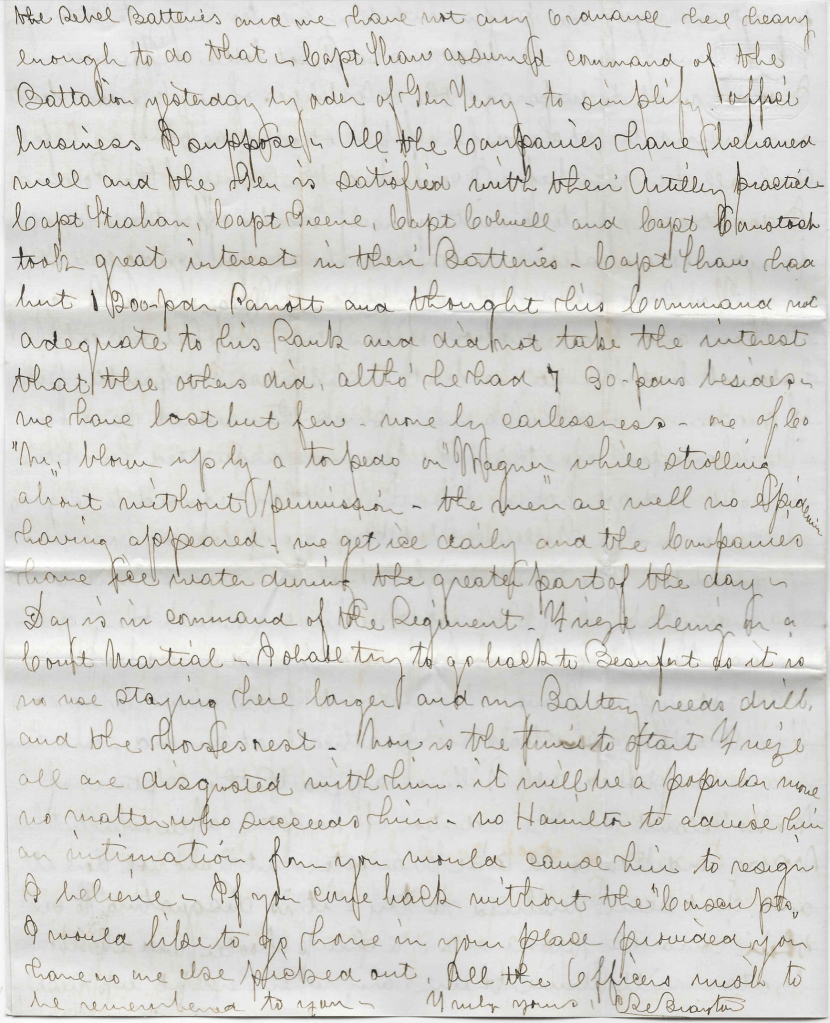







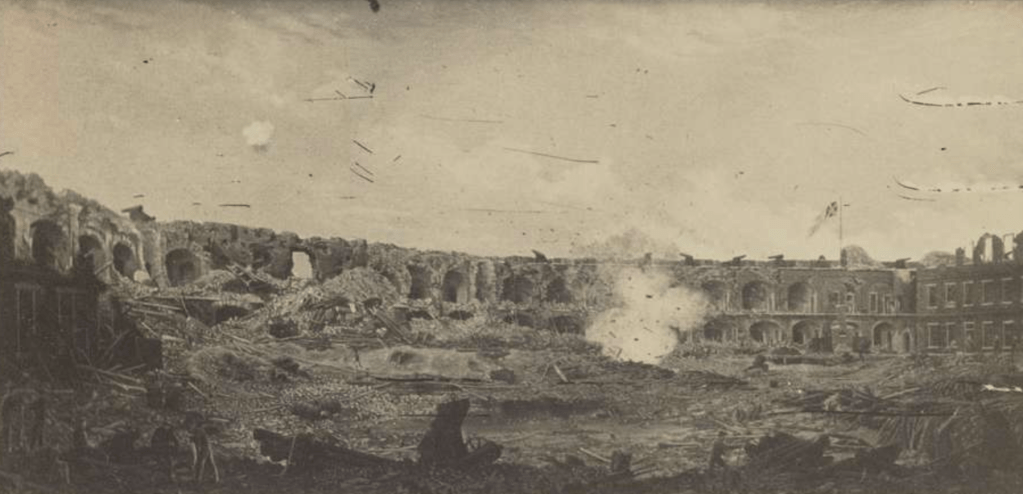
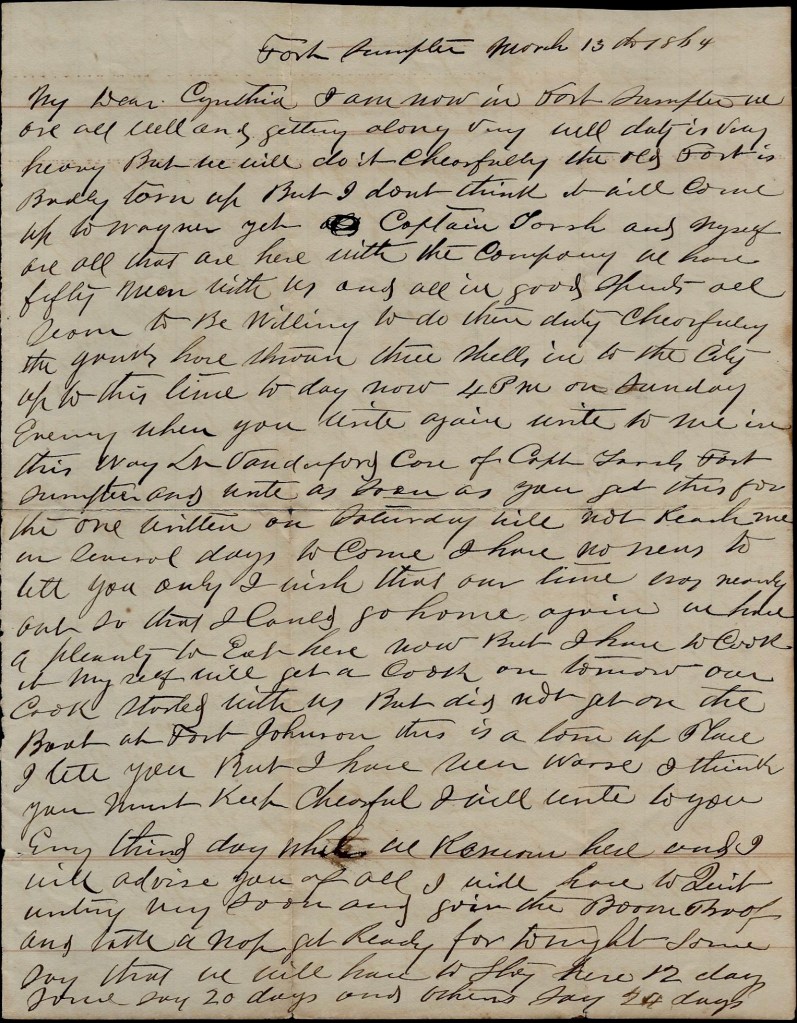

 Spared & Shared 23