These letters were written by Adam Scholl Brey (1833-1916) who was a 27 year-old bricklayer from Montgomery county, Pennsylvania when he enlisted in Co. H, 3rd Pennsylvania Reserves (32nd Pennsylvania Infantry) on 18 June 1861. Adam was discharged from the regiment on 28 July 1864 after three years service. When Adam enlisted, he was described as standing 5 feet, 7 inches tall, with grey eyes and black hair. He was hospitalized on 4 September 1862 at Bedloes Island in New York but I have not learned why.
Letter 1
Camp near Hunter’s Mill, Virginia March 14, 1862
Dear Brother,
Your letter came duly to hand on the 14th of March and was glad to hear that you have received the money and that you’re all well at present. I am in good state of health and hope this may find you all the same. I must also inform you that we are moved. I suppose you have seen it already in the paper. We left Camp Pierpont [near Langley, Va.] March the 10th afternoon at one o’clock and arrived at Hunter’s Mill the same day at ten o’clock in the evening. That day we marched about 18 miles. Our camp is 7 miles on this side Centreville as near as I know. We are encamped neat the Leesburg Railroad, just about one hundred yards on this side.
I will now inform you a little about our camp life in this part of the country. We did not take our tents along—nothing but what we could carry in our knapsacks. Some of our company had small tents to carry in their knapsack but we did not get any yet. We went to work and built ourselves tents with little brushes as good as we could to sleep under. I must also inform you that we have marching orders again to leave tomorrow morning at three o’clock.
And about the war, I suppose you know more than I do at present. Dear brother, I have one likeness yet that I left at Camp Pierpont which I will send to your wife. I had three. One I sent to father and one to Matilda Smith’s sister’s daughter but this here is not quite as good as the others. I kept it on purpose to send it to you but it did not suit me well enough to send it to you. I thought I would get it better but I got no chance to get it better. It looks like a robber but it is to protect ourselves. She says that she would pay the cost to send the likeness but I don’t want her to pay anything.
Dear Brother, I will do so as a favor to send you $15 dollars more if we get our pay soon enough. But I don’t know how soon that we will get it. With this, I will come to a close. Excuse my bad writing for I have no ink at present and I was in a hurry. As soon as you receive this likeness, please let me know soon. I will give you the direction to your letter.
Mr. Adam S. Brey, Co. H, 3rd Regiment Penn. Reserve Vol. Corps., Care of Col. Horatio G. Sickel, Washington D. C.
Then it don’t make no different where we are. The letters will be forwarded to us. Your brother Adam
Letter 2
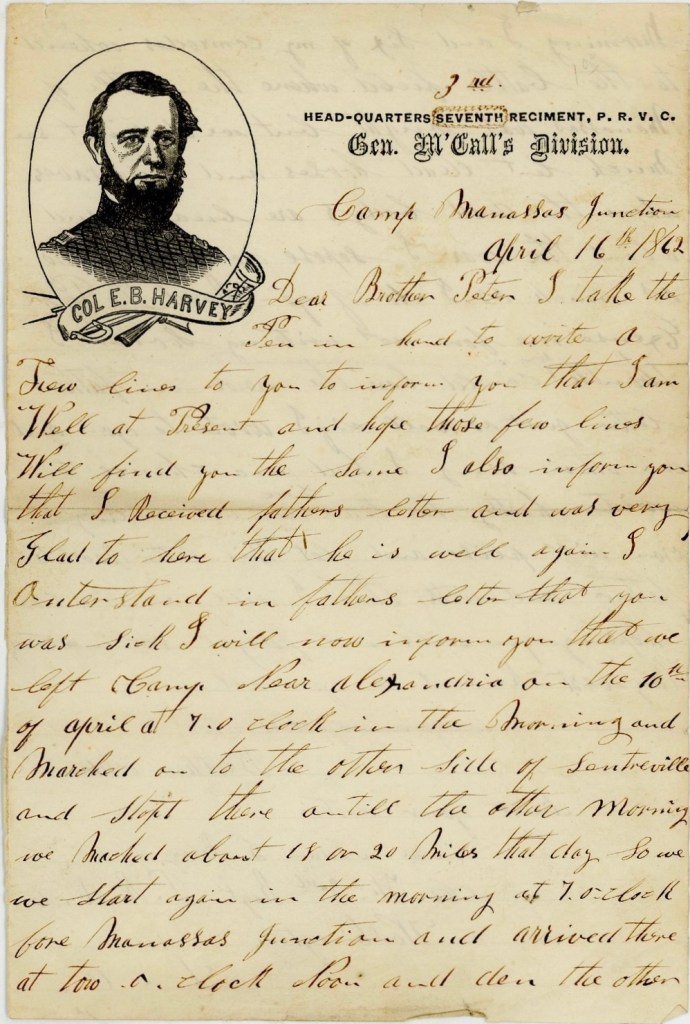
Headquarters 3rd Regiment P. R. V. C. Gen. M’Calls Division Camp Manassas Junction April 16th 1862
Dear Brother Peter,
I take the pen in hand to write a few lines to you to inform you that I am well at present and hope these few lines will find you the same. I also inform you that I received father’s letter and was very glad to hear that he is well again. I understand in father’s letter that you was sick.
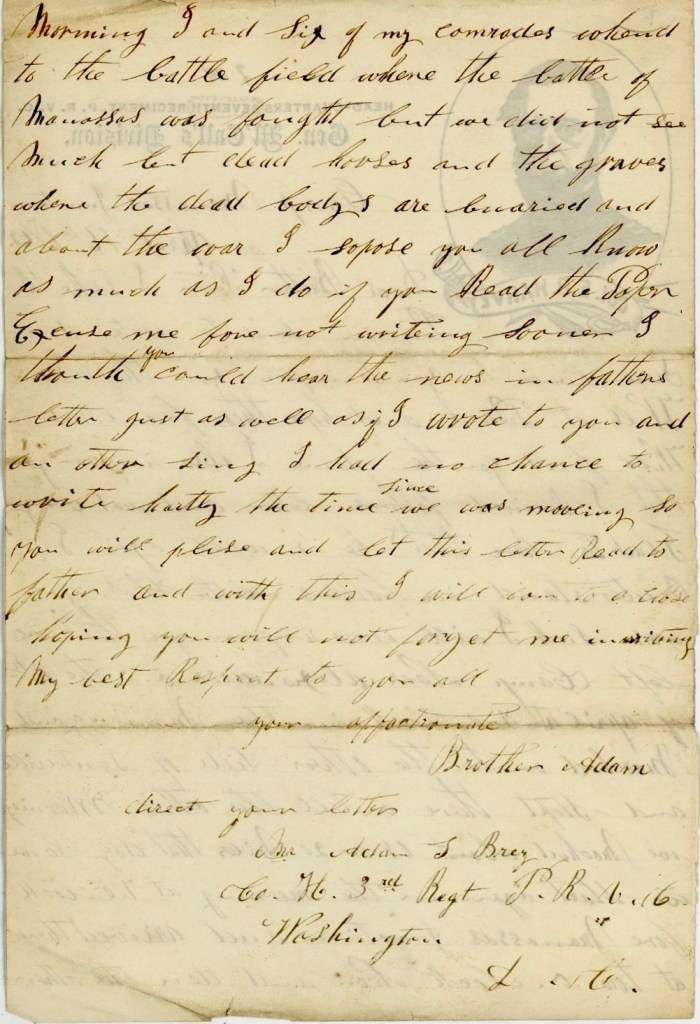
I will now inform you that we left camp near Alexandria on the 10th of April at 7 o’clock in the morning and marched to the other side of Centerville and slept there until the other morning. We marched about 18 or 20 miles that day so we start again in the morning at 7 o’clock for Manassas Junction and arrived there at two o’clock noon. And then the other morning I and six of my comrades went to the battlefield where the Battle of Manassas was fought but we did not see much but dead horses and the graves where the dead bodies are buried.
About the war, I suppose you all know as much as I do if you read the paper. Excuse me for not writing sooner, I thought you could hear the news in father’s letter just as well as if I wrote to you and another thing, I had no chance to write hardly [at] the time since we was moving so you will please let this letter read to father and with this I will come to a close hoping you will not forget me in writing. My best respects to you all. Your affectionate brother, — Adam
Direct your letter to Mr. Adam S. Brey, Co. H, 3rd Regt. P. R. V. C., Washington D.C.
Letter 3
Camp near Fredericksburg May 28th 1862
Dear Brother,
Your welcome letter of 22nd inst. came duly to hand which pleased me very much to hear that you are all well at present. I enjoy good health at present and hope this may find you all the same. Again, it gives me great pleasure to receive letters from you. I feel when I am reading them almost as if I was talking to you and I hope the time may come soon again that I can have the pleasure to speak with you all. So God’s Will that I shall return to Old Pennsylvania with life again which I hope the time will come soon again.
I must also inform you that we left camp near Falmouth. We are encamped about a miles on this side Fredericksburg and on this side of the Rappahannock River yet. We lay alongside at the railroad which runs to Fredericksburg. The railroad bridge is finished again so that the cars can run to the town of Fredericksburg.
I must also inform you how the Rebels treat our men. An old gray-headed man which was a Rebel, he passed one of our men who was lying nearby a well. He was wounded [and] he asked this old man for a drink of water which he give him. In one hand he has the cup and in the other hand a revolver which he shot him instantly dead. And on the march from [ ] Station to Falmouth, five men of the 12th Regiment belonging to our Division which were so tired that they could not march along no more with the regiment so they had to stay behind and a party of Rebels took them and tied their legs at the limbs of the trees with their heads hanging downwards with their throat cut off. That is the way our cavalry found them when they went out scouting a few days after the march.
And I would tell more such work which the Rebels done but I must hurry to close my letter for the drum beats for drill.
N. B. I will send this little locket as a present to William and with this I will come to a close hoping you will not forget me in writing. Write soon again. Yours truly, your brother, — Adam
Excuse my mistakes and bad writing. I was in a hurry. My best respects to you and all enquiring friends. Your brother, — Adam
The following letters were written by Charles Anthem Chapin (1841-1900) who enlisted in May 1861 at Elmira to serve two years in Co. K, 23rd New York Infantry. He entered the war as a private, was promoted to corporal and then sergeant before mustering out of the regiment on 22 May 1863.
Charles was the son of David Jewett Chapin (1802-1876) and Alice Glazier (1799-1865). I believe that Charles was slightly wounded at the Battle of Antietam but not so badly he could not fulfill the term of his enlistment.
Brandt’s book on Charles Tubbs’ Collection of Civil War Letters
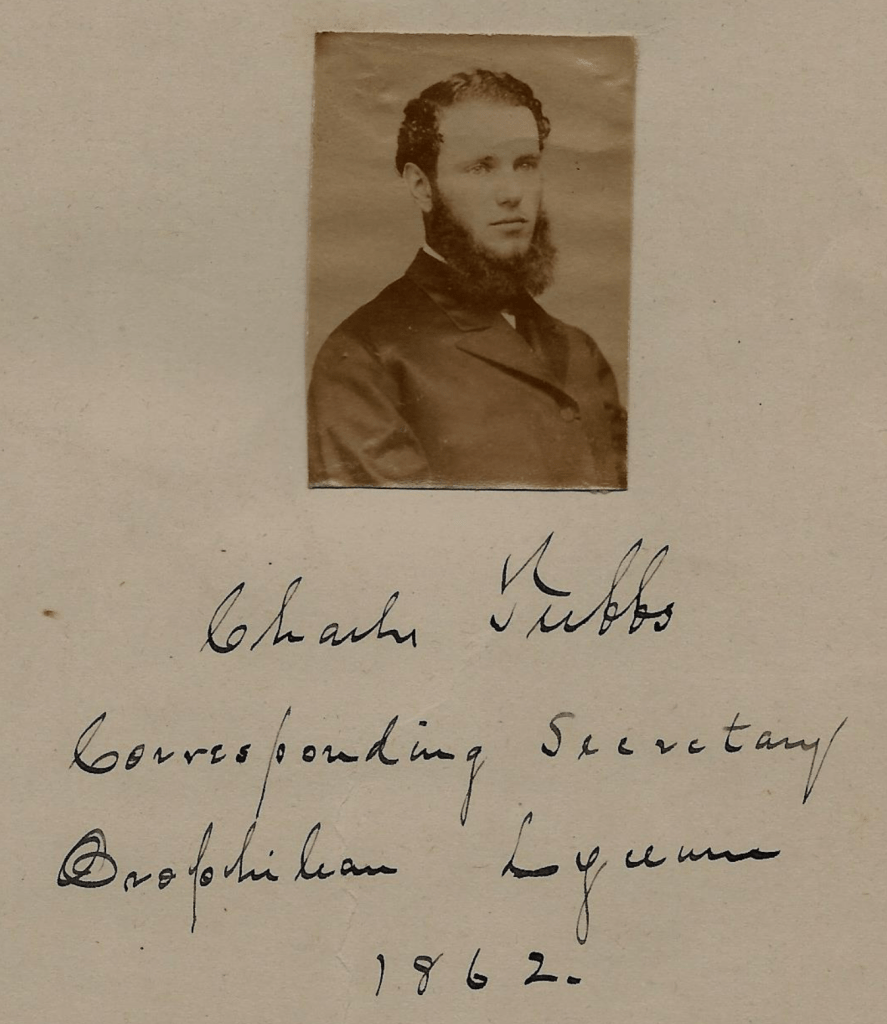
Chapin wrote the letters to Charles Tubbs, the corresponding secretary of the Orophilian Lyceum of Alfred University in Alfred Centre, New York. Founded in 1836, Alfred University was an early-day coeducational college. Tubbs later attended Union College, graduated with honors in 1864, and then attended the law school in Ann Arbor, Michigan. In researching Tubbs, I was surprised to discover a 1996 publication entitled, “Mr. Tubbs’ Civil War” by Nat Brandt. In his introduction. Brandt wrote that, “Charlie Tubbs experienced the Civil War vicariously. He never volunteered nor was drafted in the Union military forces. But many of his friends went to war, and it was through them that the day-to-day experience of the war came alive for him in the most personal way. Throughout the war, Tubbs received more than 175 letters from his friends, ordinary young men, all products of rural New York and Pennsylvania.” Curiously, of the 17 letter writers mentioned in Brandt’s publication, Charles A. Chapin is not listed and his letters do not appear in the book. It may be that these letters, which were once part of a larger collection of Tubb’s collection, were separated from the rest at an early date. It may also be possible that Brandt chose not to include these letters in his book for some reason.
Letter 1
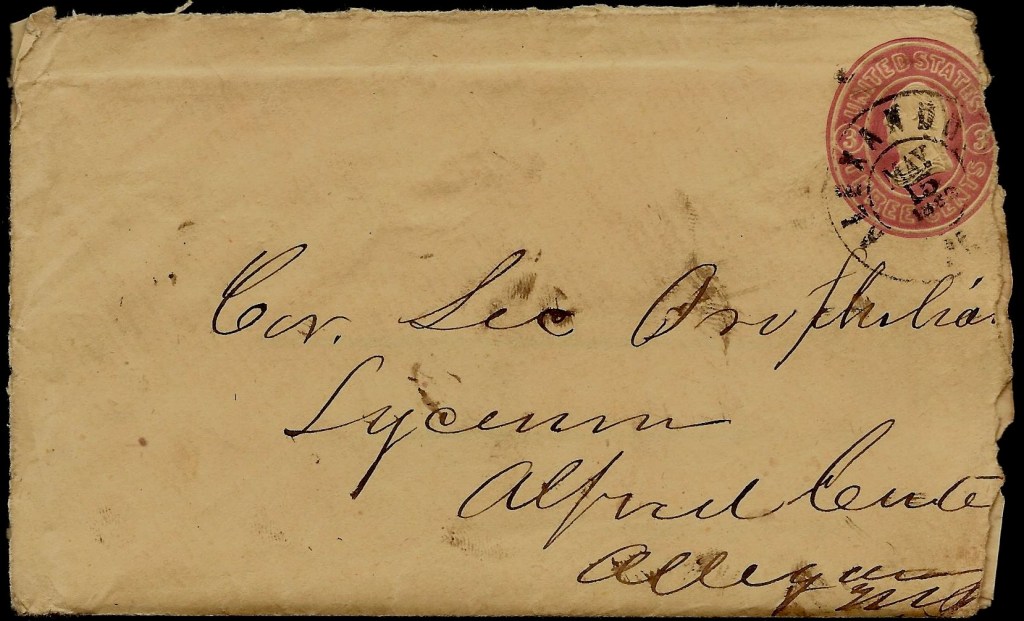
Addressed to Corresponding Secretary Orophilian Lyceum, Alfred Centre, Allegany county, N. Y.
Camp opposite Fredericksburg, Stafford county, Va. April 1862
Dear Oros,
On the morning of the 18th pursuant to an order that previous night at 6:30 o’clock, General Patrick’s Brigade was on the march en route for Fredericksburg. We had marched to Catlett’s Station two days before—a distance of 10 miles from Bristol on the Orange & Alexandria Railroad. We had two day’s rations in our haversacks and were told we had a hard march before us of about 32 miles which was to be accomplished in two days. Gen. Augur’s Brigade had gone the day before accompanied by a portion of Capt. Gibbon’s artillery.
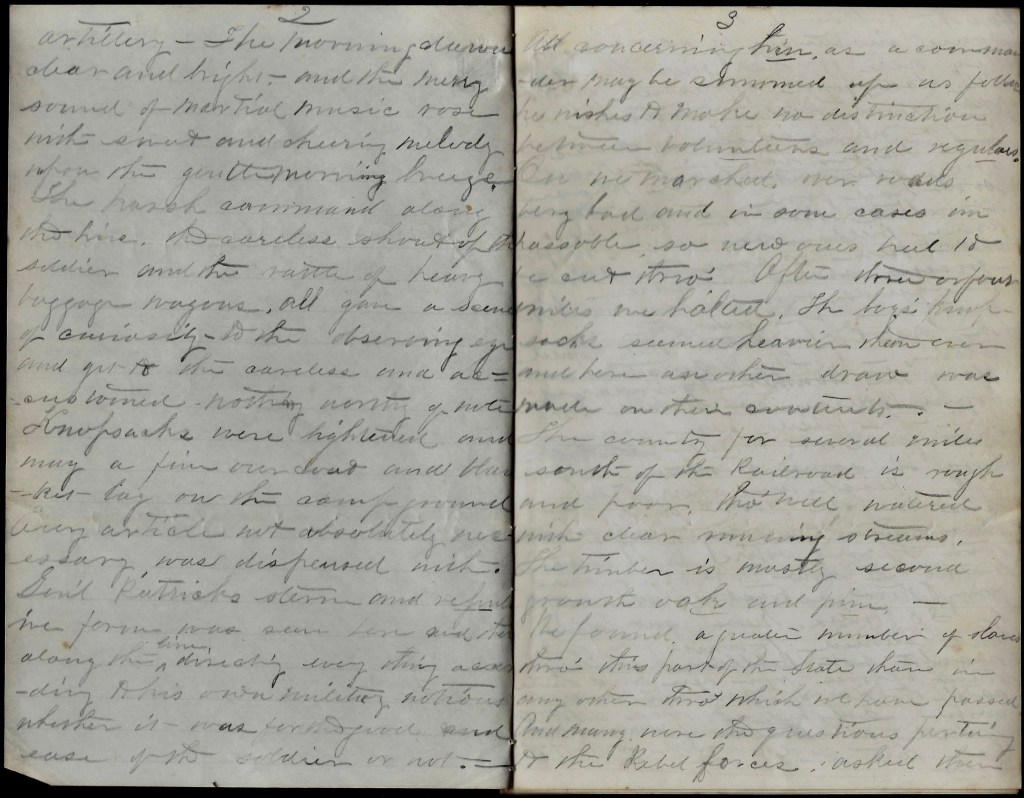
The morning dawned clear and bright and the merry sound of martial music rose with sweet and cheering melody upon the gentle morning breeze. The harsh command along the line, the careless shout of the soldier, and the rattle of heavy baggage wagons all gave a scene of curiosity to the observing eye and yet to the careless and accustomed, nothing worth of note. Knapsacks were tightened and many a fine overcoat and blanket lay on the campground. Every article not absolutely necessary was dispensed with. General Patrick’s stern and repulsive form was seen here and there along the line directing everything according to his own military notions whether it was for the good and ease of the soldier or not. All concerning him, as a commander may be summed up as follows—he wishes to make no distinction between volunteers and regulars.
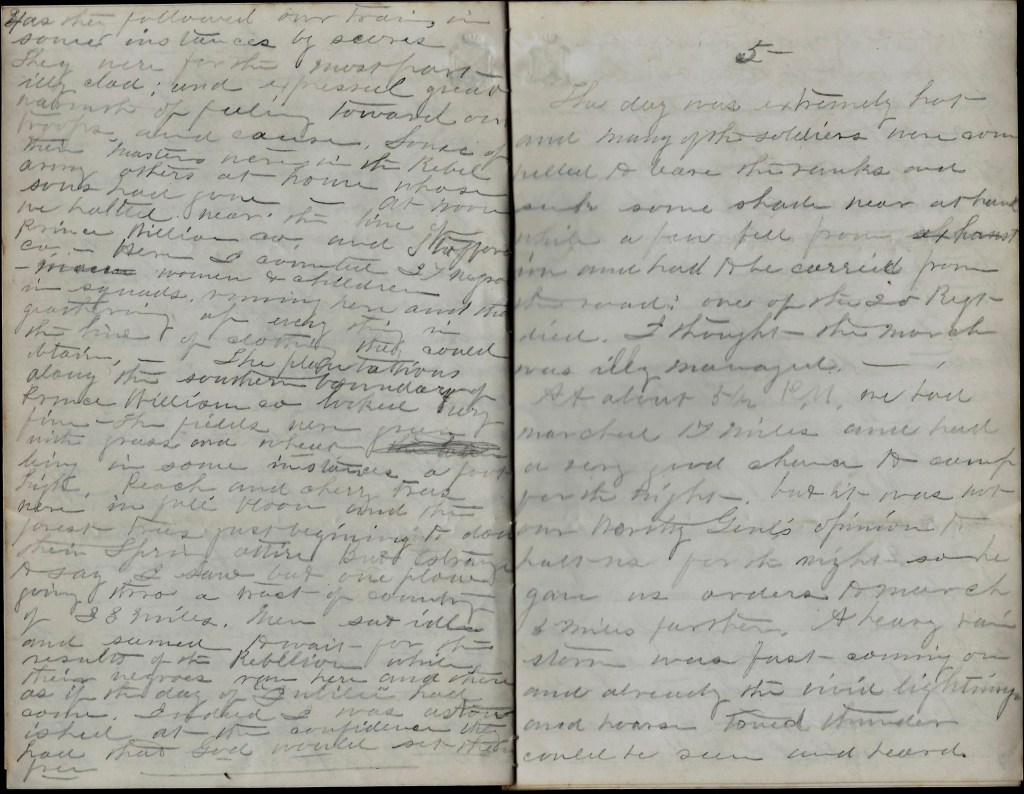
On we marched over roads very bad and in some cases impassable. After three or four miles, we halted. The boys’ knapsacks seemed heavier than ever and here another draw was made on the contents. The country for several miles south of the railroad is rough and poor though well watered with clear running streams. The timber is mostly second growth oak and pine. We found a greater number of slaves through this part of the state than in any other through which we have passed. And many were the questions pertaining to the Rebel forces asked them as they followed our train, in some instances by scores. They were, for the most part, illy clad and expressed great warmth of feeling toward our troops and cause. Some of their masters were in the Rebel army; others at home whose sons had gone.
At noon we halted near the line of Prince William county and Stafford county. Here I counted 27 negro men, women and children in squads, running here and there, gathering up everything in the line of clothing they could obtain. The plantations along the southern boundary of Prince William County looked very fine. The fields were green with grass and wheat lying in some instances a foot high. Peach and cherry trees were in full bloom and the first trees just beginning to don their spring attire. But strange to say, I saw but one plow going through a tract of country of 33 miles. Men sat idle and seemed to wait for the results of the Rebellion while their negroes ran here and there as if the day of Jubilee had come. Indeed, I was astonished at the confidence they had that God would set them free.
The day was extremely hot and many of the soldiers were compelled to leave the ranks and seek some shade near at hand while a few fell from exhaustion and had to be carried from the road. One of the 20th Regiment died. I thought the march was illy managed.
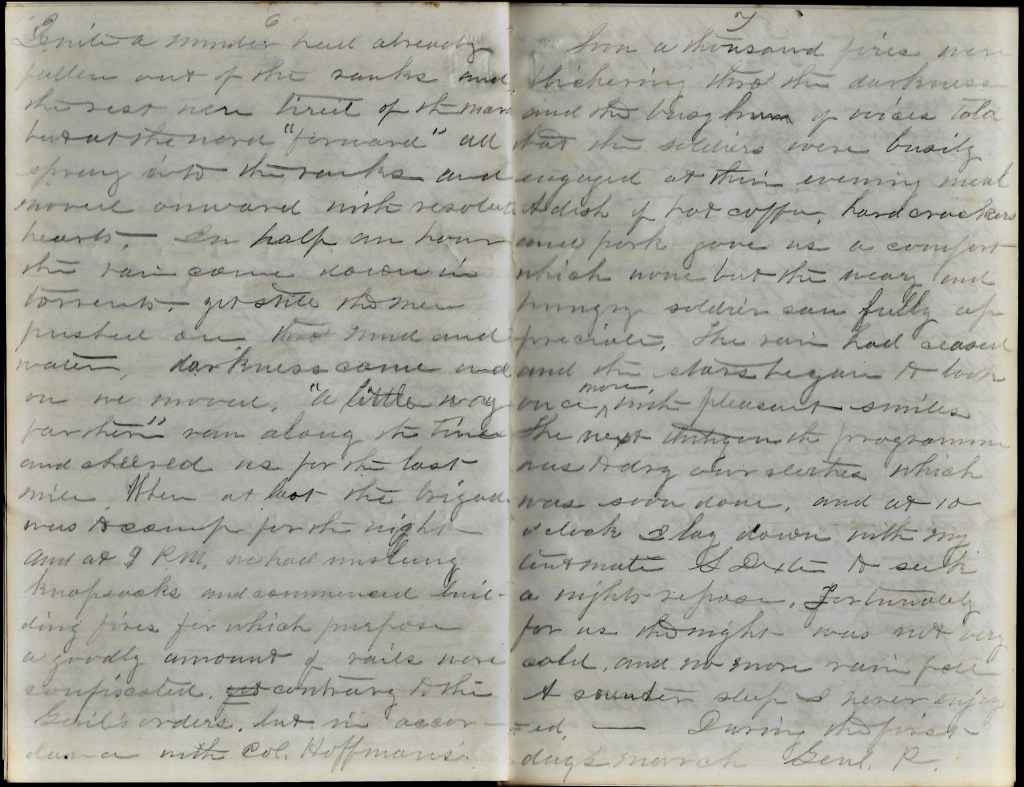
At about 5:30 p.m., we had marched 17 miles and had a very good chance to camp for the night, but it was not our worthy General’s opinion to halt us for the night so he gave us orders to march 6 miles further. A heavy rainstorm was fast coming on and already the vivid lightning and hoarse-toned thunder could be seen and heard. Quite a number had already fallen out of the ranks and the rest were tired of the march but at the word “forward” all sprung into the ranks and moved onward with resolute hearts. In half an hour, the rain came down in torrents—yet still the men pushed on through mud and water. Darkness came and on we moved. “A little way further” ran along the line and cheered us for the last mile. When at last the brigade was to camp for the night and at 9 p.m. we had unslung knapsacks and commenced building fires for which purpose a goodly amount of rails were confiscated, contrary to the General’s orders but in accordance with Col. [Henry C.] Hoffman’s.
Soon a thousand fires were flickering through the darkness and the busy hum of voices told that the soldiers were busily engaged at their evening meal. A dish of hot coffee, hard crackers, and pork, gave us a comfort which none but the weary and hungry soldier can fully appreciate. The rain had ceased and the stars began to look once more with pleasant smiles. The next thing on the program was to dry our clothes which was soon done and at 10 o’clock I lay down with my tent mate, S[eymour] Dexter, to seek a night’s repose. Fortunately for us, the night was not very cold and no more rain fell. A sounder sleep I never enjoyed.
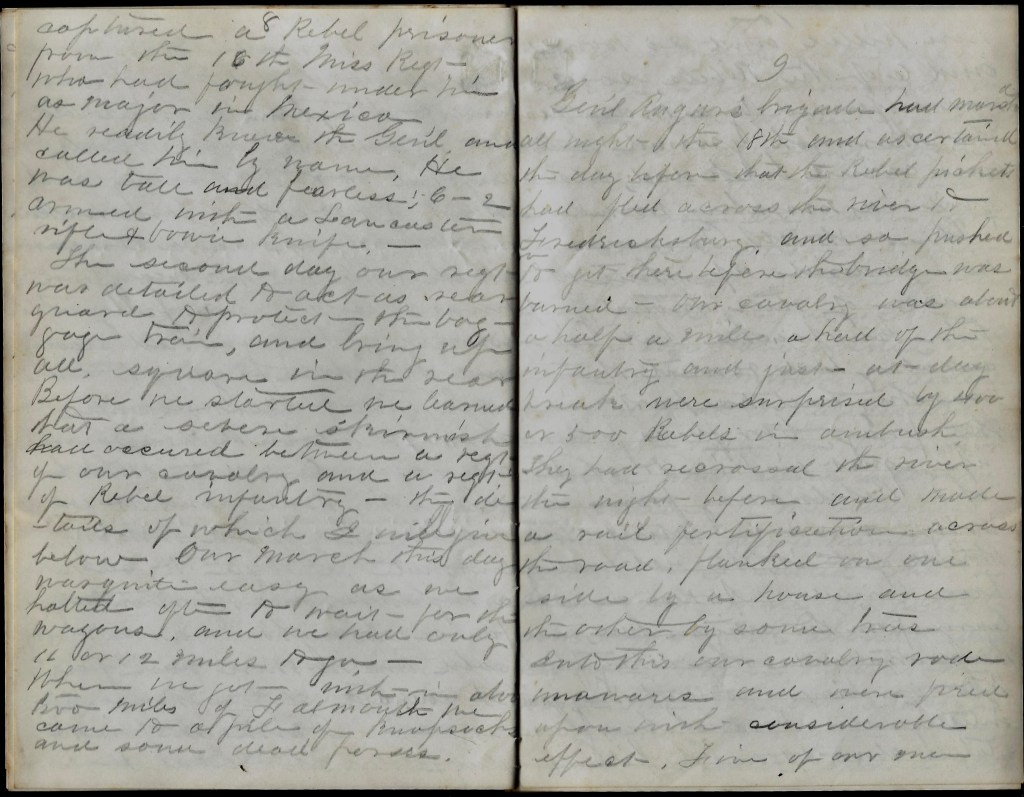
During the first day’s march, General Patrick captured a rebel prisoner from the 16th Mississippi Regiment who had fought under him as Major in Mexico. He readily knew the General and called him by name. He was tall and fearless—6′ 2″—armed with a Lancaster rifle & Bowie knife.
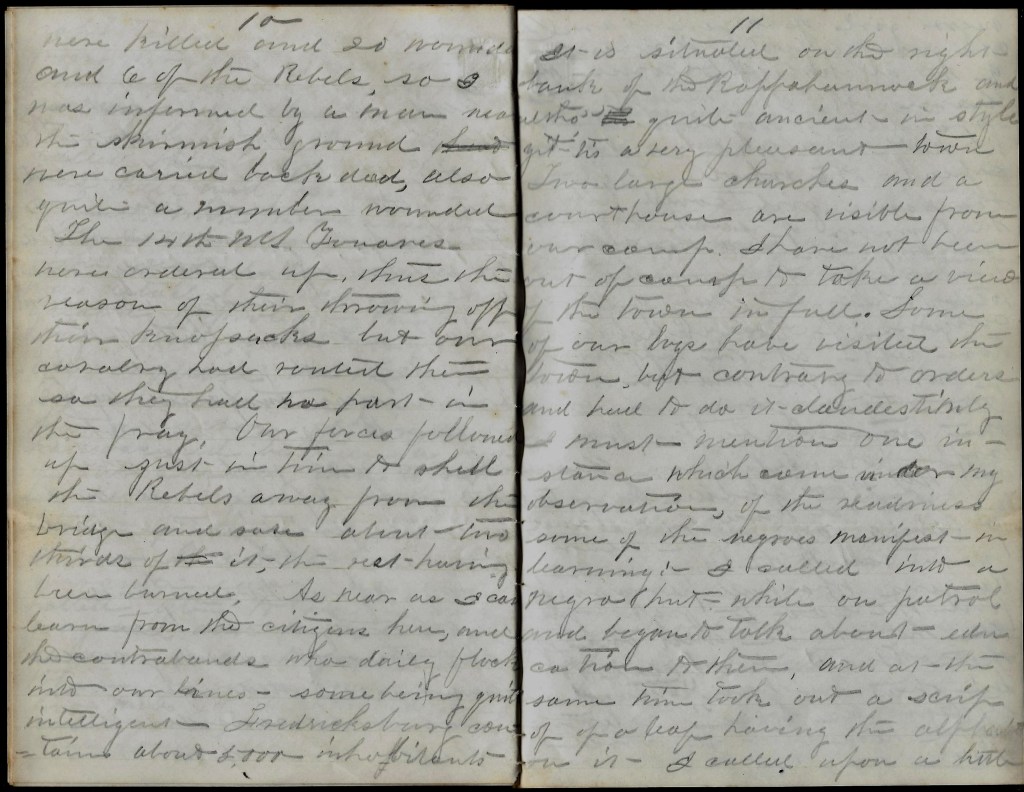
The second day our regiment was detailed to act as rear guard to protect the baggage train and bring up all, square in the rear. Before we started, we learned that a severe skirmish had occurred between a regiment of our cavalry and a regiment of Rebel infantry—the details of which I will give below. Our march this day was quite easy as we halted often to wait for the wagons and we had only 11 or 12 miles to go. When we got within about two miles of Falmouth, we came to a pile of knapsacks and some dead horses. General Ruger’s Brigade had marched all night the 18th and ascertained the day before that the Rebel pickets had fled across the [Rappahannock] River to Fredericksburg and so pushed to get here before the bridge was burned. Our cavalry was about a half a mile ahead of the infantry and just at daybreak were surprised by 400 or 500 Rebels in ambush. They had recrossed the river the night before and made a rail fortification across the road, flanked on one side by a house and the other by some trees. Into this our cavalry rode unawares and were fired upon with considerable effect. Some of our men were killed and 20 wounded and 6 of the Rebels—so we were informed by a man near the skirmish ground—were carried back dead. Also quite a number wounded.
The 14th New York Zouaves were ordered up, thus the reason of their throwing off their knapsacks, but our cavalry had routed them so they had no part in the fray. Our forces followed up just in time to shell the Rebels away from the bridge and save about two-thirds of it; the rest having been burned. As near as I can learn from the citizens here, and the contrabands who daily flock into our lines—some being quite intelligent, Fredericksburg contains about 5,000 inhabitants. It is situated on the right bank of the Rappahannock and though quite ancient in style, yet tis a very pleasant town. Two large churches and a courthouse are visible from our camp. I have not been out of camp to take a view of the town in full. Some of our boys have visited the town but contrary to orders and had to do it clandestinely.
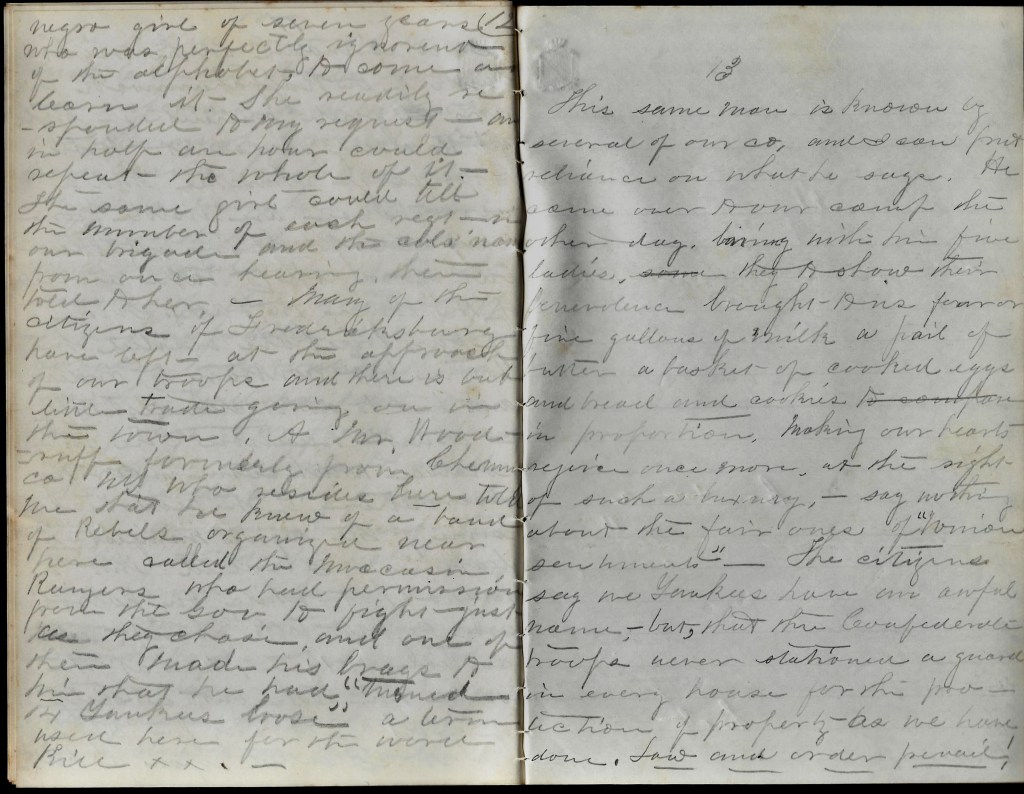
I must mention one instance which came under my observation of the readiness some of the negroes manifest n learning. I called into a negro hut while on patrol and began to talk about education to them, and at the same time took out a scrip of a leaf having the alphabet on it. I called upon a little negro girl of seven years who was perfectly ignorant of the alphabet to come and learn it. She readily responded to my request and in half an hour could repeat the whole of it. The same girl could tell the number of each regiment in our brigade and the Colonel’s name from once hearing them told her.
Many of the citizens of Fredericksburg have left at the approach of our troops and there is but little trade going on in the town. A Mr. Woodruff, formerly from Chemung county, New York, who resides here, told me that he knew of a band of Rebels organized near here called the Moccasin Rangers who had permission from the Governor to fight just as they chose and one of them made his brags to him that he had “turned the Yankees loose”—a term used here for the word kill. This same man [Woodruff] is known by several of our company and I can put reliance on what he says. He came over to our camp the other day bringing with him five ladies. They, to show their benevolence, brought to us four or five gallons of milk, a pail of butter, a basket of cooked eggs, and bread and cookies in proportion, making our hearts rejoice once more at the sight of such a luxury—to say nothing about the fair ones of Union sentiments.
The citizens say we Yankees have an awful name, but the Confederate troops never stationed a guard in every house for the protection of property as we have done. Law and order prevail!
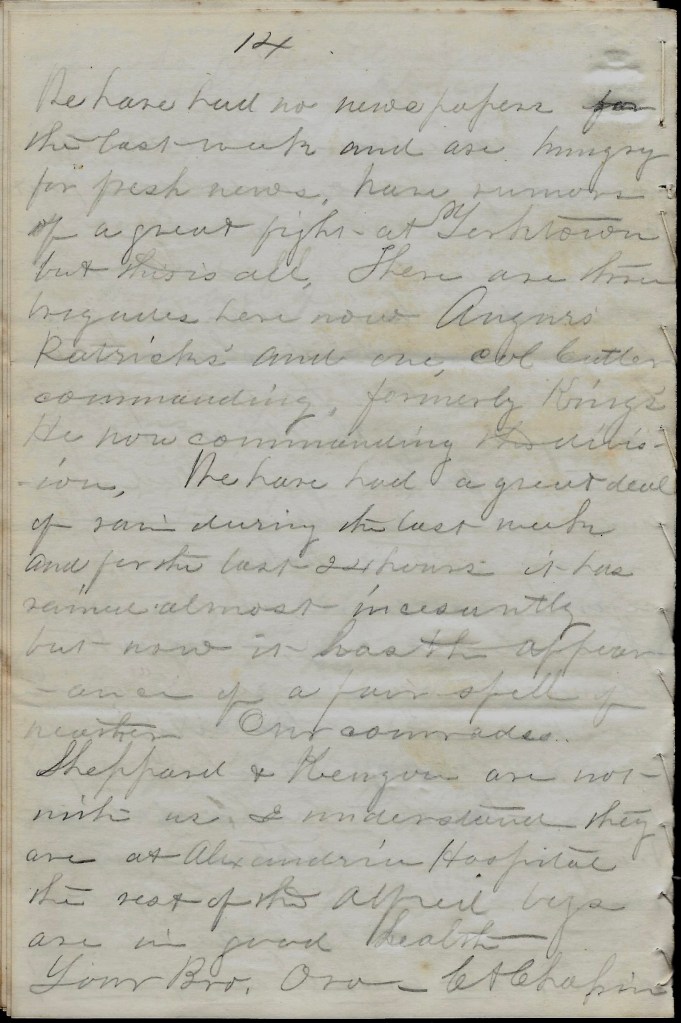
We have had no newspapers the last week and are hungry for fresh news. Have rumors of a great fight at Yorktown but this is all. There are three brigades here now—Augur’s, Patrick’s and one, Col. Cutler commanding, formerly King’s—he now commanding the Division. We have had a great deal of rain during the last week and for the last 24 hours it has rained almost incessantly. But now it has the appearance of a fair spell of weather. Our comrades [Mark] Shephard and [Lewis] Kenyon are not with us. I understand they are Alexandria Hospital. The rest of the Alfred Boys are in good health. Your brother Oro, — C. A. Chapin
Letter 2
Corresponding Secretary of the Orophilia Lyceum, Alfred Centre, Allegany county, NY
Fredericksburg, Virginia May 11th 1862
Dear Oros,
The 23rd [New York] Regiment now holds this famous town—famous because it is as old as Philadelphia—because we lay two weeks on the opposite bank of the Rappahannock and did not enter the city while the Rebels had free access to it and removed all the stores and provisions valuable therein—and because tis the place where Washington spent his youthful days from the time he was four years old till he was thirteen. It is by nature a most beautiful place. The valley is sufficiently wide to give ample room for a large city. The chain of hills on either bank is not abrupt but gently sloping, while here and there, back from the river, tower lofty mansions with almost every feature of beauty and grandeur.
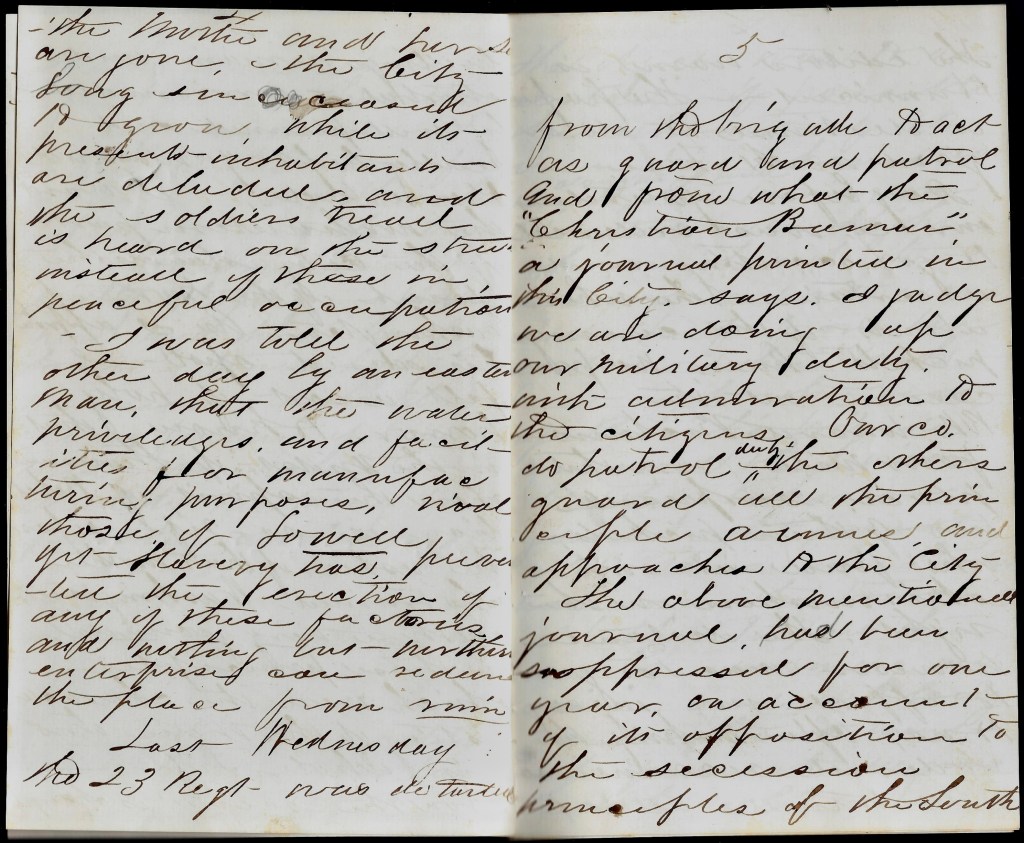
The city has many bad features and some good ones. It looks deserted and neglected, which it is, and contains many poor negro huts—a characteristic of all Southern cities—while on the other hand some beautiful dwellings remain undisturbed, surrounded by well-planned and neatly kept gardens and flower beds. Toward the northwestern part of the city stands the Tomb of the mother of Washington. As I approached this sacred spot, I felt a sort of holy horror to know that in the midst of the thousands where the spirit of rebellion is so rife, reposes the ashes of that mother who trained Washington on these very grounds in those principles which even the characteristic of the man through his whole life. Now the scene is changed—the mother and her son are gone—the city long since ceased to grow, while its present inhabitants are deluded and the soldiers tread is heard on the street instead of those in peaceful occupation.
I was told the other day by an Eastern man that the water privileges and facilities for manufacturing purposes rival those of Lowell, yet slavery has prevented the erection of any of these factories and nothing but Northern enterprise can redeem the place from ruin.
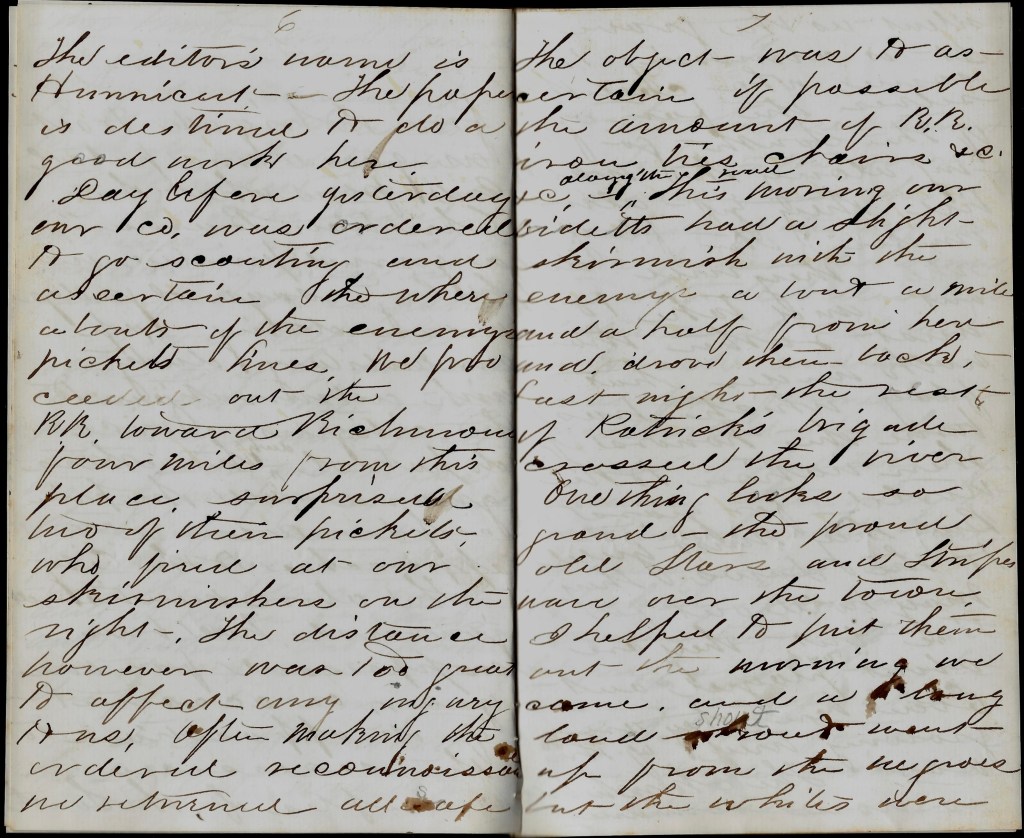
Last Wednesday the 23rd Regiment was detailed from the Brigade to act as guards and patrol and from what the “Christian Banner”—a journal printed in this city says, I judge we are doing up our military duty with admiration to the citizens. Our company do patrol duty; the others guard all the principle avenues and approaches to the city. The above mentioned journal had been suppressed for one year of account of its opposition to the secession principles of the South. The editor’s name is [James W.] Hunnicutt. The paper is destined to do a good work here.
The Christian Banner, a weekly newspaper, was edited by James W. Hunnicutt. The paper began publication in 1848 but ceased operations on May 9, 1861, in the midst of the secession crisis, with Hunnicutt bowing to public pressure over his pro-Union views. He resumed publication on May 9, 1862, after the Union army entered Fredericksburg. When the troops withdrew from the city at the end of August 1862, Hunnicutt fled the city. Newspaper Virginia Fredericksburg. Special Collections, University of Virginia, Charlottesville, Va.
Day before yesterday our company was ordered to go scouting and ascertain the whereabouts of the enemy picket lines. We proceeded out the railroad toward Richmond four miles from this place, surprised two of their pickets who fired at our skirmishers on the right. The distance, however, was too great to affect any injury to us. After making the ordered reconnoissance, we returned all safe. The object was to ascertain if possible the amount of railroad iron, ties, chains, &c. &c. along the road. This morning our videttes had a slight skirmish with the enemy about a mile and a half from here and drove them back. Last night the rest of Patrick’s Brigade crossed the river.
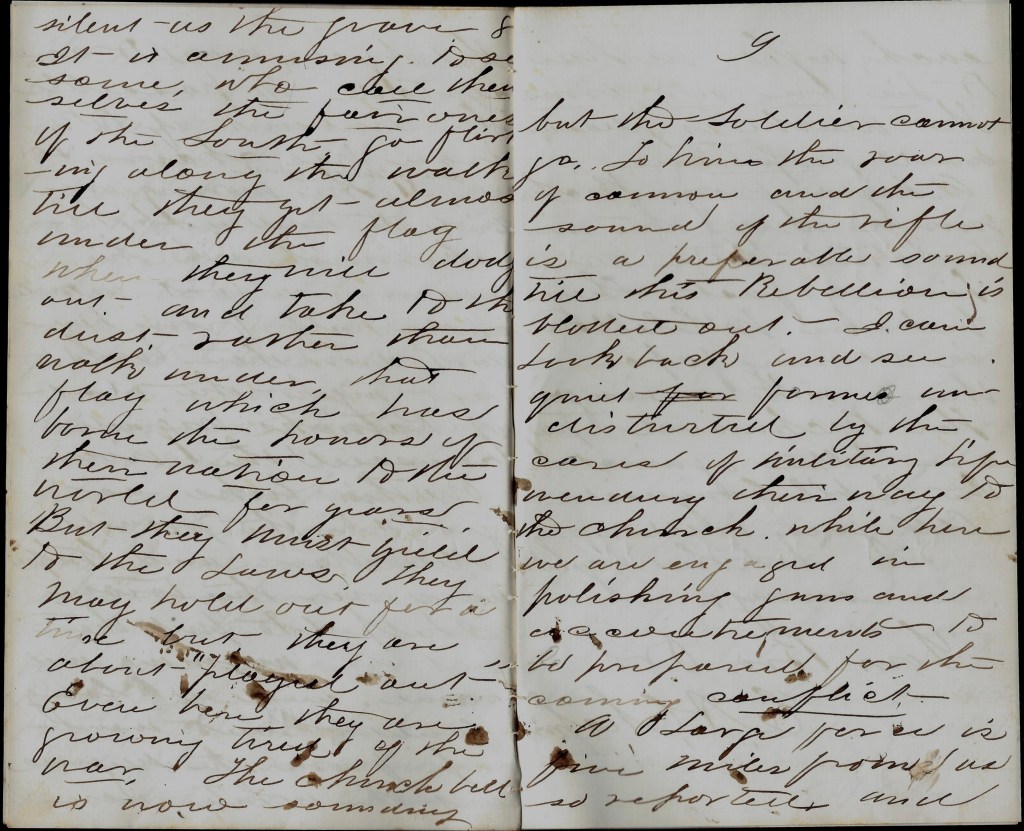
One thing looks so grand—the proud old Stars and Stripes wave over the town. I helped to put them out the morning we came and a long loud shout went up from the negroes but the whites were silent as the grave & it is amusing to see some who call themselves the fair ones of the South go flirting along the walk till they get almost under the flag when they will dodge out and take to the dust rather than walk under that flag which has borne the honors of their nation to the world for years. 1 But they must yield to the laws. They may hold out for a time but they are about “played out.” Even here they are growing tired of the war. The church bell is now sounding each night. We have to lie on our arms.
The weather is pleasant and propitious. A negro from Richmond says the inhabitants there are leaving fast. They believe McClellan is coming upon them with a vengeance. The Richmond papers are bitter against the Rebel Congress. All goes well. Let the right bear sway. Your Bro. Oro, — C. A. Chaplin
1 In the New York Herald of 2 May 1862, a war correspondent reported that the women of Fredericksburg looked “as if they could swallow the entire army of live Yankees; they are riling mad and can’t help showing their dislike and hatred to the “mudsills. Their “pouting” and effeminate scowls are amusing to our troops who nearly kill the poor “secesh creatures” with their Yankee smiles and “frolicking.” There are some good looking “Ginny g’hals” here that have already struck the fancy of some of our “Bowled solder Boys,” which, if I mistake not, will in some instances bring about a Union between secesh damsels and our boys. A good chance to get a live Yankee husband will not be allowed to slip through the fingers of these young ladies; for such an excellent bargain they will readily bring their minds to the belief that secesh is a “bad egg” and won’t do to such.”
Letter 3
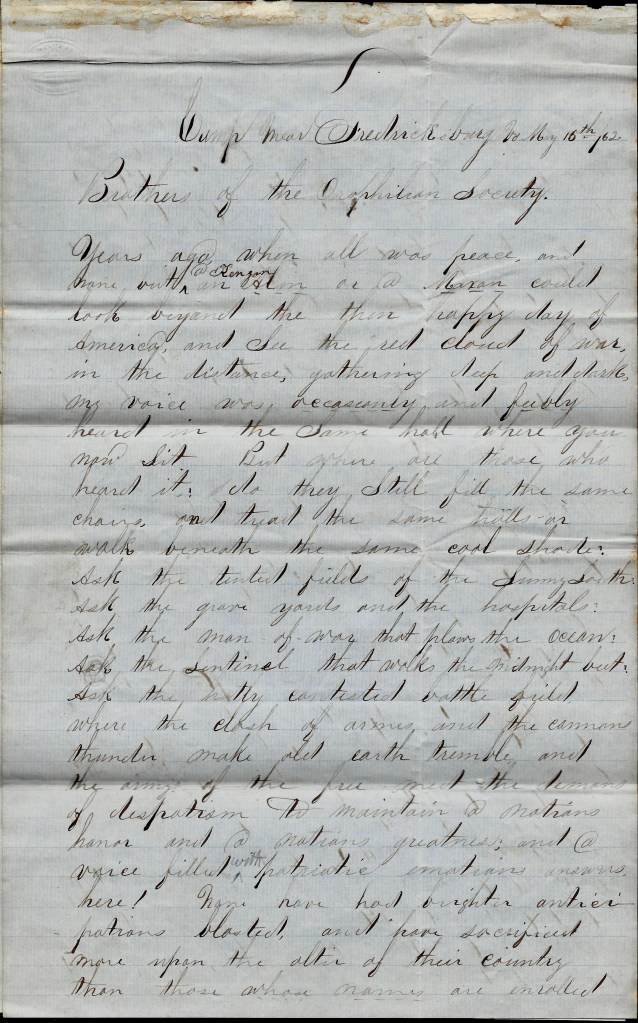
Camp near Fredericksburg, Va. May 16th 1862
Brothers of the Orophilian Society,
Years ago when all was peace and none [ ] could look beyond the then happy day of America and see the red cloud of war in the distance, gathering deep and dark, my voice was occasionally and feebly heard in the same hall where you now sit. But where are all those who heard it? Do they still fill the same chairs and tread the same halls or walk beneath the same cool shade? Ask the tented fields of the Sunny South. Ask the grave yards and the hospitals. As the man-of-war that plows the ocean. Ask the sentinel that walks the midnight but ask the hotly contested battle field where the clash of arms and the cannons thunder make old earth tremble and the armies of the free meet the demons of desperation to maintain a nation’s honor and a nation’s greatness and a voice filled with patriotic emotions answers, ‘Here!”
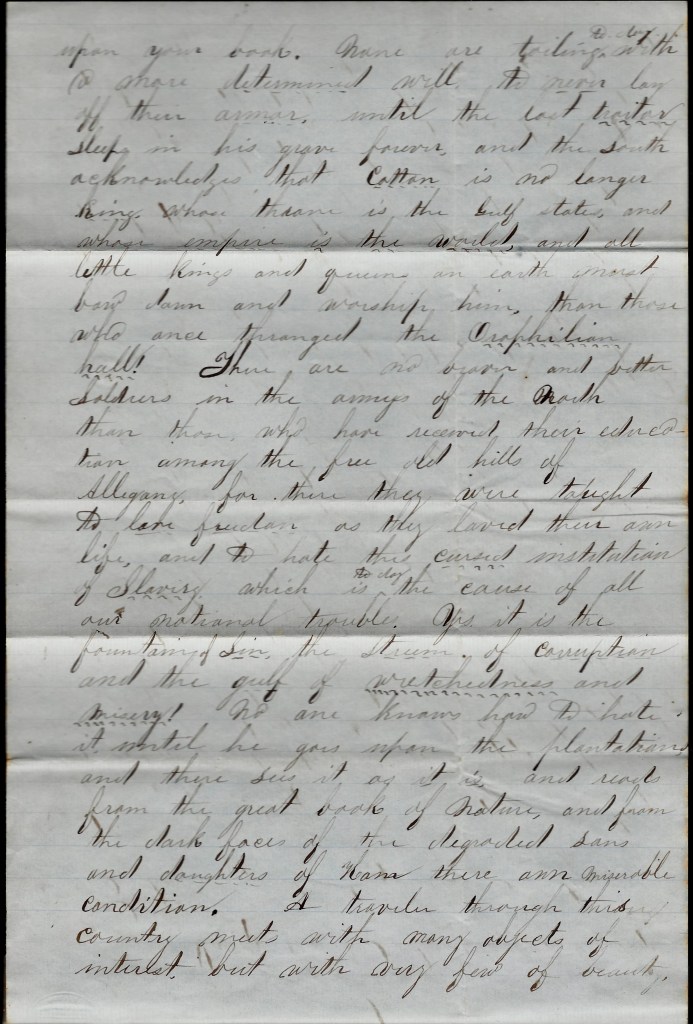
None have had brighter anticipation blasted and have sacrificed more upon the altar of their country than those whose names are enrolled upon your book. None are toiling today with a more determined will to never lay off their armor until the last traitor sleeps in his grave forever and the South acknowledges that cotton is no longer king, whose throne is the Gulf States and whose empire is the world, and all little kings and queens on earth must bow down and worship him, than those who once thronged the Orophilian Hall!
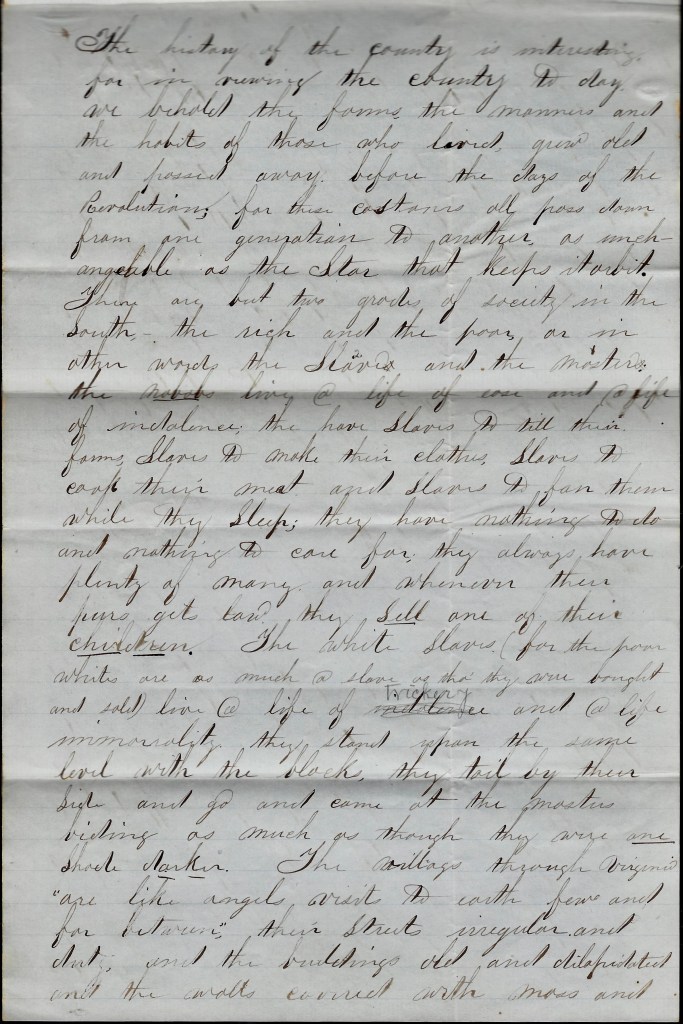
There are no braver and better soldiers in the armies of the North than those who have received their education among the free old hills of Allegany, for there they were taught to love freedom as they loved their own life and to hate the cursed institution of slavery which is today the cause of all our national trouble. Yes, it is the fountain of sin, the stream of corruption, and the gulf of wretchedness and misery! No one knows how to hate it until he goes upon the plantations and three sees it as it is and reads from the great book of nature, and from the dark faces of the degraded sons and daughters of Ham their own miserable condition. A traveler through this country meets with many aspects of interest but with very few of beauty.
The history of the country is interesting for in viewing the country today, we behold the forms, the manners, and the habits of those who lived, grew old, and passed away before the days of the Revolution, for these customs all pass down from generation to another as unchangeable as the star that keeps it’s orbit. There are but two grades of society in the South—the rich and the poor, or in other words, the slaves and the masters. The nobobs live a life of ease and a life of indolence, They have slaves to till their farms, slaves to make their clothes, slaves to cook their meat, and slaves to fan them while they sleep. They have nothing to do adn nothing to care for. They always have plenty of money and whenever their purse gets low, they sell one of their children.
The white slaves (for the poor whites are as much a slave as though they were bought and sold) live a life of trickery and a life of immorality. They stand upon the same level with the blacks. They toil by their side and go and come at the master’s bidding as much as though they were one shade darker.
The villages through Virginia “are like angel’s visits to earth, few and far between”—their streets irregular and dusty, and the buildings old and dilapidated and the walls covered with moss and cobwebs and fast going to decay. The architecture is the same today that it was two hundred years ago, without the least improvement. The most of the buildings are of a plain style with the chimney (as the soldier says) turned out door. The son patterns after the father, the grandson after the son, and the great grandson after the grandson. The planters generally select the highest point of ground on their plantation for a building spot without any reference to the road whatever, and if there is a rocky, romantic cliff there, you will find it hid among the giant oaks and shrubbery. Around these mansions, at a distance of from ten thirty yards are generally scattered from ten to twenty little log huts about the size of a Northerner’s hog pen or corn house, in which the slaves enjoy all the luxuries of the house of bondage, which is hie-cake, hard work, and the cat of nine tails. These huts are almost invariably white-washed on the outside—this is white-washing the institution, but they may white wash from now until Gabriel bids old time to end and it will be slavery still!!
This day the Stars and Stripes—the proud emblem of the free—the flag our fathers bought with blood and death—the flag which all nations honor—the flag under which we were born, have lived, and fought and expect to die, was unfurled to the breeze in sight of the capitol of Rebeldom. Wave on, old time-honored flag! May you forever proudly float over us, our children, grandchildren, till the Angels shall stand on the land and ocean and aid the world to halt them. Goodbye. — C. C.
Letter 4
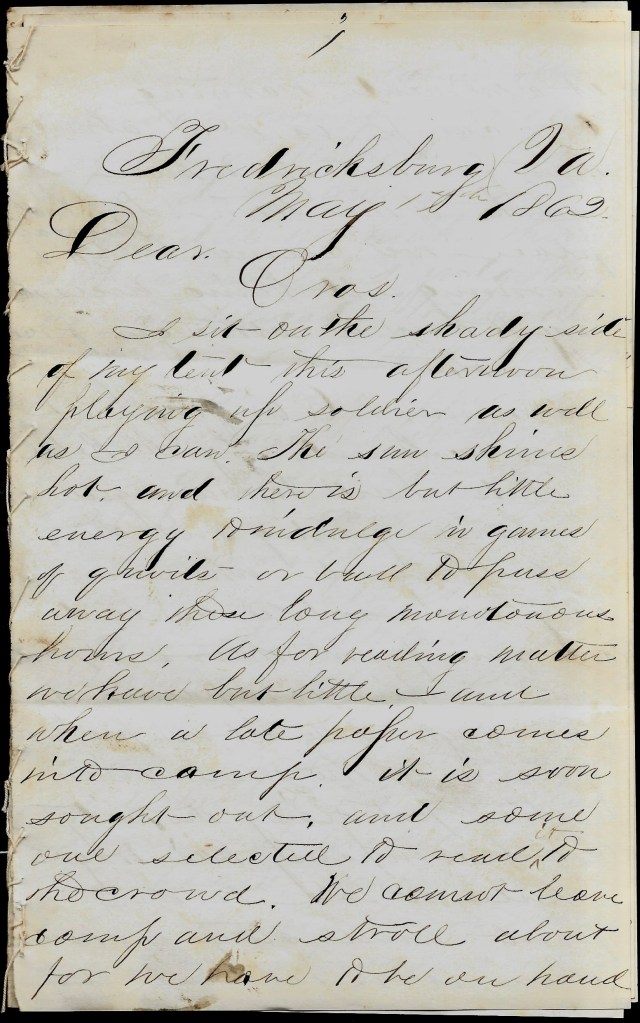
Fredericksburg, Va. May 17th 1862
Dear Oros,
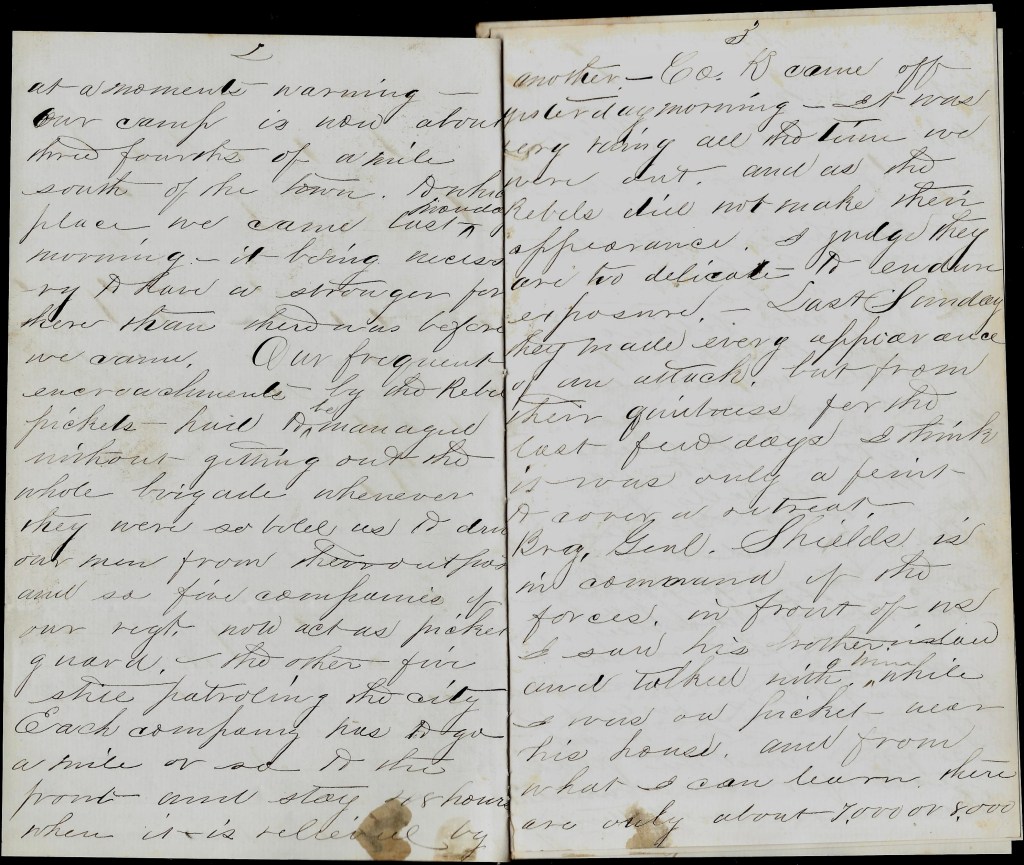
I sit on the shady side of my tent this afternoon playing up soldier as well as I can. The sun shines hot and there is but little energy to indulge in games of quoits or ball to pass away these long monotonous hours. As for reading matter, we have but little and when a late paper comes into camp, it is soon sought out and someone selected to read it to the crowd. We cannot leave camp and stroll about for we have to be on hand at a moment’s warning. Our camp is now about three-fourths of a mile south of the town to which place we came last Monday morning, it being necessary to have a stronger force here than there was before we came. Our frequent encroachments by the Rebel pickets had to be managed without getting out the whole brigade whenever they were so bold as to drive our men from their outposts and so five companies of our regiment now act as picket guard, the other five still patrolling the city. Each company has to go a mile or so to the front and stay 48 hours when it is relieved by another. Co. K came off yesterday morning. It was very rainy all the time we were out and as the Rebels did not make their appearance, I judge they are too delicate to endure exposure.
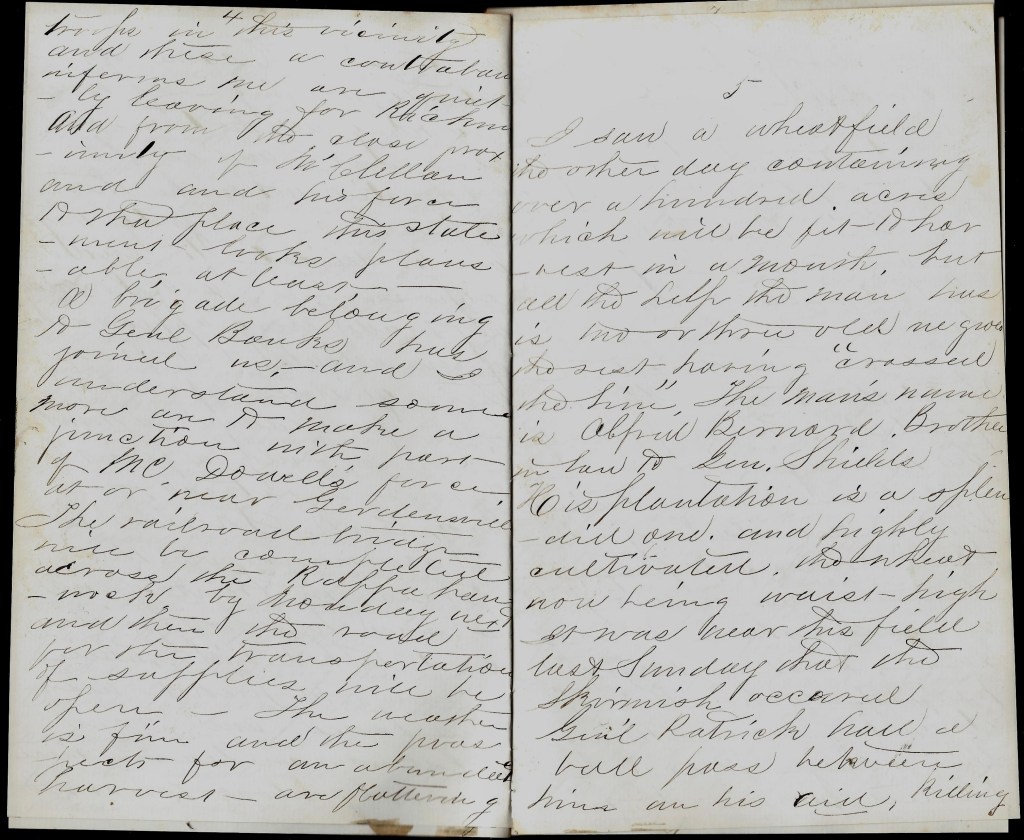
Last Sunday they made every appearance of an attack but from their quietness for the last few days, I think it was only a feint to cover a retreat. Brig. Gen. Shields is in command of the forces in front of us. I saw his brother-in-law and talked with him while I was on picket near his house and from what I can learn, there are only about 7,000 or 8,000 troops in this vicinity and these a contraband informs me are quietly leaving for Richmond. And from the close proximity of McClellan and his force to that place, this statement looks plausible at least.
A Brigade belonging to Gen. Banks has joined us and I understand some more are to make a junction with part of McDowell’s force at or near Gordonsville. The railroad bridge will be completed across the Rappahannock by Monday next and then the road for the transportation of supplies will be open. 1
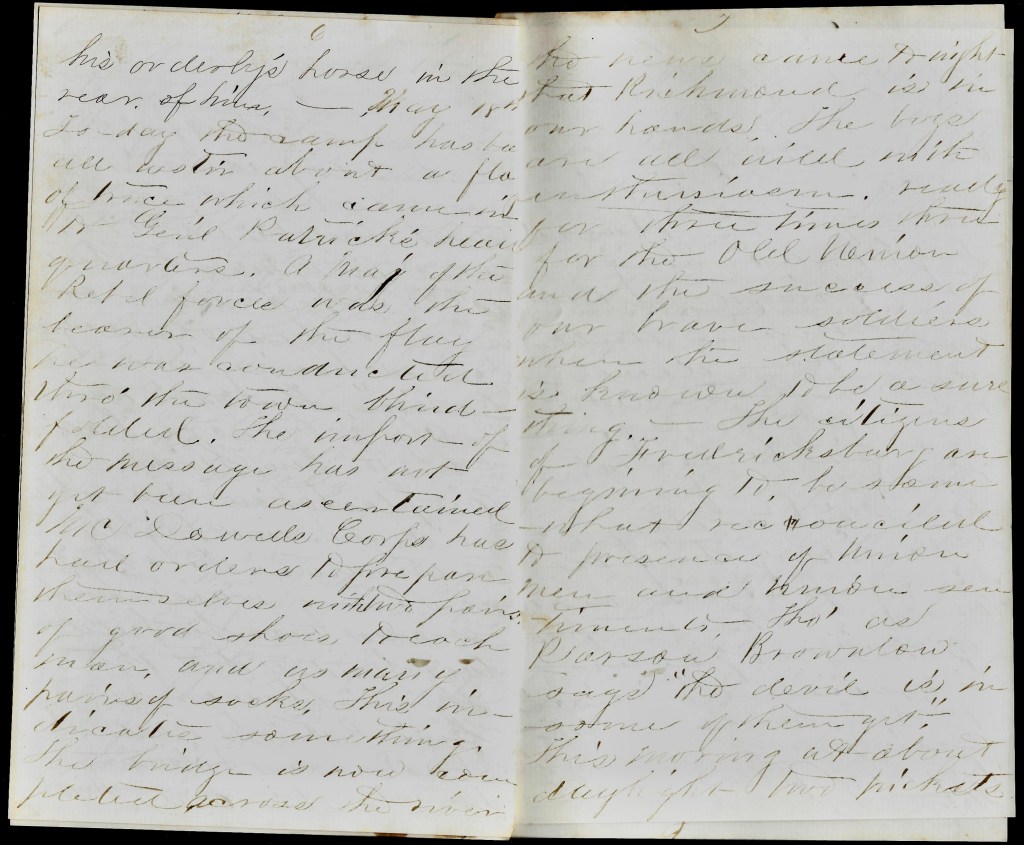
The weather is fine and the prospects for an abundant harvest are flattering. I saw a wheat field the other day containing over a hundred acres which will be fit to harvest in a month but all the help the man has is two or three old negroes, the rest having “crossed the line.” The man’s name is Alfred Bernard, brother-in-law to Gen. Shields. His plantation is a splendid one and highly cultivated. The wheat is now being waist high. It was near the field last Sunday that the skirmish occurred. Gen. Patrick had a ball pass between him and his aide, killing his orderly’s horse in the rear of him.
May 18th. Today the camp has been all astir about a flag-of-truce which came in to Gen. Patrick’s Headquarters. A Major of the Rebel force was the bearer of the flag. He was conducted through the town blind-folded. The import of the message has not yet been ascertained. McDowell’s Corps has had orders to prepare themselves with two pairs of good shoes to each man, and as many pairs of socks. This indicates something. The bridge is now completed across the river. The news came tonight that Richmond is in our hands. They boys are all wild with enthusiasm, ready for three times three for the old Union and the success of our brave soldiers when the statement is known to be a sure thing.
The citizens of Fredericksburg are beginning to be somewhat reconciled to the presence of Union men and Union sentiments, though as Parson Brownlow says, “the Devil is in some of them yet.”
This morning at about daylight two pickets of the 35th New York Vols. were taken prisoner by the Rebels. They were careless and wandered from their posts. One day last week, one of the Harris Light Cavalry surprised a Rebel horseman and shot him dead rather than let him get away. It is believed that we go from here in a day or two. Everything is being put in readiness. The troops of this corps are in excellent discipline adn health. Gen. McDowell is highly pleased with them.
The Christian Banner has again made its appearance. It is quite bitter against the Rebellion and although some of the citizens will not patronize this paper, it finds a quite lively sale among the soldiers.
The large foundry which before our appearance here was employed by the Rebels in manufacturing guns and various kinds of machinery is now worked by some of the “detested Yankees” and their workmanship makes quite a striking contrast when compared with that of the Rebels.
A man in town—I have not learned his name—last night offered a negro $200 to fire the railroad bridge just completed and gave him the necessary instruction, but thanks to the black, he had too much honesty to thus be tempted and [ ] so he reported the man who was today arrested and the negro was rewarded. But being on guard tonight, I have not time to write more. Your true Bro. Oros, — C. A. Chapin
1 Newspaper accounts dated 13 May reported that between three and four hundred soldiers under the directions of civil engineers were engaged in building a Trestle Bridge across the river immediately over the ruins of the old Railroad bridge “which the rebels, in their madness, destroyed. This bridge is seventy-five feet in height and six hundred in length. The work progresses finely and will, if nothing happens be completed by the last of this week or the first of next, this bridge connects the Acquia Creek Road with the Richmond and Fredericksburg. When completed, communications by rail from the creek to Fredericksburg will be opened them. We look for an advance of the forces now encamped upon the east side of the river. If the work of repairing railroads and building bridges belongs to this division of the army, it will be sometime before we enter Richmond as the work of destruction along the road we are informed has been quite extensive.”
Letter 5
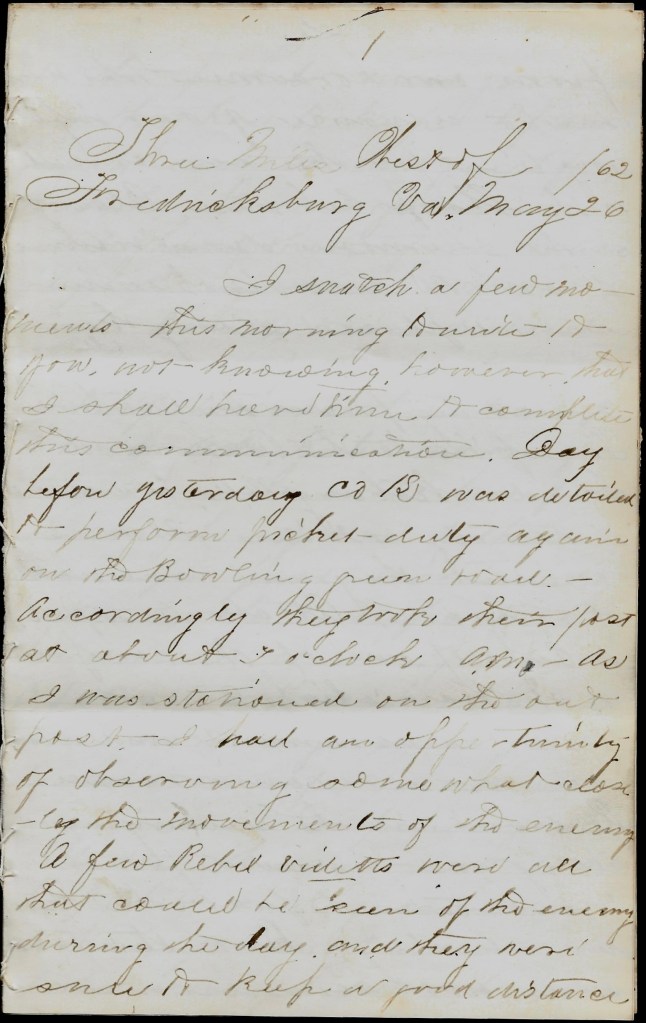
Three miles west of Fredericksburg, Va. May 26, 1862
I snatch a few moments this morning to write to you, not knowing however that I shall have time to complete this communication. Day before yesterday Co. K was detailed to perform picket duty again on the Bowling Green Road. Accordingly they took their post at about 7 o’clock a.m. As I was stationed on the outpost, I had an opportunity of observing somewhat closely the movements of the enemy. A few Rebel videttes were all that could be seen of the enemy during the day and they were sure to keep a good distance from our horsemen who were in the advance of our infantry lines for they were armed with Sharps carbines.
Along in the afternoon, dense volumes of smoke were visible in several places along their line, as near as I could learn, reaching from the Richmond Turnpike to the Richmond & Fredericksburg Railroad—a distance of nearly 4 miles. It was evident they were evacuating the place. At about 4 p.m.. a captain of one of the companies of the Harris Light Cavalry took his command and started on a reconnoissance. He drove in the enemy’s cavalry and proceeded far enough to ascertain the fact that they were leaving. But this fact was not communicated to the pickets ands guards so they had to keep up another night’s earnest and faithful watch.
When night came, the lights of their fires could be plainly seen not more than three or three and a half miles distant. Col. Lord of the 35th Regiment made a trip toward their camp at 5 a.m. yesterday morning and arrived with his force in sight of one of their camps just in time to witness their departure. He deemed it expedient to follow up as his force was not large enough to make it a safe movement against a superior force.
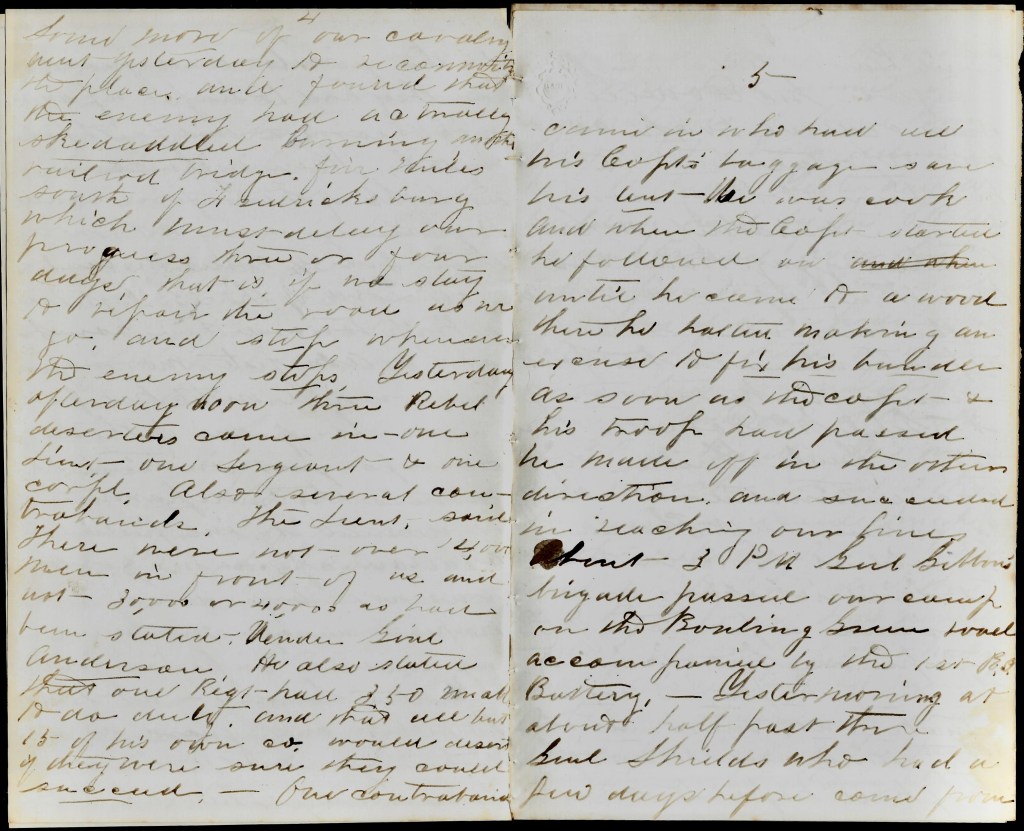
Yesterday—Sunday—at 10 a.m. the pickets and guard were taken up and orders given to be ready to march at 4. Some more of our cavalry went yesterday to reconnoiter the place and found that the enemy had actually skedaddled, burning another railroad bridge five miles south of Fredericksburg which must delay our progress three or four days—that is, if we stay to repair the road as we go, and stop whenever the enemy stops.
Yesterday afternoon three Rebel deserters came in—one Lieutenant, one Sergeant, and a Corporal. Also several contrabands. The Lieutenant said there were not over 14,000 men in front of us and not the 30,000 or 40,000 as had been stated—under General Anderson. He also stated that one regiment had 350 made to do duty and that all but 15 of his own company would desert if they were sure they could succeed. One contraband came in who had all his captain’s baggage save his tent. He was cook and when the captain started, he followed on until he came to a wood. There he hasten, making an excuse to fix his bundle. As soon as the captain and his troops had passed, he made off in the other direction and succeeded in reaching our lines.
About 3 p.m., General Gibbon’s Brigade passed our camp on the Bowling Green road accompanied by the 1st Rhode Island Battery. Yesterday morning at about half past three, Gen. Shields who had a few days before come from Gen. Banks’ column to reinforce McDowell was ordered back as it was reported that the Rebels had been working some severe mischief on Gen. Banks’ baggage train and had torn up several miles of the railroad. I have no particulars on this point—merely make mention of it. Gen. McDowell’s force before Gen. Shields left was estimated at nearly 70,000 men. Last Thursday President Lincoln was at Fredericksburg and reviewed at portion of the troops in that vicinity. The way the people’s eyes stuck out in Fredericksburg may well be imagined. They had hoped to see his head born through there as they had some of the victims of Bull Run, but that “were a delusive hope” to them. 1
“The top of cap worn by William March who was killed in civil war at Falmouth, Va., 1862 while on guard at an arsenal. The building was blown to pieces and William with it. John sent this top to mother, — E. M. M.”
Yesterday a building used by the Rebels as an arsenal near the railroad depot was blown up by means of a torpedo which was left there by them when they evacuated the town and one of Co. A, 23rd Regiment was killed. His name was [Pvt. William] March. 2 Some of the “Ladies” expressed much joy at the killing of one Yankee and up to this day the 23rd Regiment’s band has never played one of our National airs in the City. Bravo men! to be so observant of the feelings of the people of Fredericksburg!!
Five companies of this regiment are now doing guard duty in the City. The other five came to this place on the road to Gordonsville last night, three miles out of the town.
The weather is fair and pleasant yet what we are to do aside from picket and guard duty at the approaches of the city is wholly unknown to me. I do not intend to criticize the moments of this Corps but I do believe we might have given the enemy battle and routed him before he retreated to Richmond to join the force opposed to McClellan. The health of the troops here continues extremely good. — C. A. Chapin
I could not find an image of Wilson but here is one of Milton Hart of Co. H, 8th Michigan Infantry, killed in action at Spotsylvania. (Dan Binder Collection)
The following letter was written by Wilson John Baldwin (1845-1881), the orphaned son of John G. Baldwin (1819-1855) and Maria Cronkhite (1820-1857) of Flint, Wayne county, Michigan. Wilson wrote the letter to his aunt who probably raised him after his mother’s death in 1857.
Wilson enlisted at the age of 17 as a private in Co. G, 8th Michigan Infantry on 27 August 1862. This regiment had the distinction of having served in both the Eastern and the Western Theaters of the war, marching and fighting in practically all of the Southern States from the Mississippi river to the Atlantic Ocean. He was with his regiment on 19 August 1864 at the Second Battle of Weldon Railroad (Globe Tavern) when he was severely wounded in the arm which required amputation to save his life. He was discharged for his wounds on 8 June 1865.
After the war he lived in Detroit where he worked as a clerk.
Transcription
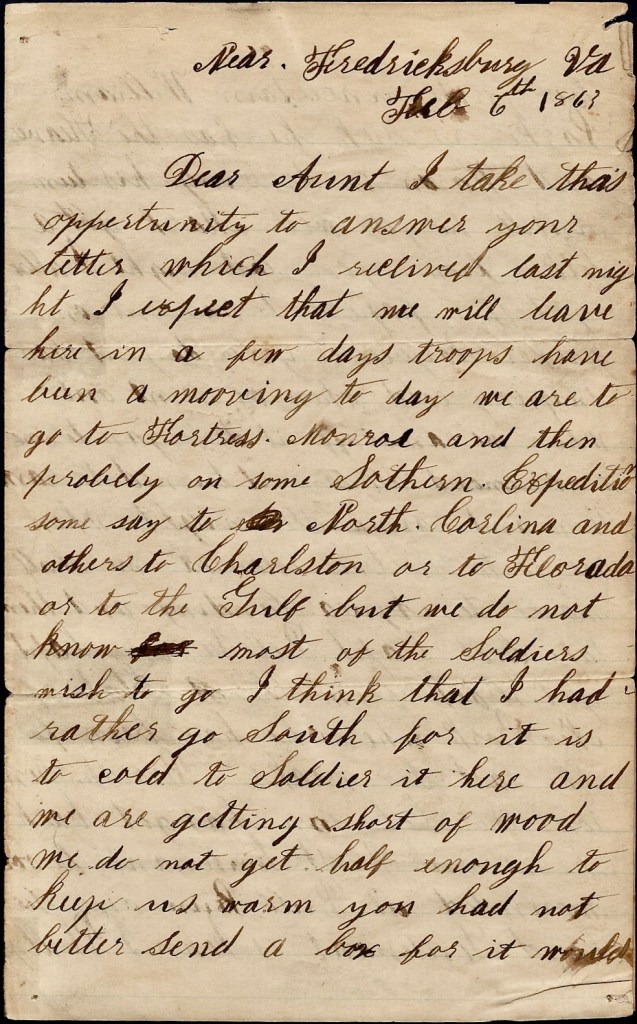
Near Fredericksburg, Va. February 6th 1863
Dear Aunt,
I take this opportunity to answer your letter which I received last night. I expect that we will leave here in a few days. Troops have been a moving today. We are to go to Fortress Monroe and then probably in some southern expedition. Some say to North Carolina and others to Charleston or to Florida or to the Gulf but we do not know. Most of the soldiers wish to go. I think that I had rather go South for it is too cold to soldier it here and we are getting short of wood. We do not get half enough to keep us warm. You had not better send a box for it would be quite uncertain.
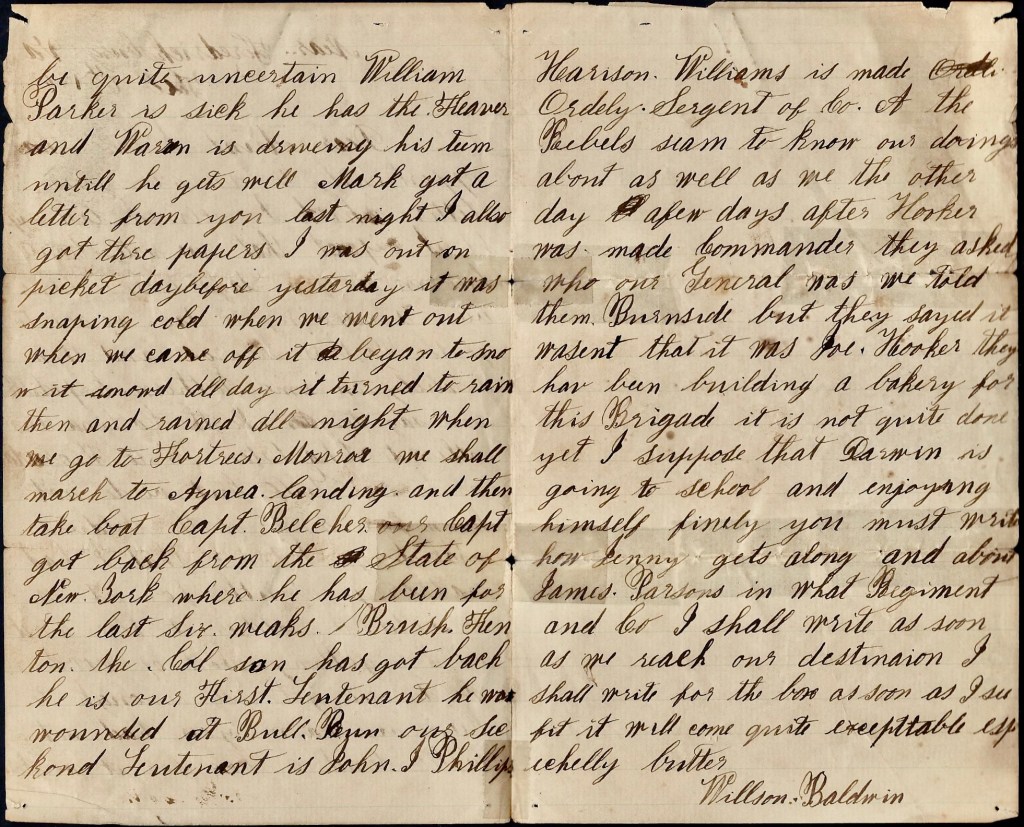
William Parker is sick. He has the fever and Warren is driving his team until he gets well. Mark has got a letter from you last night. I also got three papers.
I was out on picket day before yesterday. It was snapping cold when we went out. When we came off, it begun to snow. It snowed all day. It turned to rain then and rained all night.
When we go to Fortress Monroe we shall march to Aquia Landing and then take a boat. Capt. [Horatio] Belcher, our captain, got back from the State of New York where he has been for the last six weeks. Brush Fenton, the Colonel’s son, has got back. He is our First Lieutenant. He was wounded at Bull Run. Our Second Lieutenant is John J. Phillips. Harrison Williams is made Orderly Sergeant of Co. A.
The rebels seem to know our doings about as well as we do. The other day, a few days after Hooker was made commander, they asked who our General was. We told them Burnsides but they said it wasn’t. That it was Joe Hooker.
— Pvt. Wilson Baldin, Co. G, 8th Michigan Infantry, 6 February 1863
The rebels seem to know our doings about as well as we do. The other day, a few days after Hooker was made commander, they asked who our General was. We told them Burnsides but they said it wasn’t. That it was Joe Hooker.
They have been building a bakery for this brigade. It is not quite done yet. I suppose that Darwin is going to school and enjoying himself finely. You must write how Jenny gets along and about James Parsons—in what regiment and company. I shall write as soon as we reach our destination. I shall write for the box as soon as I see fit. It will come quite acceptable—especially butter.
Only a year apart in age, Alexander Little may have borne a strong resemblance to his brother, John Peyton Little, shown here in his Asst. Surgeon’s uniform.
The following letter was written by Archibald Alexander (“Sandy”) Little (1824-1877) of Fredericksburg, Virginia, who was assigned duty as a civilian to serve as special agent traveling in charge of quartermaster stores from Richmond, Virginia, to Columbus, Mississippi, that was consigned to Major L. F. Johnson, Quartermaster. A receipt for his services consisting of 45 days at $4/day ($180) was submitted to Maj. J. B. McClelland, Quartermaster, C. S. Army, on the 18th of June 1862.
Sandy became the editor of the Fredericksburg News in 1853 where he “wielded a most graceful and facile pen, and illustrated a thorough knowledge of his profession with a rare culture and kindly humor.” (The Virginian Pilot, 19 July 1877) His pre-war editorials no doubt promoted secession and influenced a large number of readers. Though he had to vacate his office in Fredericksburg during the war which was ransacked by Union soldiers, he returned to his profession after the war until his death in 1877.
Sandy had an older brother named John Peyton Little (1823-1874) who was a physician and served as an Asst. Surgeon in the Provisional Army of the Confederate States of America.
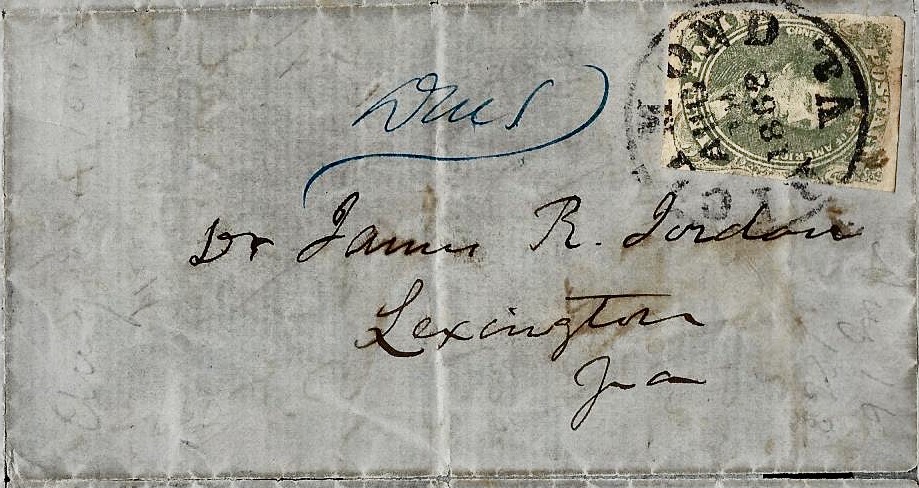
The letter was addressed to Dr. James R. Jordan (1801-1862)—a physician who resided and practiced in Lexington, Virginia. He died on 26 December 1862. I can only speculate on the nature of the correspondence. Perhaps Dr. Jordan was dying and he was concerned about the validity of an insurance policy he held with a U. S. company.
A “Major Lacy” is mentioned in the letter. Could this have been Major James Horace Lacy of Fredericksburg and the owner of Chatham Manor? He was only a Lieutenant at the time but was often referred to as “Major” prior to his promotion. He was taken prisoner in June 1862 and was widely reported to have been released in October. Perhaps he was released earlier than thought.
Transcription
Richmond, Virginia August 16, 1862
Dr. J. R. Jordan My dear Dr.,
Yours of 3 May has just been handed me by Maj. Lacy. He received it after I had gone to Corinth & before he was taken prisoner. On his return he mentioned he had received a letter for me and found it today. I can only repeat what I said a year ago—especially as I have heard nothing from the company. It will be the interest of the company to keep their promise to make all right after the war is over. They insure in France, England & Canada—foreign counties as the South will be. I will keep your note & advise you as soon as I hear from the company.
This letter was written by Pvt. John “Rison” Gibbons (1843-1919) who enlisted at Harrisonburg in Co. I, 1st Virginia Cavalry in December 1861. He remained with his company throughout the war until he surrendered at Appomattox Court House on 9 April 1865 at which time he was described as being 20 years old, standing 5′ 8″ tall, with light hair and blue eyes. He filed a claim for a bay horse killed in action near Berryville, Virginia, in August 1862 which was valued at $2900 when he entered the service.
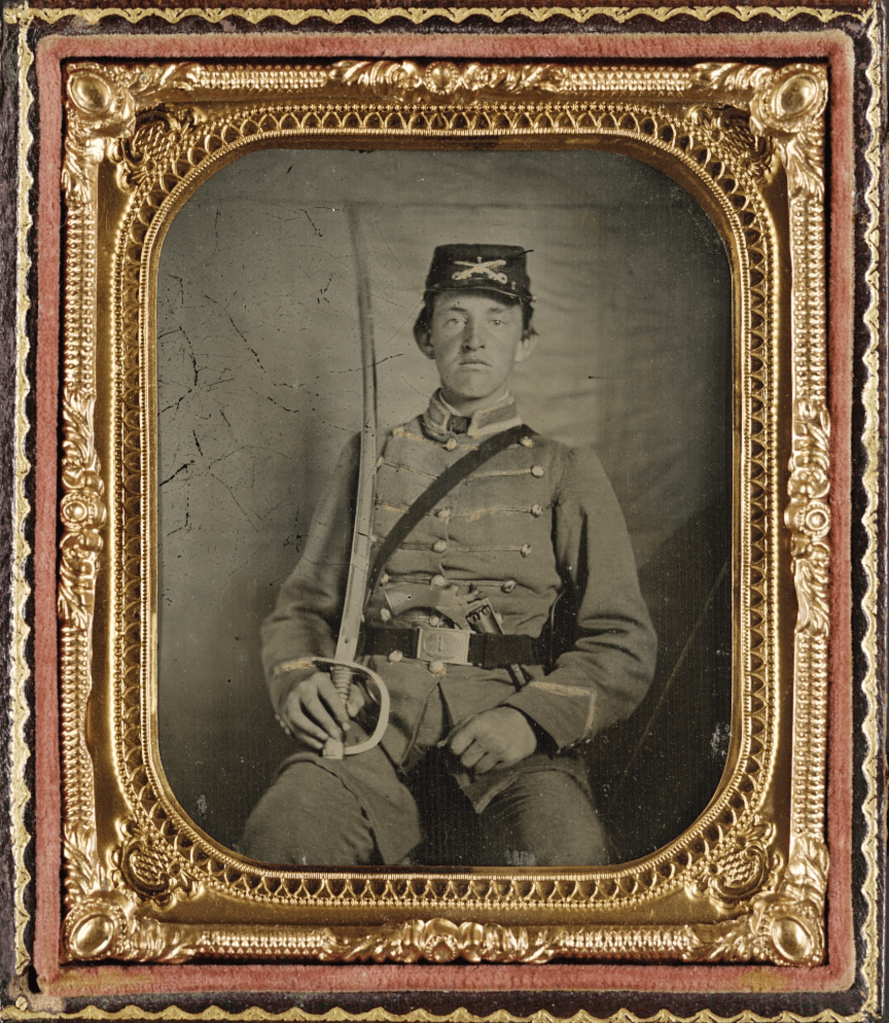
I could not find a Civil War era photograph of Gibbons but here is one of Pvt. David M. Thatcher who also served in the 1st Virginia Cavalry(LOC)
Rison Gibbons was the son of George Rockingham Gibbons (1814-1907) and Harriet Caroline Rison (1818-1876) of Rockingham county, Virginia. He married, in 1874, Ann America Felton (1848-1938). After the war he farmed in Georgia, went into the wool manufacturing business in Brentwood, Tennessee, and finally became a Mining Engineer in Georgia.
Gibbons’ letter includes a description of the battlefield at Fredericksburg and mentions the collection of two Yankee teeth he pulled from the jawbone of a half-buried Union soldier. Most soldiers found this behavior reprehensible but a great many others engaged in the occasional collection of such morbid souvenirs when time and opportunity allowed. Both sides were guilty of collecting these human trophies. After the Battle of Seven Pines, it was reported in the Pontiac Weekly Gazette (11 July 1862) that “a [Union] soldier pulled off the lower jaw [bone of a dead rebel] and asked” his comrades if they didn’t want a rebel relic.” [See Dark Trophies, by Simon Harrison]
Transcription
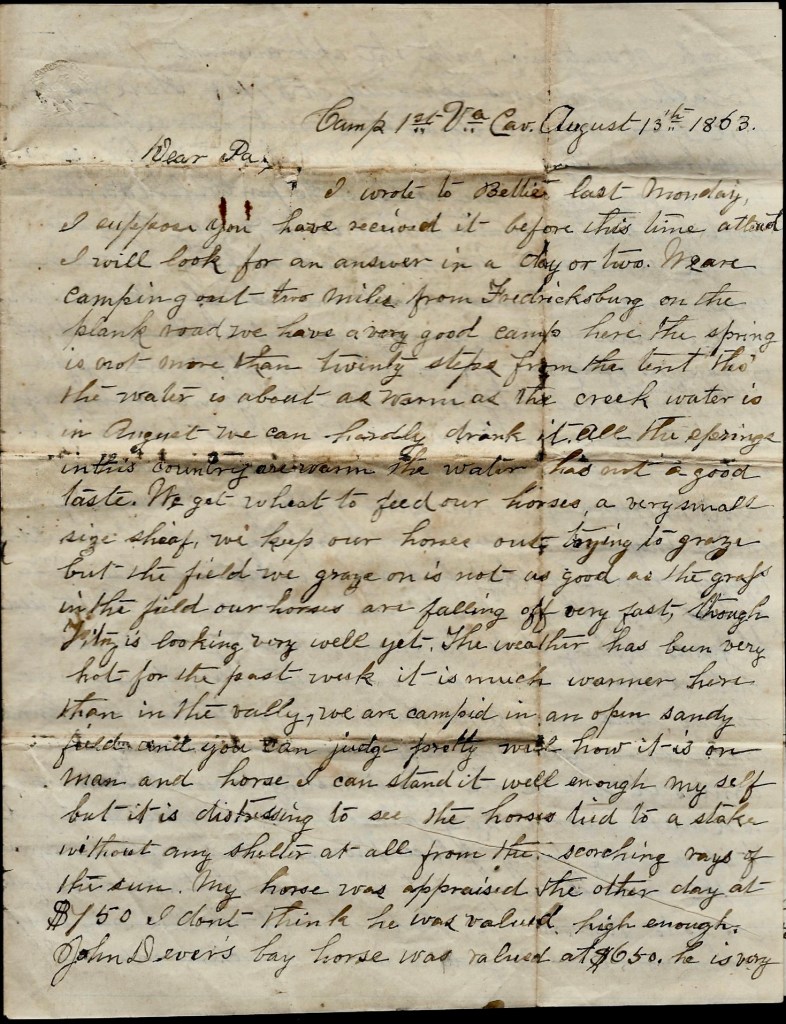
Camp 1st Virginia Cavalry August 13th 1863
Dear Pa,
I wrote to Bettie last Monday. I suppose you have received it before this time. At least I will look for an answer in a day or two. We are amping out two miles from Fredericksburg on the plank road. We have a very good camp here. The spring is not more than twenty steps from the tent though the water is about as warm as the creek water is in August. We can hardly drink it. All the springs in this country are warm. The water has not a good taste. We get wheat to feed our horses—a very small sheaf. We keep our horses out trying to graze but the field we graze on is not as good as the grass in the field. Our horses are falling off very fast though Fitz is looking very well yet.
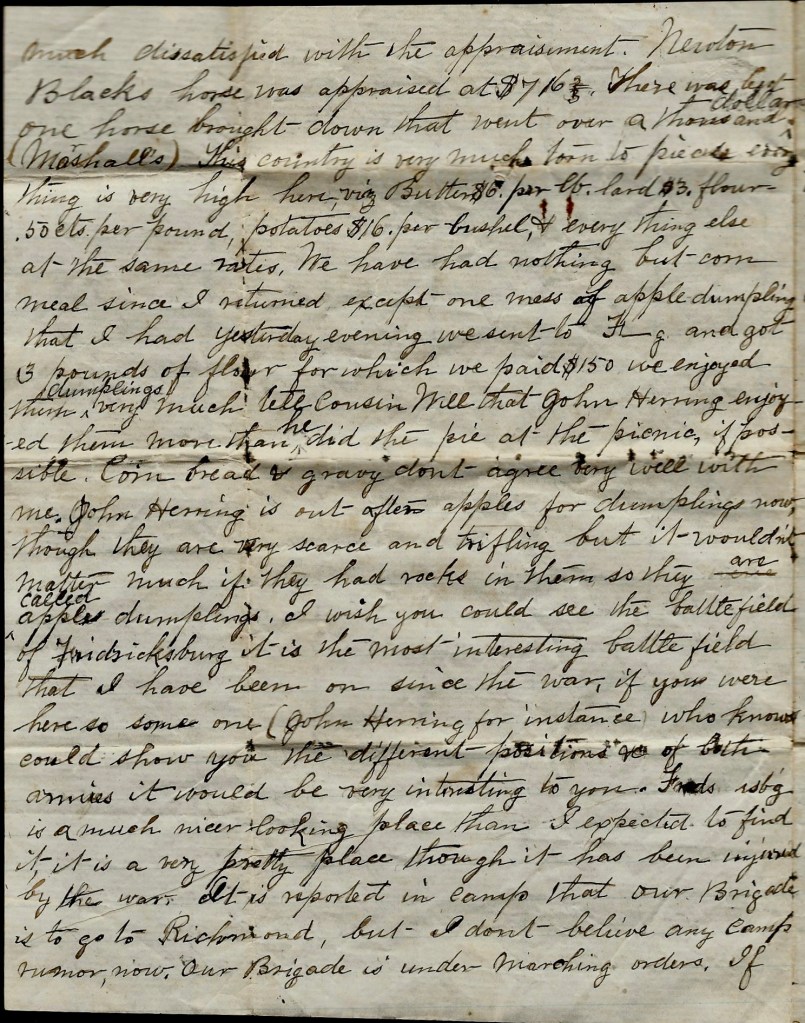
The weather has been very hot for the past week. It is much warmer here than in the valley. We are camped in an open, sandy field and you can judge pretty well how it is on man and horse. I can stand it well enough myself but it is distressing to the horses tied to a stake without any shelter at all from the scorching rays of the sun. My horse was appraised the other day at $750. I don’t think he was valued high enough. John Dever’s bay horse was valued at $650. He is very much dissatisfied with the appraisement. Newton Black’s horse was appraised at $716. There was but one horse brought down that went over a thousand dollars (Marshall’s).
This country is very much torn to pieces. Everything is very high here—viz: butter $6 per lb., lard $3, flour 50 cents per pound, potatoes $16 per bushel, & everything else at the same rates. We have had nothing but corn meal since I returned except one mess of apple dumpling that I had yesterday evening. We sent to Fredericksburg and got 3 pounds of flour which we paid $150. We enjoyed them dumplings very much. Tell Cousin Will that John Herring enjoyed them more than he did the pie at the picnic, if possible. Corn bread & gravy don’t agree very well with me. John Herring is out after apples now though they are very scarce and trifling but it wouldn’t matter much of they had rocks in them so they are called apple dumplings.
I wish you could see the battlefield of Fredericksburg. It is the most interesting battlefield that I have been on since the war. If you were here so someone (John Herring, for instance) who knows [it] could show you the different positions of the armies, it would be very interesting to you. Fredericksburg is a much nicer looking place than I expected to find it. It is a very pretty place though it has been injured by the war.
It is reported in camp that our Brigade is to go to Richmond but I don’t believe any camp rumor now. Our Brigade is under marching orders. If you get this before Lute Dever starts, send by him my dictionary & spirits turpentine. I neglected them when I left.
Enclosed you will find a Yankee tooth which you will please give to Mr. Irvine. He told me when I first started into service to send his a Yankee’s tooth which request I will comply with. Uncle Shanks Miller made the same request. I have one for him also. I will write to Uncle Robert as soon as I get through this and will enclose it to him. Both of these teeth came out of the mouth of a Yankee that was killed at the first Battle of Fredericksburg. He is buried about three hundred yards from camp. The reason why I know he is a Yankee is that a part of his blue coat is sticking out of the ground (not grave). I got his jaw bone and extricated six teeth and picked out two of the nicest to send away. The others I gave to some of the boys who wanted them for some other purpose. There are a good many Yankee bones bleaching upon the field that I am now writing on.
I must close this uninteresting letter so as to have time to write to Uncle Robert. You must come down before you go south if practicable. Some of the boys are anxious to see you before you leave. Give my love to all the family, Aunt Mary, cousins Laura & Will. write soon to your affectionate son, — J. Rison Gibbons
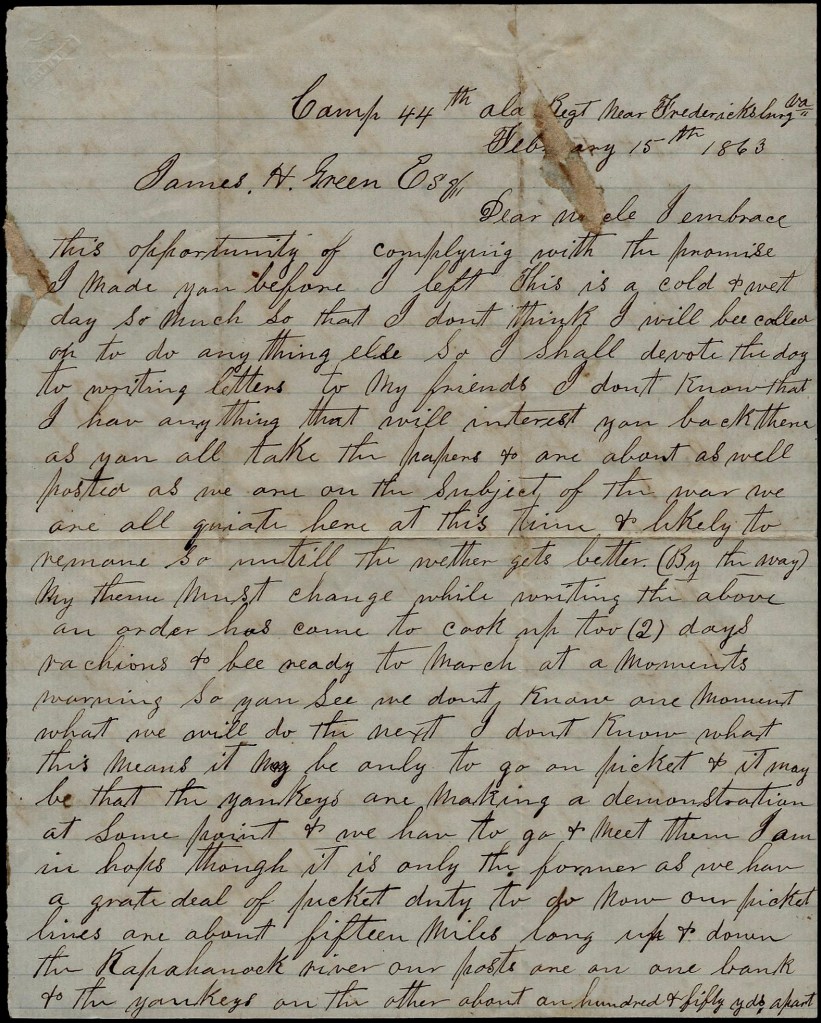
This letter was written by William N. Green who first entered the Confederate service as a 27 year-old private in Co. F (“the Bibb Grays”), 11th Alabama Regiment in June 1861. While serving in that regiment, he was wounded in the left arm at the Battle of Seven Pines but not so badly that he could not fight with his regiment at Gaines’ Mill, Frazier’s Farm, 2nd Bull Run, and Antietam. In January 1863, he was elected to a 2nd Lieutenant’s rank in Co. B (“the Scottsville Guards”), 44th Alabama Infantry and the following month, we learn from this letter that he was transferred to Co. F (“Dan Steele Guards”) where he was in temporary command due to the absence of Captain [Henley G.] Sneed and the illness of 1st Lt. Oakley. Muster rolls show him serving as the 2nd Lieutenant of Co. F, 44th Alabama Regiment until September when he went home on furlough, having been wounded at the Battle of Chickamauga on 19 September 1863. When he returned the following month, he had been promoted to Captain of Co. F and led his company in the fighting at Knoxville on 29 November 1863. He was admitted to General Hospital No. 4 in Richmond on 26 April 1864 suffering from intermittent fever but discharged and returned to duty on 8 May 1864 in time to lead is company at Spotsylvania and subsequent battles until he was discharged on 29 November 1864 from his wounds.
In the 1860 US Census, William was enumerated as a 32 year-old merchant at Six Mile, on the west side of the Cahaba river in Bibb County, Alabama. He was unmarried and living alone at the time of the census in July of that year. His age differs by five years with that recorded at his enlistment in 1861.
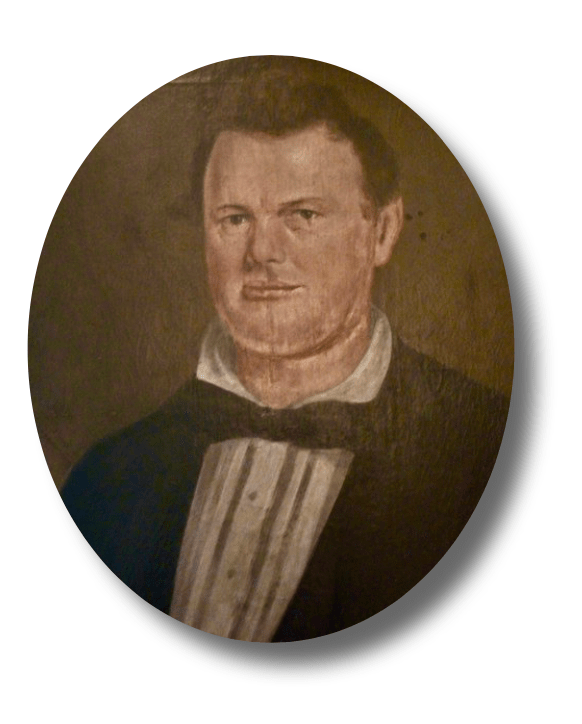
James Hamilton Green, planter from Bibb county, Alabama
William wrote the letter to his uncle, James Hamilton Green (1806-1878) of Mars, Bibb county, Alabama. I could not find William in the census records after the war but he may have been the same William N. Green who married Elizabeth C. Gradick on 18 November 1872 at Selma, Dallas county, Alabama. (Note: surname sometimes spelled Greene in records.)
William’s letter to his uncle conveys the monotony of camp and picket duty on the Rappahannock River in February 1863, two months after the Battle of Fredericksburg and one month after Burnside’s Mud March. It’s reminiscent of numerous letters I have transcribed by Union soldiers from their encampment at Falmouth on the other side of the river but it’s more rare to find them penned by Confederate soldiers. On the very same day, perhaps at the very same moment that William wrote his letter on one side of the river, George S. Gove of Co. K, 5th New Hampshire Infantry—also a 2nd Lieutenant—wrote the following on the other side: “Nothing has happened worth writing about. We have the same thing day after day with nothing to vary the monotony. It has been raining all day but is clearing off now. We have had a good deal of rainy weather & the mud has been very deep all the time. Of course no foreword movement could be made.”
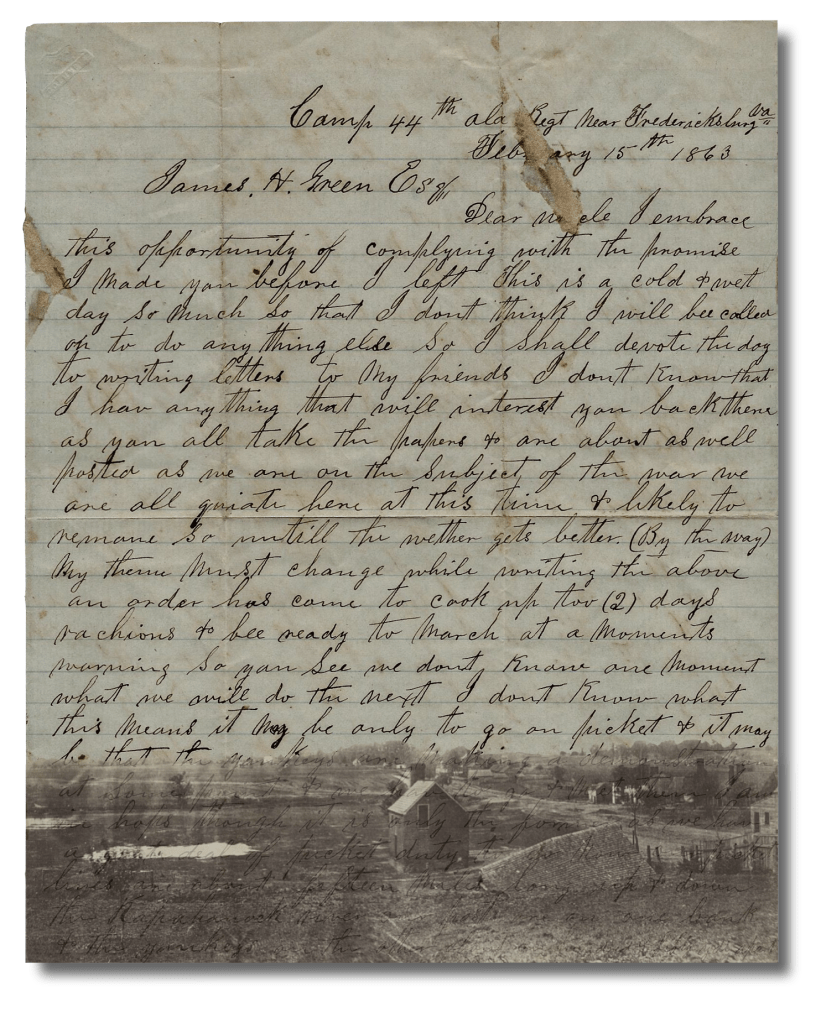
Lt. Green’s Letter with a post-battle image of Fredericksburg taken in early 1863 showing muddy Hanover Street at right angling up the hill to Marye’s House in center distance.A snowbank can be seen on the field at left. A couple days after this letter was written, Fredericksburg was hit by another snowstorm.
Transcription
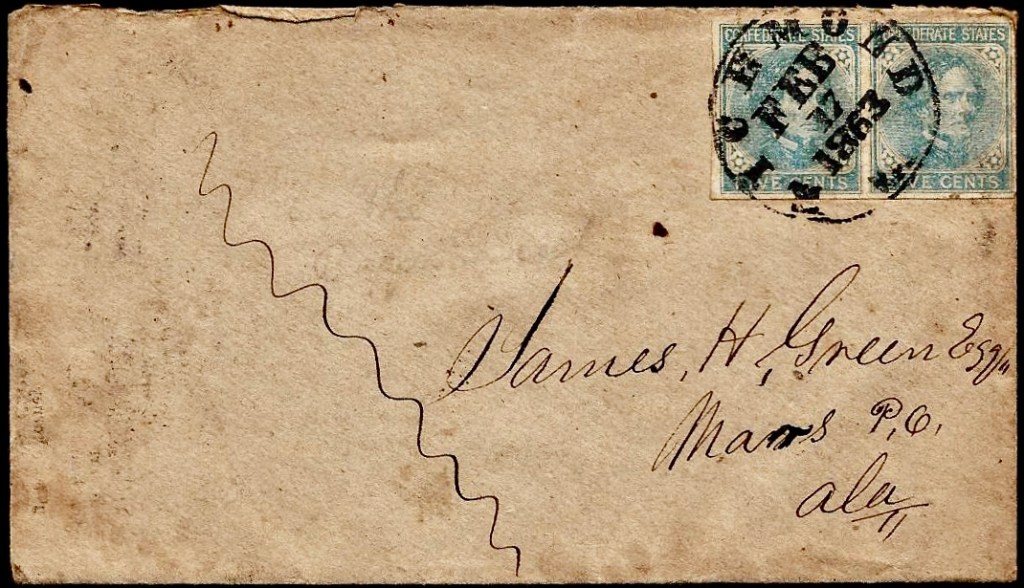
Addressed to James H. Green, Esq., Mars P O., Alabama
Camp 44th Alabama Regt. near Fredericksburg, Va. February 15th 1863
James H. Green, Esq. Dear Uncle,
I embrace this opportunity of complying with the promise I made you before I left. This is a cold & wet day—so much so that I don’t think I will be called on to do anything else so I shall devote the day to writing letters to my friends. I don’t know that I have anything that will interest you back there as you all take the papers & are about as well posted as we are on the subject of the war. We are all quiet here at this time & likely to remain so until the weather gets better. By the way, my theme must change. While writing the above an order has come to cook up two (2) days rations to be ready to march at a moment’s warning. So you see, we don’t know one moment what we will do the next. I don’t know what this means. It may be only to go on picket and it may be that the yankeys are making a demonstration at some point & we have to go & meet them. I am in hopes though it is only the former as we have a great deal of picket duty to do now. Our picket lines are about fifteen miles long up and down the Rappahahannock river. Our posts are on one bank & the yankeys on the other about an hundred & fifty yards apart.
“We have a ‘fighting Jo Hooker’ to contend with now so there is no telling when we will have to fight as he will have to do something soon or be superseded as that is their rule, though the roads are so bad now I think it out of the question for him to do much at present.”
—Lt. William N. Green, Co. F, 44th Alabama, 15 Feb. 1863
We have a “fighting Jo Hooker” to contend with now so there is no telling when we will have to fight as he will have to do something soon or be superseded as that is their rule, though the roads are so bad now I think it out of the question for him to do much at present.
When I commenced this, I intended to write you a long letter but I shall have to cut it short & prepare for marching. I will write you again soon when I have more time.
As you will see from the heading of this, I have changed my position. I am now in Co. F of this regiment—Capt. [Henley G.] Sneed’s company, acting as Second Lieut. I am now in command of the company as Capt. Sneed is at home & Lieut. Oakley is sick. You must write on the reception of this & give me all the news. Tell John 1 to write if his arm will admit of it. I learned that he got wounded in Tennessee though I am in hopes it is getting well by this time. He seems to be unfortunate in getting wounded & fortunate too in its being no worse.
Give my kindest regards to all the family & receive the same to yourself from your nephew, — Wm. N. Green
1 John Randolph Green )1844-1924) was William’s cousin who served in Co. F (“Tuscaloosa Rifles”), 50th Alabama Infantry. During the war he was wounded in both thighs and had his right arm broken. He was wounded in April 1862 at the Battle of Shiloh, Tennessee. He was severely wounded later that year on 31 December 1862 at the Battle of Murfreesboro, Tennessee. According to his own words, Green was placed in a cavalry unit as a 1st Lieutenant about 2 months before the end of the war. Green survived the war and in 1866 he moved to Kentucky for 2 years before returning home. Later in life he lived in the Confederate Soldier’s Home in Verbena, Alabama. He died on 8 December 1924 and is buried there at the what is now known as Confederate Memorial Park; the location of the old soldier’s home.






















 Spared & Shared 23