
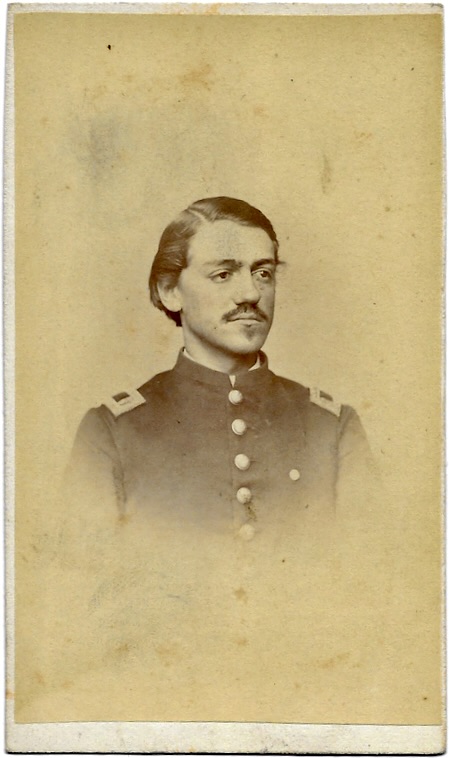
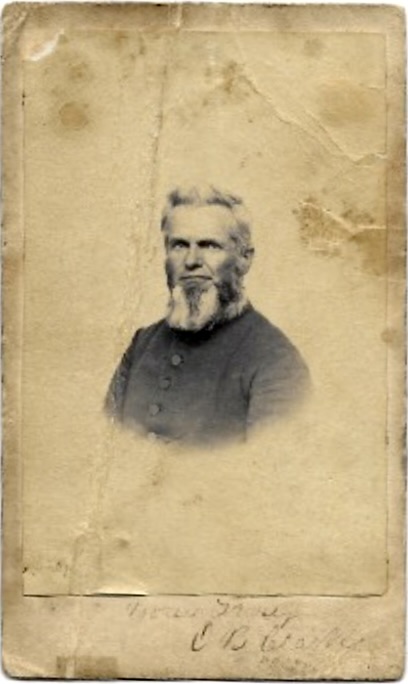
The following letter was written in two parts—the first by Lt. Daniel Webster Clark (1841-1932) and the 2nd by his father, Chaplain Orson Brewster Clark (1810-1885). Both father and son served in the 83rd Pennsylvania Infantry. In the 1860 US Census, they were enumerated in Tionesta, Venango county, Pennsylvania; Daniel working a miner and his father a Universalist Minister.
Daniel enlisted on 6 September 1861 and was commissioned a 2nd Lieutenant in Co. G, 83rd Pennsylvania. He was later promoted to 1st Lieutenant and Quartermaster of the regiment. On 20 May 1864, he was injured when he fell off his horse near the North Anna River. He mustered out on 28 June 1865. Daniel’s is the only signature by an officer among the “graffiti” signatures at the Blenheim House in Fairfax, Virginia. He signed his name there on 11 March 1862. [see Hagan History Center].
Orson was married in 1834 to Diadema Webster (1808-1894). Before turning to the ministry, he earned a living teaching select schools in Hornellsville, New York and Canisteo, New York. He was in the battles of Antietam, Fredericksburg, Chancellorsville, Gettysburg, Rappahanock, Kelly Fork, Preebles Station, Quaker Run, Five Forks, Wilderness Farm, Laurel Hill, Old Church, Cold Harbor. He was wounded at Mead’s Station.
[Note: This letter is from the personal collection of James Campbell and was offered for transcription and publication on Spared & Shared by express consent.]
T R A N S C R I P T I O N
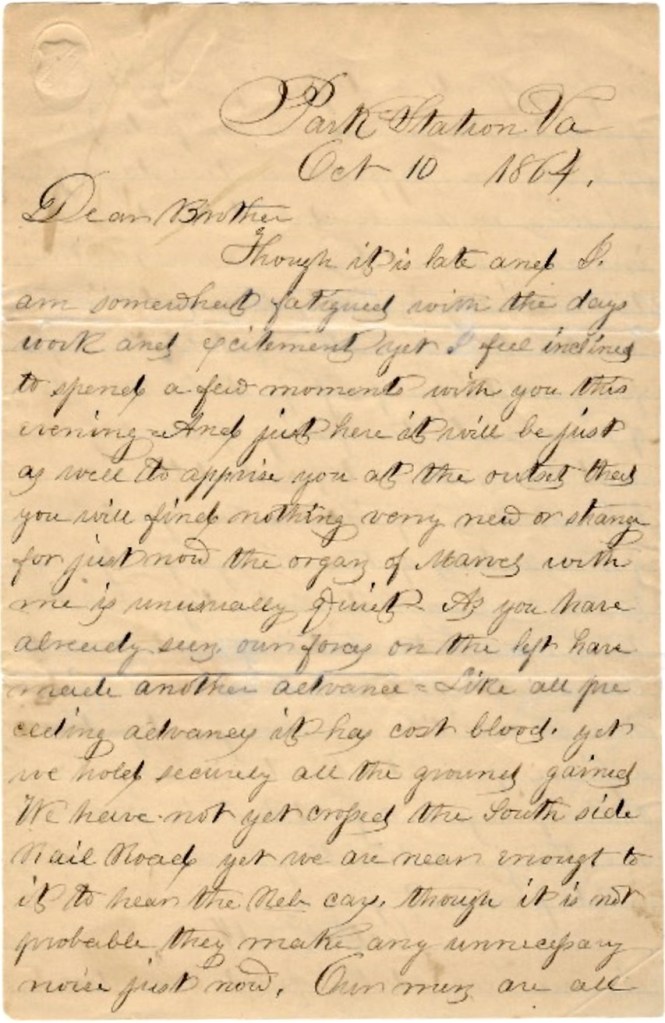
Park Station, Virginia
October 10, 1864
Dear Brother,
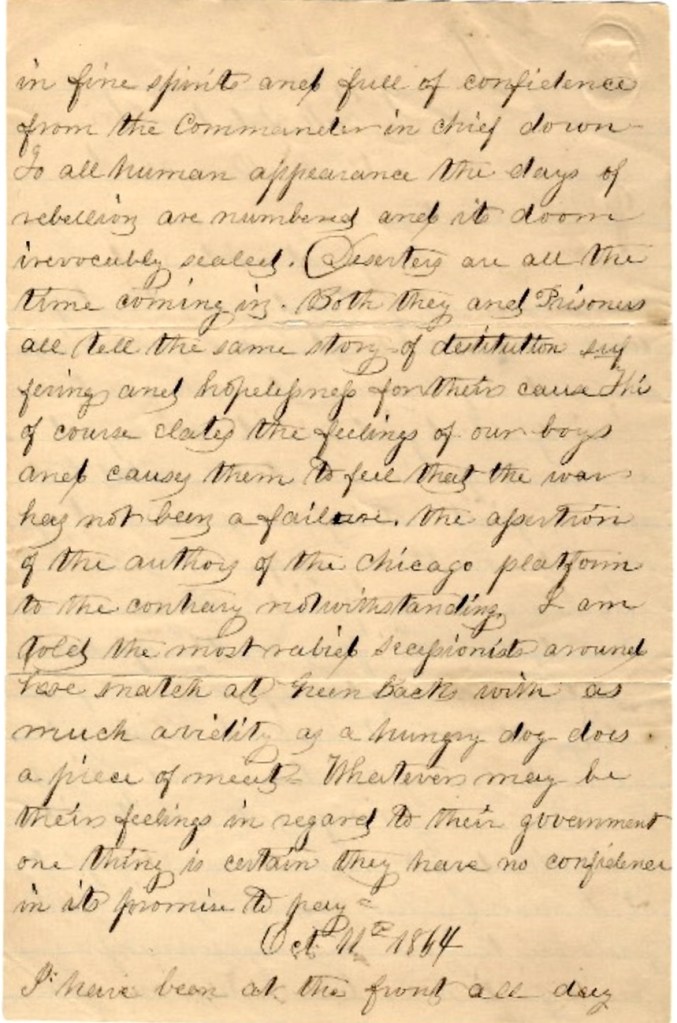
Though it is late and I am somewhat fatigued with the days work and excitement, yet I feel inclined to spend a few moments with you this evening, And just here it will be just as well to apprise you at the outset that you will find nothing very new or strange for just now the organ of marvel with me is unusually quiet. As you have already seen, our forces on the left have made another advance. Like all preceding advances, it has cost blood. Yet we hold securely all the ground gained. We have not yet crossed the South Side Railroad. Yet we are near enough to it to hear the Reb cars though it is not probable thy make any unnecessary noise just now. Our men are all in fine spirits and full of confidence from the Commander in Chief down to all human appearance. The days of rebellion are numbered and its doom irrevocably sealed.
Deserters are all the time coming in. Both they and prisoners tell the same story of destitution, suffering and hopefulness for their cause. This of course elates the feelings of our boys and causes them to feel that the war has not been a failure. The assertion of the authors of the [Democratic Party’s] Chicago Platform to the contrary notwithstanding. I am told the most rabid secessionists around here snatch at Green Backs with as much avidity as a hungry dog does a piece of meat. Whatever may be their feelings in regard to their government, one thing is certain—they have no confidence in its promise to pay.
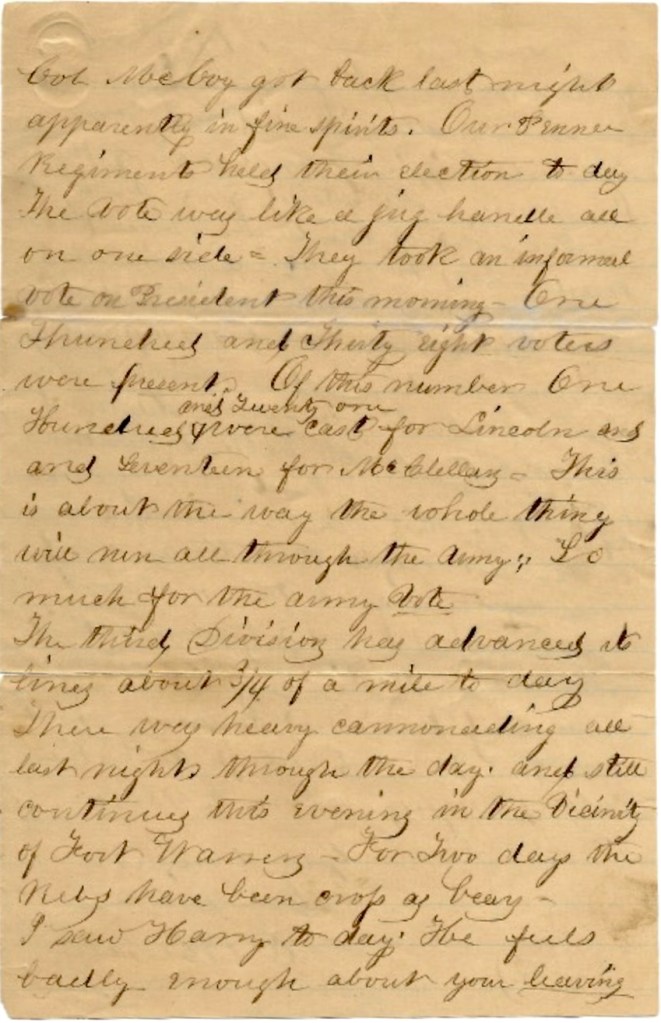
October 11, 1864. I have been at the front all day. Col. [DeWitt Clinton] McCoy 1 got back last night apparently in fine spirits. Our Pennsylvania regiments held their election today. The vote was like a jug handle—all on one side. They took an informal vote on President this morning. One hundred and thirty-eight voters were present. Of this number, one hundred and twenty-one were cast for Lincoln and seventeen for McClellan. This is about the way the whole thing will run all through the army. So much for the army vote.
“Our Pennsylvania regiments held their election today. The vote was like a jug handle—all on one side… So much for the army vote.”
— Chaplain O. B. Clark, 83rd Pennsylvania, 10 October 1864
The 3rd Division has advanced its lines about 3/4 of a mile today. There was heavy cannonading all last night, through the day, and still continues this evening in the vicinity of Fort Warren. For two days the Rebs have been cross as bears.
I saw Harry today. He feels badly enough about your leaving. They expected a great horse race today near the Yellow House 2 but for some reason it did not come off. General [Charles] Griffin’s gray was one of them.
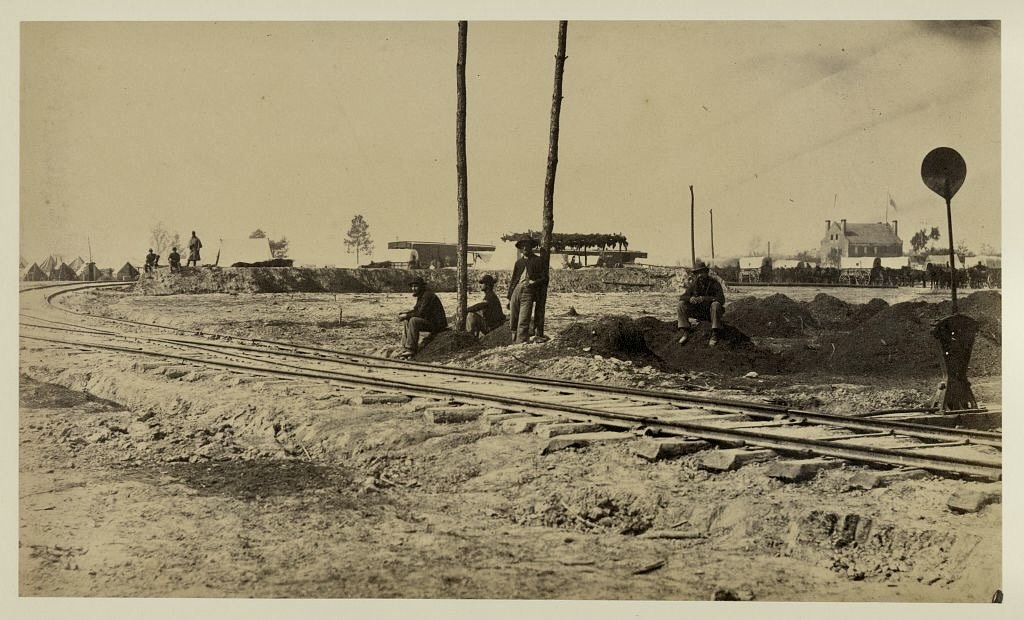
Our lines now extend from the fork on the right of the Yellow House (Fort Wadsworth) to within a mile and a half of the South Side [Rail] Road. They cross the Vaughn Road; our left resting on the Plank Road running from Stono Creek to the Sout Side [rail] Road. We have a much better & healthier position than we had when you left. It is said the Rebs charged our center last night three times and were repulsed each time.
There, I have written enough for once I think. My health continues good. Tell Ma and Vernie not to worry about me for I am old enough to take care of myself. Love to Bill and all. Good night. Your Father, — O. B. Clark

(Write)
1 DeWitt Clinton McCoy (1824-1902) enlisted in the first year of the Civil War and was chosen captain of Company F., of the 83d Regiment of Pennsylvania Volunteers. In May 5, 1864, at the Battle of the Wilderness, owing to the loss of Colonel Woodward, he took command of the regiment as lieutenant colonel. His army record was a most excellent one and he received many times, deserved compliments from his superiors. He led a brilliant charge of the 83d at North Anna, May 23, 1864, which broke the Confederate Attack and saved the Federal lines. At Gaines’ Mill [on June 27, 1864], he received a severe wound. For years he absolutely refused to apply for a pension, but owing to failing health and advanced years, by special act of Congress at the last session he was placed upon the roll.
2 The “Yellow House” refers to the Globe Tavern which served as the Headquarters of the 6th Army Corps.

 Spared & Shared 23