Category Archives: Illinois Homefront

Amanda Beasley to Nancy Catherine (Beasley) Record

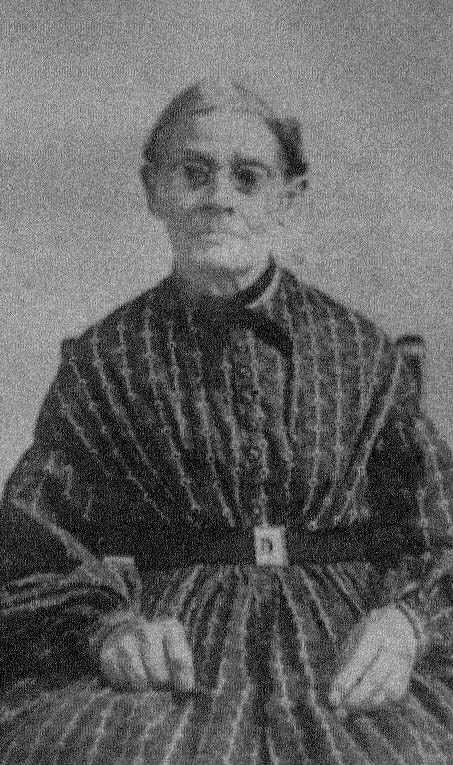
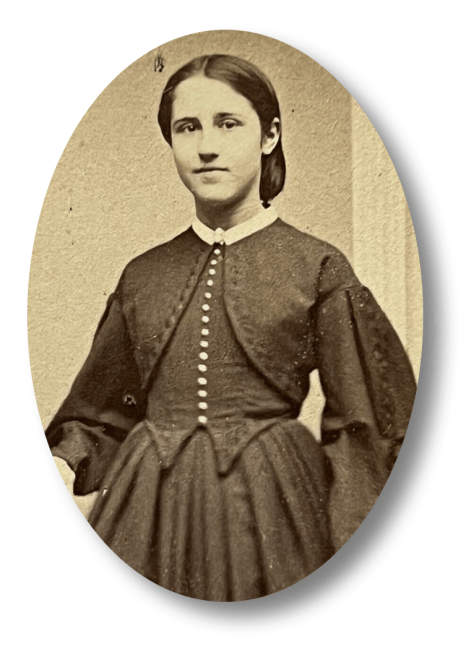
How Amanda might have looked in 1863

The following letter was written by 15 year-old Amanda A. Beasley (1848-1931), the daughter of James H. Beasley (1804-1854) and Hannah Cowgill (1811-Aft1880) of Winchester, Scott county, Illinois. She wrote the letter to her sister Nancy “Catherine” (Beasley) Record, the widow of Lawrence M. Record (1829-1862). Lawrence was the son of Rev. John A Record (1802-1858) and Lucy W. McManus (1809-1886) of Winchester, Scott county, Illinois. Lawrence was killed on 6 April 1862 at the Battle of Shiloh while serving in Co. H, 14th Illinois Infantry. Catherine and Lawrence were living in Macoupin county, Illinois, when he enlisted; they had one child named Martha (b. 27 May 1856).

In her letter, Amanda refers to several siblings. She speaks of the severe illness of her brother Benjamin F. Beasley (1846-1918). She mentions her brother Richard Beasley (b. 1844). She speaks of her sister Lucinda Ellen (Beasley) Obermyer (1938-1927) having an opportunity to see her husband Peter Obermeyer (1834-1921) who served in Co. D, 129th Illinois Infantry, home on a 15 -day furlough. She also had two brothers (the “Boys”) who also served in Co. D, 129th Illinois Infantry; they were James Beasley (1840-1903) and George A. Beasley (1843-1924).

Transcription

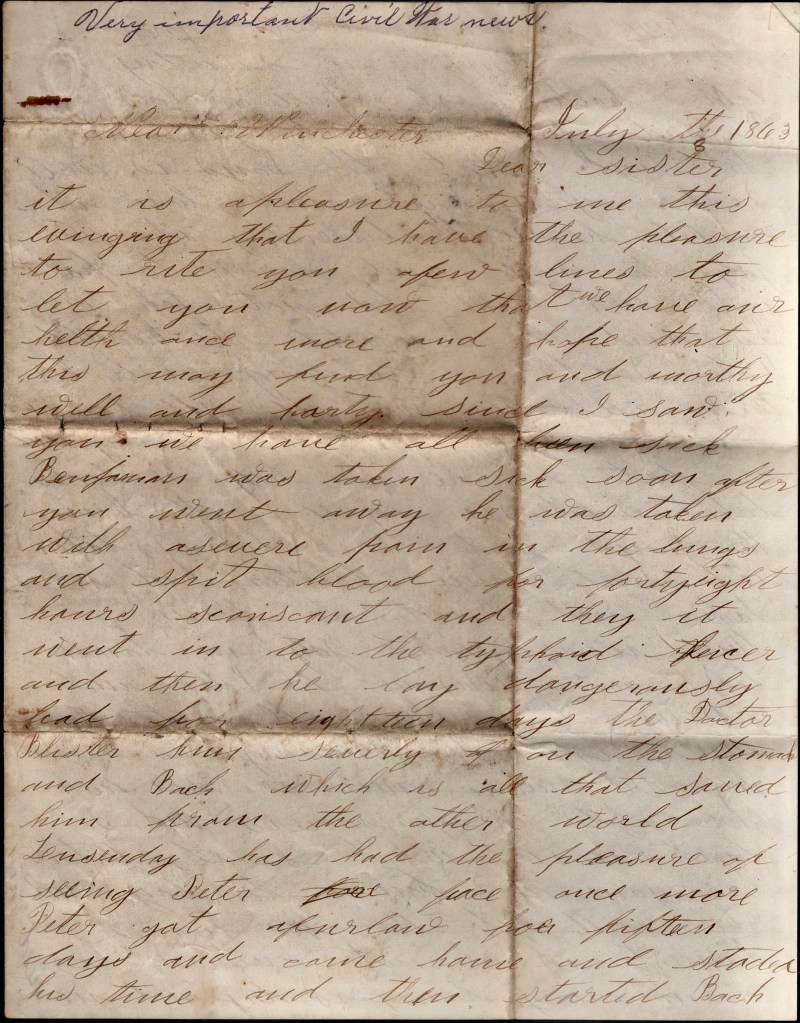
Near Winchester [Scott county, Illinois]
July 8th 1863

Dear Sister,

It is a pleasure to me this evening that I have the pleasure to write you a few lines to let you know that we have our health and more and hope that this may find you and Worthy well and hearty. Since I saw you we have all been sick. Benjamin was taken sick soon after you went away. He was taken with a severe pain in the lungs and spit blood for forty-eight hours [ ] and then it went into the typhoid fever and then he lay dangerously bad for eighteen days. The doctor blister[ed] him severely on the stomach and back which is all that saved him from the other world.

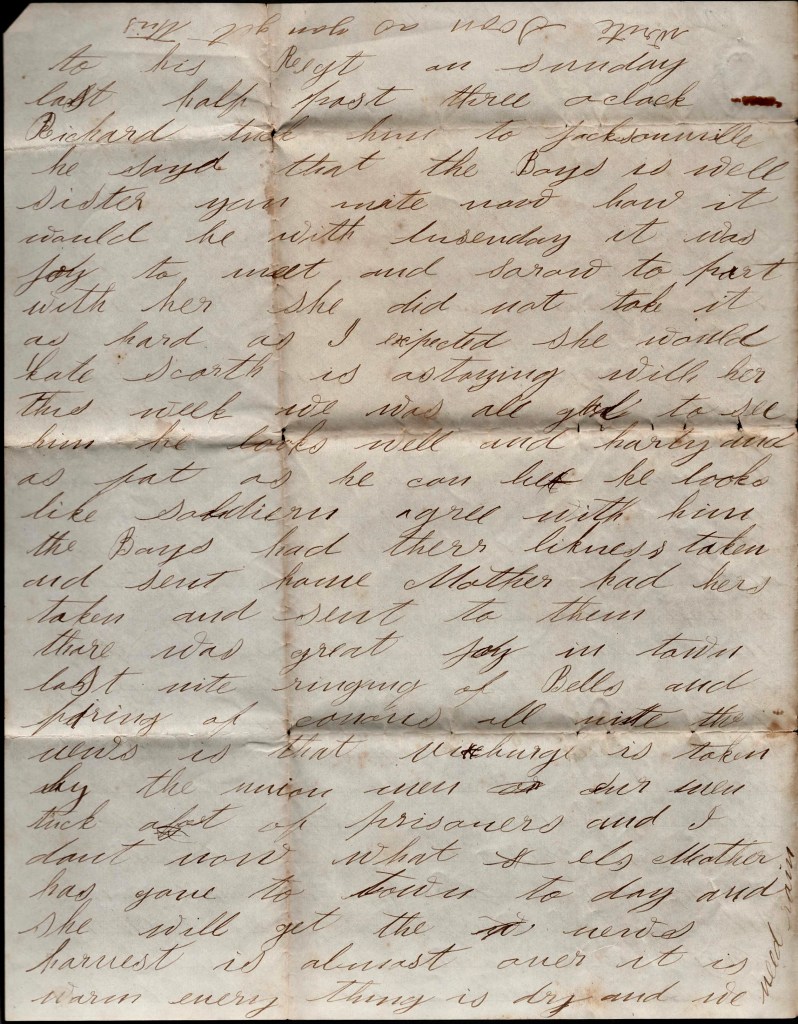
Lucinda has had the pleasure of seeing Peter’s face once more. Peter got a furlough for fifteen days and came home and stayed his time and then started back to his regiment on Sunday last [at] half past three o’clock. Richard took him to Jacksonville. He said that the Boys is well. Sister, you might know how it would be with Lucinda. It was joy to meet and sorrow to part with her. She did not take it as hard as I expected she would.

Kate Scorth is a staying with her this week. We was all glad to see him. He looks well and hearty and as fat as he can be. He looks like soldiering agrees with him. The Boys had their likeness taken and sent home. Mother had hers taken and sent to them.

There was great joy in town last night—ringing of bells and firing of cannons all night. The news is that Vicksburg is taken by the Union men. Our men took a lot of prisoners and I don’t know what else. Mother has gone to town today and she will get the news.

Harvest is almost over. It is warm. Everything is dry and we need rain.

Last Saturday, the Fourth of July passed off quite still in town. They had no celebration here but there was one at Exeter and one at Jacksonville and one at Glasgow. At Glasgow there was some fighting done. There was one man killed. His name I don’t know. 1

Well Catherine, I believe that there is a chance for young girls to marry yet for old Jane Martin 2 is to be married this evening at eight o’clock to a man by the name of Nathaniel Wilson from Glasgow. There has been several weddings went off ever since I wrote. Lately it looks like there is some men left behind yet.

The connection is all well as far as I know at present. All that has been sick is a getting better. In fact, is about well. Becky has had the lung fever. Her two youngest have had the worst sore mouth that ever you saw in all your life but they are well now. Lucinda got a letter from you on Sunday when I was there.

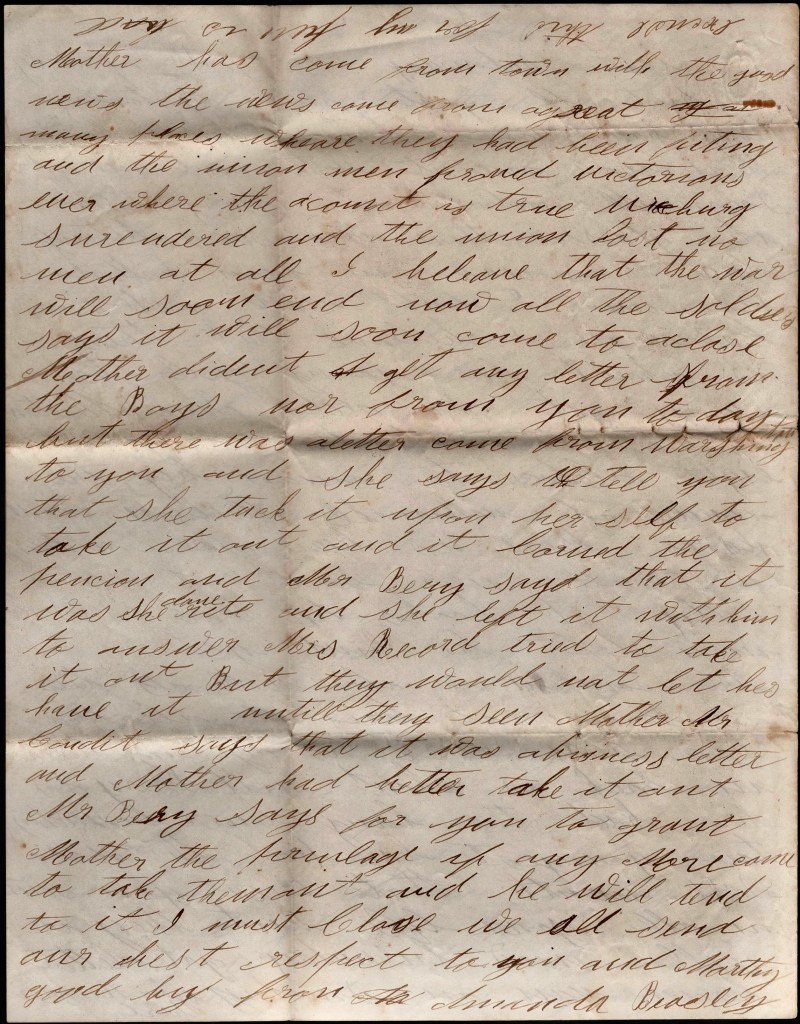
Mother has come from town with the good news. The news came from a great many places where they had been fighting and the Union men proved victorious everywhere. The account is true—Vicksburg surrendered and the Union lost no men at all. I believe that the war will soon end now. All the soldiers say it will soon come to a close. Mother didn’t get any letter from the Boys nor from you today but there was a letter came from Washington to you and she says to tell you that she took it upon herself to take it out and it contained the pension and Mr. Berry said that it was she done right and she left it with him to answer. Mrs. [Lucy] Record tried to take it out but they would not let her have it until they seen Mother. Mr. Condit says that it was a business letter and Mother had better take it out. Mr. Berry says for you to grant Mother the privilege if anymore come to take the money and he will tend to it.

I must close. We all send our best respects to you and Martha. Goodbye. From Amanda Beasley


1 I could not find any information regarding this incident in Glasgow, Scott county, Illinois, on the 4th of July 1863. It may have been a conflict arising between a Unionist and a Copperhead (Peace Democrat).

2 Nancy “Jane” Martin (1836-1911) was the daughter of James & Nancy Martin of Scott county, Illinois. Jane was 26 years of age when she married in July 1863 in Scott county to Nathaniel Wilson. This was considered “old” by 19th Century standards. Her obituary claims she grew up in Alsey, Scott county, Illinois. Nathaniel died about 1890.
1863: Eliza (Simpson) Russell to Lewis Edward Simpson

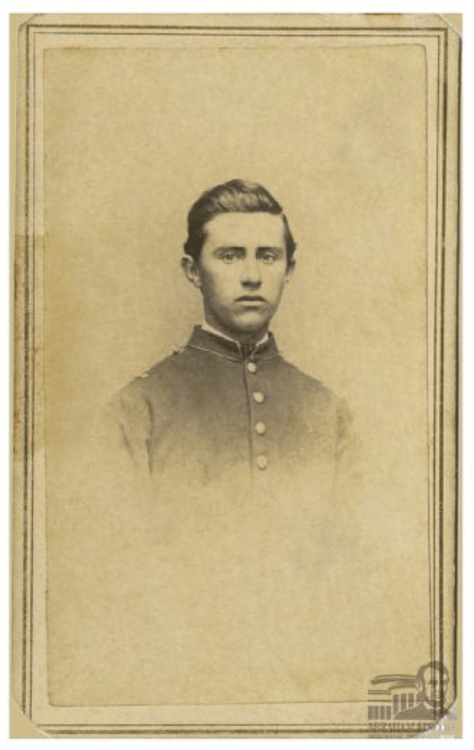
I could not find an image of Lewis but here is one of George J. Gordon who served in Co. C, 77th Illinois Infantry (Lincoln Presidential Library)

The following letter was written by Eliza (Simpson) Russell to her younger brother, Lewis Edward Russell (1846-1924). Eliza was married in 1858 to Willis Russell (18xx-1870). Lewis and Eliza were two of at least 11 children born to Edward Simpson (1799-1887) and Hatta Maria Ward (1810-1899) of Magnolia, Putnam county, Illinois. Lewis had three brothers who died relatively young, leaving him the only surviving son at the time of his enlistment, when only 16 years old, in Co. B, 77th Illinois Infantry on 22 August 1862.

From this letter we learn that Lewis was in the Battle of Arkansas Post on 11 January 1863. The 77th Illinois was in the thick of the fight and later claimed they were the first to scale the fort’s parapets. The 77th suffered six men killed in the battle, with another 39 wounded. Lewis was one of those wounded and was subsequently treated at Lawson Hospital in St. Louis, Missouri. He was discharged from the service on 12 August 1863. Lewis lived near Henry, Illinois, until 1916 when he moved to Hollywood, California.

Transcription

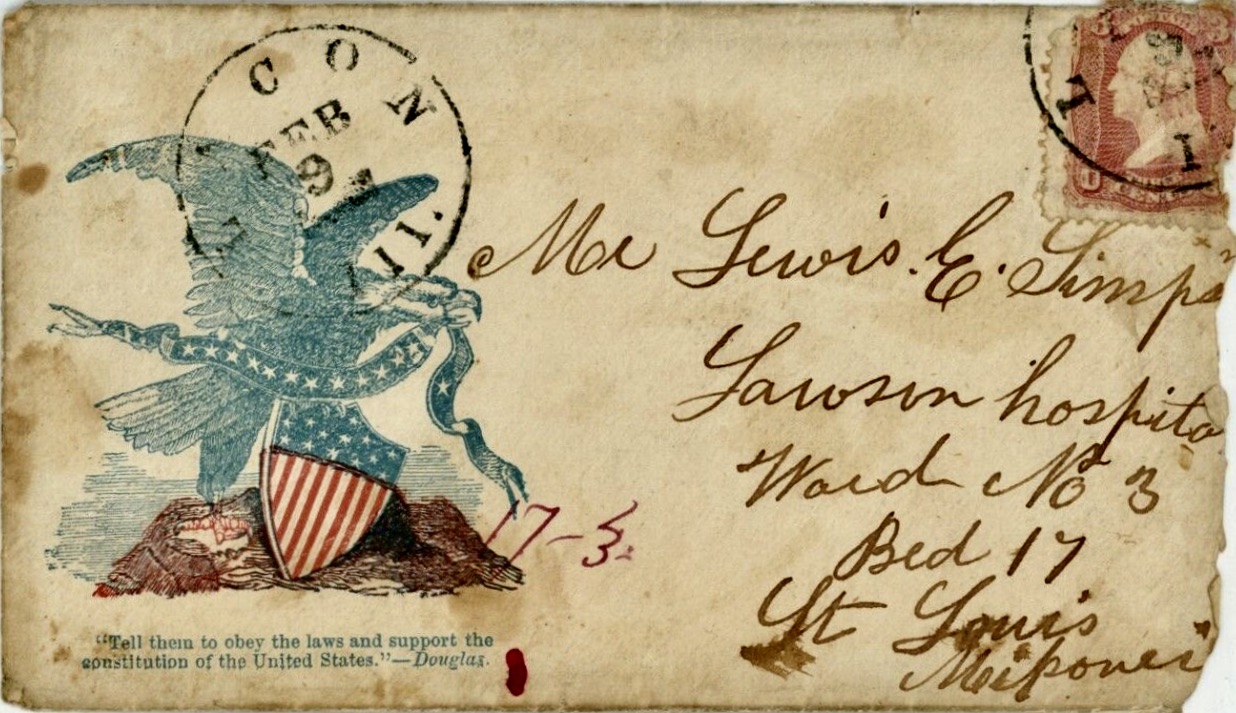
Addressed to Mr. Lewis E. Simpson, Lawson Hospital, Ward No. 3, Bed 17, St. Louis, Missouri

February 7, 1863

Dear Brother,

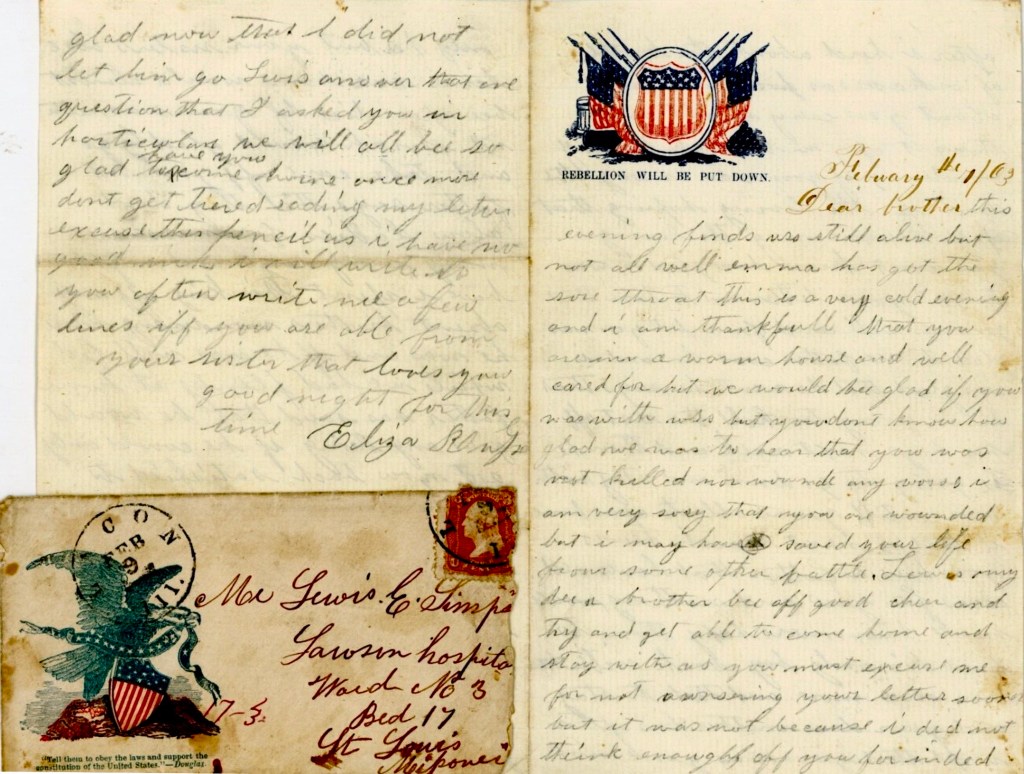
This evening finds us still alive but not all well. Emma has got the sore throat. This is a very cold evening and I am thankful that you are in a warm house and well care for but we would be glad if you was with us. But you don’t know how glad we was to hear that you was not killed nor wounded any worse. I am very sorry that you are wounded but it may have saved your life from some other battle.

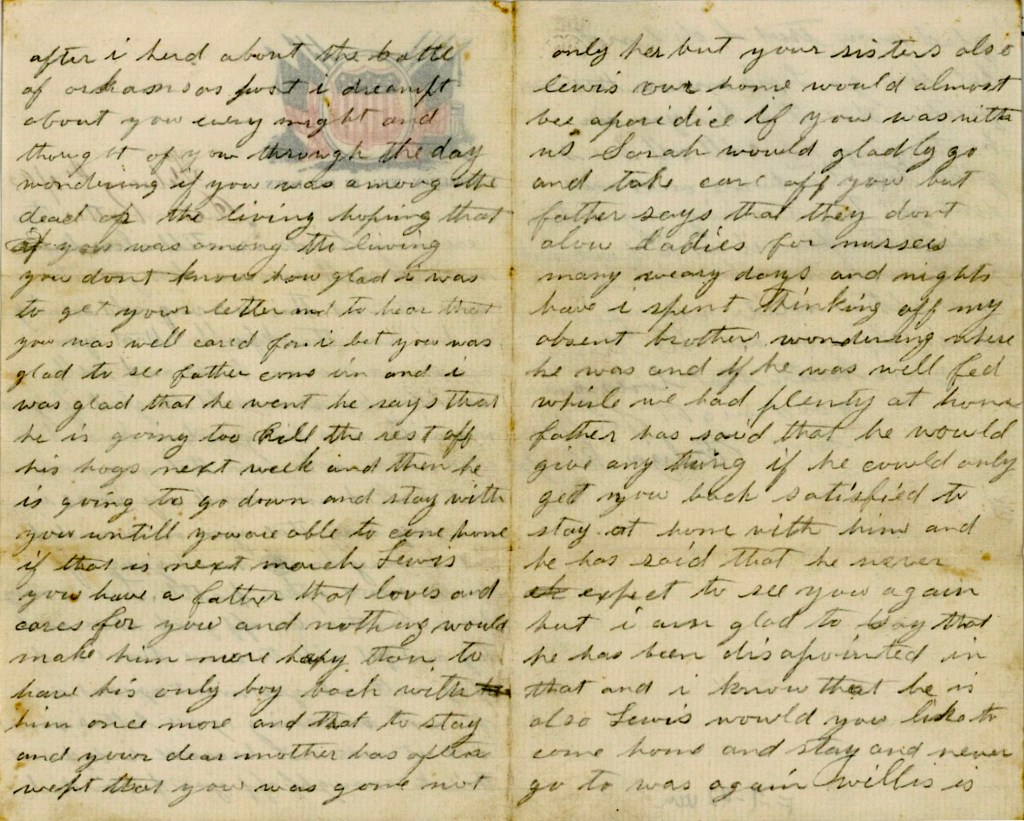
Lewis, my dear brother, be of good cheer and try and get able to come home and stay with us. You must excuse me for not answering your letters sooner but it was not because I did not think of you for indeed, after I heard about the battle of Arkansas Post, I dreamt about you every night and thought of you through the day, wondering if you was among the dead or the living, hoping that you was among the living. You don’t know how glad I was to get your letter and to hear that you was well cared for. I bet you was glad to see father come in and I was glad that he went.

He says that he is is going to kill the rest of his hogs next week and then he is going to go down and stay with you until you are able to come home if that is next March. Lewis, you have a father that loves and cares for you and nothing would make him more happy than to have his only boy back with him once more and that to stay. And your dear mother has often wept that you was gone—not only her, but your sisters also. Lewis, our home would almost be a paradise if you was with us. Sarah would gladly go and take care of you but father says that they don’t allow ladies for nurses.

Many weary days and nights have I spent thinking of my absent brother, wondering where he was and if he was well fed while we had plenty at home. Father has said that he would give anything if he could only get you back satisfied to stay at home with him and he has said that he never expects to see you again. But I am glad to say that he has been disappointed in that and I know that he is also. Lewis, would you like to come home and stay and never go to war again?

[My husband,] Willis is glad now that I did not let him go. Lewis, answer that question that I asked you in particular. We will all be so glad to have you come home once more. Don’t get tired reading my letter. Excuse this pencil as I have no good ink. I will write to you often. Write me a few lines if you are able. From your sister that loves you, good night for this time.

— Eliza Russell

1863: Margaret Vail (Kelley) Lester to Thomas Benton Kelley

How Margaret might have looked in 1863

The following letter was written by 33 year-old Margaret Vail (Kelley) Lester (1830-1917), the daughter of David Kelley (1806-1876) and his first wife, Charity Herrick (1806-1832) of Danby, Rutland county, Vermont. David Kelley later moved to DuPage county, Illinois. Margaret was married in April 1848 in DuPage county, Illinois, to James Franklin Lester (1824-1899). In the 1860 US Census, Margaret and James were residing in Marengo, McHenry county, Illinois, where James was employed as a farm laborer and a carpenter. An obituary for Margaret (The Daily Times, Davenport, Iowa, June 28, 1918) informs us that Margaret was born at Danby Four Corners, Vermont, and came to Illinois with her parents when she was 15 years old. She had been educated in the Castleon Seminary in Vermont and entered the teaching profession. Once married, the couple had two children—Emma Frances who died at the age of 16, and James Henry who died in 1917.

Margaret wrote the letter to her half-brother, Thomas Benton Kelley who was serving in Co. E, 8th Illinois Cavalry at the time.

What truly shines in this letter is Margaret’s bold articulation of the argument for women’s equality, challenging the status quo with fierce clarity.

Transcription

November 26, 1863

My dear neglected brother,

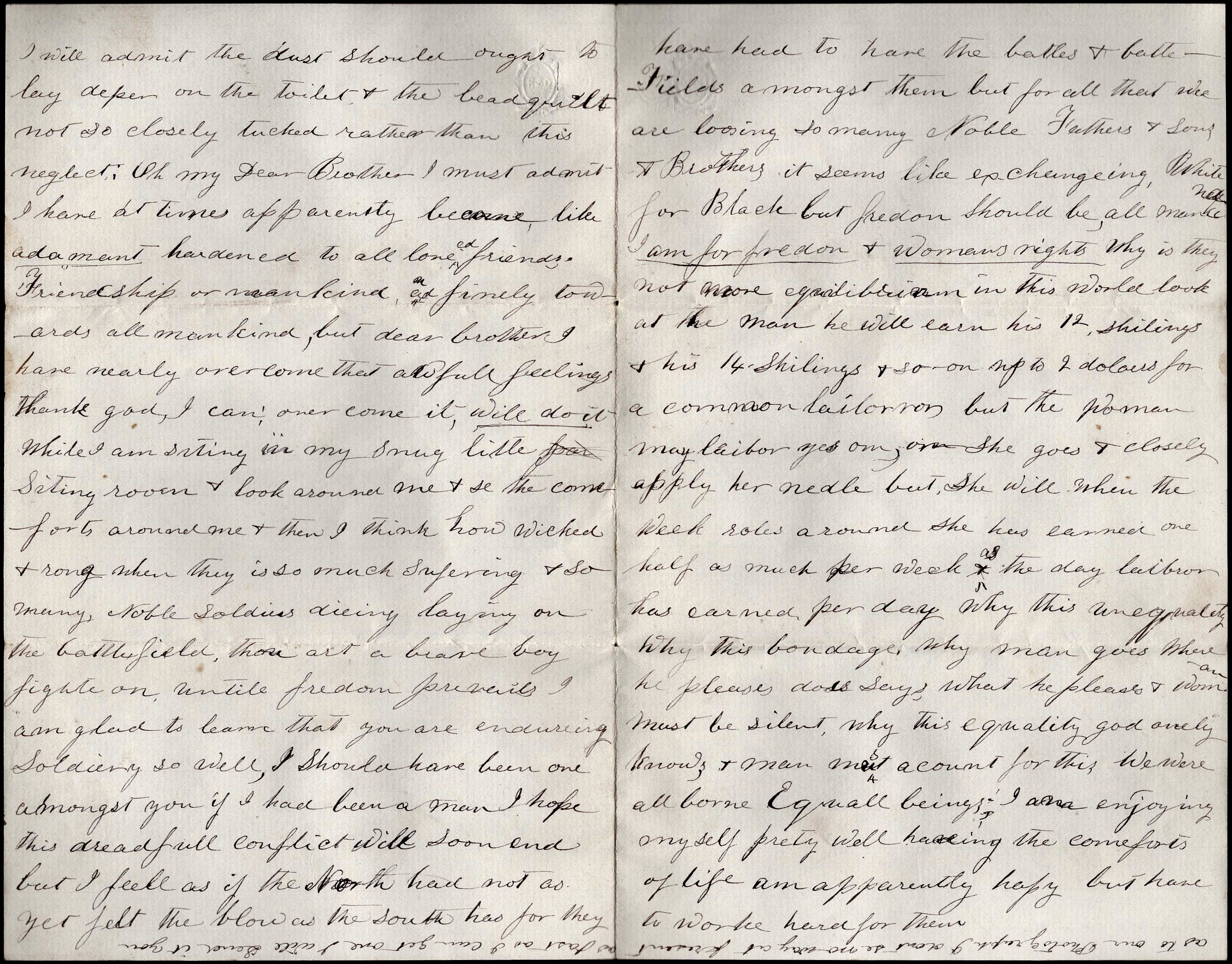
Thanksgiving eve & I cannot rest on my pillow another night before I pen you a few broken lines. I have written so little for a year back. It has become a task instead of a pleasure. Is it a possible thing? I will call it a task. No dear, brother, it is not so. But I have apparently made it so. But noble sir, I am with you in imagination, hour after hour, & many a meal do I feel as if my dear good brothers could share with me.

Oh, I have written many & many imagined epistles to you. I am almost sure sometimes I never will be forgiven for my cold neglect. But a promise for the future. My best wishes to Mary. I expect she feels my cold neglect, but come here & see what I have to pass through with & you would not wonder. I will admit the dust should ought to lay deeper on the toilet & the bed quilt not so closely tucked rather than this neglect.

Oh my dear brother, I must admit I have at times apparently become like adamant hardened to all loved friends, friendship or mankind, and finally towards all mankind. But dear brother, I have nearly overcome that awful feelings. Thank God, I can overcome it. Will do it. While I am sitting in my snug little sitting room & look around me & see the comforts around me. And then I think how wicked & wrong when there is so much suffering & so many noble soldiers dying, laying on the battlefield.

Thou art a brave boy. Fight on until freedom prevails. I am glad to learn that you are enduring soldiery so well. I should have been one amongst you if I had been a man. I hope this dreadful conflict will soon end but I feel as if the North had not as yet felt the blow as the South has, for they have had to have the battles & battle fields amongst them. But for all that, we are losing so many noble fathers & sons & brothers. It seems like exchanging White for Black. But freedom should be [for] all mankind. I am for freedom & Womans’ rights. Why is there not more equilibrium in this world? Look at the man. He will earn his 12 shillings & his 14 shillings & so on, up to 2 dollars for a common laborer, but the woman may labor, yes, on and on she goes, & closely apply her needle, but she will, when the week rolls around, she has earned one half as much per week as the day laborer has earned per day. Why this inequality? Why this bondage? Why man goes where he pleases? Does say what he pleases & a woman must be silent? Why this inequality? God only knows & man must account for this. We were all borne equal beings & I am enjoying myself pretty well, having the comforts of life, am apparently happy, but have to work hard for them.

I will return to my thanksgiving supper. We were invited out to one of our neighbors to supper. Enjoyed it much—the whole family. I hope my dear brother was where he could enjoy the necessary comforts if no more. Be patient, for thou shalt be blessed by well doing. Henry’s folks I hardly have seen or heard from for the last three months as usual. I guess the babe, Jane Charity, has been sick all the fall.

I have one boarder & a great deal company & it does seem as if I never should have any respite. Besides, Emma & myself take in work. She goes to school & her studies are crushing her. She is not very stout. She is very industrious. She often speaks of you & of Mary & Mittie, but she is not at home or she would write. She will write soon. Her correspondence is quite extensive. Emma is one good girl & Henry is another T. B. Kelley right over. He would go to the war & who would blame me if I was old enough. That is him to a dot. I have not seen father for nearly a year. It is a year last fall since I was home. E[mma] & Henry was there this fall. Mother, I guess, carries on the hotel & Father stays on the farm a great deal. E. Parish’s sister says mother has the blues. Gets quite hystericky. I believe Pa is a going to move Annetta back to the depot somewhere. I shall go to Henry’s before long. Come home as soon as your time is out or as soon soon as you can.

I hope you will excuse James for not writing. It is not for any ill will. Pleas accept his best wishes. He has a brother at Fort Jackson. Edson [Sportnoble?] was brought home a corps. He was poisoned by the physician by a sponge that was used by a man with erysipelas which caused his death. The doctor’s brother-in-law wanted his office. From your sister M [ ] Lester. My best wishes to M. E. Jones. Tell him we thank him for his photograph & Emma will write to you both soon. Goodbye.

As to our photograph, I don’t see no way at present. As fast as I can get one, I will send it you.

1862: Alexander Derr Peebles to Matthew H. Karr

The following letter was written by an indignant 18-year-old Alexander Derr Peebles (1843-1913), the son of Robert E. Peebles and Eliza Derr from Pana, Shelby County, Illinois. In May 1865, he entered into matrimony with Amy Downs in Shelby County, and in 1882, they moved to a farm in Kansas, ultimately establishing their residence in Eureka, Greenwood County, Kansas.

Alexander wrote the letter to his friend, Pvt. Matthew H. Karr (1839-1862) of Co. B, 14th Illinois Infantry. Most likely Matthew received this letter, but it may have been his last. He died from injuries and exposure on the battlefield at Shiloh on 11 April 1862. His parents were Charles and Jerusha (Harvey) Kerr of Shelby county, Illinois. Mathew’s sister Nancy Karr (b. 1845) is mentioned in the letter.

Transcription

Shelby county, Illinois
March 10, 1862

Mr. M. H. Karr—sir,

I take my pen in hand to let you know that I am well at this time and hope these few lines may find you. the same. John Rhoads was married the next Sunday after you left here. 1 Nancy is well. I was up there yesterday. I had a fine time with her.

Now I must tell you what happened last night. Dick Riggs was up to see Jane, the God-damned Sarl top. I wish he was in hell. I got the mitten by God from her. He is a God damned greenhorn as well as myself. I wish you had a been here last night and seen the fun. Almon Simmons is here on a furlough but it going back this week to Fort Donelson.

I don’t think Jane wanted to slight me but I think she was put up to it by that God damned pewter bollocks Dick Riggs. If he did that, I will break his neck. He was there all day with her. I thought [it] strange that she was not at meeting with the girls. I began to smell a mice so I went up to see what was up and they all looked as mad as hell. Jane looked like she did not know what to do. When I asked here if I could stay, she could not say at first and at last she whispered no. So I left.

I have not much to write. I will write to you again. So no more at present but write soon. — A. D. Peebles

Direct [to] Pana, [Illinois]

To M. H. Karr

1 Shelby county marriage records inform us that John Rhodes was married to Lurany Myers on 23 February 1862.

1861: Harriet F. Ogden to Franklin Delos Ogden

This letter was written by Harriet (“Hattie”) F. Ogden 1844-1922), the daughter of Rufus Ogden (1818-1896) and Narcissa C. Wilber (1820-1893) of Monmouth, Warren county, Illinois. She wrote the letter to her 1st cousin, Franklin Delos Ogden (1833-1912), the oldest son of Franklin Ogden (1808-1900) and Jane Briggs (1814-1848) of Berwick, Warren county, Illinois. Delos attended Knox College in Illinois in 1853. He was married in 1866 to Hattie A. Lewis (mentioned in this letter).

Though Hattie attempted to shame Delos into enlisting, there is no record that he ever served in the Union army during the Civil War. In the 1863 Draft Registration records, he was enumerated in Lenox, Warren county, Illinois. working as a farmer.

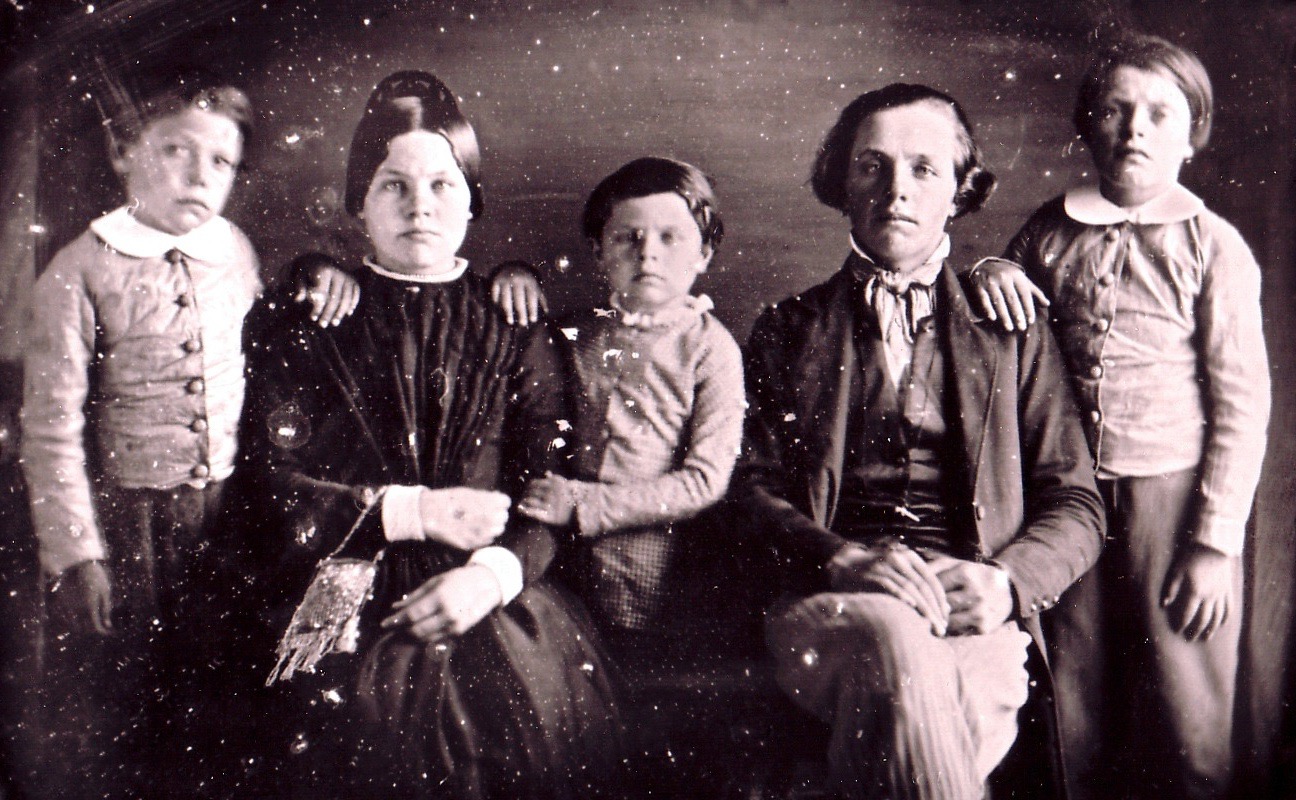
Daguerreotype of the children of Franklin and Jane (Briggs) Ogden, made slightly before the deaths of Allen, Eliza Jane and James in an 1850’s diphtheria epidemic. Only Delos and Albert survived.

Transcription

Sunday, November 24, 1861

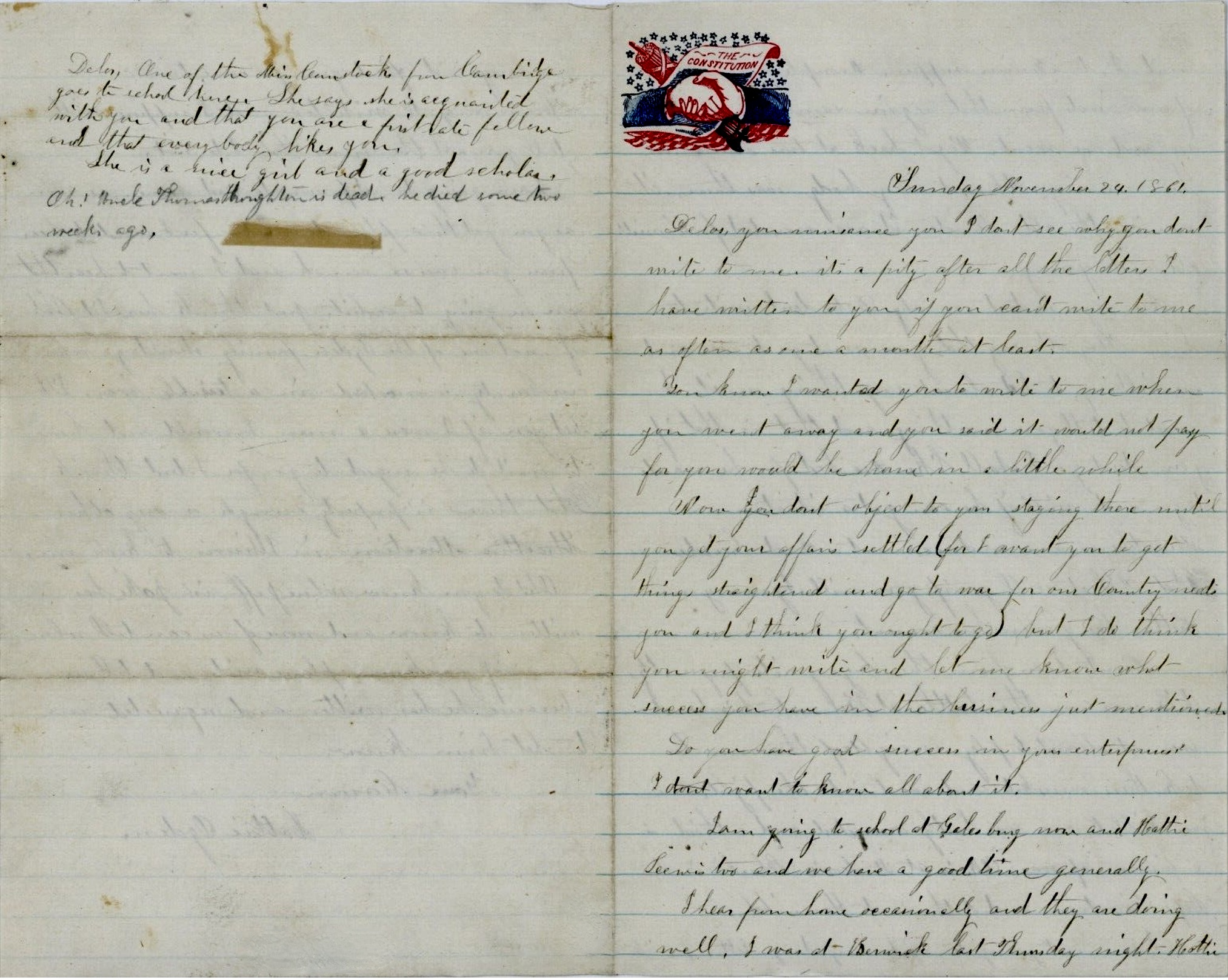
Delos, you nuisance you! I don’t see why you don’t write to me. It’s a pity after all the letters I have written to you if you can’t write to me as often as once a month at least.

You know I wanted you to write to me when you went away and you said it would not pay for you would be home in a little while. Now I don’t object to your staying there until you get your affairs settled (for I want you to get things straightened and go to war for our country next you and I think you ought to go) but I do think you might and let me know what success you. have in the business just mentioned, Do you have good success in your enterprise? I want to know all about it.

I am going to school at Galesburg now and Hattie Lewis too and we have a good time generally.

I hear from home occasionally and they are doing well. I was at Berwick last Thursday night. Hattie and I [went] to a Union supper. A couple of friends from that region came for us and we went. We got back at two o’clock in the morning. Almost everybody was there. It was in the old Senate. It was crowded full with old and young.

Asa [Abraham Matteson] says he don’t see why Delos don’t write to him. They all say that you won’t go to war and are willing to bet almost anything on it. I want to tell you one thing and that is that if you don’t go, I shall like Asa best for he wants to go and will if he can get a situation. Now there’s an inducement. And besides that Albert will go if you will. I guess your Father has given his consent.

Aunt [Ann Ogden Matteson of Galesburg] hears from the boys quite frequently. O. B. [Orville Briggs Matteson] was in the battle at Belmont [on 7 November 1861]. His band was not allowed to play so eight of the number took their muskets and went into the fight. One [John Werst] was killed. One was badly wounded and a third [William W. Sapp] is a prisoner of war. O. B. is at St. Louis. 1 Charlie [Frank Mattison] is at Cape Girardeau, and Arthur [Elon Matteson] is at Hannibal.

I am not going to write a very long letter for it may not find you for some time. Sis [Lida Ogden] is going to write too and I suppose will tell you all the news that I do not. I am going to stop now to read some. As soon as you get this, please do write for I want to hear from you ever so much and I want to hear that you are going to enlist. Just think how I’d feel if not one of the Ogden family should go when our country is involved in a terrible war. I’ll bet you if I were a man, I would not have to wait to be urged to go for I don’t think that there is property enough or any other attraction in Illinois to keep me.

Oh! do you know where Jeff is? Jake has written to know and none of us can tell where he is. If you know, please write and tell me because he has written and requested me to let him know. Yours cousin, — Hattie Ogden


1 O. B. Matteson was the appointed band leader of the 7th Iowa Infantry. He was discharged 13 January 1862.

1861: John W. Dietz to his Cousin George

The following letter was written by John W. Dietz (1841-1898), the son of Garet W. Dietz (1812-1889) and Margaret Coon, (1811-1894). From his letter, datelined from Belden, Illinois, in mid-November 1861, we learn that John had numerous correspondents serving in Illinois regiments but that he was tending store and farming in McHenry county—a county bordering the State of Wisconsin. When he registered for the draft in 1863, he was identified as single and with no prior service in the military. I have not found any evidence that he ever volunteered or was drafted. His obituary follows:

“John W. Dietz was a native of New York, and was born in Oswego County Feb. 21, 1841, and was therefore 57 yeara old at the time of his desease which oc- cured July 16, 1898. When a child his parents removed to McHenry County Ill., where he remained until after his marriage with S. Louise Cook in 1863. In 1871 Mr. Dietz came to Iowa and settled at Cedar Rapids where they remained but a year, returning to Illinois. They remained in Illinois until 1881 when they came to Osceola county [Iowa] and settled near Sibley where they remained until seven years ago when they moved to Sibley where they have since resided. To Mr. and Mrs. Deitz were born four children, two sons and two daughter. All of these live to revere an honored father save one daughter who died in infancy. In this demise a wife loses a faithful and affectionate husband, the sons and daughters a loving father, the community a faithful and upright citizen. His associations are of a pronounced character. Those who knew him best thought the most of him.”

Transcription

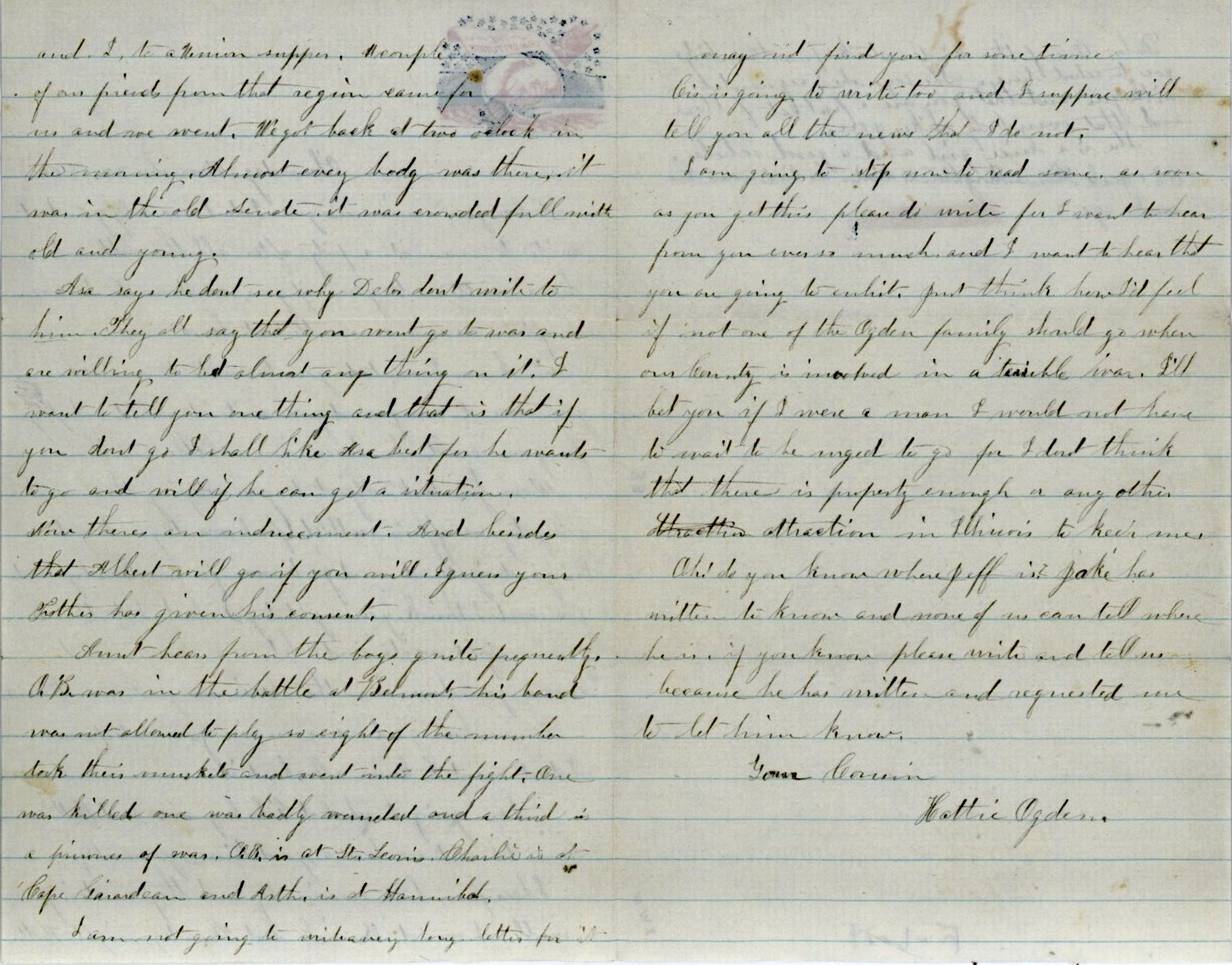
Patriotic Stationery used for letter

Belden, Illinois
McHenry County
November 15th 1861

Cousin George,

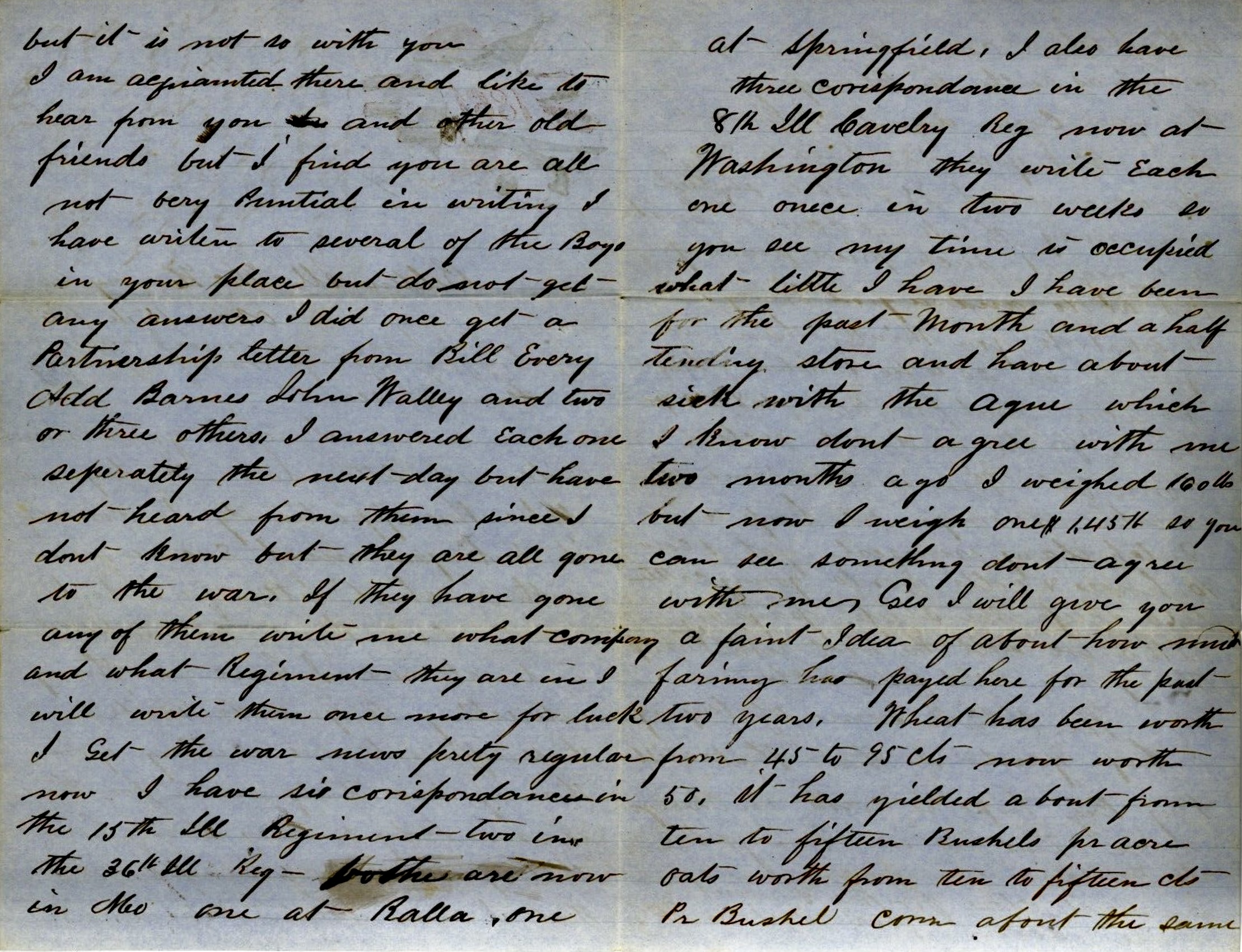
I received your much welcomed letter last Friday and take this opportunity to answer it but you must excuse me with a short letter for I don’t have more than three minutes to write at once. I have nothing interesting to you to write. It is different me writing you than you writing me for there is no body or anything here that you are acquainted with that I can write about but it is not so with you. I am acquainted there and like to hear from you and other old friends. But I find you are all not very punctual in writing. I have written to several of the boys in your place but do not get any answers. I did once get a partnership letter from Bill Every, Add Barnes, John Walley, and two or three others. I answered each one separately the next day but have not heard from them since. I don’t know but they are all gone to the war. If they have gone, [if] any of them write me what company and what regiment they are in, I will write them once more for luck.

I get the war news pretty regular now. I have dix correspondences in the 15th Illinois Regiment, two in the 36th Illinois Regiment. Both are now in Missouri—one at Rolla, one at Springfield. I also have three correspondence in the 8th Illinois Cavalry Regiment now at Washington. They write each one once in two weeks so you see my time is occupied what little I have.

I have been for the past month and a half tending store and have about sick with the ague which I know don’t agree with me. Two months ago I weighed 160 lb. but now I weight only 145 lb. so you can see something don’t agree with me. George, I will give you a faint idea of about how much farming has paid here for the past two years. Wheat has been worth 45 to 95 cents. Now worth 50. It has yielded about ten to 15 bushels per acre. Oats worth from ten to fifteen cents per bushel. Corn about the same although I believe corn has been worth as high as 20 cents in Chicago. This year corn is good. I know places that goes 1.25 bushels ears to the acre about 75 bushels shelled. You may think we cannot make a living at such prices and crop but we do and a good living too. So what do you think when we get from 20 to 40 bushels wheat per acre and from $1 to $1.50 per bushel for it. and oats 75 cents, about 90 cents. Then is the time we make money. We keep a Dutch diary as usual. Got 1 cow, 10 horses and colts, 8 or 10 young cattle, 260 sheep. The sheep pays big although we sold the wool rather cheap this year. Sold for 29 cents.
We think some of trying a hop yard. I thought that will pay. Big hops is worth in Chicago more than that in New York all the time. I must close for the present. Write soon. Your coz, — John Dietz

P. S. George, I will send you a couple papers today. You spoke about sending my likeness. I will as soon as I go where I can get it taken good and have time. Send yours as soon as you can. — John

1861: Rachel Finley (Bartlett) Griffith to Katherine (Griffith) Lawrence

Rachel Finley (Bartlett) Griffith of Edgar county, Illinois

This letter was written by a woman who lived in or near Paris, Edgar county, Illinois, in August 1861. It is either unsigned or, more likely, a second sheet is missing which would provide us with her identity. She wrote the letter to Kittie (Griffith) Lawrence (1830-1915) whom she refers to as her sister. Since Kittie did not have a sister, my hunch is that it was written by Kittie’s sister-in-law, Rachel Finley (Bartlett) Griffith (1829-1870), the wife of Orville E. Griffith (1829-1875) of Edgar county, Illinois.

Kittie’s full name was actually Ann Katherine (Griffith) Lawrence. She was married to James Lawrence of Lincoln, Logan county, Illinois. The couple were married in Edgar county in 1849 and had relocated to Topeka, Shawnee county, Kansas by 1860, but then returned to Illinois during the Civil War. Kittie and Rachel’s husband, Orville, were the two oldest children of Joseph Robinson Griffith (1806-1849) and Caroline Guthrie (1806-1850), both deceased ten years prior to the Civil War.

Transcription

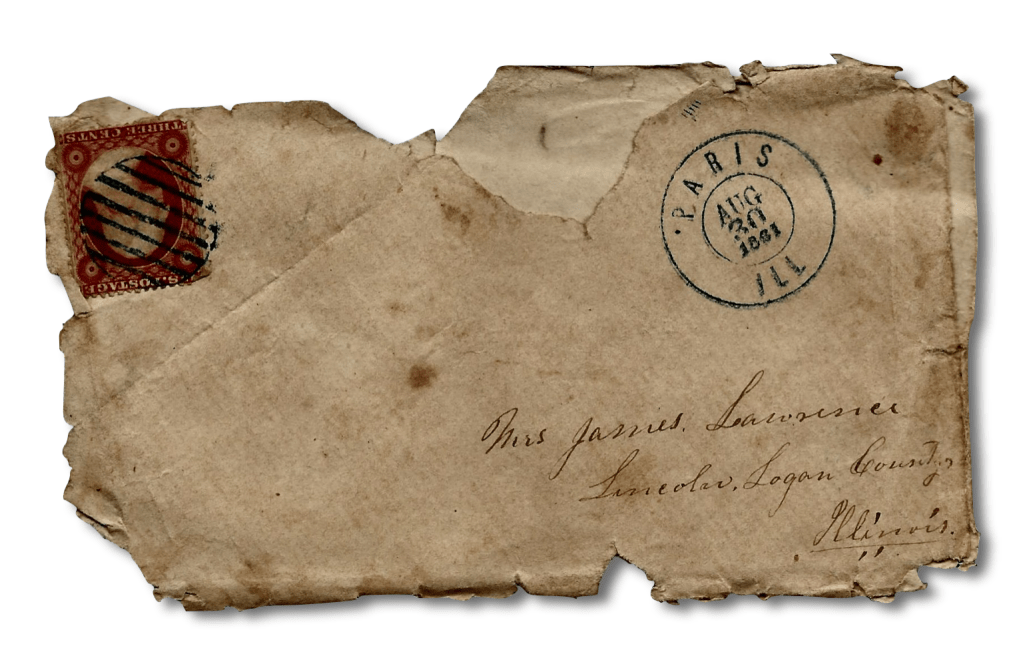
Addressed to Mrs. James Lawrence, Lincoln, Logan county, Illinois; postmarked Paris, Illinois, 30 August 1861

At school
August 28, 1861

My dear sister Kittie,

Although some time has elapsed since your kind favor came to hand, and you perhaps may think it has been forgotten or neglected (which I could not wonder if you did) yet it has not been. But if you will credit me, I could not collect money enough to buy paper, stamps and envelopes, and so this morning I went to the dry goods store and got paper and envelopes obviously credit and there is not a stamp or three cent piece in the house to send this when it is finished.

We do not know what the world is coming to unless it is coming to an end. It is needless to say anything about excitement for doubtless you know enough about it. But I doubt very much if we have not (at least) five rebels where you have one. The Union men think that at the recent Secesh rally there were no less than three hundred of them in Paris, and now would you believe it, they are allowed to make public speeches much to the annoyance of the Union ladies. I never saw our community of women so much out of patience with their men as they were for allowing Andy Hunter 1 and that thing—(I don’t know what to call him anything mean enough but Amos Green 2) to make speeches on the occasion. If the ladies had been in power, they would have been deprived of the privilege of belching there—allow me to say—devilish lies. I did not say that to swear but it is all the word that would suit at all.

It is astonishing to see what a state of feeling exists among a religious people—especially the women. They are perfectly wild. Our most quiet and pious people, it takes but a word to rouse them to fighting humor, and it is not to be wondered at when those we love most dearly are unduly torn from us, forced to undergo and endure all the hardships, trials, and privations of the soldier’s life and then be shot down like dogs in an unjust war. Is it any wonder I say that people allow themselves to be carried away with excitement. And then to think that we have to put up with their insults right here in the North where men ought to, and do know better, but who just yield to the promptings of the few selfish office seekers which infest every community.

Kittie, it would startle you (but you may have been startled in the same way) to hear some of our cool, quiet, pious men talk and make threats. The poor fool dregs of the democratic party (I mean this modern democratic party) have appointed an extra session of Court just to get Big Creek annexed to this precinct or township or some political division (I am not as well posted in these things as I ought to be. If you don’t know, James will.) The object is, however, to get that one united to this so it will at the elections go democratic, or secesh rather. Court is in session now and I just tremble until it is through. The excitement concerning it has partially abated.

Edgar [County] has sent four or five companies of infantry and a cavalry company starts tomorrow Friday week. I believe I told you our preacher was captain of the first company. [James F.] Jaquess has gone as chaplain of a cavalry company. 3 Phil Minear 4, Crene, [Edward] Rutledge, 5 and I can’t tell how many of our “big” preachers have gone as captains or chaplains. Excuse this pen. It writes when it pleases only. [unsigned or last of letter is missing]


1 Andrew (“Andy”) Jackson Hunter (1831-1913) moved to Paris, Illinois with his parents in 1832 from Greencastle, Indiana. He eventually became a lawyer and practiced in Paris until 1864 when he was elected to the Illinois Senate as a Democrat.

2 Amos Green was a notorious Peace Democrat (Copperhead) in Edgar county who broadly influenced public opinion a the editor of the Times—the Democratic organ in the county. Michael Kleen published an article called “A Confrontation in Paris” that tells the tale of how and en effort to shut down a newspaper in Edgar countym Illinois, led to one of the Civil War’s most violent home front riots. Green saw the Civil War as unjust and Lincoln as a despot who had to be stopped. He wrote vicious denunciations of the administration in local newspapers. He was arrested for sedition in 1862. After his release in August 1862, he became the grand commander of the secret Order of American Knights in Illinois, which fought restrictions on civil liberties. It was also called the Knights of the Golden Circle and later the Sons of Liberty. Green was funded by the Confederate government to arrange riots at the Democratic National Convention in 1864. Although the riots never materialized, he continued giving antigovernment speeches until he was again arrested in November 1864. After this arrest, he agreed to testify for the government about the activities of the Knights; his testimony implicated others but ignored his own deep involvement in antigovernment plots. In 1864, a clash between Copperheads and Union Soldiers in Charleston, Illinois resulted in nine dead and twelve wounded in what is now called the “Charleston Riot.”

3 James F. Jaquess volunteered as chaplain of the 6th Illinois Cavalry. He later became Colonel of the 73rd Illinois Infantry.

4 Philip N. Minear (b. 1836), a clergyman in Paris, Edgar county, Illinois, volunteered as the chaplain of the 25th Illinois Infantry but resigned on 11 July 1862.

5 Edward Rutledge volunteered as chaplain for the 61st Illinois Infantry. He mustered out in September 1862.

1862: Elvira Cole to Ruby Eloise (Cole) Merrill

Elvira Cole

The following letter was written by Elvira Cole (1805-1886), the 57 year-old unwed daughter of Alva Cole (1774-1846) and Rosemond Freeman (1787-1847) of Cattaraugus county, New York. Elvira lived for twenty-five years or so in Avon, Fulton County, Illinois. She died and was buried there in 1886.

Elvira wrote these letters to her younger sister, Ruba Eloise (Cole) Merrill (1816-1887) who later lost both her husband, Barzilla Merrill and her son, Alva Merrill, in the Battle of Chancellorsville in May 1863 when they were serving in Co. K, 154th New York Infantry.

Transcription

Addressed to Mrs. Ruby C. Merrill, Cottage P. O., Cattaraugus county, New York

Avon, [Fulton county, Illinois]
August 14, 1862

My dear sister and brother,

My health is very good but somehow I feel dull and bad this morning. I have been out two evenings to war meetings and last night went to the depot to see the volunteers start off. Quite a number went from this place and among them the most prominent members of the church. The recruiting officer had been down the road gathering up his men to go to Chicago on the night train and be sworn in today. There were three or four cars full. This we were told is the winding up of volunteering. Next comes the draft. Rev. Richard Haney, our former presiding Elder is to be Chaplain of the regiment and his son James Haney is expected to be Captain of the company. These men go in so it is believed the moral and spiritual interests of the soldiers will be care for.

When we started to come home last night, a friend told me that he saw brother Samuel 1 in the cars and spoke with him. He had enlisted and had not time to come to see but I think I shall see him yet before they move from Camp Douglas. Those that have left home suddenly without settling up their business have encouragement of coming home on a furlough of eight or ten days soon after being organized into companies and regiments.

I am going to send Uncle Stephen’s letter to you. He has been unfortunate again in losing his wife for I think he had a very good one. I believe he did not live with her quite two years. I suppose the Ophelia he speaks of to be a niece of his last wife but am not sure. The grandson is Melissa’s son by her first husband.

The prospects here are dubious—war so near and maybe much nearer. Guerrilla parties have done some mischief in Missouri within five hours ride from us. We have martial law throughout the State I suppose to prevent men from running away from being drafted. I don’t know what will be next but enough of this. You will think I am getting the blues but there is no such thing. When I think I am in danger of that, I get the Book and read the 91st Psalm and claim the protection there promised though I don’t know as I have a right to.

Our friends were all well when last heard from. I have not seen Samuel since January nor many of the rest of them. Peter called often during the spring and forepart of the summer but has not for the last month. I thought of filling out the sheet but I can’t see and it is almost train time so I must stop. My love to all. Goodbye, — E. Cole

Do write. I want to hear if I don’t very often. You can both see better than I.

Ebenezer Sanford’s second son was killed in the Pittsburgh [Landing] battle [Shiloh].


1 Samuel Dill Cole enlisted as a private in Co. I, 72nd Illinois Infantry in mid-August 1862. See 1864: Samuel Dill Cole To Ruby (Cole (Merrill.

1863: James Dempsey to July A. Dempsey

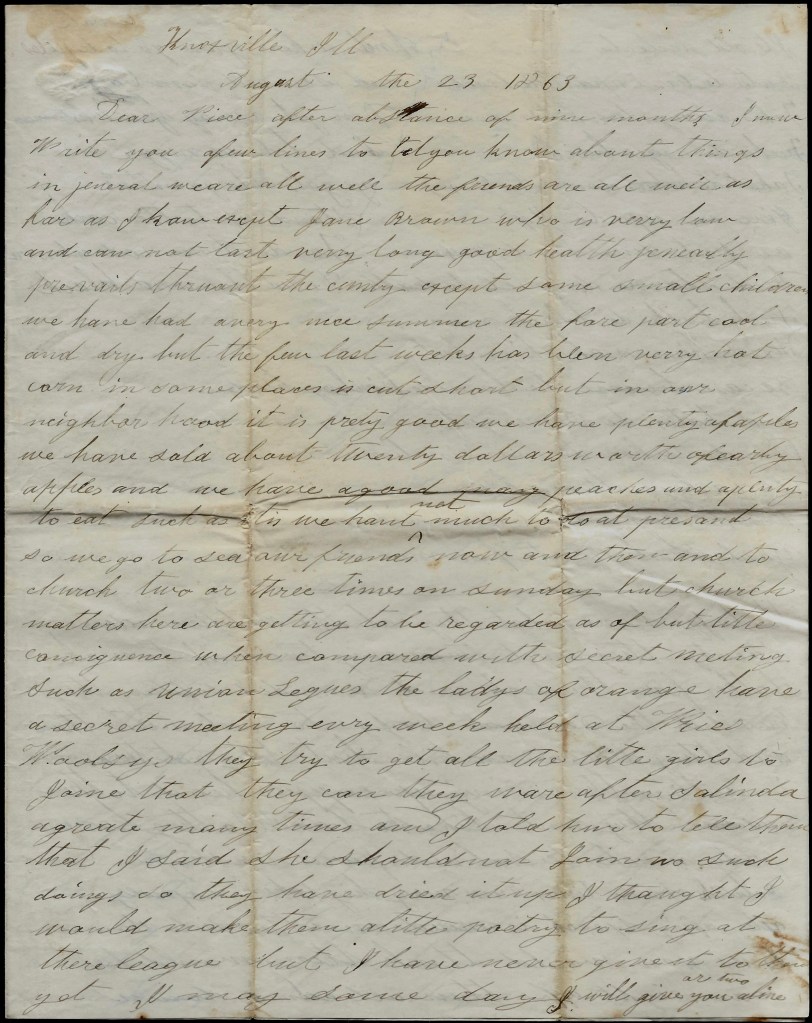
The following 8-page letter was penned by 48 year-old James Dempsey (1815-1888) of Knoxville, Knox county, Illinois. His parents were Jame Asen and Susannah (Piper) Dempsey of Chillicothe, Ohio. He was married to Virginia Amos Ferguson (1827-1910) in April 1844 and together they had at least twelve children. The letter appears to have been directed to July A. Dempsey but I believe this was meant for Julie Dempsey.

The letter vividly portrays the intricate dynamics of the internecine conflict unfolding on the home front in rural Illinois during a turbulent period in history. As citizens grappled with the divisive impact of partisan politics, the community found itself increasingly polarized. The aftermath of the Emancipation Proclamation further exacerbated tensions, as the Civil War dragged on, testing the nation’s endurance and stirring fervent expressions of patriotism.

Transcription

Knoxville, Illinois
August 23, 1863

Dear Piece,

After absence of nine months, I now write you a few lines to tell you now about things in general. We are all well. The friends are all well as far as I know except Jane Brown who is very low and cannot last very long. Good health generally prevails throughout the country except some small children. We have had a very nice summer—the forepart cool and dry, but the past few last weeks has been very hot. Corn in some places is cut short but in our neighborhood it is pretty good. We have plenty of apples. We have sold about twenty dollars worth of early apples and we have a good many peaches and plenty to eat such as it is.

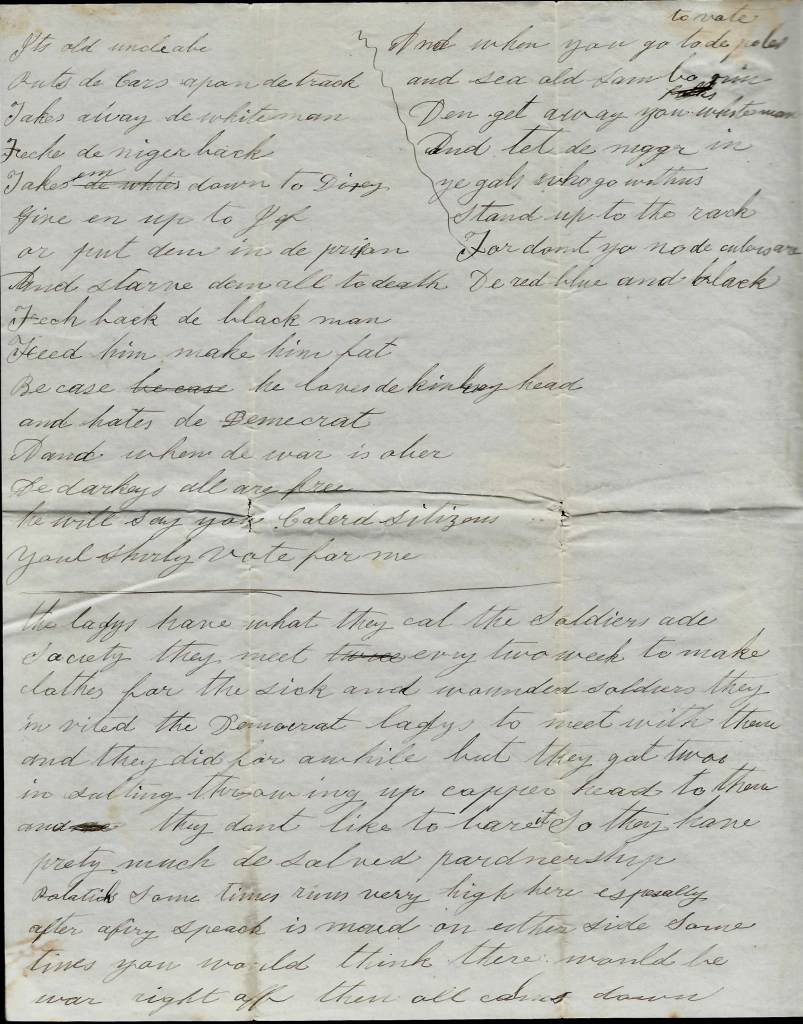
We hant not much to do at present so we go to see our friends now and then and to church two or three times on Sunday. But church matters here are getting to be regarded as of but little consequence when compared with secret meetings such as Union Leagues. The ladies of Orange have a secret meeting every week held at Wright Woolsey’s. They try to get all the little girls to join that they cab. They were after Salinda a great many times and I told her to tell them that I said she should not join no such doings so they have dried it up. I thought I would make them a little poetry to sing at their league but I have never give it to them yet. I may some day. I will give you a line or two.

It’s old Uncle Abe
Puts de cars upon de track
Takes away de white man
Fetch de nigger back

Takes em down to Dixey
Give em up to Jeff
Or put dem in de prison
And starve dem all to death

Fetch back de black man
Feed him make him fat
Because he loves de kinky head
And hates de Democrat

And when de war is over
De darkies all are free
He will say you colored citizens
You’ll surely vote for me

And when you go to de polls to vote
And see old Sambo grin
Den get away you white man
And let de nigger in

Ye gals who go with us
Stand up to the rack
For don’t you know de colors are
De red, blue, and black

The ladies have what they call the Soldiers Aid Society. They meet every two weeks to make clothes for the sich and wounded soldiers. They invited the Demoract ladies to meet with them and they did for awhile, but they got to insulting, throwing up Copperhead to them, and they don’t like to hear it so they have pretty much dissolved the partnership. Politics sometimes runs very high here—especially after a fiery speech is made on either side. Sometimes you would think there would be war right off. Then all calms down.

I will now give you a little account of a picnic we had not long since Father Abraham gave orders that we should all give thanks on the 6th day of August so friends Chase’s thought they would have a supper at their house and charge 25 cents per meal to be laid out for the soldier use. They invited the Democrats generally to unite with them but as they were to have all the control of the affair and have speakers to suit themselves, the Democrats modestly declined. Margaret Stephens asked Cornelius Dempsey if the Democrats might have the ground by the church and have a free dinner to which he gave his consent. Every exertion was made on both sides to see which side could beat. The Democrats got the promise of the band but they fell out amongst themselves and refused to go.

The day arrived and Cornelius went over to Chase’s in the morning and invited them all over to take dinner with us and said we would take supper with them and have no hard feelings but they were all stirred up like a hornet’s nest and would listen to no compromise. Cuffy was there—yes, Cuffy was there—and like old Mad Anthony, she promenaded the hill before Chase’s door pretty much all day, raging and charging about Copperheads. About ten o’clock the wagons began to roll in from Knoxville and Maquan, Gilson and every other direction but two went to the Democrat side to one that went to the other side. As the two and four-horse wagon loads came in with their flags of Stars and Stripes waving and drove in on our side, the others grew still madder. Several of the Republicans came over and ate with us—old Billy Clark for one—but when they went back [to Chase’s], they were called Copperheads and insulted so I think they made several Democrats that day.

Peter Lacy and his wife [Lucinda] and Adaline thought that they would go to both places but Peter was soon insulted and came to our side. Lucindy and Adaline went back and they would not let their children have a drink of water. Lucindy cried and her and Adaline called them Black Abolitionists and left. If they had any Republican in them, they lost it all and Peter and Cuffy fell out for the first time. We had a table a hundred yards long well filled with good things. After dinner we raised over fifty dollars for the soldiers. Little Flack then made a speech. Some of them made quite a blow about that as he has quit preaching. They say he has been too friendly with the sisters but old Tyler has been making speeches for them and that is no harm in him they think.

Excuse my awkwardness. This is the third page on this sheet. Tommy Godfrey and family are alright. If you were here and see them you would think it was old Tommy yet. Jacob P. is still living down in the brush and Jake has as many notions as ever but can’t keep in one notion long enough to go into any new speculation. Grandmother and Ann still lives near Cornelius and I don’t see as there has been much change in either of them since you left here. Your Uncle Cornelius’s girls are none of them married yet and no prospect of it as I know of.

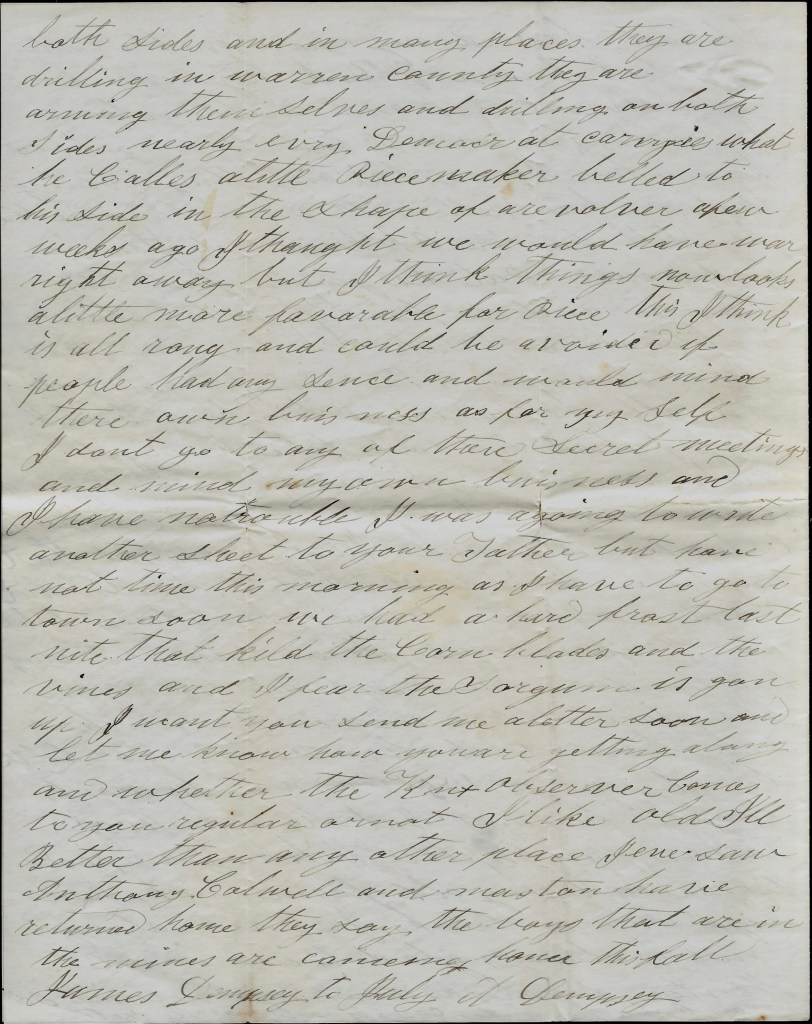
There was a great Sabbath School Celebration at Galesburg a few days ago. Salinday went. They put the darkies ahead when they marched. Galesburg is growing black very fast with negroes. They all seem to know where their friends are and the white negroes and black negroes all go together. There are a great many strange things going on here at this time and you may not be surprised to hear of a young war in Illinois some of these days. Everything that can be carried on in secret meetings are held here almost every night. Companies are formed on both sides and in many places they are drilling. In Warren county, they are arming themselves and drilling on both sides. Nearly every Democrat carries what he calls a little peace maker belted to his side in the shape of a revolver. A few weeks ago I thought we would have war right away but I think things now looks a little more favorable for peace. This, I think, is all wrong and could be avoided if people had any sense and would mind their own business.

As far as myself, I don’t go to any of their secret meetings and mind my own business and I have no trouble. I was a going to write another sheet to your father but have not time this morning as I have to go to town soon. We had a hard frost last night that killed the corn blades and the vines and I fear the sorghum is gone up. I want you to send me a letter soon and let me know how you are getting along and whether the Knox Observer comes to you regular or not. I like old Illinois better than any other place I ever saw. Anthony Caldwell and Maston have returned home. They say the boys that are in the mines are coming home this fall.

— James Dempsey to July A. Dempsey

August the 30th. I have been so busy I have not had time to finish my letter. Jane Brown was buried day before yesterday. She died on the 27th. I was there when she departed about 8 o’clock at night. About 5 minutes before she died, while her friends were standing thick around her bed—mostly women, the old General, her father, came to see her and rushed into the room where she lay, pushing the women out of the way as he went. The manner in which he came scared the women until they shook like they had the ague. He wanted to be friendly but Mary would have nothing to say to him. He looks quite old and dejected.

John Brown is about grown and think there is a good deal of outcome in him. He has work pretty well this summer. So has Tom and I think the General was quite taken with their looks. Sint too is almost grown and quite a good looking girl.

I will now give you a description of our family. Salida is nearly as tall as her mother and weighs 106 pounds. She has not went to school as much as I have wanted her to do so I think I will send her to the Seminary this fall and winter. She will start perhaps next Wednesday, not because she can’t learn any more in the country but because I think they will keep her closer to it and make her learn. John has grown very fast. You would not know him. He can beat anything spelling that he has spelt with since he came here. He still has the apthisis yet almost as bad as ever. Pat has grown fast this summer and so has the doctor. Charley is still a little sprink but learns very fast at school. Tommy is the most promising of them all. He has a very big head, broad high forehead and looks like he might make a pretty smart man.

Your aunt weighs 160 pounds. She outweighs me. Your old school teacher Lib and Jerry is married at last. They have divided our old school district and are building a new school house. Weeks’ and Woodmans [?] has made some improvements on your old place this summer. Has worked very hard and has very poor health. He only weighs 155 pounds. He wants to sell, he says, but he asks 4,000 dollars for his place. Holloways are poor farmers and my old farm looks bad. Lige Beach looks just like always and is always glad to see me. Old Wester smokes as much as ever and so does Rolly. His wife Casey is not married yet.

1862: Lucretia Smith (Trickle) Mathews to Lemuel Fordum Mathews

How Lem & Tishie might have looked (W. Griffing Collection)

The following Illinois home front letter was written by 19 year-old Lucretia Smith (Trickle) Mathews (1843-1910) to her husband Lemuel Fordum Mathews (1840-1889) of West Jersey, Stark county, Illinois. I transcribed four of Lemuel’s letters back in 2014; see—1863: Lemuel Fordum Mathews to Lucretia (Treakle) Mathews.

Lemuel enlisted in Company D, 112th Illinois Infantry in August 1862. Beginning in April 1863, the regiment served as mounted infantry during the Knoxville Campaign, before being dismounted in February 1864.

Lemuel was shot in the upper right arm (or shoulder) at Resaca, Georgia on 14 May 1864. He was sent to a hospital at Chattanooga but gangrene and typhoid fever complicated his recovery and he was subsequently sent to hospitals in Nashville, Tennessee, and New Albany, Indiana. Lemuel survived the war but he lost the complete use of his right arm and, as such, was judged disabled and honorably discharged from Camp Butler, Illinois in August 1864. After  the war, the couple relocated to Elmwood, Peoria County, Illinois and then to Spring Creek, Cowley County, Kansas by 1885.

Mentioned in the letter several times is Lemuel’s brother, Whitfield [“Whit”] D. Mathews (1838-1914), who served in the same company. Whit was married in October 1861 to Mary (“Mollie) Angeline Chaddock (1843-1900).

Transcription

West Jersey [Stark county, Illinois]
November 19th 1862

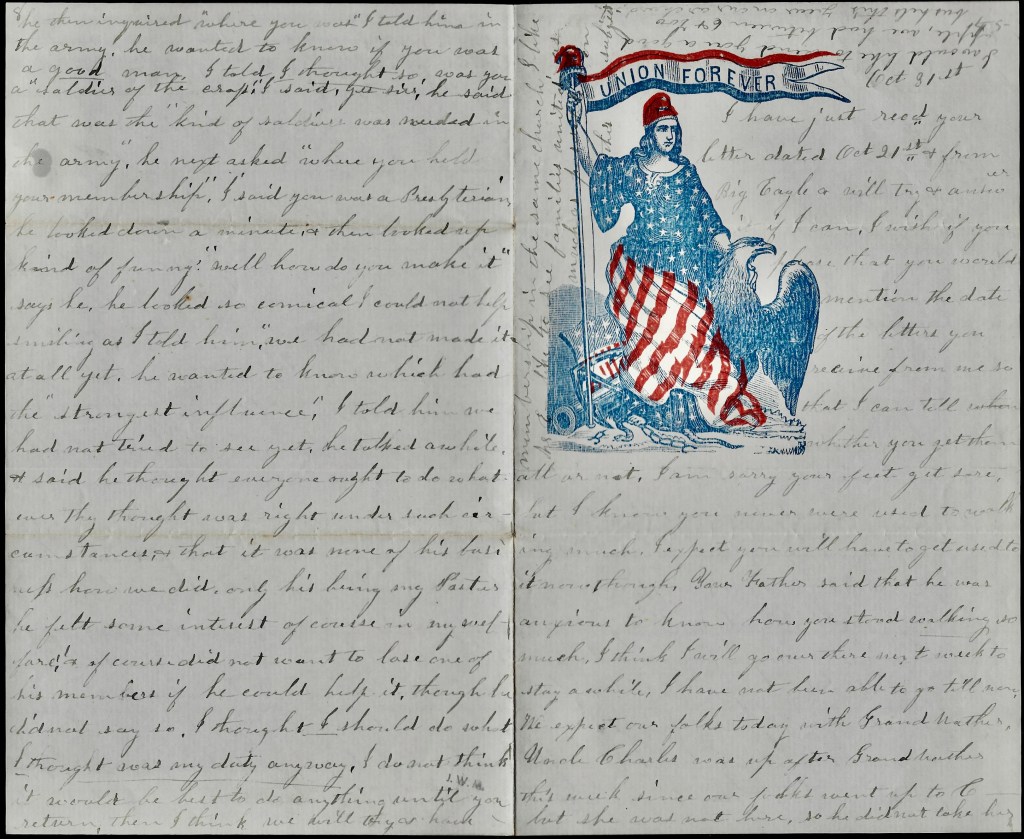
Dear Husband,

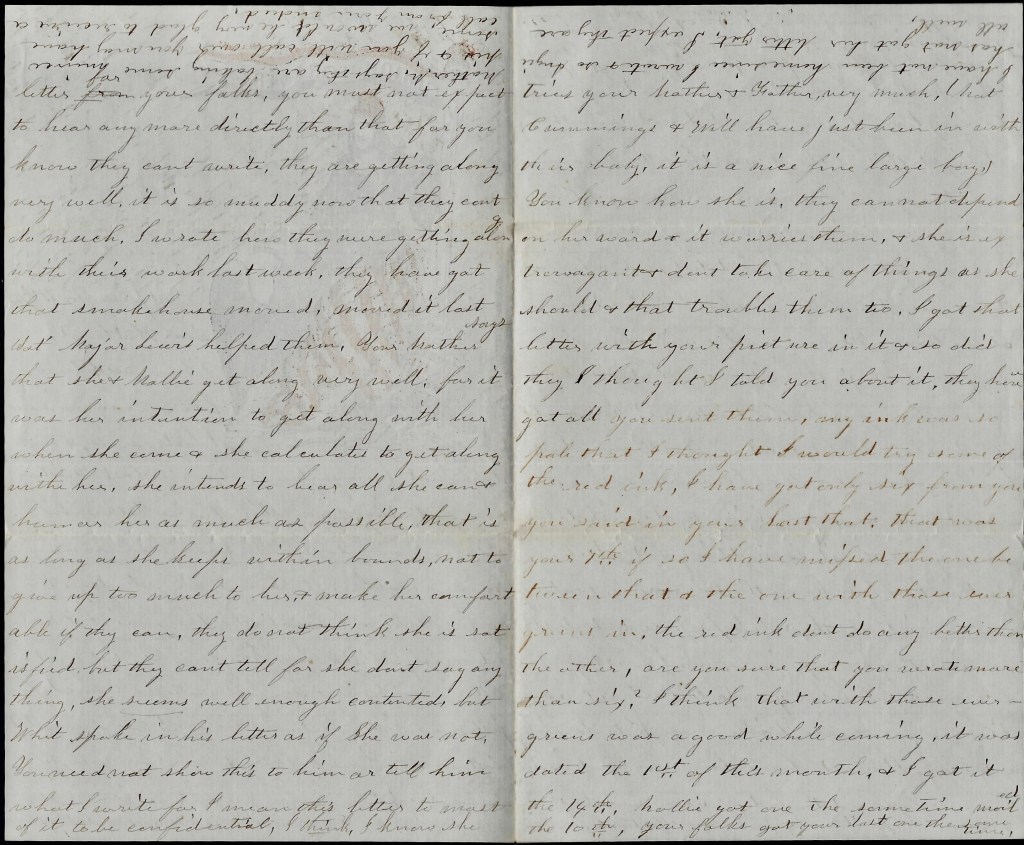
I have received two letters from you since I last wrote though it has not been quite a week—one last Friday and one yesterday. I am still at your Father’s but will return home soon. We have been having rainy weather. It rained all yesterday afternoon. Mollie & I went after the mail & it rained nearly all the time we was gone but I got a letter from you & so felt quite well paid for getting a little wet. Mollie received two from Whit last week. Your folks got one from you. They have received two since you left which is all you said you had written. Mollie wrote that letter for your folks. You must not expect to hear any more directly than that for you know they can’t write. They are getting along very well. It is so muddy now that they can’t do much. I wrote how they were getting along with their work last week; they have got that smokehouse moved. Moved it last Saturday. Major Lewis helped them. Your Mother says that she & Mollie get along very well for it was her intention to get along with her when she came & she calculated to get along with her. She intends to bear all she can & humor her as much as possible—that is, as long as she keeps within bounds, not to give up to much to her, and make her comfortable if they can. They do not think she is satisfied but they can’t tell for she don’t say anything. She seems well enough contented but Whit spoke in his letter as if she was not. You need not show this to him or tell him what I write for I mean this letter to most of it to be confidential. I think I know she tries your Mother & Father very much…

I got that letter with your picture in it & so did they. I thought I told you about it. They have got all you sent them. My ink was so pale I thought I would try some of the red ink. I have got only six from you. You said in your last that that was your 7th. If so, I have missed the one between that and the one with those evergreens in….You may expect a small package after while. I can’t tell just when in the course of a few weeks. I will advise you at the time. We have mush & milk here for supper which just suits me. What made you ask me how your mother treats me? You might know she would treat me well enough, & I will treat her as well as I can. She wishes you would not have anything to do with taking sheep, geese, &c. It is nothing but stealing she thinks & you know that is wrong & eating warm victuals the rebels prepare—don’t do it for they may poison you. I want you to be careful what you do to contract any disease for you are liable enough to be sick anyway. It must have been very sad indeed to have followed the body of a comrade to the grave. I hope it may prove an effectual warning to all.

Your mother thinks you ought to set the example of keeping the Sabbath more strictly. You could take your book & go off & read & perhaps others would follow your example, and you might do a great deal of good & be improving yourself too. You know we must watch & pray that we enter not into temptation & that we may not also lead others into temptation. She wants you and Whit to live together as brothers should now you are in a strange country.

October [November] 31st

I have just received your letter dated October [November] 21st & from Big Eagle & will try and answer it if I can. I wish if you please that you would mention the date of the letters you receive from me so that I can tell whether you get them all or not. I am sorry your feet get sore but I know you never were used to waling much. I expect you will have to get used to it now though. Your Father said that he was anxious to know how you stood walking so much. I think I will go over there next week to stay a while. I have not been able to go till now.

Uncle Charles was up after Grandmother this week since our folks went up to C—- but she was not here so he didn’t take her. I have not heard anything more of your folks since I wrote that other sheet full. Lana Eagon is staying with us while our folks are away. She says Tabitha Garner has had only one letter from Henry since he left Peoria. Do you know anything of him? Write all you know (that is, whether they are well or sick, &c.) of the Jersey boys when you write for all ask, have you heard from the boys lately when they see Lizzie & me. I would have finished this yesterday but I got into bigger business. Sand’s little girl is here with her & you know me—must do something to amuse her. So Angie brought down a great lot of old rags & we (Angie & e) went to work to making a doll. I worked all day on it & its clothes. We made quite a presentable looking article. I know you would say so if you saw it for the first attempt on my part. I wanted to get my hand in you know. Angie is making ginger bread. She says she wouldn’t mind shaking hands with you now. I am of the impression it would be easier to take hold than to let go. You will have to be a pretty good farmer when you get back if you raise potatoes enough for our own use if my appetite keeps increasing as it has done for a week back. Pickles don’t go very bad, or ginger bread.

Our preacher, Rev. Elliot, stayed with us last Sabbath night. He did not discover I was married till morn. Then he said, “good morning, sister Trickle!” when I came out of the room. There was someone else in the dining room so I took the liberty to tell him my name was not Trickle but Mathews. He wanted to know how that happened, it was Trickle on the class book. I told him I was married a short time ago & presumed it had not been changed yet & so they they will get married & be given in marriage says he. I said I supposed so & so it would be as long as the world lasted he said. He then inquired “where you was.” I told him in the army. He wanted to know if you was a good man. I told I thought so. Was you a “Soldier of the Cross?” I said yes sir. He said that was the “kind of soldiers was needed in the army.” He next asked “Where you held your membership.” I said you was a Presbyterian. He looked down a minute & then looked up kind of funny. “Well how do you make it?” says he. He looked so comical I could not help smiling as I told him, “We had not made it at all yet.” He wanted to know which had the “strongest influence.” I told him we had not tried to see yet. He talked a while & said he thought everyone ought to so whatever they thought was right under such circumstances & that it was none of his business how we did—only his being my pastor, he felt some interest of course in my welfare and of course did not want to lose one of his members if he could help it though he did not say so. I thought I should do what I thought was my duty anyhow. I do not think it would be best to do anything until you return. Then I think we will try our luck membership in the same church. I, like Mr. E, like to see families united as much as possible on this subject.

I would like to send you a good apple We had between 6 & 700 bushels this year on our orchard.

I have not been home since I wrote & so Angie has not got her letter yet. I expect they are all well. Mother M. says they are baking some mince pies & if you will call over, you may have some. We would be very glad to receive a call from you indeed.