Category Archives: Left Hand Contest

1865: John M. Tures to William Oland Bourne

This letter was written by John M. Tures although he was carried on the Roster of the 70th New York Infantry as John M. Touris, Tours, or Turse. John enlisted on 24 April 1861, at Paterson, N. J., when he was 21 years old to serve three years in Co. I. He mustered in as private, and was later promoted to corporal. He was captured in action on 2 May 1863, at Chancellorsville and paroled five months later. He was seriously wounded in the battle of Spottsylvania Court House on 14 May 1864 and was mustered out on 1 July 1864, at New York city.

John wrote the letter to William Oland Bourne (1819-1901), editor of The Soldier’s Friend, who sponsored a contest in 1865-1866 in which Union soldiers and sailors who lost their right arms by disability or amputation during the Civil War were invited to submit samples of their penmanship using their left hands. The contest, which awarded a total of $1,000 in prizes for the winning entries, was followed in 1867 by a second contest, which awarded $500 in prizes. A very large number of letters were submitted to Bourne which are now housed in the Library of Congress along with some photographs on the contestants. Most likely the following letter was a personal copy (or first draft) of the letter that John submitted. It’s also possible that John never sent the letter or missed the deadline for submission. See Wm. Oland Bourne Papers. Readers hoping to learn more about “The Left Armed Corps” can listen to Episode 1932 of Civil War Talk Radio wherein Allison M. Johnson is interviewed by Gerry Prokopowicz regarding her book on the subject.

[Note: This letter is from the personal collection of Greg Herr and was offered for transcribed and publication on Spared & shared by express consent.]

Transcription

Waterbury [Connecticut]
December 26, 1865

Friend Oland Bourne,

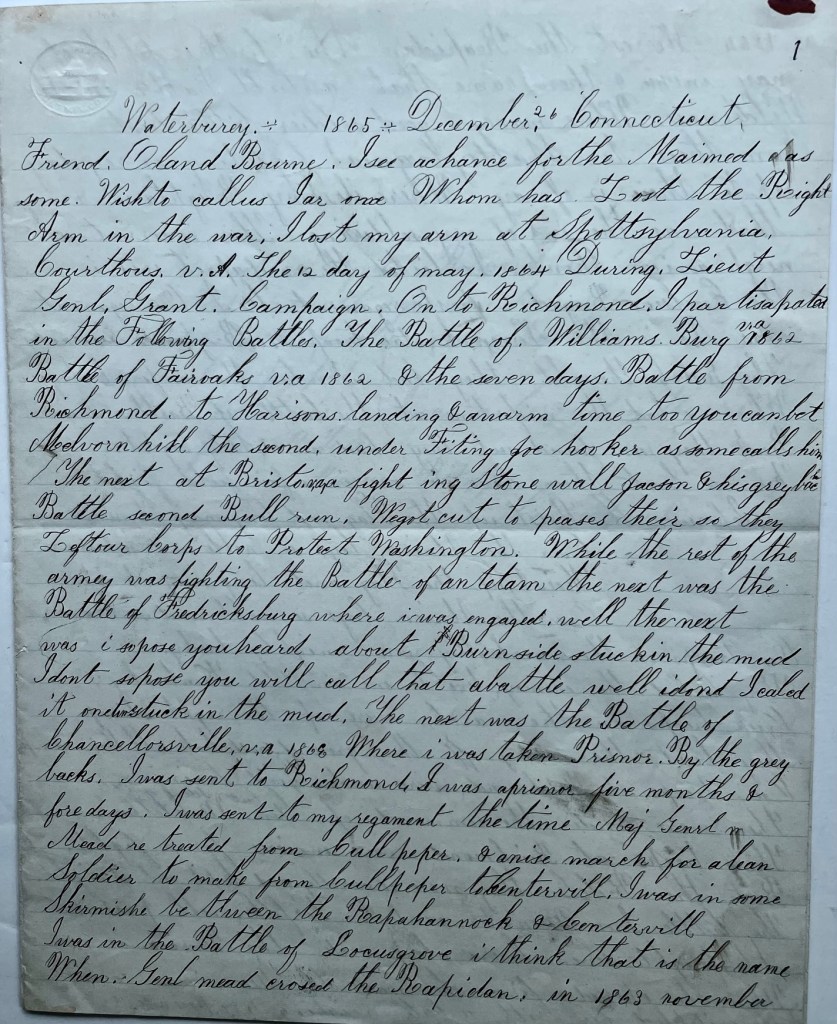
I see a chance for the “maimed” as some wish to call us. I are one whom has lost the right arm in the war. I lost my arm at Spottsylvania Court House, Va., the 12th day of May 1864 during Lieut. Gen. Grant’s Campaign on to Richmond. I participated in the following battles. The Battle of Williamsburg, Va. 1862; the Battle of Fair Oaks, Va., 1862; and the Seven Days Battle from Richmond to Harrison’s Landing, and a warm time too, you can bet. Malvern Hill the second under Fighting Joe Hooker as some calls him. The next at Bristoe, Va., fighting Stonewall Jackson & his grey backs; Battle of Second Bull Run—we got cut to pieces there so they left our trooops to protect Washington while the rest of the army was fighting the Battle of Antietam. The next was the Battle of Fredericksburg where I was engaged. Well, the next was I suppose you heard about Burnside stuck in the mud. I don’t suppose you will call that a battle. Well I don’t. I called it one time stuck in the mud.

The next was the Battle of Chancellorsville, Va. 1863 where I was taken prisoner by the grey backs. I was sent to Richmond. I was a prisoner five months & four days. I was sent to my regiment the time Maj. General Meade retreated from Culpeper & a nice march for a lean soldier to make from Culpeper to Centreville. I was in some skirmishes between the Rappahannock & Centreville. I was in the Battle of Locust Grove—I think that is the name, when Gen. Meade crossed the Rapidan in 1863 November.

We crossed the Rapidan the fourth or fifth of May in 1864 and then came that awful Battle in the Wilderness where many a good soldier but the dust. From there to Spottsylvania, fighting every day up to the 12th of May where I lost my right arm & that was the end of my soldiering. This is correct as nigh as I can think. I enlisted the 26th of April 1861 in the Excelsior Brigade, 1st Regiment, Co. I. Our regiment was numbered in the New York State Troops, 70th Regiment.

The rebels thought they had us when the war first begun
When we had the misfortune at the battle of Bull’s Run;
But they soon found out they had no earthly sight
For we beat them two to one in a fair, field fight.

Chorus:

Hoist up the Flag and long may it wave
Over the Union, boys, so noble and so brave;
Hoist up the Flag and long may it wave
Over he Union boys so noble and so brave.

Our troops on the march they were mighty lucky,
They licked the enemy, two to one in Old Kentucky;
Our troops on the march were of the right stamp
They beat the enemy off the ground, and took all their camp

Our troops at Richmond 1 were under good training
They were under the command of Gen. McClellan (but I don’t see it)
The troops at Richmond 1 were anxious for a fight
But the rebels they were cowardly and kept out of sight.

The little Iron Monitor went to Norfolk, well packed,
She fought seven hours along side the Merrimac
When she opened fire she made the Merrimac sound
She crippled her with a ball weighing 480 pounds.

I did not see your reward until about a month ago so I have not had much practice and practice makes perfect. I was a corporal in the 7-th New York Vols., Co. I

My address is John M. Tures, Mianus Post Office, Connecticut


1 I think John must have meant Washington here, not Richmond. This poem appears to be original. I can’t find any evidence that it was copied from published sources.
1865: Samuel Frank Haskell to William Oland Bourne

This unusual letter was written by Samuel “Frank” Haskell (1839-1922), the son of Jasper Haskell (1805-1874) and Salley Fickett (197901871) of Poland, Androscoggin county, Maine. Frank was wounded in the right arm on 16 June 1864 in the opening assault on Petersburg while serving as a sergeant in Co. C, 17th Maine Infantry. His wound was so severe that it required the amputation of his arm and resulted in his discharge on 15 December 1864.

We learn from Frank’s letter that he first enlisted in Co. K, 5th Maine Infantry. He was mustered into that regiment on 24 June 1861 and was taken a prisoner in the Battle of Bull Run on 21 July. His military record states that he was confined at Richmond, Va, and Charleston, S. C. before being released sometime in mid-February 1862.

Frank’s letter provides us with a description of his attempt to escape Libby Prison in the fall of 1861, which was successful, but he was recaptured just before making it back to Union lines.

Frank wrote the letter to William Oland Bourne (1819-1901), editor of The Soldier’s Friend, who sponsored a contest in 1865-1866 in which Union soldiers and sailors who lost their right arms by disability or amputation during the Civil War were invited to submit samples of their penmanship using their left hands. The contest, which awarded a total of $1,000 in prizes for the winning entries, was followed in 1867 by a second contest, which awarded $500 in prizes. A very large number of letters were submitted to Bourne which are now housed in the Library of Congress along with some photographs on the contestants. Most likely the following letter was a personal copy (or first draft) of the letter than Frank submitted. Unfortunately Frank’s picture is not among those in the Library of Congress. See Wm. Oland Bourne Papers.

[Note: This letter is from the personal collection of Greg Herr and was transcribed and published on Spared & shared by express consent.]

S. Frank Haskell is listed as Contributor No. 41 on this published sheet. There were at least 267 entries.

Transcription

Augusta, Maine
September 25th 1865

Mr. Bourne,

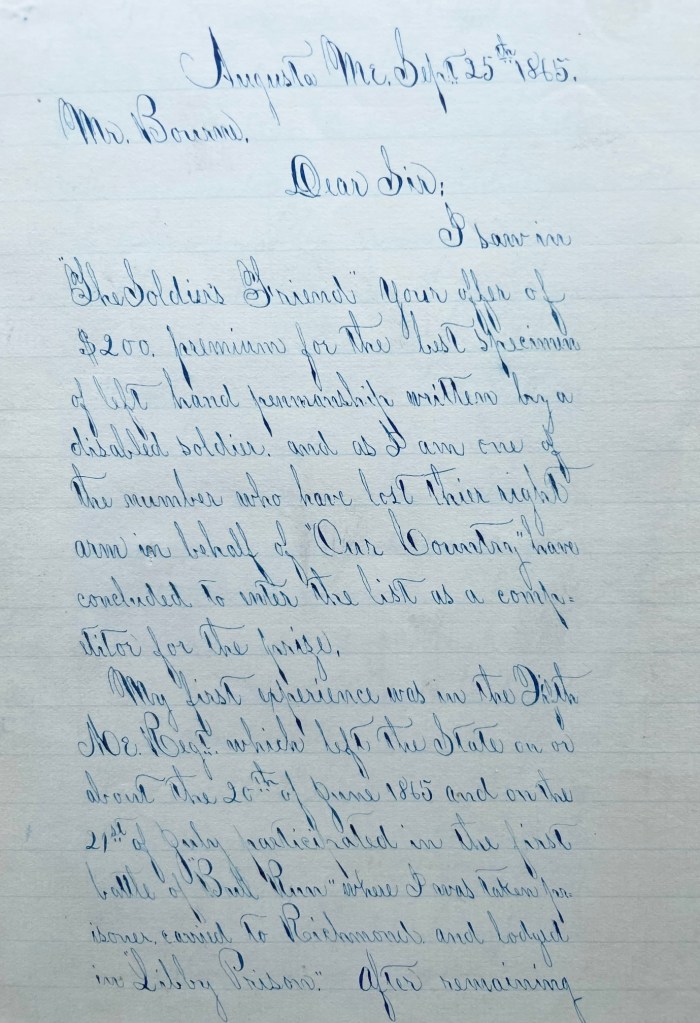
Dear sir, I saw in “The Soldier’s Friend” your offer of $200 premium for the best specimen of left hand penmanship written by a disabled soldier and as I am one of the number who have lost their right arm in behalf of “Our Country” have concluded to enter the list as a competitor for the prize.

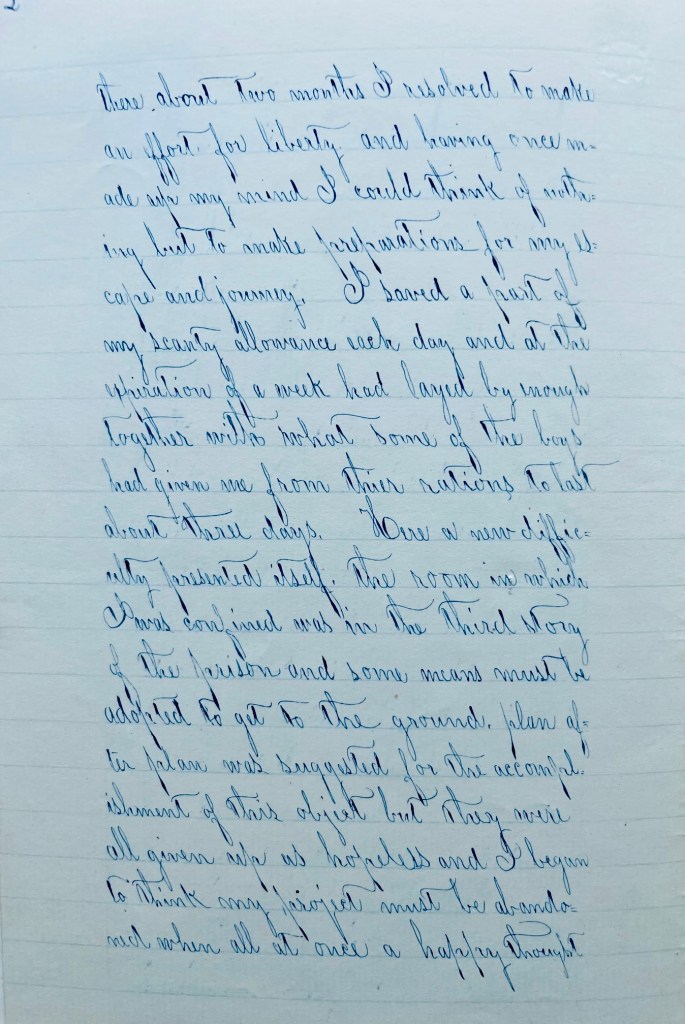
My first experience was in the Fifth Maine Regiment which left the State on or about the 20th of June 1865 [1861] and on the 21st of July participated in the first battle of “Bull Run” where I was taken prisoner, carried to Richmond, and lodged in “Libby Prison.” After remaining there about two months, I resolved to make an effort for liberty and having once made up my mind I could think of nothing but to make preparation for my escape and journey. I saved a part of my scanty allowance each day and at the expiration of a week had layed by enough together with what some of the boys had given me from their rations to last about three days.

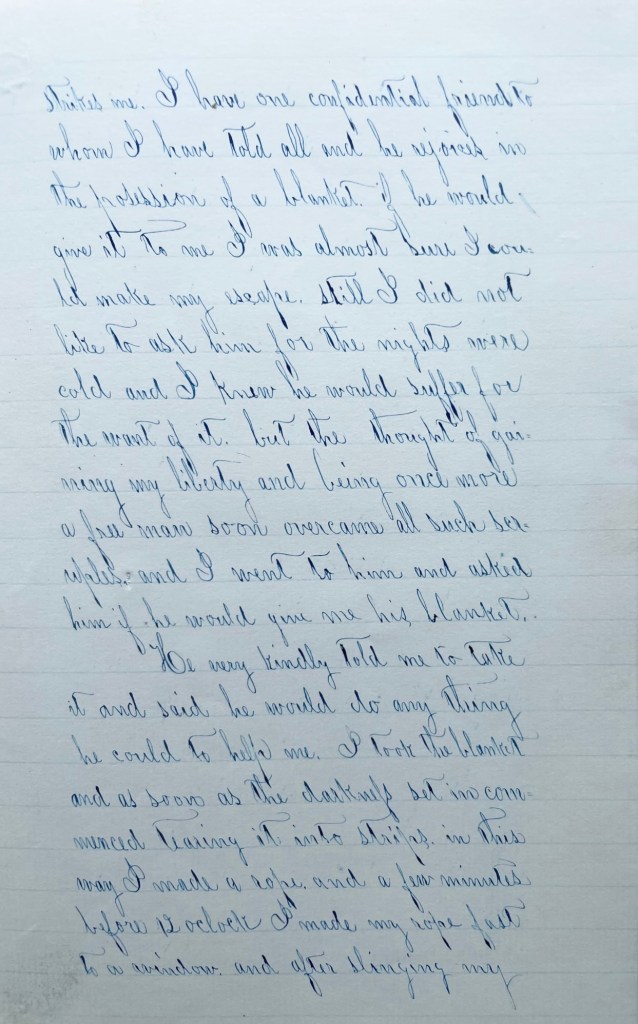
Here a new difficulty presented itself. The room is which I was confined was in the third story of the prison and some means must be adopted to get to the ground. Plan after plan was suggested for the accomplishment of this object but they were all given up as hopeless and I began to think my project must be abandoned when all at once a happy thought strikes me. I have one confidential friend to whom I have told all and he rejoiced in the possession of a blanket. If he would give it to me, I was almost sure I could make my escape. Still I did not like to ask him for the nights were cold and I knew he would suffer for the want of it. But the thought of gaining my liberty and being once more a free man soon overcame all such scruples and I went to him and asked him if he would give me his blanket.

He very kindly told me to take it and said he would do anything he could to help me. I took the blanket and as soon as the darkness set in commenced tearing it into strips. In this way I made a rope and a few minutes before 12 o’clock, I made my rope fast to a window and after slinging my haversack on my shoulder and saying goodbye to my friend, I began my descent. I succeeded in reaching the ground in safety and gave the rope a slight jerk which was the signal to draw it up and that all so far had worked well. 1

I was now outside of the prison but I still had a high fence to climb and outside of this fence the guards were posted. Fortunately for me, however, the night was pitchy dark and the rain falling in torrents. I suppose the guards were all under an old shed that stood near trying to keep out of the rain. At all events, they were no doing their duty and I succeeded in reaching the street without further difficulty. But it would occupy too much space to give all the particulars of my journey so I will only say that after traveling ten days, sleeping in the woods, living on green corn and sometimes a piece of corn bread from a negro cabin, I was recaptured within half a mile of our pickets and taken back to Richmond. A few days after this I was sent to Charleston, S. C. with a lot more of the most unruly and insubordinate of the prisoners (we saw this paragraph in [one] of their papers) for safekeeping. I was at length paroled after spending nearly ten months in prison.

I came home and stopped about two months. At that time the 17th Maine was being organized and feeling that I had not seen quite enough of “the show,” I enlisted in that regiment and was with it until the 16th of June 1864. On that day, while charging a line of the enemy’s works, a minié ball struck my right arm, fracturing the elbow joing so as to cause amputation. While in the 17th, I participated in the following battles—Fredericksburg, Chancellorsville, The Cedars, Mine Run, Locust Grove, Gettysburg, The Wilderness, Coal [Cold] Harbor, North Anna River, Spottsylvania, and number of smaller engagements not worth mentioning. I am at present attending the Augusta Commercial College. I have been here about three weeks. Enclosed please find a sample of my writing written the day I commenced taking lessons at this Institution. My Post Office address is Augusta, Maine.

Very truly yours, — S. Frank Haskell, late Sergt. in Co. C, 17th Maine Regt.


1 Early in the war when the tobacco warehouse was first used as a prison, the windows did not have bars on them.