Category Archives: 5th Maine Infantry

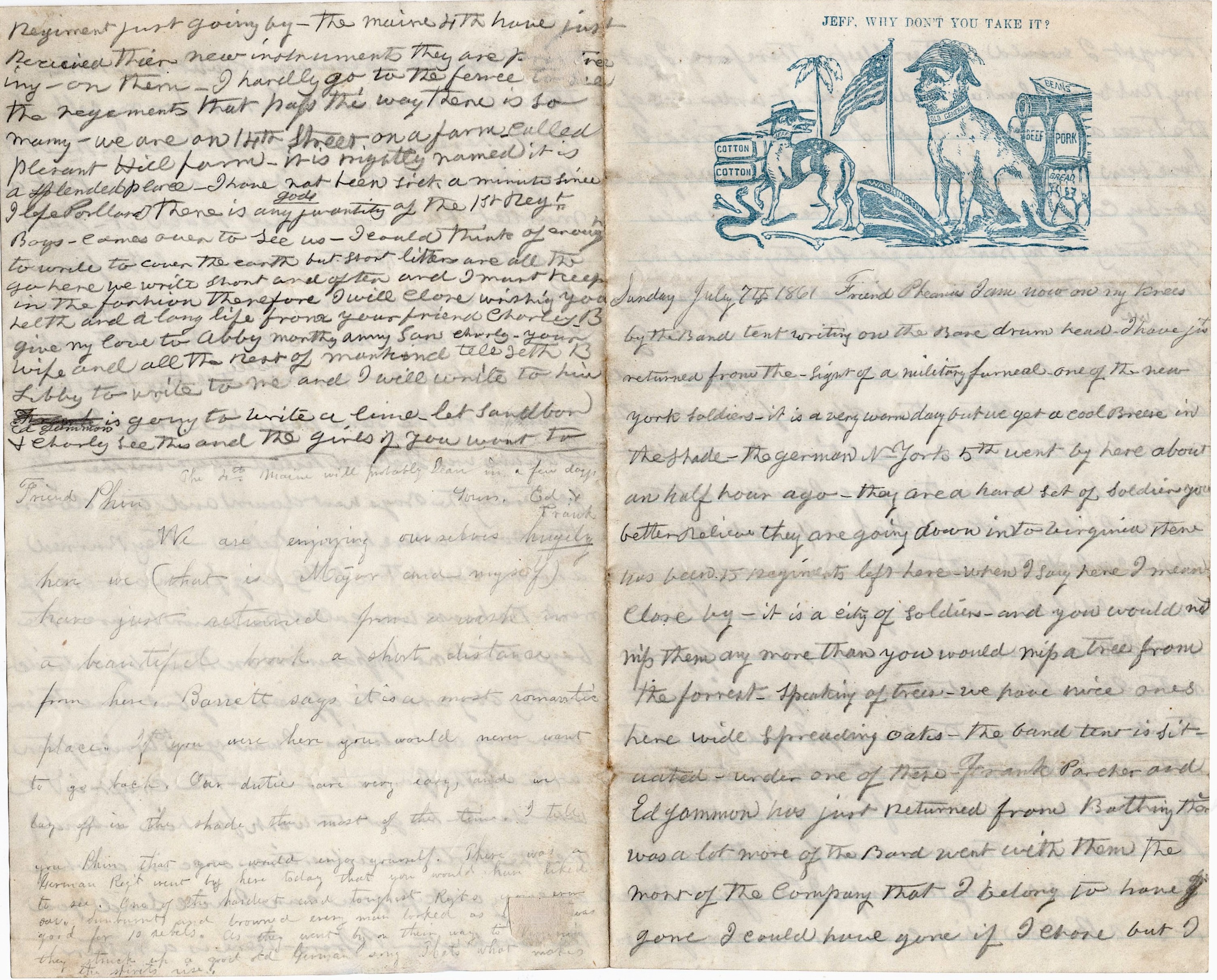
1861: Charles D. Barrett, Samuel Frank Parcher, and Edward M. Gammon to friend Phineas

This letter was begin by Charles D. Barrett (1828-1896) and finished by Samuel Franklyn (“Frank”) Parcher and Edward M. Gammon; Frank doing the writing of the latter two. All three were members of the 5th Maine Infantry. Charles began his service as a private in Co. H but later transferred to the band, joining Frank and Ed who mustered in as principal musicians. The 5th Maine Infantry was formed in Portland, Maine, and were mustered into the service on 24 June 1861 and encamped on Meridian Hill north of Washington City in July. They moved their camp to Alexandria, Virginia, just prior to the Battle of Bull Run. At that time, they were attached to Howard’s Brigade, Heintzelman’s Division. After the battle, they set up camp near Fort Ellsworth in Alexandria.

T R A N S C R I P T I O N

Sunday, July 7, 1861

Friend Phineas,

I am now on my knees by the Band tent writing on the bare drum head. I have just returned from the dight of a military funeral—one of te New York soldiers. It is a very warm day but we have got a cool breeze in the shade. The German New York 5th went by here about a half hour ago. They are a hard set of soldiers, you better believe. They are going down into Virginia. 1 There has been 15 regiments left here. When I say here, I mean close by. It is a city of soldiers and you would not miss them any more than you would miss a tree from the forest.

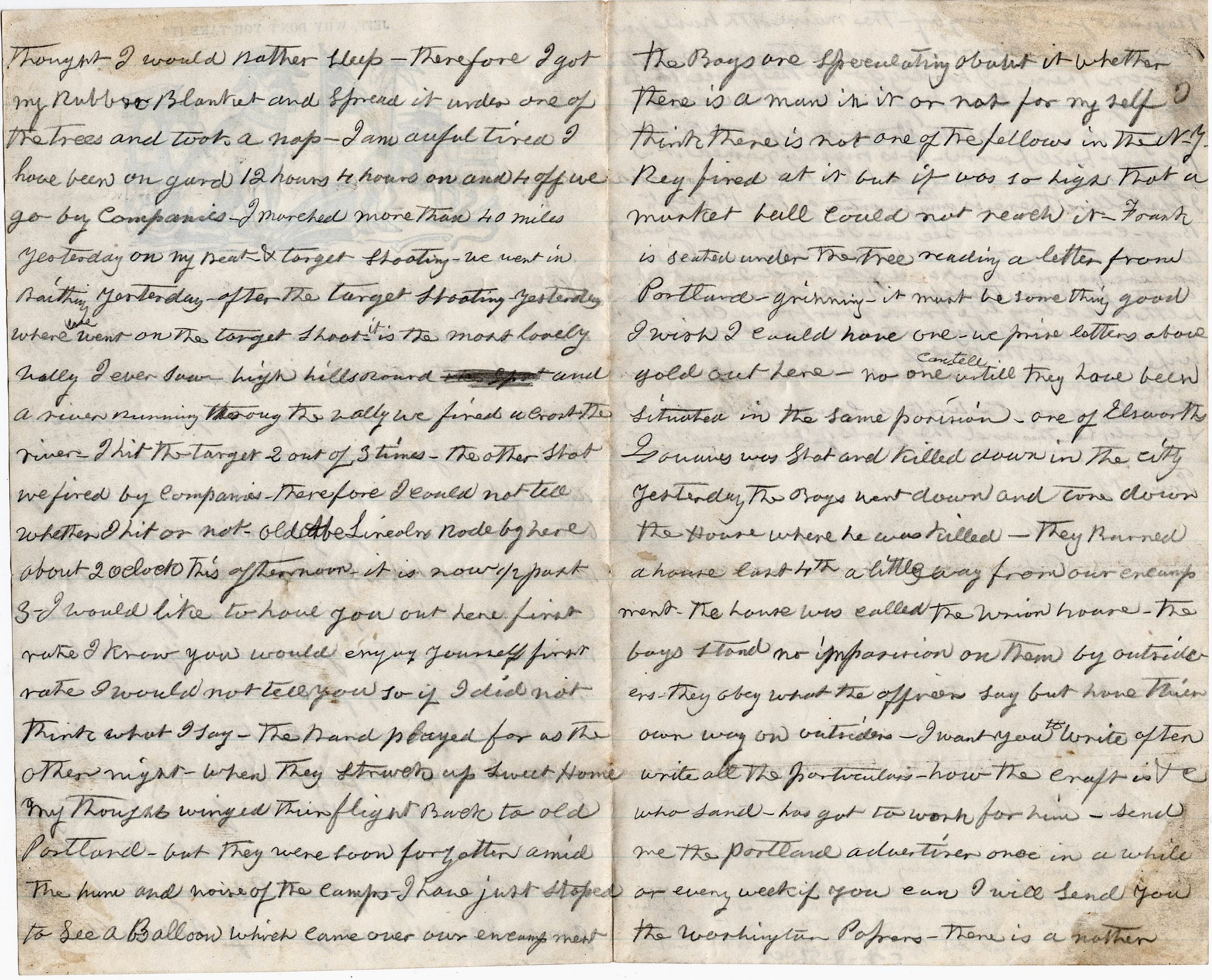
Speaking of trees, we have nice ones here—wide spreading oaks. The band tent is situated under one of these. Frank Parcher and Ed Gammon has just returned from Battery. There was a lot more of the Band went with them. The most of the company that I belong to have gone. I could have gone if I chose but I thought I would rather sleep. Therefore I got my rubber blanket and spread it under one of the trees and took a nap. I am awful tired. I have been on guard 12 hours, 4 hours on and 4 off. We go by companies.

I marched more than 40 miles yesterday on my beat & target shooting, We went in bathing yesterday after the target shooting. Where we went on the target shoot is the most lovely valley I ever saw—high hills round and a river running through the valley. We fired across the river. I hit the target two out of three times. The other shot—we fired by companies, therefore, I could not tell whether I hit or not.

Old Abe Lincoln rode by here about two o’clock this afternoon. 2 It is now half past 3. I would like to have you out here first rate. I know you would enjoy yourself first rate. I would not tell you so if I did not think what I say. The Band plated for us the other night. When they struck up Sweet Home, my thought winged their flight back to Old Portland. But they were soon forgotten amid the hum and noise of the camps.

I have just stopped to see a balloon which came over our encampment. The Boys are speculating about it whether there is a man in it or not. For myself, I think there is not. One of the fellows in the New York Regiment fired at it but it was so high that a musket ball could not reach it. Frank is seated under the tree reading a letter from Portland—grinning. It must be something good. I wish I could have one. We prize letters above gold out here. No one can tell until they have been situated in the same position.

One of Ellworth’s Zouaves was shot and killed down in the city yesterday. The Boys went down and tore down the house where he was killed. They burned a house last 4th [of July] a little way from our encampment. The house was called The Union House. The Boys stand no imposition on them by outsiders. they obey what the officers say, but have their own way on outsides.

I want you to write often. Write all the particulars—how the craft is, &c. Who Sand has got to work for him. Send me the Portland [Daily] Advertiser once in a while or every week if you can. I will send you the Washington papers. There is another regiment just going by, The Maine 4th have just received their new instruments. They are practicing [?] on them. I hardly go to the fence to see the regiments that pass this way there is so many. We are on 14th Street on a farm called Pleasant Hill Farm. It is mightily named. It is a splendid place. 3

I have not been sick a minute since I left Portland. There is any quantity of the 1st Regiment Boys came over to see us. I could think of enough to write to cover the earth but short letters are all the go here. We write short and often and I must keep in the fashion. Therefore, I will close wishing you good health and a long life. From your friend, — Charley B.

Give my love to Abby [ ], your wife, and all the rest of mankind. Tell Seth B. Libby to write to me and I will write to him. Ed Gammon is going to write a line. Let Sandbor & Charley see this and the girls if you want to.

Friend Phin,

We are enjoying ourselves hugely here. We (that is, Meyor [?] and myself) have just returned from a walk in a beautiful brook a short distance from here. Barrett says it is a most romantic place. If you were here, you would never want to go back. Our duties are very easy and we lay in the shade the most of the time. I tell you, Phin, that you would enjoy yourself. There was a German Regiment went by here today that you would have like to see. One of the hardest and toughest regiments you ever saw. Sunburnt and browned, every man looked as though he was good for ten rebels. As they went by on their way to Virginia, they struck up a good old German song. That’s what makes the spirits rise! The 4th Maine will probably leave in a few days. Yours, — Ed [Gammon] & Frank [Parcher]

1 The 5th New York State Militia (also known as the Jefferson Guard) was composed almost entirely of German citizens from New York City. They broke camp on 7 July 1861 to join the forces mustering in Virginia under Gen. Robert Patterson.

2 Lincoln and Sec. Seward spend two hours at Navy Yard. Extracts from Dahlgren Diary, John G. Nicolay Papers, Library of Congress, Washington, DC. [Source: Lincoln Log]

3 In 1861, “Pleasant Hill” was a prominent country estate and farm owned by the Holtzclaw family, situated along the 14th Street corridor in Washington City. As the Civil War began, this rural expanse was transformed by the Union Army into a fortified military position critical for the capital’s defense.
1862: Joseph Wight to his niece Mary

Lt. Joseph Wight of Co. E, 5th Maine Infantry (McDonald Collection, Digital Maine Repository)

The following letter was written by Joseph Wight (1822-1911), the son of Jonathan Wight (1783-1869) and Mercy Harmon (1788-1861) of Cumberland county, Maine. In 1860, Joseph was enumerated in Windham, Cumberland county, Maine, earning his living as a grocer. He was married to Elizabeth Irish of Sebago.

Muster records inform us that Joseph enlisted in June 1861 to serve as a 2nd Lieutenant in Co. E. In June 1863 he was promoted to 1st Lieutenant of Co. A. He mustered out of the regiment on 27 July 1864.

Joseph’s final paragraph tells us much about his personal beliefs: “I am fully satisfied about the question of slavery. I have seen enough to disgust anybody of its evil effect, both with regard to society or wealth. A man may make money by slaves but his farm grows poor and his children ignorant and degraded. But this war has nothing to do with slavery that I know of.”

T R A N S C R I P T I O N

Camp Franklin, Va.
January 1, 1862

Mary,

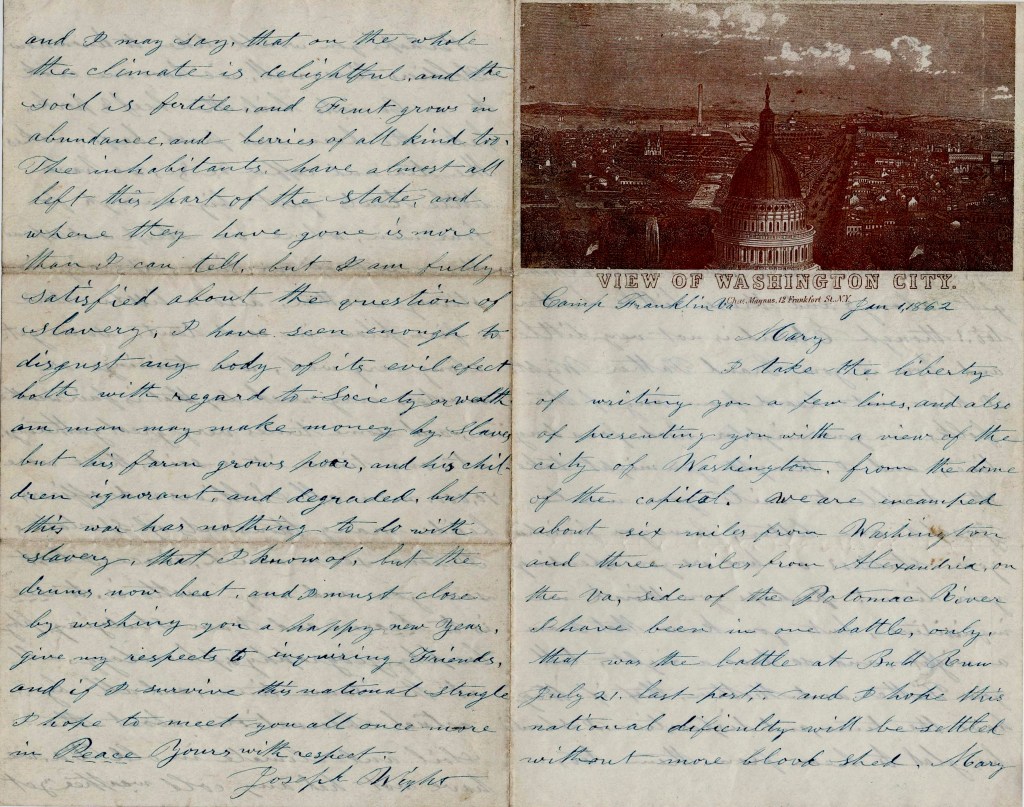
I take the liberty of writing you a few lines and also of presenting you with a view of the City of Washington from the dome of the Capitol. We are encamped about six miles from Washington and three miles from Alexandria on the Virginia side of the Potomac River. I have been in one battle only—that was the Battle of Bull Run, July 21 last past, and I hope this national difficulty will be settled without more bloodshed.

Mary, I hardly know why I should write to you, and certainly, I know of no reason why I should not write to you. I don’t know where you are but I should like to hear from you and how you and Amanda and Mercy prosper temporally & spiritually. And how does your Father and Mother get along? and those little brothers too? though Edward is not very little. And ow is your Grandfather Wight? I have not heard from any of the folks in your neighborhood for a long time and I thought you might take the trouble to write your uncle Joseph one letter. Have you finished your studies? or how are you spending your time? Perhaps you think me inquisitive but you know that I am a Wight and so have a right. Tell your Father and Mother that if they have the time and disposition, I should be glad to hear from them too.

Perhaps you would like to know how soldiers live. Well we have one cook to a company who boils the beef and pork, bakes the beans and fresh beef. makes the tea and coffee, &c. &c. We have little tents just big enough for four men where we sleep and spend the most of our time—especially in stormy weather. Also a little stove or fire place in each tent so we get along very well. We [have] trainings or musters every week day—that is, [in] fair weather, and sometimes very great gatherings at one time. It is said there were 70,000 men, all soldiers and officers, beside many thousands of spectators.

I have seen much since I last saw you and my motto is, to see is to learn. And I am studying philosophy, geography, and phrenology ll at the same time and all by actual observation about the soil and climate in old Virginia. We have not had any cold weather yet and I may say that on the whole, the climate is delightful and the soil is fertile and fruit grows in abundance and berries of all kind too.

The inhabitants have almost all left this part of the state and where they have gone is more than I can tell but I am fully satisfied about the question of slavery. I have seen enough to disgust anybody of its evil effect, both with regard to society or wealth. A man may make money by slaves but his farm grows poor and his children ignorant and degraded. But this war has nothing to do with slavery that I know of. But the drums now beat and I must close by wishing you a happy New Year. Give my respects to enquiring friends and if I survive this national struggle, I hope to meet you all once more in peace. Yours with respects, – Joseph Wight

1865: Samuel Frank Haskell to William Oland Bourne

This unusual letter was written by Samuel “Frank” Haskell (1839-1922), the son of Jasper Haskell (1805-1874) and Salley Fickett (197901871) of Poland, Androscoggin county, Maine. Frank was wounded in the right arm on 16 June 1864 in the opening assault on Petersburg while serving as a sergeant in Co. C, 17th Maine Infantry. His wound was so severe that it required the amputation of his arm and resulted in his discharge on 15 December 1864.

We learn from Frank’s letter that he first enlisted in Co. K, 5th Maine Infantry. He was mustered into that regiment on 24 June 1861 and was taken a prisoner in the Battle of Bull Run on 21 July. His military record states that he was confined at Richmond, Va, and Charleston, S. C. before being released sometime in mid-February 1862.

Frank’s letter provides us with a description of his attempt to escape Libby Prison in the fall of 1861, which was successful, but he was recaptured just before making it back to Union lines.

Frank wrote the letter to William Oland Bourne (1819-1901), editor of The Soldier’s Friend, who sponsored a contest in 1865-1866 in which Union soldiers and sailors who lost their right arms by disability or amputation during the Civil War were invited to submit samples of their penmanship using their left hands. The contest, which awarded a total of $1,000 in prizes for the winning entries, was followed in 1867 by a second contest, which awarded $500 in prizes. A very large number of letters were submitted to Bourne which are now housed in the Library of Congress along with some photographs on the contestants. Most likely the following letter was a personal copy (or first draft) of the letter than Frank submitted. Unfortunately Frank’s picture is not among those in the Library of Congress. See Wm. Oland Bourne Papers.

[Note: This letter is from the personal collection of Greg Herr and was transcribed and published on Spared & shared by express consent.]

S. Frank Haskell is listed as Contributor No. 41 on this published sheet. There were at least 267 entries.

Transcription

Augusta, Maine
September 25th 1865

Mr. Bourne,

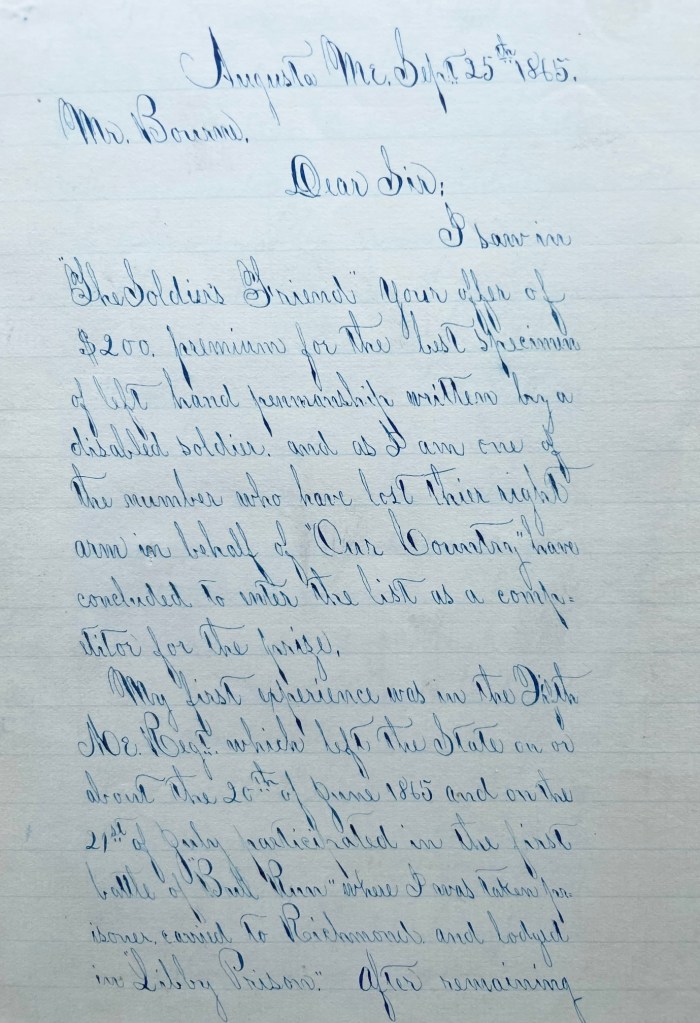
Dear sir, I saw in “The Soldier’s Friend” your offer of $200 premium for the best specimen of left hand penmanship written by a disabled soldier and as I am one of the number who have lost their right arm in behalf of “Our Country” have concluded to enter the list as a competitor for the prize.

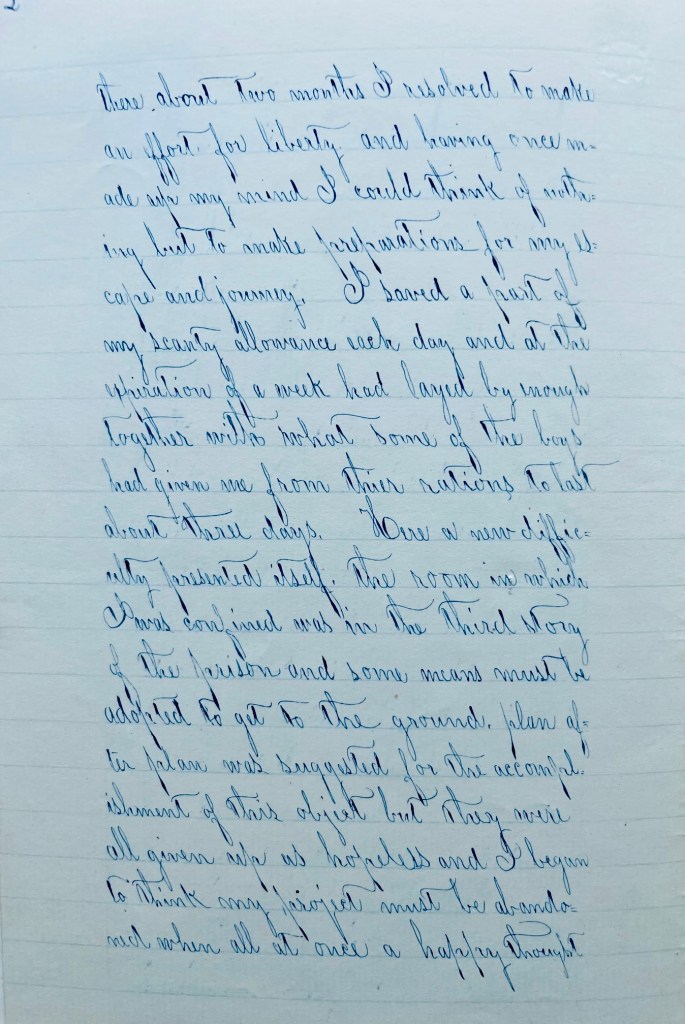
My first experience was in the Fifth Maine Regiment which left the State on or about the 20th of June 1865 [1861] and on the 21st of July participated in the first battle of “Bull Run” where I was taken prisoner, carried to Richmond, and lodged in “Libby Prison.” After remaining there about two months, I resolved to make an effort for liberty and having once made up my mind I could think of nothing but to make preparation for my escape and journey. I saved a part of my scanty allowance each day and at the expiration of a week had layed by enough together with what some of the boys had given me from their rations to last about three days.

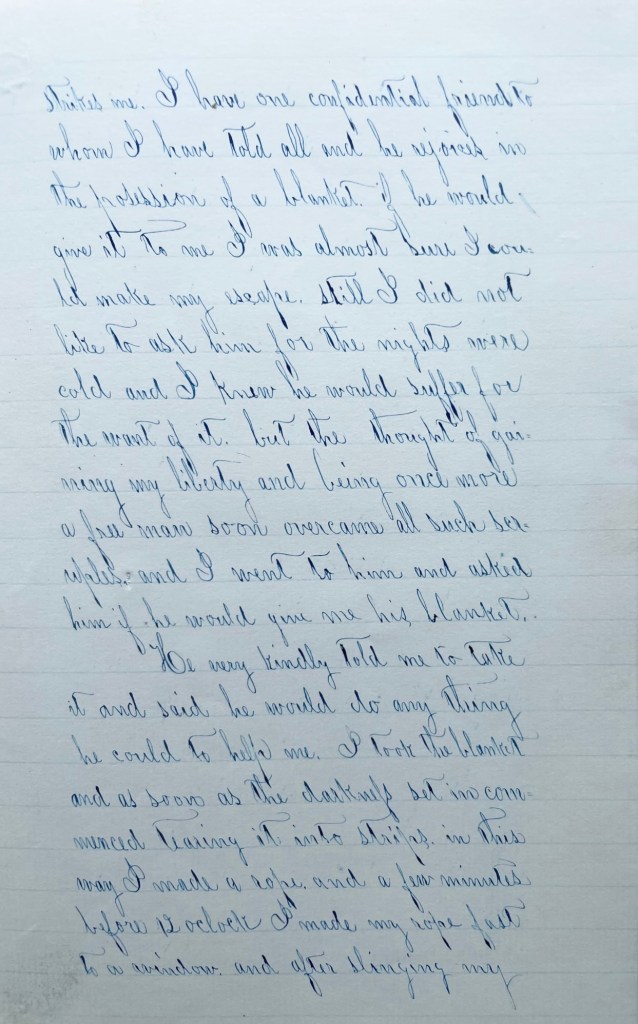
Here a new difficulty presented itself. The room is which I was confined was in the third story of the prison and some means must be adopted to get to the ground. Plan after plan was suggested for the accomplishment of this object but they were all given up as hopeless and I began to think my project must be abandoned when all at once a happy thought strikes me. I have one confidential friend to whom I have told all and he rejoiced in the possession of a blanket. If he would give it to me, I was almost sure I could make my escape. Still I did not like to ask him for the nights were cold and I knew he would suffer for the want of it. But the thought of gaining my liberty and being once more a free man soon overcame all such scruples and I went to him and asked him if he would give me his blanket.

He very kindly told me to take it and said he would do anything he could to help me. I took the blanket and as soon as the darkness set in commenced tearing it into strips. In this way I made a rope and a few minutes before 12 o’clock, I made my rope fast to a window and after slinging my haversack on my shoulder and saying goodbye to my friend, I began my descent. I succeeded in reaching the ground in safety and gave the rope a slight jerk which was the signal to draw it up and that all so far had worked well. 1

I was now outside of the prison but I still had a high fence to climb and outside of this fence the guards were posted. Fortunately for me, however, the night was pitchy dark and the rain falling in torrents. I suppose the guards were all under an old shed that stood near trying to keep out of the rain. At all events, they were no doing their duty and I succeeded in reaching the street without further difficulty. But it would occupy too much space to give all the particulars of my journey so I will only say that after traveling ten days, sleeping in the woods, living on green corn and sometimes a piece of corn bread from a negro cabin, I was recaptured within half a mile of our pickets and taken back to Richmond. A few days after this I was sent to Charleston, S. C. with a lot more of the most unruly and insubordinate of the prisoners (we saw this paragraph in [one] of their papers) for safekeeping. I was at length paroled after spending nearly ten months in prison.

I came home and stopped about two months. At that time the 17th Maine was being organized and feeling that I had not seen quite enough of “the show,” I enlisted in that regiment and was with it until the 16th of June 1864. On that day, while charging a line of the enemy’s works, a minié ball struck my right arm, fracturing the elbow joing so as to cause amputation. While in the 17th, I participated in the following battles—Fredericksburg, Chancellorsville, The Cedars, Mine Run, Locust Grove, Gettysburg, The Wilderness, Coal [Cold] Harbor, North Anna River, Spottsylvania, and number of smaller engagements not worth mentioning. I am at present attending the Augusta Commercial College. I have been here about three weeks. Enclosed please find a sample of my writing written the day I commenced taking lessons at this Institution. My Post Office address is Augusta, Maine.

Very truly yours, — S. Frank Haskell, late Sergt. in Co. C, 17th Maine Regt.


1 Early in the war when the tobacco warehouse was first used as a prison, the windows did not have bars on them.

1862-63: Clark Swett Edwards to Maria A. (Mason) Edwards

The following letters were written by Lieutenant Colonel Clark Swett Edwards (1824-1903), the son of Enoch Edwards (1774-1863) and Abigail McLellan (1779-1843). He wrote the letters to his wife, Maria Antionette (Mason) Edwards (1828-1885).

Col. Clark Swett Edwards

In 1848, Edwards came to Bethel, Maine, and with Edward Eastman as partner, bought out the trading business of Kimball and Pattee. The store stood where the Ceylon Rowe once stood on the northwest corner of the Common. A year later they moved another building up in line with their store and that of John Harris and finished the three stores into a block under one roof. This string of buildings burned during the Civil War and was later rebuilt. Edwards sold out to Mason and built a store near the “foot of Vernon Street where he traded until 1858 when he sold out.” During these years he also built several houses in various parts of the Bethel Hill village and “in various ways contributed to the growth and prosperity of Bethel Hill”.

When the Civil War broke out, “Mr. Edwards took out recruiting papers and was chosen Captain of the first company organized under his call in the county.” His company, Bethel Rifle Guards, reported to Portland and became Company I, 5th Maine Volunteer Regiment. While the regiment was assigned to the Army of the Potomac, Edwards was promoted to become regimental commander with the rank of colonel. Later he was promoted to Brevet Brigadier General. Clark Edwards’ term of service ended in 1864 but the regiment went on to serve many major engagements including the Wilderness campaign and was in the siege of Petersburg. It was said of Edwards that he was “unflinching under fire, often led his men into action, and achieved a brilliant record for conspicuous bravery.”

To read other Clark S. Edwards letters I’ve transcribed and published on Spared & Shared, see:
Clark Swett Edwards, F&S, 5th Maine (26 Letters)
Clark Swett Edwards, Co. I, 5th Maine (2 Letters)

Letter 1

In camp near White Oak Church, Va.
Sunday evening, December 22, 1862

My dear wife,

I thought I would write you a few lines again tonight. I am as you see still in camp at the place I dated my last from. I have but little to write as I wrote all in my last. I also commence a letter to the boys but as I wrote it as I could find time, I think it will hardly pay to send them and it is in such poor hand that it would bother them to read it. But as I wrote it, I will send it to you and you can correct it and do as you please with it. Some part of it is readable but take in all and it is rather a broken up mess. I have no chance or convenience to write and you must excuse all blunders.

Corp. Henry L. Tibbetts of Co. E, 5th Maine Infantry

I expect you all have been in trouble again for the last week or till you received our letter but thank God, we are all safe—or at least none killed in the last great fight. One poor fellow died last night by the name of [James C.] Shedd. He was well yesterday morning. The Dr. told me his death was caused by exposure as the weather is very cold. But you need not worry about me as I have a plenty of bedding and a warm tent, but do not know how soon it will be onward as it is about time for the papers to ask, why don’t the army move?

The boys are all here now, or the sick ones from Belle Plain come up today. Bryce [Edwards] is about the same—not able to do duty. Dan Stearns about the same. The Bethel Boys are all well. We have not got our pay as yet but are in hopes of it this week. Capt. W. says he is a going to resign soon. No changes in the regiment of late. My regards to all. — C. S. E.


Letter 2

Headquarters 5th Maine Vols.
Camp near White Oak Church, Va.
February 22, 1863

My Dear Wife,

Your kind letter of the 15th inst. is received and it is with much pleasure that I now answer it. I must say I am very sorry to cause you so much trouble in feeling in regard to my not visiting you at home. But still I have made an effort more than once within the last month to obtain a leave. These little things you speak of as being prepared for my palate will not come amiss for you & the little ones. You speak of Neal being at home. I hope he will have a good time and return to his Battery. You speak of the deep snow you are having in Maine but still you are not so far ahead of us as you might be. It is snowing here now and there is not less than a foot, and in many places it is much deeper as it is drifted quite bad.

The changes in the weather here is quite sudden as in New England. Yesterday was very pleasant and the little feathered songsters was busy in tuning up his sweet notes in singing in the trees at my door. As I lay on my cot and have the songs of the robin. It reminded me of beloved ones far away. I could but think how differently we were situated. You in that land of snow and ice with the little ones clinging to you for protection, while I am here in the sunny South (as I then thought). But today the weather is almost as boisterous as it is with you. Such weather even would do credit to the North and part of Maine.

You say you are glad I have confidence in my new commander. I would say that I always had confidence in all of my commanders, but express my opinion that some were much better superiors to others and that at often time the inferior was placed over the superior. I hope you understand me. That is where I have been misrepresented heretofore. But I will not write upon that subject as I never know when to leave off.

It is now twelve at noon and the cannons belch forth thunder in every direction, but do not start, as it is only in memory of one where name is sacred on the lips of every true American. I forget that I am writing to you instead of others and will continue to answer your letter. You touch me off a little on the jacket, but when you talk of extravagance in the army, you should look a little around home. It would not be called extravagance for a lady to have her bonnet changed four times a year to keep in fashion. Also, it is not called extravagance when a set of furs cost a hundred dollars or a shawl cost fifty when a government blanket that cost two would be quite as comfortable. It is extravagancy that make so many poor at the North. You go into the city and you will see the silks and satin upon the beggars as well as upon the rich. The deception is so extensive that one is not known by the cloth he wears. Many wolves are now found in sheep clothing and many traitors hearts are now wrapped in a tinsel jacket. Officers are like women in many things—if they cannot make themselves conspicuous in fights, they will do it by wearing good jackets. Woman is oftentimes seen advertising with good clothes instead of attending to her domestic affairs at home. I think it would be quite well if we were all a little more prudent in some things as well as others. I have no doubt you will be gratified in regard to the jacket—that is, in seeing it. Romans had better stay with Romans. And it can be applied in more than one instance.

I am glad Del T. is at home as he is is a very fine fellow, brave and generous. I have never yet heard a word against him. You speak of Kate going to Lowell. In one of your late letters you spoke of her going to Gibson and thought she [was] not strong enough. I do not understand you. You speak of the boys coming here as sutlers. I must know soon as I am bound to have one. The place would have been filled long ago if I had not been expecting them here. Sis you say is still at home. I sent an order through the Ear Department ten days ago ordering them back and I presume it will reach him in a day or two, if it has not already. I shall pity his wife but still I think she will not suffer much unless the Conscript Acts take away Neil Hastings, M__ Wormell, John Abbott, & others.

In regard to Sis prayers about Mack B., I fear they will not be heard as I shall let him go to Maine and shall also get him commissioned if possible as he has earned the place. He is one that has never been away from a single fight and is deserving of a good place. He is just like thousands of others that in envious. You say Hormell is still fussing about John. My advice to him is to dry up and the sooner the better, and instead of getting his boy out of the army, he had better take the two now with him and go forth to battle for his country as my opinion is he could be spared from the place he now fills. Such patriotism is easier talked of than felt.

You say to my Walker folks that John is quite well but he has letters to write to others as well as them. You ask my advice about sending Frank to school to the Dr. My answer is yes, to be sure. Also Nelley. In the first place, I want to do all we can for the children in the way of starting the aright in the world, and again it would be some help to the Dr. My regards to him and wife when you see them. The neighbors you say are the same as ever. I was in hopes there would have been some improvement before this as there is room. You say Mary will come or called to see me (Bully for her). I am glad I am not forgotten by the ladies. I sent her a Valentine a few days ago but do not tell her who sent it as she would not call to see me again. You say when I come home you will have a few invited friends as we have some such left. Yes, but in adversity the cold shoulder is often turned when it should be far different. Friends can be bought in every market and many at low figure. A glass of whiskey will make friends in the army. Oysters will make friends in our country villages. But such friends as a general thing is a curse in the days of affliction and a friend in need is a friend indeed—an old saying but a true one. The friendship of the Farrington you speak of is true and one such a friend is worth thousands of boughten ones, as it comes from a true heart. The army is a good place to study human nature. While a man is in power, he has friends. But when the table is turned, his friends soon vanish. Jackson, while in command of the 5th Maine, was lauded to the skies, but as soon as he left, his pretended friends were his bitter enemies, and the same doctrine will apply at home…

I had two ladies to dine at my tent yesterday. One was a Mrs. Eatore from Portland—a clergyman’s wife, and the other a Miss Fogy from Callas. They were employed by the Sanitary Committe and doing much good, I hope. I have nothing new to write—only would say that Silas P. Festes was here a day or two ago to obtain the place of sutler (but I did not see it). Dan Sternes is not very well. Maj. Millet is still at Maine. Also three or four more of my officers…

I am alone in my tent today as it storms so the boys do not get out much. Regards to all, — C. S. E.