The following letters were written by Theron Treat (1839-1908), the son of Barzillai Treat (1807-1894) and Sophia Kingsley (1814-1898) of West Worcester, Otsego county, New York. He wrote them during the American Civil War while serving in Co. D, 3rd New York Cavalry. His service records inform us that he enlisted in late August 1864 and mustered out in early June 1865—a total of ten months. Enlisting a few days before Theron was his cousin, William “Lorenzo” Knapp, who no doubt had some influence on his decision to join the regiment and avoid the draft.
Theron datelined both of his letters from the detachment’s encampment near Pungo Landing, a flat farmland, marshy area along the North Landing River in southeastern Virginia, some 30 miles from Norfolk and east of the Great Dismal Swamp.
[Note: These letters are from the collection of Brandon White and were made available for transcription and publication on Spared & Shared by express consent.]
Letter 1
Addressed to Mr. Barzillai Treat. West Worcester, Otsego county, New York
In Camp at Pungo Landing [Virginia] December the 21st, 1864
Well, here I am, well and hearty, and hope that you are all well. I got your letter two or three days ago. You wrote that you heard that I was lame. All that I have been lame was two or three days in one of my legs and that was not as bad as I have had it at home. So you see that you have had all that worrying for nothing. You wanted me to write how I was. That I do every time [I write]. My health is a great deal better than I thought it would be in the army and I like it first rate.
We are in a good place now and shall stay here some time. There is nothing to do but a little guard duty and that is to keep contraband goods from going into the country where we don’t want them to go. We are within five miles of the line between the states of North Carolina and Virginia. Our people have held this part of the state for two years so there is no rebs in these parts. We buy all of the fresh fish that we want and all of the milk and all of the fresh meat and sweet potatoes that we want, and we have a first rate time.
Lorenzo and I have a log house of our own with a brick fireplace and a good bed and lots of blankets and we have things in style. You will laugh but it is true.
You wanted me to get a furlough but I don’t want one. I am a going to stay and see this thing through and then when the time is up that I enlisted for, then I shall come home for the war will be over in a short time and I feel a great deal more like a man here than I should at home, scared almost to death at the word, D-R-A-F-T. Tell the Copperheads that they will have to come when Old Abe says the word and [Gov.] Seymour can’t save them now for scared creatures—Oh! where is Little Mac?
Tell John Treat to raise a boy for it is war ties and he must do something for his country, and it may as well be that as anything else. There is not much news to write. The weather has been very nice. There has not been any snow nor much cold weather.
You wrote that you would send me a box if I wanted. I can get all of the things here as well and as cheap so there is no need of it. I have got some undershirts and all the stockings and all the clothes that I want and I have got the money to buy all that I want to eat. And half of the boxes don’t come through [anyway] so you see that it don’t pay. I think that Lorenzo is foolish to have one sent. Tell [brother] John to write to me in the next letter. Clara wrote that he had been sick. I hope he is well and seeing to the colt. The reason that I did not get a horse when Lorenzo did was he got his to Camp Stoneman and I did not go there. — Theron Treat
Letter 2
In Camp at Pungo Landing May 21st [1865]
I am well and hearty and so is Lorenzo. He is about ten miles from here. I came from there this morning. I went down there yesterday to see the boys that was there. There is about half of our company there. You need not worry one bit about either one of us. We are alright and in good places.
I got a letter from you dated the 29th and a paper the other day. I was down to Norfolk the other day and saw that Ram that our boys took at Richmond and the one that they took at Wilmington. They was a right smart sight, I recon.
Well, I think this war is about played out and I think the rebs are as tired as they need to be and well they might be. They have caught the murderer of old Abe and shot him and if anyone says they are glad old Abe is dead, they had ought to be served the same way. I don’t care who it is. And I should like to try them on with my carbine about three paces off. They are meaner than rebs and that is needless.
You wrote that Aunt Pitts was dead so you see that people don’t live always [even] if they ain’t in the army. I recon a man will live till his time comes, let him be where he will. As for having to go on a raid, I never had to ride twenty miles in the army at one time, so it ain’t very hard, is it? And you need not worry about the guerrillas for there ain’t any here.
I think some of the troops will be discharged before long and they may take it in to their heads to discharge us. Well, I don’t care much if they do. Well, John, how are you today? Well, I hope you must not work too hard but be a good boy and I recon I will bring you a stick of candy or something else. As for that yellow gal, she is too big to send in a letter.
The following letter, authored in late April 1865 by a Union soldier encamped near Washington, reflects his anticipation of soon mustering out of the army. He identified himself as “Isack Smith” and directed the correspondence to his wife, Catherine, while also referring to his unnamed “little boy.” Additionally, he acknowledged having received communication from “Peter Larkin’s wife,” though it remains unclear whether the Larkins resided in proximity to the Smiths. Regrettably, due to the prevalence of these common names and a lack of further identifying details, I was unable to ascertain Isaac’s identity. Nevertheless, I have transcribed the letter, as it articulates compelling sentiments regarding the reactions to the news of President Lincoln’s assassination.
T R A N S C R I P T I O N
Camp near Washington City April 30th 1865
Dear Wife,
I have a few leisure moments so I thought I would pen a few lines to you. In regards to the good news—Oh how glorious that, and I expect to see you all before long. They all think that we will be discharged very soon. I hope we will. That is my wish. I don’t think that I could make a better one.
I answered your last letter. Tell the little boy that his father will soon be home. I received a letter from Peter Larkin’s wife the other day. They were all well. Her proposal was to me that I was glad that the President was dead but that is not so. I am sorry for him. It is bad but it can’t be helped now for it is too late. We lost a Father when we lost Abraham Lincoln.
We are about 5 miles from the City of Washington. I haven’t one thing more to write. All the news I can give you is this—you can look for me home before long. Give a kiss for me to the little boy. Here is one for yourself. This is from your affectionate husband, — Isack Smith
To Mrs. Catharine Smith
Here is a Soldier’s Dream [The Soldier’s Dream & The Soldier’s Tear lyrics]
The following letters were written by Henry Knox Sikes (1841-1917), the youngest child of Rev. Oren Sikes (1805-1852) and Julia Knox Thatcher (1805-1851) of Bedford, Middlesex county, Massachusetts. His father was appointed minister of the Trinitarian (Orthodox) Congregational Church in Bedford in 1846 so Henry’s (or “Hal’s”) formative years would have been spent in a household with a strong focus on scripture reading, prayer and catechetical instruction. But Hal’s upbringing was abruptly altered when he was only ten or eleven years old by the death of both his parents—his mother in February 1852 and his father the following December, within days of the date set for his 2nd wedding. Hal was closest in age to his sister Catherine (1838-1905) and the two of them were probably taken in and raised by a relative until she married in 1858 to Milton Alanson Fowler—an ambitious and successful lawyer in Fishkill, Dutchess county, New York, and later Poughkeepsie. We don’t know where Hal was living or what he was doing in 1860 but he was probably living with or near New York City where he enlisted as a private in Co. H of the 1st Mounted New York Rifles in August 1862. He mustered out a little over three years later as a sergeant in Co. G of the 4th Provisional Cavalry.
Recruiting poster for Dodge’s rifles in the fall of 1862. (LOC)
The 1st New York Mounted Rifles was a cavalry regiment that began as just two companies in July 1861 but additional companies were added over the course of the next year, the last being mustered in August and September 1862. They were stationed at various posts in Virginia, participating in operations around Fort Monroe, Norfolk, Suffolk, Williamsburg and Yorktown. Beginning in March when they were assigned to the Army of the James and participated as cavalry in the siege of Petersburg.
This regiment had a mixed reputation during the war. They were commended for their bravery but they also faced significant disciplinary issues and were the subject of complaints regarding plundering and desertion. Their Colonel, Charles C. Dodge, had occasional episodes of tension with his superior officers. In November 1863, General Dix wrote to Secretary of War Stanton, “This regiment (the 1st New York Mounted Rifles) has given me great trouble. It is known as ‘Dodge’s Rifles.’ They have plundered in all direction, and since the first of October thirty-five have deserted to the enemy, from ten different companies, most of them from outposts, carrying away their horses, arms and equipment; a thing unprecedented in any regiment in the service.” Dodge would not accept a command under anyone junior to him, and never received another command. He would resign from the army in protest in June of 1863.
In September 1865, the 1st New York Mounted Rifles were redesignated as the 4th Provisional Cavalry Regiment. Hal’s name appears variously on the muster rolls as either Sikes or Sykes.
Hal was a telegraph operator after the war, settled in Peoria, IL by 1887, and then spent his final years in Ridgeland, MS. His mother was the granddaughter of Secretary of War Henry Knox and her brother, Henry Knox Thatcher, had a distinguished career in the US Navy as a Rear Admiral during the Civil War.
[Editor’s Note: The painting in the header of this web page of transcribed letters was done by Lt. David Edward Cronin who served in the 1st New York Mounted Rifles and later with the 4th New York Provisional Cavalry. He submitted many of his sketches to Harper’s Weekly during the Civil War.]
Letter 1
Addressed to M. A. Fowler, Fishkill, New York
U. S. Transport “Empire City“ Somewhere off the coast August 21, 1862
Dear Sister,
Tuesday the 19th we were marched from headquarters to the Arsenal (after receiving our blankets, overcoats, canteens, knife, fork, spoon, belts & saber) when we were drilled for about two hours. Our dinner at 12 consisted of vegetable soup, stewed beans, boiled pork & a chunk of bread. At 3 p.m. we were marched to the Battery for inspection, thence to Pier 31 N. R. a distance of about 3 miles. At 4.15 embarked & at 5 dropped into the stream & laid until yesterday at one when we weighed anchor and stood to sea. Passed Cape May Light at one and a half & are now (2 p.m._ off some island said to be Smith’s. No other land in sight. Expect to reach Fortress Monroe this morning where I shall endeavor to mail this and other letters. I wrote Oren a letter of over four pages this morning—the first since I left him about two weeks ago.
The sea is very smooth—only the usual continuous swell which sends up–down, over this way and that. Have slept the last two nights on a coil of rope. The first was much troubled by the rats—immense ones—running around like full grown cats. But last night I guess they were seasick for they did not trouble me any & I had a beautiful night’s rest. Was on guard yesterday from 10 to 12 a.m. & from 4 to 6 p.m. My saber is about four feet in length—quite dull & must be sharpened before I can trim secesh very closely. Suppose we shall have a nice little march after landing at Fortress Monroe.
I shall enclose a carte-de-visite which I think a good likeness. Have sent Oren one and given two others away. Monday night I took two ladies to Woods Minstrels in accordance with a previous engagement. That is what I took down my citizen’s suit for. I have left it at Mrs. Palmer’s in a bundle & wish Milton would get it the first time he is down. I will write Hatfield to take the box of notions, &c. to the Rip Van Winkle & Milton will please see about taking it up. I have already thought of a few articles which I shall need and when I know of the correct address, I will let you know what they are. I may write to the “Journal” in a few days. Perhaps will give a description of Suffolk camp life or something else. Douglas is a little seasick today. Am glad he is with me. Our rations have been served. Was for the trip 1/2 load bread, 1/2 smoked beef, and some boiled shoulder and hard bread. We have about 120 soldiers aboard. I think you can direct with safety to Co. G, 7th Regt. Mounted Rifle, Col. Dodge, Suffolk, Va. I received the $50 & shall send to [you] in the first good opportunity. Write as above until I direct differently. Love to all. From Brother Hal
Letter 2
Envelope with slip pf paper tucked inside summarizing wants.
Camp Dodge near Suffolk, Va. August 31st 1862
Dear Sister,
I think it too bad that you, Milton, or Addie cannot find time to write me. Two weeks ago I left you & no letter yet though I have written you twice. You know that letters or papers here are worth their weight in gold—especially letters, for papers we can get whenever we happen to see the news boy at 5 cents a copy. But letters we cannot buy so easily & as to papers, I would now say that if not too much trouble for Milton, I wish he would subscribe for a daily to be sent to me regularly. I would also like Harpers occasionally and the Fishkill Journal for all of which I am willing to pay full market price & postage & if need be a premium to have them. I mailed a letter to you from Fortress Monroe, also once since I have been here, dated August 31st. Many have received letters from their friends some days since & it seems hard to see others sitting around about reading their letters from home & to believe that I have friends who do not care enough about me to even write me a line.
I arrived at Norfolk from Fortress Monroe at 12.30 one week ago last Friday & here, a distance of 2.5 miles at 4 o’clock. When we arrived here, Co. A of the 1st Battalion were away on a scout in North Carolina. They have since returned. Yesterday Co. C started on a scout in the same direction and Co. B on at Norfolk, so that most of those in camp are recruits. 110 arrived yesterday from New York. We have yet no officers here though they have ben commissioned. They probably will not arrive for several days.
This camp is located on a plantation which has heretofore produced nothing but clay, I should judge. At any rate, I can see no soil but clay any where about here & a few moment’s rain causes mud over shoes. This afternoon we had the most violent rain I ever saw. It lasted for about 20 minutes & now there is mud all around the camp from one to 6 inches deep. There have been a lot of contraband employed about here in ditching the camp but it does very little good. Today we were mustered in for pay which we stand a chance of getting in two r three months, notwithstanding we were promised $13 advance pay.
Col. Charles C. Dodge (1841-1910) of the 1st New York Mounted Rifles (LOC)
Our Colonel [Charles C. Dodge] is a fine man & I think understands the business in which he is engaged perfectly. We have had a sabre drill twice a day since we have been here & I can use the sabre now with considerable ease, rapidity, and correctness. A day or two since, received my horse equipments and that you may know how much I have to look after I will tell you what they are. Halter, watering bridle, curb bit and bridle, spurs, blanket, circrigle [?], brush, curry comb, & saddle with saddle bags, carbine sling, lariat rope, picket pin, &c. combined these with a sabre, scabbard, and belt to keep continually bright with blanket, overcoat &c. give me some things to look after. I have not yet got my horse because I could not get one to suit. Shall wait until the next lot arrives which will be in a few days.
Three times a day we have to water our troop horses, riding them about 3.4 of a mile bareback. I say troop horses for we are divided into Troops ad I am in Troop G. I want some things sent to me & as soon as you can make it convenient. I may not think of all I want just now but will mention what I most need. I must have a pistol & think Milton had better buy it on Broadway at “Union & Wheelocks,” I think between White and Franklin Streets on the East side. I want a six-barrelled revolver to load with cartridges. I think he has them breach-loading for about $12. Get with it 200 cartridges at 75 cents per $1 & caps. If Colts are breech loading, get one of those. I want also a pair of towels. I have some in one of my trunks but if you have any crash towels that you will exchange for mine, I wish you would send them. I want also two pairs of cotton stockings, size 1.5, a pipe, brier root, for about 50 cents or 25 cents, and soe good smoking tobacco, writing paper, and envelopes, postage stamps, a tin plate for rice & molasses, a pair of woolen shirts—something pretty nice that I can wear at times without my coat, but do not select too bright colors. I have a pair of government shirts but it is not possible to keep as clean as I would like without having more than two. I would also mention a holster which I have in my linen coat & which is made to fasten to my belt for a pistol. Some large & small white buttons for shirts, &c., a good pocket knife with one good large blade. I think of nothing more at present.
I left a bundle of clothes at Mrs. Palmer’s—shirts, coat (dress), linen do. pants, vest, &c. In the pocket of the linen coat you will find the holster I speak of, made of white leather. I want also a pair of cavalry gloves of this shape [sketch] made of wash leather, gauntlets and all and not open on. The gauntlets may cost from $1.50 to $2. Pack these in a box and in in New York, send by Harnden’s Express. Direct to me in “Troop G, 1st N. Y. Mounted Rifles, Col. Dodge, Suffolk, Va. or elsewhere” as plain print as possible. Pay expressage & charge all expenses including trip to New York to my account. I say Suffolk or elsewhere for we may not stay in this camp many weeks longer though we are making many improvements and changes about the grounds.
September 4th
I have done two days guard duty, two hours on and four off. Regimental guard, pickets outside of us. I shall probably have picket duty to do as soon as I have been drilled in the riding school a little longer. Our guard and pickets are stationed about in the manner of the drawing on the enclosed plan. Three scouting parties have left camp since I have been here and two have returned to camp with eleven secesh horses. One away three days returned early this morning with 111 prisoners (10 blacks) & 32 teams—mostly one horse or 1 mule teams, two lieutenants, nearly all in homespun & such a rough, scowling looking set I never saw before. This scout was probably ordered on account of news obtained from a Rebel mail carrier brought into camp by some of our men a few hours before the party left camp.
This forenoon the prisoners were sent to Gen. Mansfield’s headquarters. I have my horse now—a jet black, rather small. Drew him today & this morning was on mounted drill for the1st time & was told by the drill master that I drilled better than anyone in the squad. In sabre drill I am some pumpkins & can flourish my sabre in all directions, points, parries, guard, &c. according to the most approved tactics. This was all learnt us on foot. I must close & write again soon for I have much to say that I think will interest you. Write often & do not wait for me to write for my duties are numerous. I believe U sent you my carte-de-visit since I left New York, did I not. Love to all . Your brother, — Henry
I enclose a $10 Treasury Note payable in New York.
I will also send some genuine Secesh shin plaster in my next.
Hand drawn sketch of Camp Dodge at Suffolk, Va.
Letter 3
Camp Dodge near Suffolk, Va. September 6th 1862
Dear Kate,
Your last letter was received on Friday last & the Journal on Sunday—yesterday. An Independent also received a few days since. Many thanks for your kindness. You cannot imagine how much I enjoy the receipt of mail matter. I believe if it was not for mail privileges, I should soon get homesick. As it is, I now make out quite well but a few nights ago received three letters—one from Oren & one from an old school ate. I presume ere this you have received the acknowledgement of the box & I hope soon to know of the safe arrival of the $15 sent to you.
You may think strange I had so much tobacco sent. I’ll explain. I first intended to send for about $2 worth for the use of a friend & myself, he of course to pay for half. But I could not get $2 of Northern money about camp and therefore sent for the value of $5 intending to sell what I did not want, as I am doing, though rather slowly. If disposed to trust or give away, I could soon reduce my stock but I sell for cash or to perfectly reliable parties. The smoking tobacco is tip top, gloves perfection, pistol sure death (for proof of last assertion witness mangled remains of a secesh porker killed in the woods about a mile north of Suffolk), blanket nearly water proof, and everything else as it should be. I was sorry you could not send cheese and crackers but see there was no reason. They Cayenne I suppose was for the benefit of my eyes. Many thanks. I appreciate your motives, dear sister, but very much dread the affect. Yes, I have been on picket often of late & until quite recently was doing quite a driving picket business & I have felt some nights quite sleepy but with the aid of a pretty good quill of tobacco and rapid winking, I have managed to keep awake this far. For the present we do no more picket duty. That is now performed by the “Harlan” or 11th Pennsylvania Cavalry of Suffolk.
I rather like the business, perhaps because I have had good posts. For instance at the canal (Dismal Swamp Canal) about a mile east of here there are four posts or three posts & 1 patrol. When on guard there, we relieved at 9 a.m., twelve men—four for each relief. That is so that one man having been on post for two hours can remain off 4. I had the patrol there which extended from the canal east in the direction of Portsmouth about three miles, through woods, by cornfield, &c., occasionally a house & frequently a negro cabin along the road. A man whose orchard I passed kindly gave me as many nice large red apples as I could carry & at another time a negro gave me any quantity of “root beer” home manufacture. At another time while on the same duyt on the road north f Suffolk, having been sent out without forage or rations, not willing to starve or allow our horses todo so, we foraged corn from them and sweet potatoes for ourselves, killing a young porker which with some milk * bought stood us very well.
Again, on the same post, we had our morning milk & crackers and sweet potatoes for breakfast, & chicken soup for dinner. No trouble in getting all the sweet potatoes we want when away from camp & I do not feel any compunction of conscience in taking all secesh articles I want for my own use.
Have had some experience in scouting but find it somewhat fatiguing, though I shall work in no doubt. Friday night, just after we had become nicely settled in our bunks and lights all out, orders came hurriedly for every man to “turn out.” Four or five companies had during the day gone off on a scout and those remaining in camp, some 5 or 6. were quickly in saddle, in line in their respective streets. We were shortly on the road going west & south though we knew not for what purpose. Twas a beautiful night, bright moonlight. About 8 miles out of Suffolk, we met an ambulance containing one man killed and four wounded. Twelve miles out we met the “Harlan” Cavalry returning. Also four cannon bringing up the rear. From them we learned that there had been an engagement at Franklin (Va. or N. C.) near the “Blackwater” River that afternoon. Three brigades of infantry remained on the field but as there was no use there for cavalry, the 11th Pennsylvania [Cavalry] were bound for home, though why the artillery returned, I know not. We continued on till daylight when our companies were separated and Troop G turned off the road into a cornfield & fed, still remaining in line.
About 6, after hot coffee and hard tack (crackers), Troop G started off south, followed by our section of battery (two howitzers) & three more troops. Marched a few miles further, halting about 8 a.m. at the town of Windsor on the Petersburg Railroad. One restaurant, a closed store, a carpenter’s shop, and a couple of houses constitute the town. Here we remained by our horses until about three p.m. At noon for dinner I went into a negro’s shanty and had a splendid dinner on fried bacon, sweet potatoes, and hot hoe cake, cost 25 cents. We were ordered to proceed no further though we were within 7 miles of the Blackwater & rebel cavalry were known to be not far away. We were all day in expectation of an attack & several times being alarmed by the pickets, orders of “to horse,” “draw sabre” and “advance carbine” &c. were given in order to be in instant readiness. Our pickets were twice fired on and once two rebel soldiers advanced close behind one of them & while a bloody rebel citizen in the road tried to attract his attention, they endeavored to get a shot at him but he saw them in season to fire on them, scatter them, and arrest the citizen. The woods all about us were full of guerrillas but not in force enough to make an attack. Could you have seen your brother when standing at his horse’s head. at the order of “to horse,” Troop G spring to his saddle, draw and sling his sabre to his wrist, slip this cap strap under his chin & waiting there covered with dust from head to foot momentarily expecting the order “charge,” you would have hardly known him, & could you have distinguished him, would have thought he was “some soldier.”
We returned home without a fight though I think most of the men were sadly disappointed. At one time a squad of rebels (probably guerrillas) were seen advancing toward us, but at sight of one of our howitzers pointed toward them they sprang into the bushes about a mile off & were not again seen. We have not yet had our carbines given to us & may have large revolvers furnished instead. I have a carbine which I managed to get & with my little revolver for close work, I am not afraid to stand my chance, We may yet be called out to fight here or near here & shall no doubt make and advance to Richmond via Petersburg in due time. Richmond is only about 80 miles distant. If you have one of those agriculturist maps, you can see just where we are & where I have been. Suffolk swarms with soldiers. There must be 20,000 or 25,000 here in this vicinity. I have much more to write but time now will not permit. Write soon and I will drop a line again in a few days. Love to all from brother, — Hal
Letter 4
Camp Dodge near Suffolk, Va. September 8, 1862
Dear Kate,
Your letter dated 1st inst. was received on the 4th. Many thanks for the favor. T’was a rare treat I assure you & the oftener I get a letter from you the better contented I shall be in this miserable country. I have received but three letters since. I have been here now 18 days and I should have at least two each week; three would not be too many, considering my numerous friends & correspondents. I have had one from Oren, one from you and yesterday received one from Fannie. Shall wait anxiously for those you are holding back.
So Addie thinks I want to be at home, does she? Well she is partly right. I would like to be at home but I am not sorry that I came here & I do not wish to return home until I do my country some service. I did not come here to have a good time, live high, &c. &c. but expected to do soldier’s duty, eat soldier’s fare, & suffer the many hardships & privations which all soldiers are subject to. As for food, I have a great plenty. At times more than I want to eat, though of course it is not of the most delicate kind. Our allowance is for breakfast, 1 pt. coffee sweetened & minus milk, a piece of bread about 8 inches in length, 3.5 or 4 in broad, & 1.5 thick. A piece of friend pork, salt beef, or fresh meat for dinner, vegetable soup, bean soup, beef soup, boiled pork, or boiled meat of some kind, bread and crackers, for supper some allowance of bread and coffee, sometimes a piece of meat about a pint of boiled rice or hominy & molasses. Each troop has its own kitchen and 2 or 3 cooks detailed from its company. The kitchens are made of crotches & poles covered with fir and juniper boughs for shelter. Also a tent to keep the rations in and for the cooks to sleep in. The cars were passing backward & forward here last night transporting troops. The 1st Delaware left Suffolk last evening. The 4th New York this morning and I presume the 3rd New York will leave today.
I have seen Tom Andrews once. He came over here. I have not yet been to his camp though tis only about 3/4 of a mile north of here on the Suffolk & Portsmouth Railroad. I can hear their tattoo beat every night just after ours is blown. I had a friend in the 4th & am quite sorry he is gone. The regiments which left are said to be destined for Washington & I expect we shall break camp here and take the ground lately occupied by the 4th Vet. here & Suffolk or just on the outskirts of that place on what was formerly the fair grounds & race course. T’would be a much better place than this & good deal more dry and clean.
We have a foot drill and sabre exercise once a day and mounted drill twice. I have been on mounted guard once from Saturday morning to Sunday morning last. Have not been yet on picket but am liable to be at any time. Our troop is detailed for guard as we have two picket posts to fill, one on the railroad near camp and another on the Dismal Swamp Canal about 1.25 miles east of here in the direction of Norfolk. I do not consider either of them dangerous posts. We are by no means near Manassas but many miles south and east of Richmond. In fact, but 3 or 5 miles from the edge of the Dismal Swamp & by the highway only 12 or 15 miles from the North Carolina State line. I believe I wrote you of the prisoners brought in by a scouting party a few days since from near Elizabeth City, N. C. Reams on their way to join a rebel camp on the Blackwater River south and west of here. Gen. Mansfield is out here quite often. His headquarters are at Suffolk at the Central Hotel. Max Weber has his headquarters on the same street but at a splendid private dwelling.
Some 400 recruits have arrived here since I came; 40 came yesterday. Any quantity of contrabands pass here continually in groups of from two to over 100/ On Friday last I counted over 120 in one crowd, some 30 of which were children and babies from one to 3 years of age. All the young ones have red hair caused, I believe, from their going bareheaded all the time. We have quite a lot of contrabands about camp but not near as many as there should be for the work there is to be done. As each day there is a detail from the troops for fatigue duty or work about camp. One darkie here has six fingers upon each hand and six toes upon his left foot. He says his mother and grandmother were afflicted in the same way. If you have not already sent my box, I wish you would put in two or three cakes of fancy soap & if you please. a cup or two of jelly. Enclosed you will find $5 Treasury Note payable at New York. Write soon. Excuse soiled paper & blots as I write in haste between duties. I believe I have given you directions before as follows:
Troop G, 1st New York Mounted Rifles, Col. C. C. Dodge, Suffolk, Va.
Remember me to those who enquirer and believe me your affectionate brother, — Hal
Letter 5
Camp Dodge October 28, 1862
Dear Kate,
I have just closed a long letter to Oren & tonight have only time to say I am right side up and safe. Our maiden engagement came off on Saturday. No doubt you will see an account of it in some of the papers. T’was at Blackwater Bridge 20 miles from here. I’ll endeavor to write a long letter of particulars tomorrow. Love to Milton and baby. From brother, — Hal
Letter 6
Camp Dodge near Suffolk, Va. November 2nd 1862
My dear sister,
Many thanks for the frequency of your letters. That of the 27th ult. was duly received as was the carte-de-visit of my dear little Julia. How cunning & life like it looks, It seems as if the little chub was looking right into my face & all ready to laugh. I’m glad you sent it & wish you would send yours & Milton’s. I am now in possession of Oren’s and Addie’s & am promised Adaline’s before long so I ought to have yours and Milton’s to ake up the family. So you’re all going to dry apples for the army. I wish I had a few dried apples for this winter’s use. How nice a little apple sauce would go in my bread this winter. Hope you’ll enjoy the apple pies. Certainly I remember Alonzo Bartlett & should be glad to see him. If he comes htis way, I shall hunt him up. Am glad to know that Fishkill is again in possession of a fire engine; if I was there, should enjoy being a member of the company & no doubt on account of my city experience, should at once be appointed foreman. Who is foreman of the company? And does it comprise many of the better class of citizens? Presume it does or Milton would hardly like to be a member.
I hope Milton will escape the draft. I see by the Journal that Fishkill is slowly buying men from Newburgh which place has completed its quota. I do feel a great interest in the coming election & wish I was home just to give in my vote for Wadsworth. I do not want to see that rascally Seymour elected but fear he will be in spite of all the Republicans can do for I think the greater part of the latter party have gone to war.
I have a plenty of that pepper yet. Milton must have sent at least a quarter of a lb. Can’t you telegraph me a cup of that quince jelly? Think it would not be unpalatable. Can almost smell it now. But that affords little satisfaction.
There is no prospect of our leaving Suffolk for some time to come although as I have told you we are under marching orders yet. Our winter quarters are fast approaching completion & I think we shall probably remain here all winter. Did I ever tell you of our band? We have a good brass band which plats at the parade ground every evening for about an hour beside playing us on and off the ground at dress parade.
Have you seen any account of our late engagement at the Blackwater? It occurred last Saturday a week ago. We left camp on Friday afternoon and took the advance of the Harlan Cavalry and two brigades of infantry. We marched until about 12 o’clock and bivouacked within five miles of the Blackwater. Early in the morning our advance started again and as it neared the river was attacked by a small party of rebels. A Lieut. Wheelan, a fine officer belonging to Troop F, was shot three times in the head from which he died on the next day. An infantry officer was wounded. The rebels were quickly driven back and our artillery was posted on th banks of the river & at once commenced a vigorous shelling of the opposite banks. The rebels in their retreat across the river had tore up the bridge & our horses had to swim the river, after crossing which we scoured the country at a gallop for some 10 miles from the river. Houses were mostly deserted & our men completely sacked many of them.
We returned to camp on Sunday evening. I was in the reserve & was not in at the death though I was quite anxious to be in the advance.
Oren writes quite often and good long letters. He also sends the [Fishkill] Reporter, Bay State, and Boston Weekly Journal. I enjoy reading the Fiskill Journal very much. Think it contains more reading matter than it ever did under any of its former editors. I shall be under the painful necessity of requesting you to send me another quantity of postage stamps. I have a pretty large correspondence & use up stamps quite fast. News is quite scarce here at present. Heavy cannonading was a few days since heard in the direction of Norfolk. The report her is that Merrimac No. 2 is out and that she has attacked Norfolk but I guess that is all sham.
Remember me to all enquiring friends. Kiss little chub. Give love to Milton and see that he writes when he has time. Write soon to your very affectionate brother, — Hal
P. S. I enclose a genuine $1 Confederate States note. Keep on exhibition away from the destructive hands of the infant.
Letter 7
Camp Dodge near Suffolk, Virginia November 18,1862
Dear Sister,
Yours of the 10th inst. was safely received, thanks to the honesty of those whose hands it passed through for as it had never been sealed, the 30 postage stamps might easily have been stolen. And now allow me to say that I consider it best to seal all letters for the mail whether full of stamps or not. Many thanks for the stamps. I was about out & they came in good time & such a lot of them too. Will last me for a good long time I hope though my correspondence is quite extensive. Do you keep account of the number you send? You must do so.
And now the reason of my delay in writing. Yours was received on the 13th in the evening. On the morning of that day we started on a scout in search of some rebels who had the night before attacked our pickets at Providence Church some six miles from Suffolk. We traveled all day making a circuit of some 35 miles, arriving in camp just at dark. Having read your letter, I turned in as did all at an early hour hoping to get a good night’s sleep, but had not been 15 minutes in bed before the regiment was turned out for another scout. This time we rode to Blackwater Bridge where at noon on Friday we shelled a rebel camp, across the river, from which the rebels ran. Co. B crossed and secured some tents, guns, and a lot of ammunition but being attacked, had a smart fight and lost 1 killed and 4 wounded. We marched on to Zuni, a small place on the Norfolk and Petersburg Railroad & seeing some rebels escaping to the woods, we gave the woods a vigorous shelling & must have done the rebels considerable injury as from the manner in which they replied with shot guns I judge they were posted in some force. From this place we returned to camp arriving at 9 on Friday evening having traveled some 55 or 60 miles, making in all since Thursday morning some 90 miles.
Om Saturday as you may suppose I did considerable sleeping & on Sunday morning I went on picket. Came off yesterday morning and since have not felt much in writing mood. The Rebels are reported marching under Gen. Longstreet to the attack of Suffolk & are said to be as far as Petersburg, 40 miles. There is a rebel regiment posted in the woods in the vicinity of Providence Church and they continue to harass our pickets. We have one Troop there on picket all the time & have had four or five [skirmishes]. Last night Troop M had a skirmish with the rebels there. One corporal shot but not killed. I fear we are to have stirring times here soon. This much I can say, I think this place is well defended & can be held against a very large force.
The Artemus Ward spoof on the Draft appeared in numerous Eastern newspapers.
I am still the friend of McClellan & regret his supercedure, yet as it cannot now be helped, I hope Burnside may accomplish wonders, though I am sure he does not yet possess the confidence of the troops as McClellan did. I was not much surprised to know of Seymour’s election [as Governor of New York] but never the less was extremely disgusted to know that so few of the Democrats of New York State had gone to war. Could the soldiers in the army have had the privilege of voting, I think Wadsworth would have received a handsome majority. Seymour’s friends here say that his election will soon put an end to the war. I cannot see how it is to be but if the war is to be speedily ended thereby, I for one shall be contented.
We have now a chaplain from Massachusetts—a fine man. I think you say he is a Congregationalist but I should never have known from his services to what denomination he belonged. 1 I received the Eagle & was much amused at Artemus Ward’s account of the draft. Independent and [Fishkill] Journal also received.
I have received cousin Lucy Page’s matrimonial card. Have you one? I shall enclose it & you can keep it for me. It came by way of 19 & 21 Stanton Street—not a word of writing with it but I presume if I direct to Houlton an acknowledgement will reach her. Cousin Mary is to spend her vacation which soon commences with Oren. I hear from her quite regularly.
Our winter quarters are nearly completed & if the rebels do not trouble us too much, we shall be able to occupy them in a short time. Some of the troops have already moved into their houses. I will endeavor to give you a description of the quarters in my next. For the present I must say goodbye as I have a number of letters to write & I must improve the time for I know not when I may be called out. My time is no longer my own. Love to Milton and yourself & kisses for my little niece. From yours in haste, — Hal
1 According to muster rolls, the chaplain was Peter Mason Bartlett (1920-1901). His ancestors lived in Massachusetts but he was actually born in Connecticut. He graduated from Williams College in 1850 and the Union Theological Seminary in 1853.
Letter 8
Camp Dodge, Suffolk, Va. December 19, 1862
Dear Sister,
If I recollect correctly. I am quite in your debt, but I have the best of excuses. My time has been almost wholly occupied for the last three weeks. I am now troubled with a very lame wrist & it is painful for me to write so I’ll only inform you that I’m enjoying good health. 1 If you can, get the Herald (N. Y.) of the 18th & see the account of our last fight at Zuni on the Blackwater. Write as soon as you can to brother, — Hal
P. S. Love to all, $4 duly received. — H
N. B. My wrist will probably be well in a few days. I then will write. — H
1 Hal does not state the cause of his sore wrist but it’s easy to imagine that he may have hurt it using his saber. Some of the earlier saver models were actually nicknamed “wrist breakers” due to their straighter blades and tendency to jar the wrist upon impact. Proper technique, using ythe entire arm to generate force and avoiding overextension of the wrist, held to mitigate strain adn injury to the wrists.
Letter 9
Camp Dodge, Suffolk, Va. December 28, 1862
Dear Sister,
Yours mailed the 23rd inst. was tonight received. I have just returned to camp from a four days picket & consequently did not get the letter as soon as it came for I left word not to have my mail sent out to me. I wrote you a few days since just to let you know that I was well; my wrist was then quite lame but is now well. I do not know how I lamed it unless I caught cold in it sleeping on the cold ground. You propose sending a box & ask what I am in want of. I would like a dog [?] hooks & eyes and if not too much trouble, to get an oiled silk havelock. Another thing I would like & that is some molasses. Can you put some up in a little jug or something tight? I have seen it sent that way quite safely by being packed in the centre of the box.
I am enjoying usual good health though tonight am pretty tired & as Tattoo has just blown, I shall not have time to write a letter tonight. I shall hope to hear from you oftener than of late. Do not worry for me if you do not regularly. I’ll write as often as I can but for many days now & then I’m away or too busy to write.
How I want to see you all & hope the time is not far distant when we can meet again. Give little Julia lots of kisses for Uncle. Love to Milton & yourslf from your loving brother, — Hal
H. K. Sikes Troop G, 1st N. Y. Mounted Rifles Camp Dodge, Suffolk, Va, or elsewhere
P. S. Two darning needles, a little yarn, and some button needles if you please. — Hal
Letter 10
Camp Dodge, Suffolk, Va. January 11, 1863
Dear Kate,
I should be at prayer meeting tonight at our chaplain’s but I wanted to write you & Oren a few lines. Report says the regiment is to leave camp tonight or tomorrow & be out for several days. The Rebels are no doubt in force near here under Roger A. Pryor but I’m confident if we meet them we shall give a good account of ourselves. We shall have [Michael] Corcoran’s fighting Irishmen [69th NY Infantry] along with plenty of artillery. The rascals are worrying our pickets constantly and must be driven across the Blackwater. Several thousand troops were out yesterday and had some fighting but returned last night.
I wrote Milton a few days since & have no news just now to relate.
There is some talk of the Mounted Rifles going to Newbern. I almost wish we might leave this barren paltry forsaken country & above anyplace in a southerly direction, I think Newbern would suit. We may not go at all and indeed I hardly think we shall. If we do, it will probably not be for some weeks.
How about the New Year’s box? When I spoke about the havelock, I did not think that you would have to procure it in New York or I would not have sent for it. Tattoo is just blowing & I must dry up for the present. Shall hope o hear from you soon and shall write again soon if in camp. Love to Milton, kisses for Julia & lots of love for my dear sister. From brother, — Hal
Letter 11
Camp Dodge, Suffolk, Va. January 19th 1863
Dear Kate,
I intended to write you last night but commenced a letter to Oren & ran that out to such a length that I had no time to write another. I have been looking for a letter from you or Milton for many days past. Why is it you do not write oftener? Are you again without a girl or are you sick? I wish you would write as often as Oren and you did for a time but of late. Have you been quite negligent? Oren has written me 17 letters and you eleven since I’ve been a soldier. Does it seem to you that I’ve been in the service nearly six months? It was five months the 12th inst. since I enlisted. Not one cent of pay have we yet received & there is much dissatisfaction expressed at the long delay of the paymaster. Even mutiny is openly talked in this camp & whole companies threaten to lay down arms if not soon paid. I hope, however, these threats will not be carried into execution and I have done what little I could to talk down such resolutions in this troop. I’m bound not to lay down my arms & have said so though I’m sure I want my pay as much as much as anyone for I’m completely dry about the pocketbook.
I have allotted $10 per month from January 1, 1863 to Milton. This is the safest way of sending home money. There is not the slightest risk of loss. If you do not understand the manner in which money is allotted by the soldiers, I will explain at another time, but I guess Milton knows.
I wrote you a short time since that I expected to leave camp for a few days but have been at home ever since with the exceptions of sundry pickets of 24 hours each & one short and pleasant scout. Friday afternoon one sergeant, two corporals and ten picked men—your brother being among the latter, under our 1st Lieutenant James E. Ball, left camp with two feeds for horses & 2 rations for ourselves, marching at a rapid gait until about 6 o’clock when we arrived at Holly Grove, North Carolina, some 20 miles south of this place. We here took possession of a carpenter’s shop and, having thrown out our pickets, proceeded to make ourselves comfortable for the night. The fire had not gone out in the fireplace and with the aid of cut wood & dry rails at hand, we soon had a rousing fire and our coffee being soon boiled, we made short work of ration No. 1. There being but two posts, each man had to stand but two hours during the night for we were moving quite early in the morning. Having consumed ration No. 2 before daylight, we paid a visit to a large plantation where we understood stock was killed for the Confeds. We found a quantity of corn and meat on hand & thousands (for a year) of poultry & fearing that the latter might also be sent to the rebels, we brought away some 14 chickens and 6 turkeys. At nine, started for home, arriving in camp at noon.
We had two or three exciting chases after secesh who either made their escape into the woods or turned out to be peaceable citizens on their way to work. We once drove in our own pickets—cavalry—about 7 miles out of Suffolk not knowing that we had a post as far out as that. Luckily no shots were fired & no one was hurt unless some of the pickets suffered from the fright. We brought in two guns which we found loaded with buckshot at the house of a rebel about ten miles out. We obtained considerable information which may lead to a scout in that direction, but saw no rebel soldiers. There is a secret expedition talked of to the Dismal Swamp, perhaps as far as Drummond Lake & in case it goes, I shall make one of the party which will probably consist of six or eight. We may be gone three days, perhaps two weeks, & may not go at all.
We have a report here that the Army of the Potomac has refused to move for the reason that the troops have no confidence in their leaders. Is it true? I hope not though I fear everything. Oh, why was the gallant little Mac taken from his position? I’m sure we should have had Richmond ‘ere this if he had retained command. Could the army have a voice in the matter, he would quickly be reinstated. I think Burnside very good with 10,000 or 15,000 men but don’t think he has the head for a larger number.
Was quite amused at the mishaps of Miss Hobb’s. Believe I’ve not received the Journal for last week. How is Milton’s business at present? And have you any news to relate? There are various rumors afloat about us here. One is that we are going to Newbern. Another that part of us are going there, another Battalion to Baltimore, and another to Washington. I give no credit to any of these reports.
I today witnessed the presentation of a splendid sword (cost $1,000) to Gen. Corcoran by a committee from New York. I was acting orderly for our regimental quartermaster & had a fine view of the affair. Would it interest you to know that I am on the list for promotions? I have been made “lance” corporal—that is, my name is next on the list for corporalship. It is about the same as brevet corporal only I don’t yet wear the stripes.
I am quite out of stamps & am looking for a stock from Fishkill. Nothing new here at present. Let me hear from you as soon as convenient. Lots of kisses for the dear little Julia & love for mama and papa. From brother, — Hal
Letter 12
Camp Dodge, Suffolk, Va. January 26, 1863
Dear Sister,
Here I am just after breakfast this Monday morning, copying a letter to you. I finished it last night as you will see & had it ready for the mail when as accident would have it, the candle caught the end and burned through the envelope and all. How provoking. But here it is word for word.
I have a few moments this evening before going to prayer meeting which I propose to improve in writing you. I attended divine service this morning on the parade ground & this evening go to the chaplain’s quarters where we have a prayer meeting twice a week—Thursday and Sunday evenings. Our chaplain, the Rev. P. M. Bartlett of Mass., is an excellent man and one I think that is well liked by all in the regiment. He seems to take an interest in every man in the camp, visits the sick, and has a kind word for all. You say that your last letter was the first you have written on the Sabbath for many years. I cannot say as much for scarcely a Sabbath passes but I write to some one of my correspondents & I think I am justified in writing on that day for as I am situated, I know not on one day where I may be the next. Am liable to be called out upon a scout or picket any hour & whenever I do get an opportunity, I must improve it, whatever the day may be. What do you think? Am I wrong? It is now seven and I am called to go to meeting.
Here I am again at 9.30, half an hour after Taps but I have hung an India Rubber over the window in the door & my light being in my bunk does not show out of the skylight. We had a very interesting meeting tonight about thirty of us.
Well the box has at last arrived, having been three weeks on the road, arriving on the 21st. You may think the things were all spoiled but though not quite as fresh as they might be, they were all good. Man, many thanks, dear sister, for all the good things. They are just as acceptable as if received on New Year’s Day. The hooks and eyes were the only things spoiled. They were firmly attached to the cakes & crullers. The molasses, pickles, celery, fruit, &c are real luxuries & in fact, everything in the box may be said to be the same. The peanuts remind me of the ferry landing at Newburgh and wish I were there waiting for the boat to cross to Fishkill.
The havelock I intended to be an oiled silk one & I did not think at the time that it could not be procured in Fishkill. Do you think you can get the right kind of stuff & make one? If so, I’ll try to get a pattern for you. “Little pud” is getting to be quite intemperate and should learn to go to bed at an earlier hour. The dear little soldier’s niece, how I wish I could see her now. Wonder if she would know her uncle Hal.
So you thought I might have left Suffolk. I wish there might be a move for us but the 2nd Battalion [of] Major Patton’s, consisting of Troops A, H. G. & M. are building winter stables. In fact, all nearly done & as Battalions 1st & 3rd, Major [James N.] Wheelan’s and [William H.] Schieffelin’s are not building, I think they are to leave here after pay day. Report also says that one battalion is going to North Carolina and two troops to Baltimore & two to Washington.
How fortunate that the flames from Gen. Holland’s chimney did not communicate to your house. I supposed you would have been charmed by the beauty of the flames then, eh? Tell Milton to “spare that tree” while building for I want some more cherries from it next summer. Yes, Roger A’s victory was a flying one. We held the ground for hours after the fight & couldn’t see a reb. Pryor is a big windbag, all gas, and as I wrote Oren, he does not bring a thousand of his best men against our regiment & we never turn out more than 600. The rebel cavalry about here is poorly armed. One regiment—the “Nansemond”—being a mounted musket regiment; that is, they are mounted and carry long shot guns, some with bayonets and some without and no sabers unless now and then one that they may get from us. Consequently they don’t like to meet any of the 1st whose carbines carry 800 yards and whose sabres make such havoc among them in a charge. One mounted rifleman is actually equal to three or four of such trash. Major Wheelan is major of our 1st Battalion, but though Gen. Peck’s dispatch to Gen. Dix states that Pryor was repulsed by Maj. Wheelan’s Mounted Rifles, our whole regiment was on the ground as well as the 11th Pennsylvania Cavalry. I was dispatch bearer at the time from Suffolk to the battleground, some 10 or 12 miles hence, but we had to go around about 18 miles to clear the rebels.
The fore has gone out & so I am getting chilled through. I’ll close with the hope of a letter from you soon. Why don’t Milton write once in a while? Lots of kisses to Julia and love to papa and mama from brother, — Hal
P. S. Don’t at present direct any letters to me as corporal, — Hal
Letter 13
Camp Dodge, Suffolk, Va February 2, 1863
Dear Kate,
I have just written Oren and as out troop goes out to Providence Church tomorrow for five days picket, I must get off a few lines to you just to let you know I’m well. Health is very good and trust you are all enjoying as good. Have not been troubled with any cold this winter for which I am very thankful. Heard from Dick F. a few nights since. Was at Poughkeepsie but soon expecting to go home. He now writes a splendid hand.
Again Pryor and Corcoran have had a meeting & this time a bloody one. General Corcoran attacked Pryor at the “deserted house” twelve miles on the Blackwater road and after a severe contest, Gen. Corcoran drove the greybacks to Carrsville, six miles where they crossed the river & burned the bridge. Col. Spear of the 11th Pennsylvania Cavalry made a charge in the commencement of the fight in which 80 of his saddles were emptied. The 69th—“Corcoran’s Pets”—made several charges. The mounted rifles for the most part were elsewhere until the afternoon of the first day, but Gen. Corcoran says had we been there to get them in the rear & cut off their retreat, we might have taken the whole lot—some 7,000. Gen. Corcoran had about 5,000 to 6,000 men. The fight commenced last Friday morning at an early hour and the rebs were driven across the river on Saturday morning.
Our Battalion was a a place called Cross Keys 40 miles from here in North Carolina where we made a haul of 50 larges bales of fine cotton worth I think at about $15,000 bringing the same safely into camp. We left home Thursday afternoon, bivouacked for the night 20 miles away at a place in North Carolina called Holly Grove. Here we heard the fire of artillery on Friday morning with great distinctiveness. The reports came as rapidly as you could conveniently count for at least an hour when they slacked down. We left Cross Keys at 2 p.m. Friday with 16 wagons & though the roads are very heavy and we expected our teams to give lout at any moment, we kept up the march until we reached camp 4 a.m. Saturday. We should have halted at Holly Grove in our return but having received a dispatch from camp that the rebels in force were near Suffolk, we made all haste in. Was 14 long hours in the saddle riding much of the way on the trot. We expected to be cut off and thought we should have to cut our way into camp & perhaps abandon cotton and teams. I rode for miles in th cold with gloves off that I might use my arms with more freedom. I knew the odds would in all probability be against us but do not think we had many men who would have said surrender. Thank God we arrived in camp in safety.
I’m writing in great haste tonight and you must excuse a longer letter until II’ve more time. Write soon. Love to Milton and baby. From your loving brother, — Hal
Letter 14
Camp Dodge, Suffolk, Va. February 28, 1863
Dear Brother,
I wrote you for ten dollars for a certain purpose: presume you have ere this received the letter. Now I have a little different project in view. It seems that the army throughout is to be furloughed at the rare of 5 per centurn at a time. Already has one of Troop G’s men left for a furlough of 20 days & some more applications are in. My application goes in to the captain tonight & as I stand as well on the roll for “good and soldierly conduct” as any in the troop, I don’t know why I can’t succeed in getting home for a few days as well as the next one. I want a furlough very much & have strong hopes of getting one. And as I cannot afford to lose a day after getting it, I must be provided with the needful before hand. Under such pleasant circumstances, will you please forward at your earliest convenience $20. I you have already sent $10, please send $10 more. If I do not use it to travel on, I shall return.
We muster for pay tomorrow—four months. When I am paid this, I shall have $40 in allotment tickets to send home. Should have mustered for pay today but have just returned tonight from 5 days picket at Providence Church.
Am in good health as usual & all quiet along the Blackwater. Yours and Kate’s [letter] came to me on picket. Shall answer as soon as convenient. Love to all. From brother, — Hal
Letter 15
Camp Dodge, Suffolk, Va. March 10, 1863
Dear Kate,
I’ve just written a line to Oren & as I’ve much to do, I can give you but a line or so. Eight squadrons left camp Saturday night & returned last night after a hard [ ] of 80 or 90 miles. We had a skirmish at Windsor yesterday with some rebel cavalry. I shall give you the particulars for the paper—if you think best—at my earliest leisure. Our squadron goes out tomorrow night ffor another scout & we may be scouting all week. I’m confident we shall not remain here long but cannot say when we shall go, C. C. Dodge became a Brigadier [General] last night.
Health good. I’m trying hard for a furlough & hope to succeed with a letter from Oren to back me. I shall go to look after my business at Lynn. By the way, has Oren yet informed you of our business relations? I meant to have told him to ‘ere this. He and I are in the shoe manufacturing business on our own account & doing well with good prospects ahead. What do you think of that?
This charging into secesh town with drawn sabres, carbines & revolvers advanced is quite exciting and relieves the monotony of our scouts. More at another time & as soon as possibly convenient. Write soon. I sent my picture a few days since. Have you received it yet? Love to all the family. You my dear sister are almost continually in my thoughts and if I don’t hear pretty frequently, I’m disappointed, worried, &c.
In haste, affectionately your brother, — Hal
Letter 16
Camp Dodge, Suffolk, Va. March 17, 1863
Dear Broter & Sister,
Haven’t heard from Fishkill since 23td ult. since which I believe I’ve written you two or three letters. What’s up? Baby sick or troublesome? Law business or politics taking up the time? or why is it I don’t hear? I received an Independent & since and Independent & Journal of late. Many thanks for these but if not too much trouble I’d like a line or two now and then for I assure you though far away from home, I’ve not yet lost my interest in home and friends there. I am very much interested in the Journal and look anxiously for it each week. Think it a very well conducted paper now. If you are troubled to get matter for it, I shall try to send you items now and hten & just now can give you an account of one or two scouts we;ve had of late. I’ll enclose the account in this if I’ve time to write it & if you think it worth while you can give it an insertion.
Weather is fine here now and I trust it will continue thus as the roads will soon be in good condition for a forward movement westward. You must know that the 9th Army Corps is coming here. Some two or three brigades are now here and Maj. General Getty has I understand already taken up his headquarters here. This may seem to some as if this corps so lately from active service had been sent here for rest, but as come of the regiments’ time will be out in about 60 days, I think that the government will endeavor to improve the short time & instead of giving these veterans the rest which they no doubt much need, will push them and us “on to Richmond.” Possibly they are but sent here to hold this point for it is said that it will take 50,000 troops to man this place & with that number 100,000 rebels cannot take it.
I wish you could just take a look at Suffolk. A complete line of rifle pits, breast high around the place, and forts innumerable commanding every approach to town and so situated that if one be attacked, one upon each side of it—no matter which it may be—can bring its guns to bear upon the attacking party, thus bringing the enemy under fire of three forts at once. The troops here are undergoing a rigid course of drill; we have daily a squadron & regimental drill, today a pretty severe one, a skirmish drill. The men here are in fine condition and all would I think hail a forward movement with delight. Should we at once advance toward Petersburg, the greatest barrier to us would be at the Blackwater. That there will be had fighting before we gain a firm footing upon the west side I am confident. However, it may not be so bad as I prophesy. I hope not. Everything indicates a large force of rebels near that river & that they do some picketing & considerable cavalry scouting I know for we have frequently met their scouts.
Upon a large scout which we recently made, we visited Isle of Wight Court House. Smithfield, Ben’s Church, Chuckatuck & Windsor & at two of these places saw a few rebels. Smithfield you must know is very near the James River. We there got sight of their pickets, one of which we brought along with us. That he was a Yankee I’m sure from his speech and looks for you must know that these rebels have a peculiar look of their own. Squadron G was a few nights since within two miles of Blackwater. We were laying for a party of Georgia Cavalry & had a complete trap fixed for them but they didn’t make their appearance & so we didn’t harm them.
I hear from Oren often. He writes good long and interesting letters. I know you do not have even as much time to write as he does but I wish you could write a little oftener. Adaline wrote me a nice letter lately and I recently wrote to Addie a long letter suited to her young mind. Tonight’s news is indeed cheering. A rebel fleet of some 25 boats captured or sunk in the Yazoo & Vicksburg evacuated. I hope it may be true. Did you read of Commodore Porter’s mini Monitor? What’s the news that the papers don’t record? Is Milton away from home much and how is his business? I fear my furlough will come back unapproved but shall try hard to get it if we don’t move. If we do, I shall not try to absent myself for I’m in for all that’s going on in this quarter. I must now give you an account of our scouts.
Suffolk at Center of map, April 1863
Letter 17
Camp Dodge, Suffolk, Va. March 27, 1863
Dear Kate,
Your last under date of March 17th came to me on the 20th while out upon picket. Many thanks for I consider late better than never. I have mailed since January 1st between 30 and 40 letters, have received from Oren fourteen, from you and Milton five, from other correspondents eleven, total 30, or a number less than I’ve written. The result of a calculation of this kind is not by any means pleasing, I assure you, for I write just as often as I can get the time and it seems as if my correspondents ought to get as much time as I. I acknowledge I have not written to you very frequently of late, but that may be accounted for in various ways. I have written Oren some ten letters—cause why? He writes me quite often. And yet I love my dear sister very much & should write her oftener if she did not neglect her soldier brother for so many days together. Many thanks for the Journal which comes with pretty good regularity. I’m most afraid my last communication for that paper was most too lengthy and lacking of interest to the public, so keep it out or cut it short as you please.
So you’ve been dreaming that I was going ot appear to you suddenly with a furlough in my pocket? Don’t fear a surprise from me very soon. My furlough has been sent in for many days but I do not know whether Generals Peck and Dix have any intention of returning the document or not. I fear they will send it back—if they take that trouble—unapproved as so many who have received furloughs have remained many days over their time. In other words, have deserted. Everything is happening for the best and if I don’t get a furlough, I shall be satisfied for what’s the use of complaining. And then this unholy rebellion is soon to be put down too and I shall be home for good ere long. Yes, I am confident that its days are numbered. Never before have I felt so confident that the close of the war was near, though the sky is still dark. I feel that the darkness is but that which proceeds the break of day and far away to the East, low down upon the horizon, I think I can see a light, faint now, by day by day it will grow brighter and brighter until the sun of peace shall again brighten our unhappy country and prosperity and happiness shall once more reign where now distress and sorrow are seen. What is your opinion? Don’t you think Jeff is losing ground & that the Union army is coming in ahead on the home stretch? I’ll wager a greenback against a hundred weight of Richmond shinplasters that the Union beats and that within the next six months.
Perhaps you’ll think I’m happy enough tonight with this idea in my head. Well I am very well contented. I think of home & my dear friends continually but then I don’t dare to let my thoughts run away too far as then I might get homesick and you must know that a homesick soldier is a poor stick—not worth the paper his Descriptive List covers. I’m sorry my picture hasn’t reached you. I’m afraid it will be injured before you get it, if at all. I gave it to a fellow from this troop going to New York on a furlough that he might mail it there but the rascally deserter, after getting home, didn’t care a continental for anybody else. I hope your visit to Claverack will afford you much pleasure and that Julia will stand the trip like a true soldier’s niece.
What a clumsy gallant John Anna [?] must make. I wonder if Lt. [Charles A.] Varick became sick of military life? I don’t wonder he didn’t recognize me though I met him face to face time and again. But then you must know that the effect of shoulder straps is to raise the range of a man’s vision & an officers eyes seldom drop low enough to recognize anyone in the ranks. Ahem! presume he would have obtained a commission for me at once. I presume he can spin many good yarns from army life as he saw it here. He is right though in regard to the chance for promotion, in proof of which read the following copy of an order read on dress parade here the 19th inst.
Headquarters, 1st Mounted Rifles March 19, 1863 By recommendation of his squadron commander, Corp. Newton A. Lindley, Squadron G, is hereby promoted to the rank of Sergeant & will be obeyed and respected accordingly, & private Henry K. Sikes, Squadron G, is hereby promoted to the rank of Corporal & will be obeyed and respected accordingly. By order of B. F. Onderdonk. Lt. Col. Commanding James Fairgraves, Acting Adjutant
I wish I might have been with you and your young friends at your late gathering. Do any of them ever enquirer of me? Cousin Mary is now with Aunt Susie at No. 1 Legande Street, Boston. Oh what a terrible storm this equinoctial was. I never experienced a more searching one at the North. Rain, hail, sleet, and snow driven against me and my poor horse by the merciless wind for as our troop was on picket through it all, I was much exposed to it. Though while off post, I had a pretty comfortable shelter and a good warm fire. My poor “General” had to weather it all but the noble fellow stood it better than his master for I took a severe cold, though the pleasant weather we are now having will soon have me alright. I’ve not felt very well for several days but am picking up gradually. I’m almost out of paper and envelopes. What shall I do? Envelopes 25 cents per pack here and poor note paper 35 cents per quire. I cannot make out a word or two in Milton’s writing in the close of your letter… — Hal
Letter 18
Camp Dodge, Suffolk, Va. April 1, 1863
Dear Brother,
I am just in from a fatiguing scout & do not feel in the mood for writing. A line from Kate enclosing fourteen stamps received on the 29th ult. Many thanks for the sauce as twas in great need of stamps. I trust you will have returned ere this reaches Fishkill. I enclose a letter tonight received from Oren as you are already acquainted with our connection in business. I think the risk on my part can not be much as Oren has all his capital invested & I trust you will at once forward the requisite amount to him in whatever shape you think best and he will return in due time in the shape as you send to him. Perhaps I’m a good deal of bother, brother, but trust you’ll excuse under the circumstances.
Lynn papers all speak of the shoe business as flourishing & prosperous & prospects good so I don’t feel alarmed as yet. Please try and get the amount to Oren as early as possible. Trust your visit to Claverack has been a pleasant one & hope Kate has this time had that photograph taken for her brother that’s away down in Dixie.
The Journal came on the same night as the stamps. Do you preserve the Tribune’s? If not, occasionally send me one, will you? Vicksburg must fall! Hip him hurra! Have the fatted calf, turkey, goose, duck, chicken, roast beef, or any other kind of game ready to kill on the return from the war of yours truly, — brother Hal
Kiss for pud from Uncle H with lots of love to brother and sister from the Corporal.
Letter 19
In camp, Suffolk, Va. April 14, 1863
Dear Brother & Sister,
Having a few moments to spare tonight, I shall devote it to you & Oren. The enemy—22,000 to 40,000 strong advanced on this place last Saturday by three different roads. Our pickets are near the town. For the lost two days the gunboats upon the Nansemond have kept up a steady but not rapid fire upon Longstreet who has been trying to cross the river & get in between us and Norfolk. The place is well fortified & manned & our Generals I understand feel confidence in driving the rascals back. I cannot here give you what information I have to judge by, but have only to say look out for a great Union victory here in a few days. Our squadron has not been yet engaged but we are liable to be called out at a moment’s notice & our horses stand for the time with saddles on. Don’t be alarmed at any reports you may hear for I shall endeavor to keep you posted in regard to the truth. Should we be called out, however, I may not have time to write for some days. Keep up good courage, dear sister, for Hal is coming out all right. Write me soon. You must have returned from Clav. ere this. Kisses for Chub & much love from yours affectionately, — Henry
Letter 20
Headquarters 3rd Div. 9th Army Corps Portsmouth Road May 17th 1863
Dear brother and sister,
Am delighted to hear as by your last letter that you are through housecleaning &c., and trust your letters will now be more frequent. Of course ere this you have heard that the siege of Suffolk has been raised & for the present our regiment is again free to do scouting, picketing, &c. according to the old style. After Gen. Peck became satisfied that Longstreet had escaped & had joined Lee, he sent out a scouting party.
Two weeks ago today we fought the rebels within a mile of Suffolk. Sharp skirmishing was kept up through the day & at night the enemy taking the double quick moved off to reinforce Lee, but the newspaper correspondents to the contrary notwithstanding, we did not follow up their retreat. Neither did the 11th Pennsylvania [Cavalry] or the Mounted Rifles drive him across the river but he was allowed to depart in peace. There was no cavalry engaged on Sunday. In fact, from the nature of the ground, cavalry could not be fought successfully, but we were held in reserve under a hill just in rear of the battle ground, bo so near that the buzzing of shells as they passed over head was quite amusing. Yes, I mean it. There is a kind of pleasing excitement in the buzz of a shell which almost excludes fear.
Before we left “Sander’s Town”, the rebels threw shells around our post quite thickly, aimed at the gunboats, but passing away over. One struck about 50 feet from me, so near that I dropped down upon all four, but, like a majority of their shells, it did not burst. Monday morning of the fight, Squadron G took the Providence Road out as far as the church, thence across to Franklin & South Quay roads & so into Suffolk again. All quiett & no enemy in sight except a few stragglers that we picked up along the road from the church which showed signs of having been used as an amputating hospital & about which were many graves. Was sent back to Suffolk with six prisoners which I turned over to the Provost Marshal. A temporary bridge in place of the old drawbridge across the Nansemond had, during our absence, been taken up, but fortunately some soldiers had just bailed out an old oyster boat and ordering the,m to bring it to the shore, I embarked my prisoners, arms, &c. for we had picked up a number of guns, a sabre, &c. & with the act of a pole & a couple pieces of board, we soon crossed the river, but had to walk about two hours before I could get my horses across which with a guard I had left on the other side.
Our pickets now extend to the church again as formerly. A few nights since our 2nd Lieutenant (Frank Boudinot) with 20 men proceeded to Blackwater coming across a couple of mounted pickets a ile or 2 this side of Zuni—a right smart place situated on the Petersburg Railroad where it crosses the river. They shot one, captured the other, proceeded to the reserve which greatly outnumbered our men & gave them a volley & retired, bit not until we had three horses shot, two of which we left behind. The rider of one hasn’t yet turned up unless in Richmond. The other was chased a long distance and once nearly surrounded, but not desirous of a trip to the rebel capitol, took to the woods and escaped. The third horse was but slightly injured. The next day, Gen. Corcoran advanced toward Blackwater with a large force & met the enemy but in what force or with what success, I am unable to say. Day before yesterday we could hear heavy cannonading in that direction & report said that Gen. Corcoran was driving them.
Was pained to hear of Aunt Lucy’s death and also of the character you give to Hattie though not at all surprised. Do you know to whom she is engaged? A splendid education she must have indeed…. Can you not find out what has become of that old gold Knox watch which Aunt Lucy had? I think it was a double case but am not sure. It had a machine for striking the hour to a fraction but needed repairs. Aunt Lucy promised it to me & I think by rights I should have it as it is not only a Knox relic but a gentleman’s watch. I presume Uncle Ben or Aunt Corin will know about it.
And now about my situation. What I am doing here, &c. When the rebels first besieged Suffolk, Gen. Getty was assigned to this post. The right wing & a corporal & 15 men from our troop were detailed for his orderlies. They were relieved by another squad but the corporal, being promoted, I relieved him & have now bee here about ten days. We were formerly near the river but last Sunday moved headquarters over here. My business is to receive dispatches from the Adjutant’s Office, send them out with an orderly & return the receipts & if the Gen. or any other staff are going out, I am called upon to furnish one or more orderlies to ride with them. My force now consists of ten men, six of whom belong to our troop and five have gone to Deep Creek as orderlies for Col. Dalton and Col. Pease of the 3rd Brigade of this Division &c. is reported that the General will soon move his headquarters there. It is some 13 miles from here and near Portsmouth.
We are now about 2.5 miles from camp. I like the situation. For one thing, my poor horse had pretty rough duty for three or four weeks in succession and became much reduced in flesh but now he has a chance to pick up again as I do not have to use him—only when I am a mind to. Report again has it that we are going to join Burnside, this time in Kentucky and it would seem as if we were going to take the field as we have all just been furnished with rifles. Heretofore we had 6 rifle companies and 6 pistol companies; now 12 carbine companies. If our regiment leaves here, I shall want to go with them but do not know as I can be released here. I have just learned that Troop G is going to Norfolk on Provost duty so as to recruit our jaded chargers. Write soon and direct as heretofore. — Henry
Letter 21
Headquarters 3rd division, 9th Army Corps near Portsmouth, Va. June 7, 1863
Dear Kate,
I have just written Oren a short letter & in destroying a lot of letters marked answered, I find three from you without that mark so I’ll try to give them about answer though I may not do much more today as I feel but little inclined to write…I wish the report that Gen. Peck had taken Richmond with his cavalry which reached Fishkill have been true, but also there was not the slightest foundation for such a rumor. Gen. Peck won’t take anything that he ought to except his dinner. I wish we could have had a live patriotic general in command here but fear its too late now to do anything from this point. That editorial on the death of poor Stonewall [Jackson] which you mentioned as being in the Journal I failed to read. Can’t you cut it out of the paper and send it along in a letter? I should like to see it. True, I find nothing very romantic in the Sunny South, this land of big mosquitoes, noisy frogs, unearthly peacocks, and torturing gnats. I actually wouldn’t live here for a fortune if not obliged to.
I should much like to look in upon Milton in his new quarters. I can imagine a very cozy little office near and handy. I want those carte-de-photographs sent on, which I presume, ere this you have taken. In this letter I also received a kiss from pud….You advise me not to say much about my business to anyone at Kingston. The advice is good but entirely unneeded as nothing was farther from my thoughts than any communication concerning business to anyone there. I have not written Aunt Carrie in many, many months & do not recollect of ever mentioning any business arrangements in my letter to Aunt Lucy…
True Kate, we have a great cause for thankfulness that Providence has thus far dealt so kindly with me. I do indeed feel grateful for the many merciful blessings I have received during my soldier’s life…I’d like much to go to join Gen. Burnside. I think the excitement of the field would well suit me….We are about 1.75 or 2 miles from Portsmouth, a pleasant city just opposite Norfolk & about which I will give you another page or two in my next letter but I must close. I am in good health and my horse is getting fat…Your loving brother, Henry
Letter 22
Headquarters 3rd Division, 9th Army Corps Near Portsmouth, Va. June 27, 1863
Dear Kate,
Your last was duly received but I have not tome to answer it tonight for on or before noon tomorrow the Division moves, probably up the Peninsula though I cannot say with much degree of certainty yet. I’m pretty confident our destination will be West Point. The troops embark from Portsmouth at 3 a.m. tomorrow & Headquarters will be the last off per steamer C. P. Smith. Understand tis only for a campaign of a few days as we are not relieved from Gen. Peck’s command & leave many articles behind. We take 3 days cooked rations with us. I am told that our regiment is to leave for Tennessee shortly. The men have dry wood piled about the quarters ready to fore at a moment’s notice. I shall without doubt return to regiment before they get away from here. The 11th Penn. [Harlan’s] Cavalry leave Suffolk tonight for the march and our regiment is now the only one in Suffolk though Corcoran has a force at Blackwater. Suffolk is therefore about evacuated and soon will be completely, but we have and extensive line of works this side to fall back upon. I don’t consider this contraband [sensitive] news as no doubt the rebs know all ere this.
And now a word about the direction of my letters. I asked you to address to 3rd Division, 9th Army Corps but either from habit or thinking you knew best, you directed to Troop G, 1st New York Mounted Rifles, 3rd Division, 9th Army Corps. Therefore, the letter went into camp and I got behind time. If you write before I get back, the letter will reach me provided you direct as above.
Oh how I want to see you all before this campaign comes off but its all in my oath of enlistment and I must be content. A perfect shower of kisses for pud & love to Milton and dear sister. Your last, dear Kate, was a real good nice letter. Send me more such. Heard from Oren lately? In haste, I am, dear sister, [your] affectionate brother, — Harry
Letter 23
Camp near Portsmouth, Va. July 8, 1863
Dear Kate,
As the last two or three times I have attempted to write, I shall not be able to give you more than a line or two, even if paper was plenty. I am now reduced to the last sheet. I don’t know when I can get any more.
We evacuated Suffolk last Friday forenoon, burning barracks, stables, &c. but injuring no private property. [Troop] G was rear guard out & your brother with two good men had the honor of the extreme rear. We did not reach our present camp till Sunday noon. We are now one mile from Portsmouth & located in a pine grove though I think likely we shall not make a permanent camp here. The country hereabouts is beautiful & far surpasses Suffolk. The inhabitants are much more intelligent and talk more like human beings than the “uckoners” about Suffolk.
What glorious news we are now having. God grant that it may prove true & that this rebellion will soon be at an end.
Yours mailed the 26th June was received. I have a plenty of stamps for the present thanks to you but shall frank this as I am not in their vicinity. It is very warm here and we suffer much from the heat. I used to think it was some warm in Fishkill but this beats that all & out.
In haste. Love to Milton and “”pud.” From your affectionate brother, — Hal
Direct to camp of 1st N. Y. Mounted Rifles, Portsmouth, Va.
Letter 24
Camp 1st N. Y. Mounted Rifles Near Portsmouth, Va. July 17, 1863
Dear Kate,
I’m looking daily for a letter from you though I’m not sure you owe me any. Yet you know you ought to write as often as you can get time. I have almost got out of the habit of writing since I have been moving around so. First detailed with Gen. [George W.] Getty going with him to Yorktown, then back & in a few days getting ready to leave them, two weeks ago evacuated the town, came to this camp in the woods where trees and bushes had to be cut, weeds dug, & huts put up & week ago detailed to take charge of Gen. Corcoran’s orderlies. And now he has gone away, Getty is in command here & I am back in camp again though for how long, I cannot say.
Report, every circulating some story about camp, says we are to accompany Gen. Dix to New York for duty there while Gen. Hooker takes command at Fortress Monroe. What a pity there should be such a row in New York just at this time when everything goes on so well elsewhere & yet who will blame the ignorant mass. While I never will countenance any resistance to the law, yet I do say that this drafting law is clearly and decidedly an unjust one. A free government as ours professes to be enacting a law to draft the poor working class and exempting the rich, shame on such men as made that law. Let all men be drafted alike, the rich, the poor, & then there will be no cause for there will be no mobs, no resistance to the laws in our Northern States. Yes may the curses alight on all who are leaders in any such disgraceful affair as has transpired in New York City and God grant that the worst is over there.
I received an Independent and Journal a few days since. Shall hope to hear from you soon. Am writing in some of the much needed paper Milton so kindly sent accompanied by about three and a half lines of writing. Have acknowledged the receipt of his and your photograph. Direct as above to your affectionate brother, — Hal
Love and kisses for pud.
Letter 25
Camp 1st Mounted Rifles near Portsmouth, Va. July 22, 1863
Dear Sister,
I have a few moments to spare before going on guard. I had too much work to do yesterday to allow of writing & tomorrow we are expecting to start on a raid, possibly into North Carolina, but I cannot say for sure a surety. At any rate we shall be gone a number of days and probably see a pretty tough time—that is, in the way of marching though I anticipate no severe fighting. I shall give you a full account on my return & until then you must put up with brevity.
I am now quite well supplied with photographs here. We lately received Adaline’s & Milton’s. We are having rain almost every day for the last week in heavy showers & the roads are very muddy. I have lately received two Independents and two Journals.
We now have our camp laid out & are in pretty comfortable quarters of which I intend to give you a drawing soon. I’ve just been looking at little pud’s picture—the little darling. How I do want to see her and you all….Write often. emember me to enquiring friends & with much love, I am as ever your affectionate brother, — Hal
Letter 26
Gloucester Point opposite Yorktown, Va. August 5, 1863
Dear Kate,
I have more time than convenience for writing just now & you must be content if you do not get a long letter until we become settled again, which I hope will not be very long hence. I wrote you last Sunday from Williamsburg & no doubt my next will be written at the post as I understand we are to be stationed there in place of the 5th Pennsylvania [Cavalry; a.k.a. “Cameron Dragoons”] who are to take our place at Portsmouth. We have been laying here on the bluff since last Monday night with the exception of one night [when] we were out upon a scout to Cloucester Court House—raid I should say, for scouts are done away with & every dash, scout or whatever is now a raid.
The truth of the matter is that at Williamsburg the rebs have been in the habit of dashing in driving back the pickets of the 5th, putting the whole regiment to flight, burning their camp, &c. In fact, have done with the 5th Pennsylvania Cavalry about as they liked, but if they attempt any of their practical jokes upon the [Mounted] Rifles, they will find, I predict, that they have come to the wrong shop for be it known there is not a better armed, better drilled regiment in the service of our Uncle Samuel, nor a regiment upon which more dependence is placed & we have always been the terror to the reptiles along the Blackwater or in Northeastern North Carolina. With our carbines, we can act as [infantry] and are well versed in all kinds of bushwhackery & with our pistols and sabers & mounted upon our steeds, we are equal to considerable [ ] at close quarters.
“….but if they attempt any of their practical jokes upon the [Mounted] Rifles, they will find, I predict, that they have come to the wrong shop for be it known there is not a better armed, better drilled regiment in the service of our Uncle Samuel, nor a regiment upon which more dependence is placed & we have always been the terror to the reptiles along the Blackwater or in Northeastern North Carolina.”
— Henry Knox Sikes, 1st N. Y. Mounted Rifles, 5 August 1864
I wish you would now and then send me a late daily & once in a while an illustrated paper as reading is very, very scarce here. I suppose you preserve your Atlantic Monthly‘s or I would like to see a number occasionally.
The dews fall very heavily here every night but we all manage to keep dry & warm under our rubber blankets made into small tents. I am just told that we shall not leave here until Monday next for camp at Williamsburg. I am looking anxiously for letters from you & Oren but since leaving Portsmouth have received but one from each & only one from other sources. Only three papers from Oren and only two from you since then (2 weeks). I have read about everything in these papers but the advertisements & some of those. How does Milton prosper in his new location? I should much like to give him a call (unofficial) and also drop in to see you & pud. Though your last letter was written at Claverack, I presume you are at home by this time.
Has the draft in Fishkill been carried out & is Milton clear? I hope so at any rate as I don’t see how he could come. We have the York river within a few feet of us rendering a daily bath easy & pleasant, directly opposite from the batteries of Yorktown. I hardly think a Union garrison would ever have surrendered such formidable and extensive works.
I shall give you another store as soon as I can. In meantime, I am as ever with much love, [your] affectionate brother, — Hal
P. S. Continue to direct to Camp at Portsmouth & be particular to mention regiment. Send ample stamps.
Letter 27
Camp near Portsmouth, Va. August 10, 1863
My dear Sister,
Your kind letter of the 5th and 6th was yesterday received & I assure you was very welcome as it was the 2nd only that I had received from anyone in over three weeks. I do hope you will be able to get a girl soon so that you will not be quite so tied down. I must make the same excuse to you for neglect in writing that did to Oren. I was rather unwell for two or three days since coming home & until day before yesterday could not induce myself to write though I knew you would be anxious to know of the result of the raid & of my safe return. As to the latter, suffice it to say that though I returned greatly fatigued after our absence of nine long days, I was otherwise all right and am at present in good health & spirits.
As a brief sketch of our expedition with its results & non-results may not be uninteresting, I will give it you. We left here on the 25th with a force of about 1400 men, consisting of four pieces of artillery under the command of Capt. Howard, Battery L, 4th US, 1st New York Mounted Rifles with two 12# howitzers, and the 11th Penn. [Harlan’s] Cavalry with their two howitzers. The whole under command of Col. Spear of the 11th, acting Brig. General. On the 27th we crossed the Chowan River at Winton by means of numerous transports sent up from Newbern for the purpose. Our regiment being in the advance & consequently first to cross had the opportunity of taking a rest of several hours as it was quite dark before our rear guard had crossed and was underway from Winton. Winton must have been a beautiful place before the rebellion, but it was here that the Hawkins Zouaves lost heavily in one of their engagements under Burnside & in exchange they laid the place in ashes. There are now but three or four buildings standing in the whole place.
Sketch by artist from Leslie’s illustrated newspaper showing Col. Spear’s command crossing the Chowan River.
From here we marched to Murfreesboro where we arrived at 2 a.m.. Here we learned that a small force of the rebs with two pieces of artillery had just left, in fact departed as we entered town. But our gallant commander instead of pushing on a battalion to capture them, as we found to our cost. I was tired and when the order to open file and dismount was given, I threw myself from my horse & hanging my bridge reign over my arm in trooper style, I stretched myself out upon a stoop which projected out onto the side walk, was soon laying in a stock of “tired nature’s sweet restorer, &c.” Some two hours after daylight, the march was resumed very leisurely in direction of Jackson—23 miles distant from Murfreesboro. On the road we captured a large number of pickets & our advance guard charging into Jackson in the afternoon took more prisoners, making in all 46 including several officers & non-coms. Just beyond the town, we found the rebs strongly posted behind breastworks.
The repulse of Col. Spear’s command at Booth’s Mill after five hours of fighting was a brilliant military achievement by the Confederates, enabling them to prevent the destruction of the railroad bridge over the Roanoke River at Weldon—a main supply line for the Confederacy.
This was the day for the 11th [Pennsylvania Cavalry] to have the advance which they had kept so long as there was nothing but pickets to oppose them and plenty of plunder on the route, but though heretofore boasting that their forte was charging batteries, &c., when ordered to charge the position of the rebs, they broke into confusion and the Mounted Rifles were called forward. But though making a most gallant charge, they were unable to command the works for some time/ There had been quite a brisk cannonading going on but a furious storm ensuing put a stop to further proceedings & our commander learning that his delay had allowed the rebs to get reinforcements from Weldon, only 7 miles distant, prudently withdrew in the darkness which by this time had fallen upon us. Our loss was 3 killed and 2 wounded and I understand the 11th has some 60 missing who were too d—-k [drunk] to keep along with the column.
We retreated about ten miles over the worst road I ever traveled as the heavy rain had flooded the road and washed away many [bridges]. In fact, [most of] the small bridges along the road which in this country are very numerous. Having halted for the night, I cooked myself supper and spreading my India rubber, was soon asleep. In the morning, our squadron was left to guard the prisoners and proceeding by an unfrequented road, we that night reached Winton while the main body proceeded through Murfreesboro. This was the hardest day’s ride I think I ever had—some 40 miles—and confined from early in the morning to late in the evening to the prisoners. Added to this, in the afternoon, we were visited by the hardest rainstorm I ever saw. Not only did the rain descend in torrents, but the wind blew so furiously as almost to take us from our horses & half our prisoners attempted escape. I think they might have succeeded in getting away as it would have been almost impossible to have used any firearms and pursuit would have been alike impracticable.
We had brought in a large number of horses & mules and these with a quantity of cotton taken near Winton was then turned over to the provost Marshal. I forgot to mention that there was a brigade of infantry at Winton which had come up from Newbern to keep open our communication to the river.
On the 30th we recrossed the Chowan and having scoured the country for miles around visiting many villages &c., we arrived in camp much to our gratification at 10 p.m. on the 2nd inst. Nine long tiresome days out. I have no doubt had we been under a different commander, we might have reached Weldon & cut the railroad as was our object, taken more prisoners, and made a brilliant affair of it. Murfreesboro and Jackson are both beautiful places, the former having contained some 8 or 9 hundred inhabitants; the latter some hundred, besides which it contains many splendid dwellings & two or three colleges which, however, are not under steam at the present time. Both places were pretty extensively plundered—especially Jackson where some $10,000 in specie was seized beside quantities of tobacco, clothing, jewelry, &c. &c. Troopers who started out penniless came home flush with gold, silver, or watches. Though I did not enter into the robberies, I succeeded in procuring upwards of 10 lbs. of plug tobacco from a rebel sutler. There was much Confederate money seized also.
We had one of the Frank Leslie’s artists along with us and you should purchase the paper containing illustrations of our “Crossing the Chowan, March from Murfreesboro, Plunder of Jackson, Retreat, &c. &c. I don’t know whether it will be in this or last week’s issue, probably in this. So much for our raid.
We are having intensely hot weather here. Day before yesterday the thermometer upwards of 100 in the shade. Yesterday a slight breeze stirring which made it a little more endurable. Then we are tormented by innumerable flies, many of which sting like wasps.
I am sorry to hear that Milton and the baby are so afflicted but trust they will both recover in a few days. We had a short service on Thanksgiving day by by our excellent chaplain. I shall look with eagerness for the writing paper and envelopes & now while I think of it, I need a couple of shirts. We have to pay here for our coarse unbecoming woolen shirts $2 nearly. What can you get me up a pair of calico shirts for? Say a single plaid in the bosom. I would like a pair if they will not cost too much. Am surprised to hear of the death of Jude Jackson. Has Charlie returned home? Ad now with much love to Milton, bay and its mama, I am as ever your affectionate brother, — Henry
1 Thanksgiving Day was proclaimed by President Abraham Lincoln for August 1863 and it was officially set for Thursday, August 6th. This was the first time a Thanksgiving Day was proclaimed at the national level, although states had previously celebrated it on different dates. However, a second proclamation later in the year, set the national Thanksgiving Day for the last Thursday in November.
Letter 28
Camp 1st N. Y. Mounted Rifles Portsmouth, Va. August 20, 1863
Dear Brother & Sister,
Again, we camp after an eight days scout to North Carolina, well and in good spirits. I sent you a long letter a few days ago before starting out which I infer your duly received. We left camp at 4 p.m. on the 11th inst. amid a cloud of dust & gaining a point some 9 pr 10 miles this side of Suffolk, bivouacked for the night. Second days march brought us to Holly Grove in North Carolina, a distance of 18 miles from Suffolk. The third night we camped along the road a few miles beyond Cross Keys, the place at which we got the cotton lat winter. On the 4th day about noon we reached Edenton, a beautiful town of some 80 or 90 dwellings situated at the mouth of the Chowan River. Here we remained nearly two days looking for a party of Partison Rangers otherwise known by the name of guerrillas or bushwhackers. We were deployed a whole forenoon skirmishing for these rascals & scouring the woods for them but only succeeded in bringing away one notorious rascal, a sergeant named McCoy, though we here took several rebel soldiers & officers, the highest a major. Also a lieutenant of artillery home on a furlough & but just married when arrested. Hence we also brought a northern lady who has been forced to leave Edenton on account of many persecutions by the rebs & who will give important information relative to the aforementioned partison rangers. We also took a valuable mail.
On the sixth day, we left Edenton & proceeded to Hertford, another beautiful village on the Perquiman River. Here we took a Colonel and Lt. Colonel of militia who were there for the purpose of enforcing the draft. We remained here one night which night I was on guard over the prisoners, ten in number, not including the two last officers captured. On the morning of the 7th we crossed the remainder, some having gone over the night before. Our transport was a small square flat bottomed boat capable of crossing about a dozen horses at a time & not but one wagon at a time & pulled by a rope reaching from shore to shore & running through wheels on board. We reached Elizabeth City on the Posquitank River late that night amid a terrific shower of thunder, lightning and big drops of water. I was fortunate enought this night to bunk on a carpeted floor in the house of a citizen with a real stuffed feather pillow under my head.
Next day reached South Mills early in the afternoon & starting from there at four the next morning, at four reached camp at 4.30 p.m. The road from South Mills to Deep Creek is a fine one, running the whole distance of 22 miles right along by the side of the renowned Dismal Swamp Canal. From Deep Creek to camp the distance is about seven miles. We were very much troubled with dust on the road. Otherwise the scout was an easy and pleasant one & I understand that Col. Onderdonk has been highly successful in attaining the object for which he started out.
Col. Onderdock is now acting Brig. General in command of our Cavalry Brigade in place of Col. Spear, sick in hospital. I hope Spear will never resume command of the brigade again for he is a drunken officer not fit to command a brigade. Our regiment has been lately brigaded with the 11th Pennsylvania and I understand the 5th Pennsylvania. The latter regiment is somewhere in the vicinity of Williamsburg. We brought in many fine horses & mules & some contraband—no intelligent ones this time, however.
In arriving in camp I found several Journals, Independents, a Harper’s Weekly, and a bundle of paper and envelopes, all very acceptable & for which please accept my thanks. I believe I told you that upon our raid to Jackson, we had an artist of Frank Leslie’s along who took numerous sketches of our doings. I would like to see the paper that has them in & if you can get it, I wish you would send it along. Either last or this week, I think….Your affectionate brother, — Harry
Letter 29
Williamsburg. Va. August 30, 1863
Dear Kate.
Yours from Claverack of the 25th was yesterday received & I assure you was most welcome as it & one from Oren at the same time received were the only ones I’ve had since I started on this campaign. I wrote you from the old camp that I was under marching orders. The regiment left Portsmouth by boat to Fortress Monroe on Saturday 22nd. Arriving at the Fort, we marched up through Hampton & encamped for the night. Resuming the march next morning, we arrived on the plains before Yorktown before sundown and bivouacked near the very spot where Lord Cornwallis surrendered & on the ground where McClellan’s troops were encamped.
About noon on the 24th, resumed the march and arrived here about dark. Remained two nights & having undergone a review by our Brig. Gen. B. F. Onderdonk, we—the 5th Penn. and the Mounted Rifles—started on a raid. On the night of the 26th, we came upon a picket of the enemy twelve miles out but as the 5th had the advance, they didn’t catch any of them. Remained there for the night. Started before daylight next morning and at Statesville, 5 or 6 miles this side of New Kent Court House, came across another picket, our regiment in advance. The 1st and 2nd Battalions charged them into New Kent, capturing 3, nine escaping. The confounded rascals had telegraph wire all along the road for whole distance & many of our men became thrown by it & it much delayed our speed. I got my horse entangled in a bunch of it & again got a couple of turns around my legs which nearly pulled me out of my saddle, my horse being at full speed at the time. I lost my haversack with three days rations of coffee, sugar, meat, crackers, beside a towel, bottle of R. R. Relief, &c. &c.
At the Court House, we stopped to take a breath and again resumed the march toward Richmond. The Richmond mile posts were quite common along this road. When within about 18 miles from Richmond, we again started their pickets and again with sabers drawn, we charged them, driving them back for 7 or 8 miles to their reserve, inside of breastworks. Here it was understood they had a force of 1,000 men and six pieces of artillery and we went no further. In fact, we could look into the breastworks, see men and horses, but they were upon the further side of a river (I suppose the Chickahominy) and we should have had to cross a bridge to get at them which they might have cut & prevented our return. So we were within 11 miles of Richmond & drove in the reserve pickets.
We camped near that night but were allowed to make no fires. Next day returned through New Kent & halted for dinner at Slatersville. Here four companies of [J. E. B.] Stuart’s boasted cavalry came down upon us as the 5th [Penn] had the rear and the rebs, I fear, would have given them the worst of it but we sent out a Battalion of the Mounted Rifles and drove them for three miles. We reached camp here yesterday having been out just three days. We lost no men but the 5th [Penn] had one or two men shot & I understand several taken prisoners. We brought in 6 or 8 rebels and among their horses we took one large roan which they seized in Penn. on their last raid there. So you see we have met and vanquished Stuart’s Cavalry.
Today being Sunday, we have the day to ourselves, an unusual blessing to us who are more frequently on the march on that day. Our Capt. says that tomorrow we shall probably march to Yorktown, thence by transports proceed up the Potomac. What do you think of that? I hardly think it true for I’m confident Gen. Foster would not allow a regiment like ours to leave his department if he could prevent it. Do you think they are giving us fits now? I have not much time and must write Oren so must close. Much love to Milton & Julia. Your brother, — Hal
Letter 30
Camp Winn’s Mills Picket Station Near Yorktown, Va. September 17, 1863
My darling Sister and Brother,
Yours of the 14th I have just received. Yes, I did wonder that you delayed writing me but now too well do I know the reason for your long delay. In fact, a line from Oren had just made me acquainted with your great affliction & I was intending to write you this very evening. Can you doubt my astonishment, my heartfelt sorrow, dear sister, when I first learned of dear Julia’s death! Oh! how I loved the darling child almost I have thought as much as its now afflicted mother. Often have I looked forward to the time when I might again see her & upon that very night that her spirit passed home, I was looking at that cunning photograph of hers & thinking it would be but a short time before I should see her. Perhaps, as you say, we all loved here too well.
Kate, my earnest and sincere prayer to God has been that He would comfort & sustain the bereaved parents. Yes, twas for some wise end that He has sent this trial upon us and great though it be, we must not murmur. It must have been a great relief to you to have been at Claverack during Julia’s illness. I can realize how desolate must seem your house now that so much has been taken from it & I fear, dear Kate, it will be long ere that loneliness will wear away. Dear little innocent, I can hardly realize that I shall never more see her, never hear her playful laugh again. But He wills it & let us believe that it were better so than that she had lived to know trials, sorrow and sufferings.
I have barely time to give you any particulars as to my whereabouts…and as Taps has have just blown, I must postpone any particulars until morning though my time will then be limited as I have to start at an early hour for picket/ Good night, dear brother and sister, and may God bless you& be with you.
Friday morning. I have but a few moments to spare this morning as in half an hour we all are to have an inspection after which I have to start off for a two days picket. On the 22nd ult., our regiment left Portsmouth for the Peninsula, but I believe I have written you of our proceedings including the dash to Bottom’s Bridge. We remained at Williamsburg until the 31st when having mustered for pay, we marched to Yorktown, crossed the river and encamped at Gloucester Point until the night of the 5th ult. during which time we made a scout as far as Gloucester Court House. On the 5th, our troop was ordered to this place to relieve a troop pf the 5th Pennsylvania [Cavalry] stationed here. Troop B also lies about two miles above us & two more troops, L & D, remain at Gloucester Point while the remainder of the regiment have gone into camp at Williamsburg & the 5th Pennsylvania previously stationed there have taken our place at Portsmouth. Our situation here is on the whole rather pleasant. The troop we relieved was here just long enough to build excellent quarters & we have just finished good stables for our horses. We are about 2 or 2.5 miles southwest of Yorktown & about half way between the York and the James Rivers.
Our duty is not fatiguing, being principally a two days picket every eight days or 6 days in camp & two out. Our situation is nearly in sight of the memorable “Dam # 2” and our watering place is at that stream which once ran red with the blood of our brave Vermont boys. Forts, breastworks, redoubts, rifle pits in a complete network are upon all sides of us as you cannot take any road in this vicinity and travel it 5 or ten minutes but you are upon something of th kind. Strike off across the field or through the woods and all the same. The everywhere you see the work of the spade. No one who has ever seen these vast earthworks about Yorktown would ever accuse McClellan of delay but would rather wonder that with a force so much inferior in number he could have compelled the enemy to evacuate a position which [ ] their number of Union en could & would have held against any possible odds.
My health remains good, I am happy to state, and you can rest assured I am taking every possible precaution to preserve it so. We have the report that the enemy are evacuating Virginia & are about to make Atlanta the Capitol. If that be true, we may soon look for a removal hence.
I received two Independents & one Journal a few days since. The latter paper I had received a week or more ago. You had therefore sent me two of the same number. I scarcely see any paper but what you & Oren send me. Thanks for the stamps. I must now close. Write me dear Kate, & you Milton. I shall write frequently.
We remain here. Address me in Troop G, 1st New York Mounted Rifles, near Yorktown. Care of Capt. J[ohn] C. Obertrieffer
And now my dear Brother & Sister, Adieu. Affectionate Hal
Letter 31
Camp Winn’s Mills Picket Station Near Yorktown, Va. October 30, 1863
My dear Sister Kate,
Your kind letter of the 26th was yesterday received, rather I found it waiting my arrival to camp from a two days picket this morning. I need not tell you it was welcome for all my letters are so—especially those from you and Oren from whom I also heard today. That is, I had a note of a bout a dozen lines enclosed in a couple of sheets of blank paper.
My health which has been very poor is now, thanks to a merciful Providence, nearly restored to me. Since I last wrote you I was twice attacked with chills but I think they are fairly driven away & that the ague has no hold on me. I did think of trying to obtain a sick furlough but as I am now about well, I shall not try it. I am sorry my delay in writing caused you so much uneasiness. I should have endeavored to scribble off a line if I had thought how anxious you might have been. You seem to know as little of Oren as I have until the morning. I suppose they are all well as he would have written to the contrary. He promises to send me some papers soon. I have had none from him for weeks & I suppose he will ship off a load at once as he has done at times before. I have received one Harper’s Weekly when at Portsmouth but no daily papers. Does Milton ever condescend to forward? I a, greatly obliged for the stamps; they were much needed & the paper & envelopes will be anxiously looked for as all the paper I get is sent either by you or Oren in letters & envelopes. A am actually begging as I write. I have been thinking for some time of sending to you & Milton for several articles I very much need & have a small box sent out yet I hardly know whether Milton or Oren could get the articles with the least inconvenience. What I want chiefly is as follows: pens, deep tin plate, knife and fork, spoon, needles, thread, shite and black. Sand paper, emery, Gum arabic, small quantity. Pocket comb, fine tooth. It seems hardly worth while to have these articles sent but I very much need them & most of the articles cannot be bought here and those that can are sold at thrice the price at which they can be bought North. Goods are high at Portsmouth but here they are enormously so.
I believe I have told you of our quarters. We have a sitting room, 10 x 14, containing a good stove & adjoining a room just large enough for four bunks. We are just now engaged in putting up a mess room. I believe I told you that the troop was divided into messes. Our mess consists of 13 men at present but as we draw rations tomorrow & one of the mess is exceedingly disagreeable, I shall probably draw for only 12 men Each mess employs its own cook. We have a tip top one and have our rations served up in good style such as baked beans, friend potatoes, & mashed potatoes, fresh meat four times in ten days, roast mutton or beef, beef or mutton stews, boiled rice, &c. &c.—quite an entertaining bill of fate, I assure you for a soldier. Here for the first time since our soldier life are we permitted to set at table & eat in a manner becoming civilized men. Our present mess room is mostly out of doors and cold weather coming on, we are anxious to get into a tight and comfortable room which we are now building, 8.75 x 16. For lumber, we attack any deserted building we can come across and pull up the floor, tear off the sides, doors, windows, &c. But space will not permit me to write more & hoping soon to hear from you, I shall close. Much love to Milton and kind regard to the Claverack friends if with you. With much love, dear sister, I am as ever affectionately, — Harry
Letter 32
Camp Winn’s Mills Picket Station Near Yorktown, Va. November 3, 1863
Dear Brother & Sister,
Although my head is trembling as if I had been imbibing quite freely, I feel that I ought to write you without delay. Yesterday came an order to pack our extras in boxes to be left at the fort at Yorktown and to saddle & be ready to mount at a moment’s notice or something to that effect. I was on picket at the time but the pickets were called in and we had our things packed and loaded onto a four mule wagon when much to the satisfaction of all hands there rode up an orderly with a dispatch countermanding our move. I was in the stable at the time but was at once informed of the news by the cheer upon cheer that rent the air. Immediately the wagon was relieved of its load but we were ordered not to unpack our boxes. The pickets were thrown out again and everything now flows on as usual though the prevailing opinion is that we are certain to move and are only waiting movements in some other part of the Department. Rumor says Foster is to move on toward Richmond with an army of about 30,000. The regiment at Williamsburg is packed up with tents struck. One report is that we are to take transports hence. I have no doubt we shall leave here in a few days but have little idea as to our destination but shall endeavor to keep you informed as often as can be.
We may be going on a raid to return in course of ten days & I hope such is the case and again we may be going to leave for good which I fear. I t seems a pity that we have to move around so much & just as often as we get comfortably settled. But such is the life of a soldier and for that I enlisted. As to letters or papers, you can send to present direction until further notice and the documents will reach me even if we move. I heard tonight that Gen. Butler had superseded Gen. Foster but know not how true the report is. I will try to get along without any stationery until I again get settled for if you should send any by mail, I might not get it. Write me as early as you can get time & with much love to you both, I am as ever affectionately, — Hal
Letter 33
Camp Winn’s Mills Picket Station Near Yorktown, Va. November 9th 1863
Dear Sister.
Your kind letter mailed on the 7th ult. came to hand this afternoon & I take this first opportunity of replying that you may at once be put at rest concerning my present situation, &c. Know then that I am still with my troop in camp at Winn’s Mills, that we have received orders to unpack, and that there is now apparently no more prospect of our moving hence this winter than there was one month ago. Yet I almost fear whenever I see an orderly dash into camp that he brings one of those pack up and move orders.
I was pleased to read your account of the raid to New York and am very glad you enjoyed yourself so for it is not often you are treated to a scout in that direction. Did not think your account too minute. Oh how I’d like to jump on board the boat tonight and proceed to New York, Fishkill, Lynn, &c. &c., spend Thanksgiving & then return. As for my health, I feel fully restored yet it does not seem as if I had my former amount of strength quite yet. My appetite is enormous & the prospect therefore for my full amount of strength returning soon is good. I am on duty about half of the time, but the duty is light such as picket, &c. I am on picket 24 hours out of every three days. You think you would have enjoyed a trip to Dixie in the Arago? Maybe the trip would be pleasant enough but from my experience, I should say that you would not enjoy a stay in that same land. You would not be long this side the line before your cry would be, “I want to go home,” I assure you.
I was rejoiced to learn as I did several days since the result of the elections at the North though I should have liked better to have seen a still larger majority for the Union & Republican ticket.
Did I mention a pocket knife in my list of articles I sent you recently> Also I want a pair of gloves, warm to wear well, either very large or gauntlets thus. [sketch], not so stiff but what I can use my fingers in them with considerable ease. I think I wrote for fine tooth comb, and for sandpaper. I would like a large box for boot blacking. I want pens as someone took the trouble to sweep a nice gold one I have carried for two years out of doors. I wish you would see if that barrel I sent from New York there was anydrawrers. I have forgotten whether I used that article of clothing then & so don’t remember whether I had any left over. If I did, I would like one pair. If not, I’ll try to get along without them.
I spoke some time since about having a pair of calico shirts made but now it’s getting too cold for them though another summer they would be useful. Good shirts are selling at $1.55 or $1.88 forget which. They are comfortable woolen shirts. I guess that is cheaper than you could get me, the cloth either woolen or flannel, is it not? I hope I can get through the winter without any addition to my stock of shirts. I believe I have asked for all I need & I assure you for nothing more. At any rate, I have mentioned all I can think of….The box will probably reach me about Thanksgiving & I sincerely hope it will not linger so long by the way as the last one did. It should come in about 4 days. We have had several heavy frosts & are now enjoying very cool weather. This morning a sprinkle almost snow. I am obliged to close on account of the lateness of the hour. Write at your earliest opportunity and I shall keep you in receipt of frequent letters. Wiht much love to Milton and my dear sister Kate, I am as ever your affectionate brother, — Hal
Letter 34
Winn’s Mills Picket Station Near Yorktown, Va. November 15, 1863
Dear Kate,
When I last wrote you, I forgot one important article in my enumeration of things needed. It was a writing case or something in which to put my writing materials though more especially paper & envelopes & pens, something small to hold note paper in, by all means not a large case for tis not so easy transported. By case, I mean a light article of paste board or Morocco, something after the style of a portfolio. There are for sale “soldier’s writing cases” or something of the kind which I think would do. Don’t look for anything expensive, mainly a serviceable article is what I want. I have soiled unavoidably some paper and envelopes since I’ve been in Dixie & every time we move I have to roll up my stationery, each time wrinkling the paper so that tis difficult to write upon. If you have already made up the box when you receive this, never mind the writing case.
I am doing as well as I can wish—on duty though, about half the time. The weather yesterday was beautiful. Only the winds are getting quite chilly. The prospect is that we shall remain here all winter unless the war closes. I suppose you have sleighing now as we had a few light flakes some days ago. My chance for a furlough is good though distant & so not so reliable. I hear not one word from Oren though two papers came today from him.
I see Lucius W. Haight is exempted as being under age. I’m quite sure he is 19 & though 18 old enough. Confound such a man—one in his position with no business to keep him at home. Must now close for want of time. Much love to Milton and when you can’t write, try and induce him to use an evening in that pleasant way. With much love, dear sister, I am as ever, brother Hal
Letter 35
Camp Winn’s Mills Yorktown November 22, 1863
Dear Brother & Sister,
As I have a few moments to spare, I may as well keep your mind at ease by giving you a few lines. My health is good and as we are having pretty cool weather generally, I think will continue so, We have lately had a few warm days but last night’s rain has again cooled the air & today a chilly wind sweeps through the camp.
We remain as before & probably shall lay here all winter. Duty comes pretty frequently but would rather do double duty than be on the sick list.
How comes the box? I shall look for it next Saturday. Hope it will be here then as our boxes only come to camp once a week on Saturdays. Did I send for a pocket knife? If not, I’m sorry as I have none but suppose it too late to get it now & I’ll try to get one here.
I had a letter from Oren a few days ago, together with four papers in which he justly upbraids himself for his long neglect of me, but excuses himself by saying he has lately been so infatuated in reading some interesting work. Complains of your neglect and thinks you ought to have more time than he or I. How goes Milton’s law business? And how does he mike the new office? I think it must be very handy and presume tis a cozy little place. Wish you had a lot of the wood here to burn this winter for coal is so high with you while we have the best of wood fairly going to decay for want of someone to cut & burn it.
I shall try hard to get a furlough this winter & no doubt shall succeed in getting one if those now at home don’t desert. If they all return, others cab get furloughs. If I can get one for 20 days, I shall have plenty of time to visit Fishkill & Lynn as by leaving here at 2 p.m., I can reach New York City by 6 p.m. next day. Oh how I would like to see you all again. Of news, I get none but what you hear. Have received several papers lately from you for which accept thanks from your affectionate brother, — Hal
In haste.
Letter 36
Camp “Winn’s Mills” Picket Station Near Yorktown, Va. November 25, 1863
Dear Kate,
Your letter of the 20th announcing the departure of the box was yesterday received & today or rather tonight the box was received. Many, many thanks, dear sister and brother, for your kindness in forwarding it. The articles were all satisfactory and beautifully packed. Scarcely one of those nice cakes being broken. Surely Milton will understand how to pack a box. The box was not opened at Fort Monroe as is customary & so all the small articles were safe. The small cakes are beautiful but I have not tried the large one or the pie, nuts or apples though I know they are all good.
I trust you may have a pleasant day tomorrow. How I would like to be with you. The celery I shall put on our mess table tomorrow to eat with our turkey and chicken. We also desert on rice pudding with lots of plums. I shall write you again after tomorrow. More at length. Till then, believe me as ever affectionately your brother, — Hal
Health good.
Letter 37
Camp “Winn’s Mills” Picket Station Near Yorktown, Va. November 30, 1863
Dear sister,
I promised you a letter soon when I acknowledged the receipt of the box & having a few moments of leisure I propose to fulfill that promise now. Today the weather is far from being pleasant. In fact, for the last two or three days we have had considerable rain so that I believe our rainy season has fully set in. As near as I can judge, this part of the Confederacy is not so “Sunny” as the Country South of Mason’s & Slidell’s line is supposed to be. You write that you are having a beautiful Indian Summer while we have already had snow, many frosts and considerable cold weather.
How did you pass Thanksgiving? I passed the day more in the good old style than I did last year. The day here was beautifully clear & warm. Indeed, nature seemed to be lending her aid toward increasing our cause for thankfulness. Wwe had no religious services here to be sure but I forgot not the purpose for which the day was appointed, though I many times wished myself with you that I might once more enter the good old church at Fishkill and hear another of those Thanksgiving discourses.
At one, dinner was called and my mess sat down to roast turkey, roast chicken & plum pudding all got up in the most approved manner with plenty of stuffing, raisins, spices, &c. It is hardly necessary to add, I suppose, that ample justice was done the dinner. The sergeant’s mess had some company down from the regiment and had a splendid banquet. I was invited to the supper which came off about 7 p.m. It consisted of pies of all kinds, cake, cold ham, biscuit and butter, tea, pickles, &c. closing up with cigars and matches all round. I enjoyed myself very much.
Taps was ordered to be blown at 10 p.m. instead of nine but dancing, singing and merry making in general was kept up until long after midnight. I very wisely, as I thought, went to bed at 9 and enjoyed a full nights sleep. I suppose that Oren & family dined at Mr. Wm. N. Spinney’s. The celery you sent I placed upon the table for over Thanksgiving dinner as I thought it would go nice with the turkey. There was enough for all & it was quite good. I have tasted the jelly and find it excellent, nor can I find fault with a single article contained in the box. The mince pie surpassed anything of the kind I ever tasted. It was tip top. So is the cake. The nuts are good and I believe the mice think so for some of the critters entered the box last night and attempted to rob me of some of them.
Have you heard from Oren recently? I heard from cousin Mary recently. Have been intending to write cousin Harriet, Aunt Carrie & Susan, also Uncle Henry [Commodore Henry Knox Thatcher] for some time past but as yet have not started a letter to either. I know Uncle Henry would be glad to hear from me & no doubt he often wonders why I do not write but it is seldom I feel in the mood for writing that I can not much more than keep up my present correspondence with four or five individuals. By the way, that makes me think that its always best to make a requisition for postage stamps before I’m quite out for I shall soon be minus stamps. Consider if you please that my requisition is approved.
What glorious news from Chattanooga! 5,000 prisoners and 50 cannon & the enemy driven from his late position. OI hope this may be successfully followed up & allow us all a glimpse of home & friends ere many more months roll by. New I cannot give you but all that is important you get long before I do. Write soon or if your time is too much occupied, induce Milton to spend part of an evening in writing me. Much love to Milton and to my dear sister, love immeasurable from your affectionate brother, — Hal
Letter 38
Camp “Winn’s Mills” [near] Yorktown, Va. December 27, 1863
Dear Kate,
Many thanks for your kind letter of the 14th, duly received. I did wonder why you failed to write for so long a time but your excuse was sufficient. Am sorry dear sister that you’re so troubled with your hand. Is it the same old trouble? I see though by your letter that it is your wrist that now affects you which you use to be frequently pained with a “drooping sinew?” I hope your wrist is well ere this. Milton may prepare for a storm when I get hold of him for his heartless neglect of his soldier brother in Dixie. What a pity you were so cheated out of your sleigh ride though we have had scarcely enough snow here to speak of & none to give the ground a covering. We have had very cold weather—much colder I think than you imagine we get here.
Oh dear, how old you are getting. Already over a [quarter] century. I didn’t think you was even twenty-five. Are you sure you are over 24? I shall not be twenty-two until next spring, I believe, although I can scarcely keep run of my age. I was under the impression that you was about two years, 6 months older than I.
How did the S. S. Christmas tree come off? It must have been quite a novelty to the scholars. I forgot to mention the pickles your fine box contained, but will now say that they were very good and eat with a relish. Everything in the box was in good order. Have you yet sent the box to Beaufort? I cannot understand why you have to get express permission from government to send a box to Beaufort when you can send me one by ordinary express. I hope Milton has recovered fully from the sprain he received. I think you would enjoy having Little Addie with you for a time & am sure her parents would let her remain with you with pleasure if it pleased you. Can you send me a copy of the President’s Message? I did not read the whole of it but think it was fine what I did read.
I received the two Harper’s Weekly‘s & am greatly obliged to you for them. Having read the papers, I have posted the pictures over the entrance to my quarters which serve two purposes; 1st as embellishment, and 2nd, to keep the cold from entering through the seams of wood.
I am enjoying good health & think cold weather on this peninsula is about the only kind of weather that will keep one in good health. My duty of late has been chiefly camp guard but quite recently I have been on picket twice. Tonight I go into the fort for the mail 2.5 miles. Someone, generally a non-commissioned officer, has to go there for it every afternoon. The mail boat from Fort Monroe arrives at 4 p.m. I shall have to start soon and as I want to mail this tonight, I may cut it rather short.
Have been on inspection today. We have one every Sunday (if pleasant). Also every month. That is what is called a monthly inspection, beside an inspection every muster day which comes every two months so you can judge that I have to spend some time on my rifle, revolver, saber, and scabbard & horse equipmets for it won’t do to go onto inspection with arms any way but free from rust and bright. My bunk mate, Charlie Everson, is always on picket for 10 days, or rather as a safeguard to a Union man (Mass. man) some twelve miles below here. Every ten days we send down there a sergeant and six men who not only protect Mr. Bartlett and property, but scout the country between this and Ft. Monroe.
I spent a very dull Christmas, being on picket that day, though as for fare, I did well enough on pork chops, eggs, &c. Suppose you heard of the fire at Yorktown. Twas a grand sight from this camp. Shells and cartridges were exploding from dark to daylight. Some of the explosions were terrific & shook the ground under our feet, rattling the glass in our window. 1 Suppose also that you have read of the grand exploit of our regiment at Charles City recently when they took 98 prisoners, 50 horses, &c. Must now close. Love to Milton & to dear sister Kate. Your affectionate brother, — Hal
Happy Christmas & Merry New Year to you both.
1 In December 1863, during the Union occupation of Yorktown, Virginia, a fire broke out in the cook house of a hospital spread to nearby powder magazines located in the York County Courthouse and Swan Tavern. The fire ignited the magazines, leading to multiple explosions that destroyed the west end of town, including the historic Swan Tavern. Reports suggest the explosions continued for nearly three hours and could be heard miles away.
Letter 39
Camp Wynn’s Mills near Yorktown, Va January 15, 1864
My darling sister,
You may wonder what is keeping me up at this late hour of the night, for surely you wll say there must be something beside letter writing to keep him out of bed. I’ll tell you what it is. Today it has been made known to us that three is a gang of infamous guerrillas inside our lines. How or ehere they came, I know not but this afternoon the infantry picket on the Williamsburg road was fired at some miles from here & of course the Mounted Rifles were called on to scour the woods in that vicinity for nothing can be done without us. If a shot is fired upon the outpost, Troop G must mount, dash out in whatever direction it may be, and hunt through woods, over hills, & in valleys [for the ] offenders. Today, as night overtook us so soon, we were unsuccessful and leaving infantry to look out for themselves we returned to guard over our camp against the marauders. Our camp guard is doubled and pickets thrown out around the camp and your humble servant in the capacity of Corporal of the Guard, has to relieve these guards & pickets every two hours shall set up until one and then call the Srgeant of the Guard but in the meantime I could think of no more profitable way of passing the time and keeping awake than in setting your mind easy as to my present safety.
I commenced to write Oren today an answer to a nice 12-page letter recently received from him, but had written scarce three pages when a particular friend of mine came down from the regiment and I had to close up O’s letter or slight my friend. Oren looks at the matter of reenlistment in my case in a very philosophical way. I was sure neither you nor he would bring up any objections to what I consider to be my duty but my present case is so closely allied to profit that I might be accused of looking more attentively to the latter than the former. Yet I know you will not think me too mercenary for I have so often said before this large bounty was offered, that I meant to witness the end of this rebellion as a soldier in the army & in this resolution taken months ago I have not wavered in the least. Then that furlough of 30 days—how nice that will be, if we get it which is yet doubtful. After keeping us for weeks in hope, doubt and anxiety as Gen. Butler’s last dispatch to Col. Onderdonk was something like this. “Your men cannot receive the furlough unless accepted as Veterans by the War Department as probably they will be.” The Colonel goes down to the Fort tomorrow & no doubt will extract something definite from Butler if the thing be possible. I do so want to see you, Oren and all my friends that I shall be greatly provoked if the government finally refuses to accept us and grant the furlough.
Did I write you that we had had snow to the depth of an inch & a half which lay for several days? Some of the officers and men attempted sleigh rides in rude affairs of sleighs but I believe a few tumbles & a crash were the best result. The snow has now about disappeared. In fact, the weather is so usually changeable, I was surprised to see it remain as long as it did—first, very cold, next day warm, next rain, ending in a freeze. To this I believe is what gave me the ague for recently I was quite troubled with chills followed by fever & intense headache by dosing myself with quinine. However, I have once more broken it up and this time I hope for the season. No one here, however, knows at what hour the evil thing cometh, and the that is well and heart in the morning may be shivering over a hot fire at noon or suffering a hot fever later in the day with a temporary loss of appetite & in the end considerable loss of strength for you must know that this ague has the power of shaking a fellow’s muscle all out of him.
Now Kate, considering that this is a sort of extra, being written at such an unusual time, if you will agree to be satisfied with it for a few days, I will endeavor to answer your last letter shortly if not before soon. With love for Milton & my dear sister, I am affectionately, — Hal
Letter 40
Camp Wynn’s Mills near Yorktown, Va. 31 January 1864
My darling sister,
I should have written you during the past week had not my duties been such that I have found not time unless, as I told Oren, it might have ben for a short time in the evening but then the duties of the day left me too tired for anything of that kind. Of course you want to know what sort of duty I have been about, so unusual. Just one week ago tonight Lt. Boudinot came to my quarters saying that he had just received an order from headquarters requesting a detail of one corporal and 4 men to take the census of the colored population in this (York) County. The detail must be an “active intelligent corporal” and men & though he not wish to be thought complimentary, he could not after running over the list of corporals find one he considered so capable as myself. This to me, understand from my 1st Lt., was it not for bordering on the compliment after all? Furthermore, he gave me the choice of my four men from the troop so that I have just such men as suit me best.
We commenced to canvas last Monday forenoon & have now done about half the county. A difficulty arises with us in this business that a census taker at the North would not experience—namely, that of hunting up these blacks who upon coming into the lines have in many instances located themselves away off out of sight in some dense wood for you must know that in this country, we have numerous & extensive forests & pine thickets traversed by innumerable roads, crossroads, wood roads, cart and foot paths, rabbit paths, &c. on each of which away back you will find from one to a whole settlement of Darkies. ll these roads of course have to be gone over and we literally have to scour the whole country, sometimes going miles without seeing a house so that if each man gets from 60 to 70 names per day, he is doing well.
There is a very large settlement of blacks near Fort Yorktown known as Slabtown or the Contraband Camp where newly arrived blacks are furnished with a habitation & a name (if they need one) but as this is the headquarters of the Superintendent of Contrabands under whose direction I am now working, he takes hte names there. This is a very neat village by the way, all laid out into squares filled mostly with log houses, each with a nice little yard fenced off in rear. The houses are all numbered for convenience sake, I suppose. The place contains some 1500 persons, great and small, if not more.
I find many amusing cases in taking this census. For instance, yesterday we had the town of Williamsburg which by the way is a place of considerable size, and at one house a mulatto girl appearing at the door, she was asked if any colored people resided in the house to which she answered no. She was asked if she did not live there & replied yes, but she was white and had a white husband & she guessed if we could see her children & her sister we would say they were white & if we did not believe she was white, we might go and ask Col. West (commanding post).
Again, on the other hand, we find many who might easily be taken for white people but who freely come forward and give us their names as blacks. I expected to find the citizens of Williamsburg very uncivil & unwilling to answer our questions for in many cases we had to get our information from the white people. But to my surprise, I found them with but one or two exceptions very civil & polite & in a number of instances quite gracious & obliging.
We usually start from camp about 8.30 a.m. and returning at about 6.30 to 7, we find ourselves quite fatigued. Our dinner for the last six days has usually consisted of a few biscuits (baked especially for us each morning) & butter & when we can get it cooked, coffee. On Wednesday about noon we came across a Northern family (white) from Newburgh, New York. They have been in Virginia eight years but treated us very kindly. We merely asked the lady to take our coffee & sugar and cook it for us expecting to eat as usual coffee & biscuit but to my surprise she at once set to work despite my remonstrance to set out a table for us upon which she placed a joint of salt beef, some nice fried pork potatoes, home made bread and butter & apple pie. And when all was complete, invited us to sit down, she and a daughter taking seats at the same table. Did we refuse? Of course we did not. We knew the wants of our inner men too well & thought it best to improve such a fine opportunity for such Union people as she are not to be found on every road i this land of Dixie.
Suppose you have heard that the would be Monarch “Jeff” had a foretaste of what is to come but a short time since, having his house fired and robbed. Is anything but an evidence of good will on the part of his subjects in Richmond. One of his house servants arrived in the lines a few days ago bringing along a few of Jeff’s family silver spoons. Some of these Major Wheelan of our regiment, Provost Marshal of Williamsburg, has secured. I would not mind having one as a keepsake.
The 11th Pennsylvania Cavalry is now at Williamsburg. Also the 1st D. C. Cavalry, the latter armed with Henry’s Pat, 16 shooting rifle. I have also heard that the 3rd New York Cavalry was to come up here after returning from their furlough. Col. Spear of the 11th has command of the cavalry here at present for the purpose of enrolling all the citizens, white and black, in the counties between the James and Rappahannock Rivers now under our control. Perhaps by all the cavalry coming here, we may be going “Onward to ____” you know where. Deserters coming in in large numbers say that we may easily take Richmond now & that there are stores there containing a sufficient number of arms to arm all our prisoners there. How I would like to be one of the number to assist in liberating our poor fellows there. But I am told that Gen. Wistar says that we shall not leave here. That we are Provost and we shall not be relieved. I have one or two more letters to write tonight….Love to Milton and dear sister. Your affectionate brother, — Hal
Letter 41
Camp of Mounted Rifles Near Williamsburg, Va. 6 March 1864
My dear sister,
I have before me for answer your last letter mailed the 29th February, but which did not reach me until afternoon of the 4th inst. though it probably came to camp in due time, I being at [ ] did not at once receive it. The cause of my absence you may have read ere this in your papers. Before I proceed to give the details, I will mention that last Sunday morning at 4 o’clock, seven troops of the [Mounted] Rifles under ajor Hamilton, G included, left camp with one days ration & forage, marched to a point near the mouth of the Pamunkey river, in fact almost in sight of West Point, known as Brick House Farm” where we remained for the night, reaching camp at 2 p.m. next day bringing in about 500 lbs. tobacco. Saw no rebs.
Tuesday night received order to take three days ration in haversack and two days forage on horse & at nine were in the saddle, weather rainy, muddy underfoot, and dark as a pocket, reaching Ft. Magruder (built by and named after drunken Johnny), were dis mounted, and had to stand to horse for three long hours in rain and darkness while the infantry passed us & got a start for beside the [Mounted] Rifles and 11th Penn. Cavalry, we had one battery of artillery (6 pieces) and three regiments of infantry—the 5th, 6th, and 22nd USCT. Once on the march & we scarcely halted until arrived at New Kent Court House, a distance of 40 miles. None of the enemy seen as yet. Here we fed, groomed, and breakfasted, after which [Troops] G, B, & F of the Rifles with a portion of the 11th & 1st section of artillery (2 guns) proceeded toward Tunstall’s Station on the Richmond and York Railroad. Corp. H. with two men having the honor pf extreme advance, my orders were upon reaching the station to hop from my horse and block the track as it was supposed we should catch the train from Richmond which daily runs out nearly to White House. The point reached, I jumped from my horse & immediately stopped railroad communication between Richmond and the White House & looked in the latter direction surely expecting to see the train. [but] saw it not. It seems that Johnnies [illegible] is a considerable sized rat and as we soon learned, had that day only run their trains out as far as Savage Station.
Looking for the train, I saw a chap coming down the road with [ ] a hand and at once ordered one of my men to capture or shoot the fellow if he would not surrender but the nimble chap turned & running faster than the horse up the road & over the bank was quickly out of sight. Turning our eyes in the opposite direction, we saw their polished arms flashing brightly in the sun. The advance guard was quickly drawn up behind a freight car and we awaited their approach for they evidently had not seen us or thinking their number equal to ours were going to show fight. On they came, when to spoil the whole fun Col. Spear, who is always making a confounded blunder came up with the whole column, notwithstanding repeated warning to keep back out of sight, the Johnnies on the railroad at once caight sight of him & separating started for the woods & now our only chance to get them was a charge & away your brother went up the road as fast as spur & high mettle would carry him. Lt. Colbrant, our orderly sergeant, and myself had the lead & we chased the rascals about two miles but they took the woods & were out of sight. However, we contented ourselves with smashing up a valuable steam engine & burning a saw mill and other buildings belonging to the Confederate government situated near “Summit” Station. My first attempt as an incendiary, but I succeeded very well as the flames almost immediately testified.
H. Judson Kilpatrick. On Feb. 28, 1864, a raiding party set out for Richmond, Virginia, under the joint command of Brig. Gen. Hugh Judson Kilpatrick and Col. Ulric Dahlgren. Acting on information regarding horrendous prison conditions in the Confederate capital, the raiders planned to liberate prisoners, damage Richmond’s infrastructure, and disseminate Union propaganda.
Returning we ran a freight car off the track and burned that together with several other buildings, captured two fine horses, two rebs, several negroes, and returned to New Kent at night and the scout via Baltimore Crossroad again visited Tunstalls & reported about 3,000 of the enemy— artillery, cavalry and infantry—as just going into camp there. Our scout was near enough to them [ ] orders given so next morning our cavalry and a portion of the artillery started out to the attack, taking this time the road to White House three or four miles form the latter place, started the pickets and drove them pell mell back to the railroad when we came suddenly upon 3500 or 4000 cavalry and artillery of Gen. Kilpatrick’s command whose pickets we had been chasing and [when] his gay battle flag met our eyes, cheer after cheer rent the air, instead of the rattle of carbine that we had just been looking for. New York met New York and Pennsylvania met Pennsylvania & a boisterous greeting ensued. This column consisted of the 24th, 5th, and 8th New York, 16th, 17th, Pennsylvania, 1st Maine, 3rd Indiana with two batteries of artillery while Kilpatrick himself at the head of the column (making about 10,000 in all) with some 800 prisoners had gone another route, they had been in sight of Richmond, inside their first and up to their 2nd line of breastworks, fought for three hours, and fell back with the above number of prisoners.
The Alexandria Gazette, 9 May 1864
But you will read of this in the papers having accomplished what we went out for, we returned to New Kent and the next morning started for home, arriving in camp at 4 p.m. Friday, having been fired on at Barhamsville & capturing one of the 1st Virginia Cavalry.
Weather is fine. A thunder storm yesterday—first of the season. Came home with sore feet but am all right again now. The two last nights hard sleep having pretty well tired out this last scout, being much more severe than either of our long raids to North Carolina last summer. Found your letter with one from Oren. Also one from cousin being here when I came back. Have heard from Uncle Henry [Commodore Henry Knox Thatcher] since he came home. A fine letter. Shall write him again soon… I will close… Love to Milton and for my darling sister with affection as ever, [your] brother, — Hal
Letter 42
Camp Williamsburg, Va. 23 March 1864
My dear sister,
Yours of the 18th duly received, and I would thank you as it is especially interesting. Should like to see Cousin Hattie myself. She must be quite a young lady now. Has she improved in appearance & manners? My recollection of her is of an awkward forward, freckle-faced… Am glad you are going to have a girl [housekeeper]. Shall hope after 1st of April to hear from you more regularly. Was somewhat surprised to learn of Frank Kip’s engagement to Glorie Barton. Think he has made a good selection. I wrote Oren last night.
Pvt. William B. Todd of Co. E, 9th Virginia Cavalry with his Colt Model 1860 Revolver. On the night of March 3, 1864, Dahlgren and a portion of his troops were ambushed near King and Queen Court House by 150 men in the 9th Virginia Cavalry under the command of Lieutenant James Pollard. Dahlgren was shot by four bullets and died on the battlefield. Several other Union soldiers were killed in the ambush and 135 were captured. Dahlgren was originally interred where he was shot and killed. An outraged mob disinterred his body and placed it on display at the York River Railroad depot in Richmond. Dahlgren’s wooden leg was displayed in a store window and his finger was cut off to remove a ring. These reports of the mistreatment of Dahlgren’s corpse inflamed Northern public opinion. (LOC)
We have so far chastised the murderers of Col. Dahlgreen as to burn the camp of the 9th (“Gay 9th” as they style themselves) Cavalry, killed the leader of the guerrillas against Col. Dahlgreen & taken some prisoners, but the Gay 9th and the 5th Virginia Cavalry which we met would not stand for a fight but fled in their usual chivalric manner.
Our regiment had an exciting charge after the skedaddlers through very deep mud & for a long distance. On Wednesday last 4 p.m., 100 of the [Mounted] Rifles and 100 of the 11th [Penn. Cavalry] with a day’s feed and 3 days rations left camp for Yorktown. The 100 from this regiment was made up of Troop G, F & B. Crossing to Gloucester Point, we laid until Thursday night when having drawn rations and forage for another day and being joined by another 100 men from the 11th, we resumed the march, not halting until we reached Mathews Court House early the next morning. This was a hard night’s march. We drove the 5th Va. Cavalry from the Court House where that regiment, as veterans, ad come home to recruit. G. Troop captured several of their horses and some of us had an exciting race after some guerrillas while others captured some of the 5th men.
A fine country thereabouts and we had no difficulty in procuring quantities of corn for our steeds and plenty of fat turkeys & fine hams for our own eating. I captured a fine 2 year-old colt which was brought in & will no doubt furnish pocket money for some of the officers. At the Court House we found a junction with four regiments Colored troops & a battery of artillery who had come in transports via Lianitauck [?] river. I know not the object of expedition & cannot say if it was successful but guess it was. Thewhole force was under command of Gen. Graham of Norfolk.
Sunday morning, 3 o’clock, we started for home, arriving in camp about 4 Sunday afternoon, having been out 4 days. Fine weather all the time though the nights were quite cool. Yesterday about noon a hard snow storm which has been brewing for several days set in and snow fell accompanied by a furious wind until some time in the night & this morning snow to the average depth of 10 or 12 inches lay on the ground. A scout was ordered yesterday afternoon but owing to the storm, the order was countermanded, much to our joy. We must have perished had we been in the saddle last night and marching would have been almost impossible.
Our poor shanties are indeed a blessing to us now. I have not yet written to Aunt Carrie but mean to do so soon. I have twice heard from Uncle Henry [Commodore Henry Knox Thatcher], once since he has been on the court martial of Commodore [Charles] Wilkes at Washington 1 where I suppose he now is. I should not use a lead pencil but that my ink has been spilled and I do not like to trudge away over to the sutler’s through this snow. Trust this will be intelligible & shall look for an answer soon. Your account of the fair was very interesting. Let me have more. Am glad to know that Fishkill has done so well in the matter of volunteers. I have not yet seen Mortimer Cooper. I think he will like our kind of service. Write soon, dear sister. Love to both you and Milton. Affectionately, — Hal
1 When Navy Secretary Gideon Welles severely criticized Admiral Charles Wilkes in his December 1863 annual report over his retention of the Vanderbilt, Wilkes wrote a scathing response that found its way into the newspapers. A court of inquiry accused Wilkes of responsibility for its publication, and he was brought before a March 1864 court martial, facing charges of disobedience of orders, insubordination, disrespect of a superior officer, disobedience of naval regulations, and conduct unbecoming an officer. He was found guilty of all charges and sentenced to public reprimand and suspension for three years. However, Lincoln reduced the suspension to one year, and the balance of charges were dropped.
Letter 43
Camp Williamsburg, Va. 23 April 1864
Dear sister,
Your letter came last night…I have nothing in the way of news to communicate unless it may be that we are liable to leave here soon for how long or in what exact direction, or whether we shall break camp for good, I am unable to say, though as to the latter, I think not—at least for the present.
The weather is getting settled & pleasant again & the nights are fast getting warmer so that a season on the road will not be so disagreeable. And while I think of the matter, I would say that as we may possibly be in the saddle for days to come, far away from camp, & without the chance of direct communication with home, you must not worry about me if you do not hear as regularly from me as now. I can only promise to improve every opportunity to write, but if no such opportunity occurs, do not imagine that any danger has befallen me for I shall be all right. Do not let any “might bes” or any mere rumors of disaster to the Mounted Rifles worry you. What I have said above has been to prepare you for the non receipt of mail from me, but after all we may not move this summer, or at least for some time to come.
The loss of Mr. Lee must indeed be deeply felt by all the residents of Fishkill. A letter from Oren came with yours last night. I know not what they will do for a house this summer. They must have their present place & they cannot rent another anywhere nor is there any hope for them unless they buy & I cannot see how they can spare the money for even a very cheap place. If log houses were as fashionable there as here, he would have no trouble in procuring a good shelter for little or nothing but as it is, I cannot imagine what will be the consequences. You seem to expect the Addie’s to spend the summer with you. In that case, Oren would have more time to look about & before the close of the season, might be able to find a suitable house. Am rejoiced to know that Milton’s eye was not seriously injured. I hope Fishkill may escape a draft. I wish you would ask Milton whether the large bounty—county, state, and government—for Veteran Volunteers has been discontinued. I shall soon have been long enough in service to enable me to reenlist & I am free to confess that ate larger the bounty offered, the better pleased I shall be.
There is now a pretty fair prospect that I shall get my discharge this summer & in that case after taking a reasonable furlough, I shall be off to the war again. I was enlisted for 22 months—that is, I was sworn in for three years or sooner discharged but was enlisted under the order from War Department then in force (August 12, 1862) for filling up Battalions & Regiments then in the field with the promise of a discharge when the time of the old organization should be up & in this case, that will be next July. I am not too sanguine though for I should not be much disappointed or rather surprised if I was kept for the full term of three years…
There has been some talk of stopping the communication with the North and us or at least stopping mail going North, but I hope there is no truth in the reports. I cannot say anything of movements of troops here as it might be contraband. The papers need furnish you with more than I can tell. Suppose you know that Gen. Smith (Baldy) is now in this department. Am going to write Aunt Carrie as soon as I can get the paper to write on. Am entirely out. Write soon, darling sister, & with much love to you and Milton, I am as ever your affectionate brother, — Hal
Letter 44
Bermuda Hundred, Va. 25 May 1864
Very dear sister,
Your welcome letter of 17th via Fortress Monroe reached me yesterday & as you say that you will write as soon as you know how to direct,” I hasten to reply. As to directions, I thought I told you to direct to Fortress Monroe until further notice. Letters thus directed will reach me if we should be in Richmond or in North Carolina. I am still at Post Headquarters & from present appearances shall remain for some time. As to health, I am sorry to say that I have not been in full enjoyment of that greatest of blessings for several days past, nothing dangerous however, only a sort of intermittent fever which leaves me weaker after each attack & lack of appetite for our army food, which I have scarcely tasted for a week, does not serve to strengthen me very much. I shall not attempt to give you army news as you will get the best information through the papers.
On the night of the 21st, the rebels, well supplied with gunpowdered whiskey, attempted to carry our outworks by a series of charges. Our men secure behind their breastworks fairly mowed them down as they came rushing on to their doom with the yells of their friends. Charge after charge they made, but every time unsuccessful. They at last discontinued their unprofitable work leaving the ground in our front piled with their dead and dying. We lost but one man killed in the affair and five or six wounded. Such a terrific cannonading as we kept up for a couple of hours was seldom ever heard for miles away the ground trembled as if shaken by a succession of earthquakes & the roar must have caused many a sleepless eye in Richmond on that night.
You say my letter will appear in the [Fishkill] Journal. I know not what I wrote. Do not recollect writing anything which would interest the public. Should have been a little more particular in my style if I had known what was to become of it. Trust Mr. Dean has mended the composition somewhat. Will anyone outside of Dean, Fowler & Co.’s families know who the “special” is? Hope not.
Have received a Journal and Independent since I have been here. Send along more papers when you have them and if you occasionally mail Waverly Magazine, I won’t complain. Tell Milton to see that none but a Lincoln man is elected to the Convention for we must have Old Abe in for another four years. Did you tell Uncle I was 23? Believe that is my age. Ain’t certain. Can’k keep the run these times. Too much to think about to remember whether I’m growing old or young. My birthday was celebrated much more quietly than the day before, though the buzz of rifle balls had hardly left my ears.
Am pleased to hear that you have got your establishment straightened out again, Should like to look in upon you. Oren wrote me that he had a house but I think he did not speak in high terms of it. You think it warm with you. Wonder what you’d call the temperature down “yer.” I haven’t seen a thermometer anywhere around. Guess they don’t dare bring any for fear they’d melt. The fine old steamer “Tom Powell” is here. She brought up the mail last night.
Steamer Thomas Powell on Appomattox River in January 1865
At Wilson’s Landing below here the rebs had made an attack on our men stationed there and were firing away pretty rapidly when the Powell came up. As I learn the story, the gunboats were shelling the rebs and the Naval Officer in command ordered the Powell to keep back, when the Captain of the Powell stopped his boat upon which some Major aboard put him under arrest & placing a pistol at the engineer’s head, compelled him to run by the fire. At any rate, the boat arrived here safely though a little late & said to have been hit several times with rebel balls. I wrote Oren yesterday. Write often. Remember me to friends. I do not think the 48th New York is here but will keep a lookout for Owen. Hastily, as ever, affectionately, — Hal
I left most of my stamps in my box which is in storage in Norfolk & so am quite out. — Hal
Letter 45
Bermuda Hundred, Va. 31 July 1864
Dear Brother,
Your welcome letter of the 23rd came to me two days ago. I am pleased to hear that Kate is so much better than when you wrote before & sincerely trust that the chills have ere this left her altogether. I cannot understand how it is that the ague should trouble anyone so far north or rather in the climate abuot you. I never dreamed of such a thing in New York or New England though my first touch of chills was in Michigan when they were quite prevalent. What sort of medicine does Kate use? Our surgeons give us quinine pretty extensively when we are affected that way.
The weather at present is almost unendurably hot though of course we have to bear it as best we can. It’s long since we had a fine rain which ended in a disagreeably cold day but such weather don’t trouble us long in these quarters at this season. I am indeed glad to hear of rain North for I was afraid that the long drouth would seriously affect the crops which are to feed out armies through the remainder of his cruel war.
I am almost at a loss to know what to do in regard to the matter of reenlistment, Nothing as yet is said about it but I am confident that in case we are likely to get out this summer, the matter will be brought up again in stronger colors than it was painted to us last winter. But someone made a grand mistake then in fooling us & I know that the results of that will be disastrous toward reenlisting Mounted Rifles this summer. Indeed, the men begin to think that they have been most shamefully swindled now & vow that once out of the service of a “Swindling Government” (hard words I confess but such I must say are freely used), they will never again [ ] it. Can you blame men from feeling better toward the party that engaged them for two years & strives to hold them for three. But such would seem to be our case, for enlisted as we were under the President’s call for “30,000 men to fill up old organizations now in the field” (July 1862), we were solemnly promised by our enlisting officer, acting as an agent of the government, that we should have to serve only for the unexpired term of the regiment whch would keave us but about two years to serve. And now that the time at which we ought to get mustered out draws near, I must say that the prospect grows more and more gloomy & I am pretty confident that if we now get out, it will be very much against the efforts of Uncle Sam to hold us. A couple of weeks will settle the matter one way or the other, but if the government hold the Rifles another year, I am very much afraid it will be much against its own interest for trifled wither, swindled, & discouraged as the men will be, the additional year which they will be called to serve will be but wrung out of them. Nothing will be done in the way of duty with a willing or cheerful spirit & a whole regiment of men which has always carried one of the best names & at all times sustained the same will henceforth, I very much fear, be anything but a credit to the government.
On the other hand, if the men are treated in a fair & honest manner [and] are discharged as promised, the majority after a brief furlough among their friends will voluntarily reenlist & come again to the field as good & faithful soldiers. I note what you say in regard to the quota of Fishkill and will speak of that at another time. I see the Tribune gives you all the particulars though. I could mention tonight’s paper, the 30th, contains the dismissal of Col. Benj. F. Onderdonk from the service—a gallant soldier and brave officer to whom that item in the Tribune does great discredit. I never saw the man yet in such from liquor when on duty as to be unable to take command and of his regiment & have no hesitation in saying that the above mentioned review in the Tribune is a base lie. I feel that he has had influential enemies at work to get him out of command but my hope is that one who I believe has been working against and who I guess has been looking at his boots with an envious eye for a long time will fail to get the position of Colonel of the Rifles, though at present, by virtue of rank, he is in command of the regiment.
I addressed a letter to Uncle Henry [Commodore Henry Knox Thatcher] at Port Royal and presume it has reached him ere this though as he has to bring the old Vermont home with him, he may have taken an unusually early start so as to get North before winter sets in. If I get out this summer, I have an idea of applying to him for the berth of Clerk to him on his next cruise What think you of that plan? I shall in all cases be serving my Uncle Samuel and in a much easier and as regards health, a much safer manner.
I am pleased to acknowledge the receipt of a beautiful pocket photograph album addressed under your hand. I suppose it must be from you or Kate or both and would hereby express my sincere thanks for the beautiful & very convenient gift. The likeness of Benj. F. B. is perfect. Kate’s looks so well that I can only hope that the picture was taken since she was attacked with the fever as then I should from her looks feel much reassured in regard to her health. I have already filled up all the vacancies but one though I have in some cases two or three of a kind…
Yesterday we took the outer line of rebel works about Petersburg, blowing up a fort with a regiment of South Carolina fire eaters so high that I’ll warrant them never to rebel against any of their Uncles again. As yet, unsuccessful with the 2nd line. Gen. Burnside said to be wounded but don’t know of certainty. Hope not. Was out to Petersburg last Sunday & had a pretty good view of the city considering that I was over a mile away and the day was rather cloudy. I should say the place was well enough supplied with churches when if properly attended & ministered larger population than that of Petersburg might have learned better doctrines than those entertained by Davis & Co. Write me soon. Papers came today. Hope Kate will be able to send a specimen of her hand writing before long. Affectionately, dear brother and sister, I am as ever, — Hal
Letter 46
Bermuda Hundred, Va. 18 August 1864
My darling sister,
Yours of the 8th inst. has been on hand nearly a week & should have had an earlier answer but I have been very busy for the past few days and could not spare the for letter writing. I was overjoyed at recognizing your hand writing as it gave me the assurance that your health was improving—a proof so ardently hoped for on my part. I do hope and pray that the disagreeable fever & ague may very soon take final leave of you if indeed you are not already free from it. I think it one of the most disagreeable kinds of illness one can be subject to. Strong as I am & have always heretofore been, & with a constitution of iron, it has changed me wonderfully. One hard shake & a fever will now weaken me so that I can with difficulty walk about & subject as I have always ben to severe attacks of headache, the fever sometimes drives me out of reason. I am thankful, however, to be able to state that I have not been visited with the complaint for many weeks and am in hopes that I shall now escape it, at least until the coming winter. I am of your opinion in the subject of quinine & believe it a future injury while a present benefit…
For how long a time has Milton put in a substitute? What a pity that we cannot get volunteers enough without the use of such for substitutes & drafted men differ but little & neither of them are worth the snap of a finger for soldiers. They are almost invariably complete “dead beats” on the government & will not do the duty in three years that a volunteer will do in one month. I am glad that as Milton cannot well come out himself, you are so promptly doing the next best thing—i.e., furnishing a man in advance for this now that men are wanted. You evidently think I shall not get any discharge this summer. Perhaps you are right though I still believe we may get out this fall. Capt. [John C.] Obertrieffer this week received a reply from Gov. Seymour to a letter sent him some two weeks ago stating that he would do all in his power to see justice done us & should at once communicate with the War Department at Washington for the purpose of getting us mustered out of the service. Gen. Butler is apparently favorable to having justice done us and parties are continually at work for that end.
We lost one friend in Col. Onderdonk, as cool, brave and gallant an officer as any in the field & a soldier’s friend. Lt. Col. [Alexander G.] Patton & Major [James N. ] Wheelan both have been away to Washington at work for the vacant Colonelcy but both got dished out of it as I learn this morning that Col. Sumner, a “Regular,” has been appointed to the position. One thing which seems favorable to us is this—it is reported that orders are issued to transfer 400 more men from the 16th New York Heavy Artillery to our regiment & as we were filled up to full numbers last winter from the same source, what can be wanted of this additional 400 men unless we are going out?
I have already made application for the refusal of the position of clerk to Commodore Thatcher directing my letter to Brooklyn Navy Yard where he will soon arrive. If I cannot get that & get out this fall, I shall try the army again. Do you think Milton can influence a position for me for I know I am competent to take a commission & believe I ought to have one. It is certainly little enough for one of the blood—a true Knox. I am confident I have the ability & knowledge for the position of Lieutenancy.
I heard from William E. Hatfield in April last just before we left Williamsburg. He promised to write me again soon but I have not heard from him since the first communication. I see that his regiment is still stationed at Decatur, Alabama, where it was when he wrote. That is all I know of him but am hoping to hear every day. I do not think his regiment has been in active service this summer yet for all that, he might have received a wound. Do you know if Mr. Bleeker, alias Gresbeck is still residing with the Palmers in Chrystin Street? I am unable to hear from them. I am still on duty with the Provost Marshal at the Post.
Capt. John Cassel, 11th Penn. Cavalry, Provost of the Dept. 1st Lt. James North, 1st USCC Asst. P. M. 1st Lt. James Klein, 3rd Penn. Heavy Artillery, Asst. P. M.
I at first had 4 men under me from my own troop but have recently received reinforcements in the shape of 1 corporal and 5 men from E Troop & the increase of duty here makes their presence very acceptable. We have many prisoners both of the gray and blue uniform to be looked after & dispatched to bear which keeps us moderately busy.
Since I received my box from Norfolk where we had our goods stored, I have nearly filled your beautiful present—the album—and now lack but one picture I think. Yours & Milton’s are splendid likenesses and much better than those I first had which were full length pictures. I like the style of the “vignette” for a lady’s picture very much. I wish I was in a position to have mine taken to send home but no artist has yet appeared in this vicinity. A Journal and Independent came a few days ago. Do you ever get a Waverly Magazine? Idf so, I’ll not object to receiving it after you read it.
I will enclose a Confederate $10 note which I recently got from a red. It is of the latest issue & you may not have seen one of the kind as I have, if mistake not, sent you a specimen of rebel currency while at Suffolk. I would like to have you forward this to Oren after you have examined it. I shall get more the next batch of prisoners I make a raid on for they don’t place any value on their paper when they get into our lines. Uncle Sam is issuing mackerel and codfish to his family of boys now, &c. thanks to the Sanitary Commission. We now get a few canned tomatoes.
I have seen nothing of Mortimer Cooper yet. Are you sure he enlisted in the 1st New York Mounted Rifles? There are, you know, several regiments of mounted rifles for New York & it is strange if he joined our regiment that he is not here before this as the duty he is on belongs to the Invalid Corps.
I have several letters to write today and must close up this hoping you will not complain of brevity. Write soon, dear sister, and let me know of your health as I am anxious to hear. Love to Milton. Affectionately your brother, — Hal
Letter 47
Williamsburg, Va. 17 October 1864
Darling Sister,
Commodore Henry Knox Thatcher, Hal’s uncle.
I reached camp here yesterday & today have been very busy building quarters. Shall be hurried for the next week after which shall have plenty of leisure. Couldn’t allow another day to pass without sending you a line though. I am very tired tonight. The Colorado lies in Hampton Roads. I took tea with the Commodore [Henry K. Thatcher] Saturday evening. He commands & the Colorado is the flagship of the 1st Division (20 ships) of a large expedition fitting out for special service. Shall write as soon as I get a house over my head. Meantime, write to me. Love to all. Address me simply in care of Capt. John C. Obertrieffer, Williamsburg, Va. — no troop or regiment.
I must drop Oren a line. Good night dear sister. Write soon to your loving brother, — Hal
Letter 48
Williamsburg, Va. 25 October 1864
My darling sister,
Your welcome letter of the 21st is just received tonight. you speak of passing the day in bed. Have you been having another attack of the ague! I hardly know what to write…I will commence from the time I left you. Saturday 8th, reached New York after dark & at once started to report to Fort Hamilton Barracks but in getting out of Court Street cars at Greenwood to change for Fort Hamilton car, met Patton, some other officers, & a few of the men returning to the City having been excused until tomorrow. I returned to my hotel with the determination to report no sooner than Monday.
Sunday, a raw, windy unpleasant day I had the blues most of the time but passed the evening with a very dear friend in Brooklyn, E. D., and so pleasantly did the time pass away that I forgot to start for home till just five minutes before Monday morning. Up early and breakfasted, packed Oren’s coat in box and started for the Barracks. Some 50 men arrived before noon and a guard was put on allowing no one to pass out. At night about 100 men and as I couldn’t get passed out, I ran the guard intending to pass another evening in Brooklyn with E. D. With my overcoat buttoned tightly around mem I sallied forth and had nearly reached the cars across the fields when in my haste walked boldly into a very deep, mighty wide ditch—so deep I didn’t find bottom though I went in to my arm pits and good swim through the mud brought me to terra firmament where I stood awhile to let the mud and slime drip off me and then sorrowfully, sadder but wiser, I turned toward the hated barracks again, passed in, changed uniform & had my pants rinsed out and went to bed. My nice clean overcoat all mud and ready again for the wash tub. Several drunken fellows did their best to set the barracks on fire through the night, once nearly successful & once a drunken sergeant did thinking I might be cold and was about to thrust a bunch of lighted straw under my bunk when I lighted out of bed & taking him gently by the neck led him away.
Tuesday afternoon we left the Barracks & at 6.30 I took my last look of New York from the deck of the Ariadne, not Adrian as we passed down the narrows. Thursday morning early at Fortress Monroe & at 10.30 passed within a few rods of Colorado on way up the James [River]. Evening at Bermuda Hundred & taking a smaller steamer up the James 20 miles further to Aiken’s Landing where we landed after suffering much cold at 2 o’clock & was quickly buried in a stack of oat straw.
In the morning, footed it back across the James & over to Point of Rocks to regimental camp, Remained one night on the cold, cold ground & Saturday tramped to Bermuda Hundred again, took mail boat down to Fortress [Monroe], found one of the Colorado‘s boats at the dock & hunted up Lieut. Cilly (Executive Officer) & was rowed out to the ship. Uncle was glad to see me &wanted me to remain all night but having promised my Lieutenant to return, I took tea, cornbread, fresh and toasted, white bread, crackers, grape jelly, tea &c. &c. with offers of cold ham, a smoke and chat and at 8.30 was rowed to dock by seven pair oars & footed it up to Camp Distribution & joined the troop.
Sunday morning at 11, took steamer to Grove Landing on the James about three miles from here, met our horses halfway to camp and rode in. Arrived Sunday afternoon, 16 inst. All camped in sight of our old camp of last spring. I have been on duty one dat since I’ve been here and that was outpost duty. [Troop] G took home 46 men and brought back 25, leaving 21 absent at present, including two sergeants and one corporal, my only senior. It is dull, gloomy, and desolate here but I’m keeping up as good spirits as can be under the circumstances, rather more safe than glorious this present post of hours, but as our regiment is now brigaded in Kautz’s Division & as the 1st Division of Cavalry that enters Richmond is promised (fact) six months extra pay & medal of honor, we stand a sight of all the honor without the bloody glory.
Uncle Henry [Thatcher] is in command of the 1st Division of 20 fine war ships of powerful expedition not fitting out for special service after which he will probably go to Europe. He would like to hear from you. His present orders & for some time to come will be U. S. Frigate Colorado, Hampton Roads (that’s his flagship & he takes the lead with his division followed by three more. Yes, he seems to be well satisfied with his present prospects and I wish him much success & renown. It is a very honorable one.
Am glad to hear such good reports of political prospects. Your mention of good war news is all Greek to me as we see no papers of any kind. I wish you would send me out something full of war & politics until after payday when I propose to subscribe for some daily or semi-weekly. I say omit troop and regiment in my address because if the words “Mounted Rifles” appear anywhere on the envelope, the rascally post master rushes the mail off to the regiment at the front without reference to proper destination.
Miss Mira wished one of my pictures & I thought I had promised all I had. I couldn’t account for two but after leaving you, found them in my album & will enclose one which she can have if she wishes it now. I should like one of her pictures if anyone has one to spare. I shall also enclose one which I wish you to place in an envelope in the drawer (right hand) of the book case which already contains some of my pictures. I shall send one in each letter until I send home all the duplicates I have with me. I enclose Anna Dickenson.
Your letter came through in three days. I wish you would mail me one or two packages of nice buff envelopes & I’ll settle for the same pay day. I’m nearer out of stationery than I’s any idea of or should have brought along a stock. I have use for a great deal as I am writing a great deal at present. I must close as it is getting late. A letter from Oren last night. All well in Lynn. Love to all enquiring friends. In much haste, dear Kate, I am your affectionate brother, — Hal
Letter 49
Camp Williamsburg, Va. 2nd November 1864
My darling sister,
I wrote you on the 25th in answer to yours that day received. Have been looking for another letter from you but am not quite so anxious as I should be had not two packages of papers mailed on the 28th & addressed in your well known hand reached e, the first that I’ve received from any source since my arrival here more than three weeks since. Thank you for the kindness & may you continue steadily in your good way, for I’ve been almost starved for want of something to read since I’ve been in this miserable, forsaken, out of the world spot. I’ve only had nine letters since I’be been here & for the first week was forced to live without so much as one. This is the 18th I’ve written or will be when finished. I’ve been using up stationery & postage stamps at a wonderful rate since I’ve been here.
Am now comfortably settled in my new quarters with family of four sociable fellows; have a good warm house, a regular Virginia mansion of logs and mud with large cheerful fireplace of brick—that is, said fireplace is cheerful when such a bright warming fire as we have this evening lights up our room. We’re just as happy as any F. F. V. [First Families of Virginia] in old Virginia, only tonight the boys are a little cross because we had no mail. I too looked for letters & must say I should have felt in little better spirits if I had heard from sister Kate & one other of my correspondents, but as this “one other” has a sore finger, I must excuse her but what has sister Kate to offer—not unwell I hope. I’m very glad to get the “Eagle.” Several Poughkeepsians in the troop also take pleasure in reading it. I heard from Oren on the 29th. Have since written him. Also Uncle Henry who I understand is now off Wilmington. I hope he may greatly distinguish himself there and think he intends so to do if he only has half a chance.
The day after my last to you we turned out at 2 a.m. while, I presume, you was soundly & comfortably sleeping, & mounted our chargers for a scout accompanied by the remainder of the Cavalry Detachment here (one troop of the 4th Mass, and one of the 20th N. Y. McClellan Cavalry), all under the command of Capt. Buoy or Boy (ought to be spelled the latter way). Halted for breakfast & feed at Byronsville, 20 miles out on the Richmond road & afterwards proceeded some 5 or 6 miles further in direction of the rebel capitol when suddenly, “Column Left About!” & we were headed for home. Whether our Boy commander saw a guerrilla or two up the road or what the cause for turning back (we had two days rations in haversack), I cannot say. But this I’m certain of, that just after we’d turned and halted I espied a couple of rebs hovering in our rear but keeping within convenient distance of the woods. I was in charge of extreme rear guard & taking a squint with my glass, I made the chaps out to be rebel officers who, confound their impudence, had the coolness to sit there on their horses & shake their sabers at me. Perhaps this bit of defiance didn’t cut me a little & perhaps some of the rear guard didn’t “drive the rowels in the side” and dash across that large field on the far side of which these rascals were. My noble black threw sacred soil at a rapid gallop. I assure you those secesh horses never scratched gravel any livelier than then. But having a long start & perfect familiarity with the numerous wood paths into which they plunged, the rebs escaped us though we gave them a tough pull, I can tell you.
William Cahill, a member of the 20th New York (“McClellan”) Cavalry—organized in the fall of 1863.
These cavalry fellows seldom give us a fair race on a straight road as we can out run them, but sneak along near the woods just out of rifle range & drive in out of sight whenever we give chase. Thieving of the worst kind seemed to be the order with the 4th [Mass] and the McClellan Cavalry, and scarce a house on the route back to camp that they didn’t enter & steal from. This was permitted by the commanding officer, even under our very picket posts & if these miserable specimens of troopers, these disgracing representatives of our army, the numbers of the 4th Mass. and 20th N. Y. McClellan Cavalry don’t see guerrillas some of these nights on picket, then I’m mistaken. The people outside know to whom they are indebted & they’ll bushwhack these recruits some of these days as true as you live.
Our rear guard got a volley from the woods on the way in and the 2nd Lieutenant of my troop received a ball in the side but is not dangerously wounded. He rode into camp. We also lost one man taken prisoner but through his own fault, however, as he fell out of the column on the march and eluding the rear guard straggled behind. Reached camp in dark same night. Today we received a hurried notice to “saddle up” and in ten minutes time were galloping off from camp. It seems that information had been received of a party of guerrillas outside the pickets & we went to look for them but didn’t see anything of them. They have a wholesome fear of the 1st N. Y. Mounted Rifles. They know the range of our carbines 1 and that we can dismount & take the bush as well as the best of them if molested & so they never trouble us much.
I think we shall pass a very comfortable winter here & duty is comparatively light though the regiment at the front, I believe, is having a hard time. We mustered Monday for another two months pay and Uncle Sam now owes us for four months besides back bounty as well as $100 advance. Shall probably be paid in a couple of weeks. Since Henry Wilson of Massachusetts (confound him, may he be drafted & be unable to procure a substitute) cut down our rations, we are living miserably—bread, meat & coffee with now and then mackerel in place of meat. No vegetable of any kind except now and then a few beans in soup & not bread enough to last us fom day to day. I have never lived so meanly since I’ve been in service. If Henry Wilson has the benefit of half the blessings showered upon him, he won’t live long. Your box, when it arrives, will be hailed with joy if it contains only hard tack. By the way, when you send that box, be sure to& omit Troop & Regiment as on the letters and direct to Carr of Capt. J. P. Obereuffer, Williamsburg, Va. Else it will go up the James & there remain indefinitely.
I want Milton to do a favor for me & I’ll settle with him pay day, promptly. I want him to subscribe (in New York) for the “Eclectic” Magazine from the present time November to 1st January 1866 & have it sent to Mary P. Hyde, Mt. Holyoke Female Seminary, South Hadley, Mass. If he will do this, he will greatly oblige me. I intended to have done the same myself but hadn’t time before I left. I suppose he will be going to the city soon. I have sent my vote on and I hope it will pass muster. Am now writing by firelight & must close. Kind regards to all. I wish Miss Fowler a pleasant and prosperous voyage. Write soon to your affectionate brother, — Hal
1 The 1st New York Mounted Rifles carried Sharps Carbines and some were issued multi-shot Spencer Carbines in 1864.
Letter 50
Camp Williamsburg, Va. 12 November 1864
Dear Kate,
Ever so many thanks for your kind letter mailed 10th inst. & this evening received. You cannot imagine how my heart is gladdened by your promptness and I only hope I shall have no cause to complain of neglect from you. Yours mailed the 1st inst. reached me in two days, also the one from cousin Harriet came soon after. I will run over your last letter & note whatever may require answering. You wrote that my letters partook of a spirit of homesickness. I must plead guilty to that feeling for a week after my return to camp and all owing to the fact that for that week I received no one letter or word from home or any of my friends while I had looked to find at least a certain letter awaiting my arrival. But now that we have the mails pretty regularly and as nearly every one brings me a letter or paper from the dear ones at home, I am myself again and good for three years unless soon emancipated from this disagreeable duty of army life…
I knew you’d laugh over my swim in the bog near Fort Hamilton even as I did when just emerged from the mid and slime. The temptation to run the guard that night was truly great and great was my disappointment at the run into the mud. I was going to enclose a picture for Miss Myra when I remembered that she already had one of myself & not wishing to burden her with my likesnesses, I refrained from sending more.
The Miss Dick &c. I spoke of was yourself which with one of Milton’s, I forwarded in my last. In this I enclose Uncle Henry & Sergt. Major Krouse of my regiment—a good friend of mine & a fine fellow. The one sent with Everson, described by you as being so largely made up of hat is Private Abram Unkles of my own little family and now sitting near me—a fine intelligent companion. I send these home either because they are duplicates or I am in daily intercourse with the originals. I may have more in time. I would like you to put them with others I have in an envelope in right hand drawer of bookcase unless you would like to parade them on your tables…
As election has passed, your account of the procession, meeting, &c. were interesting as also the biography of Little Mac & the song. I read them out to my family & we all had a good laugh though two are, or were, McClellan men. Poor Mrs. Peck can’t be blamed for not knowing the difference between a real and make believe soldier, as she don’t take the papers. No wonder Browning don’t like to talk about a subject of which he must be quite ignorant. Yes, we have had the full account from Sheridan & all parts of late as for some time past the New York Herald has come to us quite regularly. And now as I come in order to your last letter, I join you heartily in giving three rousing cheers for the Union for our late victories over the enemy on land and sea, and for our triumph over Northern bushwhackers and the 8th for Father Abe, [Reuben] Fenton or any other (Union) man. Three times three for our gallant & plucky commander of the I think I voted for Abe & Fenton three times as beside my regular vote, I put a good man on the track of Joe Hazlet (interested I think in a bet on election) & his head clerk—the latter not of age but both determined to vote—for the gunboat landsman [McClellan]. You seem doubtful about Fenton’s election but the Herald tonight gives him the majority over the traitor Seymour.
Oren informed me that Uncle [Henry K. Thatcher] had sailed for Wilmington but I am now in direct communication with the Commodore himself who still remains in Hampton Roads though he writes that all of the light draught ships of the fleet have been sent to cruise on the coast and are “fast closing up Wilmington.” The large ships are remaining for troops. Uncle is presiding over a cort martial at Old Point Comfort. He is at work trying to get me a commission & I truly hope he may be successfull [in getting me] a command in a good white company.
I too think this very unusual weather for this season though we usually have a fire in the evenings. The days are very fine and more like spring than autumn. Some rain is falling tonight yet the moon is struggling for a peep through the clouds. Of late, the most magnificent moonlight evenings which more than anything else serve to bring on the wish for the “magic ring” that one might touch and be immediately transported post haste to whatever point they desired these beautiful evenings. I should take transportation for Williamsburg, New York, with a flying visit to my darling sister. The card I have seen but was anxious to possess one & am glad you set it. It certainly is not so much out of date as the business card of A. Lincoln gotten up by the opposition in which he notifies “all whom it may concern” that he has reopened his office in Springfield, &c. &c…
Faux-business card printed during the 1864 presidential election, presumably by the Democratic National Committee of Springfield, advertising Lincoln’s services as a lawyer beginning on 4 March 1865. It sold at auction recently for $3200.
The Copperheads or the McClellan men here can’t bear to hear anything about the Baltimore fraud & whenever it’s mentioned, they say angrily “Oh that’s played out” or “we don’t believe the story.” I hold it over them like a whip & they don’t dare say ought against the Administration now for fear of hearing about “votes by the dry goods boxes” and plots to burn Chicago,” &c. &c.
I think I wrote you that we lost one man on our last scout. We have since learned that he was robbed and murdered by guerrillas and have reason to believe the story true. All the men are exasperated at this cold blooded affair & anxious to hunt out the murderers but as yet no scout is ordered. Though still corporal, I am acting sergeant & was three days ago as such commanding the pickets on Richmond and Jamestown Roads out of Williamsburg. I left a box (worth over $30) at Haights to be forwarded to me & have since my return sent on the money to pay Express with my particular directions and though over two weeks ago, I’ve not heard one word about my box. I’m getting quite anxious as it contains boots, &c now much needed. Left it in charge of Mr. Judson Worth, Head Clerk & sent the money to him so if Milton goes to the city soon, I wish he would look into the matter. I cannot well make the loss good for twice the money and much trouble.
Am in excellent health, have good, warm, pleasant and cheerful quarters & not too much duty. Sometimes wish I was at the front with the regiment but perhaps on the whole am better off here. A bushel of laurel with medal of honor & six months extra pay wouldn’t so me much good if I lost my head or limbs.
I mean to write you regularly every six, seven, or eight days as duty will allow from 6-8 days at outside & hope you’ll write me often. Love to Milton & to my darling Kate. My love and best wishes, your affectionate brother, — Hal
Letter 51
Camp Williamsburg, Va. 19 November 1864
My darling sister,
Yours of the 16th bearing postmark of Fishkill 17th was tonight received. I cannot sufficiently thank you for you kind promptness & I think your reward will be sufficient when you know that my mail is my chief source of contentment & that all letters from the loved ones at home are anxiously looked for and dearly prized. I propose to give you a letter once a week as long as in my power. I generally write in the evening, thus my last to you was written on the evening of the 12th, taken to the fort the following day, and by boat to Old Point Comfort on the 14th. When mailed so, they will usually be postmarked on the 2nd day after they are dated….
You are but a few hours ahead of us with snow for at dark Sunday night, the wind blew & snow flew at a furious rate for the space of 20 minutes when presto, the wind and snow ceased, the moon appeared in all her brillancy and the evening closed in loveliness.
We poor wretches here do not calculate on any of the Thanksgiving goods so kindly got up for the soldiers & shall be surprised at sight of any of the nice things got up for our benefit. There are so many hands for the things to pass through before coming to the poor devils in the ranks. Was Milton able to do justice to the Great Union Supper at the Mansion House? Should have been happy to assist. Think I could have done my duty there without taking the post. I manage to get hunger now but only by”doubling” on the company cook. As I write, some members of my family are stewing oysters (9 p.m.) & I shall have to partake as soon as close.
Tonight two letters from Lynn gladdened the soldier boy and it seems they are all well there…. I hear from Uncle H[enry] often. He has lately returned from a short cruise down the coast. One of his Division lately captured a valuable prize—some 540 bales of cotton, turpentine, &c. &c. but the rascally skipper threw overboard $50,000 in gold & $200,000 in bonds. Uncle is entitled to one 20th part after government’s half is taken out of this prize, so he is doing something & as all the light vessels of his Division are cruising off the coast, he may yet make much prize money. He is off the court martial.
Have heard from Mary recently but as yet hear nothing from my New York box. We also await good news from Sherman which must soon come. I do not wonder at Miss Myra’s discontent. Should think her situation must be very unpleasant…
It is raining today and evening and I’m thankful for my good quarters. Monday I was in command of the mounted picket line at Jonesburg [?] with a force of 1 sergt., 4 corporals and 39 privates under my immediate command—quite a party for me, wasn’t it? Two days since Lt. [David] Earle ordered me to put on sergeant stripes so that I am now full sergeant for I suppose Capt. [John C.] Obertrieffer who returned tonight will confirm the appointment. You need not change the title on my address just yet, however. I’ll say when. You shall hear all about the Williamsburg affair in due time and I trust will be interested in the developments of the case. Am not at liberty just yet. My paper is scarce, ink miserable, and the hour late & though I’ve not written much, I do not want to run over my time and will try to give you a more interesting letter next week. I hope you’ll pass a pleasant Thanksgiving. Your last directed right.
Am quite well….Your affectionate brother, — Hal
Letter 52
Camp Williamsburg, Va. Saturday evening, November 26, 1864
Dear Milton,
Yours of the 24t inst. tonight received & I hasten to congratulate the parents of my young nephew on the safe arrival of his highness, the young Fowler & the good condition in which the youngster and his mother are reported. I sincerely trust that Kate may keep clear of those abominable chills & rapidly gain strength and former health. If you refuse to honor the chap with such a becoming title as Henry K., I don’t think I can assist you unless you call him Epophroditus Beigelow Horace Ben Croft, Timothy Isbel or something of that sort. I was not as you suppose eating either from [ ] bounty of that of the good patriots of New York State though on Thursday evening I attended a wedding in honor of the day as well as occasion. I endeavored to do justice to the ample supper furnished us. I managed to [ ] down some of the turkey & “fixins” with accompany after courses, but today Orms [?] Fox came and my family enjoyed a fine Thanksgiving supper with me.
I wrote Mr. McGoy (Cracker baker, 219 Forsyth Street, NY) about my box at Haight’s & he writes that he went around there and looked after it and that probably it would be shipped on the 22nd in which case it should have reached me today but no signs of it. If you go down to the city & find the box still there, please take the matter in hand & see it shipped at oce as I’m in extreme need of contents. I sent $8 to pay expressage & think the things are now all packed and ready if they are not already shipped…
The rebs are getting vert troublesome around us and last night one of the 4th Massachusetts [Cavalry] was shot on picket post. A party of our men “G’s” yesterday had a very narrow escape from a superior force of rebs only six miles out. I am now full sergeant and you can use that title in future in place of corporal of which I’m getting tired. I forward tomorrow’s mail a communication to Gen. Ben [Butler] from Commodore Thatcher which sets forth my claim to a commission—“at least a company command.” I know not as Butler the Beast will take any notice of it but think he will in consideration of the source from which it comes. But I dare not hope for any benefit…
We haven’t been paid now for 5 months. No signs of the greenback ,an who is doubtless speculating with our money which we all much need. Government owes me now about $270 aside from $200 bounty….
Wednesday night all the troops were under arms expecting an attack on the lines. I had charge of a squad to watch operations on the left of our line but we saw no enemy & our alarm was probably caused by the 30 or 40 men with whom our men fought yesterday.
I’m glad Oren has woke up to the fact that he has friends at Fishkill and a brother in the army. I guess he will write now with some regularity. I am wearing the three ‘V’s [chevrons] and an inch and a half braid on pants. Some pumpkins now, I bet you. I am keeping a regular journal or diary. It’s getting quite late and I must turn in or I shall lose a portion of my much needed rest for we are pushed into duty in a manner perfectly regardless of the fact that we are not made of iron. We are now looking for another scout.
I enclose herewith wedding cards I’ve received since out here which I wish to keep but fear I’ll lose out here. Place it among the other cards, &c. I’ve already sent home. Mark the miden name thereon and see if you ever hear the same again. Much love to dear Kate and best wishes for the success of the young man.
Write often if not at length to the soger boy. — Hal
Letter 53
Williamsburg, Va. 10 December 1864
My darling sister,
I have been delaying my regular weekly letter in hopes that I might acknowledge a letter from you or Milton, but no word from Fishkill since the 26th although tonights mail brings papers from there (a Journal and Independent) mailed 2nd and 3rd inst. so I presume you are all alive. I answered his letter containing news of the arrival of the youngster on the day received & it should bear the Old Point Comfort postmark of 27th ult. I am anxious to hear from you all—especially mother & babe & look daily for some word but suppose Milton forgets to write & that you are not doing much in that line as yet. Do let me hear from one of you at once.
I have promised to explain my ague allusions to the “certain” correspondent &c. at Williamsburg, New York, but first promise me that the information herein contained goes no further than yourself or of course you’ll tell Milton but first have him take the oath of secrecy in the matter. This “certain” individual is no less a personage than a young lady who loves your brother Hal very much, so much in fact that she has promised to become his wife at some time hereafter determined upon. At some time or other I hope not many years I trust you will meet her & make her acquaintance & am confident you will love her for her own worth as well as for Hal’s sake. I think she will make you a very passable sister-in-law, this Maggie of mine. One I think you’ll not be ashamed to own in that relation. Don’t think me rash, precipitate or anything of that kind my dear sister, for I know just what I’m about to& have known this “certain” one a long time. Orsen knows nothing of the matter. If fact, you are the only one on my side the house to whom I’ve opened my head and for the present, say not a word to a living person unless it be Milton.
Gen. Butler has sent orders to Capt. Obertrieffer for me to report to his headquarters with a letter of recommendation from Captain O. as to my character & ability as a soldier. This is as yet unofficial—that is, I’ve not yet seen the Captain but the Quartermaster Sergeant who brought the mail tonight tells me this. I expect a call from the Captain momentarily & this order from Gen. Butler is what I’ve daily looked for. I shall write you if any permanent change takes place in my affairs…
Let me hear of the young man Fowler and if you have yet a name for the fellow. Has Milton taken any stock in the oil wells? Our beautiful summer weather seems to have taken wings. The past two nights cold, rain, hail, &c. Thursday last, officiated as Sergeant of the Guard at Williamsburg again. My force consisting of 1 sergeant, 5 corporals and 39 men. I received tonight the express receipt for my N. Y. box, sent 29 November & marked for Williamsburg, Va., Washington D. C. so as it has not yet arrived, I have the very great consolation of thinking it may be in Washington while I, meantime am barefoot, sadly in need of the boots in said box. Possibly I may get it tomorrow as some goods are there coming up.
We are nearly cut off from the world, mails and everything else too & from the post very irregular. Heard from Uncle Henry a few days ago. Expected soon to steam down to the attack on entrance to Cape Fear River. Nearly all his Division & all the light draughts of the fleet being off Wilmington already forming a treble line off that port, making running by spurious craft about out of question. I hope I may see him as I pass up to the front.
I write in great haste as I have numerous letters to get off tonight. Among others are to the “certain” correspondent at Williamsburg. I hope soon to hear of your return to good health and of the rapid and healthy growth of the boy. Love to Milton who must be made to write regularly while you are unable….
Hastily and affectionately your brother, — Hal
Letter 54
Williamsburg, Virginia December 27th 1864
My darling sister,
Your kind letter of the 16th didn’t reach me until the 23rd, just one week after you wrote. The sight of your well known hand was a welcome one for by that I knew that my dear Kate must be enjoying much better health. Receive my sincere congratulations on account of your improvement. I do not usually allow my letters to remain so long without answer but have had quite a pack of letters to write on my return from the scout and as it is only a week since my last to you, I think you cannot complain of any neglect on your part. I presume my letters of the 10th inst. to you and 19th to Milton have been received although you do not acknowledge the former. As this is my 7th letter since my return here I have numbered it accordingly & henceforth will number all I write as I do to Oren and then you will know if any go missing.
I had hoped awfully expected that ere this I should be able to give you some definite information in regard to that long delayed commission of mine but I am still quite in the dark & know no more of the matter than when I wrote Milton a week since. It is now almost two weeks since the document left the regiment & it should have been here some days ago. I do not yet despair of getting it or if not that, at least another in place of it. You think my dear sister that as an officer I shall be more exposed to danger than if in my present position or in the ranks. In this I think you are under a wrong impression. The private soldier is ever exposed to danger for when not actually engaged in fighting, he is posted around the camp or along the advanced picket line to watch the enemy and raise the alarm and resist his approach, while those we think as the line for the time rest in perfect security. In my position as sergeant, my duty is within the strong line of sentinels while picketing & in that of a commissioned officer I am still farther removed from the dangerous line. On the march or in a fight, officers, non-com officers & privates are all alike exposed to danger—n one more shielded than the other.
True, my commission will doubtless remove me from any connection with the “Rifles”—a regiment which a kind Providence seems ever to have watched over and may possibly (though I doubt it) bring me to the front, but then we are now daily expecting an order for this Troop to join the regiment near Chapin’s Farm as I may be at the front whether or no. I am well aware, Kate, that in future years limbs will be worth far more than the brightest laurels but somehow or other (it may be foolishness, superstition, or whatever you choose to call it), I have always been impressed with a very strong belief that I should see the end of this rebellion in safety. My belief may have nothing to do with rebel shot & shell, but certainly it has often kept me from sad, unpleasant thoughts.
If you do not give master baby a fancy name, I think I cannot do better than name him after his Uncle Harry—say, call him Henry A. and that will be giving an equal division to each side the house, but I am rather [ ] with the idea of a fancy name and like that one of Clarence. How would Clarence Edward or the reverse do? If I can ever do anything for the young man, let me know. Perhaps I might use my influence to get the youngster a commission though I would rather see the war over before he grows old enough to think of it.
“We hope to start your box next week” took me quite unexpectedly. I had forgotten that you proposed to send me a box but it seems you are more thoughtful. I am now looking for it every arrival though I fear that it may have been detained with you on account of my expected change. I think you would have known better to have sent the cord of Miss Fowler in your letter. Shall be glad to get it.
You were having splendid sleighing weather when you wrote (Friday) but didn’t you have a rain the following day which made splash of all that fine sleighing. I know that was the case no farther from you than Williamsburg. Oren writes of 8 inches of snow at one fall in Lynn. No sleighing with us yet & not enough snow has yet fallen to cover the ground….
I thought Isaac K. was married long ago. your Christmas present to Oren must be a nice one & I know will be very acceptable. Hope some one will think of Hal after he gets settled down in civilized life. THat’s just the kind of present that would suit me if I was home.
Thank you for your congratulations, dear sis, and for your promised “cordial welcome” of my Maggie. I think you will soon come to love her for her own as well as for your brother Hal’s sake and wish you might make her acquaintance much sooner than present prospects indicate. She writes me often and her letters are highly prized for they are truly a great source of comfort to the soldier boy. During the ten weeks since my return here, have received 19 letters from her (almost 2 a week) and am confident there are two on the way now, while from Kate and Milton both only seven letters have reached me—only one every ten days on an average. Of course I don’t expect you to write quite as often as Maggie but hope that now you are able to use the pen, you’ll give me at least a sheet of note each week. When your duties prevent a letter thus frequently, do drive Milton to it though I wish you might always be able to send weeklies and he would condescend to give me frequent extras.
Had a very nice letter from Aunt Carrie last week which I shall finish an answer to this evening. I am in hopes when I get my papers that I can obtain a leave of absence to come home for a few days and fit out though must say I hardly expect to get answer on account of my late visit home which Gen. Butler (the man of long memory) will surely not forget. We now look daily for Major Putsiffer, our greenback man who owes us all several months pay, to say nothing of bounties and final settlement due the Vets.
In my last to Milton, think I must he mentioned the absence of the Troop on a raid. On Saturday they returned having been away 16 days. The scene of operations was the Peninsula between the Rappahannock and Potomac & in and about Warsaw Court House, Westmoreland county. Force “G” and “F” of Rifles, “G” and “M” of 4th Mass. Cavalry, & nine companies darkey troops (foot) on rapid marching, fierce charging, and fighting from morning till night & night till morning again. Our esteemed Capt. Obertrieffer fell, instantly killed (a shot through the head) in a gallant charge at the head of “G.” Brave, quite to rashness, his very recklessness caused his death for ahead of the troop & actually making an individual [attack] upon the very rascal who shot him. Beside him, our only loss was one horse wounded and that not seriously. Four men of the 4th [Mass.] captured, but two recaptured & the other two at once paroled, while 50 or 60 prisoners with arms & horses &c. were brought to Point Lookout by our party. Our men at first fought only te Home Guard which was speedily reinforced by “Richmond Grey Horse Cadets” and day and night in front flank & rear the enemy were constantly hovering, causing sleepless vigilance on our part.
I’ve a notion to write a piece for the Journal on this raid & guess I’ll do it tomorrow & Milton may find room for it. 1st Lieutenant Earle is probably promoted to command of “A” and 2nd Lieutenant [Joseph] Lordley is under arrest for a serious offense which will either send him clear of the service or into the ranks from whence he rose. So its impossible to say who will henceforth command “G” though we all hope that Earle may now be our captain since Capt. O. is gone.
Nothing from Uncle Henry direct yet but suppose he is off Wilmington. Does Oren write you now? He is doing well by me at present. Enough to eat now & excellent health. Our men found plenty of provisions and forage on the raid & destroyed much grain and pork intended for the rebel army & brought home fresh pork & quantities of excellent tobacco.
Address as usual for the present and everything will reach me all right whatever may be my situation. A kiss for baby and love to dad. Vert affectionately your brother, — Hal
Letter 55
Williamsburg, Virginia January 3, 1865
Dear Sister,
Yours of the 27th came in Monday’s [mail] and the box reached me on Sunday for which please accept my very sincere thanks. I have made quite a New Years of the goods. Everything in pretty good order but I’m in haste & will give account of the condition in my next.
I am now just on the point of leaving for Norfolk for three days and shall mail this at Old Point Comfort. Have received an appointment as Lieutenant and refused because not satisfactory. More of this in my next. Am rejoiced to hear such good accounts of Clarence A. and was glad to see your own handwriting. I have written Adaline. All goes well at Lynn.
Hope to find the Colorado at Hampton Roads as I wish much to see Uncle Henry. No papers for some time. What is the cause?
I suppose you boast of good sleighing now. Cold for several days here and fires in great demand. Must now close as it is nearly 3 p.m. & I must ride 20 additional miles before dark, resuming my journey of 16 or 18 miles at an early hour in the morning.
Love to Milton. Kiss the baby. Hail Columbia! Yankee Doodle, &c. Very affectionately, dear sis, your brother, — Hal
Letter 56
Williamsburg, Va. January 9, 1865
My darling sister,
Your welcome letter of the 2nd is before me, received on the 7th, a real nice and quite long letter—just such a good letter as my own dear sister so well knows how to write and for which I give you proper credit. You are a trifle fast in bestowing the title of Lieutenant upon your brother as you will know when mine of the 3rd reaches you. You propose to number your letters & to commence with the New Year. I like the plan only I would suggest that you number from the time I left you in October & as yours of January 2nd is the 7th I have received (not including Milton’s favors), suppose you number on from that, then I shall always know how many letters I’ve had from you since I left home, as [ ] from Oren.
Your excellent rule “to write me every Monday evening” pleases me exceedingly and I trust there may never be ought to prevent you from carrying out your resolution. Your little [know], dear sister mine, what comfort I derive from frequent letters from the loved ones at home—what strength they give me—how they serve to drive the dullness from camp life, or how entirely unendurable this soldier life of mine would be without them. I received a letter from you on the 23rd and another on the 29th ult. so that when you sit down to write on the 2nd, you could have neglected me so very long. Yes, I manage to keep in pretty amiable mood as I hear from that Maggie of mine very often. Indeed, I found three letters from her awaiting my return to camp on Saturday after an absence of four days. I hear from her on an average of twice a week and pretty regularly but do not imagine that I shall on that account overlook the shortcomings of other correspondents. I’m not disposed to grumble so long as all do well as of late for Saturday evening I had seven letters to read, three as above, one from you, one from Oren, one from Cousin Mory, and another from Savannah, Georgia.
You must ere this have received my acknowledgement of your nice box. I promised to state the condition of contents & so here goes. Frankly, the frames for the pies were not as good as usual so that the two mince pies were not as good as usual so that the two mince pies were jammed together with some cakes between, making a sort of Washington pie, but very nice indeed. The pumpkin to which I am partial (as I am to all kinds of pie except humble & dirt) was also mashed and worse still almost spoiled with mold though I managed to devour some parts of it. Dried apples and berries mixed together somewhat but good though damp from the pickles. Currant preserves & turkey gravy in good order and excellent apple juice. Turkey and pork excellent. Grapes good but injured by moisture from the pickles. In fact, everything but the pumpkin pie was eatable and highly praised for you must know Hal had quite enough to share with my family all the number of which are always generous whenever themselves in receipt of boxes. I hope you will not be offended when I say that the pickles should have been packed in a bottle. Then everything would have come through dry and sound and I am confident my pumpkin pie would not have been consigned to such an ignominious burial. As it was, every paper in the box was wet through and the goods all damp. But believe me I am truly grateful for your very great kindness. The box reached me on New Year’s Day and I really did enjoy its contents.
I am surprised to hear that Milton has sold a part and intends to sell the remainder of your fruit orchard. I supposed that it was the intention to hold on to that property. To be sure, you will receive very good interest on your money but do you not think the land would have brought more if held for a few months?
Thank you, I am well supplied with stationery of all kinds enough I hope to last me through the winter though I do write and awful heap of letters, many & long. Cousin Mary [P. Hyde] passed her vacation with an extensive visit after Christmas with her Uncle Bishop [Arthur Cleveland] Coxe of New York. She is now at South Hadley [Mt. Holyoke] again. I rather think her New York relatives would not listen to her passing a day of her furlough away from them after she once arrived among them.
I am anxious to see the photograph of that dear little chub of a boy of yours and shall wait very impatiently until Spring. I speak for the first copy. Milton is indeed quite devoted as he should be and I think it but right that you should keep your feet off the damp ground & snow as much as possible, so let him get out Fanny and the cutter or the buggy, whichever will run best. I wish I might enjoy some of you very fine sleighing this winter but dare not hope I may. It is a number of years since I’ve taken a sleigh ride. We had snow here the 31st but none remains in sight now. Have had right smart of cold but tonight feels quite mild.
Lieutenant Earle (1st) has received his appointment as Captain of “G” and is in daily expectation of his commission. The fact was announced to us at retreat tonight and only acknowledged by rousing cheers from the whole company. He and several of our sergeants have just left for Norfolk which place they must reach tomorrow forenoon to attend the court martial of Lordley (2nd Lt.) so the Troop is temporarily in command of a sergeant & I am 2nd in command. I am now comfortably installed in the quarters of our Quartermaster Sergeant where I remain during his absence to look after property and as our Commissary [Sergeant] is also absent, I must draw rations for the Troop tomorrow.
34 year-old Elizabeth Crocker Bowers (Mrs. D. P.) was in the middle of a two week engagement at Glenn’s Theatre in Norfolk on the evening of the 5 January 1865.
Tuesday last [3 January 1865], I mounted my steed & rode to “Little Bethel” putting up for the night at the house of a citizen. Starting early next morning for Old Point in season to take the 10 a.m. boat for Norfolk. Remained there until Saturday morning doing shopping, &c. for members of the Troop as well as myself. Wednesday & Thursday evenings visited [Glenn’s] Theatre and was highly amused. Gen’l. Ulysses [Grant], the greatest man of the age, honored the house with his presence on Thursday evening [5 January], he and a portion of staff occupying a private [proscenium] box in full view of your humble servant though I have seen the hero before. He also slept and eat under the same roof with me that night. 1
Saturday morning took an early start on a small tug for Fortress Monroe but ha not nearly reached Sewell’s Point when we had to out about and run for Norfolk on account of heavy sea. Meeting a larger tug, we were transferred and in due time our tempestuous voyage of 10 miles ended & we were landed at Old Point Comfort. Taking ourselves & horses aboard the Ella, we again put off and arrived at Grove Landing late in the afternoon & thence rode to camp arriving just in time to hear “for picket homeward Sergt. Sikes &c.”
I am in good health though suffering tonight from a sore throat. Write you in No. 8 of the arrival and rejection of that commission. I wish I might get a position in some New York Cavalry Regiment—white of course. Within a few days, a private of “G” has received 2nd Lieutenancy in the 2nd New York Cavalry and our bugler has received the same rank in our own regiment. These positions were of course obtained through a little influence which is the only way in which commissions are obtained nowadays. I wonder if Milton couldn’t pull the wires for me? Hasn’t even any influence in Albany—either direct or indirect—now that Fenton is in office? I think that if Fenton knew that I was desirous of a commission, he would not hesitate in giving me one of the many vacancies at his disposal/ I would much prefer to hold a commission from the state now that Seymour’s ugly signature is not required than hold one from this Department. I have but little doubt but Milton could raise the all sufficient influence in he felt like taking hold of the matter. But I presume he will not dare to try…
I hear no word from Uncle Henry either one way or another for some time. A certain Gen’l Loring fizzled on a late expedition of magnitude & importance. Another has gone to try, probably the same place, and if storms do not interfere I guess will be successful. It is getting quite late and I must bring my quite long letter to a close. Your last but one I have not answered but will look it over and give answer in my next. Until then, dear sister, direct to care of David Earle. Love to Milton, Very affectionately, — Hal
1 Grant must have been a frequent visitor to S. W. Glenn’s Theater when in Norfolk. A correspondent of the Philadelphia Inquirer reported seeing him there in late November 1864, reporting that the Lieutenant-General entered a private box at Glenn’s Theater soon after the commencement of the performance. “At once the play of the evening lost all interest for the assembled audience. Spontaneously they arose to their feet and made the walls ring with prolonged cheers for Grant. The General was partially hid from view by the curtains of his box, and occupying a back seat, there was a continuous craning of necks in the effort to catch a glimpse of the General who never lost a battle. The Lieutenant-General remained until the close of the performance, when he entered a carriage in waiting at the door of the theatre and took his departure amid the cheers of the bystanders.”[The Philadelphia Inquirer, 5 December 1864]
Letter 57
Williamsburg, Va. January 15, 1865
My dear sister,
Yours of the 9th, No. 8, alias No. 2 is just received—a long time on the road but easily accounted for as no mail for this miserable post has arrived for several days past. Almost everyone in camp is happy tonight for the large mail slighted but few. It gives me great joy, my darling sister, to know of your continued good health & that of your dear boy. God grant a long continuance of this blessing to you all. I wrote you on the 9th quite a long letter & believe I gave you all the particulars in regard to that commission. I am very sorry that the matter turned out as it did and I am confident that Uncle Henry will feel much hurt though I trust will not blame me for the course I have taken. I could not do otherwise for many reasons. You know I cannot stand severe marching and that my military education would not warrant my accepting a position of any but cavalry, nor does my taste incline to that mode os destroying shoe leather. After all, his late highness, Gen’l. Butler, could have given me no position but in Colored Troops though he might have granted one in my own branch of the service. I would much prefer a position on white cavalry and now that the matter has gone as far as it has, I hope some way may be devised to procure the shoulder straps for some New York cavalry regiment.
You know I never said much to anyone about promotion until Uncle Henry took the matter in hand. I was decently well contented with my lot though I have long had the assurance to think myself competent to hold a line officer’s position in cavalry. But now my old contentment has vanished having been promised a commission (and most everybody knowing it). I had not the slightest doubt but it would be such an one as it ought to be, such an one as I, Henry Knox, ought to have (don’t be shocked at my lack of modesty. I’m proud of my name & blood if I haven’t much to back it) and I am provoked out of all sorts at this miserable black, gravel-scratching termination of all my expectation. Had not Uncle Henry first raised this ambition within me, I would not have moved a straw to have influenced my promotion. But now I’d go through fire & water, mud holes &c. to obtain one. It is all useless to talk of merit in these days of political influence. Why merit is at a discount. Our company bugler (who knows not one movement of drill) has a commission from Gov. Seymour. 1 A private in [Troop] G has lately received one in the 2nd New York Cavalry also from Gov. Seymour and even our regimental shoemaker has one too. Influence—nothing more—has procured these [commissions].
Yes, the death of Capt. Obertrieffer leave a vacancy and there are several vacancies in the [Mounted] Rifles. I do wish that Milton could do something for me in this matter and think he could if he only realized his own influence, indirect though it may be as regards Gov. Fenton. But our party is now in power at Albany & why shouldn’t we reap the benefits of the victory? Of course it will be “all for the best” if my position remains unchanged, but if possible to change that condition by any fair means, wouldn’t it all be for the best then just the same. But I may tire you & subscribing to be contented in my next or some other epistle whenever you reply to this, I’ll take up some other subject apropos.
Had sausage (Fishkill) for breakfast this morning and thought them very good! Have been eating bread and molasses (Fishkill) of late quite extensively. Butter being only 85 cents per lb., don’t purchase to any great extent. Perhaps glory may yet come to the Commodore of the Colorado and 1st Division North American Squadron for Gen. Terry is away with his Division of troops & we think he has gone to Wilmington to secure that which we think B[utler] might have taken. I am glad to hear of Porter’s compliment of the Commodore and if you have any printed from off it, I wish you would send it home. I will look over my Independents tomorrow and see if I can find the obituary you spoke of. How I would enjoy some of those sleigh rides oh so hugely. I think my last was in Fishkill or on the “Bloomingdale” and have little idea of where the next or when, it will be. I am glad you are able to enjoy them and that my brother is so attentive.
I cannot understand how Milton can have leased a farm without investing (or the use of) money, but those lawyers can do most anything they like. I think there is surely oil & in large quantities about Fishkill or Milton would not pay any attention to the operations. I see frequent mentions of the article in the Journal and by the way numerous Journals & Independents have reached me and I guess none are lost…
Just now we are having fine weather though the traveling is horrible, neither pleasant or conducive to cleanliness of person or [ ]. Nights are quite cold but rendered beautiful by a bright moon the sight of which make me wish I was home. Confound the war & confusion to traitors everywhere. A furious rain threatening to float away our “Shebangs” (soldier for houses) on Wednesday the 11th. Indeed, many of the houses were flooded, fires put out, and comfort put out with them. But after all, if we did have to leave out both anchors to save us from drifting off our alignment, we were & are much better situated than many of our poor fellows….
Maggie wishes to be kindly remembered to my sister. I wish you knew her, Kate, and hope you will love her when you do see her. Of course you will and I hope the time is not so very far distant when you and Maggie are brought face to face. I shall command, “Attention!! Maggie, sister Kate. Mrs. Fowler, Miss Terry. Salute at will! Salute!! Right and left file off, march!!”
Attendance on Military Court Martial is the order with many of us just now. Lt. Earle & most of our sergeants were away early in the week leaving the Troop under command of a sergeant. That was in 2nd Lordley’s place, but he was dismissed without trial & now he & Earle are both away on another suit leaving the command with the 1st Sergt. Earle has the appointment of Captaincy of the Troop and is in daily expectation of his commission. I have written rather a jumbled up epistle but haste must be my excuse as I have to write several letters before turning in. Love to all. Kiss the baby. Hail Columbia! Very affectionately, — Hal
1 The bugler was Frank J. Chappel of Co. A. He was discharged on 4 October 1864 to accept a commission as 2nd Lieutenant in the 25th New York Cavalry.
Letter 58
Williamsburg, Virginia January 22nd 1865
My dear sister,
Your last, No. 9, ,ailed the 17th, reached me the 19th, quick time I thought. I have been searching for the past hour through various Independents for that obituary of Col. Gardner. I have been unable to find it & fear that the paper containing it has been destroyed….I was aware of Oren’s intention to visit you & knew that he was about starting for New York but was requested not to mention the fact to you lest he should be unable to get as far as Fishkill, in which case he thought you would feel displeased at him. I am glad you enjoyed his short stay so hugely & wish I might have dropped in to enlarge the circle. You all must have done some rapid talking.
So you are mourning over the removal of his late highness Ben Butler? Well it is a great pity that he couldn’t have been allowed a few months more to finish that Dutch Canal of his. But I think your sympathies would be more profitably employed in some other quarter. Evidently Butler made an inexcusable failure at Federal Point notwithstanding that red hot Beecher chooses to attempt to throw the blame to the gallant Porter. We here think Butler decidedly to blame but do not know that the Department of Virginia and North Carolina has been much benefitted by exchanging him for Hunter. I do not approve of kicking the man now that he is down and refrain from any more remarks on the subject as I cannot take his part.
A letter from Uncle Henry [Knox Thatcher] received last night evidently notices Butler with anything but approval. I cannot make his letter to me chime with that which you say he wrote Aunt Susan. The Colorado was struck only 15 times, several shot passing through the ship & disabling one gun of 9-inch bore. In the first attack on Fort Fisher, 24th & 25th December, the Colorado lost but one man killed & 7 or 8 wounded. Uncle says he is “neither disappointed or displeased that I did not accept a 2nd Lieutenancy in a negro foot regiment” and he had written Butler stating his views on the subject & requesting that the appointment [be] to some cavalry regiment. His letter us dated January 5th and he had not then heard of Ben’s removal, I should judge. I fear Butler has little to do with appointments just now though I suppose he will soon get some good situation.
You say Milton has no influence whatever with the present administration at Albany. This somewhat surprises me. Did he have any with the late administration or why do you say present? I should think if he ever had influence, then it would be now that the Republican Party is in power. But I suppose he knows best and therefore have nothing more to say—only that I am very sorry that all my hopes of promotion must fall completely through for want of a mere word which slight as it is, I am myself unable to speak…
We have had much rain of late & traveling is very miserable. Early yesterday morning rain commenced to fall freezing rapidly & forming a thick coat of sleet. The sky is still overcast & I fear the storm is not over. As usual our shanty came in for its share of water through our sieve roof. We propose adding a new coat of shingles but have thus far refrained on account of our expectation of a removal. If we go into any very exhaustive improvements, we shall be sure to move directly after completion.
I enclose a photograph of Oren to be added to my collection in your possession. He lately set me a new one & as I do not like to have but one of a king on hand in my present life, I send the enclosed. In my last I sent a card of Sergt. H[enry] K[nox Sikes] lately taken at Norfolk. What do you think of it? I intended that for an ornament to your table and not for a place among the others I have sent.
Last Monday at 3 a.m., two sergeants, three corporals & 20 men from ours were turned out for a 3-day scout, joining details of the 4th Mass, and 20th New York [cavalry]. We marched to Yorktown reaching that post at daybreak. It was our intention to cross the York River and scout on the Gloucester side but learning from a squad of deserters that a force of rebels some ten times our number (we had but about 100 men in all) were on that side, we did not go over, but remaining at Yorktown until late in the afternoon, returned to camp at dark. I suppose our officers thought discretion the better part of valor in that case & think we made about the wisest move we could. I was along as platoon commander. Another scout went out on Friday via Richmond & Jamestown Roads. A party of infantry had gone out early in the morning and meeting with too much resistance, had sent in for reinforcement but there was no fighting done by the latter. I did not go as I was on picket.
Missouri has followed the good example of Maryland and the rebel Congress as well as the whole sham Confederacy seems in a terrible stew. Guess this infernal rebellion is about winding up. It has been on its last legs so long that it is not strange it should be about played out. One pair of legs can’t stand forever and I don’t know where a new set will come from. Believe they don’t have any cork leg manufactories down “ther.”
I am in good health having about rid myself of a troublesome & painful sore throat. A kiss for baby. Love to Milton. Regards to Miss Myra & to sister Kate, An affectionate goodbye, — Brother Hal
Letter 59
Williamsburg, Va. January 27, 1865
Very dear sister,
Your No. 10 of last Monday reached me on Friday. I am pleased that you have thus far been able to conform to your excellent plan of giving me a regular weekly. I must write in great haste tonight for reasons hereinafter enumerated. Thursday evening last we received orders to take 1 days ration in haversack and one feed for horse and be in readiness to march at 3 next morning. Precisely at 3 we left camp having partaken of a cup of hot coffee and slice of bread. Passing the picket line about 4 o’clock, I was put in charge of the advance guard with instructions to take the Richmond road. Traveling was very rough and road full of ruts and ice. Nothing of importance occurred until some 25 miles out & about 8 o’clock in the morning when my extreme advance sighted the rebel gray about a mile ahead. Away we dashed as rapidly as the roads would permit & down we came with a rush upon three completely surprised rebs, two of whom had barely time to enter a house by the road side & take to cover under the ned from which retreat they were quickly induced to surrender at a glance down the tube of our ever ready Colts persuaders. Then such a hue and cry, a beating of hands & tearing of hair as was set up by some quarter dozen females at thought, I suppose, of the brutal treatment their “dear brave” boys would receive at the hands of the “Yankees” was sickening to hear. And tired of listening to the noise, I very respectfully advised the chief performer to cease her cries & gesticulations as the former might injure her health & the latter frighten our horses.
Another dash or two secured to us a few more prisoners & gave us for destruction and confiscation a quantity of rebel uniforms, underclothing, gloves, &c. Then, securing the wife of our guide together with her personal property for which the expedition went out, we took the back track and reached camp about eight p.m. having marched about 65 miles in our 17 hours absence from camp & received no injuries more than a few lame horses though Saturday morning found them all stiffened up from their hard exercise over the frozen roads. Our object was partly to bring in the family of our guide and also to relieve a squad of rebel conscripts who have for days past been resisting the conscripting officers, taking refuge in the woods for safety. We brought in some of these poor fugitives and about 8 rebel prisoners, some horses, &c.
I forgot to mention an incident or accident that happened to me while out though I have by no means forgotten its occurrence as a sharp pain in my ankle continually keeps it in mind. While leading on my advance guard in our first charge and when just up with the rebs, my horse on the full run struck a large frozen mud hole just in the curve of the road and being a heavy animal broke through with his fore feet. The hole was so deep that he could not quickly recover himself and down he went flat, falling on my left leg & throwing my saber about a yard away. My horse was up in a moment & I was not long in following & remounting. I was lamed but not seriously & shall be all right in a day or two through the aid of some of R. R. R. I don’t blame “Dick” in the least for his hasty manner of dismounting me for he could not help falling. As it was his first fall with me, I did not at first think he would go down or might have cleared myself entirely from the saddle & saved the lame.
I am just notified to mount again at 11—two hours from now—and must close. In my next will give you more details of my late experience which has quite changed from our sometime back steady camp life. I am in quite good health. Will write again in a few days…
A squad of us are going on a reconnoissance tonight & shall be gone 24 hours perhaps. Shall be on picket Wednesday & will try to write Thursday or Friday but may not have time before next Sunday. If you like the above (Messrs, Editors of jour) you can use it, I have written in great haste & you Kate had better rewrite & correct if taken for the paper Independent…
I haven’t time to answer your letter tonight tough it needs answer.
Letter 60
Williamsburg, Va. February 5, 1865
Dear sister Kate,
My last letter to you was closed rather hastily & I have scarcely had the time to write since. We expected to go on a scout Sunday night as we were ordered to take rations but as on the previous night we were merely marched to Williamsburg and passed another night on the ground there though more comfortably than the first night which was bitter cold. I think I told you that we anticipated an attack from a force of 800 grey cavalry. They haven’t made their appearance here yet and the excitement caused by their expected appearance has subsided. I guess they had to hunt their holes for they had not long left the front before the 1st Mounted Rifles and the 11th Penn. Cavalry left camp near Chapins Farm in pursuit of them.
Yesterday your number 11 arrived so that I now have two numbers unanswered. I cannot understand what delayed your last so many days as we had mails quite regularly for the past weeks. Yesterday’s mail also brought a very interesting letter from Uncle Henry dated off Hatteras. He was bound for the Roads and expected to be in New York, Boston or Philadelphia very soon for repairs which he was much in need of as the rebs at Fort Fisher had made the Colorado a “favorite target.” Uncle says 35 will cover his loss in killed, wounded, and missing while 400 will cover all loss in the fleet including that by the bursting of guns.
He sent me a copy of a farewell letter from Admiral Porter very complimentary indeed. I cannot understand how you have received the idea that Uncle Henry upholds Gen. Butler. You would surely change your opinion could you read some of Uncle’s letters which speaks of Butler’s leaving the Navy in the lurch, &c. You are evidently prejudiced in favor of Ben and not willing to sift both sides the questions. Did Butler imagine when he set out for Wilmington that he could capture all those rebel strongholds without bloodshed? Is it not reasonable to suppose that he could have successfully assaulted Fort Fisher while it contained but a small garrison of 150 or 200 men with less loss to our side that the gallant Terry with the same force, adding only a small brigade against a reinforced garrison of about 2,000 assisted as the rebs were during the latter attack by several gunboats & ironclads.
I have had two letters from Oren the past week, the last a fine healthy one of 14 pages….You think my picture lately sent not good while others decide that it is a fine likeness. I am pretty fleshy more so than when you last saw me & have no doubt that Wilson’s rations do agree with me full as well as any could do & as we now have a sufficient quantity of food, I am all right in that quarter….
I would willingly give you particulars of my Maggie’s history but must reserve them until some other letter as I shall have made out quite a respectably sized letter by the time I notice your last letter, and how I am again reminded of Oren’s last letter in which he goes on to give me a lot of very good advice regarding engagements matrimonial, &c. Oren does not know that I am engaged to Miss T[erry] though he is aware that I have such a friend & mistrusts I think the truth, hence I suppose his remarks & warnings which are all very good if they were not out of date. He warms me situated as I am & “inexperienced” in the ways of the world against contracting any engagement which I cannot at least fulfill for years. In short, he seems to look at me as if I was a mere child, had always lived in some wilderness where man and woman never were met and as if I could just as well as not help what I have been and gone and done. But his advice was given through kindness and I am obliged to him. Will he ever realize that his brother is not the inexperienced boy that he considers him?
I am very sorry about Mortimer Cooper and suppose we shall never have the benefit of his services in the Rifles. I very much want to see your dear boy. Suppose he will be a fine, large fellow before I have the pleasure. As to the commission business, I am truly grateful to Milton for his willingness to make an attempt in my favor but I am far from any disposition to press the matter after knowing that if he does work for me he must consume eat humble pie. As I would not kneel to any man, I would not wish him to do for me. But as so many commissions even in my own regiment have been obtained in this way, I mentioned….If I belonged to a Massachusetts regiment, Uncle Henry could procure me a commission from [Gov.] Johnnie Andrew as he calls him, but “if” is in the way and I regret the hopelessness of my condition after having once been raised to the expectation of something good.
I presume the name shebang would please Milton much more than a residence in that of which the word is significant/ Yesterday we were busy putting on a new roof to our mansion and now we think we can keep dry between decks even though it rains heavily. Isn’t a gentleman’s party something new for Fishkill to get up? Te wind is blowing furiously today & I am thankful to be within doors. We have had several days of warm weather. No talk of “front” at present. I came near having a “shake” yesterday but hastily partook a cup of tea, 9 parts pepper and one water. This boiling hot drove the chill but I had the benefit of a slight fever and rousing headache. Love to Milton. Kiss for Clarence & now dear Kate, goodbye. Affectionately, brother Hal
Letter 61
Williamsburg, Va. February 12, 1865
My dear sister,
I am not well today & not in mood for letter writing but do not like to let the usual day pass without something in shape of an epistle. I have to be pretty unwell to be on the sick list but I am on it now doctoring principally for a very painful sore throat though my whole system is out of order & needs regulating. Your No. 12 didn’t arrive till Friday. Uncle Henry, I suppose you know, has gone to New Orleans to take command of the West Gulf Blockading Squadron. Aunt goes out in the next mail steamer, also Susie. Oren and A. called on Uncle in Boston. Uncle has left the Colorado which after receiving repairs goes out as the Flagship of the Mediterranean Squadron. Uncle Henry will select some very swift light draught gunboat as his flagship.
We had quite a scare here yesterday morning. A force of about 30 rebs dashed inside the pickets as far as the cavalry reserve killing & wounding 5 or 6 men, killing one horse (Mounted Rifles) and capturing two (one an M. R.). Loss to my troop only in horses. It was a complete surprise. One of our men by name [Thomas] Luckey, a Poughkeepsie boy, only saved his life playing possum. His horse was killed under him & he had three shots fired at him, one passing through his pants, of the rebs rolled him over, took off his belt & left him for dead. 1 We must have hurt them but cannot say how much. Luckey, while playing possum, heard one reb tell another to “hang onto the saddle” as if he was wounded. Had not the whole of the infantry—16th New York Heavy Artillery—all run like so many sheep, we might have told a different story. The whole cavalry reserve only numbered 8 men & these kept the rebs from getting into town.
Enclosed I can send you a pretty good likeness of Maggie. Le me know of you please your opinion & do not be afraid to express yourself. Have you on hand any of your vignettes & if so, will you let me have one of them for Maggie? I am pretty sure you was out when I was in Fishkill but you may have had more since. If you have any, should like one very much.
We are having much cold weather & today fierce winds are blowing, threatening to lift our roof off the house and sending almost unbearable quantities of smoke down chimney. No daily papers with any regularity so we keep in ignorance of all shots passing in the world outside. My love to Milton. Hope he will make a fortune out of [ ] if he wants to. Kiss the baby. Oh how I want to see the little fellow. Don’t worry about me. I shall be all right again as soon as I get better. Affectionately your brother, — Hal
1 Thomas Luckey may have been lucky but he was hardly a “boy.” He was 34 years old when he enlisted on 19 January 1864 at Poughkeepsie. He mustered in as private in the 16th Heavy Artillery, January 19, 1864, to serve three years and was transferred to Co. G, First Mounted Rifles on 26 May 1864; designation of regiment changed to Fourth Provisional Cavalry, September 6,1865.
Letter 62
Williamsburg, Virginia February 20, 1865
Darling sister,
Your No. 13 of 13th inst. did not reach me until 18th. I find I have several of your late letters not marked answered and shall try to get off a long letter to you in a few days in answer to all up to date. General Inspection yesterday forenoon, a long nap in the afternoon, and a long letter to Maggie in the evening prevented my usual weekly. All day today [Troop] “G” has been waiting at “Grove Landing” [on] James River for Gen. E. O. C. Ord, Department Commander, whom we were to escort. Waited from 11 a.m. till 5 p.m. Returned to camp without him. He arrived about an hour afterward.
I have just written Oren hastily for I must soon seek my downy couch as we must be in the saddle with one days rations at 7 a.m. tomorrow, whether to escort Gen. Ord or not, I know not. Perhaps to scour the country down the Peninsula for Mosby’s men, some 20 of whom are inside our lines. I wrote you of the dash on our picket lines on the 11th. T’was made by a party of Mosby’s gang who yet lurk in our vicinity. They will have to arise early however to surprise our camp as we sleep with one eye open. 43 shots without reloading in case they enter our shebang & these within reach of our hands without rising from our beds. For three successive nights last week, didn’t undress. I tell you this that you may know our exact situation here & how well our time is occupied but hope you will not be alarmed as we are not in the least. Mosby or any other grey back has got to sit up all night to get the start of the Mounted Rifles.
I am in good health. Regretted sincerely to hear such poor accounts of yourself and boy. I trust and pray, dear sister, that you may both be very soon ushered to the blessing of perfect health. I do hope I shall be kept informed frequently as to you and Clarence. If you are unable to write, do induce Milton if only a line stating your condition as I shall be very anxious until I know of the recovery of both mother and child.
A letter from Mary Hyde recently reports her ill though I know not from what cause. I enclose card of Uncle [Henry]. Have one of a later day. Wrote you on the 12th enclosing [calling] card of Maggie. Hope it has reached you. You will see I have written in haste but I hope to get time for another & longer letter in a few days.
Deserters come in rapidly here as well as at the front. God bless & restore you & yours to perfect health is the prayer of your affectionate, — Hal
Love to Milton
Letter 63
Williamsburg, Virginia February 26, 1865
My darling sister,
Your No. 14 of the 20th reached me 24th. I was much gratified to find you able to write as usual & to hear better reports of yourself and child. I trust you all are in full enjoyment of health ere this. I have two or more of your letters unanswered & propose now to dive into them. I think there is no East Gulf Squadron but am unable to say why the tern West is used at all. Aunt Carrie wrote that Uncle Henry was to take command of the squadron as Rear Admiral. I was in hope it might be true but fear she is mistaken…
I am waiting in patience for said Eagle—fear it will be “bald headed” by the time it reaches me. I have already answered Oren’s “fatherly advice” and have confided to him the perhaps startling intelligence of my engagement to Maggie. He has not yet made any mention & I am quite on the lookout to see what he will have to say to his boy brother next. I know he means all for my own good, but confound it he will persist in the ridiculous assumption that I am yet but a mere stripling, nit fit to be outside the nursery door; that I am wholly without experience in the word, &c., while the truth is that I have traveled over more than& seen more of the little globe we inhabit than he has, have been tossed about rough & smooth, seen as much of men and women & society as he has, & am not so green, inexperienced, or youthful that I do not know what I am about.
The [calling] card I sent was from Maggie, sent to you at my request. I shall thank her for you when I write tonight. You must have studied faces before as you are right in much of your opinion [of Maggie] except as to age. I wish I was not obliged to make even that exception. You were quite considerate in placing the lady in question in your album. The picture I had in my album was of Maggie but not so good as this by a long ways. It did look older & was far from a good representation of her features. I have one of the same style as the one I sent you. As to age, you are quite out of the way. I couldn’t love Maggie any better if she was but eighteen though I wish she was less than twenty-two. I shouldn’t like to introduce the Anna Dickinson pictures as those of my sister; would prefer to wait and hope a vignette may be forthcoming before sooner.
You wished to know Maggie’s antecedents. I might read you a long chapter but suppose it will answer every purpose to state that she is of good family. She is like myself—an orphan, but in possession of several sisters & one brother, all occupying most respectable positions in society. Maggie is far from being wealthy and is not deceived with an idea that I am overburdened with greenbacks or Government 7.30s. 1 Education good and neither you or Oren need hesitate in giving her a sister’s welcome. I am confident you will learn to love Maggie & know she will reciprocate the feeling. I wish you were already acquainted.
As to the commission, I am quite sure I can get a recommendation from my captain and countersigned by regimental commander if that will help the matter. It may facilitate operations. I am very happy to know of Milton’s success in his appointment to Assistant Assessor of Internal Revenue. I would hereby congratulate him and trust it or something still better may long be a source of revenue to him. I wrote Oren today. Addie is not well. Oren writes me quite often. Mary Hyde was ill when she last wrote. Milton seems to be getting considerable feed outside his own table & FIshkill to be much changed. People seem to be awaking from their old drowsiness & Gents’ Suppers quite the rage.
Our 1st Sergt. Henry Moore has just received a commission in the Rifles and Sergt. [Rinaldo] Hackney is now 1st or Orderly [Sergeant] of the Troop while I am 2nd Duty Sergeant & in command of a platoon. We are still on the alert but I do not look for Mosby again soon. Much duty of late in the saddle & picketing. Have had much rain of late and the traveling is miserable. Today rain cleared away & now it is delightfully pleasant. Very warm and we have let our fire go out.
Glorious news from Sherman comes to us over the wires and confirmed, I believe, as to Sumpter, Charleston, and Columbia, but am not so sure about Augusta. A heavy cavalry force cutting across the country from Tennessee, an expedition from Newbern inland, Fort Anderson and Wilmington ours, &c. &c. We get no papers only by mail from friends at home and don’t keep quite up to the times. I think the rebellion about done up & in the brownest kind of brown way. Congress, I understand, has raised our pay but not our clothing allowance. $42 will now buy us an out and out suit of governments but fortunately I am well stocked for a while yet and don’t need to draw for the present. Plenty to eat & am feeling as well as ever before. I trust, dear sister, to hear by your next of your & yours fully recovered. Everything quiet along the lines. With much love to you & Milton. Kiss Clarence. I am affectionately, — Hal
1 Government 7.30’s bonds, or 7-30 Treasury Notes, were a type of short-term government debt issued to fund the Union’s efforts during the American Civil War. Issued in 1861, 1864, and 1865, they were a crucial financial tool for the U.S. government.
Letter 64
Williamsburg. Virginia March 6, 1865
Dear Kate,
Your “15” mailed the 28th ult. did not reach me until last evening. You complain of brevity in my late letters. It has been more through necessity than inclination for many days I was scarcely able to keep up my diary. In fact, I did run behind for a time on account of an unusual press of duty. For awhile the troop was run with only two duty sergeants when three should have been five & it was almost daily duty for us both for some kind—picket, scout, or escort duty, day after day. I think my last of 26th ult. will satisfy you as it was four pages letter paper in length. You are continually complaining of those miserable pens & I should judge you had ample cause for complaint. I wish you would take the whole squad of used up pens and have them re-pointed or throw them away & get a new assortment. Where in the world do you get such miserable articles? I should suppose you procured the refuse pens from the Bank of Fishkill else you would sometimes have a good one. I think the trouble is just this, like Oren you dislike to throw anything away least it may come in use some time or other, either in this generation or the next. So when one of your pens becomes wholly useless, instead of throwing it as far as you can, never more to gaze upon its spattering points, you very carefully take it out of the holder and place it on your inkstand or in that chair drawer; next time a pen is wanted, you forget its quality and put it again in holder and then wonder what can be the matter with the pen. Am I not right? Most assuredly I am. Well the, my sister, collect all those old pens, place them in your hand, and chuck them just as far as you can out into the grass or out to the ash heap. So much for the pen question. A whole page or more.
Let me here apologize for using half sheet. I have a quantity on hand and do not like to use them in my correspondence outside the family nor can I afford to waste them. I have no doubt that my epistles will be just as interesting or uninteresting on half sheets as on whole—that is provided there be half sheets enough. The good people of Claverack are indeed having their quota of illness. Do you all sleep with open windows at this season or why all those colds & coughs? There is much excuse for me, exposed as I am to all sorts of weather, forced to pass night after night upon the cold ground, to put up at times with wet feet and clothes. But for you and family, I cannot see why there should be so much of it. I am very glad to know that you & Milton are better but am disappointed and truly anxious for Clarence. I shall look with more than usual interest for your letters until I hear more favorable accounts. I should think you might welcome the approach of spring after so long a siege of real winter. I suppose our toughest weather is to come yet though. I think we shall have little or no snow & but little more cold weather. I base my belief on the almost nightly peeping of these secesh frogs. If they are like Northern frogs, they wouldn’t peep until warm weather was near.
Yes, the “brutal” Sherman has been doing “right smart” & I look for much more from him. Everything in the situation os cheering indeed. I hope the false news (through secesh sources) have not reached you or the North. I mean that of the capture of Sherman & staff or the otherm believed to be equally false, of his death. But I do hope that the reports tonight received per U. S. Telegraph of the capture of Early & staff with his command in the Shenandoah [Valley] may speedily be confirmed. Rumor at Old Point Comfort today said that Hancock had gone to the Shenandoah but whether he takes his new 1st Corps with him, I know not. (The 1st Mounted Rifles, 300 strong, sailed from Old Point Comfort last night for some point on the Rappahannock.) I am willing to admit that these miserable, dirty ragged greybacks are a brave (though not chivalrous) set but I can never admire them for clinging to such accursed principles. Don’t let me hear you are inclining toward the South or I’ll disown you quicker than a sabre flash. They ought to be brave for they are Americans and a braver [citizenry] than the American people with the cowardly Copperhead sifted out, does not exist.
Uncle [Henry] has doubtless assumed command of the W. G. B. Squadron ere this as Acting Rear Admiral. I am looking for a letter from him by each mail. I suppose Aunt & Susie have reached New Orleans & formed junction by this time as they were to leave Boston on the 24th ult. I fear they have had a stormy passage.
I have received the Independent and Journal containing portion of a “Letter from a Soldier.” Many thanks though you may have little local news to communicate outside of your own family, I am of the opinion that I prefer a weekly from you. I shouldn’t growl if I had an extra now and then, but should complain much if I didn’t hear from you as often as once a week. Do you think it a pity to soil a sheet of note & an envelope every seventh day for the benefit of your soldier brother? I shall think that you have become quite secesh if you do or if you begrudge me the time occupied in writing, say one hour out of one hundred and sixty-eight…
Col. Sumner recently acknowledged to Capt. Earle that he had used his utmost endeavors to have [Troop] “G” rejoin the regiment but that it was useless to try longer as there were too good accounts given of us from these headquarters. I was out on command of a small scouting party from “G” on Wednesday last. Saw no Johnnies but signs numerous indicating their very recent presence near our pickets in considerable force. I learned that the party was 300 of Fitz Hugh Lee’s cavalry under a Colonel. Think they have retired ere this to better hunting grounds.
Am in full enjoyment of health for which blessing I fear I am not sufficiently thankful. Maggie, ever wishes to be remembered to “sister Kate.” She has been passing some weeks at Inwood, vulgarly known as Tabby Hook. Yesterday was such a delightful day that I saddled up after our forenoon inspection and rode to the house of a lady friend formerly from Newburg, New York, here. I partook of an excellent dinner (for which purpose I set out) and was introduced to a very pretty young lady of some 18 or 20 summers recently imported from Staten Island. I shall hope for a letter from you in a few days. Substitute Captain for the title of my commanding officer and tell Milton that “J. C.” was shot on the Rappahannock. I see he prefers those initials…
With love to all. I am, my much loved sister, as ever, brother Hal
Letter 65
Williamsburg, Virginia March 13, 1865
Dear Sister,
Almost midnight and I hasten to scratch a line or two just to say I am well. Your “16” reached me on Labor Day with four other letters. I like those mails that bring me from three to six or seven letters. Tonight’s mail brought a letter from Orsen and two Harper’s Weeklies, and Independent & Journal, two packages directed in a strange hand & yet I think I have seen it before. Is it some infernal revenue clerk that Milton has secured? I shall mail this tomorrow & will endeavor to have a longer letter ready by the boat that leaves here Thursday. Was much pleased with your last & am sorry I have not time to answer it tonight. Think it quite an improvement on “15” which must have been written under disadvantage. I am getting quite a headache & must trot off to my bunk. A kiss for Clarence. Love to Milton. Uncle [Henry] has assumed command of the West Gulf Blockading Squadron, New Orleans paper of March 1st speaks of the arrival of Admiral Thatcher, so says Orsen.
In haste, your affectionate brother, — Hal Care of Capt. Earle
Letter 66
Williamsburg, Virginia March 15, 1865
My very dear Sis,
I dispatched a very brief affair two days ago in place of my regular weekly. I thought it better just to send a line than nothing at all. Tonight’s mail brought me three letters, of which one was from my dear Maggie & one from Oren. Maggie writes often and such dear letters. They are truly a source of comfort & serve greatly to lighten this dreary soldier life. I do wish you could speedily become acquainted with Maggie. I am anxious to have you know and love her. Your references to her have been truly kind and are just what I expected of my darling sister.
Yes, I have often thought the reports concerning Addie were too often not well. Yet I fear the reports are often well founded. I do not think Addie has a very strong constitution. She seems easily affected. Oren wishes “New Orleans paper of the 1st speak of the arrival of Admiral Thatcher & say that he has assumed command of the W. G. Squadron. I feel quite anxious to hear from him & also to learn of the safe arrival of Aunt S. and Susue. I suppose Uncle [Henry] is only Acting Admiral, yet hope soon to hear of his promotion to the full grade. I believe him worthy of it in every way. Oren also writes that Sherman has again thrashed Johnston. I have heard this from no other source & we have had no papers this week. I want to believe it & hope it may prove more than true. Yes, it does seem as if the rebel crew had nearly reached the much talked of ditch and I am confident of a very early settlement of this matter of treason with them. Just so sure as secesh soldiers subsist on hoe cake, popped corn, and onions, so sure must the rebel Capitol fall into our hands during the next six months, and Lee once driven out of Virginia, he will not have army enough under his control for a rear guard. Not a regiment of Virginia soldiers will march out of their state if the bogus government has tottered.
Grant is whipping Lee every day that passes & in a way that few people at the North have any idea of. Since last May about 20,000 rebel soldiers (quite a little army) have come into the lines of the Armies operating against Richmond as deserters. A week ago Saturday night a rebel Lieutenant marched his whole picket into our cavalry line & gave themselves up, arms and all. The night before, on our cavalry line alone, 140 men came in fully armed, & these are only samples of almost every nights doings. We may see some hard fighting this spring though I anticipate little and am confident that the Spring Campaign will virtually end the war. God grant it may. I am tired of it and long to return home to once again enjoy civilized life, yet my determination to see the glorious old Union safely through this struggle and the flag once more reinstated over every foot of the states just as strong as ever.
I am very glad to hear that Clarence is so much better & that ny dear sister has regained her health. I am also glad to hear that Milton has so much better occupation than sitting with his thumb in his mouth waiting for something to turn up.
I have a quantity of sewing on hand and am daily driven with work clothes to alter & mend, arms to polish, equipments and accoutrements to clean & letters to write. Fortunately I am not on picket oftener than every sixteenth day & scouting is at present not much in vogue. Gen. Ludlow, our new post commander, is fortifying our picket line in front and the Johnnies will hereafter not find a dash into Williamsburg or a surprise of our picket reserves such an easy or pleasant affair as on the 11th ult.
My health is very good. Weather much like April; beautiful days, one or two in succession, then a day of showers traveling rapidly, improving though. I suppose the equinoctial will soon be here & give us another deluge of mud. I have written cousin Mary [Hyde] tonight and want to write Oren before I turn in though it is already nearly ten o’clock.
One of my comrades is in expectation of a commission in a regiment of cavalry raising for service on the Canada frontier. Do you know anything about this regiment? I read some time ago that Dix had been authorized to raise a regiment or so of cavalry for service on the border but have since heard nothing. Think I should like a position in that myself. Vacancies in the Rifles are rapidly becoming filled from the ranks. The Rifles, 300 strong, were at Fredericksburg last week where they captured beside some prisoners over $100,000 worth of tobacco. Yesterday they went up the York River in transports and have probably landed at West Point or White House to form a junction with some other force or to create a diversion in Sheridan’s favor. Presume they will turn up at camp near Malvern Hill when next heard from. [Troop] “G” is certainly having a much easier time than the regiment. I suppose Friday’s mail will bring your regular weekly. Who directed those two last packages of papers? Many thanks for them.
Shall write again by first of the week…Love to all. Kiss the boy for his Uncle. Adieu, dear sister. As ever, affectionately, — Hal
Letter 67
Near Suffolk, Virginia 31 March 1865
Dear Sister,
Regiment left Portsmouth 1.30 this p.m. and went into bivouac here two miles from our old camp about an hour since. Am well and in capital spirits & think we are bound for Weldon. May have a chance to drop a line if we cross the Chowan as there will be transports there. Sleep under the cloudy sky bright with the earth for a couch. Rain yesterday & this afternoon and this a.m.& roads muddy. Appearance of more April showers. Hope to find several letters from you on our return in 10 or 15 days. Don’t worry about me. Love to all. Very affectionately dear sister, brother Hal
Letter 68
Bivouac near Winton, North Carolina 1 April 1865
Dear Kate,
Have marched about 40 miles today & are now camped about 4 miles from the Chowan River at Winton. Suppose we cross the river tomorrow. Report says Col. Sumner has a [ ] commission. Captured a rebel wagon trai at Summerton this noon but have met no confed soldiers as yet. Am well. Good spirits. affectionatly, — Hal
Chowan Swamp, N. C. 2 April All right to date. All waiting for transports to come up the river to take us a cross. I was across the Chowan River with a small party this forenoon, dismounted. We crossed in small boat and drove the picket out of Winton. — Hal
P. S. Hanging man from Dismal Swamp.
Letter 69
King George Court House 6 April 1865
Dear Kate,
We left Richmond on the 29th (9 troops) accompanied by the 4th Wisconsin Battery of Light artillery, the 19th Wisconsin Infantry, and a pontoon train all under command of Col. Sumner, were 4 days en route, making easy marches & went into camp at Fredericksburg on the 2nd inst. Col. Sumner is in command of the “District of the Rappahannock” embracing counties along that river & between here and the Potomac. Fredericksburg is the headquarters. I have been busy sice we went into camo there. Today at 7 a.m., our squadron (F & G) left camp with 7 days rations and arrived here a few hours since. I am now seated in the Court House at the judges’ bench. I think we are to go from this to Westmoreland and Northumberland counties for the purpose of paroling prisoners who have returned home.
We are only playing soldier now. We do no picketing at Fredericksburg, march from morn till night without any advance or rear guard to our column, pass on the road or at their homes confed. soldiers, talk with them & at night unsaddle and lie down in their midst without throwing out a picket or posting a camp guard. We are now among them as friends, paroling those who have not yet received that benefit, assisting paroled prisoners to reach their homes and protecting them in the cultivation of their farms or any lawful pursuit. I do not expect to hear another hostile shot while in service. Rumors are numerous & exciting in reference to our being speedily mustered out. High bets are made that we (the 1st Mounted Rifles) shall be home by July 4th. I think September will find me at home but may be mistaken. I may not be able to mail this until I return to Fredericksburg but hope I shall find someone on our march around the Potomac who will post it. The last received from you (“23”) was on the 28th ult. Write often. Direct to Fredericksburg instead of Richmond. Shall write at more length on my return to camp. Remember me to all and write often. I may add another line or two before sealing. Affectionately your brother, — Hal
Letter 70
Suffolk, Virginia 9 April 1865
Dear Sister,
We left Murfreesboro on the 6th marching to Winton & camping there for the night. Crossed the Chowan on the morning of the 7th and camped at Summerton on the night of the 7th, our first rainy night of the raid. Left Summerton yesterday morning & reached here at noon next. Col. Sumner went up to Norfolk yesterday afternoon for mail & perhaps new orders. I wrote you from Murfreesboro & mailed by transport at Winton on the 7th. Am quite well. What glorious news from the army. you may see me home in course of a year to stay. I have much to do and must as usual be brief. Am anxious to receive my letters and meet all the dear ones at home as well. God bless & protect you all, dear sister. Love to Milton. A kiss for the dear boy. How about the commission? As ever, affectionately, — Hal
Letter 71
Richmond, Virginia 22 April 1865
My dear sister,
I have delayed writing you longer than I intended; my last excepting a line mailed yesterday was written at Suffolk on the 11th. We marched from there early on the morning of the 12th, dined at Isle of Wight Court House & leaving Smithfield a couple of miles to our right, made a late bivouac at a place known as Bacon’s Castle. This settlement consists of a blacksmith’s shop, an old barn, a broken well sweep, and not far off the so called castle which is really a fine large mansion, very old, having been erected by one Bacon who made himself notorious some years previous to my first recollection by the invention of a rebellion.
Having marched some 50 miles this say men and horses were tired. I stretched myself upon 4 rails & awoke next morning to find my clothes rather damp from the night’s rain. This rain and the march was early resumed, passing thought Surrey Court House. We reached Cabin Point at an early hour in the afternoon. The rain ceased and I was just thinking of hanging myself up before the fire to dry out when an order came for a sergeant and ten picked men as an escort for our commissary to Fort Powhattan on the James & 8 miles distant from Cabin Point. I was conscripted as usual when there is special duty on hand and didn’t return till after dark. Stretched out by a huge rail fire, dried myself and stretched out for a night’s sleep. Awoke early, half froze. Sought another fire, warmed, made and drank a cup of coffee which occupied the time till daylight.
Cabin Point contains one neat brick church (modern) and some thirty or 40 dwellings, many of them now deserted. Marched to Fort Powhattan. drew more rations & forage, eat breakfast, and again took up the march for Petersburg, arriving there, passing through the city, and going into bivouac on one of the many high hills surrounding the city. This I think was our hardest day’s march as for many miles before reaching Petersburg, we had streams, forts, breastworks, barricades, abatis, chevaux-de-frise, ditches, &c. &c. to cross, pass through and over, and this day we passed over one vast burying ground so densely packed with mounds that I could not always guide my horse between them.
Petersburg is a large & pretty city & contains among its population a large proprtion of beautiful women. Here also were large numbers of confederate. officers & soldiers strutting about in full dress grey. Again we lay a night in the rain & another half day leaving Petersburg at 11 on the 15th & marching by the Richmond and Petersburg Turnpike to Drewry’s Bluff (fort Darling) where we stowed ourselves away for the night in quarters formerly used by the rebel garrison. Here we first caught sight of Richmond’s steeples.
Sunday morning continued the march and early passed through Manchester, crossed the James on pontoons & were in the City of Richmond by ten A.M. Marched through and to the outskirts of the city on the northeast side & went into camp on Grove Hill opposite Shokoe Hill in full view of the Davis House & Capitol Hill. on which rests the Capitol of the State & late so called Confederate States.
Sunday night I was elected for picket on the Mechancisville Turnpike and returned here Monday evening to find shelter huts erected and half of one reserved for my cover. Thursday I passed in the city seeing the sights but shall reserve an account of my experience for another letter.
My health remains good. Our troop has been detached for duty at Ashland Station on the Richmond, Fredericksburg, and Potomac Railroad. The remaining eleven are doing patrol duty in town. Col. Sumner is in command of all the cavalry in & about Richmond, mounted and dismounted though that is not very much. Lt. Col. Patton is in command of the regiment though during a temporary absence to Norfolk, Maj. Terwilliger commands. The Thomas K. Boyd of whom you speak is in Troop L. I am not acquainted with him but a cousin of his, one John Clement of Poughkeepsie is a private in my troop. I shall not have time today to give your last number an answer but shall write again in a few days. I am in hopes there might be a vacancy in a new cavalry regiment which Gov. Fenton would allow me to fill. I have understood that Gen. Dix had raised one or more regiments of cavalry to operate along the Canada border and that these regiments had many vacancies. I would prefer such a situation to one in y own regiment and for this reason that I cannot remain if promoted in Co. G, I might therefore just as well be in a regiment of strangers as in a strange troop of my own regiment & my position would be far less embarrassing in the former. Then again I presume Col. Sumner or Col. Patton has men of his own choice to recommend for the vacancies in this regiment & men who at least from date of warrants are ahead of me in line of promotion. Unless I could muster on receipt of commission for my unexpired term of service, I should not be very anxious to muster at all as an officer…
Frank T[erry], Maggie’s brother, was a dear friend of mine, a member of the 4th New York Infantry, and killed at Antietam in ’62. You was very thoughtful in avoiding any questions about the card until you had consulted with me & for this you have my thanks. Until further orders, you can direct to Richmond instead of Fortess Monroe & also omit Capt. Earles name. G Troop, 1st New York Mounted Rifles is enough. Remember me kindly to all & with much love to you and Milton and a kiss for my little nephew. I am as ever, affectionately your brother, — Hal
I like the looks of Richmond as a heading much better than any heretofore used. We all deeply mourn the loss of our beloved and patriotic President Abraham Lincoln. — H
Letter 72
Richmond, Virginia 28 April 1865
Dear Sis,
I have several of your letters not marked answered but shall try to work them off as fast as I can. We march for Fredericksburg tomorrow at 7 a.m. and thence we may got to Washington. Yours to “22” inclusive are received. Hope soon to be in some situation where writing will not be such a task as in my present cramped quarters. Very hot and dusty. I dread the march unless we are blessed with rain tonight. Light batteries are belching forth in honor of Johnston’s surrender to Grant I suppose. How Sherman has lost in the estimation of all within the last ten days.
Booth is killed, we hear. I regret that he could not be taken alive and tortured. Our colors from the regimental standard to guidons of each troop are draped in mourning & each officer wears the mourning badge.
I have been without mail for three days & feel quite discontented as I have been in camp all the time. Direct until further orders, to Troop G, 1st N. Y. Mounted Rifles, Richmond, Virginia, or elsewhere. Omit “Capt. D. Earle” Kind regards to all. Write often to your loving brother, — Hal
Nothing is mentioned of it in his letter, but this unmarked envelope was enclosed and may have been a “relic” picked up in Richmond. It’s obviously hand made and a good example of an “Adversity” envelope or cover.
Letter 73
Fredericksburg, Va. 18 May 1865
My very dear sister,
Twelve days have passed since my last was written you and I fear you’ll think I’ve become very neglectful. But as the war is over and no more fighting or dangerous duty for me to engage in, I presume you have not yet begun to worry about me. If you could see just how I’m situated this disagreeably hot weather you’d wonder how I could write at all and when I tell you how I’ve been occupied since my last letter, you’ll see the reason that I have not written sooner. My [letter] “31” was dated at King George Court House on the 6th and I think contained my experience from Richmond up to that date. My squadron, F & G, had that day left camp for Northern Neck for the purpose of paroling prisoners of war and administering the Oath to Citizens. We started with 7 days rations.
On the 7th, having dispatched my letters by the courier sent back from King George, we continued our march to Montross (a corruption I think of Montrose), the county seat of Westmoreland, having halted before noon at Oak Grove where I attended Episcopal service. Montross is about 30 miles from King George Court House. There we also quartered in the Court House. On the 8th, although my birthday, the march was resumed as usual and noon found us some 12 miles further on or 65 miles from camp at Warsaw, the county seat of Richmond. Here we quartered in and about an old dilapidated, ready to fall and long ago deserted brick church and here our business commenced in good earnest. Another courier being sent to camp upon our arrival at Warsaw, I hastily scrawled notes to Oren and Maggie and sent in by him. I was engaged in the Provost Marshal’s Office in filling out the blanks for paroles, &c. We were kept very busy until long after our blanks had given out and so more blank paper could be procured.
On the 11th, rations being nearly up, we took the road for home, reached Oak Grove and slept that night during a heavy rain in a church. Here we were met by couriers from camp with dispatches and mail, the latter containing five letters for your humble servant. On the 12th marched to King George and dined and securing another days ration and forage left here for us under guard, continued on to Fredericksburg, arriving in camp after sundown. Another mail awaiting our arrival furnished me one letter from you, your No. 24.
Saturday 13th was occupied in cleaning up and putting things in order, in acting the washer woman, &c. &c. all unputoffable matters. Sunday was consumed by inspection, morning service at the Episcopal church in town, the viewing of a portion of Sherman’s troops and a 12-page letter to Maggie. Monday more washing to do and a letter to write to Oren as I had not written him excepting the very hasty scrawl at Warsaw since leaving Richmond.
Tuesday I was on fatigue duty. Yesterday our squadron was on Provost duty in town during the passage of Sherman’s troops and today, well today, at last I’m writing you. I ought to write Maggie tonight again but shall not have time unless I break rules and keep a light after Taps. Tomorrow we are to move camp about a mile further down the river and away from town. We are as comfortably situated here as we ever are in summer but that is poor enough. Camp life is dull, monotonous, and we are all anxious to get home. I wouldn’t soldier in time of peace in the ranks for $10 a day. We can stand it very well when we have the excitement of active operations to interest us but this quiet, peaceful, do nothing, touch nothing or no one kind of life is killing. The rule of tyrannical power loving officer was easier to bear when we had the enemy to face because then we knew that obedience was necessary to discipline. But now things seem changed and it seems as if all orders issued were only given to make work and trouble to the poor devils of enlisted men.
We have seen the greater part of Sherman’s vast army pass through Fredericksburg and I must say that I have never seen anything as fine in way of an army. I will not undertake to form any estimation of numbers but you may be able to judge within 20,000 or so when I tell you that including trains and all, they have been upwards of four days in passing on two roads while at least two Corps crossed the river some miles above here by a third route. They are bound for Alexandria. My friend Hatfield passed through here but I was not fortunate enough to see him. Three Corps of the Army of the Potomac passed through here last week and Sheridan’s Cavalry have also gone by. When we shall be on the march homeward I cannot say. Rumors fly about thick and fast, some decidedly ridiculous and others quite believable in reference to our immediate future, but as yet all is uncertainty.
Men of ’62 who did not reenlist will go home very soon but I think the Vets will have to stay the summer out at least and that with no prospect of a pay master while our pockets are all as dry as cotton…
I fear that commission of mine tat I haven’t received has “gone up.” I think there will be quite a number of vacancies in the regiment (1st Mounted Rifles) soon. Even now there are several and if I must remain in the army for some months longer, it would be much pleasanter to have a commission. But I know how it is with Milton during his busy season and can readily believe that he has no time to attend to commissions now. Perhaps Gov. Fenton thinks I come under the head of “men whose time expires previous to the 1st of October” who are to be discharged at once.
We have had no mail for several days and hardly know what is transpiring in the outer world.
Went in swimming in the Rappahannock last night with a large party. We were all driven out by snakes who must have “rallied from the hillsides rallied from the plains” as they came down upon us in double skirmish line. Shall choose a different bathing place hereafter.
I shall try to write more regularly in future and think I can do so. I have seen and conversed with Thomas K. Boyd who is a pleasant young chap, not over and above well posted in the ways of the world. I have recently heard from Uncle Henry who most always wishes to have his love issued to Kate and her worthy husband. Maggie sends love as usual. What arrangement have you fixed upon for the [calling] card? Do release it from solitary confinement in the bible and place it as a “friend” in a suitable position. Remember me kindly to all friends and believe me as ever, affectionately, — Hal
Troop G. 1st New York Mounted Rifles, Fredericksburg, Va.
Letter 74
Quartermaster Department, 1st N. Y. Mounted Rifles Camp near Fredericksburg. Va. June 18, 1865
My dear sister,
June rolls on and the greater portion of another Sunday has passed…The weather is so disagreeably warm through the day and so many horrible bugs & all manner of creeping insects surround one here if he attempts to take advantage of the cool of the evening & use a candle that I write but few letters now and I have lately made this rule, to write to Maggie on Sunday, you on Monday, and Oren on Tuesday of each week…
I am still in the dark about my numbers as you only say “your last should have been 33” but don’t mention the date of that last. Fortunately I am supplied with a young dictionary ot I might have been frightened upon sight of that terrible adjective. I have read of the return of the celebrated 150th Regt. in the Herald but shall be interested in Milton’s account as an eye witness of the imposing reception. Should like to see Milton mounted on his prancing steed. Wonder what kind of a trooper he’d make. I am sorry you was unable to witness the parade as such sights must be rare to you who know little of war & its veterans only as you read in the Tribune or hear from Mrs. Peck. By the way, does Mrs. Peck know that the war is over?…
Thank you for for instructions given me in regard to treatment of Mr. D. Now is the time for me if I ever get the “straps” in this regiment or any other as we shall soon be consolidated with the 3rd New York Cavalry. Many of our officers will soon go home; some have gone already & I can see no reason why a commission may not at once be filled out with my name if Dutcher will only stir around a little. By the way, I wonder if Lt. [James] Dutcher [ ] of 1st M. R. was “anything to him.” Do you know? If Regimental shoemakers and buglers can get commissions, I think there will be no difficulty about a sergeant even though he may not be a regimental quartermaster sergeant.
I am very anxious to see the young “slumberer” & should like to see him wave the star spangled banner though I shouldn’t care about having a rap in the head with the staff.
I have read a number of dispatches of Acting Rear Admiral Thatcher, some from H. K. Thatcher, all very modest and not at all stretched out. I think Aunt and Susie were not in the city but at a hotel on the bay at the time of the explosion… 1
You asked for Maggie’s address but I think I gave it not at the time. M. A. Terry, 42 Remson Street, Williamsburg, New York. I think she will enjoy a visit to your home & know it will benefit her. If you are to have an abundance of fruit, should like to have her there in its season…
Another order to discharge all men who have suffered confinement in rebel prisons has been received & will take upward of 80 from the regiment & one or two more from [Troop] G. Another order still will soon be received which will cut us down to less than 250 men by taking all men transferred from the 16th New York Heavy Artillery & recruits of ’63 and ’64 previous to July 4th. The handful left will be consolidated with the 3rd New York. At least that is now the intention. Many have deserted since we came here but government still withholds pay now almost 6 months due. A confounded shame. Weather very hot. Almost melted today on inspection. Thunder showers are frequent…I shall write by 26th if not sooner…As ever, affectionately, — Hal
1 On May 25, 1865, in Mobile, Alabama, in the Southern United States, an ordnance depot or “magazine” exploded, killing some 300 persons. This event occurred just before the end of the American Civil War, during the occupation of the city by Federal troops.
Letter 75
Fredericksburg, Virginia 28 June 1865
My very dear sister,
I couldn’t write last evening 1st because I worked quite late moving our storehouse & 2nd because I was too tired after my work was finished so I make an early commencement this evening hoping to finish up both your and Maggie’s before too late a bed hour. Your [letter 29 reached me 6 days ago and I look for [letter] 30 tomorrow evening…By the way, as I suppose this same Ada of whom you speak so frequently is Miss Boyd, sister of Thomas H—am I right? If so , perhaps you can inform me why it is that letters to Thomas H. Boys who belongs to Troop L are almost invariably directed to Troop G. Sometimes they are in care of Thomas Luckey, his Uncle who is a member of G and sometimes they are not. Some of his letters bearing the Fishkill Post Mark are in envelopes of the exact style as those you commonly use and are addressed in a hand strangely like yours. I often see them and always think of you in connection with the writing. While I’m at Boyd, I am as well add that I’ve lately become more acquainted with him and he seems to be a real fine little fellow, very neat and soldierly, &c. &c. His troop is now at Tappahannock.
You are right, camp life in summer is the [ter]mination of extensive correspondence. Give me a life in the saddle or winter quarters and I’ll run out my quota and some on the next call. But in a summer camp, what wonder that one finds it difficult to keep up a prompt correspondence, when (as is the case since the war closed) there’s not only nothing to write about, but hardly life or spirit enough left the ill-used Vet volunteer for thought to compose…
I regret that Mr. Dutcher did not attend the great show at Poughkeepsie but trust that Milton may very soon meet him, for though time is rapidly passing away, I would not with Milton to occupy any of his valuable time and already crowded time with letters on my account. I fear he has already over worked himself. I sincerely hope you may write of his improvement. I have no doubt of my reception at Fishkill, Lynn, or even New York when I “come marching home.” Thank you for your kind assurance. I presume I shall quickly settle myself in Lynn & on your next visit there you will doubtless see me at the counter making vigorous slashes at Morroco, French kid, or linings. Am sorry I cannot establish a Relay House in New York for Aunt. It really would afford me immense gratification if I could do so. I think the Methodists would have cleared considerably over $100 had your Uncle been on the ground, or more properly speaking in the crowded room where was held the strawberry festival. I’m used to crowds, know how to elbow through them & reckon I could have found my way to the tables right often…
I know nothing more as to the probable time of my discharge than I have already written. Am heartily sick of service and was to go home. I am in charge of the storehouse at present. My position is no elevation from that while in the troop but far easier and less annoying. Remember me kindly…Your affection brother, — Hal
Letter 76
Orange Court House Glorious 4th, 1865
Dear Sis,
[Troop] “G” left camp at Fredericksburg yesterday at 5 p.m. and reached this place at 5 p.m. today, 40 miles. Camped on Chancellorsville last night. Come here to relieve “H” which is to be consolidated with “K.” Consolidation has set in throughout the regiment to an alarming extent. The wedding between the 1st M. R. and 3rd N. Y. will take place in a few days.
I can write you frequently in rail to Richmond but our mails will be irregular in coming as we shall continue to receive them via Fredericksburg & as often only as we can send 40 miles for them which will not be oftener than once per week. I was relieved from the Quartermaster Department at my own request that I might come with the troop.
Am in excellent health and have applied for furlough. Some non-commissioned officers will be mustered out as surplus and others who have just received commissions and cannot muster in on them will also be mustered out. Which I had my commission. Then I’d be home for good.
Direct as usual until further orders. Am in the Prov. Marshal’s Office temporarily, good quarters, &c.
The distant booming of cannon at an early hour this morning is the only intimation we have received that this is what the good people away up North call the Glorious Fourth. More soon. Love to all. In haste. Affectionately, — Hal
Letter 77
Warrenton, Virginia August 13, 1865
My dear sister,
“G” troop reached here from Little Washington today in accordance with orders to join the regiment. We supposed to be mustered out but since arriving here we learn that we are to go to Lynchburg. I know not what to think. I have it from the best of authority that we are to be mustered out on the 31st but if there be any truth in the Texico Mexas reports, it may delay us to a large extent. I trust we shall soon be home and was never so anxious to be free from the army than now.
No doubt you will be much surprised to learn of my marriage. I cannot take the time tonight for such explanations as I would wish and trust you will be satisfied with the mere fact until I have more time. Maggie and I were married on Monday evening [7 August] and I did not as I think I have already informed you, leave New York until 11.30 Tuesday the 8th. I trust you were as well pleased with my Maggie as she was with you. Will you tell Hal just how you was impressed with her? whether favorably or otherwise. Be frank, sister mine. I dare but think that when I can see so very much in Milton to love, you must love her some for my sake. I believe you will ever show her a sister regard and I trust that for her own, you can freely give her a sister’s love. She remains at 42 Remsen Street, Williamsburg [NY] and it is, as you may have supposed, on her account that I am the more anxious to get clear of this hated service.
When we bid you adieu on Monday morning, we had no idea of getting married for the present or you would have known of it earlier. For your information & for you alone, I may now say that our marriage was hastened on account of our Fishkill trip which strange as it may appear to you, occasioned remarks of the most unpleasant notice from a certain contemptible class of busy bodies… [Though] such remarks…by such a contemptible set would of course made no difference with me, they would have been as disagreeable & unpleasant to Maggie as tey were unfounded had I not thought marriage the swift way to check the tongues that should by right be pulled out by the roots. As the case now stands, those who have taken pains to meddle with my wife’s affairs may feel somewhat chagrined when they learn that Maggie is married and suppose as they will that the affair came off previous to that very improper daylight sail up the Hudson. I shall write again as soon as we make another anchorage & maybe before….Love to all from your affectionate brother, — Hal
Letter 78
Charlottesville, Virginia August 19, 1865
Dear Sister,
Your welcome letter of the 14th was handed me yesterday since our arrival here and was the only letter for me among a large mail. Not a word from anyone else since my return.
We reached here yesterday noon and shall leave tomorrow or Monday—probably tomorrow as it will be the Sabbath. Lynchburg seems to be our immediate destination and I think we shall then turn in all our traps preparatory to our discharge though rumors to the contrary fly thick and fast. One is that we are going to Tennessee. Another that we are bound for Macon, Ga. and so the story goes.
I am glad you spoke of Maggie’s visiting you for I want you to become more intimately acquainted. Maggie enjoyed her visit to Fishkill very much and I think it would be pleasant for both you and her could she be with you during Miss Fowler’s visit. She will be company for you & you will both have the best of opportunities for acquaintance. I have already written her on the subject & think she will visit you. Perhaps it would be better if you felt disposed to drop her a line on the subject yourself. I think I have given you the address but to make sure here it is, Mrs. M. A Sikes, (not M. A. T.) 42 Remsen Street, Williamsburg, New York.
I am rejoiced to hear such a favorable health report and pray that you may not soon have to report illness. I am glad to know that Milton has so much business but fear his health will suffer in consequence…
Little Washington is the army name for Washington, the county seat of Rappahannock county. It is the one among the Blue Ridge Mountains. We are now among the mountains again & shall be from here to Lynchburg, a distance of 60 miles. I presume I shall not have an opportunity to mail another letter until we reach there. Mailed one to you yesterday from this city containing a couple of slips of fragrant Bergamot. I know not when to hope for another mail. And am anxious to hear from Lynn and Maggie. I forgot to say that the sequel to the Macon story is this—that we are there to join Gen. Gregg for a Texan tour, pleasant prospect.
I guess I will be somewhat surprised as well as glad if I should be out of service this summer. Write often, my dear sister, via Washington D. C. I hope to hear soon that Maggie is with you. Love to all…affectionately, — Hal
Letter 79
Lynchburg, Virginia August 23, 1865
My dear sister,
First let me apologize by saying that we experienced a heavy rain on our march yesterday which wet through my portfolio & soiled paper and envelopes. I must use as it is however for I have none better at present. Secondly, we left Charlottesville 70 miles distant Sunday morning last and reached here at 6 yesterday p.m. I wrote you from Charlottesville where I had a letter from you. Today’s mail brings me three letters, two from my dear wife, and one from a comrade lately discharged. Not a word yet from Oren and I’m very anxious to hear from Lynn. I have today been appointed Quartermaster Sergeant for the troop, vice Sergt. [John H.] Dolmage, drunk and absent. I do not fancy the position as it is one of great responsibility and care, yet it gives me $2 per month additional or $22 instead of $20.
I fear we shall not get out as soon as I wrote you that we expected to, though I wrote upon the best of foundations. As near as I can ascertain, Brevet Brig. Gen. Sumner has already received orders to muster out the regiment but he is trying through his greatest influence at Washington to have us retained and I fear he has been or will be successful. Indications point strongly to Abingdon or Abington away down near the Tennessee line, about 12 days march from here. Many swear by all that is good and bad that they will not march a step farther south and do this openly and loudly. We have supposed that we were coming here to turn in our kit and though some have deserted, most have hung on for an honorable discharge here. Many more will desert & should not be much surprised at an open revolt by the regiment if we are marched away from here without being mustered out.
There is a strong and deep feeling on the subject throughout the whole command. I could stand it better if Sumner had not taken pains to state to the regiment and his troop commanders that we should undoubtedly be out by the 31st inst. We gave him his star and now see how he rewards us. I can scarcely refrain from cursing him. Don’t fear for me, my dear sis, I shall neither desert nor do anything which will lay me liable to the law though I cannot bear the idea of longer remaining in this hated service when I think of Maggie. If I had no one but myself to care for, I could stand this knocking about. Perhaps it may come out all right. If I had that commission, I’d soon kick clear. Yet by such promotion I should forfeit all claim to my $200 bounty so all things considered, I think I’d netter remain as I am.
Thursday, August 24th, evening. I couldn’t finish your letter last evening and today I’ve been just as busy as a bee from sunrise until now. I have all company to look after & have had to unload our wagons today, draw and issue two lots of clothing, attend inspection, make out duplicate rolls for commutation of rations for furloughed men &c. &c. &c. I can tell you nothing more about our prospects for the immediate future only that they do not improve. We had read to us today Gen. Terry’s General Order 101 which in substance was this—that though we had enlisted for a specified term or during the war, we could not consider ourselves entitled to discharge as the war was not over; though the rebels no longer had organized armies for us to fight, the President had declared Virginia & some other state insurrectionary districts & there being no civil government in said districts, we must be content to remain and govern them as long as needed. Gen. Terry hopes that we “who have so nobly stood by the flag through the hour of danger, who have such a proud record to look back upon, who deserve so well at the hands of our country and a whole string of such blamey will not now tarnish our good name by any acts of mutiny, desertion, or anything of the kind. Though this does not lengthen the term of service before us, it certainly does not look like encouragement to hope for an immediate discharge.
I told you I heard from Maggie yesterday. I have already told you that Maggie was boarding with an old and dear friend of hers, one Mrs. Hooton, a most excellent lady and esteemed friend of mine. Also Mrs. H, though not a confirmed invalid is of delicate health and proposes a trip to the country this month or next for two or three weeks. She is anxious to have Maggie accompany her and Maggie would like to do so though at my request and her own inclination, she wishes to make you a visit. Mrs. H has not yet decided as to where she will go and Maggie wishes to know if I think you would object to receiving them to board for two or three weeks. She has not mentioned the matter to Mrs. H and will not until she hears from me or you. I have answered that I thought you would not feel warranted in receiving anyone for a short time even owing to your poor health. Of course I would not urge the matter but can say this much, that I know Mrs. H. to be a ery quiet unassuming person and believe she would make very little if any care for you. Maggie will visit you at any rate. I hope you will have written her ere this. By the way, did Maggie ever express to you her thanks for the bouquet you sent her by me? If not please consider them said for while we were at Fishkill she mentioned the subject to me several times & said she could never think to thank you while you were in the room…
Direct for the present to “G” 1st N. Y. M. R., Lynchburg, Va. or elsewhere. Affectionately, — Hal
I could not find an image of Milton but here is one of Jonathan Jameson who served in Co. A, 99th Pennsylvania Infantry (Photo Sleuth)
The following letter was written by Milton Swope (1844-1899) of Upper Leacock, Lancaster county, Pennsylvania. George claimed he was 19 years old when he enlisted as a private with Co. A, 99th Pennsylvania Infantry, but soon promoted to corporal. He re-enlisted as a Veteran Volunteer January 25, 1864, at Brandy Station, Virginia, and re-mustered there January 29. Wounded in action at Petersburg, Virginia, on September 30, 1864, he returned to duty and was promoted to sergeant March 1, 1865. He was honorably discharged with his company July 1, 1865.
Milton was the son of George & Mary (Kellenberger) Swope. In 1860 he was a laborer living with his widowed mother in Lancaster County and in the 1863 draft registration was still residing there. He stood 5′ 6″ tall and had brown hair and blue eyes.
He married Lydia E. Rutter and moved to Lancaster where he worked as a mail carrier and ultimately as postmaster. He died at his home following several months of being confined to his bed. He had been a member of Thomas Post No. 84, G.A.R. His obituary in the Lancaster News-Journal gives a glowing description of his character as well as an unusually accurate accounting of his Civil War service.
T R A N S C R I P T I O N
Camp near Burkes Station, Virginia April 17, 1865
Dear Sister,
I now take my pen in hand to inform you that I am well and hope this will find you the same. The weather is very fine at present but the roads are very muddy. It is so long since I wrote to you last that I don’t know what to write. I suppose you have heard the good news about Richmond and Petersburg and the surrender of Lee’s army. It was a hard blow to the Confederacy and I think its death blow. We had hard marching and fighting and rations were scarce but we are all satisfied now for I think the war will soon close and we can all return to our homes once more.
We had three men killed and three wounded in our company on this campaign. There is a report here that President Lincoln was murdered in the City of Washington. That is a sad blow to the country. I have heard soldiers say they would like to torture his assassin. He would be cut into mince meat.
Tell John that we will come on a visit in about two months and he shall have [a taste] of the very best rations, such as hard tack, salt junk, and sugar and coffee. I suppose prices have fallen considerable since the fall of the rebel capitol and gold also. So no more. Write soon. Double quick. From your brother, — Milton Swope
To Eliza Solle
Direct to Milton Swope, Co. A, 99th Pa. Vet. Vols., 1st Brigade, 3rd Division, 2nd Army Corps
I could not find an image of Charles, but here is one of Thomas G. Stevenson who also served as an officer in the 21st Michigan.
This letter was written by Charles S. Brown (1846-1904) of Co. K, 21st Michigan Infantry. He enlisted on 28 March 1864 and mustered out of the regiment on 8 June 1, 1865. He was commissioned a 1st Lieutenant on 1 September 1864 and made the adjutant of the regiment.
In 1850, the Brown family lived in Homer, Will county, Illinois. His parents were Rev. David Ebenezer Brown (1796-1873) and Harriet Jones (1806-1892). His sister, Esther (“Etta”) was born in 1839. By 1860, the Brown family had relocated to Flint, Genessee county, Michigan. The 1860 census enumerates Charles father as an Episcopal Clergyman. Charles was enumerated as 14 year-old student.
This letter is no longer in private hands. It is one of several letters written by Lt. Brown that were donated to the Duke University Library. See Charles S. Brown papers, 1864-65. It was transcribed and posted on Spared & Shared at the request of Ruth Stanton.
Transcription
Headquarters 21st Michigan Voluntary Infantry Near Haywood, North Carolina April 18, 1865
Mother and Etta,
As I have not heard or written in some time and a mail leaves in the a.m. (the 1st on this march), I thought I might interest you some. We have had an awful time from Goldsboro up marching like thunder & hard work for two days. Had to be sort of train guards & help them along. The morning of the 14th we got up at 1 a.m. & started for Raleigh which we entered about 9 a.m. after marching so that the horses almost trotted. We beat everybody into town & our 1st Brigade had the pleasure of hoisting the Stars & Stripes first over the surrendered city as old Gov. Vance surrendered not only the city, but the whole state. Bully for Vance.
We heard the announcement of Lee’s surrender [when we were] at Smithfield and it was given to the whole division at the same time. You can imagine the noise made by 15 regiments giving three times three & a tiger. Well that was just “old pison” & the hats went up some. Also at Goldsboro, N. C., while on review, the fall of Richmond, &c. &c. gave us a chance to waste breath. By jove, I never thought men had such lungs. [It] beat the yell with which we charged at Bentonville all to nothing.
Oh! by the way, I don’t remember as I ever gave you a very lucid account of that fight or of the one on the 16th. The one on the 16th we were not much engaged—was mostly the 20th Corps and the 2nd Div., 14th Army Corp. They made the johnnies climb that day. The 2nd Div. only lost about 100. We then took the advance & started for Goldsboro on the 18th and the 2nd Division had a stiff skirmish with them on the a.m. of the 19th. We took the advance and the 1st Brigade. Our advance and Gen. [William P.] Carlin (our Div. Commander) told the “Bummers” if they ran on to the Rebs too strong for them, to report. In about 2 hrs. they were checked & reported the enemy in force & intrenched. Some thought there might be at least 2,000 of them there but [Bvt. Major General] Jeff Davis laughed at the largeness of the estimate & ordered Gen. Carlin to charge with a Brigade. The 1st then “went for them” and took their 1st line. We were ordered up to join on their right & did so. We were not protected by any works as they were. Our skirmishes were advanced in the woods and reported a second line of rather formidable appearance. We were ordered to charge immediately which we did. The Rebels held their line until we were within 3 rods of the works when they opened fire from all sides and gave us an awful volley. We went for them with a yell and got within 5 paces of their works and if we did not pour some lead into them, I am mistaken. We finally were ordered to fall back which was done until the 1st brigade gained their works.
We halted and began to fortify, still in ignorance of our real position & totally without support for about 3/4 of an hour. The skirmishes were driven back & the Rebs came for us. We lay behind our incomplete works & gave them fits. We checked them & held them to it until they turned the left of the 1st Brigade & of course that forced to retreat. They fell back a regiment at a time as they were compelled to & of course our Brigade had to “follow suit.” It was the best thing we ever did for falling back we met a line of Rebs marching straight for our rear and in 15 minutes more we would have been between two lines of the buggers.
We fell back on our support (the 20th A. C.) which had come up by this time & the artillery went for them. There were 8 full batteries going for them as best they knew how & they would average 2 shots a minute to the gun. As the Rebs charged on the batteries, they began to fill up the guns with boxes of cartridges which was too much for Mr Reb.
The 2nd Division in the meantime had fortified to the right of our Division & on them the Rebs charged only 7 times in the course of 2 1/2 hours. The 14th Michigan charged once and got the Reb works when the Rebs came back and took our (the 14th Michigan) works, so Mr. 14th Michigan had to charge back to get their own works. The Rebs sent word for the 14th to surrender (while in that fix) [but] the 14th told them to “go to hell” and charged through and took about 1/2 of them prisoners. We lay under fire for 3 days till the 15th Army Corps and the 17th Army Corps took them in the rear and they had to get out, leaving all of our wounded prisoners & most of their badly wounded. We then went on to Goldsboro & lay until the 10th of April.
We have just heard of the death of Lincoln. May the Lord have mercy upon the country we pass through & the Rebs we catch if we go any further upon this campaign. I never saw a more exasperated set of men than the Army. Honestly the Army had rather experienced another Bull Run affair than to have had that happen. Few men will stop from committing any outrage or crime they may choose to. Sherman and Johnston are meeting now. I hope they won’t come to terms by jove. I would like to see Wm. T [Sherman] turn his army loose over what is left of South Carolina, by jove. I would not give much an acre for it after a corps or two had gone over it. This is the worst news we have ever heard yet. I hope Andrew Johnson will put down the screws tight. By thunder, the army will sustain him if it hangs every man and burns every house in the whole South.
I must close this as I have some work to do. Consider me as ever, — Your affectionate son and brother, — Charlie
We have been out foraging to Haywood & beyond. I found some of the prettiest girls there I have seen in the South. I would like to garrison the place and would have some fun with the four Misses Bryant, and others. I found a good set of chess men which I will try and send home.
We had some fun in Raleigh, although we only stayed one day. I had the pleasure of being ordered to find out who wanted guards &c. in our section and to post them & I tell you, I did. I found out it was fun to hear their questions and some I did scare almost to death. The very name of “Sherman’s Bummers” would cause all of them to turn pale and I made some, I tell you. But “such is life” and now I hope we will soon be out of field duty, which is all very nice but rather annoying when they call you to stand within 5 paces of a 32-pound cannon & a line of Rebs. There is where the fun comes in. I tell you, it is tough to see your comrades piled up about you as we had there. We only lost 81 in all out of 250 who went in and 5 officers out of 14.
Consider me as yours affectionately, — C. S. Brown
The following letter was written by a soldier named “George” from Farmville, Virginia, in April 1865 following the surrender of Gen. Lee’s Army of Virginia. He was most likely in the 48th Pennsylvania Infantry but there were far too many George’s in that regiment to narrow his identity down further without more clues or an envelope. We know that he was married and had some “little ones” at home so he was probably in his late 20s at least.
The 48th Pennsylvania—the “Schuylkill Regiment”—was best known for its role in constructing the mine underneath the Confederate works near Petersburg where explosives were placed directly underneath Elliott’s Salient (see Battle of the Crater).
Transcription
Farmville, Virginia April 18, 1864 [should be1865]
Dear Wife,
I received your letter of the 14th. We are still camped at this place, but have no idea when we will leave, though there are all kinds of rumors about camp; some say we will go to Alexandria and others that we will go back to Petersburg, and from there to City Point and take the boats for Washington; but there is no use in giving credit to any of these camp rumors.
We got the official news last night of Old Abe’s death; it had been rumored and talked about for a few days, but no one would believe it, until it was officially announced. I can tell you, if the punishment of his murderer were left to the 48th, he would get his dessert.
The Rebs have nearly all left here for their homes; some took the Oath of Allegiance, and others took their parole. Judging from their talk, they will never fight against Uncle Sam again. They are a miserable looking set of beings—no two of them are dressed alike, and they look as though they had come out of the grave. They look so thin and pale. There were a good many thousand of them here, but are now nearly all gone, some of them passed our camp on their way home and stopped to trade off their worthless money for a few Hard Tack. One fellow gave 80 dollars for four crackers.
Enclosed you will find a sample of their money.
I have no news of any importance so I will close. My health is still good and hope yours and the little ones are the same. My love to you and all the rest.
The following letters were written by Elizabeth (Gard) Nolop (1834-1909), a native of England, who married Henry Nacey Nolop (1834-1916) in 1854. At the time of her letter, the Nolop’s had five children—Fannie (b. 1855), Carrie (b. 1857), George (b. 1859), Harriet (b. 1861), and Alma (b. 1863).
Also writing was Henry’s father, George Nolop (1804-1886), a native of Germany, who lived for a time in Canada and then came to Hixton, Jackson county, Wisconsin, about 1861. The letters were written to Henry Nolop near the end of his term of service in the 4th Wisconsin Cavalry Co. I. He mustered out in August 1865. After the Civil War, he returned home and was a farmer and a blacksmith.
Henry and his brother Daniel George Nolop (1844-1925) both served in the 4th Wisconsin Cavalry. Another son, “John” George Nolop, Jr. (1838-1922) served in Co. I, 14th Wisconsin Infantry from January 4, 1865 to October 9, 1865.
It is with pleasure that I can sit down to write a few lines to let you know that we are all well at home and I hope these few lines will find you the same. I got a letter from you last night and I was glad to hear that you was so well. [It was] the letter that you put the candy in and the children was all so pleased to get it. There was none for the baby [but] they parted it. I was sorry to hear that you was so near the fighting and [though] you told me in your letter that I must not fret so much, but I can’t help it. I fret more now that you have gone where you are but I hope the Lord will speed the time when you can come home again. There was so many that went from here that got killed and wounded and I don’t know when I shall hear the news myself. William Curran was wounded in his hip and had to have his leg cut off.
Abraham Lincoln is dead. He was shot.
I have got my cow from Mr. Curran. I had to pay 25 dollars for her. I got the clothes. Your father got the things and looked them all over. There was two or three little things in the pockets. I got the vile. You wanted me to tell you all that I got. I got four blankets. This makes nine that I have now, and two shirts, one pair of pants…
You wanted to know how your father and mother get along. I don’t know much about them, Your father has got the wagon and the chain and the grind stone and your boot is lost. We shan’t get no more fish again. I have got your spear yet and I got the three hooks. Your mother is tolerably afraid that she won’t get what you owe her. Cate is well and she is the best one to me. She comes here and talks to me. Tonight I have got my garden plowed. I gave [ ] five bushels of [ ]. The Jordans are mowing the [ ]. We all send our kind love to Daniel. We have got enough to eat. Things is getting a little cheaper. Fanny wants you to send her a little ring when you can. This is Sunday night and I must close my letter. Goodbye dear and may God bless you. So goodbye. From your dear wife, — Elizabeth Nolop
Letter 2
Hixton, Jackson county, Wisconsin April 23, 1865
Dear Henry,
I hope these few lines will find you and Dan in good health. Your family is all well. We have news that the war is over. Mobile gave up. So far so good. But the news of the murder of Abe Lincoln is not so good.
William Curran, Co. G, 5th Wisconsin Infantry. Had a leg amputated from wound received at the Battle of Sailor’s Creek on 6 April 1865
Poor William Curran has lost his leg at Richmond. Old Mr. [John H.] Curran is going down to him tomorrow. When he gets the bad news that his Mother died, he will feel bad enough. 1
We have the worst of weather here this spring. We done nothing yet on the land, On the 21st it began to snow and now we have plenty of snow on the ground. I have heard from Gerry Martin. He is in St. Louis, Mo. Maybe he will be sent to the plains to keep the Injens quiet. Enlisting and drafting is stopped altogether.
I wish you would let me know how the soldiers felt when they heard that the President was killed. Wonder what they would do if they had that fellow that fired the pistol. I don’t think that the leading Rebels will fare so well with Andy Johnson as they would with Old Abe. But we shall find out.
We had a good laugh about Dan not finding bottom in the camp at Carrollton. I hope he has got dry footing now and is in good spirits. I think you all will be home soon. Tell Dan that Mother is going to save lots of eggs and butter for him against he comes home. Dr. Negus sends his best love to you both. He is at Mrs. Martin’s for a day or two. The fact is, he is weather bound. The road is too bad to travel. He is bound for Sparta.
Mr. Coles’ son got clear but they took him again and now they have him in Milwaukee. It will go pretty hard with him.
Mother and me send our love to you and Dan. Write soon—that is, when you get a chance. And tell Dan to write. So no more at present. From your father, — G. Nolop
To Mr. Henry Nolop, 4th Cavalry, Co. I, Wisconsin Volunteers, Baton Rouge, La.
1 John “William” Curran (1840-1915) served in Co. G, 5th Wisconsin Infantry. He was badly wounded on 6 April 1865 at the Battle of Sailor’s Creek and had to have his left thigh amputated. William was the son of Rev. John H. Curran (1805-1881)—a blacksmith and local Methodist minister—and Elizabeth McKinney (1808-1865). Elizabeth died on 14 April 1865, just a few days after her son was wounded.
Letter 3
Hixton, Jackson county, [Wisconsin] May 1, 1865
Dear Henry,
I sit down and pen a few lines hoping that they will find you and Dan, and I hope John, in good health. I see by the papers that Mobile is gone the way of Charleston and Richmond. There must be something else going on for they have last week sent all the soldiers from Wisconsin to the front. If you know where that is for I don’t, for the Rebs run so that we can’t find out where the front is.
We have news that the assassin that shot the President is shot too and in the same place in the head that Old Abe was shot. It was too good for him. His flesh ought to be whittled off his bones with a jackknife.
I suppose you have seen John by this time and I wouldn’t wonder if we was to have war with Mexico yet before it is done.
There is hardly any sowing done here yet—the land is so wet. I had a letter from Gerry Martin. He was then in Missouri. Where he is now, I don’t know for they marched from there. His wife had news from Fond-du-lac that her father was very sick so she went with her children adn Mrs. Perry Clark yesterday to Sparta and today she will be in Fond-du-lac so we are all alone now. Your family are all well and so are all the neighbors. Your mother sends her love to you and Dan and John. If you see him, tell him that I got one letter from him and sent two. Your mother says that when you and Dan come home, we will have the big pudding—if it can be got anyhow.
Kate she is now at Mr. Curran’s stopping with Mary since the Old Woman died. I wish that you and Dan was home about harvest time to help me off with the harvest for you know I am all alone now that Gerry is gone. That was a long letter you sent, I hope the next will be as big. I am glad that you and Dan at last found a place that suits you. There is more such places on the seacoast. John Ashton is coming home but I have not see him yet.
This is about all. Tell Dan to keep up his courage yet. Look out for Jeff Davis. He is running somewhere with the money that he stole. I hope someone gets it. I think that the new President Andy Johnson will give the leaders of the Rebellion just what they deserve. It seems that Lincoln’s mission was fulfilled and now Johnson steps in and finishes it. The hand of Providence is in it for Lincoln was too good-hearted for the leaders.
No more at present. From your Father. Good night.
to Mr. Henry Nolop, 4th Cavalry Co. I, Wisconsin Vols. New Orleans, La.
The following letter, bordered in black, was written by Simeon Draper (1806-1866), the Collector of Customs at New York, a week after the assassination of Abraham Lincoln. He wrote the letter to the Hon. William Pitt Fessenden, who as Secretary of the Treasury in the Lincoln Administration had been instrumental in securing Draper the coveted patronage post in 1864. As a successful businessman and the former chairman of the New York State Republican Party, Draper enjoyed the support of Secretary of State Seward and was at the center of New York’s business, political, and social scene. Not everyone in Lincoln’s cabinet thought favorably of Draper, however. Gideon Wells believed him to be swindler and in fact, a post-war investigation revealed that Draper was guilty of diverting some of the proceeds of the confiscated cotton from the U.S. Treasury to his personal use. It’s believed that when Lincoln wished to remove Draper from the post, Seward “wouldn’t let the President do it.” Draper was finally replaced as the Collector in August 1865 by Preston King—the “intimate friend and constant companion” of Andrew Johnson.
Fessenden was named Lincoln’s Secretary of the Treasury upon the resignation of Salmon P. Chase in 1864. He held the post for only eight months and then returned to the United States Senate. Though he disliked Andrew Johnson, he disliked the idea of impeachment and was one of the few Republicans who voted for Johnson’s acquittal—a position that alienated him from the party he had helped to form in the 1850s.
Transcription
New York April 22, 1865
My Dear Sir,
I have not had a moment to write you since I came home and now have nothing to say worthy of your attention. The dreadful event which band my paper in black has upset all one’s thoughts and left us in contemplation of the great and uncertain passages which mortals are called to explore. I have in more moments than I can tell you thought of you with grateful feelings and zealous devotion. I have often wished I could see you that I might talk over matters and learn from you whether I have the power to serve you or yours. I will by & bye take a run otherwise Portland and see you. Perhaps you will take a little sea air in July or August in one of the cutters.
I am going to Charleston tomorrow to dig out the cotton there under the donation of the Secretary of the Treasury. I hope, pray, and intend to vindicate your kindness and confidence and pray you to command me freely.
Sgt. James L. Sutton, Co. G, 150th New York Vols. (Paul Rusinoff Collection)
The following letters were written by James L. Sutton (1825-1895) who enlisted on 12 September 1862 when he was 37 years old at Poughkeepsie to serve as a sergeant in Co. G, 150th New York Volunteers. He was promoted to 1st Sergeant on 10 November 1864 and mustered out with his company on 8 June 1865.
The 150th New York participated in Sherman’s Atlanta campaign about the beginning of May and took an important and honorable part in many of the great battles of that memorable campaign, including Resaca, Cassville, Dallas, Kennesaw mountain, Peachtree creek and the siege of Atlanta. The casualties of the regiment aggregated 100 killed and wounded during the 4 months’ fighting from Tunnel Hill to Atlanta. On Nov. 15, 1864, the regiment started on the march to the sea with Sherman, and in December was actively engaged in the siege of Savannah, losing 20 killed, wounded and missing. The following year it embarked on the campaign through the Carolinas, being sharply engaged at the battle of Averasboro and losing a few men at Bentonville. On the close of this campaign it marched on to Washington, where it took part in the grand review, and was mustered out there on June 8, 1865.
These four letters take us from the trenches before Atlanta, to the occupancy of Atlanta, the occupancy of Savannah, to the surrender of Johnston’s army and President Lincoln’s assassination. They are from the private collection of Paul Russinoff and were made available for transcription and publication on Spared & Shared by express consent.
In the trench near Atlanta Thursday, July 28th, 1864
Dear Sister and Brother,
Yours of the 12th was received the 21st. I was very happy to hear from you. It seemed a very long time since your last. Dear sister, it is pleasant to know, situated as we are in the army, that kind friends at home feel an interest in us, and often think about and pray for our safety.
We have had a very long and tedious campaign. We have been moving about since April 25th—over three months. We are dirty and weary, but there is rest ahead. We are within 2 miles of Atlanta and some of our lines nearer than that. We are drawing the lines tighter every day. If they leave the city, I think we shall remain there some time for rest.
We have had some hard fighting since I last wrote you, and very many have fallen. Our Corps and Division have lost quite heavy. Yet in the kind Providence of God! I am still preserved and in good health. We are but a short distance from a Rebel fort. They have a very good range of our works. They shell us quite often, doing a good deal of damage, killing some and wounding others. We have batteries just above us which replies to theirs, and sometimes we have quite an artillery fight—all shot and shell going over our heads, making us keep our heads low, as some of them burst very near us, the pieces flying all around us. Add to this, the Reb sharp shooters just in good shooting distance keep firing at us day and night, much to our annoyance. The skirmishers of both armies are in sight of where we lie. There was two dwellings and barn a short distance from us. The Johnnies were in there shooting at us. We could not get them away. Our batteries tried to fire the buildings with shell. They would pass through them making boards and shingles fly, but could not fire them.
Yesterday Morning the 13th [New] Jersey went up there, driving the skirmishers back and firing the buildings. It was a grand sight as we could see the whole of it where we lie. They brought in some 30 prisoners. One little fellow came along with a great, long-legged Johnnie by the neck, pushing him along. The 13th lost 2 killed and about 7 wounded. They accomplished a great deal as they found out the position of the Rebs. Just now a ball passed just over our heads, making us dodge down and lie low. I will be glad when we get out of this. We have been under fire most of the time now for about two weeks.
I received a letter from Charlie a few days ago. They were well. You think us better off than the Army of the Potomac. In many respects we are, and in some we are not. We have considerable rain and as a general thing, plenty of water. Yet it is more difficult to get food and clothing. As for vegetables, we get no sight at them, and if a man is wounded here, he cannot get the care he can in Virginia as it is so far from the hospital. Then if one is killed, he has to be buried as we cannot get him away.
We have two batteries here in our breastworks. The Rebs are throwing up works in sight of us. Our battery just opened and knocked it—as the printer would say—into pie. You talk about flies. If you could see what we have here, you would think we had just a few. Please write often. I will let you know when we get into Atlanta. My love to all. Yours affectionately, — James L. Sutton
Letter 2
Atlanta [Georgia] September 29th 1864
Dear Brother & Sister,
Yours of August 21st was duly received. I was very happy to hear from you and to know you were well. Of course you know all about our entrance into the city where we still remain and I hope at least we shall be able to remain here all winter as we are very pleasantly situated. There is considerable sickness in our regiment. Quite a good deal of chills and fever. Last week two of our regiment died and on Wednesday of this week one of our company we buried. Our numbers has diminished a great deal. There were some 40 recruits came to our regiment last week and there are some 200 more on the way. We shall be quite a regiment yet.
We fare better as regards provisions while we are in camp. We get some soft bread. Also occasionally onions which we prize very highly. We can get fruit of no kind here. How we would like some nice fruits such as apples and peaches. But it is some comfort in the thought that [we] give up all these enjoyments for the good of our country. Then again it almost makes the soldier sick and disheartened when he hears of the doings of the men [in the] North—if we can call them men. Those who would gladly today give the South all they ask for and throw us back where we started from. Such men ought to be banished from the country as not fit to live in it. Our country has cost too much. There has been too many lives sacrificed to give up now as we are near the end as I believe we are. Rather than give up with the object not accomplished, I would rather stay for three years longer. But I trust the time is not far distant when this cruel war will be ended—when peace and prosperity shall again dwell in all our land and when we shall be a free and happy people—a people who shall acknowledge there is a God that rules this universe.
There are a few furloughs granted—5 per 100 men—but most that have applied have been disapproved for some cause, I know not why. It is so very far, costs so much time 20 days, and my friends so scattered it would hardly be beneficial for me to come home at present as my stay would be short I could hardly have time to say how do you do and goodbye. I suppose your church is getting along finely, nearly completed. I hope to worship with you there yet. It ay not be so yet I will try so to live that we shall meet in the great assemblage of the just, where war and discord are never known.
Thomas George Courtland is here in the Commissary Department. He often enquires about Fanny. Remember me to all. Affectionately yours, — James L. Sutton
Letter 3
Savannah, Georgia January 13th 1865
Dear Brother & Sister,
I have been waiting since lying here to receive a mail from some of my friends but as yet have waited in vain. I received yours while lying in front of Savannah and also a pair of woolen gloves for which I thank you. They came in good time as the day after was quite cold. We were then on A____ Island.
I suppose you saw the letter I sent to Hannah Bush so I will commence where I left off there. Part of our Brigade went over on the South Carolina shore and drove the rebs back from the river. We be in reserve on the island. One man in 3d Wisconsin Regiment [was] killed. This was on the 19th of December. On the morning of the 20th, our regiment crossed on South Carolina soil. Today a man in Co. H [was] killed on the skirmish line. Also one in Co. C had a leg amputated by a shell. He died in a few hours. We went on the skirmish line the night of the 20th.
21st—This morning our troops entered the city. We can see plenty of Johnnies where we are. We are to leave here and go back into Georgia. We started this afternoon. The regiments were to cross the river but the boats could not cross as the wind blew very hard and when we fell back, the Rebs following us, we had quite a warm time. Col. Ketcham was wounded in the groin. He is doing well.
We made out to get over on the island. The wind blew nearly all the water out of the river so we had to wade part of the way, our boats getting aground and the weather being quite cold. We arrived 1 mile from the city where we encamped, built shanties, laid out streets, stayed about 1 week, moved camp near the city, built new shanties. Our men are now working in forts in the city. We had a review in the city before Gen. Sherman. We are expecting to move at any time but where, we do not know. I expect we shall have another campaign—perhaps to Charleston. Then on to Richmond.
Our time is growing short as we are but nine months men now. Some of our men talk of reenlisting in the Navy as they offer 1400 dollars bounty and 60 days furlough home at the commencement of the year, then 30 days each year. They have to enlist for five years. I think I will wait until I have been free for a time at least before I enlist. I think I have done pretty well to give three years service.
I hear Col. John H. Ketcham is Brigadier General. He is worthy of the place. I hope he will remain with our brigade. I have been all through the city. It is quite a large city. Some very nice buildings. I tried all over to get a few notions such as a handkerchief and a few other things but there is nothing we can get. The rebels must have taken everything with them.
My health remains very good for which I am truly thankful. I should like very much to come and see you all but must wait patiently till the time arrives. Please write soon. Remember me to all enquiring friends. I remain as ever yours, — James L. Sutton
P. S. I send you a couple of papers that are printed in this city. They are selling for ten cents here in camp. We have another just started called The Herald.
Letter 4
Raleigh, [North Carolina] April 20th, 1865
Dear Brother & Sister,
Your last was received March 30th. I was very happy to know you were all well. I should have written sooner but as we were to move very soon, I thought best to wait until we reached our destination.
We started April the10th from Goldsboro (in the afternoon). We had some skirmishing with Johnnies, two killed [and] a few wounded. We reached Smithfield on the night of the 11th. Here we heard of the surrender of Lee’s army. It was a time of rejoicing with the boys. Shout after shout went up. Caps, shirts, coats, sticks, and anything in reach were seen flying in air. But this did not stop our march. We started at 6 a.m., marching 13 miles. Here we stopped at 5 p.m. Orders to get supper, then resume the march. But while we were strengthening the inner man and resting the outer, fortune smiled on the weary and the order was revoked so we camped for the night. Starting at 6 a.m. intending to be the first troops in the city, but the 14th Corps started at about 1 in the morning so they cut us off, reaching the city about 1 hour in advance. They had no opposition as Kilpatrick was in advance. The officials coming out of the city and surrendering it so that nothing was destroyed.
We arrived at Raleigh at noon, the 13th of April. We are camped about 1 mile from the city.
Gen. Johns[t]on wished to surrender his army to Gen. Sherman but Sherman wanted something more. He wished to make a clean sweep of it at one blow so it took a number of days to accomplish it but it came at last and the whole Confederacy has gone up. But while we are rejoicing in the success of our army, we are called to mourn the death of our President—the great head of the Nation has fallen. But woe to the men at whose hands he has been assassinated. Better for them if they had never been born. What will not these rebels stoop to? Thank God their time is out—their race is run. But what ruin and desolation has followed in their footsteps. May God forgive them freely as the President & Generals have, as unworthy as they are to live.
We are in good health and in good spirits, hoping in a few weeks to arrive safe at home when once there to live a different life than the soldier can live. Until that time, I must bid you goodbye, hoping soon to see you all. Remember me to all the friends. Yours, &c. — James L. Sutton
The following letter was written by a member of the 14th Ohio Infantry who signed his name “Albert” but I am unable to state with certainty his identity. There were few soldiers by that name in the regiment but I cannot place any of them in Lake county, Ohio before the war. We know from the content he was a veteran who has served a full four years in the war. There is an outside possibility it was Capt. Albert Moore of Co. A. I transcribed another letter by him some time ago and there is a similarity in the hand writing.
Albert wrote the letter to Clara Teresa Ensign of Madison, Lake county, Ohio. He addressed her as “cousin” but we learn from the letter that he does not believe they are actually related.
The letter contains a commentary on President Lincoln’s assassination.
Transcription
Camp of the 14th Ohio April 29th 1865
Dear Cousin Clara,
Your kind and truly welcome favor of the 16th inst. has just come to hand and I hasten to write a few lines in reply to it. Your letter found me lying in my tent, some six miles from the city of Raleigh, North Carolina. I am in the best of health and spirits as we are now on our way home. Home sweet home. There is no place like home.
We started yesterday morning on our homeward bound march. We are to lay here until Monday morning (this is Saturday afternoon) and then start for Richmond, Virginia. From there we go to Washington D. C. and from there—home. How long it will take us to reach Washington is more than I can tell. It is something over three hundred miles from here. Quite a walk, isn’t it? What would you think about it if you had to walk that distance? I don’t like the idea of marching clear to Washington but I don’t see how I am to help it. I might perhaps go to the doctor and “play off” but my health has always been too good for that “dodge” to work so I guess I shall have to go by the way of “Fast and Walker’s line.” Not a bad line after all. I have traveled a great many miles by that line since you saw me on the snow drifts. I recollect the day perfectly well. I also recollect of passing two ladies but little did I then think that one of them would ever be a correspondent of mine, or that she was a cousin to me. How do you know but what I did “fall in love” with you that day? What’s what I’d like to know. But if I didn’t, then perhaps I may when I become acquainted with you which I hope will be before snow flies again. And I think it will be for I mean to be at home by the 4th of July. I have spent four 4th of July’s in the service and I am in hopes that the 5th one will be spent at home, or at least where I choose to go. That will be where there’s fun going on, you may bet. Oh! Be sure, I mean, I forget that young ladies don’t bet. So much for being a soldier so long. I have forgotten most all I ever did know. But it isn’t much of a loss for it want much no how.
The death of our beloved President caused universal and heartfelt sorrow through the entire army. The soldiers all think it was a plot laid by the leading men of the rebellion and their threats of vengeance were not loud but deep. If there had been any fighting to do after that, it would have been terrible work, for no prisoners would have [been] taken. They would have made short work with all that came into their power. Vengeance will surely overtake the murderer if years roll around before he is taken.
So you will tell me all about the affairs when I get home, will you? Well, I will take your word for it as I expect soon to be there and then I shall have a talk with the girl and find out all about “Ezeri” and “George” and perhaps something of “Carlton.” Quite a string of names. Clara! I have a favor to ask of you and that is to send me your photo. Will you do it? If you will, I will send you mine if you desire it, just as soon as I can get some taken, which may not be before I get home. But you shall have a copy then if you wish it. I have an album and can keep it first rate. I have just room for it. Some time when you come over to see Allie after I get home, perhaps I will show it to you. It is gay. I am happy to hear that Allie was able to go to school again. I received a letter from her today with one of her compositions enclosed. She does pretty well for a girl. The boys here in the tent have tipped over the inkstand and are raising “Ned” so that I can half write so I will close for this time and I dare say that you are tired of reading my nonsense by this time. Please write as often as you conveniently can and I will answer all your letters promptly. The longer they are and the oftener they come, the better. Ever your sincere friend and “cousin”—Albert

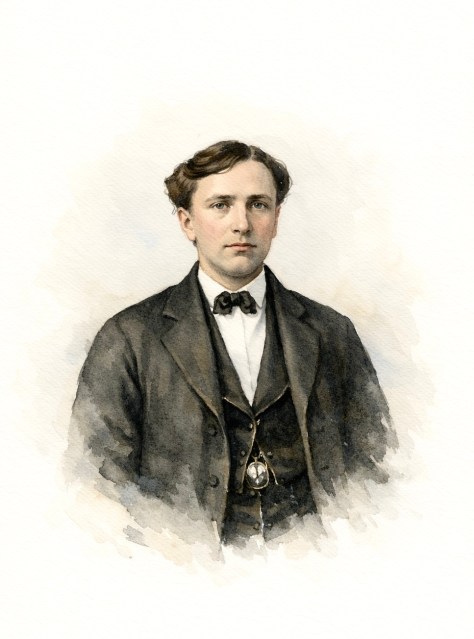
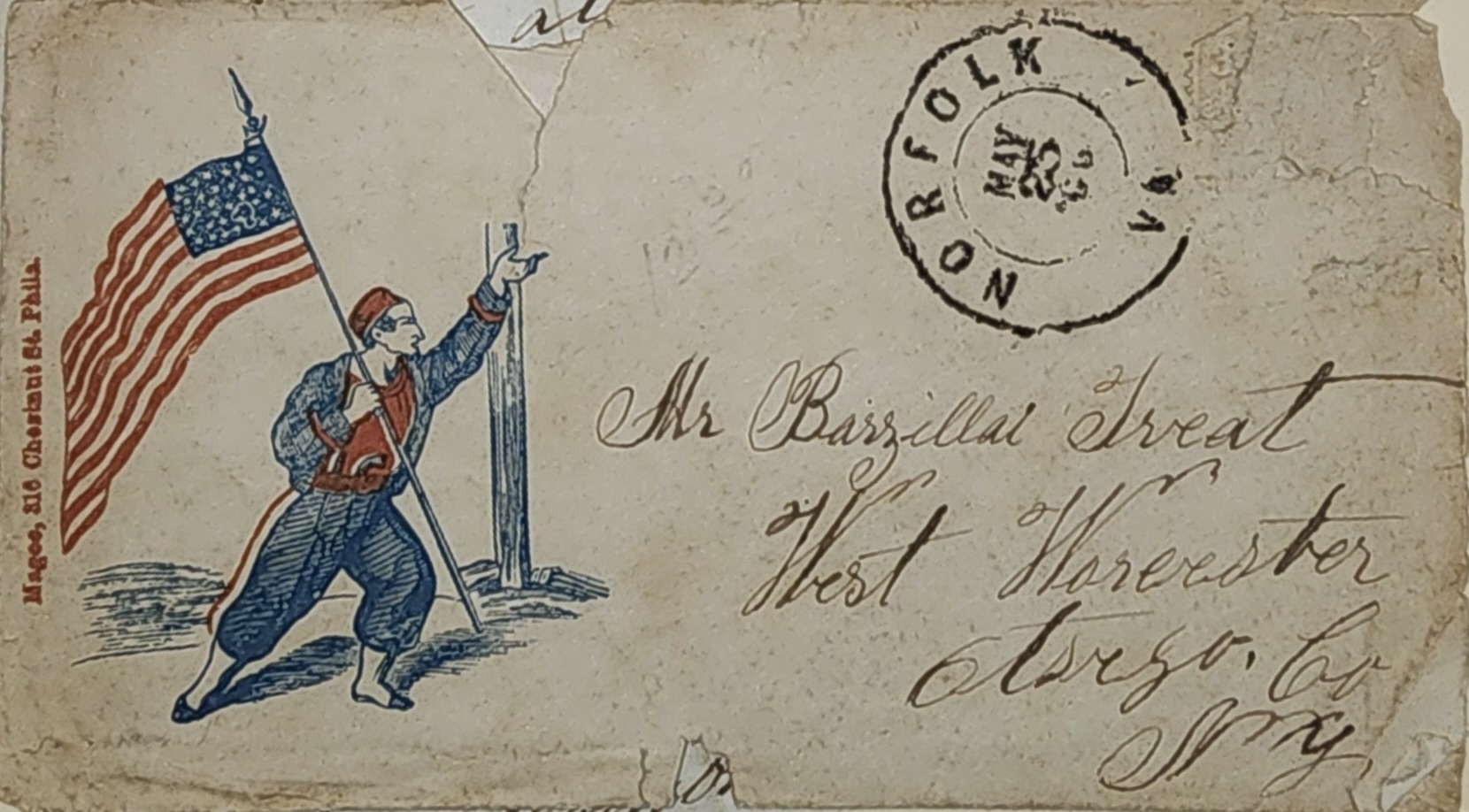
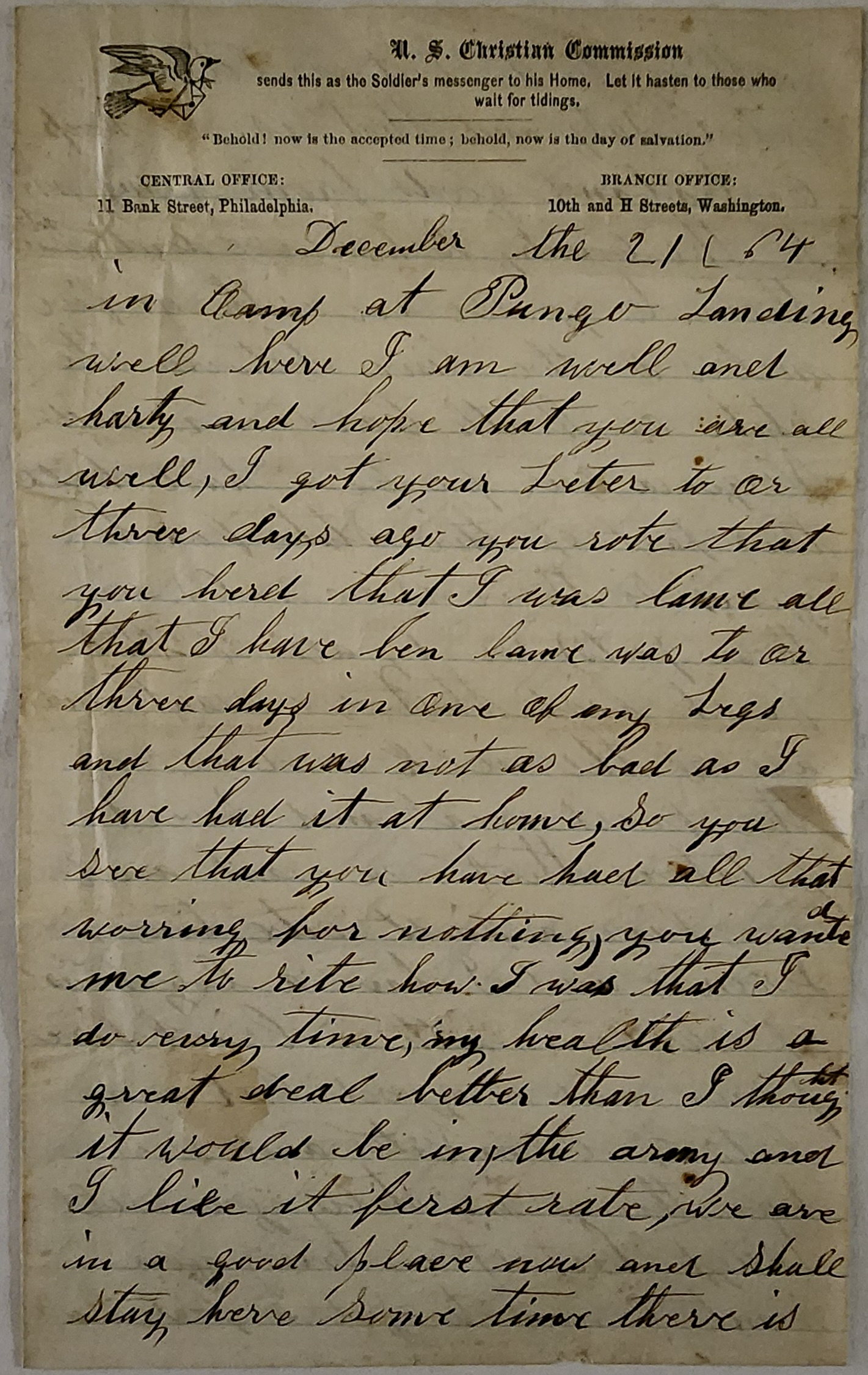
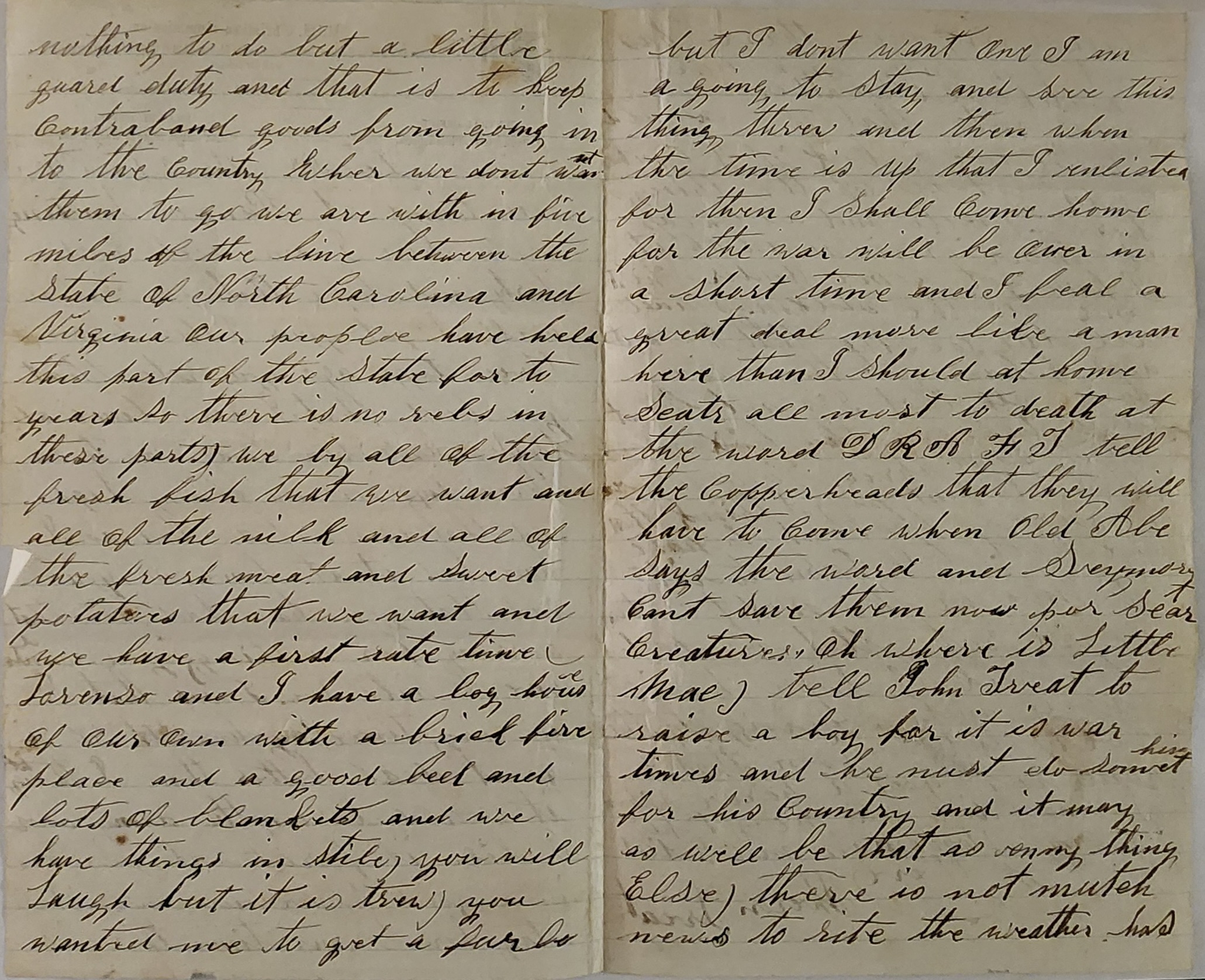
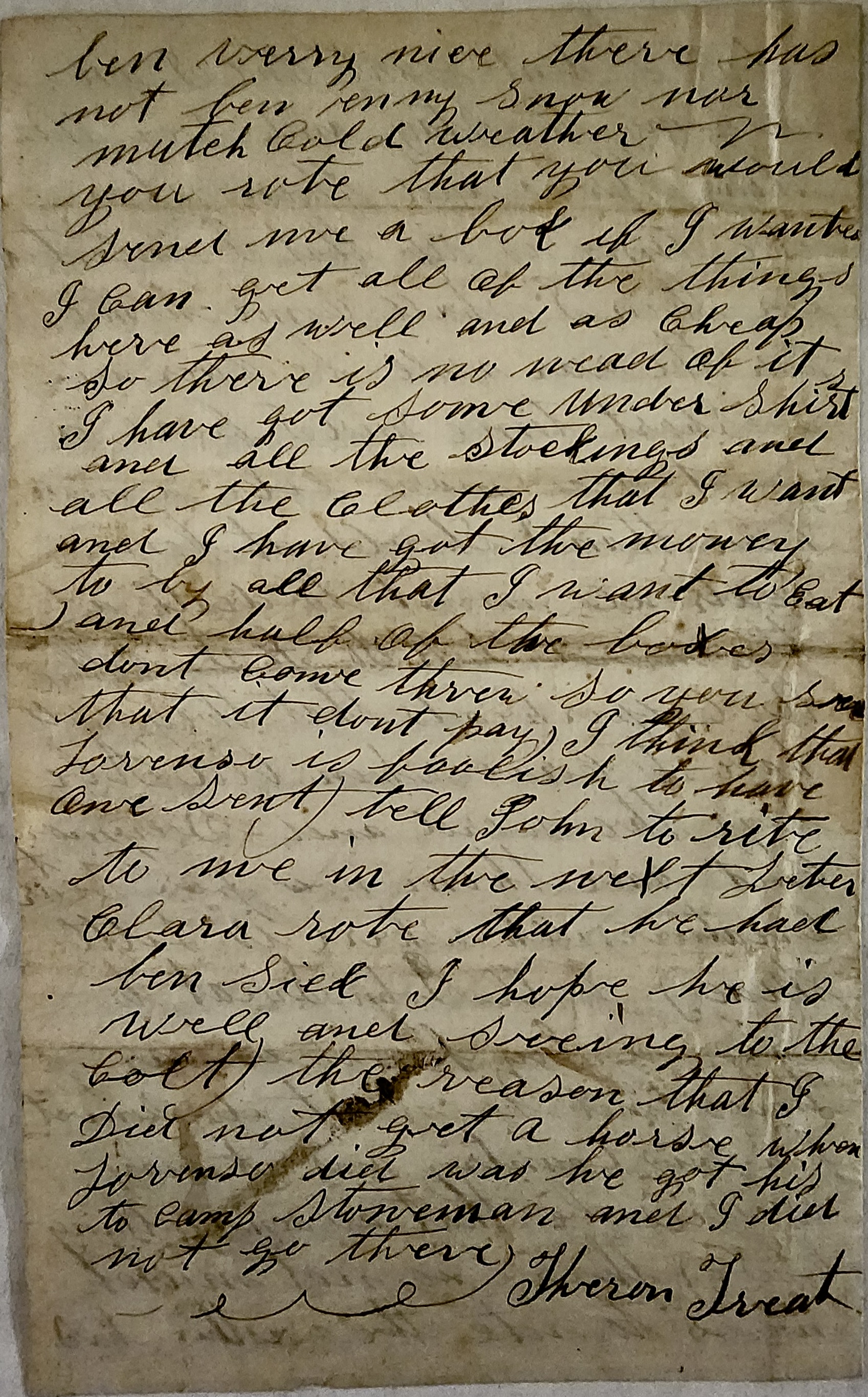
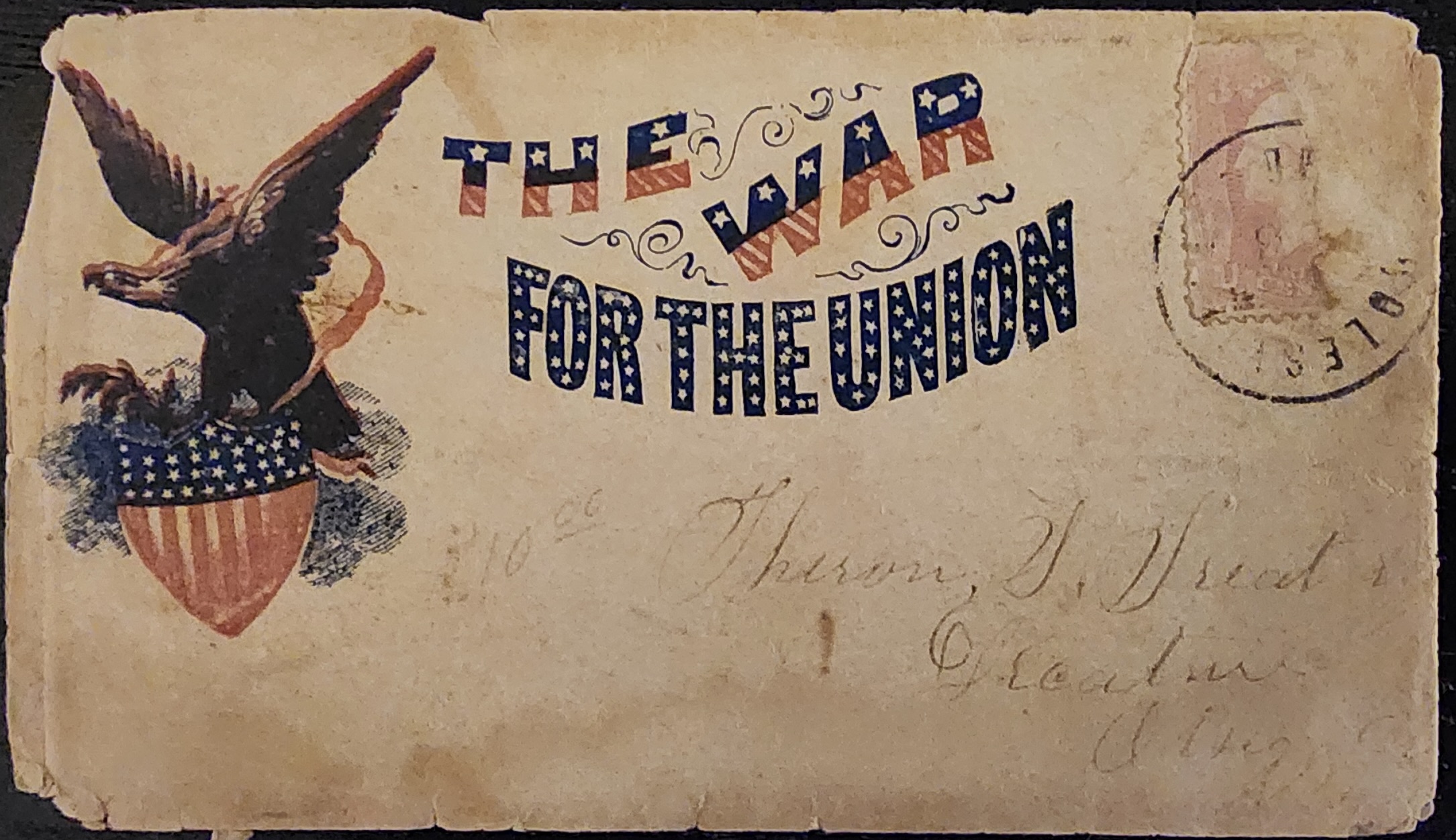
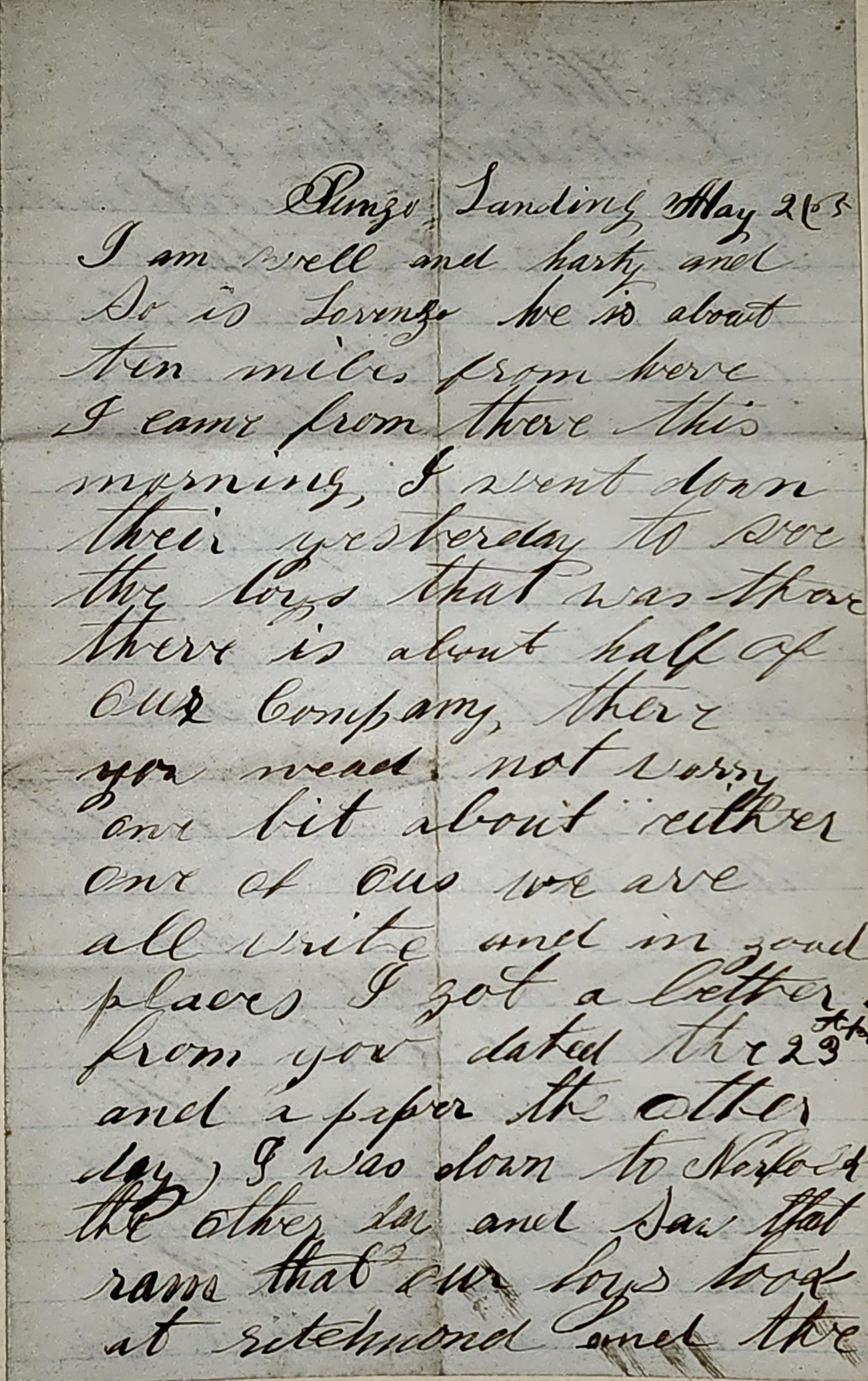
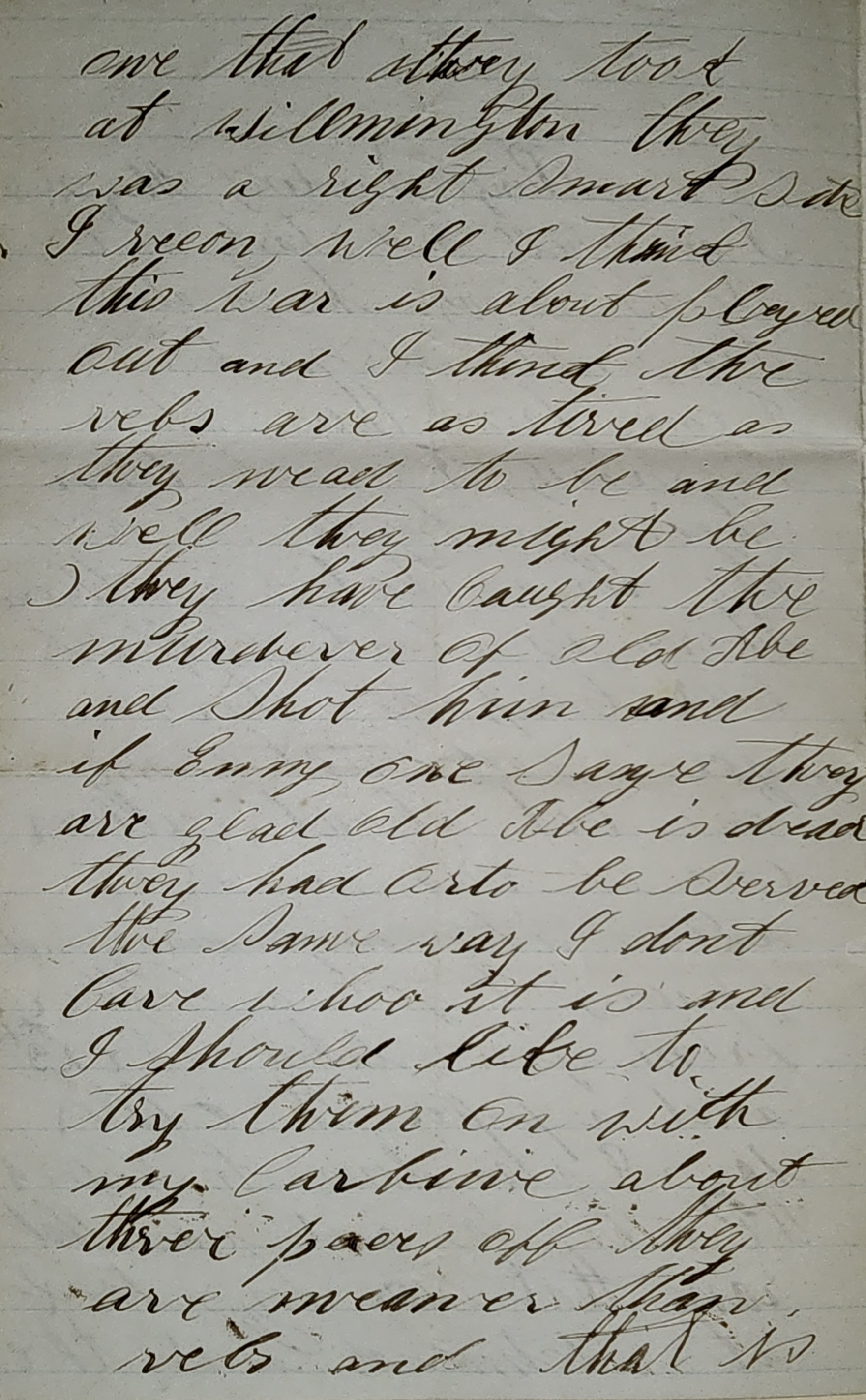
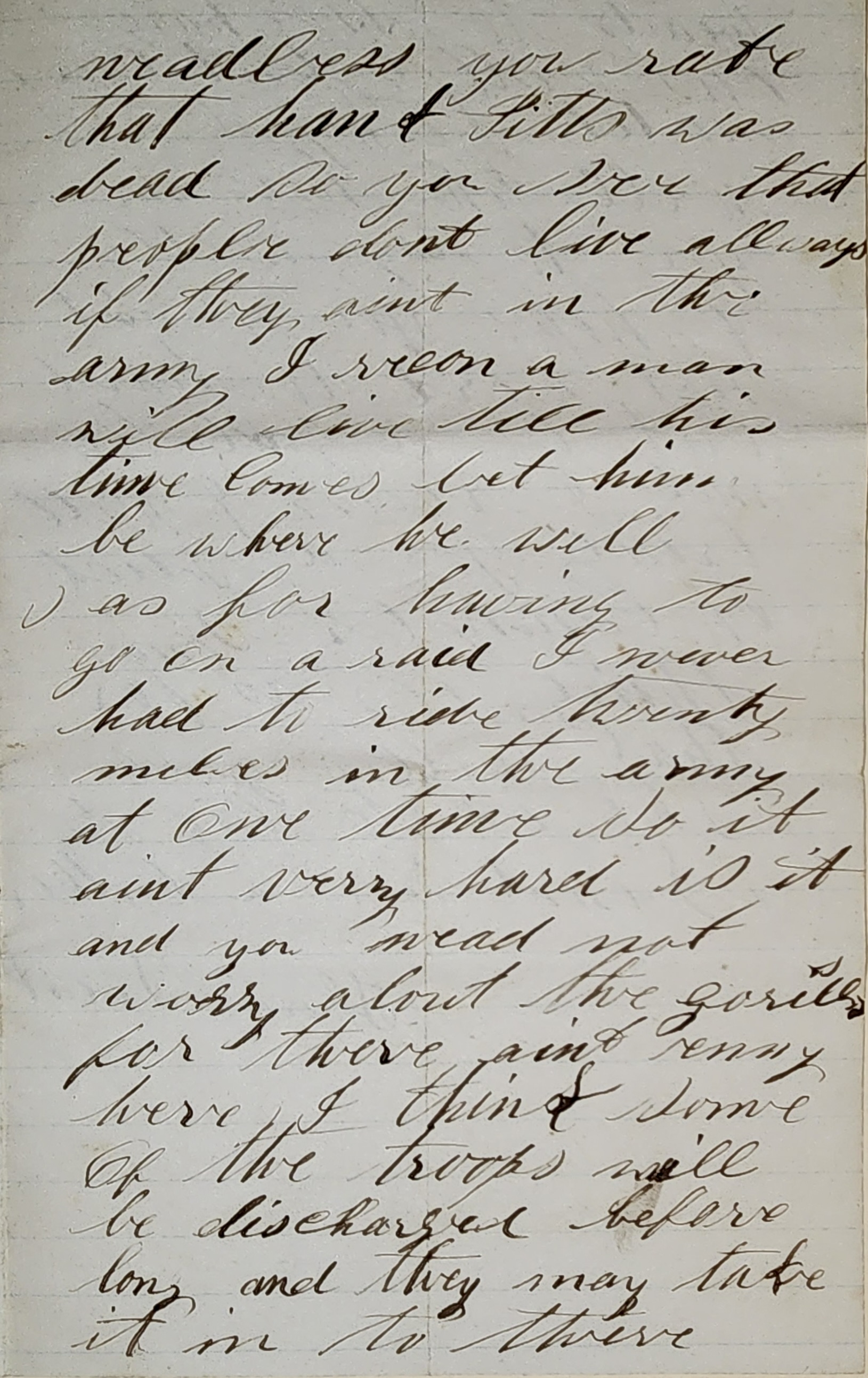
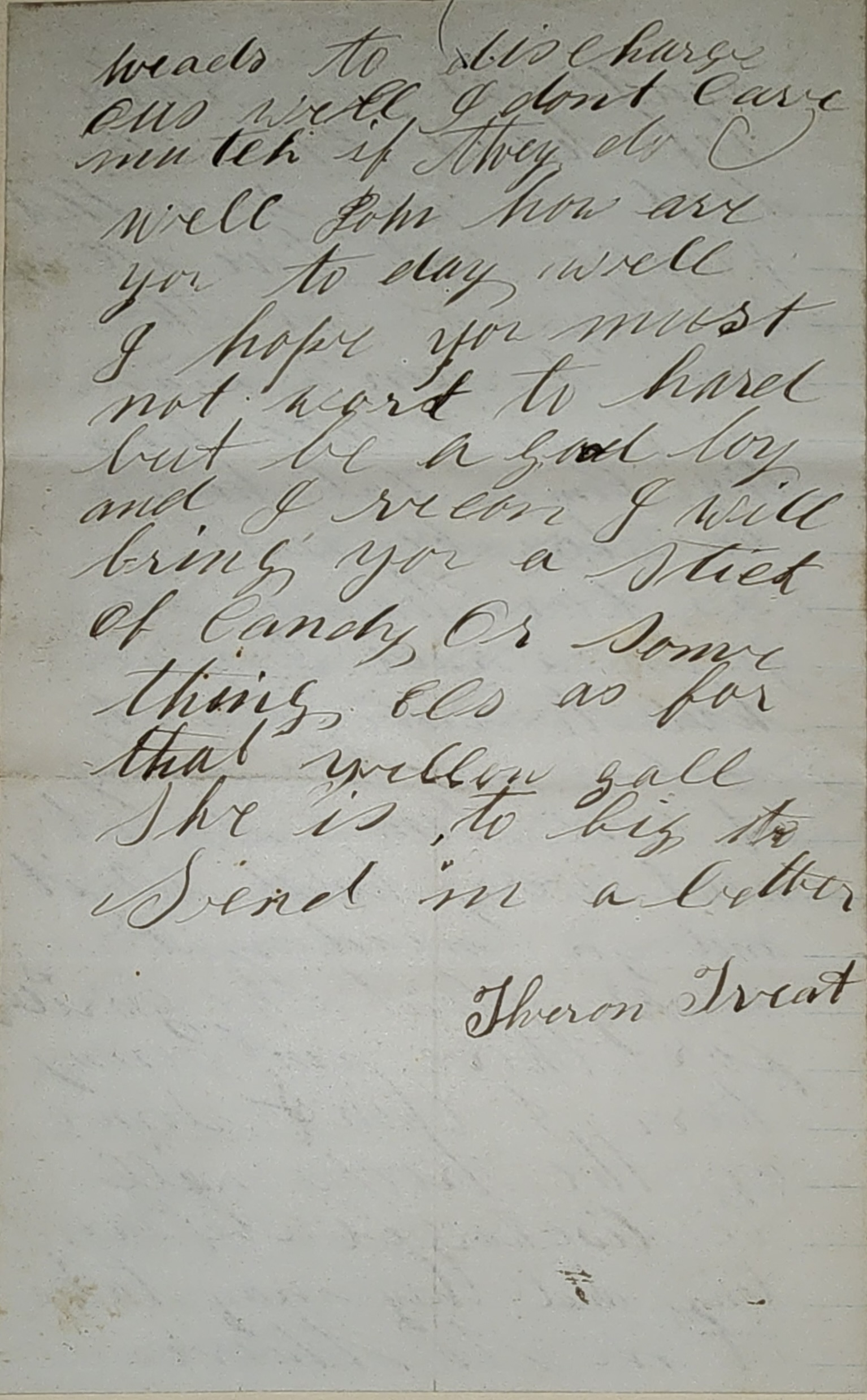


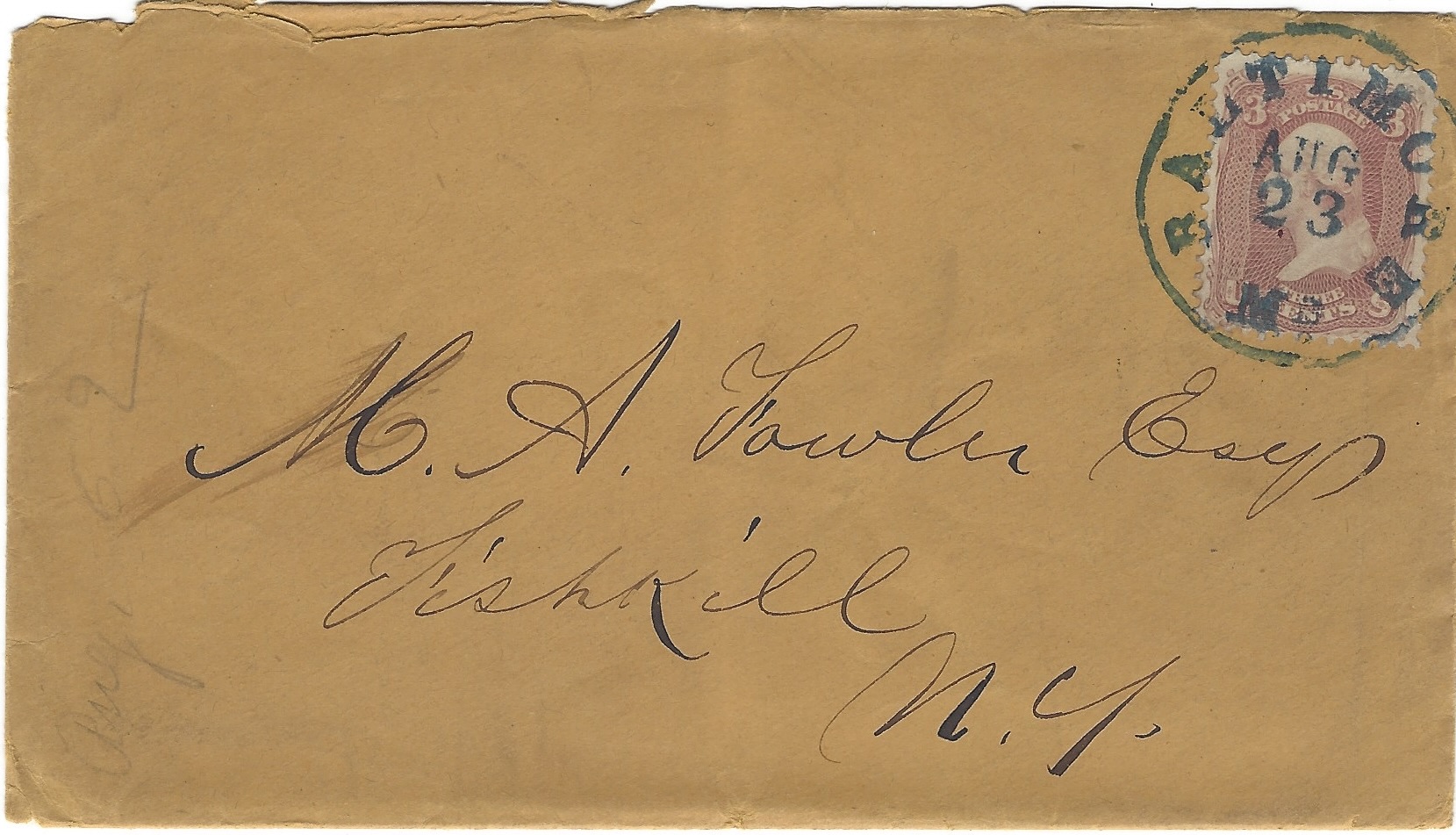
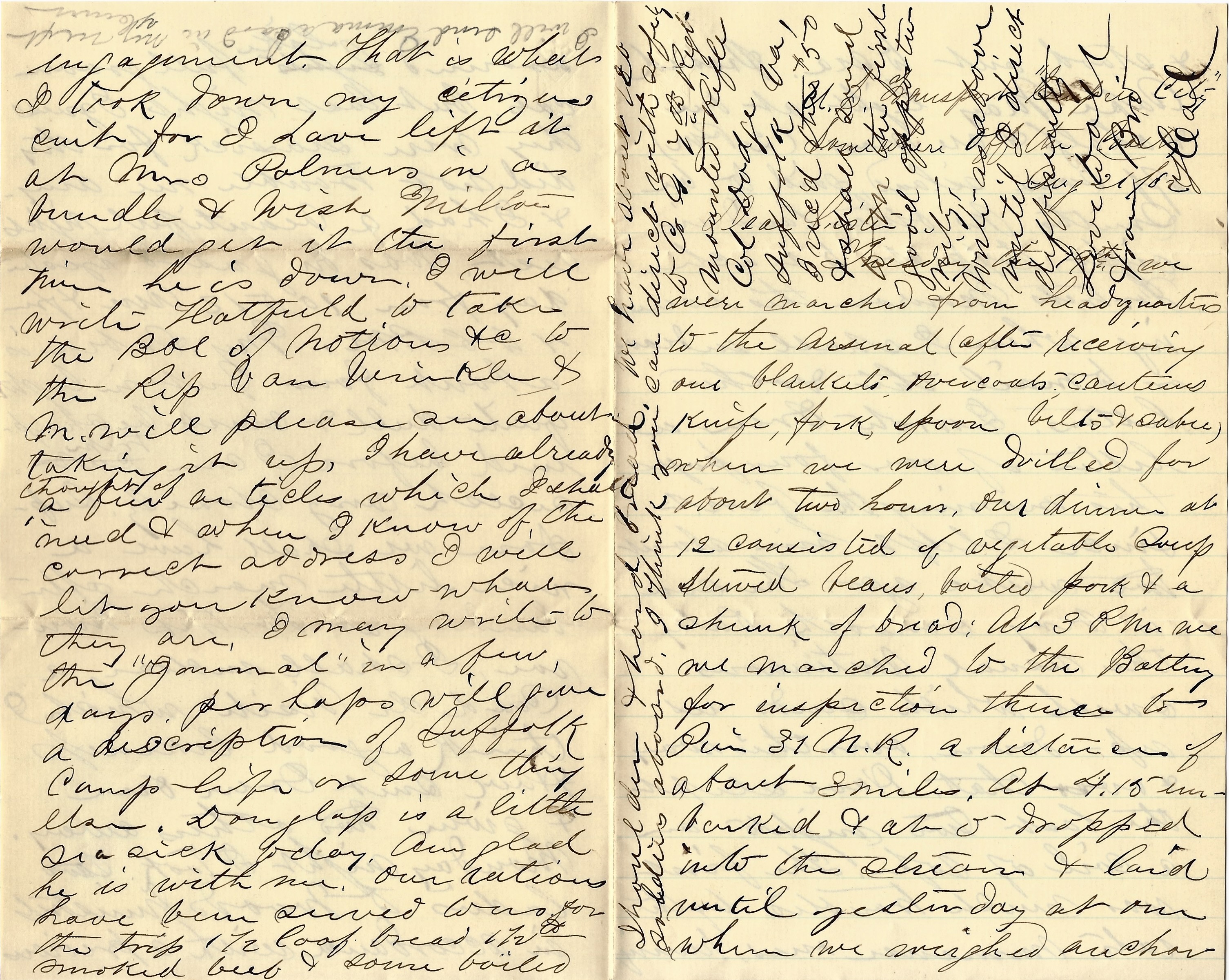
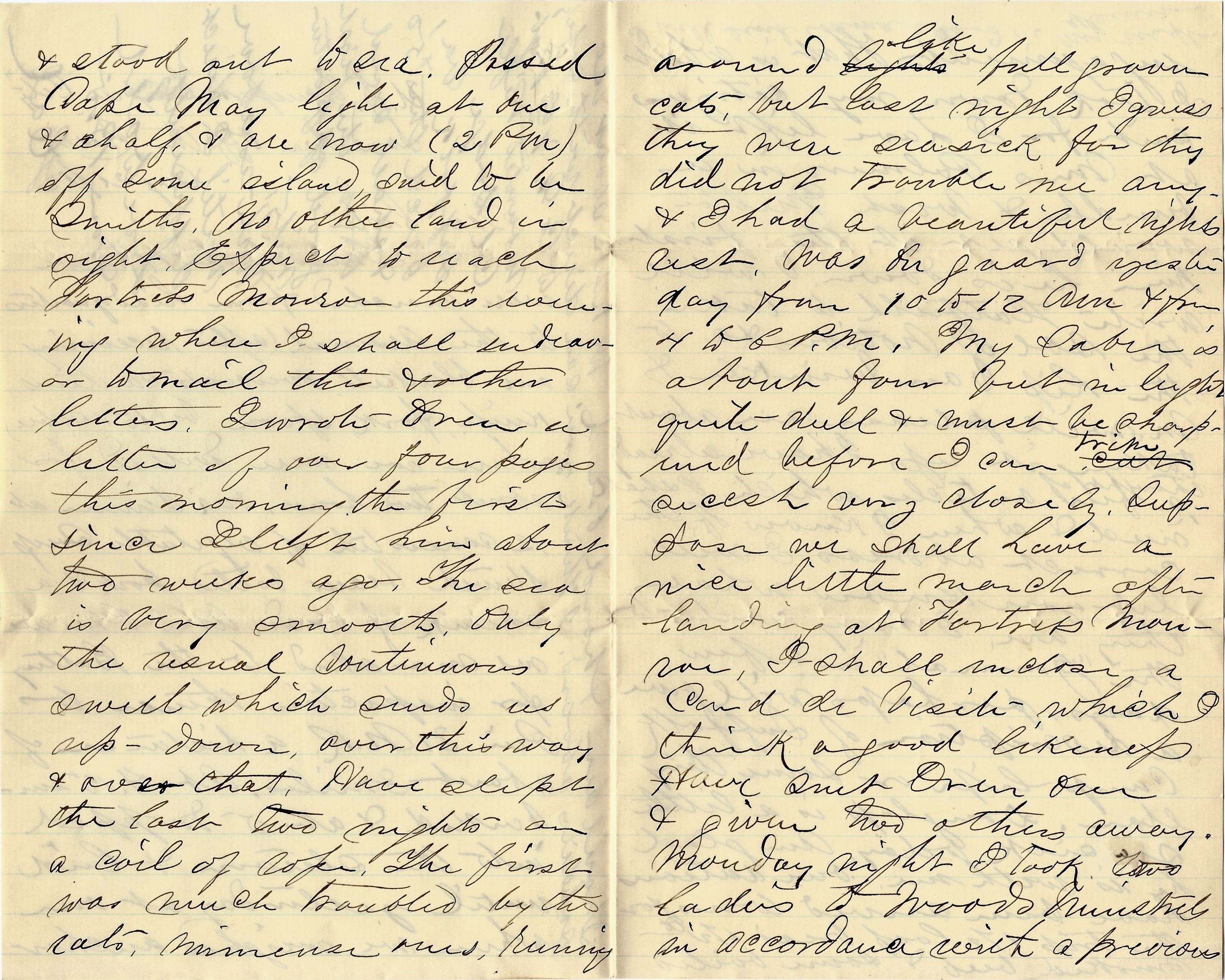


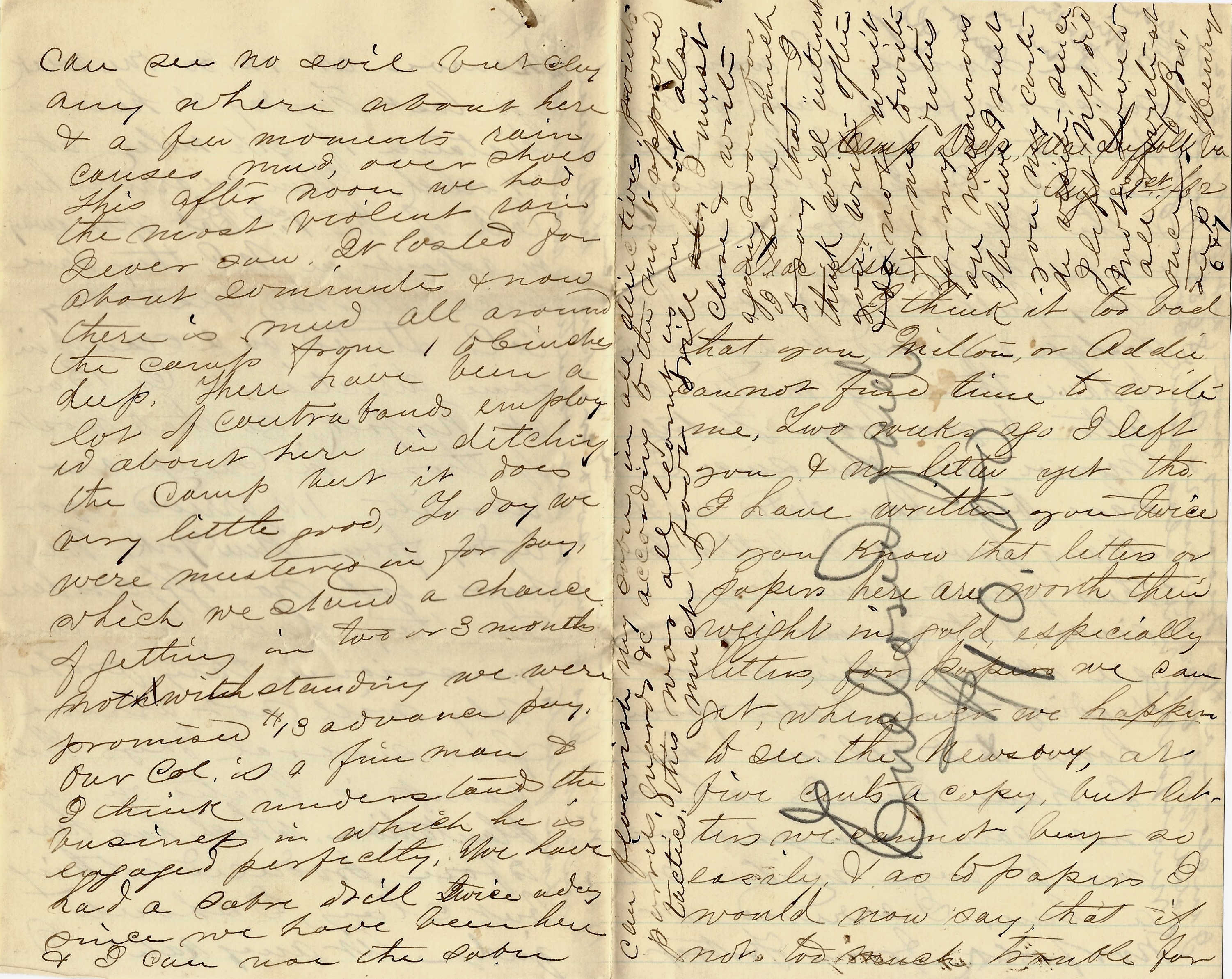
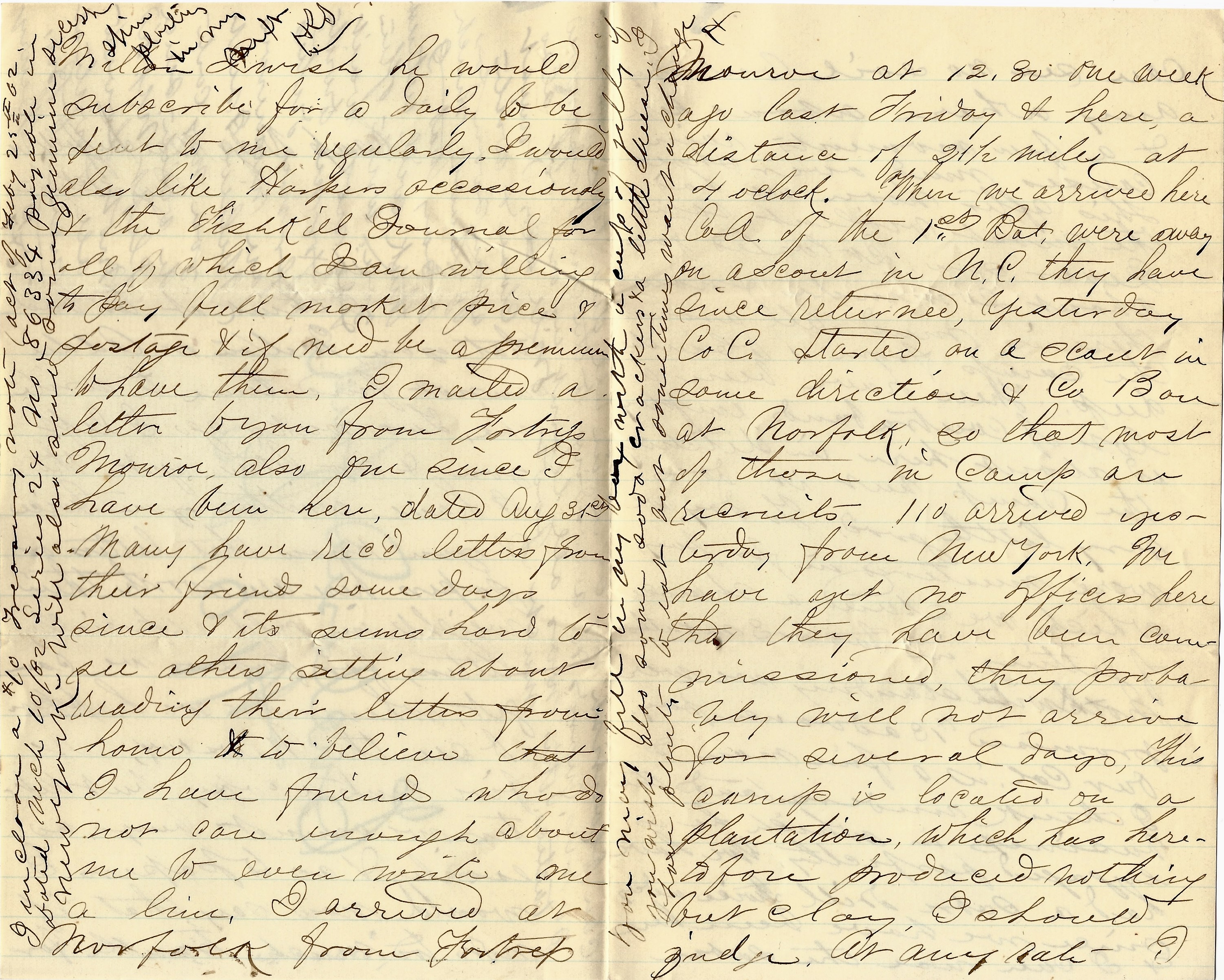

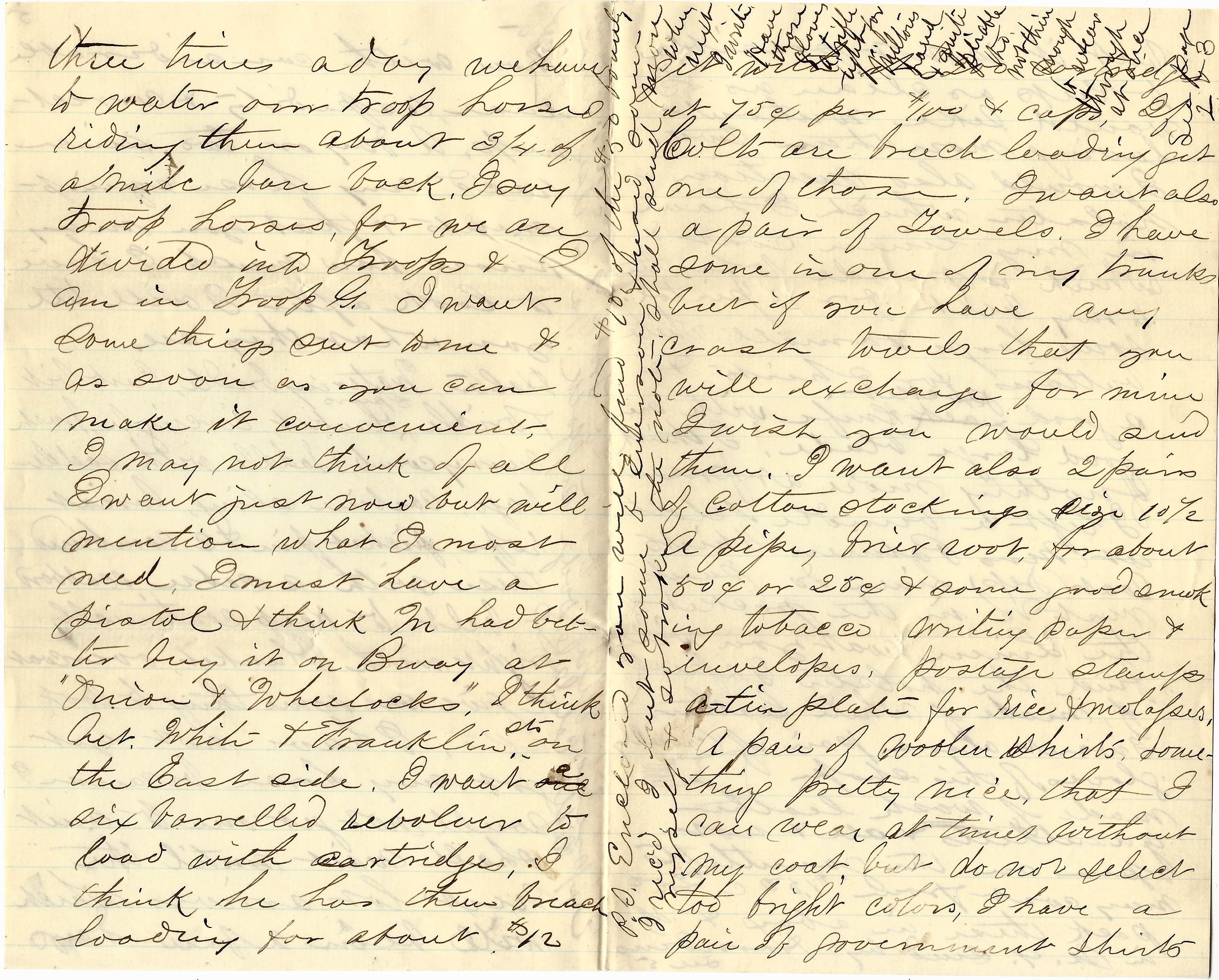
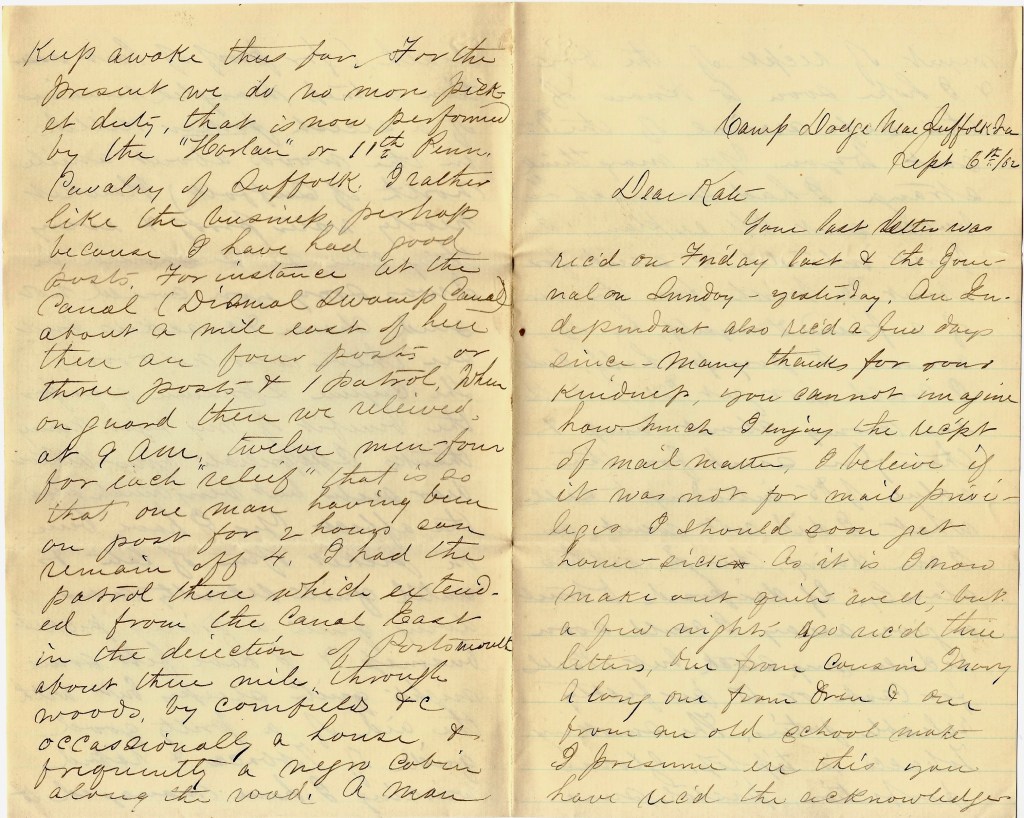


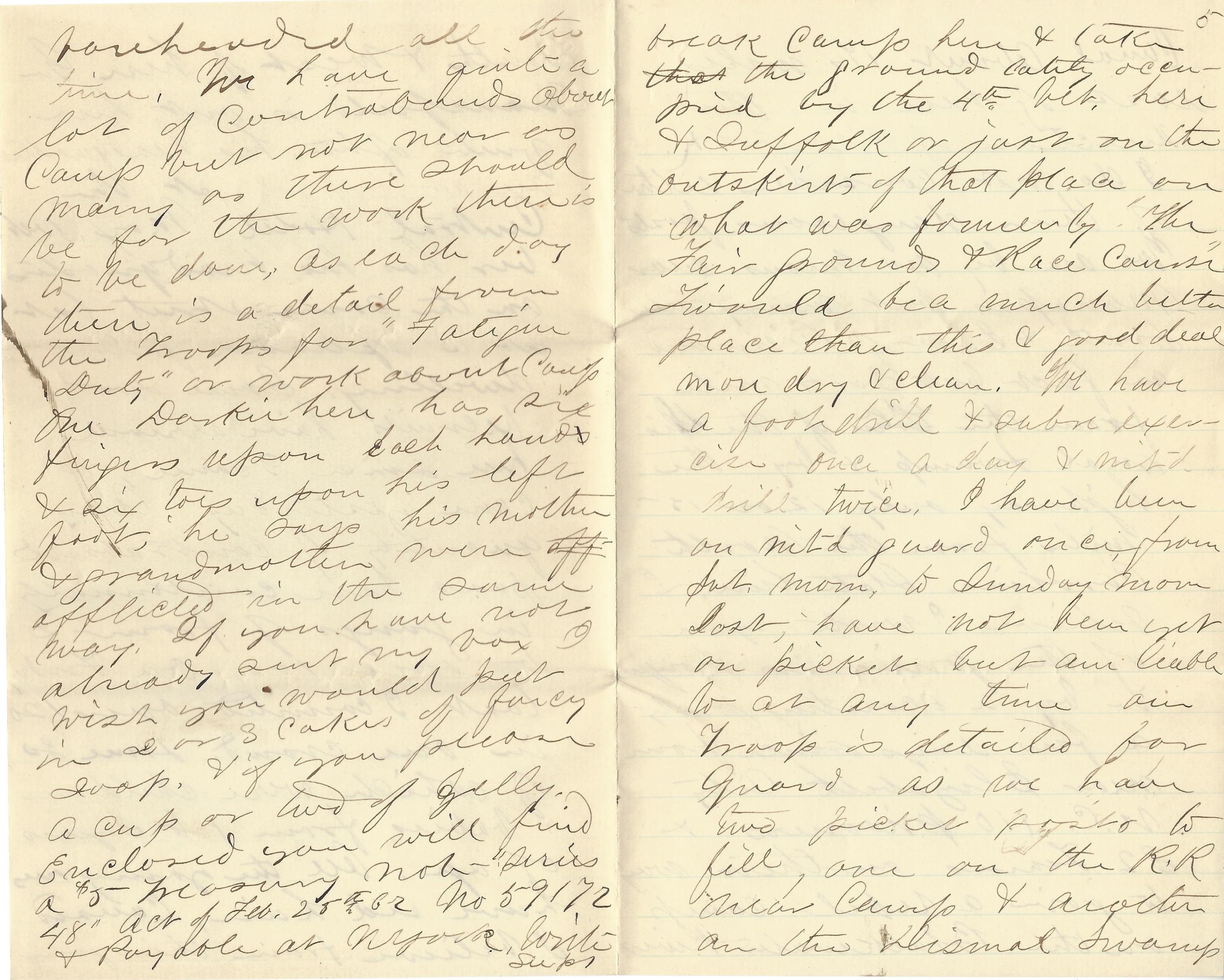

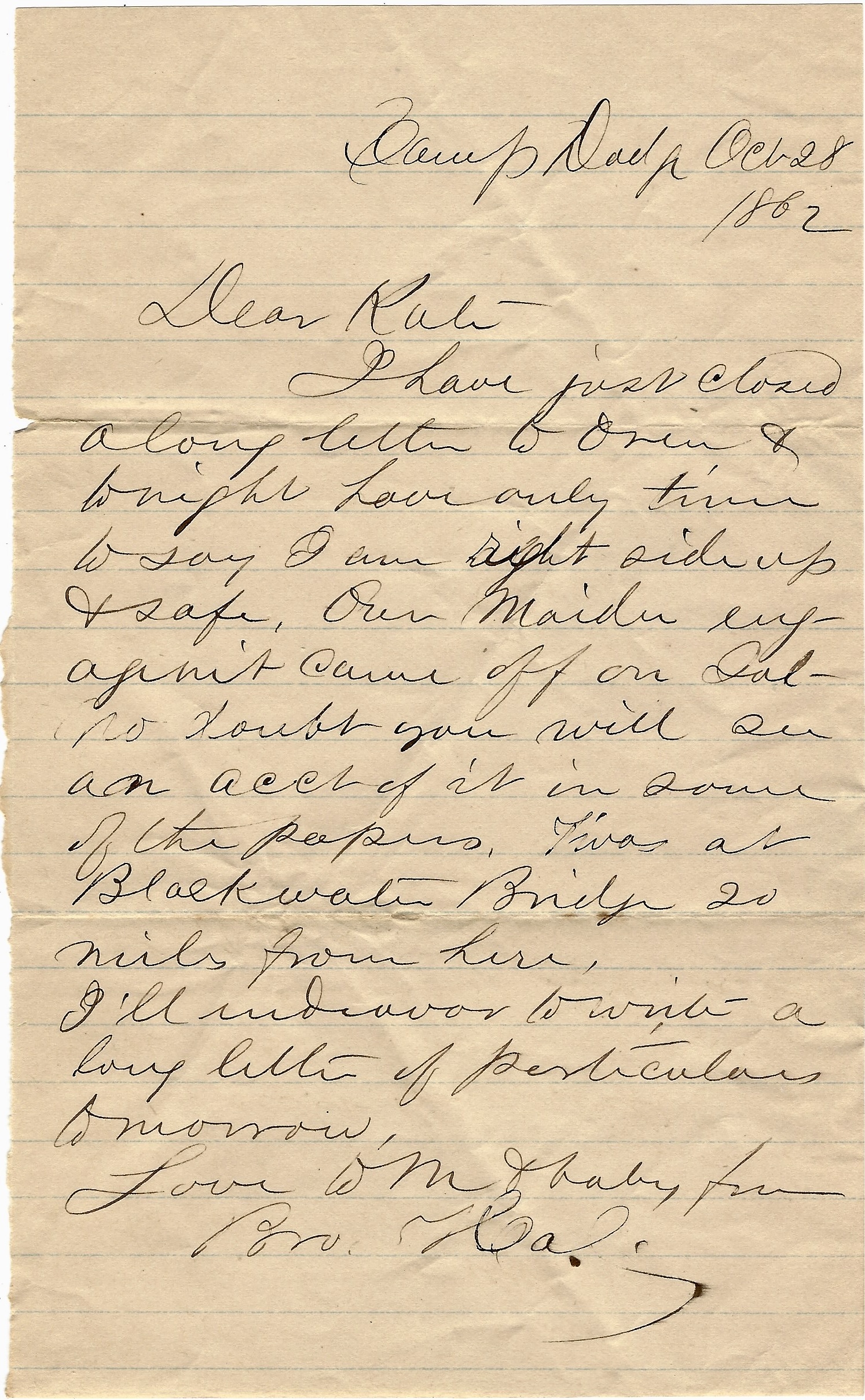

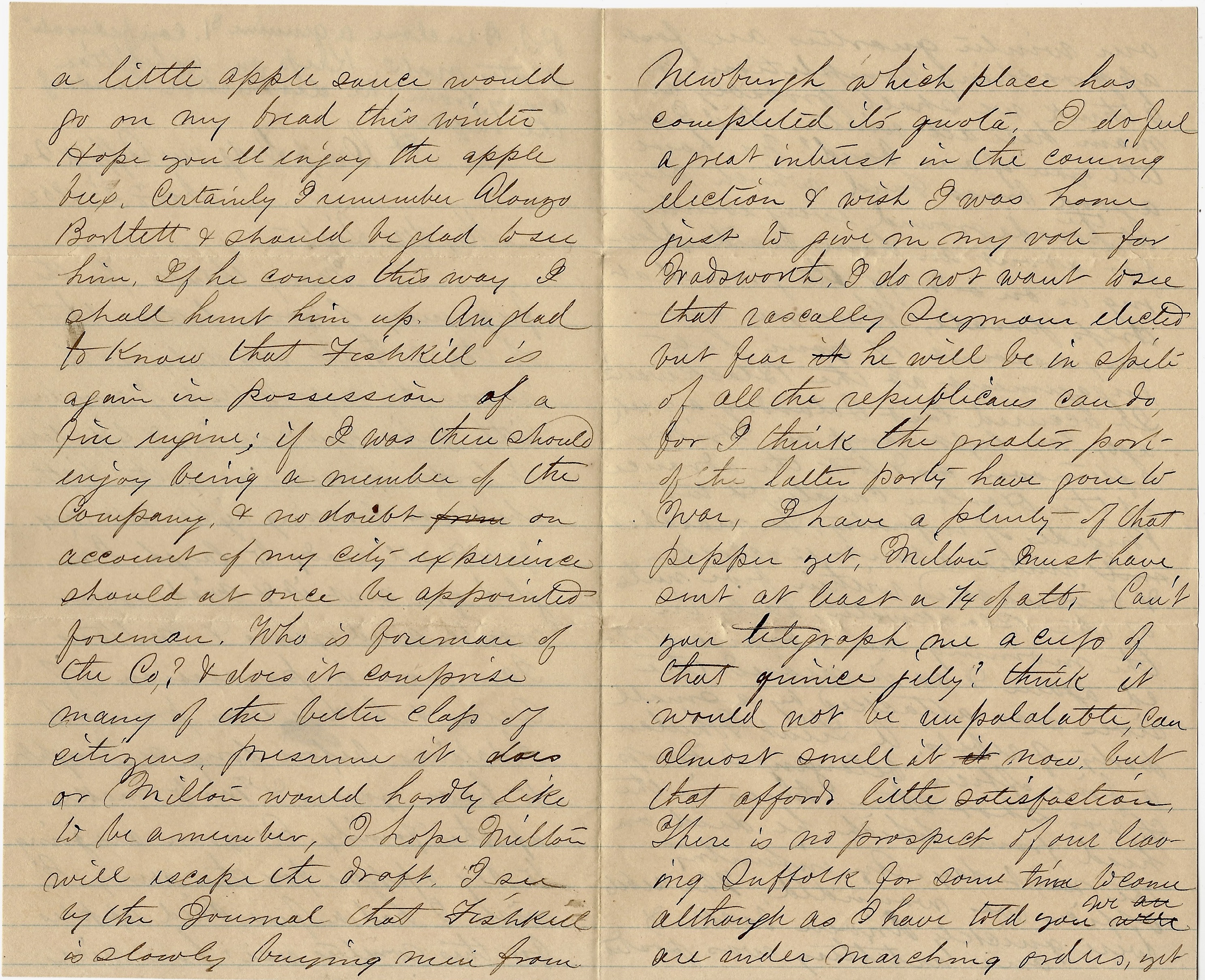


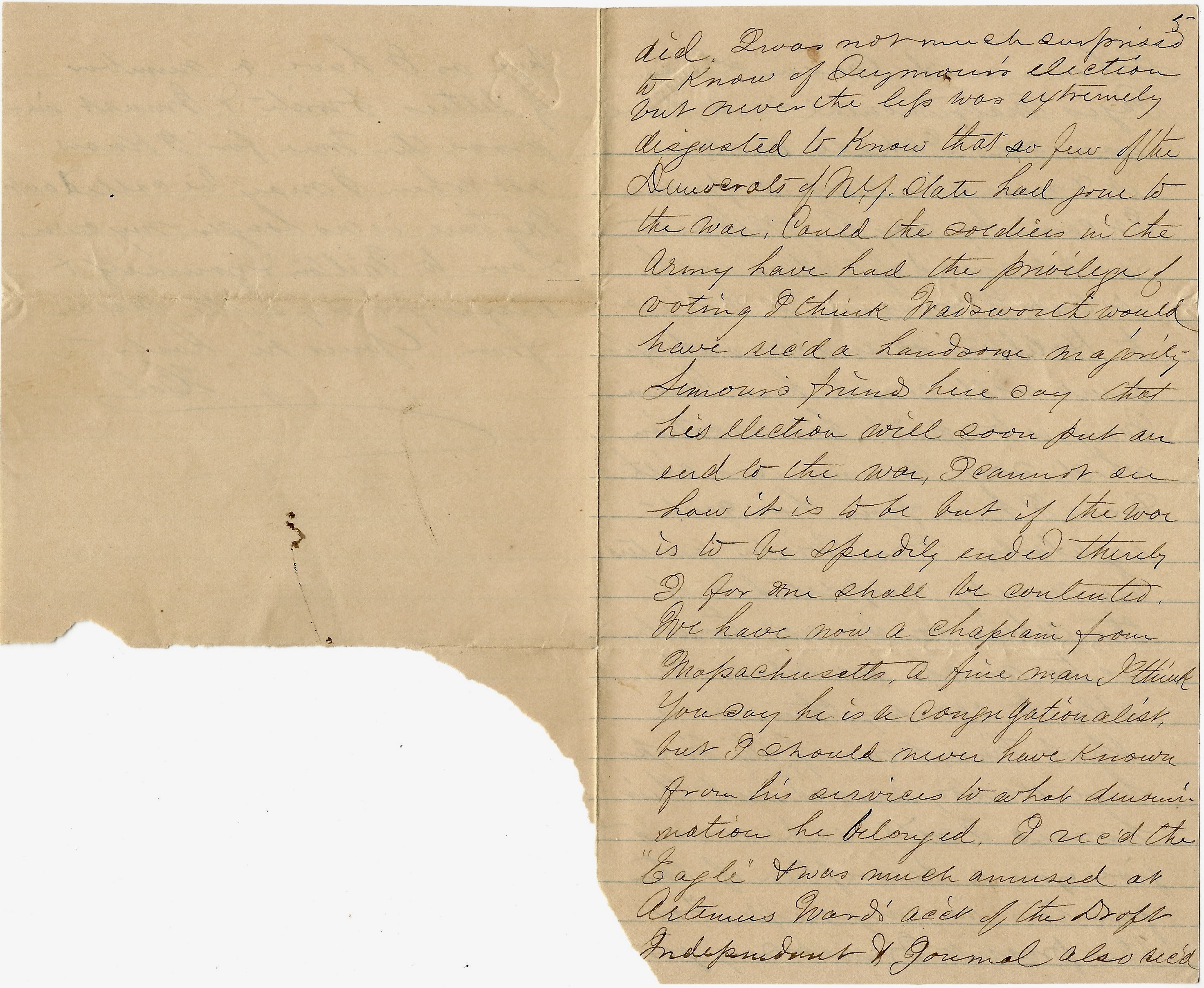


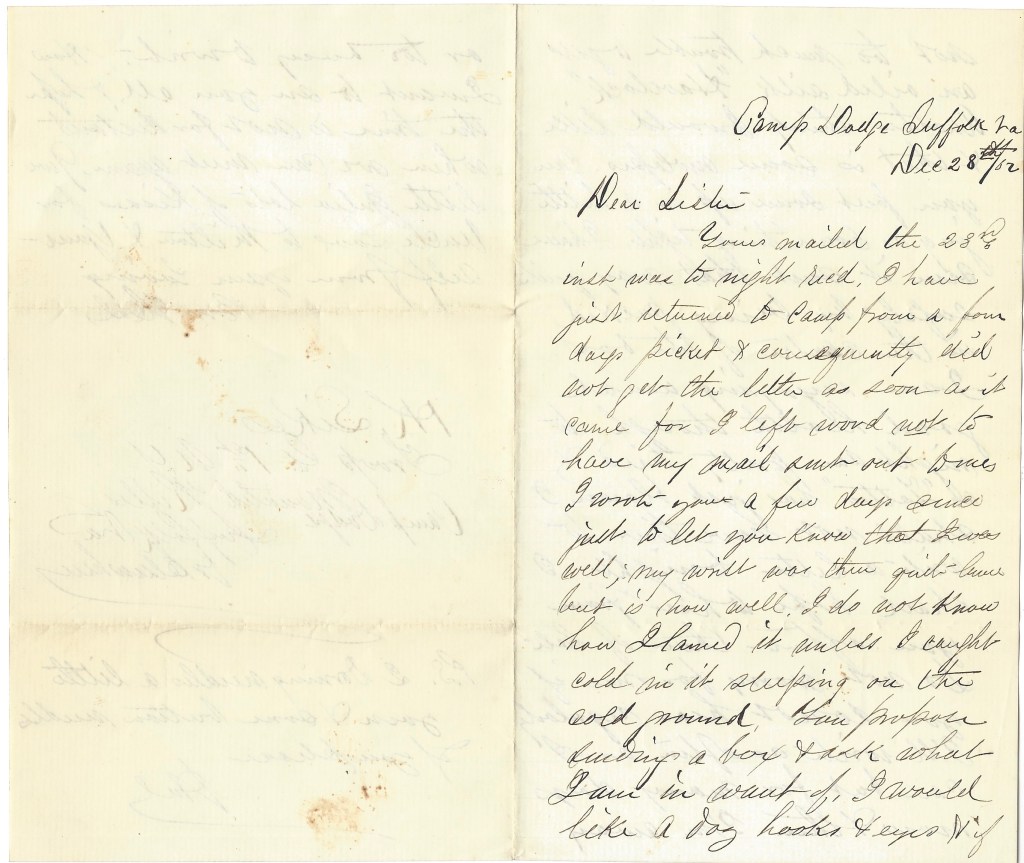


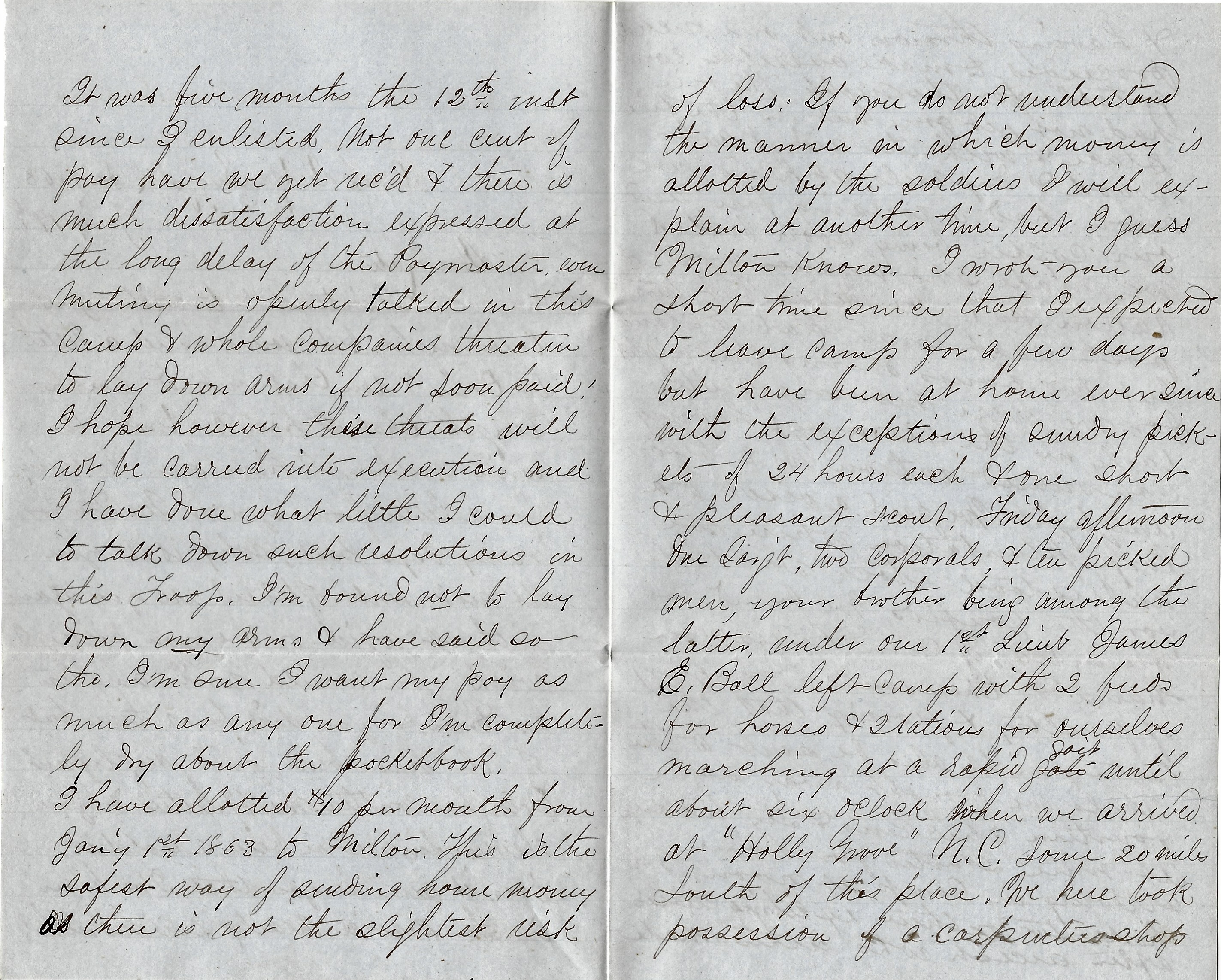
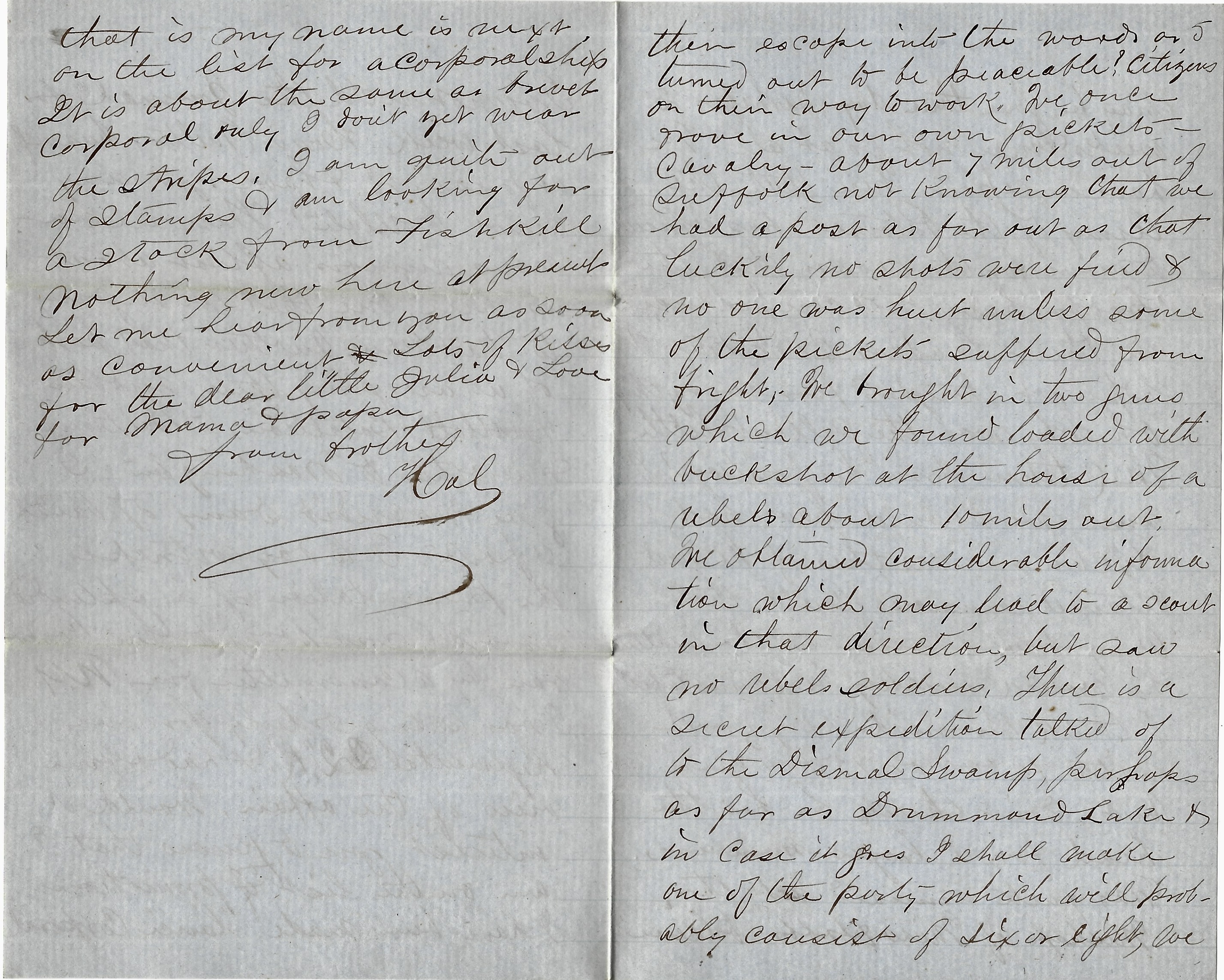


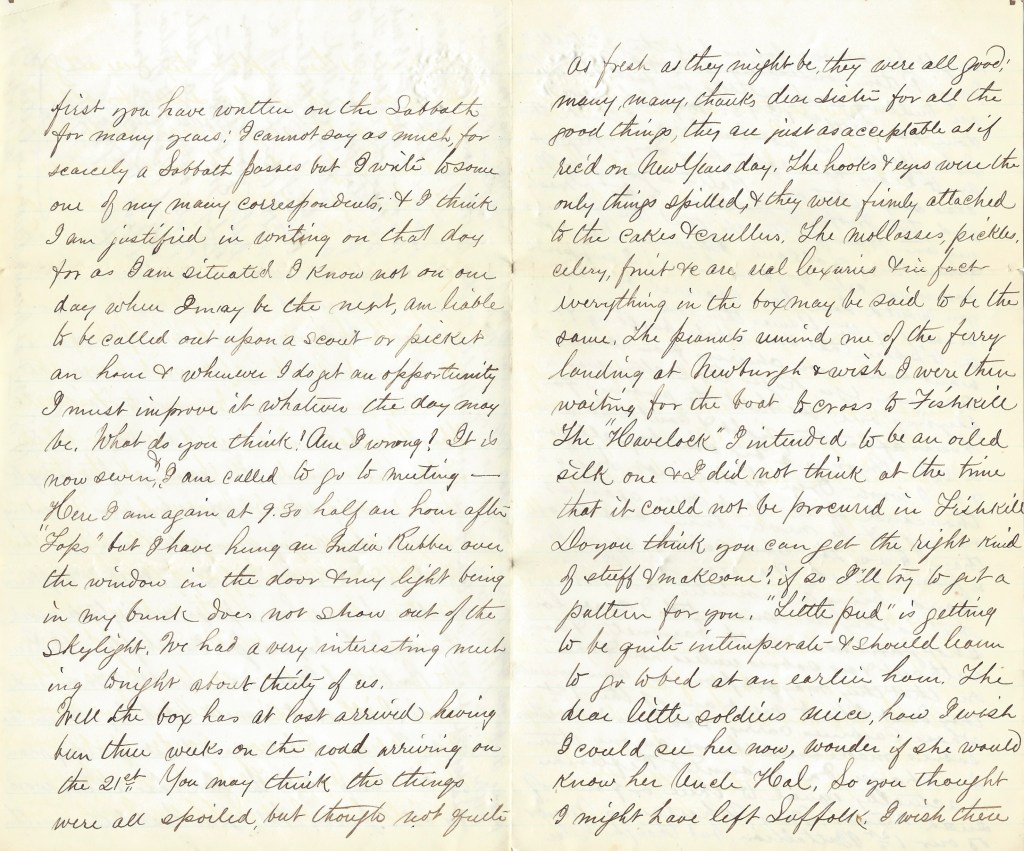
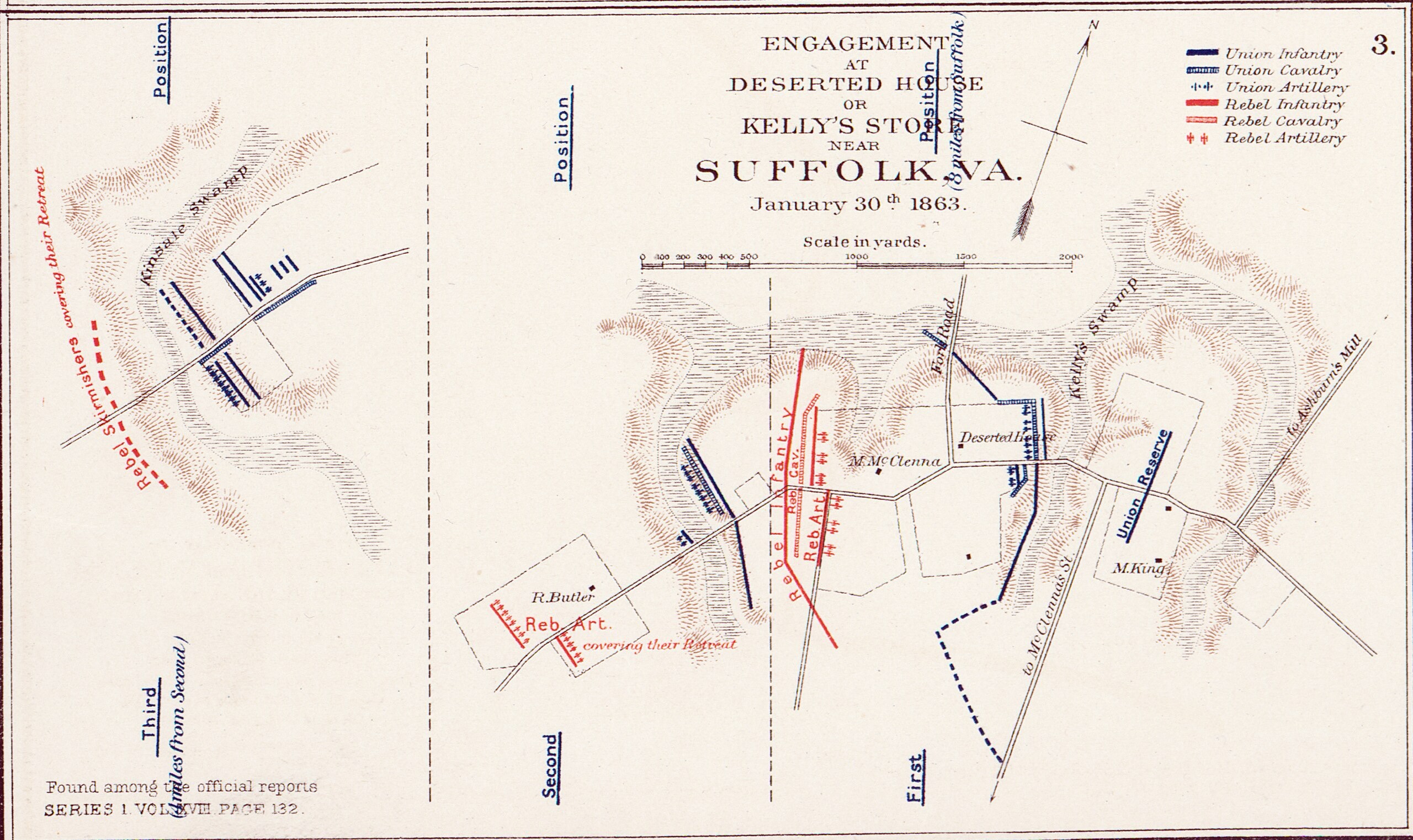


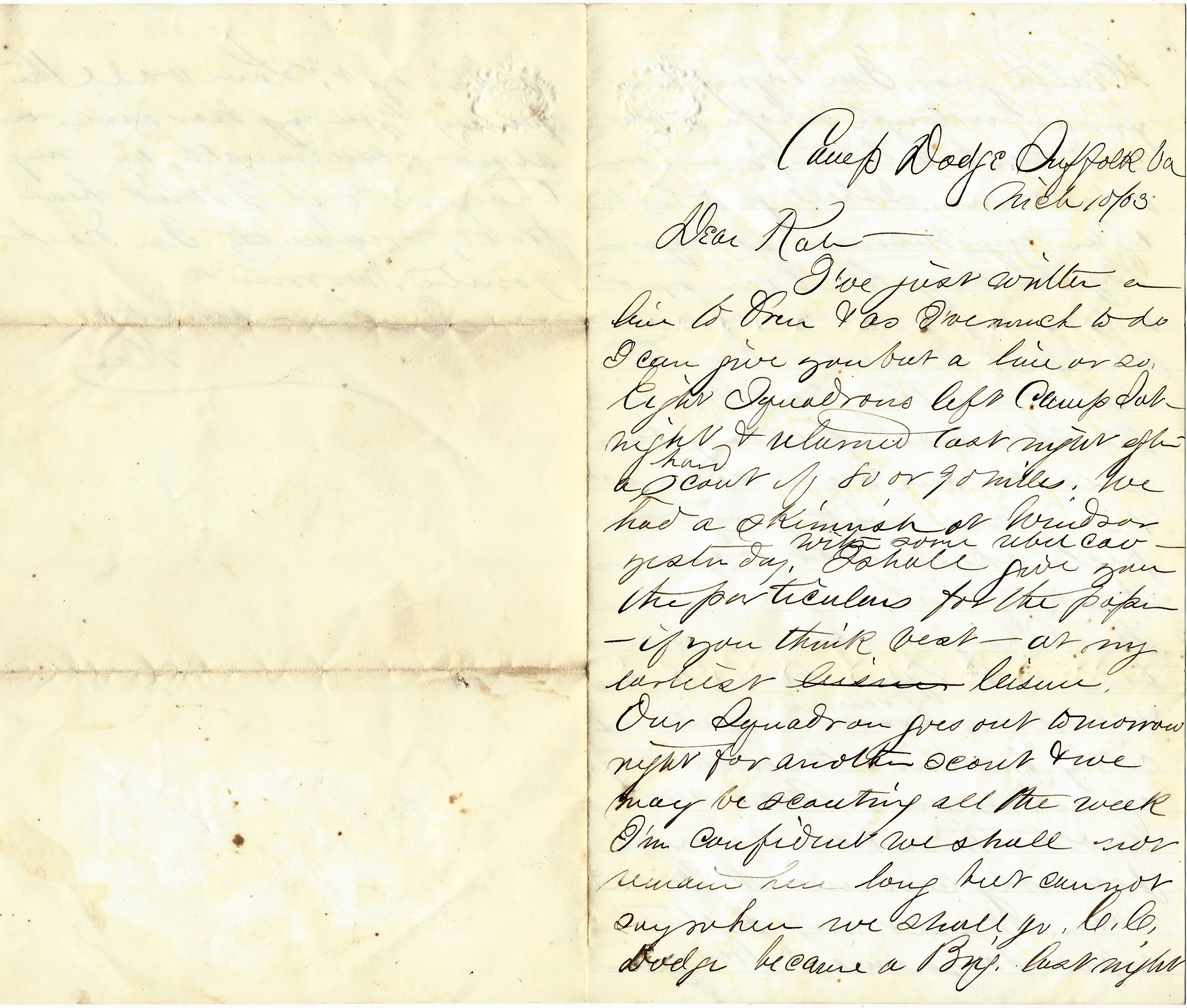
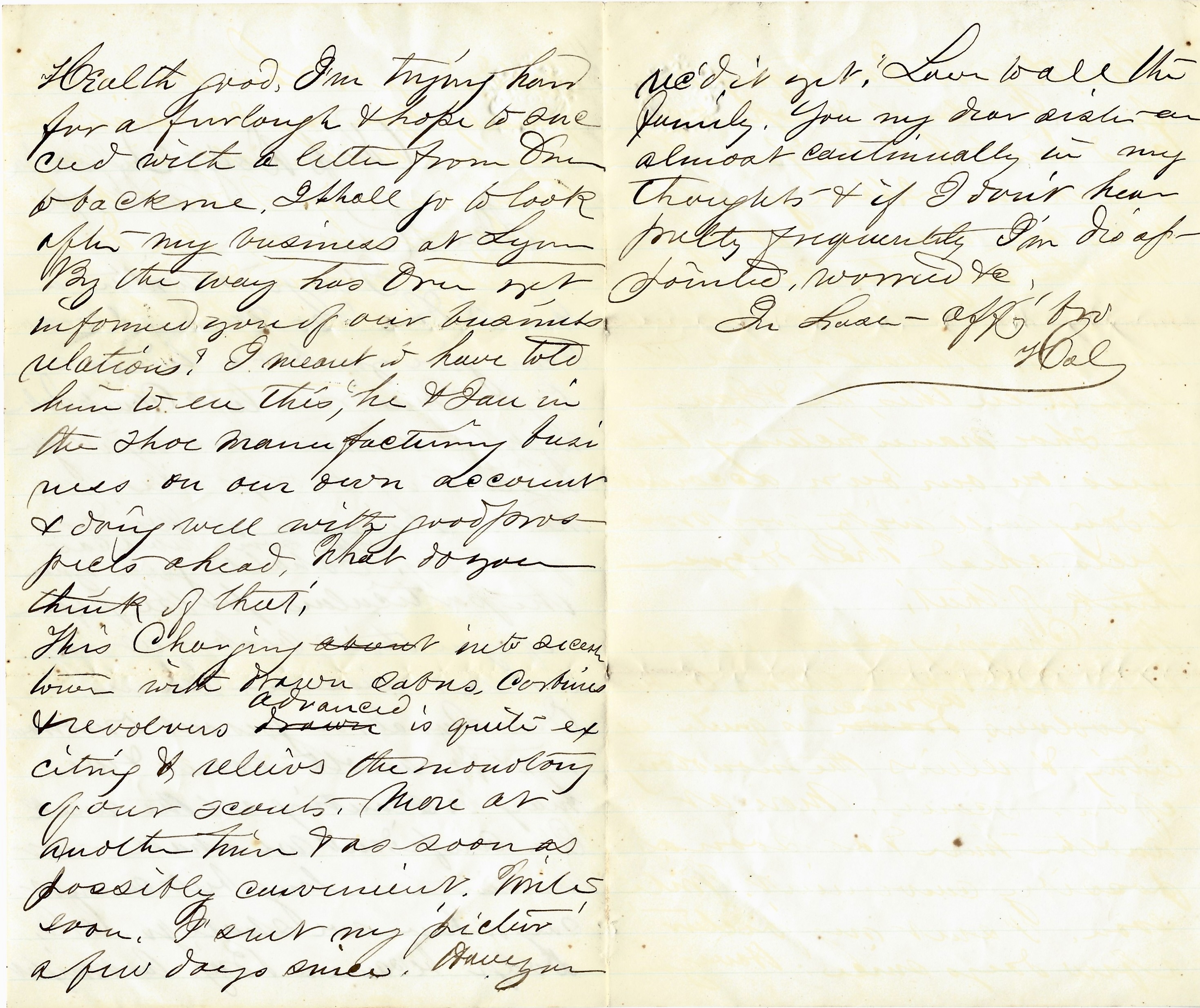


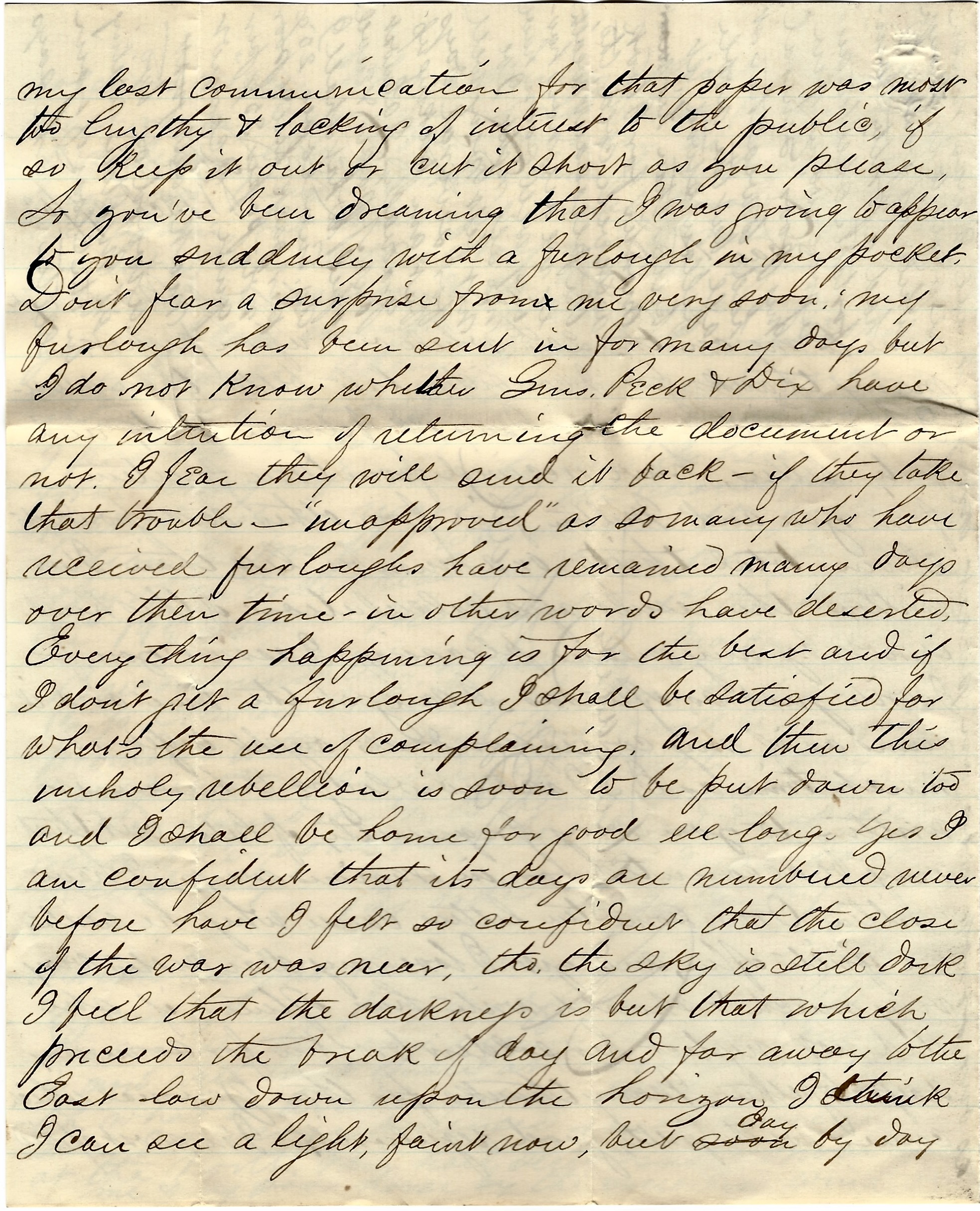

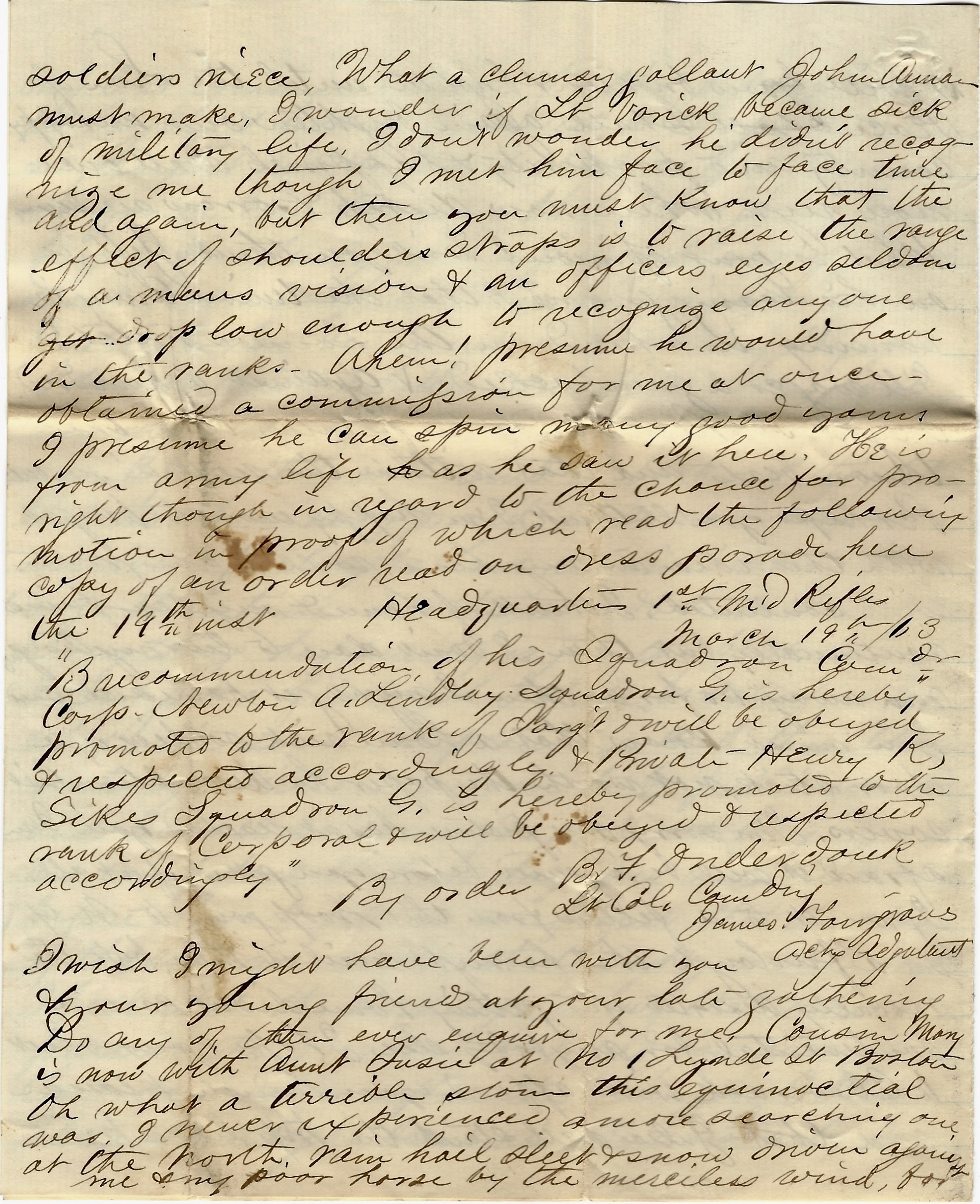
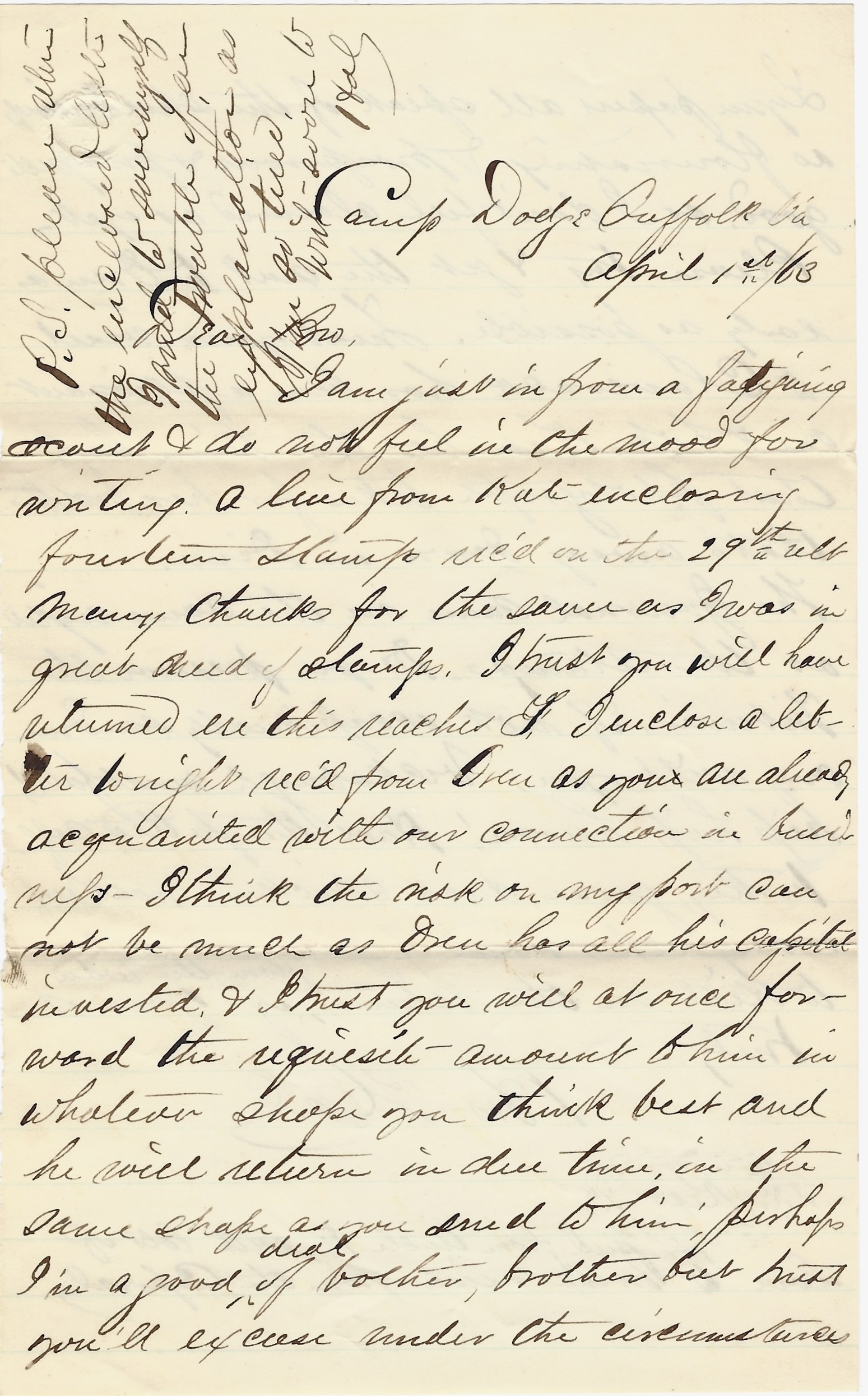

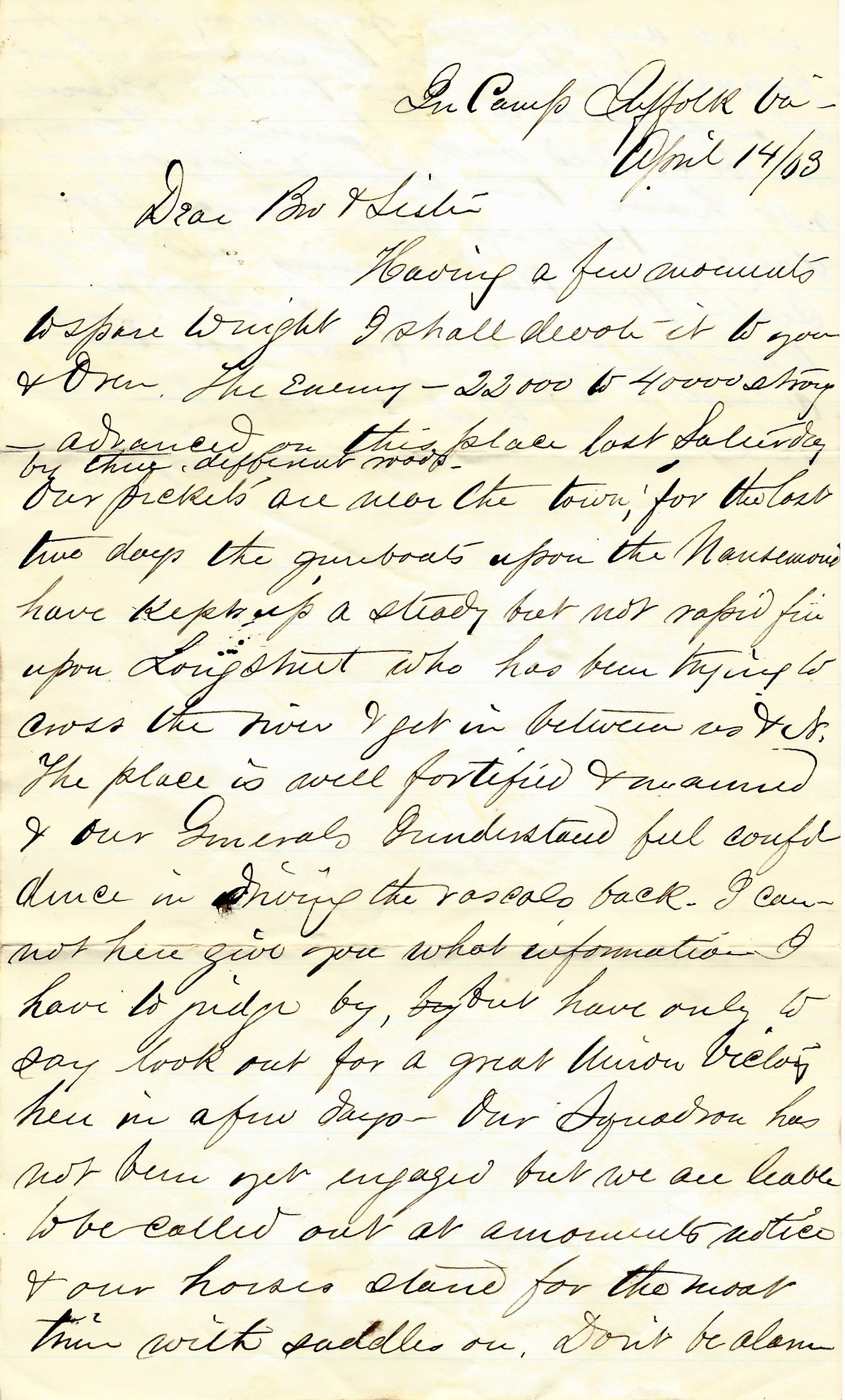

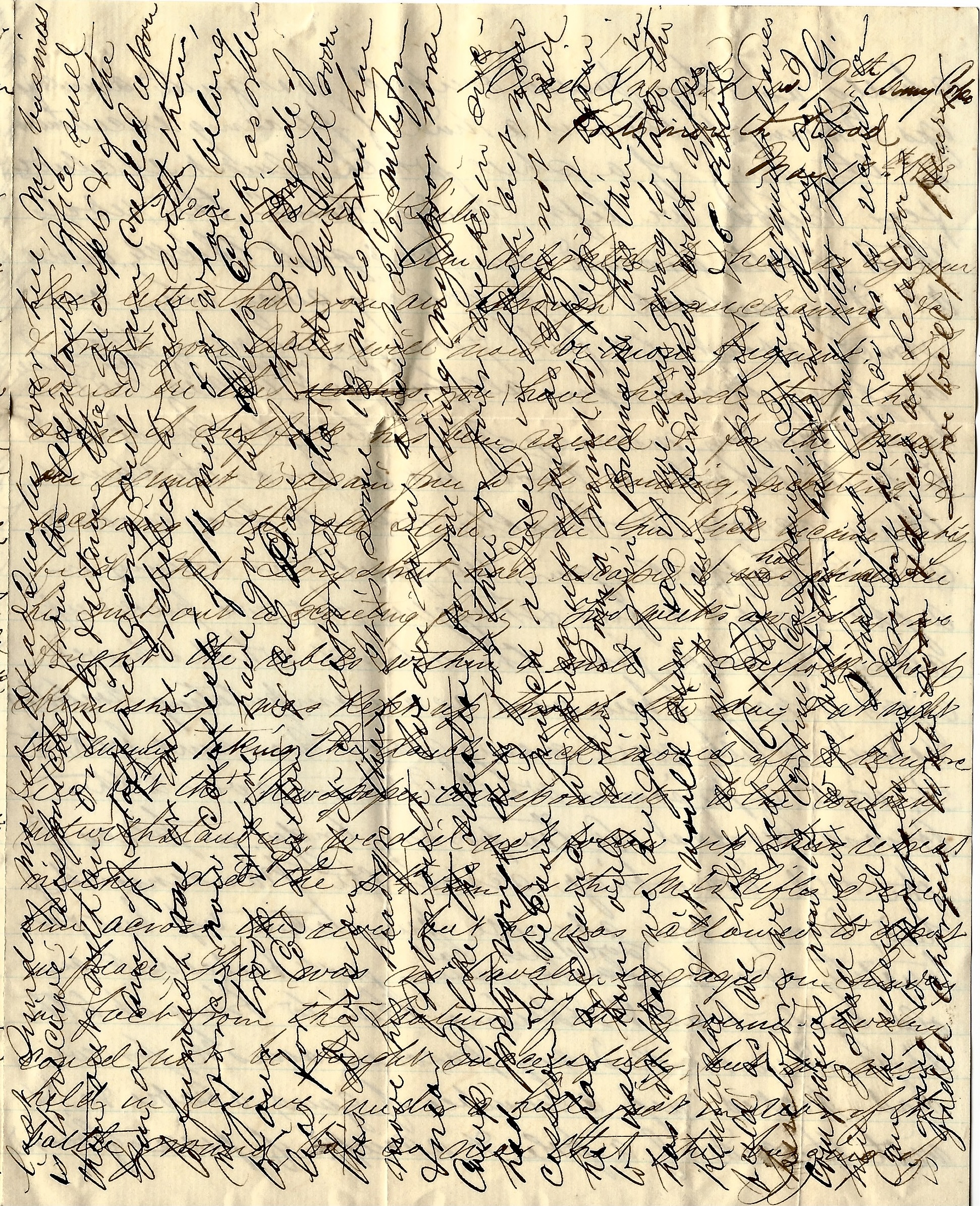


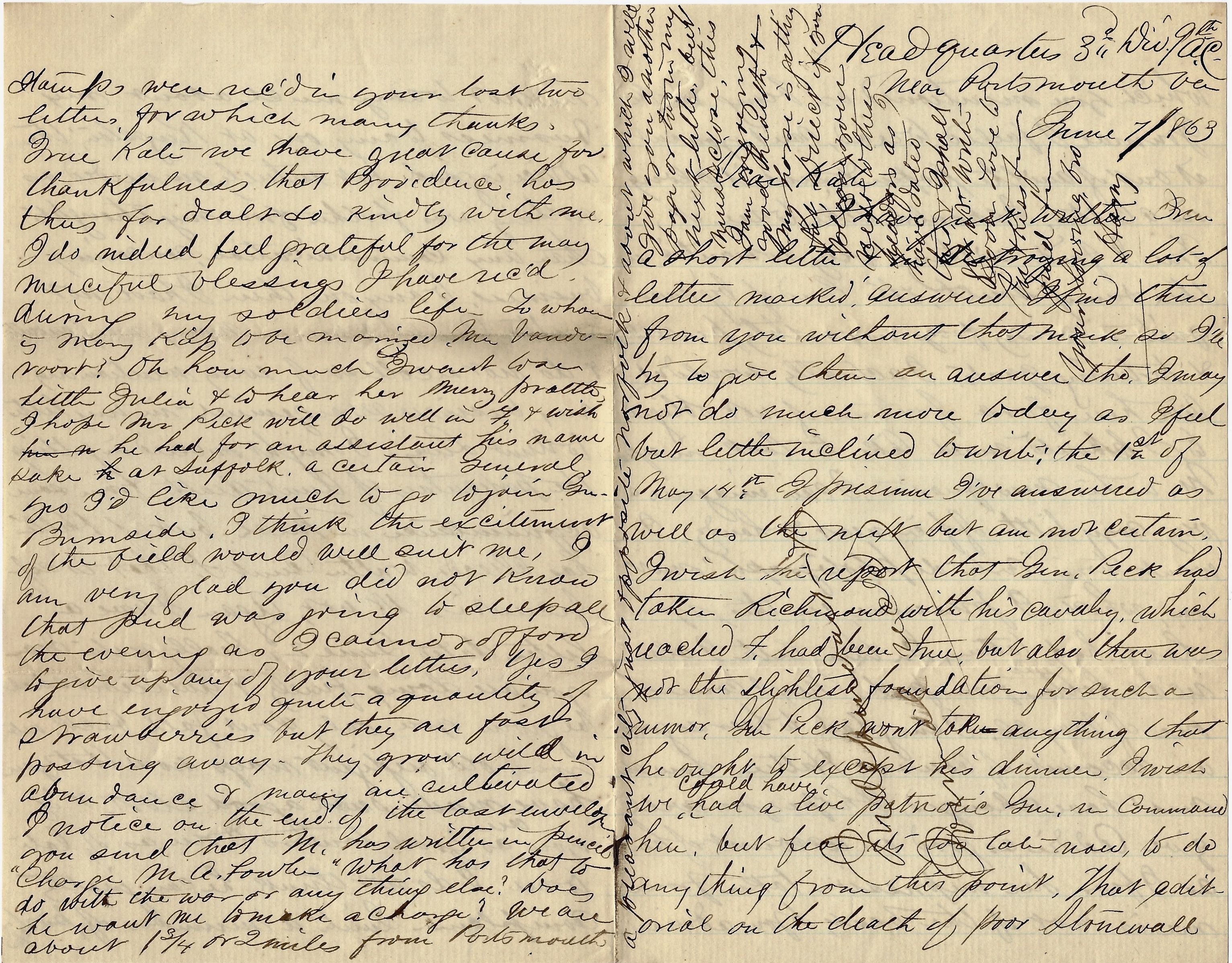


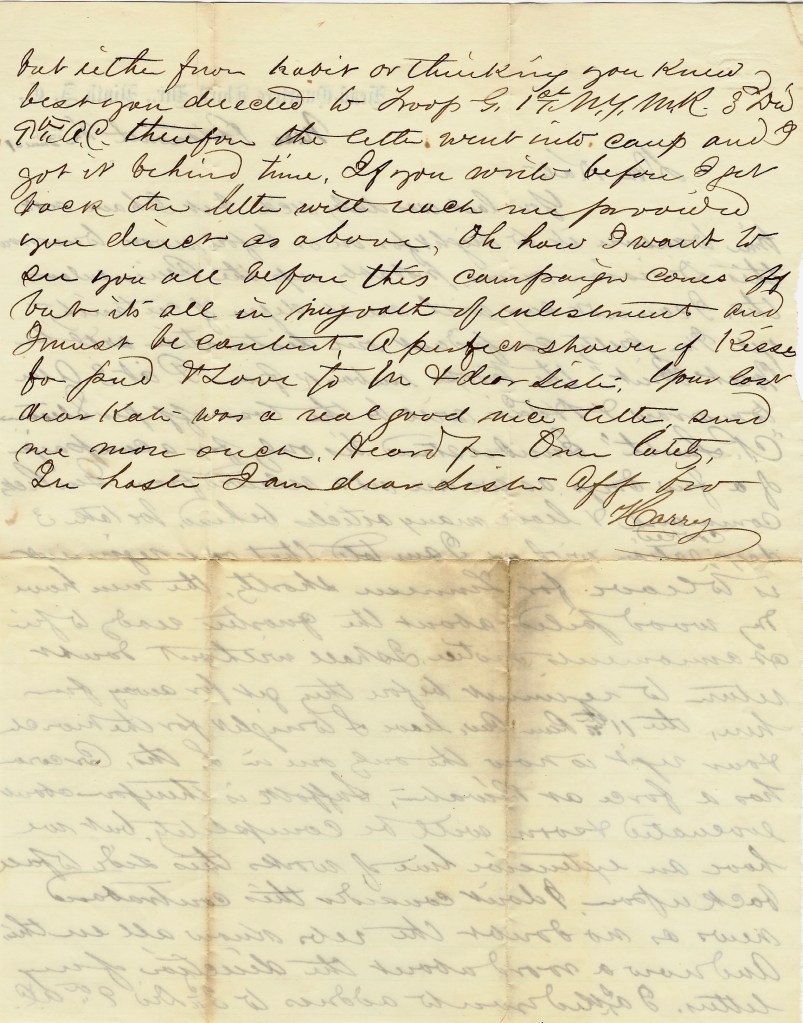

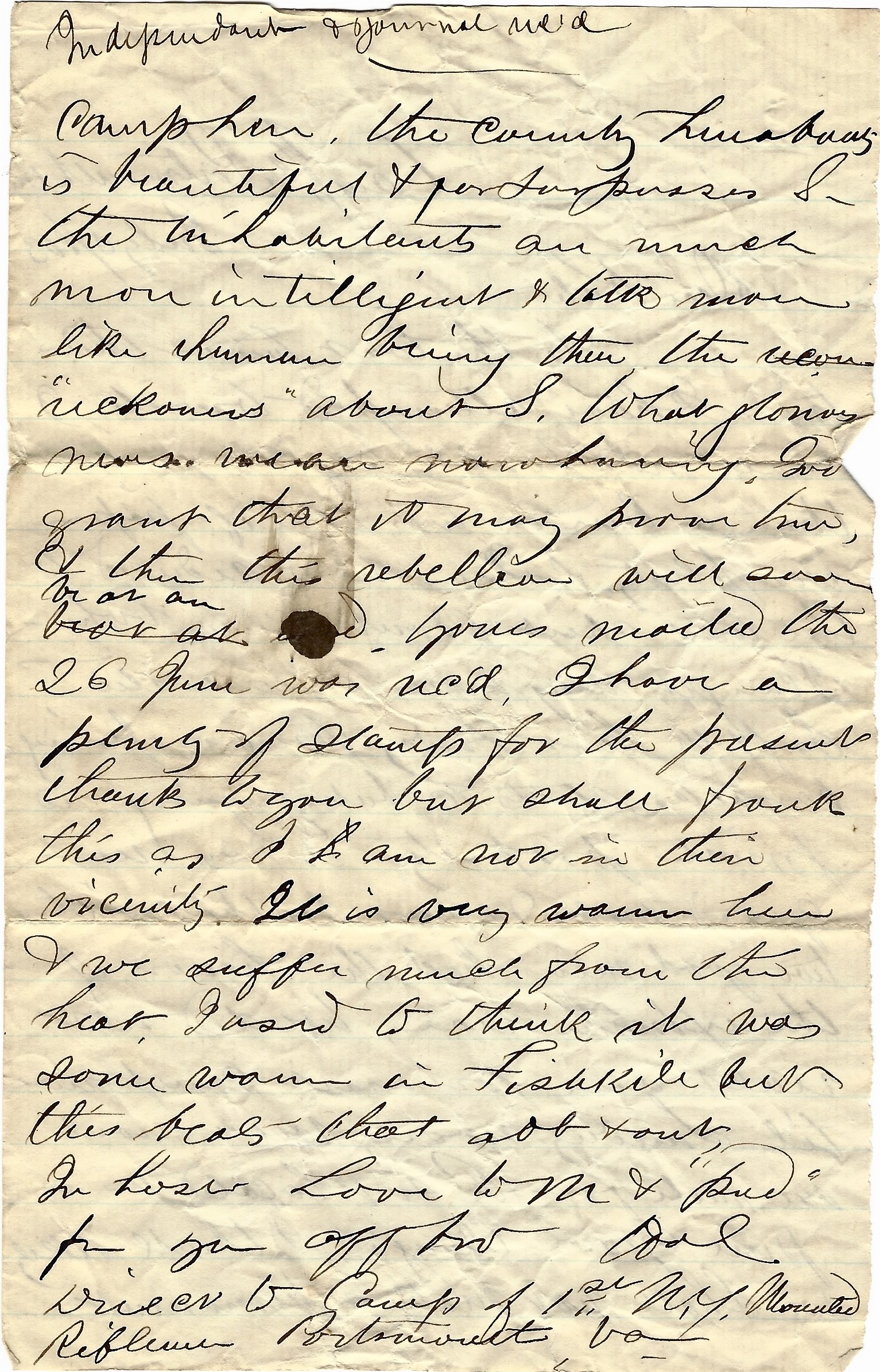




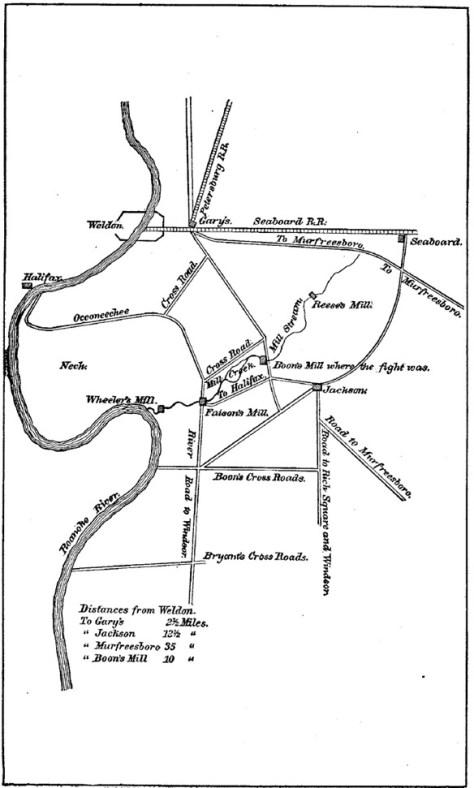



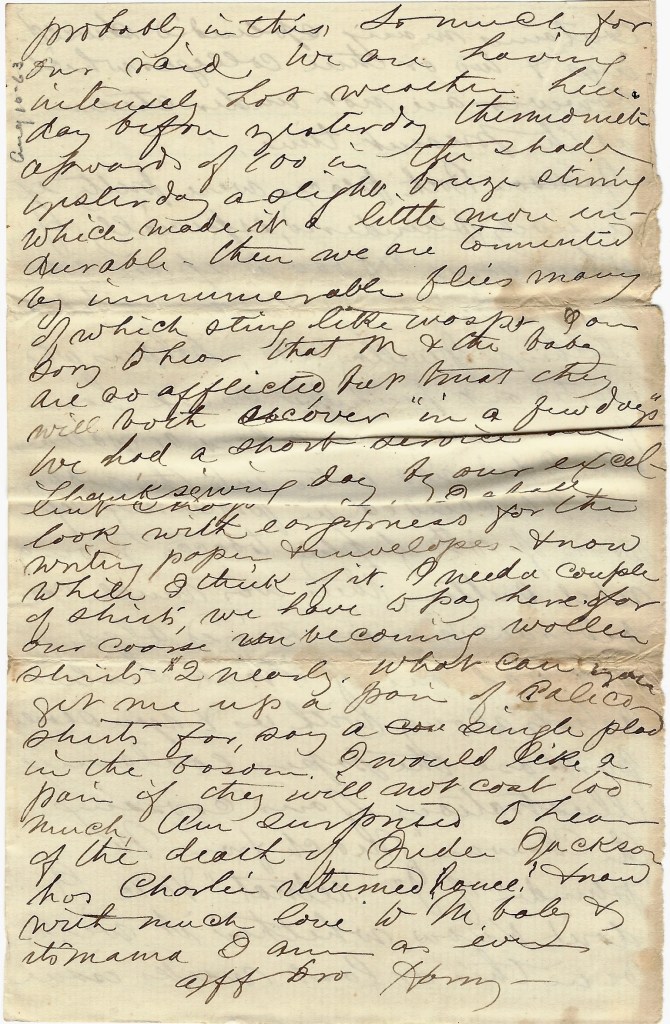
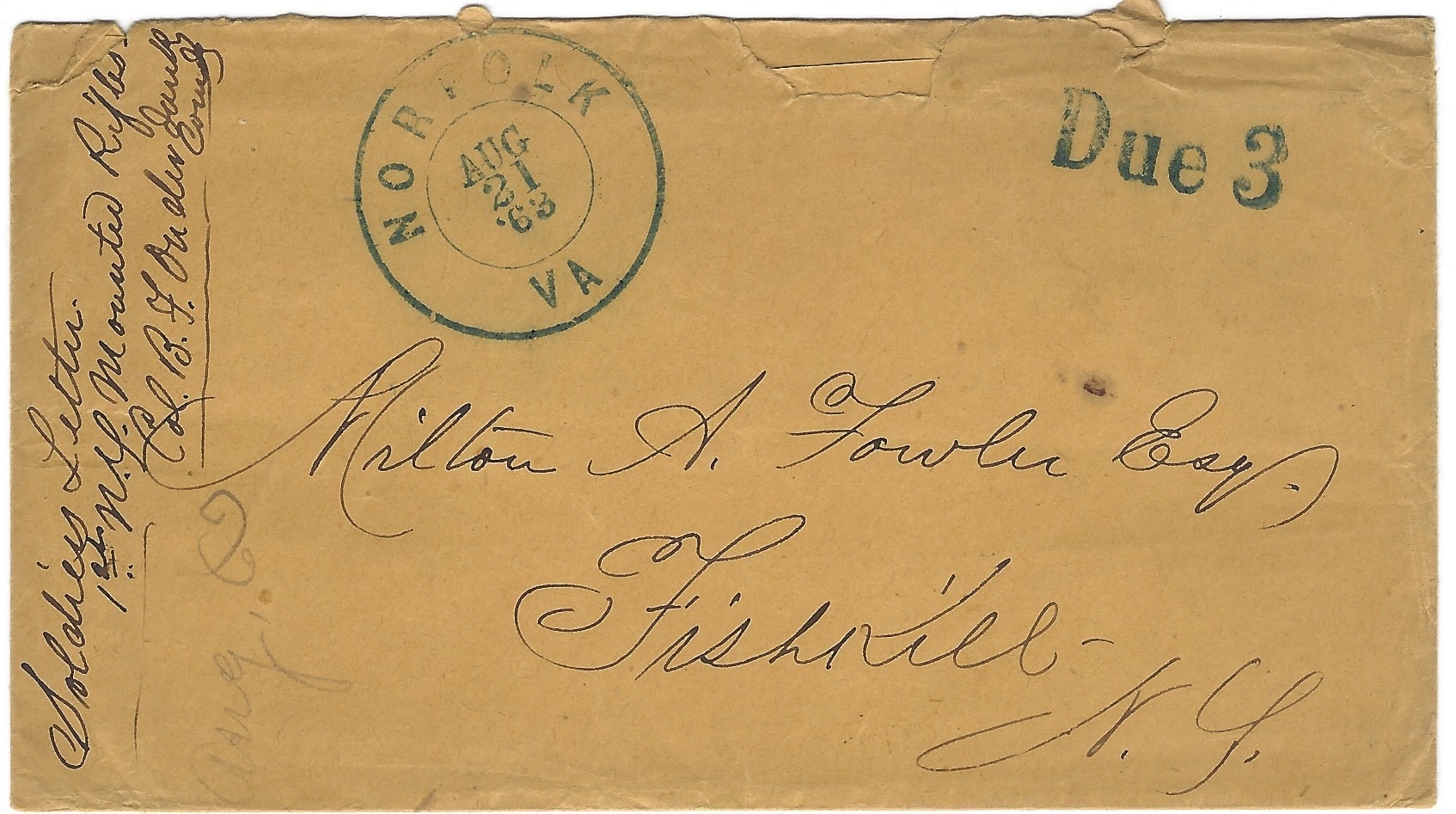

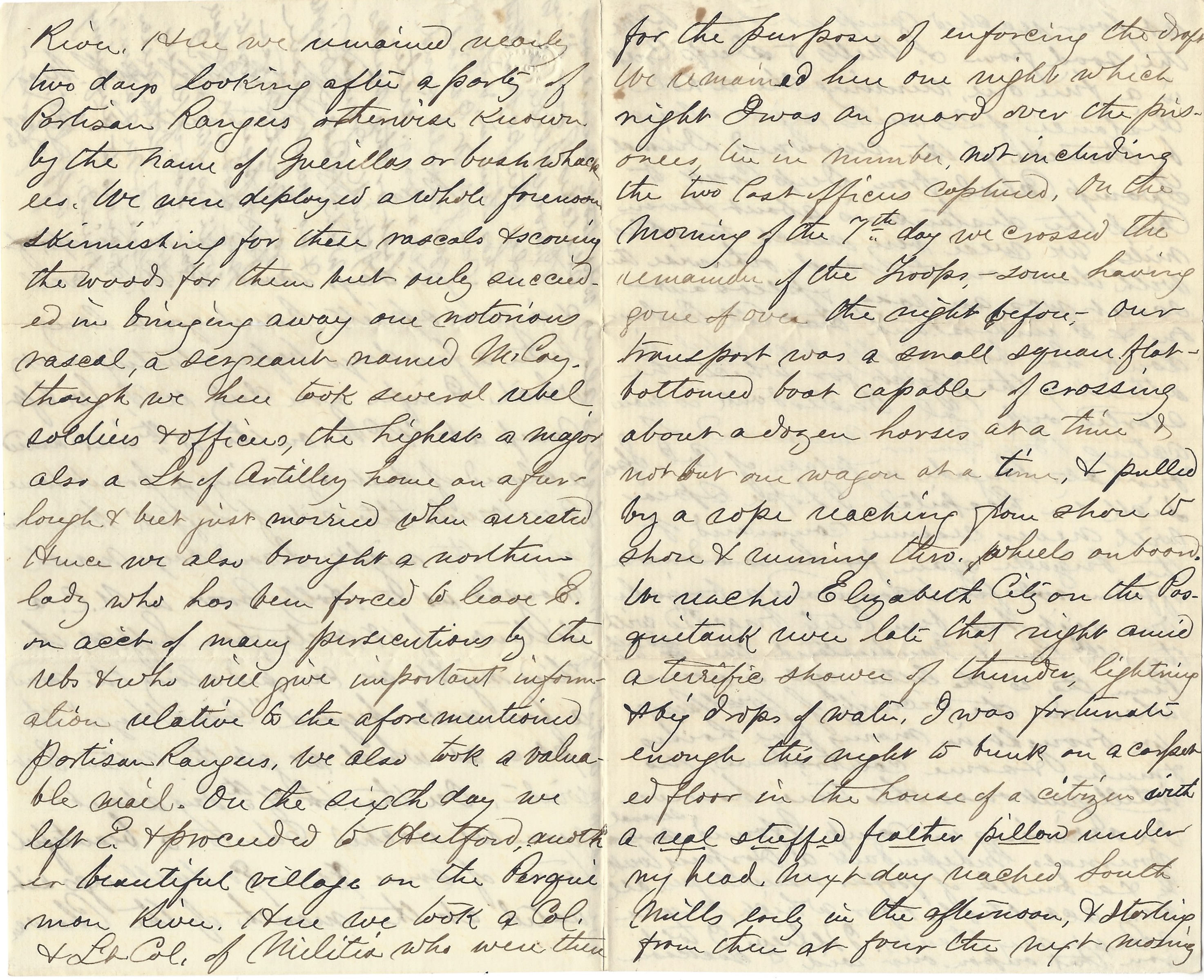
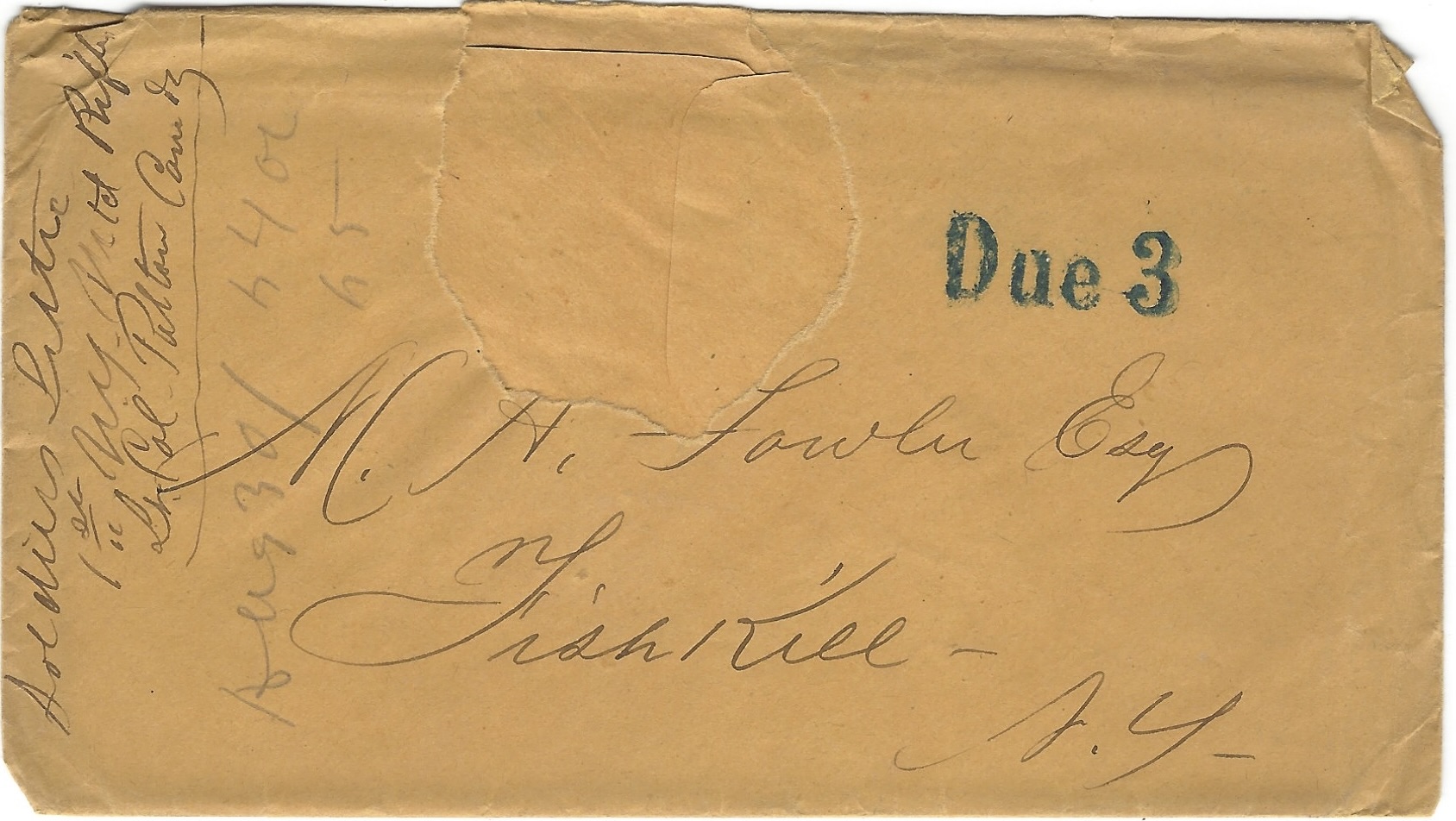

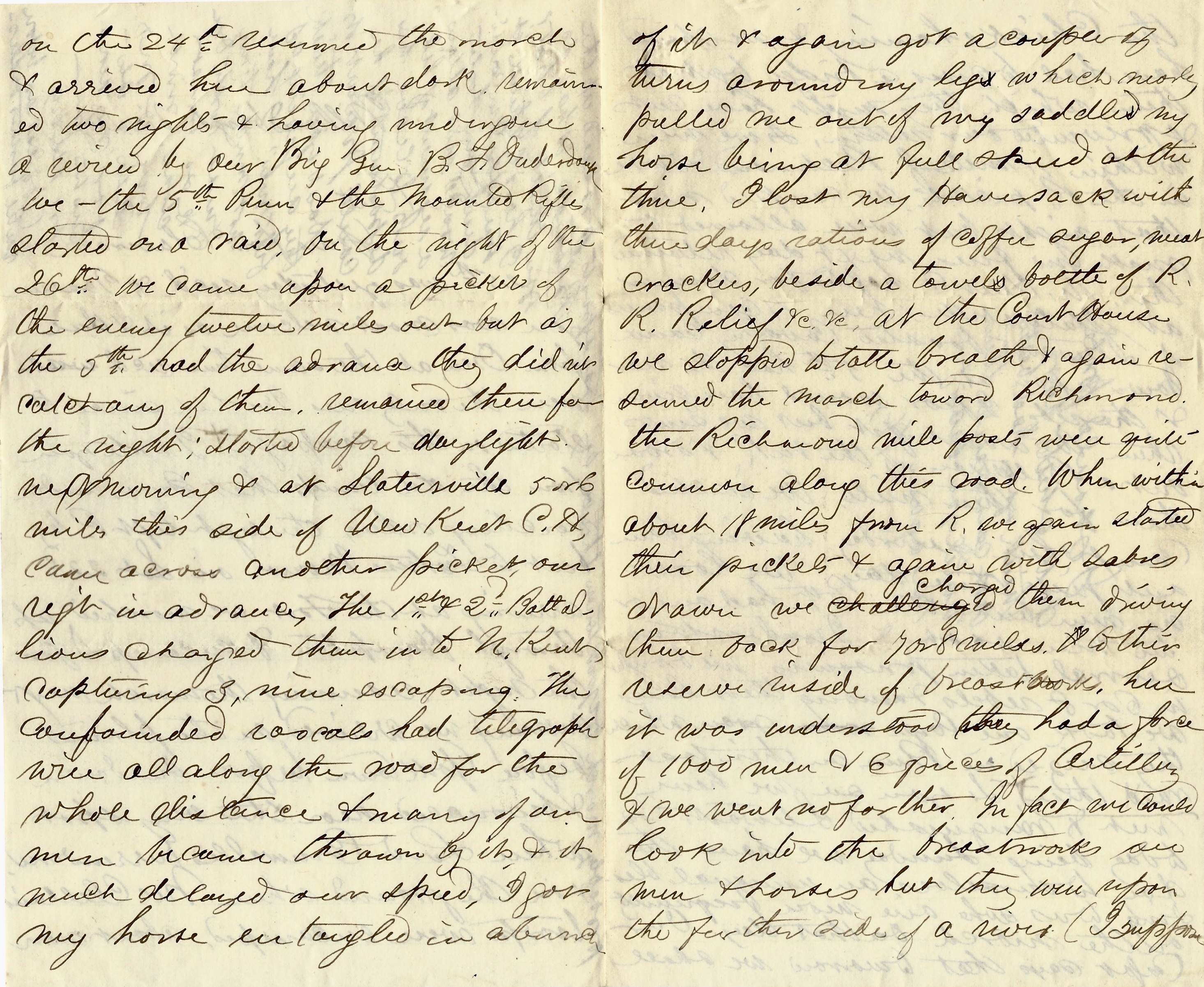

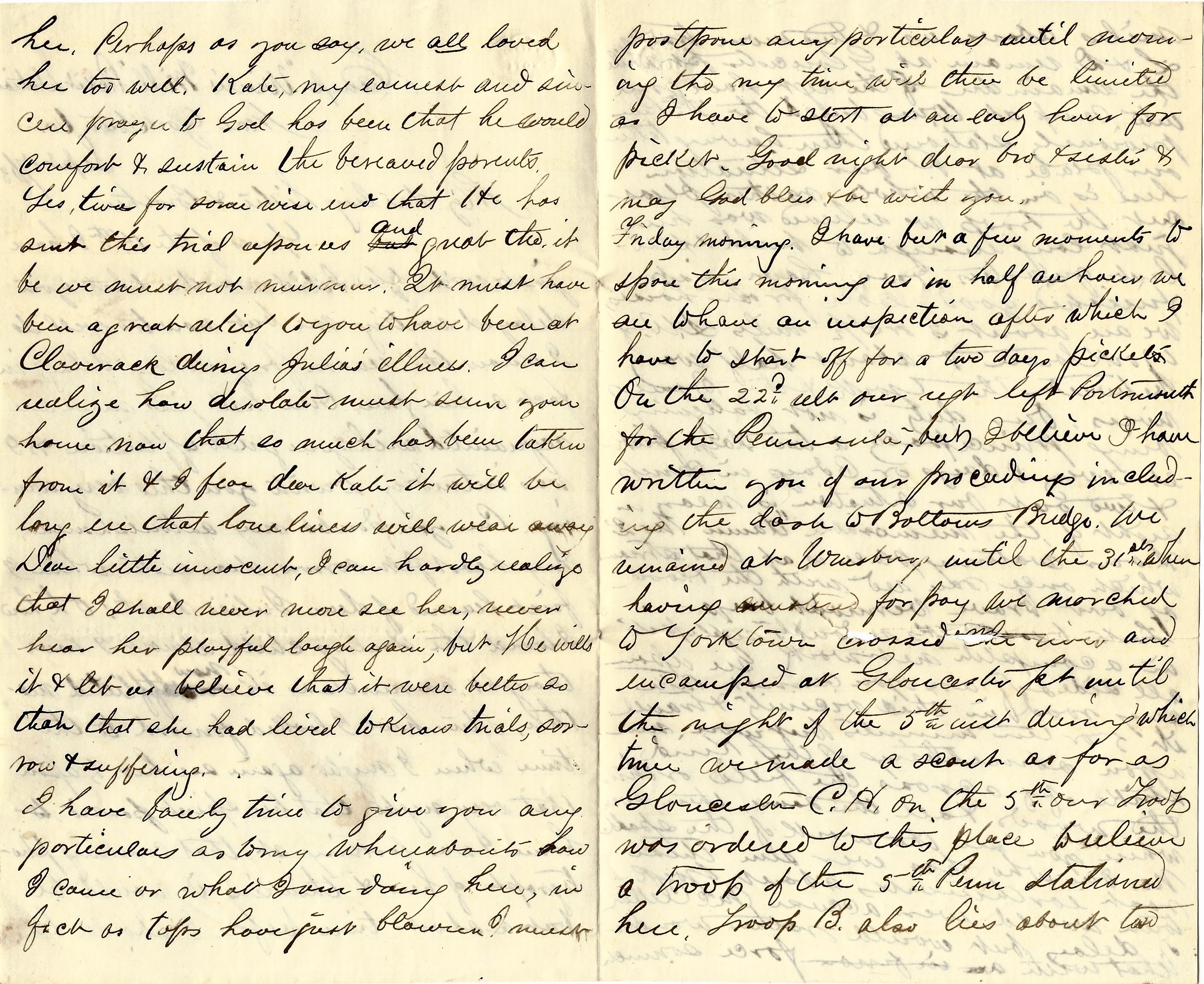


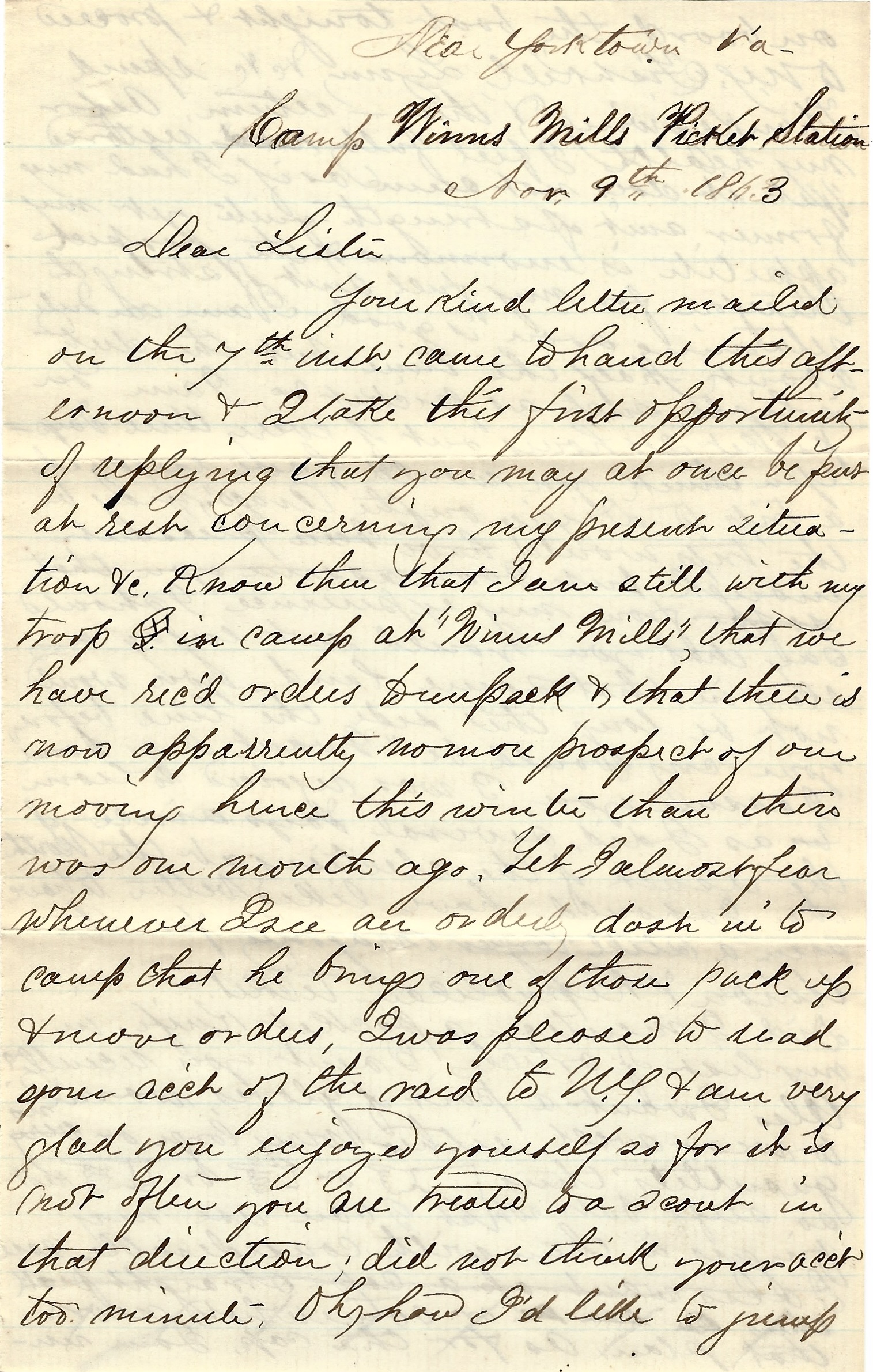

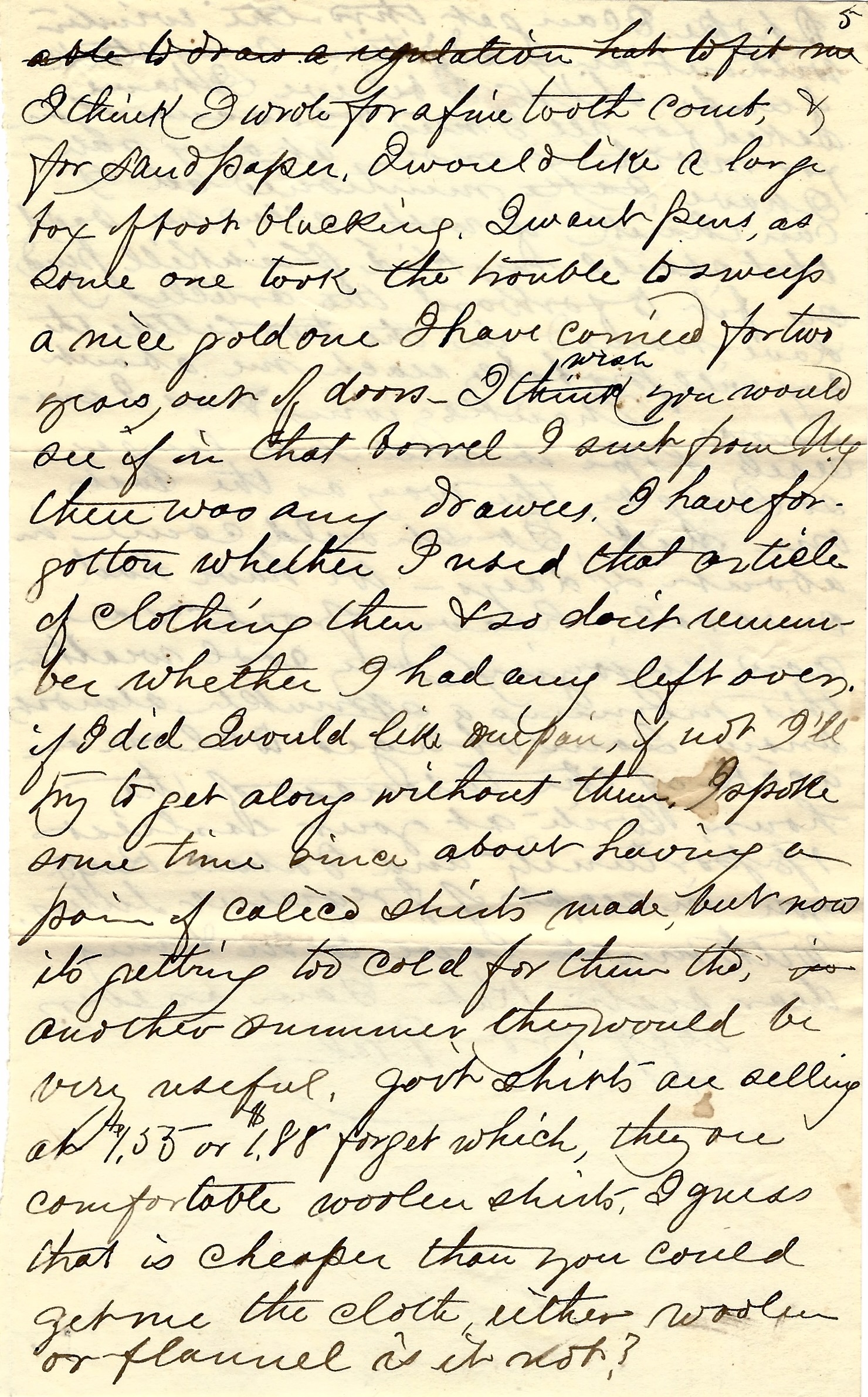
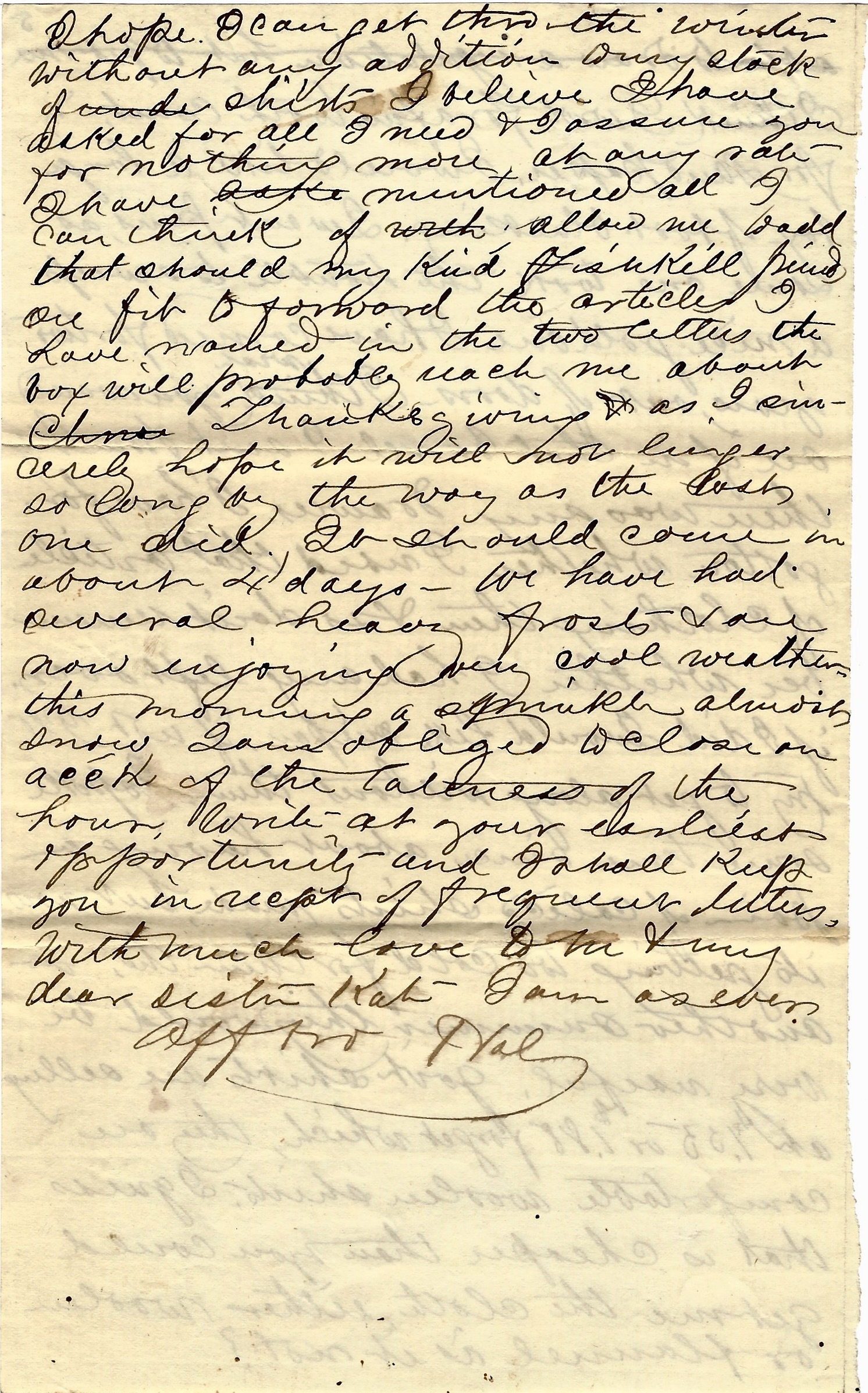
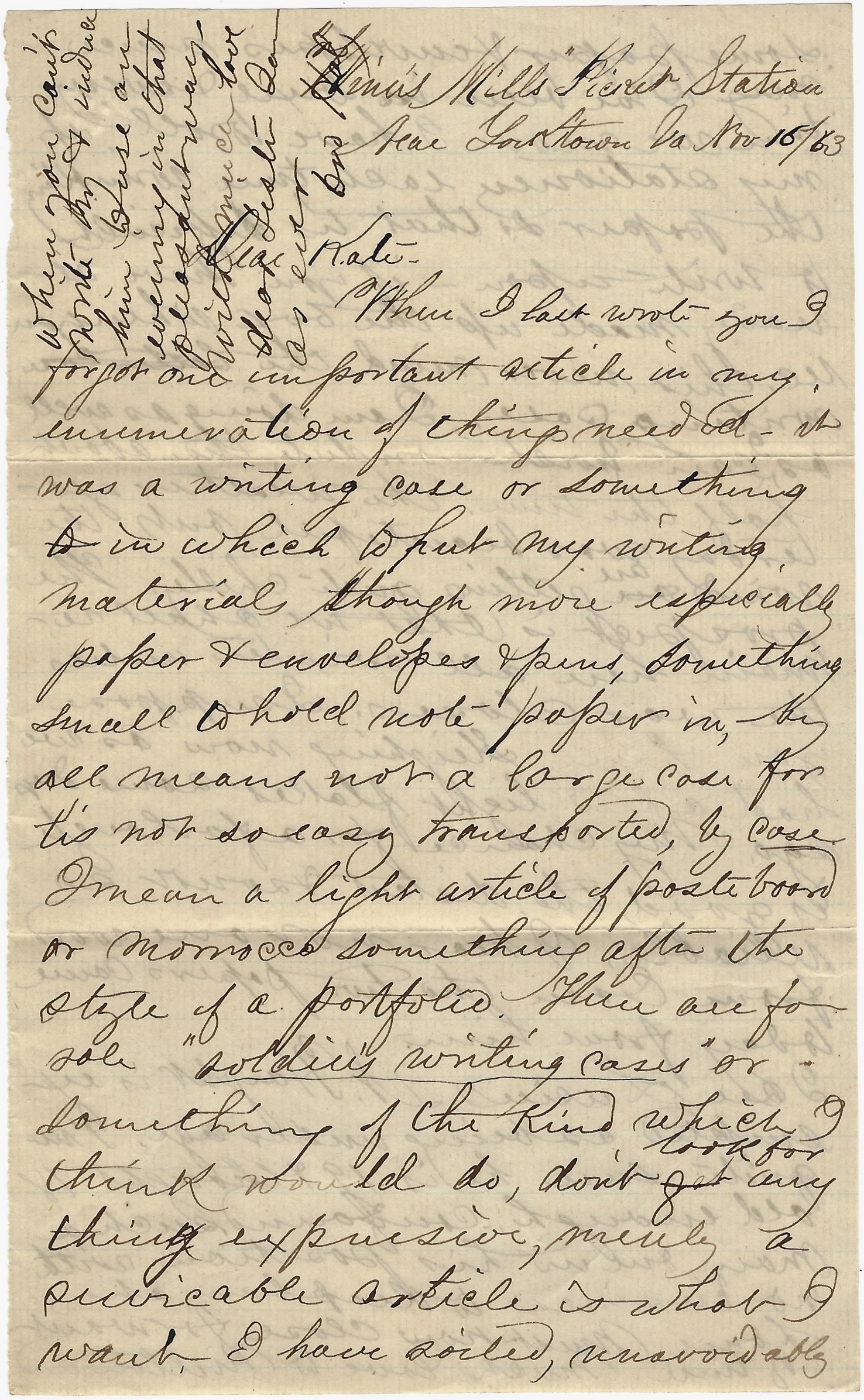
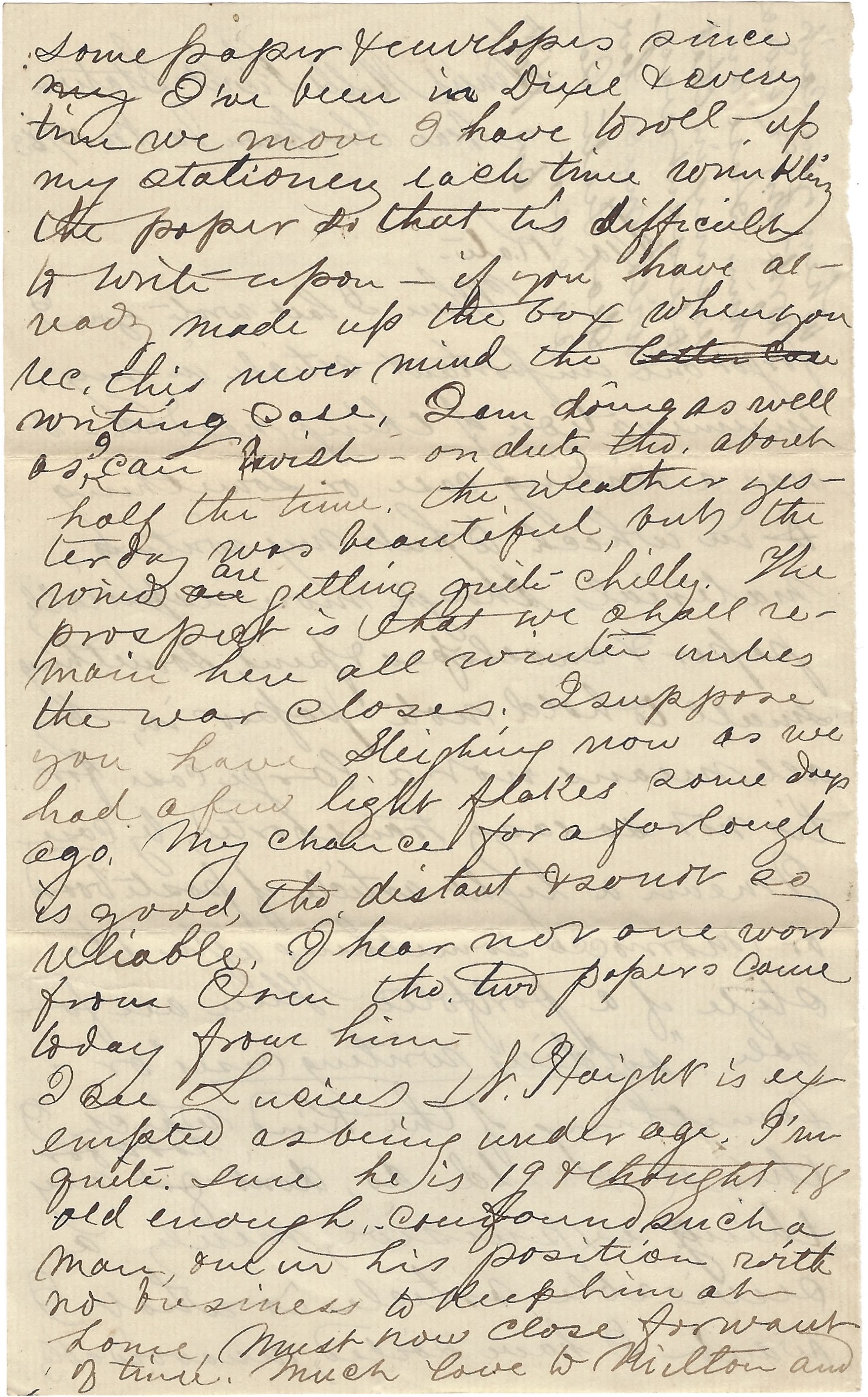


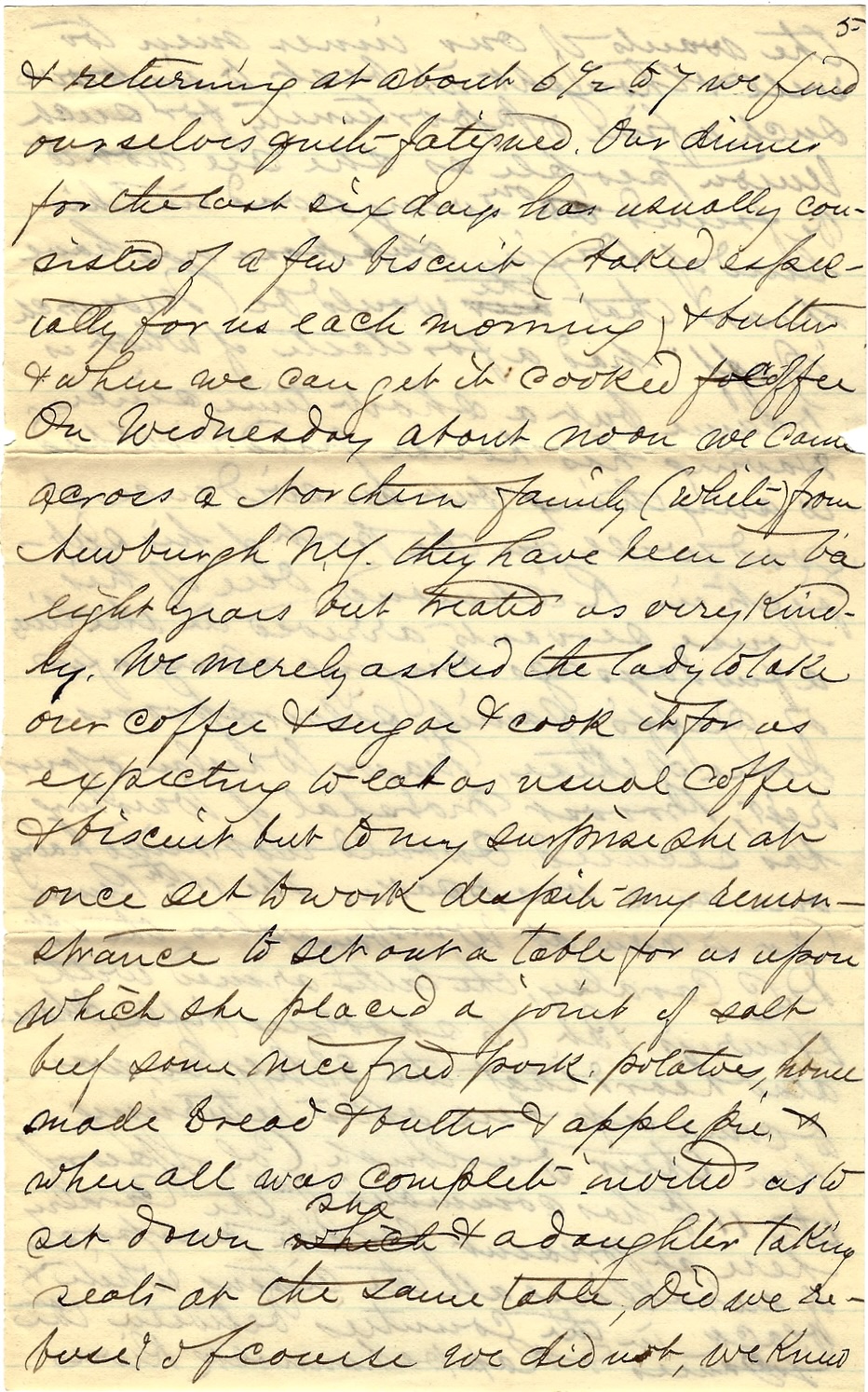


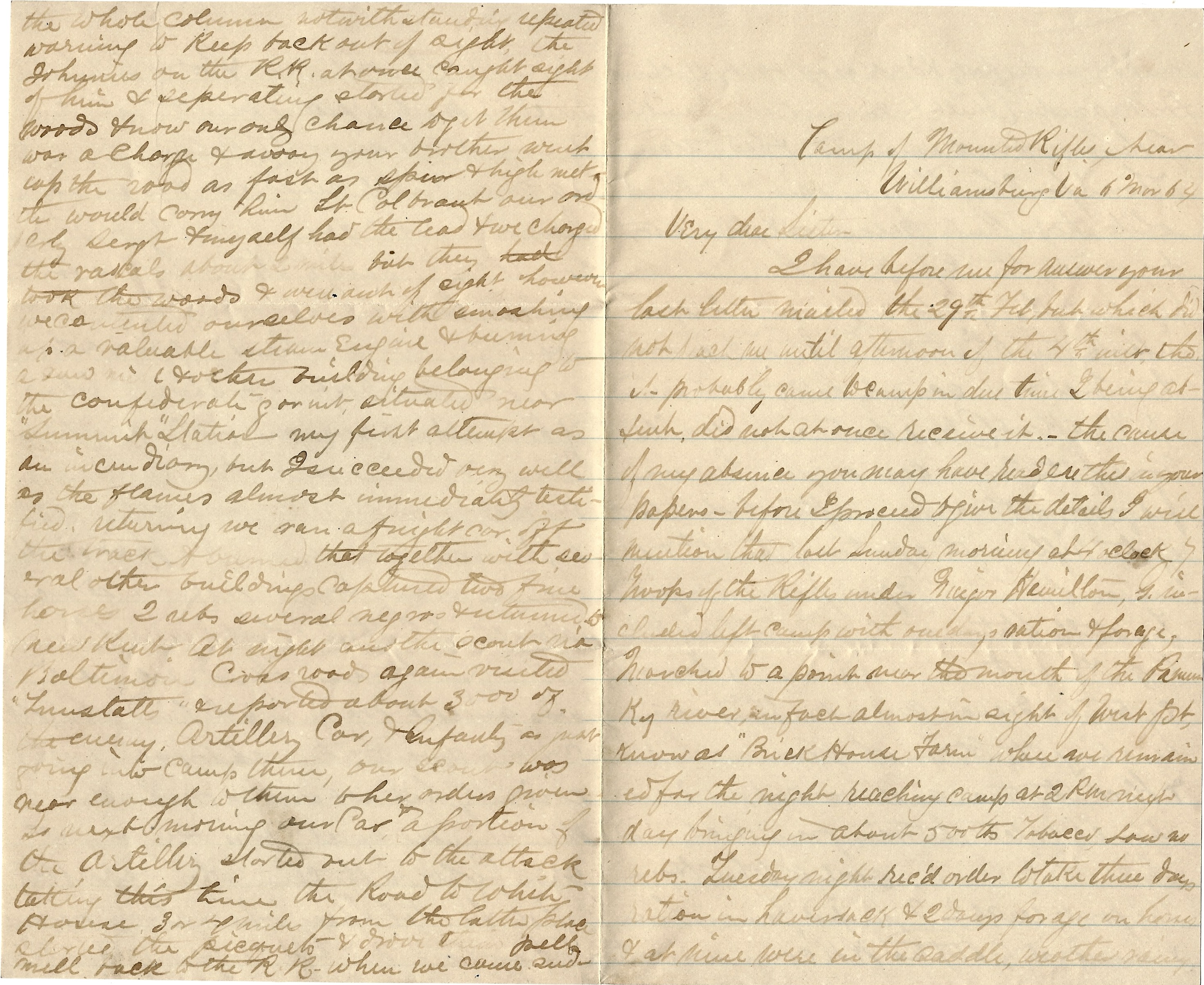


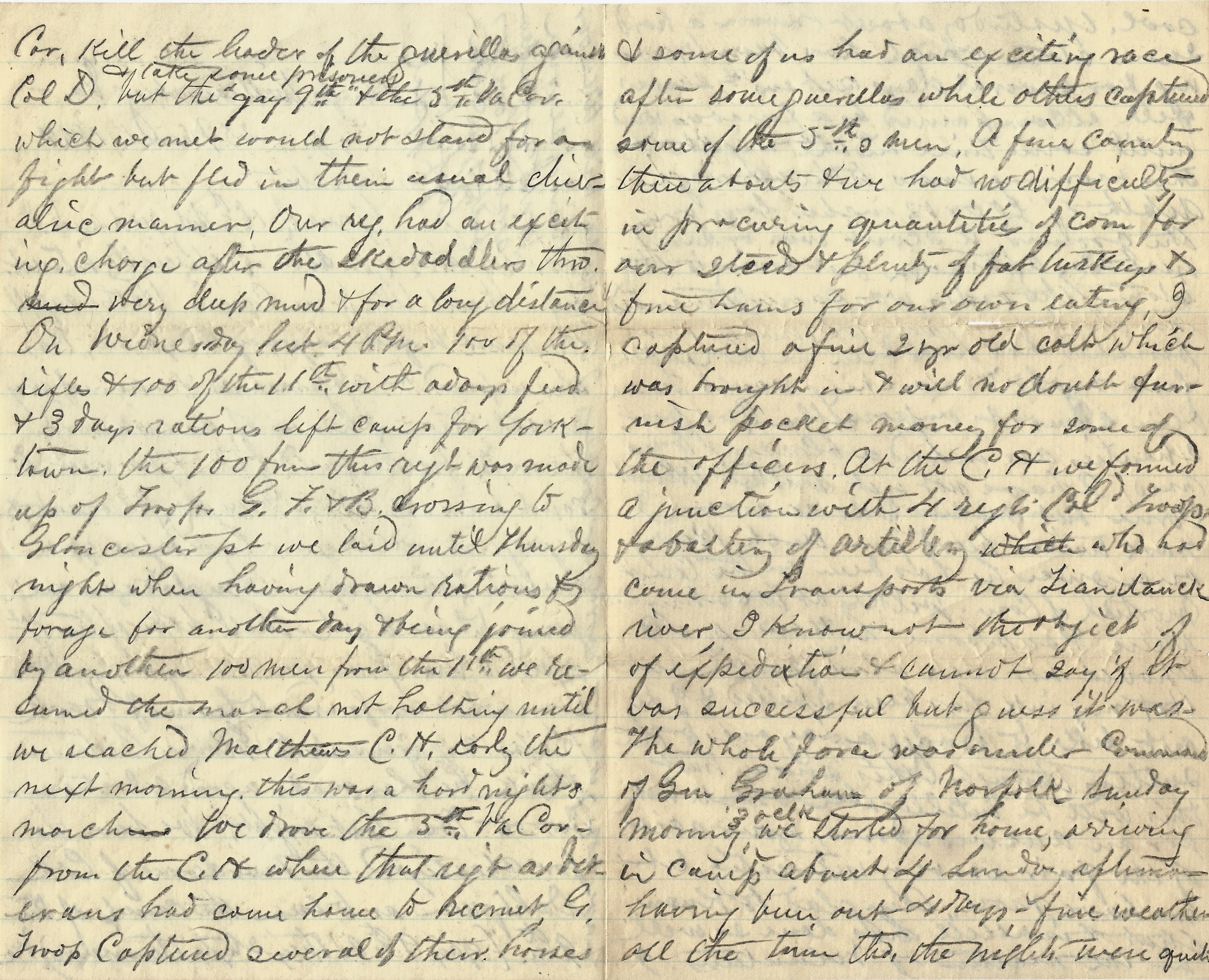

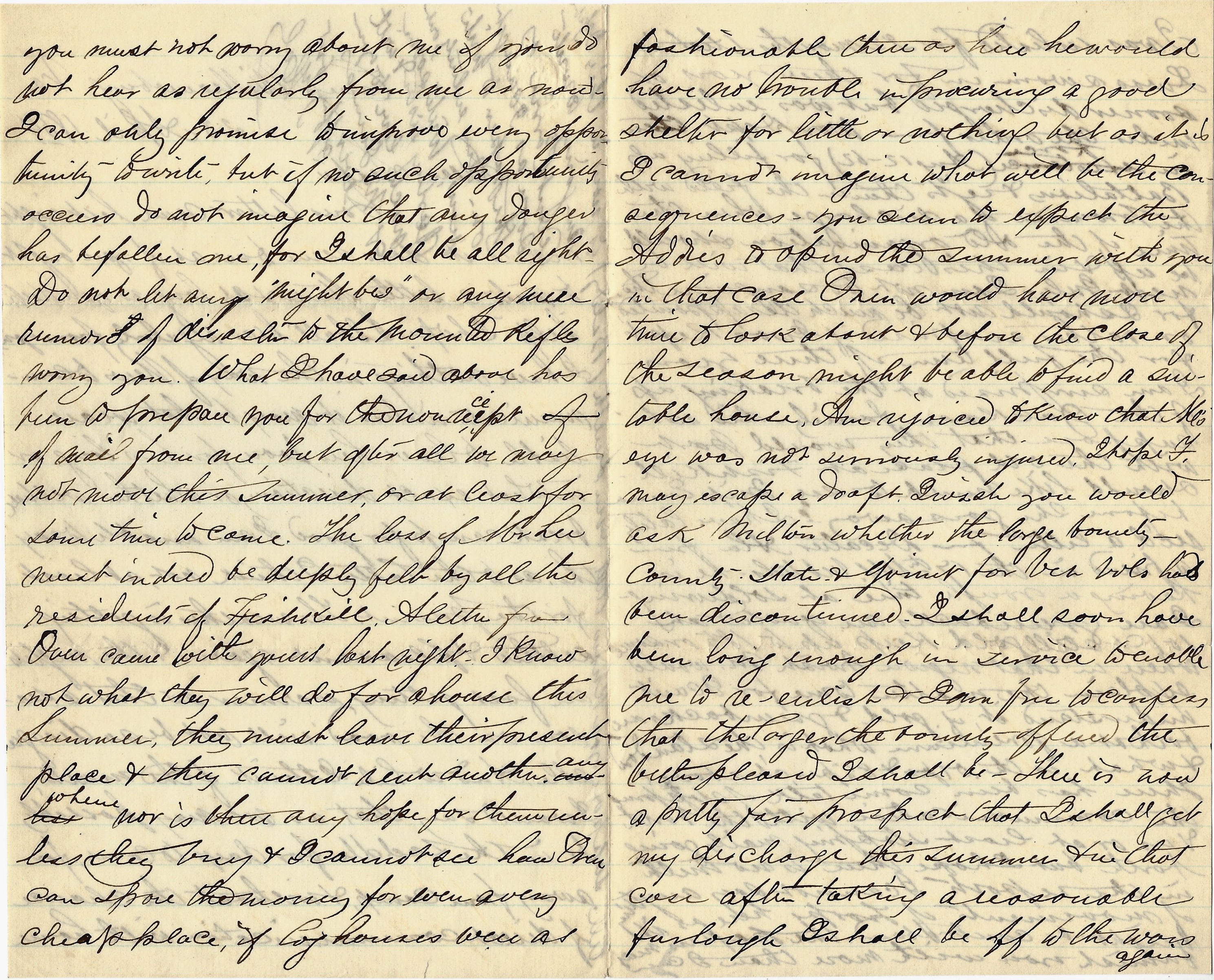


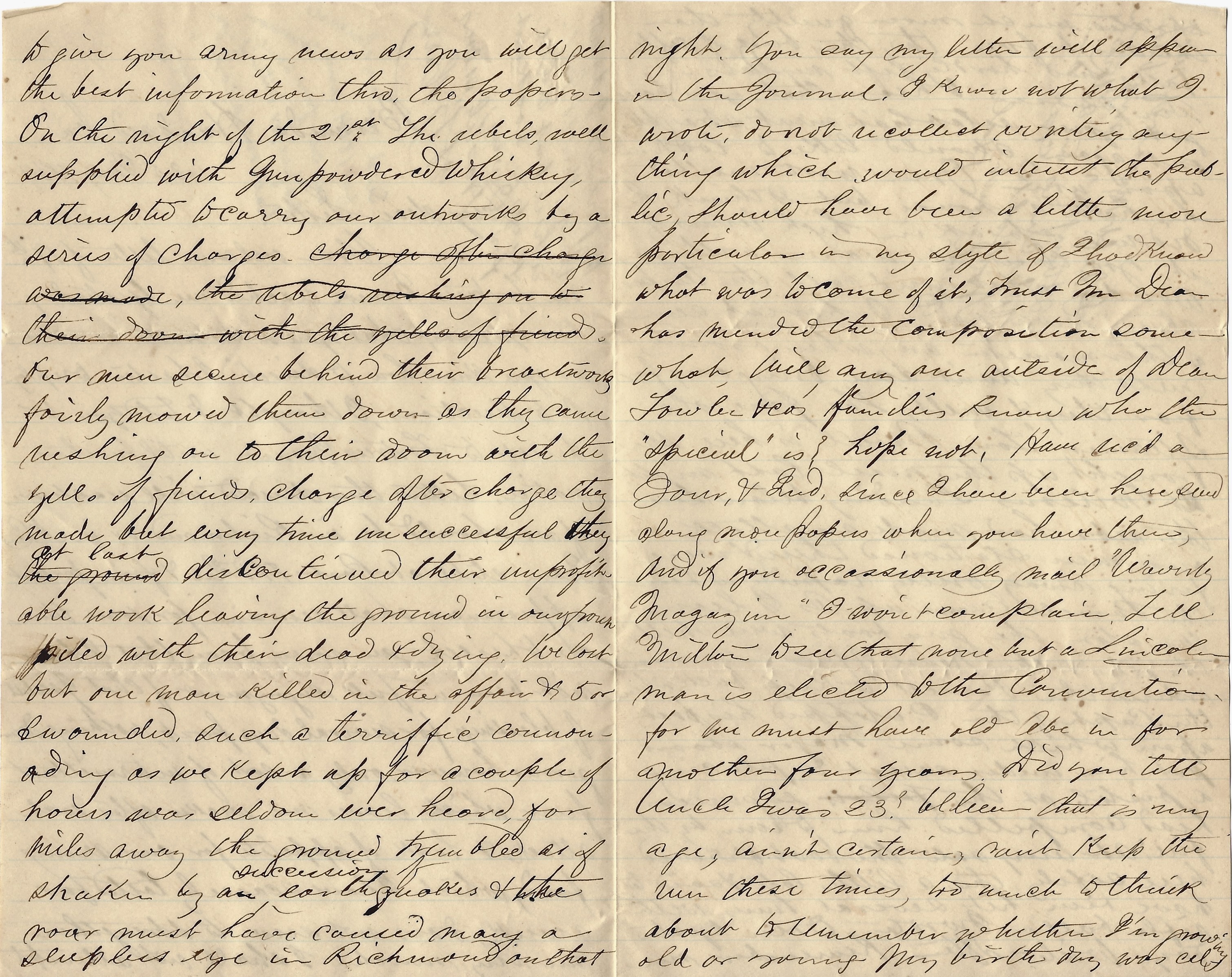




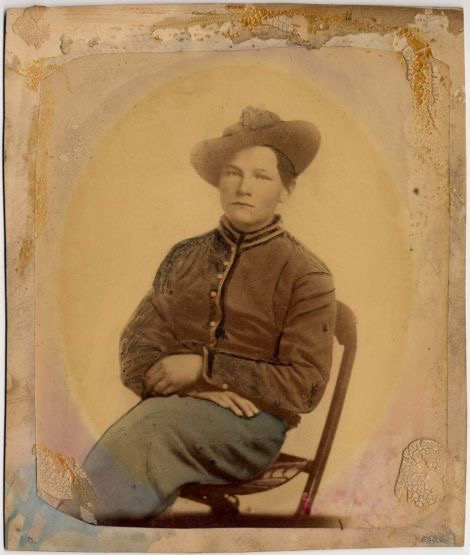

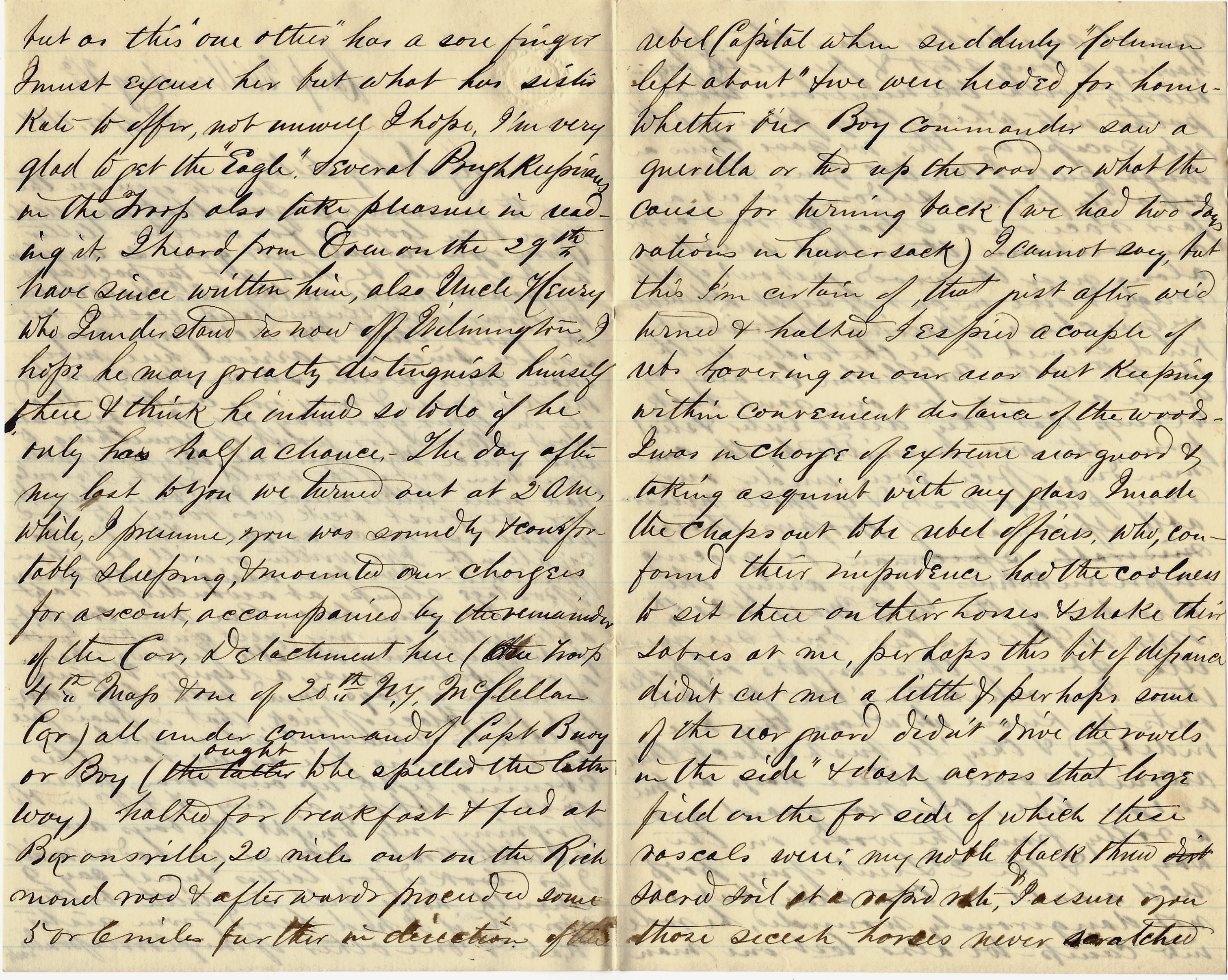
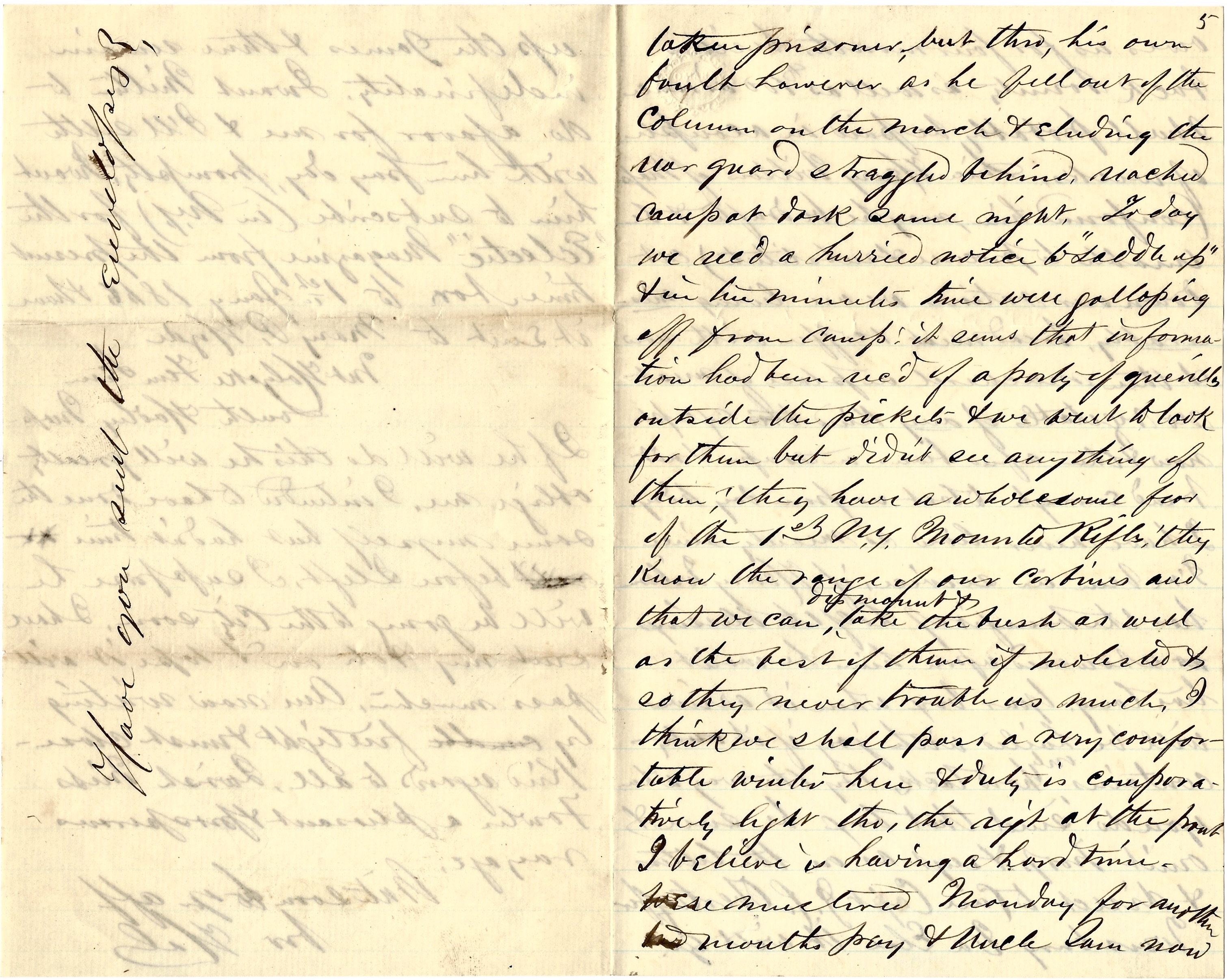



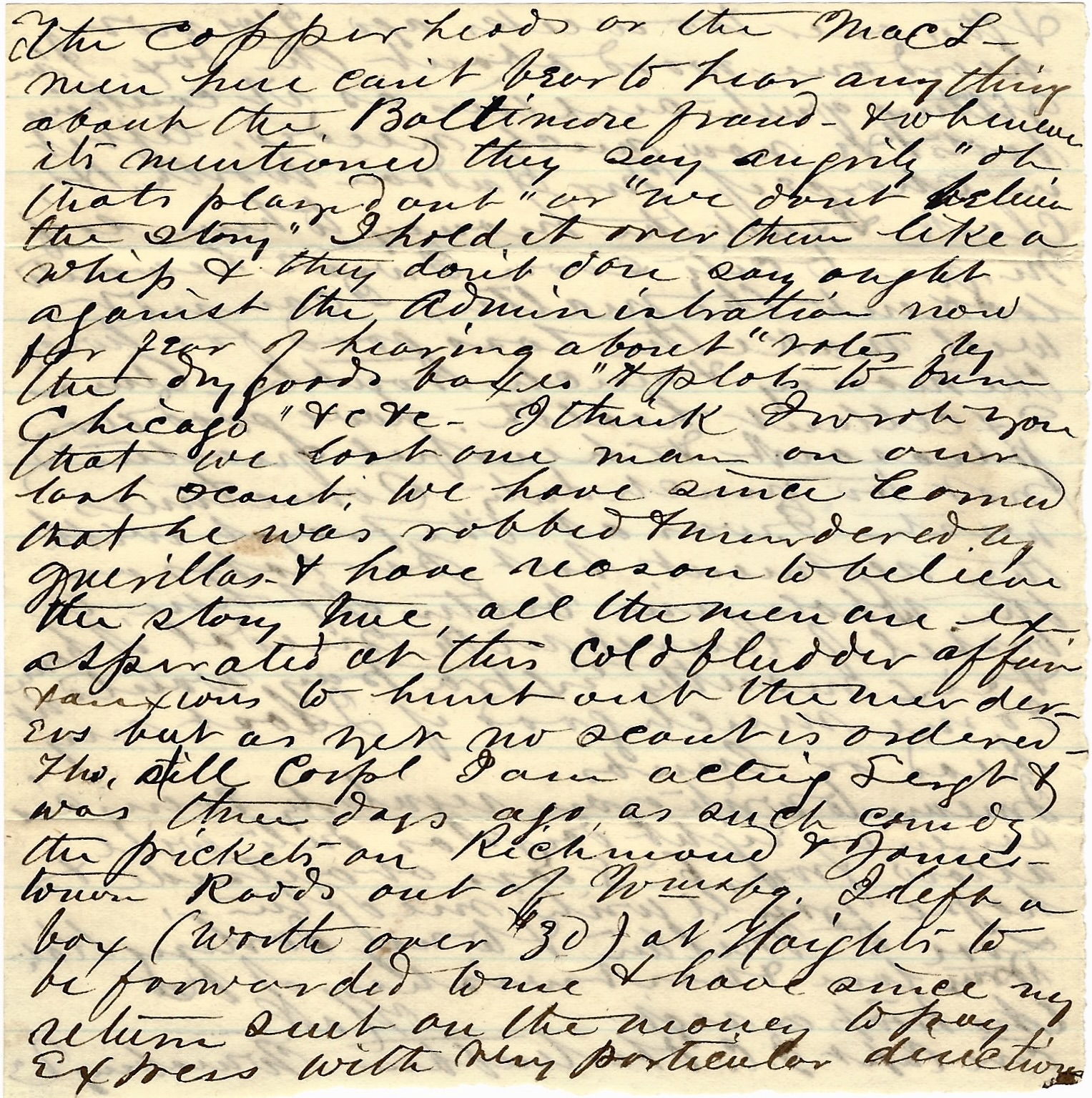


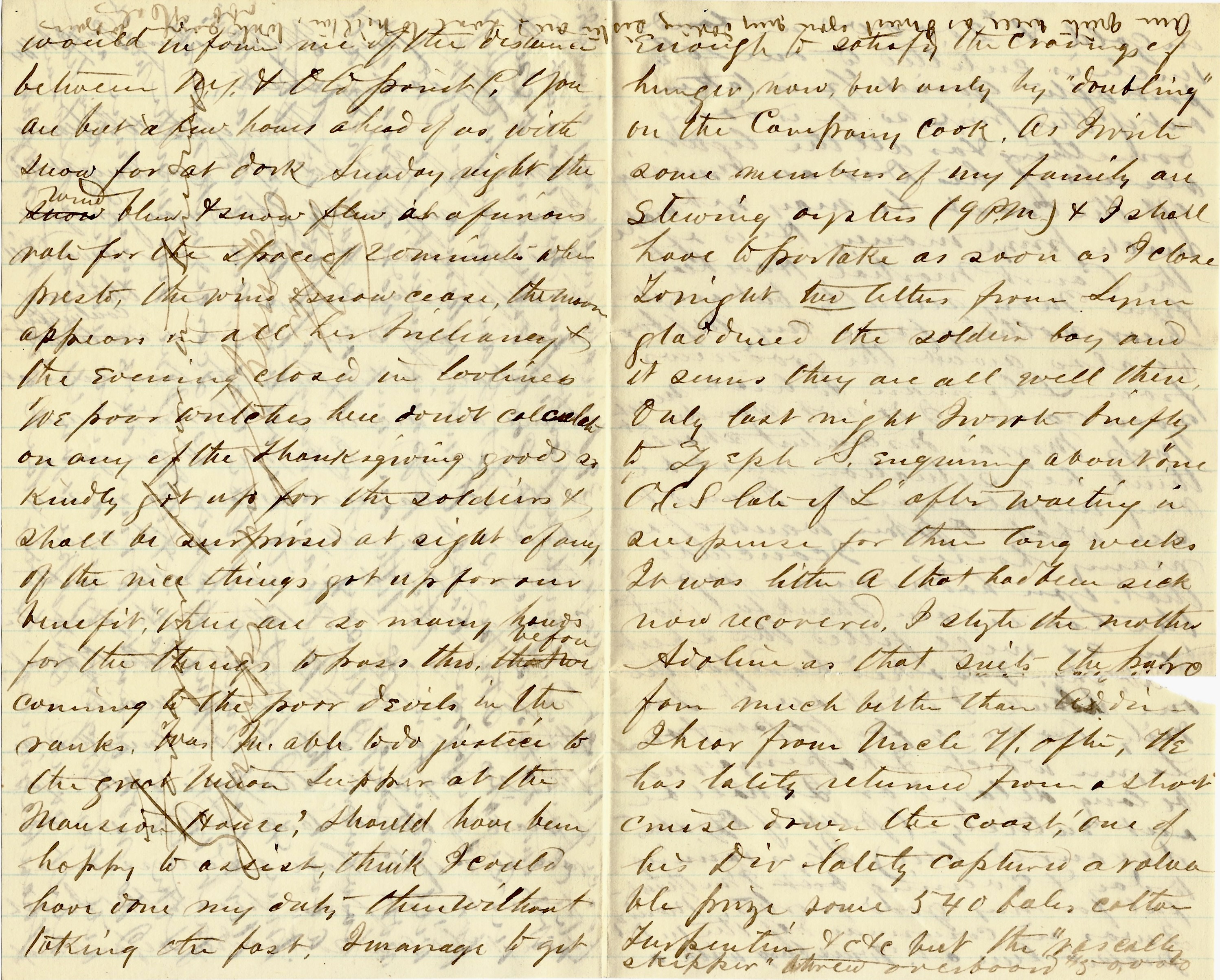


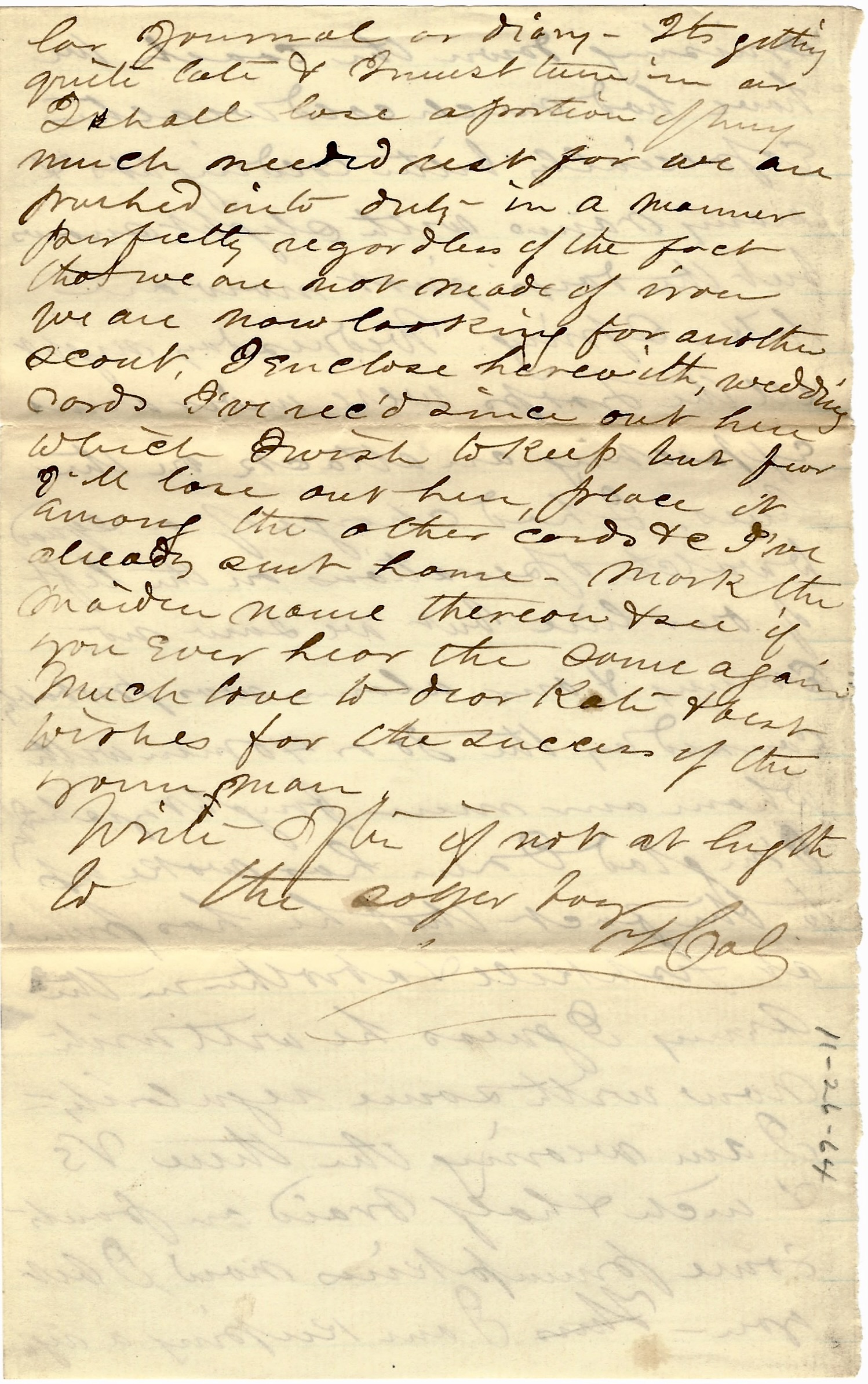
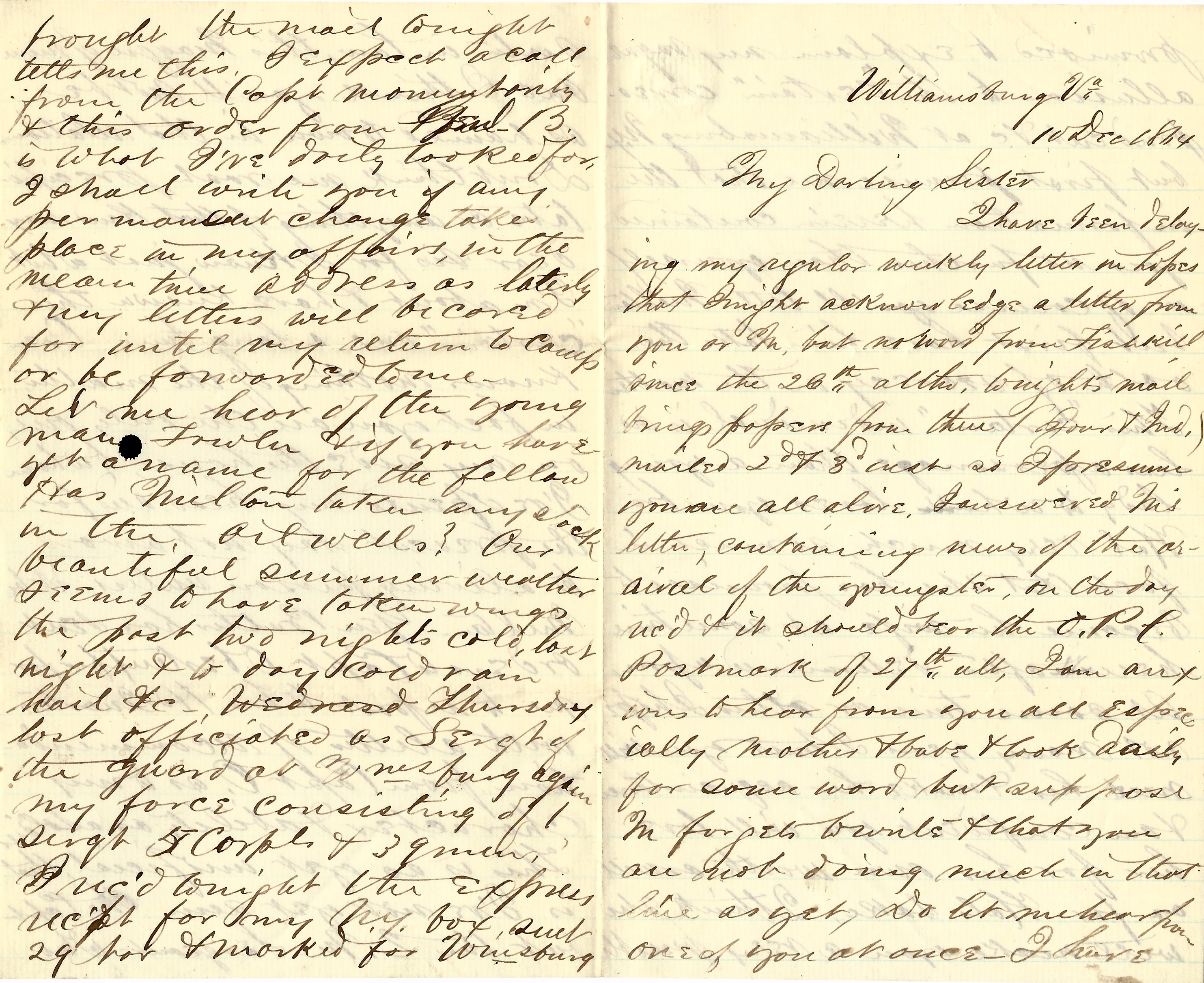





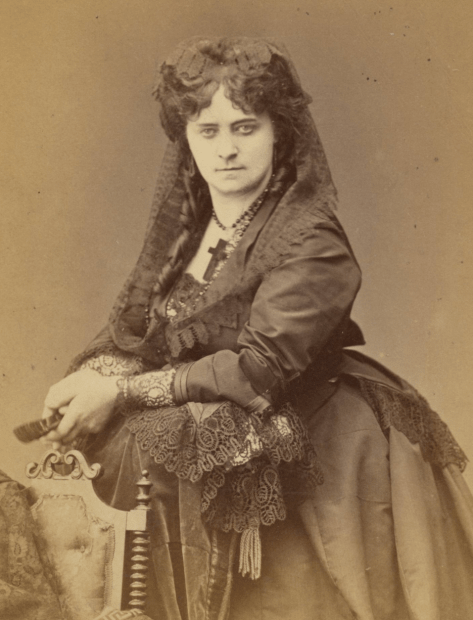
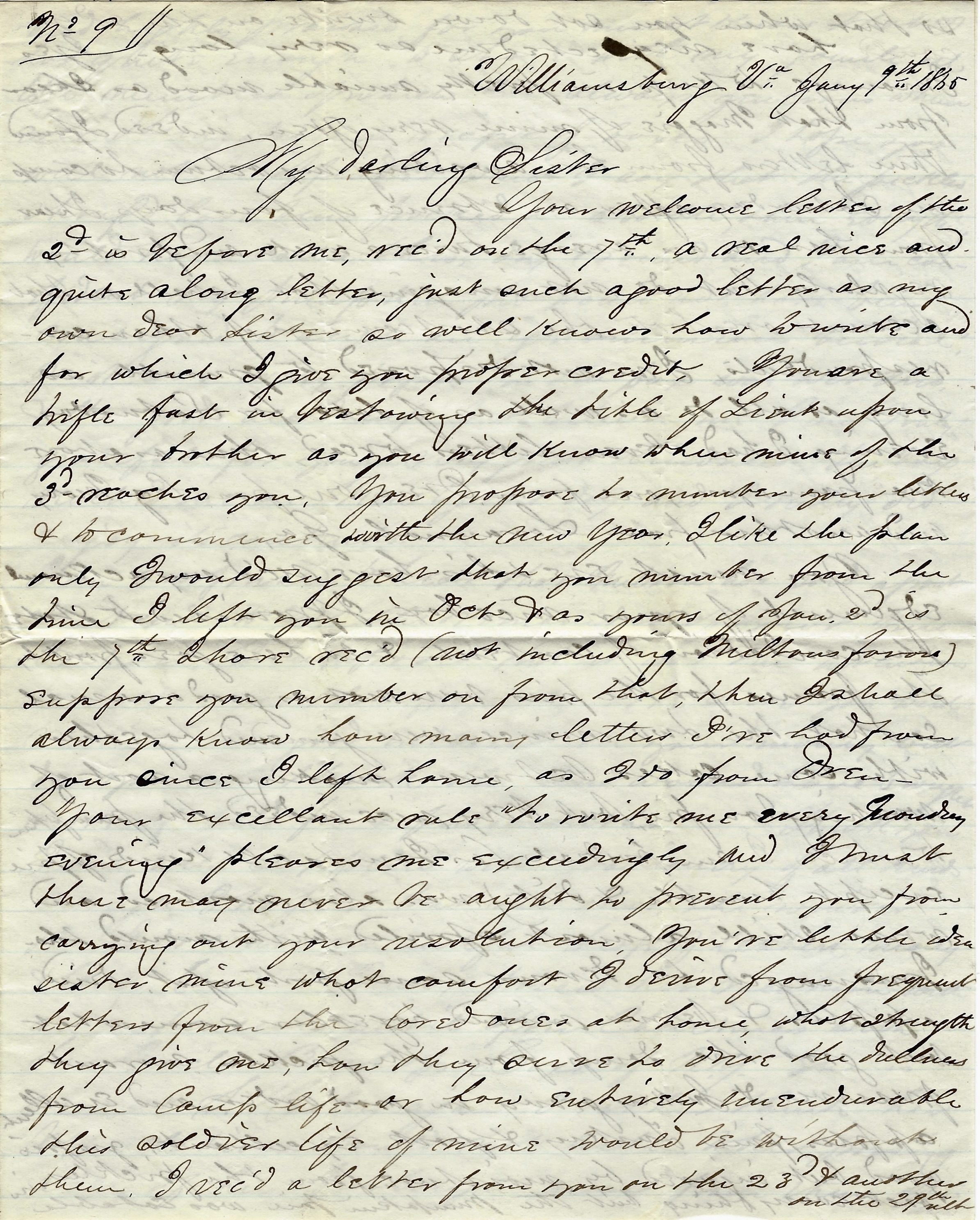


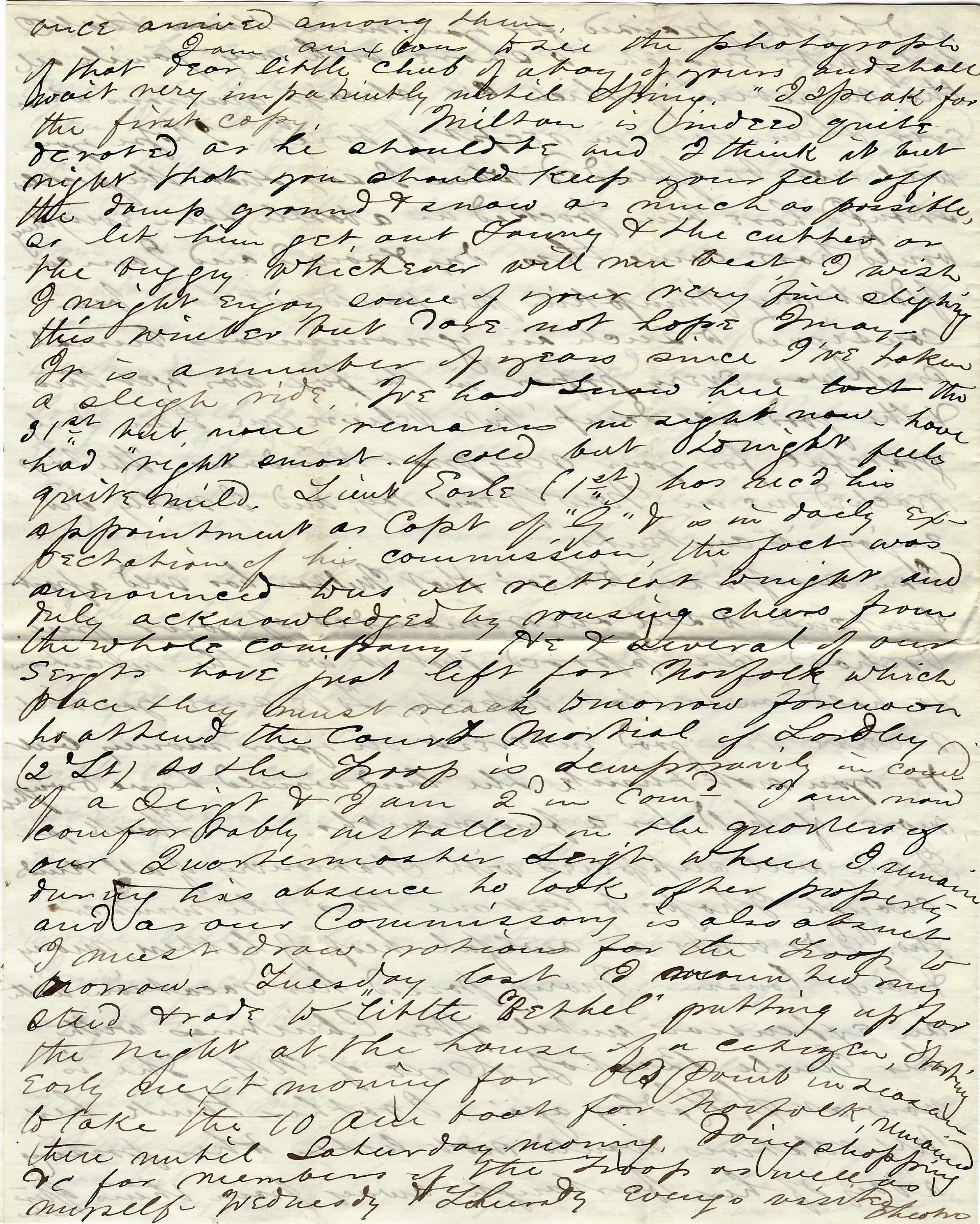
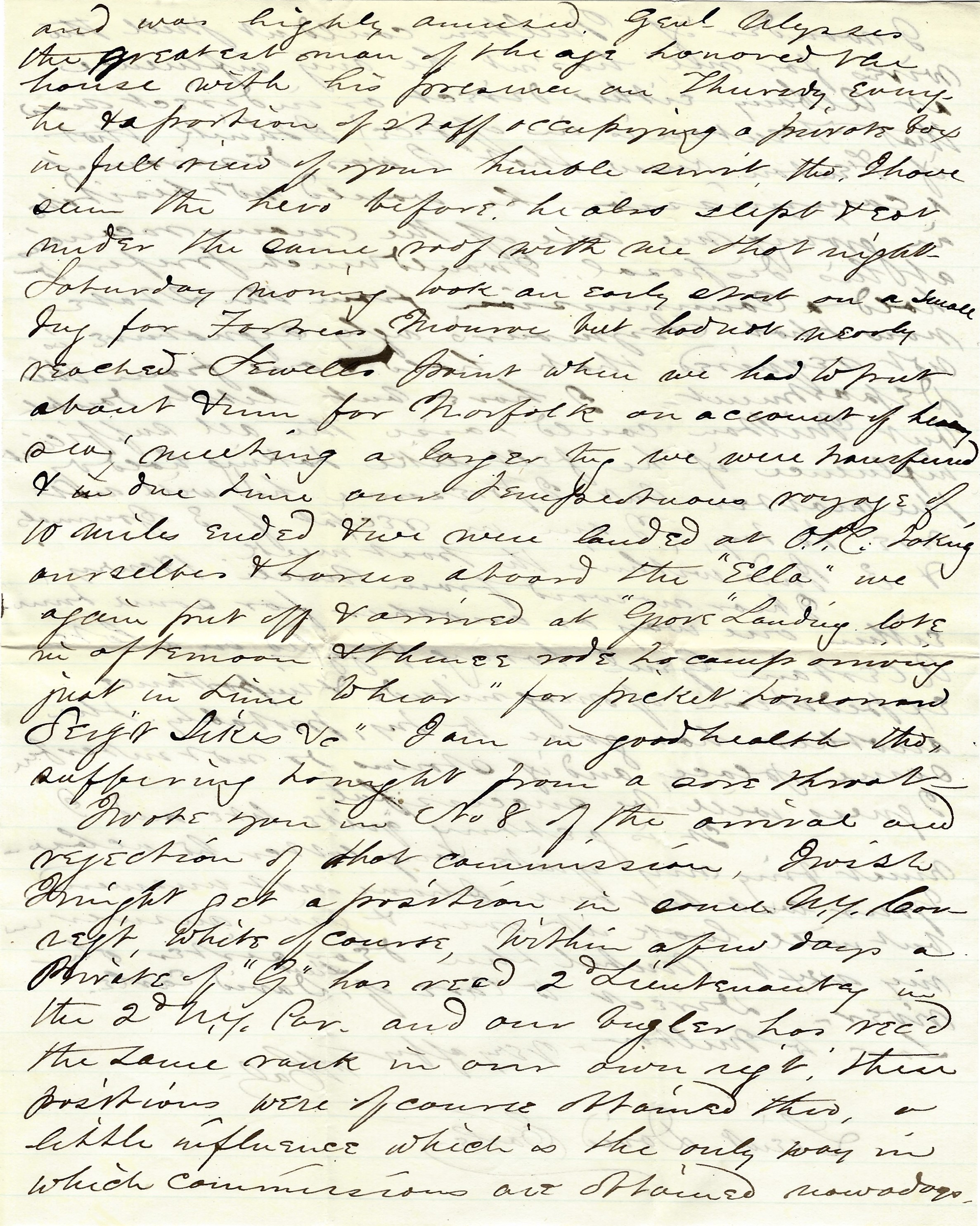


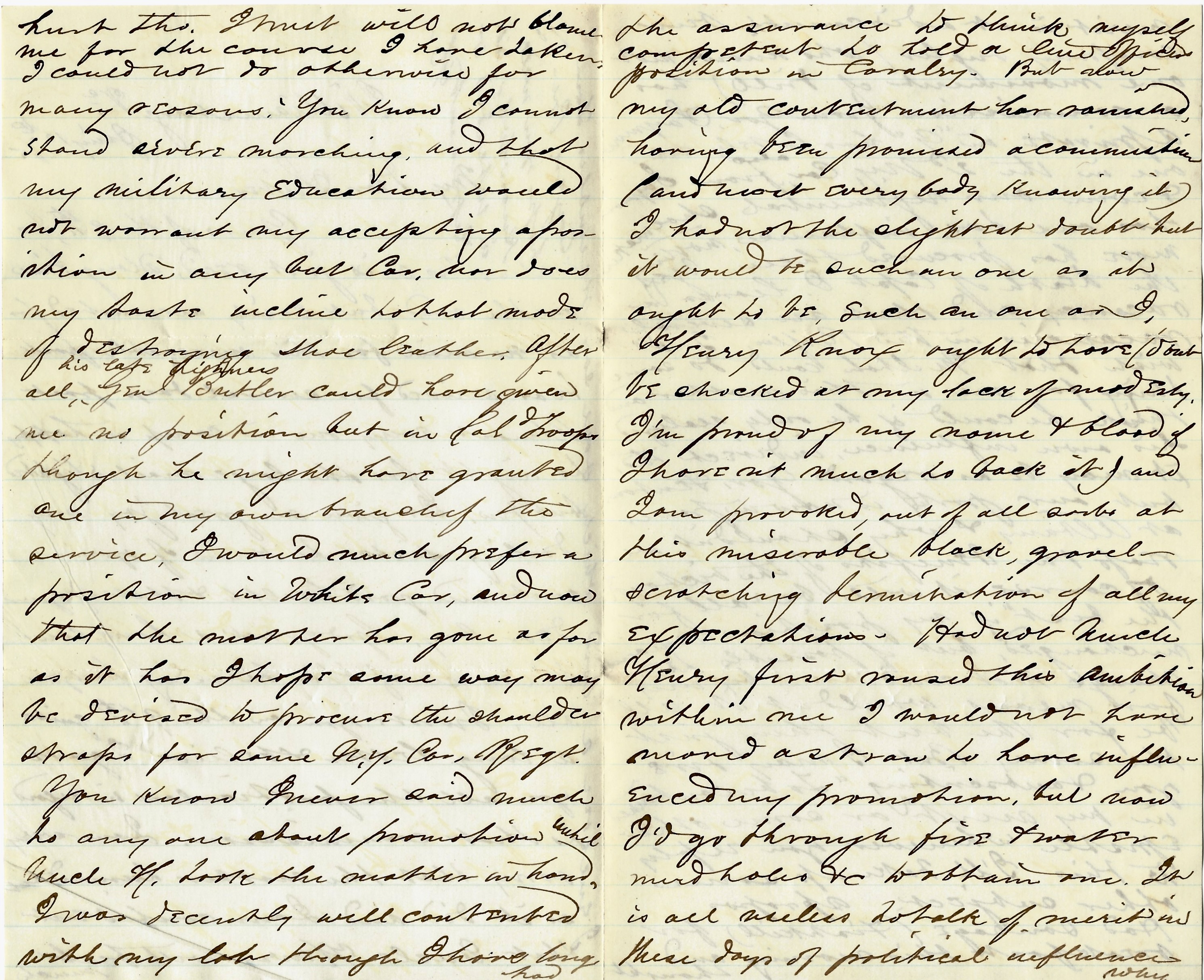


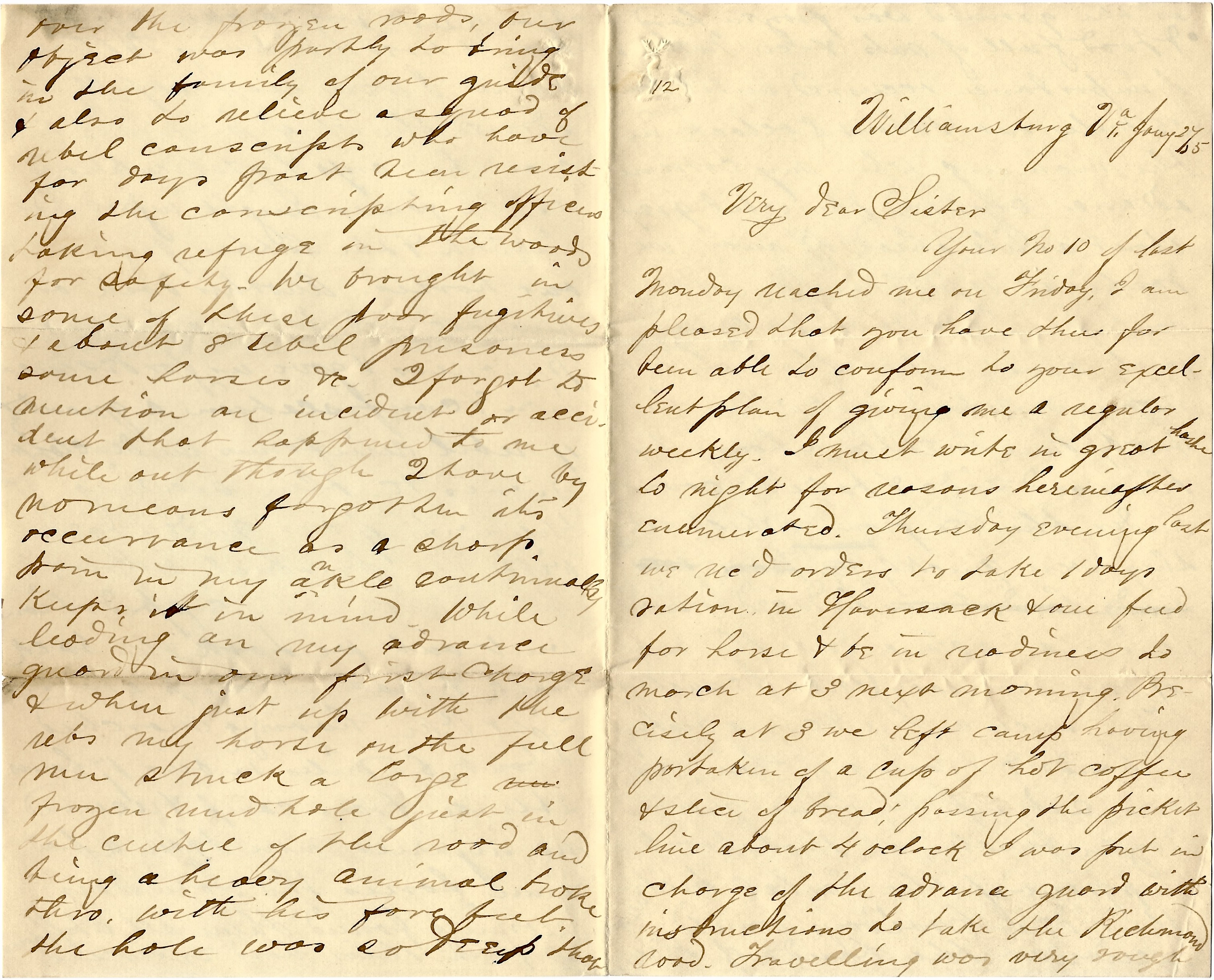
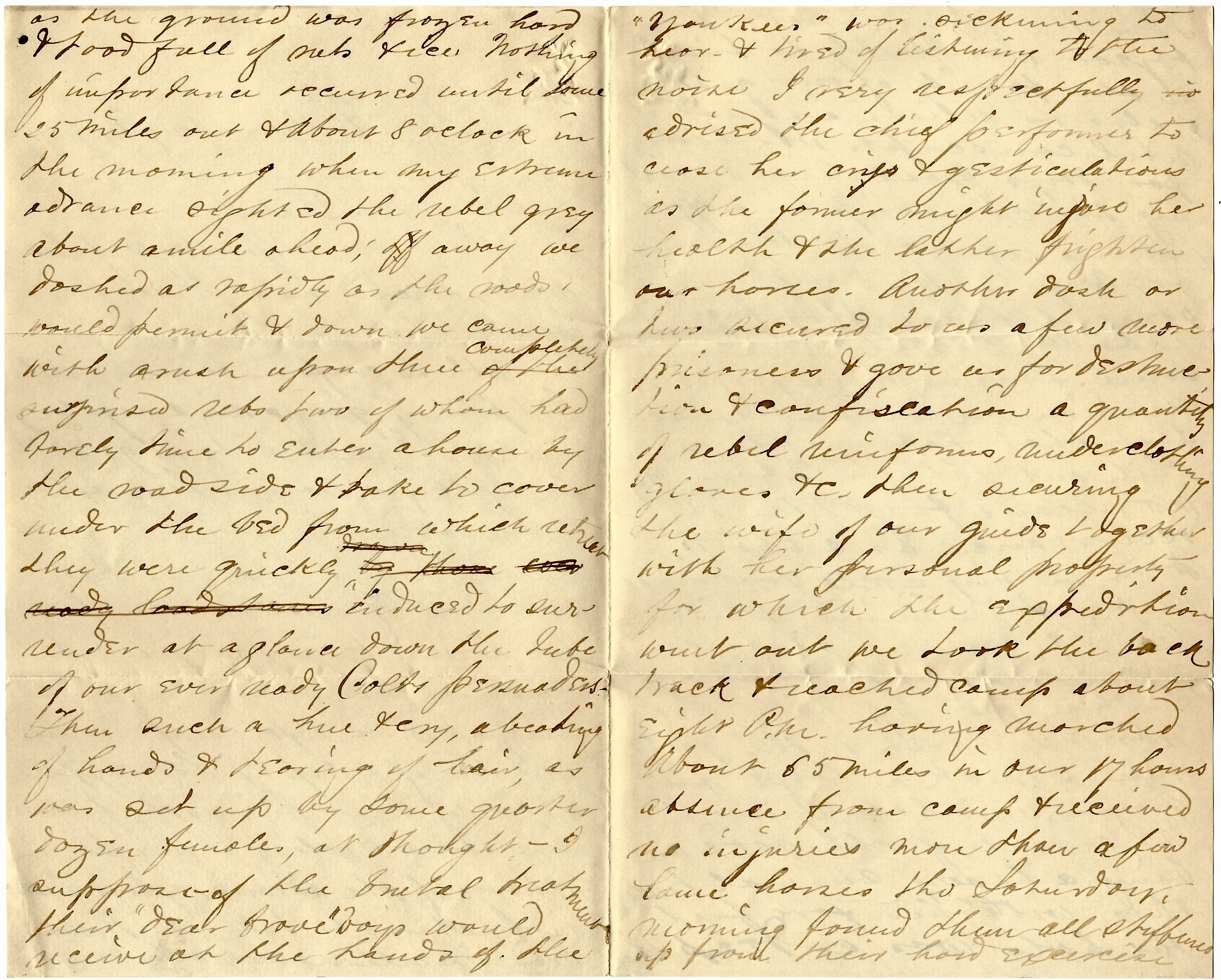


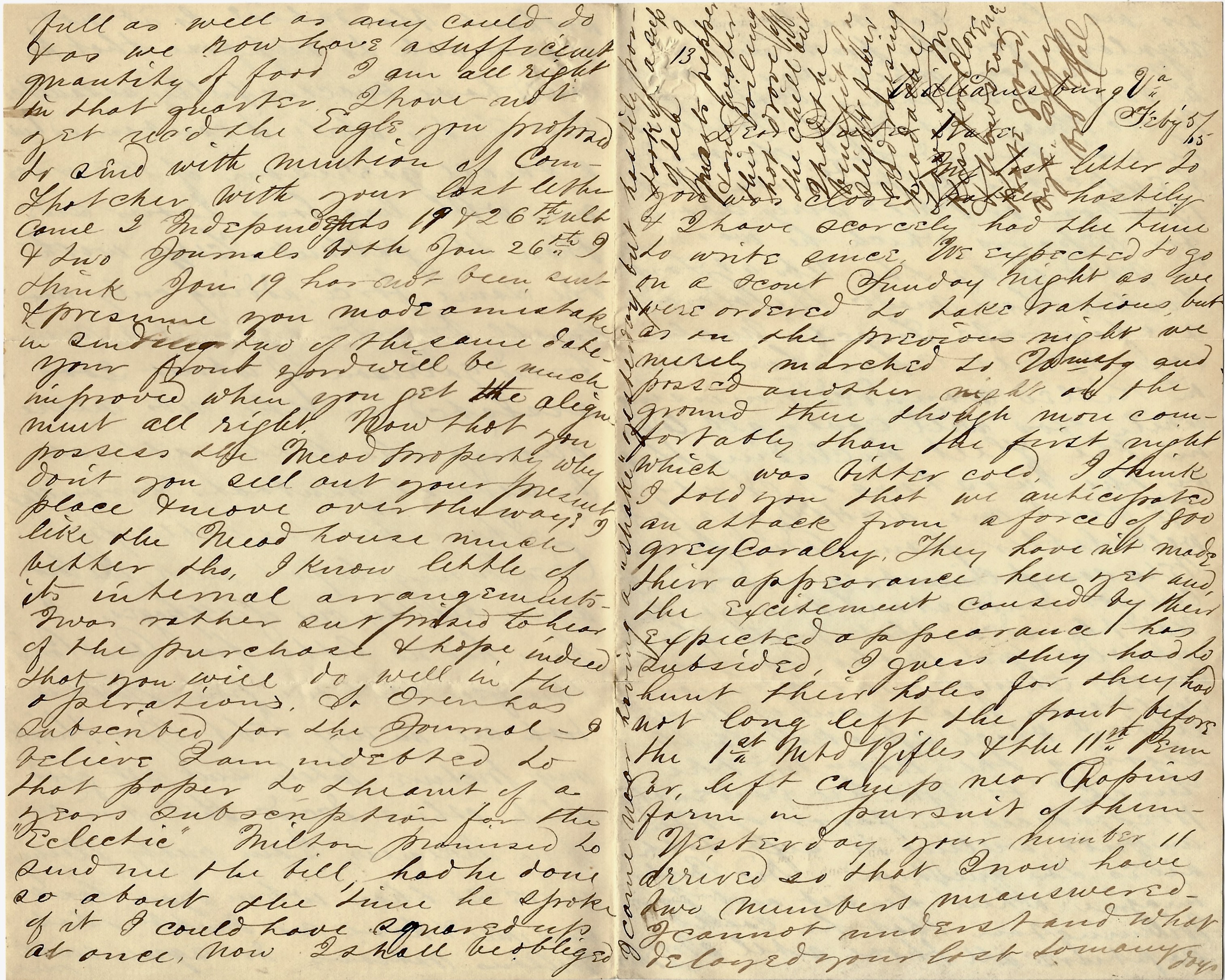


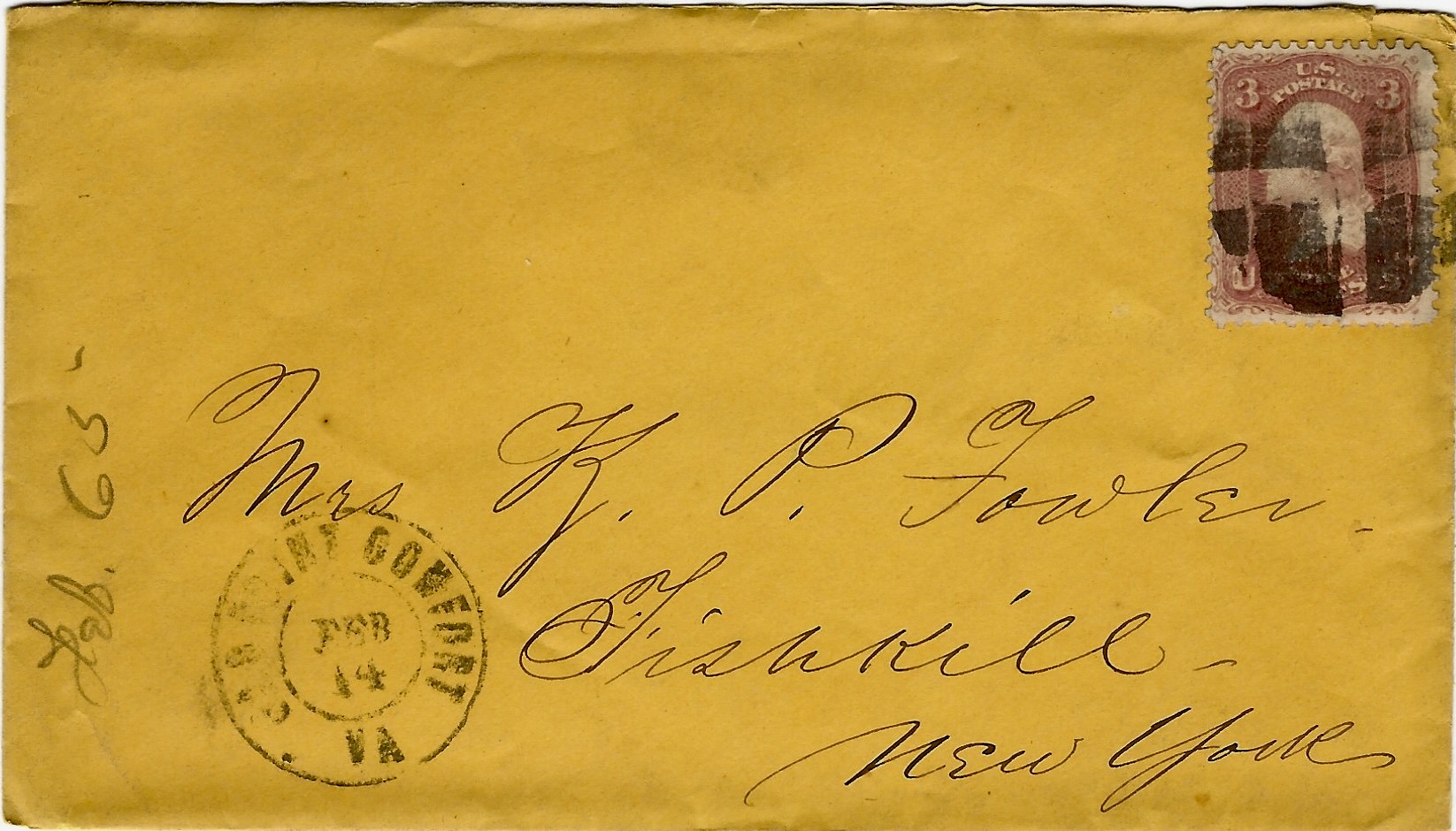
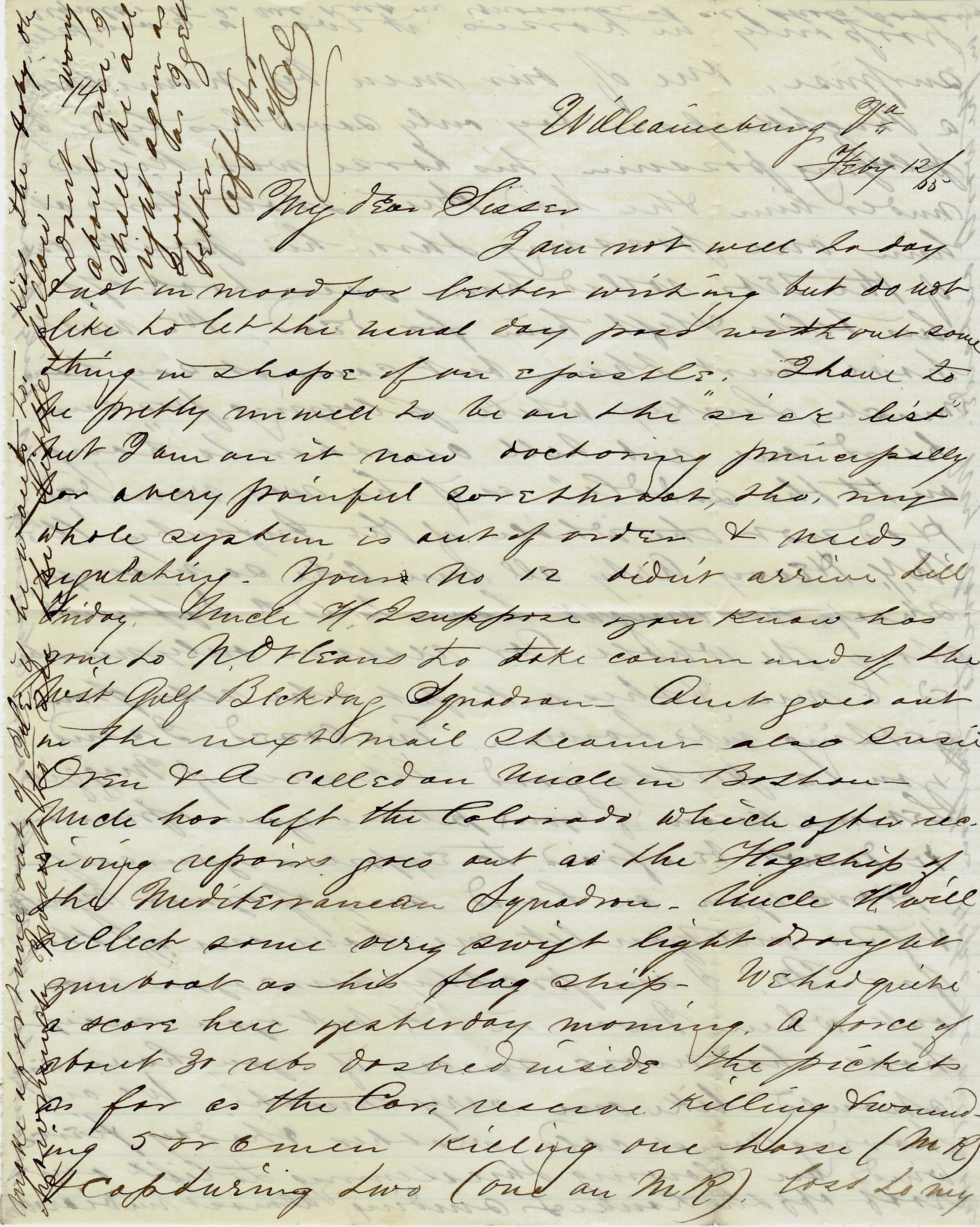

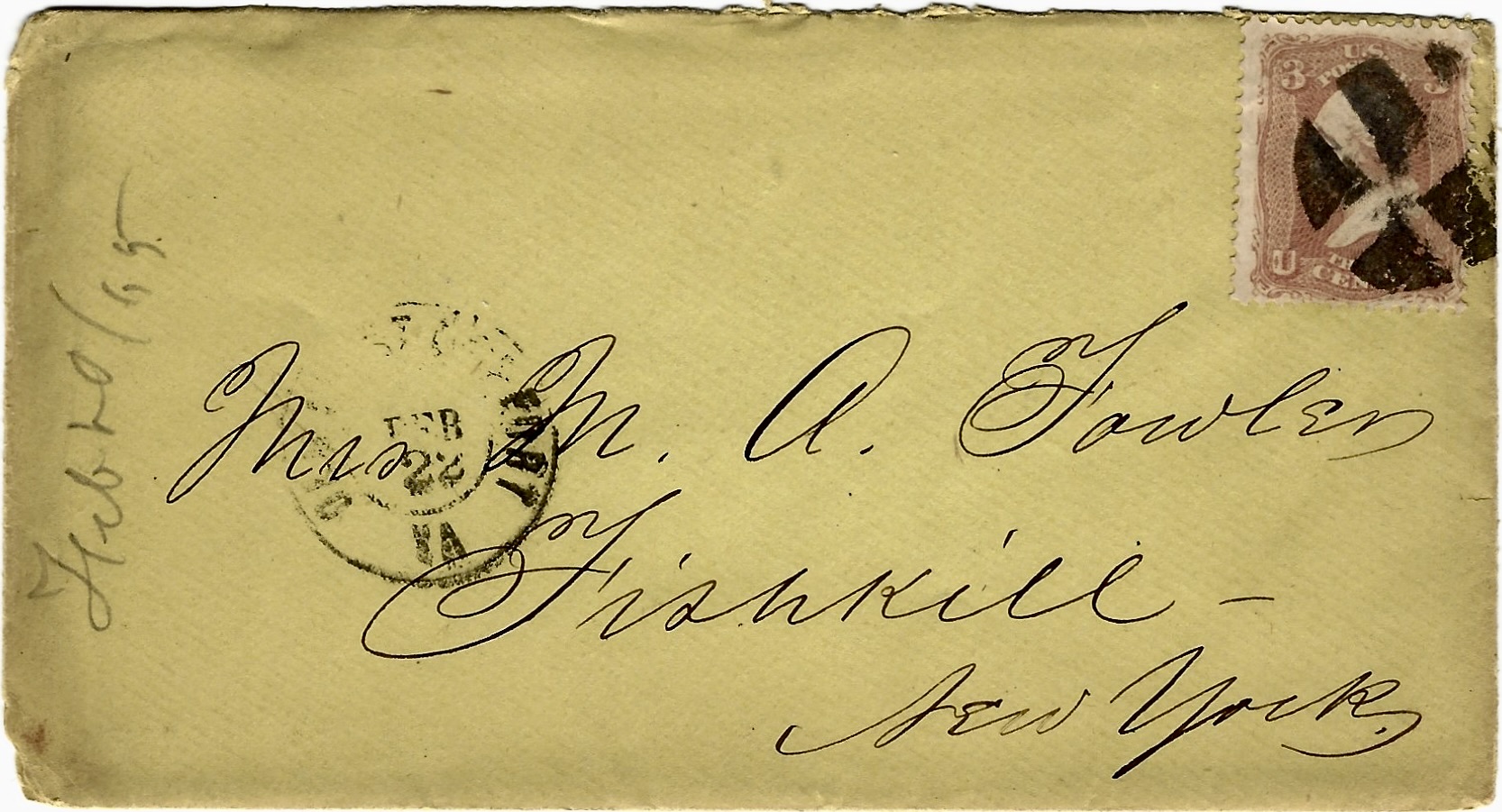


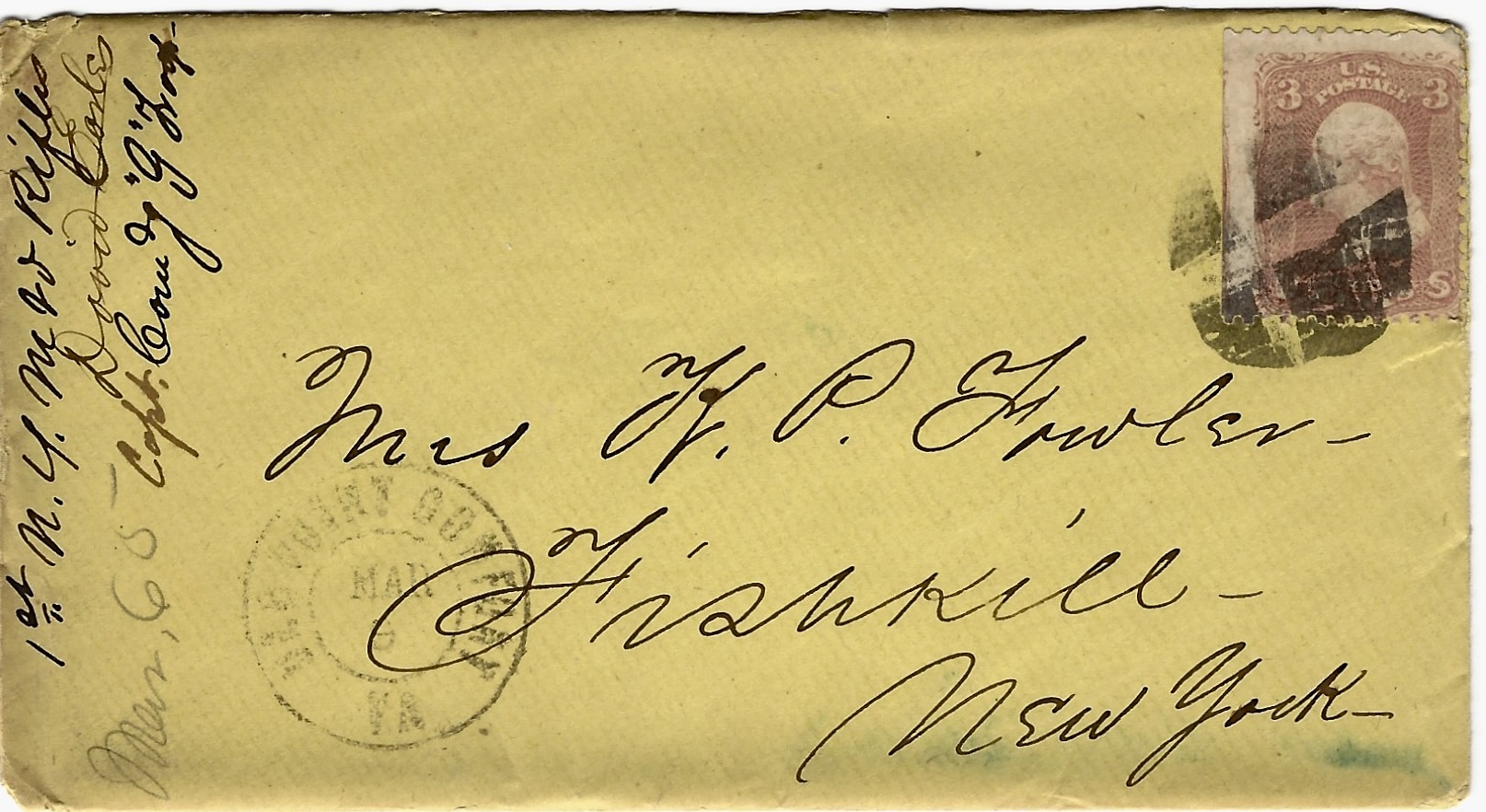




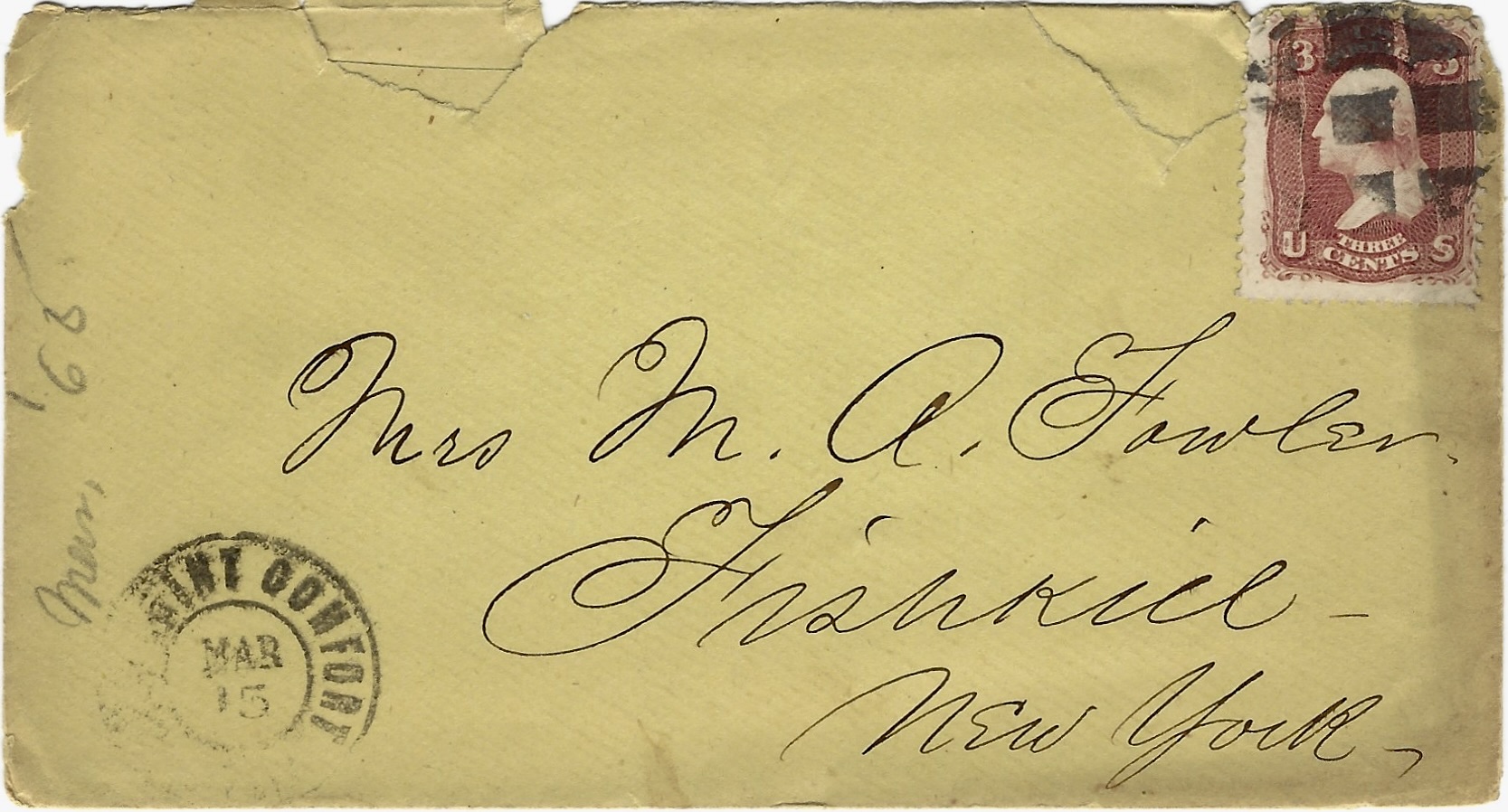

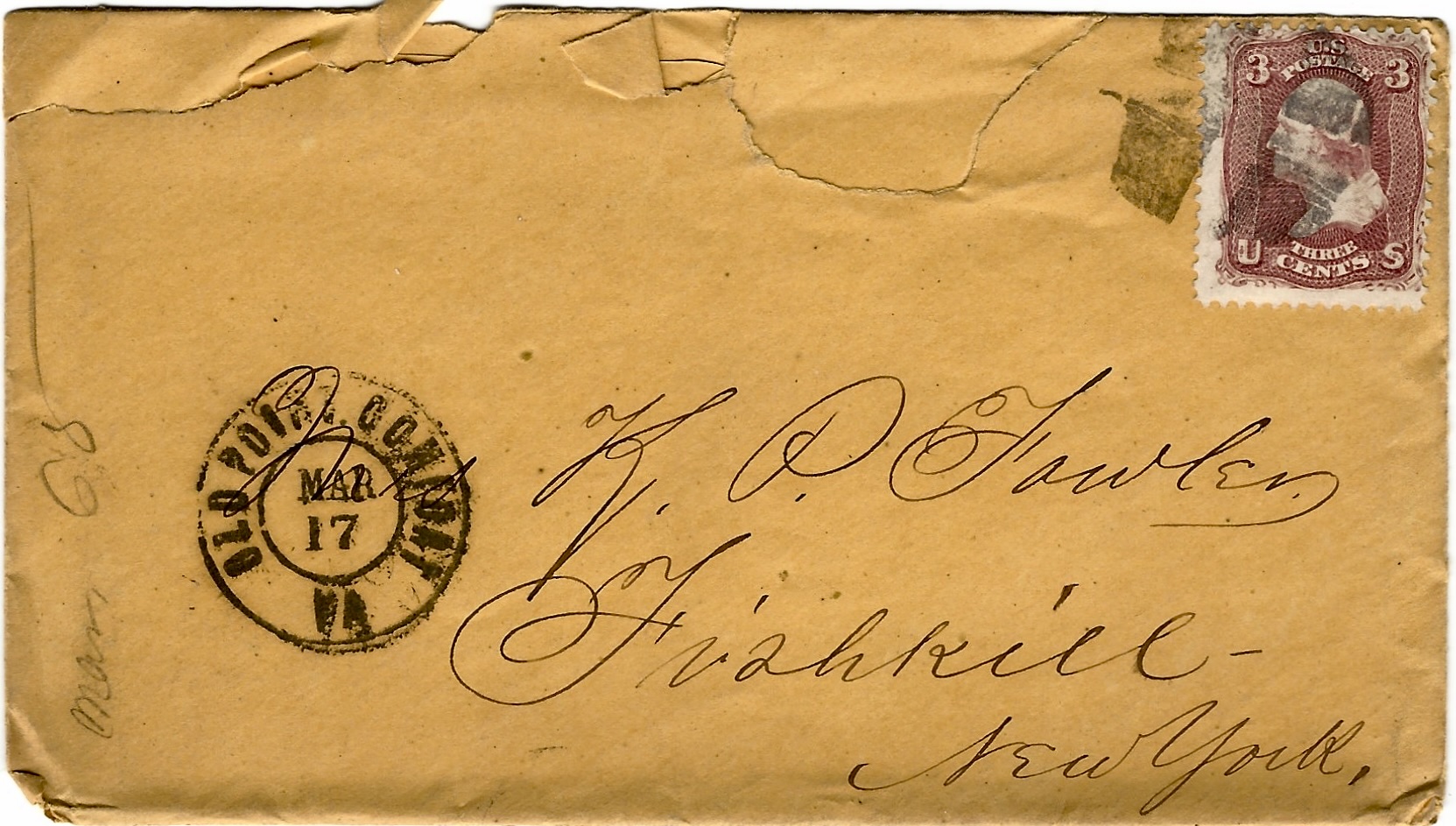


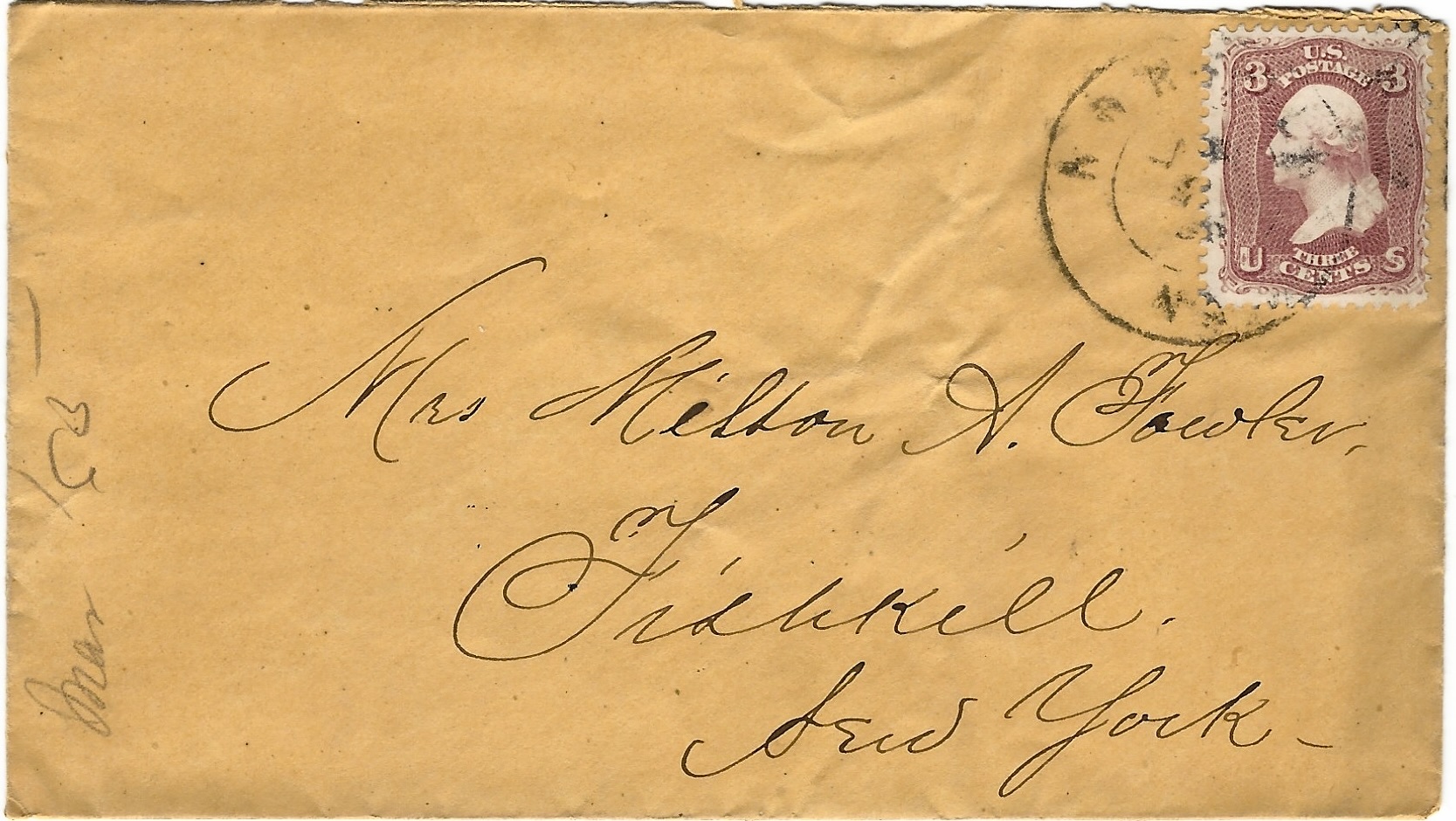

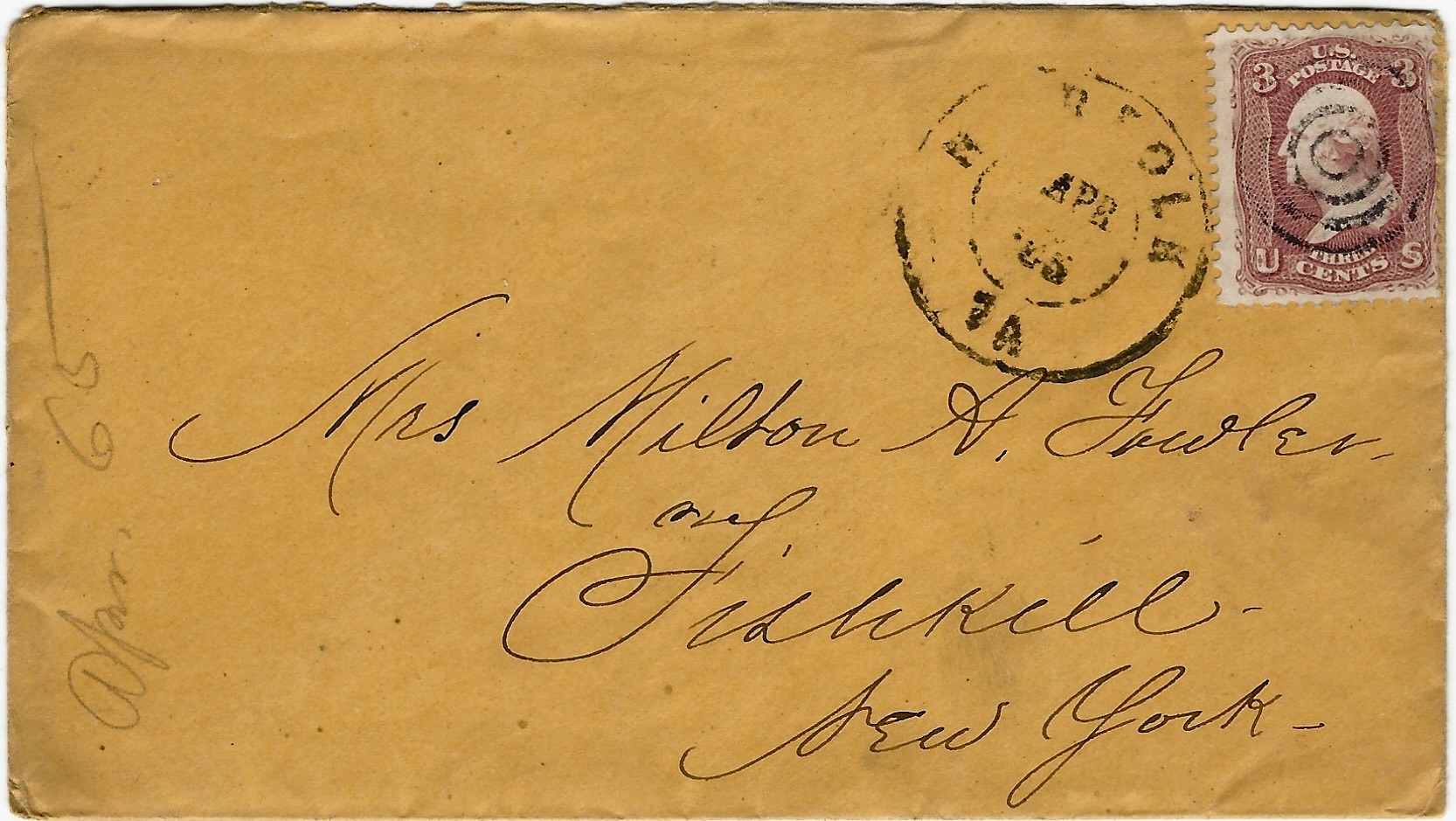


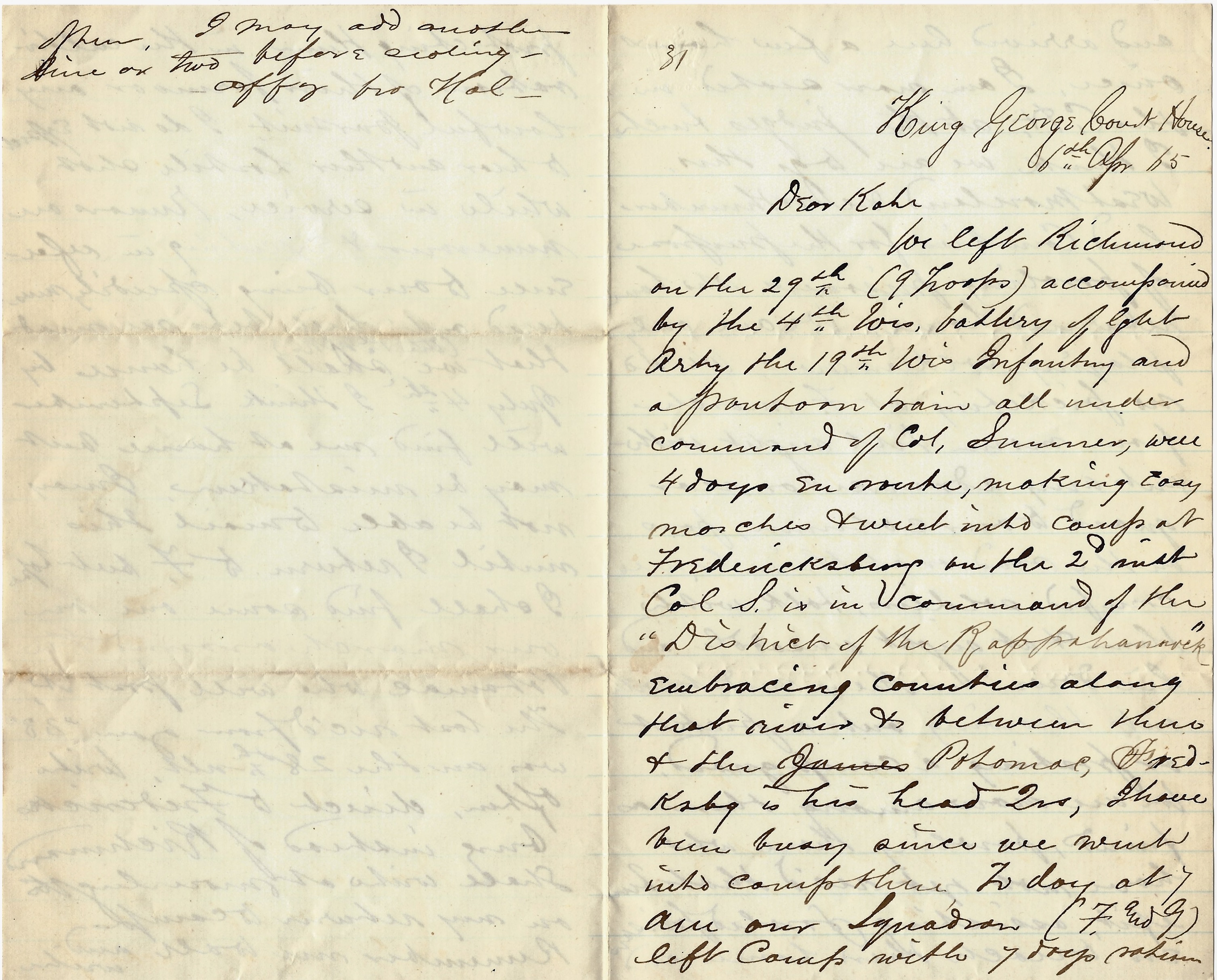
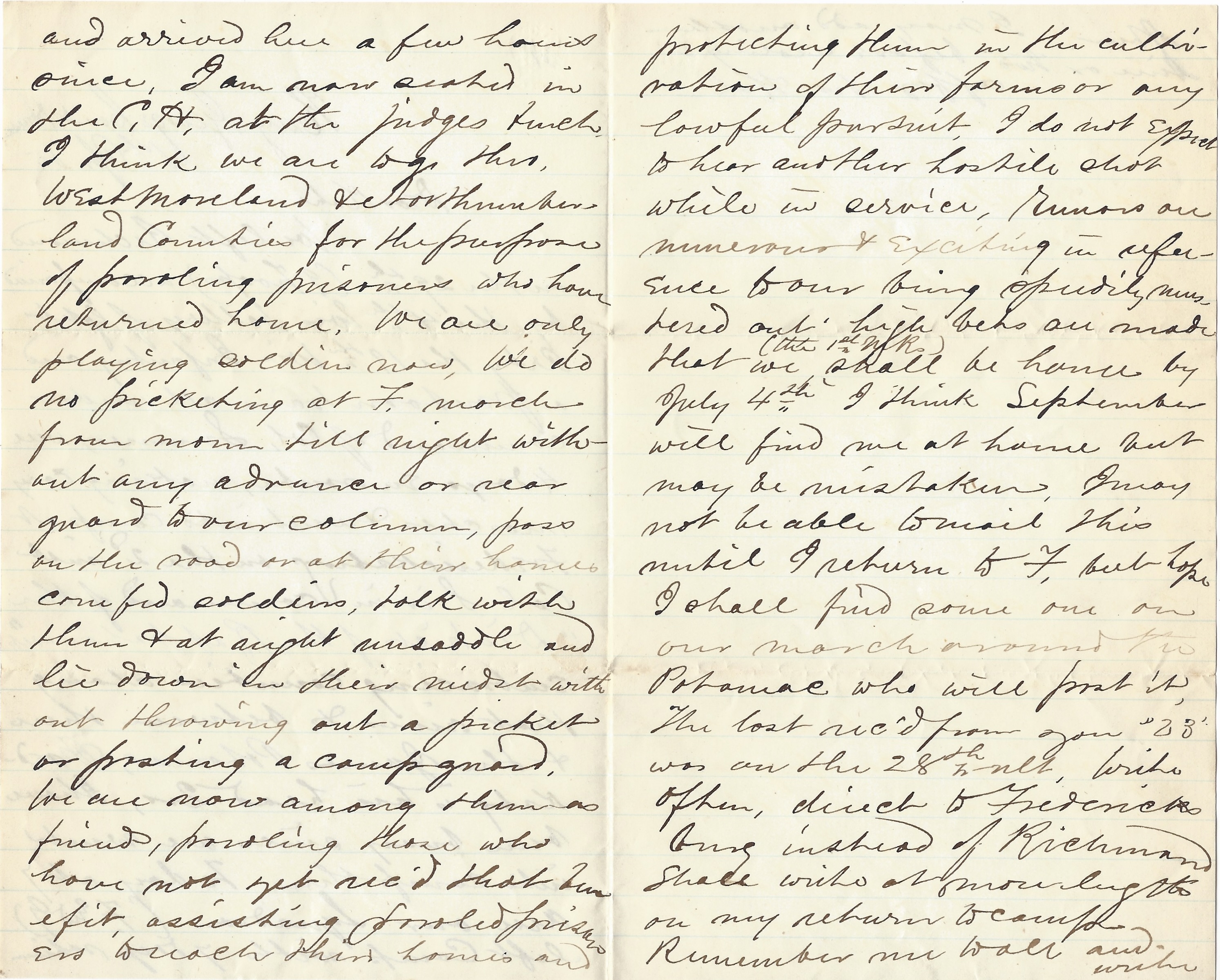


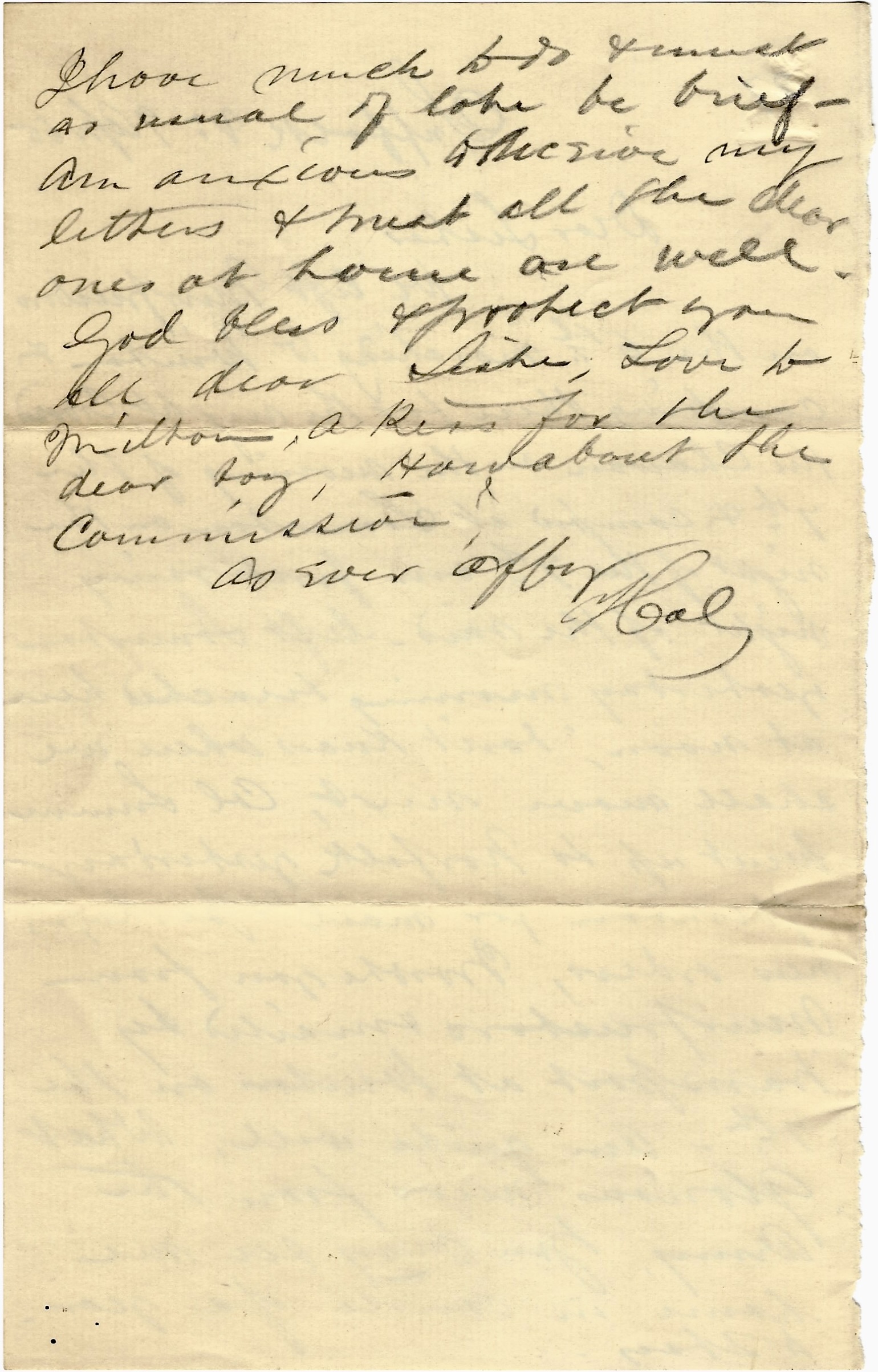
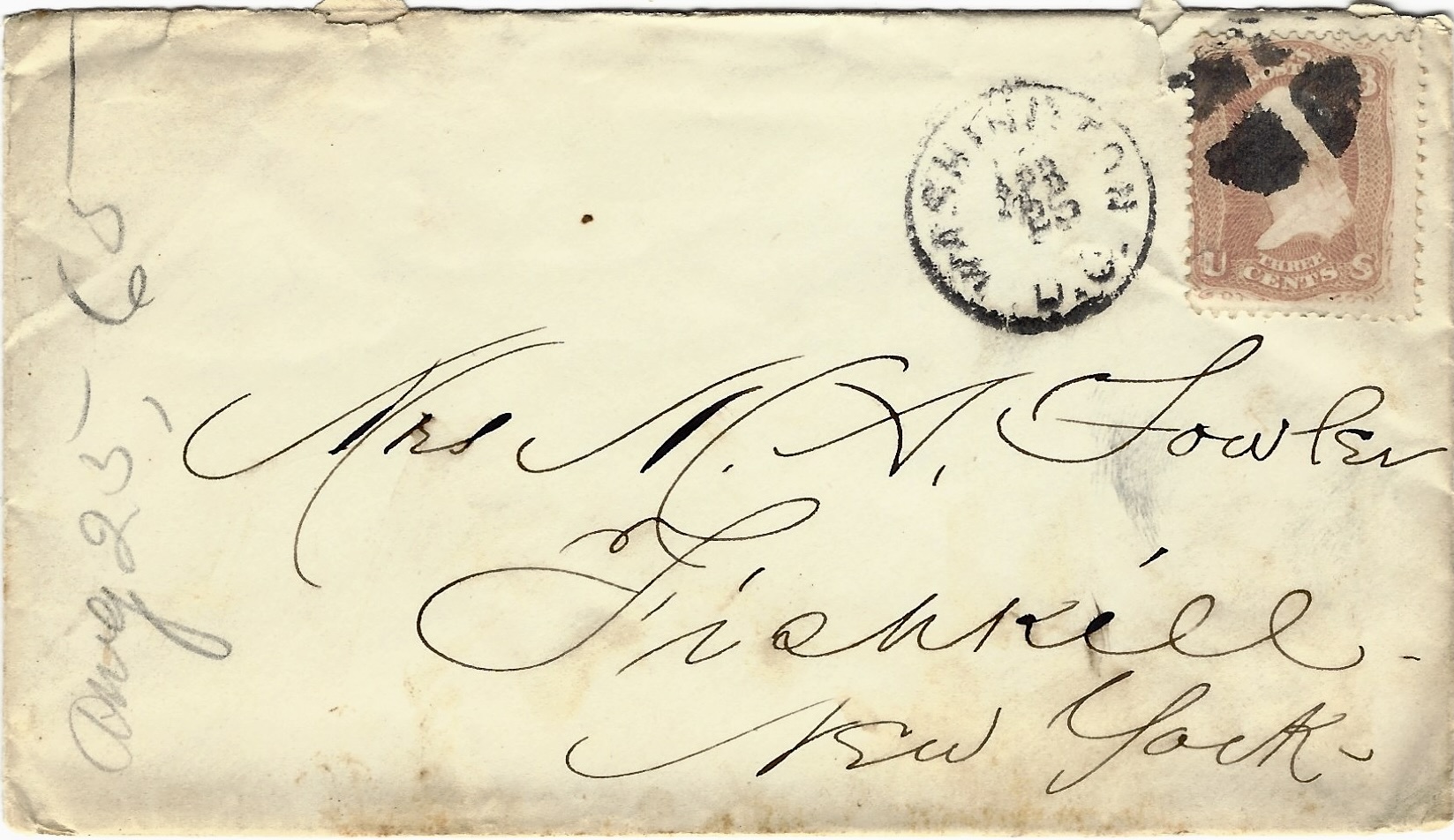
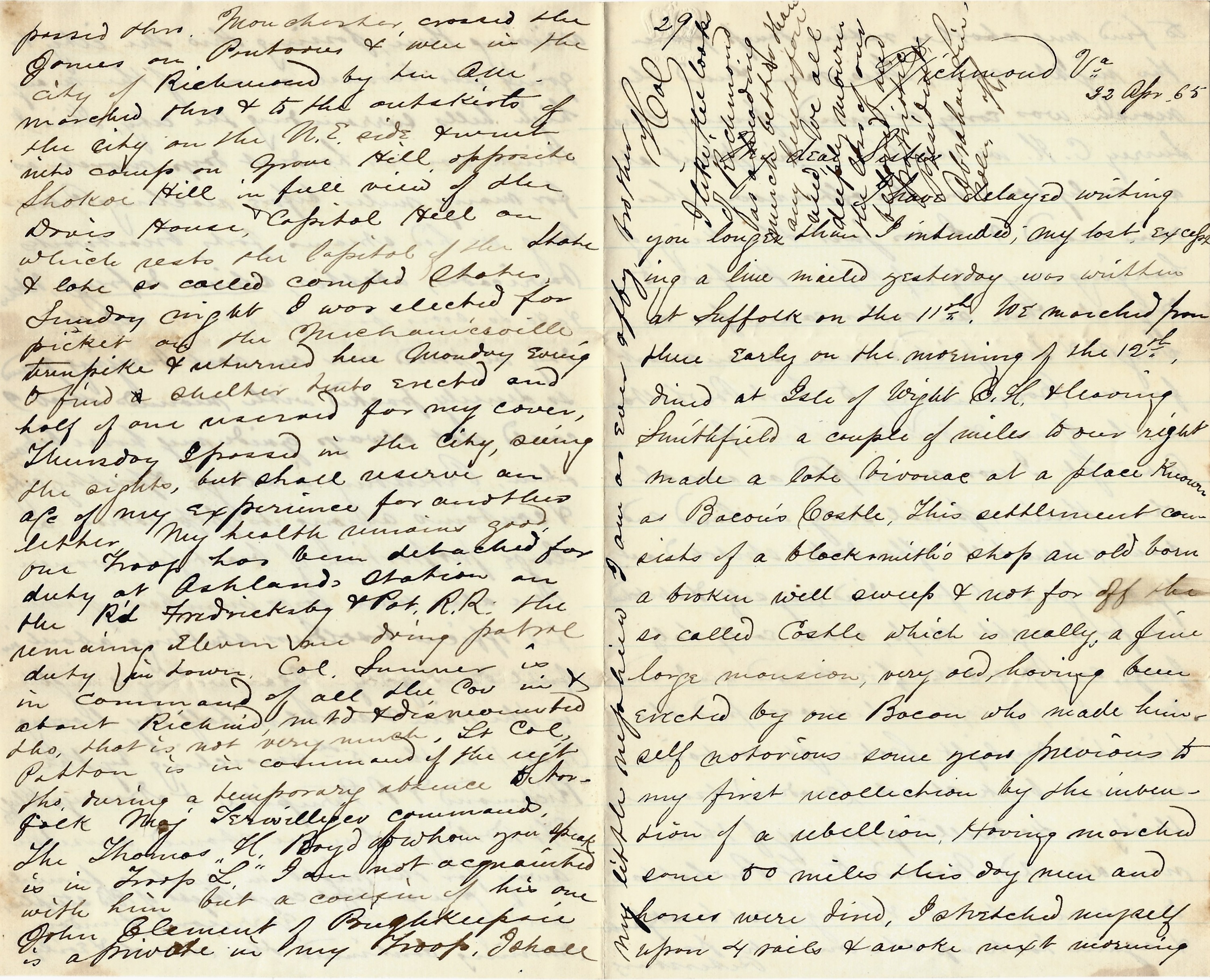

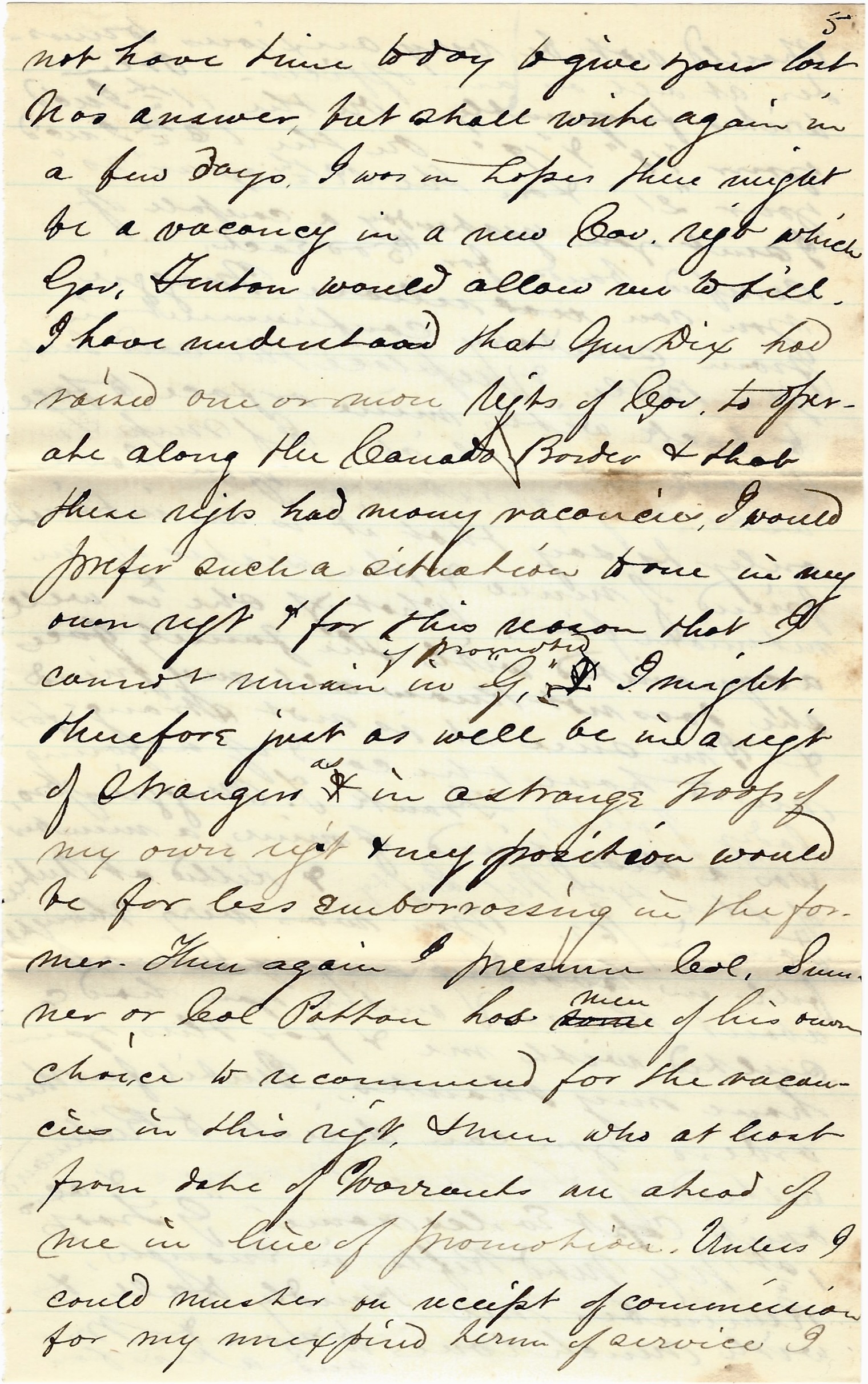

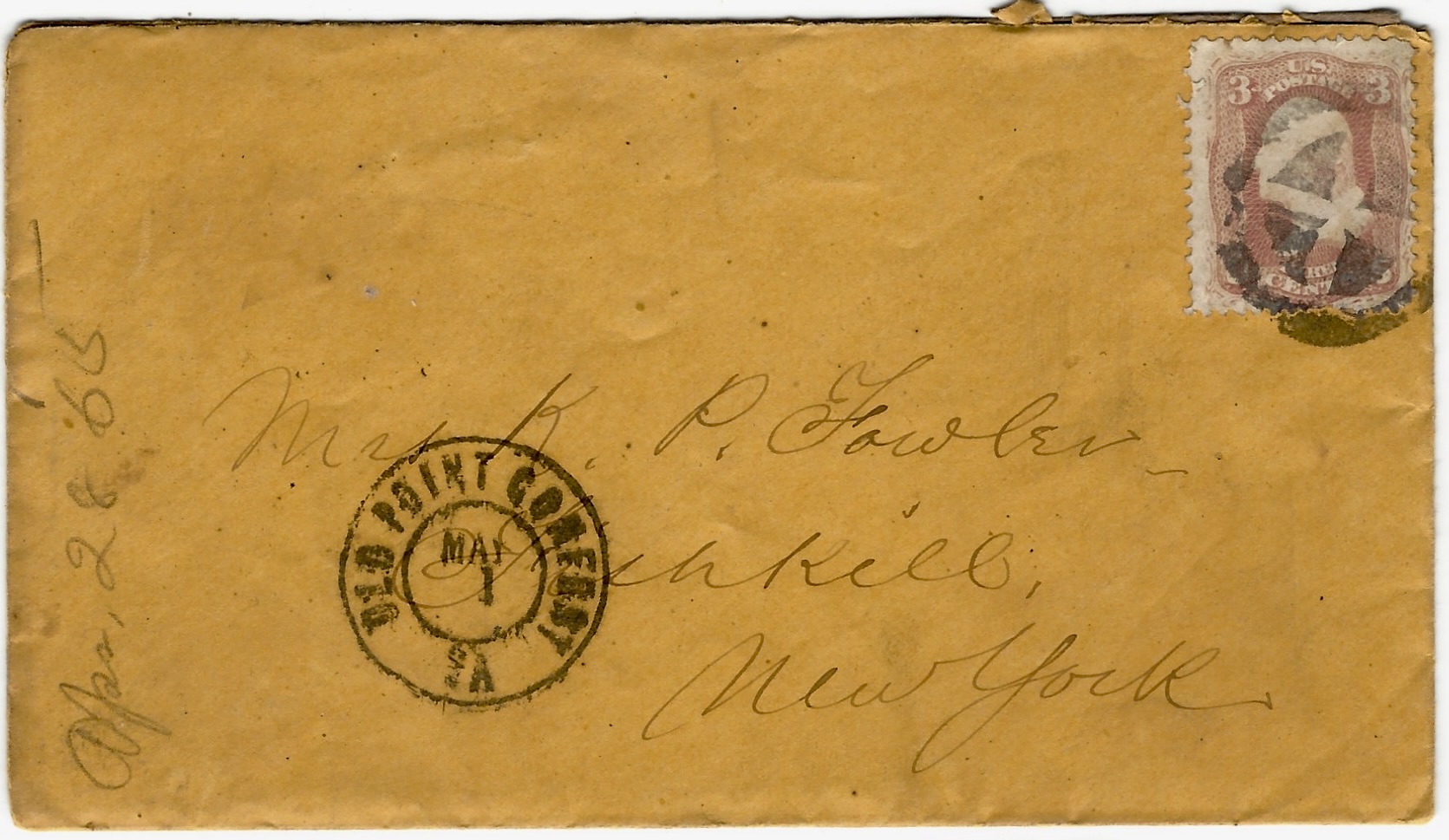


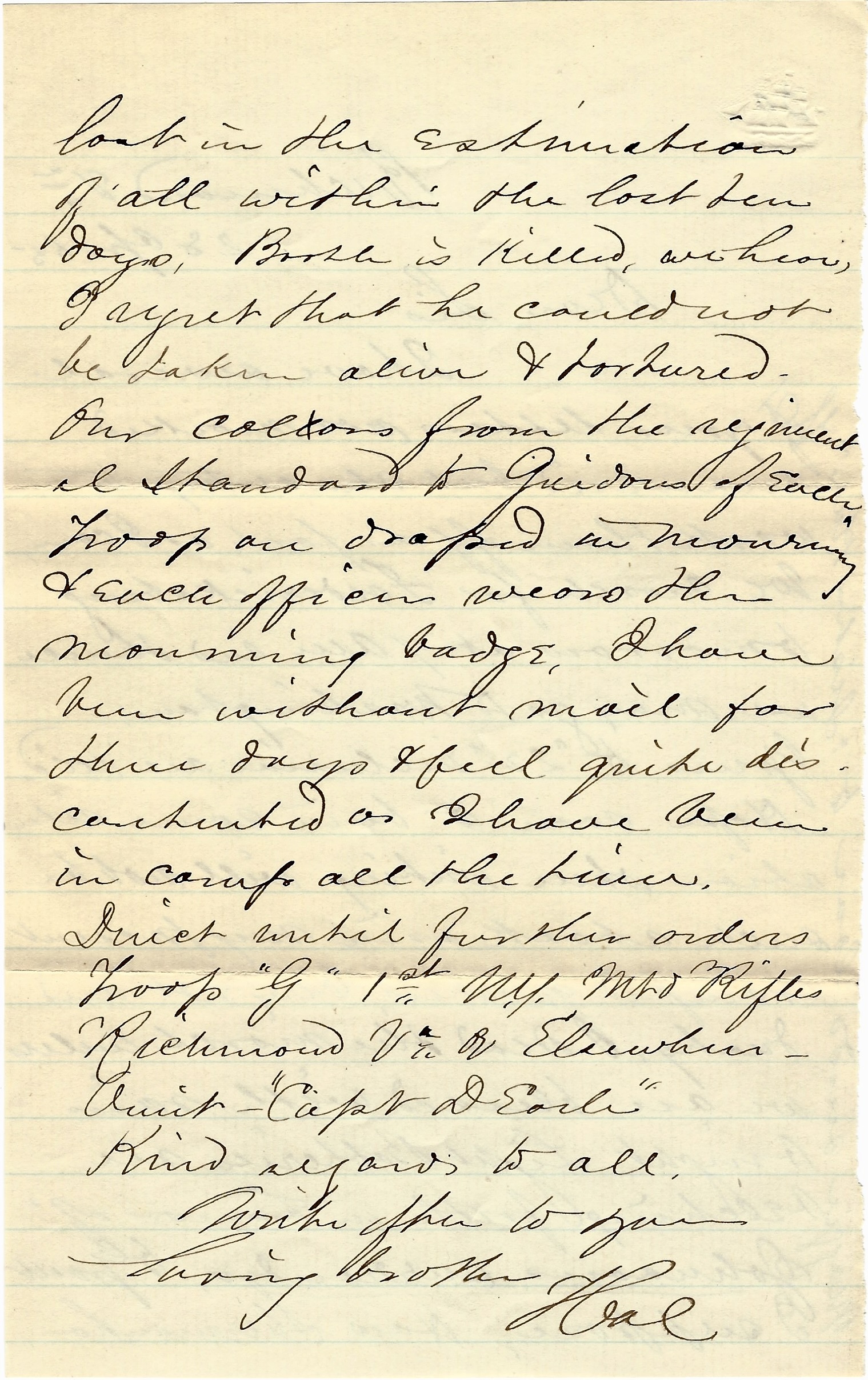

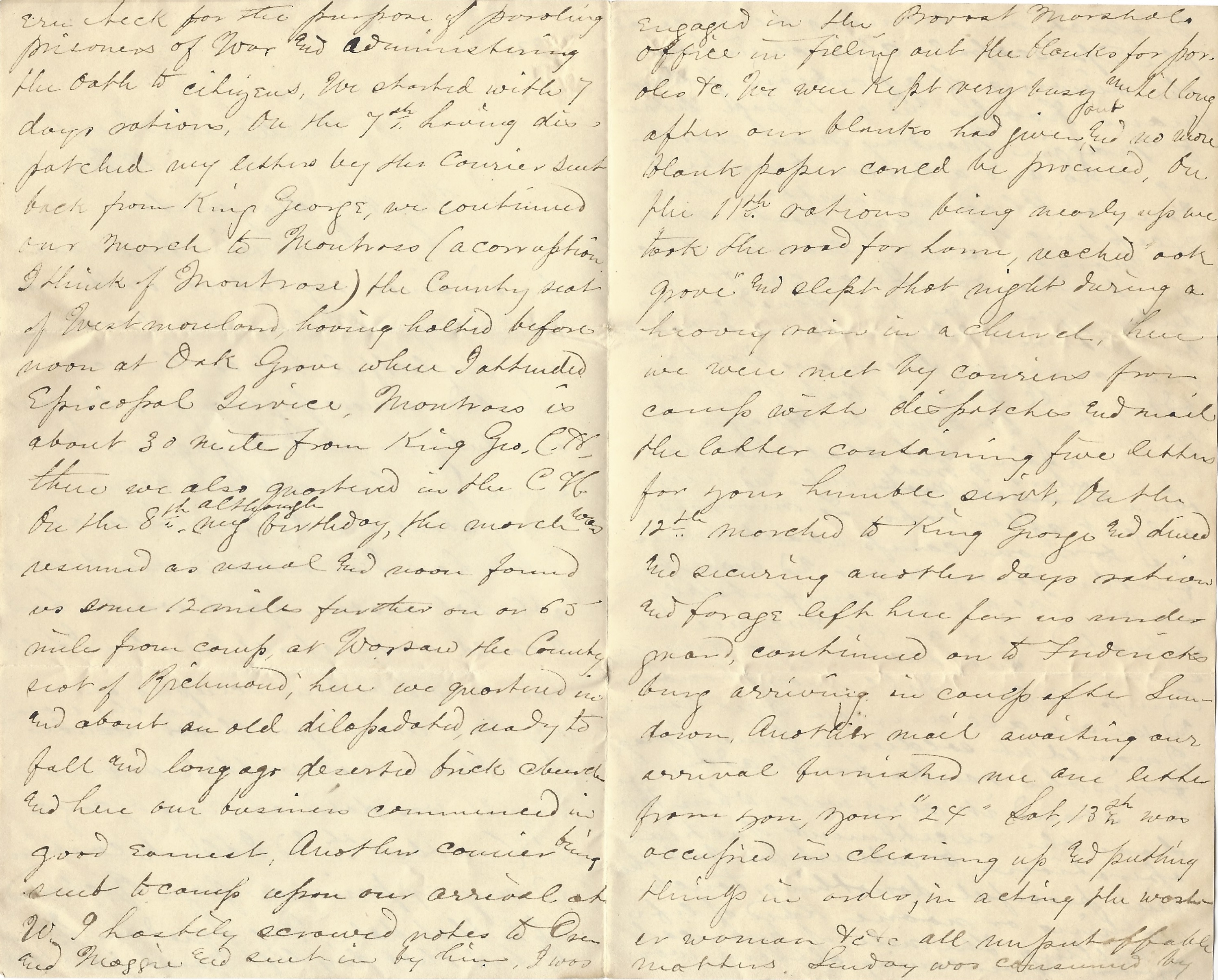


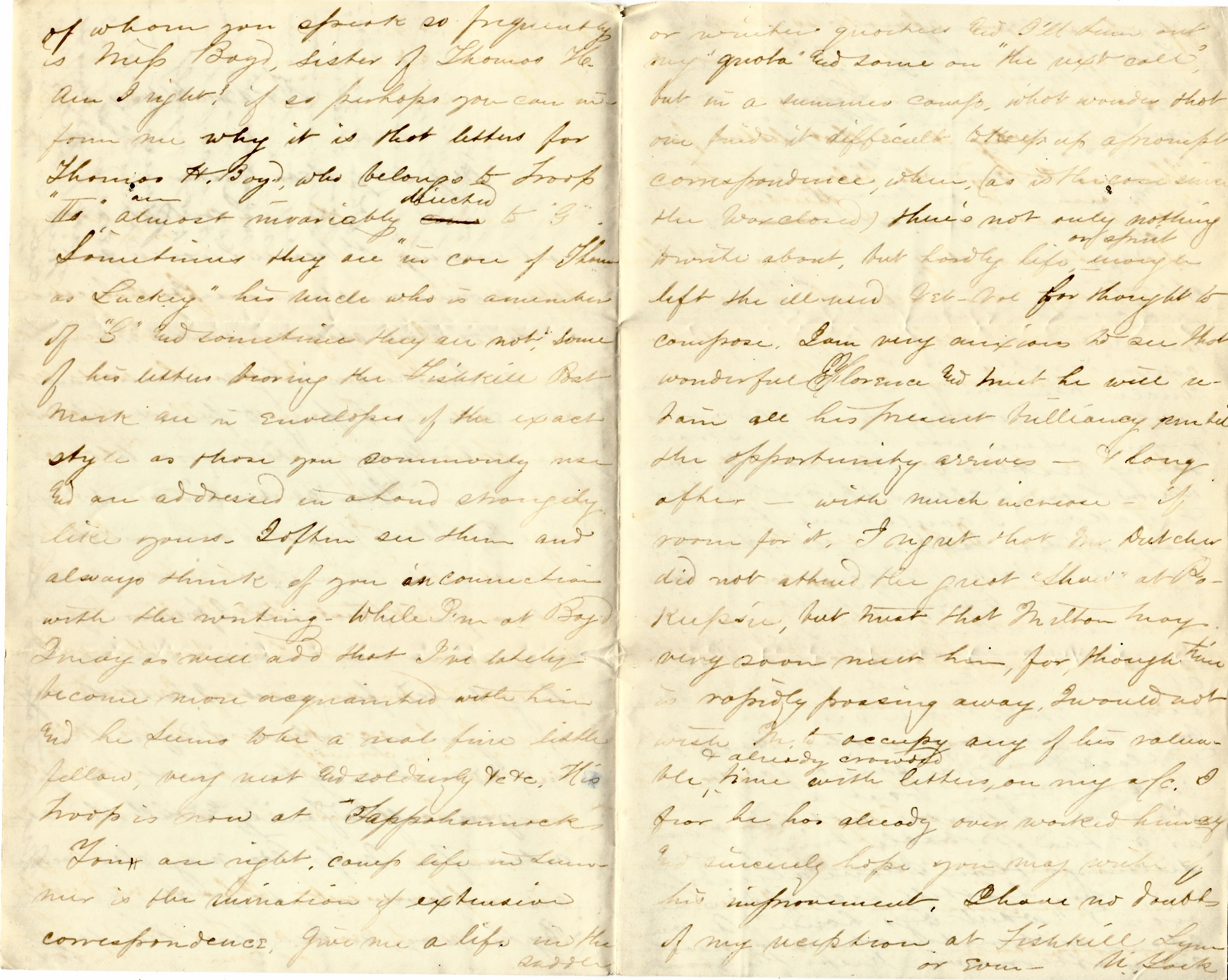


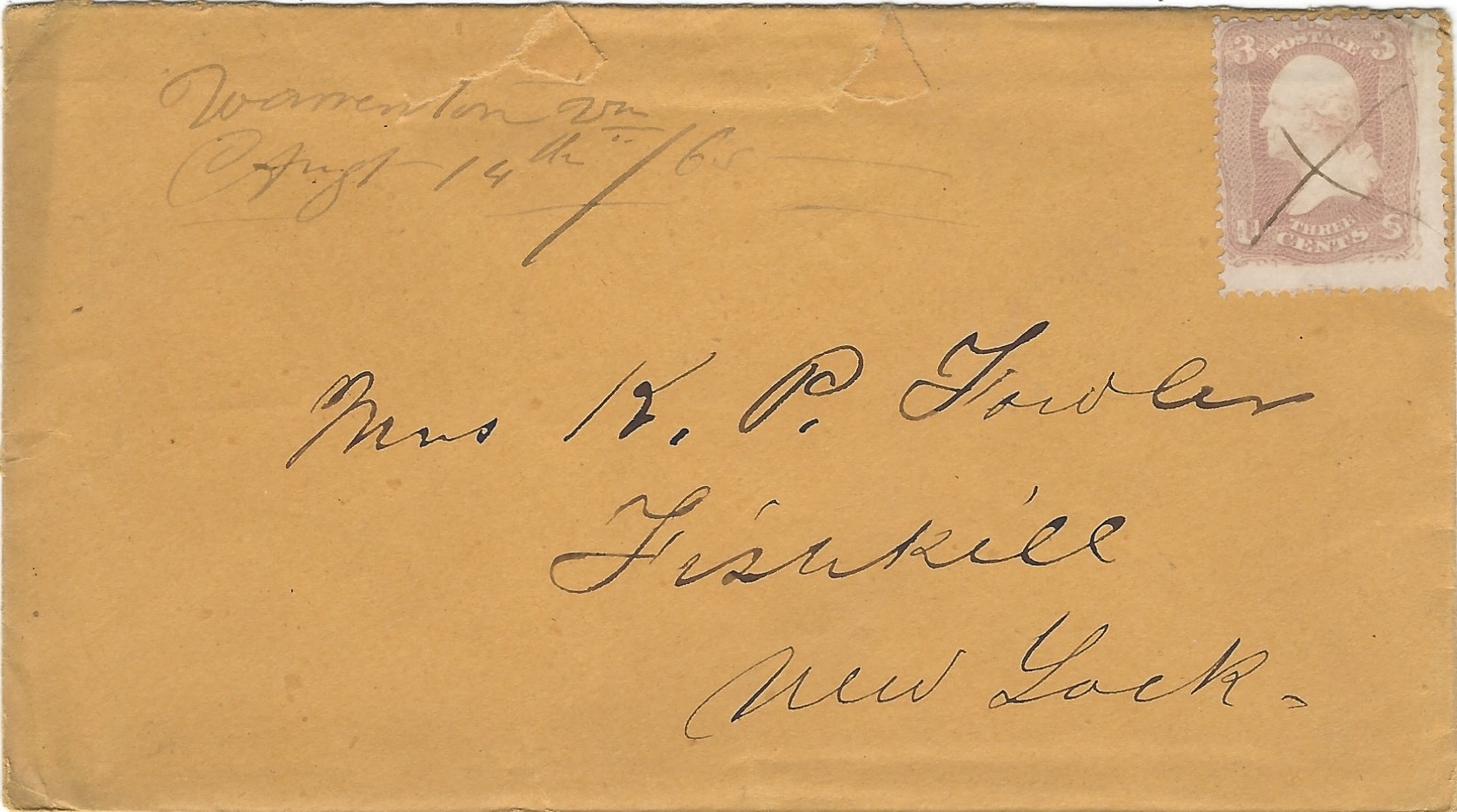

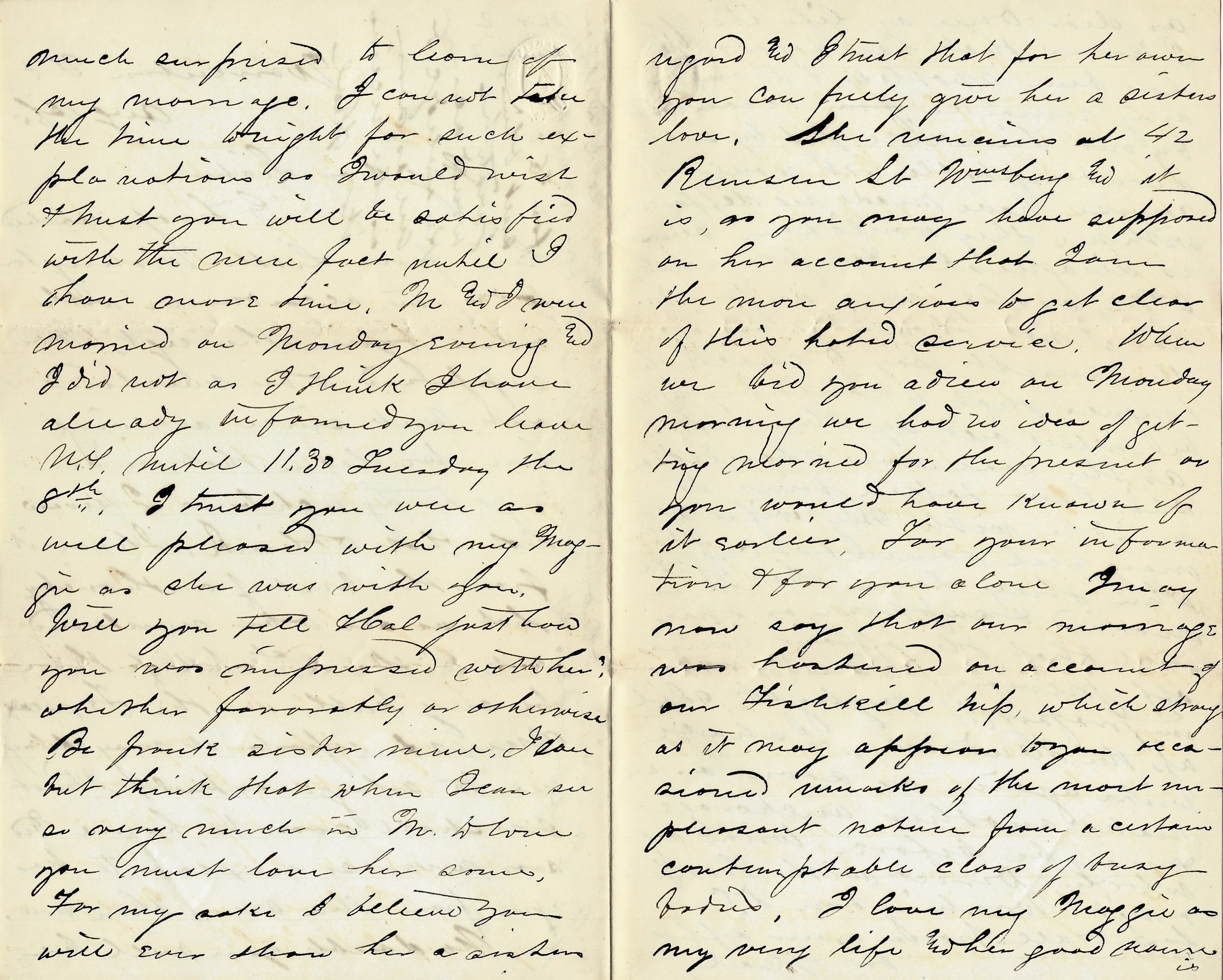





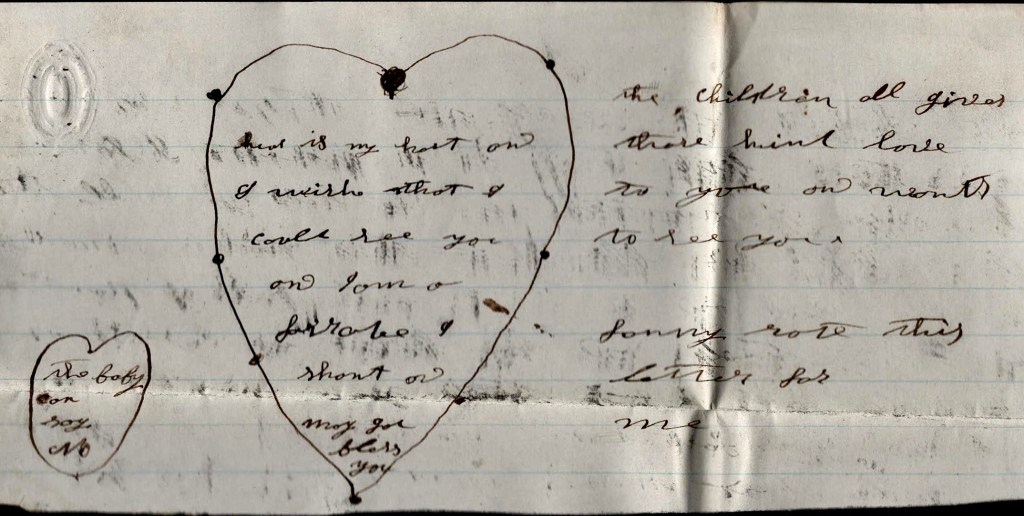


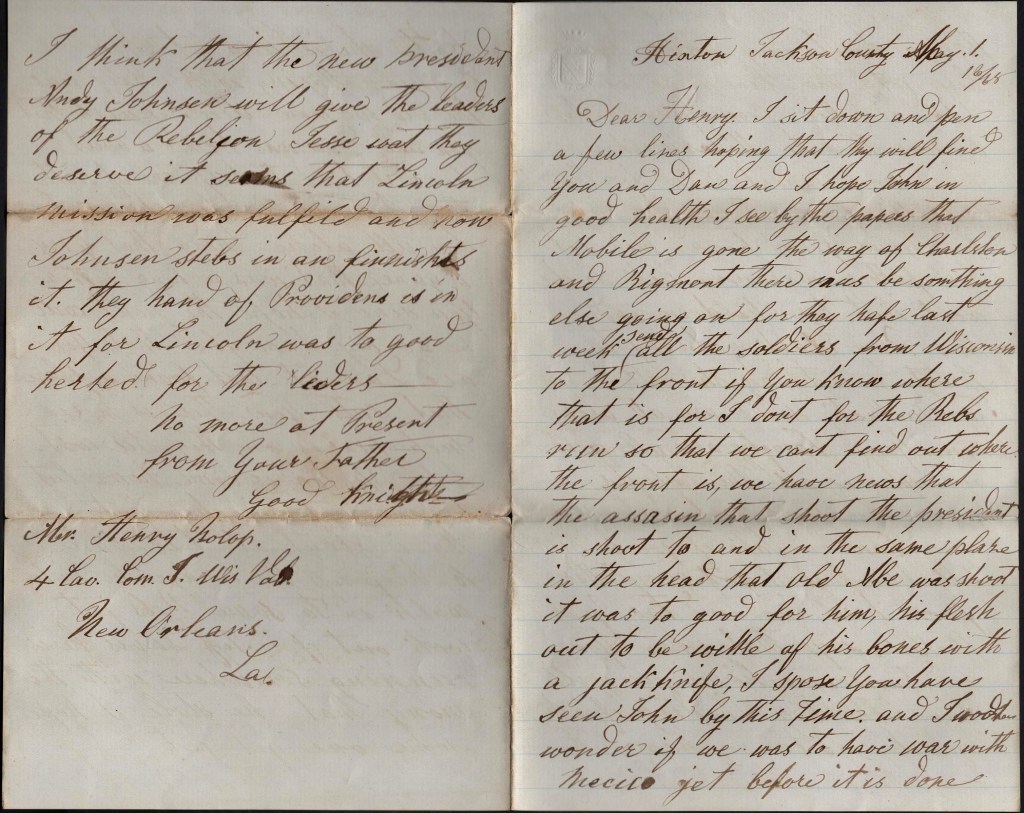



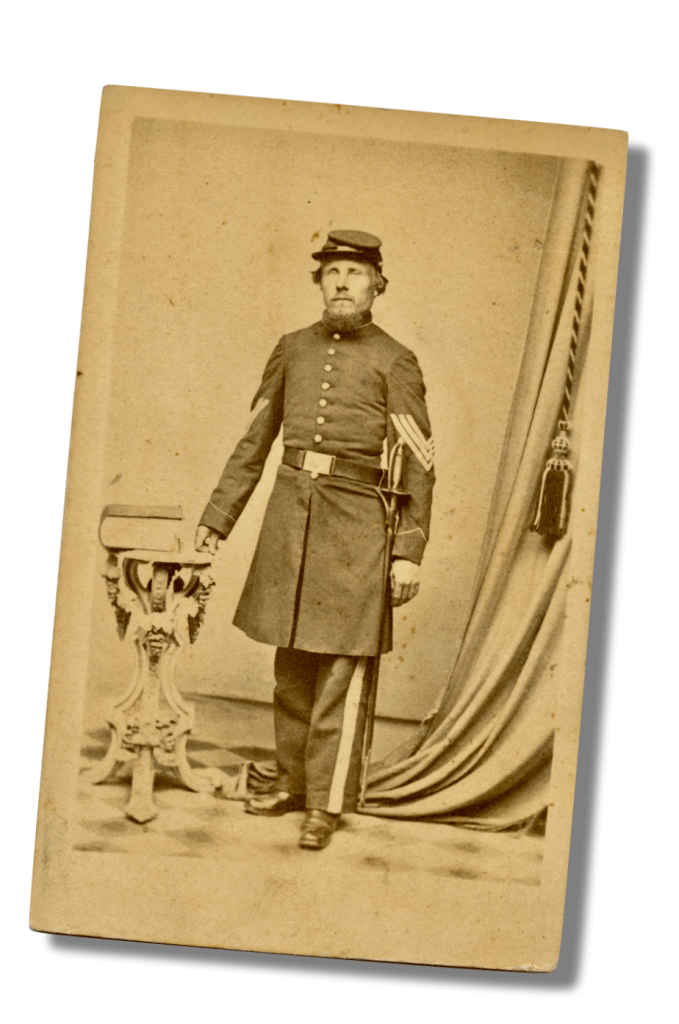


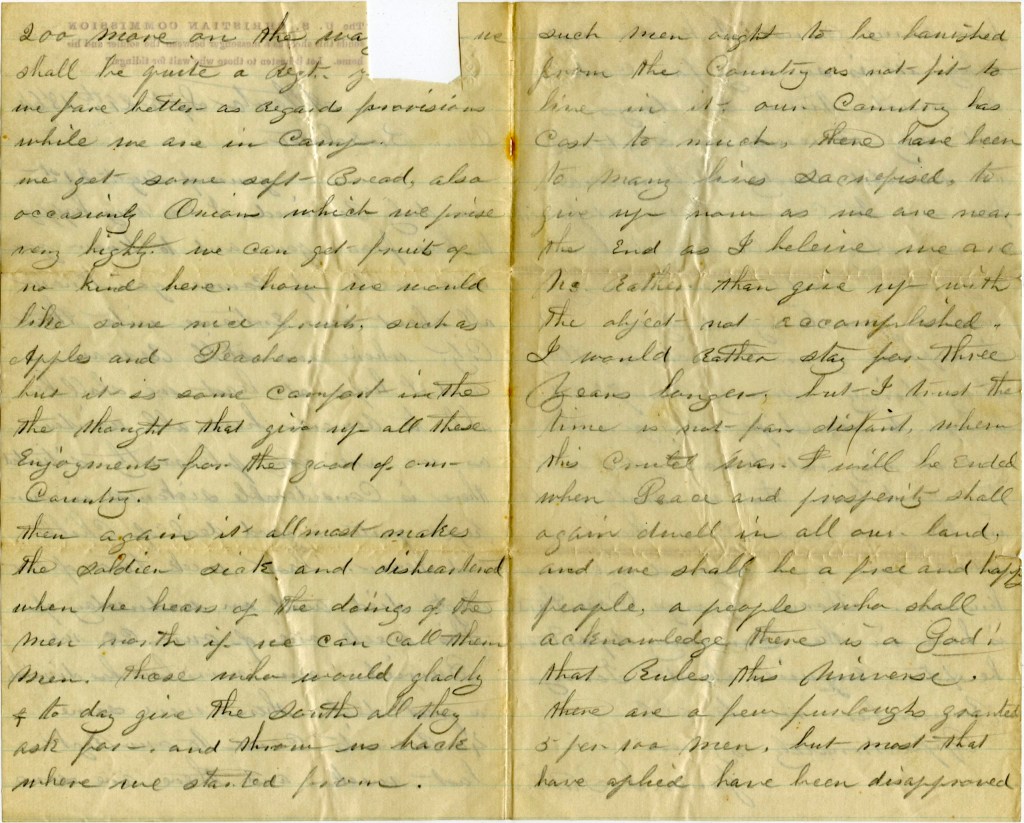

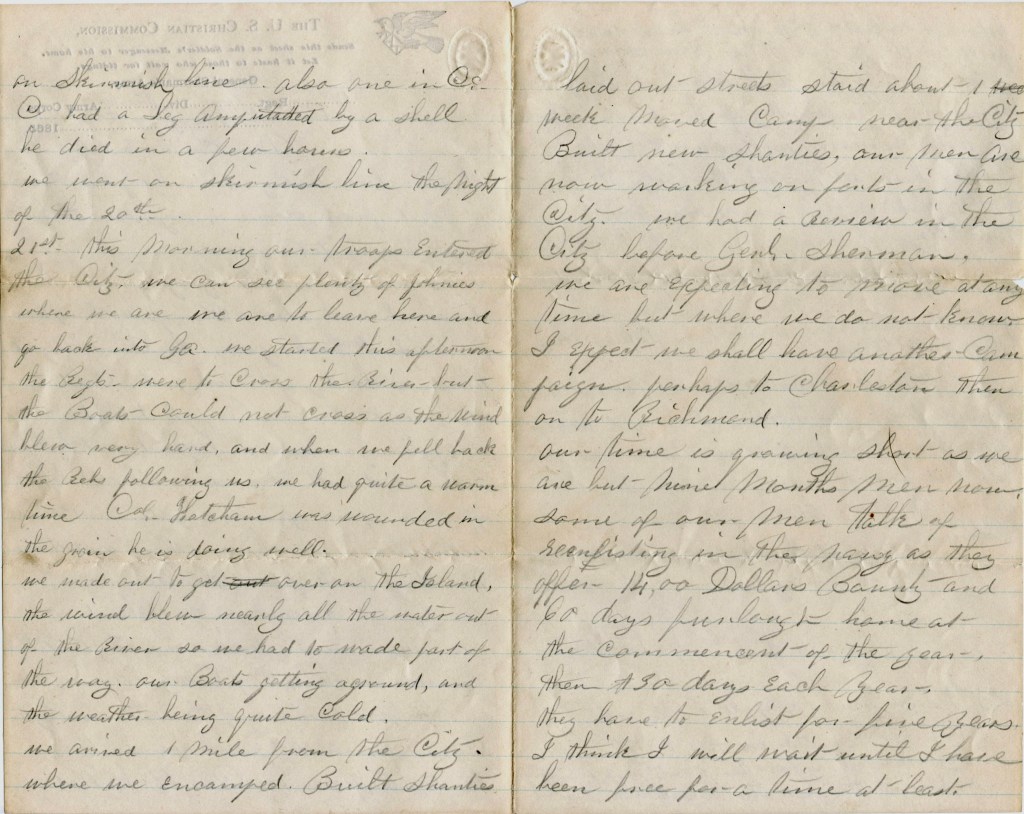
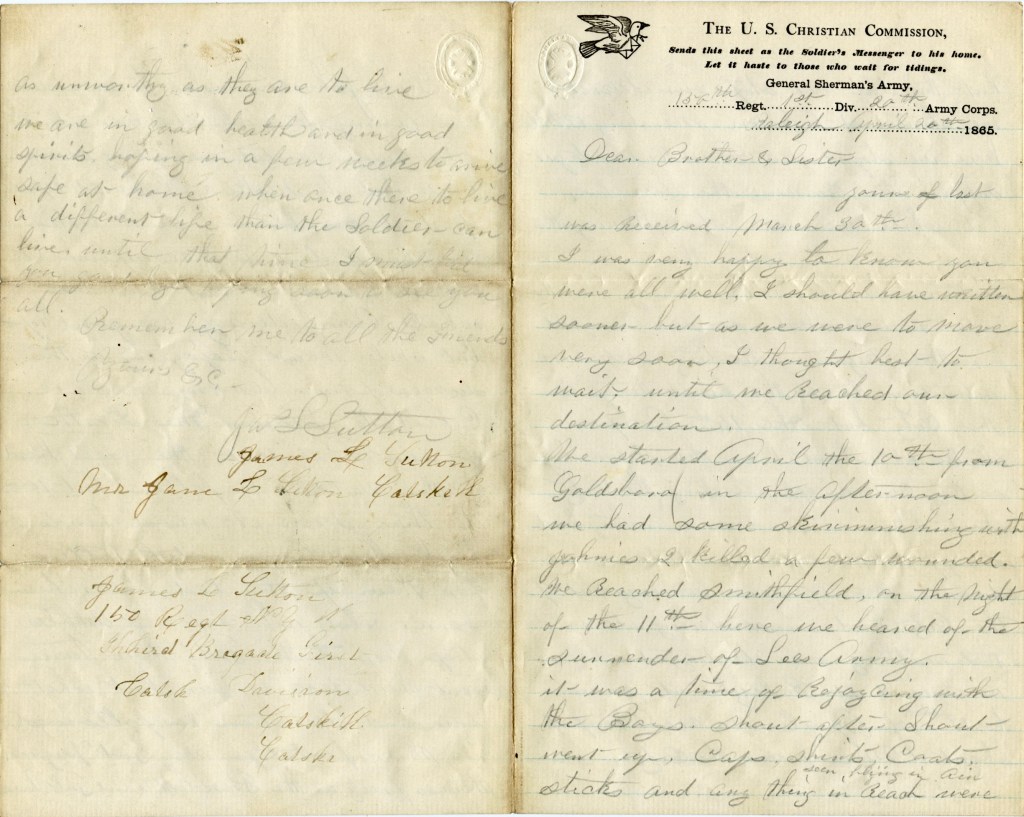
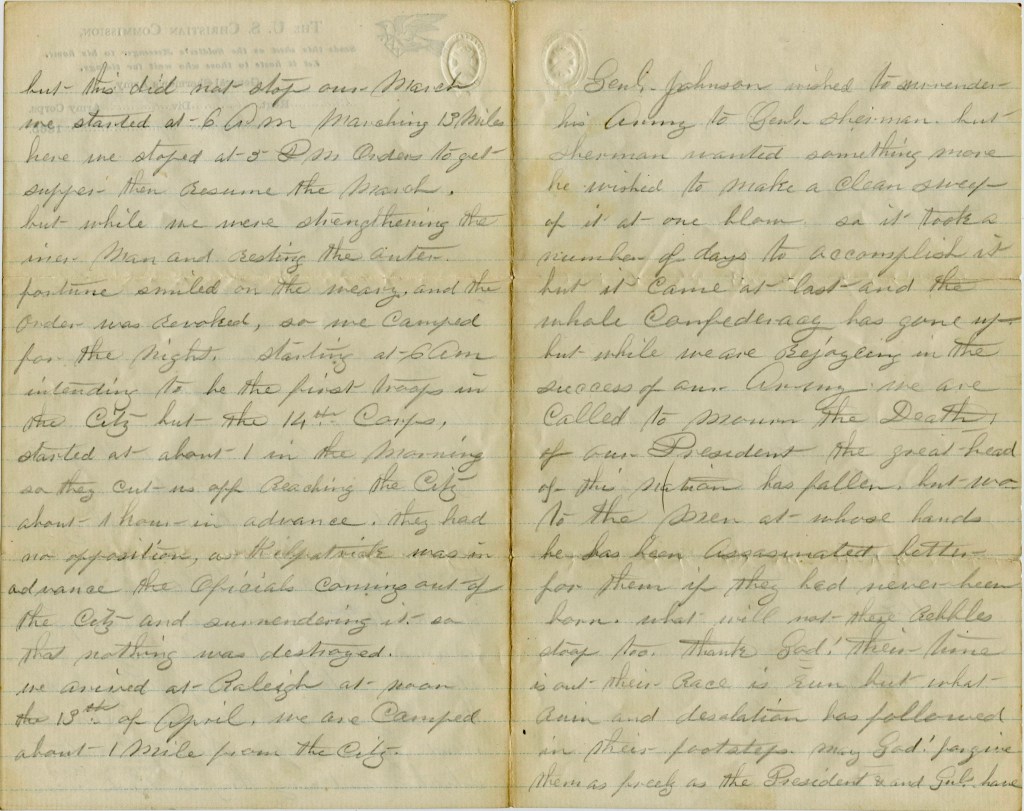

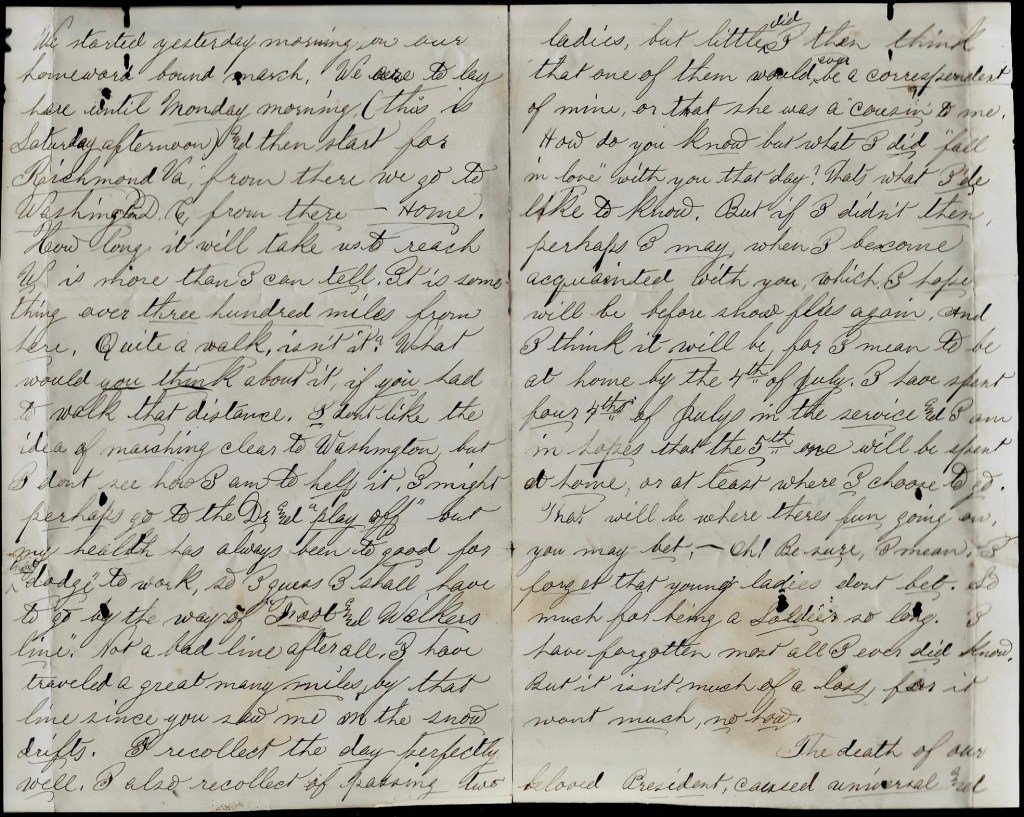
 Spared & Shared 23