Category Archives: 21st Michigan Infantry

1862: Julius Theodore Barrett to his Children

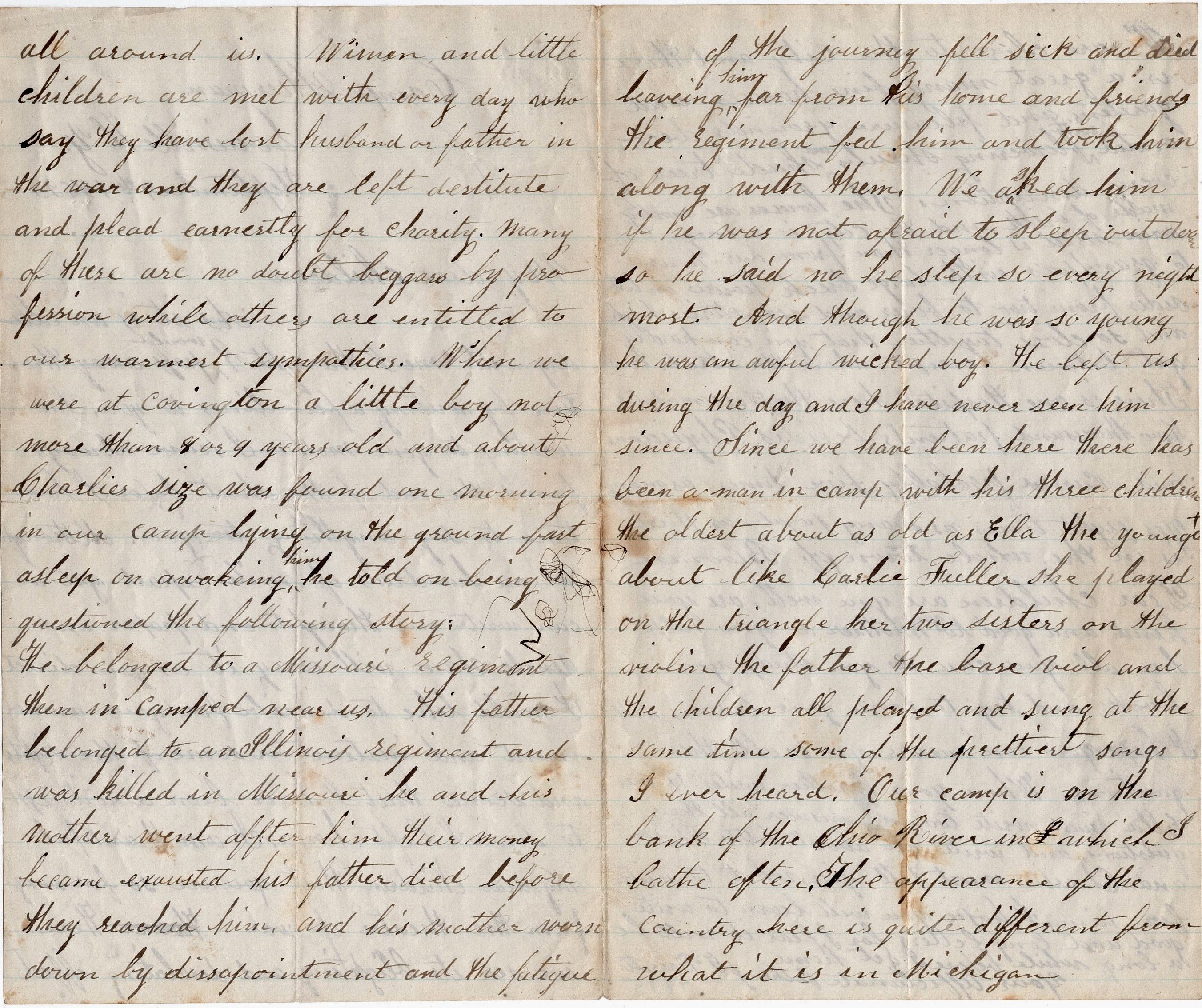
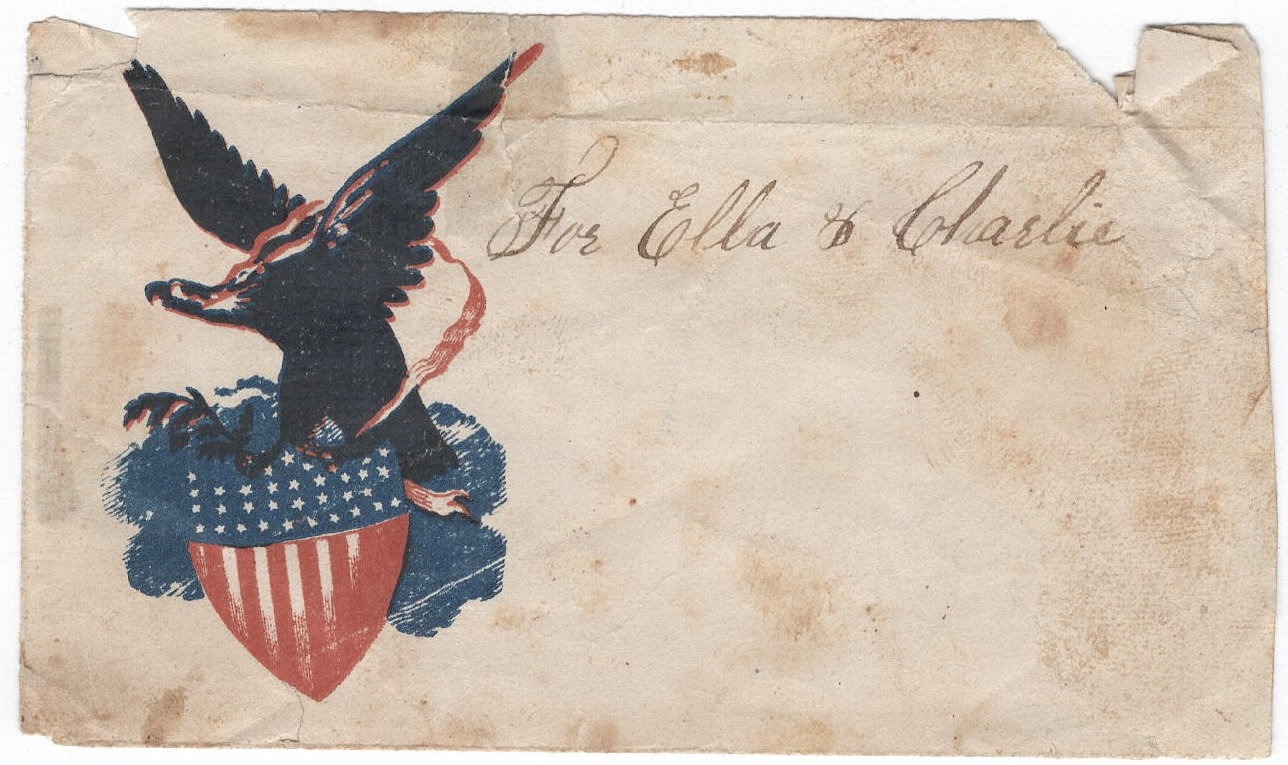
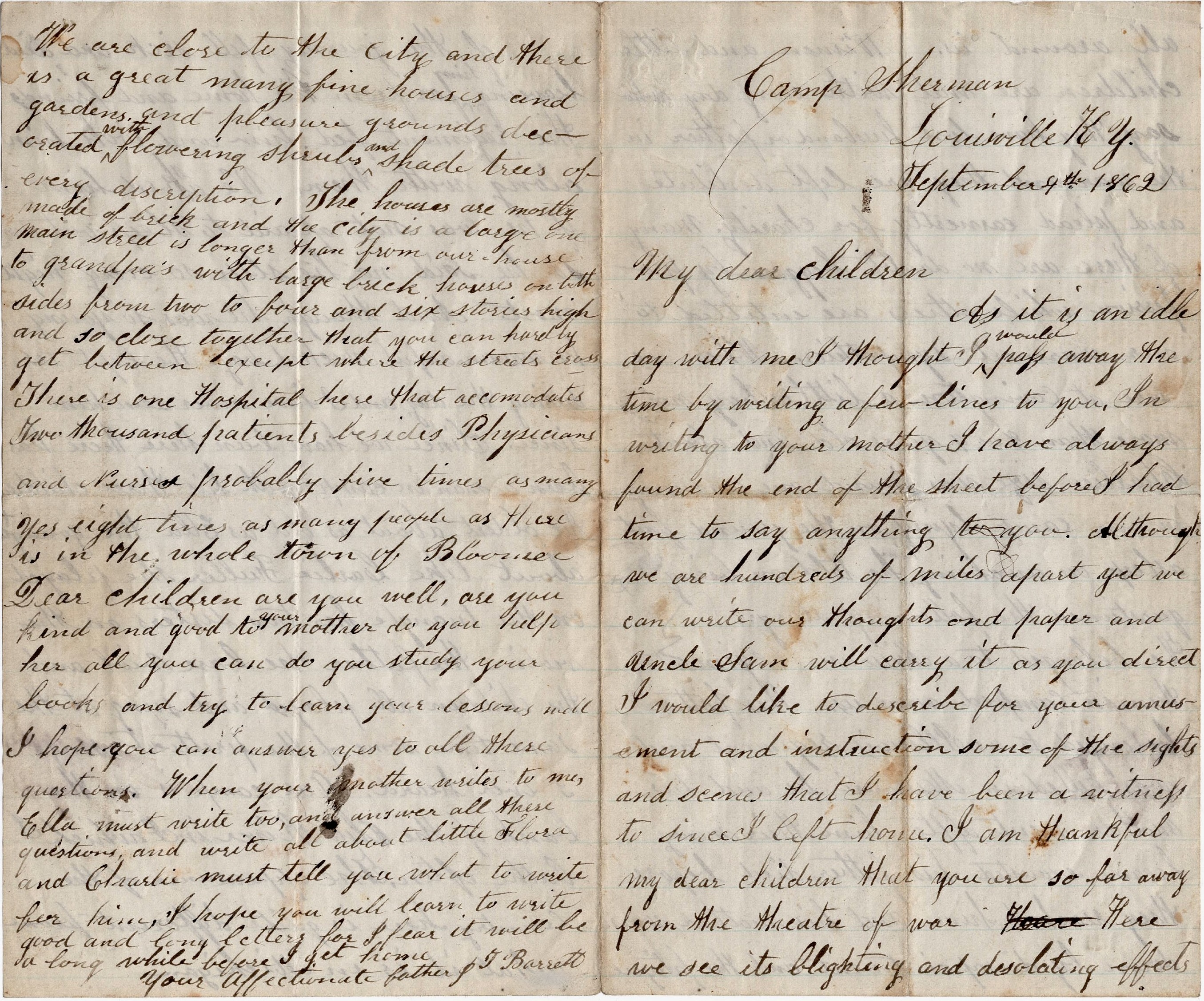
The following letter was written by Julius Theodore Barrett (1823-1862) of Bloomer, Michigan, who kissed his wife of 12 years, Mary Jane (Patrick) Barrett (1826-1897), and his three children, Ella (age 11), Charlie (age 9), and Flora (age 3) to enlist in Co. K, 21st Michigan Infantry on 12 August 1862. He served just over four and a half months before he was killed “by gunshot wound” at the Battle of Stones River on 31 December 1862.

In this heart-wrenching letter from the banks of the Ohio River near Louisville, Julius communicates to his children, for their “amusement and instruction,” a glimpse into the harrowing sights and scenes he has observed since departing from home. He recounts the war’s “blighting and desolating” impacts on the citizens he met in Kentucky, alongside descriptions of various scenes in Louisville. Our awareness of his impending death renders the act of reading this letter all the more difficult.

T R A N S C R I P T I O N
Camp Sherman
Louisville, Kentucky
September 9th 1862

My dear children,

As it is an idle day with me, I thought I would pass away the time by writing a few lines to you. In writing to your mother, I have always found the end of the sheet before I had time to say anything to you. Although we are hundreds of miles apart, yet we can write our thoughts on paper and Uncle Sam will carry it as you direct.

I would like to describe for your amusement and instruction some of the sights and scenes that I have been a witness to since I left home. I am thankful, my dear children, that you are so far away from the theatre of war. Here we see its blighting and desolating effects all around us. Women and little children are met with every day who say they have lost husband or father in the war and they are left destitute and plead earnestly for charity. Many of these are no doubt beggars by profession while others are entitled to our warmest sympathies.

When we were at Covington, a little boy not more than 8 or 9 years old and about Charlie’s size was found one morning in our camp lying on the ground fast asleep. On awakening him, he told on being questioned the following story. He belonged to a Missouri regiment then in camp near us. His father belonged to an Illinois regiment and was killed in Missouri. He and his mother went after him. Their money became exhausted, his father died before they reached him, and his mother wore down by disappointment and the fatigue of the journey, fell sick and died leaving him far from his home and friends. The regiment fed him and took him along with them. We asked him if he was not afraid to sleep out doors so. He said no—he slept so every night most. And though he was so young, he was an awful wicked boy. He left us during the day and I have never seen him since.

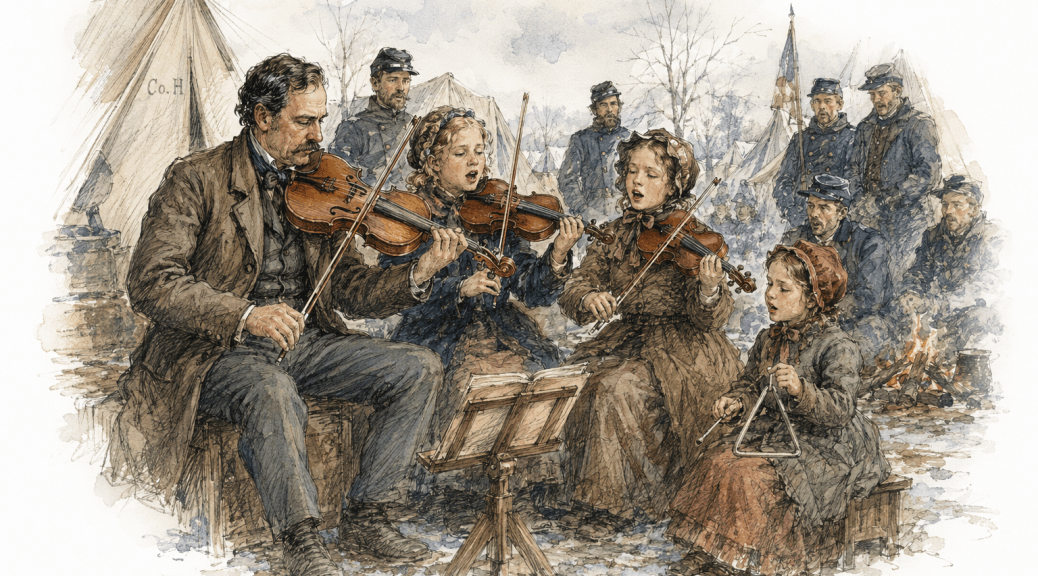
Since we have been here, there has been a man in camp with his three children, the oldest about as old as Ella. The youngest about like Carlie Fuller. She played on the triangle, her two sisters on the violin, the father the base viol and the children all played and sung at the same time some of the prettiest songs I ever heard.

Our camp is on the bank of the Ohio River in which I bathe often. The appearance of the country here is quite different from what it is in Michigan. We are close to the city and there is a great many fine houses and gardens and pleasure grounds decorated with flowering shrubs and shade trees of every description.The houses are mostly made of brick and the city is a large one. Main Street is longer than from our house to grandpa’s with large brick houses on both sides from two to four and six stories high and so close together that you can hardly get between except where the streets cross. There is one hospital here that accommodates two thousand patients, besides physicians and nurses, probably five times as many—yes, eight times as many people as there is in the whole town of Bloomer.

Dear children, are you well? Are you kind and good to your mother? Do you help her all you can? Do you study your books and try to learn your lessons? Well I hope you can answer yes to all these questions. When your mother writes to me, Ella must write too, and answer all these questions and write all about little Flora and Charlie must tell you what to write for him. I hope you will learn to write good and long letters for I fear it will be a long while before I get home.

Your affectionate father, — J. T. Barrett
1865: Charles S. Brown to his Family

I could not find an image of Charles, but here is one of Thomas G. Stevenson who also served as an officer in the 21st Michigan.

This letter was written by Charles S. Brown (1846-1904) of Co. K, 21st Michigan Infantry. He enlisted on 28 March 1864 and mustered out of the regiment on 8 June 1, 1865. He was commissioned a 1st Lieutenant on 1 September 1864 and made the adjutant of the regiment.

In 1850, the Brown family lived in Homer, Will county, Illinois. His parents were Rev. David Ebenezer Brown (1796-1873) and Harriet Jones (1806-1892). His sister, Esther (“Etta”) was born in 1839. By 1860, the Brown family had relocated to Flint, Genessee county, Michigan. The 1860 census enumerates Charles father as an Episcopal Clergyman. Charles was enumerated as 14 year-old student.

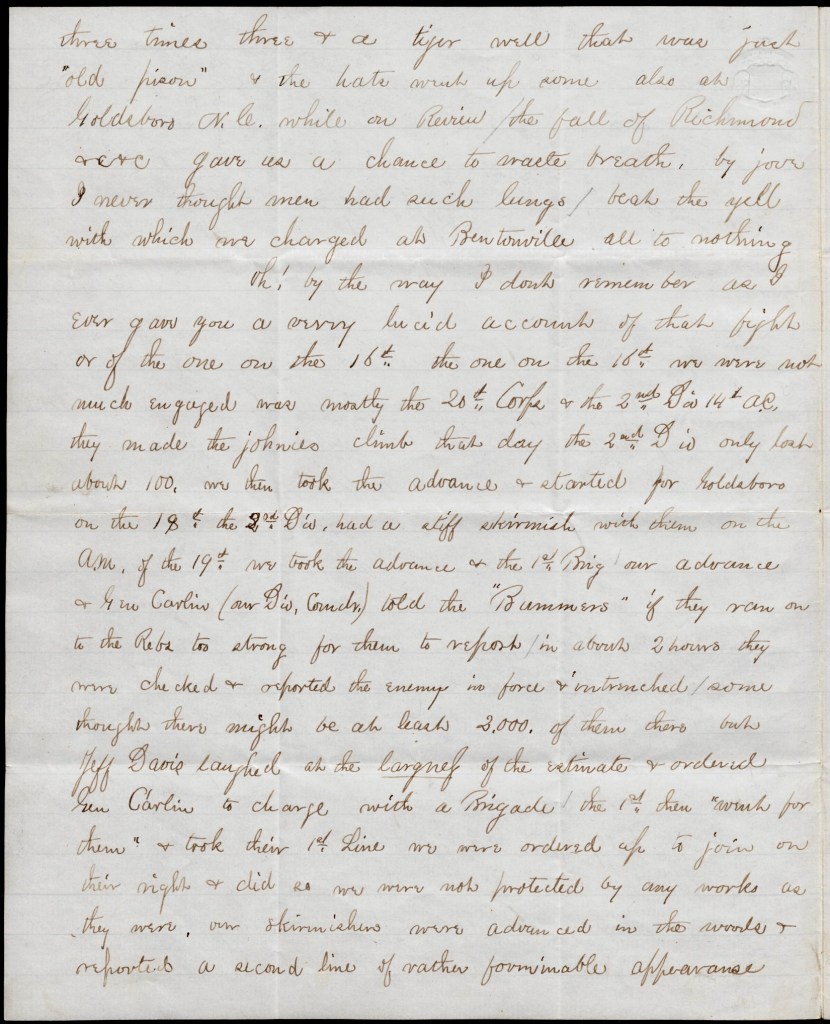
This letter is no longer in private hands. It is one of several letters written by Lt. Brown that were donated to the Duke University Library. See Charles S. Brown papers, 1864-65. It was transcribed and posted on Spared & Shared at the request of Ruth Stanton.

Transcription

Headquarters 21st Michigan Voluntary Infantry
Near Haywood, North Carolina
April 18, 1865

Mother and Etta,

As I have not heard or written in some time and a mail leaves in the a.m. (the 1st on this march), I thought I might interest you some. We have had an awful time from Goldsboro up marching like thunder & hard work for two days. Had to be sort of train guards & help them along. The morning of the 14th we got up at 1 a.m. & started for Raleigh which we entered about 9 a.m. after marching so that the horses almost trotted. We beat everybody into town & our 1st Brigade had the pleasure of hoisting the Stars & Stripes first over the surrendered city as old Gov. Vance surrendered not only the city, but the whole state. Bully for Vance.

We heard the announcement of Lee’s surrender [when we were] at Smithfield and it was given to the whole division at the same time. You can imagine the noise made by 15 regiments giving three times three & a tiger. Well that was just “old pison” & the hats went up some. Also at Goldsboro, N. C., while on review, the fall of Richmond, &c. &c. gave us a chance to waste breath. By jove, I never thought men had such lungs. [It] beat the yell with which we charged at Bentonville all to nothing.

Oh! by the way, I don’t remember as I ever gave you a very lucid account of that fight or of the one on the 16th. The one on the 16th we were not much engaged—was mostly the 20th Corps and the 2nd Div., 14th Army Corp. They made the johnnies climb that day. The 2nd Div. only lost about 100. We then took the advance & started for Goldsboro on the 18th and the 2nd Division had a stiff skirmish with them on the a.m. of the 19th. We took the advance and the 1st Brigade. Our advance and Gen. [William P.] Carlin (our Div. Commander) told the “Bummers” if they ran on to the Rebs too strong for them, to report. In about 2 hrs. they were checked & reported the enemy in force & intrenched. Some thought there might be at least 2,000 of them there but [Bvt. Major General] Jeff Davis laughed at the largeness of the estimate & ordered Gen. Carlin to charge with a Brigade. The 1st then “went for them” and took their 1st line. We were ordered up to join on their right & did so. We were not protected by any works as they were. Our skirmishes were advanced in the woods and reported a second line of rather formidable appearance. We were ordered to charge immediately which we did. The Rebels held their line until we were within 3 rods of the works when they opened fire from all sides and gave us an awful volley. We went for them with a yell and got within 5 paces of their works and if we did not pour some lead into them, I am mistaken. We finally were ordered to fall back which was done until the 1st brigade gained their works.

We halted and began to fortify, still in ignorance of our real position & totally without support for about 3/4 of an hour. The skirmishes were driven back & the Rebs came for us. We lay behind our incomplete works & gave them fits. We checked them & held them to it until they turned the left of the 1st Brigade & of course that forced to retreat. They fell back a regiment at a time as they were compelled to & of course our Brigade had to “follow suit.” It was the best thing we ever did for falling back we met a line of Rebs marching straight for our rear and in 15 minutes more we would have been between two lines of the buggers.

We fell back on our support (the 20th A. C.) which had come up by this time & the artillery went for them. There were 8 full batteries going for them as best they knew how & they would average 2 shots a minute to the gun. As the Rebs charged on the batteries, they began to fill up the guns with boxes of cartridges which was too much for Mr Reb.

The 2nd Division in the meantime had fortified to the right of our Division & on them the Rebs charged only 7 times in the course of 2 1/2 hours. The 14th Michigan charged once and got the Reb works when the Rebs came back and took our (the 14th Michigan) works, so Mr. 14th Michigan had to charge back to get their own works. The Rebs sent word for the 14th to surrender (while in that fix) [but] the 14th told them to “go to hell” and charged through and took about 1/2 of them prisoners. We lay under fire for 3 days till the 15th Army Corps and the 17th Army Corps took them in the rear and they had to get out, leaving all of our wounded prisoners & most of their badly wounded. We then went on to Goldsboro & lay until the 10th of April.

We have just heard of the death of Lincoln. May the Lord have mercy upon the country we pass through & the Rebs we catch if we go any further upon this campaign. I never saw a more exasperated set of men than the Army. Honestly the Army had rather experienced another Bull Run affair than to have had that happen. Few men will stop from committing any outrage or crime they may choose to. Sherman and Johnston are meeting now. I hope they won’t come to terms by jove. I would like to see Wm. T [Sherman] turn his army loose over what is left of South Carolina, by jove. I would not give much an acre for it after a corps or two had gone over it. This is the worst news we have ever heard yet. I hope Andrew Johnson will put down the screws tight. By thunder, the army will sustain him if it hangs every man and burns every house in the whole South.

I must close this as I have some work to do. Consider me as ever, — Your affectionate son and brother, — Charlie

We have been out foraging to Haywood & beyond. I found some of the prettiest girls there I have seen in the South. I would like to garrison the place and would have some fun with the four Misses Bryant, and others. I found a good set of chess men which I will try and send home.

We had some fun in Raleigh, although we only stayed one day. I had the pleasure of being ordered to find out who wanted guards &c. in our section and to post them & I tell you, I did. I found out it was fun to hear their questions and some I did scare almost to death. The very name of “Sherman’s Bummers” would cause all of them to turn pale and I made some, I tell you. But “such is life” and now I hope we will soon be out of field duty, which is all very nice but rather annoying when they call you to stand within 5 paces of a 32-pound cannon & a line of Rebs. There is where the fun comes in. I tell you, it is tough to see your comrades piled up about you as we had there. We only lost 81 in all out of 250 who went in and 5 officers out of 14.

Consider me as yours affectionately, — C. S. Brown