I could not find an image of Edwin but here is one of William Sawin who also served as an Asst. Surgeon in the 2nd Vermont Infantry (Photo Sleuth)
The following letters were written by Edwin R. Brush (1836-1908) who was drafted into the service on 17 July 1863 as a private in Co. H, 2nd Vermont Infantry and three months later was promoted to Assistant Surgeon of the regiment.
Brush graduated from the University of Vermont at Burlington in 1858 and took over the medical practice of his father, Dr. Salmon Brush (1804-1887) in Cambridge, Lamoille county, Vermont. Edwin wrote the letters to his wife, Amy R. Brush (1836-1915).
Edwin was with the regiment from the time they fought at Rappahannock Station in November 1863 through the Battle of Sailor’s Creek in April 1865. In one letter, he describes the mood of the army following the assassination of President Lincoln and shares portions of conversations he’s had with rebel soldiers going home following Lee’s surrender.
Letter 1
Addressed to Mrs. E. R. Brush, Cambridge, Vermont
Petersburg, Va. January 5th 1865
Dear Amy,
I received yours of the 28th of December night before last and should have answered it yesterday but I had to go on picket and so you see could not do so. Was very glad to learn that you and Nettie were well and hope you will continue so.
I am glad to know that Charley Brush is at home on a visit, Hope he will enjoy it and that his health will improve, He must have had a very hard time while he was a prisoner. The rebels say that they feed and care for their prisoners of war the same as they do for their soldiers but I do not believe it as no man could do a soldier’s duty on the ration that they prisoners say their receive. That they receive an insufficient supply of food and clothing, there is no doubt for what everybody says is pretty apt to be true and I have yet to see or hear of a man that has been a prisoner who does not say that he suffered for the want of proper and sufficient food.
We have been having another cold snap. Night before last it commenced snowing and two or three inches of snow fell when it cleared off cold. And last night was a pretty cold one but it is some warmer today. But I think it will be quite cool after sundown.
There is not much of interest here. There is the usual quiet along the lines. No firing in our immediate front but the usual amount on our right and more or less deserters coming in. The rebels are losing a great many by desertion. In fact, they are very cautious who they send on picket. One fellow came in who said he was one of the trusty ones whom they could trust on picket. He said he left his gun standing guard while he came visiting.
We can see the suburbs of Petersburg from our picket lines and the lead works near the city.
Our folks are building some quite strong forts near here. It would trouble the Johnnies now to get to our works. We have two lines of abatis in front of us that would take a man half an hour to get over if left alone except at the places left open on purpose and we have cannon planted to rake them in all directions. I believe a strong skirmish line would hold three lines of battle with the help of artillery.
I shall write to Mary soon if nothing happens more than I know of. Gove my regards to all friends. Yours affectionately, — Edwin
Letter 2
Near Petersburg, Virginia March 4th 1865
Dear Amy,
Today I received yours of the 26th. I am on picket today. I have to go on only once in about four weeks. There are two very important things transpiring today. One is the inauguration of Old Abe [but] however important that event may be to the country, there is another that is full as important to the members of the regiment individually and that is that we are receiving four months pay. And for one, I can say that it comes in time of need.
News is very scarce here just at present. The rebels are not deserting quite as fast as they were a few days ago. It is said that there are a different set of men doing picket duty in our front from what there were a few days ago. It is either that or else the rebels are more particular about the men they send on picket. I am still doing duty at the 6th Regiment. How long I shall have to remain there, I do not know. I am glad that you had so good a visit with Lieut. Buck.
About my horse not carrying double, it is true. He did not propose to carry anything that was secesh and I do not blame him much either, do you? But that time I went two or three miles beyond our picket lines to dress a wounded rebel.
I have just been paid off and shall send a check for a hundred and fifty dollars which I hope will be acceptable to you. I hope you have not suffered for the want of it. I should liked to have sent more but I had to borrow some money to live on and shall have that to pay. I have two months pay now due me but we shall not get that now.
It has been very stormy here for the last week, it having rained almost every day. So I do not think we shall have to move just yet. My health continues good yet, and I hope yours is good also.
I have not heard from Mortimer since I left the Valley. I do not know why he does not write as I wrote him very soon after we got here. I should think he would answer it but perhaps he did not receive it. Give my regards to all enquiring friends. Yours affectionately, — Edwin R. Brush, Asst. Surgeon, 2d Vermont Vols. Washington D. C.
P. S. Please let me know as soon as you receive the check. — E. R. B.
Letter 3
[Note: This letter is from the private collection of Greg Herr and was transcribed and published on Spared & Shared by express consent.]
Burkville, Virginia April 19th 1865
Dear Amy,
I was in hopes to get a letter from you tonight but have just learned that we are to have none tonight. Our mail is quite irregular at present but are in hopes soon to be where it will be more regular and perhaps we shall not be so anxious about it.
The army is feeling very sad and gloomy in consequence of President Lincoln’s death. We feel that we have lost a father and a friend and the country its head. The indignation of the men is great and general. The sadness is general throughout the whole army. Woe to his assassin if he should fall into the hands of our soldiers.
We are expecting to leave here before many days but where we are going is not yet known but most likely it will be to Petersburg or Richmond where we shall be likely to remain until we are mustered out of the service which I hope will not be many months. The rebel soldiers are very glad to get home. I saw one that had been in the army a year that has just got home from Lynchburg. He came before our troops had entered the city. I asked him if they gave him leave to come and he said he did not ask them whether he might come or not but he said they [did] not molest him. I have talked with a great many of them and they all say that they have had fighting enough and are glad of the opportunity of getting home.
“He [Lee] had about thirty thousand men with him when he surrendered and there were only ten thousand of them that were armed.”
Edwin R. Brush, Asst. Surgeon, 2nd Vermont Infantry
Gen. Lee could not keep his army together on the march through the country. He had a great many Virginia troops and many of them went home. What troops he had when he surrendered were mostly without arms. He had about thirty thousand men with him when he surrendered and there were only ten thousand of them that were armed. There were probably many that did not have arms when they left Richmond and Petersburg such as hospital attendants, teamsters, and &c. But taking those out and there must have been many that threw their arms away.
We have been amusing ourselves today in reading Jeff Davis’s last message written at Danville. I think his next will be of a different tune. I have been to the station today to look at some of the captured artillery. I do not know just how many pieces there were there today but yesterday there were one hundred and one and there were more to come. They are sending them North as fast as possible and I hope they will be sent so far that the South will never see them.
I am as well as usual. Affectionately, your husband, — Ed Brush, Asst. Surgeon, 2nd Vermont Vols.
You may tell George that Mr. Taylor was with us until just before we left Petersburg when the sutlers were ordered out of the army and I have not seen or heard of him since.
The following letter was written by George Warren Campbell (1830-1874), the oldest child of Samuel Graham Campbell (1797-1873) and Elisabeth Goings (1804-1882) of Selma, Delaware county, Indiana. George enlisted in Co. D, 84th Indiana Infantry in August 1862 and mustered out of the service in late July 1864, being transferred to Co. C, Veteran Volunteer Engineering Corps. He was married in 1850 to Sarah Amanda Snidow (1833-1922) and had at least eight children.
George wrote the letter to his brother, William Harrison Campbell (1838-1912), who enlisted in Co. K, 19th Indiana Infantry on 29 July 1861 as a first sergeant and was promoted to 2nd, then 1st Lieutenant during the war. The 19th Indiana was, of course, part of the famed Iron Brigade or “Black Hat” Brigade. He was discharged for medical disability in October 1863 on account of the wound he received in the right hand while fighting Pettigrew’s North Carolinians in the afternoon of July 1st above Willoughby Run near Gettysburg.
ASSASSIN SYMPATHIZERS FACE PUNISHMENT.—Not all Union men mourned the loss of their leader. The Nashville Press described this image shortly after it was taken on April 15, 1865. “We saw a photograph yesterday of ten men who were arrested at Chattanooga on Sunday last for expressing pleasure at hearing of the death of President Lincoln,” reported a correspondent, who added, “Upon the breast of each was a tin plate with the words ‘Assassin Sympathizer’ painted on it.” The men were sentenced to labor on the streets in Chattanooga by day while wearing the placards, and by night they were confined in irons.
The Press also identified the men. They were a mix of soldiers and contract employees. It is unclear if the names listed by the Press match the actual order, left to right, in the photo: Government employees E. Jones, R.C. Jones and James Martin; citizen S. Moxley and blacksmith C.G. Moxley; and 18th Ohio Infantry privates Cyrus Leight, Henry D. Metzer, David Alspaugh and Moses H. Matheny. The soldiers were all late war recruits: Leight, Metzer and Alspaugh were substitutes who mustered into Company K during the last week of March 1865. Matheny mustered into the regiment in February 1864, making him the veteran of the group. The four men eventually received honorable discharges. They also hailed from the same state as U.S. Congressman Clement Vallandigham, the leader of the Copperhead faction of anti-war Democrats, and a powerful opponent of the Lincoln administration.
A fragmentary period pencil inscription on the back of the mount notes that a lieutenant presented the photograph to a major general.
Albumen by an anonymous photographer. Paul Loane collection.
Transcription
Chattanooga, East Tennessee May 2, 1865
Dear Brother Will,
I received your kind letter of April 12th a few days ago. The reason I did not answer sooner was owing to my not having stamps nor could I get any until yesterday. I should have liked to have been sporting with you. I have [not] had a squirrel hunt since last summer and you know I did not make it pay very well then. It is a wonder some of the young soldiers of Linnville did not offer their services to sit up with you the evening you killed the goose. They are certainly not very neighborly about that place, not so much so as they were a few miles south of there about thirteen years ago [when] I killed my first wild turkey in Missouri and some of the young ladies offered to sit up with me. That was owing perhaps to their being better acquainted with me than you.
We were rather jubilant over the fall of Richmond and Petersburg, the surrender of Lee’s army. It is hardly necessary for me to tell you that the death of our President cast a gloom over every thing with the exception of a few Rebels and butternuts. There were a few Rebs collected together at a house near the camp of Co. I of this regiment the evening of his death and having quite a jubilee over the sad intelligence, but their rejoicing was of short duration. Co. I went for them as soon as they found out what they were at, thrashed the men and sent them to the military prison, turned the women out of doors and fired the house. There were a few men who bear the name of soldier that rejoiced at the death of the President; such are now working on the most public streets of Chattanooga (or at least all such that [are] near this place) with a ball and chain attached to one foot, or rather ankle, and a card tied to their back with these two words, “Assassin Sympathizer” printed in large letters on them so that every person that can read or spell may see for what they are working there for. They ought to have their heads shaved and be drummed out of the service.
Since the surrender of [Joseph E.] Johnston’s Army, things look more cheerful and we are trying to think we will be mustered out soon, probably before the fourth of July next. However, I am not taking much stock in it. As to finding a location for you where it will not cost so much to live, I think that would be hard to do here unless he was in Government employ and that is about played out for they are discharging all government employees about here.
I believe I have written all the news. I saw my old regiment pass through here about a week ago enroute for Nashville. The boys thought they were going home. Lucy Campbell tells me to send you her respects. Give mine to Porter and Albert Sawyer. This leaves me well and hope it may find you the same. Hoping to hear from you soon, I close. As ever your affectionate brother, — G. W. Campbell
This letter was written by Emma E. Davis (1842-1927) of Strafford county, New Hampshire, the daughter of Alfred Davis (1819-1898) and Chloe Parker (1822-1902). We learn from the letter that Emma was working as a store clerk in Boston during the last year or two of the Civil War. It appears she must have married Jacob Childs (ten years her senior) sometime shortly after this letter was penned and lived out her days in Worcester, Massachusetts.
Emma wrote the letter to her cousin, William Sydney Gray (1836-1907) of Stratford, Coos county, New Hampshire. “Sydney” was the oldest of six children born to Thomas Gray (1810-1882) and Olive F. Davis (1810-1895). Syndey enlisted August 1862 to serve in Co. F, 12th New Hampshire Infantry. He was wounded slightly in the head at Chancellorsville and again at Chapin’s Farm.
Emma expressed shock at the news of the assassination of President Abraham Lincoln and marvels that she saw the benefit performance of J. Wilkes Booth at the Boston Museum a year earlier.
[Note: This letter is from the Sic Parvis Magna Collection and was transcribed and published on Spared & Shared by express consent.]
Transcription
Adressed to Mr. William S. Gray, Washington D. C., Co. F, 12th Regt. N. H. V., Point Lookout, Md.
Boston, Massachusetts May 28th 1865
Cousin Sidney,
As I was looking over some of my letters this afternoon (it being so stormy that I could not attend church), I happened to take up your last and stopped and read it, and if I recollect right, I have not answered it. And having nothing particular to do this afternoon I thought to spend a few minutes in answering it.
I suppose you are truly glad that your time expires soon. How many happy hearts there will be when those brave soldiers come marching home. I am truly thankful that this “cruel war is so nearly at an end.” It seemed as news came over the wire that Lee had surrendered that our whole land was filled with rejoicing. Boston was all excitement. All places of business were closed and all the Military and Fire Companies of Boston and the adjacent towns marched through the principal streets and bells were rung and cannon fired.
The 10th of April was a day long to be remembered in Boston. But it seemed that their rejoicing was soon to be turned to mourning. The morning of the 15th I shall never forget. As I went to the store everybody looked so sad that I wondered what could be the reason of it. Upon entering the [store] I asked one of the salesmen why it was everyone looked so sad. And they said, did you not know that our President had been killed. I could hardly believe it. But upon opening the paper, I found that it must be so. And upon returning home that afternoon the buildings were everywhere draped in mourning. Such a sad sight as Boston presented that week will be long remembered.
It seems dreadful that such a good man as Lincoln was should die by the hand of the assassin. I saw J. Wilkes Booth a year ago this month in the Museum. That was the only time I ever went to the Museum. It was his benefit evening. It was a tragical performance. It hardly seems possible he could ever have committed such a crime as he personated that evening.
Advertisement appearing in the Boston Evening Transcript, Friday, May 20, 1864
But I suppose you will want to hear of something else so I will leave that. I presume you knew that Augustus had again enlisted for three years in the 17th US Regulars—the same regiment he was in before. He enlisted the 14th of March. I was home this spring and stopped one day. I had a letter from home yesterday. They are all well at home. Augustus is in a Recruiting Office in Dover, and expects to stop there this summer. Edwin & Charles are grown up now, nearly as large as Augustus. Lizzie is a great girl and Frank and Rubie say that they wish Emma would come home and stay. I hardly think I shall go there to stay again although Father thinks I ought to come home and stay this summer.
My health has been very poor this spring. I have sometimes thought I should not be able to work but they think they cannot spare me at the store. I suppose you are expecting to come home in a short time, as the story is here that all soldiers whose time expires this year will come home next month. If you come through Boston on your way home, please call at 25 Federal Street and see me. Or if it is in the evening or on Sunday, you will find me at 75 Brighton Street, Boston. I do not board in Chelsea now. Please excuse all mistakes writing, &c., and answer as soon as convenient and direct to Emma E. Davis, 25 Federal Street, Boston, Mass.
By the [by], I have a present from the ladies in the room. I am Overseer Officer of a photograph album and I have reserved a place for your picture in it. I have got three soldiers pictures in it now but I fear you will say, “I wish Cousin Emma would not write so long a letter to me so I will close.” Remember and call to see me when you go home. From your cousin, — Emma E., 25 Federal Street
How do you suppose Uncle Jeff likes his headquarters now?
William and his sister Sarah (“Sallie”) Clark of Londonderry, New Hampshire
The following letter was written by William Clark (1844-1916), the son of Reed and Elizabeth (Perkins) Clark “After attending public schools, prepared for college at Pinkerton Academy,” William instead “enlisted 3 September 1864 as a private in Co. D, 1st New Hampshire Heavy Artillery” and was immediately promoted to corporal. The regiment was assigned to the defense of Washington D. C.
William was posted in Washington D. C. on the night of 14 April 1865, five days after the surrender of Lee to Grant at Appomattox, when President Abraham Lincoln was shot by John Wilkes Booth in Washington’s Ford Theater. Lincoln, of course, died early in the morning of April 15 and it was soon learned that his assassination was part of a larger plot to murder multiple key Union government officials. The assassination unleashed a torrent of mourning, anger, and retribution that was felt for years to come. After escaping from Washington, Booth was eventually cornered and killed in Virginia on 26 April, following a massive dragnet for him and his co-conspirators.
William wrote this letter on April 17th, two days after Lincoln’s death, to his sister in New Hampshire. It conveys a sense of the excitement that followed the assassination, but ends with a comment illustrating the joyous rebirth of Spring that managed to blossom in the midst of the madness, reminding us that life goes on.
Map showing location of Battery Cameron west of Georgetown overlooking the Potomac. Now the location of the German Embassy.
[Note: This letter is from the personal collection of Richard Weiner and was transcribed and published on Spared & Shared by express consent.]
Transcription
Addressed to Miss Sarah E. Clark, Derry, New Hampshire. As stated in the letter, this envelope once contained apple blossoms that are no longer present, but the fragrance lingers still.
Battery Cameron District of Columbia April 17th, 1865
Dear Sister Sarah,
I have not heard from home for nearly a week, nor received a letter or paper from anyone, but I thought I would write and let you know how we are situated. Our boys are all in picket except barely enough to guard the batteries. I am lucky enough not to be on quarter guard every other day, while the picket is not relieved at all. The picket posts are about 25 feet apart and extend around the city a distance of 145 miles. The authorities are searching all places of retreat within the lines. A great many are arrested. A man was caught by our boys last night while trying to pass the picket line on his hands and knees. He was armed with two revolvers heavily loaded. He was coming in. The guerrillas fired into the canal boat above Fort Sumner yesterday.
You cannot even imagine the state of affairs. Persons that are secession at heart have dressed their houses in mourning and people dare talk nothing but Union sentiments for fear of their lives. Several have been shot already for saying that they were glad that Lincoln was dead. I hear that Lincoln is to be buried Wednesday. I want to go to into the city but can’t go till Thursday—if I can then. We have an approved pass from Col. Long to get into the City with. There are so many guards now that a cat could scarcely pass them. I would send you a Washington paper if I could get one, but I cannot.
The boys that have been into the City say that every building on the street is draped in mourning. The Light Artillery was just in season to prevent the mob from breaking into the old Capitol Prison and murdering Gen. Lee’s son [who] is confined there. And Gen. Early is at Williard’s [Hotel] under guard, so I hear, but you must take that for what it is worth. I have just seen a column of cavalry come from Virginia across the river. I should think that there were two or more regiments of them. The New Hampshire cavalry is only 7 or 8 miles from here doing picket duty.
The mail has just come in and I must stop writing till I see if I got a letter. No letter for me so I shall not hear from you until tomorrow at least. Can’t you or Marianna write about Wednesday so that I may have about Saturday or Sunday. I am almost sure of a letter from you on Wednesday. I get the letters you write on Sundays on Wednesday. Is Carrie Parsons at home? And Kate Dinsmore? I would write to them but am afraid to for I am so nervous that I cannot write a very plain hand. It is unnecessary to inform you that I am on guard for that is all the time I have to write. It takes me all the time that I am off guard to clean my gun and equipments. Please write soon. My very best to all. Tell them I am well.
Your affectionate brother, — William Clark.
I never have the good luck to back (fold) a letter any other way then wrong side up, W.C.
Here are some apple blossoms; the orchards are in full bloom.
I could not find an image of William but here is one of Robert R. Russell of Co. H, 160th New York Infantry (Missing Letters File)
The following letter was written by William C. Guest (1839-1875) who enlisted as a private at Sodus, New York, on 9 September 1864 to serve in Co. C, 160th New York Infantry. He survived the war and was discharged on 1 June 1865 in Washington D. C.
Regrettably there is no family tree information on this branch of the Guest family that I could find on-line. The letter was addressed to “Dear Father” but the envelope was addressed to James A. Guest who was born in Cattaraugus county, New York, in 1831 so he would be too young to be the author’s father. My hunch is that James was an older brother who had previously served in the Civil War in the 26th New York Battery and was, by May 1865, working as an express agent in Belle Plaine, Iowa, where he was enumerated in the 1870 census. Sometimes letters and envelopes get mixed up, or sometimes a letter from one child gets forwarded to another. James’ military records indicate that his parents were Henry Guest and Rachel Beadle of Seneca county, New York.
The 160th New York Infantry was organized and later recruited from the counties of Cayuga, Seneca, Wayne, Ontario, Allegany, Erie and Wyoming. By the time William enlisted (or was drafted) into the regiment, they had seen action in the Department of the Gulf, the fall of Port Hudson, and the Red River Expedition. By the fall of 1864 when William joined them, they had returned to the East and specifically to the Shenandoah Valley where they fought with Gen. Sheridan against Gen. Early’s men. They sustained many casualties in the battles of Opequan and Cedar Creek.
William’s letter tells us about the trip to Washington D. C. to participate in the Grand Review in May and, while enroute, witnessing the Lincoln Funeral Train not long after it had left Washington on its way north to Baltimore on 21 April 1861. He also refers to the remains of John Wilkes Booth being on the gunboat Montauk at the Navy Yard.
[Note: This previously unpublished letter was graciously made available for transcription and publication on Spared & Shared expressly by the Sic Parvis Magna, Gratias Lesu Collection.]
Transcription
Addressed to Mr. James A. Guest. Belle Plaine, [Benton County] Iowa
Camp Stoneman Near Washington D. C.
May 1, 1865
Dear Father,
Your kind letter was received some time ago by Jimmie while we laid at Summit. The 4th of April we broke camp at Summit Point and went up the Valley above Winchester where the whole division assembled in a line of encampments. We remained there for four day and all of this time the cavalry was up in the Valley ahead of us scouring the Valley. They went up as far as Mount Jackson and only met with a few guerrillas and captured six of them which I had the chance of seeing as they passed along the pike, And at this time I had the chance of seeing the largest force of cavalry I ever witnessed including the 22nd New York and seeing some of the Lyons boys as they passed along in the column. I should think the column would extend in distance from one end to the other four miles distance including the whole line of them.
After remaining up there the four days, we was all ordered back to Summit Point and remained there 4 or 5 days and then was ordered to report to Washington. We all came by railroad stored and packed in the cars for 24 hours. Jimmie and myself and a number of others rode on top of the cars and slept there all night, and the weather rainy and misty. We had the pleasure of seeing the funeral train of our lamented President Lincoln. It passed us as our train stopped to wood and water between the Relay House and Washington, the road being double tracked.
Day before yesterday Jimmie procured a pass and visited Washington. He with John Layton who is there at the Campbell Hospital visit the places of interest and curiosity of Washington.
We are doing very heavy picket duty on this side of Washington. Orders are no persons are allowed to pass out or in with a pass [unless] signed by Gen. [Christopher C.] Augur or Secretary [Edwin] Stanton. It seems that Booth, the murder[er] is captured and his remains lie in state on board of a monitor [USS Montauk] in the Navy Yard at Washington. 1
Everyone seems to have the impression that the war is over and that we will see our homes [in] less than three months. Good feeling manifested here at the news of the surrendering of Johnston. It makes the boys in the regiment still talk more stronger about going home. Jimmie received a letter from Marier Jones. She said all was well and that John [was] there and his leg was very fast improving but some lame yet. Also last night Jim received a letter from Mrs. Lyman. All [were] well but Mr. Lyman. He had the rheumatism very bad. Also that Neu__ Vanderbilt was living with his wife in [the same] house with his mother and worked her farm this summer and also that Sanford works their farm again this season and that Mrs. Brown’s girls were living with her this summer. Also that Mr. Brown had been there to visit them. And also that Charley Rozell was clerking it for Owen Klink somewhere in the army for an army sutler.
Jimmie is still Orderly of this company and is well. He is today busy making out his pay rolls of this company. We now have four months pay due us to to today—the first of May.
With my love and best wishes, I remain your son, — William C. Guest
Co. C., 160th New York State Vols., 1st Division, 3rd Brigade, 19th Army Corps, Washington D. C.
Our regiment is very small. It only contains 250 men and it left Auburn with 840 men. We have a full view of Washington from this camp.
1 Readers are referred to another letter I transcribed in 2021 that was penned by Henry Washington Landes who served as a guard aboard the USS Montauk describes witnessing the autopsy of Booth performed onboard. See Henry Washington Landes Letters & Diaries.
The following letter was written by Benjamin Willson Briggs (1842-aft1920) to his older sister Rhoda Sophia Briggs (1840-1921). They were the only children of Asa Barnard Briggs (1785-1863) and Jane Winslow (1788-1870) of Pierrepont, St. Lawrence county, New York. Rhoda was yet unmarried in 1865 when this letter was written but married Howard William Burt in 1875. Benjamin married in 1867 to Jane S. Striver (1843-1919) in Springfield, Illinois.
From the content of the letter and from the envelope it appears that in 1865, Benjamin was working for the Assessors’s Office of the US Internal Revenue Service, 8th Illinois District. We know that he married Jane in Springfield in 1867 which leads us to conjecture that he may be the same “Benjamin W. Briggs” of Pekin indicted in 1876 on petty charges of conspiring to defraud the United States in matters related to tax collecting. Later in life he appears to have taken his family to Omaha, Nebraska, where he worked as a baggage agent.
In this letter, Benjamin describes the emotional impact on himself and the community of Bloomington, Illinois, upon receiving news of the assassination of President Abraham Lincoln. He also shares a remembrance of having been at a Ford’s Theatre performance the previous September when the news of the fall of Atlanta was announced, in stark contrast to the news of the assassination. He also, surprisingly, shares his wonderment that an assassination attempt had not been made previously during Lincoln’s daily sojourn to the cottage he kept at the Soldier’s Home. Finally he mentions briefly the arrest and near hanging of a resident in Bloomington who celebrated Lincoln’s death.
[Note: This previously unpublished letter was graciously made available for transcription and publication on Spared & Shared expressly by the Sic Parvis Magna, Gratias Lesu Collection.]
Transcription
Bloomington, [Illinois] April 16, 1865
Dear Sister,
I have received two letters from you since I have written to you. I will now endeavor to answer them both at once but I am afraid that it will be but a poor attempt for I do not feel much like writing letters today. The excitement occasioned by the terrible news of yesterday has not yet entirely subsided and therefore it is difficult for me to keep my thoughts together long enough to get them upon paper. Abraham Lincoln is no more!
No longer ago than day before yesterday the people here were all elated at the glorious prospects before them. Recruiting to be stopped and the expenses reduced. Surely the end was drawing nigh. All were gay and joy gleamed from every countenance. All were congratulating each other that this cruel war was over. What a contrast was yesterday—a fearful gloom overshadowing every countenance while the doleful gun, the tolling bell, and the city draped in mourning told of the terrible bereavement which the Nation had been doomed to suffer. The greatest and noblest of men, the national Chief Magistrate, had been stretched upon a bloody bier by the hand of a skulking assassin. Citizens looked each other in the face in blank astonishment while deep in their eyes was a troubled look that bespoke of sorrow mingled with terrible vengeance.
Last summer while I was at Washington I twice visited Ford Theatre. Once, while there, in the very midst of a play, the stage manager came forward and said, “Ladies and Gentlemen, official intelligence has just been received that Atlanta is ours. Gen. Sherman’s forces entered it at three o’clock this morning,” and he added with a triumphant air, “you can see what a man can do that gets up in the morning.” The applause was loud and long. Every loyal heart was full and every loyal mouth was open. The audience nearly all arose to their feet, hats and handkerchiefs were waved, and cheer after cheer was lustily given. The old theatre resounded with the welcome of good news. The tumult would subside at times at times seemingly to be renewed again with greater vigor. When the joy had spent itself, silence again resumed its sway and the play proceeded.
Daily National Republican, W. D. C., 3 September 1864. Mr. William Jermyn Florence (1831-1891)—who made the announcement according to the newspaper clipping—and his wife, Malvina Pray, were actors performing a Benefit at Ford’s Theatre on that evening.William’s actual surname was Conlin. He generally portrayed an Irishman and she a Yankee.
While sitting there that night enjoying the good news and the theatre, how little did I think of the awful, great, real tragedy so soon to be enacted there. I looked at the private boxes well. I remember they were filled with military personages, and the stars upon their shoulder straps told that they ranked of the first order. Abraham Lincoln was not there and it would have perhaps been well for him if he had never have gone there; and yet not there alone was he exposed to the assassin’s bullets. Always about six o’clock in the evening he would leave the Executive Mansion for his cottage in the suburb of the city. On that occasion he always had a body guard and there were always from ten to twenty curiosity seekers there eager to see him take his departure. Any man with nerves steady and strong enough to take unerring aim could easily have sent the deadly bullet on its awful mission then, and I thought to myself that by taking the precaution to become acquainted with the grounds, and have a secure hiding place looked out in case that he should effect his escape, he could stand half a chance to get away even though he did the deed before the very face and eyes of a body guard of fifty men all mounted and armed to the teeth.
The southern people must have ben actuated by a blind and bigoted vengeance to have plotted such a scheme as the one which they have carried into execution. They know not what is for their own good and they care less. They have killed a great and noble man—one whose bosom was incapable of harboring a single revengeful feeling—one who though he has been stern and unceasing in his endeavors to crush the rebels, has always held the olive branch to their view and who has declared to them that if they would lay down their arms, he would exercise “justice tempered with mercy.” Who will pardon Jeff Davis now? Aye, the bullet that laid Abraham Lincoln low killed the southerners best friend and roused a longing for revenge in northern men that one generation cannot clear away.
I cannot stop to tell you of what was done here today. How a man said if he thought the news was true, he would swing his hat high—how the mob got after the wrong man—how they finally got the right man—and how, but for the vigilent energies of the police, they would have swung him higher than he could have swung his hat. 1
It is getting dark and I must close. I have written much longer than I thought I possibly could when I sat down. My love to all with a big slice for yourself.
Your affectionate brother, — B. W. Briggs
1 I could not find and newspaper account of this incident in Bloomington, Illinois, but I don’t doubt it. There were numerous incidents of Union soldiers being arrested for saying similar things upon hearing of the assassination of the President.
The following letter was written by Darwin Nichols (1841-1901), the son of Cheney M. Nichols (1810-1892) and Almena Edson (1814-1883) of Attica, Wyoming county, New York. He wrote the letter to Orpha Jane Waters (1844-1906) with whom he married in 1865.
Darwin enlisted on 9 August 1862 as a private in Co. C, 130th New York Infantry but this regiment was converted to cavalry on 28 July 1863 and known as the 1st Dragoons or the 19th New York Cavalry. At the time of his enlistment he was described as 5 feet 7.5 inches tall, with blue eyes and light hair. He was wounded on 30 June 1864 but recovered and mustered out with his regiment on 30 June 1865. During its service, the 1st New York Dragoons fought in 64 battles, captured 19 pieces of artillery and four Confederate battle flags.
Darwin had an older brother named Edwin A. Nichols who served in Co. G, 160th New York Infantry who did not survive the war. He died at a hospital in New Orleans of an illness in December 1863.
A colt revolver that was carried by Corp. Chauncey J. Fox of the 19th New York Cavalry during the Civil War.
Transcription
[Note: This letter is from the private collection of Greg Herr and was transcribed and published on Spared & Shared by express consent.]
Addressed to Miss Orpha Waters, Johnsonsburgh, Wyoming county, New York
Remount Camp Pleasant Valley, Maryland Tuesday, April 18, 1865
My dearest Orpha,
Words nor tongue can express my delight at receiving your much welcome letter of April 14th which came duly to hand last night & also one of the 12th that has just arrived today. It being directed to Harper’s Ferry, I did not get as soon as I should if it had been directed as the other was. Under the present circumstances I shall be obliged to answer them both in one.
You will see by this that I am again at Remount Camp & shall be very likely to stay here until I am discharged. The regiment left camp at Halltown morning of the 14th. I was on a pass to Summit Point, Va., where I had been to visit my brother. I found him in good health & had a good visit with him & many others of my acquaintance. My health is about as usual. The Dr. still excuses me from duty & shall be as long as I can make the Dr. believe that I am unable to do duty.
The 17th Pennsylvania Brass Band are playing such interesting music, it is almost impossible for me to write at all but will endeavor to do it the best I can (you very likely know how much I am skilled in the art of letter writing).
With the general news you very likely are as well posted as myself. With so much rejoicing we are brought to sadness by hearing the news of our President’s death. But since that, we again hear cheering news from the army. Mobile has surrendered & in all probability Johnston with his entire force has surrendered to Sherman. Everything looks favorable & I hope in a short time we shall be on our way to meet our many friends with joyful hearts and anxious minds to meet our friends & loved ones from which they have been so long absent. I don’t think I shall ever have a desire to enter the service again. I think you could easily persuade me to stay at home—that is, if you choose to do so, and I think you will unless you change your mind much from what it now is.
I was pleased to hear that Delia was married. She was a fine girl. I wish them “much joy,” don’t you? The others that you speak of I don’t know that I am acquainted with. I think they are celebrating the close of the war in good earnest & I know of some others that I think will do what they can to celebrate its close & I dare say I shall be one of the “lucky ones” & I think Miss W. will be the favored one unless she changes her mind…
The boys are making so much noise it is impossible for me to write anything sensible & will lay this aside for the evening & finish it in the morning before the mail goes. Good night dearest. Pleasant dreams, — Your Darwin
Wednesday morning, April 19
With great pleasure I resume my writing while the others are busy about the breakfast. It is quite a chilly morning though very pleasant. Wish I was in Wyoming County this morning just to see how it would seem. I think there is no doubt but what we shall all be at home within a month. I hope so at least & I dare say there are others wishing and hoping the same. How I wish I could start for home this morning instead of writing this letter. I would remain silent & surprise you a little just for fun.
We have very comfortable quarters now though I am not half contented as I was up to Halltown, Va. It was such a pleasant place. I enjoyed myself first rate while we stayed there though it was not much fun to have camp alarmed nearly every night. But I hardly ever went out of my tent on those occasions.
With the assurance that you are loved just as tenderly and truly as ever, I will close by hoping that it will not be long ere we meet to part no more. Always remember that your letters are always received with great pleasure & delight. Don’t fail to write soon and a good long letter. Hoping this will find you in good health and spirits, I remain as ever your faithful friend and affectionate lover, — Darwin Nichols
I could not find an image of Thomas but here is a cdv of Edward F. Possen who was a corporal in Co. C of the 152nd New York Infantry (Photo Sleuth)
The following letters were written by Thomas Richard Petrie (1841-1923), the son of Robert Petrie (1808-1873) and Margaret Harter (1816-1906). He wrote all four of his letter to Gertrude Emily Sanders (1842-1924), his future wife.
Thomas was 21 years old when he enlisted on 5 September 1862 as a corporal in Co. F, 152nd New York Infantry. He was promoted to a sergeant on 11 February 1863 and mustered out of the service on 13 July 1865. For a couple of weeks during August 1864, Thomas served as the First Sergeant of his company.
The 152nd New York Infantry was recruited in the counties of Herkimer and Mohawk and mustered into the U. S. service on 15 October 1862. The regiment left on the 25th and was stationed in the defenses of Washington until the succeeding April, when it was ordered to Suffolk and assigned to Terry’s-brigade, Corcoran’s division, 7th corps. After sharing in the defense of Suffolk, it served under Gen. Keyes on the Peninsula and in July was ordered to New York city during the draft riots, remaining there until October, when it joined the Army of the Potomac and was assigned to the 1st brigade, 2nd (Webb’s) division, 2nd corps. In this command it shared in the Mine Run campaign, being engaged at Robertson’s tavern. In the Wilderness campaign it fought in Gibbon’s division, 2nd corps and was active in all the series of battles ending with the surrender of Lee at Appomattox. Its heaviest losses occurred at the Wilderness, Spottsylvania, North Anna river, Cold Harbor, first assault on Petersburg, Weldon railroad, Strawberry Plains, Reams’ station and Boydton plank road. Its losses during the whole campaign amounted to a total of 303 killed, wounded and missing. Its last battle was at Farmville two days before Lee’s surrender.
Letter 1
Addressed to Miss Gertrude E. Sanders, Eatonville, Herkimer Co., New York
152nd Regt. New York State Volunteers, Col. L[eonard] Boyer Company F, Capt. David Hill Camp Marcy, Va. January 11th 1863
My Darling Betrothed,
Again it is Sunday and I find myself as usual writing to my distant and much loved friend. I often think and ask myself the question why do I write so often and the only definite answer that I can give is that it is a pleasure to me. I said the only answer I could give was that it was a pleasure to me but it is not only that, but I think and trust it is also a pleasure to you to receive and peruse my letters, no matter how often. I have good reason for thinking so too, judging from what you have written from time to time. And besides, I know it is a pleasure for me to receive a line from you no matter how often, and I know of no reason why it should not be as great a pleasure to you. But if I should trouble you too often, please make it manifest, will you?
Hank has got supper ready and I must adjourn. We are going to have an oyster soup.
Sunday eve. Again I have taken up my pen to finish my letter. Gertie, you do not know how hard it is for me to write a letter. If it was anybody else but you, I could not write as often. But if my writing is poor and my composition is still poorer, I think and trust that my friend and companion of former times will not criticize my letters too closely. And if she does, I hope will excuse all imperfections.
Then Git [Gertie] and the General went to the ball? I could not think why you sent me the mittens until I received your last letter. I did not think when I sent to see my southern friends and neighbors that you would hear of it so soon, but so it is at last. Mr. H. J. H. has accomplished his end. And now you cling to the old stand by. Git, I did not think that was your only refuge. If I judge rightly, you did not have a very good time at the party. I am sorry to hear it. You did not run over anybody, did you? If you had, I think you would have told me. Your sleighing must have been delightful without any snow. I suppose Heman had those big bells and a two-horse tree and drove up in big style as is his wont.
Git, you may think I am rather dull of comprehension in speaking of that dear old watch after your spelling it such plain letters. It was very plain at first.
Your father wished to know how his friend Mr. [Ebenezer] Pearl gets along. Well, I will tell you. The old fellow is rather bad off. He is sick and has been five or six weeks. Besides, I think he is a little homesick. Today I heard that he was a going to be taken to the hospital. The health of the regiment is not very good in general. 1
It was news to me to hear that Shully Petrie and Lieut. Conern were engaged but there has been stranger things than that happened. Git, you said in your letter that you could hardly bear the idea of my being gone three years. I will say without boasting if you do not see me within three years, you need never expect to see me. This sheet is nearly full. I have a little more spare time and I will take another.
[rest of letter is missing]
1 Ebenezer A. Pearl was 44 years old at the time of his enlistment. He was discharged for disability on 28 February 1863.
Letter 2
Four miles from Petersburg, Va. Sunday, June 26, 1864
My darling Gittie,
I do not write to you today to only assure you how fondly and dearly I still love you (which you know is the case), but to ease your anxious mind and let you know I am still unhurt and well.
It has been some time since I last wrote. If I remember correctly, it was four weeks ago today. But as my thoughts wander back over those four weeks, it does not seem more than as many days. But what has been accomplished with this great Army of the Potomac in that time? Enough to fill pages in history, and until then it will never be known what was transpiring all along the long lines of our armies.
But Gittie, without giving a detailed account of all that came under my observation, I might relate some few things that I have seen that would make your blood run cold. But I will not do it. I will try and choose some more pleasant subject than relating the horrors of the battlefield.
I see by the Journal & Courier (of which I believe you are a reader) that there was a full description given of the 152nd [New York Infantry] in their first charge upon the Johnnies and what an imperishable name they have won. But Git, there is but few of them left at present to wear the laurels they so nobly won and richly deserve. All there is in the regiment at present is between 90 and 100. The rest are killed, wounded, and prisoners. There was about 50 taken prisoners this week.
As I think of the regiment and then think what if I had been with them, I cannot help but feel thankful that I was so fortunate as to be detached from them in this great and trying struggle—not so much for myself do I care, but [for] my darling Gittie. How much anxiety and trouble have you been saved from by my staying where I am and how could I help but feel thankful for saving my dearest friend from care and sorrow.
It is almost the 4th of July again. As I think of it, I can hardly believe it. Still it is so, and we have been celebrating that day for almost two months, both day and night with shot and shell. There is hardly a night passes over without there is an awful fight. To hear the roar of 40 or 50 guns and see the shells as they go shrieking through the air on their deadly missions, and the thousands of muskets as they break at irregular periods upon the midnight air, it altogether makes one of the grandest, still the wildest sight that I ever anticipated.
Gittie, how do the boys feel about the coming draft? I should think they would sell themselves at present pretty cheap. What think you? I hear that Minerva Searle is teaching school this summer. How does she and Mr. H. L. A. make out? As well as ever I hope.
The weather here has been very warm for the past week and we have not had a drop of rain in 5 or 6 weeks. Lieut. [John W.] Quinby is about returning to school to Fairfield again. He wrote that he thought he would pass near Eatonville and he would be happy to do me any favor in that vicinity I wished him to and he spoke particularly of speaking a good word for me to Miss G. E. S. so if you should happen to see him, you need not be alarmed if he would speak of me.
I am sitting today under the shady branches of a large oak and it is comparatively cool to what it is out in the sun. But how I wish I might change my seat here for one where if only for a few hours—I will leave you to answer where I would like to change this seat for.
Gittie, I have not had a letter from you in more than a month. Why is it? Please write as soon as convenient. Give my respects to all your people and remember me as your most sincere and loving friend, — Thomas
I send you a picture of E[dward] C. Townsend, formerly Orderly Sergeant in Co. F, 152nd. Now captain in Colored Troops [23rd USCT]. He wants I should accept a commission in that branch of the service. What do you think of it?
Letter 3
Burkeville Junction, Virginia April 29th 1865
My dearest friend,
How happy I am this afternoon to be able to sit down and acknowledge myself the recipient of another of your truly kind and loving letters. If your happiness is governed somewhat by my letters and I do not doubt it, whose letters do you suppose mine is governed by? I little expected a letter so soon but must say I was gladly surprised this morning upon the receiving of your letter of the 23rd inst. I must give my friend the praise of doing extremely well in writing so often to her very unworthy friend.
You will see by my last that I had received your letter of the 17th and I might here remark that I thought when you were writing that letter, you was very low spirited and perhaps not in the humor. But I may be doing my friend great injustice in entertaining any such thoughts. If I am, I most humbly beg your pardon. Do not think, Gertie, by my writing as I have, that I mean anything harsh or bad, but only wish to find out your true feelings when writing it. You say in your last in speaking that, “you were not very happy.”
Yes, Gittie, the assassination of our President proved but too true. You ask can the northern soldiers ever look upon the south with the least degree of respect? I think if they were again called upon to fight the southern traitor—Rebel or assassins—whatever they may be called (none of those names being appropriate for them), their watchword would be, “Remember our President!” While they know it was a northern man who held the weapon that killed our much lamented President, they also know and bear in mind that it was treason fired it, and that too approved by J. Davis and more of its leaders in the so-called “Confederate States”—but Confederate States no more. Yes, Gittie, and will but feebly express our grief for our President this particular time. Still, I think his sucessor a very able man and will not show much mercy to Rebels.
Then you are happy in thinking our soldiers will soon get their discharges and peace shall again reign? And if it should prove true, you know of one who would be happy to welcome back her soldier friend and ask me if I can guess who? Now Git, you know I am the poorest hand in the world to guess. So won’t you tell me who that person is? …
[the last two pages may or may not be from the same letter]
…How sad is the fate of our much beloved President. I wish the assassins could be caught and their fate left to be decided with the soldiers. They would meet their just doom in a short time, I will warrant you. His death has caused, I think I may safely say, the most general mourning throughout the land of any person ever known, and it seems so much worse at this particular time when the whole Nation were rejoicing over recent victories and as we thought were about to see the war satisfactorily settled. The Nation and the people, and soldiers, have lost one of their truest friends. And I think the most of them appreciate his worth…
[unsigned]
Letter 4
Headquarters Second Army Corps Richmond, Virginia Friday, May 5, 1865
My Dearest Friend,
At last I have seen the Rebel Capitol and am now within its precincts enroute for home. We broke camp at Burkesville Junction on the afternoon of the 2nd and got here this morning at 9—a distance of 55 miles, and tomorrow morning we start for Washington, another little journey of 140 miles to go on foot—that is, the troops (myself excepted of course). It will take us 12 days from here and I thought I would write my friend a line while here to inform her of our whereabouts. It is thought we shall be mustered out of service as soon as we arrive in Washington. What a pleasant thought—a day that we have long been looking for.
I am going over into the city as soon as I finish this letter to see some of the principal buildings such as Castle Thunder, Libby Prison, Spottswood Hotel, and the Rebel Capitol, and whatever else may come in my way. So if I am either brief in my remarks this afternoon, my friend I am sure will excuse me for our time is short here. You will not again hear from me until we arrive in Washington and then I will write soon after our arrival. With the thoughts of soon returning to home and friends, our journey will be very much lessened of its hardships. It hardly seems like reality on come home soon, but it is the prevailing opinion that we will all be home by the 4th of July and perhaps sooner.
Well, Gittie, please excuse lead pencil writing and all mistakes, and with kind regards to all inquiring friends and with a (goodbye kiss) and much love, I remain as ever yours and yours truly, — Thomas R. Petrie
The following letter was written by Julia Moore (b. 1 May 1842), the daughter of Mason Moore (1808-1886) and Emily Stickle (1809-1887) of Schuyler Falls, Clinton county, New York. In her letter, Julia mentions her brother, Elvin Allen Moore (1840-1903) who enlisted in Co. I, 16th New York Infantry in May 1861 but was discharged a month later as being unfit for duty.
Julia wrote the letter to her hometown friend and neighbor, Merritt L. Pierce who was at the time serving in Co. L, 1st New York Engineers and encamped near Richmond, Virginia, where they would spend the entire month of June rebuilding the Mayo Bridge across the James River. Julia’s sister, Emily Miranda Moore married George Parsons Farnsworth, a veteran of the 2nd Wisconsin Infantry who was discharged from the service not long after he was seriously wounded at Gettysburg.
This letter was found in the Plattsburgh historian’s files at Plattsburgh, New York. It was transcribed by Chuck Cockrell and provided to Spared & Share for publication.
[Schuyler Falls, Clinton county, New York] [Early May, 1865]
Friend Merritt,
I have just received your letter. I had about given up the thought of hearing again from you, or while you remained in the South, but I fully pardon your tardiness in replying because I see it was impossible for it to be otherwise and a soldier’s time is not his own. I am glad your health is good. I fear I would not know you were I to meet you unexpectedly. I wish I could write you like this—“my health is good, never better”—and speak the truth, but I cannot. No, friend Merritt, I am in very poor health at present. I have been confined to bed most of the time for two weeks. Am somewhat better today. I have had some fever with slight cold. I think I should be quite smart in a few days, if I am careful.
[My brother] Elvin is much better now, but not able do anything as yet. The other two members of the family are well as usual, except Silas, who has his hands and arms poisoned very badly by the flax (flying) where he has been to work. The skin was completely covered with eruptions. He has been unable to work for several weeks. Is some better though now. Your people are well as usual. Your little brother was here the other day to get a library book. He is quite a “book” boy.
There was great rejoicing here when the glorious news “Richmond is ours!” reached us. The late victories put the people in very good spirits. We had quite an exhibition and display of fireworks and firearms for two or three nights on the renowned hill of our imposing city, Morrisonville. But oh! Merritt—how soon the terrible news, “Our President, our chief magistrate, is laid low by the assassin’s hand!” The mass of people would not—could not believe it. Even after it was confirmed later in the day, they would shake their heads in an undecided, half-affirmative way, prone to disbelieve that such a great sorrow had come unto them.
They were prone to disbelieve there was a being in the likeness of God whose heart was destitute of all human feelings and natural affection. How dreadful the thought! But it has been meted out of him according to his deserts. But the blood of the innocent will cry out against him in judgement. I am glad he [Lincoln] lived to see the bright of dawn of the day of liberty.
We think most of the soldiers will return home soon. We heard two Virginia Regiments are ordered to Washington to be disbanded. I hope it is true.
Merritt L. Pierce
Well, Merritt, I will try to finish my letter now. Should not have neglected it so long. Had I been well, I have not been able to write until today. I feel considerable better. It is trying to rain some. Hilla is at school (Miss Holcome’s) over on the plank—quite a long walk. Miranda and Carrie are at home this summer. They are not seperate much of the time. I overheard Carrie and Miranda speaking of nice times they used to have at parties e’re this dreadful war had made such a ravage and taken so many of our members. “The good old days (said Miranda), will they come back again?” “Yes (said Carrie), keep up good courage. They are close at hand.” And I am beginning to think so too. There is one I shall miss, oh how sadly. He laid himself on the alter of his country and perished nobly. I shall not wish him back for he is better off, I have reason to think, than in this cold selfish world. There is one consolation—we can see him again sometime if He wills it. It must be very pleasant indeed, so near that beautiful river. I am sorry that you have to work so hard. I fear you will be lonesome after you get home, being away from your comrades.
General Sherman is not in favor in the North just at present. Some will have it [that] he is slightly deranged. I hope it is nothing more serious than that. 1 What do soldiers think of proceedings relative to Johnston’s army? Or are the newspapers at fault? He is thought by some to be too aspiring for a citizen of the United States and one holding his position. He must be deranged. Certainly, if his ———?———- has been played out.
There has been a serious accident happened in this place a few days since. Frank Sanborn had his right hand cut and mangled terribly by a circular saw in the foundry. It was impossible to save it. Dr. John Moore took it off at the wrist. There was five doctors in attendance. It is indeed a very bad loss. Everybody is very kind to him and are taking up a subscription for him. It is thought that he will be helped to the amount of a thousand dollars. That will buy the tavern he is to move into soon and the rent of his new house will be sixty dollars per year. That, and his office (collector) will help him some. I think he will manage to get along very well.
Watson Hayes 2 was cut up very badly sometime ago by the finishing knives in the flax machine. If it were not for the timely aid and forethought of Silas, he would have been killed. It is thought, Silas flew to the gate in an instant and put it down the second time, but the savage knives had well nigh done their fatal work.
A deserter was arrested at the falls a day or so two since and sent down to the army. Resman, by name. I have forgotten if I informed you of my cousin Lester Moore’s death. He starved nearly to death in Salisbury prison. He came as far as New York City after his release and then there died. A letter was written to his father informing him of his whereabouts, but he did not receive the letter until some time after his death. Will Finn went down after his remains and he was buried beside his dear Mother. Elder Smith preached his funeral sermon. We knew naught his whereabouts and terrible suffering until it was all over. Oh, that it might have been in our power to relieve him! 3
I wish it was in my power to provide you with better food than hard tack. I should think you should need a new set of teeth every two weeks. I hope you will be home by the 4th of July. I passed my 23rd birthday last Monday (1st of May). Was sorry that the Dr. called and left some medicine that day. I should have mailed this sooner had I felt able to write. Please write soon. From your ever true friend, — Julia [Moore]
P. S. Please give my best regards to Will, Edgar, & [?].
He that watches over you this far will still continue to protect the soldier boy and bring him safe home.
We just heard Sherman shot Grant. We think it’s a false report, of course. It cannot be true. That is to horrid to believe!
1 It is true that some detractors of Sherman maligned him in the press even at this late stage of the war, calling him a “Traitor” an a “madman” but these attacks were silenced rather quickly by President Johnson, General U. S. Grant, and others who came to his defense.
2 Lucius “Watson” Hayes (1847-1914) was the son of Reuben Hayes (1815-1891) and Caroline S. Scribner (1819-1899) of Plattsburgh, Clinton county, New York.
3 Lester K. Moore (1844-1865) was the son of Jacob H. Moore (1818-1870) and Martha Marsh (1823-1851) of Beekmantown, Clinton county, New York. Lester enlisted in Co. B, 96th New York Infantry in October 1861 and was carried as present on muster rolls until 27 October 1864 when he was taken prisoner. We learn from the letter that he was confined in Salisbury (North Carolina) Prison until exchanged and that he expired in New York City on 11 April 1865.
I could not find an image of Frank but here is a private believed to be from New Jersey (Melissa Hacker Winn Collection)
These letters were written by Benjamin Franklin (“Frank”) Titsworth (1843-1918), the son of Isaac Dunham Titsworth (1805-1897) and Hannah Ann Sheppard (1813-1895) of New Market, New Jersey. According to an obituary in the Sabbath Recorder (1918):
Frank was born in Shiloh, New Jersey in September 1843 and came with his parents to Plainfield, N. J. when he was nine years old. Soon after they relocated again to New Market (now Dunellen), N. J., where he attended school at the New Market Academy, and where, after baptism by Rev. H. H. Baker, he united with the Seventh Day Baptist Church of Piscataway.
On August 1, 1862, at the age of nineteen, he enlisted as a private in Co. D, 11th Regiment, New Jersey Infantry, and was mustered out of service June 6, 1865. An incident which he was fond of relating in this connection was that, in the final review before President Lincoln in Washington, his division was the last in the procession, as was his regiment and his company, and he was in the last line and would have been the last man in forming single rank. He was promoted to detached service first in the brigade general’s office and afterwards in the adjutant general’s office, where his duties were largely clerical because of his clear and fine penmanship and systematic methods.
On his return to civil life he attended Alfred Academy for a time, and afterwards engaged in business with his father and brothers, first in Dunellen, N. J., and afterwards in Milton Junction, Wis. While living at Milton Junction he married Emeline A. Langworthy, of Little Genesee, N. Y., whom he first met while attending school at Alfred. This was on October 11, 1871, and she died November 19, 1873. While living at Milton Junction he was made a deacon of the Milton Seventh Day Baptist Church. In 1880, he moved to Farina, Ill., and engaged in the grocery and drug business, and at one time was cashier of the Farina Bank. On February 21, 1881, he married Genevra Zinn, of Farina, and to them were born three children, – Bertha, now of Durham, N. H., Adeline, now of Pittsburgh, Pa., and Lewis, now of Brawley, Cal. There are two grandchildren, Phillip and Genevra, living in California. In 1896, the family moved to southern California and later to the city of Riverside, where they were prominent in the Seventh Day Baptist church, where he retained his membership until the time of his death. In 1908, the family removed to Alfred, where he lived at the time of his death.
The first two letters that Frank wrote in this small collection were sent under the name of “Frank Marlow”—a false identity. They were sent to a correspondent who had answered an advertisement he had placed in the newspaper looking to open a correspondence with “a few young ladies of the North.” See ad below:
I am a true soldier of Uncle Sam, belong to the Army of the Potomac and having lots of spare time, nothing would suite me better than to correspond with a few young ladies of the loyal North. Object, mutual improvement and to pass away the dull hours of camp life. Address FRANK MARLOW, Hd. Qrs. 1st Brig., 2nd Div., 3d Corps, Washington, D.C.
Responding to the ad was a young woman named Amanda Wallace of Lawrenceville, Alleghany county, Pennsylvania, who also began her correspondence with Frank under a false name and address—“Amy Waterman” of Pittsburgh. Beginning with the third letter in this collection, both parties apparently had convinced themselves they wished to continue their correspondence and to do so under their real names. Whether they carried on their correspondence beyond the last of these letters is unknown but is doubtful. In any event, Frank’s letters provide some good information on the closing days of the war around Petersburg.
Letter 1
3rd Brigade Headquarters, 3rd Division, 2nd Corps December 14th 1864
Friend Amy,
I was really surprised and happily disappointed to have the pleasure of reading another one of your letters. I had made up my mind that you had not received mine in answer to your first one, or if you had, thought you wouldn’t wish to correspond with one no more punctual than I was and I couldn’t blame you. It would give me pleasure to be numbered among your correspondents. I promise to be more punctual in the future.
I intended to answer this as soon as received but the next day we went on an expedition and was cut off from all communication for three or four days. We returned last Monday after destroying several miles of the Weldon Railroad below Stoney Creek Station and nearly to Hicksford Station. If you have a map of Virginia, it might interest you after reading a detailed account of it in the papers, which will be better than I can give you.
We had very disagreeable weather. Nevertheless it was exciting and therefore enjoyed. We marched at a good rate going and some of the men straggled. On our way back we found some of those men murdered. They were completely stripped of their clothing and shot through the head and some were bruised terribly in retaliation of which General Warren—commanding 5th Corps and commanding the expedition—ordered all buildings not containing families to be destroyed. It is supposed the outrage was committed by guerrillas, inhabitants of the country we passed through. It was a splendid sight destroying the railroad and the boys seemed to enjoy it and went at it with a will. No force troubled us. It was reported that some force was awaiting our advance at Hicksford but we gave them the slip and got home safe with only one casualty in this brigade.
All is quiet at present but there is appearance of an important move. I wish it would come off soon so we could build winter quarters. You say you thought my address might change and so it has. It is now Headquarters 3rd Brigade, 3rd Division, 2nd Army Corps. I have nothing of interest to relate. We are enjoying ourselves and looking forward to the time of our deliverance from the clutches of Uncle Sam—eight months from the 18th of this month. How will it seem to be citizens once more and free. But I must close and do some work.
Believe me your true friend, — Frank Marlow
Letter 2
Addressed to Miss Amy Waterman, 885 Penn Street, Pittsburg, Pa.
Headquarters 3rd Brigade, 3rd Division, 2nd Corps February 7th, 1865
Friend Amy,
I received yours of the 27th last in due time. I am glad you reminded me of my tardiness. I now propose a withdrawal of correspondence. Do not be astonished. I make this proposal for one reason—that I do not want to favor this manner of corresponding. I have found nothing in your letters which tempts me to do this. No—I am sorry to lose such a correspondent. I admire your sentiments both religiously and political. Your letters have been a source of pleasure to me as well as instructive. If you wish to continue the correspondence, I propose that we do it with our true names.
It has been a cold, dreary, stormy day and a lonesome one to me. Last Sunday morning, two divisions of the 2nd Corps, parts of the 5th and 6th, marched to the left. Sunday afternoon heavy musketry firing could be heard and it was reported afterward that the enemy charged on our Brigade and were repulsed with heavy loss which has proved true. Yesterday and today the 5th Corps, on the left of ours, has had some severe fighting. I haven’t heard yet how it turned out except heavy loss on both sides. Some great movement is afoot, I think. This force of ours has gone out to hold a strong force of the enemy while our cavalry operates on some point or they have gone there maybe to capture the South Side Railroad or establish a new line so the enemy will have to rally theirs. We have received some reinforcements lately. Grant will not be idle long at a time.
You are surprised that I have not been absent from the army since my first winter, 1862/1863. The next winter I gave away to a friend as he had urgent business which called him home. And when he came back, the reenlisting order was received which deprived all of furloughs but those who reenlisted, and as I hadn’t been out long enough to reenlist, I lost my furlough that winter. And my time is so near now, I don’t wish to go home. As you say, “The long absence will make my return more joyous.” I was born and always lived in New Jersey—and still live there. I have a very pleasant home, as good parents as anyone could desire and patriotic too for they have sent four sons into armed service and two sons-in-law. Maybe you think it strange I am not with the troops. Well I’m left in charge of the camp. It is the first time I have been left so far in the rear for some time.
But I must draw this to a close. Hoping to hear from you and your mind on this subject, I remain as ever your friend, — Frank Marlow
P. S. Please excuse my writing. I am doing it in a hurry. — F.
Letter 3
Addressed to Miss Amy Waterman, 885 Penn Street, Pittsburg, Pa.
Camp 11th New Jersey Volunteers March 1st 1865
Friend Amy,
Yours of the 13th was duly received. Believing that our further correspondence will be not only a pleasure to me but instructive, I cheerfully extend my hand in favor of its continuance. I think there will be no harm in divulging my real name so here goes—B. Frank Titsworth. You may have heard that name before if you had lived in Jersey City.
Since the last of January I have changed my position from clerk at Brigade Headquarters to Quartermaster Sergeant of my Regiment. Quite a jump you might say from a private to a sergeant. The Colonel couldn’t get me back for less promotion. As I had been in the Adjutant General’s Department so long, I had fully become acquainted with the business and the Adjutant General was bothered to let me go. I’m very well satisfied with my new position as it gives me more time to myself. I can improve my mind by reading too. My time is very well occupied at present, making out the Quartermasters Monthly Returns, etc.
We have been having some very wet and stormy weather for the last few days. Doesn’t appear much like clearing off yet. Winter is gone—my last winter as a soldier but I can hardly realize it. In fact, the remainder of my time in Uncle Sam’s service appears longer than what I have passed through. If I devote my mind to other things, the time will seem to pass away quicker and likely be more healthful to my mind for as a person is apt to become partly deranged by setting his thoughts on one object like that and fretting on account of its nonappearance.
But this is not of any interest to you. I have no news of interest to relate. It has been so long since I saw a daily paper that I am hardly acquainted of the situation. I don’t see what is the matter that the newsboy doesn’t make his appearance now that we have just been paid off four months pay. It appears that Sherman still marches on triumphantly.
Last night just after dark, the Rebs in our front commenced to cheer and yell. We could hear them very distinctly. We couldn’t imagine what was up. Some thought Sherman had likely been defeated. But last night two deserters came into our brigade picket line and they stated the cause to be that a ration of whiskey was issued the men and also that their brigade commander told them to cheer and holler for an attack was expected from us. The cheering appears only in our front. There was noise enough for a pretty large force.
The situation of affairs looks very bright I think at present. And if divine providence continues his smile upon us, we shall soon crush this rebellion and live once more a united North and South under the best government on the earth. Deserters are coming in to our lines continually and tell stories of woe and suffering. It is my prayer that this war may be done with as little bloodshed as possible. Hoping to hear from you soon. I will subscribe myself, your friend, — B. F. Titsworth, Quartermaster Sergeant 11th New Jersey Volunteers
Direct to B. F. Titsworth, Quartermaster Sergeant , 11th New Jersey Volunteers, 2nd Army Corps
Letter 4
Addressed to Miss Amanda Wallace, Lawrenceville, Alleghany county, Pennsylvania
Wagon Park in the field Quartermaster Department 11th New Jersey Volunteers
April 1st 1865
Friend Amanda,
It gives me pleasure to address you thus, not only because we believe each other to be corresponding under pure motives, which I hope I’ll never give you cause to doubt the same of me, but I believe I have found a true soldier’s friend—a patriotic Lady. I received yours of the 11th and would have answered it ere this had not a move of the army prevented it.
We are still on the move. Broke camp last Wednesday morning and the troops marched to the left where they have been since advancing gradually. The 5th Corps and Sherman’s cavalry force are on the left of us. There has been fighting every day. The wagon train lies near Humphrey’s Station—the farthest station on General Grant’s railroad. My new position requires me to accompany the train. The wounded are brought to this station after having their wounds dressed at the field hospital, put aboard the cars and sent to the General Hospital at City Point. I have been over to the station frequently when wounded came in and I saw some very severe cases.
All is reported progressing finely for our side. General Grant is here supervising the move. It was reported two days ago that General Sheridan had cut the South Side Railroad and destroyed ten miles of it, then moved off in the direction of Burkesville—the junction of the Danville and Lynchburg Roads. That report was contradicted this morning. I won’t vouch for the truth of either. I’m not afraid but Grant will carry things through alright. I have unbounded confidence in that General.
Sherman no doubt is resting his army now at or near Goldsboro [and] well he might. Twenty thousand of his men were unshod when they reached that place. After they are reclothed and recruited, I expect we will hear more good news from “Sherman and his Veterans.” We can afford to let them rest a while. We have had two days of very heavy rain which left the roads almost impassible. Yesterday some supplies were sent to the front and almost every team mired. They returned this morning. Today is a regular March day—very windy and it’s throwing the rain on my paper. You must excuse me if my paper doesn’t look as neat as it might. We haven’t any log houses now. However, we get along first rate with tents as it is not very cold weather. I guess I have built my last log house and I hope the army has as a general thing. But I must give way for the cook to set the dinner table.
Hoping to hear from you soon, I remain as ever, your true friend, — B. Frank Titsworth, Quartermaster Sergeant, 11th New Jersey Volunteers
Letter 5
Addressed to Miss Amanda Wallace, Lawrenceville, Alleghany county, Pennsylvania
Camp 11th Regiment, New Jersey Volunteers Near Burkeville, VA April 24th 1865
Friend Amanda,
Your last kind missive bears date April 10th. It was received with many others on the 15th after having no mail for nearly two weeks. I tell you, it was appreciated. During the absence of all this mail, news from home, our spirits were not allowed to become morose and demoralized. How could we when we were pursuing a fleeing enemy so successfully and every new engagement and day brought to light that Lee couldn’t hold out much longer without surrendering or being annihilated. The long wished for surrender came at last. On Sunday, April 9th 1865, General Lee surrendered the Army of Northern Virginia to General Grant—the object fought for by the Army of the Potomac for the last four years. It is my opinion that if any other man but Grant had been put in command of this army, it would not be here as it is this day, enjoying easy camp life, no fear of the presence of an enemy, and hardly duty enough to keep the men from becoming lazy. Grant can’t see defeat.
While we have been made to rejoice over these victories, God has seen fit to stricken us as a Nation with a great affliction—yes, it seems to me, one of the greatest afflictions He could throw at us. It was evidently the will of God that President Lincoln should depart this world and we are invited to “trust in Him for He doeth all things well.” “Cast your burden upon the Lord and He will sustain thee.” I speak of the many sad hearts that will remain after this cruel war is over—yes, and even now are suffering from the loss of bosom friends by the hand of traitors. Many a sad heart will exist to tell the tales and horrors of this war. God has been very merciful to my Father’s family thus far. Of six sons and sons-in-law in the Army and Navy, all still live to share in Heaven’s blessings. You ask me if I am not glad that my position is such that I am not exposed to the fire of the enemy. Of course I shall answer in the affirmative, but don’t let this allow you to think that if my duty called me on the battlefield, I would act the part of a coward. Never.
I believe I can justly say I have always performed my duty. I have been in but one battle with my musket. You may want to know why I say with my musket. Well, I have been in battle while I was performing the office of clerk. But I won’t flatter myself in past doings.
I have now not quite four months to stay in the service. The time passes away quickly, as rumors are afloat all the while that we are going home in a very short time. I will credit that as soon as I hear of the surrender of General Johnston. You write as though you thought I had become weary of your letters. Far from it, much the other way. I love to receive and peruse them. Do you read anything in my letters that make you think so?
But I must close. Ever your friend, — Frank
11th Regiment, New Jersey Volunteers
Letter 6
Addressed to Miss Amanda Wallace, Lawrenceville, Alleghany County, Pennsylvania
Camp 11th Regiment, New Jersey Volunteers Near Washington, DC May 19th 1865
Friend Amanda,
Yours of April 30th was received the day we reached Manchester. I hoped to answer it before but pressure of business would not permit. Leaving Burkeville at the time we did put me behind in my monthly papers. But since we reached this camp, I have worked pretty busy and finished them this forenoon. We have commenced to make out our “muster out rolls” and “discharge papers” and shall be very busy until we start for home which time, I think, will not be two weeks from date. The boys are highly pleased at the prospect of getting home so soon. Nothing would suit me better. I have made up my mind to be a citizen by the sixth of next month (June). That is giving us sufficient time to make out any papers.
On our march from Burkeville to our present camp, we passed through Manchester, Richmond, Fredericksburg and Falmouth. I broke off from the column after we marched into the City of Richmond and took my own route accompanied by a friend. We visited the places of interest—the Capital, Jeff’s mansion, &c, &c. It has been a very nice city, but most of the principal streets was destroyed which damages the looks of the best part of it somewhat. It is not as large as I thought. There is some very splendid country around it.
We passed through some very nice country during our march. Fredericksburg and Falmouth looked natural as well as the country around them. We didn’t exactly pass the ground of our (3rd Corps’) old camp but saw some houses which were near there. The nearer we got to Washington each day the more it felt like home.
We are now lying on Arlington Heights near Four Mile Run. On a hill near our camp, Washington can be seen in the distance. It is about six miles. Next Tuesday and Wednesday the army is to be reviewed. I believe it is to pass through Washington. I suppose a number of visitors from the North will be present to witness it. I believe I should rather be a witness than a participant.
Since the receipt of your letter many glorious news have been received—that of the capture of Jeff Davis, &c. I haven’t had a chance to see a paper lately so I don’t know much of what is transpiring in relation to the assassins. I hope the Government is successful in ferreting them out and give them their just desserts. It seems they have been very successful thus far.
You say that “you have never told me directly but once that you did not wish my correspondence.” I don’t recollect the time. I guess I didn’t mean it. You spoke about writing this letter on the Sabbath. I suppose you want my opinion on the subject. When I was at home, I wouldn’t write a letter on the Sabbath unless to a soldier engaged in active service. I don’t know as there is any sin in writing on the Sabbath. However, I very seldom do it.
We are having very pleasant weather. I think I will be in the service by the time you write me next. If you do not write by the 6th of next month, direct to New Market, New Jersey.
Ever believe me your friend, — Frank
Excuse my hurry.
Letter 7
Addressed to Miss Amanda Wallace, Lawrenceville, Alleghany County, Pennsylvania
New Market, New Jersey June 20th 1865
Friend Amanda,
It has now been nearly one month since the receipt of your last and welcome letter. I hope and think you will pardon me for this long neglect if I tell you the circumstances. When I received your letter, we were busy finishing the muster out rolls and proper papers for our discharge. As soon as they were completed, we reported to Trenton, NJ, and while lying there, all was excitement and hurry so I couldn’t get my mind near enough pacified to write one letter. I meant to write you there. We received our discharges and pay last Friday so you see we haven’t been home long.
“Home at last,” I can hardly realize that I am home for anything except on furlough, unless [it is] the fact that I have donned the citizen’s garb. I found everything looking natural, more so than I expected to. So much the better. We are having nice times now. We are waiting now for three more boys to return; one at school and two in the navy. Then our family will be made up—all home together for the first time in four years.
We are having splendid weather—very sultry and greatly in want of rain. It has made several attempts to rain for two weeks but never made out anything. The ground is getting very dry.
They are preparing to celebrate the 4th of July in this place. Several have met at our house a few times to practice singing. I believe they are going to have a speaker, &c., and I don’t know what all. Can’t expect much from a small village like this. I think this fourth will be more generally observed than it has for many years past. Since the war, there appears to be a more patriotic feeling—a greater love for our country. I believe this war has instilled into the heart of our people a greater knowledge of the worth of our country.
New Jersey is a copperhead state. We have a copperhead governor. When we (the 11th Regt. N. J. Vols.) arrived at Newton, we marched to the State House and Governor Parker came out to make a speech. The New Jersey soldiers all hate Parker and when he commenced his speech (if it can be called such) the boys instead of cheering, groaned at him and called for Marcus L. Ward (Mayor of Newark, NJ and a great friend of the soldier). They kept it up during his remarks. It was an ungentlemanly way of acting but they were soldiers from the front and would rather have a dinner than all their speeches, though we didn’t get any dinner until two or three days afterwards and then [only] through the unceasing efforts of the ladies. I don’t know what we would have done in many instances if the ladies hadn’t taken an interest in us.
In your letter you say you would like to have been at the [Grand] Review at Washington. It was a grand sight. My Regiment was the last one to pass in review the first day.
Well, my soldier life has passed and I must habituate myself to a citizen’s life again—almost the same as a start in a new life. But I must close. Hope to hear from you soon again. I remain as ever, your friend, — Frank

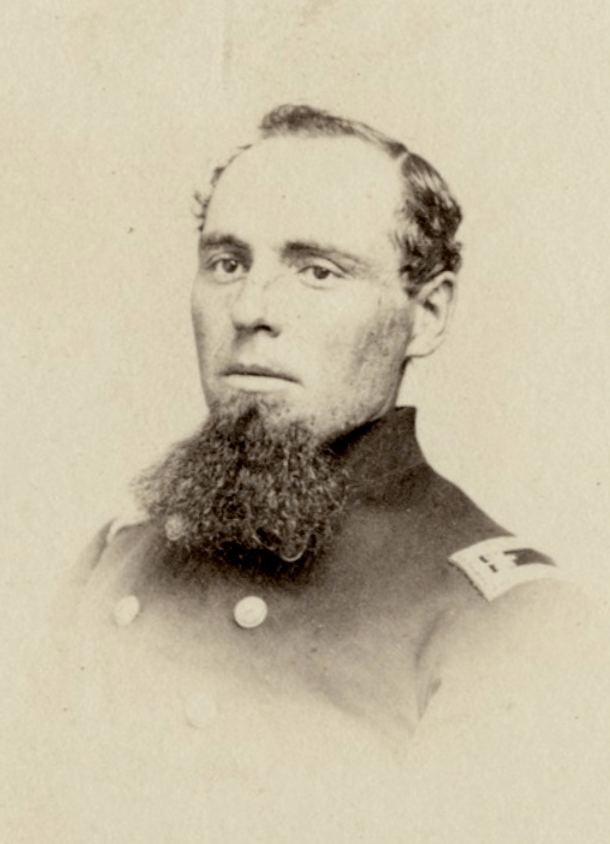
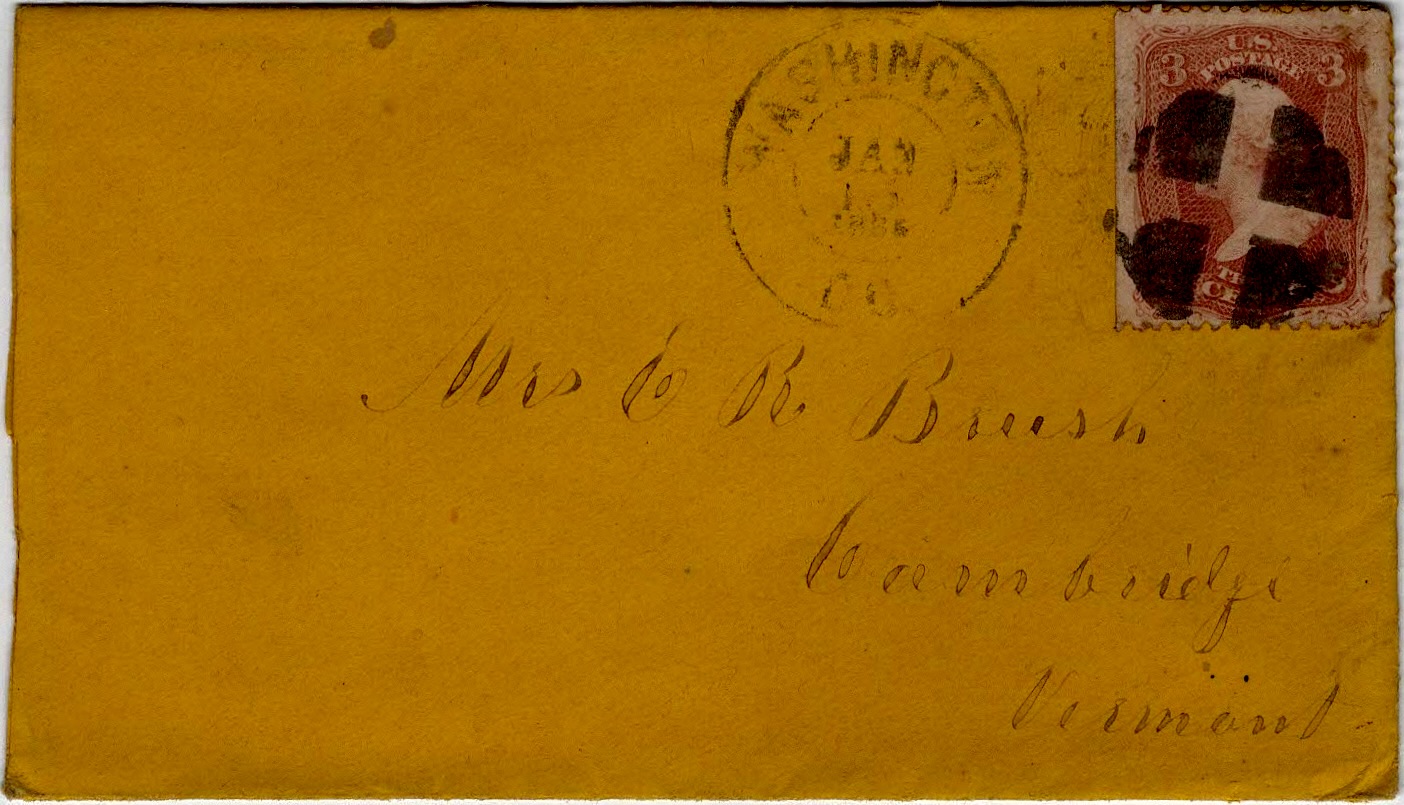
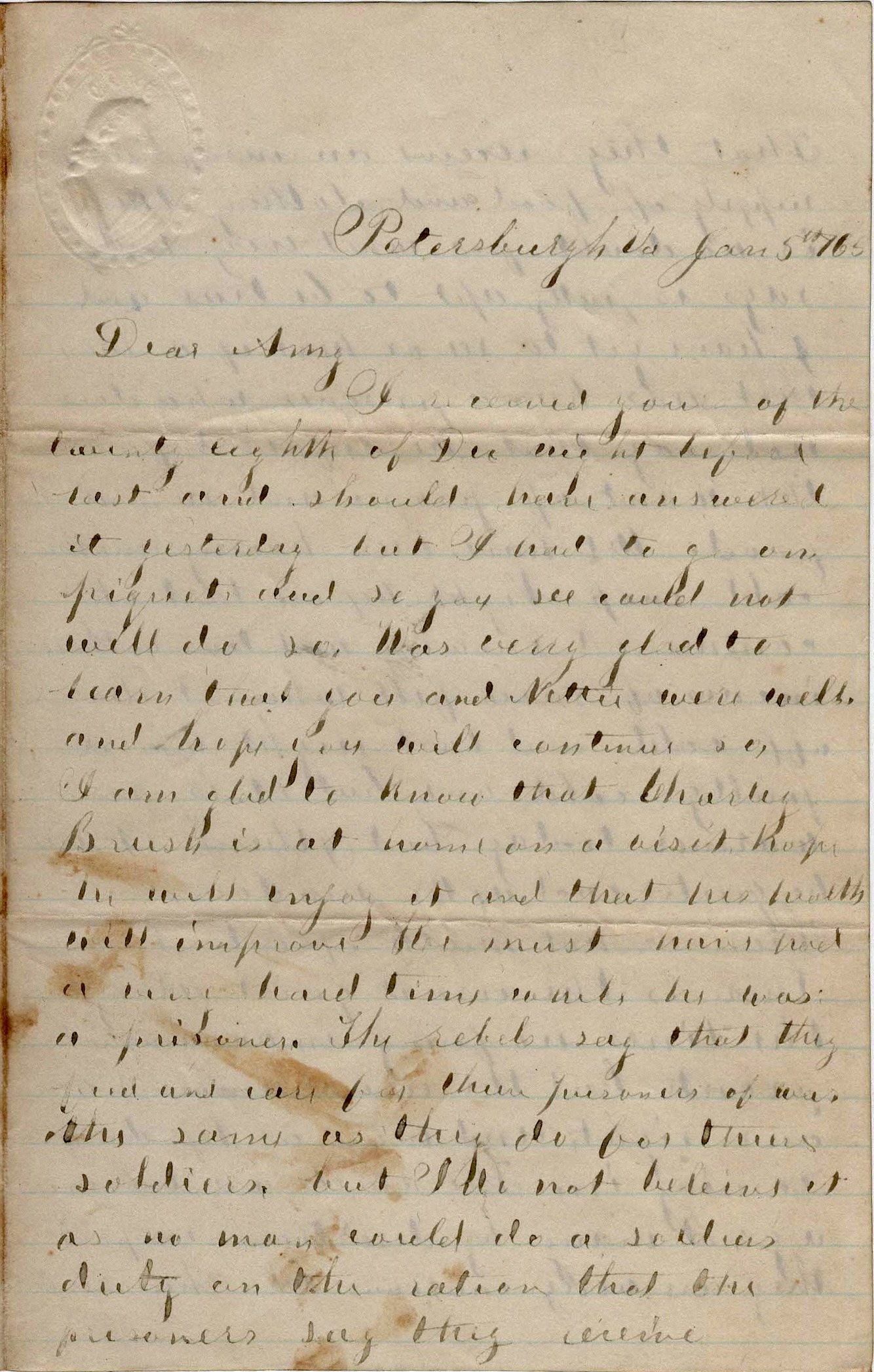
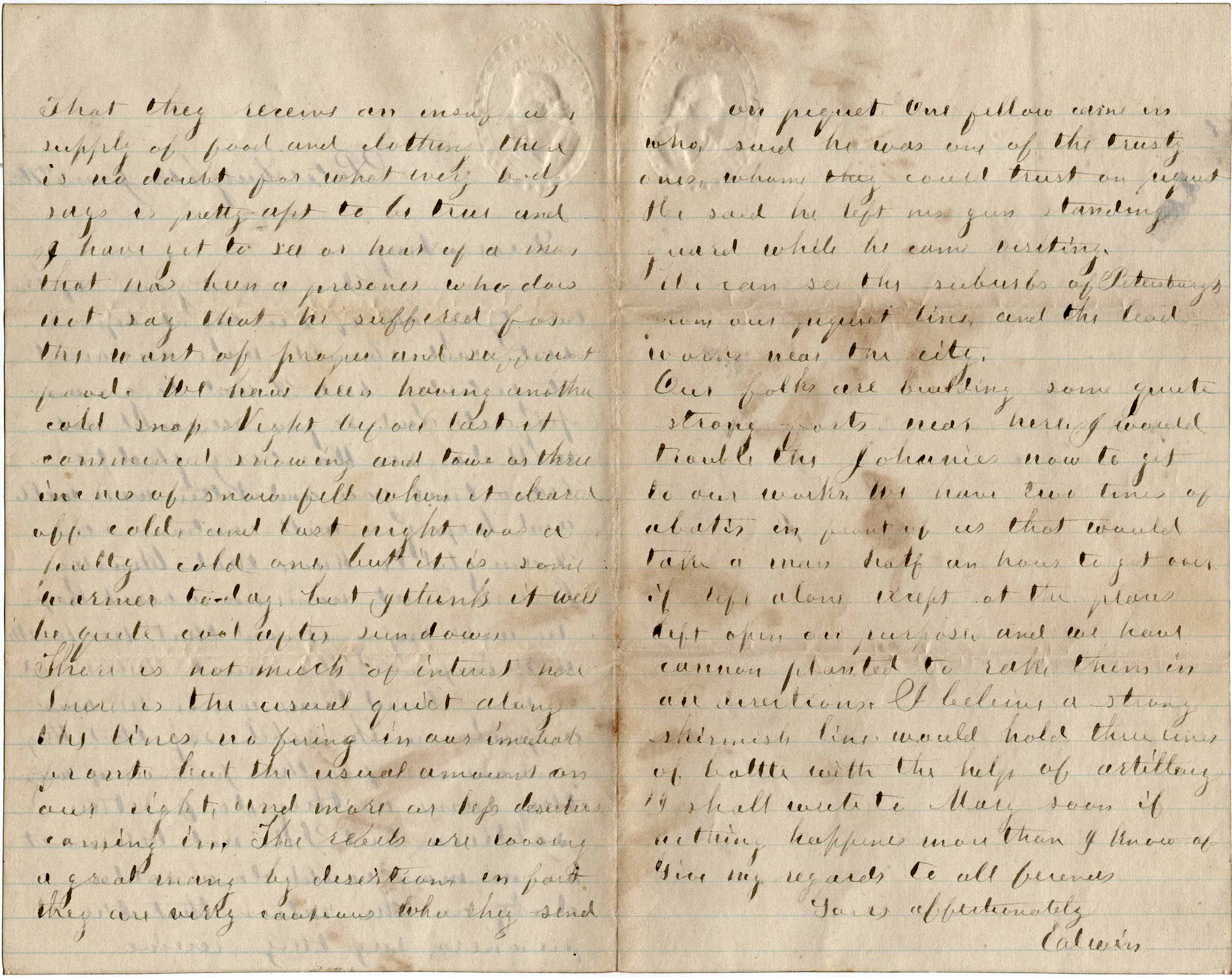
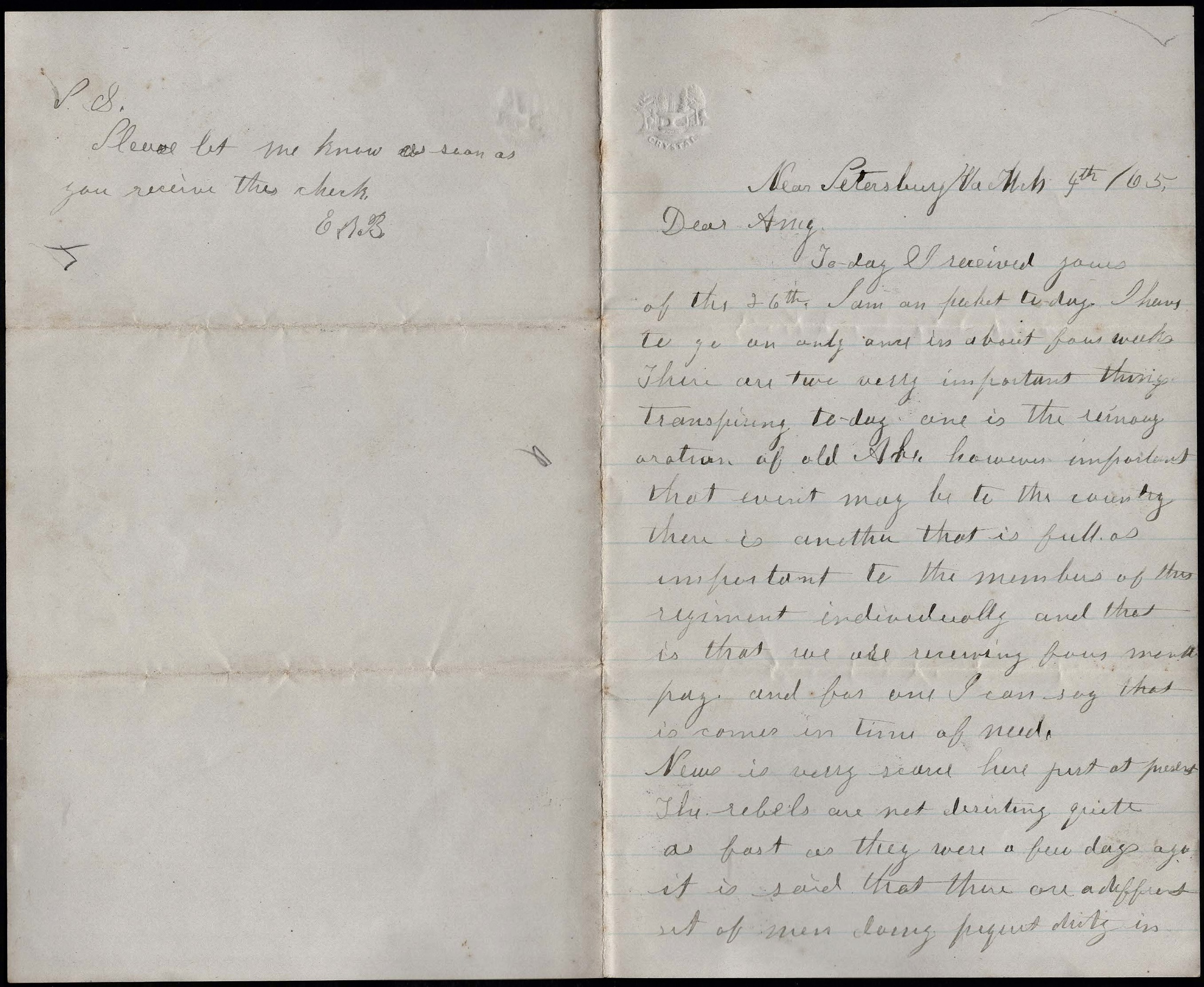

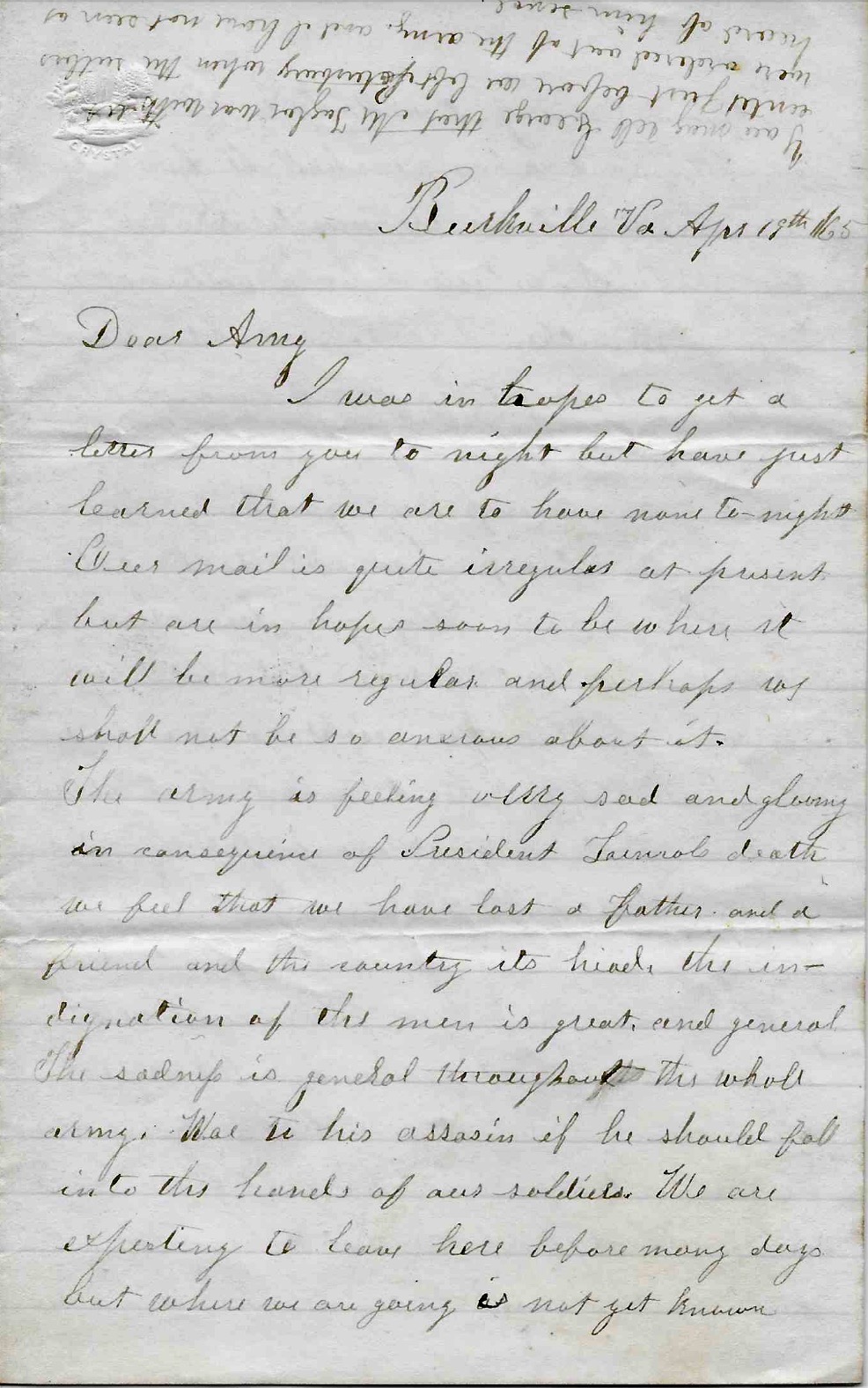
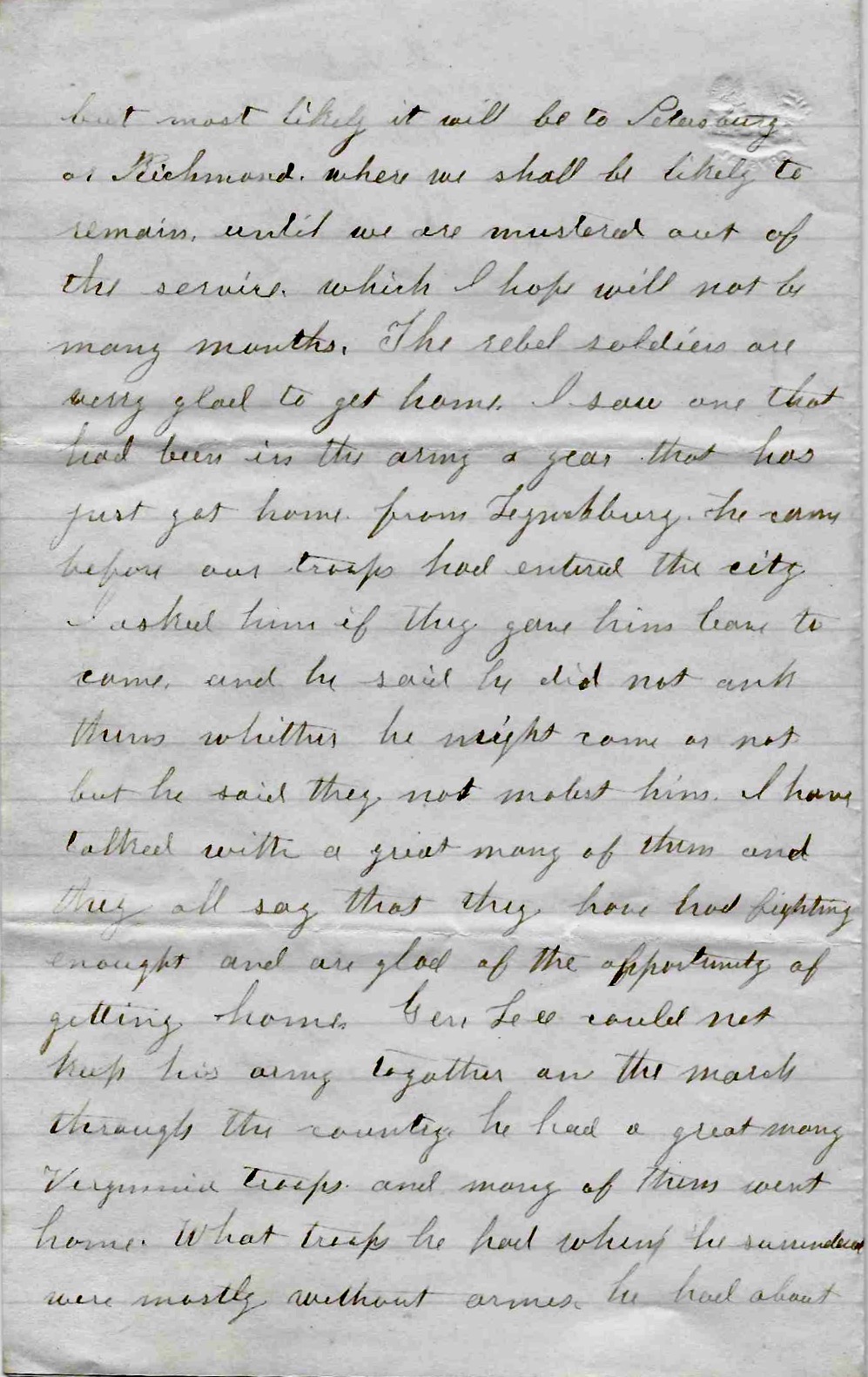

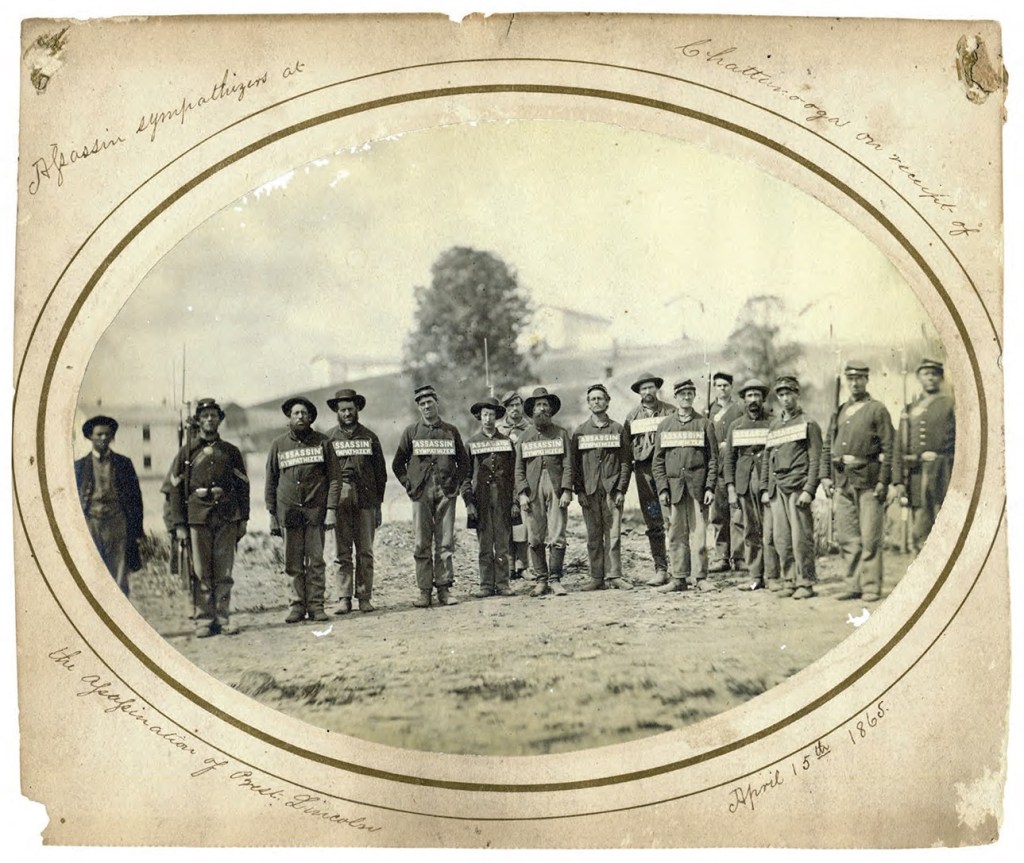


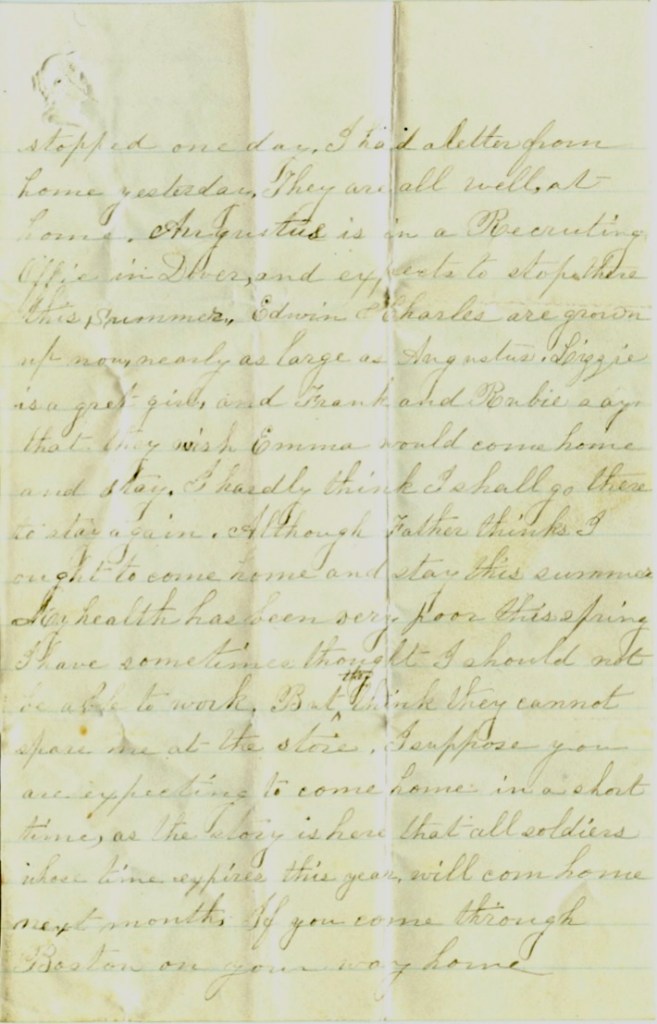
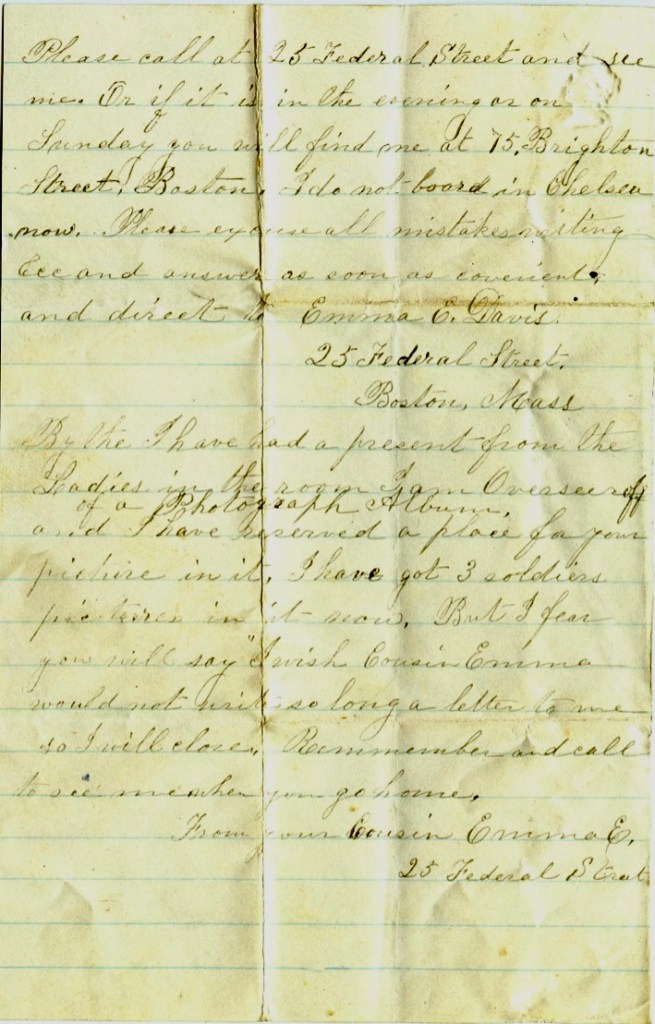
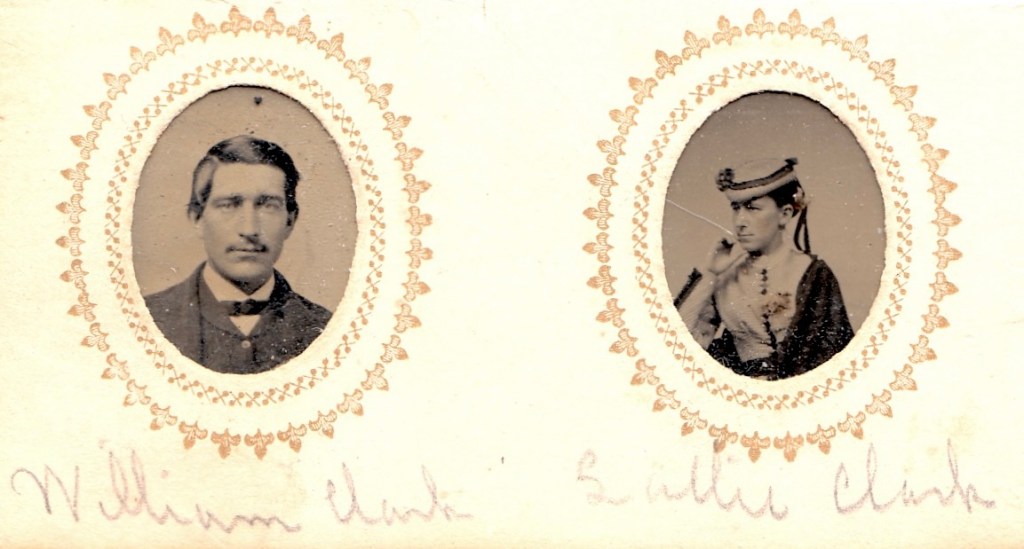
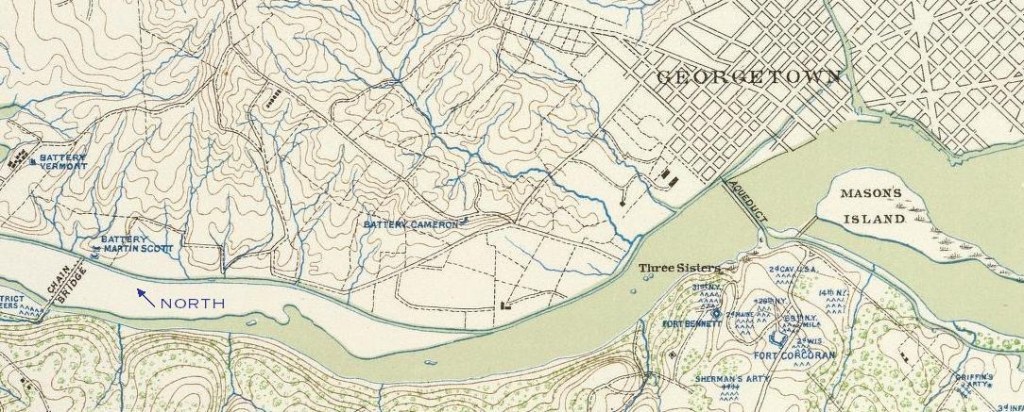


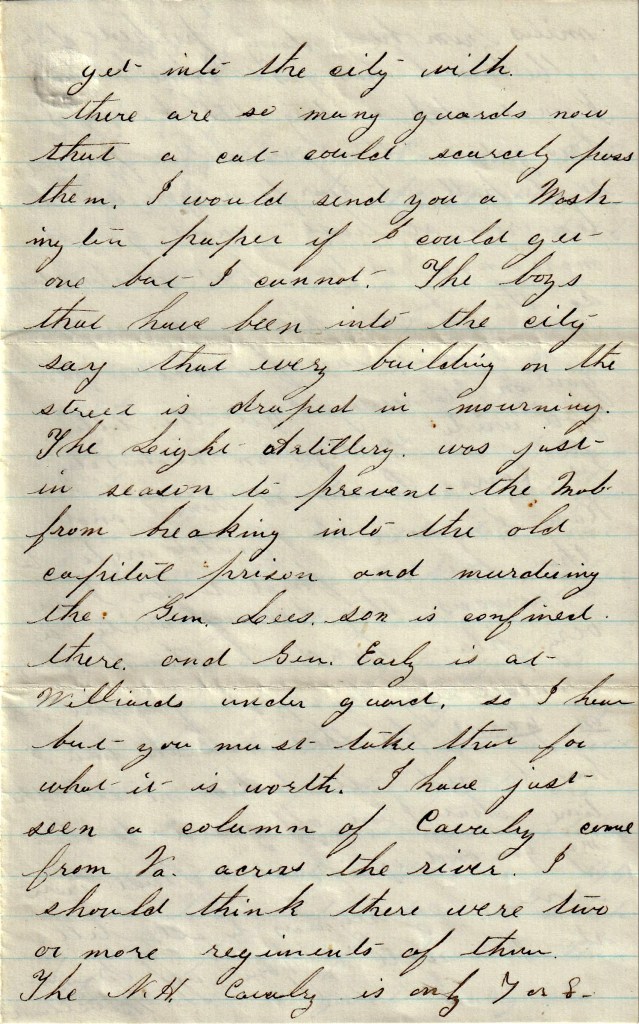


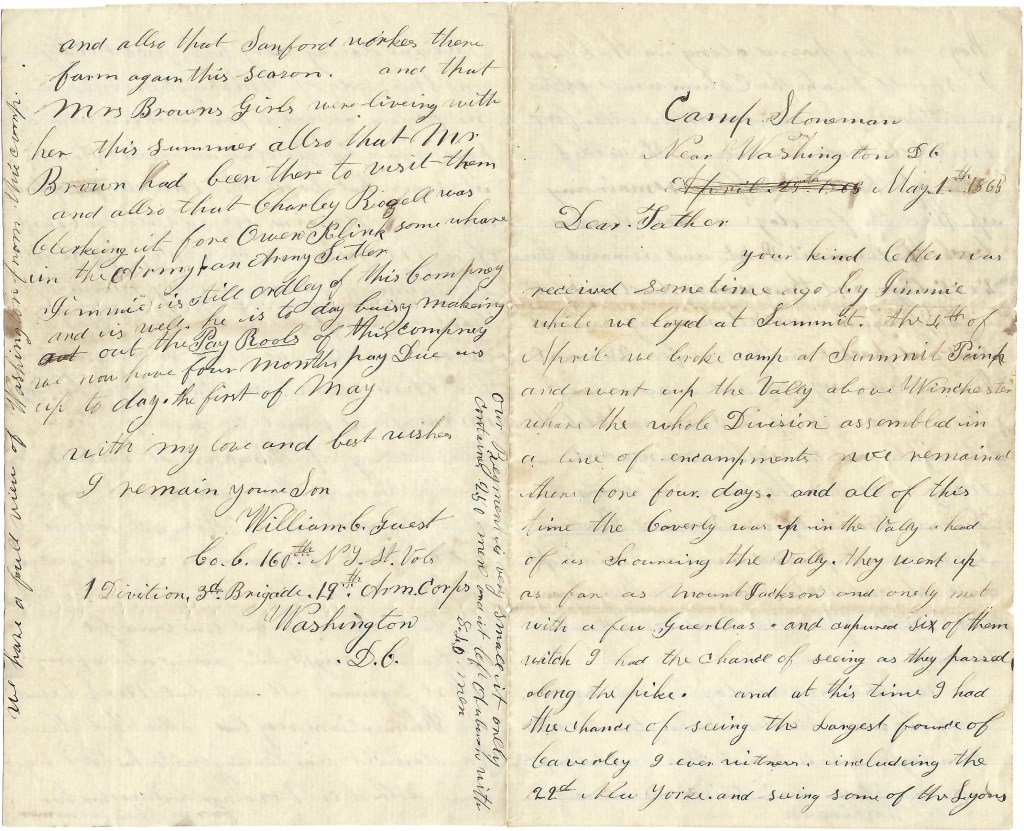
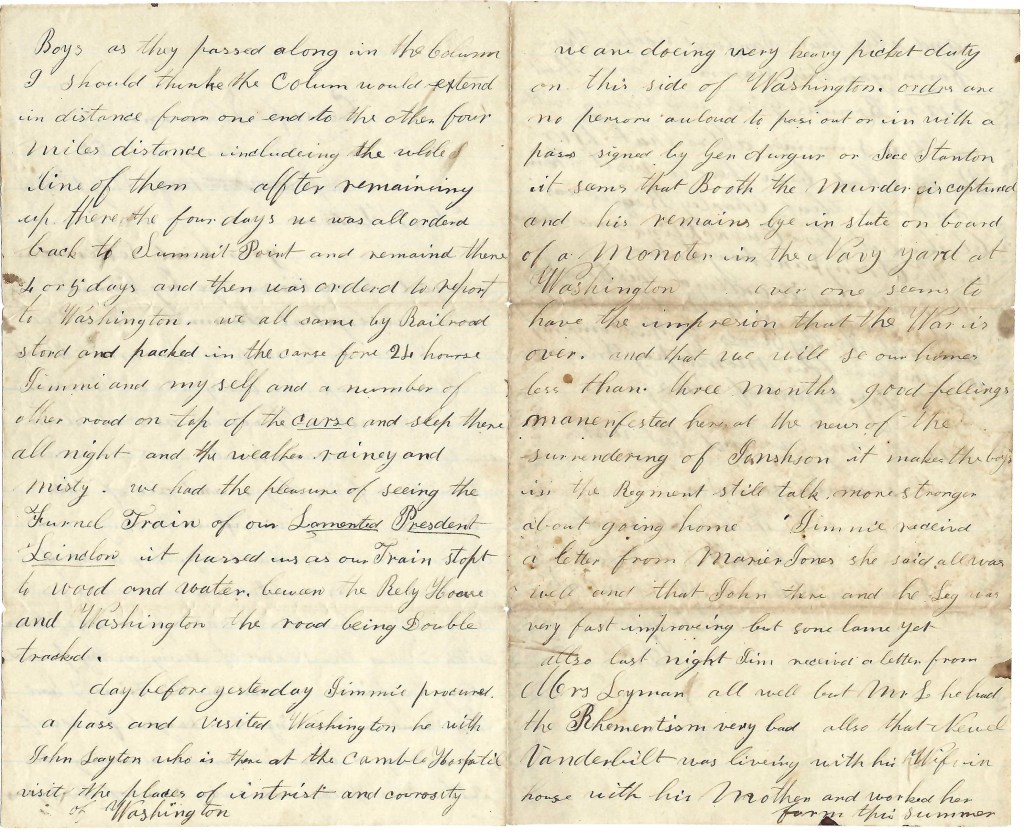
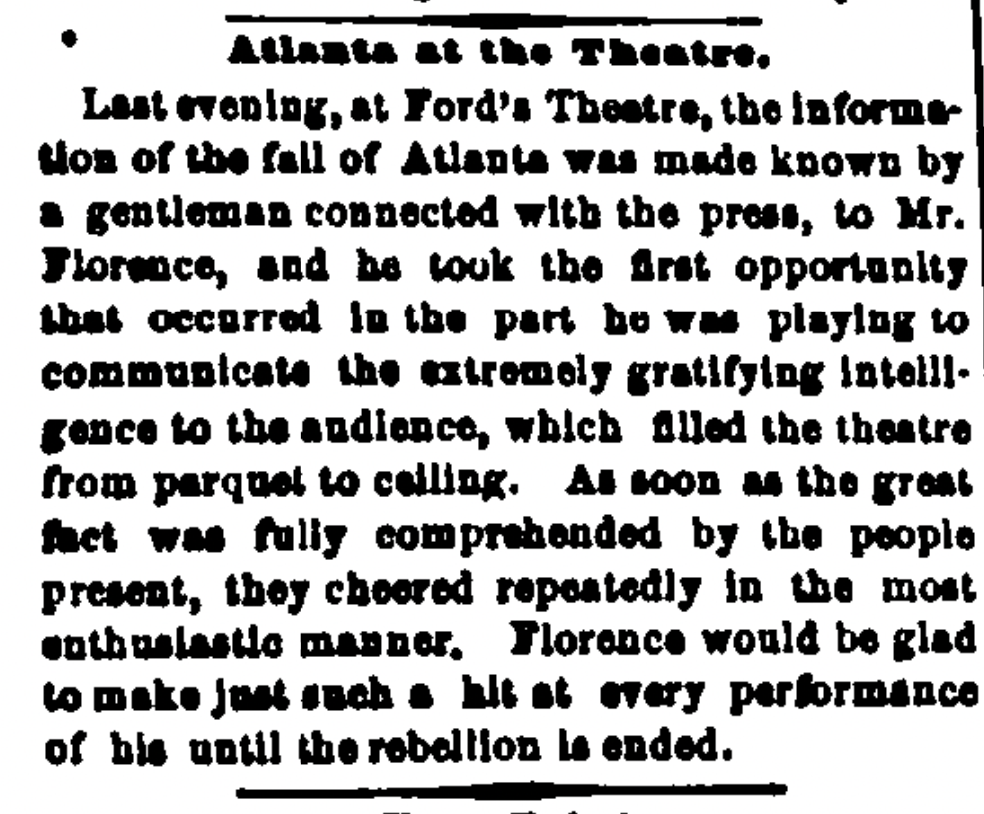


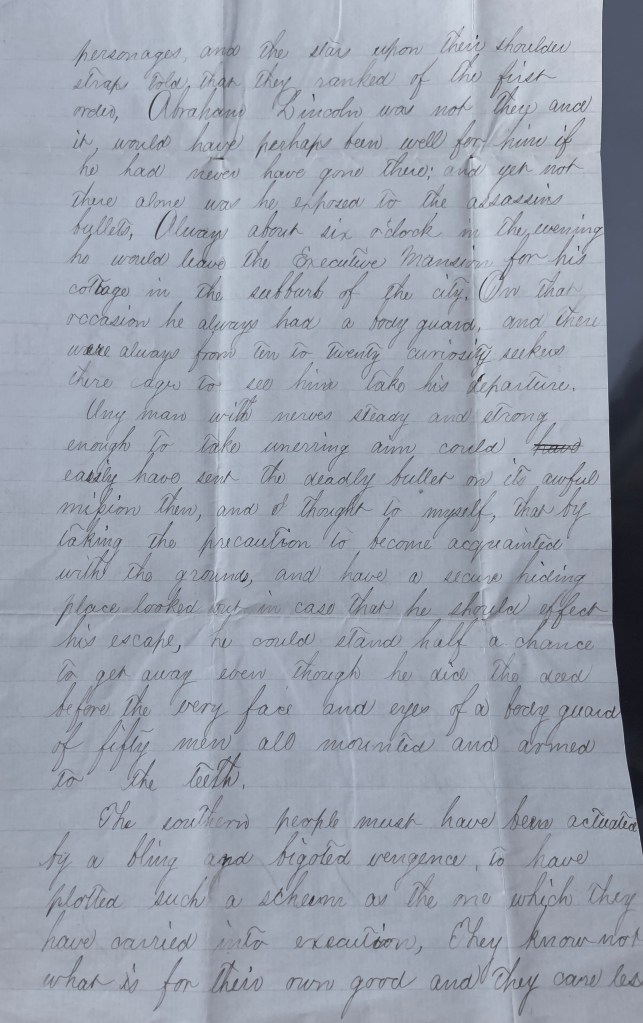


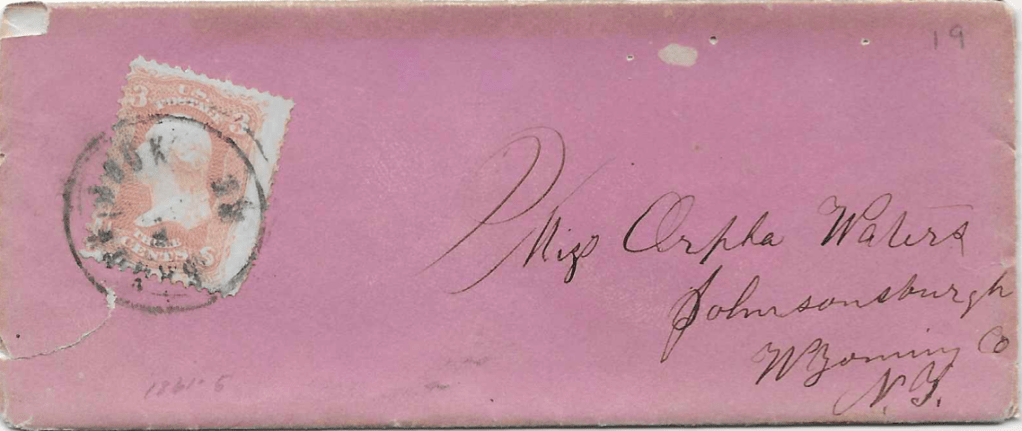

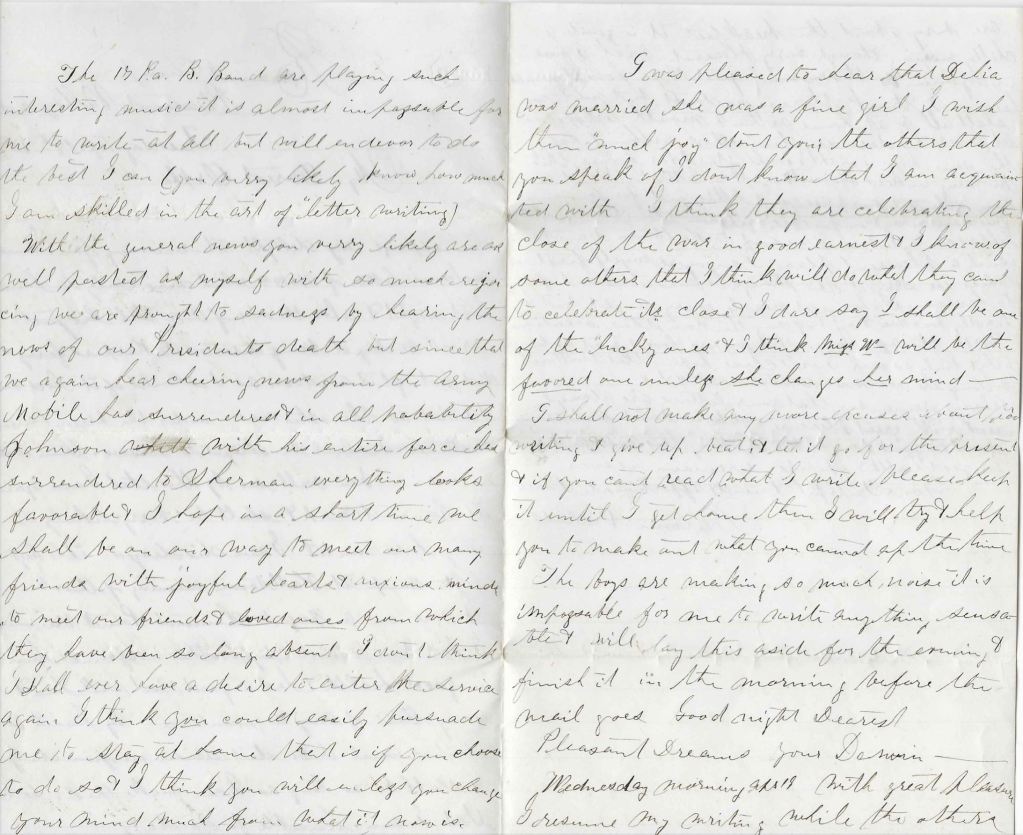


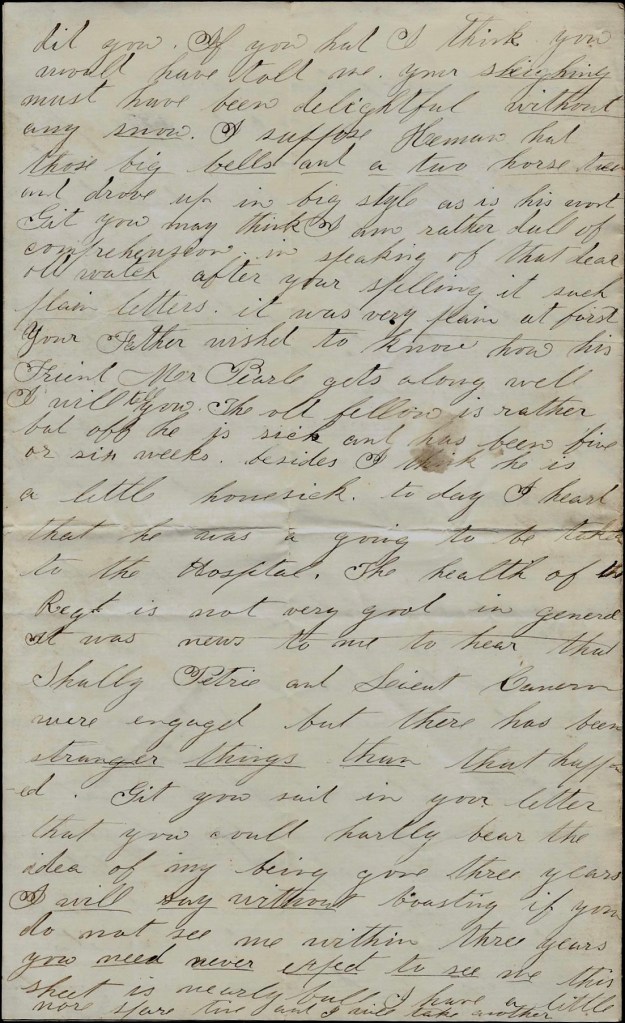

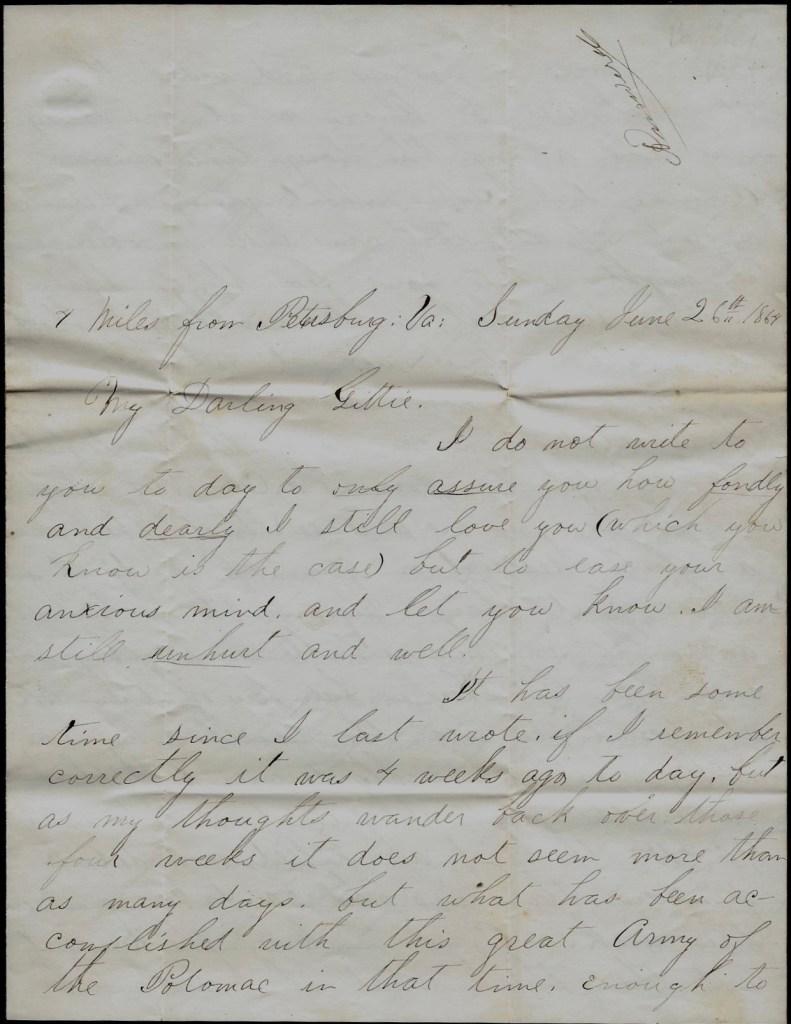
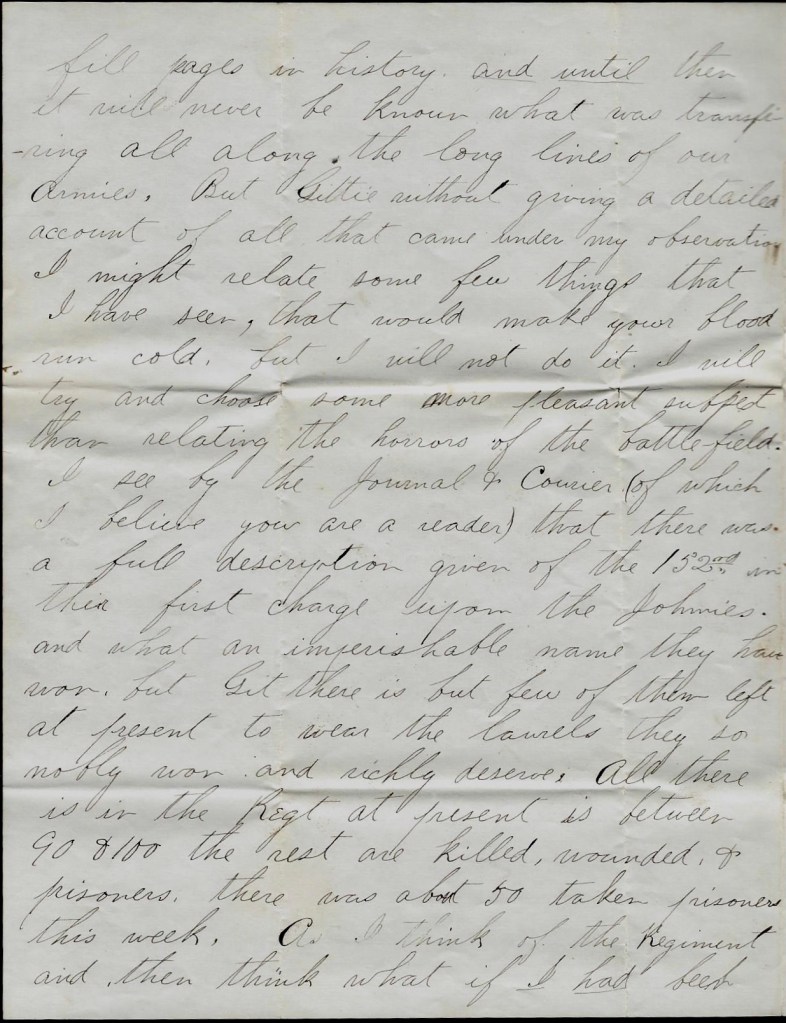
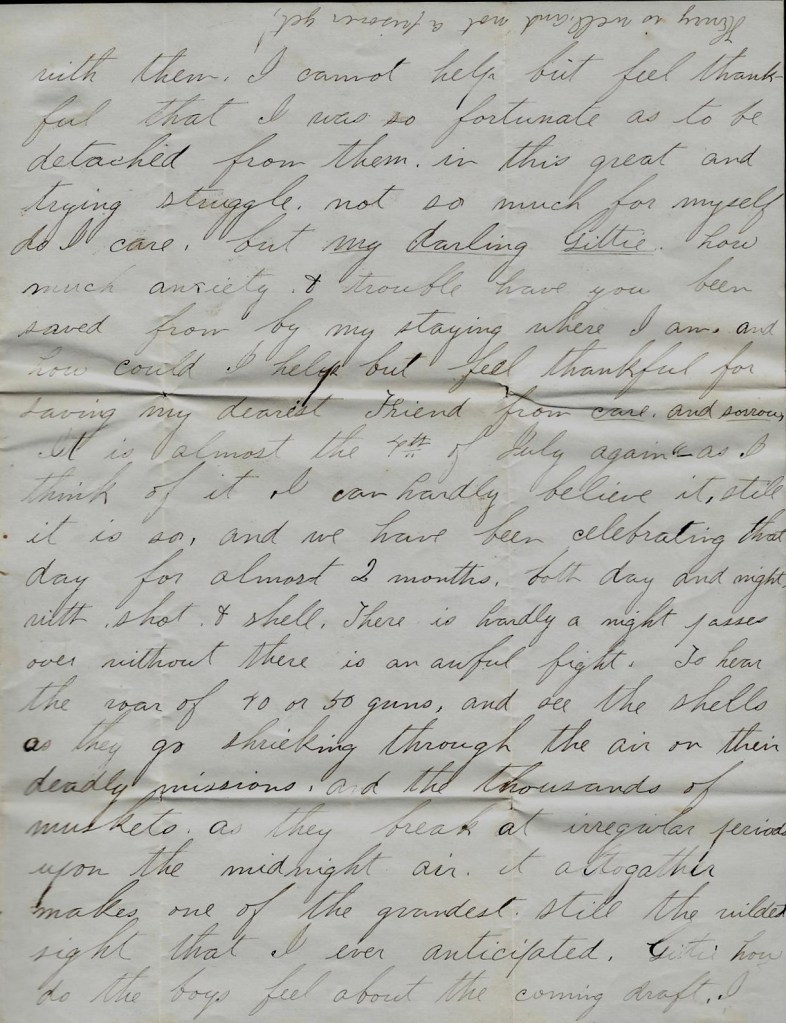

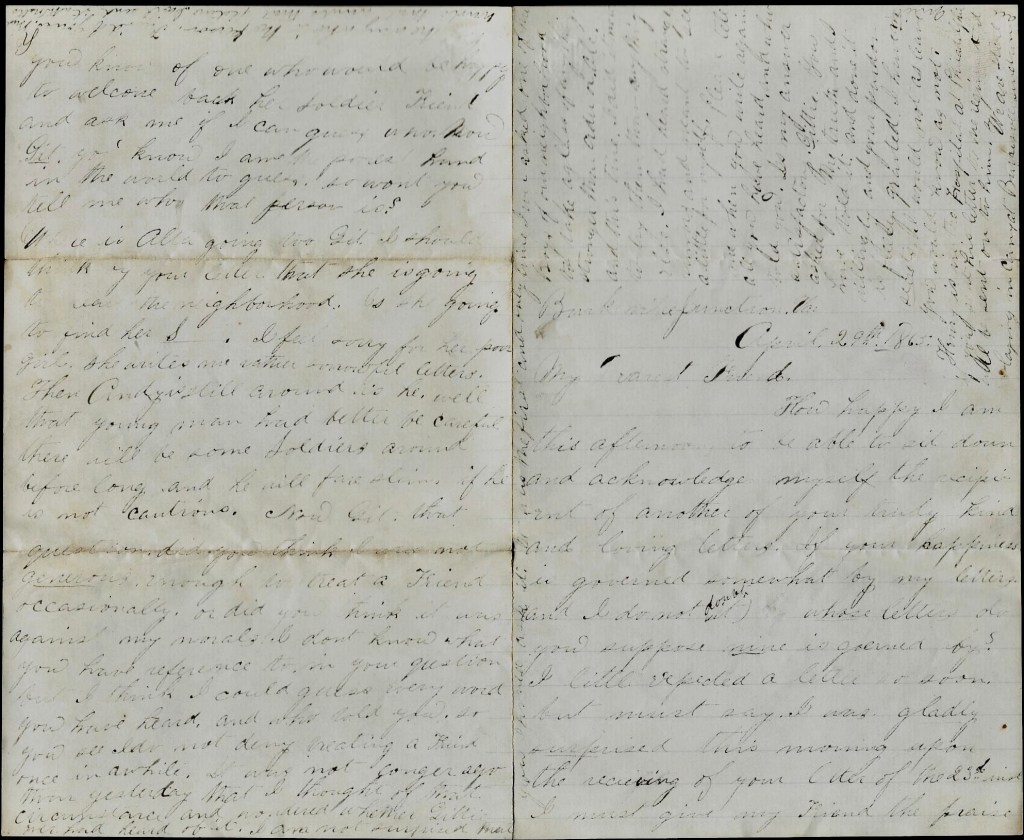
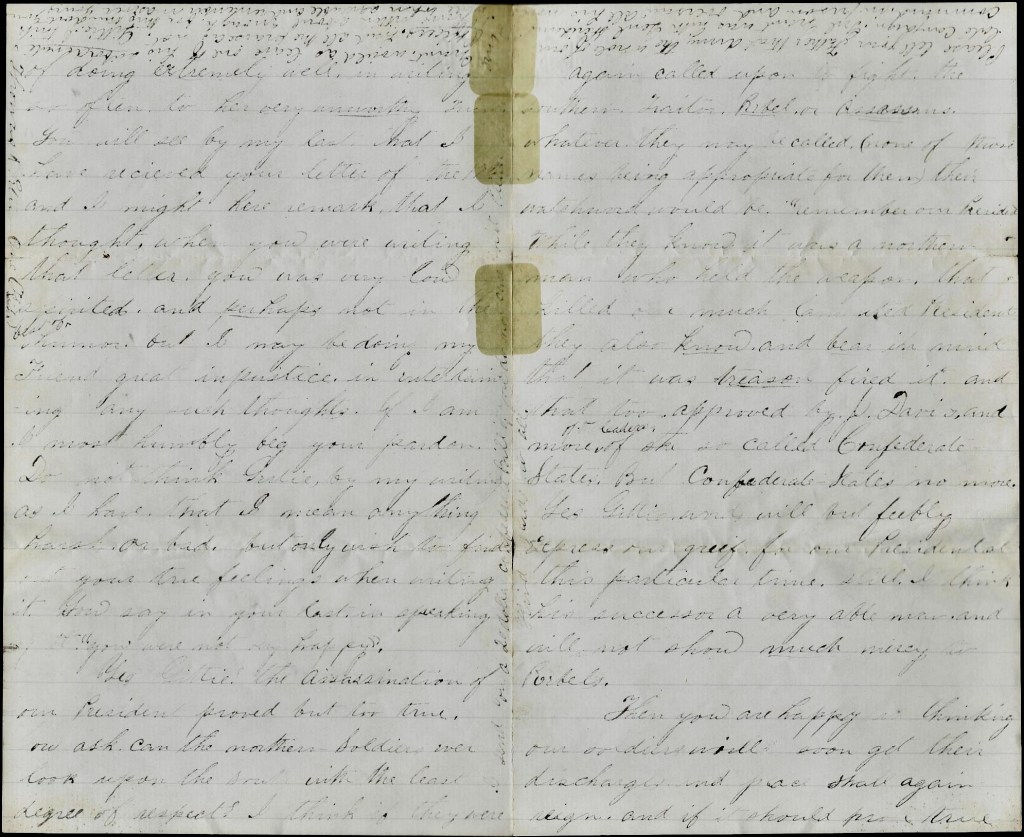
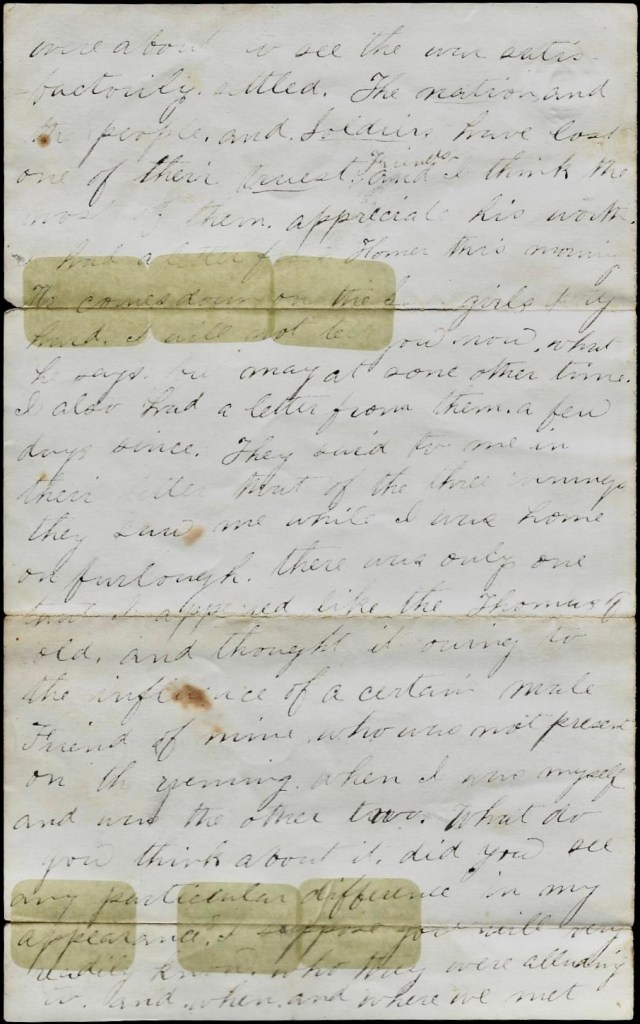


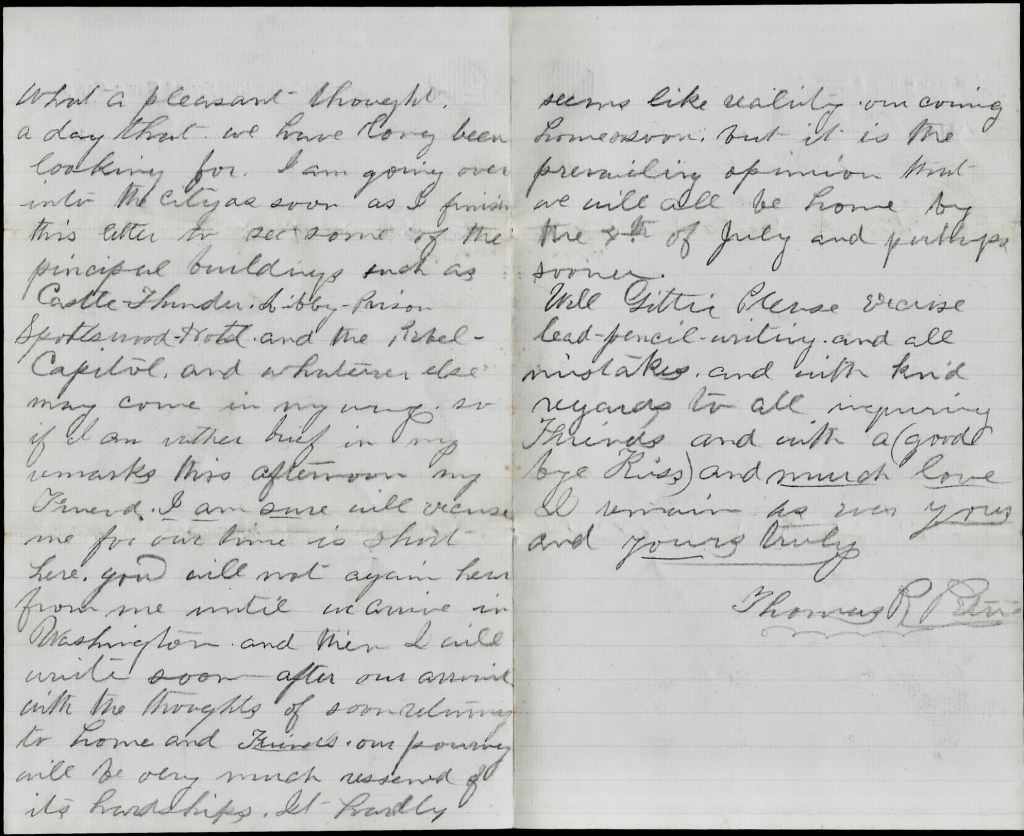
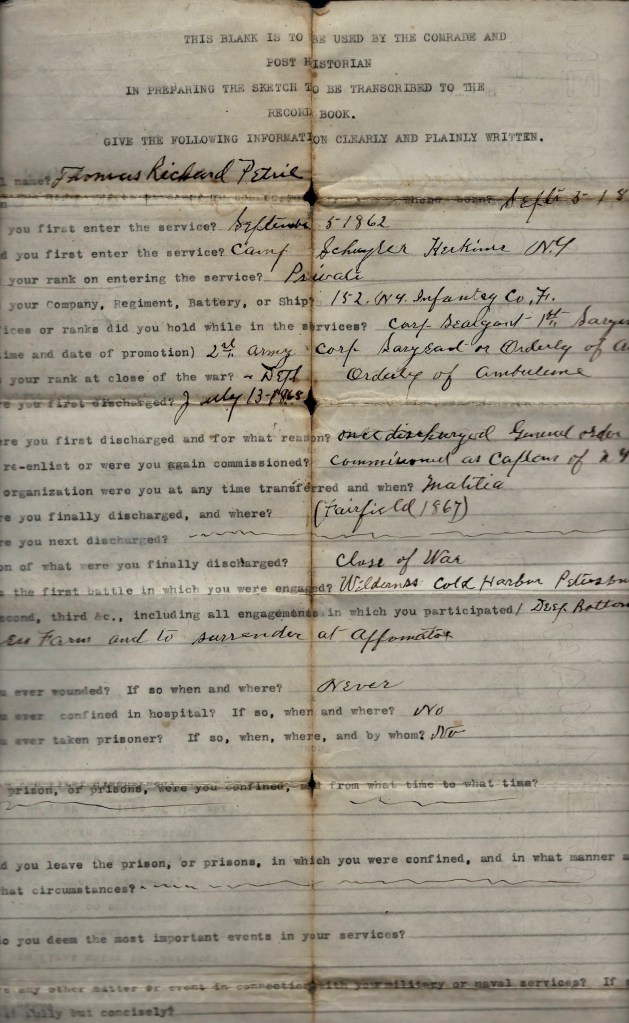

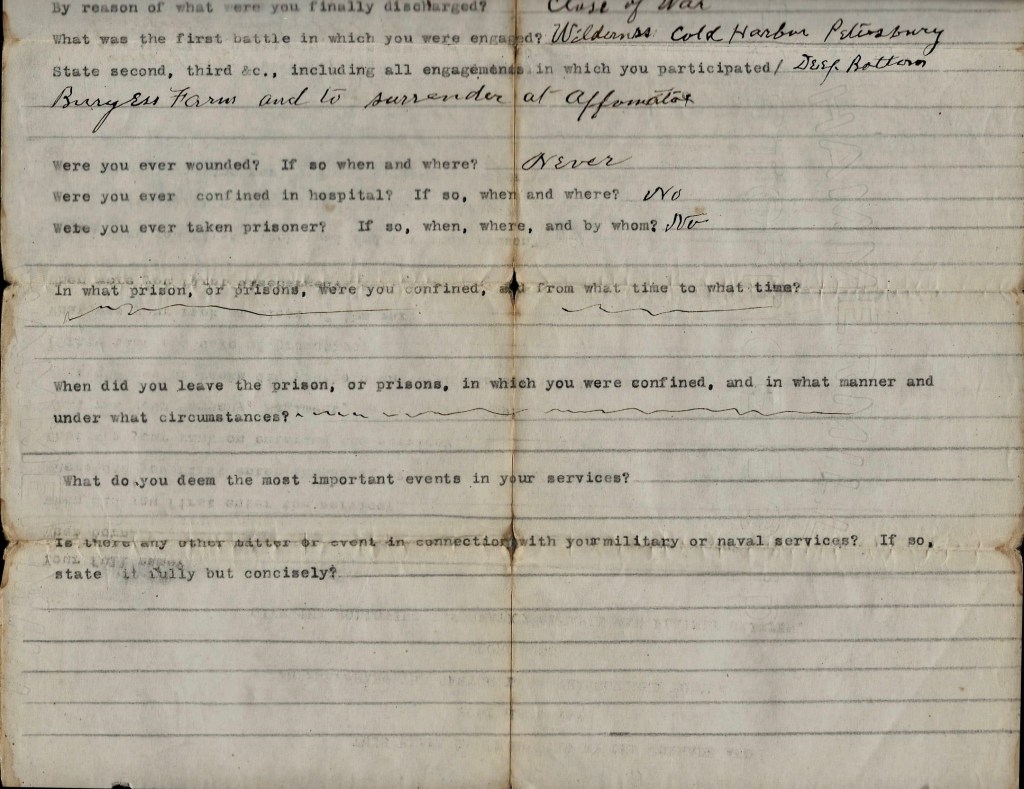
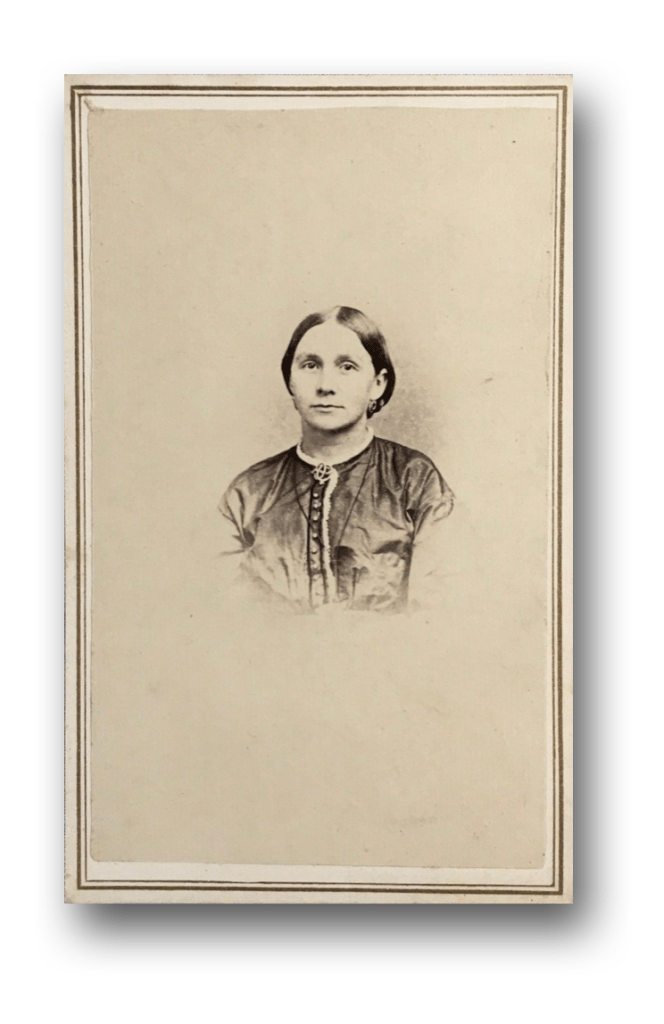

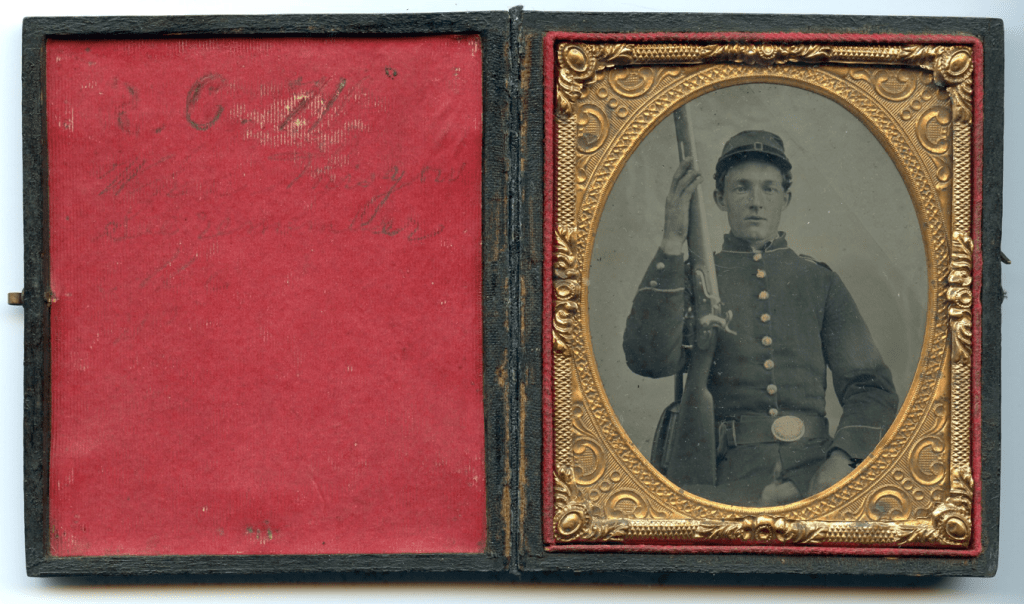
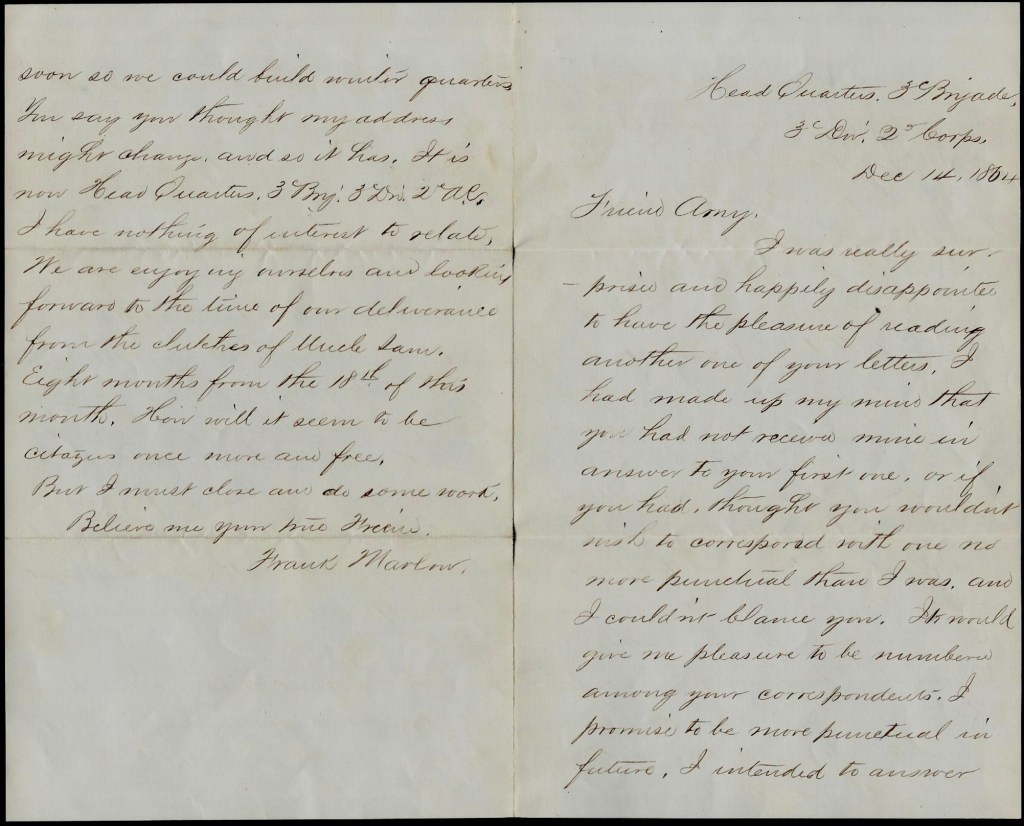

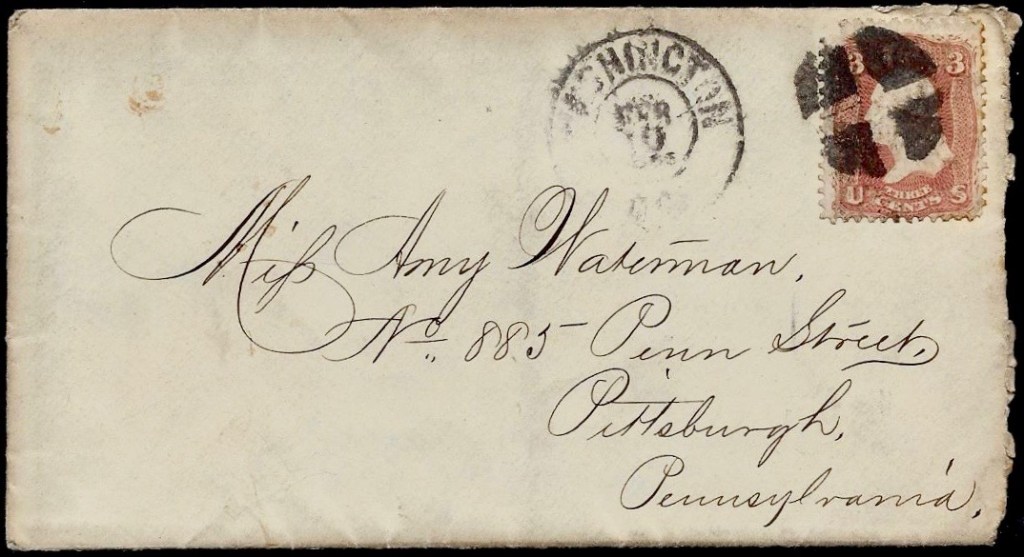


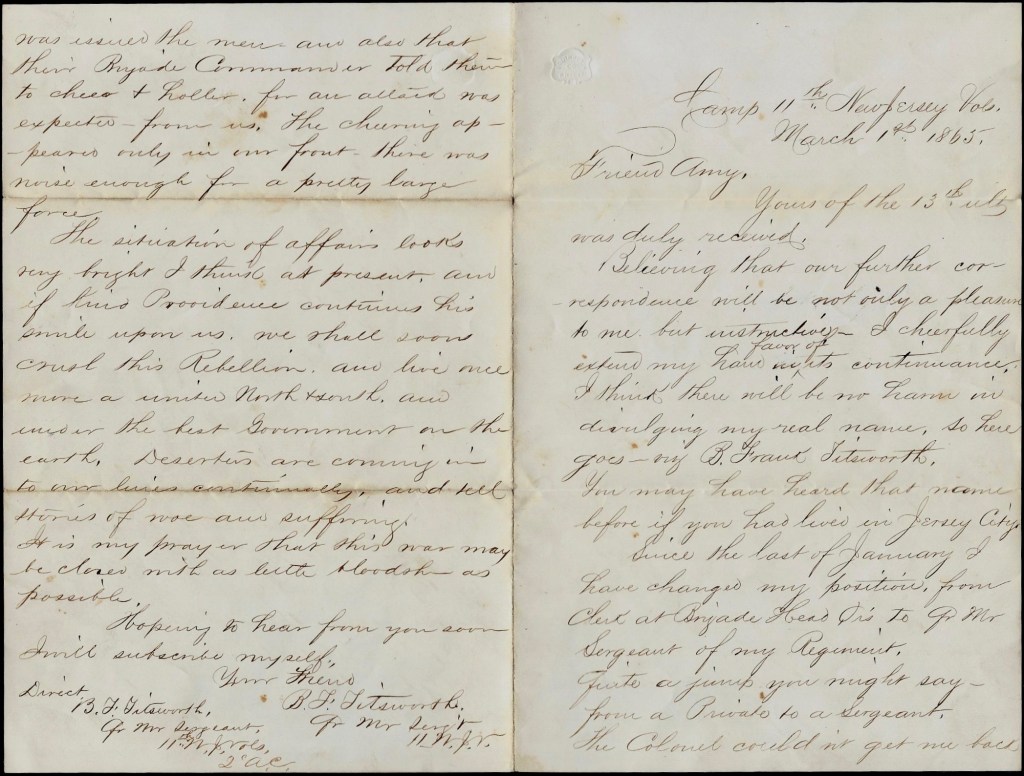


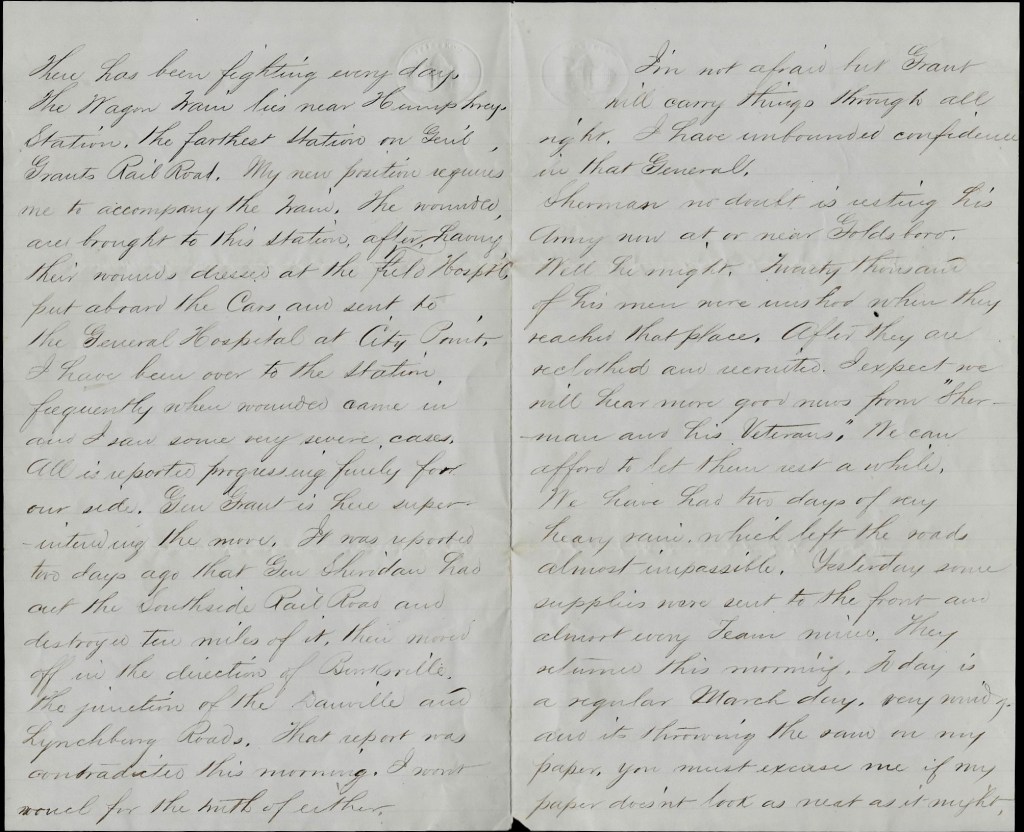


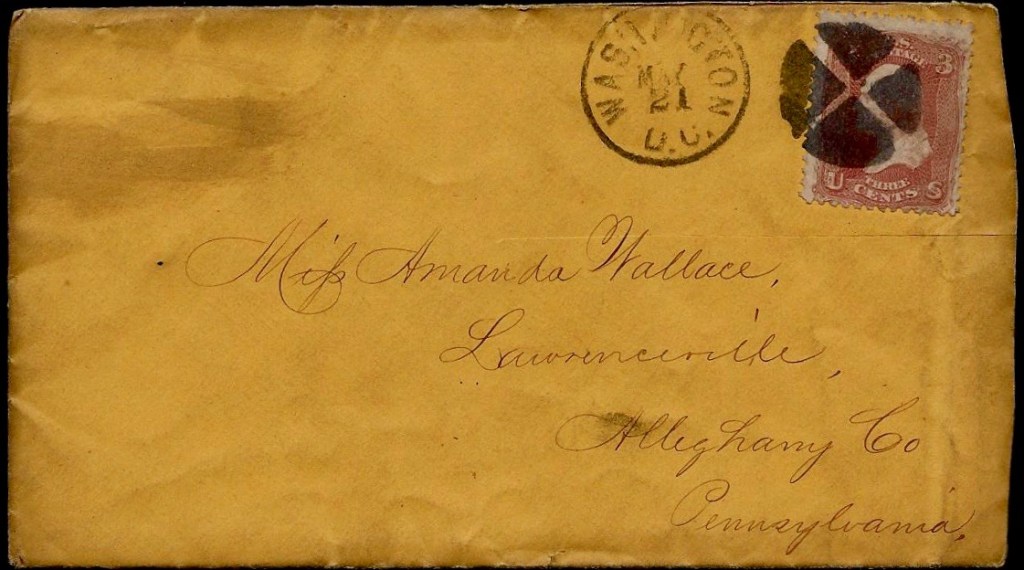

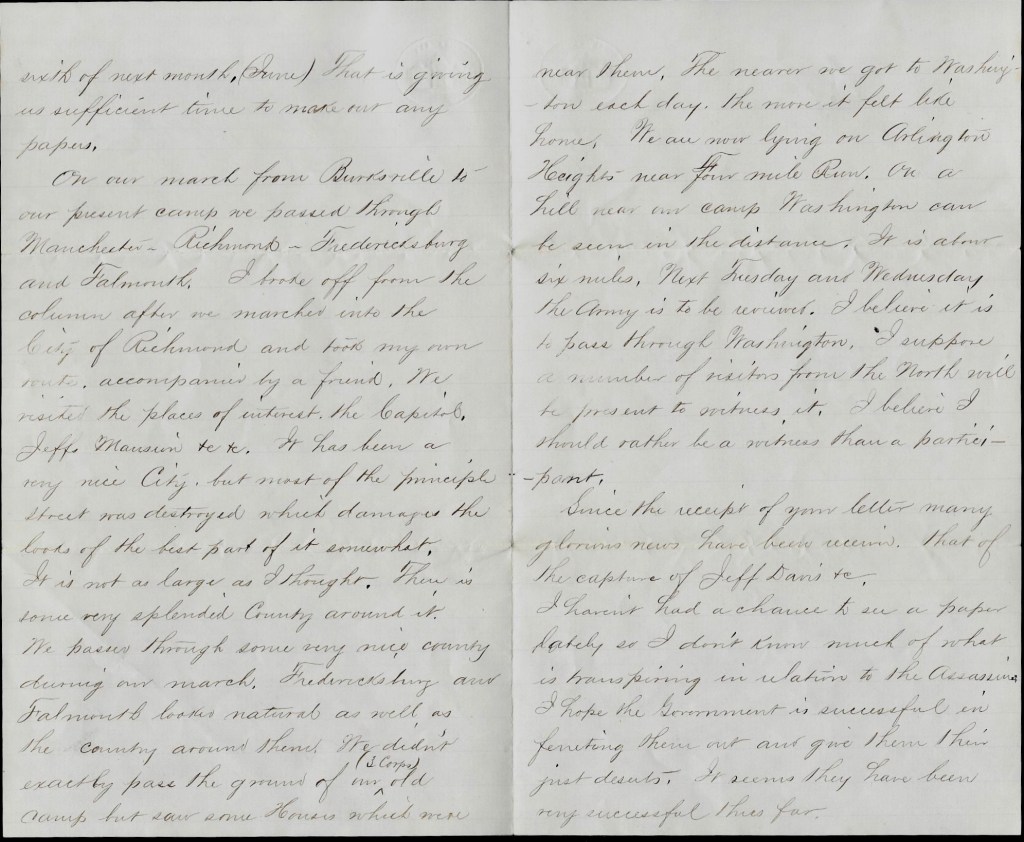


 Spared & Shared 23