The following letter was written by Samuel Norcross but which one? There were several soldiers by that name. Based on the location and date, I think it likely to be either Samuel Norcross of Co. G, 22nd New York Infantry, or Samuel Norcross of Co. E, 5th Vermont. The 22nd New York was encamped near Upton’s Hill at the time and the 5th Vermont was encamped near McLean, Virginia (Camp Griffin), some five miles further northwest. Balloon ascensions were being conducted regularly from Upton’s Hill to Vienna at the time. The camp of the 22nd New York was some five miles closer to Freestone Point where the firing on Union Vessels described occurred on 8 December 1861.
I note that the letter was addressed to his “father and mother” and since the soldier from Vermont lost his mother a couple years before the war, I’m going to attribute this letter to the soldier from the 22nd New York but without a high degree of confidence.
T R A N S C R I P T I O N
December 9, 1861
Dear father and mother,
I take my pen in hand to let you know that I am well at present and I hope that these few lines may find you the same.
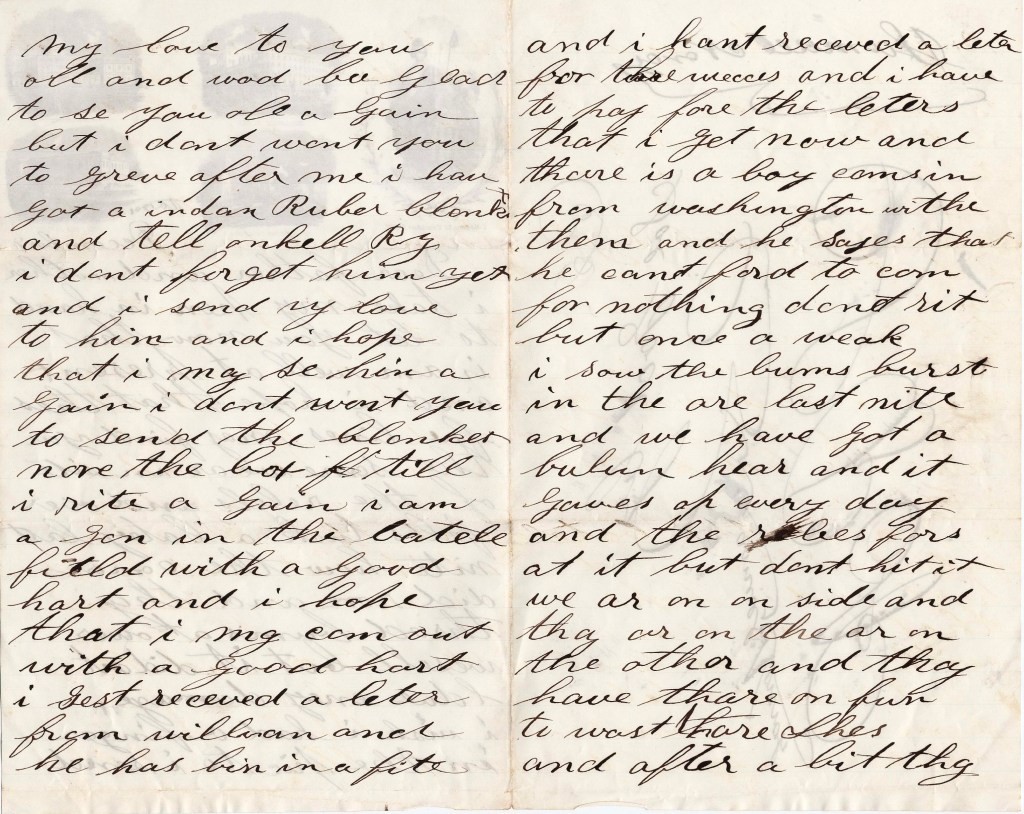
We are in sight of the rebels and our fellows took a battery last night. How the cannon did roar and they throwed bombs at our vessel but it didn’t do any damage. 1 I wish I had a finger in the pie too.
I send my love to you all and would be glad to see you all again but I don’t want you to grieve after me. I have got a Indian Rubber Blanket and tell Uncle Ry I don’t forget him yet and I send my love to him and I hope that I may see him again. I don’t want you to send the blanket nor the box till I write again. I am a going in the battlefield with a good heart and I hope that I may come out with a good heart.
I just received a letter from William and he has been in a fight and I han’t received a letter for three weeks and I have to pay for the letters that I get now. And there is a boy comes in from Washington with them and he says that he can’t afford to come for nothing. Don’t write but once a week.
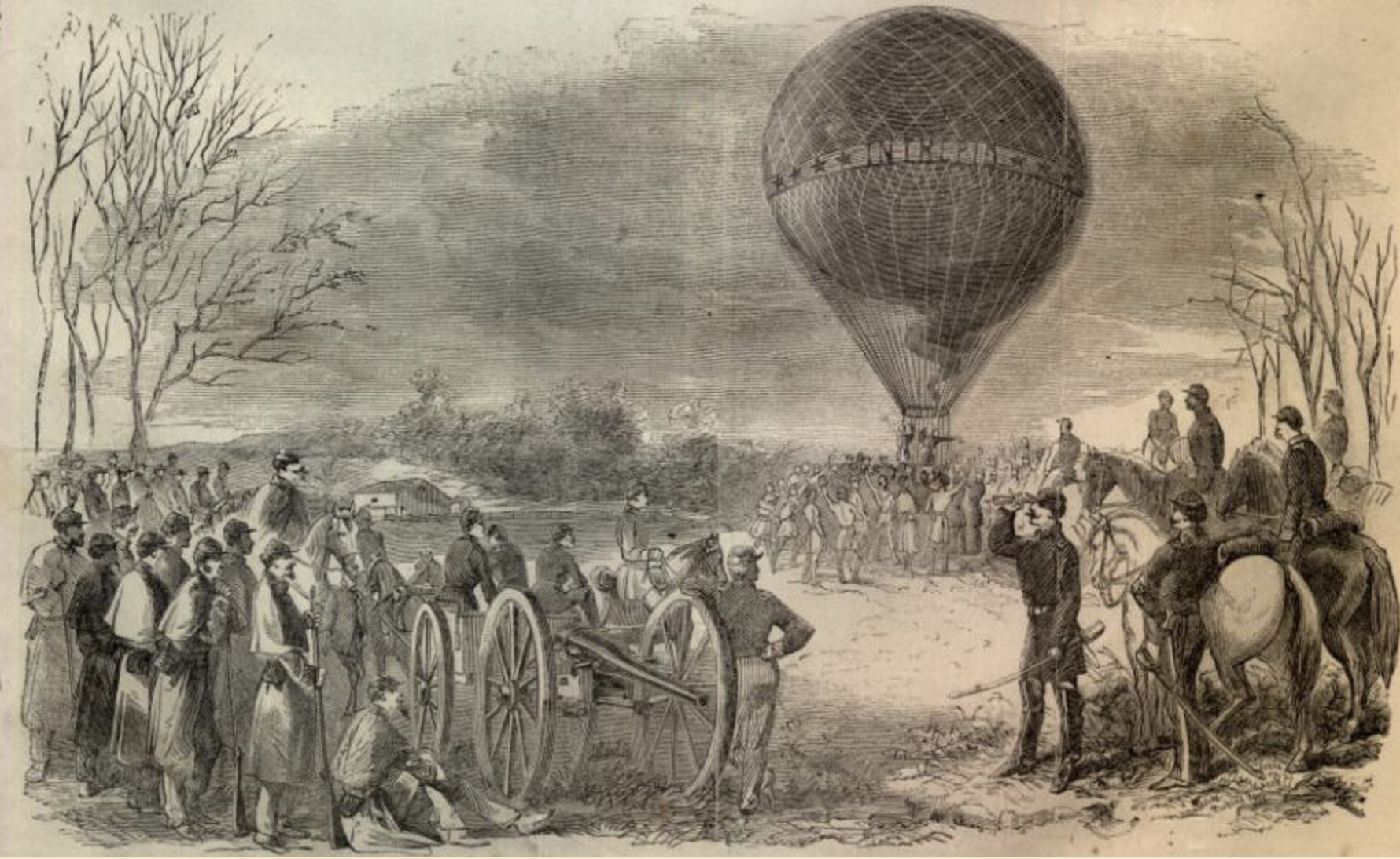
PROFESSOR LOWE MAKING A BALLOON ASCENSION ON A RECONNOITERING EXPEDITION TO VIENNA. Harper’s weekly, 14 December 1861
I saw the bombs burst in the air last night and we have got a balloon here and it goes up every day and the Rebels fire at it but don’t hit it. We are on one side and they are on the other and they have their own fun to waste theirselves, and after a bit they [rest of letter missing]
So goodbye, — Samuel Norcross
1 The Confederate firing on Union vessels may have been from Freestone Point, the northern most point of the Confederate blockade on the Potomac river. On December 8, 1861, The USS Anacostia and the USS Jacob Bell fired on Confederate troops near Freestone Point and they may have returned fire.
The following letter was written by Nathaniel Clayton Manson (1820-1894), the son of Nathaniel John Manson (1782-1859) and Sallie K. Alexander (1779-1861). Nathaniel wrote the letter to his wife, Polly Cary Wilson (1833-1912). From the letter we learn that Polly Cary was visiting her sister Francis or “Fannie” (Wilson) Price (1825-1891), the wife of Charles Allen Price (1822-1892) of Prince Edward Court House, Va. Charles served as a lieutenant in Co. D, 18th Virginia Infantry. Living near Fanny was her sister Ellen (Wilson) Berkeley (1839-1913) and Ellen’s husband, William (“Willie”) Randolph Berkeley (1838-1877) of Farmville. Willie served in the 21st Virginia Infantry.
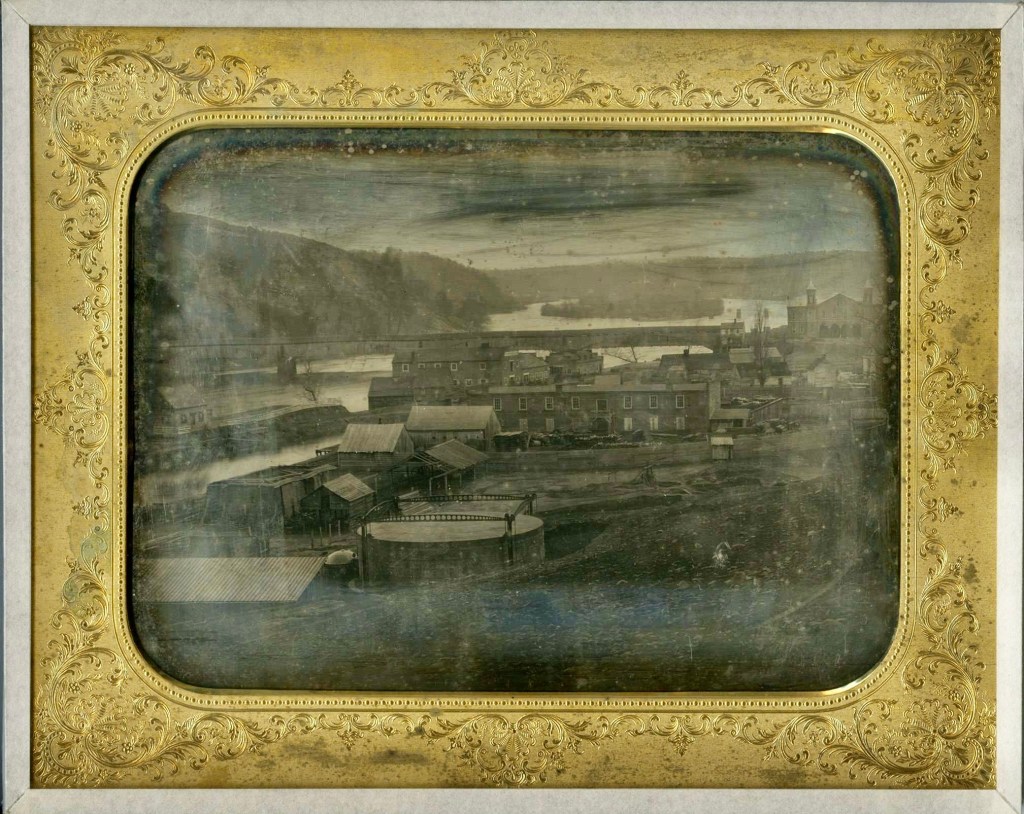
Lynchburg, Virginia,, ca. 1850. James River and Kanawha Canal at left. Valentine Richmond History Center
Transcription
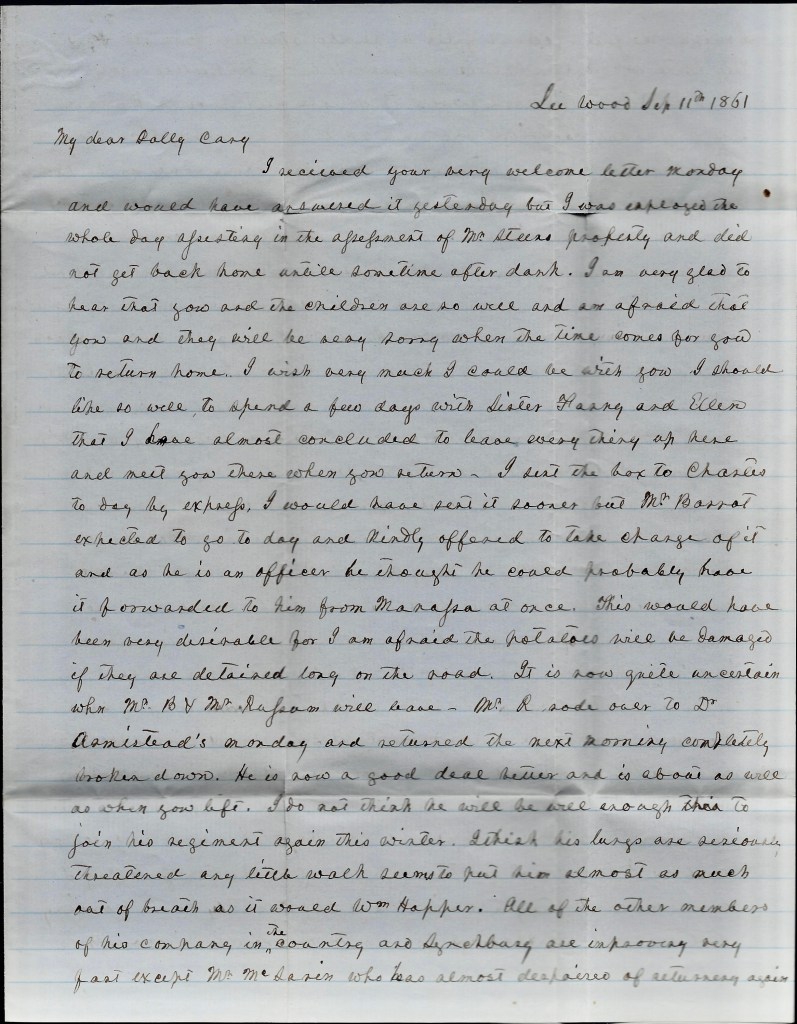
Lee Wood September 11th 1861
My dear Polly Cary,
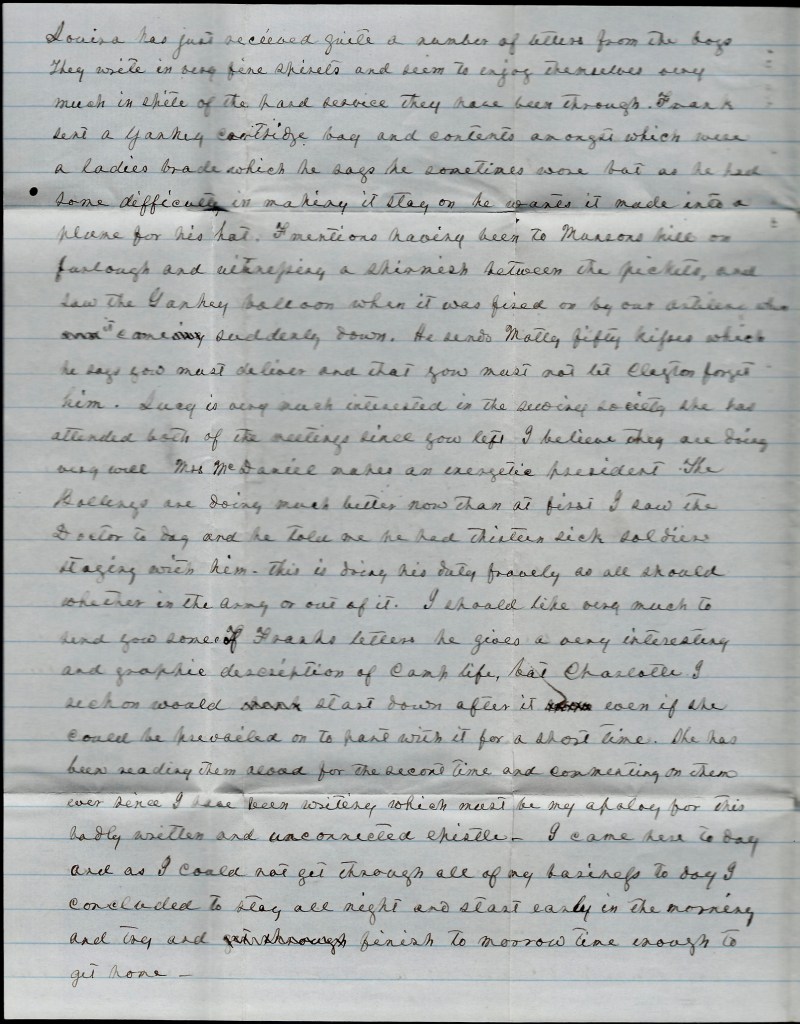
I received your very welcome letter Monday and would have answered it yesterday but I was employed the whole day assisting in the assessment of Mr. Steen’s property and did not get back home until sometime after dark. I am very glad to hear that you and the children are so well and am afraid that you and they will be very sorry when the time comes for you to return home. I wish very much I could be with you. I should like so well to spend a few days with sister Fanny and Ellen that I have almost concluded to leave everything up here and meet you there when you return.
I sent the box to Charles today by express. I would have sent it sooner but Mr. Bassot expected to go today and kindly offered to take charge of it and as he is an officer he thought he could probably have it forwarded to him from Manassa at once. This would have been very desirable for I am afraid the potatoes will be damaged if they are detained long on the road. It is now quite uncertain when Mr. B. & Mr. Rassom will leave. Mr. R. rode over to Dr. Armistead’s Monday and returned the next morning completely broken down. He is now a good deal better and is about as well as when you left. I do not think he will be well enough though to join his regiment again this winter. I think his lungs are seriously threatened. Any little walk seems to put him almost as much out of breath as it would William Hopper. All of the other members of his company in the country and Lynchburg are improving very fast except Mr. McSarin who has almost despaired of returning again.
Louisa has just received quite a number of letters from the boys. They write in very fine spirits and seem to enjoy themselves very much in spite of the hard service they have been through. Frank sent a Yankee cartridge box and contents amongst which were a lady’s braid which he says he sometimes wore but as he had some difficulty in making it stay on. He wants it made into a plume for his hat. Frank mentions having been to Munson’s Hill on furlough and witnessing a skirmish between the pickets, and saw the Yankee balloon when it was fired on by our artillery and it came suddenly down. 1
He sends Matty fifty kisses which he say you must deliver and that you must not let Clayton forget him. Lucy is very much interested in the sewing society. She has attended both of the meetings since you left. I believe they are doing very well. Mrs. McDaniel makes an energetic president. The Bolleny’s are doing much better now than at first. I saw the Doctor today and he told me he had htirteen sick soldiers staying with him. This is doing his duty bravely as all should whether in the army or out of it. I should like very much to send you some of Frank’s letters. He gives a very interesting and graphic description of camp life, but [sister] Charlotte I reckon would start down after it even if she could be prevailed on to part with it for a short time. She has been reading them aloud for the second time and commenting on them ever since I have been writing which must be my apology for this badly written and unconnected epistle.
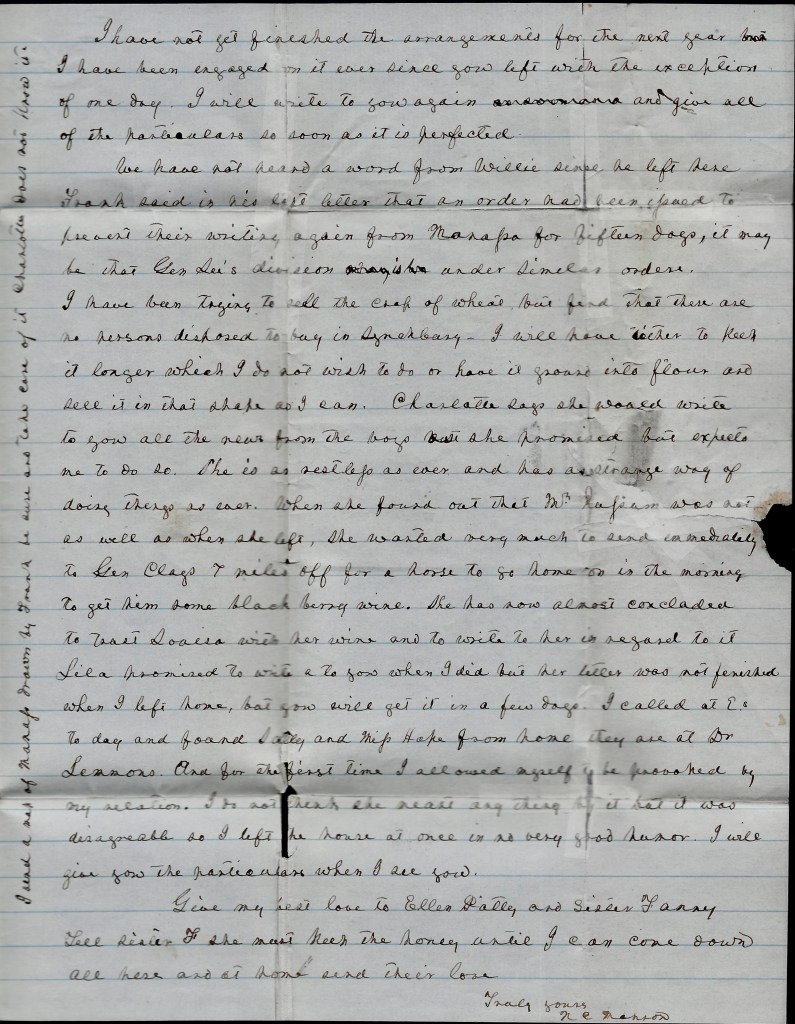
I came here today and as I could not get through all of my business today, I concluded to stay all night and start early in the morning and try and finis tomorrow time enough to get home. I have not yet finished the arrangements for the next year. I have been engaged on it ever since you left with the exception of one day. I will write to you again and give all of the particulars so soon as it is perfected.
We have not heard a word from Willie since he left here. Frank said in his last letter than an order had been issued to prevent their writing again from Manassa for fifteen days. It may be that that Gen. Lee’s Division is under similar orders. I have been trying to sell the crop of wheat but find that there are no persons disposed to buy in Lynchburg. I will have either to keep it longer—which I do not wish to do—or have it ground into flour and sell it in that shape as I can. Charlotte says she would write to you all the news from the boys as she promised but she expects me to do so. She is as restless as ever and has a strange way of doing things as ever. When she found out that Mr. Rassam was not as well as when she left, she wanted very much to send immediately to Gen. Clags 7 miles off for a horse to go home on in the morning to get him some blackberry wine. She has now almost concluded to toast Louisa with her wine and to write to her in regard to it. Lila promised to write to you when I did but her letter was not finished when I left home. But you will get it in a few days.
I called at E’s today and found Sally and Miss Hope from home. They are at Dr. Lemmon’s and for the first time I allowed myself to be provoked by my relation. I do not think she means anything by it but it was disagreeable so I left the house at once in no very good humor. I will give you the particulars when I see you.
Give my best love to Ellen, Patty, and sister Fanny. Tell sister Fanny she must keep the honey until I can come down. All here and at home send their love. Yours truly, — N. C. Manson
I send a map of Manassa drawn by Frank. Be sure and take care of it. Charlotte does not know it.
1 “I had the pleasure of seeing Prof. Lowe’s balloon, and am sure his observations were of little account to him. The Yankee experiment of ballooning came near receiving a great ‘”pull back,”’ by the firing upon the balloon spy by the Washington Artillery. Several shots were fired at it, when it immediately ‘”went down.”’ Don’t suppose, however, ‘”anybody was hurt.”’ But, nevertheless. somebody was scared, for the balloon suddenly disappeared and did not come up again.” Correspondent for the Richmond Daily Dispatch dated September 6, 1861.
This incredible letter was written by John Fales (1841-1918), the son of John Smith Fales (1800-1861) and Charlotte Leland (1807-1850) of Sherburn, Middlesex county, Massachusetts—both parents dead by the time this letter was written in September 1861. He wrote the letter to his older sister, Charlotte Adelaide Fales (1832-1908), mentioning too a younger brother, Charles Leland Fales (1843-1902) who was serving in Co. B, 16th Massachusetts Infantry. From enlistment records we know that John stood 5′ 9″ tall, had brown hair, light eyes, and a fair complexion.
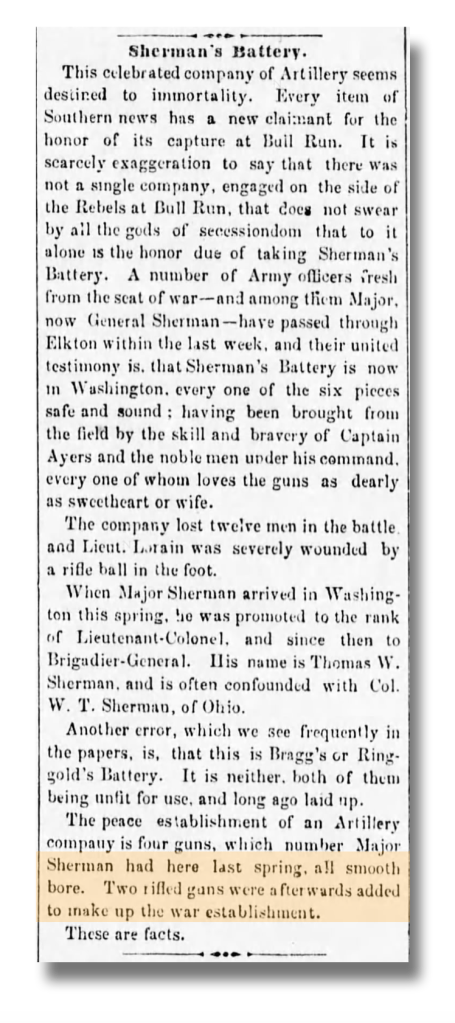
John wrote the letter while serving in the 3rd Light Artillery, Battery E, of the US Artillery (Regular Army)—commonly referred to as “Sherman’s Battery.” His enlistment was recorded as 17 April 1861 and his battery was mobilized and placed in a defensive position near Arlington Heights in late May. At least two of the guns were stationed at Pearl’s farm “north of the wagon road, half a mile east of Ball’s Crossroads” by early July. They were attached to William T. Sherman’s Brigade 1 of McDowell’s Army at the time of the Battle of Bull Run—their participation described by Captain Romeyn B. Ayres, who commanded the Battery at Bill Run, in the following after action report:
LIGHT COMPANY E, THIRD ARTILLERY,
Camp Corcoran, Virginia, July 25, 1861.
SIR: I have the honor to report the part taken in the battle of the 21st instant by this battery.
The battery advanced in the morning with the brigade to which it was attached—Col. W. T. Sherman’s—on the center route upon the front of the enemy’s position. The battery operated from this position at times upon the enemy’s batteries and troops as occasion offered. About noon I started with the brigade, as ordered, to cross the open ground, the run, and to rise the bluff, with a portion of the battery, one section being detached at this time, operating upon a battery to the left. On arriving at the run it at once was apparent that it was impossible to rise the bluff opposite with the pieces. I sent an officer immediately to report the fact to Colonel Sherman and ask instructions. I received for reply that I should use my discretion.
I immediately returned to the central position. I remained at this point, operating upon the enemy’s guns and infantry, till ordered by General Tyler to cover the retreat of the division with the battery.A body of cavalry at this time drew up to charge the battery. The whole battery poured canister into and demolished them. The battery moved slowly to the rear to Centreville.
I will add, that the coolness and gallantry of First Lieut. Dunbar R. Ransom on all occasions, and particularly when under fire of three pieces, with his section at short range, when the battery was about to be charged by a large body of cavalry, and also when crossing a broken bridge in a rough gully, and fired upon in rear by the enemy’s infantry, were conspicuous. The good conduct of First Lieut. George W. Dresser, Fourth Artillery, was marked, especially when threatened by cavalry, and at the ravine referred to above. Second Lieut. H. E. Noyes, cavalry, was energetic in the performance of his duties.
I lost four horses killed on 18th; two horses wounded on 18th; seven horses on 21st; three caissons, the forge, and a six-mule team and wagon (excepting one mule), on the 21st. I sent all these caissons, &c., ahead when preparing for the retreat, to get them out of the way. The fleeing volunteers cut the traces and took the horses of the caissons.
Very respectfully, your obedient servant, — R. B. AYRES, Captain, Fifth Artillery, Commanding Company E.
Battery E, 3rd US Artillery (“Sherman’s Battery”) as it appeared on its return from the Battle of Bull Run (New York Historical Society Museum)
John datelined his letter from “Arlington Heights” on 5 September 1861. He indicates that the battery was near Fort Corcoran. More precisely the battery was positioned a quarter of a mile soutwest of W. Ross’ farm Rossyln.
Before the Civil War ended, John would enlist twice more in his country’s service. After his three years in Battery E, US Artillery, he reenlisted in Co. E, 60th Massachusetts Infantry on 16 July 1864 and served until 30 November 1864. Following that he reenlisted again in the 3rd Massachusetts Artillery and served until 1868. His military records indicate he was wounded once—at the Battle of Olustee (Florida) on 20 February 1864. In his later years, John worked in Boston as a locomotive fireman—a job that no doubt gave him the cataracts that plagued him in his later years, not to mention his loss of hearing.
[Note: This letter is from the personal collection of Megan Lynn and was transcribed and researched by Griff for publication on Spared & Shared with Megan’s consent.]
Transcription
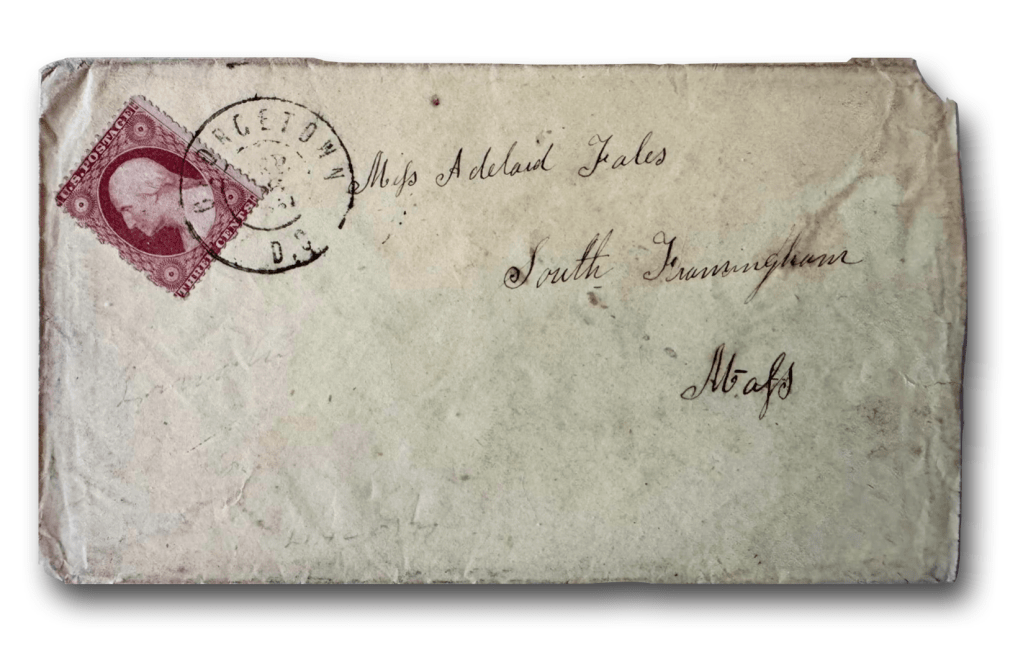
Addressed to Adelaide Fales, South Framingham, Massachusetts
Arlington Heights [Thursday] September 5th 1861
Dear Sister,
As I have a little time today, I thought I would write & let you know that I am safe & well. We are here in the same place but we have just got orders to get ready to move. I do not know where we are going but I expect we are going to advance on to Fairfax.
Mr. Lincoln reviewed us last Monday 2 & after the review he came to our camp & examined our rifle cannons. 3 He thanked us very kindly for our gallant conduct at the battle of Bulls Run & when he went away he went up to where our cook was getting dinner & took a brand of fire & lit his cigar & sit down and had a long talk with our captain. 4 He is a very pleasant talking man. Anyone would not think he was President of the United States if they did not know who he was.
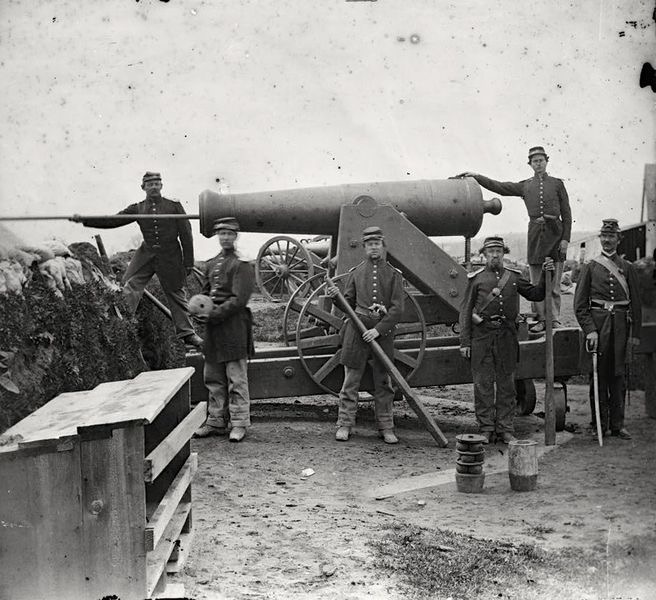
One of the 24-pounder guns in Fort Corcoran (LOC)
The 18th Massachusetts Regiment came over here from the city. 5 The Massachusetts soldiers are the best looking soldiers here. All the regiments here are at work every day. They are throwing up breastworks here in all direction & mounting heavy guns. Fort Corcoran has 8 guns which carry a 68 lb. ball & four 24-pounders. This fort commands the road from Georgetown to Fairfax & the Potomac. You can see all over the city of Washington. Our battery is about a quarter of a mile from this fort. It is large enough to hold 1500 men. I have got a picture of this fort but it does not look exactly as it does now.
I have not heard from [brother] Charlie yet. I do not know whether his regiment is in the city or not. We have got a large balloon here in our camp. He went up yesterday to take a look at the rebels. He could look right down onto them & see what they were doing. After he had been up a little while, the rebels fired a cannon ball at him but they could not reach him. He had ropes fixed to a large tree so that he would not blow away. 6
I have not anymore to write now. Remember me to all the folks. I am your affectionate brother, — John Fales
Footnotes
The Cecil Whig, 17 August 1861
1 The celebrated Battery E of the 3rd US Regulars was led during the War with Mexico by Thomas West Sherman and it was often referred to as “Sherman’s Battery,” even when it was lead, as it was at Bull Run, by Capt. Romeyn B. Ayres. Adding greater confusion, the Battery was assigned to the command of Col. William Tecumseh Sherman just prior to the Battle of Bull Run.Ayres was at Old Point, Virginia, until 7 July 1861 when he was ordered to Washington to take command of “Sherman’s Battery.” His was the only artillery unit to save all of his guns from the battlefield and even brought off two others. Ayres was transferred to Philadelphia to recruit for the 5th US Artillery shortly afterward. [Daily National Democrat, 20 September 1861]
2 “Last Monday” would have been 2 September 1861. According to the Lincoln Log, Lincoln and Secretary Seward reviewed the 2nd & 5th Wisconsin Infantry Regiments of Gen. Rufus King’s Brigade [NY Times, 3 September 1861].
3 Sherman’s Battery went into the fight at Blackburn’s Ford and Bull Run with four smoothbore cannon—two 6-pounders and two 12-pounder field howitzers, as well as two 10-pounder Parrott rifles as a reserve. The Parrott rifle was still somewhat of a novelty in 1861. It was developed in 1860 and were easily recognized by the wrought-iron reinforcing band wrapped around the breech. They were simple for the gun crews to operate and could be mass produced inexpensively.
Capt. John H. Hamilton(1823-1900)
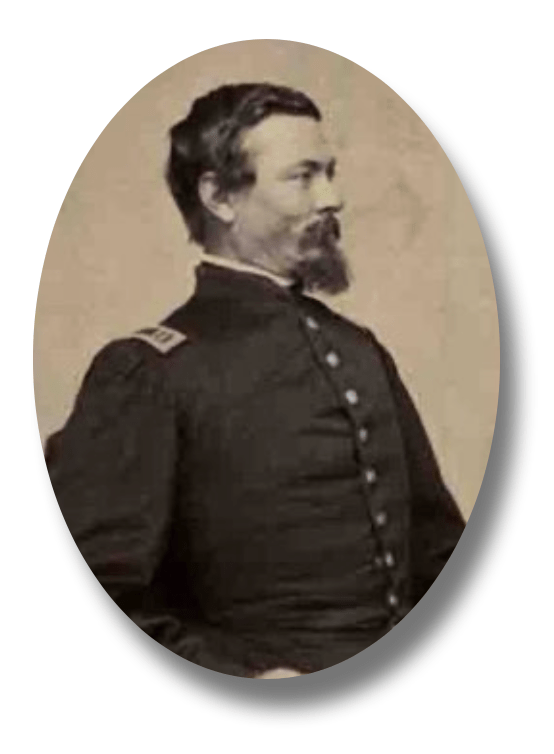
4 Though it was Capt. Romeyn B. Ayres of the 5th US Artillery who temporarily commanded the battery at Bull Run, by early August 1861 the battery was commanded by Capt. John H. Hamilton, West Point Class of 1847. Hamilton had received his promotion to captain in late April but he was in San Francisco at the time and he did not arrive in Washington D. C. until after the Battle of Bull Run. In short, it would have been Capt. Hamilton who enjoyed a cigar with President Lincoln, not Capt. Ayres.
5 The 18th Massachusetts was mustered into federal service on 27 August 1861 with eight companies. They were ordered on the 3rd of September to cross the Potomac and report to Gen. Fitz John Porter. They set up their camp near Fort Corcoran on ground previously occupied by the69th New York. Later in September they were moved to Hall’s Hill, then the outpost of the Union army.
6 Thaddeus Lowe’s newly created Balloon Corps was quite active prior to and after the Battle of Bull Run. On the day of the battle the balloon was accidentally ripped on the way to the battlefield so they were foiled in their ascension that day, but three days later, Lowe made an ascent at Fort Corcoran to look for an indications of a march on Washington by the Rebel army. Later that same day, he ascended again to check the Confederate bivouacs at Manassas and Centreville. To gain higher altitude for a better view, Lowe asked for the tethering cables to be released and the balloon drifted toward Alexandria where he was actually fired upon by Union troops thinking the Rebels were attacking by air. A number of ascents were made near Arlington Heights during August 1861 to keep an eye on the Rebel army’s movements. It was on August 29th at Ball’s Crossroads when Lowe’s balloon “Union” was fired on by a Rebel cannon commanded by Lt. Thomas Rosser of the New Orleans Washington Artillery from their position on Munson Hill. Though Fales could not have known it at the time, the Confederates attempted to send up its own “spy balloon” at Munson’s Hill on September 4th but the bag ripped before it could get off the ground. On September 5th, the date of Fale’s letter, it was reported that Union generals Irvin McDowell and Fitz-John Porter went up in Lowe’s balloon, and McClellan did likewise on September 7th. [See Arlington and Fairfax Counties: Land of Many Reconnaissance Firsts, by Dino A. Brugioni, published in Northern Virginia Heritage]
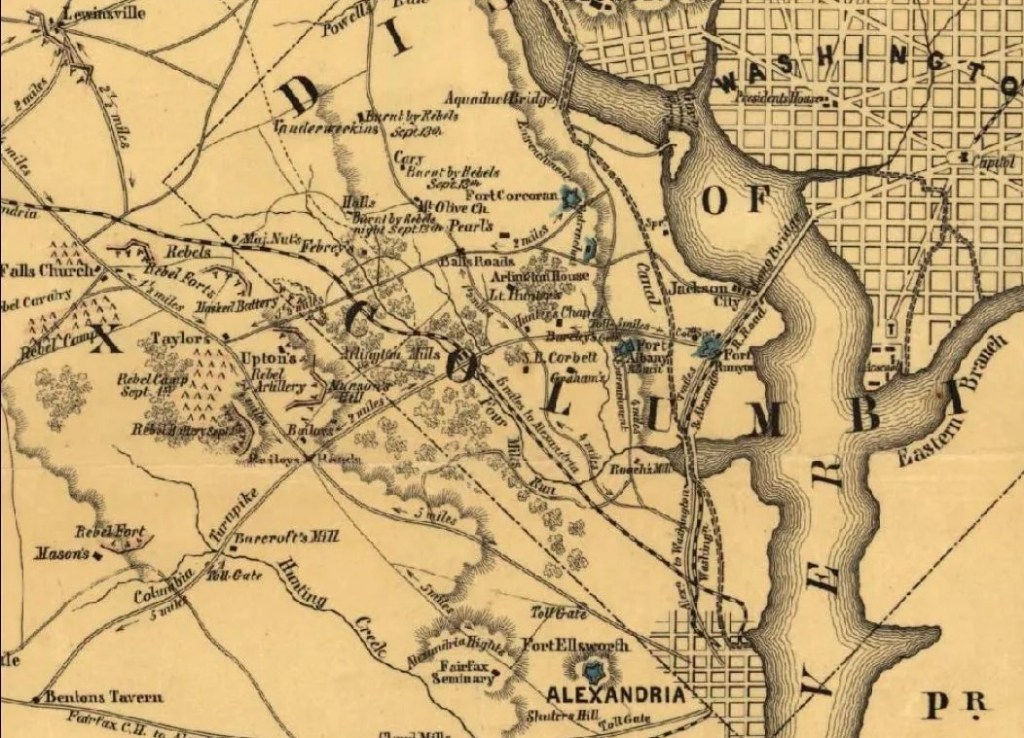
A map of the area and localities mentioned in the letter and footnotes.
I could not find an image of Edward but here is Sgt. Ransom Y. Hazard who served in Co. B, 137th New York Infantry. (Union Drummer Boy)
The following letter was written by Edward H. Finch (1842-1867), the son of Bryan Finch (1814-1852) and Mary Thorne (1818-1893) of Caroline Centre, Tompkins county, New York. Edward was working as a mechanic at the time he enlisted on 14 August 1862, accepting a $100 bounty from the town to serve in Co. K, 137th New York.
According to county records, Edward was wounded “in hip slightly” while defending Culp’s Hill on 2 July 1863 at Gettysburg. There is an excellent blog article entitled, “Who Lives, Who Dies, Who Tells Your Story? David Ireland and the 137th New York” that was published on 19 October 2016 describing the critical role played by the 137th New York at Gettysburg. It points out that “Just as the 20th Maine under Joshua Lawrence Chamberlain held the Union left flank at Gettysburg on July 2, David Ireland and the 137th New York held the Union right. Yet unlike the 20th Maine, the 137th saw significant action on the final day of battle.” Regrettably and unfairly, Chamberlain and the 20th Maine get most of the publicity when the losses at either end of the Union defenses might have proven equally disastrous.
After Edward recovered from his wound, he returned to the regiment and participated on Sherman’s Atlanta Campaign and later on the march through the Carolinas. Though he dodged death in the war, Edward did not live long after he returned to Tompkins county following his discharge in 1865. Less than two years later, on 22 April 1867, when Edward and his sister, Mary Ellen Finch, were riding home in a wagon from Caroline Centre to their home on the Speed farm, “a flash of lightning struck him on the head and passed down the whole length of his body, tearing his clothes into shreds. The same stroke” set his sister’s clothes on fire and burned the left side of her body very badly before she could put it out. (Ithaca Journal)
The letter was addressed to John Taft (1795-1876), the father of his friend and comrade, 2nd Lieut. William Henry Taft, who had also served in the same company until he died of disease at Knoxville, Maryland, on 31 October 1862. William’s remains were returned home and buried in the family plot at Caroline. See—1862: William Henry Taft to John Taft.
The letter contains a rare reference to Thaddeus Lowe’s Observation Balloon being launched “every day when it is still” on the heights overlooking Harper’s Ferry in late October 1862.
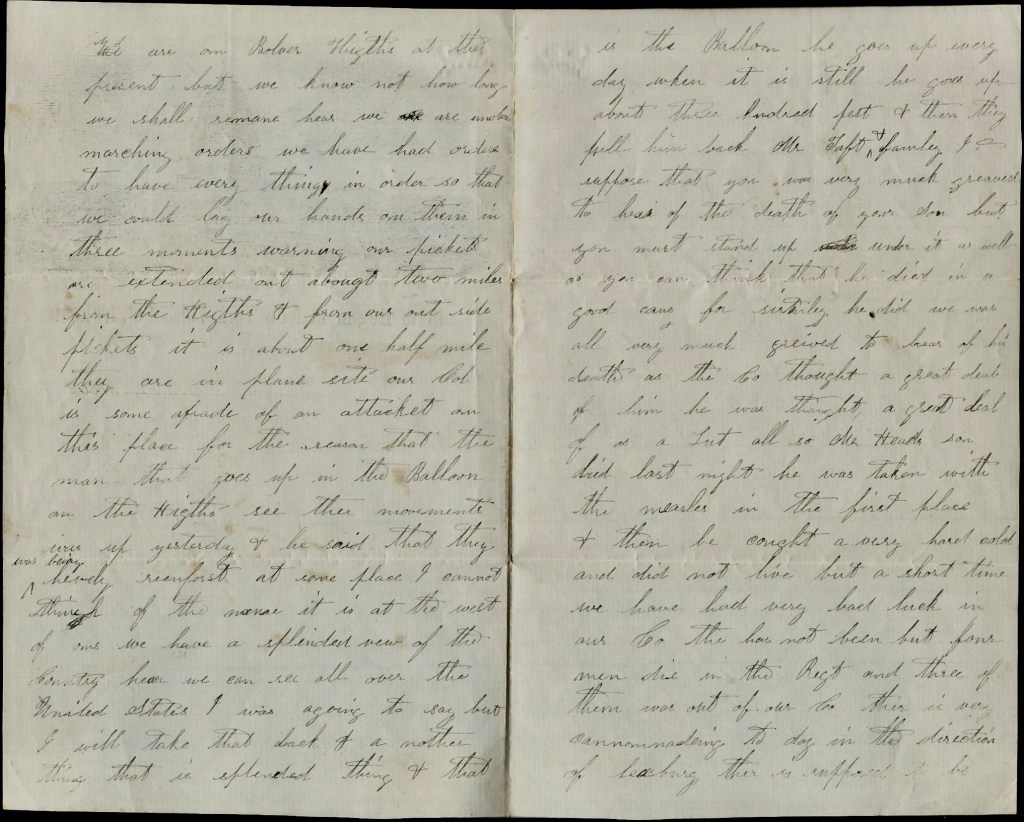
Transcription
Addressed to Mr. John Taft, Caroline Center, Tompkins county, New York
137th New York Vols. Col. Ireland Company K Sunday, November 2nd 1862
Mr. John Taft,
I thought that I would write you a few lines as it was Sunday and I had a few moments to spare. Well, Mr. Taft, we are in the land of the Rebs. I am within sight of them at the present time as I am out on picket duty today and yesterday. We was to be relieved this morning but through some mistake we was not. We are on Bolivar Heights at the present time but we know not how long we shall remain here.
We are under marching orders. We have had orders to have everything in order so that we could lay our hands on them in three moments warning. Our pickets are extended out about two miles from the heights & from our outside pickets it is about one half mile. They are in plain sight. Our Colonel [David Ireland] is afraid of an attack on this place for the reason that the man that that goes up in the balloon on the heights [to] see their movements was up yesterday & he said that they was being heavily reinforced at some place—I cannot think of the name—it is at the west of us.
We have a splendid view of the country here. We can see all over the United States, I was a going to say, but I will take that back, And another thing that is a splendid thing & that is the balloon. He goes up every day when it is still. He goes up about three hundred feet & then they pull him back. 1
Sketch courtesy of A. Lee. Drawing shows Bolivar Heights as seen from Camp Hill. Scattered buildings in hilly country, with a hot air balloon hanging in the sky in the distance.
Mr. Taft & family, I suppose that you were very much grieved to hear of the death of your son [William] but you must stand up under it as well as you can. Think that he died in a good cause for certainly he did. We was all very much grieved to hear of his death as the company thought a great deal of him. He was thought a great deal of as a Lut [Lieutenant] also. Mr. Head’s son [Isaac] died last night. He was taken with the measles in the first place and then he caught a very hard cold and did not live but a short time. We have had very bad luck in our company. There has not been but four men die in the regiment and three of them was out of our company.
There is very [much] cannonading today in the direction of Leesburg. There is supposed to be a very hard battle there this day that came on this ground. There is a great movement of the army in these parts. The regiments that was in camp here was ordered to move off & we was ordered to move on and it is said that the whole army was under a move. It is supposed that there is to be some fighting now. I shall be home by spring I think if my life is spared me till that time.
Mr. Taft, I have heard them talk about the Sunny South but deliver me from this country. It is quite warm here yet. It is warm days and cold nights. I hear that you have had snow in your town. That’s more than I have seen yet. Well, I must close. Excuse this writing as I am writing on the ground. If you think this worthy of an answer, please write soon. — Edward H. Finch
1 According to the Harper’s Ferry National Historical Park, on October 16, 1862, chief of aeronautics for the Union Army Professor Thaddeus Lowe manned a balloon above Bolivar Heights to assist with observations of General Robert E. Lee’s Confederate army. Lowe’s balloon corps marched with a complex contraption consisting of two wagons “with very large high boxes made perfectly air tight.” These boxes held the gas that filled and lifted the balloon. Harley Milborn of the 145th Pennsylvania Infantry noted, “For the last two days they have been inflating it. [T]hey finished last night, and then a few men took hold of the cords to keep it down and they conducted it through our camp.” Hillborn watched for a time, but didn’t observe the end product: “Whether he made any discoveries or not, I do not know.”






 Spared & Shared 23