Category Archives: Memphis, Tennessee

1862-64: George Cook to Thomas Cook

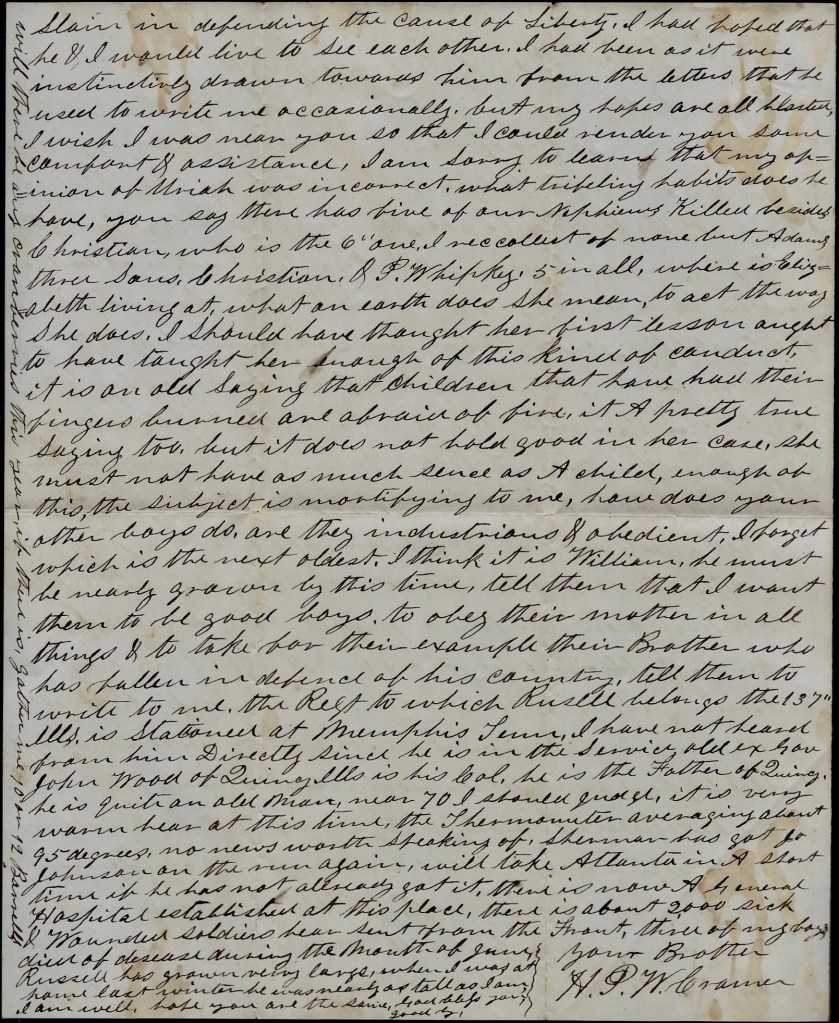
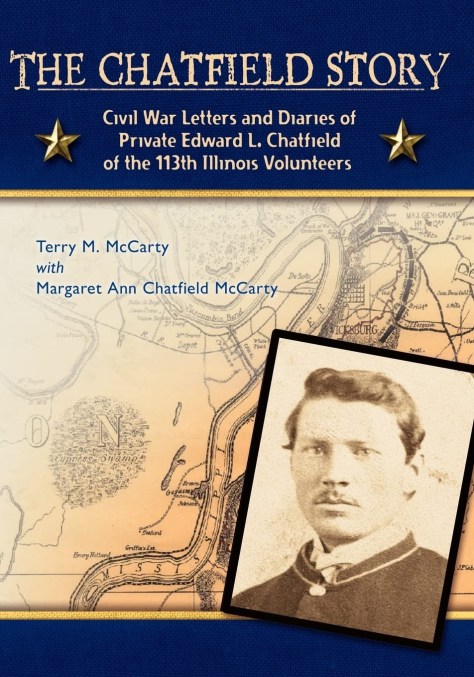
Readers wanting to know more about the 113th Illinois may want to dig into this 561 page book published in 2009. I have it in my library and found it quite comprehensive.

The following letters were written by George Cook (b. 1841) of Crete, Will county, Illinois, who enlisted 1 October 1862 as a private in Co. A, 113th Regiment Illinois Volunteers. He mustered out of the regiment in June 1865.

George wrote most of his letters to his older brother, Thomas Cook (b. 1838) of Crete. They were the children of William Cook (1810-1890) and Elizabeth Atkinson (1803-1863).

These letters are from the personal collection of Ryan Martin and were offered for transcription and publication on Spared & Shared by express consent.

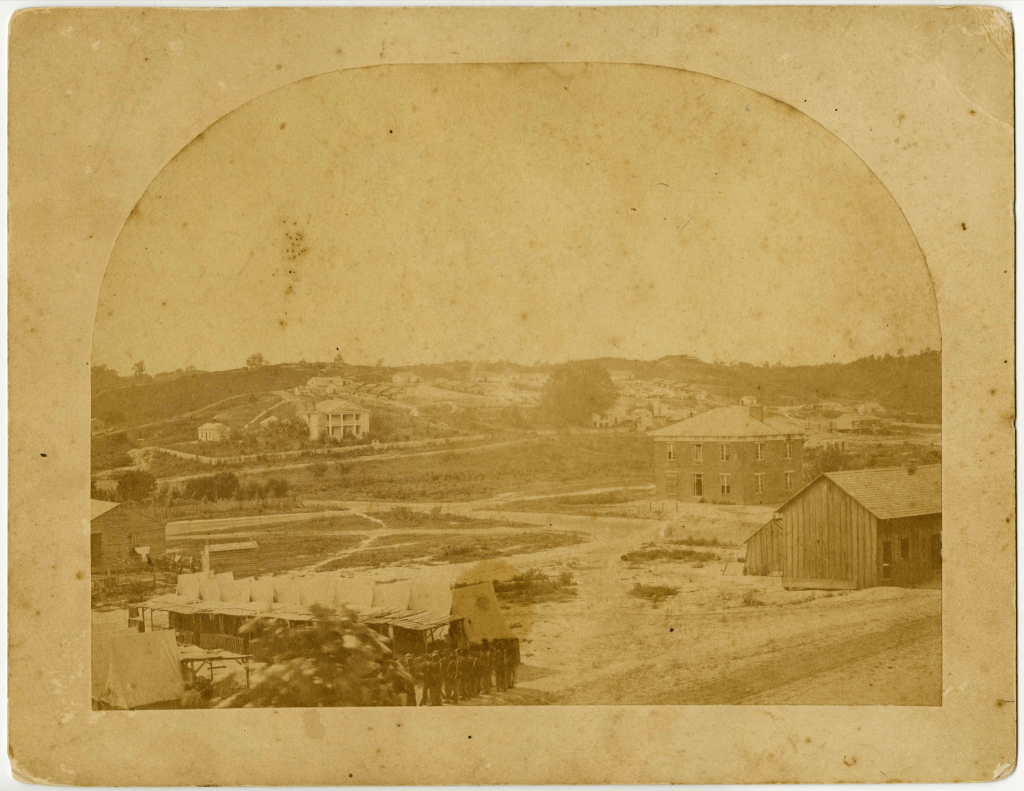
[Editor’s Note: the header image is a picture of the 113th Illinois taken in Memphis.]

Letter 1

Memphis, Tennessee
December 15, 1862

Thomas Cook,

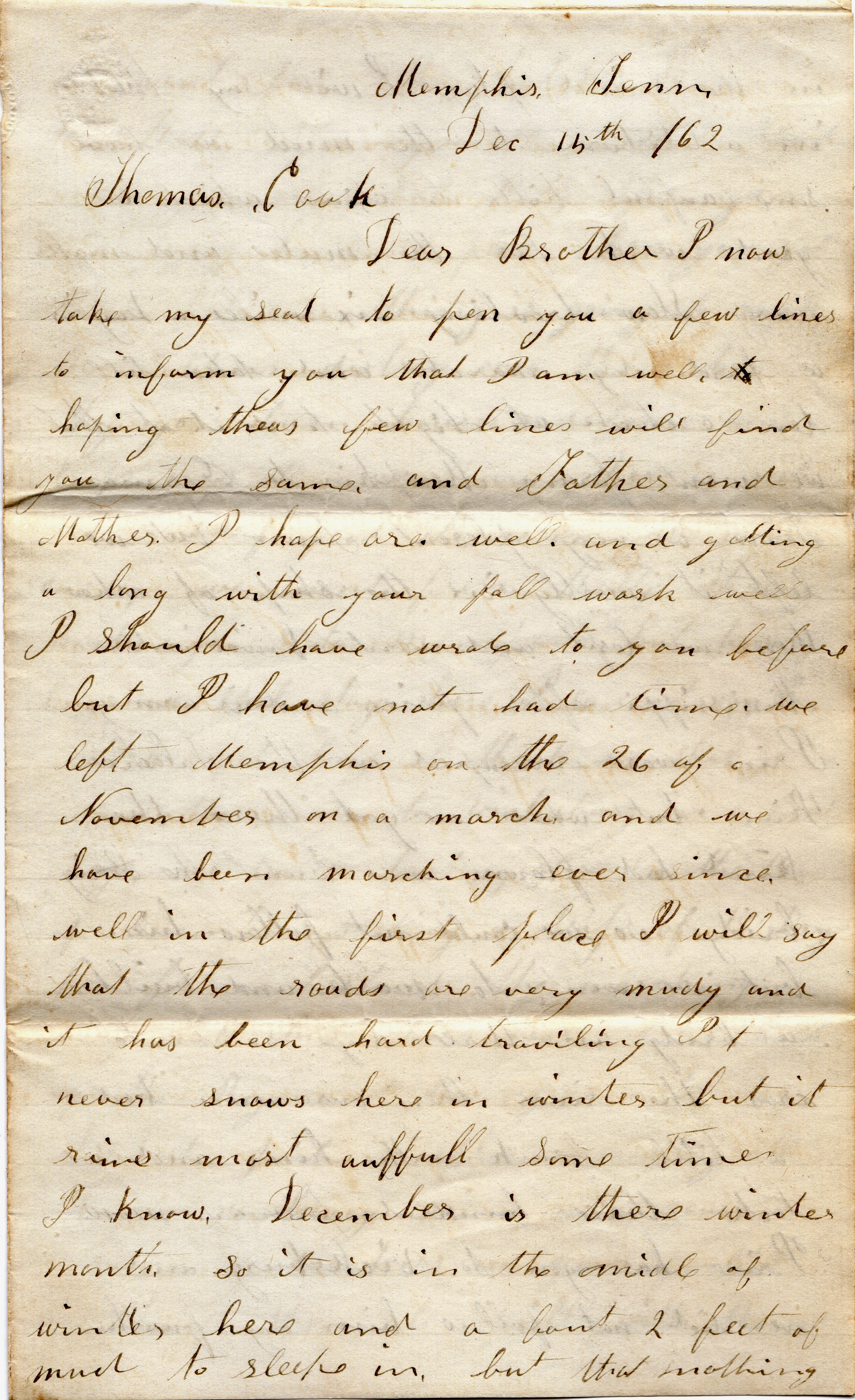
Dear brother, I now take my seat to pen you a few lines to inform you that I am well, hoping these few lines will find you the same, and Father and Mother I hope are well and getting along with your fall work well. I should have wrote to you before but I have not had time.

We left Memphis on the 26th of November on a march and we have been marching ever since. Well, in the first place I will say that the roads are very muddy and it has been hard traveling. It never snows here in winter but it rains most awful sometime. I know December is their winter month so it is in the middle of winter here and about two feet of mud to sleep in. But that’s nothing.

In the second place I will say that in addition to the mud, we have some awful hills to climb which is good work for the mules and makes very slow traveling. Six miles a day is a hard day’s march and take till ten o’clock at night to do it at that.

We went from Memphis to Germantown—a very pleasant town—but we left it mostly in the shape of ashes. Then we left and went down into Mississippi after Price and his army. Price was encamped on the Tallahatchie River but when we got there, the bird had flown and burned the bridge so we could not follow him. But we went to work and built a bridge in three days so as to cross the river. Then our men had a little brush with him and we took three hundred prisoners. Now Price has gone to Vicksburg and we did not follow him any further.

We went from the [Talla]hatchie River to Holly Springs, the hilliest road ever you see, but Holly Springs is a very handsome place when you get there. But everything is going to rack [and ruin]. The soldiers destroy everything—they burn houses and fences and crops and all—everything. There is not 80 rods of good fence in the whole country.

We went from Holly Springs back again to Memphis, but how long we shall stay here I cannot say. I think not long. I think we shall go down the river to Vicksburg in a few days. We came back yesterday, the 14th of December, making a trip of 18 days. As for me, I stand the marching very well but there was about half of the regiment that give out. The hardest part is after marching all day in a heavy rain with your supper of crackers in your pocket to have them all spoilt with the wet and have to lay down in the mud without any supper. But mud makes a soft bed to sleep on.

The country out here is all timber and very heavy timber too, from one end to the other. Wherever I have been, it is one vast forest—no openings at all—nothing but trees and stumps. All the large plantations have been cleaned up by the colored people. Some of the large farmers have as many as two or three hundred slaves on their plantations. There was one day 140 slaves left one man and came into our regiment and came with us to Memphis—quite a loss for the man. But then it could not be helped.

Levi [James] and Darton [?] are well and stand soldiering very well. [Sgt.] Henry Case has been sick ever since we came here but he is getting better now. He did not go with is on our march. He stayed in the hospital in Memphis. He is getting better fast.

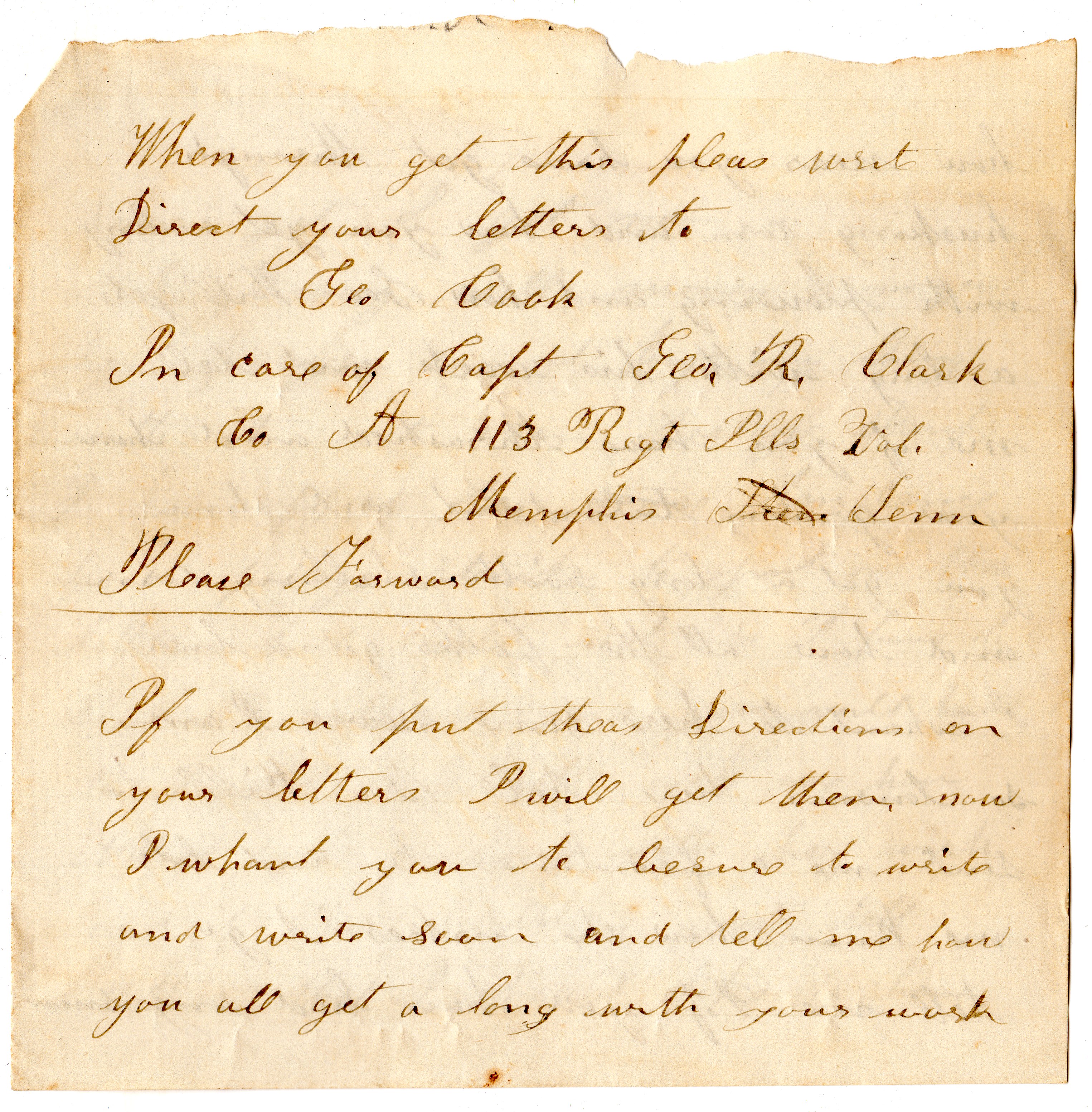
When you get this, please write. Direct your letters to George Cook, in care of Capt. George R. Clark, Co. A, 113th Regt. Ills. Vol. , Memphis, Tennessee.

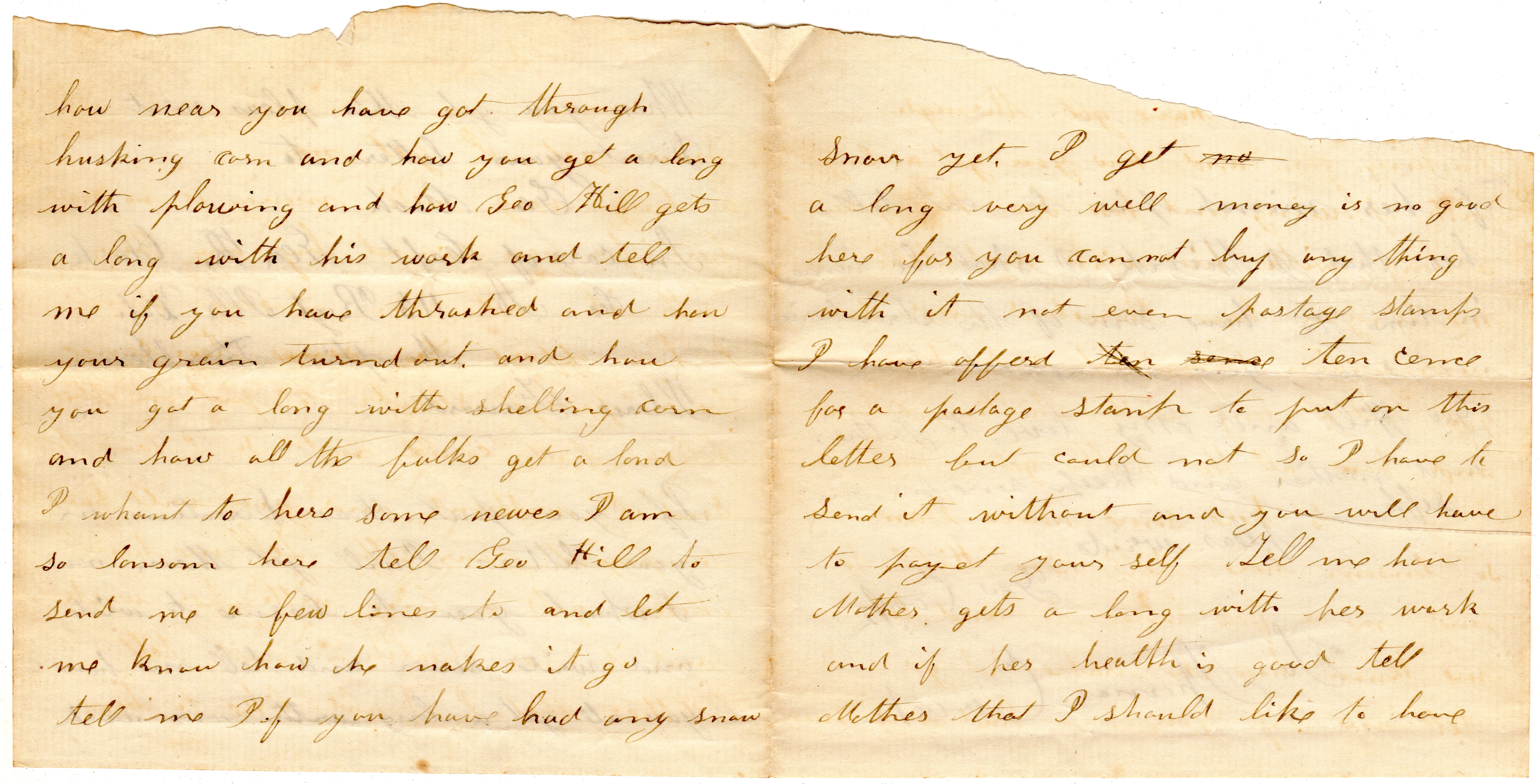
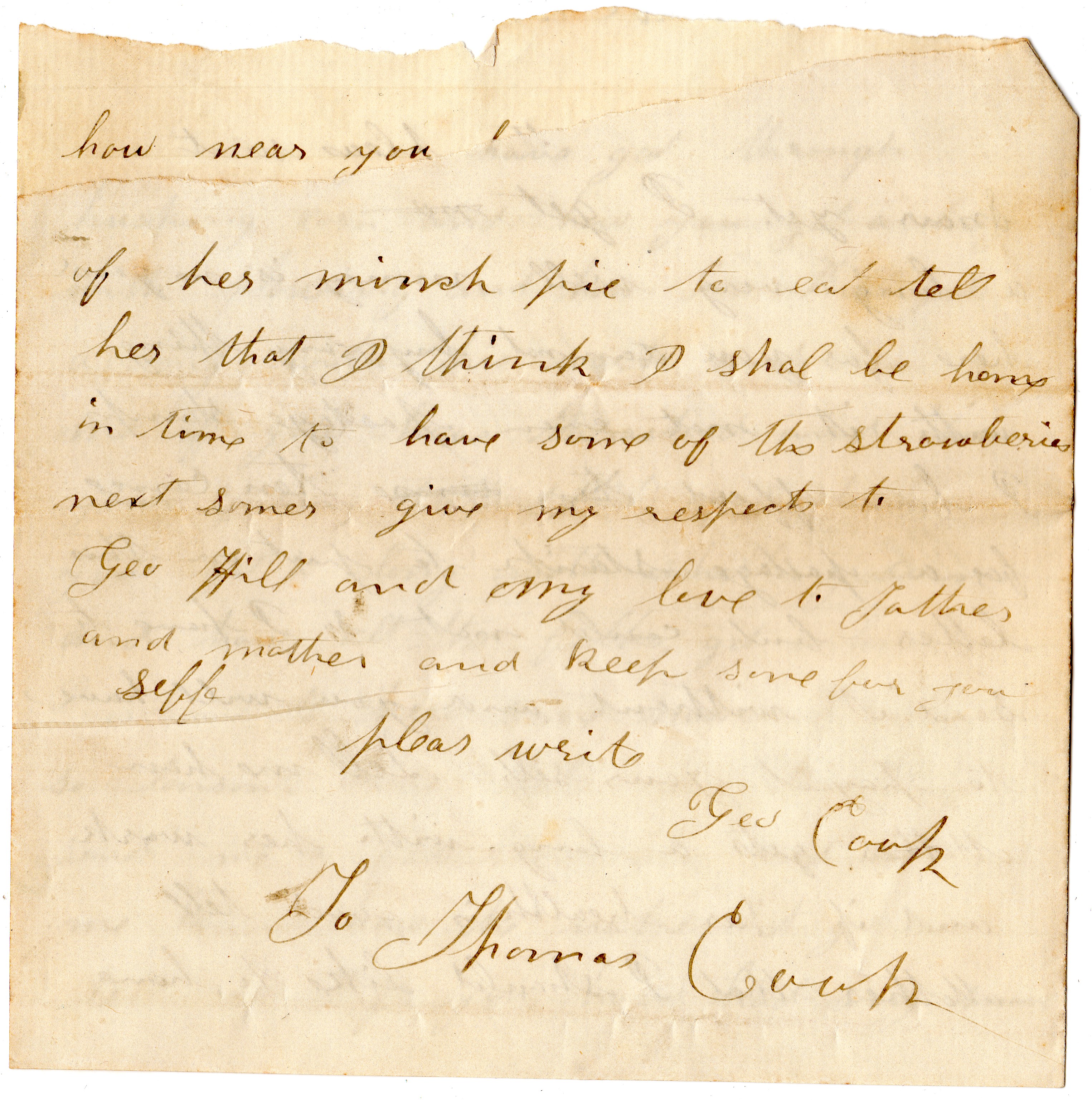
If you put these directions on your letters, I will get them. Now I want you to be sure to write and write soon and tell me how you all get along with your work. How near you have got through husking corn and how you get along with plowing and how George Hill gets along with his work and tell me if you have thrashed and how your grain turned out and how you get along with shelling corn and how all the folks get along. I want to hear some news. I am so lonesome here. Tell George Hill to send me a few lines too and let me know how he makes it go. Tell me if you have had any snow yet. I get along very well. Money is no good here for you cannot buy anything with it—not even postage stamps. I have offered ten cents for a postage tamp to put on this letter but could not so I have to send it without and you will have to pay it yourself. Tell me how Mother gets along with her work and if her health is good. Tell Mother that I should like to have her mince pie to eat. Tell her that I think I shall be home in time to have some of the strawberries next summer. Give my respects to George Hill and my love o Father and Mother and keep some for yourself. Please write, — George Cook

To Thomas Cook

Letter 2

In front of Vicksburg
State of Louisiana
January 25, 1863

Dear Brother,

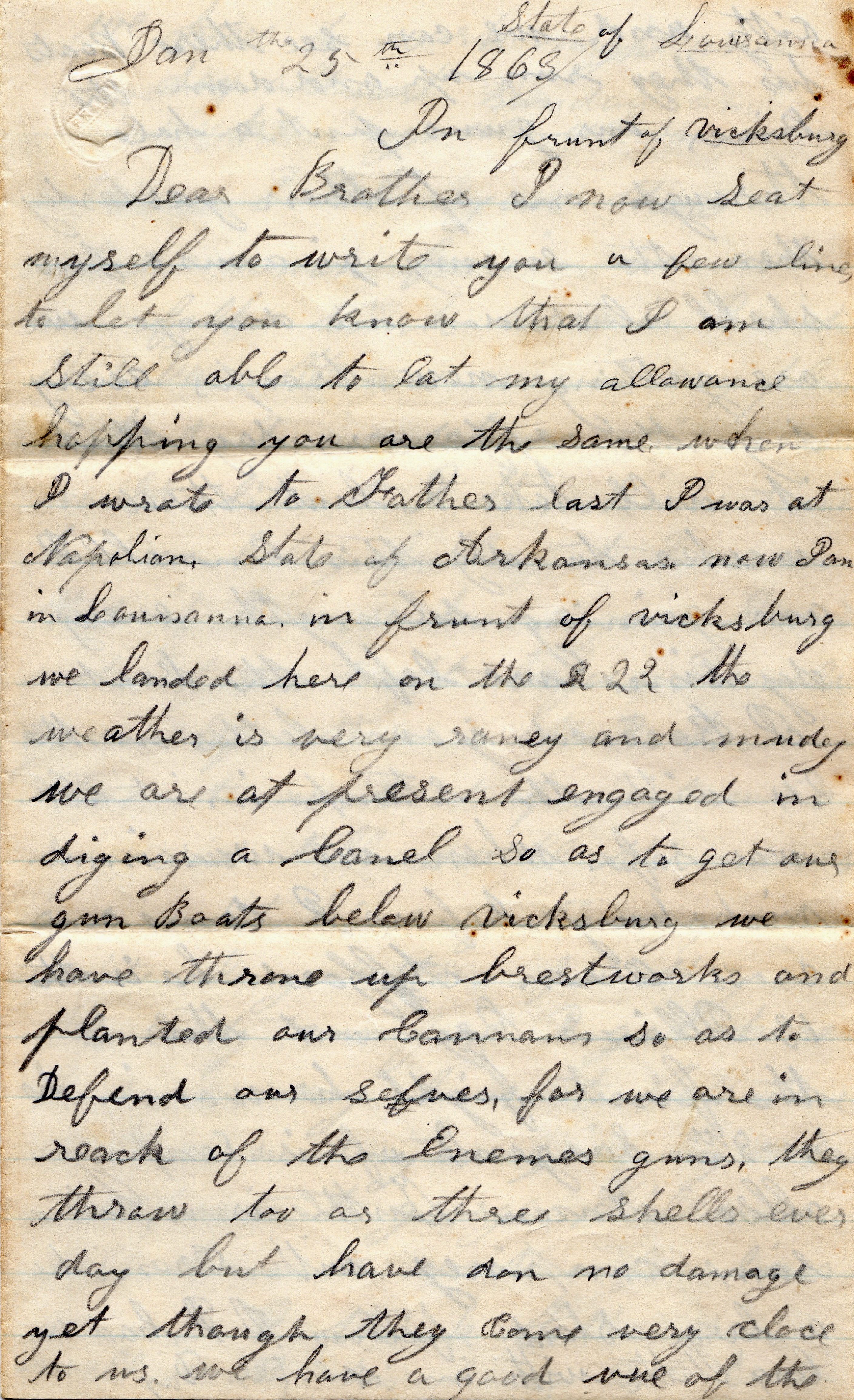
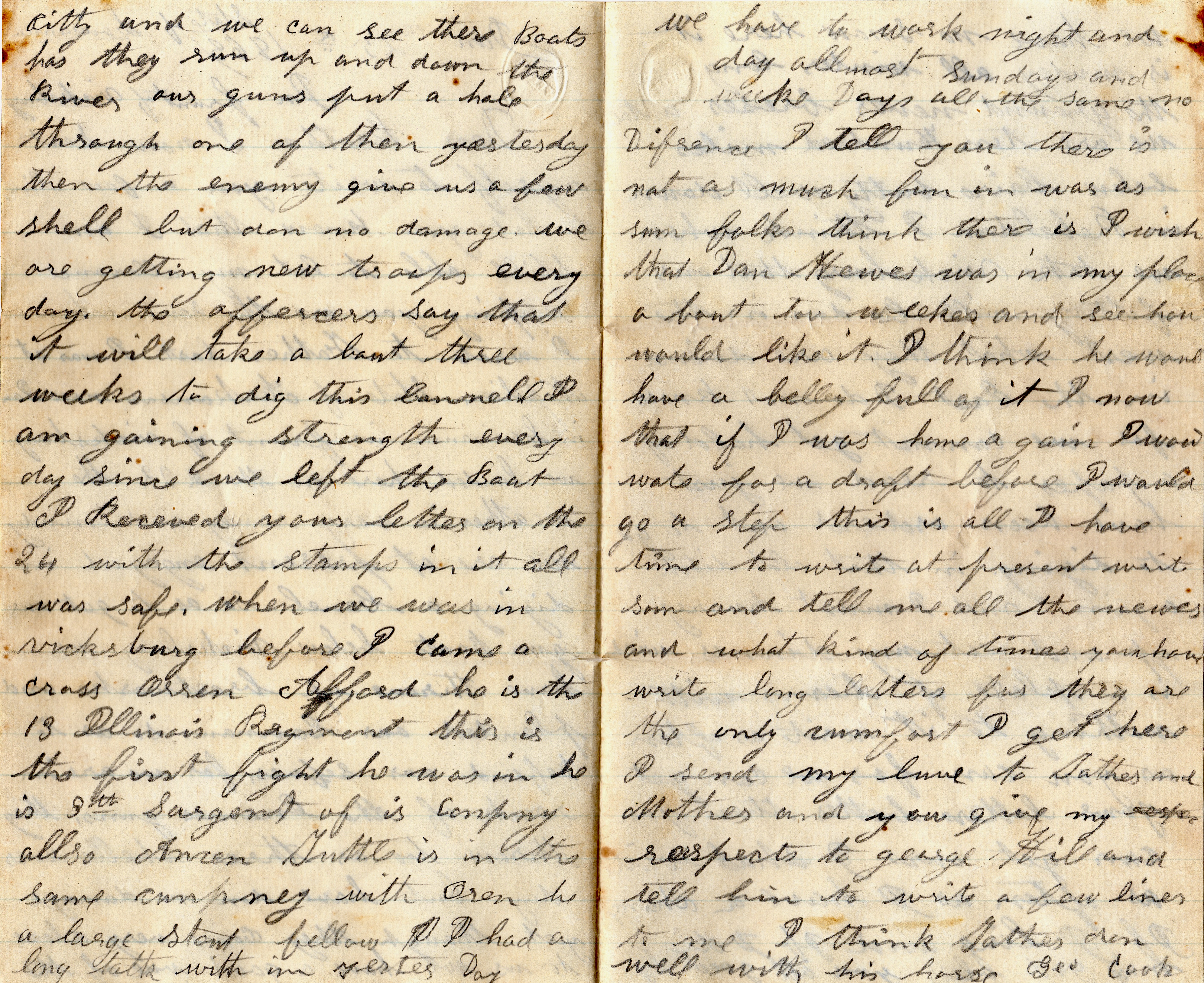
I now seat myself to write you a few lines to let you know that I am still able to eat my allowance, hoping you are the same. When I wrote to Father last, I was at Napoleon, State of Arkansas. Now I am in Louisiana in front of Vicksburg. We landed here on the 22nd. The weather is very rainy and muddy. We are at present engaged in digging a canal to as to get out gunboats below Vicksburg. We have thrown up breastworks and planted our cannons so as to defend ourselves for we are in reach of the enemy’s guns. They throw two or three shells everyday but have done no damage yet though they come very close to us. We have a good view of the City and we can see their boats as they run up and down the river. Our guns put a hole through one of them yesterday. Then the enemy gave us a few shell but done no damage.

We are getting new troops everyday. The officers say that it will take about three weeks to dig this canal. I am gaining strength every day since we left the boat. I received your letter on the 24th with the stamps in it. All was safe.

When we was in Vicksburg before, I came across Orin Alford. [Orrin T. Alfred, Co. I, 13th Ill.] He is [in] the 13th Illinois Regiment. This is the first fight he was in. He is 3rd Sergeant of his company. Also Anson Tuttle [Tuthill] is in the same company with Orrin. He ia a large stout fellow. I had a long talk with him yesterday.

We have to work night and day almost, Sundays and week days all the same. No difference. I tell you, there is not much fun in it as some folks think there is. I wish that Dan Hewes [Hughs?] was in my place about two weeks and see how he would like it. I think he would have a belly full of it. I know that if I was home again, I would wait for a draft before I would go a step. This is all I have time to write at present. Write soon and tell me all the news and what kind of times you have. Write long letters for they are the only comfort I get here. I send my love to Father and Mother and you give my respects to George Hill and tell him to write a few lines to me. I think Father done well with his horse. — George Cook

We have no snow here yet. It is muddy all winter long. The ground never freezes at all. We are ten hundred miles below Cairo—pretty well down in Rebeldom. I think when we take Vicksburg, that our fighting will be done in the West. What they are doing in the East, I do not know for we cannot get hold of a paper to read. We just have been ordered out to go to digging in that old ditch again and I must hurry up and eat my dinner which is a plate of beans with nothing to it.

Write as often as you can for we can get your letters better than you can get ours. I shall write as often as I have a chance if I live and if I die. May God bless you all. Goodbye.
Letter 3
[Expedition to Rolling Fork, Mississippi, via Muddy, Steele’s and Black Bayous and Deer Creek]

Headquarters 113th Regt. Illinois Vols.
Young’s Point, Louisiana
March 28, 1863

Thomas Cook,

Dear brother, I received your letter last night and was very glad to hear from you but was very sorry to hear that Mother is sick. I am glad to hear that the rest are all well. I am well at present though I have had some hard times since I last wrote to you. I should have wrote home before this for I should have got your letter had I been in camp but we have been on a march for 11 days. We was ordered up on the morning of the 17th of March at about 4 o’clock in the morning with one day’s rations in our knapsacks and our blankets on our shoulders and [told] to leave all the rest of our things in camp. So with out guns and 40 rounds of cartridges in our cartridge boxes, we started under cover of a heavy fog.

We marched four miles when we got on board of the steamboats and started up the river. The swift-footed steamers soon brought us to land 15 miles up the river. Everybody was wondering where we was going to and what we was going to do up here with only one day’s rations along with us. Gen. Stuart went on shore, looked around a spell, and then ordered the boats to lay to for the night.

Well in the morning our grub had run out. Gen. Stuart ordered us to go on up the river to see if we could get anything to eat. We run up the river about 15 miles and landed at a handsome plantation. Here our company was ordered to go ashore to kill some beef. We killed one cow and a lot of sheep and started back to the rest of the boats. We got there about 5 o’clock, having been all day with[out] a mouthful of anything to eat. We got there about dark. [Received but] a chunk of beef with[out] anything to [go with] it—no salt, no pepper, no bread.

The next morning after making our breakfast out of beef again, we started to march through the woods. We went about one mile when we came to some more boats in the woods—a funny place for steamboats to be—but the water was high and had run through a ravine about like that seventy. Here we stayed all night with nothing for supper. In the morning we got another day’s rations of crackers. These all went up for breakfast. We went on board the boats and run up the Black river about twenty miles. This is the finniest river you ever saw. The water looks like ink—black as a nigger’s face. Well we landed a little before dark and marched about two miles to where we camped.

There was a large plantation. Corn was up about a foot. The Negroes never thought of us coming out there. Here we had to lay down without any supper but I was about starved out and so I went into a nigger hut here. They was roasting a chicken which I confiscated with a large Johnny Cake and made out a good supper.

The next morning we got another day’s rations of crackers and started on a march. We marched on quick step all day till about 4 o’clock in the afternoon when we troops was attacked by the Rebels. We was thrown into line of battle and ordered to advance. The you ought to have seen the coats and blankets go scattered in every direction. Here I lost my blanket. We soon put them to flight and after running through the woods after them for about two hours, we brought up in the road again. Here we soon learned that the rebels was about ten thousand strong [and] about 5 miles in our advance. This was a stunner and we made up our minds that we had better retreat.

Here we was without anything to eat and within five miles of a large force so off we started on a quick retreat, We went till ten o’clock when we lay down to rest. Here is commenced to rain and it rained good and strong. We have no such rains up North. We killed a hog and roasted it over the fire in the morning for breakfast when we started on in the mud and water and rain. Here my boots failed to keep me dry for every step I went in over the tops. In this style, we paddled all day lay down in the mud at night and slept sound as a brick, the rain falling all night.

The next day we got about near to where we could get some more hard crackers which was grabbed at and no grumbling. In the afternoon, the sun came out fine and we partly got our clothes dry. At night we made our beds and expected to get a good night’s sleep but our pickets were drove in and we was ordered to fall into line of battle. In this way, we stood all night. The next morning we marched on board of the boat again. Here I lay down and liied to slept myself to death. Here we got some pies and some butter and after running round two days, we got back to Young’s Point on the night of the 27th and here I got your letter. What we will do next, I do not know.

Vicksburg is not taken yet nor is it likely to be taken yet awhile. The Rebels have shelled us out of the canal so it is a failure as I always thought it would [be] after so much labor and so many lives been lost by sickness by being down in this swamp. They talk about starving out the Rebels. If some of these big bugs would come down here and see some of the plantations on the Black river and all through the South stocked with cattle and hogs and chickens, geese and turkeys—every plantation is stocked with poultry, and the woods and fields are [ ] with cattle and hogs. They talk about living off of the enemy and eating them out of house and home. They have not see the corn cribs that line the roads wherever you go. We may feed our army horses at their corn cribs and feed our soldiers on their stock, and still there is stock enough in the South to feed both armies and keep them a going for years yet. They have got corn enough to make corn bread and they have got meat enough to eat. The Southern army lives better today than the Northern army. Every place we go to, every plantation has ten or twelve nigger huts on it and in every hut on the plantation, you will find from one to two barrels of molasses and sugar. Why the other day I went into an old log hut. It looked some like John Cole’s blacksmith ship. In this I found one barrel of salt, three barrels of the best salted ham, one barrel of molasses, and one of sugar and a barrel of sides ad a bout 15 bushels of potatoes. The old reb himself was in his nice house with about a hundred slaves around him. I got a canteen of sides and a handful of salt. This was all that we must touch. A litle while after this, we was attacked by the enemy and then our Generals say, “Well Boys, we will soon starve them out.”

Capt. [George] Clark has come back. He has been promoted to Major. He did not bring the other companies with him adn he says that he thinks that we will all go to Springfield in a little while. If we do, I shall come home as soon as we get there.

You said in your letter that George Shipley was going to get married. Write and tell me if she is good looking or not. Tell him when you see him that I wish him a happy life and if I was home, I would dance at his wedding. He had better wait till I come home but it is getting dark and I must close. Write soon. Tell George Hill to write. Give my respects to all. Much love to all—to Mother, to Father, and to yourself. I trust Mother will be [better] when you get this. I think Father is going in on trading horses.


Letter 4
On the Field in the Rear of Vicksburg
Headquarters 113th Regt. Ill. Vols.
June 14, 1863

Thomas Cook,

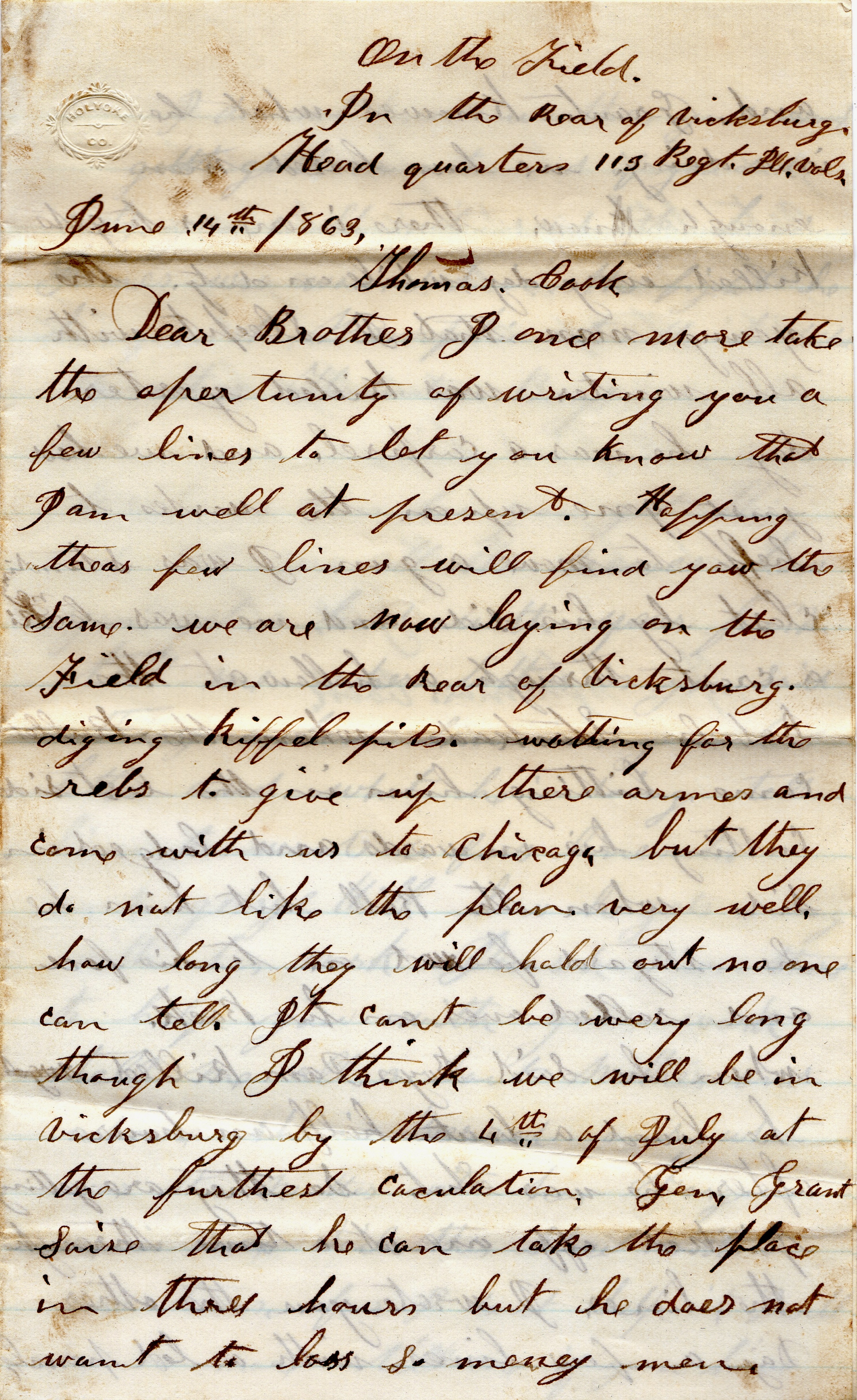
Dear brother, I once more take the opportunity of writing you a few lines to let you know that I am well at present. Hoping these few lines will find you the same.

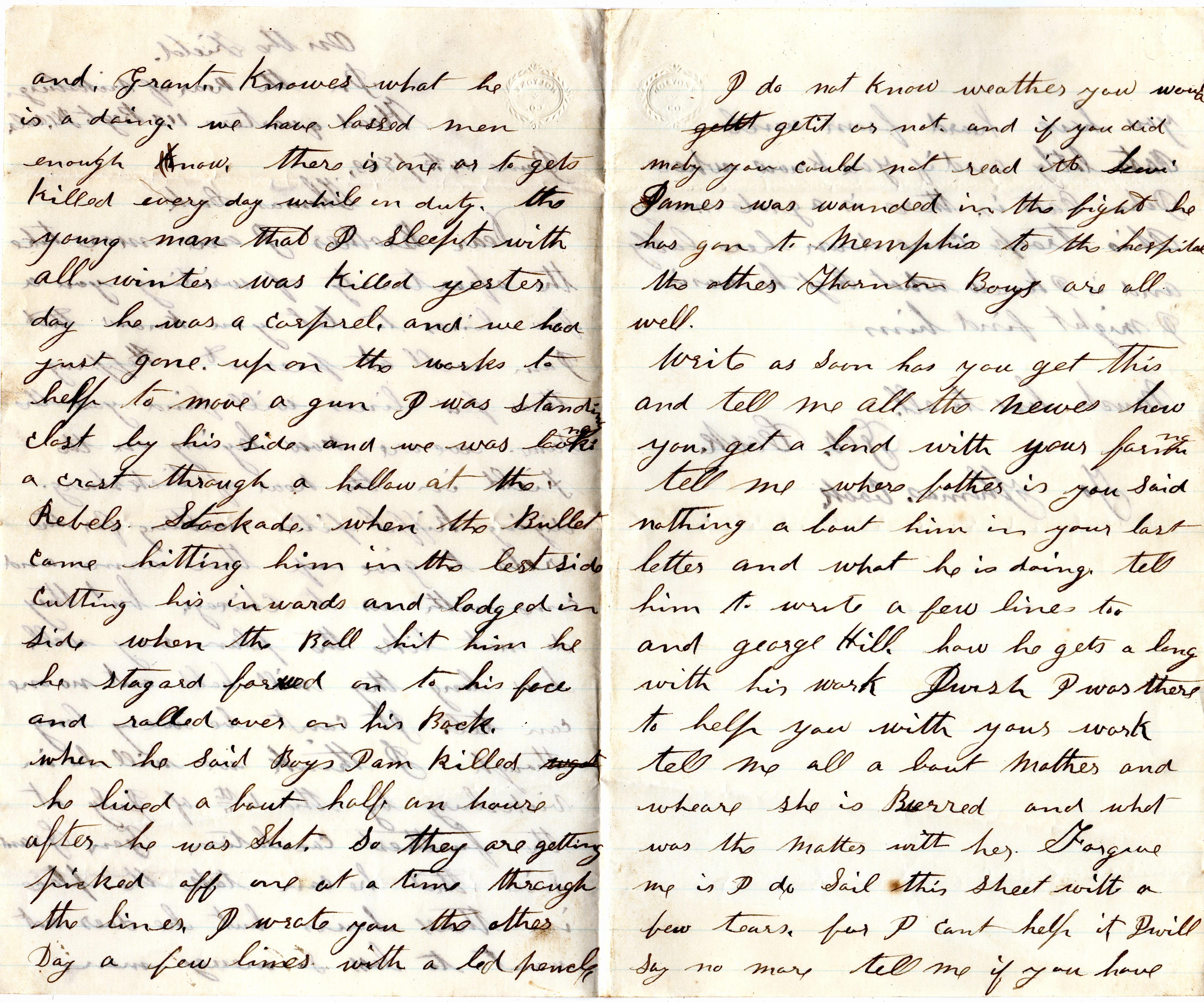
We are now laying on the field in the rear of Vicksburg digging rifle pits waiting for the rebs to give up their arms and come with us to Chicago. But they do not like the plan very well. How long they will hold out, no one can tell. It can’t be very long though. I think we will be in Vicksburg by the 4th of July at the furthest calculation. Gen. Grant says that he can take the place in three hours but he does not want to lose so many men and Grant knows what he is doing. We have lost men enough now. There is one or two gets killed every day while on duty.

The young man that I slept with all winter was killed yesterday. 1 He was a corporal and we had just gone upon the works to help to move a gun. I was standing close by his side and we was looking across through a hollow at the Rebel’s stockade when the bullet came, hitting him in the left side, cutting his inwards and lodged inside. When the ball hit him, he staggered forward onto his face and rolled over on his back. [That’s] when he said, “Boys, I am killed.” He lived about half an hour after he was shot. So they are getting picked off one at a time through the lines.

I wrote you the other day a few lines with a lead pencil. I do not know whether you would get it or not and if you did, maybe you could not read it. Levi James 2 was wounded in the fight. He has gone to Memphis to the hospital. The other Thornton boys are all well.

Write as soon as you get this and tell me all the news—how you get along with your farming. Tell me where Father is. You said nothing about him in your last letter and what he is doing, Tell him to write a few lines too. And George Hill—how he gets along with his work. I wish I was there to help you with your work. Tell me all about Mother and where she is buried and what was the matter with her. Forgive me if I do soil this sheet with a few tears for I can’t help it. I will say no more. Tell me if you have heard from Uncle Oats lately and if you know where John Oats is. There is a great many Ohio troops came down here lately and if I knew what regiment he was in, I might find him.

Much love to all. — George Cook

To Thomas Cook

1 Possibly William Ferrell of Chicago who served in Co. A with George. The roster states that he was killed on 14 June 1863 at Vicksburg, Mississippi.

2 Levi H. James (1844-1912) was the son of George B. James.

Letter 5

Corinth, Tennessee [Mississippi]
August 12, 1863

Thomas Cook.

Dear brother, I once more take the pleasure of writing you a few lines to let you know that I am well as this leaves me, hoping this letter will find you the same.

Our regiment has gone to Corinth to recruit up a little, There is out of our five companies, 164 sick in the hospital. I am in the hospital as nurse for the sick. There is two men in our company fit for duty. The rest are all sick. This is a good healthy place and a handsome country. Apples are 5 cents a dozen, and peaches all you want for nothing. Milk and butter scarce. Plenty of watermelons as large as you can lift.

We got our last pay before we left Vicksburg. Did you or Father ever get the money I allotted home? When you wrote, you never said anything about it and I never heard whether you got ot or not. When you write, let me know and how much you have received. Write and tell me how you get along with your harvesting. I suppose you have got all through with [it] long ago.

This is a great country for potatoes. They grow very large and they raise a great deal of corn in the South. Out at Jackson in Mississippi, I rode through one field of corn in one plantation [where] there was ten thousand acres in it—quite a small field.

There is some talk of making cavalry out of us and if we stay down here, I hope they will. But there is a good show for our coming up North before long.

How do you get along with the draft up North? I suppose the boys are getting a little scared again. I do not think they will draft much in Illinois. Every regiment in the field now is almost from Illinois. Write and tell me what kind of teams you have got. I suppose that Father has got through going with the horse and is at home now. If we come up North, why of course I will come home. I can get a furlough here and come home if we do not go North but it will cost a little too much for me.

This is all I have got to write this time. Write soon. Write all the news. Give my love to Father and keep a share for yourself. Tell Father to write a few lines in your next. Levi James has got his discharge. I think he will lose his arm. I saw him at Milliken’s Bend as we came up the river. Martin Pierson is in the hospital and so is all the Thornton boys.

— George Cook

Direct your letters as before to Memphis to follow the regiment. — George Cook


Letter 6

Corinth, Mississippi
September 16th [1863]

Thomas Cook,

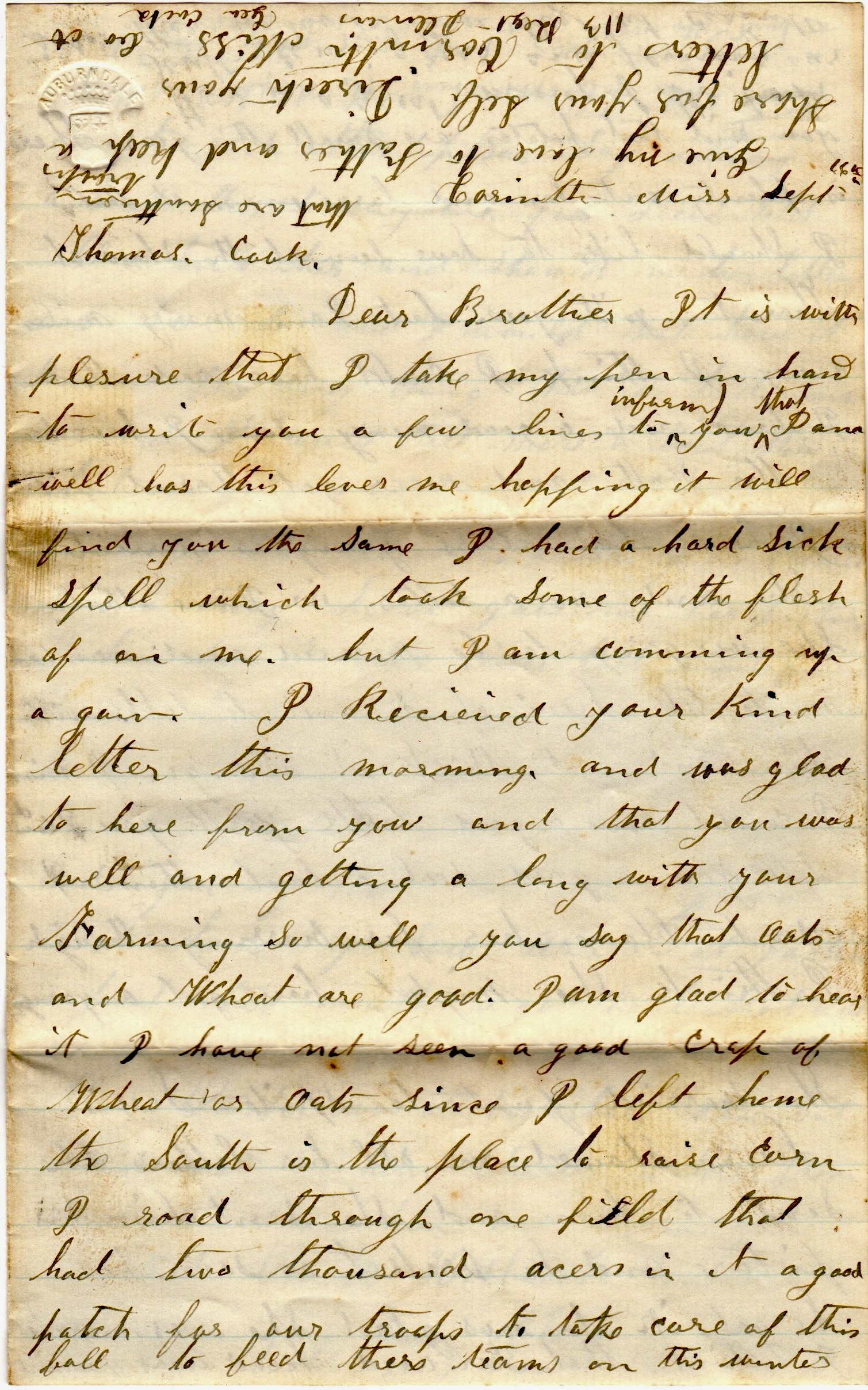
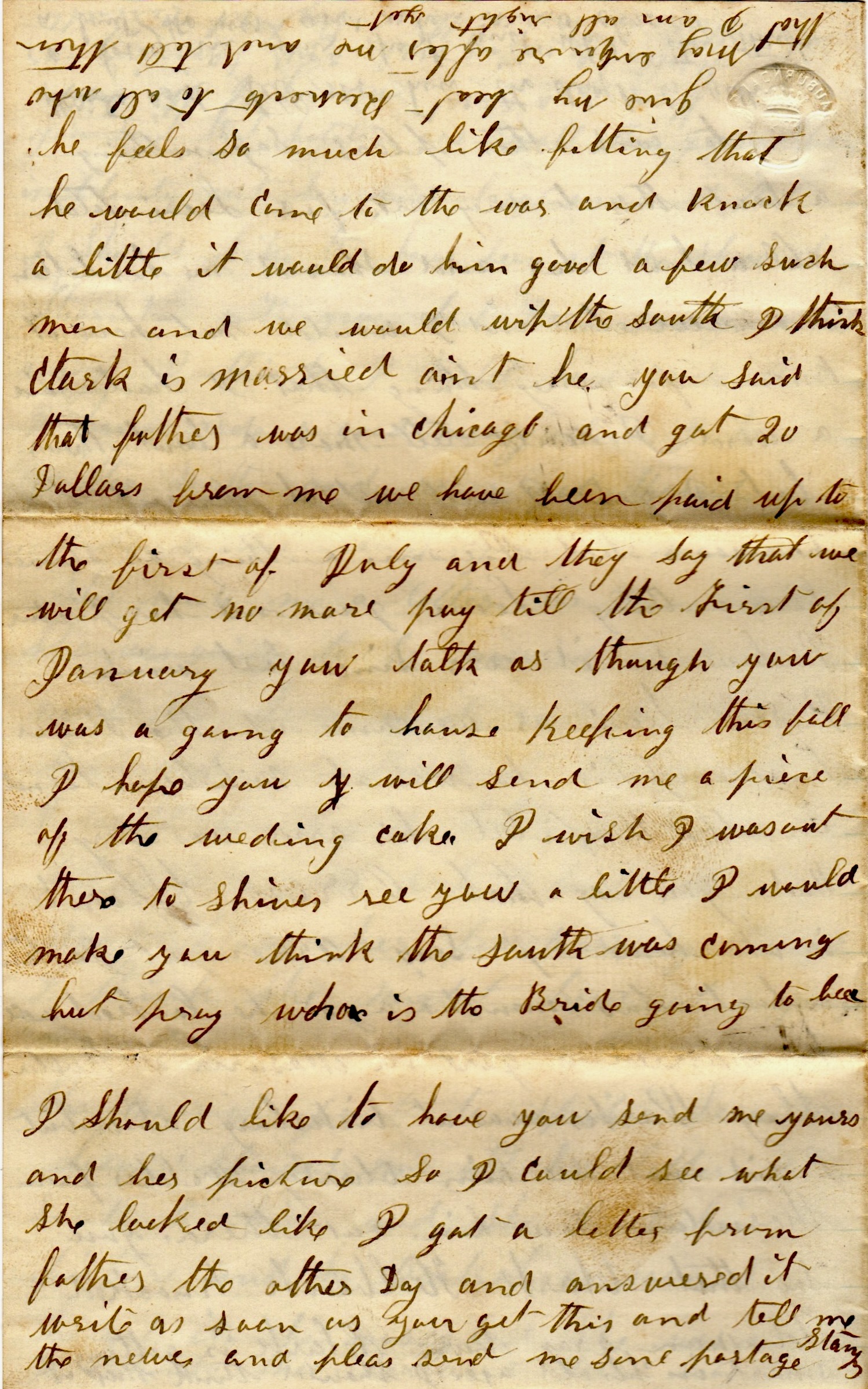
Dear brother, it is with pleasure that I take my pen in hand to write you a few lines to inform you that I am well as this leave me hoping it will find you the same. I had a hard sick spell which took some of the flesh off of me but I am coming up again. I received your kind letter this morning and was glad to hear from you and that you was well and getting along with your farming so well. You say that oats and wheat are good. I am glad to hear it. I have not seen a good crop of wheat or oats since I left home. The South is the place to raise corn. I rode through one field that had two thousand acres in it—a good patch for our troops to take care of this fall to feed their teams over this winter.

You said that potatoes are small this year. There is plenty out here and large ones at that. I should like to have been at the show at Thornton with you but I am many miles away. I think I could have rode the mule. I have rode a good many since I have ben in the South and never got throwed yet.

I heard that Miss Young is married. She wrote me a letter in June that she was going to be married and wanted me to tell Levi of it and to talk with him and not think it strange. I wish I could have a good talk with you. I could tell you a good deal about them. I don’t blame her for marriage though I think she might have got a young man. She married just to spite Levi. Levi showed me all her letters she sent to him and she sent him her picture and he broke it as soon as he got it. He was glad she was married. I think that her and Levi was promised to each other. Please say nothing about this to anyone for Levi told all about her and showed me her letters as a secret and would not have it known for anything that I had said a word. I could tell more about them but I guess I will not at present for he never told [Martin] Pierson a thing or showed him a thing. Levi gave me her picture. I have had it ever since last winter. I saw Levi as we came up the river to Memphis. He was at Milliken’s Bend in the hospital. His arm was very bad.

You say that Orrin Alfred is at home. I saw Orrin at Jackson about two months ago. He looked well. He married a girl in Missouri at Rolla. Alvey Parks was at Vicksburg also but I did not see him. Charley Wilder from Thornton saw him out there. You say that Clark Holbrook knocked old man Gray down. Clark is getting smart in his old age. I should think that if he feels so much like fighting, that he would come to the war and knock a little. It would do him good. A few such men and we would whip the South. I think Clark is married, ain’t he? You said that Father was in Chicago and got 20 dollars from me. We have ben paid up to the 1st of July and they say that we will get no more pay till the 1st of January. You talk as thougfh you was a going to housekeeping this fall. I hope you will send me a piece of the wedding cake. I wish I was out there to shivaree you a little. I would make you think the South was coming. But pray, where is the bride going to be?

I should like to have you send me yours and her picture so I can see what she looked like/ I got a letter from Father the other day and answered it Write as soon as you get this and tell me the news and please send me some postage stamps. Give my best respects to all who may enquire after me and tell them that I am all right yet. Write and tell me how the draft is getting along in your part and what they think about the war and when it will close. There is a great many of the South coming over and joining our side. There is two or three regiments at Corinth.

Give my love to Father and keep a share for yourself. Direct your letters to Corinth, Mississippi. Co. A, 113th Regt. Illinois. — George Cook

Letter 7

Corinth, Mississippi
October 4, 1863

Thomas Cook,

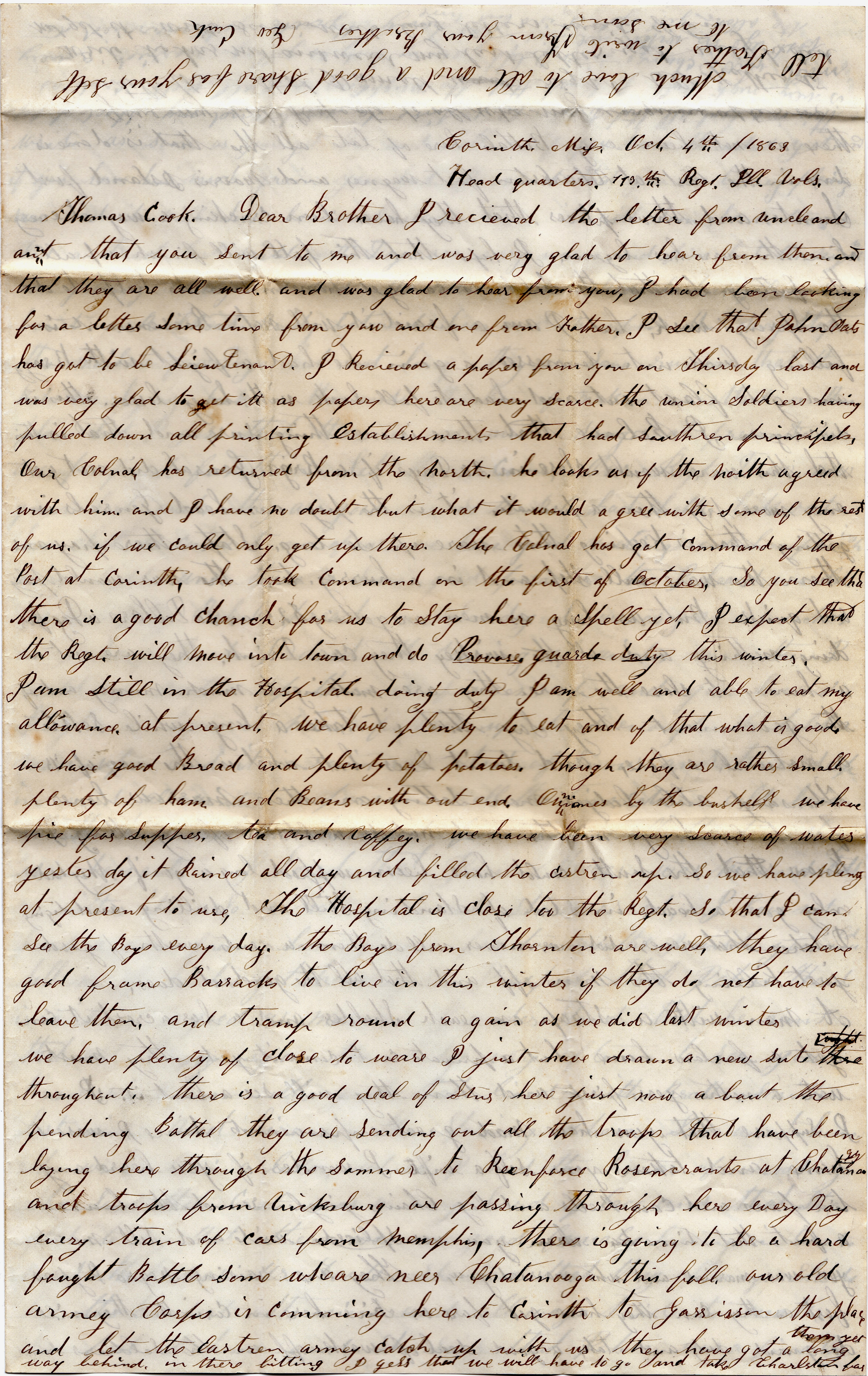
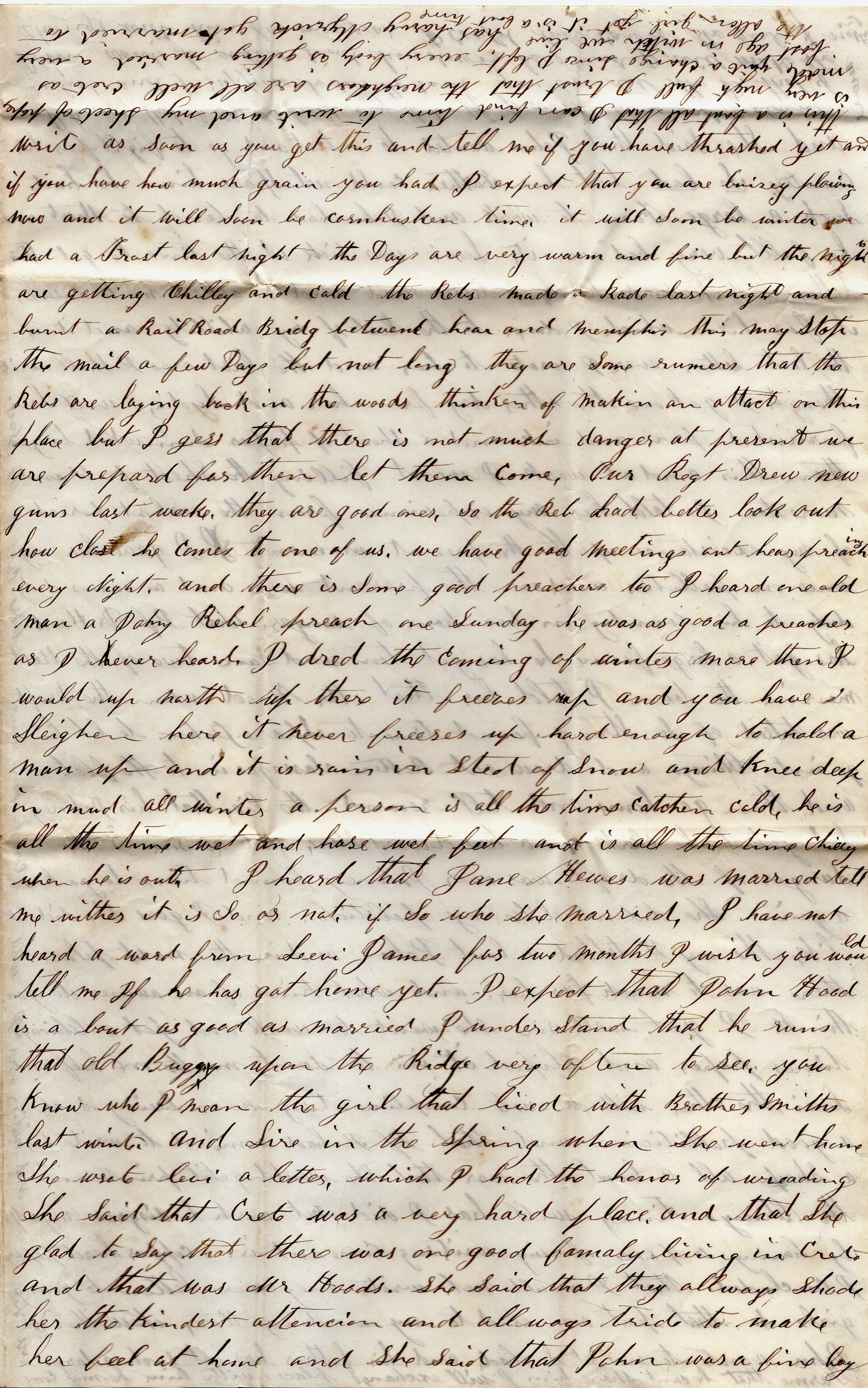
Dear brother, I received the letter from Uncle and Aunt that you sent to me and was very glad to hear from them and that they were all well and was glad to hear from you. I had been looking for a letter some time from you and one from Father. I see that John Oats has got to be Lieutenant. I received a paper from you on Thursday last and was very glad to get it as papers here are very scarce, the Union soldiers having pulled down all printing establishments that had Southern principles. Our Colonel has returned from the North. He looks as if the North agreed with him and I have no doubt but what it would agree with some of the rest of us if we could only get up there. The Colonel has got command of the post at Corinth. He took command on the first of October. So you see that there is a good chance for us to stay here a spell yet. I expect that the regiment will move into town and do Provist Guard duty this winter.

I am still in the hospital doing duty [as nurse]. I am well and able to eat my allowance at present. We have plenty to eat and of that, what is good we have good bread and plenty of potatoes though they are rather small, plenty of ham and beans without end. Onions by the bushel. We have pie for supper, tea and coffee. We have been very scarce of water. Yesterday it rained all day and filled the cistern up so we have plenty at present to use. The hospital is close to the regiment so that I can see the boys every day. The boys from Thornton are well. They have good frame barracks to live in this winter if they do not have to leave them and tramp round again as we did last winter. We have plenty of clothes to wear. I just have drawn a new suit throughout. There is a good deal of stir here just now about the pending battle. They are sending out all the troops that have been lying here through the summer to reinforce Rosecrans at Chattanooga and troops from Vicksburg are passing through here every day [and on] every train of cars from Memphis. There is going to be a hard fought battle somewhere near Chattanooga this fall.

Our old Army Corps is coming here to Corinth to garrison the place and let the Eastern army catch up with us. They have got a long way behind in their fighting. I guess that we will have to and take Charleston for there has not been any battles here of late. All that is done in the East at Charleston, Fort Wagner, and Morris Island, Fort Sumter, and those places that they have been cracking away at ever since the war has begun. I hope that this fall will finish up all the fighting so that the soldiers can get home in time to help to do the spring work. But I am afraid it will not.

Rosecrans is falling back into Tennessee again. He had a fight with Bragg [at Chickamauga] and got flaxed out and had to fall back with heavy losses. This is discouraging. I believe that there is one thing sure. and that is this—that this war would close in 30 days if a Brigadier General did not get anymore pay than a private. It is the pay our head generals is getting that is keeping this war up so long. Stop their pay and then the war will stop—and in a hurry too. THe war would play out quick. But as long as men are getting $25 or 30 dollars a day for doing nothing and all the whiskey they can drink, they are not in any hurry to close the war. They are making too much money out of the government. They say that it takes a long while to settle a national affair, and so it does. But what is the use of 75,000 able bodied men sitting on their marrow bones for twelve large months and not do a stroke of anything? I know that the South could have been whipped long ago if they had only gone ahead instead of standing still and drilling and digging ditches that never did nor never will do them a cent’s worth of good—just killing the men off and that all the good it does.

A man with a strap on each shoulder and a bar across it can get a furlough home but a private can’t come it. Yet they must wait another year first and then they will see about it. I suppose that you have made a great improvement since I was at home and taken yourself a wife. I wonder if you heard any tin pans and cow bells and leg chains jingle round the house about that time when you was spliced [married]. Write and tell me when you was married and who married you.

They are raising negro regiments as fast as they can. They have got four or five here in Corinth. They will do guard duty and take a good deal of work off of the soldiers’ hands.

Write as soon as you get this and tell me if you have thrashed yet and if you have, how much grain you had. I expect that you are busy plowing now and it will soon be cornhusking time. It wil soon be winter. We had a frost last night. They days are very warm and fine but the nights are getting chilly and cold. The Rebs made a raid last night and burnt a railroad bridge between here and Memphis. This may stop the mail a few days but not long. There are some rumors that the Rebs are laying back in the woods thinking of making an attack on this place but I guess that there is not much danger at present. We are prepared for them. Let them come.

Our regiment drew new guns last week. They are good ones so the Reb had better look out how close he comes to one of us. We had good meetings out here—preaching every night, and there is some good preachers too. I heard one old man—a Johnny Rebel—preach one Sunday. He was as good a preacher as I ever heard. I dread the coming of winter more than I think I would up North. Up there it freezes up and you have sleighing. Here it never freezes up hard enough to hold a man up and it is rain instead of snow and knee deep in mud all winter. A person is all the time wet and has wet feet and is all the time chilly when he is out.

I heard that Jane Hughs was married. Tell me whether it is so or not. If so, who she married. I have not heard a word from Levi James for two months. I wish you would tell me if he has got home yet. I expect that John Hood is about as good as married. I understand that he runs that old buggy upon the ridge very often to see you know who—I mean the girl that lived with brother Smith’s last winter and in the spring when she went home. She wrote Levi a letter which I had the honor of reading. She said that Crete was a very hard place and that she was glad to say that there was one good family living in Crete and that was Dr. [Samuel] Hood’s. She said that they always showed her the kindest attention and always tried to make her feel at home and she said that John was a fine man and that John wanted to enlist and go to fight for his country so bad but his Father could not spare him. He had such a large farm to work and John had to tend to that and he felt very bad over it.

Levi was sick at the time he got this letter and it made him a little made and he asked me to answer it for him which I done to the best of my ability. And it is the last letter ever I wrote to her and the last one I shall write though I got one the other day from her and Lydia. Well Levi furnished pen and ink and a sheet of paper somewhat larger than this and at work I went filling the sheet full and more too. I told her my experience from the earliest period of my existence up to the present moment. I gave her my views on politics and on the present war and a man’s duty to his country in her hour of danger. What if Dr. Hood has got a large farm? He has got Tom and Sam, two of the best men in the town. I told her that Mr. Hood when the draft was talked of so strong, found time to spare John to let him go into Chicago and draw out rotten sausages into the flat and then go home and tell round the lie that his Johnny had got to be clerk in a hardware store and as soon as the danger of the draft was over, Johnny found time to go home again. She didn’t like the way I talked about my politics and I guess she didn’t like the way I talked about John. And in the next place, there was too much for her. And what kind of an answer do you think I got? Well, sir, she went to work and got a Chicago Times paper and clipped it in two, sent me the one half and Levi the other with a note complimenting me on being such a good politician and that if I had a mind to write her a sheet all about the war, that she would het it printed in the Chicago Times. Well, as I did not wish to disgrace myself by having a piece of my writing come out in a Copperhead paper, I concluded that I would not write any more letters to young girls so that put an end to my writing there. Now if John wants to enlist so bad and his father had got such a large farm that he can’t spare him, I will exchange places with him. He may com out here and soldier and I will come home and take care of the place. I know that I should feel very bad if I was at home and couldn’t enlist and I suppose he does the same. You can tell the Dr. that if John wants to enlist, send him down here and I will make the change with him for one year. I could take care of the girls if nothing more. 1

This is about all that I can find time to write and my sheet of paper is very nigh full. I trust that the neighbors are all well. Crete has made quite a change since I left. Everybody is getting married very fast. Has Harvey Myrick got married to the Allen gurl yet? It is about time.

Give my best respects to all you may enquirer after me. Tell them that I am all right. Tell Father to write. He has not answered my last letter yet. Maybe he did not get it. Write soon. Wrote long letters. Write often. Much love to all and a good share for yourself. Tell Father to write. From your brother, — George Cook

Write soon.

1 This long paragraph refers to Dr. Samuel Hood (1815-1908) and his son, John James Hood (1840-1926) of Crete, Will county, Illinois. Public records show that John Hood never served in the Civil War. Dr. Hood’s other sons were Thomas Hood (b. 1852) and Samuel Hood (b. 1853).

Letter 8

Chewalla, Tennessee
November 4, 1863

Dear Father,

I take my pen in hand to pen you a few rough lines in an awful hurry in answer to your welcome letter which came to hand on the 3rd. I was glad to hear from home and to hear that you are all well. I am well of course. So are all the Thornton boys.

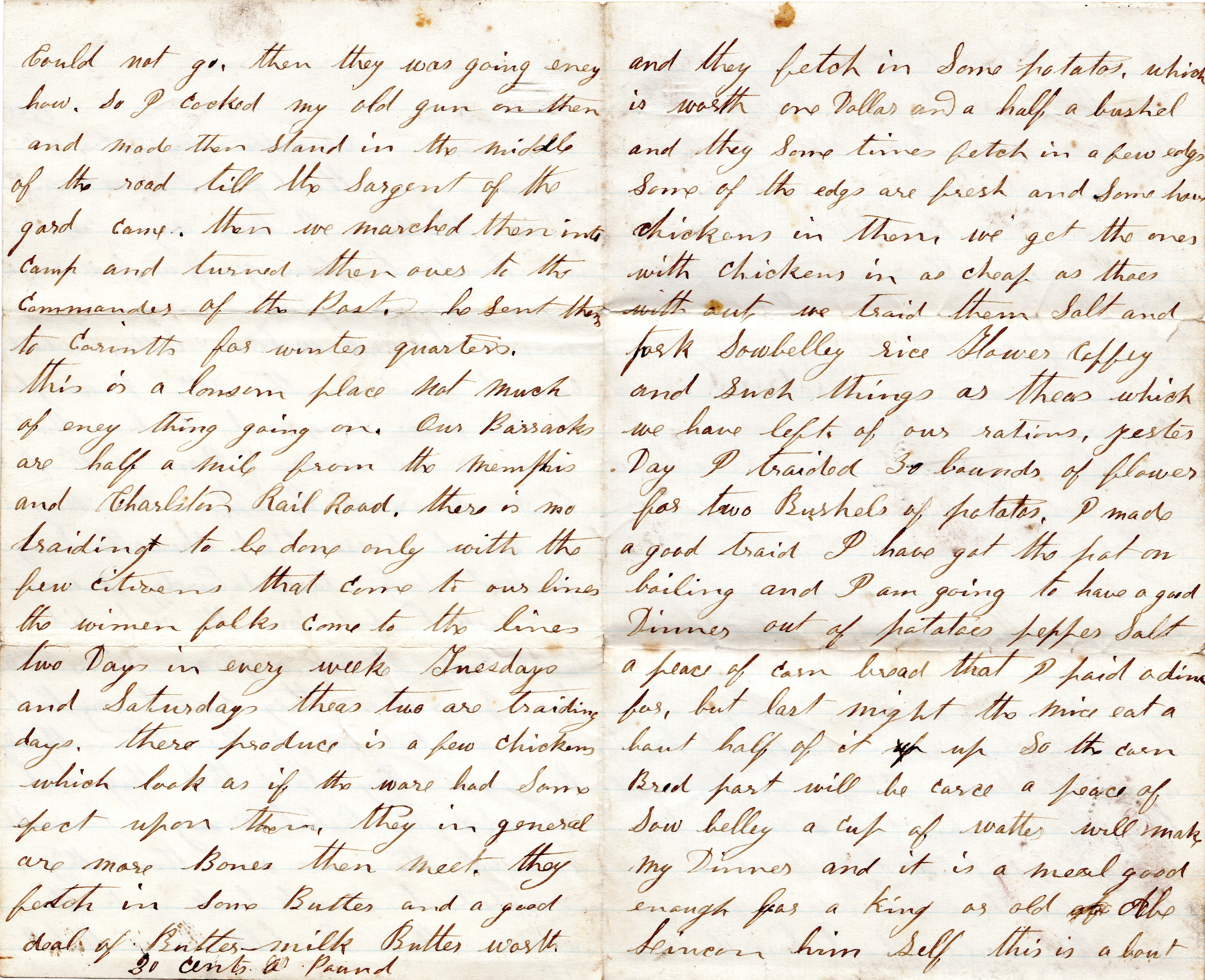
We are at present at Chewalla doing picket duty on the outside post, and I had a great time with two guerrillas. They came to my post and wanted me to pass them through the lines. They said that they had deserted the Rebel army. I would not let them in and then they wanted to sneak back into the woods. Then I told them that they could not go. Then they was going anyhow so I cocked my old gun on them and made them stand in the middle of the road till the Sergeant of the Guard came. Then we marched them into camp and turned them over to the commander of the post. He sent them to Corinth for winter quarters.

This is a lonesome place. Not much of anything going on. Our barracks are half a mile from the Memphis & Charleston Railroad. There is no trading to be done—only with the few citizens that come to our lines. The women folk come to the lines two days in every week—Tuesdays and Saturdays. These two are trading days. Their produce is a few chickens which look as if the war had some effect upon them. They in general are more bones than meat. They fetch in some butter and a good deal of butter milk worth 30 cents a pound. And they fetch in some potatoes which is worth one dollar and a half a bushel. And they sometimes fetch in a few eggs. Some of the eggs are fresh and some have chickens in them. We get the one with chickens in as cheap as those without. We trade them salt and pork sowbelly, rice, flour, coffee, and such things as these which we have left of our rations. Yesterday I traded 30 pounds of flour for two bushels of potatoes. I made a good trade. I have got the pot on boiling and I am going to have a good dinner out of potatoes, pepper, salt, [and] a piece of corn bread that I paid a dime for. But last night the mice eat about half of it up so the corn bread part will be scarce. A piece of sow belly, a cup of water, will make my dinner and it is a meal good enough for a king or old Abe Lincoln himself.

This is about all that I have to write unless it is something on the war. I think that the war must soon close or there will be a great suffering in the South amongst the poor folks. There is a great many already suffering. Very few raised anything this summer and the few that did raise any have had them most all destroyed so that they are dependent upon our lines for their support. They have hardly any clothes to wear. Most all go bare footed. They have poor houses to live in. All the good ones have been burnt to the ground in the beginning of the war and the folks had to move into the nigger shanties. Things in the South look rather scanty at present and Jeff Davis thinks so too, I guess. He is already hunting a mouse hole to crawl out of and I think he had better for there is hundreds of his own men that would shoot him if they had a good chance.

Letter 9

Memphis, Tennessee
May 20, 1864

Thomas Cook,

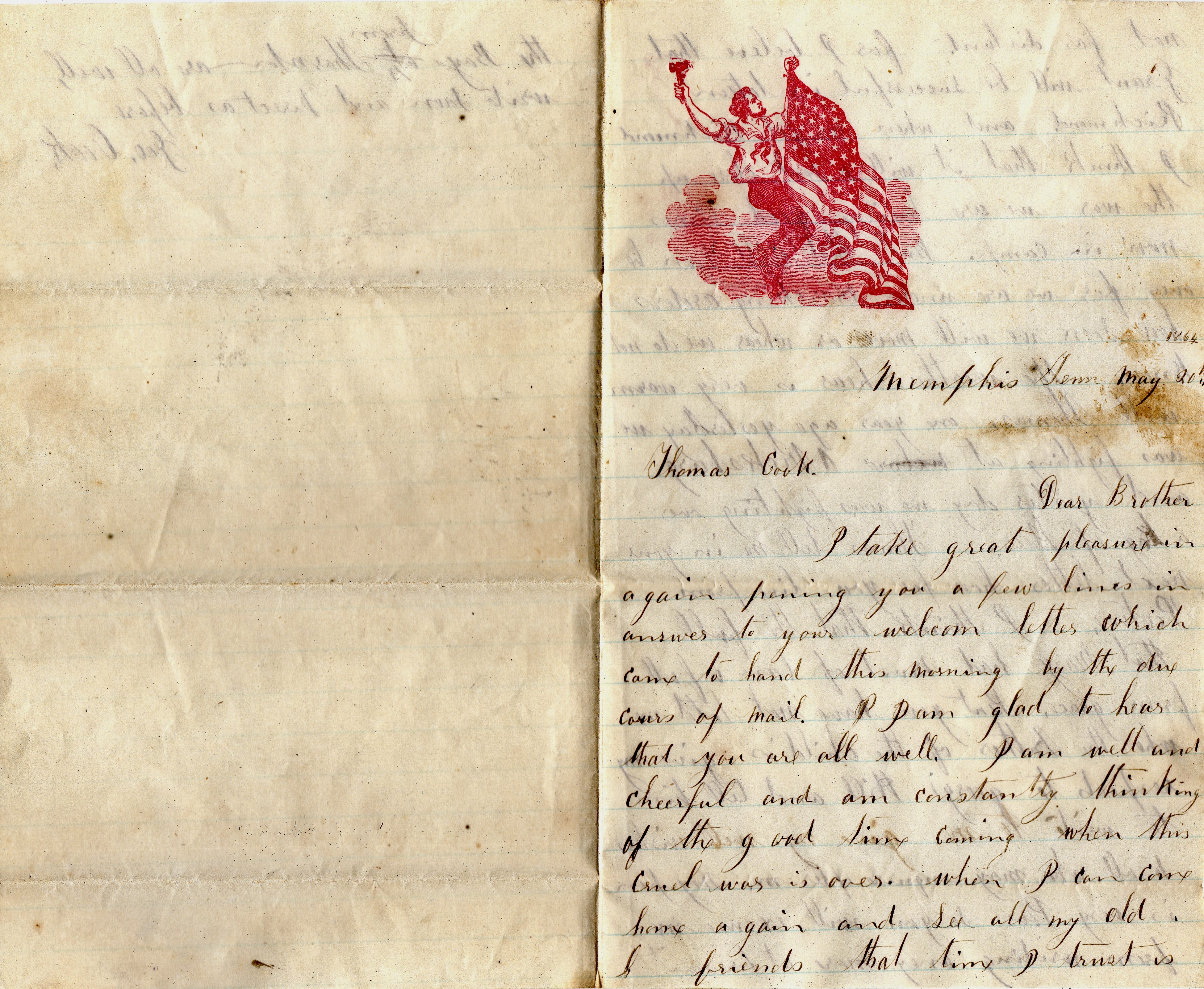
Dear brother, I take great pleasure in again penning you a few lines in answer to your welcome letter which came to hand this morning by the due course of mail. I am glad to hear that you are all well. I am well and cheerful and am constantly thinking of the good time coming when this cruel war is over when I can come home again and see all my old friends. That time, I trust, is not far distant for I believe that Grant will be successful in taking Richmond. And when we get Richmond, I think that it will about close up the war.

We are having good times now in camp. But that will soon be over for we are under marching orders. How soon we will move or where we do not know. The weather here is very warm.

Well Thomas, one year ago yesterday we was fighting at Vicksburg and yesterday we was fighting over a keg of beer. Thomas, tell me in your next letter how far you live from Peotone.

I think that the fall that Mary had must have of been a fall from grace. But you have not told me who the father of the child is. Give my respects to George Hill and tell him to write to me. Give my well wishes to all who may enquire after me. My pen is very poor so you will excuse me from writing anymore at present. The boys from Thornton are all well. Write soon and direct as before, — George Cook
1863: Joseph T. Miller to Friends

The following letter was written by Joseph T. Miller (1836-1863), the son of William B. Miller (1803-1864) and Synthia Johnson (1807-1884) of Jackson, Keokuk county, Iowa. Joseph was working as a carpenter and still enumerated in the household of his parents in Jackson, Iowa, when he enlisted at age 26 in August 1862 to serve three years in Co. F, 33rd Iowa Infantry. He was seriously wounded in the battle at Helena, Arkansas, on 4 July 1863, and was transported to a hospital in Memphis where he died on 8 August 1863.

Carte de visite photograph of the city of Helena in Phillips County under Federal occupation. (Arkansas Digital Archives)

Transcription

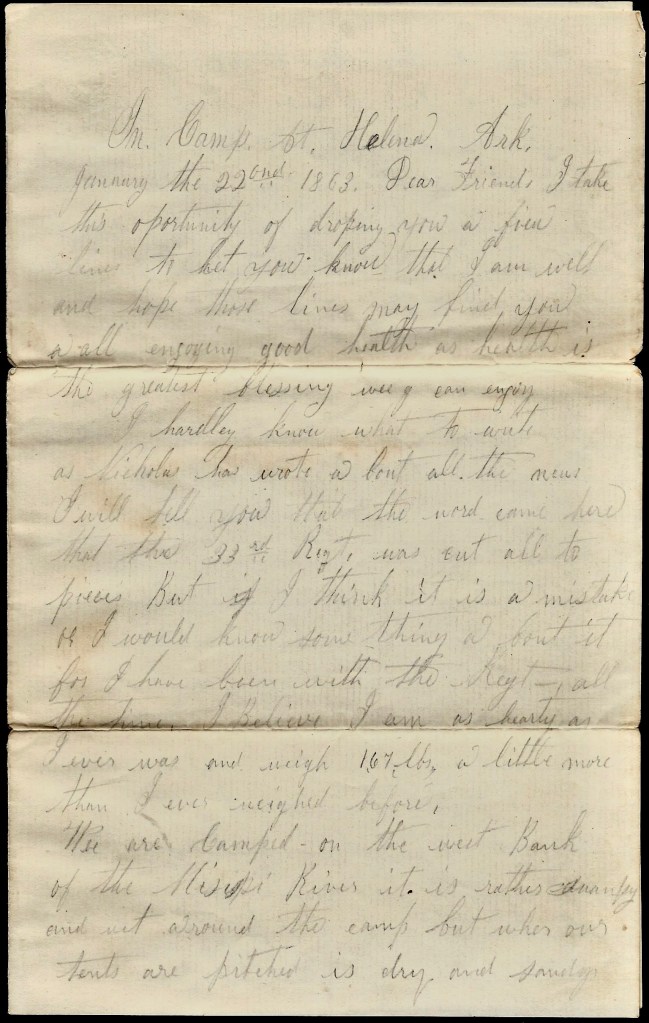
In Camp at Helena, Arkansas
January 22nd 1863

Dear Friends,

I take this opportunity of dropping you a few lines to let you know that I am well and hope those lines may find you all enjoying good health as health is the greatest blessing we can enjoy.

I hardly know what to write as Nicholas [Belveal] has wrote about all the news. I will tell you that the word came here that the 33rd [Iowa] Regiment was cut all to pieces but I think it is a mistake or I would know something about it for I have been with the regiment all the time. I believe I am as hearty as I ever was and weigh 167 lbs.—a little more than I ever weighed before.

We are camped on the west bank of the Mississippi river. It is rather swampy and wet around the camp but where our tents are pitched is dry and sandy. The river has raised 4 or 5 feet since we landed here. I do not know exactly how many troops are stationed here—something like 25 or 30 thousand—and the river is lined with boats loaded with troops now going North. I do not know to what point they are going. I can hear no news here but a little camp news and that don’t amount to much.

I must tell you that we have some pop guns here. They take about 6 lbs. of powder at a load.

Helena is rather a dull-looking place. I expected to see quite a city but was much disappointed. In coming down from Columbus, we laid at Memphis, Tennessee, one day and we got off a little bit and went up in the city and in the park. It was a nice place. I saw a monument there in memory of Andrew Jackson which paid me well for my trouble. Memphis is quite a city but I must come to a close.

The City Park in Memphis with bust statue of Andrew Jackson at center. (see Rebels Vandalism: Defacement of Andrew Jackson Monument by John. Banks).

Please excuse bad writing and bad spelling and write as soon as convenient and give me all the news that is going.

Direct to J. T. Miller, 33rd Regiment Iowa Vols., Co. F, in care of Capt. M. W. Forrest, Cairo, Illinois

Write soon. Yours in the one hope, — J. T. Miller

To Jackson, Dillard and family and Louis Belveal and family. Give my respects to all enquiring friends.

1862-64: Henry P. W. Cramer to Catherine Burkholder

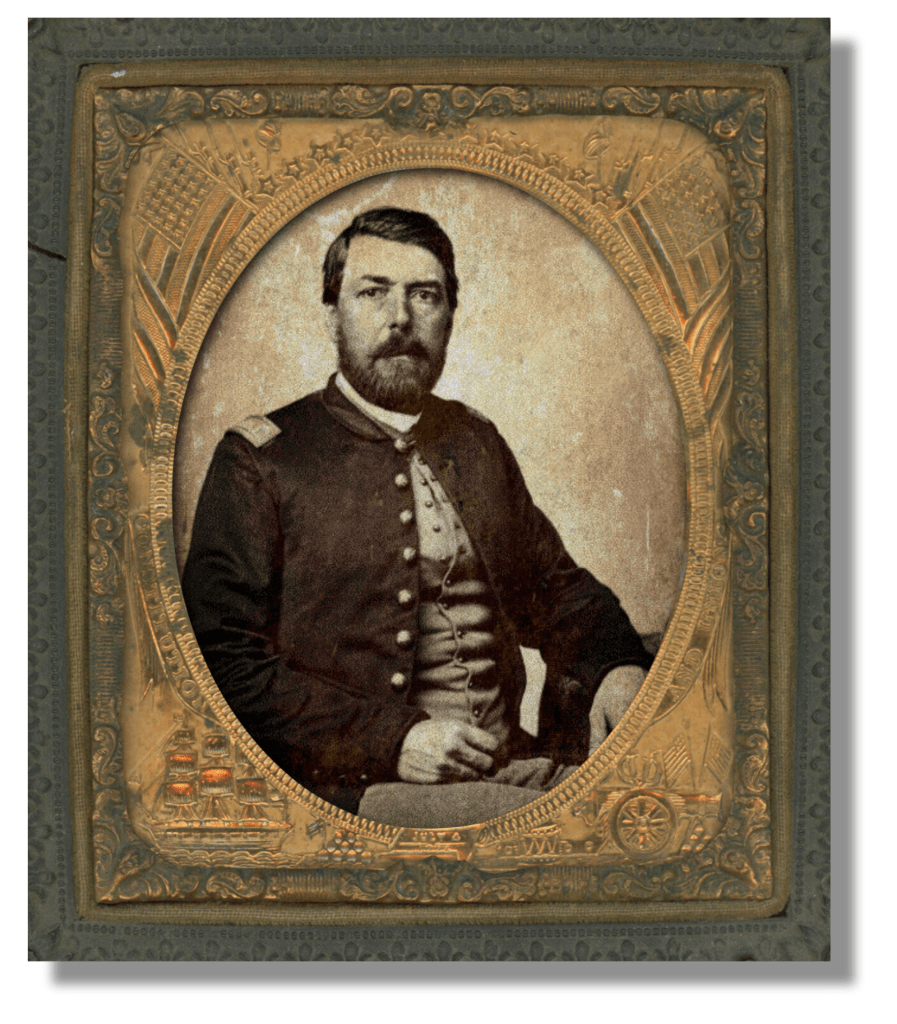
Capt. Henry P. W. Cramer, Co. A, 50th Illinois Infantry

These letters were written by Henry P. W. Cramer (1824-1899) of Mendon, Adams county, Illinois, who entered Co. A, 50th Illinois Infantry as the 1st Lieutenant on 12 September 1861 and was promoted to Captain on 5 February 1862 when Capt. Edgar Pickett resigned. Cramer remained as captain of the company until he resigned his commission on 15 September 1864 after three years service.

Henry was the son of Christian Cramer (1779-1852) and Mary E. Pitts (1791-1857). He was married to Jane Anne Dean (1825-1900) and the couple had three children born prior to Henry’s enlistment: William (b. 1849), Jessie (b. 1858), and Elmer (b. 1861).

All nine of these letters were addressed to and saved by Henry’s older sister, Catharine (Cramer) Burkholder (1822-1906), the widow of Daniel Burkholder (1815-1858). Catharine’s children included Christian Burkholder (1845-1864), Mary Elizabeth Burkholder (1846-1921), William Burkholder (1848-1922), James Wesley Burkholder (1850-1915), and Phoebe Ann Burkholder (1858-1937). Mentioned in the final letter of this collection is the death of Catharine’s oldest son, Christian, who enlisted on 31 March 1864 in Co. K, 116th Pennsylvania Infantry. He was wounded on 3 June 1864 at the Battle of Cold Harbor and died at the 1st Division, 2nd A. C. Field Hospital.

Henry’s older brother Adam K. Cramer (1809-1868) is also mentioned throughout these letters. Adam lived in Fayette county, Pennsylvania, with his wife Catherine Zufall (1810-1889). They had at least seven children, three of whom gave their lives for their country. Adam G. Cramer (1837-1863), Enos R. Cramer (1839-1863) and Samuel Cramer (1843-1863) all served in Co. B of the 142nd Penn. Vols. and all three were killed or mortally wounded on 1 July 1863 at Gettysburg while fighting in the area south of Herbst’s Woods. Enos and Adam died on the field but Samuel had an arm and leg amputation before he died on 9 July. [See: Video]

Letter 1

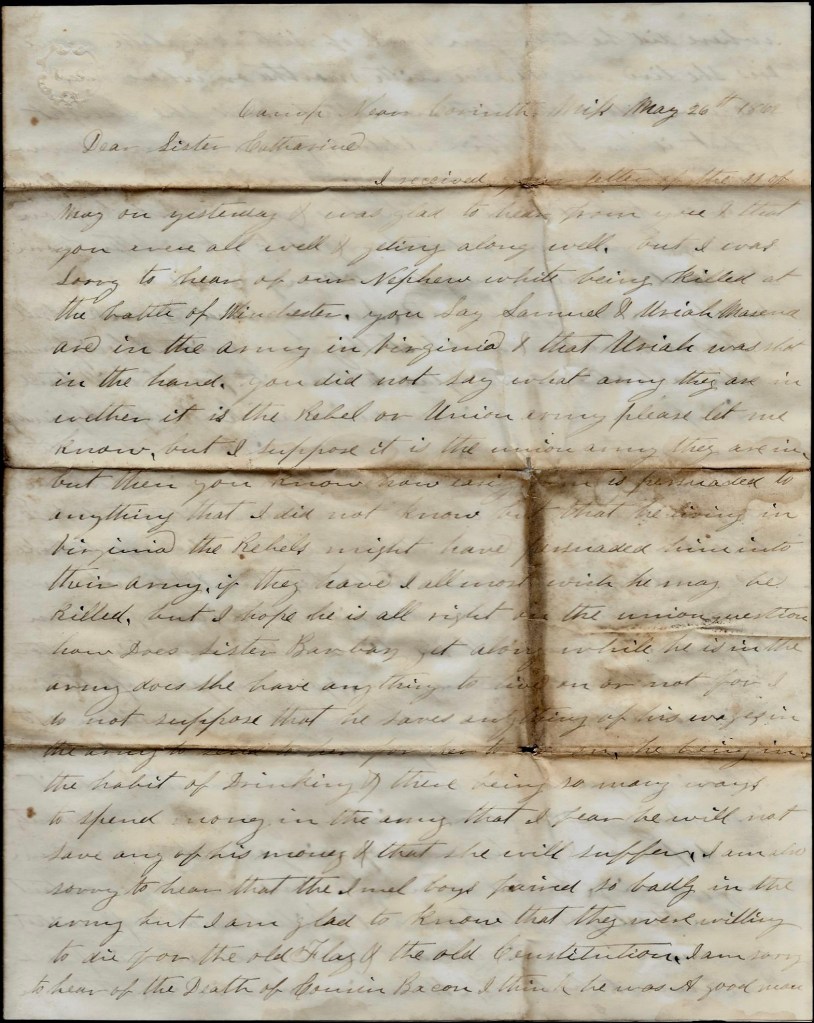
Camp near Corinth, Mississippi
May 26th 1862

Dear Sister Catharine,

I received your letter of the 11th of May yesterday & was glad to hear from you & that you were all well & getting along well, but I was sorry to hear of our nephew White being killed at the Battle of Winchester. You say Samuel & Uriah Massena are in the army in Virginia and that Uriah was shot in the hand. You did not say what army they are in—whether it is the Rebel or Union army. Please let me know, but I suppose it is the Union army they are in. But then you know how easily Sam is persuaded to anything that I did not know but that he living in Virginia, the rebels might have persuaded him into their army. If they have, I almost wish he may be killed, but I hope he is all right on the Union question. How does sister Barbara get along while he is in the army? Does she have anything to live on or not For I do not suppose that he saves anything of his wages in the army to send home for her to live on, he being in the habit of drinking & there being so many ways to spend money in the army that I fear he will not save any of his money & that she will suffer.

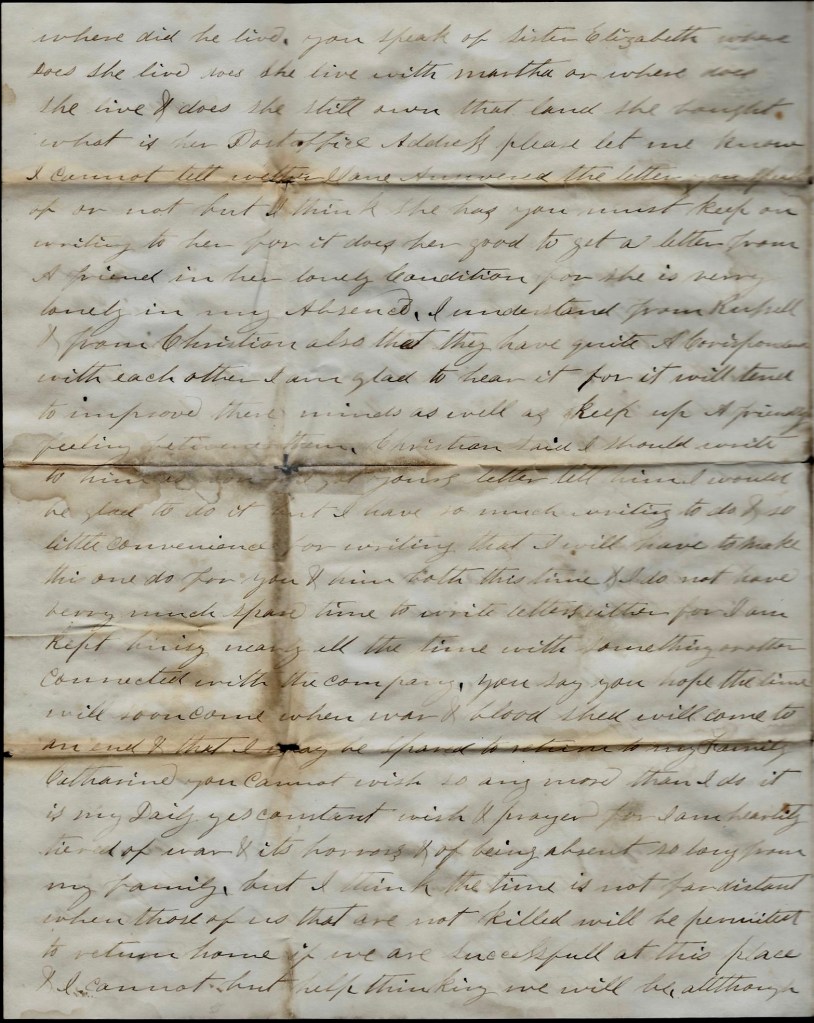
I am also sorry to hear that the Imel boys fared so badly in the army but I am glad to know that they were willing to die for the old flag & the old Constitution. I am sorry to hear of the death of cousin Bacon. I think he was a good man. Where did he live? You spoke of sister Elizabeth. Where does she live? Does she live with Martha or where does she live & does she still own that land she bought? What is her post office address? Please let me know. I cannot tell whether Jane have answered the letters you spoke of or not but I think she has. You must keep on writing to her for it does her good to get a letter from a friend in her lonely condition for she is very lonely in my absence.

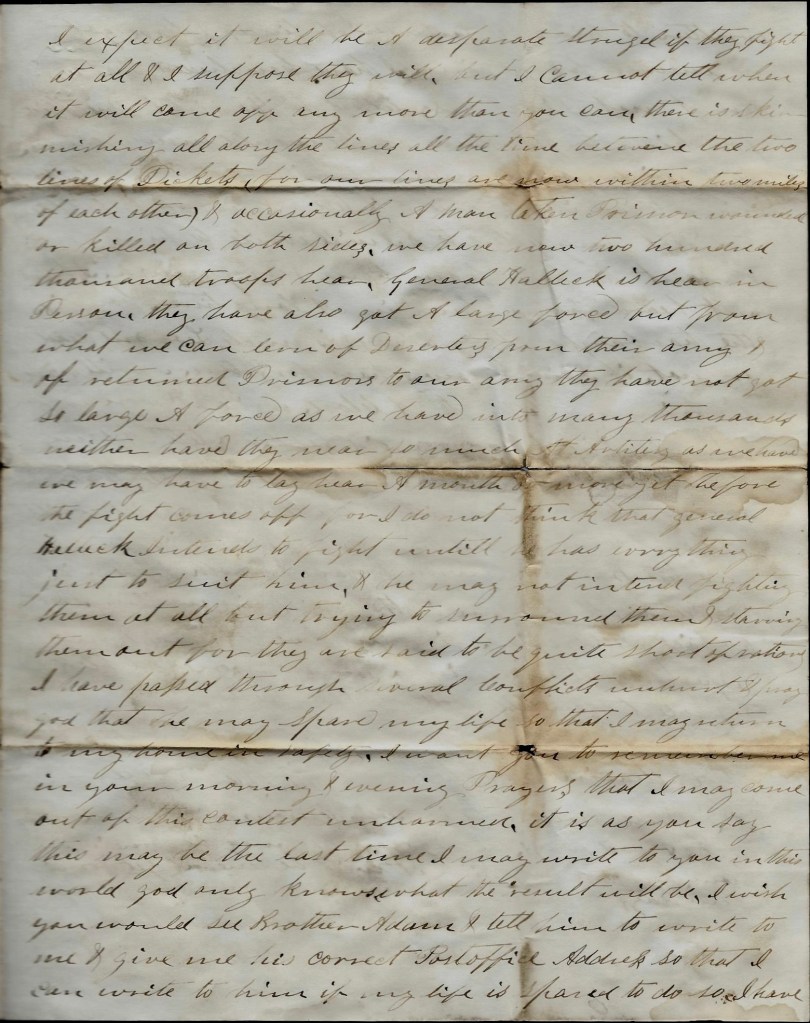
I understand from Russell and from Christian also that they have quite a correspondence with each other. I am glad to hear it for it will tend to improve their minds as well as keep up a friendly feeling between them. Christian said I should write to him as soon as I got your letter. Tell him I would be glad to do it but I have so much writing to do & so little convenience for writing that I will have to make this one do for you & him both this time & I do not have very much spare time to write letters either for I am kept busy nearly all the time with one thing or another connected with the company. You say you hope the time will soon come when war and bloodshed will come to an end & that I may be spared to return to my family. Catharine, you cannot wish so anymore than I do. It is my daily—yes, constant wish & prayer for I am heartily tired of war & its horrors & of being absent so long from my family. But I think the time is not far distant where those of us that are not killed will be permitted to return home if we are successful at this place & I cannot but help thinking we will be although I expect it will be a desperate struggle if they fight at all & I suppose they will. But I cannot tell when it will come off any more than you can.

There is skirmishing all along the lines all the time between the two lines of pickets for our lines are now within two miles of each other and occasionally a man taken prisoner, wounded or killed on both sides. We have now two hundred thousand troops here. Gen. Halleck is here in person. They have also got a large force but from what we can learn of deserters from their army & of returned prisoners to our army, they have not got so large a force as we have into many thousands. Neither have they near so much artillery as we have. We may have to lay here a month or move yet before the fight comes off for I do not think that General Halleck intends to fight until he has everything just to suit him & he may not intend fighting them at all but trying to surround them and starving them out for they are said to be quite short of rations.

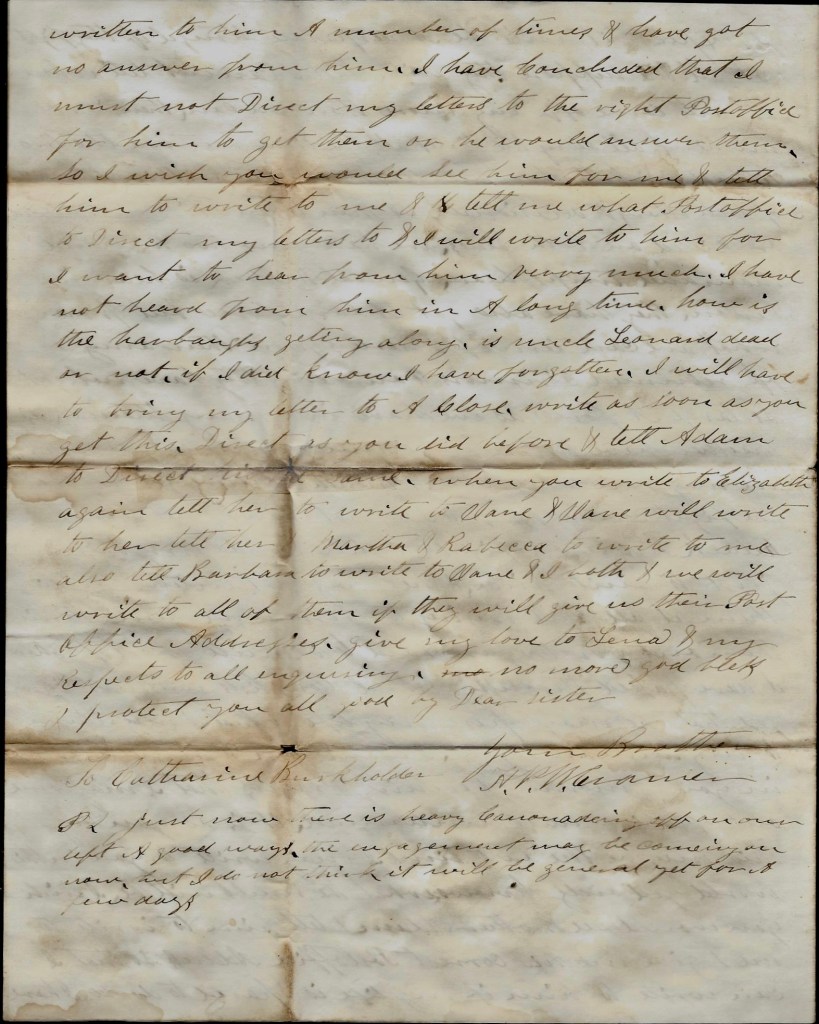
I have passed through several conflicts unhurt & pray God that He may spare my life so that I may return to my home in safety. I want you to remember me in your morning and evening prayers that I may come out of this contest unharmed. It is as you say, this may be the last time I may write to you in this world. God only knows what the result will be. I wish you would see brother Adam and tell him to write to me & give me his correct post office address so that I can write to him if my life is spared to do so. I have written to him a number of times & have got no answer from him. I have concluded that I must not direct my letters to the right post office for him to get them or he would answer them…

How is the Harbough’s getting along? Is Uncle Leonard dead or not? If I did know, I have forgotten. I will have to bring my letter to a close. Write as soon as you get this. Direct as you did before & tell Adam to direct in the same. When you write to Elizabeth again, tell her to write to Jane and Jane will write to her. Tell her and Martha and Rebecca to write to me. Also tell Barbara to write to Jane & I both & we will write to all of the, if they will give us their post office addresses. Give my love to Lena and my respects to all enquiring. No more. God bless & protect you all. Goodbye dear sister.

Your brother, — H. P. W. Cramer

To Catharine Burkholder

P. S. Just now there is heavy cannonading off on our left a good ways. The engagement may be coming on now. but I do not think it will be general yet for a few days.


Letter 2

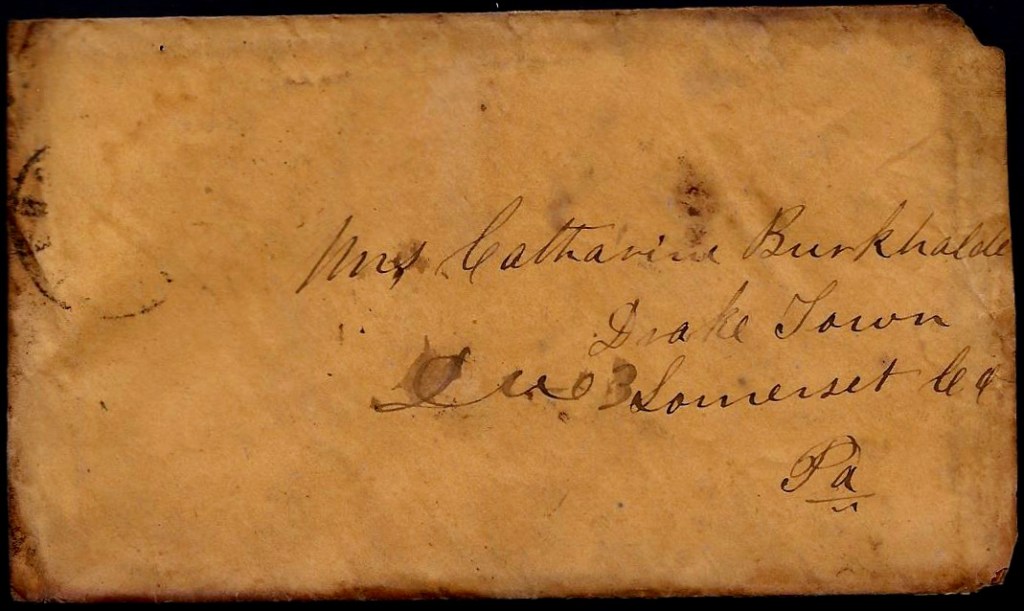
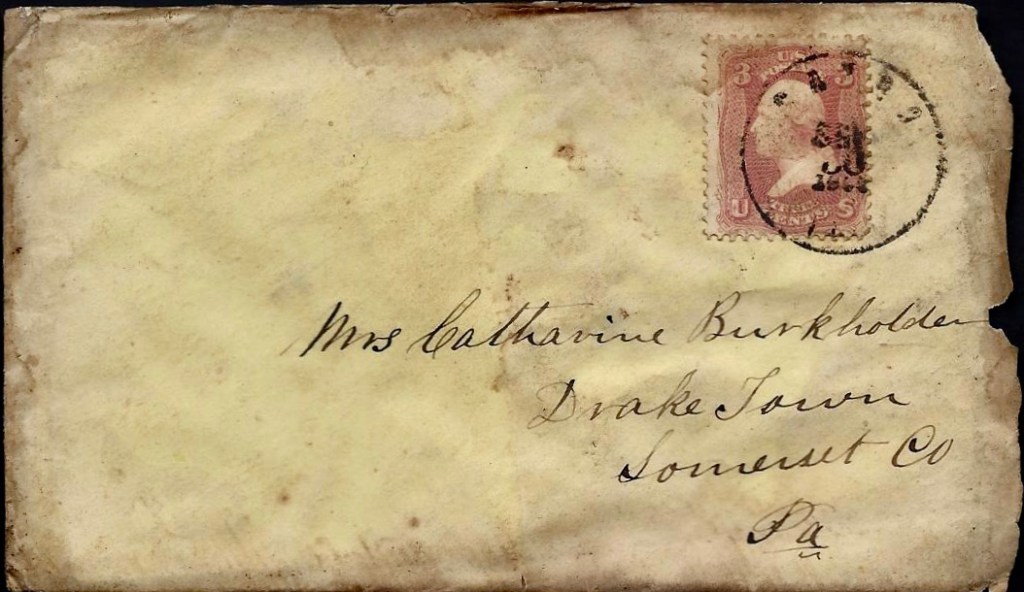
Addressed to Mrs. Catharine Burkholder, Drake Town, Somerset county, Pa.

Camp near Corinth, Mississippi
June 28, 1862

Dear Sister Catharine,

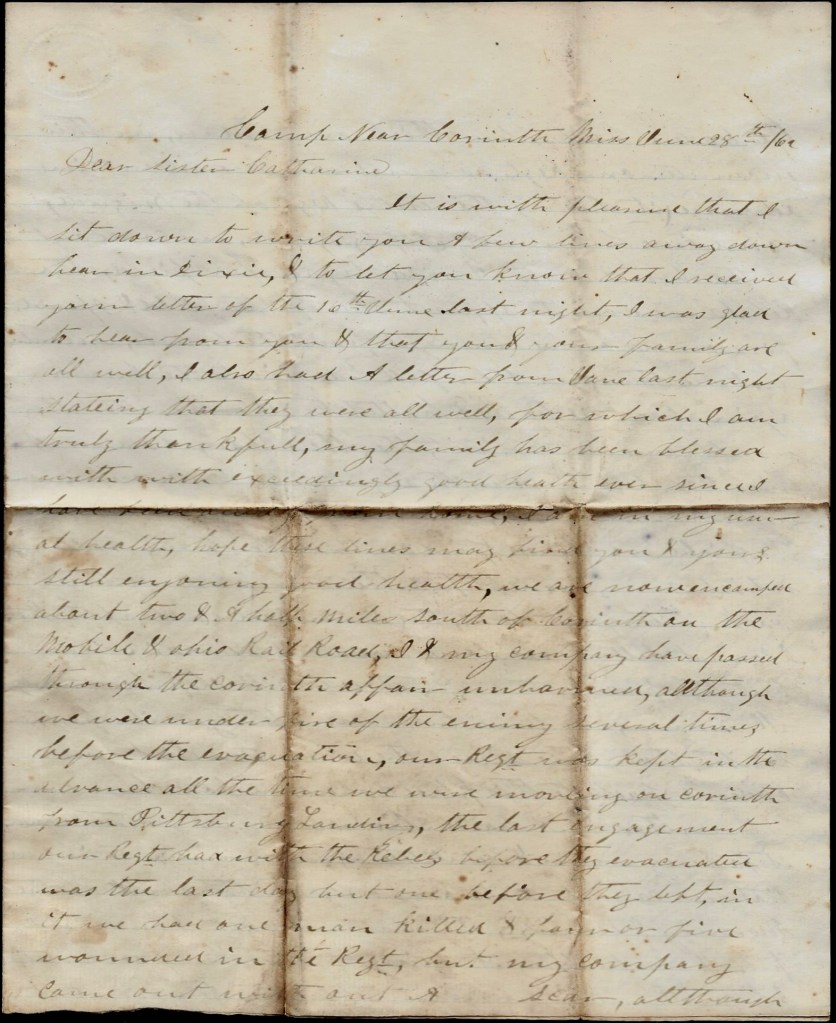
It is with pleasure that I sit down to write you a few lines away down here in Dixie & to let you know that I received your letter of the 16th June last night. I was glad to hear from you and that you and your family are all well. I also had a letter from Jane last night stating that they were all well for which I am truly thankful. My family has been blessed with exceedingly good health ever since I have been away from home. I am in my usual health. Hope these lines may find you and yours still enjoying good health.

We are now encamped about two and a half miles south of Corinth on the Mobile & Ohio Railroad. I and my company have passed through the Corinth affair unharmed although we were under fire of the enemy several times before the evacuation. Our regiment was kept in the advance all the time we were moving on Corinth from Pittsburg Landing. The last engagement our regiment had with the Rebels before they evacuated was the last day but one before they left. In it we had one man killed & four or five wounded in the regiment, but my company came out without a scar, although the leaden hail flew thick around us. In this encounter our regiment as usual was thrown out in advance (it being the centre regiment of the Brigade) some two hundred and fifty yards. We came out of the brush into a road by an open field. The Rebels were on the opposite side of the field & opened fire on us as we emerged from the brush. We could not see them. We then fell back into the brush again about 20 paces and halted to see whether they would come out or not. They then charged on us across this open field with about three times our number & with a yell. When they got fairly out into the field, we opened fire on them with our artillery which very soon stopped their noise & drove them back with great loss. They never came out after this.

I cannot tell how long we will remain here but the prospects are that we will stop here nearly all summer. We have been some thirty miles farther south than this since the evacuation but were ordered back to this place where we have been ever since. This is a hard climate on us northern men. It is very warm & debilitating—so much so indeed that we cannot drill any, only in the cool of the morning & evening. The water we get here is so poor & unhealthy, it being mostly surface water.

I hope Mc[Clellan] will succeed in flaxing them out at Richmond & that soon so that they will move us farther north, if not home. In my opinion, the result of the Richmond battle will be the decisive one in a great measure. This is a poor country down here. I would not give 20 acres of our Illinois land for a whole plantation of it & be obliged to live on it. In fact, it is hardly worth fighting about, niggers and all. But then that is not what we are fighting about. We are fighting for the Constitution as our father’s made it & for the Union & republican principles. I do not mean the principles of the Republican party, but principles of a republican form. The Rebels are contending for the principles of anarchy & despotism. God forbid that they should ever succeed in establishing them in this fair land of freedom. My prayer to God is that the Old Stars & Stripes under which we as a nation have been so prosperous may forever continue to wave all over the land of the free and the home of the brave.

Our regiment has become considerably reduced in numbers through disease and battle. When I went into the service, my company was full, 101 men all told. Now it is but seventy and will not be that long for I have quite a number of men that will have to be discharged in a short time on account of disability. The other companies have lost at about the same ratio & if we remain down here all summer, I fear we will lose still a great many more. I do not want you to understand that these men are all dead that have left the regiment. About half of them are.

I am sorry for Sam Massena 1 that he has had such bad luck, but he will not remain a prisoner long. He will either be exchanged or released on parole. Poor wretch. I pity him. Tell Uriah for me that he must not become discouraged fighting in so good a cause as ours is, but that he must keep up his spirits & fight the harder. A soldier’s life is a hard one, I very well know, but if the troops will only keep up their spirits & fight bravely, it will be over much sooner than if they allow themselves to become disheartened, for then they will not fight half so well. When you write to Uriah again, give him all the encouragement you can. Tell him to fight bravely if called upon to fight and avenge his father’s capture.

I will quit for the present. Write soon. Direct as usual. Remember me at a throne of grace. My regards to all enquiring, &c.

Your brother, — H. P. W. Cramer

To his sister Catharine Burkholder

P. S. What has become of the Aughinbough’s?

1 Samuel Massena (1820-1874) married Henry’s sister, Barbara Cramer, and lived in Aleppo, Greene county, Pennsylvania. He served in Co, A, 12th West Virginia Infantry (Union). Their son, Uriah Massena (1842-1908) served in Co. K, 26th Pennsylvania Infantry. Uriah’s biography claims he “loyally and bravely served his country for three years and three months.” See 1861-62: Uriah C. Messina to Catherine Burkholder published on Spared & Shared 16.


Letter 3

Camp near Corinth, Mississippi
August 19, 1862

Dear Sister Catharine,

I sit myself down to write you a few lines in order to let you know of my well being & that I received your letter the other day with great pleasure. I am glad to hear that you and family are all well, or were at least all well at the writing of your letter. I am sorry to hear that you have so much sickness in your neighborhood. You say you should have answered my letter sooner that you did but for the reason of your having so many sick patients to visit. Well it seems that both of my sisters have turned Doctoresses for you said in one of your other letters that sister Barbara had taken up the practice of medicine. Well I guess if I get sick, I will send for someone of you to come and doctor me—that is, if I can raise money enough to pay the bill for the bill must be pretty high at the rate that other doctors charge for visits when you take into account the distance that you would have to travel to attend me. But I hope I shall have no occasion to call on you. At present I am very well & tolerably comfortable in my situation for the situation of a soldier is changeable like that of other people—sometimes more comfortable than at other times.

We have had no trouble with the secesh since the evacuation of Corinth. Yesterday morning we were called into line before daylight to be ready to march at a moment’s notice, but the alarm that had been given proved to be a false one so we did not have to go this time.

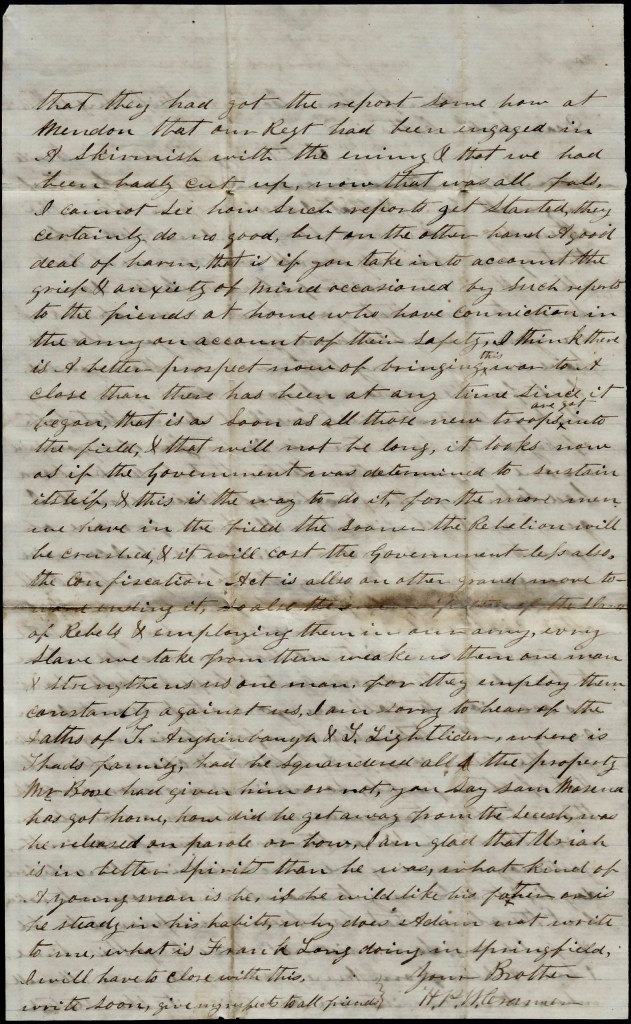
I had a letter from Jane yesterday. They were all well when it was written the 11th. In it they stated that they had got the report somehow at Mendon that our regiment had been engaged in a skirmish with the enemy & that we had been badly cut up. Now that was all false. I cannot see how such reports get started. They certainly do no good. But on the other hand a good deal of harm—that is, if you take into account the grief and anxiety of mind occasioned by such reports to the friends at home who have connections in the army on account of their safety. I think there is a better prospect now of bringing this war to a close than there has been at any time since it began—that is, soon as all those new troops are got into the field & that will not be long. It looks now as if the government was determined to sustain itself & this is the way to do it for the more men we have in the field, the sooner the rebellion will be crushed & it will cost the government less also. The Confiscation Act is also another grand move toward ending it; so also the emancipation of the slaves of Rebels & employing them in our army. Every slave we take from them weakens then one man and strengthens us one man for they employ them constantly against us.

I am sorry to hear of the deaths of T. Aughinbaugh & T. Lightlider. Where is Thad’s family? Had he squandered all the property Mr. Boose had given him or not? You say Sam Massena has got home. How did he get away from the secesh? Was he released on parole or how? I am glad that Uriah is in better spirits than he was. What kind of a young man is he? Is he wild like his father or is he steady in his habits? Why does Adam not write to me? What is Frank Long doing in Springfield? I will have to close with this.

Your brother, — H. P. W. Cramer

Write soon. Give my respects to all friends.


Letter 4

Addressed to Mrs. Catharine Burkholder, Drake Town, Somerset county, Pa.

Camp near Corinth, Mississippi
September 26th 1862

Dear Sister Catharine,

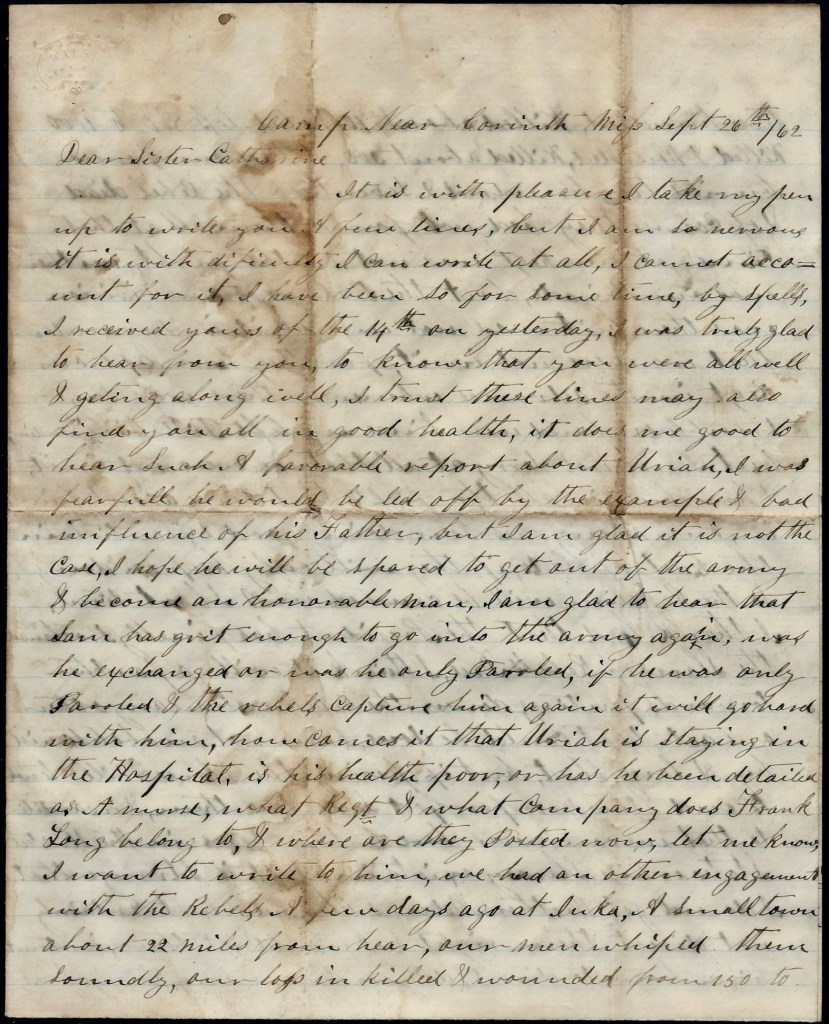
It is with pleasure I take my pen up to write you a few lines, but I am so nervous it is with difficulty I can write at all. I cannot account for it. I have been so for some time by spells. I received yours of the 14th on yesterday. I was truly glad to hear from you, to know that you were all well and getting along well. I trust these lines may also find you all in good health. It does me good to hear such a favorable report from Uriah. I was fearful he would be led off by the example & bad influence of his Father, but I am glad it is not the case. I hope he will be spared to get out of the army & become an honorable man. I am glad to hear that Sam has grit enough to go into the army again. Was he exchanged or was he only paroled. If he was only paroled & the rebels capture him again, it will go hard with him. How comes it that Uriah is staying in the hospital? Is his health poor, or has he been detailed as a nurse? What regiment and what company does Frank Long belong to and where are they posted now? Let me know. I want to write to him.

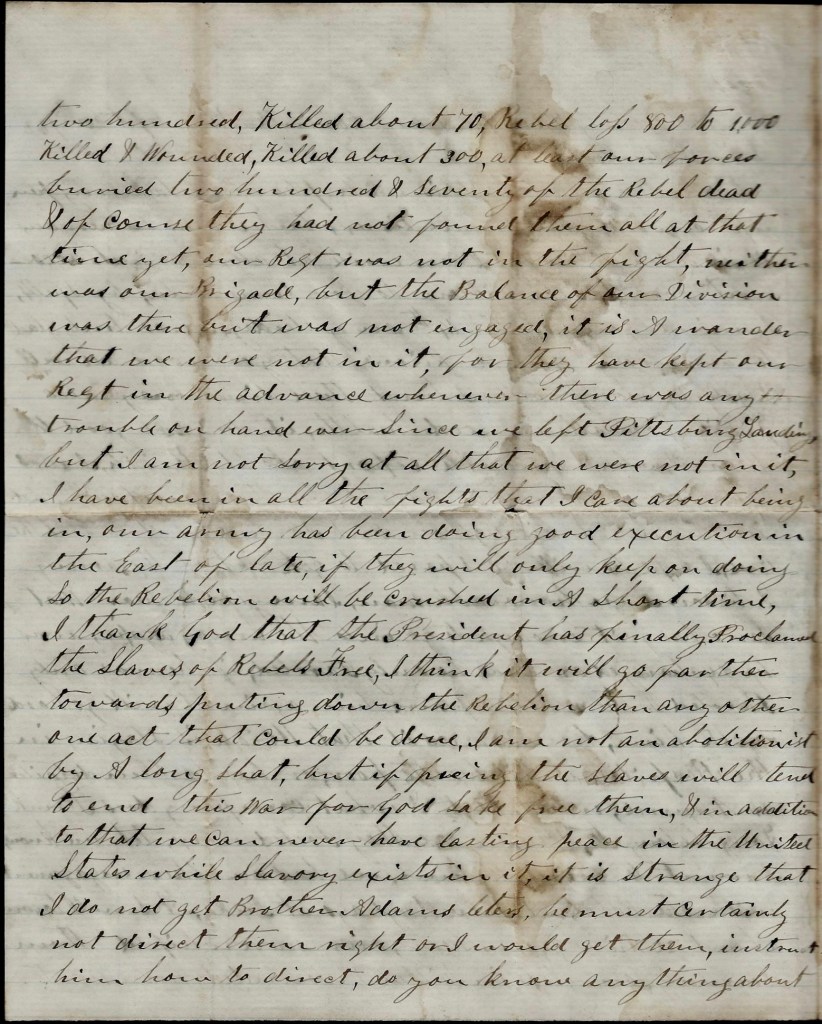
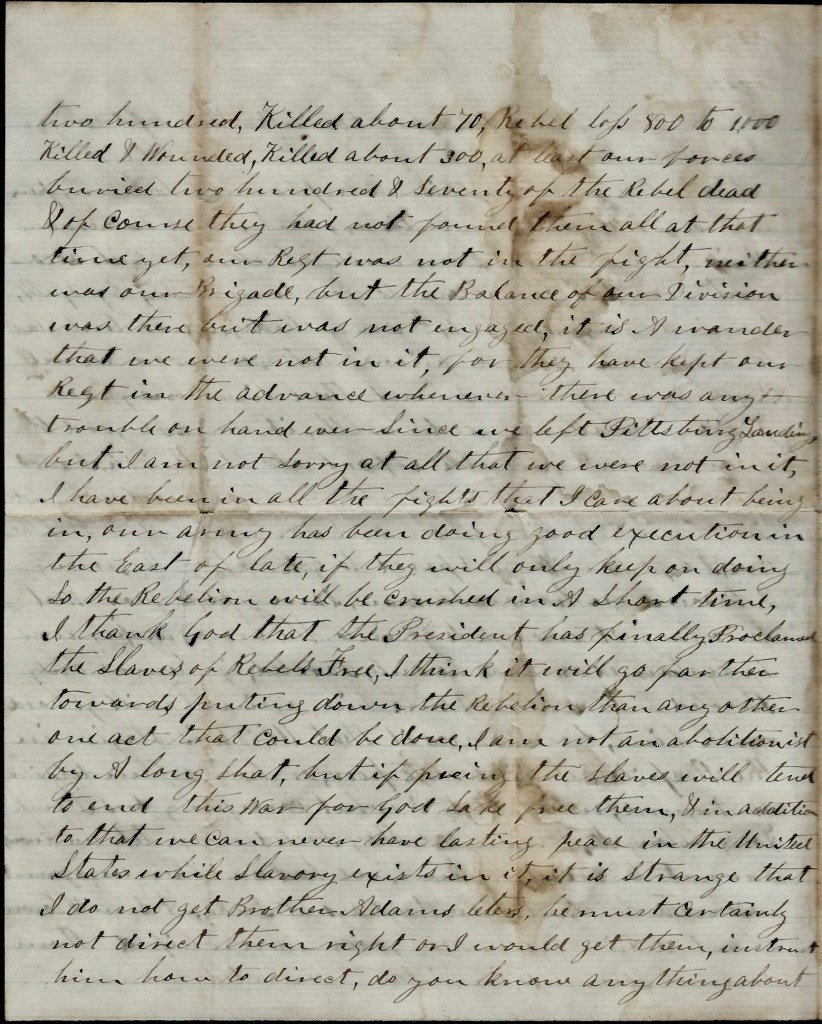
We had another engagement with the Rebels a few days ago at Iuka—a small town about 22 miles from here. Our men whipped them soundly. Our loss in killed and wounded from 150 to two hundred, killed about 70. Rebel loss 800 to 1,000 killed & wounded, killed about 300—at least our forces buried two hundred and seventy of the Rebel dead & of course they had not found them all at that time yet. Our regiment was not in the fight. Neither was our Brigade but the balance of our Division was there but was not engaged. It is a wonder that we were not in it for they have kept our regiment in the advance whenever there was any trouble on hand ever since we left Pittsburg Landing. But I am not sorry at all that we were not in it. I have been in all the fights that I care about being in.

“I am not an abolitionist by a long shot, but if freeing the slaves will tend to end this war, for God sake, free them, & in addition to that, we can never have lasting peace in the United States while slavery exists in it.”

—Capt. Henry Cramer, Co. A, 50th Illinois, 26 Sept. 1862

Our army has been doing some good execution in the East of late. If they will only keep on doing so, the Rebellion will be crushed in a short time. I thank God that the President has finally proclaimed the slaves of Rebels free. I think it will go farther towards putting down the rebellion than any other one act that could be done. I am not an abolitionist by a long shot, but if freeing the slaves will tend to end this war, for God sake, free them, & in addition to that, we can never have lasting peace in the United States while slavery exists in it.

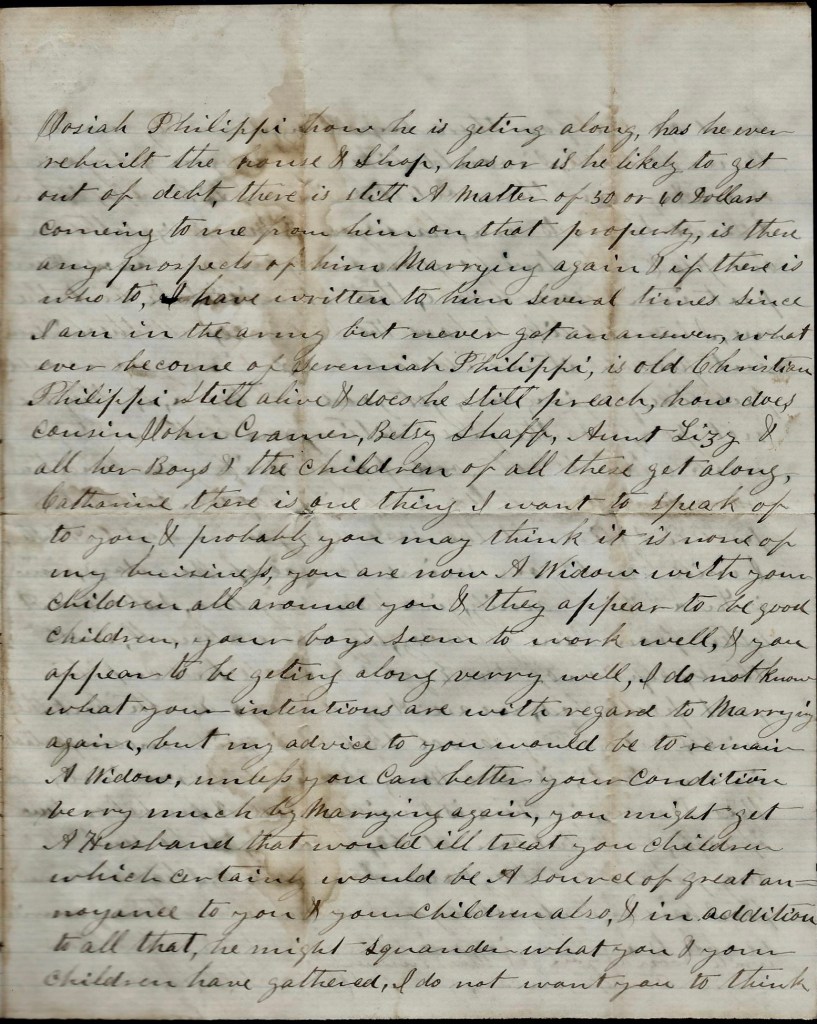
It is strange that I do not get brother Adam’s letters. He must certainly not direct them right or I would get them. Instruct him how to direct. Do you know anything about Josiah Philippi—how he is getting along? Has he ever rebuilt the house and shop, has or is likely to get out of debt? There is still a matter of 50 or 60 dollars coming to me from him on that property. Is there any prospects of him marrying again & if there is, who to? I have written to him several times since I am in the army but never got an answer. What ever became of Jeremiah Philippi? Is old Christian Philippi still alive and does he still preach? How does cousin John Cramer, Betty Shoff, Aunt Lizzy, & all her boys & the children of all these get along?

Catherine, there is one thing I want to speak of to you and probably you may think it is none of my business. You are now a widow with your children all around you & they appear to be good children. Your boys seem to work well & you appear to be getting along very well. I do not know what your intentions are with regard to marrying again, but my advice to you would be to remain a widow unless you can better your condition very much by marrying again. You might get a husband that would ill treat your children which certainly would be a source of great annoyance to you and your children also, & in addition to all that, he might squander what you & your children have gathered. I do not want you to think hard of me for these suggestions, I merely make them as such.

I would like to hope you get your own & your three oldest children’s likenesses taken & send them to me. Have yours and Mary Elizabeth’s on one plate and the two boys on one. You can have them put in a double case; then it will take but one. I would like o have the pictures of all the children but perhaps it would cost more than you would like paying out. Get good ones taken. If they are not perfect the first sitting, make them try until they do get good pictures. If you send them, have the case well done up in paper and sealed or pasted & directed the same as you would a letter. I will send you mine some of these days.

How is Lena and her family? Give them my love. I also had a letter from Jane yesterday. They were all well with the exception of sore eyes & Russell had cut his foot pretty bad.

We are a good ways south but the nights are getting so cool that it is quite uncomfortable in our tents. Is there many chestnuts and cranberries this season? If there is, I wish I had a bushel or two of each, but that cannot be. They might be sent to my folks but they cannot be to me. I had better quit for I have already asked you more questions that you will be able to answer in one letter. Write soon as you get this & answer my questions if you can. Goodbye &c.

Your brother, — H. P. W. Cramer


Letter 5

Camp near Corinth, Mississippi
November 3rd 1862

Dear Sister Catharine,

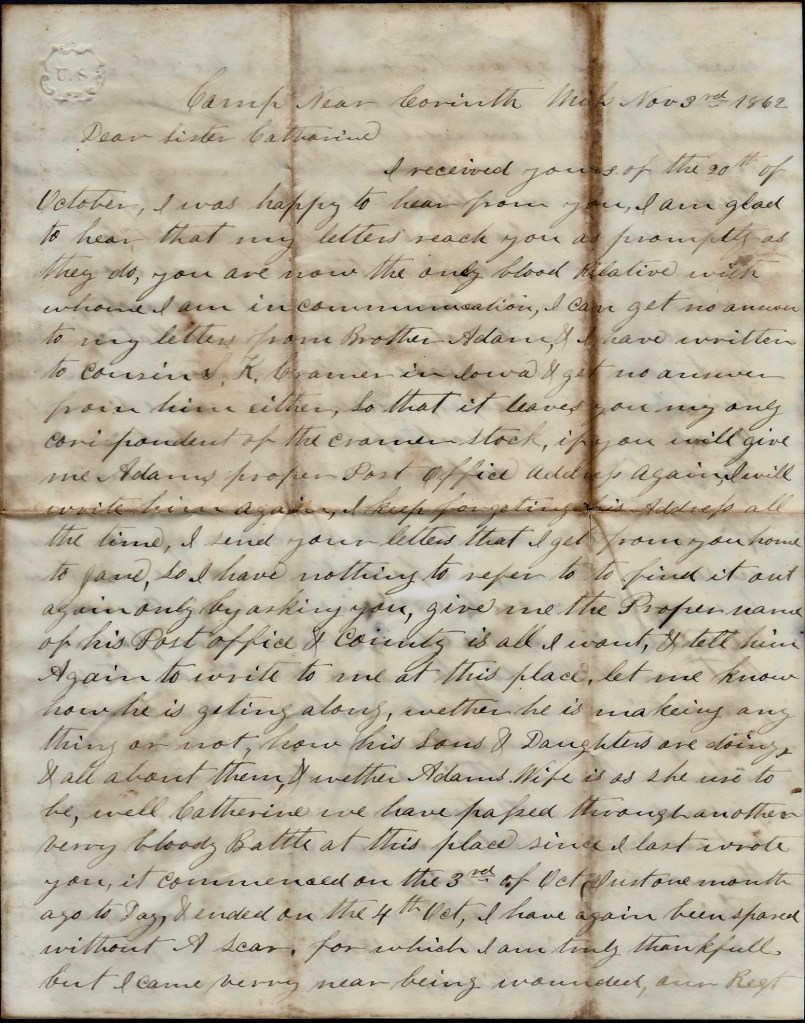
I received yours of the 20th of October. I was happy to hear that my letters reach you as promptly as they do. You are now the only blood relative with whom I am in communication. I can get no answer to my letters from brother Adam, & I have written to cousin S. K. Cramer in Iowa & get no answer from him either so that it leaves you my only correspondent of the Cramer stock. If you will give me Adam’s proper post office address again, I will write him again. I keep forgetting his address all the time. I send your letters that I get from you home to Jane so I have nothing to refer to to find it out again, only by asking you. Give me the proper name of his post office & county is all I want and tell him again to write to me at this place. Let me know how he is getting along, whether he is making anything or not, how his sons & daughters are doing, & all about them, & whether Adam’s wife is as she use to be.

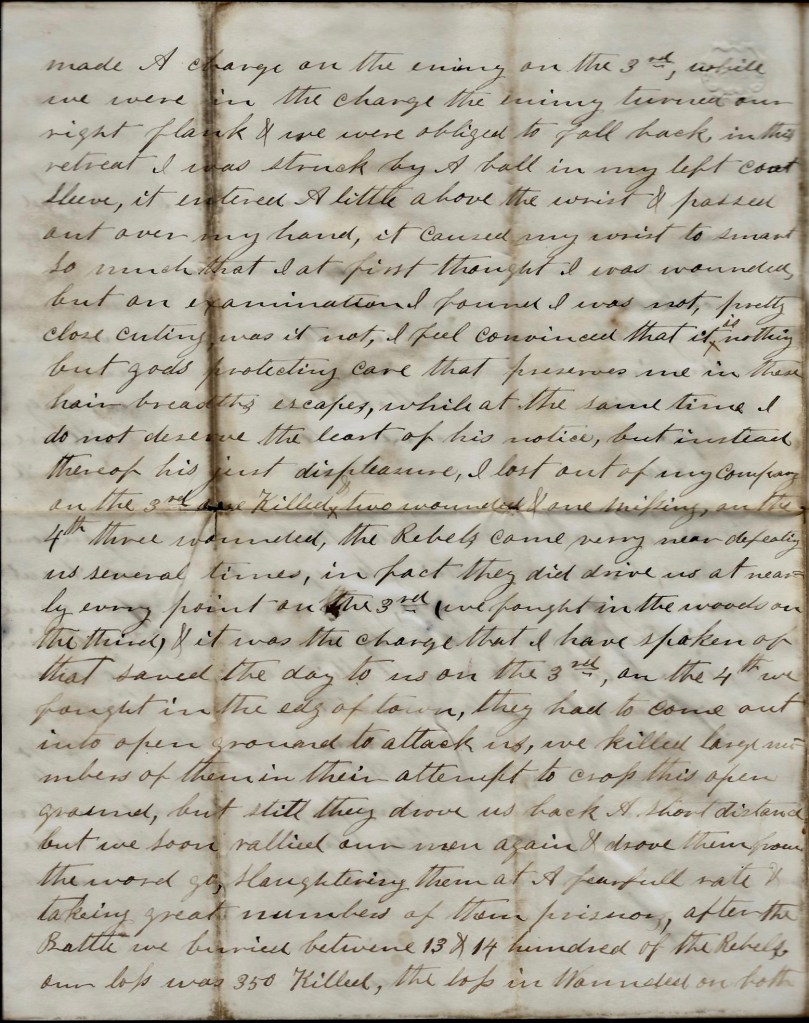
Well, Catherine, we have passed through another bloody battle at this place since I last wrote you. It commenced on the 3rd of October, just one month ago today, & ended on the 4th of October. I have again been spared without a scar for which I am truly thankful but I came very near being wounded. Our regiment made a charge on the enemy on the 3rd. While we were in the charge, the enemy turned our right flank and we were obliged to fall back. In this retreat I was struck by a ball in my left coat sleeve. It entered a little above the wrist and passed out over my hand. It caused my wrist to smart so much that I at first thought I was wounded, but on examination I found it was not. Pretty close cutting, was it not? I feel convinced that it is nothing but God’s protecting care that preserves me in these hairbreadth escapes, while at the same time I do not deserve the least of His notice, but instead, thereof His just displeasure.

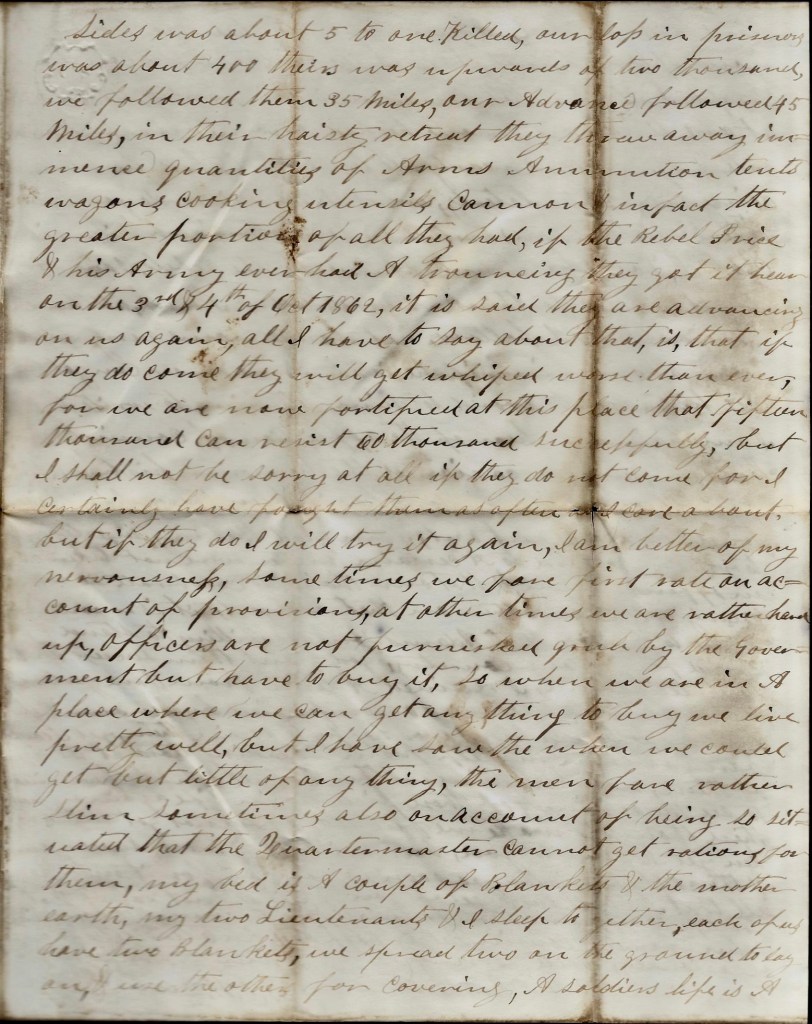
I lost out of my company on the 3rd, one killed, two wounded & one missing. On the 4th, three wounded. The Rebels came very near defeating us several times. In fact, they did drive us at nearly every point on the 3rd (we fought in the woods on the third) & it was the charge that I have spoken of that saved the day to us on the 3rd. On the 4th, we fought in the edge of town. They had to come out into open ground to attack us. We killed large numbers of them in their attempt to cross this open ground but still they drove us back a short distance. But we soon rallied our men again & drove them from the word go, slaughtering them at a fearful rate & taking great numbers of them prisoners. After the battle, we buried between 13 and 14 hundred of the Rebels. Our loss was 350 killed. The loss in wounded on both sides was about 5 to one killed. Our loss in prisoners was about 400. Theres was upwards of two thousand. We followed them 35 miles. Our advance followed 45 miles. In their hasty retreat, they threw away immense quantities of arms, ammunition, tents, wagons, cooking utensils, cannon, & in fact, the greater portion of all they had.

“If the Rebel Price & his army ever had a trouncing, they got it here on the 3rd & 4th of October 1862. It is said they are advancing on us again. All I have to say about that is that if they do come, they will get whipped worse than ever..”

—Capt. Henry Cramer, Co. A, 50th Illinois, 3 November 1862

If the Rebel Price & his army ever had a trouncing, they got it here on the 3rd & 4th of October 1862. It is said they are advancing on us again. All I have to say about that is that if they do come, they will get whipped worse than ever for we are now fortified at his place [such] that fifteen thousand can resist 60 thousand successfully. But I shall not be sorry at all if they do not come for I certainly have fought them as often as I care about. But if they do, I will try it again. I am better of my nervousness.

Sometimes we fare first rate on account of provisions, at other times we are rather hard up. Officers are not furnished grub by the government but have to buy it so when we are in a place where we can get anything to buy, we live pretty well, but I have saw that when we could get but little of anything, the men fare rather slim sometimes. Also on account of being so situated that the Quartermaster cannot get rations for them. My bed is a couple of blankets & the mother earth. My two Lieutenants [Sergeant Moody and Henry C. Bissell]and I sleep together, each of us have two blankets. We spread two on the ground to lay on & use the others for covering. A soldier’s life is a hard one at best.

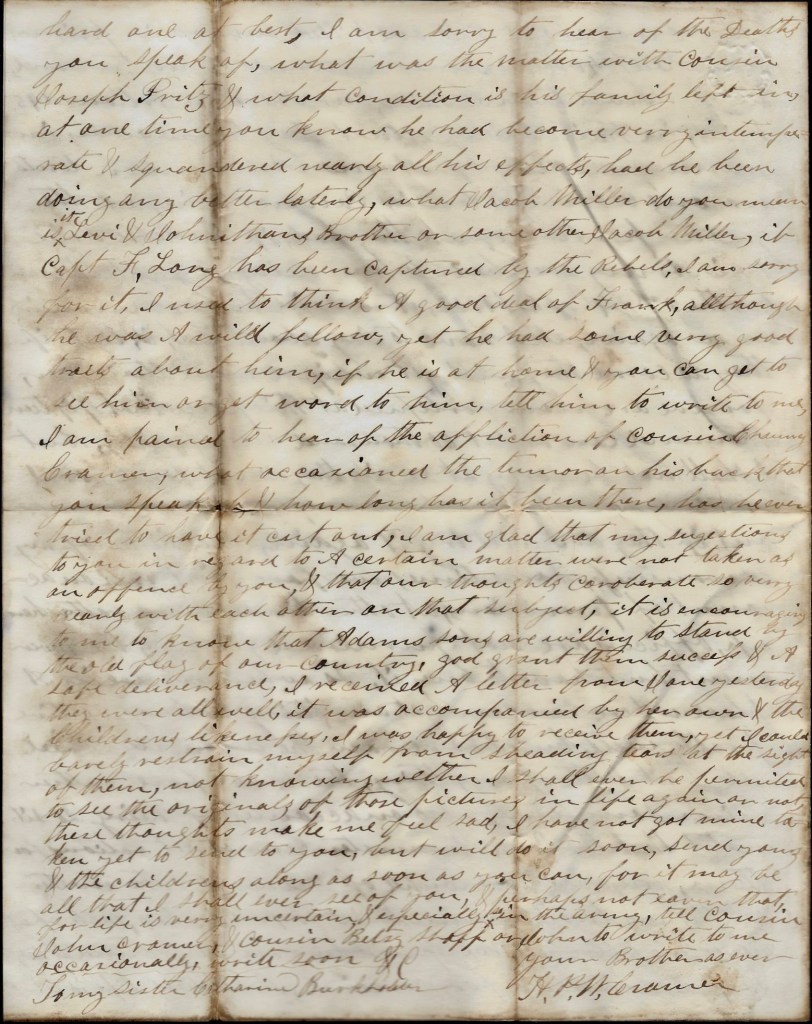
I am sorry to hear of the deaths you speak of. What was the matter with cousin Joseph Pritz & what condition is his family left in? At one time you know he had become very intemperate & squandered nearly all his effects. Had he been doing any better lately? What Jacob Miller do you mean? Is it Levi & Jonathan’s brother or some other Jacob Miller? If Capt. F. Long has been captured by the Rebels, I am sorry for it. I used to think a good deal of Frank although he was a wild fellow. Yet he had some very good traits about him. If he is at home & you can get to see him or get word to him, tell him to write to me. I am pained to hear of the affliction of cousin Henry Cramer. What occasioned the tumor on his back that you speak of & how long has it been there? Has he ever tried to have it cut out? I am glad that my suggestion to you in regard to a certain matter were not taken as an offense by you & that our thoughts corroborate so very nearly with each other on that subject. It is encouraging to me to know that Adam’s sons are willing to stand by the old flag of our country. God grant them success & a safe deliverance.

I received a letter from Jane yesterday. They were all well. It was accompanied by her own & the children’s likenesses. I was happy to receive them yet I could barely restrain myself from shedding tears at the sight of them, not knowing whether I shall ever be permitted to see the originals of those pictures in life again or not. These thoughts make me feel sad. I have not got mine taken yet to send to you but will do it soon. Send yours and the childrens along as soon as you can for it may be all that I shall ever see of you & perhaps not even that for life is very uncertain & especially in the army. Tell cousin John Cramer & cousin Betsy Shoff or John to write to me occasionally. Write soon, &c. Your brother as ever, — H. P. W. Cramer

To my sister Catharine Burkholder

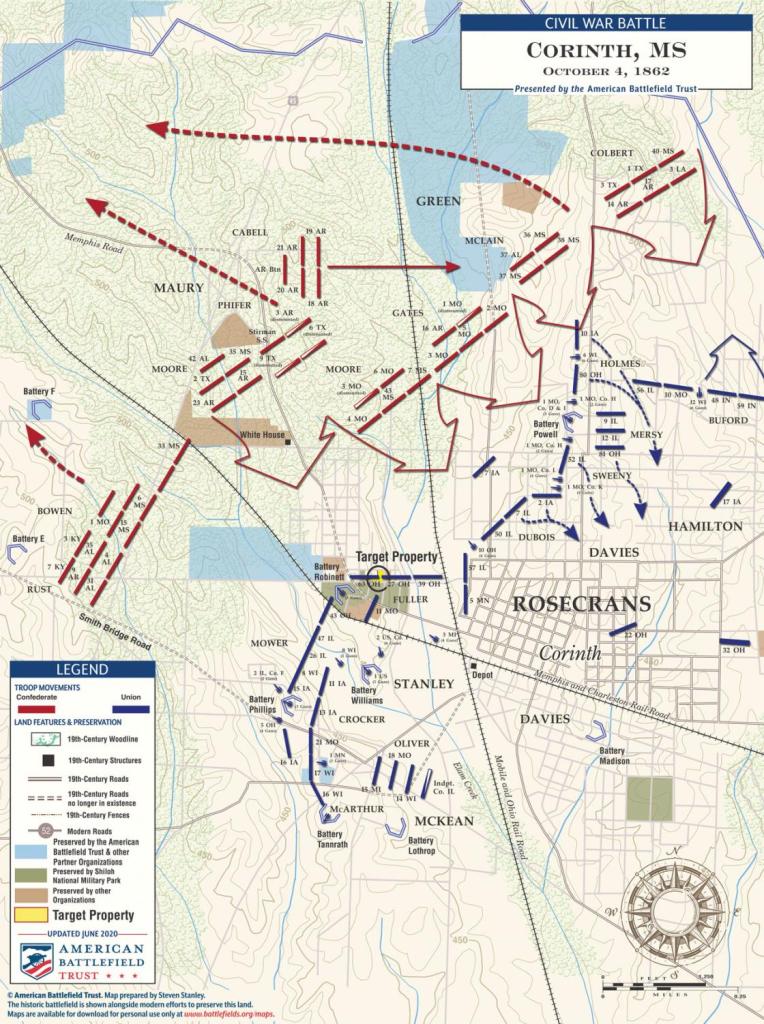
This American Battlefield Trust Map shows the location of the 50th Illinois positioned in the center of the Union line just to the right of the 10th Ohio Battery.

Letter 6

Camp near Corinth, Mississippi
February 11th 1863

Dear Sister Catharine,

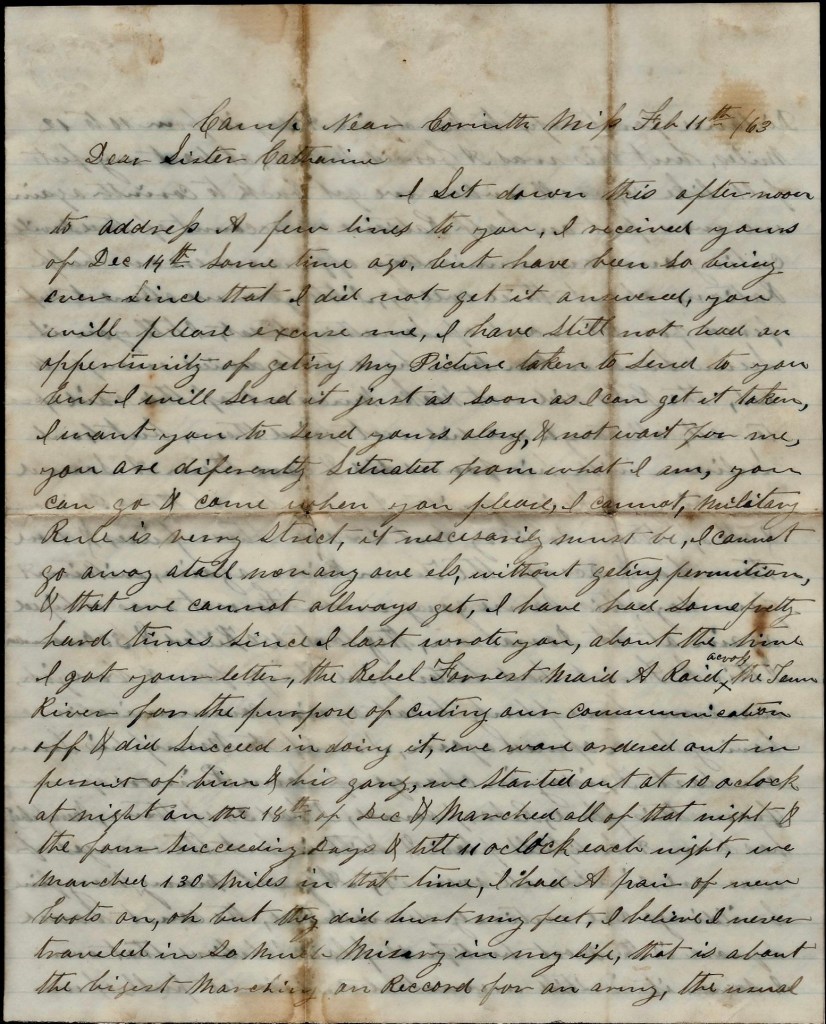
I sit down this afternoon to address a few lines to you. I received yours of December 14th some time ago but have been so busy ever since that I did not get it answered. You will please excuse me. I have still not had an opportunity of getting my picture taken to send to you but I will send it just as soon as I can get it taken. I want you to send yours along & not wait for me. You are differently situated from what I am. You can go and come when you please. I cannot. Military rule is very strict. It necessarily must be. I cannot get away at all nor anyone else without getting permission & that we cannot always get.

I have had some pretty hard times since I last wrote you. About the time I got your letter, the Rebel Forrest made a raid across the Tennessee River for the purpose of cutting our communication off & did succeed in doing it. We were ordered out in pursuit of him & his gang. We started out at 10 o’clock at night on the 18th of December & marched all of that night & the four succeeding days & till 11 o’clock each night. We marched 130 miles in that time. I had a pair of new boots on. Oh but they did hurt my feet. I believe I never traveled in so much misery in my life. That is about the biggest marching on record for an army. The usual distance for troops to arch in a day is from 10 to 12 miles, but this was a forced march—at least my feet felt like it. Well when we got back to Corinth again, we were put on half rations on account of the Devils cutting our communications off. We were on half rations about three weeks. I tell you, we almost suffered for the want of something to eat. I tell you, it seems hard when men have to be denied enough to eat. The Rebs did not take much out of this raid after all, although we did not find them. But Gen. Sullivan with his forces did and gave them a sound drubbing, taking quite a number of them prisoners and all of their artillery but two or three pieces, & drove them back across the Tennessee River again. Within a few days, this same gang under Forrest was whipped again at Ft. Donelson. They lost 150 killed & 300 wounded. I think Forrest had better give it up for a bad job.

We now have plenty to eat again, communication having been opened again. I went to Memphis, Tennessee, on last Friday in charge of some prisoners of war from this place—Rebs of course. I had 38 of them. Memphis has been a beautiful place & still is, but the ravages of war are visible all over it. A great many very fine buildings are entirely demolished. The court house square is the most beautiful place I believe that ever I saw. It is still unmolested. It is set full of evergreens. A cedar and a magnolia tree are alternately [planted] with quite a number of forest trees interspersed. In the centre stands he monument of that Old Hero & lover of the country, Andrew Jackson. One one side of hte monument is inscribed these memorable words of his—“The Federal Union must be preserved.” These Devils, although professing to be Jackson’s disciples, have really undertaken to deface this inscription. The word “Federal” is very much defaced but is still legible. The engraving is so deep they could not deface it entirely without spoiling the entire monument. But the greatest curiosity about this square—to me at least—was the squirrels that are in it. There must be at least one hundred grey squirrels in it. They are as tame as cats. One can walk up to them & nearly lay their hand on them & they do scarcely notice you. It is a beautiful sight to see them gamboling about through this square. There are boxes placed on those forest trees in which they have their nests. The whole is enclosed with a very neat, ornamental iron fence.

You said Jerry Philippi had been in the Pittsburg Landing fight. How I should have liked to have seen him. You say we are near together if we only knew it. We may have been then, but may not be now. The troops that were in that battle have since been wonderfully scattered & it is almost impossible to find a person in the army unless you know what company & regiment he belongs to & what state he enlisted from. I would stand the treat as the saying is if I could get to see him. I wish you would find out the letter of his company, the number of his regiment, & what state the regiment belongs to & let me know it forthwith.

I had a letter from Jane the other evening. They were all well. I have some notion of resigning and going home. My health is not so good as it has been but still I suppose I could stand it. It is on Russell’s account that I think of doing it. He always was a hard boy to manage. It was all I could do to keep him under subjection. Jane writes me now that he has got entirely beyond her control—that she cannot do anything with him. I am well convinced that I owe a great deal of duty to my country, but if I am not mistaken, my first duty is to my family. He is now about the right age to be ruined forever if he is spoiled now. The old adage says that charity begins at home and I think if everyone will take hold & do as much as I have done toward putting down this hellish rebellion, it will be dried up in a short time, so I think no one can blame me for resigning if I do.

I am tolerable well with the exception of a very bad cold. Hope you and yours are all well. Give my respects to all the friends. Write soon as you get this &c.

Your brother, — H. P. W. Cramer


Letter 7

Camp near Corinth, Mississippi
February 22nd 1863

Dear sister Catharine,

I sit down on this the birthday of the Father of his country (viz) Washington, to address a few lines to you. Although there is no letter due you from me at this time, I sent you one some 8 or 10 days ago to which I have got no answer yet, but as I have now my picture taken, I thought I would send it along without waiting for an answer to my last. I wonder what George Washington would have to say about this hell-begotten rebellion if he were now living. I think he would make some of those God forsaken traitors, both North and South, quail before him. I think they will begin to shake in their books ere long as it is. In their boots, did I say? Well, if I did, that is a mistake of mine. So far as the South is concerned for the southron army has neither boots nor shoes to shake in, or else they are lied on most scandalously.

I had a letter from Adam the other day in which he said that Uriah Massena had been to see them & that he (Uriah) said he had been taken a prisoner at Vicksburg & paroled. How is this?—he being in the eastern army and taken a prisoner at Vicksburg? There was none of the eastern troops sent to Vicksburg that I know anything of. It looks mysterious to me. He must have been in th Rebel service if he was taken at that place as he said he was, or he has deserted from the eastern army & has hatched up this prisoner & parole story to screen himself. If he has done that, if if he has been in the rebel service, I hope he will be arrested and punished severely for it. It makes no difference with me if he is my nephew. A deserter should be punished for forsaking his country and flag. Of course I had much rather it were not so—if indeed it is so. At any rate, it looks smutty to me. You may be able to explain it all satisfactorily to me. I wish you would if you can.

The picture I send you is a photograph likeness. I like them much better than I do the other kind. They are much more correct and cost but little more by getting half a dozen, they will not cost so much as the others, but one alone will cost more, and sitting will do for a hundred or more after they have the negative as it is called (for that alone the sitting is required). They can print a hundred or more from it, consequently the first two or three they are cheap. I wish you would have yours. A photograph instead of the other kind if you have not already got it. I suppose you would have to go to Connellsville or Somerset to have it done but that would only be a pleasure trip for you seeing you have your own horse and conveyance & in addition to all that, you might come across some good-looking widower (grins).

I will send out in this letter for Lena also, give it to her if you please & tell her that I want her to send me hers and her husband’s in photograph, hers alone if she does not feel able to get both. I want you to send them right along now. If I am spared to have the opportunity of getting the picture of my whole family taken, I will send it to you also, but at present it is out of my power to do so. I have sent one likeness to Adam & if you will again give me the correct Post Office address of my other sisters in Green county, I will send one to each of them. I mean Rebecca, Marth, Elizabeth, & Barhary. I believe they are all living yet—at least I have not heard of the death of any of them…

There is some talk of us having to leave here but I cannot tell yet whether it is true or not. I hope it is not for I do not want to go into the field until the weather gets better for we have horrible weather here. It averages about three days rain to one of sun & cold too. It is like the correspondent said of Virginia, water 6 inches and mud the balance of the way. But it is not as I like in this matter of moving. When we get an order to move, we have to go, rain or shine.

I am well with the exception of the cold that I spoke of in my other letter sitting on my breast or lungs but is getting better. I had a letter the other evening from Jane & the children. They were all well except Jane. She had had a bad spell again and that miserable sick headache. It appears that is going to follow her through life. I guess I had better quit for I have about run out of material. Now don’t forget those photographs & tell Lena not to forget here either for I will look for them certain now. You wil l have to be careful about handing them. A little scratch or anything of that kind will spoil them. Give my respects to all enquiring. Who lives now where Thad Aughinbaugh did live? Write soon & answer all my questions both in this and the other letter. May the good Lord protect and preserve you all. Goodbye. Your brother, — H. P. W. Cramer
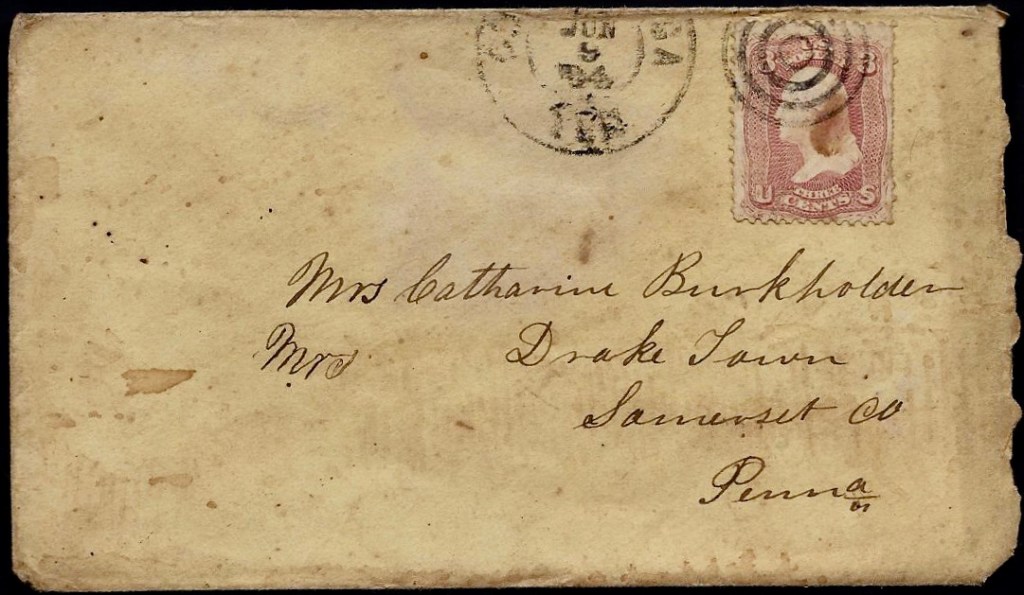
To his sister Kate.

P. S. That is the fashionable name for Catharine.


Letter 8

Rome, Georgia
June 5th 1864

Dear Sister,

I received your kind letter some days ago but was on the march at the time, consequently I could not answer it. I will now try to do so. I was glad to hear from you as I had not heard from you directly in a long time. I was glad to hear that you and your family were well and that Christian has gone into the service of his country. You say it was a hard trial for you to part with him. I have not the least doubt of that. I have had some experience in that line myself. It has always been a trying time with me when the time came for me to leave my dear family and return to the army, but after all we have a duty to perform which we owe to our government which we, if we are loyal citizens of America, will perform regardless of our inclination for ease and comfort which we would enjoy at home. I say it is our duty to go forth to protect and sustain the flag of our country—the glorious old Stars & Stripes, long may they wave over a land of freemen. Our families and family connections are pretty well represented in this war, I think it can hardly be said of the Cramer family that they have failed to show a spirit of patriotism in the time of their country’s need.

In a letter that I had from Jane a few days ago, she tells me that [our son] Russell has also enlisted in the hundred days service. I was sorry to hear it on account of his youthfulness (he is only 15 years old), but I hope he will stand it that length of time. Poor fellow. It may do him good if he lives. One thing it will do, it will cut his eye teeth for him, as the saying is. There are hard things to contend with but we must endeavor to overcome them manfully.

I saw Uriah Massena since we are on this campaign about two weeks ago. He is in the 4th [West] Virginia Regiment, 15th Army Corps. We have been near each other before but did not know it. I should not have known it then, not knowing what regiment he was in. He knew from some source that I was in the 50th Ills. Regt. & enquired for the regiment, It happened that we were moving in the same column and were close together at the time. We had halted for rest & dinner one day on the bank of a creek. I was very dirty & had gone to the creek with my Lieut. to wash. When I got back, I noticed a young man talking with one of my men that looked strange to me. He approached me & addressed me in the familiar term of Uncle. I looked at him for some time & asked in my mind, who in thunder are you. He extended his hand to me. I took it and told him that he decidedly had the advantage of me. He then informed me who he was. I was perfectly taken aback, I had not had the least idea of meeting with him in the Western Army. He was well & looked well. I may be mistaken but I think he is a better boy than I expected he was. All that I judge from is his appearance. I had formed and idea that he was a chip off the old block, but his appearance does not bespeak that for him. Am I right or am I wrong? He told me that [his father] Sam had quit drinking. Is that so, or is it not? Well, I also saw Jerry Philippi & Absalom Pile this day two weeks ago. They are both in the same company and regiment, Co. B, 76th Ohio Regt. They were well. They both knew me. I knew Pile at first light, but I should not have known Jerry if he had been pointed out to me. He looks so very old. I was astonished to see him look so old. I was never more pleased to see an old friend than I was to see Jerry. He was equally pleased to see me. He is still the same warm-hearted Jerry as of yore.
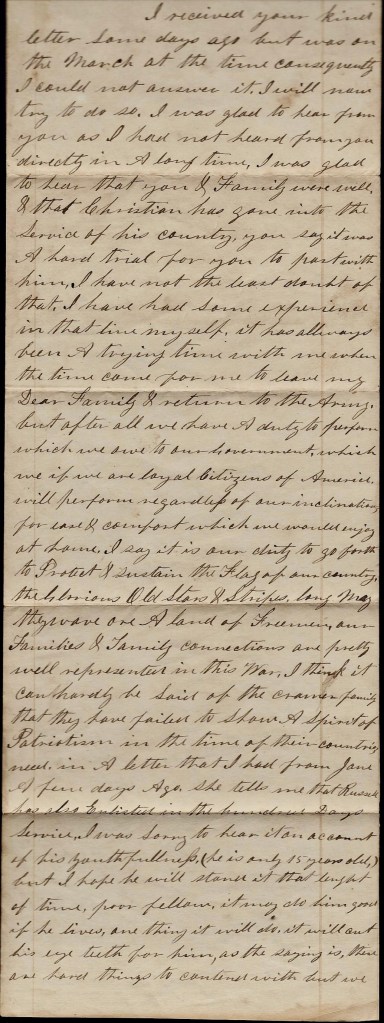
Well, I have again through the protection of God passed through another desperate battle, or series of battles, without being harmed. I thank God for it. One man of my company only was wounded. Our Division, the 2nd of the 16 Army Corps under General Dodge lost about 200 men. We are now doing garrison duty at this place. The balance of the Division is in the front 35 to 40 miles south of this. They have been charged upon 7 times since we left them but have never faltered but repulsed the charge every time. It is a fighting division of the true metal. Cannot tell how long we will stay here.

You say Elizabeth has a bastard but do not say what Elizabeth. I am ashamed of her whoever she is. Do not say anything to Jane about it in writing to her. I am well. Must quit. Have no paper but what I get out of old rebel books. Goodbye, — H. P. W. Cramer

God bless you all.

What Co. & Regt. is [your son] Christian in? Who is his captain and who his Colonel? Tell him to be a good soldier & to write to me. God bless him and protect him.


Letter 9

Rome, Georgia
July 10, 1864

Yours of the 26th June was received yesterday evening. I am truly sorry for to hear of the death of your dear [son] Christian. I have not the least doubts about his being a good boy. I sympathize with you in your bereavement but you need not, or at least you have no cause for doing so, mourn as those that have no hope. In the first place you say he had been regenerated in heart & that you think he was steadfast. I think so too from the tone of his letter to you. In the second place, he fell at his post in the discharge of his duty, nobly defending Liberty, and the cause of oppressed and downtrodden humanity & the best government the light of the sun ever shone on. God surely will not cut off those who die in the cause of right. He is a just God & loves those who do right & labor for the cause of right.

It is a severe blow, it is true, to be bereft of one so near and dear as a son in the bloom of youth—one just stepping into manhood. But when we think of the cause in which he died and the probable trouble, annoyance, vexations of spirit with which he would in all probability have been beset in this sin stricken world had he lived, that he has escaped all these things, they are calculated o ward off in a great measure the blow which under other circumstances would have fallen much heavier, you must strive to bear your affliction with Christian fortitude. God will not forsake the widow, neither do I believe He will forsake those whose main stay & support is slain in defending the cause of Liberty.

I had hoped that he & I would live to see each other. I had been as it were instinctively drawn towards him from the letters that he used to write me occasionally, but my hopes are all blasted. I wish I was near you so that I could render you some comfort and assistance. I am sorry to learn that my opinion of Uriah was incorrect. What trifling habits does he have? You say there has five of our nephews [been] killed besides Christian who is the 6th one. I recollect of none but Adam’s three sons, Christian, & P. Whipkey—5 in all.

Where is Elizabeth living at? What on earth does she mean to act the way she does? I should have thought her first lesson ought to have taught her enough of this kind of conduct. It is an old saying that children that have had their fingers burned are afraid of fire. It is a pretty true saying too, but it does not hold good in her case. She must not have as much sense as a child. Enough of this. The subject is mortifying to me.

How does your other boys do? Are they industrious and obedient? I forget which is the next oldest. I think it is William. He must be nearly grown by this time. Tell them that I want them to be good boys, to obey their mother in ll things & to take for their example their brother who has fallen in defense of his country. Tell them to write to me,

The regiment that Russell belongs is the 137th Illinois. It is stationed at Memphis, Tennessee. I have not heard from him directly since he is in the service. Old ex-Governor John Wood of Quincy, Illinois, is his Colonel. he is the Father of Quincy. He is quite an old man, near 70 I should judge.

It is very warm here at this time—the thermometer averaging about 95 degrees. No news worth speaking of. Sherman has got Joe Johnston on the run again. Will take Atlanta in a short time if he has not already got it. There is now a General Hospital established at this place. There is about 2,000 sick and wounded soldiers here set from the front. Three of my boys died of disease during the month of June. Russell has grown very large. When I was at home last winter, he was nearly as tall as I am. I am well. Hope you are the same. God bless you. Goodbye. Your brother, — H. P. W. Cramer