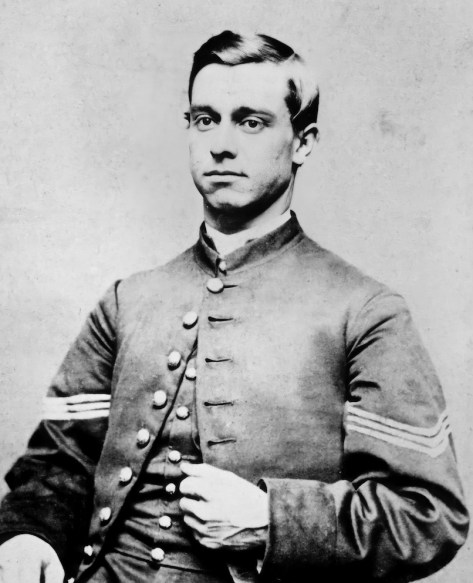
George Washington Cone, Co. B, 7th Connecticut Infantry
This letter was written by George Washington Cone, Jr. (1840-1911), the son of George W. Cone (1806-1882) and Nancy A. Cone (1812-1852) of Utica, Oneida county, New York. George may have been working in Connecticut at the time the Civil War began because he first enlisted in the Co. B of the 1st Connecticut Infantry (3 months) and then reenlisted in Co. B, 7th Connecticut Infantry, entering as a corporal and mustering out as a sergeant.
After the war, in 1866, he married Helen Augusta Louisa Cole (1846-1925) and worked as a carpenter in Herkimer, New York, for a time and then relocated to Springfield, Missouri. He died in 1911 and was buried in Fordland, Webster county, Missouri.
George wrote the letter to Jennie Bradt (1844-1915) who married in December 1863 to Delos Curran Dempster (1840-1924 at Herkimer.
T R A N S C R I P T I O N
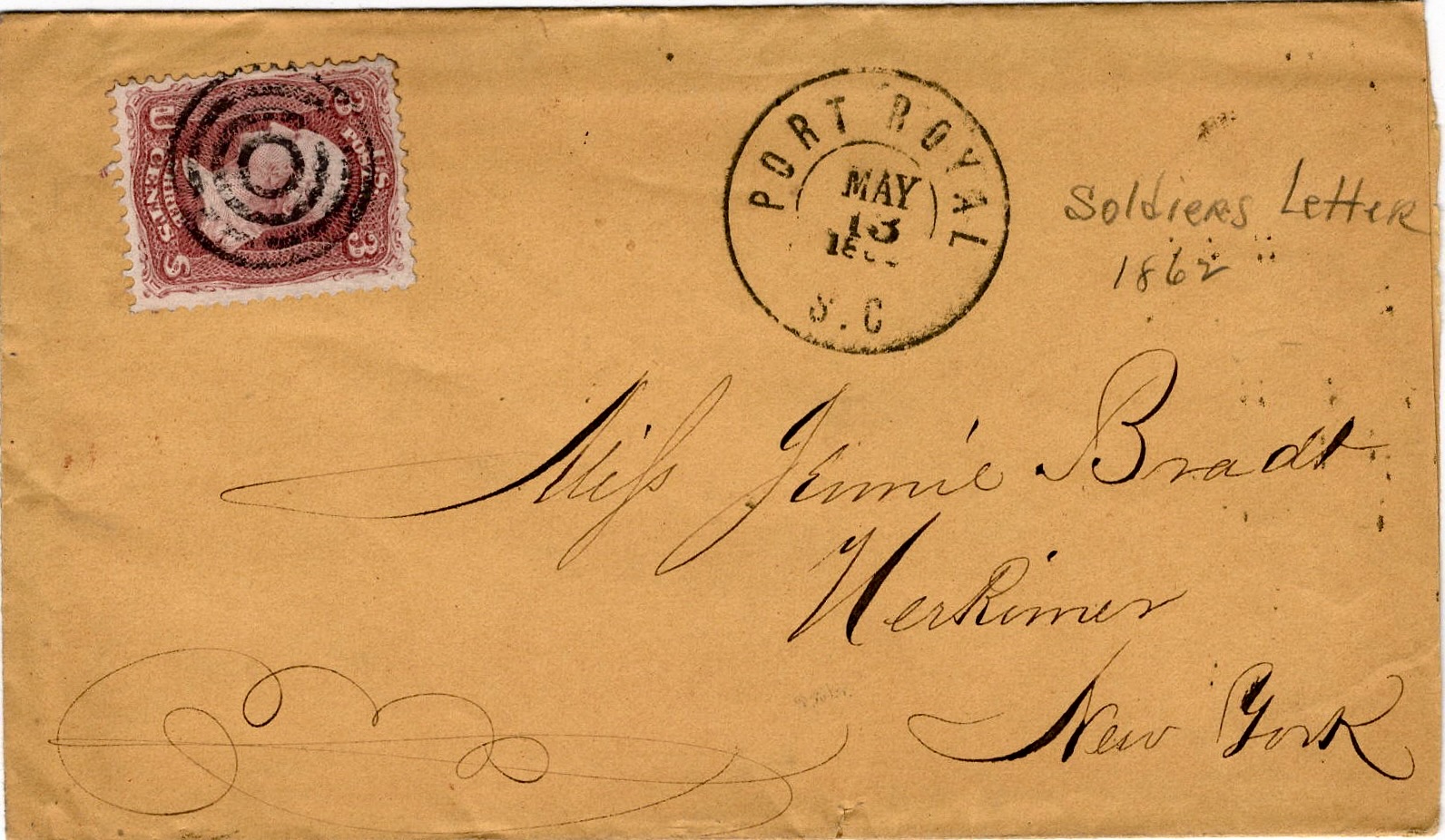
Addressed to Miss Jennie Bradt, Herkimer, New York
Fort Pulaski May 11, 1862
Friend Jennie,
I now take this opportunity to answer your letter of May the 5th. I received it this evening and was very glad to hear from you once more but was very sorry to hear that your Father is unwell. This is a very lonely evening and I am on guard so I will write tonight when I have time.
A few days after we came into the fort, some of the 3rd Rhode Island Artillery men were working among some shells that had not exploded when one of them burst and killed four of them instantly. It seemed hard after passing through a battle without getting a scratch to get killed so suddenly.
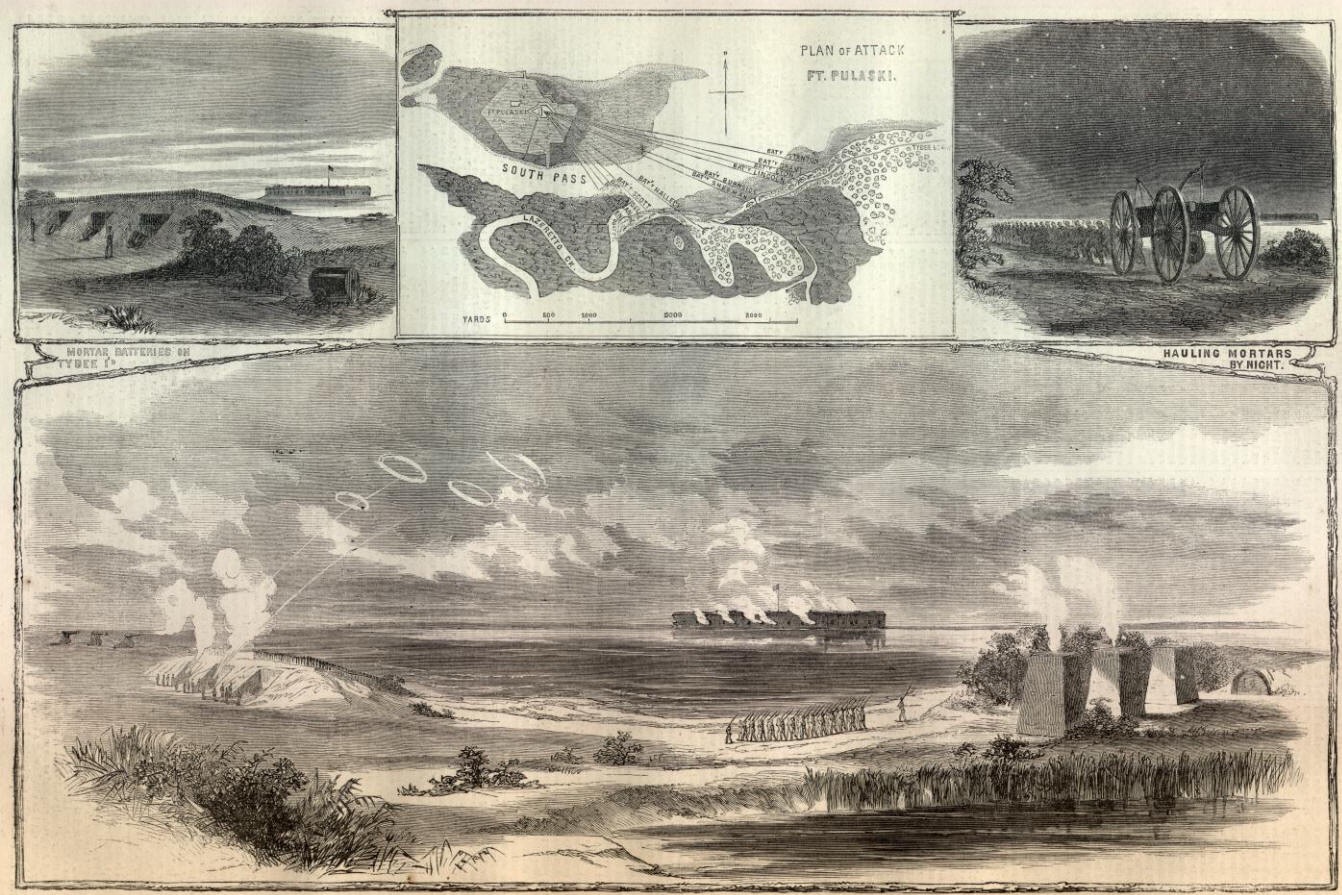
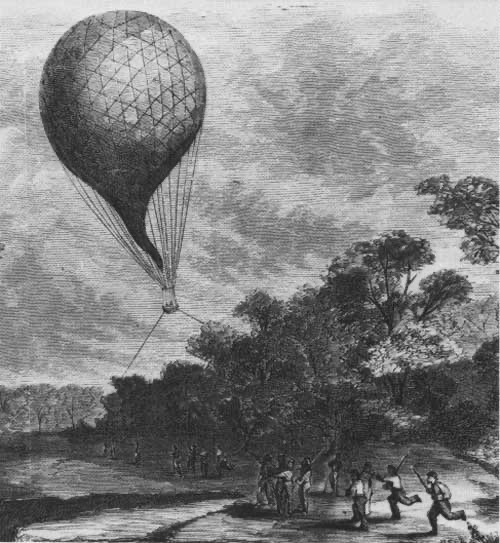
We have got a balloon here now to reconnoiter Savannah City. 1 It went up with a couple of Gents and Ladies the other day. The Ladies make frequent visits to the fort. There is one or more visits us nearly every day. The fact is, before we had stopped firing 15 minutes, some Ladies came down to our Battery. They must have run in order to get there so quick. We have got the fort fixed up pretty well now. The masons are repairing the breaches that we made in the fort. I saw a picture in Harper’s Weekly that was intended to represent the fort but it don’t look a bit like the original. One of our steamboats went up to Savannah with a flag of truce the other day.
Drawings of Fort Pulaski appearing in the 3 May 1862 issue of Harpers weekly
The weather is very fine here now and our men are enjoying good health with the exception of a [few] cases. You spoke about the letter that I sent to Charles. There was nothing of great importance in the letter so it won’t make any difference for I will write another letter. I am glad that Charley has got a good wife.
You want to know where we are going, I suppose. Our regiment is quartered in the fort at present but whether we are going to garrison the fort all summer, I am not able to say. We expect to help take Fort Sumter before long but it is only a report and it will go with all camp stories. But I think that we shall stop here some time yet. My health has been quite good since I have been here. I had rather fight one or two more battles before I come back but I can’t have any choice.
I have not any news to write at present so you must excuse me this time. Please give my best respects to all of your friends. When you write, please tell me all the news. I remain your sincere friend, — Corp. G. W. Cone
P. S. Direct to Co. B, 7th Regiment Connecticut Volunteers, Port Royal, South Carolina
1 There is no record of balloon observations made in the vicinity of Savannah until after the fall of Fort Pulaski. Sometime in May 1862, aeronautics John Starkweather observed Confederate positions around Savannah.
The following letters were written by a semi-literate English emigrant named Samual Durant (1819-1862) who enlisted at Fulton, Oswego county, New York, on 13 September 1861 as a private in Co. C, 81st New York Infantry. He was transferred to Co. G on 6 February 1862. He died of chronic diarrhea on 20 September 1862 at Philadelphia. He’s buried in the National Cemetery at Philadelphia, Section B, Site 406.
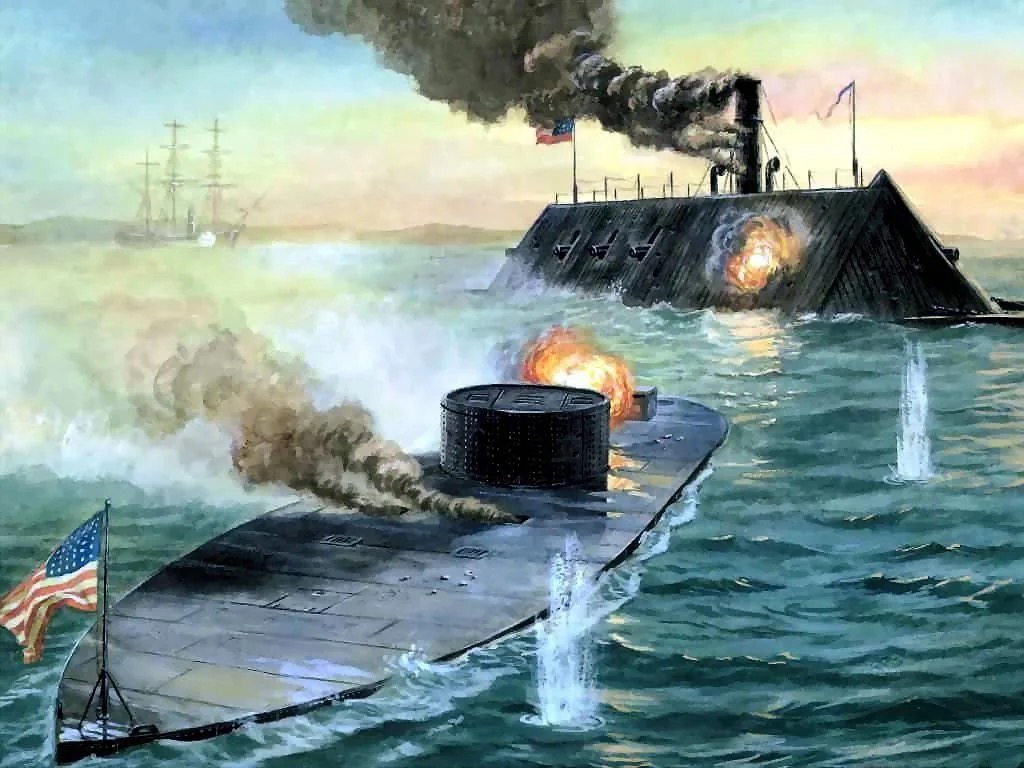
On the 21st of February the regiment was ordered to New York City, and then proceeded on the 5th of March to Washington, D. C. There the men remained in camp twenty days, and on the 28th of March, marched to Alexandria Va., where they embarked for Fortress Monroe, arriving on the 1st of April—just three weeks after the famous battle between the ironclads that captured the imagination of the public. Samuel’s description of the USS Monitor is classic: “She looks like a mud turtle with a barrel on his back. I can’t see nothing but her hump stick up out of the water. She is wicked. They are all afraid of her…”
From their landing at Newport News until May 31st the regiment was on the march or in camp, acting as reserve at the battle of Williamsburg Va., and reaching Seven Pines on the 28th, where they remained until the bloody engagement of the 31st was fought. In this battle the 81st was assigned to the left of Casey’s Division, unsupported in an open field. The regiment here underwent its baptism of fire and stood the ordeal heroically.
To read letters by other members of the 81st New York Infantry that I’ve transcribed and published on Spared & Shared, see: Horace Benjamin Ensworth, Co. B, 81st New York (1 Letter); Horace Benjamin Ensworth, Co. B, 81st New York (4 Letters); Marshall S. Moses, Co. E, 81st New York (1 Letter); Franklin Darius Sizer, Co. I, 81st New York (1 Letter); and Dexter Samson, Co. K, 81st New York (1 Letter).
Letter 1
Headquarters, Camp Dutton 81st Regiment, Company G, NYV. April 14, 1862
Dear daughter,
I take [this] opportunity to write to you. [I] take it from Albany. We march in the night to New York by railway in the morning & daylight. Laid there two days, then went on to Staten Island. Laid there 8 days, then [at] 4 o’clock in the afternoon, took a boat 25 miles and then took railway to the Delaware river, crossed that and a steamer to Philadelphia and a loyal place that was too. [The] saloon was a Cooper’s Shop. It was so large that we had a 11 hundred men all eat at one long table and we had everything the good. All regiments [that] pass through [Philadelphia] is fed by the corporation and all took pleasant good talk to boys.
Away we go for Baltimore and a fine country it was too, houses and other buildings painted white. The grass by the side of the road was on fire more than a 100 times. We come to a place called Mule City by ingen [?] I should think. They said there was 14 hundred mules and such—a sight you never saw, Great homely wagons, 6 mules make a team, one line on the leader and a saddle on the pull mull. The man sits this [ ] and [ ] is all I can make out. I tell you, he looked like a monkey on a hand organ. I wish you uncle James Harmon was here to see them. I tell you, we would have a laugh about it. I saw a team run away across the corn stubble. The wagon went bump, bump, bump. The boys all a laughing.
I have been down to the river and saw the Cumberland lay there sunk by the Merrimack. She is a iron-cladded rebel steamer. We have got the Monitor up there and she looks like a mud turtle with a barrel on his back. I can’t see nothing but her hump stick up out of the water. She is wicked. They are all afraid of her and [ ] battery that go by steam and [ ] chisels. And then we have got the Vanderbilt. If they attack us now they will smell powder. They keep playing round. I saw where they had two cut one [ ] off, killed two men and never touched them—the air knocked them dead. We had 11,000 men in one Division. I tell you, that made a show, and there was five thousand at that camp [which] is called Newport News.
All round us the fences are all burnt. I saw a wheat stubble and stacks of wheat knocked down, corn stubble and stalks and stacks of corn stalks but this is the pleasantest country I ever saw in my life. It is a good country for grain and potatoes. We [ ] cows nor hogs. We have two darkies follow us from [ ]. We keep them along with us. They cut wood, carry water. They are smart. We have tents now. The boys [ ] then about 3 miles and [ ]. I got up at light and take a black brand [?], named it Fort Spencer, Harpers ferry brew. Put on the Orderly….
Please send me particulars about your trade and where you [ ]. Excuse my writing and spelling. I must close my letter. Give my love to all my friends. I remain yours, — Samuel Durant
Letter 2
May 11th 1862
Dear daughter,
I take the pleasure to write to you to let you know I got back to my regiment last Saturday. I was very tired. The fever was leaving Robert on Saturday morning. I left him about 5 o’clock. I got to the regiment at 3 o’clock. The cannons was roaring all night. I didn’t sleep at all. The balloon went up in the night. They han’t got no light in camp so early.
The Sunday morning we started for the forts [at Yorktown], they had all left. As we were going along, I heard a report like a cannon. I thought [maybe] they was not gone, but when I got a little farther, I saw a man laying there badly wounded. There was one killed and 7 badly wounded. They had buried bomb shells in the road and all along where they thought we would go. As soon as you touch one of them, off they go. I say, “G. Van Pattan, what’s the matter?” [He said,” “see them shells buried, mind you [don’t] step on them. We had to be very careful.
Well, we traveled all day through forts and rifle pits until night and then laid down until 3 o’clock and then went back 8 miles in the rain. It rained all day and about all night. I was wet to my skin and my coat was so wet that I could barely carry it. I had to go in the dar, to a tree, chop some wood to be warm. There was firing all day just ahead of us. In the morning we marched round to get on the east side of them but they was just one day too fast. They had to fight like the devil to win. They did fight too, I tell you.
McClellan was up in the balloon. He see the Louisiana tigers come out of the woods put down the balloon. Our army is whipped. When he got there they had [ ] them all to pieces. The officer gave up his sword and said you have whipped the best regiment in the Confederate army. It is a very large field, I should think 1,000 acres. I should think and a 100 acres of wheat and corn. I don’t know but their five forts, ditches round 15 feet deep they got in there. Our boys got on one shoulder and the gun in the other hand and away they run, throwed the rails across the ditch [and] over they went [ ] them out. They took some prisoners but how many I don’t know. I saw 150 wounded rebels in one barn & shed. The doctors cutting off legs and arms, some screaming all night. That was on Wednesday night. I couldn’t sleep.
Next morning I got up and went off to south and west of the field. I come to a [ ] and then I come to a horse shot down, three or four in a mud hole with the harnesses on. They was the muddiest lot of horses and men I ever saw in my life. I saw the Michigan 5th, I think it was, all shot to pieces and bayonet[ed]. They was too fast. Had their knapsacks on all in the rain and mud. They was all muddy. 1
I just now read your letter. I felt glad to hear from you. I heard from Robert just before. He is better. I wish we get our pay so he could have some to get some things. I left all I could spared with Ed and I tell you that we are to march on the road to Richmond. They are not far ahead of us. Our boys are dragging [?] out all the time. We can’t get half enough to eat. The teams can’t get along with it. I would rather have seen wheat. I have seen the last 500 dollars but I have seen hard times. I received a letter from E. Carrier. He has received 35 dollars. From S. Durant
1 “The next major battle that the Fifth Michigan took part in was the battle of Williamsburg. The Union general wanted to attack the center of the Confederate line, which was heavily fortified by Fort Magruder. This proved to be too much for them and they were forced to turn back. This gave the Confederates a clear advantage and they decided to do a countercharge. The Confederates were able to capture a Union battery and fire upon the retreating Union soldiers. This is where the “Fighting Fifth” first earned its nickname. Once the Fifth saw what was happening, they fired upon the Confederates at the Union battery, then charged them. This shocked the rebels, resulting in them fleeing the battery. After which the Fifth started taking fire and many casualties from Confederates. To overcome this, another charge was called for, and the Fifth ended up in the rebel trenches, taking prisoners and displacing the Confederates. If it was not for their valor, the outcome of the battle would have been very different. It is reported that after the second charge they held their position for six or seven waves of attacks, incurring up to fifty percent casualties. This is the reason why the Fighting Fifth is such a notable regiment. Within their first battle, they showed gallantry and guts to overtake the Confederates with not only one, but two charges against the odds. Not only did they prove themselves at Williamsburg, but they did so too during other battles as well.” [See The 5th Michigan Volunteer Infantry Regiment during the Civil War.]
The lack of an envelope and the failure to mention any surnames or regimental affiliations in this letters makes it impossible to identify the author of this letter written by Austin to his cousin Celia. The letter was datelined from a “camp near Richmond, Virginia” on 21 May 1862 some two weeks after the Battle of Williamsburg and a week before the Battle of Fair Oaks while on the Peninsula Campaign. Though Austin claims to have been in the Battle of Williamsburg, he also states that there were no casualties in his entire regiment so they must not have actually participated in the fighting. The battle was a “rear-guard” action and only the Union regiments who were in the lead of the march from Yorktown to Williamsburg actually got seriously involved. Those regiments that trailed were delayed by rain and mud.
The Battle of Williamsburg was a rear-guard action fought in rain and mud on May 5, 1862. The Union forces, led by George B. McClellan’s second-in-command, Edwin Vose Sumner, attacked the Confederates as the Southern forces withdrew from their Yorktown defenses en route to Richmond. The armies met near Williamsburg, which was defended by 13 small redoubts and anchored at its center by a large one, Fort Magruder. The Federal forces outnumbered the Confederates 2 to 1 (112,000 soldiers to 54,000 soldiers).
Transcription
Camp near Richmond, Virginia May the 21st 1862
Dear cousin Celia,
With pleasure I write you these few lines to tell you that we are only 12 miles from Richmond, the place that the Rebels said the damned Yankees as they call us would never fire a gun or a shot into that city. I don’t know as they will but they are within 9 miles of the place by land and have got control of the James river. Our gunboats are up there within three miles by water. There is no possible chance for the rebels to escape this time I think.
Well, Celia, I have been in one battle. It was not a very pleasing thing to me though I owed the rebs spite and tried hard to kill them. I did not get hurt at all. Neither did any of our regiment but it was a hard fight. I think likely that you have seen it in the paper before this time. It was the Battle of Williamsburg. There was a great many killed and wounded. We killed them so that the ground was left covered with dead and wounded men. I could look over about 75 or 100 acres of land. They laid all over that after the fight.
The observation balloon Intrepid was used by Thaddeus Lowe during the Peninsula Campaign.
May the 22nd. There is nothing new this morning to write about only I saw a balloon go up this morning about three miles in advance of us. All seems to be very quiet this morning. There is a report that North Carolina has come back into the Union and has offered thirteen regiments to the Federal Government. I can’t say it is true but if she has not, I think she had better.
It has been a long time since I have seen my folks or friends but I hope that it will not be a great many months before I can go home and see them again. But providing I don’t get a chance to go home to see them in a short time, I hope that I may live to once more go home. But it may be with me as it has been with many a patriotic soldier who has left his happy home to go to help put this horrible rebellion down.
Though I am in the army, I feel happy as one can [be] in this place but I do not fancy war at all. My health is very good. We are moving most every day so I don’t get much chance to write or do anything else. I guess that you think by this time that I have forgotten you or feel too much above common folks to write to you but not so. I have not had the chance to write. It is not like being at home where a person can sit down and write any time they are a mind to. I must finish now because I can’t think of any more to write.
O. H. There is one thing more, I heard that Aurelia was married, Is that so. If it is, I should like to know who she married. That is all. Please write as soon as you get this. Direct as before. — Austin
I could not find an image of Daniel but here is one of David Barlow of Co, I, 15th North Carolina (Photo Sleuth)
These two letters were written by 22 year old Pvt. Daniel Wilson of Co. H, 15th North Carolina Infantry. Daniel enlisted on 15 July 1862 at Raleigh and was with the regiment until September 1, 1862 when he became ill and was hospitalized in Richmond. Though one entry on the muster rolls of his regiment claims he died of his illness, another claims that his name was among the unwounded prisoners taken captive in the Battle of Crampton’s Gap on 14 September 1862 during Lee’s invasion of Maryland and later released at Aiken’s Landing on 6 October 1862. That same source suggests that he died of scurvy at about the time of his release from Fort Delaware prison.
Daniel grew up in the Northern Subdivision of Davidson county, North Carolina.
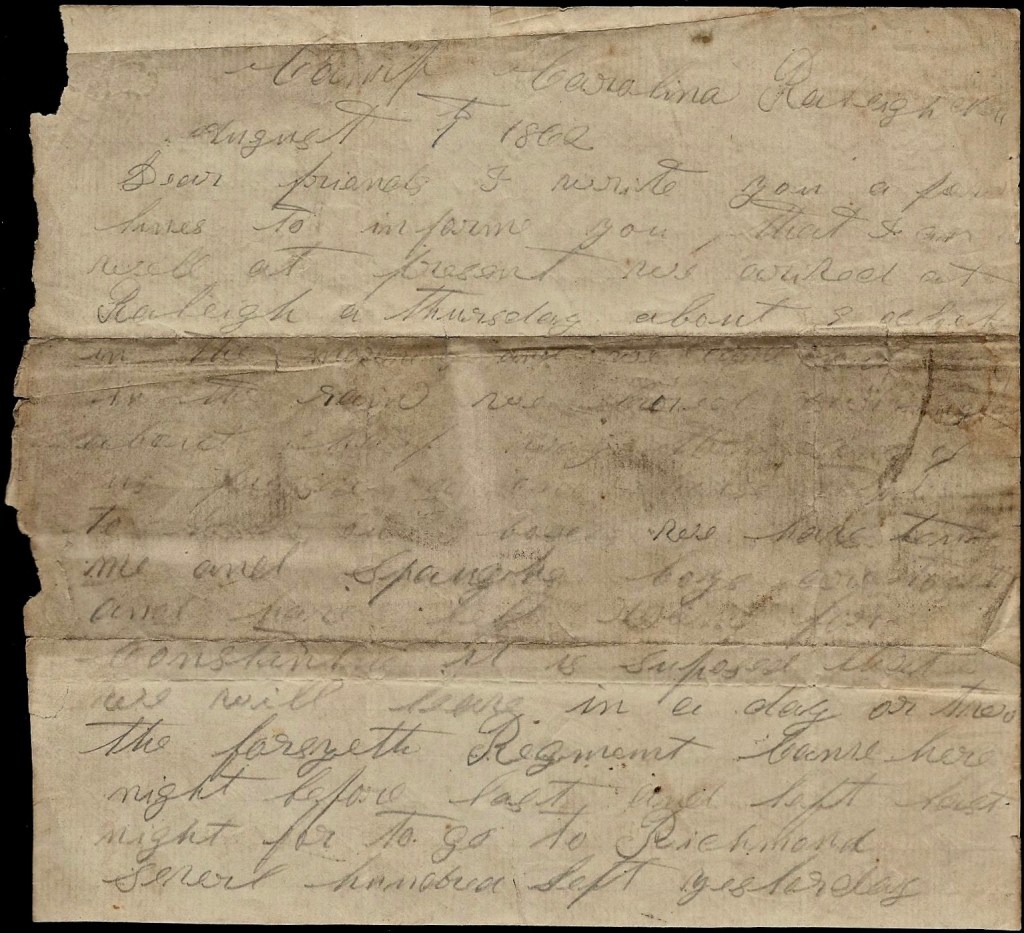
Camp Carolina Raleigh, North Carolina August 1st 1862
Dear Friends,
I write you a few lines to inform you that I am well at present. We arrived at Raleigh on Thursday about 9 o’clock in the morning and we came all the way in the rain….
Me and Spaugh’s boys are together and have left [illegible] for Constantine. It is supposed that we will leave in a day or two. The Forsythe Regiment [21st N. C.] came here night before last and left last night for to go to Richmond. Several hundred left yesterday.
I have not anything of any importance to write now for we cannot see anything for we are guarded all round. Last Sunday night about 150 run away and they only got four of them—that is captured. They send them to Richmond so fast. There is nothing here but conscripts and they are all calm so far as I have seen.
I want you to remember me in your prayers for you know I have a bad chance but I am determined to serve the Lord and if I never see you no more, I hope to meet you all in heaven. Please write to me when Henry Mock comes if Constantine [Hege] can’t come with him. Read this and think of me. Yours truly, — Daniel Wilson
Letter 2
Richmond, Virginia August 11, 1862
Dear Friend,
I again take my seat to write you a few lines to inform you that I am well so far and I hope these few lines may find you all well and serving the Lord and when you pray I will ask you all to remember me [illegible] till death, whether it be long or whether it be short. My determination is to serve the Lord while I live thought I am thrown into trials and troubles and difficulties here. But I know if we trust Him who has suffered and died for us, He will deliver me out of them although it appears with the most of them as if they had no God to serve, nor hell too, playing as much cards in one day I don’t before.
I tell you, a camp life is a hard life and nobody believes how hard it is until they try it. And if I had my time over again, I should stay at home just as long as I could. If I woulda just a stayed until Soloman and Constantine [Hege] woulda come, I would be better satisfied for I am afraid they wont get with us tho I hope they will. But if Constantine is gone and he don’t come to us and he writes to you, I want you to write to me where he is. But if he is at home, tell him to stay there just as long as he can for it is a hard change here.
We have left that camp near Richmond. We left last Saturday morning and marched 15 miles down on James River. We landed here last evening. We stopped and rested several times and yesterday morning we landed within a half a mile of this place and then we stopped there until evening. We had nothing hardly to eat all the time we were a marching and not much no time, but when we were in camp, we get flour enough but we have got meat half the time. The hardest work that I ever done is to march in this hot country and carry a load for the dust is nearly shin deep and you can hardly see one another for the dust.
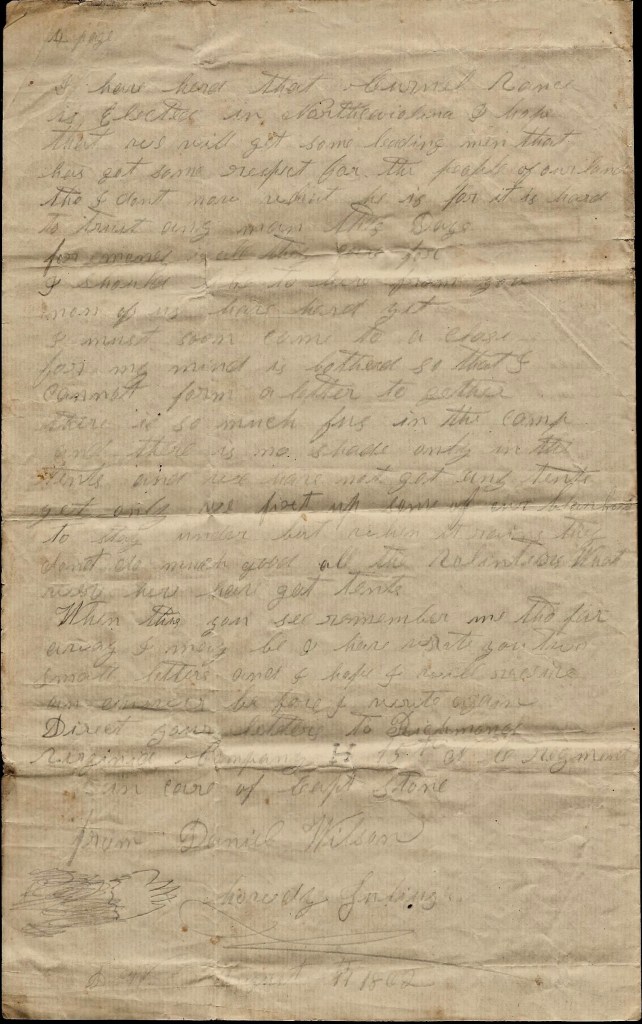
We are now getting closer to the Yankees than I want to be. Last night after we got here, I saw the Yankees raise a balloon. 1 They were a spying when I saw it. It was a standing still a little ways above the tree tops. It waved about a little, then it went down. I don’t now how far it was but it didn’t look larger than a bushel basket to me and I saw the smoke boil up from the steamboat close to the balloon. We have got to throw up breastworks close to the James River. I don’t know how soon they will fight for we heard the cannons last night and this morning one after another and I don’t like to hear them.
I tell you this part of Virginia looks bad for everything is torn to pieces nearly. All along where we came, there is camps and the timber is destroyed and there is not many people settled but negroes—there is plenty of them. We are now in a field of about 20 acres that the wheat was not cut and it looks like as if it was good. There is a house close to the camp but the yankees taken [ ] and there is nothing there but negroes now and everything looks desolate. The water is tolerable good but it is unhandy to get. It is nearly a half a mile to carry and we have nothing to carry it in but canteens and it gets warm before we get it here. There is vegetables comes in camp but they are very large apples [and] 50 cent per dozen, butter 1.25 cents per pound, eggs one dollar per dozen, chickens from 1.00 to 2.00 dollars a piece, and other things in proportion. I don’t know how long we will stay here for I expect we will be bomb shelled before many days we have not got any guns yet and have not drilled but little yet. But I expect they will try to rush us in if we get guns and they do fight here. But I hope they may bring this war to a close before long for I tell you, I am tired already.
I have heard that Colonel [Zebulon Baird] Vance is elected in North Carolina. I hope that we will get some leading men that has got some respect for the people of our land though I don’t now what he is for. It is hard to trust any man these days for money is all they care for.
I should like to hear from you now. I must soon come to a close for my mind is bothered so that I cannot form a letter together, there is so much fuss in the camp and there is no shade—only in the tents, and we have not got any tents yet only we put up some of our blankets to stay under. But when it rains, they don’t do much good. All the volunteers went over here have got tents.
When this you see remember me though for away. I have wrote you two small letters and I hope I will receive an answer before I write again. Direct your letters to Richmond Virginia Company H, 15th N C Regiment, in care of Capt. Stone.
—Daniel Wilson
1 Daniel places this tethered balloon ascent on 10 August 1862. Thaddeus Lowe’s Balloon Corps were known to be deployed with the Army of the Potomac at Harrison’s Landing where the aeronauts operated from naval vessels along the James River in July and apparently August. McClellan’s army began departing Harrison’s Landing on 14 August 1862, just three days after this letter.









 Spared & Shared 23