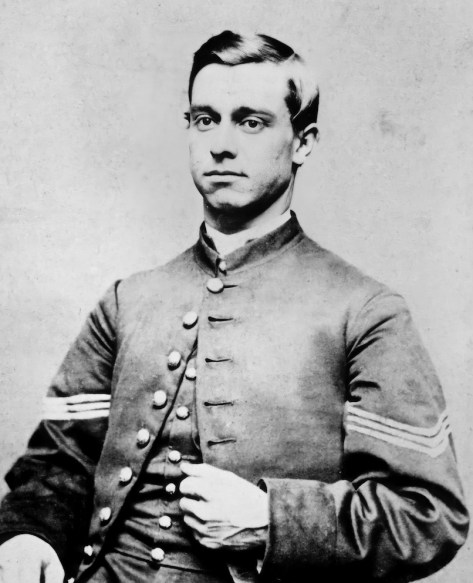
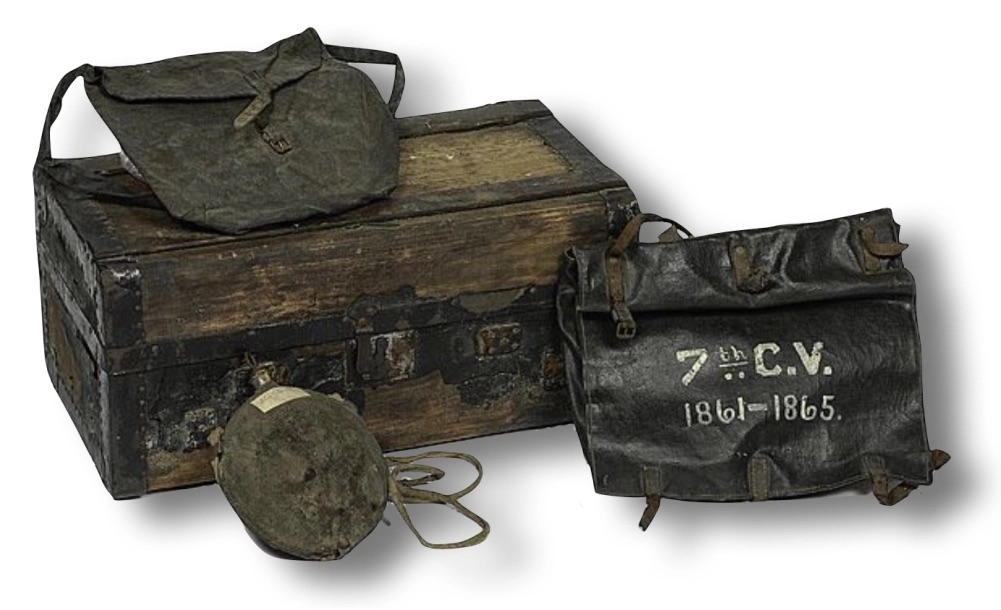
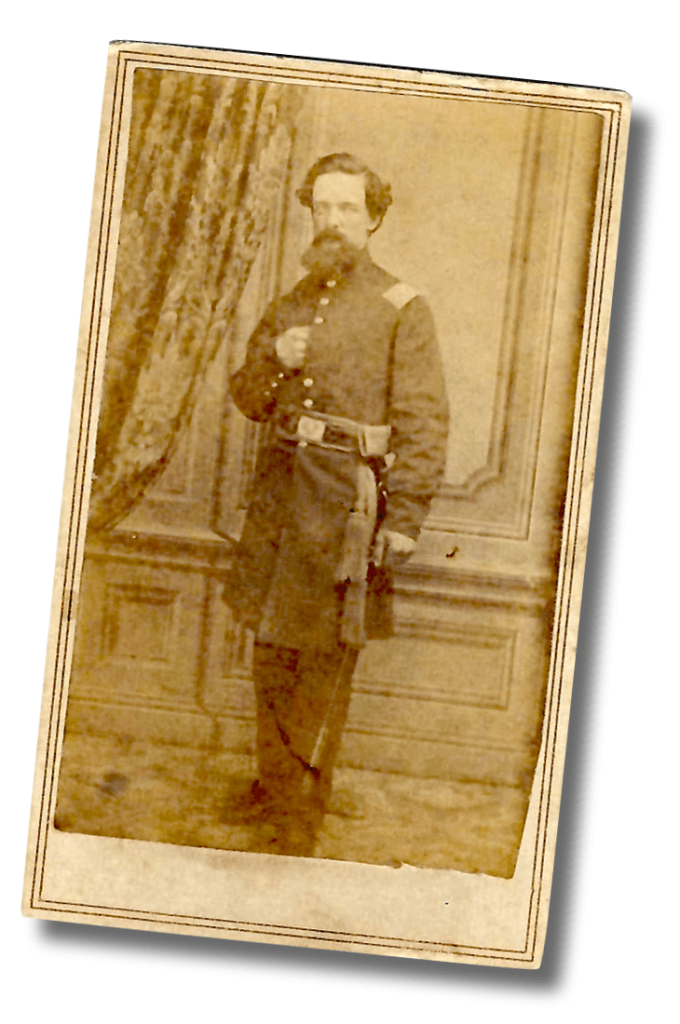
I could not find an image of Charles but here is a watercolor of Pvt. John H. Bario of Co. C, 7th Connecticut Infantry
Charles L. Hewitt (1844-Aft1919) enlisted in the Union Army on 27 August 1861, was mustered on 7 September 1861 into Co. E, 7th Connecticut Infantry Regiment, and was mustered out on 12 September 1864. Charles was the son of John and Eliza (Platt) Hewitt of West Winsted, Litchfield County, Connecticut.
The University of North Carolina at Chapel Hill contains a collection of 31 letters written by Charles L. Hewitt to his parents and siblings and a notebook in which Hewitt recorded the fates of nearly 120 of his fellow soldiers, including those who were wounded, killed in action, promoted, or deserted along with the dates and locations of these occurrances. Hewitt’s letters, written onboard a gunboat and from various locations in Georgia, South Carolina, and Virginia, document army life; his evaluations and speculations; his time drilling, serving in a boat infantry, and picketing; descriptions of his surroundings; family and social news; and descriptions of fighting.
The University of South Carolina’s Manuscript Divisions has six of Charles L. Hewitt’s letters written between January 1862 and November 1863.
After mustering out of the service, Hewitt returned to Connecticut where he worked as a carpenter and farm laborer, raising two children with his first wife, Jennie, whom he married about 1868, and two more children with his second wife, Charlotte Lawrence Sage, whom he married in 1879.
Letter 1
Addressed to Mr. John Hewitt, West Winsted, Conn.
Jones Island Fort Vulcan March 11, 1862
Dear Parents,
I received your letter of the 16th of February and was very glad to hear from you and that you was all well. How is Uncle Charles’ folks getting on? I have not had a letter from there in two months. They have not answered my letter yet. I received the combs, thread and buttons and vest. I mentioned it when I wrote my last letter. The Rowly boys have not got their box yet. You needn’t send me any more combs at present for I have plenty now. Sterling Milliman had a letter stating that Jake had got home. When you write, please write and tell me if he brought that box that I sent by him. I paid him for carrying it.
We are not afraid of the rebels now. I came on guard to the battery on the Savannah River today. She mounts 9 guns: two 30-pound rifle cannon about 12 feet long with 3 or 4 smaller ones, one 24 Howitzer and one Columbiad, one which carries a shot 11 inches through, besides which we have got a battery right opposite across the river of 6 rifle cannon [and] two gunboats to support them—the Western World and E. B. Hale. 1 Our men took two secesh this morning. Savannah isn’t taken yet. There is no land cultivated in this part of the country. We have not time for that for green peas I have not seen some yet since I left home.
As for the Darkies we keep them mostly for oarsmen. They make the best oarsmen in the world. They will row from morning until night without stopping. Rowing is their delight. Gen. [Egbert Ludovicus] Viele has got six of them to man his boat. He has got them red shirts and blue caps and they feel big, you can bet.
I received the paper that you sent me at the same time that I received the letter. You can tell Duck that I got her letter and wrote her another one. I get the letters directed either way but the best way is to direct to Port Royal, S. C., and tell her to let Frank have 50 cents of she wants to borrow it again and I will pay her. I shall be much obliged for the beef. As for the pickles, I rather think I can make way with them. I have not tasted of one since I left home—only as one of the sailors on board the Western World gave me part of one the other day. It was a luxury you can bet.
Our boys think they have a hard time here standing guard in the mud. The mud is about like it is at home in the spring when the frost begins to come out of the ground, only there ain’t no bottom to it. But the 48th New York have it worse than we do. They have to make the battery of it and get it all covered with mud from head to foot.
My paper is getting scarce and I must stop by sending my love to all. — Charles L. Hewitt
1 On 14 February 1862, Western World and E. B. Hale drove off four Confederate vessels which attempted to break the Union blockade of the Mud and Wright’s Rivers, tributaries of the Savannah. This restricted Confederate activity upon the Savannah River and protected the newly installed Federal battery at Venus Point. After remaining off the Savannah through May, Western World returned to Port Royal on 2 June. [Source: Western World (Screw Steamer)]
Letter 2
Charles wrote this first letter to Samuel Lloyd Andrews (1811-1882) of Winsted, Litchfield county, Connecticut. Samuel was a 50 year-old master carpenter in Winsted who had previously employed and boarded Charles with his family. Samuel’s son, George L. Andrews (1840-1907) married Sarah Jane (“Jennie”) Fenton (1842-1908) before the Civil War; he enlisted in 1862 as the Orderly Sergeant of Co. F, 28th Connecticut Infantry (having previously served in Co. F, 2nd Connecticut).
Charles tells Samuel that the regiment has just returned from an expedition that attempted to destroy a part of the Charleston and Savannah Railroad near Pocotaligo led by General Terry. Two days after this letter, the regiment left Hilton Head for Beaufort.
Hilton Head [South Carolina] October 29, 1862
Dear Friend,
I received your letter and should have answered it before but we had to go off on our expedition and when we got back, we were pretty much tired out. I hope you will excuse me this time and I will try and answer your next letter sooner. I sent you a paper the other day that is printed here with an account of our last fight in this part of the country. I sent you $5 through our folks. I sent it to them because I could send it all together. They will hand it to you and I will see that you get the rest before long.
Heard that George had gone out as Orderly Sergeant. Is that so? Wheelock [T. Batcheller] has been promoted to Lieut. Col. [of the 28th]?
If we get reinforcements down here, you will hear some good news from this quarter before long for we have got a man at the head of the department that means [to] fight—Gen. O. M. Mitchel. We cannot muster more than 5 or 6 thousand men to start off with here now but he has started us twice already—once to Florida and once for the railroad between Savannah and Charleston.
George—or “Lengthy” as we call him here—is well and getting along first rate. He says he will write to you before long. He sends his best respects and so does Jim.
We do not have much to do now for a few days back. We are resting from our labors in the last fight. We get soft bread every day and fresh meat every few days. We are living pretty well now.
How does Jennie get along without her George? Give her my best respects and tell Mother Andrews that [even] with all our fresh meat and soft bread, I had rather board with her. I hope this war will close before long for I, for one, am sick of it. Give my best respects to all the folks and save a good share for you and Mother Andrews.
Write soon and I will try to answer quicker next time. — Charles L. Hewitt
Letter 3
Addressed to Mr. John Hewitt, West Winsted, Connecticut
Bermuda Hundred, Virginia August 7th 1864
Dear Parents,
I received your letter of July 31st and was very glad to hear from you that you was well as this leaves me at present. I received the box the day before I received the letter. The things came all right except Jim’s and Sterling’s ¹ cheese that was moldy but mine come pretty good. It was moldy a little on the outside. Some of the lemons came all right and some were rotten. Sterling’s rusk were all spoilt. The rest of them were all right except the medicine which did not come at all.
We have some very hot weather with very little rain. We are not having duty quite so hard just at present. We have to go on picket once in 4 days and fatigue once in awhile.
New potatoes are 8 cts. a lb. That is $4.80 acts. a bushel at the sutlers. Tobacco $1.50 a lb. Milk 70 cts. a can, butter 60. Apples as big as walnuts a cent apiece. So you see we feel the high prices here as well as there. We are not troubled with buying much for we have not seen the pay master yet. We get orders on the sutler though — two dollars a month — which won’t much more than get a good meal. I think I shall have to stop chewing tobacco. It cost most too much.
I saw Jonas Leroy ² the night before the fight at Drury’s Bluff. Give him my best respects if you see him again. I hope to dinner within 5 weeks from today — just one month more to serve Uncle Sam in and then I shall bid him good day and tell him I want to settle with him.
There is no news here at present. There was very heavy firing at Petersburg the other night but I have not heard how it turned out. ³ There are rumors afloat that the rebels blowed up one of our batteries and made a charge but Gen. Grant found out that they were mining and built another battery in the rear of the one they were mining and removed everything out of it and when they charged they did more than give it to them. I don’t know how true it is though.
Give my respects to all enquiring friends. The boys all send their best respects. My love to you and mother and all the rest. Write soon. You won’t have many more to write.
From your son, — Charles L. Hewitt
¹ Corporal Sterling D. Milliman served in Company E, 7th Connecticut, with Charles.
² Jonas Leroy (1843-1921) was from West Winsted, Litchfield County, Connecticut. He served in Company G, 117th New York Infantry. Prior to that he served in Co. A, 1st New York Infantry.
³ Charles is no doubt referring to the Battle of the Crater which took place in the early morning hours of July 30, 1864.
George Washington Cone, Co. B, 7th Connecticut Infantry
This letter was written by George Washington Cone, Jr. (1840-1911), the son of George W. Cone (1806-1882) and Nancy A. Cone (1812-1852) of Utica, Oneida county, New York. George may have been working in Connecticut at the time the Civil War began because he first enlisted in the Co. B of the 1st Connecticut Infantry (3 months) and then reenlisted in Co. B, 7th Connecticut Infantry, entering as a corporal and mustering out as a sergeant.
After the war, in 1866, he married Helen Augusta Louisa Cole (1846-1925) and worked as a carpenter in Herkimer, New York, for a time and then relocated to Springfield, Missouri. He died in 1911 and was buried in Fordland, Webster county, Missouri.
George wrote the letter to Jennie Bradt (1844-1915) who married in December 1863 to Delos Curran Dempster (1840-1924 at Herkimer.
T R A N S C R I P T I O N
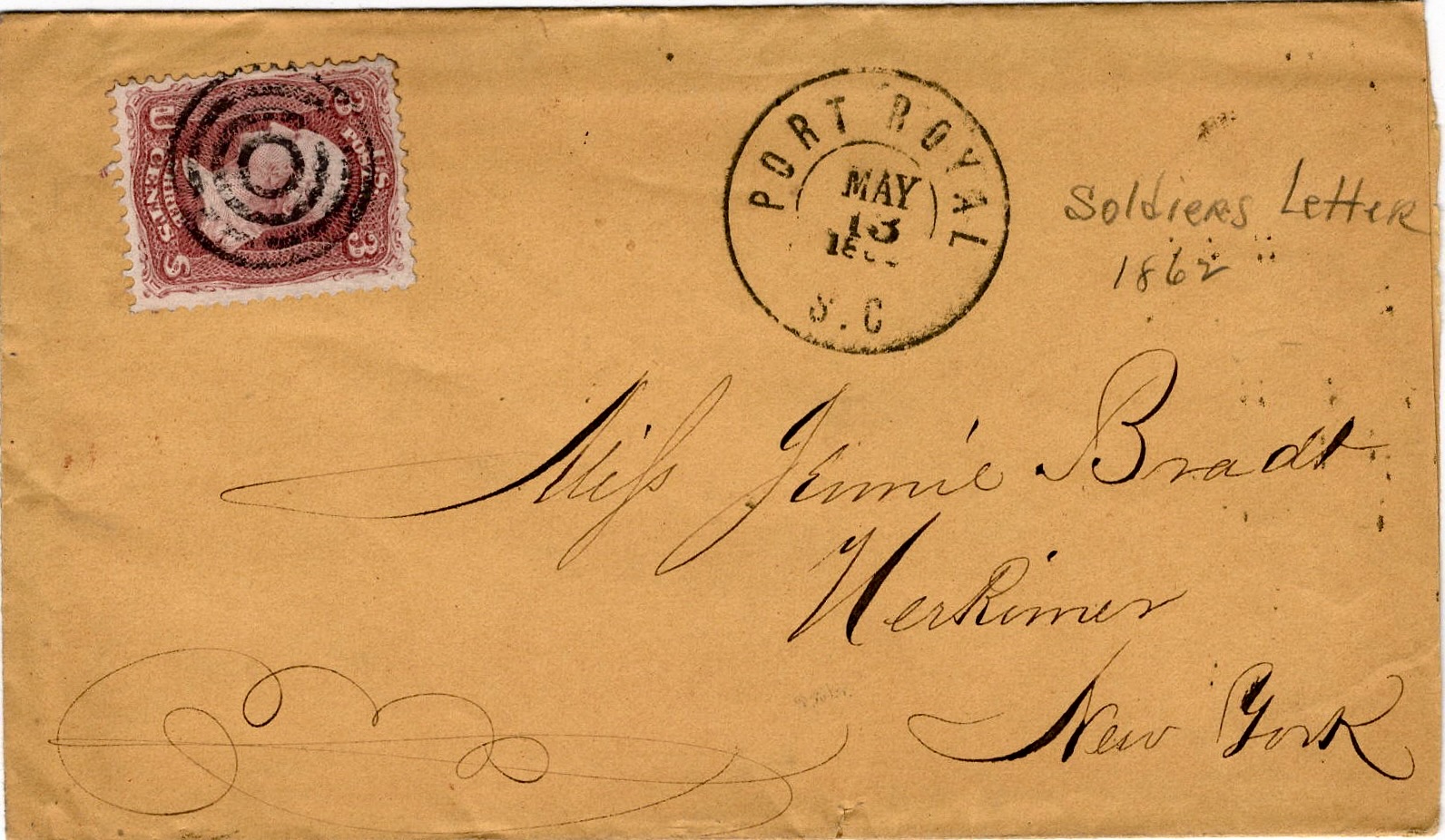
Addressed to Miss Jennie Bradt, Herkimer, New York
Fort Pulaski May 11, 1862
Friend Jennie,
I now take this opportunity to answer your letter of May the 5th. I received it this evening and was very glad to hear from you once more but was very sorry to hear that your Father is unwell. This is a very lonely evening and I am on guard so I will write tonight when I have time.
A few days after we came into the fort, some of the 3rd Rhode Island Artillery men were working among some shells that had not exploded when one of them burst and killed four of them instantly. It seemed hard after passing through a battle without getting a scratch to get killed so suddenly.
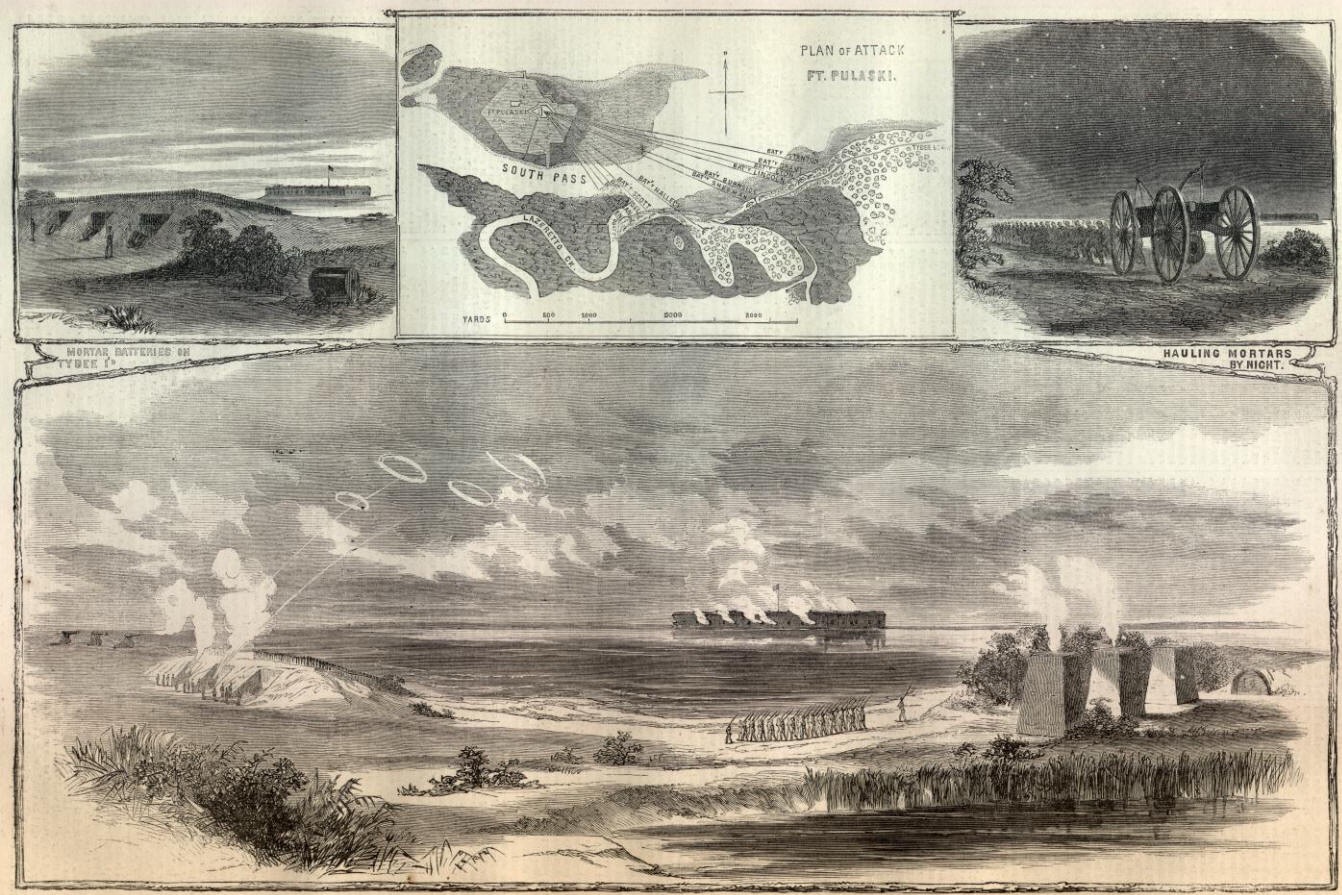
We have got a balloon here now to reconnoiter Savannah City. 1 It went up with a couple of Gents and Ladies the other day. The Ladies make frequent visits to the fort. There is one or more visits us nearly every day. The fact is, before we had stopped firing 15 minutes, some Ladies came down to our Battery. They must have run in order to get there so quick. We have got the fort fixed up pretty well now. The masons are repairing the breaches that we made in the fort. I saw a picture in Harper’s Weekly that was intended to represent the fort but it don’t look a bit like the original. One of our steamboats went up to Savannah with a flag of truce the other day.
Drawings of Fort Pulaski appearing in the 3 May 1862 issue of Harpers weekly
The weather is very fine here now and our men are enjoying good health with the exception of a [few] cases. You spoke about the letter that I sent to Charles. There was nothing of great importance in the letter so it won’t make any difference for I will write another letter. I am glad that Charley has got a good wife.
You want to know where we are going, I suppose. Our regiment is quartered in the fort at present but whether we are going to garrison the fort all summer, I am not able to say. We expect to help take Fort Sumter before long but it is only a report and it will go with all camp stories. But I think that we shall stop here some time yet. My health has been quite good since I have been here. I had rather fight one or two more battles before I come back but I can’t have any choice.
I have not any news to write at present so you must excuse me this time. Please give my best respects to all of your friends. When you write, please tell me all the news. I remain your sincere friend, — Corp. G. W. Cone
P. S. Direct to Co. B, 7th Regiment Connecticut Volunteers, Port Royal, South Carolina
1 There is no record of balloon observations made in the vicinity of Savannah until after the fall of Fort Pulaski. Sometime in May 1862, aeronautics John Starkweather observed Confederate positions around Savannah.
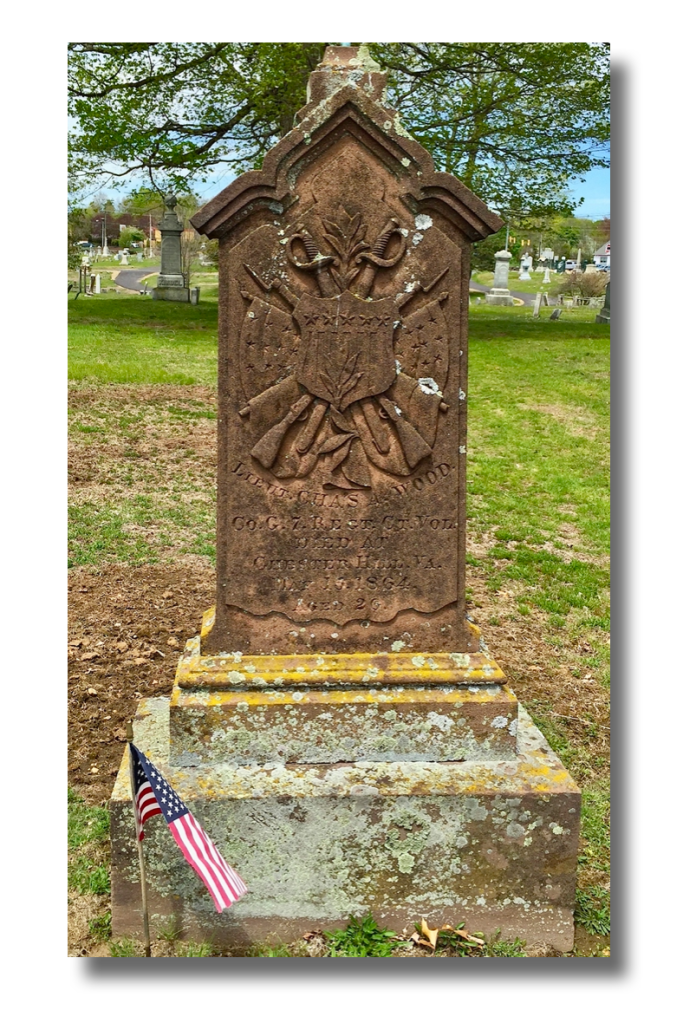
The following letters were written by Charles A. Wood (1838-1864) who was born in Poughkeepsie, New York and later moved to Willimantic, Connecticut, where he worked as a clerk before the Civil War. He mustered into Co. H of the 7th Connecticut Volunteers on 5 September 1861 as a first sergeant. He was promoted to second lieutenant in March 1863. On 28 May 1863, during a furlough in May 1863, he was married to his sweetheart, Maria Dean—the recipient of these letters. He was promoted to first lieutenant of Co. G in early May 1864, but died shortly after on 15 May 1864 from wounds received at the Battle of Drewey’s Bluff the previous day.
The letters, written days apart, contain descriptions of the brief (45 minute), but important, Battle of Successionville on 16 June 1862. Charles provides yet another account of the ill-advised attack on the Tower Battery, later named Fort Lamar, constructed by the Confederates on James Island. Ironically, in the following letters, Charles makes it clear to his sweetheart that he would rather die than be a cripple. He would eventually get his wish. On 14 May 1864, during the Battle of Drewry’s Bluff, Wood was mortally wounded when a shell severed his left leg. An amputation was performed but proved to be in vain, and he died from shock the following day.
Two days after the battle at Drewry’s Bluff, Charles’ captain, John B. Dennis, wrote to Maria the sad news of her husband’s death: “It is with feelings of pain that I am compelled to write you that sad news of your husband’s fate at the battle of Chester Hill[Drewey’s Bluff]. While nobly doing his duty, he was mortally wounded by a shell from the enemy, it severing his left leg entirely, but we thought that he would come out all right. But the constant fatigue & exposure which he had undergone…had so weakened him that he could not stand the shock. His leg was amputated and he died the next morning the 15th of May. You will mourn him as your lost husband and we all mourn him as brave officer and good comrade…. P.S. Perhaps you did not know that he was just promoted to a 1st Lieut. Which was the case.”
[Note: These letters are from the personal archive of Richard Weiner and were transcribed and published on Spared & Shared by express consent.]
Union troops charge on Rebel grape & canister at the Battle of Secessionville, 16 June 1862
Letter 1
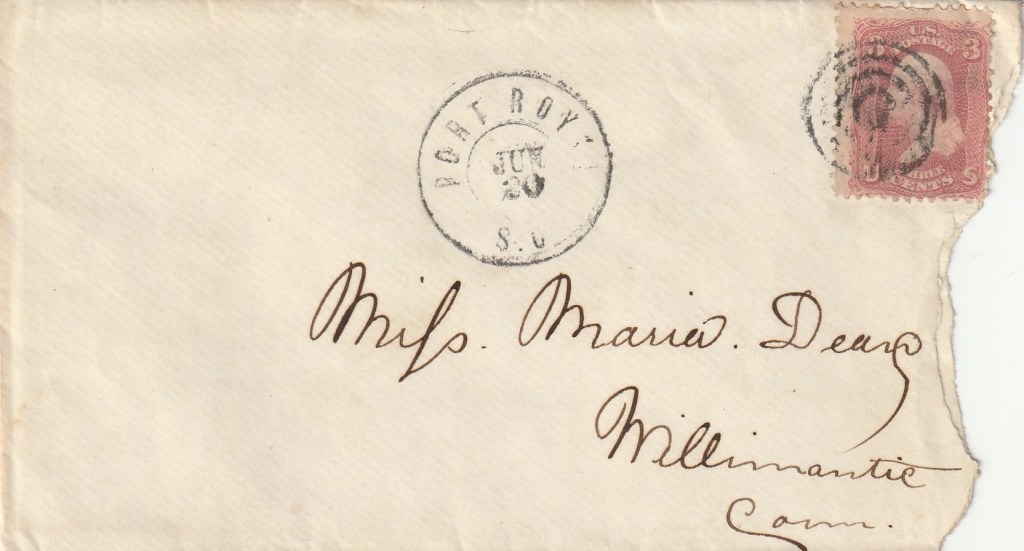
Addressed to Miss Maria Dean, Willimantic, Conn.
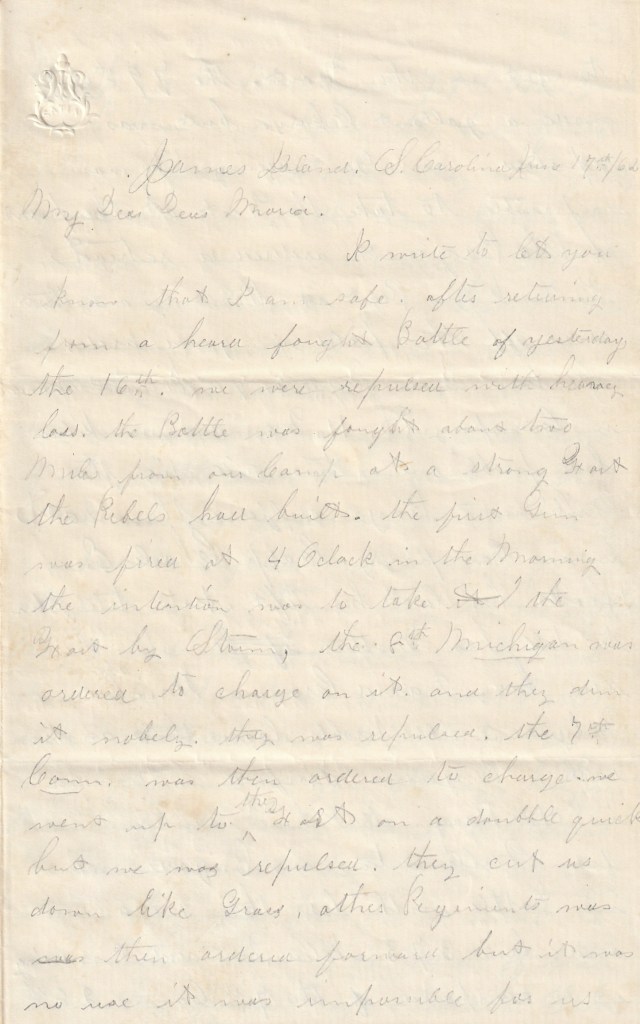
James Island, South Carolina June 17th 1862
My dear, dear Maria,
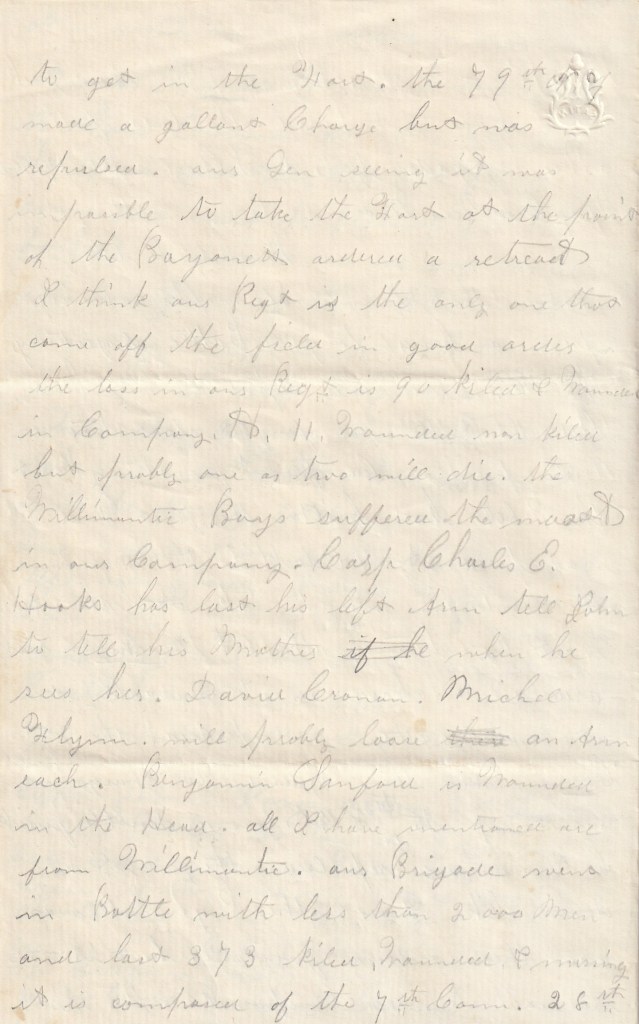
I write to let you know that I am safe after returning from a hard fought battle of yesterday the 16th. We were repulsed with heavy loss. The battle was fought about two miles from our camp at a strong fort 1 the Rebels had built. The first gun was fired at 4 o’clock in the morning. The intention was to take the fort by storming. The 8th Michigan was ordered to charge on it and they done it nobly [but] they was repulsed. 2 The 7th Connecticut was then ordered to charge and went up to the fort on a double quick but we was repulsed. They cut us down like grass. Other regiments was then ordered forward but it was no use. It was impossible for us to get in the fort.
The 79th New York made a gallant charge but was repulsed. Our general, seeing it was impossible to take the fort at the point of the bayonet, ordered at retreat. I think our regiment is the only one that came off the field in good order. The loss in our regiment is 90 killed & wounded, in Company H, 11 wounded, none killed, but probably one or two will die. The Willimantic Boys suffered the most in our company. Corp. Charles E. Hooks has lost his left arm. Tell John to tell his Mother when he sees her. David Cronan, Michael Flynn will probably lose an arm each. Benjamin Sanford is wounded in the head. All I have mentioned are from Willimantic. Our Brigade went in battle with less than 2,000 men and lost 373 killed, wounded, and missing. It is composed of the 7th Conn., 28th Mass., 8th Michigan, 79th New York. I have not heard the loss of the other Brigades yet but they will probably equal our own. 3 The [1st] Connecticut Battery [under Capt. Alfred P. Rockwell] done very good service. We helped them to work their guns.
Dear Maria, it is impossible to give a correct account of the battle now. I will in a day or two. I knew you would hear of the battle and be anxious to know if I was dead or alive. Thank God I escaped uninjured while others fell all around me. I am sorry we are defeated. I feel very bad about it but we done all the men could do. I cried when the order came to retreat. I wanted to go forward and gain the day. How I ever came off the field alive in a miracle. The bullets whistled by my ears like hail stones. They never fired on us until we got within about 300 yards of them. Then they poured grape & canister shot at us until we were obliged to fall back. 4 It was murder to march men up to these cannons as we were but the men went. They did not flinch.
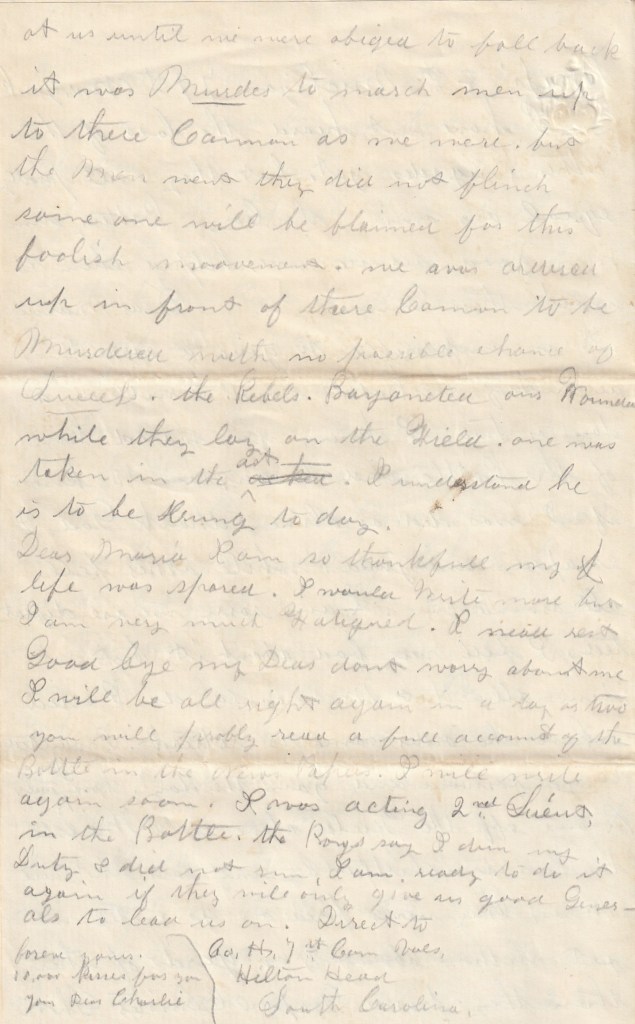
Someone will be blamed for this foolish movement. 5 We were ordered up in front of their cannon to be murdered with no possible chance of success. The Rebels bayoneted our wounded while they lay on the field. One was taken [prisoner] in the act. I understand he is to be hung today.
Dear Maria, I am so thankful my life was spared. I would write more but I am very much fatigued. I need rest. Goodbye, my dear. Don’t worry about me. I will be all right again in a day or two. You will probably read a full account of the battle in the newspapers. I will write again soon. I was acting 2nd Lieutenant in the battle. The boys say I done my duty. I did not run. I am ready to do it again if they will only give us good generals to lead us on.
Direct to Co. H, 7th Conn. Vols., Hilton Head, South Carolina
Forever yours. 10,000 kisses for you. — Your dear Charlie
1 The earthen fort constructed by the Rebels at Secessionville was built in the rough shape of an “M” bordered on each side by marsh. There were nine cannon mounted in the fort consisting of an 8-inch Columbiad in the center, flanked on either side with a 24-pounder rifled gun, 1 24-pound smoothbore, and an 18-pounder. Two additional 24-pounder rifled guns were mounted on his northern flank. The fort was so situated that any opposing force advancing on it had to compress its attacking lines or get bogged down in the marshy mud. [American Battlefield Trust]
2 Capt. George Profit of Co. K, 8th Michigan Infantry survived that battle and wrote his father later the same day: “The news of today has been solemnized by the precious lives of hundreds of brave men, and the hand of the just historian will have just cause to tremble as it records the history of the Battle of James Island that is so indelibly written in the sacred blood of our brothers and sisters. In my tears of sorrow, I can but rejoice and bless God that I yet remain to tell the tale of woe. While I write, my eyes are filled with the cries and moans of men in agonizing pain. May a peaceful future reward these, their days of sorrow.” To read the entire letter, see The Sorrows of an ill-spent Day: A Wolverine at Secessionville, Dan Masters’ Civil War Chronicles, 28 Feb. 2021.
After Harvey Martin of the 7th New Hampshire had an opportunity to speak to some of his friends from the 3rd New Hampshire who had taken part in the attack on Tower Battery, he wrote his uncle that they reported it “a very hard battle and the Rebels were superior by a large force. They stated that they [the Rebels] had three batteries. When drove from one, they had a road prepared under ground so they could retreat back to the next battery without being seen so they had all the advantage of our troops. They state there was about one thousand of our men killed and wounded. Now they have ordered our troops off of the island and they are mounting their gun boats and are going to shell them out. They say that the island is so surrounded by gunboats that they cannot get off of the island without being blown up and I wish that none come out alive. ” [See 1862: Harvey H. Martin to Samuel Osborne on Spared & Shared 7]
3 Among the other regiments ordered into the fight at Secessionville were the Roundheads of the 100th Pennsylvania Volunteers. In his diary entries for 16-19 June 1862, Christopher C. Lobingier, a member of Co. A, wrote:
Monday, June 16, 1862—Weather very cloudy. Appearance of rain. Early in the morning the pickets were called in and ordered to join the regiment which had passed before daylight to make an attack. I started to follow after and join the regiment but was unsuccessful. Several had tried before me and could not get in it during the fight. The fight soon commenced. Our men made several bayonet charges. They drove the enemy once, I think, from their rifle pits and tried several times to drive him from the fort [Tower Battery] at the point of the bayonet but was unsuccessful every attempt. Our loss and slaughter was terrible. Our men were cut down like grass before the scythe. Retreated in good order.
Tuesday, June 17, 1862—Weather very cloudy, cold, wet and disagreeable. I never saw more disagreeable and wet weather. Very cold for the climate. It reminded me of our cold March or April rains at home. We were obliged to crawl in our narrow tents and remain there all day with scarcely room to turn. The Michigan 8th lost the most in the late battle. They were all cut to pieces. Highlanders loss was very heavy. It is thought the Roundheads lost less than any regiment engaged. One member of Co. A was shot through the hand. One of the Highlanders and one Roundhead was buried today. Both died of their wounds.
Wednesday, June 18, 1862—Weather very cloudy in the morning but ere long the clouds disappeared and then was quite a change from yesterday. The sun shone forth and the day was pleasant and we were so fortunate as to get our clothes dry. I started early in the morning in search of a haversack. Went some two or three hundred yards the other side of where we had the skirmish. I found an old one lying by one of the houses where we were stationed when skirmishing. Generals [Henry] Benham and [Isaac I.] Stevens were out viewing things. Benham said he would not attempt again to take the forts at the point of the bayonet but would hold our position.
Thursday, June 19, 1862—Weather cloudy but a fine sea breeze blew all day and therefore the weather was very pleasant. Just before sun setting we had a very heavy shower of rain but it continued but a short time. I was idle all day—nothing to do. Everything quiet. No firing or shelling since the battle. The Secesh prisoners and our wounded soldiers were taken to Hilton Head. The big gun carriages were taken up today. A flag of truce was taken yesterday to the enemy. They said our dead were buried and the wounded (45) taken to Charleston. They sent a flag and visited to exchange prisoners. It was rumored through camp that Richmond had not fallen yet but on the 13th, our army had it surrounded within 3 miles.” [The 1862 Civil War Diary of Christopher Columbus Lobingier, Co. A, 100th Pennsylvania Roundheads]
Another “Roundhead” named Edward R. Miles of Co. E, 100th Pennsylvania Vols., did not mince words when he wrote his father on 24 June 1862 that, “We are planting siege guns to shell them out of the forts. I don’t know when we will make another attack on them. I don’t want it to be another slaughter like the last one was. Our General made a perfect botch of it that day. It was General Benham. He is under arrest for it now. Old General Hunter ordered him to Hilton Head & arrested him for running the infantry up on the fort when he knowed they couldn’t take it with infantry. We lost 1,000 men out of two brigades in two hours fighting. General Stevens said it was hotter fire than Bull Run was. I never saw such a time [as] it was and there didn’t a man run off the field. When we retreated, we walked off as cool as if we was going up to breakfast & not a bit of dodging about it.” He then spoke of the death of his friend Jimmy Parker. “I haven’t [heard] anything about him since the fight. I miss him as much as I would a brother. We have drilled together for a year now. He was as good [a] soldier as ever was. When we was going out that morning to fight, he was as merry as anybody & said we didn’t know who would come back again. We double quicked a mile & a half up to the fort right in front of six cannons & I don’t know how many infantry & they let loose on us with grape shot & canister & log chains & bottles & pikes, nails, & everything they could get into the cannons. It just mowed our men down like a shot gun would a flock of pigeons. Jimmy Parker’s leg was shot off with a grape shot by the thigh & he was left on the field when we had to retreat [where] the Rebels would get him. Some of the boys saw him when we was on the retreat & he was almost dead. He shook hands with them & told them to shift for themselves to keep the Rebels from getting them. There was 4 of our company killed & 9 wounded but some of them was very slightly hurt.” [See 1862: Edward Riddle Miles to William Miles on Spared & Shared 19.]
One of the boys of the 8th Michigan killed in the Battle of Secessionville on 16 June 1862 was Leroy M. Dodge of Co. B. His body was never recovered from the battlefield and he was probably one of the Union soldiers buried in a mass grave by the Confederates. See 1861: Leroy M. Dodge to Samuel Green.
4 Most reports state that the attacking Union lines were within two hundred yards of the fort when Col. Lamar ordered the Columbia to fire. It blasted “grapeshot, nails, iron chain and glass directly at the Union center, tearing a great hole through the Federal lines.” [Battle of Secessionville, American Battlefield Trust]
A letter by Edward B. Sage of Co. E, 7th Connecticut published on Spared & Shared 18 claimed that the rebels “use most anything to fill up their cannon—scraps of iron and bottles—anything to pull death. The air in front of the battery was filled with everything to cut and slay.” [see 1862: Edward B. Sage to Calvin Sage]
5 Maj. General David Hunter relieved Brig. Gen. Henry Benham of his command for disobedience after the battle, citing the 10 June directive forbidding an attack on Charleston or Fort Johnson, and placed under arrest. On 27 June, Hunter ordered the abandonment of James Island and by 7 July, all Union forces were gone. A Judge Advocate General of the US Army later decided that Benham’s attack was justified and not prohibited by the directive but Benham would never be given a field command again. He maintained that the battle was a “reconnaissance in force.”
Letter 2
Addressed to Miss Marie Dean, Willimantic, Conn.
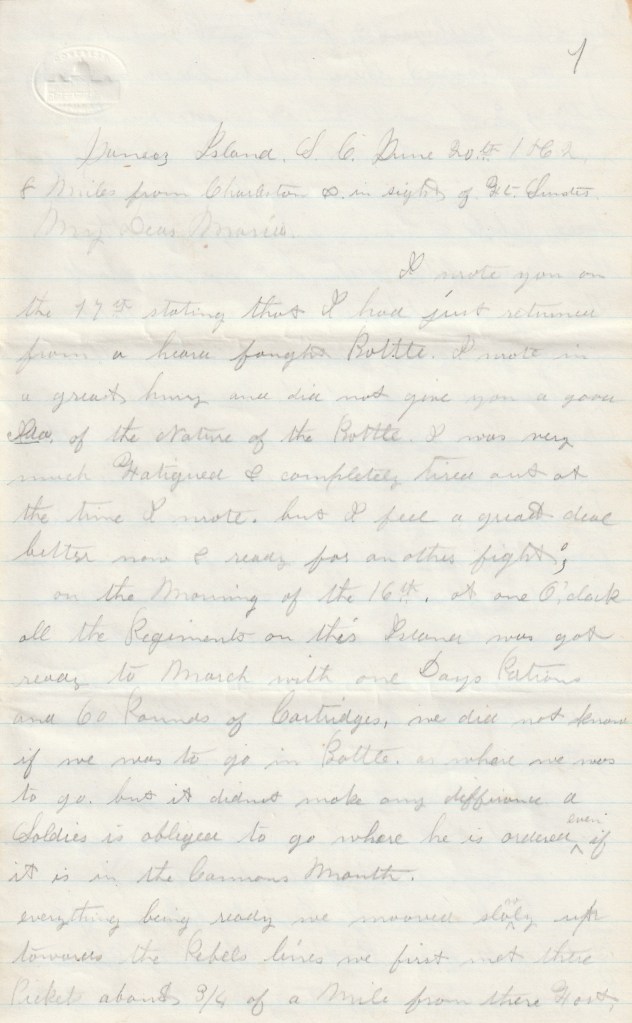
James Island, South Carolina June 20th 1862 8 miles from Charleston & in sight of Fort Sumter
My Dear Maria,
I wrote you on the 17th stating that I had just returned from a hard fought battle. I wrote in a great hurry and did not give you a good idea of the nature of the battle. I was very much fatigued & completely tired out at the time I wrote but I feel a great deal better now & ready for another fight.
On the morning of the 16th at one o’clock, all the regiments on this island was got ready to march with one day’s rations and 60 rounds of cartridges. We did not know if we was to go in battle or where we was to go but it didn’t make any difference. A soldier is obliged to go where he is ordered even if it is in the cannon’s mouth.
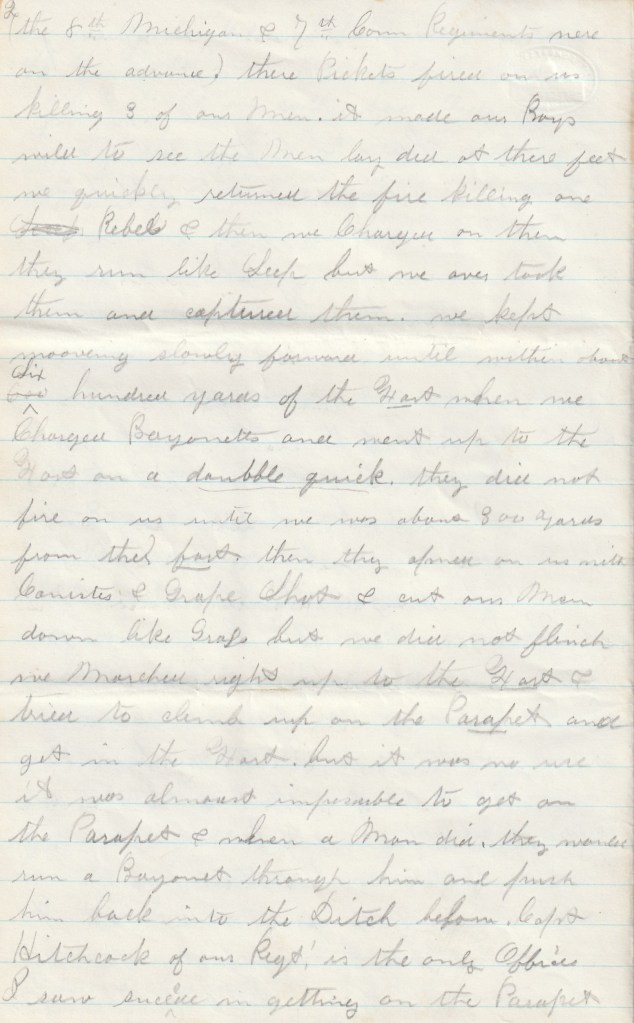
Everything being ready, we moved slowly up towards the Rebels lines. We first met their pickets about three-quarters of a mile from their fort, (the 8th Michigan & 7th Connecticut Regiments were on the advance). Their pickets fired on us, killing three of our men. It made our boys wild to see the men lay dead at their feet. We quickly returned the fire, killing one Rebel and then we charged on them. They run like sheep but we overtook them and captured them.
We kept moving slowly forward until within about six hundred yards of the fort when we charged bayonets and went up to the fort on a double quick. They did not fire on us until we was about 300 yards from the fort. Then they opened on us with canister & grapeshot & cut our men down like grass. But we did not flinch. We marched right up to the fort & tried to climb up on the parapet and get in the fort but it was no use. It was almost impossible to get on the parapet. And when a man did, they would run a bayonet through him and push him back into the ditch below.
Capt. John B. Dennis, Co. H, 7th Conn. Vols. —“I never saw him but once on the battlefield during the fight and that was when the first gun was fired.”
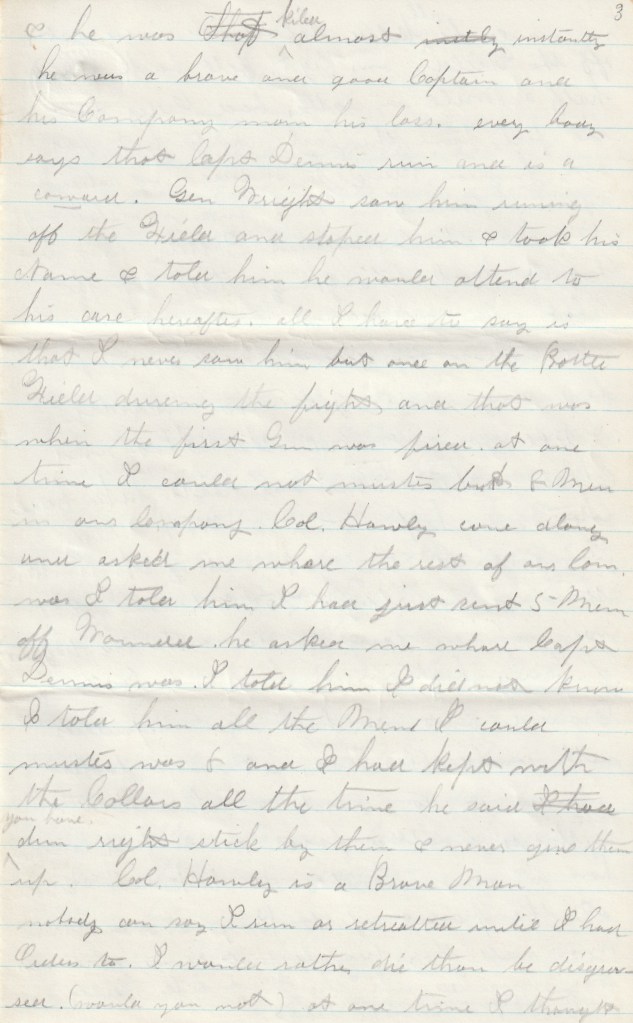
Capt. [Edwin S.] Hitchcock [Co. G] of our regiment is the only officer I saw succeed in getting on the parapet & he was killed almost instantly. He was a brave and good captain and his company mourn his loss. Everybody says that Capt. [John B.] Dennis run and is a coward. Gen. Wright saw him running off the field and stopped him & took his name and told him he would attend to his care hereafter. All I have to say is that I never saw him but once on the battlefield during the fight and that was when the first gun was fired.
At one time I could not muster but 8 men in our company. Col. [Joseph Roswell] Hawley come along and asked me where the rest of our company was. I told him I had just sent 5 men off wounded. He asked me where Capt. Dennis was. I told him I did not know. I told him all the men I could muster was 8 and I had kept with the colors all the time. He said you have done right, stick by them and never give them up. Col. Hawley is a brave man. Nobody can say I run or retreated until I had orders to. I would rather die than be disgraced (would you not).
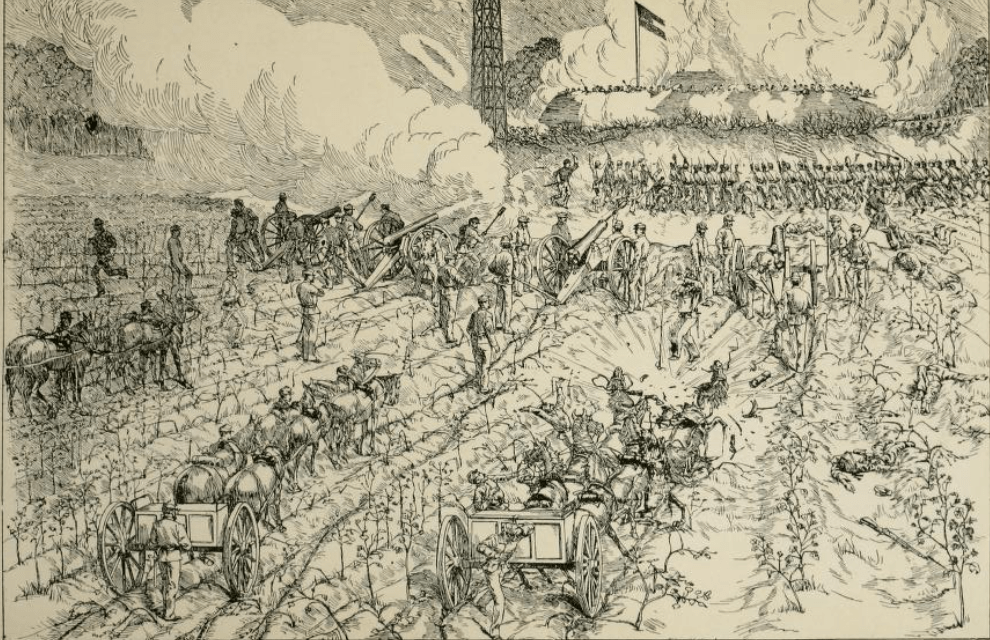
An artist’s rendering of the Battle of Secessionville appearing in the Regimental History of the Seventh Connecticut by Stephen W. Walkley (1905). Rockwell’s 1st Connecticut Battery of 4 guns may be the battery in the foreground, set up in a cotton field.
At one time I thought we would all be killed before we could get off the field. Our regiment fell back about half a mile in rather bad order but the fire from the fort was too hot for any human beings to endure. We rallied again & formed in line and marched up to cover the [1st] Connecticut Battery that was hot at work throwing shells at the Rebels. We was ordered to lay down and not expose ourselves to the enemy’s fire anymore than was necessary. I tell you, Maria, the shot and shell whizzed over our heads like hail stones. We helped them to work their guns until they got out of ammunition, then we were obliged to withdraw which we was very sorry to do with the disgrace of being beaten. We have not lost ground, but we have been repulsed with considerable loss.
“Our men done well. They done all that men could do. They marched up to the fort like heroes and was shot down like dogs.”
–Sgt. Charles A. Wood, Co. H, 7th Connecticut Vols., 20 June 1862
It was a foolish movement to march on their batteries with so small a force as we had anyhow. It is impossible to take the fort at the point of the bayonet. Our men done well. They done all that men could do. They marched up to the fort like heroes and was shot down like dogs.
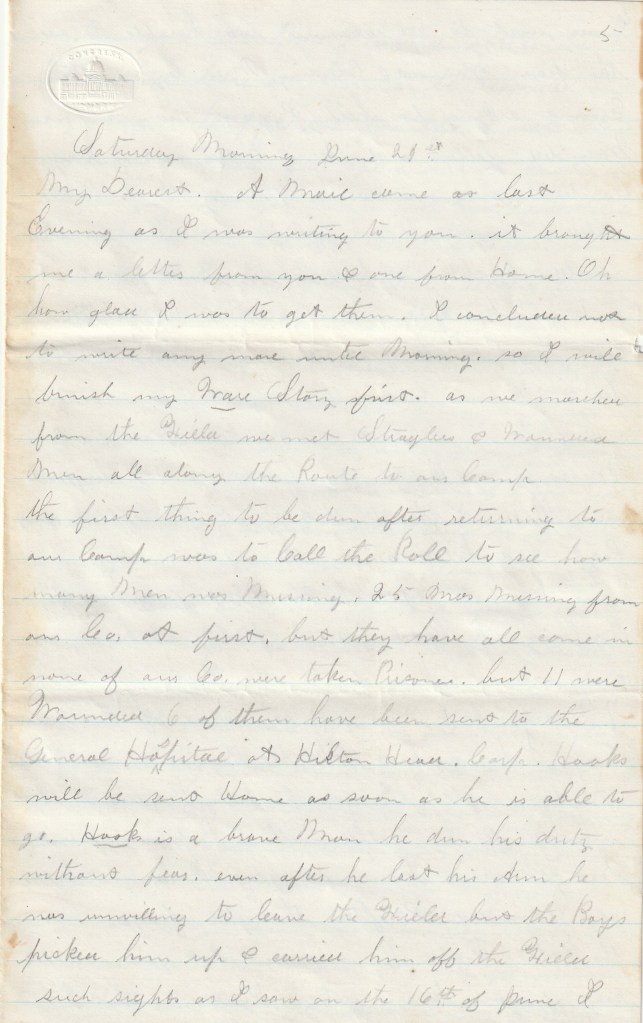
Saturday morning, June 21st. My dearest, a mail came in last evening as I was writing to you. It brought me a letter from you & one from home. Oh how glad I was to get them. I concluded not to write any more until morning so I will finish my war story first.
As we marched from the field, we met stragglers & wounded men all along the route to our camp. The first thing to be done after returning to our camp was to call the roll to see how many men was missing. Twenty-five was missing from our company at first but they have all come in. None of of our company were taken prisoners but 11 were wounded. Six of them have been sent to the General Hospital at Hilton Head.
Corp. Charles E. Hooks, Co. H, 7th Conn. Vols. following his discharge—“A brave man. He done his duty without fear even after he lost his arm.”
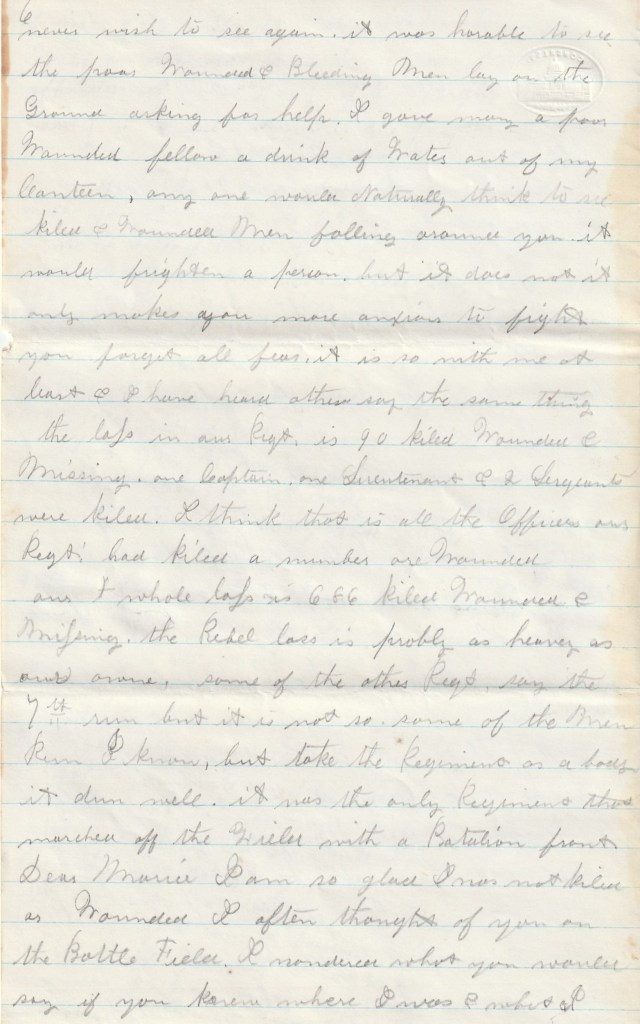
Corporal [Charles E.] Hooks will be sent home as soon as he is able to go. Hooks is a brave man. He done his duty without fear even after he lost his [left] arm. He was unwilling to leave the field but the boys picked him up and carried him off the field. Such sights as I saw on the 16th of June, I never wish to see again. It was horrible to see the poor wounded & bleeding men lay on the ground asking for help. I gave many a poor wounded fellow a drink of water out of my canteen. Anyone would naturally think to see killed & wounded men falling around you it would frighten a person, but it does not. It only makes you more anxious to fight. You forget all fear. It is so with me at least & I have heard others say the same thing.
The loss in our regiment is 90 killed, wounded and missing. The Rebel loss is probably as heavy as our own. Some of the other regiments say the 7th run but it is not so. Some of the men run, I know, but take the regiment as a body, it done well. It was the only regiment that marched off the field with a Battalion front.
“I thought I would rather be killed than lose an arm or be wounded in any way to cripple me for life. I should be obliged to give you up for you would not want a cripple for a husband. And if I cannot have you for my wife, I do not care to live.”
— Sgt. Charles A. Wood, Co. H, 7th Conn. Vols., 21 June 1862
Dear Marie, I am so glad I was not killed or wounded. I often thought of you on the battlefield. I wondered what you would say if you knew where I was & what I was doing. I thought I would rather be killed than lose an arm or be wounded in any way to cripple me for life. I should be obliged to give you up for you would not want a cripple for a husband. And if I cannot have you for my wife, I do not care to live.
Maria, how I wish I was with you. How happy I would be. Will the time ever come when we are to wed? I hope it may come soon. I do want to see you so very much. You asked me if I was going in my brother’s store again if I returned. Maria, I hardly know what I will do if I return. I have not made any calculations but one thing is certain, I want you to be wherever I am. I do not want to be separated from you again. We will get married as soon as I get home if you are willing. Let me know if you are willing to or not. I think if you are willing to wait so long for me, I ought to marry you at the first possible opportunity, don’t you think so? I wish you was my wife now. Then you would network in the mill. I am so sorry for you but what can I do. Will you do as I say, Maria?
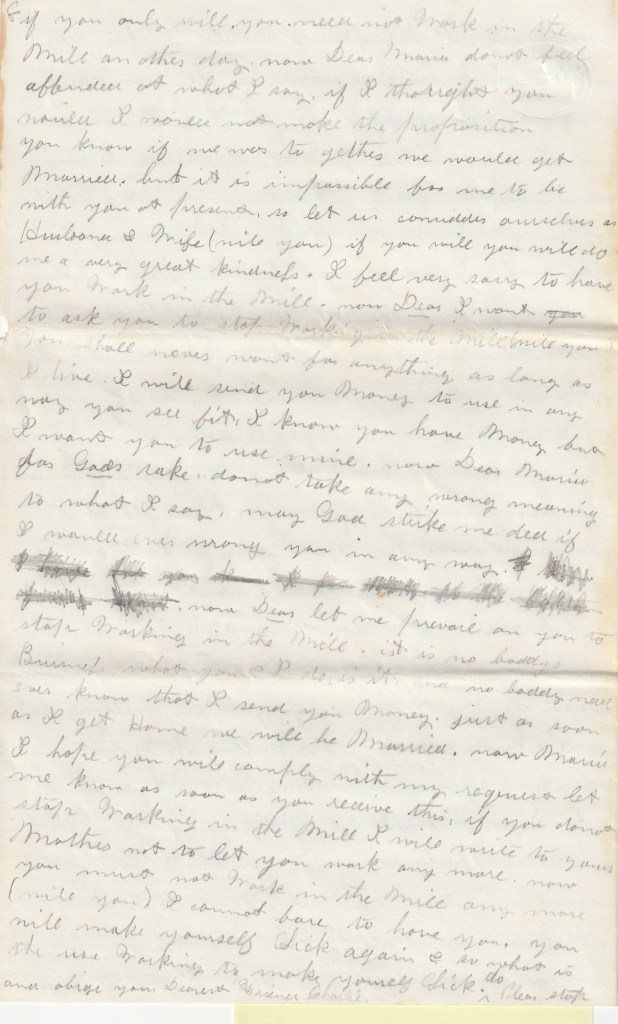
If you only will, you need not work in the mill another day. Now dear Maria, do not feel offended at what I say. If I thought you would, I would not make the proposition. you know if we were together we would get married but it is impossible for me to be with you at present so let us consider ourselves as husband and wife (will you?). If you will, you will do me a very great kindness. I feel very sorry to have you work in the mill…I will send you money to use in any way you see fit. I know you have money but I want you to use mine. Now dear Maria, for God’s sake, do not take any wrong meaning to what I say. May God strike me dead if I would ever wrong you in any way…
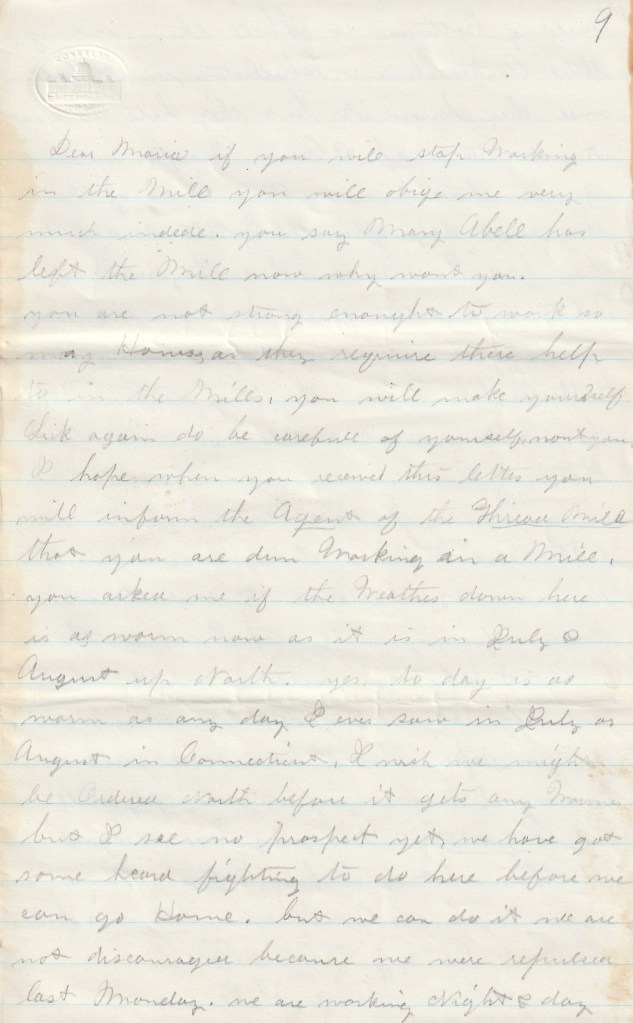
Dear Maria, if you will stop working in the mill, you will oblige me very much indeed. You say Mary Abell has left the mill now. Why don’t you? You are not strong enough to work so many hours as they require their help to work in the mill. You will make yourself sick again. Do be careful of yourself, won’t you? I hope when you receive this letter you will inform the agent of the Thread Mill that you are done working in a mill.
You asked me if the weather down here is as warm now as it is in July and August up North. Yes, today is as warm as any day I ever saw in July or August in Connecticut. I wish we might be ordered North before it gets any warmer but I see no prospect yet. We have got some hard fighting to do here before we can go home. But we can do it. We are not discouraged because we were repulsed last Monday. We are working night and day building batteries to shell them out of their entrenchments. Charleston must fall and they know it. But they hate to give it up to Massachusetts & Connecticut troops.
We went up to their lines with a flag of truce the next day after the battle to ask them if they had buried our dead. They was very polite and acted quite human. They said we fought well and marched up to their batteries like heroes. They say we never can take their batteries. Wait awhile and we will show them.
Dear Maria, I have written quite a long letter and I must close. Please answer this as soon as you receive it and let me know if you will stop work in the mill. I hope you will & comply with my request in regard to other matters if you take what I have said just as I mean. I know you will comply with my requests. Give my love to your Mother. What is John’s baby’s name?
From your ever dear Charlie. Here is a kiss. Direct to Co. H, 7th Connecticut Vols. Hilton Head, S. C.