The following letter was written by Charlotte Melissa (Miller) Coon (1821-1917), the daughter of Daniel Miller (1785-1852) and Jane Wick Genung (1792-1878). She wrote the letter to her sister, Edna Amanda Miller (1834-1928) of Seneca Falls, New York. Charlotte was married in 1842 to John V. Coon (1822-1895) and lived in Elyria, Lorain county, Ohio, where her husband had practiced law since 1846 as well as dabbled in farming and manufacturing enterprises.
In her letter, Charlotte describes the departure of her 17 year-old son John Emir Coon (1847-1889) who had enlisted, with his parent’s permission, into the Union army. He was mustered on 11 May 1864 as a private in Co. K, 135th Ohio Infantry—a 100 days regiment. The 135th OVI left Ohio for Cumberland, Maryland, May 11. It was assigned to duty as railroad guard on the Baltimore & Ohio Railroad at North Mountain, Opequan Station, and Martinsburg until July 3. At North Mountain, a portion of the regiment was captured and sent to Andersonville Prison. It participated in operations around Harpers Ferry July 4–7, and performed guard duty at Maryland Heights until September. Participated in the actions at Maryland Heights July 3–7. Emir was mustered out of the service three and a half months later, on September 1, 1864.
The “Oberlin Company” was also mentioned in the letter. This refers to Co. K of the 150th OVI, a unit largely composed of Oberlin college students and other local young men. We learn from the letter that they were initially intended to be part of the 135th OVI but a dispute among the officers resulted in their being sent to Cleveland instead to become part of the 150th OVI where they also served for 100 days. Rather than guarding railroads, however, they garrisoned the forts defending Washington D. C. To read a letter by one of its soldiers, see 1864: Allen Albert Wright to William Wheeler Wright on Spared & Shared 22.
After service in the Civil War, Emir attended Cornell University and was united in marriage with Elizabeth Boynton. In 1871 Emir’s father came to Blue Rapids and discovered the presence of gypsum among the ledges near Blue Rapids. Finding it to be of good quality he and Emir returned to Blue Rapids from Elyria, Ohio, in 1872 and built the first mill west of the Mississippi river and commenced the manufacture of plaster of Paris. Marshall county owed them the origin of the largest single manufacturing within it’s borders. This mill was operated for 12 years , when the firm discontinued business. The 1880 Census shows his profession as a lawyer and the father of two girls; Frances and Florence. On May 29, 1889, while on his way home from the mills, just in front of the Baptist church, he was seen to stagger and fall, and before anyone could reach him he was dead. The cause of death is not positively known. Emir moved permanently to Blue Rapids in 1876
T R A N S C R I P T I O N
Elyria [Lorain county, Ohio] May 10, 1864
Dear Sis Edna,
Yours of May 5th was gladly received and read with pleasure. I thank you for writing such a long letter so well filled with good news and especially for the words of encouragement and sympathy addressed to ourselves. Lottie’s letter too was so good and sympathizing. Please tender my thanks to her.
Emir left with his company this morning. They go to Columbus to be armed and equipped (the old equipments to be left behind as they belong to the State) and from there wherever the government chooses to send them. You will recollect they were to be ready for marching orders the 2d of May. Accordingly the Oberlin Company came down that day. They were not allowed to go to the hotel but taken in and entertained among our citizens—two and four in a place out of pure good will and friendship—as they were going with our boys and we wanted to make their acquaintance. We found them very nice young men—mostly college students—some studying theology—and many professors of religion. We had felt very much gratified to have our boys go with a company who would set them a good example and whose influence over them would be the right kind. They in turn had felt very grateful and a mutual warm friendship had sprung up. But by some disaffection among the officers which I cannot explain to you, the Oberlin Company were sent with the Cleveland regiment to Camp Cleveland yesterday a.m. And three hours after they left, our company received orders to report to Col. W. C. Cooper at Camp Chase. Col. Cooper commands a Mt. Vernon regiment which they say is a fine regiment. The boys of both companies felt much dissatisfaction about the matter, as well as our citizens generally. I clip what Washburn says and send it along.
We could have prevented Emir’s going on account of his age and not having had his father’s consent to join the company but he was so anxious and determined on going that we thought it would not be wise to detain him although it was like tearing our hearts out to let him go—so young and inexperienced as he is—into so much danger both morally and physically. It will seem almost wicked for us to go to our warm beds at night and think of our poor boy standing guard perhaps in a severe storm—or at best in a frail tent lying on the cold damp ground.
It has rained steady all day today and is quite cold. The past two weeks has been very exciting and wearing to us all—not only us—but most families who had boys going. Last week the town was full of soldiers who were drilling before our eyes every day. Other parents who have young boys in the company are feeling very bad. The young girls and citizens, many of them, went in the rain to the depot to see the soldiers off feeling fine and glad to start. Mary went to Vermilion last night and came back this morning. She bid Emir goodbye on the cars and has cried all day since until her eyes are almost cried out. Her mother was not quite as well as she had been.
Allie is in school every day—is healthy [and] growing fast and having lots of play and fine times. Jo[hn] is busy in court which is now in session. Mrs. Clark, Mrs. Byington, Lida and Mrs. Vincent visited here last week. They send their love to you. I have got a beautiful pressed flower wreath made. Are you pressing flowers? Do not fail to press a nice lot this summer. Is Jacob & Ruth coming West this summer? We would like to see them here, and Mother with them. Mother might make us a visit—when she has a girl to leave the work with, & a daughter to oversee her. With love to yourself. —Mother, Albert & all. Yours sister, –C. M. Coon
These letters were written by Mary Jane (“Jennie”) Cleland (1841-1929), the 22 year-old daughter of Arthur Cleland (b. 1803) and Mary Clark (b. 1814) of Defiance County, Ohio. Jennie’s father was born in Killy Leagh Parish, County Down, Ireland, and came to the United States with his parents in 1817, arriving on the schooner Vigilant. They landed at Wilmington, Delaware, and first resided at Pittsburgh, Pennsylvania, before moving to Jefferson County, Ohio.
Jennie wrote the letters to her younger brother, Corporal John W. Cleland (1843-18xx) who enlisted in Company F, 111th Ohio Ohio Infantry in September 1862 at age 19. He was promoted to 1st Sergeant in March 1863 about the time this letter was written. In April 1864, Sgt. Cleland was promoted to 2nd Lieutenant and in May 1865 to 1st Lieutenant. He was mustered out of the service with his company in June 1865 at Salisbury, North Carolina. After the war, I believe John moved to Decatur, Illinois.
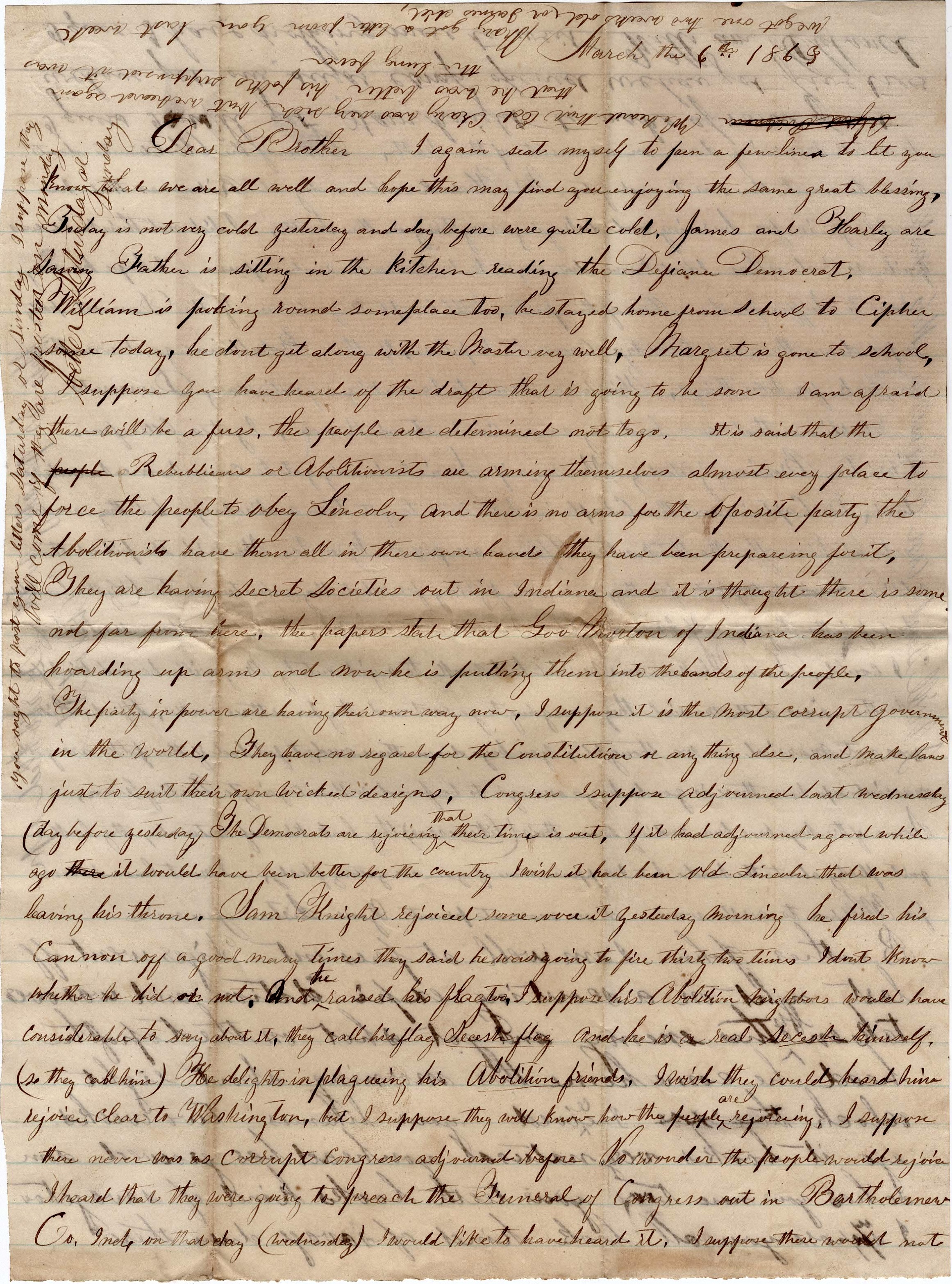
In her March 1863 letter, Jennie addresses the escalating discontent among the citizens toward the Lincoln Administration and its management of the war aimed at putting down the rebellion. Even prior to the onset of hostilities, Defiance County had shown a strong preference for the Democrats, evidenced by Lincoln securing only 43% of the votes in 1860 (it fell to 42% in 1864). However, Jennie admitted that after two years, “this war seems to be making a great many Democrats. A Republican that ever had any sense can’t stand it now.” She expressed her concerns regarding the forthcoming draft, asserting that “the people won’t stand for it.” More troubling, she alleged that the Republicans and the Abolitionists—including the Governor of Indiana—were engaging in the stockpiling of weaponry, thereby leaving the opposition defenseless. She characterized the government as “the most corrupt in the world,” with “no regard for the Constitution,” and contended that the ruling party was acting without restraint.
In her July 1863 letter, Jennie articulates her vehement criticism of Abolitionists, as well as the Union leadership, whom she perceives as incompetent and ineffectual in their efforts to secure victory in the war through combat. She asserts that soldiers should be disenfranchised, arguing that their perspectives are shaped solely by the Lincoln administration’s propaganda, thus depriving them of the varied voices from the opposition.
Back in 2014, I transcribed another of Jennie’s 1863 letters and published it in Spared & Shared 7. [see 1863: Mary Jane Cleland to John W. Cleland] It was datelined from the Cleland home on 13 April 1863. In that letter, she wrote a lot about the treatment of William (“Bill”) J. Knight of Defiance county—one of Andrews’ Raiders who became famous in the “The Great Locomotive Race.” Bill was orphaned at a young age and was raised by his grandfather, Jacob Knight, in Farmer Township, where the the Cleland family lived. Bill learned something about steam engines while working at his grandfather’s sawmill and as an engineer for the Atlantic and Great Western Railroad. While serving in Company E of the 21st Ohio Infantry, Bill volunteered for a secret mission to destroy the Western and Atlantic Railroad link to Chattanooga, effectively isolating Atlanta. On 12 April 1862, the volunteers boarded at north-bound train for Marietta, Georgia, and at a stop north of town, they uncoupled the passenger cars and stole the locomotive—The General—and three freight cars. They were pursued and eventually overtaken and captured near Ringgold, but not until after having destroyed track and cut telegraph communications. James Andrews, the leader of the men, and seven others were hung, while eight of the soldiers were exchanged for Confederate prisoners. Bill Knight was among the group of eight soldiers who managed to escape their captors, earning him the Medal of Honor for his bravery.
Over the last several years I’ve transcribed several of John W. Cleland’s Civil War letters that were sold off to numerous private collections. You can find his letters by following any of the Spared & Shared active links below:
Addressed to J. W. Clelland, Esqr., Co. Founder, 111th Regt. O. V. I.. Fort Brailey, Bowling Green, Kentucky, Care of Capt. J. E. Hill
[Farmer township, Defiance county, Ohio] March 6, 1863
Dear brother,
I again seat myself to pen a few lines to let you know that we are all well and hope this may find you enjoying the same great blessing. Today is not very cold. Yesterday and day before were quite cold. James and Harley are sowing [grain]. Father is sitting in the kitchen reading the Defiance Democrat. William is poking round someplace too. He stayed home from school to cipher some today. He don’t get along with the Master very well. Margret is gone to school.
I suppose you have heard of the draft that is going to be soon. I am afraid there will be a fuss. The people are determined not to go. It is said that the Republicans or Abolitionists are arming themselves almost every place to force the people to obey Lincoln, and there is no arms for the opposite party. The Abolitionists have them all in their own hands. They have been preparing for it. They are having Secret Societies out in Indiana and it is thought there is some not far from here. The papers state that Gov. Morton of Indiana has been hoarding up arms and now he is putting them into the hands of the people. The party in power are having their own way now. I suppose it is the most corrupt government in the world. They have no regard for the Constitution or anything else, and make laws just to suit their own wicked designs.
Congress, I suppose, adjourned last Wednesday (day before yesterday). The Democrats are rejoicing that their time is out. If it had adjourned a good while ago, it would have been better for the country. I wish it had been Old Lincoln that was leaving his throne. Sam Knight 1 rejoiced some over it yesterday morning. He fired his cannon off a good many times. They said he was going to fire thirty-two times. I don’t know whether he did or not. And he raised his flag too. I suppose his Abolition neighbors would have considerable to say about it. They call his flag Secesh flag and he is a real Secesh himself (so they call him). He delights in plaguing his Abolition friends. I wish they could heard him rejoice clear to Washington, but I suppose they will know how the people are rejoicing. I suppose there never was a corrupt Congress adjourned before. No wonder the people would rejoice.
I heard that they were going to preach the funeral of Congress out in Bartholomew county, Indiana, on that day (Wednesday). I would like to have heard it. I suppose there would not be much mourning done on account of the death. Some of the Abolitionists don’t seem to want the war to end yet. Mr. [Joseph L.] Hosack said one day at Ridenour’s that he would go in for burning and destroying everything in the South. I did not think he was quite so bad as that. I don’t know what ought to be done with such a person. I hope he may have to suffer for it. One of the parties will be apt to go down. If the Democrat Party is put down, then our country’s course is hopeless. If the Republicans go down, then we may look for better things. This war seems to be making a great many Democrats. A Republican that ever had any sense, can’t stand it now.
I got a letter from Christie Browning yesterday. She says if Lewis had only got to come home, he might have lived. His captain and the chaplain both tried to get him a discharge, but they would not let him off. She thinks the officers are perfect tyrants. She said she pitied the soldiers for they were not fighting for what they volunteered to (viz: the Constitution but for the Negro). If I was a soldier, I would not reenlist. I would rather unlist if I could.
Dan Kleckner was married last week to a girl out by Maysville. He and his wife’s brother were both married. They were going to go East and stay two or three weeks. Alfred Ridenour was not married as we thought. You boys down there needn’t feel bad if the folks are getting married up here. There is good boys enough to be found without going to Bowling Green. Some of the boys have been sending home their likenesses. They look kind of natural. They look quite fleshy about the head, but I suppose some of you are getting fleshy. I must leave room for William to write some. So no more at present. Your sister, — Jennie
Brother John, I am well at present. Tiger went off last night on a scouting expedition and was overtaken by the enemy and got shot on the top of the head. He come home this morning about 8 o’clock. I received your likeness two weeks ago. It looks very natural. Your head has growed some. So has your nose too. Your teeth looks kind of savage too. I suppose you all look kind of savage down there. I guess I will get Sam Knight to make a frame for it. We have got our sugar camp opened. We have got five trees. I guess I have nothing more to write. — William Cleland
1 Samuel D. Knight (b. 1826) was a farmer in Farmer township, Defiance county, Ohio. He was appointed postmaster in 1850 and again in 1856 by Democratic administrations. In the 1860 US Census, he was enumerated in Farmer township with his wife Amanda (Johnson) Knight and five children; his occupation given as “mechanic.”
Letter 2
[The following letter comes from the personal collection of Jonathan White and was offered for transcription and publication on Spared & Shared by express consent.]
Monday morning July 13, 1863
Dear Brother,
It is my turn to write again. I thought I would commence this morning. We have the harvest hands today again. They are cutting the field across the road from the house. They cut two days last week. They will most finish here tomorrow. Then they have some to cut at Ridenour’s. Wheat seems to be very heavy this year. Our folks think they will have a thousand bushel. The girls have to work out more this harvest than ever before. They have to rake and bind and help to make hay. I helped a little with the hay. Father and I hauled in four loads of hay last week when James and William were at Berean’s. You know that is something I never done before. I have to brag a little over it of course. I may have to help some more before the wheat is hauled in. Our hired hand ain’t much use. He is always sick when there is the most work to do and we can’t get any other now. He had the chills last week and I guess he has them yet.
We got your letter day before yesterday that you finished the 29th of June. I look a little for one Wednesday again. Anna Hill got one that was dated July 2nd. You were at Tourkinsville then. Maybe you are at Glasgow by this time.
I’ll bet you will have the Rheumatism after marching. There you were running away down pretty near to Tennessee and [John Hunt] Morgan up in the northern part of Kentucky. I heard he had got into Indiana but it may not be so. He is too smart for you fellows. He knows what he is doing all the time. Some of the rest don’t (that is, our officers). There is not very many smart generals in the Northern army because they won’t have any if they find he is worth anything. The war will not end by fighting. The Abolitionists say there is no way to end it but by fighting it out. But the majority (that is the democrats now) think it will never be ended in that way. They would get the hearty support of the people if things were carried on anything as they should be—that is, to restore the Union and preserve the Constitution and laws. But the leading men in power don’t want the Union and they don’t care for the Constitution. And the Democrats don’t want to support any such policy if they can help it.
There is no use in it. Everything seems to be against the North. I don’t know but they have been gaining some lately but not as much as they ought and I don’t believe the North will ever whip. They might as well settle it some other way than by fighting for it will have to be done at last anyway. There is nothing honorable about them. When the Southern armies destroy or take anything, they pay for it sometimes as well as they can. Of course some of them don’t care, but as a general thing I just believe they act more honorable than ours do. They destroy things often when it is not really necessary just because they hate the South. This is not the right kind of spirit. If they do wrong, that is no reason that we should do wrong to them.
The Abolitionists say now that if Vallandigham had not been in the South, the rebels would not have come into Pennsylvania. If that is so, then Old Abe is the traitor for sending him there to give them information. Little Val is traveling home again. He is in Canada, or was the latest account. I believe it would be better not to let the soldiers vote this fall. Jason Burbic thinks so too, because the soldiers most places only get to hear one side of the question (that is the Abolition side). Democratic papers are not allowed in the army very much. Grant’s army is the only one that Democrat papers get into, and it does the best business. Now why is this if Democratic papers demoralize the army. If they did not get so many nasty, lying Abolition papers, it would be better. And if the soldiers do get to vote, they will not be apt to be allowed to vote their sentiments. The Abolitionists have considerable to say about our pic-nic on the fourth. They call it a secesh dinner and that there was nothing fit to eat and that they were all drunk, &c. &c. &c. &c. If they can get up a better pic-nic let them do it.
I don’t hear much about E. M. Brown these times. He don’t get to write as much round here to the girls as he did. Poor little fellow, I know if there was going to be a battle, he would be sick. He would take some pills before the battle brakes. The Abolitionists have a great time here with the butternuts pulling them off the Democrats. Maybe some of the boys will get home on furlough again if you get back to Glasgow. We are all well and kicking round as usual. Your Sister — Jennie Cleland
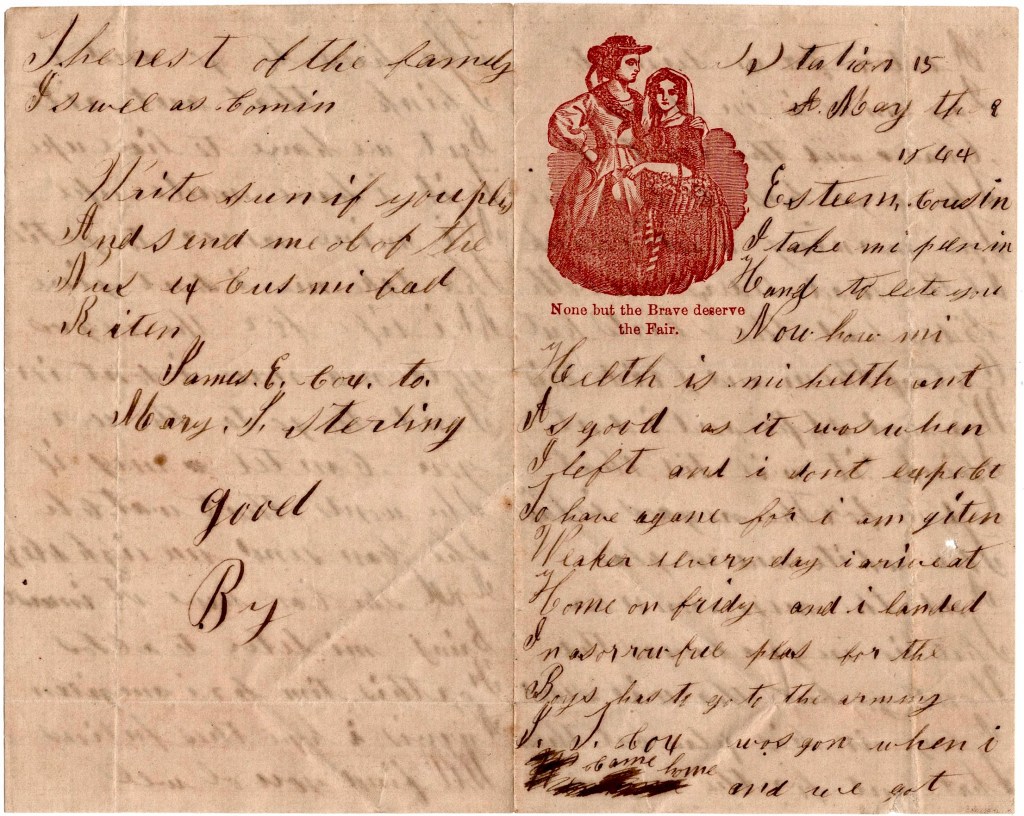
This letter was written by James E. Cox (b. 1843) whom I believe was the son of Amos H. Cox (b. 1813) and Mary Sterling (b. 1814) who were married in Tuscarawas county, Ohio in 1830. In the 1860’s the family lived in Franklin, Harrison county, Ohio.
During the Civil War, attitudes toward Black people in Harrison County, Ohio, were progressive for the time, largely shaped by the influence of abolitionist-leaning Quakers and Presbyterians. However, this local abolitionist sentiment existed within the context of Ohio’s statewide discriminatory “Black Laws,” which restricted the rights of African Americans.
T R A N S C R I P T I O N
Station 15 [Harrison county, Ohio] May 2, 1864
Esteemed cousin,
I take my pen in hand to let you know how my health is. My health ain’t as good as it was when I left and I don’t expect to have [it] again for I am getting weaker every day. I arrived at home on Friday and I landed in a sorrowful place for the Boys has to go to the army. J. T. Cox was gone when I came home and we got a letter from him today and he is in Camp Chase and the rest of the Boys has to leave in the morning. 1
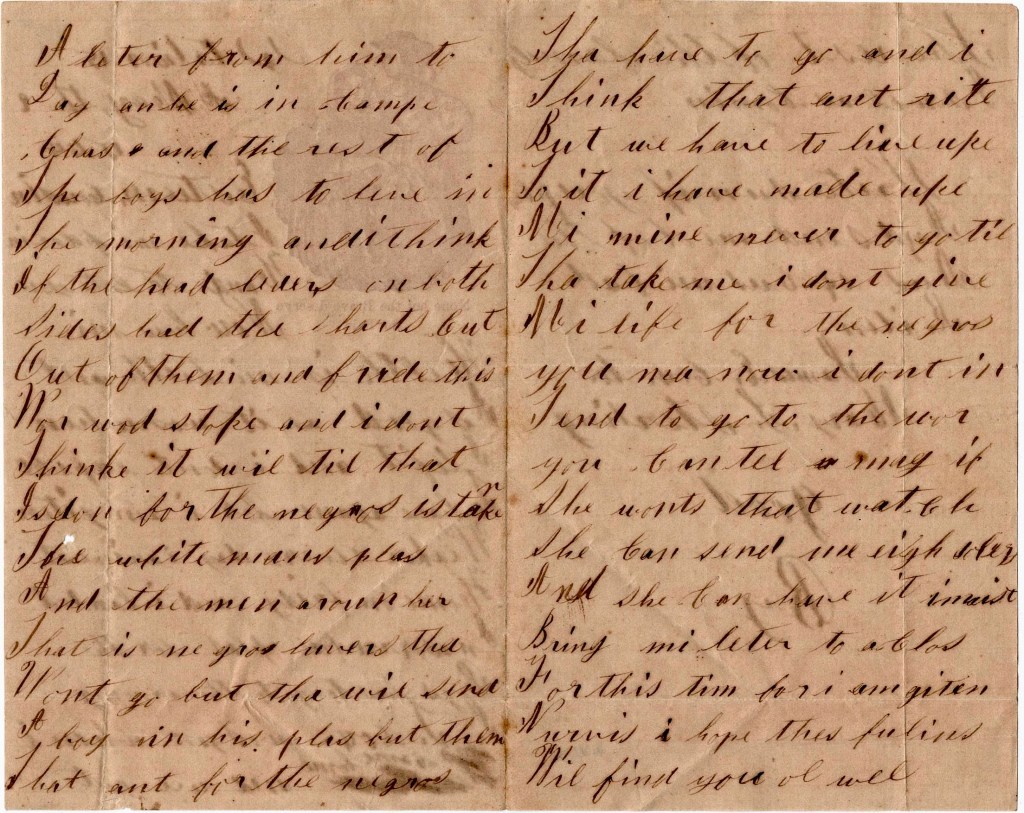
I think if the head leaders on both sides had the hearts cut out of them and fried, this war would stop. And I don’t think it will till that is done for the negroes is taken the white man’s place. And the men around here that is negro lovers, they won’t go, but they will send a boy in his place. But them that ain’t for the negroes, they have to go, and I think that ain’t right. But we have to live up to it. I have made up my mind never to go till they take me. I don’t give my life for the negroes. You may know I don’t intend to go to the war.
You can tell Mag if she wants that watch, she can send me eight dollars and she can have it. I must bring my letter to a close for this time for I am getting nervous. I hope these feelings will find you all well. The rest of the family is well as common.
Write soon if you please and send me all of the news. Excuse my bad writing. — James E. Cox to Mary J. Sterling
Goodbye
1 Probably John T. Cox who served in the 162nd Ohio (National Guard). This regiment was mustered into service on 20 May 1864 at Camp Chase, Ohio.
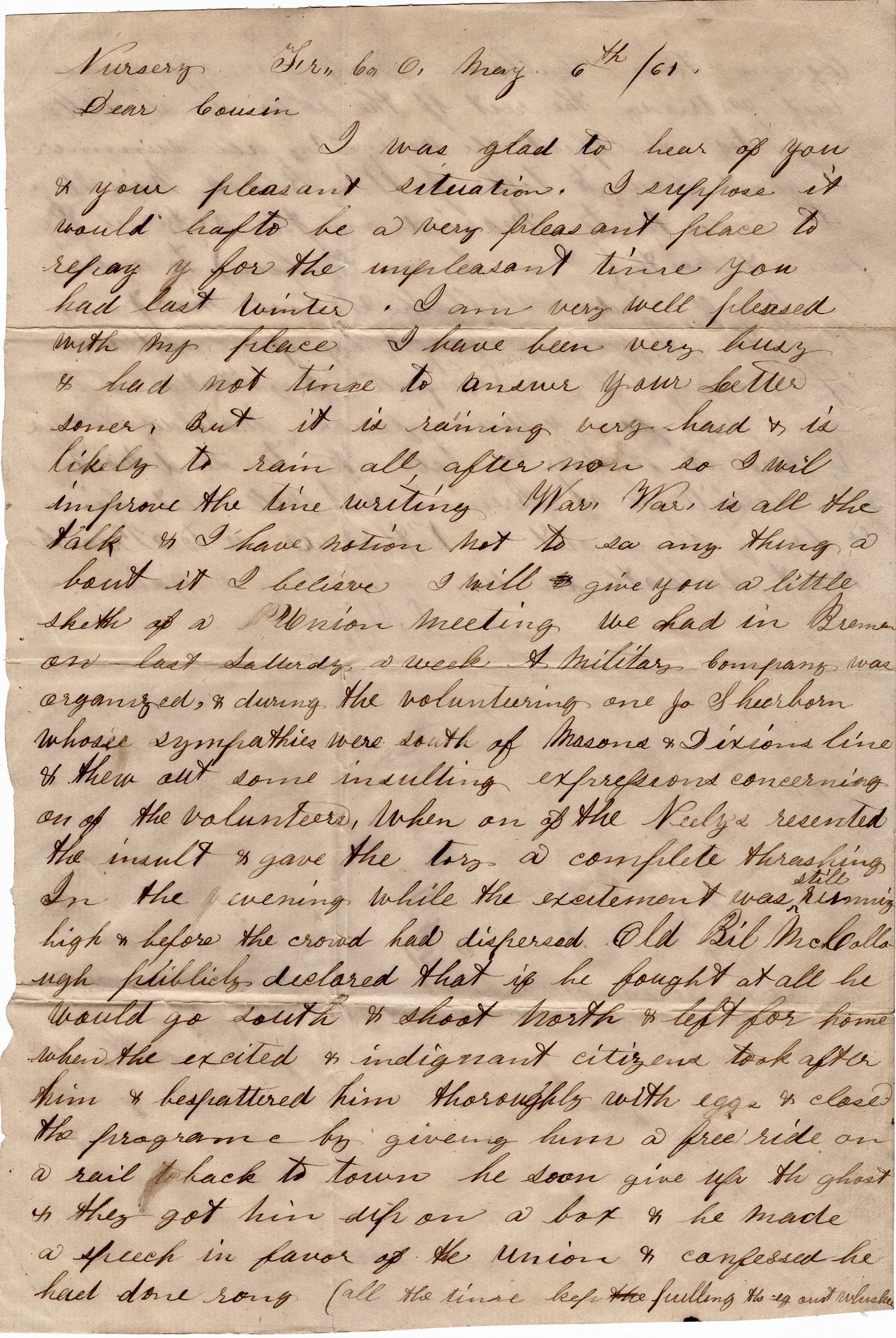
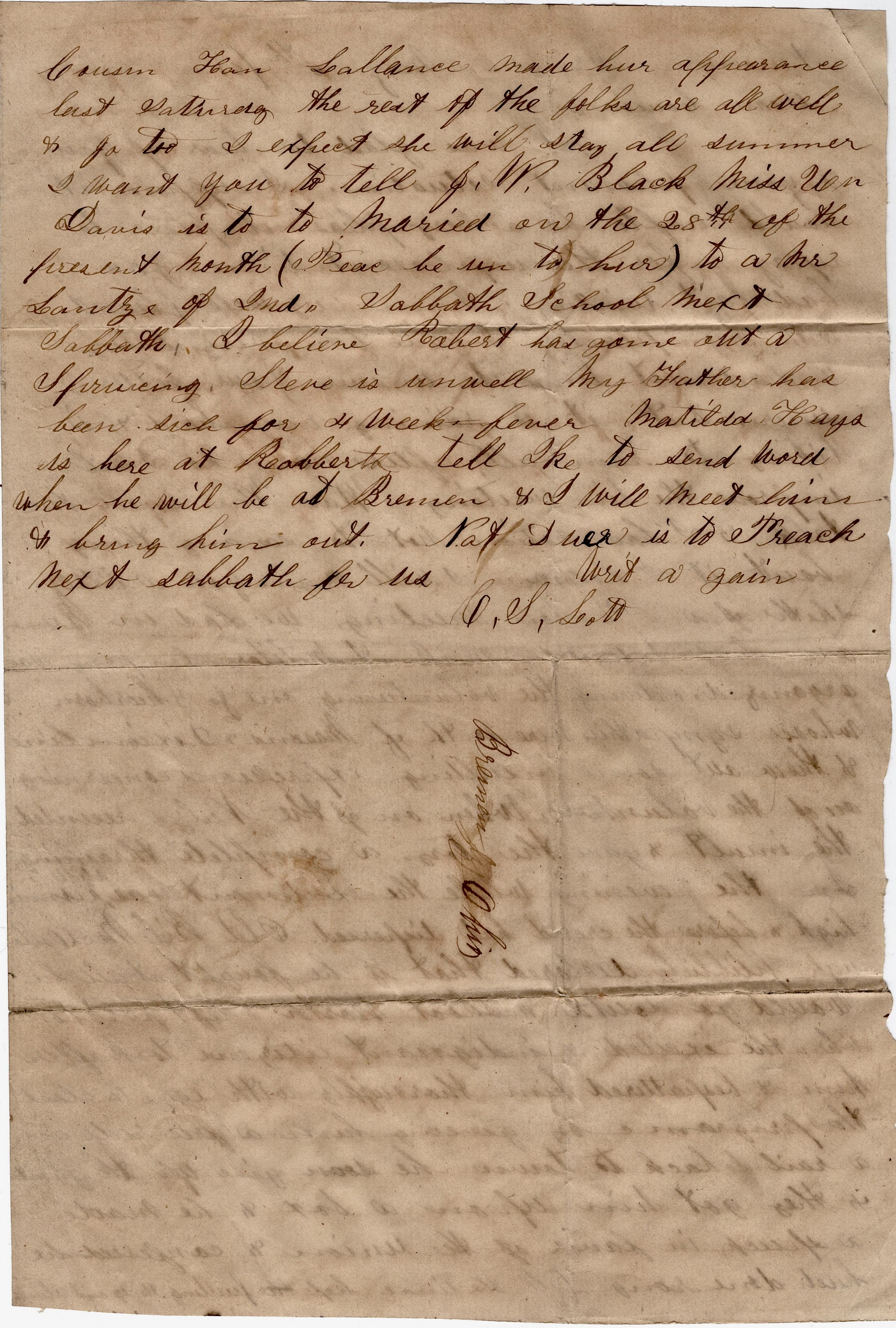
My best assessment indicates that this letter was composed by 17-year-old Catherine Solt, the offspring of Jacob Solt (1813-1886) and Sarah Glick (1819-1902) from Fairfield County, Ohio. She was likely employed as a school teacher at the time. In her correspondence to an unspecified cousin, Catherine articulates the palpable tension within the village of Bremen, where the looming threat of war has ignited conflicts stemming from divided loyalties, already resulting in acts of violence.
A newspaper article in the Lancaster Gazette published 4 days prior to this letter seems to be the source of the information contained in the letter.
T R A N S C R I P T I O N
Nursery, Fr. Co., Ohio May 6th 1861
Dear Cousin.
I was glad to hear of you & your pleasant situation. I suppose it would have to be a very pleasant place to repay for the unpleasant time you had last winter. I am very well pleased with my place. I have been very busy & had not time to answer your letter sooner. But it is raining very hard and is likely to rain all afternoon so I will improve the time writing.
Lancaster, Gazette, 2 May 1861
War, war is all the talk & I have a notion not to say anything about it [but] I believe I will give you a little sketch of a Union Meeting we had in Breman last Saturday a week [ago]. A military company was organized & during the volunteering, one Joe Sherboro whose sympathies were south of the Mason & Dixon’s line & threw out some insulting expressions concerning one of the volunteers, when one of the Neely’s resented the insult and gave the Tory a complete thrashing.
In the evening, while the excitement was still remaining high and before the crowd had dispersed, Old Bill McCollough publicly declared that if he fought at all, he would go south and shoot north & left for home when the excited and indignant citizens took after him and bespattered him thoroughly with eggs and closed the program by giving him a free ride on a rail back to town. He soon give up the ghost and they got him up on a box & he made a speech in favor of the Union & confessed he had done wrong (all the time kept pulling the egg out [his] whiskers.
Cousin Han Lallance made her appearance last Saturday. The rest of the folks are all well & Jo too. I expect she will stay all summer. I want you to tell J. W. Black, Miss U. [Eunice E.] Davis 1 is to be married on the 28th of the present month (peace be unto her) to a Mr. [Henry P.] Lantz of Indiana. Sabbath School next Sabbath. I believe Robert has gone out a sprucing. Steve is unwell. My Father has been sick for four weeks—fever. Matilda Hays is here at Roberts. Tell Ike to send word when he will be at Bremen & I will meet him & bring him out. Nat Duer is to preach next Sabbath for us. Write again. — C. S. Solt
1 Eunice Elizabeth Davis (1838-1901) was the daughter of David Young Davis (1808-1891) and Sarah B. Parker (1816-1871) of Fairfield county, Ohio. In the 1860 US Census she was identified as a teacher in Rush Creek township.
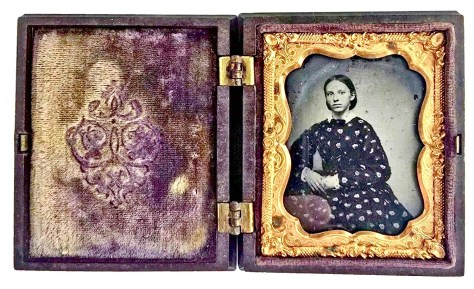
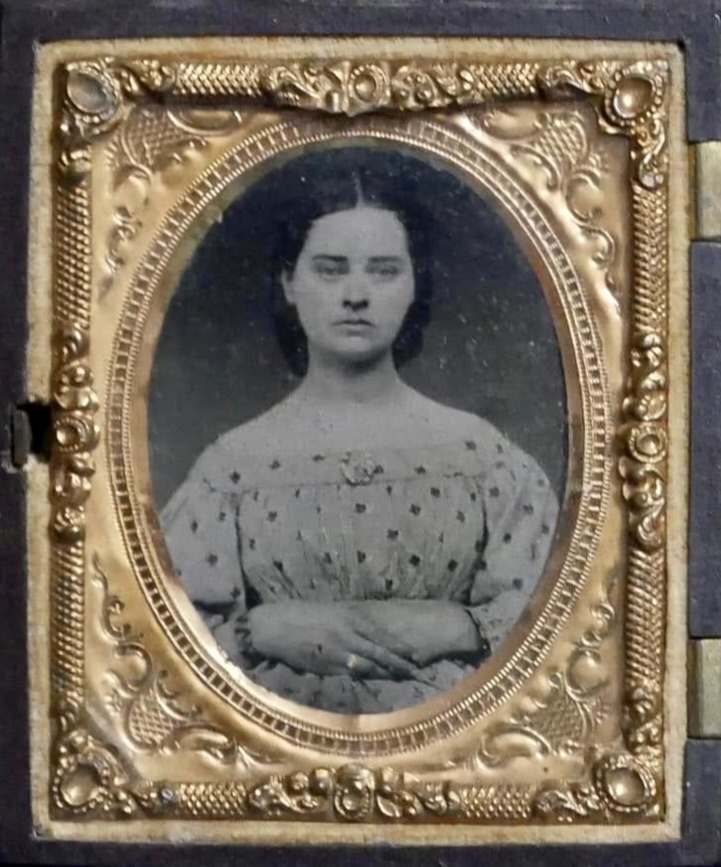
The following letter was written by 16 year-old Caroline Lewis who was enumerated in the 1860 US Census as a “servant” in the household of Robert Bateman, a gunsmith in Waverly, Pike county, Ohio. Ten years earlier she was enumerated in the household of James Hughes in Jackson, Pike county. She may have been the same Caroline Lewis who married James R. Rhinehart in Pike county on 15 March 1863.
How Caroline might have looked.
T R A N S C R I P T I O N
Waverly, Pike county, Ohio December 18, 1861
Dear friend,
I seat myself this afternoon to let you know how I am getting along these hard times. I have been sick. I have had the bilious fever and am just able to sit up now. But Maggie, I do hope this will find you well and hearty.
I would like to see you and have a good talk with you. You know we use to have some good times. I want you to write to me and tell me all the news. Tell Lib Grimes I sent my love to her. Tell her to write to me. Tell me how you and Ike gets along these hard times. You must not let him go to war. Tell me who has gone to war. Tell Lib to hold tight to Davis and not let him go to war. But I don’t believe he will go—he is afraid he will get shot. Don’t you believe he is? Tell Lib I said so. Tell Ike and Sam Adams that I would like to see them a little bit. And tell Ike I ain’t forgot the night the Wide Awakes marched at Holland—the [same] night I got throwed off of the Black.
Tell Frank and Henrietta I send my love to them. Tell your mother I send my love to her. Well, I will bring my letter to a close. Give my love to all enquiring friends and keep a good share of it yourself. No more at present. But I remain as ever your friend, — Caroline Lewis
to Maggie Kerney
A Song [to the] Tune [of] Dixie
Listen my friends unto my song I’m for the Union right or wrong Hurray, Hurrah—Hurrah, Hurrah If I was a man to the wars I’d go When duty calls, I’d never say no Hurrah, Hurrah—Hurrah, Hurrah
Chorus
Hurrah for the Union Hurrah, Hurah On Union’s land I’ll take my stand I’ll live and die in Union’s land Hurrah, Hurrah—Hurrah for the Union
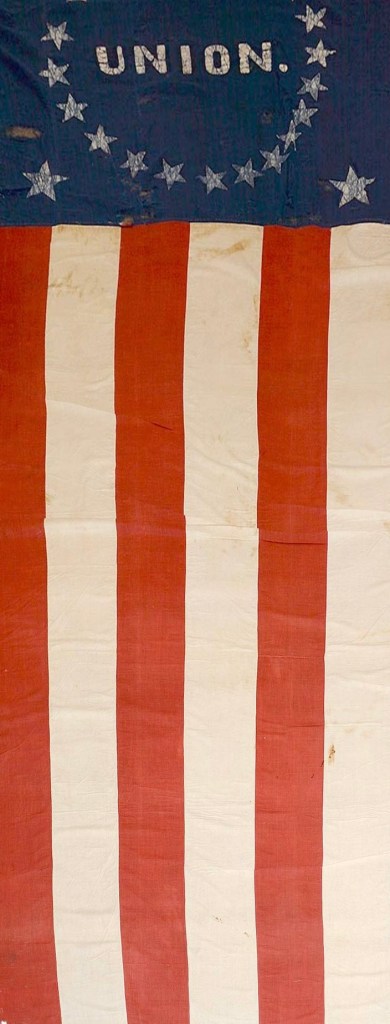
The Union must and shall be saved There is no use of being afraid Hurrah Let freedom’s banner o’er us wave And be a shield for the true and brave Hurrah!
Chorus
Ye sons of freedom hark the call Defend your country one and all Hurrah Although no active part I’d take of each young man a soldier I’d make Hurrah
Chorus
You must remember danger nigh for hark unto disunion’s cry Hurrah With a ‘God bless all’ and a safe return to all that fight for the Union Hurrah, Hurrah
Unfortunately this partial and unsigned letter provides us with few clues to the author’s identity. I’m inclined to believe it was a young female between the age of 15 and 20 who lived in Fremont, Sandusky county, Ohio. She writes of receiving a Christmas gift of “a very nice tooth brush and a cake of tooth soap and a comb”—a practical and coveted luxury at the time. She also writes of visiting the camp of the 72nd Ohio Regiment at nearby Camp Chrogan in company with the handsome Capt. Samuel A. J. Snyder. “What didn’t I have a good time!” she wrote her friend Mary.
Transcription
Fremont [Ohio] December 30th, 1861
Friend Mary,
Your letter was most gladly received and came in time to stop my letter which I was about sending, and which contained something like a scolding. I began to think you weren’t going to write to me any more or something dreadful had happened, but when your good letter came and set my fears at rest, you can imagine how welcomed it was.
I haven’t written to you so long that I hardly now how to converse with you. The first thing I will try to do will be to imagine how the house looked after you and Frank had done up the work. Probably the first thing Frank does to bother Mary is to go at the caller [?] and [ ] them a pail of water and is sent off in a hurry. [ ] straight for the corn crib and begins to shell corn while Mary puts the caller to bed and returns to her work, gets the work done up and commences to write to you know. We were but your humble servant. [ ] is much obliged to you for it, but enough of this nonsense.
I spent my Christmas very pleasant here. Went down town in the morning and called at Mrs. Beans, got an invitation to dinner the next day (which was the day after Christmas). Got home and found Brother and his wife here and spent a pleasant afternoon and evening. The next day had a present of a very nice tooth brush and a cake of tooth soap and a comb. I think I have told you all that I did on Christmas as nearly as I can think.
There is a regiment of soldiers stationed here now which makes the realities of war come closer home than ever. The camp is called Camp Chrogan (72nd [Ohio] Regiment). I went over last week with one of the officers, Captain [Samuel A. J.] Snyder 1 (he is handsome as he can be I tell you). What didn’t I have a good time. It looks so funny to see them was dishes and cook and their tents are so funny. But enough of this.
Who do you think Dillie is going to be married to? If you know, tell in your next letter. I have been interrupted in my pleasant talk with you by a caller from the town Miss Smith. They staid so long that it drove everything out of my head that I was a going to say to you. You spoke about Sis Whiskers staying here in Fremont over night. I don’t believe it for I don’t believe the place could hold him, much more that he would come here without seeing me. It is perfectly shocking. It almost made me cry. Don’t he look as though he had lost something since I came away. I don’t believe his whiskers have grown a bit since he see me. I bet the sight of me made them strike in. If so, please console him as well as you can and give him my prescription, that is some of Mrs. Winslow’s soothing syrup. Now mind you, don’t… [partial letter]
1 Capt. Samuel A. J. Snyder’s name comes up in the history of the 72nd Ohio Regiment in connection with the regiment’s flag and the Battle of Shiloh. To wit: “This flag was presented to the regiment by the mayor of Fremont in January 1862 as the regiment was leaving Camp Croghan to head south to war. It was entrusted to Sergeant Gustavus H. Gessner of Co. H. During the skirmish at Crump’s Landing on April 4, 1862, Gessner received a neck wound and went into the hospital; the flag was left furled in his tent. At the outset of the Battle of Shiloh two days later, Co. H was on picket duty and the company commander Captain Samuel A.J. Snyder (who under arrest for shooting a squirrel in camp and consequently left in camp while Co. H was on picket) noticed that the flag was in Gessner’s tent. Snyder took the flag and placed it in a regimental wagon behind the lines, then offered his services to Col. Buckland, thinking that he had placed the flag in a safe place. After a hard fight of two hours, the 72nd Ohio retreated from their position west of Shiloh Church and in the course of the retreat, the wagon and flag were captured. The flag was quickly discovered and presented to Confederate General Pierre G.T, Beauregard who kept the flag for many years.” See “72nd Ohio Infantry Flag Captured at the Battle of Shiloh”; Dan Masters’ Civil War Chronicles, June 4, 2017.
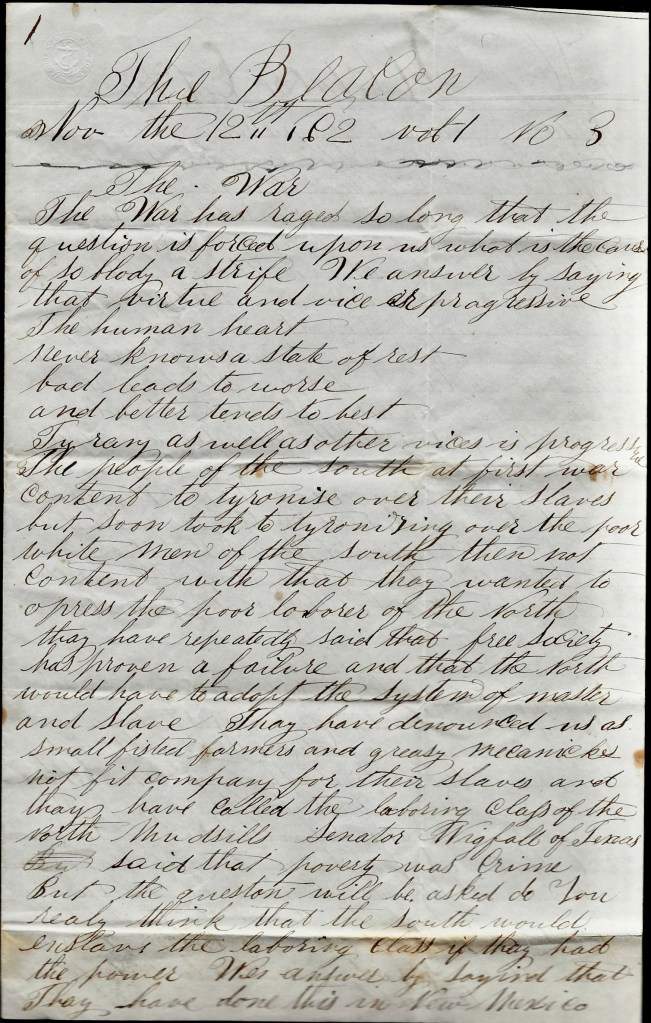
The author of this letter, written like a newspaper, was Hiram Whitacre. He was presumably from Wood county, Ohio, because he speaks of the 111th Ohio Volunteer Infantry (OVI) which is where the regiment was organized. In checking the census records for Wood county in 1860, I can only find one individual by that name and he was the 22 year-old son of Preston Whitacre (1804-1840) and Martha Lucy (1804-Aft1870) of Jersey City, Wood county, Ohio. He was born in 1838 and died in 1915.
An obituary claims that Hiram was born within three hundred feet of where he died, one and a half miles west of Jersey City. He had always ben a resident on his parent’s farm. He never married though he did serve in Co. B, 67th Ohio Infantry from 1 October 1864 to 10 October 1865.
Hiram wrote the letter to an unidentified cousin named Thomas.
Transcription
The Beacon
November the 12th 1862 Vol. 1. No. 3
The War
The war has raged so long that the question is forced upon us what is the cause of so bloody a strife? We answer by saying that virtue and vice are progressive,
The human heart Never knows a state of rest bad leads to worse and better tends to best
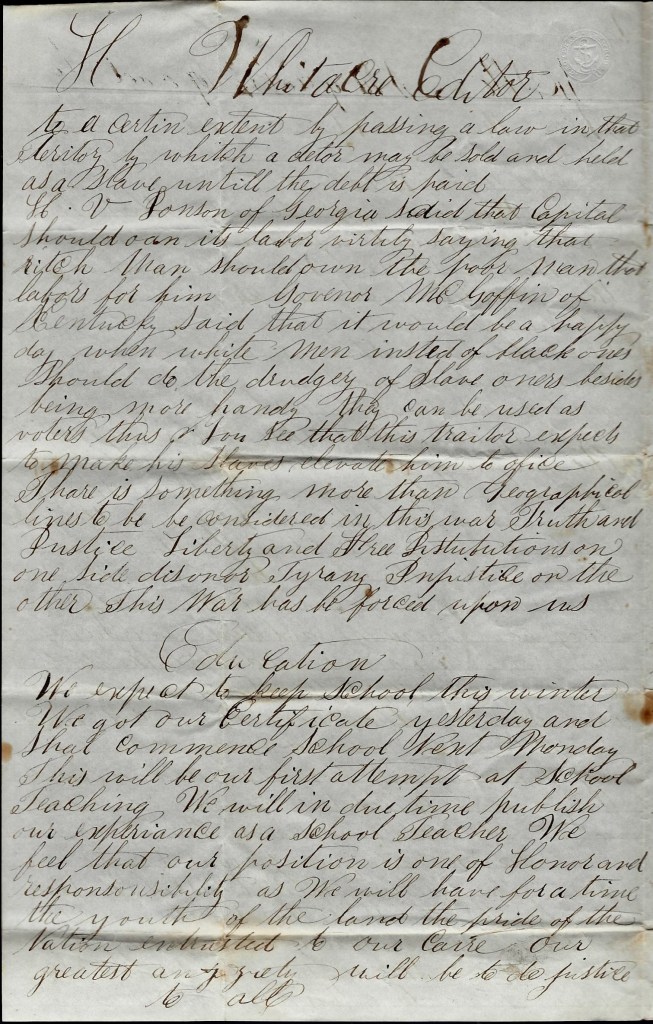
Tyranny as well as other vices is progressive. The people of the South at first were content to tyrannize over their slaves but soon took to tyrannizing over the poor white men of the South. Then, not content with that, they wanted to oppress the poor laborers of the North. They have repeatedly said that free society has proved a failure and that the North would adopt the system of master and slave. They have denounced us as small-fisted farmers and greasy mechanics, not fit company for their slaves and they have called the laboring class of the North mudsills. Senator Wigfall of Texas said that poverty was crime but the question will be asked, “Do you really think that the South would enslave the laboring class if they had the power?” We answer by saying that they have done this in New Mexico to a certain extent by passing a law in that Territory by which a debtor may be sold and held as a slave until the debt is paid.
H. V. Johnson of Georgia said that capital should own its labor virtually saying that rich man should own the poor man that labors for him. Governor McGoffin of Kentucky said that it would be a happy day when white men instead of black ones should do the drudgery of slave owners. Besides being more handy, they can be used as voters. Thus you see that this traitor expects to make his slaves elevate him to office. There is something more that geographical lines to be considered in this war. Truth and justice, liberty and free institutions on one side; dishonor, tyranny, injustice on the other. This war has been forced upon us.
Education
We expect to keep school this winter. We got our certificate yesterday and shall commence school next Monday. This will be our first attempt at school teaching. We will in due time publish our experience as a school teacher. We feel that our position is one of honor and responsibility as we have for a time the youth of the land, the pride of the Nation, entrusted to our care. Our greatest anxiety will be to do justice to all.
Emancipation
We see that some opposition is made to the President’s Proclamation and some attempt to make a false issue and say that the war is to free the Negroes. The fact is the emancipation of the Negroes of Rebel masters is intended to shorten the war. Shall the lives of our brave boys be lost in protecting the property of Rebels? We say no. We say emancipate and let Rebels know that it is a grave offense to trample on the Old Flag. We are happy to see [ ] and Stanton stand by the President. Parson Brownlow says that he will stand by Old Abe. This is encouraging. General Cass—a life-long Democrat—supports the President’s measures. He is a tried Patriot. General Halleck says that it is a military necessity and that we can never conquer the South till we take away their labor. It takes a good deal of moral courage to be President now but Old Abe is able for the position and will do his duty.
The 111th
Capt. John McGowan (Marcus McLemore Collection)
We hain’t heard from this regiment for some time. At last accounts, it was at Bowling Green, Kentucky. Most of the men was well. I believe probably they have moved ere this.
Your aunt Emma is getting along very well. Her daughter [ ] is living with her. I was there to a wood chopping not long ago. Charles 1 is in the 111th [Ohio] Regiment. I don’t know where the regiment is now. His company is D. Captain [John E.] McGowan is his captain. Jacob Harvy is in the 8th Ohio Regiment. He is some place in Virginia. Thomas, I was glad to hear that you was well. We are all well. I believe that I have no news to tell you. Nothing of importance is going on now. Once in a while we have a corn husking but that is poor fun. We have a nice fall for work. Excuse my bad writing as I write in haste. I remain, Tom, your affectionate cousin, — Hiram Whitacre
1 There were only two soldiers named Charles in Co. D, 111th OVI; 2nd Lt. Charles H. French and Corporal Charles H. Milburn.
The following letter was written by 19 year-old Charles Robert Benedum (1842-Aft1870), the eldest son of lumberman Phillip Benedum (1801-1885) and Mary Loofborough (1823-1867). Though proclaiming himself a “Union Man” and eligible for service, Charles did not enlist during the Civil War as he considered his health to be too poor to withstand the rigors of a soldier’s life. In the 1863 Draft Registration, Charles was enumerated in Lancaster as a single, “laborer” with no military service. He was still enumerated in his father’s household at the time of the 1870 US Census.
Charles wrote the letter to his cousin, Laura Delilah Hartman (1835-1919), the daughter of John Henry Hartman (1798-1877) and Catherine Maria Benedum (1798-1866) of Findlay, Hancock county, Ohio.
The letter was datelined from Lancaster, Ohio, which was populated by residents who were split roughly 50:50 between those who were from southern-leaning states favoring the Confederacy and those who supported the Union. They came predominantly from three different states—Virginia, Kentucky, and Western Pennsylvania—and they brought their value systems with them. Though street brawls were few, tensions remained high and the two leading newspapers carried on a war of words throughout the war.
Lancaster, Fairfield county, Ohio
Transcription
Lancaster, Ohio 4 September 1861
Dear Cousin,
We are all well and I hope these few lines will find you the same. It has been some time since I heard from you. Are you sick or too much work to do or what is the matter? I would of wrote before this but I have not been well all summer. One of my brothers is not well nor has not been for two weeks. He has the ague and fever. There is a great deal of sickness here.
Dear cousin, secession is very strong here. A Union man dare not open his mouth about the Union or they will land him in the calaboose or jail. But there is one thing here, six companies left here and there is another one to leave from here by Saturday and one from here some time next week. Eight companies gotten up here. Good for Old Fairfield! Beat that in one county if you can. I will not go this time. If I was well and could stand it, I would go, but the doctors tell me I could not stand it two weeks. I am not healthy enough.
A dispatch came here yesterday that Jeff Davis died. If it is true or not, I cannot say. You can’t believe the dispatches that come here—the half of them are not true. War excitement is great here but the secessionists—or the Red Lodge we call them here—they are the head leaders—they must look pretty sharp or the Union men will put them in the Callaboose or Jail. But I am none of your seceshers. I am for the Union—now and forever! Yes, a very Union man. It makes no difference who knows it. If that be true about Jeff Davis, dying was too good for him. They ought to hung him, I tell you.
I am a Union man. I cannot say what you are or your father. I hope you will not get angry at me like some people do here because I tell them this Union cannot be dissolved. They get angry at me when I tell them it won’t be. Or maybe I am going a little too far with you. I am afraid you will get angry. I think I had better stop and not go any farther. If I am wrong in this matter, I want you to correct me in your letter if this don’t make you too angry to write. I have used some very strong words I know but it could not be helped.
I must close by saying goodbye and sending my love to you, one and all. You will think this a hard letter. — Charles R. Bendodum
Lorain and Mary send their love. Write soon if this don’t make you too mad that what I am a Union Man. No more.
The following letter was written by Henry Six (b. 1808), a 55 year-old farmer in Waterloo township, Athens county, Ohio. Henry and his wife Rachel Dowler (b. 1812) had at least four children, one of them being Theron Harvey Six (1843-1863) who enlisted on 23 December 1861 to serve in Co. H, 75th Ohio Volunteer Infantry (OVI). He was taken prisoner on 2 July 1863 at Gettysburg and he died at General Hospital No. 21 in Richmond, Virginia, on 1 December 1863 suffering from chronic dysentery. He was buried in the Richmond National Cemetery.
Henry wrote the letter to the Annapolis hospital that treated paroled soldiers released from Confederate prisons hoping that they might have received his son, not knowing that he was yet barely hanging onto life in a Richmond hospital.
Transcription
Waterloo Township, Athens county, [Ohio] November 28th 1863
Hospital Steward,
Dear sir, I have a son named Harper Six belonging to the 75th Regt., Company H, OVI, who was taken prisoner on the 2nd day of July at Gettysburg, Pa., and sent to Richmond, Va., to Belle Island, and learning that two squads has been sent from Richmond to Annapolis and wishing to hear from him, as I understand that my son was sick, he may be in hospital at parole camp in Annapolis.
[If] you will have the goodness, dear sir, to inform me whether any such man has been in your hospital and [if] so, whether he is living or dead by answering immediately, you will confer a great favor on a much afflicted family.
I remain yours respectfully, — Henry Six
P. S. Direct your letter to me, Marshfield, Athens county, Ohio
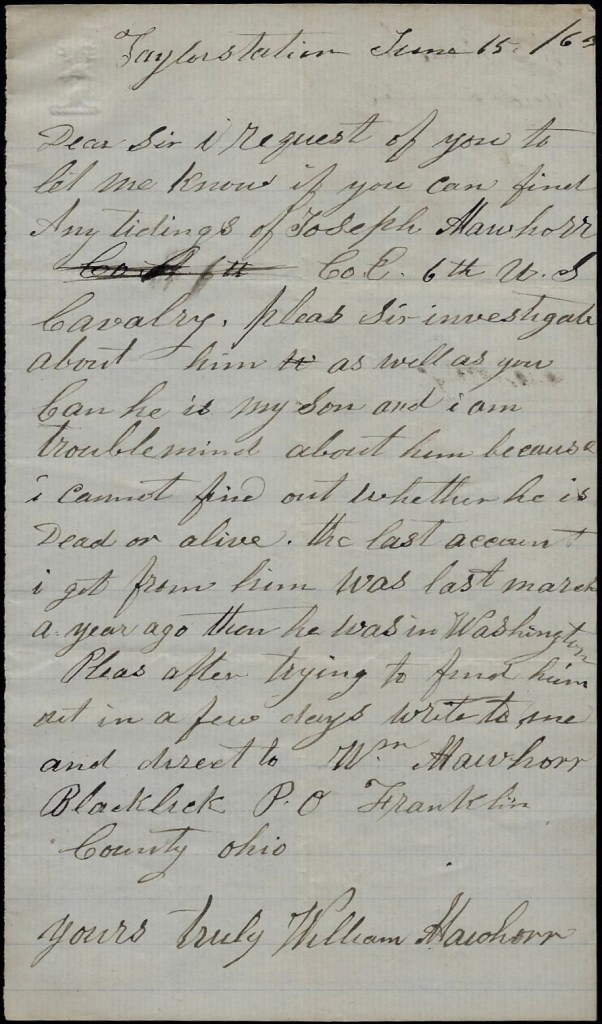
I could not identify the author of this letter whose name appears to read “William Mawhorr.” He gives his location as Taylor’s Station which was a whistle stop on the railroad east of Columbus, Ohio—just east of the present day Columbus International Airport. William’s letter beseeches the US Military to send him some word of his son Joseph, having not heard from him in 15 months. William states his believe that Joseph was serving in the 6th US Cavalry, Co. C.
I do not have access to a roster to enable me to check for Joseph so for now, Joseph and his father will remain identified in name only.
Transcription
Taylor’s Station June 15th 1863
Dear Sir,
I request of you to let me know if you can find any tidings of Joseph Mawhorr, Co. C, 6th U. S. Cavalry. Please, sir, investigate about him as we as you can. He is my son and I am trouble mind about him because I cannot find out whether he is dead or alive. The last account I got from him was last March a year ago. Then he was in Washington.
Please, after trying to find him out, in a few days write to me and direct to Wm. Hawhorr, Blacklick P. O., Franklin county, Ohio














 Spared & Shared 23