Category Archives: Peninsula Campaign

“The ground for a bed and the sky for a tent.”

The 1862 Diary of James Hamilton Mills, 11th Pennsylvania Reserves
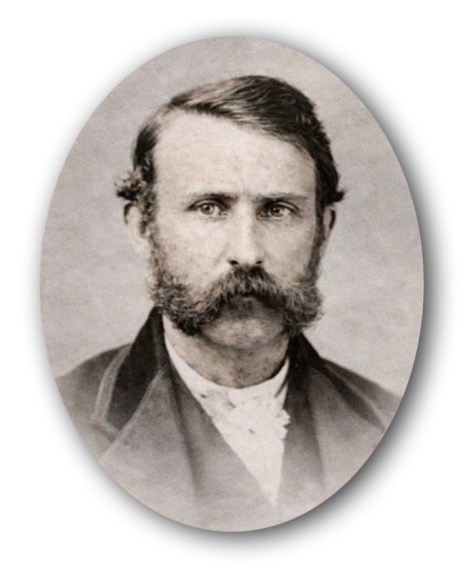
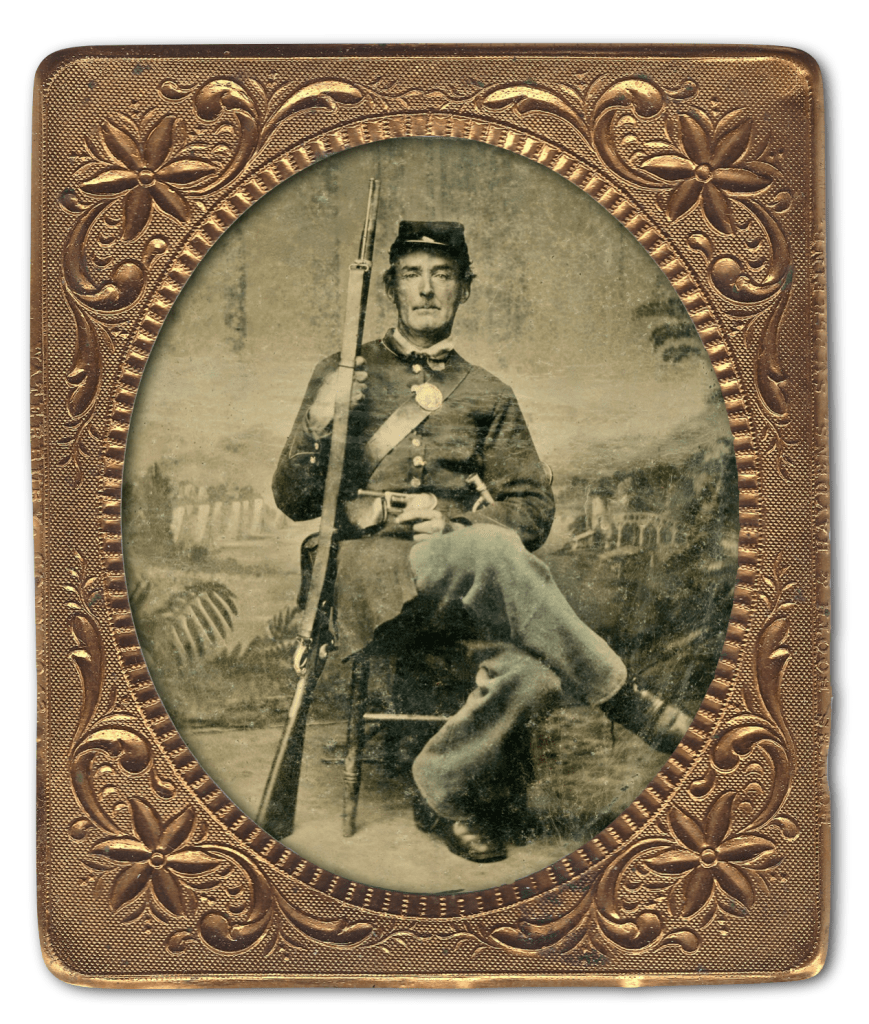
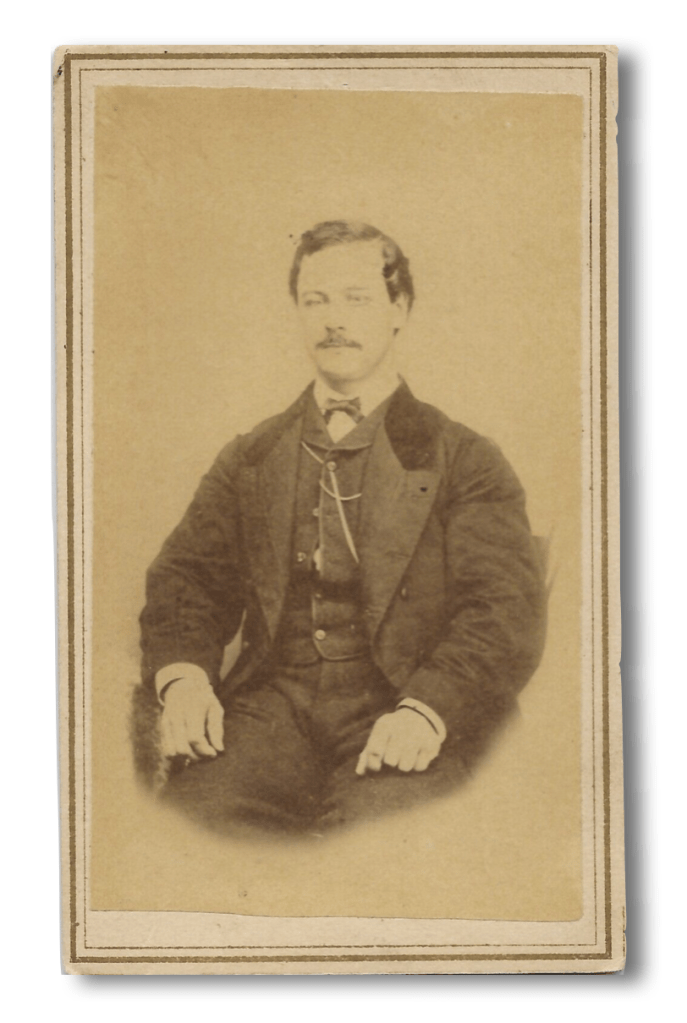
James Hamilton Mills just before the Civil War

The following account of the Peninsula Campaign and Battle of Fredericksburg comes from the 1862 diary of James Hamilton Mills (1837-1904) who was a native of new Lisbon, Ohio. He was working in “mercantile and mechanical pursuits” until the Civil War when he enlisted as a private on 27 April 1861 in Co. G (“The Independent Blues”), 11th Pennsylvania Reserves (40th Pennsylvania Infantry). With his regiment he participated in twenty seven general engagements of the Army of the Potomac, and for “gallant conduct on the field” he was promoted to corporal, first sergeant, first lieutenant and captain and for “heroic conduct in the Battle of the Wilderness and Bethesda Church” he was commissioned brevet-major and brevet-lieutenant colonel. He was mustered out of service at Pittsburg on June 13, 1864.

See also—“Two canteens of old rye for the boys!”—Excerpt from the 1863 Diary of James Hamilton Mills, 11th Pennsylvania Reserves.

Mills’ 1862 diary is among several diaries of his that are housed at the Montana State Library. It has been digitized recently but apparently never before transcribed and published. I have not shown the images of the diary pages since these can be viewed on line at James H. Mills diary, 1862.
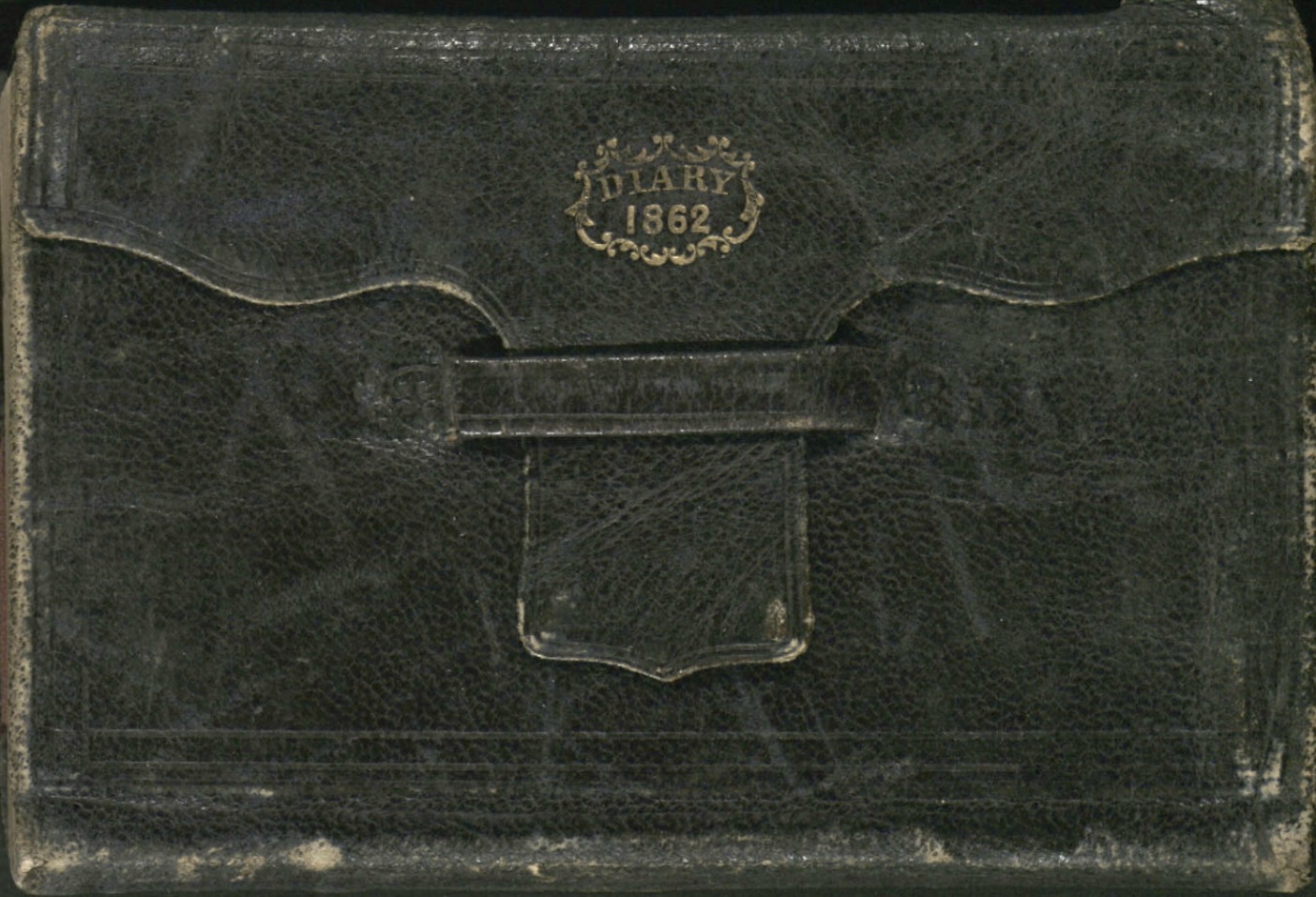
The 1862 Diary of James H. Mills, Co. G, 40th Pennsylvania Infantry

T R A N S C R I P T I O N

Thursday, April 10, 1862—Weather bright and pleasant today. Went to Alexandria, tramped around town nearly all day. The 1st Brigade left on the cars yesterday and today for Manassas.

Friday 11—Was up at 3 a.m. [with] orders to march overland to Manassas. Passed through Fairfax Court House and camped within 3 miles of Centreville. Weather pleasant and men somewhat fatigued.

Saturday 12—Broke up camp at6 a.m. and reached Manassas at 2.30 p.m. Entrenchments at Centreville numerous but not formidable. Manassas a humbug. McClellan could have taken it in 3 hours.

Sunday, April 13, 1862—Up early in the morning and off to the battle field five miles. There is no advantage of ground—it being a beautiful undulating country full of woods. Many of the corpses were lying out exposed to the sun.

Monday 14—Moved camp to a fine location about 200 yards distant, fitted up our little quarters right comfortably and are making preparations to stay comfortable if we stay at all. Weather hot.

Tuesday 15—On picket about a mile and a half south of camp. Very rainy in the morning but got fair and warm by noon. [ ] Armstrong makes the company to [illegible].

Wednesday, April 16, 1862—Got into camp at 9 a.m. fatigued and sleepy, Gen. Meade had the audacity to order us out on Brigade Drill. I was excused and I wrote to Lizzie. Weather getting the Spring fever.

Thursday 17—1st Brigade marched to Bristow. Election for Major. Candidates Porter and Johns. Johns majority 124. Dress Parade at 6 p.m. Orders at 10 to be ready to leave at 4 a.m.

Friday 18—Left camp at 6.30 a.m. and marching on the A&O [Orange & Alexandria] Railroad tracks, reached Catlett’s Station about 2 p.m. Camped in a large meadow. Wood distant, Water scarce and bad.
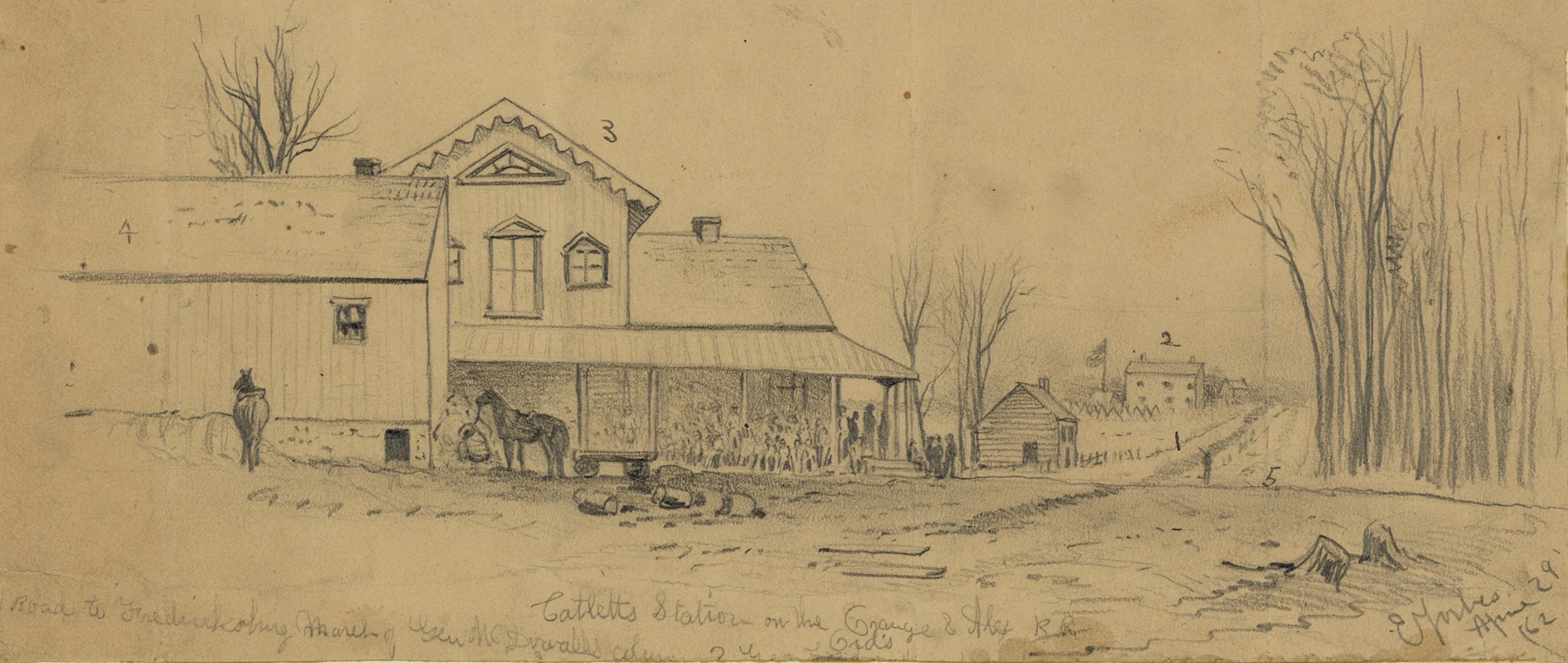
Saturday, April 19, 1862—Weather unpleasant. Rainy and cold. Had turkey for dinner which I had roasted at a neighboring farmhouse. Regiment was paid today for January & February.

Sunday 20—Weather very bad. Laid in bed nearly all day. Expressed $40 to Jo Cline. Wrote to L. Townsen and Lizzie.

Monday 21—[Still at Catlett’s Station] Weather still outrageously bad. Went to Dr. Edmonds and had a warm berth at the fireside. The Dr. and Lady are evidently full blood secesh.

Tuesday, April 22, 1862—Stayed at the Dr’s over night and returned to camp in the morning. Went on guard at the camp at 9 a.m. Had to keep guard all night. Day fair.

Wednesday 23—Another nice day. Boys engaged in cleaning up their guns and playing “penny poke” on the sunny side of the straw stack.

Thursday 24—Company detailed as guard at Catlett’s Station. A boy was killed a few feet from me by a locomotive. Commenced to rain in the evening. Slept in a car with lots of hay.

Friday, April 25, 1862—Very wet. Left camp and took up quarters at Mr. Stone’s. Had two good meals with the inevitable corn cake and bacon. Returned to camp in the evening.

Saturday 26—Detailed as Judge Advocate on Regimental Court Martial. Rather a troublesome position. The 1st Brigade marched in the direction of Fredericksburg at 1 o’clock.

Sunday 27—Mail carrier brought the 1st mail we have had for ten days. Wrote to Lizzie, Hanna and Cunningham’s. Also a letter to the “star of the evening.” Received letters from Lizzie, Hanna, G. S. M. , W. T. J., The first fair day we have had for a week.

Monday, April 28, 1862—Left camp at Catlett’s and marched about nine miles in the direction of Fredericksburg. The roads are very bad so far. We hitched our horse in a little wagon of the sutler’s and hauled all our baggage. Had a good sleep with the ground for a bed and the sky for a tent.

Tuesday 29—Struck tents at 5.30 a.m. and marched 23 miles by 3.30 p.m. Camped in a pine wood northeast of Falmouth, Stafford county, Va. Men stood it pretty well. Co. G has now 14 men on the sick list. Weather cool and pleasant.

Wednesday 30—Set in wet in the forenoon, Was mustered for pay in the afternoon. The country around Fredericksburg is beautiful. Peach trees in full bloom, apple blossoms bursting, and forest trees putting on their verdure.

MAY 1862

Thursday, May 1, 1862—Weather variable. Had a pass to visit Falmouth. Country in the vicinity rather picturesque. Undertook to be commissary for officers’ mess. Corp. Robert Hunter discharged for disability.

Friday 2—Took a ride on the pursuit of eatables and after returning, plunged into the second volume of The Count of Monte Christo—a fascinating work. Weather fair and pleasant.

Saturday 3—Felt rather dilatory and lay in my tent nearly all day reading. The mail for the 11th [Pa. Reserves] came in about 10 p.m. Lots of letters. Boys gay and happy. Had two from Lizzie. All right.

Sunday, May 4, 1862—Company detailed for patrol duty. Found it a very lazy business. 3rd Brigade arrived in the afternoon. The second pontoon bridge was laid to Fredericksburg today. News that Yorktown is being evacuated.

Monday 5—Court Martial met. Tried Joshua L. McCreary. Weather pleasant. News of the evacuation conformed. McClellan in full pursuit.

Tuesday 6—Court Martial adjourned until tomorrow. Weather still pleasant. Dr. Fulton left for Washington with the mail.

Wednesday, May 7, 1862—Court Martial met and tried the four remaining cases in Co. A. Evidence contradictory. Hot in daytime. Cool at night.

[May 8 through May 13, 1862—no entries]

Wednesday 14—Rained all day. Went on picket in the evening.

Thursday 15—Rained all day.

Friday, May 16, 1862—Weather fair. Received letters from Will & Lizzie Jackson. The camp getting more beautiful every day. The leaves are all out.

Saturday 17—Weather very warm. 2nd Brigade reviewed and inspected today by Gen. McCall. Expressed much satisfaction at the condition of the rms of Co. G.
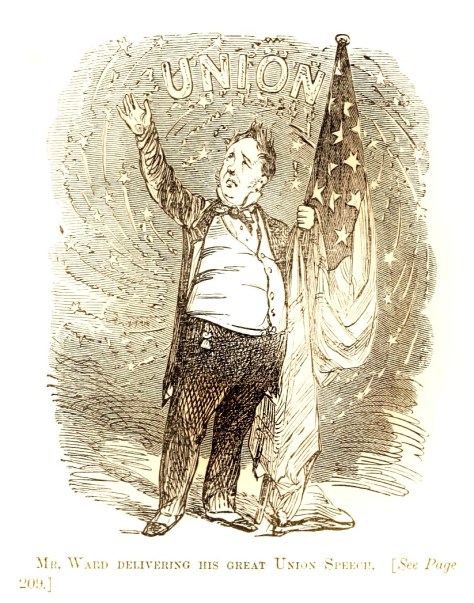
Sunday 18—Pleasant. Wrote to Lizzie and sent to Philp and Solomons, Washington, for Artemus Ward’s book. Men ordered to each have two pair shoes & socks.

Monday, May 19, 1862—Reviewed and inspected by Gen. Van Rensselaer & staff. Co. G again complimented on its arms. Weather pleasant. Dress Parade every evening at 6.30 o’clock.

Tuesday 20—Detailed as officer of the guard. Capt. [Evans R.] Brady [of Co. I], Officer of the Day. Had orders to come down to the regiment and we did it. Commenced raining in the evening.

Wednesday 21—Cool and damp in the morning. Faired up at 9 a.m. Received a letter from Labana Townsen. McClellan is at White House [on Pamunkey River] ten miles from Richmond. Will we get there too?

Thursday, May 22, 1862—Very warm. Read “The Loves of Byron,” which is also warm. [Jacob] Colver, [Johnson] Brown, Samuel T. Stewart sent to City Hospital at Washington.

Friday 23—Took a ride this afternoon to Shield’s Division. Went to the railroad bridge, from there to Gen. McDowell’s Headquarters and saw King’s Division reviewed. Afterwards our own was reviewed. Letter from Lizzie & Ans.

Saturday 24—Nothing going on. Gen. Banks was attacked at Front Royal and defeated. Had to return our wedge tent to Quartermaster.

Sunday, May 25, 1862—Received Artemus Ward’s work and read it through. Dress Parade in the evening with leggings on. The regiment looks far better.

Monday 26—Received orders to move our camp on account of sickness. Struck tents and went to another camp but before pitching, got marching orders. Left at 1 p.m. and marched down opposite Fredericksburg and camped.

Tuesday 27—Are located in a very pleasant place near the railroad, half a mile from the river and Fredericksburg. Camp in an open field, dry and gravelly which I think will improve the sanitary condition of the regiment. Warm, warm. Some anxiety for the safety of Banks’ army.

Wednesday, May 28, 1862—Opposite Fredericksburg. Dress Parade & Company Drill.

Thursday 29—Colver, Brown, and Stewart sent to Washington hospital.

Friday 30—Very warm Took a run around the country. King’s Division left to join Shields. No troops here now but the Pennsylvania Reserve.

Saturday, May 31, 1862—Wet and disagreeable last night. Commenced boarding at the sutler’s at $3 per week. Received letters from R. Cunningham & Lizzie. Severe battle at Richmond.

JUNE 1862

Sunday, June 1—Very wet all day. Read “A Strange Story” by Sir E. Bulwer Lytton.

Monday 2—Weather pleasant all day. On camp guard today. 60 men on guard. Received word of the fight at Richmond on Saturday. Commenced reading Jack Hinton [the Guardsman].

Tuesday, June 3, 1862—Opposite Fredericksburg. Warm as usual. Camp off camp guard at 9 a.m. Severe storm of wind and rain at 4 p.m., immediately after we were detailed for picket duty three miles down the river road. Reached the place at dark.

Wednesday 5—Horrible. What a rain last night and all day incessantly. Not even a bush for shelter. Woke this morning with my head in a puddle of water. River very high, Took off all four of the bridges.

Thursday 5—Slept this morning until Guard Mounting. Air raw and occasional showers all day. Wrote to W. J. Jackson. Orders for no passes & roll call five times a day.

Friday, June 6, 1862—Letter from Lizzie. Weather rather disagreeable.

Saturday 7—Wet and disagreeable. A rumor is prevalent in camp that we are to be sent to McClellan at Richmond.

Sunday 8—Had orders to strike tents at 9 p.m. and be ready to march to the transport lying down the river. Slept on the ground all night. Weather fair. A heavy dew.

Monday, June 9, 1862—Left camp at noon and marched 6 miles down the river to the landing. The 1st Brigade & the 4th Regiment went on board today. Weather fair. Bivouacked for the night.

Tuesday 10—Woke up this morning to find it raining. The 3rd and 1st went on board in the forenoon. Nine companies of the 11th [Pennsylvania. Reserves], Gen. McCall’s staff and body guard, went on board the John [ ] at dark.

Wednesday 11—Weighed anchor at daylight and run down to Chesapeake Bay by dark. Anchored until 12 o’clock and then steamed round to the mouth of York River by daylight. Fair.

Thursday, June 12, 1862—Ran past Yorktown at 6 a.m. and arrived at White House on the Pamunky at 12 M, Encamped for the night one mile from the landing. 1st Brigade gone to Richmond.

Friday 13—Left White House at 9 a.m. and marched two miles past Dispatch Station. Guerrilla party came in our rear, chased back the baggage train, and did considerable damage.

Saturday 14—1st Brigade gone back in pursuit of the guerrillas. Gen. Meade and our baggage arrived safe. Had a visit from B. H. Scott of the 103rd. Weather oppressively hot.

Sunday, June 15, 1862—Wrote to Lizzie & Hanna. Very hot and sultry in the forenoon but a thunderstorm in the evening made overcoat comfortable.

Monday 16—Weather still cool from the storm. Formed in line to be reviewed by Gen. McClellan but he did not arrive.

Tuesday 17—Pleasant. Heavy firing in direction of Fort Darling. Formed again for review but disappointed. Grub scarce today. Orders to leave at 6 a.m.

Wednesday, June 18, 1862—Marched about 8 miles up the Chickahominy and encamped. Rebels in plain view across the bottom. Artillery firing continually. Wrote to G. S. Mills.

Thursday 19—Smith’s Division had a skirmish yesterday evening a short distance from our camp. Townsend and Elder from 62nd called to see us. Battalion on skirmish drill 3 p.m.

Friday 20—Rebels throw up two new batteries with heavy guns. They have been shelling our camp all day. I was detailed today with 25 men to report to Maj. Lyman for Provost Guard duty.

[No entries from June 21 through 26, 1862]

Thursday, June 26, 1862—No firing in the forenoon. Baggage all ordered to be sent to Gen. Headquarters. The rebels attacked our right in force.

Friday 27—Three regiments fought the rebels yesterday five hours and held them in check. Today the battle of Gaines’ Hill [Mill] fought.

Saturday 28—Commenced to fall back from our works in front of Richmond. Another fight today by Smith or Hooker. Whipped the rebels.

Sunday, June 29, 1862—Stampede in the morning among the teams. All the army moving towards City Point hastily but in good order. The 11th [Penn.] Regiment annihilated.

Monday 30—Porter’s Corps took the wrong road. The rebels attacked our rear. Guards repulsed with heavy loss. The Battle of Turtle Island fought. Our forces held their ground against overwhelming number. Gen’s McCall and Meade wounded. A.A.G. Biddle killed.

JULY 1862

Tuesday, July 1—At City Point Landing. A hard fight about 1.5 miles up the river. Gen. Magruder taken prisoner. The army steadily retreating toward Harrison’s Landing.

Wednesday 2—Set in very rainy during the night. The Reserve fell back last night toward Harrison’s Landing. The roads almost impassable. Enormous stores destroyed that could not be removed.

Thursday, July 3, 1862—Gen. Shields Division arrived yesterday. The rebels threw shells into our camp today but the whole party were taken prisoners. Our army is again on the advance.

Friday 4—The army is again in order. Our advance is back four miles. The troops are all in good spirits and will fight better than ever. The Penn. Reserve Corps only musters 3000 men. Our regiment 170 in all.

Saturday 5—The weather has been fair for the last day and the roads are getting in better order. Wrote to Lizzie…

Sunday, July 6, 1862 [At Westover on the James river]. Nothing of importance. The army is entrenched—a line almost ten miles long. Had a chase for Col. Harvey of the 7th Regt. Hot. Hotter. Hottest.

Monday 7—Received a letter from Lizzie M. Jackson, I believe the losses in killed and wounded on both sides during the late battles will reach 80,000 men.

Tuesday 8—Had a letter from H. S. R. Weather exceedingly hot and sultry. Sent a box of clothing to G. W. Hoffetot, Pittsburgh…

Wednesday, July 9, 1862—Relieved from duty with Provost Marshall and reported to Capt. Porter for duty. Tom Taylor started home with the Colonel, Lt. Colonel, and adjutants’ horses. Horse to Quartermaster.

Thursday 10—Very warm. A heavy shower in afternoon. Visited 103rd Regiment and also 25th. Thomas Cochran, 2nd Lt. Heard Lt. Col. Jackson was at home.

Friday 11—Nothing…

Saturday, July 12, 1862—Nothing important except a review by President Lincoln & Gen. McClellan. Very hot. This place is a perfect Tophet [Hell].

Sunday 13—On fatigue duty. Repairing corduroy bridge across the swamps. Worked in mud knee deep all day.

Monday 14—Moved camp about two miles down the river. Good camp. Sunk wells. Water tolerable. Received a letter from Dr. Kuhn in regard to Capt, Speer. Answered.

Tuesday, July 15, 1862—Went to Gen. McClellan’s Headquarters to procure a pass for Dr. Kuhn. Was placed in command of the fragments of Companies F, G, H, I & K. Wrote to J. P. Davis, Crestline. Terrific storm in the evening.

Wednesday 16—Issuing clothing to the men. Wrote to Lizzie. Had a strange dream last night. Received an order to remove camp and to permanent guard duty ay hospital camp. Another storm.

Thursday 17—Marched through the med to the old Harrison house [Berkeley Plantation] and commenced policing the ground preparatory to pitching camp. Had a letter from Lizzie.
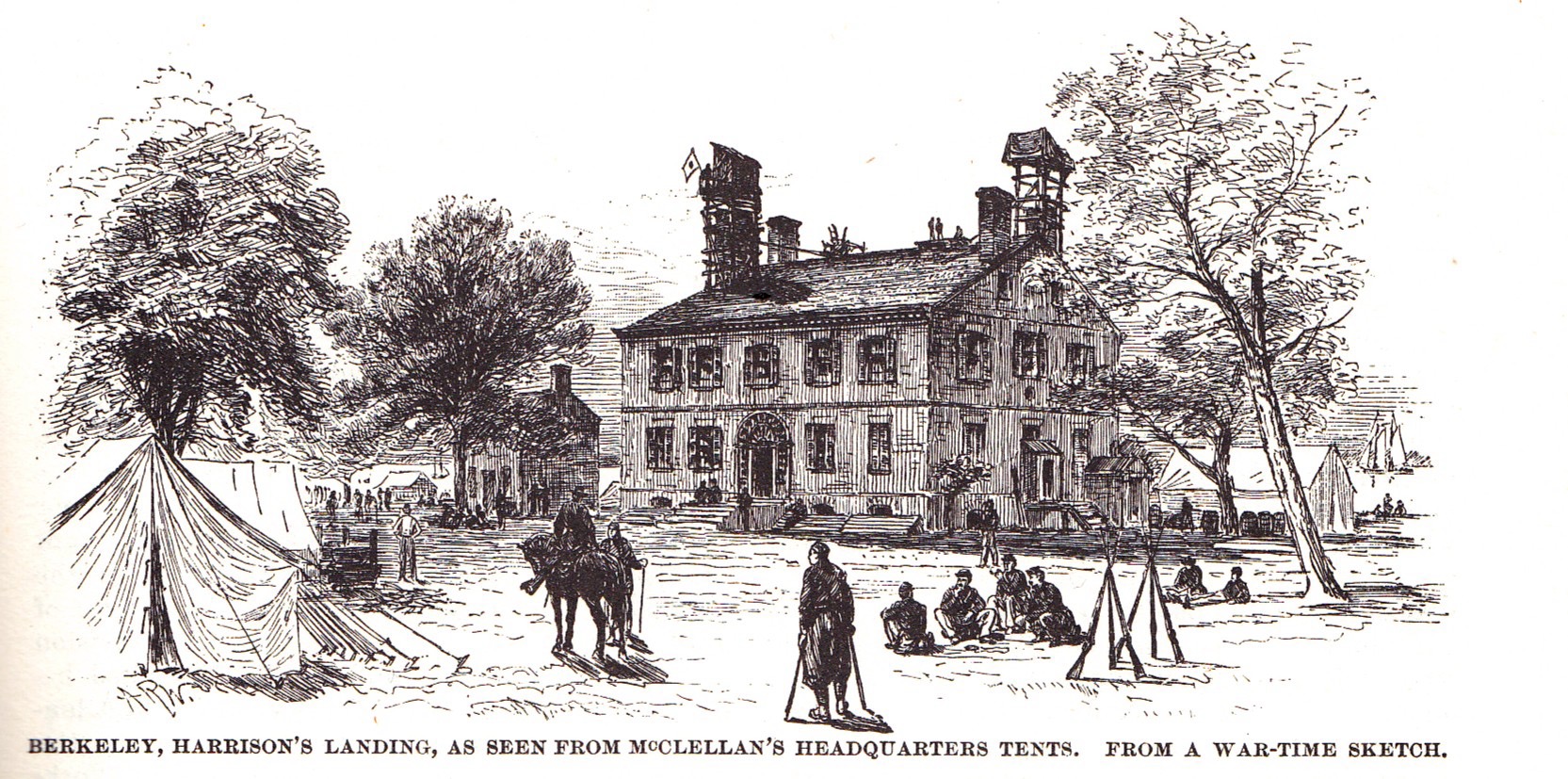
Friday, July 18, 1862—Finished policing and having received new Sibley tents, we pitched them in three streets forming a splendid camp. Weather very warm.

Saturday 19—Nothing of special interest occurring. Men have to do duty every other day. Hard work to get men enough at that.

Sunday 20—Received in the evening a little crumpled note from Capt. [James P.] Speer. He went down on the Louisiana wounded in the shoulder and thigh [on June 27th]. Thank God he is safe.

Monday, July 21, 1862—Mistake yesterday. I got alongside the Flag of Truce boats and saw several of our company on parole wounded. They are on their way east in good spirits. Wrote to Will Jackson.

Tuesday 22—Sutler here has his tent up and selling tremendously. Maj. Ball paid Co. B today for four months. Weather very hot. Flies bite clear through our clothes. Commenced to board at sutler’s.

Wednesday 23—Paymaster paid Cos. A, C, and D for two months this afternoon. He is the slowest man in the world. The boys are cursing him all around. Had a good view from the signal station this evening.

Thursday, July 24, 1862—Nothing of particular interest occurring. There has been a review of troops by Division for several days in the rear of our camp, It is said reinforcements are arriving every night.

Friday 25—Paymaster paid off Cos. E, F. G, H, I, and K this afternoon for two months. Payrolls have to be made over again for May and June. Received a letter from & wrote to Hanna, S. R.

Saturday 26—Nothing of special importance. Commenced to make out payrolls for Cos. F, G, H. I. & K. Find it a very difficult job.

Sunday, July 27, 1862—Had letter from Lizzie. Thomas A. Cochran & James Chambers on a visit from Headquarters. Went with them in afternoon to 62nd Regt. Saw Tom Anderson & Joe Moorehead of Jefferson county. Capt. Townsend commanding Co. G Sergt.

Monday 28—Find I missed it in leaving yesterday. The paymaster says the rolls must be finished today or we will not get paid. Worked until 12 o’clock last night and finished them all this evening. Letter from G. S. Mills.

Tuesday 29—Paymaster Ball paid off the regiment today. Received for March, April, May and June $445.00. Went with Archie Stewart to the Morgan in the evening. The flies are dreadful, biting through one’s clothes and crazing the horses.

Wednesday, July 30, 1862—The rebs made a raid on one of our transports last night. Burned the schooner and made the captain prisoner. Also captured a number of cattle. Received letters from W. T. Jackson and Lizzie. Letter from Zimmerman.

Thursday 31—Sent to G. W. Hoffstot $300 by Adams Express. Our gunboats now concentrating at the picket line. The siege train is also in position on ythe bank of the river. Something is evidently expected. Probably an attack looked for.

AUGUST 1862

Friday, August 1—Sure enough, the rebs give us “hark” from the other side of the river at 2 o’clock last night. Our batteries and gunboats soon made them skedaddle. 20 Union men killed and wounded. Two regiments crossed this afternoon and burned the buildings along the rebel shore. Wrote to G. S. M. and Mrs. Boyles.

Saturday, August 2, 1862—Nothing important today. REceived a letter from Rev. Kuhn in regard to some boxes. On guard at hospital.

Sunday 3—Sent $5 to Editor of Philadelphia Enquirer for subscription to be sent to G. S. Mills…

Monday 4—[No entry].

Tuesday, August 5, 1862—Several transports passed up the river last night loaded with rebel prisoners. It is hoped now that our boys in Richmond will be exchanged. Burnside has gone to Gen. Pope’s army.

Wednesday 6—11th [Penn. Reserve] Regiment returned from Richmond 329 privates. No officers yet. Boys look hard on show. The shirts and drawers were distributed and were gladly received. The enemy were expected but did not come. Bought blouse for $10.

Thursday 7—On guard today. Regiment ordered back to division delayed on account of having no tents. Very warm. News of the extra 300,000 to be drasfted is regarded as a good thing by the soldiers of the army. Name sent in for recruiting officer.

Friday, August 8, 1862—This is by far the hottest day we have had this summer. 13 men died in the General Hospital, mainly from the excessive heat. Not gone to the division yet. Tried to sell “Bill” to A. S. or 3rd Regt.

Saturday 9—Requisition made and clothing drawn for returned prisoners. Muskets also drawn but the men manifest disposition not to take them. An important movement on the [ ].

Sunday 10—Regiment formed in line and an explanation made by Capt. Porter. Men took the arms, marched to the Division and back. Sold Bill to Asst. Surgeon Orr, 3rd Regt. P. R. C. for $90 at 90 days.

Monday, August 11, 1862—Appointed acting adjutant. Had orders and moved to the Division camp in the morning. Left one hundred men in camp for a hospital ward. At 3 p.m., turned wagons over to division quartermaster and marched down to the mail landing to go on board transports. Destination unknown.

Tuesday 12—Went on board a ferry and was taken out to the steamer Belvidere at 1 a.m. 3 a.m. under weigh. 10 a.m. off Fortress Monroe. 5 p.m. a thunder storm, rough sea and sick quarter master. The most beautiful sunset I ever saw. 11 p.m. anchored near mouth of the Potomac.

Wednesday 13—Anchored off Aquia Creek at 9 a.m. Was ferried ashore. In the afternoon, left Aquia for Fredericksburg on the cars at dark. Arrived at the station at 9 p.m. Regiment slept in the open field. Wrote to Will Jackson.

Thursday, August 14, 1862—Camped on the hill in Sibley tents lately occupied by Gen. Burnside’s troops. A very pleasant, healthy location. Plenty of camp pedlers. A prospect of getting home on recruiting service,

Friday 15—Nothing important transpiring today. The weather here is cool and much pleasanter than on the Peninsula. Received orders to go home recruiting.

Saturday 16—Lieut. Sloan undertook to get transportation and failed. We are all considerably bored at getting heat as they are all poking fun at us. We will make it yet, or break something.

Sunday, August 17, 1862—Very cold last night. Went to Gen. Burnside’s Headquarters and got transportation. Arrived at Aquia Creek at 1 p.m. and got to Washington at 8 p.m. Stopped at Mrs. Forbes. The officers of the 11th [Pa. REserves] Regiment are at Brown’s Hotel.

Monday 18—…Left Washington at 5 p.m. and arrived at Baltimore at 7… Reached Harrisburg at 5 a.m.

Tuesday 19—Had our business arranged with Capt. Dodge. Sloan goes home and I am detailed here at Camp Curtin. Thousands of troops are arriving and leaving Camp Curtin daily. Very dusty and disagreeable.

Wednesday, August 20, 1863—Was arrested by Provost Guard before I was out of bed. Provost Marshall apologized but I [ ]. Reported at Camp Curtin for duty. Assigned to most wretched quarters, alive with vermin and disgustingly filthy.

Thursday 21—We are not allowed to leave camp. But several Reserve Officers run the blockade and go to town on spite of Provost guards. Board at the May House. Good fare, Very warm and dusty.

Friday 22—Much surprised this morning to receive a visit from D. W. Hoffstot. He won’t enlist. Was in town all day. Had sergeant paid off. A fine rain in the evening. Recruiting officer is god fellow.

Saturday, August 23, 1862—…Last day of volunteering for new regiments.

Sunday 24—Stayed in camp nearly all day. Don’t know what to make of the new captain. Got up a petition to Gov. Curtin which we will put through if pressure is not taken off.

Monday 25—All tight, Captain ain’t so bad as we thought—only afraid of Capt. Dodge. Slept at May House last night. Much better than camp.

Tuesday, August 26, 1862—Roads getting very dusty again. Nothing of special import today. There is fighting going on along the Rappahannock.

Wednesday 27—Sick today. Was detailed for duty. Not excused….

Thursday 28—Went down town and from there in the evening over to Independence Island to the picnic…

Friday, August 29, 1862—Feel pretty well played out today. So used for a spree. A heavy fight reported at Bull Run or Groveton. Wrote to Col. Jacksonm sent by Capt. R___.

Saturday 30—Left Harrisburg with Capt. Sands adn Lt. Cochran with 100 men to report at Ft. Ellsworth, Alexandria. Stopped over night at Baltimore. Went to Continental House O. K. Slept at Soldier’s Rest. Dry.

Sunday 31—Left Baltimore at 9 and arrived at Washington at 10, then to Alexandria by boat and on to Fort Ellsworth where we delivered the recruits. Came back to Washington and Lt. Cochran and I went over to Cunningham’s.

[No entries between 1 September through 6 December 1862]

DECEMBER 1862

Sunday, December 7, 1862—Arrived at regiment quartered at Brooks Station, Fredericksburg and Aquia Creek Railroad. Very cold. Wrote to Lizzie & N___. Slept in Col. Jackson’s tent. Received a letter from Hattie, Lizzie, Hanna, R. G. A.

Monday 8—Started at daylight and marched across the country about 8 miles and camped in a cedar thicket. Passed a couple of huts containing the most destitute, miserable looking creatures I have ever witnessed.

Tuesday, December 9, 1862—Laid in camp all day. There is snow on the ground and the nights are cold. Wrote to Adjt. Powell and Hanna. Rumor of a move soon. I think we will cross the river.

Wednesday 10—Orders to leave tonight at 11.30 o’clock. Three days grub, 60 rounds cartridges. Wrote to Hattie McIntryre. Weather fair and moderating slightly.

Thursday 11—Started at 12 midnight and reached the landing at 4 a.m. Our Brigade is guarding the pontoon corps who are laying two bridges a mile below Fredericksburg. The town is being burned down. Very heavy cannonading. Franklin’s Corps commenced crossing at sunset. No resistance but a little skirmishing.
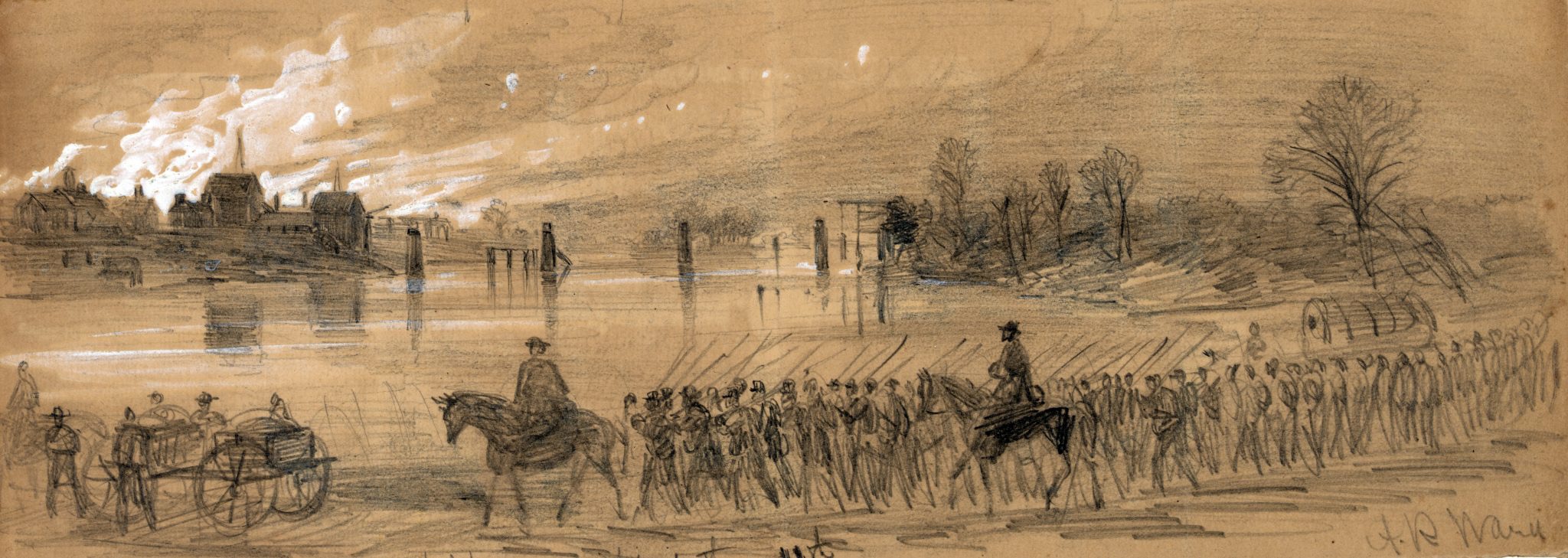
Fredericksburg, night of the 11th, by Alfred R. Waud. Library of Congress.

Friday, December 12, 1862—Crossed the river before noon and bivouacked in an open field near stone house. No fighting of any consequence today. Large numbers of troops are crossing over. Weather fair. Cold at night.

Saturday 13—Were ordered to prepare for immediate action at 6 a.m. and taken to the left. Supported batteries until 2 p.m. Then ordered forward. Advanced half a mile. Drove the rebs and were driven. Regiment suffered terribly at the railroad.

Sunday 14—The Division is laying in reserve today, being badly used up on yesterday. Co. G lost 20 men out of 25 in action and the regiment lost 212 out of 390 in action. Weather pleasant. No fighting today.

After the 11th Regiment was pushed down the ridge, Lt. Daniel Coder (11th Pa. Reserves, Co. E) wrote, “Never did I look back for support with more anxiety than on that fatal day; for on seeing a single line advance I had anticipated the result. We lost color bearer after color bearer, I know not how many. I picked up the colors at three different times myself. The flag staff was shot off and the flag perforated in nineteen different places by rebel bullets.” One of the flag bearers was Pvt. James Fritz of Co. E. Capt. Daniel S. Porter (11th Pa. Reserves, Co. B) made a similar comment. “Our division charged in the face of rebel batteries and rifle pits, drove the enemy from them and gained the hill; but no support came to our assistance, and we were driven back.” He later added, “The boys fought like heroes. They were too brave. I have little heart left, brave comrades have fallen without gain. We were butchered like so many animals.” Just above the railroad track, Pvt. James H. Trimble was shot in the chest and killed. Captain Porter wrote to Trimble’s father, “The saddest part of my task as Captain was to see my brave boys fall and next to it was to convey the sad intelligence to bereaved friends.” [Source: Shock Troops for the Union: The Pennsylvania Reserves at the Battle of Fredericksburg, by Bill Weidner (2023)

Monday, December 15, 1862—No fighting of consequence today. Brilliant Northern Light last night. A Flag of Truce was granted for one hour to bury our dead. No more of the company found.
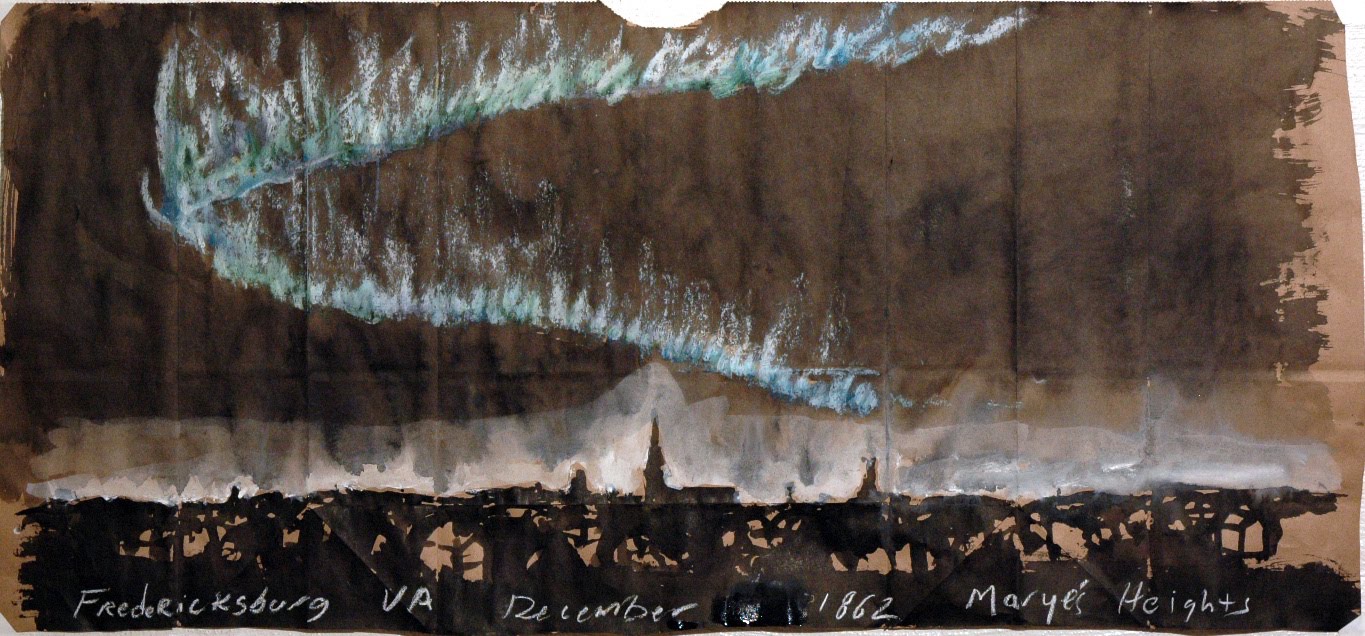
Northern Lights dance over the battlefield at Fredericksburg on 14-15 December 1862

Tuesday 16—The entire army was withdrawn across the river quietly last night. The night was rainy and favorable. Rebs made their appearance in the morning. Camped on the hill.

Wednesday 17—Lay all day in camp. Whiskey rations were issued last night and the Division was gloriously drunk. Capt. [James P.] Speer left for Washington. Cold.

Thursday, December 18, 1862—Col. Jackson and I visited the hospitals of our Division. Nearly all gone to Washington. On returning found the Division had left. Followed up and camped about two miles from White Oak Church.

Friday 19—Marched to within two miles of Belle Plain in the afternoon and camped. Very cold. Col. Anderson got a few blessings for running us through brush and over the hills uselessly.

Saturday 20—Moved about a hundred yards and camped in what is probably winter quarters. Good location. Brigade inspection. Went on picket in the evening.

Sunday, December 21, 1862—Rather pleasant for the time of year. Only three companies on post. The rest on reserve. Was relieved at sundown. This is my 25th Birthday.

Monday 22—Weather moderate. Boys all busy putting up winter quarters. Received a note from Hanna and one from Lizzie.

Tuesday 23—Weather very fine for the season. More like spring than winter. Getting along very well except that we get very poor fare from McCandless & Co.

Wednesday, December 24, 1862—Had A. K. Vantine appointed sergeant from December 1st. Took a tramp over the hills to Cockpit Point Landing. Fine view. Get no letters or papers. Very lonesome.

Thursday 25—Christmas. Oh, how dry. But I am well today and last Christmas I was [sick and] at the point of death [at Camp Pierpont, Virginia]. Am I thankful enough for the blessing? I fear not…
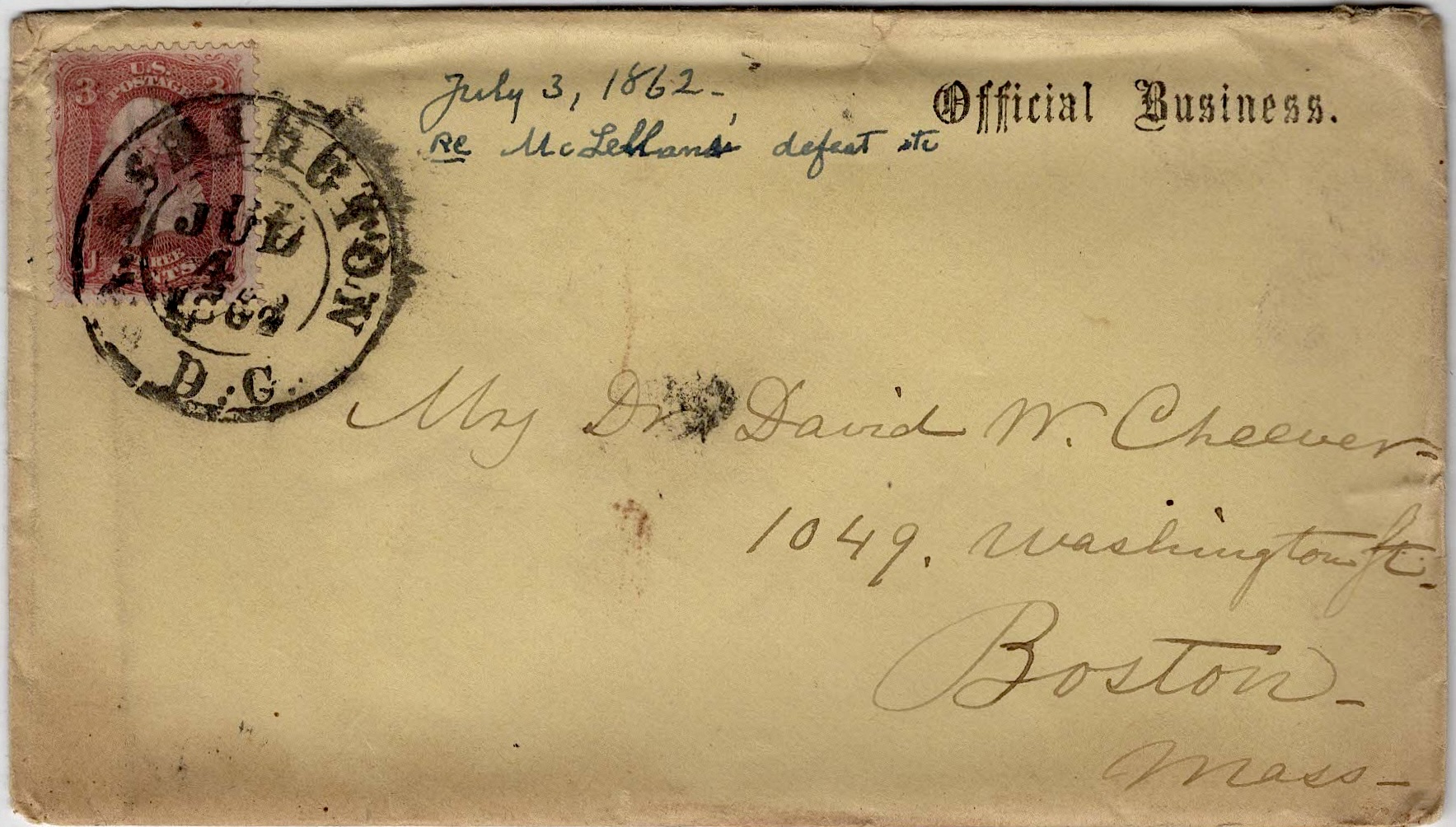
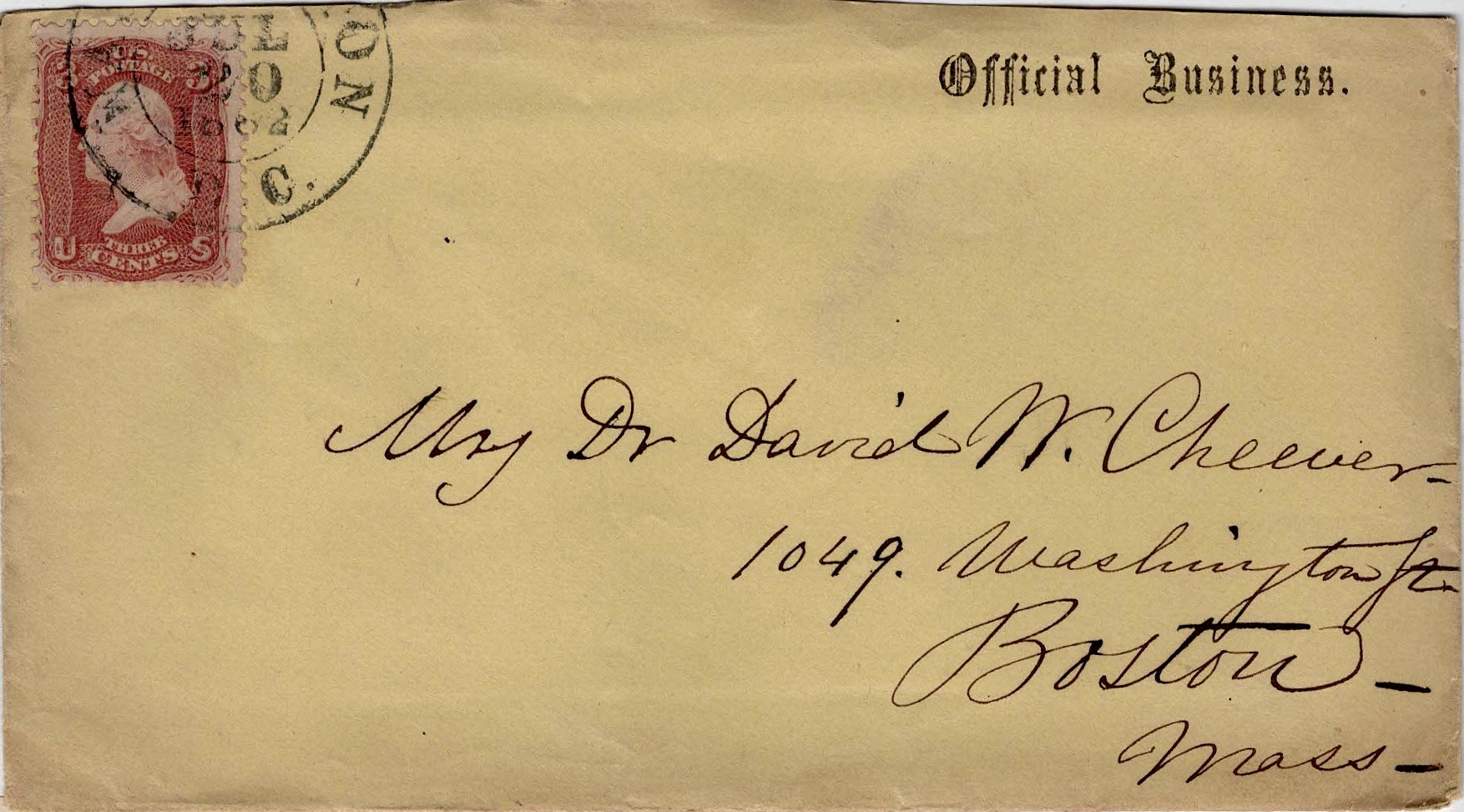
1862: David Williams Cheever to Anna C. (Nichols) Cheever

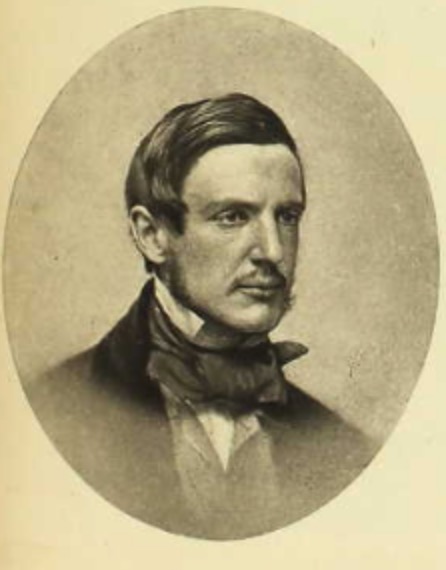
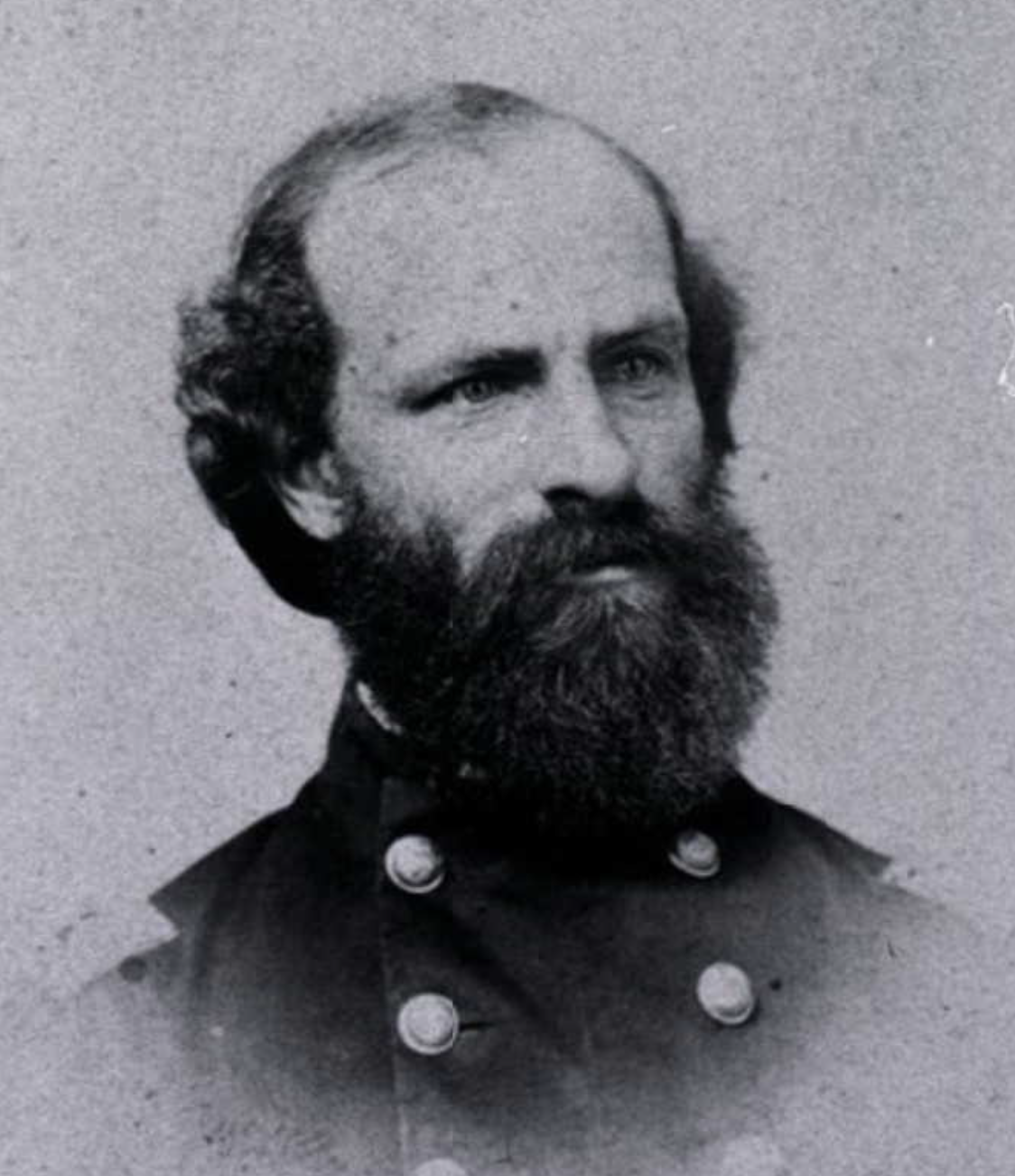
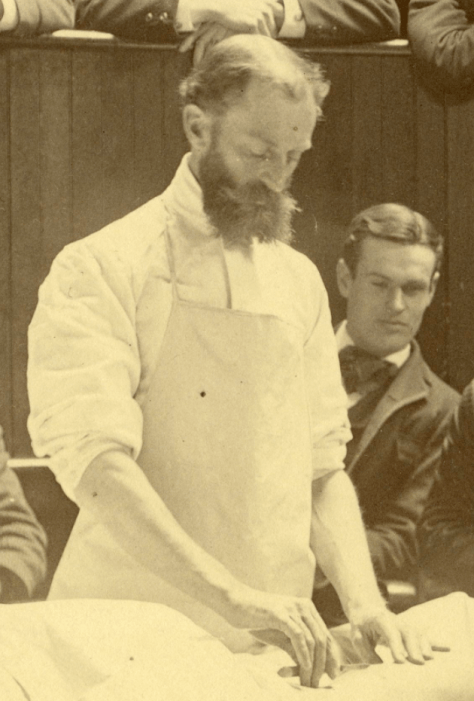
Dr. Cheever performing surgery in 1880

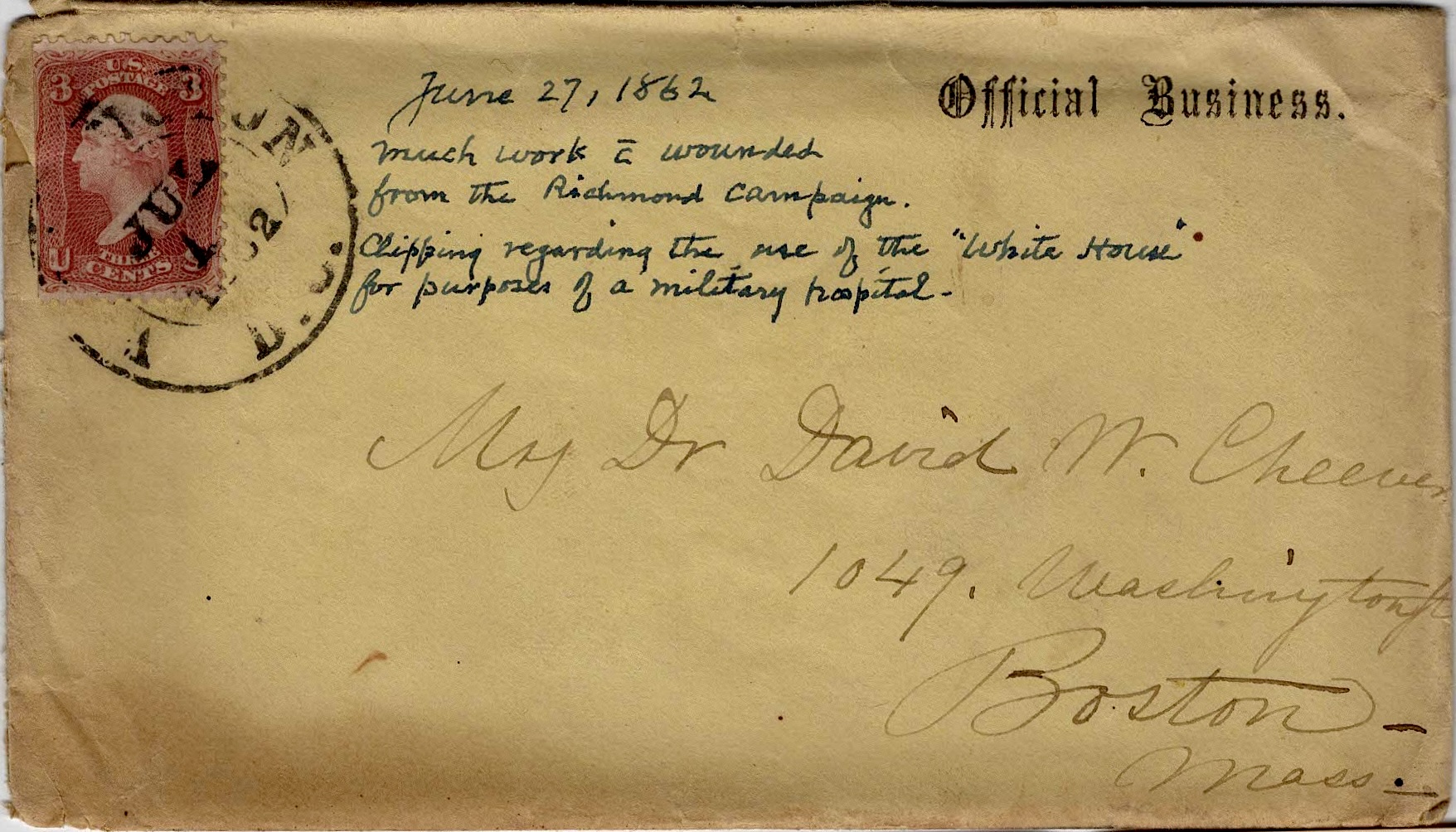
The following letters were written in 1862 by 31 year-old Dr. David Williams Cheever (1831-1915), a graduate of the Harvard Medical School where he later taught [see biographical sketch]. Cheever wrote the letters while serving as a surgeon at the Judiciary Square Hospital in Washington D. C. during the summer of 1862. This hospital was sometimes called the “Washington Infirmary.” It consisted of “commodious frame buildings” erected on the square after the burning of the first infirmary in November 1861. The new buildings were opened in April 1862.

In his letters, Cheever mentions a colleague, Dr. Frank Brown—an 1861 graduate of the Harvard Medical School. Brown mentions Cheever in a 16 June 1862 letter I transcribed in 2014 (see 1862: Francis Henry Brown to Charles Francis Wyman) which reads as follows: “Yesterday while at dinner, we received orders for one or two surgeons from our hospitals to proceed immediately to a church near the station to take charge of a large number of wounded from [Gen’l James] Shield’s Division near Winchester. So Dr. [David Williams] Cheever and I hurried our two ambulances with nurses, boys, orderlies of all kinds, instruments, soup, coffee & brandy, & went full gallop for the place. We found on arrival by some negligence our orders had been delivered too late and we had to come back. The wounded had been carried to other hospitals.”

Though President Lincoln and his wife are frequently noted for their visits to various hospitals around Washington D.C. during the war, the specific account written by Cheever in his letter of 27 July 1862 is remarkable for its details on the President’s interactions with the soldiers and his impressions on both President and Mrs. Lincoln.

Dr. Cheever wrote these letters to his wife, Anna C. (Nichols) Cheever with whom he married in 1860.

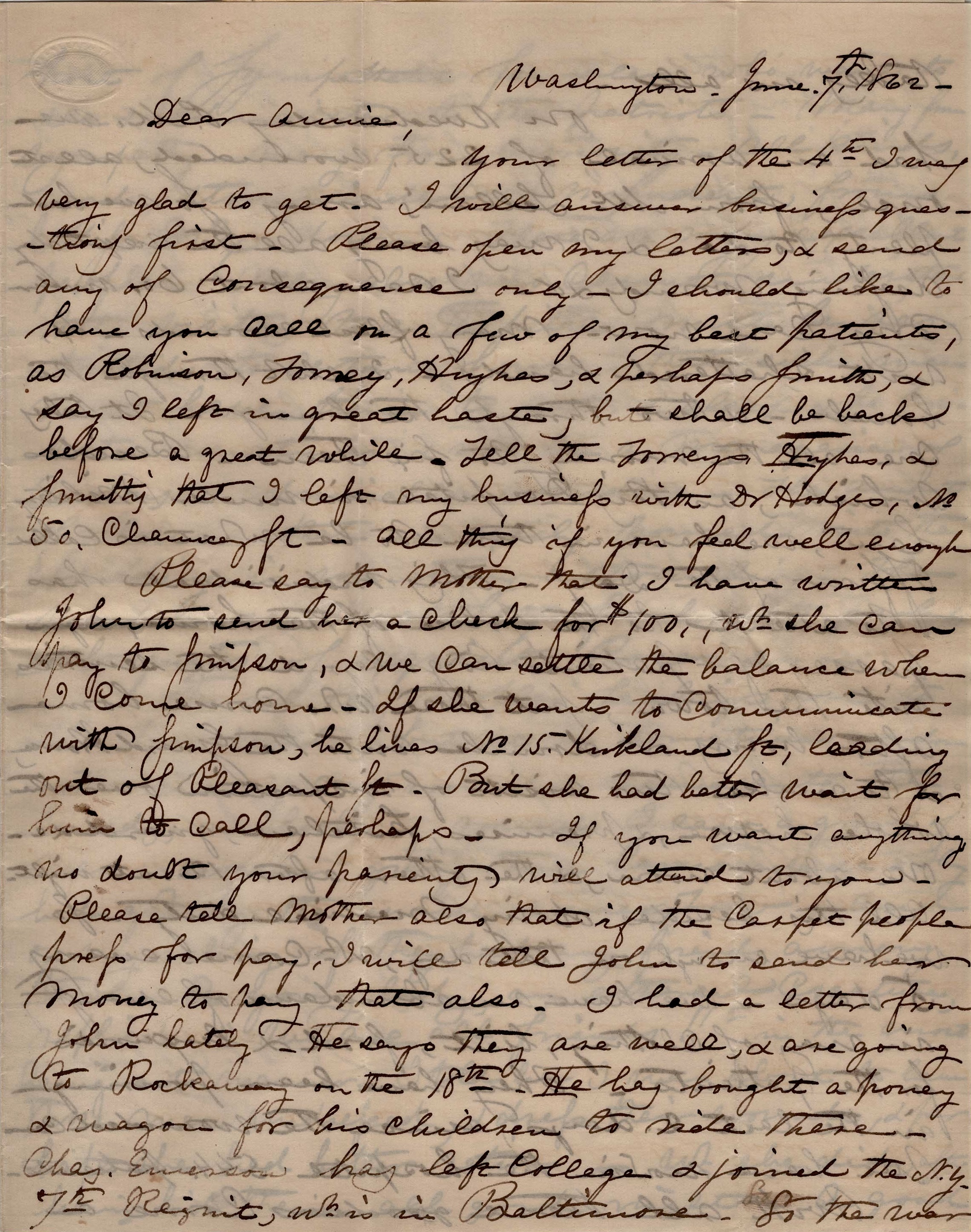
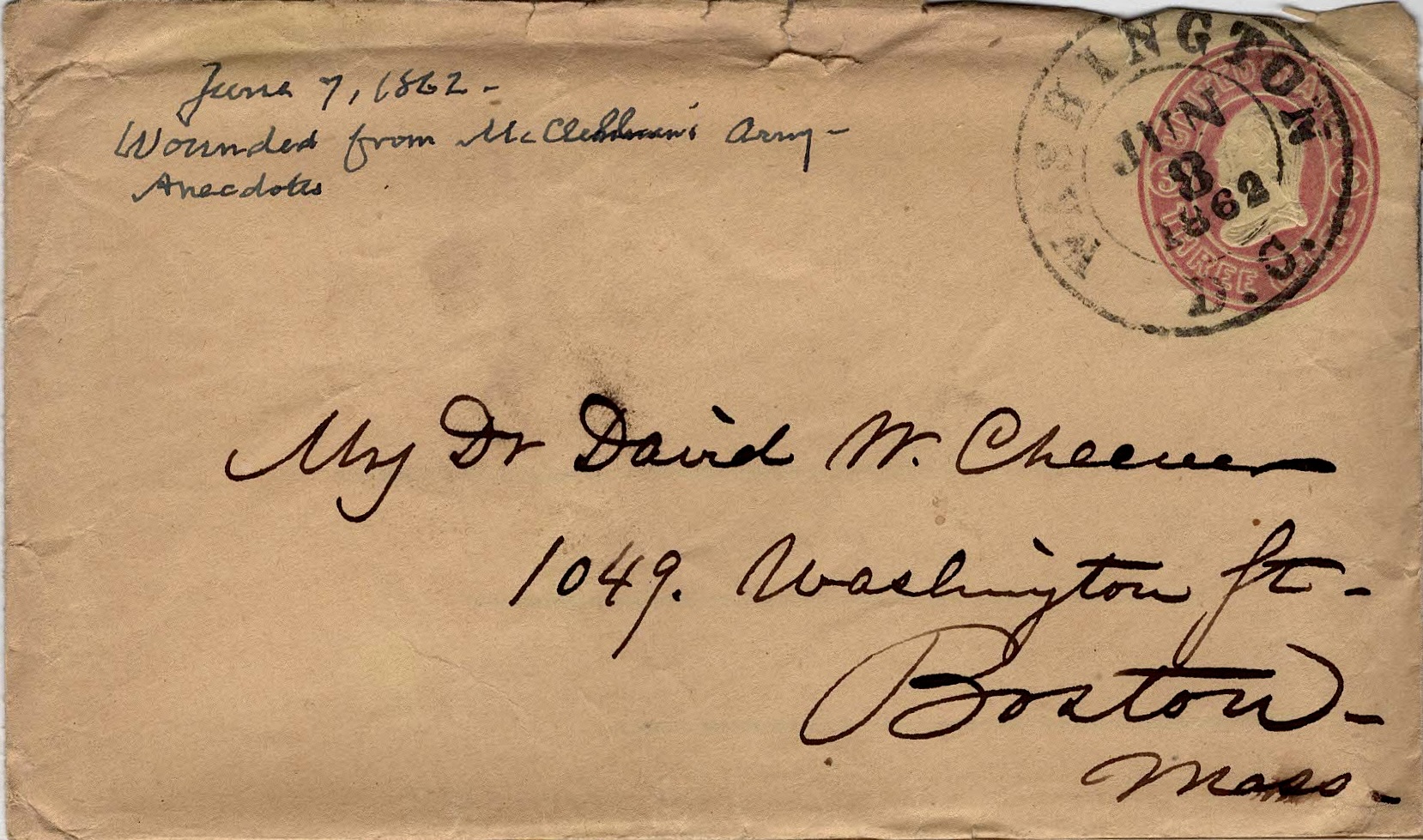
Letter 1

Washington
June 7th 1862

Dear Annie,

Your letter of the 4th I was very glad to get. I will answer business questions first. Please open my letters & send any of consequence only. I should like to have you call on a few of my best patients, as Robinson, Tomey, Hughes, & perhaps Smith, and say I left in great haste, but shall be back before a great while, Tell the Tomey’s, Hughes, & Smith’s that I left my business with Dr. Hodges, No. 50, Chauncey Street. All things if you feel well enough.

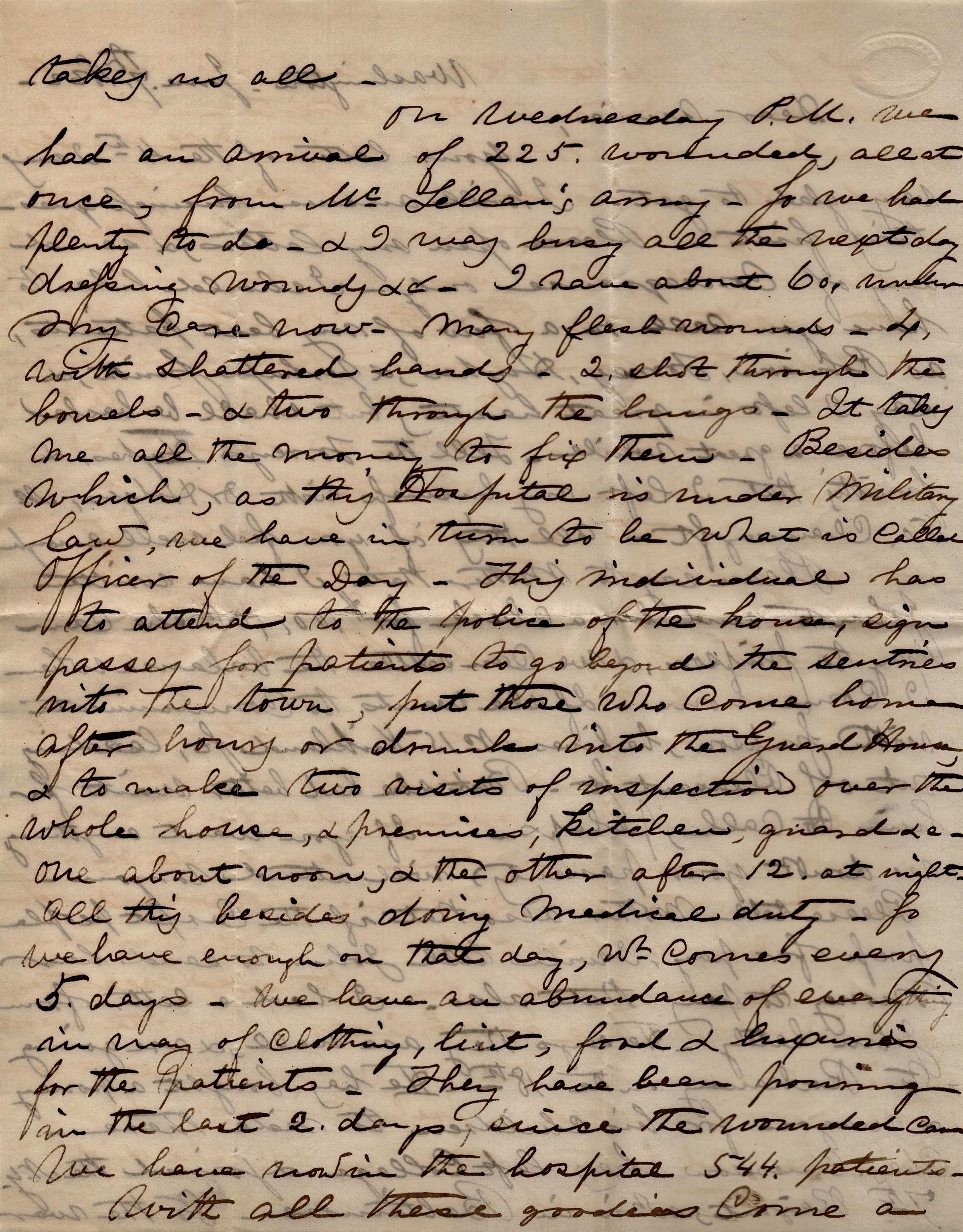
Please say to Mother that I have written John to send her a check for $100 which she can pay to Simpson & we can settle the balance when I come home. If she wants to communicate with Simpson, he lives No. 15 Kirkland St. leading out of Pleasant Street. But she had better wait for him to call, perhaps. If you want anything, no doubt your parents will attend to you. Please tell Mother also that if the carpet people press for pay, I will tell John to send her money to pay that also.

I had a letter from John lately. He says they are well and are going to Rockaway on the 18th. He has bought a pony and wagon for his children to ride there. Charles Emerson has left college and joined the New York 7th Regiment which is in Baltimore. So the war takes us all.

On Wednesday p.m. we had an arrival of 225 wounded, all at once, from McClellan’s army, so we had plenty to do & I was busy all the next day dressing wounds, &c. I have about 60 under my care now. Many flesh wounds—four with shattered hands, two shot through the bowels, and two through the lungs. It takes me all the morning to fix them. Besides which, as this hospital is under military law, we have in turn to be what is called Officer of the Day. This individual has to attend to the police of the house, sign passes for patients to go beyond the sentries into the town, put hose who come home after hours or drunk into the guard house, and to make two visits of inspection over the whole house & premises, kitchen, guard, &c.—one about noon and the other after 12 at night. All this besides doing medical duty. So we have enough on that day which comes ever five days.

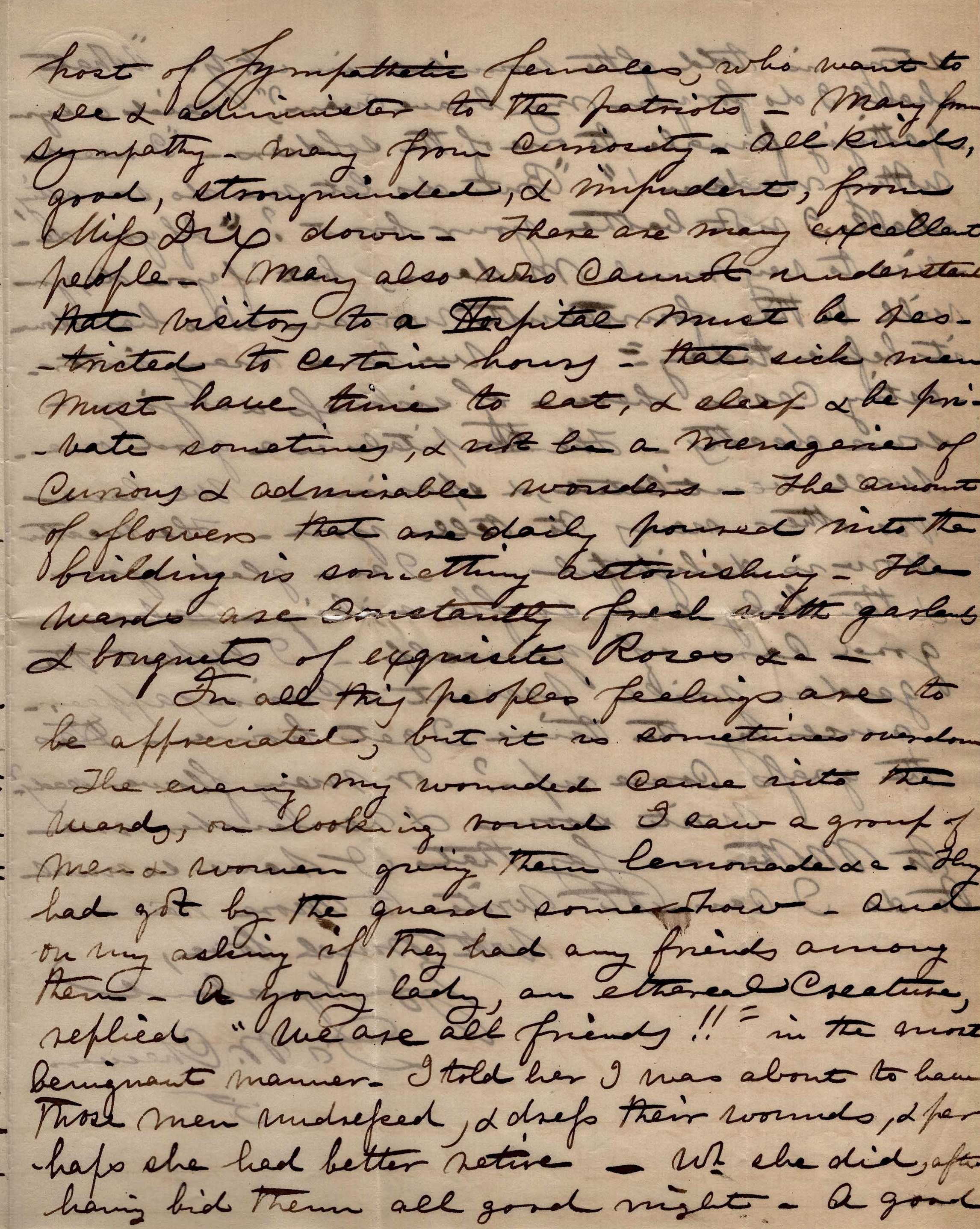
We have an abundance of everything in way of clothing, lint, food and luxuries for the patients. They have been pouring in the last two days since the wounded came. We have now in the hospital 544 patients. With all these goodies come a host of sympathetic females who want to see and administer to the patriots—many from sympathy, many from curiosity—all kinds, good, strong, strong-minded, & impudent, from Miss Dix down. There are many excellent people. Many also who cannot understand that visitors to a hospital must be restricted to a certain hours—that sick men must have time to eat and sleep and be private sometimes, & not be a menagerie of curious & admirable wonders. The amount of flowers that are daily poured into the building is something astonishing. The wards are constantly fresh with garlands & bouquets of exquisite roses &c.

In all this, people’s feelings are to be appreciated, but it is sometimes overdone. The evening my wounded came into the ward, on looking round I saw a group of men and women giving them lemonade &c. They had got by the guard somehow, and on my asking if they had any friends among them, a young lady—an ethereal creature—replied, “We are all friends!!” in the most benignant manner. I told her I was about to have those men undressed & dress their wounds & perhaps she had better retire, which she did after having bid them all good night.

A good story is told of the wounded in New York. “What shall I do for you my brave man?” said a sympathizing female to one of the soldiers. “I need nothing, madam!” “But do let me do something. Shall I not bathe your brow?” “If you desire to very much, madam, but if you do, you will be the fourteenth woman who has done it before today.”

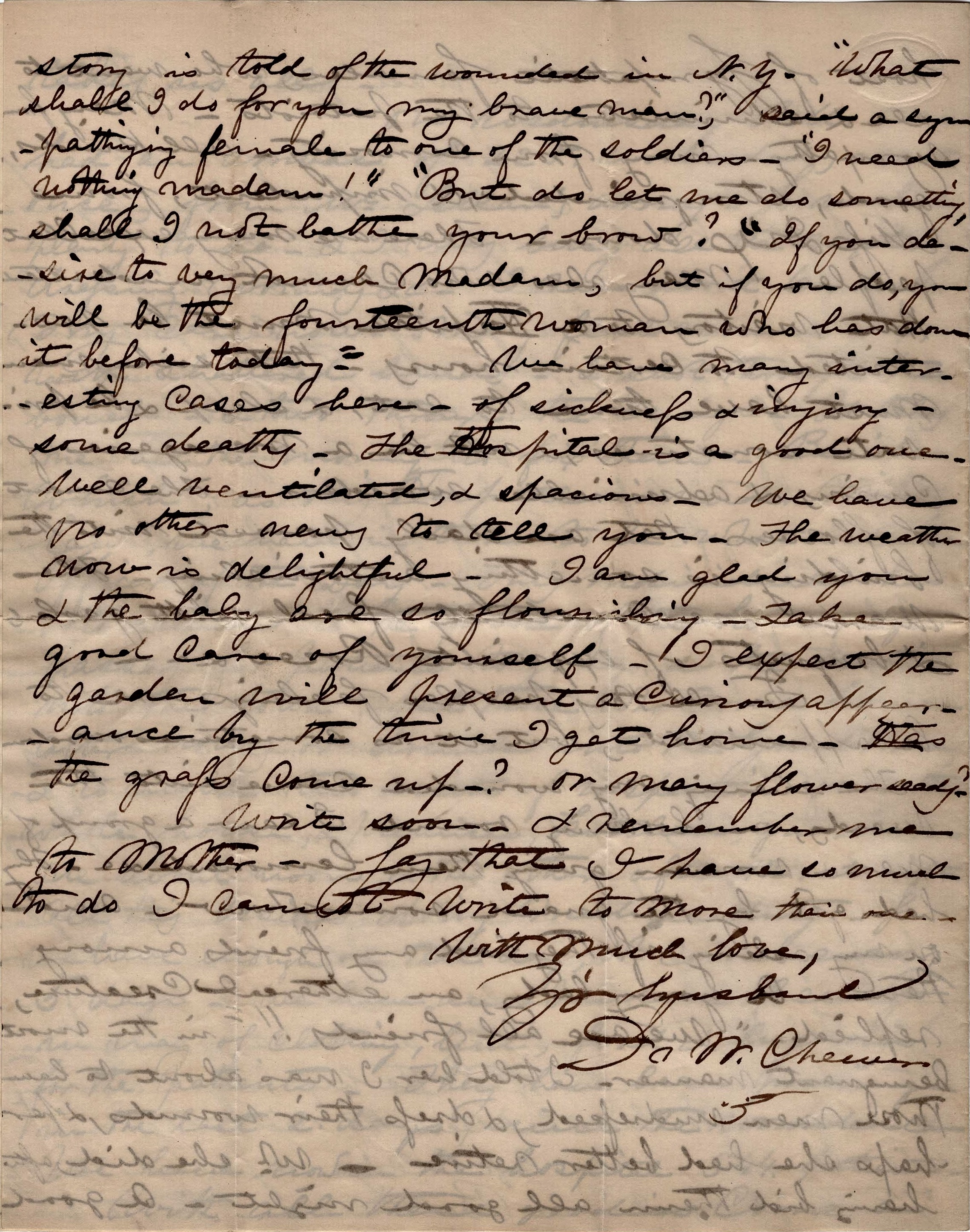
We have many interesting cases here of sickness and injury—some deaths. The hospital is a good one. Well ventilated and spacious. We have no other news to tell you. The weather now is delightful. I am glad you and the baby are so flourishing. Take good care of yourself. I expect the garden will present a curious appearance by the time I get home. Has the grass come up? or many flower seeds?

Write soon and remember me to Mother. Say that I have so much to do I cannot write to more than one. With much love, your husband, — D. W. Cheever


Letter 2

Washington
June 16, 1862

My dear love,

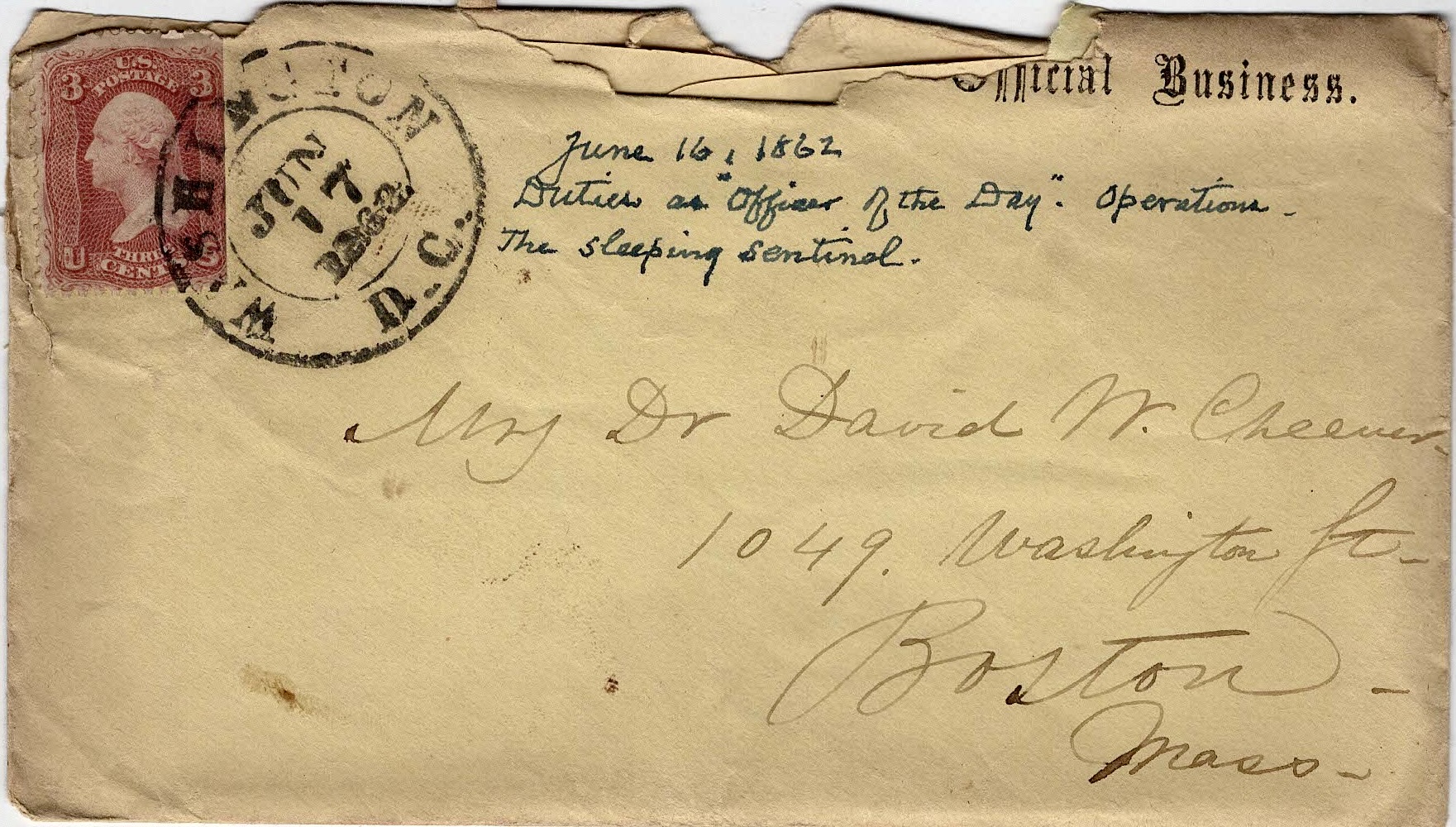
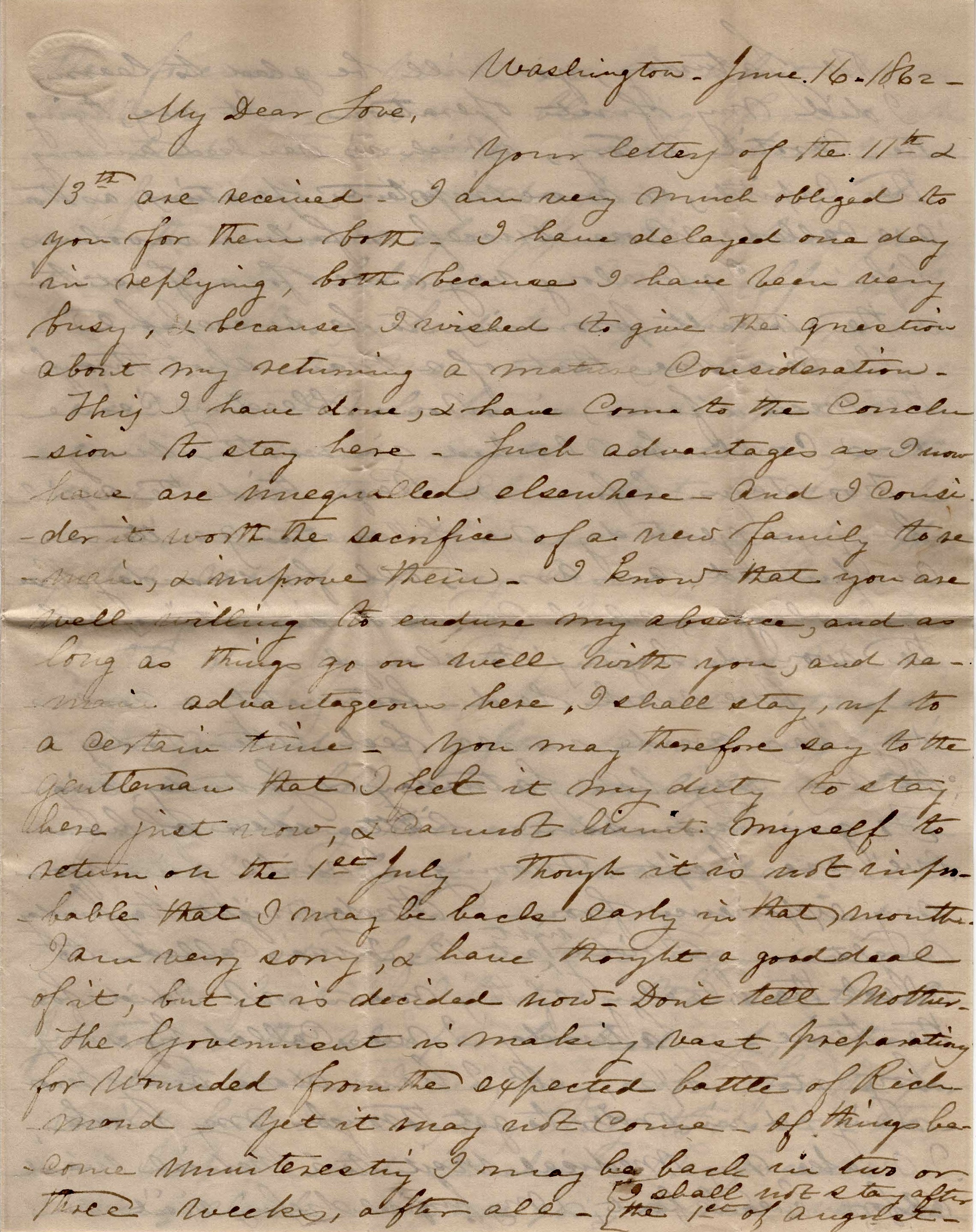
Your letters of the 11th and 13th are received. I am very much obliged to you for them both. I have delayed one day in replying, both because I have been very busy, and because I wished to give the question about my returning a mature consideration. This I have done & have come to the conclusion to stay here. Such advantages as I now have are unequaled elsewhere and I consider it worth the sacrifice of a new family to remain & improve them. I know that you are well willing to endure my absence, and as long as things go on well with you and remain advantageous here, I shall stay up to a certain time. You may, therefore, say to the gentleman that I feel it my duty to stay here just now, and cannot limit myself to return on the 1st of July, though it is not improbable that I may be back early in that month. I am very sorry & have thought a good deal of it, but it is decided now. Don’t tell Mother.

The government is making vast preparations for wounded from the expected battle of Richmond. Yet is may not come. If things become uninteresting, I may be back in two or three weeks after all. I shall not stay after the 1st of August.

On Saturday, you will be glad to learn I did my first operation. It was tying the carotid artery which is ranked among the capital or more important operations, as those are called, who success or failure involves life. I got along very well for a first time and the result promises to be successful. The case was that is a man shot through the neck and face in whom bleeding came on & could be checked in no other way. Two days before, Dr. Page tied the axillary & yesterday one of the other gentlemen amputated and arm, all for secondary hemorrhage., which comes on sometimes when the wound begins to slough.

We work hard. Fortunately a cool day has made us all feel better today. It was very hot Saturday and Saturday evening. To give you some idea of how we are kept moving, I will give you my experience from Friday night to Sunday night.

Friday night at 12, I was called to check the bleeding of this man which I did for the time. Saturday I was called by my boy at 6.30 as I have done every morning, & in order to get through my work, I make my medical visit to a medical ward before breakfast, and my surgical dressing visit in the forenoon. While at breakfast I was called again to my bleeding friend, when we tied the carotid. Then I had to make my surgical visit and dressing to 40, which with the amount of suppuration & heat going on is pretty laborious. I was Officer of the Day also and had to sign papers and all passes for the men who wanted to go out, visit the whole house, and inspect every scullery, ward, water closet & settle rows with the cooks, put the drunks &c. in the guard house, write up a hospital record of my cases, make an evening visit to my wards & wind up the day by making the grand rounds through every room, all round outside, to the guard, &c. after 12 at night.

It was a hot, but moonlight night, & going along to one place, I found the sentinel asleep & succeeded in taking his musket away unperceived & carried it off which is regarded as a great feat. I had another sentinel posted & the sleeper locked up & then went to bed. I was very sorry for the poor devil, but it was my duty to do it. He will be punished somehow. Our guard is growing slack and we are going to have a new one.

Sunday morning at 6.30 again, [worked] hard until near 12 at noon when the weekly General Inspection come, and all the officers go round together, following the head one and inspect and poke out corners and behind beds and blow up and find all the fault necessary. The hospital looks nice Sunday, I assure you, and indeed every day. It is scrubbed and mopped daily. The only difficulty is in getting clothes enough & washed fast enough to change 500 men often enough as many are wounded, &c. The way we use up bandages and supplies would astonish you. 500 loaves of bread, a keg of butter, and a barrel or 30 dozen of eggs every day, and other things in proportion. We have an abundance.

Sunday I was late at dinner because I was called off to do something in the ward. At dinner came an order to send a medical officer with nurses &c., to dress 300 wounded in a church, just arrived. I was sent with Dr. Brown as assistant, but on getting there found only five who had not been removed to other hospitals. Those five I took here and had three in my ward to attend to that evening. Then I went to bed.

Now I am going out for a little walk—first time for two days. I am very well. Love to mother. Yours affectionately, — D. W. C.


Letter 3

Washington
June 19, 1862

My dear little wife,

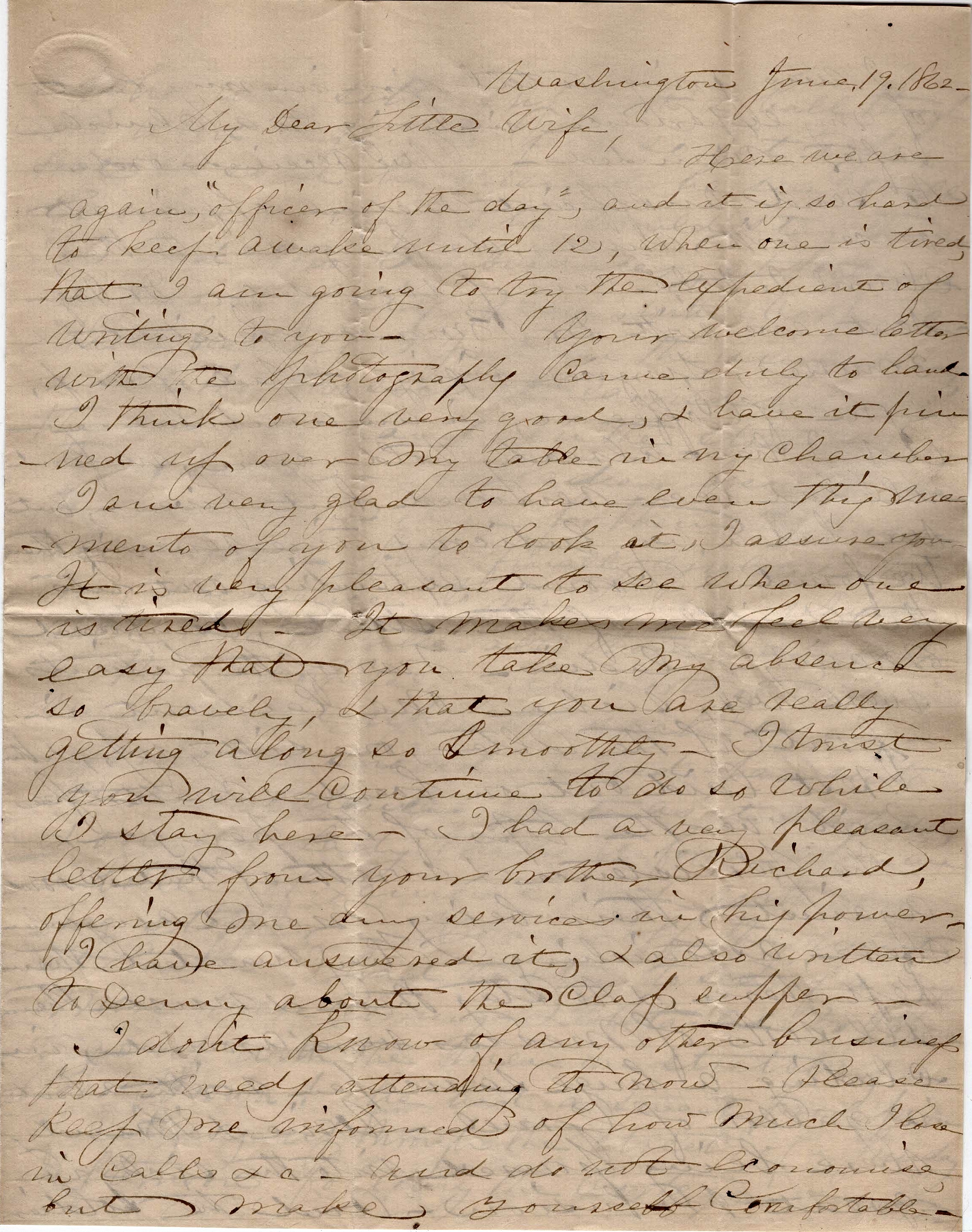
Here we are again, “Officer of the Day” and it is so hard to keep awake until 12 when one is tired that I am going to try the expedient of writing to you. Your welcome letter with the photography came duly to hand. I think one very good and have it pinned up over my table in my chamber. I am very glad to have even this memento of you to look at. I assure you, it is very pleasant to see when one is tired. It makes me feel very easy that you take my absence so bravely & that you are really getting along so smoothly. I trust you will continue to do so while I stay here.

I had a very pleasant letter from your brother Richard offering me any services in his power. I have answered it and also written to Demy [?] about the class supper. I don’t know of any other business that needs attending to now. Please keep me informed of how much I lose in calls, &c. and do not economize but make yourself comfortable.

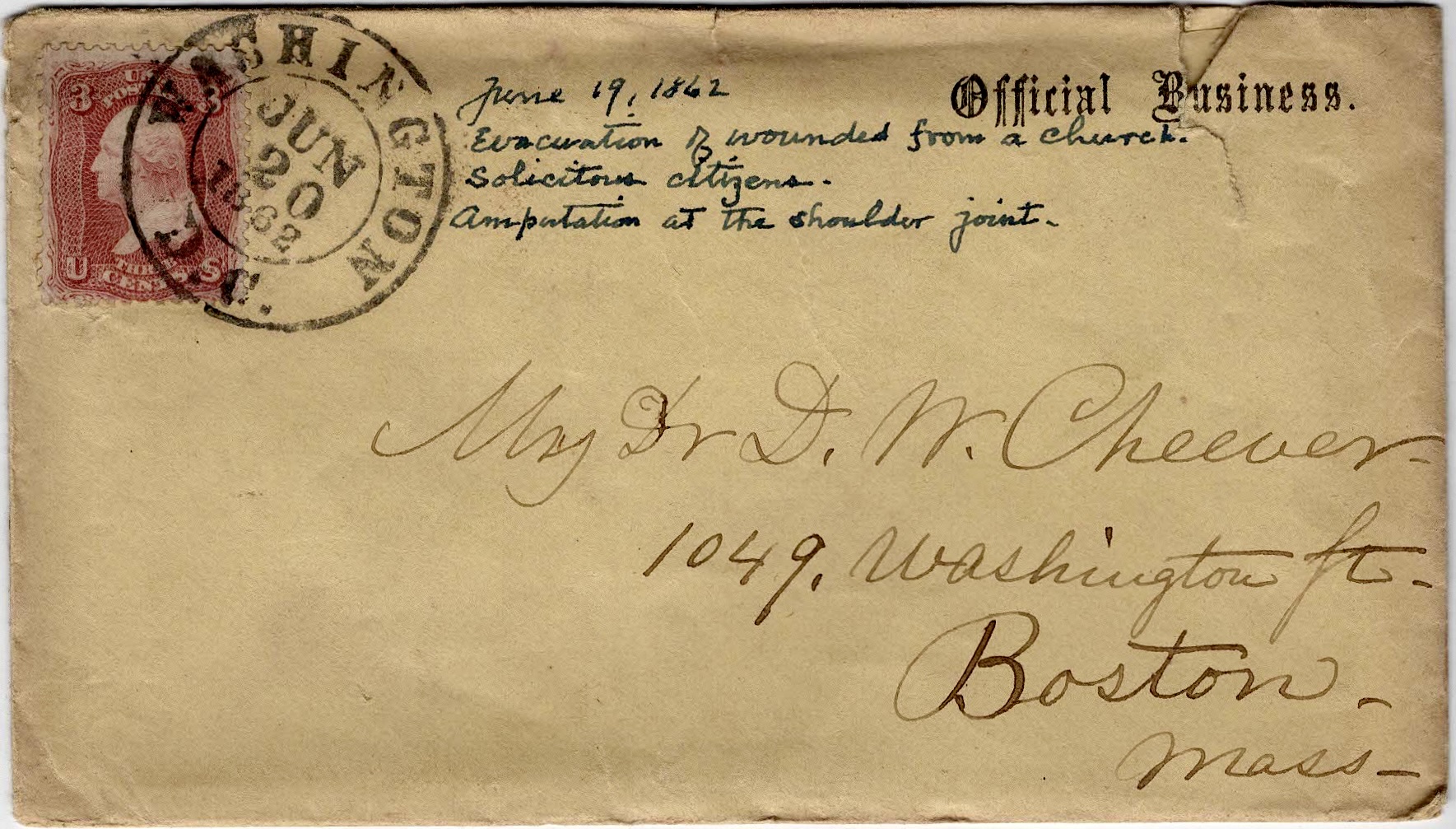
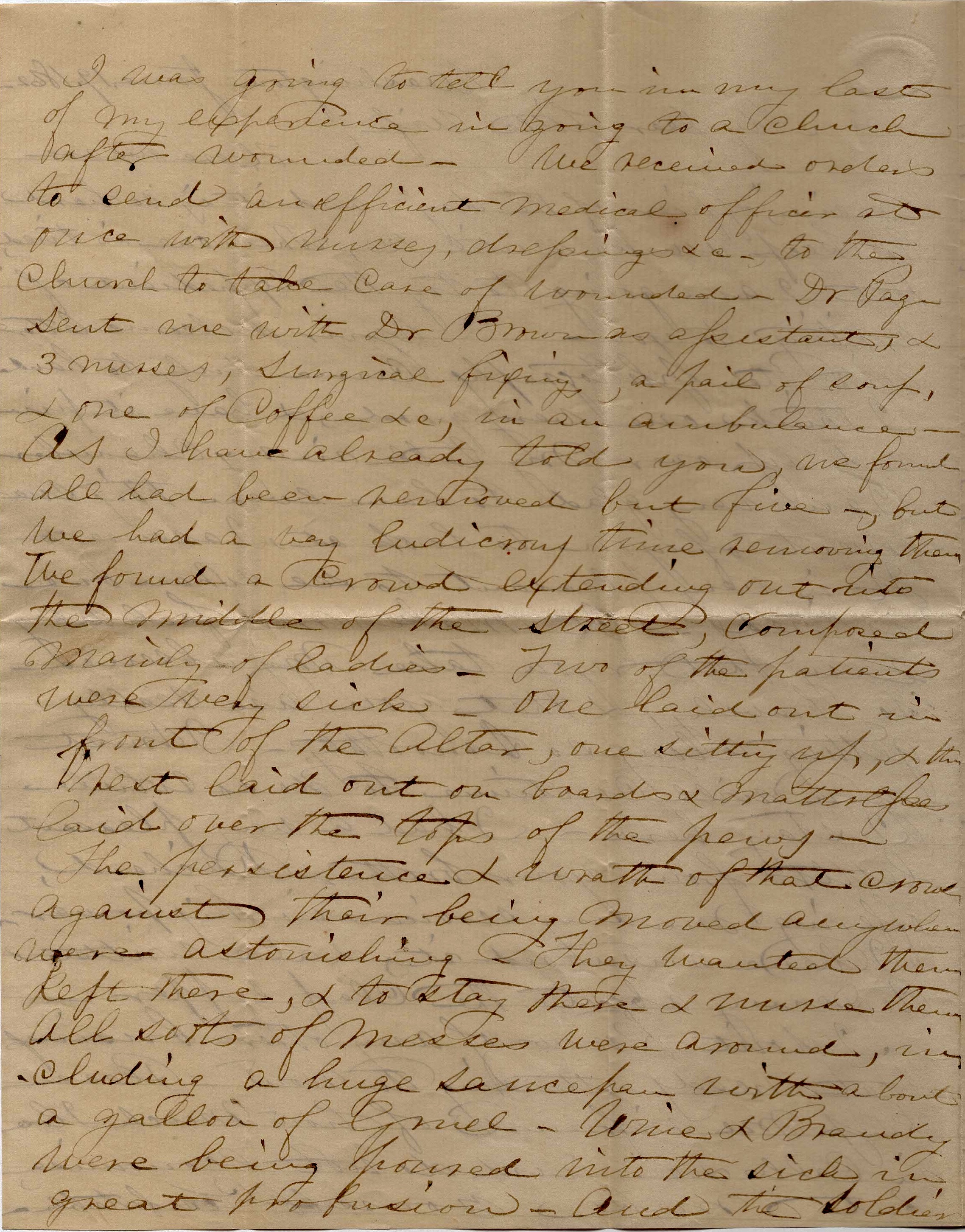
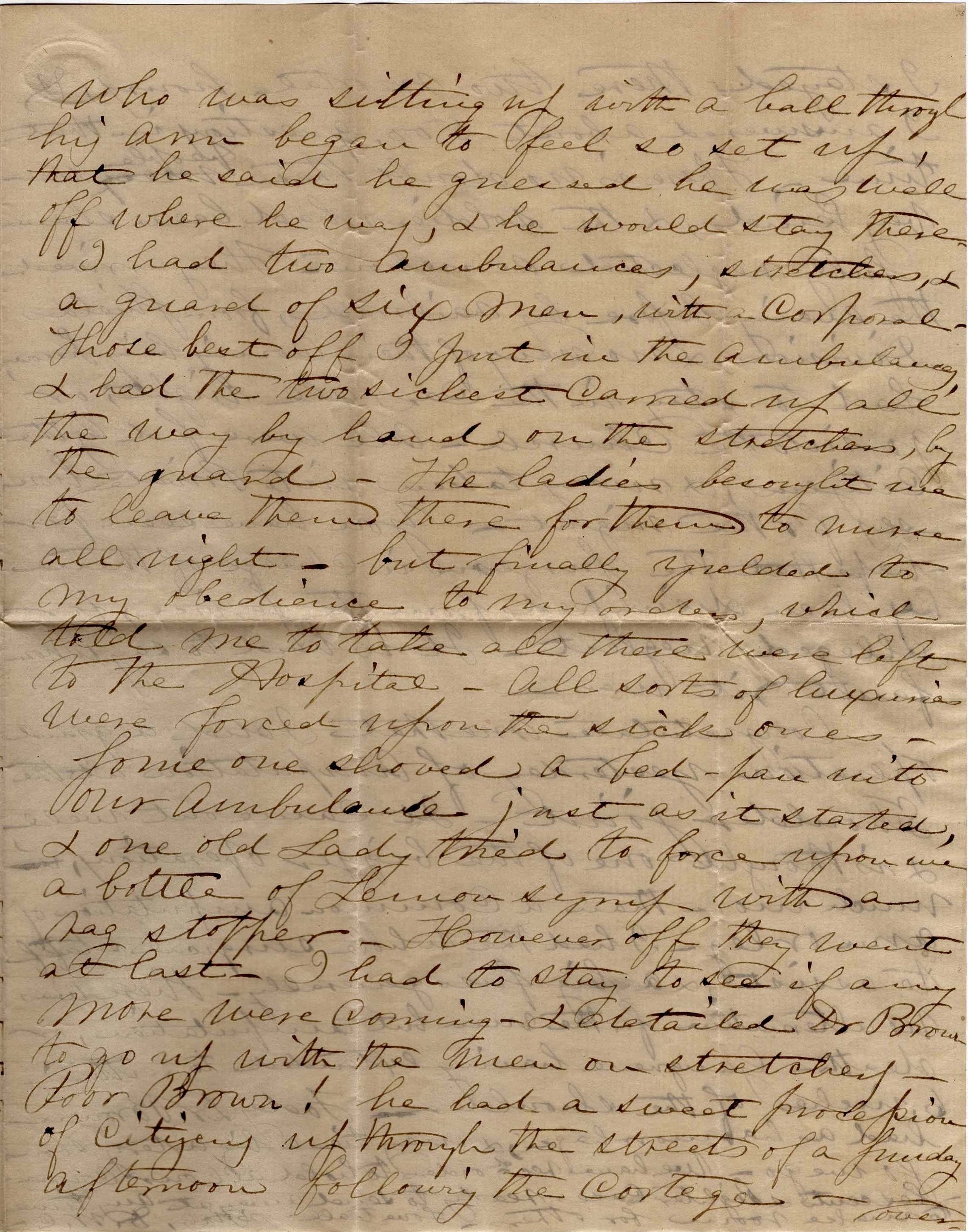
I was going to tell you in my last of my experience in going to a church after wounded. We received orders to send an efficient medical officer at once with nurses, dressings, &c. to the church to take care of wounded. Dr. Page sent me with Dr. Brown as assistant, and three nurses, surgical fixings, a pail of soup, and one of coffee, &c. in an ambulance. As I have already told you, we found all had been removed but five, but we had a very ludicrous time removing them. We found a crowd extending out into the middle of the street composed mainly of ladies. Two of the patients were very sick. One laid out in front of the altar, one sitting up, and the next laid out on boards & mattresses laid over the tops of the pews. The persistence and wrath of that crowd against their being moved anywhere were astonishing. They wanted them kept there and to stay there & nurse them. All sorts of messes were around, including a huge saucepan with about a gallon of gruel. Wine and brandy were being poured into the sick in great profusion and the soldier who was sitting up with a ball through his arm began to feel so set up that he said he guessed he was well off where he was, and he would stay there.

I had two ambulances, stretchers, and a guard of six men with corporal. Those best off I put in the ambulance and had the two sickest carried up all the way by hand on the stretchers by the guard. The ladies besought me to leave them there for them to nurse all night, but finally yielded to my obedience to my orders, which told me to take all there were left to the hospital. All sorts of luxuries were forced upon the sick ones. Someone shoved a bed pan into our ambulance just as it started and one old lady tried to force upon me a bottle of lemon syrup with a rag stopper. However, off they went at last. I had to stay to see if any more were coming & detailed Dr. Brown to go up with the men on stretchers. Poor Brown! he had a sweet procession of citizens up through the streets of a Sunday afternoon following the cortege.

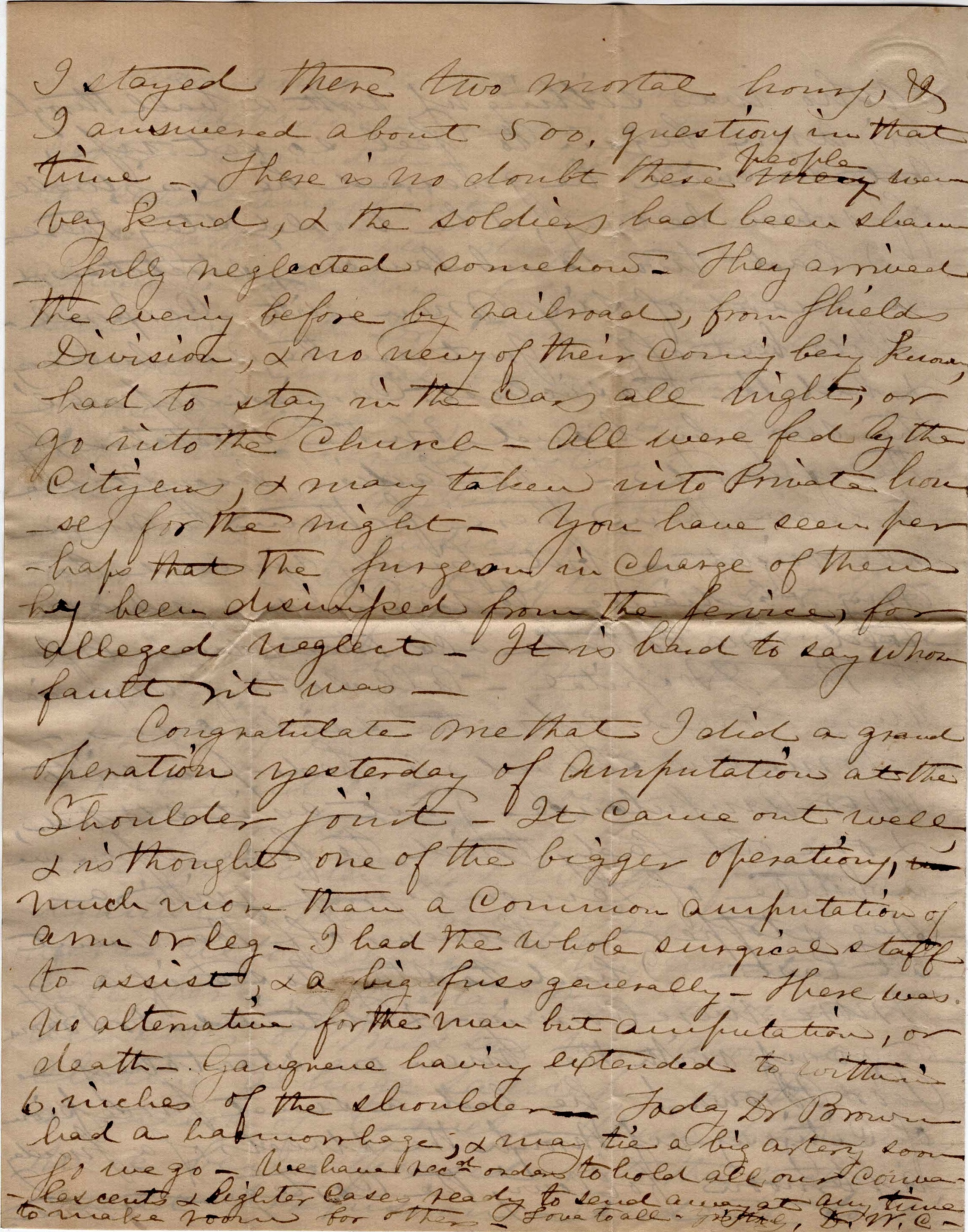
I stayed there two mortal hours & I answered about 500 questions in that time. There is no doubt these people were very kind & the soldiers have been shamefully neglected somehow. They arrived the evening before by railroad from Shields’ Division & no news of their coming being known, had to stay in the cars all night, or go into the church. All were fed by the citizens and many taken into private houses for the night. You have seen perhaps that the surgeon in charge of them has been dismissed from the service for alleged neglect. It is hard to say whose fault is was.

Congratulate me that I did a grand operation yesterday of amputation at the shoulder joint. It came out well & is thought one of the bigger operations—much more than a common amputation of arm or leg. I had the whole surgical staff to assist and a big fuss generally. There was no alternative for the man but amputation or death—gangrene having extended to within 6 inches of the shoulder.

Today Dr. Brown had a hemorrhage & may tie a big artery soon. So we go. We have received orders to hold all our convalescents & lighter cases ready to send away at any time to make room for others.

Love to all. Yours, — D. W. C.


Letter 4

Washington
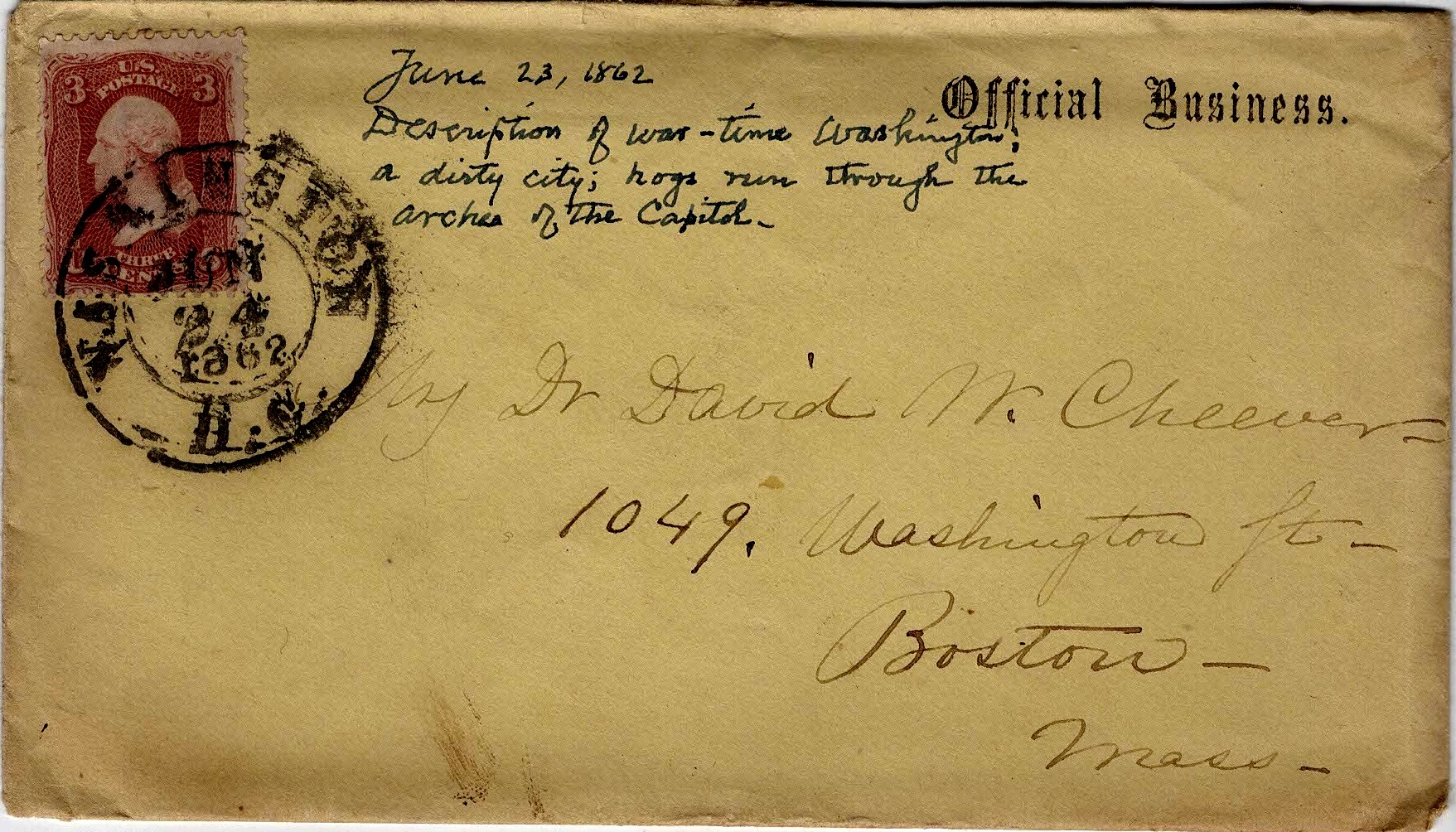
June 23, 1862

My very dear wife,

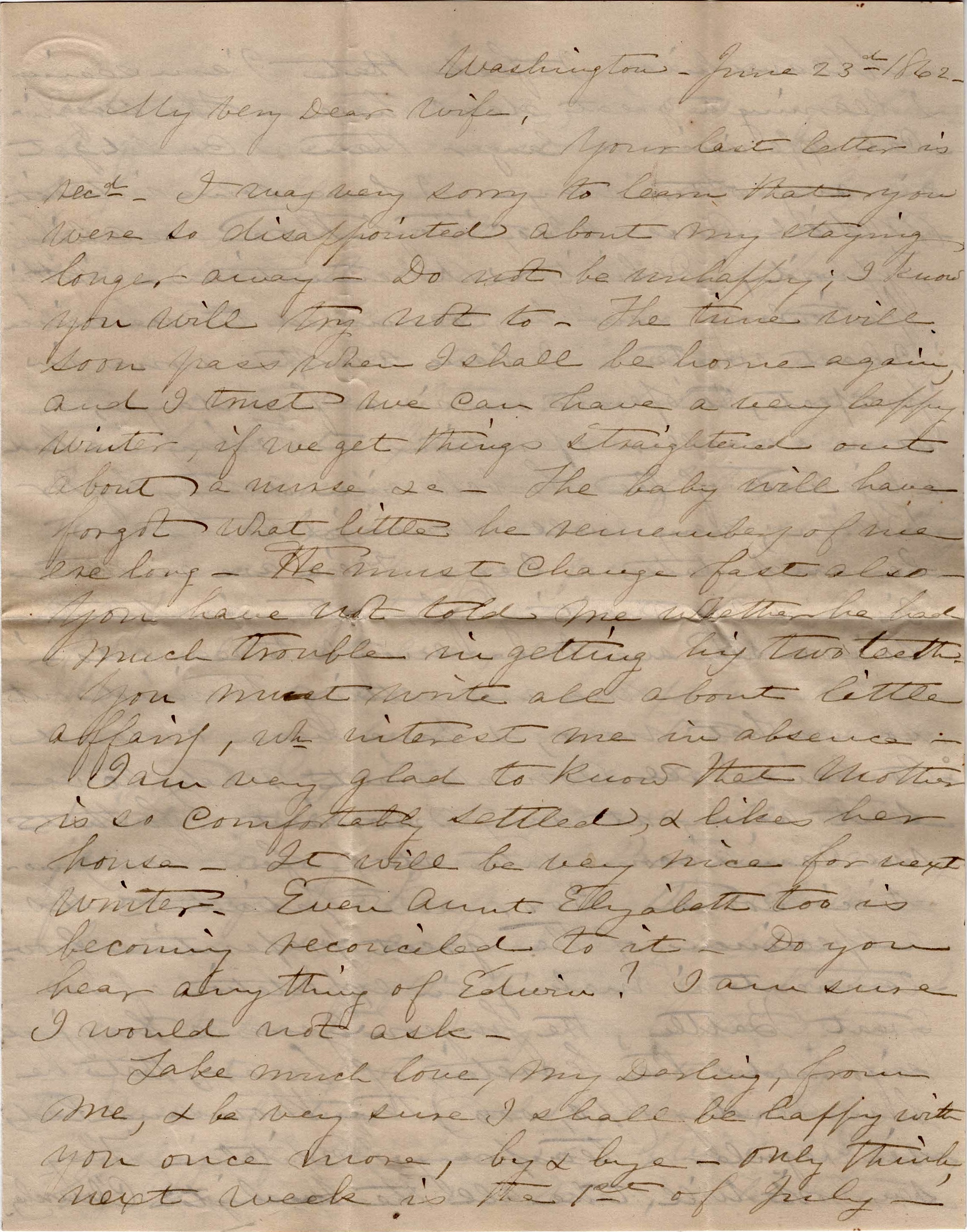
Your last letter is received. I was very sorry to learn that you were so disappointed about my staying longer away. Do not be unhappy; I know you will try not to. The time will soon pass when I shall be home again, and I trust we can have a very happy winter if we get things straightened out about a nurse, &c. The baby will have forgot what little he remembers of me ere long. He must change fast also. You have not told me whether he had much trouble in getting his two teeth. You must write all about little affairs which interest me in absence. I am very glad to know that Mother is so comfortably settled & likes her house. It will be very nice for next winter. Even Aunt Elizabeth too is becoming reconciled to it. Do you hear anything of Edwin? I am sure I would not ask.

Take much love, my darling, from me and be very sure I shall be happy with you once more, by and bye. Only think, next week is the 1st of July.

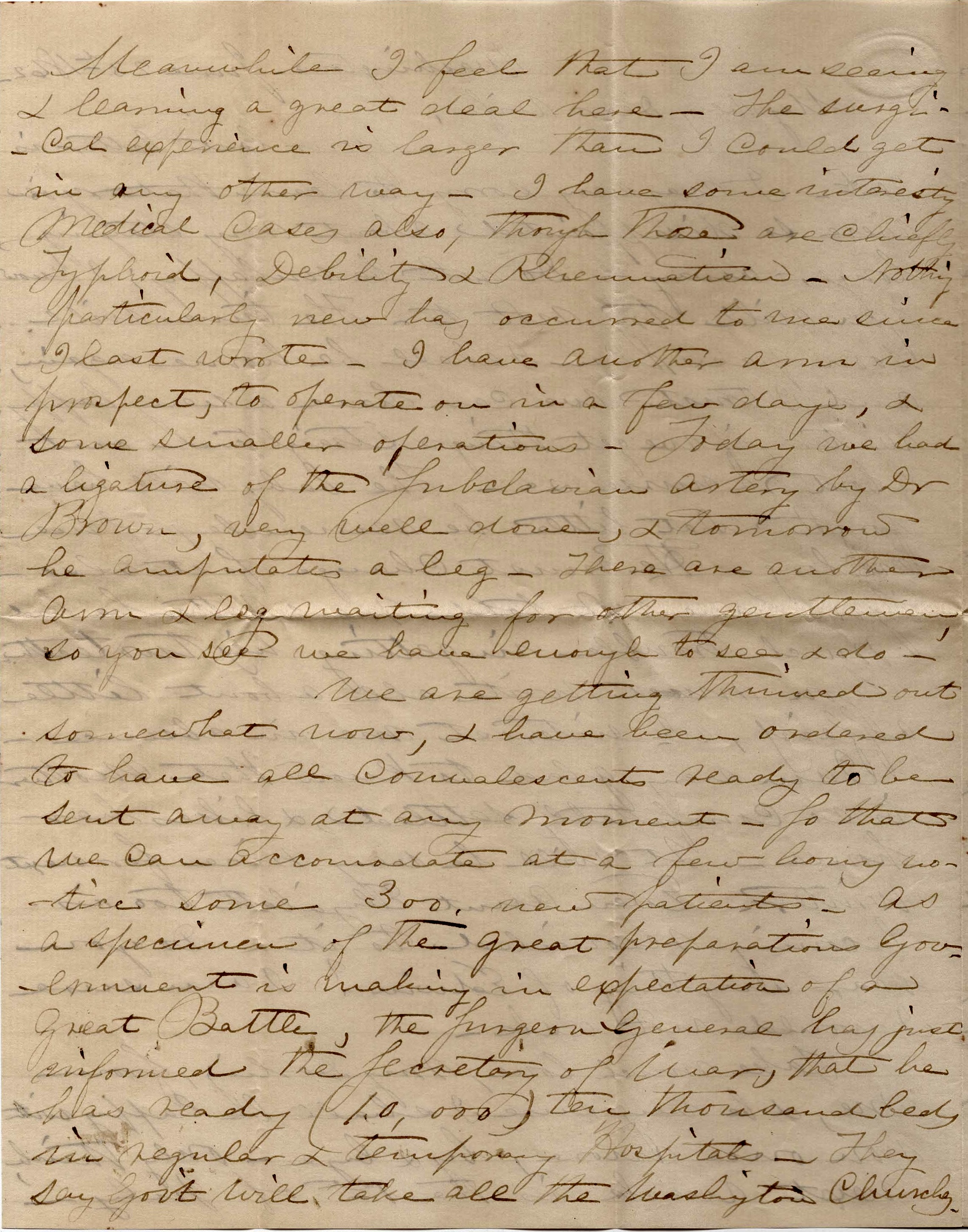
Meanwhile I feel that I am seeing and learning a great deal here. The surgical experience is larger than I could get in any other way. I have some interesting medical cases also, though those are chiefly typhoid, debility, & rheumatism. Nothing particularly new has occurred to me since I last wrote. I have another arm in prospect to operate on in a few days, and some smaller operations. Today we had a ligature of the subclavian artery by Dr. Brown, very well done. And tomorrow he amputates a leg. There are another arm and leg waiting for other gentlemen so you see we have enough to see and do.

We are getting thinned out somewhat now and have been ordered to have all convalescents ready to be sent away at any moment so that we can accommodate at a few hours notice some 300 new patients. As a specimen of the great preparations government is making in expectation of a great battle, the Surgeon General has just informed the Secretary of War that he has ready then thousand of beds in regular & temporary hospitals. They say government will take all the Washington churches.

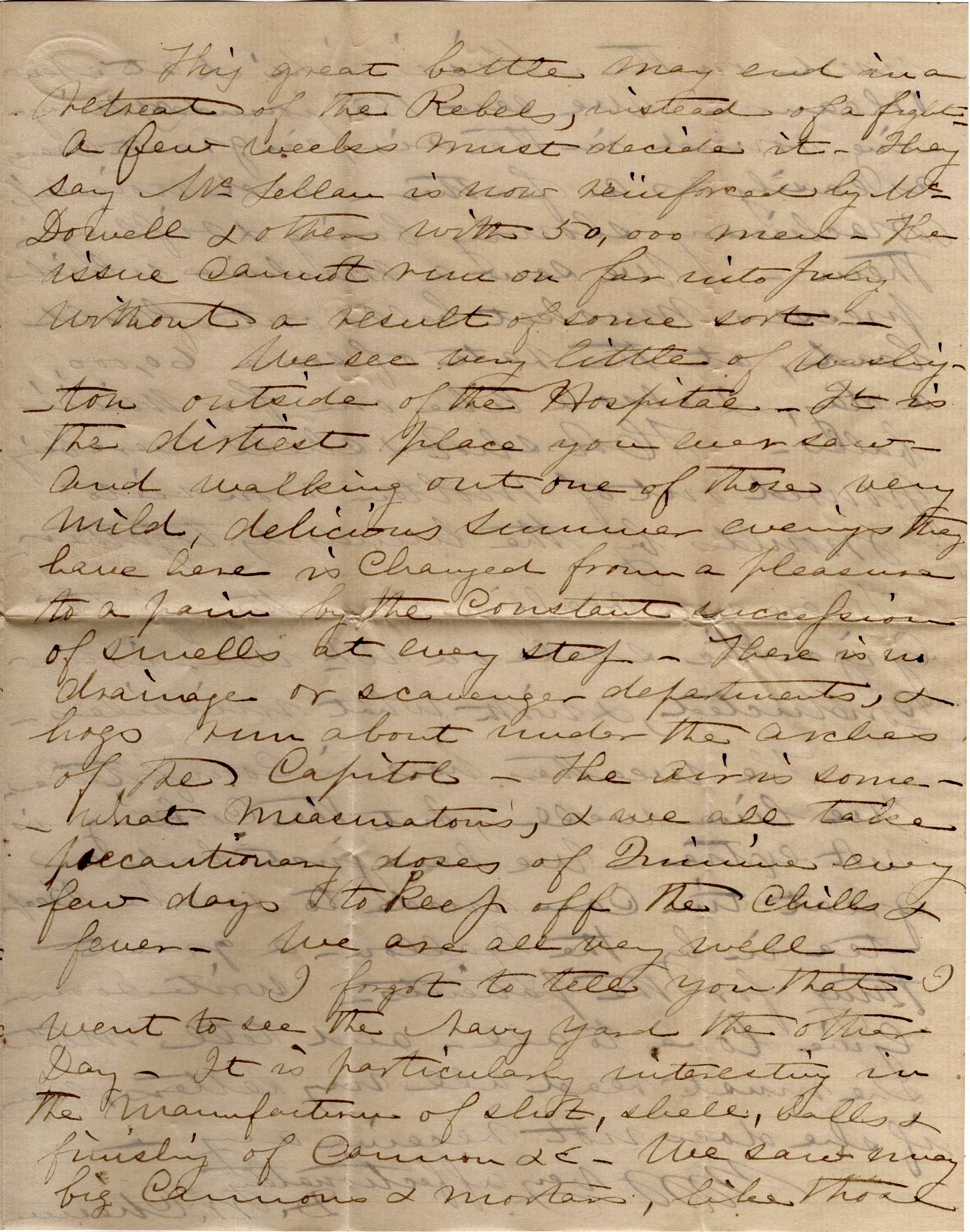
This great battle may end in a retreat of the Rebels instead of a fight. A few weeks must decide it. They say McClellan is now reinforced by McDowell and others with 50,000 men. The issue cannot run on far into July without a result of some sort.

We see very little of Washington outside of the Hospital. It is the dirtiest place you ever saw. And walking out one of those very mild, delicious summer evenings they have here is changed from a pleasure to a pain by the constant succession of smells at every step. There is no drainage or scavenger departments, and hogs run about under the arches of the Capitol. The air is somewhat miasmatous, and all take precautionary doses of quinine every few days to keep off the chills & fever. We are all very well.

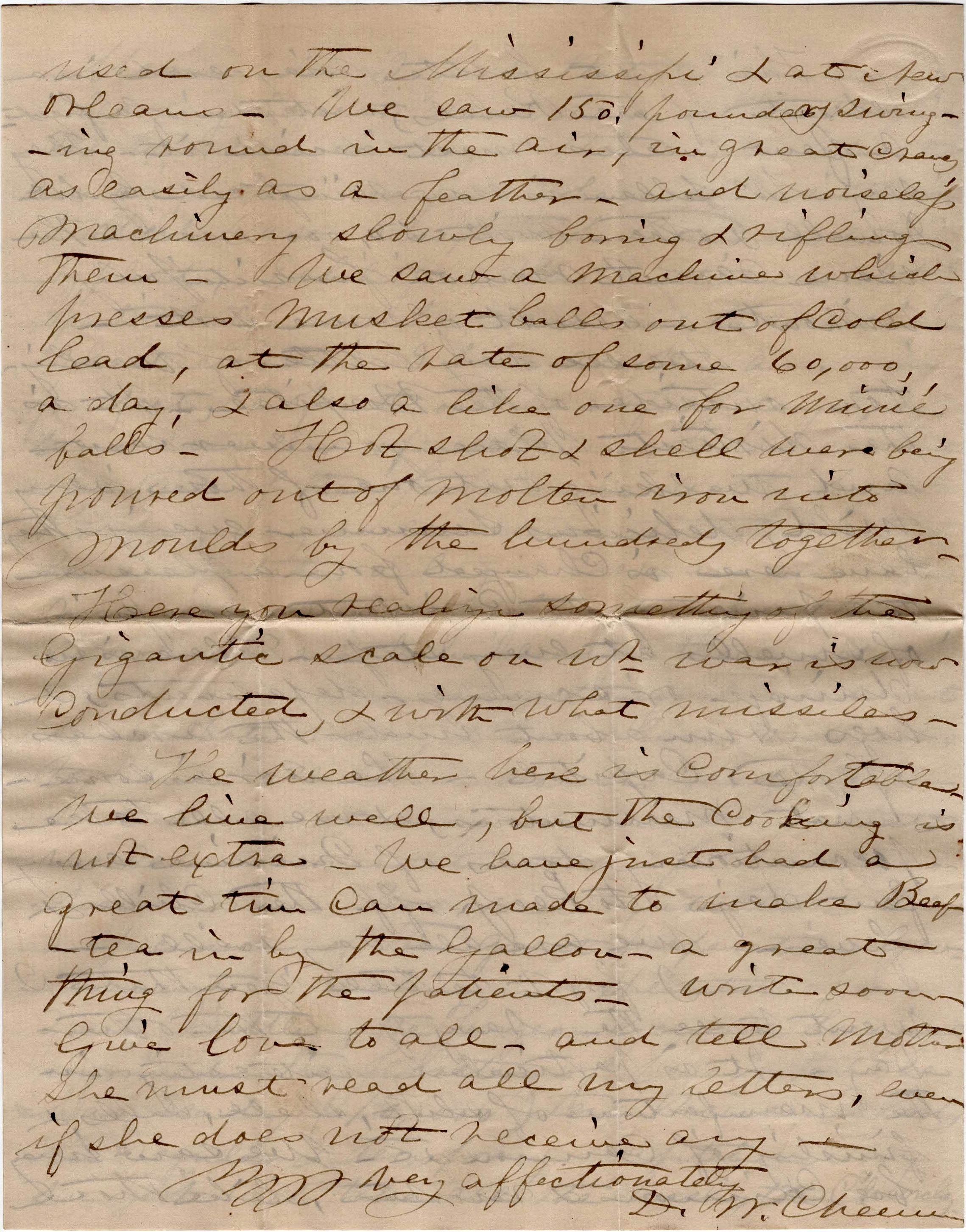
I forgot to tell you that I went to see the Navy Yard the other day. It is particularly interesting in the manufacture of shot, shell, balls and finishing of cannon &c. We saw many big cannons and mortars, like those used on the Mississippi & at New Orleans. We saw 150 pounders swinging round in the air in great cranes as easily as a feather, and noiseless machinery slowly boring and rifling them. We saw a machine which presses musket balls out of cold lead at the rate of some 60,000 a day, and also a like one for Minié balls. Hot shot and shell were being poured out of molten iron into moulds by the hundreds together. Here you realize something of the gigantic scale on which war is now conducted and with what missiles.

The weather here is comfortable. We live well but the cooking is not extra. We have just had a great tin can made to make beef tea in by the gallon—a great things for the patients. Write soon. Give love to all and tell Mother she must read all my letters even if she does not receive any.

Yours very affectionately, — D. W. Cheever


Letter 5

Washington
Sunday evening, June 29, 1862

My very dear wife,

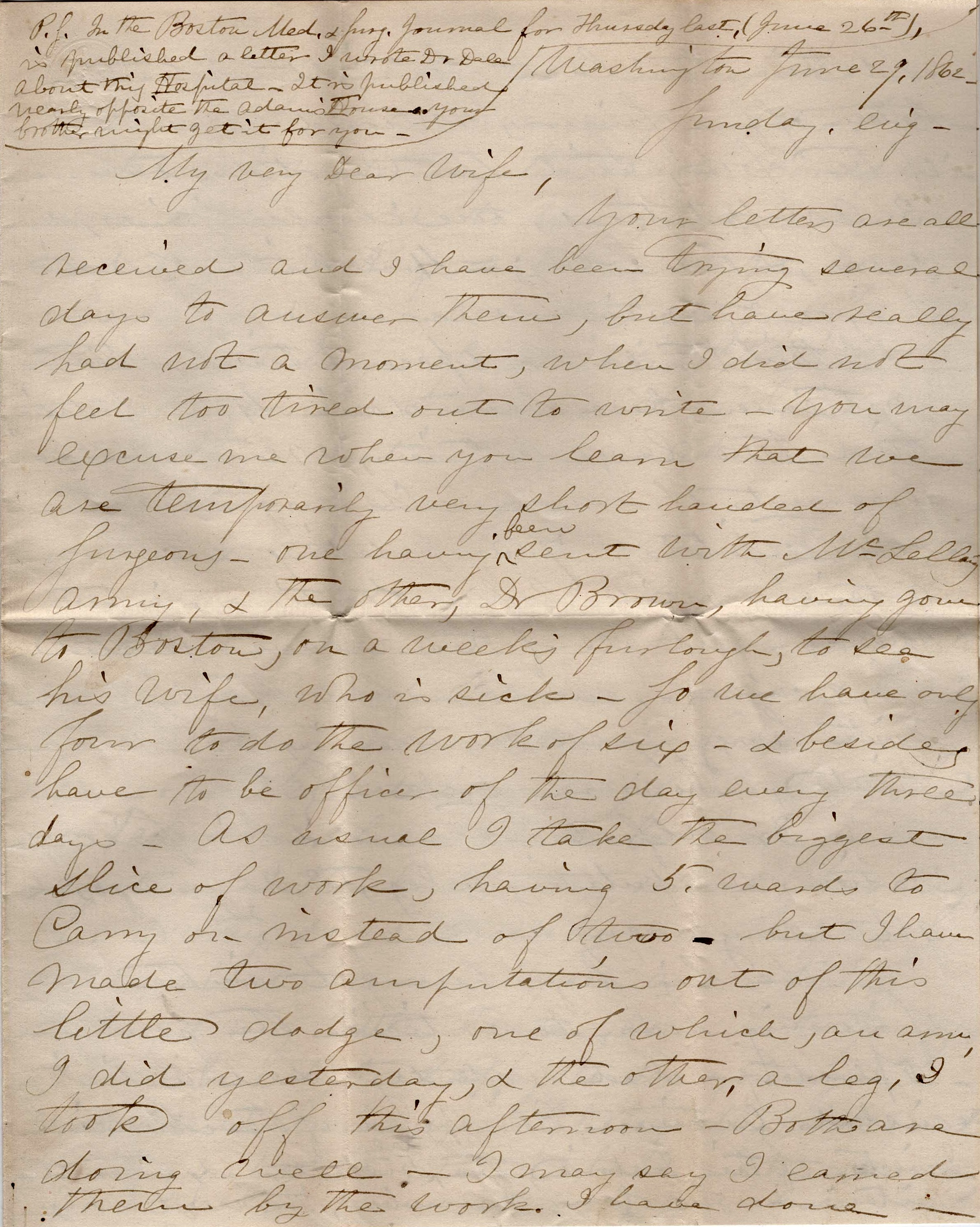
Your letters are all received and I have been trying several days to answer them, but have really had not a moment when I did not feel too tired out to write. You may excuse me when you learn that we are temporarily very short handed of surgeons—one having been sent with McClellan’s army and the other, Dr. Brown, having gone to Boston for a week’s furlough to see his wife who is sick. So we have only four to do the work of six, and besides, have to be Officer of the Day every three days. As usual, I take the biggest slice of work, having 5 wards to carry on instead of two, but I have made two amputations out of this little dodge, one of which—an arm—I did yesterday, and the other—a leg—I took off this afternoon. Both are doing well. I may say I lamed them by the work I have done. Within the last fortnight I have taken off a finger, removed three of the bones of the foot, tied the carotid, and done three amputations, one shoulder joint, one arm, and one leg—4 capital operating & 2 or 3 minor ones.

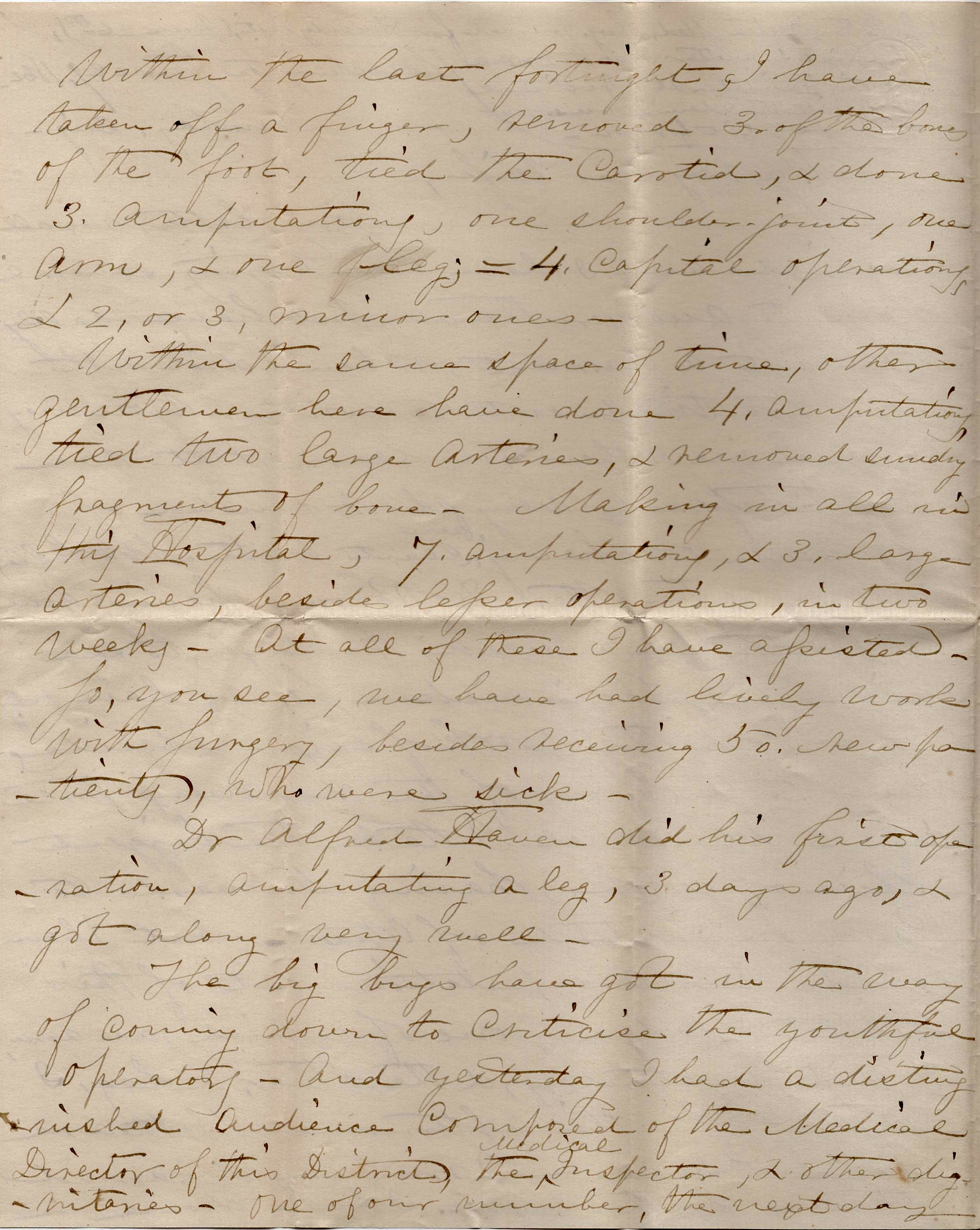
Within the same space of time, other gentlemen here have done 4 amputations, tied two large arteries, and removed sundry fragments of bone, making in all in this hospital 7 amputations and three large arteries, besides lesser operations in two weeks. At all of these I have assisted so you see we have had lively work with surgery, besides receiving 50 new patients who were sick.

Dr. Alfred Haven did his first operation—amputating a leg—three days ago and got along very well. The big boys have got in the way of coming down to criticize the youthful operators, and yesterday I had a distinguished audience composed of the Medical Director of this District, the Medical Inspector, and other dignitaries. One of our number, the next day after his operation was witnessed, was ordered to take charge of another hospital, and yesterday the same compliment was paid to me. But I am very glad that Mr. Page got me kept here where I had much rather stay, for the officer in charge of a Military Hospital has a very laborious time with official and executive duties & less chance & time to practice himself.

Calvin Gates Page, Harvard Class of 1852 (from the 1922 Yearbook).

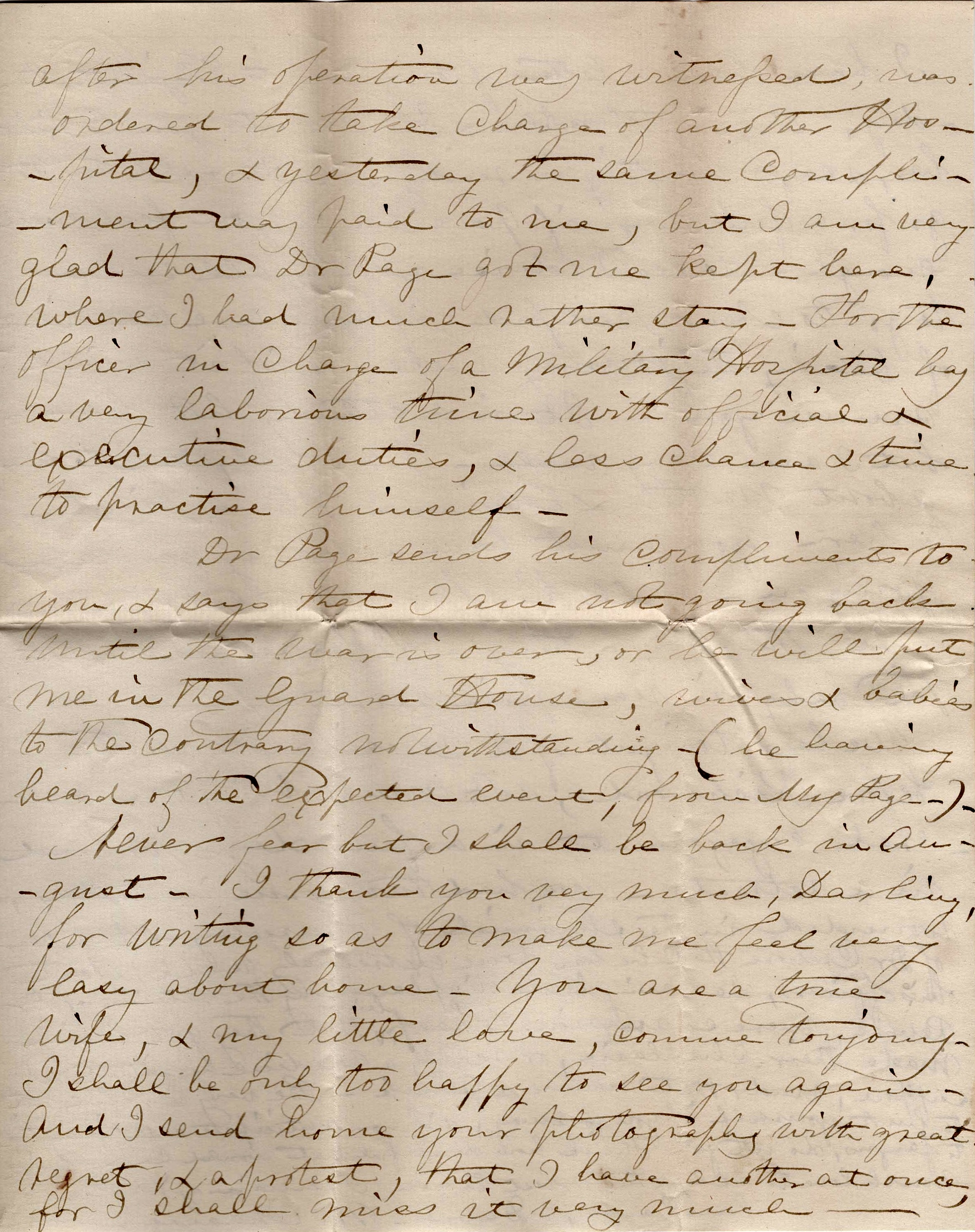
Dr. [Calvin Gates] Page 1 sends his compliments to you and says that I am not going back until the war is over, or he will put me in the guard house, wives and babies to the contrary notwithstanding (he having heard of the expected event from Mrs. Page). Never fear but I shall be back in August. I thank you very much, darling, for writing so as to make me feel very easy about home. You are a true wife and my little love comme toujours [as ever]. I shall be only too happy to see you again. And I send home your photography with great regret & a protect that I have another at once for I shall miss it very much.

I have had a letter from Aunt Elizabeth today who is tolerable. She wants you to visit her and says everything is ready, &c. I would try to go for a few days if possible & you feel well enough. Also, I advise you by all means to go to New Bedford if you are confident of bearing the journey well, and if it will amuse you. It is steady hot here but I am very well. I am delighted to hear about Mother and Edwin. I have written to her. You must have a funny garden going on. Tell Rauffer not to set you on fire the 4th of July. I have no doubt the baby is very fine now.

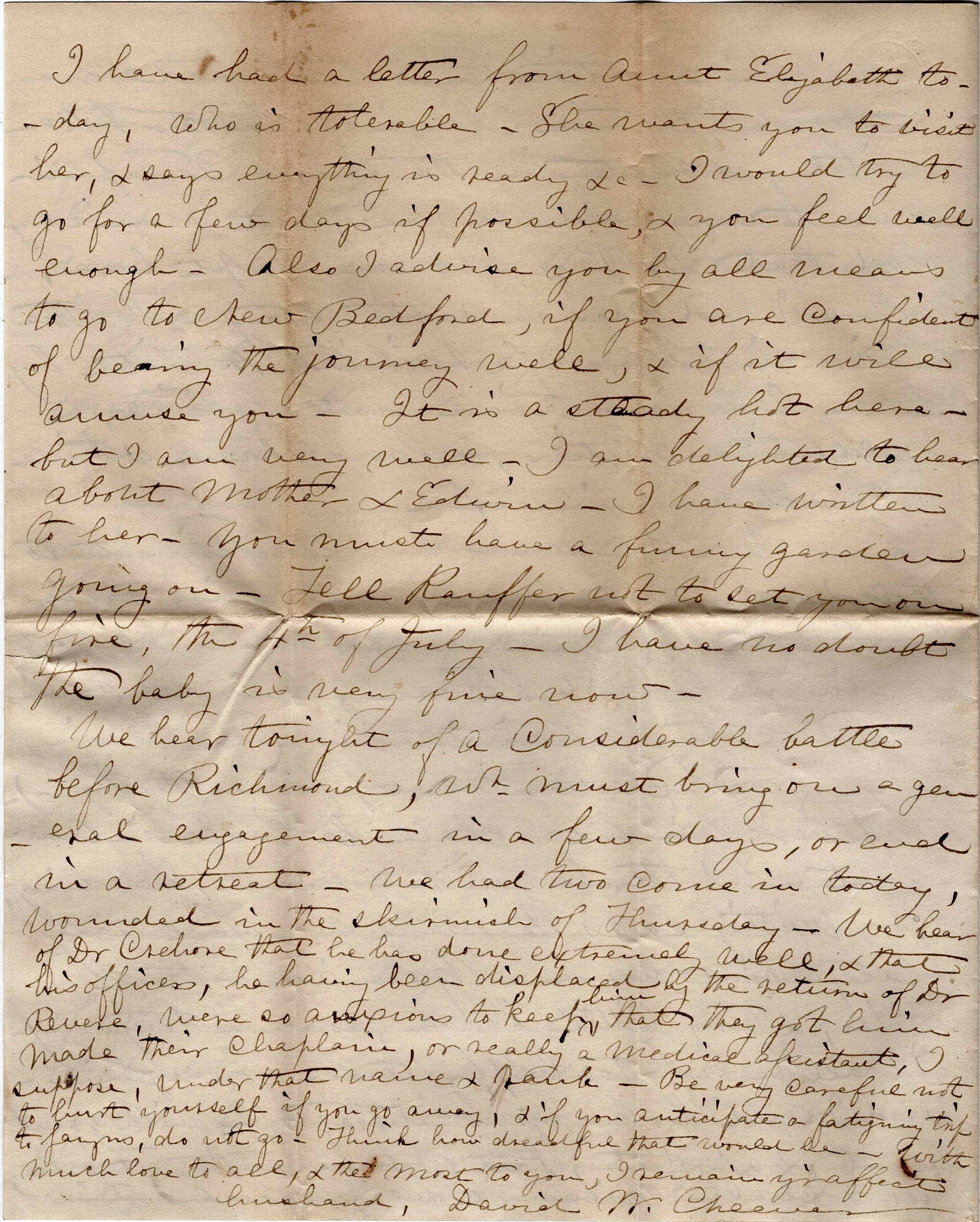
We hear tonight of a considerable battle before Richmond which must bring on a general engagement in a few days or end in a retreat. We had two come in today wounded in the skirmish of Thursday. We hear of Dr. Crehove [?] that he has done extremely well and that his officers, he having been displaced by the return of Dr. Revere, were so anxious to keep him that they got him made their chaplain, or really a medical assistant, I suppose, under that name and rank.

Be very careful not to hurt yourself if you go away, and if you anticipate a fatiguing trip to Saugus, do not go. Think how dreadful that would be. With much love to all & the most to you, I remain your affectionate husband, — David W. Cheever

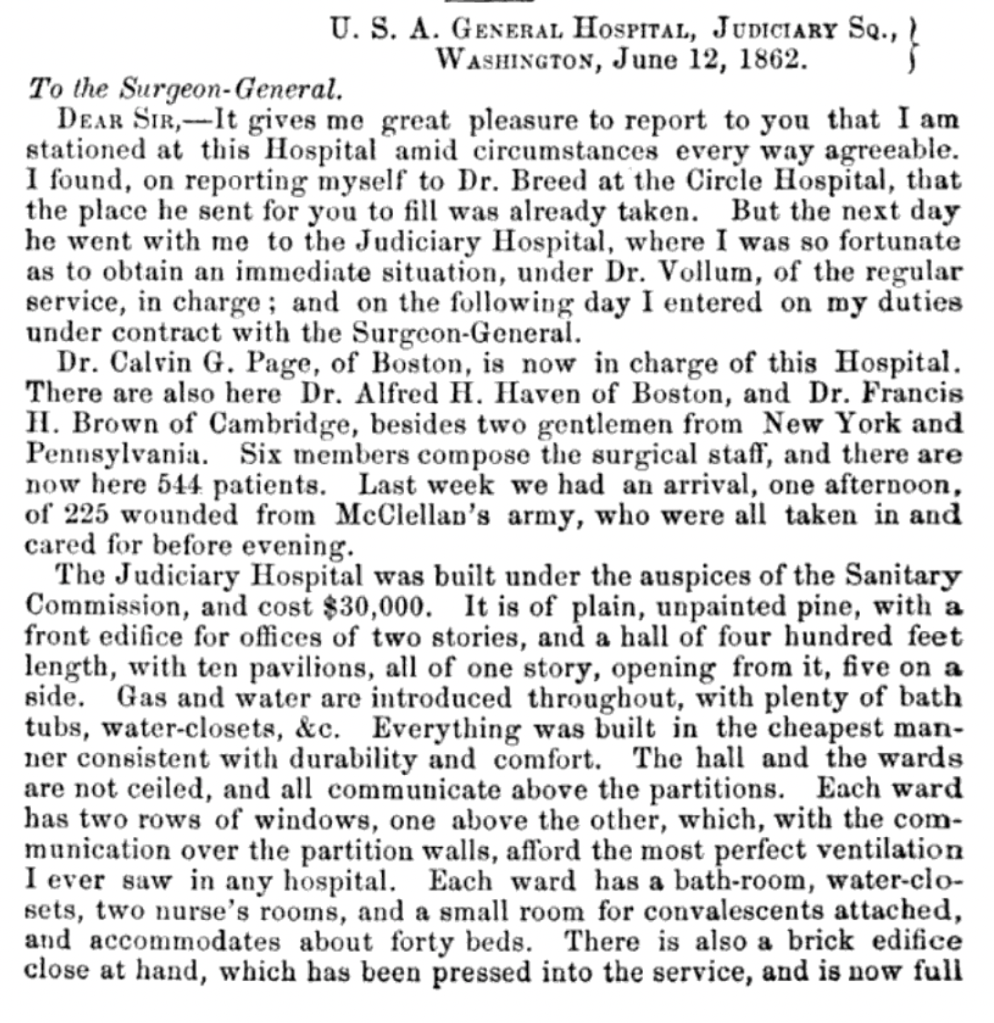
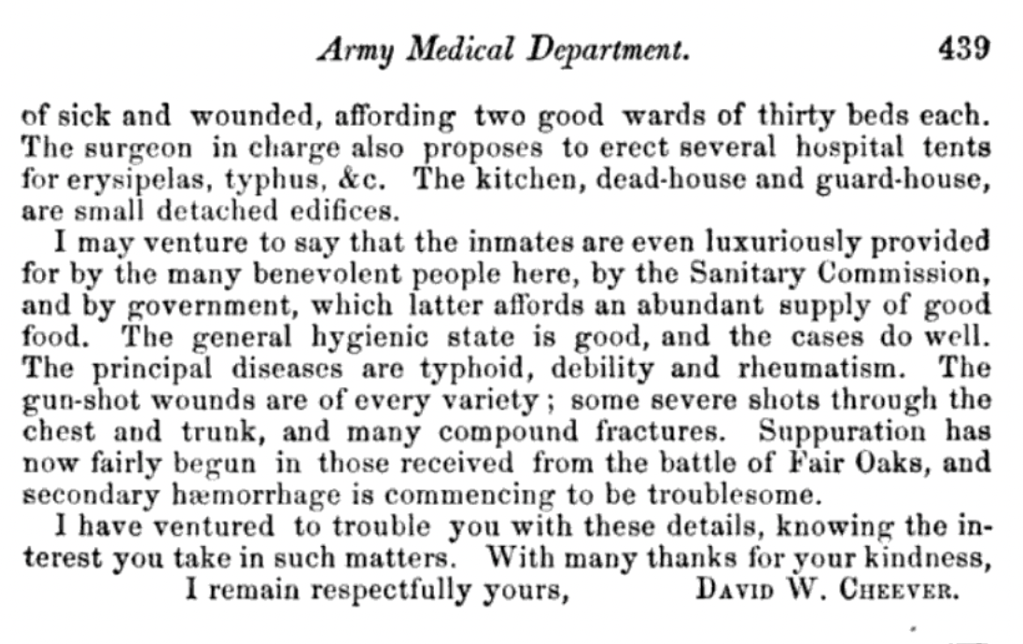
P. S. In the Boston Med. & Surgical Journal for Thursday last (June 26th) is published a letter I wrote Dr. Dale about the hospital. 2 It is published nearly opposite the Adams House. Your brother might get it for you.


1 Calvin Gates Page, Sr. (1829-1869) was a practicing physician in Boston when the Civil War began. He was married to Susan Haskell Keep (1830-1895) and was the father of three children at the time he offered his services as a surgeon at the Judiciary Square Hospital. In August 1862, he was commissioned as Assistant Surgeon in the 39th Massachusetts Infantry and served until mid-November 1863.

2 The letter appears below:


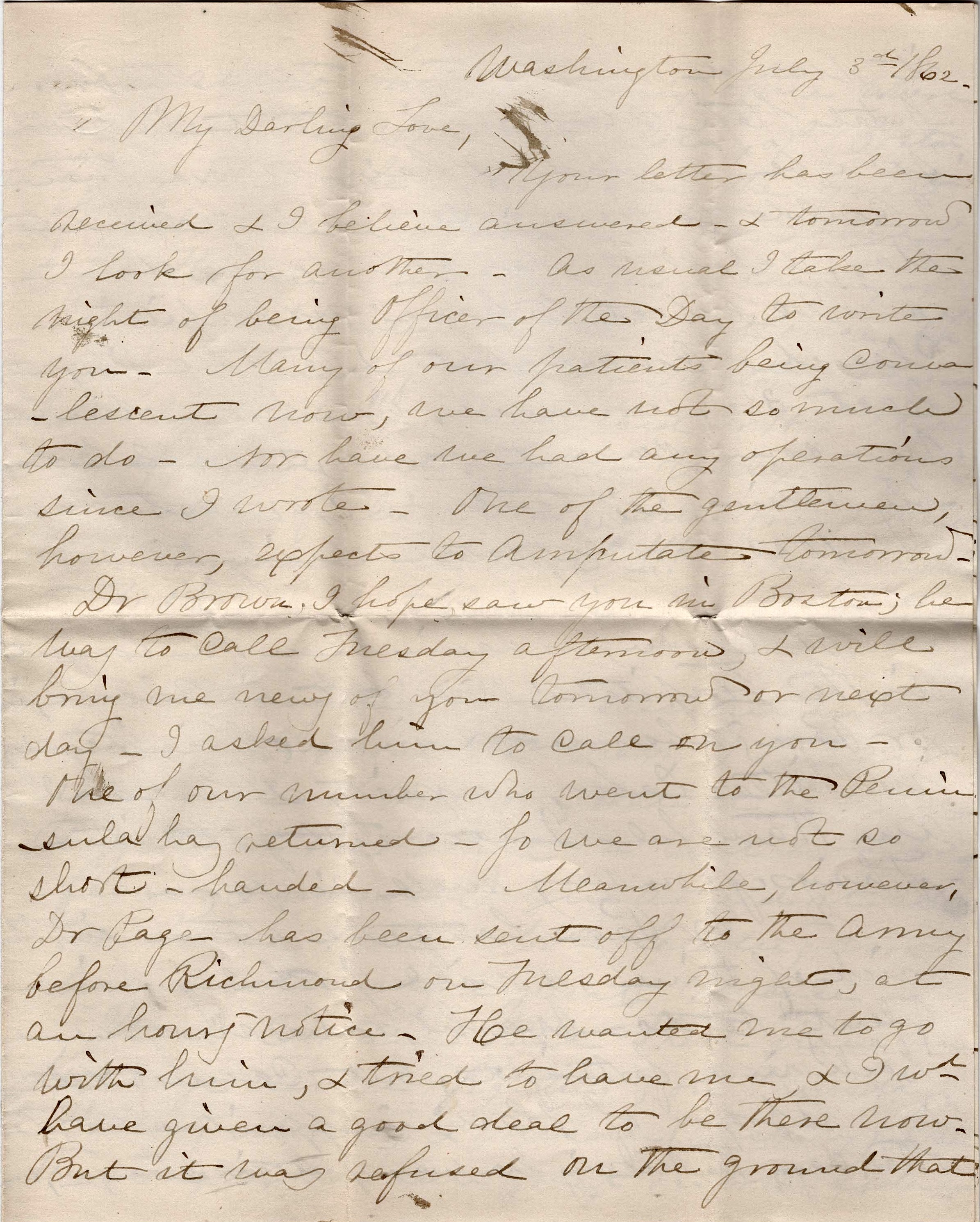
Letter 6

Washington
July 3rd 1862

My darling love,

Your letter has been received & I believe answered, and tomorrow I look for another. As usual I take the night of being Officer of the Day to write you. Many of our patients being convalescent now, we have not so much to do. Nor have we had any operations since I wrote. One of the gentlemen, however, expects to amputate tomorrow. Dr. Brown, I hope, saw you in Boston. He was to call Tuesday afternoon & will bring me news of you tomorrow or next day. I asked him to call on you.

One of our number who went to the Peninsula returned so we are not so short-handed. Meanwhile, however, Dr. [Calvin] Page has been sent off to the army before Richmond on Tuesday night at an hour’s notice. He wanted me to go with him and tried to have me & I would have given a good deal to be there now, but it was refused on the ground that it would not do to weaken the hospital staff anymore & that I should soon be needed & have more than I could do here. So I was ordered to stay and shall endeavor to do my duty.

We expect to have our hospital cleared of convalescents & to take in at least 300 wounded by and bye. We have now some vacant beds & shall probably receive 50 wounded tomorrow or next day. 1,000 are expected daily.

Dr. [Alfred] Haven, having been the longest in the hospital, was left in charge in Dr. Page’s absence, and in an office requiring no little labor, anxiety & fuss, I am thankful I have not got it. Things go on very well so far. Dr. Page has gone down in the nick of time & will probably find plenty to do. We hope he may be back in a fortnight but cannot tell.

Apropos of having appointment the other day, the morning he was put in charge, we were at the Surgeon General’s Office where we saw the immortal Cole of Boston, bigger than life, and surveying the Great Officials like a Prince. He asked Dr. Haven where he was, and learning of his new appointment, said at once, “Oh yes! We heard of that in Boston, and were much pleased.” “But,” said Dr. Haven, “I was only appointed last evening.” “Well,” replied the never-failing Cole, “Some friend must have telegraphed it then!” Query? When? to Boston and back to Cole in Washington?

Everything is in such an uncertain state about the war, and the air is so full of rumors that it is hard to get at the truth. But everybody fears—and indeed, I am afraid it is too true—that McClellan’s army has sustained a great reverse. It is certain that there have been four days severe fighting, on Thursday, Friday, Monday & Tuesday (yesterday) and that the slaughter has been great on both sides. The killed and wounded cannot but be numbered by thousands & the Great Army has fallen back 10 or 12 miles. How many of these poor devils have been left on the field in the enemies hands we cannot tell.

Dr. Edward Perry Vollum (1827-1902), Medical Inspector in McClellan’s Army of the Potomac during the Peninsula Campaign. McClellan told him just prior to the Seven Days Battles that he could “go into Richmond any day he chose.”

Dr. [Edward Perry] Vollum, the Medical Inspector of McClellan’s army, who had just come from the war and went back Tuesday night taking Page, said, “You will have hot & bloody work and no sleep, night or day.” Through the same source I learn that McClellan told Vollum last week before these battles, & he told us (only one remove, you see), that he—McClellan—could go into Richmond any day he chose. Is it not strange—war is very uncertain. This will prolong it I fear another year, and then comes up the old trouble of [foreign] intervention. So the President’s call for 300,000 more men looks the same way. Yet this evening there are brighter rumors about McClellan’s having gained a victory yesterday. We must wait events. Meanwhile, keep well and contented as you can & wait for your loving husband, — D. W. Cheever


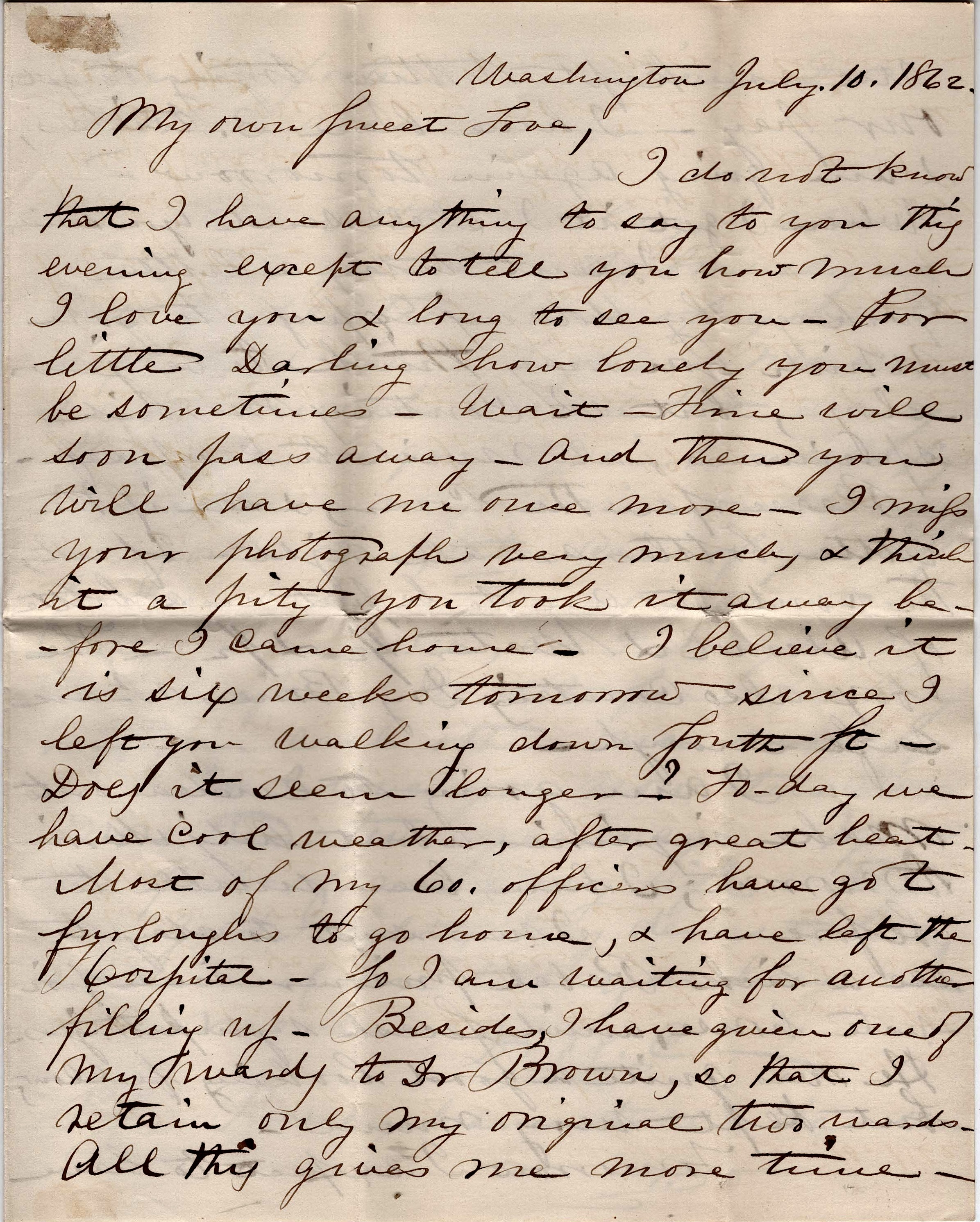
Letter 7

Washington
July 10, 1862

My own sweet love,

I do not know that I have anything to say to you this evening except to tell you how much I love you and long to see you. Poor little darling, how lonely you must be sometimes. Wait. Time will soon pass away and then you will have me once more. I miss your photograph very much & think it a pity you took it away before I came home. I believe it is six weeks tomorrow since I left you, walking down Fourth Street. Does it seem longer?

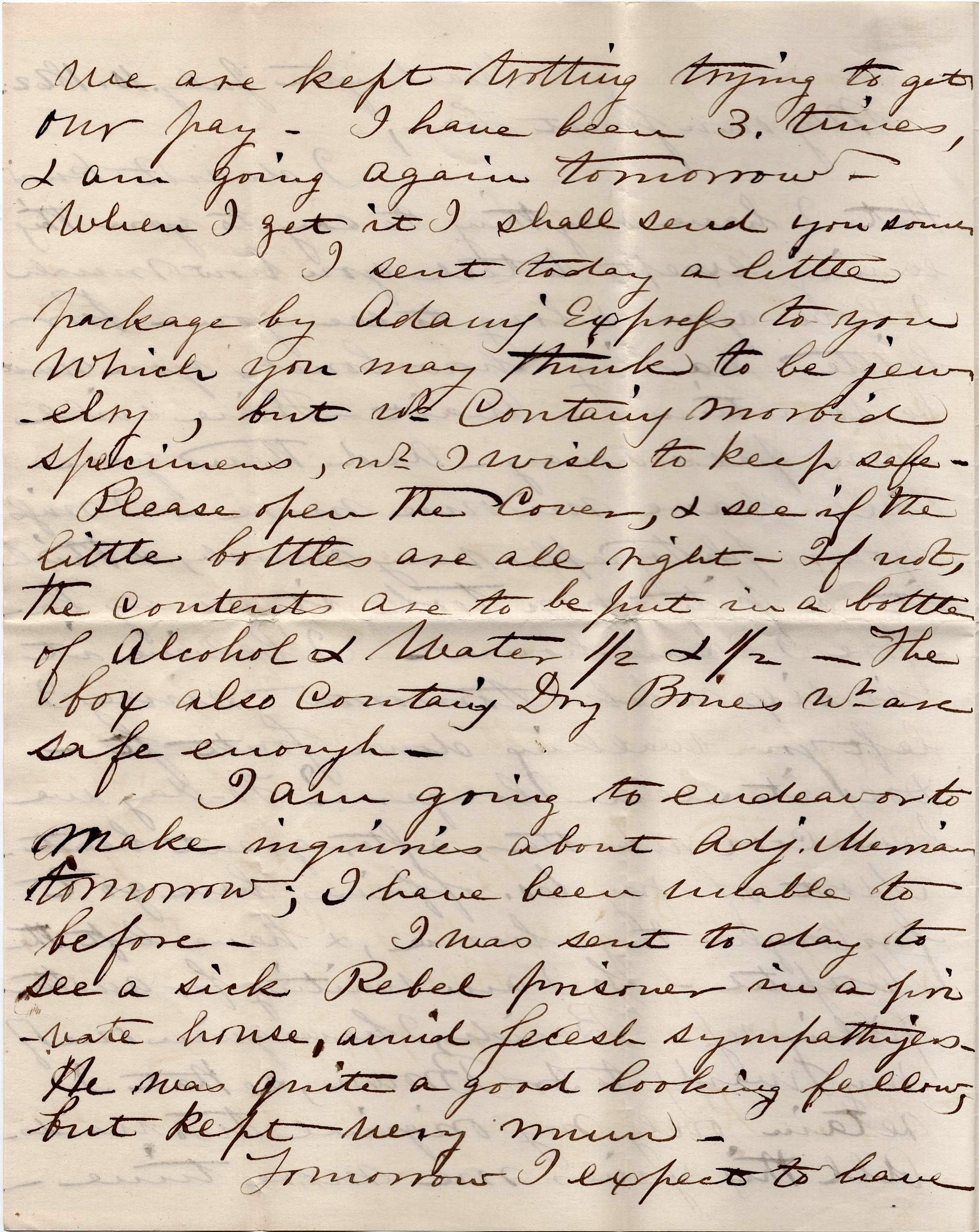
Today we have cool weather after great heat. Most of my 60 officers have got furloughs to go home and have left the hospital so I am waiting for another filling up. Besides, I have given one of my wards to Dr. Brown so that I retain only my original two wards. All this gives me more time. We are kept trotting trying to get our pay. I have been three times and am going again tomorrow. When I get it, I shall send you some.

I sent today a little package by Adam’s Express to you which you may think to be jewelry, but which contains morbid specimens which I wish to keep safe. Please open the cover and see if the little bottles are all right. If not, the contents are to be put in a bottle of alcohol and water half and half. The box also contains dry bones which are safe enough.

I am going to endeavor to make inquiries about Adj. Merriam tomorrow; I have been unable to before. I was sent today to see a sick Rebel prisoner in a private house amid secesh sympathizers. He was quite a good looking fellow but kept very mum.

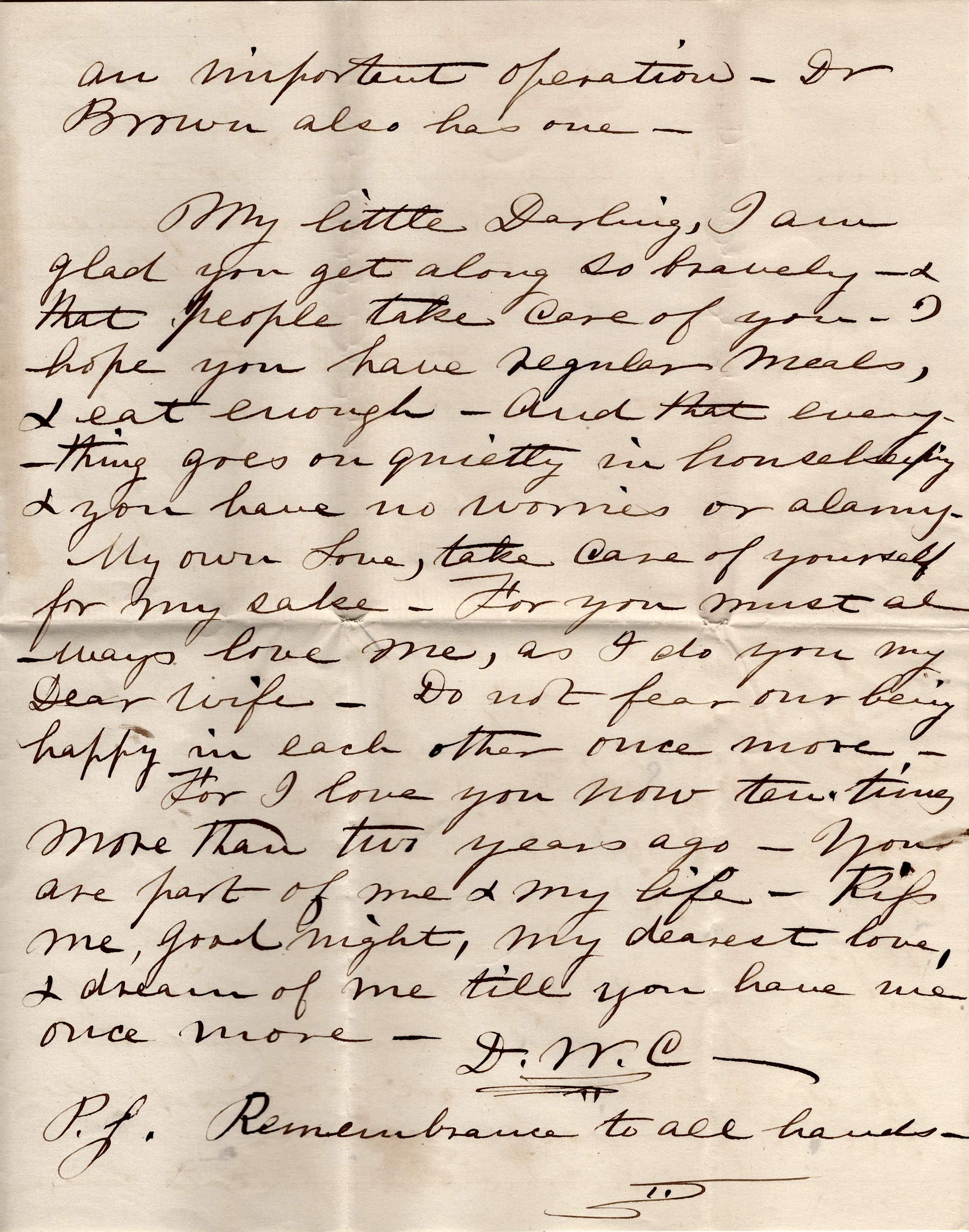
Tomorrow I expect to have an important operation. Dr. Brown also has one.

My little darling, I am glad you get along so bravely and that people take care of you. I hope you have regular meals & eat enough and that everything goes on quietly in housekeeping & you have no worries or alarms. My own love, take care of yourself for my sake, for you must always love me as I do you, my dear wife. Do not fear our being happy in each other once more. For I love you now then times more than two years ago. You are part of me & my life. Kiss me good night, my dearest love, and dream of me till you have me once ore. — D. W. C.

P. S. Remembrance to all hands.


Letter 8

Washington
July 19, 1862

My darling,

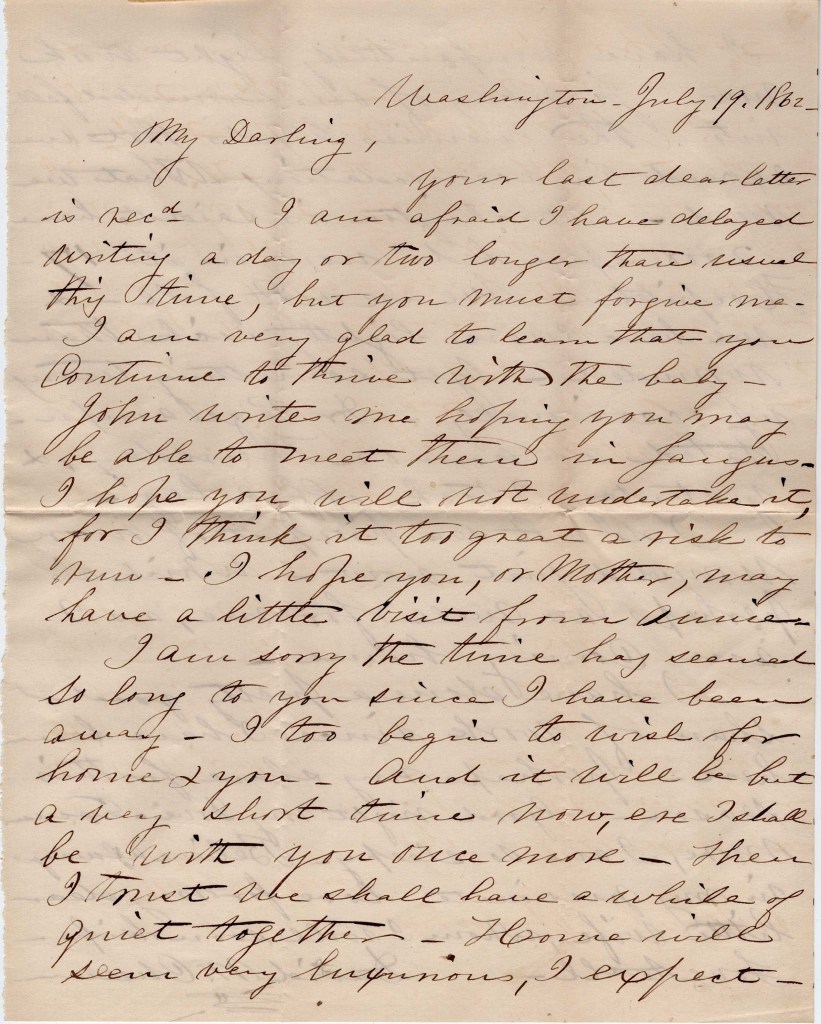
Your last dear letter is received. I am afraid I have delayed writing a day or two longer than usual this time but you must forgive me. I am very glad to learn that you continue to throve with the baby. John writes me hoping you may be able to meet them in Saugus. I hope you will not undertake it, for I think it too great a risk to run. I hope you or Mother may have a little visit from Annie.

I am sorry the time has seemed so long to you since I have been away. I too begin to wish for hime and you. And it will be but a very short time now, ere I shall be with you once more. Then I trust we shall have a while of quiet time together. Home will seem very luxurious, I expect.

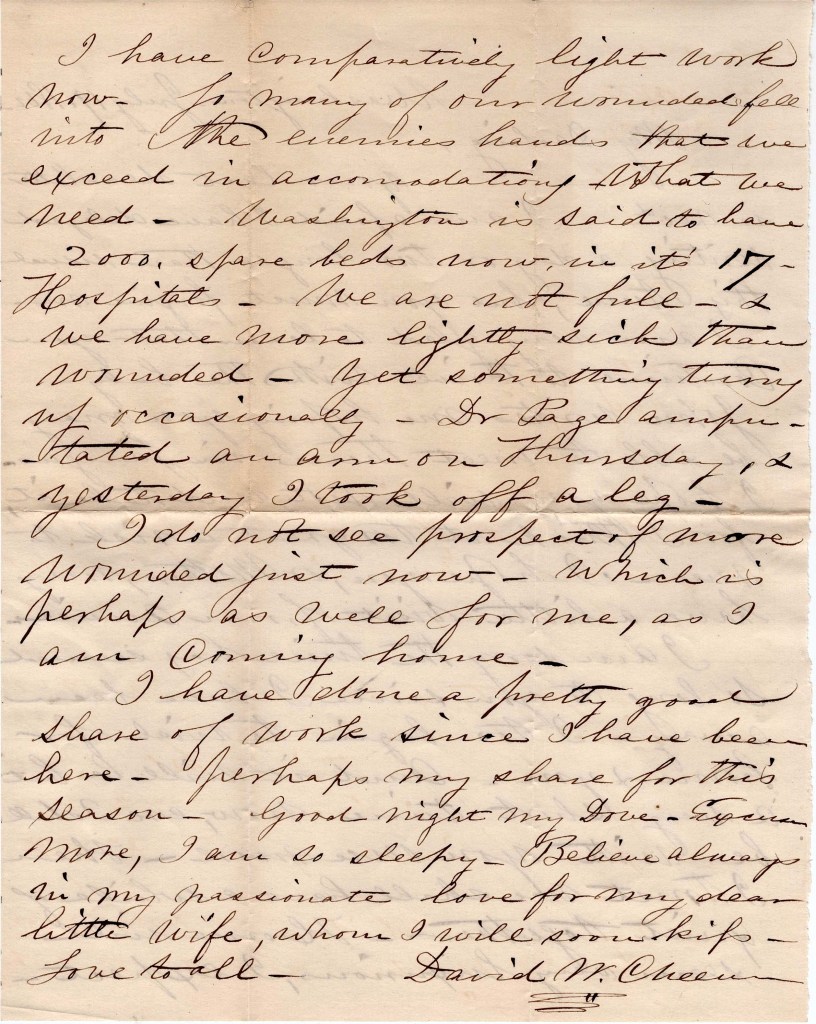
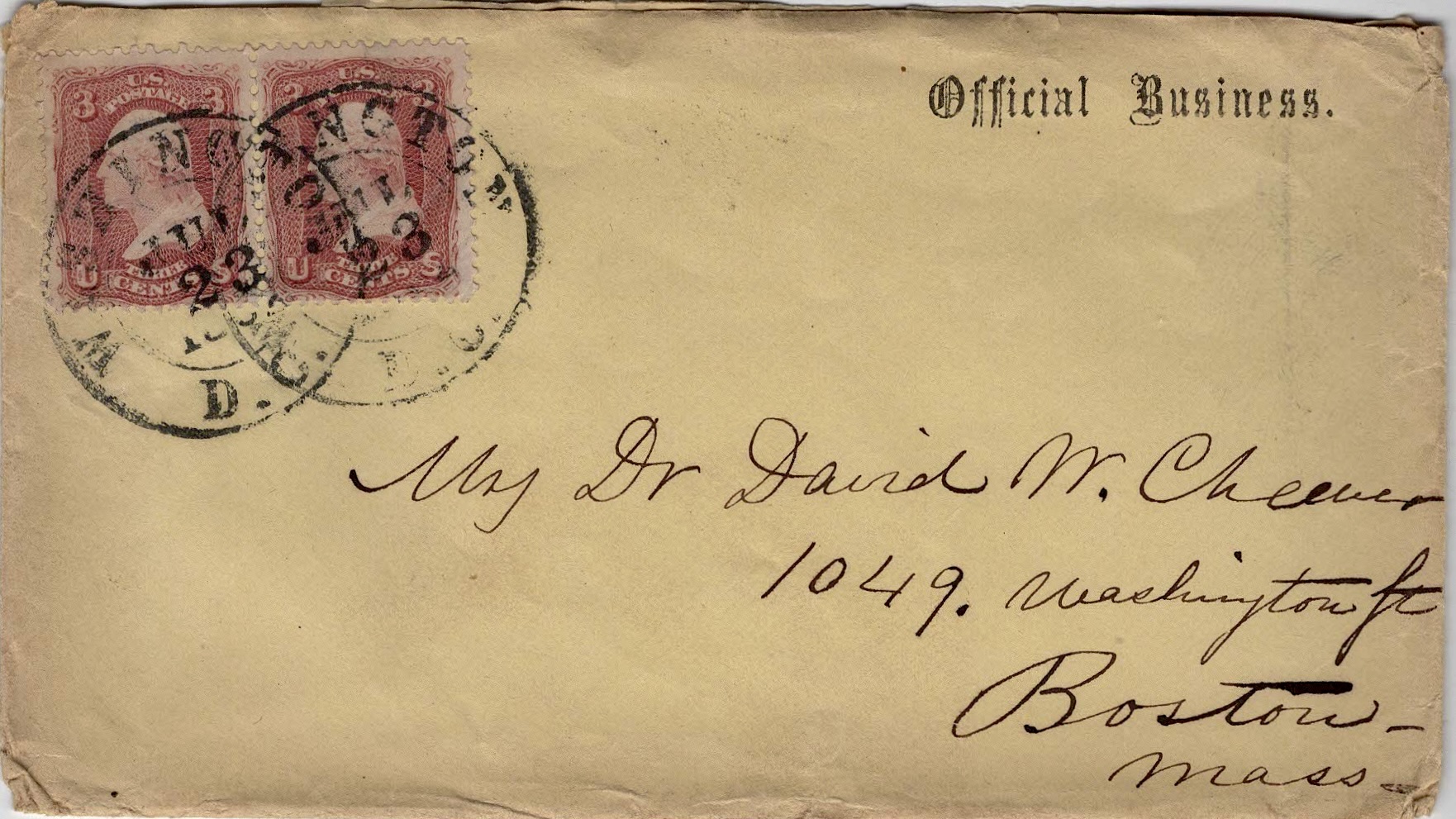
I have comparatively light work now. So many of our wounded fell into the enemies hands that we exceed in accommodations what we need. Washington is said to have 2,000 spare beds now in its 17 hospitals. We are not full and we have more lightly sick than wounded. Yet something turns up occasionally. Dr. Page amputated an arm on Thursday & yesterday I took off a leg. I do not see prospect of more wounded just now, which is perhaps as well for me as I am coming home.

I have done a pretty good share of work since I have ben here—perhaps my share for this season. Good night my dove. Excuse more, I am so sleepy. Believe always in my passionate love for my dear little wife whom I will soon kiss. Love to all. — David W. Cheever


Letter 9

Washington
Tuesday evening, July 22, 1862

My very dear wife,

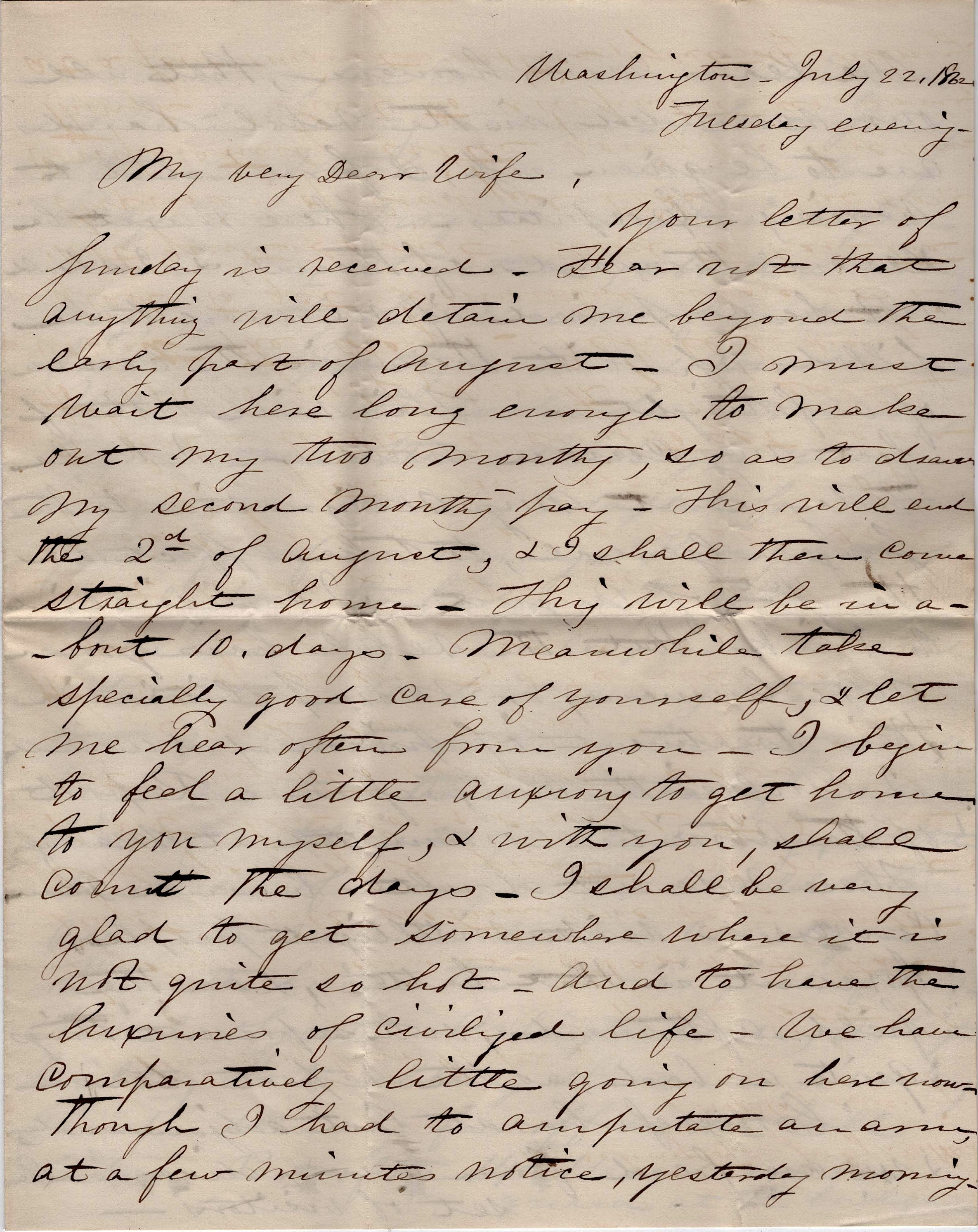
Your letter of Sunday is received. Fear not that anything will detain me beyond the early part of August. I must wait here long enough to make out my two months so as to draw my second month’s pay. This will end the 2nd of August & I shall then come straight home. This will be in about ten days. Meanwhile, take specially good care of yourself and let me hear often from you. I begin to feel a little anxious to get home to you myself, and with you shall count the days. I shall be very glad to get somewhere where it is not quite so hot, and to have the luxuries of civilized life.

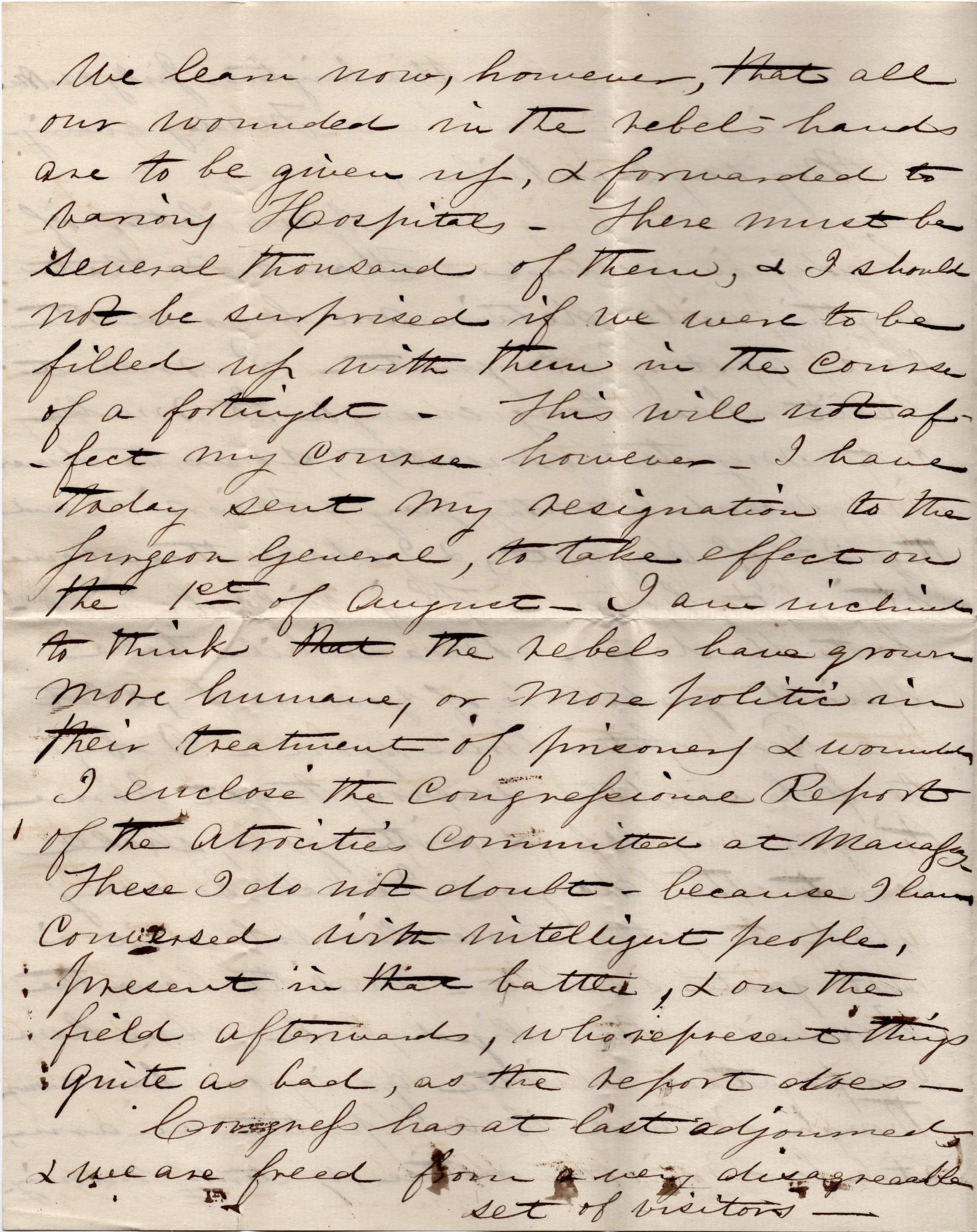
We have comparatively little going on here now though I had to amputate an arm at a few minute’s notice yesterday morning. We learn now, however, that all our wounded in the rebels’ hands are to be given up and forwarded to various hospitals. There must be several thousand of them and I should not be surprised if we were to be filled up with them in the course of a fortnight. This will not affect my course, however. I have today sent my resignation to the Surgeon General to take effect on the 1st of August. I am inclined to think that the rebels have grown more humane or more politic in their treatment of prisoners & wounded. I enclose the Congressional Report of the Atrocities committed at Manassas. These I do not doubt because I have conversed with intelligent people present in that battle & on the field afterwards who represent things quite as bad as the report does.

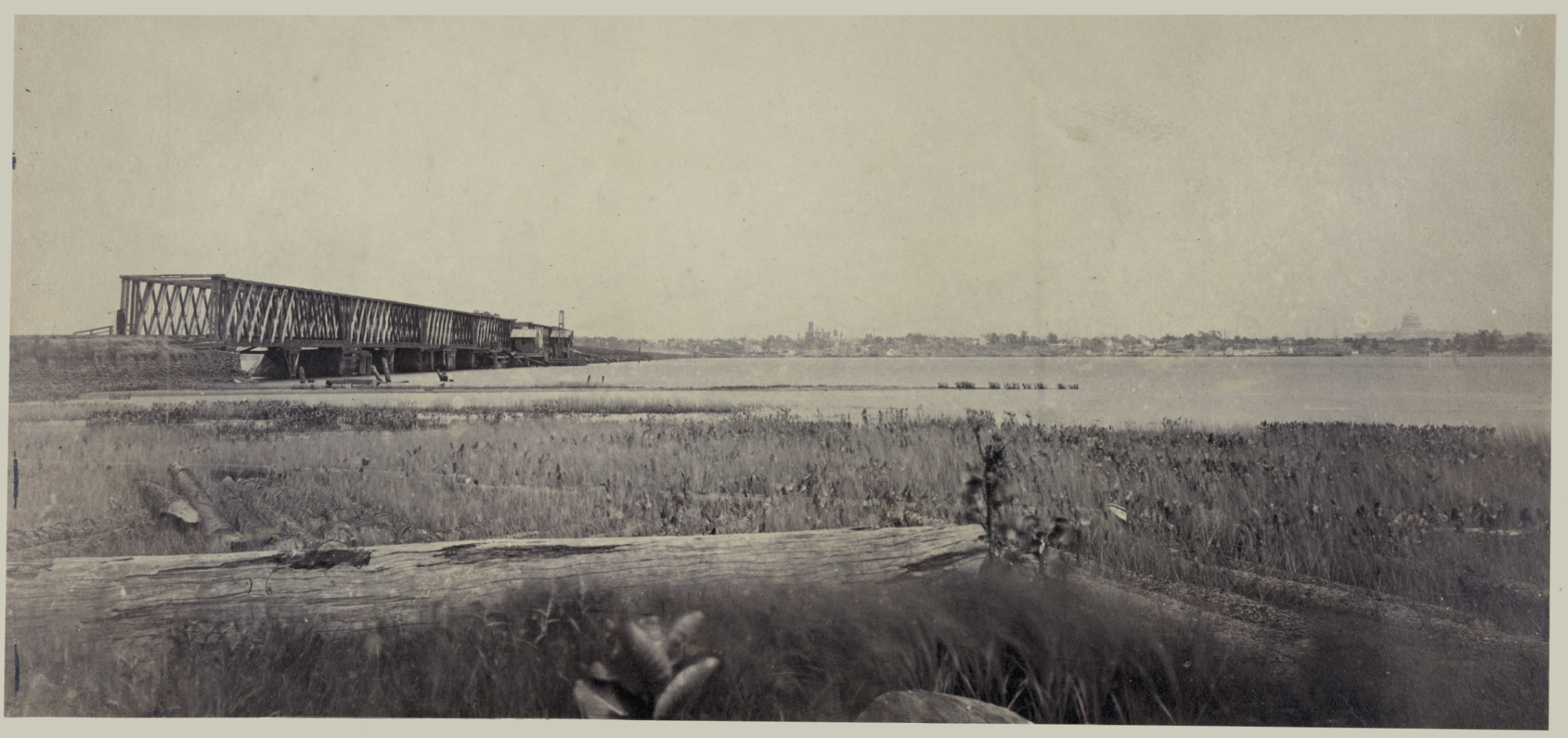
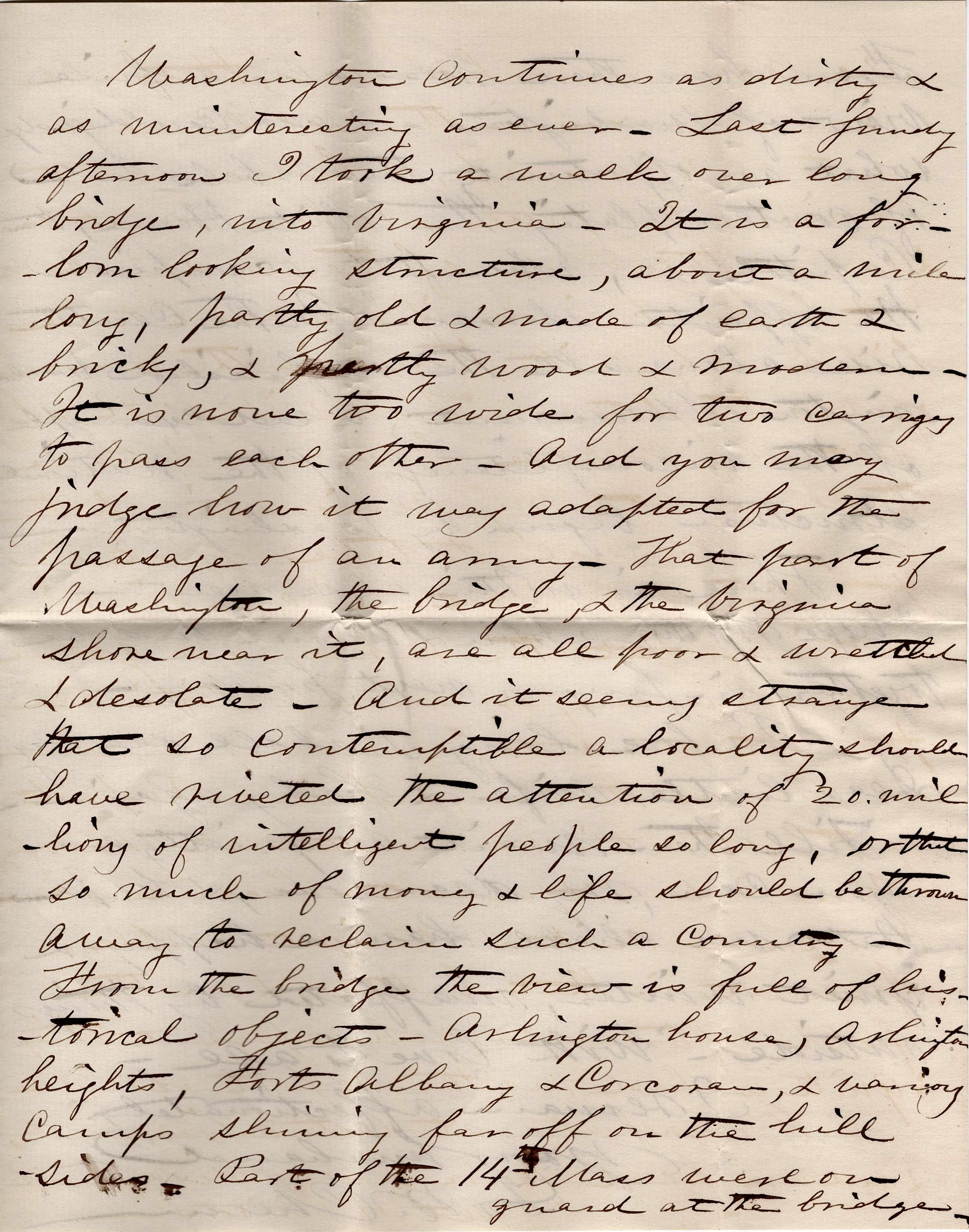
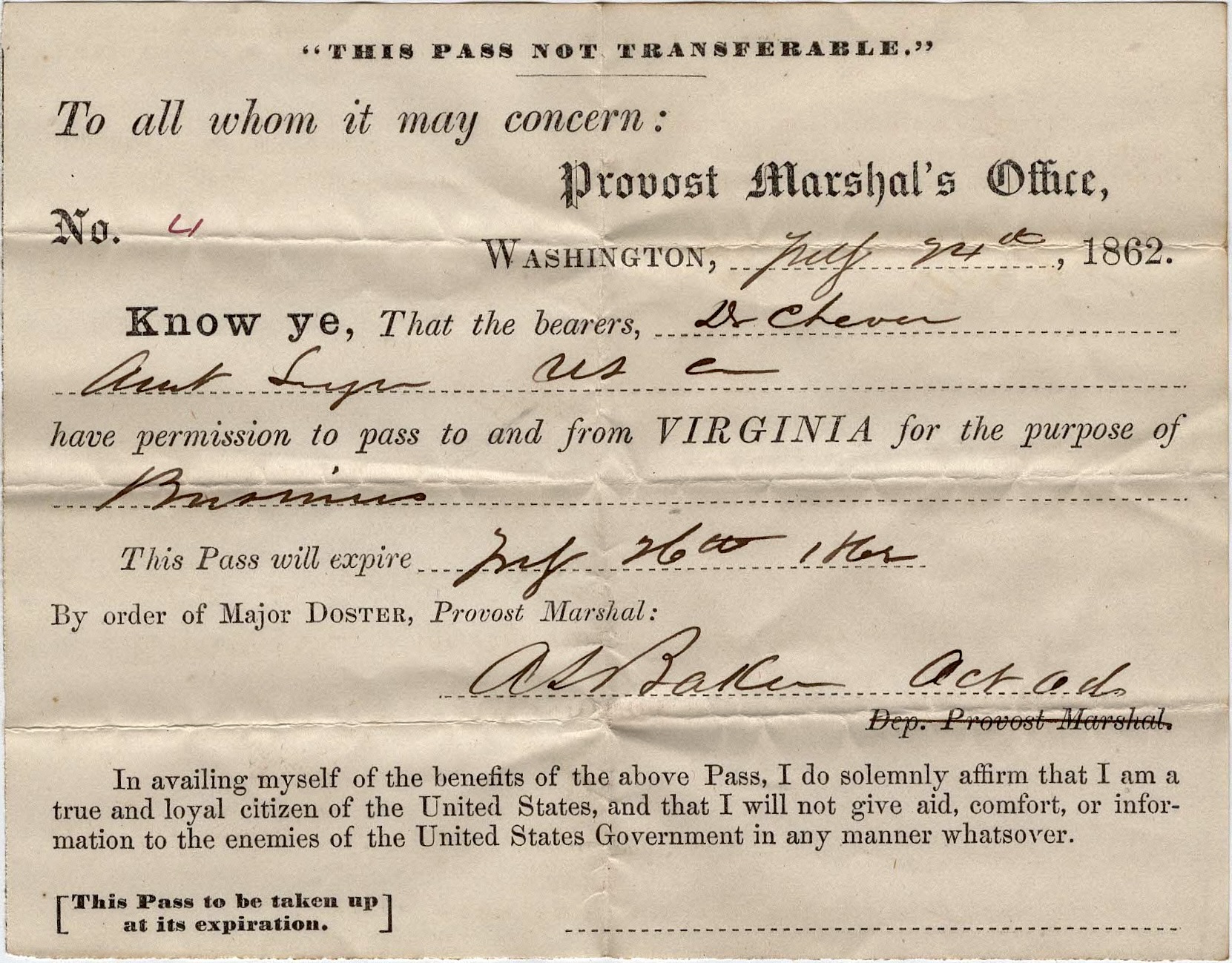
Congress has at last adjourned and we are freed from a very disagreeable set of visitors. Washington continues as dirty and as uninteresting as ever. Last Sunday afternoon I took a walk over Long Bridge into Virginia. It is a forlorn looking structure about a mile long, partly old and made of earth and bricks, and partly wood and modern. It is none too wide for two carriages to pass each other, and you may judge how it may be adapted for the passage of an army. That part of Washington, the bridge, and the Virginia shore near it, are all poor and wretched and desolate. And it seems strange that so contemptible a locality should have riveted the attention of 20 millions in intelligent people so long, or that so much of money & life should be thrown away to reclaim such a country.

The Long Bridge from the Virginia shoreline; US Capitol at far right. Ca. 1863

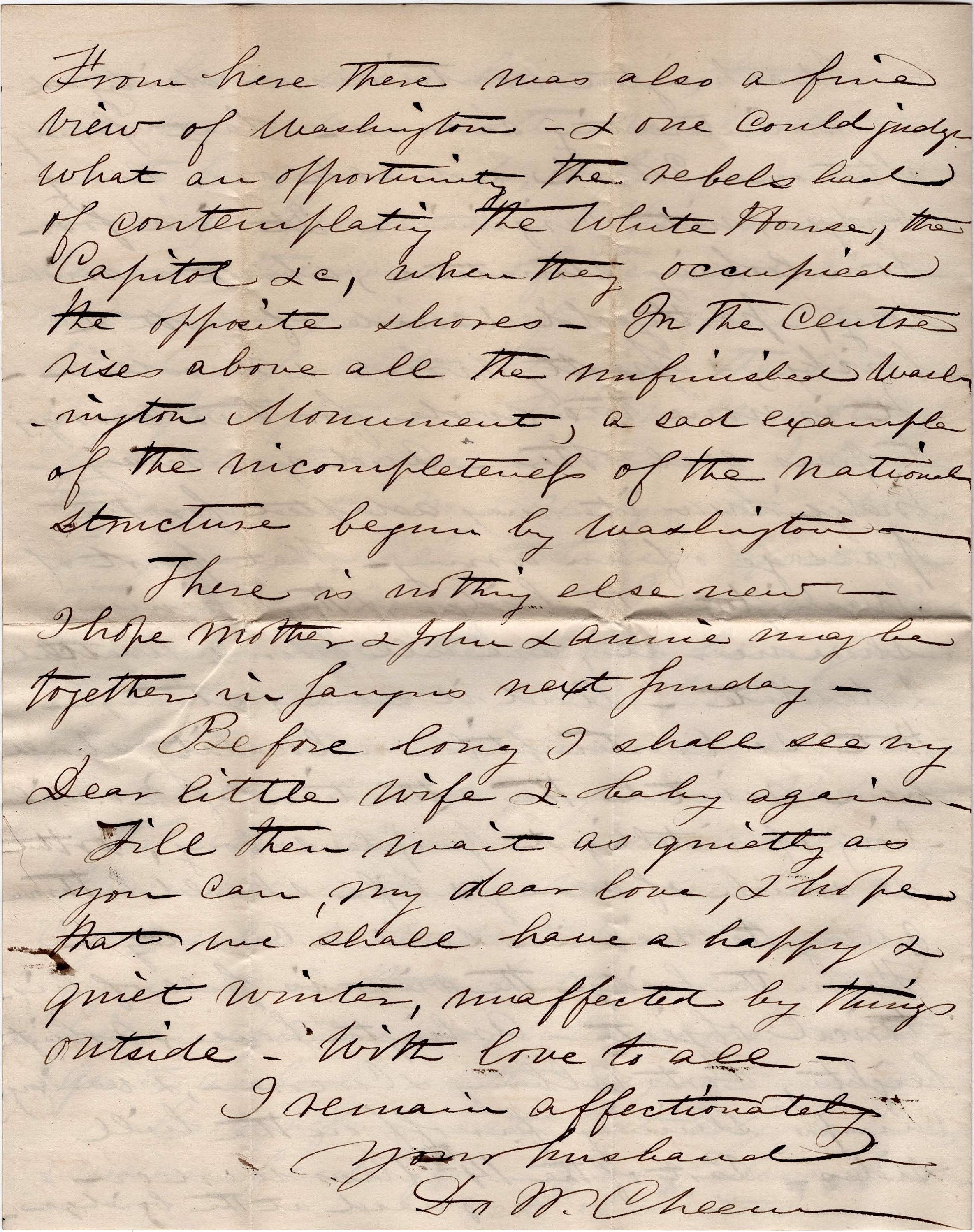
From the bridge the view is full of historical objects—Arlington house, Arlington Heights, Forts Albany & Corcoran, and various camps shining far off on the hillsides. Part of the 14th Massachusetts were on guard at the bridge. From here there was also a fine view of Washington, and one could judge what an opportunity the rebels had of contemplating the White House, the Capitol, &c. when they occupied the opposite shores. In the center rises above all the unfinished Washington Monument—a sad example of the incompleteness of the National structure begun by Washington.

There is nothing else new. I hope Mother and John & Annie may be together in Saugus next Sunday. Before long I shall see my dear little wife and baby again. Till then, wait as quietly as you can, my dear love. I hope that we shall have a happy & quiet winter, unaffected by things outside. With love to all. I remain affectionately your husband, — D. W. Cheever


Letter 10

Washington
Sunday evening, July 27, 1862

My own love,

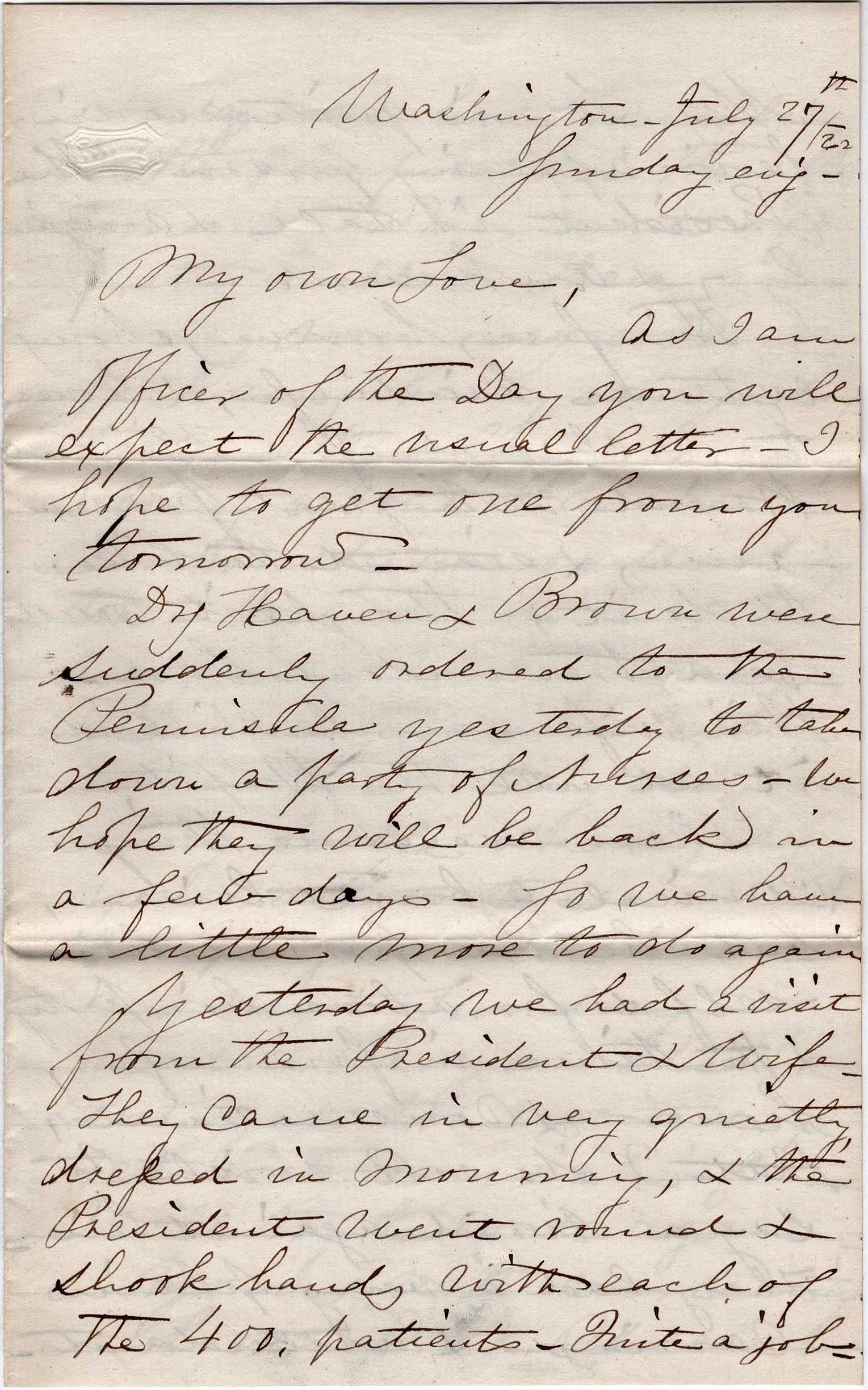
As I am Officer of the Day, you will expect the usual letter. I hope to get one from you tomorrow.

Drs. [Alfred] Haven and [Frank] Brown were suddenly ordered to the Peninsula yesterday to take down a party of nurses. We hope they will be back in a few days so we have a little more to do again.

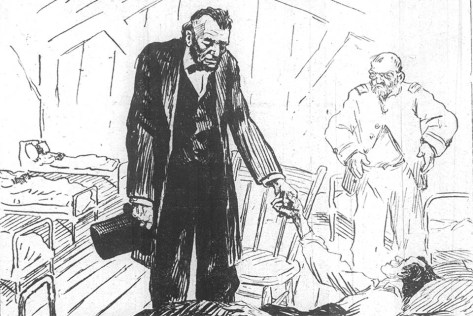
Newspaper drawing depicting Lincoln’s visit to the Depot Field Hospital near City Point, Va. (Courtesy New York State Library)

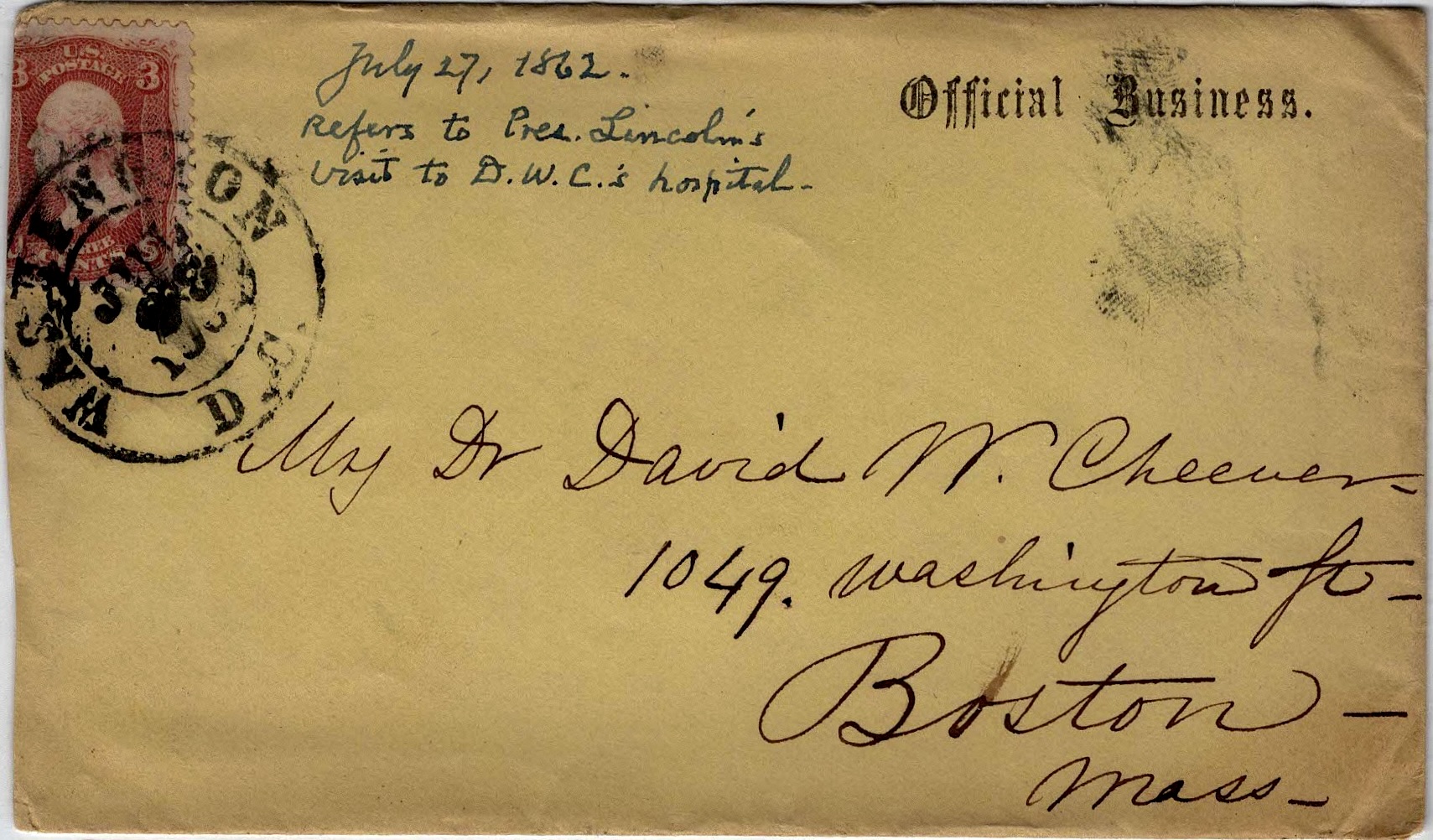
Yesterday we had a visit from the President & wife. 1 They came in very quietly, dressed in mourning, & the President went round & shook hands with each of the 400 patients. Quite a job. 2

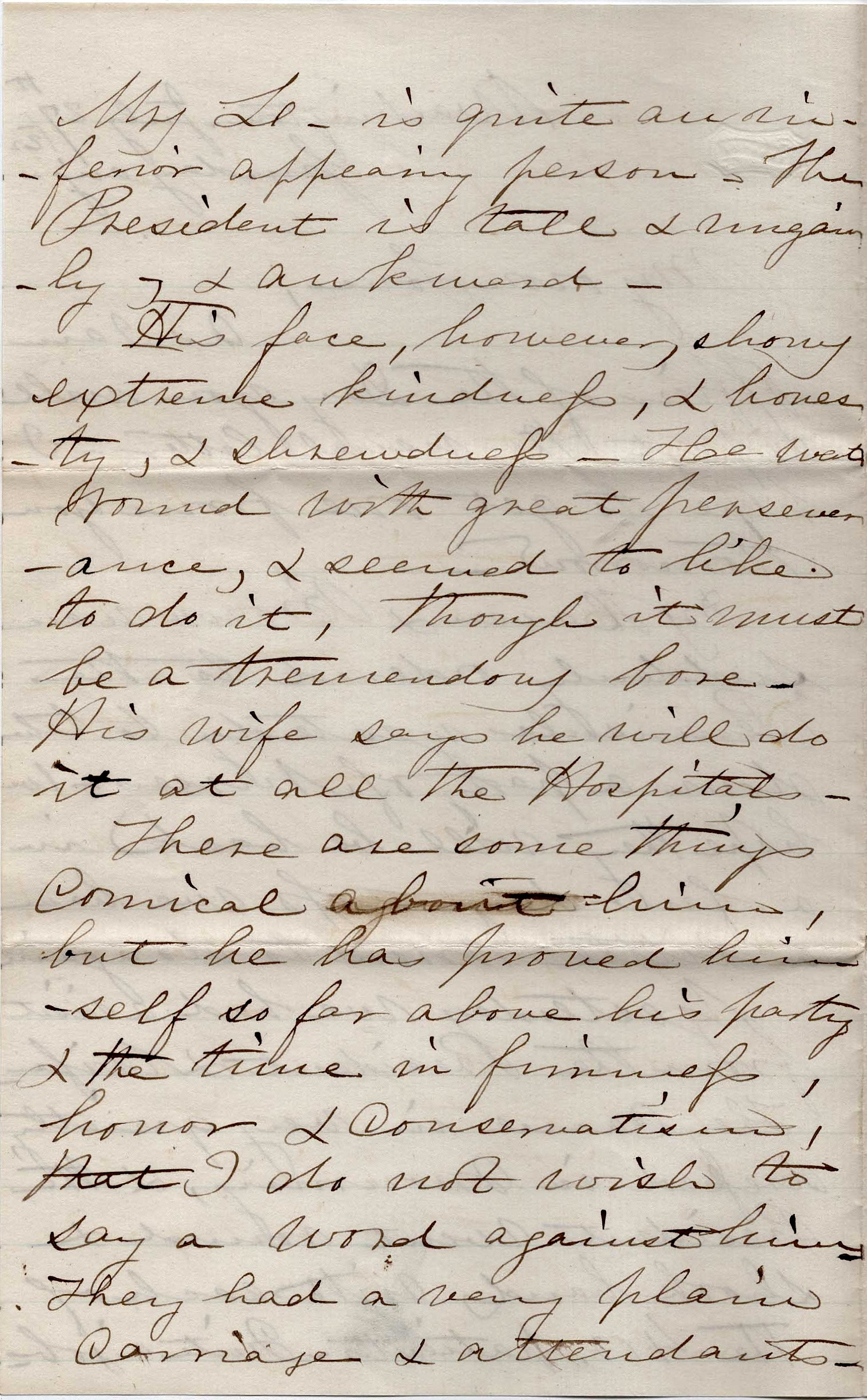
Mrs. L[incoln] is quite an inferior appearing person. The President is tall & ungainly & awkward. His face, however, shows extreme kindness, & honesty, & shrewdness. He went round with great perseverance, & seemed to like to do it, though it must be a tremendous bore. His wife says he will do it at all the hospitals. There are some things comical about him but he has proved himself so far above his party & the time in firmness, honor & conservatism that I do not wish to say a word against him. They had a very plain carriage & attendants.

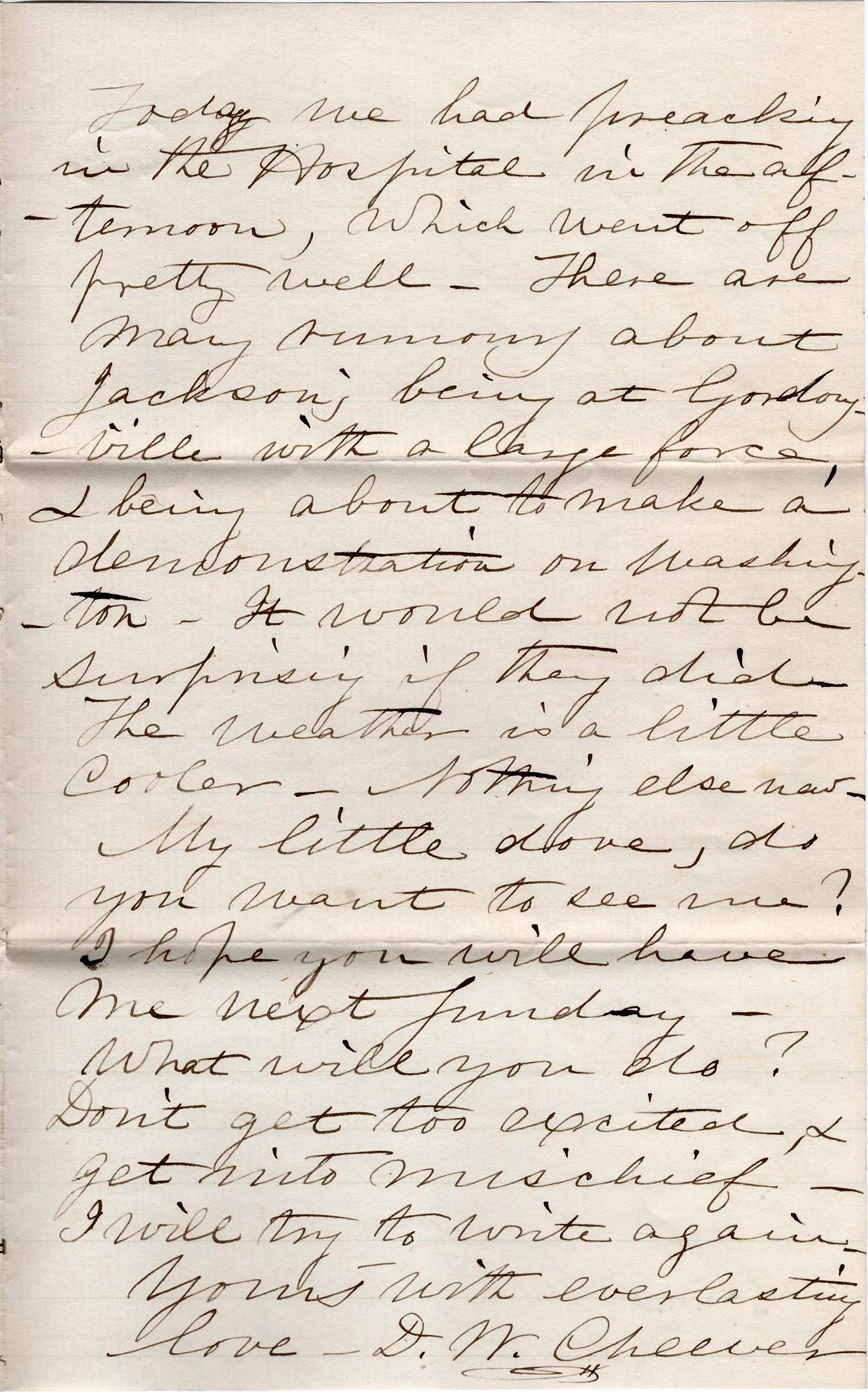
Today we had preaching in the hospital in the afternoon, which went off pretty well. There are many rumors about Jackson’s being at Gordonsville with a large force, & being about to make a demonstration on Washington. It would not be surprising if they did.

My little dove, do you want to see me? I hope you will have me next Sunday. What will you do? Don’t get too excited & get into mischief. I will try to write again. Yours with everlasting love, — D. W. Cheever


1 Lincoln’s visit to the Judiciary Square Hospital must have taken some time yet the visit but it was not recorded (yet) on the Lincoln Log, the Daily Chronology of the Life of Abraham Lincoln.

2 The hospitals were sometimes part of the afternoon rides taken by Mr. & Mrs. Lincoln. One observer noted: “Mr. Lincoln’s manner was full of the geniality and kindness of his nature. Wherever he saw a soldier who looked sad and ‘down-hearted,’ he would take him by the hand and speak words of encouragement and hope. The poor fellows’ faces would lighten up with pleasure when he addressed them, and he scattered blessings and improved cheerfulness wherever he went.” [Source: Charles Bracelen Flood, 1864: Lincoln at the Gates of History, p. 101.]

1862: George W. Smith to Betsy (Reynolds) Smith

The following letter was written by George W. Smith (1839-1864) of Co. H, 93rd New York Volunteers. He enlisted on 20 November 1861 at Bolton, Warren county, New York, when he was 21 years old and was promoted to sergeant on 26 January 1862. Sometime later he was transferred to Co. F and reenlisted as a veteran in December 1863. He was transferred back to Co. H prior to the Overland Campaign in 1864 and was killed in the Wilderness during the opening action of that campaign on 6 May 1864.

George was the son of Nathaniel Smith (1803-1885) and Betsy Reynolds (1813-1892). He saw his first action at the Battle of Williamsburg on 5 May 1862 and would come under fire again during the Seven Days Battles that would begin just a week after this letter was penned.

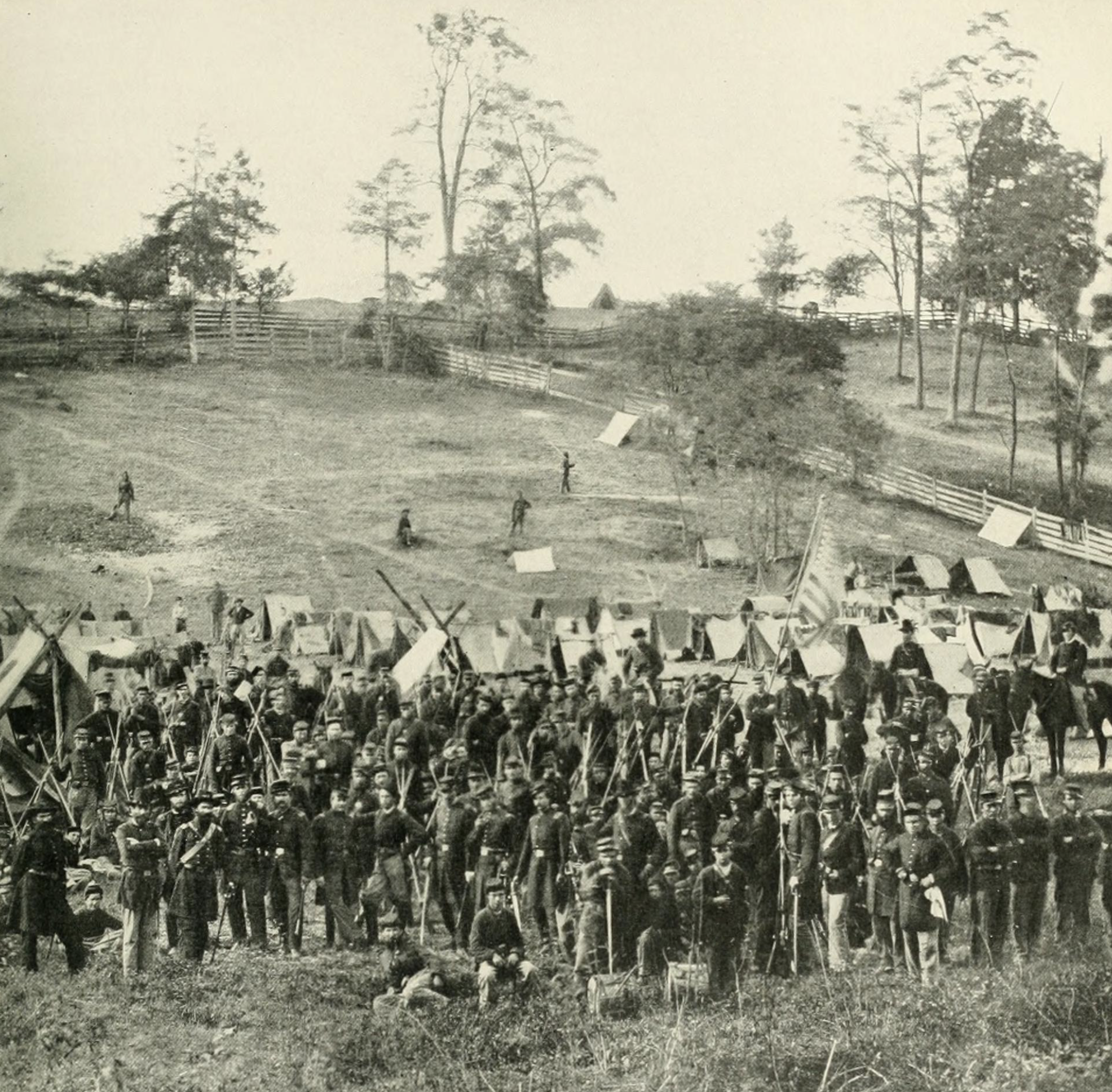
The 93rd New York Infantry in Maryland, shortly before the Battle of Antietam. (The photographic history of the Civil War, 1911)

T R A N S C R I P T I O N

Headquarters Gen. McClellan
Wednesday, June 18th 1862

Dear Mother.

I received your letter on Saturday last but have been unable to answer before because I have had so much duty to do and I don’t feel as if I could write much today. I cannot collect my thoughts or get my mind on one thing.

I received Dr. Howard’s letter a week ago last Saturday and while reading that I got the news of Sarah’s death. Capt. [George B.] Moshier got a letter from his wife and she told him to tell me of her death. I think she was up at Warrensburgh at the time. I have been sick ever since until the last two or three days but I am well at present. It is the first sickness I have had since I left home except the rheumatism. That troubles me very much at times. It has troubled me more since the Battle of Williamsburg than before. I caught a bad cold that night. It seemed to settle in my bones though it does not trouble me much—only in rainy weather.

The General has moved his headquarters across the Chickahominy Creek near Fair Oaks where the battle was fought a week ago last Saturday. It was a very hard battle. I suppose you have heard that Capt. [David] Burhans [of the 43rd NY Volunteers] was taken prisoner. I will not write much more this time.

Oh, the reason of my having so much to do for the last few days, all of our non-commissioned officers but me and another sergeant now for two weeks but were released last night so it won’t be so hard now. I have got a little money by me and want to keep some all the time in case I should be sick or anything, but I will enclose five dollars and send to you. If you want to use it, do so. If not, keep it for me and write soon and let me know if you get it all right.

About coming home, I can’t tell when I shall come but I think this fall sometime. I think that we will be successful at Richmond and if so, it will be a hard blow for the rebellion. Be sure and write soon or have Alf write. My love to Libby. Tell Pa I would like to be at home but shall never come until the war is done or I am honorably discharged unless I should get a pass to come for a little while.

Direct to Gen. McClellan Headquarters, Co. H, 93rd Regiment N. Y. S. V., Washington D. C.

From affectionately, your son, — George Smith

1862: Robert Baird to his Family

Robert Baird (1831-1862), 49th Pennsylvania Volunteer Infantry (Baird Family Collection)

The following letters were written by Robert Baird (1831-1862), the son of William Baird (1765-1863) and Nancy Harbison (1787-1855) of Pleasant Gap, Centre county, Pennsylvania. Robert enlisted in August 1861 and was mustered in as 1st Sergeant of Co. H, 49th Pennsylvania Infantry on 24 October 1861 at Camp Griffin, Virginia. At the time of his enlistment, he was described as a 6′ 1″ tall, grey-eyed, sandy haired millwright. A family history informs us that for a couple of years before his enlistment Robert worked for John Todd who built and repaired grist mills, saw mills, and water wheels.

In the summer of 1862, Robert contracted typhoid fever and spent some time in a hospital. Inadvisably he returned to his regiment before he was well and when the regiment was ordered to march, he fell by the wayside unable to keep up and was taken prisoner by the Confederates. He was taken to Libby prison in Richmond where he died 26 August 1862. Family tradition has it that a Mr. William Irving bribed the guards to provide a pine coffin for Robert’s body which they smuggled out to Belle Isle in the James River for burial and then sent Robert’s personal effects home to his family. [Source: Nancy Baird McClelland]

Note: These letters were made available for transcription and publication on Spared & Shared by John Baird.

Letter 1

Camp Curtin [Harrisburg, Pa.]
August 31, 1861

Dear Brother,

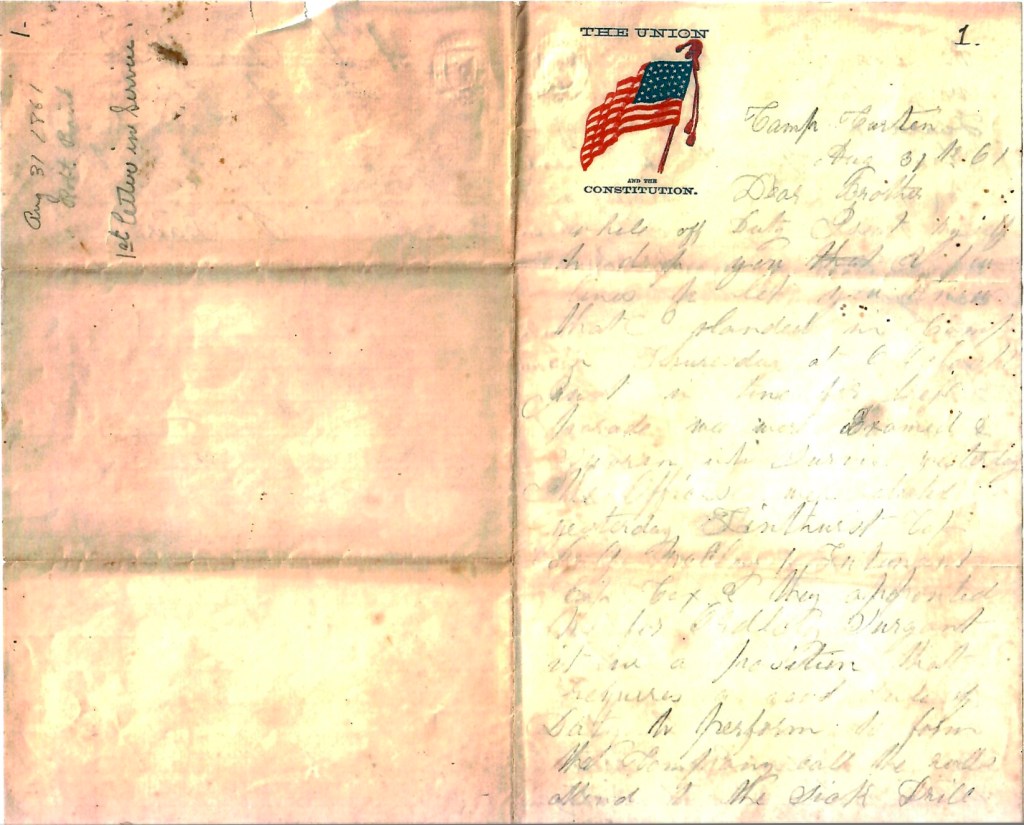
While off duty, I seat myself to drop you a few lines to let you know that I landed in camp on Thursday at 6 o’clock, just in time for dress parade. We were examined and sworn into service yesterday. The officers were selected yesterday—Linthurst Capt., Robt. McClay 1st Lieutenant, Cap Cox and they appointed me for Orderly Sergeant. It is a position that requires a good deal of duty to perform—to form that company, call the roll, attend to the sick, drill the squads, make a report every day, station the guard, etc. I get clear of standing guard.

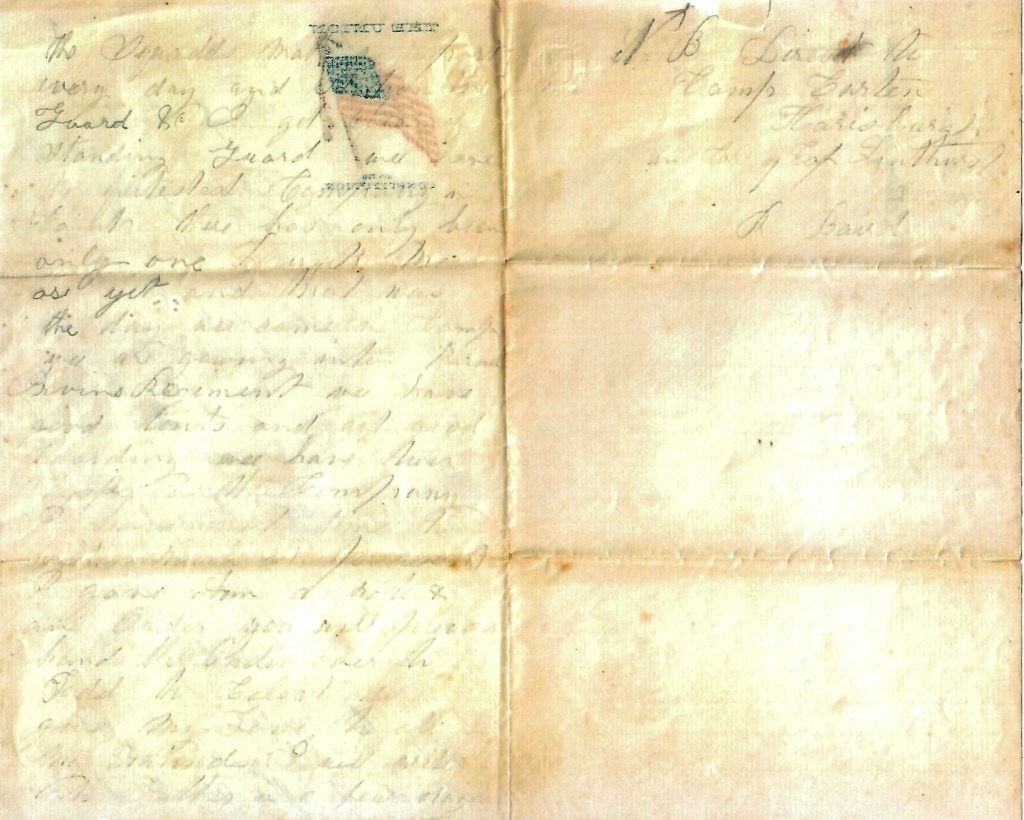
We have the quietest company in camp. There has only been one drunk man as yet and that was the day we came in camp. We are going into Col. Irvin’s Regiment. We have good tents and get good boarding. We have two cooks in the company. I have not time to write much at present. I gave Ann a note and an order. You will please hand the order over to Mr. Todd to collect it. Give my love to all my friends. I will write to Father in a few days.

N. B. Direct to Camp Curtin, Harrisburg in care of Capt. Linthurst

— R. Baird


Letter 2

Washington D. C.
September 23, 1861

Dear Father,

I seat myself this evening to drop you a few lines to let you know that I am well at present. We left Camp Curtin on yesterday morning to come here. We met with an accident between Cockeysville and Baltimore City. There was a train coming behind the one we were on that ran against ours and smashed up one car and killed two men and broke two more mens’ legs. There were about 1100 men on the train. It was supposed that the engineer done it on purpose for he said that he would take the cotton out of our ears before we got to Baltimore. He had one of his legs taken off. He went to jump off the train and got fast by some means. It is reported that he is dead now.

We marched through Baltimore in the night but was not molested. We then laid in the depot till daylight. I did not get to see Sam [cousin Samuel M. Baird of Baltimore[ for I could not leave the company that long. There is from 3,000 to 5,000 men comes in here every day for the last week. The Rebel army can be seen from the top of the Capitol. We can hear the cannonading from here. There was three bombs thrown within half an hour mile of the city last week. I cannot tell how many men there is in and about the city. Our regiment is camped by itself. There is three other camps within sight. There is 12,000 or 15,000 in one of the camps.

We are camped within half a mile of the Capitol. I can’t tell how long we will be here. I think we will go to Harper’s Ferry next week. They are expecting an attack at the Chain Bridge that is eight miles from here. We can hear the reports of cannon now in that direction. Perhaps they are at it now.

Well, I must close at present for we have to go out to drill. We get good boarding here and plenty of it. Give my love to all the friends. Tell them all to write to me. That more time to write than I have. At night we can’t write and in day time we have to drill. My love to all. Yours son, — Robert


Letter 3

Camp Griffin
49th Regt. P. V. Co. C
October 21, 1861

Dear Father,

I seat myself this morning to let you know how we are getting along at present. We have been here about twelve days. We have drilled more since we came to this camp than we did any place yet. We drill about eight hours every day with our knapsacks on at that. We had a trench dug on the side of a hill to retreat to in case of an attack. There is two companies out of the regiment stays there every night. The trench is two hundred feet long, 9 feet wide, and six feet deep. We have been called out three times expecting an attack but they did not come. They were in sight one day about one and a half miles distant. We got orders from headquarters last night to draw two days rations and have them cooked and to be ready to march in five minutes warning which we have all ready. Whether we will get further orders, I don’t know at present.

Our company are all out in picket except one Lieutenant, the sick, and myself. I have the sick to take care of and that clears me of going out on picket. We have eight on the sick list this morning. One of the number is in the hospital. The rest are not very bad. He is one of Sinkey’s boys from Penn’s Valley—one that I got when I was out recruiting. There is a great many men here in other regiments that I am acquainted with. One company in the Bucktail Regiment [42nd Pennsylvania] from Clearfield County I am acquainted with nearly all of them. They are encamped about one mile from here. There is about twelve regiments encamped in sight of ours and as many more within a few miles. There is five pieces of rifle cannon with our regiment.

Nicholas Orris, Co. H, 47th P. V.

I saw Fred Orris’s brother [Nicholas] the other day. He was well then. He is [in Co. H of] Colonel [Tilghman H.] Good‘s [47th Pennsylvania Infantry] Regiment. They are about a mile and a half from here. He came over to see us. I have only been sick two days since I left home. I have gained five pounds since I came to the service. I suppose the hard crackers and soft breads account for the gain. I have not had clothes off for four weeks—only when I change to wash them. We do our own washing when we get near any stream. We take a chunk of soap and strip off and wash our clothes. We are only allowed to take two shirts, two pair of drawers, and three pair of stockings, a blanket and overcoat and one suit of clothes and then we have them to carry when we march.

I wrote to Hannah last week. I don’t get time to write often but I have written more than I have received answers to. I must close for the present. Give my respects to all the friends. Tell them all to write. I remain your affectionate son, — R. Baird


Letter 4

Camp Griffin
49th P. V. Co. C
October 31, 1861

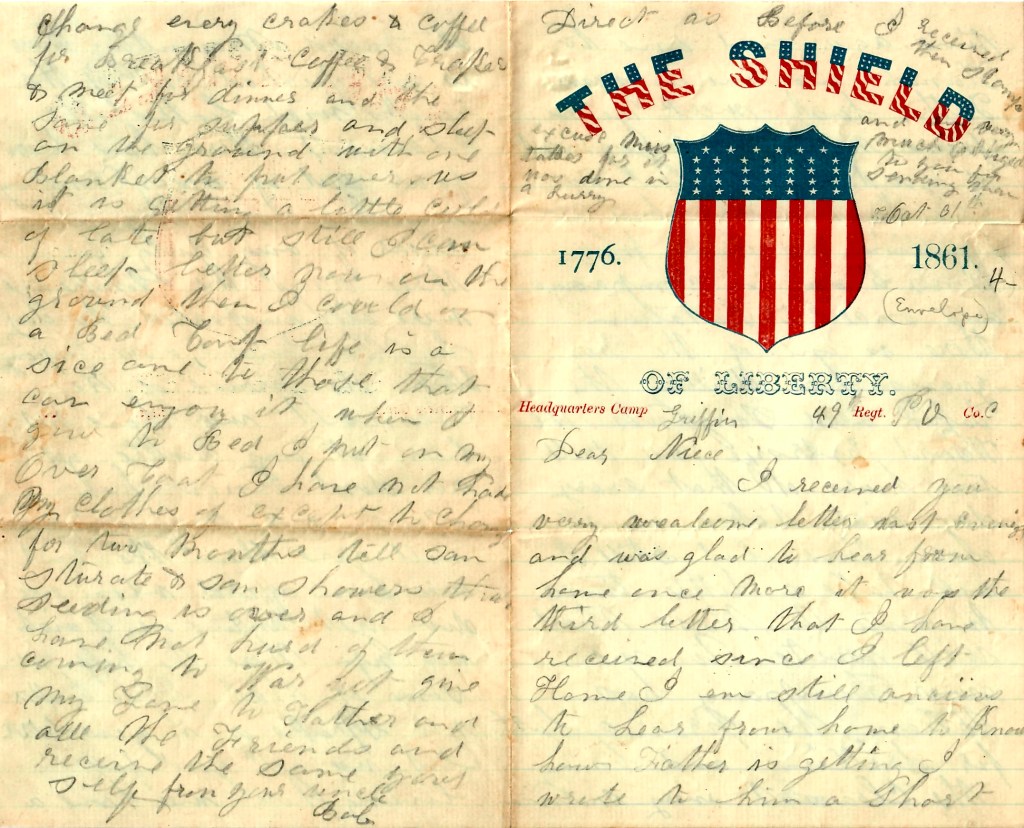
Dear Niece,

I received your very welcome letter last evening and was glad to hear from home once more. It was the third letter that I have received since I left home. I am still anxious to hear from home to know how Father is getting [along]. I wrote to him a short time ago and one to Hannah adn one to your father last week. Yours found me in the enjoyment of good health but we keep very busy drilling. We drill four times a day in companies and once in Battalion. There is one of the fire zouaves here driling the Captains and Sergeants in the sword exercise. We drill two hours at that every day which takes up all our time, but still I will take a little time to wrote to those that will write to me.

Our company has taken the praise both for drilling and being the cleanest. Every morning at guard mounting there is one picked out of the ranks which looks the cleanest. There has been four out of our company in succession. They get clear of any duty for three days. The companies were all inspected today by the General. Our company took the praise of the cleanest.

We have not been at any battle yet nor don’t know how soon we may but we will give them the best we can afford when we do get into one. I wish we were up there to help eat some of that Apple butter you spoke of in your letter but we get good fare living here. We have a change every day. Crackers and coffee for breakfast, coffee & crackers & meat for dinner, and the same for supper, and sleep on the ground with one blanket to put over us. It is gettin ga little cool of late but still I can sleep better now on the ground than I could on a bed. Camp life is a nice one to those that can enjoy it. When I go to bed, I put on my overcoat. I have not had my clothes off except to change for two months.

Tell Sam Sturate and Sam Showers that seeding is over and I have not heard of them coming to war yet. Give my love to Father and all the friends and receive the same yourself. From your uncle, — Bob


Letter 5

Camp Griffin
November 9, 1861

Dear Father,

I seat myself this afternoon to drop you a few lines to inform you of my welfare. It is raining this afternoon and we can’t drill which favors me with an opportunity of writing. I don’t get time every day. We have been drilling pretty hard for a couple of weeks but I have enjoyed pretty good health so far except last week I was sick a few days but have got to duty again.

The weather is getting tolerable rough. We have two blankets apiece which keeps us tolerable comfortable as yet. I don’t expect we will get any winter quarters. I suppose we will do the fighting this winter, We have not been in any battle yet and there is no telling how soon we may.

We have the best Colonel in this brigade. We have the praise of being hte cleanest camp and the quietest. I have not seen but one drunk man in the regiment yet. There was one of the New York men came in drunk yesterday and he was put in the guard house and is still there.

I wrote to William yesterday. He was talking of sending me some things and I had to stop several times while writing and forgot to mention that if he sent anything, that he should not pay the Express on them and I would be more likely to get them. He wanted to know the name of our company. We have changed it to Potts Guards.

Give my respects to John & Hannah and the Family and all the Friends. As there is no war news to write about, I will close for the present. From your son, — Robert Baird

N. B. If there is anything sent to me, direct to the 49th Regt. P. V., Col. Irwin, commander in care of Capt. R[alph] T. Maclay

— R. Baird, Georgetown D. C.


Letter 6

Camp Griffin
November 15, 1861

Dear sister,

I received your very welcome letter a few days ago. It was about four weeks coming to hand but still there was some news new to me in it. If found me enjoying good health and I hope these few lines may find you all enjoying the same blessing. We have had very unpleasant weather for a few days. We was out on a review yesterday. There was about four thousand men on the review. It was the prettiest sight I ever saw. They all were drilling in one body. There is another review today. It is a Division Review. There will be about ten thousand out if it comes off. It rained all night last night which makes it very disagreeable. The review which was to come off has been countermanded so we will get resting today.

There was one man died in this regiment last night—the first that died out of this regiment. The doctor reports that it was being homesick the most that was the matter with him. He was out of Capt. Green’s Company [A]. Haten [James M. Confer] I think is his name. He came from Bush Creek. There’s not very muck sickness in this regiment. There has been two of our company in the hospital for five weeks. They are both getting better. I go to see them every day. They are both able to walk around again.

We have not received any pay yet but expect to get it every day. It is three months yesterday since we came in the service & think it is time Uncle Sam was paying us some. We look for our pay whether we fight or not.

Everything goes to destruction as far as the army advances. I saw a splendid orchard cut down yesterday for wood, and there is not a fence in sight. The men won’t know their farms when they come back.

When you answer this, give me Eliza Ann Riddle’s address and I will write to her. I have not much news to write. You get the news from the army sooner than I can give it to you by letter. Give my respects to Father. I wrote to him last week. Give my respects to all the friends and write soon and give me all the news from there. You have more to write about than I have. I answered Tim’s letter a couple of weeks ago. Give me Josiah’s address. I don’t know where to write to him, I close at present by sending my respects to all your brothers, — R. Baird

N. B. Direct to Robert Baird, Washington City D. C.


Letter 7

Camp Griffin
November 25, 1861

Dear Father,

I seat myself this afternoon to drop you a few lines to inform you that I am well at present, hoping these few lines may find you also enjoying the same great blessing. The weather is tolerable cold. It snowed last night. The ground was all white this morning but it is all gone already. We have no winter quarters yet nor I don’t expect we will get any better than we have already. We have built fireplaces in our cloth tents.

I expect there will be a forward movement before a great while. There was a Grand Review last week. Nearly all the Army of the Potomac were present. There was over one hundred thousand present. It was the splendest sight I ever saw. The President & General McClellan and his staff were present. The health of the regiment is tolerable good. There has only two died out of it yet. There is two out of our company at the hospital and four on the sick list.

We drill twice per day. To practice firing, we fire blanks cartridges. I was out on picket yesterday and last night for the first time. There was not enough Lieutenants and they promoted me to act as a Lieutenant. It was a tolerable cold [night]. We can’t have any fire on picket.

We got our pay last week. I sent $53 home. Mr. Mann was here from the Big Valley and I sent it with him to be paid to Dr. Maclay to be collected by William when called for. I wrote to William yesterday about it. There was 1400 dollars sent with him from this company. It was safer sending it in that way than the mail for I have written several letters home that never went or I never got any answer to them. I wrote to Hannah some time ago. Her letter was about six weeks coming to hand. I received one from Samuel Showers last week and answered it also.

I don’t get very much time to write for I am kept pretty busy. The labor is not hard but very tedious. Well, I must close for it is time to call the company roll. Give my respects to all the friends. — R. Baird


Letter 8

Camp Griffin
January 10, 1862

Respected brother,

I received your letter few days ago and as I had written you a day or two before, deferred answering until now. I am still in the enjoyment of good health and I hope these few lines may find you all enjoying the same good blessing. We have had very wet weather for a few days which makes it very disagreeable under foot. The streets are shoe mouth deep with mud. We had a small snow. It is all gone and what little frost that wasin the ground is nearly all out.

There is more sickness in our camp at present than ever was before. The French Measles has got in the camp. There is five of our company have got them at present but are all getting better. Everything is quiet in camp at present but all are practicing on firing blank cartridges. It is generally supposed there will be an advance made before long but the roads are not fit to move artillry at present.

I was trying to sell some Robes [?] but they are afraid they can’t get them along when they move. If it was not for that, I could sell any amount of them. The Captain agrees to take mine along when we move. We are not allowed to have any extra baggage—only what we get from the government.

We were mustered for pay last week. I expect we will be paid off next week. If I get any chance, I will send you some more money to keep for me. You had better collect that at Lynn & McCoy as soon as you can and if you need it you can make use of it. As for that at J. V. Thomas’s I expect can’t be collected for I have lost the Note. Perhaps he will pay you. If he don’t know that the Note is lost, I have got back to the old mess that I had picked out before we left home. We had a roasted turkey for dinner yesterday. It was sent to Lex Barger and he had went home on furlough before the box arrived. He gave me the receipt to get the box adn divide the contents among my friends so I kept the turkey and a pound cake for my share and divided the rest amongst the company. They were talking of sending me another box from home. If they send me, tell them to put in some sausage and a couple of roasted chickens and some apples. Such things taste good, especially when they come from home.

Give my respects to all the friends. I remain as ever your affectionate brother, — R. Baird


Letter 9

Headquarters 49th Pennsylvania Regiment, Co. H
Camp Griffin
February 6, 1862

Dear Father,

I seat myself this morning to drop you a few lines to inform you that I am in good health and I hope these few lines may find you all enjoying the same great blessing. We have had very unpleasant weather for the last six weeks. It rains or snows nearly every day. It is raining now. The roads are very muddy. We have not been drilling much for a month except the last four days. We are drilling the bayonet exercise. All is quiet in camp except some talk of going south. We expected to of been gone from here before this time. There is some talk of this Brigade going to New York to go on a fleet that is fitting out there but whether we will go, I know not, nor no one knows yet. We never know where we go until we get started nor where we go until we stop.

I received John’s letter with the receipt for the box which they sent me. I have not got it yet. The sutler would not bring it out. There was a wagon went in for Express goods today and expect it this evening if nothing happens. I got my likeness taken yesterday and sent it to you. It is not a very good picture but you can see what kind of a looking soldier I make. I had only part of the equipments on. It looks pretty hairy about the face. I have not shaved since I came in the service.

I sent my old overcoat home or rather to Millroy to Graff & Thompkin’s store. If John sends with Todd, he can bring it over to him. We have drawn new coats and the old ones were too good to throw away. The Express on them were about seventeen cents apiece. I also sent $40 with Ira Thompson and if Mr. Todd was there, he knows to send it over to John or William to keep for me.

If we move from here, I have some more things which I intend sending home but can’t spare them until we move or the weather gets warmer. I must close for the present by sending my love to all enquiring friends. I remain as ever your affectionate son, — Robert Baird


Letter 10

Camp Griffin
January 15, 1862

Dear Brother,

I seat myself this afternoon to drop you a few lines in answer to your letter which I received several days ago. There is nothing of much importance to write about at present—only that I am well at present. There is more sickness in our company at present that there has been for a long time. There is several cases of measles. It makes them very sick. There is twelve on the sick list at present but none of them dangerously ill.

We got our dress coats yesterday and are getting new guns. They are to be Austrian Rifles with the sword bayonet. The ones we have now are the old musket and they are condemned not fit for service. The Colonel told me last night that we would get new equipments with our guns and new caps and he wanted the regiment to get new overcoats.

There is some talk of this Division going on Burnside’s Expedition to New Orleans. Whether or not we can’t tell as yet. I saw it in one of the daily papers. They are moving all the sick from our hospital to Washington at any rate. The 47th Regt. are goin to start on Tuesday to Florida. Nicholas Ford was over this morning to see me. They have everything ready to start. U wish we would get on the fleet. It would be a nice trip.

I received the stamps that Father sent in your letter. They are a scarce article here. They don’t bring many but here there is nothing to make on them as they dare not sell them for more than they pay for them. We get fresh bread twice a week now. We had been living pretty well since the boxes commenced coming. There is four boxes came to our tent. I have helped eat three turkeys since Christmas. If you send anything to me, send some apples and some sausage as they are easy cooked and taste good down here. We get plenty to eat here but a little change tastes good.

I finished the butter this morning that Hannah sent me. It went well and was pretty good. I want you to write oftener as I am always anxious to hear from Father. Tell him that I [am] very much obliged to him for sending me the stamps. My respects to Hannah and the children and all enquiring friends. From your brother, — Robert


Letter 11

Camp Griffin
February 3, 1862

Respected Brother,

I seat myself this morning to drop you a few lines in answer to your letter which I received last evening. I had been looking for some time for a letter from home. I received the receipt for the box you sent me. I have sent with the sutler for it. I expect he will bring it out tomorrow if he has not too much load. I was afraid we would be gone from here before the box would arrive but we know no more now than we did two weeks ago when we wil move. I think the way they are fighting us out that we will go on a fleet. We have drawn new clothes. I sent my old overcoat to Millroy [?] with several more in a box. They have landed safe. The Captain is at Mr. Graff & Thompson’s Store. I understand the Express amounts to fifteen cents apiece. If you see Mr. Todd and send with him, you can get the coat. It will make a good wagon coat for you.

When we move from here, I intend sending a blanket and some more clothes home. It is a pity to throw them away for they are good yet. There was several of the Valley folks down here last week to see us. I sent $40 home with Ira Thompson for me. He said if Todd was over there when he went home, he would send it over with him. It was the best chance I could get to seduce all the money. I told him if Todd was not there, he should keep it till you or William could call for it. William received the other I sent home.

We have had ver unpleasant weather for the last month. It has raised every other day for a month and the roads are very muddy. We don’t drill any since the wet weather has set in. All we do is to get as much wood as will keep us dry. We have a stove for every tent. We furnish such things ourselves. When we move from here, there will be a grand lot of stoves left for we can’t take them along. If we don’t go far, I intend to strap mine on my knapsack and take it along.

Give my love to all the rest. I want you to write oftener for I am always anxious to hear from home. As you don’t write very long letters, write often. My love to all inquiring friends. Has Hannah received the letter I wrote to her? I will close for the present expecting to hear from you soon. From your affectionate brother, — R. Baird

N. B. Direct as before and if I am gone it will follow me.


Letter 12

Camp Griffin
February 12, 1862

Dear Niece,

After some delay, I seat myself to answer your very welcome letter. I received the box which was sent me last night, I had a good deal of trouble getting it out of the city but there was nothing spoiled but the chickens. They were all moldy. We had some of the sausage for breakfast. It tasted right good. The apples and cakes are all good and are a treat for us for such things are very scarce here. The mittens I gave to one of my mess mates.

Nicholas has left here. I have not heard from him since he left here. We are still in the old camp yet. I can’t say whether we will leave or not. There is still some talk of our going but there is so many reports gets up we can’t tell whether w will go until we get started. The weather has been very unpleasant for a month or so. We are drilling the bayonet exercise now and it keeps me pretty busy for the Captain has ben sick for two months and when the Lieutenant is on duty, I have the company to drill. I have it to learn and then teach it to them.

There has ben a great many citizens from the Valley to see us this winter. I saw Mr. Weares from M____burgh. Mr. H___ and Mr. Wearer from below Bellefonte this week. I think they went home yesterday. There is a Mr. Beck from Milley’s here now. He has been here for a week and is going to stay another week with us. He is a brother of Aggie’s.

We had a Brigade drill yesterday—the first for six weeks. There is not very much news here to write about now. I suppose Mr. Featers feels large since he [ ] the McElroy’s…[remainder illegible]


Letter 13

Addressed to Mr. John Baird, Bellefonte, Centre county, Penn.

Camp No. 2 in the field
March 22, 1862

Dear Brother,

I seat myself this morning to drop you a few lines to let you know how I am getting along. We have been moving around since I last wrote to you. There was an advance made a week ago on Centreville, Manassas and Fairfax. The whole Army of the Potomac moved at once. The Rebels left their fortifications and fled and they were taken possession of by our men without firing a gun. They were well fortified at each of the three places. We went to Fairfax and when we got there, they were all gone and we put up for the night expecting to advance on to Bulls Run on the day but the news came to camp that our men had possession of Manassas Gap and then we were ordered back to Alexandria to go on a fleet. But when we got within three miles of the City, we were ordered to pitch tents and it was raining all day so you may guess we put in a pleasant night. For my part, I sat up at a fire all night. We are moved since to another camp and we have got our large tents again. We camped one week in the one horse tents. It beat all the clothes that was throwed away when we were on the march—blankets, coats, pants, and clothes of all description. We had our small tents to carry along on our knapsacks.

I sent a box by Express to William before I left the other camp with the rubber blanket and a couple of shirts and a gum blanket. Let me know whether it was received or not. As to whether we will go on a fleet or not, I can’t say for soldiering is very uncertain. You can’t tell one day whether will be the next but my opinion is that we will stay here now till the war is over and never see a Rebel. We are farther away from them mow than we have been since we came into Virginia.

I want you to answer this soon for I have not heard from home for some time. Give my respects to all the friends. Write soon and let me know how Father is gettin along. Tell Sam I will answer his letter some of these days. No more at present but remain your brother, — R. Baird

N. B. Direct as before


Letter 14

[Before Yorktown, Va.]
Camp No. 7 in the woods
April 13, 1862

Dear Father,

I seat myself this morning to drop you a few lines to let you [know] that I am still enjoying good health. We are now in Warwick county, Virginia. We have been moving around considerable since I last wrote. We have not received any mail for two weeks and I feel anxious to hear from home once more. We have been pretty close to the Rebel forts and they are pretty well fortified. They have fortifications thrown up for eight miles in one line and it is right in a swamp and their entrenchments are full of water which makes it impossible for our men to make a charge on them. The only way we can get them out of this place is to shell them out.

The first day we came up to their forts, they shelled them some and they returned fire but there was very little damage done on either side. Our men have not got enough of artillery here to make an attack yet. The two picket lines are so close that the sentinels talk to each other. Some of or regiment was talking to their pickets. They say they won’t fire at our pickets if we don’t. There was one of the 43rd New York Regiment shot one of their pickets a few nights ago and they returned fire and killed two of the 43rd and one of the 6th Maine Regiment. I have not been out on picket myself but when we first came in here, I went out to see the forts. They were most over a quarter of a mile off and while I was standing, they throwed a shell from their fort and it lit within a few rods off where I stood. I think if we get them whipped out of this place, the trouble will be over with them here for they can’t make much of a stand anywhere else except at Richmond and they can be easily whipped out there. There is 50,000 supposedly in these forts here.

I must bring my scribble to a close for the present, expecting to hear from you all soon. I will send this to Fortress Monroe and perhaps it will go and perhaps not for there is no mail goes from camp. We send some with the sutlers. We expect a mail in the evening. They say it come to Smith’s Headquarters yesterday. Give my respects to all the friends. I remain as ever your affectionate son, — Robert Baird

To his Father


Letter 15

[Before Yorktown, Va.]
Camp No. 9 in the Field
May 1, 1862

Dear Brother,

I seat myself this morning to drop you a few lines to inform you that I am well at present, hoping these few may find you all enjoying the same great blessing. Everything is quiet at present except a little firing along the picket firing along the picket line. There was two of our men killed yesterday. They were out of the Wisconsin Regiment and one out of the Maine the day before, and one out of our regiment last Monday. He is one of the Walkers from Wallses Run. He lived not far from the G___ stump. He had a wife & two children. We are camped within a mile of the Rebel forts. Our men have thrown up forts within five hundred yards of their guns. We done it after night. We have rifle pits within two hundred yards of theirs. How long we will be here before there is an attack made is hard to tell.

We got paid off yesterday for two months and there is two months more due us now. It has been four months since we got paid. The pay master says if he has money enough, he will pay the other two months before he leaves the company. I sent $30 along. The preacher took the money to Fortress Monroe to Express it to Dr. Maclay of Millroy. Either you or William can get it. William stated that he was going West. Perhaps he is gone before this. You can get the money by calling or send an order for it. Perhaps you will be over there sometime.

I had a letter from Riddles and one from Robinson. They are all well out there. I have not got any letter from home for some time. I get more from the West than from home. Please answer soon for I would like to hear how Father is getting along. We have a middling good camp. It is a little swampy. We have corduroy beds something like the roads through Jefferson. Perhaps you know how they are like….– R. Baird

To John Baird


Letter 16

Camp near Williamsburg
May 6, 1862

Dear Father,

I seat myself this pleasant morning to inform you that I am well at present after two days hard marching. The Rebels evacuated their forts on Sunday morning and we started after them and marched all day on Sunday and lay in the woods in front of their fortifications all night. In the morning, our brigade made a flanking movement and came in on their right with Wheeler’s & Canady’s [Cowans?] Batteries. The left one of their forts and we took possession of it and the batteries opened fire and we lay in line of battle on the right and left of the batteries. They got a reinforcement from Williamsburg and there was six thousands of them came out in line and made a charge on our brigade. There were only three regiments of us—the 5th Wisconsin, 6th Maine, and three companies of out of the 33rd New York Regiment. We retreated about twenty rods and about faced and when they came within five hundred yards, we opened fire on them. The battle just lasted three quarters of an hour. They then retreated back into their forts. It was a terrible sight to see the killed and wounded on the field. I helped to carry some of them off the field, some with their legs shot off.

There was only one killed out of our regiment, three of Maine, 16 out of Wisconsin Regiment, and about one hundred wounded while there loss was about five hundred killed & wounded and a large amount of prisoners taken. Perhaps you have seen the official account by the papers before this reaches you. Our company had to stand picket all night in front of their forts and I along with the rest, and I feel pretty sleepy today after losing two night’s sleep. The Rebels have all left this place and we are going to follow after so I have not time to write much at present. I will write as soon as we get stopped to camp. Perhaps we will start this morning. My respect to all. From your affectionate son, – R. Baird


Letter 17

Camp no. 14 in the Field
May 17, 1862

To John Baird, dear brother,

I received your letter yesterday and reply without delay. We are all getting along pretty well but have very warm weather here at present. We are encamped on what is called the Lee’s Farm [White House]. It is where George Washington got his wife. It is the best farm I have seen in Virginia. There is about 150 acres in wheat in one field. It is coming out in blossom. We are drilling in it today about 4,000 troops. It is hard to tramp the grain down Lee, that owns the farm, is Colonel in…

…day after the battle [of Williamsburg]. There was heavy losses on both sides. Our regiment escaped well. There was only one killed and one wounded. One regiment lost heavy. There was one regiment went in with nine hundred and they only had three hundred left. Our Brigade only lost about one hundred men while the Rebel loss was seven hundred and fifty. We came in on their right flank and they made a charge on us but we held our position and made them retreat. I saw some of the wounded and prisoners after the battle. They said it was the first battery that they ever saw supported by sharp shooters. They don’t like our guns. I always thought it would put a terror in a person while in a battle, but after the first fire, they don’t think anything about it. But the hardest sight…
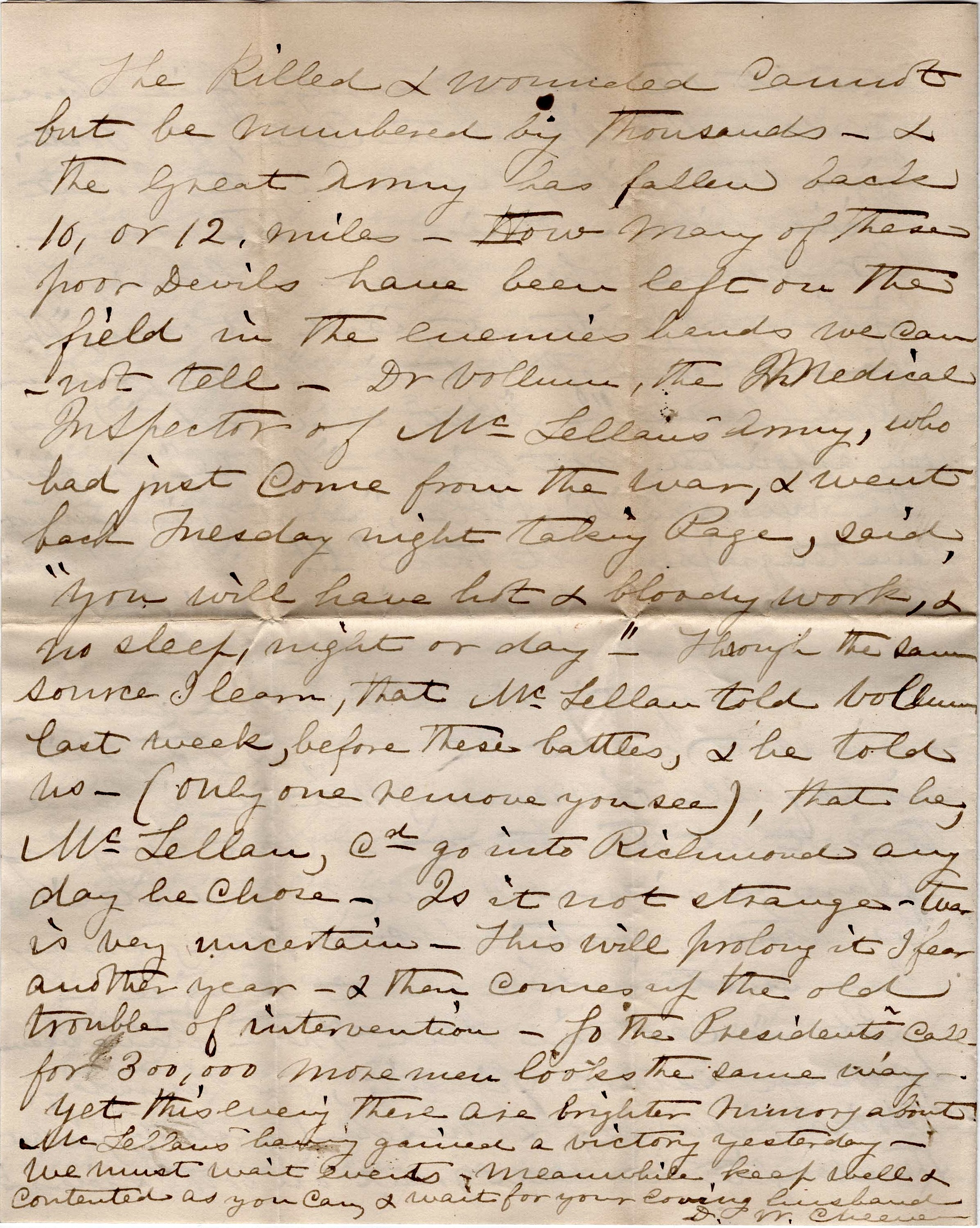
…a decided advantage of our ___ and understand between this and Richmond. We are now 23 miles of their railroad. Their fortifications are nine miles this side of Richmond. I expect we will make a forward move before long. There is about 50,000 men on this one place on the Lee Farm. There is very little corn planted here but what is planted is up four inches. We are close to the Pamunky River. The gunboats are up this far and we get our provisions brought up the river. I suppose there is great rejoicing up there about the Merrimac being blown up. Well, I have nothing more particular to write for you get the news faster than we do. I would like to have some of the county papers please.

I wrote you last week but I write more than I receive. Have you received the money I sent? It is in Millroy at Dr. Malley’s. Let me know soon. Direct to Washington as before. No more at present. Give my love to Hannah and the children. I remain your affectionate brother, — Robert


Letter 18

Camp 19 on the Chickahominy Creeks
May 25, 1862

John Baird, dear brother,

It is with pleasure I seat myself this pleasant morning to answer your very welcome letter which I received several days ago. It found me well and I hope these few lines may find you all enjoying the same great blessing. We are now within 7 miles of Richmond encamped along the Chickahominy Creek. The Rebels have all the bridges burnt along the creek and it is very swampy on both sides which makes it difficult for our troops to cross. We can [see] their troops on the opposite side of the creek. It is stated that they have a very strong force between this and the City. We are building bridges along the creek and will make an advance.

We have orders to have three days rations in our haversacks and to be ready to march at a moment’s warning. We have to leave our knapsacks behind and take sixty rounds of ammunition with us. There is no wagons to cross the creek until ordered. There was an order read to each company that there was to be no retreating in the Union army or something to the same purpose. I expect if they stand, there will be some pretty hard fighting done between this and Richmond. There was heavy cannonading on our right and also heavy musketry firing. The reporters say that Stoneman has crossed the creek. I understand there was a heavy loss on both sides but our men made them retreat leaving everything behind them. If it is correct that he is across, we will go soon—perhaps today.

I received the stamps you sent me and am very much obliged to you for sending them. I wrote to [niece] Em a few days ago and gave her all the news. I received a letter from [cousin] D[avid] W. Baird last evening. He is in Louden, Cedar county, Iowa, and is a squire and post master. Both him and his wife is both well. I also had a letter from Robinson’s Mary and the friends are all well in Stephenson County. Give my love to Father and Hannah and the children and all enquiring friends. Write soon for I am always anxious to hear from Father. Direct as before. Yours respectfully, — R. Baird

1862: Albert James Andrews to his Mother

The following letters were written by Albert “James” Andrews [Andrus] (1841-1862) who enlisted at the age of 21 on 12 September 1861 at Potsdam, New York, to serve as a private in Co. B, 16th New York Volunteers—the “First St. Lawrence County Regiment.” James served in the Peninsula Campaign and remained with the regiment until 1 December 1862 when he was taken sick and carried to the camp hospital where he died on 13 December. He was buried at Belle Plain Landing, Va.

James was the son of Winant Andrus (1812-Bef1850) and Eliza A. Vaum (or Vaughan) (1823-1898). By the time of the Civil War, Eliza had taken John C. Butler (1812-1864) as her second husband and had three or four children with him. John Butler also served in the war, volunteering in December 1863 as a private in Co. M, 6th New York Heavy Artillery. Unfortunately he did not survive the war. He died of disease on 26 December 1864 at the Judiciary Square Hospital in Washington D. C. when he was 52 years old. John Butler is referred to as the “Old Man” in these letters.

Letter 1

[Five miles from Richmond]
May 25th [?] 1862

Dear Mother,

It is with much pleasure that I take my pen to let you know that I am well and hope these few lines will find you all the same. We are five miles from Richmond. We had a little fight yesterday. We drove the enemy. We had none hurt. I heard Wm. has gone home. The corn is fit to hoe. The old man is tough as a bear. He is gone into the artillery.

Write as soon as you get this. Tell all the particulars. Try to plant something this spring. I can’t think of anything more to write. Goodbye for this time. — James A. Andrus [Andrews]

Direct your letters to Co. B, 16th Regt. New York


Letter 2

June 26, 1862

Dear Mother,

I now take my pen to let you know what I am a doing and [how] I am a doing. I am well and hope this will find you all the same. We are very near Richmond. We have a good time here and I think that we will be home this fall—perhaps sooner. They are a fighting today. The cannon roars like thunder. They will not find fun as I am sitting by candle light in my tent. I saw the old man today. He is well and tough as a bear. He is camped close to me. I see him every day. He told me to tell you that he would send you some money as soon as he could draw some pay. He did not draw any pay this pay day. I did not get any money but I will have fifty dollars due me when I draw pay next time. But I want to keep my money until I get there. I want to buy that farm when I get home.

Tell William to be a good boy and try to do well as he can this summer. I have a good time here but I would like to be home now.

They are fighting yet. It is after dark now. I will have to stop for tonight. My fingers are getting tired but I will [write] a little more. I want you to tell all the news and what all the folks is a doing up in the woods. I want to tell John that I say that when I get land, that we have a dance and have a good time a hunting. I just stole a large cherrie [pie] from the sutler today, sold it for a little money, and I sent 1 dollar to Edward and George to get them some books so that they can go to school and when I can get some more I will send some more. I want them to learn to read.

Well, I wish you would tell to me more than you do. I have wrote four letters to you and have not had any answers. I want you to write as soon as you get this. So goodbye for this time. From your absent son, — James Andrus

Co. B, 16th Regt. N. Y. S. V.

Ten minutes later. We have just received news from the fight. Our boys have beat the enemy roundly and are within two miles of Richmond. The city of Richmond is ours, or a part of the same.


Letter 3

Camp of the 16th Regt.
July 20th 1862

Dear Mother,

I now take my pen to write you a few lines to let you know that I am well and hope these few lines will find all of the folks enjoying the same. I received your letter last week but did not have time to answer it until now. I was over to the ninety-second today. I saw George C___ and Collier. I think that we will get our discharge this fall.

We had a hard fight the other day but I did not get hurt at all. I sent one dollar to George and Edward to get their [ ] books and will send some more in here if I can get it. I did not send any last pay day. I want to send enough to pay the land when I get home. Tell N__ to pile up the lumber so that it will keep. I want you to tell me all the particulars when you write and what all of the folks are a doing up in the woods. I have wrote many letters and one got one. Write soon as you get this and write often. I gave the old man the letter that you sent him. He is well. He has wrote to you two letters. He will send you some money as soon as he can get. I wrote to [ ] but have not got any answer yet.

Write as soon as you get this and tell all of the particulars. I cannot think of any more now so goodbye for this time. — James A. Andrus

Co. B, 16th Regt. N. Y. S. V.

1862: Jeremiah Downs to his Family

“I have got old abe nailed up to the head of my Bunk,”—the title of a brief biographical sketch of Pvt. Jeremiah Downs prepared by historian Patrick Leary decades ago after perusing and taking notes on eight of Jeremiah’s war time letters. Leary’s sketch reads:

Pvt . Jeremiah Downs

A self-described “mariner” from Newburyport, Mass., Jerry Downs enlisted in the Eleventh Regiment Massachusetts Volunteer Infantry on November 1, 1861, aged 25. Barely three months before, the “Boston Volunteers”—as the regiment was locally known—had lost 8 men at the first Battle of Bull Run, where Union forces had been ignominiously routed. After spending the winter of 1861-62 on picket duty along the Potomac south of Washington, the regiment moved south to join the forces being gathered under General McClellan at Fortress Monroe on the tip of the peninsula formed by the James and York Rivers. McClellan’s plan was to move up the peninsula with an overwhelming body of men and lay siege to Richmond, capturing the Confederate capital and ending the war in one bold stroke. Beginning the march on April 2, the Union army had got only twenty miles along when it was checked at Yorktown by a force of 13,000 men under Confederate General John B. Magruder. By skillfully deceiving McClellan as to the size of the city’s garrison, Magruder prompted his opponent to settle down for a careful siege, thus tying up the 53,000-strong Union forces for an entire month. On May 3, under command of the newly arrived General Johnston, the Rebels evacuated the city, pursued by the Yankees. After brisk skirmishing before Williamsburg on May 4—described by Private Downs in his letter of that date, written in the middle of the all-day artillery exchange—the Union divisions of Generals Hooker and Smith attacked the Confederate earthworks the following morning. Hooker’s division, of which the 11th Mass. was a part, was then attacked by a large force of Rebels; holding its position alone under constant fire for the rest of the day, the division was finally relieved by General Kearny’s division, after having suffered 1,700 casualties and the capture of five pieces of artillery.

After the Battle of Williamsburg, the Confederate forces moved northwest behind the Richmond defenses, while McClellan deployed his forces north and south of the Chickahominy, with his headquarters at West Point, at the head of the York River. Seeing the Union forces thus split, straddling the Chickahominy, Confederate General Johnston attacked the 19,000 Yankees south of the river at Fair Oaks with a Rebel force of 32,000 men. This battle—mentioned by Private Downs in his letter of July 24—lasted two days (May 31-June 1), ended in a draw after Union reinforcements arrived, and cost each side about 6,000 casualties. The rest of that remarkable letter describes in graphic detail the Seven Days’ Battles—Mechanicsville, Gaines’s Mill, Glendale, and Malvern Hill—in which Robert B. Lee’s army, beginning its attack on June 26, pushed the Union forces down the peninsula in a series of ferocious encounters that ended with McClellan’s retreat to the fever-ridden marshes of Harrison’s Landing. Jerry Downs calls it, simply, the “hard times we had coming from Fair Oaks.” The particular battle he describes is probably Malvern Hill on July 1, where Union batteries and infantry repulsed wave after wave of Rebel charges. One of the most severe artillery barrages of the war left 5,000 Rebel dead and wounded lying on the slopes—“sawed ends out” like stacks of wood, in Downs’ painfully graphic phrase.

Jerry Downs was one of many Union soldiers of the Peninsula Campaign
to survive fierce combat unscratched only to be felled by malaria and dysentery at the Harrison’s Landing camp. He was eventually moved to the large Federal hospital at Alexandria near Washington; he was discharged from the army for disability on December 5, 1862, and returned home.”

Jeremiah Downs was the son of Jeremiah (b. ca. 1815) and Abigail L. Downs (b. ca. 1809). According to the 1850 Census, he had one brother, George (b. ca. 1840) and two sisters, Sarah Smith (b. ca. 1832) and Mary Colton (1827). It should be noted that there are other letters by Downs written while he was in the service. Several of his letters appear on Private Voices under Authored Letters although they are transcripts only.

Transcription

Camp near Harrison’s Landing, Va.
July 24th 1862

Dear sister and mother,

I received your letter this morning & was glad to hear from you and that you are well as it leaves me at present. But I have been very sick with the slow fever. I have been in the hospital but now I am in the company and well. I was sick for one month and that since the Battle at Fair Oaks. I have not told you what hard times we had coming from Fair Oaks. We had our position on the left of the whole army till the right of our army got in our rear and then we fell back slowly and the Rebs came after us thinking to drive us, but we whipped them dreadfully. They were so drunk, they came up 1,000 at a time to the mouth of our cannon and we poured grape and canister into them that they were piled up sawed ends out. But now we are in a better place to receive them. We have got forts for nine miles around and the gunboats on the river to protect our flanks and if they come here, they will get a whipping [like] they never had yet since the commencement of the war.

Dear sister, we have fought over the same ground that our forefathers fought and the forts are still here that they made. President Harrison’s house is on the James River where we camped the first day we got here. It has a beautiful view up and down the river, is the house that [Edmund] Ruffin lives in—the first man that fired the first gun against Fort Sumter.

You ask me who wrote the last letter. Well, it was a man by the name of Wordell in our company.

You say give your love to David and William. Well, I will, and they send their love to you and the rest of the family. Also you say that you wish you coulda been here to take care of some of the soldiers. 1 I guess you would get sick of it and go home again. Tell George to stay at home if he can’t earn but 4 cents a day. Tell him not to enlist in the army anyhow if he wants his health. Tell him that the weather agrees with us so we do not mind it now. This is a very healthy place where we are so do not be worried of me being sick. I am just as well as I was six months ago. I have got the letter and paper that you sent me Monday. When you send the box, put anything in that you have a mind to. Please do put in a salt fish and some whiskey.

The directions to send:

Company D, 11th Regiment Massachusetts Volunteers. Fortress Monroe, Va.
Harrison’s Landing
Hookers Division

Ask the expressman to be sure. That is all that I can think [of] now. I will close. Give my love to all. Goodbye. Write soon. From your brother, — Jeremy Downs

1 Jeremiah’s sister, Sarah E. (Downs) Smith volunteered her services as a nurse during the Civil War. She began her nursing early in 1862. Her husband, George, had died in 1854 in St. Thomas, so at 32 yeas of age and a widow, she was readily accepted into the nursing corps. She became a matron in the Trinity Church Hospital in Washington D. C. She eventually died of tuberculosis at the age of 42 which she probably contracted during the war.

Notes from Patrick Leary’s perusal of all eight of Downs’ letters.

Samuel Brown Beatty Civil War Diary 2

This image has an empty alt attribute; its file name is screenshot-2023-11-16-at-9.23.33e280afpm.png
I could not find an image of Samuel but this long lanky soldier probably bore some resemblance to him. Samuel’s tall, slim figure and dark hair no doubt made him appear younger than his actual years. (Megan Kemble Collection)

This diary was kept by Samuel Brown Beatty (1818-1863) of Co. E, 57th Pennsylvania Infantry. Samuel was 44 years old when he enlisted as a private in October 1861. At the time of his enlistment, he was described as a 5 foot 11 inch tall shoemaker with dark eye color and black hair. When he joined his comrades in arms, he left a wife—Susan M. (Walker) Beatty (1823-1899) and at least eight children in Delaware Grove, Mercer county, Pennsylvania. Samuel’s parents were Francis G. Beatty (1789-1872) and Isabella Williamson (1792-1879).

Also serving in the war was Samuel’s oldest son, David “Walker” Beatty (1844-1863)—a member of Co. K, 63rd Pennsylvania Infantry. David’s letters to his mother may be found at the following URL—1861-62: David Walker Beatty to Susan (Walker) Beatty.

An extremely pious man, Samuel often urged his wife to pray for him such as the following passage: “Now I want you to always remember me in your prayers that I may not falter in well doing and that I may be preserved from evil and sin of every kind. That I may be prepared to stand my lot and always be found at my post let that be what it may.” Tragically, Samuel never returned home from the war. He died at the Union Hotel Hospital in Georgetown on 18 January 1863 from wounds that he received in action at the Battle of Fredericksburg on 13 December 1862. Likewise, Samuel’s son Walker died in a Georgetown hospital less than a month later on 7 February 1863 and was interred at the Soldier’s Home Cemetery (Grave 3344).

To read the letters Samuel wrote to his wife, see—1861-62: Samuel Brown Beatty to Susan (Walker) Beatty.

To read the letters written by Samuel’s son, see—1861-62: David Walker Beatty to Susan (Walker) Beatty.


Samuel’s diary with some newspaper clipping and pressed Holly leaves. All entries are in pencil.

Transcription

S. B. Beatty’s Memorandum Book. If I should be killed or die of disease, you would confer a great favor by sending this by mail to Mrs. M. S. Beatty, Delaware Grove, Mercer county, Pennsylvania.

January 7, 1862—Commenced nursing in the hospital.

February 18, 1862—Left camp Merced today for the other side of the Potomac and it being very muddy and we had a hards march but got along very well, all but some that got drunk. We got our tents up by dark and slept in them and the mud was two inches deep in them.

Wednesday, February 19th—We were all day carrying brush and fixing up our hospital and it was still muddy and sad but we done the best we could but we had but few in it.

Thursday, February 20th—Nothing of interest today. I am well and saw Daniel Young today.

Friday, February 21st—It is still wet and muddy.

Saturday, 22nd—-The birthday of Washington and we can hear the booming of cannon all around commemorating the day. Nothing of interest.

Sabbath, 23rd—This is the first that I have spent on the sacred soil of Virginia and it was wet and muddy as usual and there was nothing done.

Monday, 24th—It was clear in the morning till about ten o’clock and then there was a shower of rain and the wind rose and it sleeted and it blew a hurricane and blew down all the tents in the regiment and one of our hospital tents and it looked like desolation.

Tuesday, February 25th—It does not blow so hard this morning and we made ready to put our tent and we got it up. I am still well and in good spirits.

Wednesday, February 26th—Got case of varioloid [small pox] in the hospital but I will not run from it but will do my duty and trust my God [that] all shall be well. Nothing else of interest.

Thursday, February 27th—Very busy preparing for inspection. Feel tired but that is nothing new.

Friday, February 28th—The day of inspection. Fixed upon it and got everything ready but they did not come to the hospital at all. Feel all right today, thanks to God for his mercy to me.

Saturday, March 1st [1862]—In the hospital. There was regimental drill today, the seventh time since we left Camp Curtin. In the evening, General Jamison put them through a while and scared our officers and got [ ] up some but they soon got their wits again and then they were all right again. The colonel [William Maxwell] resigned today and left the command.

Sabbath, March 2nd—The Colonel started home this morning and was quite a touching sight to see him bid goodbye to the boys. Got dinner and then went down to the 63rd to see the boys and it snowed like fury for a while. Came back to the regiment, went to prayer meeting, and then came back to the hospital. I feel well in my mind and of course in body.

Monday, March 3rd—The snow is soft with a crust on it and it is foggy and dark. It rained this afternoon. There was regimental drill today and there is a great wonder who will be our Colonel. Nothing else of interest. I am still well. Got vaccinated on Sunday and my arm is some sore and it makes me think of my family at hoe. God has been very gracious to me this day in upholding and comforting me and in drawing me near to Himself. Oh that I may be enabled always to trust Him and take Him for my [ ].

Tuesday, March 4th—It is clear this morning. Our patients are all better in the hospital. Regimental drill this forenoon. Nothing else of interest today. I am well. My arm’s quite sore today. It makes me almost sick.

Wednesday, March 5th—It is clear this morning and cold. It clouded up about noon. I am well today. There was a Captain [Charles W.] Chapman of the 63rd Regt. shot on picket this morning. Nothing else of interest.

A detachment of the regiment consisting of one hundred men, under command of Lieutenant Colonel Morgan, while out upon the picket line beyond the Occoquan, near Pohick Church, on the night of the 5th of March, 1862, was attacked by a party of the enemy. A skirmish ensued in the midst of the darkness, in which Captain Charles W. Chapman, of company K, and Quartermaster James M. Lysle, were killed.” [63rd Regiment Pennsylvania Volunteers]

Thursday, March 6th—It is a fine day and it looks like spring. Our new Colonel came on today. His name is [Charles Thomas] Campbell, Regimental drill as usual.

Friday, March 7th—It is clear but cold and windy. Nothing of interest.

Saturday, March 8th—Clear and fine this morning and I think of going to Mount Vernon today and I went and saw what was to be seen. This is a barren and desolate-looking country. The fences are all out of repair and the land looks poor. The houses are old and small and the barns are miserable. It looks as if there was a curse upon it but it might be a fine country. Mt. Vernon is a fine looking farm but it looks neglected and forlorn. I saw the tomb of Washington and Martha, his wife, and several of his family relations and the old mansion and some trees that he planted and the old garden and the fountain and everything that was to be seen. Came back and feel tired but don’t begrudge my tired legs for it was worth all and more too.

Sabbath morning, March 9th—warm and pleasant-looking. Like spring. There is a general inspection this morning. I am well today. I have been mercifully preserved thus far amidst all the hardships of camp life. I have not been one day sick thanks be to God for his goodness to me and I am still encouraged to put my trust in Him for time to come.

Monday, March 10th—It is raining this morning and it was most of the day. We drew oil cloth blankets for tents when we march. The Division on the right of us moved today and we expect to move tomorrow. Nothing else of interest.

Tuesday, March 11th—It looks like spring. There is some excitement today about movement but i guess we will not move today, The day passed and we are here yet.

Wednesday, March 12th—It is clear and fine this day. There is review today and I went to the Potomac River and it is a noble looking stream. I am well today and in good spirits. There is a report that our army has possession of Manassas.

Thursday, March 13th—It is clear and war and it looks like spring. The spring birds are singing and the leaves are beginning to start on the elders and briers and the grass.

Friday, March 14th—Last night got orders to prepare immediately for a march and today we were all ready for a move but we were not commanded to march and we are here yet.

Saturday, March 15th—There is quite an excitement in camp today about where we are to go but we know nothing about it. But we are to go on steamers down the Potomac somewhere. I am well and in good spirits. We had a very wet day.

Sabbath morning, March 16th—Well and in good spirits. It is fair this morning and there is nothing of much interest. There is still troops coming in for to go down the river. We had preaching today.

Monday, March 17th—we marched to Alexandria and went aboard the Elm City—a large and good boat, the best that is here, and where we are going, I do not know.

Tuesday, March 18th—We are here on the Potomac and when we will leave this, none of us knows. It is just one month today since we crossed the Potomac. I am well as usual. We started down the river about noon. There was nothing of interest until sunset and it was a grand sight to me.

Wednesday, March 19th—A beautiful morning. We are in the Chesapeake Bay and it is so broad that I cannot see land—only on one side, and it looks fine to see so many sails on the water. We landed at Fortress Monroe about sunset and loaded our goods on a horse car, moved them from the wharf and then unloaded them in the middle of the street and I slept for the first time in the street and it rained all the night and the water ran all around.

Thursday, March 20th—Morning, it is still raining and I had to help load the regiment’s stuff and the hospital stuff and then went to hunt the regiment and it was quite a job. After a while, found them quartered in a stable.

Friday, March 21st—Slept in a stable last night for the first time and I did not sleep much. We are just beginning to be soldiers. I am still well and i desire to be thankful for mercies past and the blessing that I now enjoy. The regiment moved their quarters and tented out in the open field in their dog tents and it rained in the evening and I stayed and guarded the stuff.

Saturday, March 22nd—Still on guard till noon and then went to the regiment and then got some dinner. Our quartermaster is a poor excuse. I am well and in good spirits.

Sabbath, March 25th—It is a beautiful morning and is as still as if there was but one regiment here but I believe there is about thirty thousand here and more coming. Nothing of interest till evening. Then it rained. It is quite cold at night.

Monday, March 24th—We got orders this morning to be ready to move again at seven o’clock. The regiment started at eight and we did not get off till about twelve. We went about two miles and pitched our tents. We went through the old town of Hampton that the Rebels burnt last summer. It has been a nice place but it is all burnt. We are about four miles from Fortress Monroe.

Tuesday, March 25th—It is clear and the wind feels cold. I am well as usual. Nothing of interest.

Wednesday, March 26th—It is cloudy this morning and it spit snow this afternoon. I am well and I got a letter from my wife and it was a comfort to me.

Thursday, March 27th—It was clear again this morning and it looks like summer. There is nothing of interest. I am well, thanks to God for His goodness to me.

Friday, March 28th—It is clear and beautiful this morning. I washed some this forenoon and I am in the hospital. I am well and in good spirits. Nothing else but the usual montage of duty.

Saturday, 29th March—The wind is in the east and it’s cold and chilly this afternoon. It is raining and sleeting. It is hard to see the soldiers camped in these small tents when it is cold and disagreeable, Got a letter from A. Walker today.

Sabbath morning, March 30th—It rained all night and when I woke up this morning, I was lying in the water about two inches deep but I am still well. There seems to be no regard for the Sabbath here. While I write, the boys are playing ball and some are building fire places and walling up the front of their tents and some are at prayer meeting and some are lying in their tents.

Monday, March 31st—It is clear and fine this morning. It is as warm as summer today and it makes me feel lazy but I am alright. I am still in the hospital but do not know how long I am going to stay but will know by tomorrow. It is two at night and I am on duty in the hospital.

Tuesday, 1 April—It is clearcut not as warm as it was yesterday. I am going to stay awhile longer in the hospital. I am well but feel sleepy and tired. Went to bed at six.

Wednesday, 2nd April—Up at twelve and I did not sleep more than two hours last night and I feel kind of used up but I am in good health.

Thursday, 3rd April—Morning on duty in the hospital. I feel almost used up for the want of sleep but I am in good health. There is eleven in the hospital today but there is none of them dangerous. This is a beautiful day. We had a thunder shower last night and it started the grass to grow and it looks quite refreshing.

Friday, 4th April—We have marching orders this morning to march on Yorktown. We started at seven and marched to Great Bethel and the Rebels lead left just before we got there and I was very much disappointed in the place. There is but one house beside the Meeting House and the fortifications are but very slight. There is nothing but mud works and we went on about two miles and encamped for the night and slept under the wagon. Slept very well and feel well this morning.

Saturday, 5th April—I am well this morning. Our men started for Yorktown and I saw General McClellan this morning for the first time and he is a very plain looking man but is bold as a lion. It is a bad day for a march. It is raining but I am with the train and we can hear the sound of the cannon ahead of us towards Yorktown as if there was a skirmish. It is twelve and we have not started yet. This evening it cleared up and we have not started with the train yet.

Sabbath morning, 6th April—It is clear and fine. We are here yet and the regiment is some six or eight miles ahead. Our train started at 6:30 o’clock for the camp. This is a very sandy country and there is more timber than in Mercer county and more swamp. We came to the place about noon that the skirmish was yesterday but do not know any of the particulars, We are beginning to soldier it now. It does not seem much like the Sabbath. We had very bad roads part of the way. Got to the camp about sunset and found all safe and sound, The Rebels threw some shells into our camp and killed a few of the artillery horses.

Monday, 7th April—Don’t feel very well today and took some medicine. Got our hospital in big. There is nothing of interest in camp today worthy of note.

Tuesday, 8th April—I am still unwell but am able to attend to my duty. I am very bilious but hope to be all right soon. It is a very wet day and nothing doing.

Wednesday, 9th April—It is still wet and cold. Got orders this morning to move the hospital and it was a hard job for me and the work all fell on [1st Sergt. Thomas O.] Collamore and I. There was about ten or twelve in and they were moved out about one and a half miles and there was no provision made for them and we had no hands to put up our tents and we had to depend on the charity of our neighbors for their night’s lodging but we got along some way. I feel some better now.

Thursday, 10th April—It is cold and spitting snow a little. We are here beside a Meeting House and there has been a Rebel camp here and there is several of their soldiers buried in the graveyard. It is a very flat and wet [place] and I should think unhealthy, I am some better today but do not feel right yet.

Friday, 11th April—It is clear and fine this morning and it is quite refreshing. I am some better today and the boys are all doing well. Our regiment had a skirmish today with the enemy and there was three of them wounded and they killed about fifty or sixty of the Rebels.

Saturday, 12th April—It is still clear and pleasant. All is quiet in camp as if nothing had happened. I am still able for duty. There is nothing of interest thus far.

Sabbath morning, 13th April—It is clear and it makes me think of home that I left and my wife and children and a wish to be with those to spend if but one day with them and enjoy one Sabbath at home. All is quiet this morning. Nothing of interest. Our regiment went out on picket this evening.

Monday, 14th April—Still clear. I am as well as common. All is quiet. Our pickets brought in one prisoner this morning. Nothing else of interest.

Tuesday, 15th April—Cloudy this morning. I am well and feel thankful for my returning health. Our men are in god spirits. It is clear this afternoon. All is quiet except some shells flying back and forth from one camp to the other. Nothing else of interest.

Wednesday, 16th April—It is clear and fine today, It is very warm. I am well and in good spirits. There is some cannonading today. There is no stir in camp. Nothing of moment today.

Thursday, 17th April—It is very warm today, Our men are throwing some shot and shell today at the enemy. Our regiment is out on picket today. We moved our hospital again today. This evening there was the first of our regiment killed by the bursting of a shell. Nothing else of interest. Frederick Varick [of Co. G was killed].

Friday, 18th April—It is clear and would be pleasant if I was at home. It is just one month since we left Alexandria and not much done yet. Our men are besieging Yorktown.

Saturday, 19th April—It is cloudy this morning but pleasant. There is not much a doing. It is raining a little this afternoon. There was a ball threw over our camp. Nothing else of note.

Sabbath, 20th April—It is raining and cold and all is quiet except an occasional cannon shot, I am well. Nothing else of note.

Monday, 21st April—It is raining this morning. I am well. Got a letter from my wife and wrote one to her, All is quiet. Nothing else of interest.

Tuesday, 22nd April—It is clear and beautiful. I am in good health and spirits. There is no fighting today. The soil here is good but it is wet and marshy.

Wednesday, 23rd April—It is still clear and pleasant. All is quiet as if there was no army here. I am as usual. It is a beautiful place here in the woods. Nothing else of interest.

Thursday, 24th April—It is clear and cold this morning. I am well. Drew new pants today. Was down at the regiment today. All is quiet.

Friday, 25th April—It is cloudy and cold and chilly. I am well this morning. All is quiet in camp.

Saturday, 26th April—Is wet and cold. There was a small skirmish this morning and our men took twenty prisoners. Our regiment was called out but was too late. It was wet all day and there was nothing of interest.

Sabbath, 27th April—It is still cold and cloudy. I am well and hope that I may have good health.

Monday, 28th April—It is cloudy this morning. At noon it cleared up and it is pleasant. There is nothing of interest in camp today.

Tuesday, 29th April—It is foggy and dark this morning. Cleared away about ten. Our regiment moved their camp today.

Wednesday, 30th April—It is cloudy this morning. All is quiet as usual. I am well at present. Our regiment on picket. Nothing else.

Thursday, 1st May—It’s warm and foggy. Still in the hospital. I am in good health. Went over to the regiment and was mustered for pay. There is four months pay due us now. All is quiet. The siege is still progressing but silently.

Friday, 2nd May—It is clear and warm. The Rebels are throwing shot and shell quite rapid today. Our men don’t answer them but work away. I am well.

Saturday, 3rd May—There is nothing of much interest yet today, The Rebels are throwing shells pretty rapid this evening and some think they are leaving.

Sabbath morning, 4th May—The Rebels have evacuated Yorktown and our men are on the march to take possession. I am well and in good spirits. Henry Eberman died last night in the Church Hospital and was buried today. We got orders to march about 2. Yorktown is very strongly fortified and I think they missed it by leaving. It does not seem much like the Sabbath to me, one the quiet days at home.

Monday, 5th May—It rained last night and it still rains today. Our Brigade stands to pressure the Rebels this morning and we soon heard firing and it was kept up all day. We do not know the result. The roads are very bad and the road was full of teams all day. Our teams went about two miles. it still rains.

Tuesday, 6th May—morning is clear and there is still more troops coming. Soldiering is hard business. We have different reports about the fight yesterday. our regiment was not in the engagement. We are stopped for the night. I wish we were with them.

Wednesday, 7th May—Is clear and fine. We are about four miles from Williamsburg and no prospect of us getting on today. Some of our army went back to Yorktown this afternoon. Our team stayed. I stayed to guard the balance of the stuff. It is a beautiful day and I would like to be with the regiment.

Thursday, 8th May—It is clear and pleasant. Our teams are here and I am going on to the regiment and I am glad of it. There is very bad roads. We went past the battle ground and it was a strong position. Our men could have held it against one hundred thousand of the best troops but it was a hard fought battle. It is a fine country around Williamsburg.

Friday, 9th May—It is clear and pleasant. We are under marching orders. We started at ten from Williamsburg for some place up river. We saw plenty of rebel clothes thrown away in their flight from us. This is an old town, It was settled long before the Revolution. I saw wheat out in head today. We were all day going six miles. Camped for the night in the road, Went o bed at 12.

Saturday, 10th May—Up at daylight making ready for a march. It does not seem much like the days at home for there is a train of wagons on the move ten miles long. After going four miles through a dense forest of pine to an improvement and it is the best I have seen in Virginia. The road is bad. I am well and wish I was at home to spend the day with my family but I must be contented and act the soldier. I spent last night in the middle of the road and slept very ell. Got to the regiment at sundown.

Sabbath, 11th May—It is clear and warm. Are making ready for a march. I am well and it does not seem much like the day of rest. It is hard to spend the day in the army for there is so much noise and confusion.

Monday, 12th May—Is still clear and beautiful. We are camped on the road forty miles from Richmond. I am well. Got a letter from my wife today. I was glad to hear from home and wish I was ready to go there but that is out of the question.

Tuesday, 13th May—Clear and fine. Up at five. Slept under the wagon. Got orders to be ready to march at ten. All ready. This is a beautiful place. Started at the hour. It is slow traveling in the army. Saw corn four inches high. Marched about one mile and camped for the night and got two months pay.

Wednesday, 14th May—Up at three. Started to march at four. Saw an orchard in the woods and several places where whole farms were overgrown with timbers of quite large trees. This wound be a fine country if it was not for slavery. Marched seven miles, then camped adn pitched our tents and stayed there all night.

Thursday, 15th May—Is raining this morning. Got orders to march at six. Our train went half a mile and I stood about three hours. Saw more land that has been farmed overgrown with timber. Stopped for the night at Cumberland Landing and it is a very nice place. If it was in the North, there would have been quite a town. I am well but partly wet.

Friday, 16th May—It is cloudy but not wet. I am well as usual. Nothing of interest today in camp. I saw some steam adn sailing vessels today. Sent home twenty-five dollars to my wife by Adams Express. Sent it to J. K. Hamblin.

Saturday, 17th May—It is clear and warm. Washed some today. Sent off all the sick today in a boat. I am in good health. Nothing else.

Sabbath, 18th May—Up at five. I am well as usual. It is the quietest Sabbath we have had for some time. There is nothing else of interest.

Monday, 19th May—Our Brigade left—all but our regiment and we stayed to guard the Landing. The name is Cumberland on the Pamunkey River—the south branch of the York river—and it is about 70 miles from the bay and the tide rises at least two feet.

Encampment of Army of Potomac at Cumberland Landing on Pamunkey River, May 1862

Tuesday, 20th May—We are still here. I am not well today but think I soon will be. It is warm and dry.

Wednesday, 21st May—It is clear and warm. I am some better today. We are still at the landing and I do not know how long we will stay here. Commenced to write a letter to my wife today. The Locust trees are white with blossom. All is quiet and nothing of interest.

Thursday, 22nd May—Morning is clear and there is a fine breeze. It is quite refreshing. Wrote to my wife today. I am well and in good spirits and I am thankful.

Friday, 23rd May—Got orders to march at six. All ready and on the march. Went eight miles and pitched our tents and got dinner and then got orders to pull up and be off again all on the march and it is slow going. I saw roses today for the first I have seen. Ten at night. We are still on the road as good boys working for Uncle Sam. Came through a fine country but it is like all the rest of Virginia—cursed with slavery. Fields overgrown with bushes and briers.

Saturday, 24th May—Up at five. Slept by the side of the road. Slept about three hours, Feel all right. it is pleasant. We are ready for a move. Got to the Brigade at nine o’clock. At ten it commenced raining till evening.

Sabbath morning, 25th May—Up at five. I am well, thanks be to god for His mercies to me. Got orders to march. Started at 7 o’clock towards Richmond. Crossed the Chickahominy and camped within 12 miles of Richmond for the night. All is quiet. the same curse rests on the country now. Within ten or twelve miles of the Capitol and it looks like the vineyard of the sluggard.

Monday, 26th May—It is clear and cold for the place. I am well. Got orders to send everything back but the shelter tents and one blanket. I went back with the doctors things across the Chickahominy.

Tuesday, 27th May—It is raining. The teams went back for the rest of the stuff. I am well and would like o be with the regiment. There is about one thousand wagons in sight of this place. There is some cannonading on our right this afternoon. Our regiment is on picket.

Wednesday, 28th May—It is clear and fine. I am still guarding the doctor’s goods four miles in the rear of the regiment. I am well. Wishing the war was over that I could go home to my family. I long very much to see them.

Thursday, 29th May—It is clear. I am still guarding. It is very lonesome away from the regiment. I wish I was relieved so that I could go forward to the boys. I am well. Butter is selling at 40 cents and cheese at 35 and eggs at 40 per dozen. Small round ginger cakes 2 cents apiece adn everything else in proportion.

Friday, 30th May—It is cloudy this morning. I am still on the north side of the Chickahominy guarding the doctor’s traps. I am well as usual. Our Brigade moved back two miles and took up position on the railroad to guard it.

Saturday, 31st May—It rained last night and there was thunder and lightning. All is quiet. Still in the same place. I am well. It is very warm. There is a battle going on in front. it has lasted all afternoon. Our Brigade is called out. there is conflicting reports about the fight.

Sabbath morning, 1st June—It is cloudy and misting rain. The fight has commenced again. It is 5:15 o’clock and it was a hard fight for 5 or 6 hours but our men drove them back. Our army were attacked both days and they fought bravely doing honor to themselves and their country. There was several of our regiment killed and some wounded on Saturday. Today no particulars.

Monday, 2nd June—I am still in the same place. Moved back about sixty rods to get better ground. There is quite a number of our men in. The most of them are wounded in the hand. The river has risen by some means not known to us about two feet so that it is hard for the wagons to cross. All quiet but the water is still up. Nothing else.

Tuesday, 3rd June—I am well and in good spirits. We had a thunder shower last night. It is very warm this morning. We are still away from the regiment guarding the medicine and other hospital stuff. Crossed the Chickahominy and I went to the regiment and slept out in the open air and it rained all night.

Wednesday, 4th June—It is still raining and there is many of our men that have neither blankets nor tents and it seems hard to haven exposed without shelters of any kind. I am well.

Thursday, 5th June—It is still cloudy and cool. there is not much of interest—only that our men are still fetching in the wounded rebels and it is a horrid sight to see men that have lay on the field wounded for four days all fly blown. But war is cruel.

Friday, 6th June—It is cold and chilly and I am very unwell today. All is quiet. Nothing else of interest.

Saturday, 7th June—It is clear this morning. I am still sick. It rained this afternoon. Nothing of much interest in camp today.

Sabbath, 8th June—It is clear and nice. I am in the wood away about 1.5 miles from the regiment and it is the quietest Sabbath I have seen for some time. I am still quite unwell. There is nothing else of interest.

Monday, 9th June—I am still sick. We are going to move the hospital up to the regiment. Started to ride in the wagon but I could not stand it. Got there all safe [but] do not feel any better.

Tuesday, 10th June—It is raining and is quite cold. I am still under the weather. I am able to walk around. Went over part of the battle field and the balls must have flew thick and fast. I saw little bushes not more than two inches through that had sixteen balls in them.

Wednesday, 11th June—It is clear and cold. The Regiment marched back about one mile. All is quiet. i am still not well but think i am some better.

Thursday, 12th June—It is still clear but warm. I am some little better. There was picket firing today. How I wish for the sight of my home and wife and children. I think I would soon recruit up again but it will take me some time here

Friday, 13th June—It is clear and warm. Up at five. Got breakfast and started for the regiment. The Rebels are throwing shells at our men. I am some better but still have that oppression in my left side. I am almost done soldiering.

Saturday, 14th June—It is very warm today and the water is poor and scarce and the land literally stinks and I cannot help but be unhealthy. i am still better and think that I am going to get well. Went to the regiment for a letter but was disappointed again. Did not get any.

Sabbath, 15th June—It is clear and warm this morning. It makes the sweat run free. I am still at the hospital. There is about fifty under the doctor’s care. I am about well now. This is a quiet day. One of the quietest I have spent in the service.

Monday, 16th June—It is clear and cold this morning. I feel quite well, thanks be to God for continual blessings. All is quiet today.

Tuesday, 17th June—It is clear and cold. Up at sunrise. Feel well. I am at the hospital. There is some heavy cannonading on the James River. there is nothing else.

Wednesday, 18th June—It is clear and warm. I am well and able for duty. Wrote a letter to my beloved wife today. There is seventy here under the doctor’s care at this time. All is quiet.

Thursday, 19th June—All is quiet. I am well today, thanks to the Giver of every good for HIs goodness to me.

Friday, 20th June—It is still clear. There is nothing new. The same monotonous life. Oh how I wish I was at home with my family. I am about satisfied with a soldier’s life. It is not the life for me.

Saturday, 21st June—Clear and warm. All is quiet. I am well. Wrote to my wife. There is nothing of interest today.

Sabbath, 22nd June—It is still clear and warm. This is the quietest Sabbath I have spent for a long time. There is no stir of any kind. I am well and think I feel truly thankful to God for His goodness and mercy to me. This evening there was a small skirmish on which the Rebels lost about seven hundred in killed, wounded and prisoners and our men lost in all forty.

Monday, 23rd June—It is warm and beautiful. All is quiet. I am well and able for duty. It rained this evening and there is some picket firing this evening. Nothing else.

Tuesday, 24th June—It is clear but it looks like rain. I am still well and at the hospital we have 92 men here but they are all doing well except three and I think they will get well. There is nothing of interest.

Wednesday, 25th June—It’s clear and pleasant this morning. There was an advance of our army today and there was quite a hard fight but our men drove the Rebels about 1.5 miles and held the position all night.

Thursday, 26th June—All is quiet this morning but it may not last long. I do not know any particulars of yesterday’s fight. I am well and in good spirits. The men are getting along very well. Heavy cannonading on our right this evening is heavy and has continued about three hours. 6 o’clock, the firing still continues. At 9 the firing slackens a little. At 10, it has ceased and there is great cheering. [See Battle of Mechanicsville. Lee lost 1,475 men; Union losses were only 361. But Lee had stunned McClellan, who then began to fall back away from Richmond.]

Friday, 27th June—The cannonading has commenced at three o’clock and it has continued till four in the evening. I am well and on duty at the hospital. [See Battle of Gaines’ Mill]

Saturday, 28th June—There was some picket firing last night. All is quiet this morning. Got orders to move our hospital to the Division Hospital. Moved there and put up our tents. Got orders to move again. Traveled all night.

Sunday, 29th June—Put up our test and got our sick in them. There is some very sick. Our men were retreating before the enemy. They are going to James River this morning. There is some fighting today on the right and there was some slaughter on both sides. [See the Battle of Savage’s Station]

Monday, 30th June—This morning aroused at there and ordered to be ready for a move. Ready and started and the rebels followed close in our rear and they had our army drove back. The enemy got to the river.

Tuesday, 1 July—This morning the wounded men begin to come in and I had a very busy day helping to dress the wounds and there was a great many that could not be attended to.

Wednesday, 2 July—There was a general move of the army this morning and the surgeons all left last night and gave no orders what to do with the men and we all left as I was only a volunteer. I thought I would not stay but go to my regiment.

Thursday, 3 July—Got orders to move from City Point. Went out about three miles and camped for the night.

Friday, 4th July—All quiet this morning. At ten there was some picket firing and some thought there would be a general engagement but it soon blowed over, Nothing else of interest.

Saturday morning, 5th July—This is a fine day. All is quiet thus far. I am well and with the regiment. Went to the hospital.

Sunday, 6th July—It is a fine day. All is quiet. I am still well. We are still in the woods and it seems the most like the day of rest of any that I have spent for some time.

Monday, 7th July—It is clear and warm. All is quiet. I am in good health. There is nothing else of interest thus far. I am well and in good spirits.

Tuesday, 8th July—It is very warm for us fellows here. It makes us sweat lying in the shade. All is quiet along the line. I am still well and able for duty.

Wednesday, 9th July—Still fine and warm. I am well, all but a little diarrhea,. Got along very well today. Nothing of note.

Thursday, 10th July—Is warm but looks like rain. It rained this evening. I am not very well. Still in the woods. the water is bad. All is quiet.

Friday, 11th July—Cloudy and warm. I am sick this morning but still trying to do all that I can. There is nothing new.

Saturday, 12th July—Moved our hospital today. A new surgeon came to the regiment today. I am well. All is quiet.

Sabbath, 13th July—It is cool this morning. I am well and in good spirits. I feel thankful to God for his goodness and mercy to me. I would like to be at home to spend the day with my family.

Monday, 14th July—It is clear and warm. I am well and feel like staying through the war but that will be some time yet by present appearance. All is quiet today.

Tuesday, 15th July—Clear and warm. All is quiet. There is nothing new today, I am well today.

Wednesday, 16th July—It is very warm today. It makes the sweat run sitting in the shade. I am well. At the hospital. Nothing else of note.

Thursday, 17th July—We had the biggest rain last night I have seen in Virginia. It is warm and sultry today. I am well. All is quiet.

Friday, 18th July—Rained last night again. It is cooler today. Signed the pay roll. I am well. Nothing else of note.

Saturday, 19th July—It is cloudy and warm. Got my pay $52 and sent $50 home to my wife. All is quiet. Nothing else.

Sabbath, 20th July—This is a fine morning. I am well. Wrote a letter to my wife. It is a very quiet day. All is quiet and no alarm of any kind.

Monday, 21st July—Up at five. It is very warm. All is quiet. There is nothing doing.

Tuesday, 22nd July—It is cloudy and pleasant this morning. I am well. Our sick are doing first rate. All is quiet in camp. Our regiment’s out on picket today.

Wednesday, 23rd July—There is nothing of interest. I am well as usual.

Thursday, 24th July—Our regiment moved their camp today. I am well. Nothing else.

Saturday, 25th July—It is still clear and warm. This evening it rained. It is cooler since.

Sabbath morning, 26th July—This is a beautiful day. I am well, thanks to the Giver of all good for His goodness to me.

Monday, 28th July—Morning 5 o’clock, I am well. On duty today in the hospital. We have two more nurses today and I will not have it quite so hard.

Tuesday, 29th July—It is clear and warm today. There is three very sick men here today. I am all right and on duty.

Wednesday, 30th July—It is still warm. I am well, thanks to God for His goodness to me. There was one died in the hospital today.

Thursday, 31st July—All is quiet. There is some sick here in the hospital. One more died today.

Friday, 1st August—It is cloudy and cool this morning. There was an attack on our gunboats last night about 1 o’clock but it did not last long. All is quiet now.

Saturday, 2nd August—It is clear and pleasant and all is quiet, I am well and on duty at the hospital. Our sick are doing very well. Nothing else.

Sabbath, 3rd August—It’s cloudy and threatens rain. There was another man died today. All is quiet. There is nothing worthy of note.

Monday, 4th August—It is cloudy and warm at noon clear. I am well. All is quiet yet. There is nothing of interest today.

Tuesday, 5th August—It is warm and almost insufferable. We sent off some of our sick today. I am well. There is nothing else.

Wednesday, 6th August—It is very hot today. All day fixing up our hospital. I am well. Nothing of interest.

Thursday, 7th August—All is quiet. There was some of our prisoners returned last night. Wrote a letter to my wife today. I am well.

Friday, 8th August—It is very warm and that is no name for it. It is hot! I am well. All is quiet. There is nothing of interest. Captain Maxwell us under arrest for disorderly conduct.

Saturday, 9th August—Ordered to move. Went about half a mile. Al fixed up. I am well.The captain came back this evening.

Sabbath, 10th August—All doing well at the hospital. All is quiet. This is one of the stillest days i have seen since we left Washington.

Monday, 11th August—All is bustle and confusion. We got orders to be ready for a move at two. I am going to stay with the sick and I expect to go to Richmond in a few days as a prisoner.

Tuesday, 12th August—The regiment has not moved yet. They are ready at a moment’s warning. They do not know where they are going. I am well and in good spirits.

Wednesday, 13th August—Our regiment was put into Birney’s Brigade. All our officers come back. It is cool and pleasant. We have not marched yet. We are still here yet and no hopes of us getting any.

Thursday, 14th August—It is clear and warm this day. Still here and I think will be sent off before the regiment yet. I am well.

Friday, 15th August—Got orders to move at four in the morning. All ready and on the way. Marched ten miles down the James river. Camped for the night 1.5 miles from the county home [?]. Nothing of interest. I am well.

Saturday, 16th August—Marched at five in the morning. Marched ten miles again 11 o’clock to the Chickahominy. Stopped for dinner. Camped there till the next morning. There was nothing of interest. I am well.

Sabbath, 17th August—It is clear and cool at five and got breakfast. We are within 20 miles of Williamsburg. 7 o’clock got orders to march. went ten miles out of the direct road, We marched twenty-one miles. I am pretty tired but well.

Monday, 18th August—On the march at six. Feel all well. Marched to Williamsburg. The roads fine and the men march well. Camped for the night. Slept in the open field.

Tuesday, 19th August—Up at four and got breakfast. Got orders to march at seven. It is a desolate looking place here. On the march. Passed over the old battle ground. It looked quite familiar, Got to Yorktown at seven. Camped for the night.

Wednesday, 20th August—It is cloudy and cool Seven and not on the move yet. Moved at ten. Got on board boats to go down the river, Nothing else of note.

Thursday, 21st August—Steaming down the York river. It makes me feel sorry to retreat and leave all the ground that we had gained. This is a noble river. Cast anchor at the mouth of Aquia Creek for the night.

Friday, 22nd August—Started down the river. Got to Alexandria at nine. I am well but feel sleepy. I have slept but little for three nights. It looks like home here. Landed near our old camp after an absence of more than six months. Went on the cars and started for the Shenandoah. All night on the road.

Saturday, 23rd August—Got off the cars at Warrenton Junction and camped for the night.

Sabbath, 24th August—Got orders to move. Went back to the station and then moved along the railroad five miles and camped.

Monday, 25th August—Still in camp resting and rest is sweet to the weary. We are almost worn out with fatigue but my health is good, thanks be to God for His goodness to me.

Tuesday, 26th August—It is clear and fine. Still in the same camp. I am well. Think long to hear from home. I have not wrote home for two weeks and there has been no chance to mail a letter. Marched two miles and camped for the night on a very fine farm.

Wednesday, 27th August—I am in good health. Have orders to march at any minute. On the march. Started back on the same route we came. Marched hard all day and went about 24 miles and camped for the night.

Thursday, 28th August—Up at two. Started for Manassas. Got there at 11 and we had a hard march, It was warm and we marched from seven till eleven without halting fifteen minutes and our men were very much fatigued. At three started for Centreville. met the Rebs. No harm done. Went on and camped in the town for the night. Put at three and on the march at five.

Friday, 29th August—Started for the Rebs. Had quite a fight. It lasted from eleven till after night. It was near the old Bull Run Battle Ground but we worsted the Rebs. [See Second Manassas]

Saturday Morning, 30th August—Our regiment had quite a little skirmish and there was two or three wounded. There was a solid shot went within one foot of my head. Retreated back to Centreville. It was a hard march. We waded streams up to our hips and camped about 11 at night.

Sabbath, 31st August—We are still at Centreville. Saw Walker today. Stayed all day.

Monday, 1st September—Left Centreville this afternoon and had quite a fight but we drove the Rebs and lay all night on the field till three in the morning. [See Battle of Chantilly]

Tuesday morning, 2nd September—At Fairfax Court House. Got breakfast, then started and went to Fairfax Church, thence to the railroad station, then turned to the right and marched till night and camped.

Wednesday morning, 3rd September—18 miles from Alexandria. Started at five, marched by Pohick Church. Got to Alexandria at 12 and camped for the night. I am well. Nothing else of interest.

Thursday, 4th September—I am well. Still in camp and it looks as if we were going to stay a while and I hope it may be so. On guard today. I feel very much fatigued. My feet is so sore I can hardly walk. Nothing else of importance.

Friday, 5th September—Still in camp. I am well. Nothing else of importance.

Saturday, 6th September—I am well. On guard today. Again it sets pretty hard on me for I have not been used to it. I have been in the hospital but the regimental hospital is broken up and all the nurses are sent to the ranks, It is almost eleven months since I left [home] and seems as if I would never see it again. But I still live in hopes that i get home some of these days but it looks dark at this time. But it may be all for the best. Now I want you to keep this till I get home for I want to see it and I can tell you a good many things that I did not write. So no more nonsense. Good evening. From your husband, — S. B. Beaty

August 25, 1862—Within five miles of Warrington Station, Virginia
Dear Susan, as we were not on the march today, I thought I would write a few lines to let you know that we have left the Peninsula and abandoned all the ground that we have been fighting for for the last six months for which so many of our brave soldiers have lost their lives. We started on our march Friday the 15th and we marched every day for five days and my feet got very sore and my heart was sad to think that we had to retrace our steps and take a new start. I think it was a grand mistake in somebody—our going there at all—for it has cost a great many valuable lives and gained nothing by it. But we have proven to the world that the Army of the Potomac will fight and that they never leave the ground without orders.

On our march we went over the battle ground of Williamsburg and saw the old encampments at Yorktown and we slept under the guns of the old fort that we besieged so long. It looked quite natural. Then we went on board the boats and went down the York river into the Bay and then went up the Potomac to the City of Alexandria and landed near our old camp. On the same day we landed, we got on the cars and started for Pope’s army and we were so crowded that I could not sleep for three days and nights and I was almost used up. But on Saturday night, we got off the cars and camped for the night and I slept very well.

On Sabbath we marched six miles and camped in a very nice grove and we are resting today and rest is sweet to the weary.

August 26th—We are still encamped in the same place and we can hear the sound of battle to our right but we will not be in this fight. Our regiment is in General Birney’s Brigade now and we get along better than we did in Robinson’s. I have not seen Walker since we left Yorktown but he is still in the same Division with us yet and he was well when i last saw him and I hear from him often. This is a better country here than the Peninsula. Still the curse of slavery rests on it too and the fences are all gone, the fields all untilled, the forest is all destroyed, and it looks like a desolation.

August 27th—This morning we took the back track and we had a hard day’s march and it sets hard on me as we are not rested yet but we will have to try and stand it. We marched about 21 miles and camped for the night. Started the next morning at four and out it through till eleven o’clock and we stopped two hours and we have been expecting a fight all day but the Rebs are still on the move and we will still follow them up, We went across Bull Run and formed a line of battle and stood a little while and then started for Centerville, Got there about ten at night and camped. Up at three and ready for a march. We look for a fight and it is fight or die now with both armies. Still we have one side open yet.

Now Susan, we have had a hard time of it, having been on the march every day for six days, but we are not out of heart yet for we have every confidence in our General Kearny but he only commands one division and that is but a small portion of the army.

August 29th—Moved up to the battle ground today and there was quite a hard fight but we lost none of our regiment.

August 30th—This is the second day of battle and it was a terrible day to those that were engaged. It was one continual roar of artillery mixed in with musketry. Our division was not engaged but the cannon balls flew thick around us but there was but few of us hurt. There was one came within less than a foot of me but I suppose you know more about the battle than I can tell you. But still I think I can tell you something when I get home that you have not heard.

September 19th [1862]—Dear Susan, I am still alive and notwithstanding the hard marches that we have went through, sleeping on the ground in the open air, and in the rain. We were at Alexandria four or five days after the fight at Bull Run. On Monday night we left for the land of Mary. We are now near Balls Bluff on the Maryland side watching the Rebs to keep them from making a raid into the country. We marched 60 miles in two days and a half and it set hard on us. My feet and legs are so swelled that I can hardly get on my shoes at all but they are not sore—only stiff. But I am in good health and spirits. I have great reason to be thankful to God for his goodness and mercy to me. Since I left home, I have not been one day but what I have been able to take care of myself and I still put my trust in Him for life and health.

September 22nd—I am still well. We are doing picket duty. Our company was out yesterday. We did not see any Rebs. There is none of our brigade here but our regiment. I hope we may be left here for some time as it is a nice place and out of danger. Now I suppose you think that I do not write very often to you but my excuse is the want of time and chance of sending letters as we are on the move almost every day. I have wrote you two letters since we left the Peninsula and I sent you five dollars in each letter and I have not got any letter from you for a month. But we expect a mail today and I think I will get one then. Write often to me for I think the time long. No more. Goodbye. Your husband, — S. B. Beaty

1862: Ira E. Morse to his Siblings

I could not find an image of Ira but here is a tintype of John L. Cleveland of Co. B, 3rd Vermont Infantry

The following letters were written by Ira E. Morse (1837-1862) of Co. D, 3rd Vermont Infantry. Ira enlisted on 1 May 1861 and was mustered into the regiment on 16 July 1861. He received a gunshot wound on 16 April 1862 at Lee’s Mills, Virginia, but recovered only to die of disease on 29 November 1862. It appears that Ira, weakened from chronic diarrhea, had fallen out of the ranks while on a march and that a Boonsboro, Maryland, resident named Cornelius Wertz found Ira by a tree in the woods near his home and took him in and cared for him until he died. He was buried “in front of the church in Boonsboro where several Union soldiers had been buried.” David Trull claimed to have received Ira’s diary and bible from Mr. Wertz and delivered them to Ira’s parents.

Ira was the son of David Morse (b. 1807) of Charleston, Vermont, who was said to be physically unable to support his family financially. David and his wife Fanny’s net worth in 1860 was only $400 and they had come to rely on the money that Ira sent home to his family. By the time of his death, Ira had sent home $200 between his wages and the bounty he received for enlisting.

While researching Ira, I discovered in the “Widow’s Pension” claim filed by Ira’s mother following his death, that two of Ira’s letters written during the Peninsula Campaign in the summer of 1862 had been sent to the Pension Office as proof of Ira’s having sent money home to his parents for their use. I have transcribed these and added them with the 3rd Letter describing the Battle of Antietam.

Letter 1

Dixie Land
June 13, 1862
Camp at Fair Oak, Va.

Dear Parents,

I received your letter last night & was very glad to hear from you & now I seat myself in my little tent to write a few lines to let you know that we (Port & I) are well and hope that these few lines will find you the same.

We have crossed the Chickamoniny Creek at Fair Oaks on the grapevine bridge. We are now encamped on a hill on the south side of the creek. Our regiment is detailed out to build a bridge across the crick. The rest of the [Vermont] Brigade is 1.5 miles ahead. There is heavy cannonading up there this morning. Our picket is so close to the Rebs that they have to post themselves in the night & lay flat on their bellies until the next night. Our men are a building forts all along the lines. We shall have Richmond before long.

This is a very pretty place here. It is all oak on the hills and pine in the swamps. The niggers is as thick as the hair on a dog. One old nigger is 106 years old. Little niggers from 10 to twelve will carry a pail of water on their heads and not touch a hand to it.

I am sorry to hear that Dan ain’t so well. I don’t think he had ought to work at all. You may take any of my money that you need and use it and get Dan some clothes too if he needs them. I don’t want any of my folks to suffer as long as I can work. We probably shall be paid off again before long & then I shall send home some more.

I see in the papers that the Mississippi River is open now.There was a great fight here the last day of May & the 1st of June. The Rebels got licked. The loss was great on both sides. The Vermont boys weren’t in it but we could hear it. There is nothing more to write—only direct as before. So goodbye from your son, — I. E. Morse

I wrote this in a hurry.


Letter 2

Camp near Berkeley’s Landing, Va.
July 6th 1862

Dear Parents,

I received your letter the third. I was very glad to hear from you. i now take this opportunity to write you a few lines to let you know that Port and I are well and I hope that these few lines will find you the same & to let you know where we be & how we come here. Probably you have heard of our skedaddle before this time and are anxious to hear from us.

Well, first of all I will say that them postage stamps was all right.

Thursday the 26th of June, a battle was fought on our right & we got news that our boys was a licking them. Cheers after cheers was given all along the lines. We was paid off the same day & Port & I sent home our money the next day by the pay master…

Well. Friday the 27th we was all under arms & marched up onto the hill into some rifle [pits] by a little fort that we had built to support a battery & the pickets. We had not been there long before the artillery on both sides began to fight. It was the hottest place that I ever see. I see that some of our batteries throwed shell over across the crick to the Dr. Gaines’ farm & I could see rebel troops & further around to the right I could hear fighting & hard fighting too.

And then I began to think that there was something up. Our artillery silenced the rebel guns. In the afternoon we went down & tore up a bridge that some of the nigs built across the creek & there I had a fair view of a battle. Our men drove the rebs & then the rebs drove our men & they kept up just so all day and then our men give up the battle & come back across the creek. We stood to the bridge that night to keep they rebels from coming across. The next day—that was Saturday—our troops wrecked the rebels all out and took a lot of prisoners. We was completely cut off twice but forces come up in the rear from the James river and drove the rebels back. The 2nd day we arrived at this landing. It rained all day hard & the mud was half a knee deep & we all got wet as rats & our legs was all mud up to our bodies.

The next day the rebels got into a hill and began to shell some of our camps. The cavalry went up and drove them off & took their guns & then we loved to the place that we are now. We lost everything on this retreat almost. We are a building a fort here. There is not much danger here. Our front is only 5 miles long. The gunboats is right in sight of some of our camps. They protect our flanks. I said that we had no one hurt in our company but one of our boys has not been seen since the Battle of Sunday night at Savage Station. I am a going to send 3 gold dollars in this letter. There is nothing more for me to write. So goodbye. Please write soon. From your son, — I. E. Morse

Direct as before.


Letter 3

Camp near Hagerstown, Maryland
October 13, 1862

Dear Brother & Sister,

It is with pleasure that I can have time to write you a few lines to let you know that I am some better than I have been. I had had the diarrhea for two months but I am on the gain now. I shall be all right before long now.

We are to Hagerstown a doing guard duty. You have probably heard of our big fight here so I can’t tell you any news about that. I was sick about this time so I was in the rear but I went all over the battlefields. Our brigade drove them over the Blue Ridge. The 4th regt. was skirmishers & they done a most all the fighting on this ridge. They give it to them Rebs good. They took two guns and drove them all out of sight.

The valleys here is full of all kinds of fruit & corn & wheat. The farms is as pretty as I ever see in old Vermont.

Ira’s account of the battlefield—the stench, the unburied soldiers and animals, & the houses filled with wounded are described in detail in Steven Cowie’s new book, “When Hell Came to Sharpsburg”

The Battle of Sharpsburg was an awful slaughter. Our Brigade lay on their bellies 36 hours under a raking fire of the enemy [guns]. 1 John Stanton was shot through the heart. He was all the one that was hurt in our company. Every house & old barn and shed was full of wounded. The fields was full of dead. We passed across the battlefield en route for this place three days after the fight. It stank awfully then. The dead was not nye all buried. They burnt a lot of them.

We have got a good place to stay now. The citizens bring in a lots of good provisions & sell it cheap too. It has cost me some money to live since I have been sick. The government don’t furnish one thing that a sick man can eat. We are to the head of a large spring. The water that comes from it carries two grist mills & two saw mills & several small shops.

Tell Dan to be saving of his money for we shall need it sometime more than we do now. Tell him to let father get his clothes and have mother mail them. Direct to Washington. From your brother, — I. E. Morse

1 The 3rd Vermont, being in Brooks’ Brigade, left its camp in Pleasant Valley at 6 A.M. of the 17th, crossed the Antietam at Pry’s Ford and reached the field about noon. It was ordered to the support of Sedgwick’s Division, Second Corps, on the Union right but, before getting into position, was ordered to the support of French’s Division and formed in Mumma’s Cornfield, on ground vacated by the 14th Connecticut, its left connecting with French, its right resting on Mumma’s Lane, facing south parallel to and about 170 yards from the Bloody Lane. It was subjected to a galling fire of both Artillery and Sharpshooters, causing some loss. It remained in this position until the morning of the 19th.

1862: Charles G. Coffin to Donald A. Pollard

How Samuel might have looked

This tag team letter was penned in July 1862 after the disastrous Peninsula Campaign and captures the disappointment and frustration of the majority of the folks at home in the Northeastern states of the Union. The letter was written principally by Charles G. Coffin but a page and a note were also added by George P. Brown and one other whose name was obliterated by a tear in the paper. It is believed that George P. Brown was a “clerk” in New York City and his home in 1862 was on 51st North Second Avenue. I was not able to identify Coffin.

They addressed the letter to their friend, Don A. Pollard in Baltimore. Whether he was a resident of Baltimore or only passing through there on a business trip or for some other purpose is unknown. It is my hunch that the men were either business associates or former college classmates.

Transcription

New York [City]
Tuesday, July 15, 1862

D. A. Pollard, Esq.
Baltimore,

I received your favor of the 6th current and now propose a kind of answer, but what kind, I cannot tell. To answer a letter properly, one must be in good health & spirits. While I am tolerably well, I am not in good spirits. I am not satisfied with the war prospects in Virginia. I consider the delay in occupying Richmond a most unfortunate matter. Much more of such kind of work or the lack of military talent in the operations on the Potomac and indeed throughout the last nine months of the war on and about Virginia has been one to do as little hurt as possible to the enemy. Such a weak & senile course must lead to ruinous results; nothing less than independence to the rascally South but ill will of Europe super added.

“For my own part, it seems to me that the parties in power have never thought of this war as anything more than a kind of riot. It seems as if they were fearful of hurting the feelings of the Rebels.”

— Charles G. Coffin, NYC Businessman, 15 July 1862

The ill will of Europe I do not value only as it is calculated to subserve the purposes of the rebels. For my own part, it seems to me that the parties in power have never thought of this war as anything more than a kind of riot. It seems as if they were fearful of hurting the feelings of the Rebels. Why had they not called out the 500,000 men that I have talked of so long and have marched without stop or hindrance throughout Rebeldom hanging every leader and his friends as they meet? It is of little use to put a large army on the Potomac to lie 5 months in idleness and then lead them out to be murdered.

Why had not the army been hurled on Manassas, killed & captured half the Rebel army and taken its cannon? Because there was wanted someone who had a spark of generalship in his composition which ours had not. Though I stand alone, my view of the proceedings of all the Generals is that they have been faulty. They have all declined & spurned the advantages that they had within their reach and the victories, so called, have been attended with results but partially favorable. Fremont first always, Hunter next, are the only two who seemed to start right and had they been met with the proper feeling by the Government, all would have been well. For the great lack of military skill, the Nation, notwithstanding its great sacrifices, is drifting towards the abyss of ruin of divided opinion.

I want Congress to remain at its post. I want some one hundred monitors built. I want instructions given to our generals to live on the enemy, kill & capture all they can, and set every negro free, granting a pass & pointing him to the North Star, inflict all the hardships that was will justify or excuse.

And I would hang Mayor Wood, James Wood (bery), Vandamningham, &c. at the corner of every street, and any woman who lent her sanction to the Southern Rebellion should find a dwelling place inside of some prison walls and all foreigners who supported the Rebel cause in any way I would compel to remain 40 miles above the water or leave the country.

I wish I could find some general who has military education with a spark of Napoleonic stir. Then I should have some courage as to results. This matter has made me too mad to write more. We are to have a demonstration today & I hope it will be a rouser. I shall lend my all to kill traitors to the country. All well & remain very truly yours, — C. G. Coffin

Our mutual friend whose name is at the bottom of the last page has kindly allowed me to scratch you one work after expressing my satisfaction that you are in good health and heart, I have to tell you that I do sincerely subscribe to the substance of all Coffin has just written. I have changed my opinion of McClellan. Think he has been much overrated, that he has every quality of the soldier except the very one we gave him most credit for—viz: General. The proof of this I find in the fact that it took him so long to find out that the Chickahominy Swamp was not the best base of operations. By this culpable ignorance, there has been thousands on thousands of lives and millions of property scarified needlessly. But I think I hear you exclaim, how egotistic of me to criticize the military moves of skilled & experienced military men. Perhaps I deserve this, but it is pardonable for us all to have an opinion. Is it not a little singular that the man (General Benham) should in his first movement with an independent command have so egregiously blundered. I should like to hear from you upon these points.

Yours &c. [signature destroyed by paper tear]

July 16, 1862

Friend Don,

Not agreeing entirely with the above, I leave “old time” to determine. The meeting spoken of by G. C[offin] was a big thing. Union Square and Sam Kellingers were full. Probably the most uninteresting news I can write is your work is all up, balances got—and all o.k. Your particular friends D.H. H. & Savage are hearty. Yours truly, — G. P. Brown

G. Coffin desires me to say that the only prominent man enquired after in the crowd of yesterday was John C. Fremont. — G. P. B.

1862 Diary of Alexis Caswell Dean, Co. C, 22nd Massachusetts Infantry

I could not find an image of Alexis but here is one of James Beatty of Co. I, 22nd Massachusetts Infantry (Photo Sleuth)

The following diary was kept by Alexis Caswell Dean (1842-1923) of Co. C, 22nd Massachusetts. He was the son of Philip King Dean (1798-1882) and Nancy K. Thomas (1802-1857). In the 1855 Mass. Census, Alexis was enumerated as a 13 year-old in his father’s household in Raynham, Bristol county, Massachusetts. After the war, in 1866, Alexis would marry Martha (“Mattie”) Bowers Perry and settle down in Foxboro in Norfolk county where he worked as a shoe merchant.

Alexis enlisted on 2 September 1861 initially as a musician in the regiment but soon moved into the ranks where he was promoted to a corporal. He had great handwriting which afforded him the opportunity to fill in as a clerk to his Colonel and even to Gen. Fitz-John Porter during the Peninsula Campaign. He became ill following that campaign and was not with his regiment for many months. He was wounded on 23 May 1864 at North Anna River and mustered out of the regiment on 17 October 1864.

To read letters by other members of the 22nd Massachusetts Infantry that I have transcribed and published in Spared & Shared, see:

George Thomas Perkins, 22nd Massachusetts (1 Letter)
William Wallace Smith, Co. B, 22nd Massachusetts (1 Letter)
George Franklin Stone, Co. D, 22nd Massachusetts (1 Letter)
Joseph Simonds, Co. F, 22nd Massachusetts (1 Letter)

[Note: This diary is from the personal collection of Greg Herr and was transcribed and published in Spared & Shared by express consent.]

Transcription

Diary for 1862

January 1st—Very pleasant. I am in Camp Wilson, Hall’s Hill, Virginia.
January 2nd—Quite cold. Brigade drill in the afternoon.
January 3rd—Received a letter from Sarah and heard from Charles.
January 4th—Snowed a little in the night. Exchanged guns.
January 5th—Pleasant Sunday. We had a meeting in the open air and two joined the Soldier’s Church by public profession and communion services at the close of the meeting.
January 6th—Snowed a little at night.
January 7th—Supernumerary for guard. George is under arrest.
January 8th—A rainy night. I am on guard. George had a box from home.
January 9th—Came off guard. George was sent to quarters.
January 10th—On fatigue duty.
January 11th—Very muddy.
January 12th—Pleasant. Sign the pay roll.
January 13th—George was court martial and acquitted.
January 14th—Quite snowy. We’re paid off.
January 15th—Quite stormy.
January 16th—Pleasant.
January 17th—Pleasant.
January 18th—Stormy and muddy.
January 19th—Very stormy and muddy.
January 20th—Stormy and muddy.
January 21st—Stormy & muddy.
January 22nd—Stormy. On picket.
January 23rd—Came off picket. Received orders to box up all the things we could not carry.
January 24th—Battalion drill in the afternoon & morning. Rai at night.
January 25th—Went on guard.
January 26th—Came off guard.
January 27th—Tent caught fire and burnt up. On fatigue duty today.
January 28th—Stormy. Had my miniature taken.
January 29th—Washed my clothes.
January 30th—Very stormy.
January 31st—Company drill in the morning.

February 1st—Quite stormy.
February 2nd—Pleasant Sunday.
February 3rd—Snowy. Company drill in the morning.
February 4th—Pleasant. Company drill in the morning.
February 5th—Pleasant. Brigade drill in the morning.
February 6th—Very stormy in the morning. On guard.
February 7th—Came off guard. Target shooting in the morning.
February 8th—On fatigue duty.
February 9th—Pleasant. Sunday meeting in the morning. Sabbath School in the afternoon.
February 10th—Pleasant. Had my hair cut.
February 11th—Worked on the road about sick at night.
February 12th—On fatigue duty again. Almost sick.
February 13th—Very pleasant day. Seems like spring. Saw robins & bluebirds. Went target shooting. Nearly sick.
February 14th. On fatigue duty building roads. Almost sick.
February 15th—Very snowy. Went to the Dr. in the morning.
February 16th—Pleasant. Sick.
February 17th—Very stormy.
February 18th—Very muddy. On guard. I am sick.
February 19th—Very stormy.
February 20th—Pleasant. On fatigue duty.
February 21st—Drilled in the morning. Rather cold.
February 22nd—Washington’s Birthday. Salutes were fired by the batteries.
February 23rd—Cloudy.
February 24th—Tremendous windy in the afternoon. It blew nearly all our tents down.
February 25th—Pleasant. Battalion drill in the afternoon.
February 26th—Pleasant in the morning but rained at night. Battalion drill in the morning. Brigade in the afternoon. Orders to have two days rations cooked.
February 27th—Pleasant. Orders to box up everything we could not carry on our backs.
February 28th—Very cold and windy. We were mustered on guard.

March 1st—Pleasant.
March 2nd—Snowy in the afternoon.
March 3rd—Stormy.
March 4th—Pleasant. Company drill in the morning.
March 5th—Company drill in the morning & afternoon orders to come out to roll call with gun & equipments.
March 6th—Washed my clothes. Brigade drill in the afternoon.
March 7th—Pleasant. Company drill in the morning. Battalion drill in the afternoon.
March 8th—Pleasant. Brigade drill in the morning.
March 9th—Pleasant.
March 10th—Left Hall’s Hill at 7 o’clock for Fairfax Court House. Arrived there at 4 o’clock p.m. Rained in the morning and at night. Slept on the ground in the open air at night. George remained in camp.
March 11th—Pleasant. Company drill in the afternoon.
March 12th—Pleasant. Battalion drill in the morning & brigade drill in the afternoon. Reviewed by Gen. McClellan at sunset.
March 13th—Rained in the afternoon. Saw 4 rebel prisoners. Company drill in the afternoon.
March 14th—Rained at night. Company drill in the morning & afternoon. Saw a lot of contrabands. Nothing but 3 hard bread for breakfast, 2 for dinner, & nothing for supper.
March 15th—Left Fairfax at 6 in the morning for Alexandria. Rained very hard all day.
March 16th—Pleasant. Inspection in the morning. Had rubber tents.
March 17th—Company drill in the morning & afternoon. Inspection at night. Pleasant. Wm. Macomber & I went in to Fort Worth.
March 18th—Pleasant. Company drill in the morning & afternoon.
March 19th—Pleasant. Company drill in the morn & afternoon. Left Camp California for Alexandria City at 4 o’clock p.m. Quartered in a Methodist Church.
March 20th—Rather stormy. Signed the allotment roll to have $11 of my pay sent to Sarah each month. On guard at night.
March 21st—Cloudy all day. Left the city for the boat at 4 o’clock p.m.
March 22nd—Pleasant. Left Alexandria at 10 o’clock a.m. on board the steamship Daniel Webster. Saw Mount Vernon as we sailed down the Potomac.
March 23rd—Pleasant. Raised anchor at 5 in the morning. arrived in the harbor of Fortress Monroe at 5 p.m. Saw the Monitor & saw the rebel flag flying at Sewell’s Point.
March 24th—Landed at 7 a.m. Left at 10 o’clock for Hampton. Arrived there at 2 p.m. and pitched our tents. Very pleasant.
March 25th. Left at 10 o’clock and went about halfway between Hampton and New Market Bridge & camped. Pleasant.
March 26th—Pleasant. Washed my clothes. At 10 o’clock the regiment went out reconnoitering and were ordered to load [our guns] for the first time. Went out about 8 miles, found the rebels picket, and then returned to camp.
March 27th—15,000 men passed camp this morning. 11 o’clock, I am on the bank of a little river and it is the most pleasant morn I ever saw. Brigade drill in the afternoon. saw yesterday where two regiments of our army met in battle before the fight at Big Bethel.
March 28th—Pleasant. Company drill in the morning. Battalion drill in the afternoon.
March 29th—Company drill in the morning. Rainy in the afternoon. 9 o’clock at night it rains very hard and the water is quite deep in the tent. We are trying to drain the water off so we can sleep and not be in the water.
March 30th—Cloudy and some rain. went out on picket at 8 o’clock. posted in a swamp. At 10 o’clock at night one of our pickets was shot and [William] Fletcher & I went down and took his place until morning.
March 31st—Very pleasant. Came off picket. Missed the dress parade at night. Company drill in the afternoon.

April 1st—Pleasant. Battalion drill morning and afternoon.
April 2nd—Cloudy all day. Battalion drill in the afternoon. Quite heavy thunder with rain at night. On guard at the cook house at night.
April 3rd—Very pleasant. Brigade drill in the afternoon. Orders to have three days rations in our haversacks and two days uncooked in boxes.
April 4th—Pleasant. Reveille at 4 o’clock. Left New Market at 6 a.m. and arrived at Big Bethel at 10:30 a.m. Rested one hour, then marched to within 6 miles of Yorktown and camped for the night (orderly for the Colonel).
April 5th—Left for Yorktown at 6:30 a.m. Rained very hard until 10 a.m. At 11:30 a.m. halted in an open field, unslung knapsacks, had a few moment’s rest when our regiment and the 2nd Main [Infantry] were called for by Gen. [John H.] Martindale to go and support a battery. 2 p.m., the regiment supporting battery in woods. Sunset skirmishing. Company B has just advanced into the open field and had 9 men wounded. On picket at night. Slept but three hours during the night. The rebels burned a house nearby at night.

The regiment was engaged in its first combat on 5 April 1862. Warrick Road.


April 6th—Pleasant Sunday. On picket until 11 a.m. The rebels kept throwing shell over occasionally. The last one killed two horses and wounded one man. reported that a flag of truce had been sent in giving the rebels 24 hours to surrender.
April 7th—Rained in the afternoon. saw a wounded rebel that had been brought in during the night. One of the men died that was shot Saturday [Ap. 5th] in Co. H.
April 8th—Rained in the morning. Cloudy in the afternoon. saw a shell that the rebels threw over that did not burst. Also rebel gun with sword bayonet which a deserter had. On guard at the cook house at night.
April 9th—Cloudy in the morning. Rainy in the afternoon. The rebels threw a few shell over in the morning. The regiment was called out at 11 o’clock at night but it was a false alarm.
April 10th—Pleasant. Very cold at night. Left Camp Misery at 11:30 a.m. and went back one mile and camped.
April 11th—Very pleasant. Went out on picket. The rebels shelled us and came out and tried to drive us in. Several of the rebels were killed & some of our men wounded.
April 12th—Pleasant. Came off picket.
April 13th—Pleasant Sunday.
April 14th—Pleasant. Had my hair cut. Company drill in the morning.
April 15th—Pleasant. On fatigue duty building bridges. Another party went out at night.
April 16th—Pleasant and warm. Company drill in the morning. Washed my clothes. On guard at night. The rebels threw some shells over and the regiment was called out and kept in line until 11 o’clock p.m. Heavy cannonading all day and was kept up all night. Reported that we had taken two forts during the day. Many prisoners.
April 17th—Pleasant. Firing heard occasionally during the day. Heavy firing of cannon and musketry at 1 o’clock at night. The regiment was called out but the firing soon ceased.
April 18th—Pleasant. Company drill morning and afternoon.
April 19th—Pleasant during the day but rained very hard at night. Almost sick with the dysentery. Company drill in the morning. On fatigue duty building roads in the afternoon.
April 20th—Quite rainy. Sunday. On fatigue duty building fortifications in front of Fort Magruder.
April 21st—Showery all day. Rained into our tent very hard at night.
April 22nd—Pleasant in the morning. Showery in the afternoon. Company drill in the morning & afternoon. Sharp firing of artillery at 10 p.m.
April 23rd—On fatigue duty building roads. Went on guard at night. Pleasant.
April 24th—Pleasant. Came off guard. The regiment went out scouting.
April 25th—Cloudy & some rain. Went out on picket at 5 o’clock in the morning. 6:30 o’clock p.m. am on post alone under a tree the side of a river and am thinking of home.
April 26th—Very rainy all day. Came off picket.
April 27th—Sunday. Cloudy all day. Sharp firing of cannon in the afternoon and in the night by the gunboats.
April 28th—Pleasant. Went on fatigue duty at 5 a.m. The rebels shell us all day. One burst over my head. We were paid off at 10 o’clock p.m.
April 29th—Pleasant. Company drill in the morning. washed my clothes in the afternoon. The rebels shelled our men who were on fatigue duty and pieces came into our camp.
April 30th—Cloudy all day. Orderly for Major General [Fitz John] Porter. Firing of shell in the afternoon.

May 1st—Showery in the morning. Company drill in the afternoon. Sharp firing of cannon at night.
May 2nd—Cloudy in the morning. Pleasant & warm in the afternoon. Went on fatigue duty at 5 a.m. We threw up breastworks in a large peach orchard and the rebels threw shell every few minutes in the morning and occasionally in the afternoon. They fell all around us but no one was hurt.
May 3rd—Very pleasant. Company drill in the morning. At night the rebels commenced shelling us and kept it up until 2 o’clock in the morning. A piece went through the Adjutant’s tent.
May 4th—We were called up at 3:30 o’clock in the morning to go on picket. When we got out there we soon found out the rebels had evacuated. We went to the fort and Col. Gove raised the Stars & Stripes. We had 4 wounded as we advanced to the fort and 4 killed and two wounded when we got into the fort by torpedo shell which were placed in the ground. We returned to camp at 3 o’clock p.m. Pleasant.

Colonel Gove was the first Union officer over the earthworks at Yorktown and the 22nd Massachusetts the first regiment to plant its colors.

May 5th—Very stormy all day. The Brigade was ordered out at dark. Went to Fort Magruder and stayed all night in the rain without blankets. Numerous reports during the day and night in regard to the army.
May 6th—Pleasant. Came back to camp at 10 a.m. Packed knapsacks and left at noon for the Fort Magruder. Col.’s orderly at night.
May 7th—Pleasant. The regiment was called out at 10 a.m. and stacked arms and waited until 10 p.m. and then went down to the wharf and laid in the road all night.
May 8th—Pleasant. Went aboard the boat at 11 a.m. and arrived opposite West Point at 7 p.m. & landed at 8 p.m. I am sick.
May 9th—Pleasant. Marched a little further and made a camp. Saw the wounded that were in the battle on this ground.
May 10th—Pleasant and warm. Laid in the tent all day sick. Brigade drill in the afternoon.
May 11th—Pleasant Sunday. Went in bathing.
May 12th—Pleasant.
May 13th—Very warm and pleasant. Reveille at 3 o’clock. Left West Point at 6 a.m. for Cumberland. arrived there at 7 p.m. One man died on the march.
May 14th—Cloudy all day with some rain. Reviewed by the Secretary of State [Seward] and General McClellan.
May 15th—Rained very hard all day. Packed up in the morning and moved two miles in the afternoon.
May 16th—Cloudy in the morning. Col’s orderly. Marched at 10 a.m. for the White House. Arrived there at 2 p.m.
May 17th—Very pleasant. Washed my clothes and went in bathing. Inspection in the morning & afternoon.
May 18th—Pleasant. Inspection in the morning and afternoon.
May 19th—Rained in the morning. Left White House Landing for Tunstall’s Station at 6:30 a.m. Arrived there at 4 p.m. and pitched our new tents.
May 20th—Pleasant all day. A shower at night.
May 21st—Pleasant. Marched at 6:30 a.m. and went 5 miles.
May 22nd—Very hot. A shower in the afternoon. Marched at 6 a.m. and went to Kidd’s Mills, a distance of 9 miles.
May 23rd—Pleasant & hot. Almost sick.
May 24th—Rained all day, On provost guard at night.
May 25th—Sunday. Very pleasant.
May 26th—Pleasant. Marched at 6:30 in the morning and went to Gaines Hill—a distance of 4 miles from Kidd’s Mill.
May 27th—Rained very hard until 11 o’clock a.m. Marched at 5 o’clock and went 18 miles to Hanover Court House. Had a battle. Whipped the rebels and drove them back to Richmond and took a great number prisoners. Saw our dead on the field for the first time.
May 28th—Pleasant. Went into the woods in the morning and counted 15 dead rebels. Went out 5 miles reconnoitering at 10 a.m. and then returned.
May 29th—Pleasant. Left Hanover Court House at 1 p.m. and went back to camp.
May 30th—Pleasant in the morning. A thunder shower in the afternoon and very sharp lightning until midnight. Two men were struck. One was killed in the 44th New York.
May 31st—Cloudy all day. Heavy firing heard during the day.

June 1st—Called up at 4 o’clock, 3 days rations given us. Struck tents, packed knapsacks, and went out about 1 mile and stopped until 2 p.m. and then returned to camp and put up tents again. Firing heard nearly all day. Very warm and pleasant.
June 2nd—Very hot. Showers in the night. Henry Galigan died.
June 3rd—Very hot and commenced raining at 5:30 p.m. Went out on picket on the banks of the Chickahominy [river].
June 5th—Cloudy all day. Dress parade. At night an order was read from General McClellan that if we were successful in the coming battle, the rebels would give up or words to that effect.
June 6th—Cloudy with showers. We were up cooking until one o’clock at night.
June 7th—Showers in the afternoon. The regiment went out on fatigue duty, Saw a man in Company D shoot his finger off.
June 8th—Pleasant all day. Sunday.
June 9th—Pleasant. Rained during the night.
June 10th—Rained in the morning. Cloudy in the afternoon.
June 11th—Pleasant.
June 12th—Pleasant. Worked in the cook house until 2 o’clock at night. Left Gaines’ Mills at 8 o’clock and went down the Chickahominy 4 miles and went on fatigue duty.
June 13th—Pleasant & hot. Left at 3 p.m. and went back to Gaines’ Mills. Worked in the cook house until 2:30 o’clock at night.
June 14th—Pleasant and very warm. The regiment was ordered to be ready to march at 2 o’clock but the order was countermanded. Had a pair of pants. Wm. R. Macomber died.
June 15th—Pleasant. Sunday. Up cooking at night.
June 16th—Pleasant. The regiment out on picket.
June 17th—Pleasant.
June 18th—Pleasant. The regiment was called up at 11 p.m. and went out to Mechanicsville.
June 19th—Went out with the teams at 9 a.m. & came back to camp at 2 p.m. Pleasant.
June 20th—Pleasant. Left Gaines’ Mills at 7 o’clock and went two miles further towards Richmond. The rebs commenced shelling our teams at 9 o’clock and hit some of them and killed one man.
June 21st—Pleasant. The company came off guard. I left the cook house. Had a blouse.
June 22nd—Pleasant and warm. Sunday. Went to meeting in the morning to the 4th U. S. Infantry Protestant Episcopal Church.
June 23rd—Heavy showers in the afternoon and at night. Company drill in the morning.
June 24th—Cloudy nearly all day. Company drill in the morning. We were called up at 2:30 a.m.
June 25th—Pleasant. Company drill in the morning. Charles Jones came back from Taunton.
June 26th—Pleasant. Company drill in the morning. We were called up at 2:30 a.m. and went out to Mechanicsville at 12:30 p.m. The battle commenced at 4:30 p.m. We had two men killed and one wounded. Were posted near the battlefield at night on picket. Quite cold at night.
June 27th—Pleasant. Started back towards camp at 4 a.m. and got our knapsacks and went to the Chickahominy and took our position in line of battle. The rebels came up at 2:30 p.m. and the battle commenced, we repulsed them 4 times and held our position until 5 p.m. when they were reinforced by Gen. “Stonewall” Jackson and broke our lines. We formed a new line and crossed the river during the night. Nearly half of the regiment were killed, wounded or taken prisoners. Col. [Gove] killed.

Battle of Gaines’ Mill—The regiment spent most of the battle in reserve. At the end of the day the Union line broke and the 22nd Massachusetts was outflanked and forced to fall back. It lost 71 men killed, 86 wounded and 177 captured out of the 750 engaged, its heaviest loss of the war. Colonel Gove and Captain John Dunning were killed and Major William S. Tilton was wounded in the shoulder and captured. Lieutenant Colonel Griswold was absent sick, so Captain Walter S. Sampson took command.


June 28th—Pleasant. arched at 1 p.m. and crossed Bottom Bridge and camped for the night. False alarm at night. rained at night.
June 29th—Pleasant. Sunday. Marched about 3 miles and stayed in the woods during the day. Troops were passing all day. Moved one mile. At night there were two alarms. There was a skirmish here in the morning.
June 30th—Pleasant & very warm. Started on our march at 4:30 a.m. and went nearly to James River. There was a battle in the afternoon. We were in line but were not engaged.

July 1st—Pleasant. Stayed in the battlefield in the morning at 11:30 p.m. We took our position in line of battle and at 2 p.m. the battle commenced with artillery. At 5 p.m. the infantry were engaged. At 5 p.m. the 22nd went in and gave the rebels 60 rounds. Lost during the fight about 50 killed and wounded. At 9 p.m. all firing ceased. At 10 p.m. started down the James River. Marched all night.

Battle of Malvern Hill—The regiment supported a battery of the 5th United States Artillery, losing 9 men killed, 41 wounded and 8 captured.


July 2nd—Rained very hard all day. Arrived at Harrison’s Landing at 11 a.m. A very stormy night. Scarcely any sleep. Laid in the mud with [no] blankets or tent.
July 3rd—Cloudy. The rebels commenced shelling us at 9 a.m. The whole army were in lines of battle and we captured two of the rebel pieces of artillery and several prisoners. We moved into the woods and camped. Simmonds came back from Alexandria.
July 4th—Pleasant. Expected to be reviewed by Gen. McClellan but were not but by Gen. Martindale. Very quiet in camp, A few salutes were fired.
July 5th—Pleasant. All quiet.
July 6th—Pleasant. Sunday. Company went on guard.
July 7th—Pleasant. Very warm. Went in bathing at night. Had new blankets &c.
July 8th—Pleasant. Went in bathing.
July 9th—Pleasant. went in bathing. Company drill in the morning.
July 10th—Showery in the afternoon. Company drill in the morning. Inspection at night.
July 11th—Cloudy all day with some rain. Inspection at night.
July 12th—Pleasant. Inspection in the morning & afternoon.
July 13th—Pleasant. Sunday. All quiet.
July 14th—Pleasant. Company drill in the morning.
July 15th—Pleasant & hot. A very hard shower at night. Went down to the Landing in the morning. On guard.
July 16th—Pleasant with a storm at night. We were mustered for pay.
July 17th—Pleasant with a very hard shower at night. Company drill morning and afternoon.
July 18th—Cloudy all day. Company drill in the morning. Almost sick.
July 19th—Cloudy all day. Brought water at the cook house.
July 20th—Pleasant. Sunday.
July 21st—Pleasant. Had our tents. Company drill.
July 22nd—Pleasant. Company drill in the morning.
July 23rd—Cloudy in the afternoon. Moved and went down to the Landing. went on guard at night.
July 24th—Pleasant. Came off guard.
July 25th—Pleasant. reviewed by Generals McClellan & Porter at 9 o’clock a.m. Orderly for the Colonel at night.
July 26th—Pleasant and warm. Orderly for the Colonel. Shower at night.
July 27th—Pleasant. Sunday. Went in bathing in morning.
July 28th—Pleasant. Company drill in morning. Inspection at night with knapsacks. Roll call with equipments & gun. Paid off.
July 29th—Pleasant. Brought water at the cook house. Company drill in the morning. Went over to see James Wady. He is very sick.
July 30th—Pleasant. Company drill in the morning. Went on guard at night. Wrote a letter for James Wady.
July 31st—Cloudy with some rain. Sick at night. The rebels commenced shelling us from across the river at 12 o’clock at night.

August 1st—Pleasant. Went to the Dr. in the morning. Sick. Stayed in tent all day.
August 2nd—Sick in tent all day.
August 3rd—Rained in the morning. Sunday. Sick.
August 4th—Pleasant, Went doen to Westover Landing on guard at night and came back as 12 o’clock. Paid off.
August 5th—Pleasant & very hot. Orderly for the Colonel at night.
August 6th—Pleasant. The prisoners came back from Richmond. Under marching orders.
August 7th—Pleasant & very hot.
August 8th—Pleasant. Orderly for the Colonel at night. My box came from home.
August 9th—Very warm.
August 10th—Showers at night. Sunday, Had orders to be ready to march at 12 o’clock. Sent our knapsacks off.
August 11th—Pleasant. Went on guard at night.
August 12th—Very hot. Showers towards night. Guard. Were relieved at Westover.
August 13th—Pleasant. Went down bathing at night.
August 14th—Pleasant. went on guard at night. Left Harrison’s Landing at 10 p.m. and marched all night.
August 15th—Marched all days and crossed the Chickahominy at sunset and camped for the night.
August 16th—Pleasant. Marched at 7 a.m. and went to Williamsburg and camped for the night.
August 17th—Pleasant. Marched at 6 a.m. and went to Yorktown. Sunday.
August 18th—Pleasant. Marched at 5 a.m. and went within one mile of Hampton Village.
August 19th—Pleasant. Left Hampton at 7 a.m. and went to Newport News.
August 20th—Pleasant. Went on board the boat at 6 a.m. Sailed down the river. Made a short stop at Fortress Monroe and then started up the Potomac.
August 21st—Landed at Aquia Creek at 10 a.m. and took the cars and went to Fredericksburg. Pleasant & very warm. At night it rained.
August 22nd—Moved at 10 a.m. and went about 1 mile to a new camp again at 5 p.m. and marched nearly all night. Pleasant.
August 23rd—A shower in the afternoon. Marched all day and stopped about 5 miles from the Rappahannock River,
August 24th—Pleasant and cold night. Sunday. Went out on picket at 7 a.m. Marched again at 2 p.m. and went about 7 miles and camped for the night.
August 25th—Pleasant. Left camp at 7 a.m. and went about two miles, halted in the road 2 hours, and then went back in our old camp ground.
August 26th—Pleasant. Left camp at 6 a.m. and crossed the ford.
August 27th—Left the ford where the fight was a few days before and marched at 6 a.m. and went to Warrenton Junction.
August 28th—Extremely hot. A little shower in the afternoon. Left the junction at 4 a.m. and went down the railroad to where the fight was the day before and camped for the night.
August 29th—Pleasant. Left in the morning and went down to Manassas Junction. Met the rebels and had an artillery fight. We supported a battery. The regiment was on picket at night.
August 30th—Pleasant. Left in the morning and marched in the rear of Griffin’s Brigade to Centreville. Started for the battlefield of Bull Run at 5 p.m. where the rest of the Brigade was. Were stopped on the road and went back to Centreville at 9 p.m.
August 31st—Rained very hard in the morning. Cloudy in the afternoon. Rained a little at night. Sunday, Saw many wounded soldiers during the day. Moved about 1 mile at noon. Expected battle in the afternoon.

September 1st—Pleasant, Under arms all day expecting at attack. Commenced moving at 10 o’clock at night. A shower at night.
September 2nd—Pleasant. Left Centreville at 4 a.m., marched through Fairfax, stopped about 2 miles beyond Leesburg Turnpike at night.
September 3rd—Pleasant. Marched at 7 a.m. and arrived on Hall’s Hill at 3 p.m.
September 4th—Pleasant. Our pickets were driven in and we were called out but were not needed.
September 5th—Pleasant. All quiet in camp. Firing heard in the afternoon.
September 6th—Pleasant. We were mustered in the afternoon. Orders to march at 9 p.m. but did not until 2 o’clock in the morning.
September 7th—Pleasant. Sunday. S. E. Raymond and I did not leave camp until daylight. Saw J. Young at Ball’s Cross Roads and he went along with us. Went through Washington. Stopped 3 hours and then marched to Tinleytown and stopped for the night.
September 8th—Pleasant. Started for Rockville at 6 a.m. and marched within two miles of the village.
September 9th—Pleasant. Marched at 5 a.m. and went to Rockville and learned that the Division was on Arlington Heights. Marched back and got to the regiment at 4 p.m. Were mustered at 5 p.m.
September 10th—Pleasant. A little shower at night. Remained in camp all day.
September 11th. Cloudy all day and rained very hard at night. Had our knapsacks. Received James Wady’s box. Had an overcoat & pair of socks and did not [get] receipt for them.
September 12th—Pleasant. The regiment left at 8 p.m. and crossed the river. I was left behind.
September 13th—Pleasant. Washed my pants.
September 14th—Pleasant. Left at 9 a.m. and went to Fairfax Seminary Hospital.
September 15th—Pleasant. Examined by the surgeon at noon and sent to the Convalescent Camp near Fort Ellsworth. Left the hospital at 3 p.m.
September 16th—Cloudy in the afternoon. Rained at night. Remained in camp all day.
September 17th—Cloudy.
September 18th—Pleasant and hot. Went up into the city in the morning.
September 19th—Pleasant. Went to the Dr. in the morning. Fletcher came back from the hospital.
September 20th—Cloudy all day.
September 21st—Pleasant. Sunday.
September 22nd—Pleasant. Went up into the city and remained all day.
September 23rd—Pleasant. Did some washing. Had my hair cut.
September 24th—Cloudy with some rain.
September 25th—Pleasant all day.
September 26th—Pleasant.
September 27th—Pleasant.
September 28th—Pleasant. Sunday. Went up into the city and went to church in the morning.
September 29th—Pleasant.
September 30th—Pleasant. Commenced bedding with Fletcher.

October 1st—Pleasant.
October 2nd—-Pleasant. Sick at night.
October 3rd—Pleasant. Not very well.
October 4th—Pleasant. Very windy. Some rain at night. Washed all my clothes in the afternoon.
October 5th—Pleasant but windy. Sunday. Went up into the city with Fletcher.
October 6h—Pleasant.
October 7th—Pleasant. Fletcher went to the regiment with Sergeant Rock. Sent for my Descriptive List.
October 8th—Pleasant. Pealed a little.
October 9th—Pleasant.
October 10th—Pleasant. Rained in the night.
October 11th—Cloudy and cold.

[No substantive entries until November 7, 1862]

November 7th—Snowed all day and very cold.
November 8th—Pleasant in the morning. Cloudy and cold in the afternoon.
November 9th—Pleasant but very cold. Went to the surgeons in the morning with rheumatism. Sunday. Went to meeting in the afternoon in the open air.
November 10th—Very pleasant. Sick with headache and sore mouth.
November 18th—Cloudy with some rain. Sent to Fairfax Seminary Hospital.
November 26th—Pleasant. Sent for my Descriptive List.
December 15th—Left Fairfax Hospital at 9 a.m. Went to Alexandria. Took the cars and arrived at Philadelphia City 6:30 next morning.
December 16th—Stormy in the morning. Went to the U.S.A. General Hospital in west Philadelphia in the afternoon.

[The balance of his diary, running through July 1863, indicates that he spent time in various eastern hospitals.]