Category Archives: Pikes Peak Gold Fever

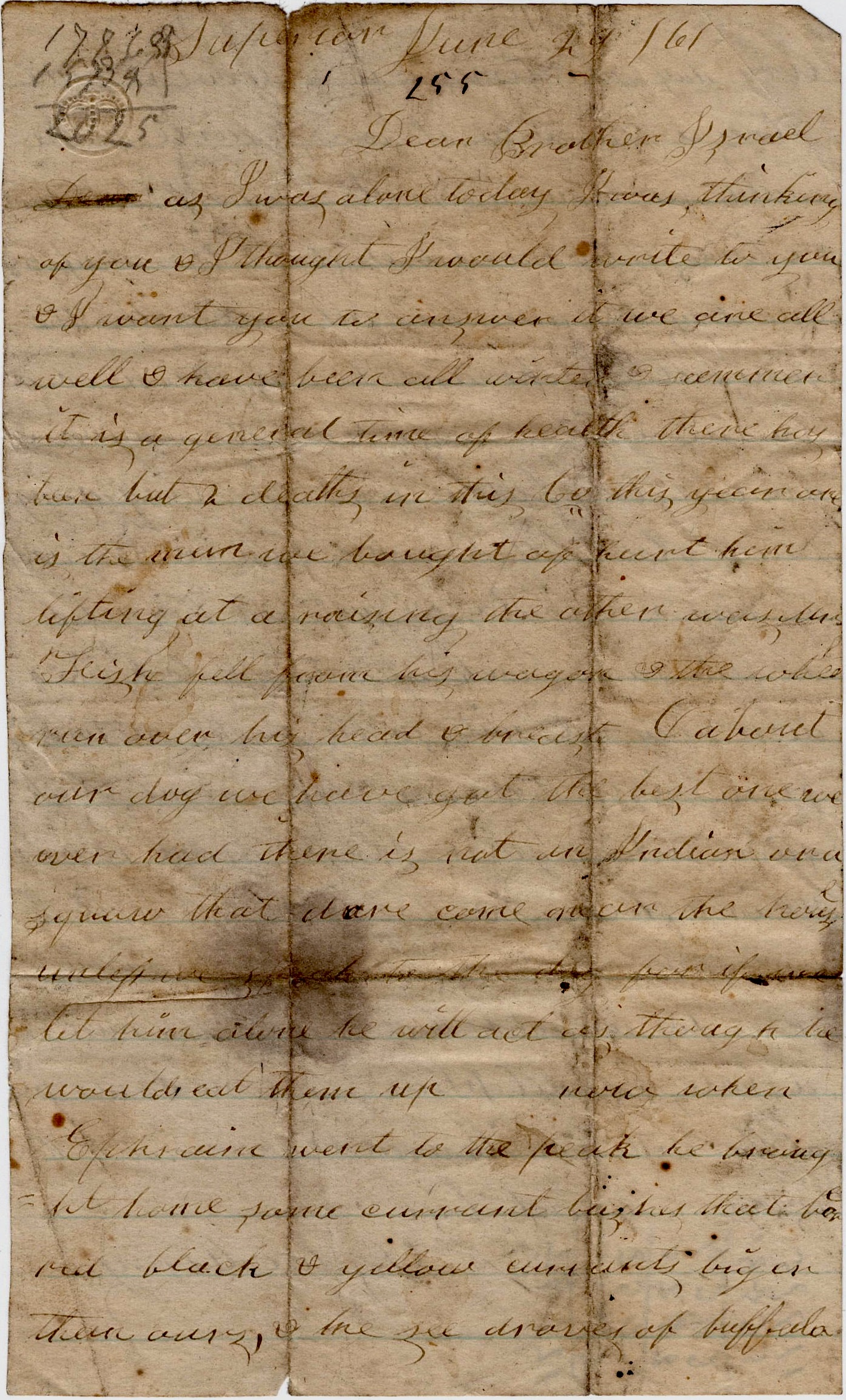
1861: Lydia (Thompson) Olney to Israel Thompson

This letter was written by Lydia (Thompson) Olney (1818-1867), the first wife of Ephraim Zelotus Olney (1816-1892). The letter was penned in late June 1861 from Superior, Boulder county, Colorado Territory. The couple were still enumerated there in 1865 though Lydia died two years later. That census informs us that Lydia was born in New York State, probably in the vicinity of her husband who came from Tioga county. The couple were farming in Potter county, Pennsylvania, before coming to Kansas. Lydia’s parents were Isaac C. Thompson(1794-1874) and Keziah Wicks (1797-1876). They had numerous children; the letter was directed to one of the youngest, Israel Thompson (1841-1909) who lived in Harrison, Potter county, Pennsylvania in 1860.

Lydia does not give us much information about her husband’s occupation but the mention of wagons to and from Pikes Peak suggests to me that he was likely transporting supplies to the mining regions. It’s curious that Lydia datelined her letter from Superior. Though the first settlers arrived in this area of the foothills between present day Boulder and Denver, a coal seam was not discovered here until 1864 and local lore claims the town derived its name from the “superior” quality of the coal mined in the area. The town itself was not platted and officially named until 1896. Native Americans of the Arapahoe and Ute nations still frequented the area in the 1860s.

T R A N S C R I P T I O N

Superior [Boulder county, Colorado]

June 29, 1861

As I was alone today, I was thinking of you & I thought I would write to you & I want you to answer it. We are all well. I have been [well] all winter and summer. It is a general time of health. There has been but two deaths in this county this year. One is the man we bought of hurt him lifting at a raising. The other was Mr. Fish [who] fell from his wagon & the wheel run over his head & breast.

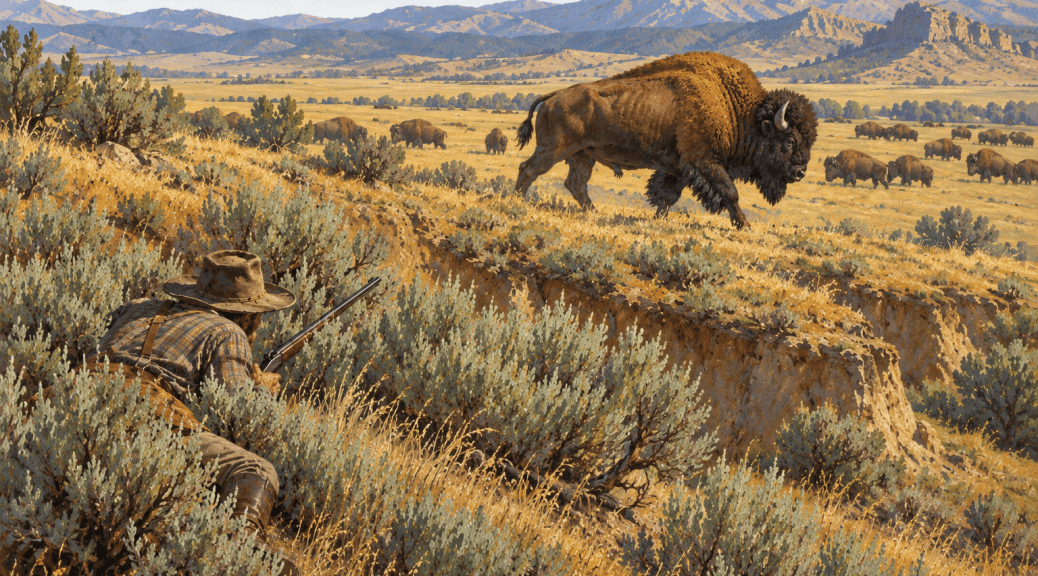
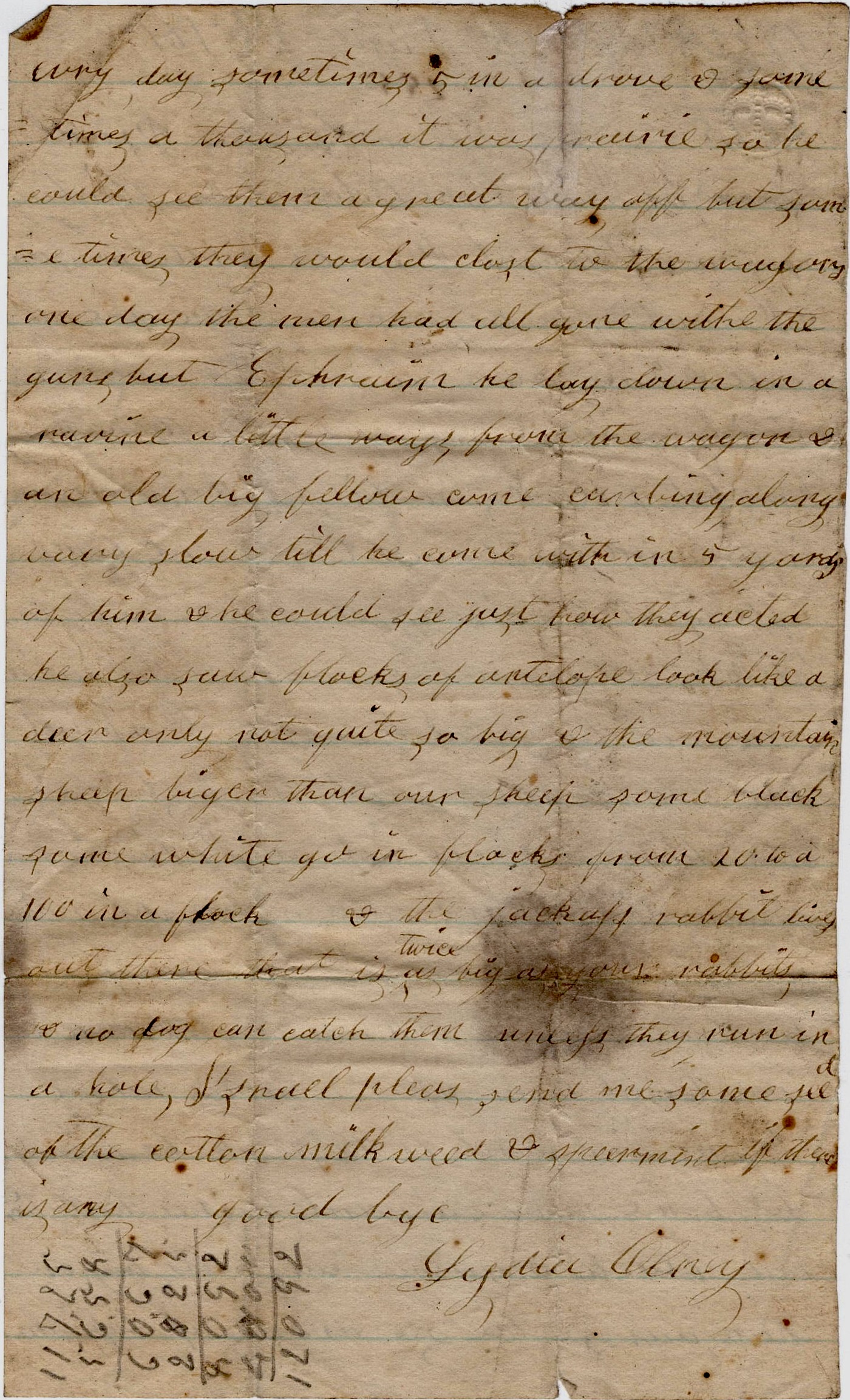
Oh, about our dog. We have got the best one we ever had. There is not an Indian or squaw that dare come near the house unless we speak to the dog for if we let him alone, he will act as though he would eat them up. Now when Ephraim went to the Peak, he brought home some current bushes that bore red, black and yellow currants bigger than ours & he see droves of buffalo every day—sometimes 5 in a drove & sometimes a thousand. It was prairie so he could see them a great way off. But sometimes they would [be] close to the wagons. One day the men had all gone with the guns but Ephraim, he lay down in a ravine a little ways off from the wagon & an old big fellow come cantering along very slow till he came within 5 yards of him & he could see just how they acted. He also saw flocks of antelope. [They] look like a deer only not quite so big & the mountain sheep bigger than our sheep—some black some white—[and] go in flocks from 20 to a 100 in a flock. And the Jackass rabbit lives out there that is twice as big as your rabbits & no dog can catch them unless they run in a hole.

Israel, please send me some seed of the cotton milkweed & spearmint if there is any. 1 Goodbye, — Lydia Olney


1 It’s hard to imagine today why anyone would want these plants but they were most likely desired for their medicinal properties. Cotton milkweed roots were used to treat respiratory illnesses and Spearmint was used to treat colic, indigestion and stomach aches, among other uses.
1859: Willard R. Wetherell to Darius B. Wetherell

The following letter was written by Willard R. Wetherell (1832-1863), the eldest son of Bradford Wetherell (1803-1887) and Sophronia Randall (1809-1892) of Russell, St. Lawrence County, New York. He wrote the letter to his younger brother, Darius B. Wetherell (1838-1930) just as he was reaching his maturity of 21.

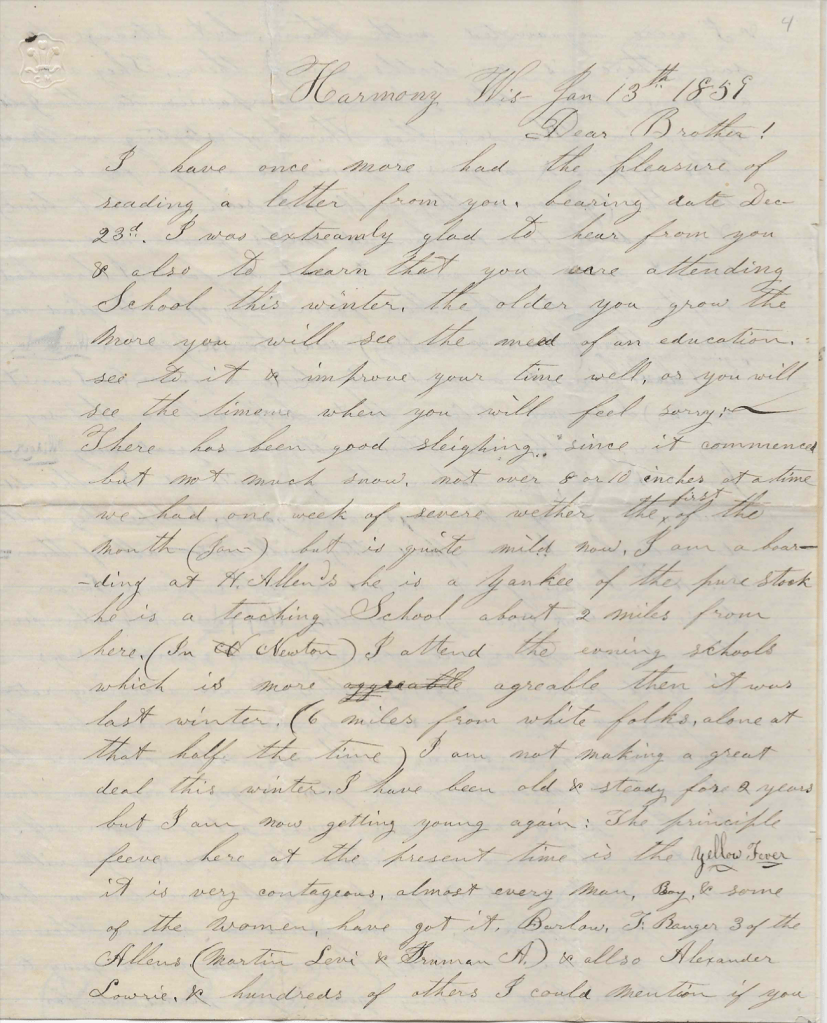
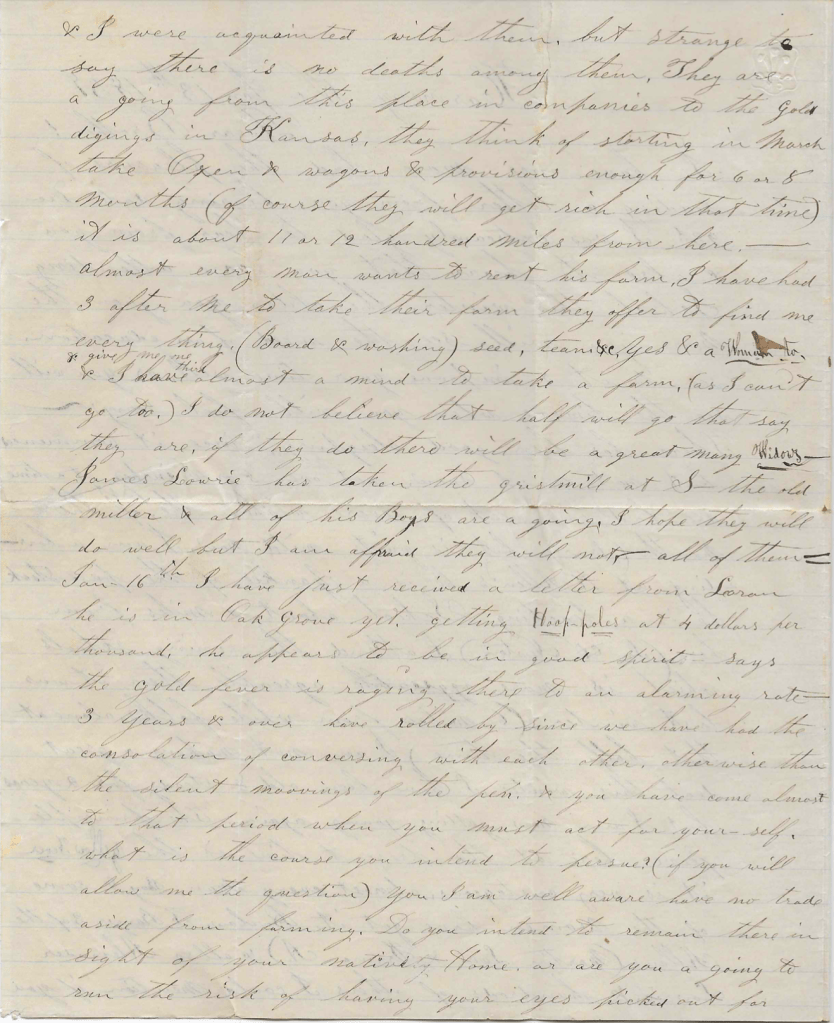
In his letter, datelined from Harmony, Vernon county, Wisconsin, on 13-16 January 1859, 27 year-old Willard stresses to his brother the importance of a good education and congratulates him on staying in school. He also speaks of the Pikes Peak gold fever that has struck the inhabitants of Vernon county and of the numerous offers he has had to rent cheaply the farms of many of those desiring to take off for the gold fields. His letter says the folks were inflicted with the “yellow fever” which I infer to be gold fever and says that that one of those affected was Alexander Lowrie (1839-1880) who would later serve as a captain in the 6th Wisconsin, part of the vaunted Iron Brigade.

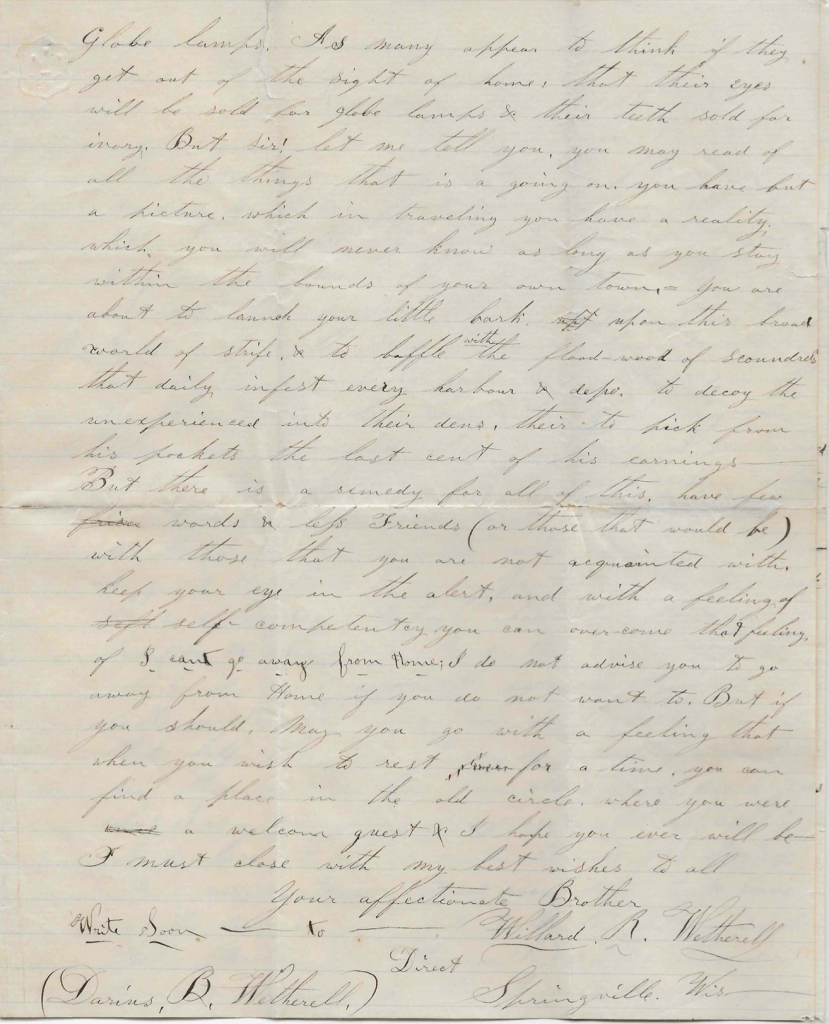
The second half of the letter is devoted to giving his younger brother some advise should he decide to leave the family farm and seek his fortune in the world. He ends by reassuring him that should he leave home, he can always return to the family circle where he will be welcome.

Two years later, Willard would enlist and be mustered in as a corporal in Co. D, 60th New York Infantry on 30 October 1861 at Ogdensburgh, New York. He died on 12 March 1863 at the general Hospital in Harper’s Ferry, a victim of chronic diarrhea.

[Note: This letter is from the private collection of Greg Herr and was transcribed and published on Spared & Shared by express consent.]

Transcription

Harmony, Wisconsin
January 13th 1859

Dear Brother,

I have once more had the pleasure of reading a letter from you bearing date of 23rd. I was extremely glad to hear from you & also to learn that you are attending school this winter. The older you grow, the more you will see the need of an education. See to it. Improve your time well, as you will see the time when you will feel sorry.

There has been good sleighing since it commenced but not much snow—not over 8 or 10 inches at a time. We had one week of severe weather the first of the month (January) but is quite mild now.

I am a boarding at H. Allen’s. He is a Yankee of the pure stock. He is a teaching school about 2 miles from here (in Newton). I attend the evening schools which is more agreeable than it was last winter (6 miles from white folks, alone that half the time). I am not making a great deal this winter. I have been old & steady for 2 years but I am now getting young again. The principle fever here at the present time is the yellow fever. It is very contagious. Almost every man, boy, & some of the women have got it. Barlow, F. Banger, 3 of the Allens (Martin, Levi, and Truman A.) & also Alexander Lowrie & hundreds of others I could mention if you and I were acquainted with them. But strange to say, there is no deaths among them.

They are a going from this place in companies to the gold diggings in Kansas. They think of starting in March, take oxen and wagons and provisions enough for 6 or 8 months (of course they will get rich in that time). It is about 11 or 12 hundred miles from here. Almost every man wants to rent his farm. I have had three after me to take their farms. They offer to find me everything (board & washing), seed, team, &c., and yes, a woman too, and give me one-third. And I have almost a mind to take a farm (as I can’t go too). I do not believe that half will go that say they are. If they do, there will be a great many widows.

James Lowrie has taken the gristmill at S[pringville]. The old miller and all his boys are a going. I hope they will do well but I am afraid they will not all of them.

January 16th. I have just received a letter from Loran. He is is Oak Grove yet getting hoop poles at 4 dollars per thousand. He appears to be in good spirits. Says the gold fever is raging there to an alarming rate.

Three years & over have rolled by since we have had the consolation of conversing with each other, otherwise than the silent movings of the pen, & you have come almost that period when you must act for yourself. What is the course you intend to pursue (if you will allow me the question)? You, I am well aware, have no trade aside from farming. Do you intend to remain there in sight of your nativity home, or are you a going to run the risk of having your eyes picked out for globe lamps. As many appear to think if they get out of the sight of home, that their eyes will be sold for globe lamps and their teeth sold for ivory. But sir! let me tell you, you may read of all the things that is going on, you have but a picture, which in traveling you have a reality which, you will never know as long as you stay within the bounds of your own town.

You are about to launch your little bark upon this broad world of strife & to baffle with the flood-wood of scoundrels that daily infest every harbor and depot to decoy the unexperienced into their dens, there to pick from his pockets the last cent of his earnings. But there is a remedy for all of this—have few words & less friends (or those that would be) with those that you are not acquainted with. Keep your eye in the alert and with a feeling of self-competency, you can overcome that feeling of I can’t go away from home. I do not advise you to go away from home if you do not want to. But if you should, may you go with a feeling that when you wish to rest for a time, you can find a place in the old circle where you were a welcome guest & I hope you ever will be.

I must close with my best wishes to all. Your affectionate brother, — Willard R. Wetherell

Write soon. Direct to Springville, Wisconsin.

to Darius B. Wetherell