
The following correspondence was composed by Thomas Williamson Walke, aged 52 (1814-1897), the progeny of Anthony Walke IV (1783-1865) and Susan Hatfield Carmichael (1786-1874). This letter reveals that Thomas resided on a farm co-owned with his younger sibling, Anthony Walke (1816-1897), while he maintained a legal career in Chillicothe, Ross County, Ohio. His father’s death occurred in March 1865, and his mother continued to inhabit the farm with her two sons.
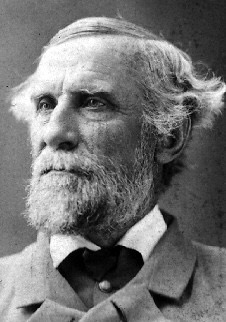
Thomas wrote the letter to his cousin, Thomas Hoomes Williamson (1813-1888), the son of Thomas and Anne (Walke) Williamson of Richmond, Virginia. Thomas Williamson joined the faculty at the Virginia Military Institute (VMI) in 1841 and worked there his entire life except for the war years when served with the Confederate Engineer Corps. He worked on the defenses of the Rappahannock river and Manassas. He was on the staff of Stonewall Jackson for a time. In his letter Thomas Walke shares family information on the Ohio branch of the family while seeking information on the Virginia branch. He refers to “the late unnatural war” which has prevented them from maintaining communications.
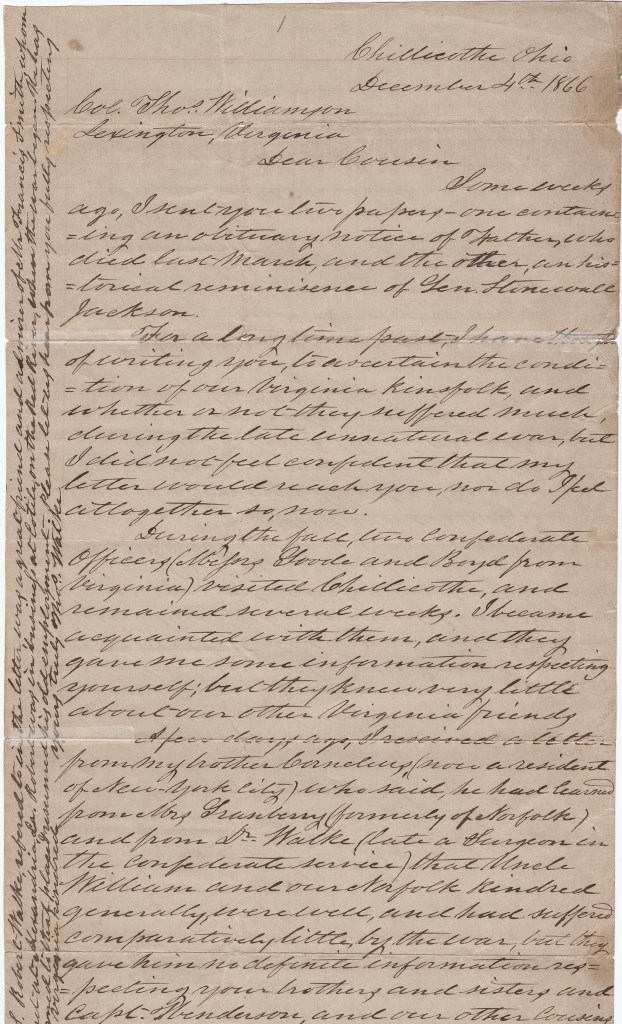
T R A N S C R I P T I O N
Chillicothe, Ohio
December 4th 1866
Col. Thomas Williamson
Lexington, Virginia
Dear Cousin, some weeks ago I sent you two papers—one containing an obituary notice of Father who died last March, and the other an historical reminiscence of Gen. Stonewall Jackson.
For a long time past, I have thought of writing you to ascertain the condition of our Virginia kinfolk and whether or not they suffered much during the late unnatural war, but I did not feel confident that my letter would reach you, nor do I feel altogether so now.
During the fall, two Confederate officers (Messrs. Goode and Boys from Virginia) visited Chillicothe and remained several weeks. I became acquainted with them and they gave me some information respecting yourself; but they knew very little about our other Virginia friends.
A few days ago I received a letter from my brother Cornelius (now a resident of New York City) 1 who said he had learned from Mrs. Granberry (formerly of Norfolk) and from Dr. Walke (late a Surgeon in the Confederate service) that Uncle William and our Norfolk kindred generally were well and had suffered comparatively little by the war, but they gave him no definite information respecting your brothers and sisters, and Capt. Henderson and our other cousins, from all of whom we are very anxious to hear.
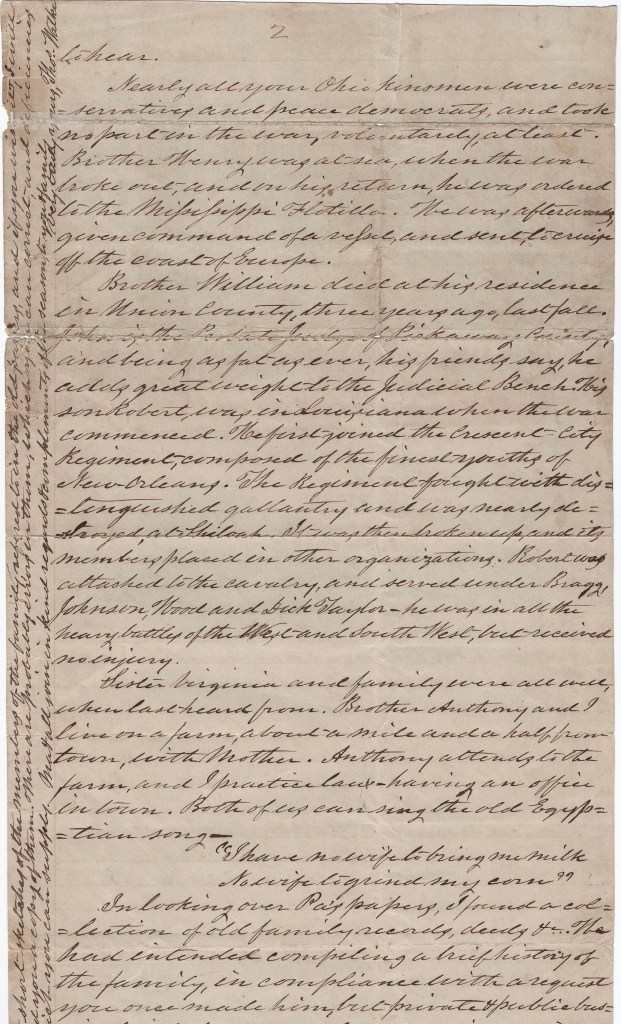
Nearly all your Ohio kinsmen were conservatives and Peace Democrats and took no part in the war—voluntarily at least. Brother Henry was at sea when the war broke out and on his return he was ordered to the Mississippi Flotilla. He was afterwards given command of a vessel and sent to cruise off the coast of Europe. 2
Brother William died at his residence in Union county three years ago last fall. 3 John is the Probate Judge of Pickaway county and being as fat as ever, his friends say he adds great weight to the Judicial Bench. 4 His son Robert was in Louisiana when the war commenced. He first joined the Crescent City Regiment composed of the finest youths of New Orleans. The regiment fought with distinguished gallantry and was nearly destroyed at Shiloh. It was then broken up and its members placed in other organizations. Robert was attached to the cavalry and served under Bragg, Johnston, Hood, and Dick Taylor. He was in all the heavy battles of the West and Southwest, but received no injury.
Sister Virginia 5 and family were all well when last heard from. Brother Anthony and I live on a farm about a mile and a half from town with Mother. Anthony attends to the farm and I practice law, having an office in town. Both of us can sing the old Egyptian song:
"I have no wife to bring me milk
No wife to grind my corn"
In looking over Pa’s papers, I found a collection of old family records, deeds, &c. He had intended compiling a brief history of th family in compliance with a request you once made him, but private & public business interfered and old age coming on, it was neglected altogether. At Henry’s request, I made out short sketches of the members of the family referred to in the old papers and if you wish it, I will send you a copy of them. There are probably errors in them which you can correct and deficiencies which you can supply. Ma and all join in kind regards & compliments of the season to you & family. Very affectionately yours, — Thos. Walke
P. S. Robert Walke referred to in the letter was a great friend and admirer of Mr. Francis Smith whom he met at Alexandria, La. Robert was in business at Cotila on the Red River when the war began. He has returned to that place & resumed his old employment. Please let us hear from you fully respecting our Virginia kindred. Yours truly, — Thos. Walke
1 Dr. Cornelius Calvert Walke (1822-1914) was a New York City physician and a censor of the New York Medical College (The Board of Censors examined the qualifications of students before their graduation and receiving medical degrees.) The erudite physician was a member of the American Geographical Society. He was married in 1848 to Hannah E. Hitchcock and they lived in an opulent home at 213 Second Avenue. See The Dr. Cornelius Walke House in Manhattan.

2 Despite his southern heritage, Henry Walke (1808-1896) remained loyal to the Union and played a bigger role in the war than Thomas may have been willing to admit. At the outbreak of the Civil War in 1861, Henry Walke was a Commander in charge of Unionist forces at Pensacola, Florida. In January 1862, he commanded the gunboats “USS Tyler” and “USS Carondelet” in operations along the Western Rivers. Promoted Captain in August 1862, he commanded the ironclad “USS Lafayette” until July 1863, when he was ordered to command the cruiser “USS Fort Jackson.” From 1864 to the end of the war, he was made Captain of the steam sloop “USS Sacramento”. Promoted to Commodore in July 1866, he commanded the Naval Station at Mound City, Illinois, 1868 to 1870. He attained the rank of Rear Admiral in July 1870 and served on the Lighthouse Board until April 1873, when he retired from active duty as a Rear Admiral. Three United States Navy destroyers have been named in his honor. (Find-A-Grave)
3 William Walke (1806-1862) was married to Virginia Evans in 1831 and was living in Milford Center, Union county, Ohio, when he died on 17 November 1862. His wife died on 22 March 1865. One of his sons, Isaac Evans Walke (1841-1922) served briefly in Co. H, 136th OVI late in the war.
4 John Walke (1811-1895) was married at Chillicothe in 1836 to Francis McArthur Kercheval (1817-1882) and he was a Probate Judge in Pickaway county, Ohio. His residence as in Circleville. His son Robert Kercheval Walke (184–1892) was in the Confederate service. He was a sergeant in Co. K of the Louisiana Crescent Infantry (the “Kid Glove” Regiment) and then a private in Capt. Dreux’s Louisiana Cavalry. See “Capturing the Hornet’s Nest with the Kid Glove Regiment at Shiloh” by Dan Masters.
5 Susan Virginia Walke (1820-1895) was married in Chillicothe in 1840 to James Dun (1818-1892) and they lived in Deer Creek township, Madison county, Ohio.











 Spared & Shared 23