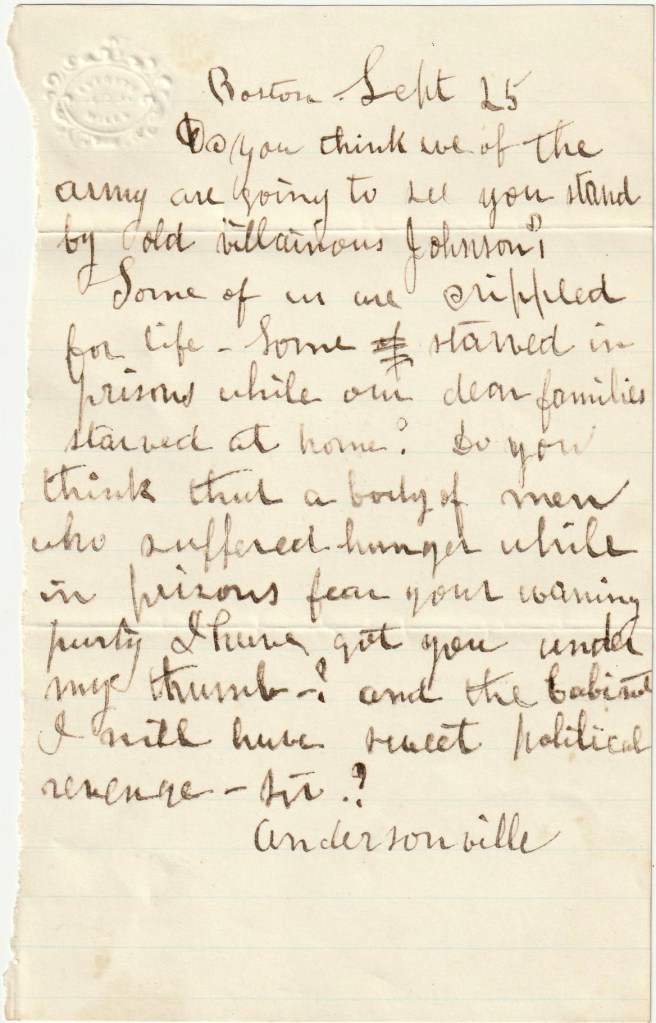
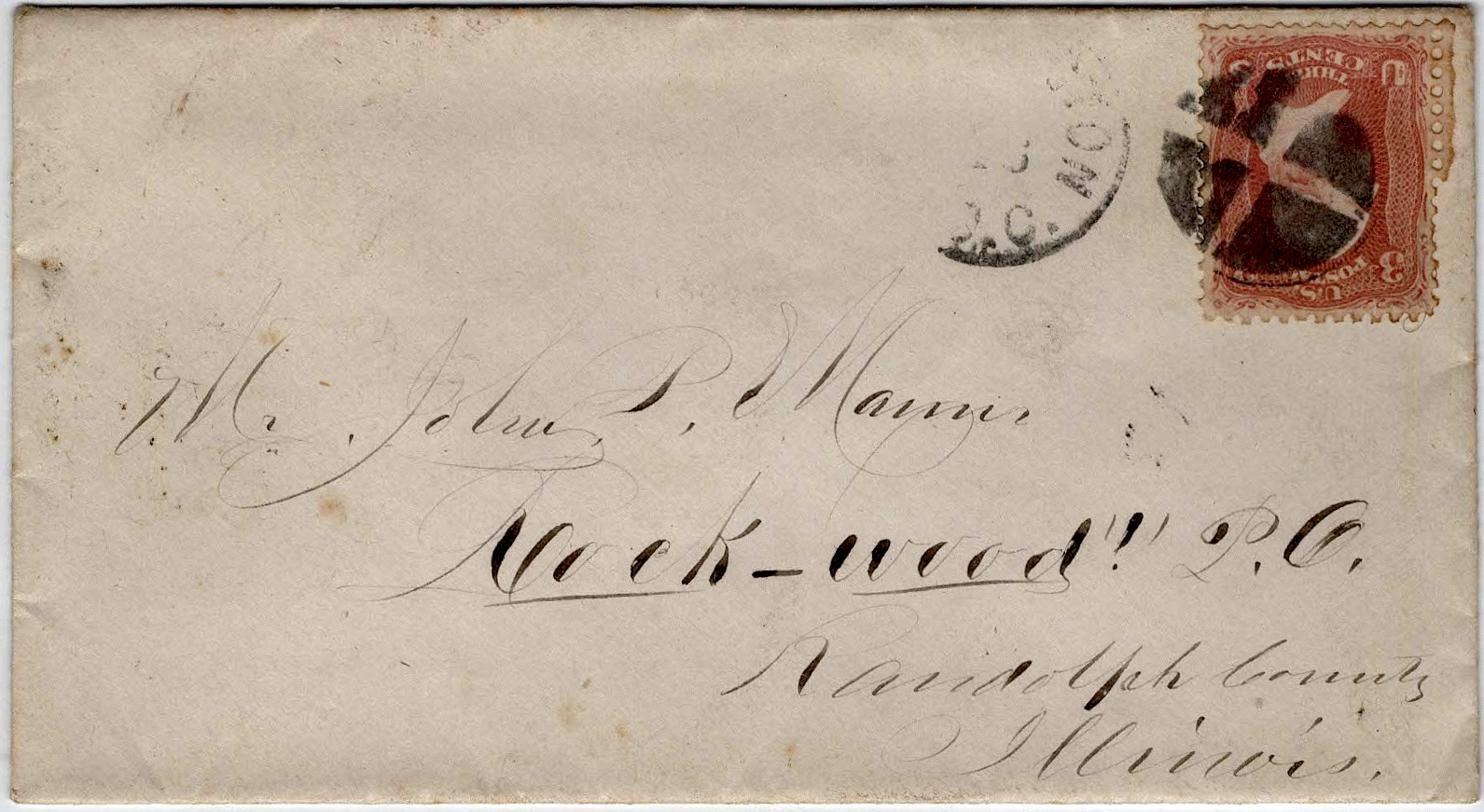
The following letters were written by Thomas Henry Barnfield (1833-1920), a native of Kentucky, who resided in Randolph county, Illinois, at the time of the Civil War. He served four years in Co. K, 5th Illinois Cavalry, rising from the rank of private to 2nd Lieutenant. He mustered out of the 5th Illinois Cavalry on 17 March 1865. Soon after, he reenlisted as a private in Co. I, of the 8th Regiment US Veteran Volunteer Infantry.
Henry wrote the letter to John Preston Mann (b. 1822) who served with him in the 5th Illinois Cavalry. After mustering out of the regiment, John began practicing law in Rockwood, Illinois. John was married to Nancy Clendening. In 1867, Henry Barnfield married Nancy’s sister, Martha Alice Clendenin (1836-1890). After he left the service, Henry farmed in Randolph county for a while and then relocated to Bartlett Springs, Lake county, California, where he died in 1920.
Letter 1
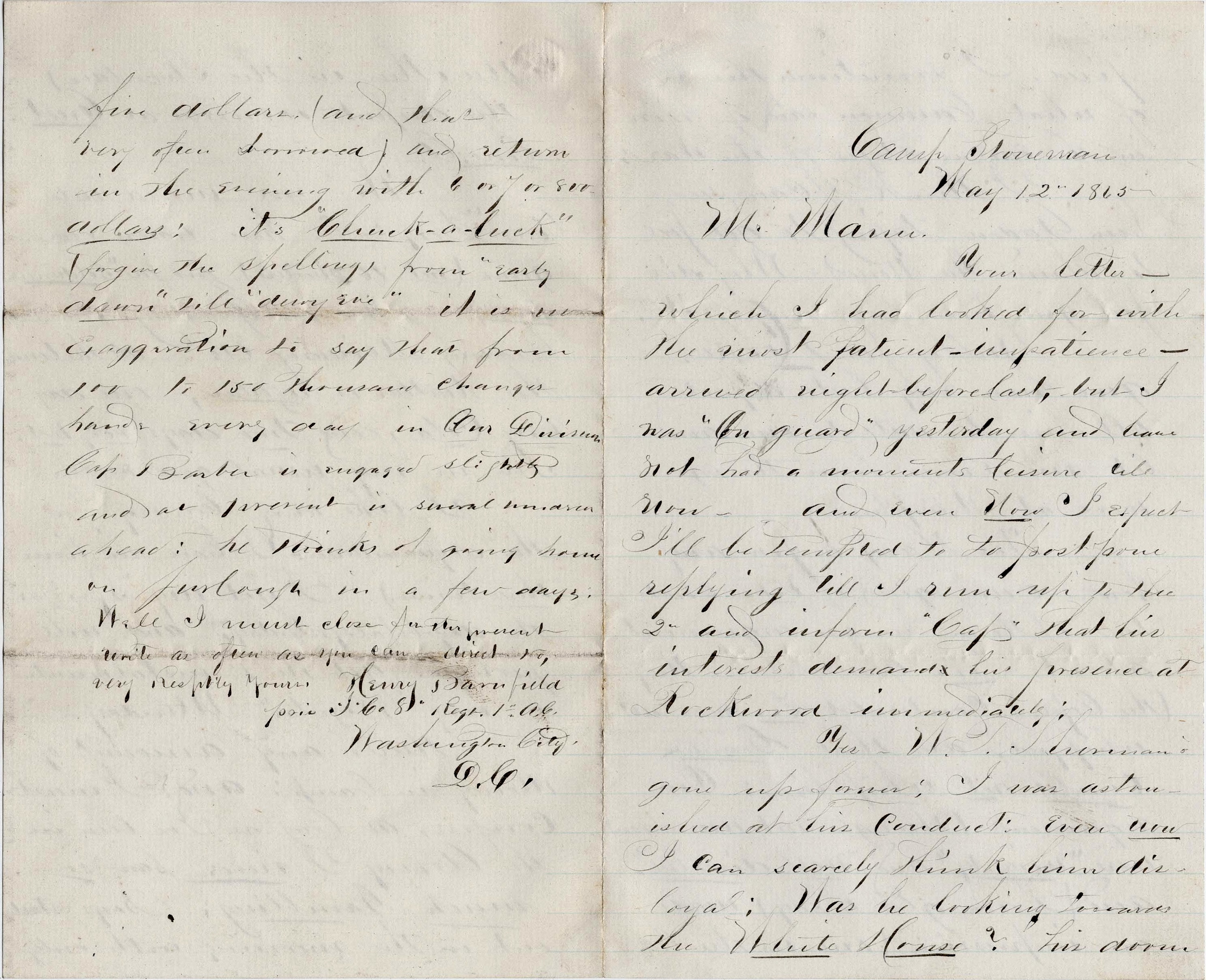
Camp Stoneman [near Washington D. C.]
May 12, 1865
Mr. Mann,
Your letter which I have looked for with the most patient impatience. arrived night before last, but I was “on guard” yesterday and have not had a moment’s leisure till now. And even now, I expect I’ll be tempted to postpone replying till I run up to the 2nd and inform “Cap” that his interest demands his presence at Rockwood immediately.
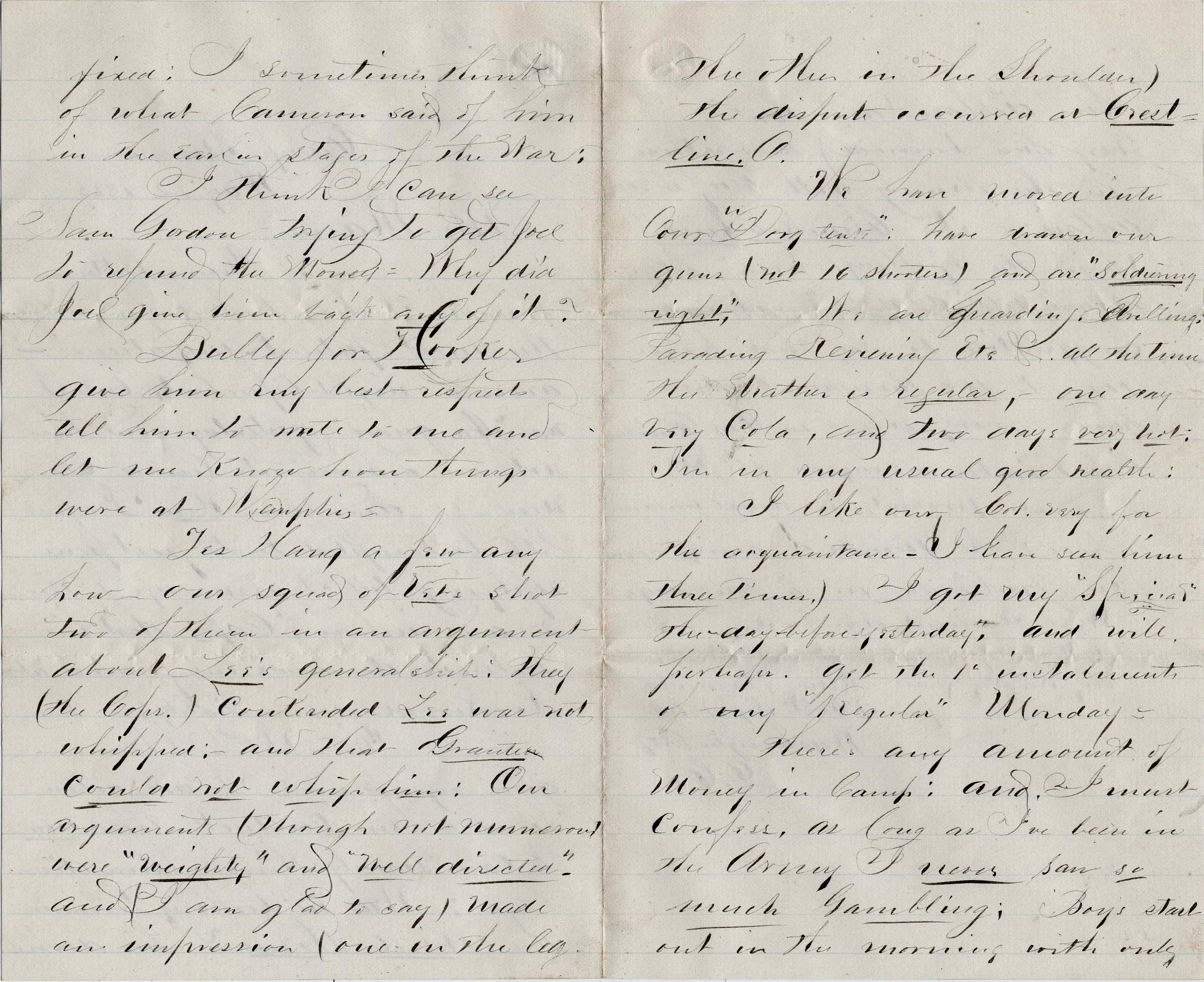
Yes, W[illiam] Tecumseh] Sherman’s gone up forever. I was astonished at his conduct. 1 Even now, I can scarcely think him disloyal. Was he looking towards the White House? His doom fixed. I sometimes think of what [Secy. Simon] Cameron said of him in the early stages of the war. 2
I think I can see Sam Gordon trying to get Joel to refund the money. Why did Doel give him back any of it?
Bully for Hooker. Give him my best respects. Tell him to write to me and let me know how things were at Memphis. Let hang a few anyhow. Our squad of Vets shot two of them in an argument about Lee’s generalship. They (the Cops [Copperheads]) contended Lee was not whipped and that Grant could not whip him. Our arguments (though not numerous) were “weighty” and “well directed” and I am glad to say made an impression (one in the leg; the other in the shoulder). The dispute occurred at Crestline, Ohio.
We have moved into our “Dog tents,” have drawn our guns (not 16 shooters), and are “soldiering right.” We are guarding, drilling, parading, reviewing, &c. all the time. The weather is regular—one day very cold and two days very hot. I’m in my usual good health.
I like my Colonel very [much] for the acquaintance (I have see seen him three times). I got my “Special” the day before yesterday and will, perhaps, get the 1st installment of my “Regular” Monday. There’s any amount of money in camp and I must confess as long as I’ve been in the army, I never saw so much gambling. Boys start out in the morning with only five dollars (and that very often borrowed) and return in the evening with 6 or 7 or 800 dollars. It’s “Chuck-a-luck” (forgive the spelling) from early dawn till dewey eve. It is no exaggeration to say that from 100 to 150 thousand [dollars] changes hands every day in our Division. Cap. Barber is engaged slightly and at present is several hundred ahead. He think of going home on furlough in a few days.
Well, I must close for the present. Write as often as you can. Direct to Henry Barnfield, private in Co. I, 8th Regt., 1st Army Corps, Washington D. C.
1 The northern press expressed shock by Sherman’s unauthorized, lenient terms for the surrender of Joseph E. Johnston’s army. They appeared to allow slavery and secessionist state governments to continue, creating public outrage and rejection by government officials.
2 In October 1861, Secretary of War Simon Cameron deemed William T. Sherman “unbalanced” or insane after Sherman, suffering from nervous exhaustion, claimed he needed 200,000 men to defend Kentucky. Following their meeting, Cameron told others in his party that Sherman was unstable, leading to national press headlines about his “insanity,” a period known as his “demons.”
Letter 2
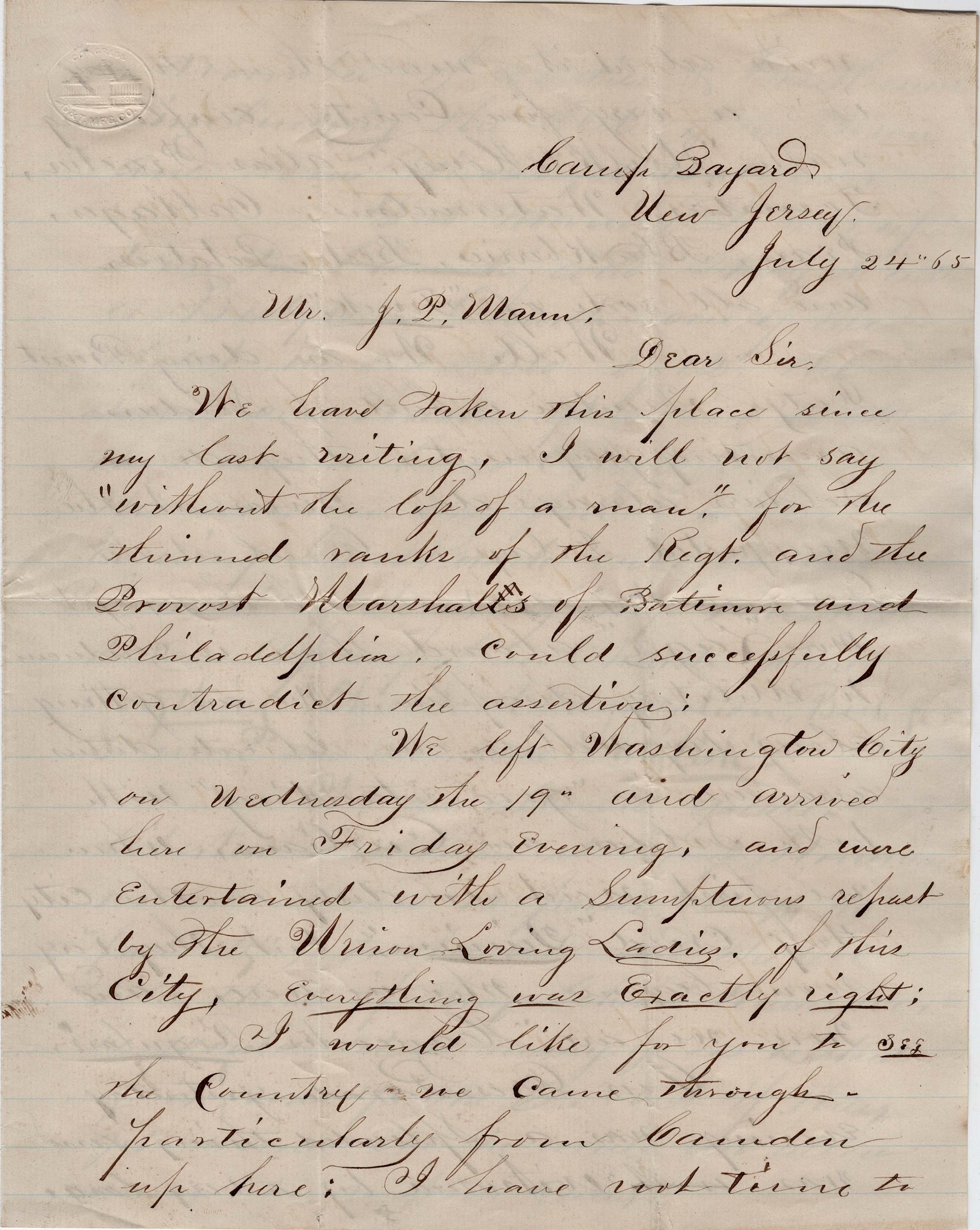
Camp Bayard, [Trenton,] New Jersey
July 24, 1865
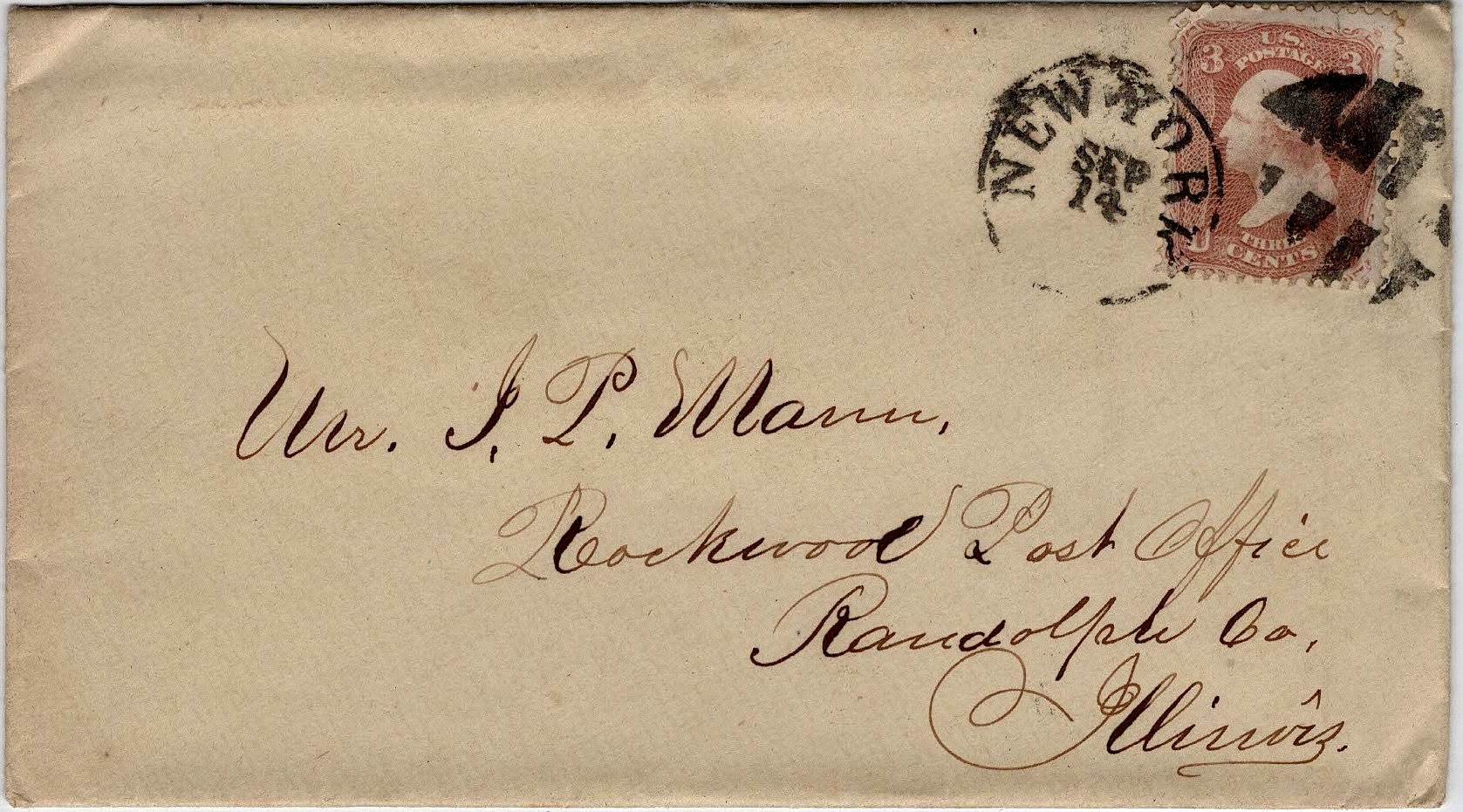
Mr. J. P. Mann
Dear sir, we have taken this place since my last writing. I will not say “without the loss of a man.” for the thinned ranks of the regiment and the Provost Marshals of Baltimore and Philadelphia could successfully contradict the assertion.
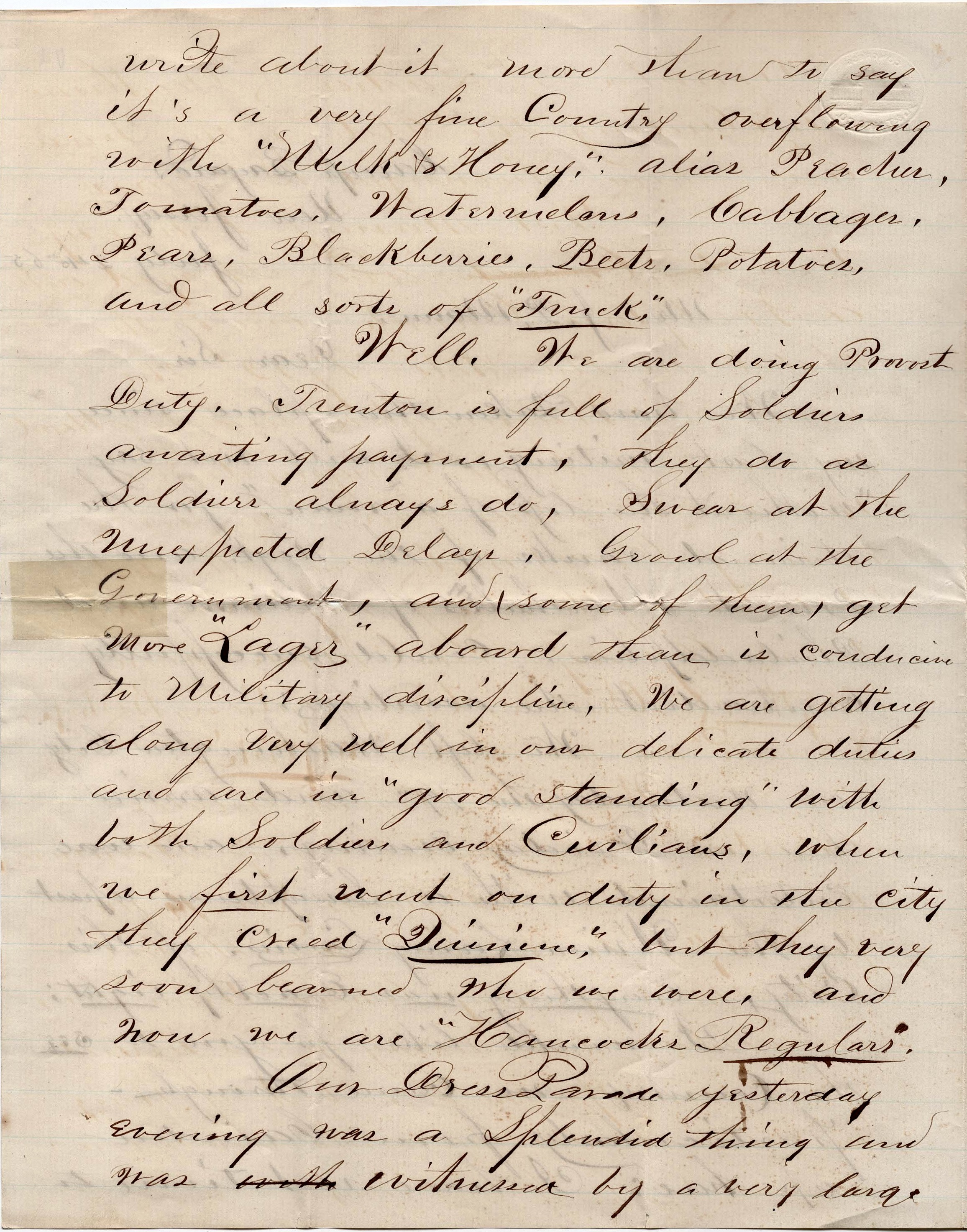
We left Washington City on Wednesday the 19th and arrived here on Friday evening, and were entertained with a sumptuous repast by the “Union Loving Ladies” of this city. Everything was exactly right. I would like for you to see the country we came through—particularly from Camden up here. I have not time to write about it more than to say it’s a very fine country, overflowing with “milk and honey,” alias peaces, tomatoes, watrmelons, cabbages, pears, blackberries, beets, potatoes, and all sorts of “Truck.”
Well, we are doing Provost duty. Trenton is full of soldiers awaiting payment. They do as soldiers always do—swear at the unexpected delays, grown at the government, and (some of them) get more “Lager” aboard than is conducive to military discipline. We are getting along very well in our delicate duties and are in “good standing” with both soldiers and civilians. When we first went on duty in the city, they cried, “Quinine!” but they very soon learned who we were and now we are “Hancock’s Regulars.”
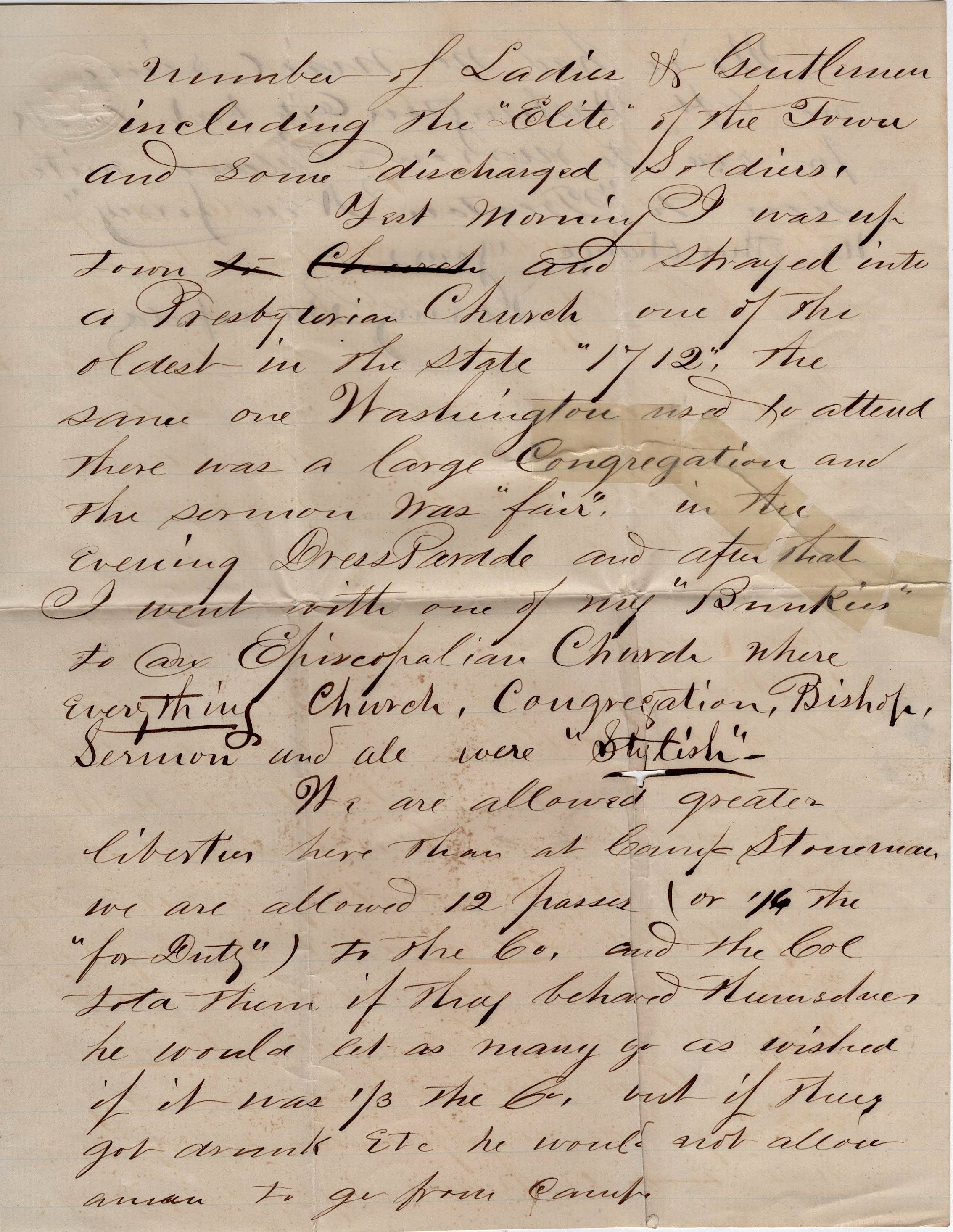
Our dress parade yesterday evening was a splendid thing and was witnessed by a very large number of ladies and gentlemen including the “elite” of the town and some discharged soldiers.
Yesterday morning I was up town and strayed into a Presbyterian Church, one of the oldest in the state—“1712”—the same one Washington used to attend. There was a large congregation and the sermon was “fair.” In the evening, dress parade and after that I went with one of my “bunkies” to an Episcopal Church where everything—church, congregation, Bishop, sermons andall—were “stylish.”
We are allowed greater liberties here than at Camp Stoneman. We are allowed 12 passes (or 1/6 the “for duty”) to the company and the Colonel told them if they behaved themselves, he would let as many go as wished if it was 1/3 the company but if they got drunk, etc., he would not allow a man to go from camp.
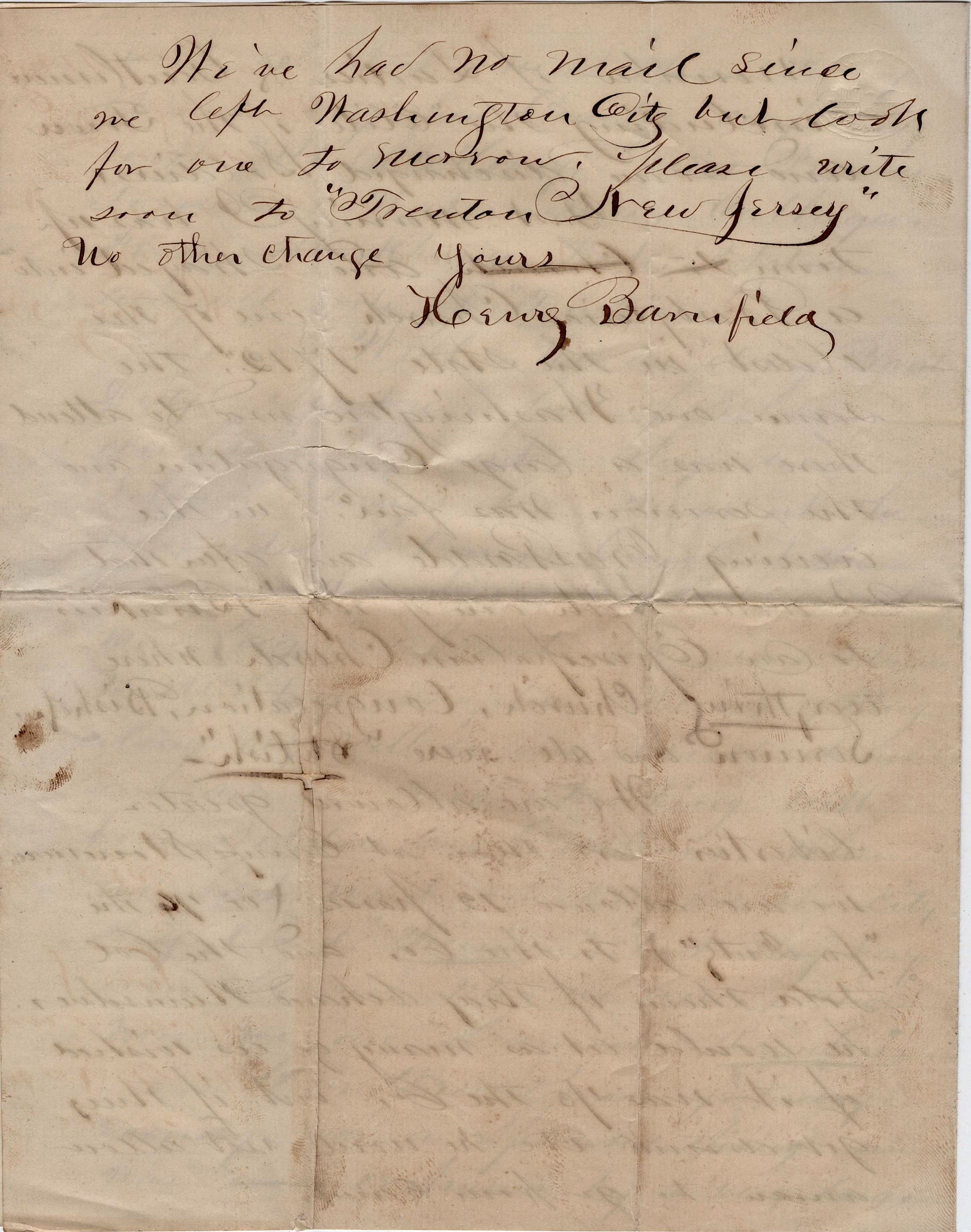
We’ve had no mail since we left Washington City but look for one tomorrow. Please write soon to Trenton, New Jersey. No other change. Yours, — Henry Barnfield
Letter 3
Trenton [New Jersey]
August 7, 1865
My dear friend,
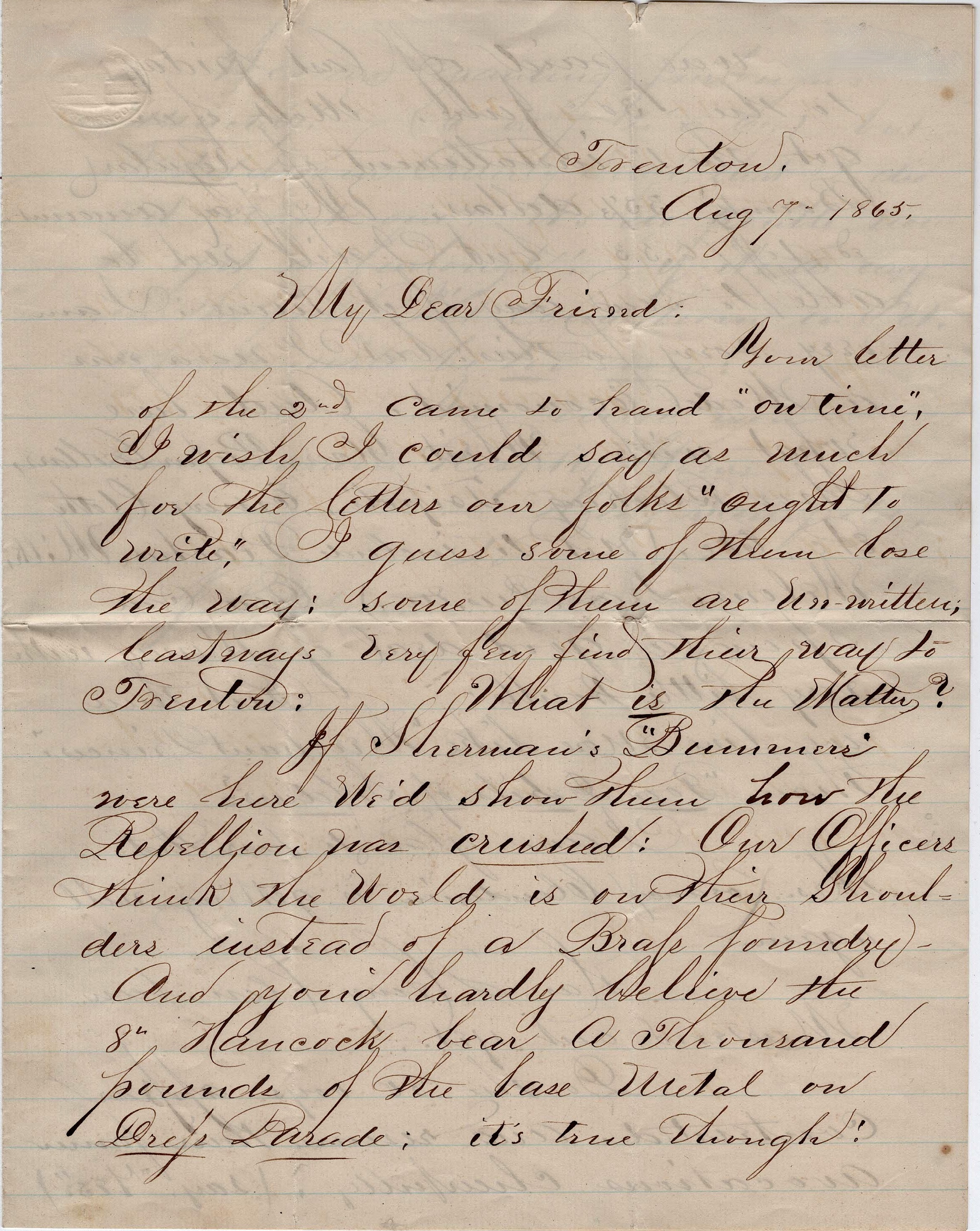
Your letter of the 2nd came to hand “on time.” I wish I could say as much for the letters our folks “ought to write.” I guess some of them are unwritten, leastways very few find their way to Trenton. What is the matter?
If Sherman’s “Bummers” were here, we’d show them how the Rebellion was crushed. Our officers think the world is on their shoulders instead of a brass foundry. And you’d hardly believe the 8th Hancock bear a thousand pounds of the base metal on dress parade. It’s true enough!
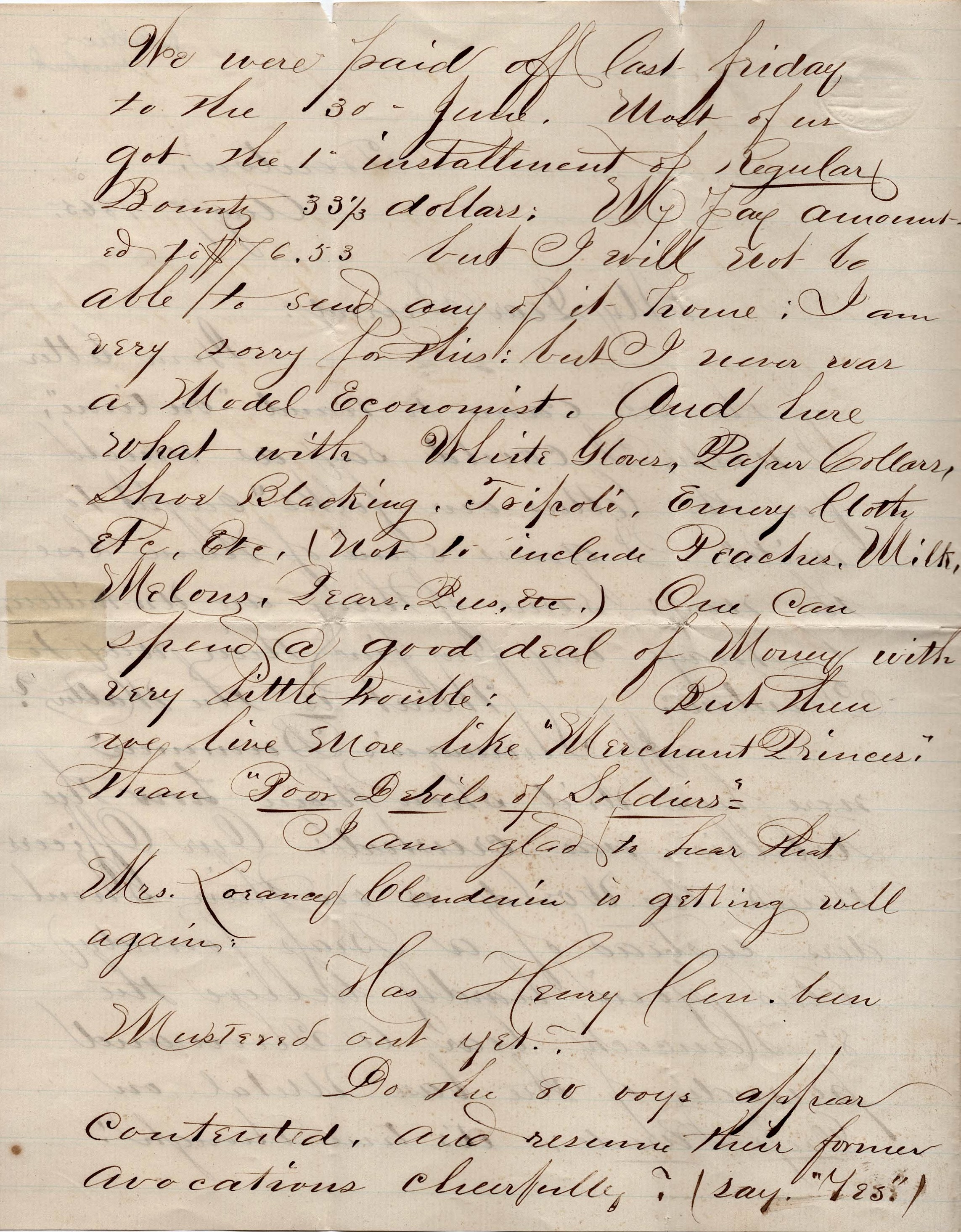
We were paid off last Friday to the 30th of June. Most of us got the 1st installment of Regular Bounty, 33.33 dollars. My pay amounted to $76.53 but I will not be able to send any of it home. I am very sorry for this but I never was a model economist. And here what with white gloves, paper collars, shoe blacking, Tripoli, emery cloth, etc. etc. (not to include peaches, milk, melons, pears, pies, &c.) One can spend a good deal of money with very little trouble. But then we live more like “merchant princes” than “poor devils of soldirs.”
I am glad to hear that Mrs. Lorance Clendenin is getting well again. Has Henry Clendenin been mustered out yet?
Do the 80th [Illinois Infantry] boys appear contented and resume their former avocations cheerfully? (say “Yes.”)
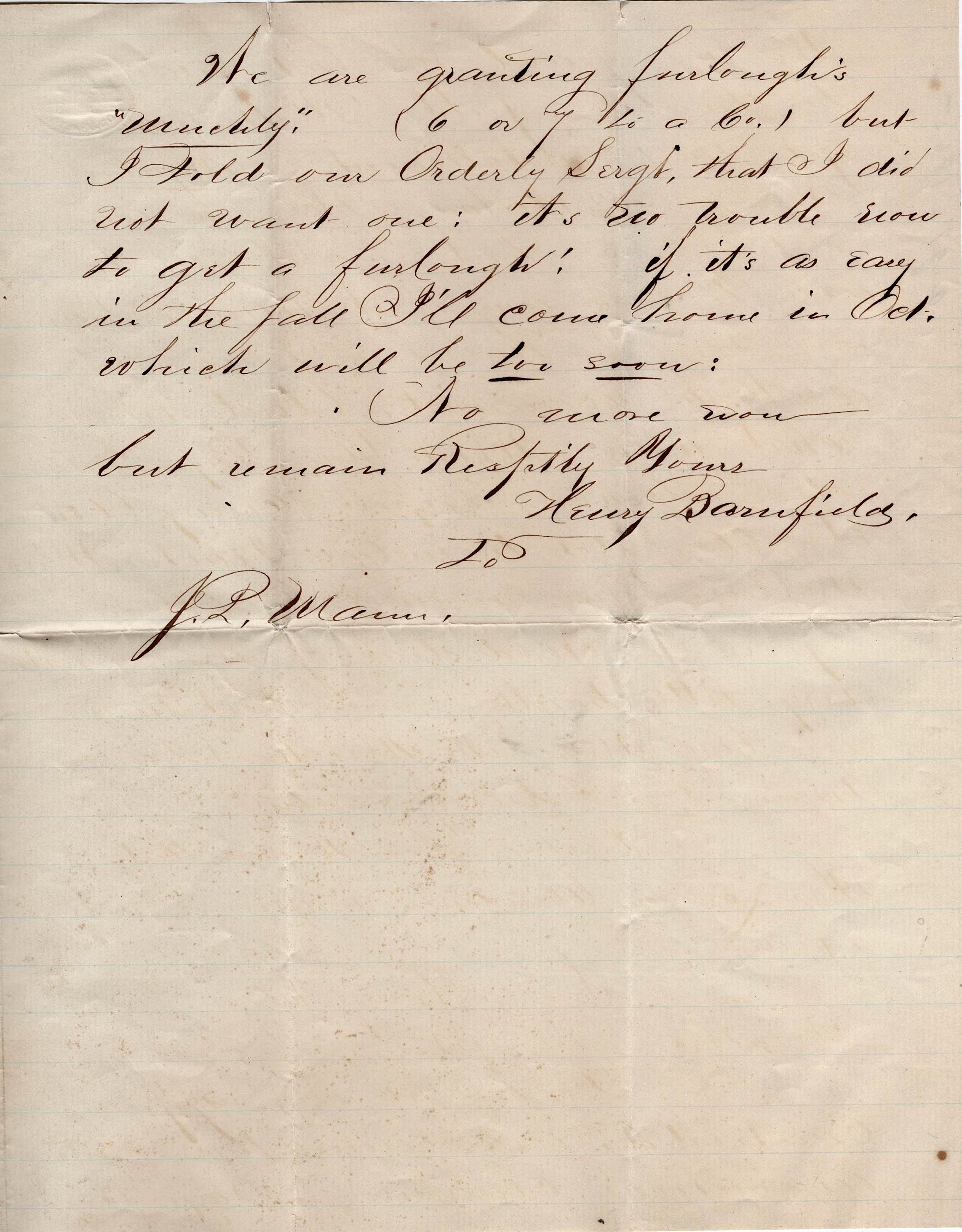
We are granting furloughs “muchly” — 6 or 7 to a company. But I told our Orderly Sergeant that I did not want one. It’s no trouble now to get a furlough. If it’s as easy in the fall, I’ll come home in October which will be too soon. No more now but remain respectfully yours, — Henry Barnfield
To J. P. Mann
Letter 4
Hart Island [New York City]
September 13, 1865
Mr. Mann,
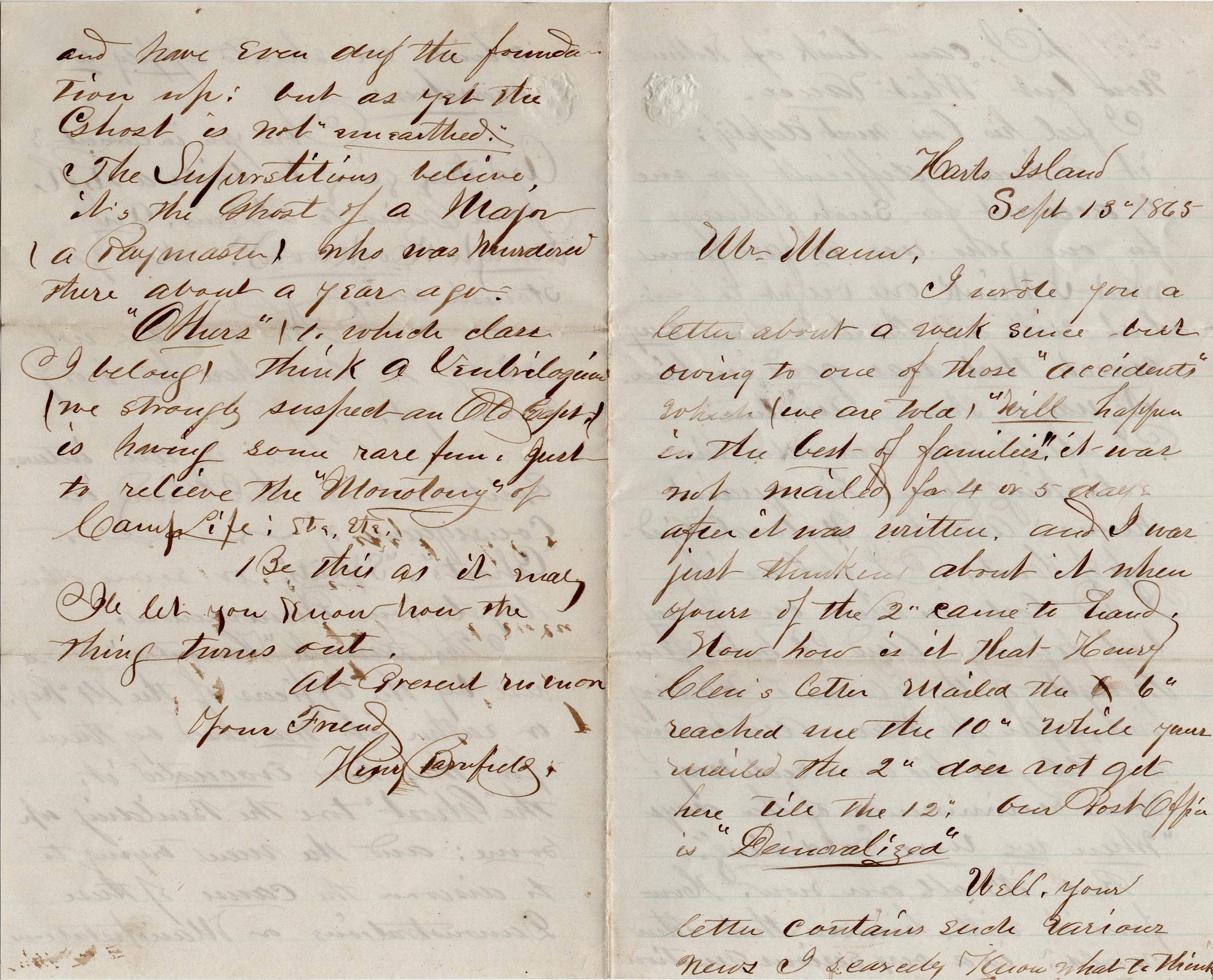
I wrote you a letter about a week since but owing to one of those “accidents” which (we are told) will happen in the best of families, it was not mailed for four or five days after it was written and I was just thinking about it when yours of the 2nd came to hand. Now how is it that Henry Clendening’s letter mailed the 10th while yours mailed the 2nd does not get here till the 12th? Our post office is “demoralized.”
Well, your letter contains such various news I scarcely know what to think though I can think of nothing now but “Whit” Vance. I feel his loss most deeply. It is indeed difficult for me to account for such feelings for one who was so far from what i think one ought to be. But with all the bad, there was very much that was good in him. It was a strange mixture. I shall ever remember his rollicking fun, his quaint humor, and his natural kindness of heart. I feel as if I had lost in him one of my best friends. And I have often thought of the pleasure of meeting him after the war and having him tell, in his own rich way, some reminiscences of the days “when we were soldiering.” But it’s all over now. How fares it with him in that other world? is a serious question which we should apply to ourselves. 1
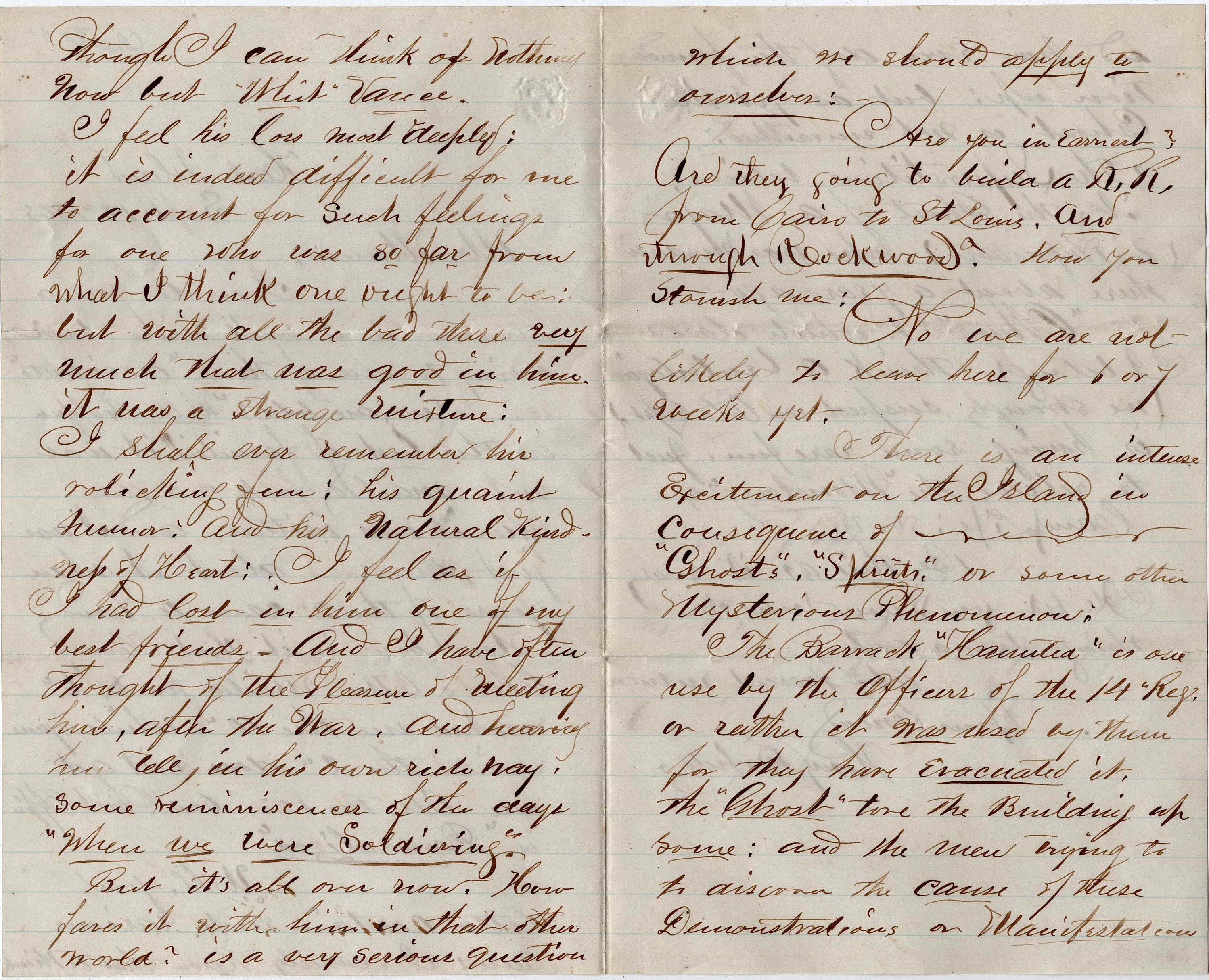
Are you in earnest?, Are they going to build a railroad from Cairo to St. Louis? —and through Rockwood? How you ‘stonish me!
No, we are not likely to leave here for 6 or 7 weeks yet.
There is an intense excitement on the island in consequence of “Ghosts”, “Spirits” or some other mysterious phenomenon. The barrack “Haunted” is on used by the officers of the 14th Regiment, or rather, it was used by them for they have evacuated it. The “ghost” tore the building up some and the men, trying to discover the cause of these demonstrations or manifestations and have even dug the foundations up. But as yet the ghost is not “unearthed.” The superstitious believe it’s the ghost of a Major (a Paymaster) who was murdered there about a year ago.
“Others” (to which class I belong) think a ventriloquies. We strongly suspect an Old Capt. is having some rare fun just to relieve the monotony of camp life, &c. &c. 2
Be this as it may, I’ll let you know how the thing turns out. Your friend, — Henry Barnfield
1 Andrew Whitney Vance (1832-1865) of Randolph county, Illinois, served in Co. K, 5th Illinois Cavalry. He died on 12 August 1865 leaving a wife and several children.
2 The Historic Pelham blog published a story about the 1865 ghost incident on Hart Island based on reports printed in the New York Evening Express in September 1865. The noises were described as “painful gasps and suppressed groans.” [Source: The Haunted House of Hart Island]
Letter 5
Hart Island [New York City]
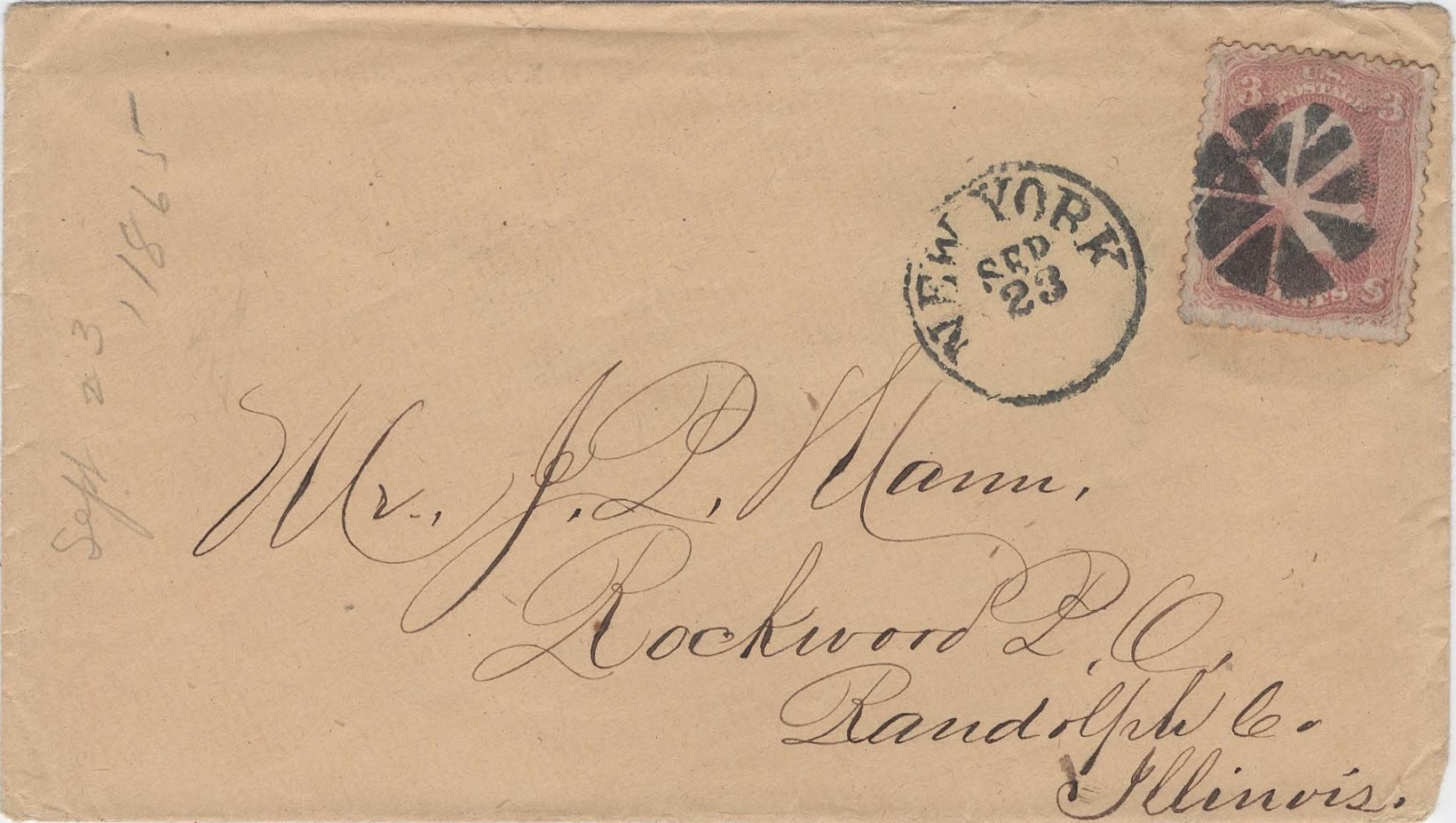
September 22, 1865
My dear friend,
Time is “dragging its slow length along.” It never passed more drearily with us. I used to imagine it passed tediously but now I know I was wrong. Each day seems a week and a week is many months. And it is yet 9 days till the 1st of October, but the season is far enough advanced for November (at least six weeks ahead of Randolph county). It is real fall weather when one feels comfortable near the stove of a morning and at 9 and 10 when we stop drilling to rest for a minute or two, he doesn’t know whether sunshine or shade is pleasantest. We begin to think of winter and greatcoats, homes and discharges.
The ladies of Rockwood are proving their attachment to the Union. I hope those “who are going to be [married] soon may be, and that the [veterans of the] 5th [Illinois Cavalry] may marry the rest. If it’s perfectly agreeable, of course. Is my sincere wish.
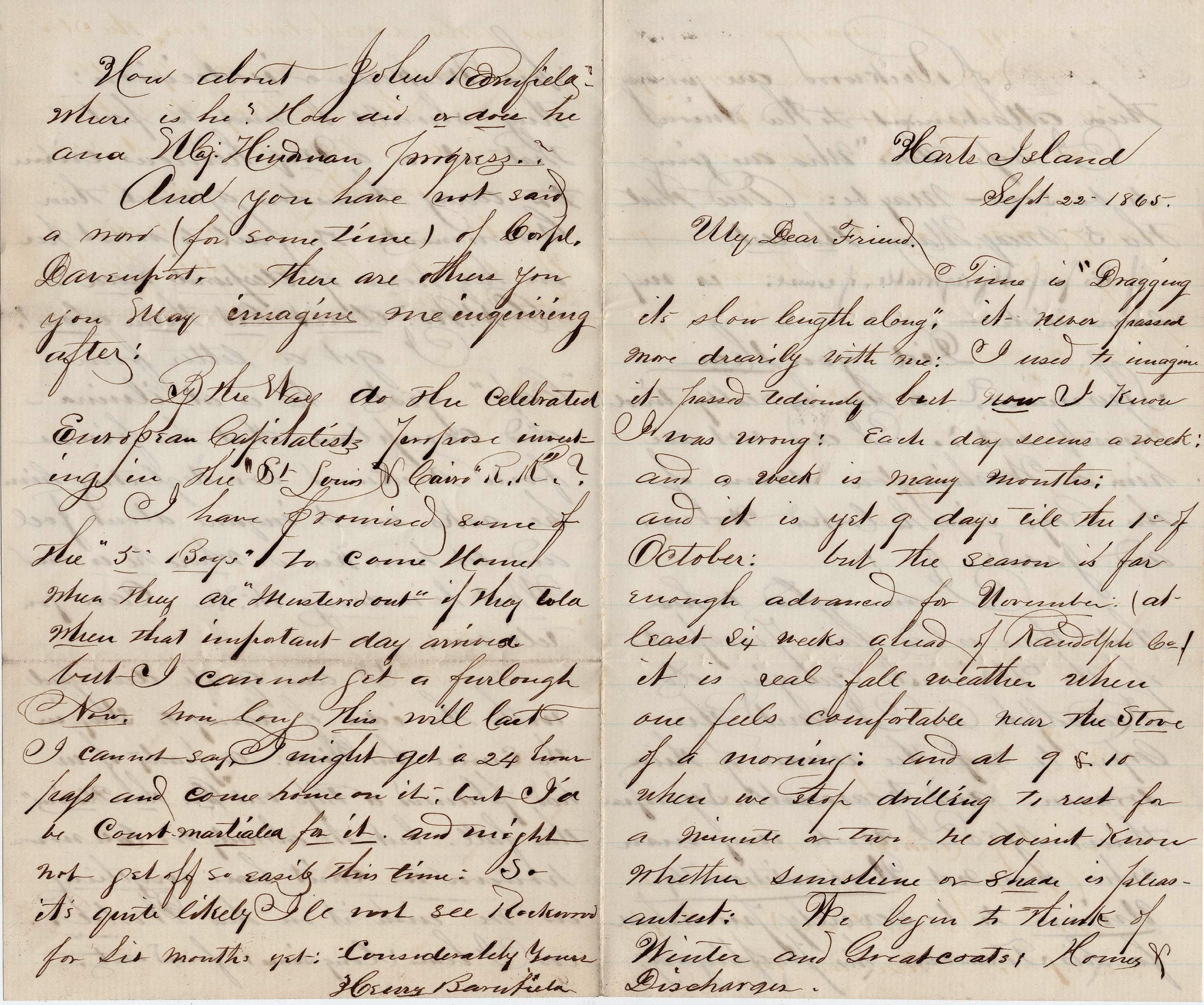
Did you hear Sherman? or has he really tired himself out? I did not see him at Washington. Some of the boys said he looked worn and jaded.
I am glad to hear that there is a fair prospect of the Unionists carrying Old Randolph County. I want the Cops [Copperheads] to reap the reward of their treason and treasonable sympathies. Yes, I wish every man who wsa not Unconditionally Union to be severely punished for his treason, his profligacy, his weakness or indecision. They should be made to feel that it is a very heinous crime to array themselves against their government or fail to assist her in her hour of desperate need. Oh! No, don’t let them alone!
I got a letter from “Cap” yesterday. He is at Elmira and complains that his friends from Rockwood are neglecting him. He asks me to inquire about Joel and let him know where he is and what he is doing, etc., &c. Can you tell me?
I am quite distressed with the idea of having to stay in the service this winter. A party of us had planned a trip out “on the plains” this fall but it’s already too late now. However, we can’t have everything as we wish it in this world as I have long since found out.
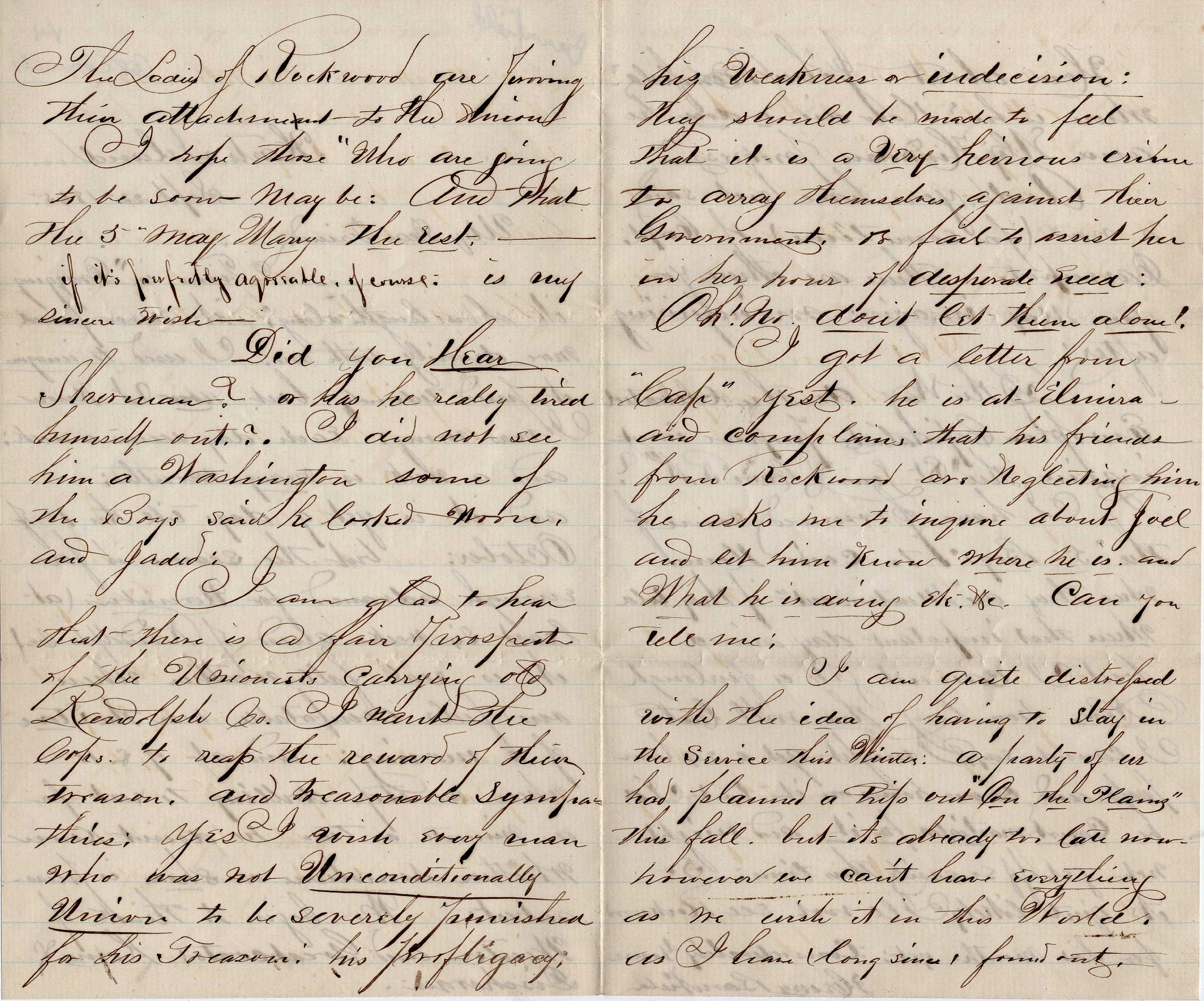
How about John Barnfield? Where is he? How did or does he and Maj. Hindman progress? And you have not said a word (for some time) of Corporal Davenport. There ate others you may imagine me enquiring after.
By the way, do the celebrated European Capitalists propose investing in the “St. Louis & Cairo Railroad?”
I have promised some of the 5th [Illinois Cavalry] boys to come home when they are “mustered out” if they told when that important date arrived. But I cannot get a furlough now. How long this will last, I cannot say. I might get a 24 hour pass and come home on it but I’d be court martialed for it and might not get so easily this time. So it’s quite likely I’ll not see Rocjwood for six months yet. Considerably yours, — Henry Barnfield
Letter 6
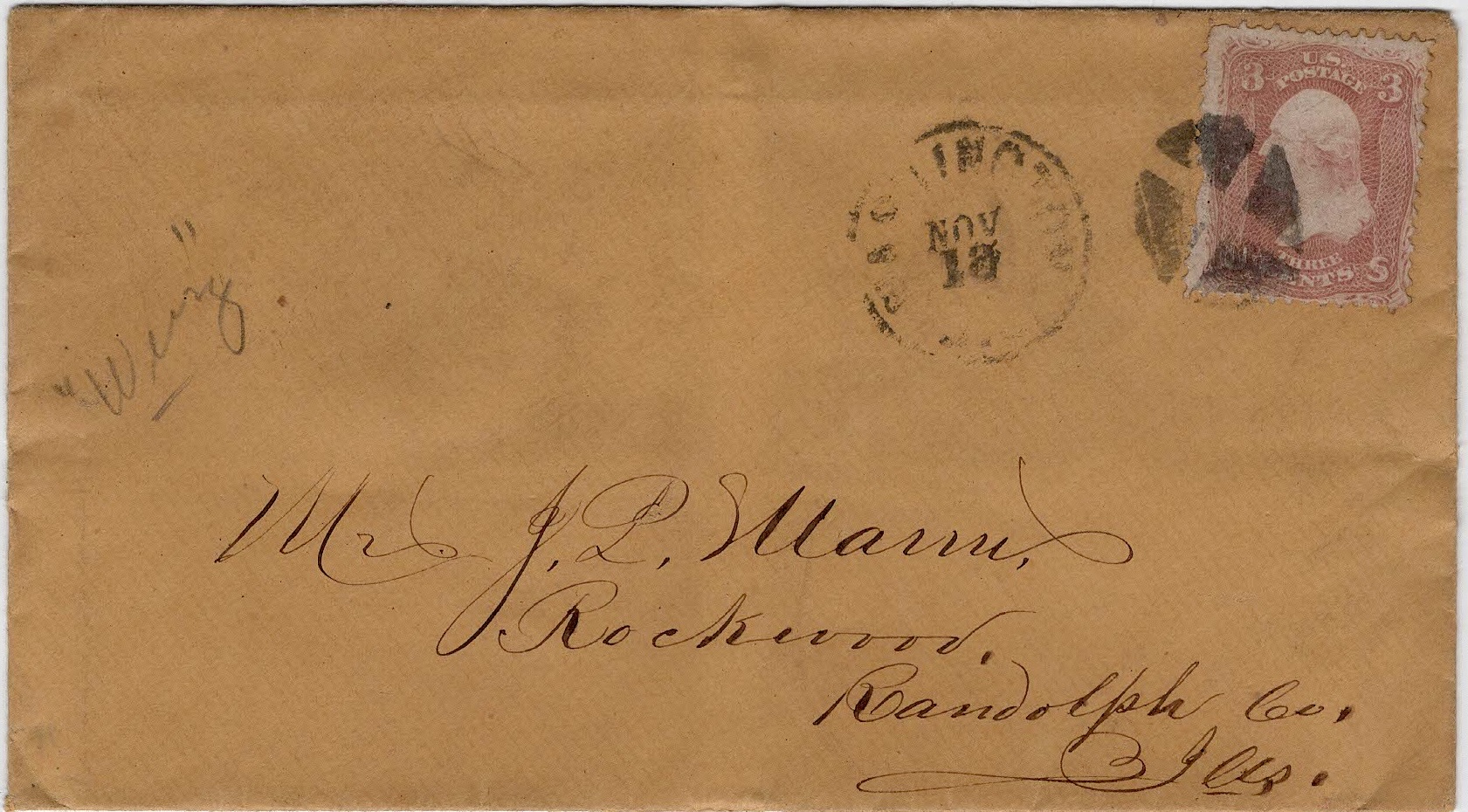
Washington City
November 12, I865
Mr. J. P. M.
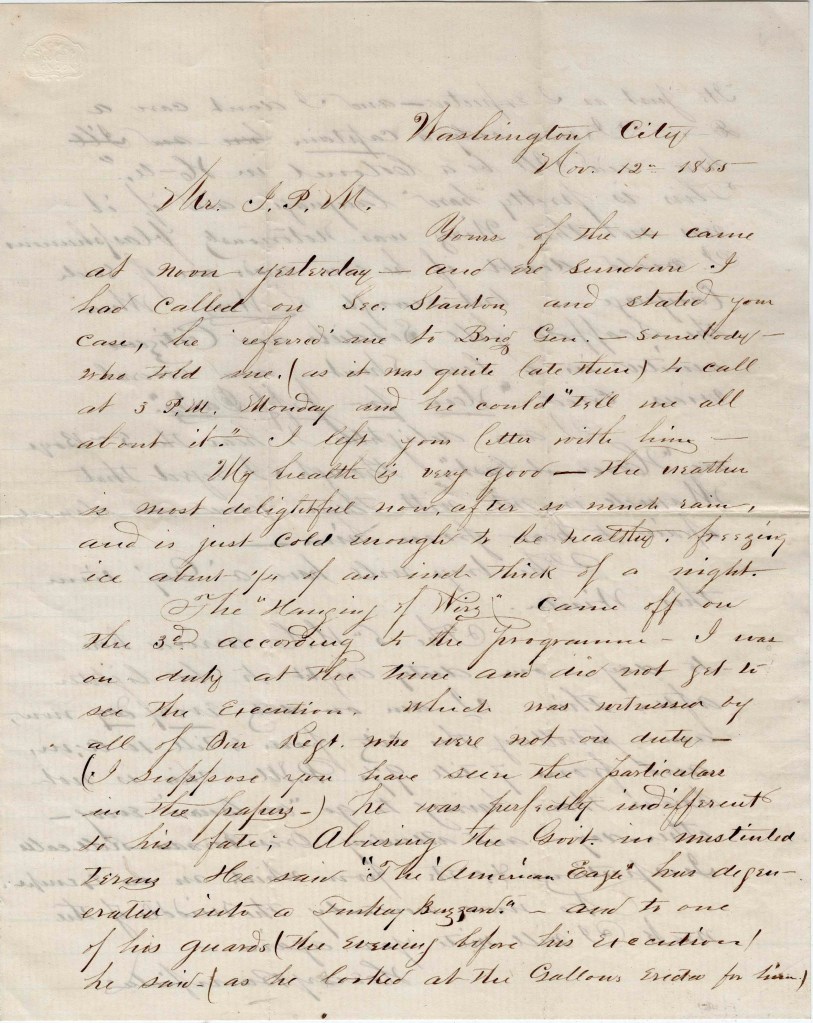
Yours of the 4th came at noon yesterday and ‘ere sundown, I had called on Sec. Stanton and stated your case. He referred me to Brig. Gen.—somebody—who told me (as it was quite late then) to call at 3 p.m. Monday and he could “tell me all about it.” I left your letter with him.
My health is very good. The weather is most delightful now after so much rain, and is just cold enough to be healthy. Freezing ice about one fouth of an inch thick of a night.
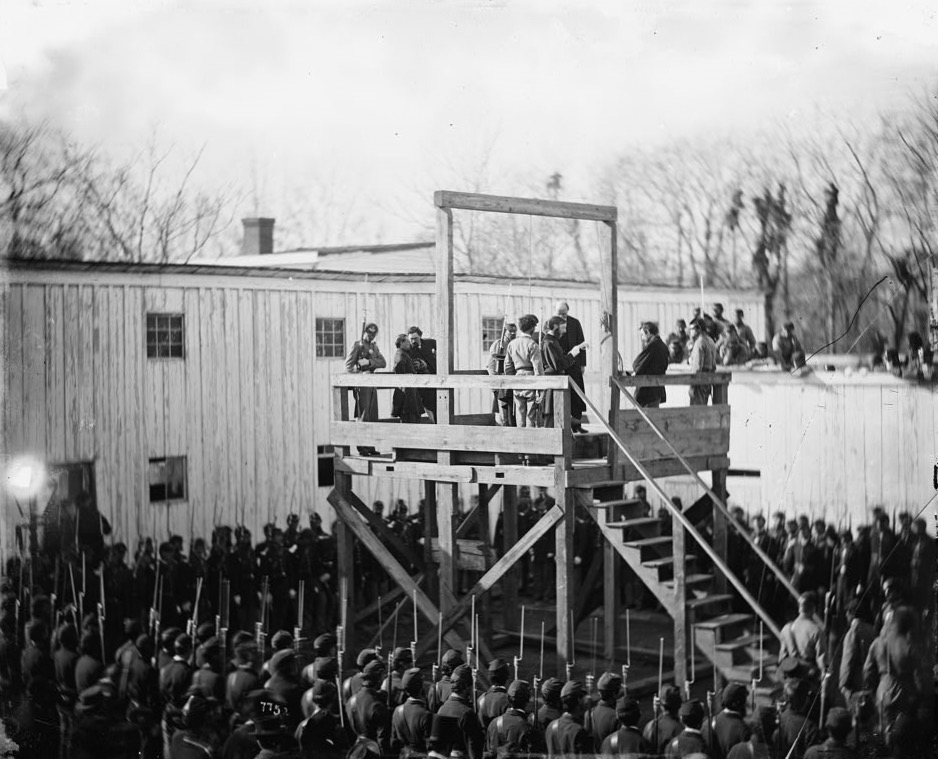
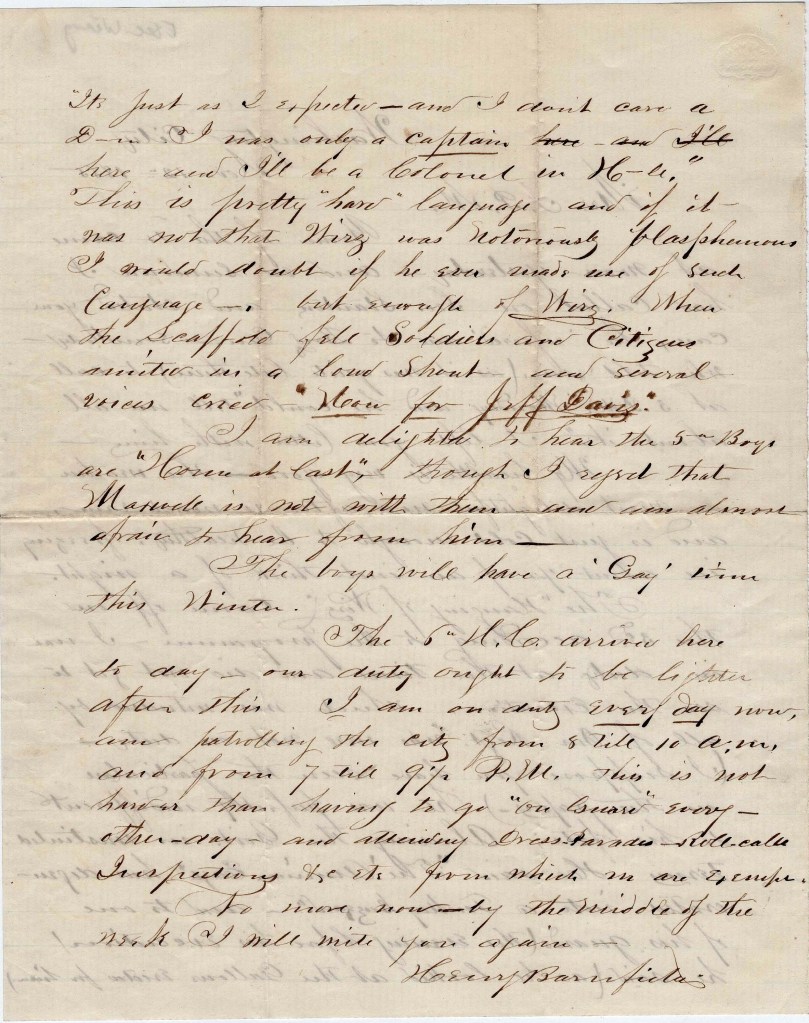
The “hanging of Wirz” came off on the 3rd according to the programme. I was on duty at the time and did not get to see the execution which was witnessed by all of our regiment who were not on duty. (I suppose you have seen the particulars in the papers.) He was perfectly indifferent to his fate, abusing the government in unstinted terms, He said “The American Eagle has degenerated into a Turkey Buzzard.” And to one of his guards (the evening before his execution) he said (as he looked at the gallows erected for him), “It’s just as I expected, and I don’t care a damn. I was only a captain here and I’ll be a Colonel in Hell.” This is pretty “hard” language and if it was not that Wirz was notoriously blasphemous, I would doubt if he ever made use of such language. But enough of Wirz. When the scaffold fell, soldiers and citizens united in a loud shout and several voices cried, “Now for Jeff Davis!” 1
I am delighted to hear the 5th [Illinois Cavalry] Boys are “Home at last,” though I regret that Maxwell is not with them and am almost afraid to hear from him. The 6th Ill. Cav. arrived here today. Our duty ought to be lighter after this. I am on duty every day now, am patrolling the city from 8 till 10 a.m. and from 7 till 9.30 p.m. This is not harder than having to go “on guard” every other day and attending Dress Parades, Roll Calls, Inspections &c &c from which we are exempt.
No more now. By the middle of the week, I will write you again. — Henry Barnfield
1 Henry Wirz, the commandant of Andersonville Prison, was hanged at 10:32 a.m. on November 10, 1865, at the Old Capitol Prison in Washington D.C., located next to the U.S. Capitol. His neck did not break from the fall, and the crowd of 200 spectators guarded by 120 soldiers watched as he writhed and slowly strangled. Wirz was one of only three men tried, convicted, and executed for war crimes during the Civil War (and, being a captain, was the highest-ranked of any executed), the others being Confederate guerrillas Champ Ferguson and Henry C. Magruder. As to the statements attributed to Wirz by his guards, I can find no other accounts to confirm them.
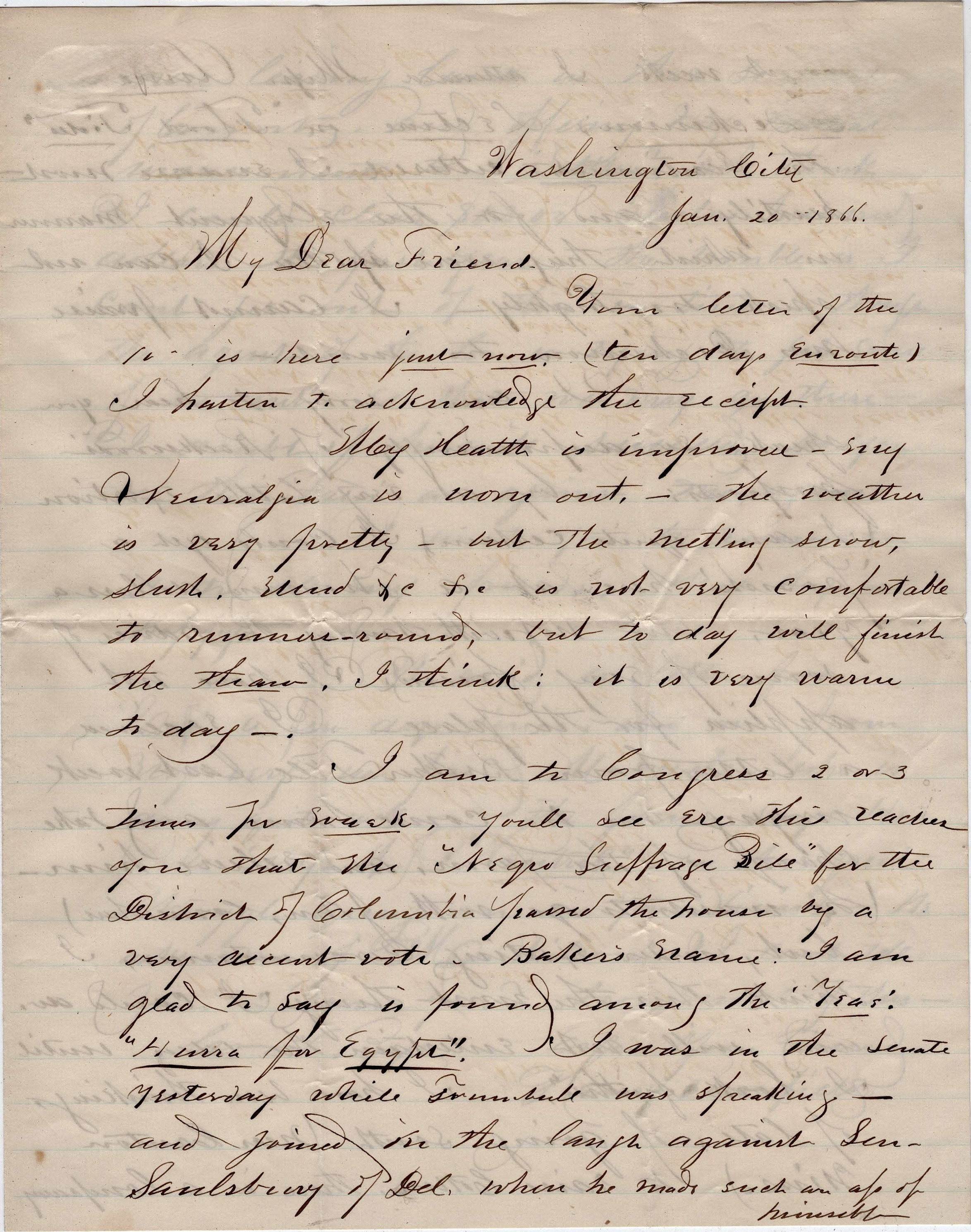
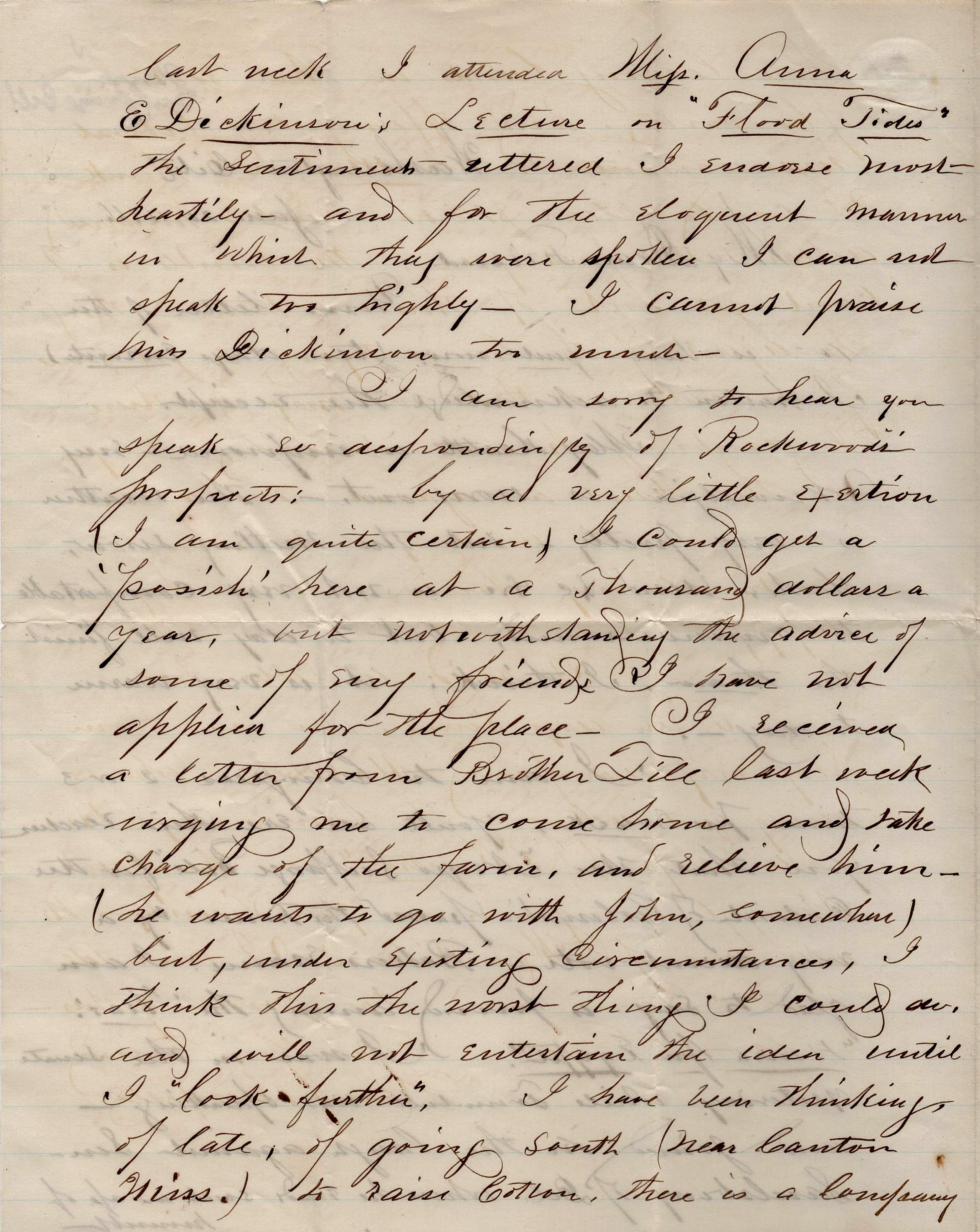
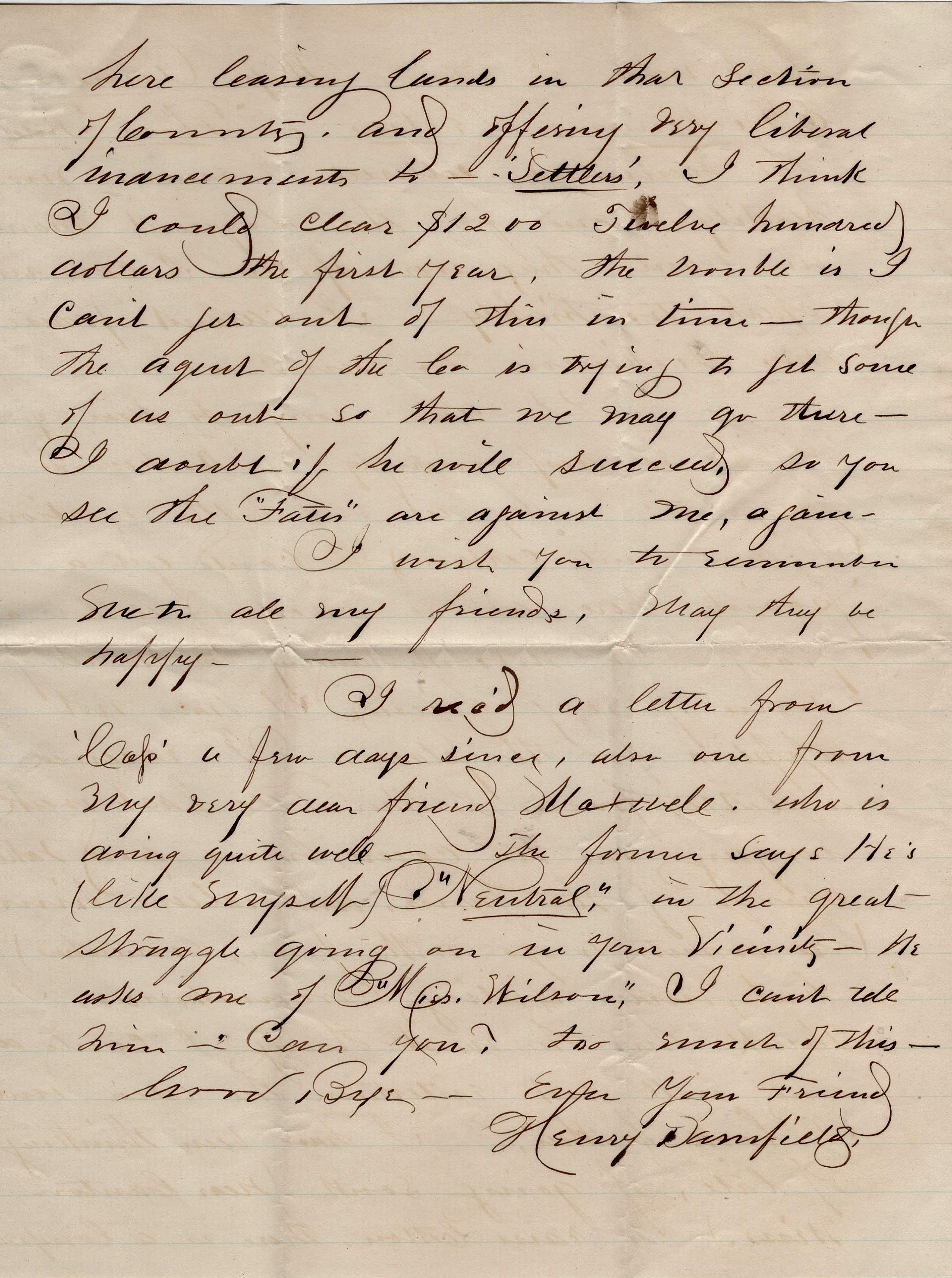
Letter 7
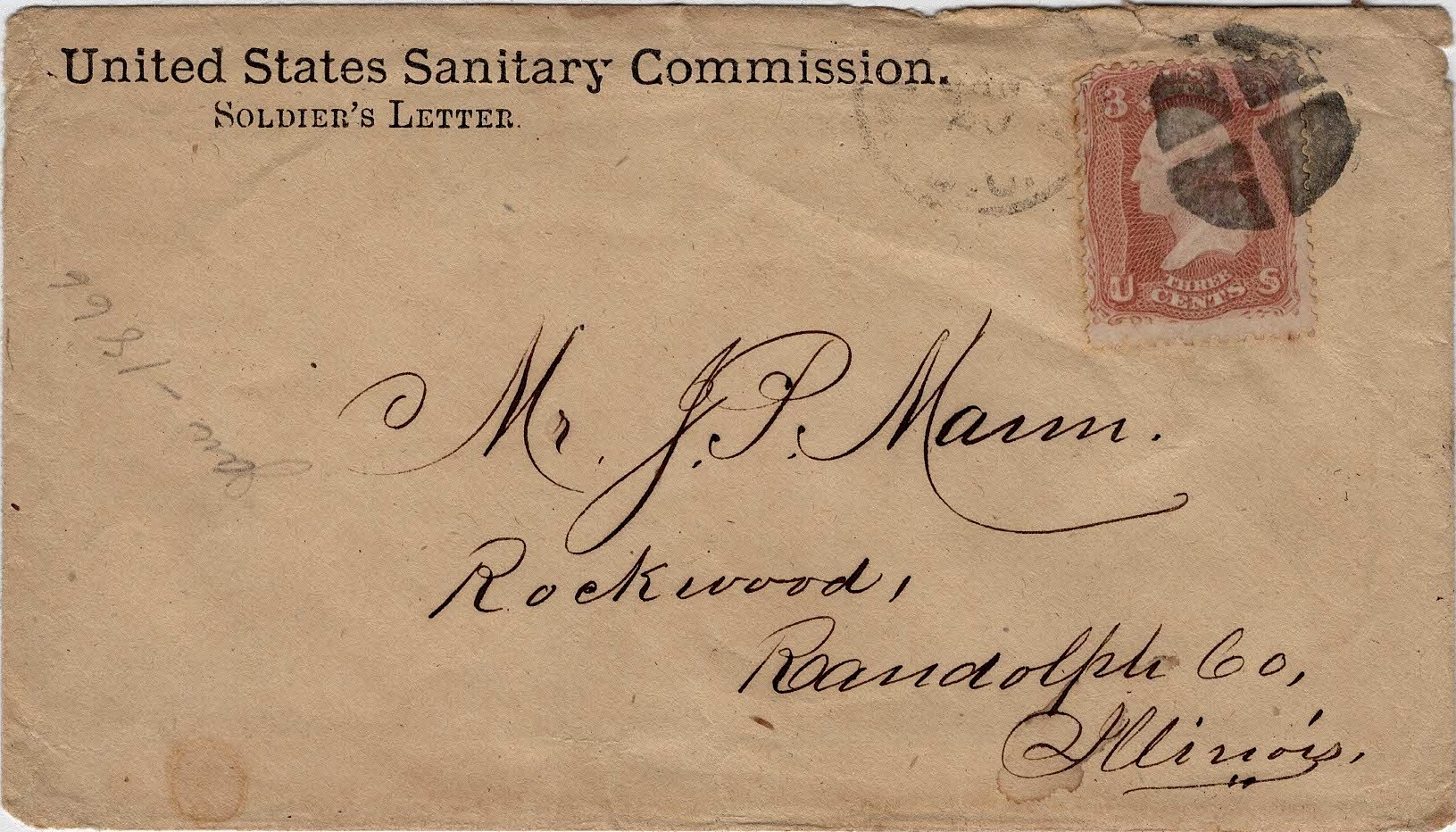
Washington City
January 20, 1866
My dear friend,
Your letter of the 10th is here just now (ten days enroute). I hasten to acknowledge the receipt.
My health is improved. My neuralgia is worn out. The weather is very pretty but the melting snow, slush, mud, &c. is not very comfortable to runners round. But today will finish the thaw, I think. It is very warm today.
I am to Congress two or three times per week. You’ll see ere this reaches you that the “Negro Suffrage Bill” for the District of Columbia passed the House by a very decent vote. Baker’s name, I am glad to say, is found among the “yeas.” Hurrah for Egypt!” 1 I was in the Senate yesterday while Trumbull was speaking and joined in the laugh against Senator [Willard] Saulsbury of Delaware when he made such an ass of himself. 2
Last week I attended Miss Anna E. Dickinson’s lecture on “Flood Tides.” The sentiments uttered I endorsed most heartily and for the eloquent manner in which they were spoken I cannot speak too highly. I cannot praise Miss Dickinson too much. 3
I am sorry to hear you speak so disapprovingly of Rockwood’s prospects. By a very little exertion (I am quite certain). I could get a “posish” here at a thousand dollars a year, but notwithstanding the advice of some of my friends, I have not applied for the place. I received a letter from brother Till last week urging me to come home and take charge of the farm and relieve him (he wants to go with John somewhere) but, under existing circumstances, I think this the worst thing I could do and will not entertain the idea until I look further. I have been thinking of late of going South (near Canton, Mississippi) to raise cotton. There is a company here leasing lands in that section of country and offering very liberal inducements to settlers. I think I could clear $1200 the first year. The trouble is I can’t get out of this in time, though the agent of the company is trying to get some of us out so that we may go there. I doubt if he will succeed, so you see the fates are against me, again.
I wish you to remember e to all my fiends….Goodbye. Ever your friend, — Henry Barnfield
1 Egypt, or Little Egypt” was the name given to the extreme southern region of Illinois encompassing some 16 or 17 counties.
2 Willard Saulsbury, Sr., a Democratic Senator from Delaware (1859-1871) was a statunch opponent of racial equality and black suffrage during the Reconstruction era. In 1861, he made a speech on the Senate floor contending that “God, nature, everything has made a distinction between the white man and negro.” He believed the United States to be “the white man’s home…”
3 See The Forgotten Fame of Anna Dickinson by Amy Cohen.
Letter 8
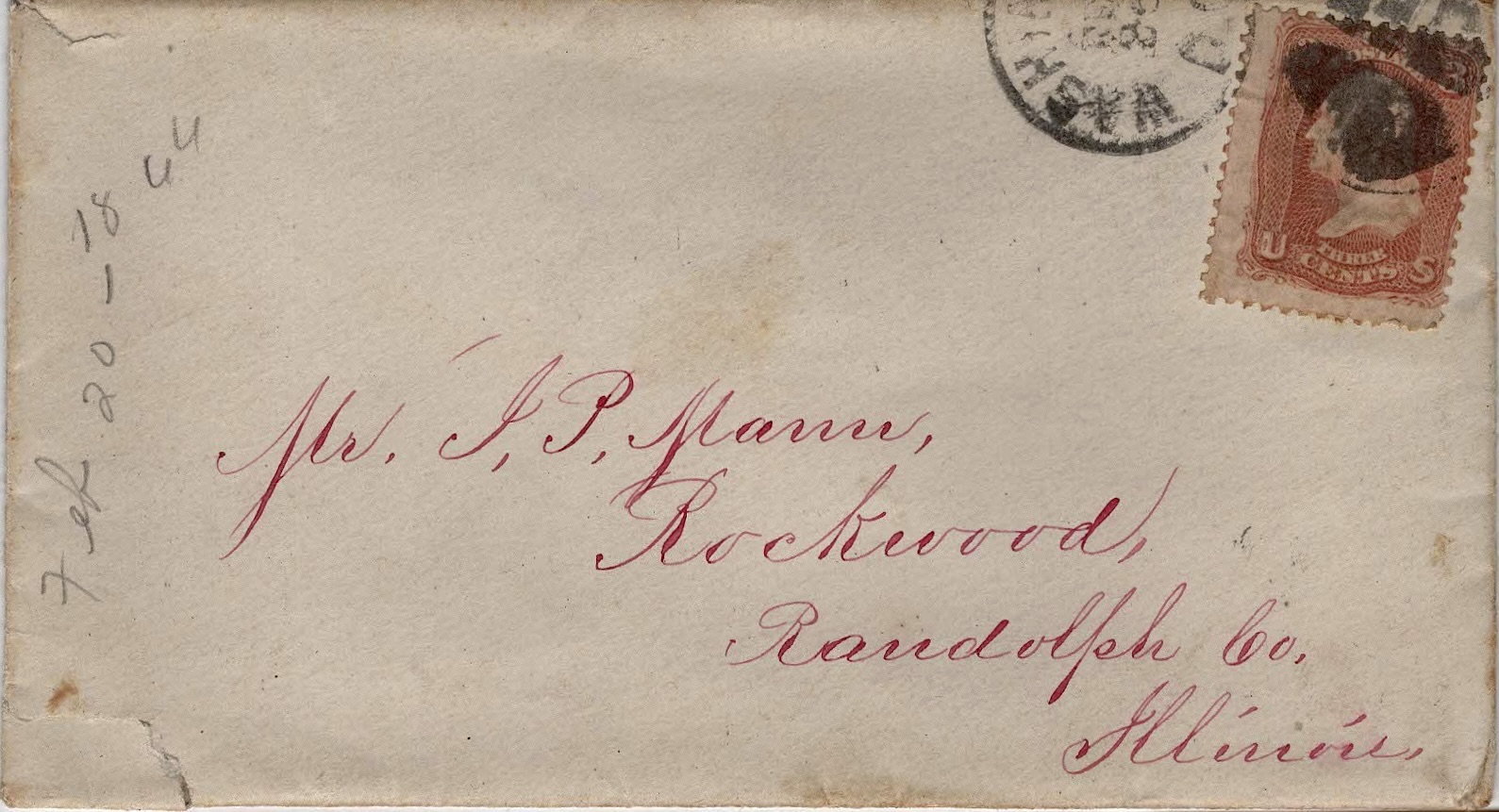
Washington City
February 20th, 1866
Mr. Mann,
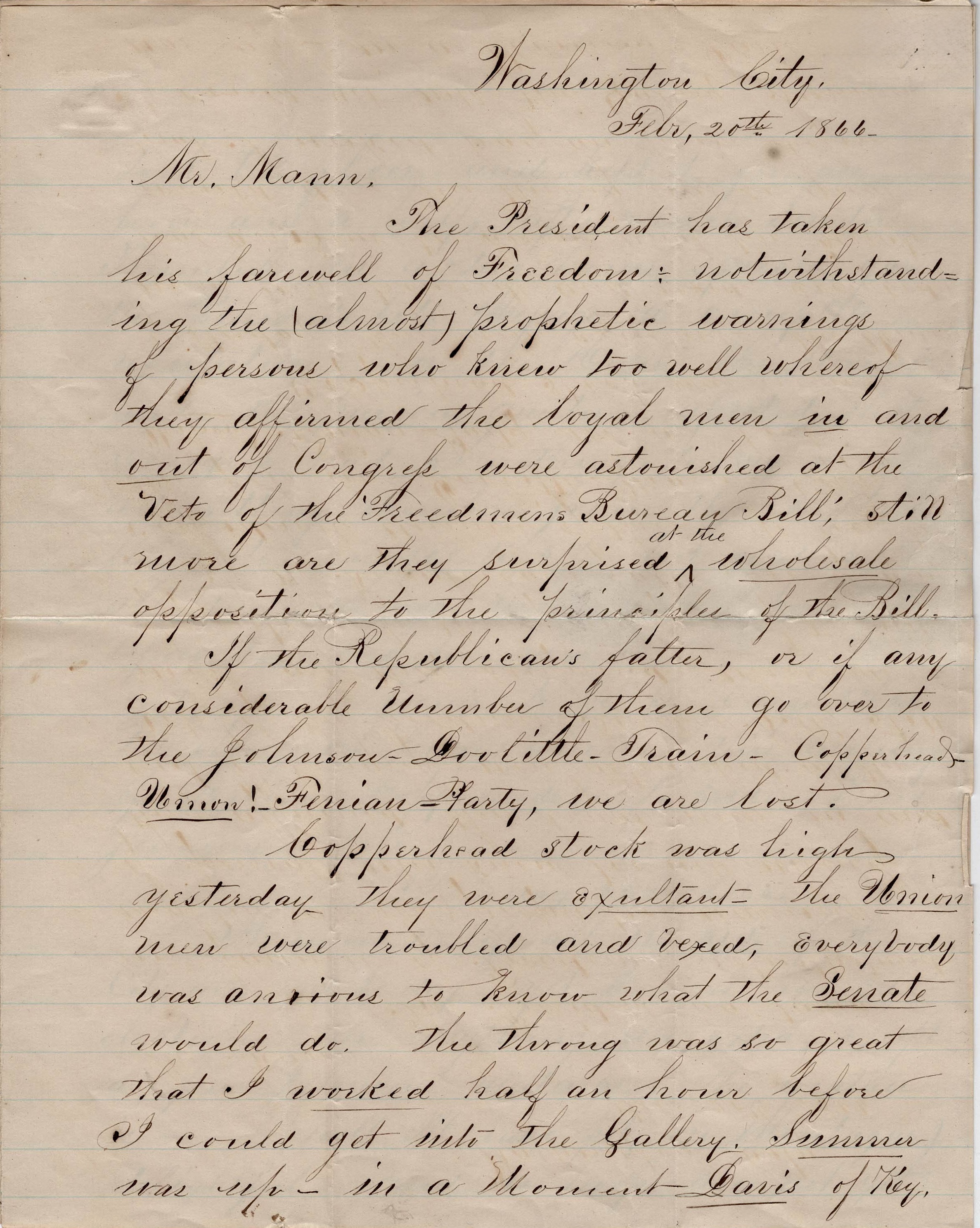
The President has taken his farewell of Freedom; notwithstanding the (almost) prophetic warnings of persons who know too well whereof they affirmed the loyal men in and out of Congress were astonished at the veto of the Freedmen’s Bureau Bill: still more are they surprised at the wholesale opposition to the principles of the Bill. If the Republican’s falter, or if any considerable number of them go over to the Johnson-Doolittle train—Copperhead—Union! Fernian Party, we are lost. 1
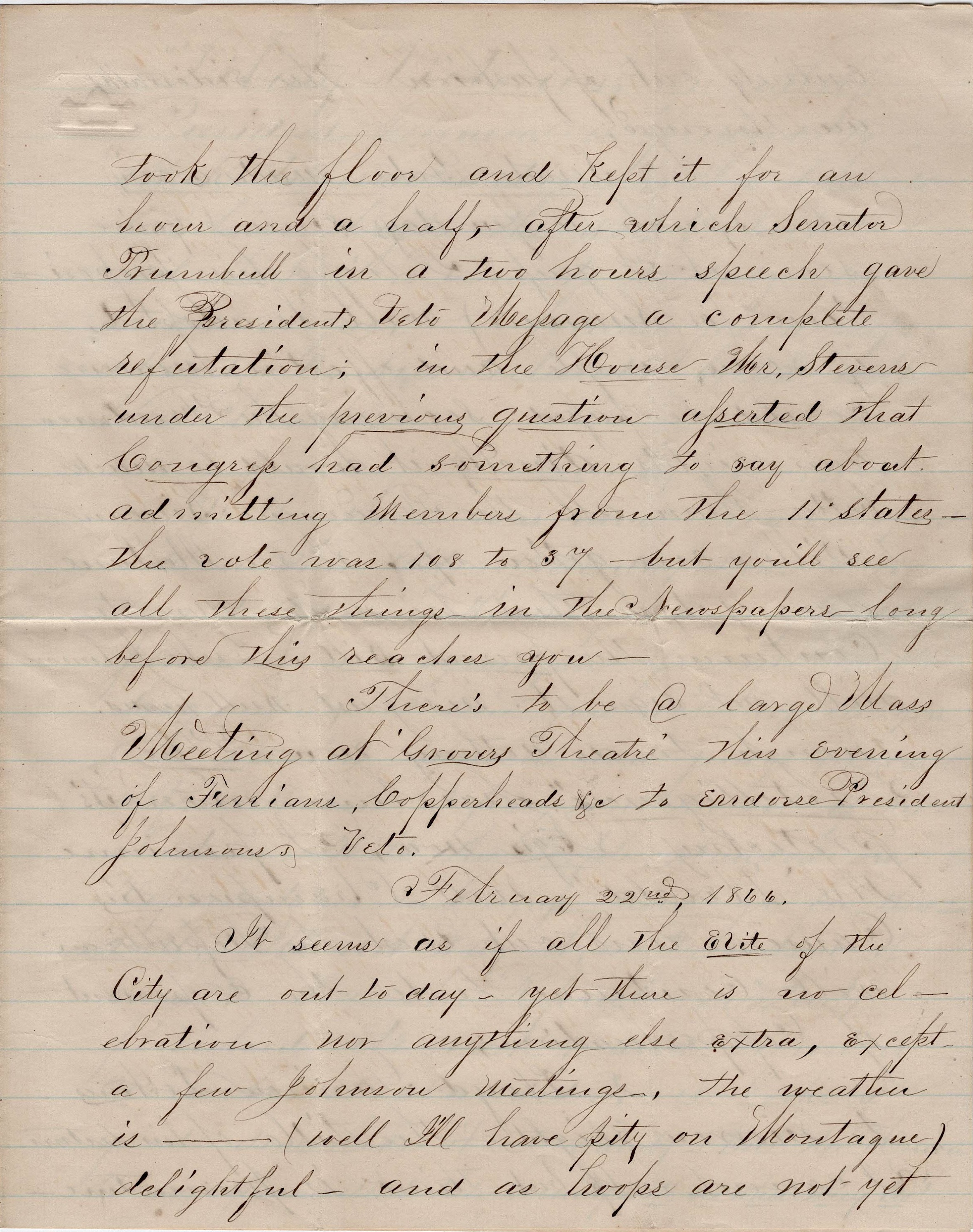
Copperhead stock was high yesterday. They were exultant. The Union men were troubled and vexed. Everybody was anxious to know what the Senate would do. The throng was so great that I worked half an hour before I could get into the Gallery. Sumner was up, in a moment Davis of Kentucky took the floor and kept it for an hour and a half, after which Senator Trumbull in a two hours speech gave the President’s Veto Message a complete refutation; in the House Mr. [Thaddeus] Stevens under the previous question asserted that Congress had something to say about admitting members from the 11 states. The vote was 108 to 37, but you’ll see all these things in the newspapers long before this reaches you.
There’s to be a large Mass Meeting at Grover’s Theatre this evening of Fenians, Copperheads &c. to endorse President Johnson’s Veto.
February 22nd I866
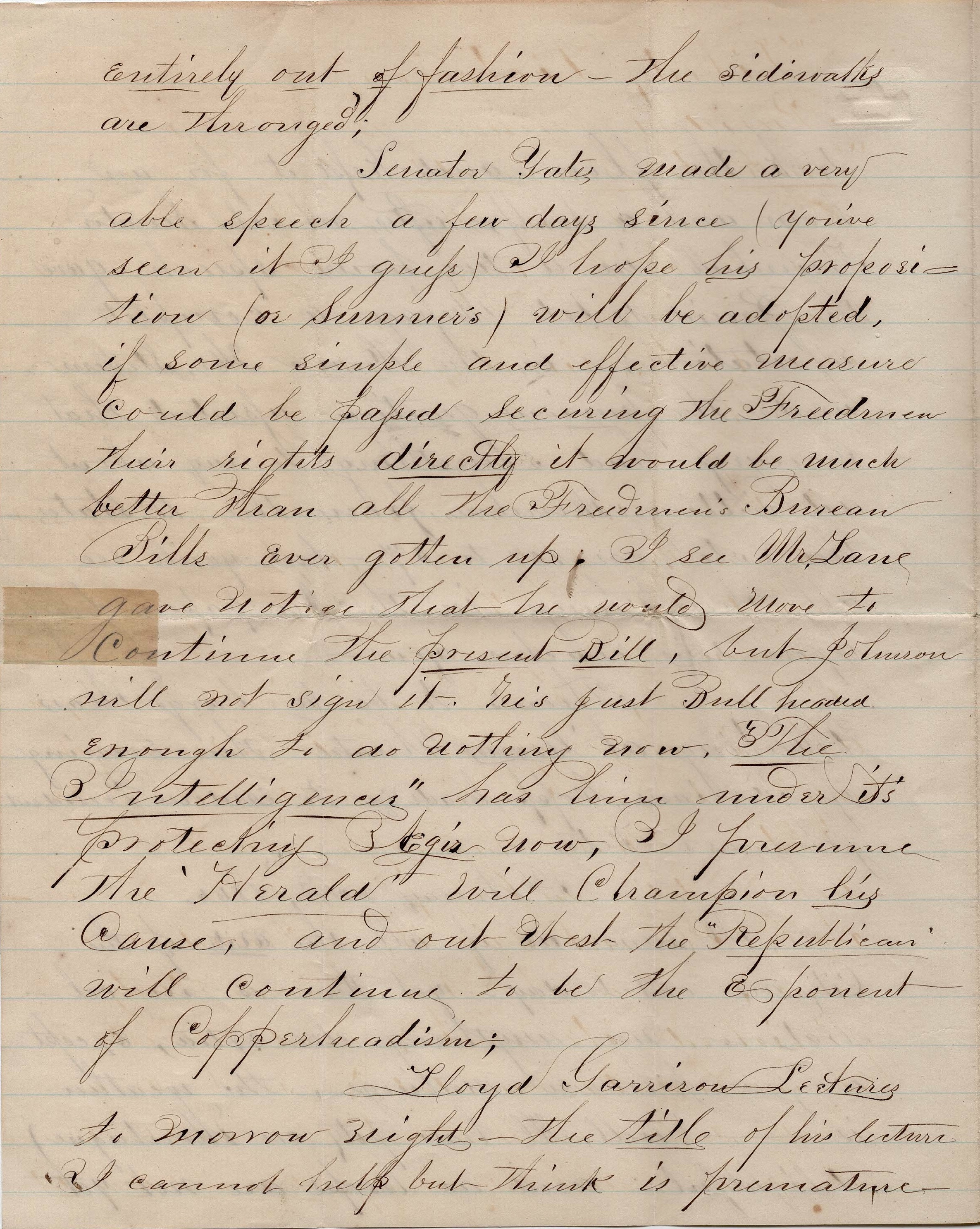
It seems as if all the elite of the city are out today, yet there is no celebration nor anything else extra, except a few Johnson meetings. The weather is—- (well, I’ll have pity on Montague) delightful, and as hoops are not yet entirely out of fashion, the sidewalks are thronged.
Senator Yates made a very able speech a few days since (you’ve seen it, I guess). I hope his proposition (or Sumner’s) will be adopted. If some simple and effective measure could be passed securing the Freedmen their rights directly it would be much better than all the Freedmen’s Bureau Bills ever gotten up. I see Mr. Lane gave notice that he would move to continue the present Bill, but Johnson will not sign it. He’s just bull headed enough to do nothing now. The Intelligencer has him under its protecting aegis now. I presume the Herald will champion his cause, and out west the Republican will continue to be the exponent of copperheadism.
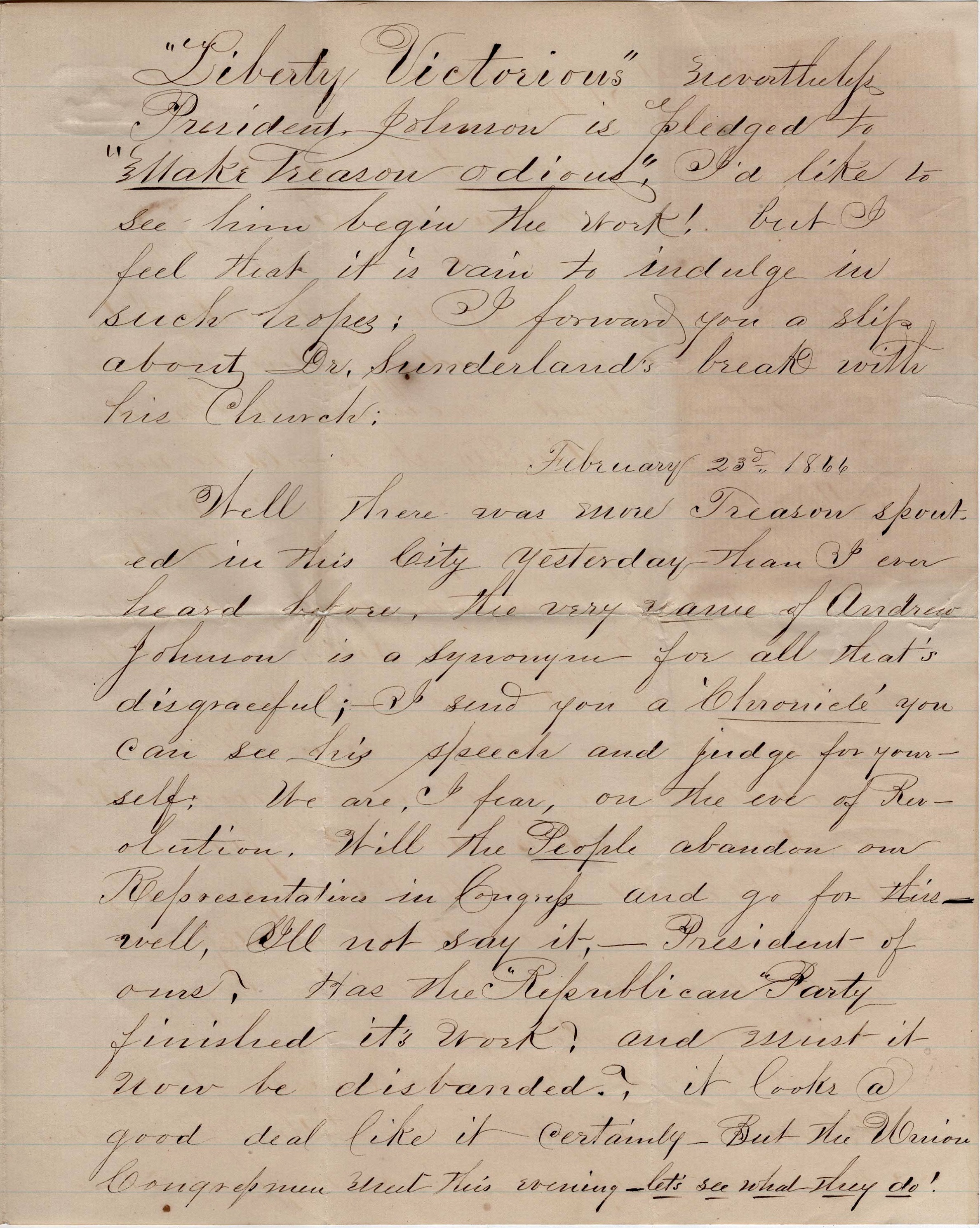
Lloyd Garrison lectures tomorrow night. The title of his lecture I cannot help but think is premature— “Liberty, Victorious.” Nevertheless President Johnson is pledged to “Make Treason odious.” I’d like to see him begin the work! but I feel that it is vain to indulge in such hopes. I forward you a slip about Dr. Sunderland’s break with his church.
February 23rd I866
Well there was more Treason spouted in this city yesterday than I ever heard before. The very name of Andrew Johnson is a synonym for all that’s disgraceful. I send you a Chronicle you can see his speech and judge for yourself. We are, I fear, on the eve of Revolution. Will the people abandon our Representatives in Congress and go for this? Well, I’ll not say it, —– President of ours. Has the Republican Party finished its work? and must it now be disbanded? It looks a good deal like it certainly. But the Union Congressmen meet this evening. Let’s see what they do! [no signature]
1 President Andrew Johnson vetoed the Freedmen’s Bureau Bill on February 19, 1866, marking a major conflict in Reconstruction. He argued it was unconstitutional, a peacetime misuse of the military, and “class legislation”. Congress failed to override this first veto, but later passed a revised bill in July 1866, which they successfully overrode.