Category Archives: Prisoner of War

1865: Andrew F. Clarke to Sallie M. H. Fulton

These two Prison of War (POW) letters were written from Fort Delaware by Andrew F. Clarke (1841-1890) who first enlisted in the Confederate service when 19 years old at Corinth, Mississippi in the Newton Rifles, 13th Mississippi Infantry. His enlistment records indicate that his home was Decatur, Newton county, Mississippi and that prior to enlistment he was employed as a teacher. His parents were Rev. Nathan Lytle Clarke (1812-1906) and Evaline Delia Powell (1823-1859).
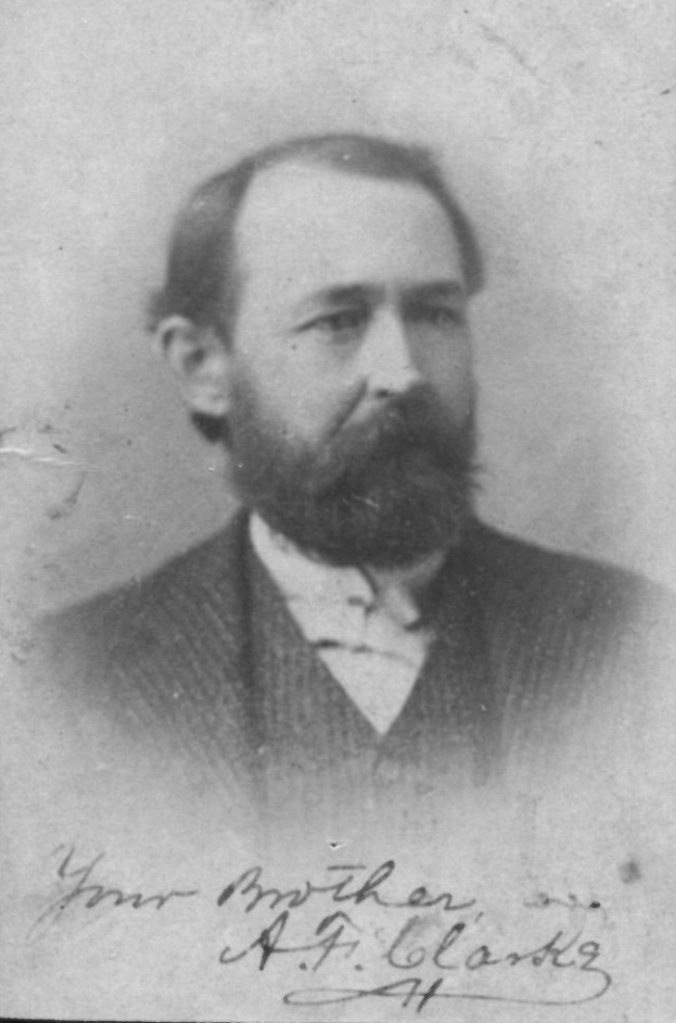
A post war cabinet card image of Andrew (Find-A-Grave)

Clarke was appointed a 3rd Sergeant shortly after his enlistment and and was promoted to a 2nd Lieutenant of Co. D on 26 April 1862. Less than a year later he was promoted to 1st Lieutenant.

Clarke was wounded and taken prisoner at Knoxville, Tennessee, during the ill-advised assault on Fort Sanders of 29 November 1863. The 13th Mississippi led the assault on the northwest bastion of the fort—the focal point of the overall attack. The men of the 13th were the first into the ditch surrounding the fort and the first to place their flag upon the parapet where it was captured along with two other regimental colors. The attack was star-crossed, furious and short lived. In the twenty minutes of fighting, the 13th’s colonel was killed, and the Confederates lost a total of 813 men: 129 killed, 458 wounded, and 226 missing. The Federals, on the other hand, lost less than 20 men inside the protection of the embattlements. Clarke was one of 17 commissioned officers captured that day. (Source: Earl Hess’s Burnside and Longstreet in East Tennessee)

As a prisoner, Clarke was transported to Louisville, to Rock Island, to Camp Chase, and finally to Fort Delaware in late March 1864. When these letters were written, he had been at Fort Delaware for ten to eleven months. Despite his continued hopes for exchange, he was not released from Fort Delaware until 12 June 1865.

Clarke addressed the letter to 24 year-old Sallie Fulton of Baltimore’s 20th Ward—no doubt a Southern sympathizer who showed compassion for Confederate prisoner’s of war and frequently corresponded with them, occasionally even sending them money to allow them certain luxuries they might not otherwise have access to. Several letters to such correspondents have survived through the years—letters to women unknown to the prisoners except for their generosity. In 1870, 30 year-old Sallie was still enumerated at the 176 Preston Street residence of her parents, John B. H. Fulton—a wholesale Dry Goods Dealer— and Ann S. Wilson. By 1880, Sallie had married John Walter Hoover, a teacher, and lived at 243 Bolton Street in Baltimore.

Letter 1

Addressed to Miss Sallie M. H. Fulton, 176 Preston Street, Baltimore, Maryland

Fort Delaware
January 11th, 1865

Miss Sallie M. H. Fulton
Dear friend:

Your favor of 31st December came to hand on the 4th Inst. and found me in excellent health. The weather has moderated greatly and appears like our springtime in the far South. Our skating has disappeared and in its stead, we wade through the mud. We are getting along very well—have plenty to eat and good fires, so we manage to live comfortably. Rumors of exchange are still current but amount to nothing.

Have you heard from Lieut. Mosely since he went South?  We are expecting a “flag of truce” mail soon and will receive a letter from him, I think. Capt. [Daniel Murray] McRae is quite well today. I know you will consider this letter uninteresting but I can write nothing scarcely when limited,  both as to space and subject. I hope you will continue to write.

Hoping soon to hear from you, I am your friend, — Andrew F. Clarke


Letter 2

Addressed to Miss Sallie M. H. Fulton, 176 Preston Street, Baltimore, Maryland

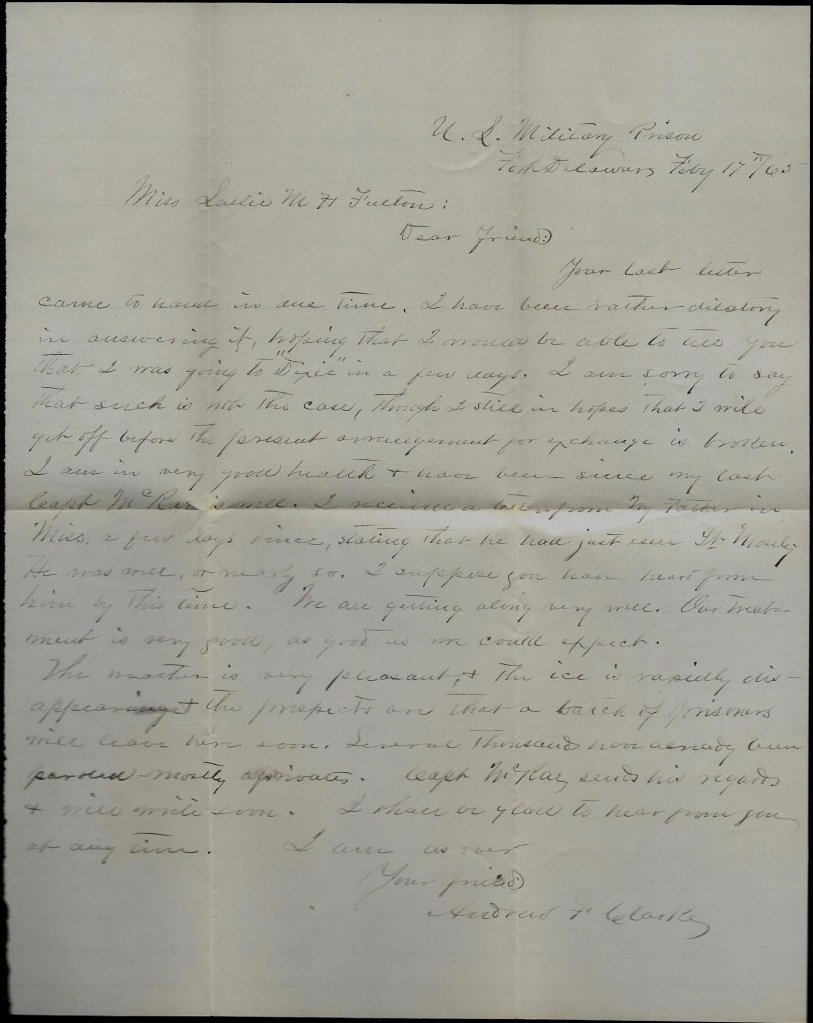
U. S. Military Prison
Fort Delaware
February 17, 1865

Miss Sallie M. H. Fulton
Dear friend,

Your last letter came to hand in due time. I have been rather dilatory in answering it, hoping that I would be able to tell you that I was going to “Dixie” in a few days. I am sorry to say that such is not the case, though I’m still in hopes that I will get off before the present arrangement for exchange is broken.

I am in very good health and have been since my last. Capt. [Daniel Murray] McRae is well. I received a letter from my Father in Mississippi a few days since stating that he had just seen Lt. Mosely. He was well, or nearly so. I suppose you have heard from him by this time. We are getting along very well . Our treatment is very good—as good as we could expect.

The weather is very pleasant & the ice is rapidly disappearing & the prospects are that a batch of prisoners will leave here soon. Several thousand have already been paroled—mostly privates. Capt. McRae sends his regards & will write soon. I shall be glad to hear from you at any time. I am as ever your friend, — Andrew F. Clarke
Andrew F. Clarke’s monument in Covington, Hill county, Texas

1864: Edward Visart to Myra McAlmont

This letter was written by Edward Visart (1839-1893) from Fort Delaware in August 1864 while a prisoner of war. Edward was serving as a 2nd Lieutenant in Capt. Blocher’s Arkansas Battery when he was taken prisoner on 28 October 1863 in Arkansas county, Arkansas, by General Clayton’s troops and held in prison at Little Rock. He was then held at St. Louis for a time but transferred across country to Fort Delaware on 25 March 1864. He was received there two days later and not paroled until 10 April 1865.

Edward began his Confederate service enlisting in the Pulaski Light Artillery at Little Rock in April 1861. He mustered out of that regiment in September 1861 and reenlisted in the Weaver Light Artillery at Little Rock in December 1861. This battery was transferred to Blocher’s Battery in August 1862. Blocher’s Battery served in the Trans-Mississippi Department throughout the war, and campaigned in Arkansas, Louisiana, Missouri and the Indian Territory.  In January 1863 the battery was assigned to Fagan’s Brigade in Hindman’s Division, and fought at Helena, the Little Rock campaign, and Price’s Missouri Expedition. 

During his long imprisonment, Lt. Visart began the study of medicine by reading books and prepared himself for admittance to medical school once he was paroled. He later got his degree from the University of Michigan Medical School and then returned to Arkansas to practice in DeWitt.

Edward wrote the letter to his “friend” Myra McAlmont (1846-1918), the daughter of Dr. John Josephus McAlmont (1821-1896), an 1843 graduate of the Geneva (NY) Medical College. He moved to Arkansas in 1850 and settled in Little Rock in 1852 where he practiced medicine and partnered with Solon Borland in a drug store. Myra married Francis (“Frank”) Terry Vaughan (1846-1916) in 1866. During the Civil War, Frank served in Capt. John G. Marshall’s Battery, Arkansas Light Artillery. He was very seriously wounded at the Battle of Helena, losing his left arm and receiving additional wounds in his right hand and breast. Myra’s uncle, Dr. Corydon Hanks McAlmont (1827-1862) served in Rust’s Brigade during the Civil War but after Corinth, returned to Little Rock where he rendered Confederate service in the hospital.

In September 1863, Union troops occupied Little Rock, Arkansas, and opened up communication and travel for Little Rock residents, such as Mrya, to travel North and visit relatives in Hornellsville, New York, where her parents had come from. Prior to September 1863, such travel would have been difficult and required passes to cross enemy lines.

(left to right) Mrs. John J. McAlmont, her daughter Myra McAlmont, and Miss Julia McAlmont, sister-in-law of Mrs. McAlmont. (ca. 1860)

Transcription

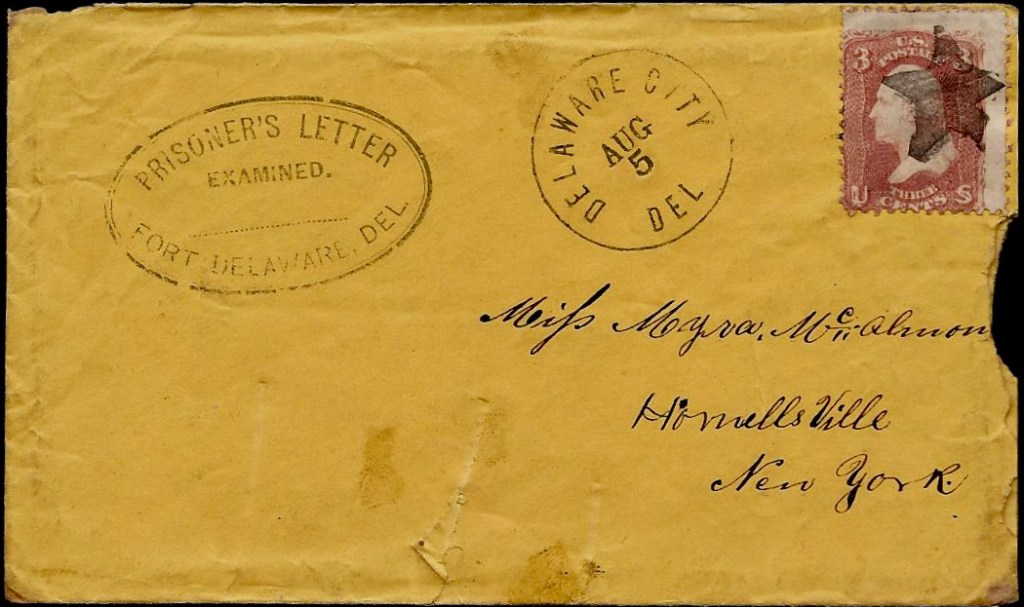
Addressed to Miss Myra McAlmont, Hornellsville, New York

Fort Delaware, Delaware
August 2, 1864

My Dear Friend,

Your welcome letter of the 29th ult., cane duly to hand last evening. Yours and Frank’s letters are always so interesting, so “talkative” of home (I mean Little Rock). I was much amused at yours and Frank [Vaughan]’s dialogue while reading it. I imagined myself there and thought it was “my put in” and spoke out accordingly; was reminded of it by a bystander who asked me if it was “much funny.” Lieut. Halliburton received a letter from his friend J. B. Garrison written at Little Rock; he and Henry Halliburton are prisoners. Were captured at Col. H.’s July 5th. Gulware and Garrison were married on the 15th of May last. I have written to Hal. I did not know Miss Agnes Colter. I will expect you this fall. I believe you will get to come.

Miss Myra, I do not know how to thank you for your kind offer. You offer to do more than I could even ask a relation. I do not yet particularly need anything. I have clothing enough to do me till winter. Lieut. H. received a box of eatables last week from a lady in Baltimore. It was a nice treat being the first thing of the kind we have had since our sojourn North. I will accept the Anatomy. I prefer “Gray’s Human & Surgical.” I suppose it will have to be sent by Express to Lieut. E. Visart, Prisoner of War, Care of Capt. G. W. Ahl, A.A.A. Gen’l, Fort Delaware. If your Aunt will send a “ham” &c. and you some biscuits &c, box them up with the Anatomy. Get Frank to Express them. They will come safely & be very acceptable. I would not have you go to any expense to make up a box. When you write home, remember me kindly to all.

We are again allowed to receive papers. Should you get another Little Rock paper, send again. I may be more fortunate next time. I fear the “Bushwhackers” have interrupted my communication with Miss Georgie. I have not heard from her in some weeks. Lieut. H. joins me in love to you & Frank [Vaughan]. I cannot do your letters justice on one page but it is all I dare write. Write soon. I remain most respectfully, your true friend, — Edward Visart

Heard from Capt. Blocher. All’s well. I was not forgotten in the reorganization. Am now 1st Lieutenant. — E. V.