

The following letters were written by William Wallace Jones (1839-1896) of New Canaan who enlisted in Co. B, 13th Connecticut Infantry. Company B was recruited by Captain Apollos Comstock of New Canaan who travelled the state looking for marksmen to create a company of sharp shooters. He had to give up his test of marksmanship by the middle of December in order to fill out his company.
William was taken prisoner at the Battle of Winchester on 19 September 1864 and later paroled. He mustered out of the regiment on 29 December 1864. In the 1880 US Census, William was still single and enumerated in his father’s home in New Canaan as a 36 year-old carpenter. His parents were John Jones (1801-1891) and Ann Tong (1811-1853).
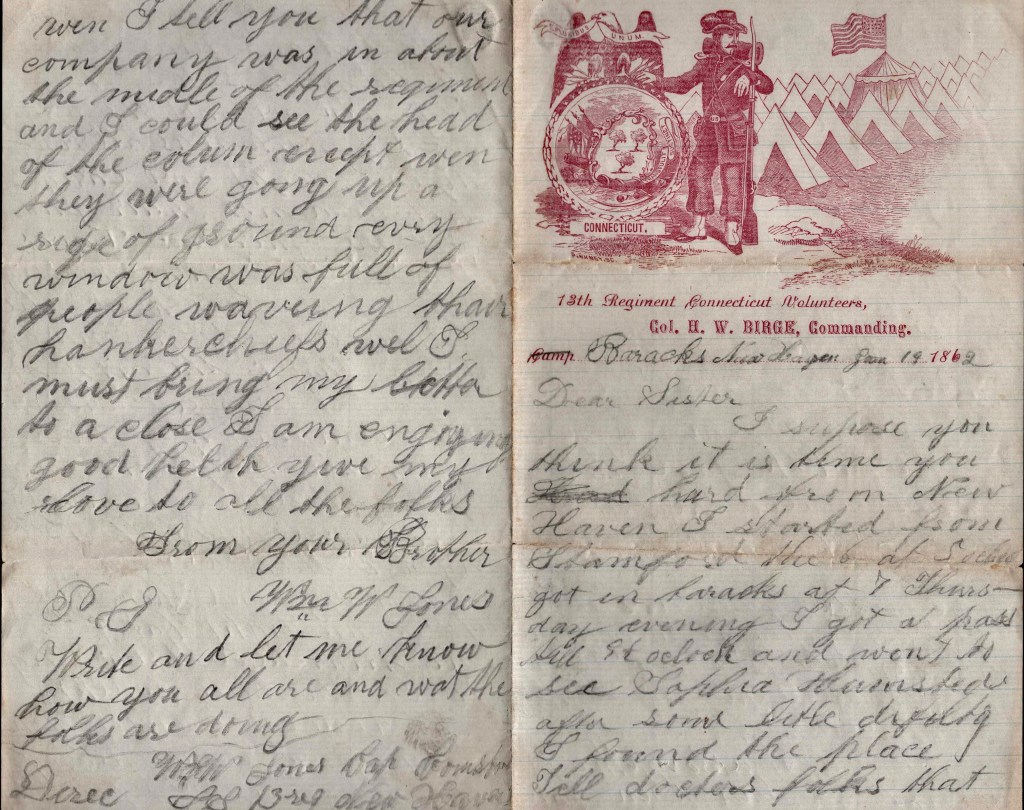
Letter 1
13th Regiment Connecticut Vols.
Barracks New Haven [corner of Chapel & Hamilton streets]
January 14, 1862
Dear Sister,
I suppose you think it is time you heard from New Haven. I started from Stamford the 6th at 5 o’clock. Got in barracks at 7 Thursday evening. I got a pass till 9:30 o’clock and went to see Sophia Humsted. After some little difficulty, I found the place. Tell doctor’s folks that I am glad that I went. Saturday we received our brass epaulets or brass kettles as some called them, and then we had to sew then on and fix for a dress parade on Monday. Sunday we went to church in the morning and evening. The whole regiment went. They filled the church full.
Well, I suppose you would like to hear of the dress parade we had yesterday. In the morning we had a Battalion Drill. In the afternoon the whole regiment turned out to escort the 1st Connecticut Light Battery through the city to the steamboat. We marched up Chapel Street above the Depot and then turned to the left and marched to the north side of the city when we met the battery which was all equipped except two carriages which had not their guns yet. The other four was brass rifled guns making six in all. We throw the salute and then marched down through the city. In front was an independent company of horse in showa [?] uniforms and presented a splendid appearance. Next the 13th Regiment C. V., then a company of cavalry, and the the 1st Connecticut Light Battery. As we marched through Chapel Street, the side walks was densely crowded. You may form some idea of the appearance we presented when I tell you that our company was in about the middle of the regiment and I could [not] see the head of the column except when they were going up a ridge of ground. Every window was full of people waving their handkerchiefs.
Well, I must bring my letter to a close. I am enjoying good health. Give my love to all the folks. From your brother, — Wm. W. Jones
P. S. write and let me know how you all are and what the folks are doing.
Direct to Wm. W. Jones, Capt. [Apollo] Comstock, S. S. [Sharp Shooters] 13th Regiment, New Haven

Letter 2
[Note: This letter contains a good account of the Red River Expedition in which the 13th Connecticut Infantry participated.]
Camp 13th Regt. Ct. Vols. on the west bank of the Mississippi River
Above St. Francisville, Louisiana
May 25th 1864
Dear Sister,
I received two letter and a Harper’s Weekly the other day from you and Helen. You say you would like o know who is in command of the regiment. C[harles] D. Blinn is Colonel. [Homer B.] Sprague [is] Lieutenant-Colonel. [William E.] Bradley is Captain of our company. We are in the 2nd Brigade, 2nd Division, 19th Army Corps commanded by Gen. Griver. Colonel Mulnor is in command of the brigade.
I have not heard from Haze [Hurlbut C. Hayes] or [Edward C.] Lockwood since leaving Thibodaux. Lockwood went to Napoleonville and Haze [Hayes] to Homer. I received a letter and that Memorandum book while at Alexandria. I wrote two letters. I suppose they were captured by the rebs on Red River. I never received a letter from Helen last winter that you speak of in your letter. I suppose you have heard long before this of our retreat from Alexandria. Our men had to build a dam below the falls on Red River to get the gunboats over. We had some fighting coming down. I wasn’t in it much as I was sick most of the way down. I was quite sick at Simmerport [Simsport] for a day or so. I had to ride some in an ambulance. None of our company got hurt as I know of. Hotchkiss is missing probably taken prisoner. I don’t see as the 13th Army Corps are so badly cut up as you tell for there wasn’t only part of the Corps in the fight.
The rebs only drove us the first day. They had to come to a halt when they came to the 19th Corps. One of our regiment was talking with one of Nims Battery men. He said they only had four men hit in the whole battery and they were in the thickest of the first days fight. When they had orders to retreat, they were mowing the rebs right down with grape and canister. I suppose you hear all sorts of stories from Red River. The men are down on Gen. Banks and I don’t blame them much. He don’t march into enemy’s country and treat them as enemies as Smith an other generals do. He would use half of his army to guard rebel plantations. If I were a reb, I should like him first rate. He would guard my property while the army marched through. I was not in the retreat from Grand Ecore. Some of the boys told me that the 19th Army Corps would put on a guard at the plantations [and] when Smith’s men came by, they burnt the plantation dwellings that the 19th Corps were so careful to guard.
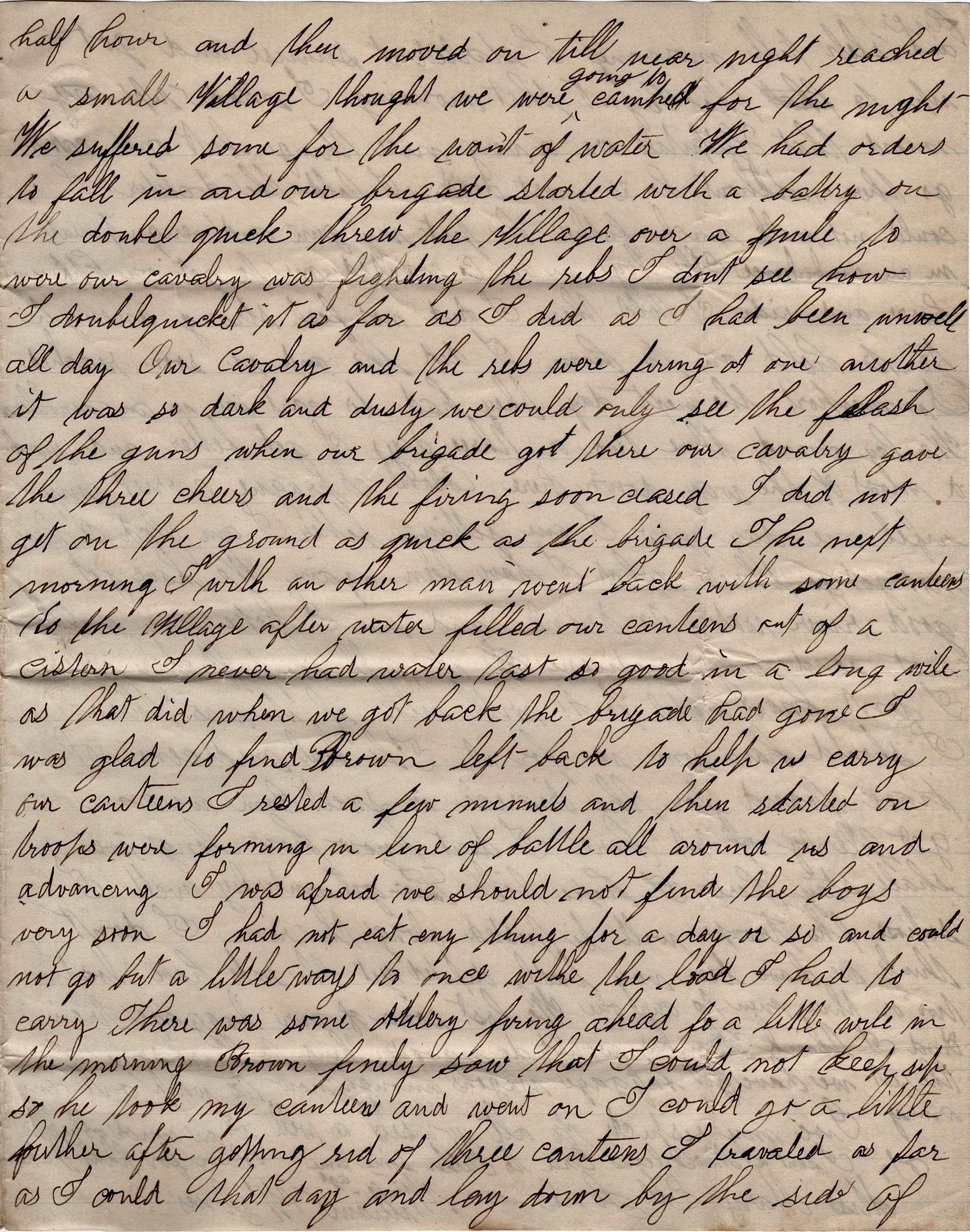
We stayed at Pineville outside Alexandria some 18 days before we left on the Alexandria side of the river. The ground was level while across the river is hilly and we got good spring water. We left Alexandria the 11th. Our Division had the advance. We lay still the 12th three or four miles below Alexandria. Started down the river the 13th. We got where the rebs had the river blockaded in two days march and camped for the night. The next morning we marched through woods, crossed a small bayou, and came out on an open prairie. In the afternoon, formed in line of battle and rested some half hour and then moved on till near night. Reached a small village [where we] thought we were going to camp for the night. We suffered some for the want of water. We had orders to fall in and our brigade started with a battery on the double quick through the village over a mile to where our cavalry was fighting the rebs. I don’t see how I double quicked it as far as I did as I had been unwell all day. Our cavalry and the rebs were firing at one another. It was so dark and dusty we could only see the flash of the guns. When our brigade got there, our cavalry gave the three cheers and firing soon closed. I did not get on the ground as quick as the brigade.
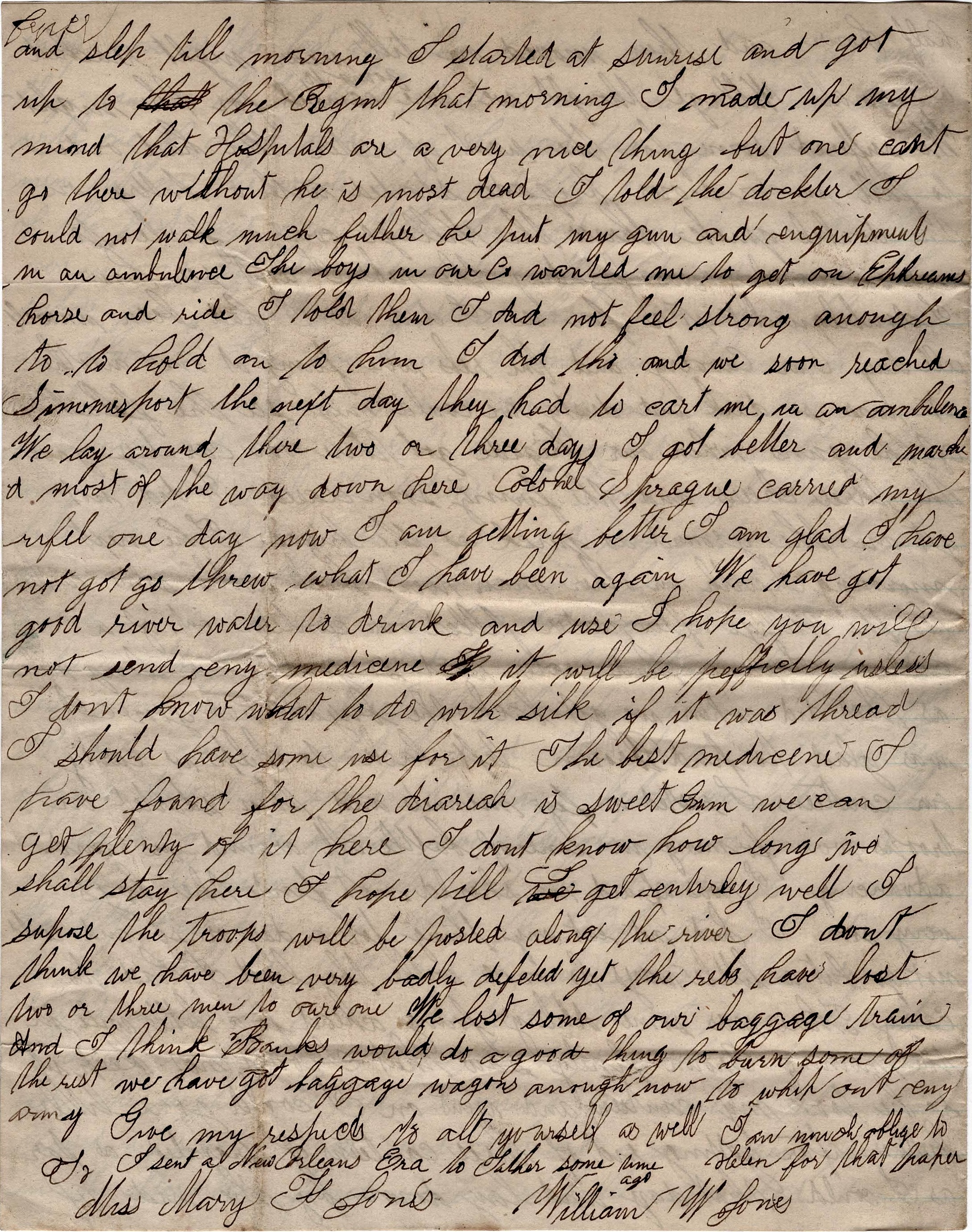
The next morning I with another man went back with some canteens to the village after water [and] filled our canteens out of a cistern. I never had water taste so good in a long while as that did. When we got back, the brigade had gone. I was glad to find [John W.] Brown left back to help us carry our canteens. I rested a few minutes and then started on. Troops were forming in line of battle all around us and advancing. I was afraid we should not find the boys very soon. I had not eat anything for a day or so and could not go but a little ways at once with the load I had to carry. There was some artillery firing ahead for a little while in the morning. Brown finally saw that I could not keep up so he took my canteen and went on. I could go a little further after getting rid of three canteens. I traveled as far as I could that day and lay down by the side of a fence and slept till morning. I started at sunrise and got up to the regiment that morning. I made up my mind that hospitals are a very nice thing but one can’t go there without he is most dead. I told the doctor I could not walk much further. He put my gun and equipment in an ambulance. The boys in our company wanted me to go on Ephraim’s horse and ride. I told them I did not feel strong enough to hold on to him. I did though and we soon reached Simmerport [Simsport].
The next day they had to cart me in an ambulance. We lay around there two or three days. I got better and marched most of the way down here. Colonel Sprague carried my rifle one day. Now I am getting better. I am glad I have not got to go through what I have been again. We have got good river water to drink and use. I hope you will not send any medicine. It will be perfectly useless. I don’t know what to do with silk if it was thread. I should have some use for it. The best medicine I have found for the diarrhea is sweet gum. We can get plenty of it here. I don’t know how long we shall stay here. I hope till I get entirely well. I suppose the troops will be posted along the river. I don’t think we have been very badly defeated yet. The rebs have lost two or three men to our one. We lost some of our baggage train and I think Banks would do a good thing to burn some of the rest. We have got baggage wagons enough now to whip out any army.
Give my respects to all—yourself as well. I am much obliged to Helen for that paper. — William W. Jones
To Miss Mary F. Jones






 Spared & Shared 23