
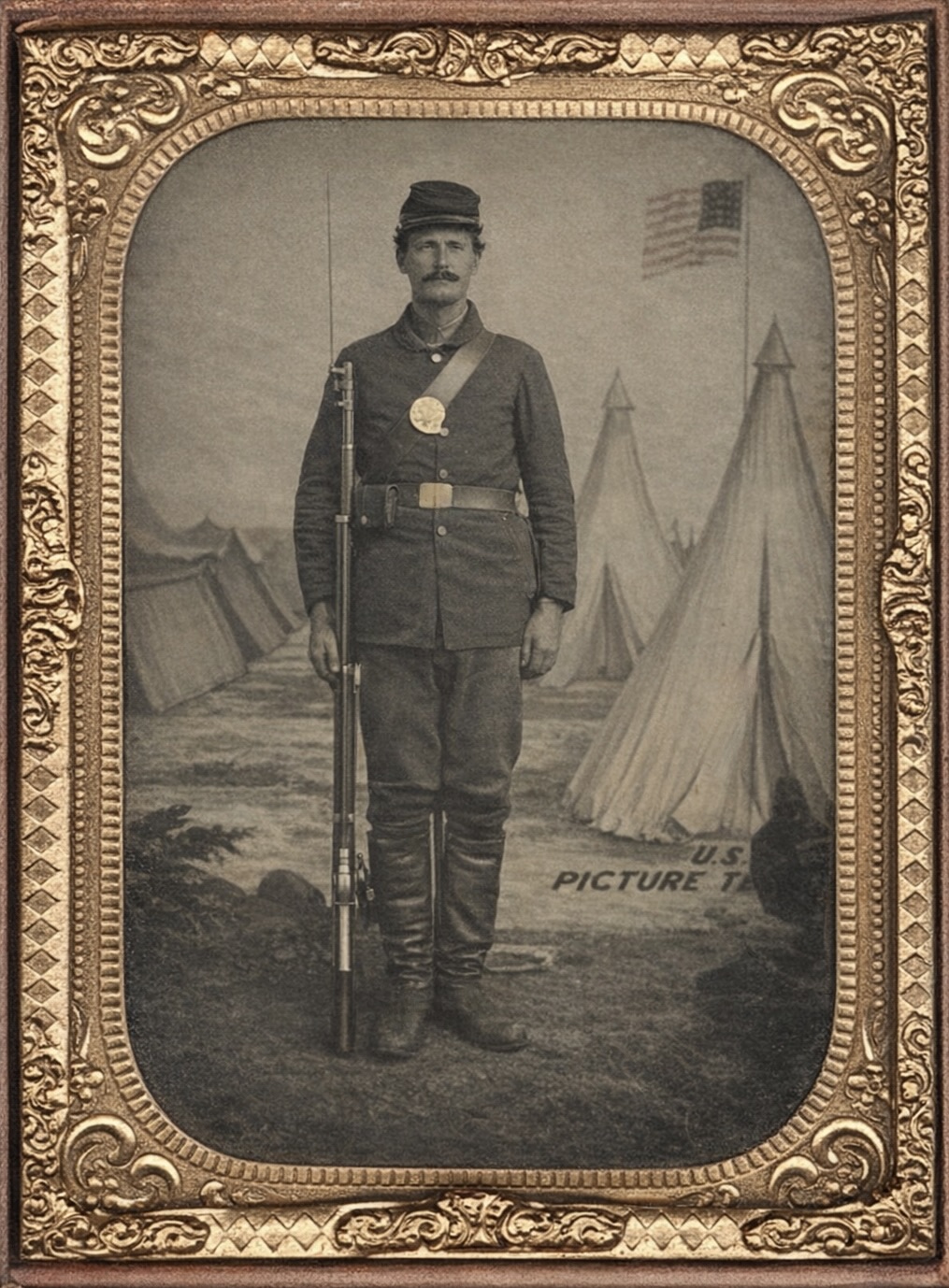
The following letters were written by Henry Randall Dunham (1838-1877), the son of John Levi Dunham (1811-1861) and Laura Melvina Cheney (1812-1894) of LaPorte, Sullivan county, Pennsylvania. Henry was “a rising young lawyer” when he enlisted in Co. K, 141st Pennsylvania Infantry and was promoted soon after to 1st Lieutenant for his efforts in raising the company. However, ill health resulted in his resigning his commission after 4 months service in late December 1862 and returning home to LaPorte. In January 1865, Henry returned to the service in late December 1864, receiving a commission by order of the President, as 2nd Lieutenant of Co. F of the Thirteenth Regiment, United States Colored Troops. Though he was only a 2nd Lieutenant, his muster rolls indicate that he drew pay for commanding Co. H from 15 February to 15 June 1865. After hostilities ended, he was assigned duty as the Acting Commissary of Subsistence at Fort Macon, North Carolina, and was mustered in as 1st Lieutenant of Co. E in late July 1865. He mustered out of the service on 10 December 1865 at Roanoke Island, returned home, and was for a time in the employ of Welles, Ackley & Company, a mercantile establishment in Dushore, Sullivan county, Pennsylvania. He afterward went to Kansas, returned to his home in Laporte where he died September 5, 1877, at the age of thirty-nine years.
Henry’s brother, Benjamin M. Dunham (1840-1863), served with him in the 141st Pennsylvania but was killed at the battle of Chancellorsville on May 3, 1863.
[Note: These letters are from the personal collection of Keith Fleckner and were offered for transcription and publication on Spared & Shared by express consent.]
Letter 1
In Camp Near Goldsboro, N. C.
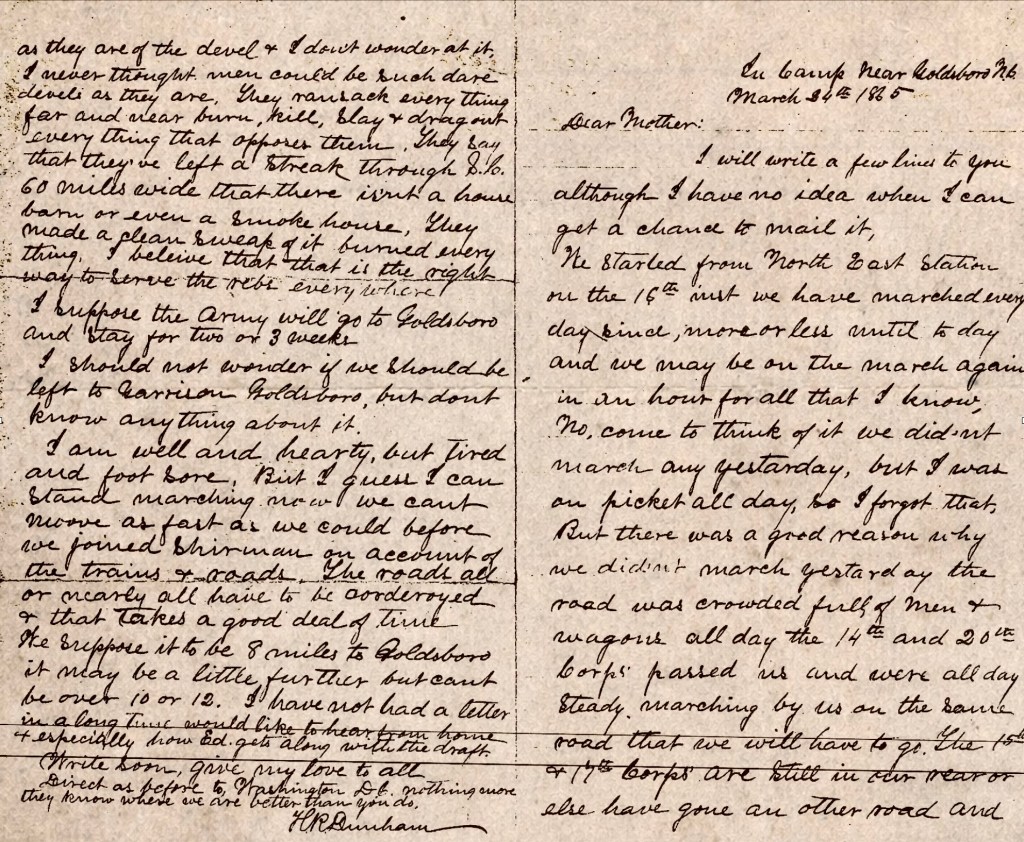
March 24th 1865
Dear Mother,
I will write a few lines to you although I have no idea when I can get a chance to mail it.
We started from North East Station on the 16th inst. We have marched every day since—more or less—until today, and we may be on the march again in an hour for all that I know. No, come to think of it, we didn’t march any yesterday, but I was on picket all day so I forgot that. But there was a good reason why we didn’t march yesterday—the road was crowded full of men and wagons all day. The 14th and 20th Corps passed us and were all day steady marching by us on the same road that we will have to go. The 15th and 17 Corps are still in our rear, or else have gone on another road and not far off.
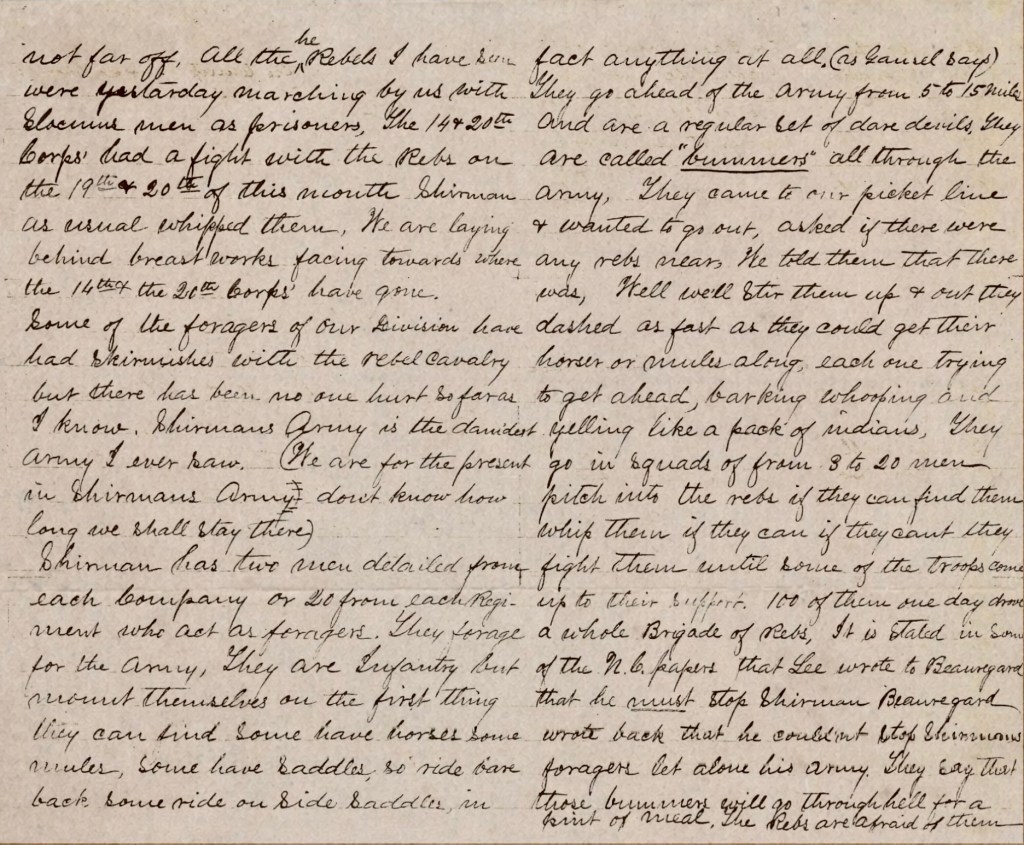
All the Rebels I have seen were yesterday marching by us with Slocum’s men as prisoners. The 14th and 20th Corps had a fight with the Rebs on the 19th and 20th of this month. Sherman as usual whipped them. We are [now] laying behind breast works facing towards where the 14th and the 20th Corps have gone. Some of the foragers of our division have had skirmishes with the rebel cavalry but there has been no one hurt so far as I know.
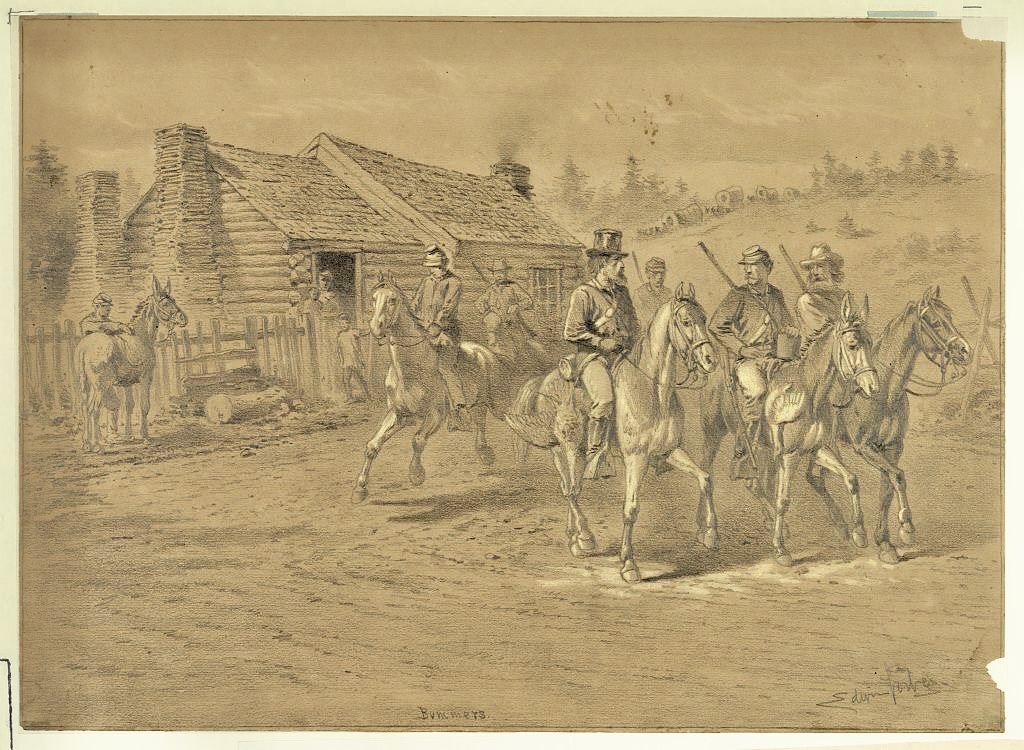
Sherman’s Army is the damnedest army I ever saw. (We are for the present in Sherman’s Army—don’t know how long we shall stay there). Sherman has two men detailed from each company or 20 from each regiment who act as foragers. They forage for the army. They are infantry but mount themselves on the first thing they can find. Some have horses, some mules, some have saddles, so[me] ride bare back, some ride on side saddles—in fact, anything at all (as Gaurel [?] says). They go ahead of the army from 5 to 15 miles and are a regular set of dare devils. They are called “bummers” all through the army. They came to our picket line and wanted to go out. [When they] asked if there were any rebs near, we told them that there was. “Well, we’ll stir them up and out!” [Then] they dashed as fast as they could get their horses or mules along, each one trying to get ahead, barking, whooping, and yelling like a pack of Indians. They go in squads of from 3 to 20 men, pitch into the rebs if they can find them, [and] whip them if they can. If they can’t, they fight them until some of the troops come up to their support. One hundred of them one day drove a whole brigade of rebs.
It is stated in some of the N.C. papers that Lee wrote to Beauregard that he must stop Sherman. Beauregard wrote back that he couldn’t stop Sherman’s foragers, let alone his army. They say that those bummers will go through hell for a pint of meal. The rebs are afraid of them as they are of the devil and I don’t wonder at it. I never thought men could be such dare devils as they are. They ransack everything far and near, burn, kill, slay, and drag out everything that opposes them. They say that they’ve left a streak through S. C. 60 miles wide—that there isn’t a house, barn, or even a smoke house [left standing]. They made a clean sweep of it—burned everything. I believe that that is the right way to serve the rebs everywhere.
I suppose the army will go to Goldsboro and stay for two or 3 weeks. I should not wonder if we should be left to garrison Goldsboro, but don’t know anything about it.
I am well and hearty, but tired and foot sore. But I guess I can stand marching now. We can’t move as fast as we could before we joined Sherman on account of the trains and roads. The roads all or nearly all have to be corduroyed and that takes a good deal of time. We suppose it to be 8 miles to Goldsboro. It may be a little further but can’t be over 10 or 12. I have not had a letter in a long time. Would like to hear from home and especially how Ed gets along with the draft. Write soon, give my love to all.
Direct as before to Washington D. C. Nothing more. They know where we are better than you do. — H. R. Dunham
Letter 2
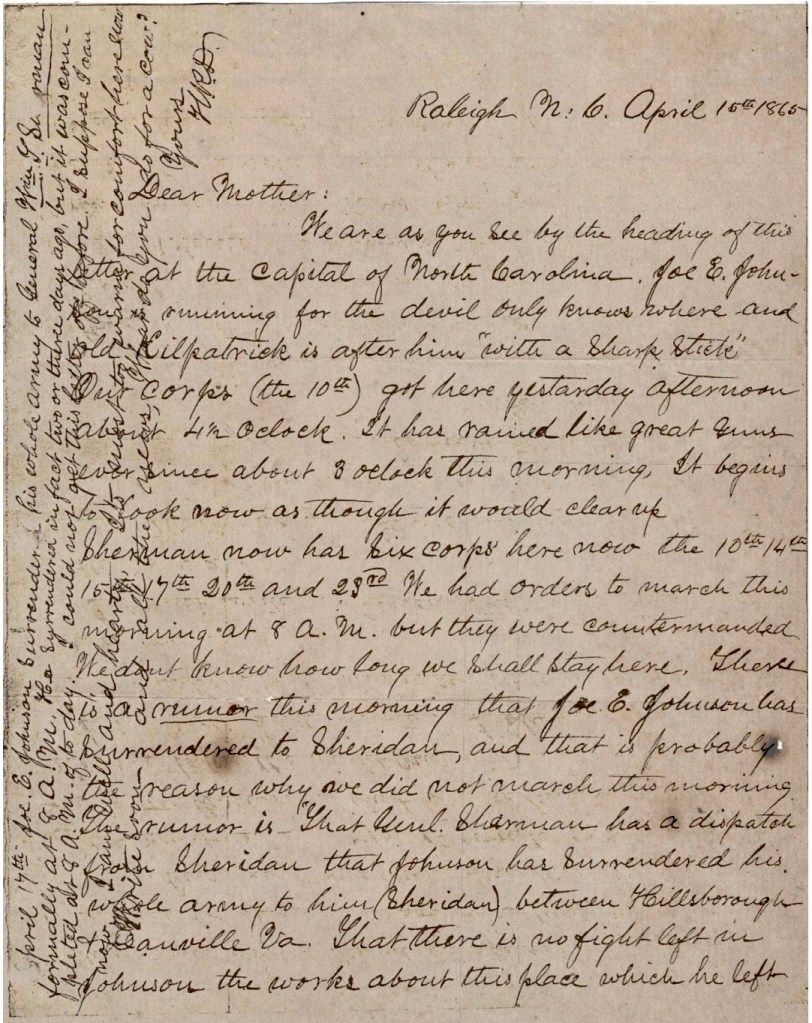
Raleigh, N.C.
April 15th 1865
Dear Mother:
We are as you see by the heading of this letter at the Capital of North Carolina. Joe E. Johnston is running for the devil only knows where and old Kilpatrick is after him “with a sharp stick.” Our Corps (the 10th) 1 got here yesterday afternoon about 4.30 o’clock. It has rained like great guns ever since about 3 o’clock this morning. It begins to look now as though it would clear up.
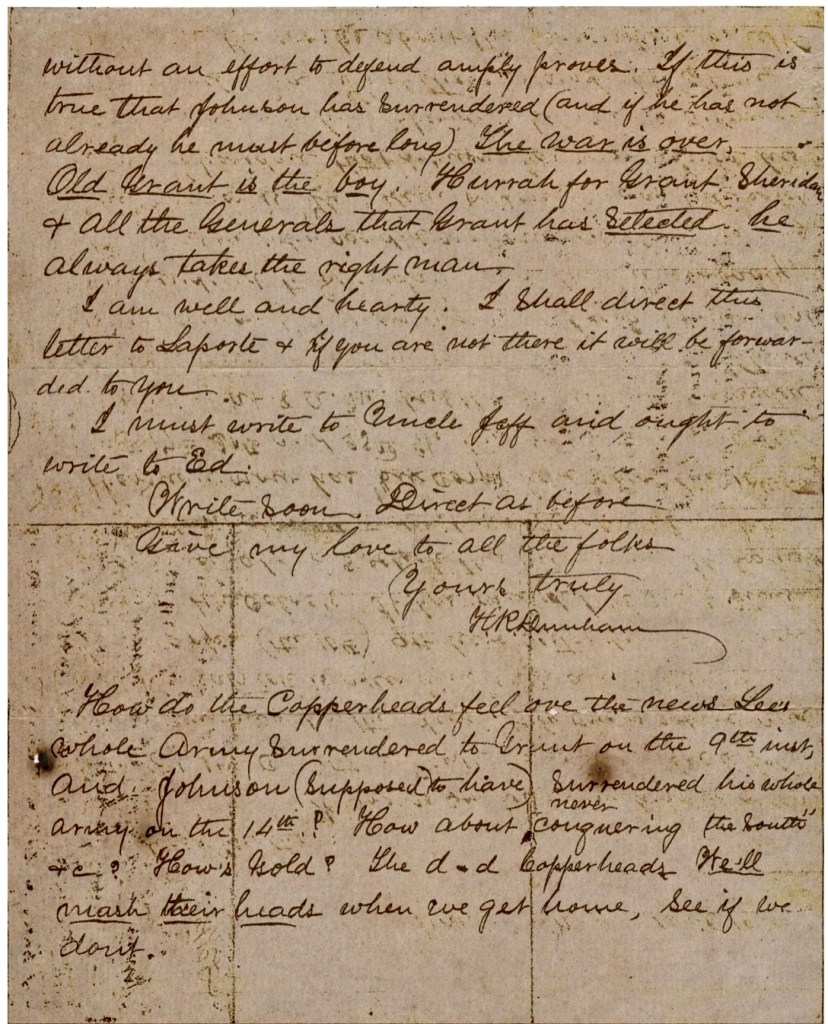
Sherman has six corps here now—the 10th, 14th, 15th, 17th, 20th, and 23rd. We had orders to march this morning at 8 a.m. but they were countermanded. We don’t know how long we shall stay here. There is a rumor this morning that Joe E. Johnston has surrendered to Sheridan, and that is probable the reason why we did not march this morning. The rumor is, “That General Sherman has a dispatch from Sheridan that Johnston has surrendered his whole army to him (Sheridan) between Hillsborough and Danville, Va. That there is no fight left in Johnston.” The works about this place which he left without an effort to defend amply proves. If this is true—that Johnston has surrendered (and if he has not already, he must before long)—the war is over. Old Grant is the boy. Hurrah for Grant, Sheridan, and all the generals that Grant has selected. He always takes the right man.
I am well and hearty. I shall direct this letter to Laporte and if you are not there, it will be forwarded to you. I must write to Uncle Jeff and ought to write to Ed. Write soon. Direct as before. Give my love to all the folks. Yours truly — H. R. Dunham
How do the Copperheads feel over the news [that] Lee’s whole army surrendered to Grant on the 9th inst., and Johnston (supposed to have) surrendered his whole army on the 14th? How about “never conquering the South” &c.? How’s Gold? The damned Copperheads—we’ll mash their heads when we get home. See if we don’t.
April 17th. Joe E. Johnston surrendered his whole army to General Wm. T. Sherman formally at 8 a.m. He surrendered in fact two or three days ago, but it was completed at 8 a.m. of today. I could not get this letter off before. I suppose I can now. I am well and hearty. It’s most too warm for comfort here now. Write soon and all the news. What do you do for a cow? Yours, — H. R. D.
1 The 30th USCT was part of the 25th Corps until March 1865 when it was reassigned to the 1st Brigade, 3rd Division, 10th Corps, Department of North Carolina. It remained a part of the Department of North Carolina until December 1865 when it was mustered out of service.




 Spared & Shared 23