The following letter was written by Rezin Shawhan DeBolt (1843-1927), and his older brother, Silas Debolt (1841-1924), when they served in the 49th Ohio Volunteer Infantry (OVI) during the American Civil War. They were the sons of Silas DeBolt, Sr. (1807-1895) and Betsy Parkison (1812-1893) of Tymochtee, Wyandot county, Ohio. Their older brother, George Rider DeBolt (1833-1864) also served in the same regiment as a member of Co. K with Silas. Rezen was a principal musician in Co. D, later, F&S. George died a POW at Danville Prison in Virginia in April 1864. The boys enlisted in August 1861. Silas mustered out in September 1864 after being wounded in the Battle of Picketts Mills. He had previously been a POW when captured in the Battle of Stones River. Rezin was also present in the Battle of Picketts Mills where he received an injury to the head from the concussion of an exploding shell. Although he was in hospitals in Kingston, Georgia, and Louisville, Kentucky, the injury was not adequately treated at the time, and it affected him the rest of his life, eventually resulting in the loss of sight in his right eye. His struggle with “chronic sore eyes” was recognized in affidavits by friends in his records with the federal pension office. His discharge took place at Victoria, Texas, on Nov. 30, 1865. He went home to Wyandott County, which was his legal residence until 1871. He began to teach school from 1871 to 1875 in Benton County, Mo., where he married her in 1874.
An obituary notice for Rezin appearing in the Anderson (Indiana) Herald claimed that Rezin was a “veteran bugler of 28 major conflicts in the Civil War…His record of military service included participation in the battles of Shiloh, Lookout Mountain, Chickamauga, Pickett’s Mill and Nashville. At the battle of Missionary Ridge, the intrepid bugler broke the code of military ethics by sounding “charge” against the orders of his commander and brought about victory instead of defeat.” Rezin won a citation for this action and the bugle is now a treasured relic in the Archaeological building at Ohio State University.
T R A N S C R I P T I O N
Camp on the Mississippi Valley 6 Miles from Corinth May the 26th 1862
Dear Mother,
I again [have] the opportunity of addressing you a few lines in answer to your very kind and welcome letter which I received last evening of the 13th inst. and to tell you that we are all enjoying very good health, hoping that the reception of this will find all of my folks in the same state of health.
Debolt’s sketch of Union forces surrounding Beauregard in Corinth, MS, in late May 1862
We have not had that awful battle yet which we are expecting every day to commence. It will either be a very great battle, or [ ], surrender, before long because Gen. Halleck has got Beauregard nearly surrounded. Just as soon as Gen. Butler gets in their rear the circle is around them as follows. When Butler comes round with his extreme left (the left is where the dot is on the mark), that will close the circle.
The pickets has been fighting every day for nearly two weeks until the day before yesterday. There is a rumor in camp—I do not know if it is true or not. It is as follows. Beauregard sent a flag-of-truce to Gen. Halleck. On the flag was these words, “A Special Dispatch to Gen. Halleck from Gen. Beauregard,” and Gen. Halleck answered it in 24 hours. We do not know what it meant but the firing on pickets has ceased. We do not know if he did send it or not but we have had more privilege in camp since that day than before.
Gen. Halleck and papers say that if they are left alone, they will take Corinth and most all of Beauregard’s forces prisoner without losing hardly any man.
Dear Mother, I received a very kind letter [from] Mary a few days ago. She said that she wanted me to write to her and inform her how you are getting along because she cannot get any letters from home anymore. She said that she did not know the reason of it. She has not heard from any of you for a longtime. She thinks that our folks can save their paper if they do not want to write to her. I think so too. She told all of us that William Baird told the Dr. that George turned her out of his house when she was up to Mexico [Ohio] and the Dr. takes delights in telling her of it and he tells it before strangers—those that wil spread it abroad. If that little puppy did tell it, he had not better come home for if he does, he will get three maulings and good ones too. That is enough of that for it makes me mad to think of it.
When you write to us, please tell us all about how the people and horses and panter [?] are getting along. Oh yes, I most forgot. Please tell Mr. Beckly to write to us. Rezen wrote two letters to him and he has not received any answer from them yet. And tell Mart to write to us for we would be very happy to hear from him. Tell him that E. is well. Send our respects to Mr. Dutcher also. Please tell him to send a hearty laugh in your letter. We would be happy to hear from him also.
Direct your letters to S. or R. Debolt, Co. [K], 49th Ohio Volunteers, USA, 6th Brigade and 2nd Division, Gen. McCook commanding, in care of Col. W. H. Gibson.
From your sons, Silas Debolt and Rezin S. Debolt. R. wrote this letter.
Oh yes. Most forgot to thank you for those stamps you sent us for they are very scarce here. Goodbye for this time. Please write soon and often and please excuse the bad writing and correct mistakes. — S.D., R. D., G. D.
The following letters were written by John T. Burke (1837-1863), the eldest son of Thomas Burke (1799-1879) and Mary Burke (1806-1877) of Irondequoit, Monroe county, New York. Muster rolls inform us that Sgt. John T. Burke enlisted on 10/15/1861 at Smithland, Kentucky. On 1/6/1862, he mustered into Co. K, 20th Kentucky Infantry. He was killed January 3rd, 1863 at the Battle of Stones River, Tennessee, and is buried at Stones River National Cemetery.
The 1860 US Census identifies John T. Burke’s occupation as a “Nurseryman.” His earliest letter is written from Commerce, Missouri, in December 1860, where he is working as a teacher. A later letter of 25 June is written from Blandville, Kentucky, and here John indicates that he is going to go into partnership with another in a “nursery and orchard business.” He further described the wild landscape of Kentucky stating that “I am going away from here. The country is so wild I cannot go from one house to another without getting lost….”
Returning to Commerce, John enlisted with a Battalion of Home Guards in the early months of the war, only to resign because “I thought it was better to give up my office than to have to act with men that I was ashamed of their deeds even though they were for the Union.” Backtracking once again, John headed to Kentucky and enlisted in the 20th Regiment Kentucky Volunteers. The new regiment suited John, and he describes much related to the general life of the regiment and the soldier, and the politics of regimental officers. One of his more notable letters was written from “3 miles east from Corinth in the woods, May 19th 1862.” In it, John described skirmishing and ultimately taking possession of Corinth, noting the plunder they recovered after the hasty Confederate retreat.
John’s younger siblings were George S. Burke (ca 1839-1931) and James Burke (ca 1843-?) also served in the war. George Burke enlisted as a private on 8/5/1863. On 8/5/1863, he mustered into New York 14th Heavy Artillery. He transferred out on 10/10/1863 and on 10/10/1863, he transferred into “C” Co. New York 1st Vet Cavalry. He was Mustered Out on 7/20/1865 at Camp Piatt, WV, after receiving promotions to Sergt 11/1/1863 and 1st Sergt 3/1/1865. James Burke was 21 years old when he enlisted as a private on 8/12/1863 at Rochester, NY. On 10/10/1863, he mustered into “C” Co. New York 1st Vet Cavalry. He was Mustered Out on 7/20/1865 at Camp Piatt, WV after receiving promotions to Corpl 7/1/1864 and Sergt 9/1/1864.
Letter 1
Commerce, [south of Cape Girardeau, Missouri, on Mississippi River] December 4 [1860]
My dear Parents, Brothers & Sisters,
Your letters of the 12th and 21st came to me together about an hour ago (it is now 8 o’clock at night). I have been back in the country or likely I would get them sooner. I have been waiting to hear from you or I would write before now. You may be sure that I do not forget you. Although among strangers, I often dream of home and sometimes lay awake quite a while before I find out that I am a thousand miles away from it. I have got so used to making myself at home everywhere, and taking things easy, that I have to stop and think before I can make myself believe that I am in Missouri on the banks of the mighty Mississippi instead of on the Little Genesee.
Tell Bernard that I think I can learn a good deal about geography and make it interesting if he will read all he can about the States, rivers and towns that I mention in my letters and the rest of my brothers and sisters if they like. For instance, in coming here, I passed through Buffalo, along the south shore of Lake Erie to Cleveland in Ohio, thence to Indianapolis—the capitol of Indiana, thence to Terre Haute, then on to St. Louis and down the Mississippi. Let [him] find out on the map and in the georgraphy [book] how long the lakes and rivers are, how large the cities, and how the States are bounded. This will be all useful to them in after life. I wish they would all pick up what information they can these long winter evenings and not spend them in popping corn and idle talk. Get their chores done up early and let me see they can do something for themselves without my watching and driving them.
I expect to see some of them able to write me a letter before spring if they try hard this winter. Even if they do not do as well the first time as others have done, after a hundred trials, they need not be discouraged nor ashamed. I think t’will be able to read it and will not show it to anyone else. I have often told them in substance before what I have now written and I think it took very little effect. But constant dropping will wear a stone, so I’ll not despair of having a brother to succeed Lincoln yet, or a sister not prepared to move in any responsible society—even in the White House. Let them remember that the President elect was a flat boatman, a rail splitter, and brought up in the woods. Now he is the people’s candidate for the highest office in the world. Hard study has done it all.
But I must leave lectures and Presidents to tell that I am getting tougher, stronger, and healthier every day. When I got here, I was hardly able to ride a horse six miles. Now I could kill a mule or walk seventeen miles as I did yesterday and not tire. I had a few hard shakes [of the ague] last month, but I shook them off.
We had what you would call fine weather for November. The ground froze about three inches on the 24th. We had snow the 23rd, 24th and part of Sunday, the 25th. Last week was fine until Sunday when we got a little more snow and frost that went away yesterday. Today was clear and cold and bracing, healthy weather. I am beside a comfortable fire in a fore place at Reynold’s Hotel in Commerce. I am nearly through with the trees. Had very little trouble with them although these folks are rather slow. I have hardly made up my mind yet as to what I will do this winter. I will write again in about ten days and let you know.
Have patience till then and do not tire the postmaster. I wish I could send this letter by telegraph but I cannot so bidding you all a good night, I remain your affectionate son and brother, — John
As quick as the Banks out here stop breaking, I will send Jim his money. In the meantime, I will talk to Bob Toates, — J. T. B.
I got the papers. Glad you sent them.
Letter 2
Commerce, Missouri April 15, 1861
Dear Parents,
I have been anxiously waiting for a letter ever since March. I received that book you sent me and expected a letter but got none. I knew that you were to move the first of April and I thought you would tell me where to [direct].
I am afraid you have no good news or you would sent it. Let me know the worst. Tell me how you are all getting along. How and where is George and Sis? I receive my paper regularly. The mail boat brings it every Tuesday. If I get a letter from you tomorrow, I’ll answer it immediately and send you all the news I can pick up.
My health is first rate. This country and school teaching agree first rate. This is the finest Spring I ever saw. My school will be out in two weeks. Can I do anything at home to earn my salt? If not, I think I had better stay here until fall. I have better wages and easier work than ever I had at home. Summer has almost commenced. The woods are full of flowers and covered with green.
We are thinking about planting corn this week.
Give my love to all. Where is Jimmy Peacock? Who is selling for George this year? I will write you a longer letter in a few days. Your affectionate son and brother, — John
Letter 3
Blandeville, Kentucky June 25, [1861]
My dear Parents and Brothers & Sisters,
I would write oftener but the mail comes here only once a week. I am in good health and high spirits. This is the finest climate I ever was in. The summers are longer than our; not much warmer. There is hardly any frost in winter, finest kind of a fruit country. Very early apples are ripe, blackberries also ripe. The principal forest trees are hickory, oak, ash, cypress, poplar, and butternut. The soil is light colored, very fine and rich. We use rain water to drink. Well water is impregnated with mineral. A good farmer and I think a nice that has a darn nice daughter offered to take me in as partner in the nursery and orchard business.
People are 50 years behind the times here. They raise hardly anything but corn, tobacco, and wheat. Have nothing to eat but bacon, hot biscuit, hoe cake, molasses, and string beans. No butter nor beef. Horses and mules are small. Cows and hogs look like deers. There are plenty of quails, turkeys, squirrels, ducks and fish, and some deers. Landis worth from twenty to thirty dollars an acre improved, five to twelve timbered. There is a farm of seventy acres here—twenty-five improved and a log house on it for 15 dollars an acre, 2 miles from the Mississippi and 8 from Cairo, Illinois. No barns in this country. I am going away from here. The country is so wild I cannot go from one house to another without getting lost.
Give my respects to all enquiring friends. Your affectionate son, — J. T. Burke
Letter 4
Commerce, Missouri July 16 [1861]
Dear Parents,
You spoke in your last about sending me money. I’ll tell you what you can do if youy wish to be patriotic and help your country, and make me a nice kind of a present. Send me a large revolver and some Minié ball cartridges by express via Cairo. If it should be stopped as contraband at Cairo, I can easily go down to Gen. Prentiss and get it. I cannot buy one here at any price. You may sell that cow if she will buy one. My health is first rate. Yours affectionately, — J. T. Burke
Commerce, Missouri
By Express via Cairo. Charges paid in advance.
Letter 5
Addressed to Thomas Burke, Esq., Rochester, New York
Paducah, Kentucky October 18, 1861
Dear Parents,
I have neglected writing to you longer than I ought to have done. But you must always take it for granted that I am safe unless you have positive information to the contrary. My health is first rate. I could not get along with the Major commanding the Battalion of Home Guards that I was in and I resigned. I thought it was better to give up my office than to have to act with men that I was ashamed of their deeds even though they were for the Union.
I came in here from Cape Girardeau and joined a Kentucky Regiment just organizing. The boys are the most respectable set of soldiers I have yet seen. Nearly every one [are] farmers. I have a good prospect of fighting my way up again. When we elect our officers, I expect to be Captain or Lieutenant of the Kentucky boys. I will go home some time this winter and tell you all about the wars. I have been in several skirmishes but no big battles yet. Have not received a scratch yet. Both parties seem a little scared of each other and confine themselves to skirmishing between outposts and scouting parties.
We have 8,000 troops in this camp, well fortified. Tell George not to enlist at present. When I get settled here, I will send for him if there is any prospect for a fight. But he would soon get tired of lying in camp doing nothing and losing his health. If he wants to try camp life, let him take a blanket and sleep out doors with wet feet a few nights. He had better come on and join the army.
Give my respects to all enquiring friends. Your affectionate don, — John
J. T. Burke, Paducah, Kentucky
Letter 6
Paducah, Kentucky December 13, 1861
Dear Parents, Brothers & Sisters,
I still live! I suppose you will be glad to hear it or rather to see it. I have nothing much to say—only just I thought I would rather send you a letter so that you would not bother the Post Master too much for nothing. I changed my boarding house today. I am boarding with a family. Have only one daughter about as big as Sis. She got on her tip toes today, brushed my coat off and made herself very useful. I have no doubt she will help to make me quite comfortable this cold winter. She is now sitting by my side sewing away as fast as she can, full of fun and mischief. You must not tell Winnie about it. You know it would make the poor girl feel so bad after having the measles.
We have lots of measles in the company. Tell me where George is if you know. Tell Annie to be a good girl, mind her book, go to school/ Tell Sis to keep her beaus on hand until the war is over, then marry a soldier is she can get one.
Make Jim and Barnard mind their books, feed the calves, and be good boys. Give my respects to all inquiring friends. My love to yourselves. — John
How would you like my likeness in a uniform to hang up? — J. T. B.
Letter 7
[partial letter, undated]
I must quit telling my adventures until we are all seated around the fire after the war. It brought the tears in spite of me when I read your letter saying that George was gone. I would have sent for him sooner but I wanted to get well settled myself first. I was boasting to some of the boys today that I was going to send for my brother but his haste has disappointed me and all my fond dreams have vanished in thin air. He is gone alone. He will get along very well if he can only make warm, true friends. I came here almost a perfect stranger. Now I have friends that will stand by me till death parts us. If he can only do that, he will be all right. He has the easiest and most comfortable place in the army, and the least exposed to wet and cold which kills more than the enemy. They never have to work except in battle and that comes very seldom. Then we all want to labor and do deeds of daring.
I might have been Lieutenant in an artillery company but there is not enough liberty to run over the country and see the folks in it to suit me. I am kept pretty busy drilling the company, straightening up their business and scouting all the time, but I will make it pay before long.
My health is first rate. I weigh 170 pounds and still gaining. I am afraid that the pilot bread we sometimes have to eat on the march would go rather hard on father’s gums and lying out one or two nights soon set him shaking with ague. I think on the whole Uncle Sam had better take the will for the deed. If the war lasts until warm weather, I would like to have him try it a month or so to see how he would like it and to brag a little out of the old stock.
If you pass your time as anxiously as I think you do, I believe there would be a better chance for father to live ten years in the army than out of it. Fretting will wear you out sooner than the war. Give my respects to all inquiring friends. I am going home to have a sleigh ride with some of the girls this winter if we are not kept too busy. Why do not Sis and Jim and Bernard write to me? I know little Annie would if she could. Send me a paper. Your affectionate son, — John
Letter 8
Camp Buell, Smithland, Kentucky January 3rd 1861 [1862]
Dear Parents,
I received yours of the 23rd December today. I was very glad to get it. I began to think there was something wrong about my letters; it was the first I received since coming here.
I have had some ups and downs here. I came here in Capt. Waller’s Company [with] 126 men. It being more than the number allowed by law for one company, 42 men were taken from it, twelve from another, and 47 that came with Col. Bruce from Lexington to make one full company. To divide the officers, it was proposed and we agreed that the man receiving the highest number of votes should be Captain and the next highest 1st Lieutenant. All parties agreed to that in the morning. When we came together to vote in the afternoon, the Lexington men, thinking they had the largest party and that they could carry every office, proposed to ballot for all officers. We agreed to that. The voting commenced. They saw the 42 from Waller’s Company and 12 from the others going for me to a man. Knowing that would best them, they kicked up and claimed to have more men and so forth. The Colonel decided the election void until the decision of the military board at Frankfort. My certificate of election went up to the Colonel let each Captain keep his own men until the decision of the board. In the meantime, Col. Bruce, Lieutenant-Colonel Hanson, Major Buckner, and the 5 captains that came from Lexington worked against us. The decision came to hold another election [and] by that time my opponent had 61 men and all the judges on his side. We were beat, of course, and would not vote at all. I could have been 1st Lieutenant if I would only humble myself to ask it. But my temper was up. I told them my opinion of them in a few words. They expected that being Captain before and having better chances that I would not go in the ranks. But I stepped into the ranks. They tried to have me take the place of Sergeant but I will notr have it.
I am going to stay with them and give them more trouble than they bargained for. After the election there was an alarm in camp. The troops turned out. The boys would not go under anyone but me. Since that time, we have our own kitchen, draw our own provisions, take one end of the company [and] do nearly as we want to. We have some friends working for us. We have some hopes of getting out of the scrape yet. The officers of our company are not very smart and I have hopes of crowding them out before the war is over. We have determined to do our duty as Union soldiers but we are going to give our officers their pay for swindling us. Our Captain cannot drill well and hired a drill master. The boys call me Captain and have not done a thing until told to by me. They call the Captain “Mac.”
Our clothing is a very dark blue. The Lexington a grayish blue. We call them graybacks. Whenever one of them comes near our tents, we make him march double quick home. They are getting sick of their trade and talk of making me 1st Lieutenant but I think I can do better after a while. I have a fine time at present [as] a private in the ranks. Receive all the respect from the men that they used to give me when I was their captain. They do everything I tell them to—wait on me and day they will stand my turn at guard or anything else.
I got a letter from George a few days ago. I am going to answer it tomorrow. Does George weight 175 or 115 pounds? I am glad that George is satisfied with his place. A great many of the soldiers wish themselves home again. I am too busy watching my Captain now to think much of sleigh riding or the girls. Capt. Waller talked of claiming me back. I sent word to him that if he got me back, I would take an old musket and drive him out of camp. He has not said anymore about it.
Our camp is the muddiest and most uncomfortable I ever saw. [It’s] on a side hill nearly as slippery as soap hill. I got my paper today—the second one I have received. The troops are not doing much. We have been expecting a movement so long that we do not pay any attention to it. Who is poor Bridget? Where is Winnie going to school? I am living in a tent. We dig a ditch in the tent, cover it with bricks, make a chimney outside and have a first rate fire. Makes the ground dry and warm. I will write again soon. How is the Irish Brigade filling ip? It will do some good fighting, but I would rather command the Hunters of Kentucky. Give my respects to all inquiring friends. I cannot get a likeness taken here. Direct to J. T. Burke
Letter 9
Camp Lytle near Bardstown, [Kentucky] February 3, 1862
Dear Parents,
It is nearly night. We just received orders to prepare to march in the morning. We were on drill. The boys cheered thinking they were going to Bowling Green to indulge in a soldier’s luxury—a fight. I so not know where we will go. I thought perhaps I would not have a chance to send to you in a week or two after his. I am in first rate health and spirits. I like a move noq better than anything could happen. Staying on one places tires me more than marching.
My love to Jim, Bernard, Sis, and Annie. In haste. Your affectionate son, — John
I got a letter from George and answered it.
Address J. R. Burke, 20th Regiment Kentucky Volunteers, Louisville, Kentucky
Letter 10
Camp on the side of a knob or mountain 400 feet high 12miles from Munfordsville and about 14 miles east of the Great Mammoth Cave of Kentucky on the Nashville & Louisville Turnpike in Greene County near Green River, February 22, 1862, waiting in a cotton house for the orders to march to Nashville or somewhere else, anxiously looking for the paymaster, sitting comfortably beside a sheet-iron stove, looking out once in a while to see the rain pour down in torrents.
Dear Parents, Brothers & Sisters,
It is not long since I wrote to you but I suppose a letter from the seat of war is never unwelcome from me. You get the principal news from Kentucky in the papers as soon as I do. We expected to have a hard time taking Bowling Green but that job is over. Nashville is our next place, I suppose. The 19th was the hardest day I ever marched. The morning drum aroused the weary camp at five, in a muddy valley surrounded by hills 300 feet high. T’was cold and rainy all day, swelling the mountain torrents so that streams across the road filled my boots to the top three times with cold water during the day. We marched 19 miles (that is, those who could keep up), [then] pitched our tents on the mud in the rain. I made a bedstead of staves laid crosswise on two rails and slept soundly on wet blankets. I thought it would lay me up but I am just as good as new now.
You must excuse me for writing on this old paper. It is the back of a map George sent me from Washington. Paper is scarce and it rains too hard to go to the sutler’s for any. We drink sassafras tea in our company half the time. The boys like it better than coffee. My love to all. Your son and brother, — John
Address to J. T. Burke, 20th Kentucky Regiment, Louisville, Kentucky.
Letter 11
Three miles east from Corinth in the woods May 19th 1862
My dear little brother,
I received your neat, well written letter of the 4th along with Mother’s. I wrote to Mother last night. I meant to write to you about noon but we were called out. I brought my paper. I have nothing to do but write with the paper on my cap, sitting under a tree.
Three companies of the regiment are 200 yards in front shooting at the secesh, and the secesh firing at them. We would go on but I think the rebels have cannons hid on the other side. We have cannons just behind us. I must jump at that. I have been looking for rain. There it is, but the noise is the thunder of cannon. The lightning is the flash and the rain ir iron. Shot and shell are whizzing in every direction. Three pieces of bursted shells are near me. Now our bog guns open. Their slacken fire. Our men are all lying or sitting. A lot of them near me seem to be trying to crawl under a log. Their noses make holes in the ground. Others are joking and laughing at the fun. There—a shell from our side has burst in a farm house they have been firing from. The rebels are scattering. The skirmish is over. It is dark. I must stop.
Morning, 20th May. It rained hard last night. I kept dry under a shed covered with bark. My rifle got damp. I just came in from firing it at a red-shirted rebel. He returned fire so we took two trees and we went to work shooting across a field. After firing 4 or 5 times each when one of us fired, the other step out to take a pop at him while loading. So I played a Yankee trick on “Old Red” as the boys call him. I took a musket that lay near by [and] shot at him. Thinking my gun was unloaded, he showed himself, cocking his piece. I fired, he dropped his rifle, shook defiance at me with his left hand, but his right hung harmlessly by his side and off he walked looking sulky as a mule.
We are now relieved by the 1st Kentucky.
In camp, May 21st 1862. I am almost alone. I did not feel right this morning and the regiment marched out leaving me asleep. I must write to George my next chance and then to Annie. I wrote to Mother three or four days ago. I would like to have you and Annie write to me again soon. I do not know whether this will be delayed or not. Letters from came are sometimes stopped at Pittsburg [Landing].
Tell me what you are doing, how the crops look, how old are you and Annie? Did you write those letters with your own hands? If you did, they are a credit to you. Excuse the mistakes. Shells cut the tree over my head while I wrote. My love to all. Your brother, — John
At daylight, news came that our men were inside the works and Corinth evacuated, the wild huzzas of the Union regiments in front soon confirming the rumor. It was the most pleasing information I ever heard. We soon “fell in” and “forward march” and we did march. I can easily keep up when rifles are pointed at every [ ] that shows himself, but yesterday morning I had to take the double quick several times. We went through several fields and down a narrow road, cut through the thick woods and dense undergrowth, crossed a small stream where we had fought all Wednesday, passed a few graves—that is, places where men are laid on the ground and a pile of dirt thrown over them in a hurry. A turn brought us in sight of the trees cut down, tops laid towards us and Beauregard’s earthworks deserted.
The cheers of the 22nd Brigade at sight of the place would make you put your fingers in your ears (I know Annie this will tire you but it will interest Father, Jim and Bernard). Pursuing the road about 500 yards through the fallen timber, we entered the first line of defense. This was halfway up ridge from the creek. 200 yards further, on top of the slope, we crossed another line or ditch. We were now within their camps. At first, everything seemed to be destroyed by fire and axes. The next camp the destruction was not as complete. Tents, camp stools, cots and scattering commissary stores were piled up, but our cavalry did not give them time to finish the work of burning. On the whole, they made a very good retreat.
The soldiers gathered a lot of molasses, sugar, flour, and black-eyed peas, some camp stools, skillets, and other plunder too numerous to mention. We returned to the old camps this morning loaded with booty. The boys are now baking biscuits out of the flour. It is a great treat to us after eating so much hard bread/ Tell me how to make loaf bread and to bake pork and beans. I captured an oven and want to use it to advantage.
Write to me often, Annie. Go to school regularly, study hard, be a good girl all the time and be assured that I will answer every letter. Do not get anyone to write for you. I would not take such letters out of the post office. I do not want any such bogus scrip. I remain your affectionate brother, — John
Charles C. Merrick was born in Munson, Massachusetts on September 11, 1825. He became a teacher and went south to teach. He became a successful builder and contractor in Memphis, Tennessee but had to leave his success behind upon the outbreak of the Civil War. He went to Chicago where the Fifty-First Illinois was being formed. He joined Captain George Wentz’s Company G. Although he joined as a private, at formal muster-in of the regiment, Merrick ranked as first sergeant of the company. In January and February 1862, while the regiment was in training at Camp Douglas, Merrick earned extra pay as a clerk in the camp hospital.
George Wentz, the captain of Company G, resigned in mid-1862 and the officers of the company each shuffled up one level of seniority to fill the cascading vacancies. Formally, Merrick’s resultant promotion to the second lieutenancy of the regiment was dated June 28, 1862. Merrick was promoted to captain of Company G (he was never first lieutenant) on December 18, 1862, but that date was later altered to officially begin his captaincy on October 28, 1862.
The Attack on the Picket Force, November 5 1862. In September of 1862, the Fifty-First and its brigade, along with a large Federal force, hurried to Nashville to keep it from falling back into Confederate hands. For two months, the Federal force expected to be attacked. On November, 5, 1862, Confederate forces attacked the Federal picket lines where the left wing of the regiment was on duty. Merrick was in charge of the picket force. The attack came at two o’clock in the morning. The regimental journal record that Companies F and G were pushed back and driven from their posts. Merrick rallied his men and brought them back to their post about daylight. The Confederate attack began again. The journal said, “The Rebels brought up artillery at the same time attacking again in several different places. Our forces were all out and the different forts had opened fire. We all supposed that the long promised attack had at last commenced but the enemy got no nearer to us than our picket line. We had seven wounded, some of them seriously. The enemy left several of their dead upon the field.” The Cincinnati Daily Commercial reported the events, timed a little bit differently according to their watch—conflated here, unpacked there—”About midnight the pickets were attacked on the Gallitin, Murfreesboro and Franklin Turnpikes, and skirmishing was continued at these points until daylight, the pickets at some places gradually falling back upon the reserves. At daylight the enemy opened upon us on the Murfreesboro Pike with artillery. Part of the 51st Illinois were on picket there, and the remainder of the regiment went to their support. A short but severe skirmish ensued, resulting in the repulse of the enemy, with a loss of several killed and wounded… The rebels were seen during the fight gathering up their dead and hauling them off in a common road wagon. The 51st had four slightly wounded, and three severely in their limbs. They also have two missing, viz: Samuel Wagstaff and Patrick Quigley” (November 12, 1862). [Wagstaff and Quigley were both soon quickly paroled, spent time at the parole camp in Columbus, Ohio while waiting prisoner exchange, and neither ever returned to active service with the regiment. Quigley was discharged for disability; Wagstaff deserted from parole camp. Michael Murphy of Company G later died of his wounds. He’s buried at the Nashville National Cemetery.] In a November 26, 1862 letter to the Illinois adjutant general Lieutenant Colonel Luther Bradley, then commanding the Fifty-First at Nashville, wrote, “Lieut. Merrick is entitled to the command of his company for the gallantry with which he repulsed an attack of 400 rebels on the picket post held by his company on the morning of the 5th inst—inflicting severe punishment on them, with a loss of but 3 wounded to himself.”
Falling Ill. But, as Merrick’s efficiency and courage worked for his success as an officer, physical illness worked against him. In February and March 1863, shortly after the Battle of Stone’s River, Merrick was troubled by some form of bowel hemorrhage—”not from hemorrhoids”, said his doctor; it was serious enough to “render him unfit for service in the field.” Surgeon Francis W. Lytle of the Fifty-First recommended Merrick’s discharge from the service, but Merrick refused “hoping he would recover.” But, it was not to be so. In August 1863, Lytle (by then with the 36th Illinois) reported that Merrick “still finds himself laboring under the same malady. My opinion is a longer continuance in the service will endanger his life.” Thomas Magee, regimental surgeon of the 51st Illinois, agreed, writing that Merrick was not even fit for the Invalid Corps because of his “broken down condition.” By letter of August 17, 1863, Merrick tendered his resignation. It was formally accepted on September 12, 1863. [Source: 51st Illinois]
[Note: These journals are from the collection of Nick Kaup and were offered for transcription and publication on Spared & Shared by express consent.]
1862
The Fifty-First Illinois Infantry formally began its existence, by order of the adjutant general of Illinois, on September 20, 1861. Already, in early October, the men of the regiment began to assemble at Camp Douglas in Chicago. The camp was still under construction. The months of October, November, December, and January were marked by continued efforts to fill out the regiment, to bring it to the required strength to constitute a regiment and move to one of the theaters of war. This activity suffered several setbacks. One of the original ten companies was a company of artillery gunners, a second was a company of cavalry troopers. The adjutant general’s office reassigned both of these companies, leaving the Fifty-First with only eight companies – not even that, for two of the companies that were at first part of the regiment dropped off, leaving the regiment’s field officers scrambling to fill up the regiment again – to the extent possible. There was ferment altogether at Camp Douglas. It was still under construction, though it had five thousand inhabitants, and those inhabitants were drilling and feeding and sleeping amidst the building materials. It was under construction by a special regiment of “Mechanics Fusiliers”, an engineers’ regiment, a regiment of sappers and miners. But that regiment was in mutiny, as the State of Illinois gave signs of sending them to the field rather than leaving them sapping and mining as they thought they’d been promised. [See: Documenting the 51st Illinois Infantry]
Wednesday, January 1, 1862—This is the first of a New Year & what a place for me yet. I shall bear patiently in hopes of getting a better position. Boys full of fun & expect their pay in a few days. Afternoon, two companies of us form in procession & visit the grave of S[tephen] A. Douglas. Eve, I sit up with one of our sick men (W. Payne) who is on the brink of the grave. To me no money at [ ] & my Mother without the necessaries of life. It has been anything but a pleasant day.
Thursday 2—This morning Wm. Payne, one of the best of our company, has gone the way of all the living. His father and mother were with him & did all that could be done but the [ ] had gone forth. The Boys club together and buy a very nice coffin and make arrangements for the funeral.
Friday 3—A heavy fall of snow with high wind. No drilling today. Some of our men jumped the fence in the evening which started the Officers out after them but did not catch them. A good many of the men drink. Where they get their whiskey is a mystery.
Saturday, January 4, 1862—All hands out early cleaning off the snow and getting ready for drill. Got a pass to go home & on my way get a letter from Bro. George containing $10—a very welcome present. Get home. Found the Relief Committee had left $4 which will make us comfortable with it. I have bought many necessary artiles & it has kept me busy till late getting things home.
Sunday 5—This morning was fair & mild. Sleigh sliding brisk. I have a hard day’s work fitting my uniform and with Mother’s assistance make it look much better. She is much pleased with her dress pattern & the articles I bought yesterday. Set in snowing about 4 p.m. and start for camp although my pass runs till 9 p.m. but do not wish to be late. Weather mild, wind NNE.
Monday 6—Snowing hard. Nothing done this morning. About noon, faired off somewhat & warm. Boys out shoveling snow. I was busy at the camp book writing and not out to drill in the afternoon. Evening turns cold & writing till late. After roll call and all in bunks so think I will follow suit & retire to rest.
Tuesday, January 7, 1862—Last night was the coldest of the winter and this morning is a stinger. Boys pretty well pinched off. Drill at 9 a.m. & Officer drill at 11. Always have a good time when the Adjutant drills us. Afternoon busy getting signatures to the pay rolls. Men to be paid off tomorrow which makes the Boys jubilant. Eve. writing. Cold out. Wind WSS.
Wednesday 8—This morning was wet, foggy, and disagreeable. The whole camp was shoving down inspection on Col. [Joseph H.] Tucker for ordering us down to commemorate the Battle of New Orleans but the weather was so bad that we were excused which was pleasing to 51st Regiment as we are to get our pay today. 4 o’clock p.m., our company are paid off. I received $17.20 which will do me much good. Eve, practice bayonet exercise.
Thursday 9—Last eve the chaplain held a prayer meeting in our barracks. About 200 present. This morning warm and foggy. In forenoon drill. I act as 1st Lieutenant and make one blunder. Noon, the barracks are crowded with peddlers and the boys money goes lively. Tis strange men will pay out their money so foolishly…
Friday, January 10, 1862—This morning is misty and disagreeable. At roll call 22 men absent without leave having jumped the fence. The women will get a good share of their money before they get back. Turns very cold before noon. Afternoon one of our men had an apoplectic fit and do not think he will [ ] of it. At Dress Parade only 40 men. Balance jumped the fence. Eve. I am all alone with what there is left of the company.
Saturday 11—Last night was the worst I have seen in camp. One of our men died, [Phillip] Muyer. Many drunk & fighting & I all alone…Today has been cold and I am about sick. Our men are all gone now but 27 and rather expect officers feel ashamed at Dress Parade. I was asked to take the position of 2nd Sergeant. Eve. also at military school.
Sunday 12—This morning is very cold. Review at 10 a.m. It is a fact that one ought not to record that our company, once the largest and best in the regiment, has dwindled down to nothing, or at least was. Only 17 beside the non-commissioned officers appeared at Dress Parade and it will be less. I intend to join some other company as soon as possible.
Monday, January 13, 1862—Last night was much the coldest of the winter & this morn is a singer. Get a pass till 4 p.m. to go home as I am so lame as to be of no use in camp. Get home at 11 a.m. and find mother well but I am in a very slim condition. Get some medicine & start back & get in ahead of time. At 4:30 p.m. the regiment was paraded before the Colonel [?] A fine bay horse the gift of the Boys, unknown to him, presented it to him by surprise.
Tuesday 14—We had another tremendous cold night. My leg keeps getting worse. Another bad night. Six of the boys come in drunk and made a great deal of noise. Did not get still till most morning. Afternoon, all the troops in camp–six regiments with something over six thousand men—were reviewed by Gov. Yates & staff. A grand sight as they were all in motion.
Wednesday 15—Boys still stringing in & come drunk and as I sleep near the stove, hear all the noise. Was up several times in the night & put them to bed. A heavy fall of snow during the night makes things look dreary. Go to Surgeons with my leg. Wait till I get time and go back. Afternoon, every well man is ordered out as escort to the Lead Mine Regiment [45th Illinois Infantry] who leave for the wars by Cairo. The Boys came back very tired & cursing…
Thursday, January 16, 1862—Last night clear and very cold. My leg pains me so that I do nothing & am glad to keep quiet. Boys are getting quiet as whiskey goes out. Common sense comes in. We have quiet times & Boys coming in fast, most without a cent, which is an inducement for them to return.
Friday 17—A peaceable, quiet day. I am writing up the company books. In the evening there was a lecture on subject, physiology and natural philosophy. I did not hear much of the subject but do not think he understood his subject. Wind SSW and moderating with light fall of snow.
Saturday 18—Got a pass early to go home. How much it cheered me up. The idea that I could for a day or two get clear of this swearing & drinking crowd & be in quiet is enough to cheer up the spirits of any drooping soul. Get home about noon. Mother glad to see me & I as glad to see her as I shall have something done for my foot & cough. Wind SSW with signs of a storm.
Sunday, January 19, 1862—Morning mild & warm. Been washing and fixing up my clothes. Get all through about 11 a.m. Afternoon. Looks as if we might have a January thaw. The sleighing is tip top & right well do the young bucks know it for look which way you will, you see horses streaking it and the young in the highest glee. Wind NNE.
Monday 20—Another mild morning. Tramp around in the forenoon. Afternoon get a pass from P.O. and go to camp. Find there is another effort being made to minister the Fusileers without success. Some few mustered. Everything all quiet. Wind SSW & thawing.
Tuesday 21—A pleasant day. I do nothing, being too unwell. But the Boys are kept busy drilling with guns. Wind NNE.
Wednesday, January 22, 1862—This has been another big day in Camp Douglas.Gen. Jim Lane was here & reviewed all the troops. After review he made a speech to the Mechanics Fusileers. Wanted them to settle all their difficulties & join his expedition [into Indian Territory]. He was enthusiastically cheered. I have been badly under the weather & am yet. Wind SSW & mild.
Thursday 23—Another mild day. Quiet in camp. I feel so much better today that I am much rejoiced & hope I am going to get along. Drilling in Skirmish Drill & many out & all like it well. Fusileers part mustering in & the rest being marched out of the gate but most get back again. Wind NNW.
Friday 24—A pleasant but not a cold day. No excitement in camp. Drill & Dress Parade occupies the day. I as usual do nothing. This afternoon I had an offer to go into the Surgeon’s quarters as book keeper, a little better pay, and better accommodations than I have now and think it best for me to accept it if the Captain [George Wentz] will allow of an exchange.
Saturday, January 25, 1862—A mild morning but began to grow cold about noon & at evening it is stinging. I have done nothing today. Expect to go into Surgeon’s quarters Monday. Get a pass & start for home at 8 p.m. Found mother abed but routed her up double quick…
Sunday 26—At home today & a cold sunny one. Fixing up as usual…Start for camp at 2 p.m. as my pass runs only till 4 p.m.
Monday 27—This morning assume my new duties at the Surgeon’s office. At the beginning it is not hard work. Do not know what it will be. Afternoon about the same duties. Evening, sets in dark & rainy with prospect of rainy night.
Tuesday, January 28, 1862—Last night was as stormy as is usually seen. Rain fell in torrents & this morning still falling. At my duties at 9 a.m. As 10 a.m. I was surprised by seeing my brother who I have not seen for over three years. Afternoon busy in the Surgeon’s office till 3 p.m.. Got a pass & go home. Go there and pass an evening, all of us together the first time for years. A rainy and very disagreeable day.
Wednesday 29—A pleasant but cold day and it froze up about midnight & morning cold enough. Up early & start for camp. At my new duties. Find them rather arduous but will be lighter soon. Evening, I call the roll and detail the guard, the Orderly being absent. Wind WNW.
Thursday 30—A clear & pleasant day. otherwise very cold. At my new duties yet. Nothing transpired today worthy of note. Wind WNW.
Friday, January 31, 1862—A blustery cool day. At my post yet & like it pretty well. Nothing new today. Dress parade as usual. Wind SSW.
Saturday, February 1, 1862—Today an entire change is made in the administration of affairs at Camp. Col. [Joseph H.] Tucker & his appointees retire by orders from Washington & a U. S. Officer takes his place making a U. S. Camp. Col. Brackett being the oldest commissioned officer assumes command. At my duties & find them arduous. Get a pass at evening to go home. A cold day. Wind NNW.
Sunday 2—At work this morning as is usually the case when at home but get all fixed up before noon. Afternoon George & I go up to Cousin Greens. All glad to see us. Feel most miserable today. Evening, much more mild than yesterday. Storm again in a day or two.
Monday, February 3, 1862—Nothing new transpired today except an Irish row at evening which called our regiment to quell it. Did not last long & nothing serious. Wind NNW and cool.
Tuesday 4—A pleasant but not cold day. Nothing of importance transpired. The Fusileers [building Camp Douglas] becoming sick & discouraged about getting their pay are going home by dozens & hundreds. In the evening another little disturbance among the men but amounted to nothing more than 50 or 60 in guard house.
Chicago Daily Tribune, 6 February 1862
Wednesday 5—Sun shone pleasant this morning. About 9 a.m. the Fusileers got together & with drum & fife started to the City after their Colonel. At 12 M they had him at the gate for admittance & lo, the gate was shut. Our regiment beat to arms & paraded before the gate & Col. Wilson politely informed that he could not enter. After a short [ ], he started for the City. The men were allowed to come in. Thus ended the last of this great farce.
Thursday, February 6, 1862—This day has been cloudy & cold. Wind NNW. I find the duties of my new situation more arduous than I had supposed but after I once catch up, it will be much easier. Sickness is on the increase in this regiment. Today we had over 60 on the sick report besides those in the hospital.
Friday 7—This day like yesterday has been disagreeable. Wind NNW. Nothing new today. Our regiment expecting hourly marching orders. I am afflicted with a bad cough which annoys me exceedingly 7 the worst of it is I cannot get rid of it.
Saturday 8—Today has been quiet in camp. The only event being the marching of the 57th Regiment for the seat of war accompanied by an escort to the cars under command of our Colonel. Got a pass & bound for home at 5 p.m. A cold, blustery day. Wind NNW.
Sunday, February 9, 1862—Last night was a tremendous cold one & this morning is a stinger. I work hard all day getting my Memphis papers fixed up at last. Got them in good shape as possible & put aside. I am figuring a little for an exchange into another regiment. With what success, cannot yet tell. Wind NNW.
Monday 10—This has been a pleasant & mild day. Much different from two or three days past. Started from home early and am in camp before Surgeon’s call. Found all excitement owing to marching orders having been received for this regiment to positively leave camp Thursday. All busy packing. Wind SSE.
Col. William F. Lynch, 58th Illinois Infantry
Tuesday 11—Another pleasant day but not cold. The great feature of the day has been the marching of the 58th regiment, Col. [William F.] Lynch. I must confess they made a poor impression. Many drunk and the whole regiment made up of Roy Toy & Bob Tail. Our regiment is quickly getting ready for marching. All quiet & busy packing.
Wednesday, February 12, 1862—This morning I got my decision from the Colonel [Gilbert Cumming] as to exchange. He utterly refused to accede to it in any shape [even if] a substitute was offered. So ends for the present my hope for a commission. Our regiment is busy enough today packing up and many soldiers are strutting about with knapsacks strapped on to see how it seems. Poor fellows. Think they will soon learn.
Thursday 13—At home last night & at camp early this morning. Everything in the greatest confusion. Our things are all packed early. Then took a stroll through the camp. Drunkenness on every side, provision tramped in the mud, & windows broken; in fact, acting like a set of scoundrels. Officers [have] no control over them. I was in hopes the 51st had pride enough not to disgrace themselves while in camp but it seems not. Do not get off today on account of a collision on the Illinois Central Railroad owing to the preparation of a dinner for the regiment. They, with a large escort, parade the streets this afternoon. Hurrahs on every side. Weather mild.
Friday 14—We did not get of yesterday & today the Boys are in a sober mood. Took the cars at 5 p.m. and started on our mission to the war. How many will return? At Kankakee, coffee was distributed & cheers plenty. No event today. We run slow & secure.
Friday 15—This morning we were above Carbondale & running finely. Every station till we reached Carbondale were waving hats, handkerchiefs, and flags. Below that we saw nothing of the kind. We reached Cairo about sunset & had a great time getting to quarters. At last got in & supperless go to bed.
Saturday 16—This morning I got up & looked around & wherever my eyes wandered, nothing but mud met their view. I started to the Mississippi River to wash—an arduous undertaking, but I succeeded & laid in the Father of Waters. I rambled around town some & in every locality, [ ] of that long stream.
Monday 17—I have had a hard forenoon’s work with the sick. At noon, heavy firing at the gunboats & batteries in honor of the surrender of Bowling Green & Ft. Donelson with 10,000 prisoners. Tramp around some & get very tired. Find Cairo the worst place in the world to find anybody as no one knows anything. Wind SSW & warm.
Tuesday, February 18, 1862—The mud dried off considerable yesterday so that it’s much better getting around. The sick list kept me busy this morning with a surgeon each side of me prescribing. In afternoon, took a tramp down town and saw a large lot of the Donelson prisoners. A hard looking set dressed in every conceivable shape.
Confederate soldiers captured in Tennessee stand before a prison barracks at Camp Douglas in Illinois shortly after their incarceration in February 1862. They wear ill-fitting coats, provided by their captors, and prisoner-of-war identification tags.
Wednesday 19—Last night I slept but little. It set in raining about 11 p.m. and our board roof leaked like a sieve & I, of course, got wet. In the morning, water lay several inches deep around the barracks. But few patients today. I have occupied my time in putting lining in my boots. Rained till 4 p.m. Around our barracks, it is awful.
Thursday 20—This has been a cold, disagreeable day. The rain yesterday makes it almost impossible to& the consequence is that I have not been out of the barracks today but have occupied my time on fixing up anything preparatory to a move when I shall not have time for such work. Wind, East & cold.
Friday, February 21, 1862—This has been a very disagreeable day. Mud and water knee deep & everybody out of humor & I do not hardly [think] I ever saw such a disagreeable place & weather combined. The sick list was not large today & I have had it easy but the weather keeps me anything but sweet.
Saturday 22—This morning raining. Nothing doing in our office but with the regiment, things do not move on smoothly as detail after detail is called for until most the whole are on duty. At noon, it faired off a little and bluebirds made the air [ ]. I was glad to hear them. Also geese and ducks flying high.
Sunday 23—This is as lovely a morning as usually falls to the lot of mortals to witness. Birds singing & all nature smiling & gay. An extensive movement is on foot. 6,000 men are ordered on boats at 6 a.m., destination unknown. Afternoon, I rambled around town and got tired. Evening, an abscess that has been gathering in my head broke…
Monday, February 24, 1862—Last night was one of the most severe I have passed for a long time. My head pained me awfully & not a wink of sleep could I get. And this forenoon I have lain in bed & suffered greatly. Afternoon, I am up around but feel miserable. This has been a very pleasant & warm day. Troops pouring in by the thousand denoting some great movement ahead. Let it come—sooner the better.
Tuesday 25—The sun rose clear and bright & throughout the day it has been fine. But after sunset it clouded up a little after 9 and set in raining with prospect of a bad night so just as I began to be capable of sleep, we will have another season of mud. Thus it is in Cairo. I am sorry as our tents were to be pitched tomorrow. Troops continue to arrive.
Wednesday 26—It did not rain much last night & I am glad as there is much to do today. I got up feeling very well but was taken early with severe pain in my right ear. The surgeon done all he could but each and every effort made it worse till it seemed as if I could not endure the pain. I have lain in bed all day & for years have not suffered so severe pain.
Thursday, February 27, 1862—Sun rose clear & bright which makes it very pleasant for our regiment as we are all astir moving across the river to our new camp. I rested better last night than I expected & am very glad for I feel so much better for today’s duties. We reached camp a litle before sunset & the sight was beautiful in the extreme. That great luminary as it sunk to rest behind the city…with the city in the foreground was a sight not soon to be forgotten.
Friday 28—Last night I rested so poorly that I was not up as early as I intended. The sun was first up and glistening upon the spires of the City. The great steamer that lay lazily puffing forth their volumes of black smoke, the river running calmly and quietly by, the birds signing their morning carol, not a breath of air stirring the white walls of our tents, rendered the scene more like some grand panorama rather than a reality. Surely the beginning of our camp life is propitious….Eve. At dress parade. The Boys were mustered for pay & I really hope we shall get it.
Saturday, March 1—I have been in bed all day so I know but little that is going on. It has rained hard all day & very cold. It has been a miserable one to me.
Sunday, March 2, 1862—This has been a cold & grim day—cold enough for a much more northern latitude. I feel much better but I have been in bed a good deal. The great event seems to be the evacuation and taking possession of Columbus [Kentucky] by our forces. Truly this is glorious news. Wind NNW.
Monday 3—This morning about 11 a.m. an order came to be ready to embark in half an hour. Soon all was confusion. Our Department were up and had all things ready in a short time but we ddid not leave camp until about 10. I stayed behind to look after our stores & as I sit by the old campfire, the scene looks dismal enough. Now there’s for active camp life. Eve. At Bird’s Point. Snows a little and rains some and no place for shelter. No probability of getting away tonight as the freight has all got to be loaded. To me, half sick and out of money, it looks anything but pleasant. But such is the life of a soldier.
Tuesday 4—I think I never spent so miserable a night as last, sitting huddled like a lots of hogs in a car without fire and nothing to eat and would have froze except at intervals I would jump out of the car and go to a log heap fire and there was so many [there] that I could not get near. Add to which the pain in my head made me most distracted & you have a faint idea of my situation. At last, daylight all about and we are off & reached Bertrand on the Cairo & Dayton Railroad without delay. Found everything looking as desolate as one could imagine. Houses all vacant and inhabitants with the Rebels. Our forces took possession of what buildings they needed and we speedily had a hospital and I was one of the first inmates. And such suffering as I endure none can tell. Very cold.
Wednesday, March 5, 1862—Last night I slept on chloroform & rested very well. My face swelling bad & suffered excruciating misery. Have not ben out of hospital today and hence know nothing what is going on. A tremendous cold day.
Thursday 6—Another night’s rest on chloroform. Could not sleep at all without. My right ear still swelling. Cannot tell when it will stop but a more painful thing never was experienced. Lay around and bear it the best possible. Still another very cold day. Wind NNW.
Friday 7—Another night on chloroform. Feel a little better today although my face has not done swelling yet the pain is not so acute. the doctor advised me to go to hospital. The doctor advised me to go to hospital at Cairo as the regiment would move in a day or two and I could not be taken. Weather much more mild.
Saturday, March 8, 1862—A fine, pleasant morning. Chloroform again came to my relief & I rested very well. It is at last decided that I must return to hospital at Cairo & have a furlough handed me for two weeks. If I can get home, all right. And if not, stay at hospital. The Division have all things packed ready at moment for march. Wind SSW.
Sunday 9—Did not get off yesterday as there was no pain but this morn am off as is also the Division, bound to take New Madrid or die in the attempt. I only wish I could be allowed to go with them but that cannot be. Well, here I am at last in Cairo and much to my surprise find I have no place to lay my head & nothing to eat. Would not receive me in any hospital & I could get no pass, and what is worse, raining. I confess, I am somewhat cast down, but bound to do the best I can. At last, after trying every available [ ] and failing in all, I am rewarded by permission to go in the cars which was joy to me.
Monday 10—Of my ride last night, will say nothing more than it was [ ] & I was wearied very much. Arrived at Chicago at 10 p.m., found Mother in bed. Got into the house without waking her till I had lit a light. She was very much surprised and pleased to see me. She and George got up, made a fire, and I had a good supper—the first for a long time. Late when we retired. I slept soundly.
Tuesday, March 11, 1862—Late when I got up & I have sit around all day & took it easily. Believe I shall get around in a few days. It is rather pleasant here but much colder than where I have been. Wind SSW.
Wednesday 12—Very unwell today. Do not stir out at all.
Thursday 13—Another bad day for me. Lay in bed most of the time. Last eve set in raining & it poured right down.
Friday, March 14, 1862—Last night was a storm & severe a one as is met. One in a year. And this morning is still pouring down. Feel some better today. Evening still stormy & I stay close in quarters. Cold.
Saturday 15—Still storming this morning. I was in hopes it would have been fair so I could go out but that seems not so to be. However what cannot be cured must be endured. Eve. It has been a dull, wet, disagreeable day & very tiresome to me.
Sunday 16—A cloudy & cold day. Sit around & make the best of it I can. Cousin Green called in the forenoon. Feel very much [better] in the afternoon.
Monday, March 17, 1862—More pleasant today. Wind changed a little. I have been out a little but cannot go far as I am very weak.
Tuesday 18—A fine morning. I start out & get some [ ]. Get very tired but succeed in getting home. With the [ ] and then to get it upstairs is the trouble. But I at last succeed by 3 p.m. and then came down & have a nap.
Wednesday 19—A pleasant but cloudy morning. get my baggage from the I. C. Railroad by paying $3 out of the $5.22 charged. Set in raining about 3 p.m. and till night. Rained hard.
Thursday, March 20, 1862—This morning get a letter from H. H. Marsh at [ ] containing propositing for business. Afternoon set in snowing & till bed time. Gathered very fast.
Friday 21—This morning the snow is the deepest I have seen it for years in this part of the country & still falling fast. Evening stopped snowing & looks as if it might clear off. Snow over a foot deep.
Saturday 22—A pleasant kind of morning although cloudy & a little snow flying today. The City Railroad Company are busy clearing their tracks of snow so as to start their cars. I went to the Relief Committee & drew $3 for Mother which will help. Afternoon thawing.
Sunday, March 23, 1862—More pleasant today. Wind changed. A little snow in the north. Afternoon went to Cousin Green’s. Stayed to tea. Evening, coming home found it much colder than when we went up.
Monday 24—A cool & blustery day. Do not stir around much.
Tuesday 25—today is a match for yesterday. Go to a shop and buy a little leather for [ ] strops & am busy making them.
Wednesday. March 26, 1862—Today I bought a little leather & oil cloth to make me a haversack & intend to have a good one.
Thursday 27—Still at work upon my dinner basket and get it finished tonight and I have a good one. This has been more mild and pleasant than many days before it & I hope we are to have soon a little warmer.
Friday 28—Was badly disappointed today in not getting any pass to Cairo as I expected which will put me under the necessity of taking a different course as my furlough expires tomorrow. Mild and warm.
Saturday, March 29, 1862—Started early to study out the course for me to pursue. Drew from Relief Committee $1.50—Mother’s weekly allowance. Afternoon went to Camp Douglas and reported myself to Col. Mulligan for duty as I found by so doing he would be compelled to furnish me transportation. Sunday 30—Started bright & early as I had got a pass to join my regiment & must fix up and make some calls. Very busy all the forenoon. At Cousin Green’s in the evening. Been a very pleasant kind of day.
Monday 31—Up and on my way to I. C. Railroad Depot. Called at Tremont on Capt. Potter & learned that transportation could not be furnished on my order so went straight to Camp Douglas. The Irish Brigade being paid off prevented my seeing the Colonel & to pass off time, ramble among the secesh [prisoners]. Hear and see much. At 4 p.m., get another pass & go home.
Tuesday. April 1, 1862—What a contrast. Yesterday clear and warm. This morning, rain pouring down. But I started for the cars all right about noon. As we neared the center of the state, farmers are busy lowing and doing spring work. In the night again we had severe storms a good deal of heavy thunder. Wind South.
Wednesday 2—Found myself in Cairo before anyone was up. Found that Dr. [John S.] Pashley was here with a lot of men sick & had hospital so I reported to him which made it all right with me. The storm we met on the cars last night done a large amount of damage and loss of life in Cairo. Evening, one of the most lovely & beautiful I ever saw.
Thursday 3—This morning packing up ready to leave. I picked up some lumber & some tools and set to work to build me a book box. Pretty tired at night. Evening went down on the levee. Everybody out as it was clear, bright & beautiful.
Friday, April 4, 1862—At work early as we expect to get away soon. Set in raining at noon which will set us back. Got my box finished before night. I now am writing on it. Cleared off about mid afternoon but thunder storm in the evening.
Saturday 5—Orders this morning to pack up & get ready to move in ten minutes. Every man at work. At 4 p.m. all ready. At 5:30 landed at Bird’s Point, got cars down and landed before sun set. A lovely evening. Sat on the bank of the rolling Mississippi as the sun rays reflecting on its bright surface brought to my mind my checkered life.
Sunday 6—At midnight we were aroused from our bunks in cars by orders to get our cars out of the way to load artillery. By some [ ] they took our cars down and landed in Sikestown at daylight—a beautiful place and the sun rose in a clear sky. We were fortunate in securing transportation and by 9 a.m. all our things on board and we started out on foot for the first 8 miles. The country was very fine with good buildings. The next 8 a big swamp. Reached camp about 7 p.m.
Monday, April 7, 1862—Under orders and took yo a line of march for the Rebels. Went down the river to Point [ ]. The gunboats had silenced the fort. We landed and took possession 12 M. Took up the line of March for Island 10. The rebels fled and we pursued to ____ville and camped for the night. One of the most [ ] marches I ever experienced, During the night, 2,000 Rebels surrendering. Prisoners with all their arms and ammunition at Island 10 and also at the place with all stores. It is immense. I found a sword. They fled in such haste as to throw away guns, swords, and everything that impeded.
Tuesday 8—Got up. Spent last night and slept right well. In the morning, our Brigade came in and formed in line of battle, the Rebels having sent word they would not surrender, so we took the double quick which soon brought them to arms. Marched them up and left guard. Afternoon, I visited their camp and was very surprised after seeing their position that as large a force should surrender to us who did not number more than 500 men. Their arms are first rate and well equipped. Very warm and oppressive. Got up a secesh tent and well fixed. Set in raining about 9 p.m. and rained down till midnight.
Wednesday 9—Rained hard all night. Broke away about 9 a.m. and we began to look around and see how we were situated. Transports soon came and they commenced taking on prisoners. Found by count there was a little over 4,000 and 15 pieces of cannon with storehouses full of provisions, arms and ammunition. The capture was immense and the wonder to me is with their numbers and situations, why they did not fight us. And after they found out our numbers, the grumbled a little but it was too late. At noon, we got on board the Alex Scott and started for New Madrid which was reached about 9 p.m. Tired, wet, sleepy, but well satisfied with our expedition and the results that will result to the country. Weather very cold.
Thursday, April 10, 1862—All quiet in camp today & pretty still as the Boys are all tired. Paymaster paying off our regiment, my pay being $41. I stood my jaunt first rate & am ready for another which I think is not far off as Paymasters worked in the evening.
Friday 11—Early this morning, received orders to cook 4 days rations & prepare for marching. Set in raining about 10 a.m. & rained hard. The Boys struck tents at noon when it rained the hardest. Our regiment has been changed from the left to the right wing of General Pope’s Army so we shall have fun. Quit raining at sunset.
Saturday 12—After a hard rain which fell all night, we had it fair from 9 a.m and had all our tents struck and everything packed. Got all off at 10 and started afoot for the new camp…we reached camp about 2 p.m. and such a hole. Mud knee deep. Commenced loading and by midnight all of us on board. At 9 p.m. were underway. Stopped at Tipton [?] a short time and pushed ahead again. The steamer Daniel G. Taylor was so cramped that hardly anyone had a place to rest.
Sunday, April 13, 1862—As daylight began to make things visible, the sight was sublime in the extreme. Twelve steamers loaded down with troops and munitions of war steaming down the river. At 9 a.m., we overtook the gunboats & all came to while the guns engaged the Rebel gunboats but they did not long stand the shot & shell of our boats & fleet. We wooded up and followed. The sight was [ ] 30 steamers and gunboats all in sight in pursuit of the Rebels. We run down to near Fort Pillow and lay to. Reports are they are evacuating. A fine sight—all steamers in a row along shore.
Monday 14—Up bright and early but did not leave. Cold. After breakfast went ashore a few minutes. Nothing to be seen. Soon the bell rang and orders come to get under weigh and by 9 a.m. we were steaming across the river…After steaming around a while, we ran down on the opposite side of the river and landed at a very beautiful plantation. The gun and mortar boats had been maneuvering for positions and at 2 p.m. a puff of smoke and shell, a booming report answered [and the] ball opened and firing commenced, short and regular. Afternoon, troops were allowed to go ashore for exercise & as I write, I am with them under a fine shade enjoying it finely.
Tuesday 15—Rested well last night & up long before the sun. We fasted upon crackers, meat and cheese. After surgeon’s call, troops all allowed to go ashore. It is amusing to see how different ones seek enjoyment—some at cards, some gambling, some lounging under trees, others listening to a exhortation from an army chaplain, while others ramble around. Afternoon so warm that I lying around. evening firing between Rebels and our gunboats pretty sharp. Some of their shells falling very near us.
Wednesday, April 16, 1862—A cloudy morning. Got out early to find a landing to get off the stock to exercise them. Made it half mile below. Had a great time in getting them off. Some fell overboard but at last all was safely landed. Took a short tramp in the woods. Birds [ ] and everything was interesting. I could have wandered all day but the mosquitoes were too bad. Afternoon, I and Dr. Pashley crossed the river and went in swimming. Had a good time.
Thursday 17—A rainy and cold night. Late in the evening, received orders to start for Corinth as soon as possible. All was bustle getting stock and [ ] on board. At 6 a.m. started on the fast track, much against the wish of the army. At 9, broke away. At 12 M, stopped to wood. It had to be brought several yards through water waist deep but a good jigger or two helped the willingness of the Boys greatly. About 2 p.m. under weigh again. Our gunboats must be doing something as a heavy bombardment has been kept up all the forenoon. Afternoon making slow time up the river. Evening thunderstorm and rain.
Friday 18—A rainy cold night….At New Madrid about noon. Lay by for orders. 2 p.m. under weigh and passed Island 10 where the enemy’s Rebel batteries were located and truly, looking from the boat, they were of a formidable character. Batteries of the heaviest guns line the shore and the only wonder is how our gunboats got past at all. Evening closed in dark. Foggy and rainy. In fact it has been a cold and disagreeable day.
Saturday, April 19, 1862—Early this morning landed at Cairo. I was up at daylight & worked hard till 9 a.m. making out discharge & furlough papers for the sick. Went on shore at 10. So wet and muddy that I soon went on board. Could not find a rubber blanket & was very sorry as I needed it much. Got under weigh about noon and steamed rapidly up the Ohio. It is very high and done much damage along its banks. Passed Mound City. From the boat, looked pretty much under water. Run into Metropolis to coal about sunset. Ladies waving handkerchiefs and cheering & our Boys yelling like Tigers.
Sunday 20—Finished loading & got under weigh about 6 a.m. & arrived at Paducah, Kentucky, about 9 a.m. Left a lot more men at hospital. Went on shore. Bought a rubber blanket for 3.15 which I hope will make me comfortable in rain. This is a pretty place & although Sunday, all the stores are doing a thriving business. Soldiers spending their money freely although the secession element is strong but they are glad enough to get hold of Uncle Sam’s money. Entered the mouth of the Tennessee River at 3 p.m, orders being to crowd ahead and no more [ ]. The telegraph reports fighting at Corinth today. Rain as usual falling this afternoon. Hope it will fair off by and by.
Monday 21—Lay by most of the night, our pilots not knowing the channel. The country thus far with the exception of the valley looks much [ ] broken. The river thus far is a fine stream but shallow when low. Now very high. Afternoon, the country and scenery became very fine. Here a splendid plantation with buildings complete in the distance would rise immense hills of sandstone in some places bold. Others look like the ruins of some old castle with turrets and towers and then again covered with green verdure among which the tall Pine shone conspicuous among these hills the river wound among.
Union transports on the banks of the Mississippi at Pittsburg Landing (Naval History & Heritage Command)
Tuesday, April 22, 1862—I was up before 5 this morning. Sky as clear as a bell and quite warm. Boat laying at Pittsburg Landing. Should think there were over 100 steamers in sight. Ordered up 7 miles to land. Sun most clear and it was as lovely morning as is often seen and the scenery still more lovely. Commenced disembarking about 8 a.m. It has been a lively day and our regiment has not located their camp and have tents at our depot. Stay on boat tonight. The men are all tired and glad of rest. The sun set beautiful and as its last rays up in the West, the camp fires in the distance, the shouts of teamsters, and the neigh of horses forms a scene not soon to be forgotten.
Wednesday 23—Last night after were all asleep, orders came to unload the boat immediately. We all turned out and got what help we could and by midnight had all on shore. Fixed up cots and got the sick in as good shape as possible and lay down myself. Slept sound. Up early and getting things in shape for sending out to hospital. After a hard days work, had all things together and once more in ship shape. Evening, went to camp and saw how they set batteries and arranged for fighting on a grand scale. The tattoo was beat, drums were heard in every direction and in the distance, the sound just reached the ear.
Thursday 24—Up early & at work. Have considerable to do to get papers fixed up for Dr. Hunt departing. A very fine day. Afternoon I had things a little to myself as Dr. Hunt wished to use the desk. Went to camp. In the evening, at bed time, looking much like rain. Wind NE.
Friday, April 25, 1862—Was woke up this morning at 3 a.m. by the long roll. Rain coming down in torrents. By 9 a.m. had everything packed, ready for a start. Rain still falling fast. Afternoon went into camp which is a quarter mile off, we occupying a house for the sick. Evening, still raining. Dr. Hunt started home this evening. Do not move till morning. Cold. Get a stove and hot fire.
Saturday 26—Sun rose clear and bright but rather cool. Up early and ready for a move but the traveling is so bad that it is impossible to move heavy wagons. Afternoon, I and Dr. Pashley took horse and went 6 or 7 miles on the route we shall take. At the top of a high hill about two miles out was one of the best views I ever beheld. South, open field and fields of wheat and fine fields of oats met the view, East, rising hills covered with verdure [ ] meandered the river. North, the course of the stream can be seen for miles. A very warm day. Quite a contrast from yesterday. Orders are to march at daylight.
Sunday 27—Broke camp & started on our advance about 8 a.m. Our driver was sick and I took the reins. Had two balky horses which was not very pleasant. The first hour forded a creek. The water ran in our [ ]…in the mud, two horse down. Got out of that by a deal of lifting and lugging. Then up a steep hill which we managed to get up after 2 or 3 balky scrapes. then we had a pretty good road. reached our camp about 1 p.m. Estimate about 7 miles. And a pretty place it is. We occupy a ridge. In our rear runs a beautiful stream. on our right a battery of artillery. On our left, infantry as far as can see. The day has been very fine & the country heavily timbered. Wind SSE.
Monday, April 28, 1862—Fixed up a shelter by using an India Ribber blanket so as to keep the night dew off. The night was warm. We played Euchre and sang songs till tired and lay down and slept. Up early and everyone astir. Picket skirmishing and several killed & taken prisoners. The day has been cloudy and denotes rain. Doing nothing in our regiment. All taking it easy. Evening, fixing up for rain.
Tuesday 29—Was taken in the night with a violent diarrhea & was sick, add to which it rained hard & I got a cold & sick. Have lain in bunk most of the day. Rain eased up about 8 a.m. and the rest of the day now pleasant. Our side sent out a strong reconnoitering force. Lost a few men and took a number of prisoners with one battery of guns.
Wednesday 30—Early this morning was ordered to Hamburg to fix up some matters and turn over all stores possible and also to break up the hospital. Got a horse, used my blanket for a saddle & started. Met an immense number of teams and when I got in the bottoms, what a sight. Wagons stuck, some broken, some upset. All mud and using shocking bad English—not things to write—and started back at sunset. Got back after 9 p.m. S I passed along, it seemed as if our camp was at least 3 miles wide. View was very fine. The whole woods aglow with camp fires.
Thursday, May 1, 1862—All astir early at 7 a.m. moved off. The road of first very bad but after three or four miles became better. Five miles out came to a halt…at last ordered on about one mile, crossed into Mississippi. Road bad. Passed a large swamp and came to a camp—a nice pretty place. Went to work to get our report. Worked late and had supper. 1 cup tea, 1 cracker and a very small piece of meat. The fact is, I have not had a meal in 4 days but am in hopes it will be better soon.
Friday 2—Up early & at work. Soon had orders to move back one mile as we were in advance of the line. At 1 p.m. struck tents ready to move off. Driver sick as usual & I had to take the reins. Got stuck in the swamp & had to have help to get out. Got to our new camp about sunset going 2.5 miles, one in retreat, 1.5 to the right flank. Very tired.
Saturday 3—Up early to finish my report. Ate breakfast on hard crackers. Orders came to be ready to march with one day’s rations. Started without a haversack. March was uninterrupted till we got near Farmington. Saw dead secesh by the road, killed in a picket skirmish. They burning in their retreat. Cut trees and burnt crossways to obstruct us but Boys [ ] and went ahead. As I write, artillery is playing lively and but a short distance off, two balls striking the tree against which I leaned. Soon we started forward at double quick, out of the woods, charged up the hill forward into Farmington, reels flying before us. When within 3.5 miles, Gen. [John] Pope ordered us to retreat across the swamp to form camp at 11 p.m. I was ordered back 9 miles to look after [ ].
Sunday, May 4, 1862—Up very early but managed to get some rest in which I stood very much in need. My march with the regime wearied me much. Found the whole Division now going out to new camp so struck tents, loaded our wagon and ambulances, got things in shape, left a guard and started. As I had a horse to ride, went ahead and got out before 8 a.m. Wagons came up by 9.30 and prepared to work. set in raining at 11 and rained till night. Got up a tent which served us [ ]. Yesterday took over 100 prisoners, killed about 25 and lost 3 men, 17 wounded. Enemy’s wounded carried off. Our boys behaved well. Set in raining about 9 p.m. Poured down.
“Charge of the Federals at Corinth”
Monday 5—One of the most rainy, dismal nights I ever experienced. Our canvas not a very good protection against such a pelting storm. Up about 8 a.m. No one stirring and water knee deep all over our camp. I got tolerably wet. Up to 10 a.m., never saw it rain harder. Broke away before noon and a pleasant afternoon. Busy finishing up monthly report and making out Pay Rolls which I fished together with posting up the books before night. Sun set clear & as it fell behind the trees, musical strains from instrumental bands filled the air in every direction intermingled with the shouts of men & the busy humming of camp life made the scene very enlivening.
Tuesday 6—A lovely morning. Clear, bright, and cool. There has so much rain fallen that tis impossible to move trains & the consequence means all put on short allowance, add to which our Department has been on less than half and one may wonder how we live. Finished up my books and got things in shape once more. Afternoon, went out foraging. Got a chicken, some feed for horses, and got back by 3 p.m. very tired as I rode with a blanket. But such traveling I never saw. Streams 5 or 6 feet rise in one night. The whole surface covered will keep them [ ] some days to come.
Wednesday, May 7, 1862—Another fine morning. Up before light streaked the East—cause diarrhea—but birds & all animated. Nature were vocal with praise to the God of Day. First I saw a ray shoot up, then another, till the Heavens were illuminated. Soon the God of the Hindu’s appeared & as his rich & mellow rays fell on the Earth, I dod not wonder that he was worshipped. My only wonder being that more have not basked in reverence to his shrine. The day passed off quietly. At evening came orders to cook one day’s rations & be ready to march at 7 a.m.
Thursday 8—Up early & ready at call, I felt most sick but my anxiety to be with the forces overcame my [ ] to shoulder a musket & fell into line, passed on. After leaving the vicinity of Farmington, we moved very cautiously. About 4 p.m. came to the swamp opposite Corinth & dashed in, mud and water knee deep, & the whole place covered with brambles & vines that tore my clothes, face and hands, but we moved on till by evening we were near the enemy’s lines. Halted & throw out skirmishers. Firing very rapid, Balls falling all around us & retreated across the swamp. Heavy cannonading to our left. Soon after we left, the rebels got their guns in position & shelled the swamp but we were safe. Got back to camp about 11 p.m.
Friday 9—Up early. Ordered to move camp & all equipment at 7 a.m. Was so ill that I stayed in camp, Soon news came that our troops bad to fight. I started & joined the regiment. The Rebels in sight, carrying off by thousands. We were ordered on a hill to flank them from our position. Shells and shot falling in our midst but the center suffered greatly, [ ] falling like raindrops, when the order to retreat came. We fell in as good order as veterans. This has been a great surprise to our officers. Yesterday near Corinth & in full possession of ground. Today over 30,000 drove our Division back across the swamp. At one time we were near being all taken prisoners & nothing could have saved us but we got safely through the swamp. The fire was terrible and incessant till retreat was ordered & the only [wonder] is more of our men were not killed.
Saturday, May 10, 1862—This morning too ill to get up & stick to my cot. Diarrhea very bad. My march yesterday nearly used me up. In our fight yesterday our regiment lost but ten killed & 4 or 5 wounded. The only wonder is that the number is so small. Evening it is not yet certain what our loss was. The day has been very warm & the night is beyond comparison.
Sunday 11—All still & quiet in camp. Everyone cleaning up of which they stood much in need. This has been the first Sunday I have seen since we entered the field & the Boys enjoy it finely. Evening sermon from the chaplain who has just returned after two months absence. A very warm day. Evening clear, bright, and beautiful.
Monday 12—Today have been too sick to stir around but arranged to finish up a letter to mother. Evening feel some better. The day has been very warm with signs of showers. Eve, moon shine brilliant and whippoorwills merry with song.
Tuesday, May 13, 1862—Feeling better this morning but keep pretty still. The day has been clear and hot. A great event to our regiment has been the presentation of a splendid pair of colors by friends of the regiment in Chicago. Munson on behalf of the donors made the presentation. Lt. Col. Bradley responded. C. M. Henderson of Illinois also made a few remarks. It was an impressive scene & will not soon be forgotten.
Wednesday 14—Another quiet day in camp but our generals are by no means still as heavy movements are on foot, putting large siege guns in position to command Corinth & bringing up more. Evening orders came to prepare one day’s rations & be ready to march at daylight. Very unwell all day.
Thursday 15—Reveille at 3 a.m. & all astir. I was too unwell to think of going so lay still. Fell into line & marched as far as the swamp and halted. Stayed there till 10 and came back to camp with orders to fall in at the tap of the drum. 1 p.m. marched again. Our regiment on as Grand Guard. We stay in camp & take things cool. Feel much better this evening.
Friday, May 16, 1862—A cool morning. I feel unwell and lay pretty quiet. All still about camp. Evening, ordered to take two days rations and be ready to march at daylight. Started & lay in swamp till afternoon & then ordered back to camp, After dinner, orders again came to fall in, Soon on the road. Pass over the same road as in the morning & move on into Farmington. A large force out. After selecting line of battle, fell to and camped till midnight making breastworks. Boys working like good fellows.
Saturday 17—Up early and started. Marched about one and a half miles & lay in the swamp till after noon & marched back to camp, After dinner, orders came again to fall in. This time large force out. Went to Farmington and after selecting line of battle, fell to make breastworks. Laid up a rail fence backing [?] rails a good ways, cut some brush & filled in, dug a ditch 3 feet wide and same deep & then up. After midnight, lay down and rested awhile. Looked like rain.
Sunday 18—This morning all astir early. I did not have much of a toilet to perform as I rolled up in my rubber blanket & lay down so all I had to do was to open my eyes and I was ready. Got works fixed up by 9 a.m. Soon some heavy guns come up and were to be planted. Heavy details from each regiment were made to place them, fix up breastworks to protect the gunners. Not much rest for the Boys today. The Rebels appear to be busy as we can hear their drums beating constantly. Picket firing at intervals all day. Saw a ripe strawberry. Evening beautiful. Wend to bed late and slept.
Monday, May 19, 1862—About 2 a.m. the whole camp was roused and under arms on account of sharp picket firing but soon quieted down. Morning clear, bright and beautiful. Sun shone up like an immense ball of fire. All quiet in our line but in Buell’s Division, very sharp skirmishing. No firing on our Division today but Buell had a little sharp work noth with artillery and infantry, the cause being a very fine spring of water which Rebels wanted but Buell dislodged them. We have one wounded Rebel in our hospital, shot through the hip in the skirmish with Buell’s forces beside many more in the different hospitals.
Tuesday 20—Last night a very heavy thunder shower & it was very much needed for the ground had become very dry & weather excessively warm. This morning a little excitement on account of a little heavy firing on our left. Otherwise all has been quiet in camp. Evening the story of the heavy firing by a deserter is two Rebel regiments firing on each other, one guarding commissary stores, the other on short rations [and] bound to have a supply. A heavy thunder shower during the night.
Wednesday 21—Morning clear and bright. The regiment under arms early. In fact, most the whole Division were ordered out. Heavy firing on the right. Troops returned to camp about noon. Saw no Rebels. Skirmishing along the line all day. I have things pretty east just now but do not know how long it will last.
Thursday, May 22, 1862—Heavy firing in the night. Was up ready to go of the regiment was ordered off but was not so went to bed again. Firing ceased about 3 a.m. This morning beautiful. The Boys muster. Payed off the regiment today. Received $49.25 and sent mother by express $42.50. Secesh shelling our lines today. Done no damage & scared no one. Evening cool & beautiful. The regiment sent over $11,000 dollars.
Friday 23—Rain again fell in torrents in the night. Morning still raining. Regiment ordered out on duty as Grand Guard. Did not go with them. An arrangement has been made with the Rebels that picket firing on each other is to cease as long as the present lines are preserved. Rain fallen all day. The latest news is that Secesh are trying to out flank us on the right and left. Think they [ ] succeed.
Saturday 24—Another rainy night but the day has been fair and cool. Nothing of interest transpired. Picket firing as usual. A few of our men wounded. Evening play cards as usual, spin yarns, and go to bed. We sleep where a bubbling brook & the sound of running water lulls our senses to peaceful & quiet slumber.
Sunday, May 25, 1862—The wounded Secesh in our hospital died last night & was decently buried this morning. Went up to camp about 9 a.m. All quiet. Church services at 10.30 a.m. Did not stay long to hear as I have very little confidence in the chaplain. Afternoon, wrote to George. The day was fine & cool & has been so for several days.
Monday 26—A fine, pleasant day. Forenoon all quiet. Afternoon our new surgeon, Dr. [Jerome F.] Weeks made his appearance. Suppose some things will now be changed. Evening a sharp skirmish with the Rebels, shot and shell falling thick and fast. One a few wounded. About 9 p.m., received orders to prepare two days rations and be ready to march at daylight.
Tuesday 27—A very fine morning. Yesterday and day before 40,000 troops arrived here to assist in the great fight at Corinth—that is expected to be. Do nothing today except lounge around & that is uncomfortable work as it is so very warm.
Wednesday, May 28, 1862—Early this morning, ordered into the field. Took my rifle & with the permission of the surgeon started with the regiment. Advanced about 1.5 miles feeling our way cautiously. About 11 a.m., Rebels opened upon us from their batteries which was immediately replied to by ours & for half an hour shot and shell rained and the elements seemed timid…About 1 p.m. the secesh by a flank movement with a strong force fell upon our right and drove in some of our forces, captured three or four guns, and killed all the horses of one battery & most all of another & charged up to the very muzzles of the guns that were raining death in their ranks. Soon our regiments wre brought into action and with the battery, mowed htem down in ranks. yet they closed up & seemed determined to conquer. But human nature could not stand it long & they fled.
Thursday 29—Stayed in camp last night. Started for the regiment early/ Firing very heavy. Found it extremely warm & got very tired before getting out to the Boys. During the night our troops got some siege guns in position & soon made it too hot for secesh batteries, dismounting their guns, but they fired rapidly as long as their guns were in working order. When dismounted, they would send up a white flag till they could get more in position and fire again. This was done twice during the day. Our gunners shot down their flag twice. No movement of infantry today, only to cover working parties.
Friday 30—Early up. All started by heavy explosions in the direction of Corinth. Soon heavy volumes of smoke rose above the tree tops. We were all ordered out to see what the matter was. Soon news came that our forces had entered Corinth & our flag floated over the smoking ruins of the town. No prisoners taken. All had fled but immense store of provisions & other stores. Thus ends the memorable siege of Corinth. About 4 p.m. ordered in pursuit. Passed through the southern part of their fortifications and they were very strong, & pressed forward. The road was strewn with blankets, kapsacks, & for miles. About midnight halted for the night having marched ten miles. All tired and soon the boys were locked in the arms of Morpheus, unconscious of an enemy.
Saturday, May 31, 1862—We all made our camp upon the ground and slept first rate. Up early and began to look around. Saw fields of wheat fields, ripe blackberries, &c. The enemy are about 1 mile from us, posted strongly. Have guns commanding the road & having destroyed the bridge across the Tuscumbia River. Feel perfectly safe and fire upon our troops whenever they come in sight, often volley after volley, but so far it has been with but little loss to us. Evening. During the afternoon there has been some heavy firing. Twice we were ordered up to support the batteries but as we could not get across the river, dine but little good. Several Brigades with artillery have gone back to Corinth. This is a fine part of the country but war has devastated it.
Sunday, June 1—Slept well last night on a bloody stretcher. The smell is all that bothered me. Up early & ordered to fall in. Marched about one mile to where the secesh had burnt the bridge. Stacked arms & brought rails to cover ground in the woods, guarding the bridge & search for secesh, but not were seen. Passed through Burnsville, a right pretty place about two miles from Tuscumbia River. Saw plenty of ladies & all dressed in white. Commenced raining at 11 a.m. Stopped at 3 p.m. Did not rain hard but got somewhat wet. Passed a very pretty country & arrived at a fine little village called Rienzi which once must have done a large business. Plenty of ladies to be seen but nary a man. Bivouacked in an open field 16 miles from Corinth.
Monday 2—Up early. Breakfasted before sunrise & fell in on the march. Passed a fine rolling country covered with large & nice fields of ripe grain which was being put in shock as fast as possible by the Darkies. About 8 a.m., came to a halt on account of a bridge which the rebels had burned & our troops were repairing. Crossing at 9.30 & resumed our march. Fields increasing in size. Crops knee high. Saw little cotton on the route thus far. About 1 p.m., reached Boonville about 10 miles from camp. Here our troops took 4,000 troops, burnt 40 cars, 10,000 stands of arms, and tons of shot and shell and abundance of provisions. Some solid shot 7 inches in diameter and 7.5 inch shell. Marched one mile beyond the town and were ordered back and camped in the hill back of town. Rebels reported in force & have made a stand about 8 miles ahead. Thunder showers frequent.
Tuesday, June 3, 1862—Bivouacked again on the ground & slept well. After midnight, considerable rain fell but the morning is clear, bright and beautiful. Was ordered much against my will back to the old camp to bread up hospital and get things forward. Started in a heavy double wagon for the trip but as the wagon master was sick, soon had a fine horse to ride. How the scene has changed since I passed on the march. Then no living being hardly was seen. Now there is one vast camp from Rienzi to Corinth & there it culminates the whole ground as soldiers. About 2 p.m., got back to Farmington & found [Hospital Steward Jacob] Parsons too unwell to go to the River so here I am on the river to be jammed to death in an old wagon.
Wednesday 4—Last night heavy thunder showers & this morning cloudy & foggy. Slept in the wagon & did not rest at all well. Start early and find the roughest road I ever saw. Reach Hamburg before noon, got our stuff & ready to return by 1 p.m. Saw Capt. [ ] and had a long conversation with him. Was taken violently sick about 3 p.m. & do not know how I should have got back if it had not been for an ambulance that was there. Passed a very sick night.
Thursday 5—In the morning took a powerful portion of Physic. Have lain a bed all day. Evening, feel much better. Feel very sorry that I am detained here as I had strong hopes of getting a commission in our company which I fear I now shall lose.
Friday, June 6, 1862—Got up late not feeling at all well. Took a stiff horn of brandy & lemon. Somewhat better. Forenoon mended up my pantaloons & some other articles of clothing. Afternoon washed out some clothes and got pretty well overdone. The day has been very war, and sultry. Evening looks like showers.
Saturday 7—Another restless night and feel sick enough in the morning. Lay around all day feeling shiftless to stir. Commenced taking quinine. Try what effect that will have on me. Evening, although the day has been very warm, the night is cool and delightful & light enough to see to read by.
Sunday 8—Yesterday I took two doses of quinine & this morn I feel like a drunken man but still taking it. It has been a very cool and comfortable day & I have lain around the best i could to kill time. Afternoon, went up to camp. Find I am very weak but think I shall start on my trip in the morning.
Monday, June 9, 1862—[Jacob] Parsons has gone out to the regiment and I feel so miserable that I shall remain till he returns. Went over to General Hospital for some medicine. A tedious walk for me. They have over 1,000 patients and arriving freely. The day has been very warm.
Tuesday 10—Feel bad and lay around on the cot most of the time. Nothing transpired worthy of note.
Wednesday 11—Up early & feel miserable but must exercise some. About noon orders came to pack up and move immediately. Went to General Hospital & got some medicine. When I returned found some ladies from Chicago with three packages for me from mother and I was right glad to receive them & hear from her. Got things on wagons & reached camp 10 miles beyond Corinth about 8 p.m.
Thursday, June 12, 1862—Slept on a cot in the open air & rested well. Morning I and [Jacob] Parsons went to Tuscumbia River and had a good swim. About 10.30 the regiment arrived at camp on their return and we were all ordered to fall in & follow. Marched back about 3.5 miles adn camped on a ridge where we expect to stay a while. The most dusty I ever saw. Very hot & no air stirring.
Friday 13—Got up a tent last night & put in our cots & had things well fixed up. Up very early & at work. wrote to mother. Made out the monthly report & wrote up the records in the forenoon. Afternoon, [Jacob] Parsons and I went horseback to the Tuscumbia swimming & had a good time. Day very warm. Evening cool.
Saturday 14—As I had some dirty clothes, I and Parsons started early to go to wash to the creek half mile. Built a fire and got our clothes all out by 10 a.m. and started back. Found orders had come to move camp about a quarter mile to the right in advance. Struck our tents and packed up & before dark were occupying our new ground & pretty place it is.
Sunday, June 15, 1862—A very warm morning. Up early and at work cleaning off our hospital ground & as it is said we have the handsomest ground in the whole line so we mean to make it a model of neatness & comfort. But it got so warm about 9 that we had to quit. Received a letter & jar of strawberries from mother.
Monday 16—Up before 4 a.m. & hard at work clearing off our grounds. At 9 very hot and laid off. Afternoon extremely hot. About 4 p.m. very heavy thunder shower & high wind. Evening atmosphere cooled off to a degree endurable. Nothing around camp worth noting.
Tuesday 17—Cool and comfortable last night & I enjoyed it. Up before 4 a.m. Breakfast at 3.30. Took a horse and rode out of camp. Got stopped by the picket guard the first time since I entered the service, but got a belly full of good ripe blackberries & returned to camp. The day has been cool and pleasant. Evening very fine.
Wednesday, June 18, 1862—Heavy thunder showers in the night. Morning clear, bright and beautiful with a cool bracing atmosphere. Surgeon’s Call comes early now and all must be up by 4 or at most 4.30 a.m. My duties are now very light. Our camp has been named at last & is called Camp Big Springs. Afternoon tramp around a little. Evening go out to Battalion drill & Dress Parade.
Thursday 19—Last night was very cold & I could not sleep well on that account. About 9 a.m. got a pass to go out berrying. Did not get many. Went to the rebel camp of Gen. Price. Saw barrels upon barrels of meat broken open & strewn over the ground. Afternoon writing up some papers with charges against some of Co. G for court martial.
Friday 20—Another very cold night but war, in the middle of the day. Today received from the Colonel authority to act as 1st Lieutenant of Co. G, 51st Regt. Illinois Vols. Expect some hard times getting things in shape but shall do the best I can. Most of the Boys are anxious to have me come. That is some consolation.
Saturday, June 21, 1862—Another cool night but hot day–just right weather for sickness. It is showing itself in our regiment. Out of 430 men, over 80 at Surgeon’s Call this morning, but many were here to get excused from duty. Tried my new position & find I have something more to do than I expected, however will do the best I can.
Sunday 22—A very pleasant & quiet day. Surgeon’s Call not as large as has been for a few days past. Took my post with the company for the first time. All went well on inspection. Evening a few words between the Colonel and our Orderly & he came near losing his place but it will have the effect to make him a little more vigilant.
Monday 23—This morning was put on as Officer of the Guard which considering the short time I have had to inform myself of its duties is as the Adjutant said hurrying me up. Took my position & went through very successfully & received compliments for doing so well. All passed off quietly through the day. At evening had a little excitement for Divinity but all passed off quietly.
Tuesday, June 24, 1862—Up & on my post all night. Relieved about 8.30 a.m. and went to my quarters & tried to sleep but could not. The day was very hot—worse than yesterday. Lay around & study my lessons for study it is now & get ready for Battalion Drill which is daily from 5 to 7 p.m. Feel tired at night but sleep like a pig.
Wednesday 25—Up early & studying my lessons. Been to work hard and do not have a moment to myself. It is drill at 5.30 a.m., lesson at 9, dinner at 12.30, lesson at 4 p.m. Battalion Drill from 5 to 7, Dress Parade at 7.30. So iti s study and work all the time. The day has been very warm.
Thursday 26—Up early again and hard at work, Have a good drill. After school making out pay roll. Finished Pay and Muster in Roll at dark. A light shower about 5 p.m. Did not have a Battalion Drill on account of rain. Evening cool & very pleasant. Had a good game of Euchre and port wine.
Friday, June 27, 1862—Our company were ordered out on picket today. Up early with haversack and canteens filled. Fell in the company in & reported at Gen. Morgan’s quarters a quarter before 7 o’clock. On the arrival of 4 other companies, took up our line [of march] for the advance which we reached and posted our men by 8 a.m. Middle of the day was very warm. We had nothing to do but to keep our men at their posts & keep a look out for General Officers. In the night, some rain fell.
Saturday 29—A rainy, dark morning. We were relieved about 8 a.m. and started for home. Rain falling lightly, Got to camp about 9, tired wet and hungry but just in time to escape a very violent shower. After breakfast, lay down and had a short nap. Afternoon some of our Boys got tight on beer but made no disturbance. Evening very pleasant and cool.
Sunday 29—A pleasant but very warm morning. Wash up and sit around till noon. In the afternoon, I and Parsons take two horses and go back to our old camp at Farmington after blackberries. Found the bushes full of large, nice ripe ones. Eat till we could eat no longer. Rode around till we got tired and then eat berries again. Started for home about 5 p.m. [ ] bad on the horses but got back about sunset feeling first rate.
Monday, June 30, 1862—This morning was Johnston’s turn to go on as Officer of Guard but as the regiment was to be reviewed, mustered adn inspected, I took his place and am again Officer of the Guard. The day has been very warm but we have all stood it first rate. Evening, Officer of the Day & Brigadier General came around to look at the guards. Midnight came again.
Tuesday, July 1—This morning looks like rain. About 2 a.m. Grand Rounds made their appearance but did not catch us napping. Nothing occurred till relieved when all went to quarters. Although very sleepy, did not lay down but went to studying my lessons. About 3 p.m.. orders came to take 1 days rations and fall in. Got started just before sun set headed towards Rienzi. As Johnston had gone home, the command of the company devolved upon me. As it had rained considerable the marching was very badd and as night drew on, it was dark as Erebus and the worst marching I ever saw.
Wednesday 2—About 1 p.m., halted near Rienzi to camp, everything man tired and wet with sweat. Lay down as best we could but it was too cold to rest and all felt uneasy. Numerous were the incidents of the night. Most all fell once or more and some got hurt. Up by daylight and ordered back. Reached camp about 9 a.m. I had to go right to work so there was no rest for me. The trip was not unpleasant as by daylight we [ ] all those places that we fell into [ ]. I was making out pay rolls till late at night. In Dress Parade for the first time this evening.
Thursday, July 3, 1862—Today has been very pleasant and not excessively warm. Finished up Pay & Muster-in Rolls. Got my lessons tonight. Had a company drill and Dress Parade. The Boys doing better than I have seen them for a long time.
Friday 4—This morning for a pass to go to Corinth. Got a horse from Dr. Weeks, saddle and bridle from quartermaster and in company with Parsons, start the ride. Was very pleasant. Found the town full and all bustle. Did not purchase what I went for—too high price. Went out and examined the Rebel entrenchments. Found them more formidable than I had expected. From there went to a blackberry patch & picked some of the largest I ever saw.
Saturday 5—Was up early & at work fixing my tent. Dug it down & leveled it off & made it look quite presentable but it was tremendous warm. The sweat runs me in streams. No lessons today but I have plenty to do. Evening, one of the most beautiful I ever saw, being light enough to see to read.
Sunday, July 6, 1862—A fine pleasant morning. At inspection, orders came to take two days rations and be ready to fall in at a moment’s notice immediately. All was bustle. I hurried round and got all picked up & fastened up and was ready in less than an hour. Evening and no marching orders. 9 p.m. all went to bed. Was not disturbed in the night.
Monday 7—Up early & sent to Corinth for rations. Bought the articles cheap—sheaper than I expected so am going to living Old Batch. Do not know how I shall like it. Get a box from the surgeon to make me a mess chest. 5 p.m. Battalion Drill the first time I have been out in command of the company but made only one blunder.
Tuesday 8—A very warm morning. After drill and lesson, go to work in my box. It was so warm that I could hardly stand it. The sweat rolled out of me in streams. So warm I could not do much. Afternoon school but no Battalion Drill. Evening a wagon load have started home, some recruiting, some on business. I would like to have come but was not allowed.
Wednesday, July 9, 1862—Up early & studying my lessons. 8.30 a.m. was notified that I must go on as Officer of the Guard. It was one hour too late but I took it as directed. The day was very warm & wearing a thick coat and heavy sword was decidedly too much for comfort. Had no trouble. The Officer of the Day was around three times but found us on the alert.
Thursday 10—Lay down from 2 a.m. when the Brigade Officer of the Day left us & slept till 5. The morning very hot and sultry. About 8 o’clock as the guard was being relieved, an ambulance drove up with Capt. [George] Wentz, Capt. Westcott, and Capt. Gardner. Capt. Wentz and myself had a long talk. I went with him among the men & they treated him better than he expected.
Friday 11—Cloudy and looks like rain. Battalion Drill & go out on a grassy field where Gen. Price’s old camp was and have a good time. Get back about 9 a.m. Find orders from United States Inspecting Officer that we will be relieved at 12. Boys all busy cleaning up. Turned out all the sick and well and got on the ground–the largest company of the regiment. All passed off well & I was complimented on making a good appearance.
Saturday, July 12, 1862—This morning was not up as early as usual, feeling unwell, but after I got up & stirred around, felt better. No drill this morning as the right wing go out as Grand Guard. This has been the quietest day for me since I have been with the company as commanding it but I have worked hard fixing up the books and my tent. Got very tired.
Sunday 13—Slept well last night although it was very warm. Sun rose hot and I was up at work early. At 7 a.m. was notified that I must go on as Officer of the Guard as I was the only well Lieutenant in camp. The day has been one of the warmest of the season. Evening delightful. Light enough to see to read by moonlight.
Monday 14—Slept some during the night. Morning exceptionally hot. Was relieved about 8 a.m. & very glad too. Put one man under arrest this morning and cited him for court martial. The day passed off quietly. At Dress Parade turned out as large as company as was in the regiment.
Tuesday, July 15, 1862—A fine morning. Up early as we were to have Battalion Drill at 5.30 a.m. Went out on a fine grassy field adn had by far the best drill I have seen. Gen. Morgan was present & expressed himself pleased with the movements. Returned to camp at 8/ Noon extremely hot.
Wednesday 16—Up early again. Morning cool with a little rain falling. Busy fixing up clothing for Capt. Wentz which is completed before noon & glad I am. Noon went out to Price’s old camp to find a round pole. Did not find any. Evening cool & pleasanter than we have had for a long time. Dress Parade at 6 p.m.
Thursday 17—A rainy, wet morning. During the night it poured down very hard. Forenoon busy fixing up some papers for court martial. Afternoon recitations as usual. Evening orders came to take 4 days rations, two cooked and two in wagons, and be ready to start at a moment’s notice.
Friday, July 18, 1862—A cool morning but very warm in the middle of the day. Did not move as expected but ordered to have all packed to march at evening. All the officers that can have gone to Corinth to escort the Colonel & Major to the regiment. 8 p.m. all returned without them. Have been very busy all day making out papers for the company.
Saturday 19—A pleasant but warm morning. As we are under marching orders, all are busy fixing up. A large delegation has gone to Corinth to escort Col. [Gilbert W.] Cumming & Co. F to the regiment as they have been expected so long. I pass the day fixing up. All quiet at camp. Evening, party returned without the Colonel.
Sunday 20—This morning all alive as the regiment are to return the old and receive new guns at 10 a.m. We had made the exchange, returned 50 and received 42 new ones. They are a fine looking piece of the Austrian make and the Boys are all busy cleaning up. Evening, ordered to have all ready to fall in at 5.30 a.m. fixed as far as possible & retired early.
Monday, July 21, 1862—Up early & all astir. Got all packed & ready to move at 5 a.m. Fell in at 5.30. Bid goodbye to the old camp and started. The morning was very warm. About noon I was compelled to fall out, being completely overcome by heat, but one brandy flask came to my relief and saved me. But several soldiers were sun struck…lay by till 4 p.m. when we started again & marched about two miles through a swampy ground & camped for the night on a hill without blankets.
Tuesday 22—Up before daylight but must confess I rested well, even if I did sleep on the ground without any blanket. Started before sunrise, marched one mile and had to return as we were to be rear guard. Teams were moving by daylight & by 9 they had got so far as to allow us to move two miles. The road was as rough and uneven as I ever saw, the rise often being high above the trees and the descending a long hill and steep one & come to a pretty valley through which the Memphis & Charleston Railroad runs at which was a right pretty town called Burnsville where we halted a long time. Started at 4 p.m. and marched 6 miles over a semi rough country—swamps and hills—but [ ]. Camped about 9 p.m. again without blankets.
Wednesday 23—Set in raining about 12 night & such a hard time for we were wet with sweat and had no shelter but managed to live through. Up early, still raining. Got our breakfast and started. Rather rough but a soldier must [ ]. We reached Iuka about 10 a.m.—one of the prettiest places I have seen. Stacked arms and halted a little while. Started again in half hour and pulled out with a strong force. Marched slow—a very rough section and lined with secesh camps. Halted about 1 p.m. and left one fourth of the 22 regiments to guard railroad in a pretty valley through which ran a fine stream. Started again at 4 p.m. up and down and steep at that. Soon we waded a large stream waist deep and at 9 p.m. a most and camped a short distance beyond. No provisions and [ ]
Thursday, July 24, 1862—Slept cold but better than I expected as I got a blanket from the hospital but was cold. Up early but no provisions. The wagon came up about 8 & all were glad to see them although we got but little. Company F that joined us yesterday thinks it is rather tough to march all day & have nothing to eat until next morning. Before rations are distributed, orders came for Company G to take the advance so with what we had in our hands, started. In half a mile came out to the best tract of land I have seen for a long, long time. The road was straight as far as the eye could see, the road lined with immense fields of corn and when a house was seen, it was a palace & through the whole day’s march it was a splendid country. Camped before sunset by a fine stream. Marched 22 miles. Evening went in swimming. Got blanket and slept well.
Friday 25—Up early and started about 8 a.m. Marched 3 miles and reached Tuscumbia City after several delays. At 10 a.m. halted by a pretty stream and one of the largest springs I ever saw. We had expected to halt here but it seems the General has decided to send our regiment ahead 50 miles as we had no provisions. Halted for the night at the spring & to get our rations. Went up town, saw Capt. Wertz, Westcott, & Pitts taking things easy. Tramped around the streets some. All very silent but when speaking , looked [ ]. The fact is its a very beautiful and wealthy place and very strong secession & must have done an immense business. Saw a spring from which a good sized river flowed. Went in bathing water—too cold. I could hardly stand it. Lay down at 8.30 and was asleep as soon as I touched the blanket.
Saturday 26—Routed up at 12 a.m., filled my canteen and fell in. Marched rapidly till daylight, halted and rested 15 minutes & pushed ahead again. Halted about 7 a.m. for breakfast, having marched about 12 miles. The country level, rich and seeming very fine. Started again in an hour and as the day was cool, marched rapidly till 9.30 and halted on the bank of Town Creek. At this place, Gen. [ ] burned a railroad bridge—a long and fine one—and destroyed a rebel train. the wreck of which fills the creek. After dinner, fell in and marched half a mile to camping ground for the night and to detail the forces that are to relieve those already here. I only hope it will not fall to our lot. The day has been fine, the country pleasant, and the march considerable although many of the Boys were so [ ]. 18 miles.
Sunday, July 27, 1862—Had our breakfast & on the march at 5.30 a.m. The country fine but lower than has been for three or four days. Passed many fine places and at 9.30 reached creek where the secesh burned the railroad bridge two days since. Here we halted a while having marched 10 miles and expect to part company with the 42nd Regiment. As the day was very warm we moved over the river to Courtland and camped for the night. This is a very pretty town but strong secesh. Had some ripe peaches and watermelon. The route today has been very pleasant. Country fine, interspersed with timber & the finest springs & the inhabitants rich.
Monday 28—Marched out of camp at 4 a.m., the 51st now alone, & moved on rapidly 8 miles when we halted & left companies H & K. The secesh burned the railroad depot and several houses this morning. After a little delay, we moved on 3.5 miles and companies E & G were left at Fox Creek but the secesh had been ahead and burning the bridge but think we will block their game after this. Evening stationed guards. Maj. [Samuel B.] Raymond in command, made a short speech, and all lay down with a feeling of perfect security.
Tuesday 29—Up very early. Did not rest well. Up last night as we occupied the most open position since I have been in the army. My eyes and ears were open but the night passed off without any alarm. After breakfast, sent out foraging parties, got 4 Negroes and set them at work. Also a lot of corn in the ear. Green corn, apples, peaches, hope to live well. Named our camp Camp Hickory. Laid out breastwork and had every man at work.
Wednesday, July 30, 1862—Up early and stirring around. At 1 a.m. we had an alarm & I took 12 men & started out. Threw them out as skirmishers & advanced about 80 rods, halted them, and started alone. Had not [gone] far when I was fired upon. Fell back & halted. Could not find any enemy. Stationed the guard & went to bed. Evening was ordered out foraging. Took 12 men, 3 teams, and started. Found 35 bales cotton and went to hauling it & by night had it all in camp & in breastworks. Saw several planters all loyal. All hands at work hard fixing up in preparation for secesh. Got some apples, green corn, and melons besides a few nice peaches, Not a bad day’s work.
Thursday 31—A wet night and morning cool. Up early. Still raining. After breakfast got at work on our entrenchments. Have today 8 Negroes to help & a great help they are. All worked pretty well in chopping but were short of tools which bothers us. The day passed off without any alarms. Did not rain enough to prevent a good day’s work.
Friday, August 1—Took a squad of me & three wagons & started to hunt up cotton. Drove all the forenoon but could not find any. Came back empty. The fact is the whole county has been completely stripped. Afternoon busy on our entrenchments. Get them most completed. Feel about sick but stick to it till night.
Saturday, August 2, 1862—Set to work in earnest to try & get things fixed up for Sunday. Sent our messenger off as usual but he came running back reported secesh in force. Sent A. Simons, our orderly with six men to [ ]. He came back & reported secesh. I was ordered to pick 12 men to go through which I done. Afternoon off with a squad hunting cotton.
Sunday 3—A beautiful morning. Our defenses are so near completed as to allow of a day of rest, of which we all stood much in need. At 10 a,m, had inspection & made a report of the condition of the company. Afternoon went out with the Major & got home [ ] & sent to [ ] Bradley. Evening very fine. Day pleasant & cool.
Monday 4—Started out a lot of teams for cotton. Went 8 miles out near the Tennessee River. Came back at night with 14 bales. I have been busy all day around camp fixing & cleaning up. A fine day—neither too warm or too cold.
Tuesday, August 5, 1862—This morning was ordered to take a squad & get all the teams I could & get what cotton I could find. Started early and at 1 p.m. had 24 bales in camp. Started again and at 10 p.m. had 25 bales more. Met with no trouble. Had all the peaches & melons we wanted. A beautiful day.
Wednesday 6—Again took all the teams & started early in another direction. Found 13 bales. Took the owner (Mr. Brook) prisoner & got back to camp by noon. Afternoon took 20 men & all the teams and started to hunt up Wright’s cotton. Work faithfully till night. Went to within 1 miles of the secesh camp. Took one man but let him go and returned to camp by dark.
Thursday 7—Up early. Took a team and ten men and started to get 1 barrel molasses, lot tobacco, two guns & several other things & got back by 10 a.m. Found secesh had followed us last night & not being able to overtake us, had vented their spite by burning two railroad bridges and pitched into a Union man, robbed him of everything he had, and fired into a Union squad and killed 2 and wounded several. A dastardly act but one worthy of secesh.
Friday, August 8, 1862—Started by sunrise with a small squad & by 9 a.m had found 24 bales of cotton & was on our way to camp. Started at 11 with 25 guard & had no trouble till the last wagon was being loaded when two signal guns were fired. We got underway as soon as possible and reached camp without any trouble. Started again at 2 p.m. with 30 men anticipating an attack. Within half mile of Cotton, were fired upon and returned the fire. Immediately deployed in the woods and sent forward a squad to reconnoiter. They reported between 2 & 300 strong. Commenced retreating. Would halt and fire & fall back. Got safely through the woods without losing a man, but secesh fared much worse. Were met by reinforcements & all got safely back.
Saturday 9—Feel about sick and do not get up early. Learn by a Negro that the secesh burned the 9 bales left and retreated much scared. Yesterday as 3 or 300 convalescent soldiers were getting to Decatur on foot caused by the secesh burning the railroad bridge, they were fired upon by the brutes—they cannot be called men—& several killed and 125 taken prisoners. Another secesh feat this morning. They were returned under a flag of truce. Feel so unwell that I do nothing. Received from Chaplain ]Lewis] Raymond by the Ladies of the 1st Baptist Church of Chicago a lot of crackers, dried meat, canned fruit, &c. which I distributed to the men and got many thanks for the Ladies.
Sunday 10—This morning learn by a paroled prisoner that in our skirmish Friday, killed two secesh and wounded some more & that they all swore over their graves to hang every Federal they took & to pay especial attention to me, but I shall look out how they catch me. Feel very unwell but attend inspection. After that Divine Service. A very warm forenoon. Afternoon showery and cooler. Evening feel so bad that I take to my bunk. All has been very quiet today.
Monday, August 11, 1862—Too unwell to get up. About 10 a.m. the surgeon came & gave me a large dose of calomel. Lay quiet all day. Nothing disturbed our peace. The Major had 24 Negroes at work cutting timber, trenching, &c. so that the Boys have a very easy time which they all enjoy finely.
Tuesday 12—Another sick day for me. Taking more calomel & keep very quiet. Negroes all at work yet. Evening, they make all musical by dancing & cutting up various things peculiar to the Negro that very much pleases the Boys & with the promise of a little coffee & sugar, luxuries which are denied them, they redouble their efforts.
Wednesday 13—A bright beautiful morning. Yet too unwell to get up but feel better than yesterday. Eat nothing as yet. Got some milk & had some corn starch made that was right good. No train as yet and all getting uneasy about it. This noon all Negroes dismissed except a few retained as cooks. The secesh not liking our neighborhood are reported to have moved [their] camp 12 miles back. Had a lot of ripe figs sent in by Mr. Elliott. They were very nice. Learn that coffee is 40 cents a pound, salt $100 dollars a barrel & not to be had at that. Is it any wonder that the South are hard up.
Thursday 14, 1862—This morning the camp is again full of Negroes bringing milk, chickens, melons, cider, potatoes, &c. which they trade for coffee and sugar, a luxury they and their masters are wholly deprived of. At 10 a.m., took six men and two teams and went after corn. Met Mrs. Wright, wife of the Lieutenant, with which we had our skirmish. She grumbled considerable but it done no good. We took the corn. The day was very warm & I felt so unwell that I returned to camp at 2 p.m. Evening hot and sultry. A 11 p.m., a tremendous thunder shower which lasted till in the morning.
Friday 15—Lay in bed late, but when got up, felt much better than I had for some time. Busy fixing up, making an awning, table, and before night make things look right nice. Late in afternoon got some nice peaches. Evening very fine & cool. Huxtering with the Negroes through the day as usual.
Saturday 16—Last night was very cool. Needed more covering. Started early with the teams & a squad of men after corn. Afternoon, making out muster rolls in accordance with orders to find the actual number of effective troops in the field. Evening very fine.
Sunday, August 17, 1862—A beautiful morning. Busy on the muster rolls yet. Inspection at 10 a.m. Service at 10.30. Afternoon Capt, Wentz came up. Looks very well though he says he is not well. Evening still at work. Secesh do not trouble us at all now but hear that our stay is limited.
Monday 18—Reveille at 5 a.m. A new order after breakfast. Got the men out and had an hour’s drill. At 10 a.m., mustered and signed the old Pay Rolls. Afternoon busy fixing up rolls preparatory to sending off. A fine day.
Tuesday 19—Very unwell this morning and do not stir around much. Capt. Wentz is here. Takes things easily but I believe [he] is anxious that his resignation should not be accepted. Company E went out yesterday but did not discover any secesh signs. Think they did not go far. A pleasant day.
Wednesday, August 20, 1862—This morning up early. After Guard Mounting, took 26 men & started on an expedition. Went towards the mountain 2.5 miles, turned to the right past Nelson’s Plantation. Saw a few bush cavalry deployed in the woods but they fled. Started again & made the circuit of 8 miles by 11 a.m. rather tired but all right.
Thursday 21—A fine clear day. Nothing of importance transpired. The same routine of camp life. Morning drill. Evening Dress Parade. The two companies made a fine appearance. Late orders came that we must move in a day or two. The 27th Illinois Vol. came up today and are to occupy our old camp.
Col. Fazillo A. Harrington (1831-1863), 27th Illinois Infantry, killed at the Battle of Stones River.
Friday 22—Up early. Nothing transpired in the forenoon. About noon, train passed going to Decatur. In half an hour word came back that the secesh had taken up the track east of Trinity, that the train had run off the track and secesh were pillaging & burning. We fell in. Sent two companies of 27th [Illinois] down the track. One of ours and one of the 27th [Illinois] started to skirt the mountain and fall in their rear. Col. [Fazillo] Harrington ordered us back which took one hour. We again started in pursuit & just before sunset came in sight of the Rebels but they fled & being mounted got away.
Saturday, August 23, 1862—Cloudy this morning. Got my pay for May and June. All feel rather sore over Col. Harrington’s blunder in ordering us back as we should have just been in time to surprise the secesh by falling on them in their rear. About 9 a.m., sent out a squad to get a team. Came back at 1 p.m. first rate, wagon and four nice mules. I started out with 41 men mounted. Was gone three hours & come in with a driver, wagon and four mules.
Sunday 24—Up at 3.30 a.m. Tents all struck at 4 & by half past fell in with Companies H & K which came up last evening and with 1 section of Beebe’s Battery were on our march by 5. The day was warm and dusty. Reached Decatur by 10.30, a distance of 9 miles. Stacked arms and all fell to work to set up tents. All up snug by 1 p.m. Boys tired & weary. Country very rich & fine.
Monday 25—A fine warm day. Hard at work fixing up & by night have our tent in as good shape as any in camp. Nothing disturbed us till Dress Parade when Company A refused to take arms because their captain was under arrest & they were all arrested and parade went on as usual.
Tuesday, August 26, 1862—A clear, warm day, All quiet around camp. I am at work hard fixing up. A soldier’s duties are never done.
Wednesday 27—This day as passed as yesterday.
Thursday 28—A fine morning. Still at work making out Pay & Muster Rolls. Evening, Lt. Atwater came up rather unexpected to all. Afternoon went out on a short scouting expedition. Did not accomplish anything.
Friday, August 29, 1862—A very warm day. Busy fixing up papers for Lt. Atwater to take possession of company. At 2 p.m., received orders to be ready to march at 6.30. A very warm night. Marched 6 or 7 miles & halted for the night. All tired and weary. Set guard around a house supposed to be secesh Lieutenant and lay on our arms.
Saturday 30—About 2 a.m. all started by shots being exchanged which proved to be secesh cavalry & our pickets. A few slightly wounded. Morning, took what things in the house & loaded a wagon & I with an escort returned to camp. The day very warm and all very weary. Afternoon the detail had returned with several wagon loads of sundry articles.
Sunday 31—Up early and work on rolls. After guard was formed, was notified that I was Officer of Guard. Got ready and took my place. The day was cloudy and cool which made it very pleasant. All passed off pleasantly.
Monday, September 1, 1862—Cloudy morning. About 9 a.m. set in raining & for an hour pound down sharply. Slacked up and the balance of the day fine. Got pay sheets fixed up & handed over so that is over. After Dress Parade, got a horse & rode around town a little. Rather a pretty place. Population usually about 1,000. At 10 p.m., firing at picket post. Roused the camp. All fell in. Result, one man in Co. F shot through the foot—a bad wound.
Tuesday 2—A fine clear morning. No more excitement during the night. The day has been fine and cool. Train came up about noon and Gen. [John M.] Palmer & several colonels. So we are in a fair way to move speedily. Evening got marching orders.
Wednesday 3—This morning all busy fixing up as wagons are to move tomorrow. For several days past, I have felt unwell & today have come down flat. What I shall do, cannot tell.
Thursday, September 4, 1862—Early this morning the Boys had everything snugly packed while I am rolling in misery. Went to the hospital to stay till the regiment moved across. The hospital was a busy sight—the river bank lined with teams and troops waiting for transportation on the boats. Was raining till midnight.
Friday 5—As I look from the window this morning, the sight is beautiful. The broad Tennessee [river] calm in the morning sun, the opposite bank lined with troops, the boats busy ferrying while there is a large number yet to move. I am very unwell. Hardly feel able to stir. According to orders, all stores that cannot be removed are consigned to the flames. 8 a.m. large volumes of smoke told the tale. Our regiment today [went] up the Tennessee 3 miles, then to the left three miles through a very bad swamp after that till we camped. The country was very fine and strongly secesh.
Saturday 6—Reveille at 3.30 a.m. March at 5. Rested very well and feel much better than yesterday. Halted at 8 at a fine creek, Moved on again & reached Athens at 10 a.m., one of the prettiest places I have seen in the whole South—large fine mansions and last though not least a plenty of pretty women from town. We made a detour of one mile & back that was lost travel as we took the wrong route & what made it worse was the extreme dust. We once more made a start and passed some very fine springs and advanced about 3 miles & halted for the night. We have joined company with the 2nd Brigade of Gen. [Eleazer] Paine’s Division so we are once more all together & bound to support Gen. Buell. We camped in the woods by a pretty stream and all feel first rate. The day has been very warm.
Sunday, September 7, 1862—Fall in at 5 a.m. & moved on rapidly. Our route lay through a timber county & in some places rising rapidly. About noon the command descending what proved to be a long steep mountain, in places defile narrow & crooked. At the foot was Blowing Spring from which flowed water sufficient to run a grist and saw mill. Got water & pushed ahead. The valley here but a few rods wide. It gradually widened till it was a very fine sight. About 3 p.m. reached Elk Creek which we forded and found about 1 mile from the river a pretty little town, doors all closed. Passed on & struck the Nashville Turnpike—a fine macadamized road. Marched 7 miles & camped, all tired and worn out. Distance marched 28 miles. Road all dust.
Monday 8—This morning as before, fell in and started. 7 miles reached Pulaski—a county seat with some very fine residences and an extremely pretty place. A long steam cotton factory [ ] fully employed. A Provost Guard was set to keep the soldiers from straggling after troops had passed. The day was so warm there was many stragglers & they were fired upon by secesh citizens & some wounded. They then demanded the surrender of the train but they pressed forward and soon had help. The road good, dusty and very warm so we suffered much. Route very broken and rough & adds to our misery. No halts. Marched 19 miles & halted for the night.
Tuesday 9—Rained hard in the night but we had tents to keep us dry. Up at 3 a.m. & as our wagons are giving out, orders were to burn them which was done with some wagons that had given out & an expensive bon fire it made but the Boys bore it cheerfully. At 5 was on the road. The country very much improved. 3 miles passed a pretty little place called Lynnville. On the route today has been large fields of corn fully ripe and cotton ready for the first picking & many were gathering. At 3 p.m. reached Columbia, a fine place whose chief manufacturing seems to be carriage making. Our troops were fired upon in the town & we filed off and put the whole place under guard till night when we crossed Duck River and camped for the night. One of the 12th Regt. killed and several wounded. Marched 19 miles.
Wednesday, September 10, 1862—On the route at 5 a.m., our regiment in the advance. Before the whole train had left camp, they were fired upon & the rear guard returned the fire. Capt. Beebe took his Battery & turned them upon the town, shelled the place for more than an hour. Result not known. Five miles passed Pleasant Grove, a nice little place snugly stowed away among the trees…Of one thing I can safely speak & that is the South is very prolific in females and in general fine looking. Moved slowly today as all danger of Bragg’s getting a force in front is passed. The country is very fine and planters rich. Marched 15 miles and camped at 2 p.m. In our skirmish this morning, lost two men & 4 wounded. Report says 8.
Thursday 11—Left camp at 5 a.m. & moved rapidly, morning cool. Seven miles passed to Franklin, an old but pretty place. Here the first Union flags I have seen in all our marches in the South. Crossed a fine stream and pushed on. Our route has been through as fine farming country as I ever have seen. Large fine brick residences & out houses & in all respects a wealthy country. At 11 passed a mountain gap where we supposed we should be attacked as we were informed 3,000 were entrenched awaiting us but we saw nothing of them. This day has been in all respects the quietest march of all—only a few shots being fired and one man wounded. 42nd Regiment lost 14 men as prisoners. Camped at 4 p.m. having marched 23 miles.
Friday 12—This morning all laying around enjoying themselves as best they could for we stay in camp today to rest & get orders—no one allowed to leave camp today. Forenoon, Brigade Drill of one hour. No stir in camp today.
Saturday, September 13, 1862—Resting again. Our Division not being called upon for any duty whatever. Our camp is very pleasantly situated with plenty of water, large boiling springs. I lay around not even changing my clothes anticipating another march. Day cool.
Sunday 14—Battalion Drill in the morning owing to firing in camp. After drill, inspection. Wash up and change clothing as we are to lay here today. At 4 o’clock p.m. orders came to fall in for a march. Struck tents & in line in half hour but the 2nd Brigade moved and we had to unpack for another night.
Monday 15—Ordered to fall in & be ready to move by 4 o’clock a.m. We were ready [when] another order came that our regiment to do picket duty today so we are disappointed in seeing Nashville today. So away we go. March about two miles and are stationed in a very good place. The day was very warm but we managed to be quite comfortable.
Tuesday, September 16, 1862—Relieved at 7 a.m. and started for town, hot and sultry. Reached camp about 10 a.m. Soon all at work fixing up as only a soldier can do. Got liberty to go into City [of Nashville] in afternoon. Tramp around and get very tired. Find the retail trade is pretty lively. Nothing in wholesale whatever, The whole caused to Uncle Sam’s Boys. Evening go to theatre. Play good & house full.
Wednesday 17—Wind very high carrying clouds of dust & felling the air and shaking the tents, sending many flying through the air. Afternoon rained hard for 2 or 3 hours but the ground needed it much. Evening down in the City pricing some articles. Find them extremely high. Returned at 6 & had a good game of cards.
Thursday 18—This morning, up early and ready for work & set about it before breakfast fixing up mess chest. Buy a pair of boots, pay $8. Afternoon visit the State House—one of the most magnificent buildings I ever saw. Built on the Roman order of solid stone and finished as far as completed in magnificent style. It is built on a high knoll & covers the whole area. You enter the building by a flight of stone steps & ascend a marble stairway to the top where the view is very fine.
The State House in Nashville during the Civil War
Friday. September 19, 1862—Orders came that our regiment was to go on picket. Fell in and started at 7 a.m. Our camp was stationed on a bridge two miles from the City on an extensive traveled road. I had enough to do examining passes & sending parties to the Provost Marshall. Evening very cold.
Saturday 20—Last night was very cold & towards morning I suffered greatly although I had an over coat. Relieved at 8 a.m. and marched into camp, tired and sleepy. Turned in at 9.30 and slept till 1 p.m. Evening went down to the City although orders are very strict. Nothing of interest.
Sunday 21—This morning ordered to work on fortifications. Fell in at 7 a.m. Got to work at 9—the worst digging I ever saw. Went into the Water Works & from the top the view was very fine. The Works are carried by a 200 horsepower engine, the water taken from the river & forced to the top of the high bluff & from there distributed to the City. Quit at 4 p.m.
Monday, September 22, 1862—This morning all busy fixing & cleaning up. A heavy detail made for men for forage train. Took out 240 wagons. Went 12 miles & loaded them all with hay, corn and oats & long fodder. Back by 5 p.m. Evening detailed for picket. Day cool. Wind NE.
Tuesday 23—This morning with 4 other companies started for picket lines at quarter to 7. Got onto post at 8 and stationed the company. All quiet on the lines. Take it very easy and lazily. Day cool & comfirtable. Night very fine. Wind NNE. Betokening rain.
Wednesday 24—Relieved at 8 and got into camp at 9. Very hungry. Did not stir out at all. Evening went down and washed in the cold water of the Cumberland & cold they were. Dress Parade finish up the duties of the day. Night very cold.
Thursday, September 25, 1862—Was not ordered on any duty today. Lay around camp and took things quietly. A lovely cool day.
Friday 26—51st Regiment ordered to be in readiness to march at 7 a.m. for Guard to forage train. All in wagons and ready by 8. Crossed the railroad bridge over the Cumberland River—a magnificent structure—and took the poke north. Passed a beautiful country for 7 miles which looked most of the way like a fine garden with numerous mansions just visible through the shrubbery. Commenced loading before noon & finished by 4 p.m. About 100 teams. Were charged upon by secesh but none hurt but some scared. I was mounted and hoped to see a skirmish. Got to camp by 9 p.m.
Saturday 27—Ordered on duty as Officer of the Guard at 8 a.m Had several prisoners—some noisy with whiskey—during the day & evening had a number of whiskey subjects under me & some pretty noisy but got through without much trouble. Night very fine.
Sunday, September 28, 1862—Relieved at 8 a.m. & I went to my quarters very glad to get away from so trying a place. The duty is light but one haves all kind of people to deal with. A pleasant quiet, fall day. Evening a flag of truce was sent in by Gen. [George B.] Anderson demanding the surrender of Nashville with all its troops and stores.
Monday 29—This morning our camp was ordered on fatigue duty. Started at 7 a.m. & tramped around the City considerable. Saw more fine buildings in the suburbs than I have seen in the City. Our duty was blocking up streets with cotton bales. Finished at 1 p.m.
Tuesday 30—Got a pass early to go to Gen. Negley’s to get discharge papers signed. Saw a crowd of officials after accomplishing my purpose. Took a ride around town. Did not see anything new. Returned to camp about 3 p.m., tired and weary.
Wednesday, October 1, 1862—Our regiment ordered out on picket duty. Fell in at quarter to 7 a.m. At our post at 8. Nothing happened till evening when we learned we would be attacked during the night. Made dispositions accordingly but the night passed without disturbance to us. There was firing at other posts. Night very warm.
Thursday 2—The night passed quietly although to our right there was considerable firing. We were relieved at 8 a.m. and marched into camp. The balance of the day passed lounging around tent. During the day there was a short skirmishing on the Franklin Pike. Our troop took some prisoners.
Friday 3—This morning looks very rainy & about 8 a.m. pouring down sharp but lasted but a few minutes. Doing no duty today. Afternoon rambled around town. Got very tired and accomplished nothing. Evening went in bathing. The water very cold.
Saturday, October 4, 1862—No duty assigned to our regiment today which is a little singular. Took things easily in the forenoon, Afternoon ordered out on Battalion Drill. Had a first rate time and kept till 5 p.m. gen. Palmer learned us some new movements. Dress Parade at 5.30 closed the day.
Sunday 5—A very fine, pleasant day. At 10 a.m., a large deputation attended church. I stayed in camp. Afternoon, Mr. [Lyman] Fenner, a discharged member of Company [G], started home, going with a large number of others under a flag of truce. Sent by him a letter to mother. Evening went in swimming. Dress Parade 5.30. A lovely evening.
Monday 6—This morning at Guard Mounting the Left Wing of our regiment got orders for Grand Guard, took blankets & fell in & on the march immediately on post. It has been very quiet. A few secesh seen but too far off to risk a shot. One of the most lovely nights I ever beheld. A round full moon shone bright—enough to read by—and warm as mid-summer.
Tuesday, October 7, 1862—About 2 a.m. artillery and cavalry began to pour out on the road & for two hours a continual stream moved along. We were relieved about 8 a.m. and came into camp. Met the 22nd & 42nd Regiments going out. All quiet till about 1 p.m. when troops commenced coming in with a plenty of prisoners. The excitement in camp was intense. The citizens flocked around and exhibited much feeling for the Rebs. The spoils taken was large. Our loss was small. The secesh quite large & took two or three hundred prisoners. All the camp in good spirits.
Wednesday 8—The amount of stores taken yesterday were 56 wagon loads of flour and large amount of bacon &c. All quiet in camp today. Large forage trains with strong guard going out, Our regiment doing nothing but guard duty. Do not understand why it is all put upon us while others go foraging and scouting.
Thursday 9—This morning ordered on Grand Guard duty. A peaceable and quiet day. Went in swimming in the afternoon. Evening lovely. The clear round moon shone out in all its brilliance undimmed by cloud or mist. The soft southern breeze just lifting the hair from the forehead oft made me think of home.
Friday, October 10, 1862—Relieved at 8 a.m. & started for camp. Large parties went out during the night. Forenoon all quiet. Afternoon set in raining about 1 p.m. & rained till bed time. Most of the time hard. Evening, another flag of truce and demand for the surrender of Nashville by 9 a.m. tomorrow. Guess they will get it.
Saturday 11—Ordered out foraging. Fell in at 4 a.m. Weather exremely cold. At 1.5 miles, halted & was ordered back on account of other regiments not joining us. Passed some very fine portions of the City that I had not seen before. Afternoon ordered out hunting for stoves. Marched 2.5 miles and found a few poor sheet iron ones & poor at that. A foolish move. The day has been very cold.
Sunday 12—Fell in again at 4 a.m. for forage, this time successful. Two regiments, two cannon and 200 wagons. Pushed ahead rapidly & marched 7 miles. By 7.30 got all loaded & ready to return by 11.30. Hay, corn, potatoes, and vegetables composed the load. Passed some very fine places, the finest of which Col. Achly [?] of the rebel service. I never have seen [ ] for private residence. Reached camp at 1 o’clock p.m. somewhat tired, having marched over 14 miles. The weather cloudy and cold enough for winter.
Monday, October 13, 1862—Ordered out for picket. Fell in at quarter to 8, full company. Much milder. Larks singing like spring. Nothing new happened on our lines although secesh pickets are within two miles. Grew cold at midnight. Wind NNE.
Tuesday 14—The latter part of the night was very clear and cold. Relieved at 8 a.m. Had the company to myself his time & all went smoothly. Busy at camp giving out clothing to the men. The day clear and cool. Wind NNE.
Wednesday 15—Feel very unwell this morning but started out about 9 a.m. Bought a piece of plank out of a lot that Gov. Harris intended to had made into pikes to rip open the damned Yankees bit it is in a fair way to be used for other purposes. Took it to a shop and worked hard all day cutting it to make two costs. Get very tired. Dress Parade at 5 p.m.
Thursday, October 16, 1862—All hands called at 3 a.m. & ordered to fall in at 4.30 for foraging. [Lt. Merritt] Atwater still sick so the command [of Co. G] falls on me. At the place of rendezvous found four regiments and battery of artillery & about 300 wagons. After a [good] deal of tugging and swearing, we are all stowed away on the wagons and underway. Our route was over the Charlotteville Pike & for 1o miles as rough a county as I ever saw. What few fields of corn there were, were completely stripped & where we loaded not a chicken or pig were to be found. Returned at dark all tired as we had to work picking corn.
Friday 17—This morning ordered on duty as Officer of Brigade Guard. It looks as it it was crowding the [ ] rather fast but as long as I am able to stand it, do not care. The day passed off quietly. No disturbance of any kind. Feel very unwell from a severe attack of dysentery.
Saturday 18—At 3 a.m. the long roll beat and the whole Brigade was under arms expecting an attack but none came. Were relieved at 8 a.m. as usual. At 12 M our regiment ordered to pack up ready to move at 3 p.m. Soon all was bustle. A 3 fell in & marched to our new quarters—a three-story brick built by Gen. Harris for a Gun Manufactory. All piled in for the night. The weather fine.
Sunday, October 19, 1862—All busy fixing up. The line officers take the upper floor, the Left Wing the second, and the right wing the lower floor. With this arrangement, all are well accommodated. Afternoon, all ordered to be in readiness at a moment’s notice as the enemy are advancing. Even went to church the first time since I left Chicago. Atwater has gone to General Hospital.
Monday 20—The night passed off without being called out. Morning a little skirmishing but we were not called upon. Have been hard at work fixing me a cot. Got the wood work done. Evening went to see Lt. Atwater. Find him very low and much discouraged. Dress Parade at 5.30 which finishes up the day’s work. The day fine but cool.
Tuesday 21—Ordered to fall in for picket at quarter to 7 a.m. Morning pleasant. Got on our post at 8. Found the secesh had scooped up the camp we were to relieve with 1 Major, 1 Captain, and 1 Lieutenant and 45 men of the 22nd Illinois, Think they will have trouble to catch us that way. Evening, the day passed off quietly. Only a few secesh seen. Up to midnight, all still.
Wednesday, October 22, 1862—About 2 a.m. and till 5 a.m., the secesh exercised us a little but none of us hurt. I shot one as he was lighting his pipe. It made a fine target. Relieved at 9 a.m. The balance of the day had to ourselves. Evening a strong force going out to pay secesh a visit. The day has been fine & cool. Larks singing like spring.
Thursday 23—Did not get up very early. Found I was detailed Regiment’s Officer of the Day. Took my place at 8 a.m. Had a very quiet time. No drunkenness. About 4 a.m. a very large force went in pursuit of secesh at Nolensville. Returned at dark without nooking [?] up much of a secesh force. What few were seen were flying in retreat.
Friday 24—Relieved at 8 a.m. Puttered around the forenoon. Afternoon went to Penitentiary. At present, 274 convicts are employed and the most a hard-looking race. Everything is kept scrupulously neat and all branches of work are carried on. After looking through the various shops, we started & had one of the most delightful rides around the City I ever have had in any place.
Saturday, October 25, 1862—Last night turned around cold & today it has been very stormy and tedious. Done no duty today. Occupied my time in fixing up my things a little. Evening, snow and sleet falling & excessively cold. Tramped all over the City to buy a bottle of brandy for Atwater.
Sunday 26—This morning snow is about 1 inch thick and very cold. After the morning duties were over, went to church—the first in the daytime sinceI left Chicago. It seemed good once more to hear the organ peals blended with the human voice. Evening much milder.
Monday 27—Ordered on picket. Marched out at 7. Got on picket at 8. A very cold morning. The day much milder. All quiet till evening when we exchanged a few shots with the secesh. Night very cold and were it not for fire, must suffer greatly.
Tuesday, October 28, 1862—Relieved at 8 a.m. & marched in to camp without discharging our guns. Went out with 5 other companies for target practice. Were complimented by Gen. Palmer on the fine condition of guns and equipments. Afternoon at work on pay and muster rolls. A pleasant day.
Wednesday 29—Ordered up at 1 a.m. to get ready for foraging. Started at 3 and marched 12 miles. The train about 6 miles long. Passed through a very fine country. Gen. Harding’s Plantation one of the finest I ever saw. Got loaded at 12 and started on our return. Rode back and reached camp at 4.30 p.m., a beautiful day. The finest expedition of the kind we have had.
Thursday 30—Up very early & at work in Pay Rolls. Got them completed together with the monthly report & at night are very tired. The day has been lovely and all have enjoyed it. Evening passed a pleasant hour playing cards. About all the amusement I have.
Friday, October 31, 1862—Up early & at work. Ordered to be ready to muster at 7.30 a.m. At the appointed time, fell in and answered to their names. Afternoon, very quiet. All the men out on duty. It has been one of the finest days I ever saw this season of the year.
Saturday, November 1—After Guard Mounting, took the old book box to the shop and cut it over & made it much smaller and lighter. Worked hard all day. Dress Parade at 5 p.m. finished up another fine day. Evening, had a good game of Wist.
Sunday 2—On duty as Officer of the Day. At 9 a.m. a General Inspection of the regiment was ordered. Turned out a large number & made a fine appearance. A large number of spectators out. The forenoon very pleasant and mild. Afternoon cool and windy. All quiet in and around camp.
Monday, November 3, 1862—Relieved at 8 a.m.. A very quiet night. The fact id the Boys have no money to spree it on. Today have been fixing & mending up my clothes preparatory to a march which I learn is to be very soon. The day has been pleasant & warm & the evening lovely. If we are to march, I wish it to be now.
Tuesday 4—Ordered out on picket duty. Fell in with 32 men all told. Our position at 8 a.m. The day passed off quietly, the Larks & other birds singing merrily. Evening learn that secesh have withdrawn their pickets which means something. Caution the men to be very vigilant. Evening beautiful. Sit up till midnight.
Wednesday 5—At 2.30 a.m. was wakened by a shot from one of our pickets. Up immediately & fell in. Soon the secesh showed themselves in force 5 or 600 strong & charged upon us. We fired three volleys and retreated, [and] they following. We formed again & awaiting them a short time & commenced by skirmishing to try & recover our ground. Found they had fallen back and after a few shots, took our old position. In setting pickets again, found one tent had been taken prisoner & [ tedly] took them both prisoners. In moving down again was fired upon by one of their pickets & in return I shot him. The trophies I took were two Colts, six-shooter pistol, 1 Colt five-shooter rifles, & one double barrel shot gun. Mighty good for one day. 3 wounded badly.
Thursday, November 6, 1862—This morning learn that we killed 12 secesh that we know of. How many more & the wounded know nothing of. What makes it bad for us is that the Boys lost all their blankets, overcoats, and haversacks & can get no more at present. The day has passed off nicely with the exceptions of one secesh scare.
Friday 7—At 2 a.m. was wakened up and ordered to get the company in readiness to march to Mitchellville for rations although they had nothing in the shape of clothing. We’re off at 5 a.m. For the first 7 miles have passed before foraging. We had about 500 wagons, four regiments infantry, and cavalry and artillery. For 12 miles the country was fine and level. We then ascended by a zigzag course a very high and [ ] mountain, at the top of which the cavalry had a short sharp skirmish. After passing the mountain, the route to Mitchellville was very fine. Reached town at 7 p.m. 36 miles. Day cold & blustery.
Saturday 8—A sleepless night. Up early & nothing to eat. At 9 a.m., got some rations of coffee and sugar, the first we have had for two months, and some ham and crackers & had a fine breakfast. Such a meal the Boys have not had since coming to Nashville. The day cold and blustering. Lay in camp as there is not rations to load all the teams.
Sunday, November 9, 1862—Ordered up at 1 a.m. & to be ready to march at 3. At the time, fall in and was soon on the route. Since leaving Nashville, have seen thousands of troops. It looks as if the South was soon to be overrun. Marched rapidly & at 2 p.m. met a train of 700 wagons going for rations. Camped at 4 p.m. 8.5 miles from Nashville at 3 p.m.
Monday 10—Up at 1 a.m. and started at 3 a.m. The road over shoes in dust. Marched rapidly making some miles in 16 minutes. The morning cold. Reached camp at 8 a.m., tired and dirty set. The men stood it well. Evening, next to Fort Negley—a very strong place. 11 p.m., got orders to get ready to march at 6 a.m.
Tuesday 11—At 1 a.m. order to march countermanded. During the forenoon all busy fixing up for a start. Afternoon a General Review of the old troops by Gen. Rosecrans. Took till late to get through. Evening an election for staff officers, Col. Cumming having resigned. Lt. Col. Bradley was promoted. Also Major Raymond & Adjutant Davis.
Wednesday, November 12, 1862—Ordered on picket again. This morning rainy and foggy. The companies that stayed in camp kindly furnished the company with great coats so as to screen them a little from the weather. All quiet on the line today. The day was cloudy and cold. The night dark & disagreeable. Managed by the aid of fires to keep comfortable.
Thursday 13—Relieved at 8 a.m. & glad we were as it was so cold the men could take no rest on their post. Received from mother a fine package—two shirts, vest, and a great many articles I much needed. Came by sutler & right glad I was to get it. Rumor is rife that we are to move tomorrow. The day quite pleasant.
Friday 14—Had a good night’s sleep—the first for a long time. Was ordered on Camp Guard. After the guard was formed and mounted, had a pleasant, quiet day and another good night’s rest.
Saturday, November 15, 1862—Morning. Begin to feel considerably recruited up. Relieved at 8 a.m. Went down town and bought some leather & things for fixing up my weapons of war. A very pleasant, warm day. The town is full of soldiers being something like 100,000 in and around the city.
Sunday 16—Ordered on Grand Guard this morning. Took a new post—the one on Murfreesboro Pike at 9 a.m. Gen. McCook’s Corps commenced passing & till 9 at night a string of men and teams filled the road. Rained some last night and afternoon. Evening all quiet on the line.
Monday 17—No disturbance during the night. Relieved at 8 a.m. and had a little target practice. Set in raining before noon and rained hard till late at night. Busy fixing my pistol case, &c. & intend to have when finished a nice one.
Tuesday, November 18, 1862—Morning wet & disagreeable. Ordered to move but the day was so wet that we were allowed to stay in barracks. On of the worst days we have had this fall. Doing nothing. Evening, still raining. The river reported to have risen three feet.
Wednesday 19—Up early and busy packing up. At 7 a.m. commence moving back on our old camp ground. All sorry to leave the Old Brick. By 10, tents all pitched & the boys busy fixing bunks. 11 a.m. commenced raining & poured down sharp till late in the evening.
Thursday 20—Ordered on picket. Morning cold. Took our post at 8 a.m. A tremendous rush of teams and foot men passing both ways & as orders were strict, it made an immense amount of work examining passes. Night cold.
Friday, November 21, 1862—Relieved this morning at 8 a.m. No trouble last night. Forenoon fixing up. Afternoon, bought at the Penitentiary a nice camp stool. Paid $1. Evening, Dress Parade. The 51st turned out larger than I have seen it for months. When orders were read, I was promoted to Captain. The Boys cheered lustily. A very cold day.
Saturday 22—Lay very cold. Could not keep warm. Got up a little after midnight & sat up. Morning clear and sharp. Moon mild. On no duty today & only four men in the company called for puttering around as usual. Afternoon, bought some sugar. Could not buy much as money is running short.
Sunday 23—A fine clear morning and much warmer than has been for a time back. At 8.30 a.m., inspection & review. All quiet during the day. Passed my time as usual reading and tinkering.
Monday, November 24, 1862—Ordered on Grand Guard. Took our post at 8 a.m. At 9, I went outside of our line about 1.5 miles & found the most nuts I ever saw. The ground was completely covered with hickory, black walnuts, and butternuts. Had a good fill of them. Evening, very pleasant & war, It has been a busy day passing and re-passing constantly.
Tuesday 25—Relieved at 7.30 by the 42nd Illinois coming in as usual. Fired at a tsarget. I shot my secesh rifle, It shoots fine. Report is that Gen. Bragg is at Murfreesboro with a strong force. Till noon was occupied in cleaning up & getting my new stove in place. Afternoon, distributed clothing 7 blankets. Evening, a large fire is burning that lights up the while Heavens.
Wednesday 26—A fine clear, cool day. Wrote to Col. Cummings & George. Not on any duty today. Taking things quietly. Nothing but the usual routine of camp life.
Thursday, November 27, 1862—About midnight was routed up to get ready with two days rations to march at 4 a.m. Up and stirring at 2 a.m. Orders came again that our regiment would not move but would go on picket. Took post at 8 a.m. From that time till 9 p.m. a double stream of men, teams, and troops interspersed with generals were passing and re-passing. A pleasant cool day.
Friday 28—Relieved at 8 a.m. & right glad we were too. Got into camp & all cleaned up by noon. Afternoon, took things quietly. The day has been blustering and cool. Evening ordered on picket again. Think they are putting on us pretty sharp.
Saturday 29—Our on our old post again at 8 a.m. Less travel than usual but any number of drunken officers & men & the most of it is my own men. Are getting a large share and some are getting pretty tight. Have had no trouble today. The day has been pleasant.
Sunday, November 30, 1862—Relieved at 8 a.m. In camp at 9. After cleaning up and making my report, was handed my commission as 2nd Lieutenant, Co. G. Right glad I am to get it as it will help mother greatly. Also had a new set of pay rolls to make out as we are to get pay. This is more good news.
Monday, December 1—Last night on of the hardest showers fell I ever saw accompanied with very heavy thunder and lightning. Rain fell in torrents, flooding tents and everything else. Today has been a mild, warm one. Doing nothing but lounging around & looking on to see others work.
Tuesday 2—Ordered up at midnight to get ready for marching. Routed up and out at 3 a.m. Was ready. Started out. Crossed the river and followed down stream. The road took a very winding course between hills on either side. They were piled high. The valley in some places but a few rods wide. Had 300 wagons. 15 miles out, loaded them and started back. Marched 10 & rode the rest. Got in camp at 8 p.m., a tired set. Day cold.
Wednesday, December 3, 1862—Slept like a pig last night. Up late and at 7 a.m. received orders to fit the company with dress coats. Forenoon busy at that. Afternoon got the payrolls signed and handed over. Avery pleasant day.
Thursday 4—Ordered on picket duty. Started at 7 a.m. I did not go out till 9. A large crowd on the road going to and from the City. All passed quietly during the day. Came in at evening as I am Officer of the Day tomorrow. A very fine, summer-like day. Blue birds and larks singing all day. Came in at night.
Friday 5—Ordered on guard as Officer of the Day—the first time since my appointment. Everything passed off quietly. Only a few drunken ones around/ Morning snowed hard with a driving wind. Faired up about noon but was very cold. Night tedious & the prisoners have no place to lay but the cold ground.
Saturday, December 6, 1862—A cold night. Was relieved at 9 a.m. After cleaning up a little, went down town. Was much surprised to see the improved appearance in the streets. Bought a cap and some other things. Afternoon had company drill. All passed off first rate. Evening, dress parade. Night by far the coldest of the season.
Sunday 7—Up early as I could not sleep warm although I had abundance of clothes. The pay master is paying the regiment today and the Boys are all agog for their money. The day is cold & blustering. Evening, our camp are paid & by 9 p.m. about half are drunk as can be. I did not receive any money.
Monday 8—This morning could not stir out half of the Boys as they were too drunk to stir. What a shame it is that soldiers as soon as they get paid cannot rest till it is all spent. I borrowed $80 & went to town and bought some things that I much needed. On my way back, found the regiment had fallen in for a march.
Tuesday, December 9, 1862—Did not leave camp last night. Had a good night’s rest. The Boys that have got money are spending it as fast as possible. No move today but everything packed and ready for a start. Evening, Boys very noisy—more so than ever. Several fights but got all still & Boys in bed by 11 p.m.
Wednesday 10—Up early & ordered to move. Had tents struck & all ready to march by 9 a.m. Boys drunk as ever. At noon, fell in. Left 10 or 12 men behind and started. The 27th and 42nd [Illinois] Regiments following. Passed a pretty country & camped 7 miles out on the Nolensville Pike. Pitched tents & got things in shape by 9 p.m. A pleasant mild day.
Thursday 11—Up at 3 a.m. as we were ordered to be in readiness to march by 5. Sun rose clear and bright. Did not go as expected. Busy fixing up camp. It is a very pretty place in a nice grove of timber. Bought today a nice mess chest & a lot of groceries & will try and live while we stay here. A very fine day. Camp Sheridan.
Friday, December 12, 1862—Got things pretty well fixed up yesterday and have now as nice a camp as can be found. This morning is a mild and warm as June. Robins, blue birds, and larks make the woods vocal with song. The day has passed very pleasantly. One always finds enough around a camp to do.
Saturday 13—Last night looked a little like rain but this morning is beautiful. The God of Day made his appearance in a chariot of fore & all nature worshipped him. This has been a very quiet day in camp. Our regiment doing no duty. I have spent my time in studying Tactics and attending to what little company duties was necessary.
Sunday 14—At 3 a.m. ordered to fall in at 6 with rations. Half an hour after order countermanded. Had dress parade at 8 a.m. Inspection at 11, knapsacks and all. By far the closest we have ever had. A very beautiful day. Afternoon passed writing to mother and reading. Evening very fine.
Monday, December 15, 1862— Routed at 4 a.m. and ordered to get ready for picket. Feel in at 5. Had some trouble getting the Boys out but at last moved off. Took our post at 8 a.m. Mild, pleasant morning. About noon turned cold and commenced raining. Evening very cold & wet. No fires allowed. Took the responsibility to move ahead a little & get into a house. Good fire made us comfortable. No disturbance & no rest. Secesh in sight.
Tuesday 16—No firing on our post last night & this morning is pleasant but cold. Relieved at 8 a.m. Secesh in sight but no firing. Were out 2.5 miles. A pretty country. After we reached camp, lay down and had a nap. Ordered to get ready with 4 days rations for a march. Camp all alive. Late in evening fitting the men with over coats.
Wednesday 17—Up early this morning. Find we are not to march today so get a pass and go to Nashville. Get a horse & in company with Lt. Moorly start out. Just cold enough for a pleasant ride & I enjoyed it greatly. The road was full of men and teams going the same way we were. In the city, every place of business is full & one must wait their turns. Bought some furniture for fitting out our mess chest. Also nought a few articles for myself. Found prices so high that I bought but little. Saw the wounded Boys looking much worse than I expected. Started for camp about sunset, one of the pleasantest rides I ever had the country. Rolling roads good & far in the distance the undulating hills gave it the appearance of the rolling sea. Reached camp about 6 p.m. Found a good supper waiting me to which I done ample justice.
Thursday, December 18, 1862—Up early morning. Cold but pleasant with appearance of a fine day. Bought some crockery for mess chest yesterday and this morning breakfast was served for the first time since I have been in the field in earthen dishes & I must confess it made me think of home. Afternoon drill. Evening appointed on a board of survey to condemn a lot of blankets.
Friday 19—A very beautiful morning. Birds singing merrily. Drill at 9 to 11 a.m. & from 1 to 2 p.m. Balance of the time taking things easily. Evening, Parsons & Case came over to play cards. Patrick brought in a can of oysters & crackers & we had a good tie. Simons got some ale and then Parsons & then Patrick got tight. We all had enough.
Saturday 20—This morning detailed for guard and got out in line to relieve when orders came to fall in for forage. Went out strong. Loaded four miles out. Saw a few secesh. Got back at dark all safe. A lovely day. About 6 a number of heavy guns were heard toward Murfreesboro.
Sunday, December 21, 1862—The firing last evening turns out to be secesh attacking our picket lines. Took a few prisoners. A lovely day. All quiet in camp. Our regiment furnishing Brigade guard. Evening lovely, warm as June.
Monday 22—This morning up early as we are ordered for picket. Fell in at 7 a.m.. Took post at 8 and had a very quiet day. No secesh venturing near. Bivouacked on the ground in the open air.
Tuesday 23—Slept pretty well last night & was not disturbed at all. Relieved at 8 a.m. & marched into camp. Another lovely morning. Battalion drill. Afternoon a good time. Evening, learn that the 22nd Regiment that relieved us this morning have had some taken prisoners. Truly they are unlucky.
Wednesday, December 24, 1862—Wakened up at 3 a.m. and ordered to get 3 days rations in haversack & be ready to march at sunrise. About 7, ordered to strike tents and be ready in one hour. Fell in at 1 p.m.. Marched one mile. Ordered back and camped on our old camp ground without tents. Night warm.
Thursday 25—Up early. Slept well. At 7 a.m. ordered to pitch tents and clean up the camp. I was detailed Brigade Officer of the Day. This is one of our time honored anniversaries & how are we spending it? But I ought to have no reason to complain. The day has been pleasant & all has passed off agreeably.
Friday 26—At 6 a.m., ordered to be ready with three days rations to march at 7. Hurried around & relieved the guard & hurried around as fast as possible. Got started at 8 & pushed ahead rapidly. Commenced raining & poured down. Hard marching. Four miles out at Stones River considerable firing. Crossed the river and moved on. Reached Nolensville at 4 p.m. Heavy cannonading about one mile ahead. Hurried on but they fled before we came up. Lost 15 men & took one cannon. Took the advance & had to climb a mountain. Seemed as if it was half mile high. Men very tired. Commenced raining again at 8.
Saturday, December 27, 1862—One of the worst nights I ever passed—not so very cold but rained incessantly. Slept but little & it was the case with most. Morning, started about 7 a.m. and came down off the mountain to the road. An immense amount of troops passing. Very foggy. Lay there till noon and started. Heavy firing in front. Set in raining at p.m. & poured down in torrents till 4 o’clock. At 3 o’clock moved forward in line of battle expecting a hard fight. Through corn fields & plowed ground we marched till very tired. Came to a large wood & ordered to camp, the secesh having fled. Made a shelter of limbs. Built us a fire & lay down thoroughly wet.
Sunday 28—Up early this morning. Slept but little but got pretty well dried out. Sun rose clear and bright giving promise of a fine day. At 10 a.m. had inspection. Do not move today & the Boys are having a fine time scouring the country & helping themselves to whatever they could find they wanted. At 3 p.m., discharged our guns. Evening, fixed up our shanties. Built a fire in front & retire in p.m.
Monday 29—Up early as we are to march at sunrise. Slept well. Left camp at 7. Marched back 1 mile & struck across towards the Murfreesboro Pike. The day was beautiful in the extreme & our route in the forenoon was through a fine country from the top of some of the hills were the finest views I ever beheld. About noon the country changed & the balance of the days march was the roughest I ever saw. Acres and acres of solid rock with here & there a stunted cedar till we passed the crest of the mountain when we came to the finest cedar I ever beheld. t evening, came down to level ground again. Camped at 8 p.m. in line of battle without anything to eat. Set in raining at 9 o’clock and angry all night.
Tuesday, December 30, 1862—Did not get up till 7 a.m. Find rubber blankets are a fine thing in a wet night. Went into battle at 8. Sent out skirmishers at 10.30 & held our post till relieved at 4.30 p.m. Men shot on an average 50 rounds each & had only one man badly wounded during the day. We gained about half a mile. Most of the time the cannonading was incessant & from the reports should think that we had gained considerable during the day. At evening, retired in a hollow. Made no fire & lay down on the ground, cold and wet with nothing to eat & have not had during the day. Neither has any of the regiments.
Wednesday 31—Up early for breakfast. Had a small piece of fresh beef broiled on the coals. Fell in early as we expect a big fight. At 8.30 a.m., amid the thunder of artillery, we charged upon a line of secesh & drove them headlong behind their batteries when we had to fall back. Soon after took a new position & were opened upon by secesh batteries. Capt. Houghtaling soon got his guns at work and made secesh scatter. Soon they rallied & being heavily reinforced, renewed the assault. This time they had got an enfilading fire on us and were charging up gallantly. It was then that cannon belched for th their thunder & iron hail fell thick & fast till sunset. I never thought there could be such incessant struggle & part of the time shot & shell fell thick in our midst & cut down nearly one half of our men. At one time our color bearer was shot down & I took the banner & bore it safely off the field. We then fell back on the Pike & took up a new position. Some secesh pitched in and ours and 27th Regiment charged upon & drove five regiments clear off the field, cutting them down like chaff. With this closes the struggle of the day on our front. Early in the fight Col. Roberts, commander of [our] brigade, was killed & in fact, all the Brigadiers of our Division.
Thursday, January 1, 1863—Up at 3.30 a.m. & standing at our guns but secesh did not trouble us much early in the morning. At 7.30 our company were sent out as skirmishers. About 1 p.m., enemy came up & we had lively times. One man wounded. Were ordered in at 2.30 and were followed by a Division. When they came in range and guns opened upon them & for a time there was lively work, but our fire was too hot and they retired. Took of the lot over 300 prisoners. About sunset they opened on our lines heavily and were promptly responded to & for near an hour the noise was utterly deafening. But at [ ] the enemy fell back.
Friday, January 2, 1863—Had out a strong picket line last night & were not troubled till after daylight when enemy advanced in force upon Gen. Palmer & opened with heavy artillery. Gen. Palmer responded and for near half an hour the thunder of heavy guns made sad havoc on both sides. But they had to fall back. Our rations came up yesterday so we feel much better but this long stretch of excitement & exposure is beginning to tell on us all. About 4 p.m.. the enemy made a violent attack on Gen. Palmer and Negley & attempted to turn the left & for 1.5 hours the cannonading and musketry equalled anything I ever heard. But they were handsomely repulsed & then cheer after cheer went along the whole line in quick succession.
Saturday, January 3, 1863—Up as usual at 4 a.m. expecting an attack but none came. Rain fell in torrents the forepart of the night which to a lot of men without fore or shelter is pretty severe. During the day a little skirmishing on our line and at evening a pretty sharp attack wound up the day. The enemy appear to be disconcerted & hardly know what to do. I hardly think we shall have much more fighting here.
Sunday, January 4, 1863—Another wet, cold, disagreeable night. How long this is to continue, cannot tell but hope it will soon end or I shall be down sick. Break away about sunrise and the day was mild & pleasant. We had strong picket lines out and were not troubled much. About 2 p.m. it was discovered that the secesh had left & immediately large parties were sent out to reconnoiter & then the fact was revealed that they had quietly withdrawn from our whole line.
Monday, January 5, 1863—A fine, beautiful morning. Secesh have fled sure enough and the whole army is in pursuit except ours & Johnston’s Division. Afternoon, heavy firing in the distance shows that their rear is overtaken. Now that the battle is over, it just begins to be seen what the disaster is—and although I well knew that men fell like chaff, yet I had but little idea of the loss to both parties.
Tuesday, January 6, 1863—As usual set in raining a little after midnight and for two hours it fairly poured. Our company equipage came up this morning & we are to move. Start at 3 p.m.. Passed through the battle ground. Although the men were buried, yet the ground was strewn with horses, some places laying 4 & 6 side by side. The trees were badly cut up. In fact, everything denoted the fierce struggle that had raged. Marched 4 miles beyond Murfreesboro and camped at 7 p.m.
Wednesday, January 7, 1862—Last night was cold and I slept but little. Morning we had to move camp. By noon were located and had our tents pitched and were fixing up our grounds. We have a pretty place in a fine grove & shall be right comfortable.
Thursday, January 8, 1863—Undressed last night—the first time in two weeks. Slept well & warm. Up early and ready to go to work. Fixing up and getting things in shape again. Worked till midnight fixing up book for making out pay roll.
Friday, January 9, 1863—Up early & hard at work making up pay rolls. Regiment out foraging but I stayed behind at work. Worked late again. Stormed in the afternoon. Snow and sleet falling.
Saturday, January 10, 1863—Worked hard finishing up pay rolls. All quiet in camp. The Boys are having an easy time. No guard or any other duty yet.
Sunday, January 11, 1863—Got rolls finished up & off today. Afternoon had [ ]. Fell in and stood a spell and went to quarters. A fine, pleasant day.
Monday, January 12, 1863—A fine pleasant day. Taking thing quietly about camp.
Tuesday, January 13, 1863—A pleasant day. Drill forenoon. Battalion drill in afternoon. Fixing up Capt. Wentz [ ].
1863
Thursday, January 1, 1863—Up at 3.30 a.m. & standing at our guns in anticipation of an attack but secesh did not trouble us much till 7.30 when Co. G was ordered out skirmishing. We held the enemy in check till 1 p.m. when they came up in force and we had lively times but were compelled to fall back. Near our lines made another stand and had sharp work. Two men badly wounded. At 2.30 p.m., ordered into our lines & were followed by a Division of the enemy. When they came in range of our guns, they opened on them with telling effect, cutting them down like grass. They replied sharply but could not stand it & fled leaving the field covered with their dead and wounded. Took off the last 370 prisoners. At sunset, they opened on our line again & for 1.5 hours the cannonading and musketry was terrible. Again were they repulsed & fled. What a day for New Year.
Friday, January 2, 1863—Had out a strong picket last night & were not troubled till after daylight when the enemy advanced in heavy massed columns & opened upon Gen. Palmer with heavy artillery, but Gen. Palmer was not to be surprised & replied vigorously & for a half hour the cannonading was terrible, making sad havoc with both sides, but the enemy again fell back. Our rations have come up so we shall have something to eat once more but this long excitement & exposure is beginning to tell upon us all. 4 p.m., enemy had massed their forces and again precipitated them upon Palmer and Negley, seeming determined to break through & turn our left. But our men stood firm and for 1.5 [hours] the discharge from cannons and small arms equalled anything I ever heard. Again and again they precipitated their heavy columns against our line to be swept away till Nature could stand it no longer & they retreated when cheer after cheer went around our line echoed by every voice till night closed in.
Saturday, January 3, 1863—Up again at 4 a.m. expecting an attack but none came. Ambulances busy yet carrying from the field the wounded and mangled bodies of the combatants during the night. They worked incessantly & by noon had most of the wounded taken off. Rains fell in torrents the fore part of the night & cold, which to a lot of men without fire or shelter is pretty severe but it is a soldier’s lot & he must not complain. During the day a little skirmishing along the line with a sharp fight on our left wound up the day. the enemy appear to be discouraged and act as if they hardly knew what to do. Evidently the fight our troops make is more than they expected or were prepared for. I hardly think we shall have much more here. Already enough brave boys have fallen to make this battle long to be remembered in sorrow.
Sunday, January 4, 1863—Another wet, cold disagreeable night. How long this is to continue, I cannot tell but hope not long else we shall all be sick. At best I am pretty well used up. Broke away about sunrise & the day was mild & pleasant. Again strong picket lines were out but not at all disturbed. 2 p.m., was discovered that secesh had left and immediately strong parties were sent out to reconnoiter. When the fact was soon revealed that they had quietly withdrawn during the night from our whole line & were on the retreat, troops were sent forward in pursuit but we were allowed to remain & much we needed rest. All are glad the terrible fight is over as can be easily seen in the manner and conversation of the men & I am glad. I have seen enough of bloody carnage for a time at least.
Monday, January 5, 1863—This morning as usual up early and a fine, beautiful one it is. Sun rose clear, bright & warm as if the power above also rejoiced that this bloody strife was over. Certainly it affords a great contrast with a few preceding ones. Most the whole army is on the move except ours and Johnston’s Divisions. Afternoon heavy firing in the distance shows the enemy are overtaken. Not that the battle is over, the victory won, we just begin to discover the sacrifice that has been made. Heavy details from our Divisions have been out all day collecting the dead and wounded bodies for burial. I have seen them in heaps of 2 and 300 together, some without heads, some without legs, and some cut entirely in two. In fact mutilated in every degree conceivable. The total loss can never be known till Official Report reveals it.
Tuesday, January 6, 1863—Set in raining a little after midnight & for two hours came down in streams, raising a flood that swept all before it. Morning dawned with a clear sky but the earth was in a decidedly wet condition. Our camo equipage came up last night & we are to move. All are very glad of this relief, standing in line of battle six days and nights is rather tedious but bravely the boys endured it. At 3 p.m. filed out and began moving, passed the line where the enemy made such desperate charges. Although the bodies of the soldiers had been buried, yet the ground was strewn with dead horses often laying 4 and 6 side by side. Large trees completely severed. In places the ground was literally torn up & everything denoted the fierce struggle that had raged. 3.5 miles to Murfreesboro. The place entirely deserted & all the available buildings used for hospitals. Camped 3 miles beyond in a nice grove.
Wednesday, January 7, 1863—Night cold and ground wet, hence I slept but little. Up at 3 a.m. and notified that we had to move camp. Fell in at 10 and moved to the spot selected for us. I was called upon to lay out the ground—the first time since I have been in the service. By noon we were all settled, tents pitched, and boys all busy policing and fixing up our grounds. We have a pretty place—a little rolling & heavy timbered, principally Ash, Hickory, Walnut & Oak. The day has been pleasant & at evening our camp is all cleaned up & in good order & the boys—those that have them and most are well supplied—have washed and changed and look little like the blood-stained, powder, begrimed set we did this morning, who for six days have been constantly under arms, not having time or opportunity to wash or hardly leave the lines a moment. But such is the fate of war.
Thursday, January 8, 1863—Undressed last night, the first time in over two weeks. Slept on my cot with a plentiful supply of blankets. Perhaps I did not enjoy it. Slept well & warm. Up at 4 a.m. and at work as I am called upon to make out muster and pay rolls with clothing up from the time of organization. The day has been pleasant & mild. Birds singing merrily. Squirrels hopping and frisking about, feeling in perfect serenity in this bee hive of humanity. But once in a while one ventures too near the ground and pays the penalty for his rashness. As a general thing, the boys are feeling first rate—much better than I should expect after their exposure and severe trial. Worked till midnight & went to bed.
Friday, January 9, 1863—Up again early & hard at work. At 7 regiment ordered out foraging. Did not go as I have yet all I can do for a few days. The train went out about 4 miles & returned by 2 p.m. Saw no secesh or any late signs of them. Late in the afternoon set in storming, snow and sleet falling rapidly but melts as fast as it reaches the ground. Worked late again and got very tired.
Saturday, January 10, 1863—Did not get up as early as usual. Not feeling very well. But after breakfast & I had moved around a little, felt better and went at my pay rolls again. The boys are having easy times. No guard or any camp duty to perform yet & will not as long as they behave themselves, which has not been the case in any camp we have been before. The cause is that Col. Bradley, our present Act. Brigadier is opposed to Brigade Guard & believes the boys will do better without than with guard which so far has demonstrated successfully. Afternoon pleasant.
Sunday, January 11, 1863—Up early & got my rolls finished & off before noon. About 1 p.m., had scare No. 1. The whole division fell in and stood under arms one hour and went to quarters. Aside from this, all has been pleasant & quiet, each one enjoying themselves as they feel disposed—some singing—some cracking nuts—some asleep—some mending clothes—others sailor fashion spinning yarns. In fact, the soldier when in camp & not overburdened with duty is a jolly, careless chap free from all troubles or care & bent only upon present enjoyment. I speak now of the mass of them. There are exceptions & I am glad there is. Today has been fine.
Monday, January 12, 1863—As it was not necessary, did not get up early but lay and took things easily. Got up after breakfast was ready. Today has passed as did yesterday—no duty to perform. The boys laying around [ ] but all good natured. Afternoon tramp around a little to look at the face of the country. Find we are camped in a beautiful and rich section. The face of the ground a little undulating—just enough to make it a fine farming section & it surely is. Evening pleasant. Moon shining clear and bright. Day mild.
Tuesday, January 13, 1863—Up very early. A good night’s rest & feel first rate. At 9 a.m., go out on skirmish drill & for 1.5 hours put the men through on the double quick to their heart’s content. A pleasant warm afternoon & we all enjoyed it first rate. Came into camp with an appetite for dinner that a denizen of the city does not often possess. Afternoon Battalion Drill did not go out as I was ordered to make out Capt. Wentz’s final statement of clothing form the organization of the company to July 1st 1862 which keeps me busy till night. A pleasant day but has the appearance of a storm.
Wednesday, January 14, 1863—Again up early as we are ordered out on picket. Took our post at 8.30 a.m. We are located on the east side of a large creek. Out post skirts its bank while the reserve is held behind a little hill in the rear. Close by is a flat rock covering 3 or 4 acres of ground without a spear of grass or bush or twig growing upon it while all around lay large boulders piled one upon another in profusion. Afternoon set in raining & poured down in torrents till midnight. The creek has risen 4 feet and covers the ground all around us. Add to the whole, it turned cold and we had no shelter but had to bear the pitiless pelting of the storm. Drew in all our posts but two and occupied our time in trying to keep warm but with poor success.
Thursday, January 15, 1863—From midnight till morning, rained incessant. In fact, we are completely surrounded by that element. At 10.30 a.m. relieved and started for camp. Went up stream to a bridge half a mile but had to wade waist deep to get to it but at last all got safely over and we started down the stream. Streams knee deep running in all directions where yesterday was dry land. After fording several streams waist deep, got to camp at noon and the first thing was to get on dry clothing which was not so easy as things were nearly as wet in tent as out. But there was a good fire & after dinner felt better but sat some time ruminating upon the beauties of soldiering. Fording streams in mid winter may look well in print, but I will venture it is not pleasant to parties engaged. Rained all day. Evening set in snowing.
Friday, January 16, 1863—Was in no hurry to get up this morning & did not till after Jerry had got breakfast. However, feel much better than I expected after having slept in wet blankets but I was so tired & sleepy I should have slept if I had had no blankets at all. Jerry kept fire all night and we were very comfortable. Forenoon all occupied in trying to make themselves comfortable which can hardly be done as the rain is yet pouring down, Evening, slacked up and turned to snow & sleet. From what I hear the damage by the freshet is severe in the loss of bridges and the washing away of roads, but time & Uncle Sam’s boys will put all things to rights again. Did not get my blankets dry today.
Saturday, January 17, 1863—Froze hard last night & this morning snow is about one inch deep. Sun rose clear but looked cold. Last night I slept in wet blankets & lay anything but warm. Not up as early as usual having my best nap after daylight. Forenoon busied myself fixing up things for a move. At noon, went out with the regiment to fire off guns. Afternoon, got my boots tapped and worked some at the Company books. Have got them nearly up so feel in no great hurry. Lt. [Albert] Simons is sick. Hoe he will not be down as this is no place to take ccare of a sick man. Evening have the men fall in under arms and examine their ammunition. Find it in much better condition than I expected after seeing so much wet as we have. Pleasant at noon but cold at evening again.
Sunday, January 18, 1863—Up very early. Not as cold as has been for a few nights past, else it is because I have got my blankets most dry. The day has been much milder than two or three that have preceded it and the ground is all mud. Nothing doing. No inspection or any duty but the boys are laying around loose and enjoying themselves finely. Robins and bluebirds have made the old forest musical today. Evening, sutler came up with a large stock of goods and his tent is crowded to overflow. Wind south and looks like rain again. The Cumberland rose 23 feet in 24 hours from the effect of the storm Wednesday and Thursday. Wrote mother a long letter today.
Monday. January 19, 1863—Sun rose mid clouds that portend a storm. A large forage train started out for forage but were ordered back. Lounging around this forenoon. Simons very sick. Afternoon, had orders to clean up the camp for inspection at 9 a.m. tomorrow & all busy cleaning & fixing up. Evening, ordered for picket tomorrow which I do not like much as it has set in raining and looks as if it would be a long tedious storm. Today’s paper reports the rise in the Cumberland this last storm as being 30 feet & that sleighing was pretty good in Nashville. Here there is no snow but an abundance of mud.
Tuesday, January 20, 1863—Up early as we were ordered on picket. Rained during the night & still pouring down with prospect of a wet day. Fell in at 7 a.m. & started. Wind and water half leg deep. Marched about three miles & got our post at 8,30. No company in sight to relieve but after our men were posted they began to string out one by one to see what was up & last of all came the captain. However, he managed to get him men together somehow and get off. Never in my life saw anything managed so clumsily. Slacked off raining about 10 & the balance of the day had only occasional showers. The boys went to work, cut crotches & with the aid of rubber blankets, made nice shelters, built fires in front & kept warm as could be wished.
Wednesday, January 21, 1863—Sat up till 1 a.m. this morning, lay down & slept till 5. Came near shooting myself last eve loading my pistol. Placed the hammer on a cap to force it on the tube & pressed upon it with my thumb when it went off, ball passing through my pants & drawers, just grazing the skin. The first time in my life that I ever had a premature discharge of any firearm. No trouble during the night or any alarm. Were relieved at 9 a.m. & started for camp. The company relieving us this morning behaved in a more slovenly manner than the one yesterday. Took as near a bee line as possible & reached camp at 9.30. Came much nearer and better route than when we went out. Raining a little but the day has been cloudy & cool.
Thursday, January 22, 1863—Not up as early as usual. Feeling very unwell from a severe pain in the back bone and chest, at times being so severe as to be difficult to move my head. Forenoon busy making out an Ordnance report—one of the most difficult & perplexing reports I have been called upon to fill out since I have been in the service. But at last it is completed after fashion. Cleared off during the day & looked like fair and warm weather. Afternoon doing nothing but lounging about feeling miserable & dissatisfied with everything around me. It is unpleasant but there are times the mind seems to give way to feeling of despondency which has been the case with me today.
Friday, January 23, 1863—This morning ordered on picket, hence was up early. Did not feel very well but filled my haversack & fell in at 7 a.m., marched 2.5 miles to our station before 8. No excitement during the day. About 11 p.m. orders came to arrest a captain of the 1st Tennessee cavalry who had shot his Colonel and was trying to make his escape but he did not cross our line. The day was very fine & beautiful. The wind south and soft & balmy as May. The birds made the woods peal with their song. Evening heavy banks of clouds in the south portend another storm.
Saturday, January 24, 1863—At 2 a.m. the cavalry advanced post came in with information that the enemy were crossing the river in our front & although fired upon, did not return it. Accordingly we made dispositions for an attack but none came. Our cavalry fell back but still kept in advance of our line. Were relieved at 8.30 a.m. & started for camp. Took a straight cut and reached our quarters about 9.25. Found a warm breakfast awaiting me to which I done ample justice. Afternoon getting & issuing clothing to the men. Set in raining at 3 p.m. with promise of a wet night, Thankful I am that we are in camp. Wind south and warm.
Sunday, January 25, 1863—Did not rain all night although what time it fell came in earnest. Morning cloudy. Up at 6 a.m. Had a good night’s rest & aside from this pain through my chest, feel first rate. The day has been a tiresome, lonesome one for me. Mud abundant. Wrote mother & the balance of the day lounged about. Evening mild & warm & looks much more like being fair.
Monday, January 26, 1863—Up early. Morning fine. 9 a.m. drill. 10, got a pass to go back to the old battleground [at Stones River]. Reached the old field of toil and strife at 12 M & commenced my observations. One place I found a tree with 33 ball marks that was done by our skirmishers. Several I saw with 10 & 15 each. The point of contest where [Charles] Houghtaling’s Battery [Battery C, 1st Illinois Light Artillery] played upon the secesh, found the trees all cut up & a large number of dead horses while where he was stationed the timber was most as badly cut up & dead horses most as thick. Went the whole length of the line & well it repaid me. I only regret that I could not have done so before so many marks were removed. Set in raining at 2 p.m. & had to return.
Tuesday, January 27, 1863—In my explorations yesterday, picked up a lot of hickory nuts on the spot where raged one of the fiercest struggles of the fight. There was not a tree or bush there that was not almost cut down. During my entire route, saw no one except Negroes repairing fence and burying dead horses. What a contrast—a few days since {mortal?] man engaged in deadly strife, today all quiet and peaceable. None to molest or to make afraid. A cool but pleasant day but evidently a storm is brewing & from appearances it will be snow. All quiet in camp. What is going on is not divulged to the army at least.
Wednesday, January 28, 1863—Wake up this morning to find the ground white with snow & frozen quite hard & still snowing. Called upon to make a new set of pay rolls for the months of September & October & have been busy at them all day. Get completed before night—the coldest day there has been this winter. Lt. Col. Raymond came back to the regiment last evening & came into the tent & had a long conversation & glad he has returned. Evening very cold.
Thursday, January 29, 1863—Last night was by far the coldest this season & this morning is frozen hard enough to bear a heavy wagon. Before noon it had thawed out & mud was knee deep. One of our men died today—the first one that has died with the regiment since we took the field. Others have died but they have been in hospitals away from the field. He was a good fellow—always faithful & willing. Never grumbling. He is at rest. Today ordered to have the company books ready for inspection at 2 p.m. & was busy forenoon fixing them up. Evening pleasant & mild but looks little like rain.
Friday, January 30, 1863—Up early as we are to go foraging. Fell in at 7. A lovely morning, just cool enough to make marching pleasant. Took the Shelbyville Pike 2.5 miles of a gradual rise & we reached the top of Rocky Ridge covered with boulders 6 and 8 feet high from the summit. It gradually descended to a beautiful valley across which our [ ] is a straight line. The face of the country is very fine & land rich with abundance of planters all bearing the impress of wealth. 10 miles out commenced loading the train and found abundance secesh and brought up some cannons and tried their hand at us but our long Parrotts were too much & compelled them to keep a safe distance. Started back at 2 p.m. Reached camp and quarter to 5. Very tired & weary. The day has been an exceedingly fine one.
Saturday, January 31, 1863—Ordered on picket this morning. At 7 a.m. the boys were off. Having some reports to make out, stayed behind. Found that a large number of troops were going out today with a large amount of cannon & entrenching tools, also 6 days rations. This would seem to denote something. Went out to the line at noon. Looks much like rain. All quiet till 3 p.m. when we had a little scare occasioned by a line of skirmishers about a mile in advance of us, but they proved to be our men who were lost & trying to regain our lines. Sunset, set in raining but did not rain hard. But drizzled till midnight. Several shots fired in front of our line but no harm done.
Sunday, February 1, 1863—The latter part of the night, all quiet on our front of the line/ Rain falling continually but not very fast. Was not relieved till 11 a.m. Began to think that we were not to be relieved today but at last they came. Started for camp as soon as possible. Marching very bad. I had sprained my knee so it was tough to move at all but at last after a deal of trying, got into camp. After a good dinner, wrote to Mother. Did not send a long letter as I was both tired and sleepy. Afternoon faired off somewhat & milder but very muddy.
Monday, February 2, 1865—Rather cold this morning but despite that, up early. The day has been pleasant & we have all lain around loose, doing but little today. Evening Dress Parade. Then supper. After that, two hours spent pleasantly playing cards and then to bed.
Tuesday, February 3, 1863—This morning ordered out on picket again. This seems to come rather thick but guess we can stand it. One of the coldest mornings this season. 8.30 took our post & had all we could do to keep warm. Nothing during the day but at night a good deal of firing on the line & so very cold but we had to stand it. In addition, no fires allowed on the line. A very beautiful night—a clear full moon fore part of the night. Not a cloud to be seen. Wind north.
Wednesday, February 4, 1863—Relieved at 8 a.m. & started for camp. Frozen hard enough to bear a heavy loaded wagon. Took a near cut & by felling two trees, crossed the crick without getting wet. Found a good breakfast ready to which I done ample justice. Busy writing till noon. Then lay down & had a nap. Woke up by the drrums beating the long roll. Up & fill the company in as soon as possible. Heavy cannonading in front indicates our direction. Marched rapidly 4.5 miles & took position in ambush but the secesh were too sharp & did not come up to give is a shot. Started for camp about dark & was not long in reaching it. A weary, tiresome march & without result.
Thursday, February 5, 1863—Ordered on picket again this morning very unexpected. Consequently were up early. Snowing a little & very cold. Took our post at 8 and had all we could do to keep warm during the day. Night set in stormy and all hovering around the fire trying to keep warm with no thoughts of sleep. No disturbance on the line at all.
Friday, February 6, 1863—Faired off about midnight & was [ ] cold. The [ ] is rather [ ] some laying on the ground trying to sleep, others on rails, others again sitting up nodding but every moment most someone jumping up & running to the fire to warm. At last the anxious looked for morning broke & we were relieved at 8 a.m. & started for camp, glad I assure you. A good warm breakfast soon set us to rights. The balance of the day taking things as comfortable as possible. A good many secesh prisoners coming in now-a-days.
Saturday, February 7, 1863—A mild morning. Did not get up very early as there was nothing that required it. Thawed considerable during the day & mud was deep and bad getting around. Made application for a leave of absence to go home but was not successful. Doing nothing today but laying around loose.
Sunday, February 8, 1863—Up early but nothing doing. After breakfast wrote mother a letter. Read a little in the bible. Studied tactics some & lounged around. This has been the first Sunday that has seemed like one for months & it really does one good to go out of the tent and see all quiet. No noise or movement of any kind. I wish we could have more of the same kind. The day has been mild & warm with signs of rain.
Monday, February 9, 1863—Last Night was so mild & warm I slept so nice that I like to forgot to get up this morning. However, breakfast routed me. Morning pleasant. Forenoon drill. Noon, go on target shooting. Afternoon busy fixing my box over and have got a nice one at last. The day has been fine but looks very much like rain. Evening pass a pleasant hour playing cards.
Tuesday, February 10, 1863—Up early as we are ordered on picket. A little rain falling. Took post at 8.30 a.m. Rained by spells all day. All quiet on the line till 9 p.m. when a little firing occurred but whether secesh were trying to cross the creek or not, cannot tell as it was very dark. But there was no further trouble during the night. Showery all night but mild and warm.
Wednesday, February 11, 1863—Relieved at 8 a.m. and started for camp. Clouds broke away about 9 and sun shone out as clear and warm as June. Birds all singing merrily—in fact, a lovely morning. Got back to camp by 9 a.m. A good wash & breakfast soon set all things to rights. The day has passed very quiet and pleasantly. Sun shining very warm. Evening looks like rain again.
Thursday, February 12, 1863—Ordered on forage today at 7 a.m. Hence, was up early. Met with a mishap this morning. Ruptured a blood vessel internally. Considerable blood came away but it did not hinder me from marching with the regiment. Crossed the West Branch of Stone River & took a westerly route for three miles, the country now beautiful. Plantations large and fine. Our course than changed to the south. Soon it began to rain and marching was horrible. After innumerable crooks and turns 8 miles out, come to. Forage in abundance and soon had wagons loaded and by 2 p.m. were on our way back. Came a near cut and reached camp at 5.30. I never have marched in such misery in my life & was very glad to get into camp.
Friday, February 13, 1863—Not up very early as I felt miserable. My march, with the attending circumstances has nearly used me up. All calculating of an easy quiet day but alas for human calculations, for at 11 a.m., orders came to fall in with 5 days rations and take the field. I am too unwell to march so stay in camp—the first time since I have ben in command of the company. Faired off about noon and was beautiful. Sun shone clear and bright & all nature was smiling. What a contrast from yesterday.
Saturday, February 14, 1863—Slept well last night. As I had nothing to hurry me, took my own time to get up & it was some time after sun rose when I accomplished that feat. But it was very warm and pleasant. After breakfast, took to writing up the books. Set in raining about noon and during the afternoon & evening heavy showers. Am right glad I did not go out with the regiment as it would made me sick. Have been busy all day writing up the books.
Sunday, February 15, 1863—A pleasant morning but clouded up early and about noon rain began to fall. Did not go out to the regiment as I felt too unwell to get wet. Received a letter from Mother dated January 9th—the first I have had for a long time. Although it was old, yet I was right glad to get it. Wrote her a letter & passed the day in reading. Evening faired off. All quiet in camp. No one to be seen & looks dismal enough.
Monday, February 16, 1863—Did not get up till very late. About 10 a.m. went to Gen. Sheridan & get a pass to join the regiment. Long roll beat all around our camp & troops were pouring out early. Heavy forage trains have gone out. Set in raining again after noon & I preferred to stay in camp as it would not abate. Got wet. If all the dreary plans, it is a deserted camp. I could not wish one in a worse torment than to be [ ] in a convalescent camp.
Tuesday, February 17, 1863—Rain poured down all night & this morning still weeping. At 9 received a letter from my brother informing me he was in Nashville & wanted to come out to the regiment. I immediately started for the Brigade, found the bottom had dropped out of the road the whole distance, reached headquarters at 1 p.m., found Col. Bradley now in command of the Division, got a pass & started back. Reached camp about sunset tired enough. Stopped raining about noon but the afternoon has been cloudy and very disagreeable.
Wednesday, February 18, 1863—One of the most rainy nights this season. Early in the morning went to headquarters to get a pass for George to come out from Nashville. Did not get it till evening. This has been one of the most disagreeable days I have passed but at last it passed and night at last set in, dark and gloomy. I have never seen it more muddy.
Thursday, February 19, 1863—Started early for Murfreesboro determined to try and get through to Nashville. Got a pass without any trouble & when the train started which was effected after much delay & a large amount of swearing & cursing, but underway about 3 p.m. Cars full to overflow. No standing much less sitting room. Got along well. Passed our old battleground. Plenty of marks of the strife still visible. Reached Lavergne at 4.10. Hardly a house left standing. Reached Nashville about six. Commenced hunting around for George. After some trouble & much running, found him at 7 p.m. & right glad I was to meet him.
Friday, February 20, 1863—Had a fine night’s rest & after breakfast, started out to see what we could. At camp of the convalescents found our Boys doing as well as could be expected. From there went to Hospital No. 1 & Dr. Weeks & Chaplain Raymond. Met from them a hearty welcome. Afternoon we went up to the State House. I am never tired of viewing the scenery from this magnificent edifice. Spent considerable time there. From that to steamboat landing. A large number were in & Black with soldiers unloading with this. The day was pretty much used up & so am I. Saw many that I know & who appeared glad to see me. The day has been very fine, dry and warm.
Saturday, February 21, 1863—We were up at 5.30 a.m. and started for depot. But few there when we reached it but they soon swarmed in & cars were filled with a mass of struggling humanity… Started at 7 and run rapidly out to Lavergne. There we lay nearly 1 hour all very impatient. At last we are once more under motion & reach Murfreesboro at 10.30 p.m. [Set] out immediately for camp. Set in raining before we reached home & poured down the balance of the day. The regiment is not in from duty yet but as it is so wet, shall not go out to them.
Sunday, February 22, 1863—Last night was wet and cold but I slept warm. Forenoon busy writing & did not go out much. Afternoon did not rain but was very cold & windy. Stomped around some but decidedly too muddy for comfort. Evening, every cannon is speaking in thunderous ones in honor of the Father of our Country. O could some patriot like him arise that could command the armies of our Union in suppressing this unholy rebellion.
Monday, February 23, 1863—Up pretty early after breakfast. Got a pass to go out to Brigade. I and George got out to camp about noon. Boys all well. Afternoon Battalion Drill. Very fine day. Evening played domino & had a pleasant time about 9 p.m. then began to be a noise at Headquarters & from that till after midnight there was but little sleep in that vicinity. What a shame it is that officers will disgrace themselves.
Tuesday, February 24, 1863—Up early as the regiment was ordered out foraging. The shoulder straps that were on a bender last night feel little like marching but have to go. I did not feel very well to so stayed behind. The day was fine & in camp very tedious. But it passed as all others do. Regiment came in at sunset tired and weary having marched 12 miles out. Roads almost impassable. The shoulder straps gave out early and had to ride. The camp is very pleasantly located & in fair weather is fine, but when it is wet, as it has been most of the time the Boys have been here, but little should be said.
Wednesday, February 25, 1863—Up again pretty early as the regiment was ordered on picket & I was to be Officer of the Day. Just as we got ready to take our post, word came that we would be relieved which was good news as it has been thundering all the morning. Set in raining about noon & till bed time there was no cessation. Ordered for picket again in the morning.
Thursday, February 26, 1863—All night long & without cessation did the rain come pouring down & there was no cessation till after 3 p.m. The Boys was loathe to get up & I do not blame them but about 8 a.m. the regiment moved out. Did not go with them as I had pay & muster rolls to make out. Worked at it busy all the time but it was so dark all the time. Evening had a fine turn playing dominoes. At 9 p.m. broke away a little.
Friday, February 27, 1863—For a wonder, did not rain last night. Up early & at work at pay rolls. About 10 a.m. the Boys came in having had a hard time of it. By noon had the old pay rolls signed and ready for pay. Afternoon busy. Dress parade at 5 p.m. Evening had a fine game of Whist. This has been for the most part a pleasant evening.
Saturday, February 28, 1863—This morning Boys all busy cleaning up as we are to have inspection & muster. Thundering heavy and looks like rain. At 10 a.m. a sharp shower, then broke away a little. Had a very fine time for inspection and muster as it did not rain much. Afternoon doing nothing. Broke away about sunset & evening moon shone clear and bright.
Sunday, March 1, 1863—This morning instead of being paid off as was expected, we were ordered to fall in for forage at 7 a.m. Quite a number of men were sick which made the company small. Saw the most beautiful rainbow I ever beheld & the only one that ever passed over the place where I was. Were fortunate in riding but the road was very rough. Went out about 8 miles among hills & rocks & found a plenty of unpicked corn. It did not take the bluecoats long to load the wagons & get on the way back. Reached camp at 4 p.m. Saw no secesh or any signs of one. A fine day but cool.
Monday, March 2, 1863—Commenced paying at 9 a.m. and got to our company at 1 p.m. I got no pay again except the $10 per month allowed as commander of a company. Evening orders to be ready to march with 5 days rations. Many of the Boys feeling happy from the effects of whiskey but a guard was stationed round camp which stopped in part the drunkenness. A fine clear day.
Tuesday, March 3, 1863—Orders came that we would not march today but to be in readiness. Got a pass & went with my brother to Murfreesboro. The day has been very cold. Some snow falling. Afternoon and election was held in the regiment for the purpose of complying with Gen. Orders No. 19. Evening orders came to be ready to arch at 4.30 a.m. with 4 days rations. Two or three of the boys pretty tight.
Wednesday, March 4, 1863—Up before 3 a.m. & all in readiness by the time the bugle blew for marching. Fell in & off before 5 a.m. Took the route on the Salem Pike. A large force along. Passed over the same route that we went the 1st inst. foraging. About ten miles from camp, struck off to the left & for several miles skirted the edge of a mountain. To the right of the road as fine land as is often seen. While the left was rocky ledges & great boulders & some of the finest cedars I ever saw. About sunset struck another pike running through a fine section. Camped about 7 p.m. in a fine field. It did not take the Boys long to strip the fences and rousing fires were soon blazing. Marched 16 miles. Some firing heard in our front this evening.
Thursday, March 5, 1863—Rested well last night. Up at 4 a.m.. Had breakfast. On our way at sunrise. Passed through a swamp walking, muddy, came in sight of Eagle Valley about 8 a.m. Marched through the street & took up a position on the south part of the town under a high hill. Secesh pickets in sight. The skirmish yesterday resulted in taking about 70 prisoners, all their camp equipage and 30 wagons & teams. About noon, heavy firing was heard on our right which lasted without cessation till 3 p.m.. From the sound of the guns, think we have won the day. Evening I went to the top of the hill where I could overlook the whole camp and the view was sublime in the extreme and in the darkness could be seen long lines of fires [with] soldiers near.
Friday, March 6, 1863—Ordered to fall in at 6 p.m. but instead of going back to camp, took a road in another direction. Cased by a skirmish between ours & secesh cavalry. Were maneuvering all day but at evening took a position in a thicket to support a battery. It had rained lightly all day but at dark, poured down hard with heavy thunder & lightning. We managed to get a shanty and with rubber blankets and cedar boughs, had a nice rest. All quiet although a large body of secesh reported within half a mile.
Saturday, March 7, 1863—Up early as we expected to move. Rained hard during the night with heavy thunder. Fell in at 11 a.m. & moved out. Passed a large number of troops and reached Triune—a small town at the junction of the Nashville-Murfreesboro & Huntsville Pike. Here we turned to the west and took the dirt road & bad it was. Mud over shoes at every step & very little run full of water. Marched 8.5 miles & camped on a steep side hill. The Boys soon had shanty’s fixed quite comfortable for the night. At 10 p.m. very heavy thunder shower came up that soon leaked all light fabrics. Rain poured down in torrents for [ ], then broke away. The rest of the night fair. Boys got a little rest by siting on rocks leaning against trees, &c.
Sunday, March 8, 1863—Broke camp at 5.30. None loathe to leave the disagreeable place. Marching as bad as I ever saw but we pushed ahead steadily & reached Franklin at 5 p.m. having marched 9 miles. The country part of the way very fine. The Boys soon had shanties fixed up & a plenty of straw to make themselves comfortable.
Monday, March 9, 1863—Enjoyed a good night’s rest and broke camp at 6 a.m., passed through Franklin at 8 a.m., the same pretty place it was six months ago. Struck the pike here and had good marching. The day was very fine & the whole army enjoyed it finely. Passed some high ridges from the top of which we could see miles over a beautiful rich and rolling country 12 miles. Passed through Spring Hill, a neat little town in front of which our troops had a fight the 5th inst. & lost a large number of men as prisoners. In Spring Hill the Boys found a large lot of honey which they made themselves free. Caped one mile beyond in a fine grove. Looks like rain.
Tuesday, March 10, 1863—Set in raining at 11 p.m. last night & till 9 this morning. Poured down incessantly. It was late when we went into camp. The Boys had no shelter & got very wet & cold. Left camp at 10 prepared for a fight The pike was in a bad condition but the Boys pushed ahead rapidly 5 miles. Struck the line of the Rebels and took up our position. Our Brigade in the advance. Set in raining at 2.30 p.m. and rained hard & as we could not fight, took a position for the night. The Boys soon had shanties up & I took one man and went to look for something for a bed half mile in front. Found some [ ] and took all we could carry, the secesh firing on us. One ball passed through my bundle.
Wednesday, March 11, 1863—Cleared off during [the night] and the morning was clear, bright and beautiful. Birds singing merrily. At sunrise, cannons opened upon the enemy who were strongly posted in high hills but did not reply and after a few shots, our batteries ceased and during the day there was no more cannonading. Afternoon, a sharp skirmish with them in which the 56th Regiment behaved nobly. Several of our regiments are out building bridges across the creek preparing for an assault. The day has been fine & the Boys all feel finely. Evening camped around [ ] fires taking things easily.
Thursday. March 12, 1863—Reveille at 4 a.m. wiht orders to march at 5.30. Stirred around and got things all ready on time. Started out on our return at 6.30. Secesh having fled—not one to be found. This looks to me as one of the most foolish moves we have been in in this war. Marched rapidly, the Boys often being on a run. Reached Franklin at 2 p.m.. 17.5 miles & went into camp. Along the whole route, large fields of wheat which looks very fine. the day has been clear and cool. Just right for marching. Passed over the same country that we did six months since. All objects looking familiar except fences & along the road those had mostly vanished.
Friday, March 13, 1863—Fell into line at 6.30 a.m. & was soon on our way. Marched back through Franklin, crossed the river, and struck out. The fair weather of a day or two had much improved the roads so as to make marching quite comfortable. Took a different route & 4 miles struck the Liberty Pike, Eight miles more passed Petersburg—a town of one house & a stable. Here ended the Pike. The rest of the way to Triune had a dirt road but we got along better than we did when we went out. Two miles from Triune, camped for the night on a ridge with fine springs on either side. The route today has been through a fine country. The residents have the appearance of having been wealthy but this war shows its effects wherever we go,
Saturday, March 14, 1863—Reveille at 4 a.m. & started at 6:30. Marched rapidly 4 miles to Eagleville. Found here Jeff C. Davis’s Division. Halted a few minutes & again started for camp. The Boys being headed for home, marched as though it was to be their last. At 12, halted one hour for dinner. Reaching camp at 5.30, having marched 23 miles. Over half of the Boys had fallen out on the way. Hence the regiment was very small when we came in. During the 11 days, we have been out to fight three times & each time secesh fled. Have taken several prisoners and camp equipage & secured a large tract of country. The day has been very fine & warm.
Sunday, March 15, 1863—Camp was still till a late hour this morning but about 8 a.m. up for breakfast. Took me a long time to clean up but I trust accomplished it & feel much better. The day has been pleasant but with every indication of rain. Have worked hard all day on business that has got behind, Evening feel pretty tired.
Monday, March 16, 1863—Up early and one of the finest mornings I ever saw. Started early to go to Murfreesboro. Got a ride down. I never saw a town so full of wagons and teams as this and all hurrying to and from as if their life depended on it.
Dress parade at 4.30 p.m. & lovely evening. The day has been warm and like mid-summer & all have enjoyed it finely.
Tuesday, March 17, 1863—Ordered on picket at 7.45 a.m. Took our position further out than we have ever been & are posted somewhat differently—on the new plan adopted by Gen. Rosecrans & I must say I like it much better. Secesh came in sight but did not disturb us. A lovely day & all enjoyed it. Evening beautiful. We occupy a romantic place. Great boulders lay scattered around with large trees growing between them. Squirrels hopping around. Regardless of our [ ], picked today a nice bunch of peach blossoms in full bloom.
Wednesday, March 18, 1863—Was not disturbed during the night. Up early and ready for any emergency. About 7 a.m. a secesh cavalryman came in and gave himself up & from questioning him, find he belongs to the same force that I used to have so many squabbles with in Alabama last summer. But I had better success getting cotton than they did getting me. Were relieved at 8 a.m. and as soon as we got into camp found orders had come to move. After breakfast, struck tents, loaded teams, and fell in & started for a new camp about 1.5 miles to the rear and right. Halted, stacked arms and went to work. I was called upon to lay off camp. Soon had all at work. By dar, all was fixed up & a new town built & inhabited.
Capt. Theodore F. Brown of the 51st Illinois “has shown himself what he really is—an Ass.”
Thursday, March 19, 1863—Slept late this morning as I was very tired but up at last & at work, busy all the forenoon fixing up camp. Afternoon went to Murfreesboro to be mustered out and into the U. S. Army as an officer. Upon getting to the office, found that one got only deeper in the mud. However, went through the mill. The day has been very fine but at evening looks like rain.
Friday, March 20, 1863—Did not rain during the night but morning looks very much like it. Up pretty early. All things quiet around camp. Forenoon passed pleasantly. Afternoon out on Battalion Drill under a new officer and I really hope we may never be afflicted by another of the kind. Some of the strangest moves I ever saw or heard of. The Boys shouted & kept up such a noise, it was almost impossible to hear Capt. [Theodore Frelinghuysen] Brown. All the boasting of his knowledge of the drill has shown himself what he really is—an Ass.
Saturday, March 21, 1863—This morning ordered to be ready for inspection at 2 p.m. Forenoon Boys busy fixing up. Afternoon went out and had a good drill. The whole division was out & reviewed by Gen, Sheridan and an imposing sight it was. Twelve regiments with artillery in line adn then when marching in review to see the whole move with the precision of clock work is a grand sight. The day has been cloudy and cool—just right for an exercise of the kind. Our regiment was complimented for the precision of its movements.
Sunday, March 22, 1863—Up early as we are to prepare for a review but instead of that came orders for picket. I did not feel very well & did not go out. Afternoon sent in application for twenty days leave of absence. The day has been cloudy and cool.
Monday, March 23, 1863—Up early as we are to be reviewed today. The regiment was relieved early and came into camp & soon all were hard at work fixing up. At 10.30, were in line & marched out in a large field & stood around till 2 p.m. when the General made his appearance & rode rapidly around the line, but having a good word for all. We this marched in review and the regiment made a good appearance. Got back to camp at 4 p.m. tired—as if we had marched 20 miles. Evening set in raining with prospect of a hard storm.
Tuesday, March 24, 1863—Rained lightly all night. Morning broke away a little. Forenoon got discharge papers. Fixed up. Afternoon went to pat master at Murfreesboro, settled up & received my sergeant’s pay from June 28 to November 29, the date of my being mustered as an officer. Received $90.70—the most money I have had at any one time since I have been in the Army. Evening set in raining hard and till bed time poured down.
Wednesday, March 25, 1863—This morning raining hard & continued to pour down till nearly noon with high winds and very cold. Afternoon, company drill. Evening, dress parade. Faired off during the afternoon but clouded up at night.
Thursday, March 26, 1863—Got up this morning about sick. Soon lay down again & lay there till noon. Then orders were came that the Brigade was going out on the Salem Pike again to relieve Johnston’s Division. I not being well was ordered to stay in command of the camp—a position I dislike very much. Did not stir around at all but took things quiet as possible. It being frost in the morning, but sun came out warm at 9 a.m. and rest of the day pleasant.
Friday, March 27, 1863—Rained considerable last night. Not up very early. After breakfast took my clothes and washed vest and pants clean. About noon, rained again. Afternoon sent a lot of men out to the regiment, Evening, my application for Leave of Absence came back not granted. Thus ends all my cherished hopes. About dark, heavy thunder shower from S. S. W. The day has been warm. Gen. Jeff C. Davis’s Division was reviewed near our camp today by Gen. Rosecrans.
Saturday, March 28, 1863—Set in raining about 10 p.m. & from that time till morning poured down continually with heavy thunder and high wind. Forenoon occupied in repairing my clothes. Afternoon, doing nothing. Evening, looks again like a storm.
Sunday, March 29, 1863—Last night was very cold & this morning wind is blowing hard. This has been a wearing tedious day. I have kept hovered around the stove & have hardly been outdoors. The wind has been on a spree all day & has blown a hurricane. Several tents have been torn in shreds & I have had all I could do to keep ours up. But the day like all others has at length passed.
Monday, March 30, 1863—Rained some last night but this morning broke away a little. Very late when I got up. Lay around all the forenoon. Read a little &c. Afternoon, sent out some men to the regiment. Fixed up papers a little. Evening, set in raining again. The day has been cold & very unpleasant. Fire very comfortable.
Tuesday, March 31, 1863—A heavy frost. Cold & blustering. Started early out to where the regiment lay. Found them in a cedar thicket nicely stowed away in their shelter tents & am well pleased with them. Did not stay long as they were to move in today. Afternoon, Wind blew a gale about sunset. A flurry of snow. Evening cold as winter.
Wednesday, April 1, 1863—Last night was very cold. This morning a heavy frost but the sun rose clear & bright & gave prospect of a fine day. My brother not finding a place as readily as he expected. Has got his things fixed up for a start home. Go to Murfreesboro at 10 a.m. & get his passes all right….Bid George goodbye & got back to camp just in season for Battalion Drill. At 5 p.m. the Roll of Honor, Men were all called out for inspection at Brigade Headquarters and a fine appearance made. Were reviewed by the Division Inspector & pronounced good.
Thursday, April 2, 1863—Up early & a fine morning. At 9 a.m., Battalion & Company drill till 11. Till 2 p.m. busy writing when we fell in for Brigade Drill and 5 p.m. had a plenty of double quick which got us all pretty well warmed up. Also a large number of mistakes were made yet had a pretty good time. Evening beautiful and warm.
Friday, April 3, 1863—Sun rose clear & bright but soon white fleecy clouds covered the horizon & wind began to blow & grow cold. 9 a.m., fell in for Battalion Drill & till 11. Were kept on double quick & the run with a vengeance part of the time. Wind blew so as to make it impossible to hear the orders. Afternoon, Pay rolls were handed in to sign. Had all finished in an hour & rolls returned. 5 p.m. Dress Parade. Evening, ordered over to headquarters & had a pleasant chat. Dave and evening cold & chilly.
Saturday, April 4, 1863—Up early as we are to go on picket. Fine morning. Fell in at 7.15 and got on our post at 8.30 as usual. If there is any advance post or post of danger, Company G is sent there & this morning were sent across the creek full half a mile in advance of the line on a hill—a beautiful spot but one that we never could retreat from safely if any force was sent against us. Had no trouble. The day pleasant and warm. Night beautiful. The round full moon shone undimmed by clouds or mist & light enough to read.
Sunday, April 5, 1863—This morning is as warm as any we have had this season. Relieved at 8.30 and made for camp. Before the Boys fairly got cleaned up, had to fall in for pay. Afternoon clouded up & looked like rain. I have been in a troubled state of mind owing to Pay Master demanding of me the payment of all the money that he paid the 2nd of March stating as a reason I had no right to it. Busy all the evening writing out my resignation. The day has been pleasant and warm at night. Boys noisy having found plenty of whiskey.
Monday, April 6, 1863—Late when I got up. Not feeling very well but after breakfast & stirring around a little, felt better. 9 a.m. Battalion DRill, Put through till noon. Afternoon busy fixing up a package for Mother. Sent $20 and my Commission by Mr. Goss. The day has been cool and windy but growing clear, still and cold. Plenty of whiskey circulating yet.
Tuesday, April 7, 1863—Cool last night & I hugged the bed till a good fire had well warmed the tent. But after the sun come out & throwed off the frost, it was much warmer. Battalion Drill at 9. Found double quick again used us up pretty well. Afternoon, Boys playing ball and enjoying themselves finely. Drilled in Manual of Arms & had Dress Parade at 5 p.m. which closes the services for the day. Evening clear and cool. Mr. Goss left for home with a large lot of money. Wind North.
Wednesday, April 8, 1863—Sun rose clear & bright. A heavy white frost covered the ground, but the genial rays of the sun soon dispelled the chilling frost & all was warm and pleasant. No drill this forenoon but busy getting evergreens to fix up our camp & by noon it had assumed the appearance of a small forest [ ] well swept & cleaned up. The camp looked very inviting. Afternoon, Brigade Drill & were put through for 4 hours pretty sharp. Evening looks like rain. 8 p.m. orders issued for picket in the morning. Pretty time this for such an order.
Thursday, April 9, 1863—Orders came at 1 a.m. to get ready with 3 days rations to start at daylight. Was up and at work & all ready on time but it slipped along till 8.30 before we started for the picket line. Took post at 8.45. A cloudy morning. Had today another company with us & it makes it very easy. Night pleasant & no disturbance on our line. During the afternoon, heavy firing on our right. Some very [ ] it is where the men intended to go but I much prefer our present position to a weary march on a dusty road.
Friday, April 10, 1863—Very late when we were relieved. Found when we got in camp an order for muster & had to go to work making out muster rolls & by 1 p.m. was ready. At 2 the job was turned—the object being to find how many men it required to fill the company to the standard required by law. The day has been pleasant & warm but looks like rain. Wind south. Vegetation springs up rapidly.
Saturday, April 11, 1863—Do not feel very well this morning. It was very late last night before I could get any rest owing to part of the officers of the 42nd and our regiment being on a drunken spree. They acted more like demons than rational beings. What curse to the world is whiskey in the army. Many use it that never drank before. I wish something could be devised to keep it out of the army line forever. Forenoon, went to Murfreesboro. Afternoon in drill and cleaning up camp for Sunday.
Sunday, April 12, 1863—As this was Sunday, in no hurry about getting up. Heavy thundershowers last night left the air cool and bracing this morning. Forenoon preaching in camp—the first time where all could attend since last August. Afternoon, received from George a trunk brought by Carl Long [?] from Chicago, containing a lot of clothing & many nice articles that I much needed. He also sent some apples & potatoes & this evening have had a fine supper. The day has been very fine & pleasant. The thunder cooled the atmosphere & made it delightful & I have enjoyed it greatly never a day better.
Monday, April 13, 1863—Up bright and early. Sky clear & warm. Busy fixing up a statement of clothing for Commission to get [ ]. 9 a.m., Battalion Drill. Noon, Capt. [John G.] McWilliams got leave of absence to go home—a favor that now disgusted me although none had more right to one than I, but favoritism will show itself. Evening Dress Parade when our Colonel, one Captain, and one Lieutenant were [ ] work as to be hardly able to go through the evolution of the [ ] & what is worse, Maj. General Palmer, Cols. [Luther P.] Bradley, [Nelson A.] Miles, & [Nathan H.] Walworth were present. What a shame & disgrace.
Tuesday, April 14, 1863—Rained hard part of the night & this morning still raining… Fell in at 7.15 & got on post at 8. Slacked up a little. At 10 sun was shining brightly. 1 p.m., raining hard with showers the balance of the day. Night, set in dark and stormy & shooting commenced through most of the night—the most shooting that I ever have known on a line in one night but none of Boys hurt.
Wednesday, April 15, 1863—Relieved early & started for camp. The river had risen so much as to make it impossible to cross the river without wading so march one mile round and came by our old camp. Everything looked desolate but [illegible]. After breakfast, lay down & took a nap. Raining lightly all the time. Afternoon doing nothing. Evening, Had visitors. This day has been a disagreeable one with rain falling constantly.
Thursday, April 16, 1863—Cloudy & grim this morning but broke away about 9 & come off warm, clear and bright. Wrote home & sent by Mr. Goss so that I was busy till noon. Afternoon, invited up to Maj. Gen. [Philip H.] Sheridan’s at a presentation of sword and silver service. The sword is a beautiful [pattern?], gold scabbard, also a silver one, a gold hilt set with costly jewels & a very [fine] pair of Colt Navy Revolvers. Altogether it is a present worth receiving. Col. [Frank T.] Sherman made the presentation speech, short & to the point, to which the Gen. replied briefly and feelingly. A large number of officers were present & partook of wine & other good things. I took nothing.
[Editor’s Note: Philip H. Sheridan’s promotion to Major General was a cause for great celebration. Col. Frank Sherman recorded the occasion in his diary of 16 April 1863: “The officers of the 3rd Division, 20th Army Corps, presented Gen. Sheridan with a $1000 sword, belt, and sash, a pair of revolvers, an elegant wine case and saddle with all the trappings, costing in all about $2000.”]Source: Quest for a Star, Francis Trowbridge Sherman, page 41.
Friday, April 17, 1863—Sun rose clear and bright & warm. Forenoon Battalion Drill. Afternoon writing and fixing up matters around camp. Evening Dress Parade after supper. Have a pleasant game of dominoes. Was introduced to Chaplain [Lewis] Raymond’s wife, the first lady I have shaken hands with for more than a year. Such it is to be a soldier.
Saturday, April 18, 1863—The fact is, I am getting lazy. The sun was high before I crawled out of my berth this morning but it was a lovely one and the birds were merry over it. At 9 Battalion Drill. Did not have a very good one. Noon, I went to Murfreesboro. Got a ride down. Never saw a place so still & quiet. Could get nothing or do anything. Had a chat with parsons and rode home in the ambulance with P___ Raymond & his wife. Felt like a cat in a strange garret to be on a seat with a back. However, I survived & reached camp safely.
Sunday, April 19, 1863—About 4 a.m. commenced raining lightly from 8 to 12. Fair. Then a hard shower & faired off cool. Company inspection at 10 a.m. Preaching at 5 p.m. and a large number out. Sermon good. Have passed the day reading and writing home.
Monday, April 20, 1863—This morning had orders to be ready with 5 days rations to go to Salem at 9. Fell in [ ] with knapsacks & everything about camp packed up. Reached our position at 10.30 and soon had a small [ ] to get out. We have a beautiful place & the day has been lovely. Evening have got all things well fixed up and cleaned up. Boys feeling first rate playing ball & several other games.
Tuesday, April 21, 1863—Up early as we are to go on picket. Fell in at 7.15, took post at 8. At 9, 2nd Brigade Col. Seibold passed out on a scout with 3 days rations. 9.30 Maj. Gen. Sheridan visited our post at 10. He with his staff & 22 & 27 Reg. of our Brigade passed out & we were ordered back to camp. Came in & stayed on guard till 5 p.m. when we went again. Ordered to our old post at 6.30. Heavy firing in the distance from the southwest & was kept up with intervals till after midnight. Heavy thunder showers for part of night but we have a good house for reserve.
Friday, April 24, 1863—About 1 a.m secesh came up to our line but gave us no further trouble except to watch them closely. Relieved at 7.45 & came into camp. After a good breakfast, lay down and had a nap. The day pleasant and fine. Vegetation has grown rapidly within a few days. Some kind of trees are leaved out in full. Evening pleasant.
Saturday, April 25, 1863—Up early as we go on picket again. Upon falling in, ordered to pack and take onto the line all traps as we were to be relieved. Took post at 7.30. Relieved at 11. Got into camp at 11.40, tired, dirty, and hungry. In about one hour, I had washed up, eat a hearty meal, and got somewhat rested. Went to Murfreesboro for George but did not accomplish much. Bought a blouse for 4 dollars [ ] and got back to camp before night. The day has been very warm.
Wednesday, April 22, 1863—Relieved at 8 and went into camp. Cleared off at noon and looks like fair weather. After breakfast, lay down and had a nap. Afternoon taking things quietly. Evening passed pleasantly playing dominoes. Retired at 10 p.m. Night cold.
Thursday, April 23, 1864—Picket again this morning at 7.30. Of necessity, was up early. Sun rose clear and beautiful & gave promise of a fine day. Birds perched on every limb and seeming to strive to excel his neighbor. Such a morning as this is rarely seen except in the Sunny South. Nothing transpired on our line today. Evening very fine. The indications this morning have been well sustained through the day.
[Missed two pages]
Sunday, April 26, 1863—A lovely morning although there is signs of rain. Inspection at 9. Preaching at 10.30 Wrote home after dinner. Dress parade at 5. Prayer Meeting at half past which round up the day. No rain has fallen although there is every indication of it. Tomorrow have got to rearrange our camp. Give up the old family Sibley and take the shelter tent…
Monday, April 27, 1863—All busy early in striking tents. Cleaning ground and getting ready to put up the shelter tent. By noon all the old ones were gone and in their [place] soon had appeared the little dog hut as the boys call them. But they have taken some pains in fixing them up & they look nice & comfortable. I have been making out pay rolls all day. Evening I was invited at Headquarters with the rest of the officers of the regiment to take a little [ ] in honor of Capt. McWilliam’s wedding & a high time there was of it. Set in raining about 7 with heavy thunder & for 3 hours poured down in one solid sheet of water.
Tuesday, April 28, 1863—This morning sunrise clear and all nature seemed alive with joy. The little songsters seemed unable to express their gladness. Forenoon occupied in finishing pay rolls. Afternoon doing nothing. 5 p.m. dress parade. After supper got a violin & two negroes in the tent & had more fun than a little seeing them dance. The day has been very fine but clouded up after sunset & rained considerable.
Wednesday, April 29, 1863—Morning cloudy and cool but did not rain. Fell in at 9 for drill. It being so cool that double quicking was good exercise. Had a fine drill. Come in at 11.30. Noon warm. Afternoon doing nothing but taking things easily. Evening pleasant & warm.
Thursday, April 30, 1863—Ordered for muster & picket. At 9 fell in and as soon as we were mustered, started for our post. I stayed in camp to finish up pay rolls. Went out on the line at 2 p.m. Found our Co. G together on as lovely spot as I ever saw. Just at our rear, Stone River, still and deep. In front, the ground gradually rising, the ground carpeted with a livid green, the trees whose foliage was so thick as to exclude the suns rays, while its branches were filled with innumerable songsters. In such a place we lay….The day was very fine and warm.
Friday, May 1, 1863—No trouble on our line during the night but at daylight several secesh showed themselves near us while to the right and left there was considerable firing. Were relieved at 8 a.m. in a most wretched, bungling manner. Came into camp tired and sleepy. After breakfast found I had an opportunity to ride to Murfreesboro & went down. Got back at noon feeling about sick. Afternoon have done nothing. The day has been very warm and fine.
[Missed two pages]
Col. Nathan H. Walworth, 42nd Illinois Volunteers
Monday, May 4, 1863—A fine warm pleasant morning. Orders come early to get ready for inspection at 5 p.m. The men were all busy cleaning up & by noon the camp looked clean and nice. Capt. McWilliams returned today & brought a package for me from home containing 1 pair of boots, under shirts, drawers &c. and some military books which will be of great use to me. Our inspection passed off pleasantly at the appointed time, the company being praised for their good appearance. Evening cloudy and cool.
Tuesday, May 5, 1863—Rained some last night. This morning cool. The great feature of the day has been Brigade Drill under a new officer—Colonel [Nathan Halbert] Walworth of the 42nd Illinois Volunteers & a great time we have had—all balks and blunders and we got hearty tired of it long before we were dismissed. I feel too unwell to stir round much. Sorry I went out to drill. Evening dress parade. Cloudy and cool.
Wednesday, May 6, 1863—Pretty much under the weather today & doing nothing. The men all busy in setting out trees and fixing up camp. Evening, [camp] looks first rate although not wholly completed. Has rained in showers all day but they have been light.
Thursday, May 7, 1863—Regiment ordered on picket this morning. I felt too unwell to go out but at 10.30 I had to go to Gen. Rosecrans’ Headquarters to get a pass for one of our men [John Allen] to join the 13th Illinois Cavalry. Rained considerable & I felt bad. Evening still raining & I have got to take a lot of medicine.
Friday, May 8, 1863—Passed a miserable night and did not get up till very late and when I did get up, could do nothing. The regiment came in at 10 a.m. Afternoon one of the men [Nelson J. Blatherwick] balked and would not do duty. It is not the first time I have had trouble with him. So tied up to a tree and kept him till night. Ordered to file charges against him Evening pleasant. Retired early.
Saturday, May 9, 1863—Again up late but after breakfast went to work fixing up. Finished setting out the evergreens so the tents a little ways off cannot be seen. Nothing but a clump of trees. It makes it nice and cool and shady & is a great improvement. The whole camp is fixed up and looked very nice. Nothing transpired today to disturb the quiet of the camp. The day has been very pleasant and warm.
Sunday, May 10, 1863—A lovely morning and soldiers enjoy it. It has been very quiet in camp today. About noon, a dispatch came that Richmond had fallen which when announced, filled the camp with enthusiasm. Cheer after cheer rent the air until it seemed as if all would run wild with joy. I only hope the news may not be contradicted. Have spent the day very pleasantly reading and lounging in the shade of our cedar grove. The evening beautiful. Took a bath in the river.
Monday, May 11, 1863—Up early, a fine morning. Brigade Drill at 11.30. Pretty warm but the Boys feel well. Afternoon two ladies came into camp—the first I have spoken to for months. Will confess I felt rather shy. Evening Dress Parade. Clear warm and dry.
Tuesday, May 12, 1863—Up again early. We are to have drill at 7 a.m. hereafter. The staff went out on an empty stomach this morning being out till midnight last night & came home pretty well fuddled. What is worse, their looks and actions show it. Had a good drill & Col. Walworth not being liked very well. Afternoon very warm. Doing nothing but trying to keep comfortable. Do not succeed very well. Evening fine.
Wednesday, May 13, 1863—Order on picket this morning. Were posted with companies H & K and Company A of the 27th Illinois which made quite a large force. All passed pleasantly during the day. Evening looks like rain.
Thursday, May 14, 1863—Set in raining about midnight. We shut our shelter tent up and kept dry while we were in it. My watch came on at 1 and it was pouring down. At two, started to make the Grand Rounds. Raining in torrents & dark as Erebus. Got outside of the line and came near getting shot to pay for it. Morning broke away & sun rose clear. Were relieved at 8. Have spent the day in fixing a pair of pants. Evening cool and pleasant.
Friday, May 15, 1863—Up early. Morning very fine. Drill at 7 a.m. & drill till 9.30. By far the best Brigade Drill we ever had. At 4 p.m. fell in again for skirmish drill. After that went in swimming & had a good time. 6.30 Dress Parade. Evening fine.
Saturday, May 16, 1863—Up early. Brigade drill at 7 a.m. Came in at 9. Had a good drill. 2 p.m. officers met for school. Lasted till 5. I was on a board of [ ] to condemn a lot of quartermaster stores. The day has been cool and pleasant. Evening making out Descriptive Rolls for 5 men to go to hospital. The company is getting reduced to a mere skeleton.
Sunday, May 17, 1863—A lovely morning. I was up early. Lt. [Albert] Simmons was up all night carousing with a lot of the officers of the regiment. I hope it will not occur again. Sent off four men to Convalescent Camp this morning at 7. At 8 we had full regiment inspection. The balance of the afternoon spent in writing home. Evening attended church. Sermon by Lt. Cole of Co. H. I was some surprised as he exhibited more ability than I thought him capable. Evening cool.
Monday, May 18, 1863—Last night was very cold with a slight frost. Up early as we are for picket again. Took post at 8 a.m. The day has been pleasant and everything quiet. Evening a little firing in front on the cavalry videttes but none on our line.
Tuesday, May 19, 1863—Pretty cold again and a little frost this morning. Relieved about 8 and spent the forenoon in cleaning up. Had a little handful of strawberries, large and nice. Afternoon a petition circulating to consolidate the regiment and most of the officers have signed it. Dress Parade at 6.30 after supper went to Brigade Headquarters and spent the evening pleasantly.
Wednesday, May 20, 1863—Up before the sun. Had breakfast early and had for salad a nice lot of lettuce. At 7, the regiment go out on Brigade Drill. I am summoned on Court Martial at Division Headquarters at 8. Met at 8 and adjourned till 1 p.m. Afternoon spent trying a hard case. Sergt. [Cornelius] Bliss got his leave of absence for 20 days. At 9 p.m. orders came to get everything in readiness for an immediate move. All in a bustle for a little while.
Thursday, May 21, 1863—Not up very early. At 8 met again and finished the case. Resulted in convicting him & sentenced to pay a fine. Then adjourned till tomorrow at 8 a.m. Afternoon borrowed a horse and in company with Parsons, took a tour of the fortifications in and around Murfreesboro & extension. We found them huge 24 and 32 siege guns being upon every point. When finished the number will be very extensive & formidable. They are constructed differently from any I have ever seen, being so arranged with salient points and angles that by slightly shifting the guns, a cross fire can be concentrated upon any point or several at once. Time passed exceedingly pleasant.
Friday, May 22, 1863—Regiment go on picket today but I being on other duty, stay in camp. Met at 8 a.m. and adjourned till 8 tomorrow as our witnesses could not be procured. This forenoon our cavalry had a skirmish a few miles out on our right & took about 200 prisoners and a lot of camp equipage. The day has been warm and sultry but the evening is as fine as I ever saw.
Saturday, May 23, 1863—Last night was very cool and this morning I hugged the B_____ later than usual. At 8 a.m. met at Headquarters & had [ ] of our trials. Hard case of desertion & forgery. But upon evidence being given became convinced that the prisoner was innocent of the charges. Extremely warm during the middle of the day. Evening cool & very pleasant.
Sunday, May 24, 1863—Lazy again in getting up but the morning was very pleasant. At 8 a large detail was made from the regiment to work on fortifications but they came back on account of its being Sunday. Middle of the day was extremely warm. Evening pleasant & cool.
Monday, May 25, 1863—Met at 8 a.m. and adjourned by order of General Sheridan as the Judge Advocate was sick. The day has been exceedingly warm & sultry & I have set and lay around as best I could. Evening pleasant & cool. Passed an hour or two very pleasantly playing whist.
Tuesday, May 26, 1863—Regiment go on picket. We met as usual at 8 but done nothing as usual, the Judge Advocate being unwell. But we shall not be bothered with him much more as we have another detailed. The day has been very warm and dry. It is beginning to tell upon the vegetation.
Wednesday, May 27, 1863—Slept like a pig last night. At 8 a.m. met as per adjournment & put through one case of desertion. Middle of the day very warm. Evening took a ride horseback & had a pleasant time. Closed by going in swimming.
Thursday, May 28, 1863—Met pursuant to adjournment but did not do much on account of our principal witness being sick. Adjourned at 11 a.m. Very hot and sultry in forenoon. Afternoon clouded up and is cooler. Afternoon orders came to be ready to march at a moment’s notice. Evening Brigade ordered to be ready to move at 7 a.m. the 29th [with] 8 days rations on outpost duty.
Friday, May 29, 1863—Brigade left at 7 and the camp is completely deserted. I went to my post at 8 and a busy day we have had of it. Done more business than any since court martial has been in secession. Considerable rain has fallen up to 2.30 p.m. Evening looks like being fair. Weather cool and comfortable.
Saturday, May 30, 1863—Rained very hard by spells last night & this morning. Still raining. Done a big business at camp today. After 4 p.m. went to Murfreesboro…
Sunday, May31, 1863—Got a horse and went out to regiment this forenoon. Made out an application for authority to raise and command a negro regiment. Col. Raymond of the 51st [?] and Col. Bradley of [ ]. The Brigade gave me as strong statement as I could ask for, I also received a letter from the Ajt. General of Illinois for [ ] my back pay so at least I am in hopes that I will get it arranged. The day has been beautiful & I have been busy.
Monday, June 1, 1863—A beautiful day.. Did nothing this forenoon but sitting in the tent & reading and studying. Afternoon went to the Field Hospital to see our sick. It was very warm and I found the walk a long & weary one. The Boys are some of them bad off. Evening beautiful.
Tuesday, June 2, 1863—Rainy this morning. Met this morning to finish up business & by noon had all finished up & adjourned the court martial and I am glad. Afternoon the Brigade came into camp & we had the village filled up again. Showers have fallen all day.
Wednesday, June 3, 1863—Up late. Rained hard last night. This morning cool. Sent my papers to Washington by mail. Forenoon busy making out muster rolls for March and April of 1862 that was lost. Noon, had for dinner strawberry pie. I did not eat much but I felt sick from the effect of it all the afternoon and as a consequence have done but little. The Boys have been busy fixing up camp, building bowers, &c. Evening cleared off fine.
Thursday, June 4, 1863—Passed a sick night. This morning the doctor put a large blister on my side. Forenoon, brisk fighting along our lines & the whole camp was busy getting ready for a march. Afternoon, the men were ordered to put three days [rations] in knapsack. It will load them down heavy. Evening, heavy firing on our right. 9 p.m. all ordered to be ready to march at a minute.
[missing two pages]
Sunday, June 7, 1863—As usual, rained some last night but this morning was bright and beautiful. After breakfast, fixed up the books. At 10.30 went to church. A very large and earnest congregation. Services by the M ajor of the 73rd Illinois Cols. & well they were worth hearing. After service adjourned to the river where a number were waiting baptism. On the banks there gathered a large concourse. What a contrast on the banks of the same stream a few short months since there met two contending armies. The blood of when victories dyed the water of this stream. Today its waters minister the sacrament to 25 who rejoice in a new hope. May they persevere unto the end. Such scenes are seldom witnessed.
Monday, June 8, 1863—A cool night but a very fine morning. Done nothing till noon, then went to Murfreesboro to try and get a place for Geary on the Topographical Engineers. With what success cannot yet tell. Dress Parade at 6.30 p.m. Evening passed a pleasant hour playing dominoes.
[Missing two pages]
Thursday, June 11, 1863—Up very early & a fine morning. Brigade Drill at 7 a.m. Just cool enough to be pleasant. About 11 a hard shower. Noon, brought Bliss & a letter & jar of strawberries & nice they are. Afternoon company drill. Evening pleasant & pass a cheerful hour playing whist.
Friday, June 12, 1863—Up early again. Brigade drill from 7 to 9.30. Warm it was. The balance of the time till 4 p.m. took it easy reading tactics & from 4 to 6 company drill. All passed off pleasantly. Evening beautiful. A large prayer meeting in progress near my tent. In fact, the whole army seems to [ ]. I hope it will continue till all are [ ]…
Saturday, June 13, 1863—Up before 4 a.m. early. Got orders to prepare for inspection at 2 p.m. Had all hands busy cleaning up. About 11 another order came that changed inspection to General Inspection at 4 p.m. The day is very war, At 4 p.m,, fell into line. Never saw the regiment look as well. Had a first rate review by Maj. Gen. Sheridan and Col. Bradley, Cavalry Brigsde. Evening beautiful. Today there has been promotions in the camp to 1st Lieut., 2nd Lieut., and Orderly Sergeant.
Monday, June 14, 1863—Up early as we are to go on outpost. Fell in at 7 a.m., knapsacks and everything. The men arrived at our camping place in the morning. Exceedingly warm…. A little before sunset a very heavy thunder shower & a long one. Although our tent was well trenched, yet it seemed to be no obstruction to the flood which [ ] over all obstacles….
Monday, June 15, 1863—Up at 4 a.m. Breakfast at 5 and took our post at 7. This is the 5th time we have been stationed on this pike by Brigade and not two alike for our reserve. We have a beautiful post. Heavy timber keeps out the sun. Boys and the birds are as lively as can be. The day has been strangely warm but we have kept pretty quiet. No trouble whatever on our line during the day. Night was beautiful. Enjoyed it greatly.
Tuesday, June 16, 1863—I was up at 3 a.m. A very heavy dew had fallen almost like rain. Were relieved at 8 a.m. and went into camp. Soon had an order for inspection at 2 p.m. I also received order to make out a statement relative to Atwater & to do it had to go back to the old camp. The day was very warm & I had to walk & got extremely weary but finished what I was sent to do & got back in time for inspection. Some of the Boys got fined today for neglect of duty.
Wednesday, June 17, 1863—Up at 3 a.m. and on post at 7. Everything quiet during the day. Had several light showers during the day & at night heavy thunder showers for some time….
Thursday, June 18, 1863—Were relieved at 7.30 and went into camp. At noon received letters from home, all of them informing me of the death of our half-brother Jacob B. M___ and that we were his heirs at law. This it is hard for me o believe. For years past there has been a great gulf between us and I cannot believe but he has disposed of his property by will. But perhaps he has of late changed his mind. Afternoon I went outside of the picket and picked three quartz of large and new blackberries and a treat they were.
Friday, June 19, 1863—Took our post again at 7 a.m. A very pleasant day & all quiet. Did not go out myself till after noon. This morning made out application for 20 days leave of absence. Hope it will go through. Evening very fine.
Saturday, June 20, 1863—Relieve at 8 a.m., much earlier than I had anticipated & started for camp. The whole Brigade got in about 10 & soon all at work as only a soldier knows how, in fixing up camp again. I have had a busy afternoon fixing up reports, &c.
Sunday, June 21, 1863—Last night was right cool. Did not get up very early. After breakfast went up to Brigade Headquarters and had a right tolerable chat. At noon the chaplain baptized 1 Lieut., 2 Sergeants, and 16 privates. Truly the work goes bravely on. Evening attend meeting. The day has been cool and pleasant.
Monday, June 22, 1863—A very cold night & I slept cold in spite of all my clothes. Up early as we expected to fall in for drill by 6.30 but instead of that there was heavy details that took nearly the whole regiment to clean and fix up camp. Evening beautiful. Had to get my own supper tonight as Jerry was sick. The day has been one of the most unpleasant to me that I have for a long time experienced. This excessive drinking of whiskey by the officers of this regiment & the trouble it occasions is to me very disagreeable & heartily wish I was out of the regiment.
Tuesday, June 23, 1863—A fine morning. Up early and got breakfast ready at 5.30 At 7 Battalion drill. At 2 p.m. orders to be in readiness to march [with] two days rations in haversack & 9 in the wagon. Everything packed up at 9 p.m. for a start.
Wednesday, June 24, 1863—Up at 3 a.m. Breakfast. Tents packed ready for marching. Fall in at 5.30 & started soon after. Found the Pike very dusty. Marched rapidly on the Shelbyville Pike 10 miles to the Guys Gap where we were met by the enemy. Skirmishing soon commenced and pretty [soon] it became evident that there was no desire to dislodge them. About noon commenced raining and poured. We were retired about 3 p.m. and started for another scene of operations where very heavy firing has been heard all the afternoon. Marched 3.5 miles to a little dilapidated place called Liberty. Never had worse marching. Rain pouring down all the time. Got to a camping place about dark.
Thursday, June 25, 1863—The Boys fixed up and was much more comfortable last night than I expected. I slept in a house. It rained all night & up to noon without cessation, Troops marching all the morning but we lay quiet. At 1 p.m., ordered to ready with two days rations more & march immediately. Quit raining about 2. Did not march as [ ]. Evening, heavy cannonading in front & a good deal of musketry. Our troops have driven at all points thus far although with considerable loss. Put up a shelter tent & prepared for a good night’s rest. Wheat all along is ripe and long and nice.
Friday, June 26, 1863—Up and ready to move at 3 a.m. Rained hard in the night & very wet. Were kept waiting for orders till near 10 a.m. when they came mid the hardest shower I ever saw. Marched half mile to Millersburg & halted. Rain pouring down in torrents. Since light there has been heavy firing near Liberty Gap. Our men suffering greatly but driving the Rebs at every point. At dark, ordered back to our old camping ground. Found everything under water but managed to fix up a dry place. The name of the little place at cross roads is Millersburg and was composed of a livery stable and blacksmith shop.
Saturday, June 27, 1863—Up & ready & started out at 3 a.m. Slept some during the night & as usual rained a little, Found the mud half leg deep but pulled out strong. The country was fine and crops nice. 7 miles took us to Hoover’s Gap—a very strong place & must have took severe fighting to dislodge them. The Gap is a romantic and beautiful place. We have done some hard marching but I think I never marched this distance under so severe circumstances. Halted a little while at Hoover’s Gap and went out to see & was much surprised after viewing the immense strong positions how they were ever dislodged with so little loss & so quick is more than I can guess. Moved out again & halted at Beech Hill at 3 p.m. and here were detailed to guard Division train.
[Editor’s Note: Union forces, specifically Colonel John T. Wilder’s “Lightning Brigade,” dislodged Confederates from Hoover’s Gap in June 1863 through surprise, speed, and superior firepower from Spencer repeating rifles, overwhelming the lightly defended pass and exploiting a Confederate deception, forcing a general retreat in the Tullahoma Campaign.]
Sunday, June 28, 1863—Up at 2.30 a.m. Marched at light. Rained hard during the night and mud was deep. Started with a large train & for 4 miles the road round around steep hills oft times barely room for the road. The whole route is very romantic & I would be glad to spend some time in running them but that is impossible. How in the name of all that is wonderful the Rebels were so easily driven from this position is a mystery. We rose a high mountain but did not descend any, the country gradually sloping off a little. 13 miles brought us to the camp that had been selected for us on the bank of Duck River—one of the hardest marches ever had. Evening went in swimming under a great [water] fall—a romantic spot as ever I saw.
Monday, June 29, 1863—About midnight, when it was raining, I got up and went to the river and found before I lay down again, saw the most beautiful rainbow ever beheld. Sun was clear but it clouded [up] and when orders came to march which was at 11 a.m., it was raining great guns but we put out with a will and for 8 hours it seemed as if the windows of Heaven were truly opened. We forded streams waist deep that in a few hours would be dry. Marched 6 miles & halted for the night—a tired, wet, hungry set. But a supper of coffee, meat and hard tack set us all in good humor again. [Clouds] broke away so the sunset clear for the first time in nearly one week.
Tuesday, June 30, 1863—Slept sound although secesh were in force in front & pickets firing constantly. Early received a letter from George which I showed to Gen. Sheridan who advised me to apply for a leave of absence which I did & got permission to carry it through in person & in 2.5 hours had my leave granted & in my pocket. Found the train of the 20th Army Corps were ready to start. Got off about 3 p.m. Mud knee deep made slow work as most of the teams were heavily loaded. A heavy shower in the afternoon. Evening pleasant. Left our Division’s camp on the Lynchburg Road six miles from Manchester & 4 miles from Tullahoma. Manchester is a pretty little place—county seat.
Wednesday, July 1, 1863—Slept in a wagon & rested. Up and ready to start at 4 a.m. The teams had no grain or hay and the four mules made music this morning but it was no use. Soon came to a low, swampy section & it was impossible to get through with any load and as the train was loaded with returned baggage, orders came to pitch it out. Among our troops I never have seen such destruction—clothes without limit, books, papers that were valuable lay cluttered for miles along the road until everything was thrown out. Made the Gap a little before sunset and camped in a little valley among the hills. I took my blanket and went up the hill to sleep. Neither mules or men had anything to east. Drove hard and came 15 miles.
Thursday, July 2, 1863—Slept beautifully. Up and moving at 4 a.m. Our route fr 5 or six miles round around among high hills but we made good headway. About 9 a.m. struck the Pike at a nice little mountain town where 300 cavalry were waiting for us but were too strong, I think, as they kept quiet. From there to town 10 miles. The road was good and we went ahead. The route has been through a heavily wooded country. Reached Murfreesboro at 3 p.m. The day exceedingly warm and dry.
Friday, July 3, 1863—Up early. Morning very warm. Got things fixed for a start. At 10, Stolt took me over to the depot. About noon commenced raining. 2.30 started for Nashville. Over 300 sick soldiers on the cars. Train moved slow and reached Nashville at 5.30 p.m. Done my business & evening went to Theatre. Not a great deal of rain fell although it did not cease till most night.
Saturday, July 4, 1863—Slept well although it is the first time I have been in a bed for 1.5 years. Up early, guns firing, bells ringing, and everything denoting joy [4th of July]. Started on the train at 7 and running finely till we reached Bowling Green. Halted and found from reports that Morgan with 10,000 men were at Cave City tearing up the tracks, destroying everything. As the train would not go ahead, took a stroll around town. It is a real pretty place, stowed away among the hills containing should think 1000 inhabitants. This is the point to which the Rebel Gen. Buckner fortified so strongly & from the top of the hills the [ ]. Evening pleasant and the day has been hot and sultry.
Sunday, July 5, 1863—Up early. Was not disturbed by secesh but most grievously by bed bugs. After breakfast found the telegraph was in working order & that we would get off at 11. Secesh came within two miles of town. Got started on time and there was no other train on the track [so we] could run fast. Had a heavy guard on board but fortunately had no use for them although Rebs were in sight. The route is through a very rough country. Pass through several tunnels. Wind around the mountains, cross valley on trestle work and reach Louisville at 5.30 p.m. Put up at the Galt House. Upon enquiring, find I can draw my pay by staying till tomorrow which I do.
Monday, July 6, 1863—Spent the forenoon as best I could. Left Louisville at 2 p.m. for Chicago through the route to Indianapolis. The country looks fine. Much different from what I have seen in the past 1.5 years. Certain it is that war has never visited this section with its horrors. Arrived at Indianapolis at 8 p.m.. From there to Okomo [Kokomo] at every little station the train was stopped to hear songs and rejoicings in honor of the victory in Virginia [Pennsylvania]. It was totally unexpected to me—especially in this section, but nonetheless gratifying.
Colonel Joseph R. Scott, 19th Illinois Infantry was mortally wounded on 31 December 1862 at the Battle of Stones River. Wounded in the abdomen, he died on 8 July 1863 in Chicago, Illinois as a result of those wounds. The 19th Illinois served in Stanley’s brigade of Negley’s Division along with the 11th Michigan, 18th Ohio, and 69th Ohio Infantry Regiments. This brigade fought just north of the Wilkinson Pike inside what is now part of Stones River National Battlefield.
Tuesday, July 7, 1863—Arrived at Chicago at 7.15 a.m. Mother very glad to see me. Afternoon news of the fall of Vicksburg set the whole city alive with excitement. Evening a general illumination. Speeches and music till after midnight.
Wednesday, July 8, 1863—Up late as I feel most sick. Went down town about noon and met many friends that appeared glad to see me. Went to Dr. Hunt and got some medicine. The day is very warm and I feel it greatly.
Thursday, July 9, 1863—Doing nothing today as I feel too unwell to stir. Air very thick and heavy. Sun hardly visible. Evening up to cousin Green’s a short time.
Friday, July 10, 1863—Another miserable day. Have done nothing. Afternoon went down town. Lt. Colonel [Joseph R.] Scott of the 19th Illinois Vols. buried today, Procession large. Also 7th Anniversary of the Chicago High School. The streets were literally crammed with crinoline. I had to retreat which was accomplished in good order.
Saturday, July 11, 1863—About sick this morning. Windy, cold and uncomfortable. Do nothing but take medicine & wait upon it.
Sunday, July 12, 1863—To unwell to stir around. Evening went to cousin Green’s a little while.
Monday, July 13, 1863—Up early and feel much more like myself than I have since I came here. Got a horse and buggy and with John King took a ride around the city, There has been large improvements in the way of buildings. Many large and fine residences being put up. Ride very pleasant. Got a surgeon’s certificate to get an extension of leave of absence. Evening attended theatre—a fine place & well executed.
Tuesday, July 14, 1863—Very late when I got up but feel much better than I have for two weeks. Got everything fixed up for a start. Buy my ticket and get off on the P___. F. & W Railroad for Washington at 7 p.m. The day has been very warm but warm as it has been, it has not kept the ladies at home for the streets and horse cars have been crowded all day. The railroad train was crowded also, At Calumet halted a while. Mosquitoes swarmed at once. I took a sleeping car and had things very quietly.
Wednesday, July 15, 1863—Reached Crestline at 7 a.m., changed cars for Pittsburgh. Had a good breakfast & put out. Ran like mischief. Came through very rough and broken [country]. Inhabitants very poor but about noon struck a fine section. At Rochester, struck the Ohio River & followed up its bank 28 miles to Pittsburgh. The whole route like one vast village. Reached Pittsburgh at 2.30 to change cars and get underway was but short work. Soon after we left the City, we commenced dodging around hills through tunnels, going sometimes north, again south. On a side hill whose steep declivity reached 1,000 feet below us and nearly as much above. Again on trestle work. It makes one’s head giddy to look to the bottom. Such was our route till far into the night.
Thursday, July 16, 1863—Reached Harrisburg at 2 a.m. & soon was on our way to Baltimore. A few miles out, there was plenty evidence existed that the Rebels had been there. Farms destroyed, crops destroyed, tracks and bridges burned—committing all the devilry they could think of but they are gone. The country is [ ] and rich. Reached Baltimore at 6.30. At 8, left for Washington which we reached at 12.30 p.m., The distance should be made in less than two hours but the tracks had been badly washed. After cleaning up a little, started out on business. Soon found I could do nothing today and took to strolling around and visited the Capitol, the parks and many other public places. It everything are completed as originally designed, it will be beautiful. The Capitol paintings, grounds &c, are all one could wish.
Brig. Gen. Silas Casey
Friday, July 17, 1863—Rained hard last night & got up feeling very blue. At 9 went to the War Department. Could do nothing till 10. Went to be examined for a Negro Regiment. Brig. Gen. Silas Casey presided. Soon got dissatisfied with the manner of questioning & could not answer correctly so suppose my case there is gone up. Could do nothing at the Department at all. Could not even get my leave extended although I had the best surgeon certificate so put out satisfied that an Honest Man has no business in Washington… Took the cars at 3 p.m. for New York. Nothing happened. Route pleasant. Train swift. Crossed immeasurable arms of the sea which made the scenery pleasant.
Saturday, July 18, 1863—Reached New York [City] at 6 a.m. Started for Springfield at 8. The day was fine and the scenery along the route equaled anything I had seen. All the way to Hartford were in sight of the sound every short distance & whenever it was seen innumerable small craft skated the surface with here and there a large steamer ploughing her way along the towns along the route. Here was the imprint of thrift and prosperity. In fact, no where does it look as if a great war was devastating the land. Reached it at 2 p.m. and commenced looking around, all busy and making money. The town has changed greatly since I saw it. Called on Uncle Green in the evening. Was well received.
Sunday, July 19, 1863—Rather late when I got up but I had a good night’s rest & felt much refreshed. Add to which it was a beautiful morning. After breakfast, sauntered around a little but it was too warm for much exercise. Evening went to Uncle Shepard’s & contrary to my expectations, passed a very pleasant evening. It was late when I left. Evening cool and pleasant.
Monday, July 20, 1863—Up early and after breakfast, went and got my photograph [ ]… Went to Palmer at 10.30. Visit Mr. Morgan at the Depot. From there to the farm at [ ]. B. [ ] near Thorndike. Visit my brother and Mrs. Vinton there and had a pleasant time. Afternoon went to Morrison. Saw Aunt Workwich [?] and some cousins. All glad to see me & very sociable. Towards evening a little showery. Got back a little before sunset. A pleasant ride.
[Missing two days]
Thursday, July 23, 1863—Reached Detroit a little after daylight & soon in our way to Chicago. The day was very warm and in the cars uncomfortable but stood it through & reached Chicago at 7.30 p.m., tired and worn out making a long trip. Mother much surprised to see me as soon.
Friday, July 24, 1863—Doing but little today. Resting from my [ ] and getting ready for a start to join the regiment. Found out the situation of affairs and wrote George. The day very warm. Evening raining a little,
Saturday, July 25, 1863—Had a conference with my attorney & his advice is to stay here till all is got settled and [set] in motion which I have decided to do. The day has been pleasant. Have had considerable running around to do but has amounted to nothing.
Sunday, July 26, 1863—A fine morning. Forenoon busy writing letters. Afternoon took a tramp to the south part of the City. Evening at cousin Green’s.
Monday, July 27, 1863—Late when I got up but as I have little or nothing to do, take things quietly. It has been a pleasant day. Nothing transpired worthy of note.
Tuesday, July 28, 1863—A fine morning. This day has passed as has several others doing nothing & I am about sick of it but must wait patiently. The day has been warm. Evening cool and pleasant.
Wednesday, July 29, 1863—A bright, pleasant morning. Do nothing today. Evening a very hard shower. George and Mr. Leonard came so shall soon know how I stand.
Thursday, July 30, 1863—Up early. The shower last night has cooled off the atmosphere so that it was pleasant and cool. At 9 a.m. all met at Sherman House and went to Mr. Ewing’s Office where all doubts about the position that it was intended I should occupy was soon dispelled. Never have I had such feelings that my own brother who is so much indebted to me should get in this manner astonished me beyond belief—but none are known till the time of trial. My next move is to the army as soon as possible.
Friday, July 31, 1863—Arranged all my plans as well as possible today. My brother left this morning without bidding me goodbye. Whether we shall ever meet again is hid in the future. Bid Mother goodbye and started for the army in the evening. Took a sleeping car and fared well. The day has been extremely hot.
Saturday, August 1, 1863—At Indianapolis at 5 a.m. Breakfasted & soon on our way to Louisville. Ran rapidly and reached Louisville at 11 a.m. Farmers have all their crops gathered which in quality and quantity are large. The day extremely warm & L kept in the shade doing nothing but getting my passes right. Evening went to hear Parson Brownlow and Col. Mundy & never in my life have I heard a party so berated. Mundy was exceedingly bitter while the Parson mixed a little sarcasm and humor in his remarks that kept the immense crowd in good humor.
Sunday, August 2, 1863—Up early & on our way to Nashville at 8 a.m. For a short distance from Louisville, the scenery is very fine. After that was passed and the level country reached, the trip was very tedious. The trains ran slow and no variations in the scenery but we got through with it and reached Nashville at 6 p.m., tired and weary.
Monday, August 3, 1863—A good night’s rest st me all right but shades of Pluto, what hotels there is in Nashville. On our way to the front at 6 a.m. with a big train. Gen. McCook and Johnston on board. After passing Murfreesboro, the route on the cars to me was new and I seen it close. The scenery is very beautiful as the road winds around among the hills. Saw the first wild magnolias I have seen for a long time. Reached Decherd at noon and here I have got to wait till I can get away. Retired at 9 but so very warm I could not sleep. Katydids very musical.
Tuesday, August 4, 1863—Fared much better last night than I expected and feel well satisfied this morning. After breakfast, look around a little. There is but one chance of getting down the road & that is by the train under Gen. Sheridan’s orders but at 2 p.m. started out. Ran to Cowan and stopped all night. Luckily for me I met Carl Low [?] and went with him to hospital, else I should have had nothing to eat or place to sleep. This is a pretty place. A nice stream runs at the base of the mountain which rises abruptly to a great height while to the west a long range us [ ] to the eye. Day was warm.
Wednesday, August 5, 1863—Slept well last night but up early as the train was to be off at 6 a.m. But 7 & 8 came and still at Cowan. Reason—Gen. Sheridan and staff were going to Stephenson but at last all aboard and off, I took post in the engine and had a fine view of the country. The grade was very steep, 230 feet to the mile and at the top of the mountain passed through a tunnel over 2,000 feet in length—one of the finest pieces of engineering that I ever saw. The road down the mountain was very steep a long train runs without steam. Reached Stephenson at 11 a.m. and a hard looking place it is—nothing but whores for females. At 4 p.m., off again and reached Bridgeport in three quarters of an hour. All appeared glad to see me once again. We are in the front, ready for secesh which are across the river.
Thursday, August 6, 1863—Up early. Took a look around. On the opposite side of the river the rebels were sitting under the trees on the bank of the stream talking with our men, all in good humor. There is no firing on our men by pickets & am very glad. The country is very rough—hills on hills. No valleys & but very few inhabitants & what there is are of the slitwork kind. The day was very hot & I done nothing. In fact, there was nothing to do.
Friday, August 7, 1863—About sick this morning & did not get up till late. The Forenoon was very hot. Afternoon showery. This is a curious country. Rain will fall in heavy showers in a few feet of you and not a drop where you are, but sun shining brightly. Done nothing today.
Saturday, August 8, 1863—Today has passed as yesterday,
Sunday, August 9, 1863—A clear bright morning. The day has been extensively hot. I have done nothing.
Monday, August 10, 1863—A very warm morning. Was examined by the surgeon for discharge and will get a certificate. Afternoon fixed up a shelter over our tent which will make it some cooler. The day has been very hot and I have done nothing.
Tuesday, August 11, 1863—A very warm morning, The company went on picket but I stayed in camp fixing up papers. Afternoon examined & received a Surgeon’s Certificate of disability. Evening made out my resignation and tomorrow will try it at Division Headquarters.
Wednesday, August 12, 1863—Today was examined for discharge and strong certificate given. Day very warm Have been on the lookout all day for a train to go to Stevenson but none came.
Thursday, August 13, 1863—Train came in a little after midnight. I was off by 6.30 a short run took us to Stevenson. I was examined & pronounced unfit for duty. All day long I have been trying to get back but with no avail. Pu up at the Alabama Hotel—a large sounding name but ye Gods, what a table. For dinner, coffee, cold ham, potatoes, musty bacon, and paid 75 cents very moderate.
Friday, August 14, 1863—Today passed miserably. Could not get away so rambled around, climbed a high and very steep hill, got tired and lay down and had a good rest. Day very warm.
Saturday, August 15, 1863—Train came in about 1 a.m. and I was up early to be on hand for a passage out of this forsaken place. At last, underway and soon at home. The Rebels burned the railroad bridge last night and this morning it is a smoldering heap of ruins. The day has been cooler and much more pleasant.
Sunday, August 16, 1863—A fine morning with promise of a beautiful day. Early heard cannonading at a great distance. Sounded towards Chattanooga. At 9 we had inspection by Brigade and I never saw the men look better or take more pride in cleaning up. My company was praised as being right in all respects and I am glad for I should feel mortified to be told the men were slovenly. I would not have it. Evening dress parade. This has been a busy day to me. Evening very fine. The day has been all that the morning promised.
Monday, August 17, 1863—A pleasant day. Have done nothing. Feeling too unwell to stir much. Evening cool.
Tuesday, August 18, 1863—A pleasant morning. Late when I got up but was busy after I was up till evening. Passed a pleasant hour playing cards. The day has been fine. Company ordered for picket tomorrow.
Wednesday, August 19, 1863—Early orders came to pack up for a start and soon all were busy. The company were relieved one hour from picket to pack their things. I soon had tent struck and everything in readiness. About 3 p.m. orders came that we would not move today. About 5 p.m. another Flag of Truce made its appearance. I took a short stroll up the river at a high hill where the Rebs had a 4 gun fort. The view was as fine as I ever saw. Away to the north stretched the Tennessee River rolling round and deep. A little to the west ranges of the Cumberland mountains stretched away as far as the eye could reach, while peak upon peak rose one above the other until their tops were lost amid the clouds. To the right, across the river in the far north loomed up Lookout Mountains behind which rests the Rebel stronghold Chattanooga. Stretching far down to the south and parallel runs Sand Mountains. I stood looking at this beautiful scene till the shades from the setting sun obscured the landscape.
Thursday, August 20, 1863—Up early as we expect to be off about 8 a.m. The railroad trains came and soon all was bustle getting things on board which was accomplished by noon and the train was off once more. We are in light marching order, nothing but blankets and haversacks for a load. The Boys all feel first rate and take to the ground for bed as naturally as a woodchuck. The weather is fine but fixing for a storm.
Friday, August 21, 1863—Rested well last night notwithstanding the canopy of heaven formed my tent. Forenoon sat around and killed time as best we could. Afternoon, Gen. Rosecrans, McCook, Stanley & Sheridan came here to look around which made it a little lively. Evening the Generals were serenaded and in return General Rosecrans made a short speech. I retired early although the Boys felt lively and were enjoying themselves finely. A little shower fell, just enough to sprinkle the dusty earth.
Saturday, August 22, 1863—A fine cool morning although very foggy which as usual cleared off hot about 9 a.m. Lt. Simmons & Capt. Bellows went out foraging and did not return till after dark. They took our 3.25 pounds coffee and 2 pounds sugar [to trade] and brought back 8 chickens, 1 bushel potatoes, 1 peck of beans, and a lot of peaches, all for the articles taken out. Drew a lot of clothing for the company so they are pretty well supplied. Evening cool and pleasant.
Sunday, August 23, 1863—About midnight were roused up by very heavy explosions in the direction of Chattanooga & soon after a large fire broke out that lit up the whole heavens. Late when I got up. Not feeling at all well. 8 a.m. went to the river and had a wash. Rest of the forenoon lay around. In afternoon, Maj. Gen. Rosecrans and his staff came here which made a little stir, The day extremely hot. Evening delightful. Had the Signal Corps at work & watched them for a long time.
Monday, August 24, 1863—An exceedingly warm morning. Sitting around all day doing nothing. Feel about sick.
Tuesday, August 25, 1863—Very war, this morning but grew cool before noon and by night overcoats were in demand. War news very favorable and all feel very happy over it. Not a soldier in the army but what will rejoice at the fall of that hotbed of treason Charleston. All honor to Gen. Gilmore and may he not leave one stone upon another unturned.
Wednesday, August 26, 1863—Last night was an extremely cold one. Blankets and clothing all having been sent back, the men fared slim. I was so cold that I slept but little. Sun rose pleasant and by 9 a.m. was warm enough. Spent the day playing cards. It is getting to be very dull business in camp. No books or anything to study to kill time and in hangs heavily. No news from my papers yet & I believe it is the intention to keep me as long as possible.
Thursday, August 27, 1863—Last night was another extremely cold one. I came near freezing. Do not think much of this kind of weather. This morning ordered on picket. I had command of five companies. Took post with my company at the lunette on the bank of the river, the extreme left of the works. The day has been very fine. Not too warm. Evening pleasant but cool. The post we occupy is on a high, clear spot of ground and a long ways up the river. The view is fine. The band of the 24th Ohio is discoursing sweet music nearby making it very interesting. Band playing at evening.
Friday, August 28, 1863—The night was cool & I did [not] sleep much. Were relieved at 8 a.m., rather late, and marched into camp. The day has been pleasant. Noon, Maj. Gen. Rosecrans, Sheridan, Thomas and others came here and pretty soon the stir commenced. At 4 p.m., two regiments of cavalry came in. An hour later, two regiments of infantry from Gen. Br____’s Division came in which with their trains made it late before all were here. Teams also have been busy hauling timber for the proposed bridge. At 9 p.m., the railroad train came in with pontoons on and a large amount of rations. War news “good.” Charleston taken, &c.
Saturday, August 29, 1863—A cold night but up early and I was going to Stevenson again for examination. Started about 7 a.m. with Dr. McGee. The ride was very pleasant, passing close to the base of some of the high hills, then across fine [ ] in which a large and nice plantations, although new but were wrecks—no fences or out buildings yet, before the ravages of war swept them from the face of the earth. Many happy homes were snuggly stowed away between these hills. Reached Stevenson about 10 and in one hour had all business attended to and ready to go back. After dinner, started and reached camp about 3 p.m. Not tired although it is the first I have ridden horseback for months…
Sunday, August 30, 1863—A very cold night and came near freezing. Up early as I could not sleep. Regiment ordered on picket but I stay in camp to fix up muster rolls. Got through about 2 p.m. The day has been cool and pleasant. Not a cloud to be seen. Yesterday three companies of the Michigan Engineers came here and commenced building a bridge across the river and tonight they have three bents up & are working lively.
Monday, August 31, 1863—A fine, clear and not a very cold morning. Late when the boys were relieved. As soon as they could swallow their breakfast, fell in for muster. As soon as that was completed, sent to quarters and took it quiet till night. Troops by train and river have been arriving all day till now Bridgeport is a large and populous town. The Engineers pushed their bridge halfway across the stream today.
Tuesday, September 1, 1863—Up early as I could not rest, Long before sun up the Engineers were at work on the bridge. During the day our regiment was all put on detail, some cutting roads, some digging, and some up to their necks in water at the bridge. I have done little or nothing but have felt blue all day. Evening pleasant. Large details to work all night.
Wednesday, September 2, 1863—By daylight, bridge all finished and early orders came to be ready to march at moment’s notice. At 10, everything in readiness. At 12 fell in and started 1 p.m. crossed the river to bid farewell to Camp Roberts. Crossed the Island about one-third mile wide—a very rich tract of ground. Across the river the ground is altogether different, Corn very large and ripe, Sun shining hot. About one mile from the river commenced climbing the mountain and steep it was. Two or three miles over a high ridge. Halted and camped for the night. As the wagons did not come up, the officer had to make supper out of green corn and water.
Thursday, September 3, 1863—Slept soundly last night. Fortunately it was not cold as I had no blankets but crawled under one of the men’s rubbers. Up early but did not get orders to move as expected but have lain in camp. The bridge [ ] the river gave away. Our train did not come up and the officers all of them were without anything to eat. But late in the eveningm the train came up and all pitched in. Before us lay a mountain that we have got to climb by road, It is about 5 miles, most of the way very steep. All day long men and teams have been toiling up its steep ascent, doubling teams which with the assistance of men get along but slowly. Day very hot and many animals dying.
Friday, September 4, 1863—Up early as we are to be off by 9 a.m. Had left hog Jaw Valley at one half past. Commenced climbing the hill which so long has loomed up before us. We were 1.25 having reached the top & most of the way was very steep & it was all I could do to get up but at last all were safely at the top and the view would well pay anyone for up the river could be seen the named Valley Shell Mound—Battle Creek our old camp which looked like quite a place with its streets while far down the crooked, winding stream [ ] its course among the hills. But the [ ] one that we were a going to try the dusty road. 5 miles camped in the brush, A hot and dusty day.
Saturday, September 5, 1863—Up early and ready to march but the train had not all come up although they marched all night, but by 9 a.m. all was ready & we bade farewell to our camp on the top of Raccoon Mountain. Marched rapidly. Dust very deep and men nearly suffocated by the dust. The country has undulations with a good growth of timber and once in a while a house. About 12 miles took us across the top of the mountains. Boulders 30 feet high lay by the road. Descended the mountains and found a beautiful valley where the Yankees had not before been. Forage is plenty and the Boys enjoy it finely. Large and beautiful springs gush out of the mountains and taken in all,, this is the finest valley we have been in.
Sunday, September 6, 1863—Last night was beautiful and we had the best camp we have had for a long time & the Boys enjoyed it. Up early and ordered to be ready to march at noon. Passed the forenoon finely and were ready at bugle call. Our camp was on Lookout Creek near Trenton, Duck county, Ga. Pulled out at noon and marched rapidly up the valley which is very fine & large farms along the route. The inhabitants look on with wonder, never having seen such numbers of men. There is none to be seen but old men, women and children. Large crops of wheat have been grown and many nice fields of corn are on the ground & also saw several of sugar cane. Camped about 5.30 p.m. having marched about 8 or 9 miles. Very hot and dusty day.
Monday, September 7, 1863—Reveille at 3.15 and ordered to be ready to march at 5 but did not till 6 but were already at the appointed time. Morning very hot and marching rapidly the route the same as yesterday up the valley. I gave out at 10 and had to take the ambulance. Halted and camped about 11 a.m. The place we are in now is memorable as being the purchase owned by the Creek Indians. At our right is a very high [ ] rocky mountains known as Fox Mountains, at the foot of which lived the last chief of the tribe. The home is still standing although very dilapidated. Day extremely hot and I am about sick.
Tuesday, September 8, 1863—Remain in camp to day to rest. Wash and clean up and very glad I am as it would be impossible for me to march for I am nearly used up…
Wednesday, September 9, 1863—A very hot, sultry morning. Ordered with two days rations and to be ready to march at moment but the day passed off without breaking camp. I have felt miserable all day and have not stirred out at all. Evening five companies ordered on picket. I went out in command. Left at6 p.m. and did not get to our post till late and it was very dark. The night was warm and pleasant.
Thursday, September 10, 1863—Ordered into camp as the Division would move at 5. We marched as rapidly as possible and got in just in time to move out with the regiment. No rest or breakfast. Marched rapidly 8 miles to where Gen. McCook’s Headquarters were this morning and then left all our sick and trains. I was detailed to stay behind, get rid of the sick, get rations for officers and after doing all this, move on with two wagons to the regiment. The roads were good and drove briskly. Reached Vally Head about 4.30 p.m, about 44 miles south of CHattanooga. Itis a romantic and pretty place. Camped by one of the largest and finest springs I ever beheld. In fact, a succession of them one above the other.
Friday, September 11, 1863—Up at 2 a.m. on the road at 3. We commenced climbing the south end of Lookout Mountain. I kept along with the teams till I got tired out with their slow movements so struck out straight up the mountain. It was a tough climb but once up will be repaid for the trouble. Seated in a jutting rock, I could look down the valley far to the north while a few miles to the west, the towering Sand Mountains obstructing further view. At my feet lay the valleym well covered with the white tents of Uncle Sam’s Boys, the men looking no larger than children. 1.5 miles brought us to the old camp where I saw a grand sight—a large stream that flowed from a spring went tumbling down a cataract near 100 feet perpendicular into chasms of about 15 acres that had sunk down leaving a wall of rock. Pushed on rapidly across a bad gulfm came down a steep mountain and reached camp a little before sunset. A very hot day.
Saturday, September 12, 1863—Yesterday was my birth day, 38 years old, and a hot day for me toiling along the road in a [ ]. This morning I am about sick and do not stir around much. The day has been very hot and sultry. Our troops are some ways in advance but what the result will be cannot tell.
Sunday, September 13, 1863—Early broke camp and got ready to fall back. It was a course regretted by all. The train did not get up the mountain so he could start in till after 4 p.m. & when we did go, each company had to be detailed to a gun and caisson to help it up. By 8 we were all safely up, fell in and marched 3.5 miles near a creek. The most dusty morning I ever saw. Had to draw some rations as all officers have to carry three days rations on their back as no wagon is going with the regiment. At last by midnight I got ready to lay down but my sleep must be short as we are to move at 4 a.m. This we left Alpine, Georgia, and are now in the State of Alabama.
Monday, September 14, 1863—Reveille at 3 a.m. Marched at 4.30. Moved very rapidly over the same ground we [ ]. Over 6 miles out, halted and I again visited that interesting spot to see the Cataract I before mentioned. This time I had more leisure and well it paid me. What aconvulsion of nature ther must have been to sink so far down such a mass of rock carving perpendicular walls all around the little stream now lost in spray before it reached the bottom. Pulled out again to make McCook’s old headquarters at 11 a.m. Halted till 2 p.m. and moved again rapidly till 6 and halted for the night having made about 20 miles. Boys very tired. I have ridden most of the day. Weather hot and extremely dusty.
Tuesday, September 15, 1863—Reveille at 3.30. Orders to march at 5. Fell in at time when orders came to halt & share rations. At 12 we are off about one mile from camp. Took a right hand road toward the Mountain, crossed some of the roughest ledges I ever saw. The path twisted and round around among the rocks in a way that was astonishing but we had no mishap that detained us. Halted for the night at the foot of Lookout Mountain at a pass called Thompson Bend. There were several very large and fine springs. Made about 8 miles. Not as hot and dusty as yesterday.
Wednesday, September 16, 1863—Up early and commenced the ascent at 5. I have seen rough & steep climbing but never anything like this. There were places where details of men were stationed with long ropes which being attached to the tongue and by this means dragged up. The poor mule long suffered everything & I have heard an immense amount of King’s English used and hard phrases but at last all are safely at the top except broken wheels and I am seated on the top of the mountain on a high overhanging rock resting. Started at 2 p.m. and by 5.30 were across and down the mountains. Had some very fine views today, well worth a long journey that from the east was extremely fine. Far as the eye could reach, one ridge upon ridge. Camped in Georgia.
Thursday, September 17, 1863—Last night was very warm. Camped in an open field. Lay still all the forenoon. At 12 noon, fell in and moved up in line of battle. My resignation came back accepted and I a again a citizen. At night the troops fall back and camped in the valley. I got a horse and in company with Lt. Wright of the battery who has also resigned, went up the mountain again after our things which have come up on the train today. The sight from the top was grand. The whole valley as far as the eye could see was lit up with camp fires while the distant echo of the thousand [ ] below came dimly to our ears. A good deal of firing in front. Day very hot and dusty.
Friday, September 18, 1863—Resignation handed me this a.m. Up early as our Division was to move ahead. I go with it partly because there is no train going back and partly because I wish to stay with the regiment till after this fight. Five miles to [ ] halted and took up position and good deal of heavy firing on our left. We had crossed the Pigeon range and our right rested on the mountains. I went on picket with the company at 8 p.m., called in, and ordered to move. Boys on the march 5 miles to the left and rear, halted in line. Dust flew in clouds all day. It has turned cold with wind in the north. Seen some very fine fields of corn 10 feet to the ears. Got very cold at 11 p.m.
Saturday, September 19, 1863—Slept very cold, what little I did sleep. Up at sunrise and took the back track on the Division train for Chattanooga. Weather very cold. Train moved rapidly over a very rocky and rough road which almost killed one to ride. The country rough and broken. Got to Chattanooga a little before sunset. Found that a steamer would go down the river at six. Stopped at the hotel for the night. This town from what I can see is scattered over considerable ground and is to all appearances a pretty place in time of peace but now a dirty, filthy place. The most noticeable feature is the hospitals built for sick and wounded. Of these there is a large number. Night very cold.
Sunday, September 20, 1863—A heavy frost this morning. Up at5. Paid our bill $2 for bed and the poorest fare I ever had. At 6 a.m. got on board steamer Post Boy, bound for Bridgeport. After innumerable delays. started out at 11 & proceeded finely 10 miles and stuck on a bar at 5 p.m. I got put ashore and started back to Chattanooga and got into the village. Found it quite full of wounded soldiers and the news is that our Division is nearly cut up. The wildest stories are floating around. Last night was the first time I have had my clothing off to sleep since August 20th.
The steamer Post Boy was built in 1859 and ran regularly from Naples to St. Louis on the Illinois River until the Civil War when she was pressed into the US Service. She was the dispatch boat for the Vicksburg fleet and also at Arkansas Post and on the White River at Clarendon and De Vall’s Bluff. Confederate spies admitted that they were responsible for the fire that burned the Post Boy and also the Jesse K. Bell, Hiawatha, and the Imperial in 1863. It is ASSUMED this is the same boat that Merrick was on but there were other boats at the time by the same name.
Monday, September 21, 1863—Slept under a tree on the ground near the Medical Director. Wounded coming in all night. Could not go home with such feeling so put back to the regiment to stand or fall with the men. Got to the regiment at 11 a.m. and what a fight. My company mustered just 7 guns, Lt. [Albert] Simon killed. Even sergt. and corporal either killed or wounded. Truly it was a mournful picture. The Boys surrounded me and seemed to be rejoiced that I had got back. I could not help shedding tears. About 2 p.m. the thunder commenced on our left and gradually came around to our line and till 5 there was at intervals very sharp work. We lost no men today.
Tuesday, September 22, 1863—Up at 12 a.m. & prepared to move at 1.30 fell in quietly and fell back to Chattanooga which we reached a little after daylight and soon placed in position and at work trenching and throwing up breastworks. Rebels followed closely and before noon commenced throwing shot and shell into our lines. But our Boys worked steadily and vigorously, never stopping for the howling missiles. By 3 p.m. our end of the line was finished and all in position awaiting an attack but none came. At sunset I hunted up the regiment train and camped with them calculating to start for home in the morning. The day was very pleasant. Dust abominable.
Wednesday, September 23, 1863— Up early but heard that Gen. Burnside with his reinforcements and come up. Concluded to stay and see the result of this day’s fight. Joined the regiment at 8 a.m. and went into the trenches with the men. Never have seen men work more cheerfully and [ ] more than they have today. I do not believe Chattanooga can be taken. Neither do I believe the Rebels will make a direct attack. Afternoon, I went around the lines. About 4 p.m. the rebs came up and tried to form for battle but our batteries opened heavily and they broke and fled. Two or three times hey tried it and gave it up for the day. Evening all quiet. The day has been cool and pleasant.
Thursday, September 24, 1863—Did not get up very early as the train would not go till 9 & took my time to sleep. Heavy guns opened at datlight. Fired rapidly till sunrise & then ceased. The train started at 12 M and I am on board at last, bound for home. The road very rough, up and down steep hills till we came to a mountain and such a mountain—ledge upon ledge, and in places so steep as to be impossible for a man to climb. The name is Weldon’s Ridge. Reached the top at 4.30 and camped. The view from the top was splendid. To the East could be seen ridge upon ridge 60 or 70 miles with the river winding among them. The day has been pleasant. Roads dusty.
Friday, September 25, 1863—Up at 3.30 but did not move till 5. Our route lay across the top of the mountain 10 miles. A rough barren tract. Going down was much better than going up the mountains. Some beautiful little shady nooks on this side from which flowed springs of ice cool water. Reached the Seynatchie Valley at 11.30. It is a beautiful little cove far down among the hills from two to six miles wide and very fertile. Here the roads were good. Made about 25 miles. Saw many fine groves of timber. The residences are after the Southern style but few negroes to be seen. Had ripe peaches. Chestnuts and beech nuts & at night a pint of milk.
Saturday, September 26, 1863—Up at 3.30, moved at 7. Cavalry command passing towards Bridgeport at 3 and continued till we started. The morning was cool but pleasant. Our route lay down the valley on the river bank, crossed it at 9 and met a very large drove of fat cattle. Reached Jasper in half hour. In time of peace, it has been a pretty little land locked place with high rocky crags on three sides and Tennessee river the other. But was a mass of ruins. Crossed the mouth of Battle Creek on pontoons at 10.30, kept down the Tennessee valley to Bridgeport and reached it at 12 noon and pulled out rapidly. Reached Stevenson at 4.30 and right glad I am to wash and clean up. Took me till night.
Sunday, September 27, 1863—Up by 3.30 but did not move till 5. Our route lay across the top of the mountains for 10 miler a rough barren tract. Going down much better than going up. Some pretty little cool shady nooks from which flowed springs of ice cool water. Reached the Sequatchie Valley at 11.30. Thevalley is from two to six miles wide. Very rich and fertile. The road was good and the teas made good time. Camp at 5 p.m. having made about 25 miles. Passed some very fine groves of timber. The residences after the southern style but no Negroes to be seen except small ones. Had some ripe peaches, chestnuts and beachnuts.
Monday, September 28, 1863—Met Carl [ ] last evening and stayed with him at hospital and got a first rate night’s rest. Up early, everything packed and ready. Left on train at 9 a.m. for Nashville and arrived safely at 5.30. Evening got my ticket through. Met Col. Bradley. Lt. Boyd and Lt. Wright and others. All sorts of stories circulating about the army at the front.
Tuesday, September 29, 1863—Up early, breakfasted at 7, paid my bill and ewre off on the cars for home. Our trip was pleasant till we reached Bowling Green and from there to Louisville it was nothing but stop and wait for government trains to pass. Train after train we met loaded with soldiers going to reinforce Gen. Rosecrans & I should think it was time. Reached Louisville 2.5 hours behind time. Find no train is going north tonight. Stop at the Galt House. The day has been fine Autumn weather.
Wednesday, September 30, 1863—Up at 3 a.m. as I supposed a train would leave at 6 but 8 came before we were off. Hotel fare at Louisville was $2. Had hard work to get away as Government had possession of the road. At last reached Indianapolis at 3.30 p.m. Visited the State Fair and passed the time very pleasantly. The show of Agricultural Implements very fine of all fair’s products. THe Fine Art show was very fine. The Floral Hall was well represented while all around were the usual kind of booths & hucksters and a female Blondin walk a tight rope. At 8.20 p.m. on the cars for home, well pleased with my short stay at the capital of Indiana.
Thursday, October 1, 1863—Reached Chicago at 7 a.m. and surprised Mother by pouncing upon her. After breakfast, started out to execute my errands. Found many glad to see me. Carried the old flag to Messrs. Mumma and Skinners. The day was very cool at night. Very tired but once again I can sit sown quietly at home and feel that I am again my own master.
The following letter was written by George Byers (1817-1862) who enlisted on 19 September 1861 at the age of 44 as a private in Co. B, 48th Ohio Volunteers Infantry. He died of disease at Memphis, Tennessee, on 20 August 1862.
The 48th was recruited from southwestern Ohio in the fall of 1861, organized at Camp Dennison in October, and subsequently dispatched to Paducah, where it was attached to General Sherman’s Division. At the Battle of Shiloh, the regiment found itself at the epicenter of the Confederate surprise attack, a mere 30 days after being issued their rifles. The 48th successfully repulsed several Confederate assaults, and it is posited that one of its soldiers was instrumental in the death of General Johnston. Despite being ultimately forced from their position by Confederate forces, the 48th, with other regiments, executed a crucial counteroffensive late in the day that impeded the Confederate advance. On April 7, the regiment reengaged the Confederates, significantly aiding Union forces in driving them from the battlefield. The 48th sustained grievous losses during the Battle of Shiloh, losing approximately one third of its active soldiers.
T R A N S C R I P T I O N
Camp No. 7, Before Corinth, Mississippi May 26th 1862
Mr. James Wintermute, dear sir,
Your letter with a power of attorney came to hand yesterday. I also got your other letter but [was] too sick to write. I have been very sick within the last ten days but am able to be about some again but am mending very slow. George is sick. I had nothing from him for three weeks till yesterday I had a letter from him. He is in Camp Dennison Hospital. Thinks he will get home in a week or ten days.
I took [Henry J.] Lee to the river ten days ago. He was very sick. I have not heard from him since. It makes [me] feel very bad. I am left alone and broken down so that if I could get off, I am afraid I would not stand the trip. [Sanford] Bundidge is quite unwell and not fit for duty. The rest of the Boys are well.
With regard to that money whether I can get it or not and if I should get it, how to send it as there is no Express line from here. But I will do the very best I can for you. But I am a little afraid of losing it. When we will be paid off, I don’t know. I was away when the last payment was made and got no money myself.
Company B of the 48th [OVI] is a mere thing now. Not more than twenty fit for duty. Our officers are all gone and we have no one to see to our interests. We have had a hard time of it since the Battle [of Shiloh]. Have lived in the woods for six weeks with no water to drink much better than soap suds. Have had to fight our way as far as we have went and build breastworks at nearly all the camps. Now we are in a short distance of Corinth with a range of breastworks some fifteen miles long and looking for a battle momentarily. The pickets are firing at each other from morning till night and our officers still won’t let us at them. And the soldiers are very impatient and don’t know what it means. But the order to us is to ask no questions but obey all orders. Well, maybe it is all for the best but I would like to know.
Your papers sent came to hand and I am glad to see them. But as to sending Southern papers to you is out of the question. We can’t get them—only when we find them. I hope George is home now and will tell you about it. Captain [Joseph W.] Lindsey has got home. This war is a terrible thing and worst of it is that every man that can [will] swindle us out of our money and rations.
I must close. Don’t forget to pray for us for nothing the mercy of His good grace can save us. My love to all. — George Byers
The following diary (or series of small diaries) were kept by Joseph Lawrence Murray (1840-1927) during his service in the Civil War. Joseph was the son of Henry Murray and Rebecca Lininger of Cairo, Louisa county, Iowa. In the 1860 US Census, 19 year-old Joseph was enumerated as the oldest child in his parent’s household. His younger siblings were 17 year-old Henry, 14 year-old Eliza, 8 year-old John P., and 4 year-old Rebecca.
According to military records, Joseph enlisted on 21 January 1862 and was mustered three days later as a private into Co. E, 16th Iowa Infantry under the able command of Colonel Alexander Chambers (1832-1888)—an 1853 graduate of West Point who had previously fought in the Third Seminole War and was still in the Regular Army when the Civil War began. As we learn from Joseph’s diary, the regiment was formed quickly and hustled into the field of action before it had time to be properly equipped and drilled, receiving cartridges for their muskets for the first time only as they disembarked from the boat at Pittsburg Landing. Only ten days before being sent onto the battlefield at Shiloh, Joseph confessed to his diary that “most all the guys I’ve talked to don’t even know how to load their guns, including myself.”
“This is a test of your courage and discipline!” shouted Colonel Chambers to his men as he led them onto the battlefield; it certainly wasn’t a test of their drilling for they had had none. “This was hard to believe for us guys who had just a few days before now were all home in Iowa, ” wrote Joseph as he witnessed wounded and panic-stricken soldiers stream past their column heading to the rear.
Following the Battle of Shiloh—the 16th Iowa Regiment now part of “Crocker’s Iowa Brigade”—Joseph’s diary takes us on the march to Corinth where, during a brief but desperate fight with the rebels, Joseph shares his experience in killing a Rebel with his bayonet. “The look that was in his eyes I will never forget,” wrote Joseph. “His blood hit me right in the face. As I pushed my tip further in the chest, he never made a sound. He just stared—eyes wide open as his life was leaving him.”
General Sterling Price’s Buffalo Mittens taken as a relic of war by Joseph L. Murray, 16th Iowa Vols.
Following the siege of Corinth, Joseph describes the march to Bolivar, the Battle of Iuka, the 2nd Battle of Corinth, and the pursuit of Price and Van Dorn’s army immediately after. From his diary we learn that the 16th Iowa came so near capturing Gen. Sterling Price that he only escaped with his life, leaving all his headquarter’s baggage in a camp to become the treasured souvenirs of Joseph and his comrades. For his war relic, Joseph came home with the buffalo mittens of Gen. Price while several of his comrades cut up the General’s buffalo blanket. A description of these relics are included near the end of Joseph’s second diary.
Joseph’s diary then describes the Vicksburg Campaign, including the mine explosion in late June 1863 when the men of the 16th Iowa “were ordered to push forward” and “surged straight ahead at the Rebels only to be met by counter attack by the enemy. At that moment it was hand-to-hand combat for what seemed to be hours and hours,” wrote Joseph. “At least five men fell at my hands and those Rebels came out of everywhere although a lot of them were killed. So were many of us.”
In the third diary, Joseph describes the entire Atlanta Campaign which came to it successful conclusion before he and the other veterans of the 16th Iowa could finally get a furlough. The fourth diary describes the march to Savannah and the Carolina Campaign.
Joseph’s diaries may be one of the best descriptions of the 16th Iowa Infantry’s record of service as I have not found any published works devoted exclusively to that unit although there are some written on “The Iowa Brigade.” Joseph was a zealot, both in terms of his faith as well as his patriotism. Anyone publishing Joseph’s war experience and searching for an appropriate title could do no better than “God bless the Union!” which he frequently used to sign off his day’s journal entries. Joseph entered the war as a green recruit, unfamiliar with the use of firearms, but eager to do his part to save the Union, including shrugging off some battle wounds and enduring the hardships and rigors of three years of war, compiling a war record to be proud of.
[Editor’s note: Joseph’s diaries are from the Sic Parvis Magna, Gratias Lesu Collection and remain in private hands. They were graciously made available expressly for transcription and publication on Spared & Shared. ]
Transcription
Diary 1
Joseph’s first diary spans the period from 20 March 1862 to 9 April 1862
20 March 1862—at 8 o’clock we are headed down to the levee. I’m told we have to wait until the quartermaster with his detail got the commissariat loaded, putting it upon our steamer and the two little barges, one on either side. It’s noon and all is ready and we marched on board, some going upon the steamer and soe upon the barges. Finally it’s 2 p.m. and we’re leaving Davenport for St. Louis. Citizens turn out in large numbers. My Ma gave me this book to write in whenever I get a chance so I’ll try to keep when I can.
21 March 1862—I had a pretty stiff introduction to my first night on a steamboat. My bunkmate, William Webster Butler, and I lay down on the deck with our heads to the smoke stack instead of our feet in order to avoud lying with our heads down hill. At 8 a.m. we landed at Montrose where two companies were transferred from our boat to another boat in order to lighten our boat for the purpose of passing through the rapids just above Keokuk in safety. About noon we are going on shore so we can cook some provisions. It’s dusk and we just returned to the boats. We are being transferred to another boat which lay at Keokuk. At night, while our steamboat proceeded down the river, we the 16th Iowa Infantry and the German Iowa Regiment have been consolidated so our regiment is called the Sixteenth Iowa Infantry, I was told. From St. Louis we will be marching to Benton Barracks. I try to write in my book as best I can because we have not yet hit any problem yet.
22 March 1862—We just left Keokuk. It’s daylight and I don’t know how long we will be on the steamer this time. Well, I’ll write some more a little later. They are saying we are going to tie up for the night. They are saying we could encounter a “secesh” battery on the banks. The weather is delightful and riding on the waters can be very enjoyable during such a time.
23 March 1862—We started down the river again at daylight and reached St. Louis at 3 p.m. We landed and marched to Benton Barracks where we were to be at home. Just as we left the boat, it commenced to rain a downpour. We marched the whole way in the rain which soaked our clothes heavily. When we got to the Barracks we built fires to dry our clothes before retiring for the night.
Benton Barracks in St. Louis, Missouri
24 March 1862—This morning we finished drying our clothes after which we cleaned up. There are several thousand troops—infantry, cavalry, and artillery here in camp. These barracks are ordinary frame structures and built around the drill grounds. Today we received our arms with no ammunition, and field equipment. I’m already missing home.
26 March 1862—New troops are arriving all the time and there are something like forty thousand men in the Barracks at present. This camp has the appearance of being nearer the seat of war. It is a novel experience for us country boys to see so many men all armed for war, some on guard duty, others leaving for the front, while still others are arriving. The commissary work of the camp is thorough and organized. Each company has a detail of cooks which serves a week at a time and then is relieved by another shift. The cooks go to the quartermaster and get the rations for five days at a time. The food is being cooked in kettles hung in a row in the rear of the Barracks and is served on long stationary stables, each accommodating a full company.
27 March 1862—We cleaned up today preparing for our first inspection and review at Benton Barracks. One of the guys, George Bedford, 1 said we should be doing drills soon. Funny thing is most all the guys I’ve talked to don’t even know how to load their guns including myself. We had our first inspection today and General Review at five o’clock. We were on dress parade but we haven’t done any drilling yet.
1Bedford, George. Age 21. Residence Deep Creek, nativity Canada West. Enlisted Jan. 13, 1862. Mustered Jan. 28, 1862. Killed in action Sept. 19, 1862, Iuka, Miss.
28 March 1862—Nothing of importance today. Camp life is a big change from life at home. In the army every man simply obeys orders. He knows his place and keeps it. Our officers are normally kind to us—especially if you are trying to do your duty. It’s my turn to go on camp guard for the first time. It takes at least five hundred men to go around the camp and I [am] glad to do it because sleep don’t come easy now-a-days. Me and two brothers—and yes, they are real brothers (one is Joseph L. Wood and the other is John H. Wood 2)—are on guard duty with me. They told me their family has been in every war America has seen.
2Wood, John W. [Alternate name John H. Wood] Age 20. Residence Mill Rock, nativity Missouri. Enlisted Jan. 3, 1862. Mustered Jan. 28, 1862. Died May 12, 1862, Camp near Shiloh, Tenn.
29 March 1862—I hear that over on the west side of camp that a soldier was engaging in cleaning his rifle today when by some movement it was accidentally discharged and hit and killed another soldier on the other side of the ground. I say prayers for his family. This is not the first time since we have been here either.
30 March 1862—No news of importance. There are troops from all over the western states here in camp and working together in harmony. Very warm and pleasant. There are soldiers drilling almost all the time. We get the St. Louis paper in camp every morning and keep posted on the movements of all parts of the army in the field. I don’t get a lot of time to write so I am trying to write down what I can in the time I have.
A CDV of Alexander Chambers from later in the war when he was a General.
31 March 1862—Our commander is Colonel [Alexander] Chambers. I hear he was the captain of the Eighteenth Regiment Infantry of the regular Army and had been acting as Mustering Officer for Iowa troops since the commencement of the war. And I can see he has lots of military training and experience in the war. We still have not done any drilling yet. The food is OK—plenty of bacon and potatoes to eat. The Colonel says we will be moving out soon. That’s good because me and the guys are getting anxious and are ready to fight. Well, time to get some sleep. I’ll write tomorrow if God wills.
1 April 1862—Reveille sounded this morning at 2 o’clock. We jumped out of our bunks, packed our knapsacks, and got started for the steamboat. Colonel Chambers and our regiment have been ordered to proceed to Pittsburg Landing, Tennessee. Upon arriving, we will be assisting Gen. Grant. So this is it, I[‘m] heading to the war to serve my country. Before leaving, me and the guys prayed together that we make it back home to our family. Well, I have to stop now. Time to leave.
2 April 1862—Today the sun shines. I won’t be able to write as much as before. It is important for me to pay attention to our commanding officers because the further we get away from Benton, the more the intensity builds up. Our company still has not received any ammunition yet. My old friend David Hiller 3 from Louisa county and I was talking about home. As we were talking, we heard firing sounds come from the banks to the right side. I started to laugh thinking that I have not reached the war yet and am already hearing the enemy. Then I said, got to keep our eye open.
3Hiler, David. (Veteran.) Age 21. Residence Louisa, County, nativity Ohio. Enlisted Dec. 23, 1861. Mustered Jan. 28, 1862. Re-enlisted and re-mustered Feb. 28, 1864. Promoted Second Corporal May 1, 1864. Wounded in right side July 4, 1864, Kenesaw Mountain, Ga. Promoted Fourth Sergeant. Mustered out July 19, 1865, Louisville, Ky.
5 April 1862—I haven’t been able to write much. The closer we get to Pittsburg Landing, the more I can hear the fighting in different areas. We should be in the field by tomorrow morning. I know I won’t be sleeping much tonight. I don’t think any of the guys will be tonight. Time to get some supper and a nap before it gets late. I don’t want to hit the battle tired.
6 April 1862—It is sunrise and we cannot only hear the cannons, you can feel every time they fire, or it might be the gunfire from the gunboat. All I can think is God be with us all. One of the guys—Lorenzo Chrisman 4—is telling me that there’s no time for writing in my book. Colonel Chambers said we are going straight to the hunt as soon as we touch the ground. We will receive ammunition when we reach land but we will fight. God bless the Union.
4Chrisman, Lorenzo D. Age 28. Residence Polk County, nativity Illinois. Enlisted in Co. D on Jan. 5, 1864. Mustered Jan. 5, 1864. Wounded in left side and arm severely July 21, 1864, Nickajack Creek, Ga. Discharged for disability June 1, 1865, Keokuk, Iowa.
9 April 1862—On April 6th we arrived at Pittsburg Landing as planned. The fight at Shiloh had already begun and the roar and rumbles of the conflict at the front line was heard as we were leaving the boat. They were handing out ammunition as we were getting off the boat so we were loading our guns for the first time that morning. There were wounded men and panic stricken soldiers began to arrive from the front line with talk of disaster to our Union troops indicating that the Rebels were superior in numbers and were victorious on every part of the field. This was hard to believe for us guys who had just a few days before now were all home in Iowa. Our commander yelled that this is the test of our courage and discipline, that is even before we are ordered forward to meet the enemy. The order come and our regiment marched bravely and proud to the front under the leadership of our gallant Colonel Chambers to aid the troops who were being advanced on by the enemy.
We strongly stood our ground in the conflict from 8:30 to 10:30 a.m.—the time it took to reach the battlefield. We come across more men returning but let me say this, of the men from the state of Iowa, not one of us ran from battle, While we were crossing an open field where the rebels were positioned, some of our men were wounded. Our regiment was lined on the right of this field in the back of a fence. Colonel Chambers orders us to lie down. After the greater part of the enemy’s fire passed harmlessly over us, there were several men wounded including my first bunkmate, William Butler, was wounded severely, not even a bull dog into battle from our position. [?] Colonel Chambers ordered us forward to the edge of timber to close range of the enemy. Many of our regiment were wounded including Colonel Chambers at that time by cannon and muskets.
For nearly an hour our regiment held its ground against a much larger force of the enemy supported by artillery when it was ordered to [retreat] before the destructive force or be captured. A retreat had been ordered [and] while retreating our regiment got mixed up with other regiments because of Col. Chambers injury. I think he got shot in the side or somewhere like that but I can tell he was in plenty pain. I seen Gen. Sherman and his troops pass by and Gen. Grant walking with a crutch. 5
5 In Grant’s Personal Memoirs he mentions having wounded his ankle in a fall on his horse just prior to the Battle of Shiloh and stating that “for two or three days after I was unable to walk except with crutches.”
Col. told us that we are going to be now raised by the gallant Lieut. Col. A[ddison] H. Sanders who posted us in the rear of the Battery during the remainder of the fight and those who had been mixed up forming line was back to their own regiments. I could hear pitiful cries of wounded and dying men on the field and it could be heard throughout the night. A thunderstorm passed through the area and rhythmic shelling from our gunboats made the night miserable and [ ]. The next day we held the same position in rear of the battery during the fight. It rained all night.
The battle was renewed this morning at 6 o’clock. Yesterday all our horses in the field and [ ] were killed or wounded. [That was the same] as the enemy. The enemy picked off our most prominent officers in this charge. Company E had it greatest loss of the day. Also wounded the first day was Pvt. John L. Wood, the brother of Joseph H. Wood whom I held ground with. I seen a ball strike a man and take his head right off his body. There is dead men everywhere and the Rebels were still fighting desperately while falling back all the while with a great slaughter of men. The dead lay so close that one could walk on dead bodies for some distance without touching the ground. There were thousands dead on the battlefield, and hundreds of dead horses not counting the men severely wounded, not yet dead, but surely are dying. What an awful sight for anyone to witness—the dead lying as far as I can see in the field.
We were told to bury our dead by their companies and all the same company in the same grave. We were ordered to bury the rebels side by side in a large grave and all horse carcasses were to be burned. Sadly to say at this time we still are not assigned to any brigade. I’ll write again when I get a chance. This battle has lasted a long time, We are being ordered to Corinth from here. While Gen. Grant’s army advance, we were finally organized as a brigade. It consisted of the Thirteenth Iowa, Eleventh, Fifteenth, and Sixteenth [Iowa] and Colonel Crocker is our commander and they now give us the name of “Crocker’s Iowa Brigade.” I’ve now got the hang of all things and it has been much easier to load my musket. The only thing I have to get use to is the smell of the dead. It is a smell that I wish not to have to smell ever again. I could not write everything that I wish to but I will try to do the best I can as long as I get some time to do so.
A German soldier gave me this bible to read. He was severely wounded and died of his wound. His name is Adolph Knocke 6 from Davenport, Company A, Fourteenth Infantry. He was disabled from his wounds. I will try…[illegible]
6Knocke, Adolph. Age 44. Residence Davenport, nativity Germany. Enlisted Oct. 23, 1861. Mustered Jan. 14, 1862. Discharged for disability July 31, 1862, Corinth, Miss. See Co. A, Fourteenth Infantry.
Diary 2
Joseph’s second diary spans the period from 20 May 1862 to 7 October 1862
20 May 1862—Not much going on. Things are a little quiet today. I’m not hearing cannons so much. They’re not so brisk at this movement but as for the skirmishers, they fire all along the line.
21 May 1862—The rebels tried to drive our line back and surely they failed at it. Today there was very heavy cannon[ading] and skirmishing going on. I am told that Gen. Pope and his men are under attack. Gotta go.
28th May 1862—It’s been very hard fighting. We got cannons on the left and firing on the right. Some of our lines have been driven back but we rallied and we regained our ground. At this time we have taken some prisoners and there were many killed on both sides.
31st May 1862—There’s not that much fighting except for the Rebels that are still firing. We got more prisoners but on the 29th there was heavy cannon fire on the left side and the pickets were dealing with heavy fighting. Gen. Pope has cut the railroad. The Second Iowa Cavalry I’m told burned a car of trains and had taken stands of arms and all [on] the 30th. They told us that Corinth had been evacuated during the night and while the Rebels were leaving, the Rebels burned the depot and several houses and a lot of other property and blew up their powder magazine. They even burned a lot of their own supplies at they could not retreat with. At daylight our forces entered Corinth still in pursuit of the Rebels. Like I said, today is Saturday and we’re dealing with the last of these running Rebels fleeing from Corinth.
Marcellus M. Crocker led the Iowa Brigade following the Battle of Shiloh
1 June 1862—Corinth at this time is deserted. It gives the look of dilapidation, so much has been destroyed of it. It looked to be a fine place at one time in the past. It had a couple of railroads that ran through its town. You can tell the importance of education by the schools they had there. It seems to be a very rich and well [ ] formerly [ ] as I said. As of April we are now a full brigade consisting of us, the Sixteenth, the Eleventh and the Thirteenth and Fifteenth Regiments of Iowa Infantry. And Col. M[arcellus] M. Crocker of the Thirteenth Iowa is now our gallant commander. 7
At Shiloh we lost from our regiment at least 15 men, not counting officers. At least a hundred of our regiment was wounded and there were some missing also, During our siege of Corinth our regiment with full brigade participated in the evacuation of Corinth to loosen the Rebels stronghold. At that time, Gen. Grant had ordered an assault upon the fortifications. The full evacuation took place last night. Our regiment now are in camp near Corinth. We will remain here until we are given orders to move.
4 June 1862—I’m told that some of the troops are returning to Pittsburg Landing. Part of them will be assisting the army in eastern Tennessee and the other will be going with other forces down the good old Mississippi.
5 June 1862—Were given orders and one day ration. I hear Gen. Buell and the Army of Ohio are planning to move into central Tennessee. The sun is beaming down on the head of us soldiers.
6 June 1862—We just were told to strike our tents at 7 a.m. and prepare to march. We marched back through Corinth and back into camp about one mile from town and we were told that we would be going out on picket the next day. Was on picket all day long. We were relieved in the evening. We were about two miles out in very high timbers. it was by a main road that led into town, There’s not much water and the taste is bad too. We had to go far just to get drinking water and water to wash our clothes.
9 June 1862—Today we are building fortifications on a massive and large scale. I know that Corinth is an important point for either side in this war. It is a key area for the control of Mississippi and Alabama. There are lots of men left from the Army of the Tennessee. Those under the command of Col. [Gen.] Halleck were sent to other commands to be of reinforcement. I wrote my father and mother and sent some greenbacks inside of it. We built our wedge tents up from the ground and built bunks for our beds. No lying on the ground today. Will be resting in a bunk. I noticed how a lot of the fields in Corinth were completely destroyed during our siege of Corinth.
13 June 1862—Once again coming off picket we were relieved by the Eleventh Iowa. I do not have much idle time here to be writing besides keeping camp and cleaning our own clothes and picket duty, fatigue duty on these fortifications. The six Division was ordered to go and cut trees around the fortifications around the camp. Were told that they cut trees. The Colonel told us the reason we cut trees so that they fall to the front forward so that they would fall outwards towards an approaching enemy. The branches of the trees are cut to a real sharp point. They call this an abatis. In such a short time I have seen so much. In such a little time I have witnessed death in many forms. Seeing dead bodies ain’t that bad now. I figure as long as I’m seeing them, I’m still here. Thank God.
18 June 1862—Under the circumstances I am doing well here today. Those who were wounded in the Battle at Shiloh and those who were given a pass home because of sickness they had encountered, were now returning to their commands. We have no Sunday service but the guys make sure to have prayer meeting when we get a chance to.
23rd of June—Nothing of importance at all. Picket duty and drilling during the day. Wash my clothes and get ready for supper. As I look across the grounds, I see some of the men giving their clothes to the Colored women to wash for them. Not I. I will gladly do mine myself.
28th June 1862—Plenty rain this morning. It smells so good and fresh. We spent all day cleaning up and polishing our belt, shoes, cartridge boxes, and muskets. We are always ready to move in a moment’s notice.
4th July 1862—The weather is pretty warm today. It makes me think of back home with the folks. This is some of our first 4th of July in the army. Parts of today is sad. The guys of the battery of our brigade took guns outside camp and fired a salute in a celebration of this day. It’s getting close to supper time OK. As I think back to the Battle of Shiloh, there lay at least 20 thousand men lay dead or wounded on the battlefield. I remember looking around and there was legs and arms and even heads just sitting there. Shiloh was a horrible scene. Now being under the command of M. M. Crocker. Shiloh was my first taste of endurance. It was what prepared me for what I am dealing with at this present moment. I remember the march toward Corinth. It was only 22 miles but it took weeks to get there. The weather could not have been worse at that time. Maj. Gen. Henry Halleck. We had to cut our way through thick forest and the terrain was rugged as it could have been. A lot of the soldiers are getting sick from this southern weather. Some die from their sickness losing the battle.
When we were about ten miles out from Corinth, I remember the Rebels began their attacks on us. Colonel Halleck ordered us to dig trenches as the enemy tried to advance. Our trenches were made to conform with the nature of the ground following the crest of the ridges. They consist of a single ditch and a parapet only designed to cover us against those projectiles coming from the enemy. Corinth was another test of our endurance, digging trenches and fighting at the same time. On the 25th of May, the fight got very intense. We got information from a Rebel soldier that an attack was being ordered by Beauregard but we were too strong at the time, out-numbering them by at least two to one. As the rebels advanced towards us, we were ordered to advance. It was a small but deadly fight. I remember I and a Rebel running at one another with our musket in hand. He lunged but was too late and too slow because I hit him in the chest. The look that was in his eyes I will never forget. His blood hit me right in the face. As I pushed my tip further in the chest, he never made a sound. He just stared—eyes wide open as his life was leaving him.
After our deadly battle in Shiloh, the rebels retreated to the city of Corinth and because of their wounds, all the houses and buildings had become hospitals. Because of the rebels’ overwhelming numbers of their casualties, more than ever the Rebels thought they could hold the city od Corinth. At the time, all that was on my mind was Beauregard, the commanding officer of the Rebels. We knew that by taking control of Corinth we would be getting control of the Mississippi Valley. We knew they were weak from the Battle of Shiloh. Under the command of Colonel Halleck, this was the largest amount of soldiers I had ever seen at this time. Despite our size, Col. Halleck had us digging trenches every night and day, staying to be prepared for any sneak attack. As I looked at those Rebel eyes of death through my Union eyes. God bless the Union.
We were planning a large siege of the City of Corinth. We got word that a lot of the Rebel soldiers had been falling sick and Colonel Halleck said it was time to put Beauregard on the wing. In some of the positions of the Rebels, we found Quaker guns which were logs painted black to give the appearance that they were real guns. That was dumb but clever for a try. The Rebels were jumping trains with their sick and wounded heading southward, hoping to find safety from us Union men. When the trains would return, we would hear loud cheers coming from the Rebels but we had Rebels sneaking to our side and telling us that there is no hope of reinforcements coming, or at least not enough to help. The Rebel soldiers that come to us with information said that Beauregard had ordered the enemy to begin evacuating the city of Corinth and those that tried to stand while leaving were wither killed or taken prisoners so the cheering of the Rebels was a hoax planned and acted out by Beauregard and their officers. When we finally marched into the city of Corinth, we found it to be deserted. So Beauregard and his army had escaped. We did not pursue the running Rebels. Colonel Halleck said we needed to take hold of the city of Corinth. Colonel Halleck was promoted and Grant was now the commanding officer. Gen. William S. Rosecrans felt it better that we should build better fortifications to defend against any surprise attack on the city Corinth.
Colonel Halleck ordered a series of batteries to be built. I heard Gen. Rosecrans say that he believed an inner line of batteries would be better protection for the railroad so we began building forts. One morning we were working and came upon Rebels. A skirmish took place and the enemy retreated. Periodically we had skirmishes with the Rebels with the Union coming out on top. God bless the Union. Right now our troops are spread throughout this area. While the biggest part of the army was under the command of Col. Halleck, we the Sixteenth march to the orders of Col. Crocker and Maj. Belknap and the Fifteenth Iowa were inside the works to guard.
28 July 1862—Colonel Crocker gave the orders to prepare to march. We are heading to Bolivar to stop the advance of the enemy. He has heard that the enemy is planning an attack. The guide that was leading us took us down the wrong path which caused us to be at the point we started at, almost. I heard the guide was tied and taken to Corinth. The roads here are very dusty. because we were marching on high grounds, water was not very easy to come by and when we did get some, the taste was not much to talk about at all. We marched for fifteen miles and bivouacked for the night. the weather is hot but with all that we carry, it seems much hotter. The roads are so dusty and with all us men marching on it, the dust clouds are easily kicked up. A soldier named Orlando Stout also of Company E fell behind out of ranks and has been taken prisoner by the enemy. it is important that we stay close to one another when marching.
30 July 1862—We camped in a plantation said to be owned by a general of the Rebel army so it was ours now. We killed all cattle that we wanted and took plenty of honey—all that we can carry with us. We marched on fifteen miles again, We started at eight in the morning marching. We arrived at Bolivar at noon. We camped 2 miles east of town on the banks of the Hatchie river. We camped within a nice area of timber. The shade felt so good but the weather being so hot, it was hard to carry knapsacks and accoutrements and keep up with the company but I did. I had to. The officers are expecting us to be attacked at this place and have put three or four hundred negroes to work throwing up breastworks.
1 August 1862—Everyone is at work cleaning up the camp. We keep a very clean camping ground and it sits right on the bank of the river. Our whole entire Crocker Brigade is at this camp and is in the command of the gallant General Crocker. The colonel has been feeling sick lately. His health has ben not doing well. We continue to change our command but we still carry the title of Crocker’s Iowa Brigade. When we headed back towards Corinth, there were lines the whole way so we would not to stop and engage constantly. Some of the men would call them skirmishes but I say they were battles. There’s nothing small about the amount of men who died during that time. As we got closer to Iuka, the Rebels had the fords all around. We fought and would move the lines back some two or three miles each time and the more we came close to Iuka, the more the Rebels made themselves visible. They claimed this to be one of their stronghold positions.
15th September 1862—At this time our regiment is back under the command of Colonel Chambers. We are about 2 miles outside of Iuka on road named Burnsville. The information that has been given to us is that Gen. Price has a strong presence of troops in and around the city. As we continue to fight, this was slowing down our movement and time of arrival to support the other troops waiting to be reinforced. The Rebels were strong in force so we were waiting for a plan to be ordered of how to take the Rebels.
17 September 1862—Before reaching Iuka as we advance today towards the city, we were ordered to the left to reinforce Colonel [John B.] Sanborn and Colonel [Jeremiah C.] Sullivan who were being hit heavily by the enemy. By the position you could tell that they had set up prior to us arriving. When we reached the front line we immediately went into hand-to-hand combat. The Rebels were charging forward. General Grant and Commander Ord was supposed to be coming to reinforce our lines against Price and his Rebels but they haven’t shown yet. Last I heard they were fifteen miles out.
As we rushed forward against the Rebels, while the balls and rifle shell pass over head, we—the 16th—fought blow for blow with the enemy, never backing down unless we are ordered to go backwards. Nothing but top honors go to Gen. Rosecrans for his gallant leadership. I just killed two Rebels. The first I shot through his chest. The second [was in] hand-to-hand combat. When my blade went into his chest, he was yelling and the first thought that came to mind was do they have schools here in the South because even in death, they seem to have no education. With blood spewing out his mouth, he was yelling something that surely did not sound like English.
Our line is between the two—Sanborn’s Brigade on my left and [Charles S.] Hamilton’s Division on the right at this time. We are the only regiment from Crocker’s Brigade on the front line. There were five batteries moving ahead, even then, we had less than the Rebels. We were able to hold them off from advancing while in line of battle. We drove the Rebel pickets in. The Eleventh Iowa was on a high piece of ground and waiting for their orders to advance [when] a line of Rebels came forward and fired a few shots from a battery of four-pounders. But then our battery of heavy guns lying in front of us opened up on theirs and stopped all that. They were running for cover. When the Rebels first began their attack, I was taking me a small nap. Two balls went straight over me, striking one of the men behind me. Gen. Rosecrans said the Rebels are moving back—that’s good. It’s evening now and we got word that the enemy are retreating.
We fought hard, being out numbered three to one. We were successful. A lot of Union boys died here last evening. Reinforcements never come. We—the Sixteenth Iowa of Crocker’s Brigade—were detached from our brigade and sent forward. We were the only regiment from our brigade engaged in the fight [and on the ] front line till the end. Our losses at this time I am writing is fourteen from my regiment. During the night all was quiet as the brigade fell back to the last line of the fortification which extended almost around the town had been built in the last few days and here we lay in the line of battle all night. The Rebels commenced to throw shells into town. The Rebels threw some ten or twelve shells before our battery could get the range of them but when they did, they opened on them some sixty-four pounders and soon put the Rebel’s battery out of commission. [ ] charged to the left with my regiment which was advancing to support a battery.
About 10 o’clock the Rebels made a charge to our right and tried to break our lines at that point but failed. This was being done by the [3rd] Texas Cavalry 8 dismounted. They came clear over the hill, driving some of our artillery away from their guns but they were soon over powered. Some were killed, some we took prisoner. Their colonel ran forward and tried to plant their flag where we were and I immediately killed him. Many rebels were dead in front of me laying three or four deep and their blood ran in streams down the trenches. The Rebels finally withdrew about 4 o’clock leaving heir dead and wounded. Our regiment moved to the left in support of a battery and engaged for the rest of the day. As of now we only had one killed but 17 wounded. The Eleventh [Iowa] had 3 killed and the Thirteenth [Iowa] had one killed. We are moving forward. I’ll write again if the Lord allows. God bless the Union and our beloved army.
8 On 19 September 1862, the regiment suffered its worst losses of the war in the Battle of Iuka, with 22 killed, 74 wounded, and 48 captured. During the battle, the 3rd Texas Cavalry was assigned to Hebert’s brigade in Lewis Henry Little’s division. A few weeks earlier, the 3rd Texas Cavalry sent their horses to graze so they fought the battle on foot. Hebert ordered the regiment to form a skirmish line and advance into a ravine in front of the Union positions. As Colonel Hinchie P. Mabry led the 3rd Texas Cavalry forward, Union riflemen and artillery opened fire at a range of 150 yd (137 m). Sergeant W. P. Helm watched as a round shot beheaded his company commander, while canister shot chopped a lieutenant and a private in half. Soon Hebert’s brigade attempted to seize the 11th Ohio Battery, which became the focus of the fighting. Part of the 3rd Texas Cavalry helped the 1st Texas Legion rout the 48th Indiana Infantry Regiment and reach the top of the ridge. Sam Barron saw four men killed near him while Sergeant Helm claimed that 27 of 42 men from his company were casualties. The 3rd Texas Cavalry lost some men to friendly fire when the 1st Texas Legion mistakenly shot at them. After a terrific struggle, the 3rd Texas Cavalry and other units captured the Ohio battery. Barron remarked of the Federal gunners, “the brave defenders standing nobly to their posts until they were nearly all shot down.” Colonel Mabry was wounded in the ankle. [Wikipedia]
21 September 1862—We have got rest in a camp that the Rebels vacated. Their tents are badly torn but there are wooden bunks that are in pretty good shape for sleeping. Our wounded are being cared for and we just buried our dead. A detachment of our army are still in pursuit of the Rebels and we’re now being ordered to engage in that pursuit. Iuka will be fully evacuated by evening. We have been ordered to return to Corinth, the Rebel forces were being rapidly concentrated for an attack, and it was evident that another battle is going to soon occur at or near Corinth. We also knew that the enemy would make a desperate struggle to regain possession of Corinth so all our Union forces were ordered to concentrate for its defense. Our once so gallant commander Colonel Chambers was wounded in the Iuka Battle, I think in the neck and side. I pray for him. He was a great man to serve under.
Pvt. Andrew Shiner Drake served with Joseph in Co. E, 16th Iowa Infantry. Drake, born in New Jersey, enlisted on 29 October 1861 in Muscatine, Iowa. He died on 22 September 1862 in Jackson, Tennessee due to the effects of chronic diarrhea. He is buried in Corinth, Mississippi. [Stan Hutson Collection]
3 October 1862—We formed a line on the left side of Cane Creek. To our left was a battery in front of our line and to the left of them was two lines held by Kissat [?] Road lead by [John] McArthur as word went through the ranks that Price and Van Dorn had combined their forces to strengthen their attack on Corinth. As the Rebels were watching from a distance, they began to move forward. Shells were passing overhead. The battery to my left began to respond. As we were ordered to march forward, there were outer line rifle pits covering the right side of the city but there were none on the left where we fought. We had three batteries—one in front and two behind. We kept marching at their line and they had three sharpshooters that were picking some of the men off. Once Colonel Crocker got a handle on where the sharpshooter was, they were handled and we continued to keep charge at the enemy.
This bloody fight [lasted] the whole day and evening until the enemy fell back in their lines, not yet or fully retreating to their lines behind them. They would come right back even with their losses. In the process, as they kept pushing forward, the battery to our left front [decided] to abandon the battery and get behind our lines. Surrendering men were killed and many more would have been wounded but we bravely stood our ground until the enemy began the retreat back behind their lines. This lasted all the way into the evening. We can still see them from a distance. We held our position and settled for the evening keeping watch on the enemy.
Peter Kiene served with Joseph in Co. E, 16th Iowa Infantry. He was wounded and taken prisoner in the 2nd Battle of Corinth on 3 October 1862 [Mark Warren Collection]
4 October 1862—Sunrise, the battle was back at full force again and it was real hard fighting, mainly off to the right side of us and we soon fell back to the first line of breastworks. We were flanked and had to pull back to the second line of breastworks, regrouped and at Colonel Crocker’s orders, began to to push forward. We could hear gun fire in the city. Then we received word that the Rebels had gotten between two lines and entered the city. We held them off until reinforcements came and then we went forward—deadly forward. Later in the day we gained control of the battle and were told that Van Dorn and Price were calling for the Rebels to retreat as we were the pursuing side now. We were very tired and worn. About evening there was some very heavy cannonading. As we were very worn out and fatigued, but every man was willing to go on if it meant the capture of General Price.
5 October 1862—As we passed the hospital of the Confederates on the Corinth [Road], formed a line of battle. We could hear some very heavy cannonading out on Hatchie River in our front. Gen. Hurlburt had cut off the retreat of the rebels at the bridge crossing the river but still after a hard fight, they still got away and continued their retreat to the south on the east side of the river. We resumed our pursuit of them until night fall. The Second Iowa Cavalry was ordered back to Corinth while we will be in high pursuit of Price.
6 October 1862—We started this morning at daylight and crowded the Rebels very hard all day, capturing their trailers and some of their artillery, ammunition, arms, and caisson. I never saw such an attack in all my life. It was like a stampede. We had the Rebels on the run and their Gen. Price right there with them. I just wanted to capture Price and punish him for all the people of the good state of Iowa whose family was taken because of this rebellion. As we continued the attack, they continued to run south. They were driving their wagons and artillery through the timber and over fallen trees two and three at a time, wiggling through the standing timber as best they could with every Rebel for himself. Some of their men—the artillery men—their cannons off the running gear, and was throwing them into gullies and covered them with leaves. Everything imaginable was thrown along the road by these running Rebels—tents, bake ovens, corn meal, fresh beef, and a great many other things, They even burned up some of their supplies to keep it from ever falling into our hands.
General Price had set a camp that he used as his headquarters. [When he became] aware that we were on the attack to get him, he ran and left everything behind. We captured some of General Price’s headquarters supplies. Among it was a buffalo robe and a pair of gloves made of buffalo fur which I took as a souvenir. These were the personal effects of Gen. Price, commander of the Confederate army, running for his life, leaving all his possessions. Well, still I want to capture him or Van Dorn—any of them I’m glad to have. I also cut some patches of all of Price’s uniform. The rest of the guys cut up the buffalo robe into pieces and all took a part as souvenirs also and we didn’t stop marching forward until 1 a.m.
Joseph’s “souvenir” or war relic—“a pair of gloves (mittens) of buffalo fur…that were the personal effects of Gen. [Sterling} Price, commander of the Confederate Army.”
7 October 1862—We were all very tired yet still willing and anxious to go on if only we could capture Price or even a part of his officers. Leaving our bivouac at eight o’clock this morning we gain started after Price. We soon come upon the rebels and shelled their rear guard almost all day. We took a great many of the prisoners. It is reported that they are breaking up battlefield. I seen at least eighteen of their dead. From the looks of them, they died from their wounds. They were lying side by side and almost black in the face which I was told had something to do with drinking a mixture of water, vinegar, and gun powder. We had barrels of vinegar, one for each regiment, so stationed as to permit us to come and help ourselves to it. Our quartermaster in hastily removed the commissary’s supply back to the inner lines during the battles somehow left these barrels for use.
Well as for now I am running out of paper in this book so until I get another one and if God allows me to continue to live through these battles and then survive the war. They say before its over we will take Louisiana and Georgia and all these other southern states if God wills. If I do not survive this War of Rebellion or any battle herein, this is to show that I loved the United States and fought for its unity, willing to die for this cause. So far I have marched under some of the most honorable command and officers in this war.
Diary 3
Joseph’s third diary spans the period from 22 April 1863 through the Atlanta Campaign. A corner of the diary pages has been chewed by rodents.
22 April 1863—We got orders to move again and our tents and it commenced raining. We marched to the boat through mud at least a mile as we got on the boat with our equipment and took time to get sleep. We [ ] at Milliken Bend about five miles from Duckport Landing about nine. We got off the boat and marched. Pitched our tents and set up camp. We will be here until the end of the week. Then we were told to turn over our tents and prepare to march. We marched about ten miles and then camped out over night. We are headed across land to get to the better area of Vicksburg.
27th April 1863—It’s raining pretty hard but we have been ordered to march. Its been about ten miles. We are somewhere by Richmond, Louisiana. We found a cotton house and stayed there over night.
28th April 1863—We are ordered to march again this morning. We marched about three miles again. This time there was this large plantation that we camped out in over night. I think it belonged to Senator Holmes. I am told that we may be here a few days.
30th April 1863—We have been ordered to march to Bruinsburg [Mississippi] and assist Gen. Grant’s army on their campaign to Vicksburg. As we reached Grand Gulf, we engaged the enemy near Port Gibson. This was around the first of May and successfully moved the Rebels.
3rd May 1863—We engage once again with the Rebels time time at Mile [?] Creek. We defeated them both times. They sustained heavy losses. Gen. Grant then ordered us to move out with rapid movement and march to the north in order to seperate garrison of Vicksburg from the covering army of Johnston. This movement was followed by a battle at Raymond on May 12th. It was successful. The enemy stood many losses once again.
14th May 1863—We engage once again with the enemy lines out at Jackson and was successful, not having much of a loss but the enemy was defeated again.
16th May 1863—We continued to advance forward. As we march we came across the Rebels line at Chapel Hill and engaged once again and they retreated back as continued to advance.
17th May 1863—These Rebel lines just keep on passing up. As we approach Big Black River, they fired shells on us but were not successful. We found our line and engaged and successfully defeated them, taking prisoners and killing those that not got away with the Rebels having lost more than we had. The march was successful. I am told we are moving toward Vicksburg next. We have been on the front line separated from our brigade fighting along with or behind Gen. Grant’s army. Cannon [balls] continue to fly overhead. A few struck our lines and men were killed.
18th May 1863—Today I was on picket. My regiment was out on scout up the Big Black River to cut a raft. We are now under the command of Colonel [William] Hall of the Eleventh Iowa. Our first Colonel Chambers was still out on account of his wounds received at Iuka and we also were under the command of [Lt.] Colonel [Addison] Sanders for some time even though he was wounded in Corinth, he continued to lead until he was removed to get his health in place again. After Sanders was relieved, [Lt.] Colonel [William] Purcell took command. At this time there was at least 20 of our regiment there in place at Vicksburg waiting for the order to come through. We have lost a lot of men at this time. I never knew when we were sailing here on the boat that we would head into the Rebel hands like this. We march over two hundred miles in a fortnight and have fought six hard battles in as many days and we felt we were ready to take Vicksburg by storm. The attempt to take the city and let free the water of the Mississippi have already cost us at least ten thousand men killed or wounded and now we stand here ready to be sacrificed for the Union and I can hear some of Grant’s soldiers saying that we should attack the enemy lines at once. We have formed a semi-circle around Vicksburg rebels and fortifications. Sherman’s army held the right and McClernand on our left side while McPherson’s guys held up the center. Our set position was not yet complete because there was a gap on the left side for a few days but later we got that closed. Our lines were nearly eight miles long and confronting us are fortifications that have been pronounced by Sherman to be stronger than the words of Sevestopol because the soldiers defending them were veteran and they were on their own soil.
They were telling us the Rebels under the order of General Johnston were trying to build up their position along Black River to attack Gen. Grant’s army in the rear because the enemy believed that Grant was at a loss from where he was positioned. The Rebels had at least nine major fortifications that anchored their lines, each covered the roads and railroads that constituted our best avenue of approach. Rifle pits connecting the major works made the Rebel lines more or less continuous. They had set Vicksburg up like an entrenched camp more than a fortified place. And using much of its strength to the difficult ground obstructed by fallen trees in its front which rendered rapidity of movement and ensemble coordination in an assault impossible. Terrain obstacles and their fire worked in concert to stop our attacks. Enemy fire and artillery raked our lines and flanked as they plunged into the ravine where they had wire that would entangle us, and they had these pits that were covered with grass that also broke up our rushing forward. General Smith’s Brigade did make it to the top of the hill dodging artillery shells the rebels rolled down on them from some Redon. At nightfall we fell back to our lines. By then our flagstaff was in three pieces and the flag itself had as many as fifty holes in it. As we come back behind our lines, we had to leave lots of dead soldiers behind that were killed. There has been thousands of men killed. I thought that the first battle was the worse that I had been in but this has been the most deadly battle thus far.
26th May 1863—I only have a few minutes to write. This has been a horrible fight. The Rebels have his city locked from all angles. I expect that they would have planned this raid like all the others. There is not a regiment or brigade that has not stood many losses during this fight. Johnston and his Rebels have held their ground. Every time we charge, a lot of men die. Knowing that is the chances of war, a lot of our leading officers have been killed or wounded but us men of the Iowa [Brigade] continue to march forward and we will see the end of the war to the end as God stands witness to these words I speak. We are close to getting control of this battle. The fortifications and batteries are a strong part of the problem. Well I got to get back into the thick of it now.
5th July 1863—Gen. Grant ordered all supplies cut off from the town Whites. We are being told that Grant was putting together a siege plan, not by advancing by force. Commander Hall ordered us to dig trenches around the town in a zig zag fashion that brought us closer to the enemy lines which I thought was very tactical thinking. He had us dig underneath the Rebels and plant barrels of black powder under the Rebel’s works and at his order they blew them and at the same time we were ordered to push forward so we surged straight ahead at the Rebels only to be met by counter attack by the enemy. At that moment it was hand-to-hand combat for what seemed to be hours and hours. At least five men fell at my hands and those Rebels came out of everywhere although a lot of them were killed. So were many of us. Also it took hours of killing before we were ordered to fall back behind our lines, leaving all of our dead and wounded on the battlefield facing the lines of the enemy. We blew our black powder mines a second time but this time we did not advance as we waited in line for orders. Cannon shells were being fired daily by our artillery that was positioned around the town and the heavy fire from our fleets but on the river their food supply had been cut off. I was told that horses, dogs, cats, and even rats had become a source of diet and food supply for the Rebel soldiers and civilans alike in the town.
Finally on the 3rd of July, Pemberton, the General of the Rebels, came out to discuss a safe surrender to Gen. Grant. Although it was said that he was named the “Unconditional,” yet this “surrender” our honorable commander Grant agreed to parole Gen. Pemberton’s men. The next morning the 4th of July, the Rebel soldiers began piling out and stacking their guns. The civilians of Vicksburg did not get to celebrate the 4th of July but the Union did for claiming the siege of Vicksburg after just one part of this battle. At least nine thousand men lay dead and that was just in the beginning of battle. We really lost more soldiers to sickness than to battle.
6th July 1863—We have advanced to Jackson, Mississippi. We got a short rest from the field. We are ordered to guard the ammunition and subsistence train. it was a short rest from battle but it did not last too long. We still had some skirmishes while guarding the train. I have to stop now.
22 September 1863—Grant has now been promoted to Lt. General of the full Union army. He is now general-in-chief and General Sherman has replaced Grant as the commander of Military Division of the Mississippi. Our General Hall told me that Sherman said that President Lincoln said that Richmond, Virginia, and Atlanta, Georgia, were important territory for the Union to gain control of so that was the word around camp for some time. One thing was for sure, that we were going to join with Sherman as we were also under General McPherson, Army of the Tennessee.
14th October 1863—We have been on the move constantly back and forth fighting along the way non stop. We are in Canton. The Rebels are here so the fighting continues. Got to go. I’m on guard duty.
7 December 1863—Rainy day in camp. Will be moving out to start on march to the Meridian. The Rebels seem to be just about everywhere.
10 December 1863—Still raining and we are still skirmishing throughout the day. They continue the worse back though they try to stand.
11 December 1863—Nothing special today except on guard.
March 1864—Most of the Iowa Infantry Volunteers have been allowed to go on furlough but the majority of us, the 16th Iowa Crocker Brigade are kept in battle on the front lines and serving in what ever way we are needed.
10th April 1864—Now in Clifton, Tennessee marching to connect up with Sherman’s army and march towards Atlanta and head towards Ackworth. I heard Grant and Gen. Meade went after Lee’s army in Virginia and we, the 16th Iowa, are now with Sherman’s army marching toward Atlanta.
23rd June 1864—The rest of the infantry is back from furlough. The Iowa infantry are back strong again and ready to fight. We have marched with Sherman’s army for two months now, fighting all the way and we are almost there. I shot two more raccoons and cut their tails to take home to my mother. She can put them on a hat or something. Now after 70 miles of marching and hard fighting all the way, maneuvering in and out of battle, our path to Atlanta became blocked by imposing Rebel fortifications on Kenesaw Mountain near Marietta, Georgia. It took at least one day to get past these country rebels and move them back so we could execute our plan of attack.
26th June 1864—We fought hard and managed to make the rebels wilt from the path that they were blocking us. Got to go. On the 24th June we were told to prepare for an all out assault on the enemy the morning of the 27th June at 8:30 a.m.
27th June 1864—It’s a warm morning and death is in the air. We have been ordered to prepare for the attack. Will write later.
7 July 1864—General Sherman ordered an all out frontal assault on the 27th of June. We, the 16th Iowa, advanced against the enemy on the north side of Kenesaw Mountain. McPherson of the Tennessee Army, while his Corps under General Logan assaulted Pigeon Hill on the southwest corner, while at the same time Gen. Thomas made a strong attack on Cheatam Hill at the center of enemy lines. See now [that] Atlanta is critical to capture because it held four important railroad lines that supplied the Rebel army and was known for its military manufacture arsenal in its own right. Atlanta held the nickname the “Gate City of the South” and it wore that name well. If we could capture it, it would open then deep south to the Union. General Grant’s orders to Sherman was to move against Johnston’s army, to attack and break it up, get into the center of the interior of the enemy’s country as far as we can, and inflict major damage as we can against the enemy. Destroy their war resources.
Back on the 27th June, the day we started our assault at Kenesaw Mountain, our artillery opened a ferocious bombardment with over 200 guns on the enemy’s works, and the enemy responded to the call unkindly. Kenesaw smoked from all the fire blazing across it like a volcano. We began to move forward soon after, itching to fight with the enemy. At 8:30 a.m. our forst three brigades began to move and attack. General Smith’s Division and Gen. Logan’s Corp and us and the Army of the Tennessee fighting against [William W.] Loring’s Corp on the southern end of their line. Our lines are now in close contact and it’s heavy fighting going on at every side with heavy artillery. As fast as we gain position, the enemy has another line all ready for us.
I see that Kenesaw is the key to the Georgia country. We weakened the enemy lines by hitting them on the northern outskirts of Marietta and the northeastern end of Kenesaw Mountain with our infantry and cavalry and made a firing assault on their southwestern end of Little Kenesaw Mountain while the Thomas army was attacking the Rebel fortifications in the center of their lines. The Rebels reset their lines from Kenesaw Mountain to Little Kenesaw Mountain. General Hood attempted an attack but failed south of Little Kenesaw. General Hall stalls our infantry about fifteen miles north of Atlanta because the roads were a mess and our railroad supply lines would be dominated by Johnston’s position on the top of Kenesaw Mountain. This whole Georgia country is a vast fort. They had at least fifty miles of connected trenches with abatis and furnished battery. We continue to gain ground fighting; these southern boys will fight.
10th July 1864—On the 8th we struck up battle ferociously again. McPherson out maneuvered Gen. Johnston by advancing t his right and crossing over the Chattahoochee near the mouth of Sope Creek which was the last area holding us from entering Atlanta. Well, the Rebels color officer was killed and in their retreating, they were running backwards and did not get their flag which was so full of holes that the Rebels, I guess, felt it not worth getting killed over. Guys from the Brigade tearing it into pieces to remember the taking of Kenesaw Mountain of Georgia. I got a small piece of it. As we continued to march forward, we wanted Atlanta and we wanted it now. But afraid for the danger of Atlanta, the rebel army began to withdraw their army and then we were told that their leader Jefferson [Davis] relieved Johnston on the morning of the 17th of July 1864 and replaced him with General Hood. The 18th is the first day in the month it seems that there is not a sound of heavy battle.
24th July 1864—Hood has tried twice to attack—once at Peachtree Creek on the 20th, and Atlanta and Decatur on the 22nd. But once again failed. Each try is closer to its capture completely.
30th July—general Hood tried again on the [ ] at a place called Exra Church and he suffered enormous casualties without any tactical advantage. In August we took hold of Atlanta and thank God I was approved for a thirty day furlough. Remember most of our Brigade went on furlough back in April but the 16th Iowa was at the front line and was needed until the end of the Atlanta Campaign.
26th of August—I’m great today. I am on my way home. Can’t wait to see my father and mother, brother and sister.
Well, just got home today. The whole family was here to greet me. What a blessing to be back around family and friends. Well. I think I’ll be leaving this book home. It won’t go back into service with me.
Atlanta Campaign. I will never forget the first battle of that campaign. It was a place called Rocky Face Ridge that the enemy Johnston made a stand with his Rebels. I remember we were ordered to hit his left flank near the town of Resaca where Johnston also had a supply line on the Atlanta Railroad. But we were stopped in our tracks by a small rebel force entrenched on the outskirts of Resaca and so we pulled back to Snake Creek. We were told that Sherman was coming our way towards Resaca because Johnston had took up position there. I remember that full scale fighting erupted in Resaca on the 14th-15th of May and we flanked Johnston by crossing the Oostanaula river and Johnston withdrew and then there there also skirmishing erupted at [ ] back in [ ] and more fighting back on Johnston’s Cassville line in May also. I’m just remembering to write what I could not because I was always in the field front line. I remember Rebel Generals Hood and Polk had orders [from] Johnston to withdraw his army from Cassville and the line across the Etowah River and Johnston’s army had set their lines at Altoona Pass south of Cartersville. Sherman and his army turned Johnston’s left and he abandoned his railroad supply line and he then advanced to Dallas. I’ll never forget Johnston and his army was forced to meet us in the open for a fight not forgotten. We fought at a place called New Hope Church and Pickett’s Mills and Dallas also.
Back in June I experienced my first hard rain in Georgia so we turned back to the railroad to get our supplies and Johnston had a new supply line. it was called the Hatchie Mountain line northwest of Marietta. There was also Lost Mountain, Pine Mountain, and Brush Mountain. After 11 days of heavy rain we were ready to move out again. I remember we spotted a group of enemy officers up on Pine Mountain and General Sherman ordered one of his artillery to open fire and so-called “Fighting Bishop” (Gen. Polk) was of that group of officers killed and they withdrew quickly from Pine Mountain. We fought a very strategic but hard fight against the enemy and as I said before, I watched the enemy color officer get shelled and got me a souvenir. Well I’m home now. I just wanted to [ ] to because I could not [ ] the way. I’ll start a new book when I return in September.
Diary 4
Joseph’s 4th diary…
Well on my way back from furlough. It was great being back home with my family spending time with my father and mother, and brothers. There was a lot of people that came to see us off. It was sad but [ ]. I was glad and ready to go back into the war. I seen a few wives of men I knew who had been killed or died from disease and it was also a sad moment seeing them too knowing that me and their husband had left there together and only I returned. But I told them everything I could about their husband and that he died honorably and how great a person they were during this war.
5 October 1864—I arrived in Atlanta about 9:00 evening. Last night I stayed all night with a soldier and his family in one of his vacant rooms. I had breakfast there the next morning with them. Then I grabbed my knapsack and all and headed for the headquarters of the 17th Army Corps. From there I went to the headquarters of the Iowa Brigade and about midday joined my company and I was glad to see the boys again. I had received lots of mail while I was in route. Atlanta is quite a city. The building structures are very nice.
6 October 1864—The camp of the 17th Army Corps is about two miles outside of the city. We have a very nice camp here. The boys built good bunks out of old lumber in their wedge tents. Our tent had been stored in Huntsville, Alabama, and after the fall of Atlanta had been sent forward. Gen. Sherman’s entire army is in camp here and strongly fortified just south of Atlanta. The army is to be paid out at camp. The muster roll have to be paid by the pay master.
7 October 1864—I noticed that Atlanta was very empty. Then one of the guys told me that General Sherman had ordered a evacuation of all citizens due to a lack of food supply coming into the city because there was only one railroad coming in from the North to Atlanta and the Rebels were almost every day destroying some portion of it. One of the boys told me that General Sherman had notified Hood to come with wagons to a station south of Atlanta and take care of the citizens. While I was on furlough, they say many southerners took the Oath [of Allegiance]. Some said that they would rather die first so some did and others were taken prisoner.
8 October 1864—We just got word that there is a strong rebel force in Fairburn, Georgia. We marched about 6 miles and went into bivouac for the evening. We received a message from D. Cole of the 24th Iowa saying his regiment is now in Shenandoah, Virginia. We march about six miles before [we] came upon the rebels rear guard. There was some skirmishing with them. I caught a light wound in my hand but not bad enough to slow me down. I fatally wounded the rebel that did this to me. The nurse wrap[ped] me and I continued with my company.
9 October 1864—We are ordered to head towards Big Shanty, arriving here this afternoon. We camped. The 15th and the 17th Army Corps are sent here to put the railroad track in repair. The Rebels tore up about nine miles of tracks, burned the ties, and twisted the rails. The engineer has to get out new ties and large details of our men have to cut down lumber and hew the ties and it is reported that the Rebels are headed north.
10 October 1864—A large detail from our regiment was put to work on the railroad, Me and two other of the boys took french leave this morning and went to the top of Kenesaw Mountain. It is a grand view from atop the mountain, but we paid for this sight-seeing. When we returned, we found that our command had left. They were ordered to move quickly to Altoona, Georgia, so we had to move fast to catch up with them. Our bunk mates were carrying our knapsacks, haversacks, canteens, and rifles. They were as thankful as we were that we caught up with them for it was a heavy walk on them.
11 October 1864—The weather has been cool most of the week. Our entire Corps started early today going as ordered to Kingston. We marched through to Cartersville where we went into camp for the night. We got word that there was some very hard fighting yesterday in Altoona, Georgia, and there was heavy loss of life on both sides, but Hood did give up the mission of trying to capture the place. We hear that Hood is now moving towards Rome, Georgia.
12 October 1864—We were ordered to move out early this morning. We got within 7 miles of Rome, Georgia, by midnight and we camped for the night. We had to move very slow on account of the teams giving out. Our horses and mules are getting very thin. This is because of the scarcity of forage and then the roads are very rough which made it hard on them. Hood’s forces are said to be about thirty thousand men of all arms and we are in fine shape. We received a large mail at Kingston. I received a letter from my father and mother.
13 October 1864—We left our teams behind at Kingston and they did not catch up with us until this morning. We stayed in camp all day. About sundown we received orders to start for Adairsville, some fifteen miles from Rome. We left our teams and all artillery behind and marched through a byroad, reached Adairsville late midnight. I rested and then was placed on guard duty for the remainder of the evening.
14 October 1864—At Adairsville. We took a train composed of box carss to Resaca. We arrived about 5 in the morning. We at once was ordered to form a line of battle and we laid in line all day and the remainder of our corps soon came and later the 14th ARmy Corps arrived to assist us. The 1st Division of our Corps was sent out after the Rebels. We found them out about 4 miles out on the railroad by Resaca and Dalton, where General [John M.] Corse had flagged Gen. Sherman for reinforcements as Hood was trying to capture the place. We had about one million rations at Altoona. Sherman flagged back, hold the fort, I am coming. General Corse sent back saying that we would hold the fort to the death if need be/ The Rebels already destroyed about fifteen miles of track. We engaged in a skirmish there in which the Rebels captured all of the 17th Iowa as prisoners except a few of us but they were at once paroled. It was said that the commander of the post at Dalton surrendered the place without firing a single shot. It’s being said that the Rebels ae heading for the mountains and if they make it there before our army it will be hard to trap them because they are in their own country and of course amongst their many friends and families.
15 October 1864—We are now after the Rebels at the south entrance of Snake Creek Gap. Here we formed a line of battle and the skirmishing began. A small force of the Rebels were behind some old works that we had built last spring while advancing on Resaca. Finally we made a charge upon them and routed them. We lost at least fifty killed or wounded. The enemy then fell back through the pass, blockading it for at least nine miles by throwing trees across the roads and we did not succeed in getting through the pass until late evening. The 15th ARmy Corps was in our rear.
16 October 1864—We left camp early this morning and went about eight miles. We passed through Goose Neck Gap. It was about forty miles long and quite narrow. The Rebels did not take time to block this gap. As we advanced we come upon the Rebels and engaged in a skirmish. The Rebels are still falling back to the north. We are now in a mountain type country and thinly settled because it is so rough and rocky. The trees are of Chestnut and all varieties of Oak.
17 October 1864—We lay camped all day. At dusk we marched about four miles and again went into camp. The weather has been very pleasant for the last few days. The muster rolls of our non-Veterans of our regiment were made out today. They received their discharge papers because their three year sacrifice will be up tomorrow. There are twelve from our company, two of them I had become close friends with—Samuel Metcalf and Albert B. Stiles [both in Co. E, 11th Iowa Infantry]
18th October 1864—We started early this morning and got to Lafayette at about nine o’clock. We were there for about two hours before picking up and marching. We are heading to Summerville, Georgia. Went into camp about four miles from town. The Rebs are still moving north through Blue Mountains. I have two days rations left in my haversack this morning. When we received orders from the quartermaster it would have to run us for four days and we could not draw any until that time and there was no news from the eastern army and God bless the Union.
19 October 1864—We entered Summerville about ten o’clock and was there [until] about noon. Well, I have to go. We are being ordered to move out once again. Rebels have been spotted.
20 October 1864—We started early this morning and marched at least fifteen miles. We camped for the night near Cave Springs. Large foraging parties were sent out which brought in great quantities of provision and feeds, this area having not been run over by our armies. Cave Springs is this little village sixteen miles south of Rome, Georgia. The citizens all left their homes when hearing our armies were approaching. It was put on picket duty and as of now, all is pretty quiet.
2nd November 1864—-We started early this morning. After marching some time we camped near Van Wert, Georgia. It was raining all day. The roads became so slippery that it made for hard marching. Some men were giving out and had to be hauled for portion of the trip. The men were beginning to grow weary as we continue to march. Still raining and getting fatigued. We finally camp in Dallas, Georgia. Time to get some rest. Will write again soon.
4 November 1864—Left Dallas this morning, marched ten miles and then camped near Lost Mountain. I went out with a foraging party from our regiment. We got five heads of cattle and seven nice hogs and some cane molasses and corn meal. We also searched for cabbage but the negroes had no idea what we were talking about. I could hear them telling one of our guys that they never heard of such a thing before in their life. We found very few town folks at the homes. The ones that were there were poor families. Their men were away with the Rebel army do it has been quiet.
6 November 1864—Our Division has moved closer to town and camped there. We received orders to remain a few days, to draw clothing, and receive our pay. This was great news. We took vacant houses and proceeded to build bunks and ranches with the lumber covering them with our rubber ponchos. We, the 16th Iowa, went out with the regimental team for foraging. About nine, trains come in over the railroad from the North loaded with provisions for the army stationed at differrent points along the line and at Atlanta guys are pretty happy in town. I write soon.
7 November 1864—It is quiet and cool and cloudy. The guys from the 11th Iowa have received six months pay this day besides another installment of the bounty. We are preparing to evacuate Atlanta. The general quartermaster is loading every train going north with the surplus commissariat and all extra army baggage. It is reported that our army is going to fall back as far as Chattanooga and we are ordered to destroy the railroad as we go. There is talk that the Army of the Tennessee is going on a long expedition further south.
12 November 1864—Our corps marched out on the railroad between Marietta and Big Shanty and tore it up, burning all the ties and bending the iron. The iron rails were thrown into the fires and then twisted up. The last train went north about noon and more mail will be sent out from this part of the army for forty days. They tell us the telegraph lines between Atlanta and the North were cut soon after the last train left. The railroad from Dalton south wherever Sherman’s army goes is to be destroyed and all stations and public buildings burned.
13 November 1864—We started early morning heading towards Atlanta. After about twenty miles, went into camp for the night. The 20th ARmy Corps is stationed at the railroad bridge crossing the Chattahoochie River. We will soon destroy that bridge also and the track clear to Atlanta. The front of us is very quiet. We were ordered to burn everything in our camp yesterday that we did not need and it seems that everything in sight is being burned and every man seems to think he has a free hand to touch the match. This nice little town called Marietta will doubtless be burned before the last of Sherman’s army leaves this place.
14 November 1864—We marched five miles, then camped a mile south of Atlanta. We destroyed the railroad tracks in Atlanta and burn all the public buildings. There is a fine large station here and a nice engine house but we burned both. Most citizens are gone from Atlanta. The 14th, 15th, 17th, and 20th Army Corps in camp in the vicinity of Atlanta. They are concentrating here for the purpose of making a grand raid down south. We are ordered to take 40 days rations with us consisting of hard tack, coffee, sugar, salt, pepper, candles and soap, but we are told to forage for meat as we march the country.
15 November 1864—We are heading for the southern coast somewhere and I don’t care so long as we are being led by General Sherman. The Army of the Tennessee has the right side and the Army of the Cumberland is moving towards Milledgeville, Georgia. We have about sixty thousand men of all arms and we are in very fine spirits and eager in this campaign. We went into camp for the night about 12 miles from Atlanta and there is nothing to forage in this country at this time. All is quiet. No rebels yet in sight.
16 November 1864—Reveille sounded this morning early. We had to march over twenty-five miles. We went into camp tired and worn. We were all day on a byroad on the inside of the Right Wing and although this country is heavily timbered, yet we are blessed with a good road. We seen some fine plantations. The 14th and 20th Corps were the Left Wing. The 15th and 17th were right and both of them being covered by our cavalry. There was some skirmishing up front center but we pushed them back and the rebels began to retreat.
17 November 1864—We broke camp early morn, marched eighteen miles and then camped for the night. The 13th and us, the 16th [Iowa] had train guard. We had guard of the rear and the 13th had the front of the brigade. We marched through some really nice country today. It is good country for foraging. There was plenty of fresh pork and all the sweet potatoes we could grab. The weather is nice and we have not seen the rebels today yet.
19 November 1864—There was rain last evening so the roads are slippery today and this is hilly country [which] makes for difficult marching. We went about fifty miles and camped. Our Division was in the rear of the 17th Corps. The infantry marching at one side of the road so that the artillery and wagon trains could move together and all go into camp early and at the same time. The citizens after hearing that we were getting close, left their homes and headed for Macon. We passed through Hillsboro and the town was deserted as we burned many of the houses as we passed. I could hear the sounds of cannon off to my right towards Macon.
20 November 1864—It is still raining and the roads are full of mud. It makes it very hard for the artillery to keep up with the infantry. There are some nice, clean plantations along the way which have had good crops this season and we find plenty of sweet potatoes and fresh pork. We are on short rations now and therefore have to forage a great deal. We also found enough forage for our horses and mules so as for now everyone is getting their share of fillings.
21 November 1864—It has rained all day and the mud is causing problems for the artillery. Our regiment has been put on train guard. We corral the wagons about four miles in the rear where the 1st Division of the 17th Corps went into camp. The weather has turned cold. We left the camp early this morning with our wagon train and caught up with our division at Gordon where they were camped last night. Gordon is 15 miles from Milledgeville and is the junction of the railroad running from here to Savannah, General Sherman with the Left Wing of our army passed through here ahead of us, remaining in this town three or four days. We left Gordon about non and marched ten miles on a byroad off the right of our corps and camped near Irwinton, the county seat of Wilkinson county which was a nice little town but like every other place we pass through, it is deserted—the citizens running away at our approaching and they would leave everything with their negroes and all is quiet in the front.
24 November 1864—I lay in camp all day. I took a shot in my right shoulder back in Atlanta near Kenesaw Mountain. They took me to a field hospital, cleaned it, wrapped it, and sent me back into camp and I have been on the front lineever since but now it is beginning to turn green and black all around the wound. But I pray to God that I can hold off until the end. It has not slowed me down yet so I will fight until the end—God bless the Union.
25 November 1864—The rebels are still in front of us and could hear cannonading off to the left of me. We, the 14th and 17th [Army Corps] are on the move destroying property. The 17th Army Corps has burned all the railroad property from Gordon all the way down to the Oconee river. The 1st Brigade from our division has burned two railroads for some miles in this area. We were skirmishing in the front of us and to the right of our lines. I’ll write again later.
26 November 1864—Our brigade marched out early this morning to relieve the 1st Brigade at the railroad bridge across the Oconee river and the rebels being just beyond this point. We burned the bridge and after waiting there some time got orders to march back to Toomsboro. We reached there about seven o’clock in the evening. Went into camp. The 15th came in on the same road in order to cross the river by our pontoon bridge which the engineer’s started to build late in the evening after we had driven the rebels from the river and we took some prisoners.
27 November 1864—The 15th [Army] Corps had an engagement with the rebels near Macon and after the fight, the Rebels fell back and began to scatter, leaving their dead and wounded on the field. Their loss was about one thousand and while we lost about five hundred, they say the force was mainly state militia that out from town to oppose our approaching army. It is reported that the rebels are concentrating about fifty miles in front of us and are strongly fortified on the Ogeechee river. We only have two-thirds rations at this time but we have plenty to eat.
28 November 1864—We marched eight miles this morning and then camped for the rest of the day. As my shoulder is beginning to look bad from the wound, one of the officers says it is looking as if it is getting infected. The 15th Corps is on the right of us about two miles and the 14th and the 20th with Kilpatrick’s Cavalry are off to our left out towards Augusta, Georgia. I noticed that they have nice farms in this area.
29 November 1864—Almost every day since leaving Atlanta, a large number of negro women, children, and old men come. Some of them had walked miles to see our army come marching by. The soldier in the ranks would engage them in conversation and the odd remarks the negroes would make were often quite amusing. They were asked many questions. One, as a joke [and] a favorite with the boys, was to ask the mulatto woman to marry them. The answers would invariably be in the affirmative. These answers would cause changes and break the monotony of our long weary march.
30 November 1864—Our general direction is southeast and the west side of Savannah and Macon railroad. We went ten more miles and went into camp on the banks of the Ogeechee river. The roads were bad. It was like one continuous swamp. We came across a small farm occupied by a poor woman and some children, all the men and larger boys beig off with the Rebel army and the rebels have been keeping close on our rear. It has been reported that General Wheeler and his cavalry are in the rear. The boys all declare that it is the best place for him to be justas long as he doesn’t get too close. Since leaving Atlanta, we have been marching both day and night. We have been fighting the Rebels here and there and we have destroyed one thousand miles of railroad and burned millions of dollars of property, camping in the swamps of Georgia.
1 December 1864—Fog is heavy this morning. Our division cross the Ogeechee river this morning. The other two divisions of the Corps crossing last night. We cross near Benton station on the Savannah Railroad. Our brigade destroyed the railroad today all the way from Benton station north to Sebastopol on the road running to Augusta. Our entire Corps destroy fifteen miles of railroad.
2 December 1864—Well, I’m now in the field hospital near [illegible] is beginning to get worse and I was told to have my wound taken care of. When I reach Atlanta I will be transported to Marietta, Georgia, then to Nashville, to Chicago, and then Davenport, Iowa to Camp McClellan for surgery. I am being entirely disabled from field service at this time. My father and mother know I’m on my way back.
10 December 1864—Hospital. The doctor came in and asked to see my tongue. I stuck it out a distance at him. He looked at it and then nodded his head at me and began writing on his board. A half hour later the pill man came in ad gave me two pills and some wine to drink them down with after. I put my cap on and took a walk down to the commissary an order of apples for ten cents, some small, some large, and they were very ripe but they were very good.
11 December 1864—Today I put in for a furlough. I also have to go to Doctor Banpsted for a examination. I have to go see the doctor. I’ll write later. Well, just got back from my exam and Doctor Bampsted said that I have a general disability and he wrote in his recommendations that he would recommend a furlough if I was better the next few days. So more pills and more wine. My mother and brother came to see me today, That’s always a blessing.
12 December 1864—Again handed Maj. Stotton the request concerning the furlough. He and six others looked at me and said they would have me up and looking good in a few weeks if I would just give it time. That means I’ll be back with my company soon & I hope not in the field or on the front line but I would be willing if they would let me.
13 December 1864—I got my pill and went down t see the 11th Cavalry boys before they left for Memphis. I found them all in good spirits. I spent the day with them. I overdid myself and open up my wounds again. Had to have the Doctor reseal my wounds. I really enjoyed myself with those guys. I hate to see them leave but glad to see them go. My condition for some reason had gotten worse. I think my wound got infected again.
14 December 1864—Am not feeling very well today for some reason. Took my pills and had some wine. I can’t complain. I am alive and I saw my family. I will beat this sickness. I did not come this far through the wart to give in to this now.
15 December 1864—Stayed in the hospital today. In addition to getting my pills, I got an extra bottle of porter wine. I wrote a letter, or rather sent one, and went and visited with some of the boys to get in info. on the upkeep of the war. Some of them are being mustered out tomorrow. I am always glad to see them. They keep me strong and pressing forward.
16 December 1864—Took a bath early today before dinner and came down with a cold. It must be because of my wound infection because I would never get sick like this before in my life, One of the boys come in today from my company and told me the rebels are on the run but not before killing and wounding many of our guys. Well, I pray that this war will be over soon. I want to finish my full term. I was told I will be able to.
17 December 1864—Had inspection today. I also had a severe headache and a bad case of the chills along with vomiting.
21 December 1864—More pills and wine. The same continues and I got a pass into town. Quite cold out there. Got back and stayed in the hospital all day.
25 December 1864—My Christmas was in the hospital this year. My dinner was chicken soup at one. After that I got to go down town and return and was to the convalescent dinner at 3:30 .m. It was composed of roast pork, beef and ham, and pie, cakes, pudding and other good things so I spent Christmas and at six o’clock p.m. I had a dish of custard.
26 December 1864—Stay at the hospital all day. Then went downstair in company with M. C. McHue and had a short snack and enjoyed that day and returned.
27 December 1864—Went down town, took supper with Captain Wells and enjoyed the conversation. My writing ain’t as easy as before. My shoulder causes my whole side to hurt, even when I use my hand for writing.
1 January 1865—Got up at seven o’clock a.m. and made my bed, combed my head, and washed my face. Ate breakfast and finished reading my book from last night. Then the doctor came around and wanted to know how I felt today. I told him I feel like drinking a bottle of porter wine so he sent me whiskey and I burnt it up and then went down and then went down to the commissary and took up dinner with the boys and it was a good dinner and in the evening I went back up and wrote my brother a letter. The Colored population was celebrating the 2nd Anniversary of their freedom. It was Black. I should be heading back into the war soon. I keep you posted as best you can. This is a new year. God bless the Union and God bless America.
4 February 1865—We remain in the line of battle all night, not being allowed to build any fires. This morning we moved out about two miles. The rebels moved out during the night. We remained here fortifying the vicinity during the night. Our teams and batteries came across the bridge the following morning. General Mower’s Division lost several men here at the bridge yesterday morning morning at the bridge at the same time we were crossing below. Today the rebels are quiet.
5 February 1865—The atmosphere is clear and it is getting quite warm. We remained in our rifle pits all day but had to put our shelter tents for we actually had to suffer from the heat. All is quiet so far in the front for now and we had company inspection this morning. We are looking to take the Carolinas. Our Division, after successfully crossing the river, affected a lodgment on the main Charleston road just before the arrival of eight regiments which was sent to make god the enemy position.
6 February 1865—The weather has changed again and it has been cold and drizzly all day. We left the trenches at seven o’clock this morning and went ten miles which seemed like we were marching all day and this country area is very swampy. We had a great deal of corduroy to build and the rebels blocked our way by burning a bridge over a deep channel in the swamp. There was skirmishing in the front of us. We were ordered to leave all our surplus bacon in the company parade ground.
7 February 1865—We had another day of cold, drizzly rain. We left our bivouac at seven o’clock. We marched until about fourteen miles and stopped for the night. With every mile the road got better as we gained the higher ground and the forage got better and better. Just after we stacked arms and camping in for the night, our regiment was ordered to fall in again. We went out on the Augusta and Charleston railroad to burn the bridge over the Edisto river but the rebel pickets, on hearing our approach, but it was too dark to see anything, all hasten across the bridge and set fire to it themselves, and this saved us the trouble and we went back, reaching our camp about midnight after going about ten miles.
8 February 1865—We started out on the railroad at seven this morning and destroyed about ten miles of tracks. We then went back to camp for the rest of the night and all day and all is quiet at the moment in the front.
9 February 1865—We remained in camp until early afternoon. Then we went forward again about ten miles and set up camp on the east side bank of the Edisto river. The 1st Division waded the river to drive the enemy back so that the Engineers with our Corps could lay the pontoons for the Corps to cross the fifteenth. Me and the boys were thinking about all the fried bacon we left behind for the negroes and poor people in the vicinity and all other supplies for they had nothing before we left. The Corps cross the river about a mile above and a great deal of property is being destroyed by our army on this raid. The familiar clouds of smoke are becoming more numerous every day. Wheeler out to our left. We can count from ten to twenty of the red clouds, like in heaven every night.
10 February 1865—We stayed in camp all day. We sent large foraging parties out and they brought in lots of forage, both pork and potatoes, also food for the animals. The farms are kept up by the negro women and old men, those who could, both white and black being in the army. Mail was pretty much large today. It was the first received this month, I received two letters and two packages. Things have been quiet for some time.
11 February 1865—Today has been pretty good weather. We started out at 8 o’clock this morn and we went about 12 miles and we began skirmishing in the front and our forces moved the enemy from its strong position. So far my wounds have been healing pretty good and have not been slowing my movement at all.
12 February 1865—Our Division was ordered to relieve the 3rd Division on the skirmish line this morning. They were ordered down the river about a mile, laid the pontoon, then crossed over the river. We started skirmishing early that morning and this has been going on all day along the line for a distance of at least fifteen miles. We were throwing shells over the river into Orangeburg. They, the rebels, retreated about one o’clock. We cross the bridge about two hours later and took control of this town. Orangeburg sits on the north bank of the Edisto River and there is a railroad running from CHarleston to Columbia. This town has been deserted for some time except for the rebels that were stationed here to fight. Once removed, it is now fully deserted. One of the negroes told me before the war began there was population of three thousand. We were ordered to destroy the railroad here and then camped for the night. It is starting to get quite [cold] here in the evening.
13 February 1865—Our Corps move out about seven this morning and as we moved, we destroyed at least 25 miles of the railroad, then marched fifteen more miles. We were on the state road from Charleston to Columbia, then went into camp. This was the better road that we had been on so far and the field doctors are keeping my wounds well maintained. When the Confederates had good position, the could not make a stand and hold them for they could delay us for a time at the main crossing of the river and there was always some part of our army reaching the same area at the river by a byroad which after arriving here would go forward at the rebel lines and sometimes at the rear would move them out of the defenses, and moved their lines back out of our movements. This town was blazing with fire when we approached the town and we were told that the fire was set by the Jews in revenge for the rebels setting fire to their cotton—about fifty bales—when they were leaving this place so we help them to extinguish it.
14 February 1865—Our commander wanted to see how fast we could march because we march out fifteen miles in three hours. That was pretty fast under the condition. We went twelve more miles and then went into camp for the evening. The rebels are still retreating ahead of us so all is quiet at this moment.
15 February 1865—It has rained all day and this morning is very cold. By eight o’clock we were back on the move. Went about ten miles while pushing the rebels back. With the 15th Corps to the right of us was driving them back behind the fortification on the south bank of the Congaree River, Then we had the regular artillery fight until late evening. We were in the thick smoke of the burning pine. This has been the conditions for the last few days now. We become so blacken some times from the smoke that we would resemble negroes.
16 February 1865—It has started early this morning, cannonading had begun in front of us followed by some all out skirmishes and we routed the rebels from the works and driven them across the Congeree river. The 15th Corps then marched along the south bank of the river above the city of Columbia to the forks where the Saluda on the Broad rivers form the Congaree, and crossed the Saluda on the pontoon. While our regiment is behind on train guard and did not come into action. We were moving forward and with our Corps went into camp for the night on the south bank of Congaree just opposite of Columbia, the State Capitol, and all is pretty quiet at this time. My wounds have been holding up.
17 February 1865—The 17th Army Corps remained all day on the south bank of the Congaree river near the Salida Cotton Mills while the 15 Corps early this morning cross the river. I think about the campaign across Georgia. Our orders were of tight marching and before this raid through the Carolina country. We have received more orders to be stripped of all unnecessary articles. General Sherman himself only had a fly tent for the evenings. Because of my wounds now, I really hate carrying heavy knapsacks. I made a frame out of cracker boxes eight inches square by four inches deep and put it in my knapsack. Then I rolled up my fly tent which was four by seven feet and around it a poncho which is rubber put in on my knapsack and was ready for the march. Before I was wounded, I could easily march forty miles a day and could do it without becoming fatigued and also carrying my rifle and cartridge box, five days rations and canteen filled with water. When we entered Columbia we found that the rebels had already left it. In the meantime the 13th Iowa Regiment being on the skirmish line in front of the city cross the river in skiffs and after a little skirmishing, succeeded in placing our flag on their State House before any of the 14th Corps even got into town. So we were actually the first to enter the town of Columbia. The corps crossed the river late in the afternoon and went into camp a short distance from us.
18 February 1865—Columbia was almost completely destroyed by fire past evening and only a few building are left untouched and there are many people without places to live this morning. Columbia was a very well kept city at one time. It was sitting on the Congaree at the front of its navigation. Three railroads passed through this town. They had a new State House going up which I believe to be the State Capitol of the Southern Confederacy. Last night we passed the shed where the fine marble columns were being stored.
19 February 1865—This morning I led the boys in prayer before moving out to march out on the railroad this morning to destroy at least seven miles of tracks and then we are to return to camp. We left our knapsacks. I could hear the sound of loud and large explosions blown in Columbia and it is reported that our army has blown up that new state house. God bless the Union.
20 February 1865—We went on marching northward today about fifteen [miles]. We destroyed at least six miles of railroad. All the railroads within 2 miles of Columbia have been destroyed. Every tie has been burned and every rail has been twisted like a corkscrew. I was just told by one of the guys and they were saying that yesterday a terrible accident took place in Columbia while a detail from the 15th Army Corps were casting fixed ammunition into the river, one of the men dropped a shell on the bank of the river which exploded and set off other ammunition which ignited into a pretty large blast killing many men and wounding at least 20 to 25 others. They said when General Sherman got wind of what had happened, he responded by saying that one of his soldiers is worth more than all that ammunition or even the City of Columbia. God bless the Union.
The sound of explosion in Columbia which we heard yesterday was due to the destruction of our men of the fix ammunition found there. General Sherman saved the beautiful state building though it bore some of the earmarks of our shots and shells. The burning of Columbia resulted from the Confederates setting fire to the bales of cotton in the streets. Then at night some of our Union soldiers, drinking poor graded wines and whisky, burning with revenge, set fire to some vacant houses. The 17th Army Corps camped here last night and this morning moving north along the railroad. A lot of the town has been burned. When we left the railroad, we headed towards the east, going into camp by the Nolene river. There are many refugees here in Winnsboro, These are well-to-do citizens that have come from all parts of the South. They came from Vicksburg and Atlanta and other places which are too many to name. They came to this state, this small town [and] thought they were safe from the coming of the Yankees. They were wrong.
21 February 1865—We left camp about noon and went into camp and went forward about ten more miles. Our 1st Brigade took the railroad and they destroyed it as they went along. Things have been pretty quiet for now and we have camp for the rest of the evening.
22 February 1865—We moved out at six o’clock this morning and marched about 20 miles and we, our Brigade, tore up about five miles of railroad while moving through.
23rd February 1865—Broke camp at seven o’clock this morning and went fifteen miles going into camp at Liberty Hill at noon. We cross the Wateree river at Perry’s Ferry on a pontoon bridge that the 15th Corps had laid and crossed just ahead of us. Our Division led the advance in the 17th Corps, the other division going into camp in the rear of us for the evening. All is well and quiet at this time.
A sample of Joseph’s handwriting. All four diaries were recorded in pencil but remain in mostly legible condition despite the condition of the diaries themselves.
24 February 1865—Up early at seven in the morning. Our division again leading the advance. We went twenty-five miles and it was all the way in a fearful rain and I mean hard rain too accompanied massively by heavy wind and the roads are getting very rough. Some of our foragers have been badly butchered by the enemy calvary over the last few days. With such atrocities that I have witnessed with mine own eyes, make the battlefield seem like kids playing grounds. One terrible thing I witnessed was one of our couriers was hanged on the road in plain sight with a note attached to his body saying “death to all foragers.” It shows how much we were truly hated in this South. And at another place I seen three of our men shot dead with the same note attached to their bodies also. But the most ridiculous thing I seen was yesterday in the direction of Chesterfield. We found 21 of our infantry lying dead in a ravine with their throats cut. There was no note or reason left for such a wicked act.
25 February 1865—It has rained all day and night. We marched 15 miles through mud. My regiment is on train guard today. We had to wade through Little Lynches Creek. It had flooded [and] it was at least waist deep. The 20th Army Corps crossed before us and lifted the dam before we come across it. The supply train had a hard time crossing. The water entered the wagon boxes and wet all our hard breads. We lost lots of cattle in the flood also. These hills are freightful and very muddy. God be with us.
12 March 1865—The 15th Army Corps came in today. The engineers laid the pontoons across the river. Fayetteville is just across the river on the east bank of the river and the head of navigation ninety miles from Wilmington on the coast. A boat come up this morning from Wilmington. We did not burn much of the town—only the public buildings were burned.
13 March 1865—The 17th Army Corps crossed the river this morning and marched a mile where we halted till late this afternoon when we moved forward a few miles and then camped for the night. A few boats come up from Wilmington today. They will be loaded with refugees and contraband confiscated by Sherman’s army the last few days.
16 March 1865—We had a thunder storm about two o’clock p.m. and then it rained all day. We went twelve miles in heavy mud. Once again our division was taking the lead front line which is an honor. We crossed the south river after dark on the stringers of the bridge. The rebels have burned a part of this bridge, Our engineers have to lay the pontoon for our artillery to be able to cross. This country is very poor and forage is very scarce. All is quiet.
18 March 1865—Yesterday was pretty rough. We moved out pretty early today, the 3rd Division being in the advance. We had to cross a wide swamp which was knee deep. Our crossing was very slow because we had to lay a large amount of corduroy so the artillery and trains could pass over the deep holes. A lot of us are almost barefooted and our clothing is nearly worn out. This morning our men drew some shoes sent from home Washington. God bless this.
19 March 1865—We are now marching through fine country. The roads were good and there were no swamps to cross. There were good crops here last season. The can tell that there’s plenty of forage so we filled our knapsacks. I could hear some heavy loud cannonading off to the left of us in the front line of the 20th Corps but all is still here for my division.
20 March 1865—Reveille sounded at one a.m. this morning. With the 15th Army Corps moving in front, we took up the line of march and moved about 15 miles where we found the rebels sitting fortified on the west side of the Neuse river near Bentonville. We drove them back inside their works, then formed a line of battle, moving closer to their works as we could and built a line of rifle pits. The rebels are said to be about thirty thousand men under the order of General Johnston and General Schofield is coming this way from the coast.
21 March 1865—We advance our battle line a half a mile, driving in the rebel skirmishers and we lost a lot of men in killed and wounded. All our artillery had to go into action and the roar of the cannons was fearful but the rebels made no reply. Their count in killed and wounded was also large. There was hard skirmishing on both sides. The 5th and 24th under the command of General Ord joined us today, thus reinforcing our army. Now the Union is in fine spirits.
23 March 1865—An order from General Sherman was read this morning stating that the campaign was over and that we had actually won the war. This battle proved to be our last and we then began to call it the Battle of Bentonville. Johnston was to surrender at Raleigh, North Carolina. Now we could prepare to take a short rest. We left the rifle pits at seven o’clock and camped within a few miles of Goldsboro. Our army is concentrating there and we are to get supplies, rest up, and prepare for another campaign.
24 March 1865—We left camp at seven this morning and marched to Neuse river and cross near Goldsboro on a pontoon bridge. As we went through town, we were reviewed by General Sherman, passing him by platoon form while marching to martial music. We looked pretty hard after such a long raid. We were ragged and almost barefooted but we felt repaid for we had accomplished the task which we had set out to do when we left Savannah.
26 March 1865—The 11th Iowa was sent out with a foraging train to get corn and fodder for the mules and horses of our brigade. They went 13 miles to get the feed. I being on camp duty did not go. A train of cars came in from New Bern loaded with supplies for the army and the quartermaster received clothing for our regiment.
27 March 1865—We cleaned up our camp today and are building ranches with expectation of staying here awhile. We have a nice camp ground with plenty of fresh water at our hands. Large foraging parties are being sent out for corn and fodder. All is quiet in the front. Nothing of importance being said. God bless the Union. I’ll write again soon.
28 March 1865—It is very rainy today. We are now in spring quarters. Some of the guys in the regiment get teams from the quartermaster and go out to vacant houses and barns and get lumber to build ranches. Jed Moore and William Green brought in a load of lumber today and this afternoon built a small house for us and I drew a pair of pants and blouse, a pair of drawers, and a pair of socks. Our regiment out on dress parade has the appearance of a new regiment. God bless the Union.
31 March 1865—Cloudy and windy today. We are ordered to have company drill four hours a day and dress parade at five o’clock in the evening, and this is all the duty we have to perform. We don’t even have camp guard or provost duty. There is no picket duty either. the 20th Army Corps is out in front of us. We are drawing full rations now and have plenty of clothing. This is fine soldiering from just back awhile ago wading through swamps and muddy lands. God bless the Union.
6 April 1865—The weather is good. Our company had two hour drills today. Our brigade was inspected by General Smith today and a statement was read to us today by the Assistant Adjutant General of our brigade stating our losses in Richmond and also that of the enemy. Our loss was seven thousand dead and two thousand taken prisoner while the enemy was forty thousand dead and wounded and prisoners.
9 April 1865—Our division was inspected by General Smith. Two regiments did not pass and were sent back to the ranches to get themselves up to Union army standards, then come back at four o’clock for inspection again. We, the 16th [Iowa], were complimented for our neat and uniformed appearance. We were ordered to come to General Smith’s Headquarters for Dress Parade at five o’clock this day. The two failing regiments were ordered to come also to see our regiment go through the manual of arms and our dress parade.
10 April 1865—Rain all day. Our entire army moved forward today. Some moved early. We left about 10 o’clock this morning. While we were waiting, some of the boys from the 24th Iowa Regiment that arrived at Goldsboro came over to our ranches for a visit from Homer Curtis of Company G, 24th Iowa. The 15th and the 17th Army Corps formed the Right Wing; the 23rd Corp in command of Gen. Schofield, the Center. 14th and 20th Corps form the Left Wing. Some cannons blast off to the left.
12 April 1865—We marched at eight o’clock this morning about five miles, all the way through a swamp area and then news came that General Lee had surrendered his army to General Grant. It was glorious news to hear. The next morning we started for Raleigh, One of the two regiments sent in front of us was ordered to halt while we were ordered into the front of them. As we passed by them, they could not find words strong enough to express their contempt for our regiment. As we were marching past the whole regiment, [we] began to sing aloud John Brown’s Body lies a Moulderin’ in the Grave as We go Marchin’ On. God bless the Union.
14 April 1865—We marched twenty-one miles, crossed the Neuse river at noon ands passed through Raleigh about dusk, going into camp about four miles west of town and not a building was burned. Our regiment had the advance while the 11th and 13th [Iowa] had train guard.
15 April 1865—We marched only five miles and went into camp again and news just came from the front that Johnston had stopped fighting for the purpose of surrendering his army to General Sherman. It rained hard all day but we don’t mind that because of the great news. We had just received the surrender of Johnston. God bless the Union. All is well with the soldier.
16 April 1865—The weather is warm and pleasant. We remained in camp all day and all is quiet in the front and both armies a resting under the flag of the truce. Neither army is allowed to change position while the agreement is enforced. God bless the Union this war is almost over, All is well.
17 April 1865—Just received horrible news that our President Abe Lincoln has been killed, assassinated at Washington in a theater and also Secretary Seward and his son and when the news came of the death of our President the safety guards were placed at houses to protect the families from violence. When the [news was] received, General Sherman at once commanded an answer from General Johnston by tomorrow in regard to the surrender. There was a soldier from another company that was put under arrest for saying that the President should have been shot three years ago. He was only with the company a short time. He enlisted for a big sum of money. I’m on picket this morning. All through the war the President was spoken of as Abe. Rest in peace to our great President.
18 April 1865—General Sherman went out to the front on the cars and the two generals agreed to the terms of the surrender of Johnston’s army. Both armies are to go into camp and to remain until the terms of surrender have been approved by the War Department at Washington. We are ordered to go into camp in the vicinity of Raleigh and the rebels in the vicinity of Chapel Hill. We come in from picket this morning after 2 p.m. All is well in the front.
24 April 1865—We march to Raleigh this afternoon and was reviewed by Lieutenant General Grant and Major General Sherman. The review stand was in front of the Governor’s Mansion. The army was glad to see their old commander once again. We received orders to move out in the morning since the terms of the surrender was not yet approved by the War Department at Washington but we are hoping that Johnston surrenders without anymore fighting and all is well here now.
25 April 1865—We broke camp at seven this morning and started to move forward with our division taking up the rear. We marched six miles and went into camp for the night. All is quiet in the front. Deserters from Johnston’s army are still coming in from the front. They declare that they do not wish to fight any more because they know that their cause is lost. They also express the belief that Johnston will surrender without any more fighting anymore. All is well.
26 April 1865—We remain in camp all day. Lieutenant General Grant and Major General Sherman went to the front early this morning and the report just come in to us that Johnston has surrendered his entire army to Sherman. There is great rejoicing in our camp at this time. Johnston is to retain one-seventh of his small arms until his men start for their homes. It is time for celebrating because the war is over—yes, it has ended. God bless.
2 May 1865—By one p.m. we were at home again and enjoying ourselves. We are now waiting for orders to start for our homes and we are wondering which way we will go. Some say that we will go back to the coast and take a ship for New Orleans but I’ll leave that to General Sherman. He has never yet made a mistake leading us so far through this war for the Union has accomplished what was set out and ordered by our leader and commanders in and through the war. God bless.
28 May 1865 [date wrong]—We received orders to start for Washington this morning. We are all in great spirits today. I will surely be home soon with my family once again, not having to return again. God bless the Union and all the commanding officers who have given their life for this cause of unity here in America. The negroes are also yelling and celebrating this great time of freedom, stepping to music as we left our camp singing and shouting. Long live the Union of America.
3 June 1865 [date wrong] —We marched twenty miles today. The crops and country look fine. There are a great amount of rebel soldiers here who have returned from the armies of Johnston and Lee. Our army for the first time is passing through this country without destroying this place. That is a sign this war has ended. The 15th Infantry is in advance of us and we at this time are bring up the rear. This country is looking good. The sun is out, bright and shining.
6 May 1865—We cross the state line into Old Virginia this morning at one o’clock. We crossed the Meherrin river and after marching 26 miles for the day, went into camp and there is fine roads out here. We just got news that the men who shot the President and Sward and his son have just been caught. One of the men is a man named Booth—not caught alive. They have been killed by officers of the Union army. All is well now here. The following officers were in command of the different departments. Major Gen. O. O. Howard was in command of the Army of the Tennesee. General John H. Logan commanding the 15th [Army] Corps.
Joseph L. Murray, 1865, Iowa Regiment
Very rare “Reward of Merit” certificates awarded to Joseph most likely for school work in the 1850s.
A young, unidentified member of the 46th Ohio appears ready for action. (Carl Fogarty Collection)
The following letter was written by 18 year-old William “Henry” Brink (1843-1920), the son of Calvin B. Brink (1820-1880) and Cornelia Caroline Butts (1823-1903) of Rome, Athens county, Ohio. The family moved to Coatsville, Adams county, Ohio in the 1850s. After the war, Henry married Sarah Amanda Weaver (1854-1938).
Henry enlisted in Co. B, 46th Ohio Infantry on 5 October 1861 and was with the regiment throughout the entire war, mustering out in July 1865 at Louisville, Kentucky. The regiment was organized at Camp Chase in Ohio but were ordered to Paducah, Kentucky, in mid-February 1862, and then taken to Savannah, Tennessee, where they went on an expedition to Yellow Creek, Mississippi, and then to Pittsburg Landing where they took part in the Battle of Shiloh. Following that, they marched on Corinth with Halleck’s army throughout the month of May when this letter was written.
Transcription
U.S. Camp No. 7 May the 24th 1862
Dear Uncle,
I take my pen in hand to inform you that I am well at present and hope that these few lines will find you all the same. We received our pay last week and I sent 15 dollars home. I will send the receipt to you and you can go to the same place when you want for the money.
We have not had any battle since the Battle of Pittsburg [Landing]. There has been skirmishing and I have had the chance to try my gun by myself. We are but a short distance from Corinth where we expect a hard fight. The pickets have been skirmishing five days when we came here on the 21st and put up breastworks. We worked until nearly twelve o’clock at night throwing dirt. We will move tomorrow half a mile farther and throw up some more works. There is a great many men here and our works are 17 miles long and still making them longer. There is five siege guns right close to us. They are 24 pounders and other things called a mortar ( 4 pound shells).
“We cut all the trees down as we go along and tear all the houses down and take the boards to sleep on.”
—Henry Brink, Co. B, 46th Ohio Infantry, 24 May 1862
I have written to John Walton two weeks ago today. Tell him to write. I have not had any letter for a long time. Everything looks very well here. It is a very pretty country. The apples are more than half grown as plenty of them and peaches too. But we cut all the trees down as we go along and tear all the houses down and take the boards to sleep on.
It rained very hard last night and we just had to stay out in it for we had no tents to sleep in and have not had for a month. But I must not tell you all until I get home. Write soon. Tell me how all the folks is a getting along. Tell our folks that I am well. I send my best respects to all enquiring friends—if I have any. Excuse this scribbling for it was a very bad pen. No more at present.
I could not find an image of Robert McClenahan but here is one of Jerome Hollenbeck who served in Co. K, 5th Iowa Infantry, loaded down for a tramp. (Iowa Civil War Images)
The following three letters addressed to “Isabella” were only signed by her brother “Robert” but I was able to eventually attribute them to Robert McClenahan (1840-1883)of Co. F, 5th Iowa Infantry. Robert was born in Stark county, Illinois, the son of Elijah McClenahan (1811-1886) and Sarah Elizabeth Emery (1815-1855). After his mother died in 1855, his father married Elizabeth Wilson (1831-1911). Both letters were addressed to his younger sister Isabella (1846-1921) who married Silas Webster Reynolds (1840-1898) in 1867. The McClenahan family relocated from Illinois to Iowa in 1854.
According to his obituary, Robert was working on his father’s farm until he enlisted in the 5th Iowa Infantry in July 1861. His service included the battles of New Madrid & Island # 10, Siege of Corinth (Apr 2-May 30,1862), and the Battle of Iuka on 19 September 1862 where regiment won high honors by holding its ground against four times its numbers, making 3 charges with bayonet when all ammunition was exhausted. Out of 480 engaged, the 5th lost 220 killed and wounded. It was during the Battle of Iuka that Robert was severely wounded in the shoulder and was discharged for disability on 2 October 1862 at Jackson, Mississippi.
After returning home from the war, Robert found employment in Sigourney as a marble cutter until he married Matilda Hoover (1840-1910) in 1868. Not long after, he was appointed the postmaster of Sigourney and served in that capacity for 14 years until his death in 1883. Like so any veterans of the Civil War, Robert committed suicide by shooting himself in the head with a pistol.
A key to learning Robert’s identity was the mention in both letters of “Seth” who I correctly deduced was his brother-in-law. Seth Enos Hall (1831-1914) was married to Sarah J. McClenahan (1838-1914) shortly after the family’s arrival in Iowa in 1854. Seth entered the service as a sergeant in Co. F, 8th Iowa Infantry, and mustered out as a 1st Sergeant in April 1865. After the war, he returned to his mercantile business in Sigourney.
Letter 1
The patriotic stationery of Robert’s first letter
Syracuse [Missouri] November 19, 1861
Dear Sister Isabella,
I received a letter from you some time ago. I will now answer. I was truly glad to hear from you for the first time & to hear that you was well. I am still enjoying hood health & am in hopes this will find you the same. I would [have] written to you sooner if I could [have] got time but we have been marching nearly every day for over one month. We have been to Springfield & we now on our way way. We expected a fight with Price when we started for that place, but when we got there, he was 50 or 60 miles further. He has left the State. The American flag is now waving in Missouri and they are fixing the telegraph line up again. It is completed nearly to Springfield. We are now to the railroad where we expect to take the cars in a few days & run down to St. Louis where our colonel thinks we will go in[to] winter quarters if we don’t go to Kentucky.
Ezekiel Silas Sampson served as the Captain of Co. F, 5th Iowa Infantry until 23 May 1862 when he was promoted to Lt. Colonel. (Iowa Civil War Images)
Our tramp was very hard on some of the boys but I have stood it very well. We have a very heavy load in our knapsacks. When we get our blankets, overcoats, boots, & everything in and on our backs, we have a very good load. It is acknowledged that our regiment has done some of the best traveling that they ever heard of. We have got so we can march together first rate. The 8th Iowa is one day behind.
Give my best wishes to Sarah [J. (McLanahan) Hall] and tell her that I have not forgot her. [Her husband,] Seth [Enos Hall was well the day we started from Springfield. That was the 9th or 10th. I will have to close for want of ink. Tell Sarah and all the rest to write as soon as they can. I want you to write again as soon as you get this for your letter done me more good than any I have ever got for I did not expect a letter from you. I was pleased to think you had attempted to write to me for I was a feared you would for get your promise. I will write more to all of you as soon as I can get some ink & paper.
From your brother Robert
To his sister, Isabella. Goodbye.
Direct to St. Louis, Mo. Please excuse my writing for you know the kind of a stand we have in camp.
Letter 2
[Note: This letter is from the personal collection of Greg Herr and was transcribed and published on Spared & Shared by express consent.]
Syracuse, Missouri December 1, 1861
Dear Sister Isabella,
I must write and let you know that I just received yours and father’s letter of November 25th. I was truly glad to hear from you both but was very sorry to hear that father had the rheumatism. But I am in hopes will be better soon. Tell him the I would liked to been there to help him gather his corn. But that privilege was not granted. But I consider that I was absent in na good cause, for our government must be preserved although it costs blood.
I am still well and enjoying myself well. I got a letter from James yesterday. He is well. They are in Benton Barracks at St. Louis. We are still camped close to Syracuse. I can get a letter from James every day. The cars run up and down daily. I haven’t heard from Seth lately. They are about 20 miles above here at the end of the railroad. We have 5 large Fremont tents to the company where we are very comfortable. we build a fireplace of mud where we sit around & joke and laugh and enjoy ourselves very ell. But after all this, I never lay down at night but what I think of home & how I would like to see you all. I feel in hopes I will be spared to see you all once more. I feel in hopes we will go down to St. Louis so I can get James in here with me.
It is very cold and disagreeable & very windy so I won’t write much this time. The paymaster came in today. I will answer gather’s letter soon. Tell him that I would like for him to send me some postage stamps for there is such a call for them here, it is impossible to get them and we have to pay the postage 5 cents every time. Please write soon. — Robert
[added in pencil]
Father, there have been a great many letters that I have written you that you have never got. I won’t send you any money until I hear from you again. I have just received your letter of October 30th. The boys are very busy shoveling the snow from around our tents. We will close up & have a snow ball [fight] after we get through. We have learned how to flank on them. — Robert McClenahan
Letter 3
Halleck’s Army on the march to Corinth, Mississippi, May 1862
Camp near Corinth, Mississippi May 7th 1862
Dear sister Isabella,
I received your very kind and welcome letter of April 27th about two hours ago and was most assuredly glad to hear from you & to hear that you was all well. My health is still good & I hope the few lines that I write will find you all well. I haven’t saw James nor Seth for over one week. I suppose we are 6 or 7 miles apart. We have moved our camp 2 or 3 times since I wrote the 29th. We moved 4 miles today. We are now [with]in 8 miles of Corinth. We are going way around on the extreme right which makes it much further.
We have heard today that Corinth was evacuated but I hardly think it is true—at least I hope it is not for we might as well fight them here as to run round after them 6 or 7 months longer. I suppose our force numbers over 225 [120] thousand. There were 15 boat loads came yesterday. The line of battle is some 15 miles in length. It has been very slow moving on the account of rains & bad roads. It is very slow making a road for so many troops and also to take heavy guns. The river is very high. It has been pleasant yesterday & today. What wheat there is here is all headed out. There are a great difference in the climate here and there. The days are very warm & nights very cold.
I received a letter yesterday of April 15th from Mary, Father, & Mose Snodgrass. I wrote to Mary the 29th which I suppose she has received by this tie or will soon. I have written to you so often lately that I expect you will get tired of them. In fact, it is the hardest place to tell anything that I ever saw. It is the same thing over & over all the time. We are not allowed out of hearing of the drums. In fact, you can tell as much about what we are doing as we can.
Brig. General Schuyler Hamilton—“a kind an affectionate man to his men”
I want to go and see James & Seth as soon as possible but I expect there will be no chance until after the battle if there are one here. [Brigadier] General [Schuyler] Hamilton says he will let us go as soon as he is allowed to let his men leave. General Hamilton is a kind and affectionate man to his men as I ever saw.
It is now nearly sundown. We are on a very nice knoll. Our wagons haven’t come up yet and it’s likely they will not be up tonight as the train is so long & roads so bad that it is impossible. The health of the company is good at present. I will write to some of you about once a week if it is but to tell you that I am well. I will give the postage stamp you sent a chance to travel the road again. The reason I put a stamp on the letter, Rayburn wasn’t certain that he would go home & if he did not, he allowed to mail it for me. I had a chance to get postage stamps enough to do me some time as we came past Cairo.
I close with my best wishes to Father, Mother, and all. the rest. Goodbye from your affectionate brother, — Robert
To his remembered sister Isabella. Write soon. Direct as before.

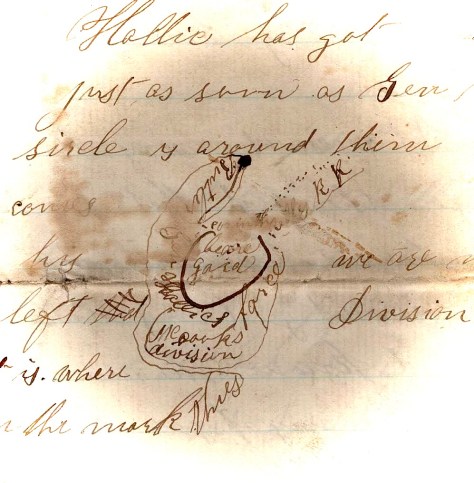
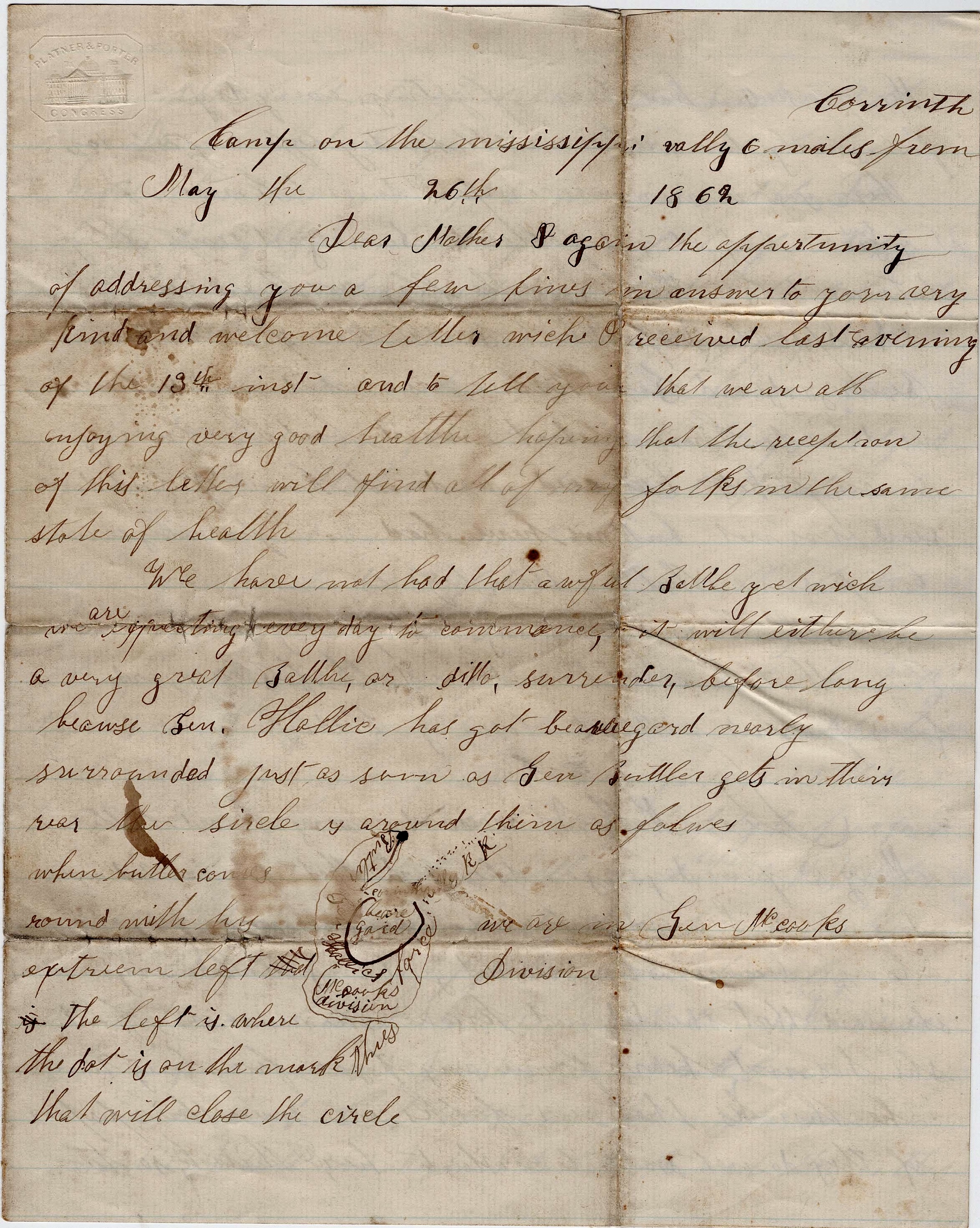
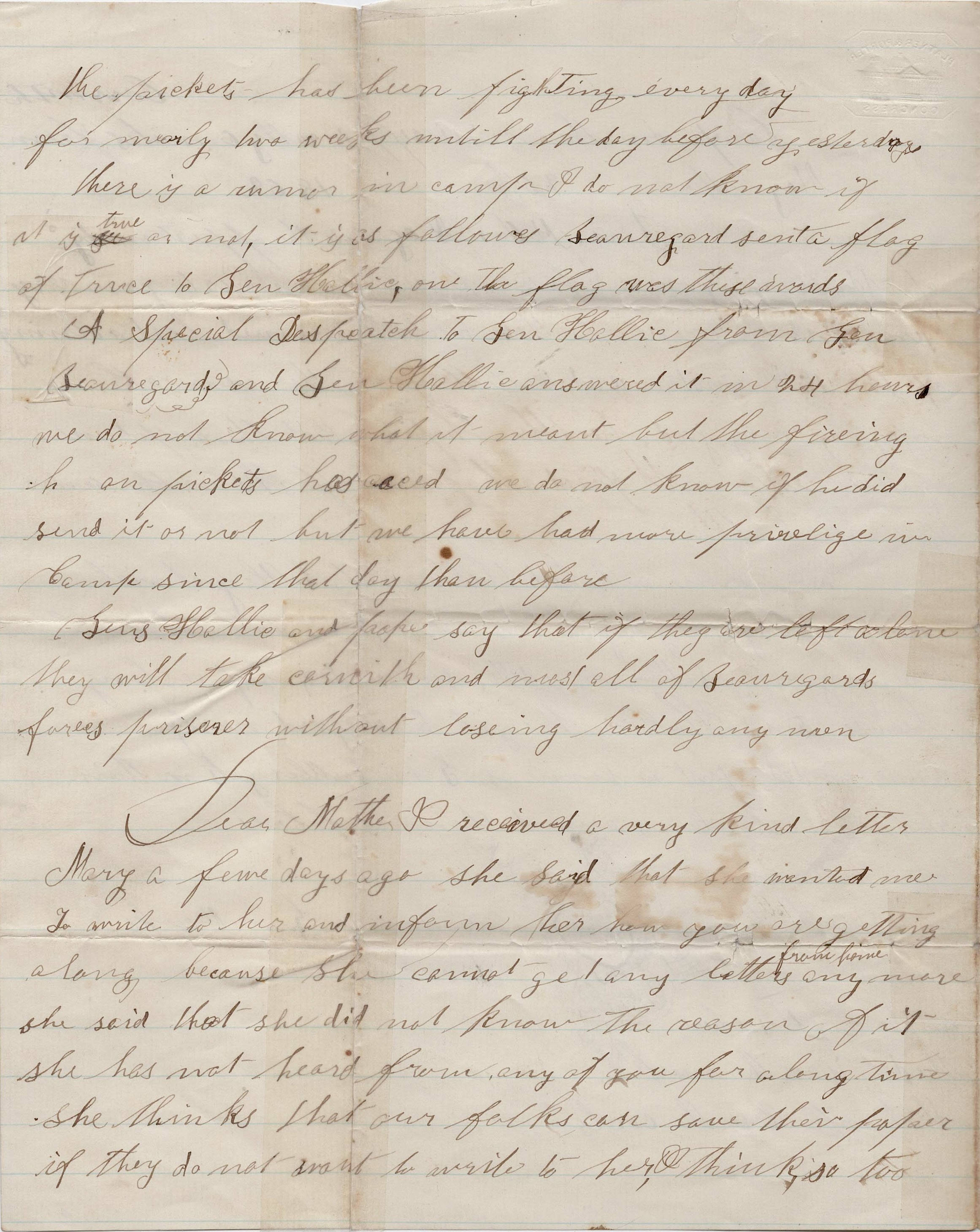
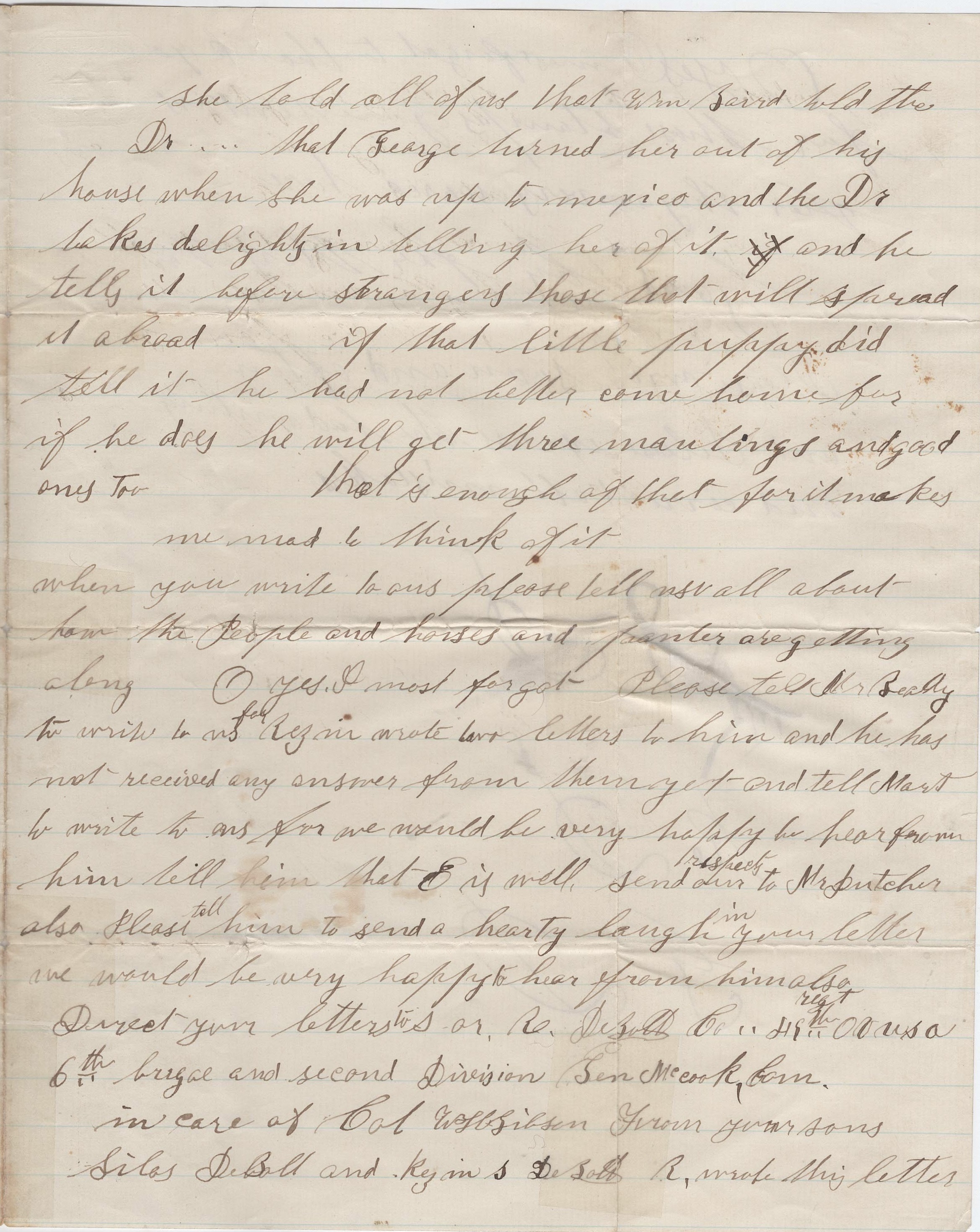
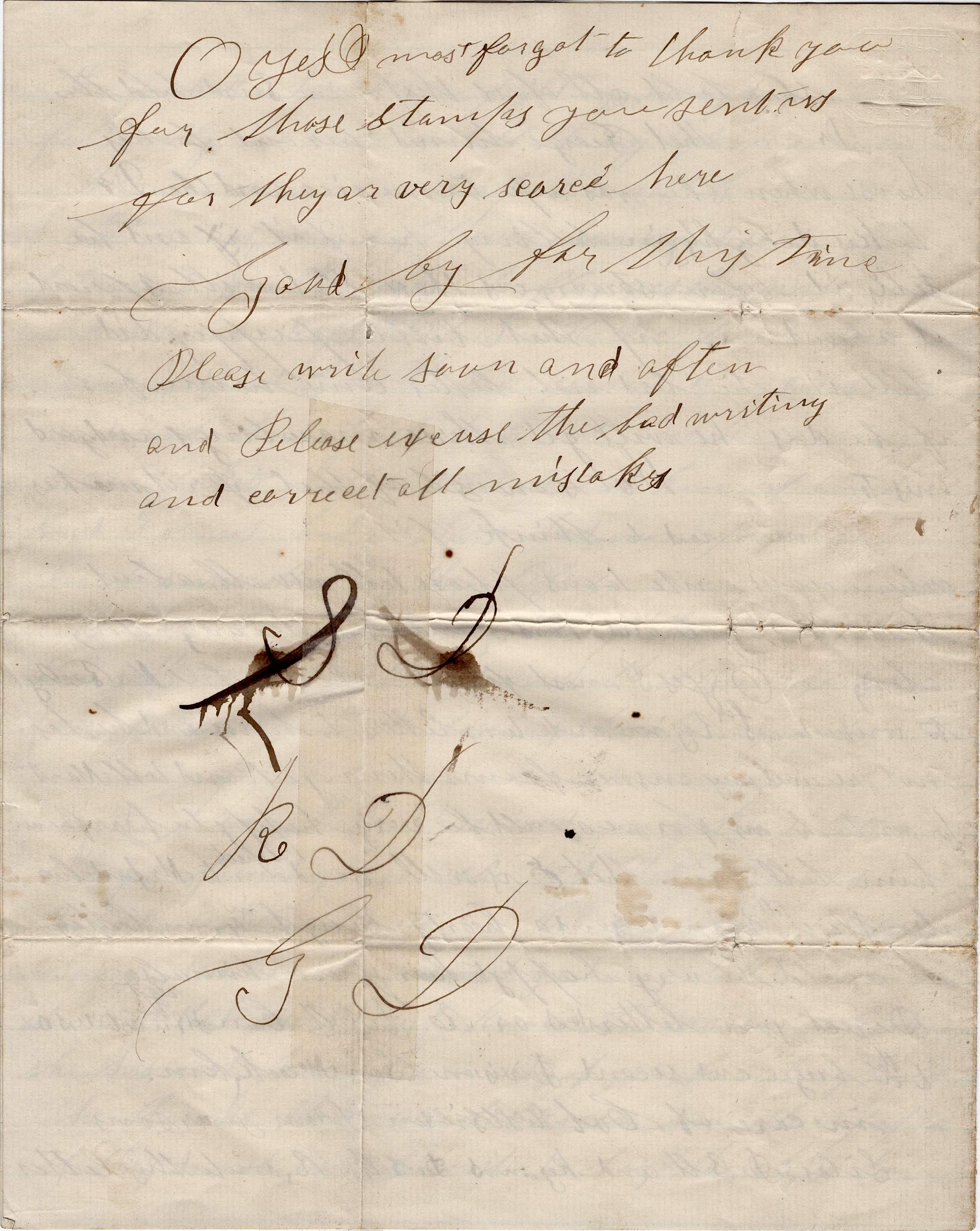
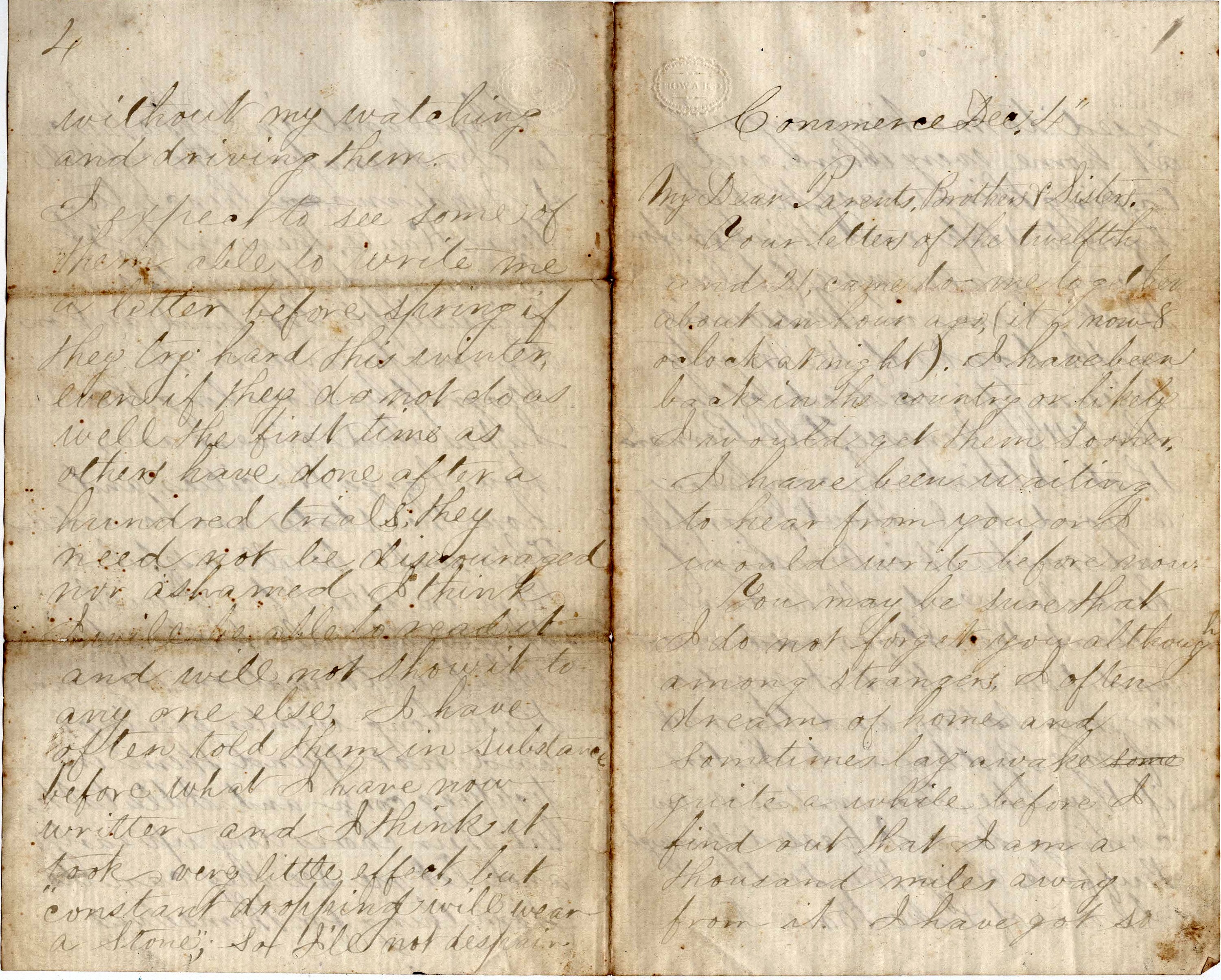


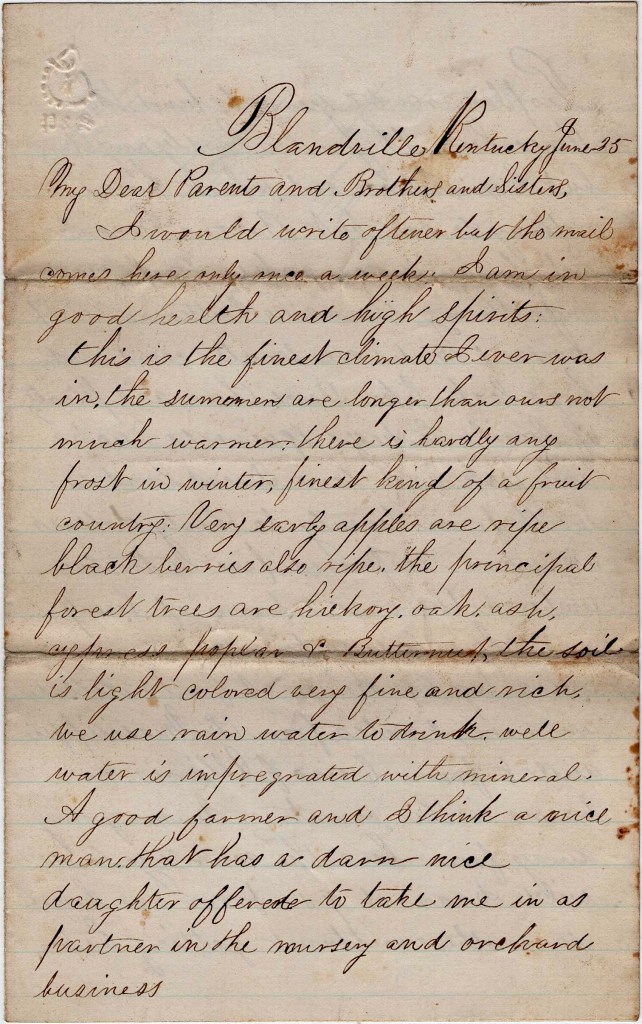
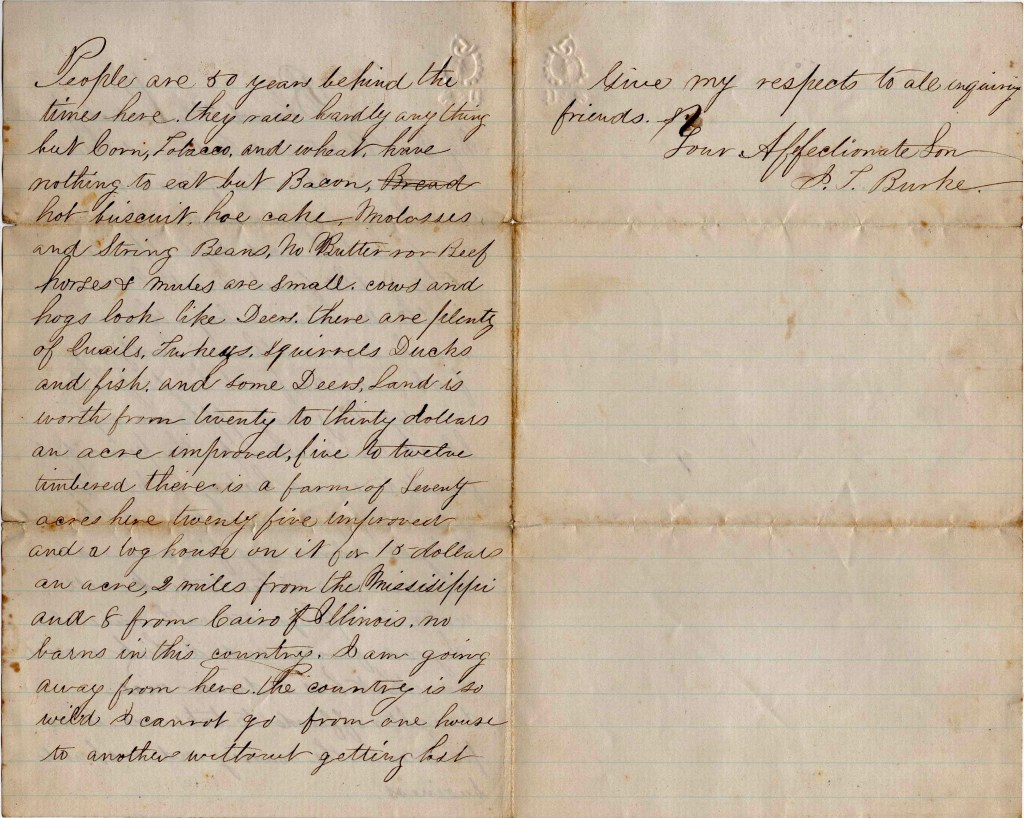
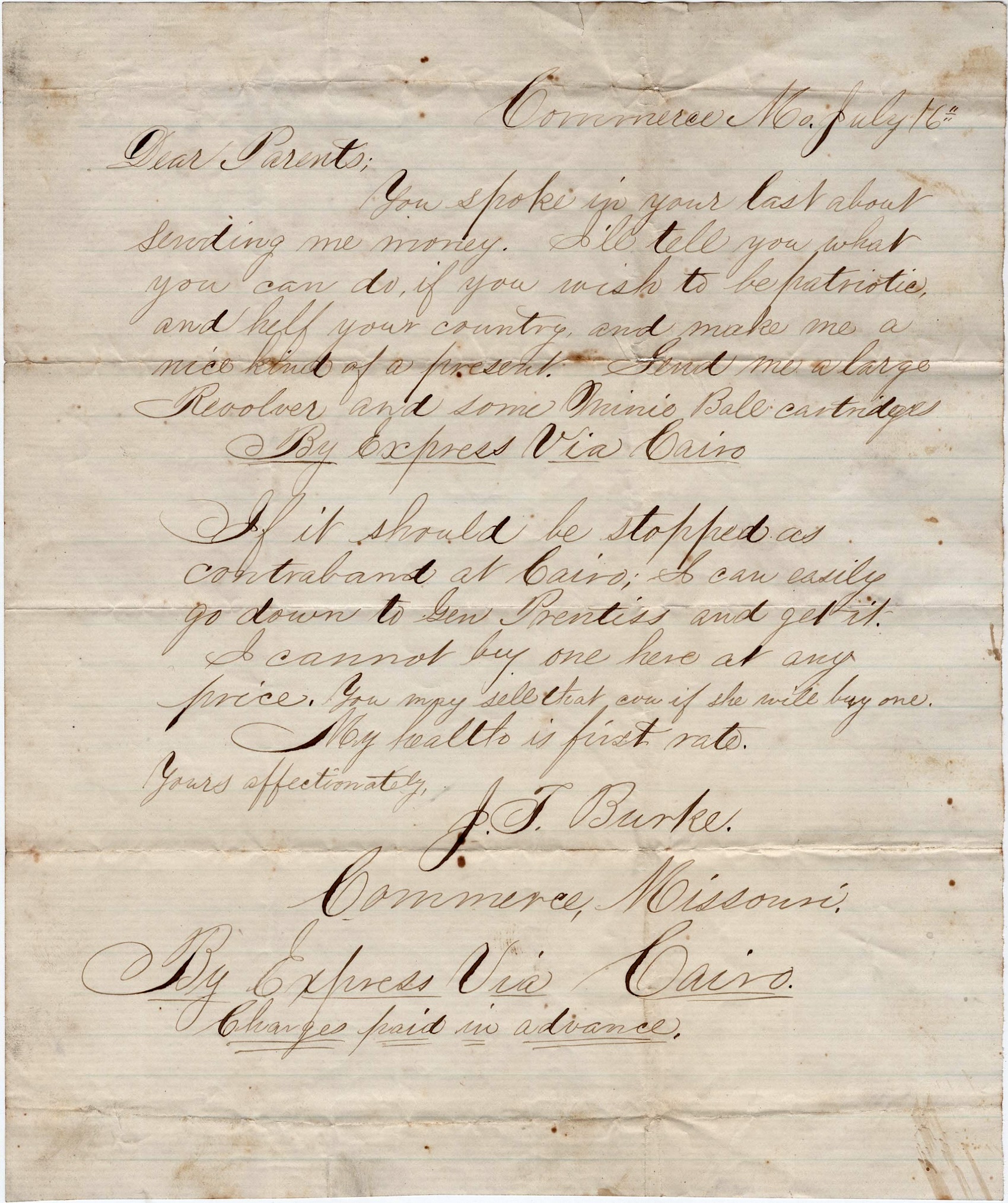
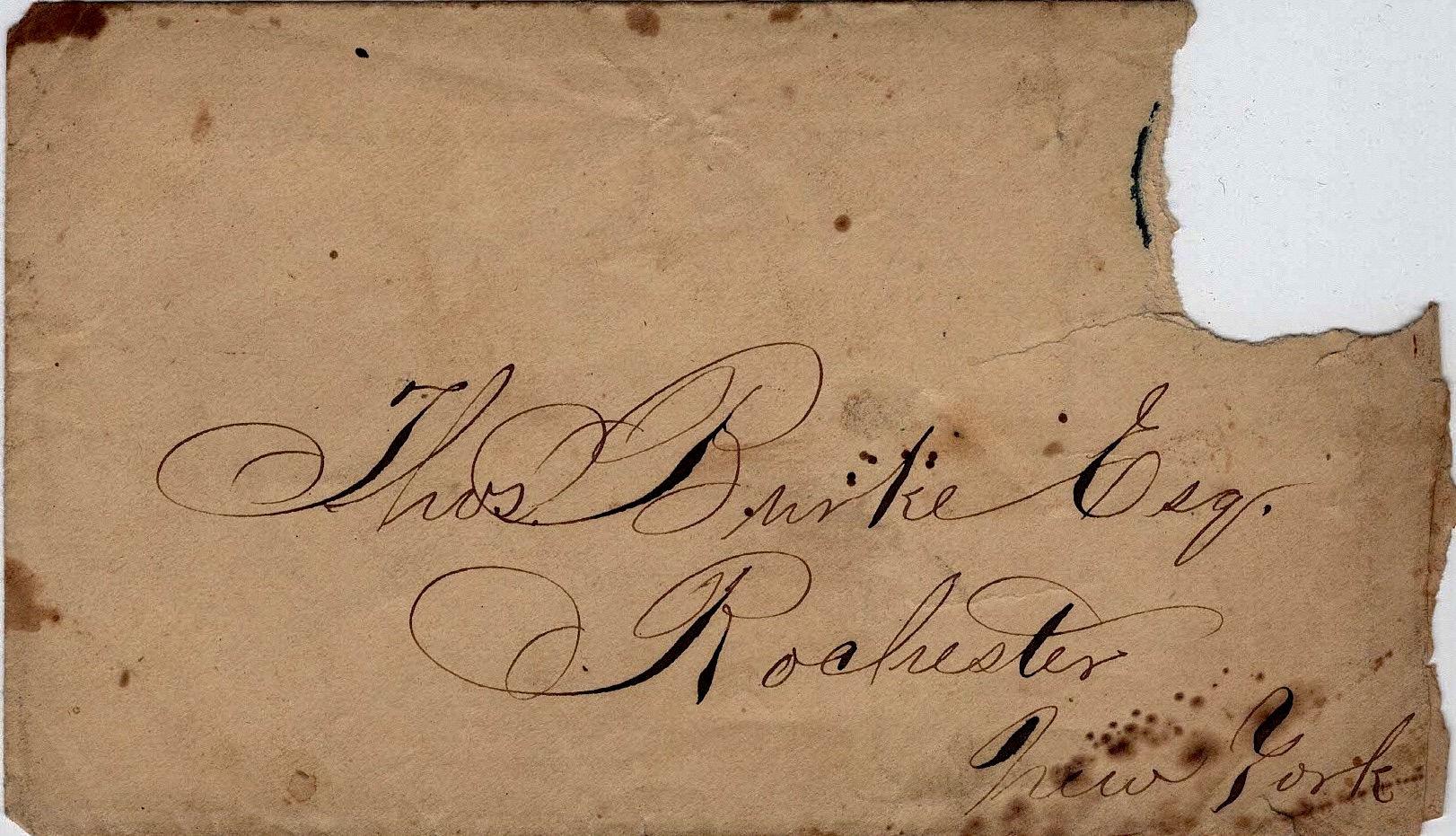
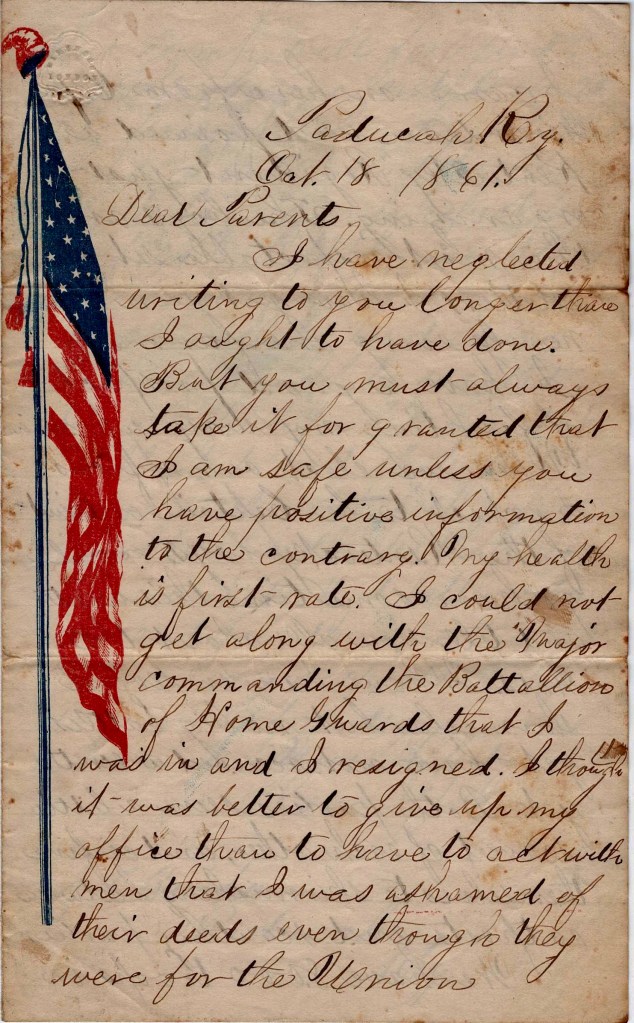

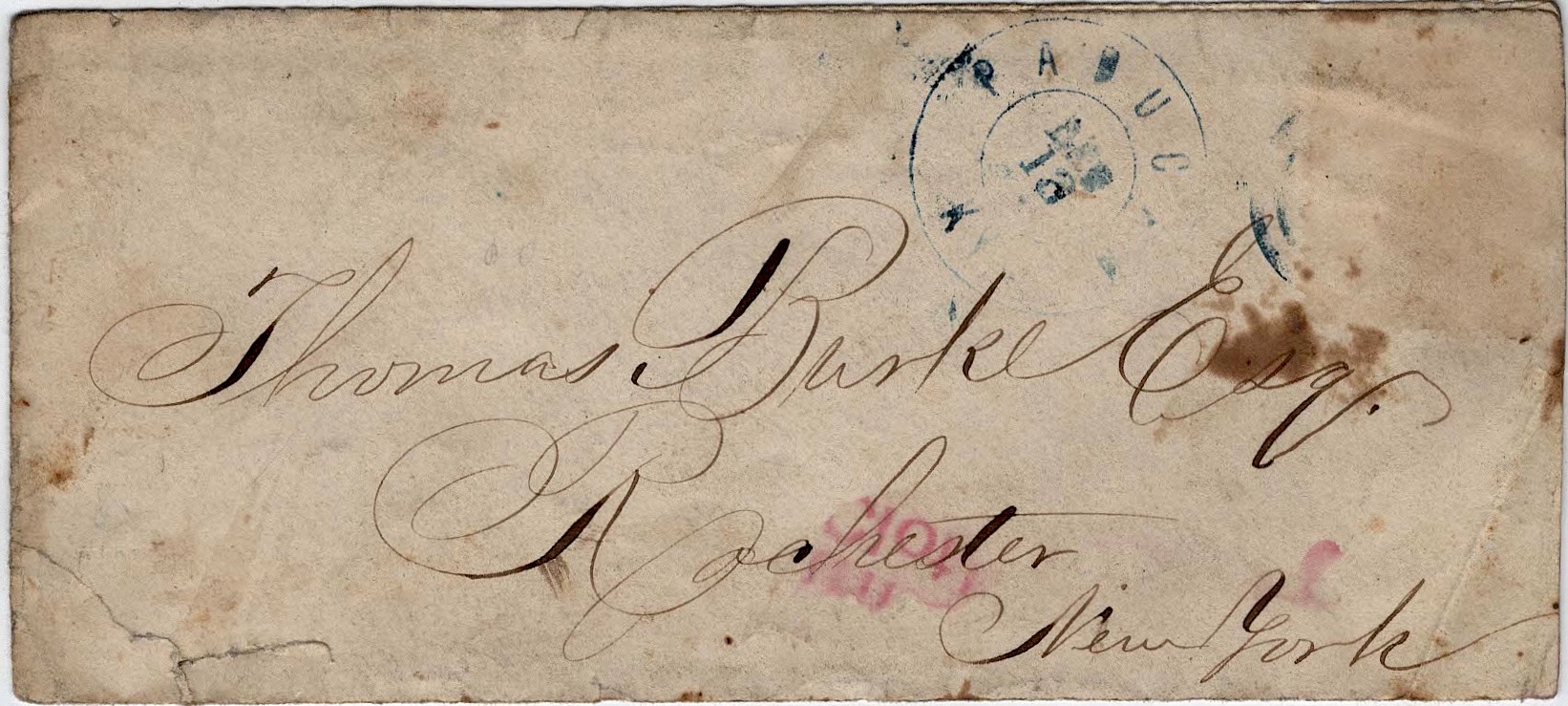
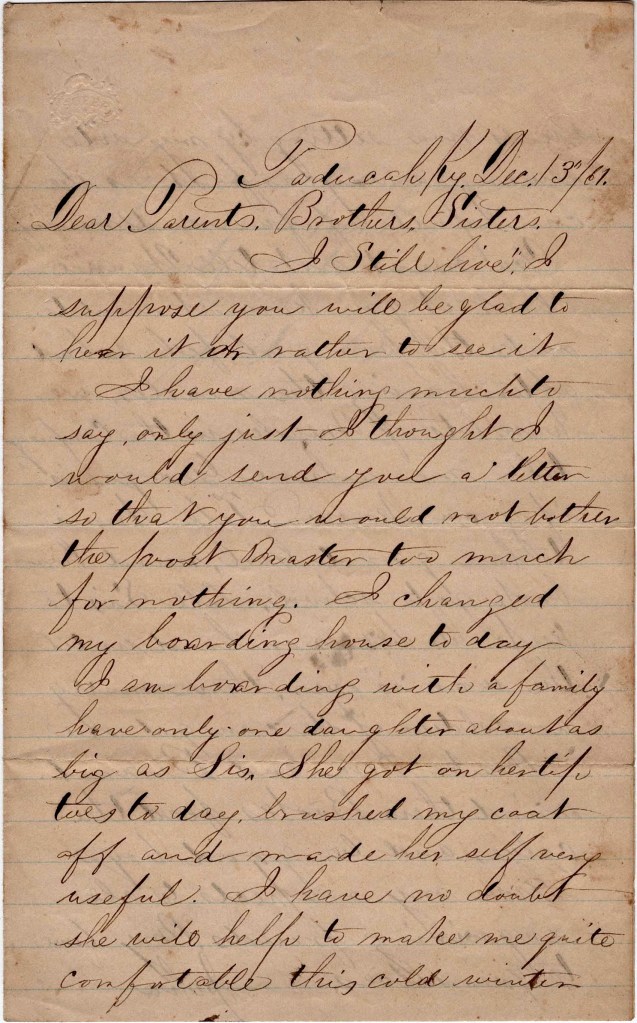
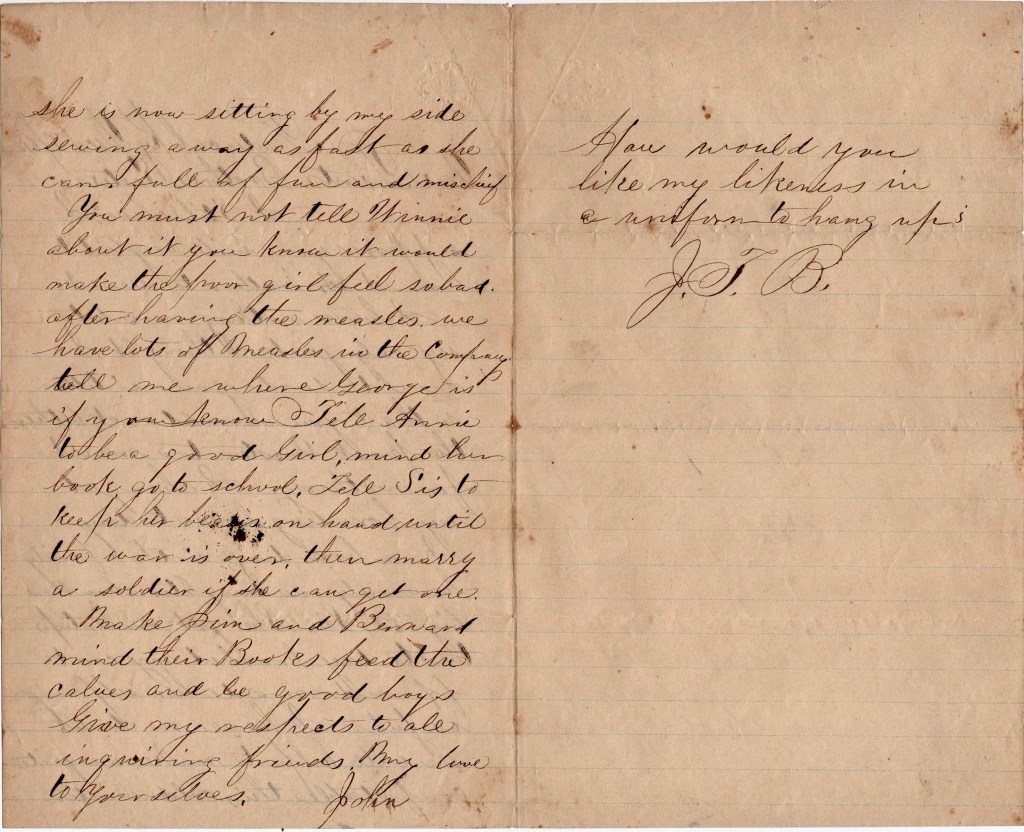
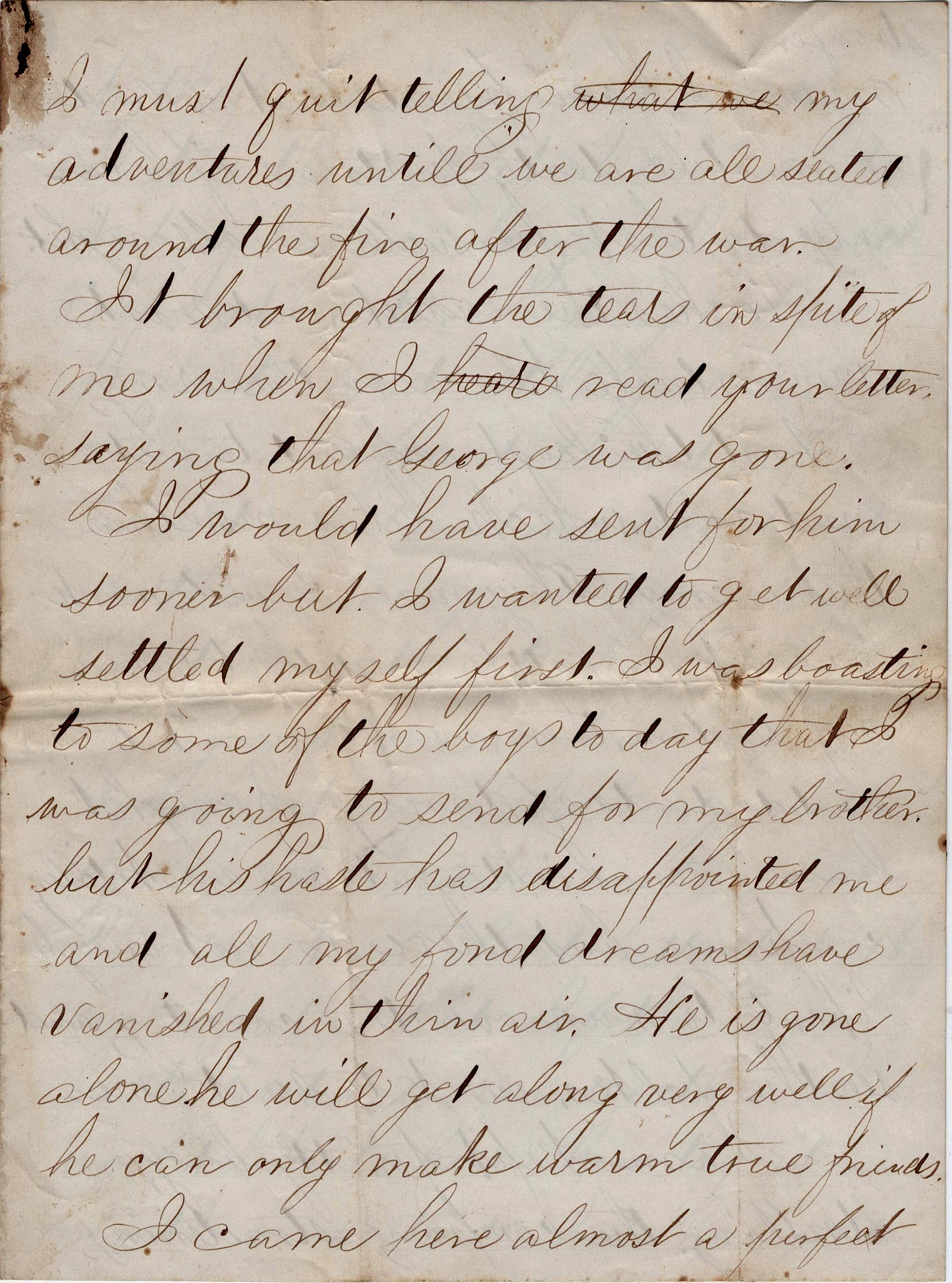
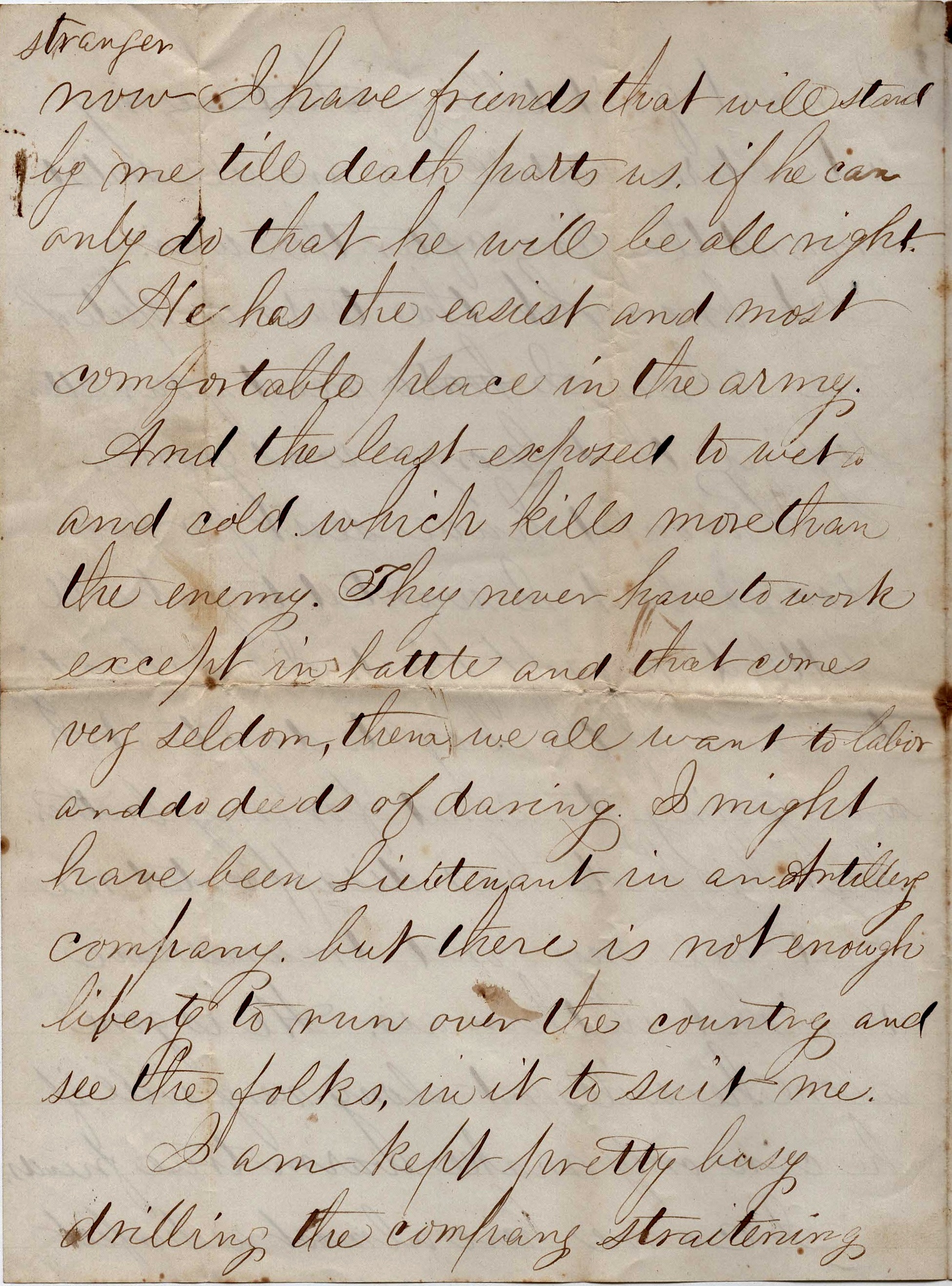
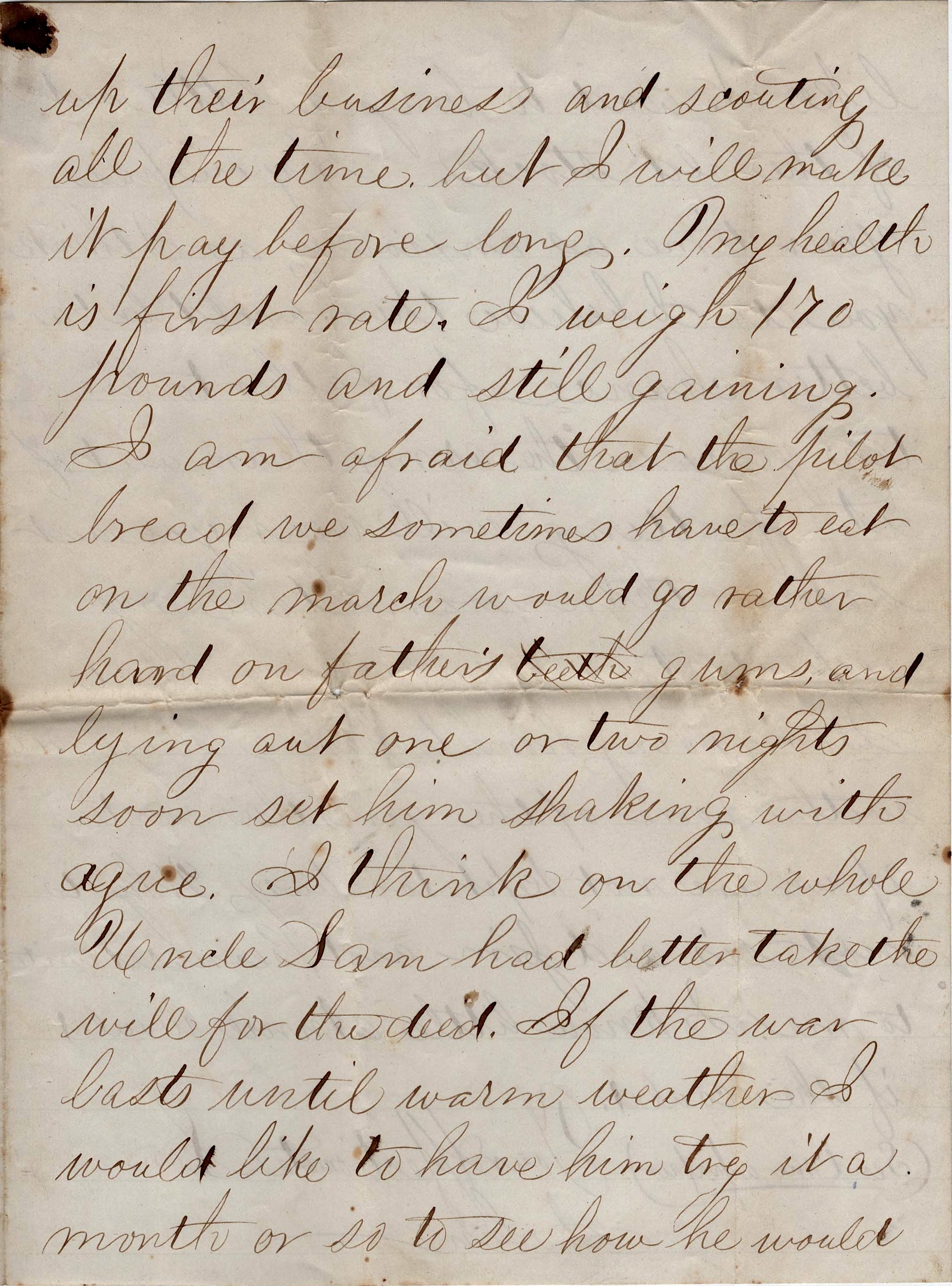
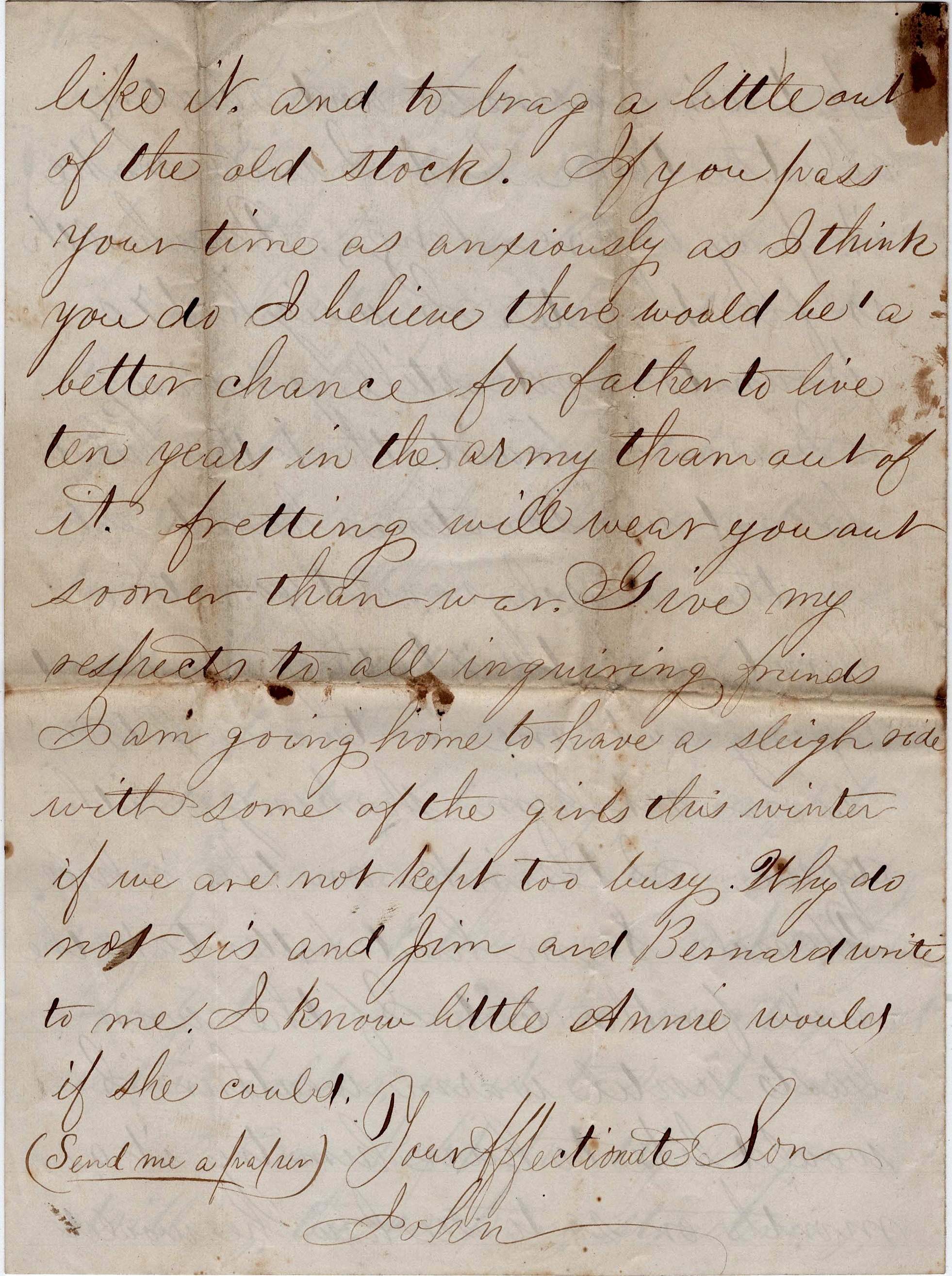
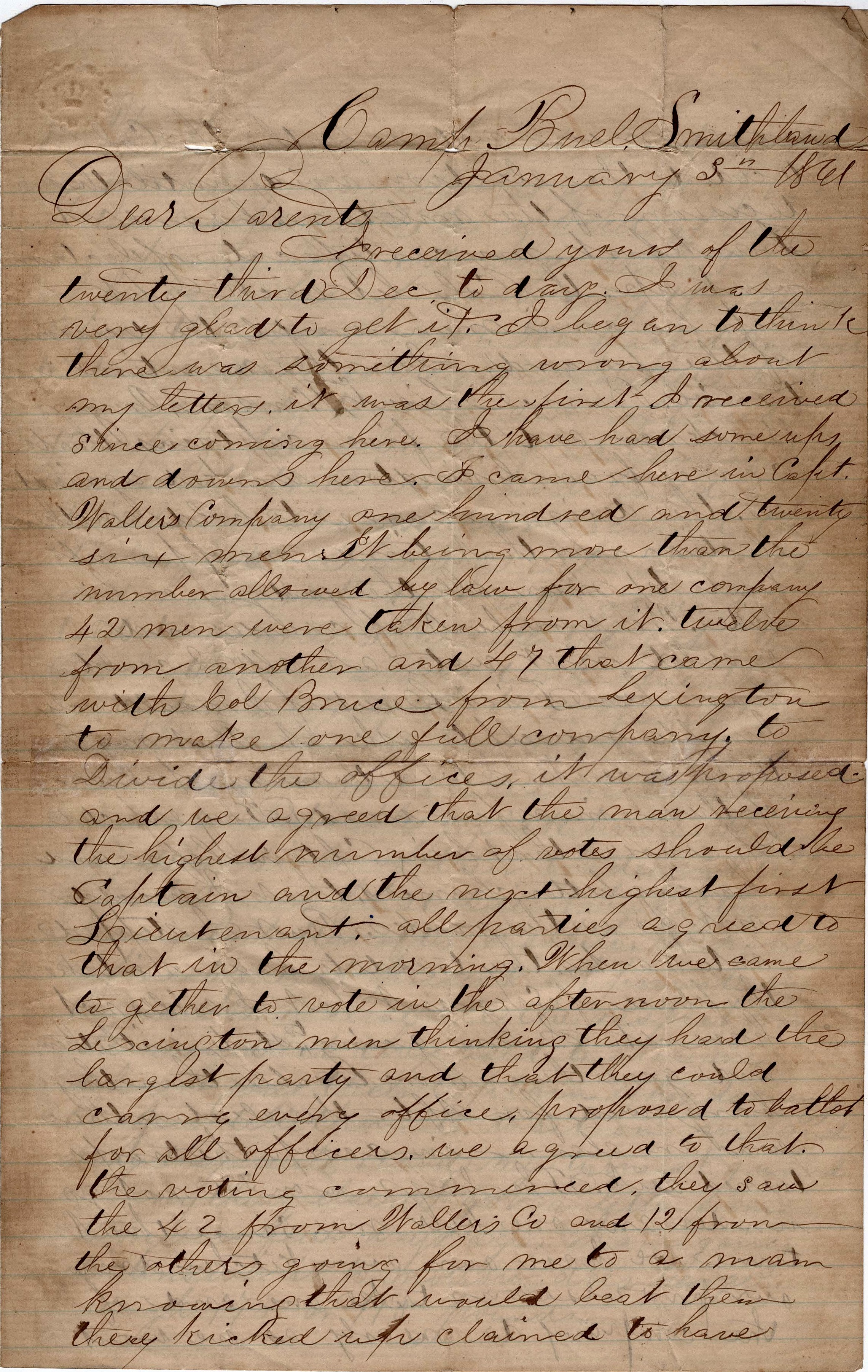


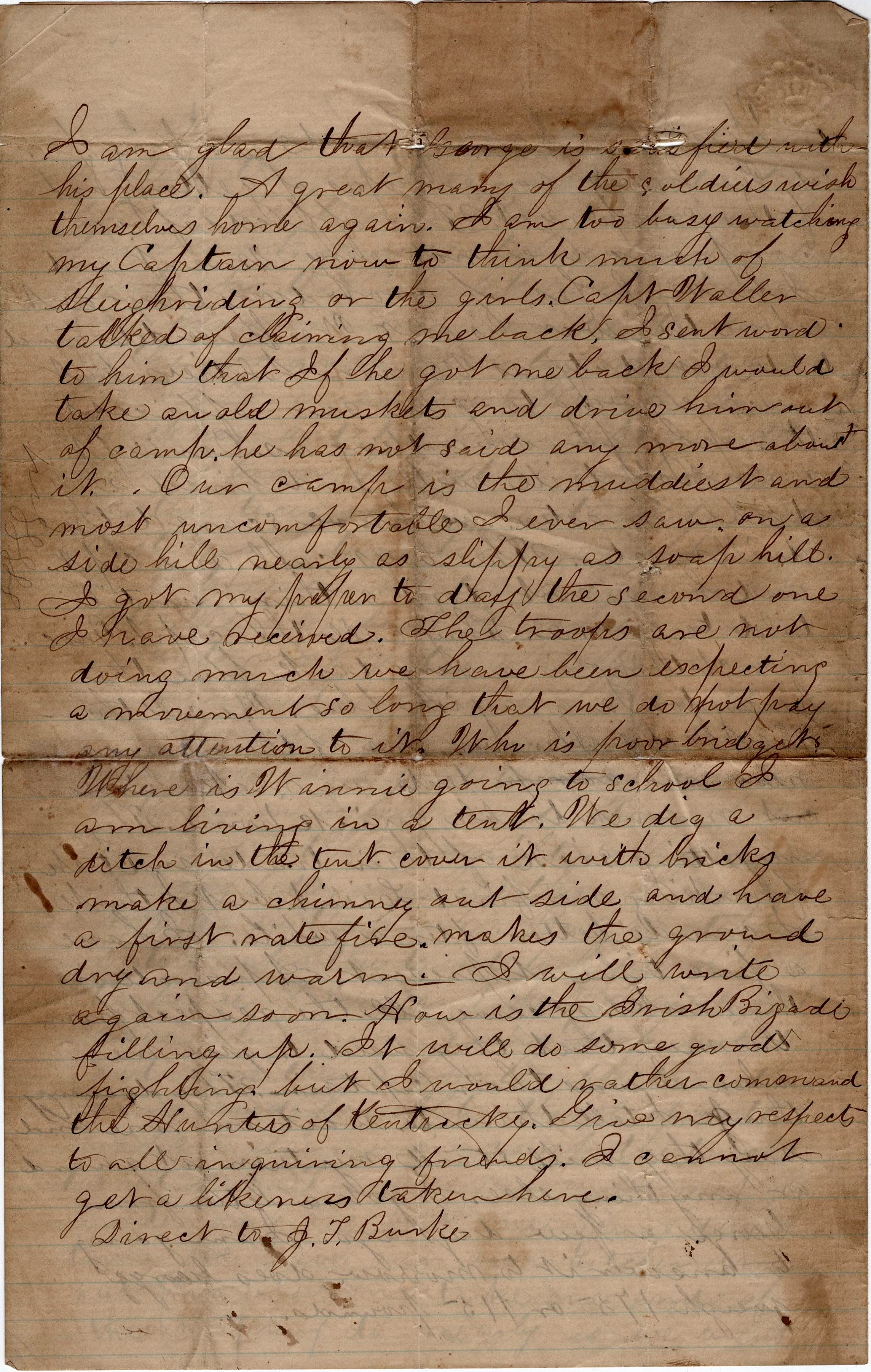
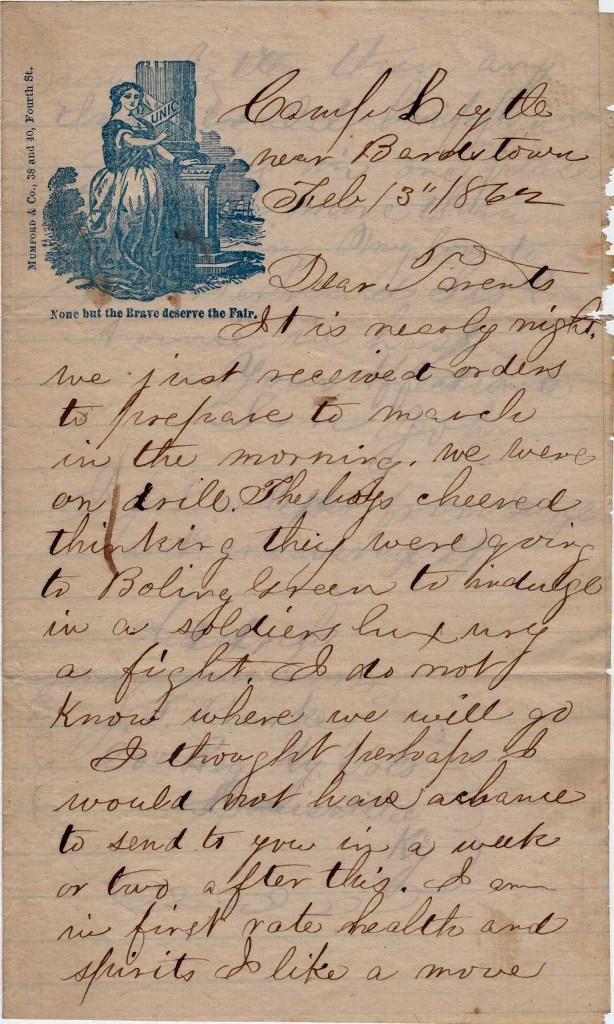
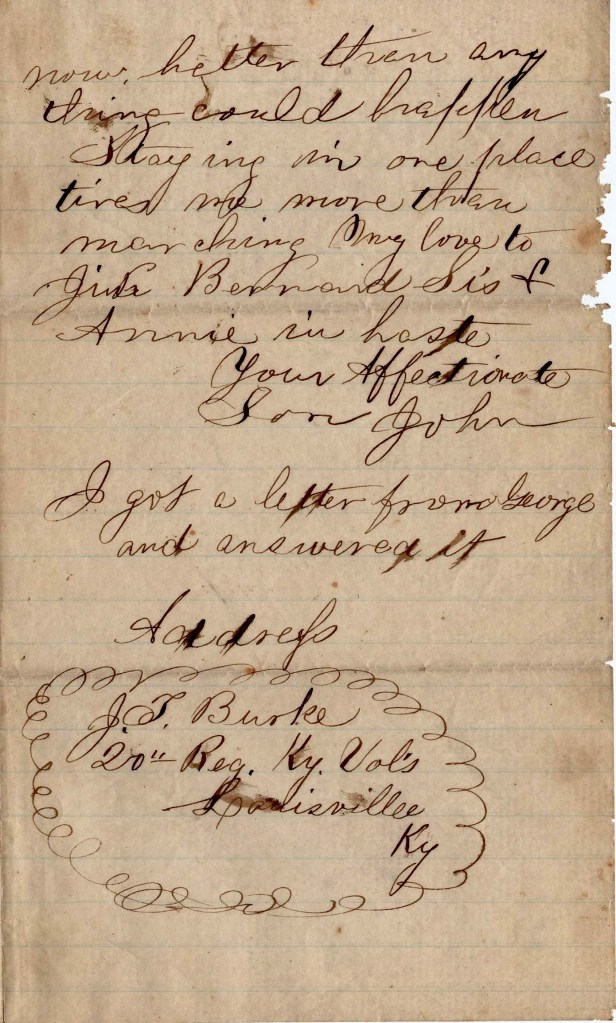
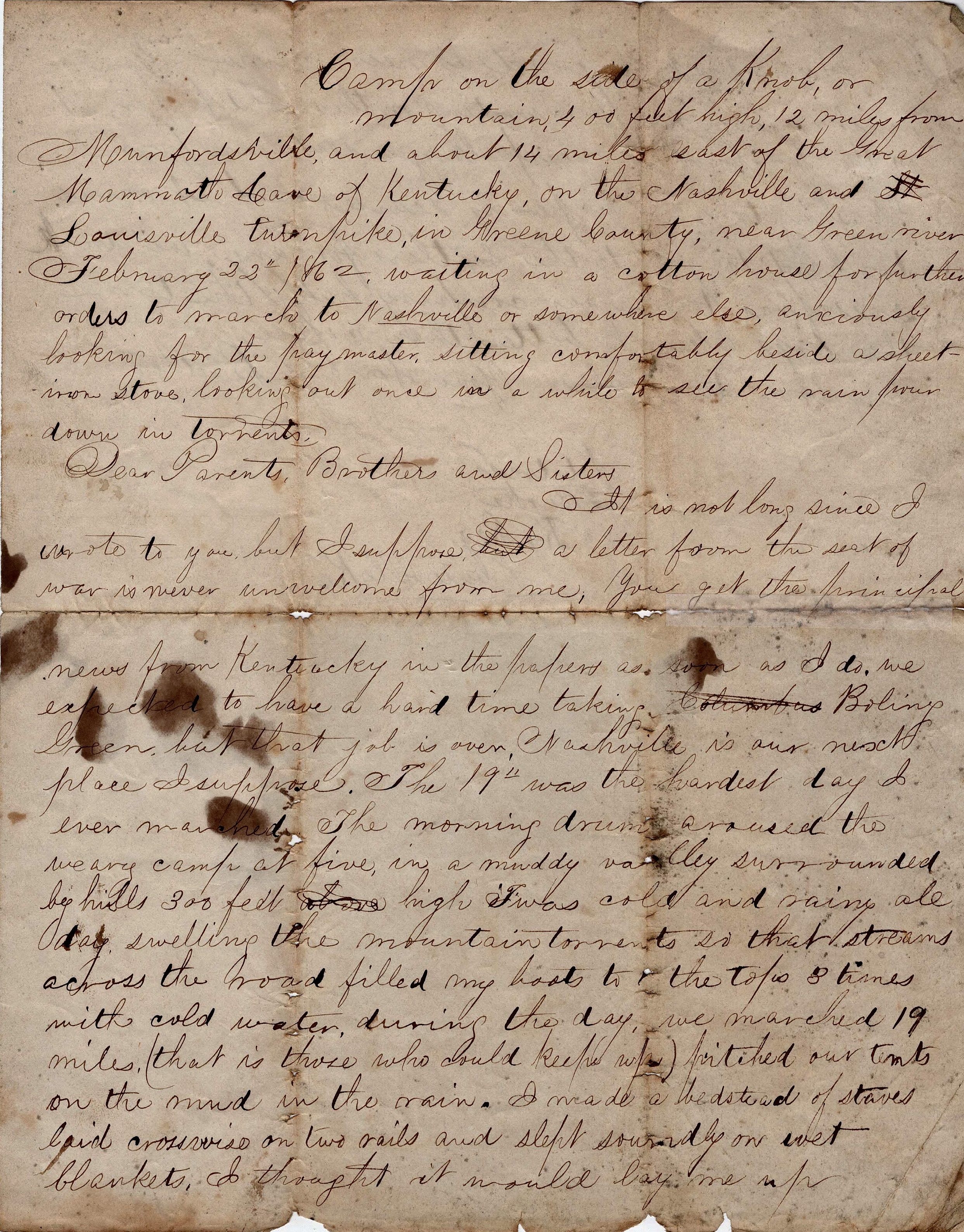
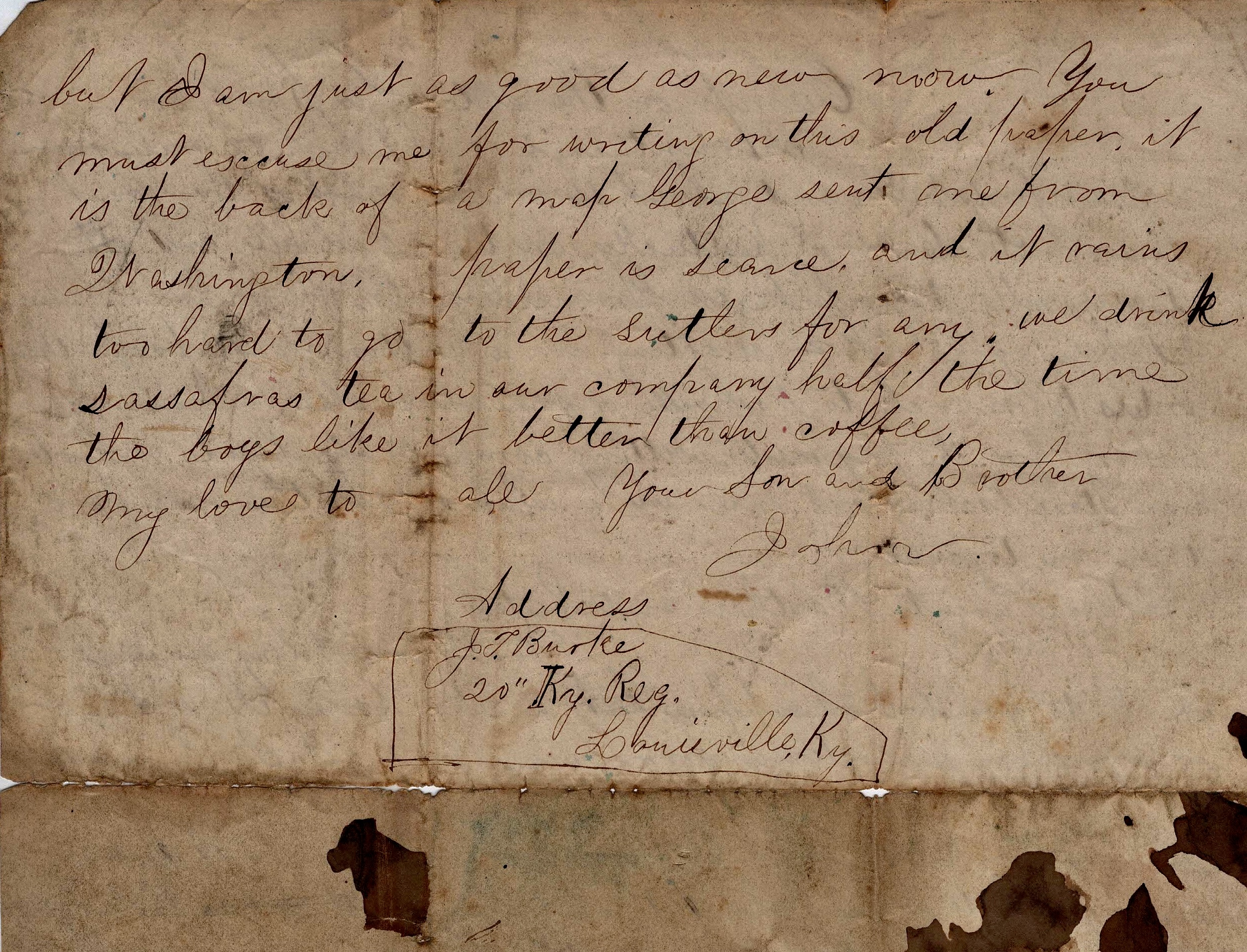
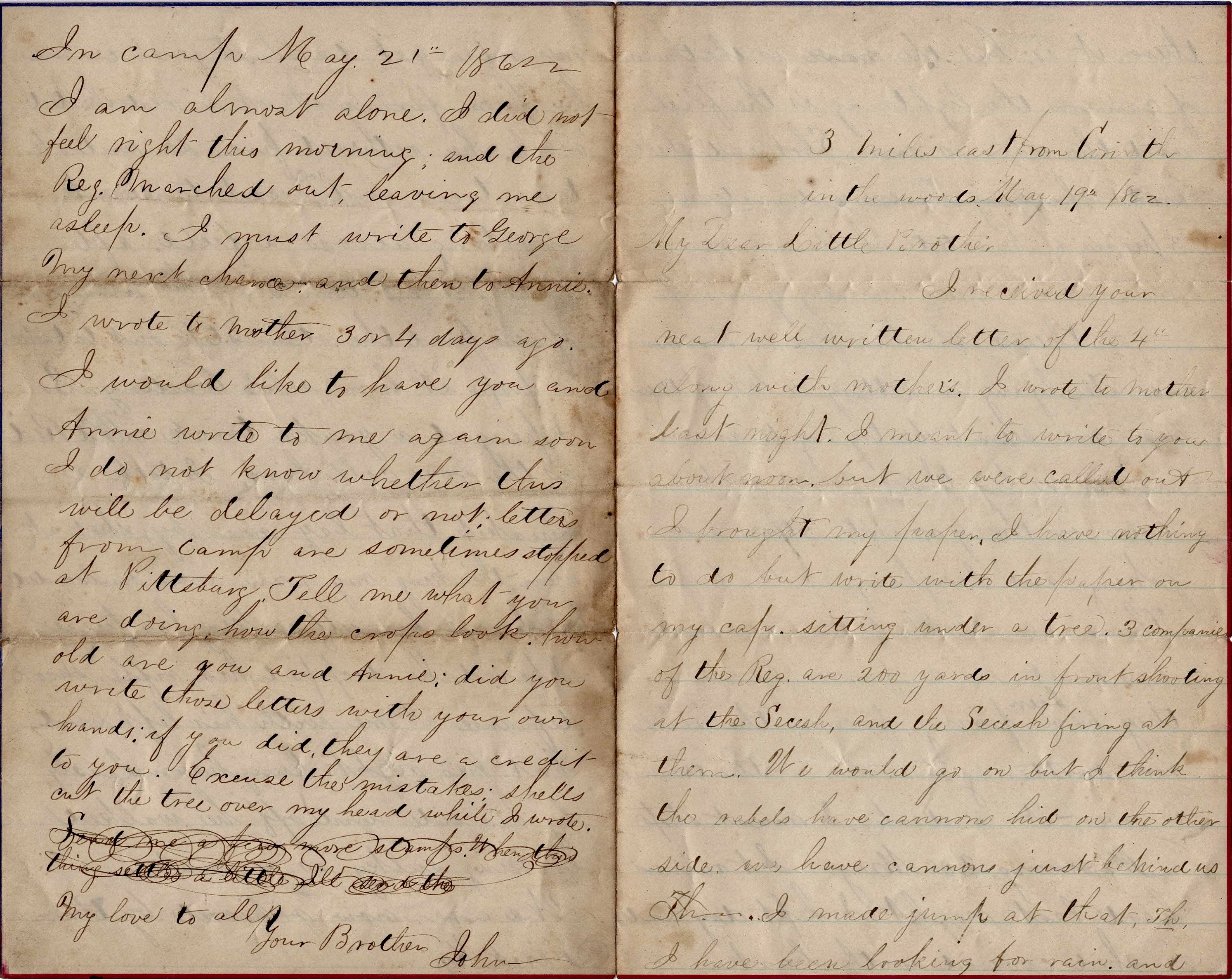
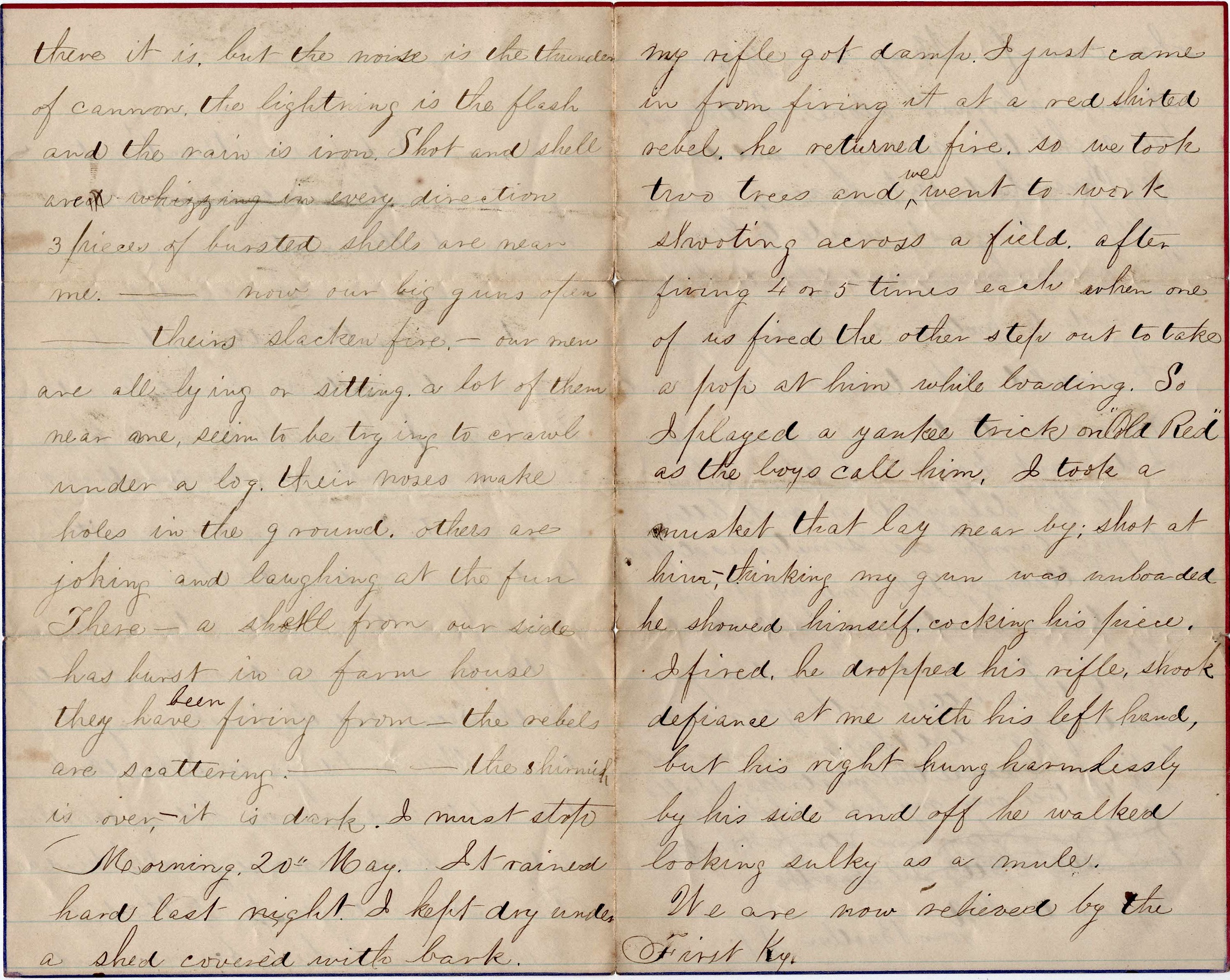
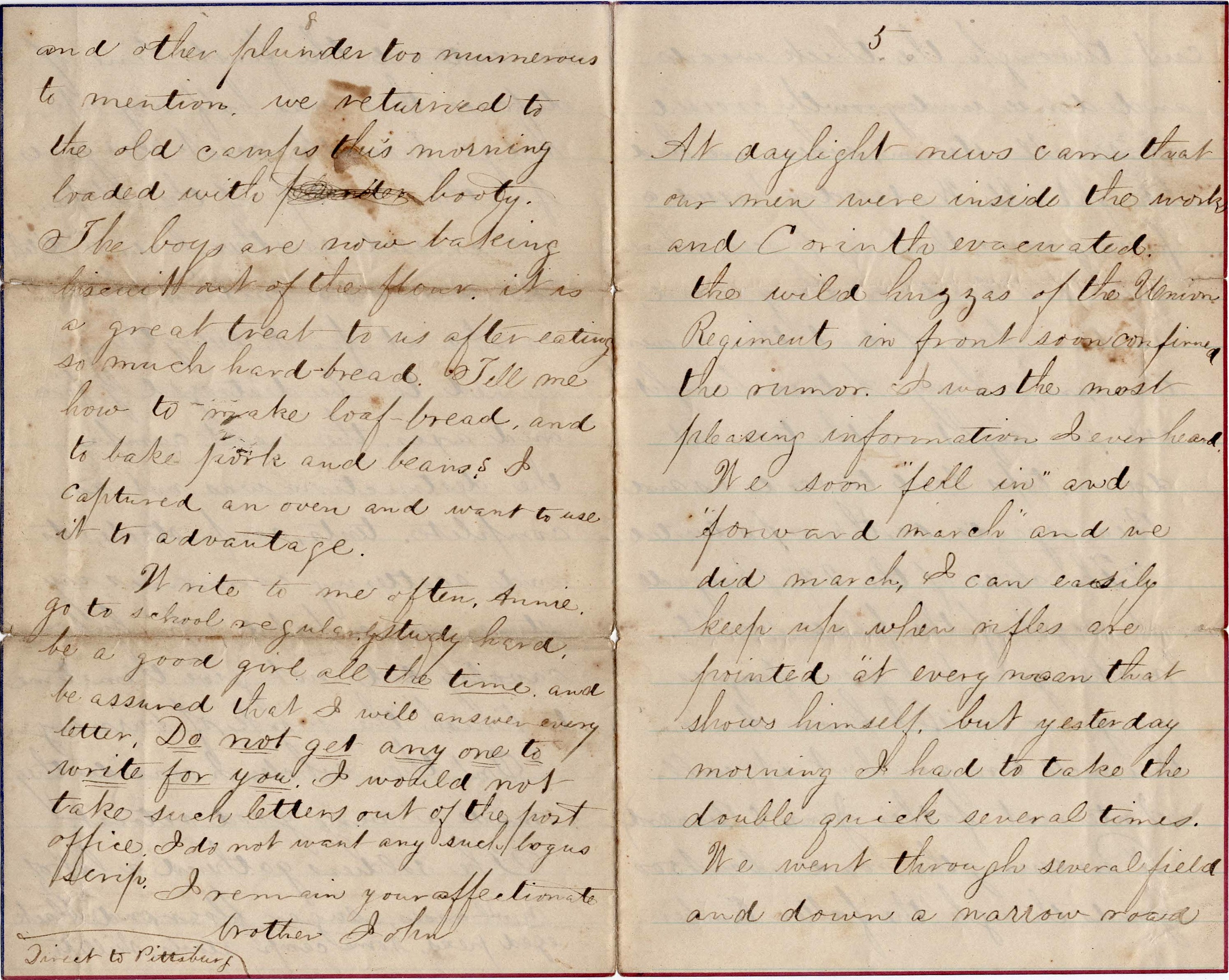
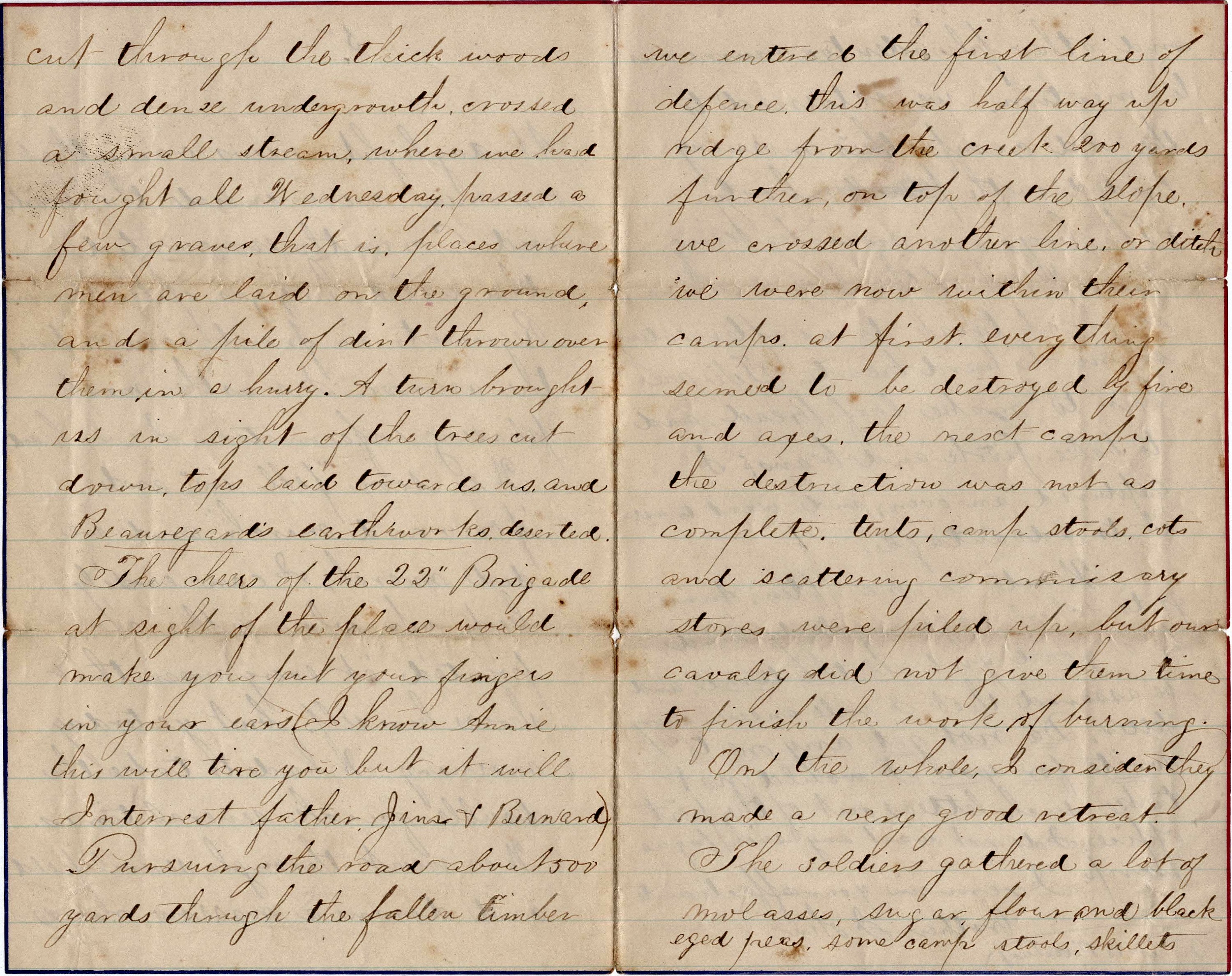
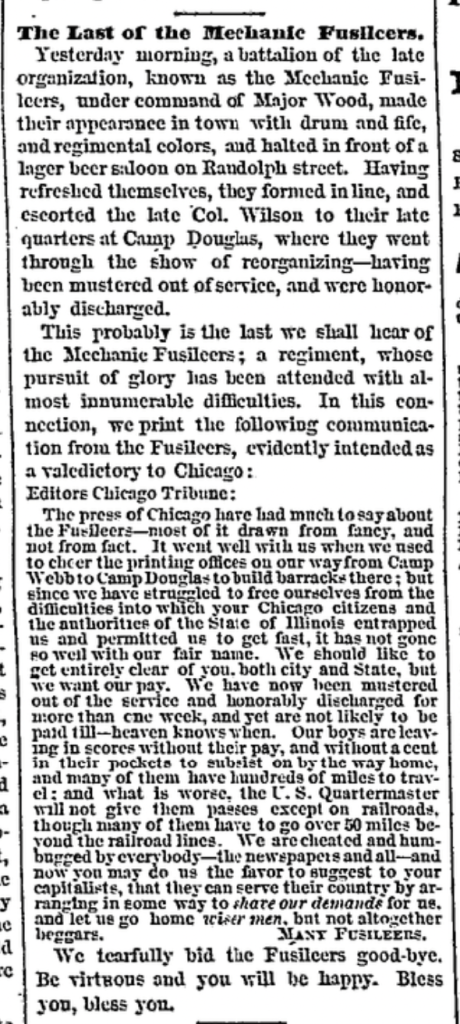
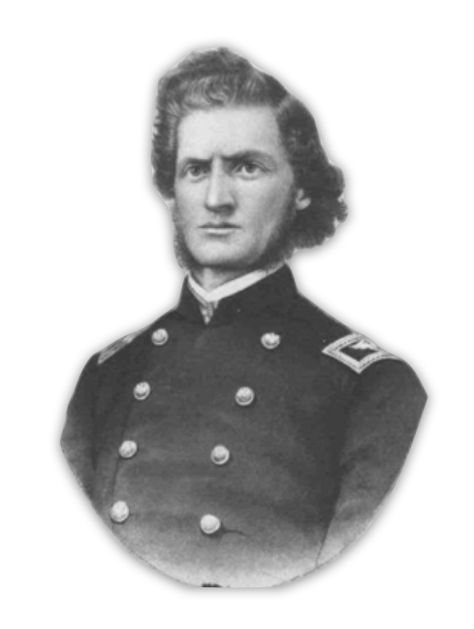
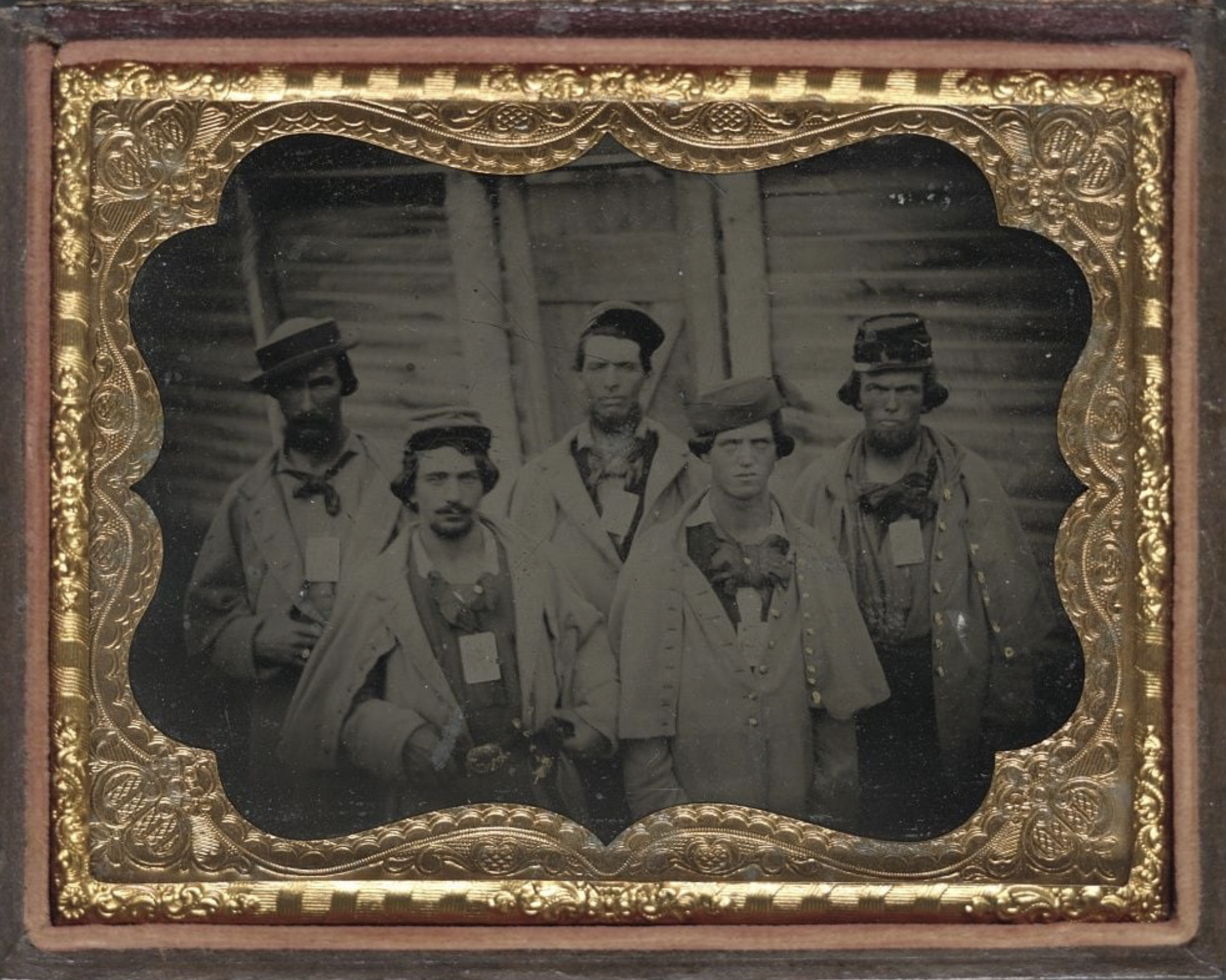
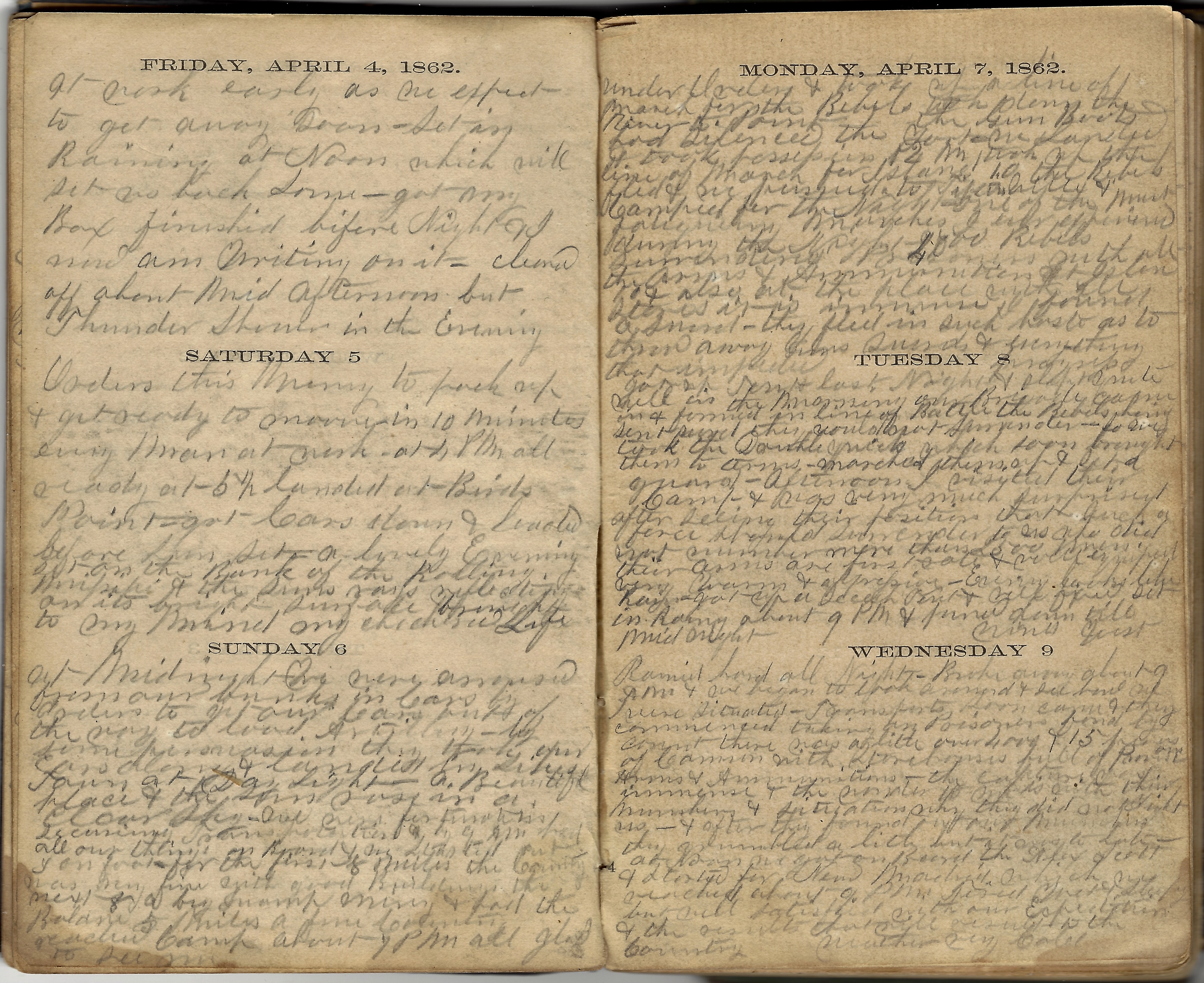

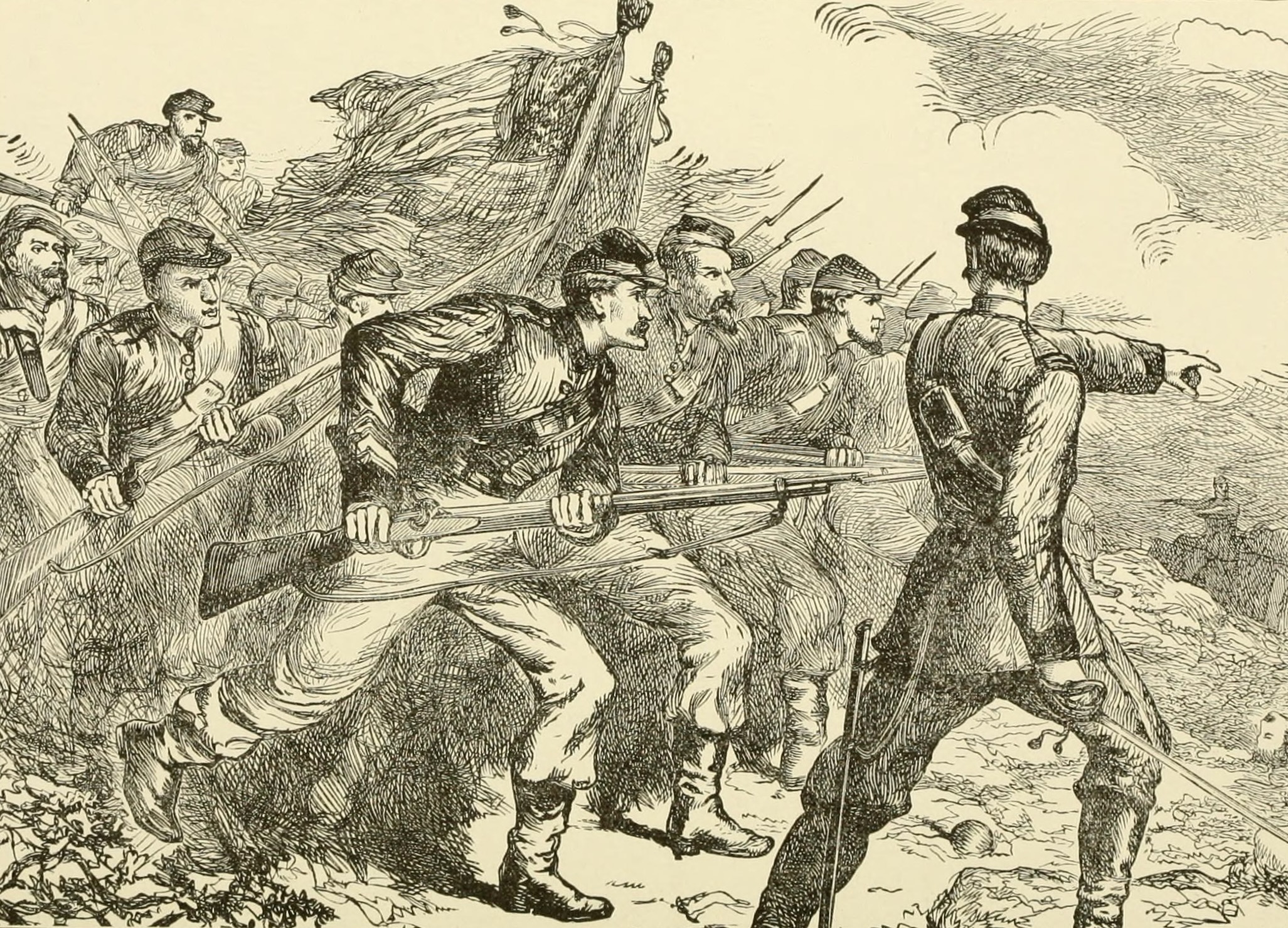


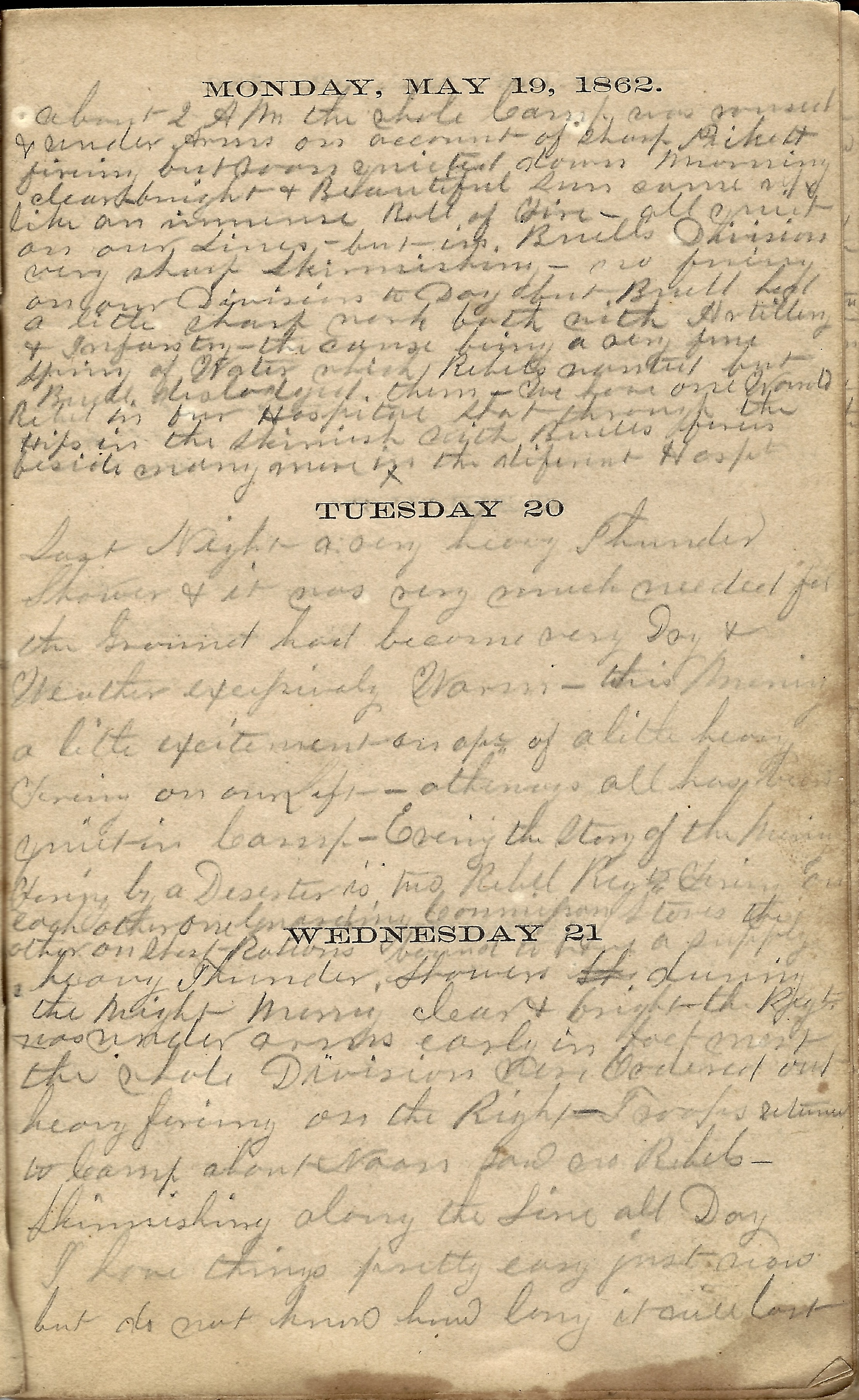
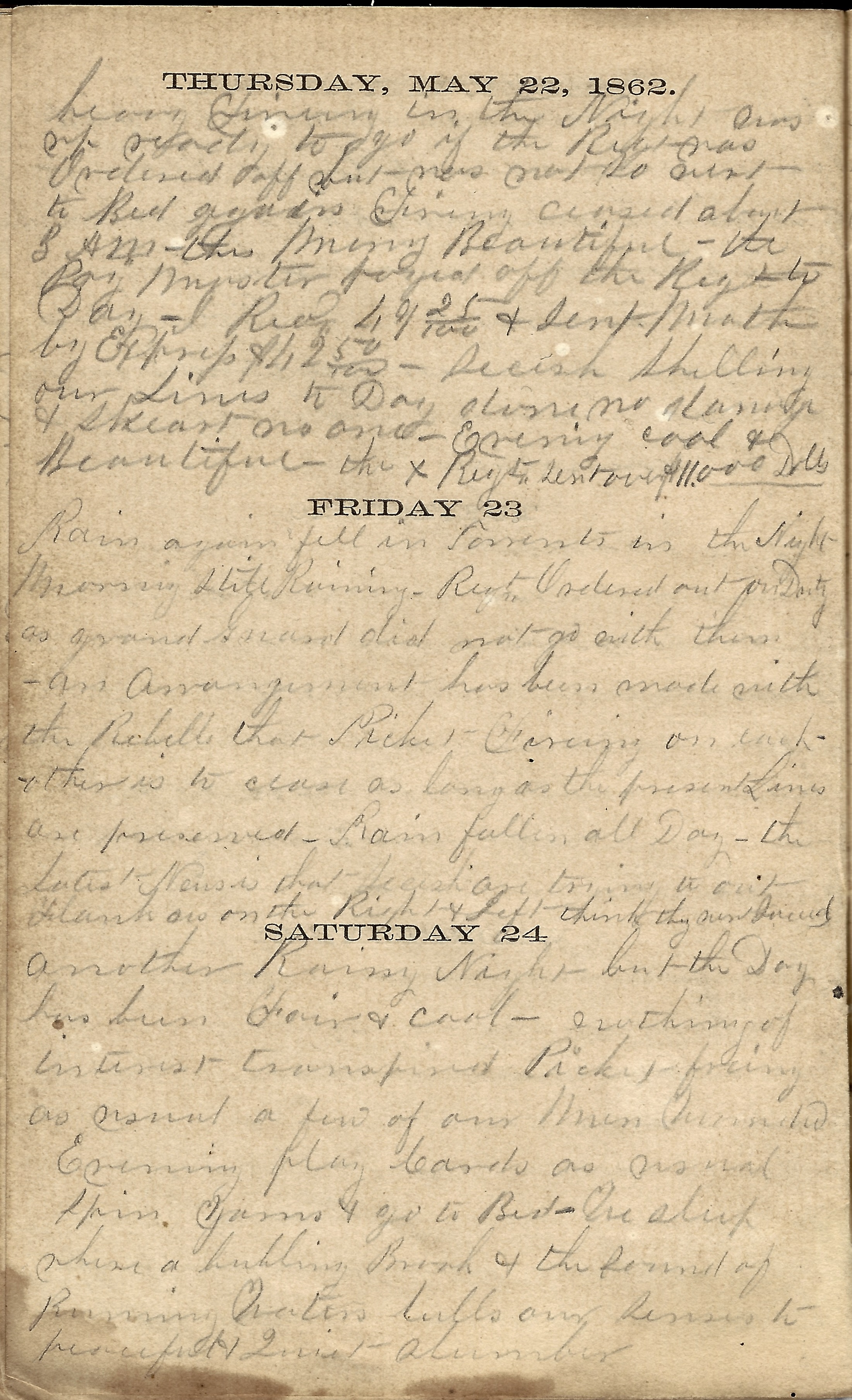


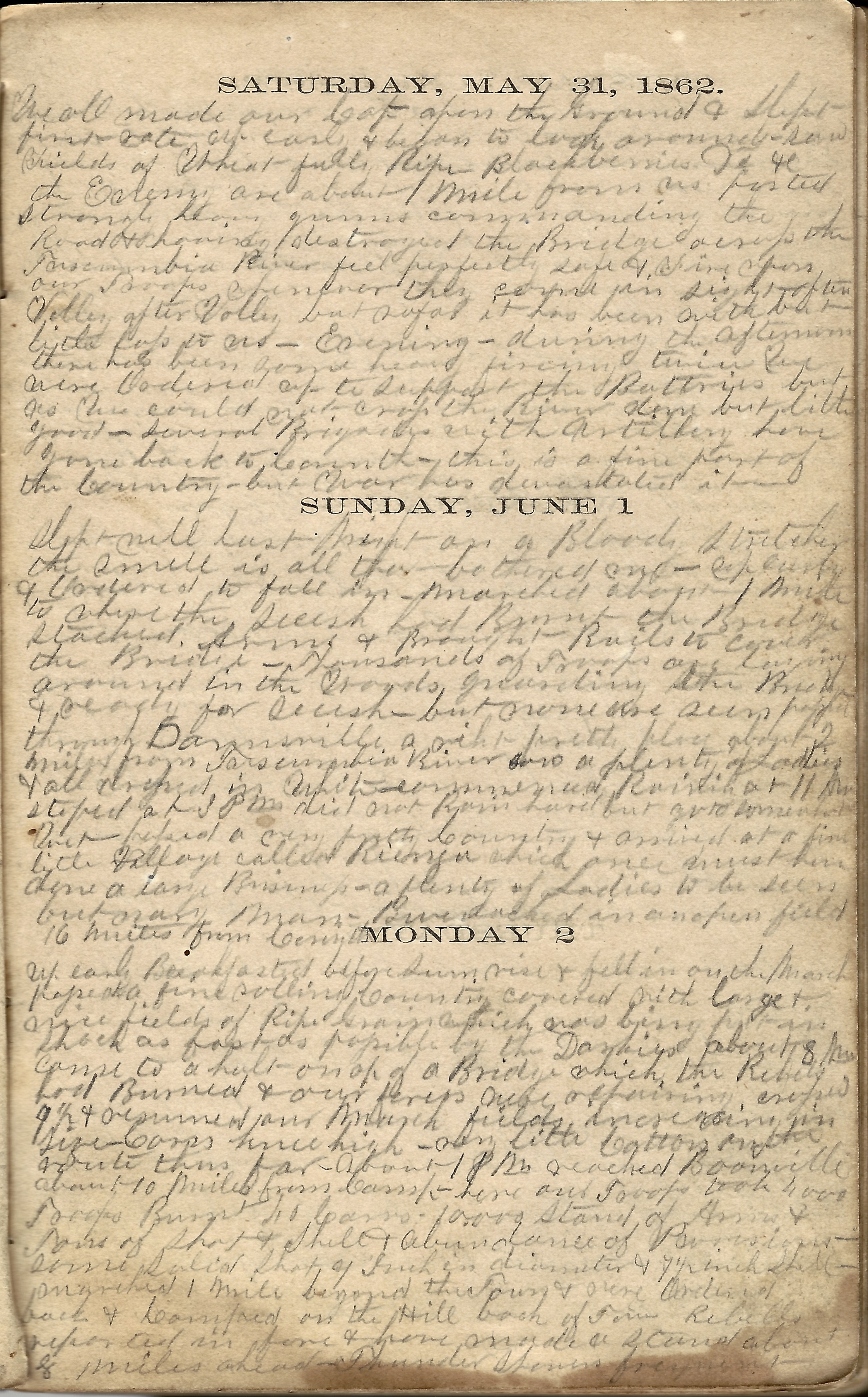
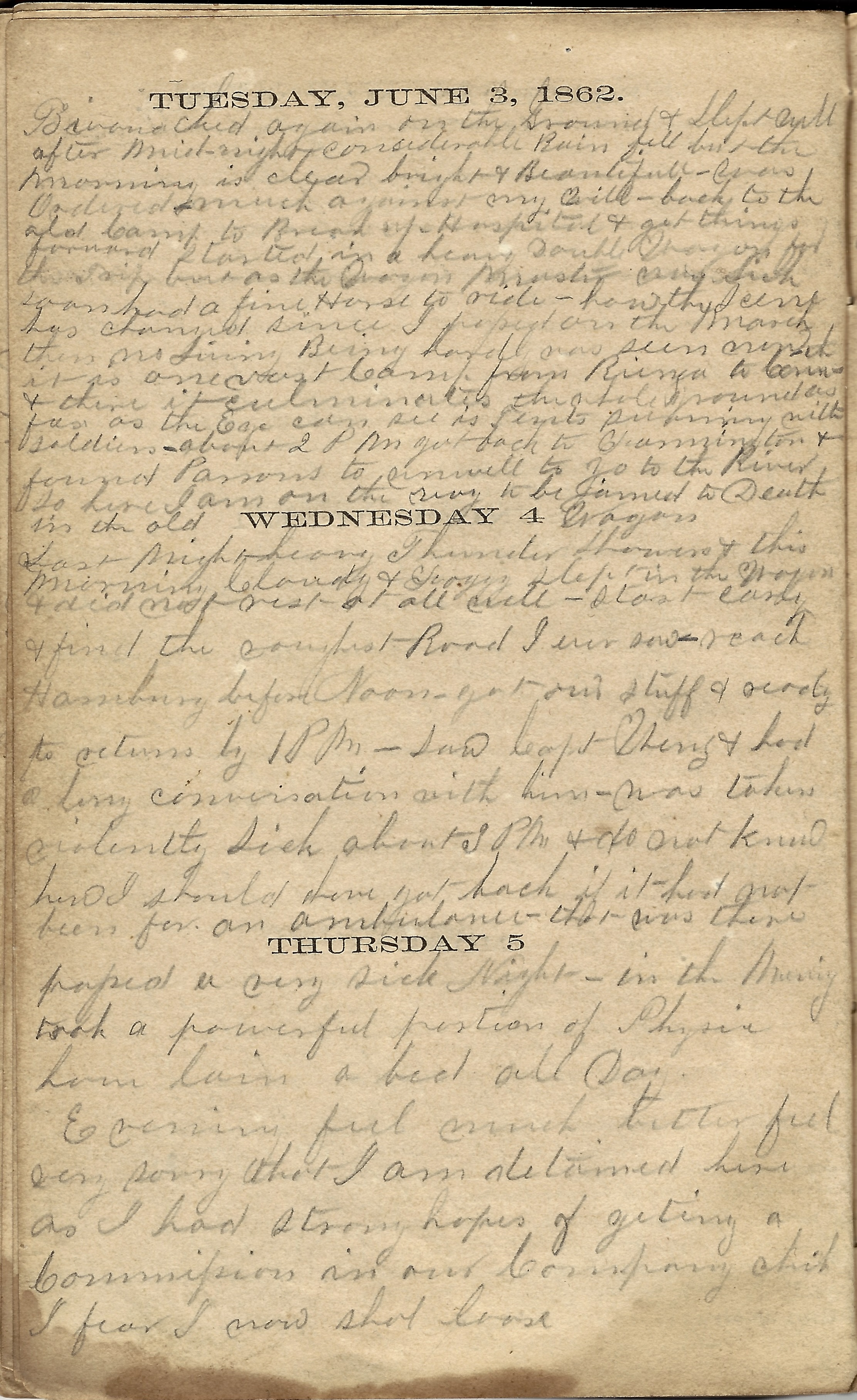


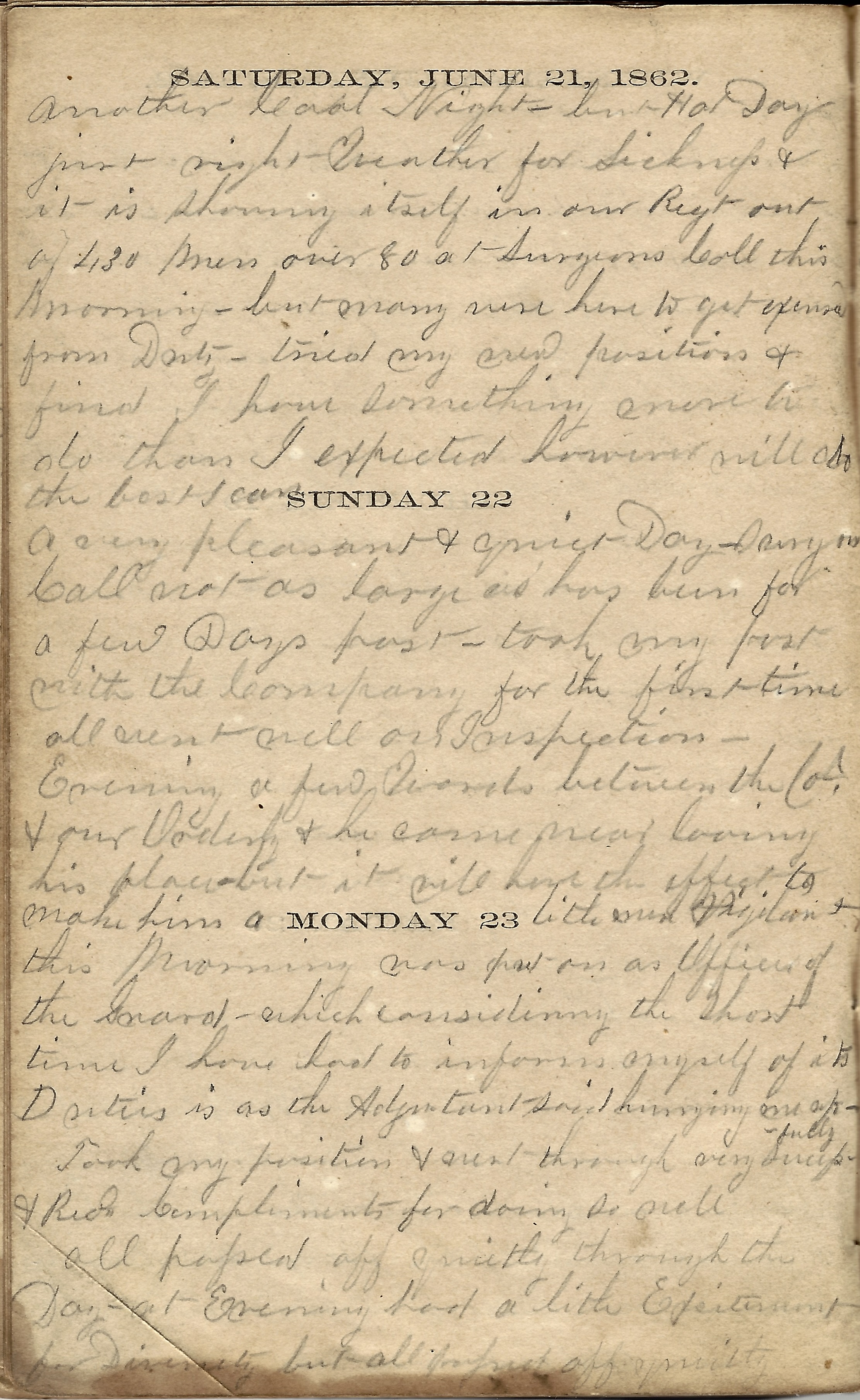


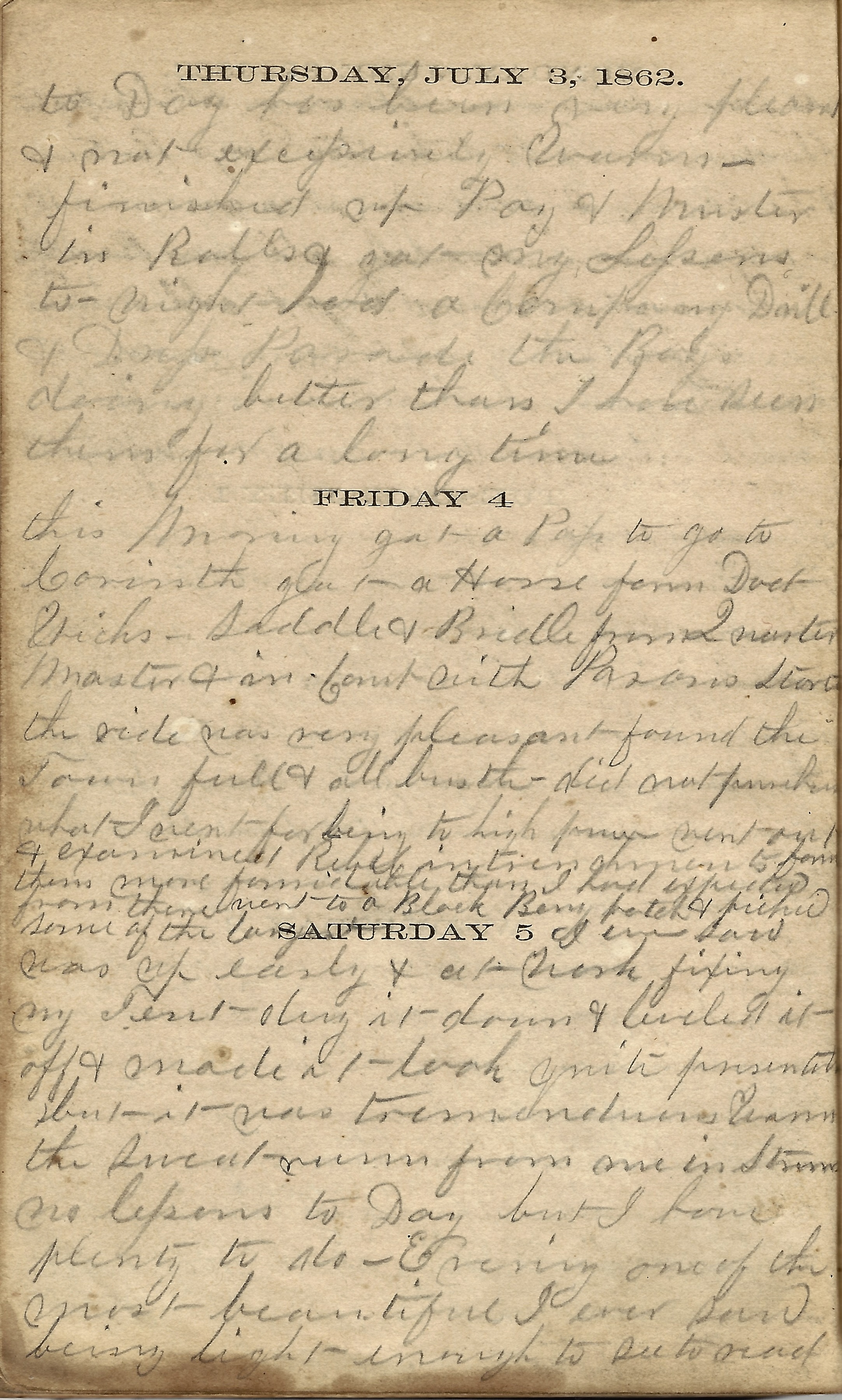

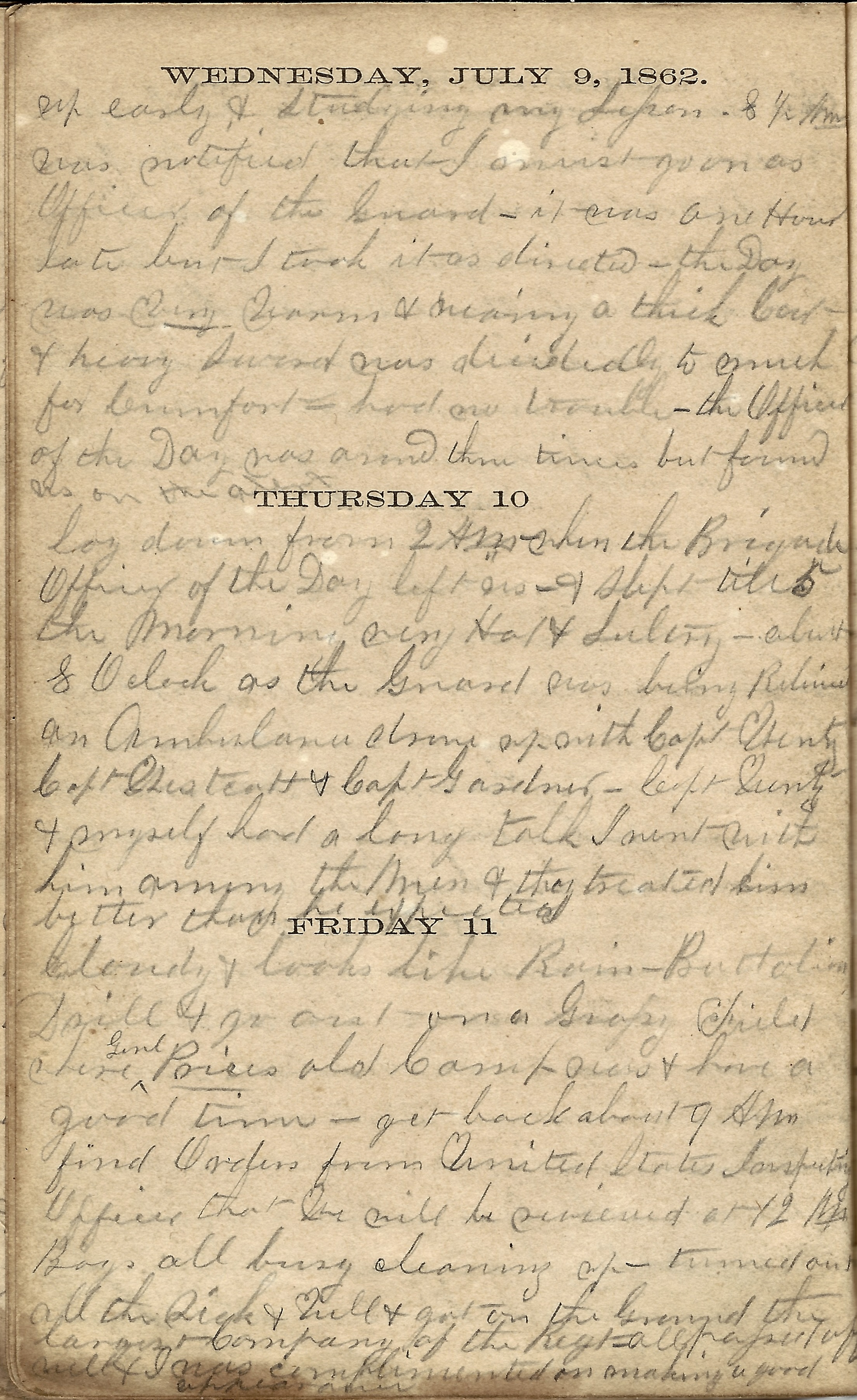

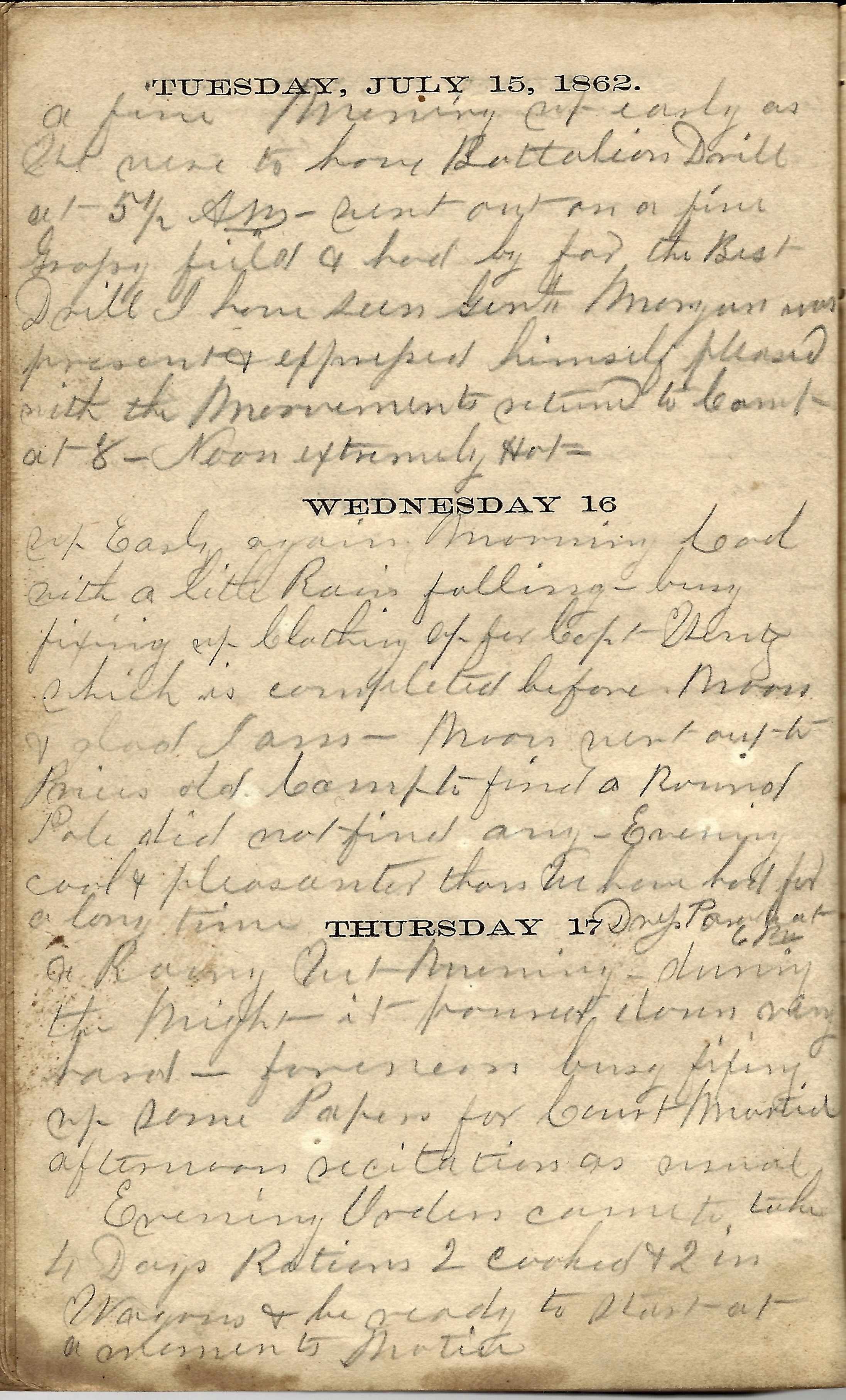
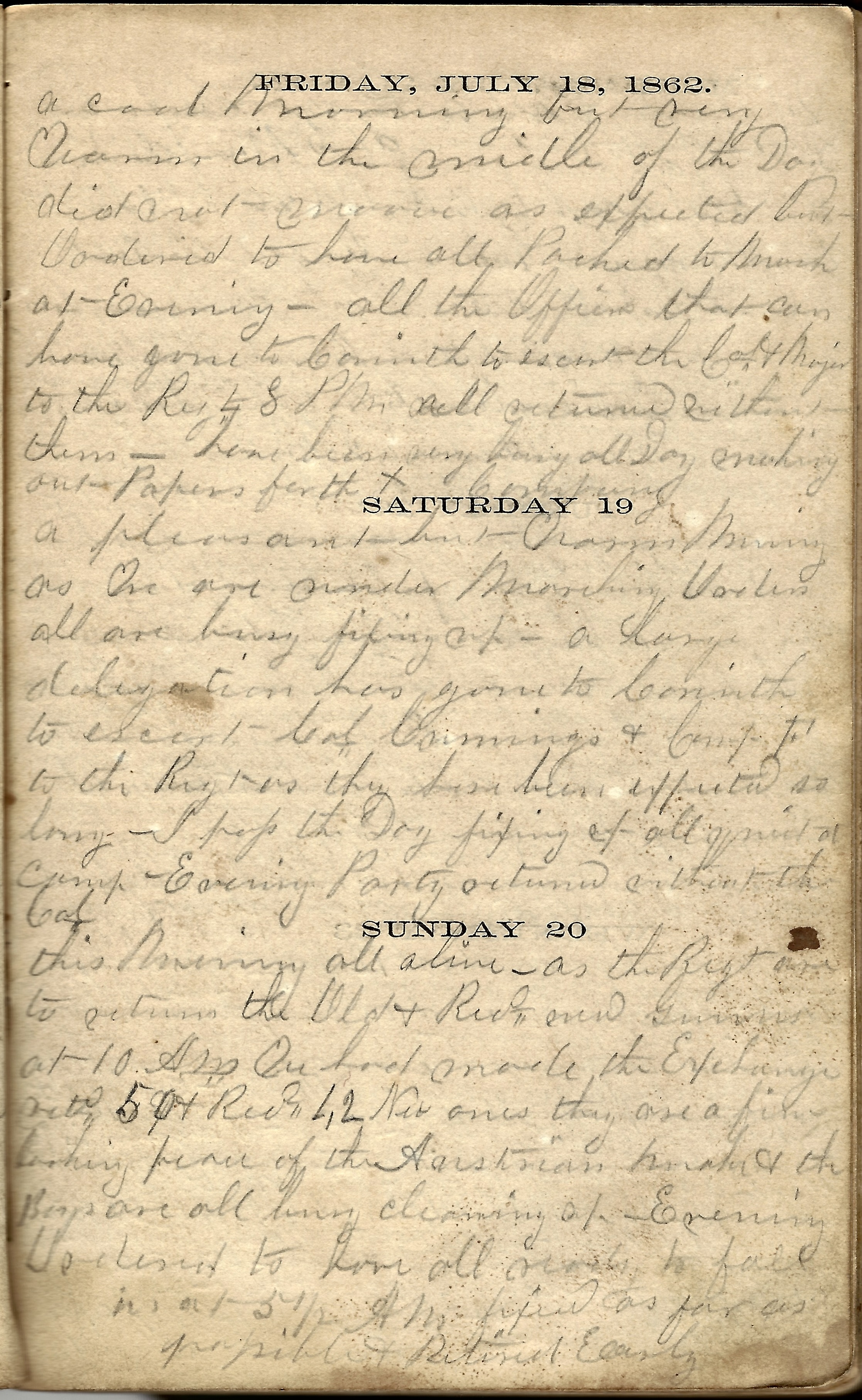


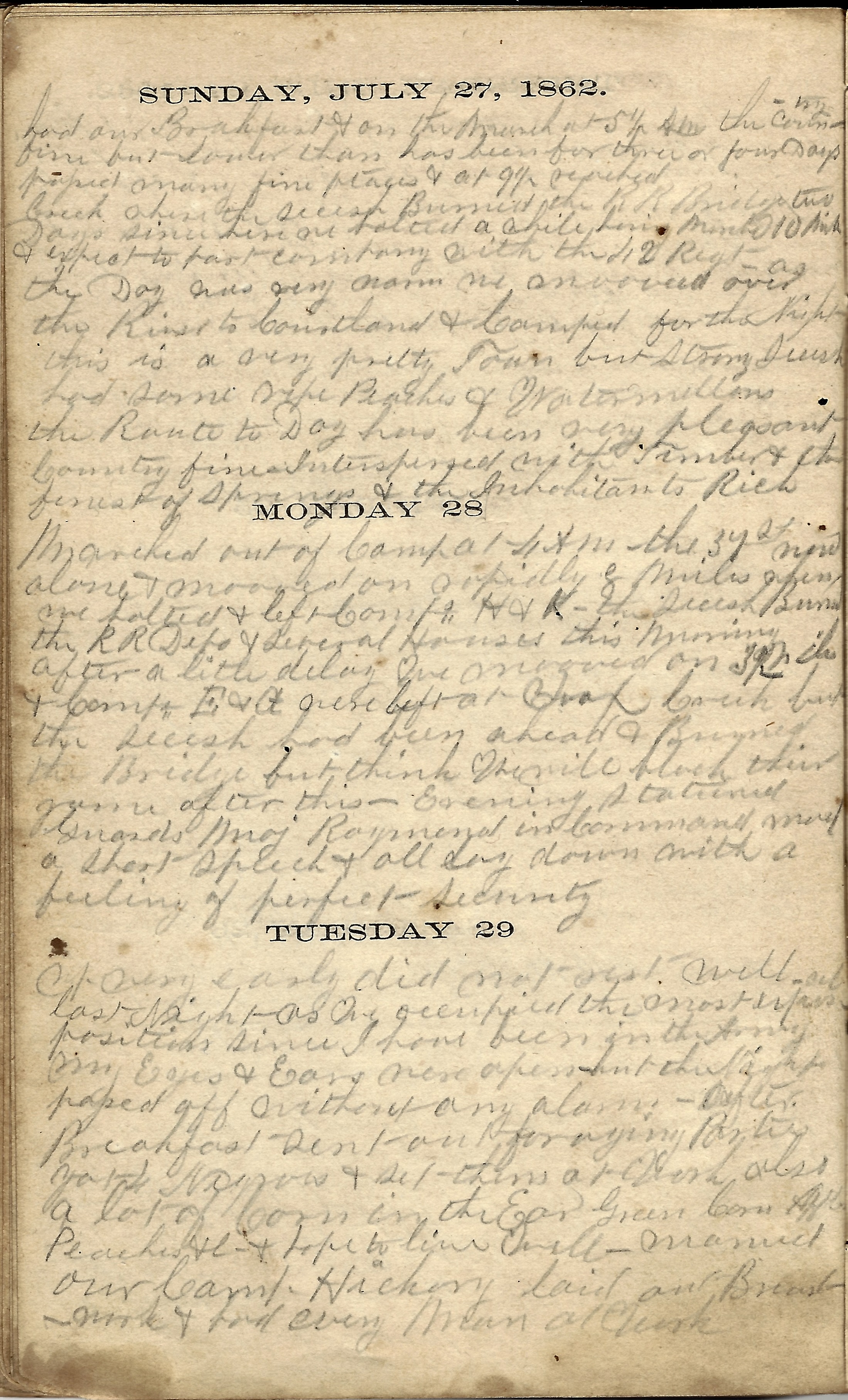
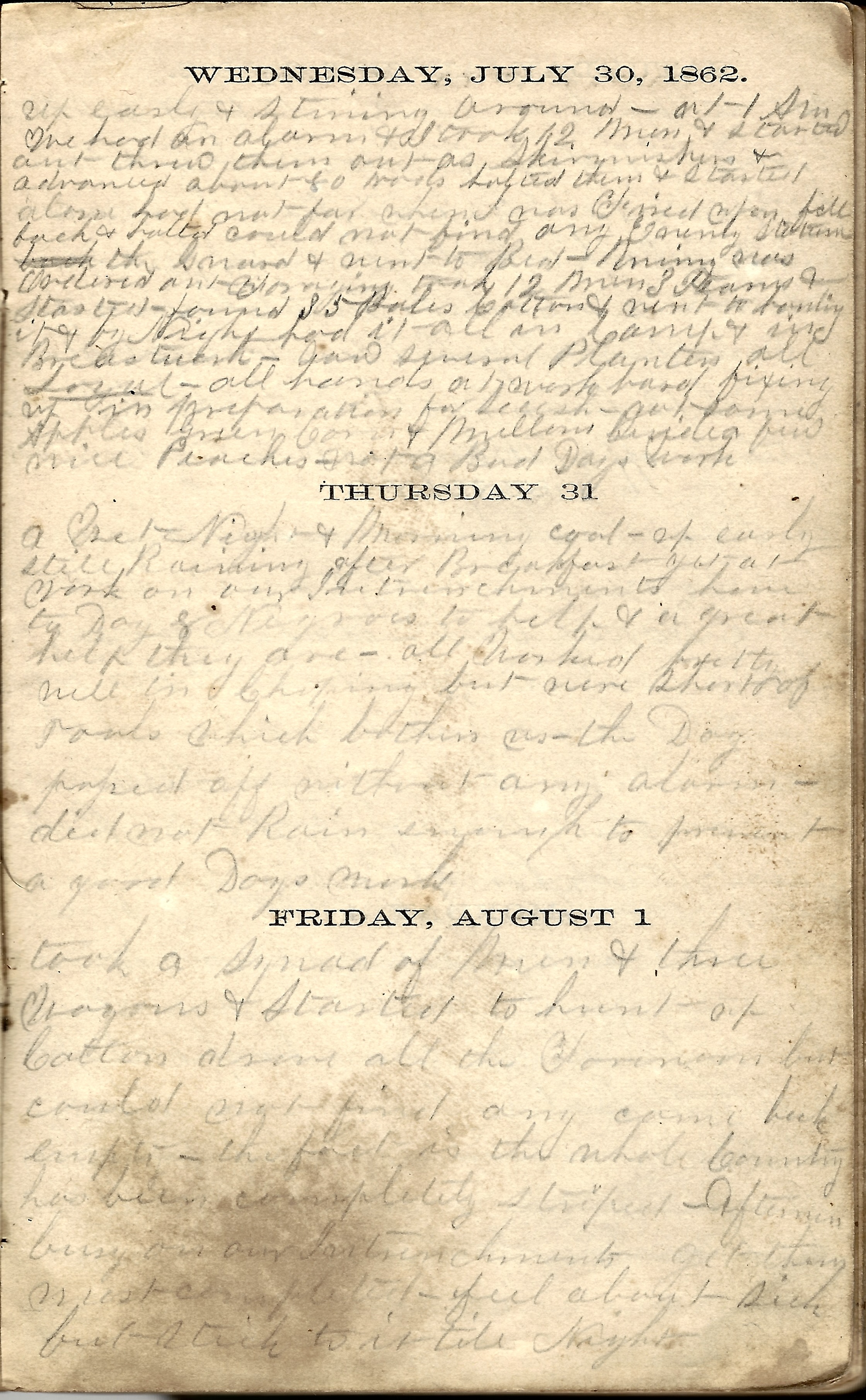
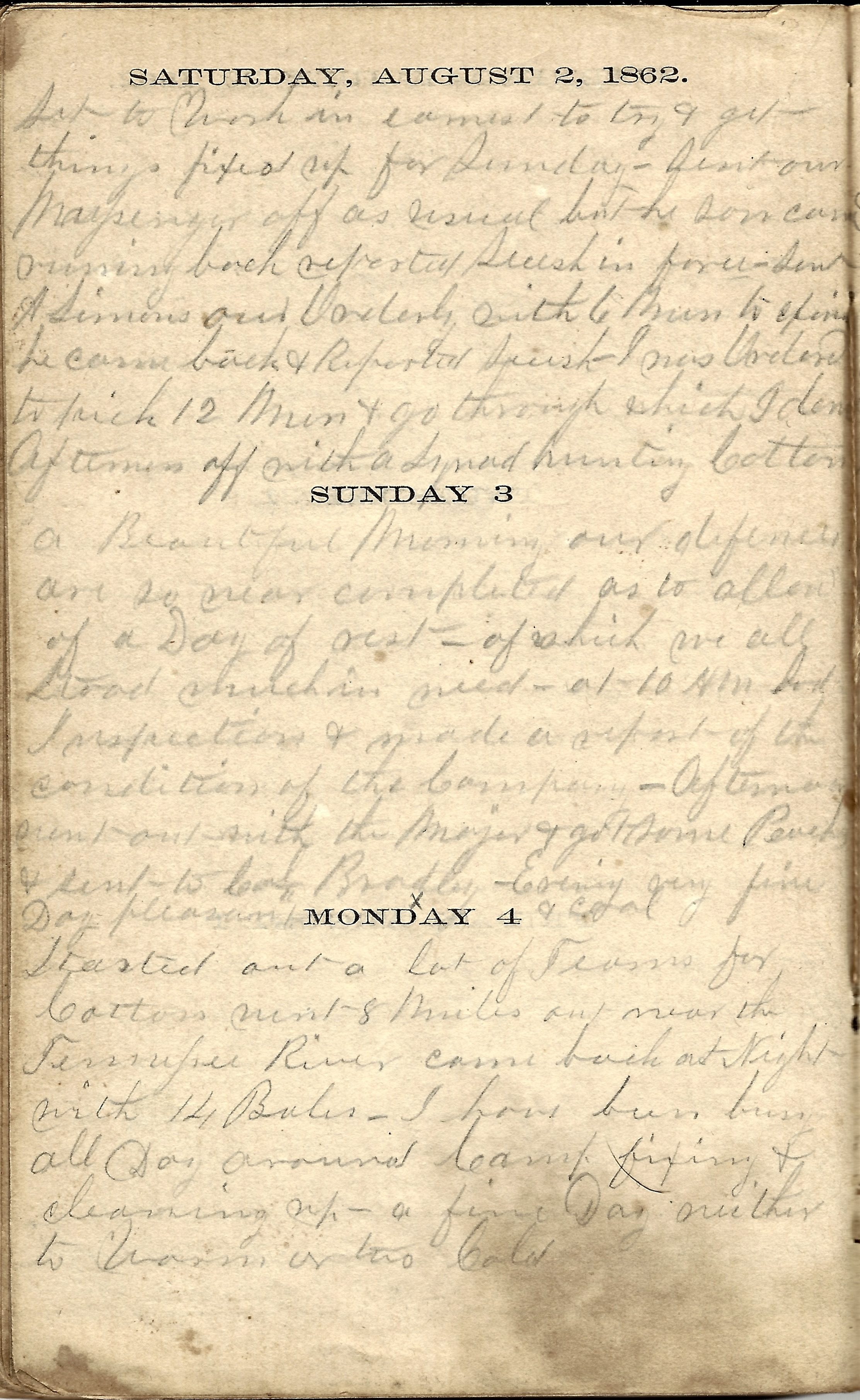


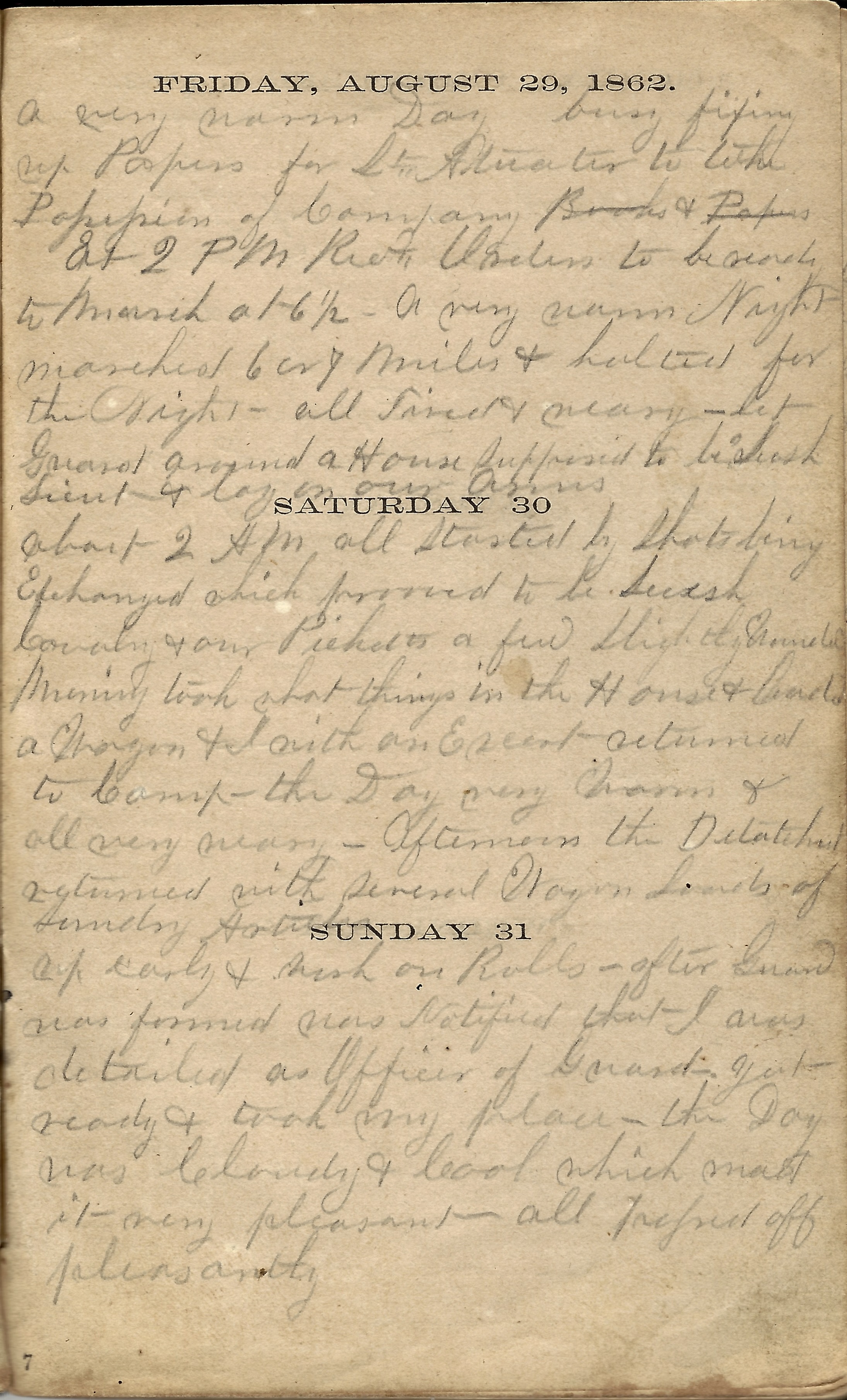


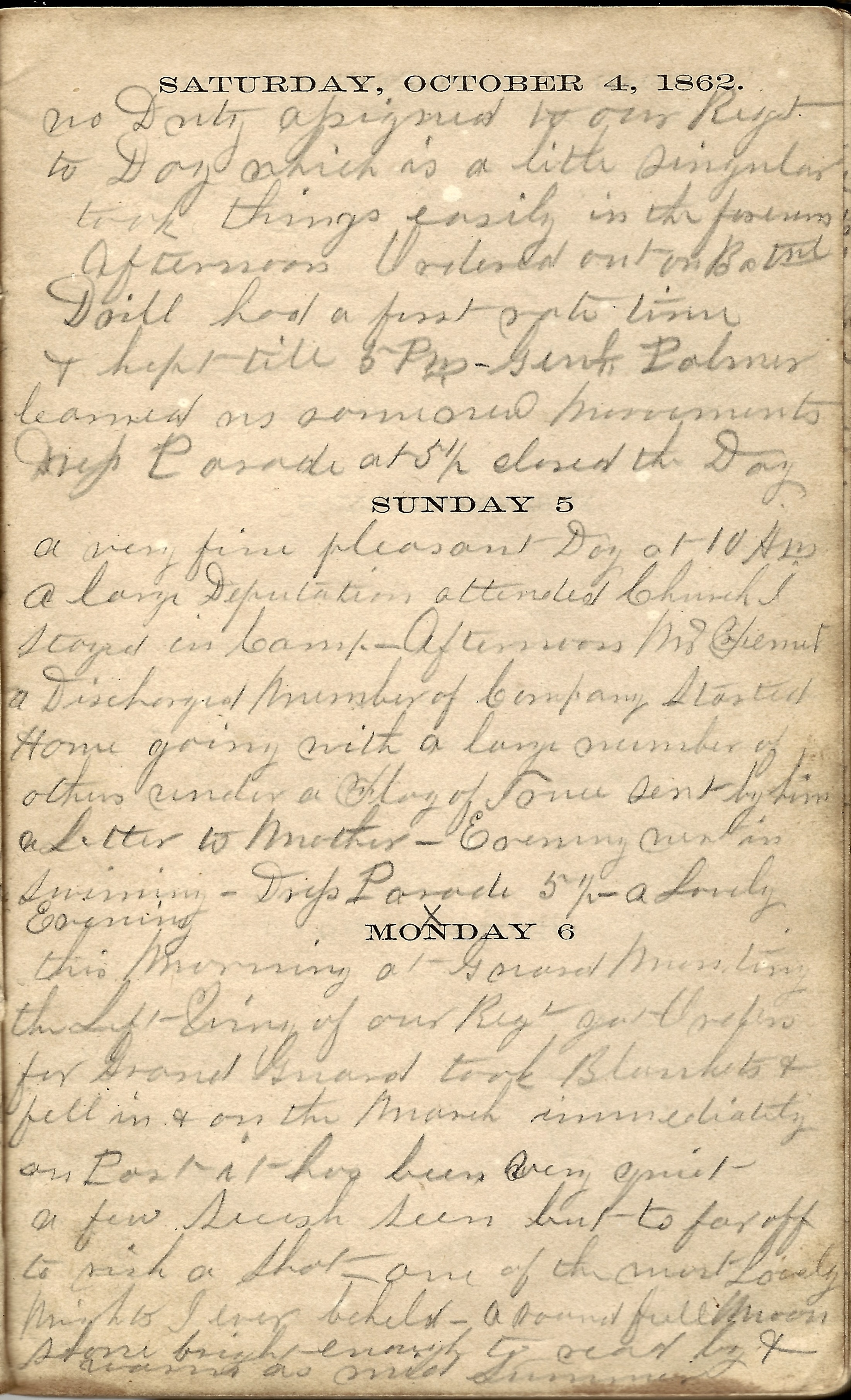


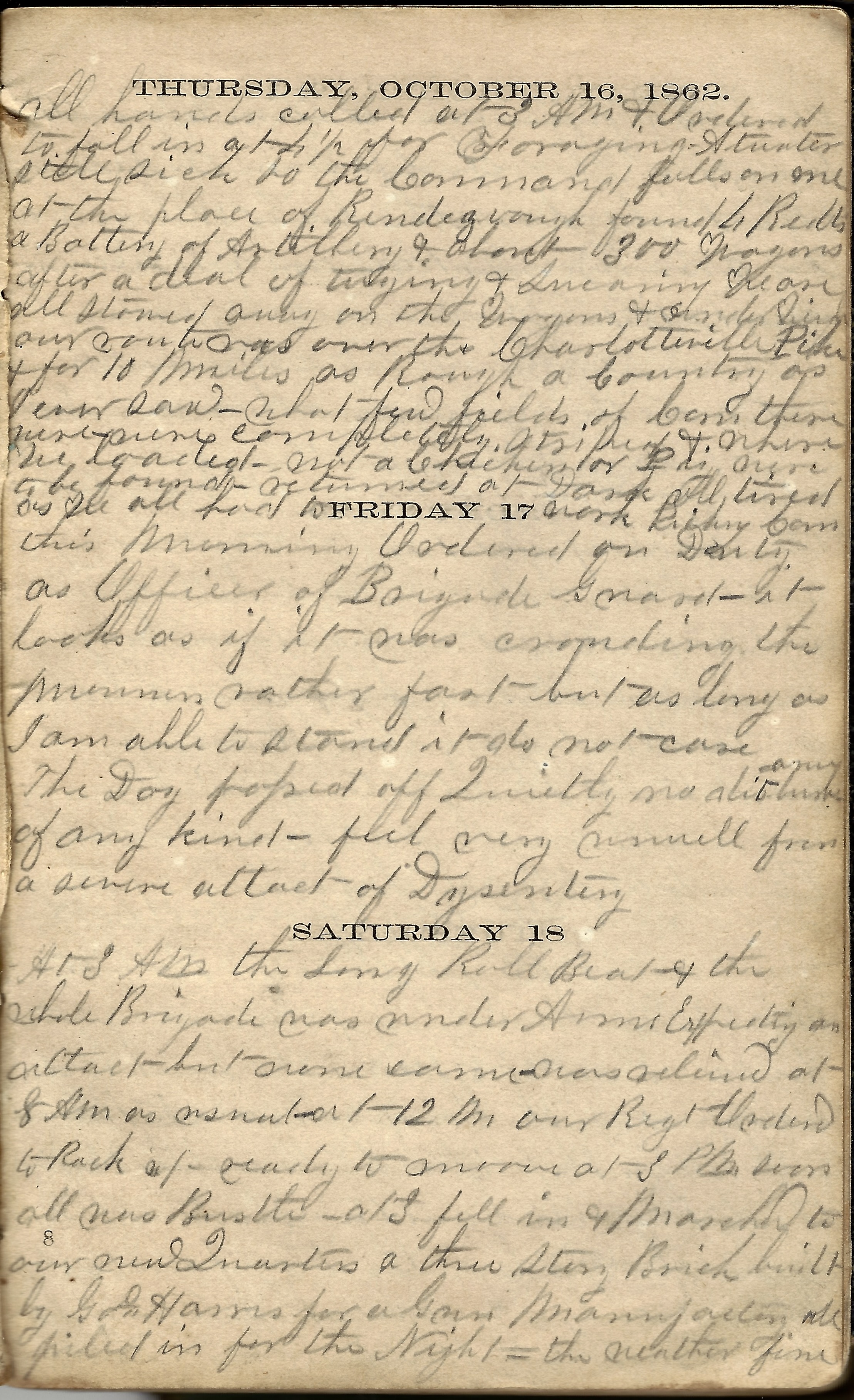




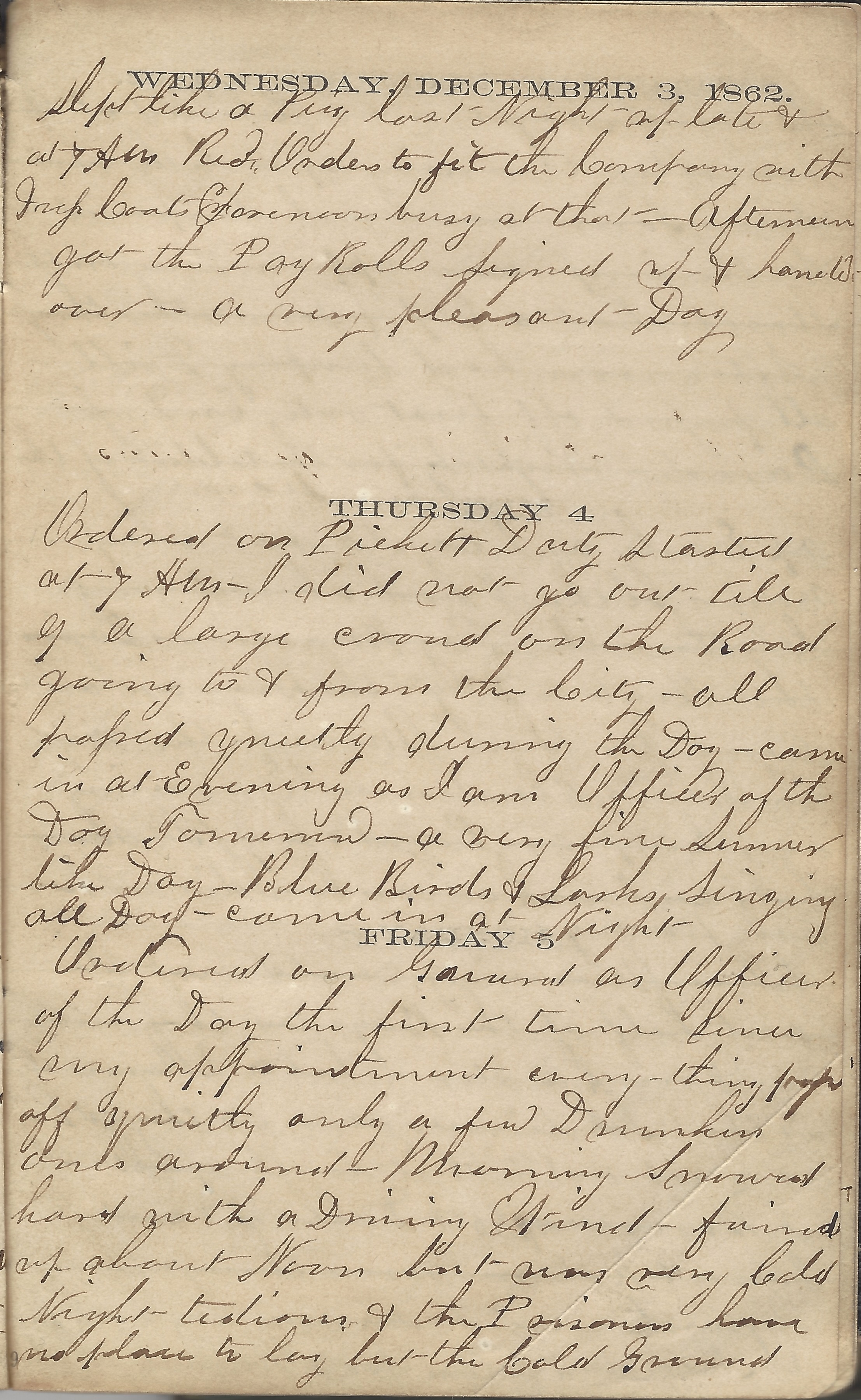


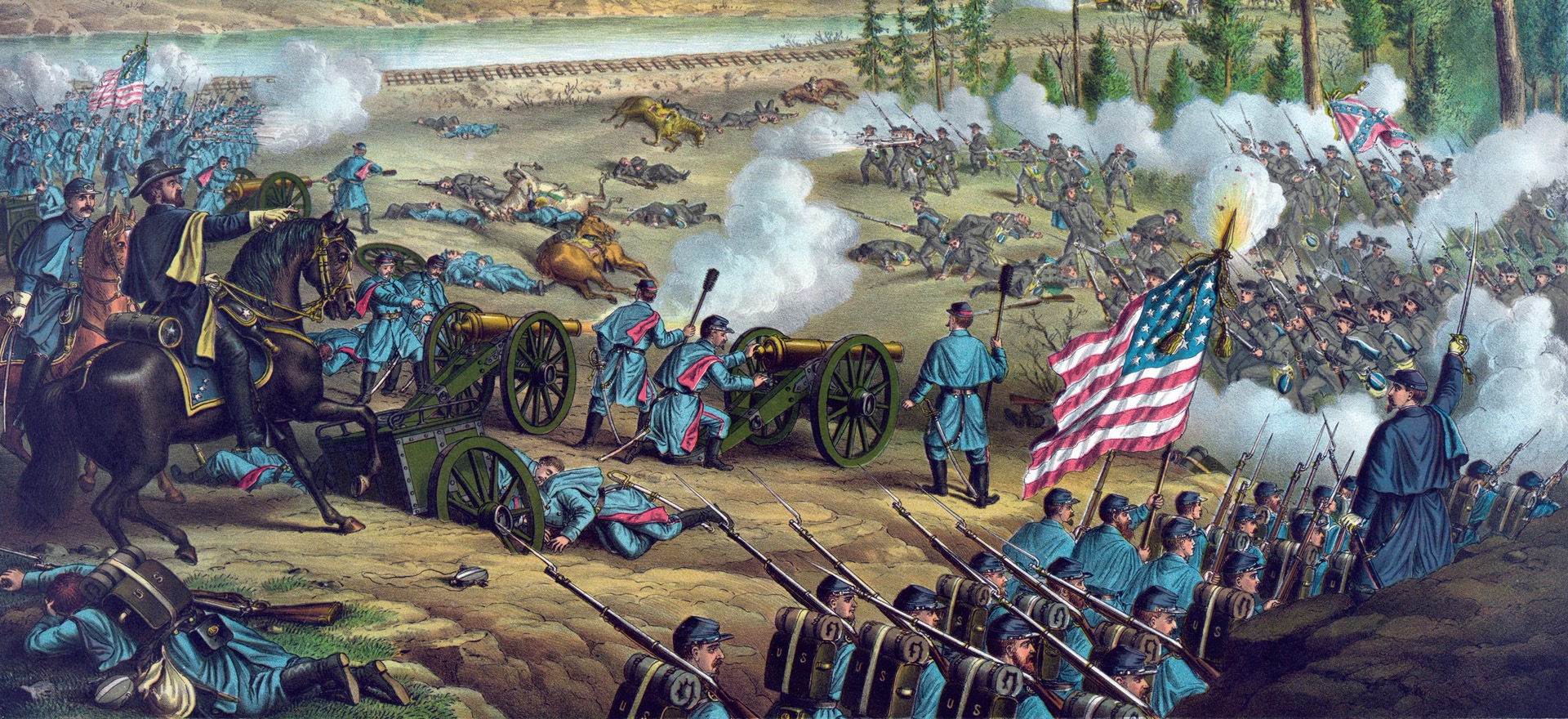


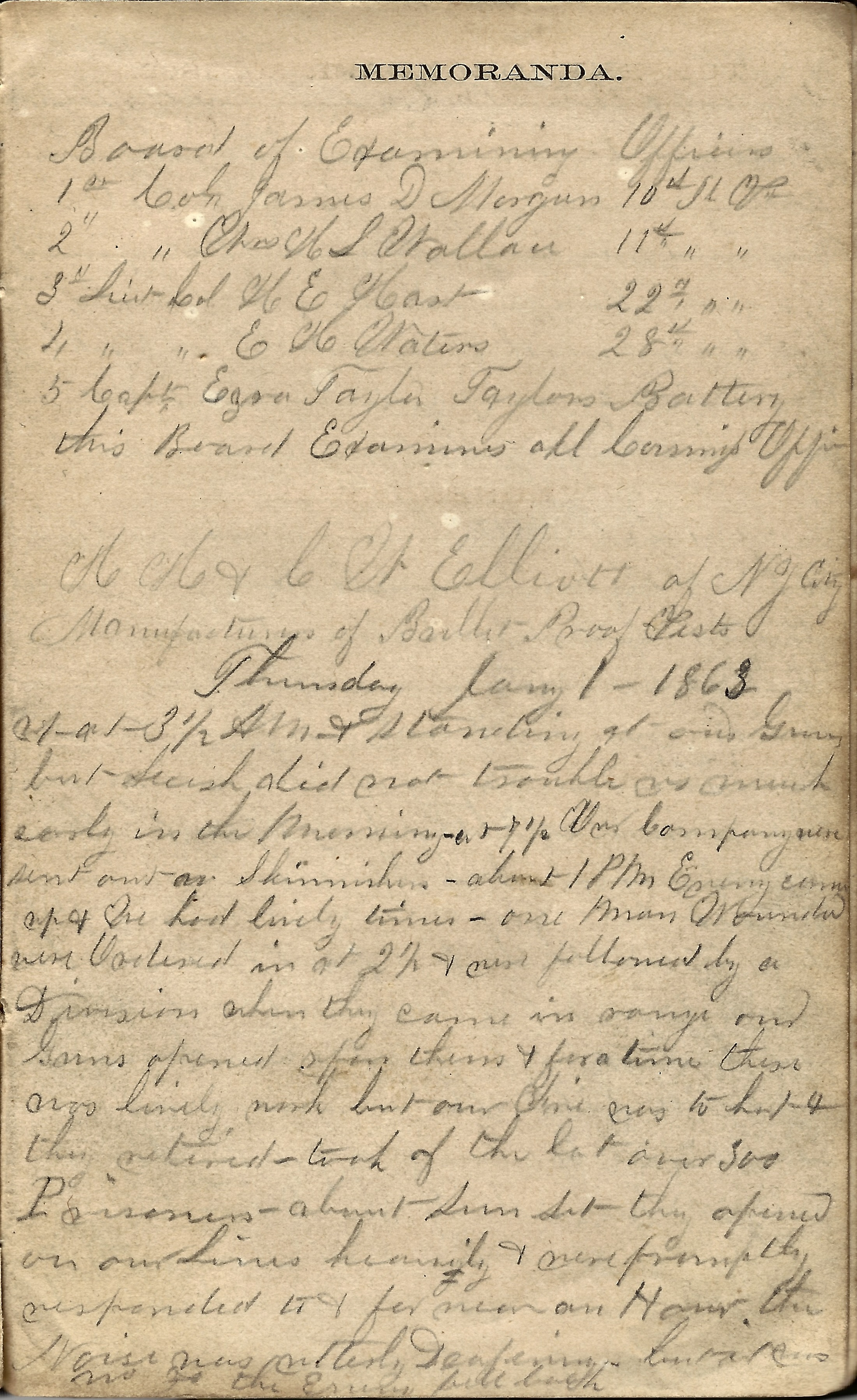

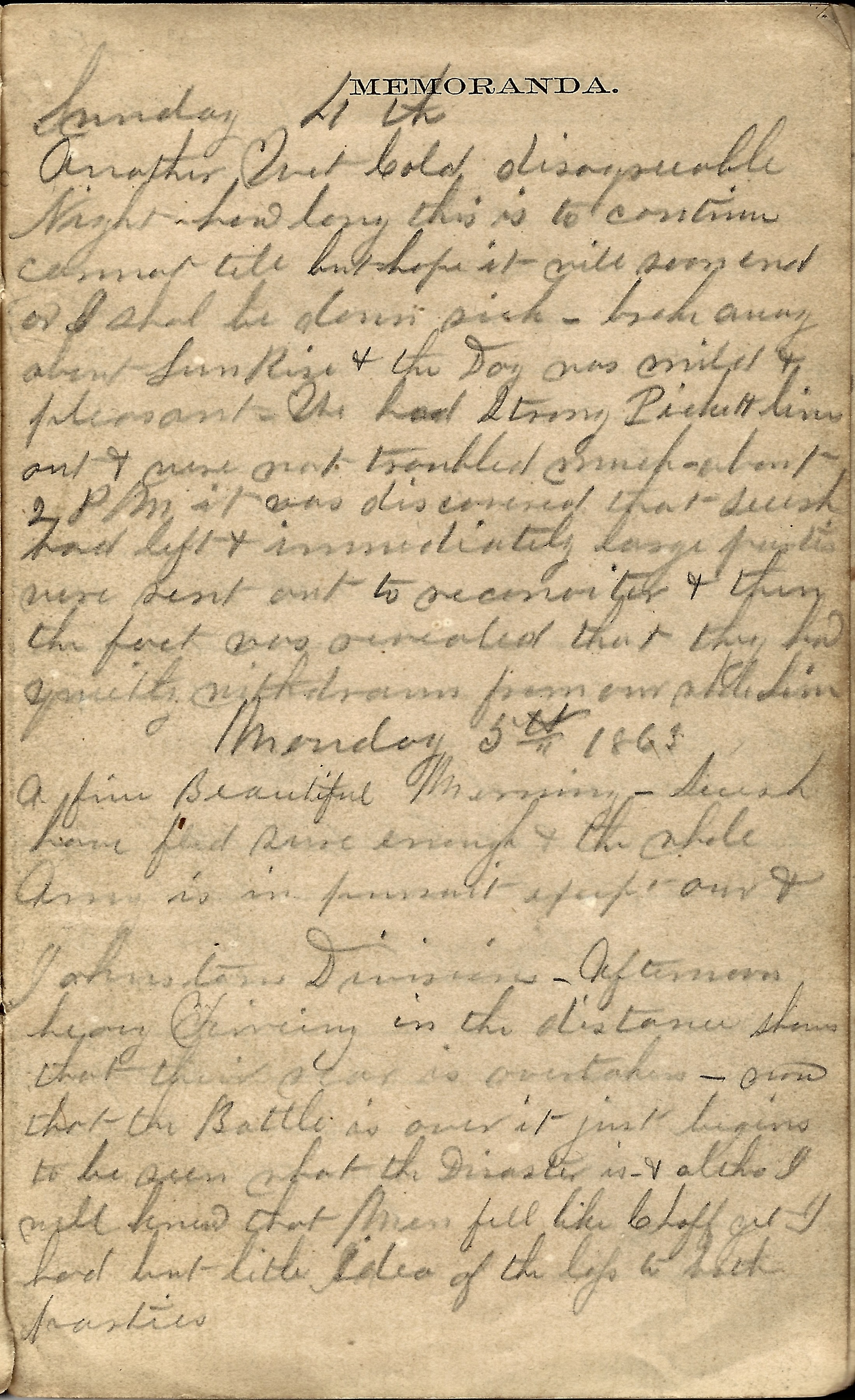
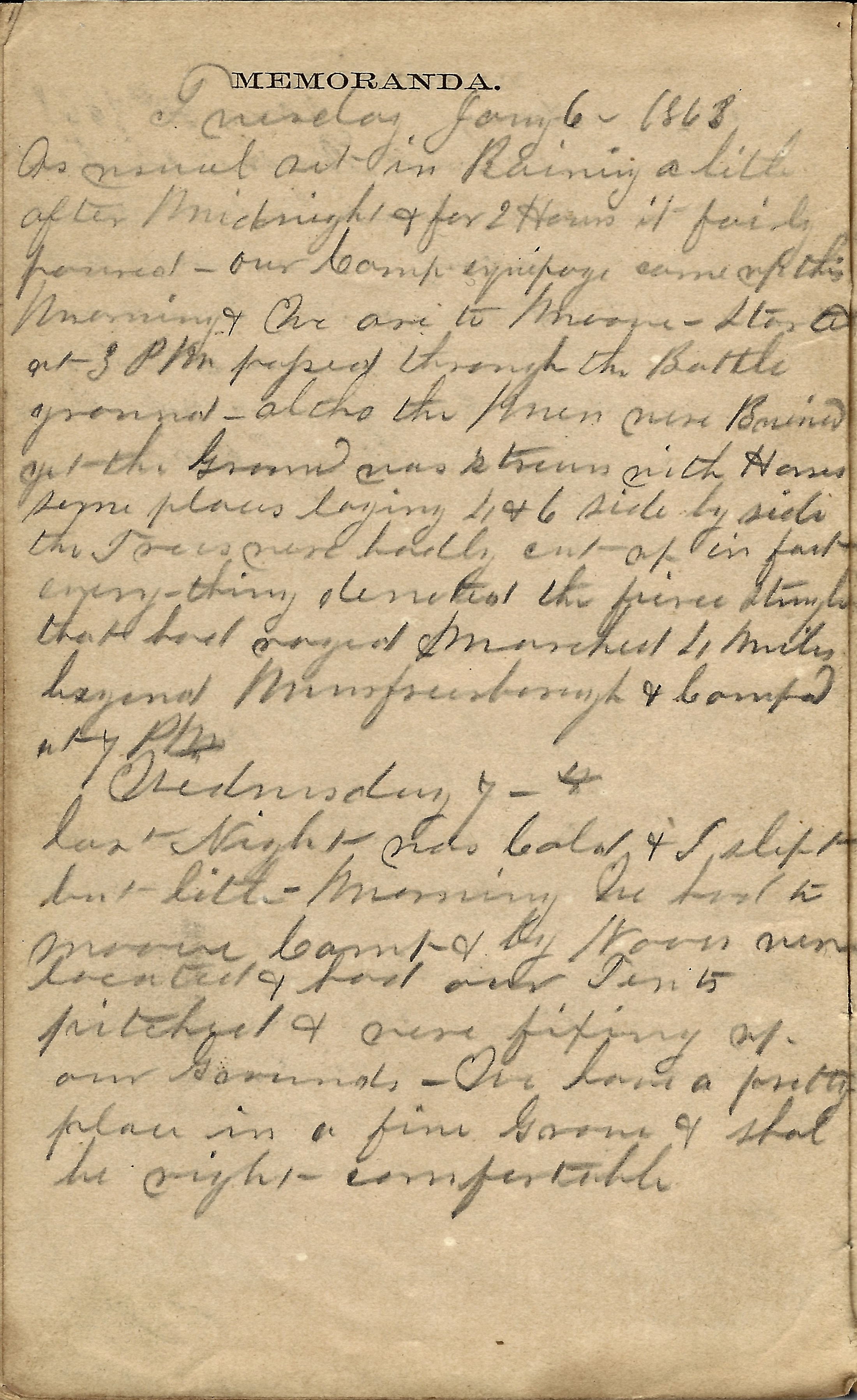

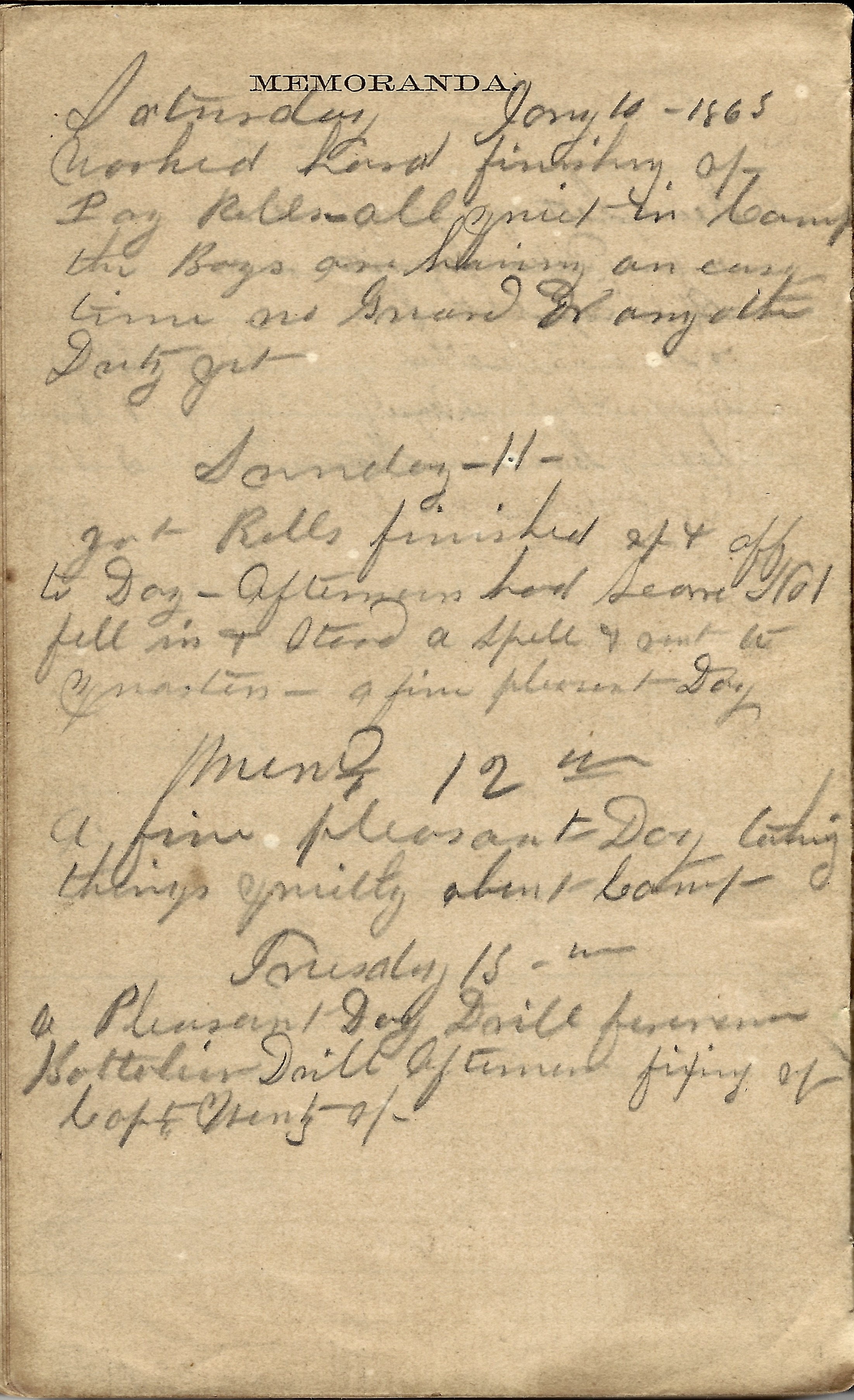
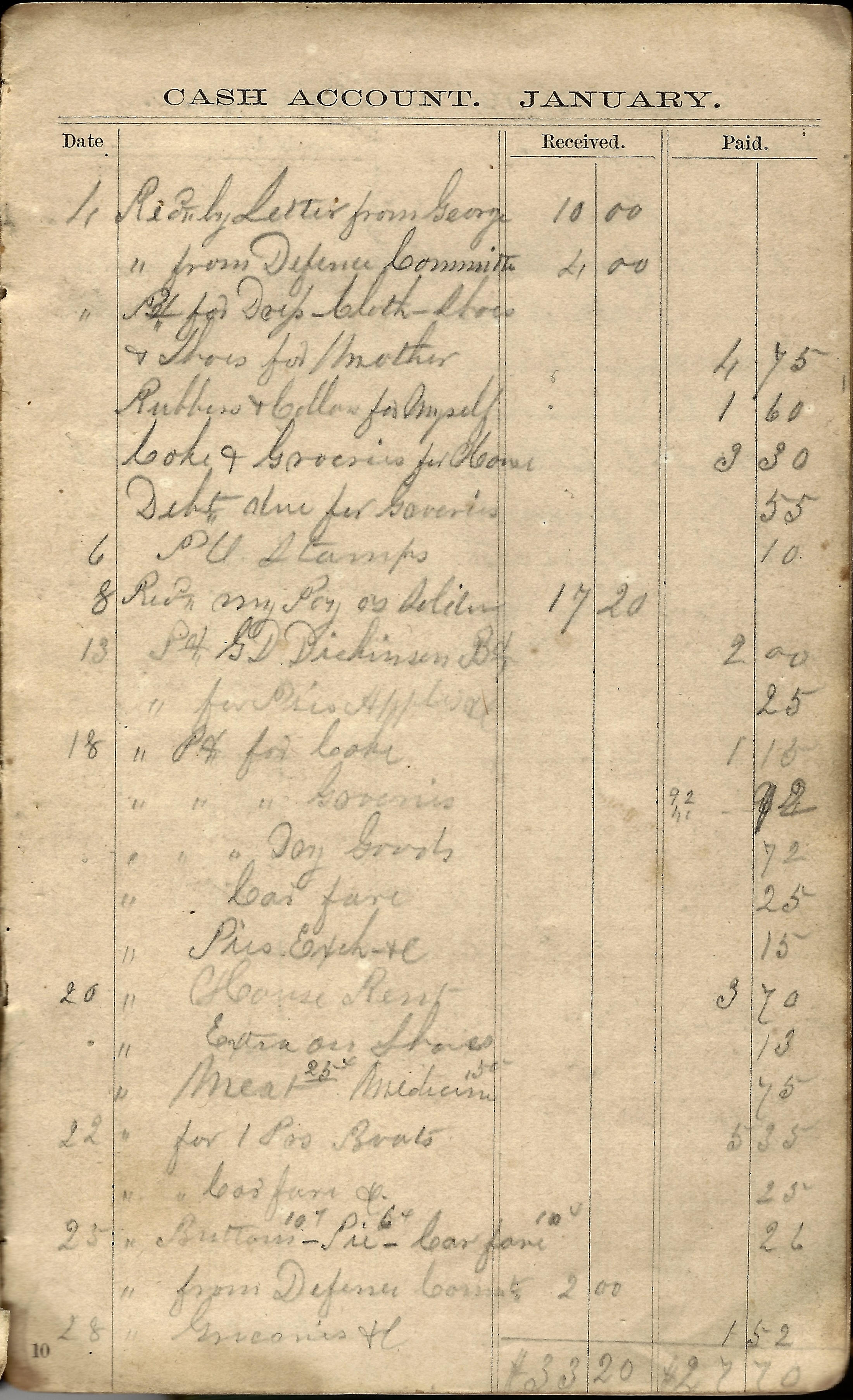

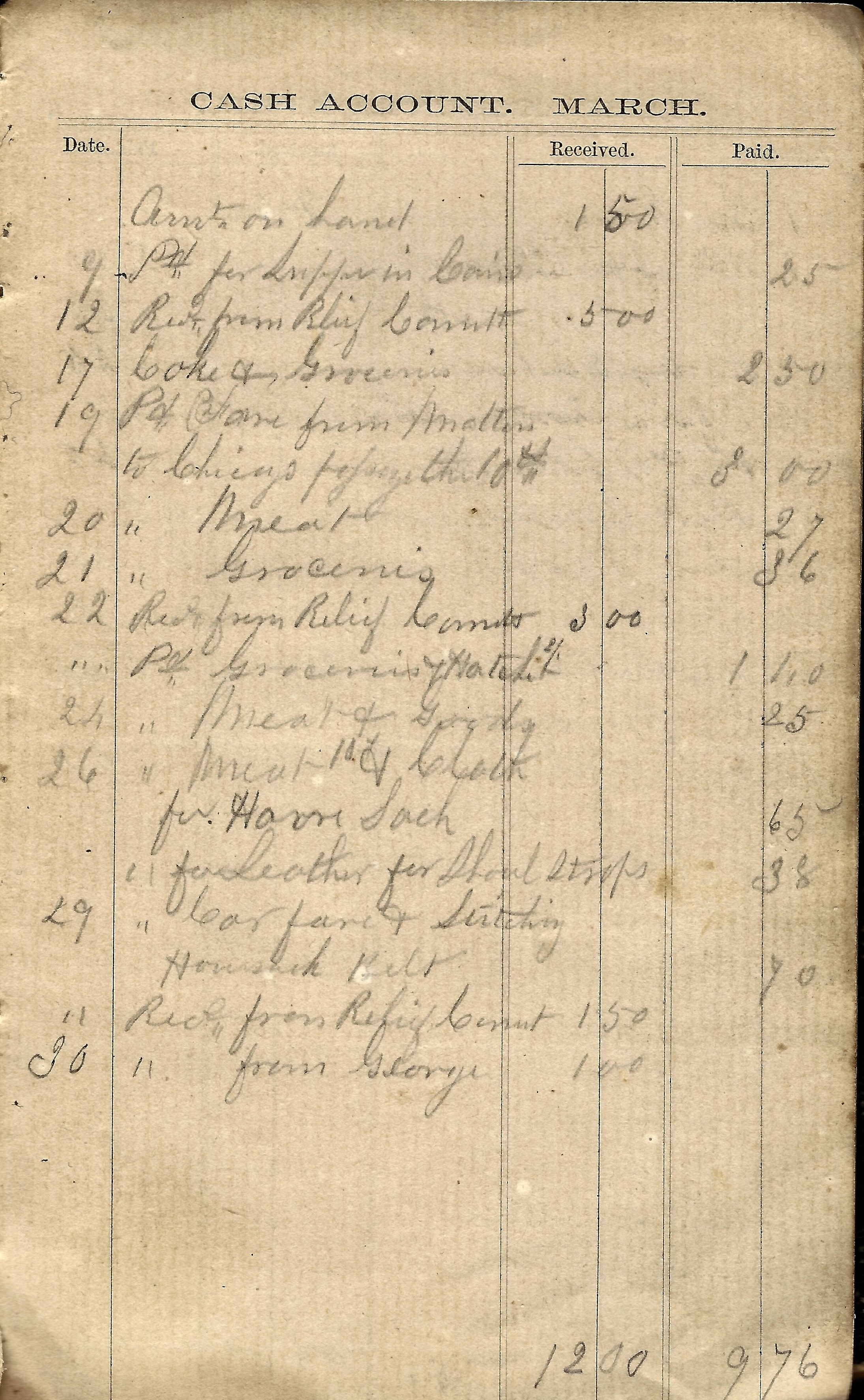
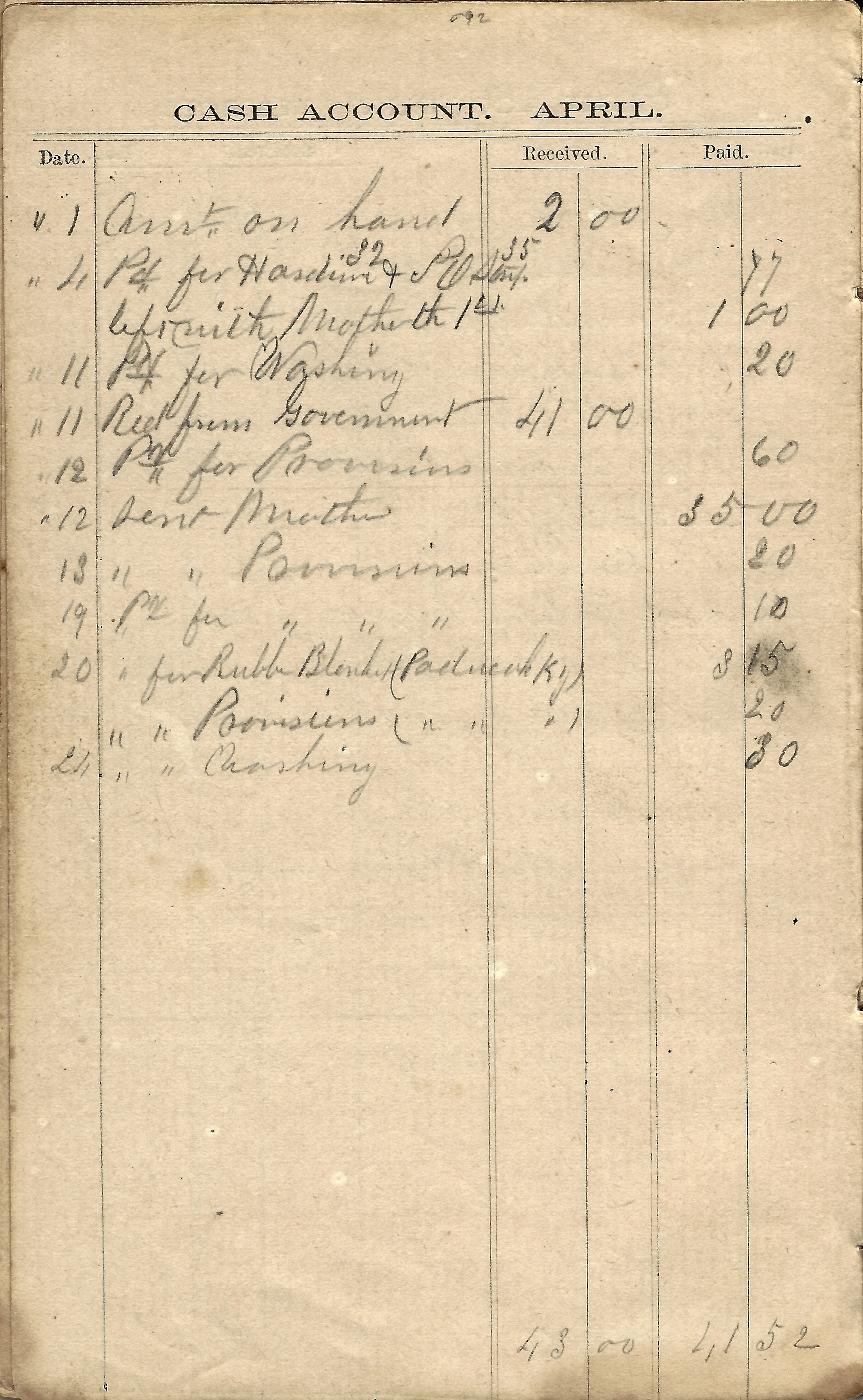




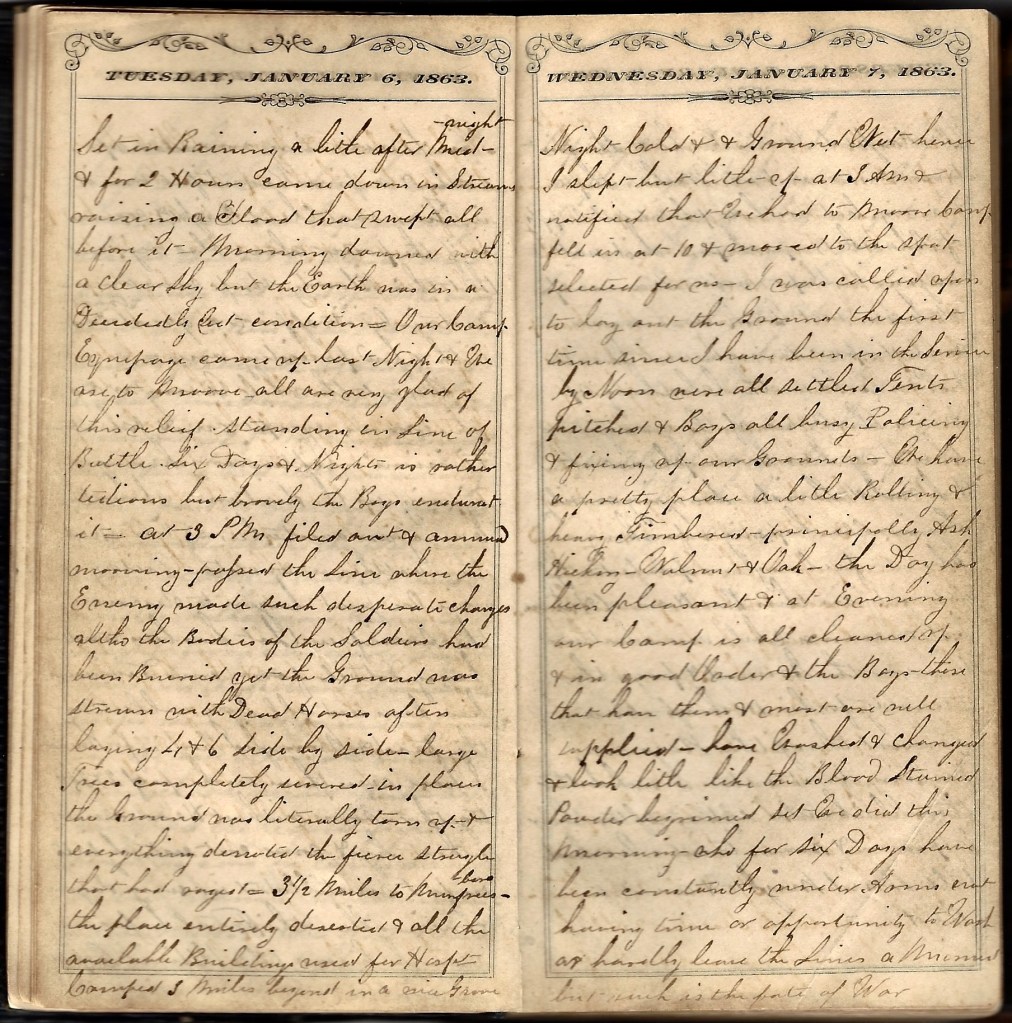








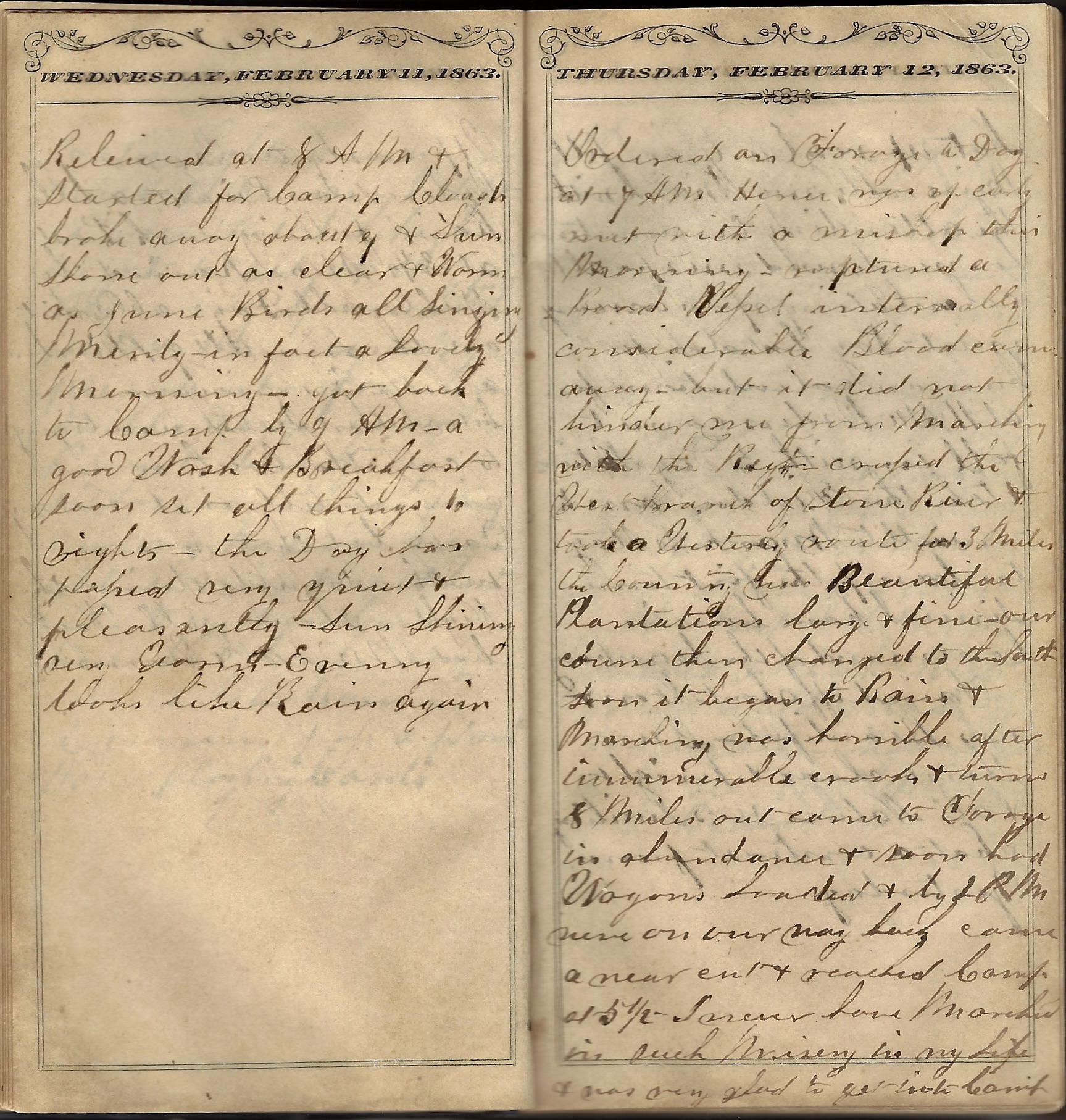
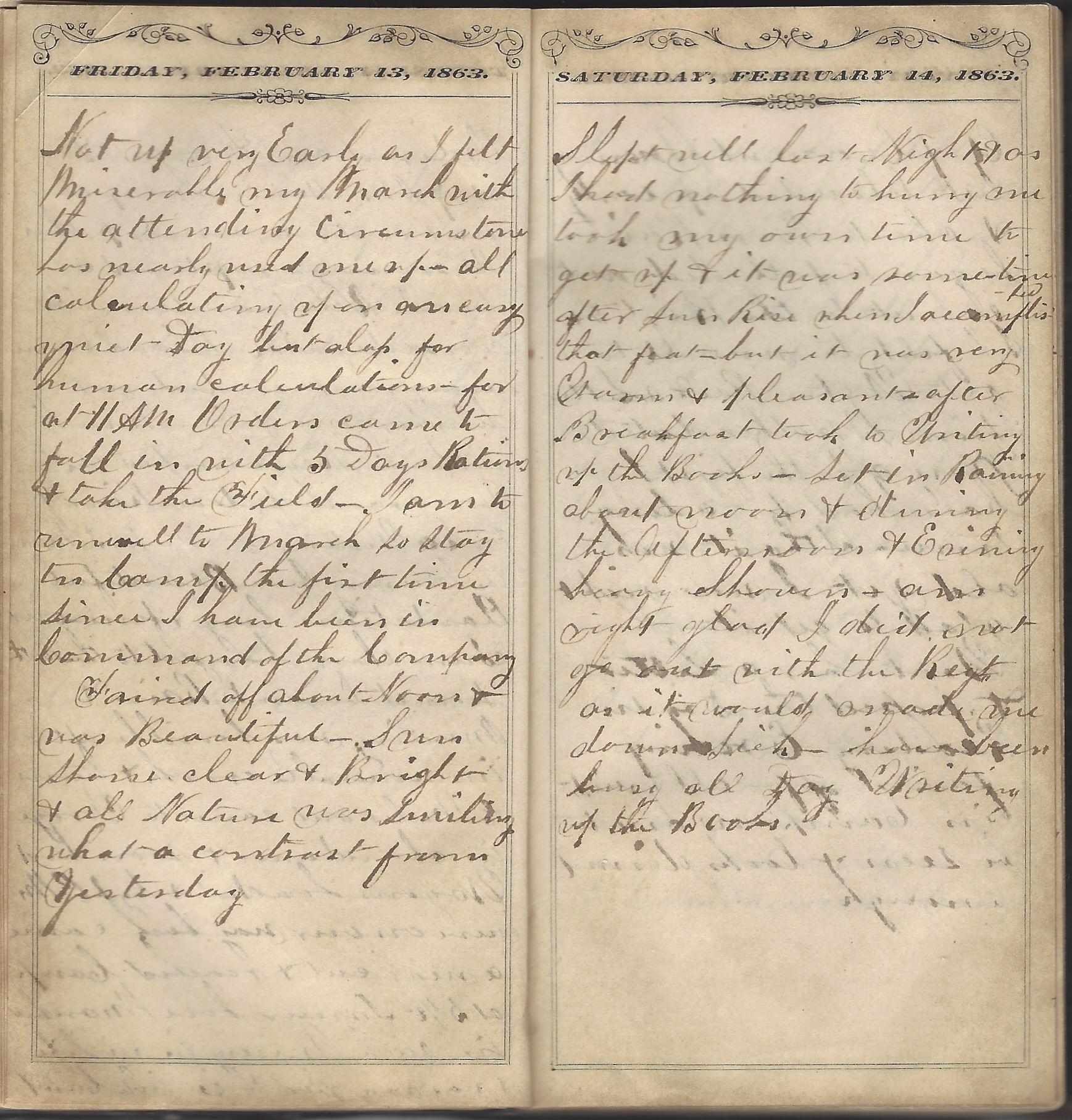

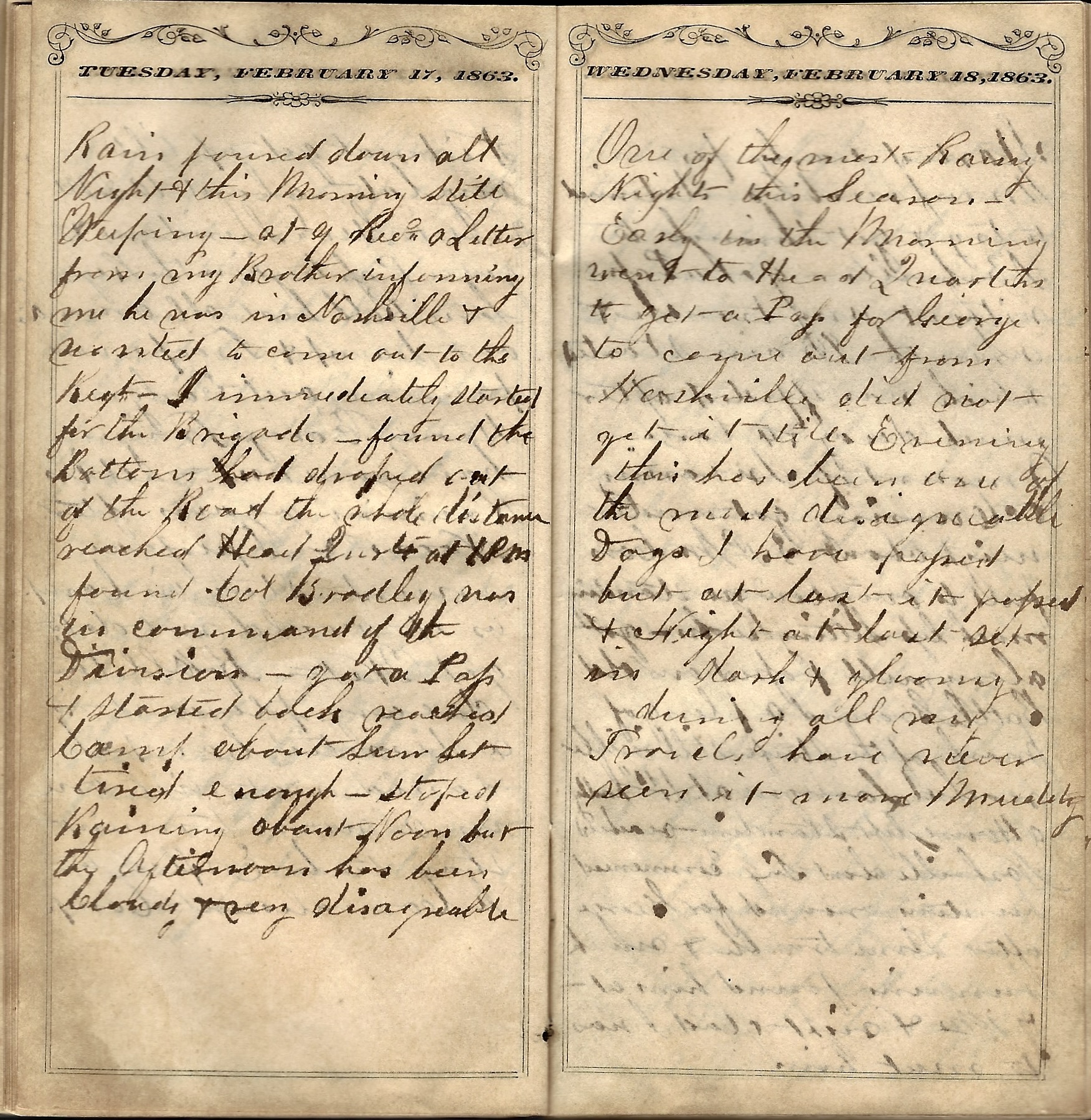


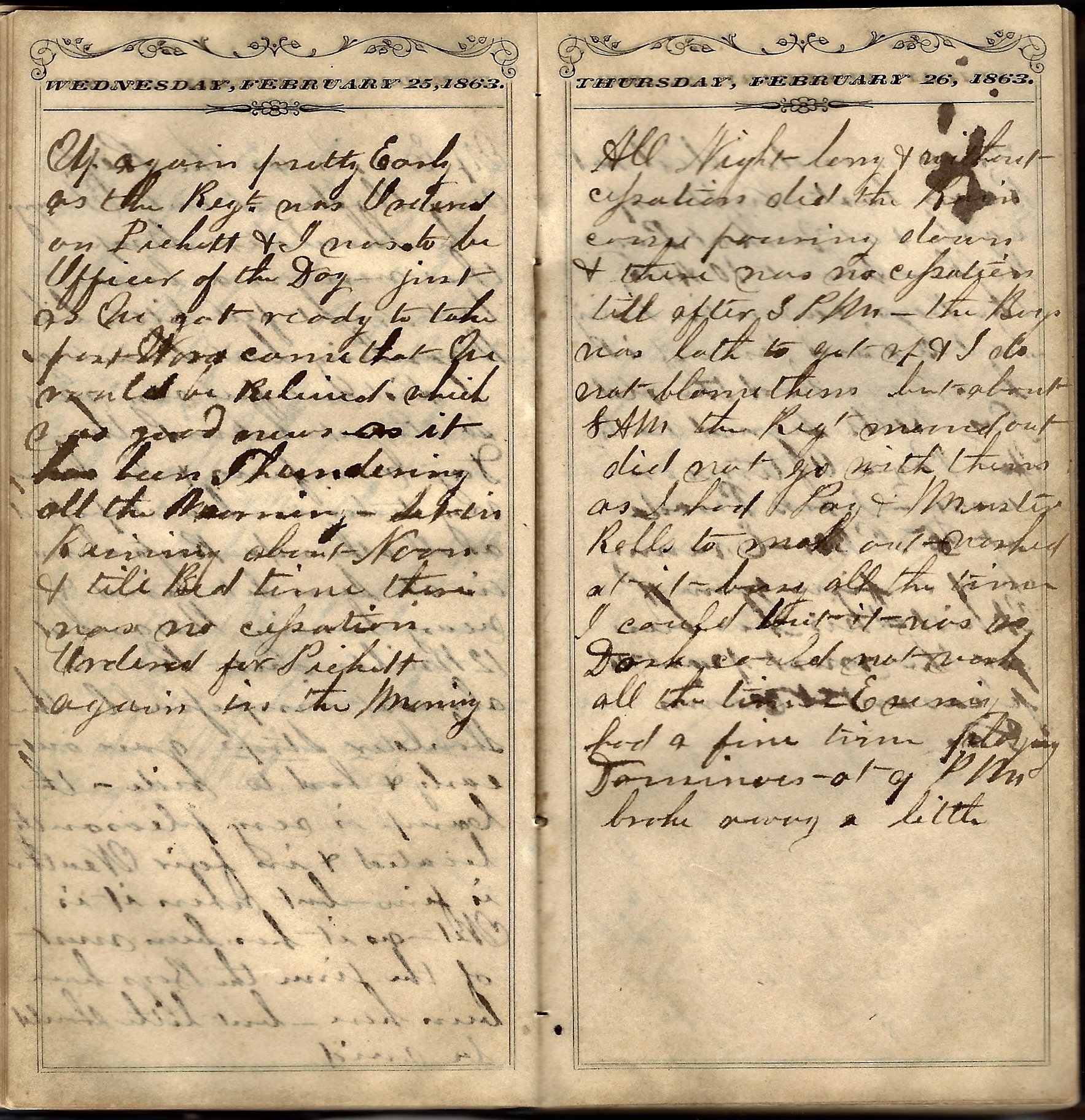






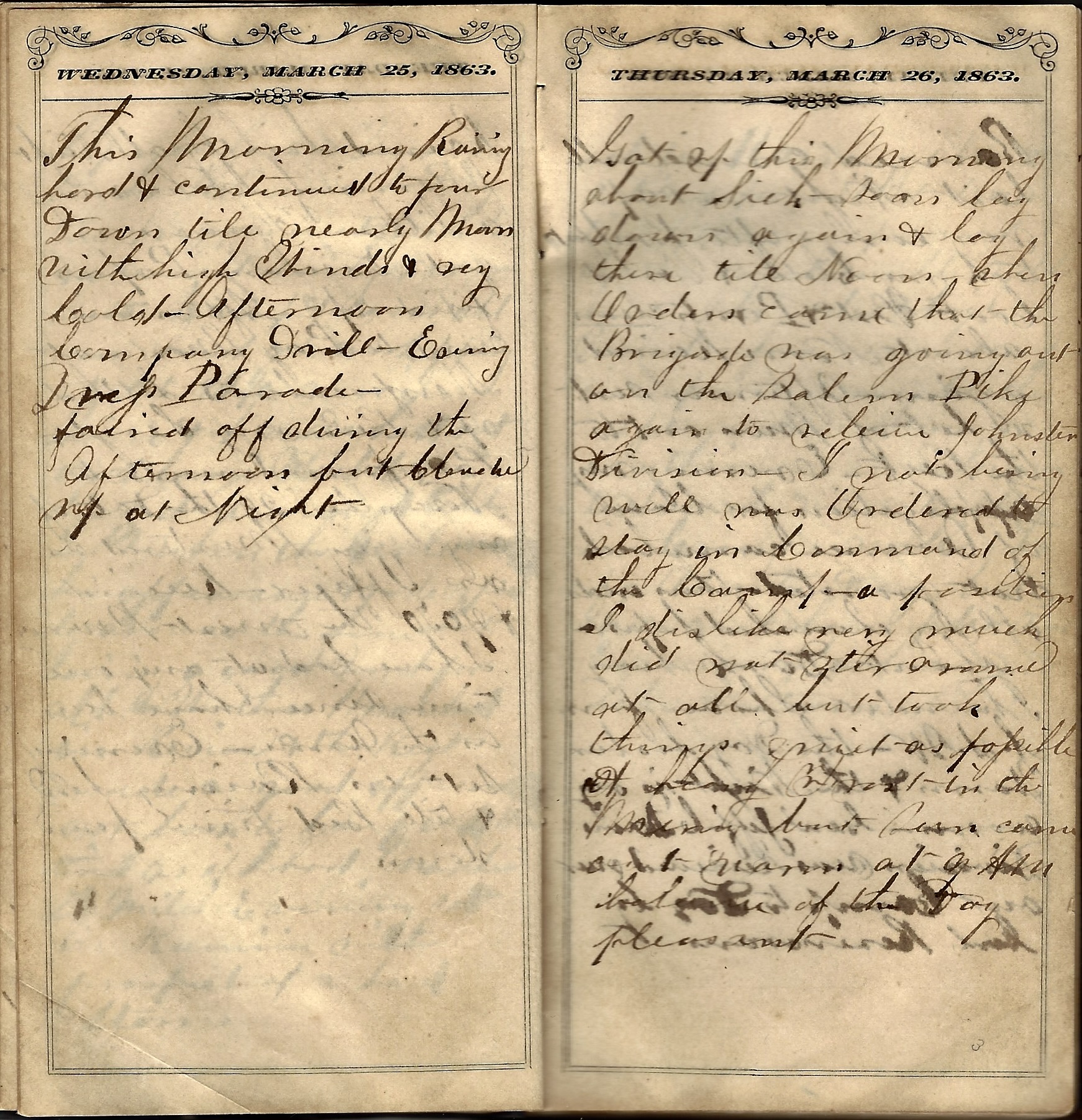
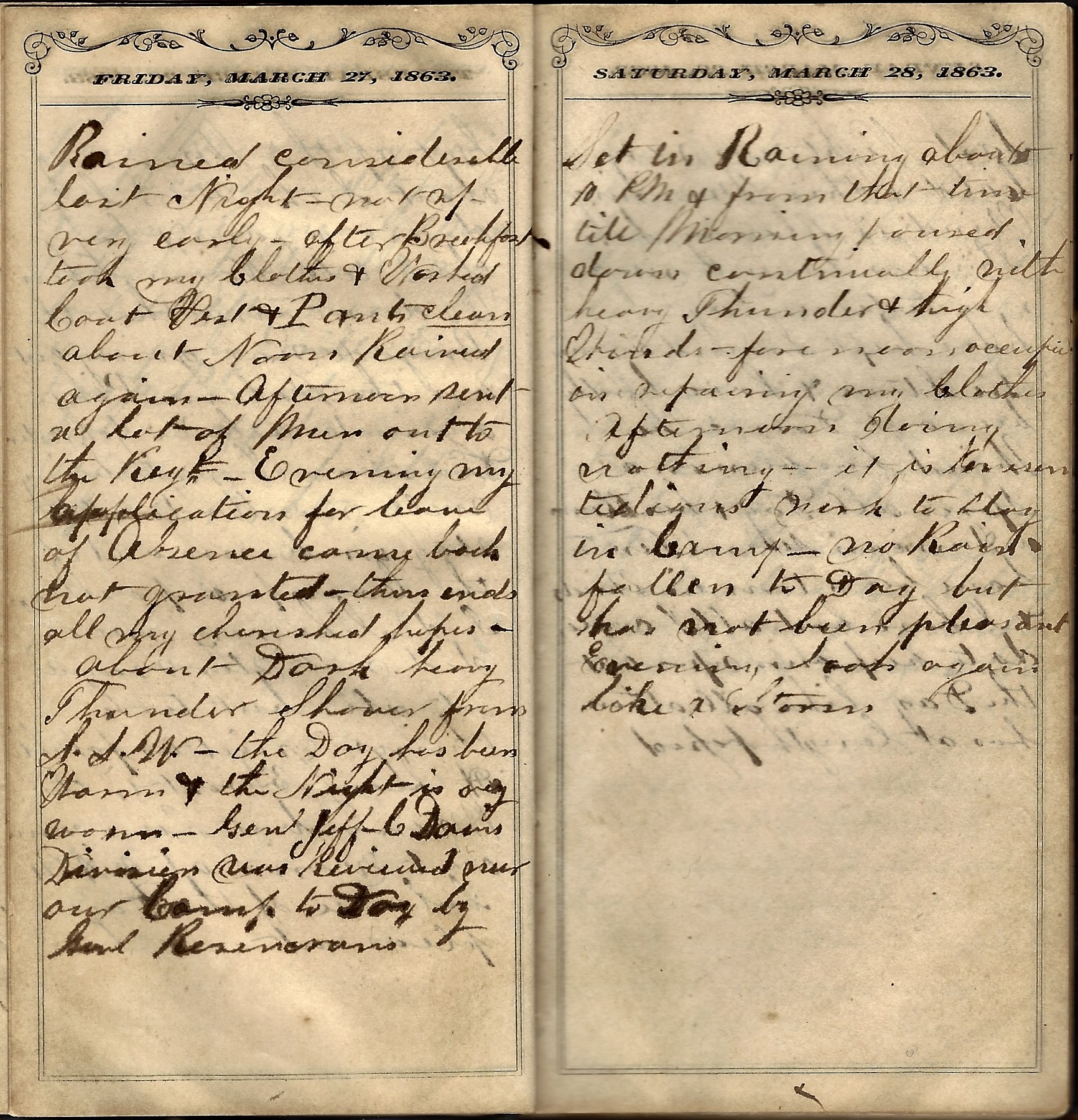
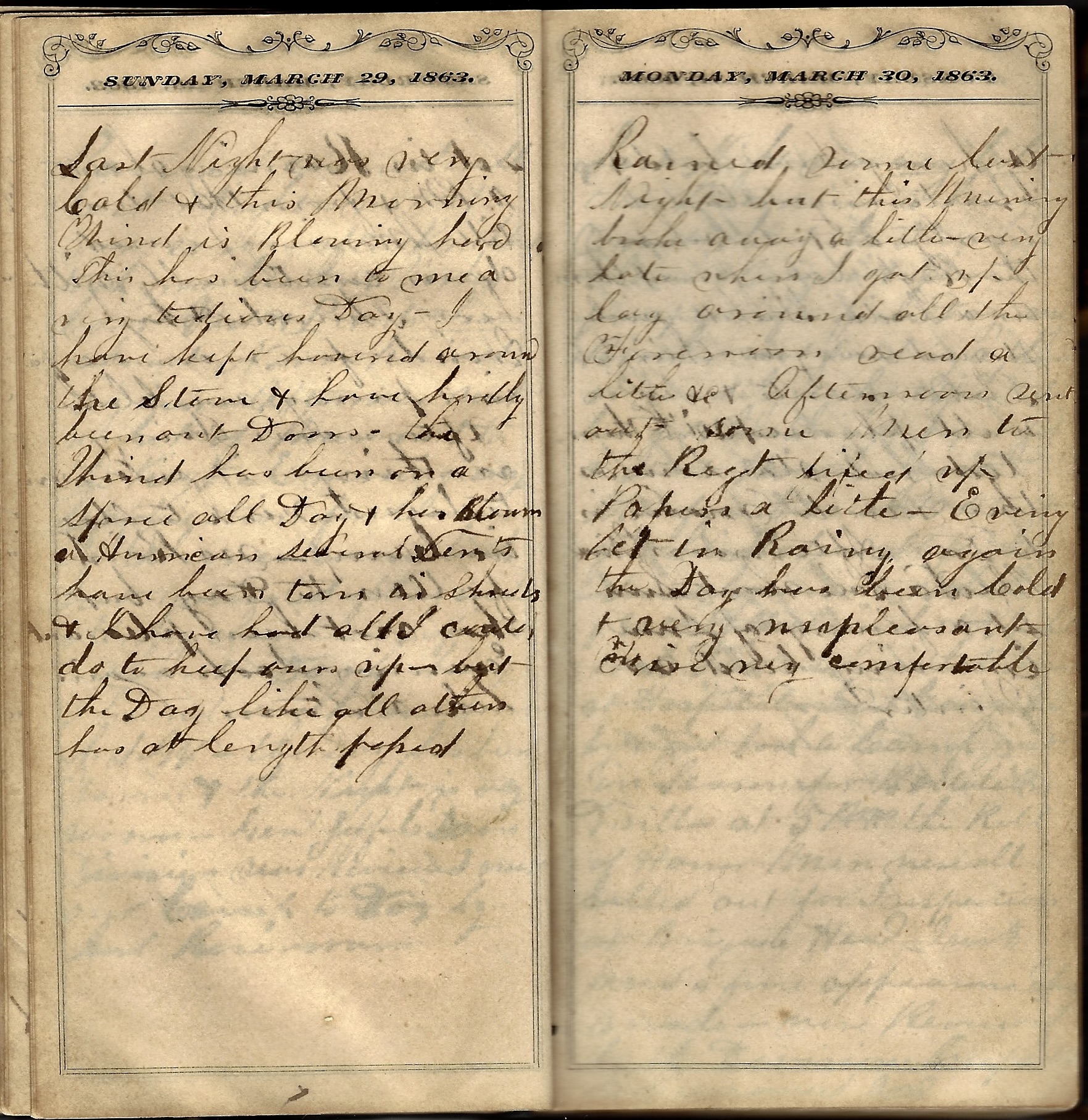


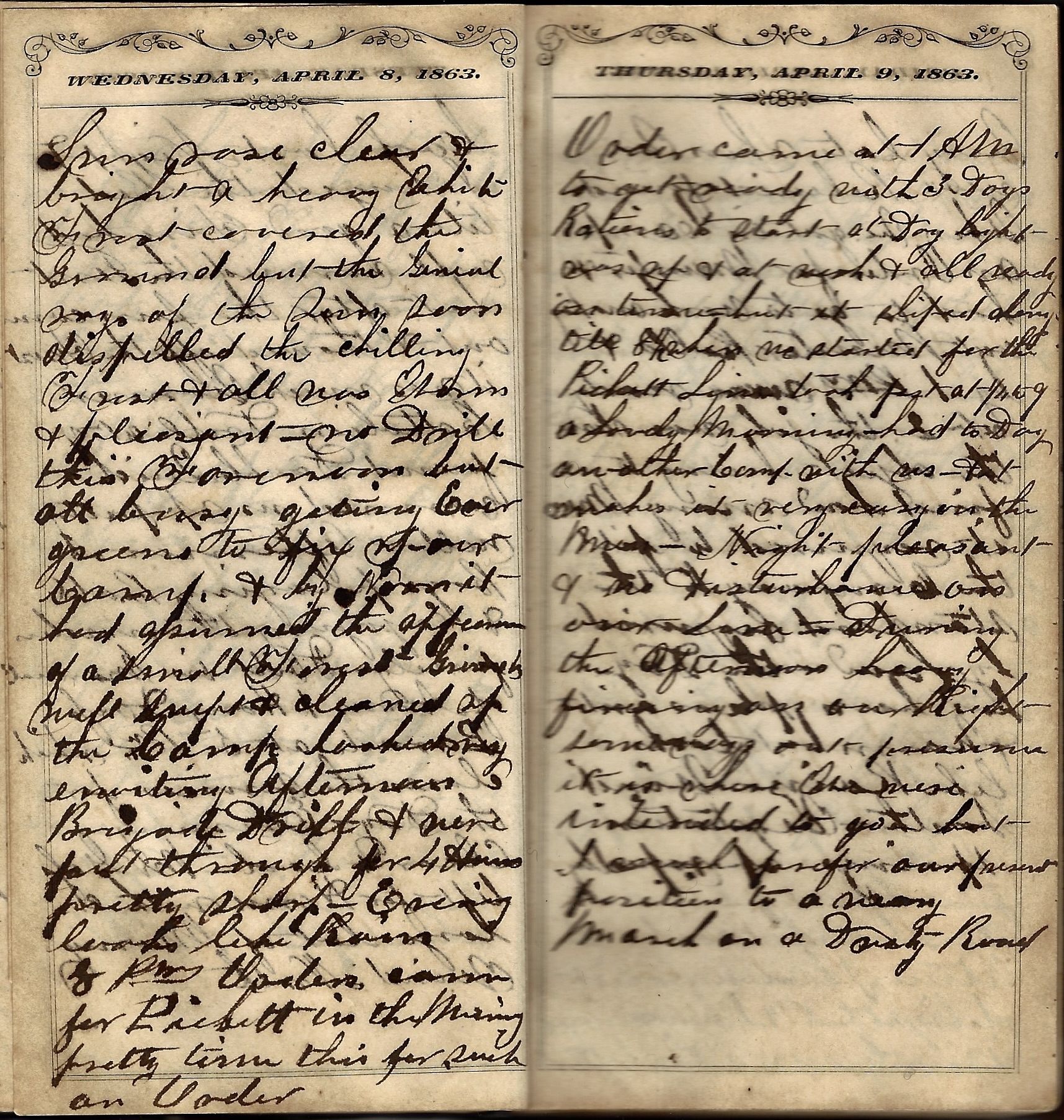


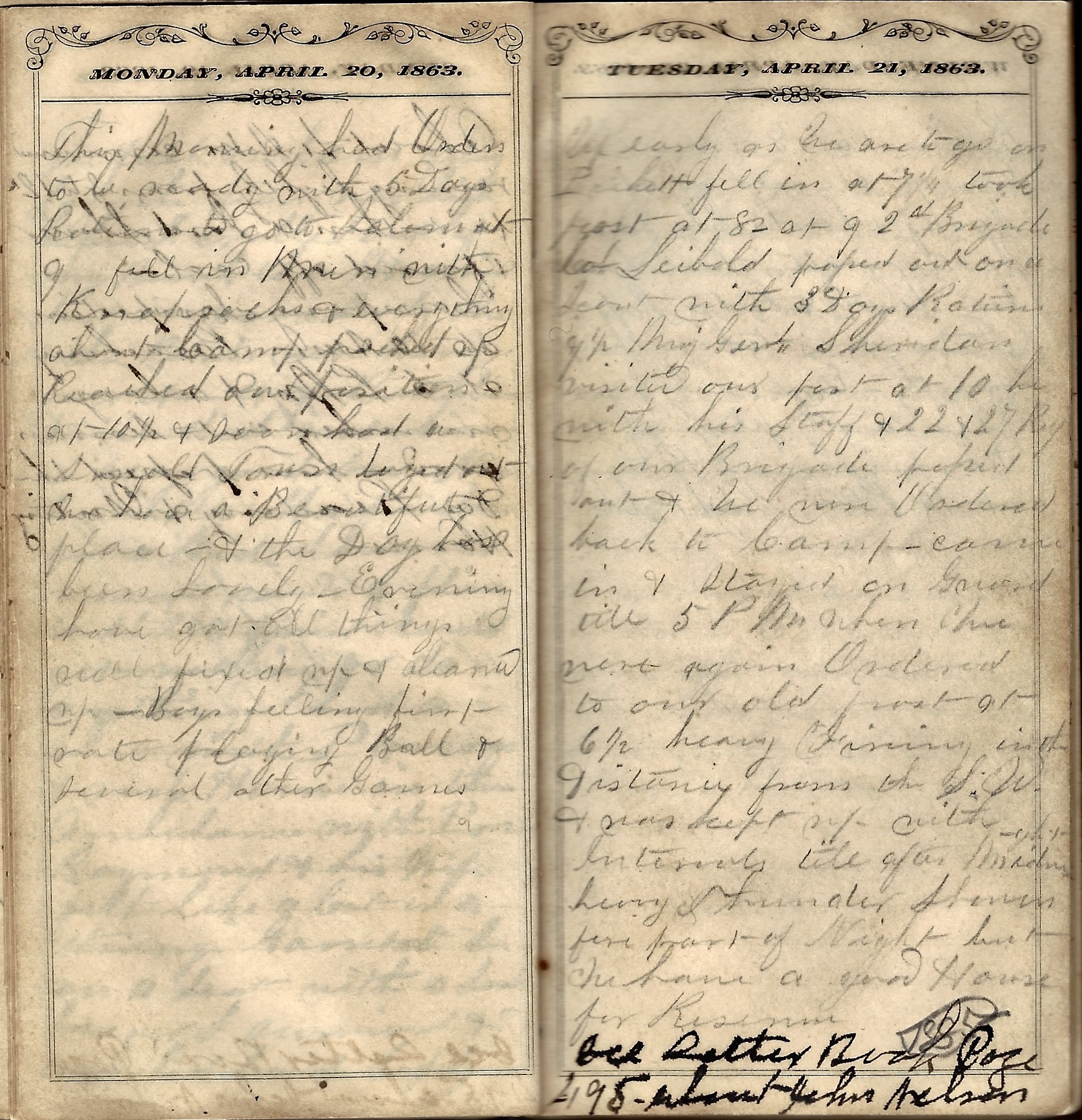


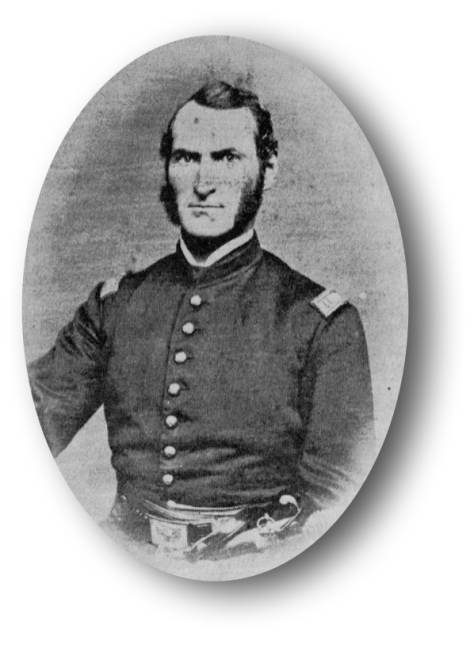

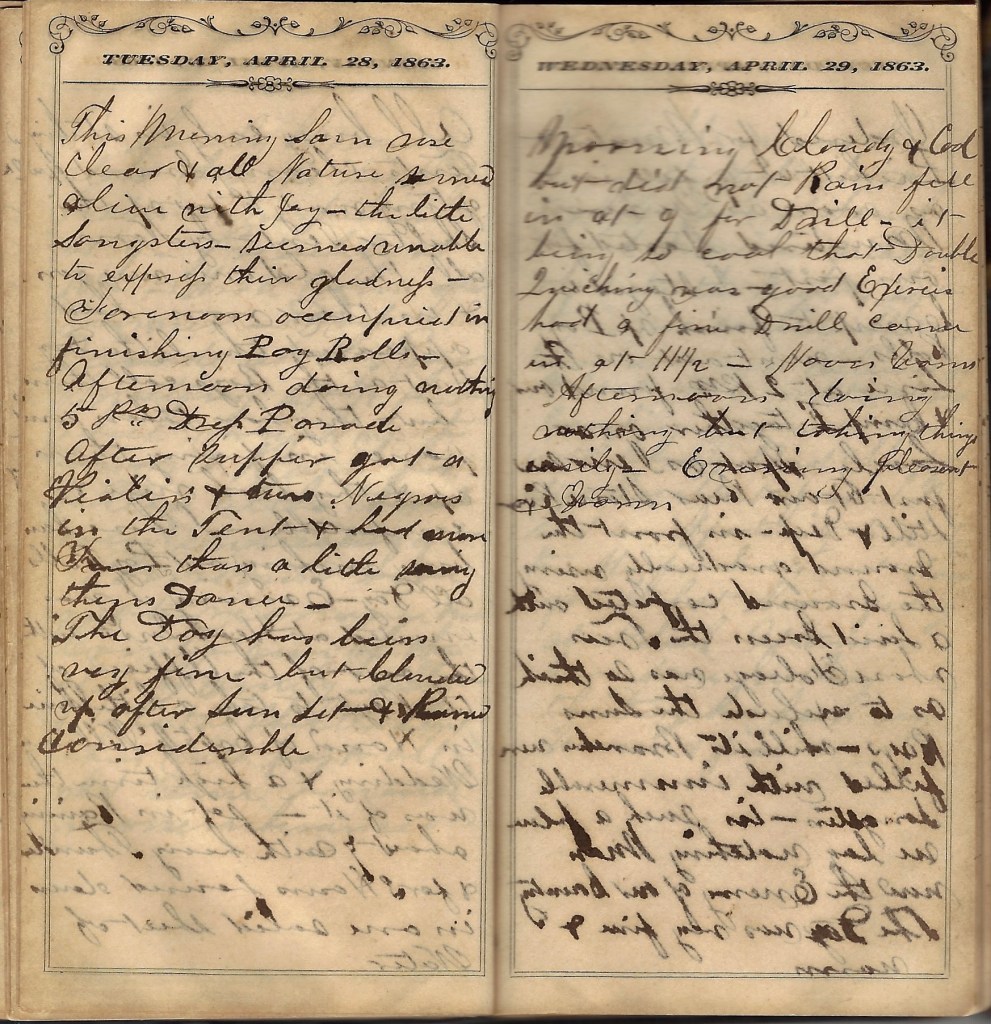
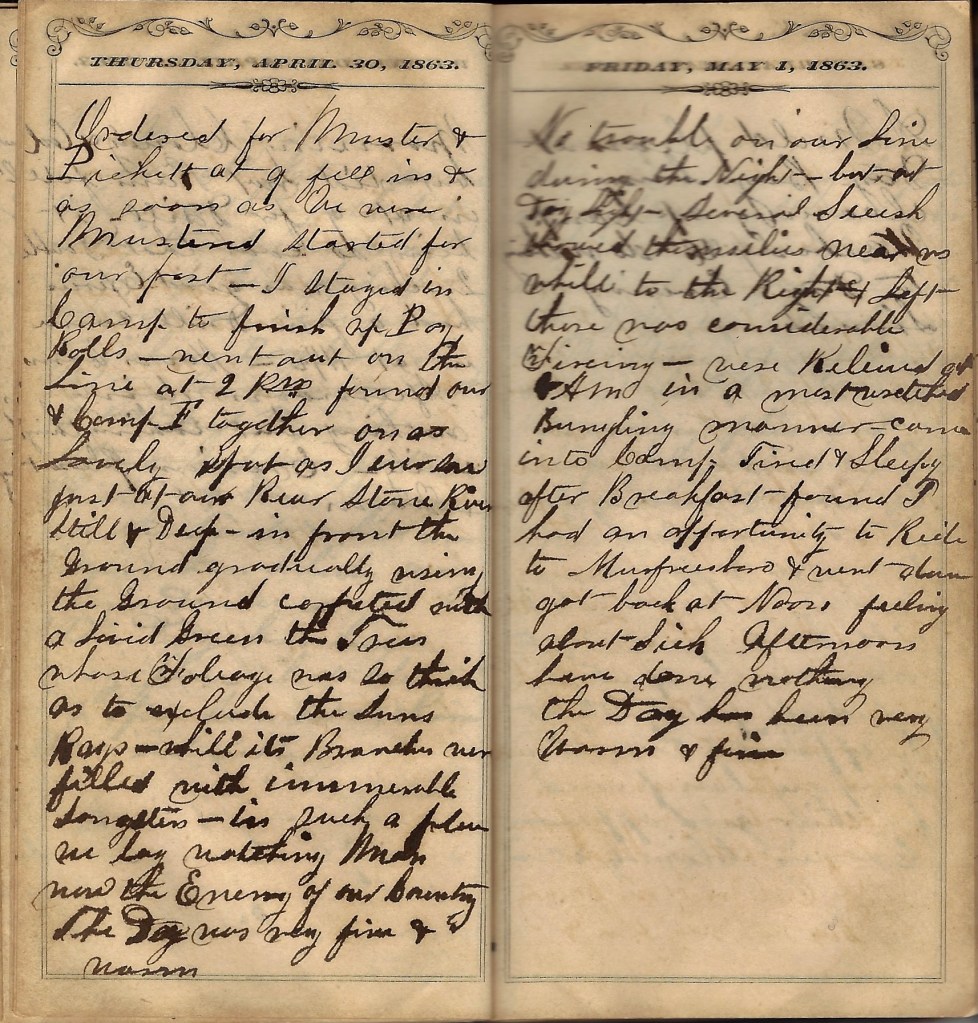
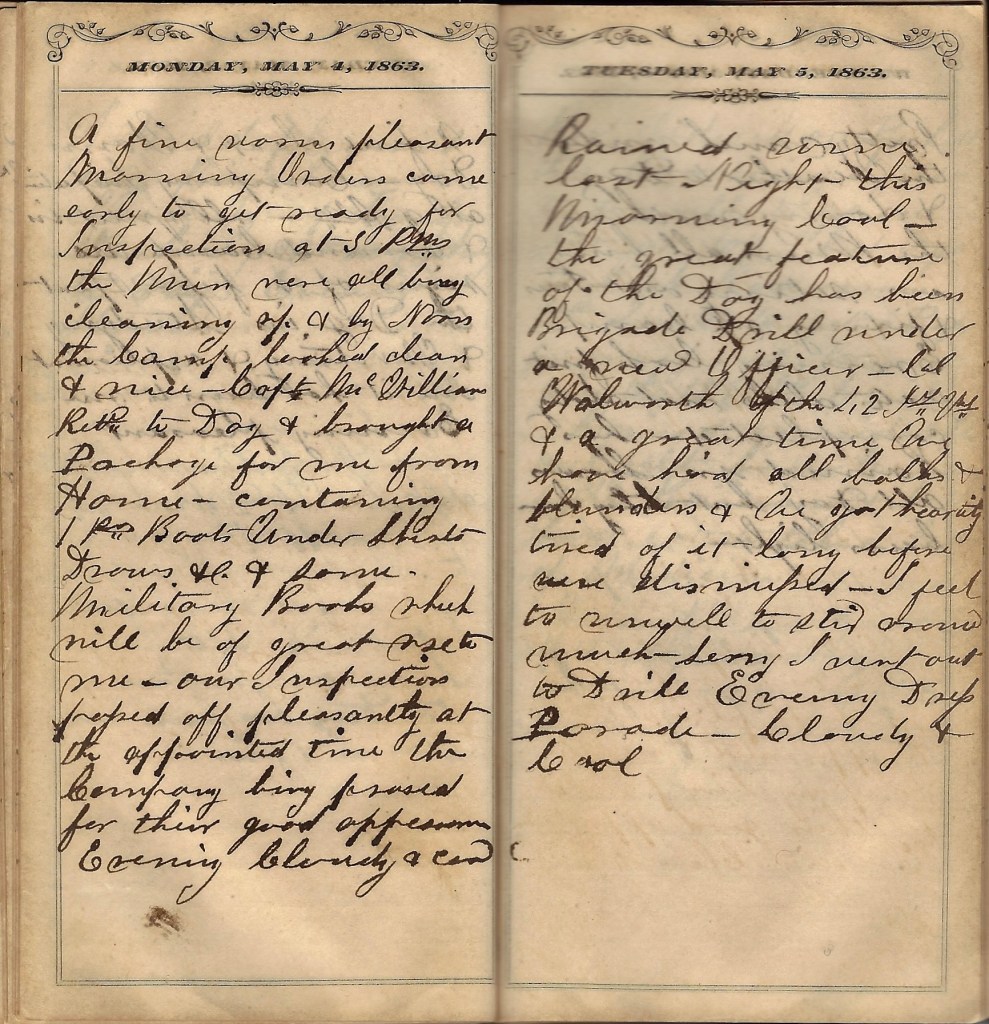
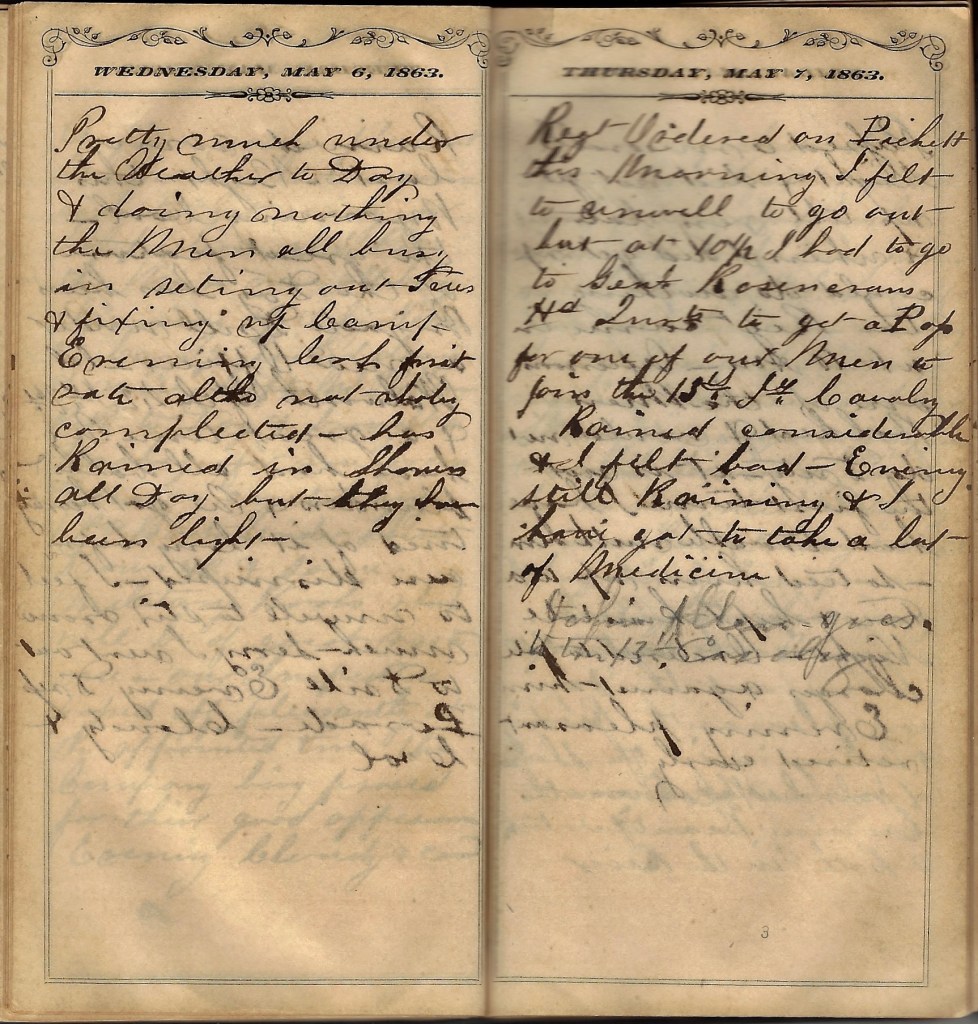


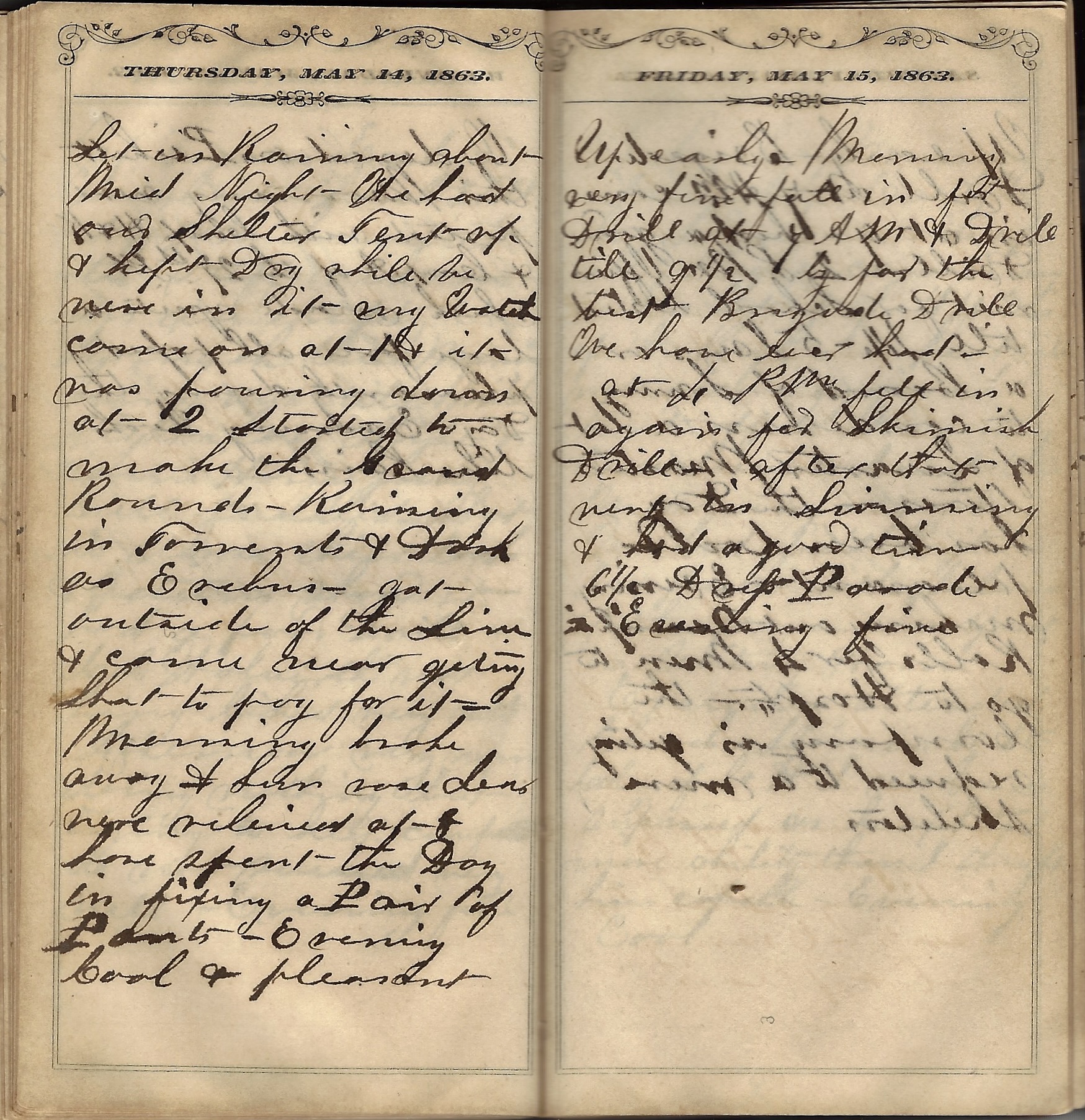
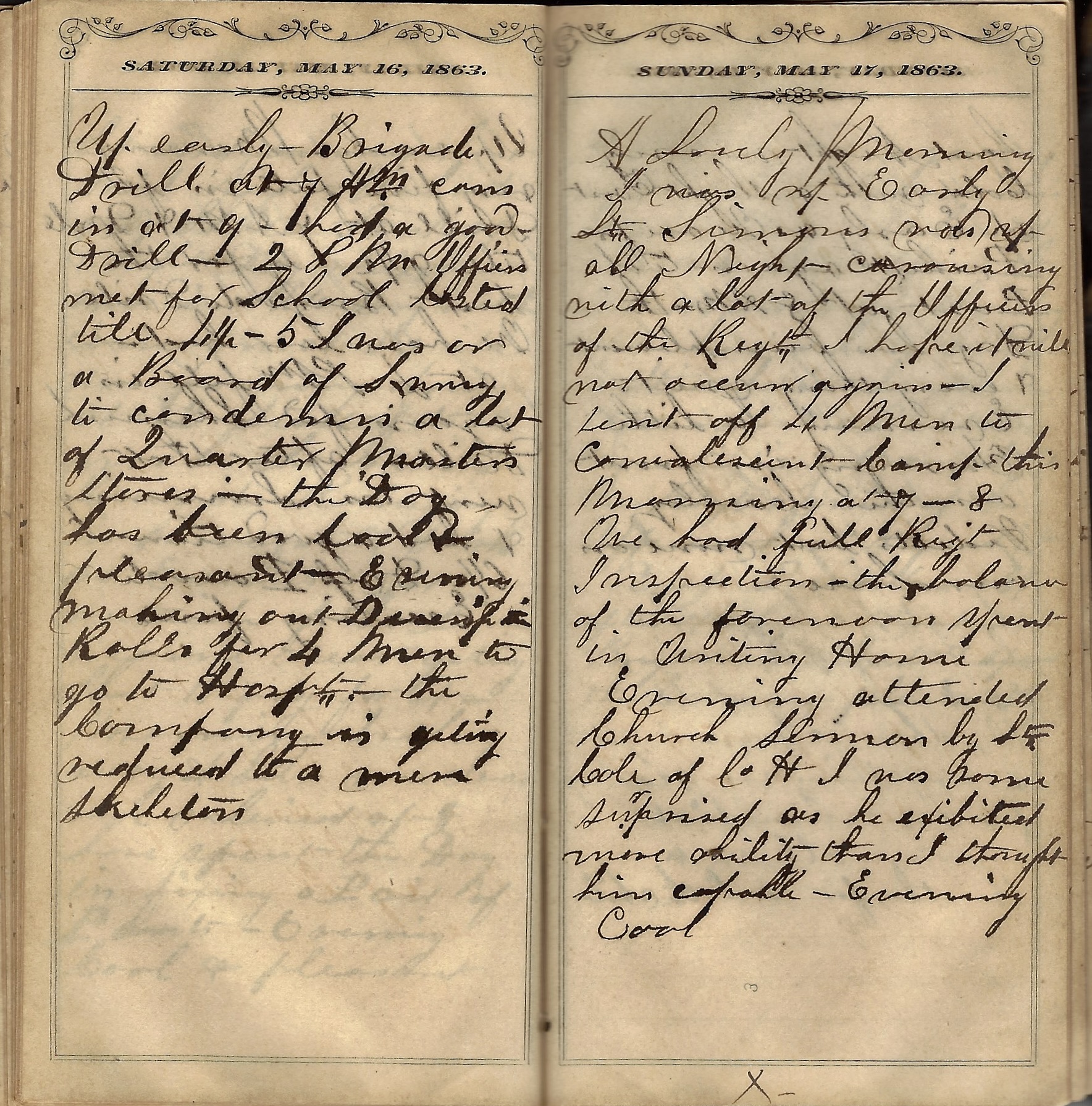








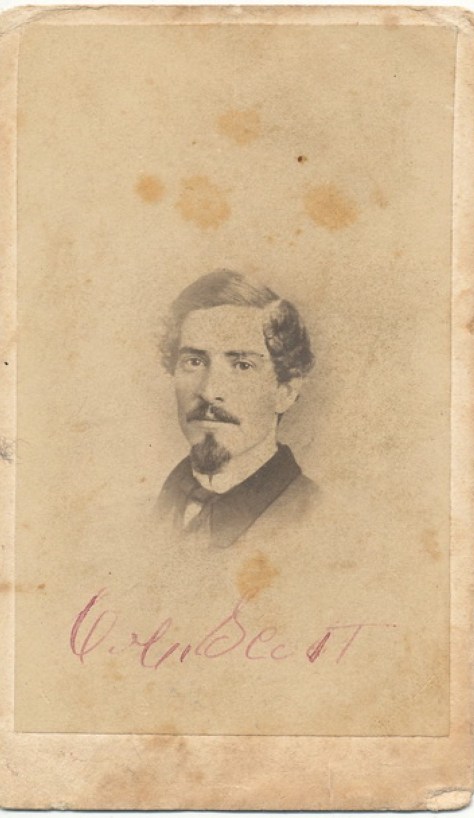


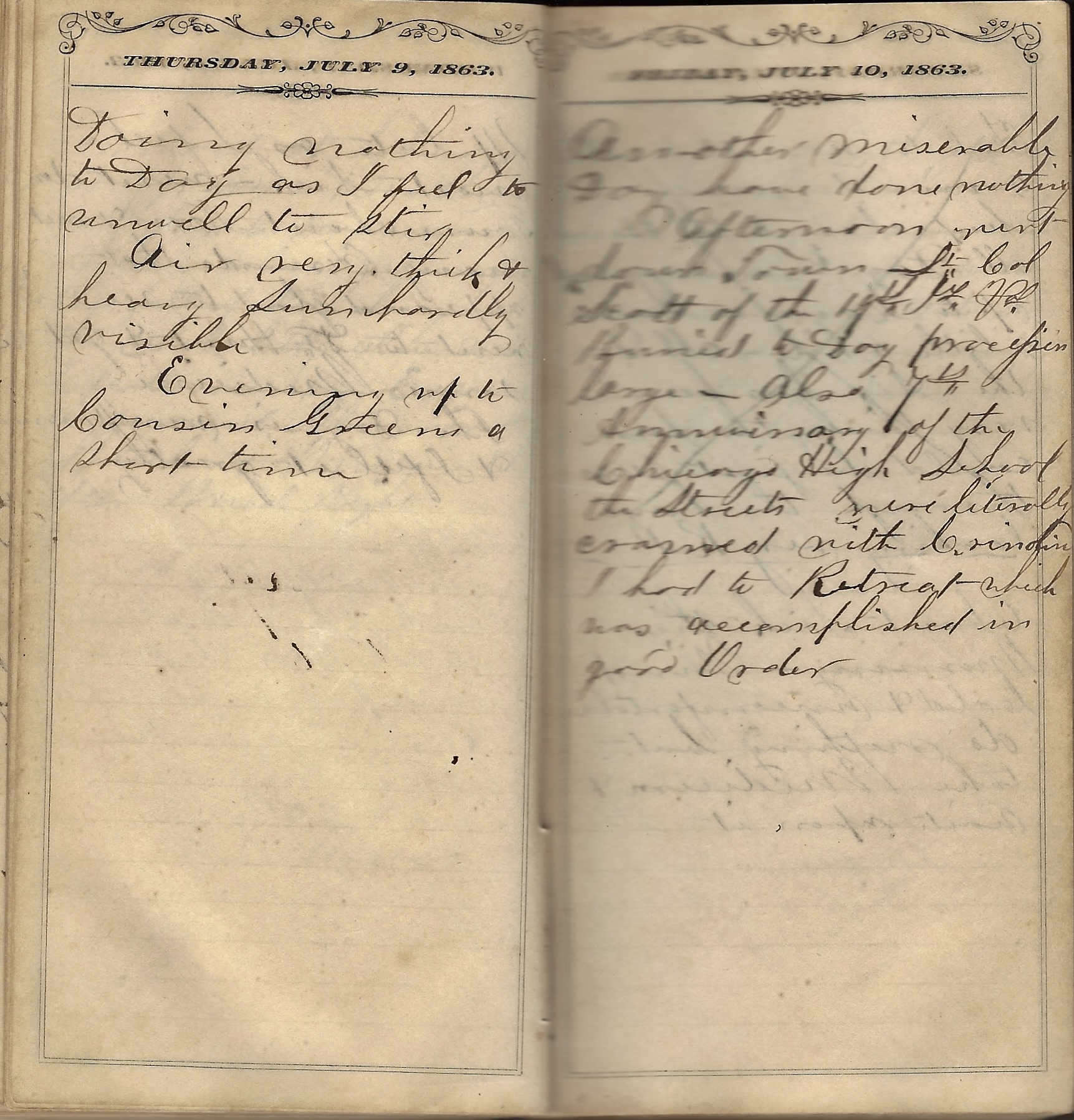

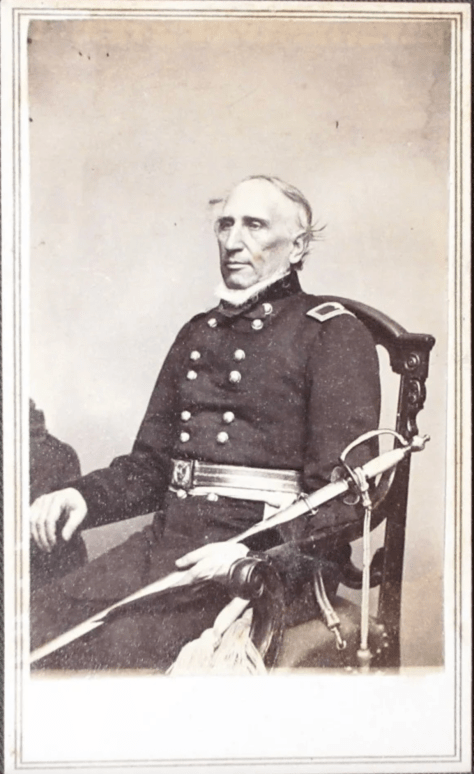

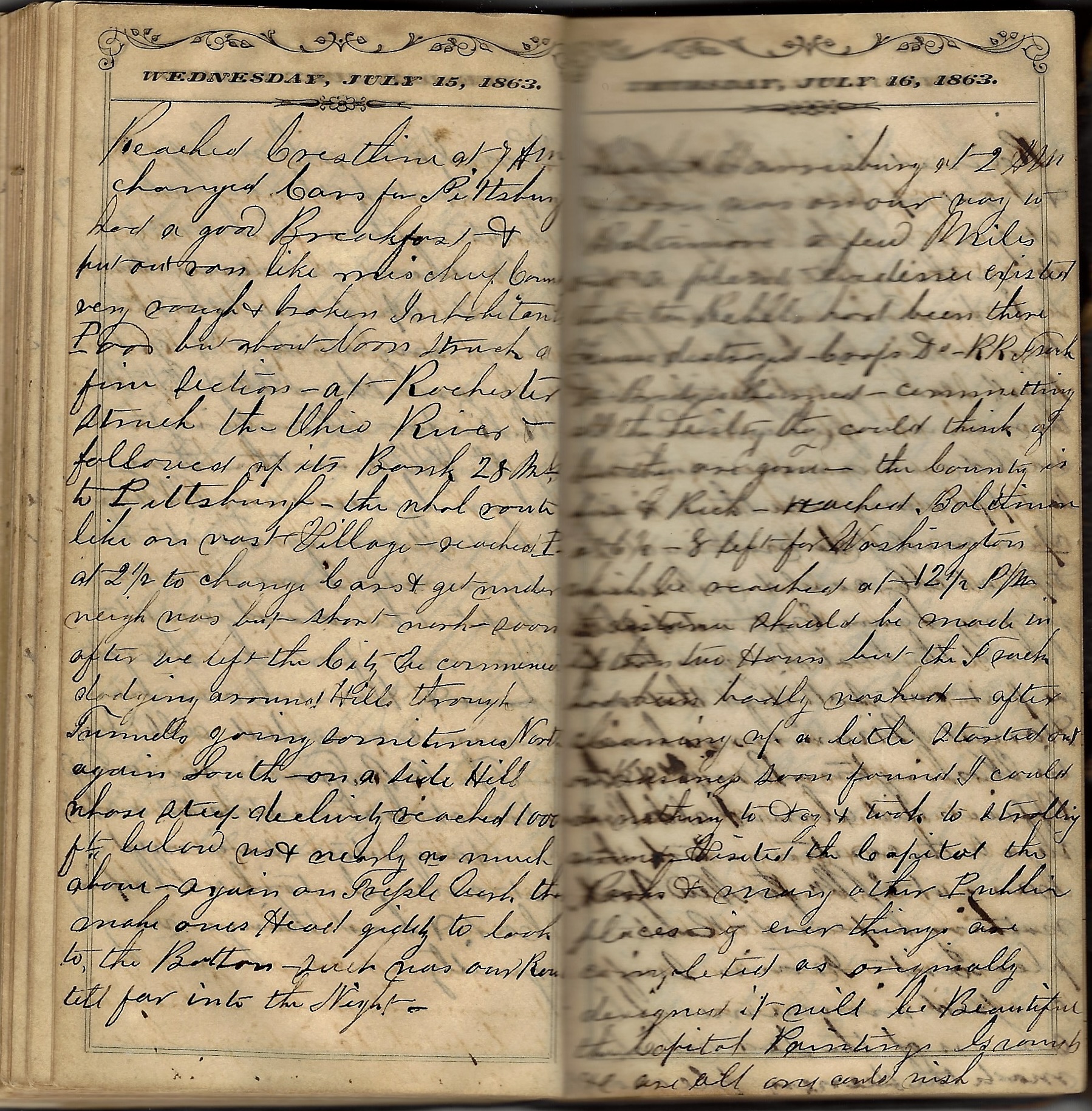











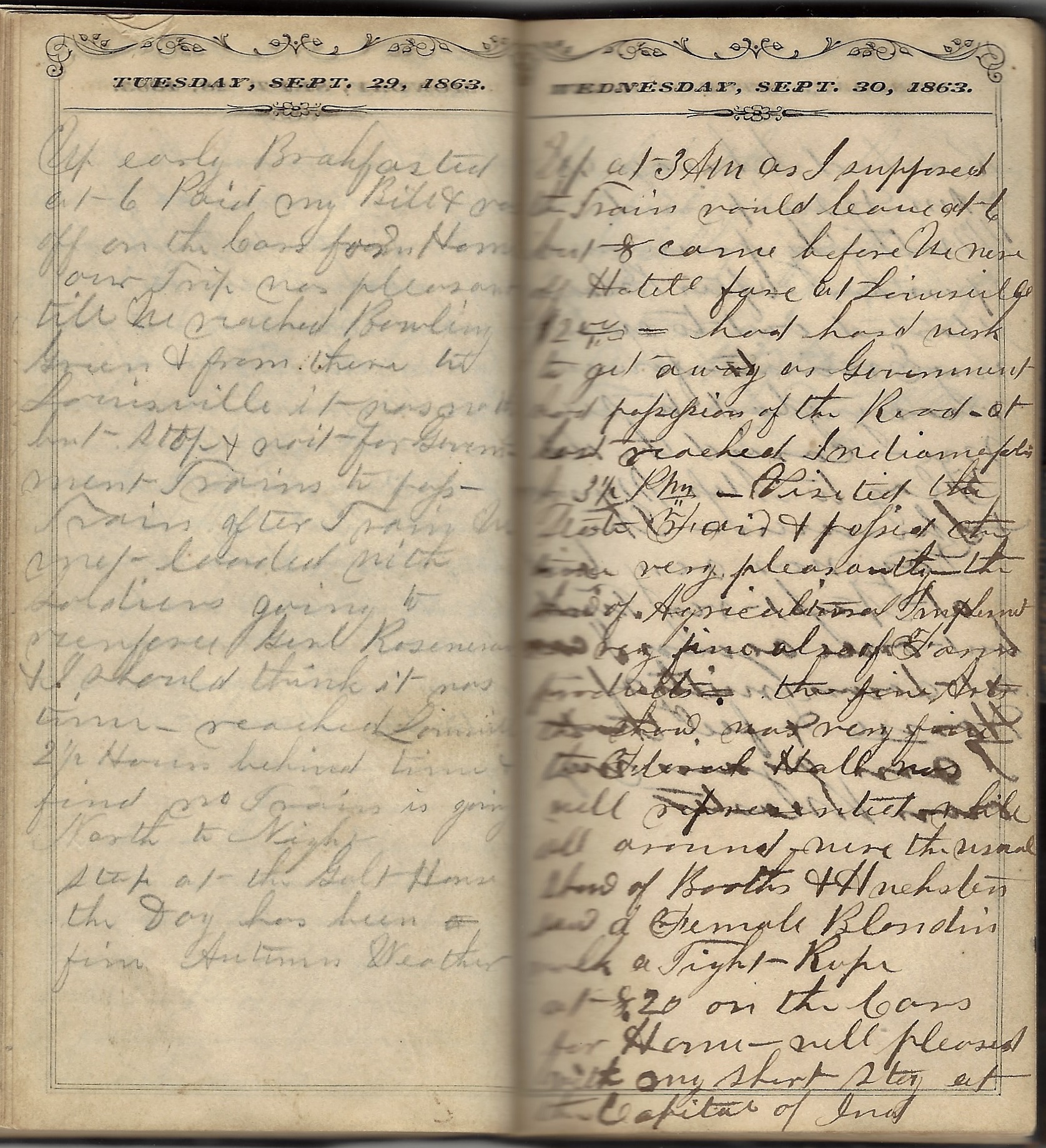
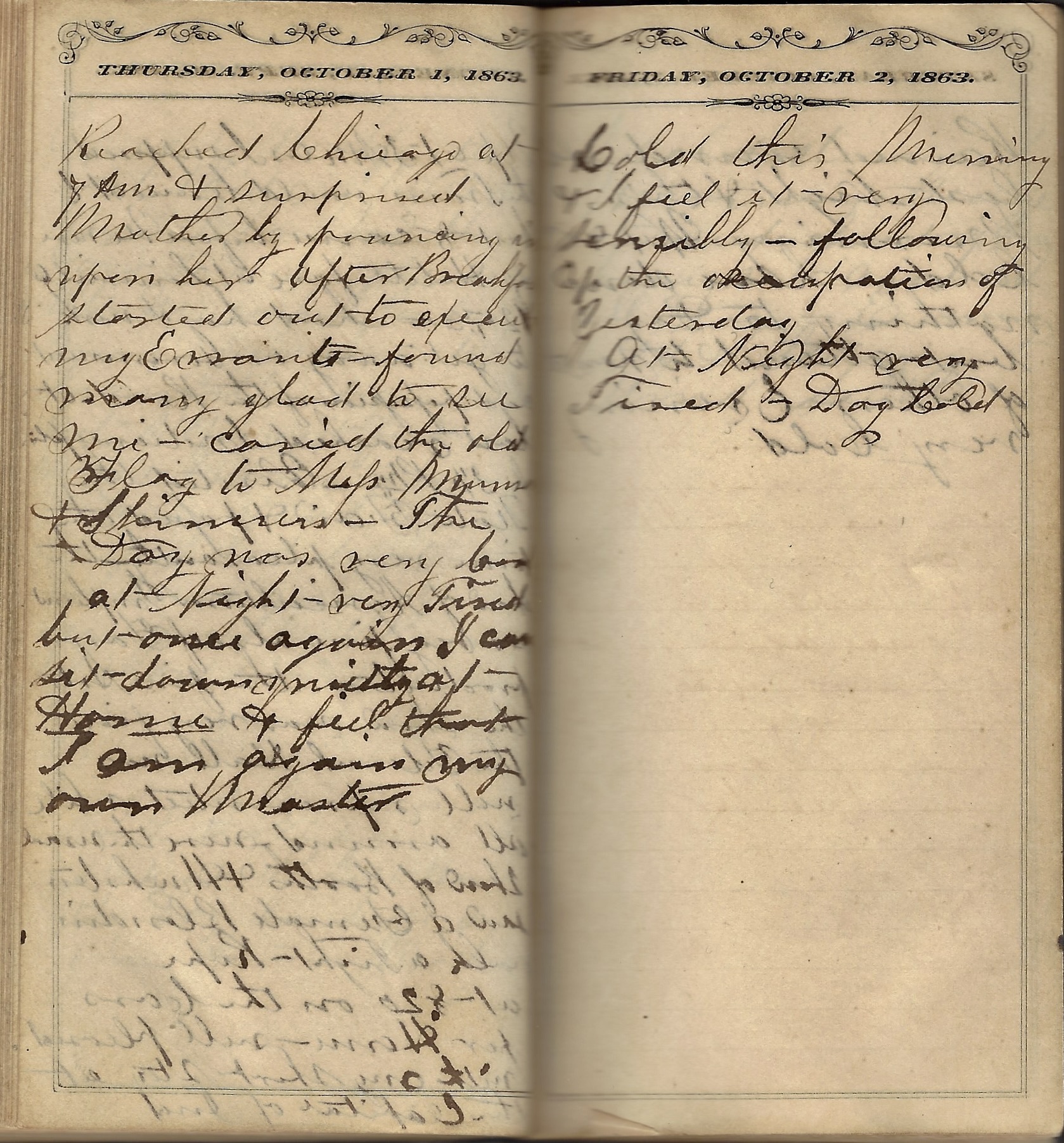


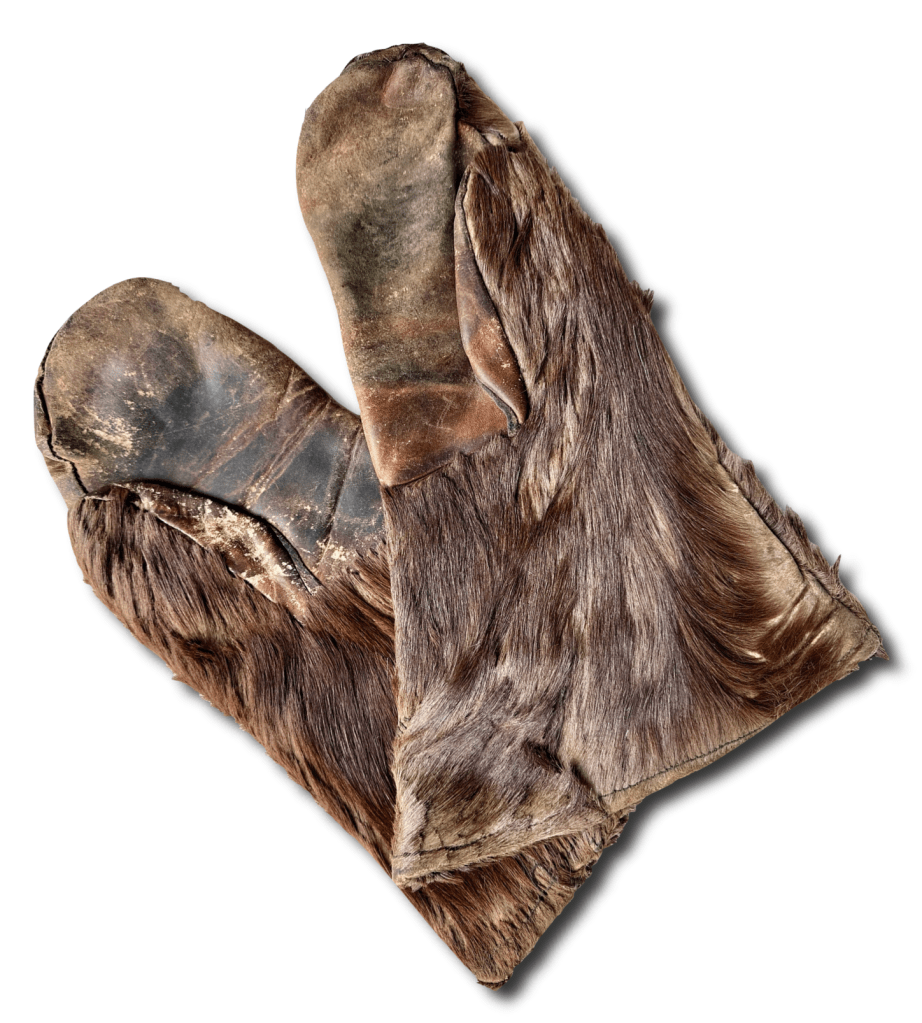

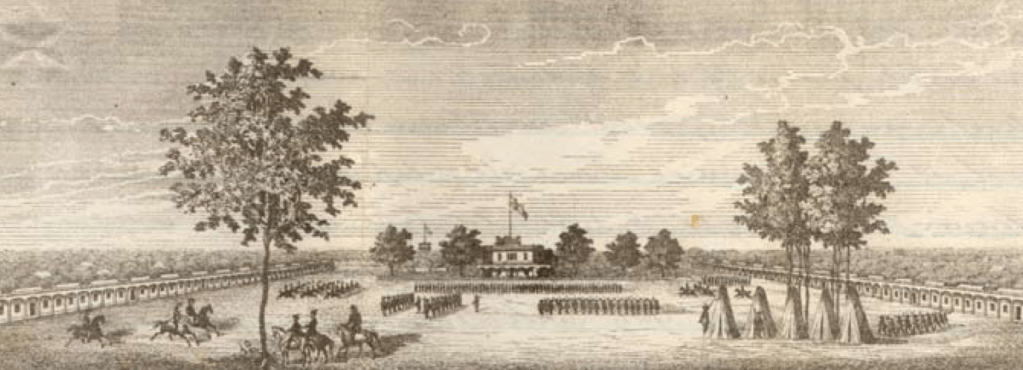
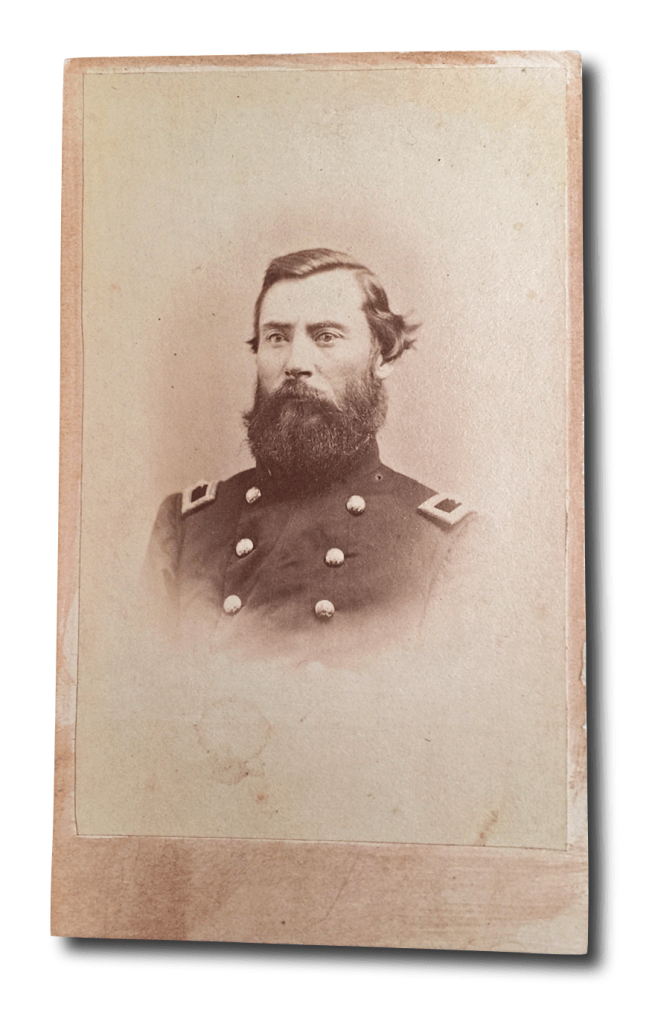

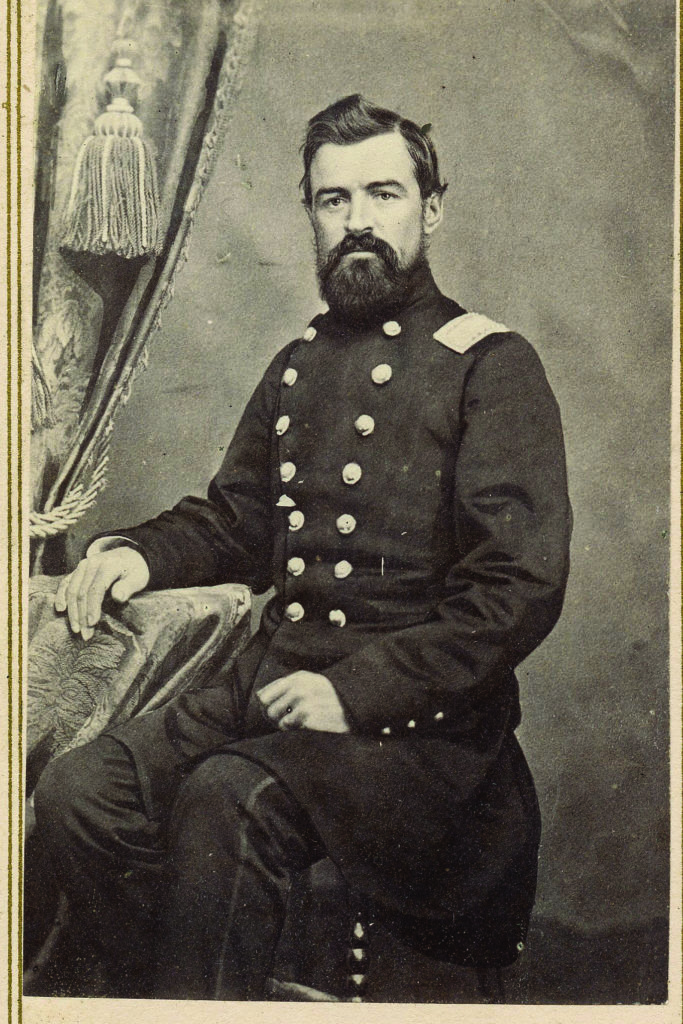
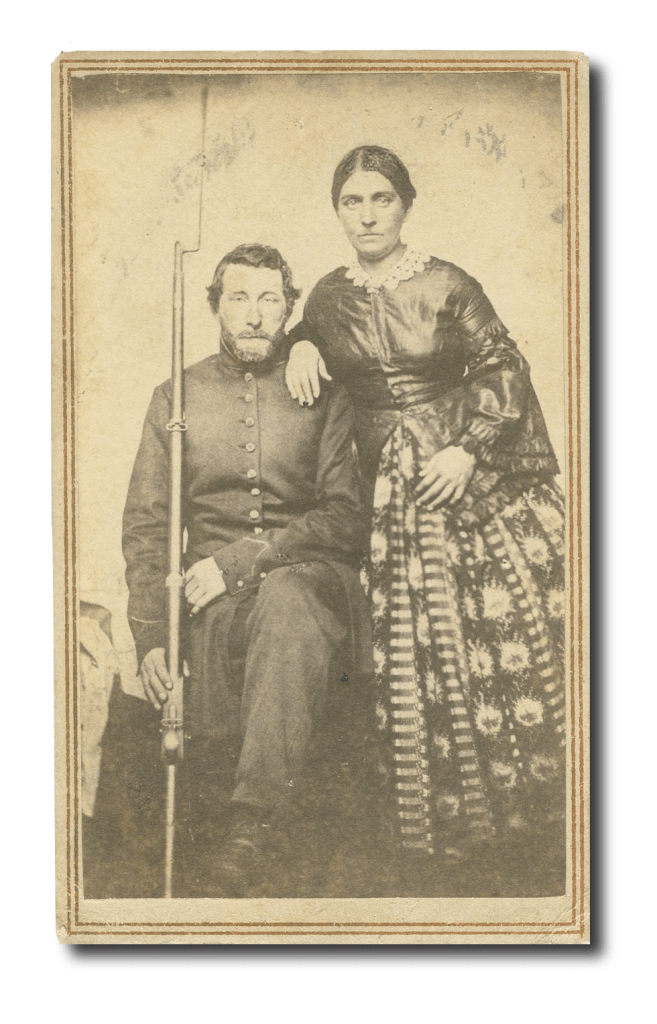


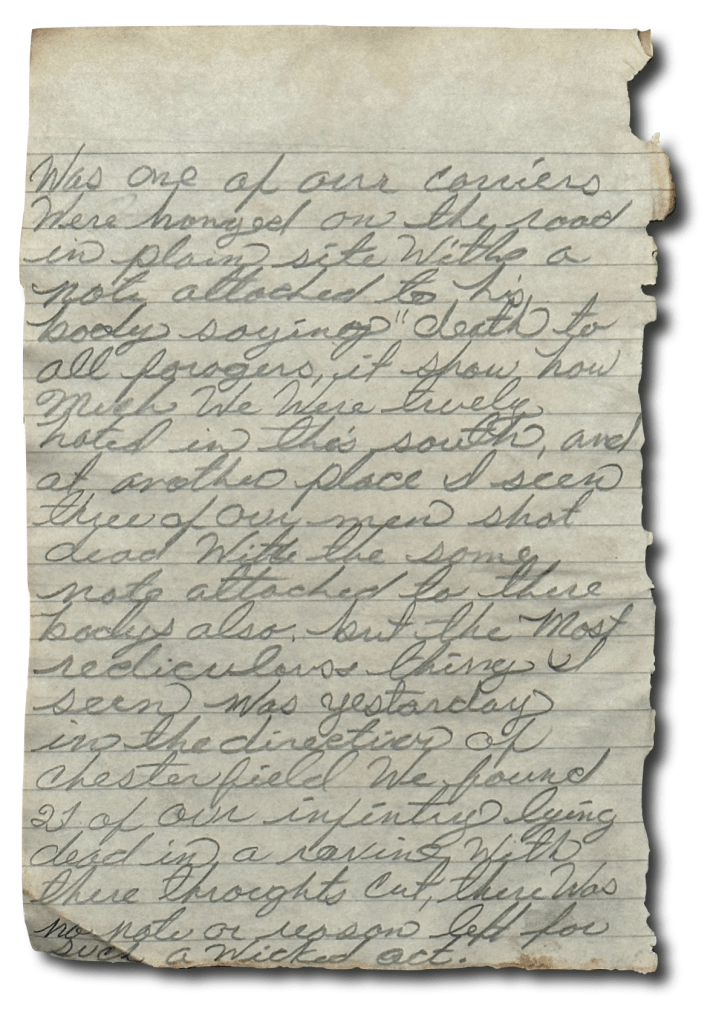

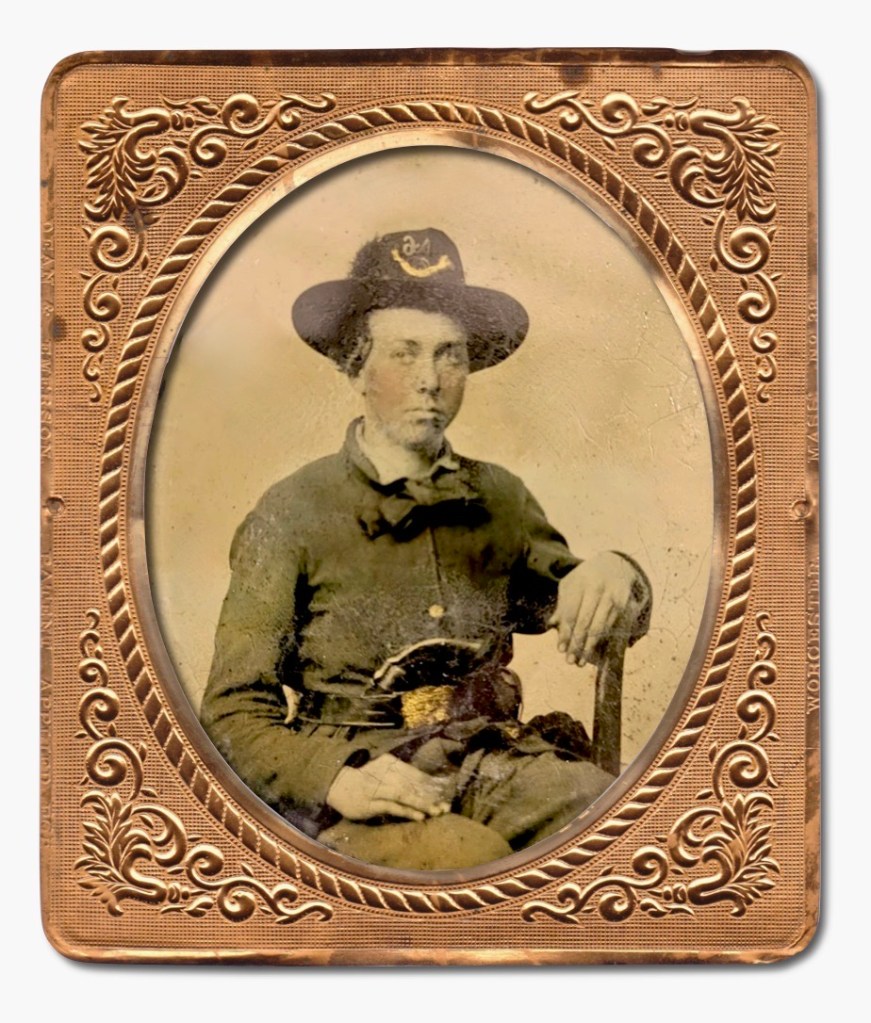


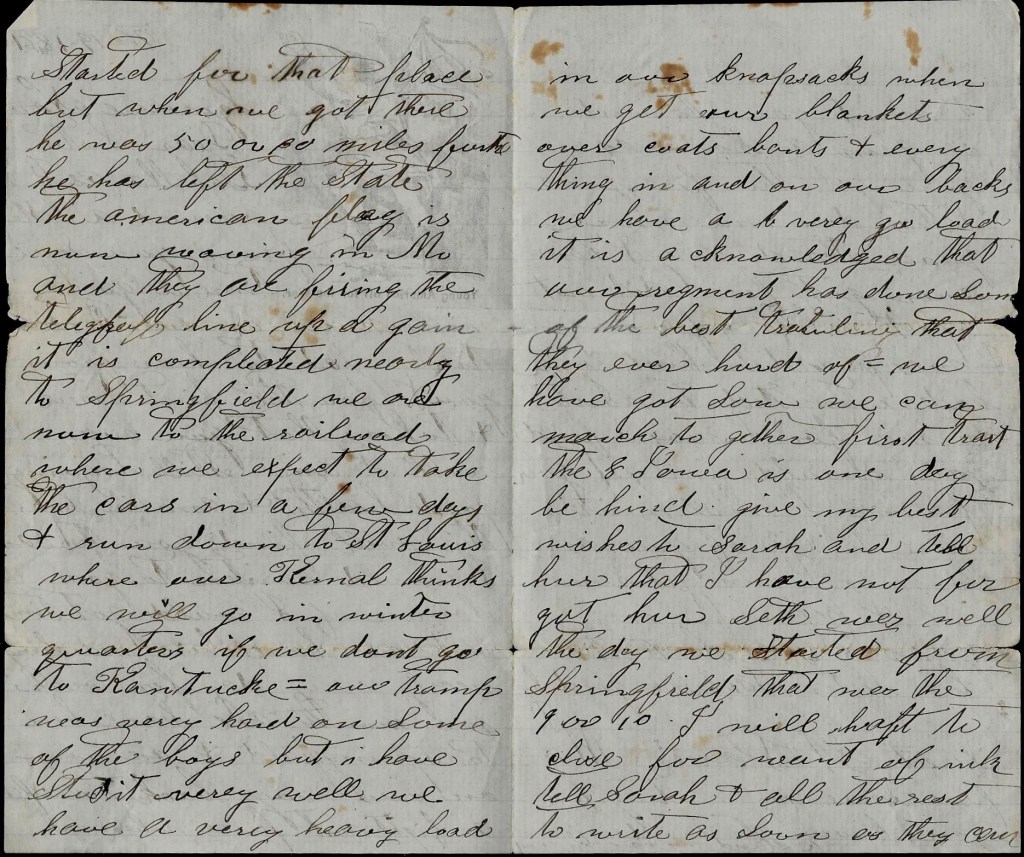


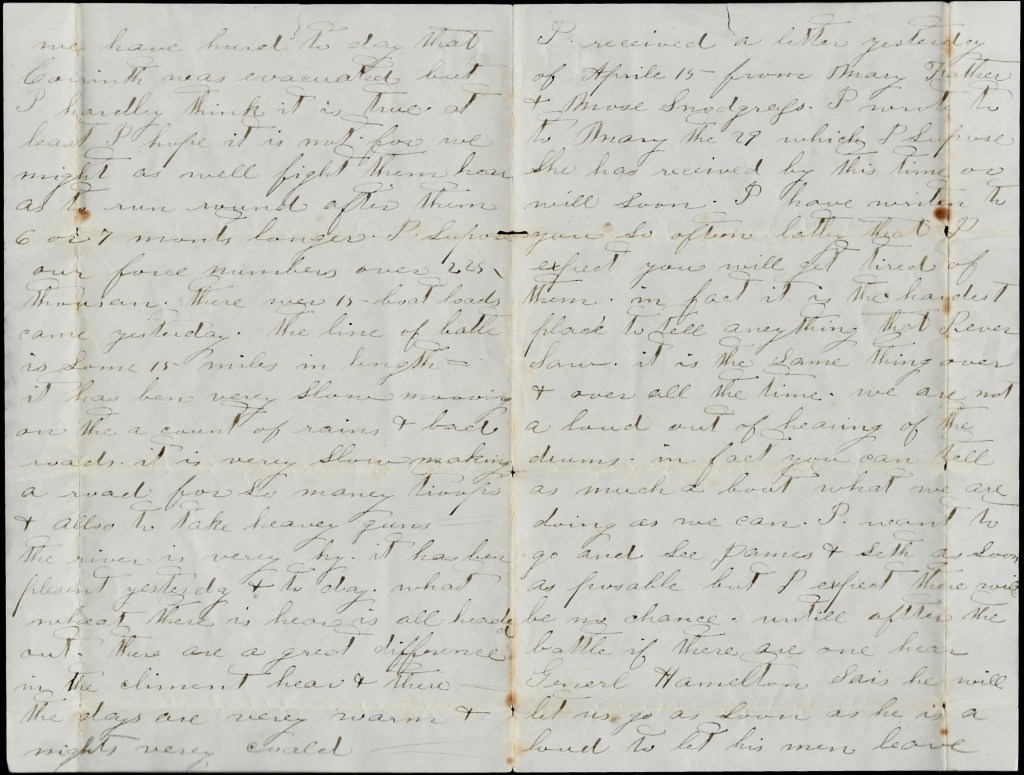
 Spared & Shared 23