
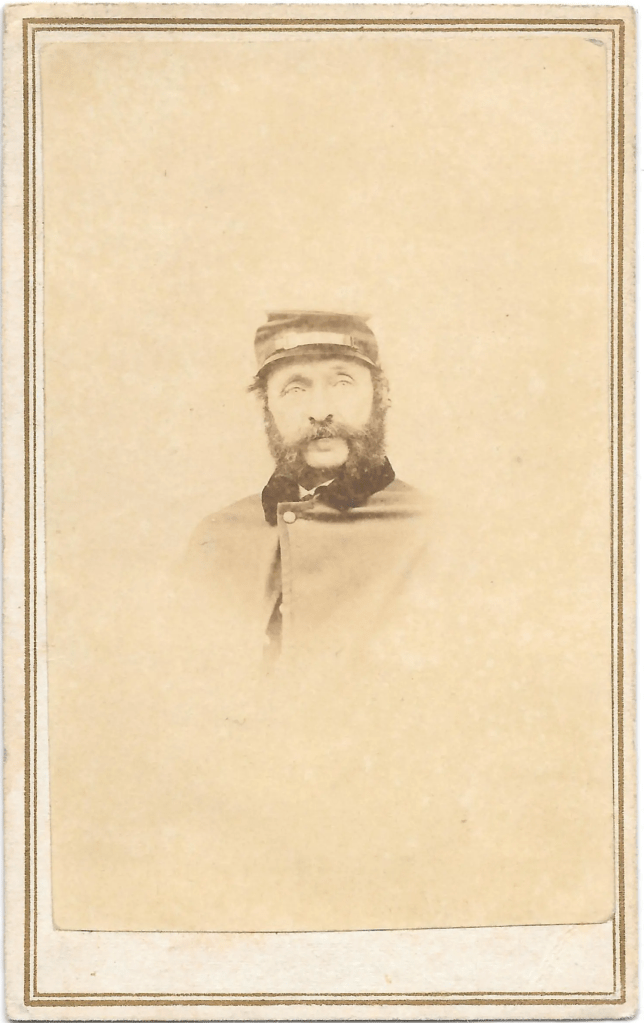
The following letters were written by Daniel Hart Eddleman (1843-1864), the son of William Eddleman (1812-1890) and Louisa Smith (1810-1889) of Germantown, Philadelphia county, Philadelphia. Daniel enlisted as a private on 6 November 1861 in Co. C, 58th Pennsylvania Volunteer Infantry.
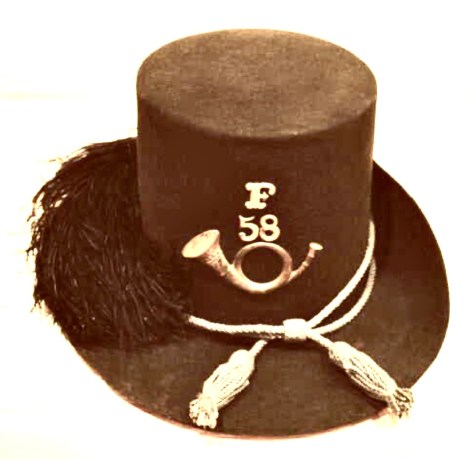
Daniel was promoted to a corporal just days before he was killed in action at the Battle of Chapin’s Farm (a.k.a. Fort Harrison, or New Market Heights) on 28 September 1864. In that action, the 58th Pennsylvania, under the command of Major Winn, led the dawn advance against Confederate Fort Harrison along with the 188th Pennsylvania. The regiments had to cross 1200 yards of open, ascending ground. In he History of the Pennsylvania Volunteers, Samuel Bates wrote that, “the two regiments moved forward at a regular pace, until within five hundred yards, when, in the face of a storm of shot and shell that swept their ranks, they rushed forward as one man until they reached the little ridge in front of the fort. Here, all, with one accord, dropped upon the ground, under partial shelter; but only for an instant; for at this moment General Ord came dashing up, and, inspired by the presence and daring of their chief, the men sprang forward with wild shouts, passed the abatis and the ditch, and scaling the parapet, drove the enemy in rout and confusion from the fort. The colors of the Fifty-eighth, which had three times fallen in the desperate onset, were planted upon the parapet by Captain Cecil Clay, who, with Adjutant Johnson, was among the first to enter the fort. As Captain Clay, who had just taken the flag from the hands of the fallen corporal, attempted to raise it upon the fort, he received two gun-shot wounds in the right arm. The flag itself was completely riddled, and the staff twice shot off. The victory was complete, and fort, heavy guns, small arms, battle-flags, and prisoners, graced the triumph of the victors.” The regiment lost six officers and 128 enlisted men of the nine officers and 228 men who began the charge.
Daniel’s older brother, Horatio Smith Eddleman (1839-1910) also served in the same company and was wounded at Chapin’s Farm but survived the battle and mustered out of the regiment as a sergeant in June 1865. Horatio was married to Sarah A. Jones (1843-1913) before entering the service.
For other letters by members of the 58th Pennsylvania, previously transcribed and published by Spared & Shared, see:
George W. Glidewell, Co. B, 58th Pennsylvania (2 Letters)
Frank W. Davis, Co. E, 58th Pennsylvania (3 Letters)
Cornelius Robbins, Co. E, 58th Pennsylvania (1 Letter)
Theodore F. Ostrander, Co. F, 58th Pennsylvania (4 Letters)
William W. Wells, Co. F, 58th Pennsylvania (1 Letter)
Adam Richter, Co. G, 58th Pennsylvania (1 Letter)
George Richter, Co. G, 58th Pennsylvania (1 Letter)
William Almon Wilmarth, Co. H, 58th Pennsylvania (1 Letter)

Letter 1
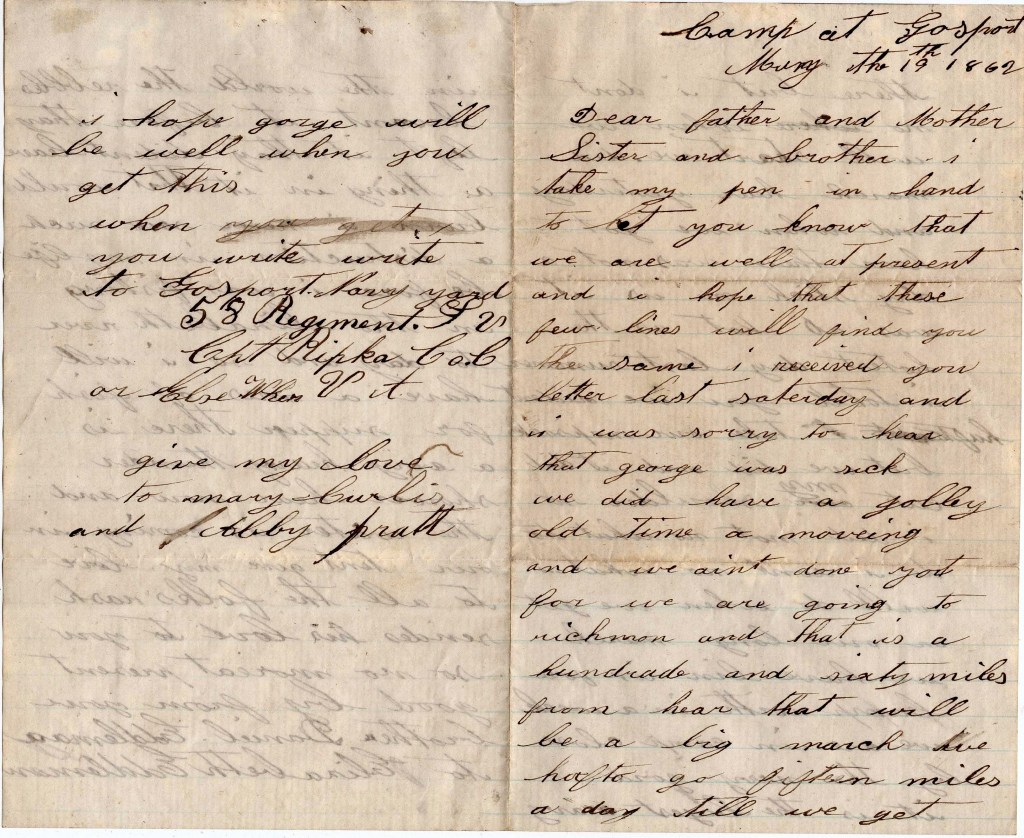
Camp at Gosport [Navy Yard]
May 19, 1862
Dear Father and Mother, sister and brother,
I take my pen in hand to let you know that we are well at present and I hope that these few lines will find you the same. I received your letter last Saturday and I was sorry to hear that George was sick.
We did have a jolly old time a moving and we ain’t done yet for we are going to Richmond adn that is a hundred and sixty miles from here. That will be a big march. We have to go fifteen miles a day till we get there but I don’t know when we will start. We did march here yesterday and when we got here, there was not a dry stitch on us. It was as hot as the hottest day last summer. I told you we didn’t have to take our knapsacks but we did and it did cut my shoulder so I did not know what to do. I don’t know what I will do when we get our long march.

We have been in four camps within a week. We are in camp close by the Navy Yard. It is the biggest navy [yard] in the world. The rebels burnt it before they left it. They didn’t leave a thing in it that would burn. I never saw such a destruction in my life before.
I was fishing in ythe Elizabeth River today and so I will have a mess of fish for supper. There is a very heavy thunder shower here now and the water is coming in our tent.
Give my love to all the folks. Rash [Horatio] sends his love to you. So no more at present. Goodbye from your brother, Daniel Eddleman
To Elizabeth Eddleman
I hope George will be well when you get this. When you write, write to Gosport Navy Yard, 58th Regiment P. V., Capt. [Alfred] Ripka, Co. C, or elsewhere. Give my love to Mary Curlis and Abby Pratt.

Letter 2
Camp near the [Gosport] Navy Yard
May 30, 1862
Dear father and mother, sister and brother,
I take my pen in hand to let you know that we are well at present and I hope that these few lines will find you the same. I received your letter last Wednesday and was glad to hear that George was a getting better.
We have had another move but not far. We are about a mile from the [Gosport] Navy Yard. The Colonel says we will lay here a good while. We are a mounting cannons. All along where we are there is a big breastwork throwed up and the cannons is on it. The whole Division is along it. If the rebels does retreat from Richmond, we do expect them to come back here. They told the citizens when they went away they would be back in a short time but I think they will have fun before they get here.
Washington is in danger again. They have sent all the home guards there and five or six regiments of volunteers from New York.
I got a letter from John last week and they said they was all well.
We are in camp in a a eight-acre corn field. The corn is six inches high. The man that owns it would not take the Oath of Allegiance and so they have destroyed it for him. He come through here yesterday and he looked as sour as the sour end of a sweet pickle.
I have just signed the pay roll to get paid. We will get paid tomorrow if nothing happens.
I went to the Episcopal Church last Sunday and he had a very nice sermon but he did not pray for the President of the United States.
It does rain most every other day here and when it don’t rain, it is so warm that we sweat and get as wet as when it rains.
They are making a law to send all of the married men home and keep the single ones for five years.
It is getting so warm that I must fetch my letter to a close so give my love to Sally and Agnes and Deal and Mary and to all of the rest of the folks, and keep a good share of it yourself. So goodbye from your brother, — Daniel Eddleman
to his sister, Elizabeth Eddleman
Write to Mr. Daniel Eddleman, Gosport Navy Yard, 58th Regiment P. V., Capt. Ripka, Co. C, Vol. Infantry, or elsewhere.
Tell Mary Curlis I will answer her letter as soon as I get it. Send some post stamps. I do owe six now.


Letter 3
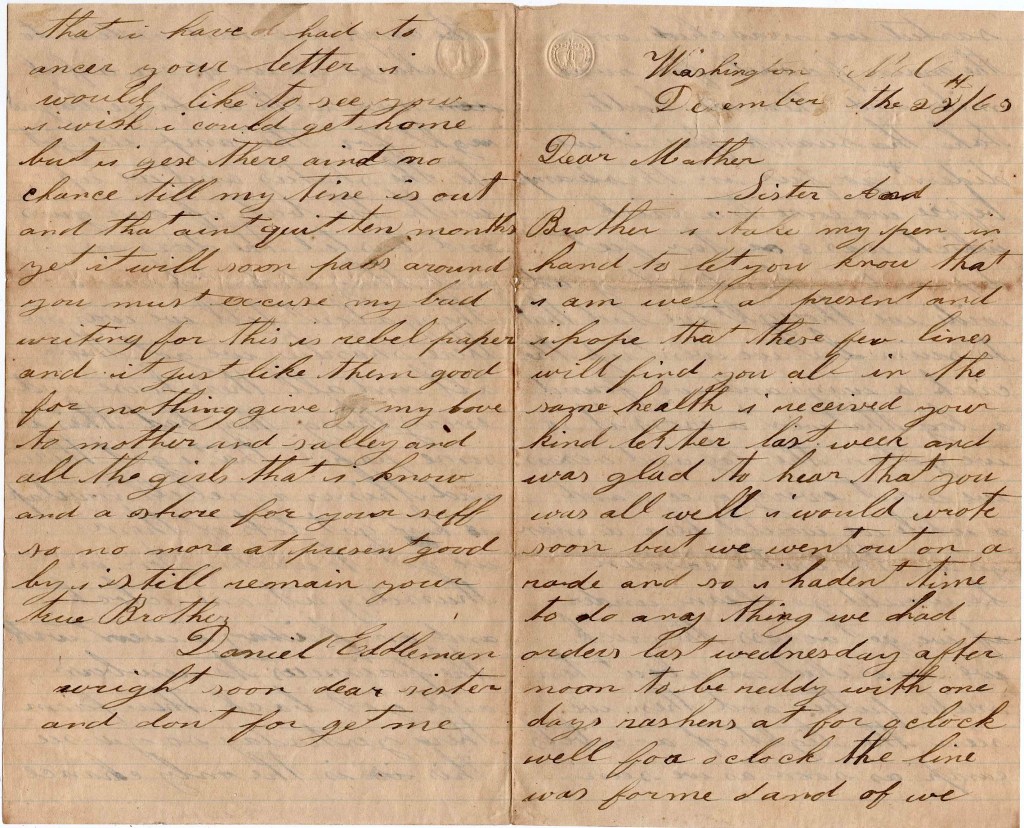
Washington, North Carolina
December 22, 1863
Dear Mother, Sister and Brother,
I take my pen in hand to let you know that I am well at present and I hope that these few lines will find you all in the same health. I received your kind letter last week and was glad to hear that you was all well. I would wrote soon[er] but we went out on a raid and so I hadn’t time to do anything.
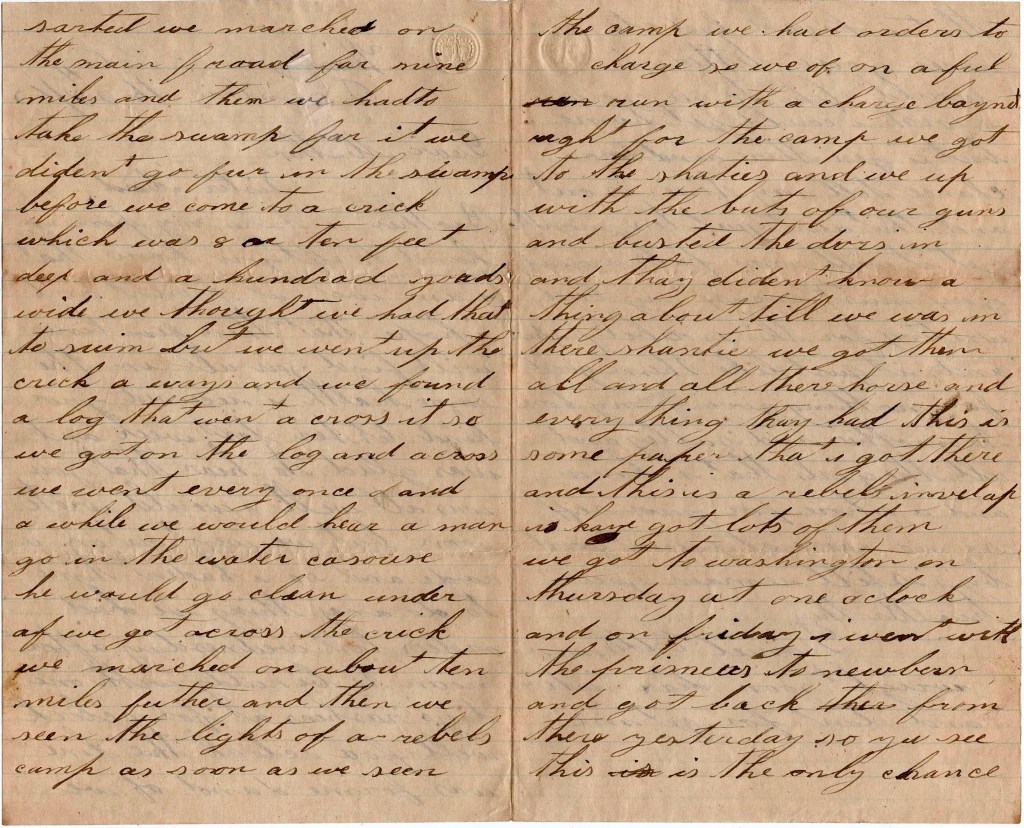
We had orders last Wednesday afternoon to be ready with one days rations at four o’clock. Well [at] four o’clock the line was formed and off we started. We marched on the main road for nine miles and then we had to take the swamp. We didn’t go far in the swamp before we come to a crick which was 8 or ten feet deep and a hundred yards wide. We thought we had that to swim but we went up the crick a ways and we found a log that went across it so we got on the log and across we went. Every once and awhile we would hear a man go in the water course. He would go clean under.
After we got across the crick, we marched on about ten miles further and then we seen the lights of a rebel’s camp. As soon as we seen the camp, we had orders to charge so we [went] off on a full run with a charge bayonet right for the camp. We got to the shanties and we up with the butts of our guns and busted the doors in, and they didn’t know a thing about [it] till we was in their shanties. We got them all and all their horses and everything they had. This is some paper that I got there and this is a rebel’s envelope. I have got lots of them.
We got [back] to Washington on Thursday at one o’clock and on Friday I went with the prisoners to Newbern and got back from there yesterday, so you see this is the only chance that I have had to answer your letter.
I would like to see you. I wish I could get home but I guess there ain’t no chance till my time is out and that ain’t quite ten months yet. It will soon pass around. You must excuse my bad writing for this is rebel paper and it’s just like them—good for nothing. Give my love to mother and Sally and all the girls that I know, and [keep] a share for yourself. So no more at present. Goodbye. I still remain your true brother, — Daniel Eddleman
Write soon, dear sister, and don’t forget me.
Letter 4
Camp Front of Petersburg
May 8, 1864
Dear Mother, Sister and Brother,
I take my pen in hand to let you know that I am well at present and I hope that these few lines will find you in good health and spirits.
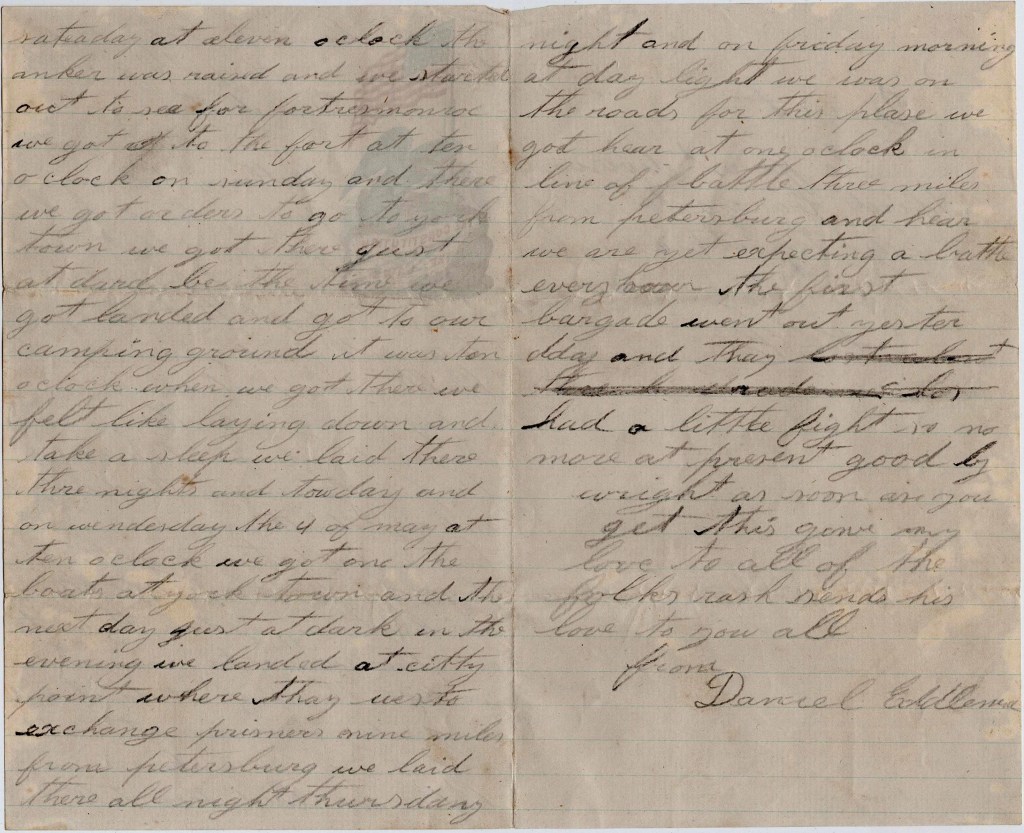
We are in a big army now. There is sixty thousand men in it. We are in the First Division, Third Brigade, and Eighteenth Army Coreps. We had a hard time a getting here. We did evacuate Little Washington. We got on the boat on Thursday afternoon the 28th and we left the wharf at dark, and on Friday morning at ten o’clock, we was anchored in Hatteras. We laid there till Saturday. At eleven o’clock the anchor was raised and we started out to sea for Fortress Monroe. We got to the fort at ten o’clock on Sunday and there we got orders to go to Yorktown. We got there just at dark. By the time we got landed and got to our camping ground, it was ten o’clock. When we got there, we felt like laying down and take a sleep.
We laid there three nights and two days, and on Wednesday the 4th of May at ten o’clock, we got on the boats at Yorktown and the next day, just at dark in the evening, we landed at City Point where they was to exchange prisoners nine miles from Petersburg. We laid there all night Thursday night and on Friday morning at day light, we was on the road for this place. We got here at one o’clock in line of battle, three miles from Petersburg, and here we are yet, expecting a battle every hour. The First Brigade went out yesterday and they had a little fight.
So no more at present. Goodbye. Write as soon as you get this. Give my love to all of the folks. Rash [Horatio] sends his love to you all. From, — Daniel Eddleman
Direct to First Division, Third Brigade, and Eighteenth Army Corp, 58th Regiment, Pennsylvania Volunteers, Co. C.





 Spared & Shared 23