John Walker (1834-1862) was earning his living as an ice dealer in Allegheny City when he enlisted in Co. F, 61st Pennsylvania Infantry on 1 August 1861. By the end of October he was mustered in as a private at Camp Advance, Virginia, with the rest of his regiment. His tombstone in Union Dale Cemetery, Pittsburgh, informs us that his parents were Joseph Walker (1801-1863) and Elizabeth Smith (1802-1884). It also informs us that both he and his older brother, William S. Walker (1824-1862) were both killed in the Battle of Fair Oaks on 31 May 1862. What it does not reveal, however, is the fact that when Walker left home, he left behind a wife, Margaret M. (Black) Walker (1835-1939) and a young daughter, Sadie Valentine Walker (1859-1948).
Most of the 61st Pennsylvania wore the standard uniform but there were four companies in the regiment that wore Zouave uniforms. They were transferred from Birney’s Zouaves in March 1862. This is Daniel Dunne of the 61st who was killed in May 1864.
The 61st Pennsylvania was organized at Pittsburgh, Pennsylvania in August 1861 and mustered in for a three year enlistment under the command of Colonel Oliver H. Rippey who was killed in the Battle of Seven Pines, where the regiment was left without a field officer standing. During the siege of Yorktown, the regiment was part of the 2nd Brigade, 1st Division, IV Army Corps which was commanded by Brig. Gen. Charles D. Jameson.
Walker’s letter to his wife gives us news of the regiments activities during the last full week of April 1862 near Warwick Court House where they had been since April 6th. The pickets of the 61st Pennsylvania were the first to enter the Confederates’ deserted works on May 4, 1862.
[Note: This letter is from the private collection of Keith Fleckner and was offered for transcription and publication on Spared & Shared by express consent.]
T R A N S C R I P T I O N
Camp Winfield Scott Warwick Virginia, U.S.A. April 20, 1862
Dear Wife,
I take up my pen to let you know that I am well, hoping that these few lines may find you in the enjoyment of good health. We have had 2 days of wet weather, but the sun has made his appearance again, and I assure you he is made welcome as this country is very disagreeable when it rains, as the mud soon makes its appearance when it commences to rain.
Well Maggie, we thought we would have had a bout with the enemy. Yesterday the General came galloping in and told us to get ready as the rebels were advancing. We got in battle line in double quick time where we stood an hour and a half when an aide of the General’s came to the colonel and told him that it was a false alarm. [It seems] the rebels had commenced fighting among themselves and our pickets got scared and thought they were advancing. So we are all calmed down again but ready at a moments notice to jump to our arms and go in—I hope to win. There is a brigade of the rebels whose time is out so they are dissatisfied. That is the cause of the fight yesterday. One of the colonels said if they would not let them go home, he would take his command off and go in with the Yankees—he means us.
Col. Oliver Hazard Rippey, 61st Pennsylvania. Killed at Seven Pines.
Our colonel [Oliver Hazard Rippey] called us out to tell us how to behave when in action as he said we might be called out in two days or in an hour or a minute, but for us to be ready at all times.
John Vance is commissary of his company. McLane told me that he had wrote a letter about 7 days ago. The 13th is guarding a mill down at the creek. Part of our company was down at that mill on fatigue duty the last Saturday. The Mill belonged to a Union man and the rebels give him so many days to clear out and they run the mill on their own hook. They had sawed a great pile of oak timber for gun carriages but we came on them so sudden that they could not take it away, so you see they was very kind, as the timber will mount Union guns to blow their batteries sky high. It is the opinion of a great many that the Merrimac won’t do the secesh any good down here anymore.
April 21st. Dear Maggie it rained last night like the very mischief. Well we got over that in the usual way—that is, let it rain till it was tired.
Well we were called out again today. I guess it will prove another false alarm. That makes four false alarms since we came to Warwick. This time we heard that the rebels were crossing the creek at the place where we lay before we came to this place. I don’t think it will be a false alarm every time we are called out.
We are going to be paid off this week. We will get only two month’s pay this time. I would have liked if we would not get paid till next month and then William and Smith would get four months pay. As it is now, they will only get two months instead of four months. They will not get their pay till next pay day. I think this will be the last pay we will get till we are mustered out of the service of Uncle Sam.
April 23rd. Dear wife, yesterday the mail came out to the regiment but there was no letter for me. I tell you I was disappointed as I have got my letters so regular before. It was a week since the mail was here till yesterday. I can’t blame you as I know that you write often. If I would get your letters half as often as you write, I would be satisfied. But you can fix it by writing long letters as we will get them all sometime or other. When they do come, they come all together. I got four of yours at one time. I don’t know whether you get all mine or not so I will begin to number them from this time.
Well, our brigade is busy digging riffle pits, building batteries, making roads, and cutting down trees to form battle lines so that if the enemy comes out our way, we will give them a warm reception. I think this fight will be about the last one as their general was heard to say that they had no hopes of gaining anything by holding out any longer. I would not be a bit surprised if they would lay down their arms and surrender after they see what preparations we are making for their arrival. Our siege guns are nearly ready to commence working on their batteries and earth works.
But I must tell you something about the sutlers. Well our sutler has gone up the spout. He can’t get anything to sell to the boys. When he brought anything out, he would not sell to privates, so when the boys seen how he did business, they went enmasse to the other regiments’ sutlers where they could buy and a great deal cheaper than he ever sold anything to us. So you see the officers are found out and they have to buy their rations at the brigade commissary and can’t afford to buy off the sutlers. You might think that the sutler’s tent would be crowded when he came into camp. [But] the way they do to give every one a chance, they make them all get in line single file and march up and get what they want in rotation. Sometimes there is one hundred in the line. It looks quite comic[al] to see them.
I send you a leaf of the holly tree. It is an evergreen. I think it does not grow in the North—at lease I never saw it. I have got a pipe made of the wood. It is some pipe. The bark of the tree is very hard and of a variegated color, the greatest part composed of a pretty yellowish brown. Well, enough about the holly tree.
I never gave you a description of the great city of Warwick. Well, I will commence with the court house and jail. Both together are not as large as mother’s house on East Lane. To fill up the city, there are four little houses. That is what they call Warwick Court House, Virginia.
April 26th. Started out on picket. Our company were reserves. We were close enough to the rebel pickets to talk to them. This afternoon, one of our boys and one of theirs swam halfway over the creek, exchanged canteens, blouses, knives, and several other little things and talked about 15 minutes and then shook hands and joined their friends. It looked funny to see us, friends and enemies, fishing in one creek at pistol shot and no cross words—nothing but politeness on either side. The same kind of pickets do not always meet as we were not relieved half an hour till the pickets were firing at one another. The [rebel] regiment that was on picket when we were was the 6th Maryland. 1 They told us that they were to be relieved at 4 o’clock and for us to be careful and keep out of sight as we might get shot for the Louisiana Tigers 2 were coming to that post. I wish I had some New York papers yesterday and then I could have got some Richmond papers in return. The soldiers on the other side would give almost anything for a Northern paper. Yesterday an adjutant came over and gave himself up. He said that the officers knew that Island No. 10 was taken but it was kept from the privates.
There is a French brigade over the creek that will not fight against us and they have to guard them so that will weaken their side a good deal. 3 A brigade is four thousand men. I asked them—that is, the pickets—if they did not wish this war was over. They said they did—that they had been tired of it a long time. They said it would not last much longer as they could not gain anything by fighting any longer.
You have heard of William [B.] Adams 4 that was Mayor of Allegheny some years ago? He is captain of a company down in Dixie. He was a first lieutenant from Allegheny. It won’t do him much good if any of our boys get a fine sight on him. There was a secesh the last time that the regiment was on picket duty that had a particular liking for our officers. He shot three times at Capt. [Joseph] Gerard [of Co. K]. The captain always carries a rifle. He said, “I guess I’ll stop him for shooting [at me].” He got down behind a log and as soon as the secesh was taking aim, he fired. Down went Mr. Secesh. After getting up, the captain said, “I’d say I fixed him,” and walked away as though nothing of importance had taken place.
Give my love to Mother and Suzie and Mary. If you see William Hough, give him my respects. I expect to get a letter from you this afternoon. I feel lonesome when I don’t get letters regular from you. I think I have told you all the news. Now I want you to send me all the news in Allegheny. Send all the news about the gunboats that you can gather up. I think I must quit as my sheet is almost full. I remain your own husband truly, — John Walker
to Maggie & Sadie Walker
1 Walker erred in naming the opposing pickets as members of the 6th Maryland. That regiment was not organized until the fall of 1862. I believe only the 1st Maryland were present in Magruder’s army at Yorktown in April 1862.
2Possibly the 14th Louisiana Infantry which became part of the Louisiana Tiger Brigade.
3 I have searched for any evidence of a French Brigade at Yorktown such as Walker has asserted and found none. “French’s Brigade” of the Army of the Potomac was present near Yorktown and perhaps there was a misunderstanding or miscommunication that resulted in the rumor.
4 William B. Adams served as the Mayor of Allegheny City, Pennsylvania, from January 13, 1854, to roughly 1856. Running as an Independent, he succeeded Robert W. Park and preceded Herman Jeremiah DeHaven in governing the city, which was later annexed by Pittsburgh. I could find no evidence that Adams joined the Confederacy.
The following letter was written by John Peak Cushing (1836-1881). He enlisted in Co. A of the 8th Massachusetts Infantry (3 months) early in the war but later reenlisted as a corporal in Co. H, 19th Massachusetts and later, in December 1861, transferred to Co. I. He was wounded in action on 30 June 1862 during the Battle at Glendale, Henrico County, Virginia; mustered out with disability on 29 November 1862 at Washington, D. C.
John’s parents were Nathaniel Cushing (1809-1857) and Olive Wade (1804-1887) of Scituate, Plymouth county, Massachusetts. At the time of the 1860 US Census, John’s mother was considered “insane 30 years.” John was employed as a blacksmith at the time—a trade that he learned from his father—and he had two older sisters and an older brother named Nathaniel G. Cushing.
Cushing’s letterhead has a patriotic image that honors Warren as the first officer killed in the Revolution, and Ellsworth as the first officer killed in the present rebellion.
T R A N S C R I P T I O N
Camp near Yorktown April 23, 1862
Dear Brother,
I have never answered your letter though I was very much pleased with it nor written home for a long time. The reason is I was sick when our regiment left Muddy Branch for Winchester. I went with them as far as our old camp near Balls Bluff & with 15 others stopped 4 weeks. I had to nurse, being the wellest. Three of the men died while I was there. When I got well, our regiment was at Fort Monroe, Virginia.
I took a steamer from Alexandria two weeks ago for Fort Monroe in charge of six men. Got there in two days. Saw our chaplain & he wanted me to stay one day and take his horse with me which was coming the next day in the boat. I did. He had no bridle and a saddle without stirrups [so] I made a bridle and got run away with. Got into camp at 11 o’clock at night—24 miles.
I had a nice time if I did get run away with. The trees were all in blossom, the air warm & nice. Hampton that was burned I passed through on my way. I saw a man from Massachusetts who had his house burned. He told me to tell the Massachusetts Boys to give them fits.
The ground is muddy like Maryland but black instead of red. Pine trees are plenty & we build roads with them. The soldiers & cavalry artillery are plenty musical, I tell you. We have to keep our eyes open. They turn us out nearly all the time. We are within one and a half miles of Yorktown.
I have sent home $20 by a new way. The allotment roll directed to you. The town treasurer will notify you when he gets it. Write soon & I will & more too. Goodbye now. — John P. Cushing
Robert Baird (1831-1862), 49th Pennsylvania Volunteer Infantry (Baird Family Collection)
The following letters were written by Robert Baird (1831-1862), the son of William Baird (1765-1863) and Nancy Harbison (1787-1855) of Pleasant Gap, Centre county, Pennsylvania. Robert enlisted in August 1861 and was mustered in as 1st Sergeant of Co. H, 49th Pennsylvania Infantry on 24 October 1861 at Camp Griffin, Virginia. At the time of his enlistment, he was described as a 6′ 1″ tall, grey-eyed, sandy haired millwright. A family history informs us that for a couple of years before his enlistment Robert worked for John Todd who built and repaired grist mills, saw mills, and water wheels.
In the summer of 1862, Robert contracted typhoid fever and spent some time in a hospital. Inadvisably he returned to his regiment before he was well and when the regiment was ordered to march, he fell by the wayside unable to keep up and was taken prisoner by the Confederates. He was taken to Libby prison in Richmond where he died 26 August 1862. Family tradition has it that a Mr. William Irving bribed the guards to provide a pine coffin for Robert’s body which they smuggled out to Belle Isle in the James River for burial and then sent Robert’s personal effects home to his family. [Source: Nancy Baird McClelland]
Note: These letters were made available for transcription and publication on Spared & Shared by John Baird.
Letter 1
Camp Curtin [Harrisburg, Pa.] August 31, 1861
Dear Brother,
While off duty, I seat myself to drop you a few lines to let you know that I landed in camp on Thursday at 6 o’clock, just in time for dress parade. We were examined and sworn into service yesterday. The officers were selected yesterday—Linthurst Capt., Robt. McClay 1st Lieutenant, Cap Cox and they appointed me for Orderly Sergeant. It is a position that requires a good deal of duty to perform—to form that company, call the roll, attend to the sick, drill the squads, make a report every day, station the guard, etc. I get clear of standing guard.
We have the quietest company in camp. There has only been one drunk man as yet and that was the day we came in camp. We are going into Col. Irvin’s Regiment. We have good tents and get good boarding. We have two cooks in the company. I have not time to write much at present. I gave Ann a note and an order. You will please hand the order over to Mr. Todd to collect it. Give my love to all my friends. I will write to Father in a few days.
N. B. Direct to Camp Curtin, Harrisburg in care of Capt. Linthurst
— R. Baird
Letter 2
Washington D. C. September 23, 1861
Dear Father,
I seat myself this evening to drop you a few lines to let you know that I am well at present. We left Camp Curtin on yesterday morning to come here. We met with an accident between Cockeysville and Baltimore City. There was a train coming behind the one we were on that ran against ours and smashed up one car and killed two men and broke two more mens’ legs. There were about 1100 men on the train. It was supposed that the engineer done it on purpose for he said that he would take the cotton out of our ears before we got to Baltimore. He had one of his legs taken off. He went to jump off the train and got fast by some means. It is reported that he is dead now.
We marched through Baltimore in the night but was not molested. We then laid in the depot till daylight. I did not get to see Sam [cousin Samuel M. Baird of Baltimore[ for I could not leave the company that long. There is from 3,000 to 5,000 men comes in here every day for the last week. The Rebel army can be seen from the top of the Capitol. We can hear the cannonading from here. There was three bombs thrown within half an hour mile of the city last week. I cannot tell how many men there is in and about the city. Our regiment is camped by itself. There is three other camps within sight. There is 12,000 or 15,000 in one of the camps.
We are camped within half a mile of the Capitol. I can’t tell how long we will be here. I think we will go to Harper’s Ferry next week. They are expecting an attack at the Chain Bridge that is eight miles from here. We can hear the reports of cannon now in that direction. Perhaps they are at it now.
Well, I must close at present for we have to go out to drill. We get good boarding here and plenty of it. Give my love to all the friends. Tell them all to write to me. That more time to write than I have. At night we can’t write and in day time we have to drill. My love to all. Yours son, — Robert
Letter 3
Camp Griffin 49th Regt. P. V. Co. C October 21, 1861
Dear Father,
I seat myself this morning to let you know how we are getting along at present. We have been here about twelve days. We have drilled more since we came to this camp than we did any place yet. We drill about eight hours every day with our knapsacks on at that. We had a trench dug on the side of a hill to retreat to in case of an attack. There is two companies out of the regiment stays there every night. The trench is two hundred feet long, 9 feet wide, and six feet deep. We have been called out three times expecting an attack but they did not come. They were in sight one day about one and a half miles distant. We got orders from headquarters last night to draw two days rations and have them cooked and to be ready to march in five minutes warning which we have all ready. Whether we will get further orders, I don’t know at present.
Our company are all out in picket except one Lieutenant, the sick, and myself. I have the sick to take care of and that clears me of going out on picket. We have eight on the sick list this morning. One of the number is in the hospital. The rest are not very bad. He is one of Sinkey’s boys from Penn’s Valley—one that I got when I was out recruiting. There is a great many men here in other regiments that I am acquainted with. One company in the Bucktail Regiment [42nd Pennsylvania] from Clearfield County I am acquainted with nearly all of them. They are encamped about one mile from here. There is about twelve regiments encamped in sight of ours and as many more within a few miles. There is five pieces of rifle cannon with our regiment.
Nicholas Orris, Co. H, 47th P. V.
I saw Fred Orris’s brother [Nicholas] the other day. He was well then. He is [in Co. H of] Colonel [Tilghman H.] Good‘s [47th Pennsylvania Infantry] Regiment. They are about a mile and a half from here. He came over to see us. I have only been sick two days since I left home. I have gained five pounds since I came to the service. I suppose the hard crackers and soft breads account for the gain. I have not had clothes off for four weeks—only when I change to wash them. We do our own washing when we get near any stream. We take a chunk of soap and strip off and wash our clothes. We are only allowed to take two shirts, two pair of drawers, and three pair of stockings, a blanket and overcoat and one suit of clothes and then we have them to carry when we march.
I wrote to Hannah last week. I don’t get time to write often but I have written more than I have received answers to. I must close for the present. Give my respects to all the friends. Tell them all to write. I remain your affectionate son, — R. Baird
Letter 4
Camp Griffin 49th P. V. Co. C October 31, 1861
Dear Niece,
I received your very welcome letter last evening and was glad to hear from home once more. It was the third letter that I have received since I left home. I am still anxious to hear from home to know how Father is getting [along]. I wrote to him a short time ago and one to Hannah adn one to your father last week. Yours found me in the enjoyment of good health but we keep very busy drilling. We drill four times a day in companies and once in Battalion. There is one of the fire zouaves here driling the Captains and Sergeants in the sword exercise. We drill two hours at that every day which takes up all our time, but still I will take a little time to wrote to those that will write to me.
Our company has taken the praise both for drilling and being the cleanest. Every morning at guard mounting there is one picked out of the ranks which looks the cleanest. There has been four out of our company in succession. They get clear of any duty for three days. The companies were all inspected today by the General. Our company took the praise of the cleanest.
We have not been at any battle yet nor don’t know how soon we may but we will give them the best we can afford when we do get into one. I wish we were up there to help eat some of that Apple butter you spoke of in your letter but we get good fare living here. We have a change every day. Crackers and coffee for breakfast, coffee & crackers & meat for dinner, and the same for supper, and sleep on the ground with one blanket to put over us. It is gettin ga little cool of late but still I can sleep better now on the ground than I could on a bed. Camp life is a nice one to those that can enjoy it. When I go to bed, I put on my overcoat. I have not had my clothes off except to change for two months.
Tell Sam Sturate and Sam Showers that seeding is over and I have not heard of them coming to war yet. Give my love to Father and all the friends and receive the same yourself. From your uncle, — Bob
Letter 5
Camp Griffin November 9, 1861
Dear Father,
I seat myself this afternoon to drop you a few lines to inform you of my welfare. It is raining this afternoon and we can’t drill which favors me with an opportunity of writing. I don’t get time every day. We have been drilling pretty hard for a couple of weeks but I have enjoyed pretty good health so far except last week I was sick a few days but have got to duty again.
The weather is getting tolerable rough. We have two blankets apiece which keeps us tolerable comfortable as yet. I don’t expect we will get any winter quarters. I suppose we will do the fighting this winter, We have not been in any battle yet and there is no telling how soon we may.
We have the best Colonel in this brigade. We have the praise of being hte cleanest camp and the quietest. I have not seen but one drunk man in the regiment yet. There was one of the New York men came in drunk yesterday and he was put in the guard house and is still there.
I wrote to William yesterday. He was talking of sending me some things and I had to stop several times while writing and forgot to mention that if he sent anything, that he should not pay the Express on them and I would be more likely to get them. He wanted to know the name of our company. We have changed it to Potts Guards.
Give my respects to John & Hannah and the Family and all the Friends. As there is no war news to write about, I will close for the present. From your son, — Robert Baird
N. B. If there is anything sent to me, direct to the 49th Regt. P. V., Col. Irwin, commander in care of Capt. R[alph] T. Maclay
— R. Baird, Georgetown D. C.
Letter 6
Camp Griffin November 15, 1861
Dear sister,
I received your very welcome letter a few days ago. It was about four weeks coming to hand but still there was some news new to me in it. If found me enjoying good health and I hope these few lines may find you all enjoying the same blessing. We have had very unpleasant weather for a few days. We was out on a review yesterday. There was about four thousand men on the review. It was the prettiest sight I ever saw. They all were drilling in one body. There is another review today. It is a Division Review. There will be about ten thousand out if it comes off. It rained all night last night which makes it very disagreeable. The review which was to come off has been countermanded so we will get resting today.
There was one man died in this regiment last night—the first that died out of this regiment. The doctor reports that it was being homesick the most that was the matter with him. He was out of Capt. Green’s Company [A]. Haten [James M. Confer] I think is his name. He came from Bush Creek. There’s not very muck sickness in this regiment. There has been two of our company in the hospital for five weeks. They are both getting better. I go to see them every day. They are both able to walk around again.
We have not received any pay yet but expect to get it every day. It is three months yesterday since we came in the service & think it is time Uncle Sam was paying us some. We look for our pay whether we fight or not.
Everything goes to destruction as far as the army advances. I saw a splendid orchard cut down yesterday for wood, and there is not a fence in sight. The men won’t know their farms when they come back.
When you answer this, give me Eliza Ann Riddle’s address and I will write to her. I have not much news to write. You get the news from the army sooner than I can give it to you by letter. Give my respects to Father. I wrote to him last week. Give my respects to all the friends and write soon and give me all the news from there. You have more to write about than I have. I answered Tim’s letter a couple of weeks ago. Give me Josiah’s address. I don’t know where to write to him, I close at present by sending my respects to all your brothers, — R. Baird
N. B. Direct to Robert Baird, Washington City D. C.
Letter 7
Camp Griffin November 25, 1861
Dear Father,
I seat myself this afternoon to drop you a few lines to inform you that I am well at present, hoping these few lines may find you also enjoying the same great blessing. The weather is tolerable cold. It snowed last night. The ground was all white this morning but it is all gone already. We have no winter quarters yet nor I don’t expect we will get any better than we have already. We have built fireplaces in our cloth tents.
I expect there will be a forward movement before a great while. There was a Grand Review last week. Nearly all the Army of the Potomac were present. There was over one hundred thousand present. It was the splendest sight I ever saw. The President & General McClellan and his staff were present. The health of the regiment is tolerable good. There has only two died out of it yet. There is two out of our company at the hospital and four on the sick list.
We drill twice per day. To practice firing, we fire blanks cartridges. I was out on picket yesterday and last night for the first time. There was not enough Lieutenants and they promoted me to act as a Lieutenant. It was a tolerable cold [night]. We can’t have any fire on picket.
We got our pay last week. I sent $53 home. Mr. Mann was here from the Big Valley and I sent it with him to be paid to Dr. Maclay to be collected by William when called for. I wrote to William yesterday about it. There was 1400 dollars sent with him from this company. It was safer sending it in that way than the mail for I have written several letters home that never went or I never got any answer to them. I wrote to Hannah some time ago. Her letter was about six weeks coming to hand. I received one from Samuel Showers last week and answered it also.
I don’t get very much time to write for I am kept pretty busy. The labor is not hard but very tedious. Well, I must close for it is time to call the company roll. Give my respects to all the friends. — R. Baird
Letter 8
Camp Griffin January 10, 1862
Respected brother,
I received your letter few days ago and as I had written you a day or two before, deferred answering until now. I am still in the enjoyment of good health and I hope these few lines may find you all enjoying the same good blessing. We have had very wet weather for a few days which makes it very disagreeable under foot. The streets are shoe mouth deep with mud. We had a small snow. It is all gone and what little frost that wasin the ground is nearly all out.
There is more sickness in our camp at present than ever was before. The French Measles has got in the camp. There is five of our company have got them at present but are all getting better. Everything is quiet in camp at present but all are practicing on firing blank cartridges. It is generally supposed there will be an advance made before long but the roads are not fit to move artillry at present.
I was trying to sell some Robes [?] but they are afraid they can’t get them along when they move. If it was not for that, I could sell any amount of them. The Captain agrees to take mine along when we move. We are not allowed to have any extra baggage—only what we get from the government.
We were mustered for pay last week. I expect we will be paid off next week. If I get any chance, I will send you some more money to keep for me. You had better collect that at Lynn & McCoy as soon as you can and if you need it you can make use of it. As for that at J. V. Thomas’s I expect can’t be collected for I have lost the Note. Perhaps he will pay you. If he don’t know that the Note is lost, I have got back to the old mess that I had picked out before we left home. We had a roasted turkey for dinner yesterday. It was sent to Lex Barger and he had went home on furlough before the box arrived. He gave me the receipt to get the box adn divide the contents among my friends so I kept the turkey and a pound cake for my share and divided the rest amongst the company. They were talking of sending me another box from home. If they send me, tell them to put in some sausage and a couple of roasted chickens and some apples. Such things taste good, especially when they come from home.
Give my respects to all the friends. I remain as ever your affectionate brother, — R. Baird
Letter 9
Headquarters 49th Pennsylvania Regiment, Co. H Camp Griffin February 6, 1862
Dear Father,
I seat myself this morning to drop you a few lines to inform you that I am in good health and I hope these few lines may find you all enjoying the same great blessing. We have had very unpleasant weather for the last six weeks. It rains or snows nearly every day. It is raining now. The roads are very muddy. We have not been drilling much for a month except the last four days. We are drilling the bayonet exercise. All is quiet in camp except some talk of going south. We expected to of been gone from here before this time. There is some talk of this Brigade going to New York to go on a fleet that is fitting out there but whether we will go, I know not, nor no one knows yet. We never know where we go until we get started nor where we go until we stop.
I received John’s letter with the receipt for the box which they sent me. I have not got it yet. The sutler would not bring it out. There was a wagon went in for Express goods today and expect it this evening if nothing happens. I got my likeness taken yesterday and sent it to you. It is not a very good picture but you can see what kind of a looking soldier I make. I had only part of the equipments on. It looks pretty hairy about the face. I have not shaved since I came in the service.
I sent my old overcoat home or rather to Millroy to Graff & Thompkin’s store. If John sends with Todd, he can bring it over to him. We have drawn new coats and the old ones were too good to throw away. The Express on them were about seventeen cents apiece. I also sent $40 with Ira Thompson and if Mr. Todd was there, he knows to send it over to John or William to keep for me.
If we move from here, I have some more things which I intend sending home but can’t spare them until we move or the weather gets warmer. I must close for the present by sending my love to all enquiring friends. I remain as ever your affectionate son, — Robert Baird
Letter 10
Camp Griffin January 15, 1862
Dear Brother,
I seat myself this afternoon to drop you a few lines in answer to your letter which I received several days ago. There is nothing of much importance to write about at present—only that I am well at present. There is more sickness in our company at present that there has been for a long time. There is several cases of measles. It makes them very sick. There is twelve on the sick list at present but none of them dangerously ill.
We got our dress coats yesterday and are getting new guns. They are to be Austrian Rifles with the sword bayonet. The ones we have now are the old musket and they are condemned not fit for service. The Colonel told me last night that we would get new equipments with our guns and new caps and he wanted the regiment to get new overcoats.
There is some talk of this Division going on Burnside’s Expedition to New Orleans. Whether or not we can’t tell as yet. I saw it in one of the daily papers. They are moving all the sick from our hospital to Washington at any rate. The 47th Regt. are goin to start on Tuesday to Florida. Nicholas Ford was over this morning to see me. They have everything ready to start. U wish we would get on the fleet. It would be a nice trip.
I received the stamps that Father sent in your letter. They are a scarce article here. They don’t bring many but here there is nothing to make on them as they dare not sell them for more than they pay for them. We get fresh bread twice a week now. We had been living pretty well since the boxes commenced coming. There is four boxes came to our tent. I have helped eat three turkeys since Christmas. If you send anything to me, send some apples and some sausage as they are easy cooked and taste good down here. We get plenty to eat here but a little change tastes good.
I finished the butter this morning that Hannah sent me. It went well and was pretty good. I want you to write oftener as I am always anxious to hear from Father. Tell him that I [am] very much obliged to him for sending me the stamps. My respects to Hannah and the children and all enquiring friends. From your brother, — Robert
Letter 11
Camp Griffin February 3, 1862
Respected Brother,
I seat myself this morning to drop you a few lines in answer to your letter which I received last evening. I had been looking for some time for a letter from home. I received the receipt for the box you sent me. I have sent with the sutler for it. I expect he will bring it out tomorrow if he has not too much load. I was afraid we would be gone from here before the box would arrive but we know no more now than we did two weeks ago when we wil move. I think the way they are fighting us out that we will go on a fleet. We have drawn new clothes. I sent my old overcoat to Millroy [?] with several more in a box. They have landed safe. The Captain is at Mr. Graff & Thompson’s Store. I understand the Express amounts to fifteen cents apiece. If you see Mr. Todd and send with him, you can get the coat. It will make a good wagon coat for you.
When we move from here, I intend sending a blanket and some more clothes home. It is a pity to throw them away for they are good yet. There was several of the Valley folks down here last week to see us. I sent $40 home with Ira Thompson for me. He said if Todd was over there when he went home, he would send it over with him. It was the best chance I could get to seduce all the money. I told him if Todd was not there, he should keep it till you or William could call for it. William received the other I sent home.
We have had ver unpleasant weather for the last month. It has raised every other day for a month and the roads are very muddy. We don’t drill any since the wet weather has set in. All we do is to get as much wood as will keep us dry. We have a stove for every tent. We furnish such things ourselves. When we move from here, there will be a grand lot of stoves left for we can’t take them along. If we don’t go far, I intend to strap mine on my knapsack and take it along.
Give my love to all the rest. I want you to write oftener for I am always anxious to hear from home. As you don’t write very long letters, write often. My love to all inquiring friends. Has Hannah received the letter I wrote to her? I will close for the present expecting to hear from you soon. From your affectionate brother, — R. Baird
N. B. Direct as before and if I am gone it will follow me.
Letter 12
Camp Griffin February 12, 1862
Dear Niece,
After some delay, I seat myself to answer your very welcome letter. I received the box which was sent me last night, I had a good deal of trouble getting it out of the city but there was nothing spoiled but the chickens. They were all moldy. We had some of the sausage for breakfast. It tasted right good. The apples and cakes are all good and are a treat for us for such things are very scarce here. The mittens I gave to one of my mess mates.
Nicholas has left here. I have not heard from him since he left here. We are still in the old camp yet. I can’t say whether we will leave or not. There is still some talk of our going but there is so many reports gets up we can’t tell whether w will go until we get started. The weather has been very unpleasant for a month or so. We are drilling the bayonet exercise now and it keeps me pretty busy for the Captain has ben sick for two months and when the Lieutenant is on duty, I have the company to drill. I have it to learn and then teach it to them.
There has ben a great many citizens from the Valley to see us this winter. I saw Mr. Weares from M____burgh. Mr. H___ and Mr. Wearer from below Bellefonte this week. I think they went home yesterday. There is a Mr. Beck from Milley’s here now. He has been here for a week and is going to stay another week with us. He is a brother of Aggie’s.
We had a Brigade drill yesterday—the first for six weeks. There is not very much news here to write about now. I suppose Mr. Featers feels large since he [ ] the McElroy’s…[remainder illegible]
Letter 13
Addressed to Mr. John Baird, Bellefonte, Centre county, Penn.
Camp No. 2 in the field March 22, 1862
Dear Brother,
I seat myself this morning to drop you a few lines to let you know how I am getting along. We have been moving around since I last wrote to you. There was an advance made a week ago on Centreville, Manassas and Fairfax. The whole Army of the Potomac moved at once. The Rebels left their fortifications and fled and they were taken possession of by our men without firing a gun. They were well fortified at each of the three places. We went to Fairfax and when we got there, they were all gone and we put up for the night expecting to advance on to Bulls Run on the day but the news came to camp that our men had possession of Manassas Gap and then we were ordered back to Alexandria to go on a fleet. But when we got within three miles of the City, we were ordered to pitch tents and it was raining all day so you may guess we put in a pleasant night. For my part, I sat up at a fire all night. We are moved since to another camp and we have got our large tents again. We camped one week in the one horse tents. It beat all the clothes that was throwed away when we were on the march—blankets, coats, pants, and clothes of all description. We had our small tents to carry along on our knapsacks.
I sent a box by Express to William before I left the other camp with the rubber blanket and a couple of shirts and a gum blanket. Let me know whether it was received or not. As to whether we will go on a fleet or not, I can’t say for soldiering is very uncertain. You can’t tell one day whether will be the next but my opinion is that we will stay here now till the war is over and never see a Rebel. We are farther away from them mow than we have been since we came into Virginia.
I want you to answer this soon for I have not heard from home for some time. Give my respects to all the friends. Write soon and let me know how Father is gettin along. Tell Sam I will answer his letter some of these days. No more at present but remain your brother, — R. Baird
N. B. Direct as before
Letter 14
[Before Yorktown, Va.] Camp No. 7 in the woods April 13, 1862
Dear Father,
I seat myself this morning to drop you a few lines to let you [know] that I am still enjoying good health. We are now in Warwick county, Virginia. We have been moving around considerable since I last wrote. We have not received any mail for two weeks and I feel anxious to hear from home once more. We have been pretty close to the Rebel forts and they are pretty well fortified. They have fortifications thrown up for eight miles in one line and it is right in a swamp and their entrenchments are full of water which makes it impossible for our men to make a charge on them. The only way we can get them out of this place is to shell them out.
The first day we came up to their forts, they shelled them some and they returned fire but there was very little damage done on either side. Our men have not got enough of artillery here to make an attack yet. The two picket lines are so close that the sentinels talk to each other. Some of or regiment was talking to their pickets. They say they won’t fire at our pickets if we don’t. There was one of the 43rd New York Regiment shot one of their pickets a few nights ago and they returned fire and killed two of the 43rd and one of the 6th Maine Regiment. I have not been out on picket myself but when we first came in here, I went out to see the forts. They were most over a quarter of a mile off and while I was standing, they throwed a shell from their fort and it lit within a few rods off where I stood. I think if we get them whipped out of this place, the trouble will be over with them here for they can’t make much of a stand anywhere else except at Richmond and they can be easily whipped out there. There is 50,000 supposedly in these forts here.
I must bring my scribble to a close for the present, expecting to hear from you all soon. I will send this to Fortress Monroe and perhaps it will go and perhaps not for there is no mail goes from camp. We send some with the sutlers. We expect a mail in the evening. They say it come to Smith’s Headquarters yesterday. Give my respects to all the friends. I remain as ever your affectionate son, — Robert Baird
To his Father
Letter 15
[Before Yorktown, Va.] Camp No. 9 in the Field May 1, 1862
Dear Brother,
I seat myself this morning to drop you a few lines to inform you that I am well at present, hoping these few may find you all enjoying the same great blessing. Everything is quiet at present except a little firing along the picket firing along the picket line. There was two of our men killed yesterday. They were out of the Wisconsin Regiment and one out of the Maine the day before, and one out of our regiment last Monday. He is one of the Walkers from Wallses Run. He lived not far from the G___ stump. He had a wife & two children. We are camped within a mile of the Rebel forts. Our men have thrown up forts within five hundred yards of their guns. We done it after night. We have rifle pits within two hundred yards of theirs. How long we will be here before there is an attack made is hard to tell.
We got paid off yesterday for two months and there is two months more due us now. It has been four months since we got paid. The pay master says if he has money enough, he will pay the other two months before he leaves the company. I sent $30 along. The preacher took the money to Fortress Monroe to Express it to Dr. Maclay of Millroy. Either you or William can get it. William stated that he was going West. Perhaps he is gone before this. You can get the money by calling or send an order for it. Perhaps you will be over there sometime.
I had a letter from Riddles and one from Robinson. They are all well out there. I have not got any letter from home for some time. I get more from the West than from home. Please answer soon for I would like to hear how Father is getting along. We have a middling good camp. It is a little swampy. We have corduroy beds something like the roads through Jefferson. Perhaps you know how they are like….– R. Baird
To John Baird
Letter 16
Camp near Williamsburg May 6, 1862
Dear Father,
I seat myself this pleasant morning to inform you that I am well at present after two days hard marching. The Rebels evacuated their forts on Sunday morning and we started after them and marched all day on Sunday and lay in the woods in front of their fortifications all night. In the morning, our brigade made a flanking movement and came in on their right with Wheeler’s & Canady’s [Cowans?] Batteries. The left one of their forts and we took possession of it and the batteries opened fire and we lay in line of battle on the right and left of the batteries. They got a reinforcement from Williamsburg and there was six thousands of them came out in line and made a charge on our brigade. There were only three regiments of us—the 5th Wisconsin, 6th Maine, and three companies of out of the 33rd New York Regiment. We retreated about twenty rods and about faced and when they came within five hundred yards, we opened fire on them. The battle just lasted three quarters of an hour. They then retreated back into their forts. It was a terrible sight to see the killed and wounded on the field. I helped to carry some of them off the field, some with their legs shot off.
There was only one killed out of our regiment, three of Maine, 16 out of Wisconsin Regiment, and about one hundred wounded while there loss was about five hundred killed & wounded and a large amount of prisoners taken. Perhaps you have seen the official account by the papers before this reaches you. Our company had to stand picket all night in front of their forts and I along with the rest, and I feel pretty sleepy today after losing two night’s sleep. The Rebels have all left this place and we are going to follow after so I have not time to write much at present. I will write as soon as we get stopped to camp. Perhaps we will start this morning. My respect to all. From your affectionate son, – R. Baird
Letter 17
Camp no. 14 in the Field May 17, 1862
To John Baird, dear brother,
I received your letter yesterday and reply without delay. We are all getting along pretty well but have very warm weather here at present. We are encamped on what is called the Lee’s Farm [White House]. It is where George Washington got his wife. It is the best farm I have seen in Virginia. There is about 150 acres in wheat in one field. It is coming out in blossom. We are drilling in it today about 4,000 troops. It is hard to tramp the grain down Lee, that owns the farm, is Colonel in…
…day after the battle [of Williamsburg]. There was heavy losses on both sides. Our regiment escaped well. There was only one killed and one wounded. One regiment lost heavy. There was one regiment went in with nine hundred and they only had three hundred left. Our Brigade only lost about one hundred men while the Rebel loss was seven hundred and fifty. We came in on their right flank and they made a charge on us but we held our position and made them retreat. I saw some of the wounded and prisoners after the battle. They said it was the first battery that they ever saw supported by sharp shooters. They don’t like our guns. I always thought it would put a terror in a person while in a battle, but after the first fire, they don’t think anything about it. But the hardest sight…
…a decided advantage of our ___ and understand between this and Richmond. We are now 23 miles of their railroad. Their fortifications are nine miles this side of Richmond. I expect we will make a forward move before long. There is about 50,000 men on this one place on the Lee Farm. There is very little corn planted here but what is planted is up four inches. We are close to the Pamunky River. The gunboats are up this far and we get our provisions brought up the river. I suppose there is great rejoicing up there about the Merrimac being blown up. Well, I have nothing more particular to write for you get the news faster than we do. I would like to have some of the county papers please.
I wrote you last week but I write more than I receive. Have you received the money I sent? It is in Millroy at Dr. Malley’s. Let me know soon. Direct to Washington as before. No more at present. Give my love to Hannah and the children. I remain your affectionate brother, — Robert
Letter 18
Camp 19 on the Chickahominy Creeks May 25, 1862
John Baird, dear brother,
It is with pleasure I seat myself this pleasant morning to answer your very welcome letter which I received several days ago. It found me well and I hope these few lines may find you all enjoying the same great blessing. We are now within 7 miles of Richmond encamped along the Chickahominy Creek. The Rebels have all the bridges burnt along the creek and it is very swampy on both sides which makes it difficult for our troops to cross. We can [see] their troops on the opposite side of the creek. It is stated that they have a very strong force between this and the City. We are building bridges along the creek and will make an advance.
We have orders to have three days rations in our haversacks and to be ready to march at a moment’s warning. We have to leave our knapsacks behind and take sixty rounds of ammunition with us. There is no wagons to cross the creek until ordered. There was an order read to each company that there was to be no retreating in the Union army or something to the same purpose. I expect if they stand, there will be some pretty hard fighting done between this and Richmond. There was heavy cannonading on our right and also heavy musketry firing. The reporters say that Stoneman has crossed the creek. I understand there was a heavy loss on both sides but our men made them retreat leaving everything behind them. If it is correct that he is across, we will go soon—perhaps today.
I received the stamps you sent me and am very much obliged to you for sending them. I wrote to [niece] Em a few days ago and gave her all the news. I received a letter from [cousin] D[avid] W. Baird last evening. He is in Louden, Cedar county, Iowa, and is a squire and post master. Both him and his wife is both well. I also had a letter from Robinson’s Mary and the friends are all well in Stephenson County. Give my love to Father and Hannah and the children and all enquiring friends. Write soon for I am always anxious to hear from Father. Direct as before. Yours respectfully, — R. Baird
The following letters and diaries were written by George Ellis of Warren, Massachusetts. He was married to Sarah Ann Smith on July 8, 1856. At the age of 25, he enlisted from Monson, Massachusetts, leaving behind his occupation as a fabric dyer in one of the town’s woolen mills. With a heavy heart, he bid farewell to his wife and three children as he took up the musket. Regrettably, the scant information we possess about George is derived from the widow’s pension application submitted by his wife.
George enlisted on 21 June 1861 at Springfield to serve three years in Co. E, 10th Massachusetts Infantry, driven no doubt by a deep sense of duty. He was killed in action on 12 May 1864 at Spottsylvania Court House while courageously carrying the colors, a testament to his bravery and commitment to his fellow soldiers and his country. The last words to his beloved wife, scribbled on a piece of paper ripped from a journal the evening before the fateful battle, were filled with reassurance: “Don’t worry for me for I shall come out all right,” a poignant reminder of his unwavering hope and the profound love he held for her amid the chaos of war.
Spottsylvania Court House, May 12, 1864, where George Ellis lost his life. “The Fourth Brigade, to which the 10th Massachusetts was attached” held the rifle pits captured by Hancock’s men early in the morning and the Rebels were “determined to retake at whatever cost, and for 23 continuous hours they were subjected to the most terrific fire of musketry. The tight of the 10th Massachusetts was close to the Rebel right, both fighting over the same works, only a few feet of space intervening. The Rebels charged repeatedlt on the position held by the 10th. Sometimes the fighting was so close that the muskets of the enemy were knocked aside, and in some instances wrenched from their hands….A heavy rain was falling all the time to add to the discomforts of the position, adn all day and all night the 10th was under a murderous fire. Probably there never was a battle where the bullets flew so thick.”
[Note: These letters and diaries are from the collection of Matt Snihur and were made available for transcription and publication on Spared & Shared by express consent.It should be noted that some letters have portions missing due to the removal of patriotic images, and attempts were made to reconstruct incomplete sentences, though not always successfully.]
Letter 1
Medford, Massachusetts July 21, 1861
Dear Wife,
As I am now at leisure, I write you a few lines. We had a good time on the trip from Springfield to Boston. It was 7 o’clock when we arrived in the city & then we had to march 5 or 6 miles to our camp. It was 10 o’clock & very dark when we got in. We had no provision made for us with the exception of our tents. No supper, no straw, no nothing but the bare ground to lay on. About 12 o’clock there came a very heavy shower. We were so tired & sleepy that we lay & took it. You can imagine my feelings but they were no worse than almost all the rest, I assure you.
We got up in the morning & took a view of our situation. All eyes was wandering in all directions. We stayed around on the [camp ground] until 10 o’clock when an enquiry [revealed that] there was no breakfast for [us but] they would give us some [dinner. Not] wishing to wait until noon, [to sit and] suffer, half of the regiment [passed the] guard and scattered in all directions. I went with the rest first to Medford and then to Boston. I saw many sights that I never saw before but what interested me most was Bunker Hill Monument. I went on the top of it.
They sent out officers after them and got most of them back before night. We have now got some wells dug and cooking stand up so we now fare as well as expected. Our situation is a very pleasant one. We are within one mile of Medford in sight of Boston, Charlestown, and many other places. The monument is in plain sight with the Stars and Stripes waving from its top. Our camp is very near the salt water [and it] comes up within 5 rods of our [camp. We] go into it swimming every [ ] day that much. All the fault [I can see] is our tents. They are about large [enough for] 6 men but there are 20 packed in and we have to lay spoon fashion. The Colonel [H. L. Eustis] says if we stay here long he will get some more.
In the tent that I am in, all but five are foreigners—some English, Irish, Scotch, & the rest I know not what they are. I have laughed myself faint to hear them jabber & see them perform. I never knew before what kind of people this world was composed of. We are visited daily by hundreds of spectators. There is another camp about one and a half miles from here. I have not seen it yet but they say it is a pretty hard set. This is said to be the best camp in the State. One thing is certain, we have got the best Colonel [Henry Shaw Briggs]. I have never heard him speak a cross word to a man.
The US Belt buckle worn by George Ellis while serving in Co. E, 10th Massachusetts Infantry.(Matt Snihur Collection)
We are now fully equipped for war. We have got some good [guns] and shall use them when we go [ ]. We are to go just as soon as [they] get a ship to carry us. I should [not] be at all surprised if we [leave in] one week.
I saw a large man of war in Boston that had just come from the South. It looked savage, I tell you. There has two small vessels passed within 100 rods of our camp since we have been here. They are curiosities to us country boys. The band is playing to call us out on drill. What would folks [have] said one year ago to see such a parade of men on Sunday. We know no Sabbath here. I saw Mrs. Green when we came through Palmer.
Ann, rest assured I think of you & children & shall know more fully how to prize a wife and family when I get home.
N. B. Be sure and write as soon as you get this. Direct to Medford, Massachusetts, 10th Mass. Regt., Co. E.
Ever yours, — George Ellis
Letter 2
Washington D. C. July 29, 1861
Dear wife,
I improve hte first opportunity I have in writing to you. Thursday morning, 25th inst., we pulled down our tents and at [ ] p.m. bid farewell to Old Medford. We went by rail to Boston [and] at 4 o’clock we went aboard the steamers, five companies on each boat, and the third boat took a part of our horses. I went on the Ben Deford and a fine boat it was too.
We let the two boats pass us the first night & then we had a race. We got ahead and took the lead and kept it until we arrived here. The first night out I felt first rate & slept first rate. But the next day I felt as though there was something in my stomach that did not belong there. But I laid on my back most of [the day which] kept me from vomiting [ ] voyage I felt as well [ ] but some of the boys [ ] all the way. I feel that [ ] not. There was many boys [and some] men which I saw looking [at their] girls and wives daguerreotypes & [from their] looks I guess they wished themselves back home. I am glad that I did not bring yours & children with me for it would have made me home sick to have seen them.
We were allowed on deck all the time & we saw many sights to attract our attention after we got out of sight of land, such as whales, swordfish, and porpoise, schools of Mackerel, &c. I had a revolver & enjoyed myself much shooting at them. We were out of sight of land two days and that is longer than I ever wish to be again. I shall never make a sailor, I’ll bet. I think I have seen all the salt water I ever wish to see.
[ ] pleasant voyage with the [ ] Saturday afternoon about 4 o’clock [ ] heavy shower. It rained [ ] wind blew a gale. I heard [someone] ask the Captain if he did not think we were in danger of being [capsized]. He laughed at them and told them [it was] nothing but a gentle breeze. [We saw] many suspicious looking sailing vessels on the way but by putting on a full head of steam, we soon left them far behind. We got stopped by a man-of-war in the Chesapeake Bay but as soon as we told them where we were going, they let us pass. It was a U. S. steamer looking for southern pirates.
In coming up the Potomac river, all the officers of the boat expected to be fired into every minute. We went within quarter of a mile of where the rebels had a battery two weeks ago. They have fired into several boats while coming up the river. The river is about three quarters of a mile wide.
We arrived in Washington Sunday p.m. 1 o’clock. We landed at the arsenal about one mile from the Capitol. I have not been to it yet but it is in plain sight. The City of Washington is not as large as I expected. Neither is Alexandria, All the cities are small and old. Every house on the Virginia side looks as though it had been built 100 years.
I am now writing under a tree close to the Potomac exactly opposite on the Virginia side—our troops are camped there—are one hundred and eighty thousand. As far as I can see up the river and down it is nothing but tents, tents, tents. At the last battle [Bull Run] our troops were driven back. They are now digging trenches so that if they have another engagement, they can have these for protection. The enemy is but 4 miles from their camp and we expect an engagement at any moment. Just below us is the bridge into Virginia which [ ] by the northern troops [ ] the right is the Washington Monument. It is not finished yet.
Ann, I can give you but a faint idea of all these things. Everything is so different from Old Massachusetts. When we arrived here it was the same as when we went to Medford. No preparations for us. We got our breakfast in the boat & had nothing served out to until the next day noon. They gave us $2.50 aboard the boat but it being Sunday, it was almost impossible to buy anything. What we did get, we had to pay ten times what it was worth. For just putting a piece of our own bread on top of their stove, they charge ten cents and for one pint of warm water with a little meal the same. It is now 5 o’clock and we are to march.
Tuesday morning 8 o’clock. We started from the Arsenal just after a heavy shower. The streets were knee deep with mud & it was awful hot. We marched two miles & come to a halt with a knapsack of 40 pounds weight on our backs, our clothing was wet through with sweat; many of them were so faint that they had to be carried. We made another halt in front of the President’s House, remained half an hour, and then marched to our camp. It was dark and oh heavens! how it did rain. But we got up our tents the best we could and some got under them & some did not. Some laid out in the rain but it did not get wet much because they were wet through with sweat.
This morning for breakfast we had a small piece of salt pork apiece. Myself and a half dozen others went out & got some wood, built a fire, took our pork on a stick and held it over the fire. I ate all that was allowed to me with a good stomach. It is not the government that is to blame for this. There is plenty of provisions here for us if our officers would get it for us. But as long as they can get all they want, it is all they care. I have just been down to a brook & washed myself. I shall take just as good care of my health as I can. There are some here that will not [survive] if they do not keep themselves cleaner. There is a slave plantation about 8 rods from where I am not writing.
The orders have now come to pull down our tents and go nearer the City of Washington. It is each man for himself & I guess the Devil will have us all before long. Ann, I am not sorry that I came. It is just what I expected. Write to me soon. Direct to Washington D. C., Massachusetts 10th Regt., Co. E. Give my respects to all, — George Ellis
Captain Frederick Barton and the NCO’s of Co. E, 10th Massachusetts Infantry pose with their Newfoundland mascot. This photo was taken at Camp Brightwood, Washington DC in August, 1861. (MOLLUS Collection – Volume 117, Page 6013)
Letter 3
Washington D. C. September 16, 1861
Dear wife,
Yours of the 12th inst. has just reached me. I am glad that you have got moved and are right smart. I was surprised to receive any money from you as we have been paid off and I have sent you $20 by Mr. Wilcox to Springfield and he will send it by Express from there to Warren. Write me when you receive it.
It was the happiest day this regiment ever saw when they were paid. Officers as well as privates could not get three cents to mail a letter or get a paper of tobacco. I hardly expected that I should get so hard up as to hunt around for old segar stubs to smoke but I did it two weeks ago. I reckon I shall keep a little money by me now for such necessities. Before the regiment were paid there was not a peddler that dare come on the ground. The boys arms had grown mighty long and their fingers pretty nimble. But now that we have money, they are plenty enough.
I have no news in particular to write. I see a Republican every week and see that you get the news in Massachusetts before we get it here. We have got our three forts nearly finished. 1 This regiment was at work on one of them when the fight was on the other side of the river. I could hear every discharge of cannon and almost see them. The Colonel told us as soon as we got the forts done we would try and give the Old 10th a chance. We work right smart I reckon on them now. I think there is but little prospect of this regiment ever being called into active service. It has the name of being the best regiment about here and in all probability we shall be kept here to guard the Capitol. It is my opinion that in two months from this date, those rebels will surrender. Two or three more good battles will teach them their folly. With the forces that we have and winter coming on, they cannot resist us. Wonder if Father still thinks this war will last three years?
This month is the sickliest in the year in this climate. Co. I (West Springfield) hae lost three. Co. C (Northampton) one four with a very short time. The hospitals are full. It is the Typhus fever that takes them off.
We had a funeral here day before yesterday. Buried him here on the camp ground. It would be odd for you to go to a funeral out in an open field and see each man armed with a rifle or sword with a brass band and a dozen drums. When he was lowered in the ground, the company fired three round of cartridges. You say that you have got dreadfully tanned and look old. If you could see my old face you would think tanned. The skin on it [is] as thick as on a person’s heel and I guess about as dirty.
My health is good. I presume after cool weather comes, the health of the regiment will be better. There is no use thinking of going home before spring so I keep it out of my mind as much as I can. But I would like to see that little devil Walter and hear him talk. I am glad if he is good to mind you and hope he will grow up to honor and respect his parents. It don’t hardly seem as though I were father or husband it has been so long since I have heard the names called.
Capt. Frederick Barton (1841-1908) of Co. E, 10th Mass Infantry
In regard to the time that I was sworn into the service, I have just been to Capt. [Frederick] Barton. He gave me the enclosed which you can show to certify the time. I have heard that you could receive pay from the State from the 21st of June. Father can find out how much you are entitled to draw and you put him up to it and see to it that he gets every cent of it for it won’t be amiss to have a few dollars laid aside to commence housekeeping again. As I said before, get all you can and I will be as saving as possible. And I dare say, we can commence in the spring in good shape.
This is the greatest country for works and bugs that I ever heard of. We have to sleep on the bare ground and the other night after one of the boys had lain down for the night, he felt something under his head. Thinking it was a rat, the boys got up to catch him. They all got around his knapsack to grab it when on raising it, there lay an Ader two and a half feet long. The other night a bug crawled into one of the boys ears while asleep. It set him crazy and took three or four men to hold him while they turned something in to kill it.
There has adozen or more had their fingers shot off. All have been shot in their hands. They are dreadful careless here and it is a wonder that half of us are not shot before this time. One of the boys got a finger shot off this afternoon. We think nothing of having a bullet shot through our tent. We have got so used to guns and firing that I don’t think the rebels would scare us much. I hope this regiment will have a little brush before we get home and see how we shall perform.
I suppose that you begin to have cool weather in Massachusetts by this time but it is hot enough here yet. We have not begun to think of fall yet. When it comes cold, we shall have to build barracks or move farther south. I have had my photograph taken but have not received it yet. I expect it soon and will send it to you. Keep up good cheer and be right smart and I will take care of myself I reckon. Time passes swiftly with me here and it will be but a short time before I shall be at home. Yours ever, — George
1 The 10th Massachusetts spent most of their time constructing Fort Massachusetts (later renamed Fort Stevens) which was near Camp Brightwood where they camped in the summer of 1861.
October 4 [1861]—Friday. I went on picket at the little store this side of Graves. I was sick in the night with the colic.
October 5—Returned from picket & stayed in my tent in the afternoon.
October 6—I did nothing but stay in my tent as it was Sunday.
October 14—Went on Grand Guard Duty near the fort.
October 15—Went to camp and did nothing till dress parade in the forenoon.
Letter 4
Camp Brightwood Washington D. C. October 23, 1861
Dear wife,
Yours of the 18th inst. came duly to hand. I sent you a view of this camp but it was disfigured by numbers and folding. I will send you another. Keep this choice and I will get it framed when I get home.
We have been under marching orders the past three days and it has rained all the time. Inside our tents it is all mud and our blankets and clothing are all wet. It makes it very unpleasant and unhealthy to have such weather as this. Every little skirmish over the river and we are put under marching orders for three or four days. We came very near going down the Potomac where the Rebels have attempted to blockade. There was fifteen steamers in readiness for this brigade but the government saw where they could use them to a better advantage. The Rebels have got a good place for miles on the river where they could sink every steamer that comes into Washington but they have not done any great damage as yet. It is my opinion they will get almightily troubled if they don’t keep away from the river. We must and will have that open.
It seems to me that McClellan is rather slow in his movements but there are a great many things to be taken into consideration. When I think it all over, I am forced to the conclusion that he knows better how to manage affairs than myself and I for one am willing to be guided by him. It is quite certain that this brigade will remain this side of the river. We may be called out to be away a few days at a time but this ground will be our home. If there is any hard fighting near by, we may see it. But if not, this regiment will have no great victories to brag over when we get home. I still hold to it that we shall see Massachusetts in the spring for I believe that before long McClellan is going to wade in—and deep too. There must be a great deal of fighting and some dreadful hard struggles next month. But how much better to be careful and thus save many valuable lives and be more sure of victory.
You tell me to keep up good courage. I am bound to do that, and to see it through if my services can render any assistance. I am sick of camp life and its rough usages, but still I feel as I always have felt, that it is my duty to be here. As regards the danger of a battlefield, I have no fear in the least. You may perhaps think that I have got reckless and careless but it is the hard usages, the many careless and dangerous positions we are placed in. But still we cherish the same affection for home and friends that we have always had.
If you can get some pictures taken on paper or leather so you can send in a letter, send them. Don’t try to be saving. Anything that will tend to comfort your wants, get them and make yourself as comfortable as you can under present circumstances. I shall probably get some more money the first of the month when I will send you some more. It is amusing as well as provoking to be cooped up 16 of us in a little tent in such weather as this. Sometimes they are all pleasant and laughing, and sometimes all mad and swearing. For a week past, the boys have been raising the very Devil. We have had several fights in camp and the boys have stole pretty much everything they could get their hands on including a barrel of ale from the sutler. He is a Jew and the boys are learning him Yankee tricks. The next letter I hope to hear that you are comfortable and everything as favorable as circumstances will permit. Yours ever, — George
[Editor’s Note: The following scrap of paper is undated but I’m going to presume that it was written at this time while the 10th Massachusetts was at Camp Brightwood. I will change its location chronologically if I discover later that it was written at a later date.]
Dear wife,
Yours of the 18th inst. has been received (p. m.). Here I sit in an old church eight miles from Washington on picket guard. We came out this morn and shall probably get back into camp sometime tomorrow. This is the farthest…..regular and it has also been used for a school house but the pickets have now taken it for their quarters. Notice was given that there would be a meeting here at 4 o’clock p. m. They had gathered from all quarters (as I supposed) to hear a prayer but they were disappointed for no minister came. The congregation consisted of four women…..them here. I would like to give you a faint idea of this old chapel [and] also an imperfect portrait of myself sitting in the pulpit writing on this sheet but it useless for me to attempt. Therefore I will not try.
Lt. [Wallace A.] Putnam is here with us. We had a chicken pie for dinner. He hired a nigger to make us a right smart one for $1.50. She sent it up this evening……quite a play with them and almost wished that I had one at home to play with. One thing is quite certain—if I were independently able—my business would be to run slaves into Canada. I dislike niggers as bad as anyone, but the more I see of slavery, the more I dislike it.
Monday morning. I have been up to a hotel (about two miles) this morn….
Letter 5
Norway Heights Camp Brightwood Washington D. C. January 13th [1862]
Dear wife,
Yours of the 10th instant came to hand. The pictures are in good shape. I am pleased with them, I assure you, We were paid off today and I will send you some money by express as soon as I get a chance to send it to the city (probably this week). I have got well but cannot having the horrors most of the time to see how this war is managed. I have written you a few of y ideas but cannot give you all until I see you. I do not know what this government is coming to. One thing is certain—something must soon turn the scale or we are ruined.
We were paid off in [ ] but they are at a [ ] per cent and it will [ ] for that has no special [ ] and that cannot [ ] demand notes. The inhabitants here are in worse shape than at the North for you have small Bank Notes and here it is a fine for a person to have a Note of smaller denomination than five dollars. These Treasury Notes are not a lawful tender, only for government trade, so you can see in what shape we are as far as money is concerned.
Again, we are no nearer the end of this trouble (comparatively speaking) than we were two months ago and every day is an unnecessary delay and so long as McClellan is nosed around by military officers, we must expect it.
[ ] a glance how [ ] used first all of our [ ] generals are receiving [ ] and it is not for [ ] to push forward and [ ] for they are getting the [ ] they cannot get elsewhere. Not only this, but half of them are in favor of slavery and will not do anything to injure that institution. Until Congress passes an act to abolish slavery, we might as well stop where we are. Again comes the Division and Brigade Generals who receive large pay. It is not for their interest to push forward for by so doing, they will soon cease drawing their salaries. And next there is 600 Colonels who are getting $218 per month. It is not for their benefit to close this up and throw themselves out of a job. And then the thousands of other officers who are now getting $[ ] month who at home [ ] them would get but [ .] Again there are hundreds [ ] friends hanging around [ ] to get a few more favors [ .]
Many a man is making a great fortune by getting government contracts and again we never can prosper so long as there is so many secession spies in our midst. The Rebels have communication with us every day and know all of our movements just as well as we do. They are caught almost every day at it. Some of them get no punishment whatever. Others get shot up and few days and then by taking an oath are let loose to go at it again. Such is the management of affairs. And who can blame a soldier for having the horrors. The boys swear that if [rest of letter missing]
MARCH 1862
March 7, 1862—Missed roll call & got excused by Lieutenant.
March 10—Left Camp Brightwood at 7 o’clock. It commenced raining. Went over Chain Bridge. Encamped with division on Prospect Hill. Laid on the ground. It rained in evening. Cleared off cold. Suffered some.
March 11—7 o’clock, cool but pleasant.
March 12—Wrote to wife. Received letter from wife. One of the Rhode Island Regiment killed. Our provisions came.
March 13—Wrote to Tom. Commenced raining in p.m.
March 14—Left Prospect Hill in morn and marched to Chain Bridge. Encamped. It rained all night.
March 15—Rained all forenoon. Started back to camp 7 o’clock p.m. Went by way of Georgetown. Rained hard. Mud knee deep. Had an awful time. Got into camp about midnight & soaking wet.
March 16—All the boys lame. Went over to [see] Uncle Ned.
March 17—Pleasant in morning. Went over to [see] Uncle Ned.
March 23—Sick. Green took my place [on Provost duty]. Very sick all night.
March 24—Sick. Excused from duty.
March 25—Wrote to wife. Marched just below toll gate. Was ordered back to camp at night. I went and stayed with Uncle Ned. Was sick.
March 26—Marched in morning. Stopped in street near Navy Yard. Embarked on boat 7 at night. Stayed there all night.
March 27—Started & went to Alexandria. Lots of boats here. Started down river at 11 o’clock. Was some sick but staid up on deck.
March 28—We are in Chesapeake Bay, Hampton Roads. Very pleasant. Arrived at Fortress Monroe 1 o’clock p.m. Run boat up to Hampton. Remained until 4 o’clock. Marched four miles and encamped. It commenced raining at dark & rained all night. I slept down in a swamp. Got wet through—this the 29th.
March 30—Got up in morn, cold & stiff. Some of the boys came down and we built up a hut. I wrote to my wife yesterday.
March 31—Felt better this morn. Sent letter to Harvey.
March 31—Captain Fred [Barton] took command of company.
APRIL 1862
April 1 [1862]—Was sick. Got excused from all duty by the doctor. Weather warm and pleasant.
April 2—Weather cool and cloudy. Felt better but got excused from duty by the doctor. Received a letter from wife and one from [ ]ville. It rained hard in the night.
April 3—Sun shone bright in morn.
April 4—Marched in morning at 8 o’clock. went near Newport News. Marched up the river. Stopped to rest at 1 o’clock. Rebels have been here. I found a secesh letter. John Dunn killed a hog. Marched on near Warwick and encamped in pine woods. I was very tired and sick.
April 5—Weather pleasant. Marched out of woods at 6 o’clock. Commenced raining. We now had a forced march. Stopped at 1 o’clock to rest. Marched on one mile and drew up in line of battle. Deployed two companies as skirmishers. In p.m., marched on again near a battery. They are now shelling it 5 o’clock near by. At dark we were ordered to Warwick Court House. Encamped at 10 o’clock. Our regiment went down into the swamp on picket guard.
“Warwick Court House consists of a small brick school house building, for the Courts, a little jail of less size & one other building, perhaps for a bank. There was one old, dilapidated wooden dwelling house nearby. This is what occupies one clearing. The interval lands in that vicinity are beautiful. The apple trees & peaches are in blossom, and the trees are leaving. As soon as the rains are over the ground gets settled. I expect it will be pleasant here…” — Oliver Otis Howard, April 24, 1862.
April 6—Very pleasant in morn. Our regiment went out to build bridges. Came back to jail at 4 o’clock and encamped all night.
April 7—Weather cool. Wrote to wife. Commenced raining in p.m. Gen. McClellan here this p.m. Very cold & rained like hell all night.
April 8—Very cold. Rained all day. The roads are almost impassable. We have nothing to eat. I hear a great deal of swearing. Cold rain all night.
April 9—Weather cold & rainy. Nothing for us to eat.
April 10—Was out on guard yesterday & today. Sun came out.
April 11—Wrote to Daniel Woodworth.
April 12—Warm & pleasant.
April 13—Warm & pleasant. I went off to a house and got six ears of corn. Boiled it. We had no breakfast or dinner.
April 14—Very warm. I wrote to Harvey. I was sick all day. Did not go on dress parade. Received letter from H.
April 15—Weather hot. Went on inspection at 4 o’clock. No music is allowed in any of the camps.
April 16—arched towards the batteries at 9 o’clock. At noon we hear the cannon nearby. Do not feel very well but am bound to go with regiment. Our company went on picket & I came back to camp sick.
April 17—The regiment left camp at 3 o’clock this morn. I did not go. Felt very faint and weak. Got my knapsack carried & went on and joined the company. Got there just at dark. Received a letter from wife. Was up all night on guard.
April 18—Warm & pleasant. Felt much better.
April 19—Went down and saw batteries. Wrote to wife. Felt well. Commenced raining at 4 o’clock. Were called into line of battle at 8 o’clock & stood all night. It rained all night.
April 20—It rains. Am cold and wet in a.m.
April 21—wrote to wife.
April 22—Wrote to Tom Keith. Skirmished in forenoon. Came back to Warwick in our old camp.
April 23—Received a letter from Mrs. Hen[ry] French died. Provision scarce today.
April 24—Worked on corduroy road. Co. E went out on picket.
April 25—Remained in camp. Wrote to father. Our company came in from picket tonight. Commenced raining tonight.
April 26—Rained all day.
April 27—Cloudy all day. Wrote to Harvey. New recruits came.
April 28—Out all day [working] on corduroy [roads]. Pleasant today. Received a letter from wife. Was called out in night. Stack arms.
April 29—Weather very hot. Co. E building corduroy road.
April 30—Weather cloudy & wet. Was on guard. Rhode Island Regiment broke [illegible].
April 31—Rained all day. Mustered this morning. Came off guard this morn.
MAY 1862
May 1 [1862]—Went out on back road on picket with J[ohn] Squires & [Albert] Witherell. Reported flag-of-truce. No firing this afternoon. Post No. 2.
May 2—I came in from picket, Wrote to wife. Received a paper.
May 3—Went over to river with Scott & Cad. Saw lots of rebels. Heavy firing from 4 o’clock all night. Mortars, I guess.
May 4—Sunday. All quiet this morn. 12 o’clock orders to fall in. We are all packed up. Orders countermanded. Reported evacuation. God damn shuck works. I wish the rebels all in hell. Wrote to Jack Morgan. Marched from 4 o’clock until 9 o’clock the whole line rebel batteries. Encamped in a plowed field. The enemy fled just before us destroying ammunition &c. Commenced raining at midnight. Got pretty thoroughly wet.
May 5—Marched at 7 o’clock. Raining. Mud knee deep all the way. Came near a fort. Line of battle. Got down just after surrendered. Saw 150 prisoners. Lots of wounded. Rained all night. A tough time. Rebs held a fort just ahead of us.
May 6—Sun shone warm. Went skirmishing. Saw lots & lots of dead rebs. Went to a fort evacuated last night. They are burying dead and carrying off the wounded this morning. At noon marched down to Fort Magruder & encamped. Went out on the battlefield in afternoon. Horrid. Terrible. Brought in lots of prisoners.
May 7—Went up to Williamsburg to get some tobacco. Streets full. Saw lots of wounded rebels. Very warm and pleasant today. Went out and saw them bury the 8th New Jersey [soldiers]. More prisoners.
The 8th New Jersey entered the battle with 889 men, and approximately 200 were either killed or wounded during the engagement. In the larger context of the battle, Union casualties were estimated at 2,283 (with 456 killed) and Confederate casualties at 1,560, according to the American Battlefield Trust.
May 8—Warm & pleasant today. Wrote to wife and Harvey. Received letter from Tom. Went around and saw the wounded. Orders to march at 3 o’clock with four days rations, Countermanded.
May 9—Called out at 4 o’clock. Marched at 6.30. Very hot. Where the Devil we are tonight, I don’t know. Encamped in a rye field. The road strewed with wagons and horses. The hardest march I ever had. Sick during the night.
May 10—Warm and pleasant. Marched at 7 o’clock. Encamped at 3 o’clock. Very pretty farms all along. Wrote to wife. [ ] all day.
May 11—Out on patrol all day. Saw the lancers. [Probably the 6th Pennsylvania Cavalry or Rush’s Lancers] Warm and pleasant. Boys remained in camp to rest. A great deal of cheering at night.
May 12—Warm & pleasant. Was out on patrol. Went over to a plantation. Lots of niggers. Very tired at night.
May 13—Warm and pleasant. Marching orders. Marched from 7 o’clock until 12.30 at night. New Kent Court House. Got but one hours sleep.
May 14—Commenced raining 10 o’clock. Our regiment went on outpost picket. Rained all the afternoon. Called in 5.30 a.m.. Now waiting. Went back & stayed with reserve. Rained all night.
May 15—Went out on picket. Rained all day. Went up and saw the enemy pickets. Retreated back midnight. Rained all night.
May 16—Signs of clearing off. Raining on picket at reveille. Rebs evacuated their position. We came back 1.5 miles. The division passed us at 9 o’clock. Got rations & marched on to the brigade.
May 17—Warm and pleasant. Felt rather lame & stiff. Twenty miles now from Richmond/ Received a letter from wife. Marched 6.5 [ ]east of main road. Went out skirmishing forenoon. At noon we went on to right. Encamped on a beautiful place.
May 18—Beautiful morning (Sunday). Wrote to wife. Dress parade.
May 19—Warm & pleasant. Rained from 8 until 12. Came up to the railroad & camped. Now ahead of the division. There is a bridge burned just above here so we stop over night. Signal Corps is here.
May 20—Warm & pleasant. Went out to a house on the main road on picket. Started 7 o’clock at night. Rained while we were out. Got into a house for shelter.
May 21—Rainy in morning. Left knapsacks. Went down near river. Was there when the flag went across. Went over on picket. Keyes came. Gen. McClellan came over. Received a letter from Springfield. Was relieved from guard & came back to regiment at 9 p.m.
May 22—Very hot in forenoon. A very heavy shower & hail in p.m. Wrote to Springfield. Pontoon bridges went along.
May 23—Pleasant this morning. Marched with all the division 2 o’clock. Encamped over night.
May 24—Rained all day. Marched down to support artillery. Drove the rebs. Came back.
May 25—Warm & pleasant. Feel like an old man. Marched at 10 o’clock. Stopped to rest where the fight was yesterday. All divisions here in field, 1.30 o’clock moed off to left. Regiment encamped. I went on picket at 4 o’clock. At dark, went down in swamp. Slept cold. Unwell all night.
May 26—On picket in swamp. Received a letter and paper from wife. Rained all night. Very wet.
May 27—Wet and cold. Sick. Came into camp. Sun came out in afternoon. Heavy firing. Musketry at night. Butcher Smith from Palmer Cavalry [Anderson Troop or 15th Pa. Cavalry].
May 28—Warm and pleasant. Our regiment out scouting. Shelled. Rained in afternoon.
May 29—Warm and pleasant in morn. Marched two miles at 7 o’clock. Co. E on picket. I went out on picket in p.m. Wrote to wife.
May 30—Warm and pleasant in a.m. Rained in p.m. Rebs drove in Casey’s pickets 4 and then tried to flank left. A good deal of firing left of me.
May 31—Very wet all night. Fight commenced just after noon. We pickets retreated back before dark. I did hear rifle all night.
JUNE 1862
June 1 [1862]—Came off pleasant. Our regiment in rifle pits at 7 o’clock. Battle commenced just ahead of us. Pretty hot work up there. 9 o’clock fighting stopped afternoon. Gave [Frank] Cadwell $10 to send home. Laid in the fort at night. Got dreadful [ ] at nothing.
June 2—Heavy firing on the right.
June 3—Moved into new pits. Went upon old camp.
[missing pages]
June 18—Sick. Chills all forenoon. Very lame & stiff. A battle at the right in p.m.
June 19—Firing all night. File firing this morn just through the swamp. Felt old. Weather warm. Another company came and relieved us. We went into camp. My head commenced to ache.
June 20—Sick all day [with] headache. Weather very hot. Bill Butterworth came to see me.
June 21—Sworn into service one year. Very hot. Letter wife. Sick headache all day.
June 22—Picket firing at 4 o’clock. A heavy skirmish before dark. Picket firing all night long. I did not sleep any. Sick. Sent to doctor this morn. Inspection this afternoon.
June 23—Felt a little better today. Had a good wash all over.
June 24—Very heavy rain last night. Marching orders this morn. Our pickets advanced. We expected a fight. All quiet.
June 25—Rained hard last night. Our brigade marched up the road. Musketry for two hours. Afternoon heavy artillery. They are at it hot up in front. Our regiment has been into it.
June 26—Our regiment digging rifle pits all night. Firing all night long. Our regiment came in this morn. Received a letter from wife. Wrote to wife. Afternoon firing on the right.
June 27—Firing all day. Heavy. Our regiment to Savage Station. Ordered back and over the railroad. I followed the regiment down to the station & came back to our old camp & stayed over night. Received a letter Springfield & Cadwell.
June 28—Don’t feel any better. George Porter, Lewis & Harris are here. Stayed here until 5 o’clock, then went to Savage Station. Found some of the boys. At 8 o’clck we were ordered to our regiment. Marched to near where we encamped when we crossed the Chickahominy. Did not sleep one wink all night.
June 29—Before light, marched & found regiment. Cavalry had a skirmish just as we got up. Co. E in front of regiment. I joined the regiment towards night. Ordered to march. Marched all night. Never suffered so much in all my life. Awful horrible time. We camped after light.
June 30—Warm & pleasant. But three-fourths mile of James River. Laid out in an open field all day. It is scorching hot. Just before night, our regiment too off knapsacks & went off, I don’t know where. The Captain left me to guard the knapsacks. Am sick.
JULY 1862
July 1 [1862]—Regiment has not got back 6 o’clock. It did not come back today. I laid on the knapsacks sick. The regiment has been in a fight [at Malvern Hill]. [Sgt.] Charles McFarlane is killed. Everybody is on the move. At night, teams all going down river.
July 2—Feel much better. The regiment came to knapsacks at light. Went down river to [Harrison’s] Landing. It commenced raining 6 o’clock morn. The whole army retreated. Such marching, raining, mud. We are all on one field close to the river. It has rained all day long. Oh! such a looking set of men. Mud and sposh. Mud & sposh.
July 3—Very cloudy but no rain. I have just been to the river. Full of vessels and steamers. General movement in all directions. Saw the 32nd Massachusetts. 4 o’clock we were ordered to move. Marched through oh such mud. Went until 9 o’clock, stopped in an open field. Was routed before daylight by picket [firing].
July 4—Warm & pleasant today. Received a letter and paper from wife. A good deal of firing all around. In the afternoon all brigades moved. Our company [too]. I went forward picket. I got up from midnight until light. Chopping to the left of us all night. Did not sleep scarcely any all night.
July 5—Warm & pleasant. Went over to a house foraging. The owner—a Major with the Rebs. Got some meal [for] hoe cakes. A regiment chopping all day. Got relieved by Co. G at 4 o’clock. Our camp moved into woods. Had a small drink of whiskey.
July 6—Routed up at light. Warm & pleasant. Marched around all days and got about one mile. Encamped in a swamp—a very low, mean place. Chopping all day and night up in front of us.
July 7—Routed up at light. [James L.] Scott & [Edward] Potter on fatigue all night. Wrote to wife. Received and answered a letter from [Frank] Cadwell. Very hot today. Went and worked on fort all night. Had a hard night of it.
July 8—Did not get relieved until 7 o’clock. Very hot today. Moved our tents in different position. Very sleepy all day. Washed in brook. Went over to a spring for water.
July 9—Wrote to Springfield. Very hot. Mustered at 5 o’clock p.m.
July 10—Very hot. Had a good wash. Raised our bed off of the ground. Went in search of Bill Butterworth to Kearney’s Division. Did not find him. Commenced raining at five o’clock. Rained all night. Promotion to corporal.
July 11—Rainy all day. Inspection of arms at 4 o’clock.
July 12—Warm & pleasant. Had the shakes last night. Was very sick all night. Very weak today & headache.
July 13—Received a letter from wife. Hot. Feel better today. Did not sleep but little at night.
July 14—Very hot. Had a good wash. Saw a lot of cavalry go out on advance. Feel much better today.
July 15—The hottest day yet. A very heavy shower at dark. Sent a letter home by Wm. Lewis. Inspection at 10 o’clock by Gen. Keyes.
July 16—Dreadful hot. Out to work on a fort all day. Alvy [Alvah] Phillips went home. Fatigue party got whiskey twice. A very heavy thunder shower 5 o’clock.
July 17—Received a letter from Father. Found water in the well. A heavy shower all night. Had a general cleaning of streets.
July 18—Received a letter from Emma Jones. Rained all day.
July 19—Received a letter from [Frank] Cadwell. Cloudy today. General Inspection by [ ] officer.
July 20—Sunday. Warm & pleasant. Received a paper from Springfield.
July 21—I received two papers. Was out on fatigue all day digging sinks and burying hides, &c. Received a letter from Springfield. A box of hospital supplies came.
July 22—Cloudy all day. Did not feel very well.
July 23—Our company went out with F, G, & H on advance picket. Commenced raining at 5 o’clock. My beat was at midnight. Cleared off.
July 24—All routed up at 4 o’clock. Relieved and went to camp at 10 o’clock. Very hot all day. Saw Austin Sholes.
July 25—Hot. Went to the river & washed. Got some molasses. Had some cakes. Received two letters yesterday. One from [ ] and one from Springfield. Also two papers.
July 26—Rained at 5 o’clock. Did not feel very well today.
July 27—Hot today. Inspection at 7 o’clock in morn. Saw Bryson from 15th Regiment. Our regiment went on picket at 5 o’clock.
July 28—Came into camp this morn. Received a letter from wife. Went on cattle guard near river. Had considerable work to do. Very tired at night.
July 29—Went to Landing three times. Went up to camp and drew rations. Got an order yesterday of 1.00 from Lt. on Bryant.
July 30—Very hot.
July 31—Went down to the river three times. Went up to regiment. All under marching orders.
AUGUST 1862
August 1 [1862]—Rained all night. Artillery firing at midnight. Our gunboats quelled them. Wrote to wife.
August 2—Butchered this morn. Received a letter from [Frank] Cadwell & [Tom] Keith & two papers from wife. Got paid off this morn $26. Wrote to Tom Keith.
August 3—Went to General Hospital to carry letters to Charles Hall. Came up by the side of the river. Was on guard last night. Rained most all day.
August 4—Went after cattle. Saw George Burroughs. Got some potatoes & onions.
August 5—Wrote to [Frank] Cadwell. Cannonading up in front. Our brigade went up there.
August 6—Went up to camp. Was on guard at night.
August 7—Troops came back. Got my pants and short washed.
August 8—Wrote letter to Springfield. Received paper.
August 9—Went up to camp. Scott came to see me.
August 10—Marching orders.
August 11—Killed one beef. Teams carrying knapsacks with teams to Landing all day. Went bathing twice today. Expect to march any moment. Drew two days rations.
August 12—Very hot this morning. Went down to landing with teams after rations.
August 13—Drew 8 days rations. Went up to camp in morn. Went carried knapsacks to landing. Wrote to wife. Received paper. Sent $20 to wife by Express.
August 14—Reported back to my company.
August 15—Cloudy and wet this morn. Orders to march. Great fun putting up in ages. Remained in camp all night.
August 16—Marched at 4 o’clock. Very dusty but cool. Marched until 7 o’clock and encamped. Felt first rate at night.
August 17—Cool last night. Routed at 3 o’clock. Marched at 6. Our division scouted towards the Chickahominy. No teams. Many good looking houses. Crossed river on pontoons just before dark. Very dusty. Have marched 20 miles today. Encamped just across the river. All very tired and dirty.
August 18—Up at light. Halted two hours near where slept. Marched through woods. Very slow in the forenoon. All the afternoon most double quick. Very dusty all the way. Came by Grist Mill and Hill. Encamped at 8 o’clock at night. Passed Williamsburg at 5 o’clock.
August 19—Tuesday. Up at light. Marched three miles. Waiting orders. Remained here all day. Troops passing us all day. A court martial in 36th. Stragglers.
August 20—Up at 3 o’clock. Marched at 4. Marched through Yorktown at 8 o’clock. A small & old place. Well fortified. Halted just through the village. Saw the old Revolutionary earthworks. Went on two miles in peach orchard & encamped all day and night. York River nearby. Went bathing. General muster at 6 o’clock. The boys catch crabs, clams and oysters. A beautiful view here of the bay.
August 21—Fished crabs. The boys brought in lots of hens and geese.
August 22—Detailed by Provost. Rained all the morning. Received a letter from wife and Tom [Keith]. Went out on duty to a house three miles. Arrested two colonels 36th arrested [?]
August 23—Slept under a work bench last night & feel first rate this morn. Wrote to wife and Father. Received a letter from wife. Went into camp for rations.
August 24—Rained all night. Slept under the house. Peck’s Division passed this morn. Cold and wet all day. Went to Provost Marshall with teamsters.
August 25—Cold and cloudy. Provost Marshall here. Slept in the house.
August 26—Warm and pleasant. Wrote to Tom Keith. Went hunting this morn. Killed a turkey buzzard. Went into Provost Marshall with two cavalry.
August 28—Rained all night. Cool and cloudy this morn. Ordered to our companies. Left Nottingham afternoon.
August 29—Marched at 7 o’clock a.m. Provost Marshall got rations at Yorktown. Went bathing in river. Went aboard boat just as dark. Remained out in river all night.
August 30—Have not moved this morn. Waiting orders. I feel a little seasick. Started at just 12 o’clock. Got into the Bay at 5 o’clock.
August 31—Sunday. Sailed all night. Rained all day. Passed Aquia Creek at 1 o’clock. Passed Mount Vernon at 6 o’clock. Also Fort Washington, Arrived at Alexandria at dark. Went past and stopped over night. River is full of boats.
SEPTEMBER 1862
September 1 [1862]—Hauled up to wharf and unloaded in forenoon. Marched almost to Fairfax Court House. Rained very hard all the way. Marched until 11 o’clock at night.
September 2—Came back to near Alexandria in forenoon. Marched upon hill. Waiting orders. went back near Alexandria. Started for Chain Bridge 2 o’clock. I marched to Georgetown [and then] fell out. Stopped overnight near Arlington.
September 3—Went on to Chain Bridge. Found regiment in forenoon. Drew rations from Ft. Ethan Allen. Encamped here over night.
September 4—I received letter from wife. Went bathing in Potomac. Dress parade in evening. The rest of the brigade came here.
September 5—Marched in afternoon. Crossed Chain Bridge and through Tenleytown. Encamped at 9 o’clock. Co. E went on picket. Very tired.
September 6—Marched at light. All very tired and lame. Very hot. Marched 6 miles and encamped over night.
September 7—Inspection at 8 o’clock. Got well rested up.
September 8—Wrote to wife. Received a letter from wife.
September 9—Marched at 8 o’clock. A forced march to Seneca Falls [on Maryland side of Potomac]. Halted near Potomac at 1 o’clock. Remained here all night.
September 10—Marched at 8 o’clock. A forced march to Poolesville [Maryland]. Halted at 3 o’clock p.m. Very tired. Went into village. Bought box mustard. An old dilapidated town. Regiment moved nearer [Monocracy] river at dark. Our company went on picket.
September 11—Stole sole potatoes. Boys killed a hog. Rained in afternoon. Rained all night.
September 12—Orders to join the regiment. Started at 7 o’clock. Went through Barnsville. Caught up with regiment. Was sent down to Provost. Got supper and breakfast at house. Firing all day ahead of us [by Stonewall Jackson attacking Harpers Ferry].
September 13—Saturday, Joined regiment at 7 o’clock and marched. Crossed a river. Halted on a hill at 11 o’clock. The prettiest scenery that I ever saw. Firing of artillery [heard.] Received a letter from Tom [Keith]. Moved into woods and remained all night.
September 14—Sunday. Marched at 6 o’clock. Went through Edwardstown. B&O Railroad here. Pretty town & pretty girls. Halted at Jefferson and got rations after dark. Then marched until 10 o’clock. Heavy firing all day long [at Crampton’s Pass of South Mountain]. Caught six prisoners [in] haystack. Got up with teams and artillery and stopped over night. South Mountain just ahead.
September 15—Artillery firing early. Drew three days rations. Regiment marched at 6 o’clock. Our company on ammunition guard. Went through Burkittsville. Saw prisoners & wounded. Halted on side hill three hours. Here the battle of yesterday. Lots of dead and wounded rebs. Went on over the hill. Halted. The regiments gone on. We halted. Remained under hill all night.
September 16—Remained here all day. Artillery firing all day. Marching orders all night. Remained all night, I on guard.
September 17—Started at 5 o’clock through Brownsville towards Harpers Ferry. Teams all in a move. Halted at 10 o’clock. Five miles from Harpers Ferry. Heavy artillery firing this morning [from Sharpsburg]. Went on to within 1.5 miles of Harpers Ferry. Ordered back same way through Brownsville, Rohrersville. Halted three hours. Brigade went ahead. We went in at 8 o’clock. Very dark. One team ran off a bridge. Halted at midnight. A battle [was] raging all day [at Sharpsburg]. Tired almost to death tonight.
September 18—Ordered on at 7 o’clock. Went near battle ground. Saw great many wounded. Saw McClellan on the road. Halted at 10 o’clock. Couch’s Division gone ahead. Recruits came. Con[stantine] Hebert joined us. Stopped over night at Keedysville. I went through the village. Saw a great many wounded. Heavy shower at 4 o’clock.
Keedysville, Maryland (Civil War Trails)
September 19—Artillery firing this morn. Got to Sharpsburg at 3 o’clock. Went over the battlefield. Dead horses by the hundreds. Terrible sights all along road. Went into the houses at Sharpsburg. Every house struck by shells. Help carry two dead rebs out. Got a razor and other things. Rebs left here last night. Encamped here over night.
“The field was strewn with everything that they needed and all anyone had to do was to walk about and help himself. But what an introduction to the embryo soldier that terrible field of Antietam must have been! Had he cherished any delusive fancy as to the romance of war, the rapidly swelling bodies of lately active, thinking men must have reduced him to the hardpan of solid facts with sickening haste.” [Regimental History, page 137]
September 20—Our brigade off at 1 o’clock. We started at 8 o’clock. Went fast and over the battlefield through Bakersville. Teams went up near reb pickets. Loaded teams with hay. Came back and through Fairplay. Went to cross roads. Saw lots of Penn. State Militia. Citizens have been to battlefield. Wrote to wife this morn. We started for division 9 o’clock p.m. Gave them 20 rounds of ammunition. Did not start back until light. Did not sleep any all night. Got back to cross roads at 8 o’clock.
September 21—Sunday, Smith’s and Slocum gone up to reinforce Couch. Hundreds of Pennsylvania State Militia gone down to battlefield. Went up near division. In p.m., ordered back near cross roads. Encamped over night.
September 22—I went to Hagerstown. Did not get any corn. Came back to cross roads at night. Division teams got up here. Got some preserves from Orderly. A present of a towel. Potter came here. Encamped here overnight.
September 23—Received a letter from wife. Moved about two miles this p. m. We camped near our regiment overnight.
September 24—Raining this morning. Unloaded ammunition into new teams and sent the old ones back to Washington. The regiment moved into the woods. We remained here overnight.
September 25—We moved about quarter mile. Mustered [for pay] by Colonel of 36th.
“The 25th was a significant day since then we mustered for pay, and pay certainly was needed. The men were in a woeful plight in the line of clothing. Many were shoeless and shirtless and the officers not much better.”
September 26—Sent for some new clothing. Troops have gone to drilling. Wrote to wife.
September 27—Saturday. Went with Skid off in country. Went up cutting corn in p.m. Some of the boys got pretty drunk. Received a letter from wife.
September 28—Wrote to Lo. Clark.
September 29—Teams were brigaded off. Boys stole lots of apples tonight.
September 30—On ground this morn. Went over to headquarters guard.
OCTOBER 1862
October 1 [1862]—Nothing of any importance.
October 2—Company returned back to regiment. Burial of one of the Artillery.
October 3—Inspection by President Lincoln. Saw him and Gen. McClellan. Strict orders read to us.
October 4—On division guard. Got 1.00 order on Bryan.
October 5—Came in from guard. 37th Massachusetts [Infantry] joined our Brigade.
October 6—Wrote to wife. Received a letter from her & [erased]
October 7—Wrote to [erased]
October 8—Regimental drill in afternoon.
October 9—Nothing of importance.
October 10—Went on guard. Received letter and paper from wife. Rained all night tonight. I was excused from guard.
October 11—Saturday. Came off guard this morn.
October 12—Sunday. Attended religious services. Saw Dwight Parsons in 37th Mass. Rained all night tonight. Weather very cool.
October 13—Cold and rainy. Gave Bidwell Palmer journal. Scott & Skid on guard todsay. Express boxes came tonight. Niggers had a little fight.
October 14—More Express [boxes] this morn.
October 15—Went on guard.
October 16—Came off guard. Got two dollars of tickets. Had a good time all afternoon. Boys had good time generally. Horrid cold night.
October 17—Felt rather blue all day.
October 18—Warm & pleasant. Marching orders 3 days ration. Marched at 6 o’clock p.m. until 2 o’clock [a.m.]. Encamped near Elias Spring. Went through Williamsport.
This image from Harper’s Weekly, November 8, 1862, shows troops passing under the Canal at Hancock. (Hancock Museum)
October 19—Sunday. Pleasant this morning. Marched at 7 o’clock up the Potomac. Halted at 5 o’clock near Hancock. Beautiful scenery along the river.
October 20—Very cold last night. Like to froze to death. Could not sleep. 36th [New York] boys on a drunk [all] afternoon. Went to the lock. Heavy stonework. Many of the boys went into town. Went on guard to Colonel’s headquarters. Marching orders at midnight.
October 21—Marched 1 o’clock this morn. Team overturned. A man killed. I marched until almost light. Lay down under a haystack. Scott [too]. Slept two hours and went on. Soon caught up with regiment. Halted near Fair View Inn. Those left in the old camp joined us. I feel mighty blue this morn. Rested until noon and moved. Went down the river. Baggage and rations came. Received a letter from wife & Clark. Received two papers from Springfield. Very cold & rained tonight.
October 22—Very cold & windy. Scott & Skid over the river on picket. Cavalry captured Reb picket. Fixed up bunk in good shape.
October 23—Marching orders at midnight. Left camp at light this morn. Went up on turnpike & halted. Headed toward Clear Spring. Went back into camp we left. Gave out four days rations. Expected to march in morn. On guard tonight.
October 24—Came off guard this morn. Wrote a letter to wife. Went over to 37th [Mass.] at night with Scott.
October 25—Done some washing today. Went over canal to the river.
October 26—Sunday. Very lonesome today. Received a letter from wife & [erased]. Rained all day. Very cold & disagreeable.
October 27—Marching orders. Left camp at 7 o’clock morn. Went up on [turn]pike, stacked arms. Marched to Indian Spring. Also to Clear Spring. Beautiful scenery at Fair View inn. Got to Williamsport at 4 o’clock p.m. Saw reb pickets just over river. Went just through town & encamped. Very cold. Came near freezing night.
October 28—Inspection and review. Went on guard at Gen. Deven’s Headquarters. Was sick all night.
October 29—Very pleasant today. Marching orders at noon. I went with brigade wagons. Encamped on old ground Downsville. Put up general’s tents. Got some whiskey.
“Some would have liked to know what the ten days’ trip had amounted to, above an object lesson of Washington county geography, with actual observation of the river fords at Williamsport, Cherry Run and Hancock and the excellent breaking in that the new 37th Massachusetts had. .The boys of the latter organization thought we were pacing them as a trial of their speed, but they found out that it was the regular step of the brigade and that they were coming on finely. Nothing could be more cordial than the relations between the two regiments, and well they might be, since we were from the same section of the state and did not Colonel Edwards get his first lessons among the men of the Tenth?” [Regimental history, page 145]
October 30—Got relieved from guard. Received letter from Tom [Keith]. Wrote to him. Marching orders. Give out rations. Was up almost all night.
October 31—Routed up at 3 o’clock. Marched at light down the river. Went through Bakersville. Also Keedysville & Rohrersville. Encamped just outside town.
NOVEMBER 1862
November 1 [1862]—Marched at light. Came over battlefield at South Mountain. Went through Burkittsville. Arrived at Berlin [6 miles below Harpers Ferry] in afternoon. A pontoon [bridge over the Potomac river] here. Also railroad and canal. Can hear artillery firing. [Probably the Battle of Unison in Louden county, Va.] Halted just below town by side of the river. Our company mustered to night. Received a letter from wife. Encamped on side hill.
November 2—Remained here on hill. Artillery firing most all day.
November 3—Marching orders. Marched at noon. One day’s rations. Went through Berlin. Crossed Potomac on pontoon [bridge]. Went through Lovettsville and several small towns. Halted over night 10 miles from Berlin.
November 4—Up before light. Marching orders. Marched at 8 o’clock, Went 15 miles. Artillery firing all day. A beautiful country all the way. Halted over night near Union. Shenandoah Valley just over mountain.
November 5—A pleasant morning. Marched 6 or 8 miles in round about course. Encamped near brook over night. Wet and rainy all night. Our regiment ordered on picket. Went out a ways and was ordered back.
“Well, we got rid of going on picket and it happened this way. There was a long fence near where we stopped for the night and soldiers always like to find a good dry fence, the rails’make such a beautiful fire to cook coffee by. Well, the Second Rhode Island and the 37th Massachusetts got into trouble over the fence and from words they came to blows and had quite a little time for a while. Our Regiment had just got started for picket when the General sent for us to come back and sent the Second Rhode Island instead to pay for fighting.” [Regimental History, page 147]
November 6—Marched at 7 o’clock. Boys rallied on secesh house and gots lots of hens, turkeys, &c. Encamped at night White Plains Station near the Manassas Gap Railroad. Boys rallied in sheep big time. Cars run for the first time.
“Camp was pitched at about 3.00 p. m. and just before dark, in searching for water, these inquisitive Yankees found a large flock of sheep in a cleared field, evidently placed there with the hope that they might escape the eyes of marauding soldiers. It was not to be, for the slaughter began at once. The smell of of blood soon brought other men to the scene and in a very brief time there was nothing of that flock left except their pelts. Though some of the men found a whiskey distillery near and others found certain hogs which were exceedingly tasty, and though the camp may have had some other designation, the prevalence of sheep while here forever fixed it in the memories of the boys themselves as “Camp Mutton.” Perhaps no such general carnival ever was participated in by officers as well as men. Though the irate owners hastened to headquarters to complain and though orders emanated thence to cease the slaughter, it was too late, for the work had been done. It is said that some companies of the Tenth had as many as ten sheep on the coals at one time; the odor thereof filled the air and a man coming over from the camp of the 37th, eating from a full leg of lamb, said that Colonel Edwards had ordered all of his men to grease their guns with mutton tallow. For the first time in three months a train of cars was run up from Alexandria.” [Regimental History, page 148]
November 7—Weather very cold. Commenced snowing. Boys got hold of sheep, hogs, &c. Rations mighty short. Wrote to wife. Snowed all day.
November 8—Weather pleasant. Snow melted today. Mighty hard up for rations. Wrote letter to [erased].
November 9—Marched with teams at 7 o’clock. Went to New Baltimore 6 miles. Encamped on Bull Run Mountains. Can see all God’s creation. A beautiful scenery of country.
November 10—Artillery firing below us. McClellan, Burnside and other generals and staff visited all the regiments.
November 11—The boys are very dissatisfied with the removal of Gen. McClellan.
November 12—Went over to [ ] Regt. Missed roll call at noon. Received two papers from wife.
November 13—Appointed as corporal.
November 14—Very pleasant today. Received a letter from Springfield.
November 15—Saturday. Went to Warrenton. Had a pass. Tried to find 34th. Got back at dress parade.
November 16—Sunday. Marched this morn at 9 o’clock. Encamped at Catlett’s Station in the Orange & Alexandria Railroad.
November 17—Marched at 7 o’clock morn. Came cross lots most of way. Marched about 15 miles. Encamped at 5 o’clock.
November 18—Marched before light. Came cross lots all the way. Marched about 12 miles. Encamped two miles from Stafford Court House. Now about 8 or 9 miles from Aquia Creek.
November 19—Rained all day. Went on as Corporal [of the guard] for the first time. Co. E got court martialed.
November 20—Came of guard in morn. Wrote to Tom Keith. Rained all day. Moved camp up on hill.
November 21—Received paper from wife. Drew rations. Half starved.
November 22—Cleared off this morn. All the regiment went on picket. Moved our position near night.
November 23—Wrote to wife. Weather came off pleasant. Relieved from picket at noon.
November 24—Very cold last night. Went on guard this noon on ammunition train.
November 25—Came off guard this noon. Battalion line at 3 o’clock. The Major [Parker] drilled the regiment. He got balked and dismissed the regiment. Called them out the 2nd line. Gave many wrong orders. Sent home some things by Palmer.
“For the 25th, there is a record of a battalion drill under Major Parker in the afternoon. For some reason matters became so involved that he was obliged to dismiss the exercise with the command, to the several company officers, to take charge of their respective bodies of men. All this, in sight of visitors from all over the brigade, was quite disheartening to many, but the men went off the field in so hilarious a mood that Colonel Eustis was attracted by the sound and, ascertaining the cause, ordered the companies out again and proceeded to put them through a course of drill in which there were no errors whatever. To the list of officers under arrest was added Lieut. Wallace A. Putnam of Company E, whose offense was in having refused to obey the order of the Colonel in regard to certain barefooted men. It appears that Lieutenant Putnam, then in command of the Company, on account of the lack of shoes had excused some of his men from drill; this coming to the ears of the Colonel, he ordered the Lieutenant to take the men and with them bring wood from a pile left by the Rebels, until he directed him to cease. Considering the command as an unreasonable one, under the circumstances, the officer flatly refused to obey and was at once placed under arrest.” [Regimental History, page 152]
November 26—Received a letter from wife. 1st Mass. Cavalry passed here. [William] Birnie from Springfield came [“with boxes of underclothing, etc. from the friends at home”]. Lt. [Wallace A.] Putnam put under arrest. Clough ordered to be broke by Colonel.
November 27—Thanksgiving. Weather pleasant. Received letter [erased]. Formed square & prayers today.
November 28—Birnie went home this morn.
November 29—[erased]
November 30—Sunday. Paid off $46.
DECEMBER 1862
December 1 [1862]—Started for the 36th <ass. at retreat. Laid in pine woods.
December 2—Saw 16th & 11th Connecticut, 36th & 21st Mass. Saw lots of old acquaintances. Got back to camp at 8 o’clock p.m.
December 3—Wrote to wife. Sent $10.
December 4—Marched at 8 o’clock. Came by Stafford Court House and across railroad. Encamped near Potomac Creek. Marched about 10 or 12 miles today.
December 5—Marched at light. Halted at noon in woods. Commenced raining. Ordered to move to a new camp. Went one mile. Commenced snowing. Snowed all night. Horrible cold.
December 6—Slept very cold last night. Moved my tent in better position. Snow did not go off today. Cold.
December 7—Sunday. Built fence around tents. Received letter and paper from wife.
December 8—Very cold.
December 9—Wrote a letter to wife. Buried one of Co. K.
December 10—Had a lot of rations given out. Orders to be in readiness to march.
December 11—Marched at 5 o’clock a.m. Arrived near Fredericksburg at 9 o’clock. Heard artillery all the way. Halted in bank of [Rappahannock] River below Fredericksburg. [2nd] Rhode Island charged across the [lower pontoon] bridge at 5 [p.m. as the sun was setting]. We followed close behind them. Went out a few rods & [formed] line of battle. 2nd Rhode Island [skirmish] picket, we behind them. I was on guard over houses. Got a belly full of delicacies.
December 12—Wednesday. Lots of other troops came over this morn. Picket firing early. Heavy artillery on right in morn. Rebs shelled us hard in afternoon. We moved up our batteries and silenced them and took position of the heights at dark.
December 13—Thursday. Cool and cloudy this morn. Hot artillery and rifle firing [on the] left. 10 o’clock, still hotter on the right. Lots of reinforcements came to us, Got shelled hard. Killed one [of the] 37th. Toward night went out to the left. Got the [damnation?] of all shelling. One of our boys got hurt. Also 7th. After dark came back to hospital. Very hard fighting both right and left almost all day.
This has been a terrible day to the Army of the Potomac. We (i. e., the army as a whole) have been fighting all day and have accomplished nothing, except to lose thousands of men killed, wounded and prisoners. General Sumner commanded on the right. His troops charged the works on Marye’s Heights four times, only to be driven back each time with fearful slaughter. General Franklin commanded on the left and part of his troops and General Meade’s Division from the center (commanded by Hooker) were fighting on the left. * * * About three o’clock in the afternoon, our brigade was sent down to the left to support some batteries there. The Rebels had a beautiful range on our batteries, both in front and left flank. Their shells burst over us, in front and all around us, and struck in the ground around without bursting. * * * About nine o’clock the firing ceased and our brigade fell back and got a good night’s rest. [Regimental History, page 158]
December 14—Got up at light. Moved down to [pontoon] bridges. Received a letter from Tom [Keith]. Laid here all day. Went to bed.
December 15—Routed up at 2 o’clock a.m. Marched up to front at 4. Took position in the road. All quiet until 3.30 p.m. Our battalion shelled. Small pines. The retreat back across commanded at dark. We marched towards the [pontoon] bridge at 10 o’clock. Went down to river and halted. A cavalry fired into our own regiment. Our regiment was the last across. Felt much better after we got over. Went down river 1 mile and laid down. The rain began to pour in torrents. Remained here half hour & up again, Marched up the hill through mud. Encamped in woods at light. Wet through and most tired to death. Laid down in mud to sleep.
December 16—Got up at noon, wet and cold. Received paper from wife. Felt mighty hard this p.m. Put up a tent. Went to bed early.
December 17—Feel rather blue this morn. Write to wife. Sent $5. Weather cold & snowed some.
December 18—Routed up before light. Charles Roberts here to see me. Packed up at 8 o’clock morn. Laid here until 4 o’clock afternoon. Marched two miles. Went on picket. Laid in pine woods over night.
December 19—Got up early. Weather pleasant. Got relieved at dark. Went out in open field. Halted. Got into camp about 9 o’clock.
December 20—Sunday. Taken sick with piles. Lt. Col. Parsons came back, Inspection and Dress Parade today.
December 22—Sick all day & night. Took a walk out to an old lady’s. Hired Hazelton to do washing.
December 23—Sick last night & all day.
December 24—Sick but felt better p.m. William Nelson here today.
December 25—Christmas. Went on guard. Albert Wheeler & Moore here.
December 26—Received letter from wife containing the news of the death of my much loved and respected friend, Tom Keith.
December 27—Nothing.
December 28—Sunday. Jack to see me.
December 29—On guard. Fatigue.
December 30—Jo Clark here. Sent some things to wife.
December 31—Played all day and half the night. This is the close of the old year. Goodbye. Farewell.
The 1863 Pocket Diary of George Ellis, Co. E. 10th Massachusetts
[In camp near White Oak Church]
January 1, 1863—Feel first rate this morn. Received box from this morn. No drill today. Wrote to wife. Received letter from Springfield. Ed Knight took command of company.
Friday 2—Played all day & half the night. Received paper from wife.
Saturday 3—No drill today,
Sunday, January 4, 1863—On guard but worked hard. Built our bunk over anew. Shub[ael] Winslow in with us. Very pleasant all night.
Monday 5—Came off guard at 10 a.m. Bought picture of Wheeler.
Tuesday 6—Went to the 36th Massachusetts & 11th and 16th Connecticut. Saw lots of old acquaintances. Went on river bank to City. [Corp.] Jesse Pricket went with me. Rained in afternoon.
Wednesday, January 7, 1863—Played with Monk [?]
Thursday 8—Very cold this morn.
Friday 9—Went on guard. The regiment out on picket.
Saturday, January 10, 1863. Came off guard this morn. received letter from wife. Wrote to her. Rained afternoon and night.
Sunday 11—On guard today. Sent paper to father.
Monday 12—Came off guard this morn. Regiment came off picket.
Tuesday, January 13, 1863—Nothing of importance.
Wednesday 14—Sent to New York for Harpers weekly.
Thursday 15—Sent diary home to wife.
Friday, January 16, 1863—Marching orders. Very cold tonight. Expect now to go on Monday.
Saturday 17—No drill today. Wrote to Springfield [erased]. Received letter and paper from wife.
Sunday 18—Jack here to see me. Two Northampton gents here. Very cold tonight.
Monday, January 19, 1863—[no entry]
Tuesday 20—Marched at noon. Crossed railroad above Falmouth. Encamped near dark in piece of woods. Rained all night. Almighty tired.
Wednesday 21—Rained all night. Marched before light. Awful going. Mud and rain. Halted near river 10 o’clock a.m. Moved p.m. new camp.
Thursday, January 22, 1863—Rained all night. Encamped on top hill. Packed up at 9 o’clock. Continued. Went over the river. Saw Rebs. Rain. Mud. Mud. Rained all night.
Friday 23—Routed up at 3 o’clock. Marched into open lot. Halted. Each company on piece of a battery. Started back for camp at 10 o’clock. I went to 36th [Mass] & 11th Conn. Got back 5 o’clock. Almost tired to death.
Saturday 24—Fixed up our bunk today. Feel pretty old and stiff.
Sunday, January 25, 1863—Received letter from wife. Wrote to her. Company inspection in morning.
Monday 26—General inspection of Brigade.
Tuesday 27—Stormed all day.
Wednesday, January 28, 1863—Rained all night. Snowed hard all day. Feel discouraged and homesick.
Thursday 29—Nothing of importance.
Friday 30—Snow went off some. Dreadful muddy.
Saturday, January 31, 1863—Got an axe.
FEBRUARY 1863
Sunday, February 1—Scott’s Father came here. Liked him very much.
Monday 2—[no entry]
Tuesday, February 3, 1863—Near froze. Stormy. Went up to citizen’s house eve. Chimney burnt out this eve.
Wednesday 4—Mr. Scott went home. Coldest night this year. Came near freezing.
Thursday 5—Cold. Snowed all day.
Friday, February 6, 1863—Rained all day.
Saturday 7—Built a new bunk. Worked hard all day.
Sunday 8—Went out on picket 9 o’clock. Left Wing as reserve. Very pleasant today.
Monday, February 9, 1863—Very pleasant. Went down on bank [Rappahannock] river. Rebs would not talk with us. Received paper from wife.
Tuesday 10—Went on the road as guard. Very warm and pleasant. Boys got tobacco & letter from Rebs.
Wednesday 11—Commenced snowing this morn. Came in to camp from picket. Rained all afternoon. Received letter from wife. Also one from Springfield.
Thursday, February 12, 1863—Washed clothes this morn. Wrote towife.
Friday 13—Wrote to Springfield.
Saturday 14—[no entry]
Sunday, February 15, 1863—Co. E on camp guard. Rained all day. Received letter from Cadwell.
Monday 16—Wrote to Mumford.
Tuesday 17—Snowed all day and night. Furloughed men got back.
Wednesday, February 18, 1863—Rained all day.
Thursday 19—Never so homesick as today. Have had the horrors. Stormed all day.
Friday 20—Feel pretty blue.
Saturday, February 21, 1863—Snowed all night.
Sunday 22—Washington’s Birthday. Artillery fired a salute. Snowed hard all day.
Tuesday, February 24, 1863—Received letter from wife. On detail for Dr. & Lt. Colonel.
Wednesday 25—Co. E on home guard. Received Palmer paper from home. Weather very pleasant. Wrote to wife. Rained some in night.
Thursday 26—Came off guard. Rained hard.
Friday, February 27, 1863—Went to Hooker’s Headquarters. Weather cloudy. Mud three feet deep. The [Observation] Balloon came here and came down near our camp.
Saturday 28—Mustered this morning.
MARCH 1863
Sunday, March 1 [1863]—Rained. Received letter from wife and Mumford.
Monday, March 2, 1863—Very warm and pleasant. Rained some tonight.
Tuesday 3—Showers today. General inspection 3 o’clock p.m.
Wednesday 4–[no entry]
Thursday, March 5, 1863—Received letter from Springfield.
Friday 6—Sent for my watch by Sgt. Kingsley.
Saturday 7—Boys went home on furloughs. Went out on picket. 9 o’clock. Rained most all day. Went on bank of river at dark. Stayed in a barn over night.
Sunday, March 8, 1863—Rained this morn. Talking all morn with rebs. Got relieved at 12 o’clock. went back. Received paper from wife. Stayed in woods over night. Rained hard in night.
Monday 9—Moved down near river 4 p.m. Very pleasant all day. Moved down to barn at dark.
Tuesday 10—Went back to brook before light. Snowed all forenoon. Got relieved at 10 o’clock a.m. Mighty tired.
Wednesday, March 11, 1863—Stragglers went on guard. Received letter from wife.
Thursday 12—Company E on guard.
Friday 13—Brigade drill afternoon. Cold & windy.
Saturday, March 14, 1863—General inspection afternoon. Received paper from wife.
Sunday 15—Inspection at 10 o’clock. Stormed all night.
Monday 16—Cold and snowy this morn. Visited Potter in the eve. Heard the long roll at 12.
Tuesday, March 17, 1863—Received letter from wife. Artillery firing in afternoon.
Wednesday 18—Wrote to wife. Battalion drill in afternoon. Furloughed men got back.
Thursday 19—Battalion drill afternoon. Received two papers. Visited Potter in eve.
Friday, March 20, 1863—Snow storm.
Saturday 21—Wrote to Sergt. Kingsley.
Sunday 22—Stormy. Co. E on guard.
Monday, March 23, 1863—Came off guard this morn.
Tuesday 24—[No entry]
The 7th Louisiana Infantry, part of Hay’s’ Louisiana Brigade, wore this distinctive uniform and were often called the “Louisiana Tigers.”
Wednesday 26—Half of regiment went on picket. I was on the river bank. 7th Louisiana [of Hays’ Brigade] on the other shore. Rained some in night.
Thursday, March 26, 1863—Got relieved at 10 o’clock by Co. F. Went back in hollow as reserve. Very cold. Snowed some.
Friday 27—Cool but pleasant.
Saturday 28—Rained very hard. Got relieved at 10 o’clock a.m. Received letter from Springfield.
Sunday, March 29, 1863—Very cold and windy.
Monday 30—Received letter from wife.
Tuesday 31—Snowed all night. Rained all day. Wrote to wife.
APRIL 1863
Wednesday, April 1, 1863—[no entry]
Thursday 2—Fast day. Inspected by [Major] Gen. [John] Newton.
Friday 3—Inspection by Jo. Hooker. Warm & pleasant.
Saturday, April 4, 1863—Cold & windy. Dress parade.
Sunday 5—Snowed & blew hard all night. Co. E on guard. Stormed.
Monday 6—Came off guard. Played ball afternoon. One of the 2nd Rhode Island buried. Received paper from wife. Received my watch.
Tuesday, April 7, 1863—Battalion drill morn. Ordered review by President countermanded.
Wednesday 8—Review by the President. Received a letter from wife.
Waud’s sketch of President Lincoln and Gen. Joe Hooker reviewing the ARmy of the Potomac at Falmouth on 8 April 1863.
Thursday 9—Inspection by Gen. [John] Newton. A lady visited with the general.
Friday, April 10, 1863—Wrote to wife & Mumford. On fatigue today. General muster by Col. [William H.] Browne.
Saturday 11—Visited Bent Barrett in morn. Scott & Foster on a pass. Received paper from wife. Division review by a Major General.
Sunday 12—Regiment out on picket. Stationed at the old mill. Rained all night.
Monday, April 13, 1863—Pleasant but cold. Pitched quoits all day. On guard tonight.
Tuesday 14—Warmest day this spring. Marching orders in camp. Received letter from wife. My post in cornfield. Night commenced raining 12 o’clock. Marching orders countermanded.
“The Tenth received orders on the 14th to be ready to advance on the following day with eight days’ rations in knapsack and haversack and with twenty extra rounds of cartridges. Up to this time the weather had been fine, the roads seemed settled and the men were pronounced in their admiration for the new Commander. But on the 15th the windows of heaven were opened and the floods descended. Our Regiment was just coming off picket and the men received a wetting, second to none in their lives. From one o’clock in the morning until late at night, the rain continued to fall and the ensuing mud warned Hooker to suspend his movement till dryer times. The late tour of duty on picket was near or on the old Washington farm, then held by the Fitz Hughs, all of whom except the wife, two daughters, and an eighteenyear old son were in the South, two sons in the army. They claimed to have inherited the plantation from General Washington. Our Massachusetts men were interested in learning that the apple orchard on the place was from a Boston nursery and a northern piano was a source of music in the parlor.” [Regimental History, page 176.]
Wednesday 15—Relieved by 1st. L. I. at 10 o’clock. Rained hard all day and night. Slept all afternoon. Got $2 order of sutler.
Thursday, April 16, 1863—Cloudy. Joe Hooker passed here. Col. [Henry L.] Eustis got back.
Friday 17—Visited Frank Winter in a.m.
Saturday 18—Very warm and pleasant. Match game of ball. Co. E beat Co. K & Co. F.
Sunday, April 19, 1863—Company E on guard. Warm & pleasant.
Monday 20—Great game ball. 36th [New York] and 10th [Massachusetts]. Draw game—20 apiece. Rained most all day.
“In the midst of so much warlike preparation it was a relief to find the boys of the Tenth and those of the 36th New York playing a game of baseball and all must have quit good natured, since the game itself was a draw.” [Regimental History, page 177]
Tuesday 21—Address by Gen. [Charles] Devens. Devens took leave of this Brigade. Weather cold and stormy. Received a letter from wife.
Wednesday, April 22, 1863—Wrote to wife. Expect certainly to march at daylight tomorrow morning. Inspection by brigade inspector.
Thursday 23—Rained all last night. Rained all day. Slept most of the day.
Friday 24—Rained all day. Received paper from wife.
Saturday, April 25, 1863—Pleasant. Signed pay rolls. Match game between 7th and 2nd.
Sunday 26—Brigade dress parade.
Monday 27—Got paid this morn $48.
Tuesday, April 28, 1863—Sent $40 to wife by Express. Broke camp and marched at 3 o’clock. Stayed over night near the [Rappahannock] River [“in a sheltered ravine”]. Rained and very foggy day and night.
Wednesday 29—Picket firing 4.30 [a.m.] We were routed up. Moved down in the road 7 o’clock. Stayed here all day. Saw troops [Brooks’s Division of the 6th Corps] cross [the river at Franklin’s Crossing]. Commenced raining at 4:30 p.m.
Thursday 30—Laid side road all day. Saw artillery duel just before dark. Bridges and troops shelled by rebs. A splendid sight from the hill.
MAY 1863
Friday, May 1, 1863—Laid still until 5 o’clock p.m. Formed line of battle on river. Moved to lower bridge after dark. Came back to old camp 9 o’clock p.m. Received letter from wife.
Saturday 2—Packed up at 7 o’clock morning. Commenced shelling on the left. Both sides kept it up for two hours. All [of the 1st Corps] returned back on left across the river. We moved to left early in morning. Crossed over pontoon [bridge] at 9 in the evening.
Sunday 3—In Fredericksburg at light. Moved a mile above. Got shelled. Heights taken before noon [principally by the 7th Massachusetts and the 36th New York]. The 10th [Massachusetts] engaged the enemy at 3 p.m. Relieved before dark by Col. Dare Devil [Henry L. Eustis]. We [were in the] 2nd line all night. All feel good.
Monday, May 4, 1863—Wrote to wife. Occasional artillery all day. Rebs got all of us surrounded and opened on us 2 hours before dark. We all got out at Banks Ford. Got safely over the river at 2 o’clock a.m.
“Casualties in Company E — Wounded, Corp. James Wm. Turner, ankle, slight; Charles M. Hall, breast and side, mortally; Edmond Dunphv, jaw, severe; Dwight E. Bassett, left arm, severe; James Walsh, leg, slight.”[page 188]
Tuesday 5—Routed up before light. Marched down river and rested. Hottest day this year. Drew rations. Heavy rain came on 5 p.m. Rained hard all night.
Wednesday 6—Rained all day and night.
Thursday, May 7, 1863—Rained all day and night.
Friday 8—Orders to pack up at 8 p’clock morn and marched all over God’s creation & encamped back of and half mile from old camp. Feel tired and blue. Bad news from all quarters.
Saturday 9—Received paper from wife. Wrote to wife.
Sunday, May 10, 1863—Inspection at 10 o’clock a.m. Dreadful hot today. Wrote to NY
Monday 11—Dreadful hot.
Tuesday 12—Dreadful hot.
Wednesday, May 13, 1863—Dreadful hot all day.
Thursday 14—Rained most all day. Received letter from wife. Furloughed men went home. Feel blue and homesick.
Friday 15—Inspection and dress parade. Went over to Corps Headquarters.
Saturday, May 16, 1863—Match game ball. 10th [Mass] & 62nd [NY]. Drew 7 days rations.
Sunday 17—Wrote to wife. Received a letter from wife. Very hot today. Inspection at 8 a.m.
Monday 18—[no entry]
Tuesday, May 19, 1863—Went out on picket. I was at Smoke Hill, our old camp. Went to my old bunk.
Wednesday 20—Very hot all day. Went out on post at 4 o’clock p.m.
Thursday 21—Dreadful hot all day. On post at midnight.
Friday, May 22, 1863—On post at 6 o’clock this morn. Came in from picket. Got into camp at noon. Dreadful not. Received letter from wife.
Saturday 23—Moved into a new camp. Hottest day this summer.
Sunday 24—Inspection this morn. Wrote to wife. Received two papers.
Monday, May 25, 1863—Put up a shade for bunks. Cool and cloudy. Worked hard all day.
Tuesday 26—[no entry]
Wednesday 27—Received letter from wife. Took a walk in evening.
Thursday, May 28, 1863—Went to Falmouth on a pass.
Friday 29—Wrote to Miles Miller.
Saturday 30—On guard today. Officers all on a bumb.
Sunday, May 31, 1863—Came off guard this morn. Regimental inspection. Wrote to wife.
JUNE 1863
Monday, June 1 [1863]—[no entry]
Tuesday 2—Brigade drill in afternoon.
Wednesday, June 3, 1863—Brigade drill in afternoon. Played ball in forenoon.
Thursday 4—Marching orders routed. Up at 3 o’clock. Packed up & stood in line 12 hours. Drill in afternoon. Saw the Governor of Indiana [Oliver P. Morton].
Friday 5—Our artillery [opened] on rebs at 4 p.m. Drove the rebs from rifle pits and 2nd Division crossed at 5 o’clock. Wrote to wife. All quiet all night. We kept packed up all night.
Saturday, June 6, 1863—Very hot. Left camp at 9 o’clock this morn & marched down to bank of [Rappahannock] River. But one division across all day & night. Siege guns threw a few shell across. Heavy shower at 5 o’clock in afternoon.
Sunday 7—Remained on flat all night. Cold and chilly all night. Went across the river after dark. Dug rifle pits until day light.
Monday 8—Came back across river at 4 o’clock. Laid on flat all day. Received letter from wife.
Tuesday, June 9, 1863—Wrote to wife. The rebs shelled us at 5 o’clock p.m. One of Co. G hit in breast. Laid quiet all night.
Wednesday 10—Very quiet all day. Went over the river at 5 o’clock p.m. Went to the front as skirmishers. One of Co. G shot through the leg. Rebs shot at us smartly.
Thursday 11—Got relieved from front at 7. Rebs shot while being relieved. Went down by rifle pit and rested. Received letter from wife. Laid on flat all night.
Friday, June 12, 1863—Moved down to the left in morn. Our position behind [a] stone house. Out in rifle pits all night.
Saturday 13—Got relieved at daylight. Went behind stone house. Wrote to Father. Crossed back over river at midnight. Rested up on the hill. Rained in torrents all the evening. 10th [Massachusetts] last regiment to cross. Not a shot fired.
Sunday 14—All troops got back safely. Marched up near old camp & from there to Stafford Court House. Marched again at 10 o’clock at night. Went all night long. Tired almost to death.
Monday, June 15, 1863—On the march at light this morn. Tremendous hot all day. arrived at Dumfries at noon. Encamped on a hill close to town.
“The day was terribly hot and the long stay in camp had unfitted the men for long and hurried marching, hence the amount of straggling was unusual and the footsore victims, when they did come up were pitiable objects. The hardships of that day are yet discussed by the survivors. Some have said that it was the most trying march of the Army of the Potomac. The ambulances were soon filled with men who were sunstruck or near it ; every available bit of shade was seized upon; nor wras the falling out confined to men from the ranks, since the fierce rays of the sun beat right through shoulder straps that, in some cases,, bore eagles upon them. The sight was appalling, but still the march was onward.” [Regimental history, page 201]
Tuesday 16—Routed up and marched at midnight. Halted at 7:30 in the morning. Halted at Wolf Run Ford [on the Occoquan] at 12 p.m. Arrived near Fairfax Station [18 miles from Alexandria at] 6 o’clock. Suffered much by heat & dust. Laid here all night.
Wednesday 17—Remained here all day. All the 36th New York arrested [claiming their 2-year enlistment period had expired]. Tremendous hot. I am sick.
Thursday, June 18, 1863—Up at 4 o’clock. Marched to Fairfax Court House. Arrived at Fairfax C. H. at 9 o’clock. Hottest day this year. Saw reb wounded & prisoners. Remained here all day and night. Rained most all night.
Friday 19—Received letter from wife.
Saturday 20—Laid quiet all day. Saw a lot of prisoners. Rained all day.
Sunday, June 21, 1863—Sworn into service two years [ago] today. Wrote to wife. Rained all day. Heavy artillery firing.
Letter 6
Fairfax Court House, Virginia June 21st 1863
Dear Wife,
I should have written to you several days ago but we have been on the skedaddle all the time and I have been quite unwell. We left our position on the Rappahannock one week ago last night and all of [us] got across the river safe and sound but it was by the providence of God as he caused it to be very dark and the rain to pour in torrents at the time. I think had it not been so, our loss would have been heavy. I felt greatly relieved when we left that slaughter pen, I assure you, and I hope & pray that we may never see those heights again. Were I at home with a map, I would show to you our zigzag rout that brought us here but I cannot tell you by writing.
I thought that I had seen hard and dusty marching before but I can say with truth that the past week has been the most tedious of my life. But I feel better now and we are having a rain which is doing much good.
As regards the rebs, their movements or ours, you know just as much about it as I do. I wish all the rebs would go into Maryland and Pennsylvania, yes, and into New York and then it would wake the North up to their duty. We (the 6th Corps) are now on the ground where the First Bull Run battle commenced. Two years of hardships and hard fighting and here we are, driven back to the very spot where we commenced. Ann, we are all discouraged out. Who can blame us? No other army but this would ever [have] borne up under repeated failures as we have. Gen. Hooker’s Headquarters are close to our camp. No one cheers him or care to see him around. Everyone speaks very disrespectful of him. How can we fight with any spirit much more to ever gain any victory with an incompetent General at our head. Were it not for you and my children, so help me God, I would desert this service even at the risk of my life. But the thoughts of the little ones at home and their dependence on me is all that restrains me.
Two years ago today this regiment was sworn into service and just one year from today, we are free. But it is a long time ahead. Very many will never see it and those that do will in all probability undergo everything but death. It makes me so mad to see how all the old troops are banged and jammed around while most of the new ones are laying in forts or doing Provost Duty in cities. Lots of regiments are going home now everyday who got $200 for coming out here who have never seen a rebel.
We are now 20 miles from Washington. Why don’t they send out the 34th Massachusetts and all the rest of those $200 men (who never saw a reb) into the field and let some of the old troops rest up? I saw George Burroughs day before yesterday but he had a lady with him so I dar not speak to him. If he had been alone, I should. I have not heard from Miles yet. Your letter of the 14th I have received. I send you back Mrs. Keith’s letter. Glad you sent it me. I supposed she had paid you that money. Please send me in a few dollars as soon as you receive this. Those stamps which you sent I got wet and they are spoiled. I hear sharp cannonading today. There is a battle raging and I am flad I am not there. I expect we shall catch it in a few days. Tell Flora and Walter that I think of them most of the time. Write often, Yours ever, — George
Monday 22—Moved our camp 10 rods. Received a letter from wife.
Tuesday 23—100 of us went to Fairfax Station. Went as guard for railroad trains. Arrived at Gainesville at noon. Enjoyed the ride much. Got back to camp at 7 o’clock. Have rode and traveled 60 miles.
Wednesday, June 24, 1863—Marched at 2 o’clock in afternoon. Arrived at Centerville at 5 o’clock. Encamped very near the town. Pleasant and healthy place here.
Thursday 25—The troops [Hays’s brigade of the 22nd Corps] that have been here all winter are going off this morn. We took one of their old camps. Got fixed up in good shape. Heavy cannonading at dark. Went to bed early. Rained.
Friday 26—Routed up & packed at 3 o’clock. Marched at 7 o’clock in the morn. Crossed the railroad at Herndon’s Station [on the Alexandria & Leesburg railroad]. Arrived at Dranesville 7 o’clock. We have been 20 or 25 miles.
Saturday, June 27, 1863—Routed and marched before light. Crossed Broad Run at 10 o’clock. Crossed the Potomac [on pontoon bridges] at 3 o’clock p.m. at or near Edward’s Ferry. Halted two miles from Poolesville.
Sunday 28—Packed up and marched at 3 o’clock. Went on the old rout through Poolesville. Arrived at Barnestown at 9 o’clock. Halted close to Sugar Loaf Mountain. Passed through Hyattsville 4 o’clock. Halted two miles beyond all night.
Monday 29—Routed up at 3 o’clock. Marched at 10 o’clock as rear guard [for the 6th Corps]. Crossed the Baltimore & Ohio Railroad twice. New Market and half dozen towns. Left the regiment—fell out at midnight. Marched 24 miles.
Tuesday, June 30, 1863—The 36th New York left us at Westminster. Caught up with the regiment at 6 o’clock. Got rations and marched at 7 o’clock. arrived at Westminster 1 o’clock. Pretty towns and country and girls. Reb cavalry here last night. Camp two miles from Manchester and one and a half from Germantown.
JULY 1863
Wednesday, July 1 [1863]—Wrote to wife. Rained most all night. Camped in the woods. Marched at 8:30 evening on the Baltimore & Gettysburg road. Marched all night long.
Thursday 2—Fell out at 3 o’clock this morn. With Provost Marshall guard all day. Got away and found regiment at dark. Laid in line of battle all night. Hard fighting most all afternoon.
Friday, July 3, 1863—Routed up at light. Marched all around 500 times. Acted as a reserve. Terrible artillery & musketry. I saw 5 flags & hundreds of prisoners.
Saturday 4—Routed up before light. Went out on front line battle. Skirmishing but just in front. At night our regiment on skirmish line. Rained hard all night.
Sunday 5—Got relieved at 7:30 o’clock. Rained. Rebs have evacuated. We start on in pursuit at 8 or 9. Came across the battlefield. Horrible. Came past reb hospitals. 6,000. Caught up to rebs. Halted all night. Rained.
Monday, July 6, 1863—Routed up at 3.30 o’clock. Marched half mile. Rested all day. Marched at 6 o’clock through Fairfield. Rested. Marched at 8 o’clock. Passed Emmittsburg [Maryland] at midnight. Halted one and a half mile beyond. Rained all night.
Tuesday 7—Up at light. Drew rations. Passed Stockton Furnace & other towns & went up mountain. Terrible hard march. Rested all night. Top [ ]. Rained all night.
Wednesday 8—Up at light. Wrote to wife. Marched to Middletown. Halted at 1.30 o’clock for rations. Cannonading in mountains. Remained at Middletown all night. Near starved.
Thursday, July 9, 1863—Marched at 7 o’clock this morn. Arrived at Boonsboro 11.30. Halted on top of hill near town. Received letter from Father. Laid here on hill all night.
Friday 10—Up at light. Marched through Boonsboro & five miles on pike to Hagerstown. Halted near Funkstown. Cavalry skirmish all day. Remained in clover all night.
Saturday 11—Received letter & paper from wife. Remained here in lit all day. Packed up to go on picket 6 p.m. Did not go. Remained here all night.
Sunday, July 12, 1863—Marched early in morning. Went through Funkstown. Halted just across river. Hottest day this year. Went on two miles. Joined 5th Corps. Rained. Senator Wilson here. Very sharp skirmish.
Monday 13—37th dug rifle pits all last night. Rains all night & now. Received letter from wife. Wrote to wife. Rained all day. Went on picket at 4 p.m. 46th Mass. came near here.
Letter 7
[Near Williamsport, Maryland] Monday morning, July 13th 1863
Dear wife,
Your letter of July 7th was received this morning. I was not surprised at all to hear of Augusta’s death for I have expected it for some time. I would like to write much concerning her death and give consolation to you and Father and Mother, but the firing of musketry is quite sharp—not more than a quarter of a mile in front of me ad I being in the 2nd line of battle, I know not how soon I shall be called upon. You know where she died and how she was buried, but thousands of soldiers have fallen that their parents know not of their last hours or their resting place. But I must write fast.
I was greatly surprised to hear from Lo[well] among the thousands of dead, wounded and prisoners of rebs I have expected to hear from or see Lowell. I know not why it was but I firmly believed that he was with them. You tell him for me now that he has got home if he don’t stay there, he is a damn fool. And if I ever see him or hear of him out of Massachusetts, I never will own him. Why has he never written home? Is he crazy? He is an odd chap to make the best of him.
But to my whereabouts and situation. I will send you a map I have marked with an “x” a few of the places that we have been at and near Williamsport “xxxxx” are where our corps now are. There are corps to the right and left of us and I have all reason to believe that all the rebs this side of the [Potomac] river are completely surrounded and a more demoralized set of beings never lived that the rebs are—hid in the woods, barns, and every place they could. And we have picked up hundreds and I think thousands. And when we catch up with them, they throw down their guns and run to us by the dozens.
The map that George enclosed with an “x” marking key points along the regiment’s route into Maryland and Pennsylvania to Gettysburg and then back to the Potomac River near Williamsport marked with “xxxxx” (their present location, under the orange diamond).
Yesterday I was on the advance. We drove them out of Funkstown and took our position where we now are. At noon yesterday a part of our troop left us at Funkstown and went up towards Hagerstown. I heard smart fighting but I guess with nothing but reb cavalry. After we got here yesterday afternoon, a part of my brigade went out on picket. They were going through a wheat field when up jumped a lot of rebs and gave them a volley, wounding nine. Our boys charged on them and 42 rebs and two or three officers threw down their guns and gave themselves up. This is about the way they have done all along their retreat. You have no idea of the prisoners and wagons we have taken. All of them this side of the river are in close quarters and I believe would gladly give themselves up if they dared. But a soldier cannot do as he pleases. It is just as their officers say and they may give us a desperate fight yet. If they do, we will give them Gettysburg No. 2 and cause them to cry as they there, “The old Army of the Potomac is after us, run boys run!”
We are all tired out and poor as sharks but we have good news to cheer us up. We have whipped them once and if it is a possible thing, we will annihilate Lee’s army before we get through with them. Vicksburg has fallen and if we are successful here, this rebellion is closed. We have suffered everything mortal man could for a month past but Old Lee must surrender or we will follow him and fight him so long as there is a dozen of us left.
Many of us have not seen our new commander (Meade) yet but all are satisfied with him. I have got so used to the boom of cannon and the bursting of shells and the buzz of bullets that I don’t care anything about them. I had just as leave be to the front as the rear, Occasionally there is a bullet comes buzzing near me as I am now writing, but I have no fear for no man dies until his time comes and mine is not coming yet for many years. Yours, &c. &c. — George
Tuesday 14 [1863]—Acted as a reserve all night. Rebs all gone this morn. All of us gone after them. Arrived at Williamsport 3 o’clock. Rebs have all got across the river. Remained here all night.
Wednesday, July 15, 1863—Up at light. Marched to Boonsboro. Camped just beyond town. It has been tremendous hot.
Thursday 16—Up at 3 o’clock. Took lead of corps. Arrived near Berlin 1 o’clock. Visited the 46th Massachusetts. Remained here all night. Rained all night.
Friday 17—Rained hard. Wrote to Father.
Saturday, July 18, 1863—Remained here all day and night.
Sunday 19—Marched at 7 o’clock morning. Went to Berlin & crossed on pontoons. On same road we ent before. Went 8 miles. Halted for night. Large barn burnt last night. It has been terrible hot today.
Monday 20—Wrote to wife. Marched this morn at 10 o’clock. Co. E rear guard for Brigade. Marched 8 or 9 miles. Halted over night. Boys rallied on sheep. Remained here all night.
Tuesday, July 21, 1863—Rested here all day & night. Officers went home after company inspection. Washed shirts &c. Very nice & cool day.
Wednesday 22—Marched at 1 o’clock afternoon. Went through Union. Halted near stone bridge and the gap in the mountains where we did last year.
Thursday 23—Marched early in the morn. Halted 2 hours at Rectortown. Stayed over night at Barber’s Crossroads. Got in at 10.30 o’clock night. Went 18 or 20 miles today.
Friday, July 24, 1863___Up at light. Marched without breakfast. went to Manassas Gap. Meade’s Headquarters & railroad. Rested here three hours. Hot, hot. Went back to Barbers Crossroads. Halted 9 o’clock on road too Warrenton. Been 18 or 20 miles.
Saturday 25—Up at light. Marched at 7 o’clock. Went through Orleans. Arrived 1 mile from Warrenton at 2 o’clock. Camped over night. It has been tremendous hot.
Sunday 26—Washed clothes & body. Went up on hill and took a view of Warrenton. Boys rallied on beef. Remained here all day and night. Inspection at 6 o’clock.
Warrenton, Virginia, during the Civil War.
Monday, July 27, 1863—On guard today on spring. Received two papers from wife. Rained some—day and night.
Tuesday 28—Relieved from guard this morn. Wrote to wife. Drew pants. Boys brought in lots of beef.
Wednesday 29—Letter from wife.
Thursday, July 30, 1863—Sick. Went to Dr. Excused.
Friday 31—Sick. Went to Doctor. Excused.
AUGUST 1863
Saturday, August 1 [1863]—Feel better today. Wrote to wife for a box. Went to large brook washing.
Sunday, August 2, 1863—It is tremendous hot. Moved camp quarter mile.
Monday 3—Fixed bunk up from ground.
Tuesday 4—A terrible rain in afternoon. Blew all tents flat to ground. Everything sopping wet.
Wednesday, August 5, 1863—Part of our regiment on patrol.
Thursday 6—Received a letter and paper from wife.
Friday 7—Wrote to wife. A detail out on patrol.
Saturday, August 8, 1863—Nothing.
Sunday 9—Nothing
Monday 10—Nothing
Tuesday, August 11, 1863—Nothing
Wednesday 12—Nothing
Thursday 13—Dress parade tonight.
Warrenton, Virginia
Friday, August 14, 1863—Wrote to wife. Went with Gid to Warrenton. Saw soldier in 6th Maine shot. [Probably Thomas Jewett, 5th Maine] Reported capture of Signal Corps. Got back to camp at 4 o’clock.
Saturday 15—Some of the brigades moved. Part of our regiment on patrol.
Sunday 16—[no entry]
Monday, August 17, 1863—Wrote to Father. Received letter from wife. God paid off $69.73. I [was] on guard for paymaster.
Tuesday 18—Went on picket, Signal Corps.
Wednesday 19—Went off in mountains scouting. Went on post at sundown. Took dinner at Gaskins.
Thursday, August 20, 1863—On post all day and night. Went down and washed.
Friday 21—Got relieved at 6 o’clock. Received letter from wife. Received paper from Springfield. Walter is badly hurt.
Saturday 22—Wrote to wife.
Sunday, August 23, 1863—Preaching this afternoon.
Monday 24—Sold pipe to Chase.
Tuesday 25—Very cold & rainy all night.
Wednesday, August 26, 1863—Gt my watch cleaned. Received two papers from wife.
Thursday 27—Went out on patrol. Took dinner at Mrs. Couches.
Friday 28—[no entry]
Saturday 29, 1863—Wrote to Father. Sent $20. Received letter from wife. Stofford.
Sunday 30—Brigade inspection at 10 o’clock. Brigade dress parade.
Monday 31—Wrote to Father. Sent $20. Mustered this morn.
Letter 8
Camp of 10th Massachusetts Vols. August 31, 1863
Dear Father,
Enclosed is $20. I also sent you 20 last Saturday and will send you 10 more in a few days. We have just received marching orders. Don’t know where to go. The guerrillas are among us here all the time and capture some of the boys every day. After taking all things valuable, they release them.
We have not received any conscripts yet. All that come to this army go to the other corps. I have received my box. Everything was good. Hoping you will receive this. I remain your son, — George Ellis
10th Reg. Mass. Vol. Co. E
SEPTEMBER 1863
Tuesday, September 1, 1863—[no entry]
Wednesday 2—Went out beyond picket. Got milk.
Thursday 3—Wrote to father & wife. Sent $10. Received letter from father, $5 and paper from Springfield.
Friday, September 4, 1863—Received a letter from Clark.
Saturday 5—[no entry]
Sunday 6—Reg’t inspection this morn. Received a letter from wife. Wrote to Clark.
Monday, September 7, 1863—Went outside picket for milk. Sent paper to Matilda.
Tuesday 8—[No entry]
Wednesday 9—[no entry]
Thursday, September 10, 1863—Went up to Warrenton.
Friday 11—[no entry]
Saturday 12—Foot race. Hazelton won. Heavy blow and rain in p.m.
Sunday, September 13, 1863—Inspection this morn. Sent a paper to father.
Monday 14—[no entry]
Tuesday 15—Wrote to A. J. Morgan. Broke camp and marched in p.m. Marched to near Sulphur Springs. Camped at 8 o’clock at night.
Wednesday, September 16, 1863—Marched at light. Went past the Springs. Nothing left there but a few houses. The large hotel was burnt. Waded the Rappahannock at noon. Camped on Stone House Mountain at 8 o’clock at night.
Thursday 17—Under arms before light. Received letter & photograph of wife. Commenced in afternoon and rained all night.
Friday 18—Heavy rain storm.
Saturday, September 19, 1863—Went out on picket. Sent $25 to father. My post near Nigger’s house. Had a chicken supper.
Sunday 20—Remained on picket. Went around lots some. Lived high. Plenty potatoes.
Monday 21—Remained on picket. Chased sheep all forenoon. Received letter from Clark.
Tuesday, September22, 1863—Went to citizens with coffee. got relieved from picket in p.m. Feel mighty lonesome in camp.
Wednesday 23—Very cold last night.
Thursday 24—[no entry]
Friday, September 25, 1863—Received letter from wife.
Saturday 26—Wrote to wife.
Sunday 27—[no entry]
Monday, September 28, 1863—Very pleasant today.
Tuesday 29—Went to Culpeper with Gid. Rode back with Bent.
Wednesday 30—[no entry]
OCTOBER 1863
Thursday, October 1, 1863—Had marching orders at dark. Packed up. Left camp at 11 at night. went direct to Culpeper. Marched all night. Took railroad towards Washington.
Friday 2—Arrived at Rappahannock Station at 9 o’clock today. Got breakfast & off at 11. Rained in torrents. Camped below Bealton Station at 3 o’clock. Rained in torrents. Left Wheaton’s Brigade at R [ ].
Saturday 3—Marched at 8 o’clock. Pleasant. Arrived at Catlett’s Station at noon. Left Shaler’s Brigade at Catlett’s. Arrived Bristoe Station at 5 o’clock. Went into camp here.
Sunday, October 4, 1863—Put me up a shanty. The cavalry all left. Went out on picket at noon.
Monday 5—Cold last night. Received a letter from wife.
Tuesday 6—Wrote to wife.
Wednesday, October 7, 1863—Come in from picket at 12. Received a letter from wife.
Thursday 8—Rained today.
Friday 9—[no entry]
Saturday, October 10, 1863—[no entry]
Sunday 11—Sent relics and papers to wife.
Monday 12—Had marching in evening. Have worked on tent all day. Had the toothache all night. Sent paper to Springfield. Sharp artillery near night.
Tuesday, October 13, 1863—Marched at 3 o’clock this ornate. Halted at Catlett’s Station 9 o’clock. Arrived at Warrenton Station noon. Laid here in lines of battle. Commenced to retreat at 3 o’clock p.m. Marched all night.
Wednesday 14—Regiment rested till 3:30 this morn. Got breakfast near Kettle Run. Arrived at Maassas a 10 o’clock. Arrived at Centreville at 4 o’clock. Camped here over night. Sharp artillery firing [ ].
Thursday 15—Marched at 9.30 o’clock. Camped near Chantilly. Hard fighting to left of us. Old man Barton came to see us. On guard tonight. Wet, rainy. Rations came up.
Friday, October 16, 1863—Boys are digging rifle pits.
Saturday 17—Received a letter from wife. Wrote to wife. Pleasant all day. Packed up at dark. Stood in line of battle 2 hours. 38th Massachusetts came to us today.
Sunday 18—Stood in line [of battle] two hours morn.
Monday, October 19, 1863—Tremendous shower at light. Marched at 7 o’clock morning. Arrived at Gainesville at 6 o’clock. Rebs dashed on our cavalry. Good deal of excitement at 8 o’clock. Rested quiet all night.
Tuesday 20—Left Gainesville at 8 o’clock. Passed through Buckland. Arrived at New Baltimore at 3. Went to my old bunk on hill. Left there at dark. Camped near Warrenton at 10.
Wednesday 21—Moved camp this morning. Laid here all night.
Thursday, October 22, 1863—Fixed my tent in good shape. Marched at noon all the Division. Camped on the 7th Mass. old ground. Went out on picket at dark. Post on the Salem Turnpike.
Friday 23—Received letter from wife. Commenced raining near night. Passed a most miserable night.
Saturday 24—Rained all day. Came in from picket at noon. had the toothache all night.
Sunday, October 25, 1863—Inspection this morn. 18 of Co. E went up in the woods at night. Had a big fire.
Monday 26—Put me up a stone chimney. Read two papers from wife. Wrote to wife.
Tuesday 27—[no entry]
Wednesday, October 28, 1863—[no entry]
Thursday 29—[no entry]
Friday 30—Received letter from wife.
Saturday, October 31, 1863—Rained today. Very cold & windy tonight.
NOVEMBER 1863
Sunday, November 1—Birthday today. 28 years old. Brigade inspection. Wrote to Jo Clark.
Monday 2—[no entry]
Tuesday, November 8, 1863—Wrote to wife.
Wednesday 4—Sick today.
Thursday 5—Received letter and paper from wife. Sick all night.
Friday, November 6, 1863—Very windy today. Two of the 4th Vermont here.
Saturday 7—Marched this morn at light. Arrived at near Rappahannock Station 3 o’clock. Formed in 2nd line of battle. Supported two or three batteries. Moved to the right 4.30 o’clock. Had a good view of the charge. [See Second Battle of Rappahannock Station] Laid here all night. Lame and sick.
Sunday 8—Moved to left before light. Halted and got breakfast. Very lame and sore this morn. Troops crossed the river. Went up to railroad bridge and crossed at 2 p.m. Camped in the forts commanding road. Laid here all night.
Monday, November 9, 1863—Co. E on picket at 11 o’clock. Packed up things in afternoon. Went back across the river. Went up to fort & rifle pits today. Went down to Kellys Ford. Laid here all night.
Tuesday 10—Laid here all day. Got some rations here. Feel pretty sick today.
Wednesday 11—Received letter from Jack Morgan.
Thursday, November 12, 1863—Left Kelly’s Ford. Went up to Rappahannock Station. Crossed over the river. Went down four or five miles. Camped near the 3rd Corps.
Friday 13—Wrote to wife. Went over to Corps Headquarters.
Saturday 14—Heavy rain this eve.
Sunday, November 15, 1863—Our troops crossed the Rapidan. Rained hard all night. Cleared off at 10 o’clock.
Monday 16—Brigade inspection 10 o’clock.
Tuesday 17—[no entry]
Wednesday, November 18, 1863—Received letter from wife & Clark.
Thursday 19—[no entry]
Friday 20—Inspection by Russian officers.
Saturday, November 21, 1863—[no entry]
Sunday 22—[no entry]
Monday 23—Got paid off in morning. Wrote & sent $5 to wife. All the regiment drunk all last night and today. Express came today.
Tuesday, November 24, 1863—[no entry]
Wednesday 25—[no entry]
Thursday 26—Marched early morning. Sinner of two hard tack. Teams troubled us. Hitch hike all the evening. Crossed Rapidan at 10 o’clock. Camped near river bank.
Friday, November 27, 1863—Routed up at light. Cold. Guarded the [Germanna] ford all day. Moved in woods near night. Heavy battle two miles from us. [See Battle of Mine Run] Artillery firing until late eve. Camped in woods all night.
Saturday 28—Marched at 2 o’clock this morn. All the corps went down river. Halted for breakfast 8 o’clock. Skirmishing in front of us. Rebs took a position ona bluff. Enemy held us here all day.
Sunday 29—Mount Hope Church. Marched to rear at light. Went clear round on the left flank. Halted at a church near railroad. Cavalry skirmishing front of us. Rebs in our rear shelling train. Firing all around us. Camped 7 o’clock.
Monday, November 30, 1863—Got up before light. Rebs have made a stand in front. Sharp artillery right at 10. Our boys skirmishing. Relieved by 2nd Corps after dark. Rebs shelled us before dark. Never came nearer a fight than today.
DECEMBER 1863
Tuesday, December 1, 1863—Got up this morn near Gov. Warren’s Headquarters. Laid here all day. Very cold. Went out on picket at dark/ 2nd Corps commenced retreating. I was on post from 9 to 12.
Wednesday 2—Left the picket line at 2 o’clock in the morn. Came as rear guard to Rapidan. Crossed at 10 o’clock at Ely Ford. Halted near river for dinner. Marched again at noon. Halted at 7 o’clock. 27 miles today.
Thursday, December 3, 1863—Marched this morn to old camp. All of [us] very still and tired. Bunked on the ground we left.
Friday 4—Received a letter from wife. On guard tonight.
Saturday 5—Wrote to wife. Sent $5. Received letter and two papers from wife. Very cold at night.
Sunday, December 6, 1863—Dreadful cold today.
Monday 7—Wrote to Jo. Clark.
Tuesday 8—Brought logs for a house.
Wednesday, December 9, 1863—[no entry]
Thursday 10—[no entry]
Friday 11—Commenced building a bunk.
Saturday, December 12, 1863—Worked in bunk all day.
Sunday 13—Finished up the bunk. Rained very hard last night.
Monday 14—Received letter from wife.
Tuesday, December 15, 1863—Wrote to wife. Corps review by Russian officers.
Wednesday 16—[no entry]
Thursday 17—Rained all day.
Friday, December 18, 1863—Two soldiers executed. I went and saw them. One of them was not shot dead. Belonged to 2nd and 5th Vermont.
Letter 9
[Partial letter describing the military execution by firing squad of two Union soldiers in the VI Corps. This execution took place on 18 December 1863. The soldiers executed were George E. Blowers of the 2nd Vermont and John Tague of the 5th Vermont. Both of them had been found guilty of desertion.]
…and all of them belonged to the 6th Corps. It is rather tough to dig a man’s grave, sit his coffin near it, and then sit him on it and march a squad of soldiers up to within 10 yards and fire a volley of bullets. I will tell you how this was conducted.
It was out in an open field. They rode on their coffins to the grave, got out and stood erect until their sentences were read. One of them took off his hat, threw it upon the ground very spiteful acted mad. They then knelt upon their coffins. One [George Blowers] appeared much affected and cried but the other [John Tague] was firm and unmoved. A sergeant went up and pinned a badge over the heart of the one that was crying as a mark to shoot at but when he stepped [up] to pin it on the other, he took it and dine it himself. 24 men were then marched in front. Ready! Aim! Fire! The one that was crying fell of his coffin after being shot and cried out so he could be heard by all present, “Oh dear me!” He then put up his hand motioning for them not to shoot him again.
The other one patted his hand on his heart when ready to be shot, the same as to say shoot me, God damn you, and I believe he thought it [but] he did not say it. He was spunky and gritty, I tell you, but he died quick. The other one, I don’t know whether he died of the effects of the bullets or whether the Dr. bled him to death. I saw enough of such shameful actions and went away utterly disgusted. They were not blindfolded nor neither were their hands tied. It is not right to shoot men but I say shoot them in a proper way and not murder them. I long to get home so I can tell you all about such things which I have seen. 1 Yours ever, — George
1 Here’s another description of the execution: “Meanwhile, over in the camp of the 2nd Division, 6th Corps, a dual execution occurred, this one for Private John Tague and Private George Blowers. As always, the division assigned to carry out the killings formed up in a three-sided box facing the graves. The soldiers who observed the execution stood at “order arms” for about one hour until two ambulances drove onto the site, bearing the condemned men and their coffins. One of the soldiers in line, Private Wilbur Fisk, wrote, “It seemed as if some horrible tragedy in a theater were about to be enacted, rather than a real preparation for an execution.” The most alarming thing about it was the behavior of John Tague, who, as the orders of execution were being read, threw his hat onto the ground in bold defiance. Two chaplains stepped to the sides of Tague and Blowers, bade them kneel, and delivered a prayer. After that, the sergeant of the guard conducted them to their coffins and made them kneel again. He put two massive rings around their necks which suspended targets on their chests. (By now, authorities had realized that the firing squads needed to be coaxed into taking a kill shot.) Strangely, this execution contained no reserve. That is, no one expected the prisoners to live beyond the first volley. Two platoons of men faced each prisoner, and the prisoners were not blindfolded. Private Fisk recorded the final moments:
Blowers had been sick, his head slightly drooped as if oppressed with a terrible sense of the fate he was about to meet. He had requested that he might see his brother in Co. A, but his brother was not there. He had no heart to see the execution, and had been excused from coming. Tague was firm and erect till the last moment, and when the order was given to fire, he fell like dead weight, his face resting on the ground, and his feet still remaining on the coffin. Blowers fell at the same time. He exclaimed, “O dear me!” struggled for a moment, and was dead. Immediately our attention was called away by the loud orders of our commanding officers, and we marched in columns around the spot where the bodies of the two men were lying just as they fell. God grant that another such punishment may never be needed in the Potomac Army.
This was Private Fisk’s first execution. Like many who witnessed such tragic scenes, he never forgot what he saw:
I never was obliged to witness a sight like that before, and I sincerely hope a long time may intervene before I am thus called upon again. . . . These men were made examples, and executed in the presence of the Division, to deter others from the same crime. Alas, that it should be necessary! Such terrible scenes can only blunt men’s finer sensibilities and burden them the more; and Heaven knows that the influences of a soldier’s life are hardening enough already. . . . I have seen men shot down by scores and hundreds in the field of battle, and have stood within arm’s reach of comrades that were shot dead; but I believe I never have witnessed that from which any soul shrunk with such horror, as to see those two soldiers shot dead in cold blood at the iron decree of military law.” [Tales from the army of the Potomac (Blog).
Saturday 19—Received letter from Jo. Clark. Received two papers from wife. Bought picture of Hazelton. Done washing. Very cold.
Sunday 20—Inspection in morn. Wrote to wife.
Monday, December 21, 1863—Fixed the chimney. Very cold.
Tuesday 22—[no entry]
Wednesday 23—Very cold all day. Snowed last night.
Thursday, December 24, 1863—Very cold.
Friday 25—Sent paper to wife.
Saturday 26—Monk got canteen. W. went to Corps Headquarters in eve.
Sunday, December 27, 1863—5th Vermont went home. On fatigue duty. Cold and stormy. Received letter from wife. Wrote letter to Jo Clark
Monday 28—Rained hard all night. Wrote to wife. Sent paper to Tilly.
Tuesday 29—Wrote to A. J. Morgan. Received diary from wife. Old Veterans sworn in.
Wednesday, December 30, 1863—Very pleasant today.
Thursday 31—Rained hard all day. Mud, mud 3 feet deep. Officers and men all drunk this eve. A perfect hell here. Resolved this night that whiskey shall never make a fool of me and that I will be temperate and steady in all time to come as I have been the past 14 months. I am utterly disgusted. If whiskey is allowed in this army one year longer, it will be ruined.
Letter 10
Camp 10th Regt. Mass. Vols. April 18, 1864
Dear Wife,
Yours of the 13th inst. was received this evening. I will answer on receipt of all your letters as I have of late. We are having a few days of fine weather but the mountains are covered with snow yet. You have no idea what a beautiful scenery it is. I have looked at them so much that they appear as natural to me as the mountains at home. Every day that is pleasant I wander off in some high piece of ground and gaze all around the country. It makes me feel sad many times but it is the best way that I can pass off the time. I feel very uneasy much of the time. Two months appears a much longer time to me now than eight did last year. I thought when I got to be a 9-month’s man, my time was almost [gone], but it looks long to [me] now, I assure you.
We had a review today by Gen. Grant. It was the first time that I have ever seen him and I like his looks much better than I expected. He rode through our camp this afternoon but no one cheered him. Let Little Mac ride through any camp and the boys would hullo so they could be heard for miles. I have a McClellan Badge which I will send in this. I wish you to keep it as a keep sake. It is my opinion that Grant will find a little smarter general in Lee than he has ever had to deal with before. If the Rebs stand and fight us here, we have got to have twice as many men as they have or it is no use. They have chosen their own positions across the Rapidan and are at work there every day as busy as bees building earth works. They have all the advantage of us. But I hope we shall be successful. But by so being, many a Father and near relative must lay low.
In one week (and perhaps less) you will hear of lively times here. All the surplus baggage has been sent to Washington and everything indicates a movement in a few days. I saw but one lady today—the wife of some big general, I presume. All citizens have been sent off and we are all soldiers here now. Women and citizens have always been a curse to us and I am glad they are gone. I shall carry a pretty light knapsack when we march, I tell you. I don’t intend to worry myself with a big load as I have heretofore. Scott wore my overcoat home on furlough and left it at his Father’s so I can get that when I come home. He showed me a letter that his Father wrote giving his opinion of his marriage. The old man thought the boy little knew of the responsibilities of married life and by what he wrote of war widows, I reckon he has had something to do with them himself. I will tell you the whole story when I get home.
Oh Ann, how I long to tell you of my adventures—where I have been—what I have seen, &c. &c. I know they will interest you. Oh what a comfort we will take together. If some of these Vets who get married don’t wish themselves in hell before three years are out, then I’ll lose my guess. What a fool a man is to leave a wife that he loves. Some of them have told me this already. One of the boys gave me a picture of a wife dreaming of her absent husband. It is a most beautiful representation and never have I seen anything that reminded me of home as that does. Were I not hard-hearted, I know it would bring tears in my eyes. As it is, it makes me feel very sad every time I look at it, so I think that I will send it to you.
In this patriotic print, a northern woman at home dreams of her husband leading a battle charge, waving a large U.S. flag. A companion print to The Soldier’s Dream of Home, the image stresses home front support for the war with a poem at the bottom that reads: “Ever of him who at his country’s call, / Went forth to war in freedom’s sacred name, / She thinks in waking hours: and dreams are all, / Filled with his image, on the field of fame. / She sees her hero foremost in the fight, / Bearing the glorious banner of the free; / Triumphing o’er the traitors boasted might, / Then home returning crowned with victory.”
Here this sheet is written over and I have not answered one word of your letter but I will not write another sheet for the envelope will be too full. Tell Flora that I will answer hers in my next to you. Thank you for the postage stamps. To regards your photograph, I think it a very very poor one. You cannot want anything of it. I can see some of your features in it but your dress looks most miserable. Good night. Yours ever, — George
Letter 11
Near Spottsylvania Court House Wednesday, 2 o’clock, May 11th 1864 1
Dear wife,
I am all right yet. 124 killed & wounded in this regiment & 16 missing.
Bill Skidmore 2 hit in the head but will not die. Don’t worry for me for I shall come out all right.
Fighting is going on now. Keep up good spirits. I will write again in a few days. — George Ellis
1The regimental history informs us that May 11th was spent mostly by Grant’s army in preparing for another battle, There was reconnoitering of positions and attendant skirmishing, more or less, along the whole line. The 10th Massachusetts was relieved on the picket, which “was at the same time the skirmish line, early in the morning, moved to the left and took position that had previously been occupied by General Wheaton, and lay in this position all day. The afternoon was rainy, and the night that followed was dark and dismal, the clouds were thick, and the rain still fell. Preparation had been going on all day and into the night for the battle of the morrow.”
2 William J. Skidmore was listed among the casualties of the 10th Massachusetts during the period of May 5th to May 11th, 1864. His wound was “scalp, slight.”
An unidentified member of the 44th New York Infantry (“Peoples Ellsworth Regiment), LOC
The following letter was written by William Eckerson, Jr. (1835-1864), the son of William Eckerson (1803-Aft1860) and Jeanette Miller (1818-1891) of Seward, Schoharie county, New York.
William enlisted as a private in Co. I, 44th New York Infantry in October 1861. During the 2nd Battle of Bull Run, William was taken prisoner on 30 August 1862. The date of his exchange is not given but later, during Grant’s Overland Campaign in 1864, after fighting at Cold Harbor, William was posted on picket on the night of 3 June and was killed instantly by a sniper’s bullet about 9 o’clock. He was buried on the battlefield by his comrades.
To read other letters I’ve transcribed by members of 44th New York Infantry and published on Spared & Shared, see:
Addressed to Miss Catharine Shaffer, Gardnersville, Schoharie county, New York
44th New York Volunteers Camp before Yorktown, Va. April 26th 1862
Dear Cousin,
With pleasure I avail myself of the present opportunity of addressing a few lines to you, this being the third letter that I have written this morning. It is raining now quite fast and the wind is east and cold and very disagreeable. Yet for the most part, we have had beautiful weather here, much of which has been very sultry and hot. The apple and peach orchards long since have been in blossom and the trees of the forrest now present a beautiful appearance, clothed with their new and green foliage. The earth too is clothed in her beautiful green drapery of grass where the soil is not marred by the heavy march of artillery or made as hard as a brick bat by the repeated tread of infantry. But what a gloom is spread over this beautiful region of country which might be a home for the oppressed and the scene of enjoyment. Nature hath made it the most beautiful and attracting of any land that I have yet seen, and a place where I would delight to make my earthly home where the land is rich and beautiful. No rocks are lifting their heads above the surface of the soil or hill towering up high into the sky, but in many places the soil is slightly rolling and the York and James rivers present a beautiful scene as they empty themselves into the bays and winter is scarcely known in any part of iy—a place that might be desirable upon earth and where one might enjoy sweet fellowship with another.
But how different is the spectacle that it now presents. A raging disease has fastened upon it, more to be dreaded than small pox; and desolation is the fruit that it leaves behind for an inheritance. Its groves and orchards are cut down and destroyed, it cities and fences are burned up and laid waste; and its soil is either tread as hard as a bake oven by the foot of the soldier or dug full of entrenchments and rifle pits, where brother against brother have deluged the ground with their blood. Day after day the booming cannon is sending its deadly messengers back and forth through the air, and the shrieks and groans of the maimed and dying show forth their work of destruction. These are the wages of war, and the fruits that its victories receive.
I have looked upon the distorted and mangled face of the dead and turned away with a sickening awe, contemplating on the cruelty of war. Yet I have took deadly aim at a fellow man and sent the leaden messenger forth with as little feeling on the subject as one would have to shoot a squirrel. I have stood before the rattle of an enemy’s musketry and faced the mouth of the blazing cannon, when the bombs have burst and the pieces flew all around me, and the bullets whizzed past my head like hail, yet I felt nearly as secure from their harms as you do perhaps in your own peaceful dwellings. Yet when I have been alone and though on these things, I have wondered how it could be that one should be so fearless in the face of danger, and composed as it were right in the arms of the Angel of Death. Yet when I remember that God takes care of his creatures and that those that put trust in Him shall not be confounded, then I see how it is that a man can be fearless in the midst of danger, when the shafts of death are thrown around him.
I learned a few days ago that Emory A. Shaffer was dead! You can imagine the shock when the words fell on my ear. Thinks I, how can that be? Emra dead?! When we left Albany, none bid more fair to go through the war than he & I trusted that we should share the perils of war together, and one at least be left to tell the story over when the war should come to a close. Yet he has gone and that by the hand of disease, before he had a chance to fight his country’s battles, and I am left to go without him. He was a soldier beloved and respected as a man, and we trust that he has found a home in heaven—that land of peace where the weary are at rest. So dry your tears and live to meet him & dear old Aunt Rebecca in that better and heavenly land. We too must pass the chilling river, and perhaps it will be my lot very soon. Yet I shall rejoice in the hope of the glory of God. Be of good cheer for heavenly mansions await those that love our Lord, and He will comfort those that put their trust in Him. Were it not for this consolation, my life would be a dreary one, exposed daily to the shafts of the enemy.
I have seen many rough and tedious marches since we left Halls Hill and traveled many a day like this in the rain and mud. I have traveled over the fields of Centerville & Bulls Run, saw the smoke of Manassas as the rebels retreated from it and many other things which it would take me too long to narrate at this time, or merely hint at, for it would fill many sheets of paper. But I must skip over a long train of events till I come to the siege of Yorktown and then bring my letter to a close as I have already written more than I intended to when I commenced my first sheet. Yet I must write about a few things that happened though I shall have o commence on another sheet to get it all on.
While walking about the forts at Centerville, I saw a big log in one of the holes pointing to the place in which we came in, and made to represent a large cannon at a distance. Supposing perhaps that our artillery would fire at it and so waste their shots for naught before finding out the mistake. But it so happened that they marched right up into Centerville without firing a gun, and took some secesh prisoners who were unable to escape. They left us good quarters to go into which they in their haste to evacuate did not have time to destroy. The most sickening scene that I saw there was human skulls laying ever since the Bulls Run battle.
We then went back to Fairfax and then to Arlington Heights and then to Alexandria where Ellsworth was shot. From there we went on board of transports and traveled down the Potomac and then into the Chesapeake to Fortress Monroe & Hampton. When we passed Mount Vernon, I thought of the immortal Washington and the bells jingled a merry tone from his spacious dwelling. Salutes were also made at Fort Washington. We stayed about Hampton a few days, made reconnoissance’s to Great Bethel, and drove the rebels from that place, killing some as they tried to escape, and took some prisoners. And then we commenced our march to this place and encamped before the rebel works at Yorktown.
Two weeks ago last Saturday, or will be three weeks ago tomorrow afternoon, we volunteered to go on picket duty that same night and were placed in a most daring position, right in front of the rebel works and within rifle shot of them. They fired a few rounds of musketry at us during the night. It being quite dark, we did not return the fire and they ceased. The next morning (Sunday) they drew their pickets into the forts and commenced a brisk fire of infantry on us from them but we was not slow to answer them in their own coin. Their bullets whizzed around us like hail, yet none of our regiment got killed though some of them got wounded. We were permitted, however, to see some of the secesh carried in on stretchers as the result of the firing. At one time our boys and the secesh commenced blackguarding each other and in one instance when one of our boys shot and missed his game, a secessionist jumped up on the fort and said try that over again, but he fell, jumped and fell again. A second shot fetched him down to rise no more.
During this day, a bomb shell burst close where I was stationed and its missiles flew in every direction around me without hurting anybody. On Saturday all day a heavy cannonading was kept up, one rebel battery captured and several pieces of artillery with the loss of considerable many men. We had some ten men killed and about forty wounded. More or less skirmishing is going on every day and more or less men killed while we have been building breastworks and planting siege guns. And a grand attack is now expected in a few days. Last night the 5th Massachusetts Regt. took another rebel battery, captured some 40 prisoners with a large number of stands of arms, with a loss of about 50 killed and wounded. The rebels at this place are about 100,000 strong while we have nearly 180,000 men at different points around htem so we think they cannot escape being captured.
But I now have filled another sheet more than full and must bring my letter to a close. Remember me to the rest of the family & all enquiring friends and write to me immediately. Your cousin, –Wm. Eckerson, Jr. to C. Sheffer.
Direct your letters to William Eckerson, Jr., Co. I, 44th Regt. N. Y. V., Porter’s Division, Washington D. C.
I could not find an image of Ed but here is one believed to be Virgil Mortimer Hamilton of Co. K, 3rd Michigan Infantry. His brother Emmet served with Ed in Co. E. (Doug Sagrillo Collection/CW Faces)
The following letters were written by Edward Townsend Webster (1841-1864), the son of Roswell Webster, Jr. (1815-1864) and Harriet Townsend (1822-1896) of Leighton township, Allegan county, Michigan. Ed enlisted on 10 June 1861 to serve three years in Co. E, 3rd Michigan Infantry. He was killed in action 5 May 1864 on the opening day’s fight in the Battle of the Wilderness. A memorial marker in Hooker Cemetery in Wayland, Michigan, states that Ed’s brother, Henry W. Webster (1846-1864) died in Andersonville Prison on 24 August 1864. Henry served with Emma’s brother, Isaac Clinton Wade.
The 3rd Michigan’s baptism of fire took place at Blackburn’s Ford on July 18, 1861—a prelude to the first battle of Bull Run on July 21. The Third suffered its first wartime casualty early on Saturday morning, July 20, 1861, when Homer Morgan of Company B allegedly took his own life. The regiment covered the retreat of the federal troops from Bull Run on July 21, and subsequently went into a succession of camps around Washington throughout the fall and winter of 1861-62. The regiment participated in McClellan’s Peninsular campaign of 1862 and suffered its worst casualties to date at the Battle of Seven Oaks, Virginia on May 31, 1862 and at Groveton (or Second Bull Run) on August 29, 1862.
Ed addressed the letters to his cousin, Emma Frances Wade (b. 1846), who became the wife of John A. Holliday (1843-1913) in 1862. Nothing more could be found regarding her. It’s believed she died in the mid-1860s. Emma’s parents were Thaddeus Wade and Mary J. Townsend of Leighton township, Allegan county, Michigan.
[Note: The following letters are from the collection of Greg Herr and were offered for transcription and publication on Spared & Shared by express consent.]
Letter 1
Eagle Hill, Virginia Monday, November 4th 1861
Dear Cousin Emma,
It was with great pleasure that I received and read your welcome favor of the 27th ult. and I will attempt to answer the same although I do not think of much to write this morning. Everything goes on about as usual here. Nothing new turning up to interest or excite a person.
The weather is fine this morning and so it was yesterday but the day before was about the worst day I ever saw in my life. It rained and blew all day like a perfect hurricane. I did not get out my tent but once all day and that was to get wood to burn. There was a good many of th tents blew down and tore to pieces and I expected that every moment we should be without a shelter to cover our heads, but our old tents stood the test nobly. We are to have new tents soon. we expect to get them now every day. I understand that we are to get small tents for four or six persons. I hope we shall for it would be a great deal more comfortable than to have large tents with sixteen in them. When we get the new ones, we have got new bed ticks to put into them. They will not let us put them into these old ones and we do not want to for they would get spoilt before we get the new ones.
There is a good many things that looks as if we were going to quarter here for the winter but I do not know what may turn up or what we shall do, anything about it, ad I have given up guessing, or trying to.
I am glad to hear that the singing school is going on finely. I hope that it will continue to prosper. I hope that all of the folks there will take hold and have a good school there this winter. I will help pay a god teacher. I cannot be there probably but will do my share for the sake of keeping up a school there this winter. There was a movement among a few of us yesterday to start one here in camp. There is a man by the name of Mead in George’s company that has taught singing school a good deal and is a good singer. He says he will take hold and we will get a lot of books—some glee books or some kind, and I believe that we can have a good singing school. We shall have to dispense with the ladies company to be sure, but they never do help a great deal you know, and I guess we can get along without them if we try to.
You must write often to me, Emma, and I will be sure to do the same. I had to make a bonfire of my letters yesterday. I had over a hundred and could not keep them so I had to burn them up. I hated to do it but it could not be helped. Give my love to all the friends and be sure, I remain forever, affectionately, your cousin, — Ed
Letter 2
Addressed to Miss Emma Wade, Middleville, Barry county, Michigan; envelope signed by Major Byron Root Pierce, 3rd Michigan Infantry
In Camp before Yorktown Wednesday, April 23rd 1862
Dear Cousin Em,
Yours of the 13th ult. is just received and I thank you for it even if it a short one. I have had no letters for a long time until yours today. I do not know without my friends are forgetting me. What is the reason. But that cannot be the cause. It is true that I am a good distance from home, but still it cannot be that I am forgotten for I do not forget my friends who are so far away. But they are often present to my mind and whether lying in my tent, or whether on picket guard before and in sight of the enemy, wherever I am, my mind reverts to home and friends and the pleasing associations that my memory connects therewith. And I am unwilling to believe that I am not often in the thoughts of those dear to me. I hope that they will all prove that they think of me by writing often good long letters which do much to encourage ad lighten the dreary life of the soldier in the field.
I do not like to write very often and do not write as many letters lately as I would like to because I am out of postage money and even if I had the money, it would be impossible to procure the stamps. And I dislike to write for my friends to pay the postage but I feel as if I must write occasionally to let the friends know of my welfare. So please excuse this for this time and I hope to be able to do better when I want to write the next time.
My health still remains excellent. All of the Leighton Boys are well with the exception of George Joslin who is in the hospital. He went there about one week ago. Mr. Paine told me this morning that he saw George yesterday and he was much better and would probably be able to return to the regiment in the course of a few days. I hope he will for it is somewhat lonesome without him here. I mention his being sick as his folks not getting letters as usual from him would be more uneasy than if they knew the truth, but I assure them that he is not dangerously ill and hope they will not be troubled upon his account.
The weather is splendid for the most part although for two or three days it has been quite rainy but today it is beautiful. Last Sunday night we were ordered to be ready to go on picket the next morning at 4 o’clock. So at the time, we started through the dark and a drizzly rain. We got to the line and posted about daylight. Our company was just back of the line in the woods while we threw out three men in front of us behind a fence just in the edge of the woods. The morning was so foggy that we could obtain but an imperfect view of Rebeldom, but as the fog cleared off, we saw them in plain view. There being a fort a little to our left, we could distinguish no guns on their walls although there were embrasures for them and piles of sand bags to protect their gunners. There were no troops to be seen around them except a scattering squad here and there, but I doubt not that they have men there or near at hand but they are afraid to show themselves for we keep a battery of artillery along the line that play “the deuce” with them whenever htey venture to show themselves in any considerable numbers.
Our artillery “spoke” to them occasionally through the day. Some of our shells scattered their sand bags in all directions but go no answer at all. To the right of their fort and along in front of us was a field of some 80 rods [440 yards] wide and on the other side of it was woods along the edge of which their pickets were posted, and right in frint of us within easy rifle shot was an embankment thrown up that looked as if they had begun to build a fort and had not time to complete it before the “Yankees” came upon them. They now use it to protect their pickets and there seemed to be quite a number of them behind it from the smoke which came from it. But they were very careful to show themselves up in sight. There was one fellow that I noticed particularly as he would show himself above the works to the waist. He had on an old black hat and white or grey coat, I actually believe that he was a “Nigger.” He would crawl along until he got a good chance when he would “pop away” in our direction several times through the day. His bullets flew through the trees above our heads. We are not allowed to fire a shot and I never before had any inclination to shoot at pickets but I did ache to send him the contents of my rifle. I could hardly contain myself. I do not know as I could have hit him but I believe I could have given them a pretty good “scare.” At all events, I should liked to have tried some of them on.
Here in the woods where we are, we would not think that much is being done to ensure the success of the siege and a person has to look sharp to see what is being done. But I have seen enough to satisfy me that the thing is being rapidly pushed forward. Everyone here has the utmost faith in Gen. McClellan and believe him to be the one to lead on to certain victory. I am sure that he will do it.
There is continually the boom of cannon to be heard more or less at all hours of the day and night. It is probably done to prevent the “Secesh” from working on their defenses and often the sharp crack of a rifle of the sharpshooter in front is to be heard, which is almost a sure sign that one more rebel is defunct. By the way, these same Berden’s Sharpshooters are a terrible “eyesore” to these doers of iniquity and and it is very seldom that they venture to expose their precious persons to the range of one of those telescopic rifles.
Remember me to all of the friends. Write often and as ever, I remain your affectionate cousin, — Ed
The following letter was written by 1st Sgt. William J. Clark (1839-1870) who mustered into Co. G, 106th Pennsylvania Volunteers on 27 August 1861 and was discharged for disability on 25 July 1862. After he was discharged from the service, William returned to Norristown where he became a railroad worker. He died of dropsy in 1870.
William was probably the son of David H. Clark and his wife Letitia, emigrants from Ireland who resided in Norristown, Pennsylvania. David was a weaver by trade.
Transcription
Addressed to Mr. Thomas C. S____, No. 160 Main Street, Norristown, Montgomery county, Pennsylvania
Camp Winfield Scott (well never mind how near it is to Yorktown) April 28th 1862
Cousin Tom,
I take this opportunity of writing to you to let you know that I am well, hoping these few lines will find you in the same. Well, I have got to hurry up with this letter for I don’t know how soon I will have to travel out again.
Well, we just got in yesterday, Sunday morning, after being out since Friday afternoon and just after we was called out it commenced raining and it rained all night and all day a Saturday and Saturday night and (I want you to reckon, as the Rebels say) that Company G was pretty well soaked through. Well our company was out on the outpost. Well we could hear the rebs working their hatchets and axes very plain over on the other side of the swamp.
Well they have batteries all along but our boys keep them very busy minding themselves and jumping and dodging our shell and bullets. Well Saturday night was the longest night I ever saw or ever put in I will tell you for our regiment was called out on last Friday afternoon and we was out all night Friday night and all day Saturday and then our company was put on the outpost at night. Well, that is nothing for we have just the little bit the best-looking company that I see about in this part of the country. Well we could hear the Rebels a working all night and then every one of their pickets carries a dark lantern and they tried their best to throw the light into the face of two of my men that I had on post for I had two posts with 12 men and a corporal for them both. But the secesh could not make anything out of the Blazers, as our boys call themselves.
Well, Tom, there is nothing but a continual roar of musketry and artillery a going on all the time. But we have got so used to it that we don’t mind it any more. Only once the week before last when our company and company D & F & K—four companies—got saluted by four shells from the Rebel’s batteries. Well, I will tell you how that happened. We were all out working at a fort all night and in the morning after we had finished the fort, we was a going back through the woods to our camp and we got out on a road that was clear and right on our right was a big open field with a Rebel battery. Well they opened on us of course. But they are very bad gunners for their shells all went over our heads. But we had to get out of the road as quick as we could for our artillery come up and opened on the Rebs and they always have to leave when our boys open on them,
Well, I cut or rather bruised my finger this morning a cleaning my gun and you will have to excuse this sheet of paper for being so dirty, Well, I suppose we will go on picket tomorrow again and then we will be up to the gentlemen again. Well, now I got a paper from you and I am very much obliged to you for The Defender for they always give me all the news about the town and country.
Well, you must not forget to answer this letter. Direct to Sergeant William J. Clark, Co. G, 106th Regiment P. V., Col. Morehead Commanding, Burns Brigade, Sedgwick’s Division, Washington D. C. or elsewhere.
Well, give my respects to Deacon and Hart. Tell Deacon that I will take a gin cocktail. Goodbye. Write son. I remain yours, Cousin W. J. Clark
The following letters were written by a semi-literate English emigrant named Samual Durant (1819-1862) who enlisted at Fulton, Oswego county, New York, on 13 September 1861 as a private in Co. C, 81st New York Infantry. He was transferred to Co. G on 6 February 1862. He died of chronic diarrhea on 20 September 1862 at Philadelphia. He’s buried in the National Cemetery at Philadelphia, Section B, Site 406.
On the 21st of February the regiment was ordered to New York City, and then proceeded on the 5th of March to Washington, D. C. There the men remained in camp twenty days, and on the 28th of March, marched to Alexandria Va., where they embarked for Fortress Monroe, arriving on the 1st of April—just three weeks after the famous battle between the ironclads that captured the imagination of the public. Samuel’s description of the USS Monitor is classic: “She looks like a mud turtle with a barrel on his back. I can’t see nothing but her hump stick up out of the water. She is wicked. They are all afraid of her…”
From their landing at Newport News until May 31st the regiment was on the march or in camp, acting as reserve at the battle of Williamsburg Va., and reaching Seven Pines on the 28th, where they remained until the bloody engagement of the 31st was fought. In this battle the 81st was assigned to the left of Casey’s Division, unsupported in an open field. The regiment here underwent its baptism of fire and stood the ordeal heroically.
To read letters by other members of the 81st New York Infantry that I’ve transcribed and published on Spared & Shared, see: Horace Benjamin Ensworth, Co. B, 81st New York (1 Letter); Horace Benjamin Ensworth, Co. B, 81st New York (4 Letters); Marshall S. Moses, Co. E, 81st New York (1 Letter); Franklin Darius Sizer, Co. I, 81st New York (1 Letter); and Dexter Samson, Co. K, 81st New York (1 Letter).
Letter 1
Headquarters, Camp Dutton 81st Regiment, Company G, NYV. April 14, 1862
Dear daughter,
I take [this] opportunity to write to you. [I] take it from Albany. We march in the night to New York by railway in the morning & daylight. Laid there two days, then went on to Staten Island. Laid there 8 days, then [at] 4 o’clock in the afternoon, took a boat 25 miles and then took railway to the Delaware river, crossed that and a steamer to Philadelphia and a loyal place that was too. [The] saloon was a Cooper’s Shop. It was so large that we had a 11 hundred men all eat at one long table and we had everything the good. All regiments [that] pass through [Philadelphia] is fed by the corporation and all took pleasant good talk to boys.
Away we go for Baltimore and a fine country it was too, houses and other buildings painted white. The grass by the side of the road was on fire more than a 100 times. We come to a place called Mule City by ingen [?] I should think. They said there was 14 hundred mules and such—a sight you never saw, Great homely wagons, 6 mules make a team, one line on the leader and a saddle on the pull mull. The man sits this [ ] and [ ] is all I can make out. I tell you, he looked like a monkey on a hand organ. I wish you uncle James Harmon was here to see them. I tell you, we would have a laugh about it. I saw a team run away across the corn stubble. The wagon went bump, bump, bump. The boys all a laughing.
I have been down to the river and saw the Cumberland lay there sunk by the Merrimack. She is a iron-cladded rebel steamer. We have got the Monitor up there and she looks like a mud turtle with a barrel on his back. I can’t see nothing but her hump stick up out of the water. She is wicked. They are all afraid of her and [ ] battery that go by steam and [ ] chisels. And then we have got the Vanderbilt. If they attack us now they will smell powder. They keep playing round. I saw where they had two cut one [ ] off, killed two men and never touched them—the air knocked them dead. We had 11,000 men in one Division. I tell you, that made a show, and there was five thousand at that camp [which] is called Newport News.
All round us the fences are all burnt. I saw a wheat stubble and stacks of wheat knocked down, corn stubble and stalks and stacks of corn stalks but this is the pleasantest country I ever saw in my life. It is a good country for grain and potatoes. We [ ] cows nor hogs. We have two darkies follow us from [ ]. We keep them along with us. They cut wood, carry water. They are smart. We have tents now. The boys [ ] then about 3 miles and [ ]. I got up at light and take a black brand [?], named it Fort Spencer, Harpers ferry brew. Put on the Orderly….
Please send me particulars about your trade and where you [ ]. Excuse my writing and spelling. I must close my letter. Give my love to all my friends. I remain yours, — Samuel Durant
Letter 2
May 11th 1862
Dear daughter,
I take the pleasure to write to you to let you know I got back to my regiment last Saturday. I was very tired. The fever was leaving Robert on Saturday morning. I left him about 5 o’clock. I got to the regiment at 3 o’clock. The cannons was roaring all night. I didn’t sleep at all. The balloon went up in the night. They han’t got no light in camp so early.
The Sunday morning we started for the forts [at Yorktown], they had all left. As we were going along, I heard a report like a cannon. I thought [maybe] they was not gone, but when I got a little farther, I saw a man laying there badly wounded. There was one killed and 7 badly wounded. They had buried bomb shells in the road and all along where they thought we would go. As soon as you touch one of them, off they go. I say, “G. Van Pattan, what’s the matter?” [He said,” “see them shells buried, mind you [don’t] step on them. We had to be very careful.
Well, we traveled all day through forts and rifle pits until night and then laid down until 3 o’clock and then went back 8 miles in the rain. It rained all day and about all night. I was wet to my skin and my coat was so wet that I could barely carry it. I had to go in the dar, to a tree, chop some wood to be warm. There was firing all day just ahead of us. In the morning we marched round to get on the east side of them but they was just one day too fast. They had to fight like the devil to win. They did fight too, I tell you.
McClellan was up in the balloon. He see the Louisiana tigers come out of the woods put down the balloon. Our army is whipped. When he got there they had [ ] them all to pieces. The officer gave up his sword and said you have whipped the best regiment in the Confederate army. It is a very large field, I should think 1,000 acres. I should think and a 100 acres of wheat and corn. I don’t know but their five forts, ditches round 15 feet deep they got in there. Our boys got on one shoulder and the gun in the other hand and away they run, throwed the rails across the ditch [and] over they went [ ] them out. They took some prisoners but how many I don’t know. I saw 150 wounded rebels in one barn & shed. The doctors cutting off legs and arms, some screaming all night. That was on Wednesday night. I couldn’t sleep.
Next morning I got up and went off to south and west of the field. I come to a [ ] and then I come to a horse shot down, three or four in a mud hole with the harnesses on. They was the muddiest lot of horses and men I ever saw in my life. I saw the Michigan 5th, I think it was, all shot to pieces and bayonet[ed]. They was too fast. Had their knapsacks on all in the rain and mud. They was all muddy. 1
I just now read your letter. I felt glad to hear from you. I heard from Robert just before. He is better. I wish we get our pay so he could have some to get some things. I left all I could spared with Ed and I tell you that we are to march on the road to Richmond. They are not far ahead of us. Our boys are dragging [?] out all the time. We can’t get half enough to eat. The teams can’t get along with it. I would rather have seen wheat. I have seen the last 500 dollars but I have seen hard times. I received a letter from E. Carrier. He has received 35 dollars. From S. Durant
1 “The next major battle that the Fifth Michigan took part in was the battle of Williamsburg. The Union general wanted to attack the center of the Confederate line, which was heavily fortified by Fort Magruder. This proved to be too much for them and they were forced to turn back. This gave the Confederates a clear advantage and they decided to do a countercharge. The Confederates were able to capture a Union battery and fire upon the retreating Union soldiers. This is where the “Fighting Fifth” first earned its nickname. Once the Fifth saw what was happening, they fired upon the Confederates at the Union battery, then charged them. This shocked the rebels, resulting in them fleeing the battery. After which the Fifth started taking fire and many casualties from Confederates. To overcome this, another charge was called for, and the Fifth ended up in the rebel trenches, taking prisoners and displacing the Confederates. If it was not for their valor, the outcome of the battle would have been very different. It is reported that after the second charge they held their position for six or seven waves of attacks, incurring up to fifty percent casualties. This is the reason why the Fighting Fifth is such a notable regiment. Within their first battle, they showed gallantry and guts to overtake the Confederates with not only one, but two charges against the odds. Not only did they prove themselves at Williamsburg, but they did so too during other battles as well.” [See The 5th Michigan Volunteer Infantry Regiment during the Civil War.]
I could not find an image of Sam, but here is one of Lt. Jay Cushing of Co. G, 53rd Penn. Vols. (Photo Sleuth)
The following letter was written by 2nd Lieutenant Samuel (“Sam”) M. Royer (1838-1921) who mustered into Co. C, 53rd Pennsylvania Infantry on 17 October 1861. Samuel was the son of Samuel Royer (1792-1856) and Martha Patton (1802-1881) of Springfield Furnace, Blair county, Pennsylvania.
Sam was promoted to 1st Lieutenant on 9 May 1862 and he resigned his commission on 1 December 1862 to return home and pursue a career in medicine. By the time of the 1870 Census, he was practicing as a physician in Martinsburg, Pennsylvania.
In March 1862, the 53rd Pennsylvania joined in McDowell’s advance toward Manassas Junction where they passed through the battlefield of 1st Bull Run. They were then transferred into Gen. Israel B. Richardson’s Division in the II Corps and sent to the Peninsula to take part in McClellan’s drive on Richmond which began with the siege of Yorktown. Royer penned this letter shortly after landing at Ship Point but not before he had a good look at the celebrated ironclad Monitor at Hampton Roads which he describes in detail.
USS Monitor engaged at Hampton Roads with CSS Virginia
[Note: This letter is from the private collection of Greg Herr and was transcribed and published on Spared & Shared by express consent.]
Transcription
Addressed to Mrs. Martha Royer, Springfield Furnace, Blair county, Pennsylvania
Camp near Ship Point Sunday, April 13th 1862
Dear Mother and all,
I wrote you while on board the steamer Robert Morris but felt doubtful as to your receiving the letter though I hope you have read it ere this. We were four days on the water and to me it is altogether the preferable mode of traveling. On the afternoon of the 7th we reached Fortress Monroe and right sorry was I when we were ordered to put back. At the fortress is all life and activity and more. The place is beautiful. Here we had a fine look at the wonders of the world—the Monitor and Steven’s Battery. The Rebels said well when the Monitor was called “A cheesebox on a raft.” It looks very like a raft. The deck is flat and only about two feet of the vessel can be seen above the water, but I was told it draws thirty feet. On the deck is a round iron-plated kind of a coop about five feet high and large enough to contain four guns. This is the only armament on board. The two boiler smoke stack, whistle, and pilot house are merely seen above the deck so that it is impossible for balls to strike anything but the iron-plated coop and in the fight with Rebels, it was struck [ ] times, but was hurt none. Received a slight ding on the eight. It does seem impossible for such a machine to be hurt. There are no sails or any other fixins about it except what I have mentioned.
On the evening of the 7th, we headed up the bay and when about fifteen miles up, the bay grew rather boisterous and we anchored for the night. Early in the morning we again weighed anchor and moved on the Ship Point a short distance below the York River. Here we landed and moved across the country to our present camp, two miles from Ship Point.
The country here is altogether different from any I have yet seen—all one level begins—no mountains or hills. Yet there is an abundance of timber—all of one kind, pitch pine. The soil is sand and you may imagine the condition of the roads. I have seen the teams drawing their wagons along very smoothly when in an instant they would go down to the hub and when left, would go over the wheels. The principal agriculture productions of this region are corn and sweet potatoes.
I have written you heretofore of the many troops I have seen, but now I might say I have not seen many troops till [ ] from Ship Point to Crockett’s Mill three miles in the direction of Yorktown and as great a space north and south is one mass of infantry, cavalry, and artillery. There are a few inhabitants yet remaining in the region, all bitter secesh. They are awfully frightened at our forces. They cannot be made to believe that all the troops are from the north but really believe some are foreign. What can be the idea of concentrating such a force here is altogether a mystery. The supposition is that Yorktown is to be besieged and all the troops made prisoner. This it is reported can [ ] moving up as the road is being made and no doubt ere a week, the advance will be [ ] the rebels. The secesh here think their forces will evacuate and burn the town. What the effect of the news from the defeat in the West will have upon Yorktown is yet to be seen. It is to be hoped that a surrender equal to days of yore will be expected of the enemies of our country at Yorktown.
Monday morning, 14th
Today we are having the usual beautiful weather. Part of the artillery was moved yesterday in the direction of Yorktown. We will, I hope, hear in a short time of the end of the rebellion, no doubt yet. I am anxiously looking for the captain. The [ ] been called in and will certainly report this week. I am sending a root and some seeds of a beautiful evergreen. They should be planted in a box filled with moist sand. If the root does not grow, perhaps the seeds will. I am also sending a ring for Dot. It is made of a button which I found at Manassas on a coat belonging to Sergt. Finch of the 12th Alabama. 1 The shells I send also [which] I picked up yesterday on the shore of the York River. Also a piece of pine I have just picked from a little tree at my tent door.
We get oysters in superabundance. The boys are in the river all hours of the day and bring any bushels. We also get an abundance of sweet potatoes. Did you get your [ ]. Write me all the news. Tell [ ] to write. Yours, &c., — Sam
We are sending our letters by chance but hope they will reach you. Direct to Ship Point, Co. C, 53rd Penn. Vols., Richardson’s Division
1 I believe Sam has written the 12th Alabama but if he did, then Fitch did not die from wounds received from the Battle of First Manassas because they didn’t participate in that engagement. They did spend the fall and winter encamped near Manassas, however, and so may have died from sickness. Searching for soldiers named Finch in the 12th Alabama has not revealed the button owner, however. Only one John W. Finch appears in the muster rolls and he was a musician who did not die at Manassas. It’s also possible that the button was taken from a garment that did not belong to a dead soldier, found on the site.
An unidentified private from Manchester who might very well have served in the 2nd New Hampshire Infantry (Dave Morin Collection)
The following letter was written by Lemuel Mason Cox (1837-1914) who volunteered in Co. C, 2nd New Hampshire Infantry in May 1861 and served three years and three months before mustering out on 21 June 1864, shortly after the Battle of Cold Harbor. At the time of his enlistment, Lemuel had been boarding in Manchester, Hillsboro, New Hampshire, earning his living as a carpenter. He was described as standing 5 feet five inches tall with gray eyes and brown hair.
The 2nd New Hampshire had a long and storied career, participating in the first battle at Bull Run where they had seven men killed, until they occupied Richmond four years later. At Gettysburg, the 2nd New Hampshire entered battle with 353 soldiers. In under three hours, 47 were killed, 136 wounded and 36 men went missing; of the 24 officers, only three were not killed or wounded. Due to their high losses, the 2nd New Hampshire was assigned to guard duty at Point Lookout, Maryland, with the 5th and 12th New Hampshire Volunteer Regiments. The 2nd New Hampshire returned to battle in time for the Battle of Cold Harbor where it suffered heavy casualties of nineteen killed and 54 wounded.
Transcription
Camp Winfield Scott Warwick Court House April 28th 1862
Dear Mother,
I now take my pencil in hand to answer your last letter which I received day before yesterday. I should have answered it yesterday had I been able. I was on guard night before last and was taken sick to my stomach but I stood it through till I was relieved and then went to bed. The doctor gave me two or three kinds of medicine in which I think done me a great deal of good for I am much better today. I will be all right in a day or two.
We have had much rainy weather for a week past but it has cleared off again since I last wrote to you. We have been as near the rebels as any of the rest that have not fought. They have got their batteries in good shooting distance but if one comes up in sight to load, our sharpshooters pick them off.
There was twelve regiments went out the other night and cleared the trees away in front of our big siege guns to let the rebs see what we had got for them in a few days. Sundays are no account in the army. Half of our company went out on picket yesterday and the rest went a building corduroy roads. I think I experience a soldier’s life now but I do it cheerfully. When I think that I volunteered my services to my country, I am perfectly contented. I do not know what to think about the war. Sometimes I think it will end by next fall, and again I think it will last longer. If we had a Washington or a Napoleon at the head of our army, it would have ended the war before this time. I think McClellan is doing well now.
We have heard of the fight at Pittsburg Landing [Shiloh]. They lost their best General [A. S. Johnston]. I do not know who that Lieut. was that was shot. The boys are all well. Charley is the best friend I have got in the army. You say you send the Greenfield paper every week. I do not get it only once in two or three weeks. I believe I have no more to write at present. From your affectionate son, — Lem
April 28th. Afternoon. Most affectionate brother, I thought I would write a few lines to you. I am a great deal better this afternoon. It is clear and hot. I have not heard from you before for some time. The rest of the Heath boys are well. Richard come off picket yesterday. Charley, Spencer, and Frank went on. Your letters are not opened that you send to me. I do not know whether those that I send are opened or not.
It seems to me that you are having a great many cases of sickness and death. I should think Wm. Hunt had begun to preach quite young. Are you a going to stay with Jonas this summer or not? I hope you will get some steady place. That knife I sent in Herman’s box was a small dirk knife with a German silver handle and a guard. The handle was scalloped.
I received the postage stamps that you and mother sent. Spencer is well. I should like some of Uncle Solomon’s sugar pretty well. You wanted to know what we had for grub. Well, we have our coffee and sugar dealt out to us so we have all the coffee we want and hard bread. I wish I could send you some. That is all we have had since we left Brightwood until yesterday. The boys had some beans and today some rice and molasses. My mouth watered for them but I had not dare eat them. I must draw to a close in order to write a few lines to William. From your brother, — Lem

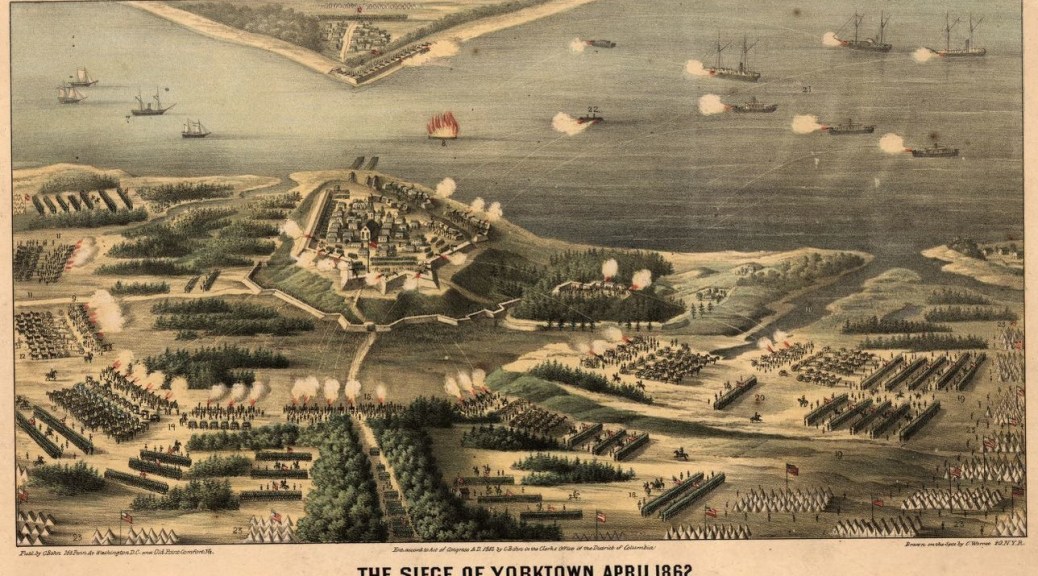
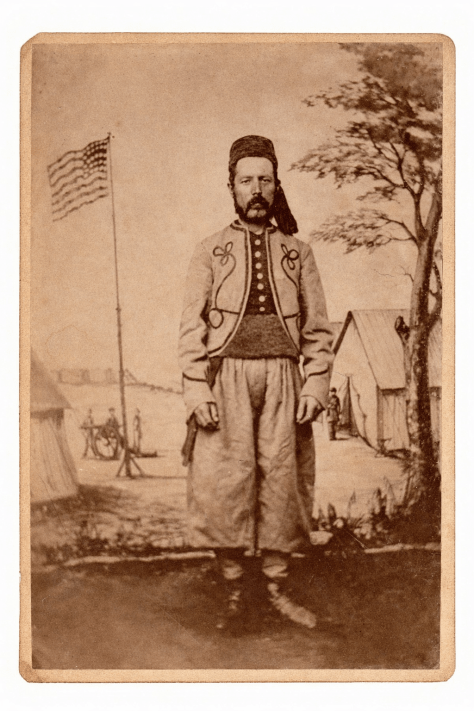
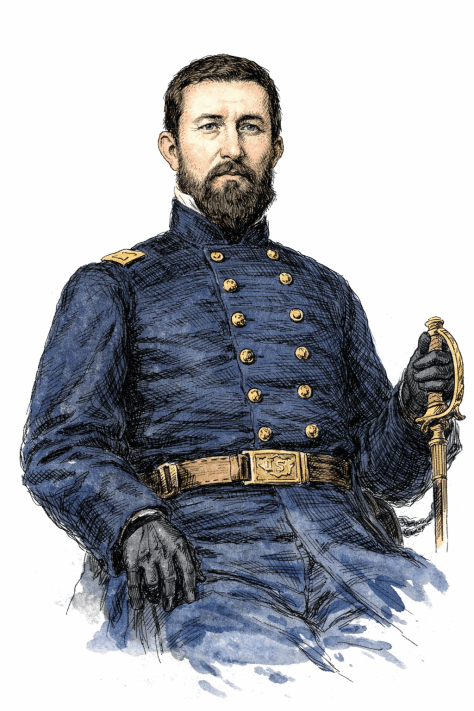
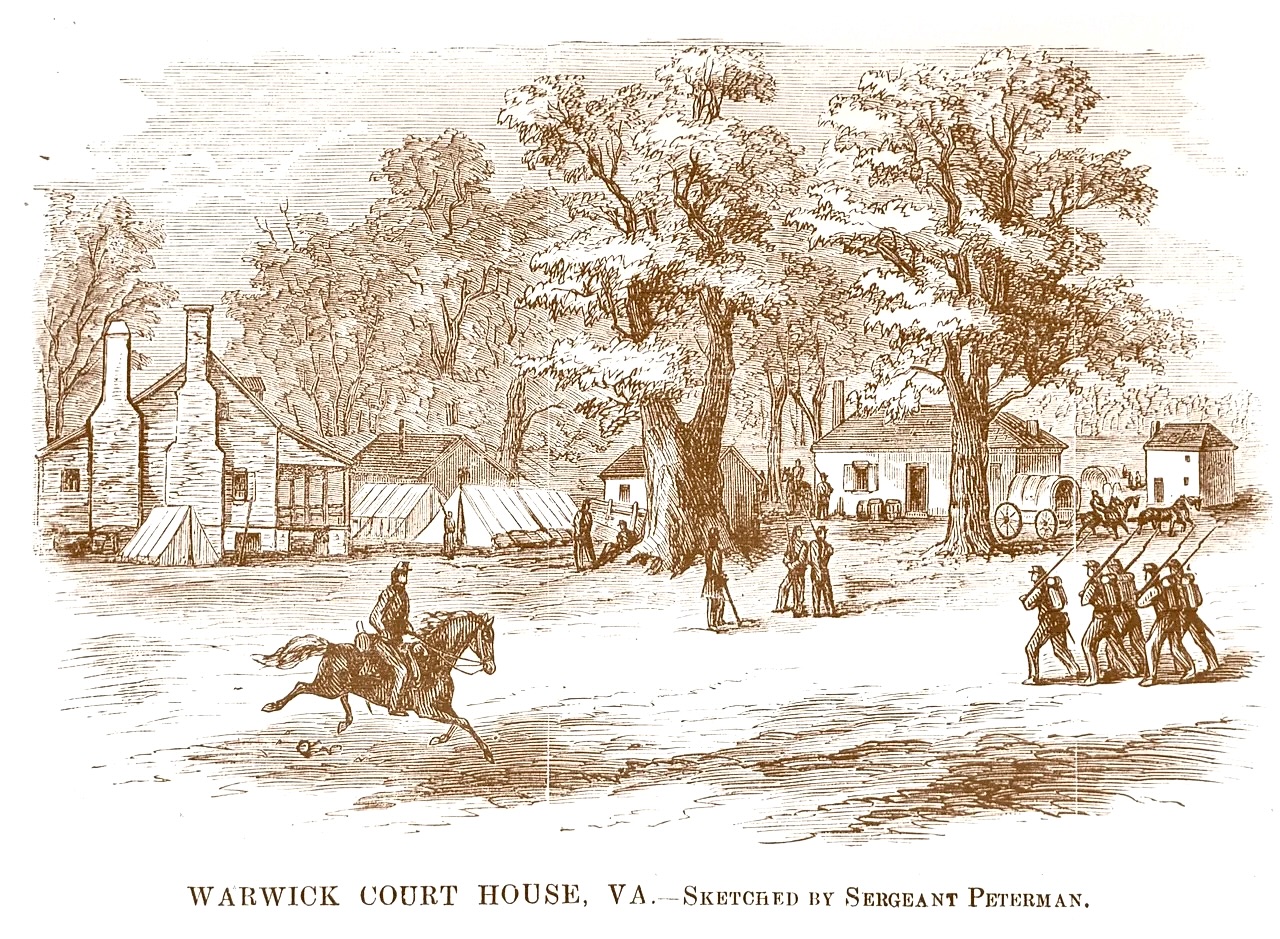
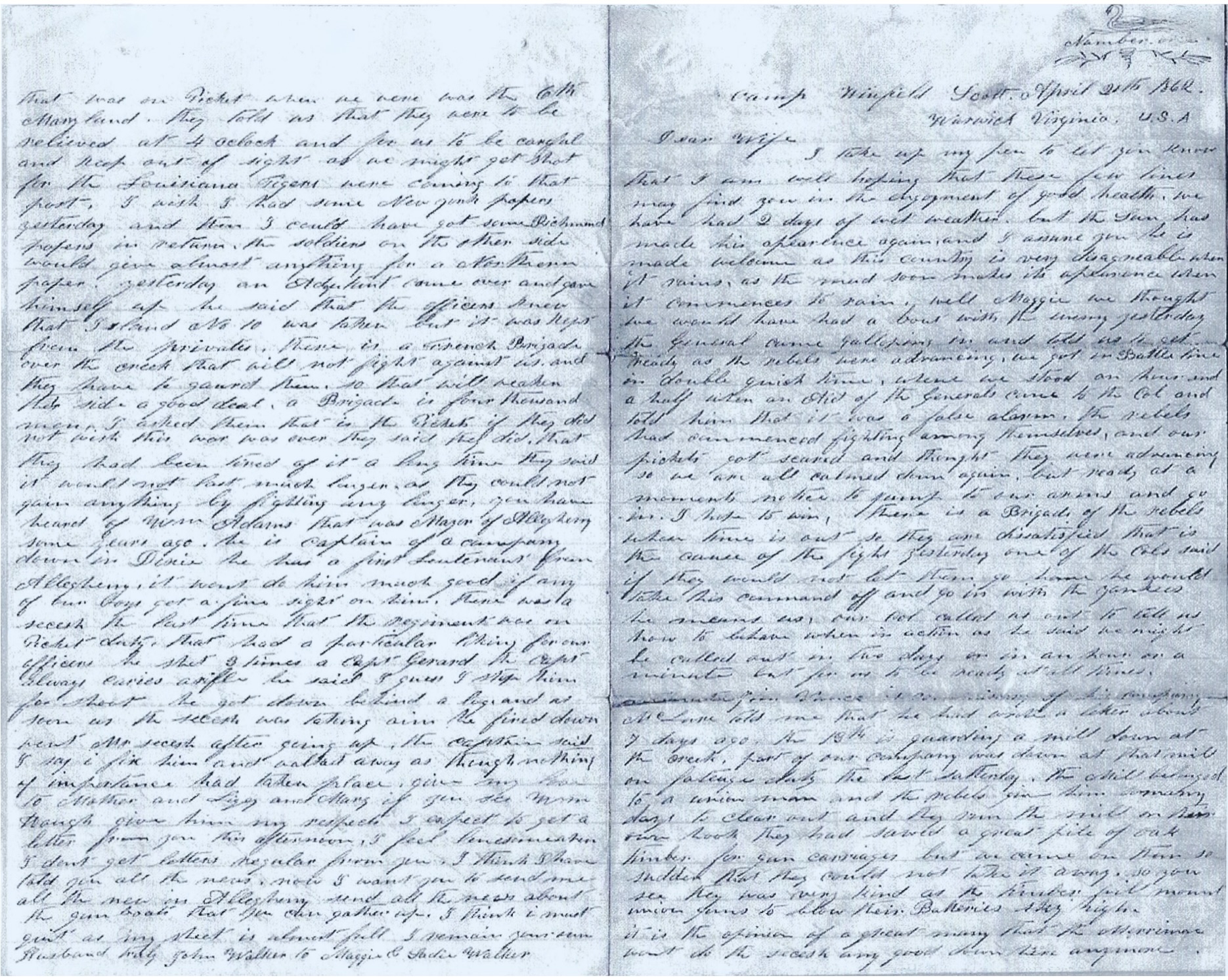
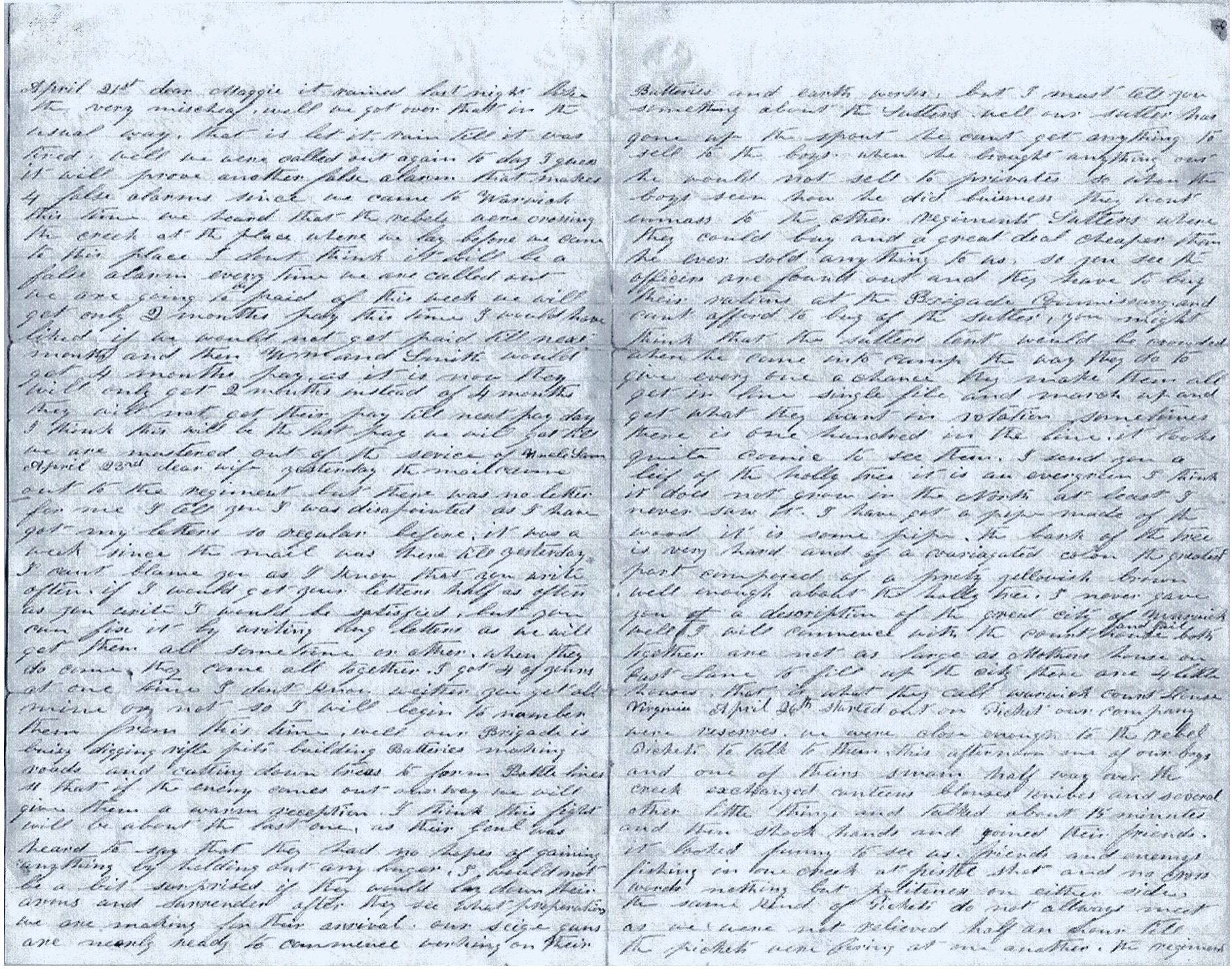
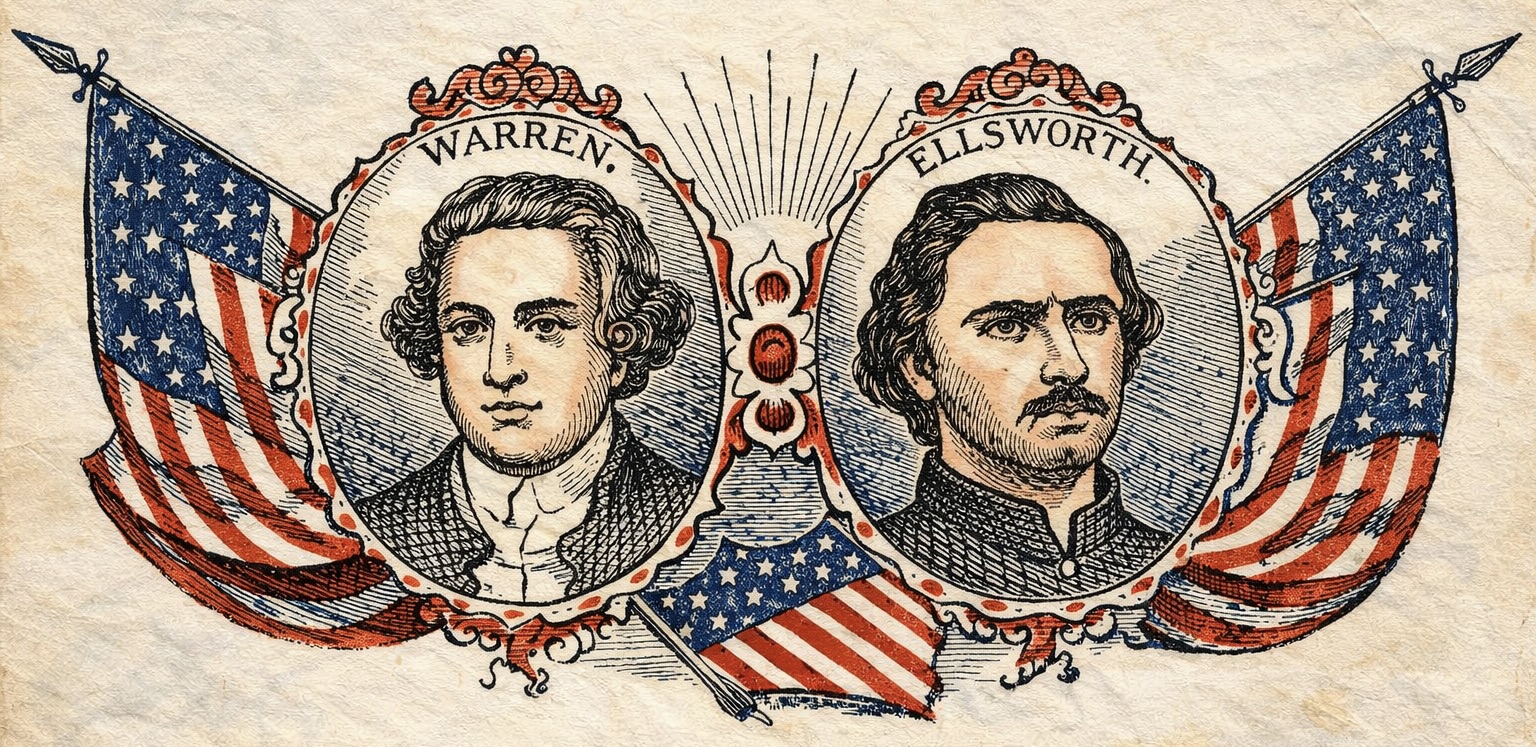
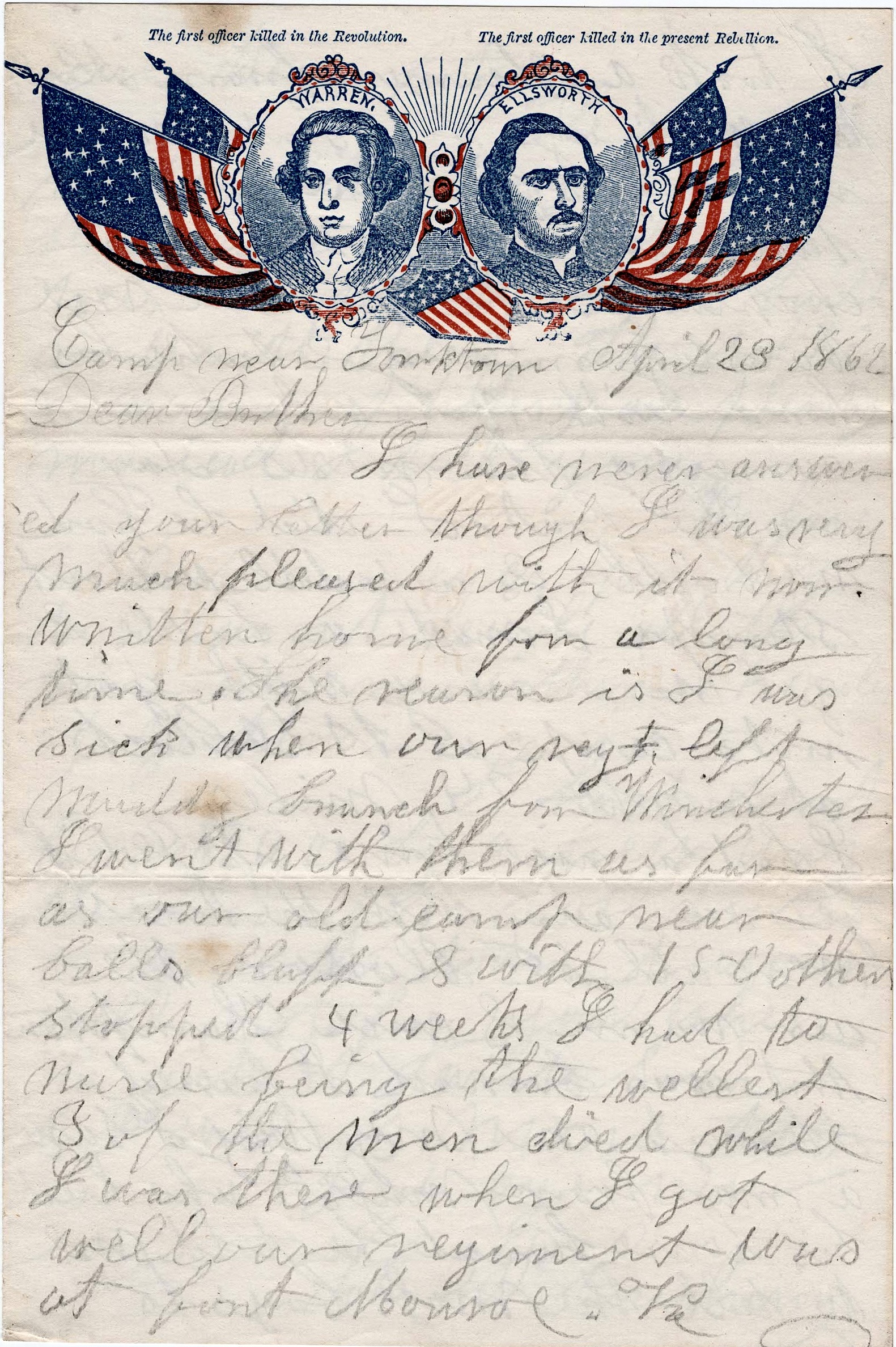
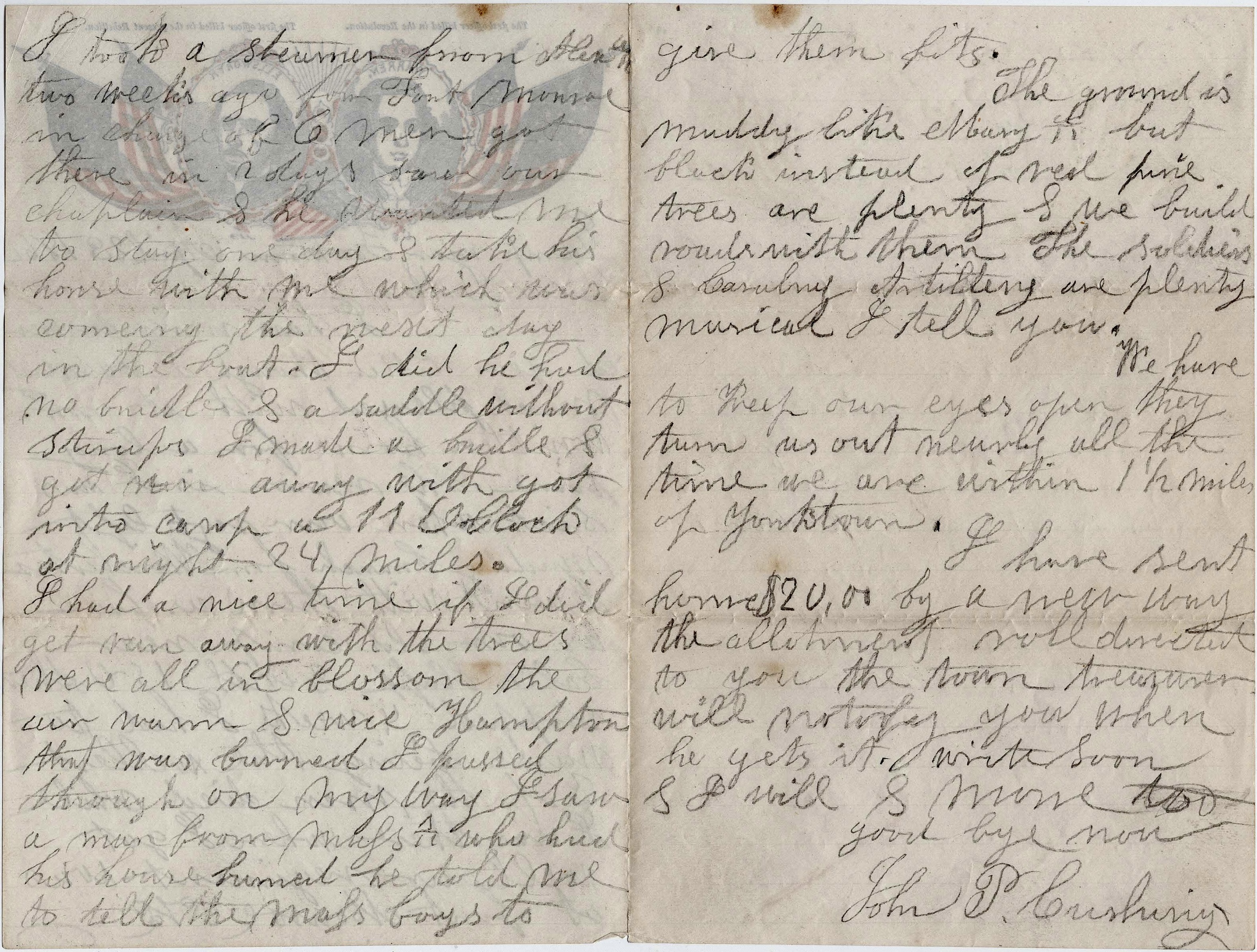

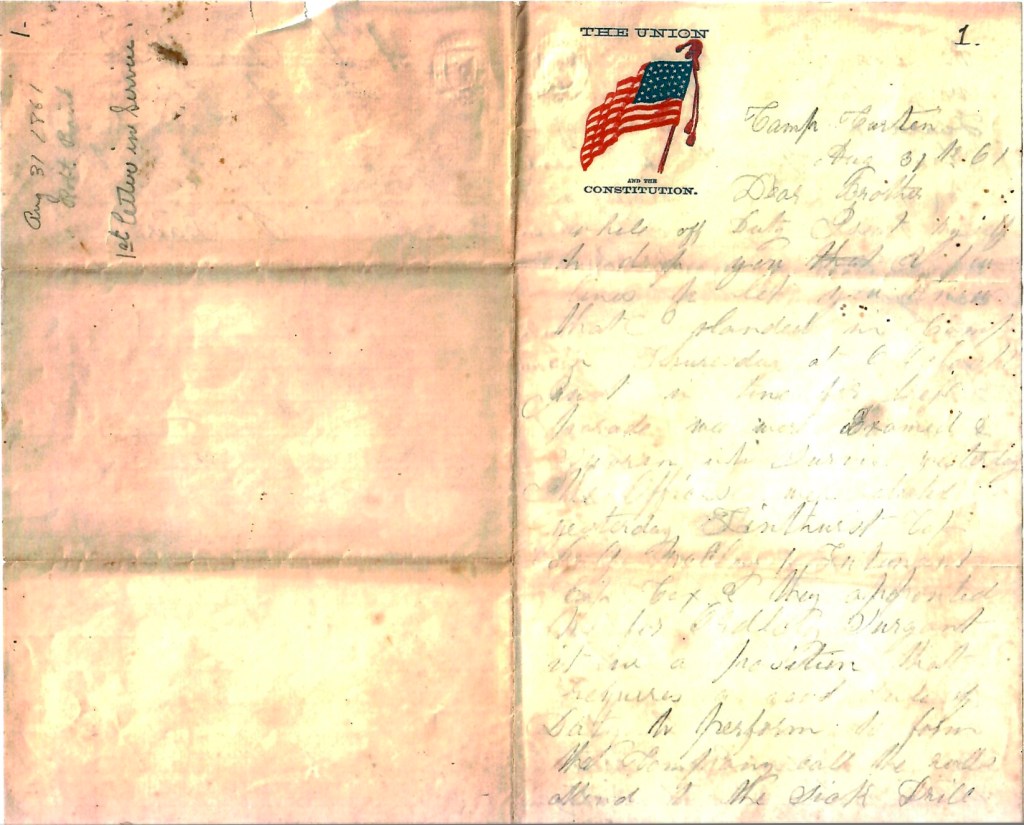


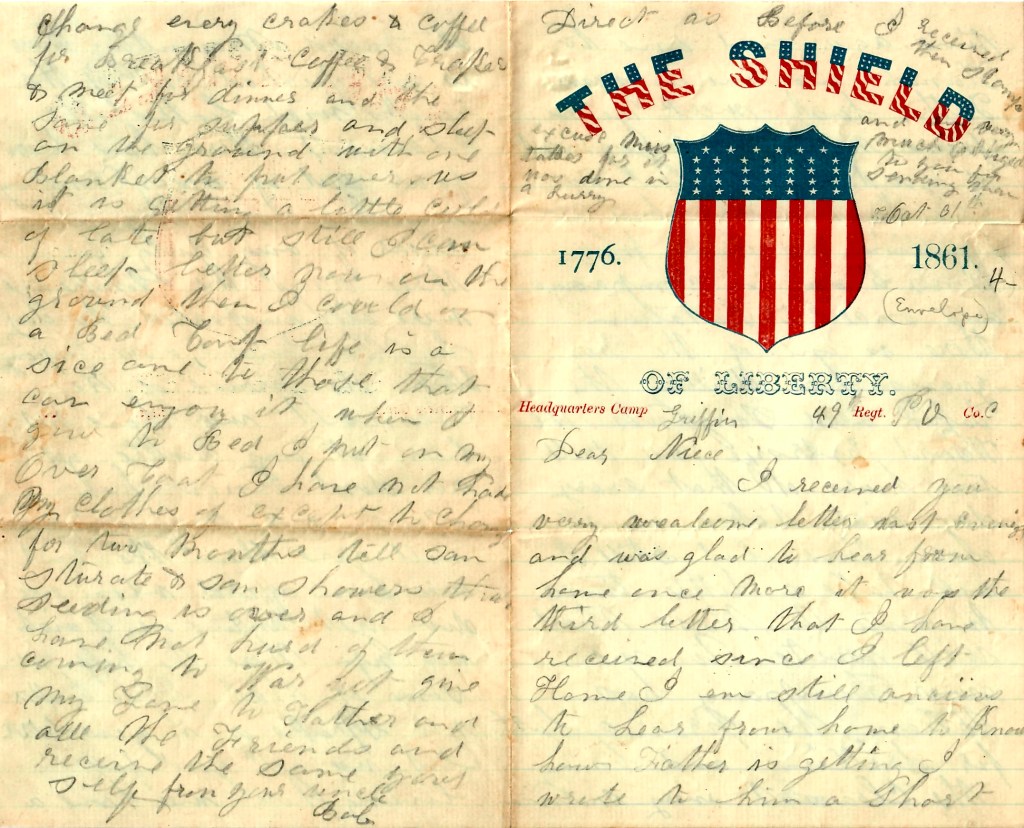

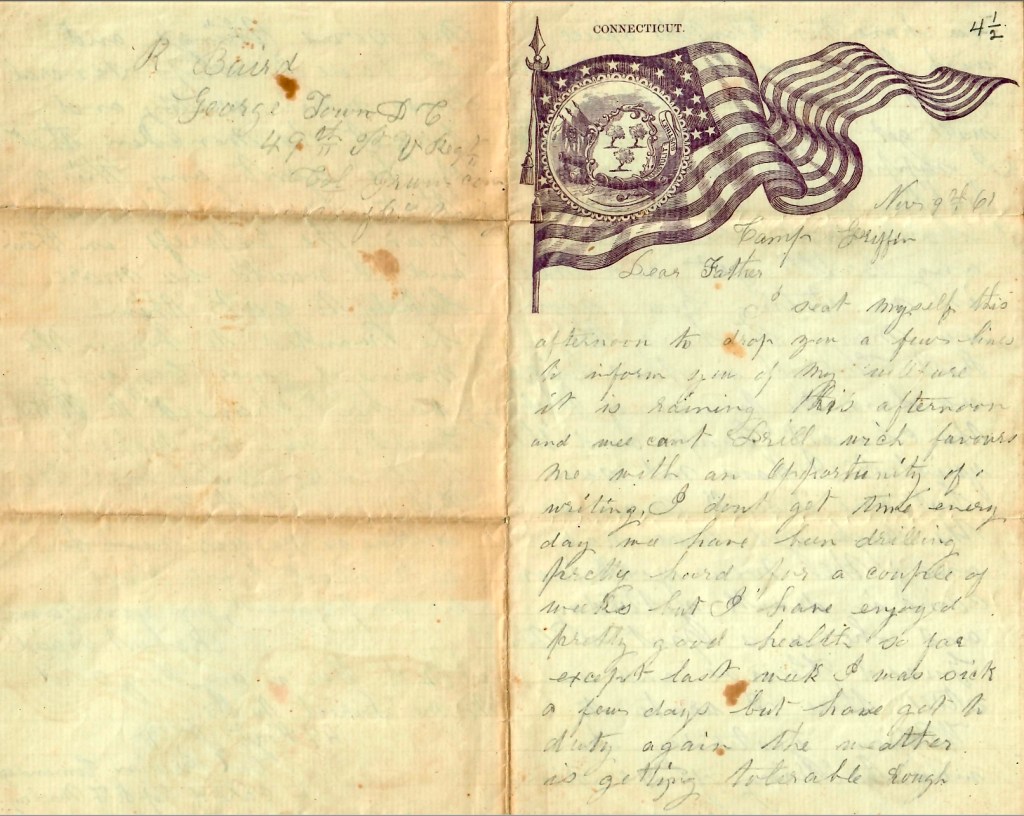

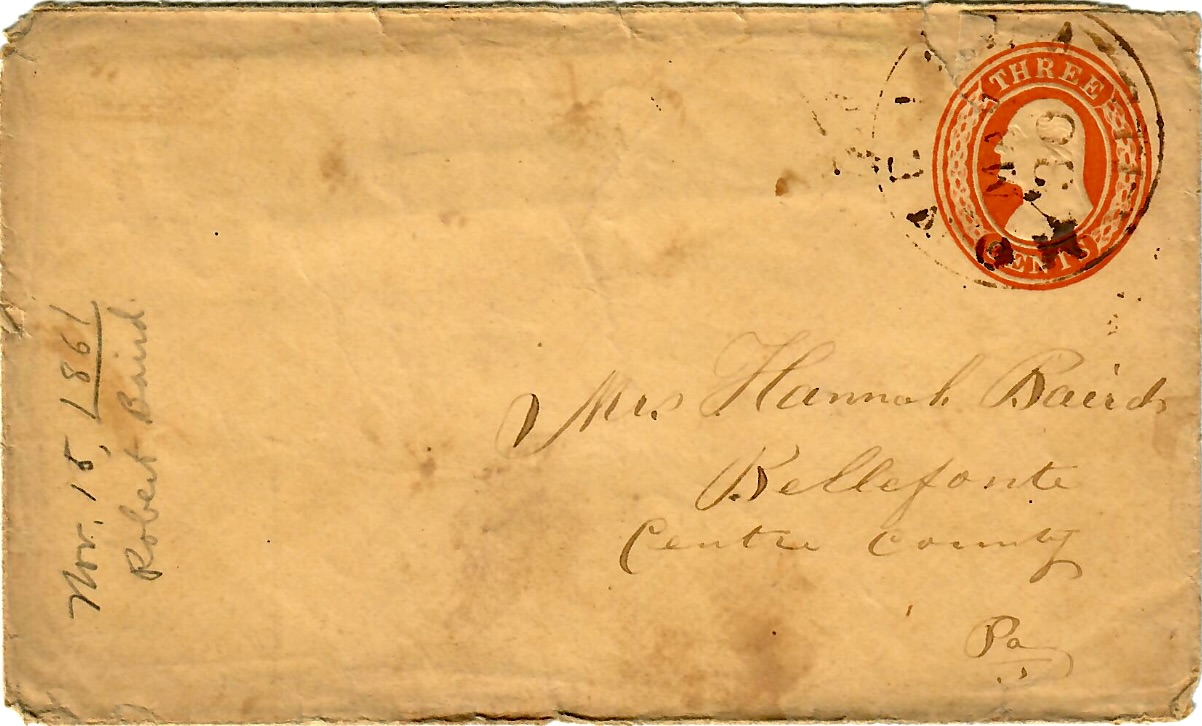
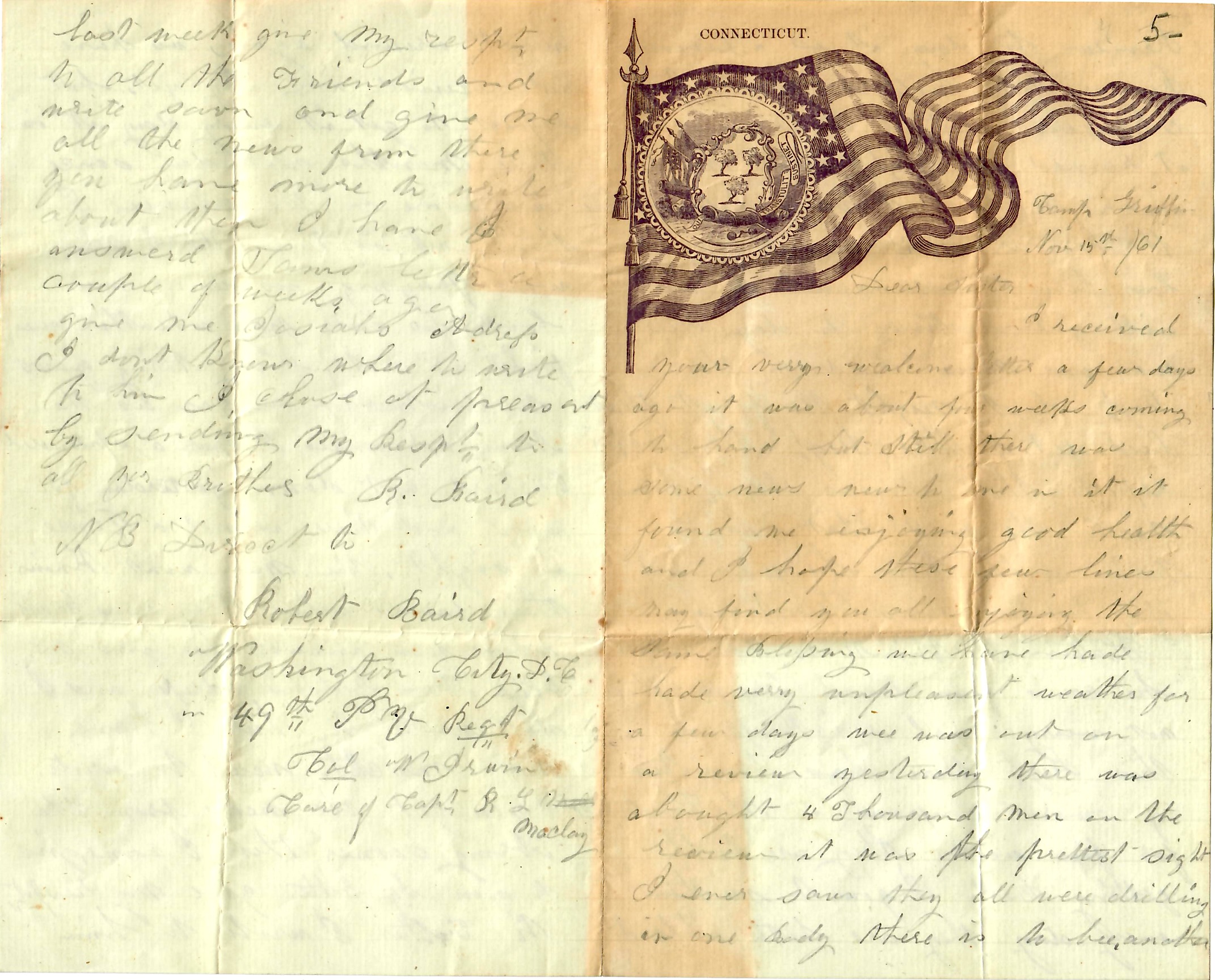


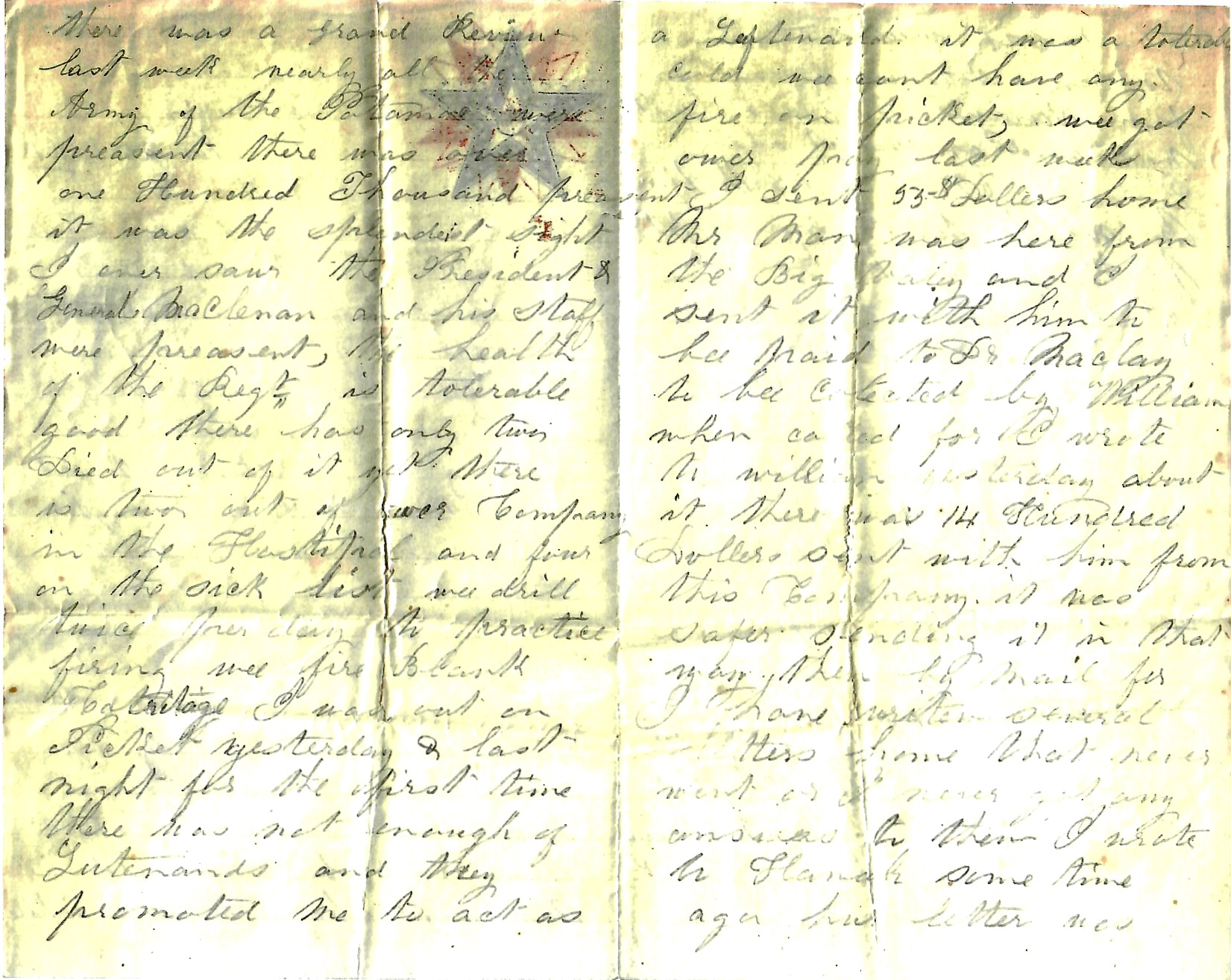


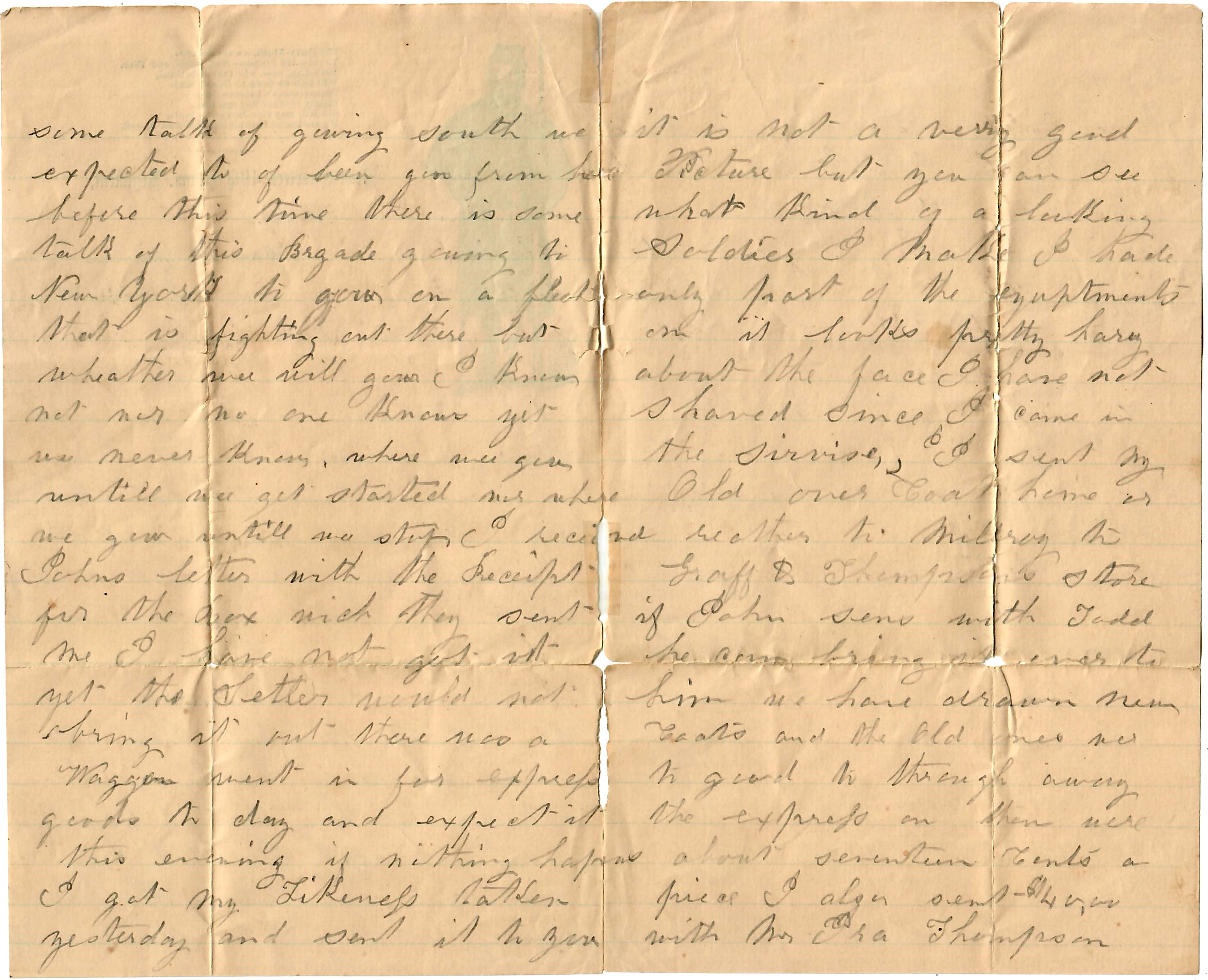

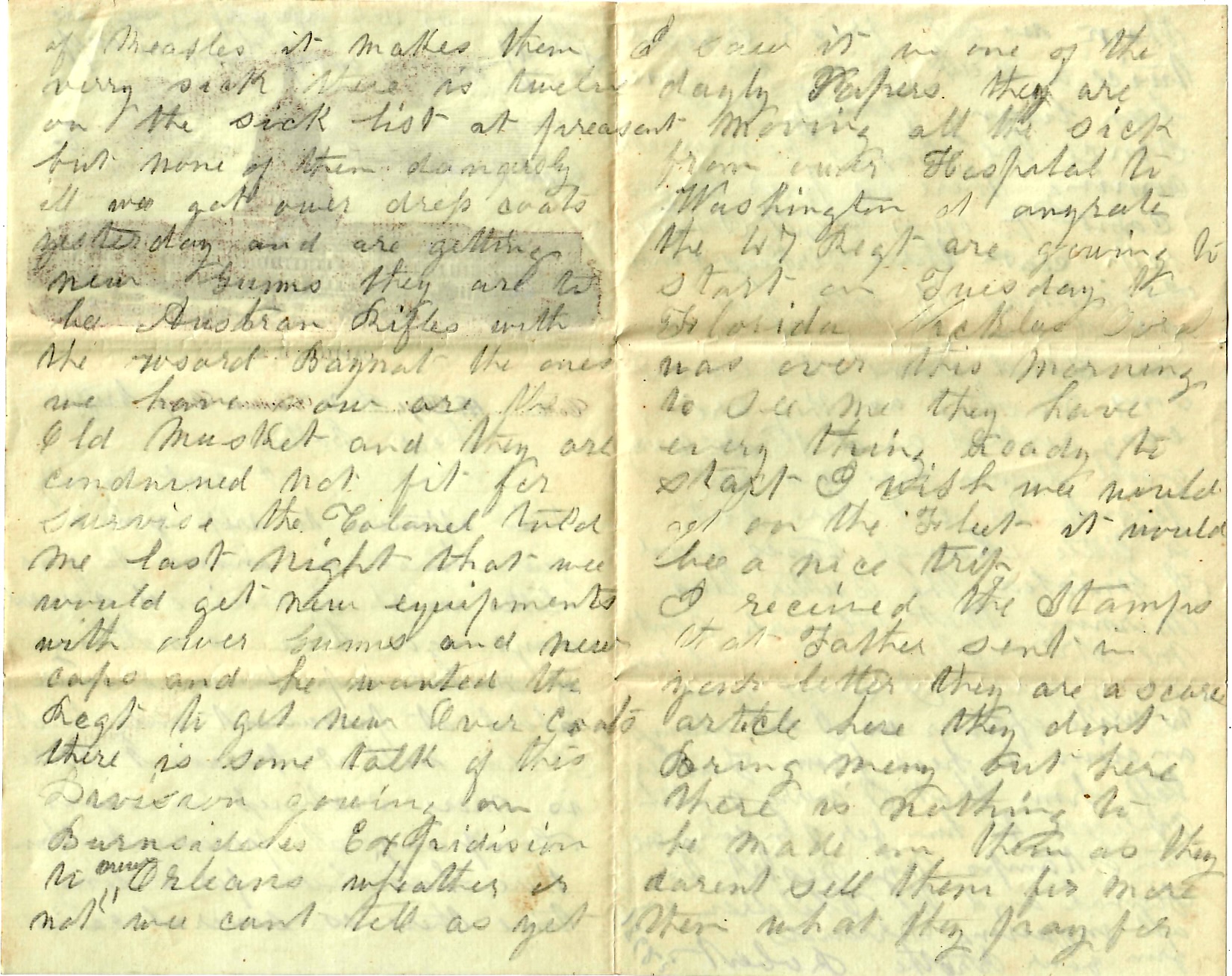

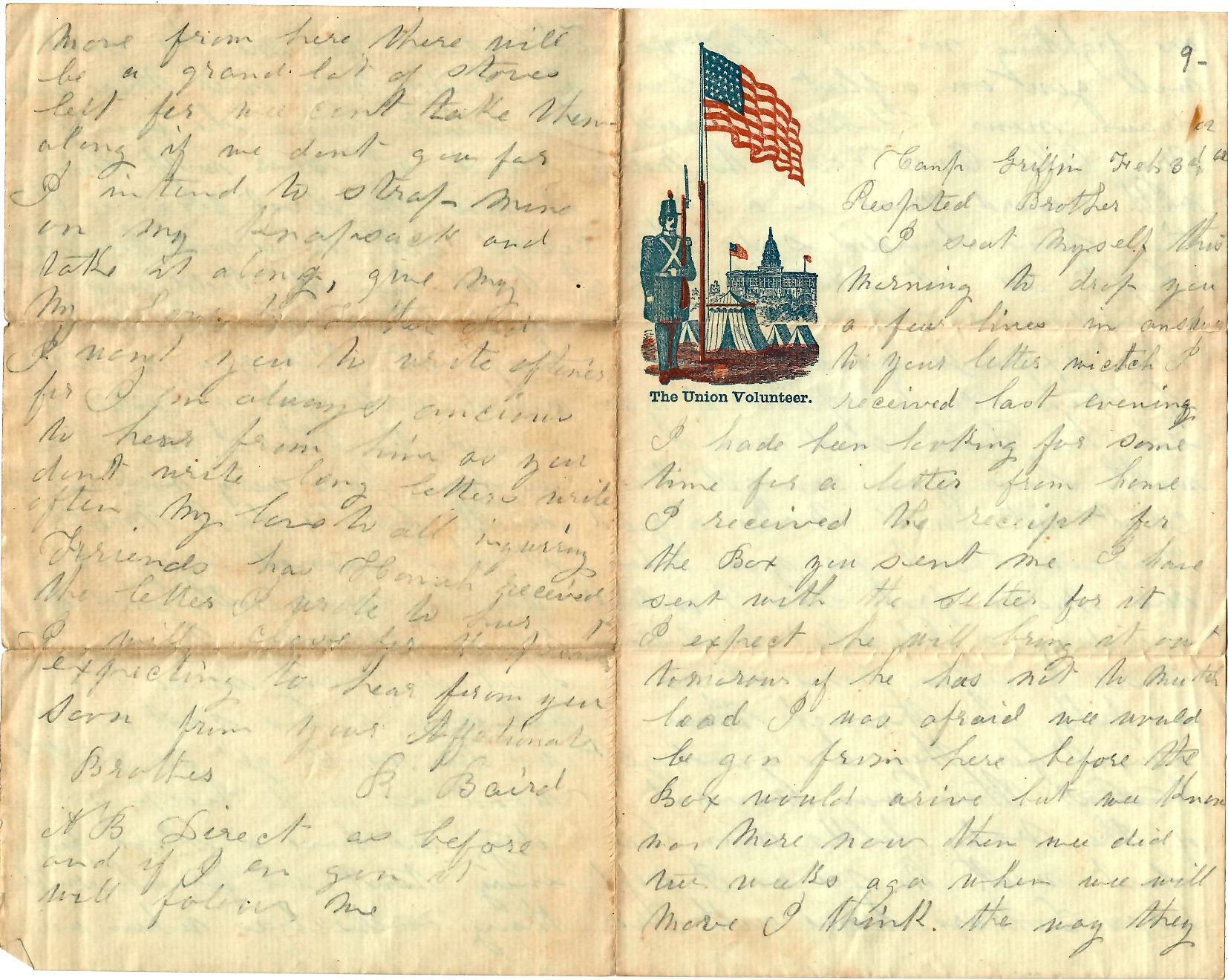


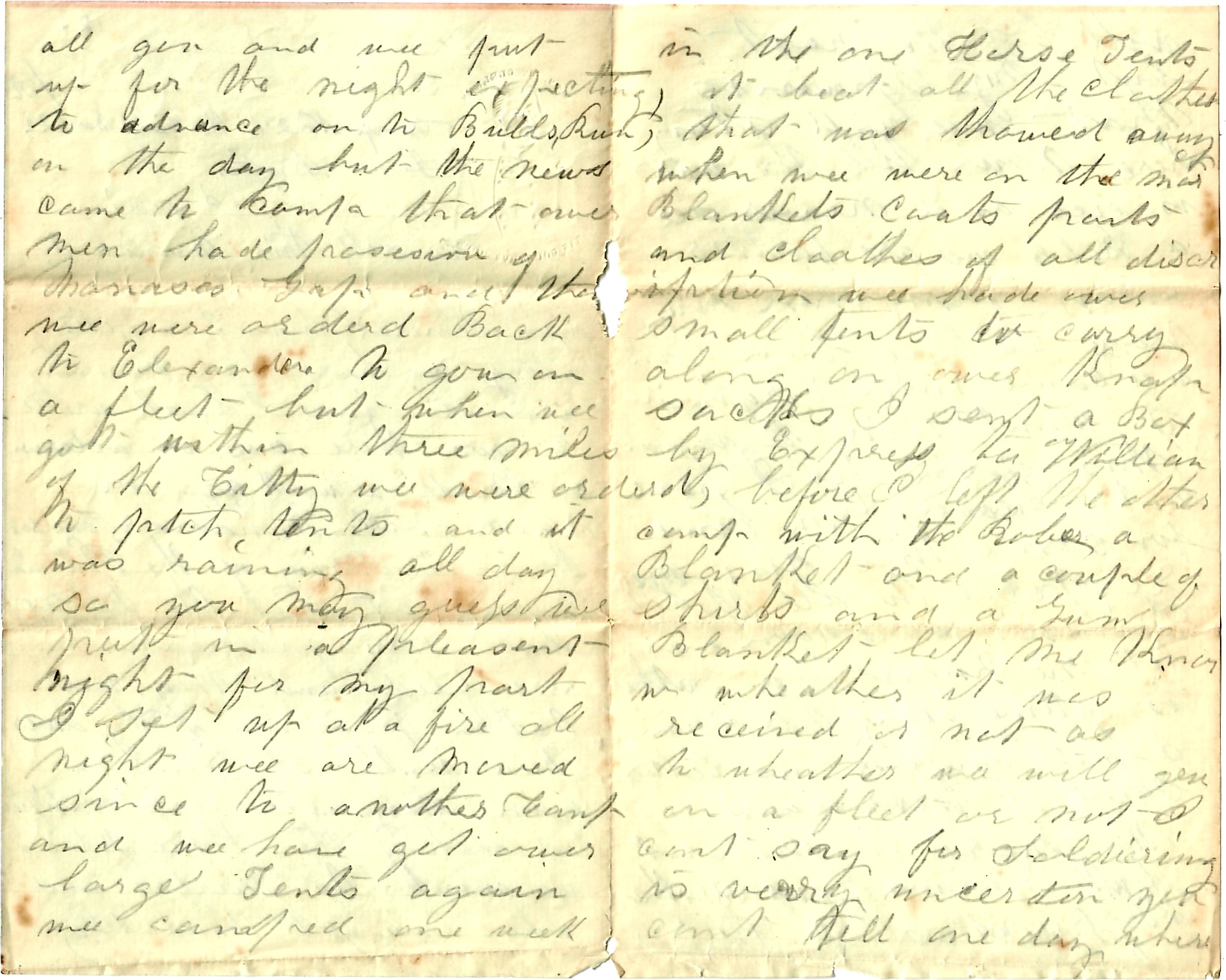
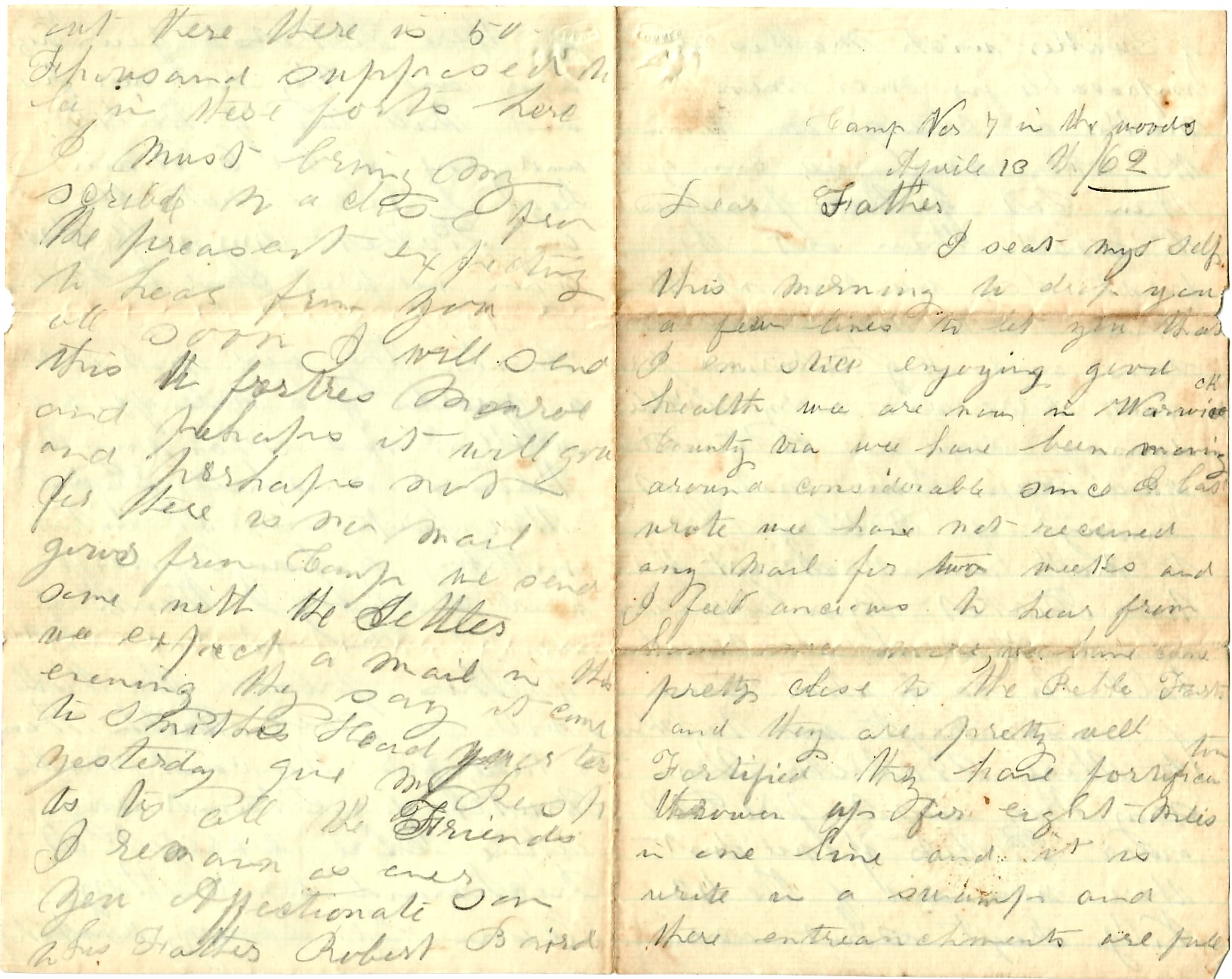
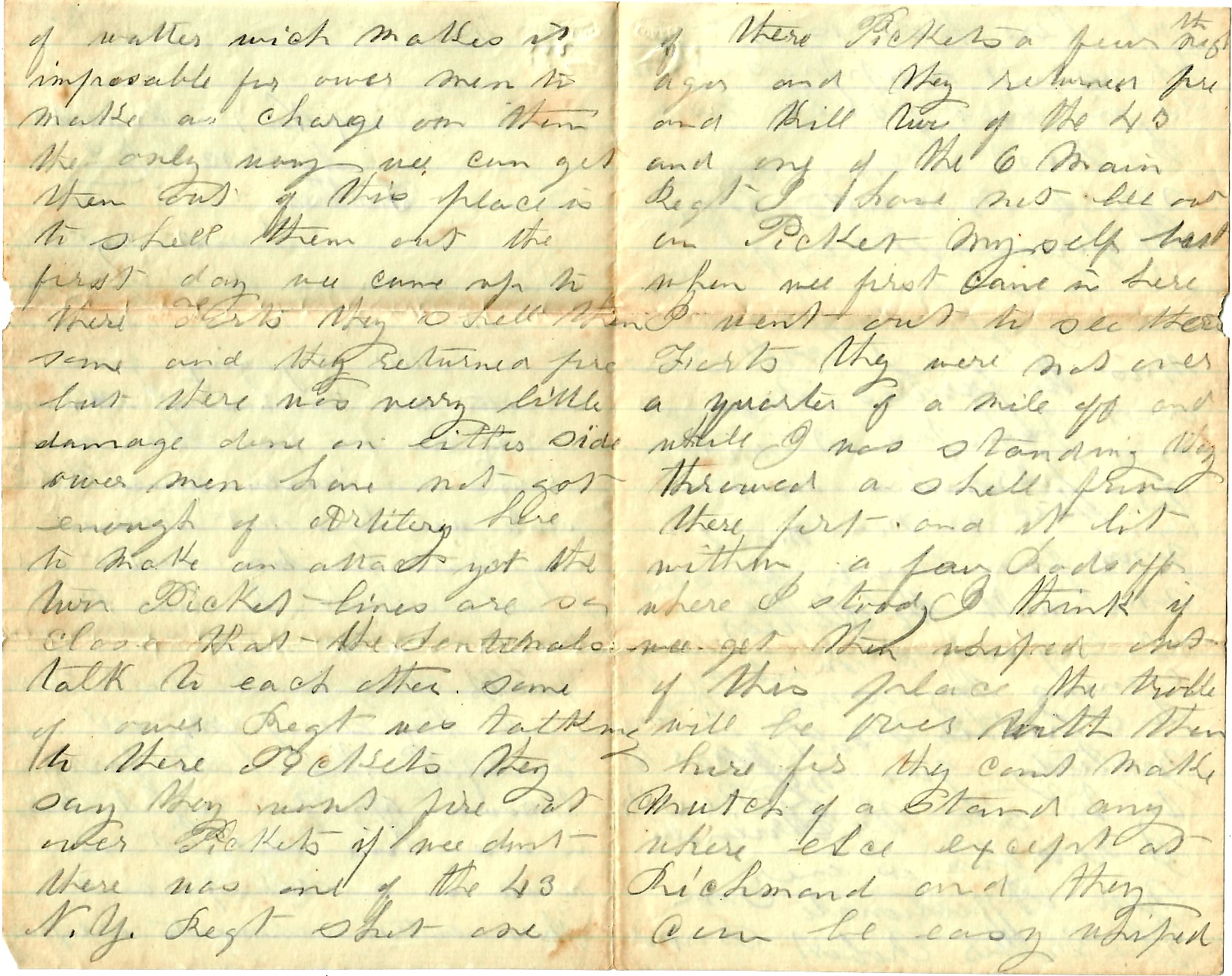
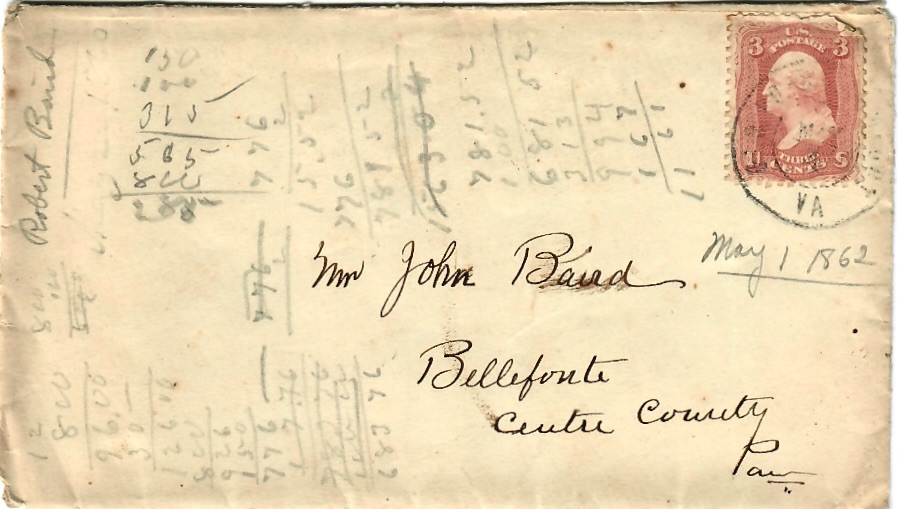


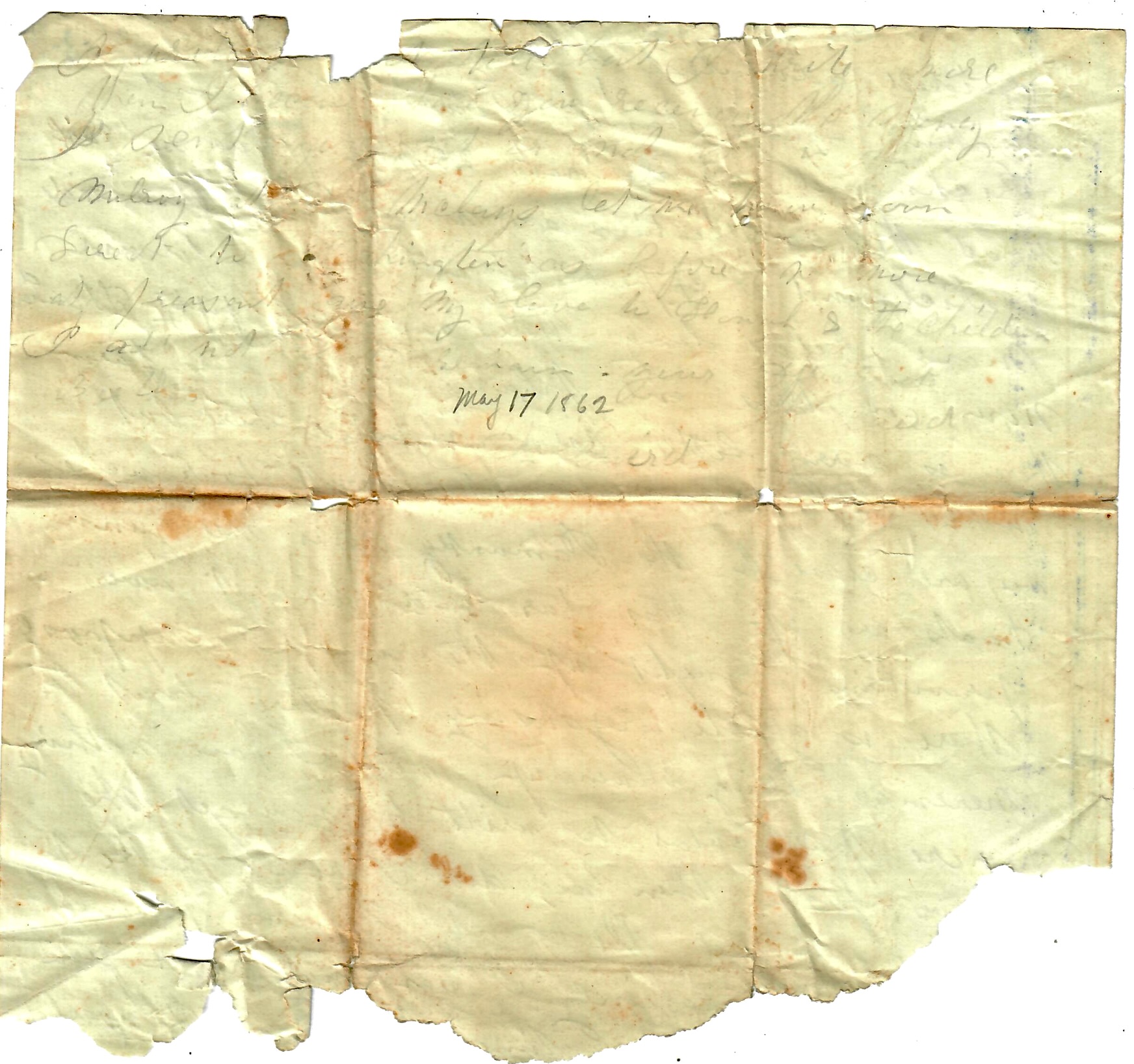
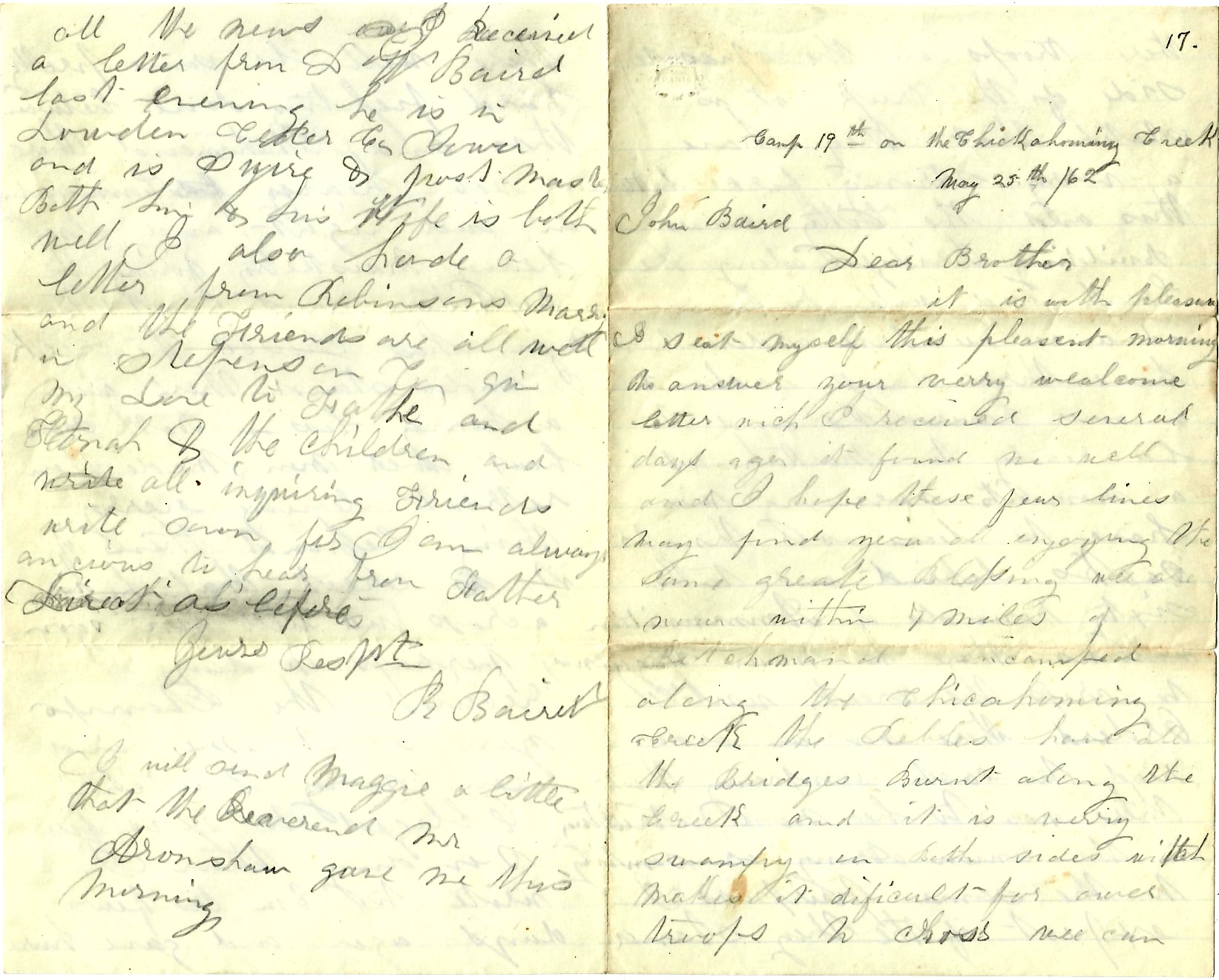


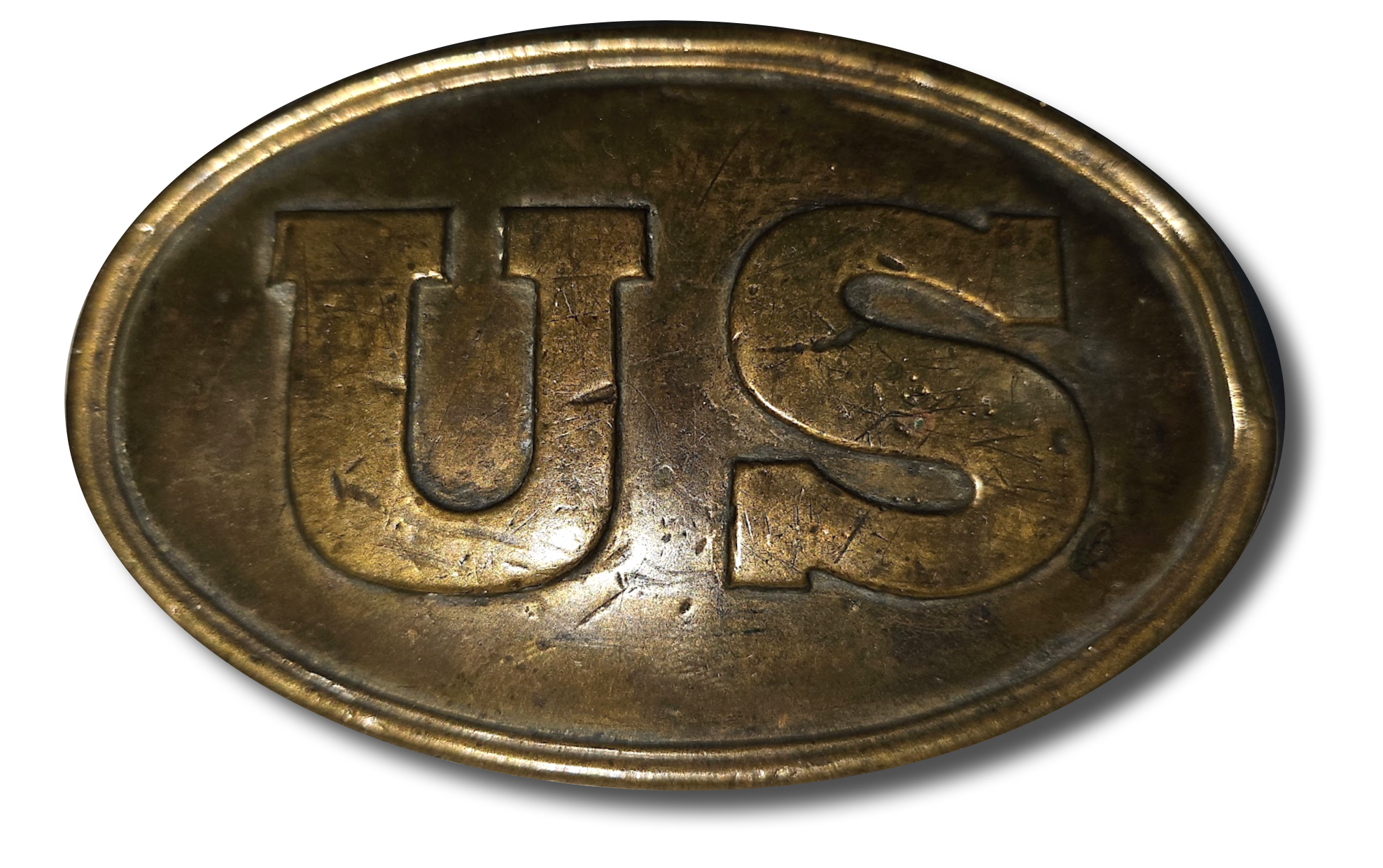

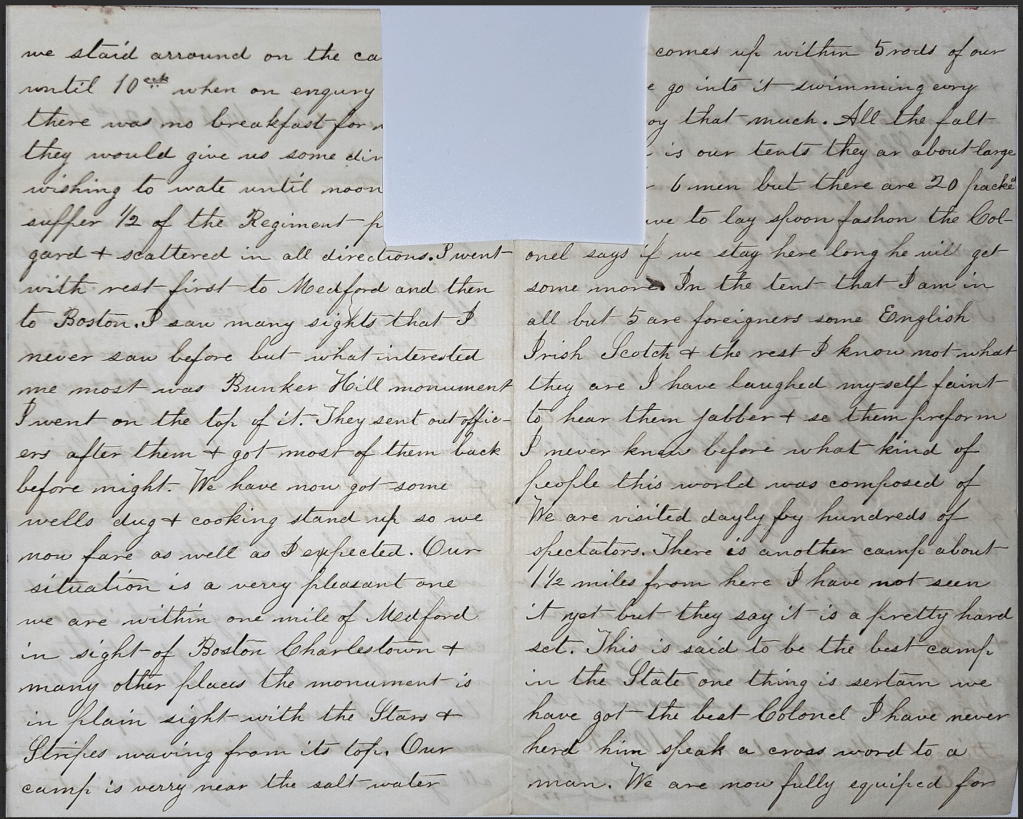
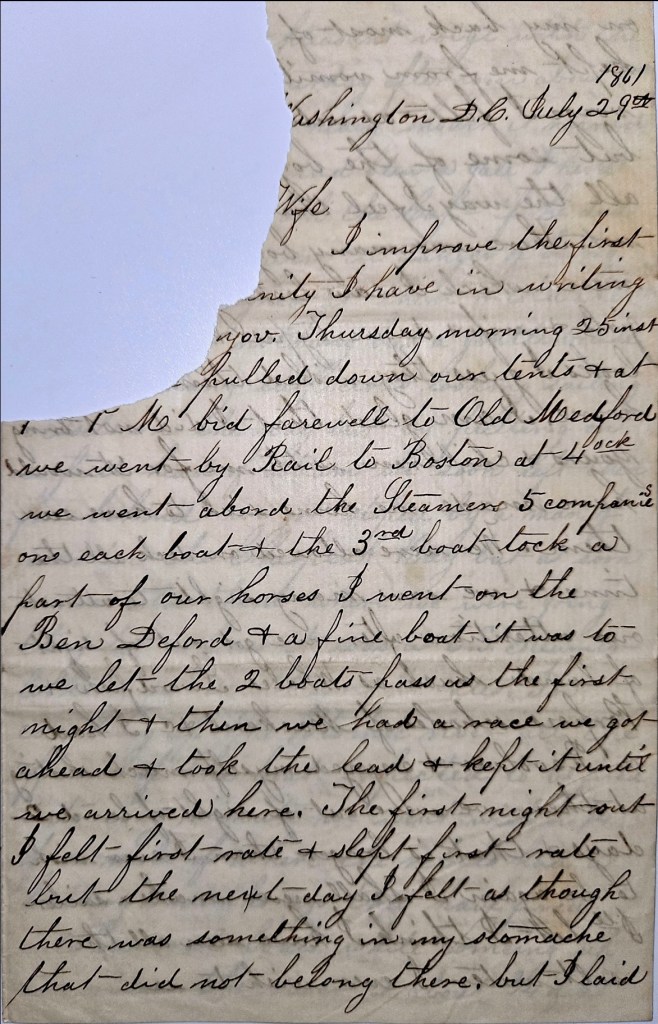
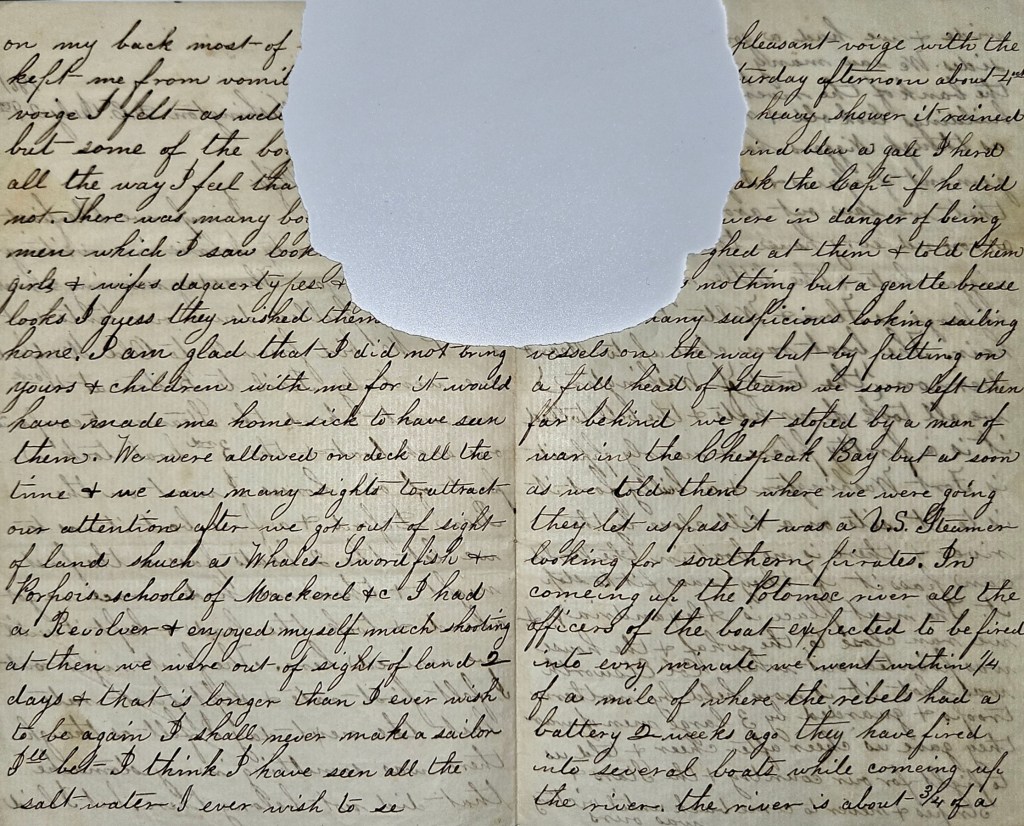

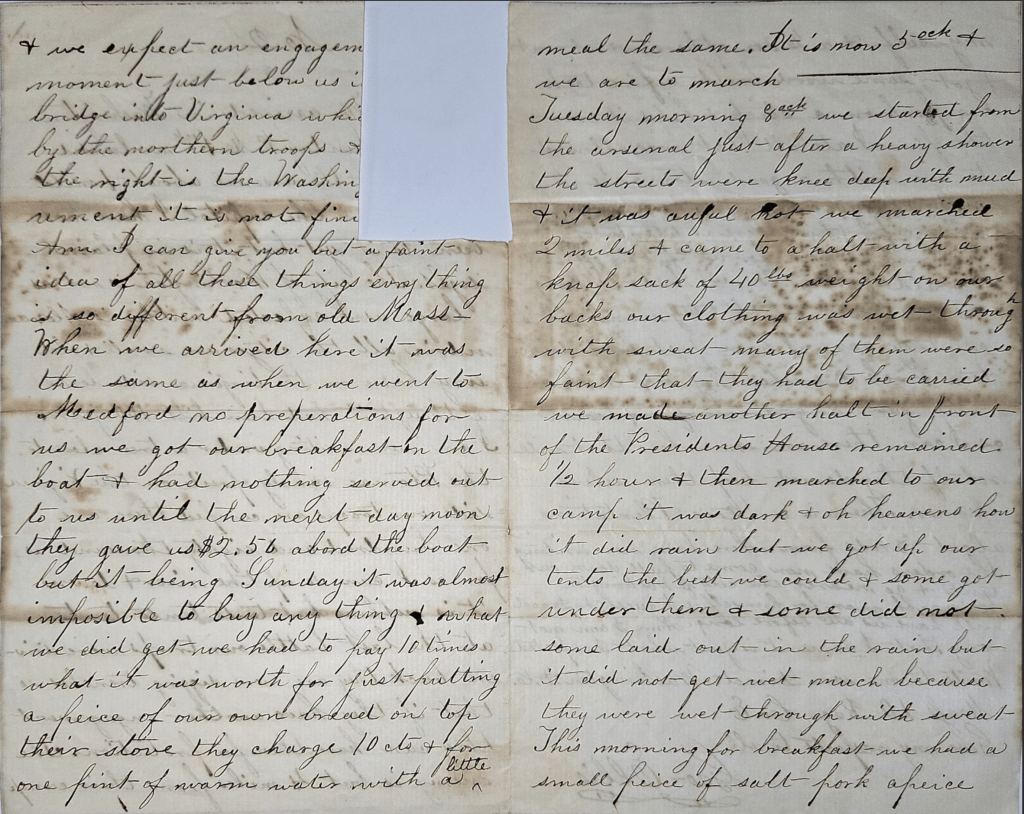


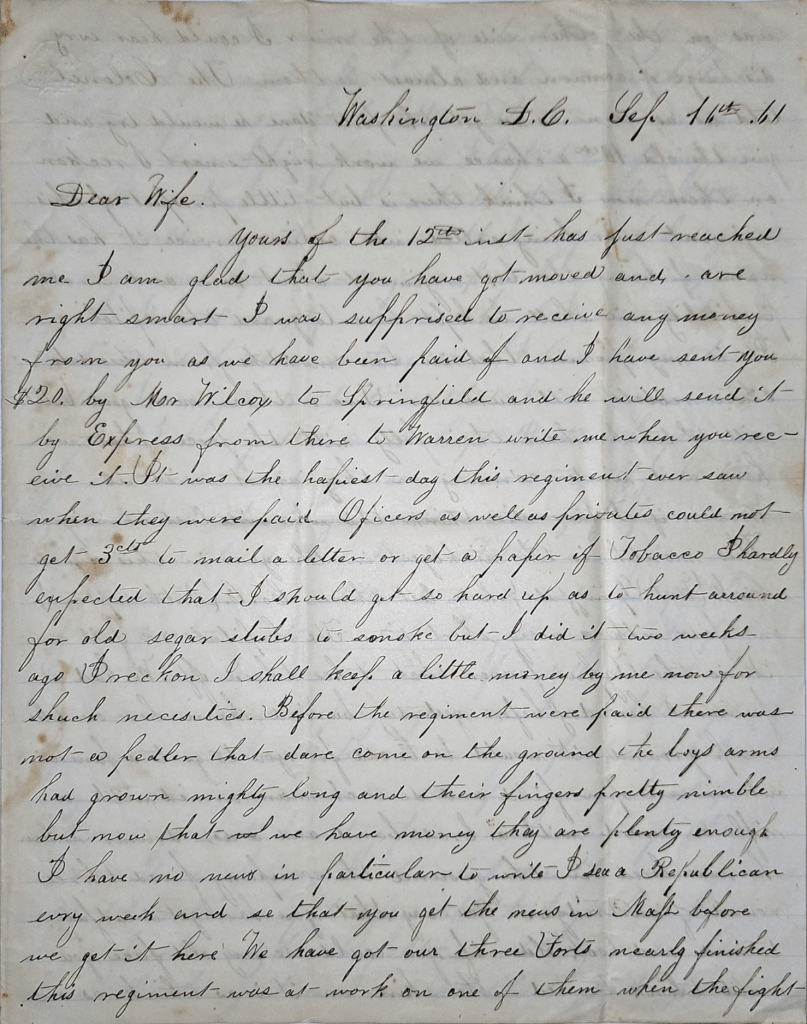


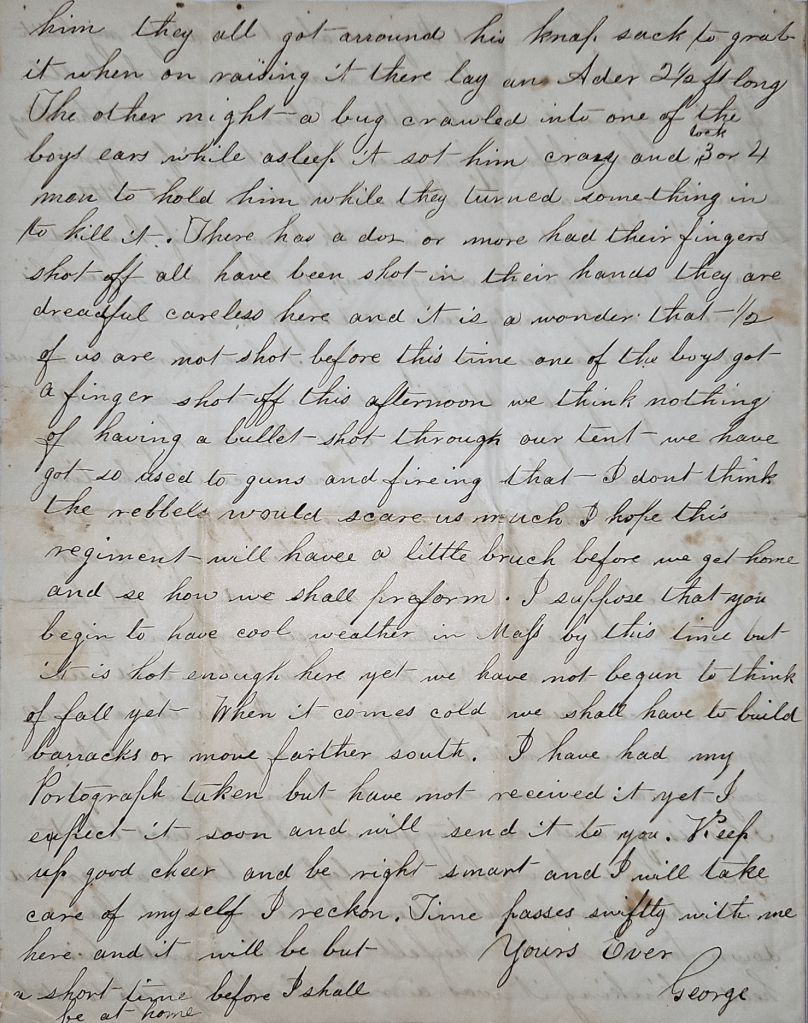
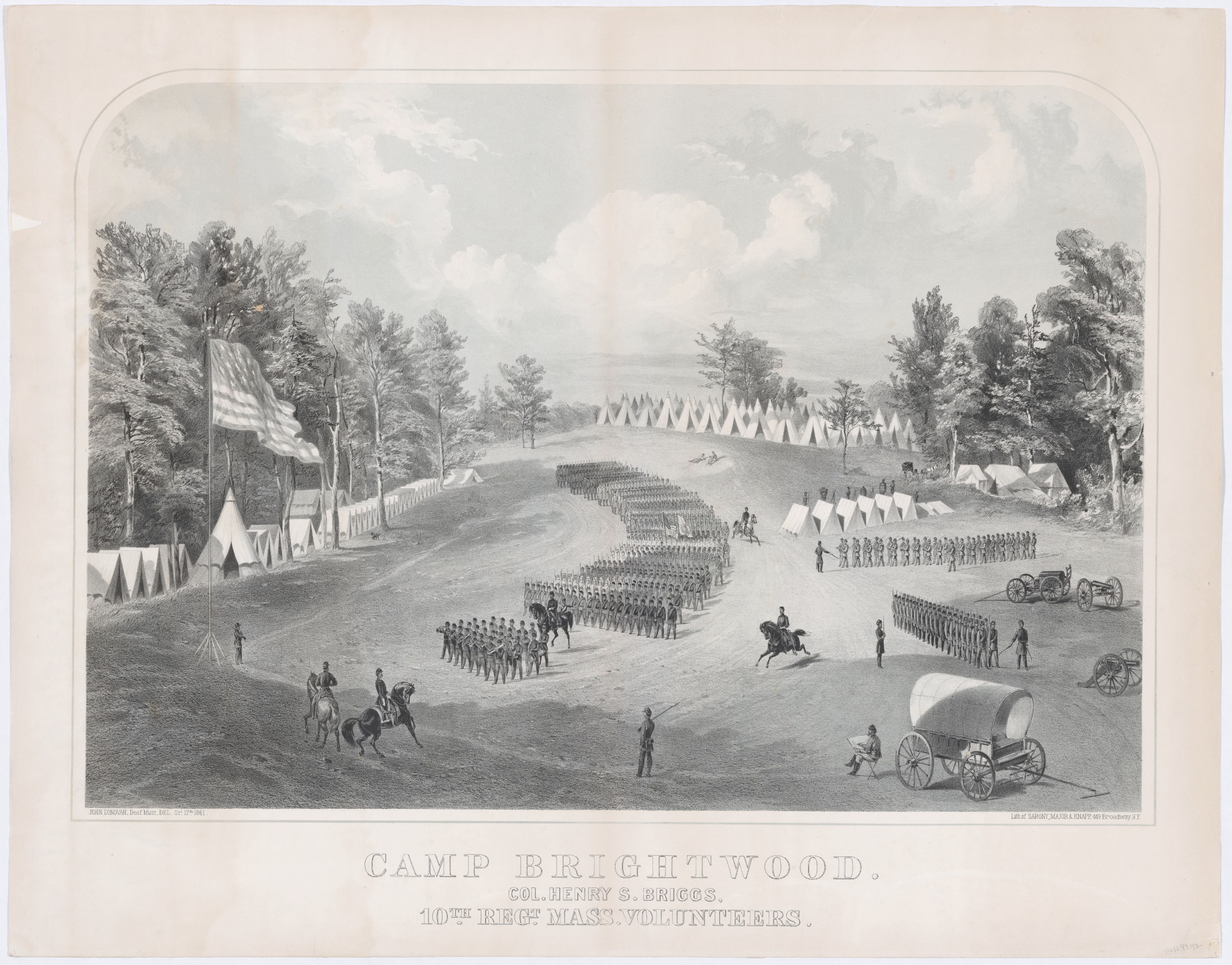
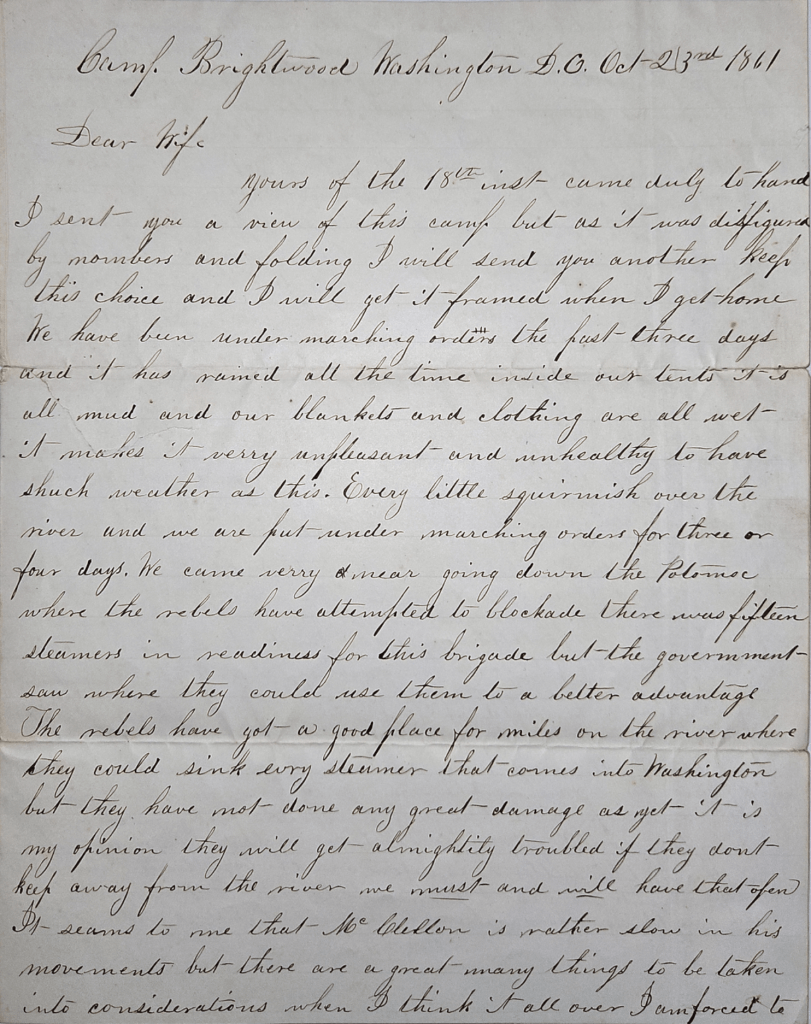
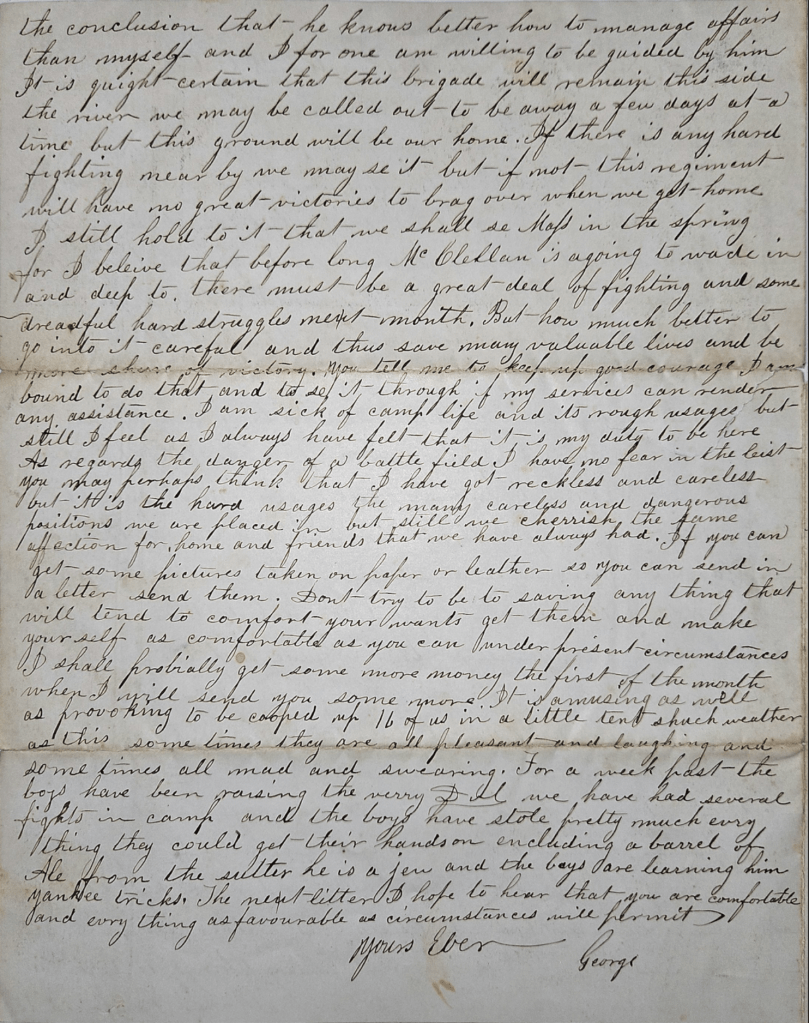

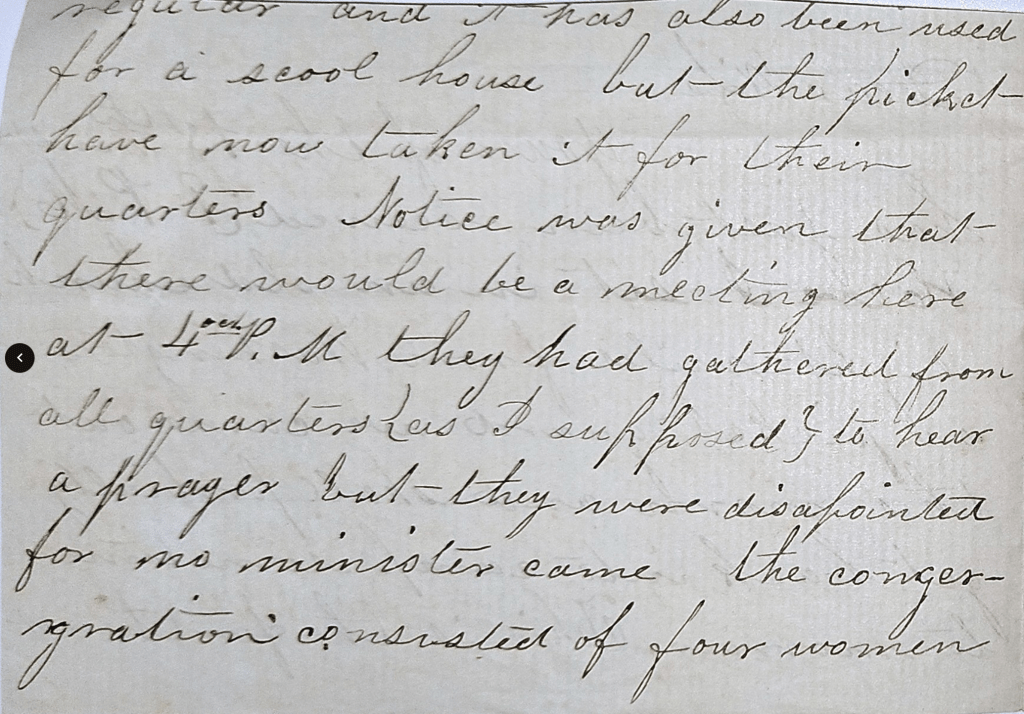


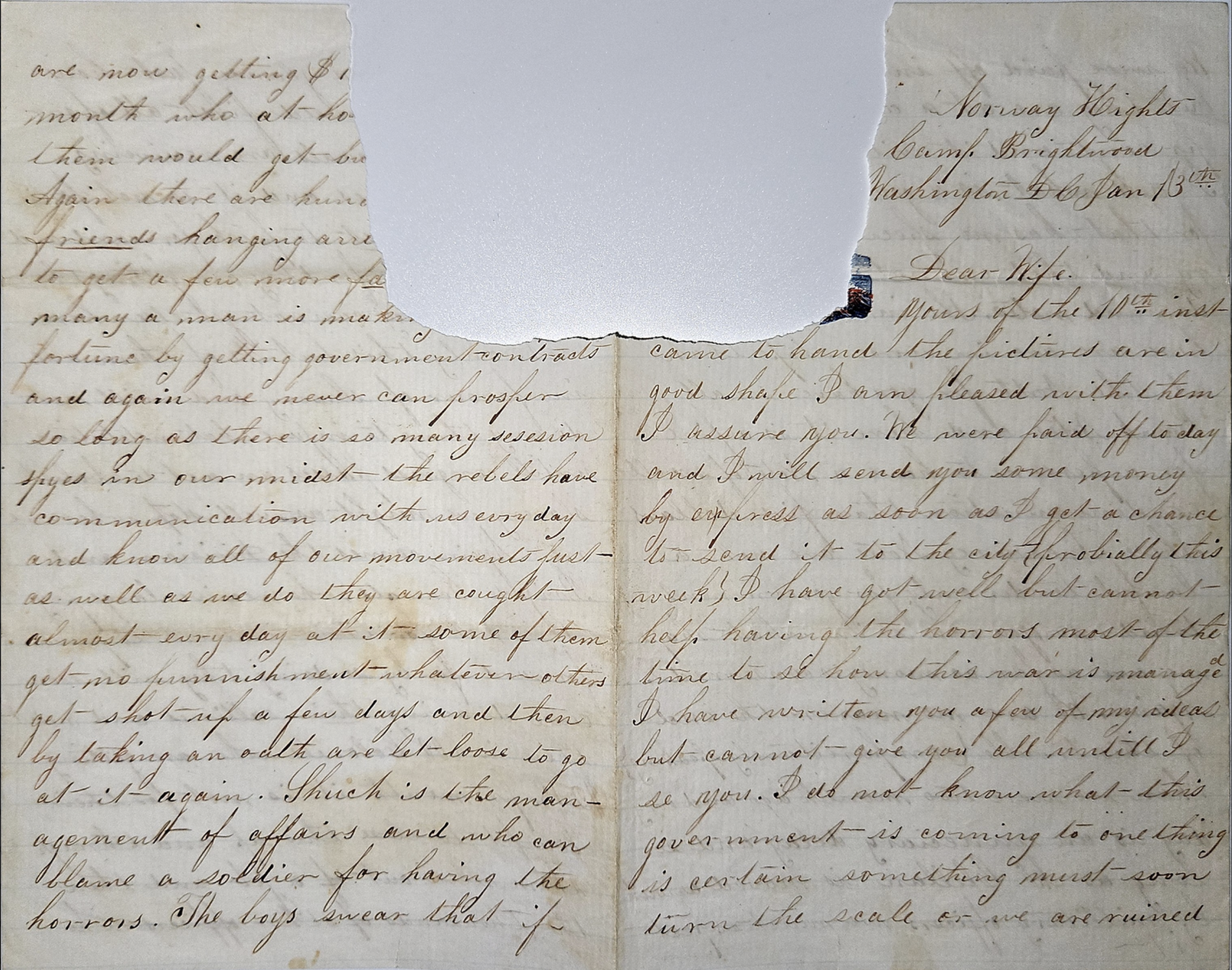
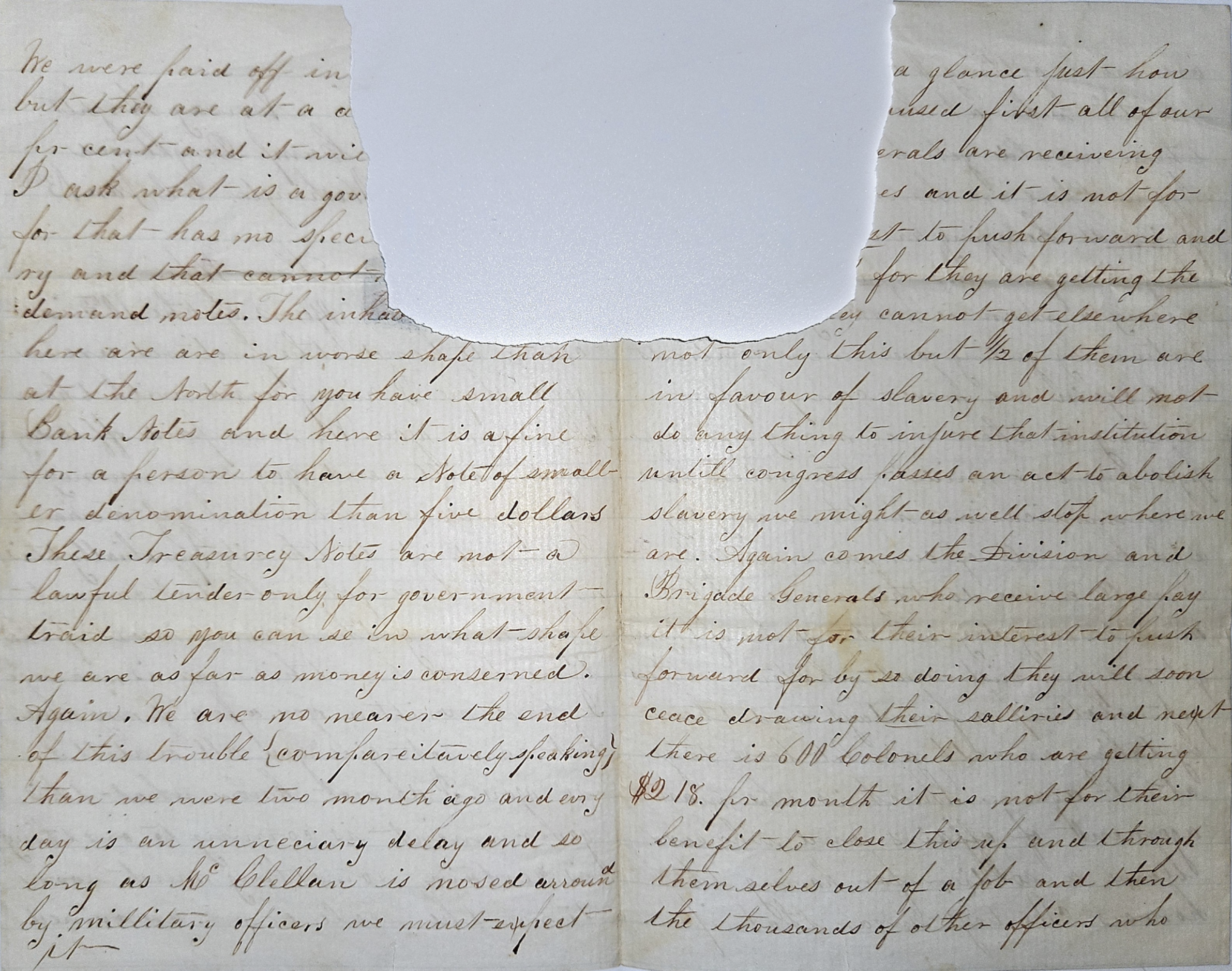

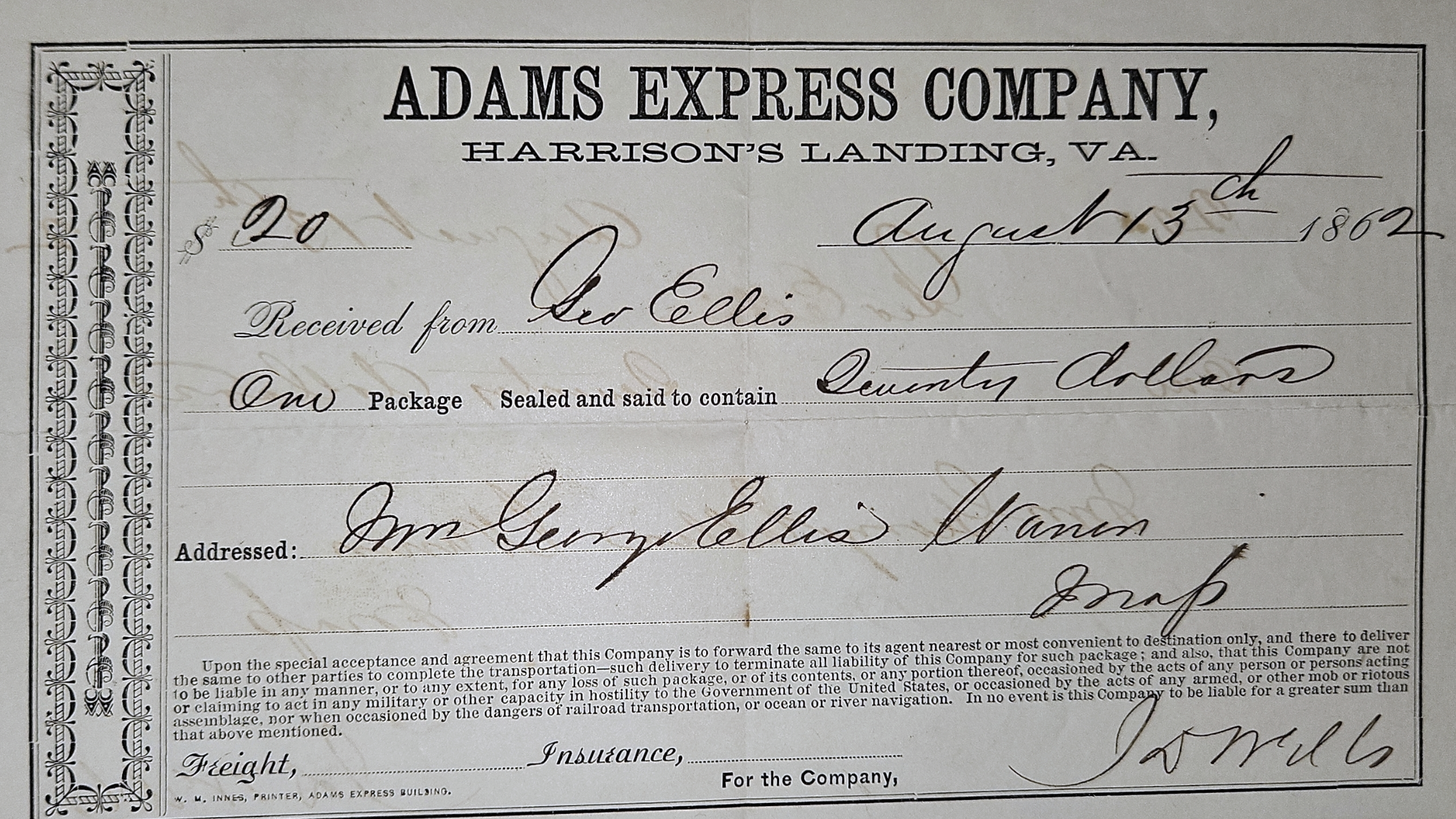


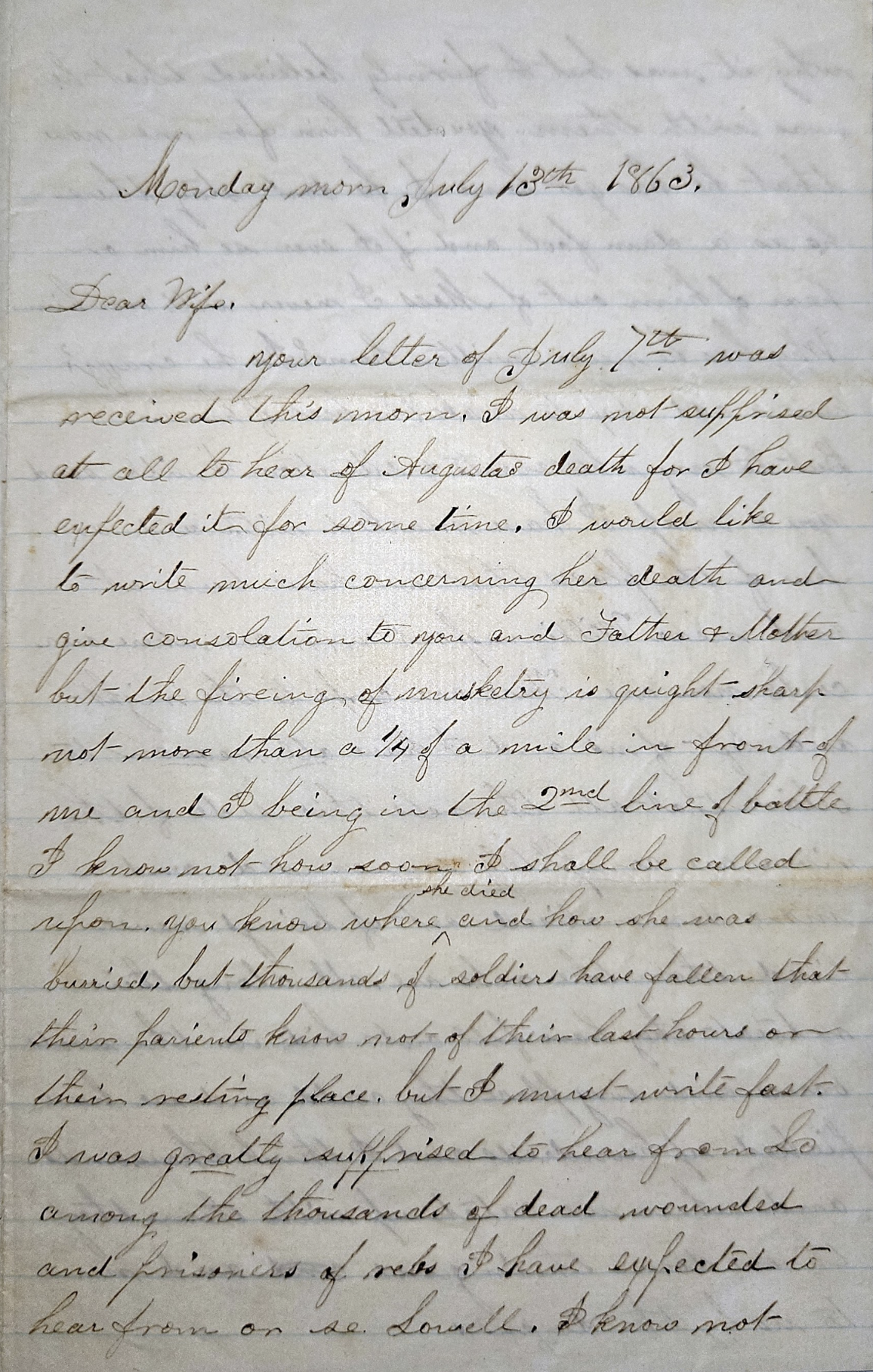





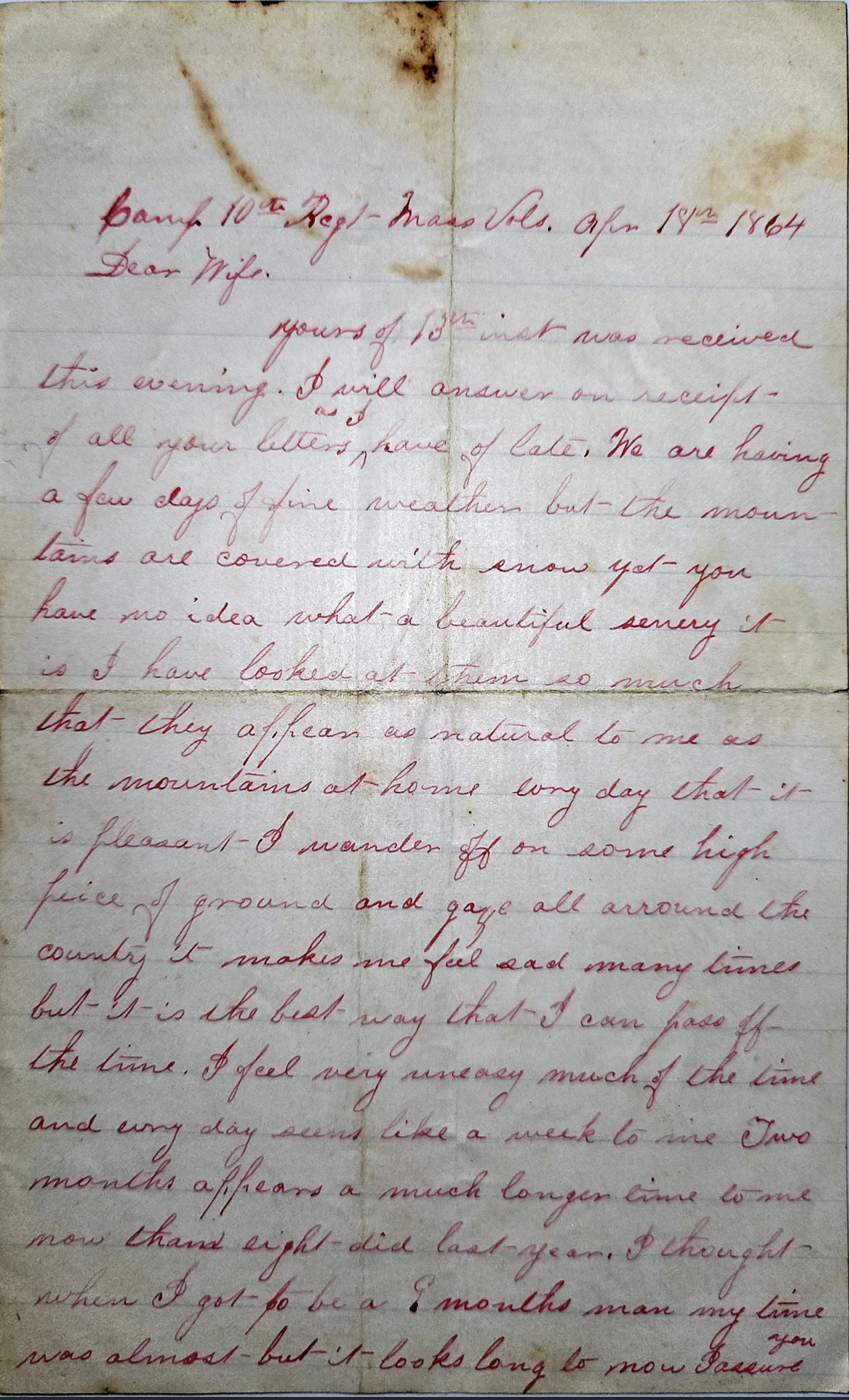


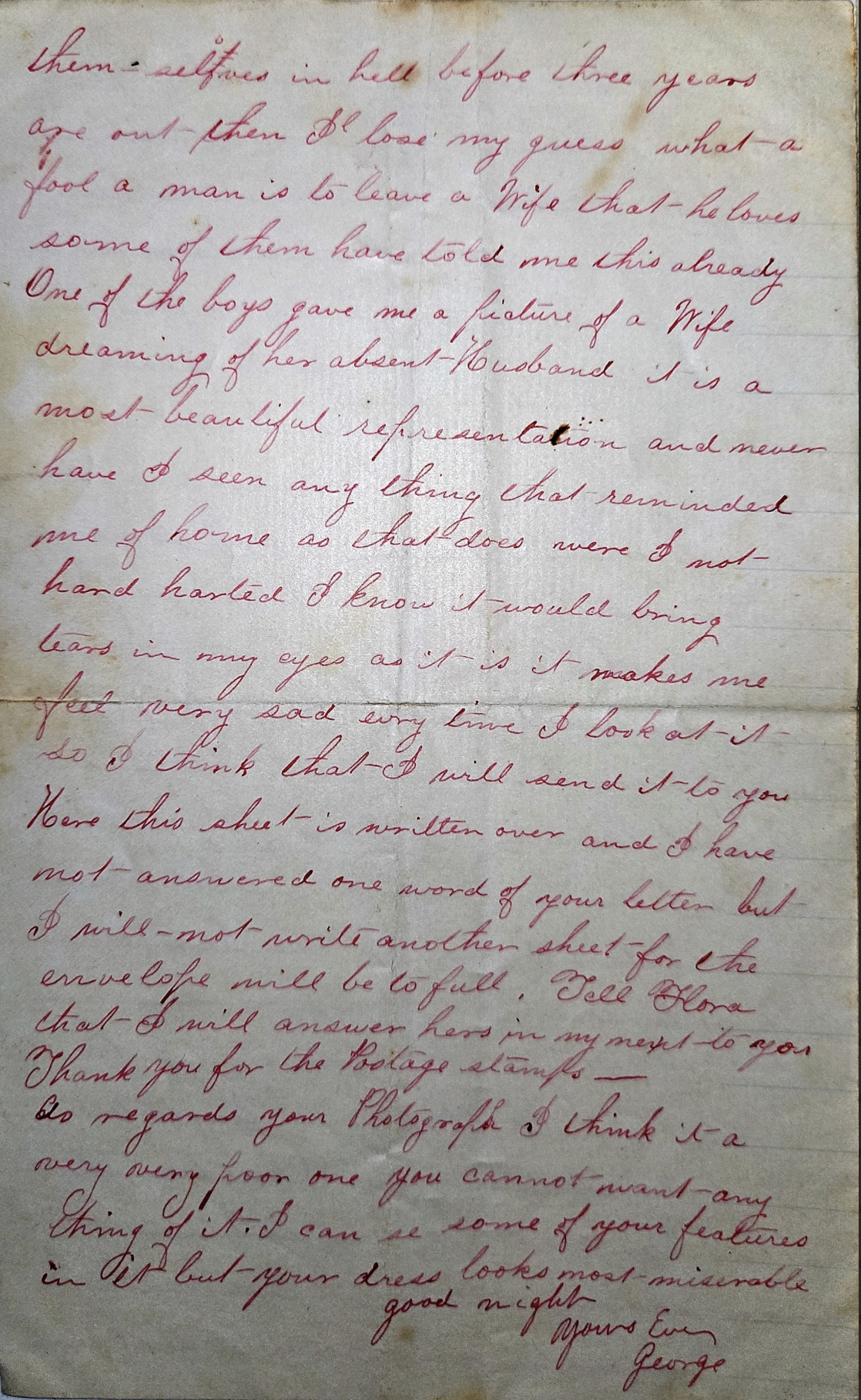


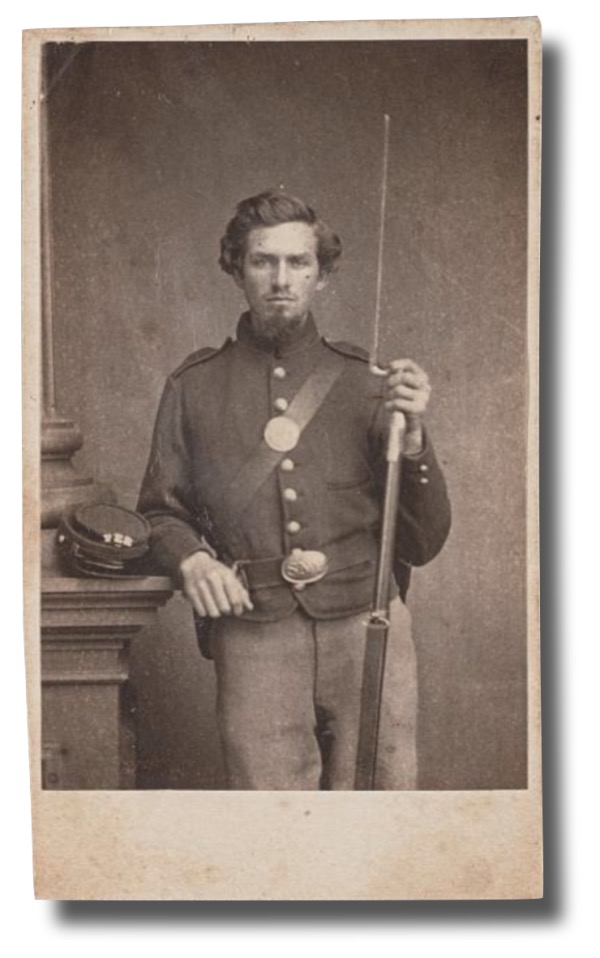




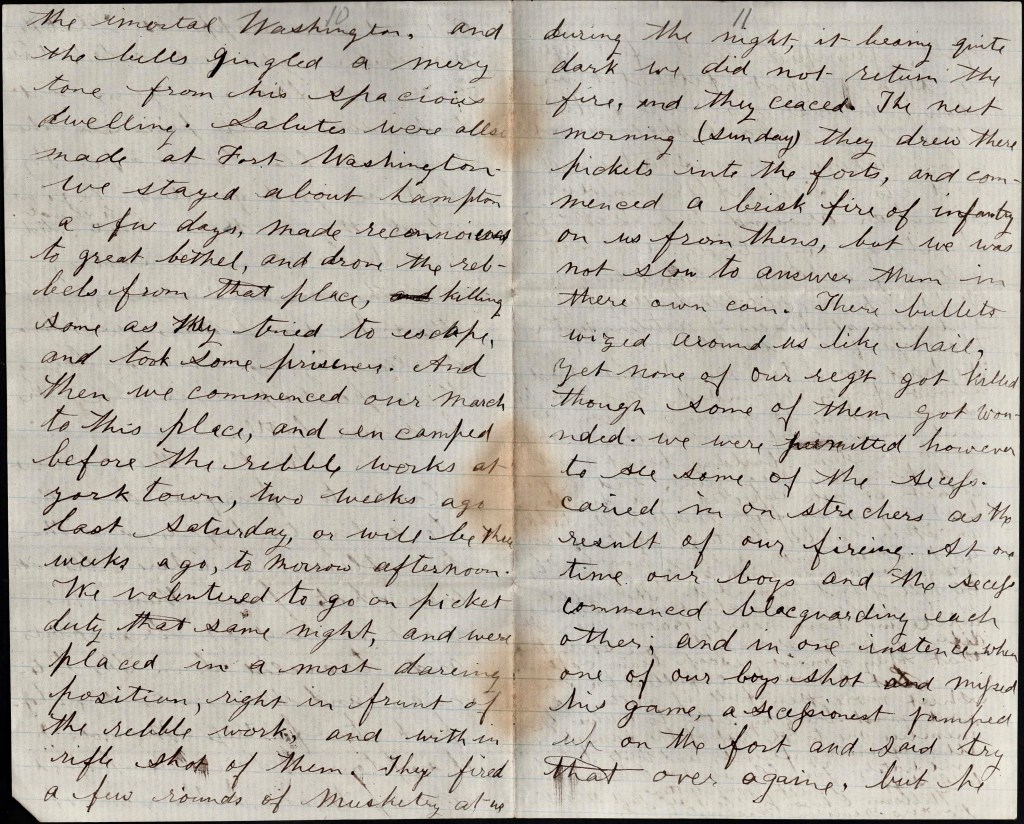







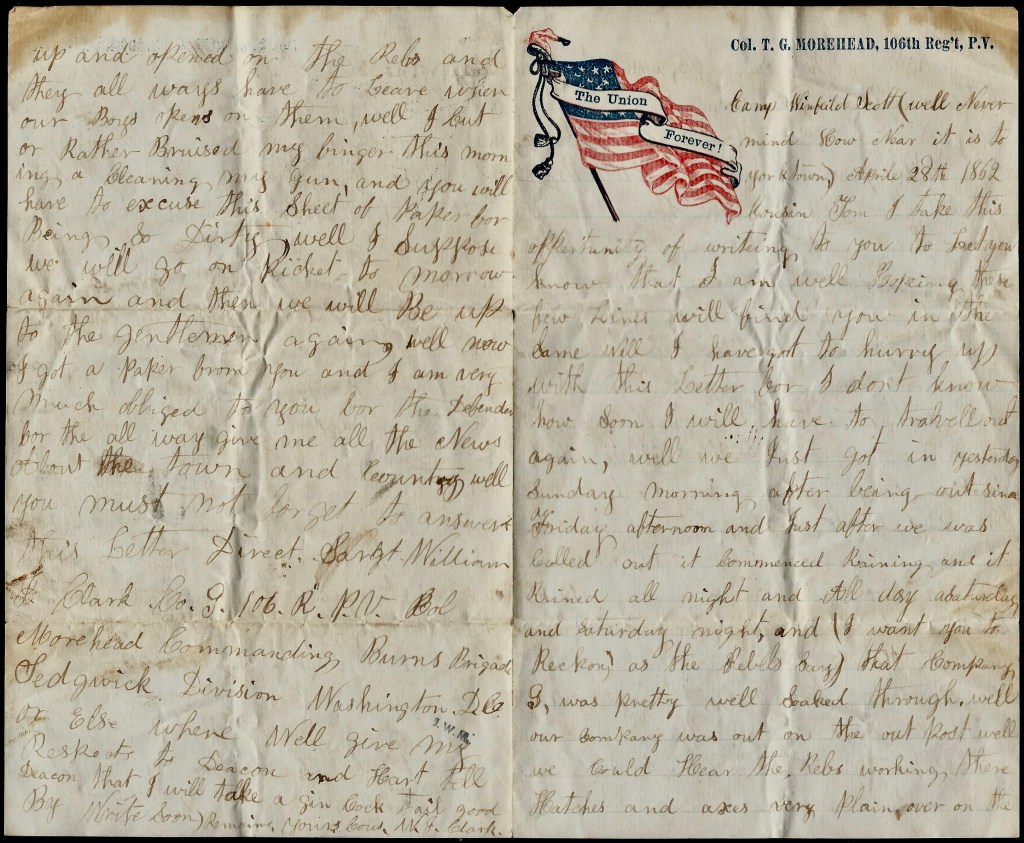

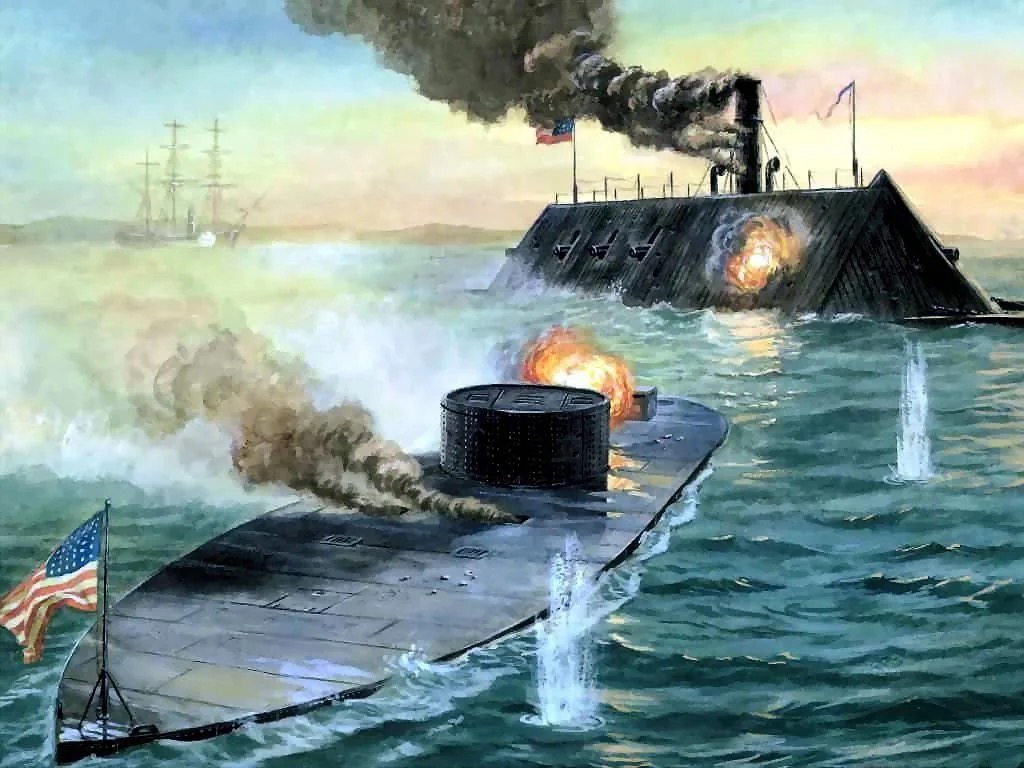


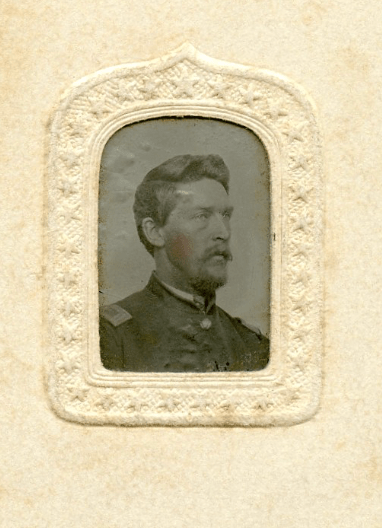


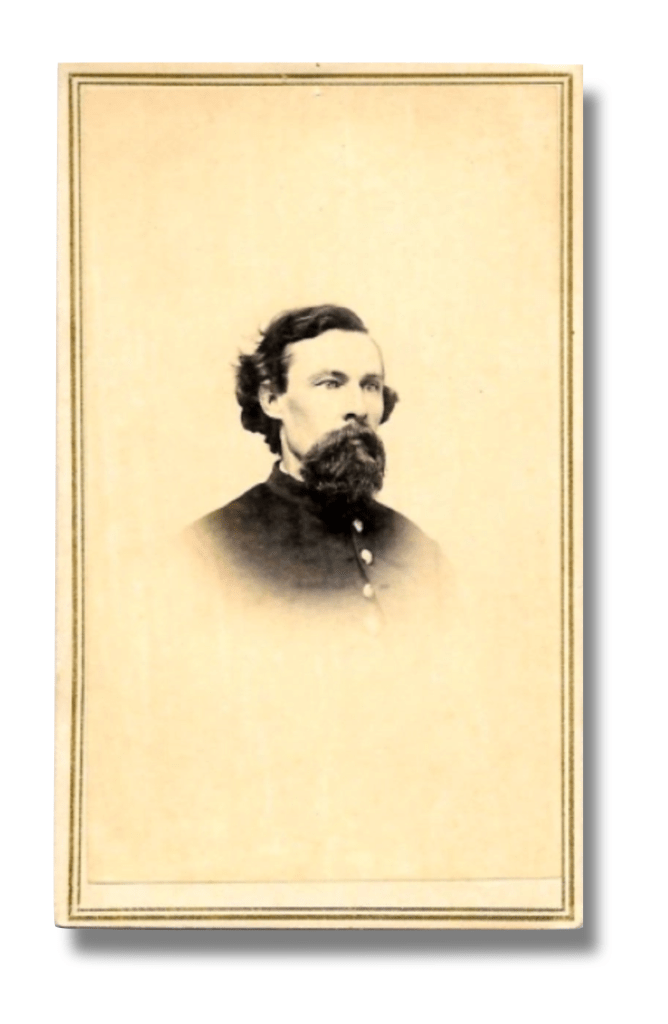
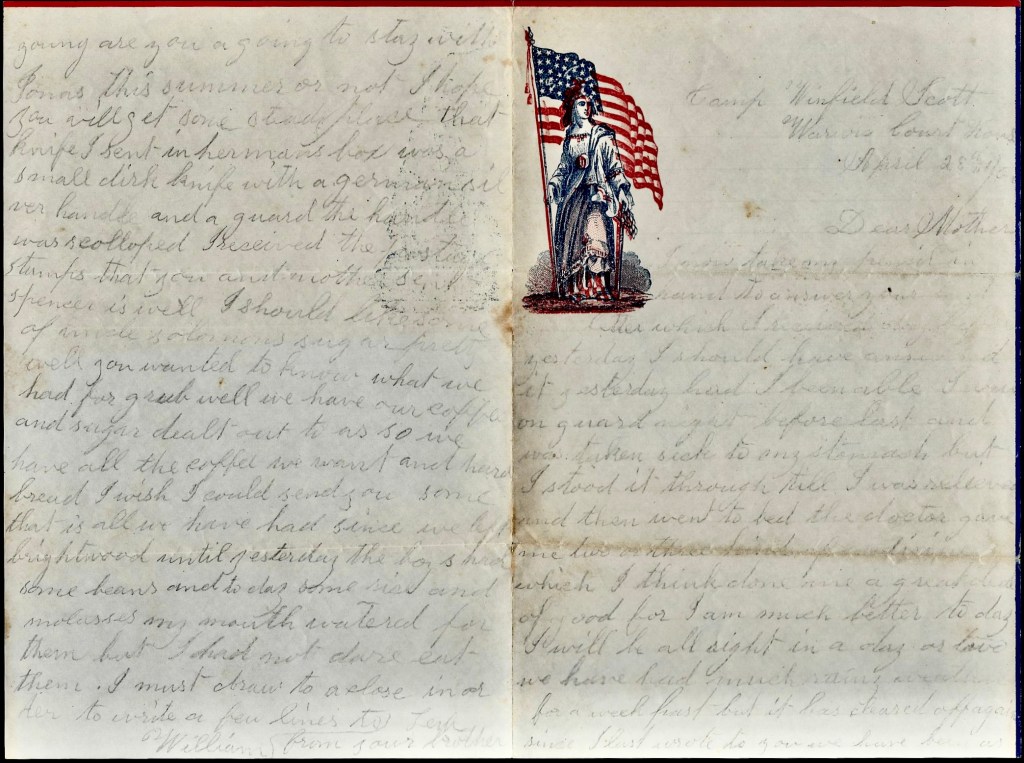
 Spared & Shared 23