The following letter was written by Thomas Whiting Cowne (1784-1857) of Turners, Fauquier county, Virginia. Thomas was the son of Robert Cowne (c.1756-1829) and Sarah Whiting of Culpeper. His first wife was Martha H. Buchanan (died 1818). In 1820 he married Susan Latham (born 1787) of Fauquier. Thomas W. Cowne was a merchant in Falmouth. He also operated a school in Falmouth and offered courses such as reading, spelling, penmanship, grammar, geography, history, arithmetic, bookkeeping, and Latin. Tuition was $20 per student (Virginia Herald, Dec. 11, 1816). At the time of the 1850 US Census, Thomas was the owner of ten slaves ranging in age from 10 to 50.
He wrote the letter to his son, Thomas W. Cowne, Jr. (1821-18xx), a merchant in Staunton, Augusta county, Virginia.
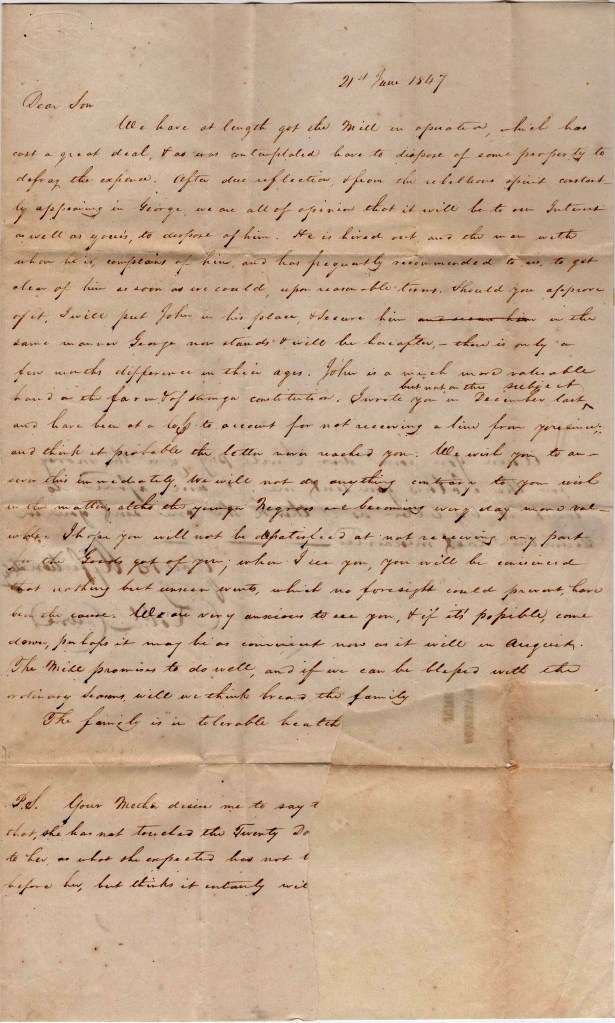
Thomas’ letter speaks of the “rebellious spirit” of one of his negro slaves named “George”—so troublesome that he has decided “to dispose of him” as soon as he could “clear of him” on “reasonable terms.”
T R A N S C R I P T I O N
[Falmouth, Virginia] 21 June 1847
Dear Son,
We have at length got the mill in operation, which has cost a great deal, & as was contemplated have to dispose of some property to defray the expense. After due reflection & from the rebellious spirit constantly appearing in George, we are all of opinion that it will be to our interest as well as yours to dispose of him. He is hired out and the man with whom he is complains of him and has frequently recommended to us to get clear of him as soon as we could upon reasonable terms. Should you approve of it, I will put John in his place and secure him in the same manner George now stands & will be hereafter. There is only a few months difference in their ages. John is a much more valuable hand on the farm & of stronger constitution, I wrote you in December last but not on this subject and have been as a loss to account for not receiving a line from you since, and think it probable the letter never reached you. We wish you to answer this immediately. We will not do anything contrary to your wish in the matter although the younger negroes are becoming every day more valuable.
I hope you will not be dissatisfied at not receiving any part of the goods got of you. When I see you, you will be convinced that nothing but unseen events which no foresight could prevent have been the cause, We are very anxious to see you, & if it it’s possible, come down. Perhaps it may be as convenient now as it will in August. The mill promises to do well and if we can be blessed with the ordinary seasons, will we think bread the family. The family is in tolerable health.
The following letter was written by William Semple Ryland (1836-1906), an 1858 A.M. graduate of Richmond College where his father presided. William’s father, Rev. Robert Ryland, was a “prominent leader in Virginia and pastor of the large First African Baptist Church. He believed all people deserved equal access to biblical teaching while at the same time he enslaved people and hired them out to Richmond College and others in the region. He was in many ways a paradox, embracing spiritual equality while rejecting racial equality.” [Source: University of Richmond]
During the Civil War, William served the Confederacy as a Chaplain of the 13th Virginia Infantry. He later held pastorates in Frederick County, Virginia, Winchester, Virginia, Logan County, Kentucky, and Lexington, Kentucky. He was president of Lexington Female College 1877-1880 and of Bethel College 1889-1898 where he also was professor of natural science and chairman of the faculty.
William wrote this letter to Miss Evalina Peale (b. @ 1820) who lived four miles east of Staunton, Rockingham county, Virginia. She was the spinster daughter of Bernard Peale (1762-1818) and Catharine Newman (1776-1866). Her house burned down in 1867. Her brother, Jonathan Peale, had a home nearby (still standing) that served as Stonewall Jackson’s headquarters in the spring of 1862.
Transcription
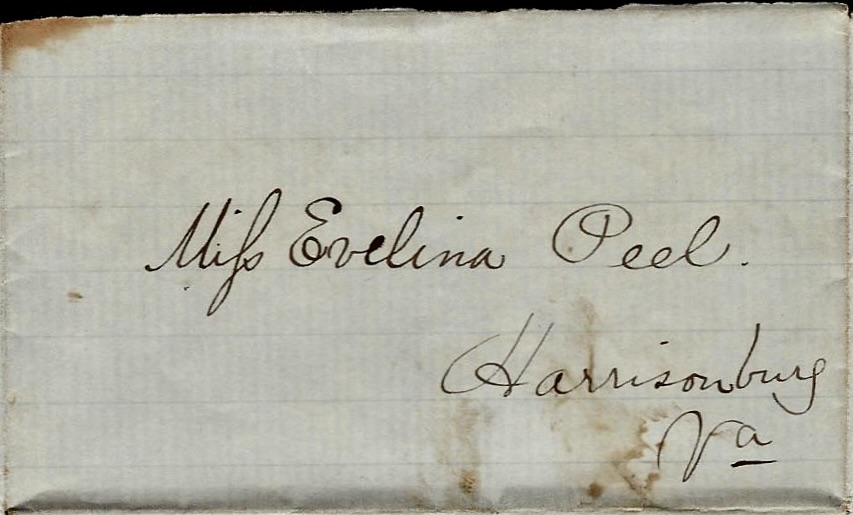
Addressed to Miss Evelina Peel, Harrisburg, Va.
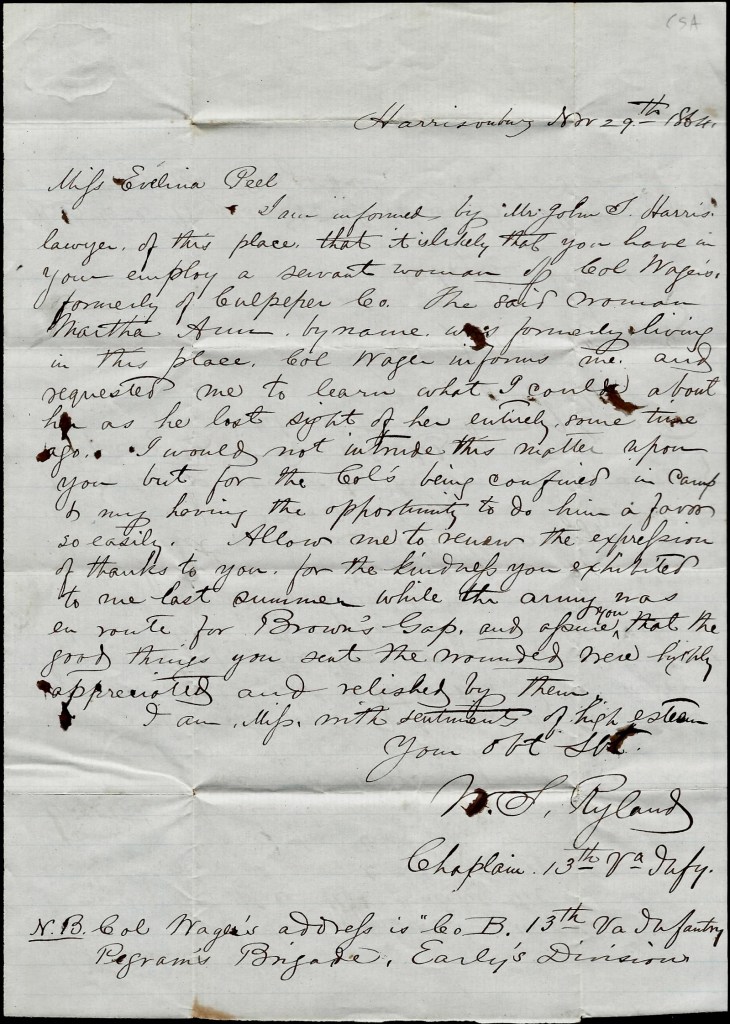
Harrisonburg [Virginia] November 29th 1864
Miss Evelina Peel,
I am informed by Mr. John T. Harris, lawyer of this place, that it is likely that you have in your employ a servant woman of Col. Wager’s, formerly of Culpeper county. The said woman, Martha Ann by name, was formerly living in this place, Col. Wager informs me, and requested me to learn what I could about her as he lost sight of her entirely some time ago. I would not intrude this matter upon you but for the Colonel’s being confined in camp & my having the opportunity to do him a favor so easily. Allow me to renew the expression of thanks to you for the kindness you exhibited to me last summer while the army was en route for Brown’s Gap and assure you that the good things you sent the wounded were highly appreciated and relished by them.
I am, Miss, with sentiments of high esteem, your obedient servant, — W. S. Ryland, Chaplain 13th Virginia Infantry
N. B. Col. Wager’s address is Co. B, 13th Va. Infantry, Pegram’s Brigade, Early’s Division.
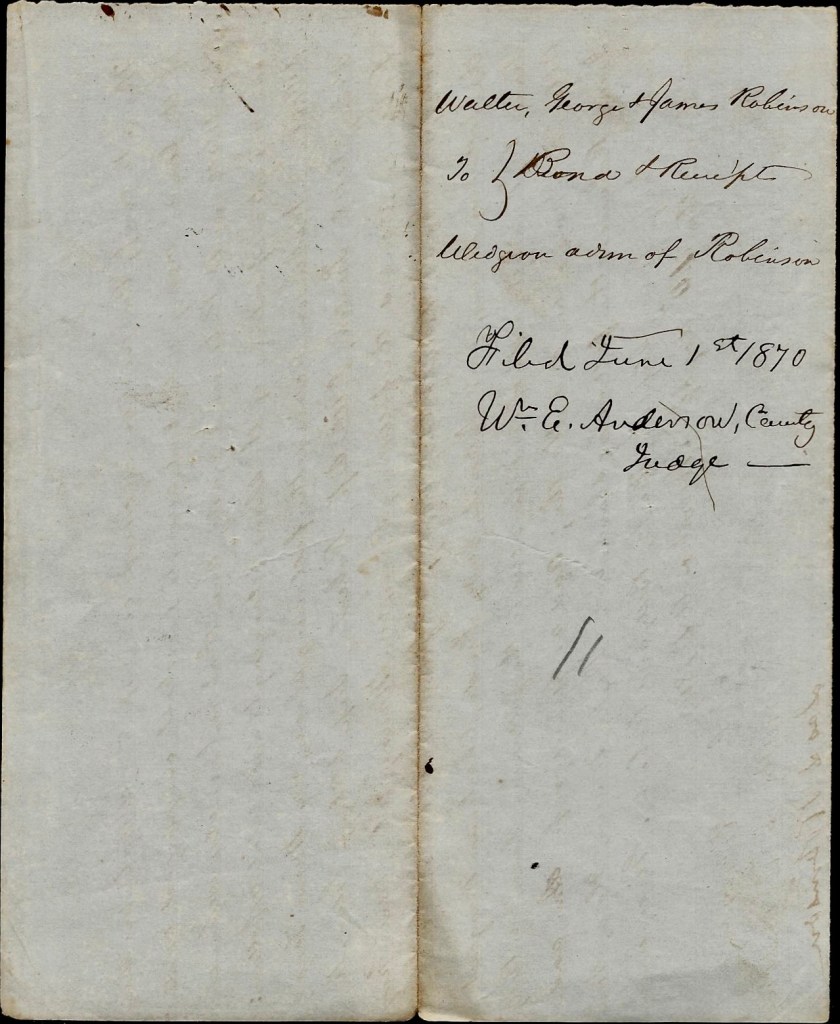
The following document certifies the satisfactory division and disposition of property associated with the estate of William H. Robinson, probably a brother of Jacob Robinson (1779-1840) who resided in Marianna, Jackson county, Florida. The property included 36 slaves that were distributed to the children of Jacob Robinson which included Walter Jacob Robinson (b. 1820 and who would later serve as Capt. of Co. E, 2nd Florida Infantry), George W. Robinson (b. 1825), James L. Robinson (1826-1875), and to Hettie Isabelle Robinson (b. 1816). Actually Hettie’s slaves became the property of her husband, Isaac Widgeon (b. 1810) who also served as administrator of the will. Isaac also took ownership of slaves willed to two juveniles.
Normally I would not transcribe this type of document but since it contained the names of the slaves (unfortunately without ages, however), I decided to post this in the hope it might be useful to someone trying to trace their ancestry.
Transcription
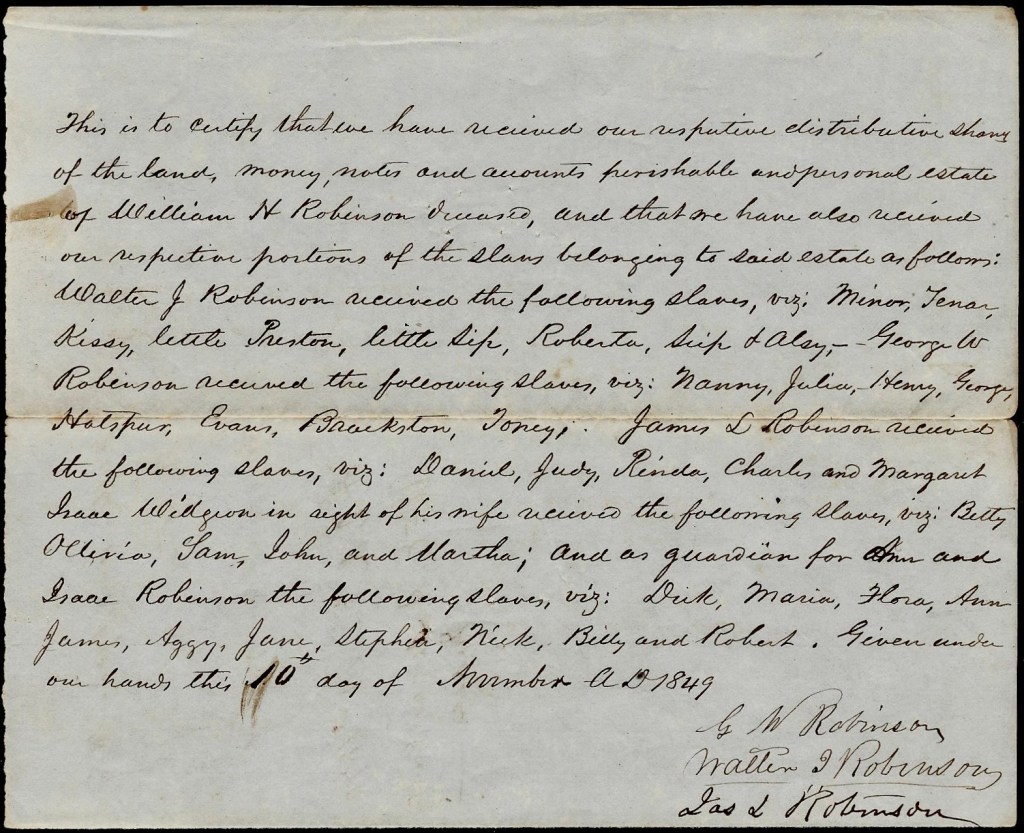
This is to certify that we have received our respective distribution shares of the land, money, notes and amounts perishable and personal estate of William H. Robinson, deceased, and that we have also received our respective portions of the slaves belonging to said estate as follows:
Walter J. Robinson received the following slaves, viz: Minor, Tenar, Kissy, Little Preston, Little Sis, Roberta, Siss, and Alsay.
George W. Robinson received the following slaves, viz: Nanny, Julia, Henry, George, Hotspur, Evans, Brackston, Toney.
James S. Robinson received the following slaves, viz: Daniel, Judy, Rinda, Charles, and Margaret.
Isaac Widgeon in right of his wife received the following slaves, viz: Betty Olivia, Sam, John, and Martha; and as guardian for Ann and Isaac Robinson the following slaves, viz: Dick, Maria, Flors, Ann, James, Aggy, Jane, Stephen, Nick, Billy, and Robert. Given under our hands this 10th day of November A. D. 1849
G. W. Robinson [signature] Walter J. Robinson [signature] Jas. L. Robinson [signature]
This statement, testifying to the death of a slave boy named Robert while employed constructing rebel fortifications on James Island, was made by and sworn to by Samuel Dagnell who I believe was a civilian overseer at the time but had formerly served as a private in the 5th South Carolina Reserves, Co. E, for 90 days during the winter of 1862-63. Samuel Dagnell (spelled Dagnal) was enumerated in the Edgefield District of Edgefield county, South Carolina, as a farmer with his wife Cathrine in the 1860 US Census.
We learn from the letter that the slave belonged to William Francis Prescott (1822-1877) of Ivey Island, Edgefield county, South Carolina. William was a captain of Co. I (the “Red Field Guards”), 7th South Carolina Infantry during the Civil War.
Transcription
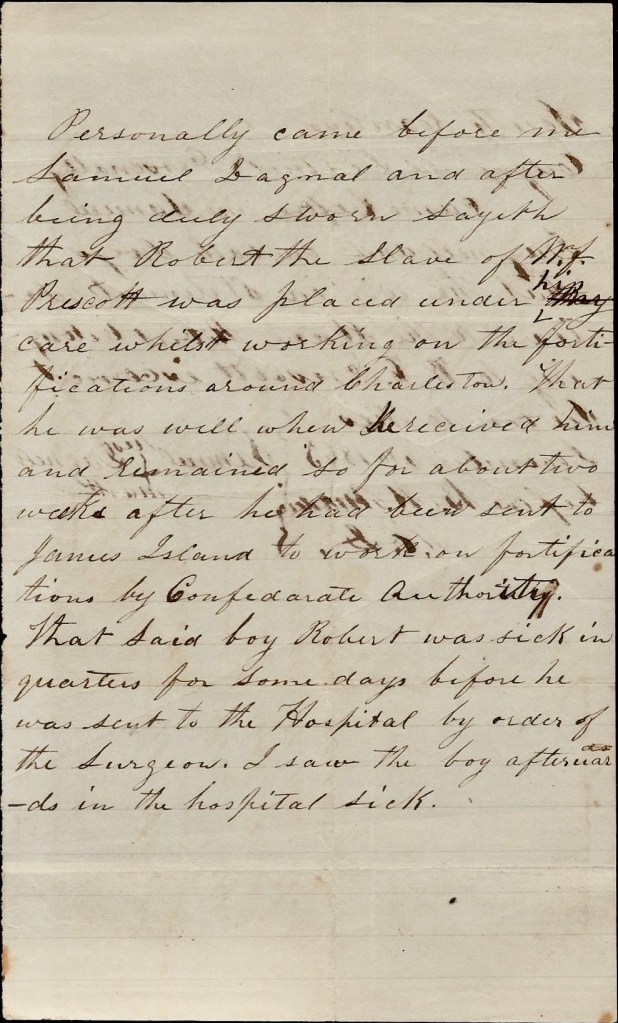
Personally came before me Samuel Dagnal and after being duly sworn sayeth that Robert the slave of W. F. Prescott was placed under his care whilst working on the fortifications around Charleston. That he was well when he received him and remained so for about two weeks after he had been sent to James Island to work on fortifications by Confederate authority.
That said boy Robert was sick in quarters for some days before he was sent to the Hospital by order of the Surgeon. I saw the boy afterwards in the hospital sick.
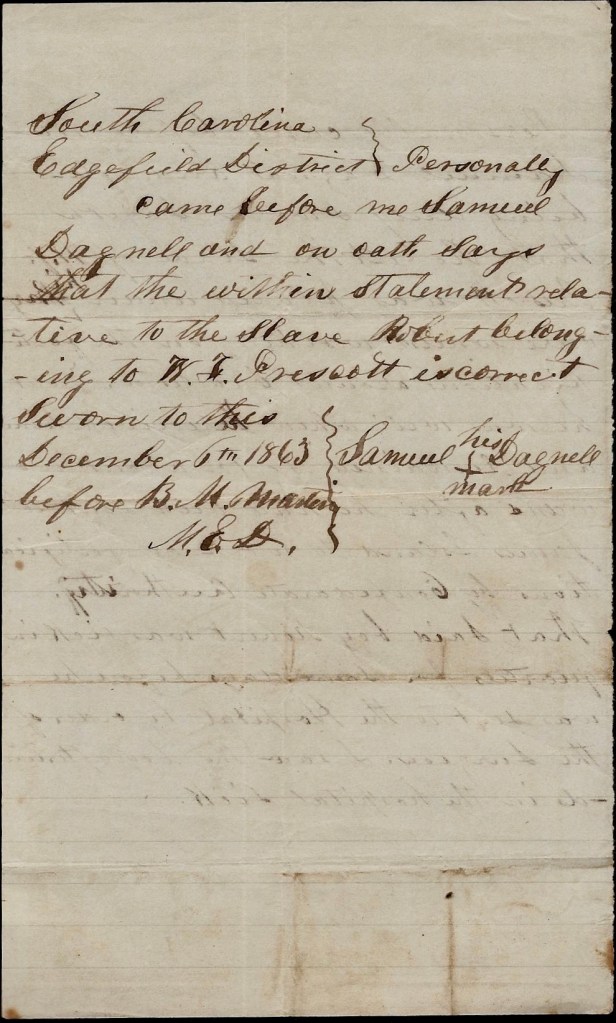
South Carolina Edgefield District
Personally came before me Samuel Dagnell and on oath says that the within statement relative to the slave Robert belonging to W. F. Prescott is correct. Sworn to this December 6th 1863, before B. M. Martin, M. E. D.
This letter was written by Paul Tudor Jones (1828-1904), the youngest son of Gen. Calvin Jones and Temperance Body Williams. He came with his parents to Bolivar, Hardeman county, Tennessee in 1835, settling on a farm where the West Tennessee Insane Asylum was eventually built. He received his education at La Grange College in Alabama and in 1849 married Jane Margaret Wood. When she died in 1863, he married Mary Kirkman. Paul was an extensive planter as was the man he addressed his letter to, Major John Houston Bills (1800-1871) of Bolivar, Hardeman county, Tennessee. Major Bill’s biography in Tennessee Encyclopedia reads:
Born in Iredell County, North Carolina, John H. Bills was one of the founders of Bolivar, in Hardeman County, and a leader of the Tennessee Democratic Party in the nineteenth century. He came to the West Tennessee area in 1818 with members of the family of James K. Polk. In 1823 Bills married Prudence Polk McNeal, a cousin of the future president. Bills also began a cotton factoring company with her brother, Ezekial McNeal, which they called Bills and McNeal, and acquired two plantations, one near Bolivar and the other in Mississippi.
Bills was one of the first commissioners for the new town of Bolivar in 1824, and with his brother-in-law, one of the leading industrialists and planters in West Tennessee. He purchased his home, known as “The Pillars,” in 1837, from a Philadelphia newspaperman, John Lea, and traveled throughout the eastern United States to furnish it in appropriate style. The mansion is now a historic house museum administered by the local chapter of the Association for the Preservation of Tennessee Antiquities. Bills entertained several notable Tennesseans and southerners at his home, including Andrew Jackson, James K. Polk, Sam Houston, Leonidas Polk, and Jefferson Davis. After his wife died in 1840, Bills continued making trips throughout the eastern U.S. and Europe. In 1849 Bills married a widow from Virginia, Lucy Anne Duke.
Union troops burned the town of Bolivar in 1864, destroying the business district, including Bills’s cotton plant. Bills, however, proclaimed himself neither Unionist nor secessionist, and thus protected his home and much of his wealth from military reprisals. He continued traveling, entertaining, and aiding in the rebuilding of his business and of Bolivar until his death at home in November 1871.
From the letter we learn that Major Bill’s “great house” was being remodeled and in his absence, Mr. Jones was overseeing the construction work which was being performed by the Major’s slaves. The Major’s home—called “The Pillars” was built in the 1820s but a wing was added onto the building beginning in 1858 according to “The Pillars” website.
Transcription
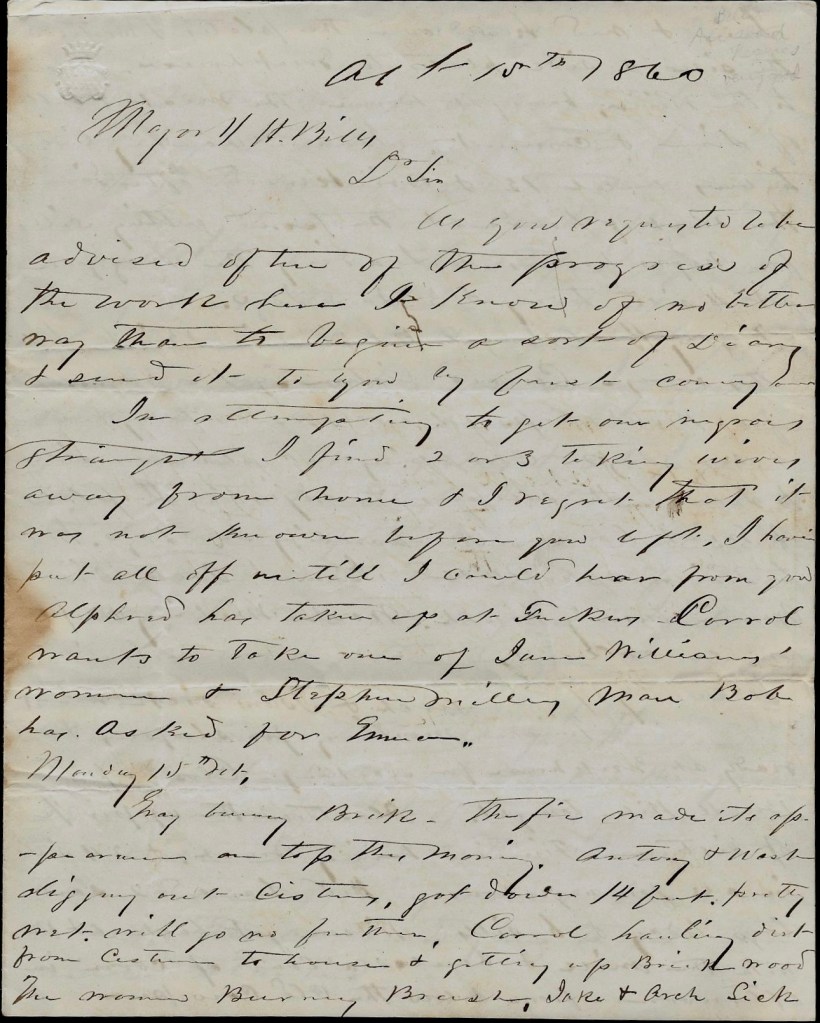
October 15, 1860
Major J. H. Bills, dear sir,
As you requested to be advised of the progress of the work here, I know of no better way than to begin a sort of diary & send it to you by first conveyance.
In attempting to get our negroes straightened, I find 2 or 3 taking wives away from home & I regret that it was not known before you left. I have put all off until I could hear from you. Alfred has taken one of Jane Willians’ women & Stephen Miller’s man Bob has asked for Emma.
Monday, 15th October
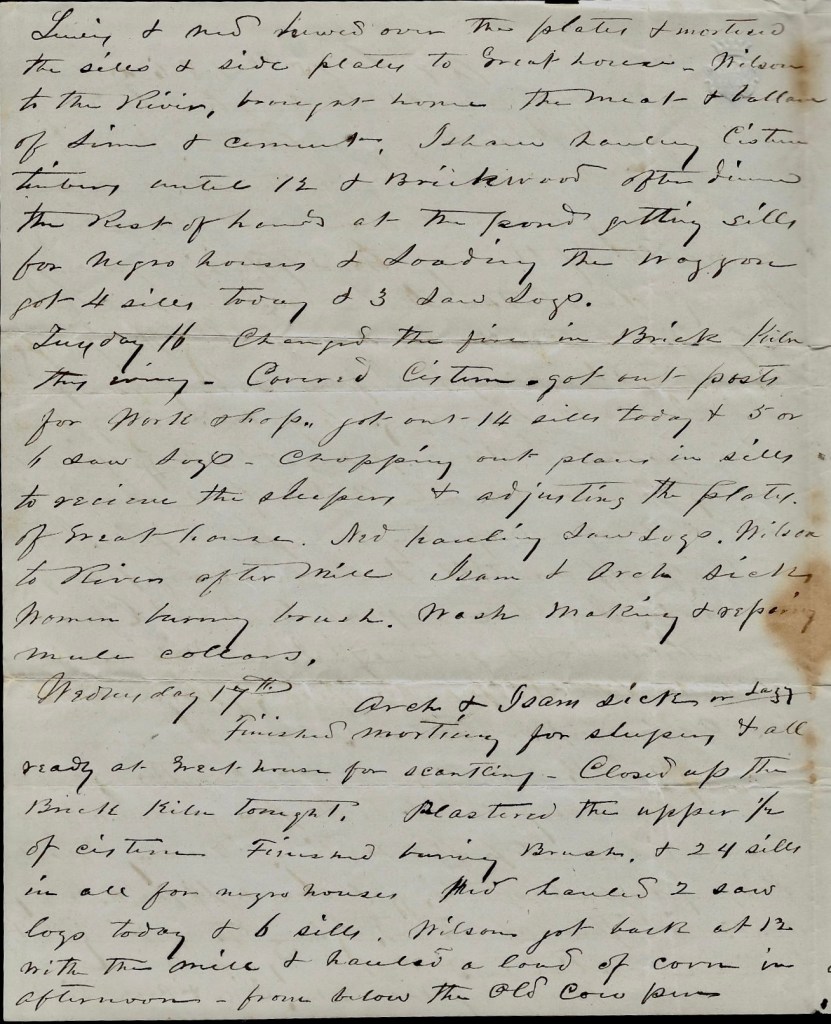
Gray burning brick. The fir made its appearance on top this morning. Anthony & Wash digging out cisterns. Got down 14 feet. Pretty wet [and] will go no further. Carrol hauling dirt from cistern to house & getting up brickwood. The women burning brush. Jake & Arch sick. Lucy & Ned hewed over the plates and morticed the sills & side plates to Great house. Wilson to the River. Brought home the meat and balance of lime & cement. Isham hauling cistern timbers until 12 & brickwood after dinner. The rest of hands at the pond getting sills from negro houses & loading the wagon. got 4 sills today and 3 saw logs.
Tuesday 16. Changed the fire in brick kiln this evening. Covered cistern. got out posts for workshop. Got out 14 sills today and 5 or 6 saw longs. Chopping out places in sills to receive the sleepers & adjusting the plates of Great house. Ned hauling saw logs. Wilson to River after Mill. Isam & Arch sick. Women burning brush. Wash making & repairing mule collars.
Wednesday 17th Arch & Isam sick or lazy. Finished mortising for sleepers & all ready at Great house for scantling. Close up the Brick kiln tonight. Plastered the upper half of cistern. Finished hauling brush & 24 sills in all from negro houses. Ned hauled 2 saw logs today and six sills. Wilson got back at 12 with the Mill and hauled a load of corn in afternoon from below the old cow pen.
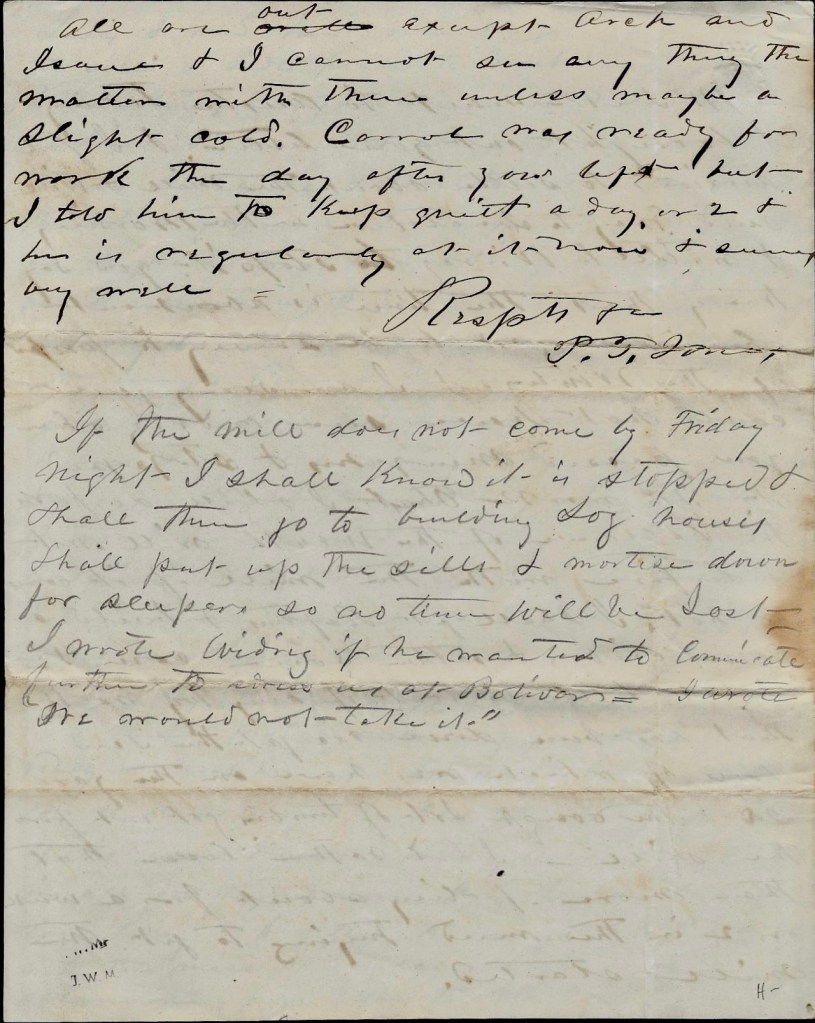
Mr. Duke went to Austin today and brought out your letters & I feel anxious to settle about the Mill & will send Gray to Senatobia in the morning & write to [George] Widrig to stop it. You say truly that the time is about out when it ought to be sawing to profit this winter & I am sorry you could not have seen Widrig when you passed Murphey & stopped it. The work that I shall do for the balance of the week will not interfere with the mill if it comes or not. I shall get rafters and build a corn crib & gather some corn, &c. And but little is lost if any log work that has been done except the saw logs of which we have in the yard 20 & the rough lot of timber got out for the mill. I had rather lose that than more fooling about for a week or two in the mud trying to get the mill started.
All are out except Arch and Isam & I cannot see anything the matter with them unless maybe a slight cold. Carrol was ready for work the day after you left but i told him to keep quiet a day or two and he is regularly at it now & doing very well
Respectfully — P. T. Jones
If the mill does not come by Friday night, I shall know it is stopped and shall them go to building log houses. Shall put up the sills & mortise down for sleepers so no time will be lost. I wrote Widrig if he wanted to communicate further to address us at Bolivar. I wrote we would not take it.





 Spared & Shared 23