Category Archives: Suffolk, Virginia

1863: James Delamater Stearns to Emeline (Frank) Stearns

The following letter was written by 41 year-old James Delamater Stearns (1822-1899), the son of Amory Stearns (1797-1875) and Mariah De Lameter (1800-1889) of Jamestown, Chautauqua county, New York. James wrote the letter to his wife, Emeline (Frank) Stearns (1832-1893), while serving in the 7th Company, 1st Battalion New York Sharpshooters.
Capt. Joseph S. Arnold commanded Co. 7, 1st Battalion, N. Y. Sharp Shooters

The origin of this regiment came about in the following way. Major W. S. Rowland received authority from the War Department in October 1862 to recruit a regiment of sharpshooters in the States of New York and Pennsylvania. The regimental organization failed and only a battalion was recruited, which was finally organized consisted of four companies, the 6th, 7th, 8th and 9th. The 7th Company—Co. L, 112th New York Volunteers was organized at Jamestown under the command of Capt. Joseph S. Arnold and mustered in the service of the United States for three years on 12 September 1862. It was recruited principally at Ellicott, Kiantone, Busti, Ellington, Ellery, Carroll and Jamestown. [Source: New York in the War of the Rebellion, 3rd ed. Frederick Phisterer. Albany: J. B. Lyon Company, 1912.]

T R A N S C R I P T I O N

Suffolk, Virginia
Tuesday, June 16, 1863

Dear Emeline,

It is over one week since I wrote to you, but be assured you are not forgotten for I think of you as often as though I wrote every day. We have been moving our camp and making streets through our new city and I have had to get my three meals of victuals per day for the Captain and Lieutenants and often I have to cook for our sick boys. And when it comes night, you may guess that I am very tired. Tonight my legs and feet feel as though I had been on an all day march and now it is after nine o’clock in the evening, but write I will.

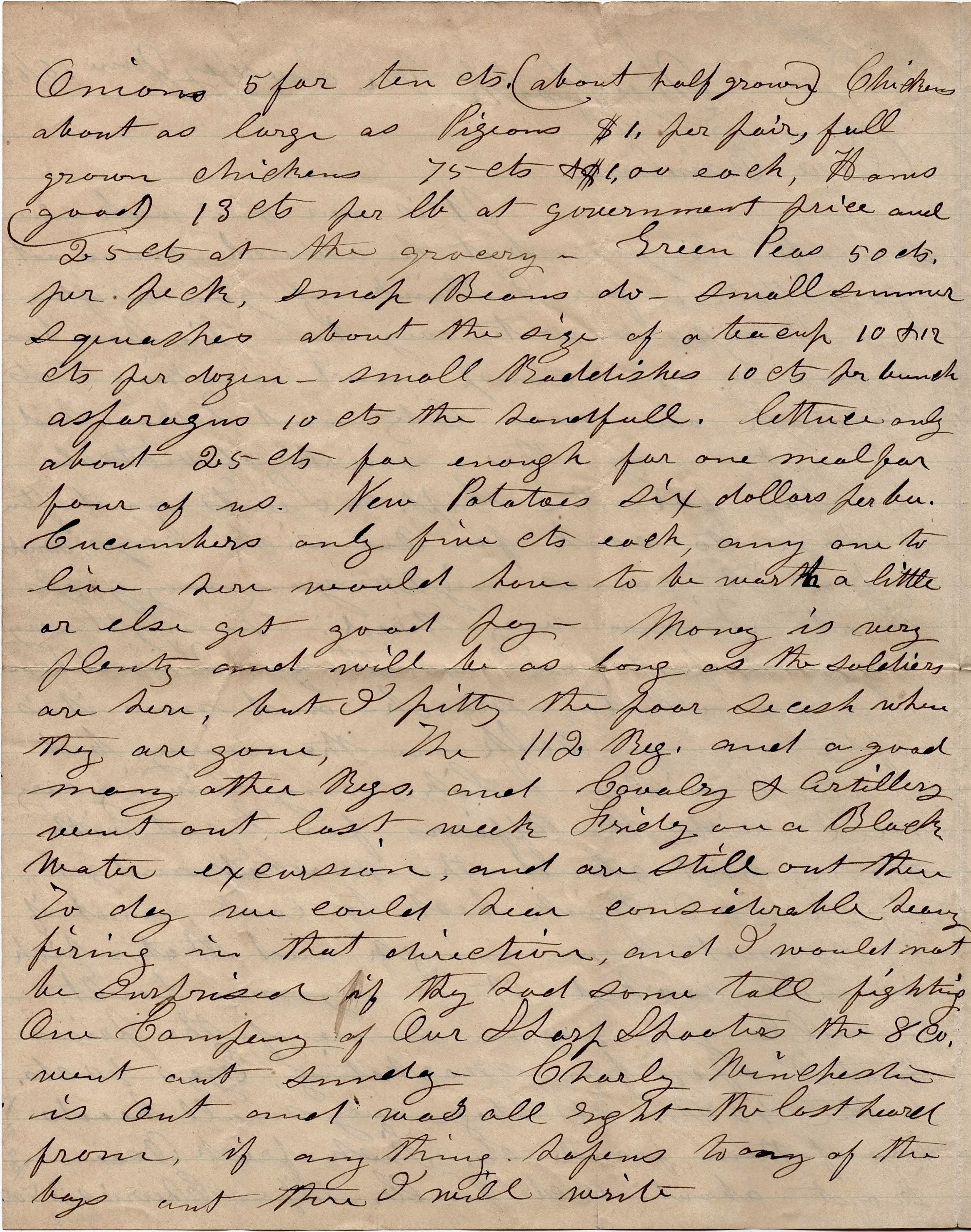
I like my living very well with the officers for I eat with them and attend the markets and get such as I think best to cook, and if I do not have enough and that which is well cooked, it is my own fault. I will give you some of the prices that I pay for marketing. Eggs 40 cents, butter 40 cents, cabbage, very small heads, two of them for 25 cents, fish, fresh ocean trout about 15 cents per lb., ripe cherries 25 cents per quart, onions 5 for ten cents (about half grown), chickens about as large as pigeons $1 per pair, full grown chickens 75 cents & $1 each. Hams (good) 13 cents per lb. at government price and 24 cents at the grocery. Green peas 50 cents per peck, snap beans ditto, small summer squashes about the size of a teacup 10 and 12 cents per dozen, small radishes 10 cents per bunch, asparagus 10 cents the handful. Lettuce only about 25 cents for enough for one meal for four of us. New potatoes six dollars per bushel. Cucumbers only five cents each. Anyone to live here would have to be worth a little or else get good pay. Money is very plenty and will be as long as the soldiers are here, but I pity the poor secesh when they are gone.

The 112th [New York] Regiment and a good many other regiments and cavalry and artillery went out last week Friday on a Black Water excursion and are still out there. Today we could hear considerable heavy firing in that direction, and I would not be surprised if they had some tall fighting.

One company of our sharp shooters—the 8th Company—went out Sunday. Charley Winchester is out and was all right the last heard from. If anything happens to any of the boys out there, I will write.

I received a letter from Bro. William last night. Will answer it in a day or two. We were paid off last Saturday and I will send you the money either by R[ussell] M. Brown tomorrow or in a letter in a few days. Russel M. Brown has got his discharge and is a going to start home tomorrow. He is very low and I doubt his standing his journey very well. He will call on you when he is able to and let you know just how I get along. A. K. [Amos K. Brown] is quite sick but will probably get up in a few days. We have quite a number of sick ones but none very dangerous as yet. I have had a few shakes of the ague. The doctor gave me quinine enough to break it up so I am all right. I will try and write you again in a few days but you need not wait for me to write but send along your letters and all the news. I will attend to Mercy as soon as it is convient. Bill Leaver’s & Dan Jennings’ wives are here and making about ten dollars apiece per week in baking, &c., for the soldiers. Dan’s wife is not very well for a [ ].

Give my regards to all enquiring and especially to Mrs. Em S & the children. Yours &c. — James

1862: Lewis Longden Long to Mary Elizabeth (Peters) Long

Lewis Long’s Honorable Discharge Certificate

The following letter was written by Lewis Longden Long (1826-1889), the youngest child of William Calvert Long (1783-1861) and Mary Armstrong (1783-1861) of Priceburg, Monroe county, Pennsylvania. Lewis married Catherine Peters (1832-1856) and after her death, took Catherine’s younger sister, Elizabeth Peters (1842-1915) as his second wife.

Lewis made his living as a Monroe county farmer before and after his time in the service. He was mustered into Co. C, 176th Pennsylvania Infantry as a sergeant in November 1862 and was discharged in August 1863 after nine months service.

T R A N S C R I P T I O N

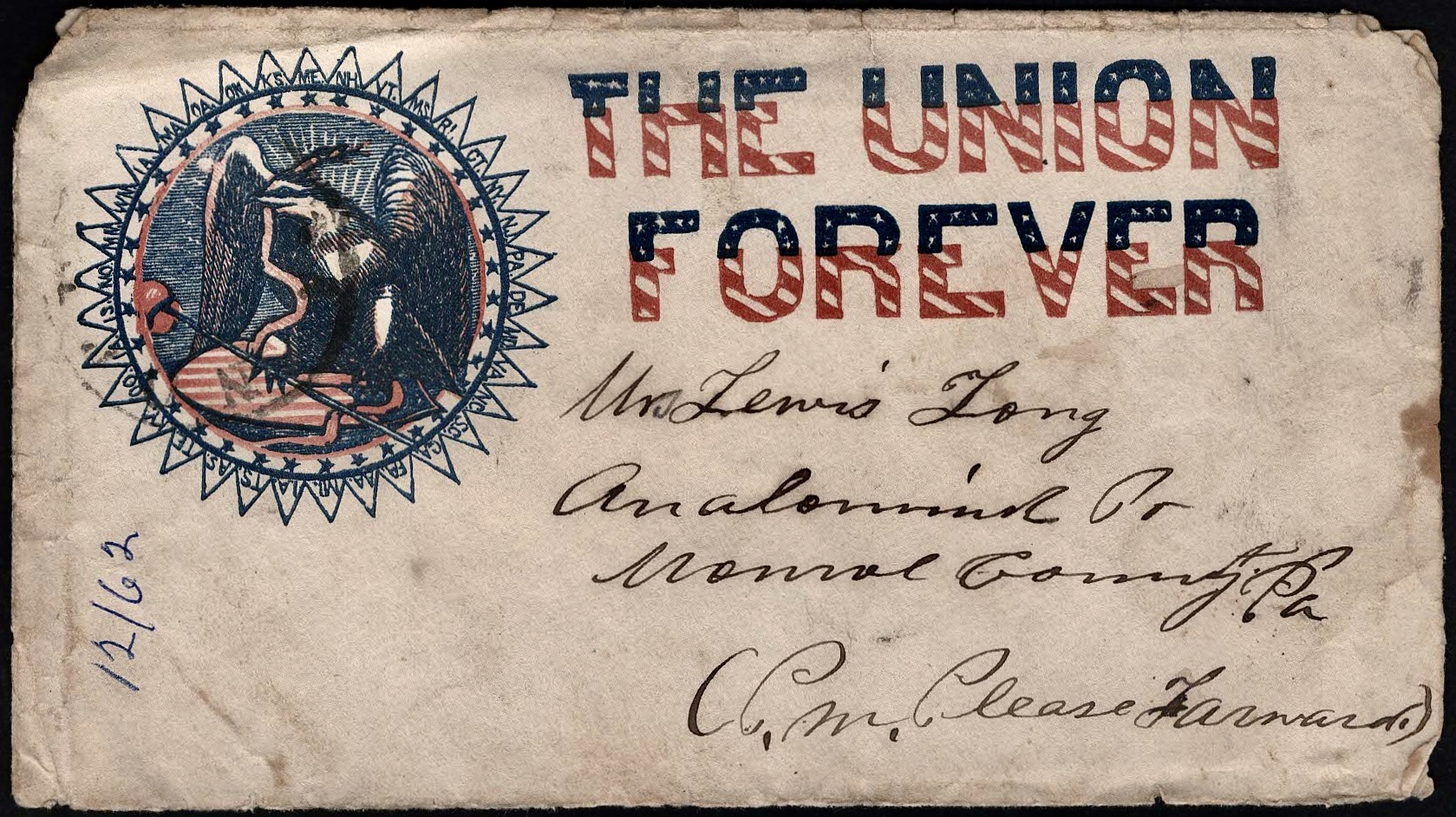
Addressed to Mr. Lewis Long, Analomink, Monroe county, Pa.

Camp Suffolk, Virginia
Thursday, December 4, 1862

My Dear beloved wife,

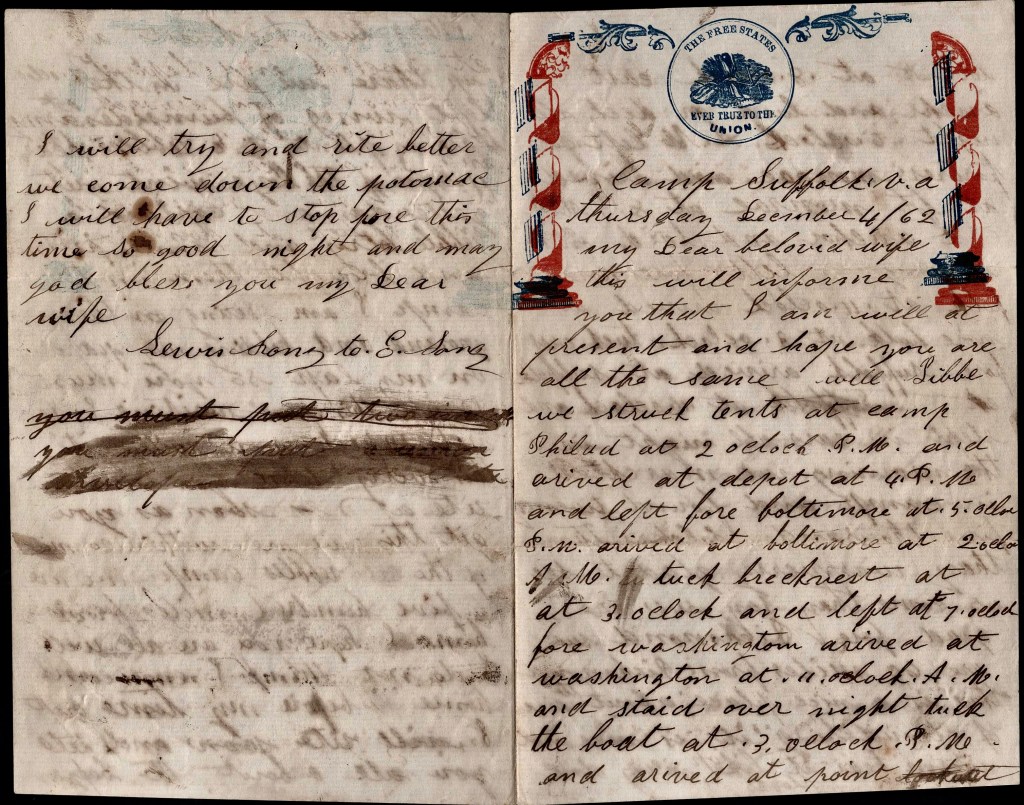
This will inform you that I am well at present and hope you are all the same. Well, Libbie, we struck tents at camp Philadelphia at 2 o’clock p.m. and arrived at depot at 4 p.m. and left for Baltimore at 5 o’clock p.m. arrived at Baltimore at 2 o’clock p.m. [We] took breakfast at 3 o’clock and left at 7 o’clock for Washington. Arrived at Washington at 11 o’clock a.m. and stayed overnight. Took the boat at 3 o’clock p.m. and arrived at Point Lookout at 8 o’clock. Cast anchor and laid on deck all night. 6 o’clock a.m., left for Fortress Monroe and arrived at Ft. Monroe at 8 p.m. Cast anchor and laid on deck all night. Left for Norfolk at 11 o’clock. Arrived at Norfolk at 3 o’clock. Took cars for Suffolk. Arrived at Suffolk at 11 o’clock and slept in cars all night. In the morning we marched into camp and found twenty-five thousand solders there. They was very glad to see us come. They say we are good for Richmond. We are 60 miles from Richmond.

This is a nice place—about the size of Stroudsburg [PA]. It is nice and warm here. It looks like May does up there.

We are in the Left Wing of Burnside’s army. There is plenty of Rebels here. Some of the boys went out yesterday and captured a rebel battery and some prisoners and brought them into camp.

I am sitting on the ground and holding my paper on my lap so you must excuse this poor writing. I do not expect you will get this very soon. You must write as soon as you get this. We are within 20 miles of the Rebel’s camp. We are five hundred miles from home. I hope you are all well. I do not think I can come home before my time’s out. I will write soon and tell you all about the boys. I will try and write better. We come down the Potomac. I will have to stop for this time so good night and may God bless you. my dear wife.

Lewis Long to E. Long

1863: Thomas Richard Petrie to Gertrude Emily Sanders

The following letter was written by Thomas R. Petrie (1841-1923) of Fairfield, Herkimer county New York, who enlisted on 5 September 1862 when he was 21 years old to serve three years in Co. F, 152nd New York Infantry. He was quickly made a corporal and promoted to sergeant by April 1863 when this letter was penned from Suffolk, Virginia. He was later promoted to 1st Sergeant and was wounded in 1864.

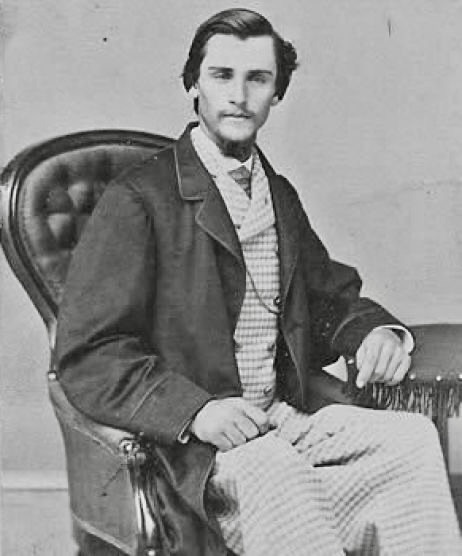
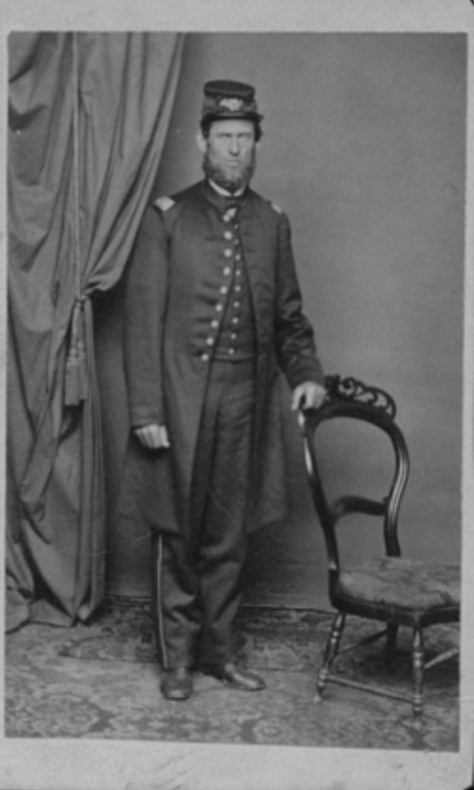
The image included with the letter. My hunch is that this was NOT Thomas for several reasons. Thomas was quickly made a corporal and this soldier appears to be a private; he’s wearing what appears to be a state-issued jacket and these were not issued to the 152nd NY in the fall of 1862; the image is a photograph of an early war tintype so as to make copies. The oval scratches on the original tintype are visible.

When he enlisted, he was described as 5 foot 11 inch tall farmer with hazel eyes and brown hair. He was the son of Robert Petrie (1808-1873) and Margaret Harter (1816-1906) of Fairfield.

Images of this letter were provided to me for transcription by Michelene Johnson who informed me that her mother gave it to her many years ago. She thinks it was among several items purchased in an estate sale in Remsen, New York, back in the 1970’s. A photograph of a young Union soldier was with the letter but it is not labeled and she is uncertain if it was Thomas Petrie.

Two years ago I had the opportunity of transcribing four other letters by the same soldier. You can find them posted here—1863-65: Thomas Richard Petrie to Gertrude Emily Sanders.

T R A N S C R I P T I O N

Headquarters 152nd Regiment N. Y. S. V.
Suffolk, Virginia
April 24th 1863

My dearest friend,

At last we have got into Dixie in earnest and thinking you would perhaps like to hear from your friend, I sit down to write a few lines. You have doubtless heard before this that we have left Washington Tuesday night very unceremoniously and started for parts unknown. We took the boat and away we went down the river. As we passed by the 121st, 34th, and the rest of the Boys at the front, there was great excitement and curiosity among us to know where we were bound for. But time was to answer our questions.

After sailing 18 hours we landed at Norfolk. There we stayed about 12 hours. Then we took the cars for Suffolk where we now are. The cars that we came on were nothing but wool cars—nothing but stakes up to the sides. Don’t you think we had a pleasant ride of 23 miles on those platform cars? And to make our pleasure complete, it rained almost all the way. It is about 250 miles from here to Washington. We have now got so far away from home that I hardly expect to ever get back again.

There is about 60,000 of our men around this city inside of the fortifications and there is a great many more expected soon. About 5 miles from our lines is the Rebel General Longstreet with about 40,000 men. He says that he is going to make this place too hot for the Yankees. He will have a fine time of it if he tries it. There is a great battle expected here soon.

Our general’s name is Peck. Our pickets and the Reb’s pickets are within shooting distance of each other. they exchange papers with each other once in awhile.

Now a word about the appearance of things here. The country does not suit me any better than it did at and around Washington for all everything in the line of agriculture is far advanced of your place. Peach trees are in full bloom and flower gardens are numerous and in all their beauty. But when you’ve said all that can be said of the country and productions, then turn and look at the inhabitants. In the first place, there is but a few of them here although it is quite a large city and those that are here look as if they were sent for.

Well, Git [Gertrude], I am sorry to say that this will be the last time that I shall be able to inform you as to H[amilton] I. Hailes’ health as he was left in Washington in the hospital. Will D. Morey was also left with him. He was suddenly taken sick a few days before we left.

Last night our company stayed in an old barn and we are there at present. Hank and I are well as ever, hoping this may find you the same. Believe me to be as ever your most true and sincere and devoted friend. With love unmeasurable, — Thomas R. Petrie

Write soon. I have not had a letter in it sent to me a long time. They are calling and I must stop writing. Remember me as your friend, — Thomas

Saturday morning, April 25, as I did not send this yesterday, I thought I would write a few lines more this morning. Yesterday we came very near having a little engagement with the Rebs. We were held back as reserve and the other regiments done the fighting. We for once heard the sound of battle and saw the effects thereof.

Give my love to all enquiring friends and write soon. Yours truly, — R. P. Please excuse all imperfections, blots and bad writing. I am writing upon my knee—the soldier’s desk.

1862: David Nichols to his Mother

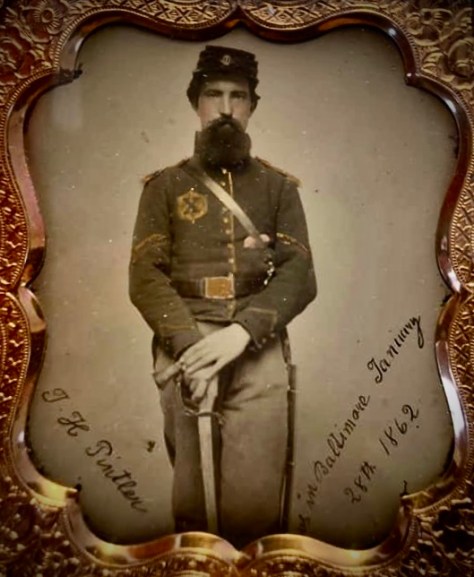
I could not find an image of David but here is an Ambrotype of John H. Pintler who served in Co. C, 1st NY Mounted Rifles. He was killed in Dec. 1862. (Adam Ochs Fleischer Collection)

This letter was written by David Nichols (b. 1829) of New York City who enlisted as a private in September 1862 to serve three years in Co. H, 1st New York Mounted Rifles. He re-enlisted in September 1864 and was transferred later to Co. K. In September 1865, the regiment was designated the 4th Provisional Cavalry. The regiment served until 1864 with the 7th and 4th corps, principally at Fortress Monroe, Norfolk, Suffolk, Portsmouth, Williamsburg and Yorktown, Va., taking part in over 50 battles and skirmishes, but sustaining no severe losses. Its heaviest casualties being at Scott’s mills, Va., in May, 1863, when 28 were killed, wounded and missing.

Muster rolls inform us that David was employed as a longshoreman previous to his enlistment. He stood 5 feet 9 inches tall, with brown eyes, black hair.

Transcription

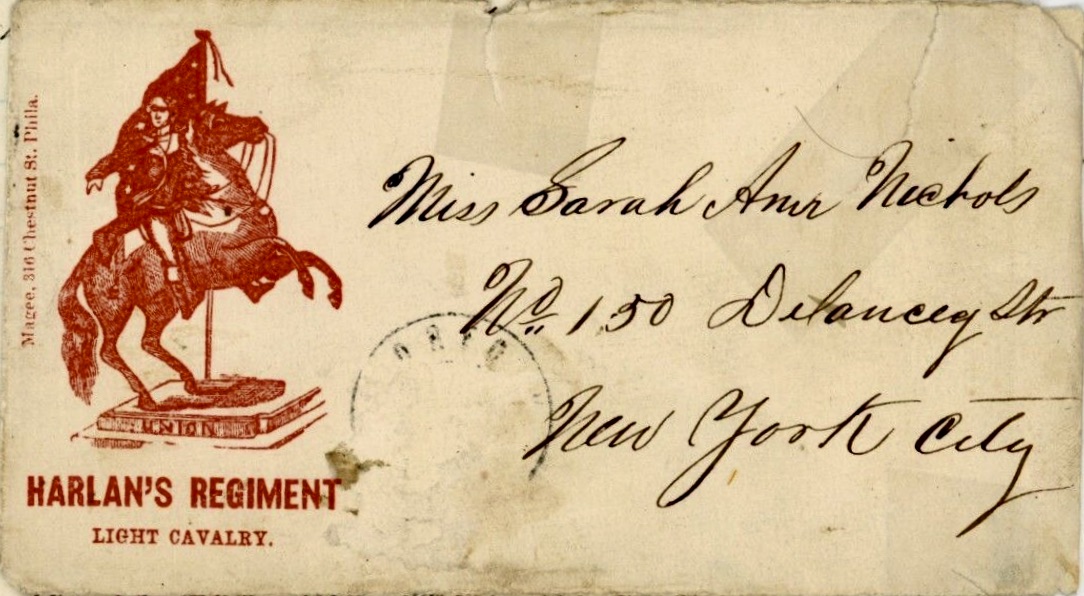
Addressed to Miss Sarah Ann Nichols, No. 150 Delancey Street, New York City; includes a patriotic image of “Harlan’s Regiment, Light Cavalry” which was a Philadelphia Regiment (11th Pennsylvania Cavalry).

In Camp near Suffolk, Va.
October 6th 1862

Dear Mother,

I received your letter a few days since and was very glad to hear you were well. I would have answered before this time but we were sent out on a scout on Friday towards Blackwater. We did not get back until Saturday night late. I expected a general engagement with the Rebels as a number of infantry regiments and also cavalry regiments were with us, but for some cause or other we could not get into a fight.

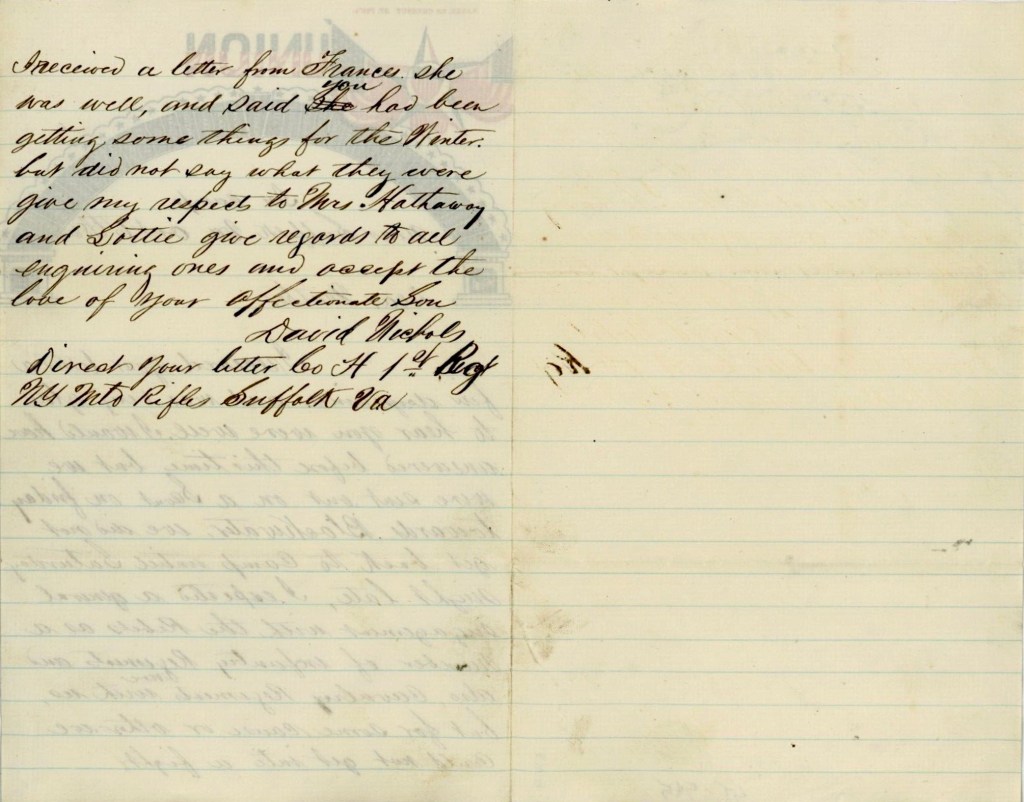
I received a letter from Frances. She was well and said you had been getting some things for the winter but did not say what they were. Give my respects to Mrs. Hathaway and Lottie. Give regards to all enquiring ones and accept the love of your affectionate son. — David Nichols

Direct your letter to Co. H, 1st Regt. N. Y. Mtd. Rifles, Suffolk, Va.

1862: Charles Walsh to Friend Lowell

The following letter was written by 30 year-old Charles Walsh (1831-1912) who enlisted a on 14 August 1862 at Wellsville, New York, and mustered in as a corporal in Co. E, 130th New York Infantry in early September 1862. He was appointed a sergeant in June 1863 and then commissioned a 2nd Lieutenant on 9 February 1865.

Many soldiers in the 130th NY Volunteers used pre-printed envelopes

At the time this letter was written in mid-November 1862. the 130th New York Infantry was serving in Foster’s Brigade in Brig. Gen. Corcoran’s Division at Suffolk, Virginia.

Charles was born in Halifax, Nova Scotia in 1831, the son of William Walsh (1810-1890) and Ann James Mooney (1810-1890). In his muster rolls, he was described as standing 5 feet 11 inches tall, with black hair and hazel eyes. His occupation was given as wheelwright and lawyer. He was married in 1856 to Barbara White Proctor (1833-1922).
Transcription

Suffolk, Virginia
November 13, 1862

Friend Lowell,

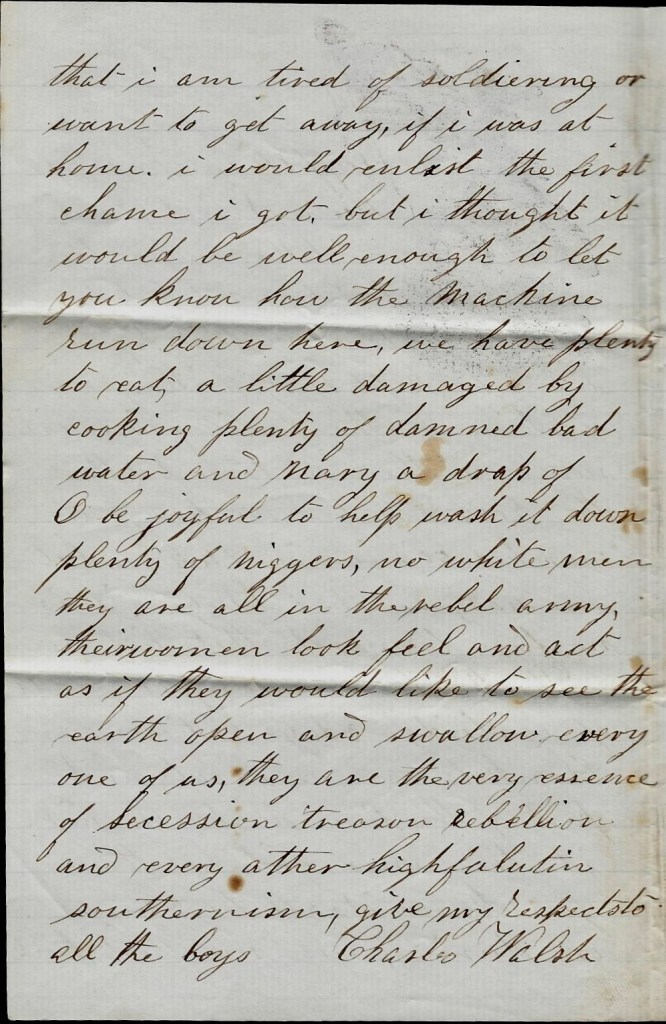
I received your letter in good time but have not had time to answer it before. We are kept busy drilling and working on the fortifications wit now and then a tramp after the rebs. About two weeks ago we marched 50 miles in 24 hours but saw nary a reb. I tell you, it is no fun to march that distance with the load we carry—60 rounds of cartridges, three days rations, our blankets and overcoats, and part of the time on double quick. It tries one’s grit. But then you know it’s all for three years or during. You must not think that I am tired of soldiering or want to get away. If I was at home, I would enlist the first chance I got. But I thought it would be well enough to let you know how the machine runs down here.

We have plenty to eat, a little damaged by cooking plenty of damned bad water and nary a drop of “O be joyful” to help wash it down. Plenty of niggers. No white men. They are all in the rebel army. Their women look, feel, and act as if they would like to see the earth open and swallow every one of us. They are the very essence of Secession treason rebellion and every other highfalutin southernism.

Give my respects to all the boys. — Charles Walsh

1862-65: Foster C. Carl to Walter Tilly Foster

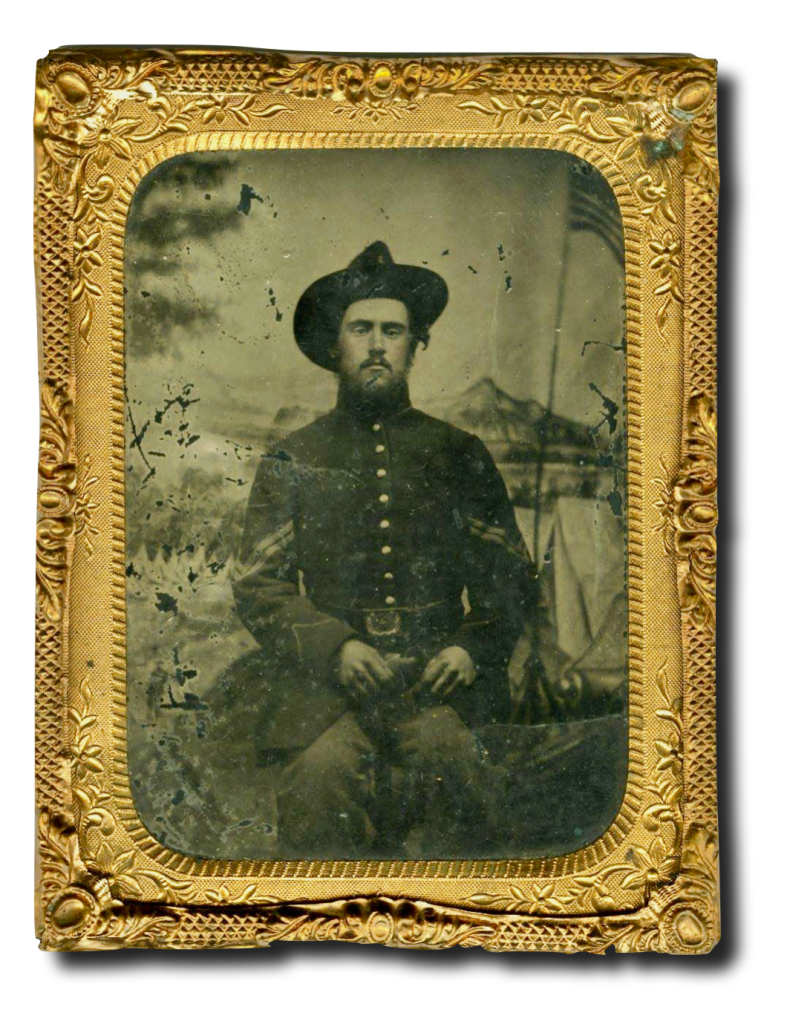
I could not find an image of Foster but here is Pvt. Allen Curtis Smith who also served in Co. I, 1st Mounted Rifles

The following letters were written by Foster C. Carl (1845-1920), the son of William C. Carl (1796-1882) and Mary Bennett (1807-1884) of Putnam county, New York. Foster enlisted in 1862 in Co I, First Regiment of New York Mounted Rifles, and served until the close of the war, when he was honorably discharged. He was only 17 years of age when he enlisted, and the consent of his parents was obtained by Capt. George H. Dean, who commanded the company and recruited it. He was a strong, healthy young man when he entered the service, and was a good soldier, always ready for duty, and never flinched. This is shown by the testimony of his captain.

He was taken sick about April 8 or 9, 1865, at Summerton, N. C., and was carried in an ambulance to the hospital at Petersburg, Va. After a few days he returned to his regiment and went from there to Fredericksburg, Va., but was not able to do any duty. He was granted a sick leave for thirty-five days, and was taken down with malignant typhoid fever, and was confined to his bed until March, 1866. He was attended by physicians whose affidavits are on file. This sickness resulted in a permanent disease of the head and air passages and throat and bronchial tubes. Matter was discharged from the ears, and the throat continually filled with phlegm. It resulted in a permanent disability in the nature of a catarrhal trouble, and a disease of the throat and general debility. The soldier seems to have suffered from a malarial poisoning, and is
in a general feverish condition. The hearing and eyesight of the soldier is now seriously affected, and he suffers constantly from the same trouble of a catarrhal nature and is emaciated and physically unable to
do but little work. At the time he was taken down with the sicknesses referred to he had been in the saddle with his command for 15 consecutive days. He was discharged from the service on 15 June 1865.

Foster wrote the letter to his half-brother, Walter Tilly Foster, the son of Tilly Foster (1793-1842) and Mary Bennett.

Camp Dodge at Suffolk, Virginia, 1862

Letter 1

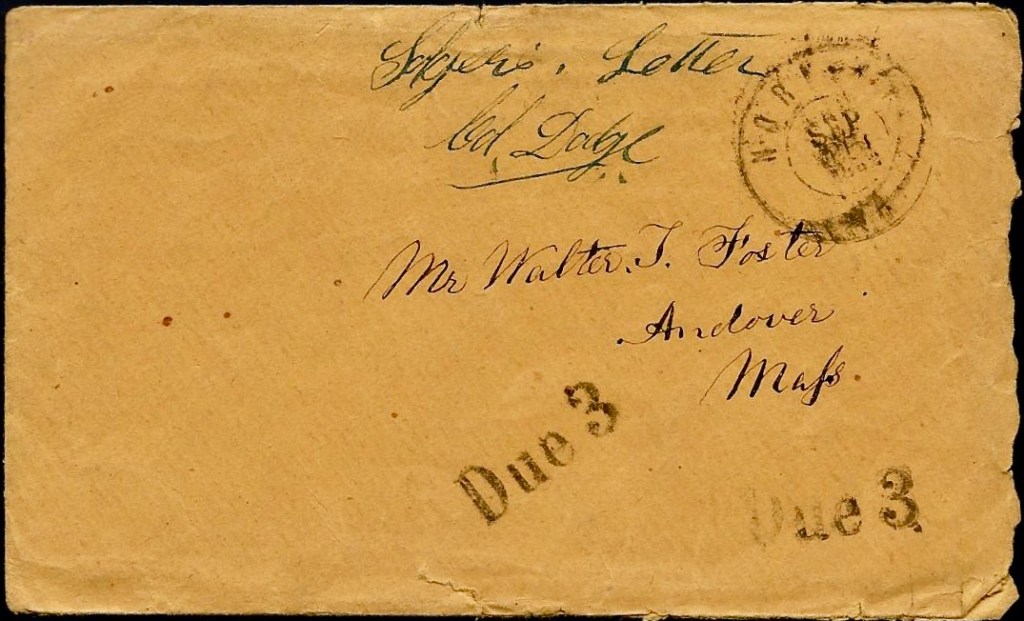
Addressed to Mr. Walter T. Foster, Andover, Massachusetts

Camp Dodge
[Suffolk, Virginia]
September 24, [1862]

Dear Brother,

I wrote to you some time ago for some things & ain’t received the things nor letter yet. You must send them as soon as you can as I want them. There is nothing new in camp. We are preparing for a battle. I can’t write much. Capt. has come & I am taking care of his horses now & things in his tent. I feel quite at home since he came. Write soon & let me know the news. Send a paper.

From your affectionate brother, — Foster C. Carl

I just received a letter from home. They are all well.


Letter 2

Camp Suffolk, Suffolk [Va.]
November 13th 1862

Dear Brother,

I received yours of the 9th inst. and hope you will obey Capt.’s wants. He says if you will come down, he will have six horses hitched up to receive you. You must act to the best of your judgment about it. I should like to see you very much, but it costs like thunder to travel now-a-days—at least I think so.

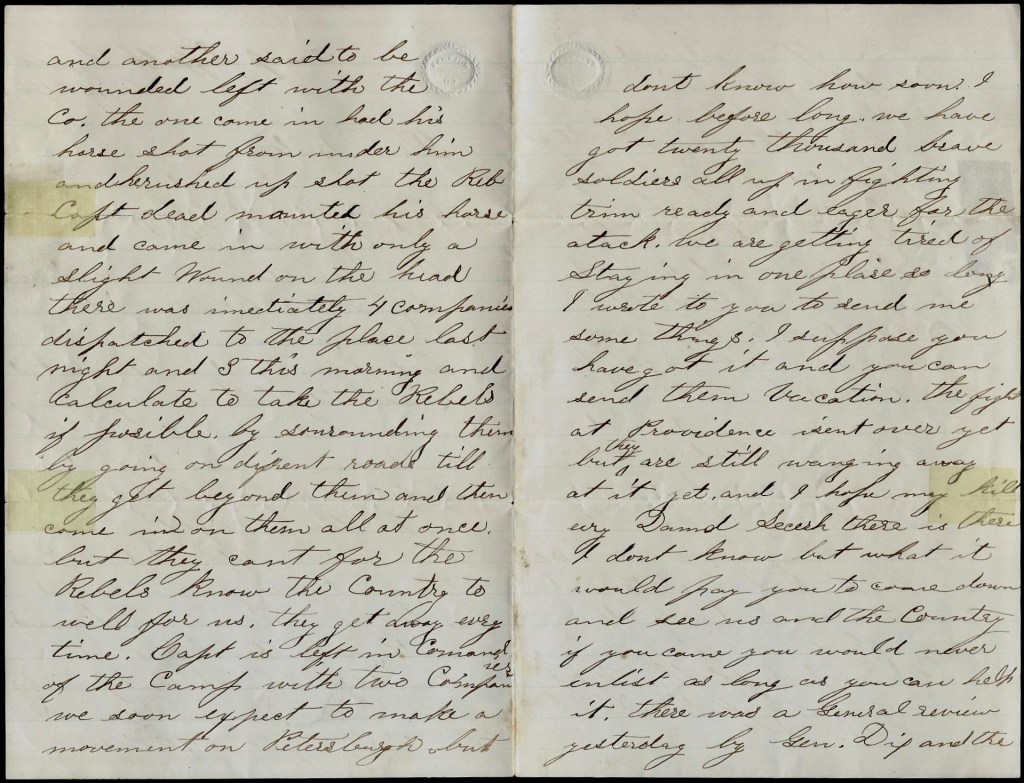
We shall soon see each other as Fighting Joe and Burnside are determined to push things right along now. Capt. [David C.] Ellis of Co. H had a skirmish with some rebels out at Providence Church about 7 miles. There was one wounded came in last night at 12 o’clock and another said to be wounded left with the company. The one that came in had his horse shot from under him and he rushed up, shot the Reb captain dead, mounted his [the Reb’s] horse, and came in with only a slight wound on the head. There was immediately four companies dispatched to the place last night and three this morning and calculate to take the Rebels if possible by surrounding them by going on different roads till they get beyond them and then come in on them all at once. But they can’t, for the Rebels know the country too well for us. They get away every time.

Capt. is left in command of the camp with two companies. we soon expect to make a movement to Petersburg but don’t know how soon. I hope before long. We have got twenty thousand brave soldiers all up in fighting trim, ready and eager for the attack. We are getting tired of staying in one place so long.

I wrote to you to send me some things. I suppose you have got it and you can send them.

The fight at Providence isn’t over yet but they are still wanging away at it yet and I hope may kill every damned Secesh there is there. I don’t know but what it would pay you to come down and see us and the country. If you come, you would never enlist as long as you can help it. There was a General Review yesterday by Gen. Dix and the men & officers appeared splendid on the review. Our regiment is still ahead of the others & the General & Staff complimented us very highly on the occasion.

We have a chaplain here now. Ned Buntlin is here. He is 4th duty sergeant. I guess you might as well see the country South now as ever. It is a solemn sight to see the deserted houses covered with turkey buzzards and wild animals in abundance such as the bear, dear, and possums. I expect still it will soon be pay day amongst us here. I can’t think of much to write. Answer soon and come down. — F. C. C.

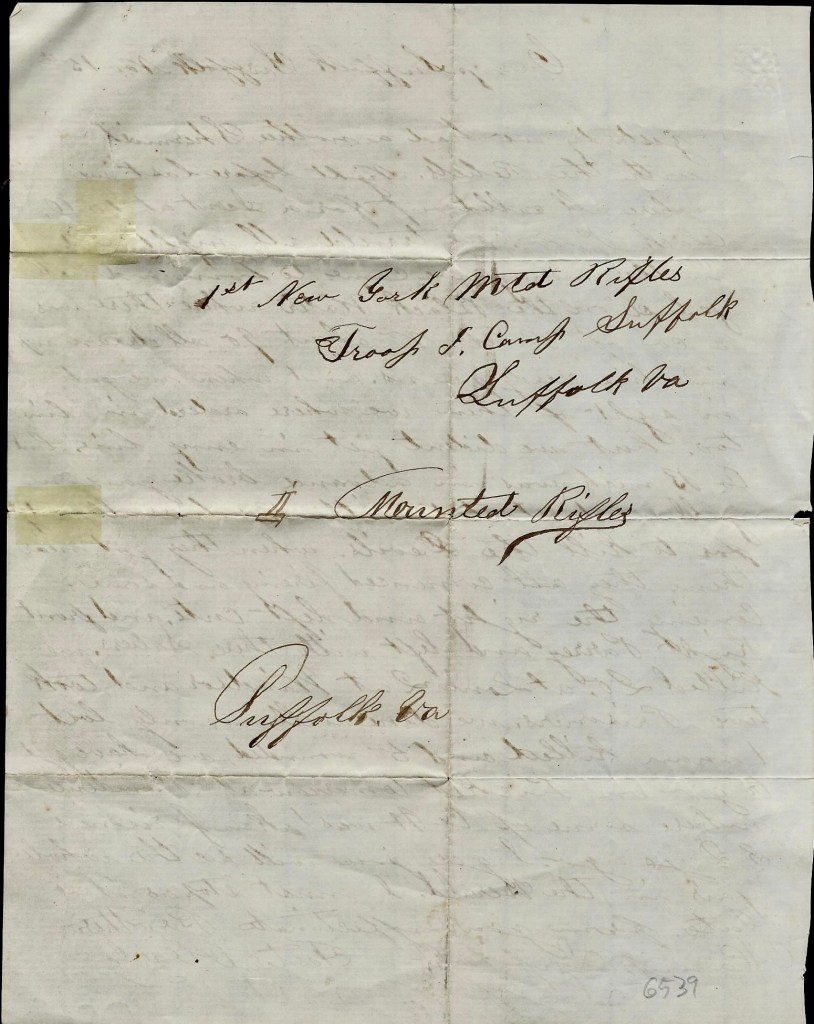
1st N. Y. Mounted Rifles, Co. I, Camp Suffolk, Suffolk, Va.

Write a good letter.


Letter 3

Camp Suffolk, Suffolk [Va.]
November 15 [1862]

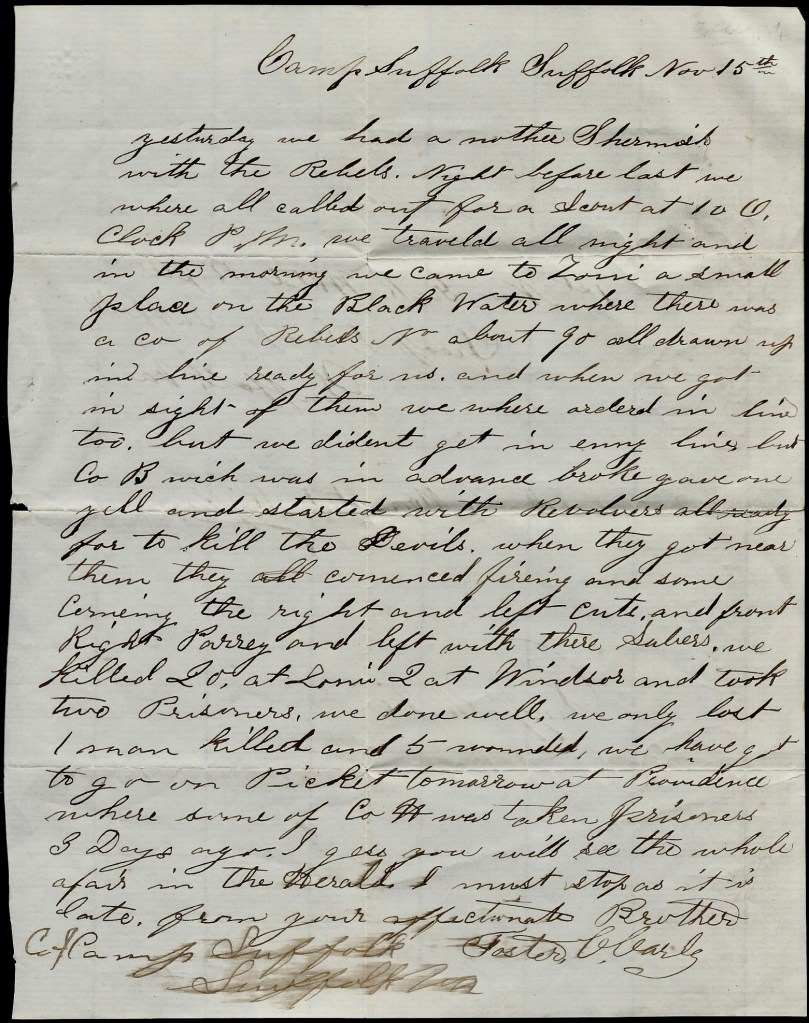
Yesterday we had another skirmish with the Rebels. Night before last we were all called out for a scout at 10 o’clock p.m. We traveled all night and in the morning we came to Zuni—a small place on the Black Water where there was a company of Rebels, numbering about 90, all drawn up in line ready for us and when we got in sight of them, we were ordered in line too. But we didn’t get in any lines but Co. B which was in advance broke, gave one yell and started with revolvers all ready for to kill the Devils. When they got near them, they commenced firing and some coming the right and left cuts, and front right Parry and left with their sabers. We killed 20 at Zuni, 2 at Windsor, and took two prisoners. We done well. We only lost 1 man killed and 5 wounded.

We have to go on picket tomorrow at Providence where some of Co. H was taken prisoners 3 days ago. I guess you will see the whole affair in the Herald. I must stop as it is late. From your affectionate brother, — Foster C. Carl

Company I, Camp Suffolk, Suffolk, Va,


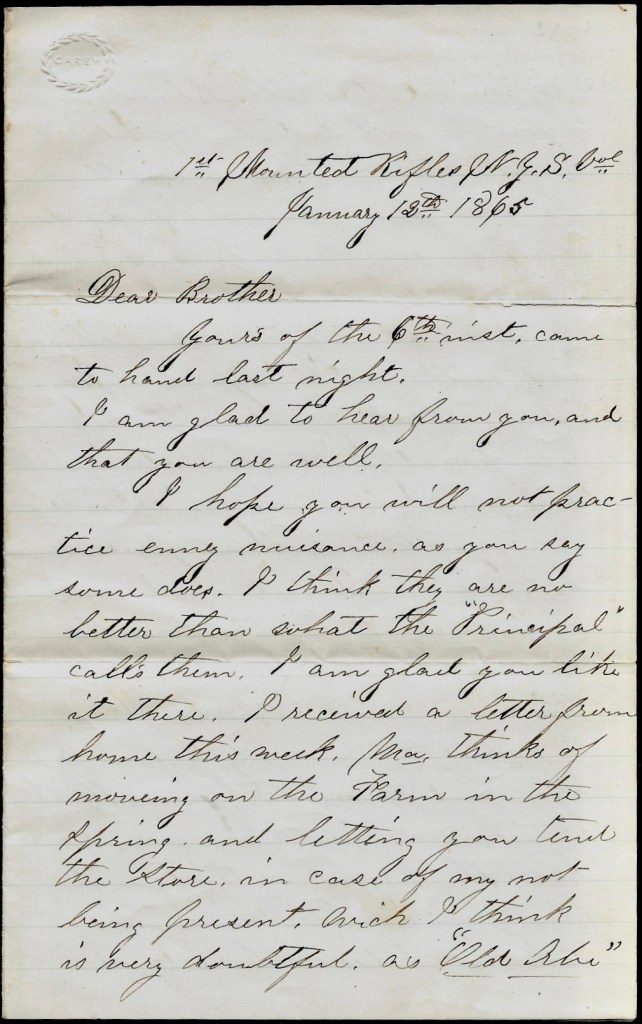
Letter 4

1st Mounted Rifles N. Y. S. Volunteers
January 12th 1865

Dear Brother,

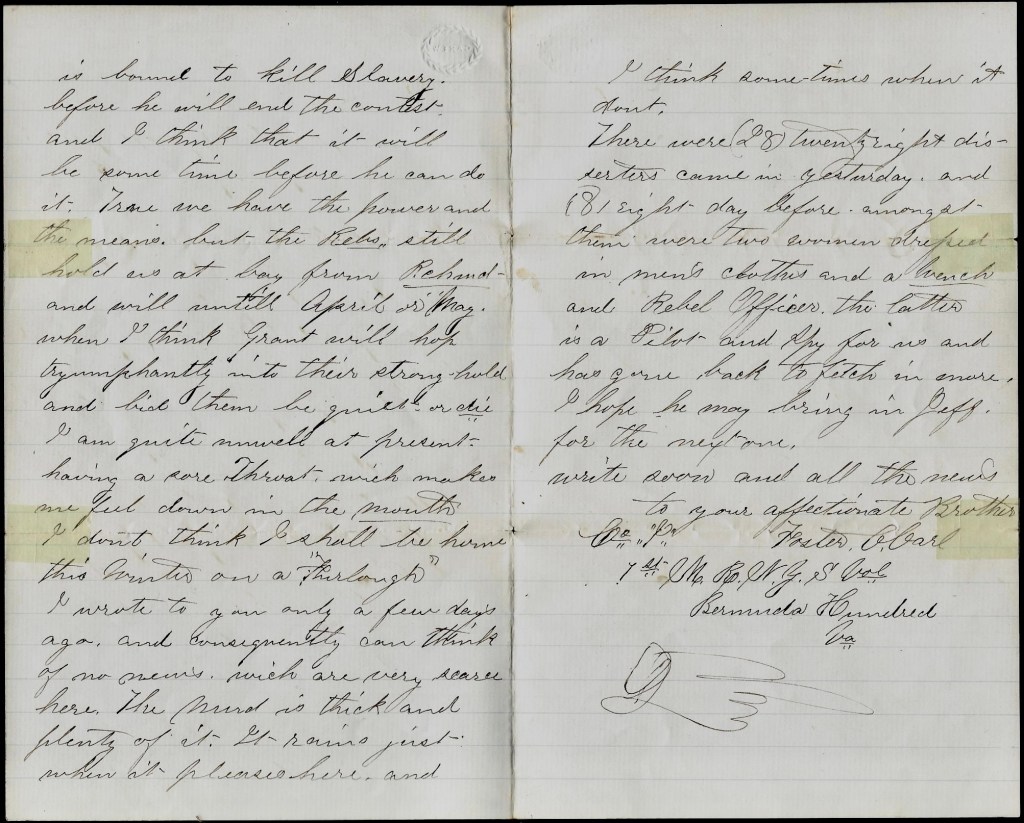
Yours of the 6th inst. came to hand last night. I am glad to hear from you and that you are well. I hope you will not practice any nuisance as you say some does. I think they are better than what the “Principal” calls them. I am glad you like it there. I received a letter from home this week. Ma thinks of moving on the farm in the Spring and letting you tend the store, in case of my not being present, which I think is very doubtful as “Old Abe” is bound to kill slavery before he will end the contest and I think that it will be some time before he can do it. True, we have the power and the means, but the Rebs still hold us at bay from Richmond and will until April or May when I think Grant will hop triumphantly into their stronghold and bid them be quiet or die.

I am quite unwell at present, having a sore throat which makes me feel down in the mouth. I don’t think I shall be home this winter on a “furlough.” I wrote to you only a few days ago and consequently can think of no news which are very scarce here. The mud is thick and plenty of it. It rains just when it pleases here and I think sometimes when it don’t.

There were 28 deserters came in yesterday and 8 day before. Amongst them were two women dressed in men’s clothes and a wench and Rebel officer. The latter is a pilot and spy for us and have gone back to fetch in more. I hope he may bring in Jeff for the next one.

Write soon and all the news to your affectionate brother, — Foster C. Carl

Co. I, 1st Mounted Regiment N. Y. Volunteers, Bermuda Hundred, Va.


1863: Henry D. Lewis to Charles D. Lewis

I could not find an image of Henry but here is a tintype of Cpl. Richard K. Woodruff of Co. I, 15th Connecticut Infantry (Jeffrey Kraus Collection)

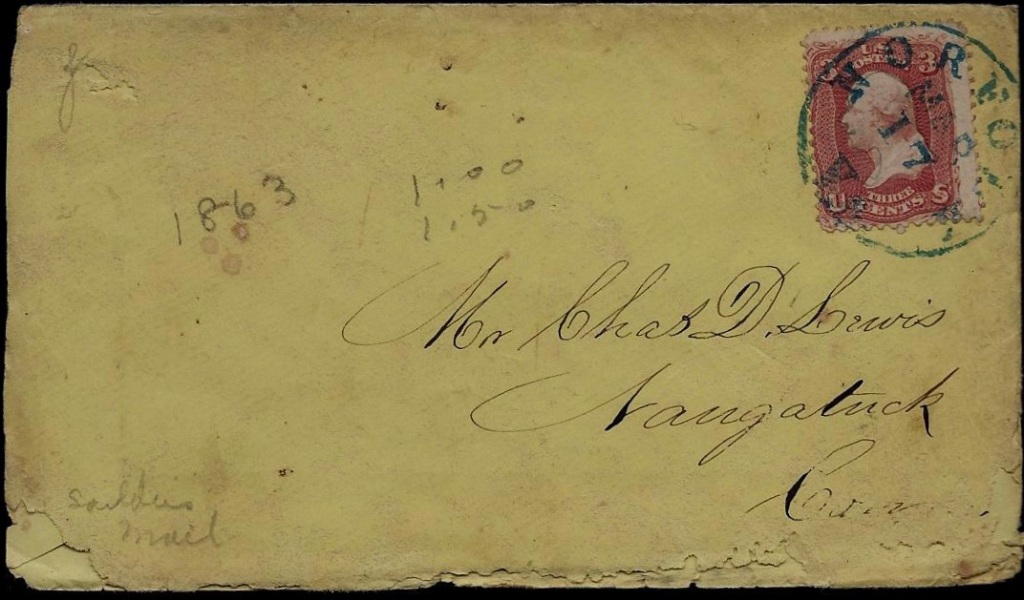
This letter was written by Cpl. Henry D. Lewis (1841-1937) of Co. H, 15th Connecticut Infantry. Henry was the son of Lucien Franklin Lewis (1804-1882) and Susan Hitchcock (1814-1875) of Naugatuck, New Haven county, Connecticut. Henry served from August 1862 until June 1865.

Henry wrote the letter to his cousin, Charles Dwight Lewis (1841-18xx), the son of Asahel H. Lewis (1807-1895) and Harriet Newell Horton (1818-1907) of Naugatuck, New Haven county, Connecticut.

Mentioned in the letter is another cousin, Rufus W. Lewis (1836-1909) — the son of Lawrence Sterne Lewis (1804-1884) and Nancy L. Hull (1810-1881) of Naugatuck. Rufus also served in Co. H, 15th Connecticut Infantry until his disability caused his reassignment to Co. E, 18th Veteran Reserve Corps in 1863.

See also — 1863: Henry D. Lewis to Charles D. Lewis [Letter dated 10 October 1863 from Portsmouth, Va.] and 1863: Henry D. Lewis to Charles D. Lewis [Letter dated 17 December 1863]

Transcription

Addressed to Mr. Charles D. Lewis, Naugatuck, Connecticut

Suffolk, Virginia
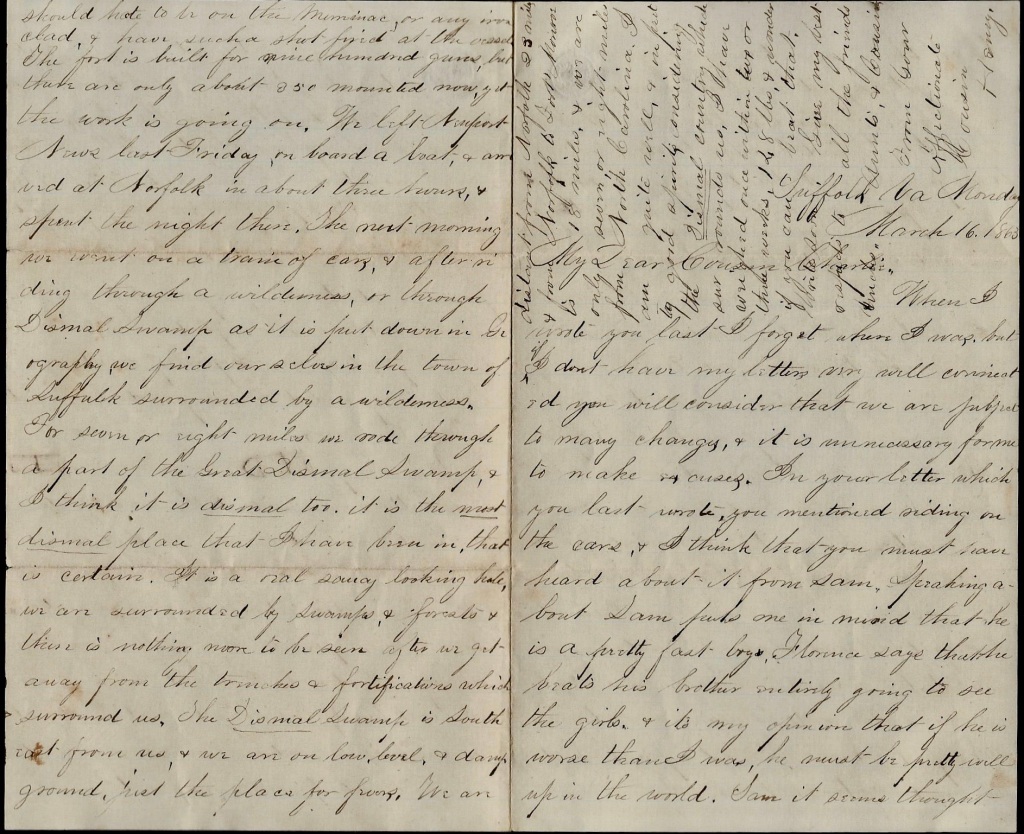
Monday, March 16, 1863

My dear cousin Charlie,

When I wrote you last, I forgot where I was, but if I don’t have my letters very well connected, you will consider that we are subject to many changes, and it is unnecessary for me to make excuses. In your letter which you last wrote, you mentioned riding on the cars & I think that you must have heard about it from Sam. Speaking about Sam puts one in mind that he is a pretty fast boy. Florence says that he beats his brother entirely going to see the girls, and its my opinion that if he is worse than me, he must be pretty well up in the world. Sam it seems thought that there was danger of your becoming entangled in the meshes of love & I hope if such is the casae, that he has been kind enough to do his best to help you out—that is, if you needed any help.

You asked in your letter if there were any such hills in Virginia as in Old Connecticut. I reckon there are some & there were some in the rear of the City of Fredericksburg which none were able to climb—at least none of the Union soldiers. We had a fine place for encampment at Newport News & it really seemed much like home because I had such a view of the water. I sometimes fancied when looking across the James river that I was looking across Long Island Sound & that Long Island was in the distance for the river is from six to seven miles wide. 
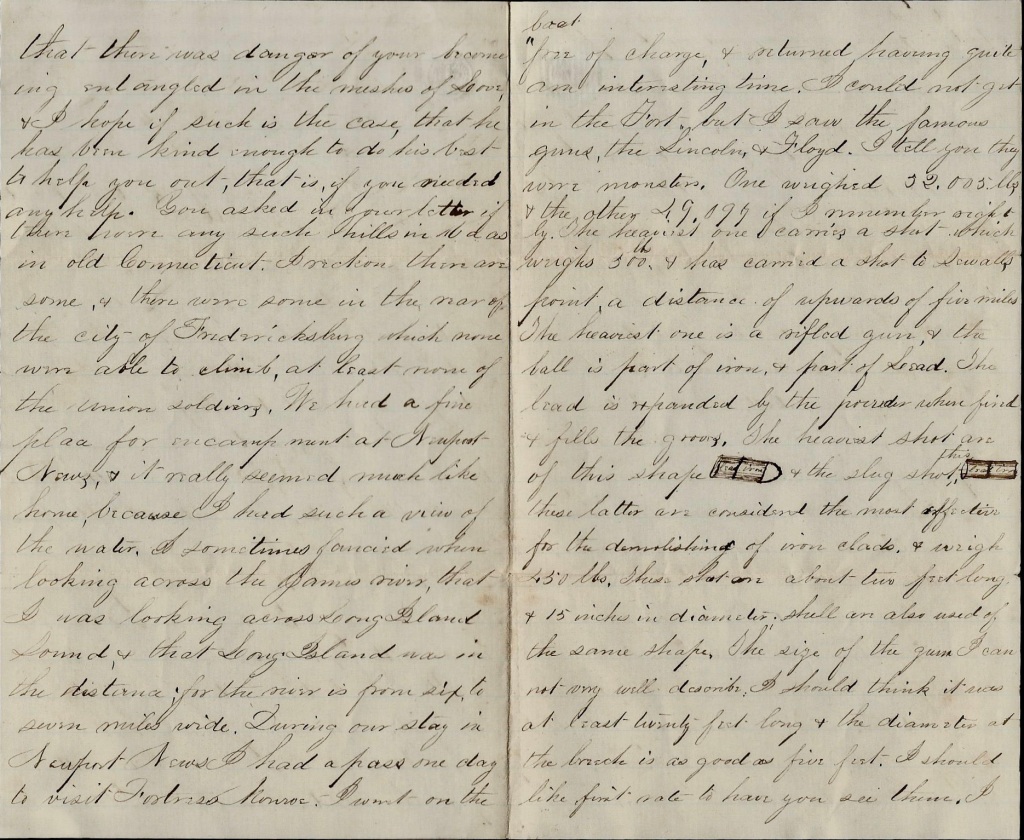
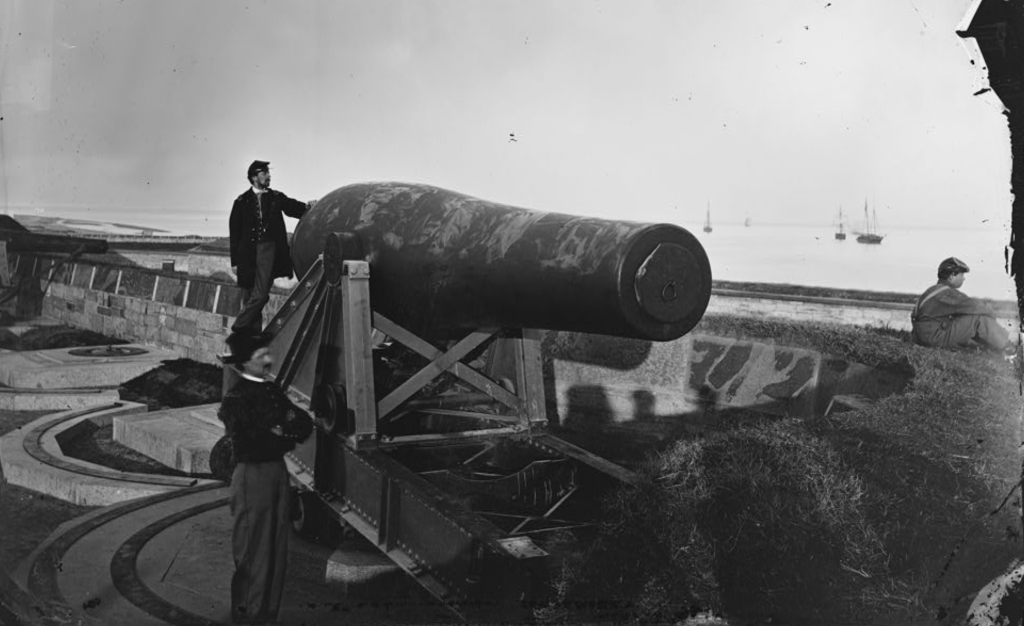
During our stay in Newport News, I had a pass one day to visit Fortress Monroe. I went on the boat free of charge and returned having quite an interesting time. I could not get in the fort but I saw the famous guns—the Lincoln and Floyd. I tel you, they were monsters. One weighed 52,005 pounds and the other 49,097, if I remember rightly. The heaviest one carries a shot which weighs 500 lb. and has carried a shot to Sewall’s Point, a distance of upwards of five miles. The heaviest one is a rifled gun and the ball is part of iron and part of lead. The lead is expanded by the powder when fired and fills the grooves. The heaviest shot are of this shape [sketch] and the slug shot this [sketch]. These latter are considered the most effective for the demolishing of iron clads & weigh 450 lbs. These shot are about two feet long and 15 inches in diameter. Shell are also used of the same shape. The size of the gun I can not very well describe. I should think it was at least twenty feet long and the diameter at the breach is as good as five feet. I should like first rate to have you see them. I should hate to be on the Merrimac or any ironclad & have such a shot fired at the vessel. The fort is built for nine hundred guns but there are only about 850 mounted now, yet the work is going on.

The “Lincoln Gun” at Fortress Monroe was actually a 15-inch Rodman Columbiad LOC)

We left Newport News last Friday on board of a boat and arrived at Norfolk in about three hours and spent the night there. The next morning we went on a train of cars & after riding through a wilderness, or through Dismal Swamp as it is put down in Geography, we find ourselves in the town of Suffolk surrounded by a wilderness. For seven or eight miles we rode through a part of the Great Dismal Swamp and I think it dismal too. It is the most dismal place that I have been in, that is certain. It is a real saucy looking hole. We are surrounded by swamps and forests & there is nothing to be seen after we get away from the trenches and fortifications which surround us. The Dismal Swamp is southwest from us and we are on low, level, and damp ground—just the place for fevers. We are distant from Norfolk 23 miles & from Norfolk to Fort Monroe is 18 miles, and we are only seven or eight miles from North Carolina. 

I am quite well and in pretty good spirits considering the dismal country which surrounds us. I have weighed once within two or three weeks 148 lbs. and under, if you can beat that. Write soon. Give my best respects to all the friends, Uncles, Aunts, and cousins.

From your affectionate cousin, — Henry

1863: Richard S. Thomas to Hannah Jeffrey

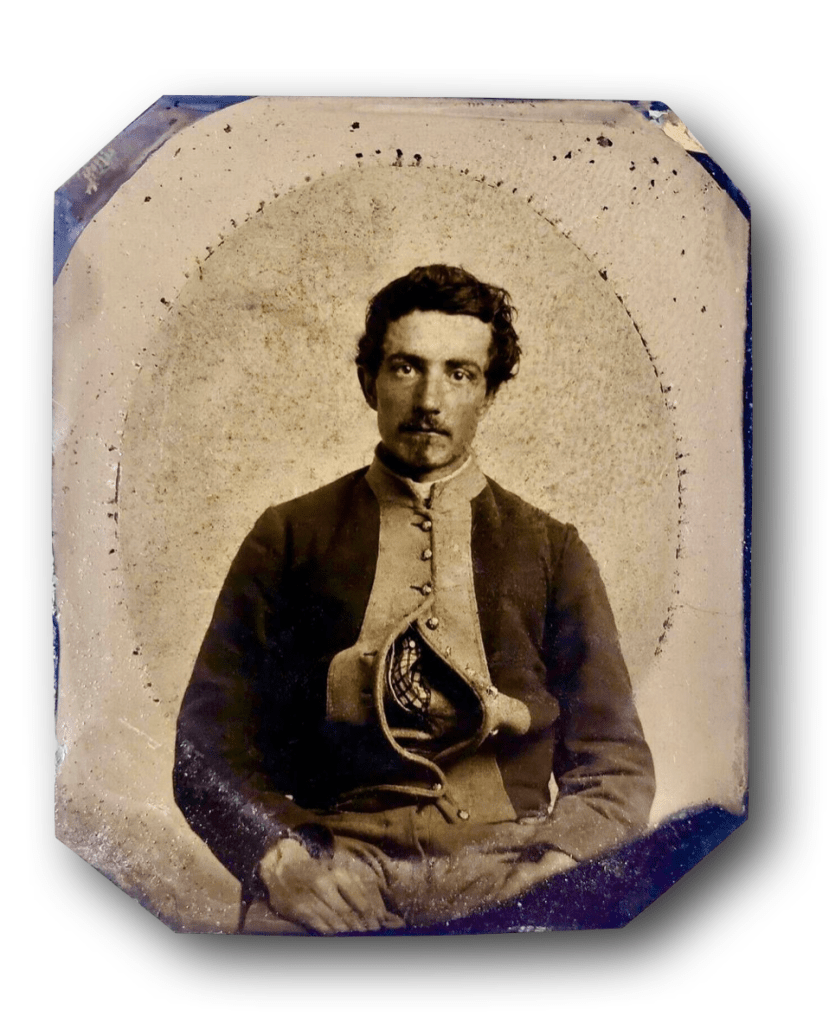
An unidentified Union soldier, possibly from an Indiana Regiment, wearing a faux zouave jacket
(Will Griffing Collection)

The following letter was written by Richard S. Thomas (1839-1864) of Huntington, Indiana, who enlisted as a recruit in Co. F, 13th Indiana Infantry on 13 September 1862. He was killed on 10 May 1864 in the fierce hand-to-hand combat that ensued when the regiment was attacked unexpectedly by two Confederate brigades led by Major General Robert Ransom while on an expedition to cut the line of communication on the Richmond & Petersburg Railroad (see Battle of Chester Station).

Richard addressed the letter to his cousin, Hannah Jeffrey (1838-1886), the daughter of Willis Jeffrey (1807-1886) and Zilpha Achsah Thomas (1811-1865) of Mount Etna, Lancaster township, Huntington county, Indiana. She died unmarried at the age of 48.

Transcription

Addressed to Hannah Jeffrey, Mount Etna, Huntington county, Indiana

Camp Suffolk, Virginia
April 30th 1863

Dear Cousin,

I have nothing of importance to write but I concluded I would write a few lines to let you know that I am still alive and well. I have no doubt but you have heard before this time that we had a few rebs in our immediate neighborhood and that we have been giving them a Lincoln pill occasionally and that they have been returning the compliment with Jeff Davis drugs.

On the 11th inst. there was one hundred men went out in front from the Old 13th to feel of their pulse but we had not advanced but a short distance outside of our pickets till we found our patients was prepared to give us a warm reception. We exchanged shots with them for about an hour but finding them too strong for our small force, we returned to camp with a loss of three men wounded. Barney [Bernard] Conron, our 2nd Lieutenant, was amongst the wounded and has since died. We sent his body to Huntington.

“Our regiment…made a charge into a piece of woods where the skirmishers said the rebs was drawn up in line of battle but they was either mistaken or else when we raised the hoosier yell and went in on double quick with bayonets fixed, they thought it was more than they could stand and skallyhooted out of that in a hurry for when we got there, there was not a greyback to be seen.”

Robert S. Thomas, Co. F, 13th Indiana Infantry, 30 April 1863

On the 24th we went out in force on another road and had a little fight. Our regiment was on the right and made a charge into a piece of woods where the skirmishers said the rebs was drawn up in line of battle but they was either mistaken or else when we raised the hoosier yell and went in on double quick with bayonets fixed, they thought it was more than they could stand and skallyhooted out of that in a hurry for when we got there, there was not a grey back to be seen. I shall not attempt to give any particulars as you will get it sooner and more correct in the paper than I could give if I should try.

Our company was out on a reconnoissance yesterday up the Jericho Canal, or rather the Dismal Swamp Ditch. We was about three miles above our outpost pickets and did not see anything nearer like a rebel than mud and water and canebrakes. we went till we had to wade mud and water knee deep and the further we went, the worse it got. We talk of going again tomorrow in skiffs and if we do, we will go through to Dremen [Drummond] Lake unless the rebs stop us before we get there.

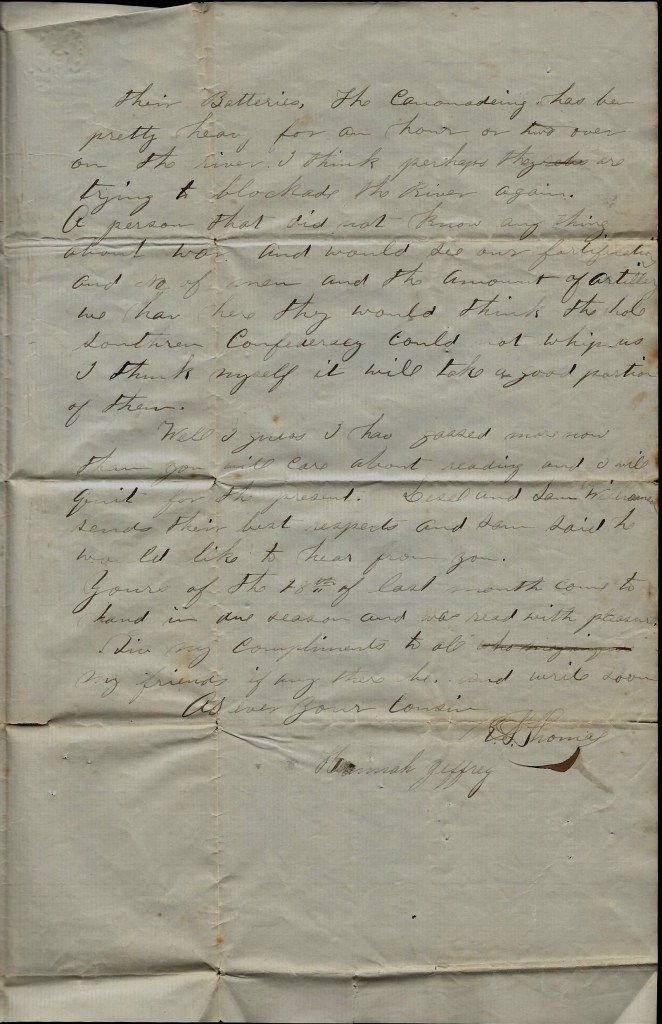
There has not been any fighting for several days except by the sharpshooters. They are popping away every day but I don’t think they are accomplishing much. There is more or less artillery firing every day by our men. They are shelling the woods to keep the rebs from planting their batteries. The cannonading has ben pretty heavy for an hour or two over on the river. I think perhaps they are trying to blockade the river again.

A person that did not know anything about war and would see our fortifications and number of men and the amount of artillery we have here, they would think the whole Southern Confederacy could not whip us. I think myself it will take a good portion of them.

Well, I guess I have gassed more now than you will care about reading and I will quit for the present. Lesel [?] and Sam Williamson sends their best respects and Sam said he would like to hear from you.

Yours of the 28th of last month come to hand in due season and was read with pleasure. Give my compliments to all my friends if any there be and write soon. As ever, your cousin, — R. S. Thomas

[to] Hannah Jeffrey

1862-63: Charles Abial Wright to his Family

These letters were written by Charles A. Wright (1843-1899), a 19 year-old cooper from Townsend, Massachusetts, who enlisted on August 25, 1862 in Co. B of the 6th Massachusetts Infantry during their second term of service—a nine-month’s stretch when they were attached to the VII Corps and saw duty in and around Suffolk, Virginia. After he was discharged from the 6th Mass, he enlisted into Co. D, 2nd Massachusetts Heavy Artillery. He was discharged for disability at New Berne in July 1865.

Charles was the son of William Henry Wright (1804-1887) and Mary Baldwin (1807-1873) of Townsend, Middlesex county, Massachusetts.

Five soldiers, four unidentified, in Union uniforms of the 6th Regiment Massachusetts Volunteer Militia outfitted with Enfield muskets in front of encampment. Photo shows soldiers wearing frock coats and standing at ease with their Enfield Rifles. An encampment is visible in the background. Photo shows one identified soldier, Albert L. Burgess, on far right. Taken during their second term of service probably in Suffolk, Virginia. Published by North South Trader, May-June 1983, p. 23.

[Note: These letters are from the personal collection of Jim Doncaster and are published on Spared & Shared by express consent.]

Letter 1

Suffolk, VA
Sunday morning, October 5, 1862

I am pretty well today. We have had a fight it out here yesterday. We whipped them up pretty well. We killed about thirty of them.  We lost only four men in all. The Rebels had to skedaddle and burn the bridge so we could not get across.

I wish you would send Jennie out here in a letter. I would kiss her and send her back home safe. Henry, I suppose you feel pretty big of your horse. I hope you do. If I live to get home I shall buy me a wife and live happy. I tell you, I shall. I am a different man now to what I was at home.

I want you to tell Augusta to send her picture to me. I should like to have her send it as soon as she can. I did not think of it when I wrote to her. I want you [to] tell John Going to write to me, and I will write to him. I go to church every Sunday. I hope you all go to church every Sunday. You tell William to write to me….also Martha and do tell her to write to me and send Hattie out here in a letter and I will kiss her and send her back safe at home. I should like to see the little ones. I hope I shall live to see them once more and see you all. 

I hope you will write as often as you can. So goodbye. From your brother, — Charles A Wright


Letter 2

Suffolk, Virginia
December 19th [1862]

Dear Sister,

I received your letter this evening and I was very glad to hear that you was well and all the folks. I am well tonight. I wrote a letter today. I am growing fat as a pig. I got my box safe and them pies was good and the rest was good too. I hope mother will send my pants and hat for I should like them. We have not [moved] out of this place yet nor I don’t think we shall this winter. I hope not for we have a good time out here. But I can’t help but think about Little Edgar. 1 It is in my mind all the time. You can’t tell how [bad] I felt when I heard Little Edgar died. I felt just as I wanted to go with him. I did not want to live any longer for I felt so bad. We have lost about eight men out of our regiment.

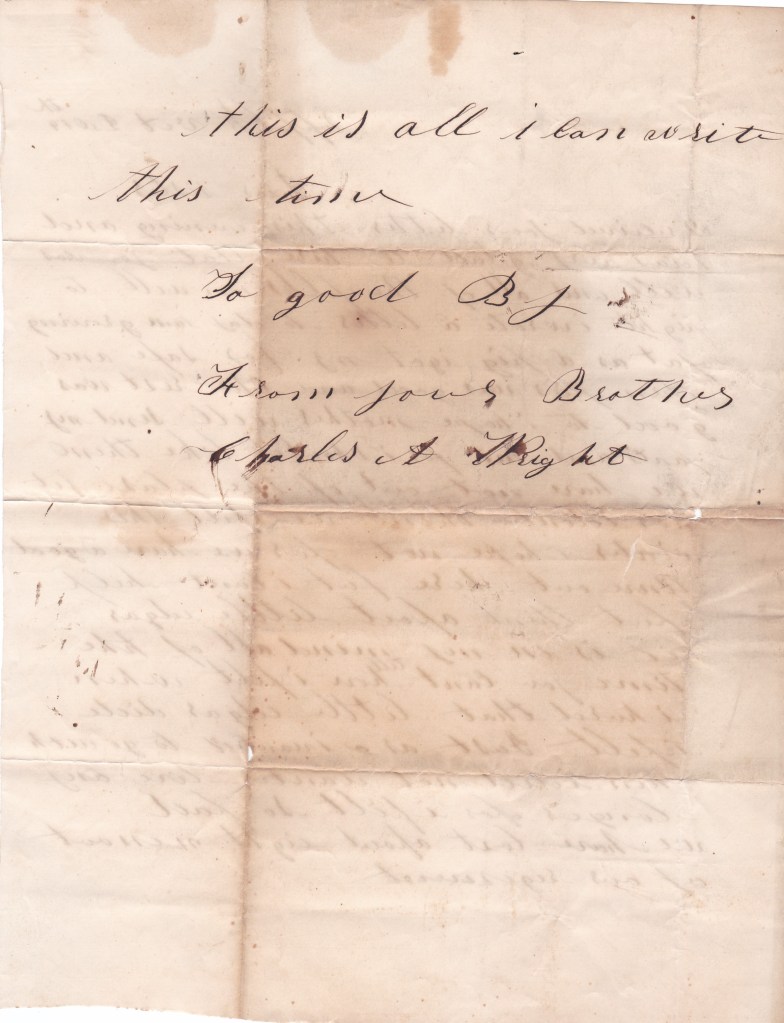
This is all I can write this time. So goodbye. From your brother, — Charles A. Wright

1 Little Edgar was Charles’ nephew, Edgar Heselton (1859-1862). Edgar’s parents were Franklin Loring Heselton (1836-1917) and Mary Roanna Wright (1834-1864).


Letter 3

Suffolk, Virginia
1863

Dear Mother,

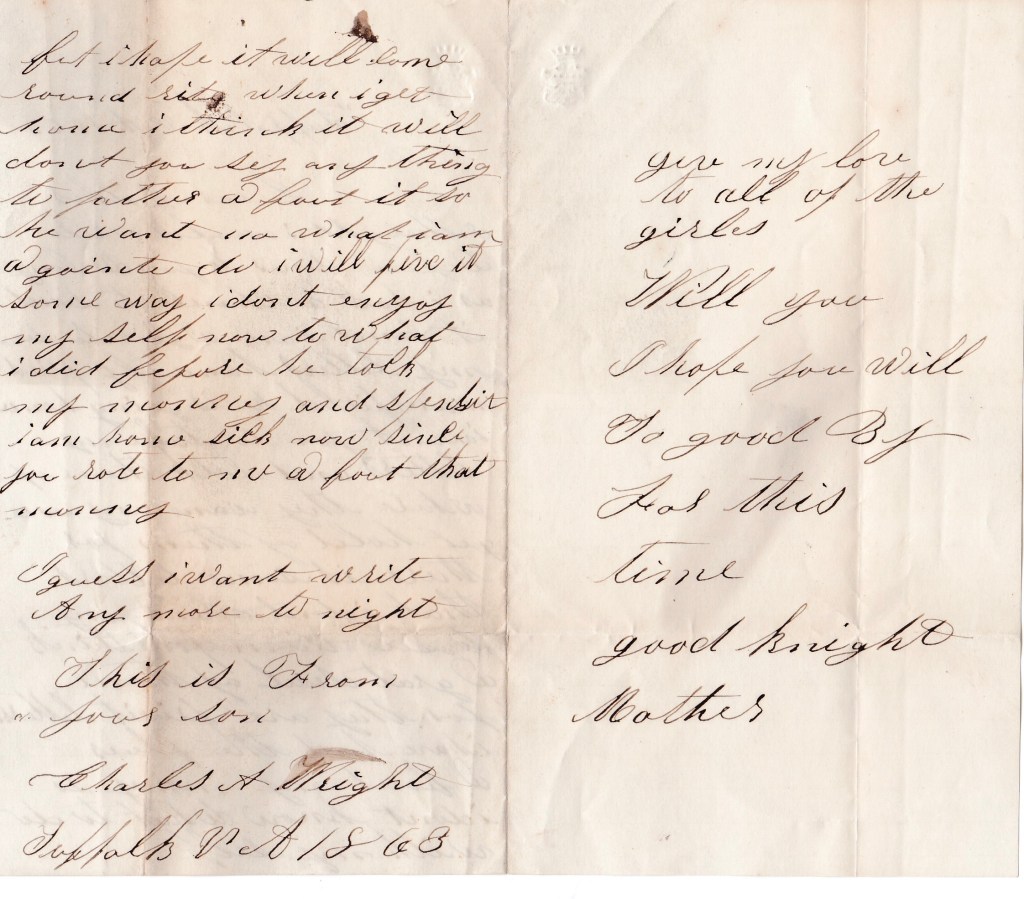
I thought I would write a few lines to you as long as I had a chance to send it and I am a going to send my letter home by Fred Mansfield. He is going home. I want you to take my letters and lock them up where they won’t anyone get hold of them for there is some letters that I don’t want any[one] to see them for I think a great deal of them for they are private letters. I have had the blues about my money so I don’t know what to do with myself but I hope it will come round right when I get home. I think it will. Don’t you say anything to Father about it so he won’t know what I am a going to do. I will fix it some way. I don’t enjoy myself now to what I did before. He took my money and spent it. I am homesick now since you wrote to me about my money.

I guess I won’t write anymore tonight. This is from your son, — Charles A. Wright.

Give my love to all the girls, will you? I hope you will. So goodbye for this time. Goodnight, Mother.


Letter 4

Suffolk, Virginia
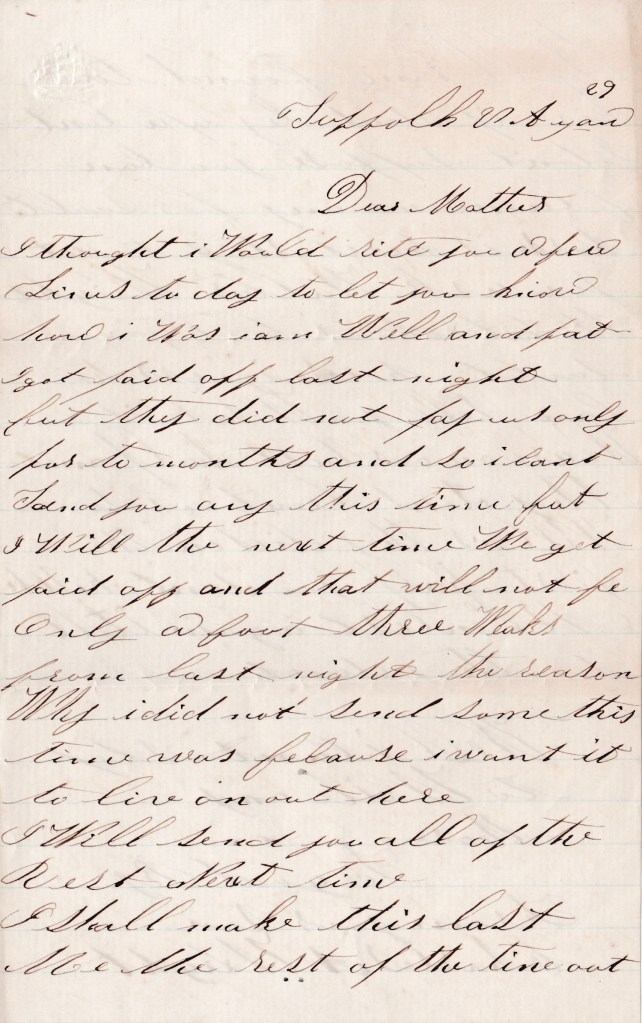
January 29, [1863]

Dear Mother,

I thought I would write you a few lines today to let you know how I was. I am well and fat. I got paid off last night but they did not pay us only for two months and so I can’t send any this time but I will next time we get off and that will not be only about three weeks from last night. The reason why I did not send some this time was because I want it to live on out here. I will send you all of the rest next time. I shall make this last me the rest of the time out.

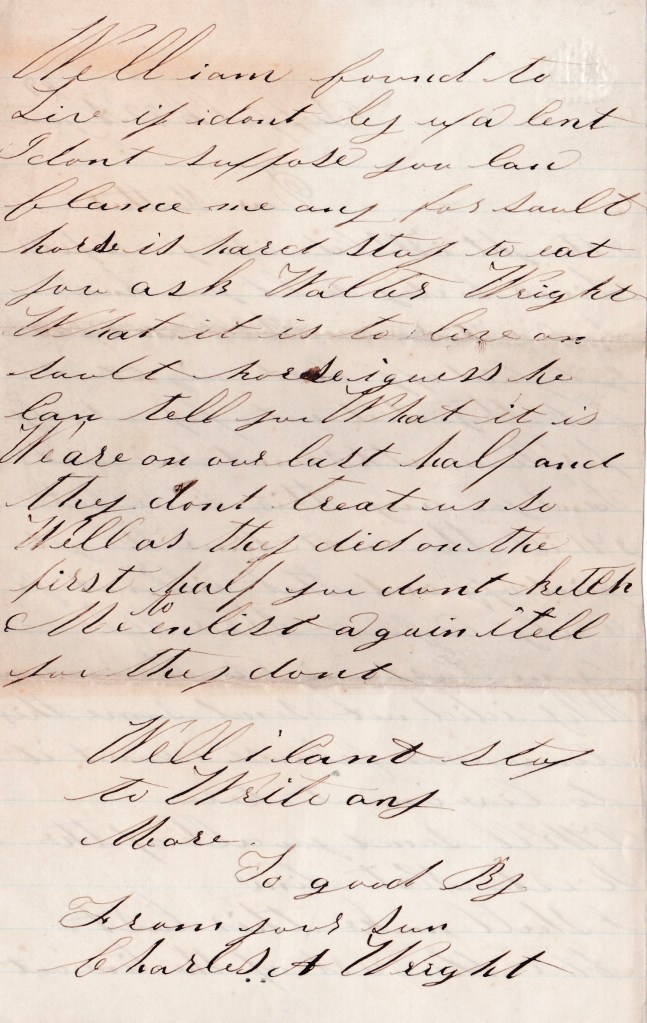
Well, I am bound to live if I don’t lay up a cent. I don’t suppose you can blame me any for salt horse is hard stuff to eat. You ask Walter Wright what it is to live on salt horse. I guess he can tell you what it is.

We are on our last half and they don’t treat us so well as they did on the first half. You don’t catch me to enlist again, I tell you they don’t.

Well I can’t stop to write anymore. So goodbye. From your son, — Charles A. Wright


Letter 5

Suffolk, Virginia
April 21, [1863]

Dear Mother,

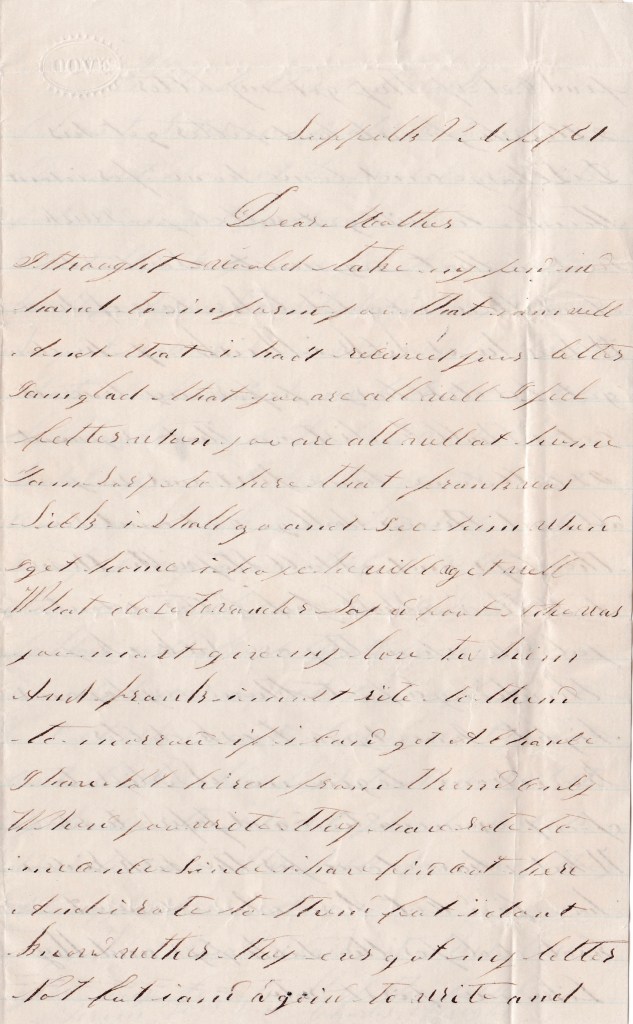
I thought I would take my pen in hand to inform you that I am well and that I had received your letter. I am glad that you are all well. I feel better when you are all well at home. I was sorry to hear that Frank was sick. 1 I shall go and see him when I get home. I hope he will get well. What does Frank say about the war? You must give my love to him. And Frank must write to them tomorrow if I can get a chance. I have not heard from them, only when you write. They have wrote to me once since I have been out here. And I wrote to them but didn’t know whether they ever got my letters. But I am a going to write and find out if they got my letters. I think Frank had better get his discharge and come home for I don’t think he will get well, do you? I wish I was in that regiment as a nurse and that I could take care of him when he is sick. I think if he don’t get his discharge before my time is out, I shall enlist in that regiment. I shall come home first and see you all and then I shall go out and see the boys and I shall stay with them. And then I shall feel better. I don’t feel right when they are sick. I keep thinking about them every day and night. I am a going to ask Doctor [Walter] Burnham to give me a certificate of my examination and papers to show what I have done for the sick soldiers here. I have done a great deal for the sick boys and they like me first rate.

Well, Mother, I think the climate suits me better out here than it does at home. I’ve never been so fat in my life as I am now. I don’t think you would know me now hardly if you should see me for I am so fat. I don’t suppose you would think that I could get so much fat onto my little frame but I have and I can hold up a great deal more if I had it on me. I weight one hundred and twenty-five pounds. That is pretty good for me, I think. Don’t you? I suppose Father will buy that horse for me. I hope he will for I want it when I get home. And if I go out to see the boys, he can sell it if he wants. I don’t find nothing else to write. The sick boys are getting along first rate now.

This is all I can write this time. Give my love to all the folks. From your son, — Charles A. Wright

1 I presume Charles is referring to his older brother Franklin S. Wright (1841-1863). Frank was serving in the 33rd Massachusetts Infantry. He was killed at the Battle of Brown’s Ferry Farm on 29 October 1863.