Category Archives: U. S. Colored Troops

1864: David Hopkins to his Family

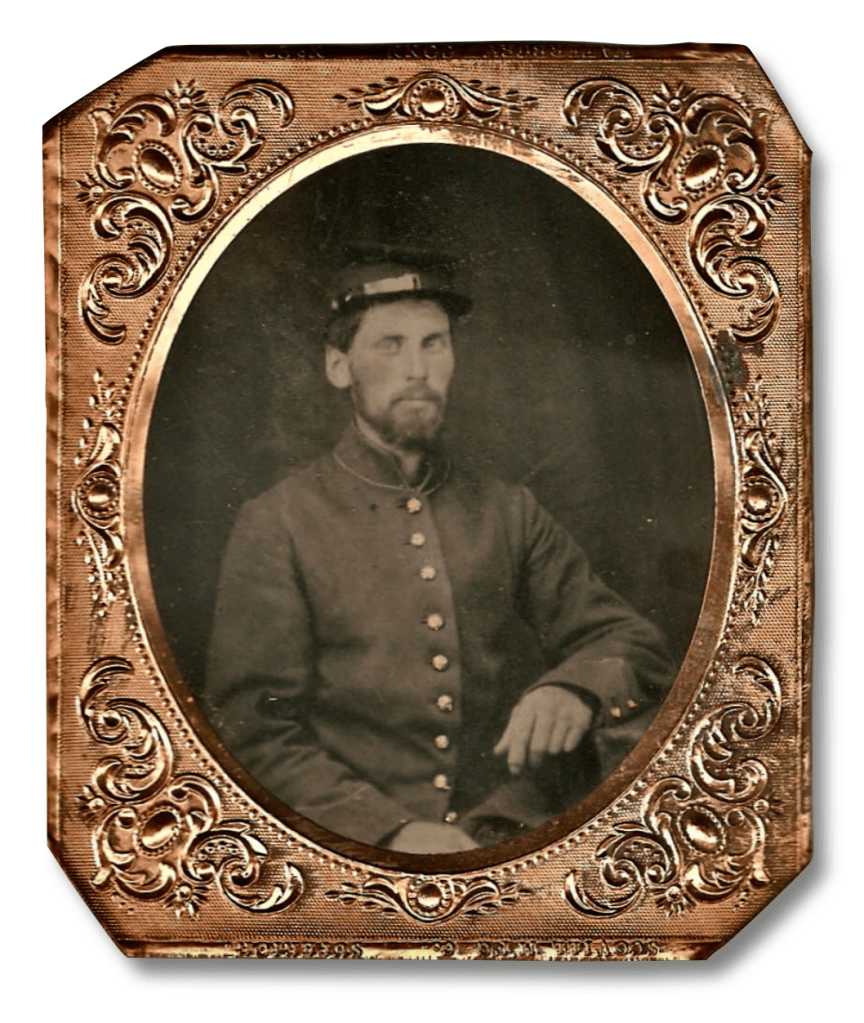
The following letters, written in pencil from the breastworks before Petersburg in the summer of 1864, were composed by 38 year-old David Hopkins of Buffalo who mustered in as a sergeant in December 1862 to serve in the 27th New York Battery. He was discharged in early February 1865 to accept a commission as 2nd Lieutenant of Co. C, the 13th Heavy Artillery Colored Troops, joining the regiment at its post in Smithland, Kentucky.

David’s letter informs us that the 27th Battery, New York Light Artillery was in Burnside’s IX Corps, Ledlie’s 1st Division, and joined by two other batteries—the 2nd Maine Light Artillery and the 14th Massachusetts Light Artillery. The 1st Division black troops were the 56th, 57th, and 59th Massachusetts Regiments.

These two letters, in combination, make interesting reading. One was written roughly a month before the Battle of the Crater and the other a few days after that “big fizzle” as he termed it. The contrast in attitudes toward the Black soldiers is evident and unfortunate as they the USCT were made the scapegoats for the poorly executed battle plan of the Union leadership.

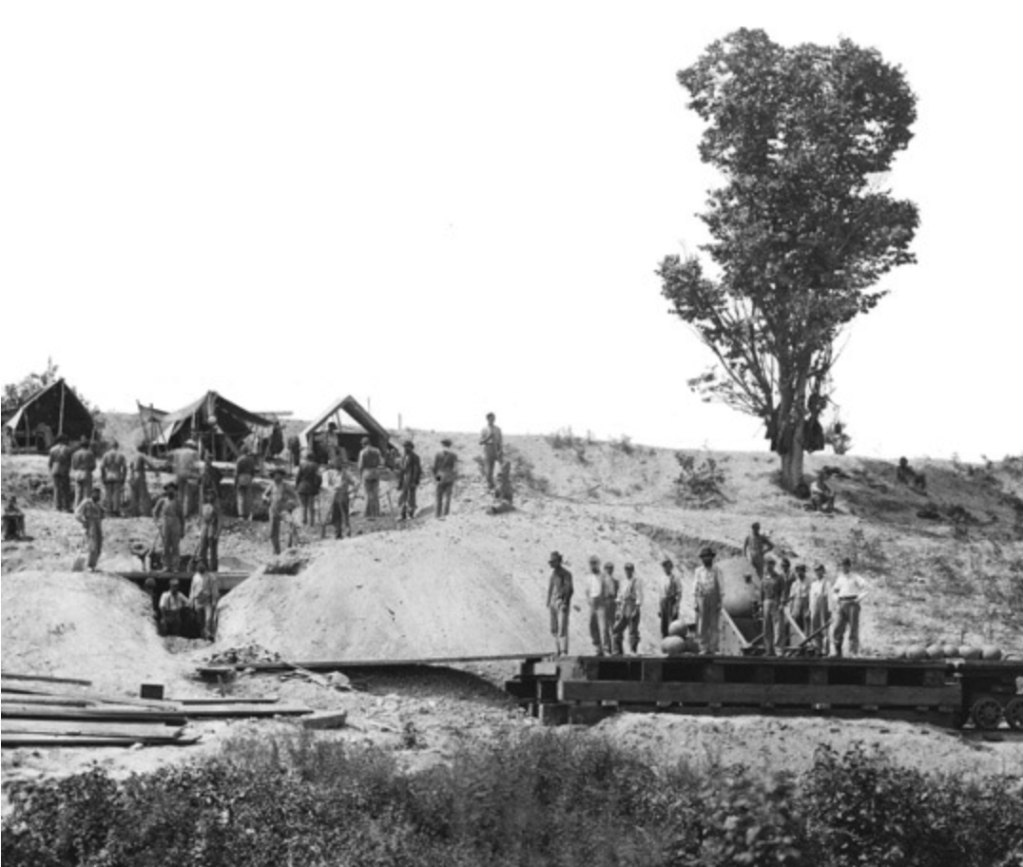
US Colored Troops at Petersburg (1864)

Letter 1

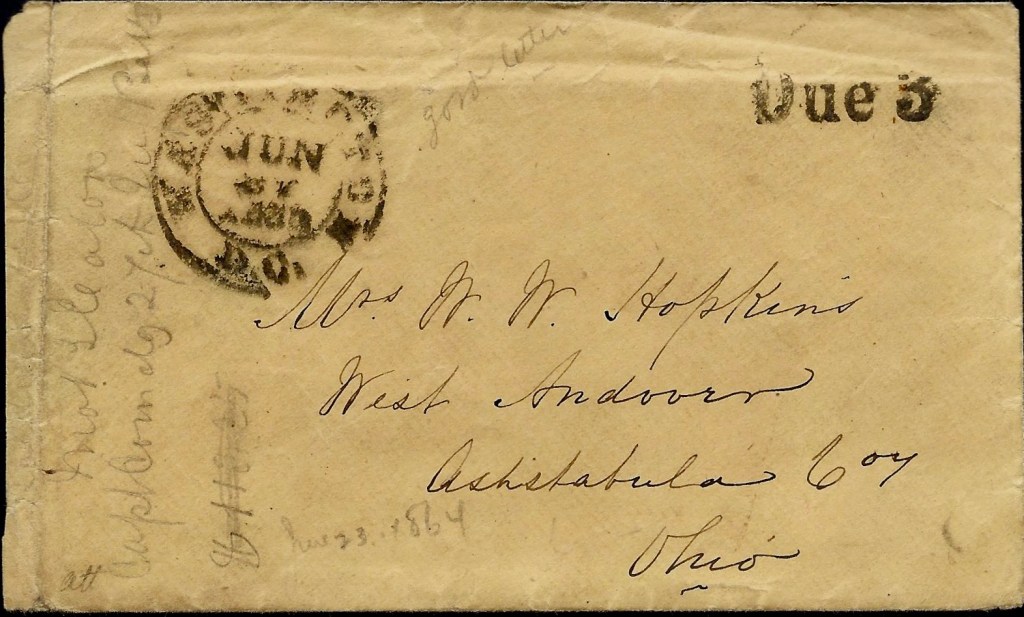
Addressed to Mrs. W. W. Hopkins, West Andover, Ashtabula County, Ohio

In the field
June 23rd 1864

Dear Sister,

I am now lying in the breastworks of our front lines, beside of my gun & occasionally firing a shot at the enemy & keeping my head out of sight as much as possible when not necessary to otherways. The sharp shooters are busy on both sides and make it very unpleasant, to say the least about it, for one dare not stir outside of the breast works.

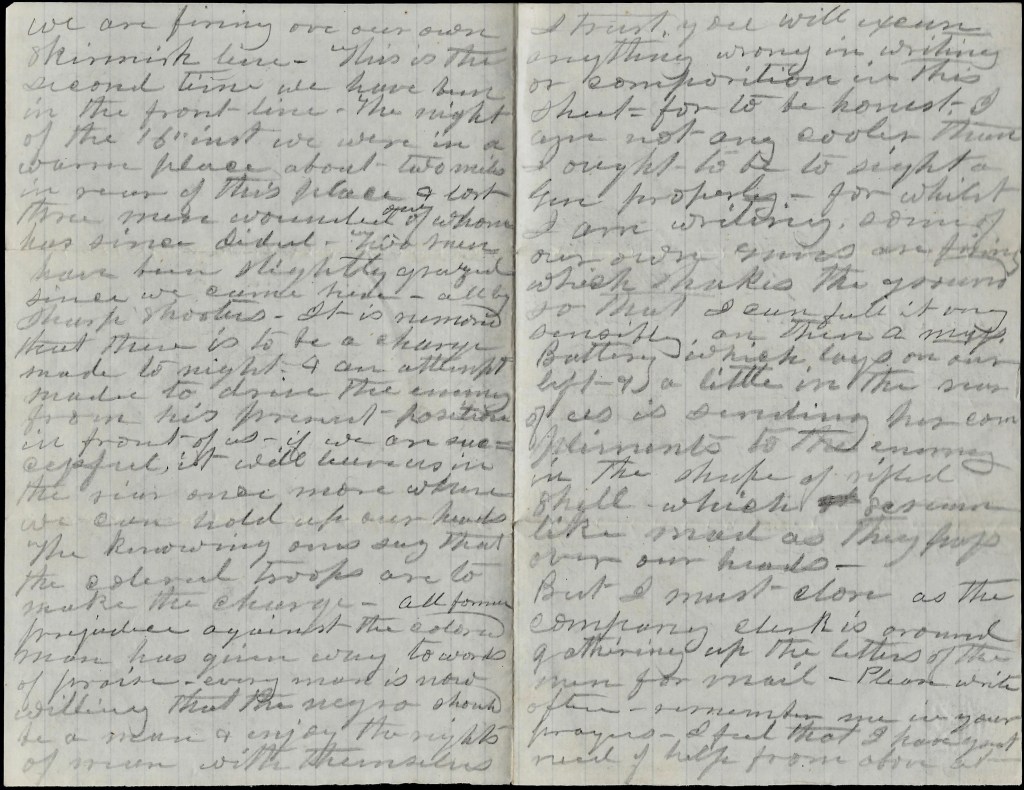
We came into the present position at two o’clock this morning. How long we shall have to lay here is hard to tell. Our breastworks are within about three hundred yards of the Petersburg & City Point Railroad which constitutes our skirmish line. The rebel works are about the same distance beyond the railroad. Consequently we are firing over our own skirmish line. This is the second time we have been in the front line. The night of the 16th inst., we were in a warm place about two miles in rear of this place & lost three men wounded—one of whom has since died. Two more have been slightly grazed since we came here—all by sharp shooters. It is rumored that there is to be a charge made tonight & an attempt made to drive the enemy from his present position in front of us. If we are successful, it will leave us in the rear once more where we can hold up our heads.

“The knowing ones say that the colored troops are to make the charge. All former prejudice against the colored man has given way to words of praise. Every man is now willing that the negro should be a man & enjoy the rights of man with themselves.”

David Hopkins, 27th N. Y. Battery, 23 June 1864

The knowing ones say that the colored troops are to make the charge. All former prejudice against the colored man has given way to words of praise. Every man is now willing that the negro should be a man & enjoy the rights of man with themselves.

I trust you will excuse anything wrong in writing or composition in this sheet, for to be honest, I am not any cooler than I ought to be to sight a gun properly, for whilst I am writing, some of our own guns are firing which shakes the ground so that I can feel it very sensibly, and then a Mass. Battery which lays on our left & a little in the rear of us is sending her compliments to the enemy in the shape of rifled shell which scream like mad as they pass over our heads.

But I must close as the company clerk is around gathering up the letters of the men for mail. Please write often. Remember me in your prayers. I feel that I have great need of help from above at this time more than ever before. Much love to all the family. I have not time to write all separately. They must take will for the deed & consider this a family letter and all answer it. A little tin, if you can afford it, of black pepper in each letter or paper will be very thankfully received as I can’t get such things here in such quantities as are needed. Tea I cant get at all at any price.

Address 27th New York Battery, 1st Division, 9th Corps. There is a band playing national airs at the present time about one mile in the rear but we can hear it very distinctly & no doubt the Rebs can too, which must be anything but pleasing to them. But I don’t suppose that Grant intends to do anything to please them if can avoid it. But I must close. Goodby & may God bless you all, — David Hopkins

Letter 2

Monday, August 1, 1864

Dear brother Charley,

Yours of the 26th came to hand in due season. Also the fourth paper containing tobacco which many thanks. Also for the postage stamps which were just on time.

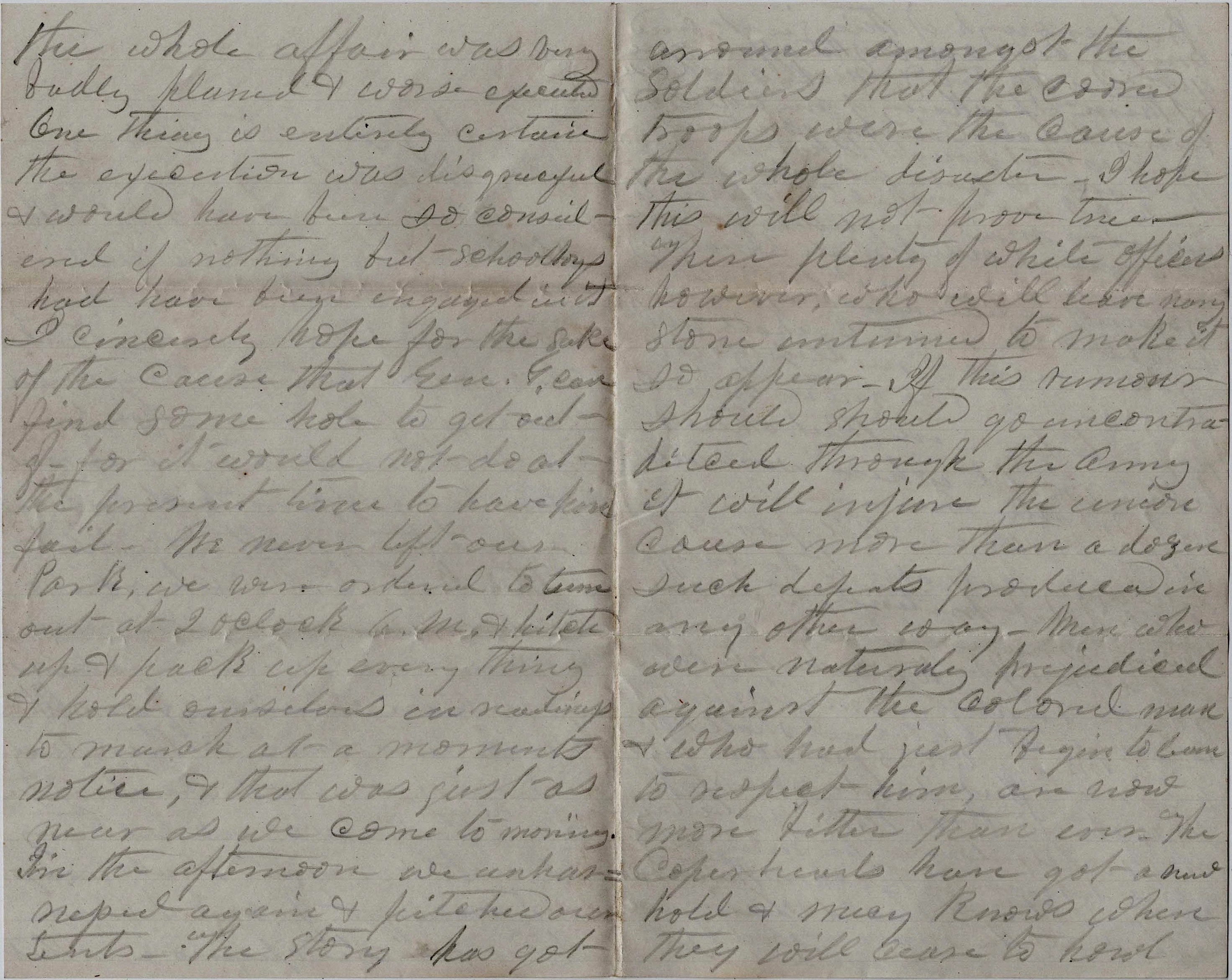
You have no doubt ere this read an account of the big fizzle which came off here the 30th ult. & whilst I think of it I wish you would send me a full account of the affair as you can obtain, for although we were within long range of a good deal of the fighting, we know nothing about [it] and never shall unless we can get it from home. My private opinion is that the whole affair was very badly planned and worse executed. One thing is entirely certain, the execution was disgraceful & would have been so considered if nothing but schoolboys had been engaged in it. I sincerely hope for the sake of the cause that General Grant can find some hole to get out of for it would not do to have him fail.

We never left our park. We were ordered to turn out at 2 o’clock a.m. & hitch up and pack ourselves in readiness to march at a moment’s notice, & that was just as near as we came to moving. In the afternoon we unharnessed again and pitched our tents. The story has got around amongst the soldiers that the colored troops were the cause of the whole disaster. I hope this will not prove true. There’s plenty of white officers, however, who will leave nary stone unturned to make it so appear. If this rumor should go uncontradicted through the army, it will injure the Union cause more than a dozen such defeats produced in any other way. Men who were naturally prejudiced against the colored man & who had just begun to come to respect him, are now more bitter than ever. The Copperheads have got a new hold & mercy knows when they will cease to howl.

But enough of this. Just send me the best accounts of the affair you get. I will try & make good use of them.

Speaking of my letters not being directed in my own hand requires that I ought to have mentioned the cause. I have not always had ink & I have asked the officers to direct and mail my letters for me. As a general rule I shall direct my own but in any event, try and give yourself as little uneasiness as may be about. Be sure I shall not expose myself needlessly & if I fall to rise no more here, I hope to live in that other & better world wherewars will not trouble me.

My health is still poor & I am only half able to do duty & in fact, don’t pretend to do anything. I have not even energy enough left to wash my own shirts. And unless some important change takes place, I shall not write many letters for some days to come. But don’t you stop.

I wrote to Brother W. W. yesterday at West Andover. He may be gone before it reaches there but no matter. I shall slaim one ahead all the same. Goodbye, — David

1863: Edward Alexander McConnell to Edward McConnell

This partial letter was written by Edward Alexander McConnell (1844-1867), the son of emigrants Edward McConnell (1805-1878) and Charlotte McGlashan (1813-1889) of Chicago, Cook county, Illinois. At the time of the 1860 US Census, 16 year-old Edward was working as a clerk in Chicago. After the war, Edward married Susannah Richards Colehour, who gave birth to their only child four months after Edward’s death in February 1867.

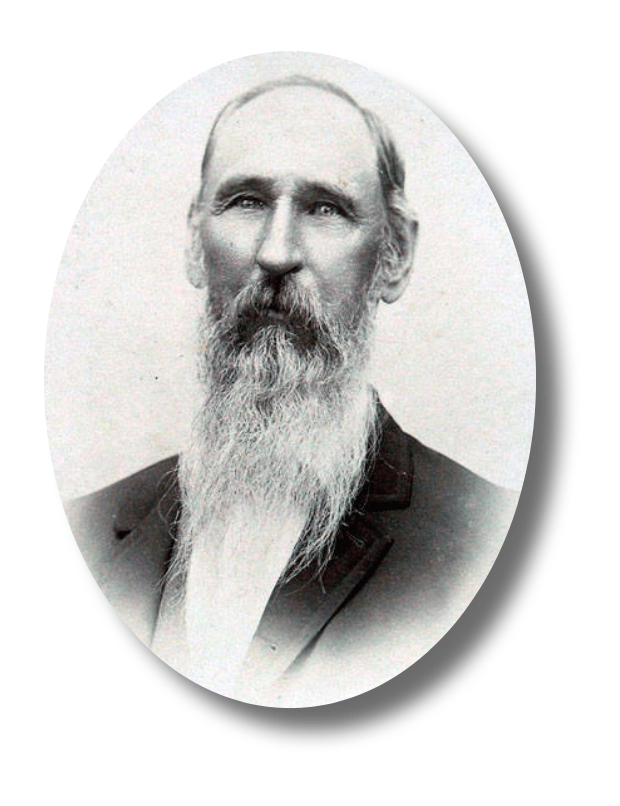
I could not find an image of Edward but here is Azel D. Hayward who also served in Co. B, 72nd Illinois Infantry (Randy Hayward Collection)

During the Civil War, Edward enlisted as a private in Co. B, 72nd Illinois Infantry (the “First Chicago Board of Trade Regiment”) in August 1862. He was promoted to corporal in June 1863 and to sergeant in September 1863.

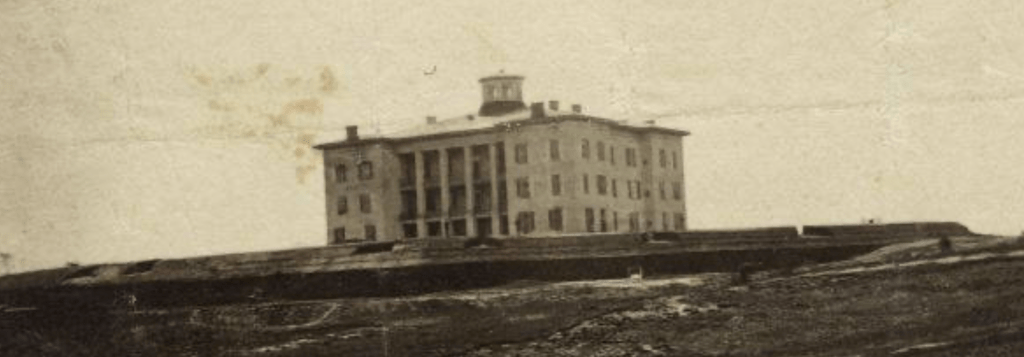
In his letter, Edward writes a paragraph on the Black troops in Natchez in September 1863 and of the construction of a new fortification there on the north side of town. On July 13, 1863, Union troops arrived in Natchez and “established the Union Army headquarters at the Rosalie Mansion. By August of 1863, more U.S. Colored Troops began residing in Natchez. A large number of black men that enlisted were from Natchez or had left plantations in surrounding areas such as Franklin County, Jefferson County, Wilkinson County, etc. During the Fall of 1863, the soldiers began working on the construction of a fortification named for General James Birdseye McPherson. There were over 3,000 colored troop soldiers who served in the six regiments at Fort McPherson. These regiments included the sixth U.S. Colored Heavy Artillery, 58th U.S. Colored Infantry, 70th U.S. Colored Infantry, 71st U.S. Colored Infantry, 63rd U.S. Colored Infantry, and the 64th U.S. Colored Infantry.” [The Story of the Natchez US Colored Troops by Inesha Jackson]

The Union Battlements of Fort McPherson, encompassed the United States Marine Hospital

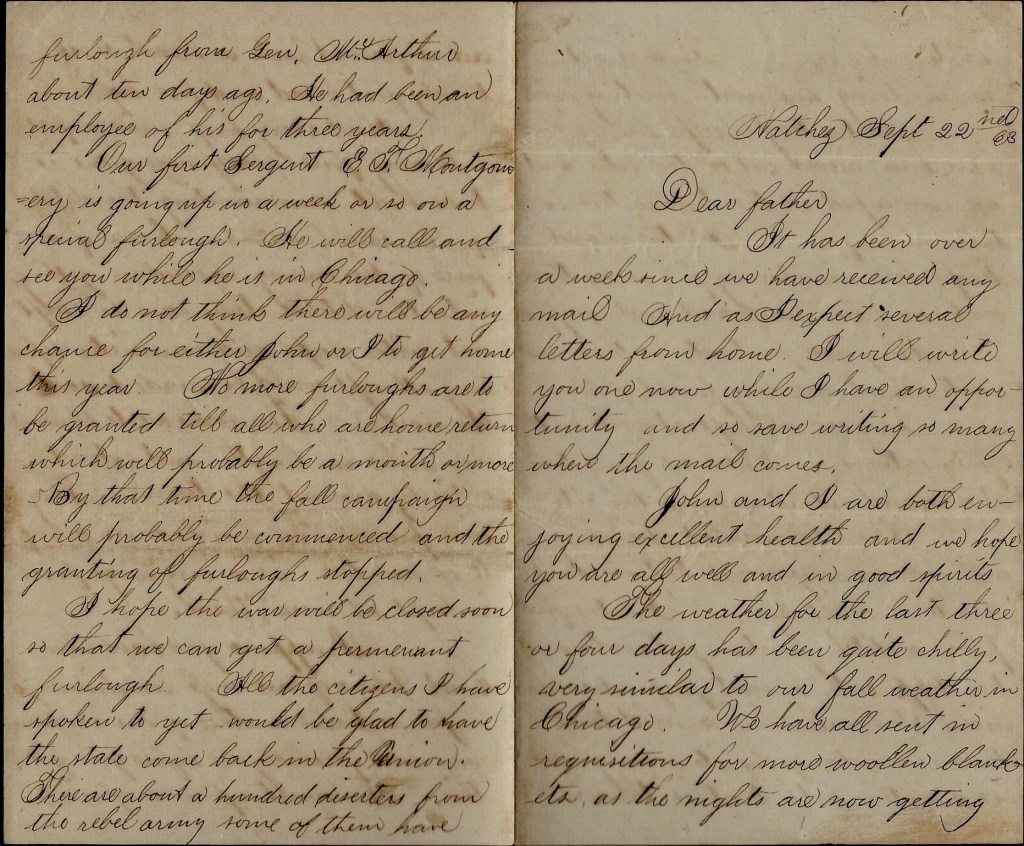
Transcription

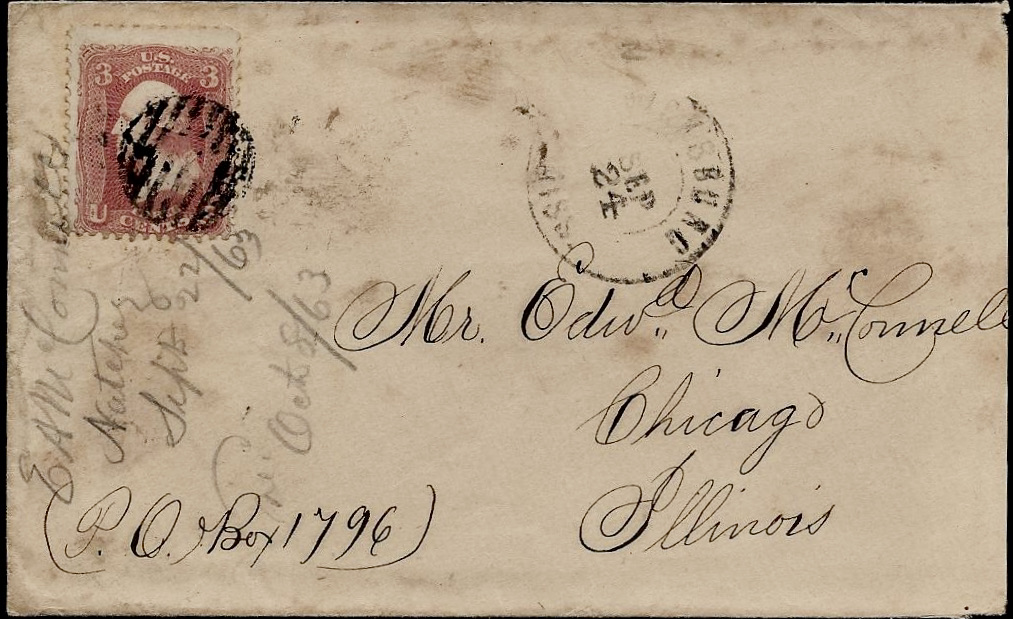
Addressed to Mr. Edward McConnell, Chicago, Illinois

Natchez [Mississippi]
September 22, 1863

Dear father,

It has been over a week since we have received any mail and as I expect several letters from home, I will write you one now while I have an opportunity and so save writing so many when the mail comes.

John and I are both enjoying excellent health and we hope you are all well and in good spirits. The weather for the last three or four days has been quite chilly—very similar to our fall weather in Chicago. We have all sent in requisitions for more woolen blankets as the nights are now getting quite cool. There is not much doing here worth writing about.

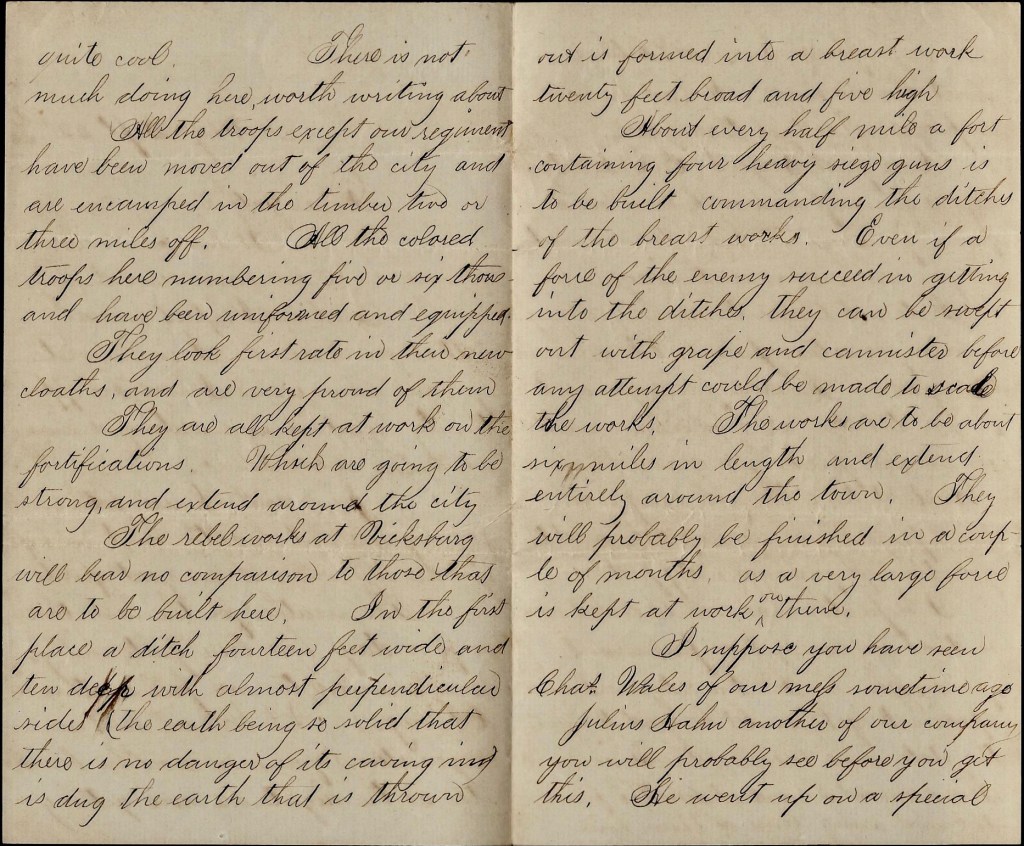
All the troops except our regiment have been moved out of the city and are encamped in the timber two or three miles off. All the colored troops here numbering five or six thousand have been uniformed and equipped. They look first rate in their new clothes and are very proud of them. They are all kept at work on the fortifications which are going to be strong and extend around the city.

The rebel works at Vicksburg will bear no comparison to those that are to be built here. In the first place a ditch fourteen feet wide and ten feet deep with almost perpendicular sides (the earth being so solid that there is no danger of its caving in) is dug. The earth that is thrown out is formed into a breastwork twenty feet broad and five high. About every half mile a fort containing four heavy siege guns is to be built commanding the ditches of the breastworks. Even if a force of the enemy succeeds in getting into the ditches, they can be swept out with grape and canister before any attempt could be made to scale the works. The works are to be about six miles in length and extend entirely around the town. They will probably be finished in a couple of months as a very large force is kept at work on them.

I suppose you have seen Charles Wales of our mess sometime ago. Julius Hahn another of our company you will probably see before you get this. He went up on a special furlough from Gen. McArthur about ten days ago. He had been an employee of his for three years.

Our First Sergeant E[than] T. Montgomery is going up in a week or so on a special furlough. He will call and see you while he is in Chicago. I do not think there will be any chance for either John or I to get home this year. No more furloughs are to be granted till all who are home return which will probably be a month or more. By that time the fall campaign will probably be commenced and the granting of furloughs stopped.

I hope the war will be closed soon so that we can get a permanent furlough. All the citizens I have spoken to yet would be glad to have the state come back in the Union. There are about a hundred deserters from the rebel army. Some of them have [rest of letter missing].

1864: Edmund Lockett Womack to Sallie (Elliott) Womack

These two letters were written by Edmond “Lockett” Womack (1834-1913), the son of William A. and March (Lockett) Womack of Prince Edward, Virginia He was married to Sallie Emmett Elliott (1827-1918) in May 1857 and had several children born before, during, and after the war.

Edmund Lockett Womack (ca 1895)

Lockett entered the Virginia Military Institute (VMI) in July 1853 but was dismissed in December of that year for neglect of duties and studies.

During the Civil War, Lockett enlisted in Co. D (the “Prospect Rifle Grays”), 18th Virginia Infantry as a private in early 1861 and was quickly made a corporal. At the time that Lockett wrote these letters in late 1864, the 18th Virginia Infantry was still serving in Pickett’s Division, 1st Corps, Army of Northern Virginia. Both letters were written from the encampment of the regiment near Chester Station on the line between Richmond and Petersburg.

By this late stage in the war, most picket lines were generally quiet at night—both Union and Confederate soldiers themselves having agreed to, and abided by, an understanding that they would not fire on one another. This gentleman’s agreement fell by the wayside, however, once the Union army started assigning Negro soldiers to picket duty. Lockett’s letter of 1 December 1864 gives yet another account of Rebels firing on Negro pickets. This increase in nighttime firing was not limited to musketry; segments of the Union lines known to be manned by USCT regiments were also targeted purposely by the Rebel artillery. [For other accounts of Confederate soldiers firing on USCT pickets, see “Confederate Soldiers in the Siege of Petersburg….” by Matthew R. Lempke]

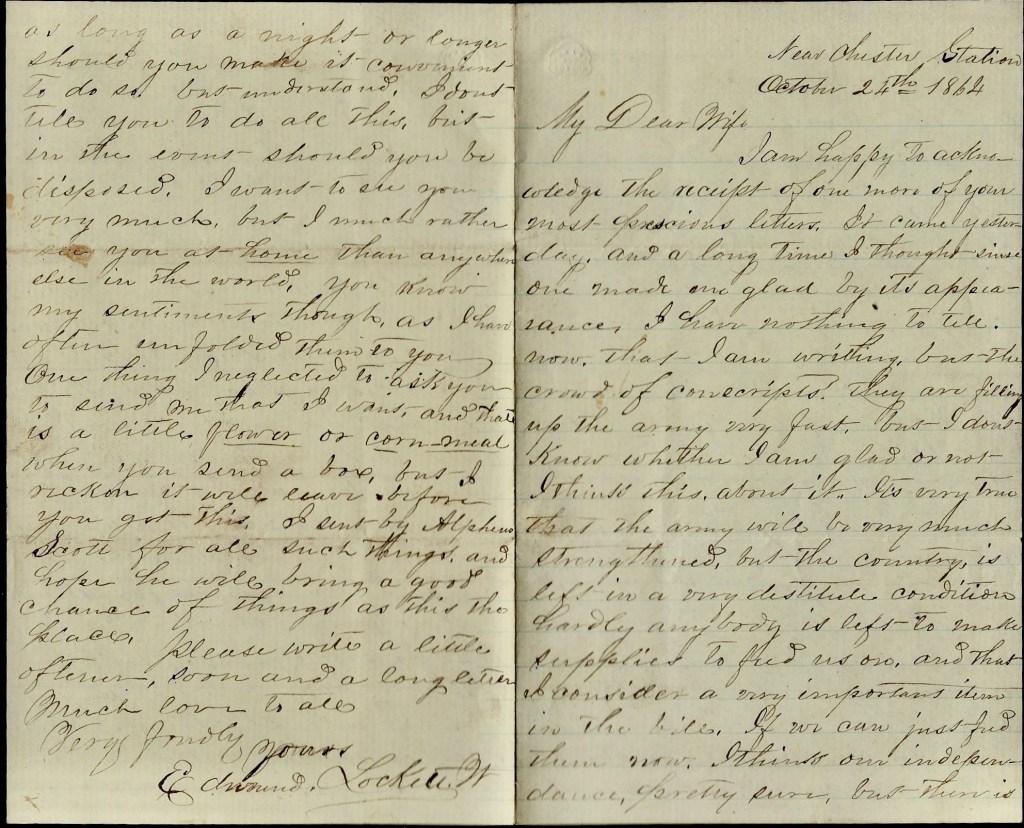
Letter 1

Near Chester Station
October 24th 1864

My Dear Wife,

I am happy to acknowledge the receipt of one more of your most precious letters. It came yesterday and a long time I thought since one made me glad by its appearance. I have nothing to tell now that I am writing but the crowd of conscripts—they are filling up the army very fast but I don’t know whether I am glad or not. I think this about it. It’s very true that the army wil be very much strengthened, but the country is left in a very destitute condition—hardly anybody is left to make supplies to feed us on, and that I consider a very important item in the bill. If we can just feed them now, I think our independence [may come] pretty soon, but there is great fears entertained in respect to the negroes destroying what has already been made and then again of their not making much more as there are but very few men left and they old men. Though we can only hope for the best should the worst come.

My greatest hope is in the Presidential Election. I am very much in hopes that will end the thing in our favor. I just stopped a little while to see Mr. Wilbourne. He is in at last. Is now sitting down in my house and talking very much to our amusement. He thinks the army is a terrible place. He is in Rice’s Depot Company but very anxious to come to this regiment and get n our company but I don’t think there is much chance for that, for our company is about filled up now. I think we have about fifty men for duty in our company, some sick in hospitals, and William Hunt is one. You may tell Mr. Hunt’s folks when you see them he is slowly improving. I think he is a little low-spirited.

When you come down to Richmond, tell Pa to come with you. They have no right to interrupt him, and if I can, I will come to see you. But I don’t want you to come out here. It is no place for ladies. Pa can come but not you. If I didn’t love you, probably I might tell you to come, but under the circumstances I do not not. I want to see you the worst in the world and you can come as far as Chester but no farther, or rather I wouldn’t like to see you any farther this way. I can come up there any time and will. Should you come, I reckon we can procure a room there should you want to stay as long as a light or longer should you make it convenient to do so. But understand, I don’t tell you to do all this, but in the event should you be disposed. I want to see you very much, but I much rather see you at home than anywhere else in the world. You know my sentiments though as I have often unfolded them to you. One thing I neglected to ask you to send me that I want, and that is a little flour or corn meal when you send a box, but I reckon it will leave before you get this. I sent by Alpheus Scott for all such things and hope he will bring a good chance of things as this the place.

Please write a little oftener, soon and a long letter. Much love to all. Very fondly, your Edmund Lockett W[omack]


Letter 2

Near Chester [Station]
December 1st 1864

My Dearest Sallie,

Agreeably to promise, I hasten to comply though but little of importance has transpired since I saw you last. As soon as the cars left that day, I started for camp. hurried on and to my great surprise and mortification I was informed immediately after arriving at camp of the death of Charles Richardson & Thomas Weaver, both of the Farmville Company [18th Va., Co. F]. They both were killed by the fragments of the same shell while on the picket line, and I understood they were both asleep at the time—shot through the head. I saw Charley—brought him off myself. The ball or fragment entered the back of his head and came through the right jaw a little below the mouth, cutting the face frightfully. I didn’t see the other man atall, but he had just gotten back off furlough and I think that was the first time he had been on picket.

The cause of the shelling was from our men shooting at their negro pickets, but today has been remarkably quiet. They hollowed to our men this morning early not to shoot, that they had no negroes on them, called our men, “Johnny Reb,” and we call theirs, “Corporal Dick and Joe”—real negro names you know. I expect we will have hot times again tomorrow from the fact that a deserter came over to us tonight and said they had on negroes again, but I reckon they will take them off before light, which if they do, all will be quiet again as today has been.

I told Ed what you said and said that he though more of you than any of the rest of his sisters or brothers but as he had said that he wouldn’t come to see any female relative near the army, he thought he would be as good as his word. But I don’t think that was his best reason, though I am not able to say what it was. I am glad to say that John Womack received a box this evening with potatoes, apples, meat, and several other things [including] two spoilt chickens which we had to throw away of course. This I believe is all that has transpired of any note since I parted with you.

Now hoping that you will have a safe and pleasant trip home, I must close by asking you to remember me to the family by presenting my best love and kindest wishes to them all. Kiss all the little ones for me when you see them together. Write soon after arriving at home and be sure don’t forget to tell Pa to send a statement of what Scott got and what he paid as it will be of service to me.

I am devotedly yours, &c., — Lockett

P. S. Please send for my puppies at Uncle Cobbs.

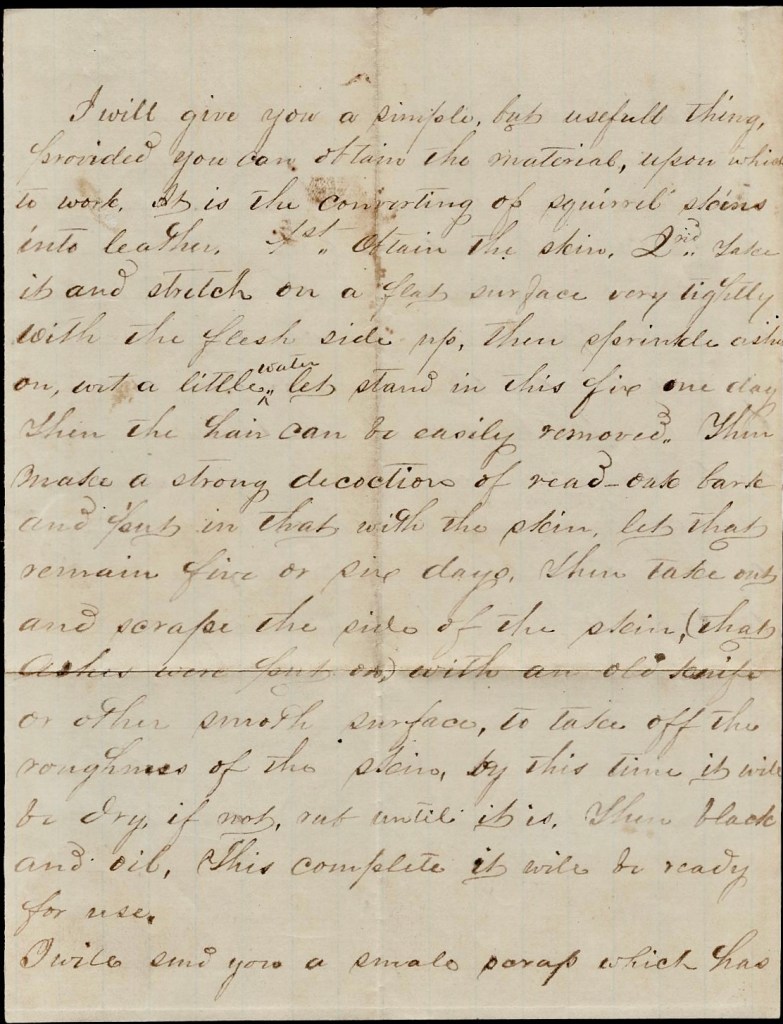
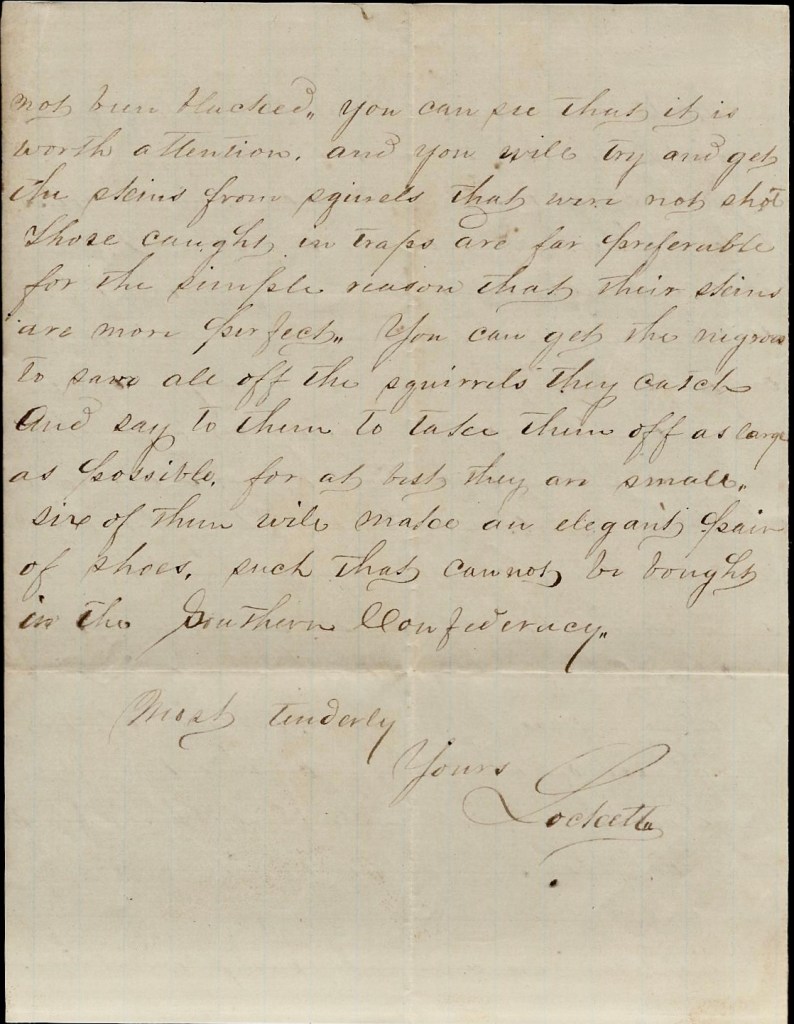
[There is an attached document that I did not transcribe describing the skinning of squirrels. It ends with thee following; “Try to get the skins from squirrels that were not shot. Those caught in traps are far preferable for the simple reason that their skins are more perfect. You can get the negroes to save all the squirrels they catch and say to them to take them off as large as possible for at best they are small. Six of them will make an elegant pair of shoes such that cannot be bought in the Southern Confederacy.“]