I have not yet been able to attribute this letter signed by “Oscar” to his sister, “C. J. Emerson” to any particular soldier. It seems apparent that Oscar was serving in the same company with a brother named William and that he possibly had another brother named Joe who served in another regiment. I think there is a strong possibility they enlisted from a Midwestern state because Oscar expresses interest in knowing the names of those killed at the Battle of Shiloh in Tennessee.
Transcription
Newmarket, Va. May 1st 1862
Dear sister,
I received yours of April 16th last night. We have both written since we had any letters from home. I wrote to Pa from Strasburg. We stay only a few weeks in a place but our letters follow along after awhile. I have been unwell for a few days from a severe cold and a slight touch of the jaundice, but I am much better today. William will speak for himself. He is now on drill.
I sent a box of books and clothing home from Strasburg by express thinking they would be worth the expressage at least. If I ever get there, they will be valuable to me. If not, do as you please with them. And if they never get there, they will cost nothing to anyone.
I should enjoy your lectures, society meetings, and public exercises very much and hope soon to be able to be with you once again and enjoy the comforts of friends, home and old associates. You perhaps hear the news and know the progress of the war better than we do. But we hope soon to be no longer needed in the tented field.
Give my love to Libbie in return for hers. I cannot but recur to the time spent at school at H. with pleasure and at times even now my heart longs for liberty to return again to my old associates. You spoke of teaching. Certainly teach even if you get only your board as you will be better prepared to meet life’s stern reality.
I have had no letter from Joe for near two months. I suppose he is at or near Yorktown. We have not yet heard who were killed at Pittsburg Landing. I see I am near the bottom of the page so I must close. Give my best respects to all who inquire and believe me your sincere brother, — Oscar
The following letter was written by Elias Prather Musgrave (1844-1864)m the son of Jacob Eli Musgrave (1805-1857) and Elizabeth Flake (1813-1899) of Martinsville, Morgan county, Indiana. Elias and Mattie Evans were married in May 1863. Elias wrote the letter to his mother and siblings but primarily to his cousin George W. Flake (b. 1840) who lived in Martinsville too.
A relative, Walton Musgrave (1828-1874), is mentioned in the letter. In 1860, Walton was a farmer in Warren township, Marion county, Indiana. He was married to Olive Smith (b. 1841) in 1856.
Transcription
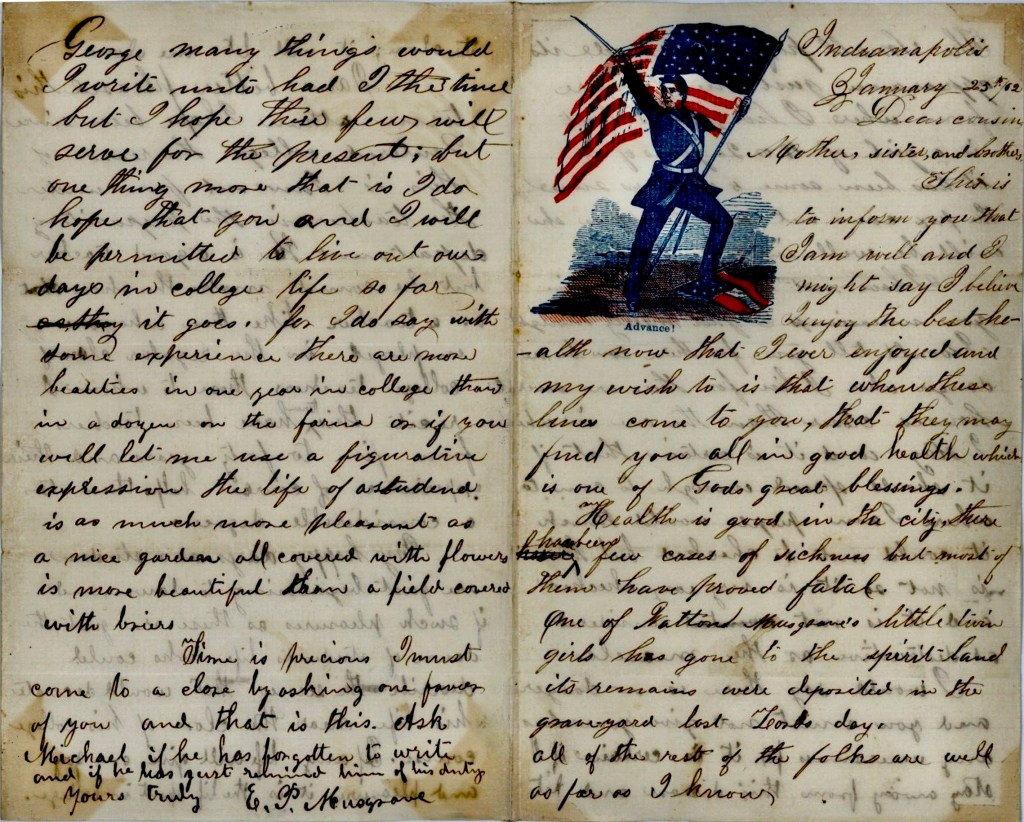
Indianapolis [Indiana] January 23, 1862
Dear cousin, Mother, sister, and brothers,
This is to inform you that I am well and I might say I believe I enjoy the best health now that I ever enjoyed and my wish to is that when these lines come to you, that they may find you all in good health which is one of God’s great blessings. Health is good in the city; there has been a few cases of sickness but most of them have [not] proved fatal.
One of Walton Musgrave’s little twin girls has gone to the spirit land. Its remains were deposited in the graveyard last Lord’s day. All of the rest of the folks are well as far as I know.
The small pox has made its appearance just one square from where I live; the subject is a girl of 18 or 20 years of age. It has been some 5 or 6 days since the pox came out and I suppose she will be well in a few days.
I have not written this to give you uneasiness. I just merely thought I would tell you for there are several houses closer than the one in which I stay and it is certain that if it should spread enough to come to where I am, people would think it could not be checked. But this is not so. It is very easy checked and it is not considered as destructive as the measles. I would say there is no danger and you must not give yourselves any uneasiness for it is certain if I stay away from this disease and let it alone, it will let me alone.
I am better pleased this term than I have been since I entered college. The reason of this is I am out from under the teacher in the preparatory department. He is a good teacher but he cannot make the show as a teacher like those who are employed in the regular class of college teachers those to whom I recite this term have been teachers from five to forty years and their experience of course helps them to a considerable degree.
My happy days as a student are just beginning to dawn and if such pleasures as these are just the dawn of student’s life, who could describe scenes that would decorate his life near the close of his college course. If any life will give one joy and pleasure, it is the life spent in college.
George, many thing would I write had I the time but hope these few will serve for the present. But one thing more—that is I do hope that you and I will be permitted to live out our days in college life so far it goes for I do say with some experience there are more beauties in one year in college than in a dozen on the farm, or if you will let e use a figurative expression, the life of a student is as much more pleasant as a nice garden, all covered with flowers is more beautiful that a field covered with briars.
Time is precious. I must come to a close by asking one favor of you and that is this. Ask Michael if he has forgotten to write and if he has, just remind him of his duty. Yours truly, — E. P. Musgrave
I feel pretty confident this letter was written by Jacob Fisher (1823-1905) who was born in Germany in 1823 and came to Buffalo, New York in 1833 with his parents, and then came to Racine, Wisconsin about 1845. According to his obituary, he worked for many years for the Case T. M. Co. as a machinist. He did serve in the Civil War but did not enter the service until September 1864 as a recruit in Co. D, 16th Wisconsin Infantry. In this letter he claims to have enlisted in the 22nd Wisconsin but says he was “sorry” he enlisted and given that the regiment was urgently mustered in and moved out to Kentucky just a couple days after he wrote this letter, my hunch is that he was never mustered in. At least there is no one by that name appearing in the regimental roster. At the age of 36, Jacob married his first wife, Anna Stecher (1836-1911) in 1859.
Transcription
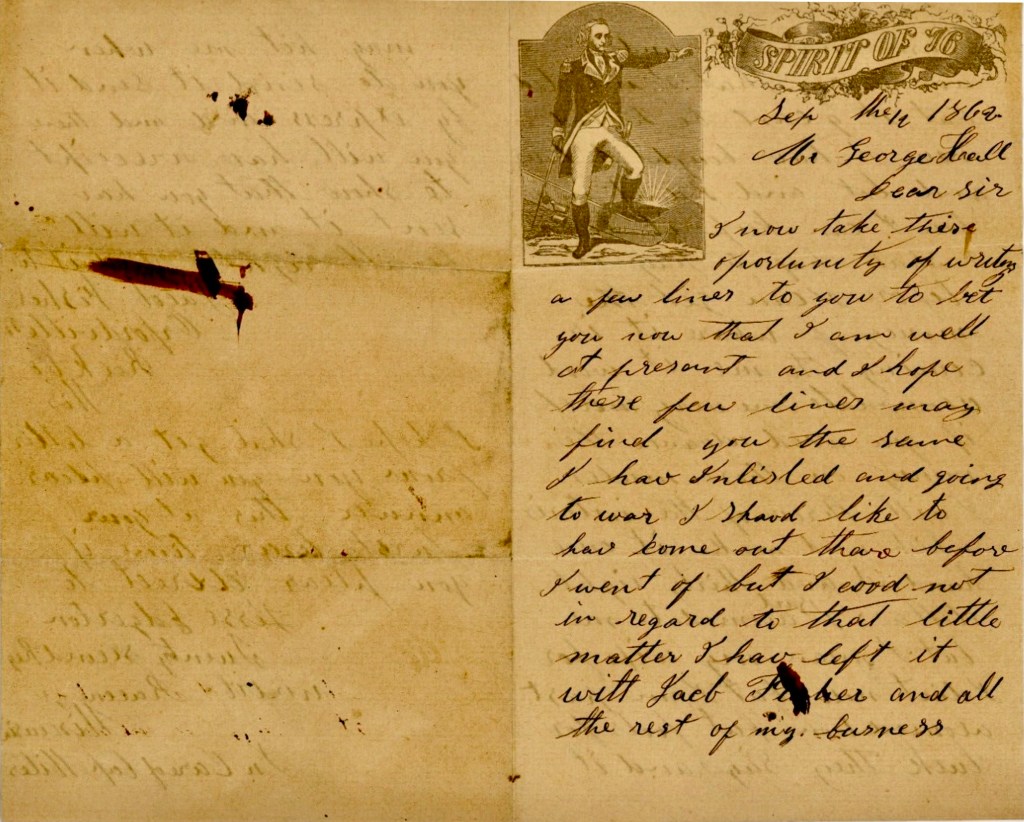
September 12, 1862
Mr. George Hall, dear sir, I now take this opportunity of writing a few lines to you to let you know that I am well at present and I hope these few lines may find you the same. I have enlisted and going to war. I should like to have come out there before I went off but I could not.
In regard to that little matter I have left it with Joeb Fisher and all the rest of my business. I am married and I am sorry that I enlisted but it can’t be helped now. I have bought a house and lot and I don’t know how I can keep it for I shall have to pay it before I can get the money, were it is coming to me. It would accommodate me very much if you would advance the money on those mules. I will throw off the interest which would make it one hundred and thirty-eight dollars. I said accommodate me but I mean my wife for I don’t know but I am past accommodation. But fools for luck, they say, and it may hit me. When you do send it, send it by express and then you will have a receipt to show that you have sent it and it will be all right. Send it to Jacob Fisher, Orfordville T., Rock county, Wisconsin
I hope I shall get a letter from you. You will please answer this at your first leisure time if you please. Direct to Jesse Edgerton, 22nd Regiment Wisconsin Vols. Racine, Wisconsin, in care of Capt. Miles
This unsigned or partial was written by a soldier who most likely served in the 37th Illinois, the 9th Missouri Infantry 9changed to 59th Illinois), the 5th Iowa Infantry, or 1st Kansas Infantry as they were brigaded together in late September 1861 at Boonville, Missouri, under the command of J. C. Kelton.
Transcription
Syracuse, Missouri December 5th 1861
Friend Thompson,
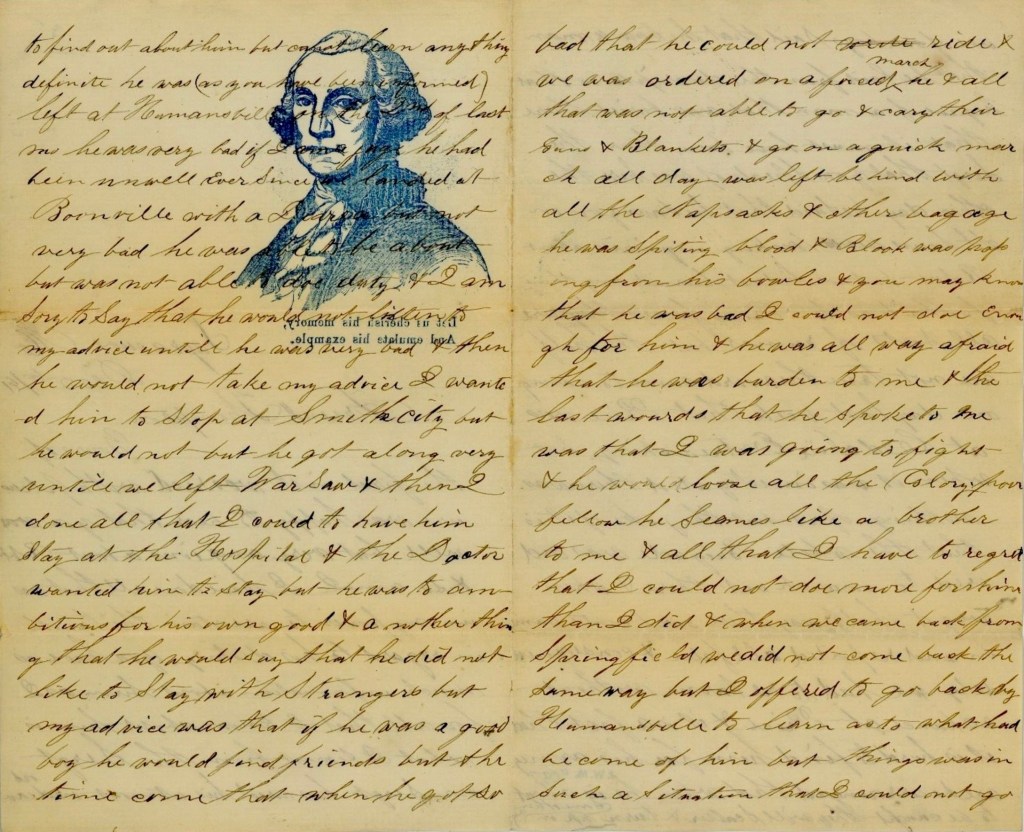
Yours of the 1st inst. was received with pleasure. Was happy to hear that you was well but very anxious about Robert & so am I. I have done all that was in my power to ascertain the truth in regard to his destiny. You have as much information about him as I for all that I know about him is what I learnt from the Sergeant. Our sergeant has used his utmost endeavors to find out about him but cannot learn anything definite.
He was (as you have been informed) left at Humansville 1 on the 2nd of last month. He was very bad if I can judge. He had been unwell ever since we landed at Boonville with a diarrhea but not very bad. He was able to be about but was not able to do duty & I am sorry to say that he would not listen to my advice until he was very bad & then he would not take my advice.
I wanted him to stop at Smith City but he would not, but he got along very [well] until we left Warsaw & then I done all that I could to have him stay at the hospital & the Doctor wanted him to stay but he was too ambitious for his own good and another thing that he would say that he did not like to stay with strangers, But my advice was that if he was a good boy, he would find friends. But the time come that he got so bad that he could not ride & we was ordered on a forced march. He and all that was not able to go & carry their guns and blankets and go on a quick march all day was left behind with all the knapsacks & other baggage.
He was spitting blood & blood was pooping from his bowels & you may know that he was bad. I could not do enough for him & he was always afraid that he was a burden to me & the last words that he spoke to me was that I was going to fight & he would lose all the glory. Poor fellow. He seems like a brother to me & all that I have to regret [is] that I could not do more for him that I did. And when we came back from Springfield, we did not come back the same way but I offered to go back by Humansville to learn as to what had become of him but things was in such a situation that I could not go.
One of our boys said that he saw a man that he said from the description that he gave of a man that was buried there that it must have been him. The Sergeant that you speak of was here the other day. He said that he saw you in St. Louis . He was making inquiries about Robert but we had not learned anything further.
And as to Price’s forces, there are all sorts of rumors but the half are not true. The word came to camp one day last week that Price was at Sedalia entrenching but when it was investigated, there was nothing of it. But the joke of it is that the whole brigade was ordered to march out there and when we got half way there, our scouts came in and reported all false & consequently we had to return without a chance at Price. And it is a fact that it is hard to find him for his army are so arranged that she he is about to be caught, they will scatter & turn up in some other way. [unsigned or partial]
1 In the regimental history of the 59th Illinois Infantry, Humansville was described as a “small town in Hickory County, Mo., and is the only place where any demonstrations were made, in honor of the stars and stripes, between Boonville and Springfield. Here the soldiers of the Union were welcomed by the waiving of flags and the smiles of the women, and the kindly greetings of the citizens generally. A portion of Price’s army had passed through this place, some three weeks before, and had carried off all the goods belonging to the merchants, and had mistreated the inhabitants of the town and vicinity to such a degree, that they were heartily tired of their presence, and were rejoiced at the approach of the Federal troops….The sick of the regiment, had been increasing for the last ten days, to such an extent, that now there was no means of conveying them any farther. Thus far, they had been transported in wagons, but it was now necessary to select such as could not, in a measure, provide for themselves, and leave them behind. The Surgeon, therefore, fitted up the Meeting-house in town, in the best possible manner, and removed the sick to it. A cook, some nurses, and several days rations, were left with them. Poor fellows! they all nearly starved to death before they could get away, and three did die from the effects of disease and want of proper nourishment. After the army left, the patriotism of the ladies and gentlemen of the town, oozed out at their fingers ends, and our sick boys could get nothing from them. One man, John Clemens, of Co. H, who was very sick when taken there, died on the 4th of November. Bromwell Kitchen, of Co. F, soon followed, and Nathaniel B. Westbrook, of Co. A, died on the 20th. The others eventually found their way to the regiment.”
I have not yet learned the identity of this soldier whom I believe was probably from Ashtabula county, Ohio, and served in a three-month’s organization early in the Civil War, possibly the 19th OVI. More research is needed.
Transcription
Camp Goddard 1 Zanesville, Ohio June 12th 1861
Dear Etta,
I received your dear letter last night and at the same time Sam got one from Ellen. I have been waiting all of this week for a letter from our folks but have till this time heard nothing from them. Darling, you must excuse poor writing this time. I have been sick 2 to 3 days last week and although well now, I don’t feel quite so strong as I did before. I won’t be so nervous in a day or two. I hope you are well, darling. I beg of you to take better care of your (dear) self. I know it is carelessness with you. If you are real careful, dearest, and not look so much on the dark side of war, you will surely get well and I hope keep so. Since I heard you was sick, I couldn’t rest well nights not be contented day times. I always thought of you and I knew that your carelessness wouldn’t help you any in your sickness.
Darling, you must not get mad at what I say to you for you know I mean it all well and what I say to you is for your own good and also for mine so if you love me truly, my darling, and want me to feel contented here and keep in good health, then for my sake, take the best care of yourself for my sake and for your good.
We are still in this confounded camp and waiting for marching orders. I do wish they would call us in to action. We all want to go to Virginia but don’t know when we will go. The Government of this fine state is rather misusing us. We have not received our pay yet although our first month has long gone by. Our colonel started to Columbus last night to see about it and if possible get us away from here. The talk today is that all three-months men will be paid off and then sent home—that is, those who won’t go in for three years. I won’t go in for three years under any such mean government as this state has now got. I had thought of going in for three years under the U. S. Navy. It would be a good deal more healthy on the water than on land and although I have not said I would go, I can’t enlist till I get a consent from our folks and tat will be hard work for me to get it, and then further, I won’t go until I am insured that our aid is needed more than it now is.
I want you to advise me, dear one. I won’t go if you, Darling, says no. I don’t know how I can stay away from you, my dearest love, till my first campaign is up. But the next would be so much longer. Well, I will come to see you when my three months are up and then by that time I will know better and then both of us can talk it over. I won’t do anything about enlisting for three years till I see you so you can’t say I done as I wanted to without asking you.
I make awful poor work of this letter but I know you will excuse it considering where it comes from. I will do better next time.
Capt. Harvey J. Covell
Now about news. I am surely surprised to hear that H[arvey] J. Covell 2 has been telling such lies about us. He ought to be ashamed of himself. I had a letter from him day before yesterday and he don’t like it as well there as he did when in our company. They had to build their barracks themselves and in the rain as well. They have a rather poor camp ground.
Dear Etta, kiss little Lilly for me and Fanny and Orson. [unsigned].
1 Camp Goddard in Zanesville. The camp’s first building, a barracks, was finished on May 15, 1861. Just two days later, Camp Goddard already contained nearly two thousand volunteer soldiers. The camp remained in use only during 1861.
2 Harvey J. Covell (1835-1883) was the son of Silas Covell (1789-1853) and Eunice Latimer (1796-1865) of Rock Creek, Morgan township, Ashtabula county, Ohio. On June 1, 1861, Harvey joined the 23rd Ohio Infantry as a sergeant in Co. B. He later was commissioned a captain in Co. B, 6th USCT. See 1861: Harvey J. Covell to Louisa Olive Woolsey.
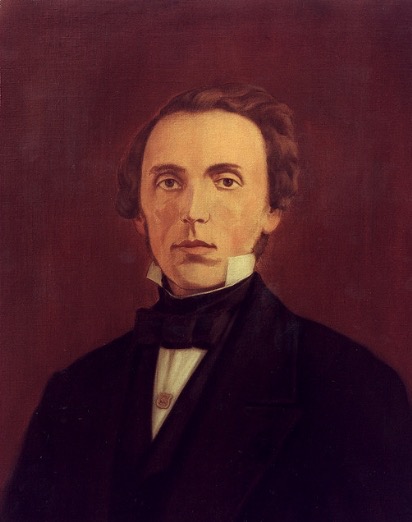
The following letter was written by Robert Stuart Morrison (1822-1902), the son of Thomas and Mary (Jennings) Morrison of Mount Gilead, Morrow county, Ohio. Robert was born in Green county, Pennsylvania, in March 1822. He graduated at Miami University (1852) and the Princeton Theological Seminary (1854), and until 1879 was a teacher and a minister of the gospel at Chicago and Louisville. While at the Miami University, Morrison, with five other students, founded the Phi Delta Theta Fraternity.
Robert Stuart Morrison, 1851
Morrison’s career as a minister, editor of religious publications, and teacher took him to Tennessee, Kentucky, Ohio, and Missouri. He edited the Louisville Presbyterian Herald from 1854 to 1860. He was also co-editor of the Louisville True Presbyterian, which was suppressed by Union military authorities in 1863, during the Civil War.
In September 1869, Morrison established Westminster Academy, a co-educational school in Waterford, Ohio, where he was principal for six years. He was also the principal of Poplar Grove Academy in Rutherford County, Tennessee. He combined his teaching duties with regular preaching. From 1879 to 1881 he worked as a financial agent to eliminate the debts of Westminster College and established the Phi Delta Theta Missouri Beta Chapter, in Fulton, Missouri. After this he preached at various locations around Missouri, and founded churches in towns such as Gravois Mills and Tuscumbia.
In his letter, Morrison speaks of the weekly newspaper recently purchased by himself, Andrew Davidson, and Stuart Robinson, which they named The True Presbyterian. The first issue of the publication was 3 April 1862. At the time, Morrison lived fifteen miles south of Louisville.
From Morrison’s letter, we learn that he made a trip out to Camp Chase for the purpose of seeing his friend, Col. Joel Allen Battle, 20th Tennessee Infantry. The colonel was taken captive during the Battle of Shiloh in early April 1862. After being held in Columbus, he was later taken to the prison at Johnson’s Island where he was not exchanged until September 1862. Two of Battle’s son’s were killed at Shiloh—William Searcy Battle (1835-1862) and Joel Allen Battle, Jr. (1838-1862).
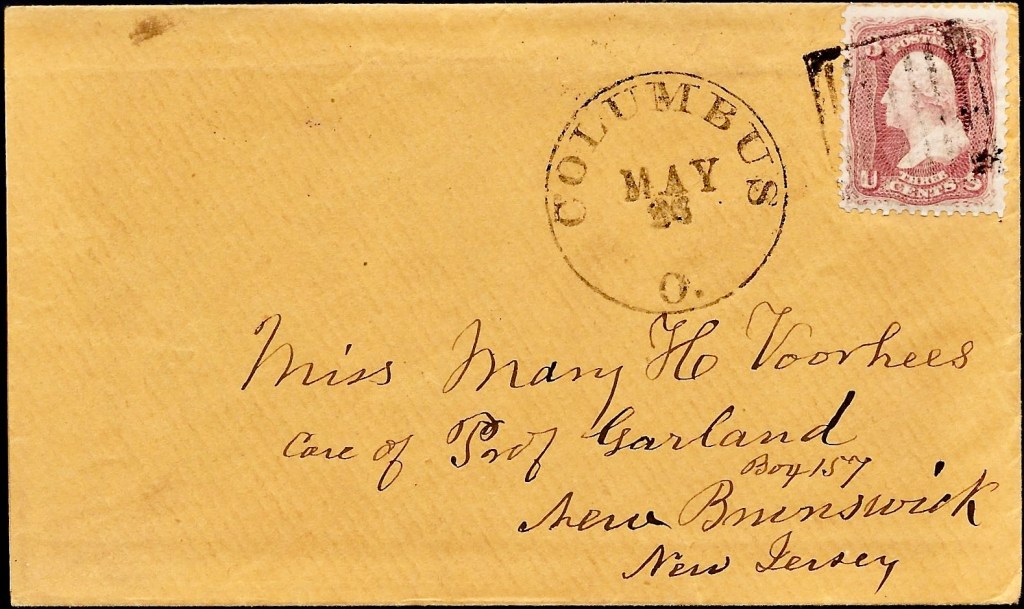
The letter was addressed to Mary Helen Voorhees (1833-1908), the daughter of Peter Albert Voorhees (1802-1883) and Maria Suydam (1806-1883). She married John Calvin Hoagland (1827-1894) in January 1868.
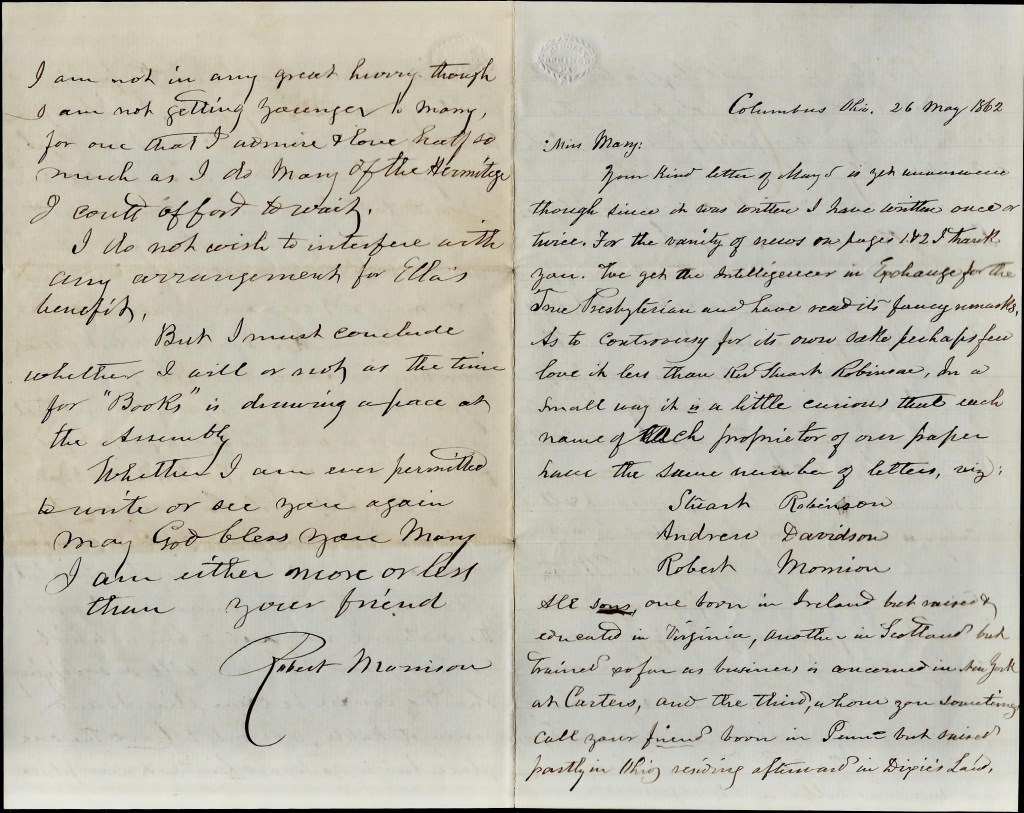
Transcription
Addressed to Miss Mary H. Voorhees, Care of Prof. Garland, Box 157, New Brunswick, New Jersey
Columbus, Ohio 26 May 1862
Dear Mary,
Your kind letter of May 5th is yet unanswered though since it was written, I have written once or twice. For the variety of news on pages 1 & 2, I thank you. We get the Intelligencer in exchange for the True Presbyterian and have read its fancy remarks. As to controversy for its own sake perhaps a few love it less than Rev. Stuart Robinson. In a small way it is a little curious that each name of each proprietor of our paper have the same number of letters, viz:
Stuart Robinson Andrew Davidson Robert Morrison
All sons, one born in Ireland but raised and educated in Virginia, another in Scotland, but trained so far as business is concerned in New York at Carters, and the third, whom you sometimes call your friend born in Pennsylvania but raised partly in Ohio, residing afterward in Dixie’s Land.
I have been here for several days, a looker on in Venice, a listener and a note taker in the court, making out reports for the True Presbyterian. The assembly is large—somewhere between 230 & 240. Of course no delegates south of the Border States. Saturday evening they passed a paper destined, I suppose, to send the Presbyterian Church in Maryland, Kentucky, and Missouri, and by & by, in some places north of us. It was Dr. Breckinridge’s paper on the State of the Country. The vote was taken by calling the ayes and noes & the vote stood 199 to 20.
The weather has been pleasant & this city is a pleasant, beautiful place. I wish to go out perhaps this p.m. to visit some friends taken prisoner at Pittsburg Landing—some of the first men of their region I have found here on their way as prisoners to Johnson’s Island at Sandusky on Lake Erie. One, and a friend, a Colonel of the 20th Tennessee, was here who had two sons killed in his regiment.
And I may not have the privilege of visiting you. Sorry for it. It is a hard penance to which I am consigned but I am loyal and yield to direction. If “I have not time” I would take it for such a privilege as to see the light of your countenance. May I not call to see you when you are abroad if I may not see you at home? e.g. at your Cousin Rev. Voorhees Gulick’s or at Brooklyn or somewhere else?
The counselor I need is of the kind that God alluded to when he said it was not good for man to be alone. That was the kind I spoke of.
In this wide work, God uses a variety of laborers & whether they should be nuns or not, some should be “mission teachers” but of course before a woman should forsake the natural, normal orbit in which God has placed her, God’s will so signifying should of course be clear, direct and unmistakable, not only to leave the one place but to go to a definite & new place. I am not in any great hurry, though I am not getting younger to marry. For one that I admire & love half so much as I do Mary of the Hermitage, I could afford to wait.
I do not wish to interfere with any arrangements for Ella’s benefit. But I must conclude whether I will or not at this time for “Books” is drawing apace at the Assembly. Whether I am ever permitted to write or see you again, may God bless you, Mary. I am either more or less than your friend, — Robert Morrison
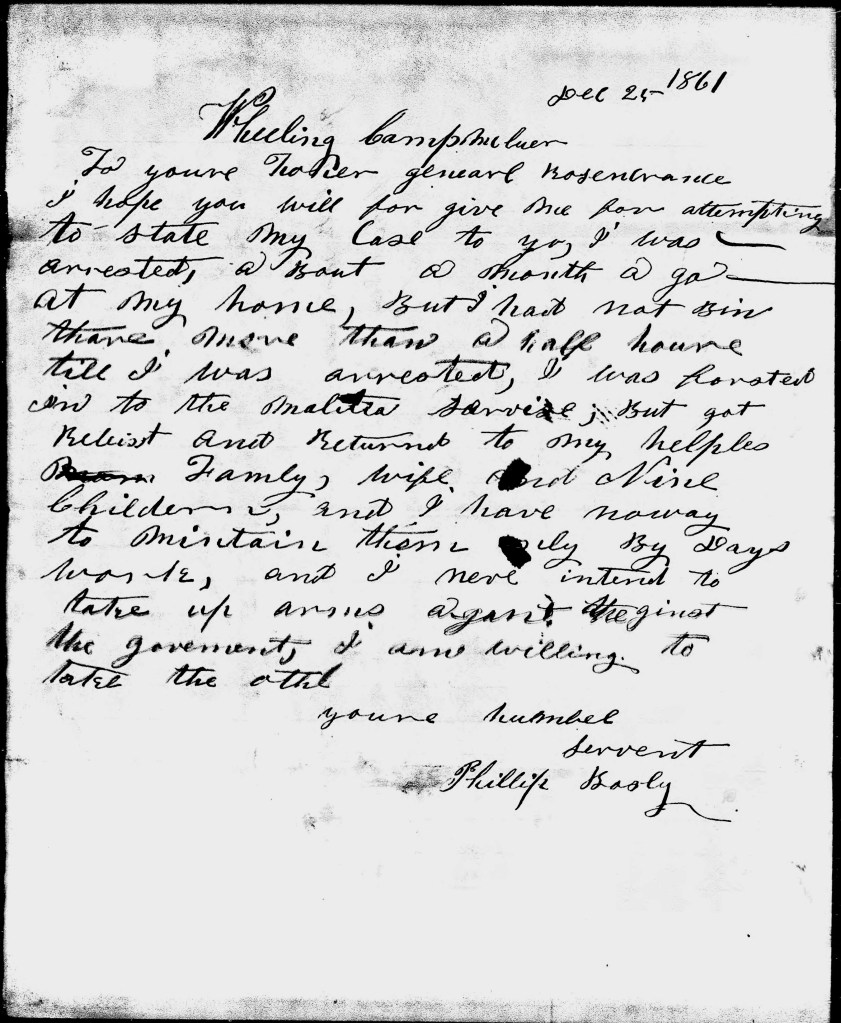
The following letter was sent to me by Mark R. Terry who asked me to confirm his transcription of a record from the Union Provost Marshal’s Papers (see Union Provost Marshals’ File of Papers Relating to Individual Civilians, 1861–1867; Microfilm publication M345, 300 rolls; NAID: 2133278. War Department Collection of Confederate Records, Record Group 109; The National Archives in Washington, D.C.). Mark had a question particularly about the camp name and wondered if I might confirm the author’s identity. While I’m certain the author attempted to write “McLure” as the camp name—the McLure house being the headquarters of Gen. Rosecrans at the time, I am unable to confirm that the author was his g-g-g-grandfather of the same name though I think it’s likely. What’s not clear is whether the author wrote the letter from or to Camp McClure. In other words, was the McLure House used to hold prisoners? I did find some evidence that it was though it may have been only a temporary holding place. The October 19, 1861 edition of the Atlantic Democrat tells the story of a Mrs. Poole who was “placed in confinement at the McLure House, charged with aiding and abetting the escape” of her daughter charged with being a spy.
Gen. William S. Rosecrans
General William S. Rosecrans established his headquarters at the McLure House—a hotel on the Corner of Market and Monroe (now 12th) Streets in downtown Wheeling, West Virginia in December 1861. Rosecrans, who commanded all Union troops in western Virginia, at the time lived in Wheeling from December 1861 to March 1862.
Terry’s ancestor, Philip Obed Bosley (1818-1909) was born in and lived his entire life in Hardy county, (West) Virginia. Terry has found evidence from newspaper accounts that four men—one named “Bosley”—were arrested subsequent to the attack on the wagons of a Union foraging party not far from were his ancestor lived and it’s logical to conclude that any Confederate militia or guerrillas rounded up by the Union army would have been taken eventually to Wheeling for confinement. Terry’s ancestor was also married and had nine children by the time of his arrest in 1861.
There’s no evidence that Terry’s ancestor ever served officially in the Confederate service prior to or subsequent to his arrest, though he may have engaged in some guerrilla activity if the family bore anti-administration sentiments as Terry claims they did. Whether Rosecrans acted on Bosley’s Christmas Day petition for clemency is unknown but he was undoubtedly released sometime not long after as this part of Virginia fell under strong Union control by the spring of 1862 and most of its citizens lived unmolested.
Transcription
Wheeling, Camp McLure December 25, 1861
To your honor General Rosecrans,
I hope you will forgive me for attempting to state my case to you. I was arrested about a month ago at my home but I had not been there more than a half hour till I was arrested. I was forced into the militia service but got released and returned to my helpless family—wife and nine children—and I have no way to maintain them only by days work and I never intend to take up arms again against the government. I am willing to take the oath.
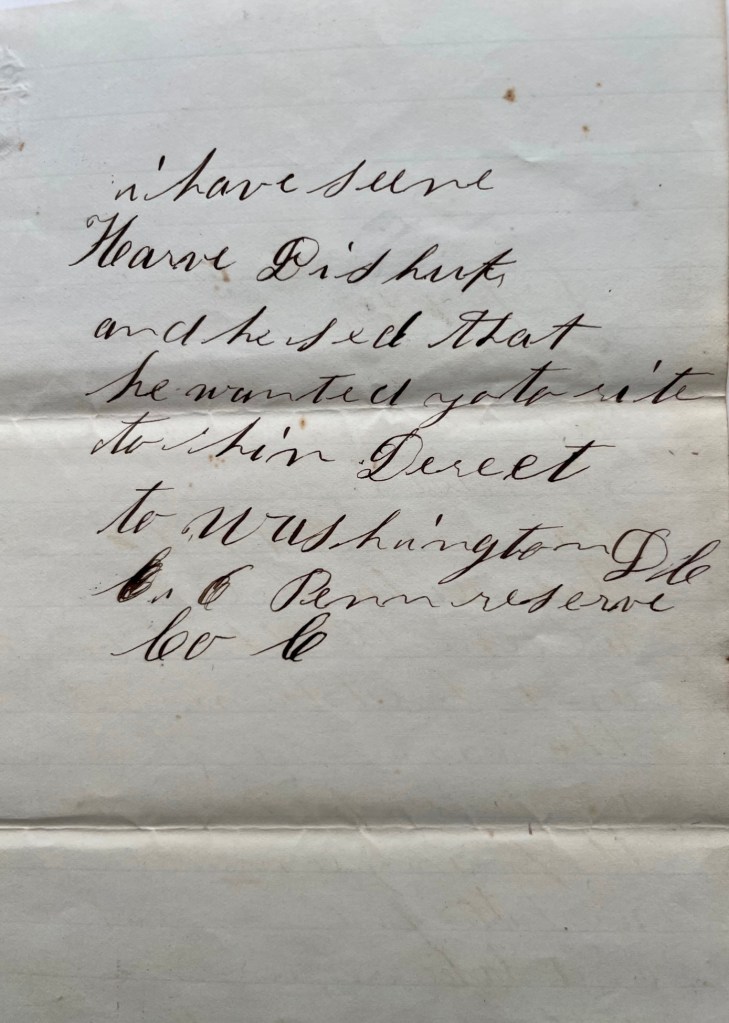
The following letter was written by a Union soldier from the state of Pennsylvania and we know that he had a brother named Moses, but beyond that, there are very few clues that would afford us an opportunity to learn his identity. It was unsigned and there is no envelope. The letter was written on stationery of the 84th Pennsylvania but the directions he provides his brother for answering his letter appears to state that he was in Co. C of the 6th Pennsylvania Reserves (35th Penn. Volunteers). Soldiers in Co. C, 6th Pennsylvania Reserves were recruited in Blair and Westmoreland counties.
Transcription
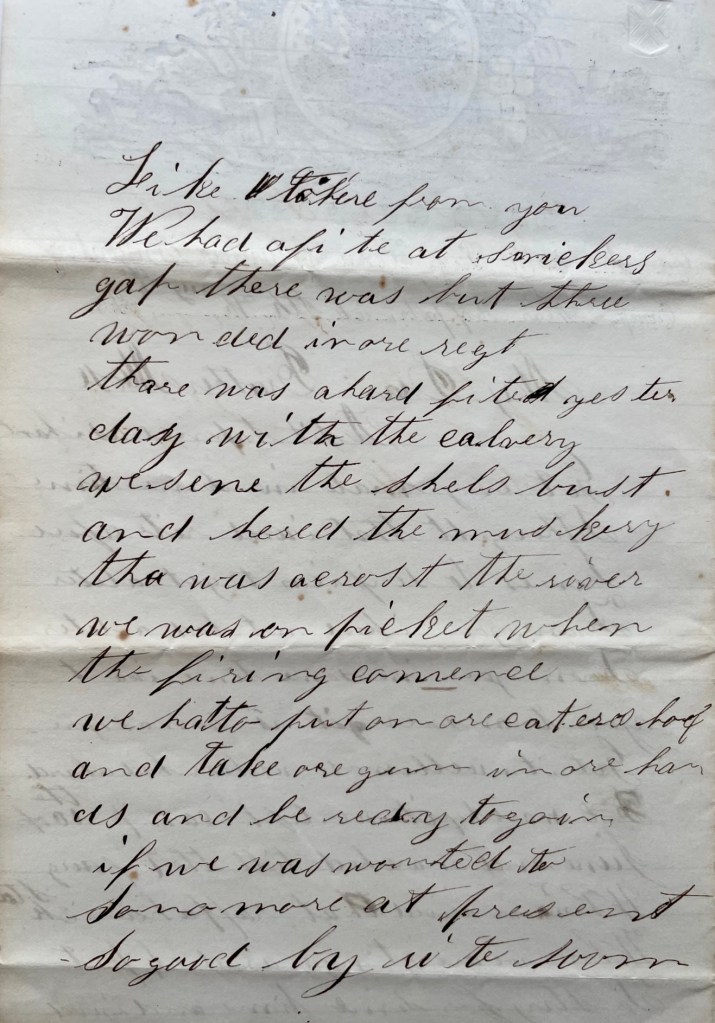
Co. I, 84th Regt. Penn. Volunteer Infantry Camp near Rappahannock Station. Va. August 5, 1863
My dear brother Mose,
As it happens as I hain’t got any mail in some time, I thought that I would write a few lines to see if I can get a letter from you. I have not had a letter from you in some time. I want you to answer it as soon as you get it.
Well, Mose, we have had a hard march of it. We left camp the 10th of June and marched till the 1st of August when we arrived at Rappahannock Station where we are now and I expect to stay for some time and would like to hear from you.
We had a fight at Snicker’s Gap. There was but three wounded in our regiment. There was a hard fight yesterday with the cavalry. We seen the shells burst and heard the musketry. They was across the river. We was on picket when the firing commenced. We had to put on our cartridge box and take our gun in our hands and be ready to go in if we was wanted to.
So no more at present. So goodbye. Write soon. I have seen Harve Dishart and he said that he wanted you to write to him. Direct to Washington D. C., 6th [?] Pennsylvania Reserves, Co. C.
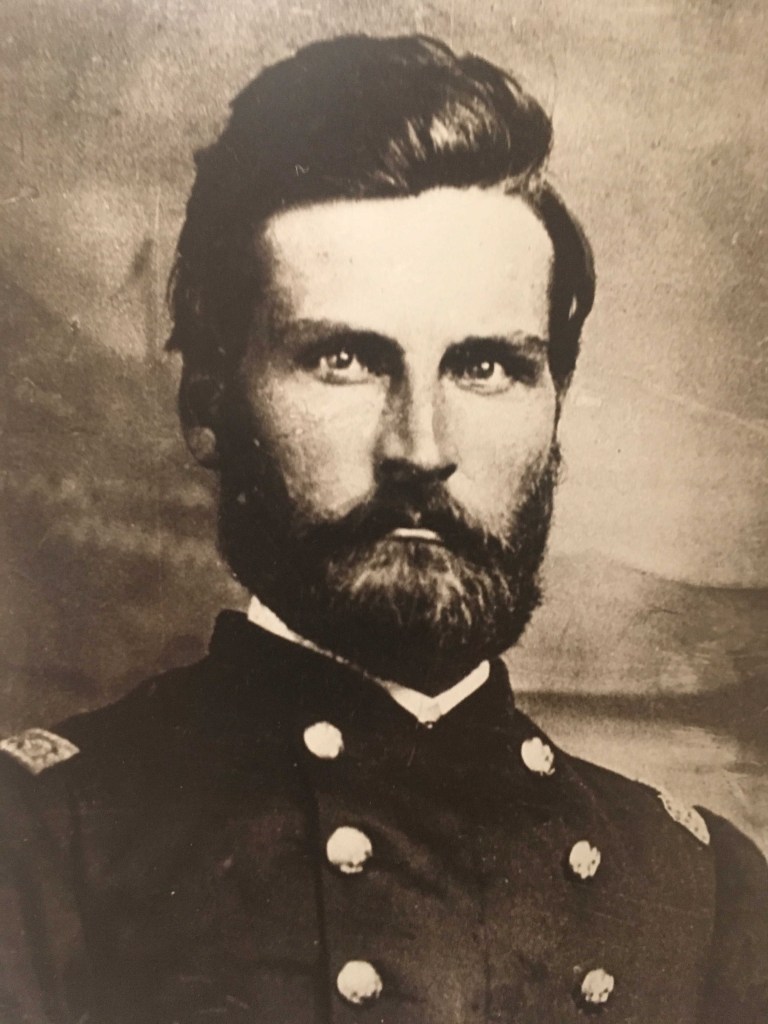
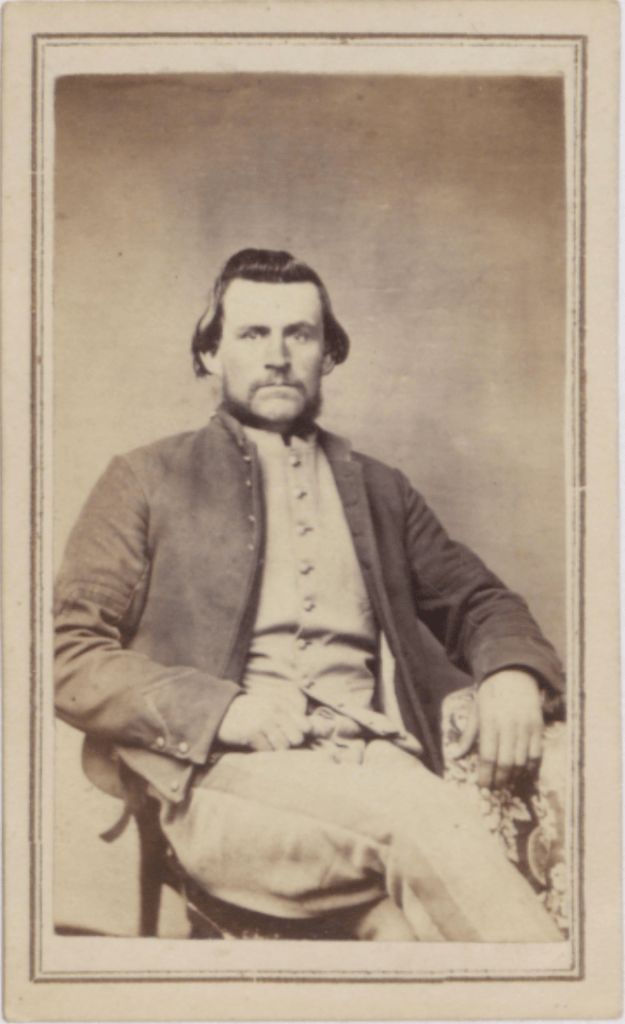
I could not find an image of Peter in uniform but here is Daniel H. Frazier who served in the 11th Kansas Cavalry
The following two letters were written by Esther (Warner) Calkins (1834-1880), the wife of Peter Berdic Calkins (1833-1897). The couple were married in Richland, Oswego county, New York and were living in Elm Creek Township. Saline county, Kansas, during the Civil War.
Esther wrote the letter to her sisters-in-law, Jane (Calkins) Alexander, the wife of Samuel Alexander, and Phebe (Calkins) Hager (1831-1898), the wife of John Hager (1829-1897) of Altmont, Michigan.
Esther’s letter indicates that her husband Peter had recently become a soldier. Peter enlisted in Co. L, 11th Kansas Cavalry on 31 March 1864. He was discharged for disability on 14 June 1865 at Fort Riley. Both letters were written while Esther was home alone in Saline county with her two little girls—Mary (b. 1856) and Jane (b. 1863).
Letter 1
Salina [Kansas] June 11, 1864
Ever dear Brother and Sister,
I improve the time this morning in answering your kind and affectionate letter which came to hand in due time. I was very glad to hear from you. I and my little children are well. It has been 3 weeks since I have seen Peter. He says he likes a soldier’s life first rate. His health is much better since he enlisted, but it has been very lonely for me since he has gone. He has been at Fort Riley all the spring, until within a few days he has gone to Fort Scott.
It has been a very cold backward spring. The winter wheat is an entire failure. How I wish I could come and spend the summer with you and Phebe. I think I should enjoy myself better than I shall here.
The Indians have been trying to be troublesome this spring. Four weeks ago, news came to us; the Indians was just above town killing everybody they came to. We thought if they were that near to us it was time for us to be leaving. The man that I live with got his team and we started and went 15 miles before we stopped but to find out the truth of it, there was one white man and three Indians killed [and] that was about 70 miles from us. We were all very badly scared but I think that we are safe now. The soldiers came and drove them back. The men in Salina have built a fort so they will be ready for the rebels if they ever come to make war with the whites. I hope we won’t have any more trouble with the Indians.
I hope this cruel war will come to a close this year. It is enough to make one’s heart ache to think how many homes it has made desolate. Good of all kinds re very high. Calico is 35 cents a yard. Coffee 55 cents a pound and everything according. I have 7 cows with me and five yearlings and 2 horses. Peter has bought nine head of cattle since he has been in the war. I have not got them home yet.
I can’t think of much to write since Hattie died and Peter has gone in the war, I ain’t myself any more. Tell Phebe that I will write to her soon. Peter’s post office: Fort Riley, Company L, Kansas 11th, in care of Capt. Henry Booth. If I could see you I could tell you more then. I can write no more at this time but ever remain your sister until death. Let us try and meet in heaven where we never shall take the parting hand. — Esther
Goodbye.
Letter 2
Salina [Kansas] July 10, 1864
My dear sister Phebe,
I take my pen in hand to let you know that I have not forgotten you. I am well today and I hope when this reaches you it will find you enjoying the same blessing. Dear Phebe, I can sympathize with you in your loneliness. I got a letter from Peter today. He was well and seems to enjoy himself first rate. He is about 75 miles from home.
The Indians are quite troublesome this summer. They have killed two white men this summer. The soldiers are out all the time keeping them back. Whether they will come into this place I cannot tell.
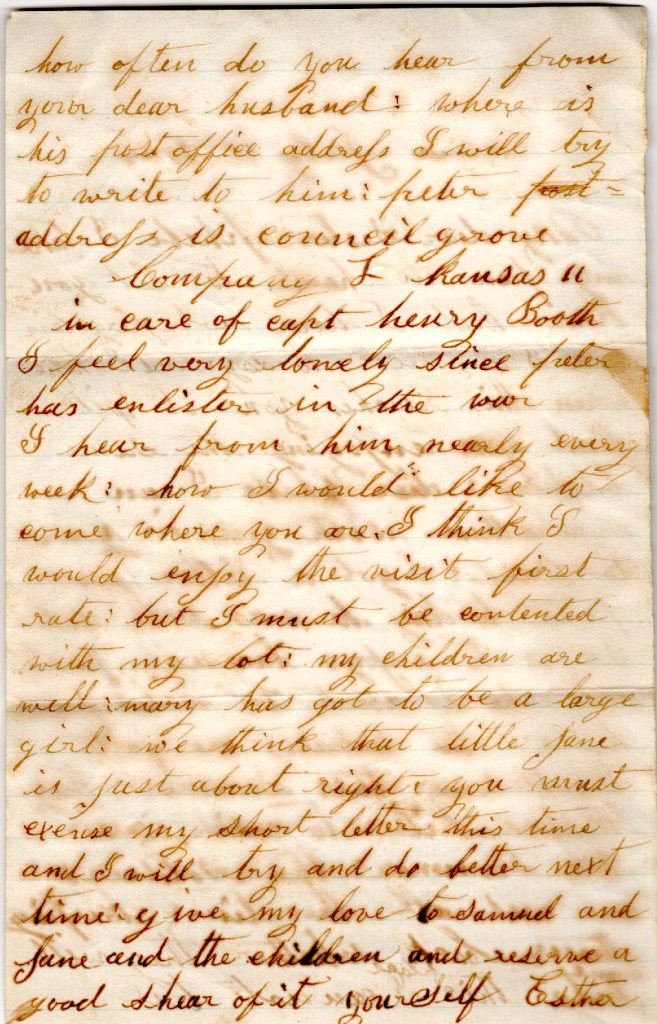
How often do you hear from your dear husband? Where is his post office address. I will try to write to him. Peter’s address is Council Grove, Company L, Kansas 11th, in care of Captain Henry Booth.
I feel very lonely since Peter has enlisted in the war. I hear from him nearly every week. How I would like to come where you are. I think I would enjoy the visit first rate. But I must be contented with my lot. My children are well. Mary has got to be a large girl. We think that little Jane is just about right.
And you must excuse my short letter this time and I will try and do better next time. Give my love to Samuel and Jane and the children and reserve a good I share of it yourself, — Esther
The following letter was written on 5 March 1862 from an encampment on Meridian Hill in Washington D. C. The soldier’s name appears to be Charles Jessup but I have not been able to identify his regiment. He must have only just arrived in Washington having passed through Pittsburg and across Pennsylvania to Baltimore before arriving in Washington. He was, therefore, likely to be from a “western” state like Ohio, Illinois, Indiana or Michigan. My hunch would be the latter.
Transcription
Washington [D. C.] March 5, [1862]
William Castle,
It is with much pleasure that I take my pen in hand to let you know that I am well. I should like to see you and all of the rest of the folks that I used to be with around there. Although I am now far from you all, I haven’t forgotten about you all that I used to see when I was there. Do you remember the meeting they had at the log school house the night before I started for the rapids. Ask Enoly is she has forgotten that she has. Tell her to put on her thinking cap. The rest of the folks that I used to know when I was there—tell them that I would like to see them and be there to go to the [ ] with them and you.
I have seen the large mountains that are in Pennsylvania. I have seen where they dug through rocks from one to two hundred feet. I have rode from a quarter of a mile to a mile and a quarter under ground. I have seen some pretty nice cities since I left there and some that weren’t so nice. Pittsburg was the worst looking place that I saw since I left there and Baltimore was the nicest place I did see.
I should like to live in Baltimore. I was in the fort in Baltimore when I was there. I tell you that the large guns looked pretty saucy to point at a man. Our men had to keep the town guarded for fear of the rebels breaking onto them. We stopped in Baltimore one day so I had a good chance to see the city. Miles Filey and myself went downtown while I was here and the lieutenant of our company and we had a pretty nice view of the city.
We are on Meridian Hill. We have a pretty good sight for to look out on the Potomac river and see what’s on there. The Sixth is within the half a mile of us. I am down to the Sixth now. I do like this part of the country very well.
As I find my sheet pretty near full, I will bring my letter to a close. You must excuse my bad writing for I haven’t no place to write but to take my pen and paper on my lap and write. So goodbye to you, — Charles H. Jessup















 Spared & Shared 23