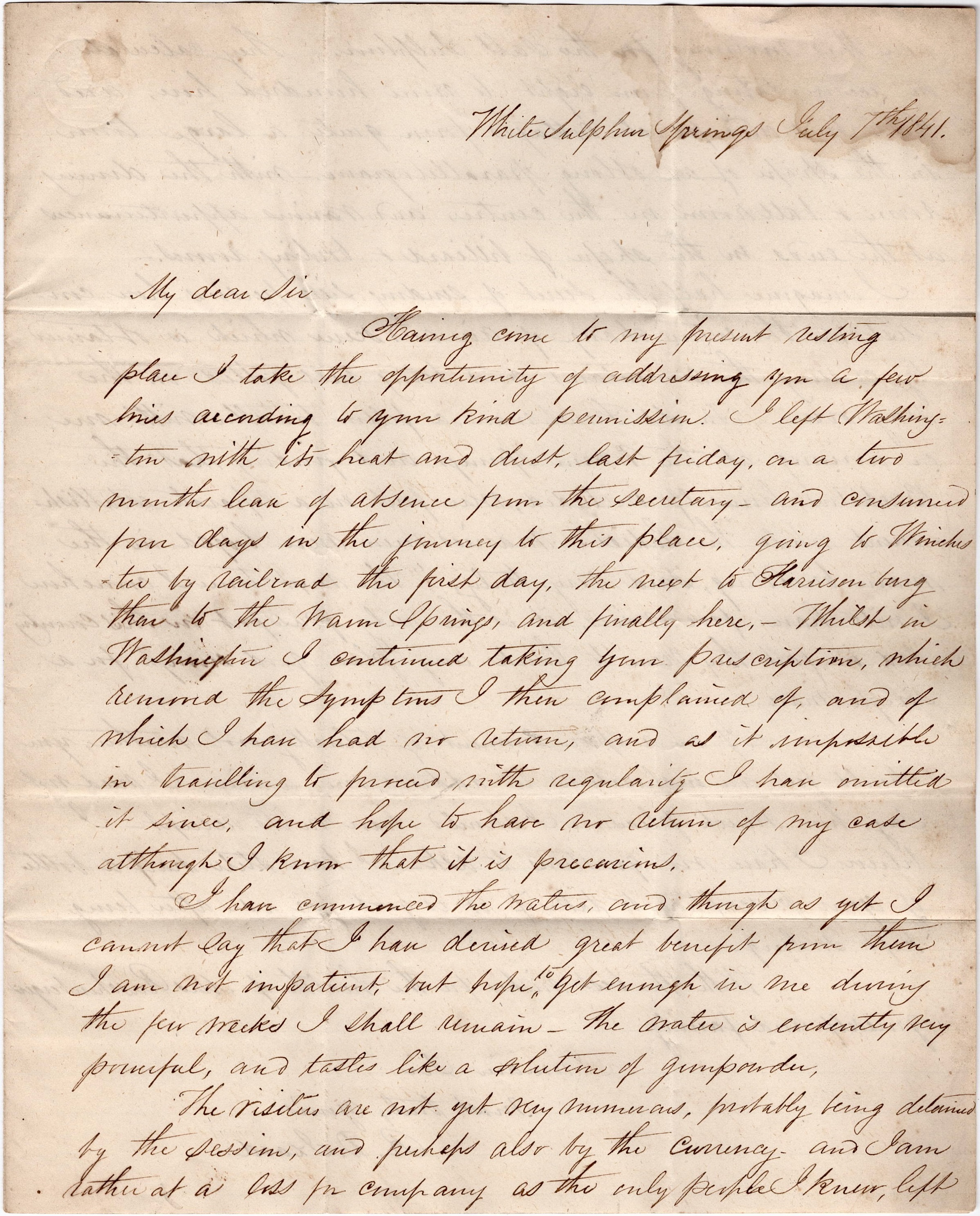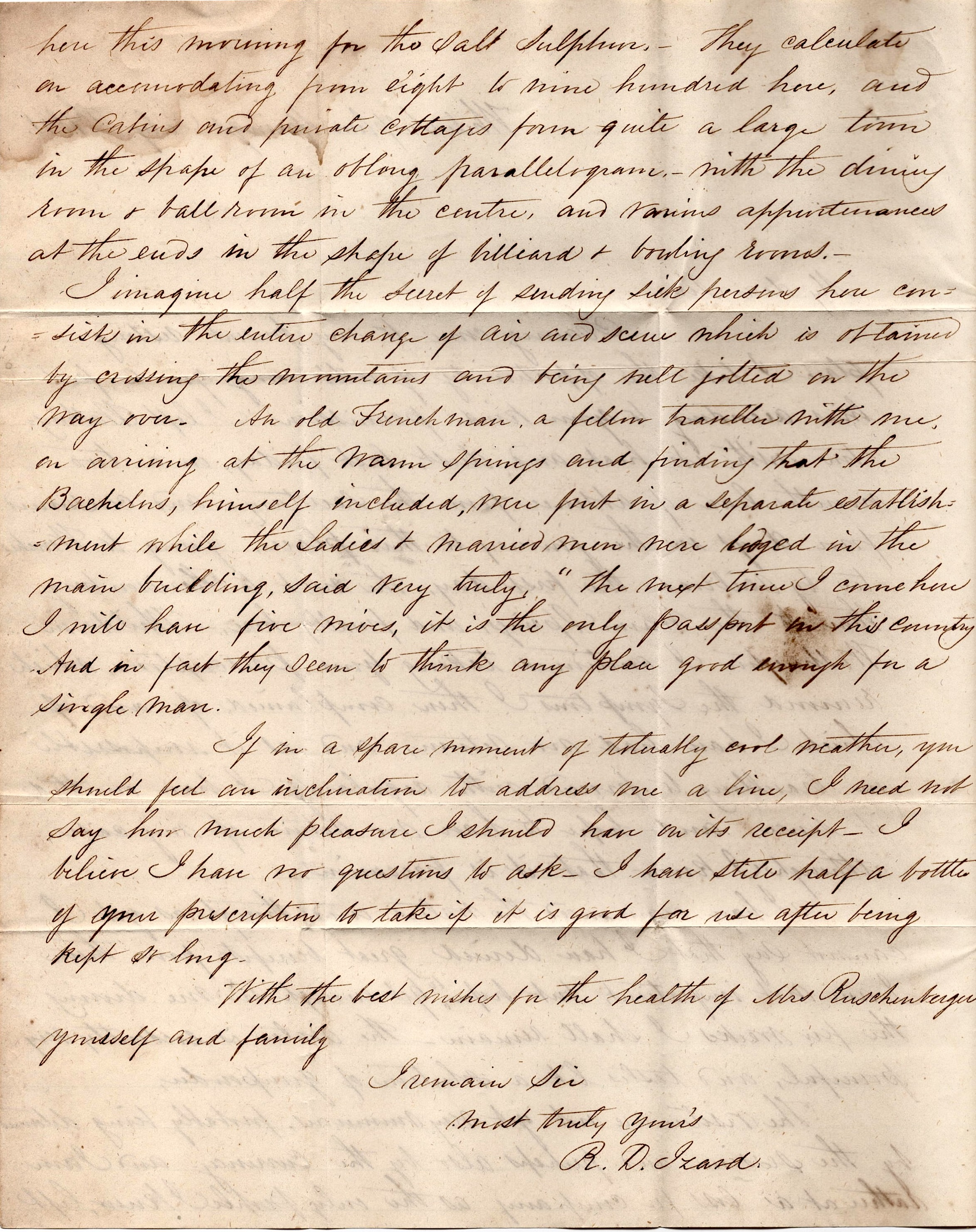
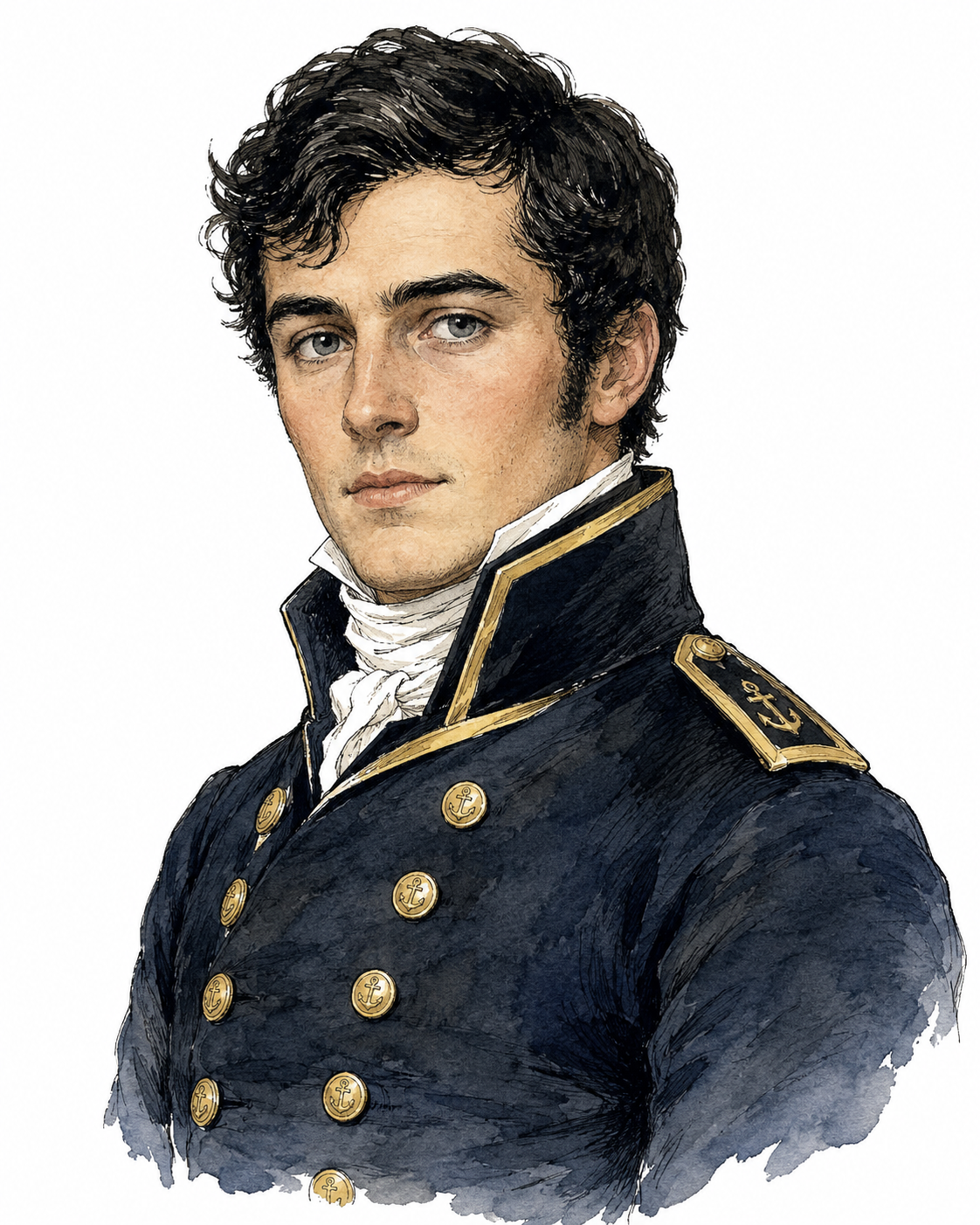
I believe the following letter was written by 23 year-old Ralph DeLancey Izard III (1819-1849), the son of Lt. Ralph DeLancey Izard (1785-1824) and Elizabeth Middleton (1787-1822) of Charleston, South Carolina. Lt. Izard, the father of the letter writer, was the son of Ralph Izard who served as a delegate to the Continental Congress and later a US Senator from South Carolina.
I could not find a biographical sketch for Ralph D. Izard III, but I have learned that he served in the US Navy and I found that an 1845 passport from the State Department for him issued just prior to his traveling to Europe on a visit. . He wrote the letter to William Samuel Waithman Ruschenberger (1807-1895)—a surgeon for the US Navy, a naturalist, and a writer. From 1840 to 1842, Ruschenberger was attached to the naval facility at Philadelphia, and later the Brooklyn Navy Yard hospital.
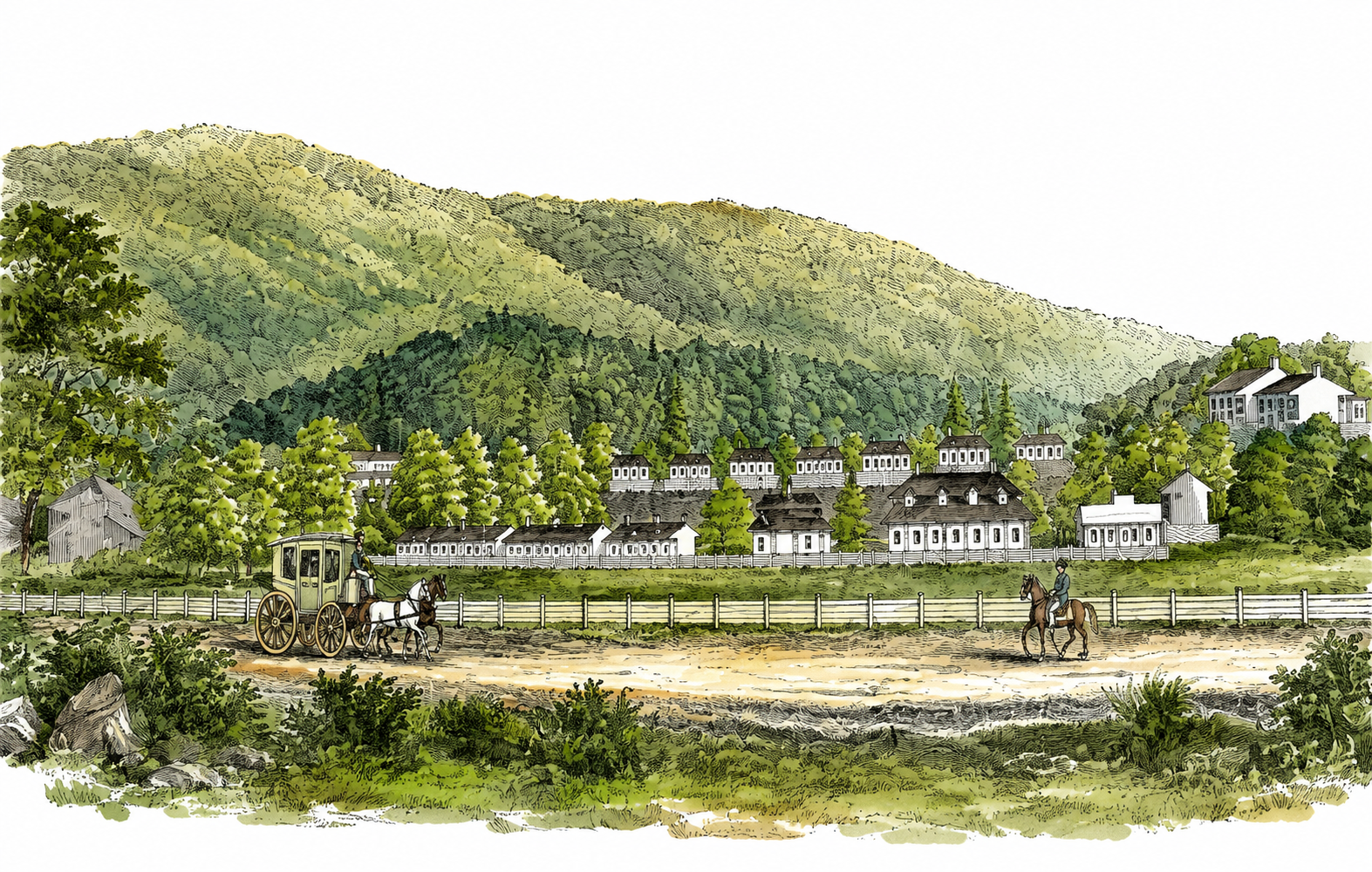
When Ralph visited White Sulphur Springs in 1841, the resort was at the pinnacle of its popularity. The social elite gathered at the springs to partake of the mineral-rich sulphur waters, convinced of their purported therapeutic effects. Nonetheless, the taste of the water was less than agreeable; Ralph remarked that it resembled “a solution of gunpowder.”
T R A N S C R I P T I O N
White Sulphur Springs,
July 7th 1841
My dear Sir,
Having come to my present resting place, I take the opportunity of addressing you a few lines according to your kind permission. I left Washington with its heat and dust last Friday on a two month leave of absence from the Secretary, and consumed four days in the journey to this place. Going to Winchester by railroad the first day, the next to Harrisonburg, thus to the Warm Spring, and finally here. Whilst in Washington, I continued taking your prescription which removed the symptoms I then complained of, and of which I have had no return, and as it impossible in traveling to proceed with regularity, I have omitted it since, and hope to have no return of my case although I know that it is precarious.
I have commenced the waters and though as yet I cannot say that I have derived great benefit from them, I am not impatient, but hope to get enough in me during the few weeks I shall remain. The water is evidently very powerful and tastes like a solution of gunpowder.
The visitors are not yet very numerous, probably being determined by the session and perhaps also by the currency, and I am rather as a loss of company as the only people I knew left here this morning for the salt sulphur. They calculate on accommodating from eight to nine hundred here, and the cabins and cottages form quite a large town in the shape of an oblong parallelogram, with the dining room & ballroom in the centre, and various appurtenances at the ends in the shape of billiard and bowling rooms.
I imagine half the secret of sending sick persons here consists in the entire change of air and scene which is obtained by crossing the mountains and being [ ] jolted on the way over. An old Frenchman, a fellow traveler with me, on arriving at the Warm Springs and finding that the bachelors—himself included—were put in a separate establishment while the ladies & married men were lodged in the main building, said very truly, “the next time I come here, I will have five wives. It is the only passport in this country. And in fact, they seem to think any place good enough for a single man.”
If in a spare moment of tolerably cool weather you should feel an inclination to address me a line, I need not say how much pleasure I should have on its receipt. I believe I have no questions to ask. I have still half a bottle of your prescription to take if it is good for use after being kept so long.
With the best wishes for the health of Mrs. Ruschenberger, yourself, and family, I remain, Sir, most truly yours, — R. D. Izard