1864: August Rost to Margaret (Steele) Rost

The following letters were written by August Rost (1833-1864), principal musician in the 17th Alabama Infantry. August wrote the letter to his wife, Margaret Steele (1846-1934) with whom he married in January 1863. Margaret—called “Molly” in these letters—was the daughter of German immigrant Michael Steele.

August Rost (1833-1864)

Rost led a popular brass band in Mobile before the Civil War. On June 10, 1861, there is notice that he provided music for Gov. A. B. Moore’s excursion to Fort Morgan aboard the steamer Crescent. In that same month Rost’s band led the German Fusiliers (Co. G, 8th Alabama) and their escort to the train station as the company left for Virginia to participate in the Battle of Bull Run. By the end of July the band became the official garrison band at Fort Morgan at the entrance to Mobile Bay. A member of the 2nd Alabama Regiment stated that Rost’s Band “entertained the garrison after the duties of the day were over.” By mid-September, 1861, the band was back in Mobile.

Sometime in 1863, Rost’s Band became the band of the 17th Alabama Infantry and early in 1864, the regiment joined the Army of Tennessee, serving under General Cantey, and active in the Atlanta Campaign and Hood’s expedition into Tennessee. Rost, however, died on 11 November 1864. 

Several years ago I transcribed six letters by August Rost and published them on Spared & Shared 10. See—1863-64: August Rost to Mary Rost.

Advertisement for the Mobile Military Brass Band, Mobile Register, 2 June 1860
Southern Republic Polka March as performed by Rost’s Military Brass Band, Mobile, Alabama

Letter 1

No. 1

Marietta, Georgia
June 21st 1864

Dear Wife,

I received your kind letters on the 10th and 17th the 21st of June and was very sorry to see that [ ] was sick and [ ] again. Molly, you tell me very…kind letter. I received that tobacco bag and I can [ ] think of you whenever I do smoke…you did write for me to come home but it is not possible till after this fight, if I live to get home. But I would not go. But as soon as this fight is over I do come and stay about 10 days with you.

Dear wife, when I was eating my dinner today, Peter Von Alber came to me to tell me that he was looking for me the last month. He is well and was as glad to find me as a lost child finds his Pa. He told me he never had a happy day in ten years like today.

Darling, I have to close. My time is [ ]. Give my love to Pa, Ma, and sisters and brothers and tell Pa to write soon to me and if he wants me to write in English to let me know. Darling, take care of yourself and be happy if you can. You will see me soon if I am spared. — August Rost

Margaret (“Molly”) Rost

No. 2

Marietta, Georgia
June 21st 1864

Dear Molly,

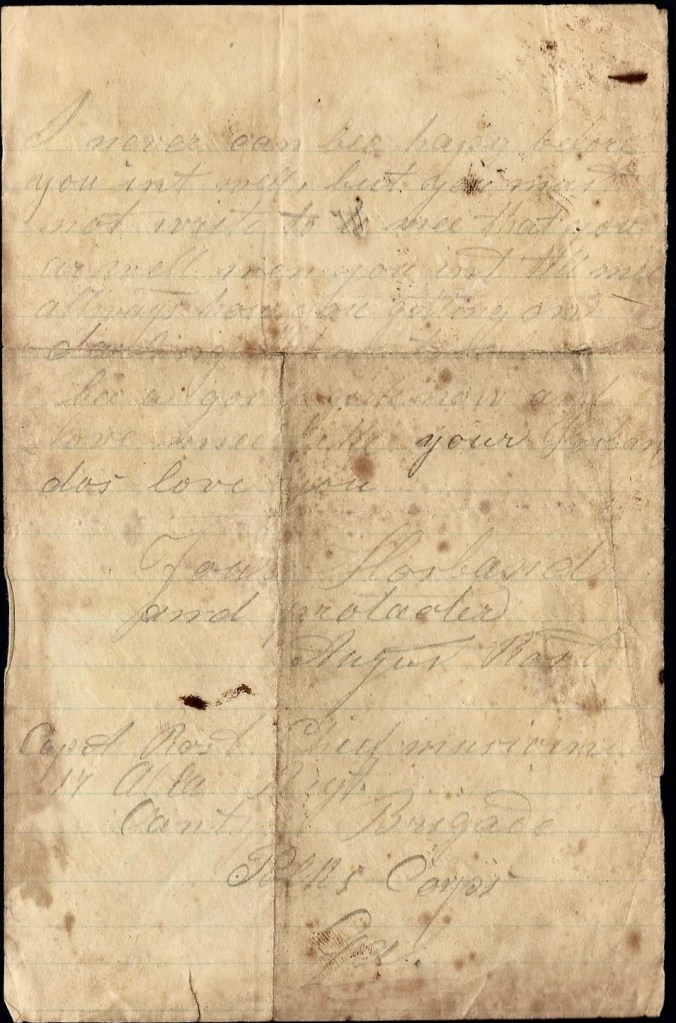
Tell me in your next letter how you are getting [on] and if that made you sick to lay in the bed of if was only unwell. Molly, you must not work much if you ain’t well, and neither work in the house. If you keep still, you soon will get over it, and if you think you are getting better, go out to that milk woman on Government Street and stay there about 9 or 10 days. That will do more good than all. Do not eat anything than milk and rice and flour bread, and let me know how you [are] getting on.

Dear wife, I am glad you get money yet. I will not get any before this fight is over. Dear Molly, try to get well till I do come home. I never can be happy before you are well, but you must not write to me that you are well when you ain’t. Tell me always how you are getting on. Darling….be a good wife now and love me like your husband does love you. Your husband and protector, — August Rost

Capt. A. Rost, Chief Musician, 17th Alabama Regt., Cantey’s Brigade, Polk’s Corps.


Letter 2

Marietta, Georgia
June 25th 1864

Dear Wife,

I am still in Marietta yet and fighting is going on from day to day. We lost about 1,500 men on Thursday the 23rd 1 and I think the Yankees lost more. I think we will fall back about four miles and give the Yanks a general fight. If they do not fight us, we will have to fight them.

Dear Molly, I am well and I hope that you’re getting better. If not, let me know all about it. Darling, I think of you day and night. I never did know how dear you are to me before till now. [ ] only be one day with you. I have a lot of little things to tell you but I hope that day will come soon, and [I will] tell you all I know. And I know you have many things to tell me. …

[ ] wanted me to start a band for him and the 17th Brigade was bound to let me go of Gen. Polk says he wanted me. They sent a note to Col. [Virgil S.] Murphey that I should report to him the [ ] to let me go and he would have done so if he didn’t live me day…..

I will write more as soon as I receive a letter from you. Tell Pa to write to me and let me know [ ] and give my love to Ma and sisters and brothers. Darling, do not forget your true husband till dead. — August Rost

Capt. A. Rost, Chief Musician. 17th Ala. Regt., Cantey’s Brigade, Polk’s Corps.

1 August is probably referring to the Battle of Kolb’s Farm which took place on 22 June 1864. Polk was killed at Pine Mountain on June 14 and temporarily replaced by Major General William Wing Loring. Historian Albert E. Castel estimated that Hood’s attack cost his corps 1,500 killed, wounded, and missing, two-thirds of which were from Stevenson’s division.


Letter 3
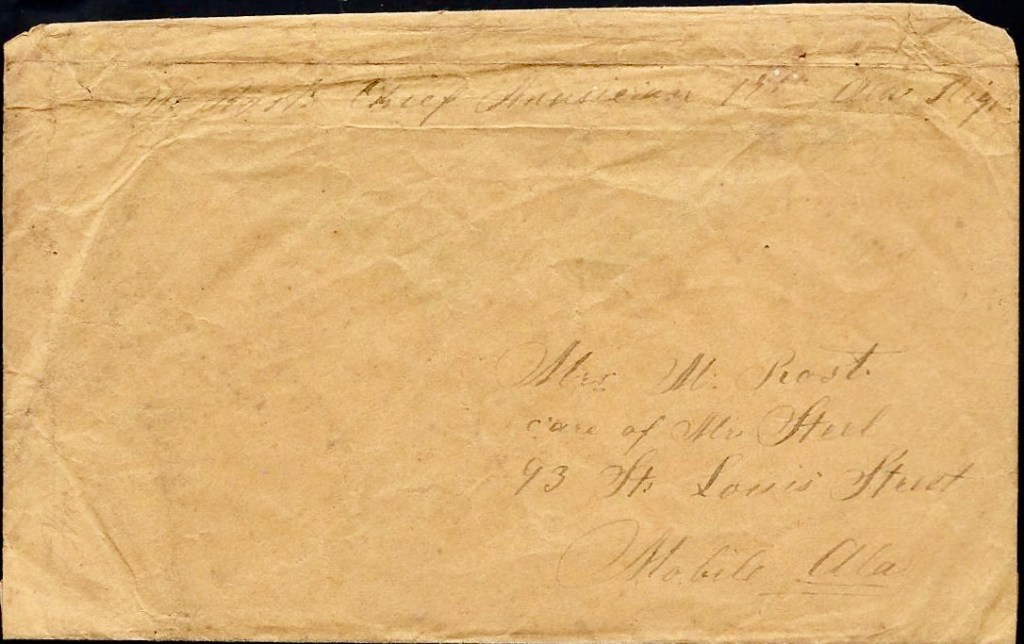
Addressed to Mrs. M. Rost, care of Mr. Steele, 93 St. Louis Street, Mobile, Alabama

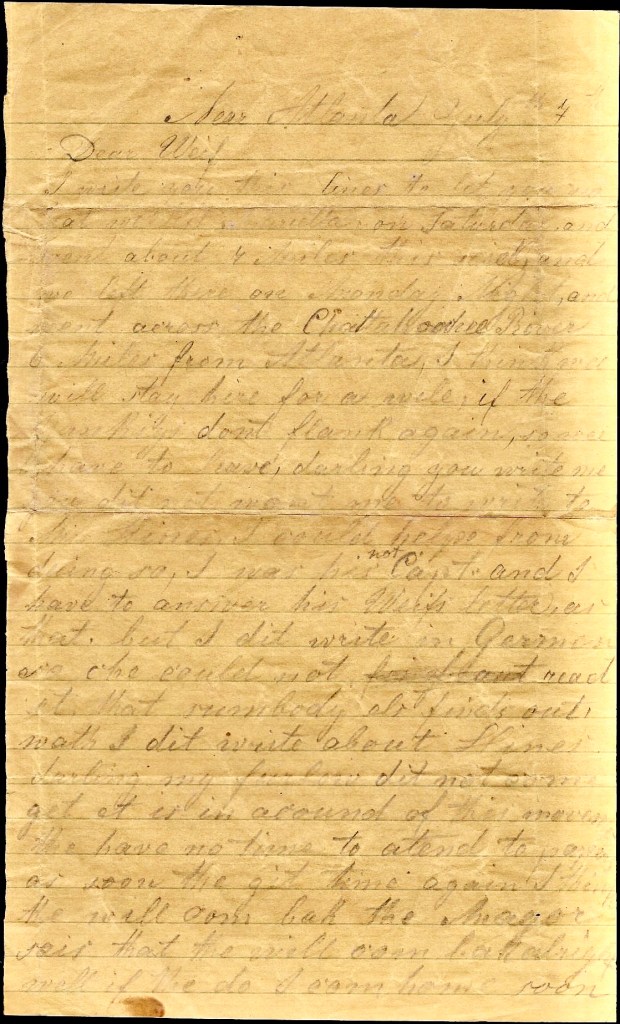
Near Atlanta [Georgia]
July 7, [1864]

Dear Wife,

I write you this time to let you know that we left Marietta on Saturday and went back about 7 miles this [ ] and we left there on Monday night and went across the Chattahoochee River 6 miles from Atlanta. I think we will stay here for a while if the Yankees don’t flank again so we have to leave.

Darling, you write me you did not want me to write to Mrs. Hines. I could [not] help from doing so. I was his captain and I have to answer his wife’s letter at that, but I did write in German so she could not read it, that somebody else finds out what I did write about [Jacob] Hines. 1

Darling, my furlough did not come yet. It is in account of this move. We have no time to attend to papers. As soon as they get time again, I think they will come back. The Major says that they will come back alright. Well, if they do, I [will] come home soon, but I have no hope that I come before this fighting is over. I will come then or I come before I play again with my band. I give you my word.

Dear wife, I am in very good health and I hope that you are the same. And I think of you from hour to hour. Darling, you do not know how a true man does love his wife, yet he loves her better than himself. Oh, I did see 50 men at least wounded and nearly dead. All they pray for is, “Oh God, bless my dear wife.” They do not think about themselves. It does me good to see it. There is nothing in the world that is so dear to me than my little wife. Darling, goodbye. I have to close. Write soon and I hope we will meet soon again.

Your husband till dead, — August Rost, Capt. of Band, Chief Musician, 17th Alabama Infantry, Cantey’s Brigade, Polk’s Corps.

1 Jacob Hines was a musician in the band of the 17th Alabama. He was taken prisoner at Cassville, Georgia, on 20 May 1864 and sent to Louisville, Kentucky, and then forwarded to Rock Island, Illinois.

Letter 4

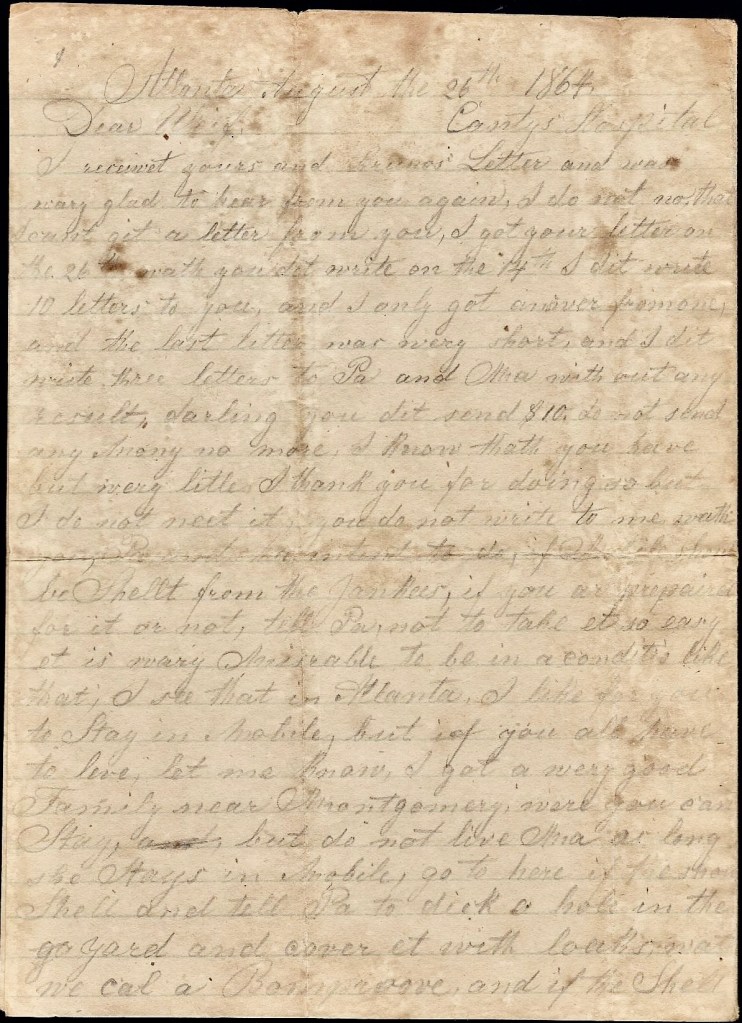
Atlanta, [Georgia]
August 26th 1864
Cantey’s Hospital

Dear Wife,

I received yours and [Edward] Bruno’s letter and was very glad to hear from you again. I do not know that I can’t get a letter from you. I got your letter on the 26th that you did write on the 14th. I did write 10 letters to you and I only got answer from one and the last letter was very short. And I did write three letters to Pa and Ma without any result. Darling, you did send $10. Do not send any money no more. I know that you have but very little. I thank you for doing so but I do not need it. You do not write to me whether your Pa wrote as he intended to do. If Mobile should be shelled from the Yankees, if you are prepared for it or not. Tell Pa not to take it so easy. It is very miserable to be in a condition like that. I see that in Atlanta. I like for you to stay in Mobile but if you all have to leave, let me know. I got a very good family near Montgomery where you can stay, but do not leave Ma as long she stay in Mobile. Go to her if they should shell and tell Pa to dig a hole in the yard and cover it with logs—what we call a bomb proof—and if the shells go in there, tell them to stay down.

Molly, tell me if you did get any money from me and if you got any, do not be without. Let me know and I [will] send you some. Darling, do not forget your true husband who thinks of you day and night and cannot help you in your present condition. If it were in my power, I would be on your side and protect you to the last but we are parted and left to ourselves so I have to call on Pa and Ma to protect you and I know they will do so until I return.

My dear wife, if Mobile should fall [illegible] come soon and take care of my darling and send me letters by Flag of Truce and I will do the same and think of the happy hours we had when met the last time. Darling, I got good times. I stay in the hospital and have nothing to do than write music and practice with my band. I went last night serenading to our Gen. [Alexander Peter] Stewart and thank for improving my band so fast and he told me to go in that way, that he would protect me, and if I want for anything to let him know.

Darling, I have to close…Give my love to Pa & Ma and to all. write soon again and tell Pa to write me. From your true husband, — August Rost

Letter 5

Cantey’s Brigade Hospital
Atlanta, [Georgia]
August 30th 1864

Dear Wife,

I received your kind letter sent by that young man on the 29th of August, and was very glad to hear that you are in good health and I thank God that I can tell you the same. Darling, I live in hopes we will be soon together again. This war must close soon. It is going to the end and if it don’t, I will try to finish it myself. I will try very hard to get my discharge on the 17th of September. If I get it, I will come home. It may be that we come back to Mobile as soon as this campaign is over, if the Yankees don’t take Atlanta.

Darling, Mr. Junger is coming to Mobile. I told him to come and see you and tell you all about how I get along. He told me he would go in Tuesday and I went to Atlanta on Monday to our Brigade General to get $200. A note was promised to me on Monday and when I came to Atlanta, our Brigade was moved from there and till I come home, Junger [Yunger?] was gone, and I could send no letter with money, after I walked about ten miles in the hot sun. He will tell you all about it.

Dear Molly, let me know if you did get them $200 paid. I do not pay the bill here until I hear from you. I will send you money as soon as I can get it to Mobile. It is very hard to send money at the present time from here. I did not get any pay yet from the regiment, neither from the government, but I did buy an instrument for $400 and I get $500 and I bought an old instrument for $10 and made a bugle from it today. I will sell that to the brigade for $100. As soon as I get that money together, I will send it to you and you will be alright again. I think I will get it together in about 10 days and I have got plenty left when I get paid off from the regiment, and the government. I will write to Montgomery again and if the sutler don’t pay you, I will write to Col. Murphey and be will tend to it. Dear Molly, you shall not suffer as long as I live and if I have to work day and night, it is all the pleasure I have got to work for you.

Darling, leave [Edward] Bruno’s trunk at Miss Fuceliting till I come home again. I don’t want you to have anything to do with it. I got clothes enough till I get clothes from the government. Molly, do not think hard of Pa because he is cross. He has a good deal of trouble, I believe, at the present time. He is a good old fellow. Let him have his way, darling.

I have to close. Write soon again and think you have a true husband far from you but he never will forget you. It never does pass an hour that he don’t think of you, I believe. — I remain your true husband, — August Rost

Molly, do not write no more with a pencil. That letter I got from you was most out. Your true Augusta

1864: George Schmitt to his Wife

This letter was actually penned by Sergt. H. W. Thompson of Co. K, 1st Confederate Regiment Georgia Volunteers. Sgt. Thompson was later killed in action on 20 July at the Battle of Peach Tree Creek. Ga. He wrote it at the request of his mess mate, George Schmitt, who was apparently illiterate.

The letter was penned from Dalton, Georgia, where the Army of Tennessee wintered in early 1864. The names of many comrades who deserted during the winter were recorded in the letter.

Transcription

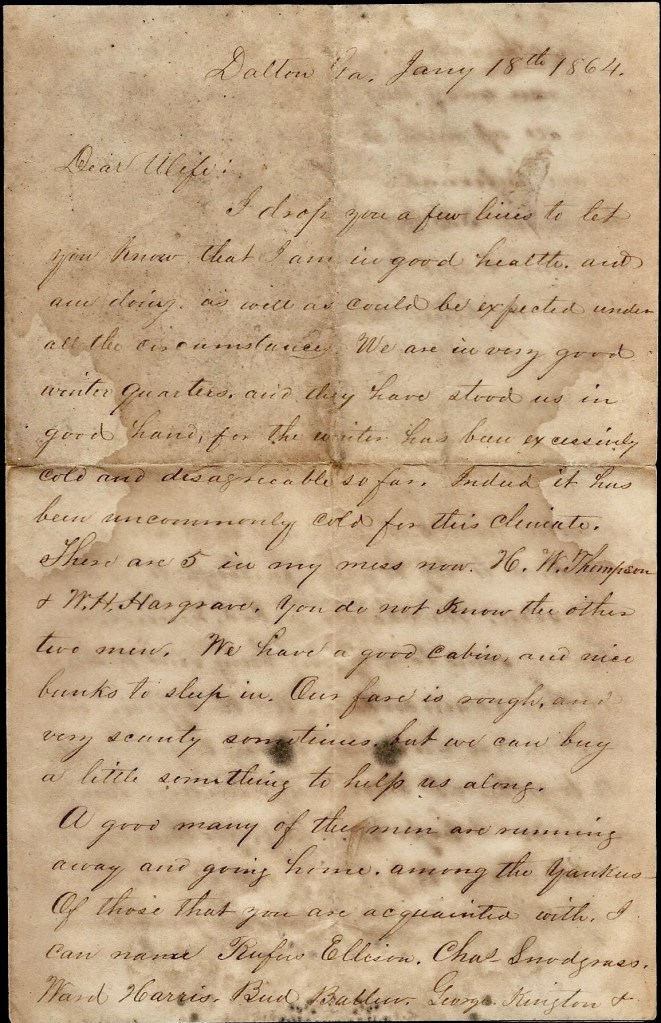
Dalton, Georgia
January 18, 1864

Dear Wife,

I drop you a few lines to let you know that I am in good health and am doing as well as could be expected under all the circumstances. We are in very good winter quarters and they have stood us in good hand, for the winter has been excessively cold and disagreeable so far. Indeed, it has been uncommonly cold for this climate.

There are five in our mess now. H. W. Thompson & W[illiam] H. Hargrave. You do not know the other two men. We have a good cabin and nice bunks to sleep in. Our fare is rough and very scanty sometimes but we can buy a little something to help us along.

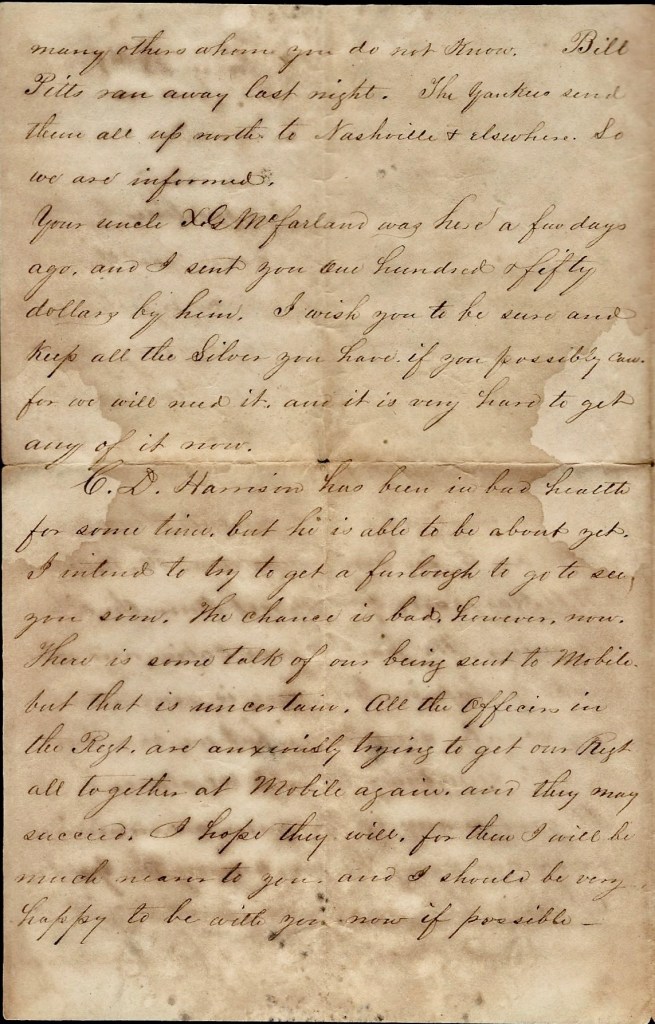
A good many of the men are running away and going home among the Yankees. Of those that you are acquainted with I can name Rufus Ellison, Charles Snodgrass, Ward Harris, Bud Ballew, George Kingston, & many others whom you do not know. Bill Pitts ran away last night. The Yankees send them all up north to Nashville & elsewhere. So we are informed. 1

Your uncle X. G. McFarland was here a few days ago and I sent you one hundred and fifty dollars by him. I wish you to be sure and keep all the silver you have if you possibly can for we will need it and it is very hard to get any of it now.

C[olumbus] D. Harrison has been in bad health for some time but he is able to be about yet. I intend to try to get a furlough to go to see you soon. The chance is bad, however, now. There is some talk of our being sent to Mobile but that is uncertain. All the officers in the regiment are anxiously trying to get our regiment all together at Mobile again and they may succeed. I hope they will for then I will be much nearer to you and I should be very happy to be with you now if possible.

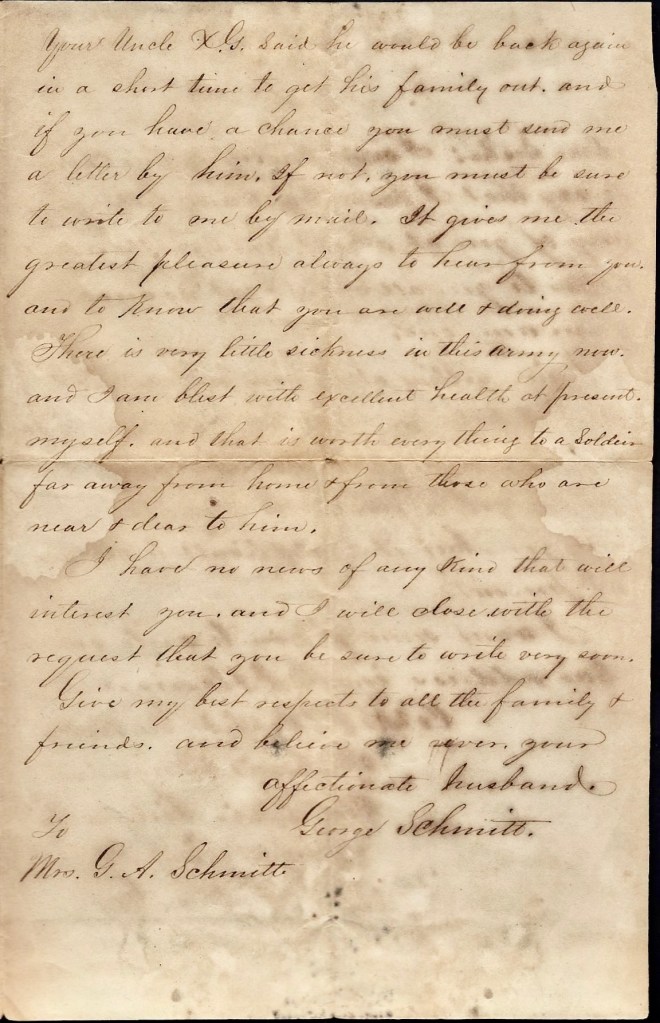
Your uncle X. G. said he would be back again in a short time to get his family out and if you have a chance, you must send me a letter by him. If not, you must be sure to write to me by mail. It gives me the greatest pleasure always to hear from you and to know that you are well & doing well. There is very little sickness in this Army now and I am blest with excellent health at present myself, and that is worth everything to a soldier far away from home & from those who are near & dear to him.

I have no news of any kind that will interest you and I will close with the request that you be sure to write very soon. Give my best respects to all the family and friends, and believe me ever your affectionate husband, — George Schmitt

To Mrs. G. A. Schmitt

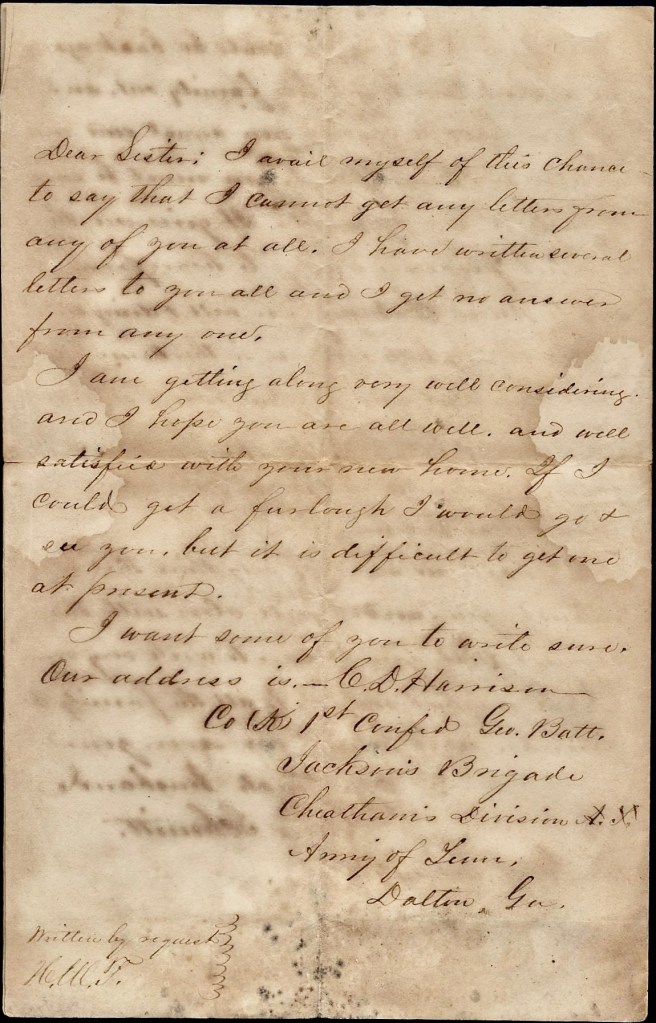
Dear Sister, I avail myself of this chance to say that I cannot get any letters from any of you at all. I have written several letters to you and I get no answer from any one. I am getting along very ell considering and I hope you are all well and well satisfied with your new home. If I could het a furlough I would go & see you but it is difficult to get one at present. I want some of you to write sure. Our address is C. D. Harrison, Co. K, 1st Confederate Georgia Battalion, Jackson’s Brigade, Cheatham’s Division, Army of Tennessee, Dalton, Ga.

Written by request, H. W. T. [H. W. Thompson]


1 It appears that most if not all of these soldiers were eventually sent to Louisville, Kentucky, where they were administered the Oath of Allegiance and pledged to stay north of the Ohio River for the remainder of the war.

1864: Negro Boy Abducted for USCT

The following letter was most likely the draft or copy of a letter sent to a gentleman residing in Baltimore, Maryland, asking for his assistance in finding and returning a young Negro boy, “not thirteen years old” who was taken against his will to serve in one of the USCT regiments being organized at Camp Birney in Baltimore. The author of the letter never identifies himself (the letter is unsigned), nor does he even given the name of the Negro boy who was in all probability his slave. The only names given in the letter are “Mr. Chapline” of Shephardstown—the author’s agent sent to Baltimore to recover the boy—and Col. Joseph Perkins of the 19th USCT, whose “intoxicated negro soldiers….forced away” the boy. The author’s version of the boy’s abduction and of his physical disabilities seems to stretch credulity.

In July 1863, Druid Hill in Baltimore became known as Camp Birney, after Secretary of War Edwin M. Stanton assigned Gen. William Birney, son of an abolitionist, to recruit African Americans for U.S. Colored Troops (USCT) regiments. Birney freed 16 shackled slaves from a Pratt Street slave pen when they promised to enlist. He also organized the 7th USCT here, as well as the 4th and 39th USCTs in 1864.

The following letter is from the private collection of Greg Herr and was transcribed and published on Spared & Shared by express consent.

Transcription

Shephardstown, [West] Va.
10th April 1864

Mr. John W. Wright, Baltimore, Maryland

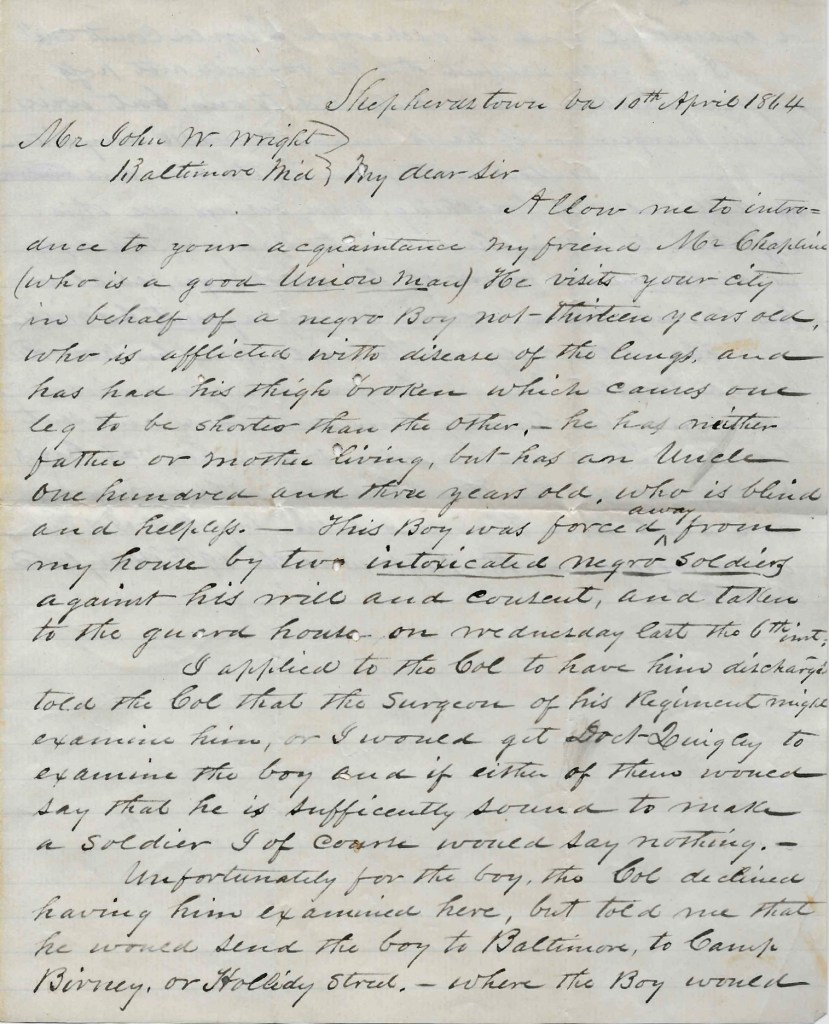
My dear sir, allow me to introduce to your acquaintance my friend Mr. Chapline (who is a good Union man). He visits your city in behalf of a negro Boy not thirteen years old who is afflicted with disease of the lungs, and has had his thigh broken which causes one leg to be shorter than the other. He has neither father or mother living, but has an Uncle one hundred and three years old who is blind and helpless. This Boy was forced away from my house by two intoxicated negro soldiers against his will and consent, and taken to the guard house on Wednesday last the 6th inst.

I applied to the Colonel to have him discharged, told the Colonel that the Surgeon of his regiment might examine him, or I would get the Doct. [John] Quigley 1 to examine the boy and if either of them would say that he is sufficiently sound to make I soldier, I of course would say nothing. Unfortunately for the boy, the Colonel declined having him examined here, but told me that he would send the boy to Baltimore to Camp Birney, or Holliday Street, where the Boy would be examined and if discharged—“would count one.”

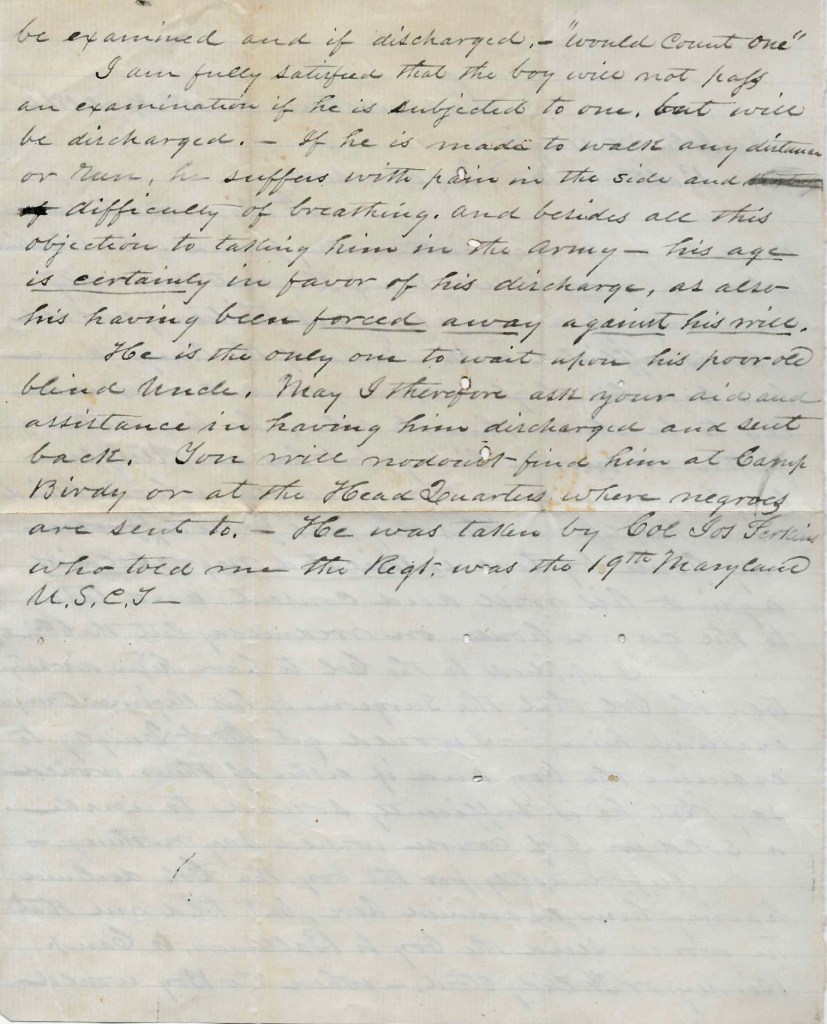
I am fully satisfied that the boy will not pass an examination if he is subjected to one, but will be discharged. If he is made to walk any distance or run, he suffers with pain in the side and difficulty of breathing. And besides all this objection to taking him in the army—his age is certainly in favor of his discharge, as also have been forced away against his will.

He is the only one to wait upon his poor old blind Uncle. May I therefore ask your aid and assistance in having him discharged and sent back? You will no doubt find him at Camp Birney or at the Headquarters where negroes are sent to. He was taken by Col. Jos. Perkins who told me the Regiment was the 19th Maryland U. S. C. T.


1 “John Quigley was a doctor in Shepherdstown in the 19th Century. He was born in 1802 in Shippinsburg, Pennsylvania and graduated from the University of Pennsylvania Medical School in 1823. He married Mary Swearingen of Shepherdstown in 1827 and practiced medicine here until his death in 1883. During the aftermath of the battle of Antietam, he and Mary took 34 wounded confederate soldiers into their home on German Street, and their children helped care for them.” [Source: Historic Shepherdstown & Museum]

1863: Unidentified Soldier to Polk Pierson

The following letter was written by a Confederate soldier named “Don” or Dan” who I believe served in the 12th (usually called the Eighth) Texas Infantry. He wrote the letter to his cousin, J. Polk Pierson (b. 1846), the son of William Howell Pierson (1816-1869) and Malinda Sharp (1820-1894) of New Salem, Rusk county, Texas. Polk’s brother, Marshall Samuel Pierson (1838-1909) served in Co. C, 17th Texas Cavalry (Moore’s). The 17th Texas Cavalry was dismounted and consolidated with other Texas regiments at the Battle of Arkansas Post (Fort Hindman) in mid-January 1863 where many of them were taken prisoner. Marshall Pierson escaped, however, and made his way back to Confederate lines.

The letter describes the last minute attempt to reinforce Arkansas Post before it was attacked by Union forces under the command of John McClernand. Trans-Mississippi Confederate Commander Theophilus Holmes was blamed for inadequately supplying troops to defend the Post though it was a virtually indefensible position to begin with.

Transcription

Camp near Pine Bluff, Arkansas
March 20th 1863

Mr. Polk Pierson,

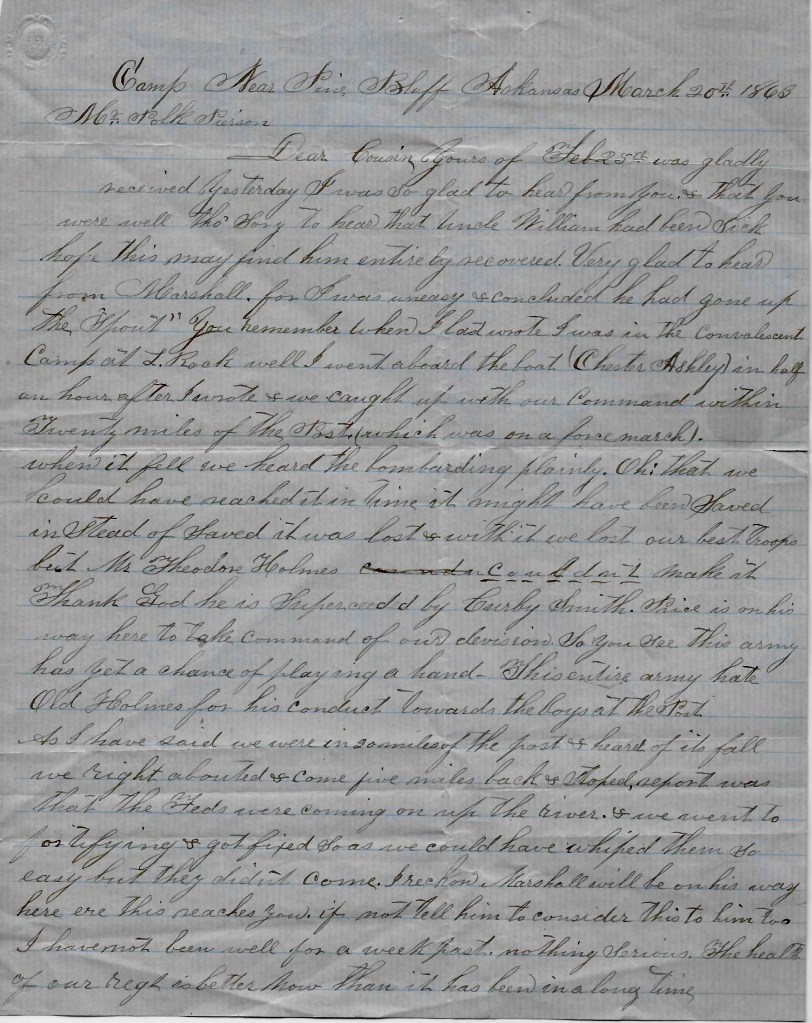
Dear cousin, yours of February 25th was gladly received yesterday. I was so glad to hear from you & that you were well though sorry to hear that Uncle William had been sick. Hope this may find him entirely recovered. Very glad to hear from Marshall for I was uneasy & concluded he had gone up the “spout.”

You remember when I last wrote I was in the convalescent camp at Little Rock. Well, I went aboard the boat (Chester Ashley) in half an hour after I wrote & we caught up with our command within twenty-five miles of the Post (which was on a force march). When it fell, we heard the bombarding plainly. Oh! that we could have reached it in time. It might have been saved. Instead of saved, it was lost and with it we lost our best troops. But Mr. Theodore [Theophilus] Holmes couldn’t make it. Thank God he is superseded by Kirby Smith. Price is on his way here to take command of our division. So you see this army has yet a chance of playing a hand. This entire army hate Old Holmes for his conduct towards the boys at the Post. As I have said, we were [with]in twenty miles of the post & heard of its fall. We right abouted & come five miles back and stopped. Report was that the Feds were coming on up the river & we went to fortifying & got fixed so as we could have whipped them so easy but they didn’t come. I reckon Marshall will be on his way here ere this reaches you. If not, tell him to consider this to him too.

I have not been well for a week past. Nothing serious. The health of our regiment is better now that it has been in a long time. We have nothing new. We have many rumors, none of which are worth relating.

We received the sad intelligence of Ellen’s death the first of this month. In her death we lost an affectionate sister which loss is irreparable. But “Our loss is her eternal gain.” We received letters from home yesterday. All well and getting along as usual.

Last Friday two men were executed by musketry for desertion. We were all marched down & witnessed it. It was a solemn scene. I was about twenty steps from them. They took it calmly—never shed a tear. The old priest was with them & he had humbugged the poor fellows till they thought he would take them right to Heaven. Another one is to be shot tomorrow & seven next Friday the 27th—all for desertion. They are all Dutch & Irish belonging to the artillery companies. We will all go.

Ras 1 in very good health. Col. [Overton] Young is superseded by Brig. General [James Morrison] Hawes (who formerly commanded the cavalry). It causes some dissatisfaction in the brigade. We are living some better than we used to. We get one-third of a pound of pork to the man per day. Same old corn bread. I never wanted to see a biscuit as bad in life. Farmers are planting corn. This is a good corn & cotton country but children here 15 years old who never saw a biscuit. If I had a bushel of biscuits, I could toll this entire army off.

As for peace, I don’t see much chance yet. It is rumored here that Abe has called for 600,000 more troops. Don’t believe it, Polk. I have a slight fever which makes me nervous as you see & I will close this uninteresting letter. My warmest love to all. Ras send love to all. I shall anxiously look for Marshall. Write soon to me, my dear cousin, & I will do the same.

I am, my dear cousin, yours as ever, — Don [Dan?]

P. S. A fire broke out in Pine Bluff a night or two ago and burned several houses. Polk, I have no postage stamps & I will send this without this time, but in the future I will pay on my letters. I have sent to Little Rock for five dollars worth of stamps that will be here tomorrow or next day. Adieu.


1 Believed to be Erastus Smith, Captain of Co. C, 12th Texas Infantry.

1864: John Payne Bull to Eliza Sprigg Bull

This letter was written by Lt. Colonel John Payne Bull (1840-1911), the son of John Cardwell Bull (1812-1898) and Eliza Sprigg Payne (1819-1905) of Carondelet, St. Louis, Missouri. John began his service in the Confederate Army as Major of the 8th Arkansas Cavalry. He was later promoted to Lt. Colonel of Cabell’s Brigade.

In this letter, John’s appointment by Gen. Price as the Provost Marshal of the army preparing to invade Missouri in the fall of 1864 is announced. The following excerpt of Price’s 1864 Missouri Raid describes Bull’s role:

“Price remained in the vicinity of Pilot Knob until September 29. Having abandoned hope of capturing St. Louis, he headed for the Missouri capital. Jeffer- son City, where he hoped to achieve his political goals. During the first week In October, the Army of Missouri wound its way leisurely across the central part of the state. Rampaging far and wide, they captured countless small and Isolated militia garrisons, “liberated” dozens of towns, tore up track and burned bridges of the Pacific Railroad, and “exchanged” worn out horses for fresh ones.

They also looted. Price had issued strict orders against looting before the army left Pocahontas, but the practice began In the vicinity of Pilot Knob, where Price appointed Lt. Col. John P. Bull as Provost Marshal of the Army, Bull organized a 50-man provost guard for each brigade to prevent straggling and plundering, but lawlessness continued. The army’s wide dispersion. with its main column stretched out for five or six miles, made it difficult for the guards to maintain control.

Slow movement of the cumbersome wagon train gave the soldiers ample time to roam about and forage. The train, which originally consisted of about 300 wagons, soon grew to over 500 wagons, many of which were being used to carry the “fruits” of the expedition. Accompanying the train were many stragglers, described by one observer as “a rabble of deadheads.” The incompetence and indifference of many of the line officers, and the fact that much of the army consisted of unwilling conscripts, added to the slow rate of march and lack of discipline. As time went on, the more seasoned veterans began to fear that “the odious train would occasion disaster to the army.”

[Note: This letter is from the private collection of Greg Herr and was transcribed and published on Spared & Shared by express consent.]

Transcription

Union, [Missouri]
October 2, 1864

My own darling mother,

I wrote to you on yesterday from Franklin and hope you received my letter. I was slightly wounded in the knee on yesterday in the fight at Franklin and several good friends in this vicinity have promised me they would see you and assure you of the exact nature of it. It has been very painful but is now much better and I hope in a very few days I will again be able for duty. Gen. Price this morning issued a complimentary order with regard to our Brigade and appointed me Provost Marshal General of the Army of Missouri. When I left Arkansas, Willie & Nobia was both very well. I hope before many days I will be able to press my dear mother once more to my arms. Farewell. Love to all. Your affectionate son, — Johnie

[On opposite side in a different hand]

Union
October 27, 1864

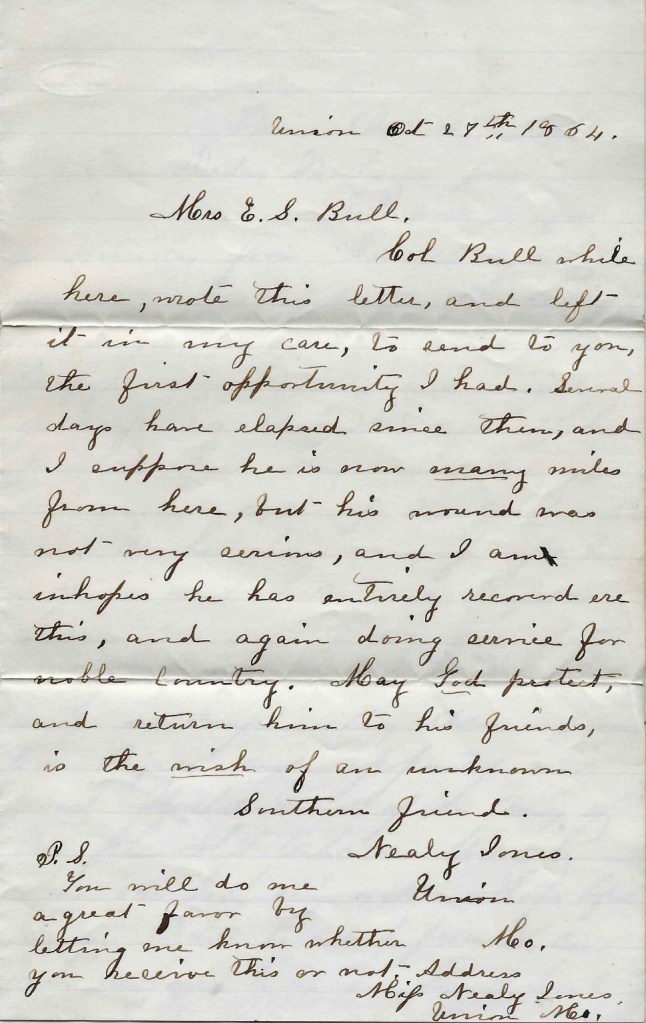
Mrs. E. S. Bull,

Col. Bull while here, wrote this letter and left it in my care to send to you the first opportunity I had. Several days have elapsed since then and I suppose he is now many miles from here, but his wound was not very serious and I am in hopes he has entirely recovered ere this and again doing service for noble country. May God protect and return him to his friends is the wish of an unknown Southern friend, — Nealy Jones, Union, Mo.

P. S. You will do me a great favor by letting me know whether you receive this or not. Address Miss Nealy Jones, Union, Mo.

1863: James David Gornto to Susan (Allen) Gornto

The following letter was written by James David Gornto (b. 1841) of Co. C, 4th Florida Infantry. James mustered into the company at Fort St. Marks, Florida, on 5 September 1861. He was with his company until 25 November 1863 when he was taken prisoner on Missionary Ridge with a wound to his right leg.

James was the son of a Madison, Florida, planter named Elijah Dowling Gornto, Sr. (1817-1886) and his wife, Susan Ann Allen (1821-1913).

Transcription

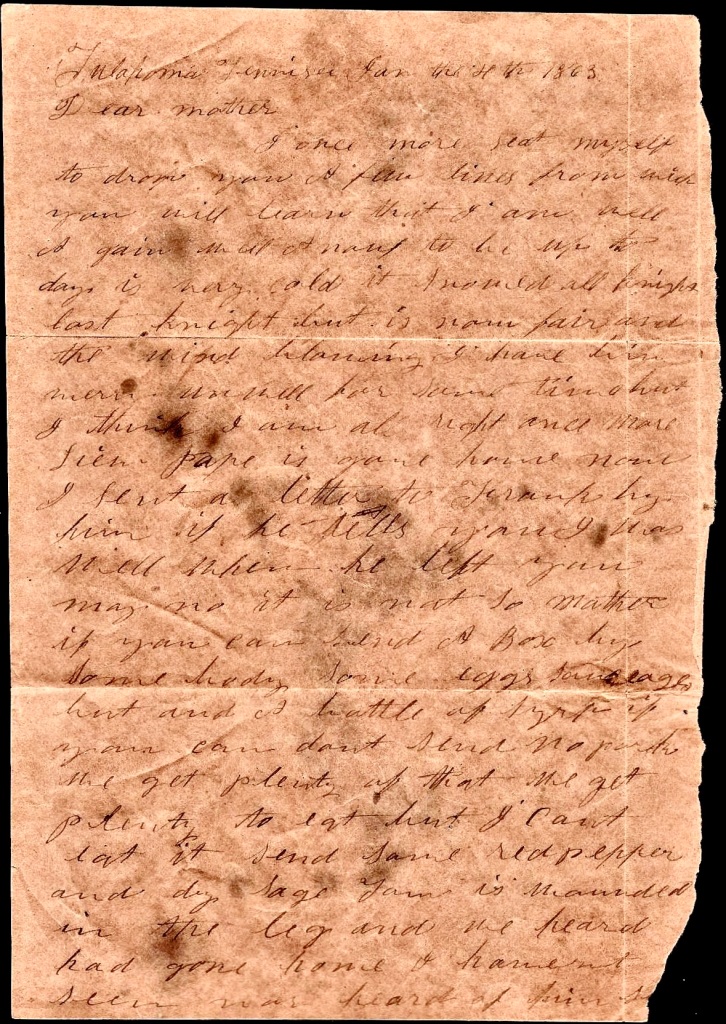
Tullahoma, Tennessee
January 4, 1863

Dear Mother,

I once more seat myself to drop you a few lines from which you will learn that I am well again—well enough to be up. Today is very cold. It snowed all night last night but is now fair and the wind blowing. I have been very unwell for some time but I think I am all right and more lean. [Aaron S.] Pope is going home now. I sent a letter to [brother] Frank by him. If he tells you I was well when he left, you may know it is not so. Mother, if you can send a box by somebody, some eggs, sausage, butter, and a bottle of syrup if you can. Don’t send no pork. We get plenty of that. We get plenty to eat but I can’t eat it. Send some red pepper and dry sage.

A post war image of Robert Lemuel Wiggins

Tom is wounded in the leg and we heard had gone home & have not seen nor heard of him since the battle [of Stones River]. 1

Mother, Sunday was a week I had the pleasure of hearing Mr. [Robert Lemuel] Wiggins preach. He has found me out of hand. Am up and been [ ], spent two evenings with him. He is the same old Bob. 2

Mother, I am very lean and only weigh [ ]. Oh, I forgot, do send me an orange. Tell Aunt Anny to send me one and send yours and father’s likeness. Give my respects to all my friends and relations. Tell grandmother to write. Write to Uncle Bob to write. Mother, keep Willy at home. Don’t let him come here if you can help it. He is too young. I would like to see him here on a visit but not to stay and he is not able to come here on a visit. Write soon.

I am your true and affectionate son, — J. D. Gornto


1 Probably a reference to James’ cousin, Thomas J. Gornto (1841-1909) who served in the same company. Thomas was the son of David Gornto (1805-1864) and Eliza Allen (1811-1871).

2 Robert Lemuel Wiggins (1841-1915) served early in the war in the 1st Florida Cavalry but was transferred into the 4th Florida Infantry in December 1863.

1862: Will Morgan to his Mother

The following letter was written by “Will Morgan” whom I believe was William E. Morgan of Co. D, 10th Illinois Infantry but I can’t be certain of this. There was another soldier in this same regiment named Henry Runge—another name mentioned in the letter—but he served in a different company. There were other regiments that had soldiers by these two names in them but their circumstances don’t seem to coincide with the contents of this letter. The year of the letter is also not given but my hunch is that it was February 1862 when the 10th Illinois was encamped at Bird’s Point, Missouri.

William’s military records inform us that his residence was Jacksonville, Morgan county, Illinois, prior to his enlistment at the age of 18.

Transcription

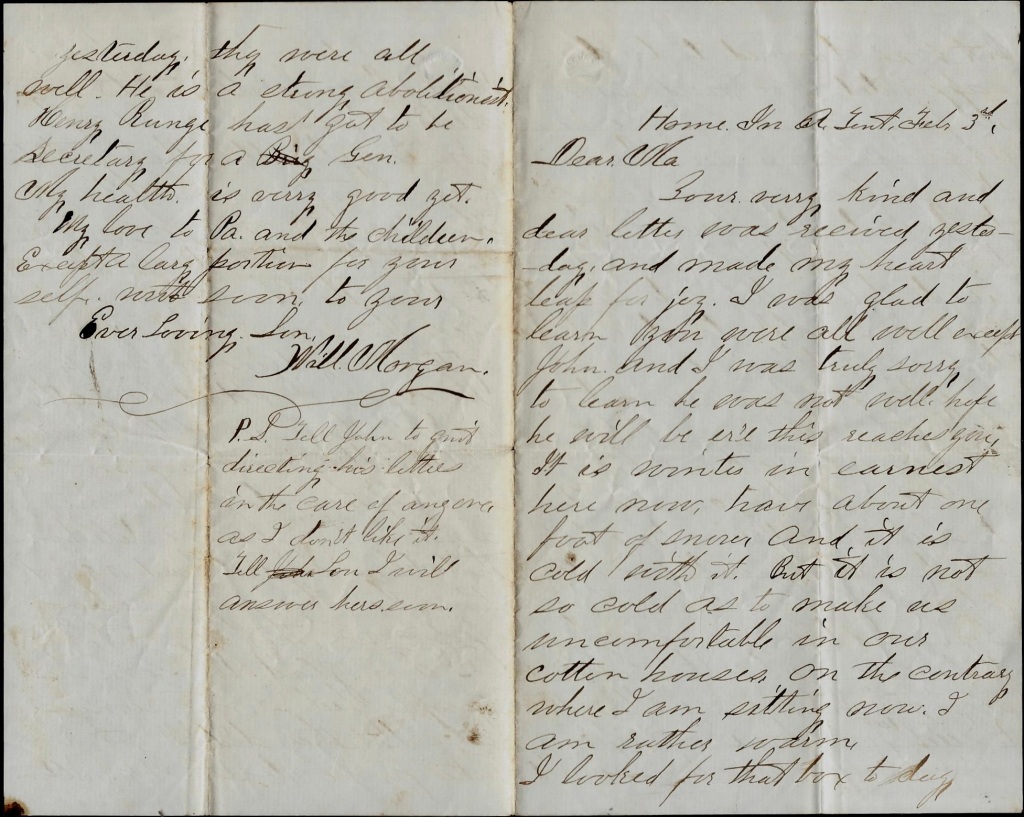
Home in a tent
February 3rd [1862]

Dear Ma,

Your very kind and dear letter was received yesterday and made my heart leap for joy. I was glad to learn you were all well except John and I was truly sorry to learn he was not well. Hope he will be ere this reaches you. It is winter in earnest here now. Have about one foot of snow and it is cold with it. But it is not so cold as to make us uncomfortable in our cotton houses. On the contrary where I am sitting now, I am rather warm.

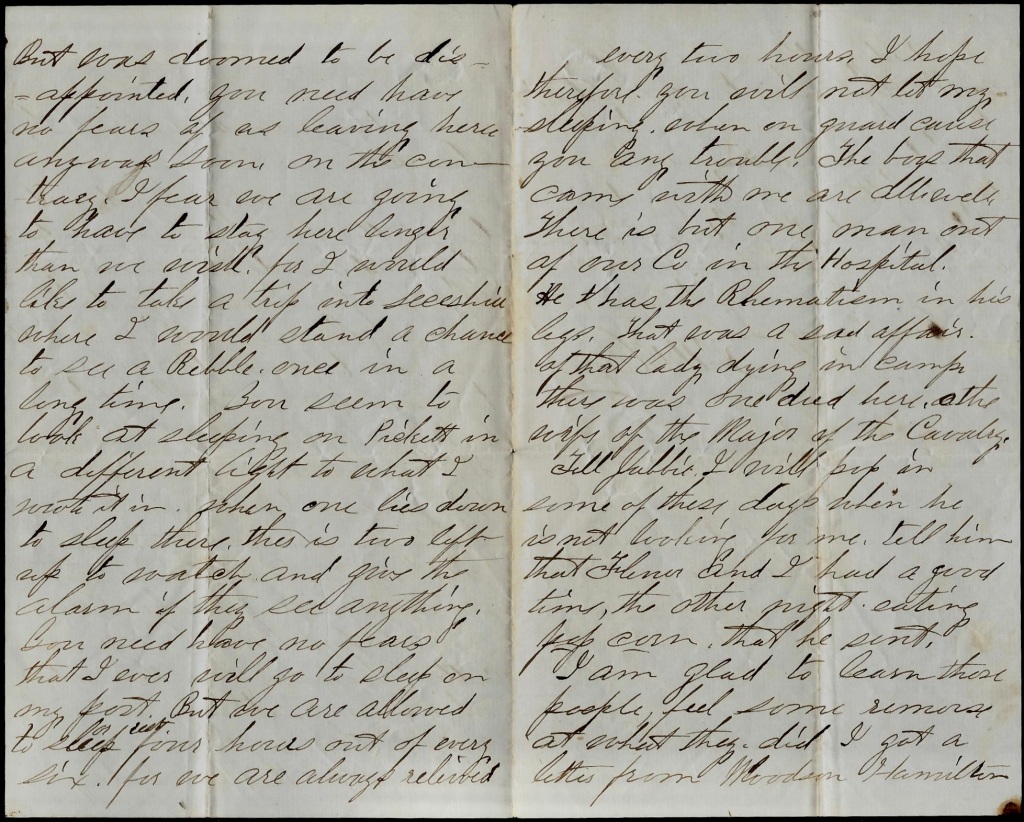
I looked for that box today but was doomed to be disappointed. You need have no fears of us leaving here anytime soon. On the contrary, I fear we are going to have to stay here longer than we wish for I would like to take a trip into secession where I would stand a chance to see a Rebel once in a long time.

The boys that came with me are all well. There is but one man out of our company in the hospital. He has the rheumatism in his legs. That was a sad affair of that lady dying in camp. There was one died here—the wife of the Major of the Cavalry.

You seem to look at sleeping on picket in a different light to what I wrote it in. When one lies down to sleep there, there is two left up to watch and give the alarm if they see anything. You need have no fears that I ever will go to sleep on my post. But we are allowed to sleep, or rest, four hours out of every six, for we are always relieved every two hours. I hope, therefore, you will not let my sleeping when on guard cause you any trouble.

Tell Jabbie I will pop in some of these days when he is not looking for me. Tell him that Flener and I had a good time the other night eating pop corn that he sent. I am glad to learn those people feel some remorse at what they did. I got a letter from Woodson Hamilton yesterday. They were all well. He is a strong abolitionist. Henry Runge has got to be secretary for a General.

My health is very good yet. My love to Pa and the children. Accept a large portion for yourself. Write soon to your ever loving son, Will Morgan

P. S. Tell John to quit directing his letters in the care of anyone as I don’t like it. Tell Lou I will answer her’s soon.

1863: Austin M. McDowell to William H. Moody

The following letter was written by Austin M. McDowell (1815-1892), the husband of Susan Ann Finney (1813-1889) and the Captain of Co. D, 74th Ohio Infantry during the Civil War. Austin was working as a lumber agent in Xenia, Greene county, Ohio, when the war began. He enlisted in October 1861 and resigned his commission in mid-February 1863—just a few weeks after this letter was penned.

From Austin’s letter we learn that he was not with his company in the Battle of Stones River. He was apparently in Xenia, Ohio, on recruiting duty.

Transcription

Xenia, [Ohio]
January 3rd 1863

Lieut. Wm. H. Moody
Dear Friend,

Not having heard from you for some time, I drop you a line. I am having no success in recruiting. My squad reports to me regularly and we have not yet got a single man. How are you getting along? I think it downright folly to keep us here doing nothing but mot my will but Father Abraham’s be done. You have doubtless read the stirring news from Murfreesboro. It has been a terrible battle and I fear the 74th has suffered great loss. I feel great anxiety for my own noble boys. I hope and believe that they have done their duty. I regret to hear that our Colonel [Granville Moody] is probably wounded. 1 If so, I trust it is slightly and I rejoice to know and am proud to express it that, from accounts, he has won by his valor an imperishable name on that gory field. I am very anxious to hear the final result and particulars of the battle. Dr. Kyle expects to start tonight for Nashville. Rev. Mr. [James] Harper expects to go early next week and likely others will go. Some women think of going. I would like to go but I suppose there is no chance for that. Please write to me soon

Your obedient servant, — Capt. A. M’Dowell

1 Col. Moody led the 74th Ohio into the Battle at Stones River (Dec. 31, 1862- Jan. 2, 1863) near Murfreesboro, Tennessee. A later account noted that “his horse was shot from under him, he took a bullet in his right calf and he narrowly escaped a fatal wound when one or more bullets shattered a revolver he carried in his right breast pocket, more bullets shredded his uniform so much that one man called him the ‘ragged colonel.’”

1864: George W. Patterson to Friend Sarah

The following letter was written by George W. Patterson who enlisted on 3 October 1864, at age 18, at Nunda, New York, to serve one year. He mustered in as a private, Co. I, 188th New York Infantry on October 22, 1864; promoted corporal, March 10, 1865; mustered out with company, July 1, 1865, near Washington, D. C.

The 188th New York left the state to join the Army of the Potomac on October 13, 1864. Initially, only seven companies left the state but company K followed in November. The army was before Petersburg, Virginia, at that time. The regiment was placed in 2nd Brigade, 1st Division, V Corps then under Major General Gouverneur Warren. The 188th New York remained in this assignment for its entire federal service.

On October 27, less than a month after first muster, the regiment went into battle at Hatcher’s Run near the Weldon Railroad. The regiment suffered 7 dead and between 39 and 46 wounded (depending on reports). On December 8, 1864, the regiment participated on a raid to Hicksford, Virginia, where two soldiers were taken prisoner.

February 6 and 7, 1865 saw the regiment at Hatcher’s Run again. During this battle the regiment suffered 5 dead, 21 wounded, and 3 missing.

The Appomattox campaign saw the regiment fight with its corps at White Oak ridge, Gravelly Run and Five Forks, when its casualties aggregated 45 killed and wounded. The 188th New York also participated in the final assault on Petersburg and was present at Appomattox Station on April 9 when General Lee surrendered the Army of Northern Virginia. According to the Rochester Democrat and Chronicle, it reported that the 188th was the regiment that “busted up the confederacy.” They were given the honor of posting guard duty around the court house while Lee surrendered the confederacy to Grant.

Transcription

October 26, 1864

Friend Sarah,

I now take the opportunity of letting you know where and how I am. We have just left Albany today for the City of New York on a steamer. It looks very nice to get on board of a steamer and go down the Hudson river for 100 miles or so. In coming down from Rochester to Albany there were a great commotion raised among the men by the falling off of two or three soldiers from the cars and the report came in by telegraph that they were both killed. But when we got ready to start this morning, they both came on board the steamer.

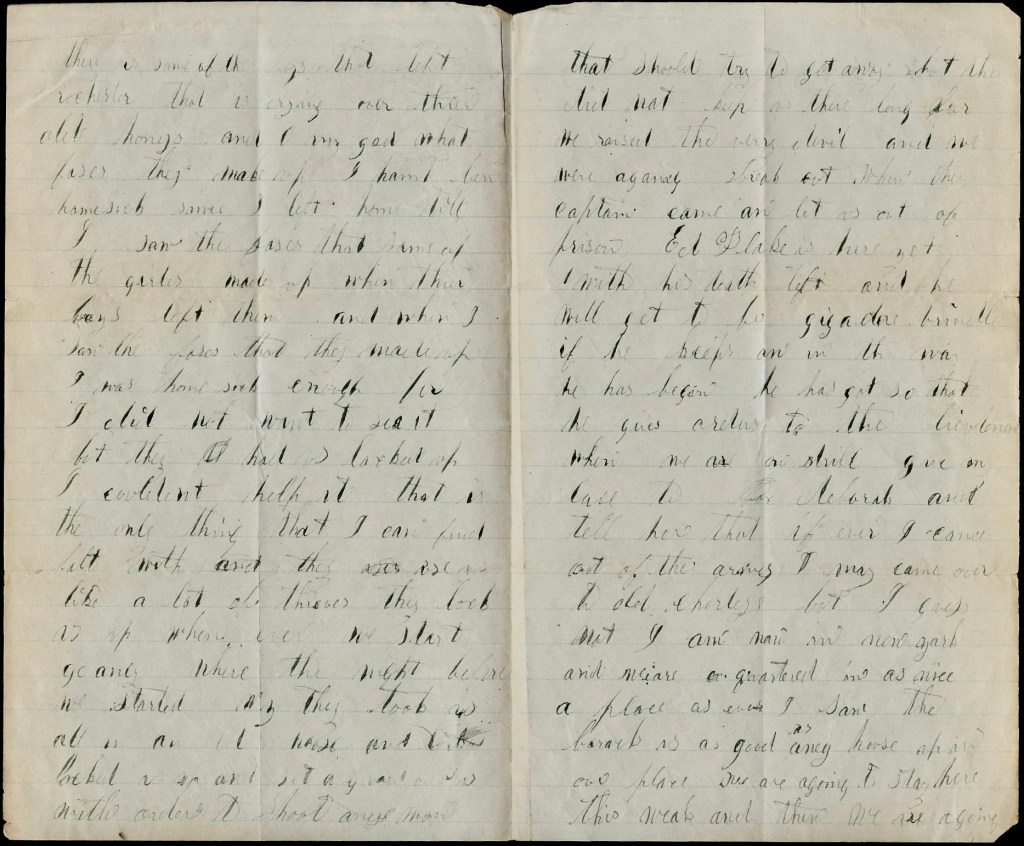
There is some of the boys that left Rochester that is crying over their old homes and O my God, what faces they make up. I hain’t been homesick since I left home till I saw the faces that some of the girls made up when their boys left them and when I saw the faces that they made up I was homesick enough for I did not want to see it but they had us locked up. I couldn’t help it. That is the only that I can find fault with and they use us like a lot of thieves. The lock us up whenever we start to go anywhere. The night before we started to New York they took us all in an old house and locked us up and set a guard on us with orders to shoot any man that should try to get away but they did not keep us there long for we raised the very devil and we were a going to break out when the Captain came and let us out of prison.

Ed Blake 1 is here yet with his teeth left and he will get to be Gigadere Brindle if he keeps on in the way he has begun. He has got so that he gives orders to the Lieutenant when we are on drill.

Give my love to Deborah and tell her that if ever I get out of the army, I may come over to old Charley’s but I guess not. I am now in New York and we are quartered in as nice a place as ever I saw. The barracks is as good as any house up in our place. We are a going to stay here this week and then we are a going to start for Battery Point and there we shall collect till our regiment has been in a battle and some fifty of them killed and eighty wounded. That is the way they stay in Rochester and I knew it would be for I never knew a regiment to stay where the officers said they would stay when they got up the regiment.

I close for I am ordered out to roll call and if we don’t come out when we are [called], they put us in the guard house. So goodbye. — George W. Patterson

Direct to Battery Barracks to the 188th Regiment, New York State Volunteers, Battery Barracks, In care of Capt. Pursall

1 BLAKE, EDMUND W.—Age, 18 years. Enlisted, October 3, 1864, at Nunda, to serve one year; mustered in as private, Co. I, October 22, 1864; wounded in action, February 6, 1865, at Hatcher’s Run, Va . ; mustered out with company, July 1, 1865, near Washington, D. C ; also borne as Edmond P.

1861: Albert Wesley Pillsbury to Marion C. Chamberlain

Though neither letter is signed with anything other than “Albert,” I was able to attribute the following letters to Albert Wesley Pillsbury (1834-1914), the son of Methodist clergyman, Rev. Samuel Pillsbury (1802-1888) and Eliza A. Latta (1809-1883) of Durand, Winnebago county, Illinois.

Albert wrote the letters to Marion C. Chamberlain (1836-1872), a native of Canada, who was enumerated as a schoolteacher in Durand, Winnebago county, Illinois in the 1860 US Census. In the 1870 US Census, Albert and Marion were residing as man and wife in Virginia City, Madison county, Montana, where Albert was farming and Marion was “Keeping House.”

Albert wrote both letters from Lake Gulch in the Central City Gold Mining region of Colorado Territory, in November 1861. In local news he writes of hunting down a horse thief and of a devastating fire in nearby Nevada City [Nevadaville]. He also writes some of the what he hears about the war back East and of the enlistments both in Denver as well as in Illinois.

Letter 1

Addressed to Miss. M. C. Chamberlain, Pecatonica, Winnebago county, Illinois

Lake Gulch, Colorado Territory
November 3rd 1861

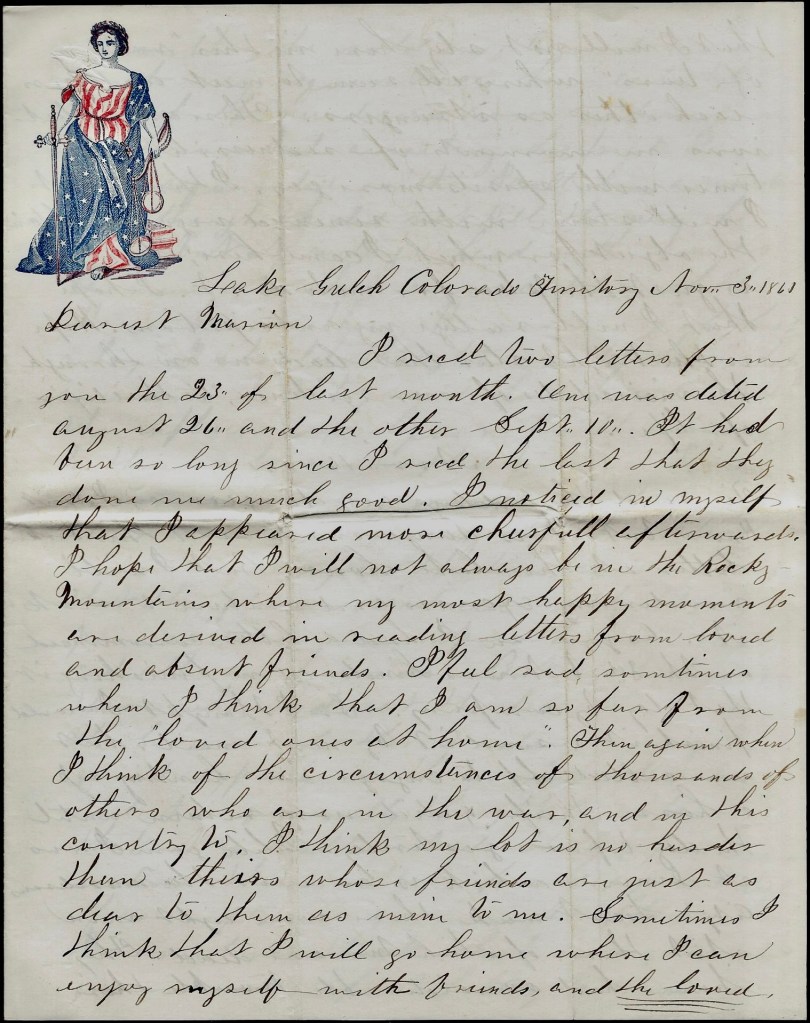
Dearest Marion,

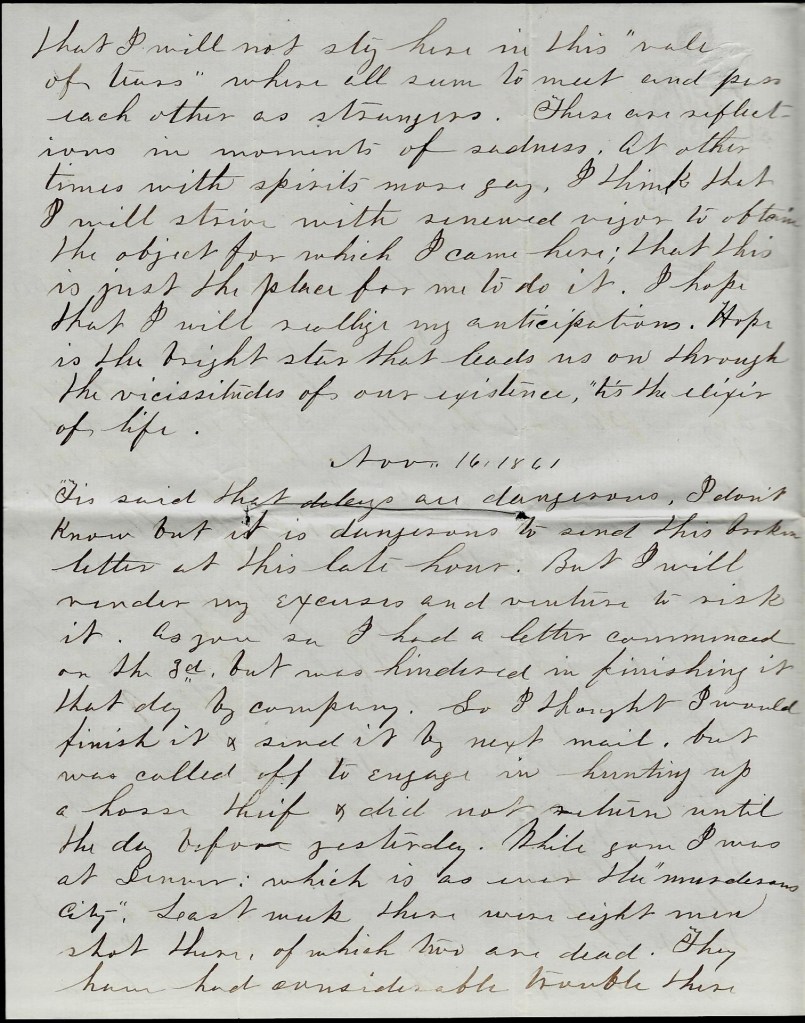
I received two letters from you the 23rd of last month. One was dated August 26th and the other September 10th. It had ben so long since I received the last that they done me much good. I noticed in myself that I appeared more cheerful afterwards. I hope that I will not always be in the Rocky Mountains where my most happy moments are derived in reading letters from loved and absent friends. I feel sad sometimes when I think that I am so far from the “loved ones at home.” Then again, when I think of the circumstances of thousands of others who are in the war and in this country too, I think my lot is no harder than theirs whose friends are just as dear to them as mine to me. Sometimes I think that I will go home where I can enjoy myself with friends and the loved—that I will not stay here in this “vale of tears” where all seem to meet and pass each other as strangers. These are reflections in moments of sadness. At other times with spirits more gay. I think that I will strive with renewed vigor to obtain the object for which I came here; that this is just the place for me to do it. I hope that I will realize my anticipations. Hope is the bright star that leads us on through the vicissitudes of our existence. Tis the elixir of life.

November 16, 1861

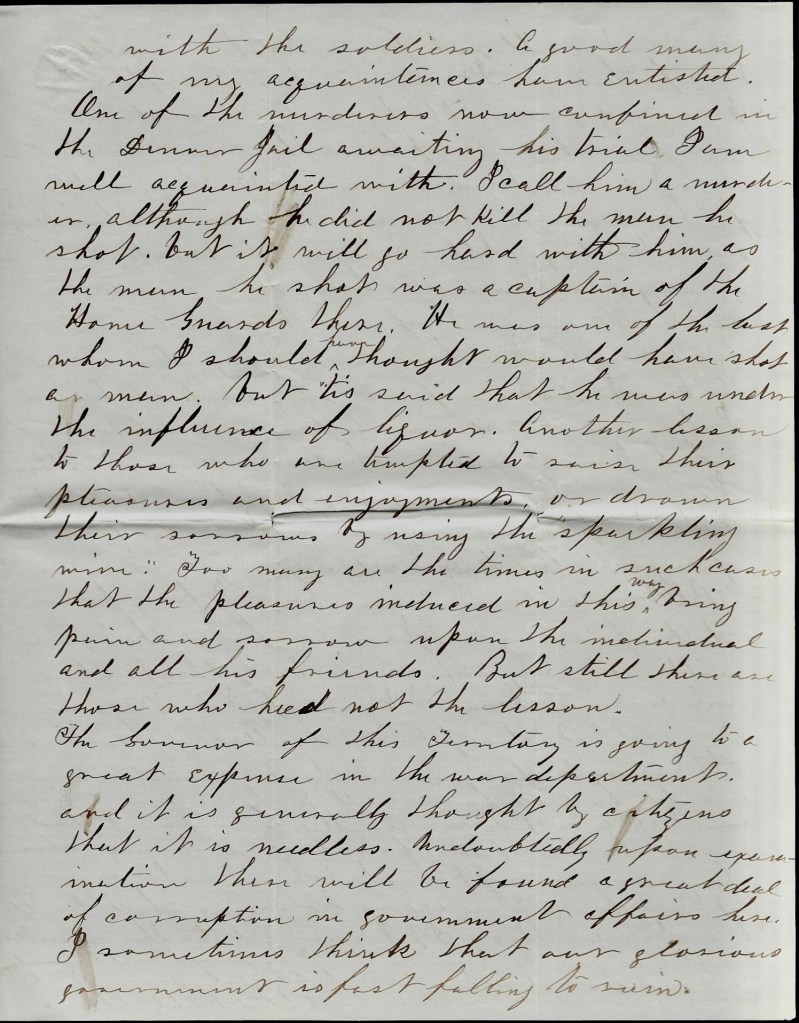
Tis said that delays are dangerous. I don’t know but it is dangerous to send this broken letter at this late hour. But I will render my excuses and venture to risk it. As you see, I had a letter commenced on the 3rd but was hindered in finishing it that day by company. So I thought I would finish it & send it by next mail, but was called off to engage in hunting up a horse thief & did not return until the day before yesterday. While one, I was at Denver which is as ever the “murderous city.” Last week there were eight men shot there of which two are dead. They have had considerable trouble there with the soldiers. A good many of my acquaintances have enlisted. One of the murderers now confined in the Denver jail awaiting his trial I am well acquainted with. I call him a murderer although he did not kill the man he shot—but it will go hard with him as the man he shot was a captain of the Home Guards there. He was one of the last whom I should have thought would have shot a man. But tis said that he was under the influence of liquor. Another lesson to those who are tempted to raise their pleasures and enjoyments or drown their sorrows by using the “sparkling wine.” Too many are the times in such cases that the pleasures induced in this way bring pain and sorrow upon the individual and all his friends. But still there are those who heed not the lesson. 1

The Governor of this Territory [William Gilpin] is going to a great expense in the War Department and it is generally thought by citizens that it is needless. Undoubtedly upon examination there will be found a great deal of corruption in government affairs here. I sometimes think that our glorious government is fast falling to ruin. That it will yet prove to the world to be a failure. It seems that everything is proving favorable to such an end. The ones in whom we placed the most confidence are, it seems, trying to use it to the gratification of their own desires. It seems that they are standing still before the traitorous enemy, and when there is a sacrifice made, it consists of our bravest and best men. We have not many [Nathaniel] Lyons and [Edward D.] Bakers to dispose of at this critical period.

I have not received any letters since the ones of which I mentioned in the commencement of this. I am waiting in great expectation: but when I think of being disappointed, I remember that you are looking as anxiously as I am. But you don’t know how I long for a letter from you. I am so afraid that you will not say what you truly think about my coming home. I know if I don’t come you will be disappointed. “Every heart has its secret drawer.” I think sometimes it would be best for us all to have some friend in which to confide our troubles. At home I had two or three confiding friends, and I miss them here. Do you suppose that home will ever appear home to me again. It seems that I will be a stranger there. If I receive a letter this week, I will answer by next mail. I hope you will overlook my long delays. Direct to Central City, Colorado Territory.

Write soon. Yours as ever in love, truth and fidelity, — Albert

1 The Captain of the Home Guards was Capt. Zeiglemuller. It was the Orderly of the Rifles that shot the captain in a financial dispute between them.


Letter 2

Lake Gulch, Colorado Territory
November 24, 1861

“O! that my prayer might unto heaven ascend,
T’would be that thou went ever blest;
That joy and sunlight, thy path might blind
And tranquil visions lull thy peaceful rest.”

My dearest Marion,

In my last I promised if I should receive a letter this week from you that I would answer it by return mail. I am very glad that I have been enabled to fulfill the promise. It much rejoices me to learn that your organ of hope is so very large. If a person could believe without a doubt (and never even think otherwise) in the idea that you advanced in your last, that is, “that good and evil alike, when come from God were blessings,” they necessarily would be happy. You say that you do think that I will be with you before Christmas. Now it makes me feel sorry to think that you are to be so much disappointed. Still I don’t entertain the idea that it will cause you to commit suicide or any other rash deed. “The way the twig is bent, the tree is inclined.” We may as well learn to stand grief while we are young; then it will not be so hard for us to endure it in riper years. It may tend to more fully prove to your mind that doctrine you so frequently advance—viz: “It is all for the best.” I expect you will say that is poor consolation for me. Still, I hope “it is all for the best.”

I don’t get any letters lately from home. Perhaps they think that we will be at home in a few days and it is of no use to write. I am sorry to disappoint them so much. But I don’t see any need of this being lonesome if we don’t come. I expect they are having fine times going to school as I suppose it has commenced before this time. The girls in Durand will have nothing to do this winter but study, as the young men are all gone so that they will not be likely to be bothered going to parties, &c. It must be rather dull times there in general. Who is to be married this winter? None, no not one, “nary one.”

I was much surprised to hear of the proceedings of Mr. & Mrs. D. J. Stines upon his volunteering. She must think a great deal of her country. If I had been in Lumpster’s place, I believe that I should have told her to wait a little longer—that she was not old enough to get to marry. He must have seen at once, if he would have considered any upon the matter of backing out, that it would forever be a stigma upon his character as a true patriot, as a lover of his birthright. I would not have such a charge brought against my name and known right amongst my own folks to be true for all the women in God’s footstool. I had twice, or even a thousand times rather die for my country. But I suppose there are some grounds to partially excuse Demp. upon. I suppose his mother thought it was dreadful for him to go. But I can imagine in my own mind how she talks about the war. I will bet that she thinks it the duty of everyone to go. She thinks that government should compel a force to march upon the enemy longer than it now has. I can just see in my mind how she gets up in meeting and sympathizes for her country, grieves at its wrongs, and wishes for every loyal American to resent those wrongs, to gather around the standard of her flag and protect it to the last extremity. But she don’t want Demp to go. There is too much rish to run. “Twould make Mary sick to have him go to the war. She would not give her son for the final salvation of the whole human family. No, she would not even risk her wealth, or future prosperity for such a gift. She would rather teach herself that it was an impossibility—that all don’t deserve any such merits. Self rules predominant in her mind to believe any such doctrine, tis too liberal. But Mary’s and Mrs. Stine’s whining would not in my mind justify his turning traitor to his country.

Nevadaville before the November 1861 fire

Week before last this portion of the mountains were thrown into a great deal of excitement by fire. There were about fifty houses burned in Nevada City [Nevadaville] which is about one and a half miles from here. The wind blew awfully. It seemed as if the elements were bound to drive the people from this part of the mountains. It was as light as day anywhere within a mile of the fire. Everything here is so dry and so full of pitch and the wind so dreadful that when fire breaks out, it is apt to do a great deal of damage. There were not many goods burned. They took them and threw them into bad holes and put them into tunnels, but a great many of them were destroyed and damaged by moving them so hastily. Besides these were several families burned out but no one burned to death. The people in Central City, which is about three-quarters of a mile from Nevada, took all of the goods out of the place, supposing that it would be destroyed also. Teams got broke $10 to $25 per load for hauling goods to the nearest prospect hole or tunnel. But luckily the fire did not do any damage there, but it caught fire a great many times and was put out. This all happened in the night which made it much more fearful. The air was filled with flying sparks. It blew them as much as a mile, which made the fire jump from mountain to mountain. The family that I live with got their goods all packed up and out ready to start, but were not damaged any, but dreadfully frightened. 1

Write soon. Direct as usual. You don’t know how I want to find out about what you think of my coming home. I am afraid that you will not say as you think about it. No more at present. I hope that you will ever believe that I am your true and affectionate lover. Goodbye for a while, — Albert

1 In 1861 a fire destroyed most of the town. A newspaper article about the fire stated that there were around 40 stamp mills in the vicinity of Nevada, a staggering number for that early date, which surely made the town the milling center of Colorado at that time.