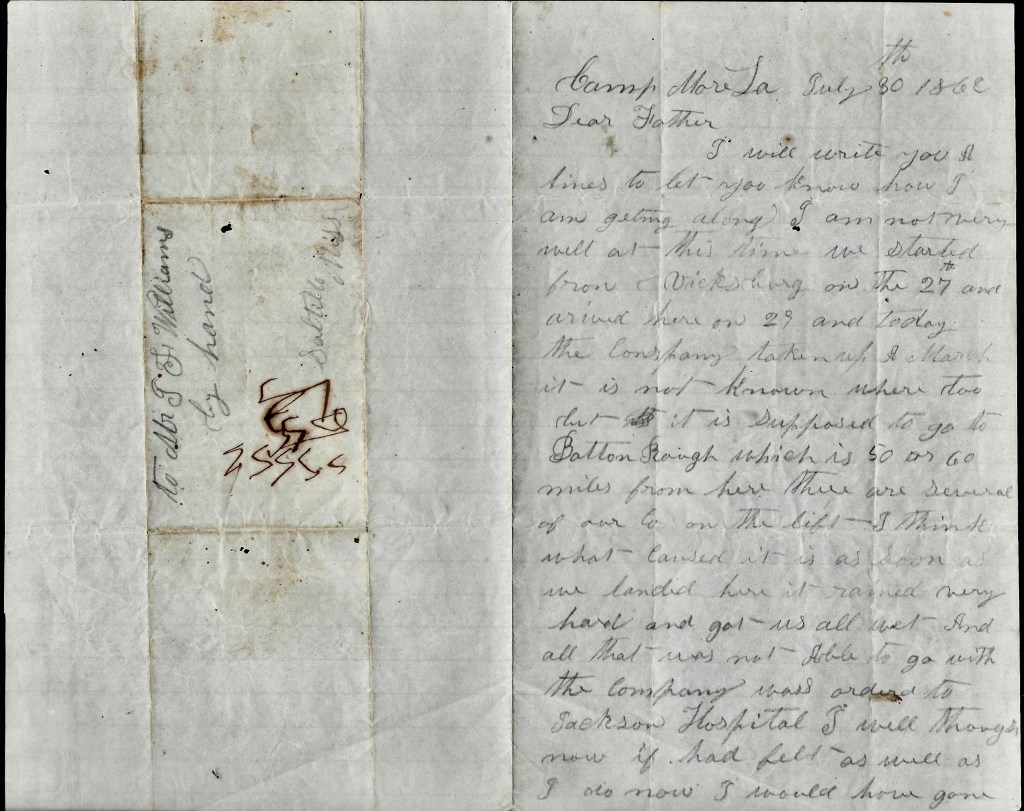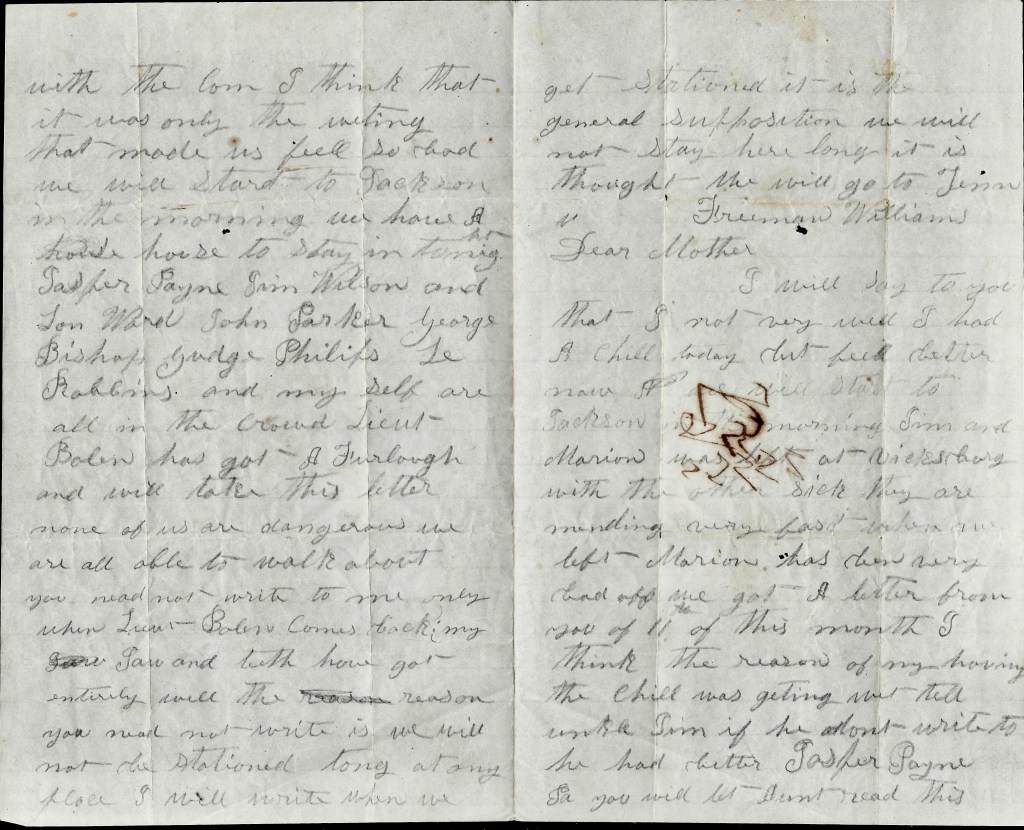
The following handwritten notes were found in an 1862 New Testament that was carried by Levi Lewis Jaquith (1829-1913) while serving as a sergeant in Co. B, 53rd Massachusetts Infantry.
Levi was the son of Seth Jaquith (1804-1866) and Ann Robbins (1805-1878) of Cheshire county, New Hampshire. Levi was first married in 1850 to Sarah Louisa Kingsbury (1833-1892) and later, in 1894 to Orvilla Wilson (1842-1918). At the time of the Civil War, Levi was living in Fitchburg, Worcester county, Massachusetts. Levi was 33 years old when he enlisted on 25 August 1862, giving his occupation as a “chair maker.”
After it was organized in the fall of 1862, the regiment was assigned to the expedition to go to Louisiana and once there, in January 1863, it was assigned to Gooding’s 3rd Brigade, Paine’s 3rd Division, 19th Army Corps. After participating on some expeditions into Louisiana, the 53rd found itself in May 1863 at Bayou Sara, bearing down on Port Hudson from the north. It was here that Levi began taking notes on the flyleaf of the New Testament, distributed by the American Bible Society.
In addition to preserving the New Testament that he carried with him in the service, Levi collected and kept a rather unusual relic of his sojourn into Dixie—a lash that he picked up from a Louisiana plantation. The braided leather lash measures approximately 21 inches in length and bears a contemporary tag, barely discernible, but appears to read, “Lyman Plantation, Laurel Hill, Lash,” and includes Levi’s signature. There was a village named Laurel Hill in West Feliciana Parish through which the troops passed, though I cannot find any mention of a plantation owned by the Lyman family.
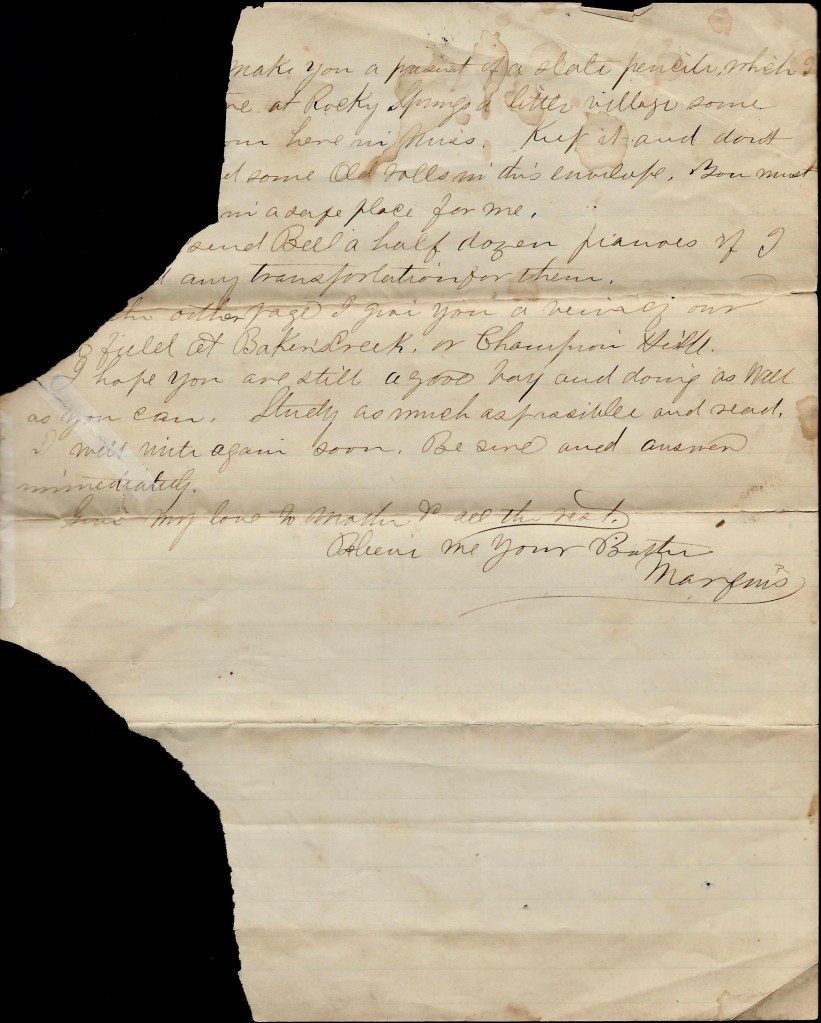
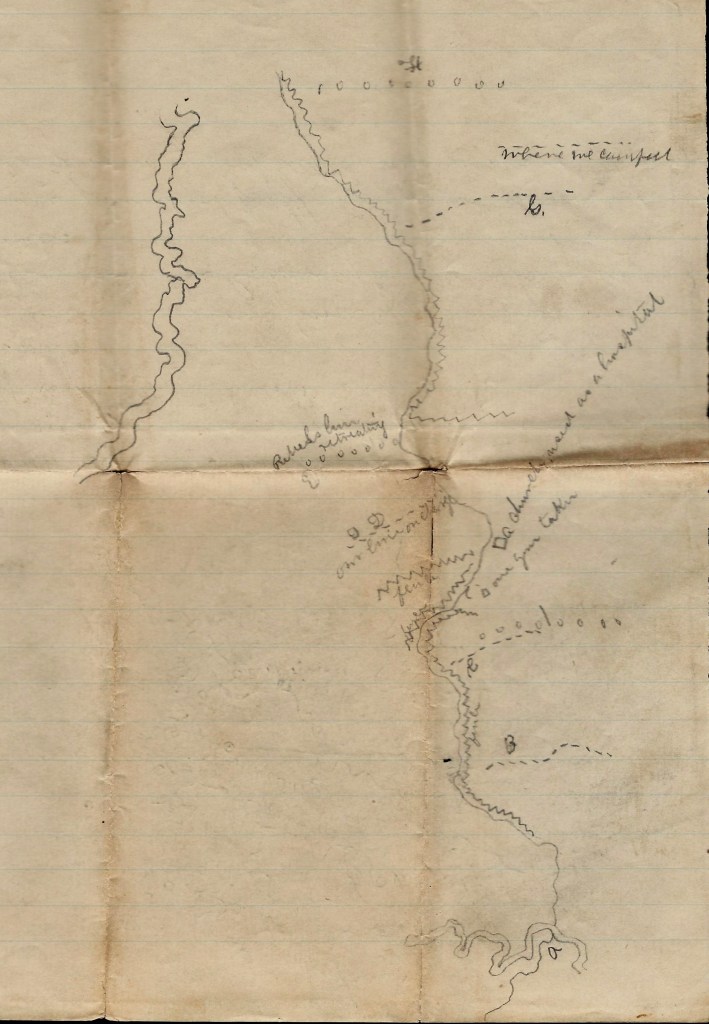
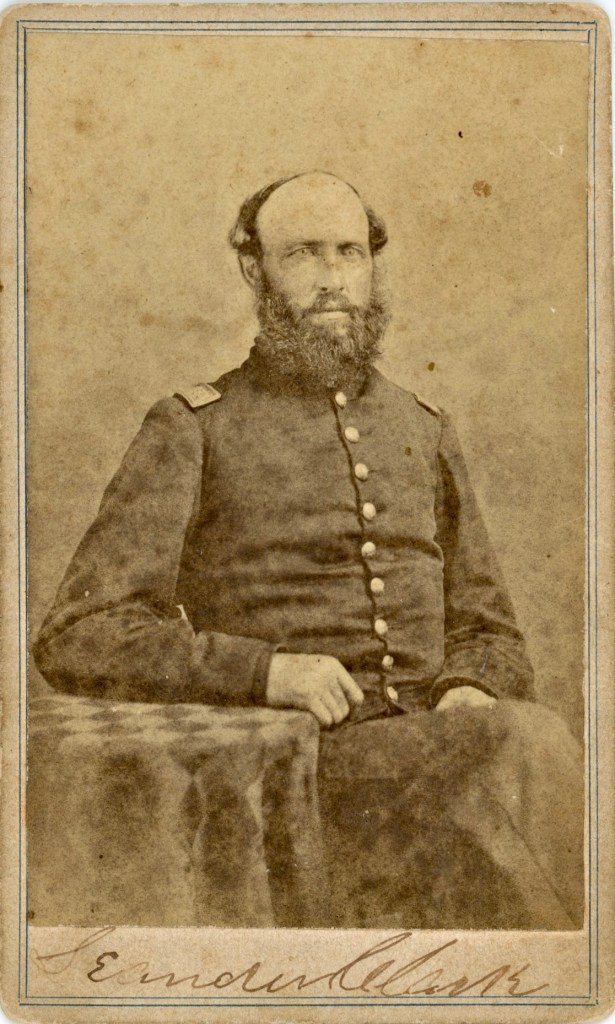
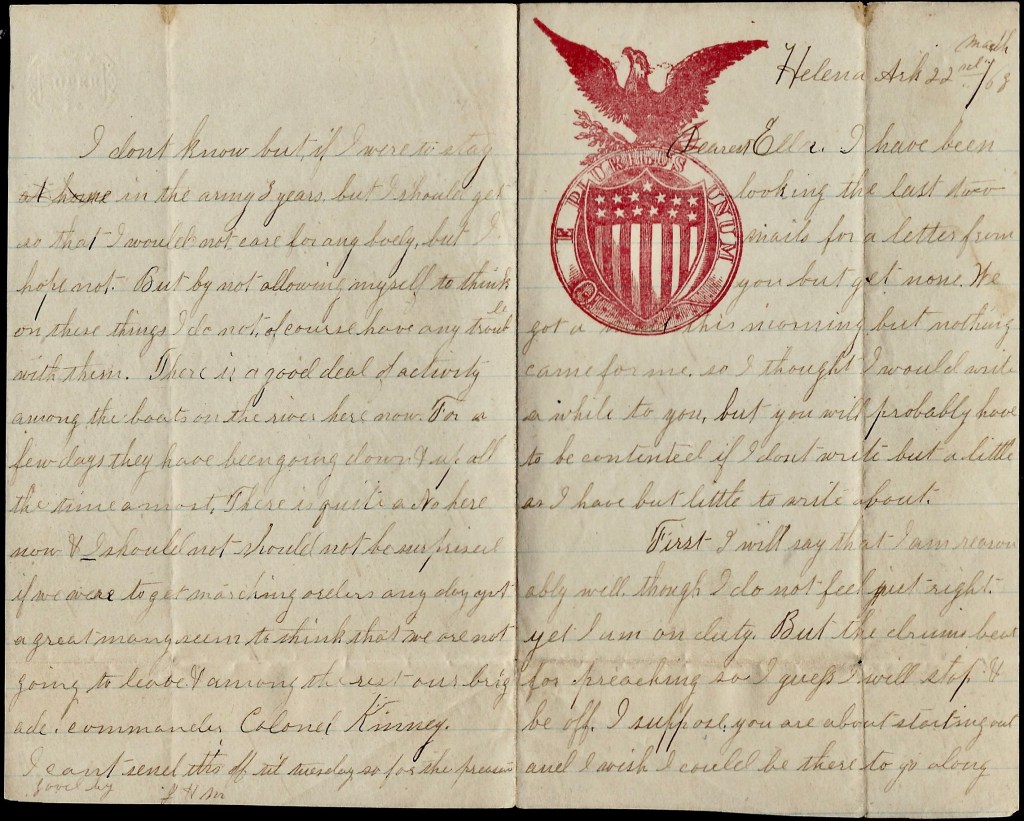
Transcription
Arrived at St. Francisville
Handheld New Testamentdistributed by the American Bible Society
Saturday morn 23rd [May]. Midnight on Mississippi river. Moved from Alexandria to Simsport. Start May 22nd. March 75 miles. 3 days. Morning of 26th, go into city from river. Camp near Lyman Plantation in magnolia grove and cape jasmine. Cross in Laurel Hill [packet sidewheeler]. Change camp. Nearly all the troops gone up river towards Port Hudson. Embark on Laurel Hill. Don’t start up river.
Store houses on the river burned by Butler. Ammunition train. Stop at St. Francisville. No flour, cloth, meal, servants nearly starved. Fine court house and church (new). Most luxuriant country…
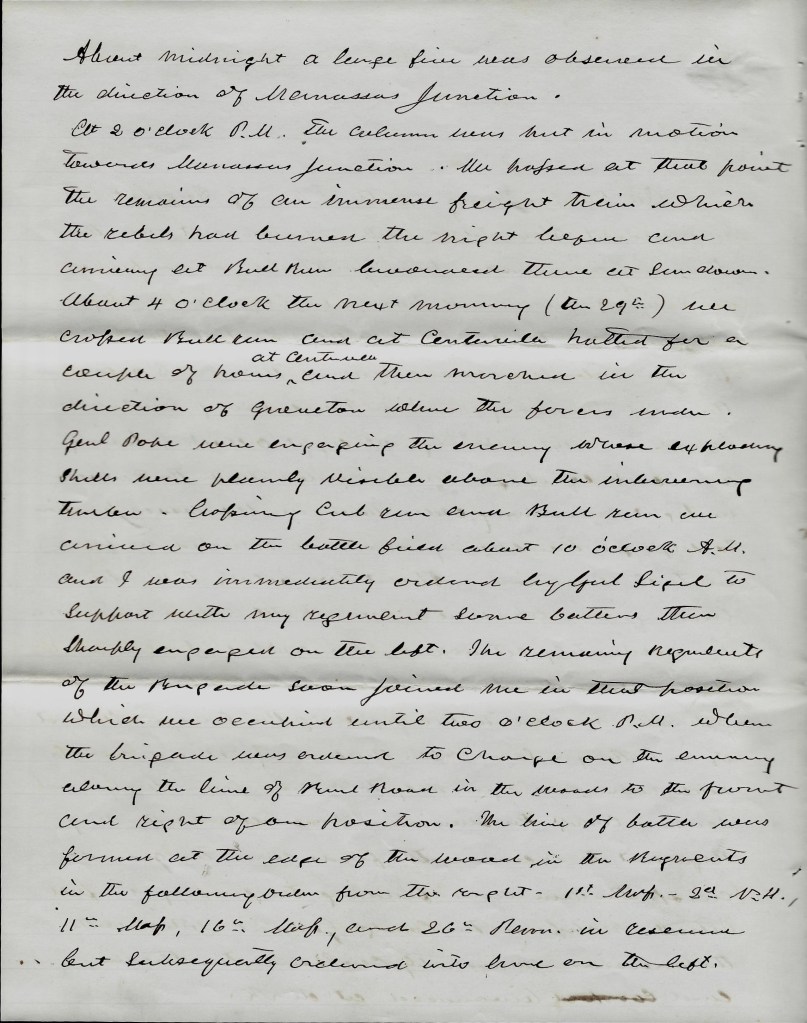
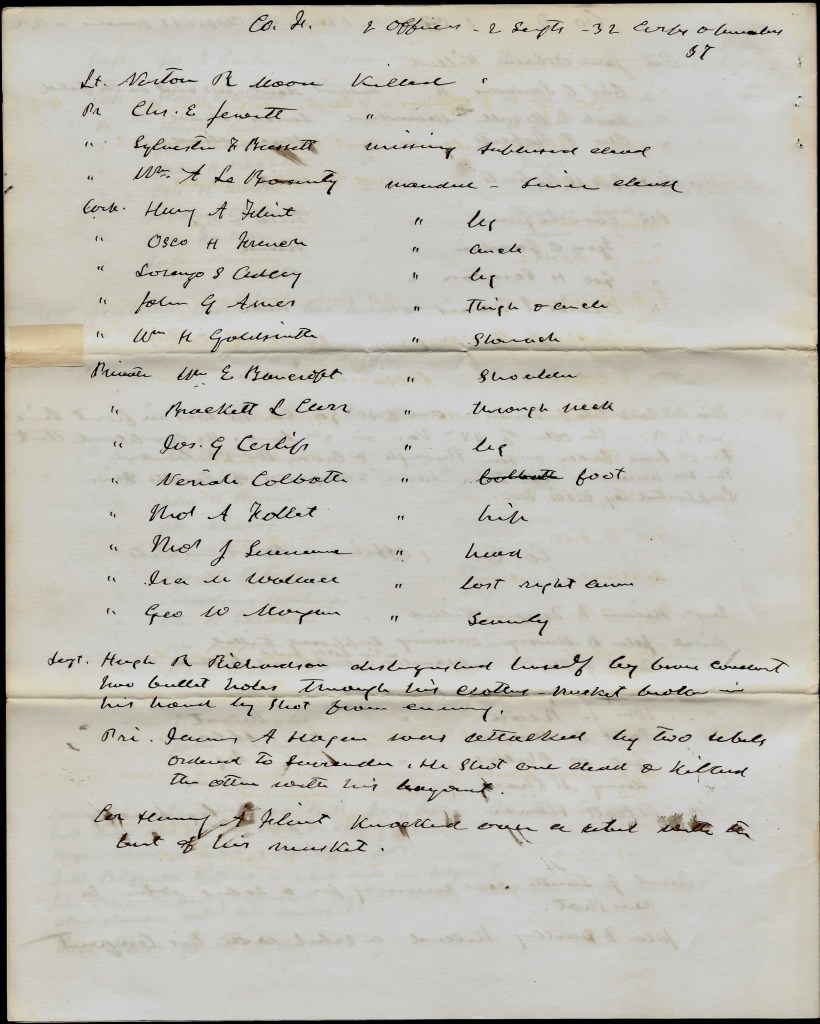
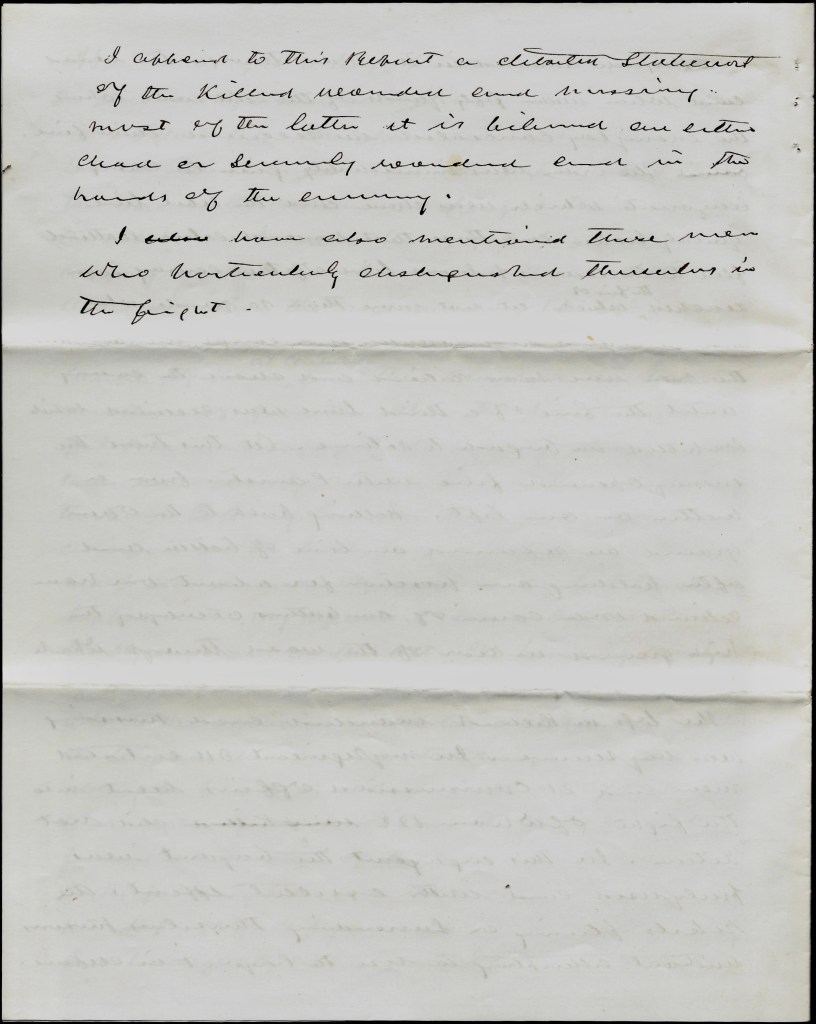
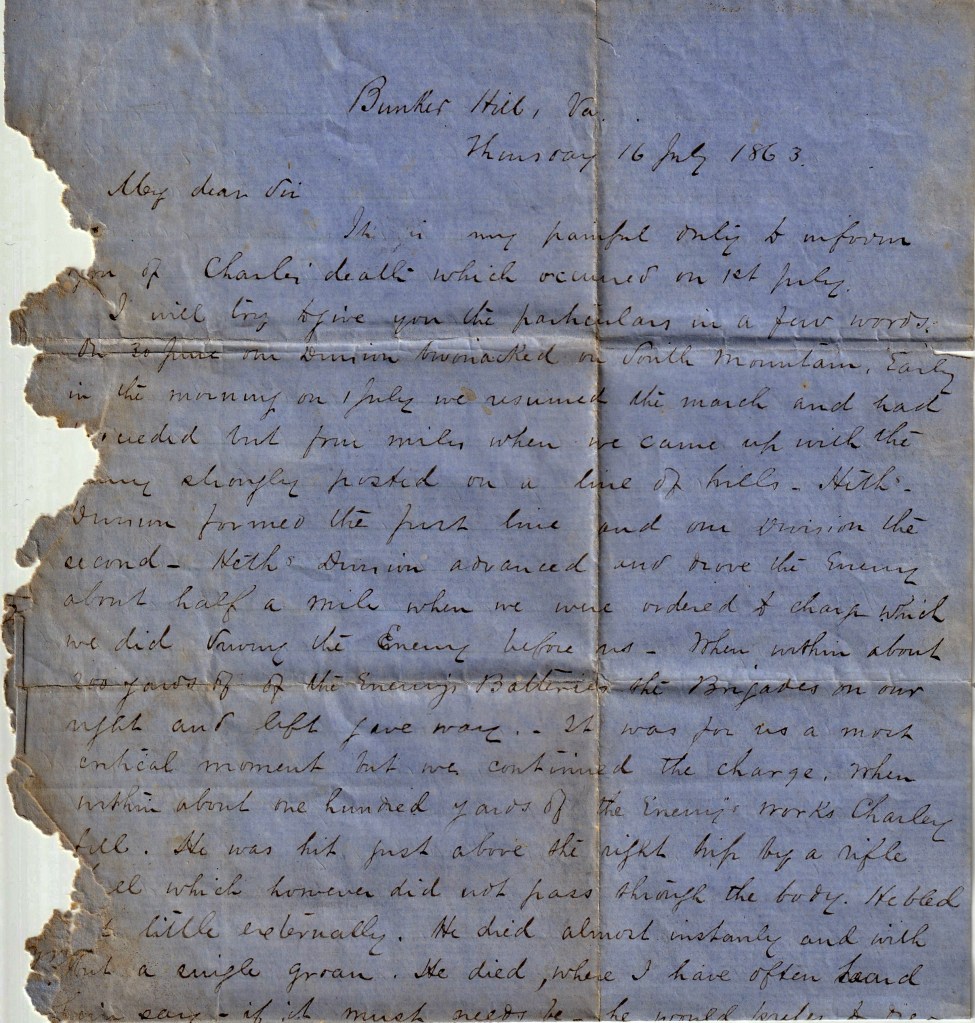
March three miles to enemy’s works through woods. In ravine, see the [ ] skirmishing. Heavy artillery open. Pioneers clear away—make road for artillery. 1 o’clock, abandon this road because of deep ravine. Change position to another a half mile away near forward. Corps of Pioneers build new road. Cross ravine 30 to 50 feet deep, cut trees &c. Camp down at dark. I work forming picket lines until 11 o’clock. Sleep with adjutant. Distant sound of horses in night. Rebels make a feint to retreat twice. Fearful volley in front and rear. A few fall back. They volley, take old position. Three or four wounded. One finger shot off (self shot) Capt. [George H.] Bailey. 1
Work until 11 deploying skirmishers. Return to headquarters with reserve. Co. I and F did from 12 to 3. Major waked me and we count on the whole line, examining the position. Adjutant struck with spent ball. One volley at daylight. Rebs retire. Two persons come in Tuesday noon. I retire to rear. [Gen.] Paine with them. Order of Col.—remain all quiet. Returned at 9 o’clock. Retire half a mile to cook and sleep. Remain all day resting. Negro regiments. 22 guns. Bouquet of magnolias.
No firing. A strange calm before the storm. Quiet walk in the evening alone. Sat down but no sleep. Restless, nervous, weary and sleepy. But no sleep. I feel the weight of our position. The awful solemnity. Col. came in at 11. I notify all commander that the grand attack will commence in the morning by the central force. Order that men have two day’s rations, breakfast eaten, blankets rolled, and left under guard, and start at 4:20.
Brig. General William Dwight
Move at 4:30 through the woods. Gen. [William] Dwight leads, having command of us infantry. In one to two hours the rebs are all driven through the woods to a clearing and the artillery comes up. Open a terrible fire. Rebs respond. An awful artilllery duel. 30 lb. fused shells strikes within 2 feet of our line [but] did not explode. Men did not move. The 30 lb. shells strike all about us. Several battery trains cut down. Tree cut entirely in two, falls upon a caisson and 6 horses, crushing them all. Men go by in crowds wounded—officers also. Lots of skedaddlers. “All cut up.”
Gen. Paine comes up and says our forces have taken two rifle pits but are badly cut to pieces. Needs us there. Had regiment [start] for the place he wants but we must support the battery and hold the hill. [ ] the 91st New York and 2nd Louisiana &c. welcomed with “bully for you” over and over. The men have driven the rebs out of a ravine for three-quarter mile. Our regiment sprang to the edge of a cliff and opened fire. The enemy are behind rifle pits 150 yards in front. From 10 till dark our men fire continuously. Reb’s big Columbiad……4 men wounded on our side.
On Thursday, 28th, firing with rifles stopped. We lay all day resting with a watch, ordered to cease firing. After noon the artillery opened and in a few moments dismounted the enemy guns. Flag of truce to bury dead till 7 evening.
1 Capt. Bailey was mortally wounded on May 25th and died on the 27th.
The standard uniform of the Oneida Independent Cavalry Company (Military Images, March 2017)
The following letter was written by Addison Gardner Bonney (1841-Aft1880), the orphaned son of Perez Harwood Bonney (1793-1851) and Sybil Covey (1807-1854) of Hamilton, Madison county, New York.
Addison wrote this letter while serving as a corporal in the Oneida Independent Cavalry Company. He mustered into the company on 4 September 1861 and mustered out as a sergeant in September 1864. This company was recruited mainly at Oneida, Salisbury, Stockbridge, Hamilton, Otisco, Eaton, Nelson Flatts, Vienna and Chittenango. It left the State in September, 1861, and served at the headquarters of the Army of the Potomac, performing escort and guard duty, and furnishing couriers, etc.
Addison wrote his letter from the Headquarters of the Army of the Potomac (AOP) at Frederick, Maryland, just days before the Battle of Gettysburg, and on the very day that Gen. Meade replaced Gen. Hooker as the commander of the AOP—though that information was not yet known to him. “Gen. Hooker is a good division general but is not fit to command the Army of the Potomac, and he is no favorite of the army,” confided Addison to his sister.
Transcription
Addressed to Miss Byron Powers, Knox Corners, Oneida county, New York
Headquarters Army of the Potomac Frederick, Maryland
June 28, 1863
Dear Sister,
We have traveled sixty miles in the last two days from Fairfax Court House to this place. We will probably remain here for two or three days.
I never knew less of what was going on in the army than at this time. Gen. Hooker is noted for still movements and quiet planning, but we will of course attack the enemy in Pennsylvania in the rear if a battle is fought then.
I have written before of the fine country about here, whereas harvest has commenced. I never saw such splendid fields of wheat before. I think they will yield forty bushels to the acre (without exaggeration).
Our entrance into Frederick yesterday was far from being what it was last year. No cheering ever meets the ear of our General. No handkerchiefs ever wave to welcome the approach of our General. No young ladies of surpassing beauty wait impatiently to salute him with a kiss. Gen. Hooker is a good division general but is not fit to command the Army of the Potomac, and he is no favorite of the army.
I become every day more and more convinced that this is a political war and is carried on by a set of politicians and speculators. And these are hardened and selfish and are totally blinded to the country’s interests and to everything but their own personal benefit.
I am well but am pretty tired from hard riding and little sleep.
The following short letter was written by James Alexander Seddon (1815-1880), an 1835 law school graduate of the University of Virginia who set up his practice in Richmond and then served in the 29th and 31st US Congresses. During the Civil War, he was selected as Secretary of War by Jefferson Davis on 20 November 1862 and served until his resignation in January 1865 but not before penning the following letter to Gen. Pierre Gustave Toutant-Beauregard. Beauregard was then in command of the Department of the West—a prestigious title in name only as it was really only an advisory role.
Seddon’s response to Beauregard was prompted by Gen. John B. Hood’s request on 3 January 1865 to Beauregard for a furlough of 100 days for the Trans-Mississippi troops to allow them time to rest and resupply. Beauregard thought the request unthinkable given the present state of affairs following Hood’s defeats at Franklin and Nashville, and he was no doubt pleased to hear that Seddon shared his opinion.
I am not an expert in signatures but I can find no signature by Secy. Seddon from the 1860s that appears as it was hand-written on this document leading me to believe it is likely a period copy of the Secretary’s correspondence written by a clerk.
Transcription
C. S. A. War Department Richmond, Va. January 8th 1865
To General Beauregard Selma,
Repress by all means the proposition to furlough the Trans-Mississippi troops. The suggestion merely is dangerous. Compliance would probably be fatal. Extinguish if possible the idea.
The following war recollection was found in the Iowa Digital Library at the University of Iowa. It does not appear to have ever been transcribed. It was attributed to Rufus Nathan Merriam (1837-1905) of Co. B, 4th Iowa Infantry.
In this six-page, handwritten document, Rufus recalls the movements of his company from late January until mid-February, 1862. The regimental history records that during this time, their service included: March from Rolla to Lebanon January 22-31, 1862. Advance on Springfield, Mo., February 10-13. Near Springfield February 12. Pursuit of Price to Cassville February 13-17.
I could not find an image of Rufus but here are seven members of Co. F, 4th Iowa Infantry (Roger Davis Collection)
Transcription
I was a private in Co. B, 4th Iowa Infantry. In January 1862 we were in camp at Rolla, Missouri. Having been there nearly five months, orders came to march on Springfield, Mo., as Gen. Price, Van Dorn, and McCulloch were reported there with 40,000 confederate soldiers. About the 25th of January, we broke camp and started on the march but as most of us were convalescent at this time, we only went 5 to 8 miles a day. We came to Lebanon which I think is within about 40 miles of Springfield. Here we camped ten days and by that time the boys health had improved so fast that we were now alright except I know that a good many of the boys like myself had bought a pair of boots at Rolla thinking thy would be just what we would need to march in, but they were the first pair and the last pair I bought in the army.
We left Lebanon about February 10th and on the 12th the Johnnies had come out to meet us from Springfield. The cavalry had a skirmish with them for a few minutes being a few killed and wounded. It now being dark and in timber, we were deployed as skirmishers on each side of the road for some distance back but as we did not find any of the Johnnies and being within three miles of Springfield, we spent the night on picket duty, all expecting a big battle on the morrow.
The morrow came but the Johnnies had skipped out. We now found out that it was the rear guard of the whole army that came out to meet us the evening before. We were now in Springfield and much elated to think with about 10 or 12 thousand of Yanks, Gen. Price was on the run with his army. It looked like he did not intend to fight if he could help it. We camped here till the next morning which was February 14th (Valentine Day) as I well recollect, and a bitter cold morning it was too. My boots I had taken off the night before and they were frozen still and I had to throw them out by the fire for an half hour to get them on.
The sun came up very bright that morning and the weather moderated very fast. The advance moved out about sunrise and soon we were on the same road that Gen. Price had left on two days before. We were now in good spirits and could march to the quick step. We passed over the battlefield of Wilson Creek that was fought on 10 August 1861 where Gen. Lyon, the Union general in command, was killed. We had been marching all day and were getting tired and asking every cavalryman we saw how far it was to camp Just before sunset we heard those mounted howitzers booming about two miles ahead of us. This put new life into the boys so we made camp about dark. We could now see the camp fires of the Johnnies ahead of us. We made fires and cooked mush for supper as cornmeal was the main thing that was issued from the Quartermaster Commissary.
That night, after supper we laid down on the ground to sleep and got rested as we were told by the officers that we were to be ready to march at sunrise in the morning. We were up early and got breakfast and were in good spirits for the days march as the train had arrived during the night with hardtack and now we were alright. We had stacked our guns the night before in front of where we slept as that was orders, except when we were ordered to lay on our arms, then each man slept with his gun beside him. Just before the company was ordered to fall in, John Reed, a comrade of our company, went to take his gun out of the stack and in doing so, one gun was discharged and shot him through the hand. He was sent back to Springfield and report came back afterwards that he died from the wound.
We got started on the march soon after sunup and the boys struck up to singing the familiar songs of those times. We were a jolly set and by the time we had gone five or six miles, we passed several wagons on the side of the road that the Johnnies had abandoned so it looked like they were doing their best to get out of our way. The advance came up to them just before sunset and we heard those Howitzers booming (we called them bulldogs). We had now marched nearly all day and still the Johnnies were ahead of us so we went into camp for the night. We found a good supply of rails at this place to build our fires. As I had been cook for the mess that I was in which consisted of about twenty of us, it devolved upon me to make the bread for our rations the next day. So I took a rubber blanket, put the flour in it, and poured water on and soon had mixed up to a good stiff dough. The next thing was how to bake it. I concluded there was a poor show in the ashes so I laid fence rails around the big fire and put the dough on them to bake. I got it baked but it was after midnight before I went to bed. But I don’t recollect losing any sleep after that until called up in the morning as we had to be ready to march at sunrise.
The bread was divided among the mess, each one getting his share, as I now recollect that bread was about all the rations we had to depend on for that day’s march, and as I had nothing to put in it to make it rise, you can imagine it made good solid food, as we were able to overtake the Johnnies at an earlier hour in the day than we had done before.
This day we had passed two small towns—Cassville and Keithsville in the southwest corner of Missouri. It was now about 4 o’clock in the afternoon when we crossed the line into Arkansas. The booming of cannon ahead made us think there was a chance to double quick and the road being on the downgrade, we went for about [line cut off]…in line of battle on the ridge beyond Sugar Creek, and as we came up the order was given by companies into line. And by the time the regiment was in line of battle, the Johnnies had lit out so we were disappointed again in having a fight. Then we came back to Sugar Creek and camped for the night. Some of the boys about this time had found a smoke house filled with hams a short distance away. Our mess was well supplied before the guards arrived at the smokehouse which was done as soon as they could be detailed. The hams were salted just right and not smoked but very little and I thought that they were the finest I had ever eaten. I know they tasted the best and better than anything that I have eaten since.
Gen. Curtis in command of the Union forces decided to give up the chase and give the troops a short rest, so the next day we marched only ten miles to Cross Hollow where we went into camp and foraged off of the country and done some target shooting and trying to make ourselves as comfortable as possible under the circumstances as the weather was cold and blustering for we had no tents as they had been left at Rolla or Springfield.
A sample of Merriam’s handwriting
I was detailed to go on a foraging expedition while we were here. We went about four miles mostly through the timber and forded a small creek. The water just come up to the wagon bed so we did [line cut off]…a water mill on the creek for grinding corn. We found no one at home so we took possession and helped ourselves. We found a nice lot of apple butter which was appropriated to our use. and then camped for the night. I picket guard was detailed and I was one of that number. We took shelter in the mill except one that was to stand out two hours at a time about 40 rods from the mill to give the alarm in case of danger. I was out on that picket post twice that night, 2 hours each time, which I shall never forget as I stood there alone facing a blinding snowstorm which continued all night—four inches of snow on the ground in the morning. The weather now cleared up, teams were loaded up, and we got back before night all safe to camp.
The following letter was written by Henry Bartlett (1829-1896), the son of Seth and Nancy (Bradford) Bartlett of Duxbury, Plymouth county, Massachusetts. Henry wrote the letter to his wife, Emma Jones Stowell (1841-1935) whom he married in July 1859 in Boston where he was working before enlisting in August 1862 in Co. F, 47th Massachusetts Infantry—a nine month’s regiment.
The 47th Massachusetts was sent to New Orleans in late December 1862 and were stationed at the United States Barracks, the former headquarters of the Louisiana State Guard. Sometime after his arrival in New Orleans, Henry appears to have been transferred to Co. C, 2nd Louisiana (Union) Infantry where he was detailed to the Chief Quartermaster Department of the Gulf.
Letter 1
[This letter was transcribed and posted by “The Excelsior Brigade” and I cannot confirm the accuracy of the transcription against the original.]
United States Barracks New Orleans, January 15, 1863
My own darling Wife and little Etta girl,
I wrote you yesterday and as I had an opportunity to send you some money per Adams & Company Express, I enclosed the letter I had written, so this short letter is merely to inform you that I sent the $30, and have taken the receipt for it. It is also insured, which you will be obliged to pay at that end. We received 39 dollars & 85 cents. I sent you $30, and owed here 11dollars, which leaves me still in dept over one dollar. I have done the best I could possibly do darling under circumstances, and shall always as long as I am in the service. I know it is small, but I have got into the damn harness and have got to stay in I suppose. God knowns I wish my time was up. I had rather be sawing wood than be in such a cursed mixed up mess.
We came back to these barracks yesterday, and have taken quarters formerly occupied by the 30th Regiment, they having gone up the river to Baton Rouge. Ours is the only regiment here except a few companies of Texan Rangers who are recruiting a regiment. I don’t know where we will go next, but guess we have got about to the end of our journey. I don’t believe we shall ever go into a fight if Colonel Marsh can prevent it. He heard a gun yesterday and came very near peeing his trousers.
O what a celebrated Massachusetts regiment I am engaged with. We are by new orders yesterday to appear in future on dress parade in white gloves and highly polished boots. One thing damn certain, they will have to find me in blacking if my boots are polished. This comes the nearest to damn nonsense that I have seen yet. You would think we were in Boston Common if you should see us. However, I won’t talk too much, as we may see some rough times to make up for it and to punish me for talking. I notice I do generally get my pay for anything I do wrong and take it for granted that it is all right. I thought yesterday when that curse was paying us off, that I would like to be alone with the pile of money he had s short time.
Have you seen Charley Tileston yet since I left? I hope he has seen your father, as he tried to in New York. I believe he knew him in San Francisco. If you know anybody coming out here, send them to see me. Most anybody will find out bye and bye where the gallant and brave Massachusetts 47th are quartered for the campaign, unless sooner discharged. What the devil we ever came out here for is more than I have ever been able to find out, unless it is to eat up the victuals cooked for us. We are all growing fat and saucy as you can imagine.
The steamer was due here on Tuesday last and I hope she will be here soon with news from home. I trust you and my own darling little Etta are first rate, and will continue so until I come home; also Father and Mother and all the rest of the folks.
I believe now I will heave around the city and see the fashions. If I see anything pretty I will write you, but I don’t believe I shall, as there does not appear to be much business going on in this vicinity at present. All people do here is to eat and drink. Kiss my little beauty a thousand times, and tell her to take good care of her mother.
From you affectionate husband, Henry
Letter 2
Addressed to Mrs. Henry Bartlett, South Boston, Massachusetts
Office Chief Quartermaster Department of the Gulf New Orleans [Louisiana] July 20th 1863
My own darling wife and little Etta,
I intended writing you yesterday by the steamer which takes General Sherman home, but could not find a moment to spare that day. I did not receive any letters from you per the last mail and another steamer arrived yesterday. If you do not furnish me with one or more in this, I shall certainly be sadly disappointed. The will will be opened about 12 o’clock today. I don’t see what can be the matter with the mail department. I can’t believe you have neglected writing me.
I hope your visits to Boston were not the means of completely absorbing your time so much that could not find time to write me. However, I will not complain too much. I have had my share of letters heretofore and hope to continue having them. Hulloo darling, here comes the mail. Now let me see, Yes, one letter from you, one from Mother, and one from Judge Clapp’s sister. Now I feel very much better. I am delighted dear to read that you are all well and receive my darling little Etta’s “peck of kisses” with a great deal of pleasure.
I had not before heard that Fannie Cushing was o increase her family. Well, that’s all right. It’s your own fault that yours was not increasing before this. I think Joshua and all the rest have taken a great deal of pains to correspond with me, but tis just as well. I am so busy that perhaps I should not have answered their letters very promptly.
I am sorry to hear of the death of Fannie Emenson’s baby. It will be quite a loss to her, but darling, it don’t see, as though it could be half as hard to them as if our dear little Etta should die. But I can’t write such as this. Take good care of her. You can’t be too careful & I know I need not caution you.
I am glad the Draft is to take effect in Boston. I should like to see some of them out here who have to be driven. I am still no nearer being mustered out of service here than when I last wrote you and don’t yet know how it will come out although hard to think of being away longer. Yet I think it will be for my interest to remain. I am glad to hear of Father’s patriotism still increasing. I expect he will cry for joy to know of Vicksburg, Port Hudson, and the Centre victories. I too begin to be inspired with some little patriotism.
General Banks is in town today and is quite a curiosity here. I should feel ashamed if I were some young men I knew of in Boston, that they have allowed all these proceedings to go on with our country, without participating in it. I am glad I came. I am glad I have seen what I have, and I shall always consider it an honor, even much more to brag of than any others of the 47th [regiment].
Today the Judge Advocate of another court came to me and was bound I should be his clerk. I cannot leave here, but perhaps will try and help him. He knew me & my work when on the other court and wanted me then, but I could not leave Judge Clapp.
Our business here is quite intricate in making up our Quarterly Reports but I have assistance and don’t hurt myself—and don’t mean to.
Ned Wales is in town today and stopping with me—my sleeping room now is an old office where the Judge was. When I read some of mother’s letters to Ned respecting the patriotic [ ], he said tell you mother she is just right. He laughed well at it—it being his opinion. I have not yet answered Miss Needham’s letter. Will try and do so soon. Give my regards to Nettie and to all the rest of friends. I cannot write Mother tonight as I have only time to mail this and I am afraid you cannot make half this out. I will write you a good long letter soon which will make up for my many short ones.
Ned sends love to you all. I hope you will go to see mother soon. Tell her he is fat and hearty. Give my regards to Fan Taylor’s family. Kiss my darling little Etta a thousand times for me, and take good care of yourself & her. With a good deal of love, I remain your own devoted husband until death, — Henry
I could not find an image of John but here is one of Jonas Nathan Shuler of Co. E, 10th Illinois Cavalry (Ancestry)
The following letter was written by John Ewing Jenson (1839-1927), the orphaned son of John Singletary Jenison (1793-1853) and Martha McNabb (1804-1858) of Menard county, Illinois. He wrote the letter to his older sister, Martha (Jenison) Estill (1837-1866), the wife of Samuel Estill (1824-1900). After his parents died, John went to live with his older brother William “Luther” Jenison (1832-1905) of Greenview, Menard county.
John was 20 years old when he enlisted as a private on 21 September 1861 to serve in Co. A, 10th Illinois Cavalry. At the time of enlistment, he was described as standing 5 feet 8 inches tall with hazel eyes and dark hair. He remained in the service until 22 November 1865, mustering out at San Antonia, Texas.
The 10th and the 15th Illinois Cavalry regiments were consolidated late in the war, each regiment having been reduced in number. They were reorganized as the 10th Illinois Cavalry.
In this letter, John gives his sister some details of the Skirmish at Huntersville which took place on 8 July 1864. When rebels guerrillas attempted to disrupt supply lines to the Union-occupied city of Little Rock, Col. James Stuart sent out a party of twenty enlisted men and one lieutenant to scout for guerrillas. In the brief engagement that followed, the Federals captured one enemy soldier and “killed or wounded four more” while not suffering any casualties of their own. The remaining Confederates escaped, and the Union troops did not pursue. John’s letter also speaks of the efforts by Joe Shelby to press into service men between the ages of 15 and 50 to participate on Price’s anticipated raid into Missouri later in 1864.
[Note: This letter is from the personal collection of Richard Weiner and was transcribed and published on Spared & Shared by express consent.]
Transcription
Addressed to Martha Estill, Athens, Menard county, Illinois
Huntersville, Arkansas July 10th 1864
Dear sister Martha,
Your very friendly and pleasing letter of June 24th found me enjoying very good health. The health of our regiment is good and especially our company for the time of year. I hope when this comes to hand it will find you well and enjoying yourself well. Also that you had a good time on the 4th.
I traveled all day on the 4th and guarded prisoners at night. We started out on the second and was gone four days. Was ordered out again on the 8th. A good portion of the regiment went. I fixed to go and did not get my horse shod in time. They started in the morning that evening. I was called for a surprise scout. There was one lieutenant and twenty-two men of us. We started about dusk. We rode the most of the night. About ten the next day we ran afoul of a squad of guerrillas. We captured one and killed one. The one we killed shot ten times at us. We was mounted and he was afoot. We halted him and he would not stop. I and one other fired our carbines at him and he did not stop. We then three of us ran up onto him [and] he got behind a tree. All three of us fired at him and then I rode up [with]in about ten feet of him and demanded his arms. He said nothing but fired at me. He had before that fired some three or four shots at us. He fired one at me and I one at him when we was [with]in ten feet of each other. He shot a hole through my blouse sleeve. It knocked a piece of flesh off of my arm. By this time, I being on a very wild horse, the horse commenced jumping so I could not get a shot any more. The man next to me could not get his arms to go. The caps bursted. When he found out that his arms would not go, he got out as if there was a lot of varmints after him.
The reb started to run ahain. He ran about twenty yards and lay down in some weeds. By this time the lieutenant came up with two or three men. He shot at the lieutenant and shot his horse in the neck. There was two men shot him through just then. He died with one groan and without a word. A braver man I never seen, I don’t think. We shot him four times. He died with his pistol in his hand.
Pure as its white the future see! Bright as its red is now the sky! Fixed as its stars the faith shall be, That nerves our hands to do or die. 1
Now for a change. The weather is very warm here now. It is clouding up for rain now and it makes it very pleasant this evening. I have less to do today than any Sunday for some time. I wish I was sitting in your shanty where I could talk to you in the language of my pen but this is not likely to be the case for some time. I generally make myself contented, let my position in life be as it will.
It would be a easy matter for me to soldier was it not being absent from a set of sisters and brothers for which I feel the most sincere regard. Notwithstanding, I would like to be at home and enjoy the luxuries that I would enjoy was I there. I would not purchase preferment had I it in my power for everyday more ffirmly convinces me that the cause I am in is the cause of justice.
Since Shelby crossed on this side of the river, they have kept us on the move watching his movements. His headquarters is across White River. He sends men on this side to press in every citizen from the age of fifteen to fifty. While they are pressing in the citizens, we are picking up them. That is the way we spend the most of our time. We keep our horses saddled I guess about as much as the farmers keeps horses harnessed in Illinois. Almost all of our men is mounted now and very poorly too. The boys threaten to go out this fall unless they get to furnish their own horses. Col. [James] Stuart has got on his eagles now and he is commanding the post.
We are on the opposite side of the river from town. The Colonel of the Third Regulars has been inspecting here. He is a cavalry Colonel. He inspected quarters and arms and horses. When they went to to look at the quarters, Col. Stuart told him he need not go to Co. A [because] their quarters was always right & he did not inspect our quarters. He inspected our arms and pronounced them in very good fix. It was said that he said the 10th Regiment was the best regiment that he ever seen but they was not mounted.
I will close. I remain most sincerely your affectionate brother and well wisher, — John E. Jenson
The bugle has blown in for church. Direct as before. Since I have been writing, the band has been playing. It plays three tunes three times a day.
1 The last stanza of a poem by G. W. Curtis entitled, “The American Flag.”
The following letter was written by Elisha Whittlesey (1783-1863), the son of John and Mary (Beale) Whittlesey of Litchfield county, Connecticut. Elisha studied in Danbury, where his older brother, Matthew, practiced law; moved to Canfield, Ohio; and was soon appointed prosecuting attorney for the WesternN Reserve, serving from 1807-23, except during the War of 1812 when he was private secretary to Gen. Wm. Henry Harrison.
Elisha Whittlesey
As a lawyer, Whittlesey was the senior partner with Eben Newton in the area’s best-known partnership, the proprietor of a 1-room law school, and an early leader of the Ohio bar. He was a circuit lawyer specializing in land cases. As a businessman, Whittlesey earned a small fortune by slow, steady work, basically handling eastern capital invested in Ohio lands and holding stock in Ohio banks. He lost a considerable sum in the Panic of 1837. Whittlesey’s elective career began in 1820 with 2 terms in the Ohio general assembly. He served in Congress, first as a Natl. Republican, then as a Whig, from 1823-38, nicknamed “watchdog of the Treasury,” a recognized example of official integrity in government. As a party leader, Whittlesey was a conciliator in party rivalries. Active in the American Colonization Society, he believed expatriation was the answer to slavery. After 1848, Whittlesey served the Taylor, Fillmore, Pierce, and Lincoln administrations as comptroller of the Treasury.
Elisha wrote the letter to John William Allen (1802-1887), also of Litchfield, Connecticut, who attended preparatory schools and moved to Chenango County, New York in 1818. He received a classical education and studied law. Allen moved to Cleveland, Ohio in 1825, and studied law under judge Samuel Cowles and became a leader of the bar. He was president of the village from 1831 to 1835, a member of the board of directors of the Commercial Bank of Lake Erie in 1832, and one of the incorporators of the Cleveland and Newburgh Railroad Company in 1834. Allen was an organizer of the Ohio Railroad in 1836, and served in the Ohio State Senate 1836–37. He was elected to the 25th and 26th Congresses as a Whig, and served March 4, 1837 – March 3, 1841. He was elected Mayor of Cleveland in 1841.
In 1845, Allen was elected president of the Cleveland, Columbus and Cincinnati Railroad, and was a delegate to the first convention on river and harbor improvement, held in Chicago in 1847. When the Whig party dissolved in the 1850s, he joined with the Republicans. He was appointed postmaster of Cleveland April 4, 1870, by President Grant, and was re-appointed in 1874, serving until he resigned January 11, 1875. He died in Cleveland on October 5, 1887.
In his letter Elisha reveals that the author of the letters appearing in the Cleveland Herald in 1844-45 under the pseudonym “Chenango” were written by his friend and fellow Whig, Congressman John W. Allen of Cleveland. He also takes Allen to task over his broad denunciation of the South as “slave holders” arguing that such “indiscriminate condemnation of the South” will only lead to greater hostile feeling between the geographical sections of the country unnecessarily. The letter was penned at the time of the debate over the annexation of Texas which was opposed by the Whigs as it would result in the addition of another slave state and likely provoke a war with Mexico.
Transcription
Canfield [Mahoning county, Ohio] February 24th 1845
My Dear Sir,
Your esteemed letter of the 6th was duly received. I should have answered it immediately if I had known where to have addressed you. Your arrival was anticipated before I left Columbus but was given up as I understood by those who had communicated with you, verbally or otherwise, Mr. Catlett from Wellsville was to leave the morning I did, and I expected to have found him in the stage. He told me some days before he should not expect you, if you did not arrive at a time he mentioned, which elapsed before the day we agreed to return home.
If I had known certainly that you would have been at Columbus, I should have stayed for I wanted to see you. There are a few only with whom I can talk freely on the subject of politics and I am a stranger among my own countrymen and kindred. Those with whom I formerly counseled, act, or seem to me to act, as if I had committed an unpardonable political sin by staying at Washington and that I am leprous. Well, I cannot pull of my shirt to satisfy them my skin in free from disease. It has been the most extraordinary mystery to me why anyone should have supposed it was the duty of a subordinate officer to cut sticks and run because there was a breach between the President and his cabinet. If I had left at that time, everyone would have laughed at me and have compared me to the fable of the frog and the owl. If my conduct needed justification, it might be found in the request of distinguished Whigs not to leave, but I will not resort to it, under any circumstances. I shall not walk the broad aisle until I am conscious of having done something wrong.
There is a new generation in active life, with whom I have no acquaintances. They treated me very civilly and it would have been agreeable to me to have been on terms of confidential intercourse, but to have sought it might have been considered obtrusive. It seemed to me that some gentlemen supposed I was at Columbus in the character of an office seeker and therefore that it was necessary to use a long pole.
Having been greatly afflicted myself in seeing my old friends when in the decline of life, seeking for employment and office, I long since determined never to distress my junior friends in that way, I will dig for a living rather than get it in that manner. I said I did not want an office, but if it was thought I could be of service to the State, I should feel it to be my duty not to decline.
There is a time when every man having a regard to his reputation should not stand in the way of men younger than himself who are ambitious or preferment, I have with pain seen old people a burden to their friends for office and to their children for a support. It is my desire to avoid both positions.
Now, my dear sir, do not conclude from the freedom of my remarks that my temper is soured or that I feel myself in any way slighted. A querulous or a jealous old man is not an agreeable companion for a gentleman of your good temper, and kind feelings, and I would not on any account forfeit your respect by seeming to be dissatisfied when I am not. I do not complain and that I have said is in justification of my conduct, and it seemed to me to be necessary that I should explain to you fully my own position least you should conclude I was in fault from what what you heard at Columbus. If you had been there before I left, I should have conversed with you fully.
I received two numbers of the [Cleveland]Herald on my return from Warum Saturday evening where I had been to address some Whigs on the 22nd, Washington’s birthday.
I am always instructed by “Chenango,” and thank you for the papers. Permit me to dissent from you in one particular. It is the indiscriminate condemnation of the South under the designation of “slave holders.” If we do not cease our geographical denunciations, we shall be a divided nation, Texas or no Texas. We denounce our friends with our foes, and we sacrifice a great many honorable patriotic men who have as much to content with as they can bear up under without our contumely. I think the South in error in many particulars but they are a part of the confederacy and many of its citizens are our friends in feelings and interests, It is my firm belief if some four or five gentlemen had not been members of Congress, we should never have heard of the annexation of Texas. What disgraceful scenes have lately been played in the Hall! Let us read Washington’s farewell address and practice it. This section of the country is under an influence that will make all of us disunionists unless it shall be checked. You will see the intemperate resolutions at [Warsaw?]. I have no doubt if they do not claim parentage at Washington, they do affinity. If I had not been called on to address the meeting, I would have opposed a part of them. They are not in a good spirit, nor in good union languages. The movement is to out brag the Liberty Party. 1 I go at no such game. My belief is we should expose any party, or men, who are hostile to the Union, or whose measures endanger it. I noticed with regret it was the practice of the speakers last summer & fall to denounce all slaveholders. Mr. Corwin was not exempt from it and at Medina he admitted the correctness of my private suggestion to him. It seemed to me we were fully sustaining in this particular the Liberty Party in this cause they took. I think so now. I am mistaken if we are not required to sustain “a martyr in the cause of human rights” by an indiscriminate attack on the South. The mandate is issued or I am mistaken that we are to volunteer in Lickey [?] of Massachusetts. Have we not enough to do to attend to our own matters. A Martyr! Yes, a martyr!!!
Present us most kindly to Mrs. Allen. Most sincerely yours, — E. Whittlesey
[to] Hon. J. M. Allen
1 The Liberty Party emerged in upstate New York as a third party committed to confronting slavery more directly than the prevailing Whig and Democratic Parties. The party aligned chiefly with the evangelical church, and organized largely around the concept of “one idea” abolitionism: committing the party’s platform singularly to ending slavery or its expansion. Salmon P. Chase captured this sentiment when he coined the party’s slogan “the absolute and unconditional divorce of the government from slavery.”See Liberty Party.
The following letter was written from China Grove, Alabama, by Lt. George Washington Wright, formerly of the 1st Florida Regiment, but serving as a 2nd Lieutenant in Co. A, 6th Alabama Cavalry when this letter was penned on 16 April 1863.
Lt. George Washington Wright, Co. A, 6th Alabama Cavalry
6th Cavalry Regiment was organized at Pine Level, Alabama, during the spring of 1863. It contained men from Montgomery, Coffee, Tallapoosa, Pike, Barbour, Macon, Henry, and Coosa counties. The unit was brigaded under Brig.-General James Holt Clanton, served for a time in Florida, then in August became part of the garrison at Montgomery. Later it was attached to Armstrong’s command and saw action in various conflicts during the Atlanta Campaign. In August, 1864, the regiment returned to Clanton’s Brigade and fought at Bluff Springs, Florida, and in southern Alabama. With less than 200 men it was included in the surrender of the Department of Alabama, Mississippi, and East Louisiana. Its commanders were Colonel C. H. Colvin, Lieutenant Colonel Washington T. Lary, and Major E.A. McWhorter.
George’s letter informs his sister of the less than desirable encampment of the battalion “in a dense growth of poisonous weeds which have so poisoned the men that all of them present the appearance of having been in a big fuss and got their eyes banged up. Some have both eyes closed, some only one, while others have their lips swollen to the size of hen’s eggs.”
Transcription
China Grove [Pike county, Alabama] April 16 [1863]
Dear Louisa,
Having on my last clean shirt and a probability of not being able to make a shift for some days to come reminds me of the importance of having the colored shirts which you promised to make for me. They will suit camp much better that the white shirts in the double respects of being less easily soiled and more appropriate to this kind of life. I do not know that this letter will reach you nor will you be surprised when you come to know how finely we are situated and the many facilities we have for writing and reading letters by mail.
Our situation is eligible and desirable in many respects. First of all, we are free from all temptation afforded by a proximity to a city. Secondly, we are free from all the allurements that might tempt and cause delinquencies in a neighborhood where there were women and other civilized attractions so the men are always ay their post, having no place to go to. We have very good water too, of a brownish tinge and fine to make the liver act. And in addition to all our tents, we are pitched in a dense growth of poisonous weeds which have so poisoned the men that all of them present the appearance of having been in a big fuss and got their eyes banged up. Some have both eyes closed, some only one, while others have their lips swollen to the size of hen’s eggs. And the evil effects of the weed was inevitable—the men having all to lie down upon the ground until shelters could be erected. I have escaped more fortunately that the rest. My mouth is sore only a little.
The sagacity of our commander is very much felt in his selection of this place. I would write further but have no time. Your brother, — W. W. Wright
Address:
G. W. Wright Maj. [C. H.] Colvin’s Battalion Clanton Legion
Lt. G. W. Wright, Capt. Armstrong, commanding Major Colvin’s Bat Clanton Legion China Grove, Alabama
The following letters were written by Edgar B. Bennett (1842-1918), the son of Smith Bennett (1807-1875) and Susan Snow (1809-1851) of Monroe, Connecticut. He served in Battery K, 1st Connecticut Heavy Artillery. He remained with his battery until March 25, 1865 when he was slightly wounded and taken prisoner during the Battle of Fort Stedman ¹ (in front of Petersburg) and confined in Libby Prison for five days until he was paroled. On April 9, 1865, while on parole, he married Mary E. Marsh (1849-1919), daughter of Lewis and Evaline (Stone) Marsh.
Several years ago I transcribed and published 15 letters that Edgar wrote during the war. See 1863-65: Edgar B. Bennett to Mary E. Marsh. Four of those letters were also written from Fort Richardson—a detached redoubt in Arlington, Virginia, that was part of the defense ring surrounding Washington D. C.
Edgar wrote most of the other letters in 1864 from Redan No. 2 and Redoubt Anderson, fortifications on the Bermuda Hundred line south of the James River, not far from Petersburg, Virginia. Enclosed with many of the letters (including this one) are swatches of silk purported to be cut from the Regimental flag of the First Connecticut Heavy Artillery. The color of the swatches seem to match those advertised in an on-line auction claiming to have hand-written provenance to support it.
Letter 1
[Note: This letter is from the personal collection of Richard Weiner and was transcribed and published on Spared & Shared by express consent.]
Fort Richardson June 11th, 1863
Dear Mary,
It is with the greatest of pleasure that I now seat myself to answer your kind and affectionate letter which came to hand today. I was so glad to hear from you and that you were well. I am well and hope this may find you all enjoying the same great blessing. I am glad you have got my last picture. I also sent you some others the next day and I think they must have reached you by this time. There is a great battle progressing on the Rappahannock now.
Yesterday Fort Lyons blew up killing 26 and wounded 14 but it is thought there is more in the ruins but I hope not. 1 But there has some kind and loving sister lost her brother by it. Oh! how many a poor mother has lost her only son in this war and never to see him more on earth. But dear Mary, this will learn us all a lesson that never will be forgotten. I know it will me. It has been to me the greatest lesson I ever learned, and to many others. But when I left home, I did not expect the war would last till this time. But it has and I am afraid it will last for 2 or 3 years to come yet for there is not as much signs of its coming to close now as there was 18 months ago. I want to see peace again, but we will not till Abe ——- then there will be some hopes of it. But not till then. But they are getting the Negroes to fighting and I am glad of it. They have now in service 35,800 Negroes so the government will not want so many white soldiers from the North.
Yes, Mary, next summer I hope to be in Burlington if nothing happens and hope to meet you there. I wish I was where I could call in and see you this eve, but no, I cannot. Mary, I shall always try to be a good boy and if I try, I know I can.
The weather has been very pleasant this Spring but it changes so often. It is so warm one day [such that] we can hardly stand the heat, and the next it is so cold we want overcoat and mittens.
I have not seen anything planted this Spring here for if they did, it would do them no good for there is too many soldiers here that everything would be stolen from them. There is but one thing we can get that we want that is milk and that is not very plenty and that is two-thirds water. Everything is very high. There has been a few strawberries here but there is so many to pick them we cannot get more than one apiece. I can’t think of any news at present so I shall have to close.
Give my love and best wishes to your Father and Mother. My most affectionate love to you. I shall remain you true friend, — E. B. Bennett
Fort Richardson [Alexandria, Va,] Friday Eve, August 7th 1863
Dear Mary,
It is with pleasure that i now seat myself to write you a few lines as I have just received your affectionate letter. I was so glad to hear from you. When I wrote to you one week ago tonight, I told you I should go over to Fort Lyons on Saturday the next day and I done as I told you, I went there and was very glad I did for I saw your uncle and a number of others that I knew. your uncle and myself had our pictures taken together so he had one and I have one myself. I would send it to you but they are not good ones for the day was too warm and they were taken in a tent. But if you wish for it, I will send it to you. I had a nice visit with your uncle.
We do not get any news here from the army and we know nothing about it at all. In fact, we don’t get any news at all from any part. It is too warm for the army to move anywhere now. We have not had any rain at all for a long time and it is very warm here. Last Sunday there was 7 men in our regiment was sun struck. One of them died instantly. The others are very feeble. Our doctor was also sun struck and he has not been able to get off from his bed since Sunday and Monday there were 13 sun struck in Washington City. The people here say it is about as warm as they ever knew it to be.
I am well and hope this may find you in the same good health.
Mary, I do not think of any more to write so I will close by sending my love and best wishes to your father and mother, mu kindest and affectionate love to you. I remain your true friend. I hope, dear, we shall all live to meet again once more for I long for the time to come when we may see each other. I will now bid you a happy good night. From your ever loving friend, — Edgar
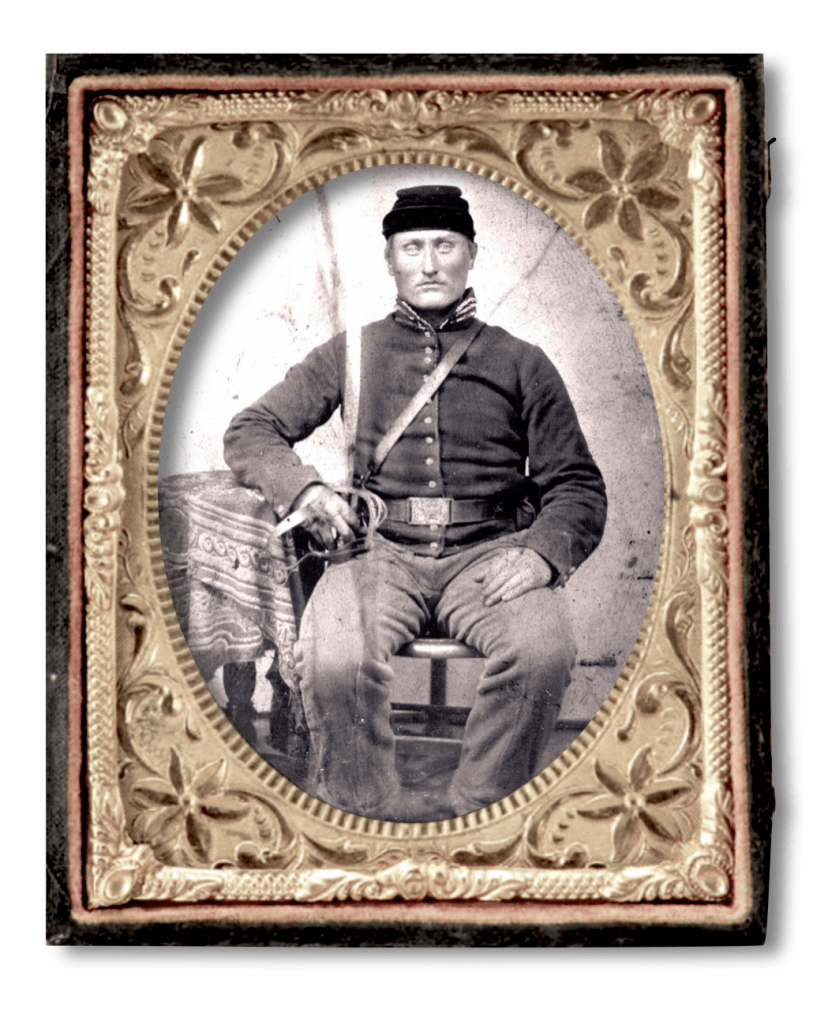
A tintype of William Carman, Co. A, 115th Pennsylvania Infantry, found in the Pension Office Records in Washington D. C.
The following letters were written by William F. Carman (1827-1863) of Co. A, 115th Pennsylvania Infantry. According to the pension application, he “died from wounds received at Chancellorsville, Va., May 3, 1863. He left a widow, Emma Carman, and a fifteen year-old daughter, Josephine Carman, of Philadelphia. “Mr. Carman was a shirt cutter. He was a respectable, active, and industrious man, and always took good care of his family.”
I have not been able to find a biographical sketch for William that tells us anything about his parentage but from what I have been able to cobble together, it appears he was born and raised in Baltimore, Maryland. He was, it seems, the oldest child of William Carman (1785-@1855) and Susanna Townsend (1801-1862). The couple were married in the Methodist Church in Baltimore on 23 January 1825. William (the father) was a cripple and made a meagre living cutting hair. Besides William, there were two younger sons—John (“Jack”) F. Carman (b. 1835), and Thomas J. Carman (b. 1837). Thomas, the youngest, was the only son still living at home in 1862 when these letters began, though he enlisted in the US Navy in August 1862 and was assigned to the Steamer United States. Thomas must have been well suited for the Navy for he could apparently drink and fight with the best of the Baltimore rowdies.
An early-war recruiting poster for what would become part of the 115th Pennsylvania commanded by Col. Robt. Emmett Patterson (LOC)
“William F. Carman called his new bride ‘Emma’ when they were married in Baltimore, Maryland in May 1848. Their daughter, Josephine, arrived soon after. By the time the 1860 Federal census was taken, the family had moved from Baltimore to the 3rd Ward of Philadelphia. William worked as a shirt cutter before enlisting on April 2, 1862 to serve a three-year term in the Union army. This left Emma alone to raise their teenage daughter and eventually find a means of support as the Army was slow to pay the soldiers.
William was devoted to Emma. Emma’s pension file contains thirty-two handwritten letters from William spanning eleven months, the earliest one dated July 1, 1862…The last from William letter is dated June 6, 1863 and appears to be the last one Emma received from him. His death came three days later on June 9.
Emma’s pension file does not provide information on how – or even if – she and Josephine were notified of William’s death, but it does document Emma’s struggles to survive without him. As her mental state spiraled downward, we see her lose grip of William’s letters and his “likeness” in an effort to establish herself as his “legal widow” within the strict bureaucratic government system brokered by the Pension Bureau, only to be overturned in the end by a Special Agent with his ear to a churning neighborhood rumor mill.”
Jackie Budell, an Archives Specialist at the National Archives has meticulously researched Emma’s twenty-year struggle to obtain and maintain a pension for her husband’s service. It is far too long to repeat here so I will merely refer readers to her article entitled, “Why William Carman’s Tintype was in his Widow’s Pension File.”
Suffice it to say that Emma may have had a checkered past and there is evidence that the home William and Emma kept at No. 4 Bath Street in Baltimore before moving to Philadelphia may have been disreputable too. I was able to find an article published in the Baltimore Sun on 15 February 1858 in the “Local Matters” column that was titled, “Another Murderous Affray—Four Men Stabbed and One Shot” described as “one of the most sanguinary affrays without resulting in the death of either of the parties that has occurred in this city for some time.” The article describes the drunken attack and stabbing of William Carmen by his brother Thomas. “The house is occupied by a man named William Carman and his wife, and is notorious as a place for the resort of the dissolute.”
Letter 1
Camp Hamilton Fortress Monroe, Va. July 1st 1862
My dear and affectionate wife,
It is with pleasure I write to you to let you know that I am well at present and hope these few lines will find you the same.
We left Harrisburg about a week ago and [have] been traveling ever since. I arrived in Baltimore the same day and seen Tom Carman and George Elliott and Reddy also. Went and seen my mother. She didn’t know me. She took me for Jack and began to cry. But Tom knew me and told her that it was me. He has two fine children. I hadn’t many minutes to stop with them. I was on guard, We left Baltimore the next day in the steamboat for Fortress Monroe. Got there the next day and we have been busy ever since…
We were mustered in for pay today and soon as we get pay, I’ll send you some money. Tom and Mother send their love to you and Josephine. Write soon as you get this and let me know how you are getting along.
Direct your letter to Fort Hamilton, Fortress Monroe, Va.
— William Carman
Letter 2
Harrison Landing, James River July 31, 1862
Dear Emma,
I received your letter last night and was glad to hear that you was well. I wrote two letters to my Mother and I got two. She says that she has received a letter from John. You know her John is the brother that was in Richmond. He has been a soldier in the Richmond army. He is married and got two children. Tom is enlisted in the Navy. You must write and let me know all that is going on in the city but don’t send me nothing—only what I write for.
We are under marching orders and now more boxes are received at the landing. You must tell me in the next letter whether the relief money has stopped or not and also send me a sheet of paper in the letter. I was very glad to find the postage stamps that I wrote for. The five cents I bought some tobacco with. I wanted it very bad.
I hope by the next letter I write to you that I will be able to send you some money and if they pay me all, I can send you a good sum of it.
I send my love to you and Josephine and Harriet and Sam. Tell Sam we expect to go to Washington. Give my love to all my enquiring friends. No more at present but remain your husband, — William Carman
Direct as before. William Carman, Co. A, 115th Regt. P. V., Patterson’s Brigade, Hooker’s Division, Fortress Monroe, or elsewhere.
Letter 3
Harrison’s Landing James River August 8th 1862
Dear wife,
Your kind letter come to hand last night. Was glad to hear that you was well. I also received one letter from my Mother. She says that she ain’t very well at present. Tom thinks he will come to Fortress Monroe. If he doesm he will have something to do.
On last Monday evening we had orders to march about half past four o’clock. We marched nearly all that night till we came to a place called Malvern Hill. Here we sat down and rested for an hour, then got ready for to go into the field for a fight. Our men marched up bravely. The fight lasted one hour. The artillery and gunboats done all the work. Our men were only drawn up in line. The shot and shell fell very thick for awhile [and when] the Rebels could not stand it any longer, they retreated. We took two hundred and fifty prisoners, five hundred head of cattle, killed and wounded about fifty. There was some of our men killed and wounded—about twenty-five. We stayed there all that day and all that night nearly when we took up the line of march for camp. We arrived next morning. There was nobody hurt in our regiment.
The men are all well except some few. We have the same Captain [Patrick O’]Murphy 1 yet. We are under marching orders all the time but don’t know where we will go but it makes no difference where I go. I will write to you if I live and when you don’t hear from me, you may just assure [yourself that something is the matter. I haven’t [received] no pay since I enlisted—that is the 4th of April. The pay master is paying off our division now. It won’t be long now before we get paid. When you write to me, always send me a sheet of paper and stamp and envelope.
I am well at present. Give my love to Mrs. and Mr. Wallis and to Fred and Frank. Tell them that I ain’t forgotten them. Also to Tom Richardson and also to you and to Josephine. No more at present but remain your husband, — William Carman
Send me twenty-five cents if you can spare it in your next letter but I hope to be paid before it reaches me.
1 Patrick O’Murphy served as the captain of Co. A, 115th Pennsylvania Infantry from the time the regiment was mustered into service on 21 April 1862 until he was discharged on 25 June 1863. From William’s letters it does not appear that O’Murphy sent much time in the field with his company.
Letter 4
Alexandria, Virginia Sunday, September 14th 1862
My dear and affectionate wife, Emma Carmans,
Your kind letter came to hand last night and I was glad to hear that you was well. We are still encamped near Alexandria but there are nothing new going on here at present. We don’t know how long we will stay here. I also received a letter from my Mother. She says things is very dull in Baltimore. She got a letter from Tom. He is on board the United States Steamer now laying in Norfolk, Va.
Dear Emma, I am very much obliged to you for sending me the silk and needles, Also the stamps and paper for I hadn’t none for to write on. Give my love to Josephine. Tell her that in 48 hours after the pay master comes, she will receive it. We are expecting him every day now.
Dear Emma, I send my best love to you. Also give my best respects to Mr. and Mrs. Wallis and to Fred and Frank. Tell them that I am well but I feel very sassy at present. No more at present but remain your affectionate husband, — William Carman
Please send me three envelopes as I haven’t got none. I have paper. Direct your letter as before.
Letter 5
Camp Hooker near Alexandria, Va. September 23rd 1862
My Dear Wife,
Your letter I received this day after coming into camp after a week’s absence and was glad to hear that you was well at present but I was very sorry that I could not go to Philadelphia on account of having no money.
Dear wife, you speak about Fanny the dog. I suppose he thought he would see me for I ought to have been there at the same time because I had a furlough for one week and couldn’t get no further than Washington. There I had to stop on account of having no money. There I remained a week till it was time for me to go to camp.
The first day I got in Washington I come across my old friend, Robert Rainey, and I stopped at his house the whole time. He sends his best respects to you. When I was in Washington, I went three days to the General Paymaster Office for to see our paymaster and they told me he was paying our regiment but he ain’t come to camp yet. But I hope he will be here this week for I am getting tired of waiting for him.
I am very glad you seen Capt. O’Murphy. I suppose he told you all about the [Second] Bull Run fight. Give my respects to Fred and Frank. Tell them that I am well. Also to Mrs. and Mr. Wallis [Wallace?] and to Mrs. Laws. I don’t hear anything about the regiment that James is in at all.
Tell Josephine that I hope to send her present next week if the pay master comes.
Letter 6
Camp Hooker near Alexandria, Va. September 24, 1862
Dear Wife,
After writing my letter, I received one from my sister bringing me the melancholy news of my Mother’s death. She died on Sunday, half past three o’clock which makes me feel very sorry. I was the only one she wished to see. My sister got a letter from me just in time to read it to her before she died for she was looking every minute to hear from me before she died. There wasn’t one of the boys at home to see her.
I send my best love to you and to Josephine. Also to Mr. and Mrs. Wallace. Also to all my inquiring friends. Give my respects to Harriet Laws and Ginny and Sissy. Don’t forget to give my respects to Fred and Frank. Tell them that they must write.
Dear Emma, please to send me a few postage stamps as soon as you can for I have none at present. I think we will be paid this week or the first of next. No more at present but remain your husband, — William Carman
Direct your letter to me, William Carman, Co. A, 115th Regt. P. V., Patterson’s Brigade, Washington D. C. , or elsewhere.
Letter 7
Camp Hooker near Alexandria, Va. September 29, 1862
My Dear Wife,
Your kind letter dated 26th inst. came to hand on Saturday night and I was glad to hear that you was well but I feel very sorry to think that the people impose on you since I left. But dear Emma, try and keep quiet till I get paid and if I get all that is coming to me, I will send you the biggest half of it and then you be careful how you spend it because we don’t get paid when we want to.
Dear Emma, when I was in Washington, I didn’t enjoy myself one bit although I had all I wanted to eat and drink. But that didn’t satisfy me for I wanted to get home to see you and Josephine. If we don’t get paid this week, God knows when we will be paid. But anyhow, when I do get my money, I want you to buy Fanny as much meat as as she can eat.
Tell Josephine to have patience and wait a little longer for mine in nearly played out. You say that you wished that I had wrote for you to come to Washington but that would have been an expense for nothing. And besides, it would take a good deal of money and things is very dear in this place for they charge three prices for one. All strangers have to have a pass from the government to travel south while this war lasts. Some of the soldiers think that this war will be over this winter and God grant it may for I am got my full of it.
In your letter was five envelopes and three postage stamps and this sheet of paper. Also a ten-cent piece which I was very glad to see. It didn’t frighten me the least for I just wanted a plug of tobacco which made me very glad to see the ten-cent piece.
I wrote a letter to you to tell about the death of my mother which I don’t know whether you got it or not. It had no stamp on it. I have no more to say at present but I send my best love to you and Josephine. Also give my respetcs to all my inquiring friends.
Your husband, — William Carman
Letter 8
Camp Hooker near Alexandria, Va. October 4th 1862
My Dear Wife,
The pay master has come and paid us and the men were all glad to see him but they didn’t get as much as they expected for they took some money to pay for the clothing they had drawn.
Dear Emma, I enclose you twenty-five dollars which five of it you must give to Josephine for the present I promised to her. I intended to send Josephine more but couldn’t. You can tell her [it was] on account of helping to pay the funeral expenses of my mother.
Dear wife, you must answer this letter as soon as you get it for I have a little more money to send you. I didn’t like to send it all in one letter for fear that it might not come to you. I want you to send me twenty-five cents worth of postage stamps and nothing else.
I had to send twenty dollars to Baltimore which leaves me five after I send you some more. We will get paid every two months now so the paymaster says and that won’t be long a coming now and I can send you more money. Don’t forget Fanny. Be sure to get some meat for her. I send my best love to you and Josephine. Give my best respects to Fred and Frank and to Mr. and Mrs. Wallace. You can tell them that I am well and if I live to come home, I mean to have a good time of it. No more at present but remain your husband, — William Carman.
Direct to me: Co. A, 115 Regiment P. V., Grover’s Division, Patterson Brigade, Washington D. C. or elsewhere.
Get your coal and wood for the winter and be careful that nobody cheats you in making change.
Letter 9
Camp near Alexandria, Va. October 9th 1862
Dear Emma,
Your kind letter I received last night and was glad the money came safe to you. I was afraid that somebody might take the letter out of the bag before it did leave camp as there are a great many men goes to it for to put their letters in it. I knew that when it got to Mrs. Devine, it was all safe. The money I sent to Baltimore I have no answer yet but I hope it went safe.
Dear Emma, I enclose ten dollars more in this letter which I hope will reach you safe and soon as you get it, write to me without delay. I also send you six of them postage stamps back as some of them has been in use and the others have no gum on them for to make them stick. You go and take them back to the person that you bought them from and when you buy stamps again, go to the post office where you will get them right and you won’t be cheated.
Dear Emma, you needn’t to think of coming out here for we haven’t no accommodations here for ladies. And besides that, it is a good ways from Alexandria and none of our men are allowed to go to the town without a pass. If they do, they are picked up by the Provost Marshal and taken and put in the slave pen where they stay for two weeks before they get out.
We are under marching orders and we don’t know how long we will be here but I hope they will countermand them for I don’t care about going to fight anymore this winter. I would like to stay here or somewhere about the neighborhood this winter.
I am very glad to hear that Sam Laws is well for he must have seen a hard time of it.
Now Emma, don’t you go and spend all your money in furniture that ain’t one bit of use to you. It will be six or seven weeks before I get anymore but soon as I get paid again I will send you some more. Send Fred and Frank my best respects. Also give my respects to Mr. and Mrs. Wallace. You can tell them I am well, I also send my love to you and Josephine. And tell Josephine I was very sorry I couldn’t send her more of a present that I did. I have no more to say but remain your husband, — William Carman
Direct your letter as before.
Letter 10
Camp Kearny, Va. October 15, 1862
Dear Wife,
Your kind letter I received last night and was glad to hear that it came safe to you with the money. I got a letter from my sister at the same time and she says that she hasn’t heard nothing from Thomas or John but soon as she hears from them she will write and let me know. John is in Wheeling, Virginia, and is married.
Dear Emma, we expected the rebels last night. We had orders to lay by our guns all night but the rebs didn’t come. They must have gone some other way.
Dear Emma, I am very much obliged to you for sending me the postage stamps and envelopes and I am very sorry that I haven’t nothing for to send you in return but as soon as I get paid, I will send you some more money which I hope won’t be very long. I don’t want you to send me anything for I don’t want nothing at present, but I feel very thankful for what you have already sent me. I am well and I hope these few lines will find you the same. You must giver my kind respects to Mr. and Mrs. Wallace and to Fred and Frank if you see him anymore. And you tell Frank that he won’t find sailor life like home.
Dear Emma, I send my best love to you and Josephine. Is Josephine doing anything now or is she living home with you. Reason I ask the question, I seen her name in one of the Baltimore papers where she was to dance. I haven’t no more to say at present but give my respects to all my enquiring friends.
Very respectfully your husband, — William Carman
Letter 11
Camp Van Lear, Virginia October 29th 1862
My dear Emma,
Your kind letter come to hand and I was glad to hear that you and Josephine was well. I am very much obliged to you for your kindness for sending me the postage stamps and paper. I have enough to last me some time and I don’t want nothing else now at present.
You say that you would like to come down here but you take a fool’s advice and stay home for this is no place for ladies for there ain’t nothing but men and boys down here and some of them ain’t got no manners about them whatever. Besides that, it would be a great deal of trouble and expense for nothing. You would have to get a pass just as a negro before you could go anywhere and there ain’t no accommodation whatever for there ain’t no place that you could stay at night at and it is very disagreeable weather just about this time of the year for the roads are knee deep with mud. We have had a very rainy week of it.
“You needn’t to take this likeness around for a show nor laugh at it for the man that took it [did] the best he could out here.”
Dear Emma, I can only send you my likeness but if there are any way of getting a furlough or [my] getting to Philadelphia this winter, I will try to come. You needn’t to take this likeness around for a show nor laugh at it for the man that took it [did] the best he could out here.
Give my respects to Mr. and Mrs. Wallace and to Fred. Also to Cody Carlson when you see him. I would like very much to see Fred and Cody. I haven’t heard nothing from Baltimore since I wrote you last. Don’t neglect Fanny.
We will be mustered in for pay in a week’s time. I send my love to you and Josephine and very much obliged to Josephine for her kind offer but I shan’t write for nothing at present. Write soon as you receive this. No more but remain your husband, — William Carman
Direct your letter as before. Let me know how Sam Laws is when you hear.
Letter 12
Virginia November 22 [should be November 2], 1862
Dear wife,
Your kind [letter] I received this morning after three days marching in the rain. I am well at present but I am very sorry that you have been sick.
We are on our way to Aquia Creek. Our General [Frank] Patterson shot himself this morning about daylight. Nobody knows the cause of it. 1
No more at present but remain your husband, — William Carman
I send my love to you and all my enquiring friends. You must excuse this for it is raining and we have no shelter to get under to write. Send a few stamps for I have only one.
1 Patterson was at Catlett’s Station when he withdrew his brigade upon hearing unconfirmed reports of a Confederate troop presence nearby. Sickles accused him of retreating without orders and called for a military board of inquiry to court-martial him. However, on November 2, Patterson was found dead in his tent of a self-inflicted gunshot wound. Initially it was not clear whether his death was accidental or a suicide. But an article in The Baltimore Sun from 29 November 1862 cites an eyewitness, Capt. Vreeland of the 8th New Jersey Volunteer Infantry who was with him in his tent at the time. Vreeland states that Patterson “committed the act while under a temporary insanity … so suddenly was the rash act committed that (I) could not stay his hand.”
Letter 13
Bristoe Station, Virginia November 5, 1862
Dear Emma,
What is the matter you don’t write? I would like to hear from you.
We expect to have a battle soon. The whole army is moving towards Richmond. I am well at present and we will get paid in a few days. The weather is very cold and it is snowing very fast at present.
I send my love to you and Josephine and to Mr. and Mrs. Wallace. Also to Fred and Cody Carlson. No more at present. Your husband, — William Carman
Direct your letter the same as you always did and I will get them. I will send you some money soon. Find enclosed 3 stamps. They are damaged. Take them where you got them. Let me know how you like the likeness.
Letter 14
Virginia November 15, 1862
My dear wife,
Your kind letter dated the 8th inst. came to hand and I am glad to hear that you are well. We have been on heavy marching ever since the first of the month. My instep hurt me very much. We have just camped. I don’t know the name of the place but it is in Virginia. I can see the Blue Ridge Mountains very plain. We won’t be here long.
Your letters I get sometimes on the road as we march along but we can’t answer them always. Direct your letter to Washington the same as you always do.
Dear Emma, I thought that you were sick or locked up in my imagination that I didn’t hear from you sooner. We expect to have one of the greatest battles that ever was but I hope it will be a failure for they won’t let us settle down nowhere and I am tired for I want to go into winter quarters.
We expect to get paid this week. I will send you some money. Do you get the relief money yet? I send my love to you and Josephine and to Mr. and Mrs. Wallace. Also to Devin and all his children.
Give my best respects to Fred and Cody Carlin. Also don’t neglect Fanny if you have moved. No more at present but remain your husband till death. — William Carman
I am glad you are fixed for the winter. Send me the number of the house. Captain O’Murphy is in Philadelphia yet.
Letter 15
Camp near Fredericksburg, Va. November 30, 1862
My dear wife,
Your kind letter dated the 20th inst. came to hand this morning and I am glad to hear that you are all enjoying yourselves. We have been on the march ever since the first of the month. We are near Fredericksburg, Virginia. Here we expect to have a great battle before long. I think they will shell the city before they can take it. The rebels are on one side of the river and we are on the other.
The weather is very nice but I don’t think I can get home for some time yet for our pay master ain’t made his appearance yet. I wish he would come so I could send you some money before Christmas.
Dear Emma, I wish you would send me twenty-five cents and soon as I get paid I will send you some money.
Our pickets talks to one another across the river. There are three hundred thousand rations drawn here every day for the soldiers.
I send my best love to you and Josephine. Also to Mr. and Mrs. Wallace. Give my best respects to Fred and Frank. Also to Cody Carlin when you see him. I haven’t hear nothing from Baltimore yet.
Write soon as you get this and don’t forget to send me twenty-five cents for I want to get some tobacco. No more at present. Your husband, — William Carman
Direct your letter as before.
Letter 16
Camp Front of Fredericksburg, Va. December 7, 1862
Dear Emma,
Your kind letter I received this morning and I am very sorry to hear that you were sick. The papers all came to me and the stamps. Please send me one small piece of tobacco in the next papers you send me so I get it this day week.
There is a young man in our company named Allen who told me that his son would come out with Captain O’Murphy in about two weeks and his name is Allen. Lives at 505 Catherine Street. He will call to see you. You can send me one pound of chewing tobacco by him so I get it by Christmas and two handkerchiefs of cheap cotton. That is all. I will send you the money U get as soon as I get paid.
I am very glad you are fixed comfortable and I would give most anything to be home for this kind of soldiering is enough to kill the Devil. We have nothing comfortable whatever. It is very cold, snow on the ground, and nothing but a blanket to cover with, hardly any tents. My fingers is very cold writing this.
I hardly know what to say. Don’t forget to send me a piece of tobacco in the next paper.
Dear Emma, I am well at present and I hope when these few lines reach you, that you will be the same. I send my love to you and Josephine. Send me a small piece of tobacco every time you wend me the newspaper. Put it inside so it won’t be seen.
Letter 17
Camp near Fredericksburg, Va. December 25, 1862
Dear Wife,
I was glad to receive your kind letter and paper. Also the letter paper and stamps you set to me. And I feel very glad you have seen Captain O’Murphy and Tommy Allen wrote to Captain O’Murphy and told him in his letter that he wasn’t in the battle. That is all true enough for he was with the doctor about three miles from our line when we were under fire and had to retreat back. It was one of the hardest fought battles we have had yet. Men that had been in all of the battles said it was—-just at this moment the Sergeant brought me another letter dated the 22nd inst. from you. Don’t send me no gloves for I have got a pair from the government. Don’t rob yourself to send me anything. You can send me a pipe as I lost the one you bought me and the handkerchiefs. Don’t send me any more papers that cost 8 cents for it is too much to pay for them.
I have been very sick since I wrote to you last but thank God, I have got well once more. This is Christmas Day and all we have for breakfast is one cup of coffee and hard crackers is all we got. It is a very poor Christmas for the soldiers. They can get nothing for love nor money for there are no places to buy anything.
You can give my best respects to Captain O’Murphy when you see him. The men would all like to see him. Our Col. [Robert Emmet] Patterson ain’t been with us for some time and I don’t think he will be with us anymore. Our Colonel’s name is [William] Olmstead now. 1
I send my love to you and Josephine and soon as I get paid, I will send you some money. There is four months pay coming to us and I think if we stay here we will get paid. I hope we will. Give my respects to sister Wallace and to Mr. Wallace for I think often of them. Give my best respects to Fred and tell him I hope I will see him some of these days. The weather was coudy this morning but it has turned out to be a fine day and I hope you all had a happy Christmas. Goodbye till you hear from me again, — William Carman
This is some of the paper you sent me.
1 Lt. Colonel William Omstead commanded the 115th Pennsylvania at the Battle of Fredericksburg due to the absence of Col. Patterson.
Letter 18
Camp near Falmouth, Va. January 10th 1863
My dear wife,
Your kind letter I received about a week ago and one paper and a plug of tobacco you sent me and it was very good. The only thing the matter with it was it didn’t last long enough. You said that you would go and see Capt. O’Murphy that the relief company had sent you a card to be signed and if he didn’t sign it, you would send it to me. But I suppose he signed it. I would have wrote to you sooner but I was waiting to hear from you about the card. You must try and learn when Capt. O’Murphy is coming out so I will get the tobacco he has. I don’t think he will be out here for some time and if he don’t come soon, you can get it and send it by Express if they will bring it. Also send me a pipe to smoke.
Our lieutenant is sick and he is going for to leave us and go home. I think he got enough of soldiering. 1
I wrote in the last letter to send me the Inquirer or the Sunday Dispatch whenever you could. They are cheaper than those other papers and just as much news in them. I send you a letter I got from my sister which you can read, Fred Edwards is very lucky in getting home.
I am well at present and we expect to get paid soon and I will send it to you for I know that you must want some money. I send my love to you and Josephine and to sister Wallace and to Mr. Wallace. I think of you all every day and night.
Mrs. Devine is very good to you in answering your letters. Give my best respects to her. Please send me a postage stamp in your next letter as I haven’t none. No more at present but remain your affectionate husband, — William Carman
1 Probably 2nd Lieutenant William H. Lechler who was discharged on 30 January 1863, although 1st Lieutenant Michael J. Dunn was also discharged on 11 February 1863. John Blair was promoted to 1st Lieutenant from Commissary Sergeant on 1 May 1863.
Letter 19
Camp near Falmouth, Va. January 16, 1863
My Dear Wife,
Your kind letter dated the 10th inst. I just received this morning and I was very happy to hear that you was well. I received the tobacco you sent me and was very glad of it. We are now building our log cabins for to go into winter quarters but I don’t think we will remain in them very long.
Dear Emma, I know it is very hard to get money and it seems harder to me that they don’t pay the soldiers so they could send their money home to their wives. But as soon as I get paid, I will send it to you for I know you must want it now. It is nearly five months since they paid us and I think it is pretty near time that we were paid as they promised to pay every two months which they don’t.
Don’t forget to send me the pipe. If Capt. O’Murphy don’t come out soon, you send it by mail in a paper. Get a nice light one like the one you got before and I am a thousand times obliged to you for sending me the twenty-five cents and four postage stamps for I had none.
I am well and send my love to you and Josephine…No more at present but remain your husband till death, — William Carman
P. S. If Captain O’Murphy ain’t out in ten days time, you will please send the pipe to me by mail and fill it full of tobacco so I will have a nice smoke when I get it and be thinking of home at the same time and the one that is so dear to me.
Letter 20
Camp near Falmouth, Va. February 9, 1863
Dear Wife,
Your kind letter reached me this morning and I was glad to hear that you were well. I also got the paper and tobacco and the postage stamps and I am very thankful to you for sending them to me. Our pay master ain’t paid us off yet but soon as he does, I will send you some money for I know you want it.
Dear Emma, it is very hard to get a furlough in our company as we have no captain or lieutenant—they have all resigned—and we have nobody to command us now. I don’t expect to see Capt. O’Murphy out here anymore. The only ones that get furloughs is those that are sick in the hospital and only one man out of every hundred is allowed to go home. I would like very much to come home for about ten days but I don’t think I can at present. I think we will go to Washington very soon as the army is moving every day and if we go to Washington, I will let you know. There might be some chance of getting home then.
Dear Emma, give my best respects to Samuel Laws and tell him I am glad that he got home and I would like to be home to see him but I hope it won’t be long before the war is over now.
I got a letter from Baltimore telling me that Tom was in the Navy Hospital at Portsmouth, Va. [N. H.] sick. I meant to send it to you but I lost it. I send my love to you and Josephine…No more at present but remain your husband, — William Carman
Letter 21
Camp near Falmouth, Va. February 17th 1863
My dear wife,
Your kind favors came to hand this morning and I am always glad to hear from you and to know that you are well and also I hope that Josephine will take good care of herself and save her money and not spend it foolish for money is very hard to get now—even when earned. For my part, I think they treat the soldiers very bad for they only pay the men when they see fit where they ought to get paid every two months. However, don’t send me anything more that will cost so much postage till I send you some money which I hope won’t be very long.
We are still in our log houses yet. We expect to move shortly. We have very little time for ourselves as our company is very small—only 12 men. I heard from Capt. O’Murphy yesterday saying that he would leave on Monday night at 11 o’clock for to take charge of his company but I don’t think he will. The weather is bad for it is snowing and I got to be out all night.
Dear Emma, I’m very much obliged to you for sending the handkerchief but I would [have] liked it much better if it had been colored. But it is a good handkerchief.
You give my respects to Sam and tell him I am very glad he has got home.
I send my love to you and Josephine…No more at present but remain your husband, — William Carman
Letter 22
Camp near Falmouth, Va. March 1, 1863
Dear wife,
We got mustered in for pay yesterday and we will get paid about the middle of this month and then I will send you some money so you can get what you would like. I dreamed the other night that [our dog] Fanny came running into the tent to me and I couldn’t get her out. I got a letter from sister which I enclose to you.
Dear Emma, please send me an envelope and a sheet of paper in your next letter. I am well and I hope these few lines will find you the same. You must excuse me for not writing more for I ain’t got time for we have to go out on picket and it will be four days before we get back to camp again.
I send my best love to you and Josephine…No more at present but remain your husband, — William Carman
Letter 23
Camp near Falmouth, Va. March 14th 1863
Dear Wife,
Your kind favors I received and was glad to hear from you and all of my friends and would like to be at home for to see you all once more but we have no captain and we have no chance to get a furlough at present. But soon as we get paid, I will try to get one for ten days. There are very few men get furloughs in our regiment. They are most all officers that get them.
Dear Emma, I heard from [brother] Thomas. He has got home but didn’t get no pay yet. He says he is going to work. He sends his best respects to you and Josephine.
I think we will move soon as it is all the talk but we don’t know where. We are kept very busy. Hardly any time to wash a shirt. We are all the time doing something. The roads is very bad. I will have to stop for I got to go after wood. I send my love to you and Josephine. I will send you some money next week if the pay master comes. Give my best respects to all my friends. I’m very sorry that Frank Spicer drank himself to death. If he had been out here, he might have been living yet. I don’t drink any more. No more at present but remain your husband, — William Carman
I think you may look for some cash in your next letter.
Letter 24
Camp near Falmouth, Va. March 23, 1863
Dear wife,
I received your kind letter and was glad to hear from you and all my friends and to know that you are well.
Captain [Patrick] O’Murphy is out here but hasn’t taken command of his company yet. He come on the 14th of March. His leg is very bad. I don’t think he ever will be able to take command of us. I would have wrote sooner but thinking the pay master would be here every day so I could send you some money. I hope by the time this reaches you that I may be paid for it has been seven months since I got any money and I know that you must stand in need of some. No more at present but I send you my love to you and Josephine….Very respectfully your husband, — William Carman
P. S. I also send my best respects to Mr. and Mrs. Wallace. Some of the soldiers is betting that the war will be over in two months but I hardly think it will. Write soon as you can and let me know how the times is in Philadelphia. No more. — William Carman
Letter 25
Camp near Falmouth, Va. April 11, 1863
Dear wife,
It gives me great pleasure to have the chance to write to you and let you know that I am well at present, hoping these few lines will find you the same. I haven’t much to say but I would like to be home and see you for it seems to me a long time and it will be as long again before I get my discharge.
Our regiment has been just eighteen months in service but I will try to get a furlough soon as the pay master pays us. He ought to have been here long ago but hasn’t come yet. They will owe me eight months pay this month and I think it very hard that we don’t get paid. But I hope they will pay us soon now as they say they will.
Mr. Allen’s little boy is out here with Capt. O’Murphy and will leave for home next week and will call and see you.
Dear Emma, please send me two or three postage stamps as they are hard to get here and as soon as I get paid, I will send you some money for I know you want it for it vexes me every day for to think that they don’t pay me. I only can send my love to you and Josephine and all my enquiring friends. No more at present, but remain your dear and affectionate husband, — William Carman
My letter hereafter will be directed to you as Mrs. William Carman.
Letter 26
Camp near Falmouth, Va. April 17, 1863
Dear Wife,
I received your letter with the likeness last evening as we were getting paid and was glad to hear you are well as I am to be able to send you some money. I send you $30 by Adams Express which you will call and get at the Office as soon as you receive this. I would have sent you more but we did not get paid in full. We are to get paid every two months from this time.
We are to march every hour and know not where we are going to. I am on guard and cannot get a chance to write myself.
I cannot send it by Express so I will enclose it in this letter. I am well as usual. Yours, &c. — Wm. Carman
Write soon. Very seldom I get ink.
Letter 27
Camp near Falmouth, Va. Monday morning, April 27, 1863
My dear wife,
Your kind letter I received and was glad to hear you got the money I sent you. They didn’t pay me only one half that was coming to me. If they had paid me all, I could have sent you seventy-five dollars but as it is, I couldn’t. They say they will settle up with me the first of January but if I live I will be home before that. I didn’t keep no money for myself for I knew that you must stand in need of all I sent…
We have got to go on picket this morning at 7 o’clock and it is near that time. Now write soon as you get this. No more at present but remain your husband, — William Carman
Thee is no news yet but expect to mover every hour.
Letter 28
Hospital 2rd Division, 3rd Army Corps Potomac Creek May 16, 1863
Dear Wife,
I received your letter of the 30th yesterday. I was wounded in the Battle of Chancellorsville on the 3rd of the month by a gunshot in the left hip besides three slight wounds on the same leg. I am in no danger and not much pain. I expect this hospital will be broken up and we will be sent to our respective states in a short time.
You mention that you sent me a handkerchief and some papers, I have not got them yet.
Out of our company we lost 2 killed and three wounded and two missing. I will close by sending my love to you and Josephine. I hope to see you soon. I remain yours, — Wm. Carman
Write soon. Direct to the regiment. I will get it.
Letter 29
[written by some hand other than William’s]
Camp near Falmouth, Va. Hospital about a mile from camp May 29th 1863
My darling and affectionate wife,
I received your letter this day by my friend Thomas K. Allen which I am glad to hear that you are well and in good health. Thanks be to God, I am in good spirits myself. My wound is getting better. We expect to be going to Philadelphia in a few days. They say that the regiment will be going home to recruit again and take the sick to Philadelphia where they will be treated better than they are here.
We expect to be paid 3 months pay on Monday. I will send you some home then…I have no more to say to you at present but I hope that I will be home soon. Mr. Allen is well and all the boys—only the two that was killed—[Patrick] Ward and[Richard] Thunder. God be with them.
I am your affectionate husband until death, — William Carman
N. B. Goodbye but not for ever. Kiss this in memory of me.
Letter 30
[written by some hand other than William’s]
Second Division, Third Corps Hospital Near Aquia Creek, Va. June 6th 1863
Dear Wife,
I write these few lines to you hoping to find you in good health only I am not out of bed yet. My furlough I have ready to put in and I hope to get home in a few days. There was two of our regiment went home this day. I have not received them handkerchiefs. I do not know what is the reason, I do not know. Thomas K. Allen is here doing duty at the Provost Marshall’s. He is a great comfort to me. He comes twice a day to see me. Tell his wife he is here and tell her to direct her letter as the directions of mine. I have no more to say to you at present. Hoping to be able to see you before long. Give my best respects to Mrs. Diven and all friends.
I have no more to say to you at present but I remain your affectionate husband until death, — William Carman