The following plaintive missive expresses the pangs of an anticipated long separation experienced by the wife of a Union soldier who has just enlisted for three years. It was written by 35 year-old Mary Gifford (Richmond) Brown (1826-1891), the daughter of Allen Richmond—who passed away on 1 November 1861—and his first wife, Betsey Dennison Jones (1799-1830). Mary and her husband were married in March 1844. Because she was under the legal age to get married in Ohio and her parents opposed the union, they eloped to Bedford, Pennsylvania where a local Justice of the Peace solemnized their marriage. Once hitched, they settled in Newton Falls, Trumbull county, Ohio, where Mary’s husband made a living as a wagon maker. By the time of the 1860 US Census, the couple had three children—Libbie (age 14), Allen (age 10), and Joseph Denison, or Denni (age 7 months).
Mary’s husband was 43 year-old Joseph Brown who enlisted as a sergeant in Co. D of the 6th Ohio Volunteer Cavalry (OVC) in October 1861. This unit was organized at Camp Hutchins in Warren, Ohio; its members drawn mostly from the Western Reserve. They remained in Warren until January 1862 when they were sent to Camp Dennison for drill instruction. In March they were assigned to Camp Chase to guard Confederate prisoners. In the spring of 1862, they operated in the Shenandoah Valley, Virginia, and in June participated in the battle of Cross Keys, and again at Cedar Mountain and second Bull Run. They joined Burnside’s advance on Fredericksburg and went into winter quarters, guarding the Rappahannock. In the spring of 1863, they fought under Hooker at Kelly’s Ford, joined Stoneman’s raid, and followed Lee’s movement into Maryland, having several severe actions. The regiment took an active part at Gettysburg and followed Lee’s retreat, capturing many men and wagons. They participated in many engagements in Meade’s advance on the Rapidan and spent the winter fighting Mosby’s guerillas.
Before the Overland campaign began in 1864, however, Joseph became ill. Apparently he was with his regiment until about the 15th of March when he was taken sick and left the company encamped at Warrenton, Virginia, for Lincoln Hospital in Washington D. C. In early May, Lincoln Hospital was ordered to relocate convalescents in order to open up bed space for the anticipated wounded arriving from the Battle of the Wilderness and Joseph was sent with others to Lovell General Hospital in Portsmouth Grove, Rhode Island. His military record indicates he died there of erysipelas on 19 May 1864 after 2 years and seven months of service and separation from his beloved Mary—just five months short of his term of enlistment.
The sale of Joseph Brown’s property in Newton Falls following his death in 1864
Transcription
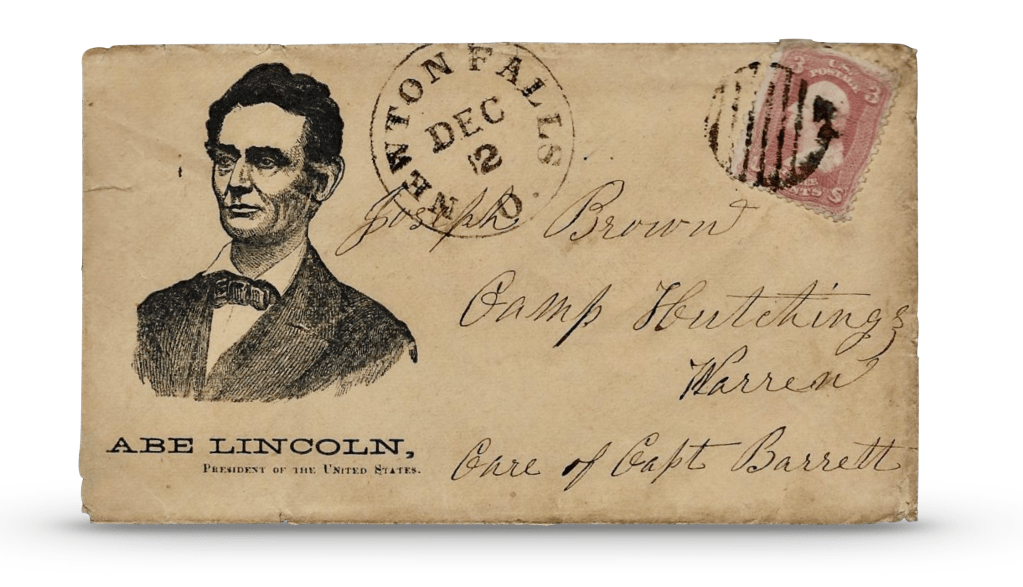
Addressed to Joseph Brown, Camp Hutchins, Warren, [Ohio], Care of Capt. Barrett Postmarked Newton Falls, Trumbull county, Ohio, December 2, 1861
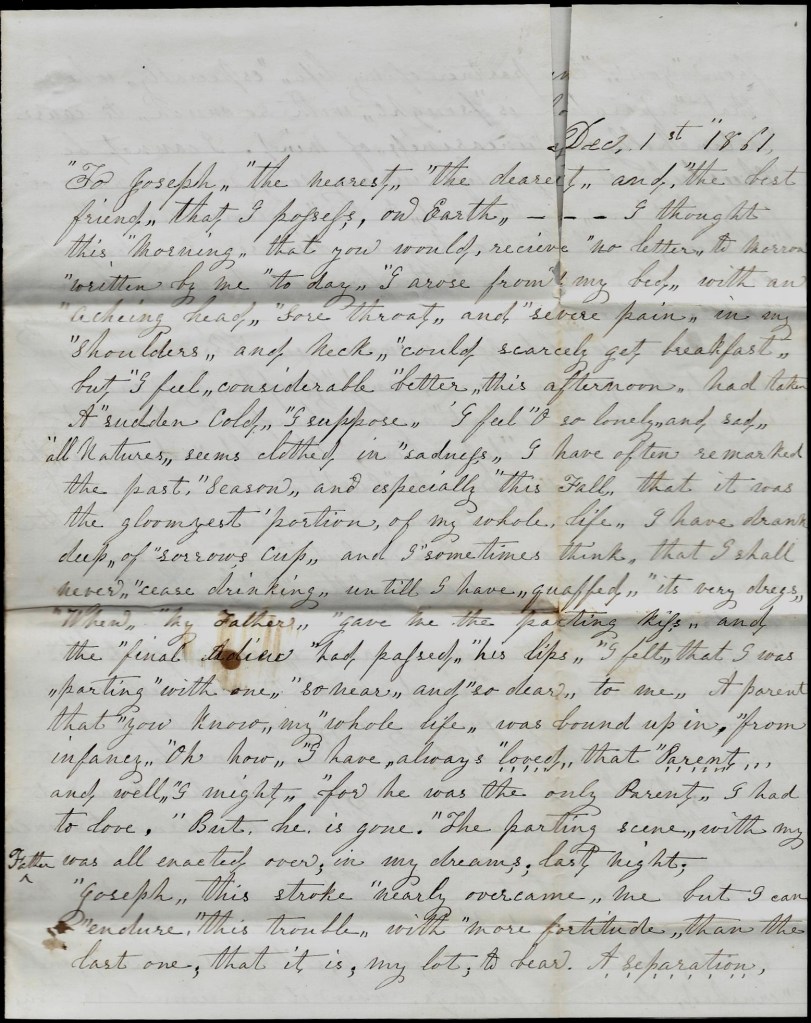
December 1st 1861
To Joseph—the nearest, the dearest, and the best friend that I possess on Earth,
I thought this morning that you would receive no letters tomorrow written by me today. I arose from my bed with an aching head, sore throat, and severe pain in my shoulders and neck, could scarcely get breakfast but I feel considerably better this afternoon. Had taken a sudden sold I suppose. I feel Oh so lonely and sad. All nature seemed clothed in sadness. I have often remarked the past season, and especially this fall, that it was the gloomiest portion of my whole life. I have drank deep of sorrow’s cup and I sometimes think that I shall never cease drinking until I have quaffed its very dregs.
When my father gave me the parting kiss and the final adieu had passed his lips, I felt that I was parting with one so near and so dear to me—a parent that you know my whole life was bound up in from infancy. Oh how I have always loved that parent I had to love. But he is gone. The parting scene with my father was all enacted over in my dreams last night.
Joseph, this stroke nearly overcame me but I can endure this trouble with more fortitude than the last one that it is my lot to bear. A separation from you—the partner of my life, especially where that separation is fraught with so much to cause melancholy and uneasiness of mind. I cannot be cheerful or enjoy life in any way when I know or feel that you are exposed to the inclemencies of the weather, to all the contagious diseases incident to camp life, and also to the fare which many of our soldiers are compelled to bear. You may fare tolerably well now whilst you remain in Warren, but you cannot always stay there. And Joseph, you cannot imagine with what awful dread I anticipate the time of your departure.
The old adage is that every back is fitted for its burthen, but I fear that mine will prove treacherous. I could endure it better if there was no compulsion. But to think that you are compelled to stay and endure the fatigue, the hardships, and the privations which I know you will have to endure, and if sick, left to the mercy or and care of others, no friend near to administer to your wants or to assuage in any way your mental or physical suffering. Oh Joseph, I cannot bear to think. It almost sets me crazy, and still I cannot stop thinking were it not for our children, it would be better for me were I in my grave than to life and suffer so much torture of mind.
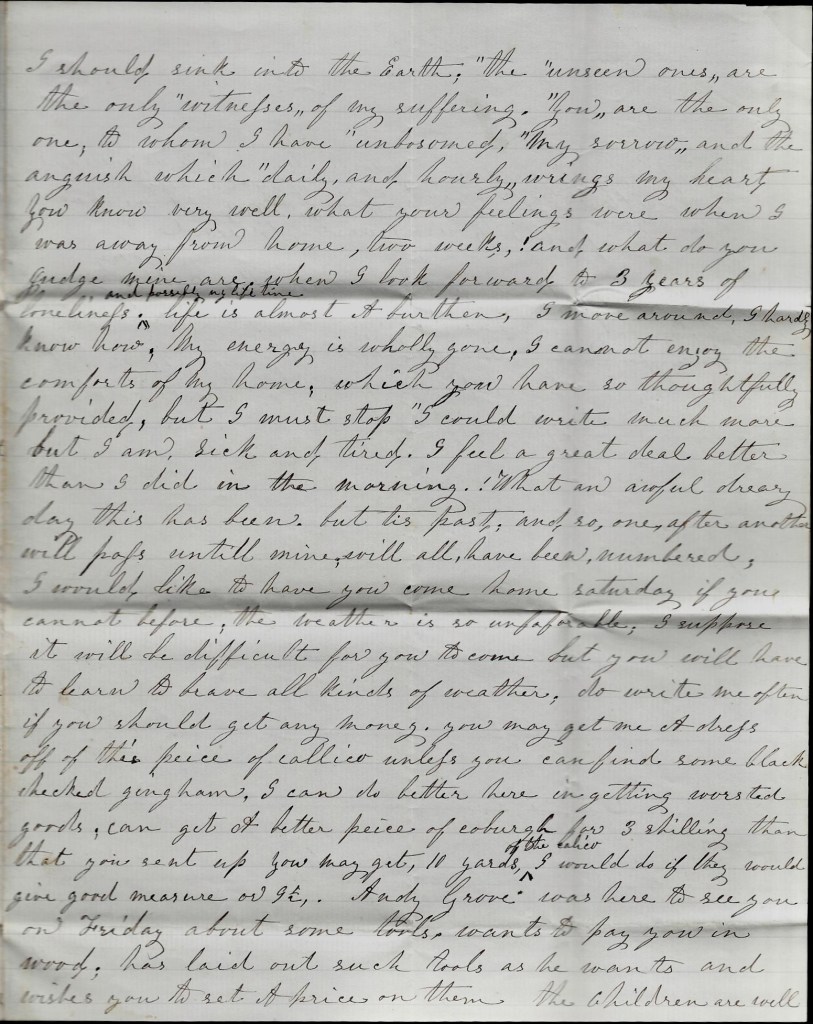
My nervous system has become so deranged that it is hard for me to govern myself. But I have managed to so far—have smothered and crushed down my feelings when it seemed as though I should sink into the Earth. The unseen ones are the only witnesses of my suffering. You are the only one to whom I have unbosomed my sorrow and the anguish which daily and hourly wrings my heart. You know very well what your feelings were when I was away from home two weeks! and what do you judge mine were when I look forward to 3 years of loneliness and possibly my lifetime.
Life is almost a burthen. I move around I hardly know how. My energy is wholly gone. I cannot enjoy the comforts of my home which you have so thoughtfully provided. But I must stop. I could write much more but I am sick and tired. I feel a great deal better than I did in the morning. What an awful dreary day this has been. But tis past, and so one after another will pass until mine will all have been numbered.
I would like to have you come home Saturday if you cannot before. The weather is so unfavorable, I suppose it will be difficult for you to come. But you will have to learn to brave all kinds of weather. Do write me often. If you should get any money, you may get me a dress off of this piece of calico unless you can find some black checked gingham. I can do better here in getting worsted goods. Can get a better piece off Coburgh for 3 shillings than that you sent up. You may get 10 yards of the calico. I would do it if they would give good measure or 9 and a half.
Andy Grove was here to see you on Friday about some tools. Wants to pay you in wood. Has laid out such tools as he wants and wishes you to set a price on them. The children are well.
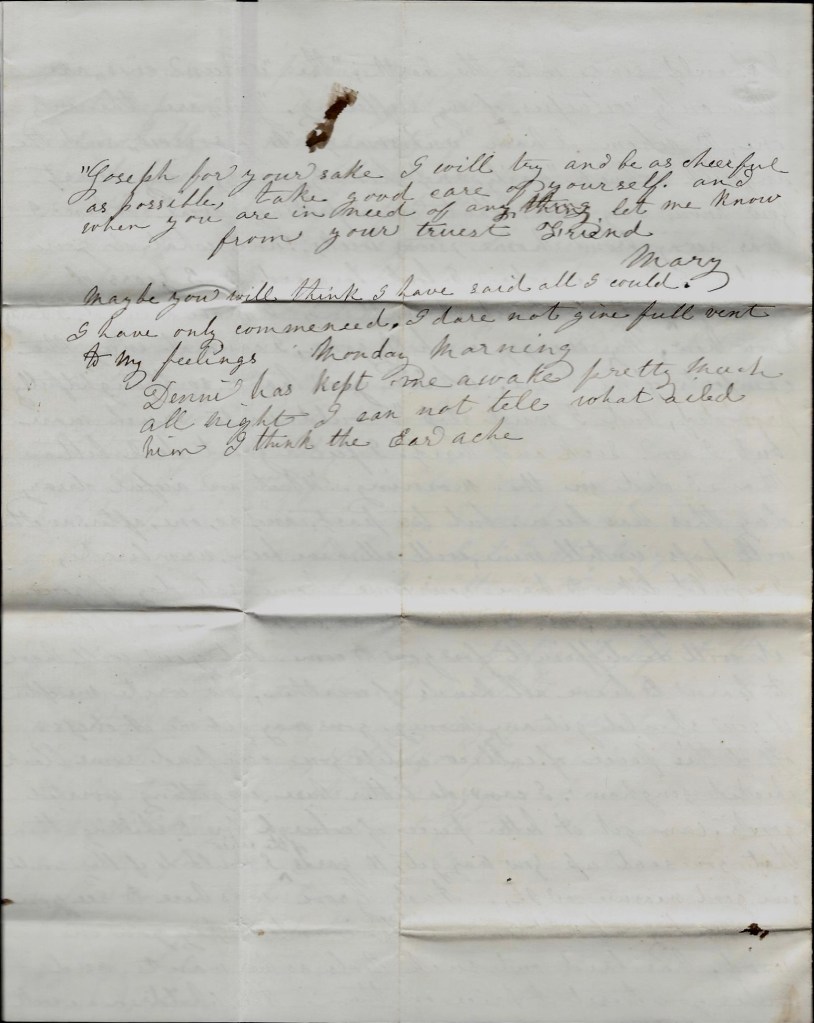
Joseph, for your sake, I will try and be as cheerful as possible. Take good care of yourself and when you are in need of anything, let me know. From your truest friend, — Mary
Maybe you will think I have said all I could. I have only commenced. I dare not give full vent to my feelings.
Monday morning. Denni has kept me awake pretty much all night. I can not tell what ailed him. I think the earache.
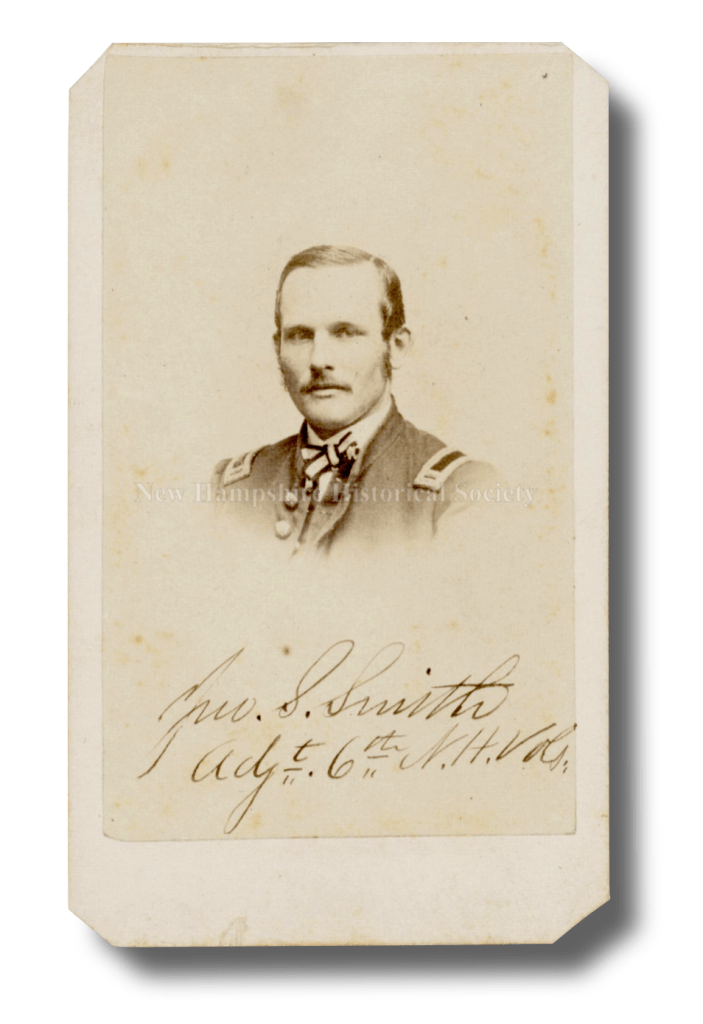
Adj. John Stearns Smith, 6th N. H. Vols. (New Hampshire Historical Society)
The following letter was written by John Stearns Smith (1837-1916) of Peterborough, New Hampshire who enlisted at the age of 23 on 4 October 1861 as a private in Co. E, 6th New Hampshire Infantry. He was wounded on 29 August 1862 at the battle of the 2nd Bull Run and again on 30 July 1864 (Battle of the Crater) at Petersburg. He was promoted up the ranks to 1st Sergeant by 1 July 1862 and commissioned a 2nd Lieutenant on 1 November 1862. He made 1st Lieutenant on 20 March 1863 and was also assigned duty as the regiment adjutant on Field & Staff at the same time.
In this letter, written from the trenches before Petersburg, the 6th New Hampshire had just settled in for a siege of the city after a failed early attempt to capture the city a week earlier.
John was born at Waltham, Massachusetts, on 27 November 1837—the son of John Smith and Susan Stearns.
Transcription
Headquarters 6th Regt N. H. Veteran Vols. Near Petersburg, Virginia June 24, 1864
My dear cousin,
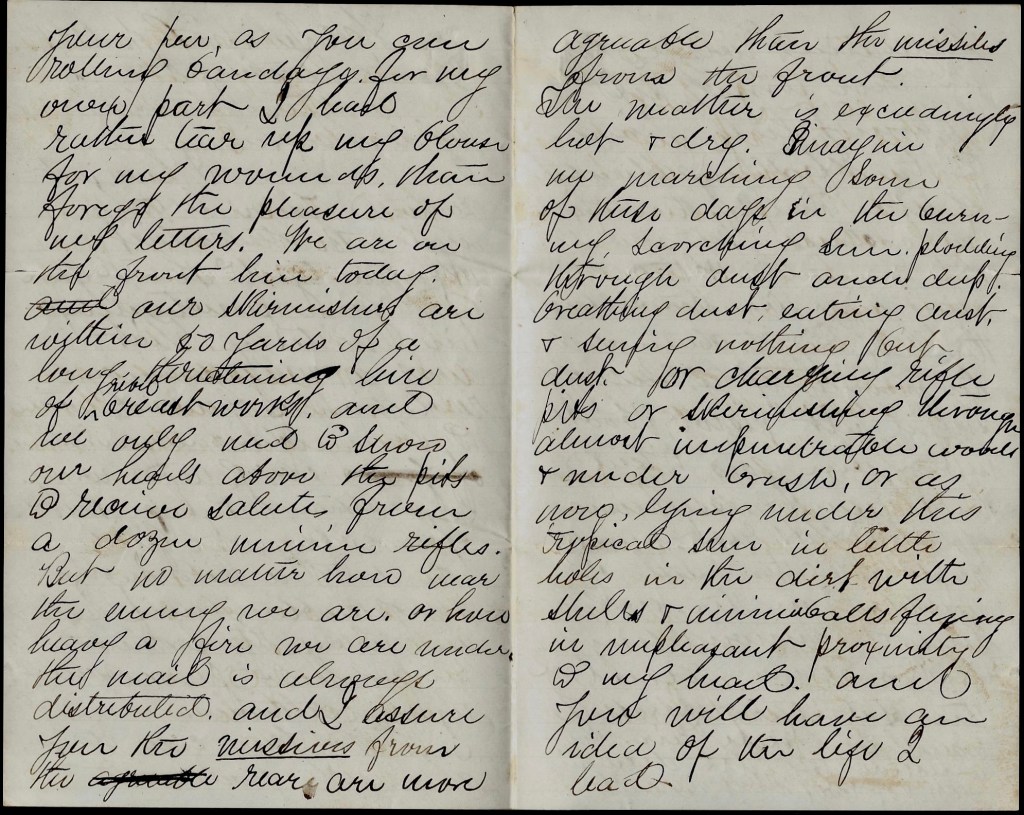
I have just received your letter and take the earliest opportunity to thank you for your punctuality in writing. That was a magnanimous resolution of yours to write to some soldier acquaintance every two weeks. I venture to hope that you will not find the duty a laborious or disagreeable one, if I am to be the fortunate recipient of your communications. I think you can do as much good with your pen as you can rolling bandages. For my own part, I had rather tear up my blouse for my wounds than forego the pleasure of my letters.
We are on the front line today. Our skirmishers are within 50 yards of a long, threatening line of rebel breast works and we only need to show our heads above the pits to receive salutes from a dozen minié rifles. But no matter how near the enemy we are, or how heavy a fire we are under, the mail is always distributed, and I assure you the missives from the rear are more agreeable than the missiles from the front.
The weather is exceedingly hot and dry. Imagine us marching some of these days in the burning, scorching sun, plodding through dust, eating dust, and seeing nothing but dust. Or charging rifle pits or skirmishing through almost impenetrable woods & under brush, or as now, lying under this tropical sun in little holes in the dirt with shells and minié balls flying in unpleasant proximity to my head, and you will have an idea of the life I lead.
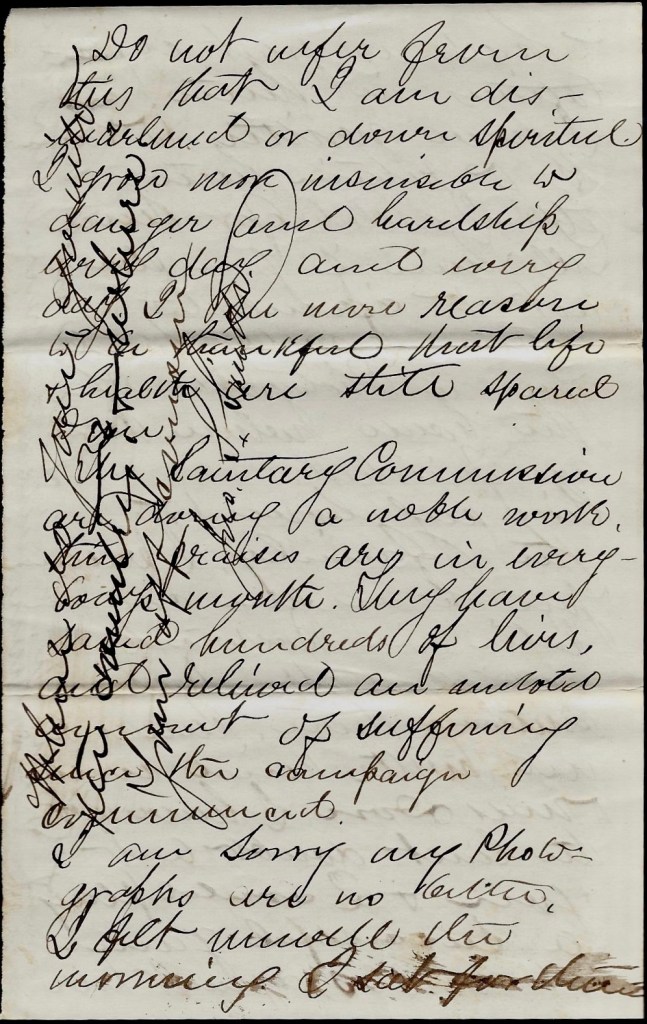
Sometimes while lying in our torrid pits I cannot help thinking of the refreshing shades of Elm Hall, the delightful coolness of the water in the well, the delicious cider in the cellar, the luxury of clean clothes, the privilege of taking off sword, belt, pistol, boots, &c., where one goes to bed with the assurance of a night’s rest uninterrupted by the rattle of musketry on the picket line & cannonading in the rear. And of the salutary effects of breathing pure air, uninfected by the decaying debris of two vast armies. Do not infer from this that I am discouraged or down-spirited. I grow more insensible to danger and hardship every day and every day I see more reason to be thankful that life and health are still spared to me.
The Sanitary Commission are doing a noble work. Their praises are in everybody’s mouth. They have saved hundreds of lives and relieved an untold amount of suffering since the campaign commenced.
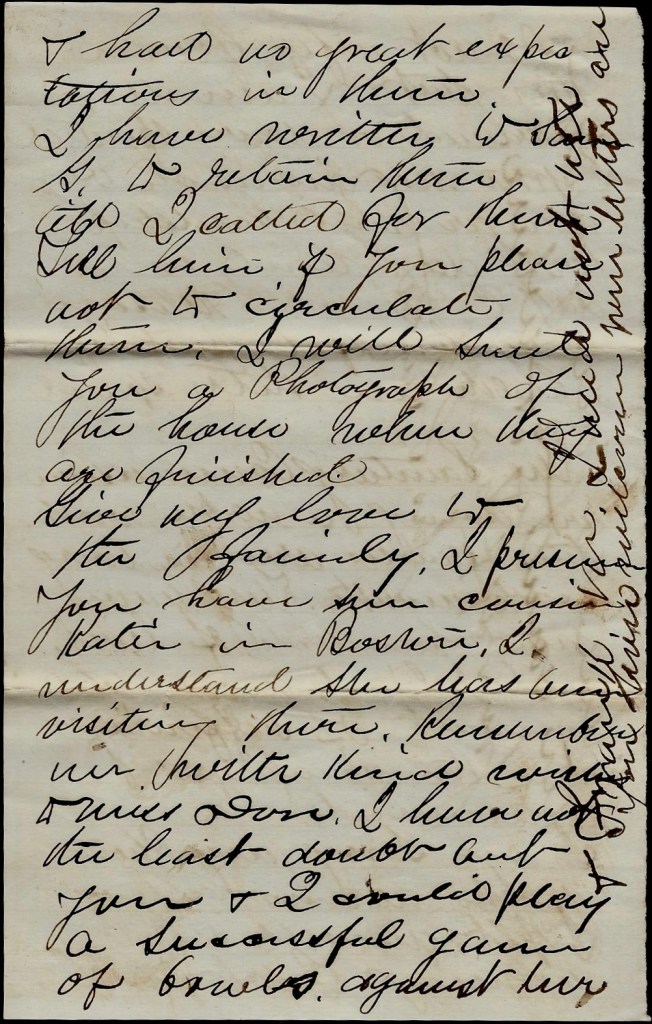
I am sorry my photographs are no better. I felt unwell the morning I sat for them and had no great expectations in them.
I have written to [ ] to retain them till I called for them. Tell him if you please not to circulate them. I will mail you a photograpg of the house when they are finished. Give my love to the family. I presume you have seen cousin Katie in Boston. I understand she has been visiting there. Remember e with kind wishes to Miss [ ]. I have not the least doubt you and I could play a successful game of bowls against her…
The following letter was written by Thomas F. Bragg (1840-1919) to his widowed mother, Elizabeth (Poage) Bragg (1814-Aft1904). In the 1860 US Census, Thomas was enumerated in his mother’s household in Union City, Randolph county, Indiana, where he worked as a Daguerre Artist. He is listed (“T. F. Bragg”) in Craig’s Daguerreian Registry as “ambrotypes and photographs” in Union City, Ohio, 1860.
Census records inform us that Thomas was actually born in Hancock county, Indiana. His deceased father’s name was Jackson Bragg (1811-1849).
Thomas enlisted on 23 April 1861 at Union City to serve 3 months in Co. I, 11th Ohio Volunteer Infantry (OVI). He was discharged at Columbus on 30 August 1861 at the end of his term of enlistment. Later in the war, he was drafted into Co. D, 27th Indiana Infantry and was discharged on 17 May 1865 after 16 months service.
In October 1904, Thomas was admitted into the Home for Disabled Soldiers at Indianapolis and was discharged on 29 March 1905. Admission records inform us that Thomas never married. That at age 65 he stood 5 feet 4 inches tall, had gray hair and dark eyes, that he was a Protestant and that he had been working as a real estate agent in Indianapolis.
Transcription
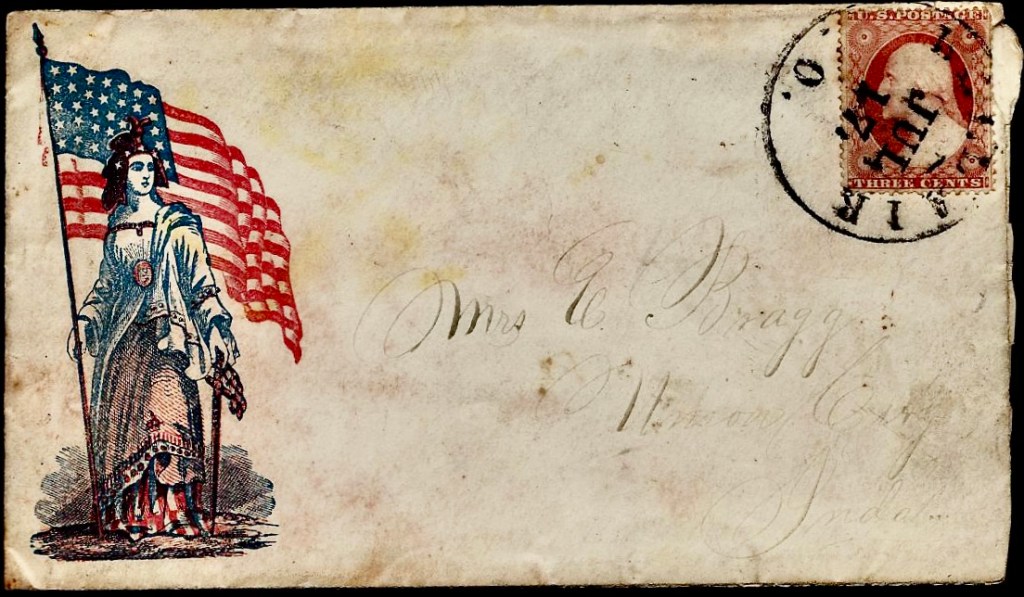
Addressed to Mrs. E. Bragg, Union City, Indiana
Bellaire, Ohio July 16th 1861
Dear Mother,
This day affords me the pleasure of once more communicating a few words with you by way of the pen. I learn from your last letter that you have not received all my letters dated since our arrival here. However, you may be well contented as we are enjoying good health and the pleasures of life exceedingly.
Well, this is no doubt the last week that we shall be in camp, our time being up Saturday. We shall as I before stated, return home at the close of our enlistment. I have thought something of calling at Uncle Samuel’s as we will pass near there. I have a desire to know what has been the matter with him for the last three months—why he has failed to comply with my several letters. I hope he has not turned traitor to his country.
We have had since our arrival here the pleasure of seeing many of our acquaintances from different parts of the country as this is the main crossing for those passing to and from the seat of war. We saw this morning several men from Capt. Stone’s Regiment stating that they were quartered at Buchanan, Va. and have been completely surrounded by the rebel forces. This we doubt from the fact that we hear so many rumors from that part of the country. We have almost come to the conclusion here to believe nothing we hear which gives us but little satisfaction to write anymore to our friends at home.
I shall not write to you any more unless something should turn up that might delay us a few days. You may look for us soon. Having nothing of an interesting nature to write, I close by giving my compliments to all the friends at home. I remain as ever, — T. F. Bragg
Sadly there is too little information for me to do anything but hazard a guess at this soldier’s identity and regiment. We only know that he was named “Bob.” But it is too good of a letter not to publish it. It was penned ten days after the Battle of Fredericksburg from the author’s winter camp near Belle Plain, Virginia. In his letter, the author tells his father, he was “been in one more battle and one midnight skedaddle,” adding that the “soldiers were in good spirits until this retreat but now they say let the South have all they want. They’ll get it anyhow, We have no general sharp enough for Lee and another thing—if one man gets a start, then out goes he for somebody else in two weeks. This is nothing short of a political war.”
One regiment is mentioned—the “130th Regiment”—which may be one that recruited and organized in the same home town as the one the author served in. However, the state name was not provided.
Ironically, Bob’s letter was written on patriotic stationery with the word “VICTORY” emblazoned across the top though it contained news of one of the worst defeats in the history of the Army of the Potomac.
An unidentified private with a disillusioned stare, “I thought I was going for the cause of my country but far different—it is to fill some man’s pocket.” (Paul McKee Collection)
Transcription
Camp in the pines near Belle Plains, Virginia December 23, 1862
My dear father,
I received yours of the 16th yesterday and I can assure you I was pleased as I had no letter from home for at least three weeks.
We have been in one more battle and one midnight skedaddle—that’s Burnside for them. But it must be acknowledged it was done systematically. Some of our batteries muffled their wheels with blankets. All moved off as quiet as mice. Our officers did not speak gruff that night passing you.
We were not engaged with our muskets on the left. It was all artillery except a little picket firing. Enough of that. I can tell you more when the war is over and the soldiers are at leisure. We do not hear anything about the 130th Regiment at all. Will and I have bought ourselves boots. We got tired of wading Virginia mud with shoes, but only take care of the boots. They will be well seasoned for us when we get home which I hope will not be long. This unnatural war must stop.
The soldiers were in good spirits until this retreat but now they say let the South have all they want. They’ll get it anyhow, We have no general sharp enough for Lee and another thing—if one man gets a start, then out goes he for somebody else in two weeks. This is nothing short of a political war. What do they care at Washington as long as the money rolls into their pockets. That’s what I think, and that I know to be the opinion of the men in general.
If I was at home now, they might draft me and then do what they could. I can see into this war now. I thought I was going for the cause of my country but far different—it is to fill some man’s pocket.
We are going into winter quarters now but I do not know how long it will last. We had orders about a week ago to the same effect, and just as we had the logs cut and carried where we wanted them old style, get ready to move. This time they will get them up anyway.
About those clothes, I do not know what to say. Better let them a week yet. We are both well and our respects to all. No more. Your obedient son, — Rob
You did not say one word about mother—whether she is well or not. Has she got a cough this winter? Mother, Bob won’t eat your pies this winter but would like to have one tomorrow for Christmas. Hoping to see you all soon, I shall close.
The following letter was written by George W. Douins (1834-1863) who served as a private in Co. B, Brackett’s Battalion, Minnesota Cavalry. This company was organized at Fort Snelling, Minnesota, and ordered to Benton Barracks, Missouri in November 1861 where they were attached to Curtis Horse, an independent regiment of cavalry, which was later designated the 5th Iowa Cavalry. Co B was redesignated Co I at the time they were transferred to Fort Henry (Tennessee) in February 1862. They served unassigned in Tennessee most of the remainder of 1862, repairing roads and erecting telegraph lines (escorts). This particular letter was datelined from Fort Heiman across the border in Kentucky.
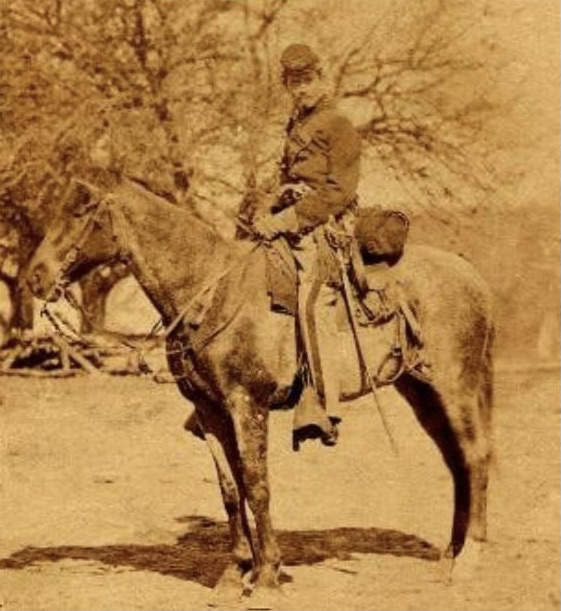
I could not find an image of George but here is one of Joseph S. Rich of Co. D, 5th Iowa Cavalry (Iowa Civil War Images)
George Douins was the son of John Douins (1805-1841 and Rebecca Dow (1805-1870) of Clark county, Indiana. He was married to Nancy S. Denny (1835-1869), the daughter of Morris Thomas Denny (1811-1896) and Martha Trowbridge (1822-1847) of Washington county, Indiana. They were married in May 1856 and moved to Des Moines county, Iowa, where their first child Lucinda was born in March 1858. The couple then moved to Belle Plains, Scott county, Minnesota, where their second child Jennie was born in September 1861. Just after Jennie’s birth, George enlisted in the service but he would never see his home again.
George’s service record can be found under Co. I, 5th Iowa Cavalry and his pension card under Co. D, 1st Mississippi Marine Brigade Cavalry—the unit he was serving in when he died of pneumonia as a sergeant at Little Rock, Arkansas, on 18 December 1863. After her husband’s death, Nancy took the children back to Indiana where she died in Salem in 1869, leaving her children to be raised by relatives in Clark county, Indiana.
In his letter, George enquires of Nancy’s brother, Sgt. Gilbert Harvey Denny (1833-1865) who served in Co. G, 18th Indiana Infantry, who also died of disease in March 1865.
George’s letter also mentions having received a letter from his wife stating that “the Indians were so bad that she had to leave home” and return to Indiana. This of course refers to the Dakota War of 1862 and though no attacks took place in Scott county, it was a location through which travelers, refugees, supply trains, and soldiers passed on their way to or from the prairies, and a general sense of fear and excitement prevailed.
Transcription
Addressed to Morris T. Denny, Kossuth, Washington county, Indiana
Fort Heiman [Kentucky] September 24, [1862]
Dear Father,
I take this opportunity of writing you a few lines to let you know that I am well at present and hope these few lines will find you the same. I never had better health in my life.
I had a letter from Nancy the other day. She wrote the Indians was so bad that she had to leave home. She wrote that she was going to start to Indiana that evening and I have not heard from her since.
We have been here about a month. I don’t know whether we will stay here this winter or not. If we do, I will try to get a furlough and come up there. I have been riding a good deal this summer. I have been all over Tennessee and part of Mississippi State and now in Kentucky. I want you to write and let me know how Gilbert is and where he is and whether he was well or not. I wrote George Leach a letter some time ago. Tell George that if he knowed how well that soldiers liked to hear from his friends, he would be a little prompter to write.
If Nancy comes there, tell her that I will send her some more money when I get my pay. So no more at present—only I remain your son until death. — George Downs
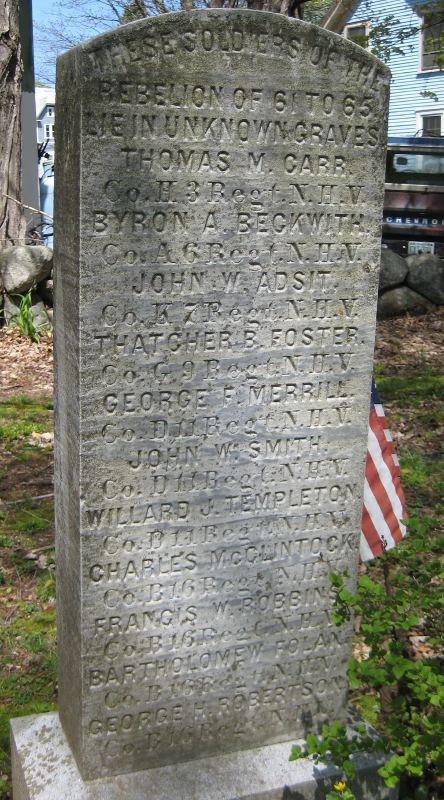
This letter was written by Thatcher Bradford Foster (1844-1864), the son of Charles Harrison Foster (1820-1901) and Martha Ann Sargent (1822-1904) of Hillsboro, New Hampshire. Thatcher signed his name “Thacher” but I presume his given name was “Thatcher” as that is the name on his cenotaph in Hillsboro. At the time of the 1860 US Census, Thatcher was enumerated in his parents home in Hillsboro where he was most likely learning his father’s trade as a house carpenter—his father being “sick and poor” at the time.
I could not find an image of Thatcher but here is a cdv of Pvt. Thomas William who served in Co. K, 9th New Hampshire. Thomas was killed in the Battle of the Crater (Dave Morin Collection)
Thatcher volunteered on 18 August 1862 at the age of 18 to serve in Co. G, 9th New Hampshire Infantry. The recruiting officer recorded his height as 5 feet 5 inches, his hair light, his complexion fair, and his eyes blue. The 9th New Hampshire Infantry was one of the few regiments having an opportunity to serve in both Eastern as well as the Western Theatre of the war.
This letter was written in the summer of 1863 from the trenches before Vicksburg but by the following year, the regiment was with Burnside’s 9th Corps back in Virginia and in the vicinity of Petersburg where they spent two months in front of the Rebel lines at Elliott’s Salient, part of which time it was being undermined for the Battle of the Crater in which “the Ninth bore a conspicuous part” on 30 July 1864. The 9th New Hampshire was called upon to lead Griffin’s 2nd Brigade, advancing on the crater from the right, some ten minutes after the explosion. In the attack, the 9th New Hampshire’s commander, Captain Hough, “fell when part of his jaw was shot away.” The regiment was one of the first to float their colors over the enemy’s works but they soon fell under a heavy fire from Wright’s guns at a distance of 500 yards, and a counterattack by remnant’s of the 17th South Carolina and the 49th North Carolina, causing the loss of half of their men. Among the wounded and taken prisoner was young Thatcher who was held prisoner for some time before he was exchanged, suffering severely from chronic diarrhea. He was transported to a hospital at Annapolis, Maryland, but died there on 1 November 1864 and was buried in the Annapolis National Cemetery.
A cenotaph with Thatcher’s name on it along with other men from Hillsboro who “lie in unknown graves” still stands in the local cemetery.
Transcription
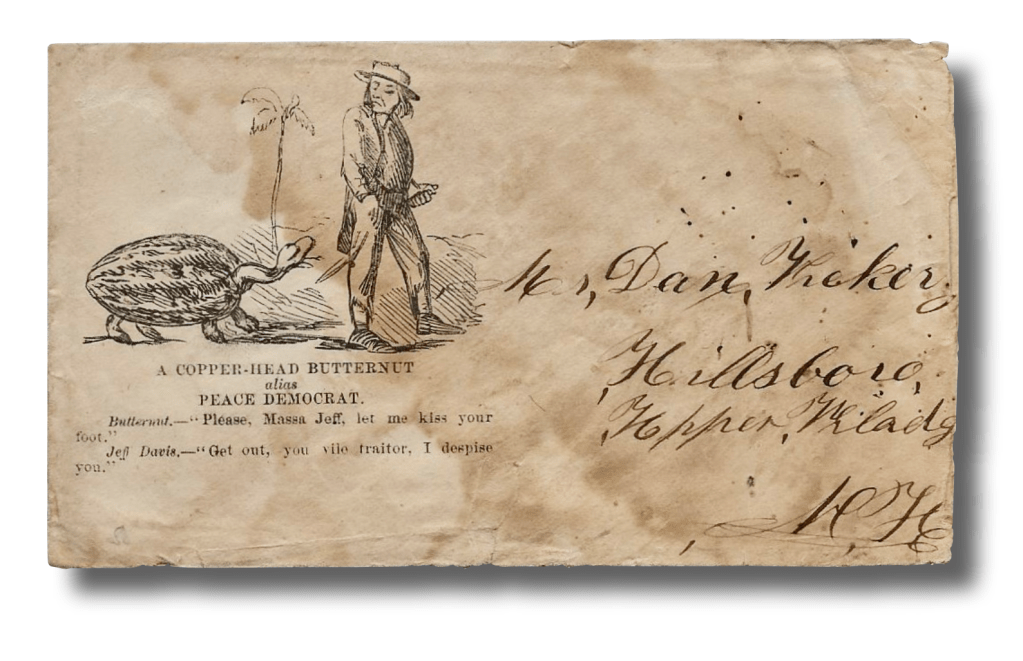
Addressed to Mr. Dan Vickery, Hillsboro, Upper Village, New Hampshire
Camp near Vicksburg, Mississippi June 19th 1863
Friend Dan,
I take my pen to write you to let you know that I am in the land of the living alive and well. I should of written before but you talked of going to New York and I did not know whether you had gone or not. But as I was a going to write home this morning, I thought I would just drop a few lines to you.
It is as hot as you please here. I went out black berrying yesterday and had good success too. This country is full of everything that you could think of. There is a lot of rattlesnakes here. I killed one yesterday that was 10 feet 4 and a half inches long. It makes my hair stand up pretty straight if I happen to run onto one of them a sudden.
Now I guess I will close by requesting you to write me as soon as you get this. Goodbye. from your friend, — Thacher
The fight is still a going on.
P. S. Direct to Co. G, 9th Regt. N. H. V., First Brigade, 2nd Division, 9th Army Corps, Cincinnati, Ohio
Thacher has drawn a percussion rifle firing a ball at a traget (I presume)
I could not find an image of Stanley but here is one of 1st Lieutenant Thomas S. Nelson of Co. I, 4th South Carolina Cavalry.
The following letter was written by Stephen Stanley Crittenden (1829-1911) who enlisted on 1 February 1861 at Greenville, South Carolina, and was elected a 1st Lieutenant in the 4th South Carolina Infantry. They fought at 1st Manassas under Shank Evans but when it came to reorganize in April 1862, various companies were consolidated and they became known as either the 4th or 13th South Carolina Battalion. Stanley, the 1st Lieutenant of Co. D, was wounded in the left breast on 1 June 1862 at the Battle of Seven Pines in Virginia. Late in the war he served as a Lt. Colonel in the 3rd South Carolina Reserves.
Stanley wrote the letter to his first wife, Eliza Jane Lynch (1838-1865), with whom he married in 1855. His second wife was Sarah Ann Rou (1839-1911).
Sadly, Crittenden’s life ended tragically. Local papers carried the following death notice: “Col. Stanley S. Crittenden of Greenville, aged 82 years, a writer and former postmaster of Greenville, committed suicide Wednesday morning by shooting himself to death in his bathroom. Death came instantly. Col. Crittenden was lieutenant colonel in the staff of Gen. Mart Gary in the ‘war between the sections.’ He helped the late general and Bishop Ellison Capers organize the South Carolina division of United Confederate Veterans, and himself commanded that division for some time.” Another paper added that the Col. had been “much depressed over the death of his wife several weeks ago, and this, coupled with other troubles, had much to do with his sudden death.”
Transcription
Columbia, South Carolina Sunday, 4 o’clock p.m. [1861?]
My dear wife,
I have picked up an old piece of paper as youy perceive to write you a few lines for tomorrow’s mail. Yours and sister Marcia’s welcome letters were received yesterday and gave me great pleasure. I return Marcia’s for you to read. The box of good things also came in plenty time for supper last night and our whole mess are very much obliged to you. The things are very nice & the butter particularly acceptable. We are living very well—some of us continually getting something from home and buying fish, eggs, &c. in this market. So don’t be afraid about our living.
I never slept sounder or felt better in my life than since I have been here. Still I think of you my darling and the dear babies all the time & wish very much to see you all. Richard Foster got a furlough for 4 or 5 days and went home with his wife. We are liable to be called from here any time to Virginia and if you felt like coming, you could easily stay at Janny’s Hotel a few days & I could be with you all the time. But then my darling, you would feel so badly again when we had to say goodbye.
I volunteered with some 60 of our cavalry & two of the regiments for Virginia if needed. You will see by today’s paper that the Governor considers all the volunteers as liable to be ordered to Virginia without volunteering again, as defending Virginia is defending our own state. We may be ordered there in a few days or we may not be sent there at all.
This Sunday and we have drilled twice. This morning I took the company by invitation to hear Dr. Reynolds of the South Carolina College. He gave us a fine discourse.
The box that you sent only cost 10 cents—the cartage from the depot. The railroad charges nothing for packages I believe to the volunteers. If we stay here long, I may write to you for some of my summer clothes, those and some handkerchiefs & cotton socks being about all I will need. Write me, my darling, all that you are doing. You and your Ma might stay at the farm a good deal if you felt like it.
I said something to Maj. Whitaker I believe about sending the epaulets. I have forgotten what I left the keys there as you know. She & Edward write often Remember me to Oliver, Harriet and all the servants. Tell them to take care of everything—horses, cows, hogs, corn, &c….Tell Oliver to fence in the whole new ground. get all the bark from the oaks & pile it carefully as he gets it, haul it the new way to the tan yard & get the money for it….
With love to your Pa and Ma & to yourself, my darling, & our babies. Your own, — Stanley
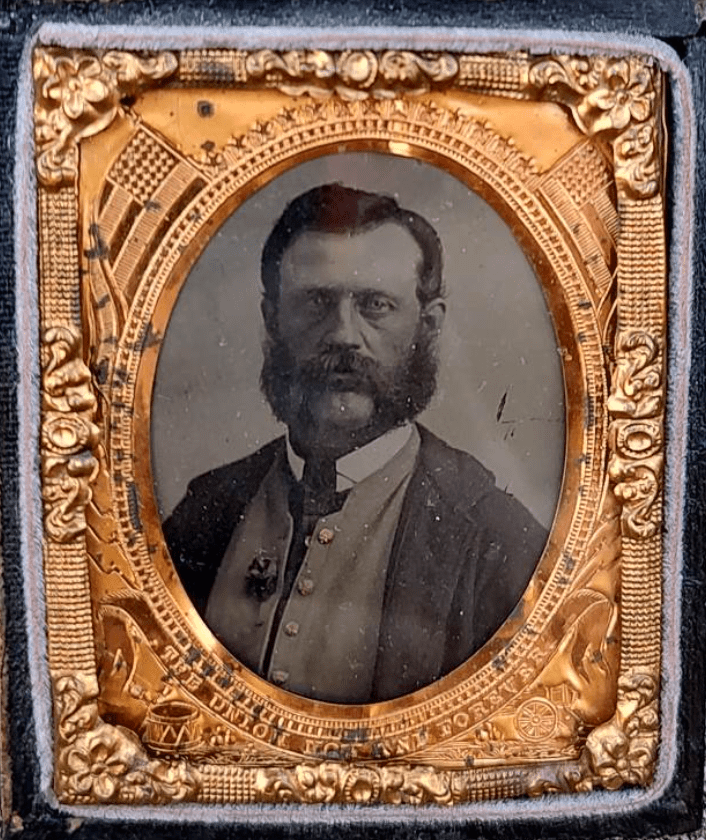
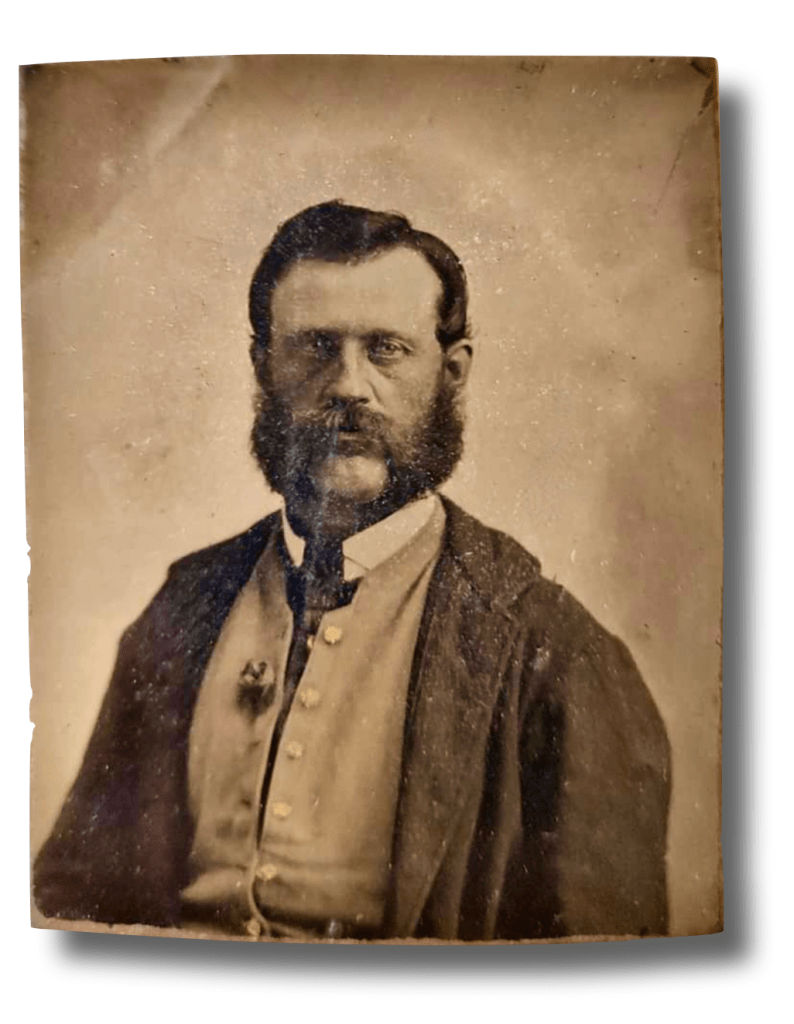
The following letters were written by Emor Young (1823-1869) of Glocester, Providence county, Rhode Island, to his wife, Martha P. (Gleason) Young (1826-1882). Emor served as a private in Co. C, 7th Rhode Island Infantry but spent much of his time detailed as a cook and baker for the regiment. During the Battle of Petersburg, Va. in July 1864, he served in a military hospital in City Point, Va., for several weeks.
In the 1860 US Census, Emor was enumerated in Glocester and employed as a “lumberman.” In the same household were his wife Martha and their two sons, Edgar M. (age 12) and Frederick (age 8).
Mortality records indicate that Emor died at the age of 45 while employed in a cotton mill. The cause of death was attributed to typhoid fever.
[Note: Many more (100+) of Emor Young’s letters are in the private collection of my friend Rob Grandchamp which were published in a limited number under the title, “Write Soon and Give me all the News.” Copies were distributed to libraries in Rhode Island. There are also a large number of Young’s letters (76 altogether) that are housed in the Filson Historical Society Archives in Louisville, Kentucky.]
Letter 1
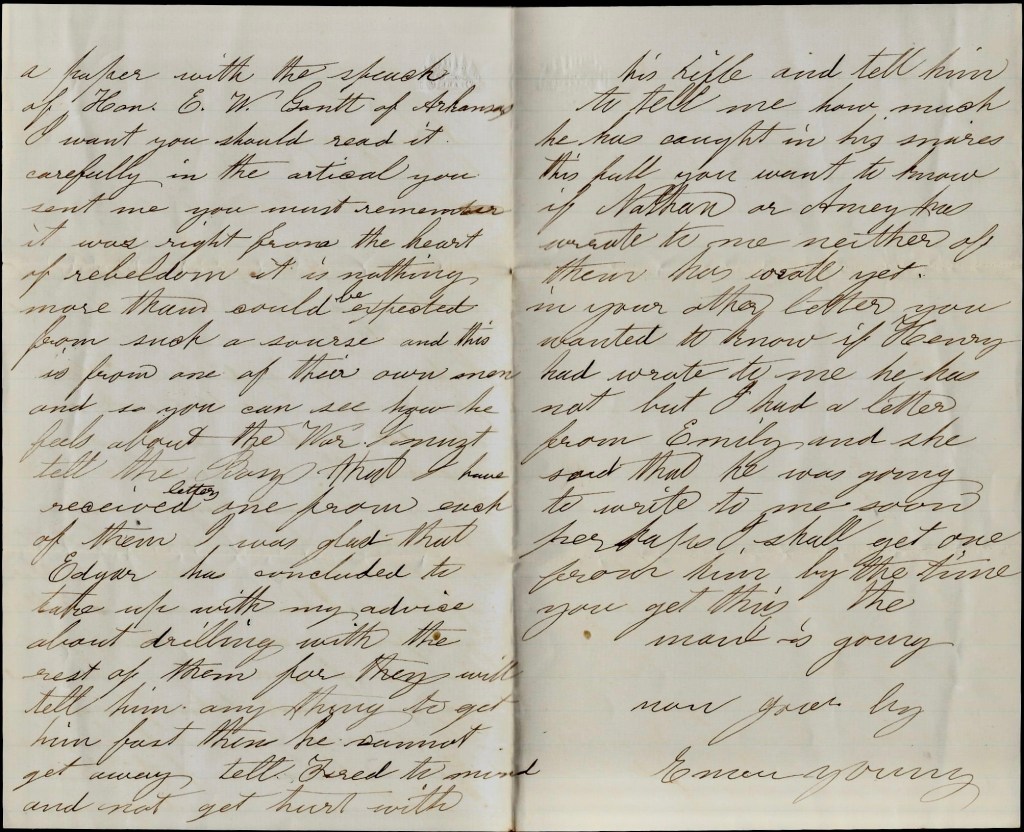
Lexington, Kentucky November 7, 1863
Dear Wife,
I now take my pen in hand to let you know that I am well and hope this will find you all the same at home. I have received two letters from you—one October 28th, one November 1st, and two newspapers. One was the Pat and the other the Cincinnati Times. Where they come from, I cannot tell. There was no name on either of them.
I have no news to tell you for you can see the papers. In one of your letters you sent me an extract taken from a Richmond paper to prove the continuance of this war. I shall now send you a paper with the speech of Hon. E. W. Gantt of Arkansas. I want you should read it carefully. In the article you sent me you must remember it was right from the heart of rebeldom. It is nothing more than could be expected from such a source and this is from one of their own men and so you see how he feels about the war.
I must tell the boys that I have received letters—one from each of them, I was glad that Edgar has concluded to take up with my advice about drilling with the rest of them for they will tel him anything to get him fast. Then he cannot get away. Tell Fred to mind and not get hurt with his rifle and tell him to tell me how much he has caught in his snares this fall.
You want to know if Nathan or Amy has wrote to me. Neither of them has wrote yet. In your letter you wanted to know if Henry had wrote to me. He has not but I had a letter from Emily and she said that he was going to write to me soon. Perhaps I shall get one from him by the time you get this. The mail is going now. Goodbye. — Emor Young
Letter 2
Point Isabel, Kentucky January 10, [1864]
Dear Wife,
I now take my pen in hand to let you know that I am well and hope this will find you all the same at home. You must excuse me for not writing sooner but the day after I wrote you before, we marched for this point. It has been a cold march but I cannot describe it to you. But it appears that our regiment has the times on the mountains this winter. We are upon the Cumberland. Last winter we was on the Blue Ridge. I must tell you where this place is. It is between the two branches, the North and South of the Cumberland [river]. It is now called Burnside Point. It is the route that he took for Knoxville. It is all mountains where we are now. This is the worst place we have ever been in. There is nothing for either man or beast to eat at present. The roads are so bad that they cannot get the teams over the road. The hills are almost straight up and down. It is so cold that I cannot write much this time—just enough to let you know that I am still in the land of the living.
I must tell you what I am up to at present. I am cooking for the teamsters. So you see that I get my knapsack carried instead of backing it. We are going to stay here for awhile. [Zenas] Bliss is in command of the Post here. This is all that I can write this time.
Direct your letter to Point Isabel, Kentucky Now goodbye. Yours truly, — Emor Young
Letter 3
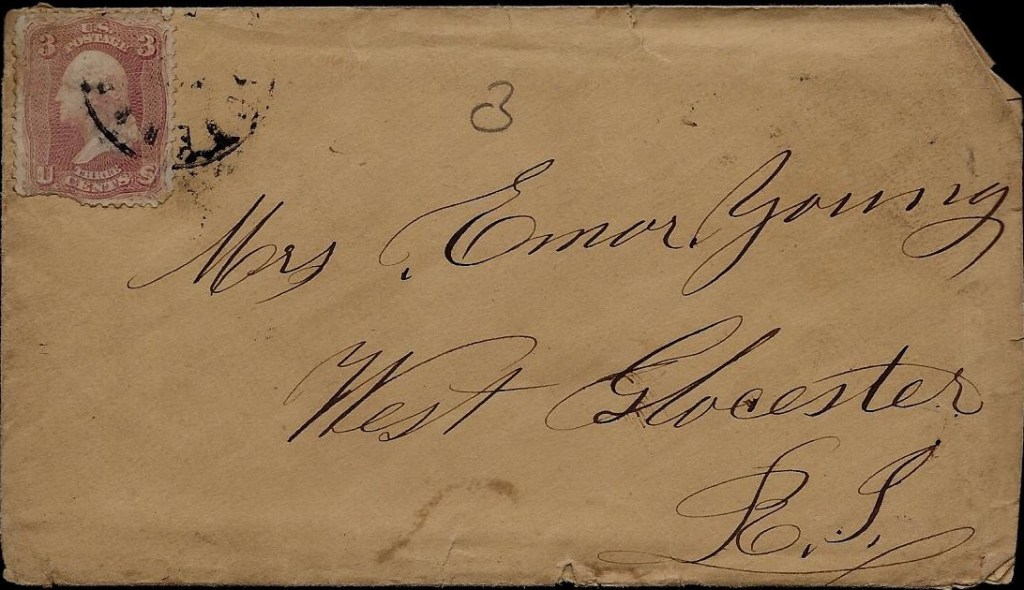
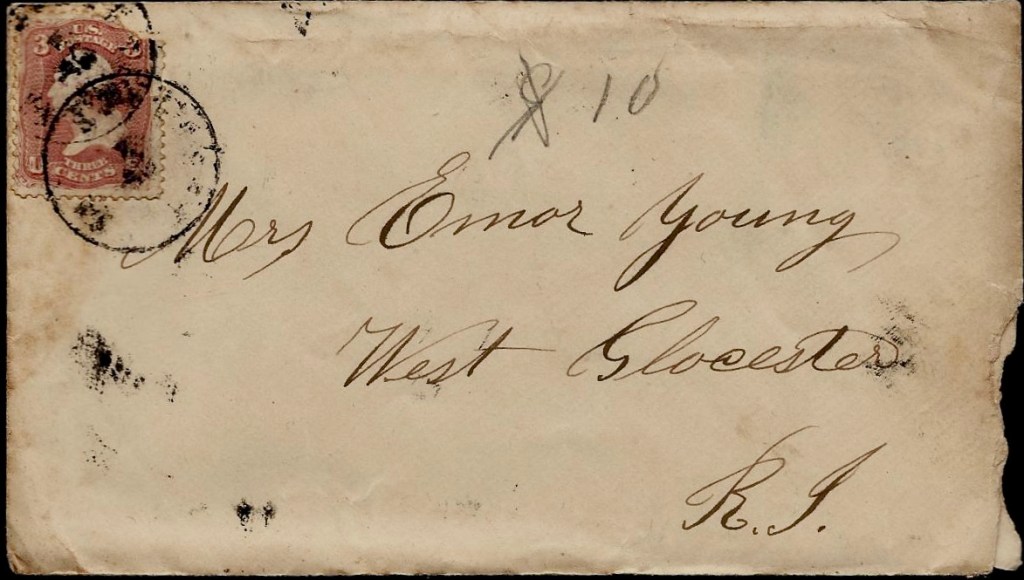
Addressed to Mrs. Emor Young, West Glocester, Rhode Island
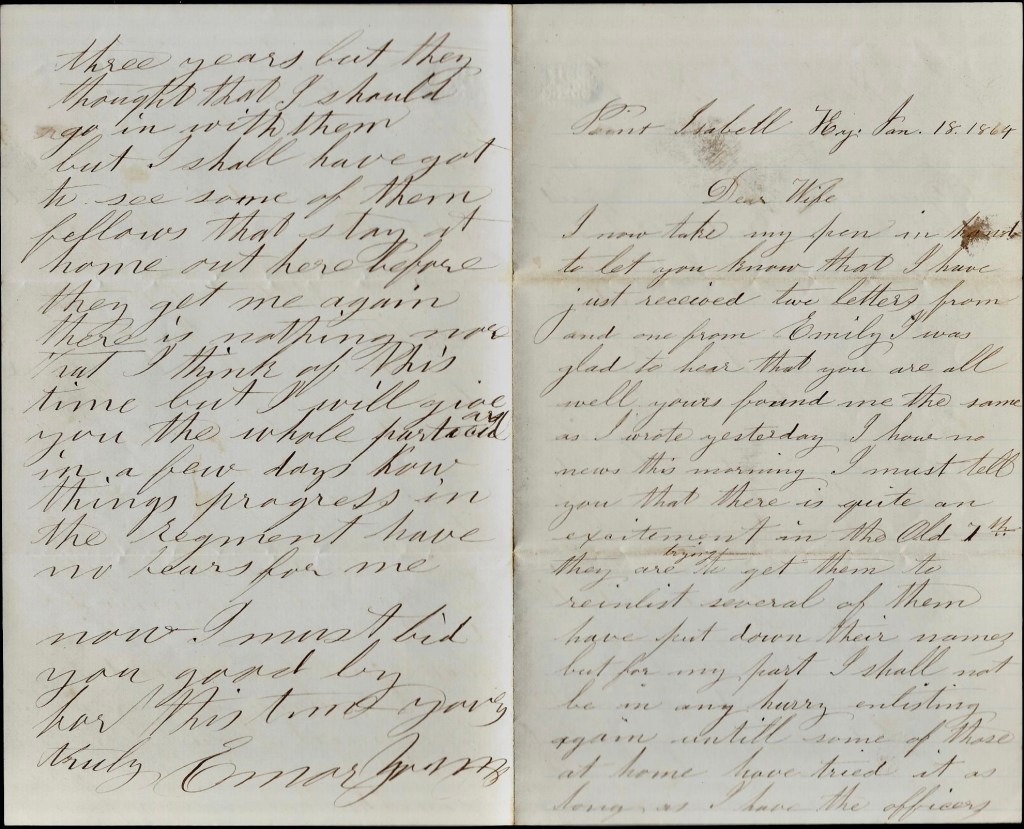
Point Isabel, Kentucky January 18, 1864
Dear Wife,
I now take my pen in hand to let you know that I have just received two letters from you and one from Emily. I was glad to hear that you are all well. Yours found me the same. As I wrote yesterday, I have no news this morning.
I must tell you that there is quite an excitement in the Old 7th. They are trying to get them to reenlist. Several of them have put down their names but for my part, I shall not be in any hurry enlisting again until some of those at home have tried it as long as I have. The officers tell the men funny stories to get them to reenlist but they cannot fool me so I know them too well.
I see by Edgar’s letter that he is afraid that I shall reenlist but he need not fear. He says that he has done the best that he could to help you and is willing to still do so if I will not reenlist but if I do, he can not help me any longer. Quite an encouragement for me. Does he think that I crave this suffering and privation? Is it for me alone or is it for my children that I have suffered and still you know nothing. I have never told you one tenth part of what I have undergone, but still I do not murmur. But Edgar has come to the conclusion not to help me any longer if I reenlist. But that would not make any difference. Has the forgotten the months and years that I and you have toiled for him and what I am still although hundreds of miles from home. Tell him that I shall not reenlist but if I thought it my duty, whether he refused to help me or not, it would make no difference. Now he can do as he pleases about helping you any longer.
Tell both of the boys that they must write as often as they can. You must do the same. The officers have just been round to see how many men are willing to reenlist. I must tell you that there is about three-fourths that will go for three years but they thought that I should go in with them. But I shall have got to see some of them fellows that stay at home out here before they get me again. There is nothing more that I think of this time but I will give you the whole particulars in a few days how things progress in the regiment. Have no fears for me.
Now I must bid you goodbye for this time. Yours truly, — Emor Young
Letter 4
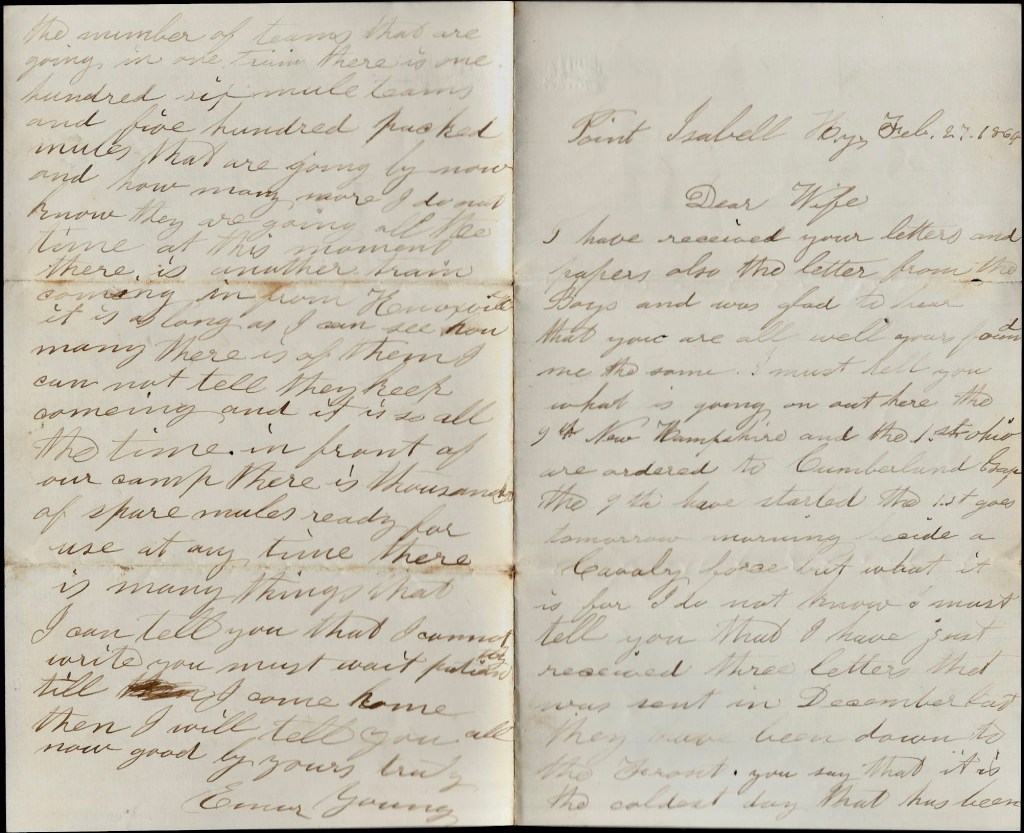
Point Isabel, Kentucky February 27, 1864
Dear Wife,
I have received your letters and papers. Also the letter from the boys and was glad to hear that you are all well. Yours found me the same.
I must tell you what is going on out here. The 9th New Hampshire and the 1st Ohio are ordered to Cumberland Gap. The 9th have started. The 1st goes tomorrow morning beside a cavalry force but what it is form I do not know. I must tell you that I have just received three letters that was sent in December last. They have been down to the front.
You say that it is the coldest day that has been this winter and want to know how it is out here. It is like May at home. I wish you could be here and enjoy the rambles with me. Every chance that I get, I stray off over the mountains. It is very beautiful. I begin to like this place very much now. We have enough supplies, the snow is all gone, and in some places the grass begins to start.
You speak about Mr. Hall. Hill. He come into our camp in Virginia when Nell was with us. I have never seen him since. Ask the boys how they would like to live out here. Tell Fred that some of the teamers are out after wild turkeys and coons and some of them have gone up the river after fish. They have Saturday to do their washing so they wash Friday night, then have all day Saturday. Now how should you like to live out here. There is mountains and plains that extend for miles in length and breadth. Then the broad rivers between making it one of the finest places you ever saw. There is a railroad run out near our camp.
I must tell you that we are making fortifications and it will soon be one of the most important forts between Knoxville and Lexington. It has the advantage of most all the rest. It has the river and it is filled with steamboats loaded with any amount of rations. I will tell you the number of teams that going in one train. There is one hundred six-mule teams and five hundred pack mules that are going by now and how many more I do not know. They are going all the time at this moment. There is another train coming in from Knoxville. It is as long as I can see. How many more of them I cannot tell. They keep coming and it is all the time. In frint of our camp there is thousands of spare mules ready for use at any time. There is many things that I can tell you that I cannot write. You must await the particulars till I come home. Then I will tell you all.
Now goodbye. Yours truly, — Emor Young
Letter 5
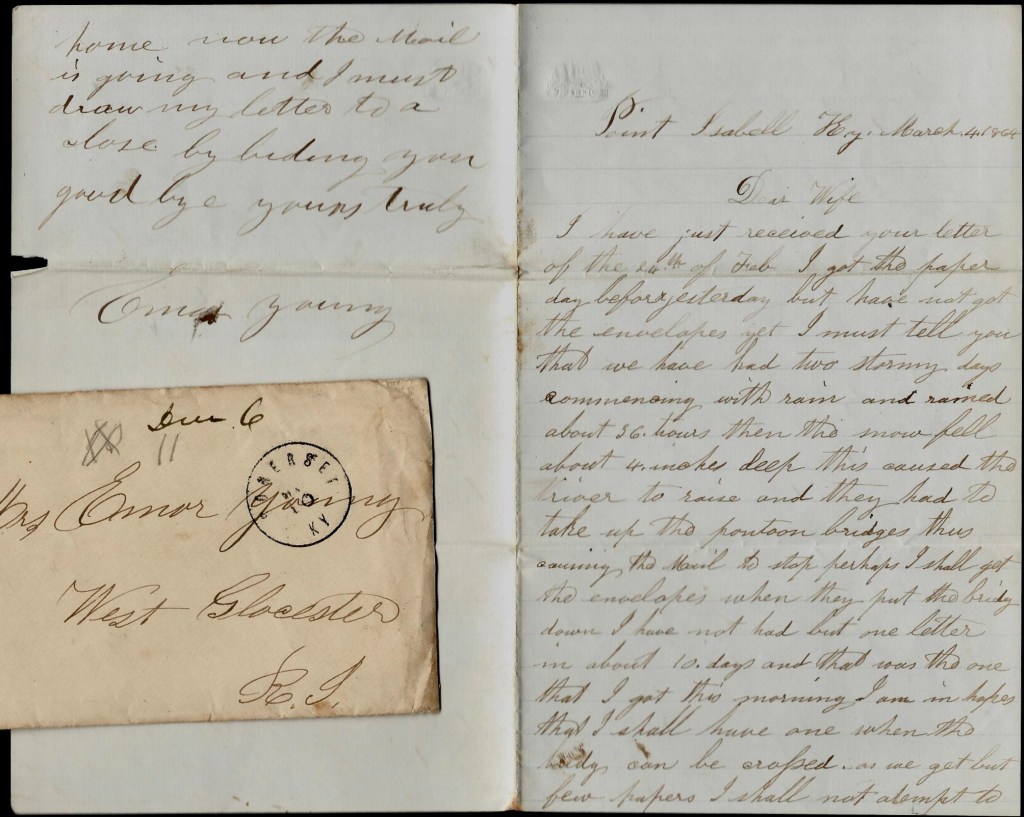
Point Isabel, Kentucky March 4, 1864
Dear Wife,
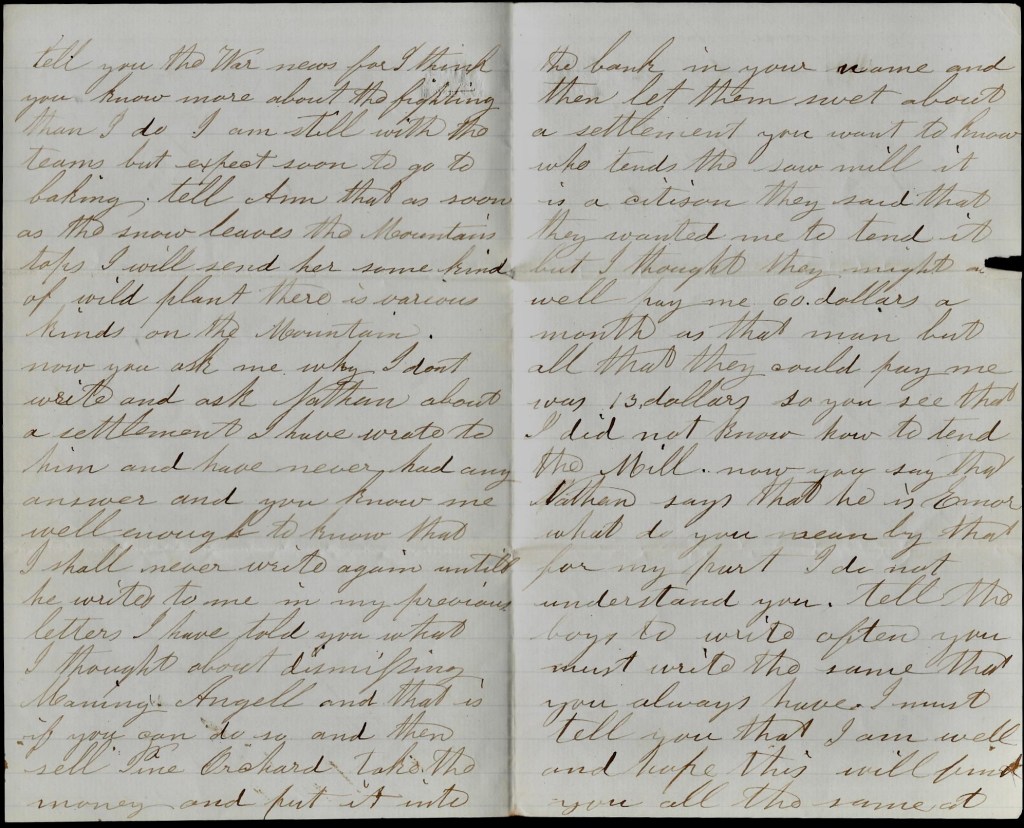
I have just received your letter of the 24th if February. I got the paper day before yesterday but have not got the envelopes yet. I must tell you that we have had two stormy days commencing with rain and rained about 36 hours. Then the snow fell about 4 inches deep. This caused the river to raise and they had to take up the pontoon bridges, thus causing the mail to stop. Perhaps I shall get the envelopes when they put the bridge down. I have not had but one letter in about ten days and that was the one that I got this morning. I am in hopes that I shall have one when the bridge can be crossed. As we get but few papers, I shall not attempt to tell you the war news for I think you know more about the fighting than I do.
I am still with the teams but expect soon to go to baking. Tell Ann that as soon as the snow leaves the mountain tops, I will send her some kind of wild plant. There is various kinds on the mountain.
Now you ask me why I don’t write and ask Nathan about a settlement. I have wrote to him and have never had any answer and you know me well enough to know that I shall never write again until he writes to me in my previous letters. I have told you what I thought about dismissing Manning Angell and that is if you can do so and then sell Pine Orchard, take the money and put it into the bank in your name and then let them sewat about a settlement.
You want to know who tends the saw mill. It is a citizen. They said that they wanted me to tend it but I thought they might as well pay me 60 dollars a month as that man but all that they could pay me was 13 dollars so you see that I did not know how to tend the mill. Now you say that Nathan says that he is Emor. What do you mean by that? For my part, I do not understand you. Tell the boys to write often. you must write the same that you always have. I must tell you that I am well and hope this will find you all the same at home. Now the mail going and I must draw my letter to a close by bidding you goodbye. Yours truly, — Emor Young
Letter 6
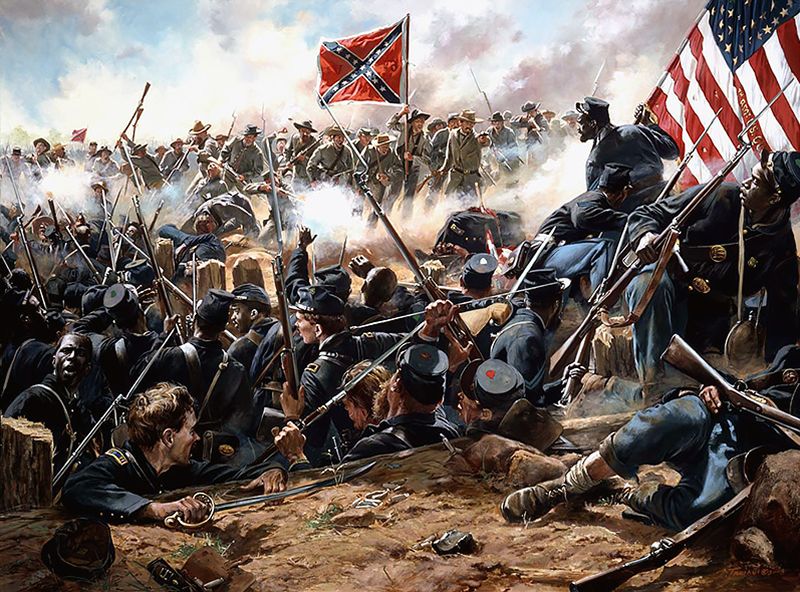
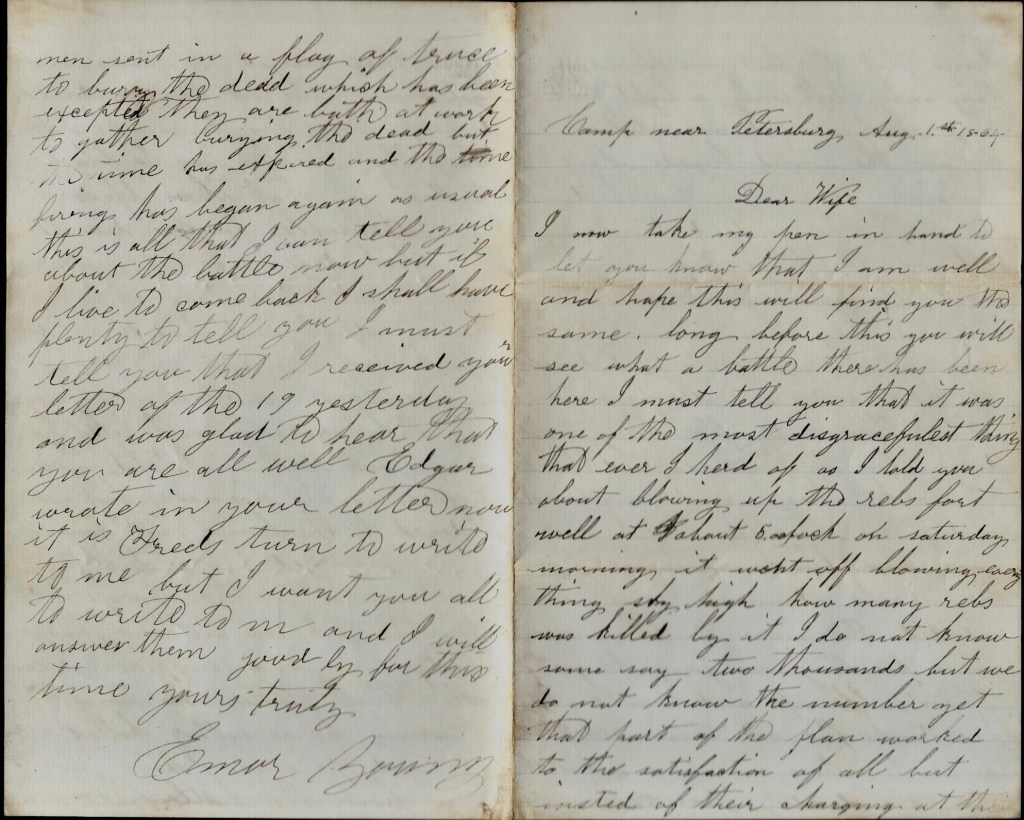
Emor’s letter describes the debacle of the “blowing up of the reb’s fort” on 30 July 1864 (Battle of the Crater)
Camp near Petersburg [Virginia] August 1, 1864
Dear Wife,
I now take my pen in hand to let you know that I am well and hope this will find you the same.
Long before this you will see what a battle there has been here. I must tell you that it was one of the most disgraceful things that ever I heard of as I told you about blowing up the reb’s fort. Well, at about 5 o’clock on Saturday morning, it went off, blowing everything sky high. How many rebs was killed by it, I do not know. Some say two thousands but we do not know the number yet. That part of the plan worked to the satisfaction of all but instead of charging at the time that the fort was blown up, they only left with a light force. They went in and was repulsed. Then this the 2nd Brigade of our Division, the the 4th Division which is the colored troops was ordered to charge. They went in and drove everything before them. They was supported by the rest of the 9th Corps and one division of the 10th Corps—in all, perhaps ten thousand.
After they had drove them to the second line of works, they made a stand and then started towards our men—the blacks still in front as the rebs advanced. The officers ordered the men to let them come for they [the Union officers] was going to give themselves up and would not let our troops fire on them and they came to where our men was, then poured a deadly fire into our men, then charged on them and got them started. They run like sheep. They tried to make out that the blacks was to blame but I say that the officers is responsible for the disaster. The blacks drove the rebs out of their works after the white troops had tried it and had been drawed back.
But I must stop on this subject and let you judge by the papers. I will tell you about our regiment. As I told you before, we are pioneers but was ordered to the front [and] had four or five wounded, none killed. We was not in the charge. The 4th Rhode Island was in the charge [and] lost 71 men and 12 officers, 83 in all. Phil Potter is among the missing, He is either killed or taken prisoner. I have just come from the battlefield. Our men sent in a flag of truce to bury the dead which has been accepted. They are both at work together burying the dead but the time has expired and the firing has begun again as usual
This is all that I can tell you about the battle now but if I live to come back, I shall have plenty to tell you. I must tell you that I received your letter of the 19th yesterday and was glad to hear that you are all well. Edgar wrote in your letter. Now it is Fred’s turn to write to me. But I want you all to write to me and I will answer them. Goodbye for this time. Yours truly, — Emor Young
Letter 7
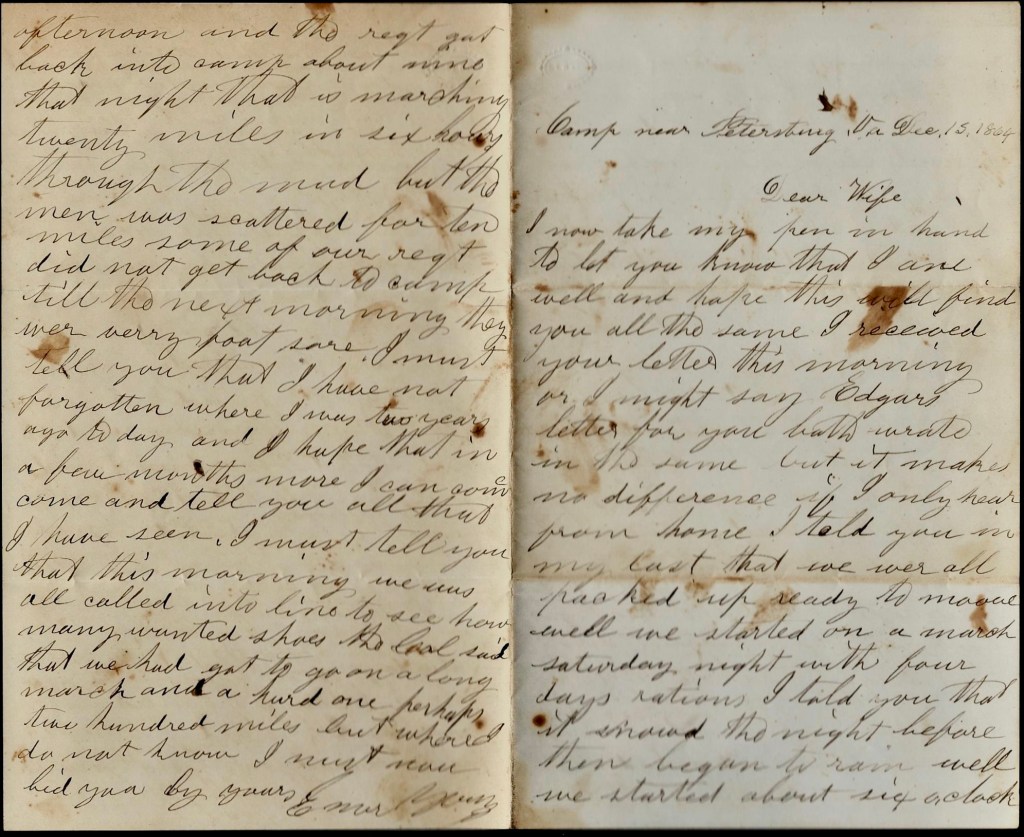
Camp near Petersburg, Va. December 15, 1864
Dear Wife,
I now take my pen in hand to let you know that I am well and hope this will find you all the same. I received your letter this morning—or I might say Edgar’s letter, for you both wrote in the same, but it makes no difference if I only hear from home.
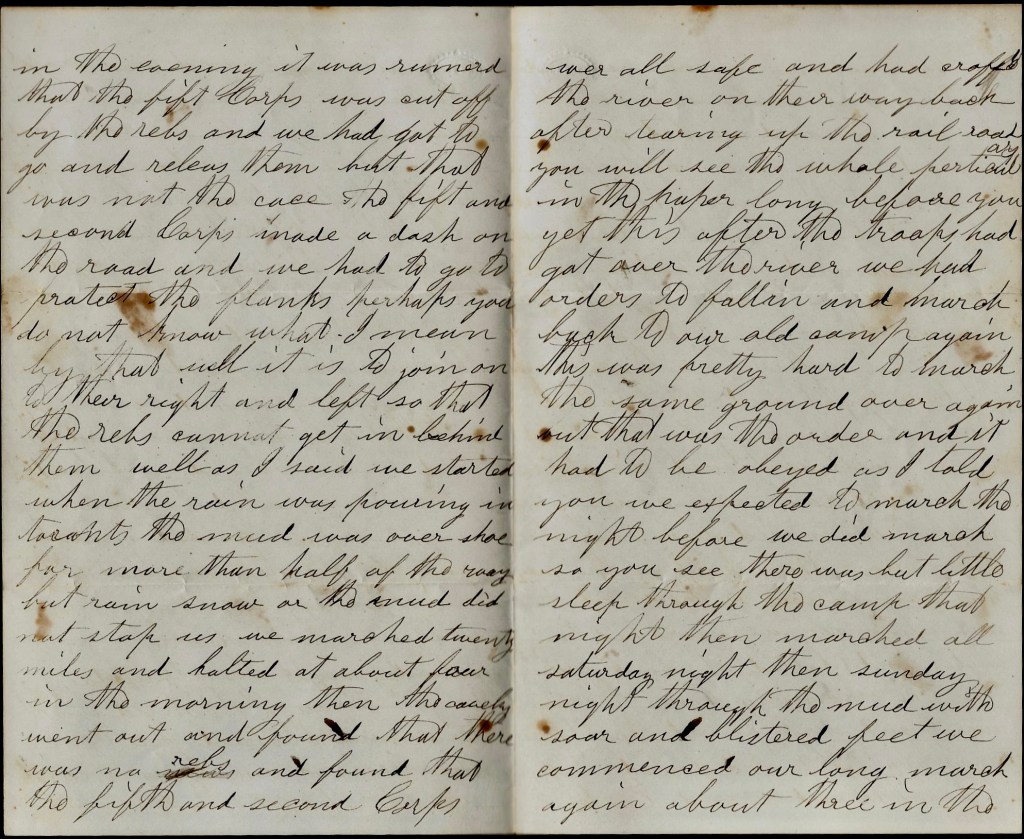
I told you in my last that we were all packed up ready to move. Well we started on a march Saturday night with four days rations. I told you that it snowed the night before, then began to rain. Well, we started about six o’clock in the evening. It was rumored that the 5th Corps was cut off by the rebs and we had got to go and release them but that was not the case. The 5th and 2nd Corps made a dash on the road and we had to go to protect the flanks. Perhaps you do not know what I mean by that. Well, it is to join on to their right and left so that the rebs cannot get in behind them.
Well, as I said, we started when the rain was pouring in torrents. The mud was over shoe for more than half of the way, but rain, snow, or the mud did not stop us. We marched twenty miles and halted at about four in the morning, Then the cavalry went out and found that there was no rebs and found that the 5th and 2nd Corps were all safe and had crossed the river on their way back after tearing up the [Weldon] railroad. You will see the whole particulars in the paper long before you get this. After the troops had got over the river, we had orders to fall in and march back to our old camp again. This was pretty hard to march the same ground over again but that was the order and it had to be obeyed. As I told you, we expected to march the night before we did march so you see there was but little sleep through the camp that night, then marched all Saturday night, then Sunday night through the mud with sore and blistered feet. We commenced our long march again about three in the afternoon and the regiment got back into camp about nine that night. That is marching twenty miles in six hours through the mud. But the men was scattered for ten miles. Some of our regiment did not get back to camp till the nrext morning. They were very foot sore.
I must tell you that I have not forgotten where I was two years ago today and I hope that in a few months more I can come and tell you all that I have seen. I must tell you that this morning we was all called into line to see how many wanted shoes. The Colonel said that we had got to go on a long march and a hard one—perhaps two hundred miles—but where I do not know. I must now bid you goodbye. Yours, — Emor Young
Letter 8
Near Petersburg, Va. December 23rd 1864
Dear Wife,
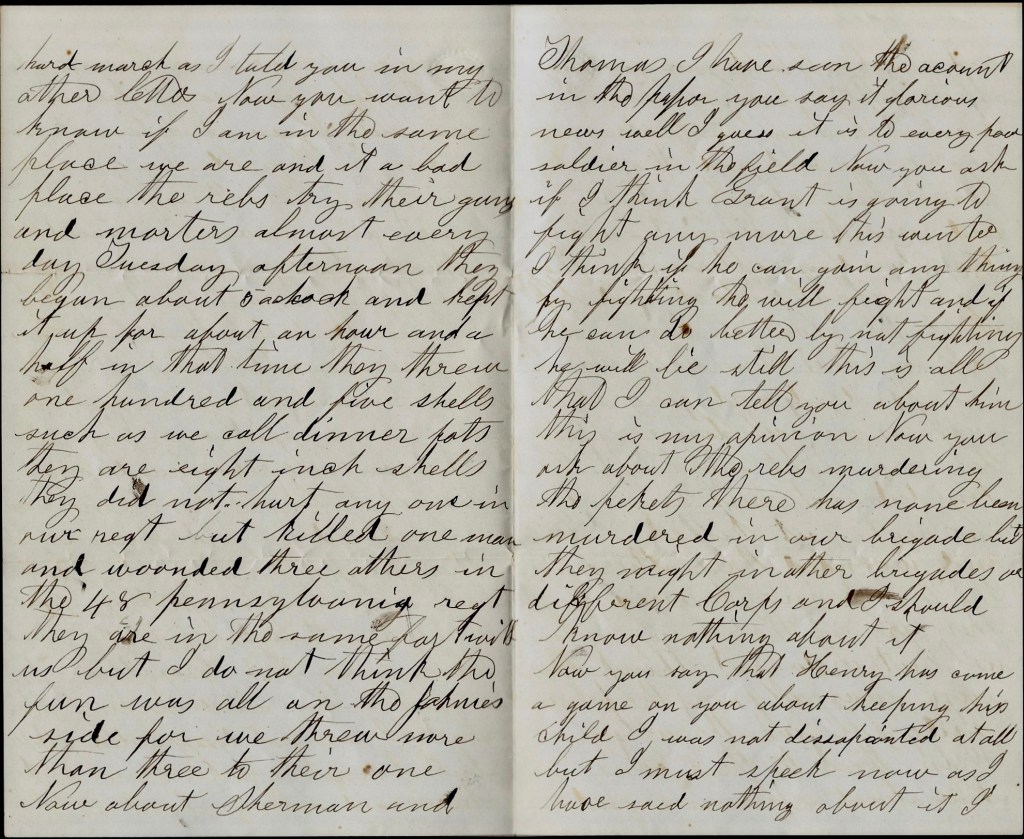
I now take my pen in hand to let you know that I am well and hope this will find you all the same at home. I have just received two letters from you—one dated the 16th and the other the 19th and a sheet from Edgar. You want to know f I was with Warren on his expedition. I told you in my last that our regiment was out with the 5th Corps. There was four regiments went and five stayed to guard the lines in our brigade and of course the 7th Regiment was one that had to go. But never mind that now. We have all lived through it but it was a pretty hard march as I told you in my other letter.
Now you want to know if I am in the same place. We are, and it is a bad place. The rebs try their guns and mortars almost every fay. Tuesday afternoon they began about 5 o’clock and kept it up for about an hour and a half. In that time they threw one hundred and five shells such as we call dinner pots. They are eight-inch shells. They did not hurt anyone in our regiment but killed one man in the 48th Pennsylvania Regt. They are in the same fort with us. But I do not think the fun was all on the Johnnies’ side for we threw more than three to their one.
Now about Sherman and Thomas. I have seen the account in the paper [that] you say is glorious news. Well, I guess it is to every poor soldier in the field. Now you ask if I think Grant is going to fight anymore this winter. I think if he can gain anything by fighting, he will fight. And if he can do better by not fighting, he will lie still. This is all that I can tell you about him. This is my opinion.
Now you ask about the rebs murdering the pickets. There has none been murdered in our brigade but they might in another brigade or different corps and I should know nothing about it.
Now you say that Henry has come again on you about keeping his child. I was not disappointed at all but I must speak now as I have said nothing about it. I must advise you not to do anything rash that will make the child suffer for what the parents have been guilty of consider well. Suppose it was your own child. But do as you think best. Tell Edgar that I am glad that he likes his school. Tell him to try and learn all he can and when I come home, I shall want he and Fred ready to go with me out West where we can live easy. I suppose you will want to go and live with us. We can take comfort but I must not think of that for it is a long time yet. There is nothing more that I think of so I will bid you goodbye.
The following two letters were written by Ralph Augustus (“Gus”) Lanning (1835-1893) who enlisted 27 May 1861 and was mustered into Co. D, 83rd New York Infantry as a sergeant. By mid-January 1862 he had received a commission as 1st Lieutenant of his company and by 22 May 1862 he was serving as its Captain.
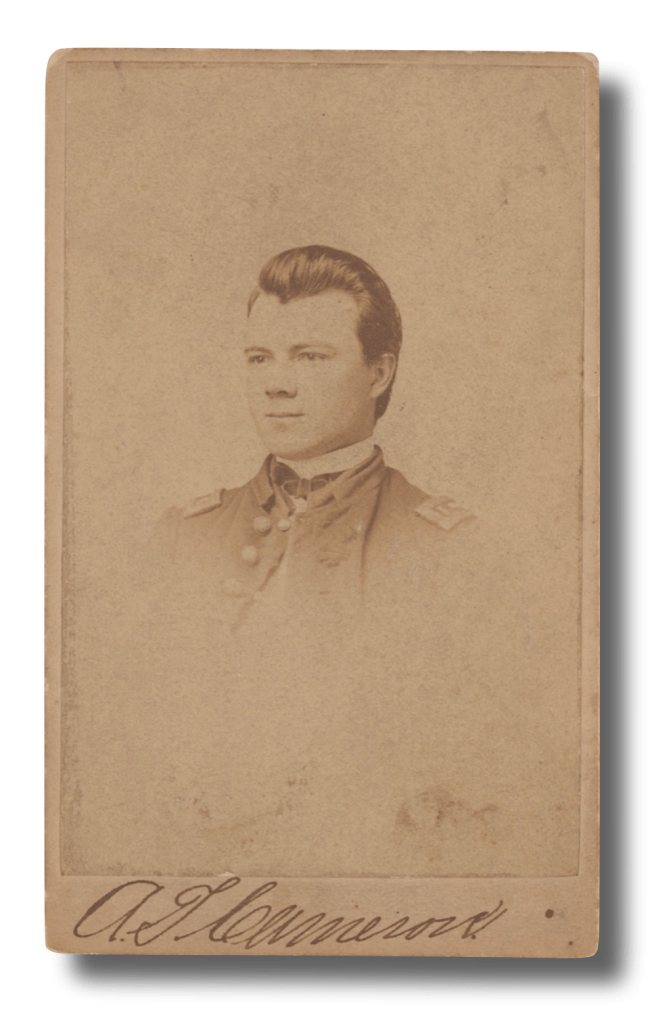
I could not find an image of Gus but here is one of Angus Cameron who also served as a captain in the 83rd New York Infantry. Capt. Cameron was in Co. F. (Photo Sleuth)
The 83rd New York served along the Potomac River in Maryland and at Harper’s Ferry. In the spring of 1862 the regiment was stationed near Warrenton Junction and along the Rappahannock river with several different assignments and participated in Gen. Pope’s Virginia campaign with the 3d brigade, 2nd division, 3d corps, suffering the loss of 75 members at the second Bull Run. The brigade and division were transferred to the 1st corps on Sept. 12, fought at South mountain and Antietam, the regiment being closely engaged in both battles and losing 114 at Antietam. Among those wounded at Antietam was Capt. Lanning who was discharged for disability on 12 December 1862.
In the book, History of the Weld Family (p. 27), it is reported that “Julia Berry Weld (1836-1905) married Mr. Ralph A. Lanning of New York City. He served in the war of 1861, was promoted in office, was wounded, and returned on crutches to his Julia, who received him with a hearty welcome, and they were shortly married. He is a true gentleman, now doing a handsome business in the City of New York.”
Gus was the son of Ralph Lanning (1785-1843) and Mary Wynkoop (1786-1842), both deceased by the time Gus was eight years old. He may have been raised by his Uncle Isaac W. Lanning of Trenton, New Jersey, who was named the trustee of Gus’s inheritance which was part of a farm of 46 acres in Mercer county.
Letter 1
Charlestown, [West] Virginia Sunday, March 2nd 1862
My own darling Julie,
We left Bolivar on Friday night [28 February] about 11:30 o’clock, marched to this place 9 miles. It was a very cold & windy night. I suffered more with the cold than I did anytime through the winter. We were kept in line at Bolivar over an hour before we started. Some of the men had their ears and feet frozen. We made a very quick march—only 1 hour and 55 minutes. We did not make a single halt. When we arrived in Charlestown we could not find out where we were to be quartered. After waiting in the street until the men were nearly frozen, we marched about one mile out of town ad bivouacked in a woods—a very cold place to sleep—but thanks to my men, they got some rails and made me a small house, covered it with brush and leaves, and built a good fire in front & I slept very comfortable.
This is the strongest secession place we have been in. Yesterday our tents came & we are getting along very well, It is snowing very hard at present, Some of the men came to me this morning & asked me if I would allow them to forage for poultry & pigs. I told them I would not prevent them nor give them permission. If they got anything, they must not let me know anything about it. All I do know, I saw them come in camp with some chickens and pigs. I asked no questions. It would not trouble me the least if they took all the poultry in the state. I know very well they would show us no favors. Besides, they have raised one cavalry company & one infantry company & done considerable damage. The troops we had a skirmish with last 4th of July where we lost two of our men were from this place.
We expect orders any moment to move on towards Winchester. We are only waiting for the balance of our army to get here. We have got to see some pretty hard times but I am contented. I am anxious to push on & end this trouble. The men are in tiptop spirits & anxious to see some fun. It is entirely out of the question getting a furlough at present. Enclosed you will find the disapproval of my last furlough. It does appear too bad that I could not get away while we were doing nothing & now we are getting farther off.
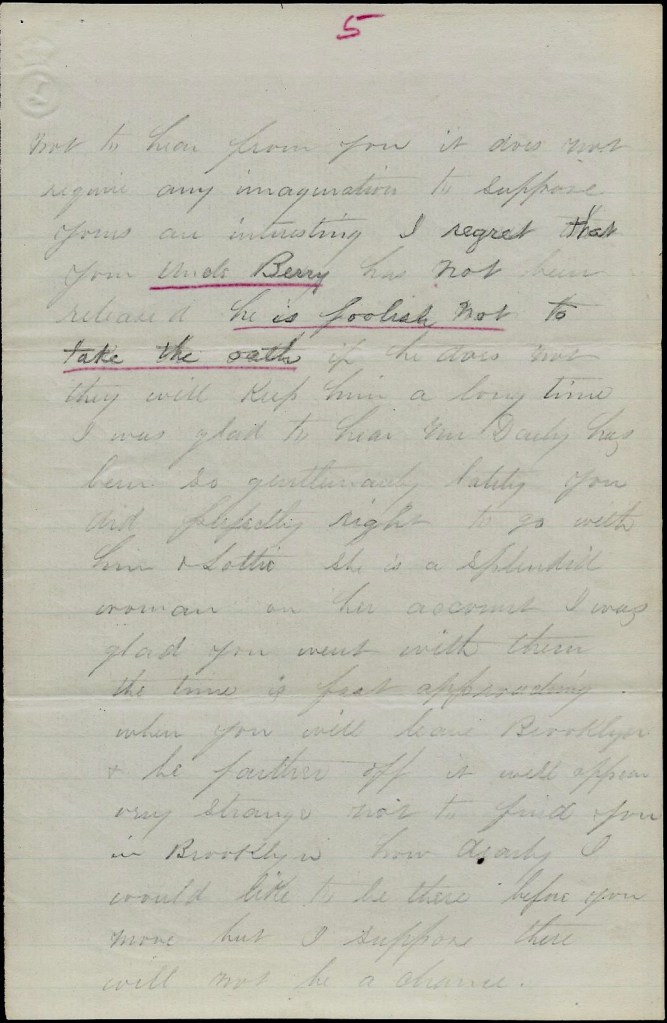
I think more than ever about you, darling one. Do not worry about me. I am well cared for and could not be treated any more kindly than I am by my men except at 45 Sands Street. I received only one letter from you last week. Expect to hear from you this evening. Do hope I will not be disappointed. Please write often. You said in your last you were almost ashamed to send some of your letters. Now darling, I ought to give you a good scolding. Your letters are excellent & very interesting. Please, dear one, not to think so again but write often as you can. I would be very unhappy not to hear from you. It does not require any imagination to suppose yours are interesting.
I regret that your Uncle Berry has not been released. 1 He is foolish not to take the Oath. If he does not, they will keep him a long time. I was glad to hear Mr. Daily has been so gentlemanly lately. You did perfectly right to go with him & Lottie. She is a splendid woman. On her account, I was glad you went with them. The time is fast approaching when you will leave Brooklyn & be farther off. It will appear very strange not to find you in Brooklyn. How dearly I would like to be there before you move but I suppose there will not be a chance.
Monday, March 4th [3rd] 1862. Good morning darling. This is a very gloomy and disagreeable morning. I was disappointed last eve in not getting a letter from you, dear one. There is a report in camp that letters will not go any farther than Baltimore until this move of the army is completed but I do not credit it. The reporters are not allowed to send any dispatches to the papers. It is about time for the mail to leave & I must close this miserable letter. Give my love to all my dear friends at 45 but keep enough love for yourself. May God bless & protect you, darling one, is the prayer of your own, — Gus
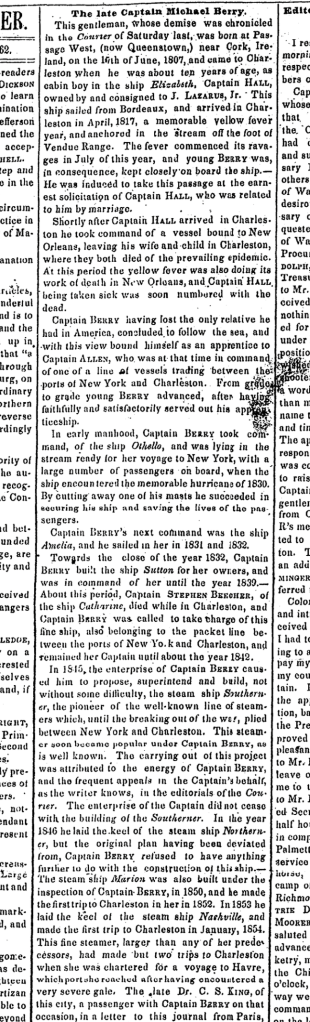
1 Capt. Michael Berry, formerly of the steamship Columbia that made regular runs between New York and Charleston, prior to the secession of South Carolina, was a prisoner in Fort Lafayette, and afterwards at Fort Warren, charged with secession tendencies.
Letter 2
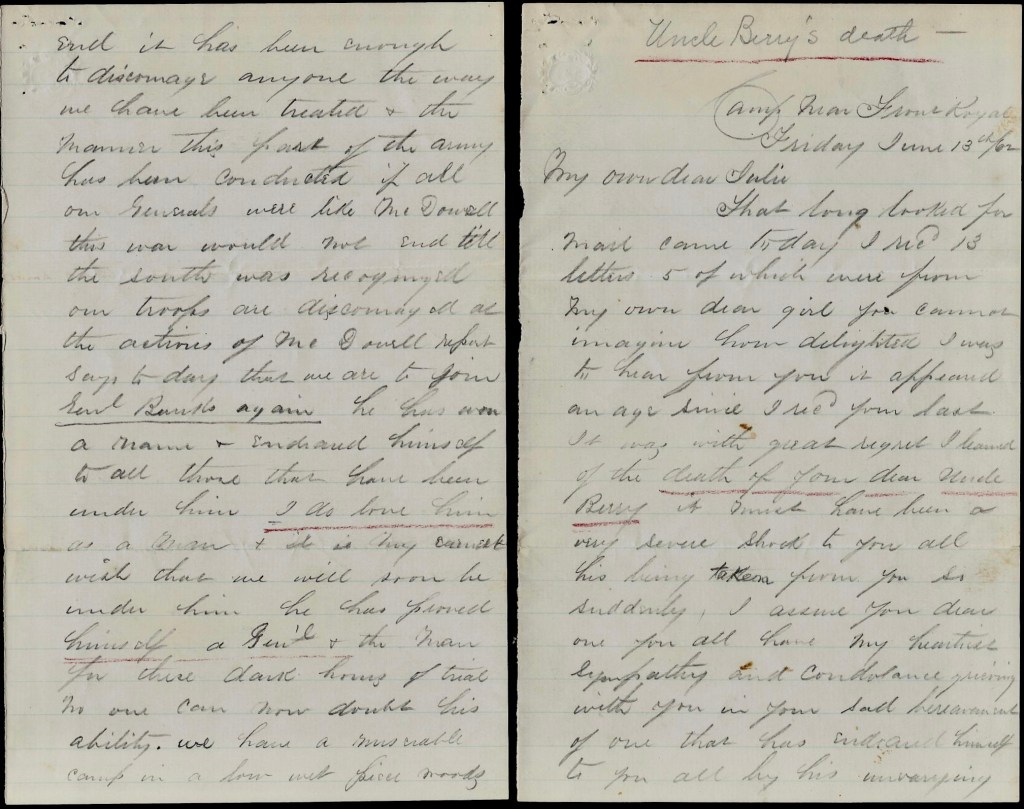
Camp near Front Royal Friday, June 13th 1862
My own dear Julie,
That long looked for mail came today. I received 13 letters—5 of which were from my own dear girl. You cannot imagine how delighted I was to hear from you. It appeared an age since I received your last.
It was with great regret I learned of the death of your dear Uncle Berry. 1 It must have been a very severe shock to you all—his being taken from you so suddenly. I assure you, dear one, you all have my heartiest sympathy and condolence, grieving with you in your sad bereavement of one that has endeared himself to you all by his unvarying kindness and affection. It is another lesson to us all that when the fatal hour of trial shall come, to be found ready and prepared to render a faithful account to Him who doeth all things well.
I had a dream a few nights since that some awful calamity had befallen you. Ever since I have thought of it many times which made me doubly anxious to hear from you. Each letter as I found it I thought of my dream & when I came to the last, I found it to be true.
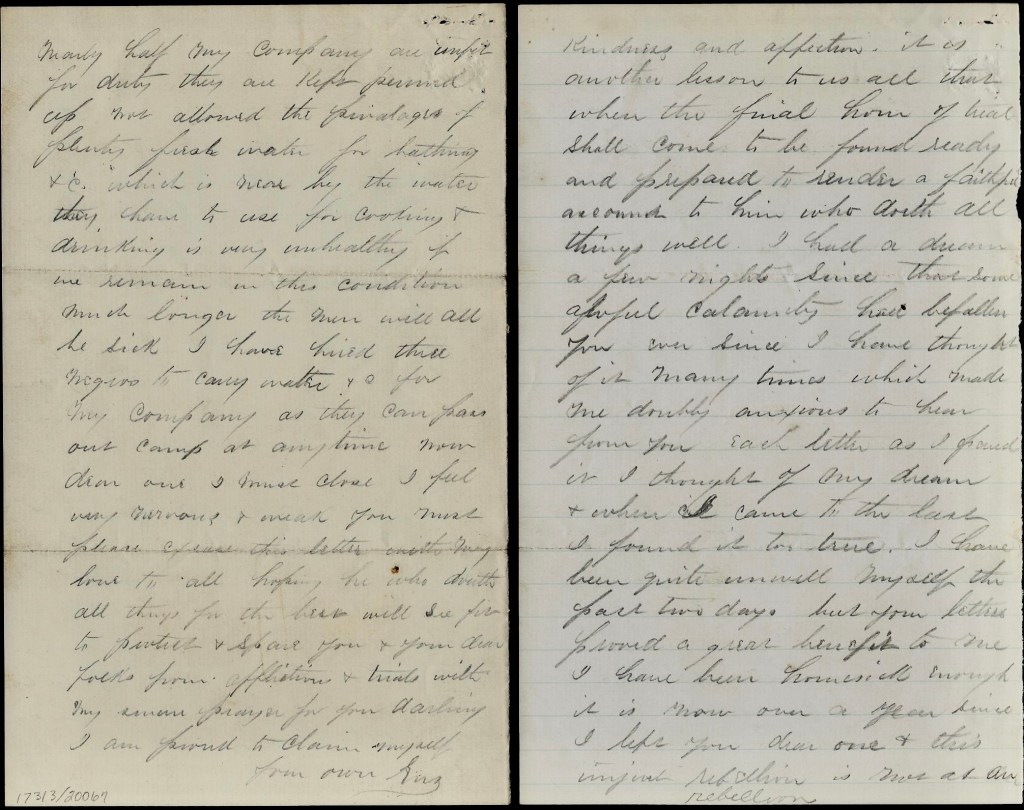
I have been quite unwell myself the past two days but your letter proved a great benefot to me. I have been homesick enough. It is now over a year since I left you, dear one, and this unjust rebellion is not at all rebellion and it has been enough to discourage anyone the way we have been treated & the manner this part of the army has been conducted. If all our Generals were like McDowell, this war would not end till the South was recognized. Our troops are discouraged at the actions of McDowell. Report says today that we are to join General Banks again. He has won a name and endeared himself to all those that have been under him. I do love him as a man and it is my earnest wish that we will soon be under him. He has proved himself a General and the man for these dark hours of trial. No one can doubt his ability.
We have a miserable camp in a low wet piece of woods. Nearly half my company are unfit for duty, They are kept penned up, not allowed the privileges of plenty fresh water for bathing, &c. which is near by. They have to use for cooking & drinking is very unhealthy. If we remain in this condition much longer, the men will all be sick. I have hired three niggers to carry water &c. for my company as they can pass our camp at anytime.
Now, dear one, I must close. I feel very nervous & weak. You must please excuse this letter. With my love to all, hoping He who doeth all things for the best will see fit to protect and spare you and your dear folks from afflictions and trials. With my sincere prayer for you, darling, I am proud to claim myself your own, — Gus
1 An obituary notice was posted in The Atlantic Democrat & Cape May County Register on 14 June 1862: “Death of a Political Martyr.—Died in Brooklyn, on Tuesday morning, Capt. Michael Berry, formerly of the steamship Columbia, that used to run between the port of New York and Charleston, before South Carolina seceded from the Union. Capt. Berry was imprisoned in Fort Lafayette, and afterwards in For Fort Warren, last winter, charged with secession tendencies, but was liberated about a month ago. He was a man of warm sympathies and generous nature, and it is believed that he would have been alive today but for his cruel and illegal imprisonment, — Newark Journal.”
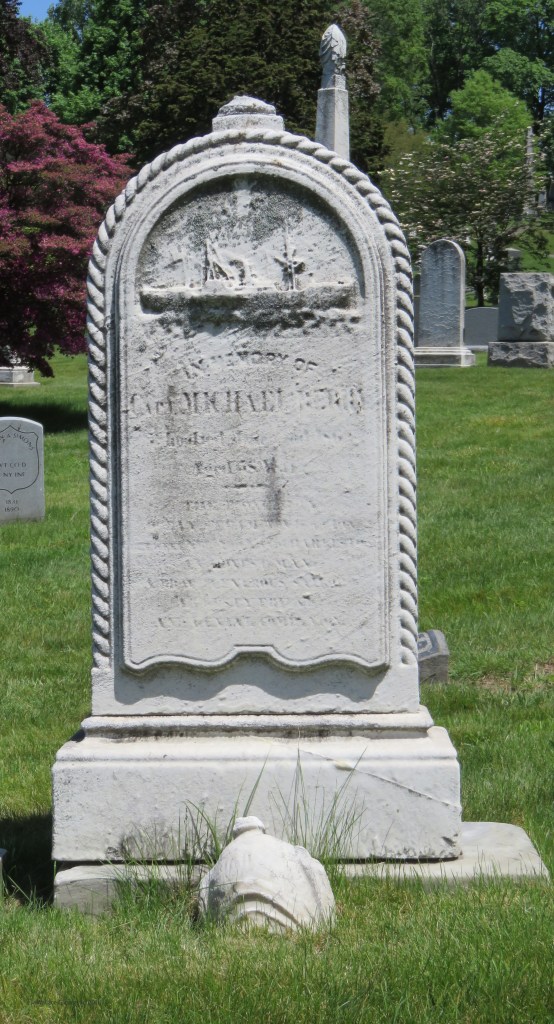
Obituary of Capt. Michael BerryGreenwood Cemetery in Brooklyn, DOD 6 June 1862
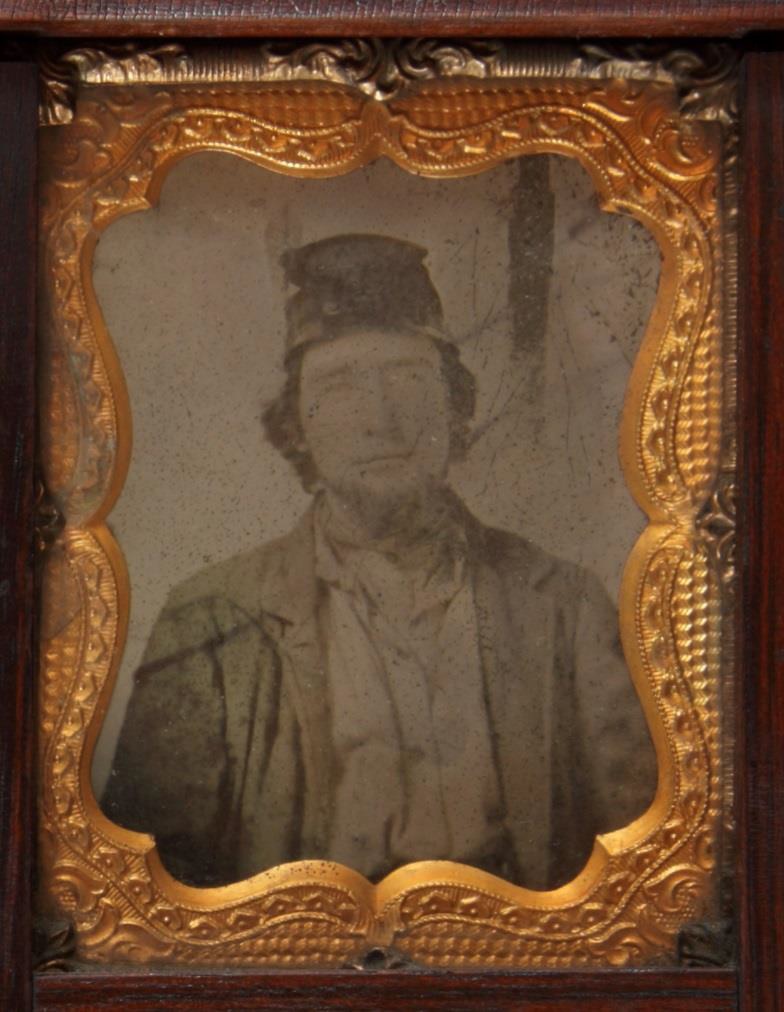
The following letter was written by Pvt. Okey H. McDowell (1843-1912) of Co. I, 2nd Ohio Cavalry. Okie was the son of John Thomas McDowell (1811-1869) and Hannah J. Murdagh (1815-1893) of Wayne county, Ohio. He enlisted in August 1861 and was eventually appointed Commissary Sergeant. He mustered out after 4 years and 1.5 months service.
Okey wrote this letter while on an expedition into Indian Territory which lasted from 25 May to 8 July 1862. In this expedition, the 2nd Ohio Cavalry joined a Union advance from Fort Scott into Indian Territory in early June. Upon reaching Spring River, the regiment, along with some artillery pieces, advanced against Confederate Stand Waite’s camp at Cowskin Prairie, driving the enemy soldiers from this site.
After the war Okey married Helen M. Blake (1845-1925) and went into partnership with his brother at Medina in the drug business.
Transcription
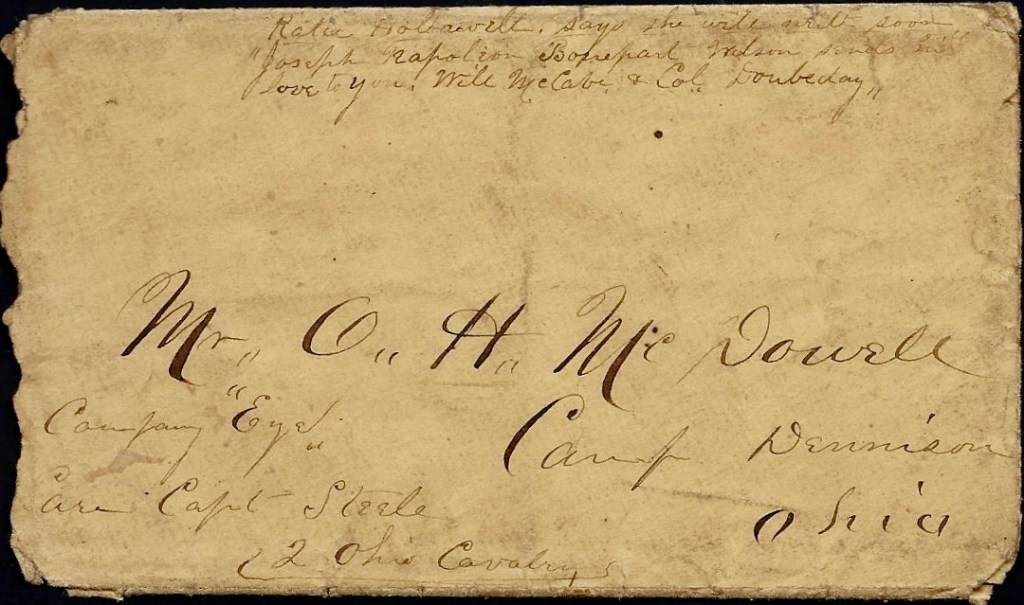
This envelope came with the letter but it was originally used to carry a letter to Okey, not from him.
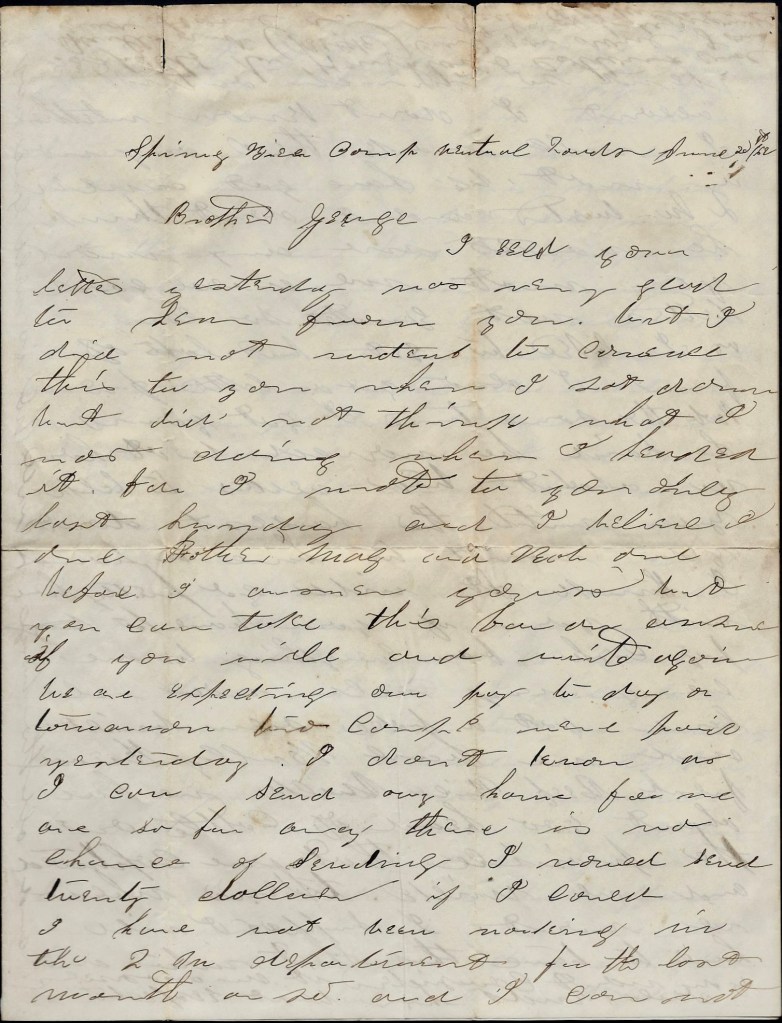
Spring River Camp, [Cherokee] Neutral Lands June 2, 1862
Brother George,
I received your letter yesterday. Was very good to hear from you but I did not intend to address this to you when I sat down but did not think what I was doing when I headed it for I wrote to you only last Sunday and I believe I owe both Mag and Rob one before I answer yours but you can take this [ ] and answer if you will and write again.
We are expecting our pay today or tomorrow. Two companies were paid yesterday. I don’t know as I can send any home for we are so far away there is no chance of sending. I would send twenty dollars if I could. I have not been working in the quartermaster department for the last month or so. I don’t know whether I will make that organization now or not. We have got a new quartermaster and I don’t think he wants me any more.
You wrote me a real good letter—not quite so long as I like to get but lots od fun. I also got a letter from Bob the same time I got yours. He said he would be at home in about two weeks to help you with the harvest. Don’t you want to hire a hand? I think it will get pretty hard with you if you have to pay cash for everything. We are living very well now out here. Got a bake oven built and we have bully bread, fresh beef, nice milk. We have about 500 head of cattle on the prairie that we captured and we milk them when we want. I suppose I will have to tear this sheet in two or you won’t consider it and answer.
[ ] sends his best respects and all the boys you know is well. My respects to Houghton, Cotton, and…
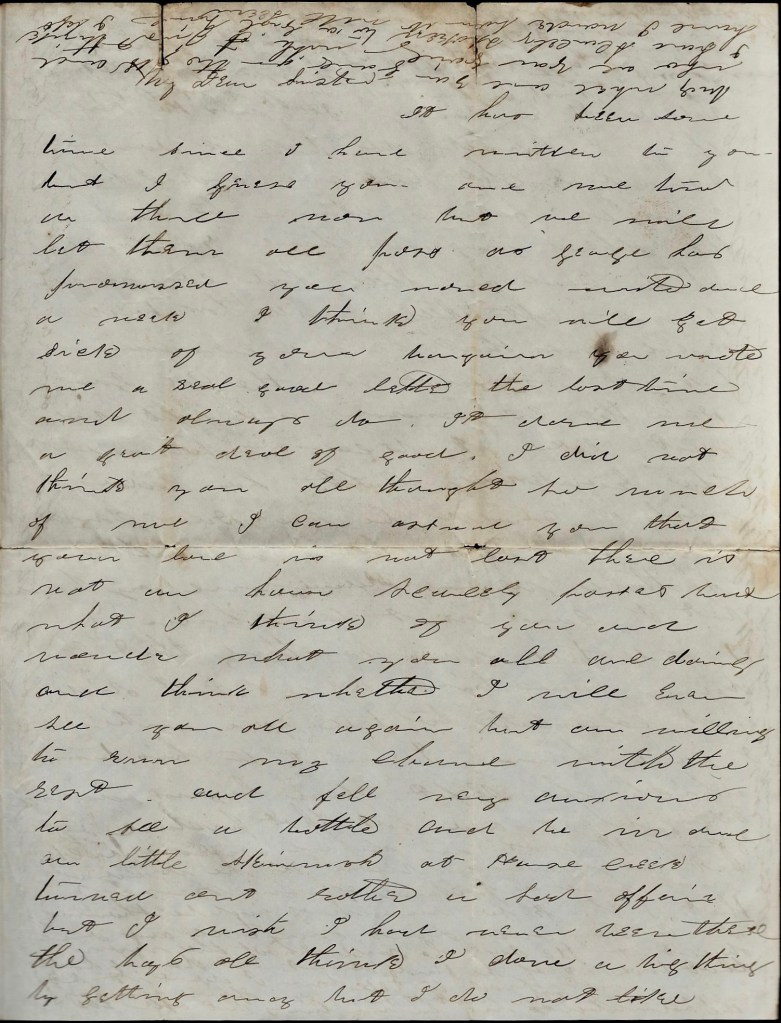
My dear sister,
It has been some time since I have written to you but I guess you owe me two or three now but we will let them all pass as George has promised you would write once a week. I think you will get sick of your bargain.
You wrote me a real good letter the last time and always do. It done me a great deal of good. I did not think you all thought too much of me. I can assure you that your love is not lost. There is not an hour scarcely passes but what I think of you and wonder what you all are doing and think whether I will ever see you again. But am willing to run my chance with the rent and feel very anxious to see a battle and be in one. Our little skirmish at Horse Creek 1 turned out rather a bad affair but I wish I had never been there. The boys all think I done a big thing by getting away but I do not like the idea of running. It was the only thing I could do but it don’t sound right to me and I do hope I will have a chance to run the other way sometime.
You asked which, Dave or [Allen P.] Steel had command. Capt. Steel, I see, has told several times that he had command but it is not so. The Colonel gave Dave the command and Capt. did not like it because he was the ranking captain. How I do wish I could be in Dave’s company. I do not like [Capt.] Steel or [Lt. William B.] Shattue. Shattue never showed me an harm but I cannot bear him. I will tell you something that I done some time ago but I did not calculate to tell you until I came home. I went to his trunk which he kept open laying about everywhere and got that picture of yours. It was an awful mean trick but as mean a man as he is cannot have a picture of my sister that I think so much of and he showing it to everyone. Don’t tell anyone about it. He says he will shoot the man that took it if he finds it out. But the big fool. I am not afraid to tell him I done it…I will show him that I am as good as he is—if not better. I will give it back to him if you say so.
1 Action at Horse Creek (Missouri) on 7 May 1862.The Western Reserve Chronicle of 28 May 1862 wrote: “The Ohio boys pursued a large body of guerrillas who had concentrated on Horse Creek, a long distance, but without getting a fight. A small party from Co. I, while out scouting, ran into a rebel ambuscade. The former fought bravely but were overpowered by numbers, and compelled to retreat with the loss of a corporal killed, two men wounded, and three taken prisoners.”



























 Spared & Shared 23