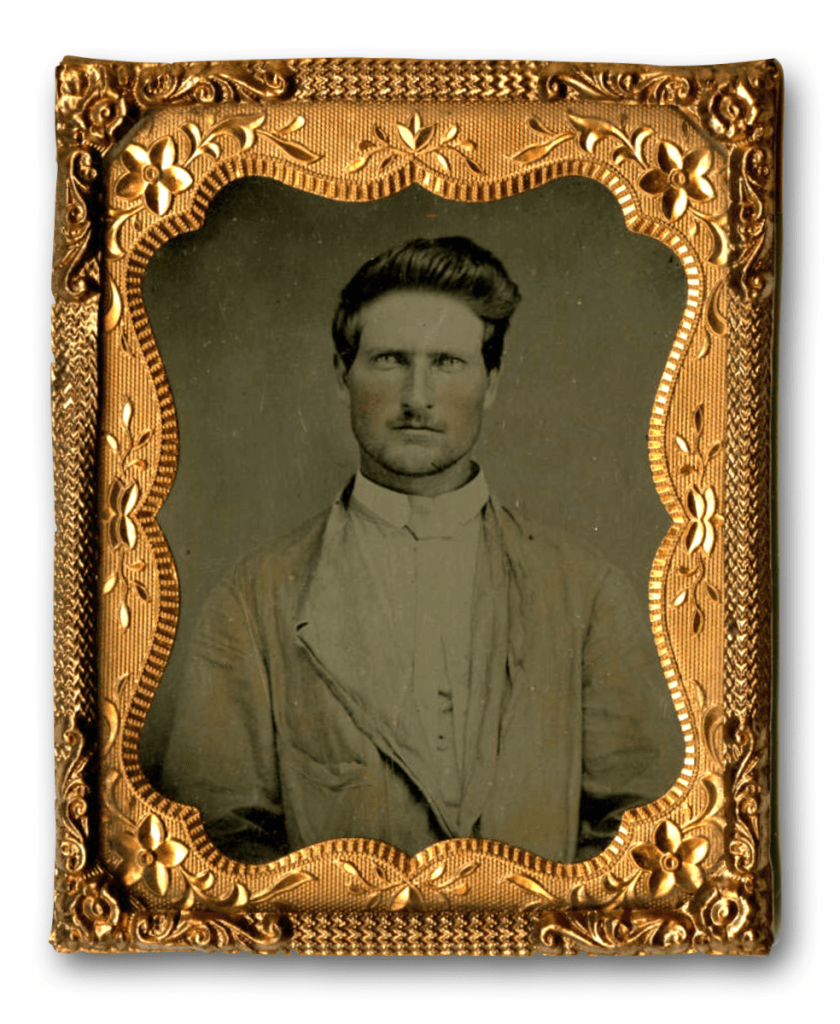
I could not find an image of Isaac but here is a CDV of Pvt. John G. Weckel of Co. A, 93rd Ohio Infantry
This letter was written by Isaac W. Newton (1841-1863), the son of Asa Newton (1812-1880) and Lydia Cook (1812-1908) of Camden, Preble county, Ohio.
21 year-old Isaac enlisted on 9 August 1862 to serve three years in Co. G, 93rd Ohio Volunteer Infantry (OVI). The regiment was organized at Dayton, Ohio, and sent to Lexington, Kentucky, just in time to join the Union retreat back to Louisville due to the advance of Gen. Bragg’s army. The regiment remained at Lexington for a time and then marched to Frankfort, Kentucky. After manning the fortifications there for a few weeks, they were sent to Tennessee in time to participate in the Battle of Stones River where they were in the thickest of the fight.
Newton remained with his regiment until he was taken prisoner during the Battle of Chickamauga in September 1863. He died a couple of months later while a POW at Danville Prison. He is buried in the Danville National Cemetery in Plot E, grave 747.
Transcription
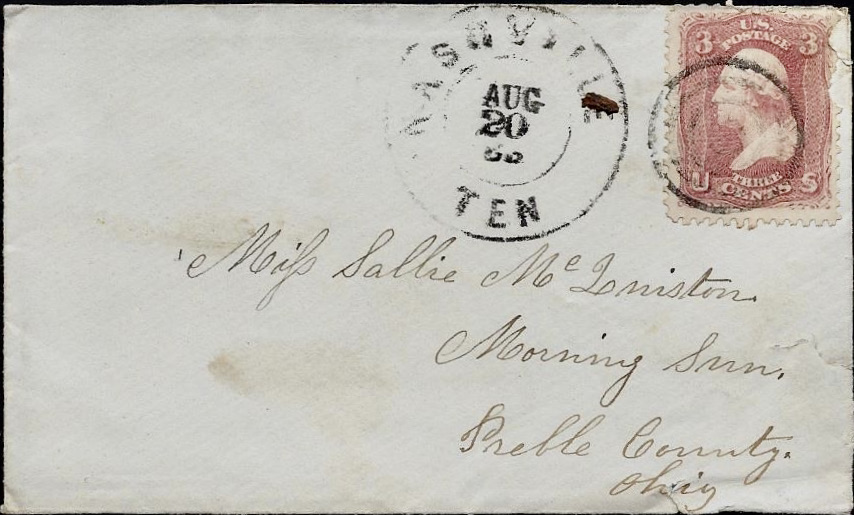
Addressed to Miss Sallie McQuiston, Morning Sun, Preble county, Ohio
Tullahoma, Tennessee August 15, 1863
Friend Sallie,
I received your kind and welcomed letter of the 4th [on] the 13th and was glad to hear the news. Since my last letter to you I have moved my position somewhat. On the 4th, I resolved to go to my regiment. I got transportation and by 8 o’clock a.m. the next morning, I was aboard the cars going to Nashville. By 6:30 p.m. we arrived there to this place. We had a very pleasant trip. The next morning by 3 a.m. we were hurried up to get ready to go on.
We were marched down to the cars. Soon we moved off and had proceeded about 10 miles on the way when the train which we were on stalled as it was turning a curve. There was another train coming up in the rear and it did not see us in time to stop. It run into us demolishing five or six cars killing three guards that were guarding the train and wounding a number of others. There was several that was on the car that I was on jumped off and got seriously injured. For my part I thought it was as safe to remain on the car as to jump off.
After considerable delay we started on the way. Our trip lay through the Stone River battleground and the awful carnage is still visible. By dusk in the evening, I got to my company, found the boys with the exception of two or three getting along finely. Smith Hamilton was in the hospital at Tullahoma and was very low. Since then he has been sent to Nashville. At present John Whiteside is down here trying to get him home. I don’t know how he will succeed in the undertaking.
We have a good camp with plenty of water. Our duty is very light. I think we will move on before long. There is talk of us going down to Stevenson but this is only a rumor. Well as it is about time for taps for lights to be blown out, I will close promising to write more in the future. So no more but as ever remain your friend. Yours truly, — Isaac Newton
P. S. Direct your letter to Co. G, 93rd Ohio, Tullahoma, Tennessee. No more. — I. Newton
I could not find an image of Alfred but here is a tintype of Sullivan Gilpin of Co. D, 63rd OVI(Ohio History Connection)
This letter was written by Alfred A. Laughlin (1844-1862) who lived in Germantown in southwestern Ohio. The letter came from a collection of letters that were sold by the Swann Auction Galleries. Laughlin joined the 112th Ohio Volunteer Infantry (OVI), which never reached full strength and was merged into the 63rd Ohio Infantry. The lot included several letters he wrote to his parents David and Susan in Germantown from September to December 1862. This is the last letter in that collection, dated 7 December 1862, written from Mississippi where his regiment expected to face off soon against Confederate general Sterling Price: “Sunday we could hear the cannon roar all day. There are troops enough around here to eat old Price and all his men. A deserter from Price’s army came in here yesterday. He says that the most of the soldiers’ time is up, and they won’t fight any more.”
Laughlin died of dysentery in camp later that month (19 December 1862). The lot included two letters from men in his regiment to his grieving parents. Francis Emley tries to give his best account of Laughlin’s final days: “He did not appear to suffer much pain and he died very easy. . . . Thank God he died in a glorious cause, that cause was for the old flag, that ower forefathers fought for. . . . Alford was buried very nice, for I helped to dig his grave, and I know that it was don right.” The company captain George Wightman followed up in September with advice on securing Laughlin’s effects and final pay.
Transcription
[Near Holly Springs, Mississippi] December 7, 1862
Dear Father and Mother,
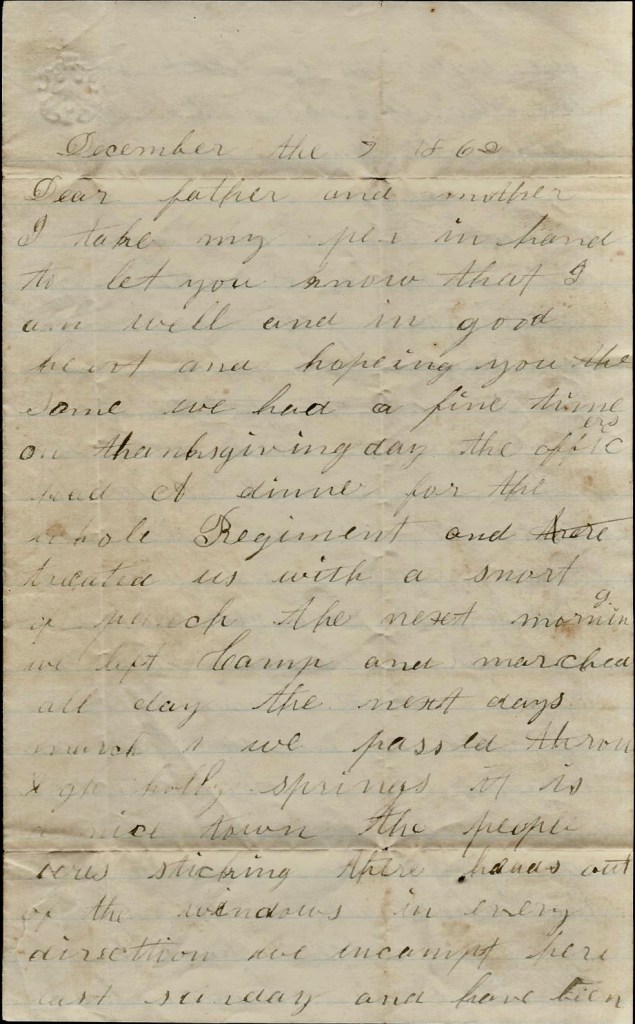
I take my pen in hand to let you know that I am well and in good heart and hoping you [are] the same. We had a fine time on Thanksgiving Day. The officers had a dinner for the whole regiment and treated us with a snort of punch. The next morning we left camp and marched all day. The next days march we passed through Holly Springs. It is a nice town. The people were sticking their heads out of the windows in every direction. We encamped here last Sunday and have been here ever since.
Last Sunday we could hear the cannon roar all day. There are troops enough around here to eat Old Price and all his men. A deserter from Price’s army came in here yesterday. He says that the most of the soldiers time is up and they won’t fight anymore.
We have plenty to eat. We get beef every day and have good water. We could get plenty hogs and chickens if we would darst take them [but] if a fellow takes anything, he is put under arrest. There was fifty-two prisoners passed here the other day. If you get this letter before Ed Hoffman leaves home, if you can get a pair of gloves and send them along with him. If you have not got my dress coat yet, go to Coblent’s. We boxed them up and was going to the quartermaster to be started away and we thought we had better send them home. It is tied with a twine string and has my name on a piece of paper,
I will send you a few cotton seeds and you can plant them and see if it will grow up there. Nothing more. Write soon. — A. A. Laughlin
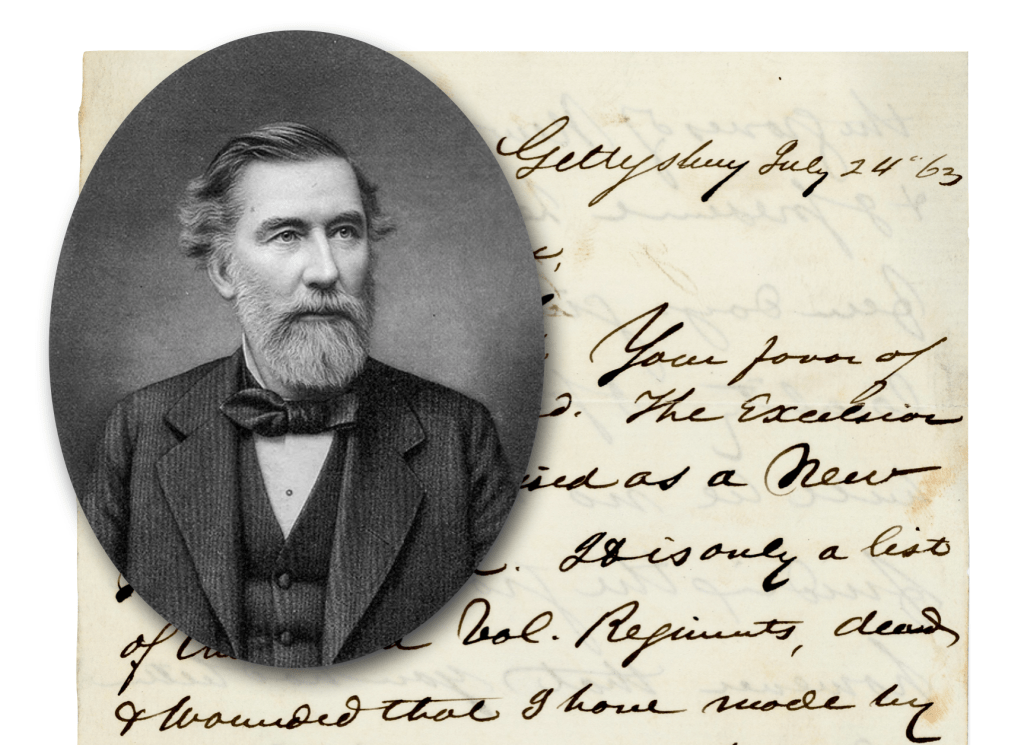
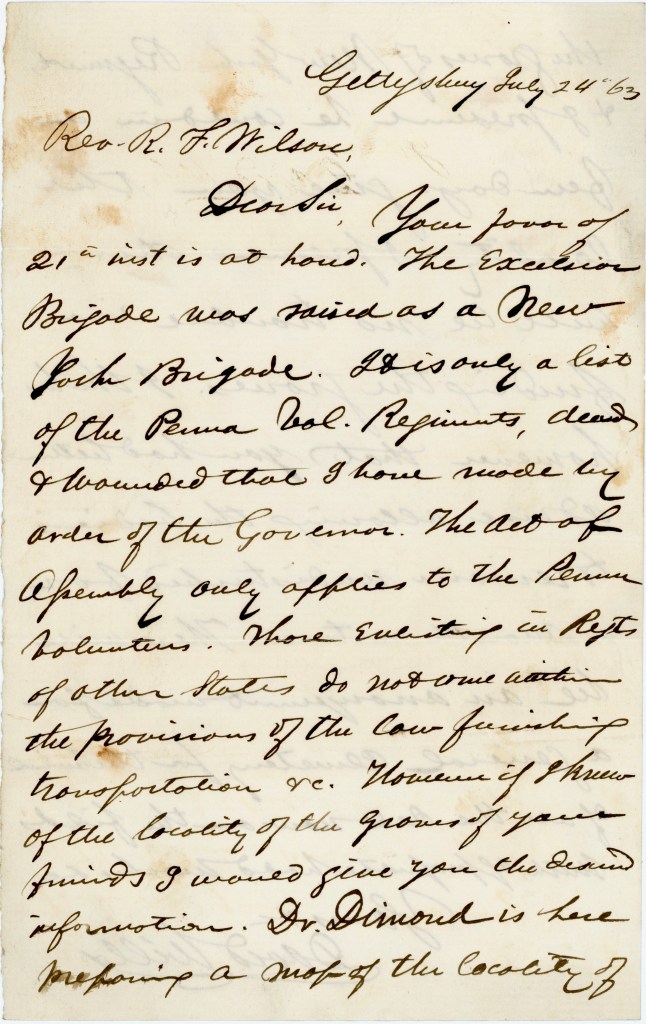
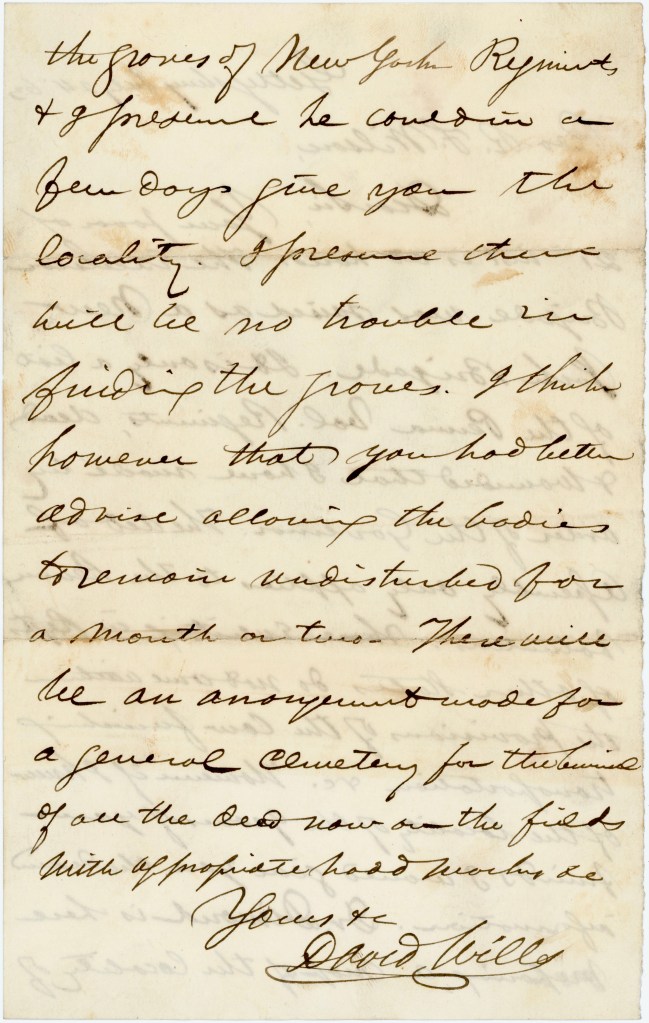
Attorney David Wills of Gettysburg & his letter of 24 July 1863
The following remarkable letter was penned by Gettysburg Attorney David Wills on 26 July 1863 to Rev. Robert Fleming Wilson (1825-1905), a Presbyterian Minister of McKeesport, Pennsylvania, responding to Wilson’s request for information on how to recover some of the dead of the New York Excelsior Brigade, and informing him of plans to establish a soldier’s cemetery at Gettysburg. Composed just three weeks after the battle, this rare previously unpublished letter was written by Wills on the same day that he wrote to Pennsylvania Governor Andrew Gregg Curtin outlining his proposal for a Soldiers’ Cemetery—a proposal that Wills soon implemented with the Governor’s approval.
This letter is from the personal archives of Charles T. Joyce who authorized me to publish it on Spared & Shared. He also shared with me his belief that Rev. Wilson must have been enquiring about the following members of the Excelsior Brigade. Co. E of the 70th New York Infantry (1st Excelsior Regiment) was recruited largely in Pittsburgh. According to Travis W. Busey & John W. Busey (B&B), Union Casualties at Gettysburg, there were four killed in action in Co. E that hailed from there (also, one mortally wounded, but he didn’t die until August 18, at the Newton Hospital in Baltimore). The four were: 1st Sgt. Samuel Croft, Corporal Matthew McGraw, and Privates William Brookmeyer and James Montgomery. Of these, there’s no information as to where Croft is buried (Charles suspects he was disinterred and buried somewhere at home). McGraw was buried first in the Catholic Cemetery in Gettysburg, and then re-interred at Evergreen. Brookmeyer was listed as wounded and missing, with no record of what happened to him thereafter; B&B states he was “probably killed.” Only James Montgomery definitively made it into the Soldiers’ National Cemetery at Gettysburg. He’s buried in Row B, Plot 128 of the New York Section.
Transcription
Gettysburg [Pennsylvania] July 24th 1863
Rev. R. F. Wilson Dear Sir,
Your favor of the 21st inst. is at hand. The Excelsior Brigade was raised as a New York Brigade. It is only a list of the Penna. Vol. Regiments, dead & wounded, that I have made by order of the Governor. The Act of Assembly only applies to the Penna. Volunteers. Those enlisting in regiments of other states do not come within the provisions of the law furnishing transportation, &c. However, if I knew of the locality of the graves of your friends, I would give you the desired information. Dr. Dimond 1 is here preparing a map of the locality of the graves of New York Regiments & I presume he could in a few days give you the locality. I presume there will be no trouble in finding the graves. I think, however, that you had better advise allowing the bodies to remain undisturbed for a month or two. There will be an arrangement made for a general cemetery for the burial of all the dead now on the fields with appropriate head markers, &c. Yours &c. — David Wills
1 Dr. Theodore Dimon was the youngest member of the Yale graduating class of 1835. Receiving his medical degree from the University of Pennsylvania in 1838, he then set up practices first in Berkshire County, Massachusetts, and later in Utica, New York. In 1841 he married Sarah Watson Williams, daughter of a Utica magistrate. Two of three sons were born in that city before Dr. Dimon moved to Auburn, New York, to become resident physician at the Auburn State Prison, where, with the exception of three years spent in the California gold fields, he remained until the outbreak of war. In April 1861, the 45 year-old doctor volunteered as surgeon in the 19th New York Infantry (which later became the 3rd New York Artillery). He served with the unit in North Carolina through June 1862, when he was transferred to the 2nd Maryland, where he served through the campaigns of Second Manassas, Chantilly, South Mountain, and Sharpsburg. In October 1862, he rejoined his New York battery. He was mustered out of service shortly before the Battle of Gettysburg, yet he answered the call for physicians and spent weeks caring for the human debris of that three-day engagement. A lack of suitable burial places for the dead moved Dr. Dimon to suggest a soldiers’ cemetery for New York troops at Gettysburg; with the aid of several officers and government officials, he obtained approval of the undertaking from Governors Andrew G. Curtin of Pennsylvania and Horatio Seymour of New York. He then acted as volunteer agent in the Relief Service until the end of the war.[see A Federal Surgeon at Sharpsburg, by James I. Robertson, Jr., The Kent Sate University Press]
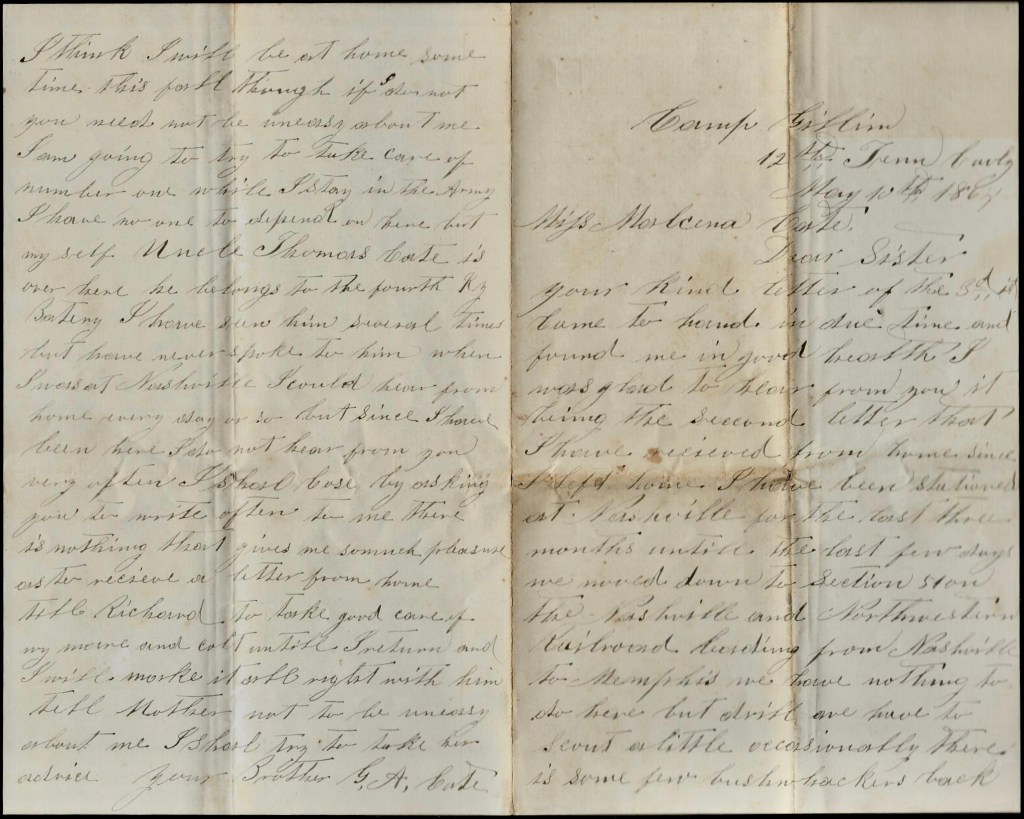
This letter was written by Gustavis (“Gus”) A. Cate (1844-1910), the son of William Wiley Cate (1814-1892) and Ann Glaze (1813-1887) of Cleveland, Tennessee. Gus’s father, a farmer in Bradley county, Tennessee, voted against the ratification of the ordinance of secession and was a Union sympathizer throughout the war. He was known to provide food and aid to Union troops passing through Bradley county.
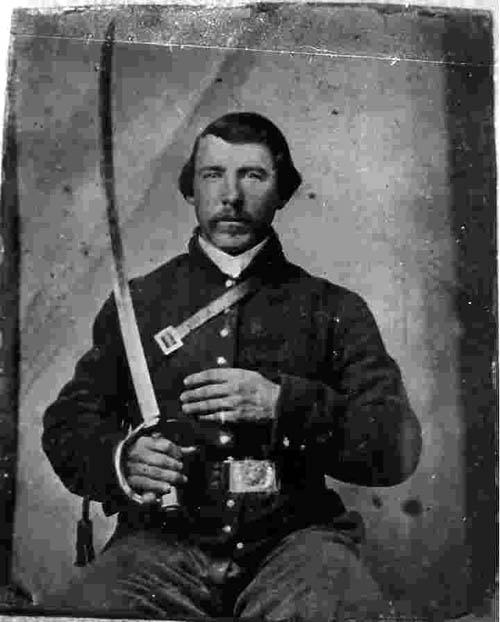
I could not find an image of Gus but here is one of William D. McCulloch of Co. F, 2nd Tennessee Cavalry wearing a typical Union trooper’s uniform.
Gus had an older brother named Henry Glaze Cate (1836-1907) who also was in the army but Henry wore gray while his brother Gus wore blue. Henry served as a private in Co. C, 36th Tennessee (Confederate) Infantry. In November 1863, Gus enlisted as a sergeant in Co. D, 12th Tennessee (Union) Cavalry. After its organization, the 12th Tennessee Cavalry was assigned to Gen. Gillem’s division and was placed on guard duty on the Nashville & Northwestern railroad, where it remained until April, 1864. During the remainder of the year the regiment was in active service almost continuously. It was one of the most efficient regiments in opposing Wheeler on his raid through Middle Tennessee and had several severe engagements with portions of his command. In the latter part of September it marched to contest the approach of Gen. Forrest, with whom it was several times engaged with considerable loss.
The regiment was also active in the campaign against Hood, participating in the battles at Lawrenceburg, Campbellsville, Spring Hill, Franklin and Nashville. From Nashville the regiment was in the advance in pursuit of Hood and fired the last shot at the enemy as he crossed the Tennessee River at Bainbridge. On Feb. 8, 1865, the regiment went into camp at Eastport, Miss., where it remained until May 11. It was then transferred from the 2nd to the 1st brigade under the command of Bvt. Brig-Gen. George Spalding, who had been commissioned colonel upon the completion of the regiment Aug. 16, 1864, and ordered to St. Louis.
Gus wrote this letter to his younger sister Malcena Cate who was born about 1847. She was still enumerated in her parents household at the time of the 1870 US Census.
Your kind letter of the 3rd came to hand in due time and found me in good health. I was glad to hear from you, it being the second letter that I have received from home since I left home. I have been stationed at Nashville for the last three months until the last few days. We moved down to station 51 on the Nashville & Northwestern Railroad leading from Nashville to Memphis. We have nothing to do here but drill. We have to scout a little occasionally. There is some few bushwhackers back here though not a great many.
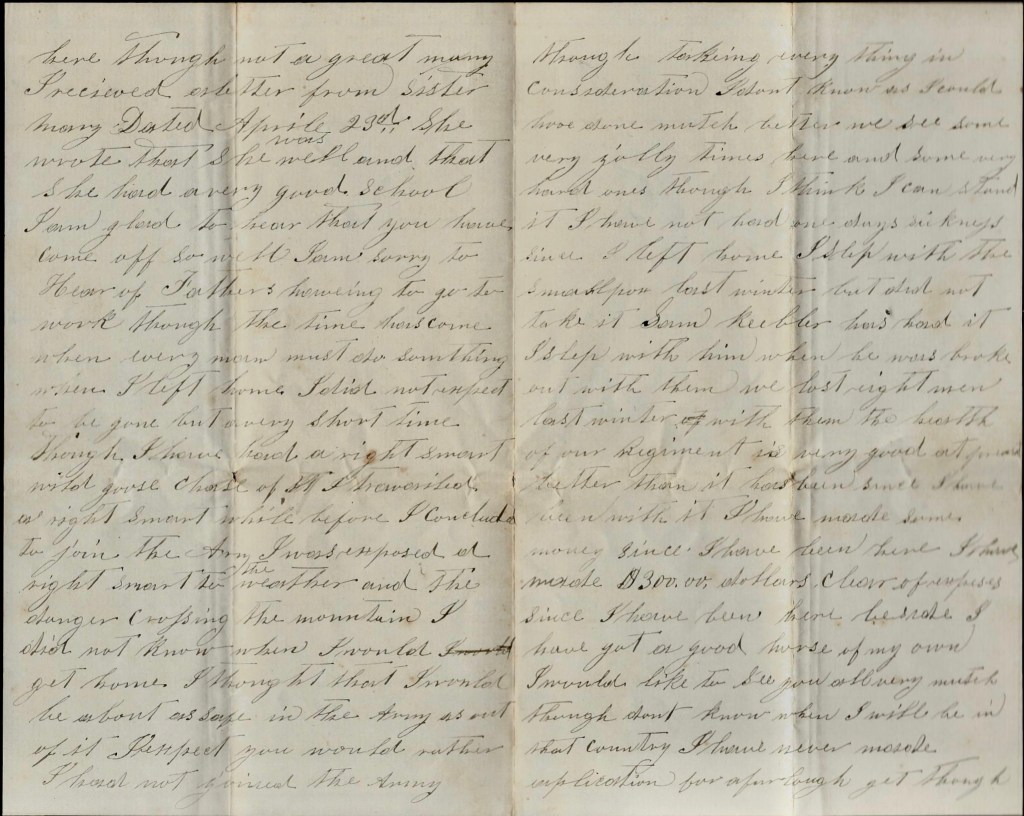
I received a letter from sister Mary dated April 23rd. She wrote that she was well and that she had a very good school. I am glad to hear that you have come off so well. I am sorry to hear of Father’s having to go to work though the time has come when every man must do something. When I left home, I did not expect to be gone but a very short time though I have had a right smart wild goose chase of it. I travelled a right smart while before I concluded to join the army. I was exposed a right smart to the weather and [with] the danger crossing the mountains, I did not know when I would get home. I thought that I would be about as safe in the army as out of it.
I expect you would rather I had not joined the army. Though taking everything in consideration, I don’t know as I could have done much better. We see some very jolly times here and some very hard ones though I think I can stand it. I have not had one days sickness since I left home. I slept with the smallpox last winter but did not take it. Sam Keebler has had it. I slept with him when he was broke out with them. We lost eight men last winter with them. The health of our regiment is very good at present—better than it has been since I have been with it.
I have made some money since I have been here, I have made $300 dollars clear of expenses since I have been here. Besides, I have got a good horse of my own.
I would like to see you all very much though don’t know when I will be in that country. I have never made application for a furlough yet though I think I will be at home sometime this fall though if I do not, you need not be uneasy about me. I am going to try to take care of number one while I stay in the army. I have no one to depend on here but myself.
Uncle Thomas Cate is over here. He belongs to the 4th Kentucky Battery. I have seen him several times but have never spoke to him, When I was at Nashville, I could hear from home every day or so but since I have been here, I do not hear from you very often. I shall close by asking you to write often to me. There is nothing that gives me so much pleasure as to receive a letter from home. Tell Richard to take good care of my mare and colt until I return and I will make it all right with him. Tell Mother not to be uneasy about me. I shall try to take her advice.
This letter was written by Doke Young (1804-1874), a farmer of Cherry Valley, Wilson county, Tennessee. He wrote the letter to his friend, Capt. Archibald Doak Norris of Co. K, 7th Tennessee Infantry.
Doke was the son of David Young (1774-1856) and Sarah Phillips (1776-1845). He was married to Sarah (“Sally”) Reeder (1806-1878). Four of his children are mentioned in the letter; two at home—Mary or “Polly” (b. 1838) and Jacob or “Jake” (b. 1845), and two in the Confederate service—John Bell Young (1840-1913) and Alexander Young (1844-1921) at Russellville.
In the 1860 Slave schedules, Doke owned five slaves. The value of his real estate in 1860 was $28,350 and the value of his personal property was $12,845. From the content of the letter, it appears that Archibald may have boarded with the family at one time.
In his letter Doke informs Archibald of the apparent Union movement against Forts Henry and Donelson. He also provides some particulars of the battle of Mill Springs (or Fishing Creek) in which Union forces under the leadership of Gen. George Thomas defeated those of General George Crittenden and General Felix Zollicoffer was killed.
Transcription
Cherry Valley February 7, 1862
Mr. A. D. Norris,
Your letter from camp near Romney came to hand the 1st inst. I assure you it was received with much pleasure not only by me but by the whole of our small family. I landed home from Russellville the 1st inst. Have been on a visit there to see the boys, friends, and acquaintances. I found Jno & Alek with bad colds but mending. Met Toby coming home for the first time since he left. He is well and weighs 167 pounds. He started back to camp this morning. I found Mr. Rosser very low with fever. He says he is some better. Mrs. Rosser is there with him.
Russellville was a very handsome place before the soldiers were posted there. Now it is the muddiest place I ever saw. The forces there is estimated at 20,000 & more coming. The prospect of a fight at Bowling Green. I think, is blasted for the present & Russellville is threatened. About 8,000 Lincolnites came across Green river at Carrolton & was fortifying for 15 or 20 days but Jno writes me since I got home that they are gone from there but does not know where. The newspapers say they are coming up Cumberland & Tennessee rivers as far as Fort Donelson on the Cumberland and Fort Henry on the Tennessee. Rumor has it that they were fighting at the latter place day before yesterday. I think we will hear tonight. The danger lies in that direction now, I think. They are aiming for our railroads. If they destroy the bridges, they cut off our supplies from Bowling Green to Russellville.
I suppose you have heard of our defeat at Fishing Creek under General Crittenden. It was not near as bad as it was at first reported, but was bad enough. The best information is we lost about 200 killed & 300 prisoners. Among the killed, General [Felix] Zollicoffer, Col. [George] Raines, and Col. Bailey Peyton. The Lincolnites call it Bull Run, Jr. Crittenden is called everything but a patriot by some. I suppose our generals were deceived as to the strength of the enemy. They were in 2 divisions on either side of Fishing Creek—the creek very much swollen [and] supposed to be impassible. Our generals concluded to attack the division in between the river & creek, made a forced march of 20 miles in the night and joined the other division in the fork which made their forces double as strong as was expected. Zollicoffer was decoyed up to a Indiana Regiment by a Confederate flag hoisted by them and was shot in the early part of the engagement (Tennessee is in mourning at his loss). The remains of Zollicoffer & Raines was interred at Nashville last Saturday; that of Peyton at Gallatin the same day with military honor. All the good wagons & teams have been pressed to supply the loss at Fishing Creek. Yankees state their loss as great as ours in men.
While at Russellville, I came across a young man—a native Kentuckian—who went to Virginia last spring, was in the hospital when the battle was fought at Manassas, has never been well since, was discharged, went to Bowling Green on his way home, [and] could get no farther. He came home with me.
Our boys have had a hard time of it ever since they went to Russelville. They have been scouring the Green & Mud river country ever since they went up there. Jno. A. Bass’s hand has cured up but cannot use it yet. Captain Phillips is well and is very popular in his company. He lost a fine horse while I was up there worth $200. I understand that General Anderson is at Nashville trying to get his brigade orders to Tennessee or Kentucky. If you come, let us hear from you as you pass. When your letters comes to hand, there is a scramble between Polly & Jake who will read it first.
Pardon my scribbling and I will not intrude on you patience longer. Write soon and often and remember your friend, —Doke Young
N. B. My wife says she wonders if she will ever see you walking into the dining toom to your meals as formerly. Give my respects to al of my acquaintances. Tell them I have never received a line from one of them. — D. Y.
I could not find an image of Fassett but here is Capt. Jonathan Prince Cilley of Co. B, 1st Maine Cavalry, who was seriously wounded at Middleton, Va., on 24 May 1862. (Andrew German Collection)
This letter was written by George Llewellyn Fassett (1844-1915) of Abbott, Maine, who enlisted on 31 October 1861 to serve in Co. M, 1st Maine Cavalry. He enlisted as a private and rose in rank to at least a corporal in 1863. George was taken prisoner on 24 May 1862 at Middletown, Virginia, and was presumably exchanged shortly after this letter was penned in late October 1862. He mustered out of the regiment on 20 June 1865 with the rank of sergeant. After his discharge, he returned to Piscataquis county where he earned his living as a carriage maker.
As stated previously, George was taken prisoner on 24 May 1862 in what has come to be known as the “Middletown Disaster.” The loss to Companies A, E, and M was severe, a large number of men being wounded or taken prisoner. The events of the battle are best summarized by the National Park Service in an article entitled, “The Running Fight/The Battle of Middletown—May 24, 1862.”
Transcription
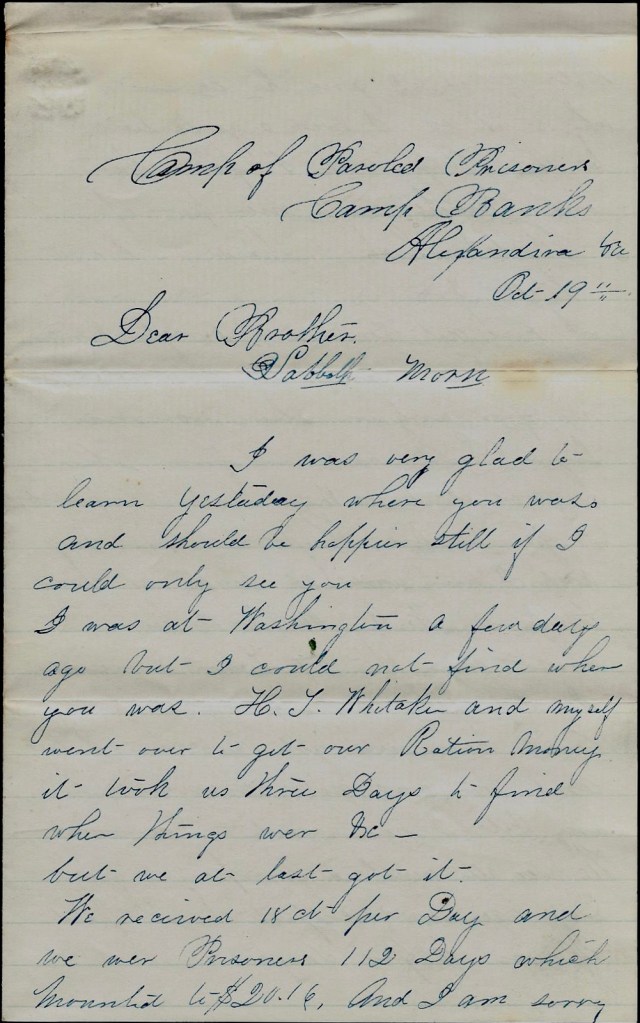
Camp of Paroled Prisoners Camp Banks Alexandria, Virginia October 19, [1862] Sabbath morn.
Dear Brother,
I was very glad to learn yesterday where you was and should be happier still if I could only see you.
I was at Washington a few days ago but I could not find where you was. H. T. Whitaker and myself went over to get our ration money. It took us three days to find where things were, &c., but we at last got it.
We received 18 cents per day and we were prisoners 112 days which amounted to $20.16 and I am sorry that it is all gone. Ha ha. Why it is so? I owed a good deal to the boys and I paid them and bought me a nice pair of boots which I paid a $5 bill for.
I have not received a single line from home since I was released nor from any one else, save one from Susan and one from John. He was at home then but expected to go to his regiment in a few days and I have wrote as much as three times a week. I’ll bet I have wrote more than 50 letters since I was released and have not got but two letters and there was no answer for any that I had wrote.
We were all mustered for pay a few days ago and expect to get paid off in a few days. If we are paid off before we are exchanged, I shall try my best to go home—take a French furlough. There is nine out of ten that has gone home since we came to Alexandria. I would like to go home and see the folks once more.
I suppose you have heard the death of little Freddie. Poor little fellow is no more. He died quite a spell ago. “May he rest with [ ].” And I heard by Sull Hall that Alton was very sick with the fever. I should like awful well to hear from home.
I will not write any more this time but look with anxious eye for an answer. I remain your dear brother, — George L. Fassett
Camp of Paroled Prisoners, Camp Banks, Alexandria, Va.
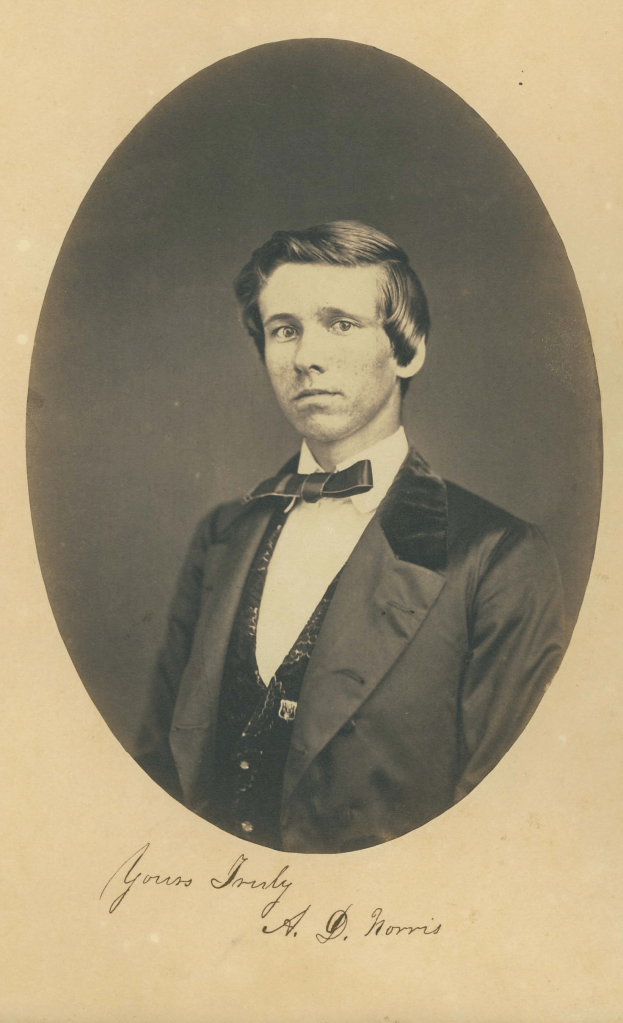
“Born in Smith County, TN, Archibald Debow Norris was the son of a prominent farmer. After graduating in 1860 as the valedictorian of his class at Allegheny College in Meadville, PA, Norris returned to his hometown of Rome, TN where he worked as headmaster of a local college.
Archibald Debow Norris, 1860 Allegheny College Archives
As the country moved closer to war and Tennessee inched closer to secession, Norris maintained a pro-Union stance. Ultimately, once Tennessee seceded Norris would determine that he must maintain his allegiance to his own state over that of the Union. Records indicate that a twenty-one year old Norris enlisted on 5/15/1861 and was commissioned into Co. K, 7th Tennessee Infantry. He attained the rank of captain in 1862, fought with his regiment at Gettysburg on July 1st and 3rd, was captured at Petersburg, VA on 2 April 1865, and was released from Johnson’s Island Prison, 19 June 1865.” [Cowan’s Auction]
At Gettysburg, Norris fought with the regiment where he displayed conspicuous bravery despite the chaos of combat. Another soldier would later remember…
“I can recall Capt. A. Norris… when the right was being enveloped and hope gone, tearing the flag from the staff, and retreating with a fragment of his company under a fire so destructive that his escape seemed miraculous. There was no better officer in the Seventh or in any other regiment”
“Norris married Sarah Melissa Baird on 25 December 1866, and subsequently went on to serve in a variety of civic roles including superintendent of public instruction for Wilson County, TN from 1873-1874; county surveyor, 1878-1882 and again 1896-1899; and TN state representative, 1887-1899. Norris was a Mason, a member of the Methodist Episcopal Church, and was active in farming, banking, and the insurance business.” [Cowan’s Auction]
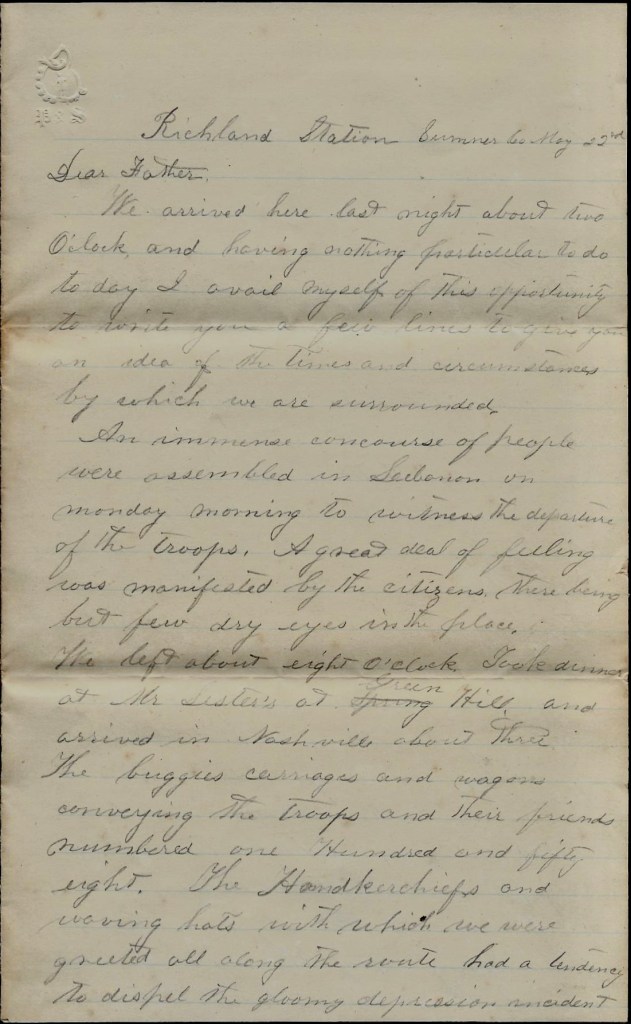
Richland Station Sumner county [Tennessee] May 22, [1861]
Dear Father,
We arrived here last night about two o’clock and having nothing particular to do today, I avail myself of this opportunity to write you a few lines to give you an idea of the times and circumstances by which we are surrounded.
An immense concourse of people were assembled in Lebanon on Monday morning to witness the departure of the troops. A great deal of feeling was manifested by the citizens, there being but few dry eyes in the place. We left about eight o’clock, took dinner at Mr. Sister’s at Green Hill, and arrived in Nashville about three. The buggies, carriages and wagons conveying the troops and their friends numbered one hundred and fifty-eight. The handkerchiefs and waving hats with which we were greeted all along the route had a tendency to dispel the gloomy depression incident to the parting of friends and relatives.
The procession proceeded around the Square and through the principal streets of Nashville and then repaired to the fairground where we were “mustered into service” by taking an oath to office, our services in defense of the state for twelve months.
I then went to see Grandma Lyons, stayed a short time, slept at the Commercial Hotel with Wilson Phillips who went down with the procession. I was quite unwell during the night in consequence of having eaten too heartily of preserved soft peaches at dinner and adding thereunto a hearty supper. Was all right yesterday morning.
We were drilled a little yesterday morning after which I called on Mr. Rosser’s friends to whom I had letters of introduction. Had a very pleasant visit and received a letter of introduction to Captain Craighead of Company B of the Rock City Guards which I will soon present to him.
Yesterday evening we marched from the fairground to the depot, a distance the way we went of about three miles. We got on the cars before seven but it was after ten before we left Edgefield. We had a dort of “rough and tumble” ride to this place, one or two of the cars becoming detached and causing delay. We pitched our tents and some time after three o’clock lay down and slept till about five. I do not feel near the fatigue that I expected to from exposure and loss of sleep. Last night was my first in the “tented field.” I like it very well just from the novelty. At present my health is good and spirits cheerful.
We will probably remain here a day or two and then go to the general encampment a few miles from this place. Beyond this, nothing certain is known or conjectured.
I must close. I will write again when I get to a place where I think we will remain long enough to get an answer. Your affectionate son, — Archie
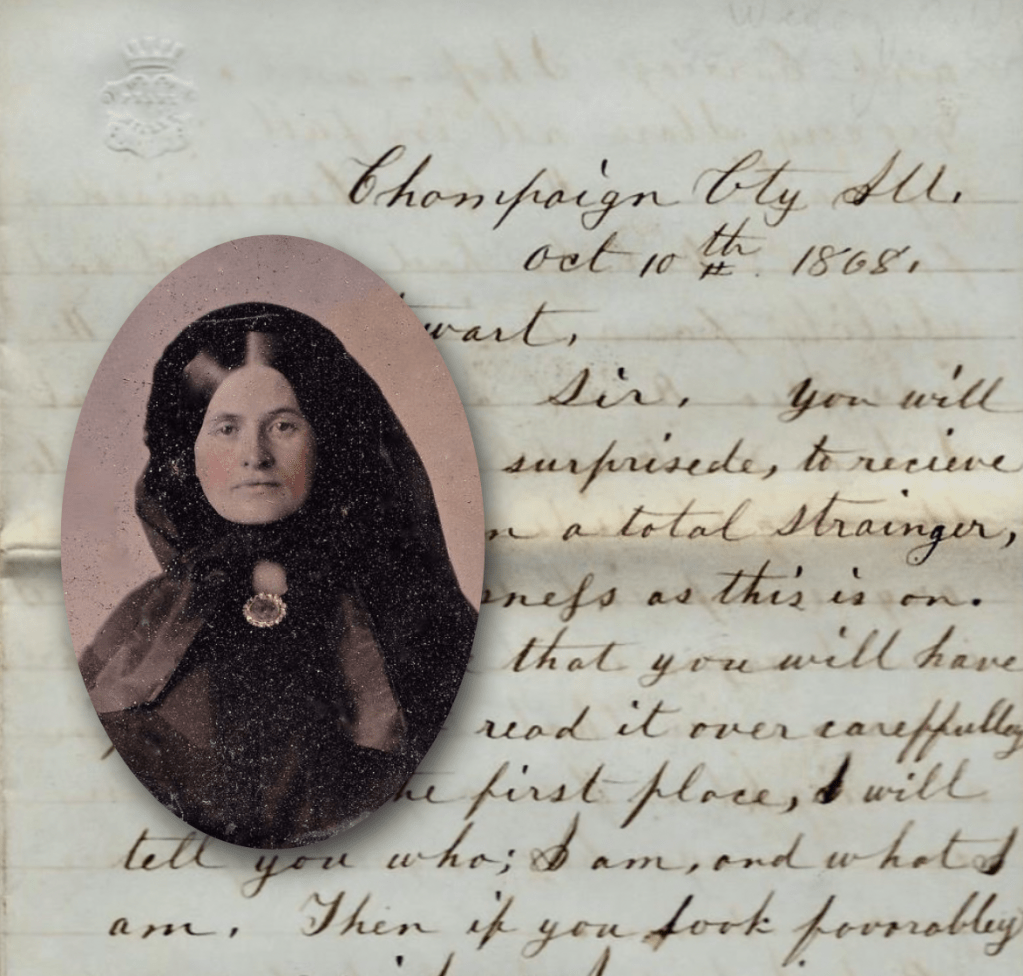
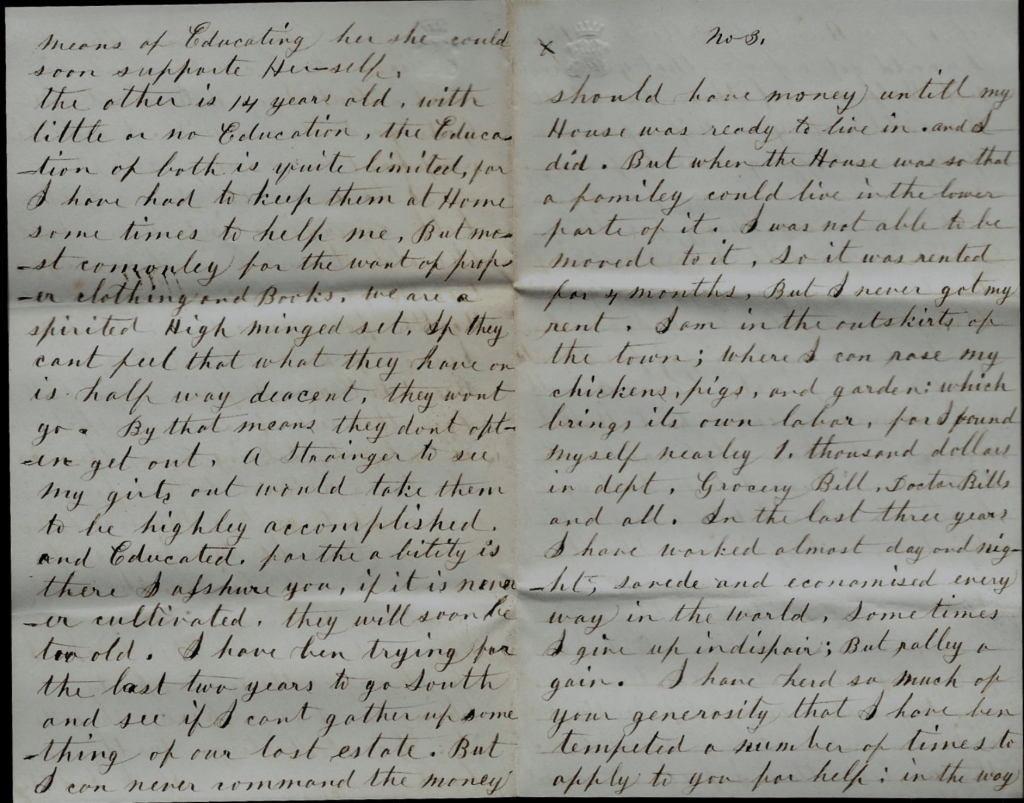
This poignant 1868 letter was written by 42 year-old Louisiana, or “Lou”, (Wilson) Nunn (1826-1910), the widow of Sgt. Daniel Lafayette Nunn (1827-1862) who died of typhoid fever in the hospital at Cairo while serving in Co. G, 63rd Illinois Infantry. In her letter to Alexander Turney Stewart (1803-1873)—the American textile merchant whose dry-goods store grew in to a giant wholesale and retail business in New York City—Lou shares the saga of her efforts to provide herself with a livelihood for herself and two daughters, Harriet N. (b. 17 Oct 1849) and Ida M. G. (b. 18 July 1854) since her widow’s pension of $8/month had proven woefully inadequate. Military records reveal that Sgt. Nunn entered the service on 1 December 1861 at Robinson, Crawford county, Illinois, and that he was mustered in on 10 April 1862 only to die some ten weeks later on 21 June 1862. See letter 1 in Pension File pertaining to Daniel’s cause of death written by Lou Nunn.
“I have worked almost day and night, saved and economized every way in the world, sometimes I give up in dispair but ralley again.”— Louisiana Nunn
From the pension file we learn that Louisiana and Daniel were married on 3 January 1849 in London, Laurel county, Kentucky. Daniel was a carpenter by trade and just prior to the Civil War, had his own wagon and carriage shop in Somerset. Kentucky.
In March 1879, Louisiana married a harness maker named Cornelius Holden (1806-1898) and took up residence in Humbolt, Coles county, Illinois. The couple later purchased land in Whitley county, Kentucky, where they farmed on 200 acres. After Cornelius died in 1898, Lou was able to reinstate her monthly widow’s pension which she had lost upon her 2nd marriage. Her monthly pension of $20 was finally terminated in 1910 when she died.
To his credit, the wealthy Alexander T. Stewart gave handsomely to benevolent causes but his public notoriety most likely made made him a target for thousands of letters of this nature.
Transcription
Champaign County, Illinois October 10th 1868
Mr. Alexander Turney Stewart Sir,
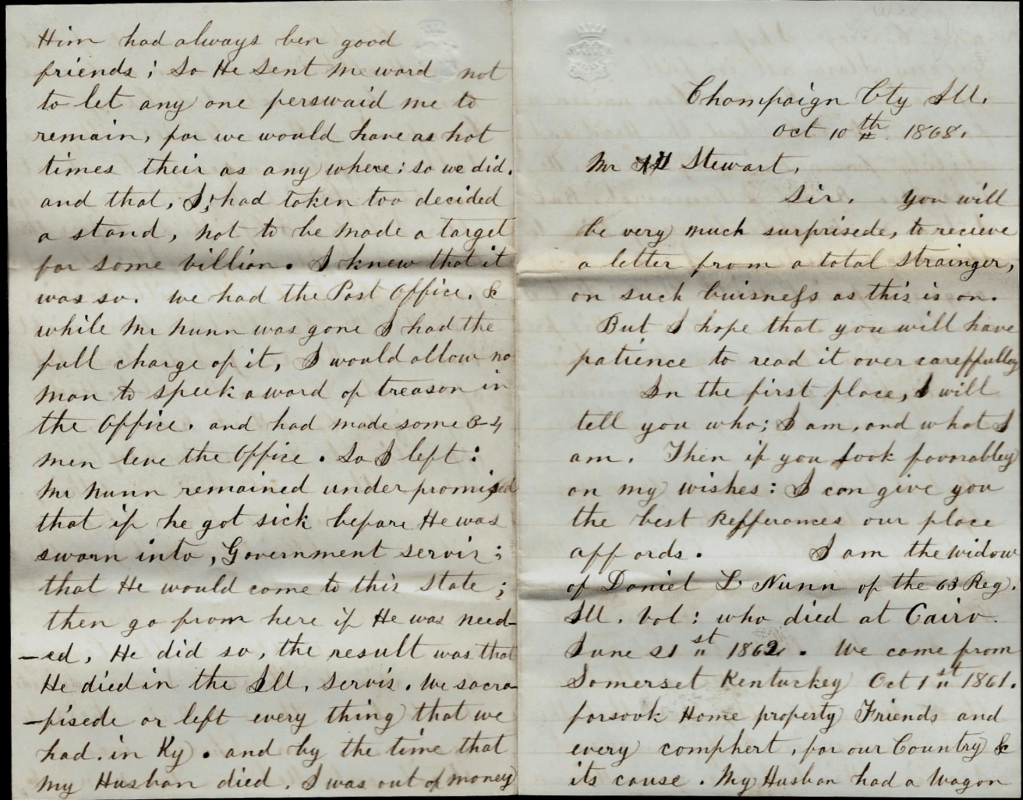
You will be very surprised to receive a letter from a total stranger on such business as this in on. But I hope that you will have patience to read it over carefully.
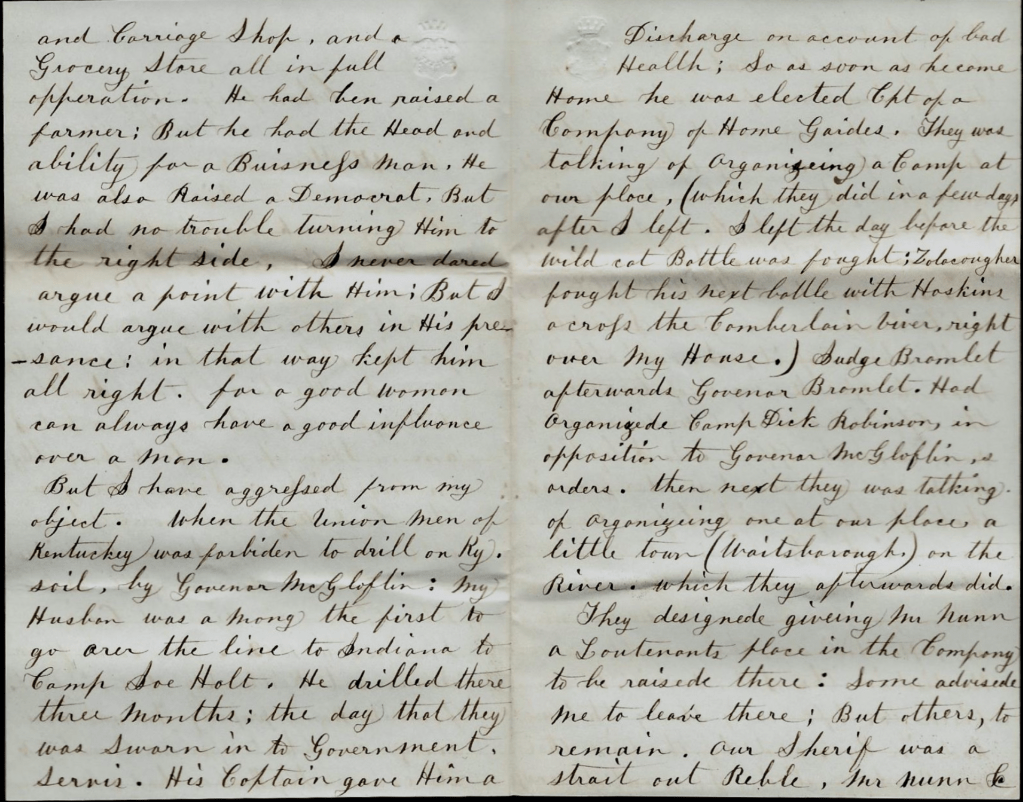
In the first place, I will tell you who I am and what I am. Then if you look favorably on my wishes, I can give you the best references our place affords. I am the widow of Daniel L. Nunn of the 63rd Regiment Illinois Volunteers who died at Cairo June 21st 1862. We come from Somerset, Kentucky October 1st 1861, forsook home, property, friends, and every comphert for our Country & its cause. My husbon had a wagon and carriage shop, and a grocery store all in full operation. He had ben raised a farmer but he had the head and ability for a business man. He was also raised a Democrat but I had no trouble turning him to the right side. I never dared argue a point with him but I would argue with others in his presence—in that way kept him all right, for a good woman can always have a good influence over a man.
But I have aggressed from my object. When the Union men of Kentucky was forbiden to drill on Kentucky soil by Governor McGloflin, my husbon was among th first to go over the line to Indiana to Camp Joe Holt. He drilled there three months. The day that they was sworn in to Government service, his captain gave him a discharge on account of bad health so as soon as he come home, he was elected captain od a company of home gardes. They was talking of organizeing a camp at our place (which they did in a few days after I left. I left the day before the Wild cat Battle was fought; Zolocougher fought his next battle with Hoskins across the Comberlain river, right over my house). Judge Bromlet—afterwards Governor Bromlet—had organized Camp Dick Robinson in opposition to Governor McGloflin’s orders. Then next they was talking of organizing one at our place, a little town (Waitsborough) on the river, which they afterwards did.
They designede giveing Mr. Nunn a Loutenant’s place in the company to be raisede there. Some advised me to leave there but others to remain. Our Sherif was a strait out Reble. Mr. Nunn & him had always been good friends. So he sent me word not to let any one perswaid me to remain for we would have as hot times their as any where: so we did, and that, I had taken too decided a stand not to be made a target for some villion. I knew that it was so. We had the Post Office, and while Mr. Nunn was gone, I had the full charge of it. I would allow no man to speek a word of treason in the office and had made some 3-4 men leve the office. So I left. Mr. Nunn remained under promise that if he got sick before he was sworn into government servis that he would come to this state; then go from here if he was needed. He did so. The result was that he died in the Illinois servis. We sacrafisede or left every thing that he had in Kentucky and by the time that my hunbon died, I was out of money.
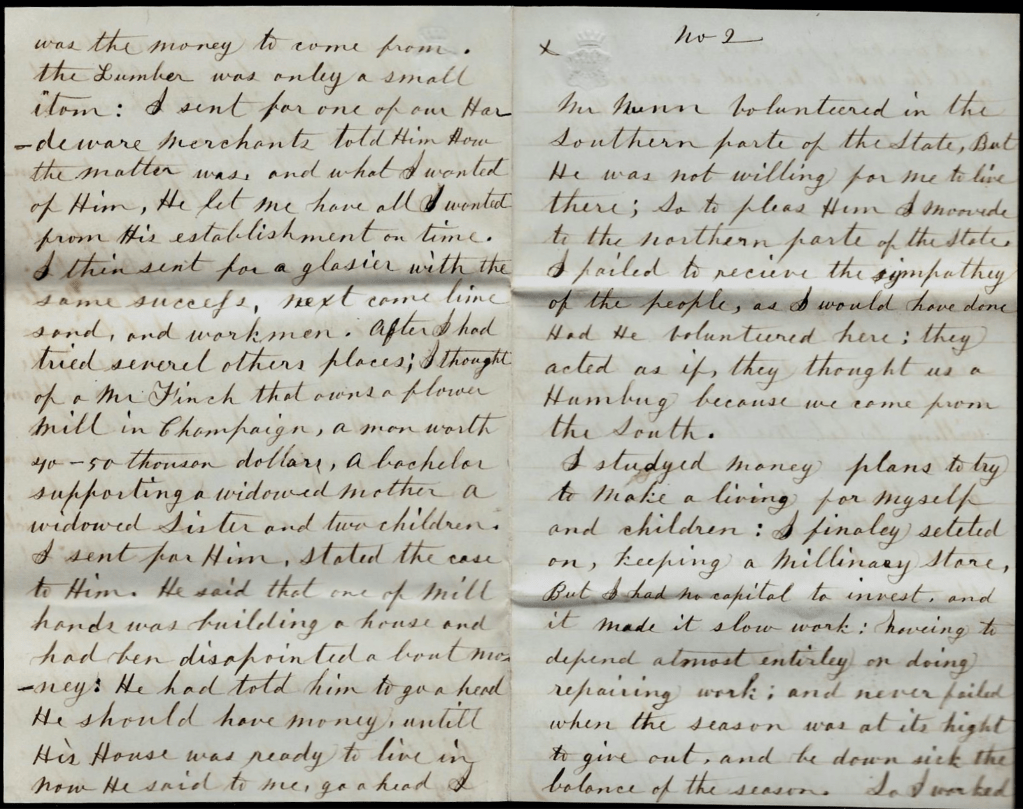
Mr. Nunn volunteered in the Southern parte of the State but he was not willing for me to live there. So to plea him, I movede to the northern parte of the State. I failed to receive the sympathy of the people as I would have done had he volunteered here. They acted as if they thought us a Humbug because we come from the South.
I studyed money plans to try to make a living for myself and children. I finaley seteled on keeping a millinary store but I had no capital to invest and it made it slow work, having to depend almost entirely on doing repairing work and never failed when the season was at its hight to give out, and be down sick the balance of the season. So I worked for three years trying all the while to find someone to let me have seven or eight hundred dollars to build me a neat little house. I wanted to get the money and give a mortgage on the house until it was paid for. But no. I went to a Mr. Harris, the welthaest man in Champaign County, said to be worth between two and three hundred thousand dollars. I told him that I wanted to find someone that was willing to let me have the money without interest if I could and give them a mortgage on the house and obligate myself to pay it as fast as I drew my pention for that was my only chance. My pention was not anough to pay my house rent but I knew that if I once got it into a home, I then could begin to enjoy the good of my pention which is the price of the life of my dear husbon. But he would not tuch, unless he knew that the whole world could have known of it. Then he would have let me had it.
I then went to the different lumber yards to see if they would let me have lumber and pay for it as I drew my pention. But no. I then got a friend to write to a lumber merchant at Chicago stating my case and see if he would let me have lumber on them terms. So I sent a bill for lumber. The very next day I was taken sick and lay sick for nine months; not able to earn anything and no one helping me. But I never suffered for there was a poor grocer keeper that knew me and let me have everything that I wanted on a credit. There their was a pay day comeing some day. The next thing was where was the money to come from. The lumber was only a small item. I sent for one of our hardeware merchants, told him how the matter was, and what I wanted of him. He let me have all I wanted from his establishment on time. I then sent for a glasier with the same success. Next came lime sand and workmen. After I had tried several other places, I thought of a Mr. [Frank] Finch that owns a flower mill in Champaign—a man worth 40-50 thousand dollars, a bachelor supporting a widowed mother , a widowed sister and two children. I sent for him, stated the case to him. He said that one of the mill hands was building a house and had been disapointed about money. He had told him to go ahead. He should have money untill his house was ready to live in. Now he said to me, go ahead, I should have money untill my house was ready to live in and I did. But when the house was so that a familey could live in the lower parte of it, I was not able to be movede to it. So it was rented for 4 months. But I never got my rent.
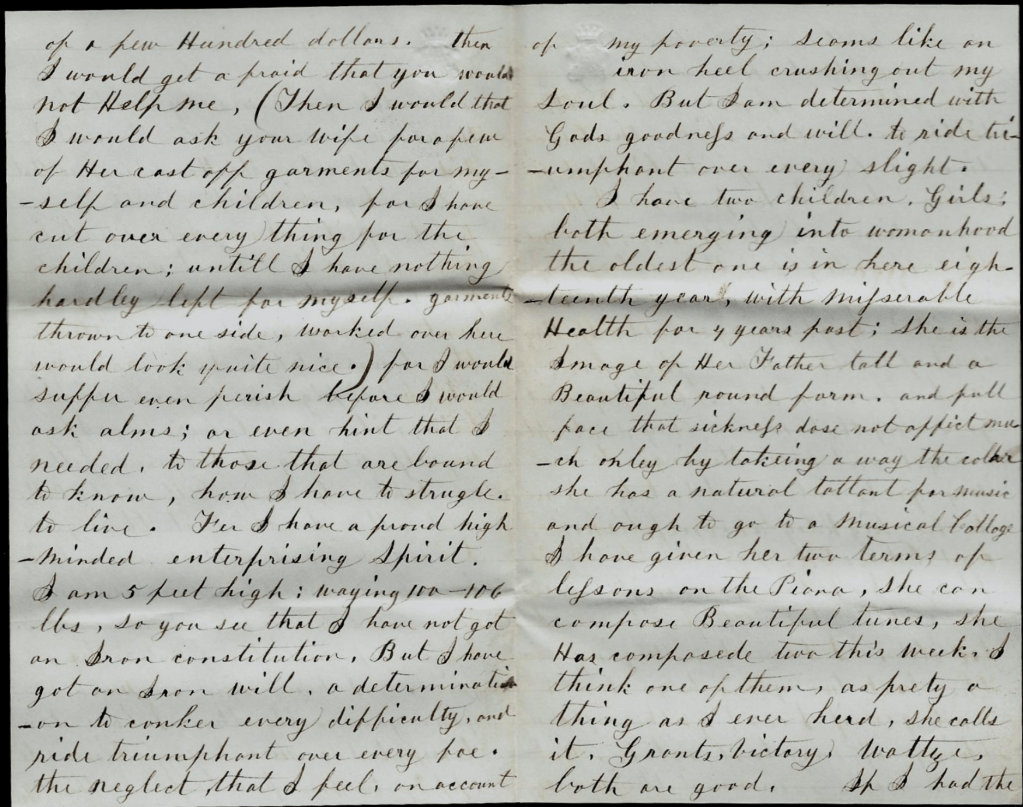
I am in the outskirts of the town where I can raise my chickens, pigs, and garden which brings its own labor for I found myself nearly 1 thousand dollars in debt—grocery bill, doctor bills, and all. In the last three years I have worked almost day and night, saved and economized every way in the world, sometimes I give up in dispair but ralley again. I have heard so much of your generosity that I have been tempted a number of times to apply to you for help in the way of a few hundred dollars. Then I would get afraid that you would not help me. (Then [I thought that] I would ask your wife for a few of her cast off garments for myself and children, for I have cut over everything for the children until I have nothing hardly left for myself—garments thrown to one side, worked over here would look quite nice) for I would suffer, even perish before I would ask alms, or even hint that I needed, to those that are bound to know how I have to struggle to live. Fer I have a proud, high-minded, enterprising spirit.
“I am 5 feet high, waying 100-106 lbs., so you see that I have not got an iron constitution. But I have got an iron will—a determination to conker every difficulty and ride triumphant over every foe. The neglect that I feel on account of my poverty seems like an iron heel crushing out my soul.”
—Lou Nunn, 10 October 1868
I am 5 feet high, waying 100-106 lbs., so you see that I have not got an iron constitution. But I have got an iron will—a determination to conker every difficulty and ride triumphant over every foe. The neglect that I feel on account of my poverty seems like an iron heel crushing out my soul. But I am determined with God’s goodness and will to ride triumphant over every slight.
I have two children—girls, both emerging into womanhood. The oldest one is in her eighteenth year with misserable health for 4 years past. She is the image of her Father, tall and a beautiful round form and full face that sickness does not affict much only by taking away the colar. She has a natural tallant for music and ough to go to a Musical Colloge. I have given her two terms of lessons on the piana. She can compose beautiful tunes. She has composede two this week. I think one of them as prety a thing as I ever herd. She calls in Grant’s Victory Waltze. Both are good. If I had the means of educating her, she could soon support herself.
The other is 14 years old with little or no education. The education of both is quite limited for I have had to keep them at home sometimes to help me. But most comonley for the want of proper clothing and books. We are a spirited high-minded set. If they can’t feel that what they have on is half way deacent, they won’t go. By that means they don’t often get out. A strainger to see my girls out would take them to be highley accomplished and educated for the ability is there, I asshure you, if it is never cultivated. They will soon be too old. I have been trying for the last two years to go South and see if I can’t gather up something of our lost estate. But I can never command the money for my honor is out for my pention to go on my debts and I lack about three hundred dollars of being out of debt.
Now I have got a plan for a big speckulation in my head. There is a thirty acre track of land that my house is on joining the town plot. I think that it can be bought for ten thousand dollars. The new rail road runs close too it. Now if I could borrow the money of you and give you a lean on it to secure you, then throw it out in too town lots and sold immediately out, which I think could be done right away, it would rase me above want the ballance of my days. I have been on the point of writing to you to see if you would not fit me up with a dry good store on commishion. I have got to strike some kind of a breese so that I can get along without so much harde labor. People tell me that I look 20 years older than I did six years ago. I can realise it myself. But I have had to go through hardships anough in that time to make anyone look old, much less a frail being like myself. Therefore I should love o get something that I could find rest for my poor wearied boddy and brain.
Now I have given you a small sketch of myself or history so that you can form an ideah of woman that applies to you with perfect confidence for help, beliving that she will get it in some form or other. I wish you to bair in mind that I feel that it is no desgrace to work at any kind of labor that is honest if I am onley able to doo it. In short, I think it an honor for people to know that poor people to work for what they get for they have to have a living—honest or dishonest one.
If I could be contented to live like a hethan, I could get along. But I can’t. I would have went raving mad if I had not succeeded in geting me a home. I had always ben uste to a good home.
My mother was killed when I was 4 years old. My first step mother was an amicablem good woman. The second was as mean as the Old Nick would have her. Se married my Father for his money, then led him a miserable life. He went security for a man that took the benefit of the bankrupt lone and then left my Father the debt to pay. In the heat of it, my Father died and by rascality his property all passed from us. The property is now worth over one million of dollars. That is harde to bare. Still we must bare it.
Please to answer this immediately if you possabley can and let me know in what way you are willing to help me. I would rather have the money to buy the land if agreeable. If your wife has cast off garments, they would any and [all] be acceptable as we have got almost out of everything that is to ware or keep us comphertable. Hopeing to hear from you soon, I am very respectfulley, — Mrs. Lou Nunn
1 The following letter was found in the Pension File, written by Lou Nunn at the time she was attempting to prove her claim in August 1863.
Campaign Cty, Ill. August 17, 1863 Mr. [Joseph H.] Barrett, [Commissioner of Pension Office] Sir,
It is impossible for me to send you a Certificate from any of the surgeons in the hospital for Capt. Stanford wrote me tat all the surgeons and physicians that was connected with the regiment at the time of his death have all left the regiment long ago. And I know not where to find them.
As to the disease he died with, if you will take the trouble to go to the hospital as I did, and see the poor boys brought their, emaciated from a diarrhea, brought on by drinking all kinds of miserable stuff at Cairo (and the whole city under water except the barracks and grade) then brought to the hospital, and stuff Quinine down them until they loose their hearing, turn people, have a burning fever, and suffer a great agony for a few days and die. I should like to see the doctor that could five it a name. And still such is the disease that 5 tenths of our poor boys die with. I could find none in the hospital of a different cast to that and I have seen a great many set home, all with the same disease, far away from those that love them, and would take care of them to be neglected by those that have the care of them them. Such is the poor soldiers’ lot. Still our Government must stumble over such trifling points and let the widdows and orphants suffer and starve for their just rights now the Husband and Father can no longer assist them.
I lay sick last winter for a long fever and lingered a long time. I had to borrow money on my government prospects to live on so that when I got my money from the auditor which was $128.90, it was all gone in 36 hours to lift notes and it will take 50 dollars out of the pention that is due me to clear me of debt. (Their, I have added it up—it is 70 dollars). So you see my [ ] will be small, but it is better to have it in my hand than to pay interest on borrowed money.
As to the marriage certificate, it answered the auditor’s purpose. I can’t see why it won’t yours. It ust be an over sight in the new clirk, not to attack the county seal. I will send back to Kentucky for another copy. It is doubtful a bout my getting it soon as the Rebbles are in that parte of the State almoste constant. It frets me constant to think here, I am so dependant on others. When I had a comphertable little home in Kentucky it it is not destroyed. But the Union Army, or the Rebble Army are one or the other their almost constant around it. I fear that their is not much of it left being right on the ferry where the cross the river. Excuse my long preamble.
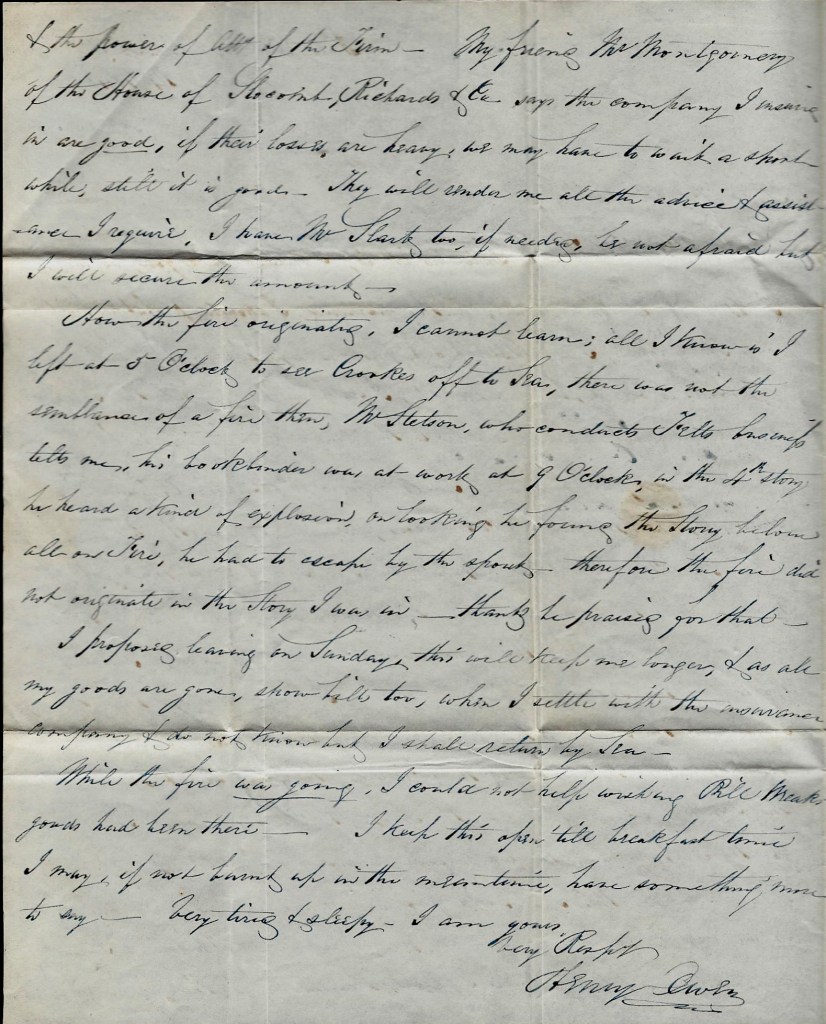
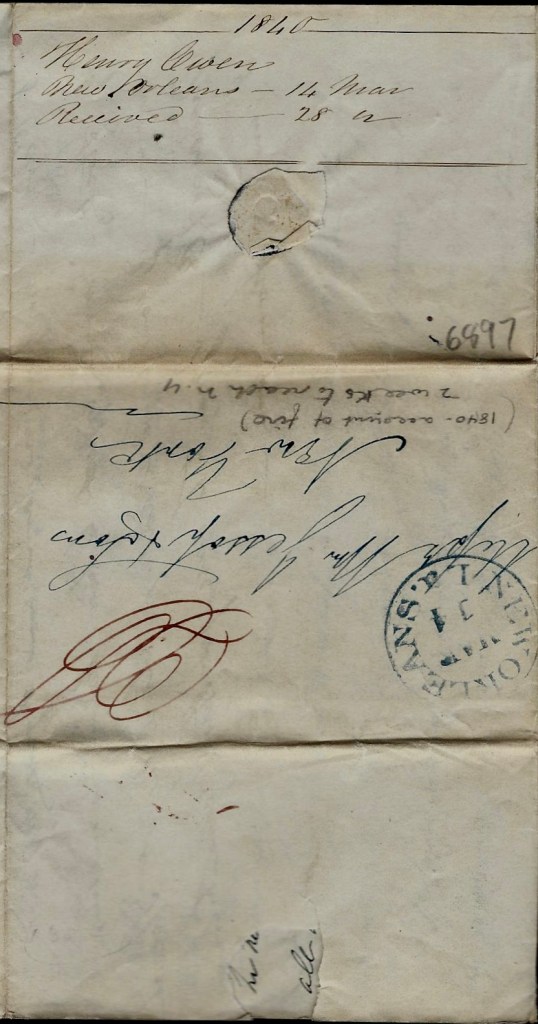
This letter was written in mid-March 1840 by Henry Owen from New Orleans, Louisiana, who we learn has just lost his inventory in a fire that took place at No. 24 Chartres Street where he had it stored. A newspaper advertisement placed by Henry Owen appearing in The Daily Picayune of Thursday, March 5, 1840—just 8 days before the fire started—indicates that he was an agent selling Joseph Gillott’s Patent Steel Pens. The advertisement states that he had “a large assortment of the well known pens for sale wholesale…at 24 Chartres street, upstairs.”
According to a newspaper article appearing in the New York Daily Express on Monday, 30 March 1840, the fire that “broke out on the night of the 13th inst., [was in] the bookstore and stationery warehouse of D. Felt & Co., No. 24 Chartres street. The flames rapidly extended to other houses on either sides; viz., to Armistead & Spring’s foreign & domestic dry goods store, No. 22, and to L. Chittenden’s importing silk and fancy store, No. 26. Notwithstanding the indefatigable exertions of the firemen, the flames took a northerly direction and rapidly consumed the clothing store of Paul Tulane & Co., No. 23, and the saddlery and harness warehouse of Smith, Cantzon, & Co., No. 30, corner of Chartres and Custom House streets.
It does not appear that Henry operated as an agent selling Gillott’s Patent Steel Pens for more than just a few months in the winter of 1839-40. From newspaper advertisements we learn that he was selling Gillott pens in New York City at 109 Beekman Street in the summer of 1837 and in 1838. He apparently returned to New York City following his loss (albeit insured) at New Orleans. There is a notice of his selling these same pens as the “sole agent” at 91 John Street in New York City in 1847 and even as late as 1864.
Henry wrote the letter to Henry Jessop (1808-1849), the son of William Jessop (1772-1835) and Rebecca Taylor (1770-1859). Henry took over his father’s firm William Jessop & Sons after his father’s death in 1835. The firm produced high quality steel in its Sheffield, England, factory, but shipped to agents in America.
Henry’s connection to the Jessop’s of Sheffield, England, convinces me he was the same Henry Owen who was born in Sheffield, England, on 10 May 1811 who was described as being 5’10” inches tall, with blue eyes and light brown hair, and 53 years old when he applied for a passport in 1864 giving 26 West 25th Street on NYC as his address.
Transcription
Stampless cover addressed to Messers. William Jessop & Sons, New York
New Orleans [ Louisiana] 3 a.m., March 14, 1840
Mr. Hy. Jessop My dear sir,
Late as it is, I must write you, as were I to trust to writing early in the morning, I should probably fail. The fact is, I am burnt out, not as a rap saved, but fully insured, my book is burnt, for fortunately, I yesterday added up the sales, and can most unequivocally swear to the amount within a trifle.
Now for particulars. I was engaged in conversation with a stationer, when the cry of “Fire” arose. We ran out of the verandah & learnt the fire was at No. 24 Chartres Street. I hurried to the spot and running into the lower store for the key, asked some gentleman to lend a hand. On opening the side door leading upstairs, I found the top of the stairs on fire. Of course I could not go through them. I got to the street and that moment every iron window shutter was burst open by the force of the flames. The fire burnt the store on the South and Four on fire on the North to Custom House St. Luckily for the neighboring [buildings], the walls fell almost as the fire reaching them. But for this, I should probably have been burned out of house as well, to make sure I did not pack up. Whiting & Stark, narrowly escaped. All I regret the loss of is the prices you sent & the power of attorney of he firm.
My friend, Mr. Montgomery of the House of Slocomb, Richards & Co., says the company I insured in are good. If their losses are heavy, we may have to wait a short while—still it is good. They will render me all the advice and assistance I require. I have Mr. Stark too, if needed. Be not afraid but I will secure the amount.
How the fire originated, I cannot learn. All I know is I left at 5 o’clock to see Crookes off to sea. There was not the semblance of a fire then. Mr. Stetson who conducts [David] Felt’s [stationery] business tells me his bookbinder was at work at 9 o’clock in the 4th story. He heard a kind of explosion [and] on looking, he found the story below all on fire. He had to escape by the spout. Therefore the fire did not originate in the story I was in—thanks be praised for that.
I proposed leaving on Sunday [but] this will keep me longer. And as all my goods are gone, show bills too, when I settle with the insurance, I do not know but I shall return by sea.
While the fire was going, I could not help wishing Phill Meaks’ [Weak’s?] goods had been there. I keep this open till breakfast time. I may, if not burnt up in the meantime, have something more to say. Very tired and sleepy, I am yours. Very respectfully, — Henry Owen
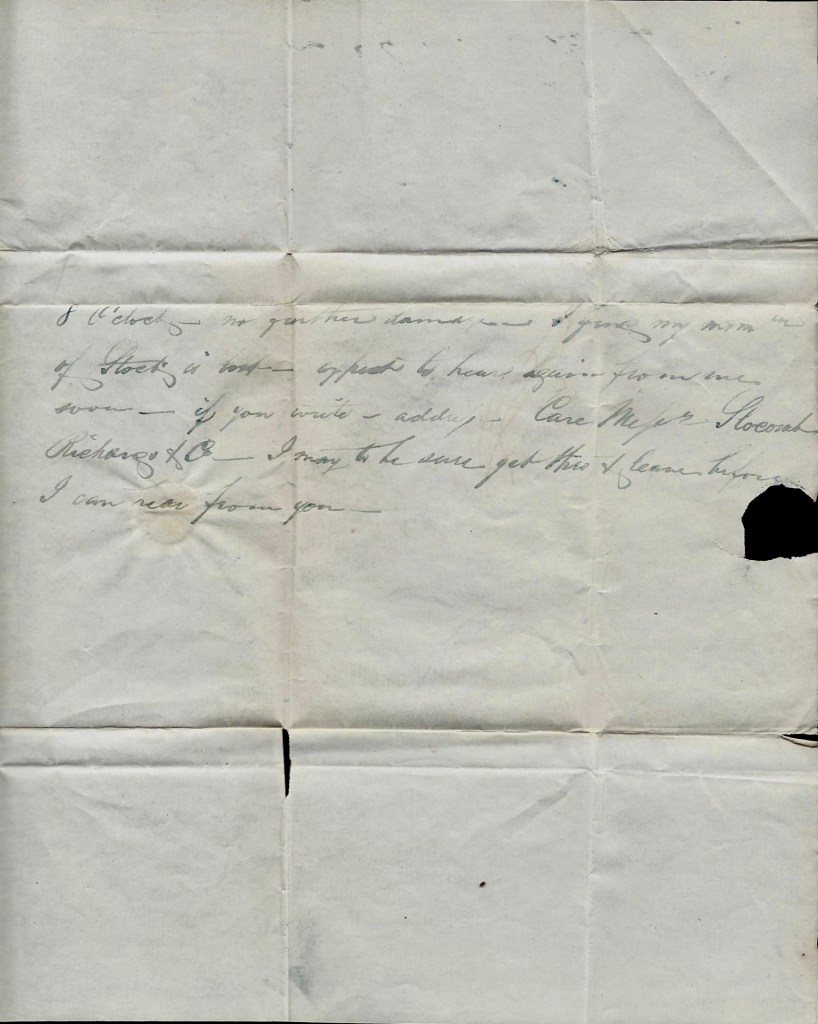
8 o’clock. No further damages. I find my [ ] of stock is lost. Expect to hear again from me soon. If you write. Address Care of Messer Slocomb, Richards, & Co. I may to be sure get this and leave before I can hear from you.
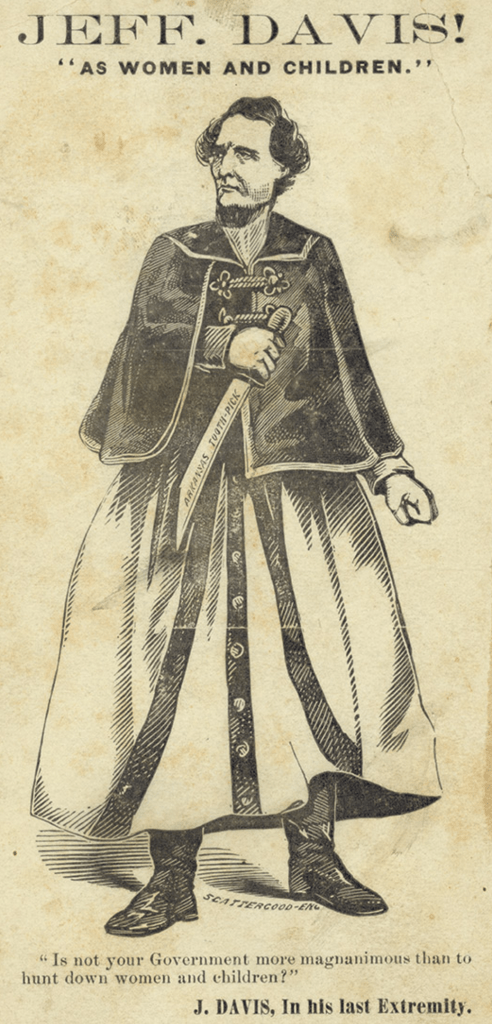
Three decades later, Jeff Davis is depicted with an “Arkansas Toothpick” under his garments as he flees capture at war’s end.
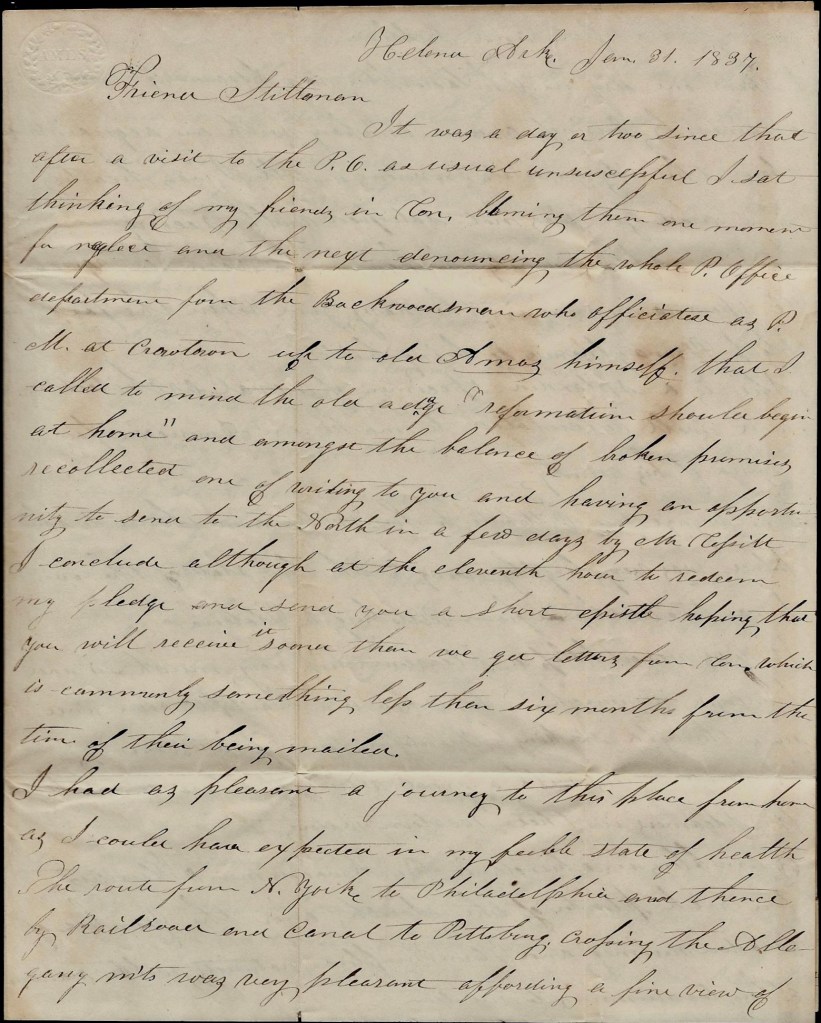
This letter was written by 22 year-old Edward Rice (1814-1850), the son of Levi Rice (1775-1853) and Annie Hayes (1777-1845) of Granby, Hartford county, Connecticut. He wrote the letter some weeks (possibly months) after his arrival in Helena, Phillips county, Arkansas—some six months after it had become the 25th state to join the Union. According to the 1850 Mortality Schedules, Edward Rice died in Helena from “congestion of the lungs” in May 1850. I have not been able to ascertain whether Edward remained in the dry goods business at Helena for the entire thirteen years period he remained in Helena until his death.
Edward wrote the letter to his boyhood friend, Stillman Allen Clemens (1816-1875), the son of Allen Clemons (1793-1868) and Catherine Helen Stillman (1796-1856) of North Granby, Hartford county, Connecticut. At the time this letter was written, Stillman was attending Yale University. After graduation, he was employed as a teacher.
Not only is the letter a good “travel” letter but Edward shares his impressions of Helena, Arkansas, and its inhabitants—an early statehood glimpse of the Mississippi river port town.
I note that the Clemens name is sometimes spelled Clemons and it appears to have been written that way by Edward.
Transcription
Addressed to Stillman Clemons, Esq., New Haven, Connecticut
Helena, Arkansas January 31, 1837
Friend Stillman,
It was a day or two since that after a visit to the P. O. as usual unsuccessful, I sat thinking of my friends in Connecticut, blaming them one moment for neglect and the next denouncing the whole Post Office Department from the backwoodsman who officiated as postmaster at Crowtown up to old Amos [Kendall] himself, that I called to mind the old adage, “reformation should begin at home” and amongst the balance of broken promises recollected one of writing to you. And having an opportunity to send to the North in a few days by Mr. Cossitt, I conclude—although at the eleventh hour—to redeem my pledge and send you a short epistle hoping that you will receive it sooner than we get letters from Connecticut, which is commonly something less than six months from the time of their being mailed.
I had as pleasant a journey to this place from home as I could have expected in my feeble state of health. The route from New York to Philadelphia and thence by railroad and canal to Pittsburgh, crossing the Allegheny Mountains, was very pleasant affording a fine view of scenery, beautiful and sublime.
I spent one day in Philadelphia very pleasantly, being detained by business, and in company with an acquaintance about the city and its environs until I was heartily tired and yet was not satisfied with seeing. It is a splendid city. I have never seen its equal. We spent a morning in the Navy Yard where the far famed ship Pennsylvania is being built. She is a splendid specimen of naval architecture and well-calculated to make an American feel proud of his country.
The USS Pennsylvania warship (large ship left center) was launched in the summer of 1837
The voyage from Pittsburgh to Louisville and then to this place was very lengthy owing to the low state of the river. I was nearly two weeks from Pittsburgh to Helena. It was nevertheless a pleasant trip—very much so—and I enjoyed it much. The Ohio is a beautiful river and runs through strikingly beautiful and fertile country.
A person meets with a great variety of character on board the steamers in the Western waters. Gambling in abundance, backwoodsmen & hunters, the rich planter of the South, and the Yankee of wooden nutmeg and horn gunflint notoriety, with various others too numerous to mention.
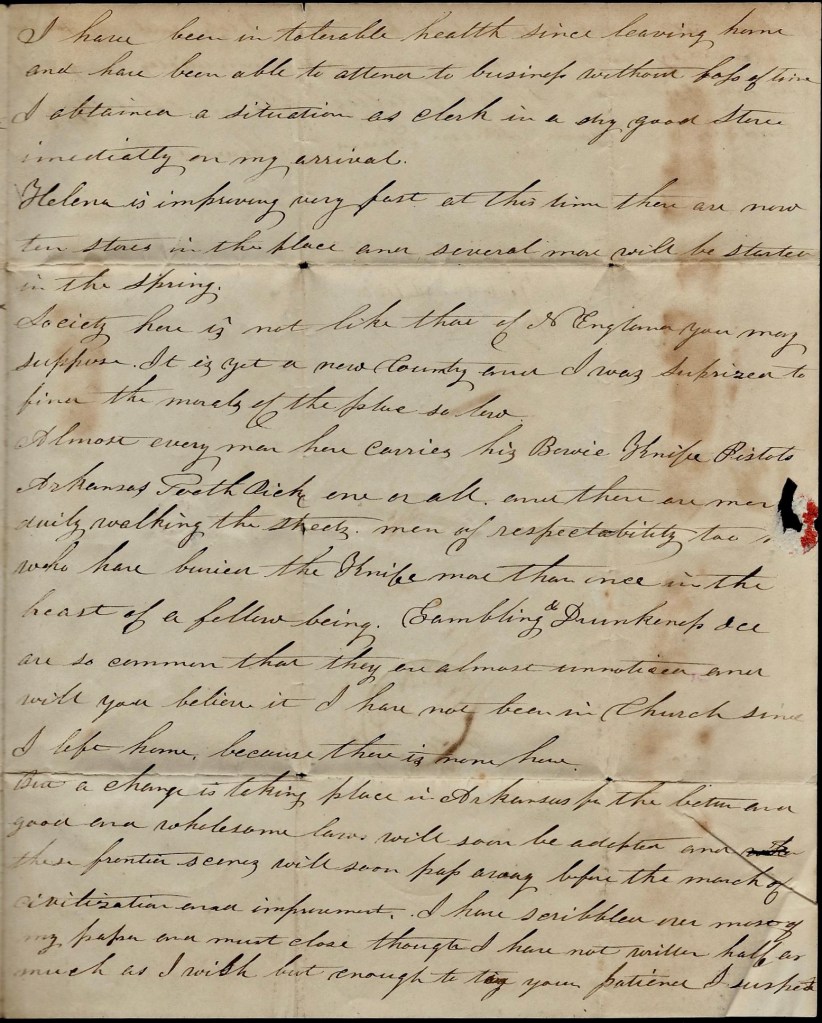
I have been in tolerable health since leaving home and have been able to attend to business without loss of time. I obtained a situation as clerk in a dry goods store immediately on my arrival.
Helena is improving very fast at this time. There are now ten stores in the place and several more will be started in the spring. Society here is not like that of New England, you may suppose. It is yet a new country and I was surprised to find the morals of the place so low. Almost every man here carries his Bowie knife, pistols, Arkansas Toothpick, one and all. 1 And there are men daily walking the streets—men of respectability too—who have buried the knife more than once in the heart of a fellow being. Gambling & drunkenness &c. are so common that they are almost unnoticed and will you believe it, I have not been in church since I left home—because there is none here!
But a change is taking place in Arkansas for the better and good and wholesome laws will soon be adopted and these frontier scenes will soon pass away before the march of civilization and improvement. I have scribbled over most of my paper and must close though I have not written half as much as I wish, but enough to try your patience I suspect.
I have not heard a word from home since I left and my patience is almost exhausted. I wish you to write immediately on getting this and give me a sketch of college life in the City of Gardens.
Your sincere friend, — Edward Rice
[to] S. Clemons.
1 There is some debate over whether or not an Arkansas toothpick is technically a Bowie knife. The Arkansas toothpick is a type of large dagger with a straight blade that is used for thrusting. It is named after the American frontier state of Arkansas where it was supposedly created. Bowie knives, on the other hand, are typically larger knives with a curved blade that is good for both slicing and thrusting. Some people argue that the Arkansas toothpick is simply a smaller version of a Bowie knife and thus can be classified as such. Others maintain that the two knife types are distinct enough to warrant their own separate classification. Since Edward mentions both types of knives in this letter, they must have had a different meaning at the time. As near as I can tell, the term “Arkansas Toothpick” came into popular usage about 1835.

















 Spared & Shared 23