This letter was datelined from Bayou Sara, Feliciana Parish, Louisiana, in mid-February 1866 and written by Nellie (Riegel) Nickerson—the 19 year-old wife of Azor Howitt Nickerson (1837-1910). Nellie was the daughter of John Riegel (1818-18xx) and Susan Adams Ingol. Nellie’s sister, to whom she addressed her letter, was Sarah Gertrude (Riegel) Groff (b. 1844), the wife of Johnson R. Groff of Mechanicsburg, Pennsylvania. Unfortunately for Nellie, her marriage to Azor was brief—she died of spotted fever at Fort Boise, Idaho, only 14 months later.
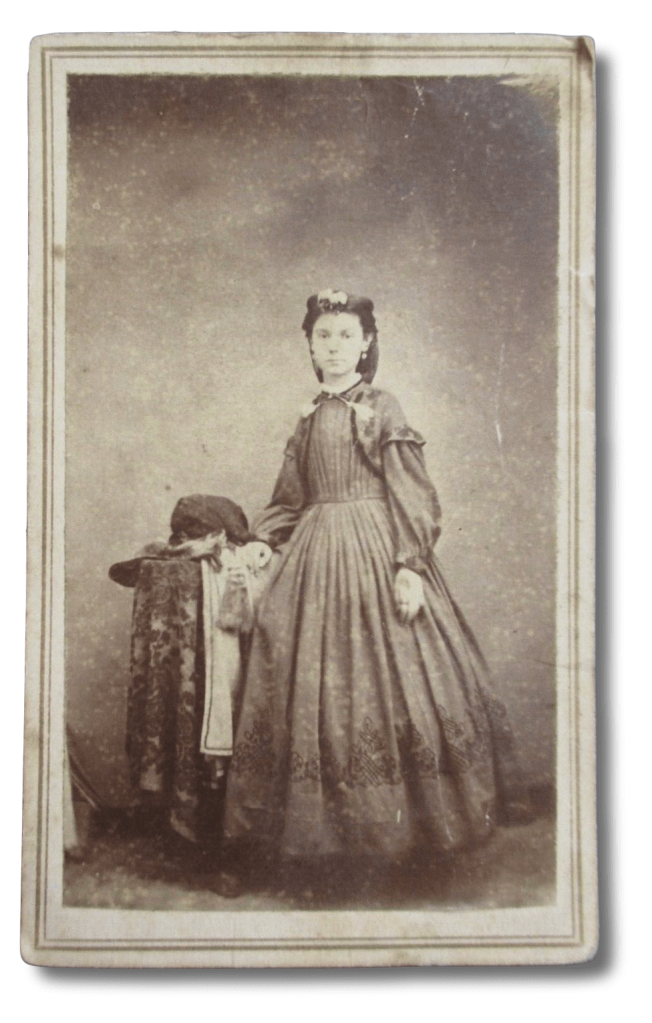
There is no surviving image of Nellie that I have found but here is a young woman about her age wearing apparel that dates to about 1866.
But what was Nellie’s husband doing in Bayou Sara, Louisiana, in February 1866? A Washington Post article researched and written by William Horne informs us that Azor was there as an agent of the Freedmen’s Bureau tasked with protecting the interests of the former slaves who were being hired to work for wages on the sugar and cotton plantations. Protecting their interests meant providing them assistance in the way of food, shelter, medical aid, schools and legal assistance. Indeed, the Freedmen’s Bureau Louisiana Field Office list of personnel gives “A. H. Nickerson” as “Agent and Asst. Subassistant Commissioner” from January 1865 to May 1866. Nellie’s letter was written in the winter time when the risk of disease was relatively low but apparently during the previous summer of 1865, a small pox epidemic erupted in the area, hitting the black communities particularly hard where, clustered in cramped quarters, the disease spread rapidly unchecked. Allegedly Nickerson colluded with the white planters to keep the infected blacks out of the village (where he was living with his wife), which essentially “condemned them to almost certain death.” Later, Nickerson accused the mayor of attempting to spread the disease, even by going so far as to infect him with it, by sending diseased blacks to his office hoping to run both him and the Bureau out of the parish and thereby maintain elements of hierarchy reminiscent of slavery. [See “In the hands of racist officials…” by William Horne]
Nickerson had a long a controversial post-war career best summarized on the Arlington National Cemetery website that highlights events captured in a book entitled, “The Tarnished Saber: Major Azor Nickerson, USA, His Life and Times” by Angelo D. Juarez.
[Note: This letter is from the private collection of Richard Weiner and is published on Spared & Shared by express consent.]
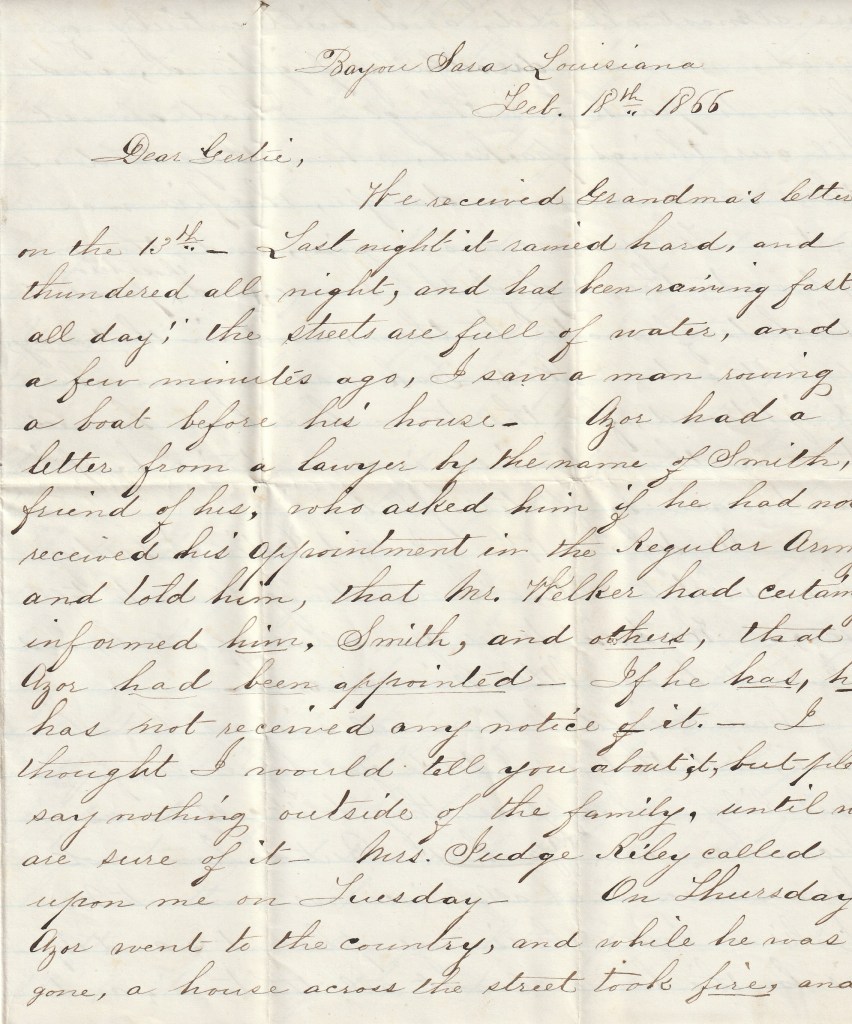
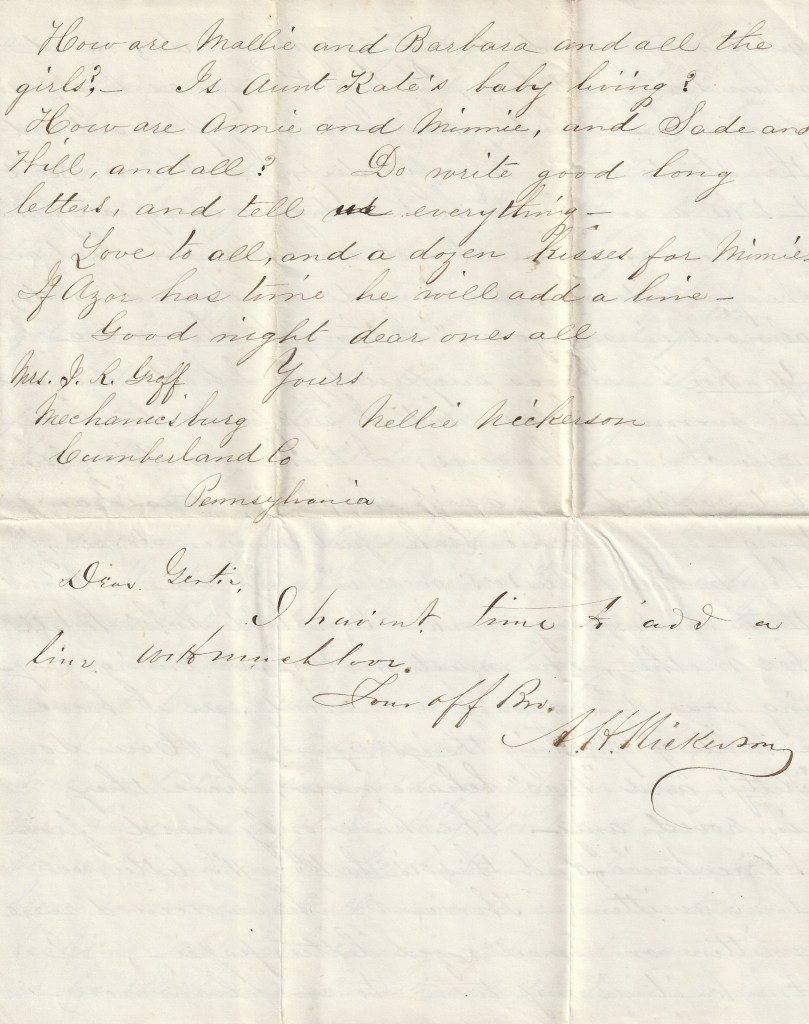
Transcription
Bayou Sara, Louisiana February 18, 1866
Dear Gertie,
We received Grandma’s letter on the 13th. Last night it rained hard, and thundered all night, and has been raining fast all day. The streets are full of water and a few minutes ago, I saw a man rowing a boat before his house. Azor had a letter from a lawyer by the name of Smith, friend of his, who asked him if he had not received his appointment in the Regular Army and told him that Mr. Welker had certainly informed him—Smith, and others, that Azor had been appointed. If he has, he has not received any notice of it. I thought I would tell you about it, but please say nothing outside of the family until we are sure of it. 1
Mrs. Judge Riley called upon me on Tuesday. On Thursday Azor went to the country an while he was gone, a house across the street took fire and as it was a very windy day, and the houses are almost all old and built entirely of wood, we were dreadfully frightened. and began to pack our things. I had almost all our things packed when they told us there was no more danger—the fire was out. They have no engine and the men got onto the roof of the house and those below passed buckets of water to them, and in that way, put it out. Mrs. Leak was very much frightened for the town has been burned two or three times—one or twice by fires and once by Porter’s fleet. 2
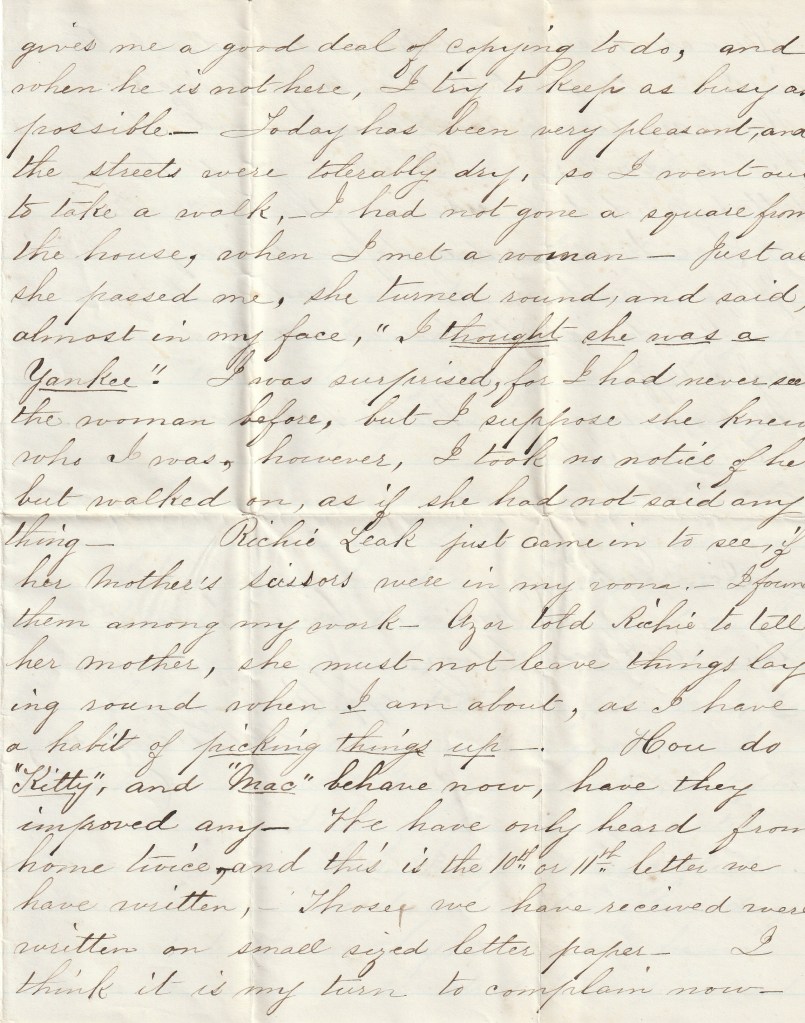
Monday, February 19th. Indeed, Gertie, I hardly know what to write. I have nothing new to tell you. We want to see you all very much and I want to see little Minnie so much.
I have received but one call since we have been here and that, as I told you before, was from Mrs. Riley. I suppose they don’t call on us because we are “Yankees” but I have not been lonesome at all since we came to Mr. Leake’s. 3 Mrs. Leake is very pleasant and Azor is in the house almost all the time and gives me a good deal of copying to do, and when he is not here, I try to keep as busy as possible.
Today has been very pleasant and the streets were tolerably dry, so I went out to take a walk. I had not gone a square from the house when I met a woman. Just as she passed me, she turned round and said, almost in my face, “I though she was a Yankee!” I was surprised for I had never seen the woman before but I suppose she knew who I was, however. I took no notice of her but walked on as if she had not said anything.
Richie Leake just came in to see if her mother’s scissors were in my room. I found them among my work. Azor told Richie to tell her mother she must not leave things laying around when I am about as I have a habit of picking things up.
How do “Kitty” and “Mac” behave now? Have they improved any? We have only heard from home twice and this is the 10th or 11th letter we have written. Those we have received were written on small sized letter paper. I think it is my turn to complain now. How are Mollie and Barbara and all the girls? Is Aunt Kate’s baby living? How are Annie and Minnie and Sade and Will and all? Do write good long letters and tell everything.
Love to all and a dozen kisses for Minnie. If Azor has time, he will add a line. Goodnight dear ones all. Yours, — Nellie Nickerson
To Mrs. J. R. Groff, Mechanicsburg, Cumberland county, Pennsylvania
Dear Gertie, I haven’t time to add a line. With much love, your affectionate brother, — A. H. Nickerson
1 President Andrew Johnson approved the nomination of 2nd Lt. Azor H. Nickerson to 1st Lt. in the 14th Regiment of Infantry, Regular Army on 23 February 1866.Azor was a captain in the Veteran Reserve Corp at the time he was discharged from the army but apparently was being reinstated in the post war regular service at a lower rank.
2 On 10 August 1862, the US Gunboat Essex shelled the town while a small landing party set it ablaze. All the buildings within two blocks of the river were destroyed. More destruction occurred in the months to follow, virtually leveling the town and no doubt accelerating the resident’s hatred for Yankees.
3 Mrs. Leake was Elizabeth Henrix Pollard who married Richard Marcellus Leake in 1848 in Missouri. Their daughter “Richie” was born in 1854. After Nickerson and his wife left Bayou Sara in the spring of 1866, Richard M. Leake served in the same role as Nickerson for September-October 1866 until he was shot and killed during a labor dispute with William Reynolds—the Irish blacksmith and carriage maker in Bayou Sara.
This letter was written by Albert D. Clark (1840-1909) who, at 21 years of age, enlisted on 6 September 1861 as a sergeant in Battery A, 1st Ohio Light Artillery. He mustered out in September 1864. Prior to his enlistment, Albert was working as an iron moulder at Franklin Mills, Ohio.
Albert was the son of John Finney Clark (1813-1901) and Eliza S. Dunning (1814-18xx) of Franklin township, Portage county, Ohio. The following biographical sketch comes from a county history:
“Our subject was reared and educated in Kent. He enlisted April 24, 1861, and served as Sergeant in Company A, First Regiment Ohio Light Artillery, and was Acting Orderly over two years, and commanded the Second Section of artilleries over a year. He was in the battles of Shiloh, Stone River, Chickamauga (he was recommended for promotion for bravery on the battlefield of Chickamauga by Maj. Wilbur F. Goodspeed), and was in many other engagements, and honorably discharged at Chattanooga, Tenn., September 12, 1864, paying a flying visit to friends in Ohio. He then went into the Quartermaster’s Department at Johnsonville, Tenn., serving eighteen months as Assistant Superintendent of laborers of that place, also in the vicinity of Nashville. When Johnsonville, Tenn. was evacuated by the Union forces he went to Nashville, thence to Franklin and Duck River; returning to Nashville took passage on the transport “New York” for Eastport, Miss. On the steamer’s arrival at her destination he accepted and filled the position of Chief Receiving Clerk under Lieut. Samuel W. Treat, commanding river and railroad transportation. On resigning this position he returned to Ohio. He then went West and engaged in railroading, visiting all the principle cities of the West. In 1869 he returned to Kent, and accepted a position as foreman in the brass foundry of the A & G W. R. R., which he held until 1883, when he embarked in his present business. He was married August 18, 1870 to Sarah J., daughter of Harvey C. and Flora B. Newberry, of Kent.”
Albert wrote the letter to Antoinette Longcoy (1842-1910), the daughter of David and Abbie (Woodward) Longcoy of Portage county, Ohio. She later married Samuel Putnam (1835-1909), an older brother of Col. Haliman Sumner Putnam. Col. Putnam was an 1857 graduate of West Point and was appointed Col. of the 7th New Hampshire. He commanded the 2nd Brigade in the attack on Fort Wagner during which he was shot through the head and left on the field.
I could not find an image of Albert but here is an albumen print showing members of the 1st Ohio Light Artillery posted on Civil War Faces by Thomas Molocea in 2017
Transcription
Headquarters Battery A, 1st OVLI [Ohio Volunteer Light Artillery] Camp Brough, Nashville, Tennessee April 24th 1864
Miss Annett Longcoy, Franklin, Ohio,
You will undoubtedly be surprised at my assumed boldness in approaching you as our former acquaintance was very limited indeed, but I assure you there is no offense intended. I have become somewhat acquainted with a plot which concerns you and others that I shall mention before I close. A certain few of the Battery that are noted for their malicious character & gossiping qualities assembled together and concocted the following scheme for the purpose of obliterating the dull monotony of camp life. Each one was to hand in his name and also that of some young lady. The addresses were numbered & corresponding numbers on cheques to be drawn. In this manner your address fell to one that I know you would not want to court acquaintance with, The person that entered your address done so under an assumed name so it is impossible for me to tell you who it was. The other person is Miss Mary Metlin. The person who received her address told me he was not a going to write. But should he do so yet, Miss Metlin & you, Miss Longcoy, must act at your own pleasure in regard to forming a correspondence. I have acquainted you with the characters of these two gentlemen and also the means that were employed in obtaining your addresses. Out of respect for you and Miss Metlin, as young ladies of high standing in society, and also to put you on guard against the approach of these inconsiderate men. The I become acquainted with these proceedings is not known by the persons interested and should you conclude to reply to their productions, I would request that you keep your informant’s name a secret as it will avoid hard feelings.
My respects to all enquiring friends. Yours in haste. From your friend, — A. D. Clark
I could not find an image of Loel but here is one of Delos M. Phillips who served in the same company & regiment. (Photo Sleuth)
This letter was written by 22 year-old Loel Chandler Hakes, a farmer from Wellsville, Allegany county, New York, who accepted a bounty of $50 from his village and enlisted on 5 September 1862 to serve three years in Co. H, 160th New York Infantry. According to his enlistment papers, he stood 5′ 11″ tall and had black hair and blue eyes. Though claiming to have a strong “constitution,” the rigors of camp life eventually proved too difficult for him as he was discharged for disability with the rank of sergeant on 13 May 1864.
Loel was the son of Billings Hakes (1797-1878) and Lucy Maria Pierce (1812-1871). He was married on 7 January 1861 to Elizabeth Hamilton (1839-1901), whom he called “Lib” and branded “the best wife in Allegany county.”
Loel wrote the letter from a hospital in Brashear City, recruiting from exhaustion incurred by the long march in recent weeks when the regiment—in Gen. Wetzel’s Brigade—moved from Brashear City up to the mouth of the Atchafalaya, skirmishing with the enemy most of the way
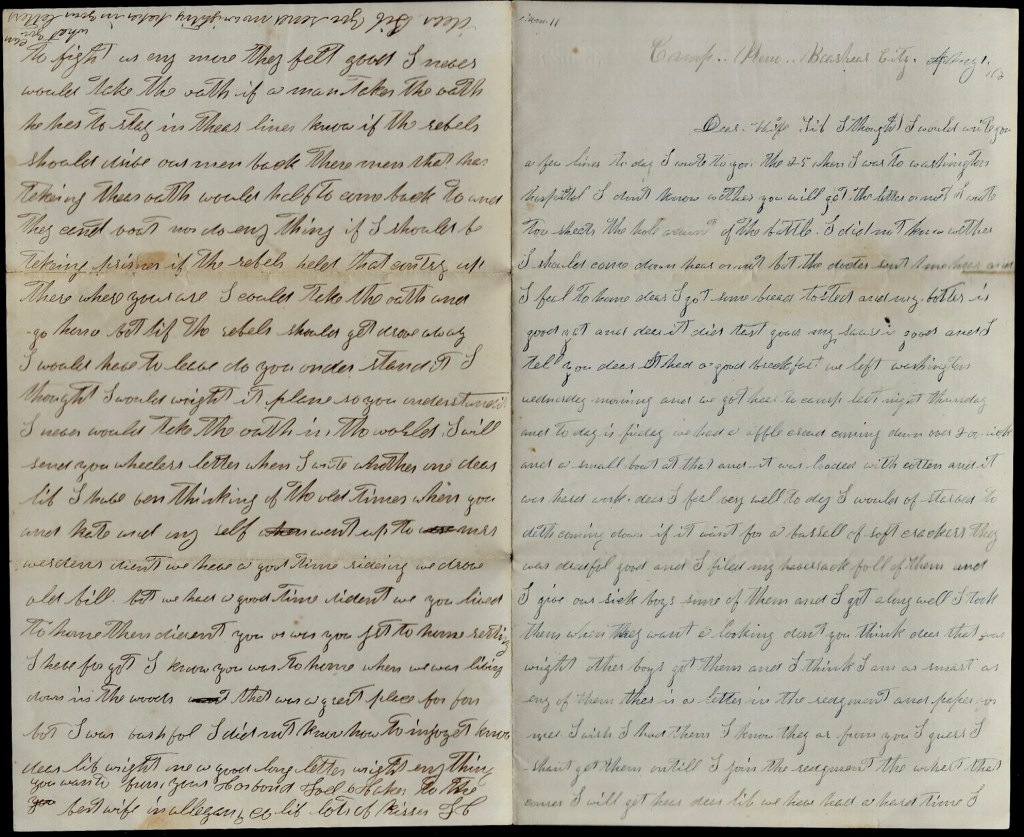
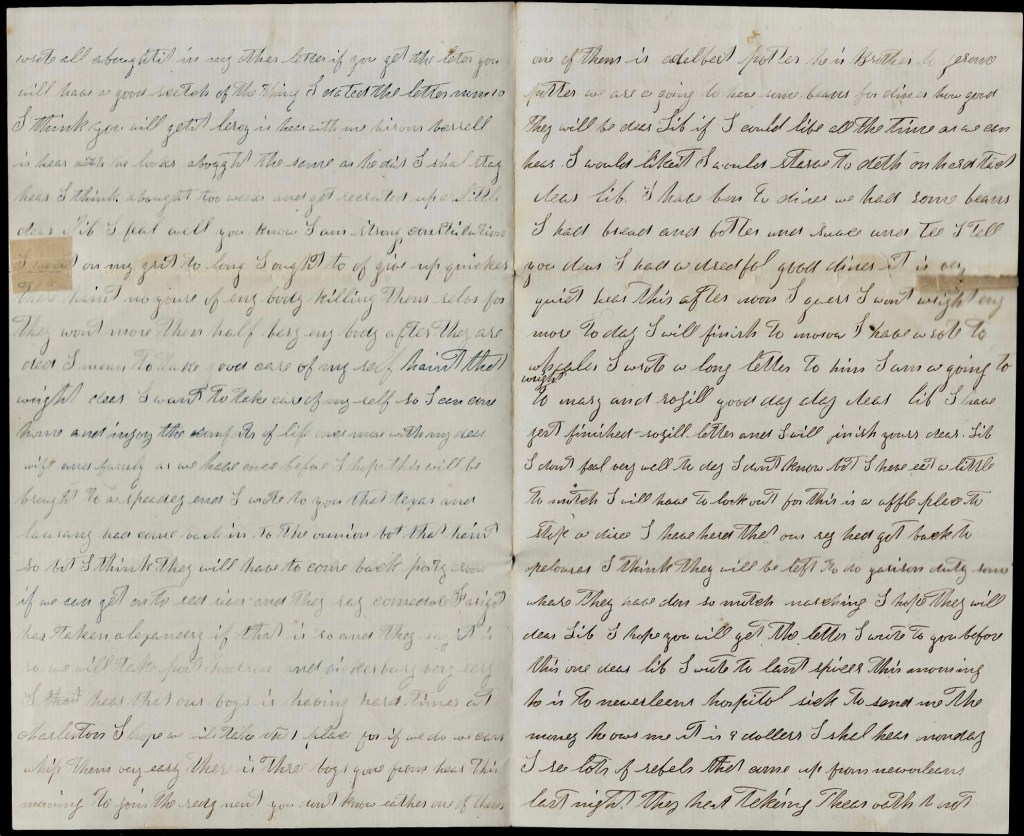
Transcription
Addressed to Mrs. Elizabeth Hakes, Wellsville, Allegany Co., New York
Camp near Brashear City [La.] May 1, 1863
Dear wife Lib,
I thought I would write you a few lines today. I wrote to you the 25th when I was to Washington Hospital. I don’t know whether you will get the letter or not. I wrote two sheets the whole account of the battle. I did not know whether I should come down here or not but the doctor sent me here and I feel to home.
Dear, I got some bread toasted and my butter is good yet and dear, it did taste good. My sausage is good and I tell you dear, I had a good breakfast.
We left Washington Wednesday morning and we got here to camp last night Thursday and today is Friday. We had an awful crowd coming down—over 200 sick and a small boat at that—and it was loaded with cotton and it was hard work. Dear, I feel very well today. I would of staved to death coming down if it wasn’t for a barrel of soft crackers. They was dreadful good and I filled my haversack full of them and I give our sick boys some of them and I got along well. I took them when they wasn’t a looking. Don’t you think, dear, that was right? Other boys got them and I think I am as smart as any of them.
There is a letter in the regiment and paper for me. I wish I had them. I know they are from you [but[ I guess I won’t get them until I join the regiment. Dear Lib, we have had a hard time. I wrote all about it in my other letter. If you get the letter, you will have a good sketch of the thing. I dated the letter No. 10. I think you will get it. Leroy is here with me. Hiram Burrell is here. He looks about the same as he did. I shall stay here, I think, about two weeks and get recruited up a little.
Dear Lib, I feel well. You know I am [of] strong constitution. I went on my grit too long. I ought to give up quicker. There hain’t no use of anybody killing themselves for they won’t more than half bury my body after they are dead. I mean to take good care of myself. Hain’t that right, dear? I want to take care of myself so I can come home and enjoy the comforts of life once more with my dear wife and family as we have once before. I hope this will be brought to a speedy end.
I write to you that Texas and Louisiana had come back into the Union but that hain’t so. But I think they will have to come back pretty soon. If we can get onto Red River and they say Commodore Farragut has taken Alexandria. If that is so and they say it is, so we will take Port Hudson and Vicksburg very easy. I hear that our boys is having hard times at Charleston. I hope we will take the place for if we do, we can whip them very easy.
There is three boys gone from here this morning to join the regiment. You don’t know either of them. One of them is Adelbert Potter. 1 His is brother to Jerome Potter. We are a going to have some beans for dinner. How good they will be. Dear Lib, if I could live all the time as we can here, I would like it. I would starve to death on hard tack. Dear Lib, I have been to dinner. We had some beans. I had bread and butter and sauce and tea. I tell you, dear, I had a dreadful good dinner. It is very quiet here this afternoon. I guess I won’t write anymore today. I will finish tomorrow. I have write to [ ]. I wrote a long letter to him. I am going to write to Mary and Rozell. Good day, dear Lib.
I have just finished Rozell’s letter and I will finish yours. Dear Lib, I don’t feel very well today. I don’t know but I have eat a little to much. I will have to look out for this is an awful place to stop and die. I have heard that our regiment had got back to Opelousas. I think they will be left to do garrison duty somewhere. They have done so much marching, I hope they will.
Dear Lib, I hope you will get the letter I wrote to you before this one. Dear Lib, I wrote to Corp. [Daniel T.] Spicer this morning—he is to New Orleans Hospital sick—to send me the money he owes me. It is 9 dollars. I shall hear Monday. I see lots of rebels that come up from New Orleans last night. They had taken the oath to not fight us any more. They felt good. I never would take the oath. If a man takes the oath, he has to stay in their lines. Now if the rebels should drive our men back, their men that has taken the oath would have to come back too and they can’t vote nor do anything. If I should be taken prisoner if the rebels held that country up there where you are, I could take the oath and go home but if the rebels should get drove away, I would have to leave. do you understand? I thought I would write it plain so you understand it. I never would take the oath in the world.
I will send you Wheeler’s letter when I write another one. Dear Lib, I have been thinking of the old times when you and Kate and myself went up to Mrs. Werden’s. Didn’t we have a good time riding? We drove old Bill. But we had a good time, didn’t we? You lived to home then, didn’t you, or was you just to home resting? I have forgot. I know you was to home when we was living down in the woods. That was a great place for fun but I was bashful. I did not know how to enjoy it. Now dear Lib, write me a good long letter. Write everything you want to.
From your husband, — Loel C. Hakes
To the best wife in Allegany county—Lib
Lots of kisses
1 Adelbert Potter was a private in Co. H, 160th New York Infantry.
Hakes’ Monument in Woodlawn Cemetery in Wellsville, NY
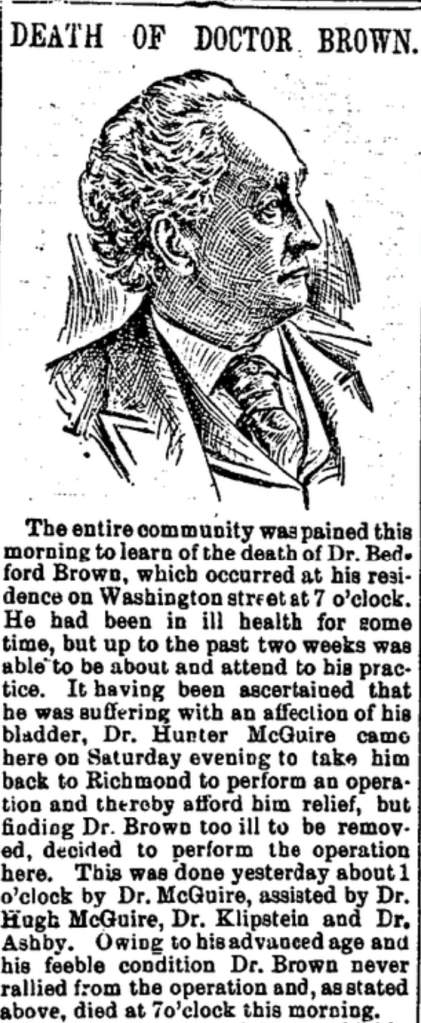
Though it is only signed “Bedford,” I feel certain this letter was written by 39 year-old Dr. Bedford Brown (1823-1897) of Caswell, North Carolina. Brown grew up on the Rose Hill Plantation, the son of US Senator and planter Bedford Brown (Sr.) (1795-1870) of Caswell county, North Carolina—a leader in the “States Rights” faction of the southern Democratic party and a close personal friend of Andrew Jackson. Sen. Brown was very much his own man, and stood toe to toe with John C. Calhoun on the floor of the Senate when their opinions differed. He has been eulogized as a man that was “true to his convictions in all with an idea that all white men were free and equal and though little lower than the angels perhaps were crowned with glory and honor from above.” [The Times (Richmond, Va), 14 Sep 1897, emphasis added]
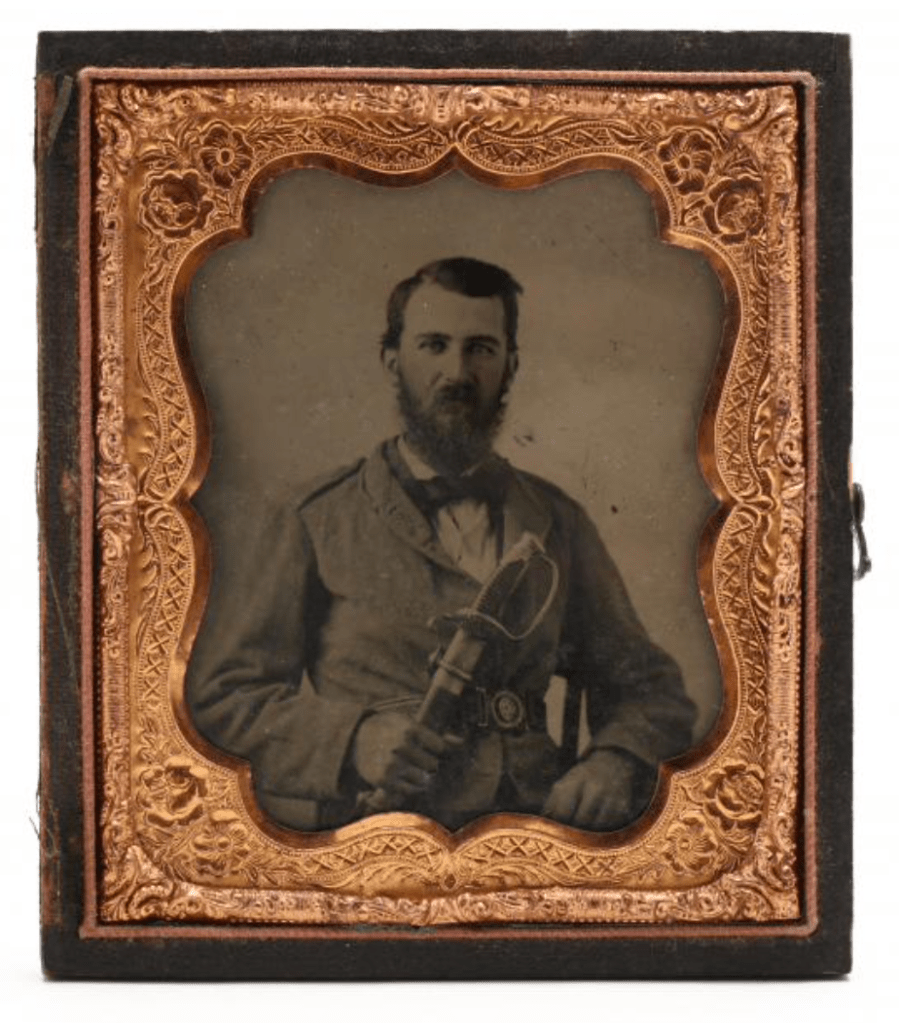
I could not find an image of Bedford wearing his uniform but here is William R. Hughes who was a surgeon in the 31st North Carolina. He’s wearing a short military jacket and a NC Belt Plate.
Young Bedford was tutored by the same schoolmaster as Robert E. Lee. At age 21, he was sent to Lexington, Kentucky, to read medicine with Dr. Benjamin Dudley, graduated at Transylvania University, and also from Jefferson College in Philadelphia in 1854. He was married to Mary Elizabeth Simpson (1827-1907) in 1852 and by the time this letter was written in 1862, the couple had at least four children, though only two were still living. After practicing medicine in Albemarle and Fauquier counties, Dr. Brown went back to his father’s plantation but when the war began, he offered his services as a surgeon in the 24th North Carolina Regiment and was assigned to Floyd’s Brigade, serving in West Virginia. Then he was assigned to “Gen. Gustavus Smith’s staff and later surgeon of Daniel’s Brigade. He served under Gen. Lee and Gen. Stonewall Jackson as well, and during the latter part of the war had to leave the service though he was long inspector of camps and hospitals in North Carolina and thereabouts.” After the war he settled and opened a practice in Alexandria, Virginia.
This letter was written just after Lee’s Army of Northern Virginia—including Brown’s former regiment, the 24th North Carolina—had been turned back at Antietam and were being driven back (some would say allowed to retreat) “with thousands of sick, wounded & broken down men straggling” into Virginia. In his letter, Brown acknowledges his wife’s plea for him to consider taking advantage of the Exemption Bill which came to be called the controversial “Twenty-Slave Law.” Brown reminds her that the Bill was not yet a law (it passed the Confederate Congress on 11 October 1862) but does not hint further whether he would consider exempting himself. We know from his service record that he did not.
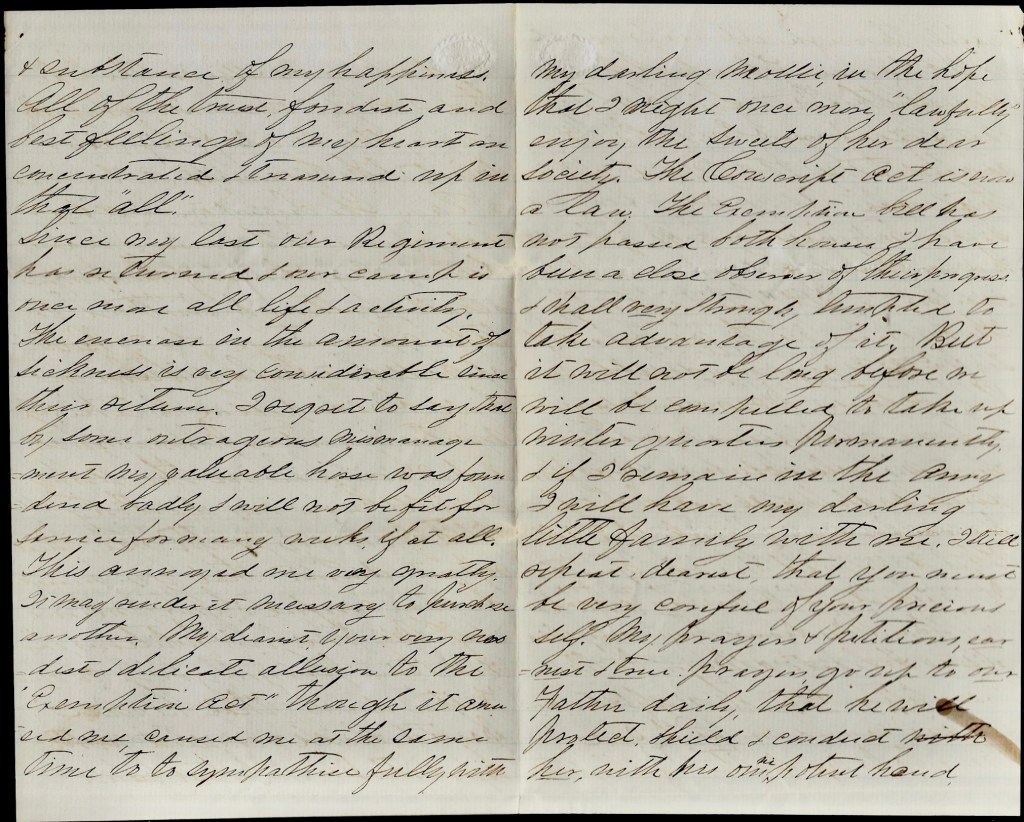
Your very dear & treasured letter of the 23rd inst. came to me promptly last night. Your letters, dearest one, are very precious to me. Their tone, style & expressions remind me so much of her who is so fondly treasured by me. Indeed, my own sweet Mollie, your tender & loving letter afford me exquisite pleasure. They make my heart leap and bound with delightful emotions of sympathetic love and fondness. The the happy, very happy information that “All” were well. That “All” means really “All.” It is in truth all to me. It is the all with which my fond & devoted heart is snapped up with. It is the very sum and substance of my happiness. All of the trust, fondest and best feelings of my heart are concentrated & treasured up in that “all.”
Since my last, our regiment has returned & our camp is once more all life & activity. The evenness in the amount of sickness is very considerable since their return. I regret to say that by some outrageous mismanagement, my valuable horse was foundered badly and will not be fit for service for many weeks, if at all. This annoyed me very greatly. It may render it necessary to purchase another.
My dearest, your very [n____dist] & delicate allusion to the “Exemption Act”—though it amused me—caused me at the same time to sympathize fully with my darling Mollie, in the hope that I might once more “lawfully” enjoy the sweets of her dear society. The Conscript Act is now a law. The Exemption Bill has not passed both houses. I have been a close observer of their progress & shall [be] very strongly tempted to take advantage of it, but it will not be long before we will be compelled to take up winter quarters permanently & if I remain in the army, I will have my darling little family with me. I still repeat, dearest, that you must be very careful of your precious self. My prayers and petitions, earnest & true prayers go up to our Father daily, that He will protect, shield, and conduct her with His omnipotent hand safely through all her trials, who is the treasure of my heart, & preserve her to me in future.
I was surprised to learn of the death of my old friend B. Guinn. As you say, I fear that he was taken away badly prepared to meet his maker.
One of our officers heard a rumor in Richmond this morning that our army was falling back from the Potomac. There is no doubt that our army is in a suffering condition. There being thousands of sick, wounded & broken down men straggling—our Northern Virginia in a starving condition. Now dearest one, may our Father manifestly spare thee to me, preserve our little darlings to us. Kiss them for me. My love to all at Pa’s. Respects to Miss N.
Ever dearest, your true & loving husband, — Bedford
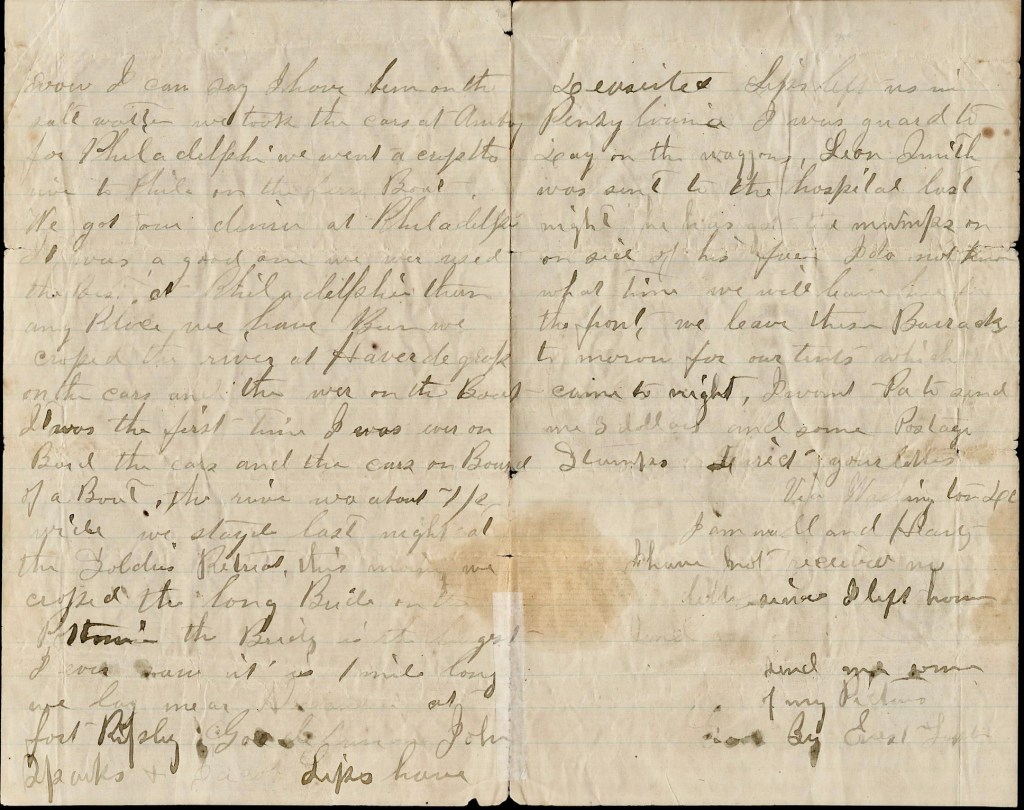
This letter was written by Ernest Leolin (“Lee”) Lapham (1846-19xx) who was 18 years old when he enlisted on 25 February 1864 to serve three years in Co. G, 25th Ohio Volunteer Infantry. He began his service as a private, was promoted to corporal on 1 August 1865, and made sergeant before he was mustered out in June 1866. Since the original members of the 25th OVI mustered out of the service on 16 July 1864 after their three years service, all that remained in the regiment were those original members who reenlisted as veterans and the new recruits. The only battlefield experience these new recruits would have was at the Battle of Honey Hill in South Carolina where the regiment’s losses in killed and wounded was 150.
Ernest was the son of Stephen Lapham (1821-1896) and Lucinda M. Hall (1823-1904) of Republic, Scipio township, Seneca county, Ohio. He was employed as a carpenter prior to his enlistment. After he was discharged from the service, Ernest came home to marry Sarah Jane (“Jennie”) McVay (1846-1918). He farmed for a time with his father-in-law in Shelby county, Ohio, and then relocated to Newton, Harvey county, Kansas, where he worked as an agent for a mining company.
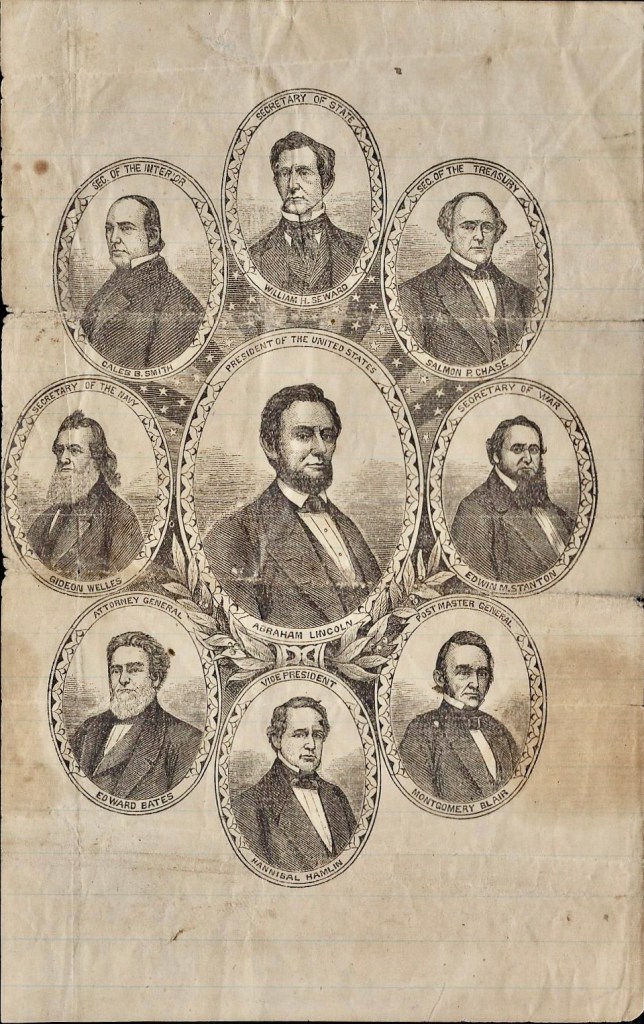
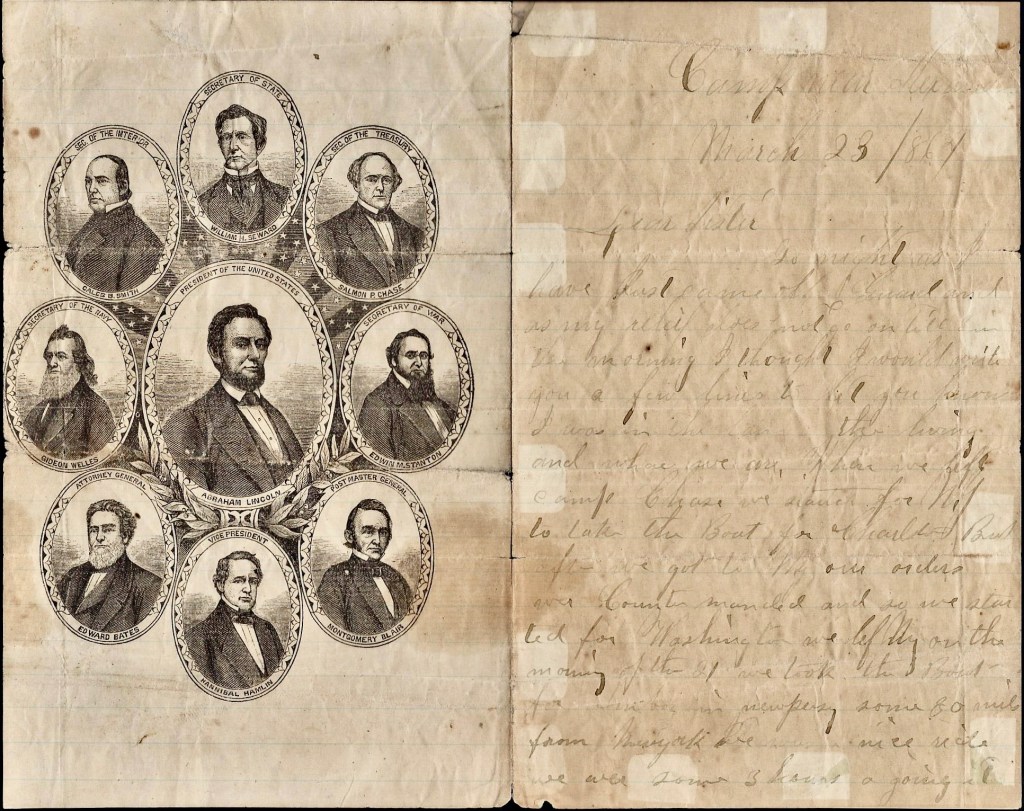
Lee Lapham wrote his letter on stationery that included an engraving of President Lincoln and his Cabinet at the time (1864)
Transcription
Camp near Alexandria, Virginia March 23, 1864
Dear Sister,
Tonight as I have just come off guard and as my relief does not go on till 8 in the morning, I thought I would write you a few lines to let you know I was in the land of the living and where we are. When we left Camp Chase, we started for New York to take the boat for Charleston but after we got to New York, our orders were countermanded and so we started for Washington. We left New York in the morning of the 21st [March]. We took the boat for Amboy in New Jersey some 80 miles from New York. We had a nice ride. We were some 3 hours a going it. Now I can say I have been on the salt water. We took the cars at Amboy for Philadelphia. We went across the river to Philadelphia in the ferry boat. We got our dinner at Philadelphia. It was a good one. We were used the best at Philadelphia than any place we have been.
We crossed the river at Havre-de-Grace on the cars and they were on the boat. It was the first time I was ever on board the cars and the cars on board of a boat. The [Susquehanna] river was about half mile wide. We stayed last night at the Soldier’s retreat. This morning we crossed the Long Bridge over the Potomac. The bridge is the longest I ever saw. It is 1 mile long. We lay near Alexandria at Fort Ripley.
Good___, John Sparks, and Jacob Lips have deserted. Lips left us in Pennsylvania.
I was guard today on the wagons. Leon Smith was sent to the hospital last night. He has got the mumps on one side of his face. I do not know what time we will leave here for the front. We leave these barracks tomorrow for our tents which came tonight. I want Pa to send me 3 dollars and some postage stamps. Direct your letters to Washington D. C. I am well and hearty. I have not received any letters since I left home.
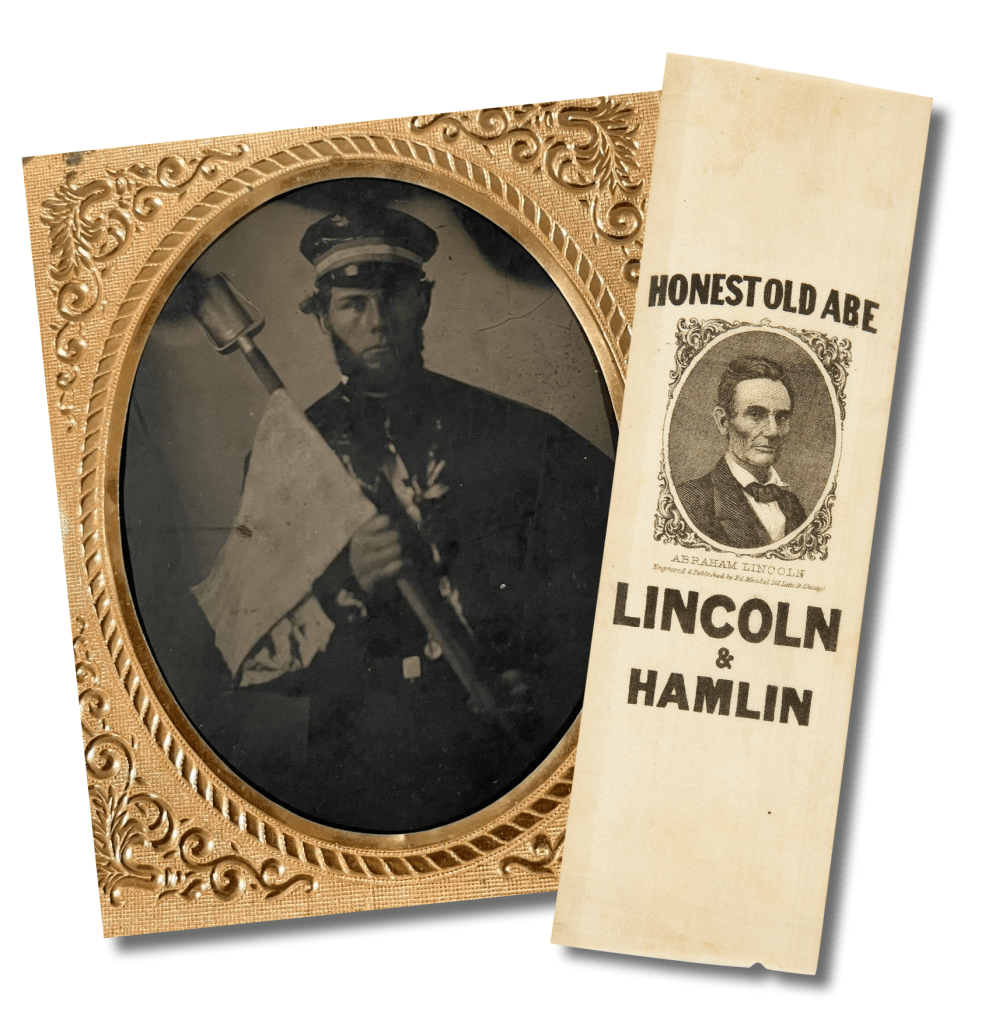
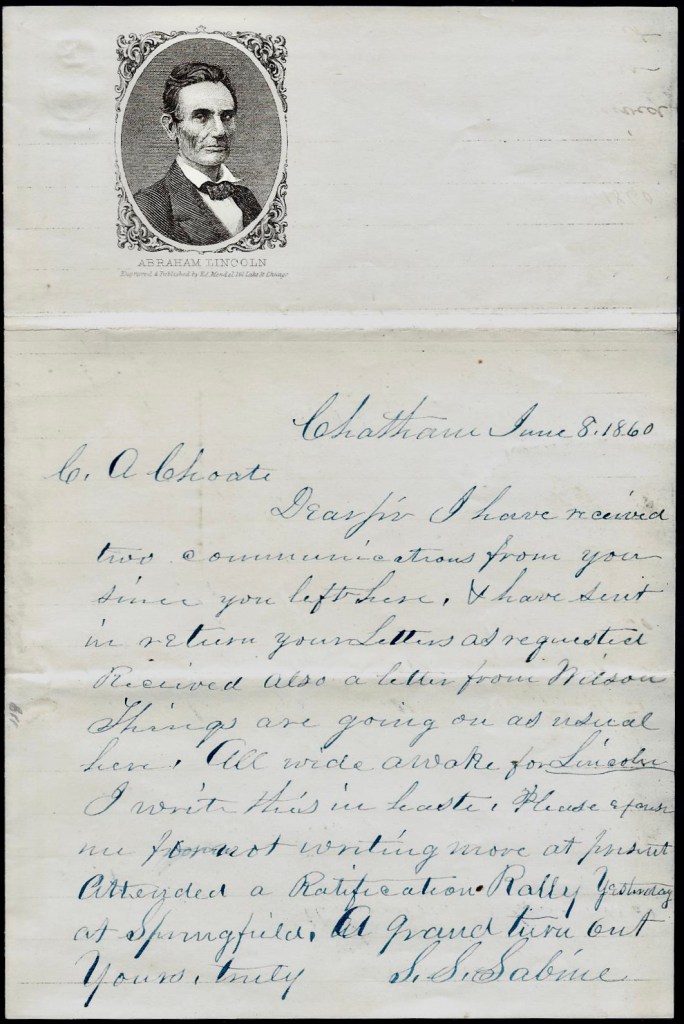
This brief letter was written on extremely rare stationery incorporating an engraving of Abraham Lincoln by the well-known Chicago engraver, Edward Mendel. 1 I have seen this engraving on a campaign ribbon, poster, and an envelope but not on stationery previously. For most voters, this was the image of Lincoln that served to introduce him to the American public.
Unfortunately I cannot confirm the identity of the correspondents but believe them to be Sheridan S. Sabine and Charles Augustus Choate—both patriotic youths of Illinois who would have been the kind to have campaigned for Lincoln and participated in Wide Awake torchlight parades. Twenty-one year-old Sheridan (1839-1876) was a joiner in Chatham whose father was postmaster, allowing himself and family to send mail without paying postage (a perk of the postal employees). When the new President called for soldiers, Sheridan took the oath as a volunteer on 27 July 1861, as a corporal in Co. A, 3rd Illinois Cavalry. He served out his full three years with the company, mustering out on 5 September 1864.
Eighteen year-old Charles A. Choate (1842-1915) was a young college-bound student whose father, Charles Choate, was an 1823 graduate of Bowdoin College and physician who settled down as a farmer in Montebello township, Hancock county, Illinois, when his heath failed—his home on a bluff overlooking the Mississippi river.
An 1860 Lincoln Campaign Ribbon with Mendel’s engraving of Lincoln and an unidentified Wide Awake torch bearer from the personal collection of Adam O. Fleischer
Transcription
Chatham [Sangamon county, Illinois] June 8, 1860
C. A. Choate Dear Sir,
I have received two communications from you since you left here & have sent in return your letters as requested. Received also a letter from Wilson. Things are going on as usual here. All wide awake for Lincoln. I write this in haste. Please excuse me for not writing more at present. Attended a Ratification Rally yesterday at Springfield. A grand turn out. 2
Yours truly, — S. S. Sabine
1 “Edward Mendel, for many years a lithographer in this city, and known as a man who has been closely identified with Chicago’s business interests for over a quarter of a century, died at his residence, No. 2321 Wabash avenue, yesterday evening at 7:30 o’clock. For many months the insidious but deadly Bright’s disease had been assailing his system, and at last the foe became the victor. Mr. Mendel was born in Berlin, Germany, in 1828, receiving his education in that country and learning the trade of a mapcarver. When 22 years of agehe came to America. Engaged for a short time at his trade in Cincinnati, he soon came further West and ere long was at work in Chicago, and was also employed for a while on a surveying corps. About the year 1853 be began the work of lithographing. He started in this business on Lake street; near La Salle, occupying the old John Link Building. His business began to enlarge, and about three years before the great fire he moved into the First National Bank Building, located at the southwest corner of State and Washington streets. There the fire found him and there the fire left him, well nigh penniless at best, so far as his business interest was concerned. Not daunted by adversity, he again began business at the corner of State and Twenty-second streets, afterward moving down to the Hoffman Building on Fifth avenue, between Madison and Monroe street. He rapidly regained his former position and again moved, this tie to the fourth floor of the Times Building on Fifth avenue, which latter place he occupied up to the time of his death. As a man of close attention to business, of industry, of loyal devotion to the work which claimed much of his time and talent, Mr. Mendel was known by a large circle of business friends. A man of native reticence and averse to courting society he yet left a strong impression of his own individuality upon those who knew him. Mr. Mendel had become the possessor of a good deal of valuable city property, owning the Mendel Block, on the northeast corner of Pacific avenue and Van Buren street, a number of houses on Wabash avenue aside from his residence, and other property which would perhaps bring wealth close up to a half a million dollars. In 1863 Mr. Mendel was married in this city to Miss Sarah Joy, by whom he has had three children, Edward and Albert, two of them now living, the eldest on now nearing manhood. Thirty years of active business life in Chicago, conducted upon the careful and conservative principles which governed his life, could not but have won Mr. Mendel many friends, who will join their sympathy to the sorrow of the bereaved family.” [Obituary posted in Inter Ocean, April 5, 1884]
2 A “Ratification Rally” was merely a campaign rally to endorse the Republican nominee for President of the United States.
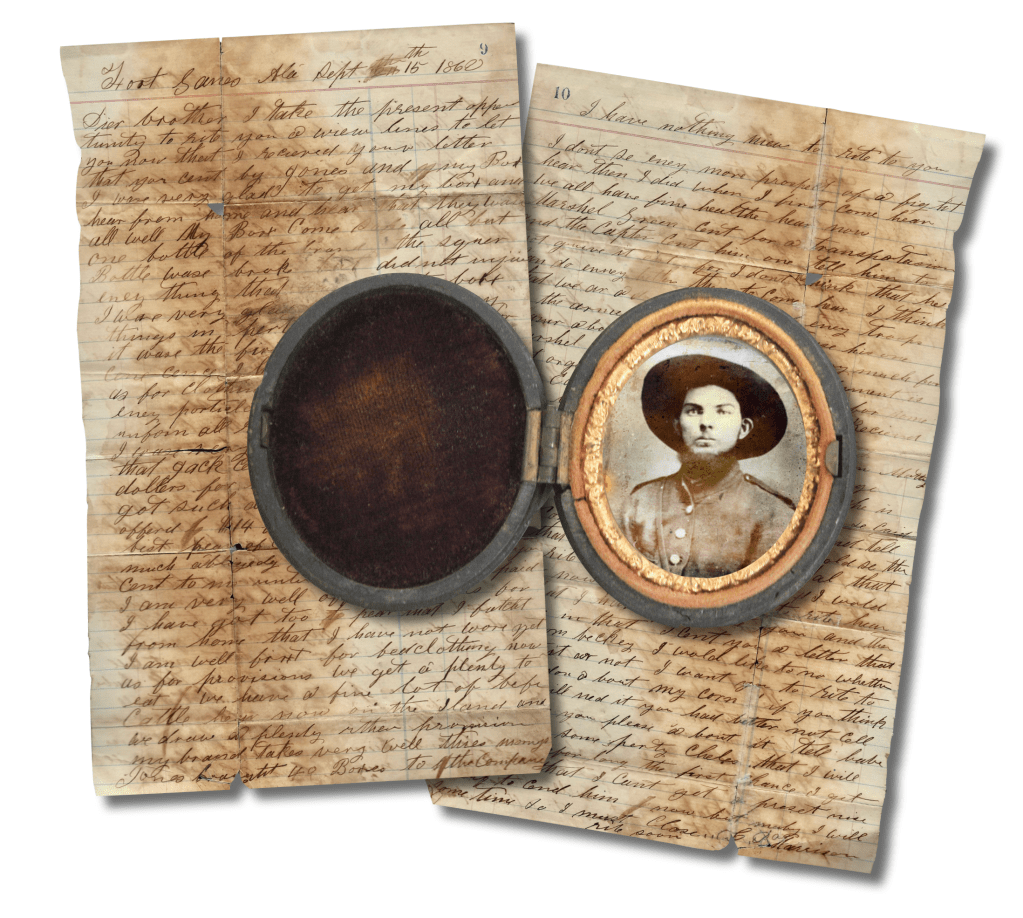
This letter was written by Columbus D. Harrison (1836-1879) who enlisted as a private in the 1st Confederate Regiment Infantry, 2nd Co. E, on 1 May 1862. He was later transferred to 2nd Co. K. This regiment was originally known as 1st Villepigue’s Independent Battalion and the 36th Regiment, Georgia Infantry, (Villepigue’s). Its designation was later changed to 1st Confederate Regiment Infantry and it was also known as the 1st Confederate Regiment, Georgia Infantry.
Columbus surrendered with his regiment at Greensboro, North Carolina, on 26 April 1865.
Columbus was the son of John J. Harrison (1808-1874) and Saphronia McFarland (1810-1850) of Walker county, Georgia. He was married to Martha J. Cooper (1849-1921) in December 1868 in Catoosa county, Georgia.
Columbus’s Letter with image of Pvt. James Henry Pascoe of Co. E, 36th Georgia Infantry
Transcription
Fort Gaines, Alabama September 15th 1862
Dear brother,
I take the present opportunity to write you a few lines to let you know that I received your letter that you sent by Jones and my but I was very glad to get my box and hear from home and hear that they was all well. My box come safe—all but one bottle of the brandy. The square bottle was broke but did not injure anything that was in the box. I was very glad to get all of my things, in particular the brandy, for it was the first drop that I have seen since I have been on this Island. As for clothing I was not needing any[thing] particular. Jones bought our uniforms already made in Atlanta. I was very glad to get the shirt that Jack sent me. I was offered ten dollars for it. I can’t see where Jack got such a nice one at and I was offered $14 for my shoes. They are the best pair of shoes in camp. I am so much obliged to you all for what you sent to me until you are better paid. I am very well off for socks, for I have got two pair that I fetched from home that I have not wore yet. I am well fixed for bed clothing now. As for provisions, we get a plenty to eat. We have a fine lot of beef cattle here now on the Island and we draw a plenty other provisions. My brandy tastes very well this morning. Jones brought 40 boxes to the Company.
I have nothing new to write to you. I don’t see any more prospect of a fight here than I did when I first come here. We all have fine health here now. Marshal Green sent for a transportation and the Captain sent him one. Tell him to not give it out for I don’t think that he can do any better than to come here. I think that we are a doing the best of any troops in the army, but tell him to use his own pleasure about it. I would like very much for Marshal to come down here. Our regiment is not organized yet. We are a looking for some more companies here before long.
I received three letters from the Cove the other day—one from Jane Collins and one from Matty and one from Jane Strong. Jane Strong wrote me a very nice letter. I think she is a taking on very much about you & said that she wanted me to write to you and tell you to come up oftener. I wish you could see the letters that they wrote to me. Tell Sal that I will write to her before long. I would to her now, but I nothing to write here but what I have just wrote you and there is no use in that. I sent you a letter that I got from Becky. I would like to know whether you got it or not. I want you to write to what you done about my corn. If you think that you will need it you had better not sell it. So do as you please about it. Tell babe that I have some pretty shells that I will send her before long the first chance I get. Tell Jack that I can’t get a present nice enough to send him now, but maybe I will some time. So I must close. Write soon. — C. D. Harrison
This letter was written by 46 year-old Thomas Wainwright Colburn (1816-1882), the son of dry goods merchant Joshua Colburn (1783-1873) and Eunice Jones (1784-1871) of Boston, Suffolk county, Massachusetts. Thomas wrote the letter to his older brother, George Wood Colburn (1814-1896) who married Sarah Hovey Foster (1820-1914) in 1842.
Thomas made his way to gold fields of California in the early 1850s, taking up residence in Nevada City, California as early as 1852, possibly earlier. In was here in Nevada City that Thomas met and married his wife, Louise Mather (1821-1916) of Albany, New York. While in Nevada City, Thomas apparently entered into the firm Colburn & Jenkins which went bankrupt in 1856. I don’t know for certain what this business was but think it may have been a water canal enterprise associated with the mines. In 1870 Thomas was still affiliated in the mining industry, serving as secretary of the Hidden Treasure company in San Francisco. Thomas died in Stockton, California in 1882.
The letter is marvelously written and readers will no doubt marvel at the author’s prescience—and the confidence with which he expresses it—at the outcome of the civil war that has erupted between the North and South. He, I think, fairly accurately puts his finger on the cause of the “acrimony,” attributing it to the lack of understanding between the residents of the two regions who for too many years were fed falsehoods about each other by biased newspapers, leading to an “unjust prejudice.” [These distortions of reality are captured wonderfully in Thomas Flemings’s book, “A Disease in the Public Mind” published in 2013]
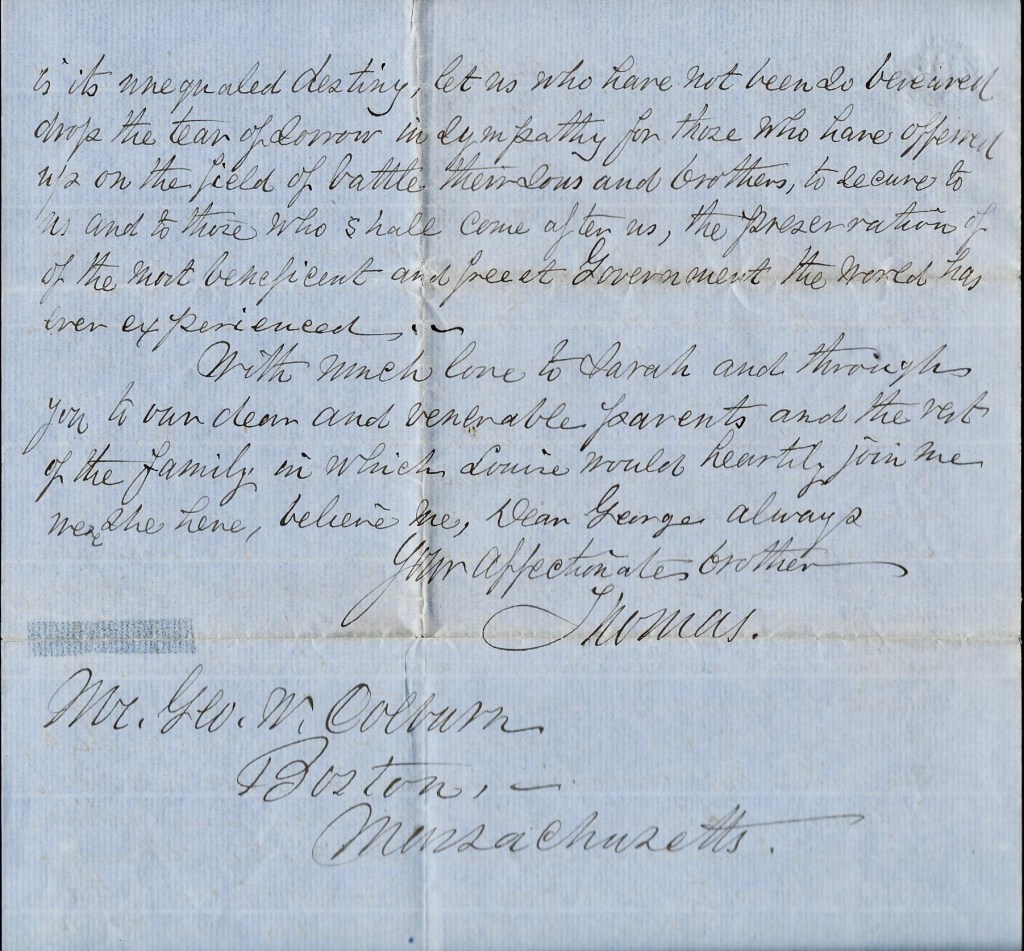
I particularly like his final sentiment which reads: “But while the Country is struggling through this sad and bitter experience in order that it may arrive at that future greatness with greater speed and certainty that is its unequaled destiny, let us who have not been so bereaved drop the tear of sorrow in sympathy for those who have offered up on the field of battle their sons and brothers, to secure to us and to those who shall come after us, the preservation of of the most beneficent and freest Government the world has ever experienced.”
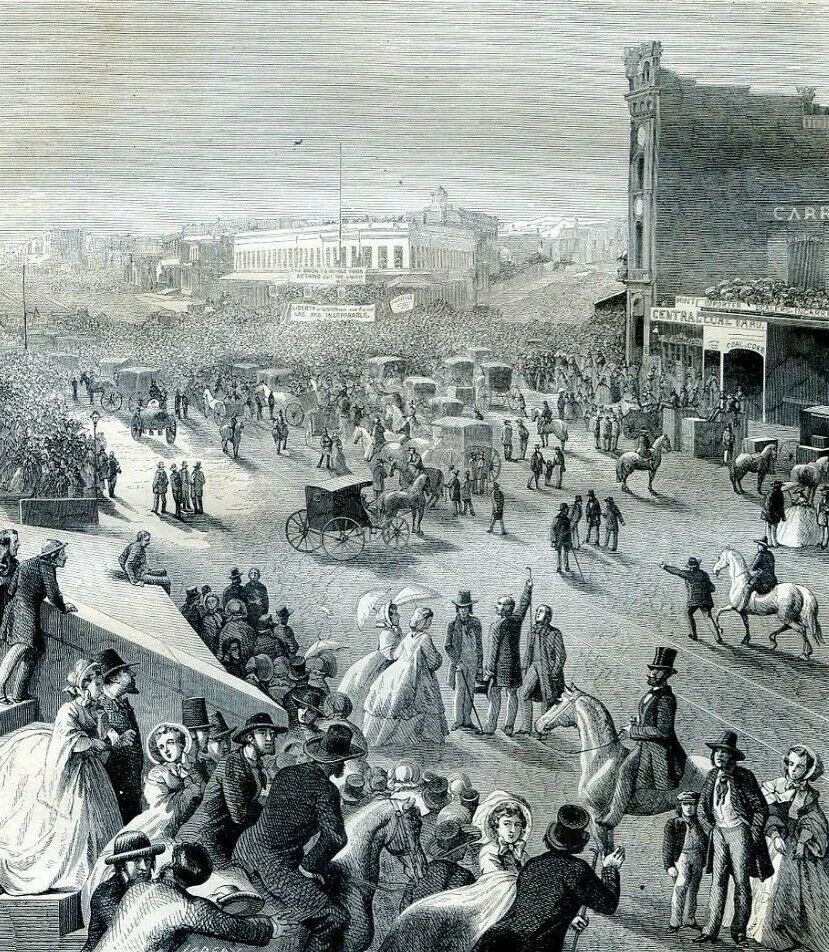
Engraving of San Francisco in 1862
Transcription
Per steamer via Panama 215 California Street San Francisco [California] February 20th 1862
Dear George,
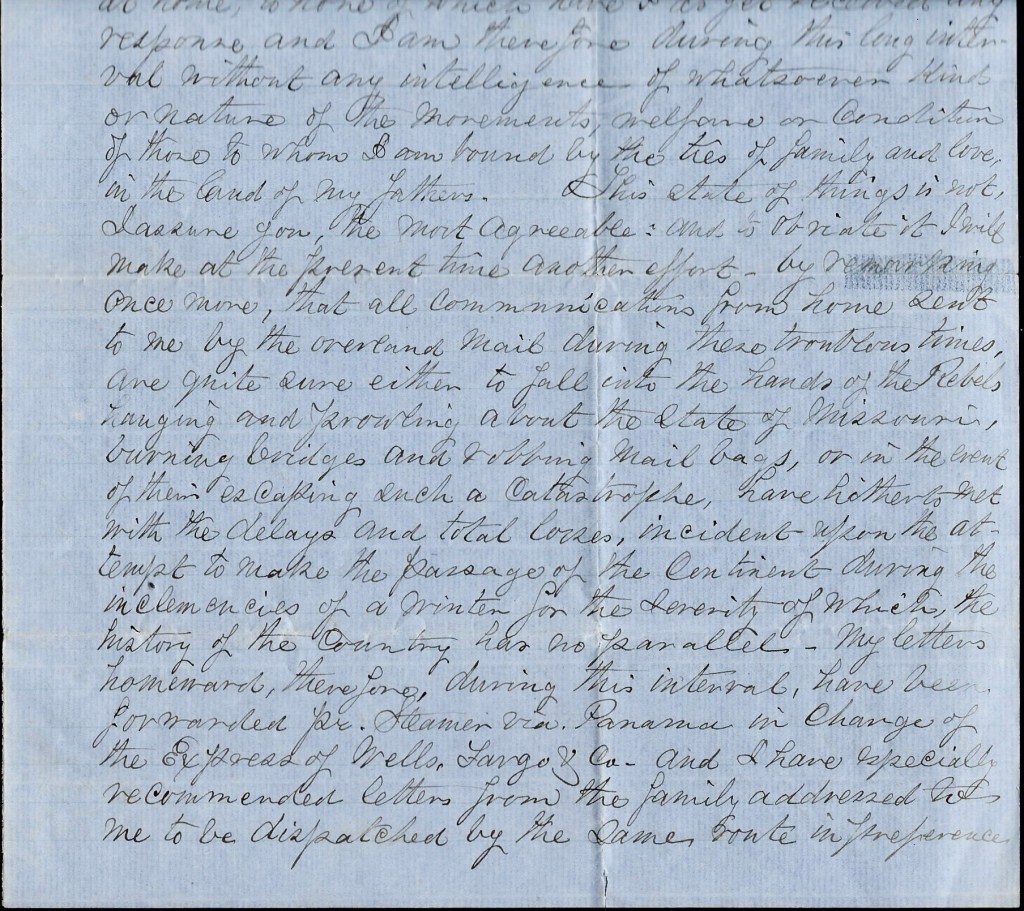
Since my sojourn in this city, which dates back to the middle of October last, I have written sundry and various letters to the members of the family at home, to none of which have I as yet received any response and I am therefore during this long interval without any intelligence of whatsoever kind or nature of the movements, welfare or condition of those to whom I am bound by the ties of family and love, in the land of my fathers. This state of things is not, I assure you, the most agreeable; and to obviate it I will make at the present time another effort by remarking once more, that all communications from home sent to me by the overland mail during these troublous times, are quite sure either to fall into the hands of the Rebels hanging and prowling about the State of Missouri, burning bridges and robbing mail bags, or in the event of their escaping such a catastrophe, have hitherto met with the delays and total losses, incident upon the attempt to make the passage of the Continent during the inclemencies of a winter for the severity of which, the history of the county has no parallel. My letters homeward, therefore, during this interval, have been forwarded per Steamer via Panama in charge of the Express of Wells, Fargo & Co. and I have especially recommended letters from the family addressed to me to be dispatched by the same route in preference to having them subjected to the uncertainties and vicissitudes of the Overland Mail.
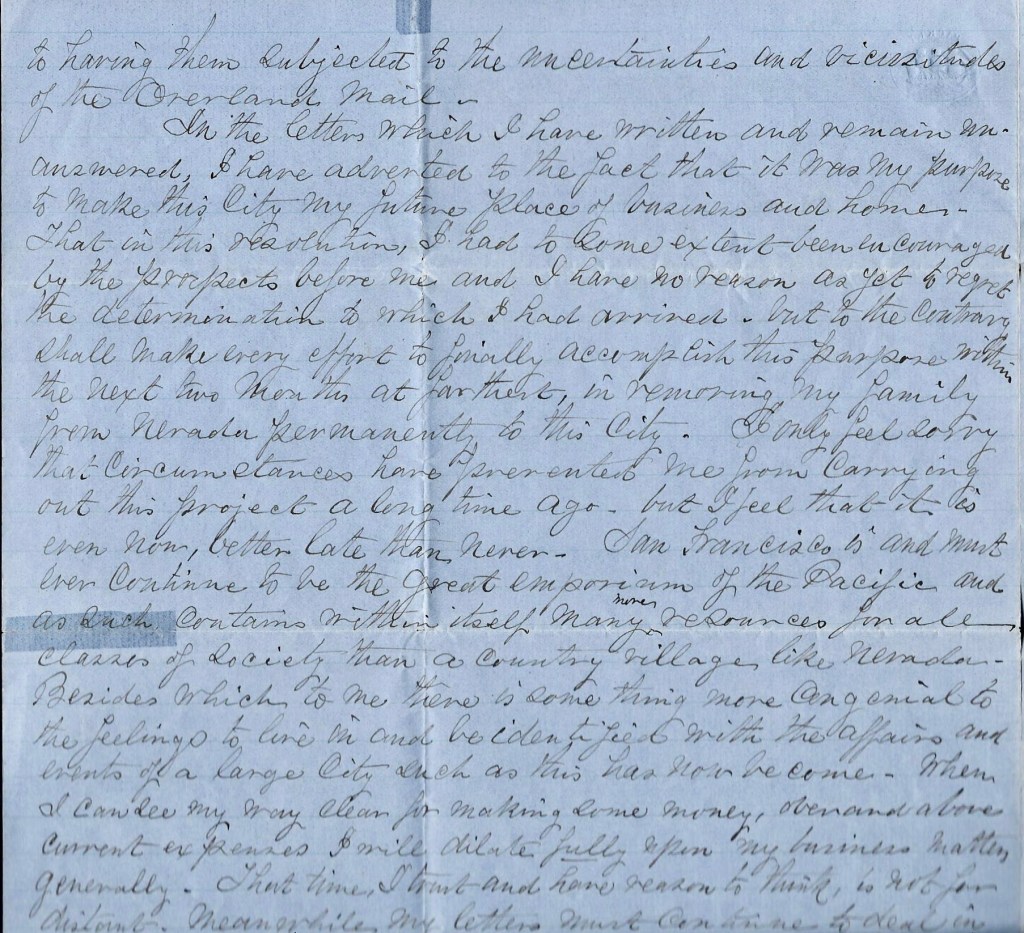
In the letters which I have written and remain unanswered I have adverted to the fact that it was my purpose to make this City my future place of business and home. That in this resolution, I had to some extent been encouraged by the prospects before me and I have no reason as yet to regret the determination to which I had arrived, but to the contrary shall make every effort to finally accomplish this purpose within the next two months at farthest, in removing my family from Nevada permanently to this City. I only feel sorry that circumstances have prevented me from carrying out this project a long time ago, but I feel that it is even now, better late than never.
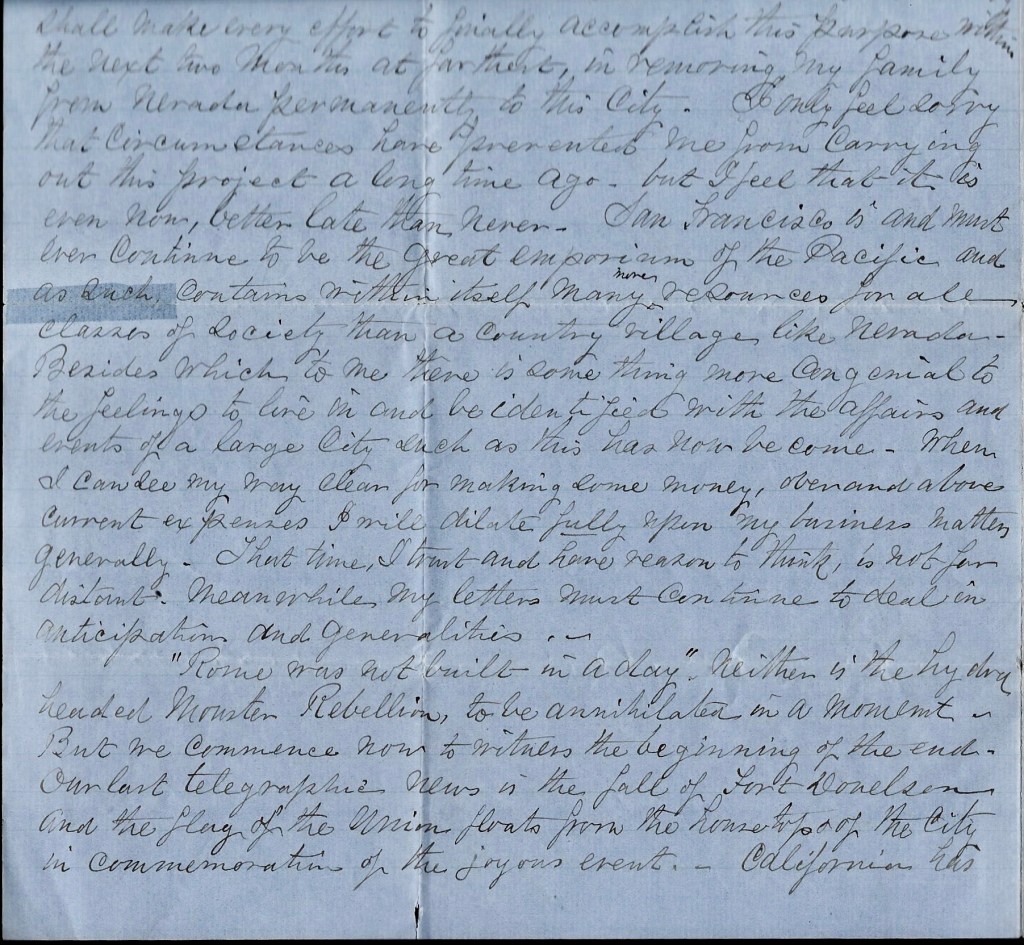
San Francisco is and must ever continue to be the great emporium of the Pacific and as such contains within itself many more resources for all classes of society than a country village like Nevada. Besides which, to me, there is something more congenial to the feelings to live in and be identified with the affairs and events of a large city such as this has now become. When I can see my way clear for making some money, over and above current expenses, I will dilate fully upon my business matters generally. That time, I trust and have reason to think, is not far distant. Meanwhile my letters must continue to deal in anticipations and generalities. “Rome was not built in a day.” Neither is the hydra headed monster Rebellion to be annihilated in a moment. But we commence now to witness the beginning of the end.
Our last telegraphic news is the fall of Fort Donelson and the flag of the Union floats from the housetops of the City in commemoration of the joyous event. California has been from the first as loyal as any State of the Union and her great heart throbs in unison with her loyal sister States east of the Rocky Mountains. Sarah asked me some time since whether when this foul rebellion is once crushed, we would ever again become in sentiment—as well as in name—a united people. My reply is most emphatically in the affirmative. The acrimony which now exists on the part of the South had its origin in an unjust prejudice based upon almost inexcusable ignorance as to the real sentiments and feelings of the North. When the truthful page of history commences to make the record of this eventful period, this and future generations of southern men—when the passions of the human heart have subsided and reason reigns once more supreme—will peruse that page thoughtfully & dispassionately, and when the task is done, they will acknowledge with shame their ingratitude, their madness, and their blindness in the suicidal course they have pursued.
“But while the Country is struggling through this sad and bitter experience in order that it may arrive at that future greatness with greater speed and certainty that is its unequaled destiny, let us who have not been so bereaved drop the tear of sorrow in sympathy for those who have offered up on the field of battle their sons and brothers, to secure to us and to those who shall come after us, the preservation of the most beneficent and freest Government the world has ever experienced.”
Thomas Colburn, citizen, San Francisco, 20 February 1862
The North in its magnanimity towards a conquered brother, will seek every opportunity to show its generosity by word and deed and thus within this generation link again the South to itself in bonds of fraternal amity which no future contingencies can ever sever again. And another decade will witness the great and glorious spectacle of the most united people—the most prosperous and the mightiest nation on the face of the globe—never again to be disturbed by any internal dissensions and impregnable against the combined forces of the Old World. It takes no prophet nor the son of a prophet to predict this—and even far more. But while the Country is struggling through this sad and bitter experience in order that it may arrive at that future greatness with greater speed and certainty that is its unequaled destiny, let us who have not been so bereaved drop the tear of sorrow in sympathy for those who have offered up on the field of battle their sons and brothers, to secure to us and to those who shall come after us, the preservation of the most beneficent and freest Government the world has ever experienced.
With much love to Sarah and through you to our dear and venerable parents and the rest of the family in which Louise would heartily join me were she here, believe me, dear George, always
This letter was written by a Swiss emigrant named John Bally (1827-1902) who arrived in the United States in 1849. After his first wife Clara Dickson (1828-1859) died in 1859, John remarried to Harriet E, Marvin (1838-1911). In the 1850 US Census, John was enumerated in Oswego, New York, where he worked as a silversmith. By 1860 he had relocated to Deposit, New York, where he was identified as a “watchmaker” or a “jeweler.” John received his naturalization papers from the State of New York in April 1855.
When the Civil War began in 1861, John offered his services as a musician in the regimental band of the 41st New York Infantry. He served in the band from June 1861 until he was discharged on 7 October 1862 by order the War Department when it was determined that regimental bands were an unnecessary war expenditure. He later reenlisted as a musician in Co. A, 144th New York Infantry on 30 August 1864 and was mustered out on 25 June 1865 at Hilton Head, South Carolina.
John’s letter contains a very good description, recounted by those who survived it, of Gen. John P. Hatch’s Expedition up the Broad River on 29-30 November 1864 and specifically of the Battle of Honey Hill on the 30th. From Boyd’s Landing on the Broad River, Hatch’s forces—half of them Black troops–launched an attack on the railroad junction at Gopher Hill, 36 miles northeast of Savannah and 84 from Charleston. Due to delays in their arrival, Rebel forces anticipated their attack and were able to amass 1400 militia to join the South Carolina cavlary and artillerymen under Col. Charles Colcock in fixed fortifications at Honey Hill.
In a series of failed attacks on the rebel fortification that have since been attributed to the “irresolute leadership” of Gen. Hatch, the Union forces suffered 746 casualties. The first assault was made by the 35th United States Colored Troops (USCT) regiment up the Grahamville Road to Honey Hill. After they were repulsed, the 55th MA (Colored) regiment charged up the Grahamville Road to Honey Hill three times, each charge with 5 of 8 companies in field column. During the second assault, a supporting charge on their left flank by the 127th New York was orchestrated but all three of these charges were repulsed. Finally the 25th OVI charged unsupported on the Confederate rifle-pits north of Honey Hill and was also repulsed. Each assault was repulsed and defeated in detail as the Confederates were allowed to concentrate sequentially their fire on one Union attack at a time. Between and during these assaults, the front line Union regiments engaged the Confederate position with small arms fire. [Sources: The Battle of Honey Hill, by Lowell D. Hamilton, and Civil War Letters & Diary of Henry W. Prince, 127th New York State Volunteers]
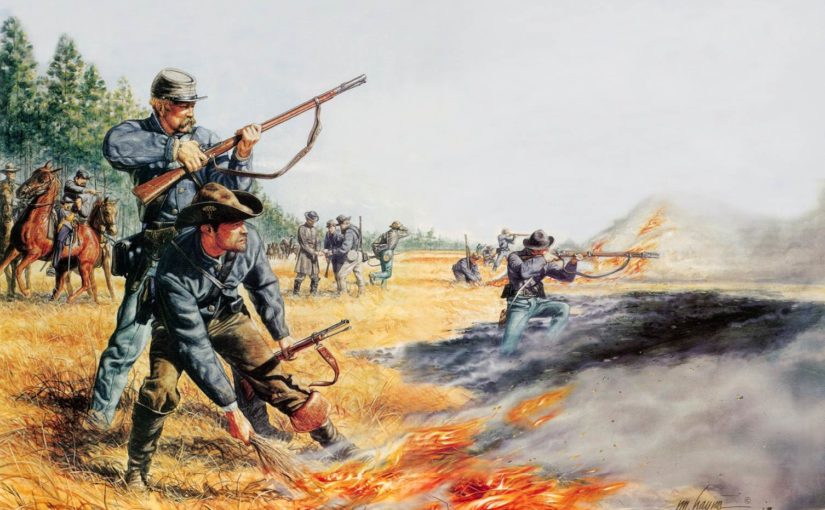
Rebels delay the approach of Union forces with fire and bullets at Honey Hill
Death of John Bally Elmira, N. Y., Sept. 19.–John Bally, senior member of the jewelry house of John Bally & Son, 330 E. Water St., was buried to-day. Mr. Bally’s death, which occurred Tuesday at his home, 311 Columbia St., was due to heart failure, superinduced by acute indigestion.
The deceased was a prominent citizen of this city as well as one of its oldest Jewelers. He was born in Geneva, Switzerland. July 16, 1827, and attended school and college in his native country. In early life he learned the trade of watchmaker, and when 21 years old he left Switzerland to seek his fortune in the United States.
He located first in New York, where he became employed as watchmaker by the old house of Ball, Black & Co., and shortly afterwards moved to Oswego, where he remained for about three years. During his stay in Oswego he married Miss Clara Dickinson, and later moved to Buckingham and finally to Deposit. In this last place he remained for 11 years, and during his stay there his wife died, and he subsequently married Miss Harriet Marvin.
Toward the latter part of the Civil War Mr. Bally joined the 144th New York Volunteers and served until 1865. After the war Mr. Bally moved to Elmira, which city was his home for the remainder of his life. The firm of John Bally & Son, of which Louis E. Bally, Jr., is a member, was the one interest to which the deceased devoted all his energy until he retired from business a short time ago. Besides being a practical jeweler and a successful merchant, Mr. Bally was also an artist of considerable ability.
The deceased was a Mason, was a member of the Patriarchs’ Club, and was one of the oldest members of the Park Church. He is survived by his seven children– four sons and three daughters.
Source: The Jewelers’ Circular and Horological Review – 24th September 1902
John wrote the letter to his friend Horace Swallow Reed (1824-1891), the proprietor of a marble works in Deposit, New York. Horace was married to Francis Elizabeth Hull (18xx-1907). In the 1860 US Census, Horace was identified as an hotel keeper in Dorset, Bennington county, Vermont, but ten years prior to that he was in the marble business.
Transcription
Addressed to H. S. Reed, Esq., Deposit, Delaware county, New York
Hilton Head, South Carolina December 8th 1864
Mr. H. S. Reed Dear Sir & Brother,
It is now almost four months since I left home and at this late date only have I at last made up my mind to write a few lines to you. The reason why I have not done so previously was not that I had forgotten you, far from it, as in almost all my letters to my wife I have sent you my compliments, but not having anything of interest to write, I thought I would wait and when something worth writing about should take place, I would then give you the news. Now that our regiment has broke up its long resting spell and that war in its ugly form has begun in earnest around us, then I thought that a few lines would be acceptable to you.
Last Monday a week ago, our regiment embarked aboard transports with other troops from Florida & Morris Island and some negro troops, among them the 26th Colored—the regiment in which our colored boys from Deposit are in and who were stationed at Beaufort S. C., about 10 miles from here. They started up Broad River with the intention of cutting off the railroad connecting Savannah with Charleston. After some severe blunders and considerable time lost, they effected a landing and after marching a few miles, met the enemy in force who gave them battle, and who, by the way, set a large marsh on fire so that our boys had to fight fire and bullets, saying nothing of shells which the rebel’s artillery threw away with great liberality.
The news that I give you I gathered from wounded brought here in the hospital, not having the pleasure of being a participant nor any eye witness, the Band having been left behind, to learn some new pieces and to guard the camp—-I do not know which, but here we are—and what I am writing about you, you must take it as I have but at the same time as all seemed to give the same story it must be near the truth.
“All who have come back to camp says without exception that the colored troops fought splendidly and that no better fighting was ever done. They made charge after charge to the mouth of them guns, but to no avail. But friend Reed, had you been here and saw the poor wounded when brought to the hospital, you might have found your blood taking fire—nay anxious—to go and avenge them.”
—John Bally, musician in 144th New York, 8 December 1864
On Tuesday and Wednesday our troops drove the Johnnies some four miles till they came upon strong breastworks, well defended with heavy artillery. They, not being sufficiently strong to carry them, they fell back to their starting point [with] our regiment—the 144th [New York Infantry], covering the retreat. All who have come back to camp says without exception that the colored troops fought splendidly and that no better fighting was ever done. They made charge after charge to the mouth of them guns, but to no avail. But friend Reed, had you been here and saw the poor wounded when brought to the hospital, you might have found your blood taking fire—nay anxious—to go and avenge them. For my part, I almost cursed my being in the band and thought it the place of a coward. But if I was not permitted to fight, I done the next [best] thing, and that was to volunteer in the hospital and take care of my poor brother soldiers. During the engagement we could plainly hear the cannonading and every report would make me jump out of my boots, feeling so much anxiety for the result of the fight, knowing the small number of troops sent there and the facilities of the rebs in concentrating theirs. We lost, as near as I can find out, from 800 to 900 men. Our regiment lost about 88 killed, wounded & missing.
I told you our troops fell back to the landing under the protection of the gunboats and then entrenched themselves. Since, they have made several reconnaissance’s and the last news from the front who came here today is that by another road they have turned the rebs’ earthworks and have drove them to half mile from the railroad and now command the road. This was done Tuesday this week and today some heavy artillery is being sent to the front. A load of prisoners has just come up and judging from their appearance, the rebs must be pretty hard up. They are old men and boys from 14 to 16 years old.
In this last fight our forces were very lucky and had all the advantage. The Rebs left in our hands all their killed and wounded, things which they did not in the first fight. It seems that by that flank movement our artillery took them with an enfilading fire and mowed them down by the score. Today we are informed that Gen. Foster, who is in command of our troops, has received a message from Sherman, who is now near Savannah, and that movement against that railroad was—and is, without any doubt—to cut up reinforcements that Lee might send against him.
This afternoon for about two hours, a very heavy cannonading was distinctly heard in the direction of Savannah and we all think and hope that it is Sherman thundering at its gates. May God grant that it may be so. According to the appearances and judging from the amount of ordnance and ammunition sent to the front with the large number of entrenching tools, all go to show that Foster means to hold the position he has gained, and by that means cooperate with Sherman.
There is a bridge in that locality called the Pocotaligo bridge; that bridge is two miles long and a trestle work ten miles long over a large swamp. I do not now think the intention is to destroy it. If they can [just] hold it, it will be of great use in the future. I understand that our artillery knocked off a train of cars yesterday and that they do not run any more trains over it. But what I write about is only my opinion formed by what I gather around me and I give it to you for what its worth and not be be relied on any more than what you may read not officially though I think it pretty near the truth. I presume that the New York papers have heard from this quarter by this time and you will have chance to compare notes.
Our friend, Charles Ediely [?] was among the unlucky—or rather the lucky ones. He is wounded—a slight flesh would over the left shoulder enough to make him pretty mad but that will keep him in camp till after this execution is over. Told his father that he musn’t trouble himself about him. He is doin finely. Now Friend Reed, a few more words about myself. Here I am doing nothing, or rather doing no duty but what we volunteer to do. It is lonesome enough here since the regiment went away and aside from learning some new music, nothing for us to do. When the regiment was here, we had our hands full. But now, escorting dead soldiers to their last resting place constitutes our main business— rather lonesome one it is.
I have written to Ellicot Evans a good while ago to send me the Gen. Lyons Funeral March that our band at home used to play but I have not seen anything of it yet. I would give most anything for it. When you see him, please remember it to him, if you please. I am enjoying the best health in the world and as we Band are messing together, we have the best kind of rations and of course are benefitted by it. My quarters are very good. I have a good A tent with boards all around it and a good floor, have a little stove in it and am just as comfortable as can be. The weather here is delightful. It is warmer here than June at home and have had fire but twice in the evening so far. Mosquitos, flies, fleas, &c. are plenty here; butterflies are flying around us the whole day long and were it not for the leaves of the trees falling off of their own account, we would not dream that it is winter. I should like to settle in this country, but before I make up my mind I want to see what the summer will be.
I play in the Band the E6 Tenor in place of Eb Soprano and I would not change for anything. it is a good part and I can play the whole day long without getting tired. I hope to keep that part till we get through.
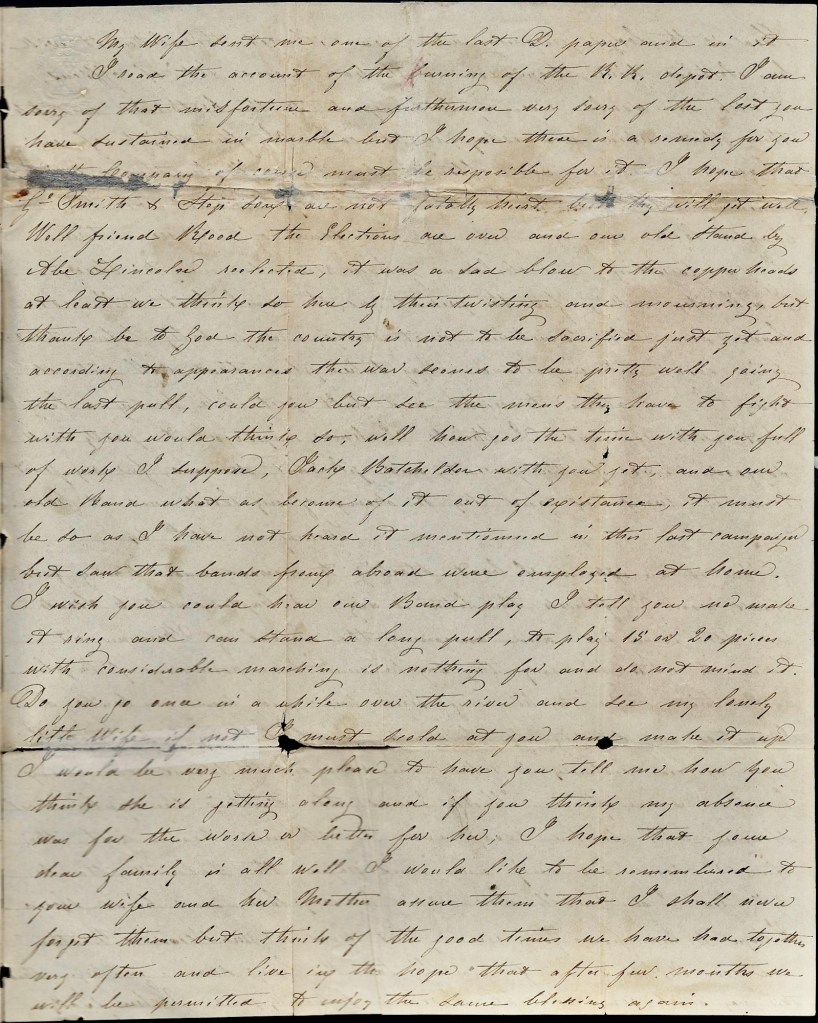
My wife sent me one of the last Deposit papers and in it I read the account of the burning of the railroad depot. I am very sorry of that misfortune and furthermore very sorry of the loss you have sustained in marble but I hope there is a remedy for you [paper torn] of course must be responsible for it. I hope that G. Smith & Stop [ ] are not fatally hurt, but they will get well.
Well, Friend Reed, the Elections are over and our old stand by Abe Lincoln reelected. It was a sad blow to the copperheads—at least we think so here by their twisting and mourning—but thanks be to God the country is not to be sacrificed just yet and according to appearances, the war seems to be pretty well going the last pull. Could you but see the men they have to fight with, you would think so. Well, how does the time with you? Full of worry I suppose. Jack Batchelder with you yet? And our old band? What has become of it? out of existence? It must be so as I have not heard it mentioned in this last campaign but saw that bands from abroad were employed a home. I wish you could hear our band place. I tell you, we made it ring and can stand a long pull to play 15 or 20 pieces with considerable marching is nothing for [us] and do not mind it.
Do you go once in awhile over the river and see my lonely little wife. If not, I must scold at you and make it up. I would be very much pleased to have you tell me how you think she is getting along and if you think my absence was for the worst or better for her. I hope that your dear family is all well. I would like to be remembered to your wife and her Mother. Assure them that I shall never forget them but think of the good times we have had together very often and live in hope that after a few months, we will be permitted to enjoy the same blessing again.
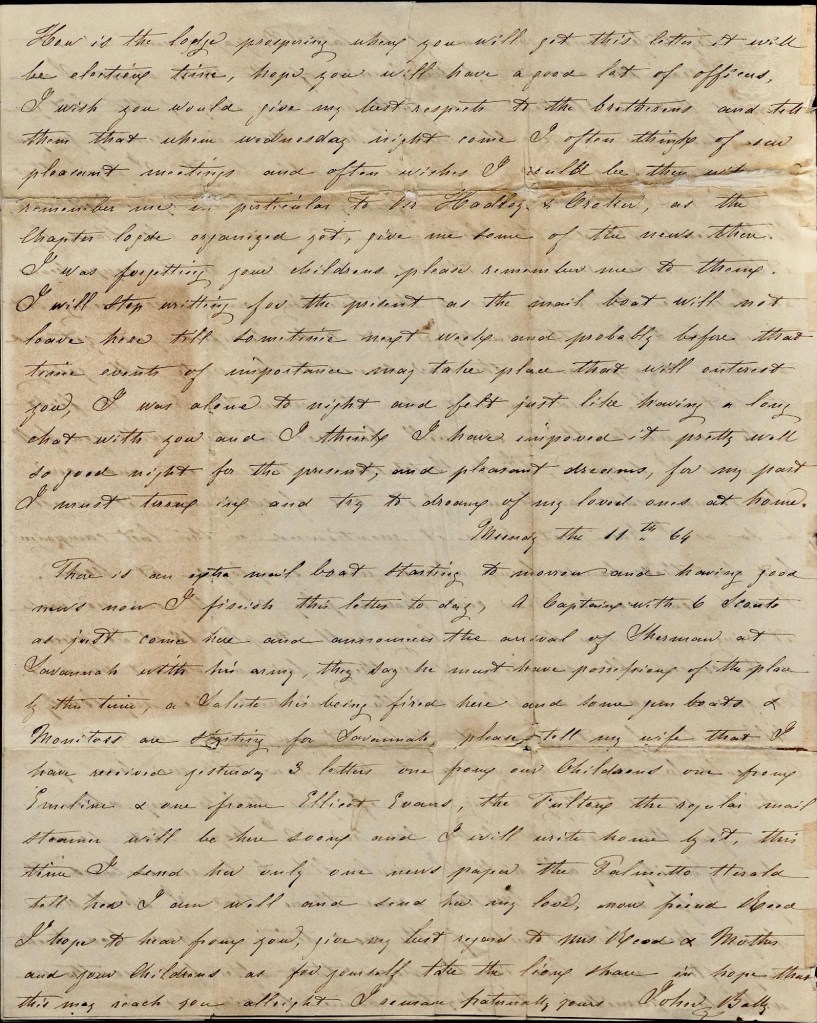
How is the Lodge prospering. When you get this letter, it will be election time. Hope you will have a good lot of officers. I wish you would give my best respects to the brethren and tell them that when Wednesday night comes, I often think of our pleasant meetings and often wish I could be there with them. Remember me in particular to Mr. Hadley & Croker. Is the Chapter lodge organized yet? Give me some of the news there. I was forgetting your children. Please remember me to them. I will stop writing for the present as the mail boat will not leave here till sometime next week and probably before that time events of importance may take place that will interest you. I was alone tonight and felt just like having a long chat with you and I think I have improved it pretty well. So good night for the present, and pleasant dreams. For my part, I must turn in and try to dream of my loved ones at home.
Monday the 11th, ’64
There is an extra mail boat starting tomorrow and having good news now I finish this letter today. A Captain with 6 scouts has just come here and announced the arrival of Sherman at Savannah with his army. They say he must have possession of the place by this time. A salute his being fired here and some gunboats & monitors are starting for Savannah. Please tell my wife that I have received yesterday 3 letters—one from our children, one from Emiline, and one from Elliott Evans. The Fulton—the regular steamer—will be here soon and I will write home by it. This time I send her only one newspaper—the Palmetto Herald. Tell her I am well and send her my love. Now Friend Reed, I hope to hear from you. Give my best regard to Mrs. Reed and Mother and your children. As for yourself, take the lion’s share. In hope that this may reach you alright, I remain fraternally yours, — John Bally
Out of concern that the Union army would attempt to take Charleston in 1863, Jefferson Davis requested South Carolina to raise a local defense which resulted in five regiments being organized that became known as the South Carolina State Troops. The initial enlistment was to be for 6 months but the men could be called upon to serve longer. The 1st Regiment, South Carolina State Troops was organized in July 1863. It was also known as Roberts’s Regiment and did not go into active service until 4 September 1863. They did not participate in any battles and they served until February 3, 1864.
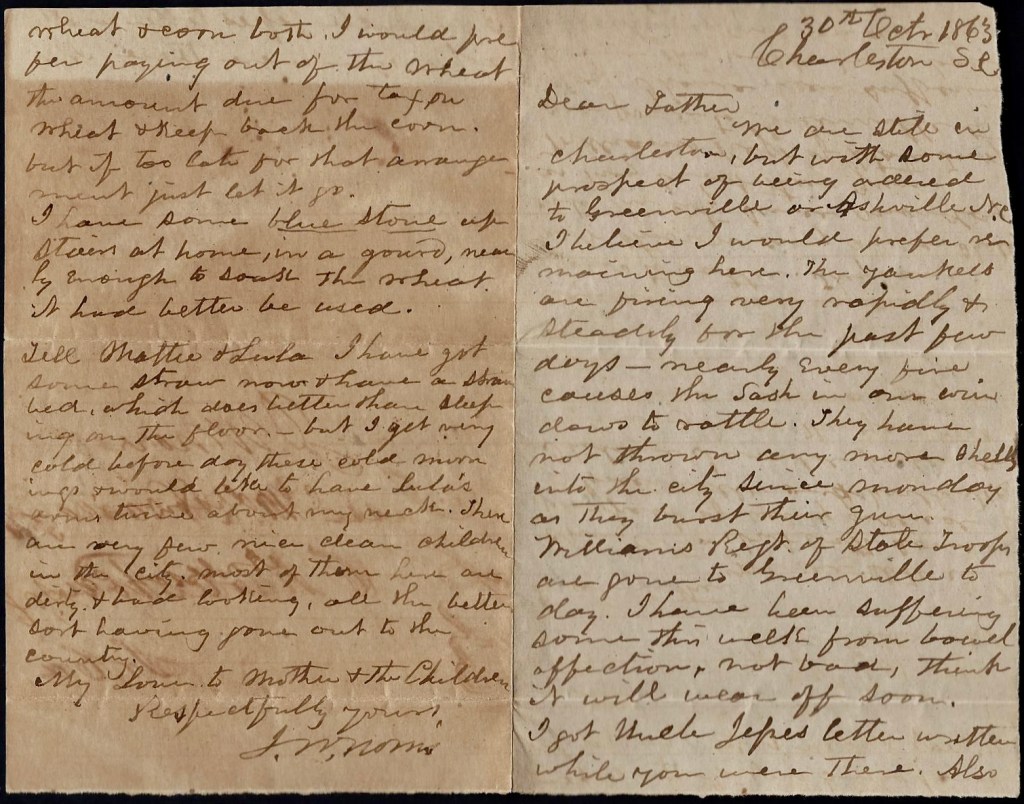
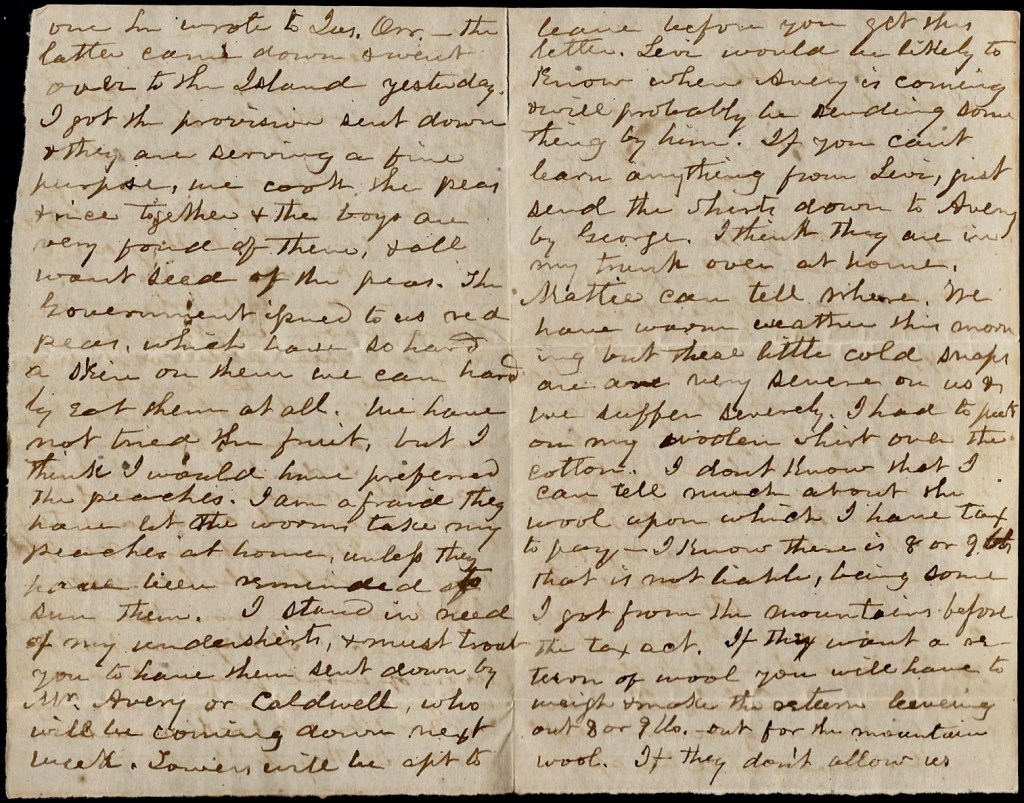
In this letter written to his father in October 1863, Sergeant Major J. W. Norris of the 1st South Carolina State Troops discusses Yankee artillery firing into Charleston, poor Confederate provisions, and his need for warm clothing as colder weather approached. Norris opens the letter stating “we are still in Charleston, but with some prospect of being ordered to Greenville or Asheville, N.C.” He continues, “the Yankees are firing very rapidly & steadily for the past few days.” Since August Federal artillery had been harassing the city from their Marsh Battery position near Morris Island-including the brief use of a massive 16,500 pound Parrott rifle nicknamed the “Swamp Angel.” Norris notes, however, that “they have not thrown any more shells into the city since Monday as they burst their gun.” The gun he refers to was not the Swamp Angel, which burst in August, but of another gun firing from the same position. Norris then mentions “Williams’s Regt. of State Troops are gone to Greenville today,” referring to Colonel James H. Williams’s 5th State Line Infantry. He also mentions that James L. Orr, Confederate Senator and organizer of Orr’s Rifles, “came down & went over to the Island yesterday.”
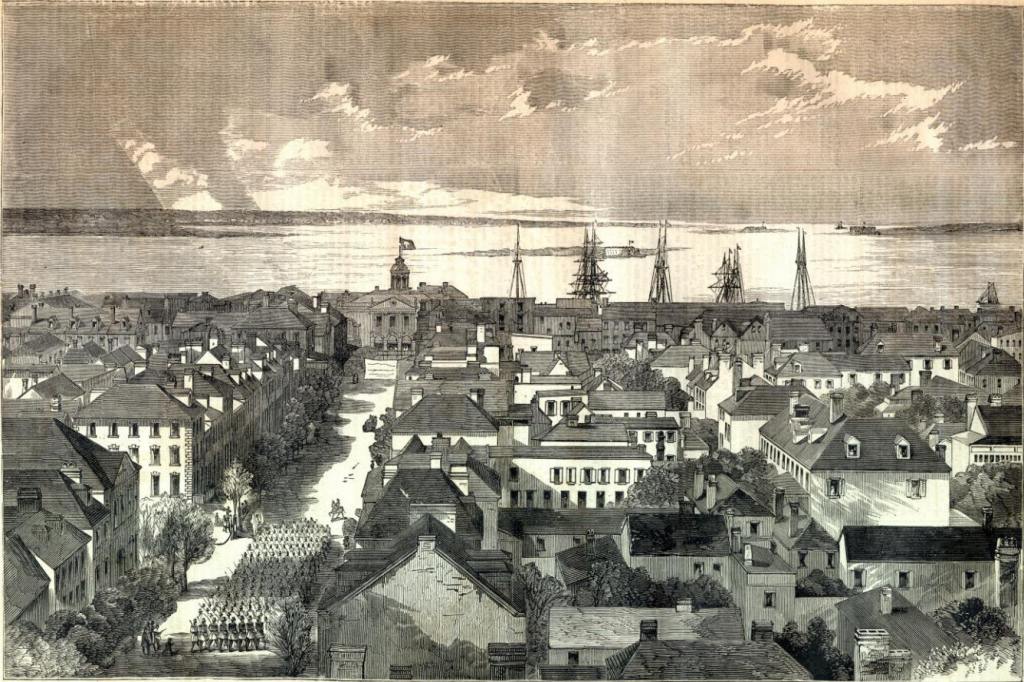
Charleston, South Carolina
Transcription
Charleston, South Carolina 20th October 1863
Dear Father,
We are still in Charleston but with some prospect of being ordered to Greenville or Ashville, North Carolina. I believe I would prefer remaining here. The Yankees are firing very rapidly & steadily for the past few days—nearly every fire causes the sash on our windows to rattle. They have not thrown any more shells into the city since Monday as they burst their gun.
William’s regiment of State Troops are gone to Greenville today. I have been suffering some this week from bowel affliction—not bad—think it will wear off soon.
I got Uncle Jess’s letter written while you were there. Also one he wrote to James Orr. The latter came down & went over to the Island yesterday. I got the provision sent down & they are serving a fine purpose. We cook the peas & rice together & the boys are very find of them & all want seed of the peas. The government issued to us red peas which have so hard a skin on them we can hardly eat them at all. We have not tried the fruit but I think I would have preferred the peaches. I am afraid they have let the works take my peaches at home unless they have been reminded to save them.
I stand in need of my undershirts & must trouble you to have them sent down by Mr. Avery or Caldwell who will be coming down next week. Towers will be apt to leave before you get this letter. Levi would be likely to know when Avery is coming & will probably be sending something by him. If you can’t learn anything from Levi, just send the shirts down to Avery by George. I think they are in my trunk over at home. Mattie can tell where.
We have warm weather this morning but these little cold snaps are very severe on us & we suffer severely. I had to put on my woolen shirt over the cotton. I don’t know that I can tell much about the wool upon which I have tax to pay. I know there is 8 or 9 lbs. that is not liable, being some I got from the mountains before the Tax Act. If they want a return of wool, you will have to weigh & make the return leaving out 8 or 9 lbs. out of the mountain wool. If they don’t allow us wheat & corn both, I would prefer paying out of the wheat the amount due for tax on wheat and keep back the corn but if too late for that arrangement, just let it go.
I have some blue stone upstairs at home in a gourd, nearly enough to soak the wheat. It had better be used.
Tell Mattie & Lula I have got some straw now & have a straw bed which does better than sleeping on the floor but I get very cold before day these cold mornings & would like to have Lula’s arms twine about my neck. there are very few nice clean children in the city. Most of them are dirty & bad looking. All the better sort have gone out to the country.
My love to Mother & the children. Respectfully yours, — J. W. Norris












 Spared & Shared 23