Col. Isaac Dyer, 15th Maine Infantry(Digital Maine)
The following letters were written by Isaac Dyer (1820-1913) while serving as the Colonel of the 15th Maine Infantry. He entered the service as the Lt. Colonel of his regiment on 17 December 1862 and the following year, after the regiment’s Colonel resigned in disgrace, Dyer was promoted to Colonel and led his men in operations in Louisiana and Texas, and in Virginia in 1864. He was brevetted Brigadier General, US Volunteers on March 13, 1865 for “meritorious services,” and was honorably mustered out on 13 September 1865.
Isaac was married to Lydia Emery in 1851. Their son Albert, mentioned in this letter, was born in 1856. Prior to the war, Isaac was a druggist in Skowhegan, Somerset county, Maine.
It’s humorous to find the Colonel writing details of troop strength and movements to his wife while acknowledging at the same time that this information is forbidden to be communicated.
Some of the Colonel’s traps sold at Heritage Auctions
Letter 1
Headquarters, 15th Maine Volunteers August 12, 1863
My Dear Wife,
I was glad to receive a letter from [you] of July 27 & 27. It seems as though you were about a 1,000 miles nearer than you have been for the last 8 months. Now if you will only write every week and be sure and put the letter in the office as soon as written, I shall get one every week.
Maj. Drew will start for Main tomorrow after conscripts. I have to stay by the craft. Col. Murray has gone home on a furlough so I am along in my glory. Perhaps I may get a chance some day. My health is very good and courage as usual. I have good quarters in a nice large two-story house close by the river. Plenty of trees and shrubbery and flowers. The weather is pretty warm but we are getting along very well indeed. Some few are troubled with chills and fever.
I am in hopes I shall be allowed to come home this fall but it will be uncertain. I want you and George to do the best you can and settle up all accounts you can. But I don’t want you to worry about matters at all. There is enough to pay all bills and something for a wet day. I want you to dress first rate and go where you please. I don’t believe anybody will thank you for borrowing any trouble. Be careful, be courageous, be spunky.
Maj. Drew and Lady will call and see you so you must put on the best of smiles and that new dress that you are going to get for my benefit.
Well, hoes does Master Albert and his dog Victor get along? Which gets tired first? How tall is Albert? Is he 8 years old this fall or 7? I have forgotten. I expect he is a great boy and can read smart. Can’t he write me a letter? Can he print letters?
But the post master is waiting for this letter and I must close. Be a good girl and keep up the best of courage. I sold a horse for 300. The man could not raise the money as he expected so I had to take him back. I hope to save something by my horses yet. I have been pretty lucky in that direction. Kisses for you and Albert. Goodbye, — Isaac
My regards to my friends.
Letter 2
New Orleans [Louisiana] September 4, 1863
My Dear Wife,
I have just returned from Carrollton from witnessing a review of the 13th Army Corps (Gen. Grant’s). I assure you, it was a big sight. (There [were] 47 regiments infantry, 15 batteries, and a lot of cavalry, but this you must not mention as it is against regulations).
Look out for big news in a few weeks. The 9th Connecticut, 12th, 13th, and 15th Maine, and 1st Louisiana are to take charge of the City of New Orleans and suburbs, so we shan’t see much fighting at present. (Now, while I am writing, steamboats loaded with soldiers are pushing down by. This also contraband).
I am I hopes we shall all be allowed to go home by next spring for it looks as though the rebels would be cleaned out this fall.
Well we all want to see the end of this business for our New England has attractions superior to the Sunny South. We love civilization to barbarism and the luxuries of the North are far superior to the South.
I have not time to write much now. I suppose you have seen May Drew before this time. I have received the box of boots and box of pants all right. All has been received except the box lost on the Marion.
These two letters were written by Frederick Erasmus Underwood (1841-1889) the son of Albert Underwood (1810-1881) and Susan Moulton (1821-1891) of Brimfield, Portage county, Ohio.
I could not find an image of Erasmus, but here is one of William E. Carlton of Co. B, 42nd OVI (Cowan’s Auctions)
According to muster records, Erasmus entered the service on 20 September 1861 as a private in Co. A, 42nd Ohio Volunteer Infantry (OVI). He mustered out of the service in 20 September 1864 after three years.
Events described in these letters correspond to the following two paragraphs from the regimental history”
On February 1, 1862, the 42nd boarded boats and sailed up the Big Sandy River to Pikeville, Kentucky. On March 14, 1862, the regiment with other Northern units seized Pound Gap, Kentucky. The Union force spent the next few days skirmishing with Confederate guerrillas, before marching for Louisville, Kentucky on March 18. Upon reaching this new location on March 29, 1862, the 42nd entered camp.
In May 1862, the 42nd boarded railroad cars and traveled to Lexington, Kentucky. The regiment then joined Brigadier-General George W. Morgan’s command and marched to Cumberland Ford, where officials brigaded the organization with the 16th Regiment Ohio Volunteer Infantry and the 14th and 22nd Regiments Kentucky Infantry. On May 15, 1862, the brigade crossed the Cumberland River and entered camp at the junction of the roads leading to Cumberland Gap and to Rogers’s Gap. On June 5, 1862, General Morgan led his troops against Confederate troops at Rogers’s Gap. The 42nd participated in several skirmishes upon reaching this location. On June 18, 1862, the Northerners attempted to strike a Confederate force at Big Spring, but the enemy withdrew as the Union soldiers approached. Morgan ordered his command to Cumberland Gap later that same day, with Confederate soldiers again withdrawing as the Federals approached.The 42nd Ohio entered camp near Yellow Creek and spent the next six weeks participating in various expeditions.
Letter 1
Camp Buell February 9, 1862
Yours of the 14th inst. by some unaccountable blunder came to hand but few days since but notwithstanding its tardiness, I was the no less gratified & overjoyed to receive it.
I was much pleased to hear that Mother’s health was good and Father’s improving. I also understand by a letter of later date to Mr. Hastings that Adaline and Josie have been sick.
There! Hark! I hear our captain’s voice. Listen to what he says, “Co. A, up, up instantly prepared to go to Piketon. Be ready within two hours.”
Now all is bustle again and I shall have to postpone writing for the present to finish in the future. Good night. — F. E. Underwood
Camp Brownlow February 11, 1862
Again, dear parents and sisters, after 50 miles ride on a steamboat and after the confusion which ever and eternally accompanies the setting of tents, I find myself settled again and conversing with you.
We are now situated very pleasantly at Piketon—a small town in the Big Sandy about 35 miles from the Cumberland Mountains. We have now cleaned out every vestige of secession in Eastern Kentucky. The rebel regiment under command of Col. Williams have left the state entirely and marshal force have disbanded. How long we shall stay here, I know not but hope that the next move we make will be down the river.
I regret much to inform you that my health has been quite poor for the last three weeks. I am troubled with the dysentery and rheumatism. I am getting to be quite poor. Oh! Mother, I would choose you in preference to a thousand regimental doctors for a nurse. I think though that I shall get along without going to the hospital. I hope so at least. The captain is now administering to my wants. He has given me two doses of “Hygean’s Pills” which sicken me to an alarming extent. I was sent yesterday to see the doctor and in so doing, exposed myself with many others from our company to the “mumps.” I have forgotten whether I ever had them or not. If not, I will consider myself “elected.”
Tell Adaline and Josie to write just how many such sutlers as that last one [ ] there are “amignto.” I shall always receive them with great joy and delight. I am heartily sick of our “stuff” on which we subsist. If I could only have a little potato [and] some soft bread, it would be such a help. I don’t know if we shall be paid as soon as I expected when last I wrote you. The paymaster hasn’t shown himself yet and not much prospect of it. If I had money, I might buy milk, bread and butter, but I would not ask you to send me any for it might not reach me.
Why don’t Lavina and Ellen write to me? I have not hear a word from them since I came to Kentucky. All write and oblige your son, — F. E. Underwood
To Father, Mother, Addie, Josie, and Sumner.
Letter 2
Camp Virginia Cumberland Gap July 4, 1862
My dear parents,
Sadly and with a sorrowful heart do I sit down to reply to yours of the 2nd that came to my perusal yesterday. Glad indeed was I to hear from you for my mind—-since I learned of the irrevocable rent so suddenly and unexpectedly made in our dear circle—has been in a state of continual agitation searing, lest the deep affliction so suddenly brought upon you would crush the already bruised and mangled heart of my dear mother.
It is now nearly two weeks since I was appraised by Alice Savina and Ellen of the death of Josie. 1 Could I? Must I believe it? That she whose quick perceptibility’s and bright and untarnished intellect was seldom equalled; whose nature ever seemed to be inspired with the love of truth and acted accordingly, must be so rashly stricken down in this, her life’s springtime. But dear parents, I will cease to agitate your already turbulent ocean of trouble.
When I wrote you last we were encamped in Tennessee on the old Rebel camping grounds. But in consequence of the unpleasant, as well as unhealthy odor that constantly arose from the very earth so long polluted by their foul footsteps, Gen. Morgan gave our officers leave to seek a more congenial atmosphere which was done by moving over into the valley on the Kentucky side and pitching our tents in a beautiful grove of pine about 2.5 miles from the Gap. We shall probably stay here through this month although there is one regiment in our Brigade to be sent as provost guard to Frankfort, Louisville, and Lexington. The rumor through camp today intimates that our regiment is th one detailed. We all hope and trust it is.
The boys are all well from Brimfield with the exception of Jim who I think is threatened with a fever though he tells me today that he feels better.
Write to me often and tell me all the news connected with home and vicinity. And now with a hope that God will level his mighty power in bringing about a speedy restoration of peace that we may once more return to our homes and loved ones, I will close.
Your obedient son, — F. Erasmus
Cumberland Gap via Lexington, Co. I, 42nd OVM
P. S. Tell [sister] Adaline to write me a good long letter and [ ] that I could with my presence console her in her deep affliction. — F. E. U.
1 Mary Josephine (“Josie”) Underwood (1849-1862) died on 11 June 1862.
This letter was written by Lyman Henry Wood (1840-1914), the son of David Wood (1804-1877) and Lucretia Baldwin (1815-1851) of Tompkins county, New York. He wrote the letter to his older sister, Frankes (“Frank”) Woods (b. 1836) who in 1863 still lived with her father in New York State. Just prior to his enlistment, Lyman was residing in Bath township, Greene county, Ohio, working as a carpenter.
Lyman served in Co. I, 44th Ohio Volunteer Infantry (OVI) which organized at Springfield, Ohio, in the fall of 1861. After spending the winter in West Virginia, they were ordered to Kentucky in the fall of 1862 and spent the winter near Richmond and then Danville, Kentucky, where this letter was written on 4 January 1863. One year later to the day, 4 January 1864, the regiment was changed to the 8th Ohio Cavalry.
“Three pretty little Kentuck girls went to work and got us a first rate dinner.”
Transcription
Camp near Danville, Kentucky January 4th 1863
Sister Frank,
I received your letter last evening ad this dreary, rainy morning I will try and answer it. You see by the heading of this that we have moved from Richmond. I thought once that we would remain at Richmond through the winter but I begin to think winter quarters for our Brigade is played out and it suits me for winter quarters won’t end this war and I want to be at home next 5th of July if not sooner.
Yesterday the news of Murfreesboro fight came to us. If the report only turns out to be true that Gen. Rosecrans has gained a complete victory over the rebel force, I think it will have a great deal to do towards ending the rebellion.
I must tell you what a good time I had yesterday. A squad of 31 men went out to guard a forage train and while the train was loading, four of us went to a house and what do you think we saw there? “Why” three pretty little Kentuck girls. They went to work and got us a first rate dinner—the best dinner I have had since I have been in the service. After dinner we had a good chat with them and before we was ready to go, one of the boys came and told us the train was ready to start for camp so of course we had to leave though not without being invited to call again. And if it should be my luck to go with the train again, think I will accept the invite.
I suppose you had a good time during the holiday. We put our timer in at marching & building entrenchments.
I can’t think of any more to write so I will close promising to do better next time. Write soon.Your brother, — L. H. Wood
These Civil War letters were written by Francis Henry West (1825-1896), an American businessman, politician, and Wisconsin pioneer. He was a member of the Wisconsin Legislature for three years, and served as a Union Army officer during the American Civil War, earning an honorary brevet to brigadier general.
West was born in Charlestown, New Hampshire. He moved to the Wisconsin Territory in 1845, eventually settling in Monroe, in Green County, in 1846. In Green County, he worked in the lumber industry. In 1853, he was elected as a Democrat to represent Green County in the Wisconsin State Senate for the 1854 and 1855 sessions. In 1855, he was the Republican nominee for Bank Comptroller, but was not successful. In 1859 and 1860, he accompanied parties of migrants from New York to California.
West joined the Army on August 28, 1862, and was commissioned a lieutenant colonel with the 31st Wisconsin Volunteer Infantry Regiment, which was still being organized in Wisconsin. The 31st Wisconsin was created from two volunteer battalions from Crawford County and Racine. The 31st mustered into service in October 1862 and left Wisconsin in March 1863, traveling to Kentucky via Cairo, Illinois, where they were attached to the XVI Army Corps. They spent the summer of 1863 on patrols and picket duty in southern Illinois, western Kentucky, protecting supply routes along the Mississippi River.
In September 1863, they were ordered to Nashville. Here, their colonel, Isaac E. Messmore, resigned, and, on October 8, Lt. Colonel West was promoted to colonel of the regiment. Through the winter of 1863–64, the regiment was stationed at Murfreesboro, Tennessee, and continued to serve as protection for logistics and supplies. In April 1864, the 31st was attached to the XX Corps and split into detachments to protect a long stretch of railroad lines in Tennessee. In June, the regiment was ordered to consolidate and return to Nashville.
On July 5, the 31st Wisconsin was ordered by General William Tecumseh Sherman to proceed to the front of the ongoing Atlanta campaign. The 31st traveled by train to Marietta, Georgia, and reached its position on the line July 21. The regiment worked on constructing siege fortifications around Atlanta and came under frequent enemy fire due to their proximity to the enemy lines. They did not take part in the actual battle, but were one of the first units to enter the city. The regiment was assigned to provide security in the city and protect foraging operations in the surrounding area.
On November 15, 1864, the XX Corps broke camp and marched out of the city to begin their part in Sherman’s March to the Sea. They advanced without encountering any resistance until ten miles outside Savannah where, on December 9, they encountered two small enemy fortifications. The 31st Wisconsin, along with the 61st Ohio, were ordered to flank the position through a thick swamp. They passed the swamp and charged the enemy, taking the position with light casualties. For their action, they received the compliments of General Sherman. The regiment joined the siege of Savannah, and after capturing the city were assigned quarters there.
On January 18, 1865, the 31st Wisconsin departed Savannah and marched for Purrysburg, South Carolina, at the start of the Carolinas campaign. The regiment proceeded through South Carolina, burning enemy facilities, tearing up railroad tracks, and pushing the enemy’s rear guard toward North Carolina. On March 1, the 31st advanced toward Chesterfield, South Carolina, near the border with North Carolina. They forced a small confederate force to flee north, then stopped in the village. On March 16, the 31st took position on the front line for Averasborough, where they were shelled and took casualties. Three days later, they were in the advance on approach to Bentonville, along with two other regiments, where they encountered significant Confederate opposition and found their flanks exposed. They fell back and formed a defensive position with elements of the XIV and XX Corps. The Confederates attacked their position five times and were repelled in fierce fighting. This was the worst fighting that they saw during the war, and suffered ten killed and forty-two wounded.
On March 24, they reached Goldsboro, North Carolina, where they stopped to rest and re-equip. While the 31st was camped at Goldsboro, Ulysses S. Grant accepted the surrender of Robert E. Lee at Appomatox. On April 10, the 31st marched out to continue their advance toward Raleigh, pursuing Joseph E. Johnston and the remnants of the Army of the South. But before they reached Raleigh, they received word that Johnston had surrendered to Sherman and the war was effectively over.
The 31st was ordered back to Washington, where they participated in the Grand Review of the Armies in May, and West mustered out on June 20, 1865.[2] While in Washington, U.S. President Andrew Johnson nominated Colonel West for an honorary brevet to brigadier general of volunteers for gallant service in the field, effective back to March 19, 1865, the day of their combat at Bentonville. The United States Senate confirmed the brevet on March 12, 1866.
After the war, General West moved to Milwaukee County and entered a partnership—Fowler & West—with James S. Fowler in the grain commission business. He served for six years on the board of directors of the Milwaukee Chamber of Commerce, including two years as president.
In 1873, he was elected on the Reform ticket to represent Northern Milwaukee County in the Wisconsin State Assembly for the 1874 session. The Reform Party was a short-lived coalition of Democrats, reformers, Liberal Republicans, and Grangers. Their signature accomplishment was the 1874 “Potter Law,” 1874 Wisconsin Act 273—named for Republican state senator Robert L. D. Potter—which established a new state Railroad Commission to aggressively regulate railroad and freight fees. In the Assembly, Colonel West served on the Committee on Railroads and the Committee on State Affairs. General West did not seek re-election in 1874.
During Grover Cleveland’s first presidential term, West was appointed United States Marshal for the Milwaukee district. After completing this final public service, Colonel West retired to Alabama, where two of his sons lived.
While on a trip to New York, in 1896, West slipped while attempting to step off of a street car and was severely injured. He was confined to his bed for several days before he was healthy enough to return to Alabama. He died a few weeks later, on March 6, 1896, at Bessemer, Alabama.
Francis H. West and his wife, Emma M. Rittenhouse, had several children. They included, Louise Ellen (1850-1878), Caroline (“Carrie”) (1852-1934), Edith (1854-1940), Susan (1859-1910), Grace (1866-1938), Benjamin F. (1868-1957), and Josephine (1872-1876). [Wikipedia]
Thomas BeattiePhilemon LivermoreDaniel B. DippleAlexander T. NewmanJohn P. WillardFarlin Q. Ball (on left)
These images by members of the 31st Wisconsin Infantry are from the collection of Marc & Beth Storch and used by permission on Spared & Shared.They include Lt. Thomas Beattie, Co. B; Pvt. Philemon Livermore, Co. F/G; Capt. Daniel B. Dipple, Co E; Pvt. Alexander T. Newman, Co. A; Lt. John P. Willard, Co. H; and Capt. Farlin Quigley Ball, Co. G.
Letter 83
Near Savannah, Georgia Saturday evening, December 18th 1864
My Dear Wife,
We have just received a large mail from the fleet by way of the Ogeechee River—the first news we have had from the outer world for about six weeks. I am very much chagrined at receiving one letter from you and that of November 7th, more than a week before we left Atlanta although we got papers and letters from Madison and other points as late as the 25th. I only write a line now, my dear one, to let you know that I am very well—never better—have not been unwell a moment since leaving Atlanta on the 15th of November.
We had a very pleasant, eventful, and triumphant march through Georgia a description of which would fill a volume. Therefore, I will not commence it now. It is the grandest event of the war. The regiment was never in better health or spirits. All are well. We have lost but few men this far on the campaign. It is now a week since we arrived here which has been occupied in getting the forces in position for besieging the city and in opening communication with the fleet which has been done by way of the mouth of the Ogeechee River. We are now about ready to commence in earnest. Thus far we have not made much demonstration on the City although they have shelled us continually but without doing much damage. This evening Sherman sent a flag of truce demanding a surrender or he should open on the City with give hundred guns at six tomorrow morning. Of course they will not surrender and possibly we may have a long siege as they are strongly fortified. The siege is vastly more interesting than was the siege of Atlanta. There is so much of interest to describe that I have concluded to pass it all by until I can have the pleasure of describing it to you in person.
I have not heard a word from Murfreesboro since leaving there. Consequently do not know whether Mr. Caldwell has been gobbled up or not.
The 31st [Wisconsin] gained quite a little reputation for the manner in which they in company with the 61st Ohio, both under my command, assaulted and captured a rebel fort at a place called “Harrison’s Field” ten miles back built to arrest our further progress. 1 We were publicly thanked the next day by all the generals in command up. to and including General Slocum, commanding the Left Wing of the Army of Georgia for the handsome manner I which it was done. Tell little George we made the Rebs run. like good fellows, killing lots of he.
With the exception of one or two days we have had most beautiful weather. Today, however, has been rather to warm for comfort. Of course we have had some pretty severe hardships since starting but we expected that and more when we started. If I get through safely, I would not have missed it for anything. As I said before, I have so much to write about, I have concluded not to write anything—and especially as you do not write to me. Give my love to all the children and ask Lou why in the world she does not write to her Pa. I hope to be with my loved ones at home soon and to stay but do not know when it will be. Affectionately yours, — Frank
We have no ink in camp.
1 “Confederate Col. Charles C. Jones dug in to slow Sherman and protect railroad tracks near “Harrison’s Place,” a plantation field at Monteith Swamp that has been cultivated since before the Civil War and is currently leased by Dotson to a hay farmer. The 14th and 20th corps with about 30,000 men advanced on three roads — Monteith Road, Middle Ground Road and Old Augusta Road. Jones’ detachment of 300 at Monteith Swamp strengthened its defensive works, felled trees and built an abatis and trench lines for its flanks. The Rebels used a long line of swamp to its advantage against an overwhelming force. On Dec.9, 1864, the entire 20th Corps (12,000 regulars) under Brig. Gen. Alpheus S. Williams (below) advanced down Monteith Road from Zion Church. Around noon they hit Confederate positions….By late afternoon, the defenders were gone, leaving knapsacks and camp equipment but taking their colors and four guns with them. The Confederates had about 14 killed and four captured in the six-hour battle. Union losses were two dead and six wounded. Union forces got to the railroad the next day and rolled up the Confederate defenses on the western line. The loss of Fort McAllister soon after spelled the end for Savannah. Sherman had ships to bring in supplies and a “biscuit line” to feed his massive army, Sheehy says.” [Monteith Swamp: Trying to Save what’s left of the 1864 Battlefield near Savannah]
Letter 84
Savannah, Georgia December 25, 1864
My dear daughter Louise,
I wish you and all the rest of the family a very Merry Christmas and am very sorry I am not there to help you enjoy it instead of being here in a swamp with my eyes smoked out by pitch pine fires and without shelter. I have not been inside of a house until yesterday since leaving Atlanta.
Yesterday I went into the City and took dinner with an old secesh gentleman who invited me in today to eat Christmas dinner with him. Of course I accepted the invitation and have just returned to camp having had a very respectable dinner. It was a great treat to have a “clean meal” once more. The City is a very old-fashioned, uninviting kind of a place with sand knee deep in the streets. It is quite a large place having twenty-five thousand inhabitants, most of whom remained in the city after its capture. As you will learn all about its capture from the papers before you receive this, I shall say nothing about that.
We are now camped on the banks of the river two miles above the city and expect to start on another campaign for Charleston or some other secede place in about four weeks. Of course everything is very different in this far south country from what it is North. I think it is the finest climate to winter in I have ever been in but it must be a fearful place in the summer. I do not much expect to see you again until my term expires next August. I have been greatly in hopes the war would end sooner than that but I fear now it will not.
We received a large mail this morning and I was in hopes to be made merry by receiving letters from home but was disappointed as usual, there being letters for everyone else but myself. I have received but one letter from home written within the last two months (your mother’s written 7 November). I have received the Monroe Sentinel however down to the last date. If any of you are sick, someone ought surely to write and let me know about it. Tell your mother that if she will have the kindness to write me a few lines, I will. try and answer it immediately.
My health is first rate and everything is going on as pleasantly as could be expected under such frightful circumstances. Do try and keep me “posted up” as to what is going on at home. Give my love to all the family. Your affectionate father, — F. H. West
I hope your mother made you all a nice present for Christmas.
Letter 85
Savannah, Georgia Sunday, January 1st 1865
My Dear Wife,
I wish you a very happy New Year and wish I had a little better prospect for a happy one myself. I was in hopes to have got a letter from you today which would have made the first day of the year passable at least. It is now nearly two months since I hav heard from you and I am beginning to stop looking for or expecting any mail.
We are having very beautiful weather while I expect you are having all you can do to keep from freezing to death.
We are expecting to get off on a new campaign in the course of the next ten days and anticipate a much rougher time than we had in coming here. The past week has been spent in Grand Reviews of a Corps at a time by General Sherman. These reviews take place inn the streets of Savannah and attracted large crowds of spectators. The new year commences with splendid prospects for the success of our army and the speedy termination of the rebellion. I suppose you hear of everything that happens here through the newspapers. We have got the particulars of Thomas’s great victory in Tennessee [Battle of Nashville] which has so effectually cleaned out Hood. I expect that Caldwell is cleaned out also. I have not heard from him since the 17th of November since when he could not have had an opportunity to do anything. He had got fifty-seven bales of cotton into Nashville which will more than pay the outlay.
Have Mr. Niles take possession of that land on verbal contract as he proposed and we will fix up the papers when opportunity offers. He must pay the taxes on it this winter. Write all about taxes, money matters, how you get along for wood, &c. I do not expect to be at home before next May or June when I shall try and get a leave of absence which will help me along until my time is out which will be in August. Give my love to all the children. — Frank
Let the suit of clothes remain where they are until I write you where to send them. If I can get a few days leave sometime to slip up to Charlestown and see Father & Mother, I shall do it. I send this by Lt. Lafferty who starts home tomorrow.
Letter 86
Savannah [Georgia] Friday, January 6, 1864 [1865]
My Dear Wife,
I returned last night from a trip of trendy-five miles up in the country where I had been in command of an expedition and found on my return your letter of December 18th. I was greatly relieved to find you were all well. You speak of having written before but I have not received any letters.
We expect to start out very soon on our new expedition, perhaps tomorrow. There is no danger of General Sherman’s letting us remain idle long. You might as well get his portrait framed at once. I don’t think you will ever have occasion to regret it.
Dr. Arndt has got his resignation accepted and starts home tomorrow. He will go to Murfreesboro in a few days. We expect to plant cotton there again next spring. I am in hopes the miserable old rebellion will be “played out” so that I can join them in the spring after making you a visit.
Sunday 8th. No more yet. I received yours of Christmas & 28th last night. I am glad you had a Merry Christmas. Hope you had a “Happy New Year” also. Capt. Vliet returned yesterday having been absent just a year. As ever, — Frank
Letter 87
Savannah, Georgia Friday, January 13, 1865
My Dear Wife,
Our Chaplain, Mr. Woodworth, starts for home today on a detail to carry home money for the men and to do errands generally for the regiment. He is to be gone thirty days. He lives at Warren but he will call on you at Monroe previous to his return and probably stop at day or so at our house. I want you to send my new uniform by him. Have it nicely put up I a paste board box or something of the kind. Also be sure and buy me a half day pair of good large size cotton socks and put in with them. Mr. Woodworth will take charge of everything that you or anyone else may have to send to the regiment. I send home by him my old carpet sack with a few things without any special value in it but not wanting them here I thought best to send them home. There is a couple of tactics books that I want preserved. Also a couple of volumes that I took from the State Library at Milledgeville. Also a counterpane which you may have some use for.
When the 31st [Wisconsin] stormed the little fort near Savannah, we captured among other things an officer’s bedding which fell to my share. There being more of it than I have any use for, I send this piece in exchange for that quilt you sent me which you will recollect of having spoken of on different occasion. Although this was taken as a regular trophy of war, I am almost ashamed to send it home for the reason that there was so much vandalism committed by our men on the march in taking all such things from private houses. Consequently you had best not exhibit it for fear they may think it was obtained the same way. I have seen privates using piano covers that were worth a hundred dollars for saddle blankets and all such other wantonness to match. These things however were mostly taken from deserted houses and not infrequently found buried in the garden or other places. These things to me were the most disagreeable feature of the campaign, but General Sherman is mainly to blame for it as it was understood that he was in favor of the most indiscriminate plundering.
You can imagine what kind of a winter we are having when I tell you that there are orange trees in the open gardens here loaded with fruit at the present time. Still we have seen very chilly weather.
Yesterday General Sherman reviewed Kilpatrick’s Cavalry. Secretary Stanton and other notables from Washington being present, it was quite a big day with us.
I hear nothing from the cotton business yet and never expect to hear anything very favorable from it. If I can hear from Mr. Caldwell & Dr. Arndt that there is a favorable prospect for trying the speculation another year, I shall get out of the army in the spring and join them. Write about everything. — Frank
Letter 88
Savannah, Georgia January 15, 1865
My Dear Wife,
I received yours of the 1st and 3rd today. I wrote you yesterday giving the letter to Chaplain Woodsworth who I expected to start for home yesterday but he did not get off on account of some delay in the boat. He expects to start tomorrow. I also gave him my carpet sack with something to take home. I shall send this by mail. If the Chaplain comes to Monroe you will see that he is well entertained while he stops there. I had a letter from Jo this morning saying that sixty two bales of cotton had been received and sold in New York. My share of the proceeds must be about twelve thousand dollars so we are “out of the woods.” I consider it very fortunate to get out without loss under the circumstances. He had not heard from Caldwell. I have no doubt but all the balance of our cotton together with gin, teams, &c. was taken or destroyed and do not know but what Caldwell himself was carried off. I shall write Jo to put the money into interest bearing bonds.
I would like much to quit the service and go home now but cannot think of it as long as the government is asking for more men. I think however that I shall be able to get away in April. I am a very homesick individual now. You might afford to write nearly every day the remaining of the time. — Frank
Letter 89
Drurysburg, South Carolina January 24, 1865
My Dear Wife,
This dreary God forsaken swamp was made cheerful today by the receipt of a large mail—the first we have had for two weeks—and among which was yours of the 5th and 10th. I also received letters from Mr. Briggs and Dr. Arndt from New York from which I learned that I had on deposit in New York thirteen thousand, four hundred & twenty-nine 32/100 dollars ($13,429.32) as my share of the cotton sales, sixty-four bales that Mr. Caldwell got out before Hood’s raid. They had not heard from Mr. Caldwell since. Neither have I but do not expect that he has saved anything more, but am still in hopes that he has. If he was not disturbed, he may have nearly half as much more. Under the circumstances, we are lucky to get out so well as we have.
This place is on the Savannah River twenty-three miles above Savannah. We came up here on the 18th, since which time it has rained all the time and we are nearly drowned in the swamps, being unable to advance. The country is one vast swamp and it will be utterly impossible for us to move except in very dry weather. Some of our teams have been drowned; others we have got back to Savannah on boats. This is certainly the worst place that ever I have been in. I would not be surprised if the campaign had to be abandoned or at least undertaken in some other shape.
You do not say a word about taxes or business matters. I want to know all about those things. I am glad you are having such fine sleighing although it makes me shiver to think of it. All we have here for amusement is a great amount of music made by the millions of frogs in the swamp. I thought I had been homesick before but I believe I was mistaken. If we do not get out of this soon, I shall die with the blues. If I do not leave the army in the Spring, I shall try and get another leave of absence. Since leaving Savannah, I have been in command of the brigade. It is only temporary however.
Give my best regards to Fred and Elesebeth. Continue to direct your letters to Savannah and do not put the address so near the top of the envelopes so that there will be a chance to put the postmark near the top where it belongs. The health of the regiment is very good at present. If you knew my precious wife how dear your were to me, I am sure you would write very often. Frank
Give my love to the children.
Letter 90
Fayetteville, North Carolina Sunday, March 12, 1865
My Dear Wife,
We arrived in this city at midnight last night, it being nearly two months since we cut loose from Savannah during which time we have struggled through mud and swamps and across swollen creeks and rivers day and night, frequently getting into camp at 2 o’clock in the morning and starting out again at 6, and subsisting almost entirely upon what we could pick up in the country. Still both the health and spirits of the men are first rate. I have stood the campaign first rate but am getting a little rheumatic and prematurely old from exposure and hardships. The enemy have offered by very little opposition to our advance but have fled before us like frightened deer. We are literally overrunning their whole country.
This place is at the head of navigation on Cape Fear River. Some gunboats have run up and met us here and returned this afternoon with the mail. I do not know whether we shall make any stop here or not, or where we shall go next, but expect we shall move on to Goldsboro on the Neuse for a base to fit up for another campaign. We are all very anxious to get where we can get mails from the North and get letters and papers from home. We have no idea what is going on in the world except what we do ourselves. I am in hopes we will get a mail before leaving here.
We have lost no men from the regiment since leaving Savannah except five who were captured while out foraging. We cannot realize that winter has passed. We have seen so little to remind us of what our Northern winters are. It seems to me that I can never be satisfied to spend another winter in the North but aside from the climate in winter, there is nothing to recommend the Carolinas. Both the country and the inhabitants are much meaner than I had ever heard them represented to be.
My greatest anxiety has been and will be to hear from home. I am in hopes to be able to return soon, not to leave again. I am heartily sick of the destruction of war. We have been in the dense pitch pine smoke of camp fires, railroad ties, fences, buildings, kilns, turpentine forests, &c. until we are as black as Negros and our clothing being very much worn and torn in running through the brush, we are as hard a looking set of human beings as ever astonished the natives of any country.
As soon as I can hear that you have got through the winter all right, I shall feel well again. I have just lost both of my horses. One died and the other was stolen. I am anxious to hear from Dr. Arndt and Caldwell to know how the cotton business closed up and what they are going to do this year in this direction. Give my love to the children. I shall write again the first chance. — Frank
Letter 91
Goldsboro, North Carolina Sunday March 26, 1865
My Dear Wife,
We arrived here on Friday and closed the great Carolina Campaign, it having been a perfect success. We have had a very rough time on account of constant rains and mud and the poverty of the country much of the time. We were glad to get as much corn as we wanted to parch to live on, and some of the time we could not get enough even of that, and I have seen my men gathering up the scattering grains of corn that had been left where the Rebel cavalry had fed their horses. A good deal of the time, however, we fared first rate.
My own health has been good but the regiment suffered severely in the battle at Bentonville on the 19th. On the 16th, the enemy attacked our Corps in the swamps near “Smith’s Farm” and we fought them all day without much loss—the regiment losing twelve in killed and wounded, five of whom were from Capt. Treat’s Company, but no one that you know. Hogans had his gun shot out of his hands and a ball through his knapsack but escaped unhurt. The 19th corps coming up at night, the Rebs retreated on the 19th near Bentonville. The 15th Corps being in advance were attacked and sorely pushed by the whole Rebel force. Our Brigade and one other Brigade of our Corps being in advance of our Corps were pushed on and arrived on the field at 2 PM and just as a part of the 14th Corps were giving away, we were precipitated into the breach and fought desperately until darkness put an end to the fight and was the means of saving the day.
Sgt. Daniel Wickham, Co C, 31st Wisconsin, was killed in action on 19 March 1865 at the Battle of Bentonville (Kevin Canberg Collection)
The 31st [Wisconsin] held the key to our whole position and sustained seven different assaults. Our loss was sixty-one, which is light considering our position, but the enemy charged so wildly that they did not fire with any accuracy, shooting high above our heads. My boys fired beautifully, causing great havoc. Lt. Lyman was killed; none other hurt that you know. My officers and men behaved splendidly. None of the field or staff hurt.
On the 16th our Brigade lost three field officers. On the 21st the right wing of our army came up and pitching into the Rebs, whipped them handsomely, thereby clearing the road for us to reach Goldsboro and close the campaign. We did some skirmishing on that day without any loss. The Major expects to start home soon in a few days. We have not received any mail yet and of course are very anxious to hear from home. It is now over two months since I have heard from you. We expect a mail tomorrow when I hope for nothing but good news from you.
Monday, 27. Received a long but not very late mail last night. Received your letters to February 20th. Am rejoiced to hear that you are all well. I cannot realize that we have had any winter but I suppose you have had a realizing sense of it. I hear from Caldwell & Dr. Arndt that I will have two or three thousand dollars more coming from the cotton. I learn that they formed a new partnership with those other men making six in the firm so that I am to have a sixth interest. As they are going to plant but a thousand acres, my interest will not amount to much one way or the other. The capital stock of the firm is $28,000 (my share 4,666).
Tell Willie that I have got a beautiful little double barreled shot gun that I captured from a Reb that I am going to send to him the first chance I have. I must get George one too if I can.
We are all very much worn out and exhausted. Many of the men came in barefooted and all very ragged. Excuse me not writing more, my dear wife, as I have got at least forty letters to answer today. I shall write again very soon. Give my love to all the children and my compliments to all friends who enquire after me. Affectionately yours, — Frank
I do not think I shall resign although I am as anxious as a person possibly can be to be at home with my wife and family who are all the world to me.
Letter 92
Goldsboro, North Carolina March 30th 1865
My Dear Wife,
I have received your letters to March 12th. We get a mail every day now and I am in hopes to get later letters from you soon. We are fitting up for a new campaign as fast as possible and expect to start out about the 10th of April. If there is anyone curious to have this infernal war close, it is me. If you could only make me such a visit this spring as you did last, how it would help pass off the time.
Our wounded boys that are able to travel all go home on furlough today. I do not know as any of them go to Monroe. Our Chaplain has not returned yet. I hear that he is at Port Royal on some duty. You did not inform me whether he took my things or not.
In the case of Mr. Miles, my terms were positive that he should pay the taxes of last year and I never will make him a deed unless he does pay them. The Major failed to get his leave and in now trying for a sick leave being as usual quite unwell. I have been quite sick since arriving here but am much better today. Think I am alright again. I hope you will have everything kept up in nice shape around the house and yard this spring. If you have only spent eleven hundred dollars the last year, you must have managed very economically considering how very high everything has been. If I could only be at home to spend the spring with you, I should be the happiest mortal living. I find that I shall make on the cotton speculation very [near] ten thousand dollars. I shall instruct Mr. Briggs to use three or four thousand in the new cotton from this year, but the arrangements are such that I have no confidence that it will amount to anything much one way or the other.
Tell Willie that his letter has got too old to answer and that he must write me another one and then I will answer it. Just think, it is now over a year since I have seen Lou. Is George as much of a dreamer as used to be?
How are Carrie and Edith carrying sail now days? Give my love to all of them. — Frank
Letter 93
Goldsboro, [North Carolina] Monday, April 3rd 1865
My Dear Guardian Angel (For such I think you must be or I should not be always thinking of you.)
I should have written you yesterday but had the sick headache which is quite common for me lately. I have not been very well since arriving here. It seems to me that if I could get some little delicacy (such as white folks usually have) to eat, I should feel better. I have a great longing for a piece of bread & butter—a thing that cannot be got in this country.
The Major [Robert B. Stephenson] failed to get his leave of absence so he got a certificate of disability and expects leave on them in a day or two. I have not received any letter from you since March 12th although others have letters from Monroe as late as the 24th. However, I am much obliged to you for writing as often as you did since we left Savannah.
Our Corps Commander General Williams was relieved from duty yesterday and Maj. Gen. Mower assigned to the command in his place. This is unfortunate for me as Williams ad told me that he was going to recommend me for promotion for gallantry on the field. It will fall through now.
I am very thankful that our children have escaped the ravages of the scarlet fever so far. I only write this line, my precious loved one, that you may not have any excuse for not writing to me. — Frank
Letter 94
Goldsboro [North Carolina] Thursday, April 6, 1865
My Dear Wife,
I hope you will not scold me for writing so often but if you know how deeply devotedly your husband worships you, you will not think strange of it. I often wonder if you have any idea how much I love you. My only happiness now is in anticipation of the time when this awful war shall close and I be permitted to return home and remain with those I love.
This army is having great rejoicings today over the news of the capture of Richmond and Petersburg, the news of which we have just received without any particulars. Hope it will prove as “big a thing” as rumor makes it at present. The fall of Richmond will of course change the whole course of our next campaign. We are now making every preparation to start immediately (it will probably be two or three days before we can get supplies and ammunition sufficient so that it will answer at all for us to start) I suppose I whatever direction the enemy are found to be going. It does seem so strange that they should try to hold out any longer but I have prophesied their speedy downfall for so long that I have given up all expression of opinion on the subject.
The weather has been very cool and pleasant for a long time. we have had no uncomfortably warm weather yet this spring. Love to the children — Frank
Friday. No letter from home yet. We do not expect to start before Monday. Should I get a letter from you I may answer it before leaving.
Letter 95
Raleigh, North Carolina April 17, 1865
My Dear Wife,
Everybody is crazy with excitement of the surrender of the Rebel armies and the termination of the war which we all think is ended. The only question talked of now is when shall we be able to go home. Sherman has gone out twenty miles today to receive the surrender of Johnston’s army but of course all war news will be old to you before you could get it by letter. We have no intimation yet of how or when our armies are to be disposed of. I have no doubt I shall be able to go home in the course of a month, either on leave of absence or as a citizen—probably the latter. I only wish I could start today.
The Chaplain has arrived but did not bring his trunk so I have not got my clothing which I am very much in need of. I wish you would have half a dozen nice white shorts made for me. I want to dress like a white man again. I have not received any letter from you since March 12th although I have received papers and other mail matter to April 7th. What does it mean?
My health is now first rate again. I hope no accident or sickness has happened to mar the joy occasioned by the prospect of a speedy return home of your humble servant.
Give my love to the children and believe me to be the most affectionate husband living. — Frank
As soon as matters settle a little, see that I can make a reasonable prophecy as to the future I will write again.
Letter 96
Washington [D. C.] May 20, 1865
I arrived here Tuesday noon in time to witness the Great Review and a magnificent affair it was as you will have learned by the papers. I wish you could have ben here.
I did not join my regiment but remained here as a spectator until the whole ceremony was over. Sherman’s army was reviewed on the second day and did splendidly, far outstripping the Army of the Potomac. It was a proud day for us. The whole pageant was one of the grandest ever witnessed in the world. We are now camped four miles east of the city near the line of fortifications. I am boarding at a farm house near the camp. We are included in the first lot that is to be mustered out but may not get away from here in three weeks. I spent a very pleasant day in Chicago last Sunday with Mr. Hall’s and Mr. Carpenter’s folks. They are living finely and seem to enjoy themselves much. My desire to move to Chicago has been quite revived. If you receive anything from Murfreesboro, forward it at once.
I received and appointment as Brevet Brigadier General in the US Col. Services this morning. Give my love to the children, — Frank
Letter 97
Louisville [Kentucky] Saturday, June 17, 1865
My Dear Wife,
We arrived here yesterday morning having had a most delightful trip from Parkersburg down the Ohio 450 miles. There are seventy steamers engaged in transporting Sherman’s army. Every village and house along the banks of the river had banners flying. The ladies were all out waving their handkerchiefs, bands playing, and everything was very gay and pleasant. We expect to leave here for Madison next Thursday so as to arrive in Madison on Saturday. There is nothing certain about the time of starting, however. I have not heard from you since leaving home except by the receipt of Dr. Arndt’s letter forwarded.
It is so very warm I do not think I shall go to Murfreesboro but take the chances on getting a settlement by letter. The heat seems to affect me worse than ever this summer.
Mount Vernon in 1858. If you look closely you can see that timbers and ship masts are being used to prop up the piazza roof.
This incredible letter was penned by Miss Arete E. Johnson (1829-1904) of Louisburg, Franklin county, North Carolina. On 8 June 1859, when Arete was 30 years old, she became the second wife of James Hart Yarborough (1828-1860). He died the following the year and “though she was a very beautiful and much admired woman,” Arete never remarried. Arete’s 1904 obituary described her as “a fine type of antebellum Southern woman—soft of speech, gracious of manner, versatile of gifts, and a charming conversationalist; she gave the impression of a culture higher and better than that of the post-vellum commercial life of the ‘New South.’ She and a sunny and cheerful disposition and was, withal a genuine believer in the Christian religion. Her religious faith ran like a thread of gold throughout her whole daily life. She was a consistent member of the Episcopal church…No estimate can be made of the influence for good of a good woman’s life. It is a sad but very truth that the types of social southern life, exemplified by Mrs. Yarborough, are fast disappearing. [The Franklin Times, 7 October 1904]
Arete was the daughter of Wood Tucker Johnson (1802-1862) and Josephine Ann Stephon Outerbridge (1806-18xx) of Franklin County. Arete’s father was a graduate of the University of Pennsylvania Medical College but in later life he settled into the life of a gentleman farmer on his 950 acre plantation where he raised cotton and other crops. Prior to his death in 1862, Arete’s father willed her one quarter of the 71 family-owned slaves.
In 1854, when Arete was 25 years old, she was called upon by a member of the Mount Vernon Ladies’ Association (MVLA) to represent her county—Franklin county, N. C.—in a fund raising activity to purchase and thereby save the home and gravesite of George Washington. The following letter, in Arete’s own hand, was sent to some unidentified female resident of Franklin county with a copy of a circular that was printed by the MVLA providing the details of the association and its purpose. The name of the letter’s recipient would normally have been written at the lower left hand margin of the letter and has most likely been torn off the third page. In 1858, the Association began printing the “Mount Vernon Record” to document their activities and to record the amounts of monies raised in the states. Miss Johnson’s name appears among the more successful North Carolina collectors, having raised $241 through her efforts.
“If the men of America have seen fit to allow the home of its most respected hero to go to ruin, why can’t the women of America band together to save it?” In 1853, Louisa Bird Cunningham wrote these words to her daughter, Ann Pamela Cunningham, after seeing the decrepit state of George Washington’s home while traveling on the Potomac River. Inspired by her mother’s words, Cunningham took it upon herself to challenge the nation to save Mount Vernon. She founded the Mount Vernon Ladies’ Association in 1853 and by 1858 had raised $200,000 dollars to purchase the mansion and two hundred acres.
Transcription
Louisburg [Franklin county, North Carolina] August 9th 1854
My dear Madam,
Though a stranger to you, I take the liberty of addressing you on a subject which I feel should make us friends and acquaintances, for it is one in which every person in the Union, whatever the station, or degree, age or sex, is equally interested—and this common cause should bind us all together in bonds as close as this between the dearest friends, causing us to set in concert in this important matter in which being united, we will succeed for “in union there is strength.”
The accompanying circular will explain the reason of my letter.
Mount Vernon, the home and grave of Washington is about to pass into the hands of strangers and perhaps in a few years, the precious remains of the “Father of his Country” will be desecrated and no man will be able to point out his sepulcher!
I am sure, my dear Madam, that this appeal will not be made to you in vain. Will you read this circular? and when imbued with its spirit, will you carry it around to your neighbors? and rouse the same spirit and energy that inflamed our revolutionary mothers and made them accomplish such deeds of heroism!
We are not called upon to rival them in those glorious acts! All that we are asked to do is to contribute out mite to assist in purchasing the Home of Washington in order that his last resting place may be sacred!
You will see by the circular that a lady is shown from each county to act as “Presiding Lady” of that county. I have received this appointment for the county of Franklin and my business is to cause the subscription list to be carried into every part of the county so that every woman and infant girl may have her name down for at least one dollar.
As it would be impossible for one lady to visit in person all the different parts of her county, she chooses a lady to act for her where she cannot go. I have selected you for this work, and I beg you, for the remembrance of our beloved Washington, to carry this around your neighborhood and induce every woman and girl to give something towards this good cause. It is thought that all could give one dollar, perhaps, some would give more. If a mother had several daughters, she might subscribe a dollar for each one, writing down the names under her own, in order that all may have a share in the work. It is advisable to collect the subscription at the time of procuring the name as this mode would prevent confusion and trouble hereafter. In case of great inconvenience, however, this might be omitted, taking care of course that “Paid” be written after the name of every person who does pay.
Will you undertake this cause with you whole heart and work while there is yet time? The women of Franklin are surely as patriotic as those of other sections of the State. I feel that they will not be behind hand in so good a cause.
Will you do all that you can immediately, and send the subscription list with the amount collected by some trusty person to yours, very respectfully, — Arete E. Johnson
Follow-up
Received the following response to an inquiry made at the Fred W. Smith National Library for the Study of George Washington at Mount Vernon:
“Thank you for sharing this document and transcription with us. This letter is particularly interesting because if the early date. The Ladies’ Association had been organized for less than a year when this was written and we don’t have much correspondence or other manuscripts from the earliest years in our archives. I’m attaching a Washington Circular which must be similar to the one Mrs. Johnson enclosed in her letter, but it cannot be the exact same because of the date (ours is dated November 1854 and the letter was written in August). We do not have an earlier form of the circular in our archives, but I now know that they printed other versions before this one. Thanks again for sharing the letter with me. If your friend decides to donate it, we would be thrilled to accept it. Best regards,– Rebecca Baird, Archivist”
These two letters were written by Francis Bernard Higgins (1794-1863) & his wife, Elizabeth Ann (Caldwell) Higgins (1803-1889) of Newberry county, South Carolina. The first letter was penned by Francis; the second letter by Elizabeth. Both letters were addressed to their son, Dr. Alfred W. Higgins (1827-1906) who married Mildred Nichols (1837-1912) in the late 1850s.
Francis Bernard Higgins
The first letter was written four years before the Civil War a couple of months before the 1856 Presidential Election that resulted in the Democratic nominee James Buchanan taking the Presidential chair. The second letter was written seven years after the Civil War and the two letters, together, provide an interesting contrast in the tone of the writing.
The first letter acknowledges the ascendency of the Democratic Party and seems to portend the dissolution of the Union should that party ever loose its grip on the control of government. The second letter shares a tone of bitterness as a result of “the devastation of war and fire” and resentment of the Yankees who continue to “take up men and put them in jail” just to keep Grant and the Radical in office.
[Note: These letters are from the personal collection of Richard Weiner and are published on Spared & Shared by express consent.]
1856
Newberry, South Carolina U. S. of N. America August 21, 1856
Dear Alfred,
Your letter of the 3rd July last, acknowledging the receipt of a draft No. 1 for 2500 Francs enclosed in my letter of the 11th June was received by me on the 21st of July, and I was pleased to know the fact that it had reached you in safety.
By this days mail I have received (or rather Fannie has received as it was directed to her) a something from you dated on the 4th of this instant. I cannot call it a letter to either of us, as it seems to be part of two letters; the first four pages in part of a letter, directed in the inside to me in which you state that my draft No. 2 for the amount above tased, has also reached you & you further then go on to recite instances in which remittances to several gentlemen in Europe had failed to reach them from this country, after which you proceed to say “with these reasons I proceed to make the following suggestions if meeting with your approbation.” But what these suggestions were intended to have been is more than I can imagine, as. the subject is entirely dropped, and the next page of your letter (the 5th page) begins in the middle of a sentence & in the middle of a subject to Fannie, the meaning of which none of us can understand on account of the absence of the first four pages of the letter to her. If this was the first instance of such a blunder, I might bear it with some degree of patience, but a similar instance of carelessness has occurred with you before which makes the present one doubly provoking.
I have written to you heretofore for a statement (as near as you. can approximate to one, and I cannot expect you to be precisely correct). of what amount of funds you will require to carry you through the course you have prescribed to yourself in France & to bear your expenses home, & at what time you would want those funds; but you have given me no explicit answer on the subject. I wish you in your next to do such a statement however may be contained in that part of your letter of the 4th of August which you neglected to enclose in the letter to Fannie.
The coming Presidential Election is producing a blaze of political excitement in this country, from one extremity to the other, which has never been equalled since the organization of our government. There is less of it in South Carolina than in any other state of the Union because at least three-fourths of our people belong to the democratic party & their minds are already made up and therefore require no political excitement to stir them up. And as to the possibility of changing their political faith, that is regarded by all the other states as impossible & therefore is not attempted.
Many persons apprehend a dissolution of the Union as a consequence of the present antagonism between the free & slave states. The thing is possible but I do not regard it as probable as yet, although I cannot believe that our confederacy can remain many years in its present condition. For the present, however, I think the storm will pass over without very serious consequences as the democratic party are now in the ascendant in every southern state without exception and also in several of the largest of the middle & western states & is still increasing in strength & will, I think, without any doubt be strong enough to elect a democratic president.
We have had through most of the southern states a very unfavorable summer for crops. In some small sections the seasons were more favorable, but those section were few and far apart. Very many of the planters will not make corn enough to do them, whilst the cotton crops is in many places also seriously injured. My own corn crop, though not good, is far above an average of the crops in this vicinity & without some unforeseen accident, I shall make enough to do me. My cotton crop is tolerably good & I expect to make as much as I usually do.
I received a letter from John not long since. He had been quite sick but had recovered. All of the other members of the family are well.
Answer me on the receipt of this and let me know the amount of funds you require & I will forward them to you. Your mother and Fannie & Martha (who is now here) send their regards to you.
Yours as ever, — F[rancis] B[ernard] Higgins
1872
Newberry, South Carolina May 23, 1872
Dear Alfred,
Why have you so long been silent? I have often written to you all and have not received any answer from you since Christmas when I wrote to Minnie. I am very anxious to receive a letter from you. Fannie wrote a very long letter to dear Minnie in February before she was confined. She has another lovely son almost the exact image of his father. She has recovered her health but looks very thin from nursing,
I have just returned from a pleasure trip to Columbia to see Lolla. I am quite proud of the improvement, both mental and physical. She is quite a lovely girl and has established a good name for her industry, obedience and cheerfulness of temper. Mrs. McCormick says the she is now receiving good wages in the mantua business. Lolla says the she will be very glad to hear from you again. If you think there is a good opening in your town for her, she thinks that she will be ready by the last of this year if you can help her start. She wishes to learn the millinery department as it will. be conducive to her business to carry on both. I think you and Lolla could make it quite profitable if you would superintend the store. You know she will only be able to do her work as she will not have anything to start with but her hands. I am very proud of Lolla, She is very smart and everyone speaks in the best terms of her ability to carry on her trade.
I spent two weeks in Columbia and often had her with me, I had a very delightful visit. I stayed at Mr. Clark Wearing’s who married Mollie Black, old Aunt Gillam’s great grand daughter. He is a very wealthy artist or menial instructor. He lives in good style. I had a very happy time. Mollie asked me very affectionately of your welfare. She has a lovely family of children. She is the third wife of a rich man—very much petted. I was very glad to be able to visit the scenes of my childhood after 55 years absence, notwithstanding the devastation of war & fire. I viewed the old part of the college & thought of those dear ones who received their education in those walls, now silent—all gone from the scenes of this world to that rest that remains for God’s people. I was the happy witness of the monumental celebration of the association decorating the graves of our departed brave soldiers. It was indeed a lovely sight to behold so many dear friends engaged in crowning the silent, sleeping place of those who gave their lives for their country. I think there assembled over 2,000 persons in procession, all engaged in that solemn duty to the dead. I never witnessed such a scene and I think it was beautiful & respectful.
I wish you to write to me and all me how you are all getting on. I am still living when at home with the Dr. and Fannie at the old place as I wrote you word he bought it. Oh, he is indeed a good kind son to me. I am much better satisfied now than I have ever been since your dear Father’s death. Although I have but little, I knew I could not keep up the place. Therefore I consented to give up all & let the sale come on to have things settled. The Dr. has got it it into some shape so that he can arrange matters now & I got my dower which I had to pay for all the property I took under your Father’s will which the law said I had no right as the estate was in debt. I have nothing now but my land your Grandpa gave me & then I have a blessing in my children who I hope will never suffer Mother to want. All of them has offered me a home but you know how independent I am. I wish to be at all times ready to go where I think I can be of most service. I expect to go up to Tue’s in about the first of June as she will need my services in July. I have nursed Fannie through & she is in the same strength.
Poor Charlotte. She is still dragging out a miserable life. No improvement. All her first children left her but Burt & I am thinking of sending her to Charleston to the Soldier’s Orphan’s Home as there are some of the girls from this place who have been sent down and are doing well. I hope that Charlotte will consent to ____ going also. I am greatly surprised to hear that you have not received my letters. I wrote to you the week after Fannie was confined. I have been very much taken up with the babe until I left for Columbia. I had a delightful trip….
…We have had quite a time of meningitis amongst the blacks but none in the whites. We have had a spell of the Yankees taking up men ad putting them in jail. This your see from the papers, all for effect to keep Old Grant in office and radicals to rule the country. I hope the Lord will bring good out of evil. Write to me as soon as you get this. Direct it to Chappel’s Depot, Newberry County, care of James W. Smith as I will soon go there. Remember me kindly to all my friends…
This letter was written by 20 year-old Mary Elizabeth (Gardner) Van Nest (1842-1928) to her husband, Joseph P. Van Nest (1841-1905) who enlisted as a private in Co. F, 120th Ohio Volunteer Infantry (OVI) in August 1862. Before his enlistment, Joseph worked with his father as a harness maker in Rowsburg, Ashland county, Ohio.
Joseph P. Van Nest when a lieutenant in the 114th OVI
In his book, “A visitation of God: Northern Civilians Interpret the War,” author Sean A. Scott wrote that Joseph was “raised in a family old dyed-in-the-wool Democrats…and that Joseph went to war to preserve the old Constitution.” A few months after enlisting, however, Joseph “felt betrayed by the Emancipation Proclamation and evidently his dissatisfaction became known throughout the community. One minister even claimed that Joseph, if given the opportunity, would be willing to shoot the President if he did not retracts the edict. As would be expected, Joseph’s father took offense at this slanderous statement for he had seen the letter in question and knew that his son had expressed no such sentiment.” When Joseph’s father confronted the minister, the “Abolition preacher” apparently withdrew the charge claiming that he must have “misunderstood his wife.”
Despite Joseph’s anger regarding his government’s prosecution of the war and his wife’s pleadings to desert, he remained steadfast in his duties, rising in rank to 1st Sergeant of his company, and then accepted a commission as a 2nd Lieutenant in the 114th OVI.
To read letters previously transcribed and published on Spared & Shared that were written by Joseph P. Van Nest, see: Joseph P. Van Nest, Co. F, 120th Ohio (10 Letters)
Letter 1
[Note: This letter is from the personal collection of Richard Weiner and is published on Spared & Shared by express consent.]
Addressed to J. P. Van Nest, in care of Capt. Buck, Co. F, 120th Regt. O/V. I., via Memphis, Tennessee
Rowsburg, [Ohio] February 1, 1863
Dear Husband,
I again seat myself to try to write you a few lines to let you know we are all well at present and I hope you are getting along better than you were when you wrote. I was very sorry to hear you were sick, but still I was glad in one way, so that you had not to go in the battle. We heard that the sick was all sent to St. Louis and I think that is a good plan for they will be better taken care of than at Memphis. Uncle John started for there last Wednesday. I hope that you are sent there too so that you will not be in that battle at Vicksburg again for if you are in it, I have little hope of ever seeing you again. It will be an awful slaughter. I don’t believe our men will ever take it. I don’t believe the fighting will ever end this confounded war and no person thinks so anymore.
If I was you, I would not stay down there and fight for the negroes anymore for I would not have my blood spilt for them. This is not an honorable war anyhow. The men that lives to get home will not have any honor anyhow.
Joe, I don’t care how soon you desert and come home and your folks don’t care either. They said they wished you would come home. I would not want you to start with those [military] clothes on, but send me word and I will send you some [civilian] clothes. I can send them in a box and get them expressed to you and then you would have no trouble to get home, and you might go to some other state and work until the war was over. I would stay where I am [just] so I know where you were. I would not care.
Mother said she should write to [her brother] Al 1 and tell him to come home and start East. Oh! how I wish you would have taken my advice and stayed at home with me. Sometimes I think it can’t be that the one that I love best of all on earth must be so far from me. Oh, Joe, sometimes I sit down and cry when I think of times past and gone forever and never to return again. It is a solemn thought indeed that I may have seen you for the last time. It is hard to tell. I think sometimes I must just start and come and see you but the distance is too great. It seems awful hard to think you can’t come home until the war is over. Oh Joe, desert and come home. If you knew how bad I want to see you, I think you would.
Keifers feels very bad about the war. They think he may have drowned himself. It will be an awful thing if he has done it. Some say there was another man missing with him and maybe they have deserted together. I have not learned his name, but I glory in their spunk if they have deserted. I wrote in the other letter I sent you about so many things. Emerson wrote a letter in the Times that the sesech wanted things so bad and they were so mean that when they got to Ashland, they opened the barrels and distributed them. It was an awful mean trick after we went to so much trouble and getting it ready for our poor soldiers. If I hear anything about Keifers, I will send you word of it.
Dr. Cole’ wife had a son.
There was several of the boys wrote home that [Capt. Henry] Buck 2 and [1st Lieutenant Robert M.] Zuver 3 run when the battle was at Arkansas Post. I wish you would write if it is true or not. Everybody says you ought to shoot them both. I will never pity Buck a bit if he don’t get home. He wrote home if the soldiers did not get something pretty soon to eat, you would have to starve. Before I would starve, I would start home. Joe, do come home. I can’t hardly live without you. It seems so long since we were together. If Buck would start home, you should just start too for he promised before you went that he would stay with you.
I guess I’ll stay on in the little house. It is so good a place as I can get. It is pretty lonesome—nobody but me and [our son] Johnny. All I want is for you to come home. I can put up with anything. Bill Strayer has gone East with a patent-wright to stay all winter.
I guess I have written all the news for this time. I’ll write again. I feel out of heart today and can’t write as I wished. These are dreary days and I suppose they are to you too. Johnny is well and will soon walk. Your father gave me a new dress. It is oil calico [and] is very pretty. Joe, I hope you will excuse this poorly composed letter. I send you some newspapers with this letter. I must close by bidding you good night. I remain your affectionate wife, — Mary E. Van Nest
Tell me all that is sick when you write. I forgot to state when I received [your] letter. It was the 29th. Write soon for I can’t wait.
1 Alpheus A. Hamilton, in the 42nd OVI
2 Capt. Henry Buck of Co. F, 120th OVI resigned on 15 February 1863.
3 1st Lieutenant Robert M. Zuver of Co. F, 120th OVI resigned on 14 June 1863.
Letter 2
Rowsburg [Ohio] October 15th 1863
Dear husband,
I seat myself to answer your letter of September 22 which I received yesterday. You write you think I have forgotten you but Joe, you must not think that for that is not the ccase. How could I forget such a good husband as you are. You must not think that I don’t write. There has not a week passed over without me writing you a letter. Only when Johnny was sick, I believe it two weeks, and you could not think hard of that for you know what a sick cild is to attend to. You don’t know how my feelings were hurt when I read that letter. There must be a half a dozen that you have not got. I feel as if my skirts are clear for I have written often and if my letters fail to reach you, I cannot help it. I don’t blame you for feeling bad as far as you are from home and do not hear a word from home. I think I can imagine your feelings for if I do not get a letter every week, I think I cannot stand it. I felt bad when Capt. Sloan came home and had no letter for [me] but I guess you thought I had quit writing and you would do the same. If you do not receive my letters, I don’t want you to quit. I blame the Postmaster for you not receiving any letters. It seems very strange that I received your letters and you don’t mine.
Joe, if you were here to talk with me tonight, you would not think that I had forgotten you. Never can I forget you, Joe. I have not one bit of pleasure since you are gone. I sometimes think this war will never come to close. I feel very much disappointed that you are not coming home. I expected a very good time and I thought it would be so much satisfaction to talk with you. I almost give up in despair of ever seeing you. If you was within my reach, I would come and see you providing you were willing this fall. I thought I would get me some clothes and go away some, but when I think my pleasure is all gone, another long and dreary winter is about setting and how I will spend this winter all alone is hard to tell. You do not know how lonesome it is for Johnny. And Joe, if you are far from home, I want you to think that you have a wife that cares for you.
Well, enough on this subject. I think you will be satisfied that I have written or at least hope so. I will try and give you some of the news. I have written several letters that I am sorry to say that you dis not get for they were such good, long ones.
Brig. Gen. John Switzer died a few weeks ago. And John Anstant died the 11th of this month. He was at home about seven weeks. He was nothing but skin and bones adn his wife never came to see him while he was sick but she came to the funeral. Mr. Ecker received a dispatch the 12th that his son Newton Ecker was dead. Well, I don’t see any use of me writing such long letters when you do not get them. Johnny is almost well so as you need not be uneasy about him. Your cousin Sallie Van Nest is here on a visit. We expect a kind of a good time here tonight because [John] Brough is elected [Ohio Governor]. If he didn’t get the majority, I don’t know anything about it.
Well, I will close by saying we are all well at present and hope this may find you the same. I hope you will excuse this letter for my mind is somewhat scattered. I will close hoping to hear from you soon. From your affectionate wife, — M. E. Vannest
This incredibly detailed six-page letter was written by Lt. David Wilbur Low (1833-1919) of the 8th Massachusetts Infantry. David was the son of sea captain Frederick Gilman Low (1789-1878) and Eliza Davis (1790-1874) of Gloucester, Essex county, Massachusetts. At the time the Civil War began, David was a merchant in Gloucester, married, but without children.
The 8th Massachusetts regiment entrained and traveled through New York to Pennsylvania where it seized a large railroad ferry called the Maryland to cross the Susquehanna River, arriving off Annapolis on April 21. The arrival of the Eighth Infantry protected the USS Constitution (“Old Ironsides”) from certain capture or destruction by Confederate forces. On April 22, Company K was detailed to reinforce the garrison at Fort McHenry in Baltimore Harbor where they remained until May 16 when they rejoined the rest of the regiment outside of Baltimore. The Eighth secured the Northern railroad supply and communication line to Washington (Baltimore & Ohio Railroad), ensuring a flow of Federal reinforcements at a rate of up to 5,000 troops per day into the Capitol.
If you take the foregoing single paragraph for the regimental history and expand the events described within it into six lengthy pages, you’ll have some notion of the contents of Lt. Low’s letter.
[Note: This letter is from the private collection of Richard Weiner and is published on Spared & Shared by express consent.]
Transcription
Washington City May 2, 1861
Brother Sinclair,
You have no doubt heard of the adventures of the 8th [Massachusetts] Regiment since they left Boston so that I hardly know what to write. But I must say that when I left home, I did not dream of passing through such hardships so soon as we did. Our bill of fare from the first was short allowance of food, less of water, still less of sleep, and plenty of work.
When we approached Havre de Grace we were inspected and prepared for a fight. Ten rounds of ammunition to a man was supplied and we were told that we were to meet 1600 men and take from them a ferry boat at all hazards as the safety of what was left of the regiment and the “success of our expedition depended upon the capture of the boat.” Every man in the regiment except one (who jumped off the cars) was nerved to the work laid out for him. We stopped half a mile this side of the station, the Salem Zouaves [Co. A, 8th Mass.] thrown out as skirmishers who took to the woods & made for the boats, the regiment following at double quick time. But to our great surprise & joy, we were ahead of the secessionists and took the boat without a gun being fired.
Zouave unit uniforms from a Civi l War Envelope; the Sale Zouaves (Co. A, 8th Mass) are shown as No. 6
Gen. Butler then had a train of coal cars loaded & shoved upon the boat—also about 20 barrels of water. We then started [but] we didn’t know where. The muskets were stacked on the upper deck and guarded and the men slept below. They had to lay across each others legs to stow away. The floor was covered with coal dust as well as every part of the boat. I laid down across & against a door. In the morning there was two inside of me and coal dust instead of my blanket under me.
The next morning (Sunday) we arrived at Annapolis harbor and went alongside of the Old Constitution where we went to work getting her heavy guns out & putting them on board the Maryland (our boat). The sappers & miners, 20 out of 60 from our company, were to work in her hold getting up ballast & throwing it overboard. We lightened her from 23 feet to 19 and then she started, towed by the Maryland to sea. In going over the bar, owing to the treachery of our pilot & engineers, our boat and the ship were both got ashore on the bar. The engineers were immediately arrested & engineers and firemen from the regiment were put in their places. Capt. [Henry S.] Briggs [Co. K]—who was to be Officer of the Guard that night—was sent on board the Constitution [and] I was detailed in his place.
I stationed the men, some 60 in number, in two reliefs. My orders from Gen. Butler was very strict as an attack from Baltimore was anticipated. Two men were stationed over the small boat with orders to blow the first man’s brains out who offered to touch it without orders (as it was expected those belonging to the boat would try to escape). Every boat that approached was challenged and if they gave no good account of themselves, were ordered off under penalty of being fired into. The sappers & miners and other troops on board the Constitution were beat to quarters & drilled at the guns.
The USS Constitution (or “Old Ironsides”)
About 3 o’clock in the morning, a steamer was seen approaching. An alarm was raised and all. the troops mustered on the upper deck with their arms, Co. G being the first to muster. The steamer proved to be the Boston of New York with the 7th New York Regiment on board, accompanied by a tug boat which pulled the Constitution off [the bar], which was a great relief to us. We were then living on two biscuits and a slice of raw salt pork from the Constitution put on board of her in 1837.
All the next day we were without water, but towards night some breakers of water were brought to us by the middies. We remained on board the Maryland another night trying all the time means to get off the bar the N. Y. boat at anchor, about a quarter of a mile off.
In the morning I had to serve out the water to the regiment as they passed up stairs to the upper deck. I never had a harder two hours work in my life. I gave them a small tin cup full to a man and not until he got upon the step opposite to me and such pushing and crowding I never saw. Some of them seemed to drink it down at one swallow, they were so thirsty. The Boston took hold of us but could not start us, 3.5 feet water alongside. Gen. Butler then ordered the coal cars to be run off which was done in good shape, he beating a drum himself (the drummer being below) to make the troops more lively. Towards night the Boston was sent up to land her troops & return. The guard was set on board our boat and all turned in. I piled myself across some empty water barrels out on the guard of the boat, the night being warm & slept until roused by the order of “turn out men” given at half past 1 in the morning. We were then transported in boat to the Boston which had returned. The boats being manned by the midshipmen from the [Naval] School; they took a company at a time. We all turned in aboard of her and were roused out at the wharf at Annapolis about daylight.
Each man [was then] furnished with his rations of two biscuit & a slice after which we were marched out upon the parade grounds [and] after drilling a little while, were dismissed. I went the first thing up to the gates where the darkey girls & boys were selling pies & cakes & got something to eat. About 5 o’clock I was ordered by the Colonel [Timothy Munroe] to take charge of fifty men that had just been ordered from the regiment by Gen. Butler for special duty. We were marched with another detail which had been made with Gen. Butler at our head through Annapolis with silent tread to the [railroad] depot where I found that I was to relieve Capt. [George T.] Newhall & his command [Co. D] which had been on duty there all day. The other relief was sent on ahead to guard the track between the depot & the outposts of Capt. [Knott V.] Martin’s company. Gen. Butler gave me my orders and said that “if the depot buildings were surprised & taken, I must answer for it with my life.” I told him “all right” and immediately posted my men as I thought most advantageous to resist attack or give alarm. Capt. Newhall’s company went to sleep and were ready as reserve in case of attack. Men were around us all night long and you better believe your humble servant did not sleep much that night (tired as he was). I had 60 men posted, 50 that I brought and 10 fro the other relief. They were on all night long—but we got through with it safe, thank God.
The next morning all that had been on guard at the depot were sent back to the Chapel at the Naval School (which was to be out head quarters) 1 to get some sleep & get recruited up, while the rest of the 8th [Massachusetts] Regiment and 7th New York Regiment went on. The 8th Regiment—and that only—worked laying track & repairing bridges. Towards night, Lt. Colonel [Edward W.] Hinks with [Knott V.] Martin’s company [C] & detachment, came in. We all had a good night’s sleep. I slept at the Colonel’s quarters having gone there after something from my baggage and went to sleep sitting on a trunk (with my valise in my lap, I suppose) for I found it bottom up alongside of me when I woke up about half past three on the morning. I made a change of my underclothes the first chance I had had). I was about 4 o’clock sent up to the Chapel to arouse Capt. Martin and tell him to get his company ready to march forthwith.
US Naval Academy as it looked in 1861(Digital Maryland)
When I got up there, I found one or two companies from the 6th Massachusetts Regiment quartered there. It was dark and the floor was completely covered with human beings. I called two or three times for Capt. Knott Martin but could get no response. I then made my way upstairs on every one of which was a sleeper to the singing seats. [On my way up,] a thought having struck me how to awake Marblehead and Gloucester men [and] as soon as I got there, I found, I sung out in my loudest voice (which is not very weak, if hoarse), “All hands ahoy! tumble up!! tumble up!!! Do you hear the news?!” which brought every man to his feet with exclamations of what is it? What is it? Capt. Knott Martin with the rest of the 8th Regt. to be ready to arch forthwith. I then mustered out my command and we all marched off for the depot where we got some raw ham and good fresh baked soft bread which we eat with a relish. We then got on board the cars, my command having a large open platform car with casing about two feet high around it.
Our first stop was stop was a log lashed across the track; our next a tree felled across which was quickly removed. We then went on until we came to a place where the rails were torn up. Men were set to work and by using rails that we brought along with us, we soon got it fixed. My response to a call to run some cars back, my men were so prompt that the next stopping place (which was only seven feet from the end of a rail where two rails, sleepers and all, had been torn up and thrown down an embankment 60 feet high into the river. Eight feet farther and the whole train would have gone to total destruction with all on board.) I was out of the train & on the spot. I was ordered with my men to hunt up the rails (if possible) as we had one of that length. My men I had all out. One man jumped into the river up to his waist and feeling around with his foot found one of the rails which my men dragged up the embankment & what sleepers we could get picked up, but the other rail could not be found. The other side was searched but finally it was found on the same side with the first and in less than half an hour from the time of stopping, the rails were laid & the train went over for which dispatch the train was put in my charge as Conductor (a position I never dreamed of ever reaching & from the experience I have had at it, I don’t envy Conductor Davis or any other).
As soon as we reached the junction two miles from this last place, I had orders to take fifteen men as guard and go back with the train to Annapolis. I had some passengers aboard who had just arrived at the junction from Washington. After running 7 miles from the junction, the train stopped. I got out on the platform & found we were surrounded by the 71st New York Regiment & the Rhode Island troops under Gov. Sprague who was introduced to me. The Colonel of the 71st [George B. Hall] wanted me to run back with some of his troops who he said were tired out & had only one ration left. My inclination was to do so. I told him at last if the passengers were willing, I would do so [but] as I turned to go into the cars, a gentleman met me and said, “Lieutenant, you can’t go back. I’m the bearer of secret dispatches from Washington and you must go on at all hazards.” The other passengers came to the door & said they were willing to go back. I said, “Gentlemen, it is impossible. I can’t go back. My orders are imperative for me to go on.” The Colonel again remonstrating with me, the bearer [of the dispatches] went out and took him one side and spoke to him and showing him his packet under his shirt, the Colonel called out to his men, “The train can’t stop. The conductor would return, but I’m satisfied he can’t according to his orders.” I then made the signal and the train went on.
Gen. Benjamin F. Butler “shook me by the hand & expressed his gratification that the [railroad] route was clear [to Washington D. C.]” — Lt. David W. Low
As soon as I arrived, I told Lieut. Hodges who had charge of the depot & trains at Annapolis that my orders were to bring all the baggage and provisions belonging to the 8th [Massachusetts] back with the train as soon as possible. He told me his orders were to report to Gen. Butler as soon as the train arrived. I then went down to the Academy with the bearer of the dispatches and was told at the door of the General’s quarters that he was too busy for the present. I told him to report Lieut. Low from the Junction [was here and] I was immediately admitted. The General came forward, shook me by the hand & expressed his gratification that the route was clear & then asked me how many men my train would carry. I told him about 600. He then ordered a regiment to the depot. After I got down to the depot, an orderly came to me there and gave me a half dozen letters from the General to parties in Washington. After an hour’s detention, I got the train started, packed solid full of troops and I never travelled on a train of cars where I felt such responsibility resting upon me as that night. I was with my 15 men on the engine & tender. The packing of the engine was loose and a cloud of steam around the engine prevented the sails ahead being seen. However, we got through safe. I then gave up the train to [George B. Hall,] the Colonel of the 71st [New York] who in running back the train run it off the track two miles from the station.
“The regiment marched to the White House [and] from there to the Capitol where they have been quartered since—the roughest, toughest, dirtiest, and ragged regiment there is in Washington.”
Lieut. David W. Low, Co. G, 8th Massachusetts Infantry, 2 May 1861
I went on with the. regiment to Washington where I left at the depot and went and delivered the letters. The regiment marched to the White House [and] from there to the Capitol where they have been quartered since—the roughest, toughest, dirtiest, and ragged regiment there is in Washington. By what I have just learned, they are bound we shall have the brunt of everything. So we are to be under marching orders ready at a moment’s warning after today to march wherever ordered. The Colonel has just been around enquiring the state of the muskets & the supply of ammunition. Our probable destination will be Virginia where in some sections the Union men are kept down by a state of terrorism, threats of the secessionists, and as soon as the Union men know that Government will protect them, they will show their strength. We may remain here for weeks and we may be off tomorrow. It’s hard telling what will be done with us until we receive the orders.
Write me or let Presson write me all about the business, how the vessels are doing, how the notes are met, &c. &c. If we are gone from here, letters will be forwarded. Stir up the citizens to send us a set of knives such as were furnished Allen’s company. We shall need them if we go into active service in Virginia.
We have all been sworn in—not one backed down. I little thought ten years ag when I joined the Mass. Vol. Militia I should ever be an United States officer. I now rank as 1st Lieut. of Co. G, 8th Regt. Mass Militia. Send me with some things I have written to my wife for, some Castile soap & fifty dollars in small gold. If I find I have got to leave the city soon, I shall draw on you for fifty dollars at sight and get Hon. B. B. French who Mr. Parkman has given me a letter of introduction to, to get it cashed for me a it is hard work to get any paper cashed here. Hoping for the best, but prepared for the worst, I remain yours truly, — David W. Low
1 The first building specifically designed for religious services, and referred to as the first Chapel, was dedicated by Chaplain Theodore Bartow in February, 1854. A simple structure, built of brick with Ionic columns, the first Chapel could house 300 people, and also served as an assembly hall for debates and lectures. During the Civil War the building was used as an enlisted men’s barracks.
This December 1861 letter was written by 58 year-old Joseph Hiden (1803-1869)—a wealthy Orange County, Virginia, businessman, landowner, slave owner, and public official who was well connected politically as this letter demonstrates. Though prominent and influential, Hiden’s cantankerous nature was observed by others such as Philip B. Jones, Jr., aide-de-camp to General D. R. Jones who used Hiden’s house for his headquarters in 1862. In a letter dating from that time period, Philip wrote, “During our stay at Mr. Hiden’s, he treated General Jones with neither consideration or respect…As a citizen of Orange [county] I deem it my duty to say that Mr. Hiden has always been regarded as a very eccentric person.” How eccentric? Enough to write his friend in this letter, “I desire a good, long, bloody cruel war. Why? Because I know of nothing less that will make a gulf [sufficiently] wide, deep, and dark to save us from Yankee invasion and pollution.”
Hiden mentions in the opening paragraph of his letter a favor he has asked in regard to his son Philip Barbour Hiden (1842-1915), a 19 year-old private in the 13th Virginia Cavalry. The favor was probably a request to have his son dismissed from the service so that he could enter the Virginia Military Academy—a rather disingenuous request given his firebrand tirade in the balance of the latter. Philip was discharged from the service just two weeks after this letter was penned.
Joseph addressed his letter to Angus Rucker Blakey (1816-1896) of Madison county, Virginia. From Blakey’s “Confederate Application for Presidential Pardon” submitted after the war we learn that he was a representative from that county to the February 1861 convention that assembled in Richmond and voted for the Ordinance of Secession. He claimed that ill health kept him from military service during the war until 1864 when he was compelled to serve in the Reserves of Rockbridge county where he had relocated during the war. From Hiden’s letter we can also infer that Blakey represented Madison county in the Virginia legislature during the war and that Hiden felt no inhibition in sharing with Blakey his ideas for laws that would limit the future rights of any “Yankee” found living within the state’s borders and which he believed, if enacted would lead to the Southern Confederacy becoming “the greatest, freest, happiest, safest, most long-lived nation on the whole earth.”
The Cover of The Civil War Monitor, Spring 2016
Hiden’s letter is a classic illustration of the importance placed on shared enmities by the leaders of the Confederacy. In his book, “Damn Yankees: Demonization & Defiance in the Confederate South,” George Rable reveals the ways in which Confederates demonized their opponents. He shares his belief that this hatred of the Yankee was an important part of Confederate nationalism. In fact, the Confederate national vision was construed as “a quest for republican purity that sought to ‘quarantine the southern world from the plague of northern radicalism, infidelity, and abolitionism’. Similarly, Rable’s research on the religious history of the Civil War notes how southerners drew on civil religion to reaffirm their belief that they were fighting a just and righteous war…Hatred of the Yankee came to serve as an emotional and psychological crutch for some southerners. ‘To imagine that the dastardly enemy might ultimately triumph just did not fit in with pervasive ideas about virtuous Confederates who would eventually prevail over evil Yankees. Clear-eyed assessments of the Confederate military and political situation became difficult if not impossible when looking through the clouded lenses of sectional chauvinism and righteous anger.’”
Click here to see an article on Joseph Hiden’s war-time home in Orange County, Virginia. Click here to see an article about a home Joseph Hiden built after the war.
[Note: This letter is from the private collection of Richard Weiner and is published on Spared & Shared by express consent.]
Transcription
Addressed to A. R. Blakey, Esqr., Virginia Convention, Richmond
Orange Court House December 5, 1861
My Dear Sir,
Your very kind and most excellent letter reached me today for which please accept my sincere thanks. Anything you and our mutual friend Barbour may do in behalf of my soldier boy will be properly appreciated, whether we succeed in our application to the President or not.
But my dear sir, your letter in relation to the Yankee invasion which will certainly overrun and demoralize and ruin our good old commonwealth after this war shall terminate, has been read and reread with the greatest interest and satisfaction. No matter what may be the length of this invasion—what force the enemy may bring—what may be his hellish designs of murder, arson, theft, and every villainy and wickedness, from this invasion, we have but little to fear, compared with that invasion, which is certain to occur, as soon as peace is restored, unless we guard against it by every species of legislation that may be calculated to save our state from Yankee pollution. 50 or 75 years—the period you name when we might expect another secession movement from the Cotton states is, it seems to me, too remote. In every word of your most excellent letter I most cordially concur with this exception.
I have no shadow of doubt but that the hand of a just but angry God is upon our enemy & that our resistance will be crowned with full success [and] that we will, in God’s own good time, drive him from our borders and beat him into good behavior—so far as his corrupt nature is capable of good behavior; but I tremble for what I awfully fear will follow after peace shall come. Such is my dread of the consequences that are to be apprehended after the war that I instinctively dislike to think about peace, and wicked, silly, or whatever else it might be, I desire a good, long, bloody cruel war. Why? Because I know of nothing less that will make a gulf wide, deep, and dark to save us from Yankee invasion and pollution. I know of many good men, even now, that could not be trusted to make a treaty. Let salt and taxes get higher and peace will be in their eyes still more desirable. I hope you will do all you can—in season and out of season—to raise the purpose of our good citizens to proper legislation.
How much can Virginia do by state legislation? We have more to apprehend that any other state in the Confederacy. Our contiguity, water power, minerals, timber, &c., and above all the unsuspecting, forgiving temper of our people. I sometimes hear unguarded remarks from good people that are indeed truly alarming. One of high intelligence with an officer’s uniform on his precious person and a commission in his possession, said to me, “O, Mr Hiden, we shall never have such another government!” meaning such an one as the old United States. I have a settled purpose never to vote for any man for any office whom I suspect of any partiality for any of the whole Yankee tribe.
I would, if consistent with the Confederate Constitution, provide in our [State] Constitution and in our laws, that no Yankee should hold land within our borders, sit on a jury, give testimony in court as a matter of right, vote in an election, nor sue in our courts. This last—and no suffrage—I would most earnestly insist on. I have thought and prayed on this subject, tried to examine my poor, feeble, wicked heart—tried to understand my duty to my country’s enemy, and above you have the result.
Unless I am vastly deceived, a terrible future awaits the whole Yankee nation, and woe, woe to the bastard Southerner that now sides with the Yankee. It were better that Heaven’s lighting should blast him forever.
But my dear friend, let us turn from these sad thoughts and raise our souls in praise to a gracious Providence that we are cut loose from these people, that our good old Commonwealth is now in the Southern Confederacy, and if our people will be wise & humble themselves before God and seek light from the Father of Lights, all will be well. We shall be the greatest, freest, happiest, safest, most long-lived nation on the whole earth. And here, religion and piety and virtue, and the arts and sciences, and everything that makes a people truly great, will flourish and endure beyond anything that our earth has yet seen.
Please take a night with me on your return from Richmond. Truly yours, — Jos. Hiden
James’ headstone in Scotch Grove Cemetery, Jones county, Iowa
This letter was written by James C. Gosseline (1836-1863), the son of millwright Thurston J. Gosseline (1796-1878) and Mary (“Polly”) A. Cole (1807-1893) of New Bedford, Lawrence county, Pennsylvania. James mentions both of his younger sisters in the letter—Florence (“Flory”), born 1852; and May, born 1855.
Two months after he wrote the following letter, James enlisted at Caseyville, Illinois, as a private in Co. E, 22nd Illinois Infantry. At the time of his enlistment, he was described as standing 5′ 11″ tall, with light colored hair and blue eyes. He gave Pocahontas, Illinois, as his residence and his occupation as “painter.” Sadly, James did not survive the war. He was killed in action at the Battle of Chickamauga in Georgia on 19 September 1863. I don’t know if James’ body was sent home or not but there is a marker for him in the Scotch Grove Cemetery in Jones county, Iowa, next to his parents’ graves. Most likely he is not actually buried there as they did not move to Iowa until the 1870s.
This letter is remarkable for capturing the anxiety and chaos within the State of Missouri in the weeks leading up to the firing on Fort Sumter. In his letter, James informs his father, “all I can say now is that my life, and the life of every Republican, is in danger every moment. They (the disunionists) threaten to drive us out of the country….I have not went to bed a night for a long time without a Colt’s revolver under my head and in the daytime I am armed to the teeth and so are all of our party.”
[Note: This letter is from the personal collection of Richard Weiner and is published on Spared & Shared by express consent.]
Transcription
Addressed to Col. T. J. Gosseline, New Bedford, Lawrence county, Pennsylvania
Ironton, Missouri April 14th 1861
Dear Father,
I have waited a long time to get something of importance to write but about all I can say now is that my life, and the life of every Republican, is in danger every moment. They (the disunionists) threaten to drive us out of the country. But rest assured that if any such diabolical attempt should be made, I will stand alongside of those that oppose them, ready to fight and die in the cause of. freedom, and I will not give one inch though I die by it.
I have not went to bed a night for a long time without a Colt’s revolver under my head and in the daytime I am armed to the teeth and so are all of our party. This evening I got word that at Pilot Knob 1 mile above here where there are a great many Republicans, that they were all engaged making cartridges and running balls ready for firm resistance.
The news of the bombardment of Fort Sumter has just reached here and caused some excitement. We shall have fun here soon—especially if they try to drive any Republicans out. If they do, it will cost a great deal of blood for we intend to fight to the last.
You need not write to me here for I do not know how how long I shall stay in this state for I want to go to some free state where I can join the Federal army. I am bound to fight for my country if the war continues. Give my love to all friends, — J. C. Gosseline
To Flory and May—dear sisters. I should be glad to hear from you but I cannot now. But when I leave here, you can write to me. I should be glad to see you dear girls. But now I have little hope that I ever shall—although I may see you soon. Everything is so uncertain with me now but you will hear from me again if nothing happens soon. So farewell. — J. C. G.
Dear mother—it is late in the night and I am very much fatigued and sleepy so please excuse my brief scratch. All of importance is addressed to father. All I can say is that I have done very little work for six months and am consequently pretty hard up. But it is a long road that has no turn. When I get into the army, I hope to make some money. Still hoping and praying for your comfort and happiness, I bid you farewell. Affectionately, — James

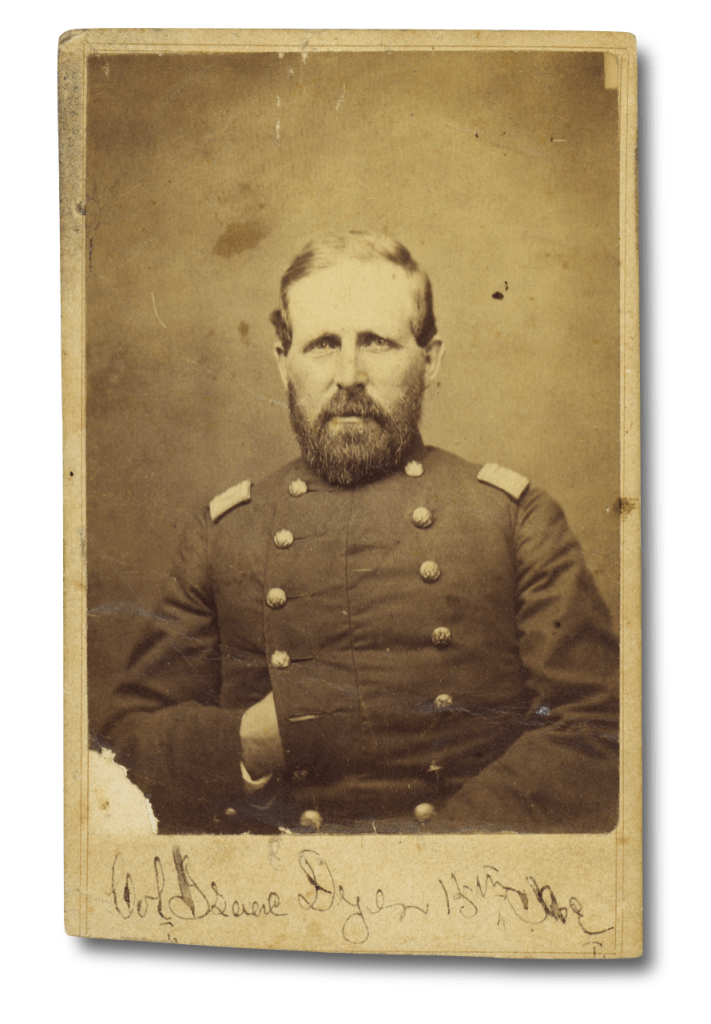

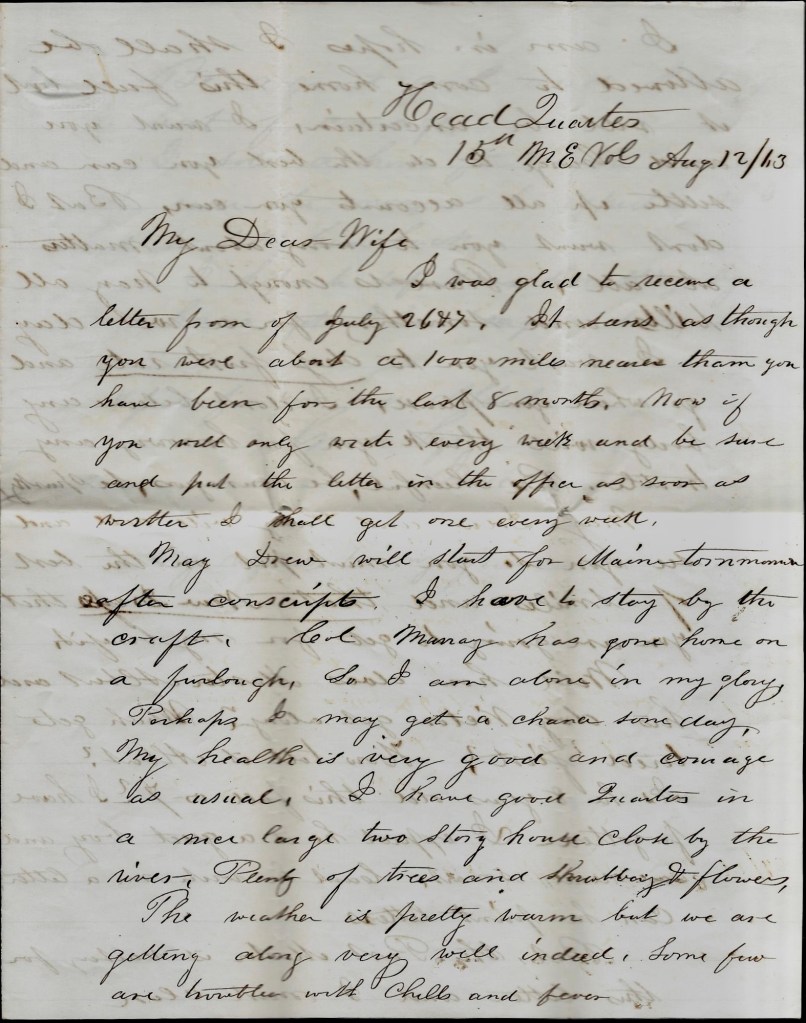
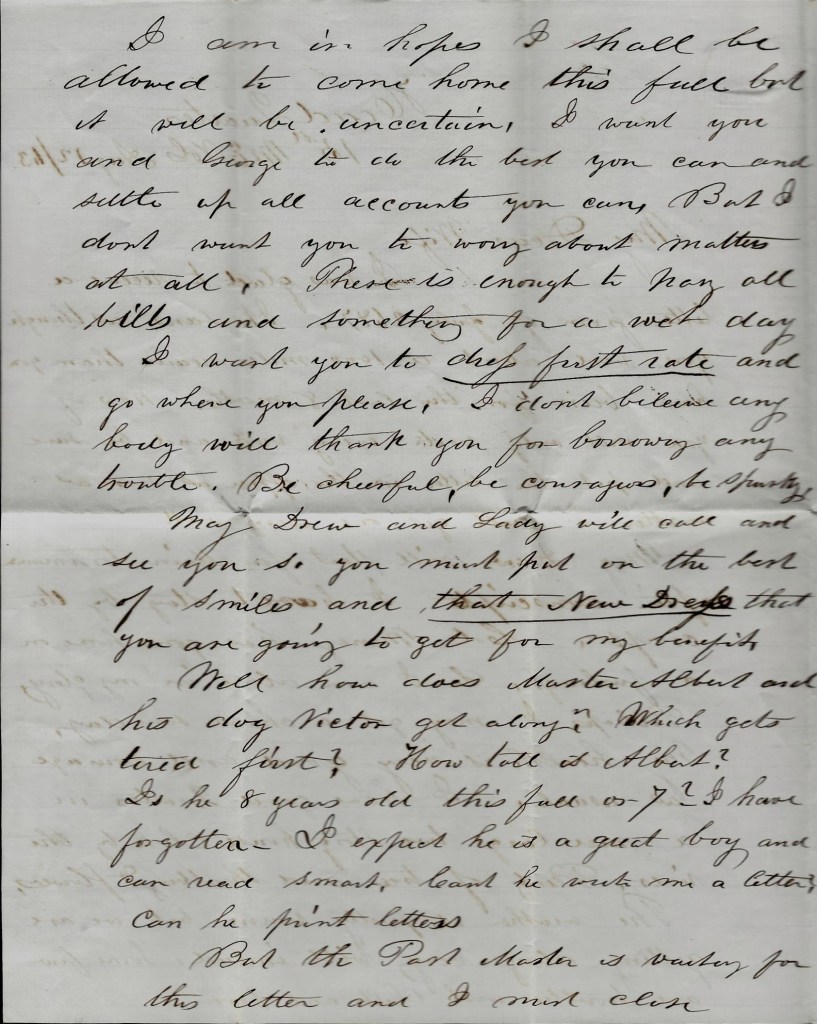


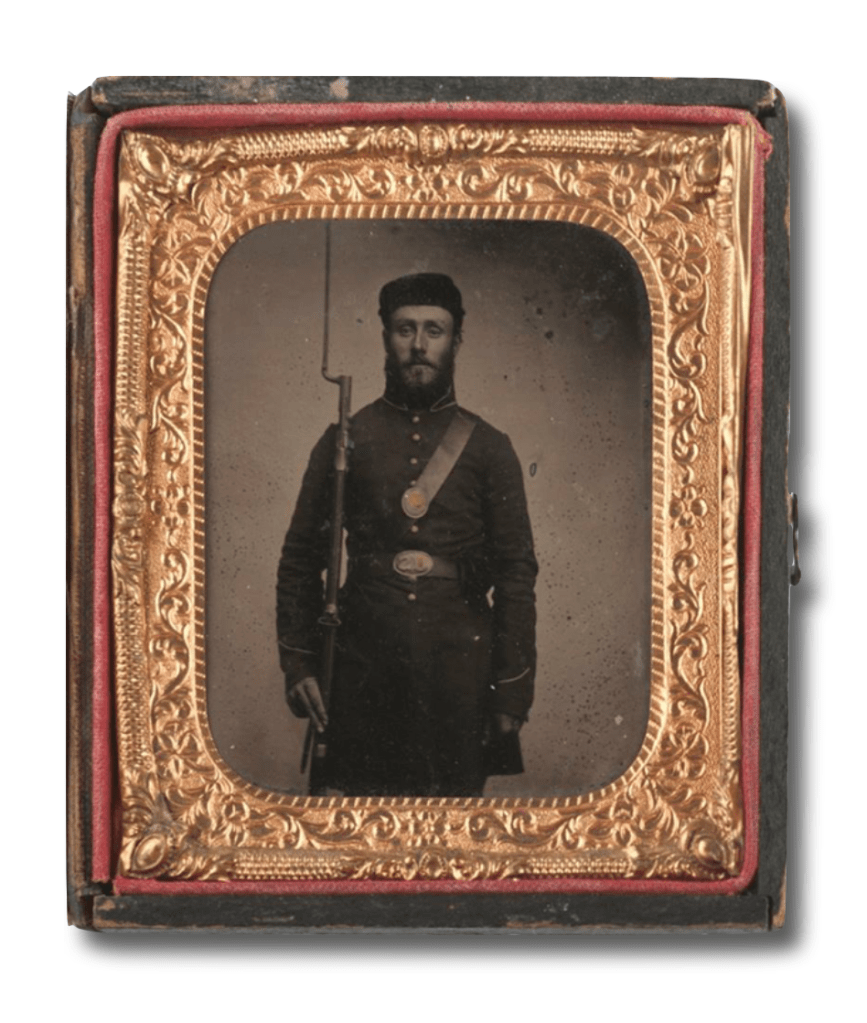
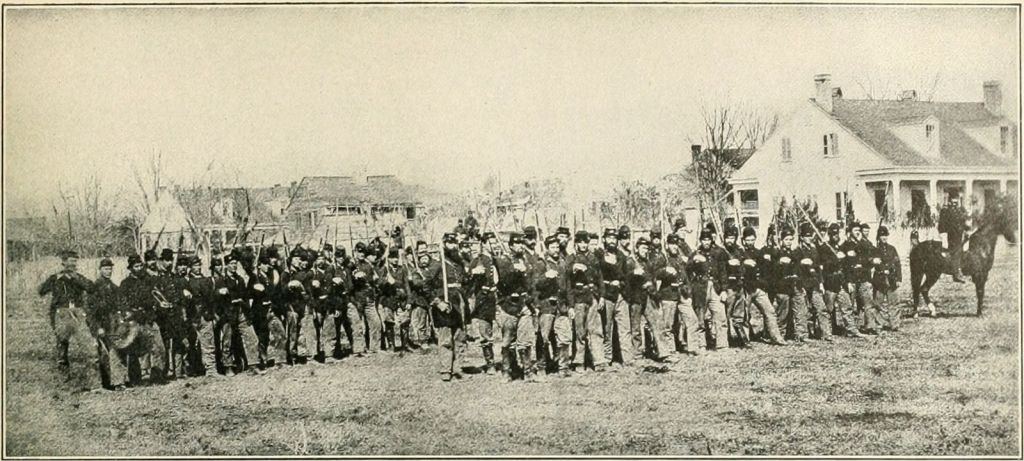
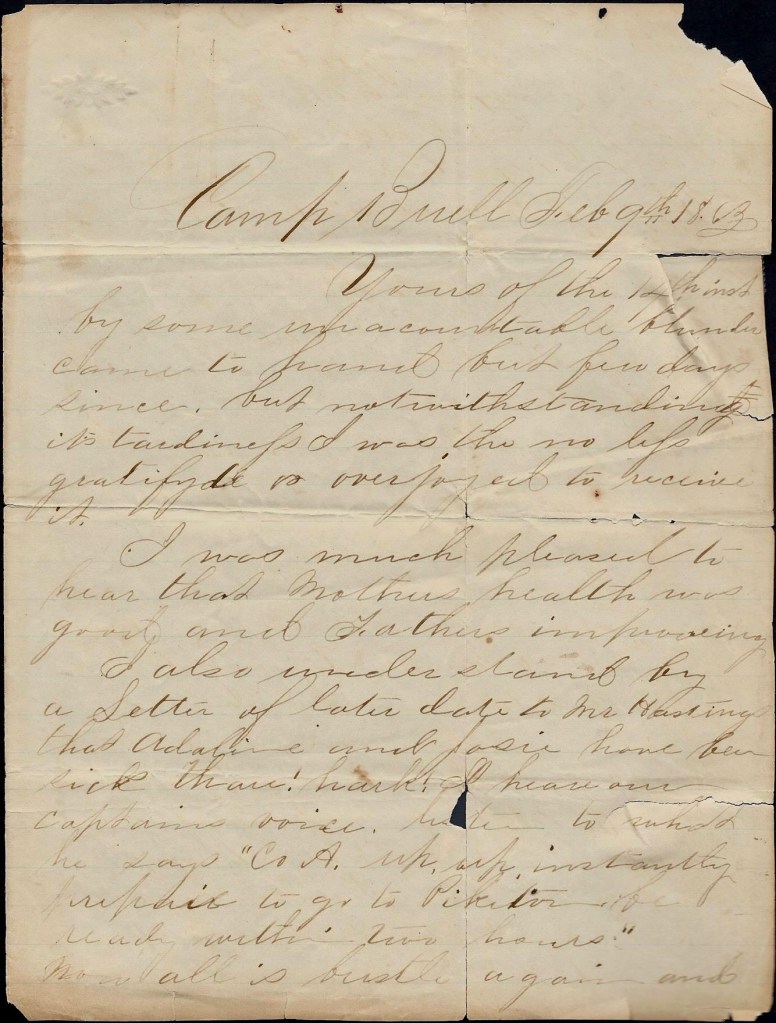


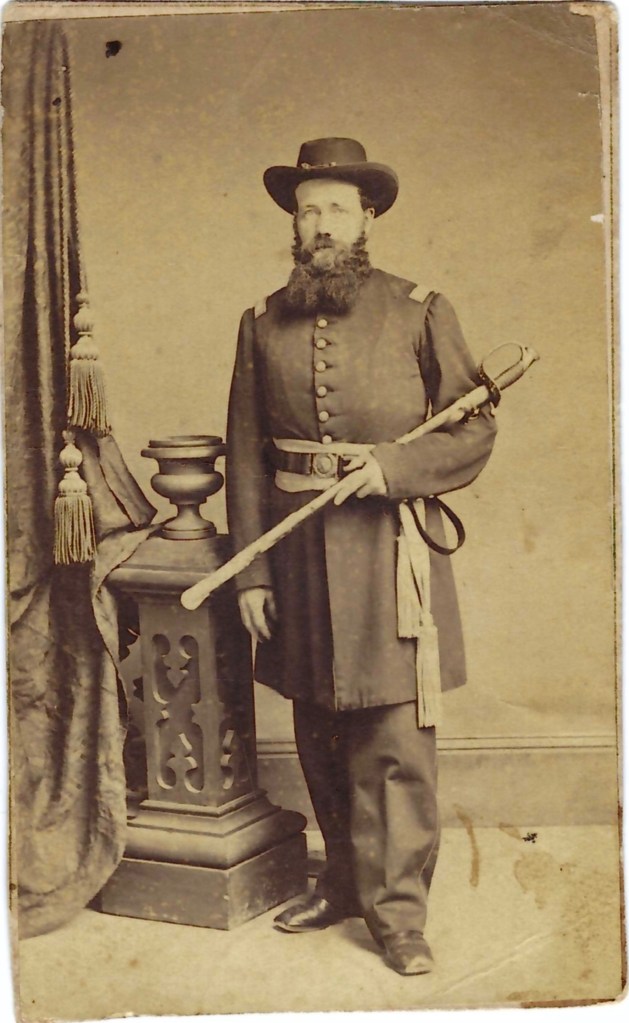
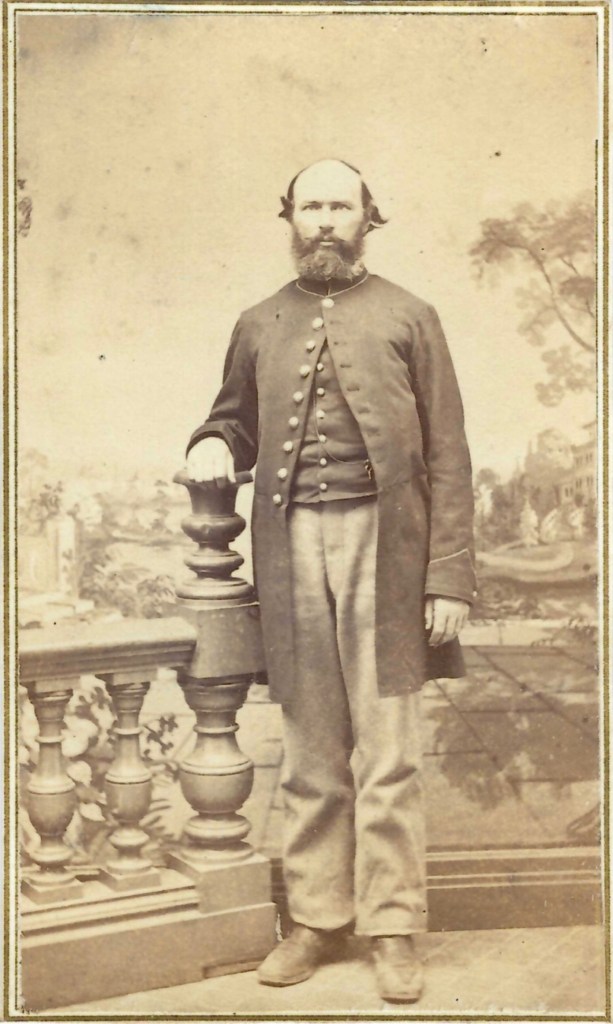

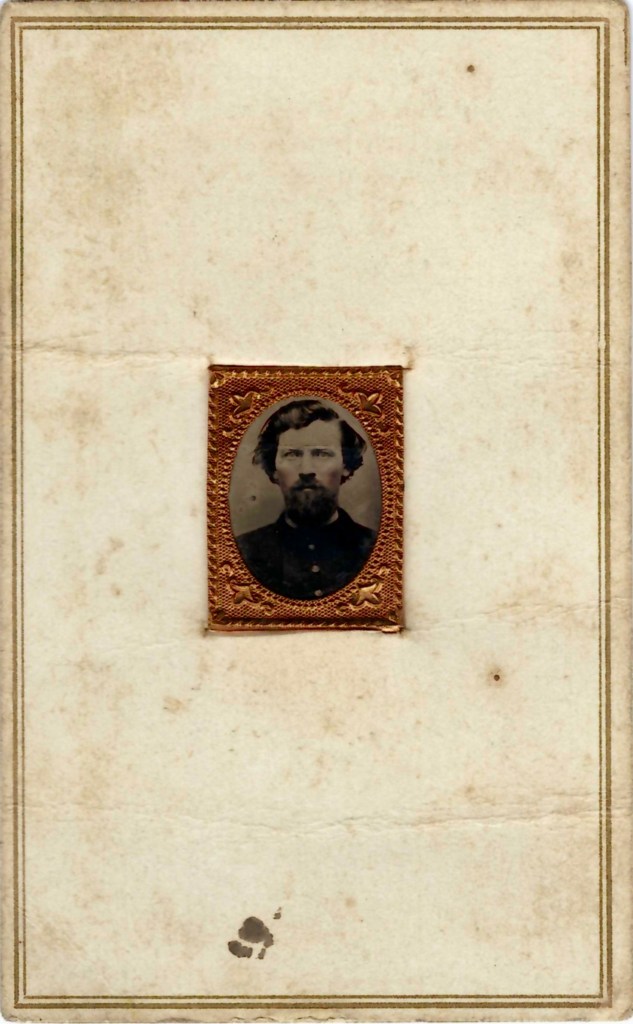


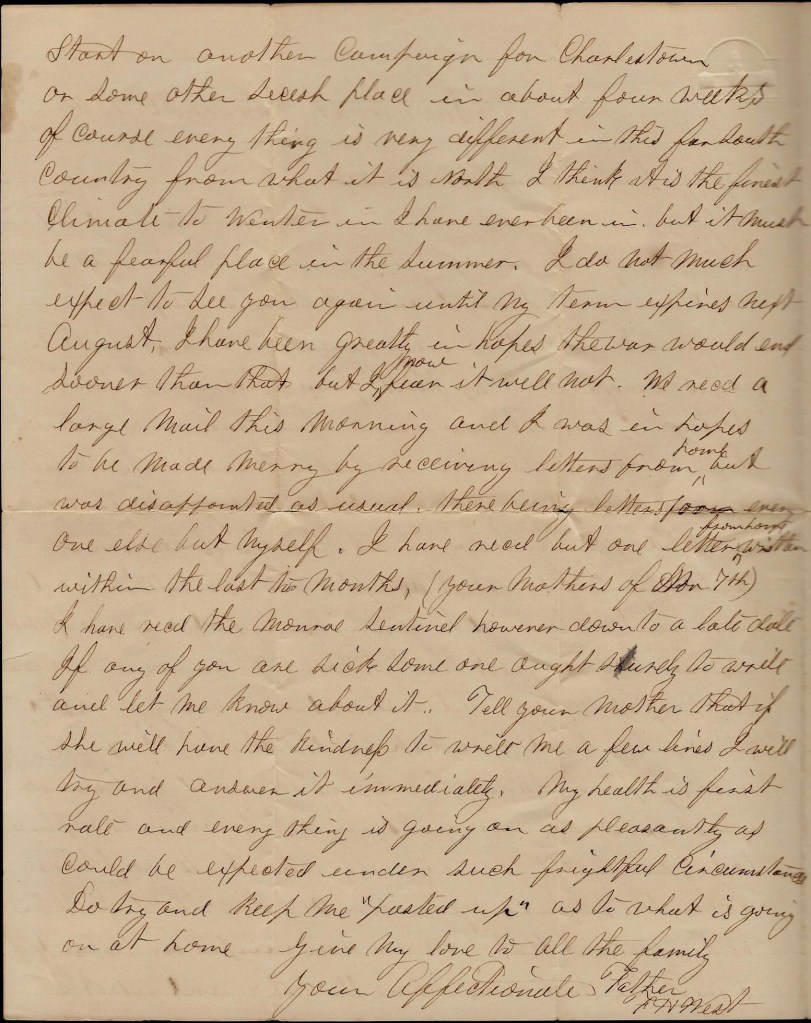


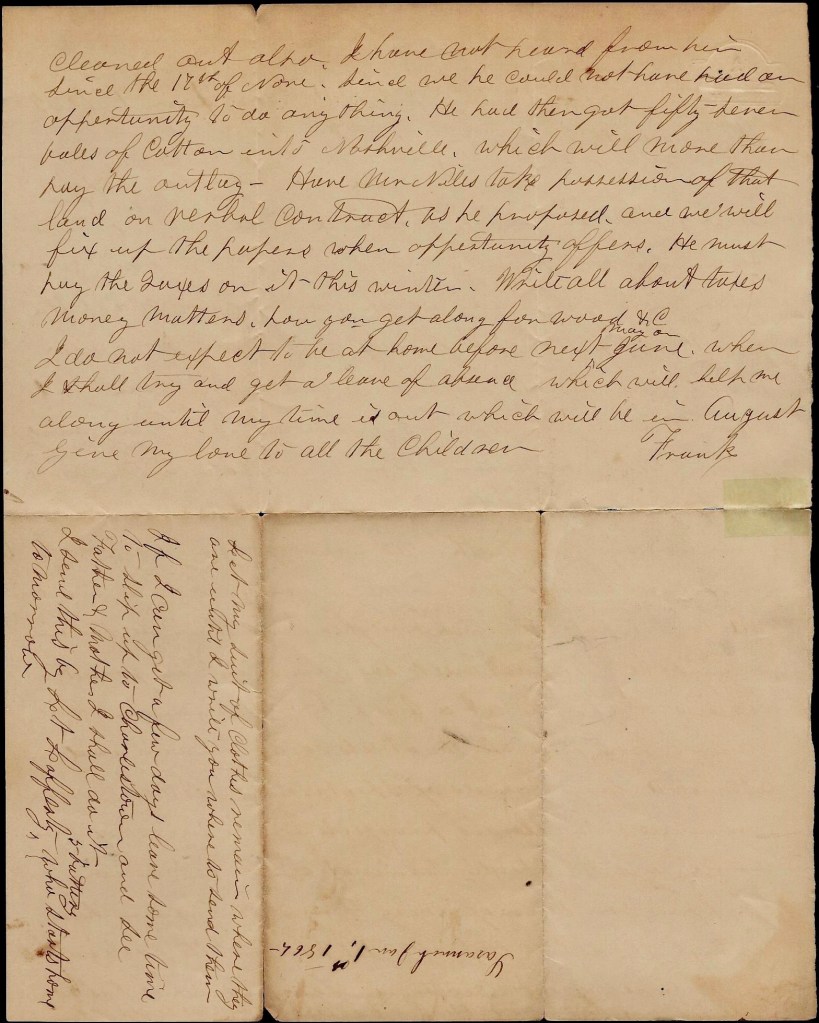


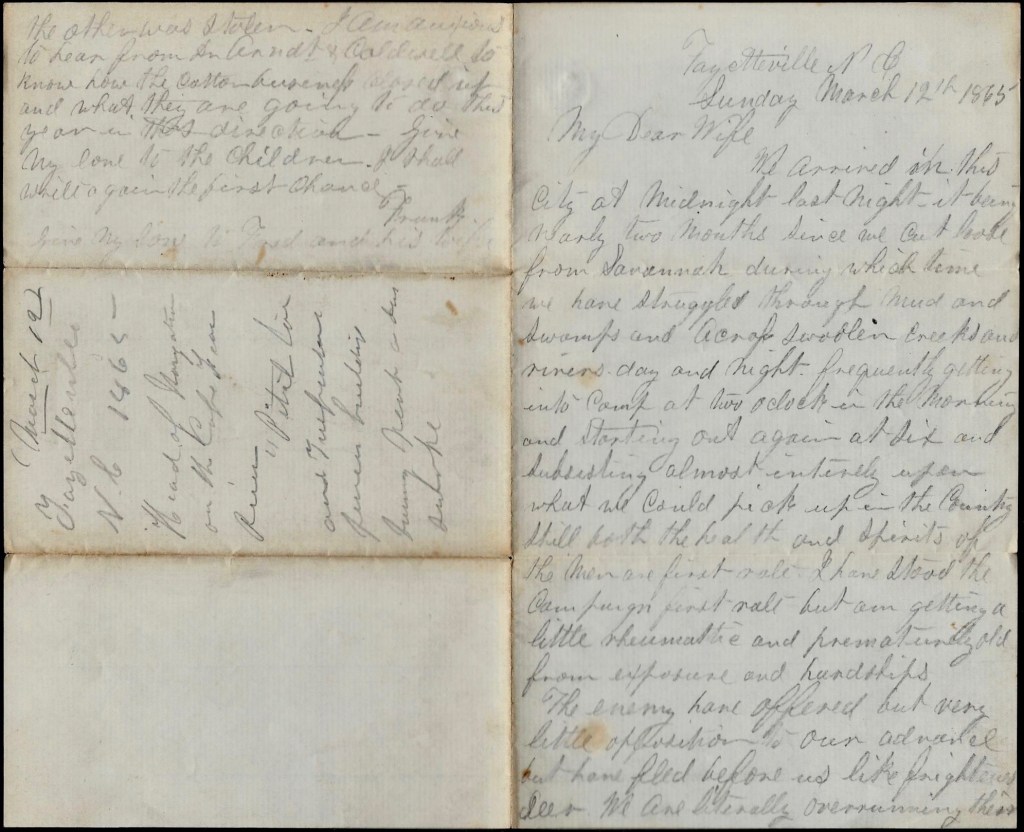
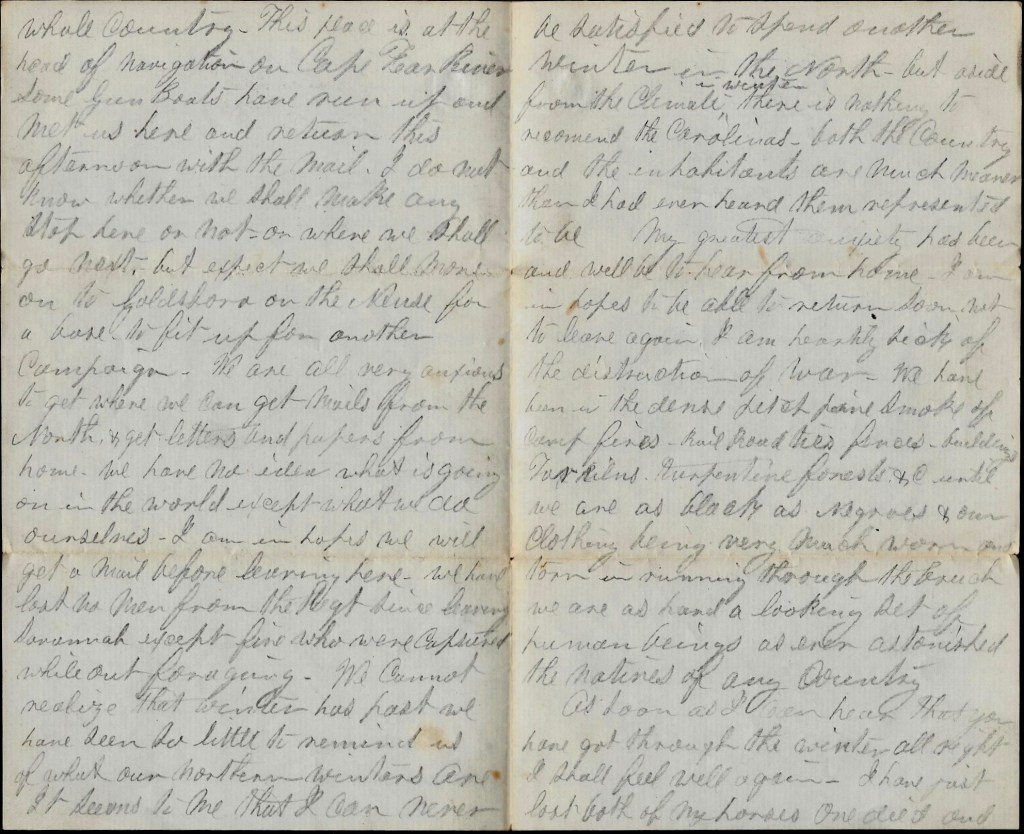


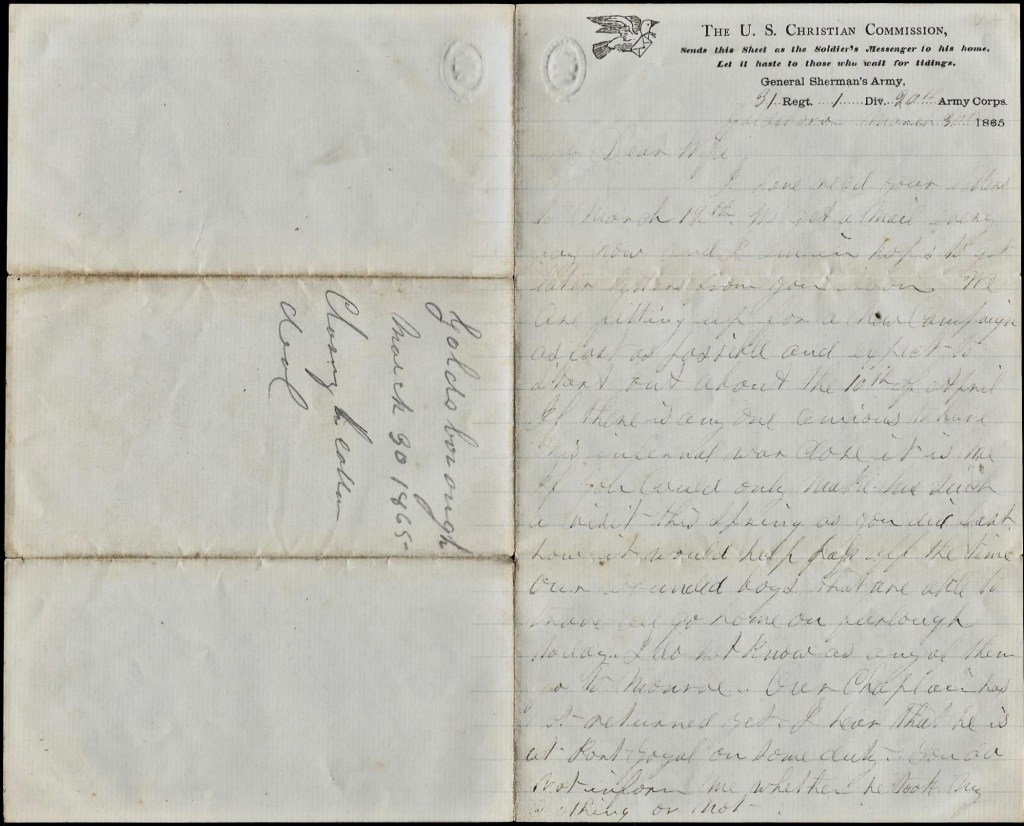
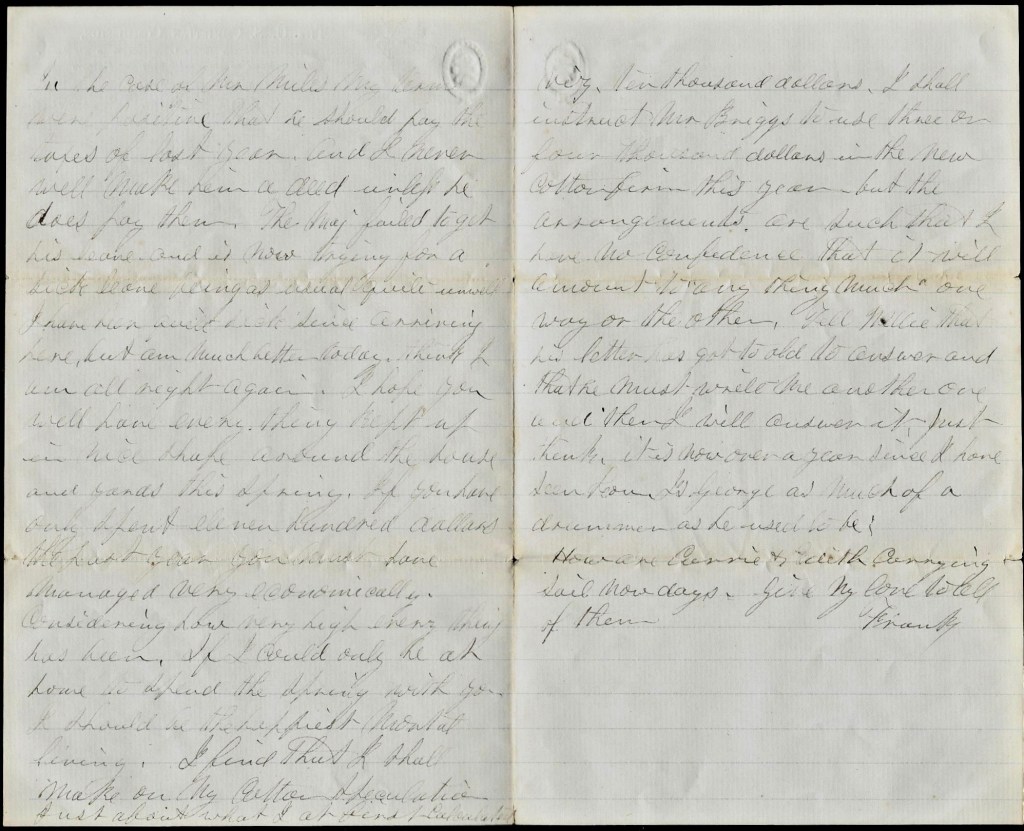


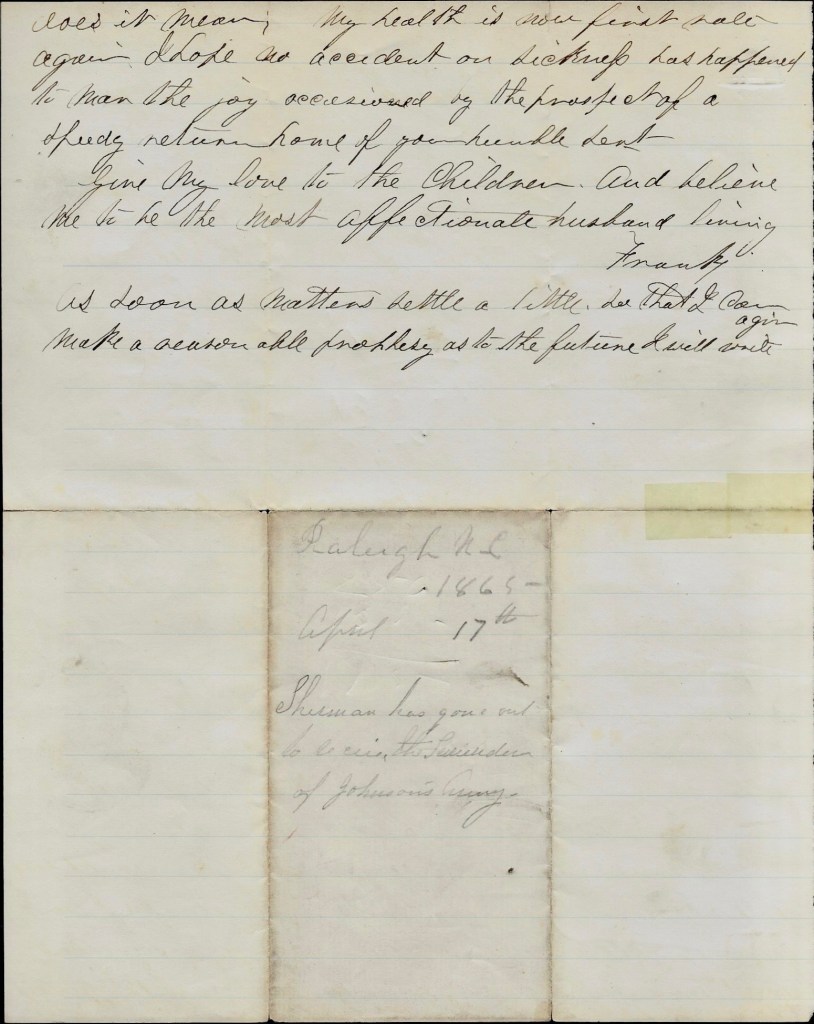
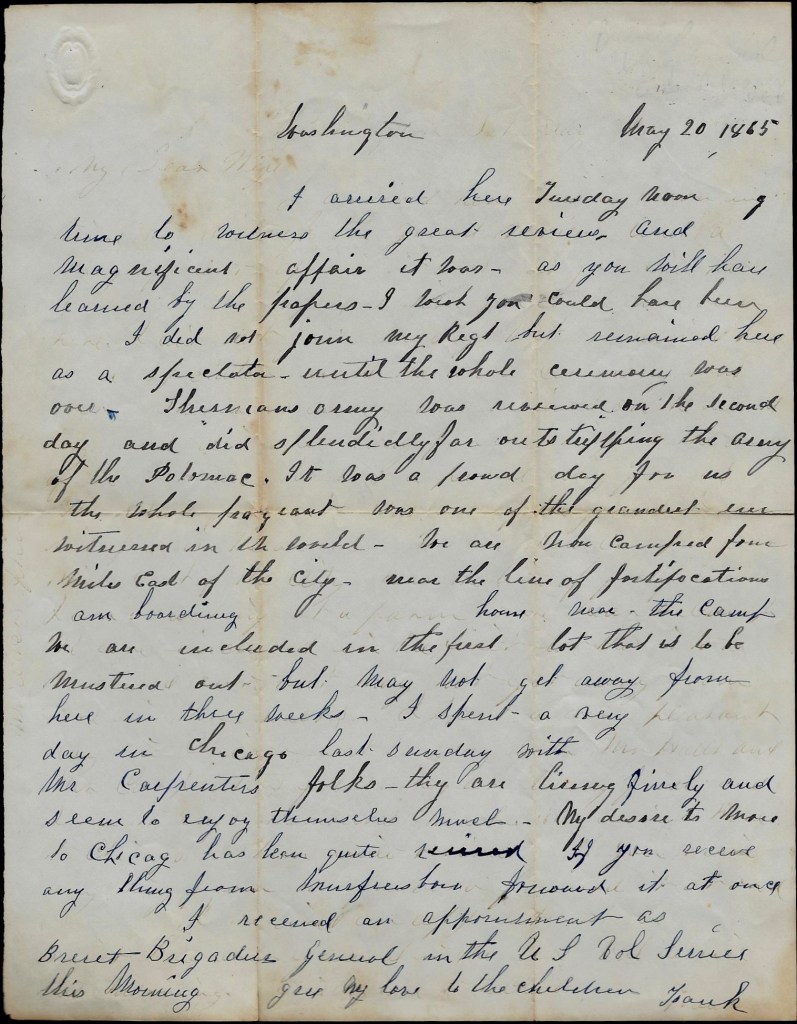


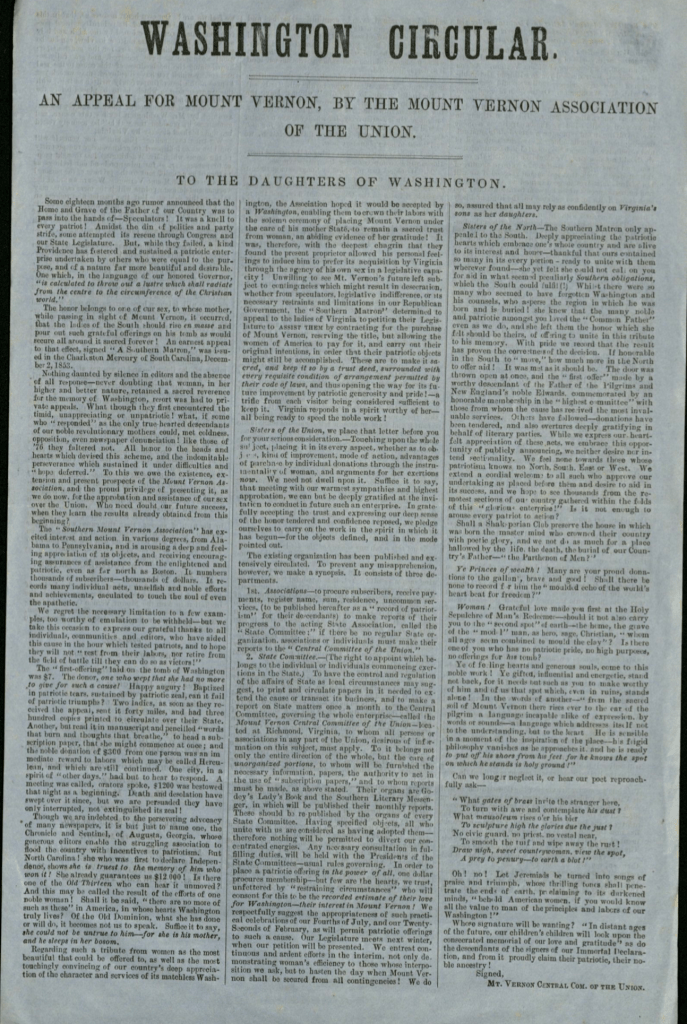
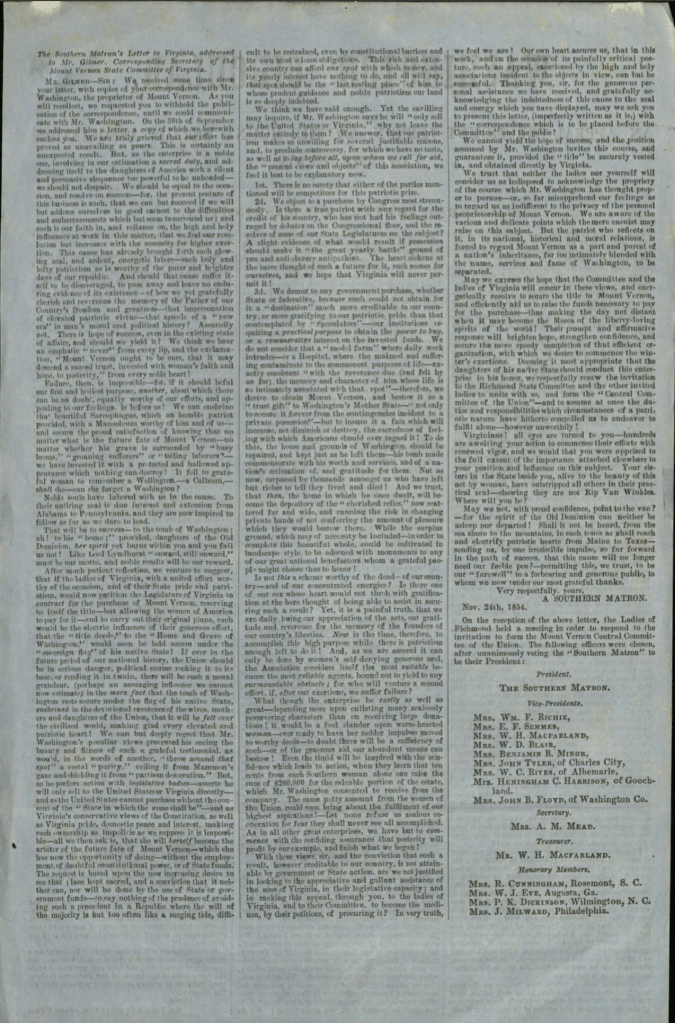


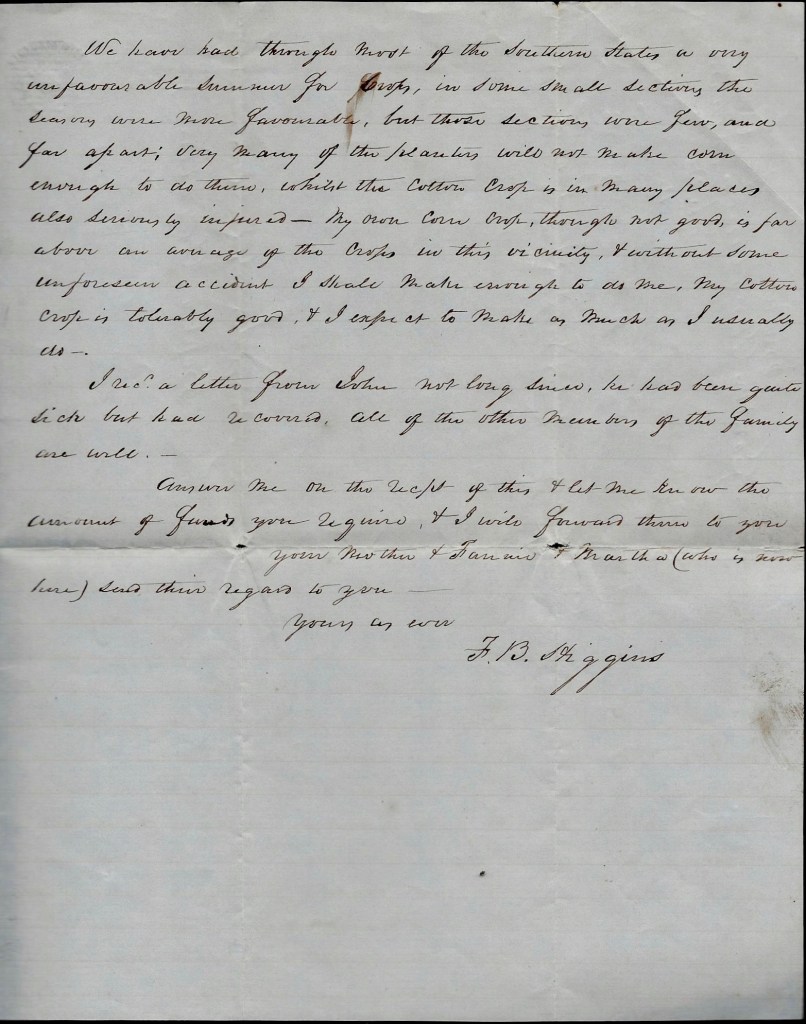
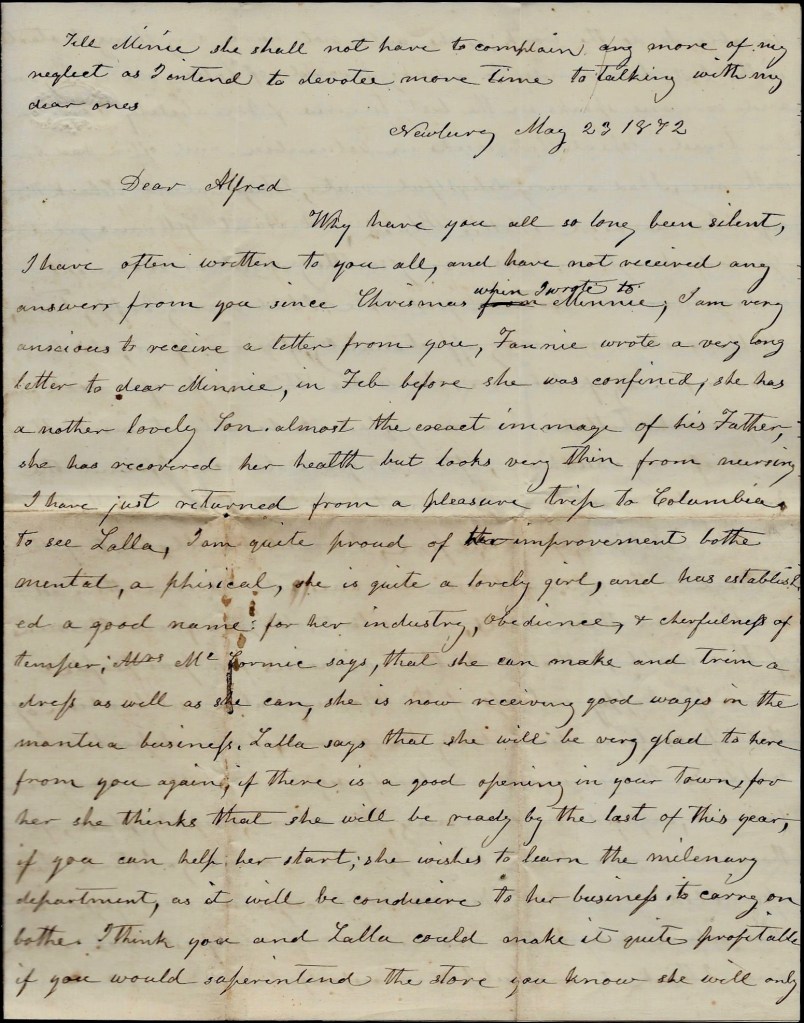

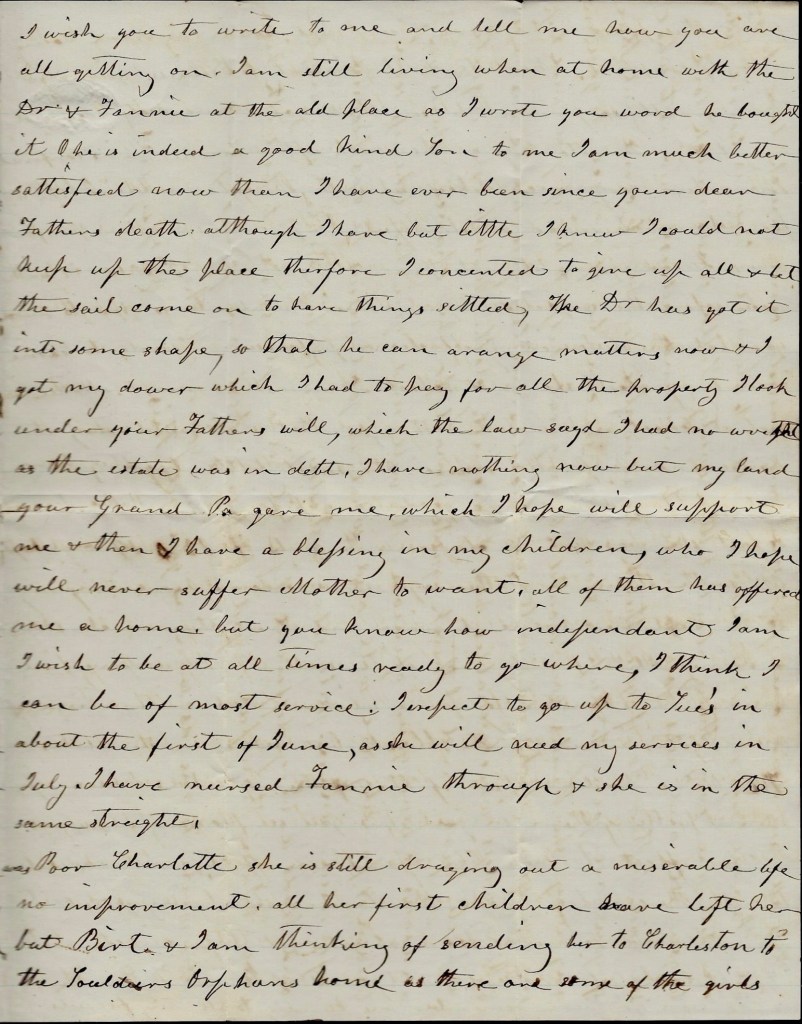
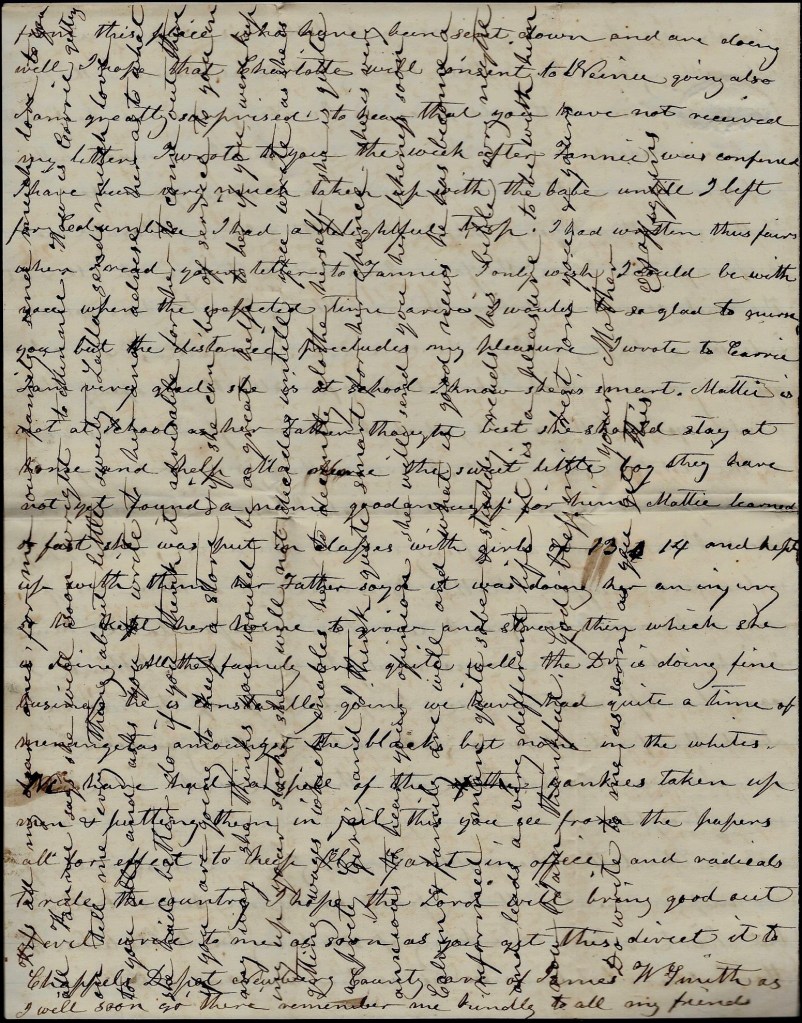
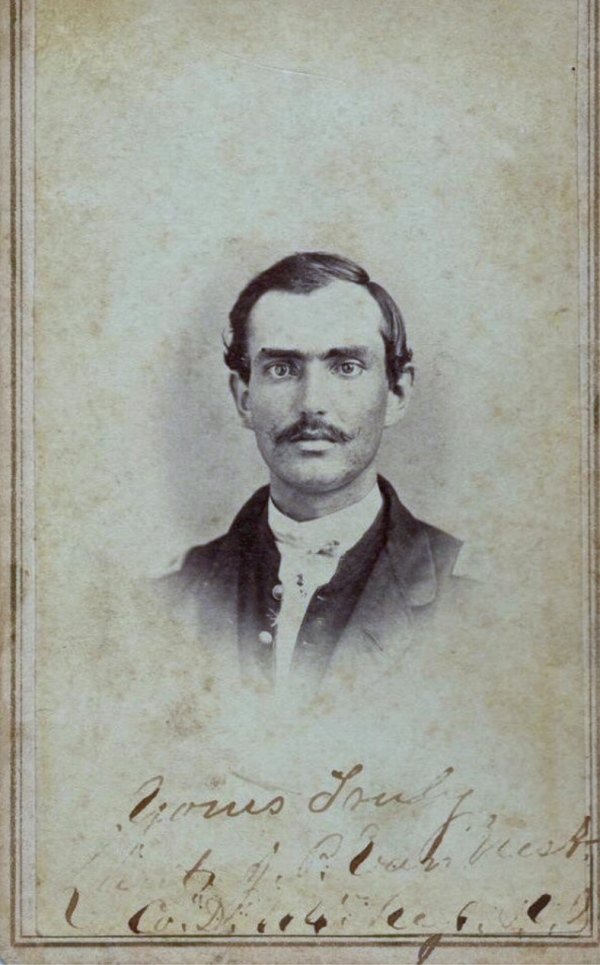

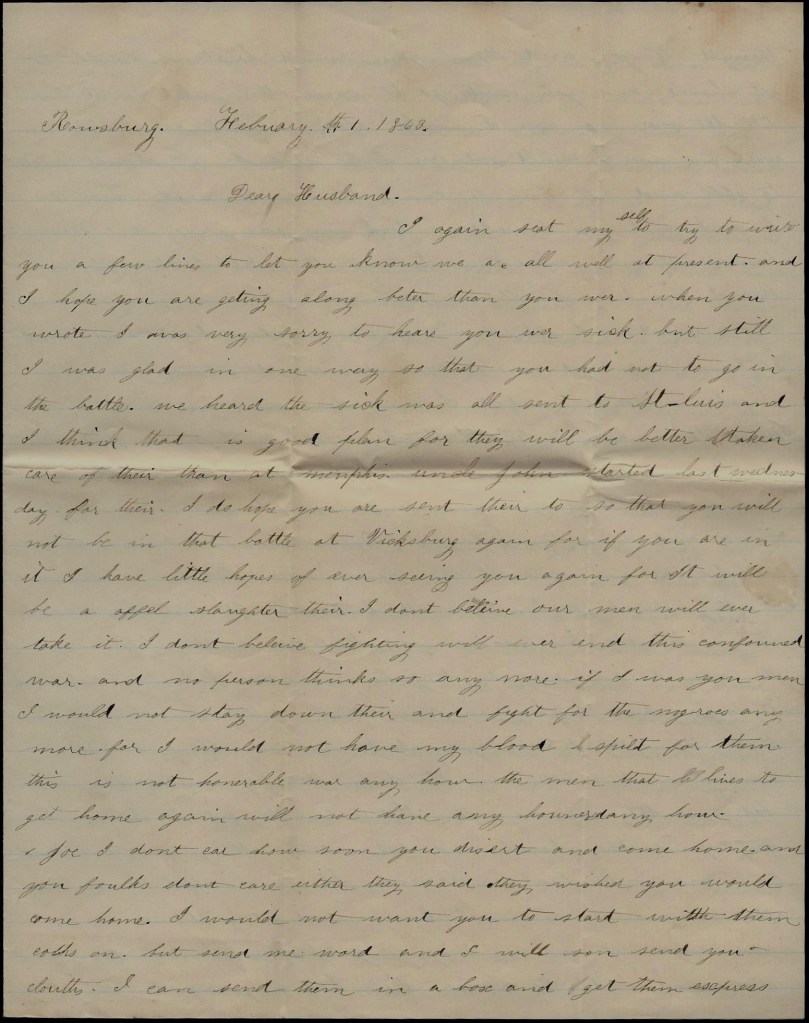


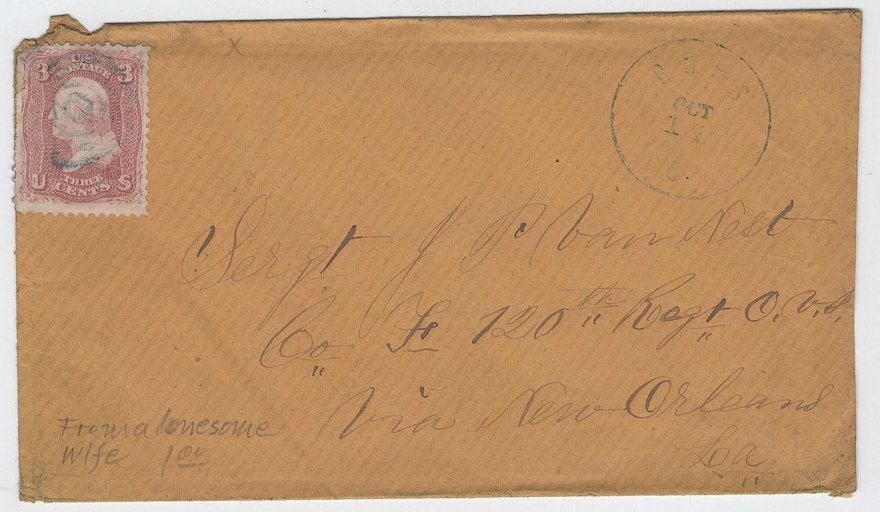
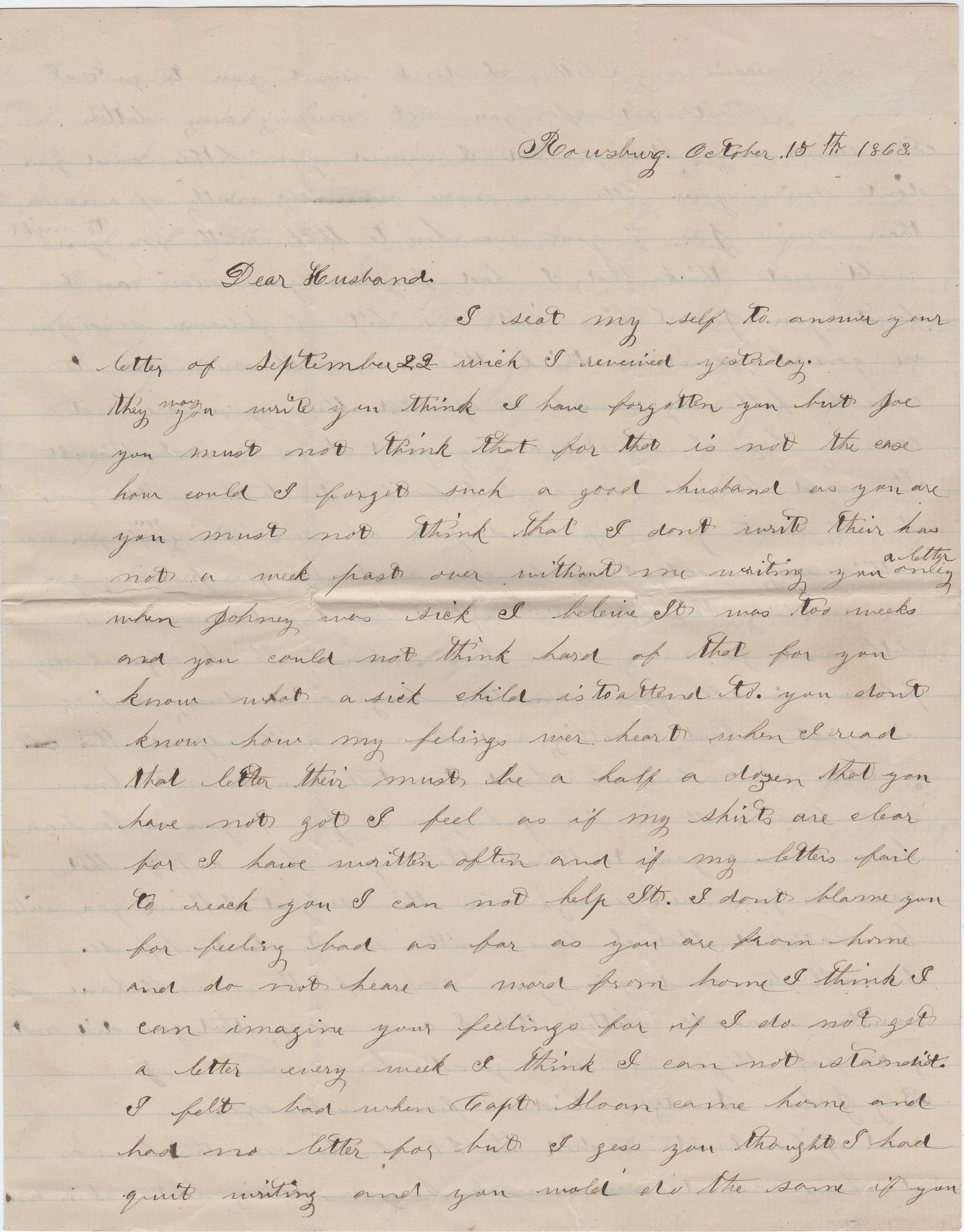
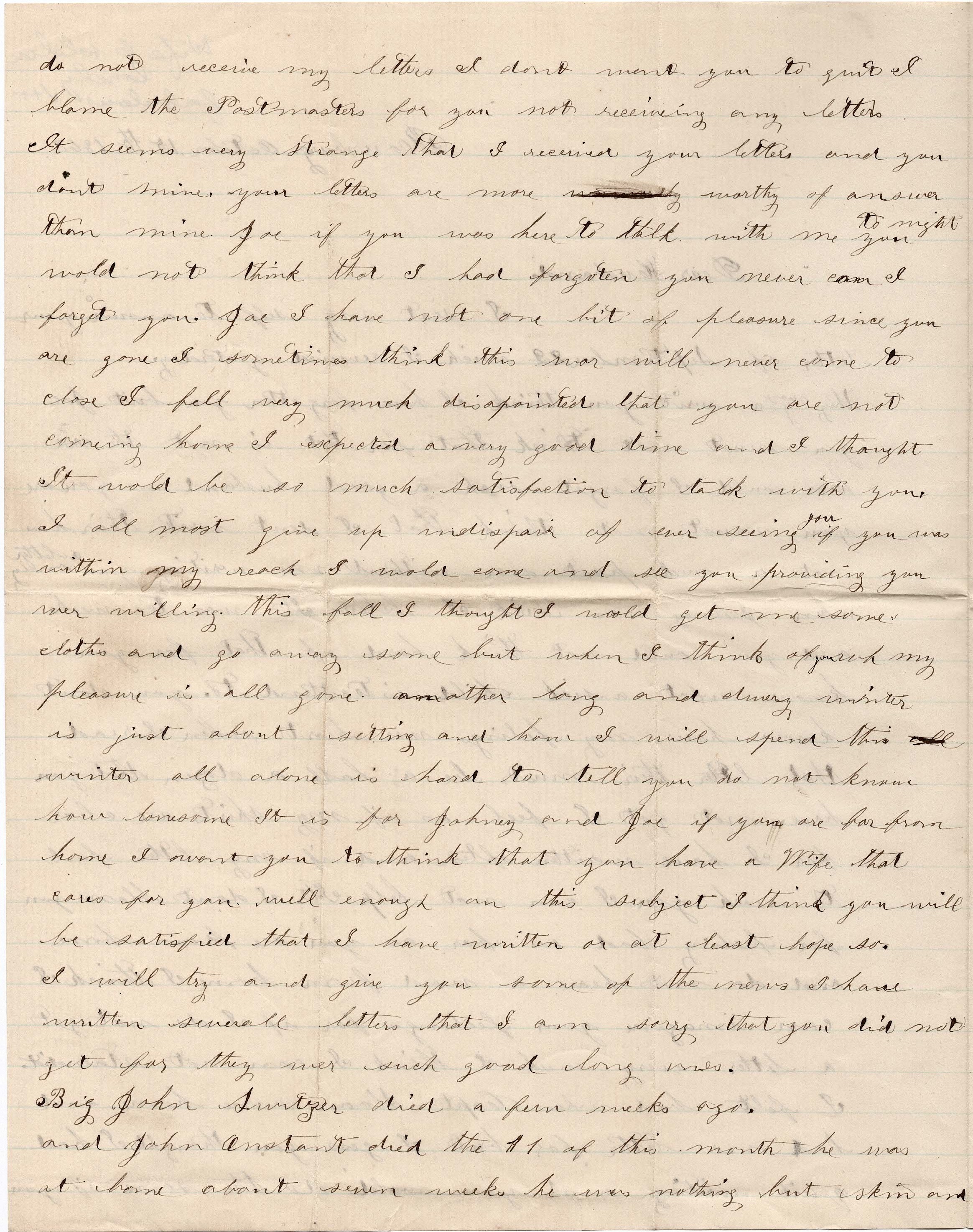

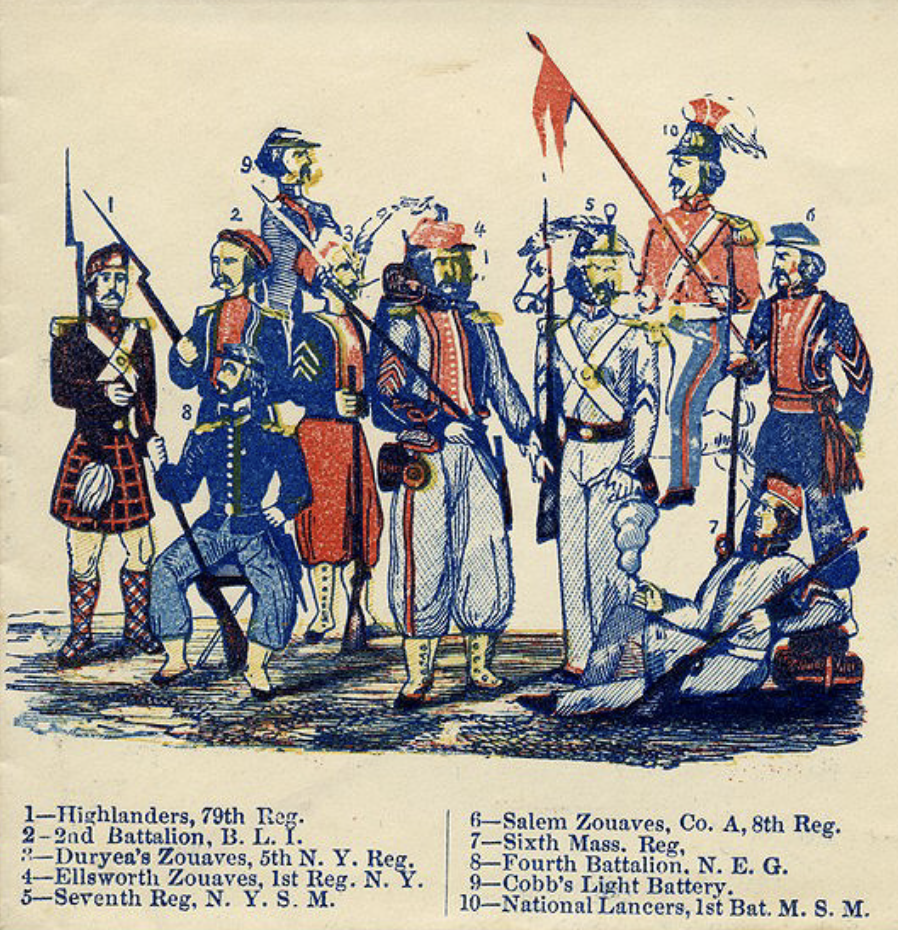

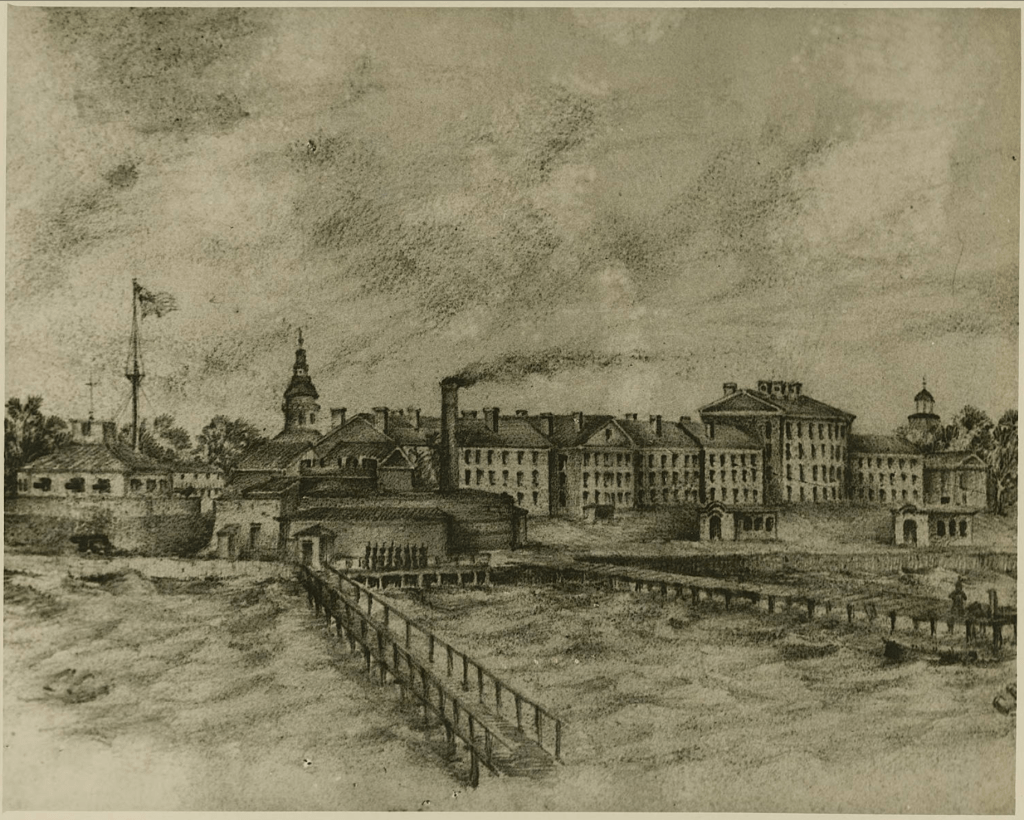






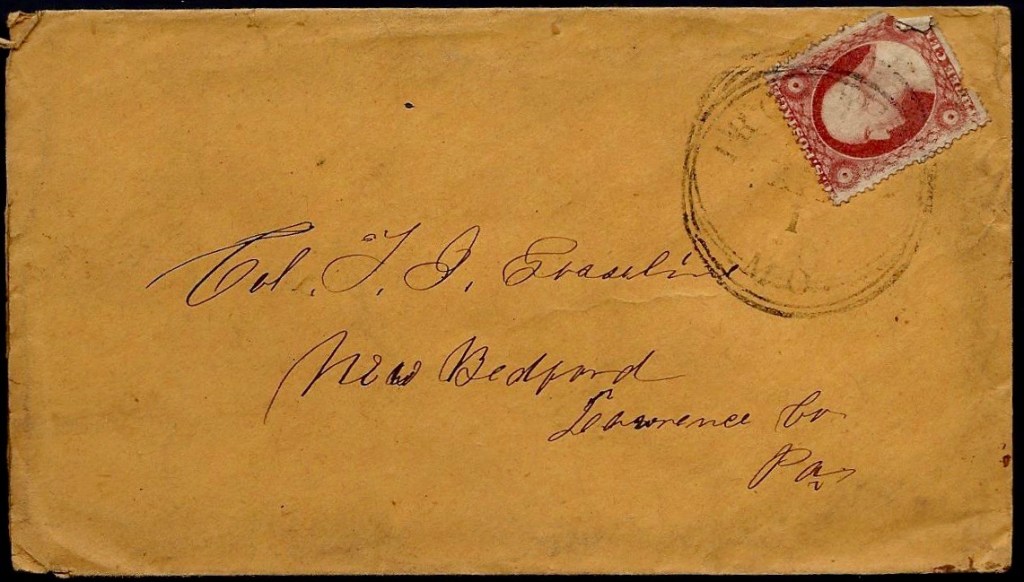


 Spared & Shared 23