This letter was written by James M. Williams (1844-1922) of Franklin, Delaware county, New York, while serving in Co. E, 109th New York Infantry. He wrote the letter to the woman he would marry in 1867, Miss Ruth L. Bradley (1842-1917). William enlisted in August 1862 and served three years, mustering out in June 1865.
An AI generated image of fortune teller.
T R A N S C R I P T I O N
Addressed to Miss Ruth Bradley, North Franklin, Delaware county, New York
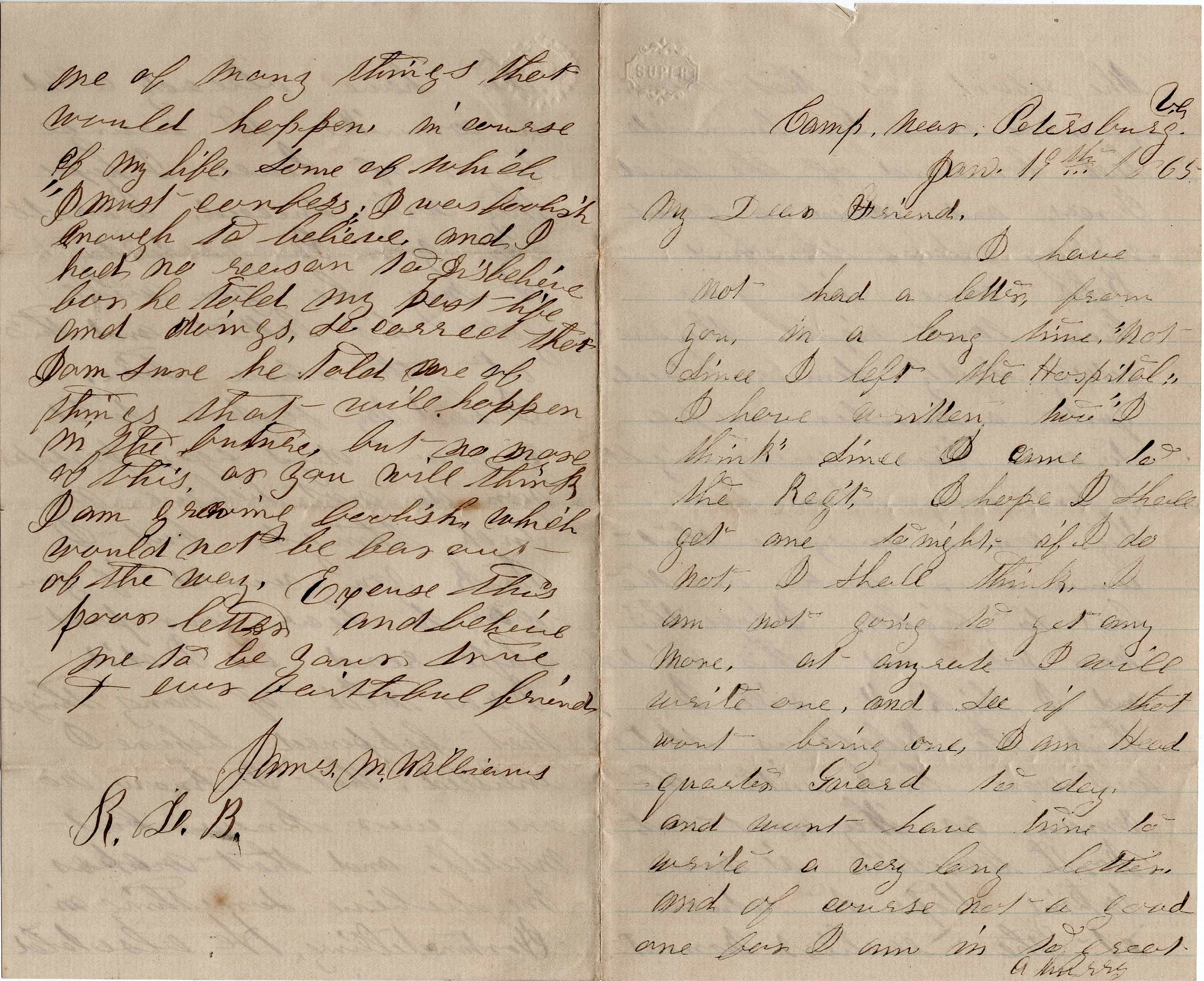
Camp near Petersburg, Va. January 19th 1865
My dear friend,
I have not had a letter from you in long time—not since I left the hospital. I have written twice I think since I came to the regiment. I hope I shall get one tonight. If I do not, I shall think I am not going to get any more. At any rate, I will write one and see if that won’t bring one.
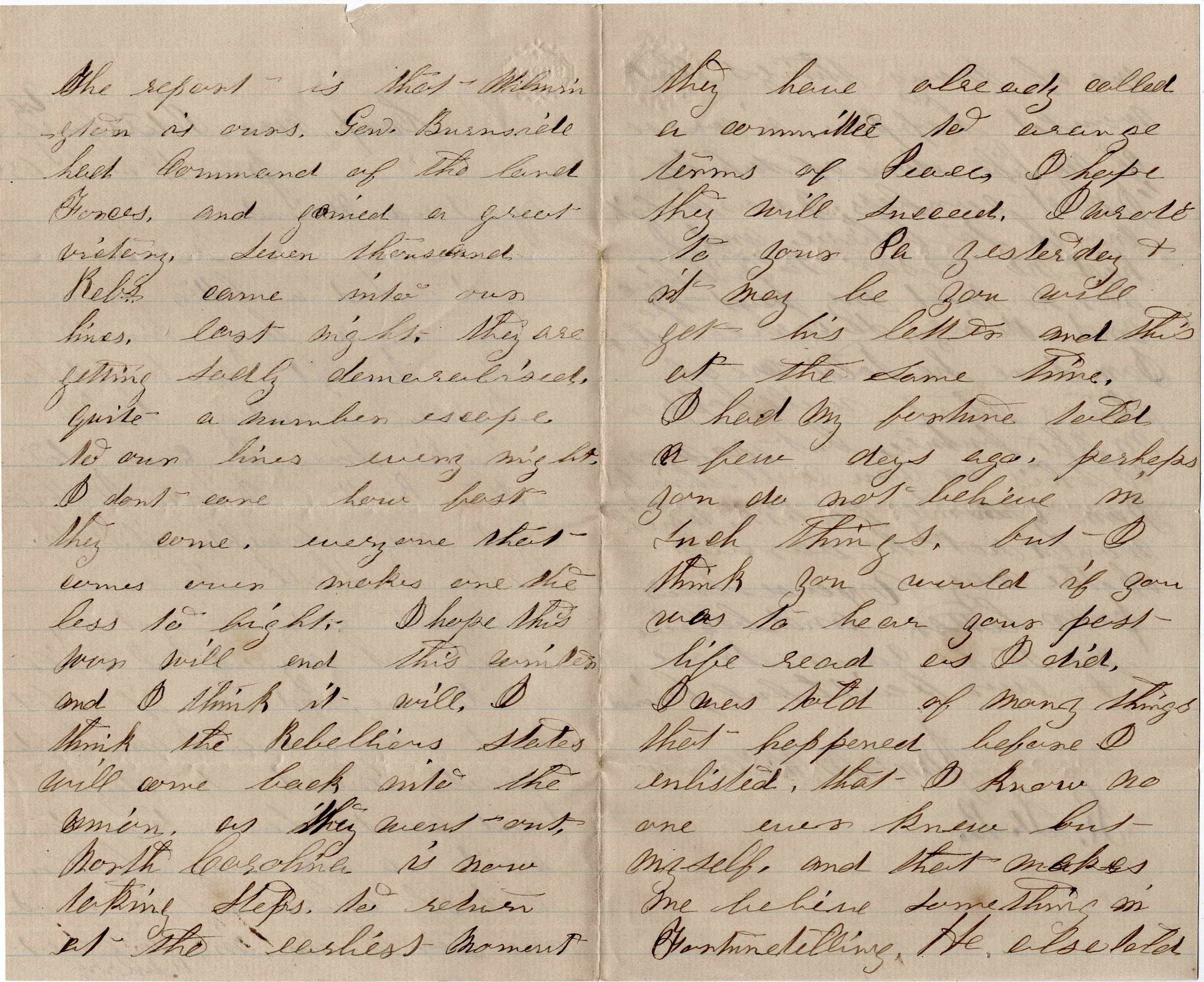
I am headquarters guard today and won’t have time to write a very long letter and of course not a good one for I am in so great a hurry. The report is that Wilmington is ours. Gen. Burnside had command of the land forces and gained a great victory. Seven thousand rebs came into our lines last night. They are getting sadly demoralized. Quite a number escape to our lines every night. I don’t care how fast they come. Everyone that comes over makes one the less to fight. I hope this war will end this winter and I think it will. I think the rebellion states will come back into the Union as they went out. North Carolina is now taking steps to return at the earliest moment. They have already called a committee to arrange terms of peace. I hope they will succeed.
I wrote to your Pa yesterday and it may be you will get his letter and this at the same time. I had my fortune told a few days ago. Perhaps you do not believe in such things but I think you would if you was to hear your past life read as I did. I was told of many things that happened before I enlisted that I know no one ever knew but myself and that makes me believe something in fortune telling. He also told me of many things that would happen in course of my life, some of which I must confess I was foolish enough to believe and I had no reason to disbelieve for he told my past life and doings so correct that I am sure he told me of things that will happen in the future. But no more of this or you will think I am growing foolish which would not be far out of the way.
Excuse this poor letter and believe me to be your true & ever faithful friend. — James M. Williams
The following letter was written by Edward G. Mabry (1839-1864), the son of Joel Mabry (1787-1840) and Sarah McKinzie (1802-1886) of Posey township, Washington county, Indiana. He wrote the letter to his brother, Joel Mabry. He mentions someone named “Wood” in his letter whom I believe was his older brother, William Woodford Mabry (1829-1892). He had another brother named James S. Mabry (1832-1863) who died in the service from pneumonia in 1863.
Edward wrote this letter while serving in Co. H, 66th Indiana Infantry. It was datelined from Corinth, Mississippi, in mid-May 1863. Edward did not survive the war, however. He died on 21 August 1864 at Rome, Georgia.
Corinth, Mississippi
T R A N S C R I P T I O N
Corinth, Mississippi May 13, 1863
Dear Brother,
I take the pleasure to send you a few lines to let you know that I received your letter a few days ago. It found me in good health and I hope when these few lines comes to hand, they may find you all in good health.
We are well at this time. I got a letter from Wood. He was well. He is at Helena, Arkansas. He wrote that he was to try and get a furlough and come to see us. I would be glad to see him.
Well, I will tell you about [our] tramp we have taken down in Alabama which was about ninety miles from Corinth. We was gone eighteen days you know. We saw some good old times. We saw some Rebels but they would not stand fire. The cavalry and them had some fighting but we did not get at them. We found them at Little Bear Creek. We run them to Town Creek. We formed a line of battle three times. When we got to Town Creek we got there late in the evening. We shelled them some and commenced in the morning at half past five o’clock the next morning and continued till 3 in the evening and by that time we had a pontoon bridge across the creek [and] we went over. They left the 10th Kansas Jayhawkers. When we came back, they burnt all the houses eight miles wide and captured all the negro and all the mules and all the horses. They destroyed all the cotton that they could not fetch with them. We swept everything clean. That is the way to do it.
You wrote that you was not going to set yourself up for a target for them to shoot at. Well I am up for them and I think it is every man’s duty that is able. I think the backbone is broke now. I don’t think they can hold out much longer. I think that I will be at home against the 1st of November.
We was all paid off up to the 1st of March which was four months—52 dollars. I sent home forty dollars. I got a letter from Charles last month. They are all well. He wrote he had got him a duck. Well, I must bring to a close. I still remain yours so write soon, — Edward G. Mabry
The following letter was written by Corp. William H. Thompson (1829-1864) of Co. H, 66th Indiana Infantry. He mustered into the regiment in August 1862 and was killed in the fighting near Atlanta on 9 August 1864. William was the son of John Calvin Thompson (1806-1876) and Amanda Vaughn Garriott (1809-1853) of Little York, Washington county, Indiana. A cooper by trade, William was residing in Washington county with his wife of nearly 7 years, Lydia Jane (Graham) Thomson (1830-1863) when he enlisted. The baby, Douglas Graham Thompson, born in 1860, appears to have survived.
William’s letter was addressed to his cousin, John Royse, in Washington county, Indiana. See also the letter by John Royse’s brother, Simeon G. Royse (1837-1867), the son of John W. and Mary (Garriott) Royse of Fredericksburg, Washington county, Indiana. Simon enlisted as a private in Co. H, 66th Indiana Infantry on 19 August 1862 and mustered out of the service on 13 June 1865. 1863: Simon G. Royse to Mary (Garriott) Royse.
T R A N S C R I P T I O N
[Guarding the Memphis & Charleston Railroad] September 14, 1863
Dear cousin,
I sit down tonight to answer your kind letter which came duly to hand and should have been answered before this time but I know you will excuse me for not writing sooner when I tell you that since I came to Lafayette, Tennessee, and heard the report that [John] Hallenbeck and [Martin] Edmonson brought concerning my poor wife, my mind has not been composed enough to write and intelligible letter and you must not expect much from me at this time for I have no word from any family since the first and I suppose that my dear wife and child was not expected to live. You may form some idea of my feelings at the present time, not knowing whether I have a dear wife and sweet little babe or not. But the Lord giveth and the Lord taketh away and Blessed be the name of the Lord.
Well, John, I hardly know what to write to you for there is nothing here of interest to me and I am in a poor condition to select anything to interest anyone. But I will do the best I can and let ignorance plead my excuse. In the first place, I will give you a history of our move from Corinth to this place. It was a pretty rough move to me but nearly all the Boys got through on the cars. I will tell you how it happened. On the 18th day of August, I was detailed with six others of our company to go out on picket. Well just about 5 o’clock that evening our Brigade of four regiments was ordered to Lagrange, Tennessee, and the order was for all but those on picket to go on the cars and for those that was on picket, when they was relieved the next morning, to march through as a guard for the wagon train.
Well we was relieved about 9 o’clock on the 19th and went into camp and eat our dinners and prepared for a march of sixty miles which turned out to be about 80 more or less. Well we started about 3 in the evening with 40 wagons and 175 men, 56 of our regiment and about 45 apiece of the 52nd Illinois and the 2nd and 7th Iowa. Well, after a march of 15 miles, we stopped to camp where the town of Chewalla once stood before it was burnt. Here the 18th Missouri is stationed. Here our strength was increased by the addition of two companies of the 2nd Iowa that had been guarding a bridge out in the country.
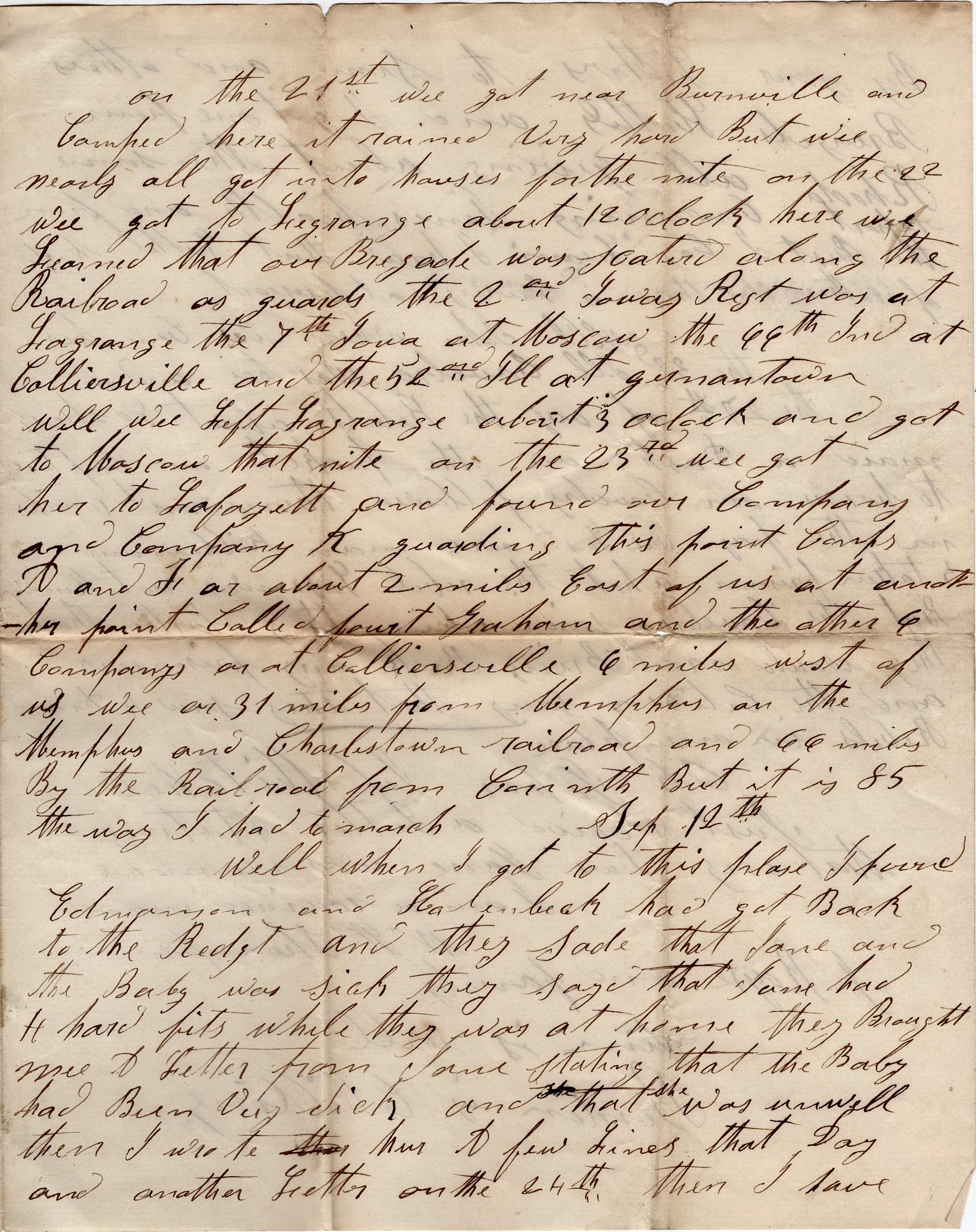
When we started from Chewalla on the 20th, we got an escort of 30 cavalry to go with us as far as Pocahontas so you see our guard amounted to some 350 men. Well, we passed Pocahontas about three miles that day. On the 21st we got near Burnville and camped here. It rained very hard but we near all got into houses for the night. On the 22nd, we got to Legrange about 12 o’clock. Here we learned that our Brigade was scattered along the railroad as guards. The 2nd Iowa Regiment was at Lagrange, the 7th Iowa at Moscow, the 66th Indiana at Colliersville, and the 52nd Illinois at Germantown.
Well we left Lagrange about 3 o’clock and got to Moscow that night. On the 23rd we got here to Lafayette and found our company and Co. K guarding this point. Companies A and F are about two miles east of us at another point called Fort Graham and the other six companies are at Colliersville, six miles west of us. We are 31 miles from Memphis on the Memphis and Charlestown Railroad and 66 miles by the railroad from Corinth, but it is 85 [miles] the way I had to march.
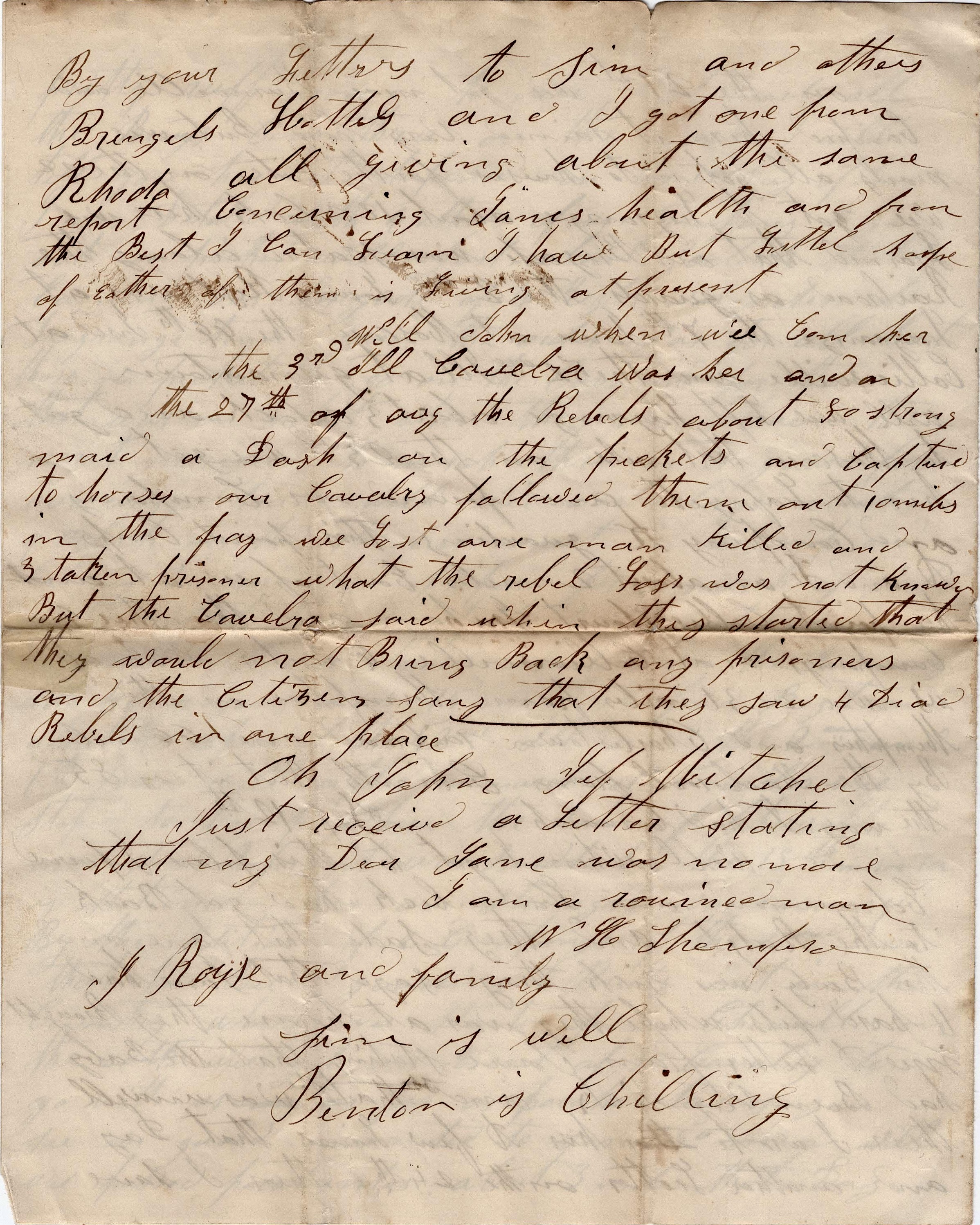
September 12th. Well, when I got to this place, I found Edmonson and Hallenbeck had got back to the regiment and they said that Jane and the baby was sick. They said that Jane had four hard fits while they was at home. They brought me a letter from Jane stating that the baby had been very sick and that she was unwell then. I wrote her a few lines that day and another letter on the 24th. Then I have [news] by your letters to [your brother] Sim[eon] and others, and I got one from Rhoda all giving about the same report concerning Jane’s health and from the best I can learn, I have but little hope of either of them in living at present.
Well, John, when we come here, the 3rd Illinois Cavalry was here and on the 27th of August, the Rebels about 80 strong made a dash on the pickets and captured two horses. Our cavalry followed them out ten miles. In the fray, we lost one man killed and three taken prisoner. What the Rebels lost was not known but the cavalry said when they started that they would not bring back prisoners and the citizens say that they saw four dead Rebels in one place.
Oh, John, Jef. Mitchell just received a letter stating my dear Jane was no more. I am a ruined man. — W. H. Thompson
[to] J. Royse and family. Jim is well. Benton is chilling.
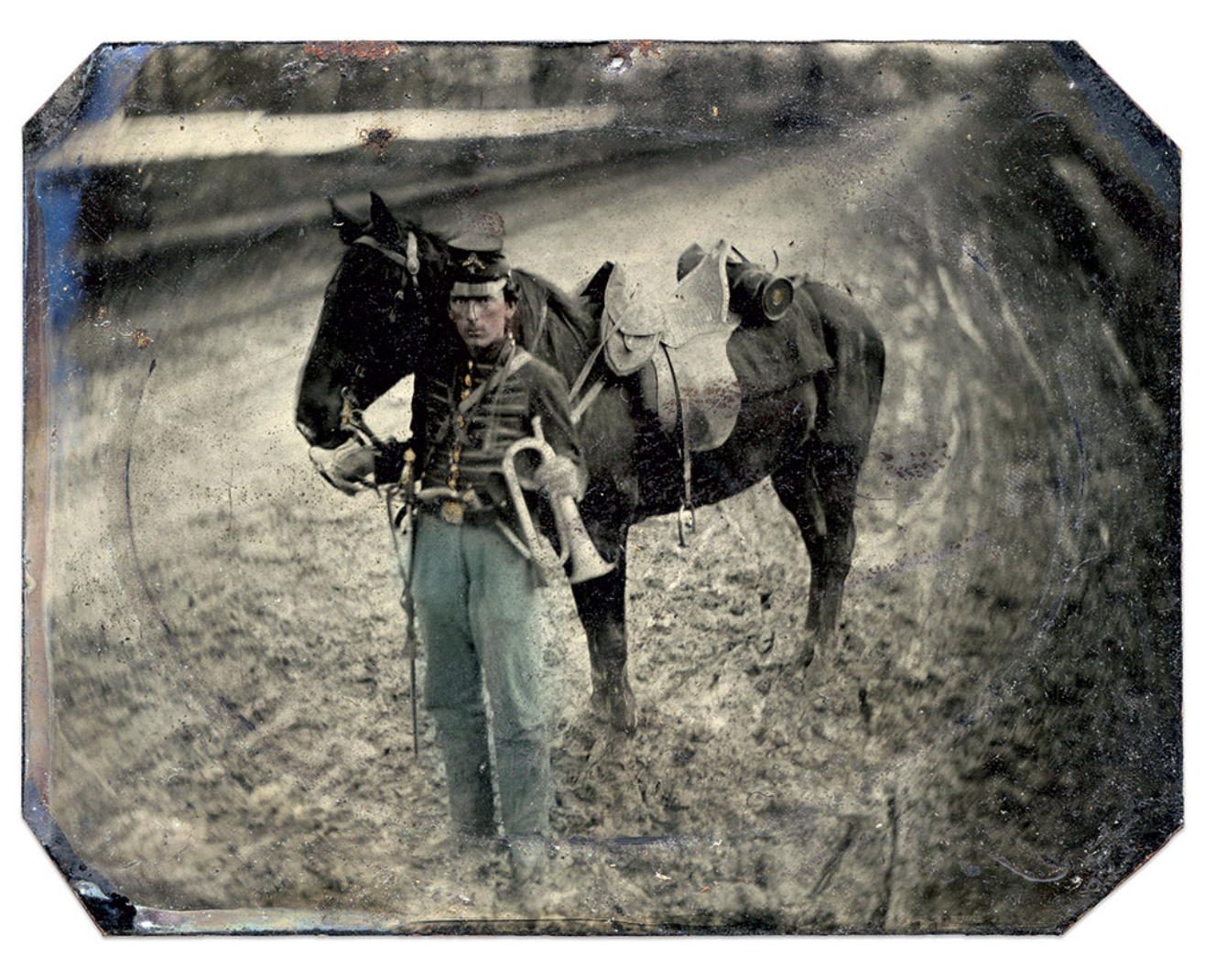
The following letter was Reuben Wheeler Coy (1843-1896), a former student of Genessee Wesleyan College, who enlisted on August 5, 1862, when he was 19 years old as a private in Co. K , 1st New York Mounted Rifles. He was appointed as company bugler and served in the regiment until June 12, 1865, when he was mustered out at Richmond, Va. After the war, he came to Michigan and settled in Elk Rapids where he taught school for one year. He then entered the employ of Dexter and Noble, as a salesman in their store. In 1870, he resigned his position, opened a general store in Helena Township and platted the village of Spencer Creek, now called Alden. A few years later, he built a gristmill at the site of the old gray building on the southeast side of Spencer Creek at Coy Street and subsequently a sawmill. Three years later he married Helen M. Thayer, the daughter of Lucius and Helen Thayer of Clam River. Helena Township was named for Coy’s mother-in-law Mrs. Thayer, the first woman pioneer in the area.
Reuben was the son of Benjamin Chambers Coy (1806-1897) and Caroline Reed (1811-1899) of Livonia, Livingston county, New York. Reuben wrote the letter to his older brother, Justus F. Coy (1840-1920) who enlisted as a sergeant in Co. G, 1st New York Dragoons, and later rose to Captain of his company. He was wounded on 11 June 1864 at Trevillian Station, Virginia. but survived and mustered out of the service in June 1865.
An unidentified bugler from the David Holcomb Collection (Military Images Magazine, June 2021)
T R A N S C R I P T I O N
Camp 1st Mounted Rifles N. Y. Volunteers Point of Rocks, Virginia June 20th 1864
Dear brother Justus,
Where under the sun are you, I wonder. You are somewhere under the sun I suppose but that is about as far as my knowledge extends for I have not heard from or about you since the first of May. Grant’s army is here and part of Sheridan’s cavalry also dismounted. I have read about the Dragoons in the papers and suppose now that you are left on the north side of the James to look after prowling bands of rebels.
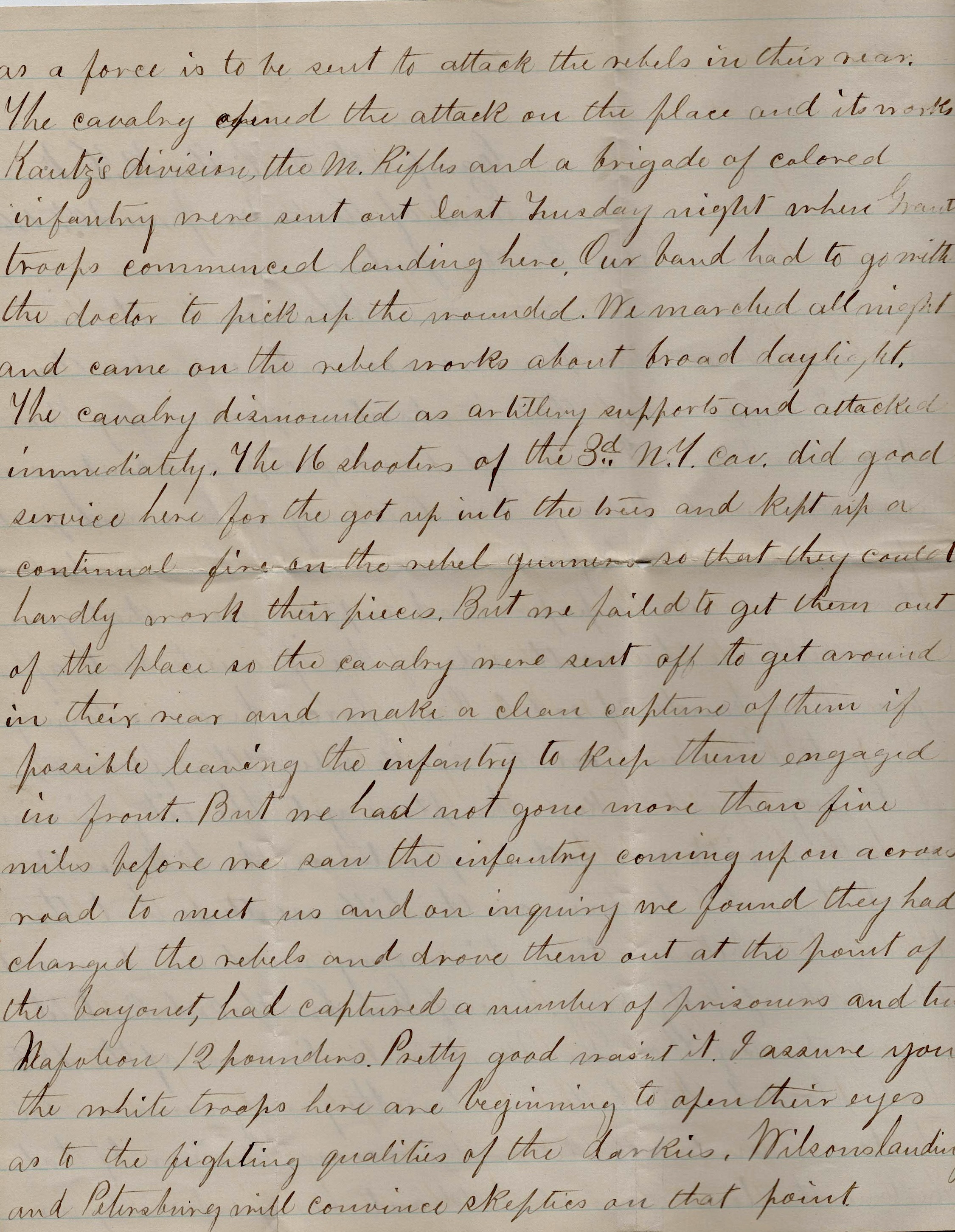
The cavalry opened the attack on the place and its works. Kautz’s division, the Mounted Rifles, and a brigade of colored infantry were sent out last Tuesday night where Grant’s troops commenced landing here. Our band had to go with the doctor to pick up the wounded. We marched all night and came on the rebel works about broad daylight. The cavalry dismounted as artillery supports and attacked immediately. The 16 shooters of the 3rd New York Cavalry did good service here for they got up into the trees and kept up a continual fire on the rebel gunners so that they could hardly work their pieces. But we failed to get them out of the place so the cavalry were sent off to get around in their rear and make a clean capture of them if possible leaving the infantry to keep them engaged in front.
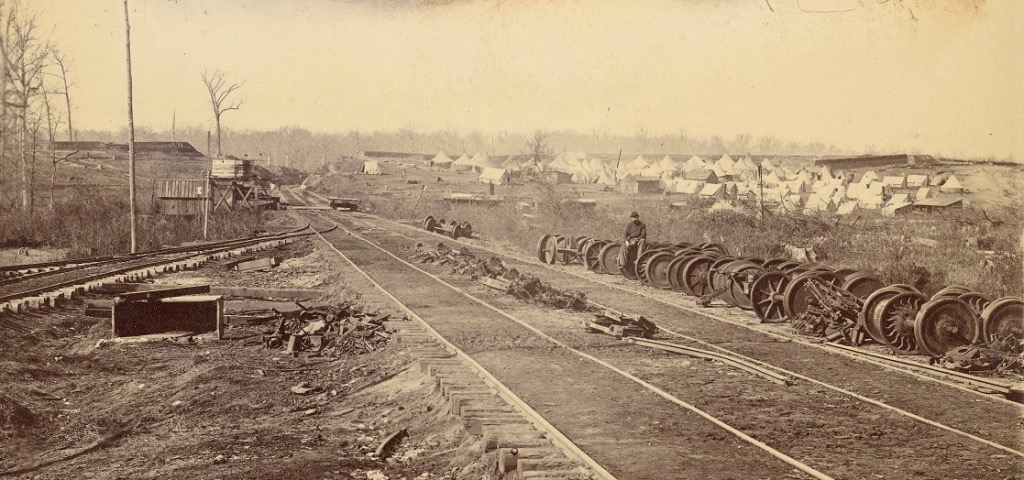
Our forces here are laying siege to Petersburg on the south side of the Appomattox but they haint taken the place yet. The city lies in a hollow with our batteries planted on the hills south and the rebel batteries on the hills north so that the town lies between two fires very much as it was at the Battle of Gettysburg. One of Gen. Smith’s orderlies told me yesterday that Gen. Martindale’s division of the 18th [Army Corps] had planted their batteries where they easily commanded the town and all the bridges across the river. If that be true, the town cannot hold out long—especially as a force is to be sent to attack the rebels in their rear.
“I assure you the white troops here are beginning to open their eyes as to the fighting qualities of the darkies. Wilson’s Landing and Petersburg will convince skeptics on that point.“
— Reuben Coy, 1st New York Mounted Rifles, 20 June 1864
But we had not gone more than five miles before we saw the infantry coming upon a cross road to meet us and on inquiry, we found they had charged the rebels and drove them out at the point of the bayonet, had captured a number of prisoners, and two Napoleon 12-pounders. Pretty good, wasn’t it? I assure you the white troops here are beginning to open their eyes as to the fighting qualities of the darkies. Wilson’s Landing [see Battle of Wilson’s Wharf] and Petersburg will convince skeptics on that point.
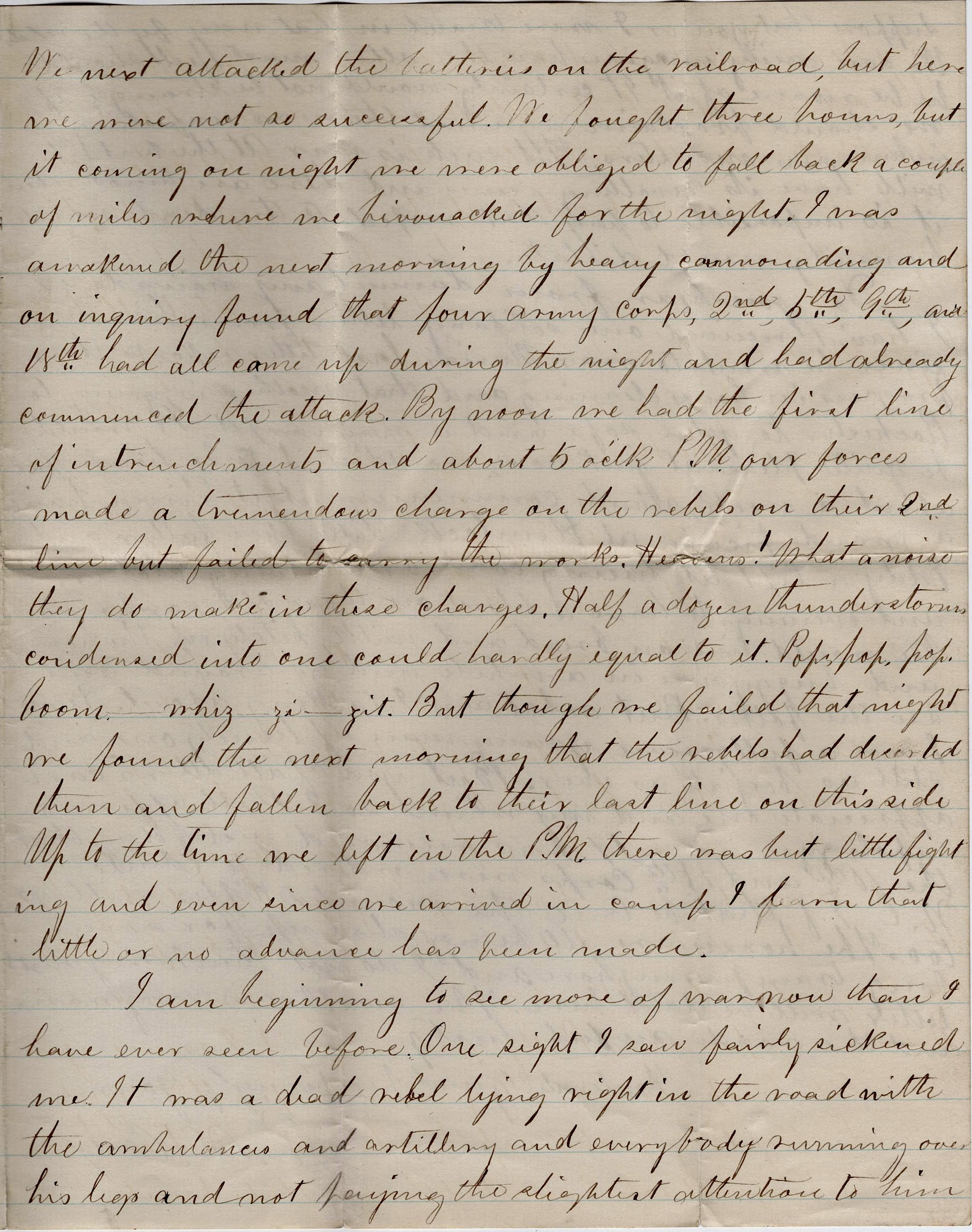
We next attacked the batteries on the railroad but here we were not so successful. We fought three hours but it coming on night, we were obliged to fall back a couple of miles where we bivouacked for the night. I was awakened the next morning by heavy cannonading and on inquiry, found that four Army Corps—2nd, 5th, 9th, and 18th—had all come up during the night and had already commenced the attack. By noon we had the first line of entrenchments and about 5 o’clock p.m. our forces made a tremendous charge on the rebels on their 2nd line but failed to carry the works. Heavens! What a noise they do make in these charges. Half a dozen thunderstorms condensed into one could hardly equal to it. Pop, pop, pop, boom—whiz—zi—zit. But though we failed that night, we found the next morning that the rebels had deserted them and fallen back to their last line on this side. Up to the time we left in the p.m., there was but little fighting and even since we arrived in camp, I learn that little or no advance has been made.
I am beginning to see more of war now than I have ever seen before. One sight I saw fairly sickened me. It was a dead rebel lying right in the road with the ambulances and artillery and everybody running over his legs and not paying the slightest attention to him. Suppose that you or I were treated in that way by the rebels. We can easily imagine how the other must feel should he be aware of it. It certainly would not be strange if we should proclaim against them as unfeeling, inhuman monsters. Yet such is war. At the best it will have its revolting scenes and there are times when it is impossible to pay that respect to the dead which humanity would dictate.
Do you hear from Samuel any nowadays? I haven’t received one solitary letter from him since he went to war. Maria’s last letter reports their progress in house cleaning and that Mother is going to Rochester to get a sofa and a new carpet. It would be quite pleasant just now, wouldn’t it, to be home for about a week, attend commencement at Lima, have a grand picnic at Hemlock Lake, give Father and Eddy a life at hoeing corn or mowing clover, and evening have a blow on those old saxhorns. We would live on bread and milk, hitch up the horse and buggy once in a while and go around and see the folks. But what am I talking about. Here I am a full grown young man of twenty-one and still as boyish as ever. But you of all others can appreciate me and my whims so I shall offer no apology.
It was rumored yesterday that the 10th and 18th Corps were ordered to Edenton, North Carolina. If that be true, the Mounted Rifles will go too. The horses are all being shod up for some long tramp anyhow and I do not think my next letter will be dated here. The weather is very warm and the roads awful dusty. Fraternally and perspiringly yours, — R. W. Coy
The following letter was written by Edward Chapman (b. 1836), the son of Edward Chapman, Sr. (1802-1886) and Elizabeth Burnett (1812-1874) of Utica, Oneida county, New York. Edward parents were natives of England; he was born in Nova Scotia. From his letter we learn that Edward was engaged in the telegraphic business in Albany. The 1855 N. Y. State Census informs us that he had been a telegraph operator for at least five years. By the time of the 1865 New York State Census, he was residing once again with his parents in Rochester, Monroe county, New York, where his occupation was given as “telegrapher.” Noticing that his father was also in the telegraph business, I found that Edward, Sr. had been for many years the secretary and treasurer of the New York, Albany, and Buffalo Telegraph Company which terminated business under that name in December 1863 when it merged with another company and became the Western Union Telegraph Company.
Chapman wrote the letter to George Robert Adams (1840-1915) of Charlotteville, New York, and a student at Wesleyan University, Middletown, Connecticut., at the time. He graduated with a Bachelor of Arts in 1863 and when he was drafted, George hired a substitute to take his place while he served as the principal of the Schoharie Academy. In 1866, George was admitted to the bar in New York State and practiced law in Charlotteville and later Kingston, New York. In a letter that I transcribed in 2020, George’s mother wrote him in November 1862, “The sorrow and anguish that this war is making, no mortal tongue can tell. I am not willing that my friends should be led as sheep to the slaughter. I am willing others should have the glory of the battlefield. It is as necessary that some should remain to other places of importance to the Nation. I hope you will be a blessing to your country in some other way besides going to war.” [See—1862: Julia A. (Goss) Adams to George Robert Adams]
T R A N S C R I P T I O N
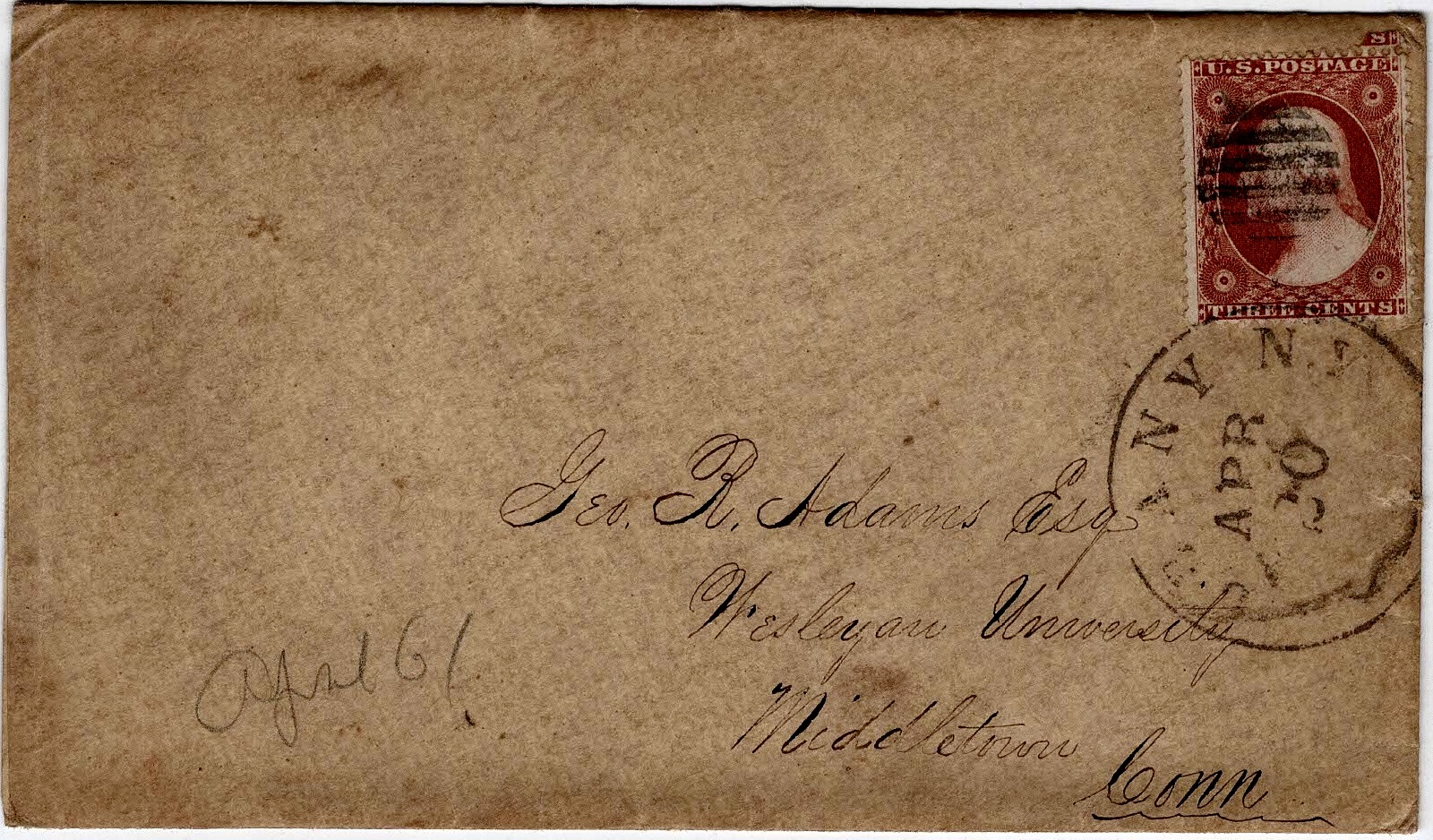
Addressed to George R. Adams, Wesleyan University, Middletown, Connecticut
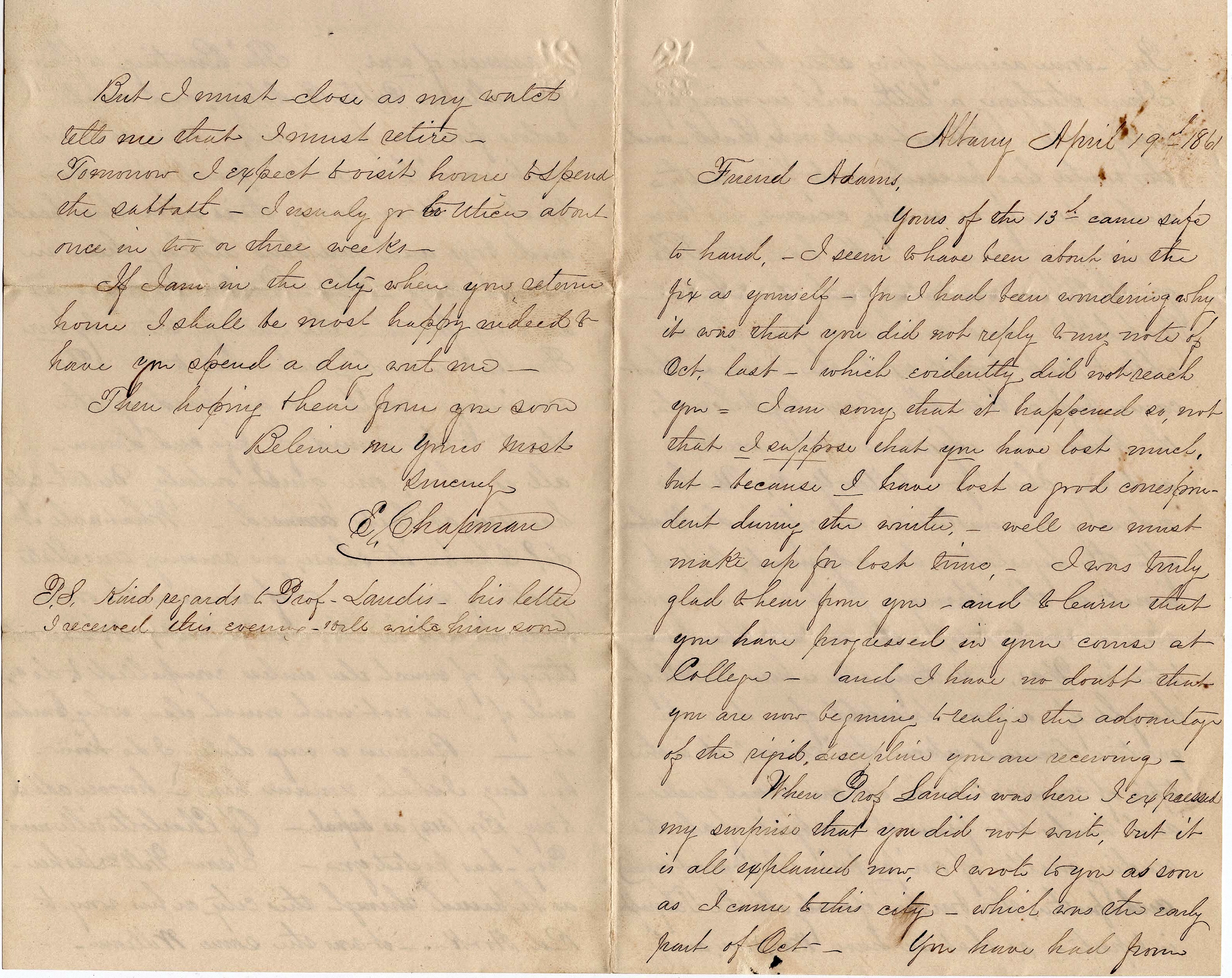
Albany [New York] April 19th 1861
Friend Adams,
Yours of the 13th came safe to hand. I seem to have been about in the fix as yourself for I had been wondering why it was that you did not reply to my note of October last which evidently did not reach you. I am sorry that it happened so, not that I suppose that you have lost much, but because I have lost a good correspondent during the winter. well we must make up for lost time.
I was truly glad to hear from you and to learn that you have progressed in your course at College. And I have no doubt that you are now beginning to realize the advantage of the rigid discipline you are receiving. When Professor Landis was here, I expressed my surprise that you did not write, but it is all explained now. I wrote to you as soon as I came to this city which was the early part of October. You have had from Professor some account of my stay here. I am studying a little and enjoying life pretty well. I do not work very hard and the winter has passed quite pleasantly and especially so as my cousin has been rooming with me.
We had the telegraph office connected with the House (Capitol) and so through him I was able to keep posted about the business that came before both the Assembly and the Senate. The Houses have adjourned this week and my chum goes to New York. Under ordinary circumstances our city is dull after the Legislature has adjourned, but it is not so this Spring for it is in the highest state of excitement. The one all absorbing topic is War—nothing else is here talked of—thought of—or even dreamed of. It is the question discussed upon the “corners,” it is the topic of conversation in all our social circles, and besides this, forms the subject of all the reading matter in our papers (I. S. News not excepted), and further, the burden of all the telegraphic reports. So [in] short, we have War, War, and rumors of War.
The bunting is flying from all our public buildings and small colors from our private ones. Men that we meet wear “their colors” pinned upon their breast. Horses carry theirs upon their heads and boys and maidens display them in various ways. Several Volunteer companies are being formed. The call for them by our President is readily responded to. This evening, companies are parading the streets to the sound of the fife and drum—all is alive. Our quiet, orderly, Dutch city has been at last aroused. What will it do? I hope its share in raising our State’s quota of men.
I of course with others have shared in the excitement. I have not thought of much else unless compelled to do so, and if I do not write much else, why pardon it. Business is very dull. I do not know how long I shall remain here, however address to my Box (304) as usual.
Of Charlotteville news, Professor has posted you. I saw William Lasher as he passed through this city on his way to Red Hook. It was the same William. But I must close as my watch tells me that I must retire. Tomorrow I expect to visit home and to spend the Sabbath. I usually go to Utica about once in two or three weeks.
If I am in the city when you return home, I shall be most happy indeed to have you spend a way with me. Then hoping to hear from you soon, believe me yours most sincerely, — E. Chapman
P. S. Kind regards to Professor Landis. His letter I received this evening. Will write him soon.
These letters were written by Alonzo Freeman (1843-1888), the son of Joseph Freeman (1815-1873) and Mary Emeline Folsom (1815-1874). He wrote the letters to his cousin, Eliza Marshall Folsom (1843-1868), the daughter of Levi Folsom (1804-1883) and Eliza A. Freeman (1812-1899). In the 1860 Census, the Folsom’s resided in New York City’s 8th Ward where Levi was employed as the proprietor of a saloon/restaurant. Levi’s wife was employed as an artist.
Alonzo wrote the first two letters while serving in Co. A, 1st New Jersey Infantry—part of the 1st New Jersey Brigade. The third letter was written while a member of Co. C, “Scott’s 900” — the 11th New York Cavalry. He was discharged on 21 July 1865 with the rank of “hospital steward.” The regimental history indicates he was captured at Doyal’s Stockade on 5 August 1864. His father, Joseph, also served in the 11th New York Cavalry. He enlisted at age 43 on 3 January 1862 at New York City in Company G and was discharged on 1 March 1864 due to disability. His rank was “saddler’s sergeant.”
There is a tragedy connected with this family. When Alonzo’s father (Joseph, Sr.) died in 1873, he left his sizable fortune to Alonzo’s mother, Mary Emeline (Folsom) Freeman. When she did not distribute the money to her sons, one of them — Joseph, Jr. (b. 1847) — became disgruntled and threatened to shoot himself with a pistol if she did not give him $2,000 for a business venture. When she refused, he turned the gun on her and shot in her in the back as she was exiting the room, killing her almost instantly. The defense attorney argued that the shooting was accidental, and that the defendant was of “unsound mind” but the jury did not believe it. We learn from the coverage of this incident in the newspapers that Alonzo Freeman used his hospital experience to become a physician after the Civil War. A search of the catalogue for the College of Physicians & Surgeons at Columbia University reveals that Alonzo graduated in 1869.
Letter 1
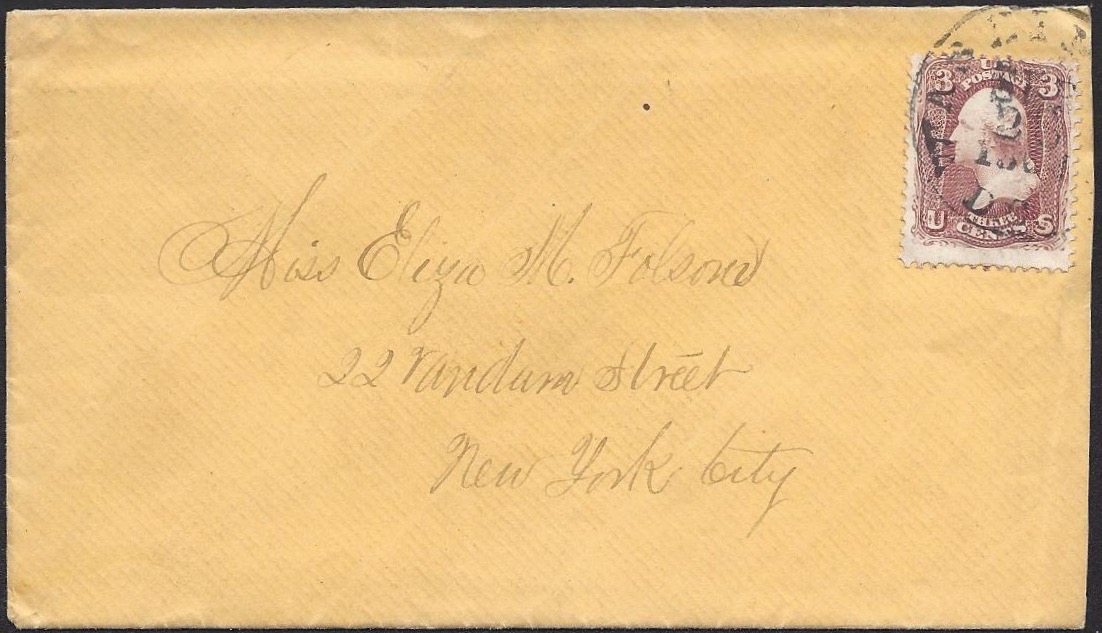
Addressed to Miss Eliza M. Folsom, Care of Levi Folsom, Over Clinton Market, New York City
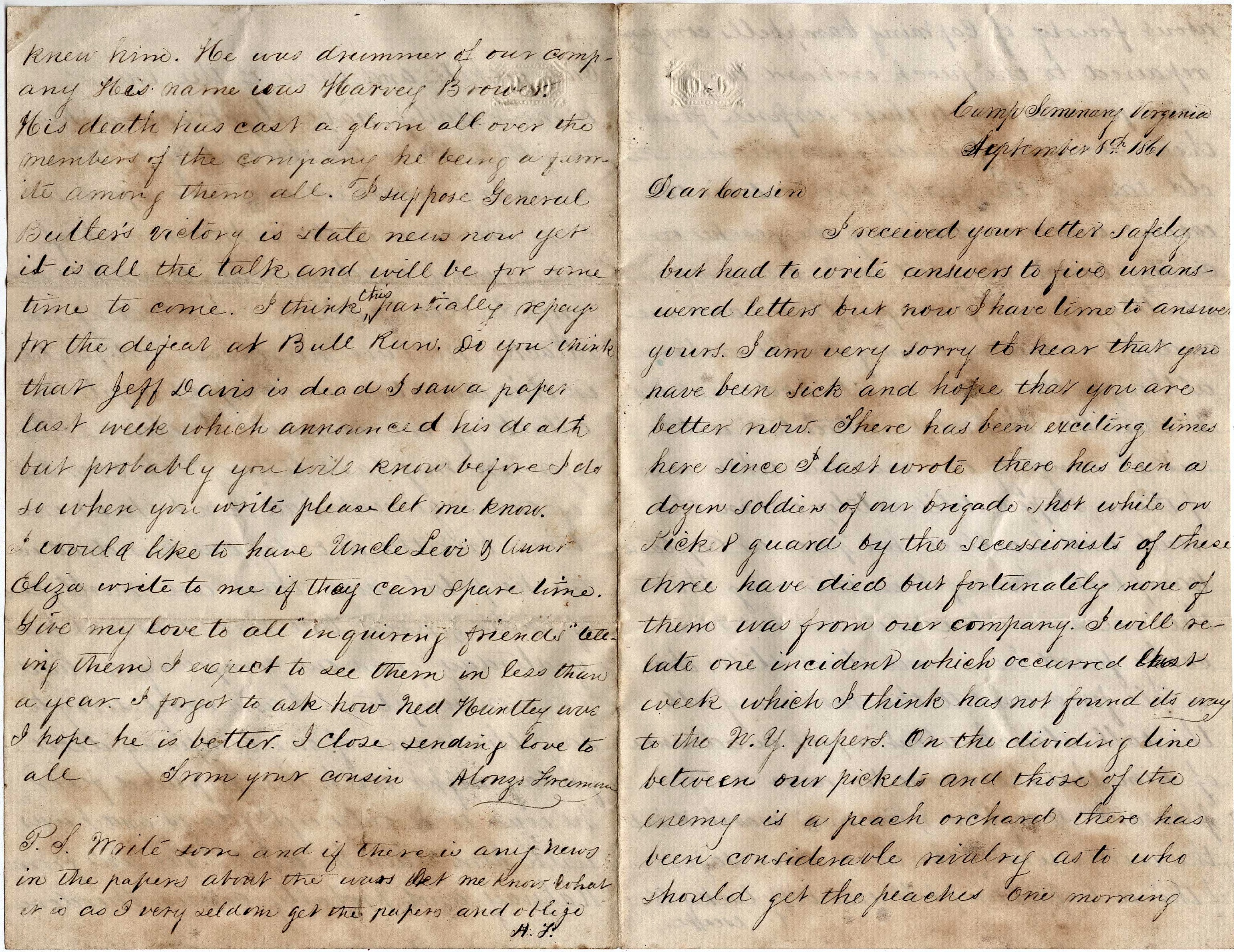
Camp Seminary, Virginia September 8th 1861
Dear Cousin,
I received your letter safely but had to write answers to five unanswered letters but now I have time to answer yours. I am very sorry to ear that you have been sick and hope that you are better now.
There has been exciting times here since I last wrote. There has been a dozen soldiers of our brigade shot while on picket guard by the secessionists. Of these, three have died but fortunately none of them was from our company.
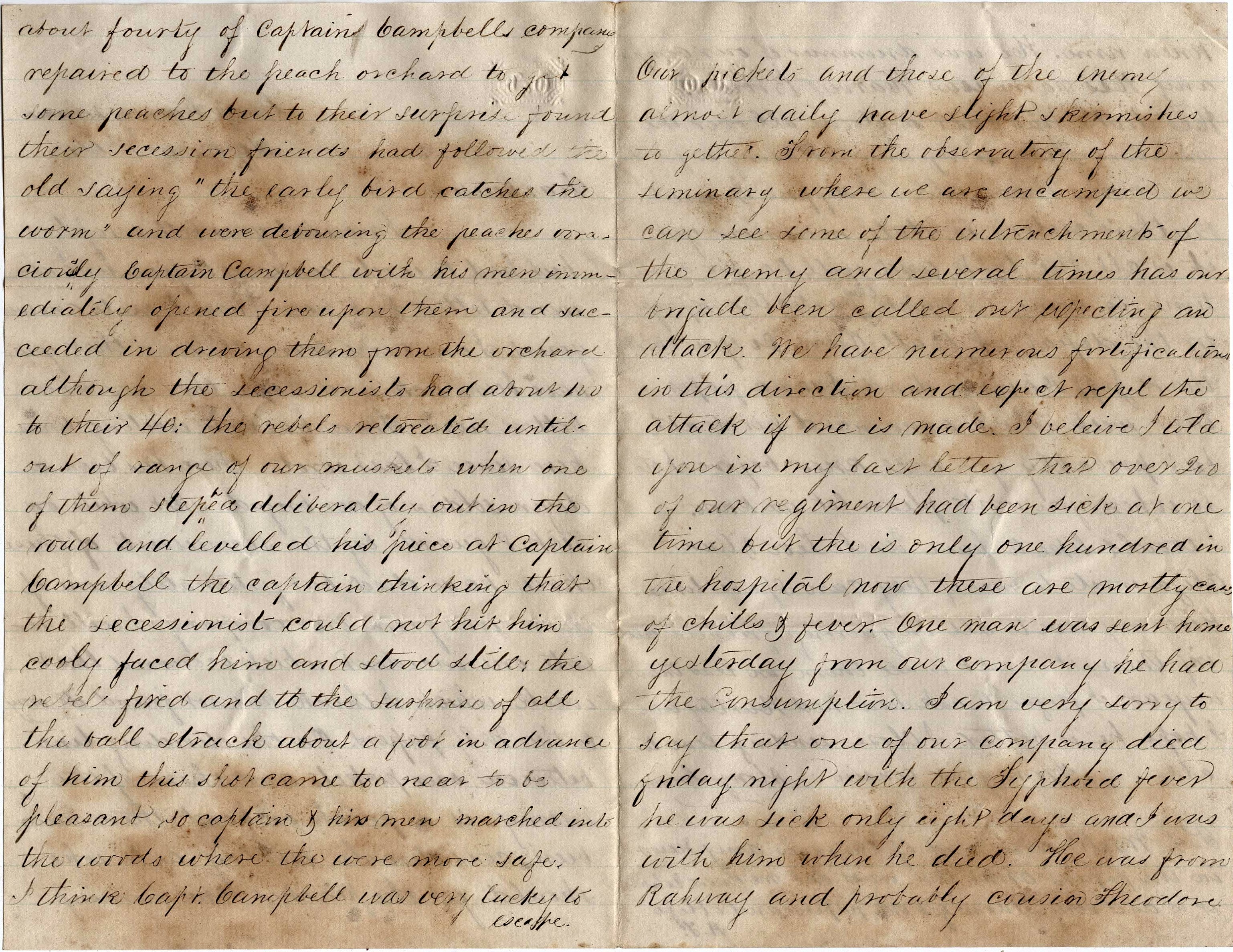
I will relate one incident which occurred that week which I think has not found its way to the N. Y. papers. On the dividing line between our pickets and those of the enemy is a peach orchard. There has been considerable rivalry as to should get the peaches. One morning about forty of Captain [Edward Livingston] Campbell’s company repaired to the peach orchard to get some peaches but to their surprise found their secession friends had followed the old saying, “the early bird catches the worm” and were devouring the peaches voraciously. Captain Campbell with his men immediately opened fire upon them and succeeded in driving them from the orchard although the secessionists had about 100 to their 40. The rebels retreated until out of range of our muskets when one of them stepped deliberately out in the road and leveled his piece at Captain Campbell. The captain, thinking that the secessionist could not hit him, cooly faced him and stood still. The rebel fired and to the surprise of all, the ball struck about a foot in advance of him. This shot came too near to be pleasant so captain and his men marched into the woods where they were more safe. I think Capt. Campbell was very mucky to escape.
Our pickets and those of the enemy almost daily have slight skirmishes together. From the observatory of the Seminary where we are encamped we can see some of the entrenchments of the enemy and several times has our brigade been called out expecting an attack. We have numerous fortifications in this direction and expect to repel the attack if one is made.
I believe I told you in my last letter that over 200 of our regiment had been sick at one time but there is only one hundred in the hospital now. These are mostly cases of chills and fever. One man was sent home yesterday from our company. He had the consumption.
I am very sorry to say that one of our company died Friday night with the Typhoid Fever. He was sick only eight days and I was with him when he died. He was from Rahway and probably cousin Theodore knew him. He was drummer of our company. His name was [Daniel] Harvey Brower. His death has cast a gloom all over the members of the company, he being a favorite among them all.
I suppose Gen. Butler’s victory is stale news now yet it is all the talk and will be for some time to come. I think this partially repays for the defeat at Bull Run. Do you think that Jeff Davis is dead? I saw a paper last week which announced his death but probably you will know before I do so when you write, please let me know. I would like to have Uncle Levi and Aunt Eliza write to me if they can spare time. Give my love to all inquiring friends, telling them I expect to see them in less than a year. I forgot to ask how Ned Huntley was. I hope he is better. I close sending love to all. From your cousin, — Alonzo Freeman
P. S. Write soon and if there is any news in the papers about the war, let me know what it is as I very seldom get the papers and oblige. — A. F.
Letter 2
Baltimore [Maryland] September 17, 1862
Dear Cousin,
I intended to have written to you before this time but have had no opportunity to do so. You must not think I have neglected to write from want of desire for with the exception of Mother & Sister, there are none to whom I would rather write.
I am getting along very well but [my] wound is not quite well. I have a very pleasant place here in the hospital as druggist, but it is rather confining. However, I get an opportunity sometimes to see the city. There are four Medical cadets here—residents of this city—with whom I am very intimate and through them I have made a number of valuable acquaintances.
Advertisement for “Our American Cousin” playing at the Holliday Street Theater in Baltimore. Asa Trenchard played by John S. Clarke; Mary Meredith played by Fanny Browne. Fanny became famous after her cdv was found on John Wilkes Booth’s dead body. The Baltimore Sun, 20 September 1862.
I was out one evening last week and went to the Holliday Street Theatre. The play was “Our American Cousin” but it appeared very poorly represented when compared with Laura Keene’s version of that piece. Still it was very good.
Baltimore is a very pretty city and resembles New York more than any other place I have been in. Federal Hill is within the city limits and mounts about thirty cannon. This was the quarters of the famous 17th N. Y. Regiment. In case the rebels should attack Baltimore, Federal Hill could shell them from any direction. The Cathedral is a beautiful edifice and is the finest Roman Catholic church in United States.
The people of this city have been much excited about the Confederates. The Union [citizens]—fearing that Baltimore would be attacked; the secesh hoping Jackson would get possession of it. But thank fortune, Jackson can never get to Baltimore. About one half the people of this city are secesh and a riot has been expected.
I understand Charlie [Henry] Bliven has received a commission in the 13th New Jersey Regiment as a first Lieutenant. I am glad of it and wish him success.
I am glad that Brother Joe has escaped so far but I am afraid I shall never see him again. I shall try to get a leave of absence or furlough to come home the last of October but cannot tell whether I wall be successful or not. But I shall have to close this poor letter sending my best wishes and love to all hoping to hear from you soon. I remain your affectionate cousin, — Alonzo Freeman
Letter 3
Hospital, Scotts “900” September 25th 1863
Dear Cousin,
I received your letter safely — also one from Theodore — and am very sorry to hear that you and Uncle Levi are so sick. It was too bad that Rinalds & Egerton had to leave New York so soon. I suppose they have joined the “Army of the Potomac” again.
What do you think of the war out West? I think that Rosencranz [William Rosecrans] did first rate [at the Battle of Chickamauga] but it was strange that General [Ambrose] Burnside did not reinforce him. At Charleston we are getting along very slowly. Fort Sumter is in possession of the rebels yet. We have seven companies stationed about sixteen miles from here. They are skirmishing with the rebels almost every day.
Father was up there this week but came back the next day. The Doctor says he thinks he will send me there with medicine for the sick. I hope he will do so. Our hospital is filled with sick. We are very busy.
I have enclosed a letter to Harriet which is important and I would like to have her get it as soon as possible. This only an apology for a letter as I am in a great hurry. I will write again on Monday. Father and I are both well and send love to all.
The following letters were written by Rev. Robert Francis Taylor (1830-1866), an 1851 graduate of Hanover College who became a licensed preacher in the Presbyterian Church with pastorates in Indiana, Arkansas, Texas, Kentucky, Michigan and finally Vernon, Indiana in the 1850s. In 1860 he was supplying the pulpit in the First Presbyterian Church of Macomb, Illinois, when he resigned for health reasons and relocated to Rochester, Minnesota. In September 1862, he mustered into the 78th Illinois Infantry as its Chaplain, coaxed into the service by a Macomb parishioner. He resigned from the regiment for health reasons on July 8, 1863. He died just three years later from the tuberculosis that had plaqued him most of his life.
Robert wrote the letters to his cousin, Capt. David Taylor of Co. B, 113th Ohio Volunteer Infantry (OVI).
Readers may also be interested in this article about Rev. Robert F. Taylor’s war-time experiences: See Rev. Taylor’s War-time Duties.
Letter 1
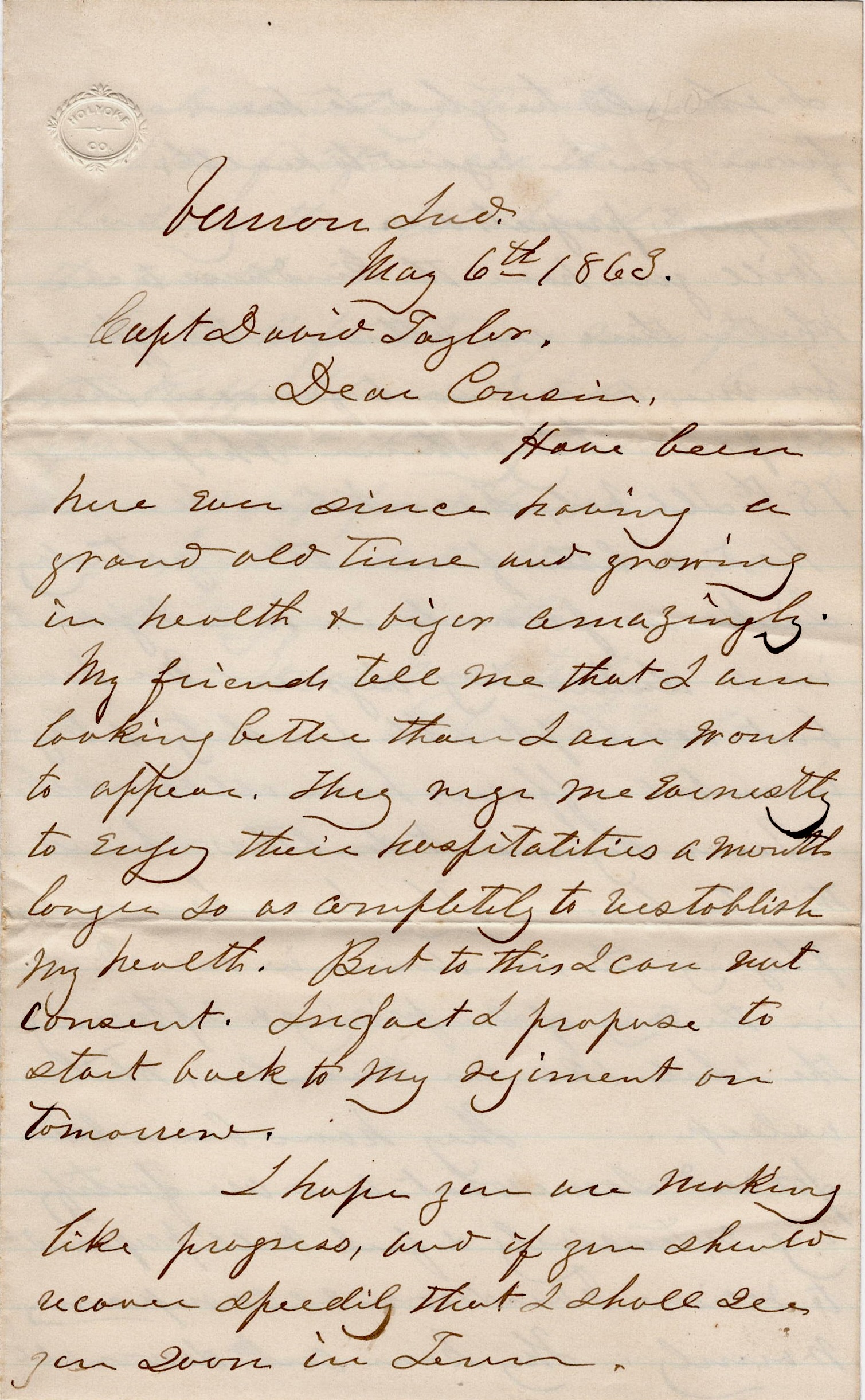
Vernon, Indiana May 6th 1863
Capt. David Taylor.
Dear cousin, have been here ever since having a grand time and growing in health & vigor amazingly. My friends tell me that I am looking better than I I am wont to appear. They urge me earnestly to enjoy their hospitalities a month longer so as completely to reestablish my health. But to this I cannot consent. In fact, I propose to start back to my regiment on tomorrow.
I hope you are making like progress, and if you should recover speedily that I shall see you soon in Tennessee. I should be glad to hear from you in regard to health, prospects, projects, &c.
Will you have the kindness to see whether there are letters in the office for me, and if so to forward them superscribing them Chaplain, 78th Illinois Volunteers, Franklin, Tennessee. Had a letter from there yesterday. Sickness prevails in our regiment in a distressing degree. We have but one Captain able for duty, and regimental officers have all been sick. Your regiment doubtless shares this trouble. They have been playing the handsome in our Division in the way of surprising and capturing the whole [?] 120 in number while asleep. They have been reinforced somewhat and are fortifying extensively & feel well prepared to receive Van Dorn & company warmly. They have cut down all surrounding timber and have fortified all the hills including the old bald hill to the north.
I look for stirring news from the Rappahannock today. God grant that it may be all that we could hope for or desire. My regards to all. I will write to your mother soon.
Yours most truly, — Robert F. Taylor
Letter 2
Headquarters 78th Illinois Infantry Franklin, Tennessee May 26th 1863
Capt. David Taylor,
Dear cousin, your favor of the 6th instant has just been received by way of Vernon, Indiana. Also one of later date was received some days since and the inquiries it contained replied to in a letter to your Mother.
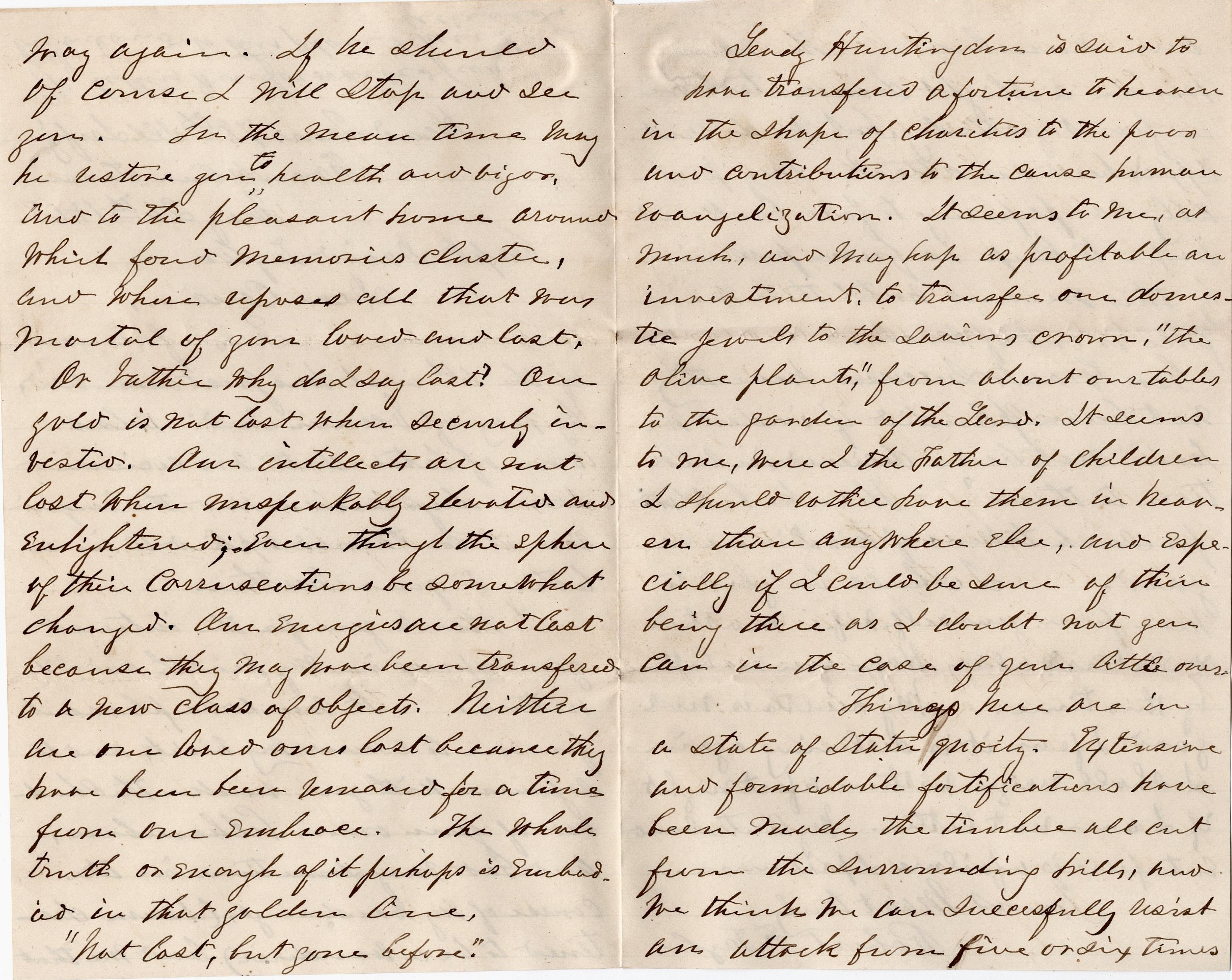
I thank you for the interest you express in my health and situation. It would be pleasant for me to renew my visit and to sojourn with you under the shadow of your own Alhambra; and God may sometime in the course of my wanderings (I seem destined to be a wanderer) lead me that way again. If He should, of course I will stop and see you. In the meantime, may He restore you to health and vigor and to the pleasant home around which found memories cluster, and where reposes all that was mortal of your loved and lost.
Or rather, why do I say lost? Our gold is not lost when securely invested. Out intellects are not lost when unspeakably elevated and enlightened; even though the sphere of our conversations be somewhat changed. Our energies are not lost because they may have been transferred to a new class of objects. Neither are our loved ones lost because they have been removed for a time from our embrace. The whole truth or enough of it perhaps is embedded in that golden line, “Not lost, but gone before.”
Lady Huntingdon is said to have transferred a fortune to heaven in the shape of charities to the poor and contributions to the cause of human evangelization. It seems to me as much, and may hope as profitable an investment to transfer our domestic jewels to the Savior’s crown, “the olive plants,” from about our tables to the garden of the Lord. It seems to mem were I the Father of children I should rather have then in heaven than anywhere else, and especially if I could be sure of their being there as I doubt not you can in the care of your little ones.
Things here are in a state of status quoity. Extensive and formidable fortifications have been made, the timber all cut from the surrounding hills, and we think we can successfully resist an attack from five or six times our number. The enemy made a slight demonstration in front yesterday but we do not apprehend an attack. They probably are preparing to fall back and hope to keep us from pursuing by this means until their main force is out of reach.
Gen. Grant’s successes—have they not been splendid? If indeed we have not been deceived in relation to them? Thanks be to God for such tokens of His divine regard.
I shall be glad to har from yourself, wife, mother, and sisters, and all. My health is not good & fear it is declining again. I shall resign within a fortnight if I am not better. My contraband enterprise is a failure I presume. Yours most truly, — Robert F. Taylor
My letters were forwarded from Cleveland to this place & have been received.
These letters were written by Dr. Alonzo Harlow (1811-1888), an 1851 graduate of Allegheny College, Pennsylvania, who was practicing medicine in Chagrin Falls, Cuyahoga county, Ohio in 1860 when he enlisted to serve as the assistant surgeon of the 113th Ohio Volunteer Infantry (OVI). He was in the service from 1 September 1862 until 11 May 1863 when he resigned. After leaving the service, he practiced medicine in Detroit.
Dr. Harlow informs us that his reason for resigning was “ostensibly” for poor health but clearly there was another reason that likely had to do with personnel issues. Since he and other asst. surgeons all resigned in the spring and summer of 1863, my hunch is that he and others had difficulty working under the direction of Surgeon James Rush Black (1827-1895) who resigned himself in July 1863.
He wrote all three letters to his friend and former comrade in the 113th OVI, Capt. David Taylor (1837-1919) who was severely injured in an accident in February 1863 and was sent home to Ohio to recuperate but he never fully recovered.
Letter 1
Camp at Franklin, Tennessee May 12, 1863
My dear captain,
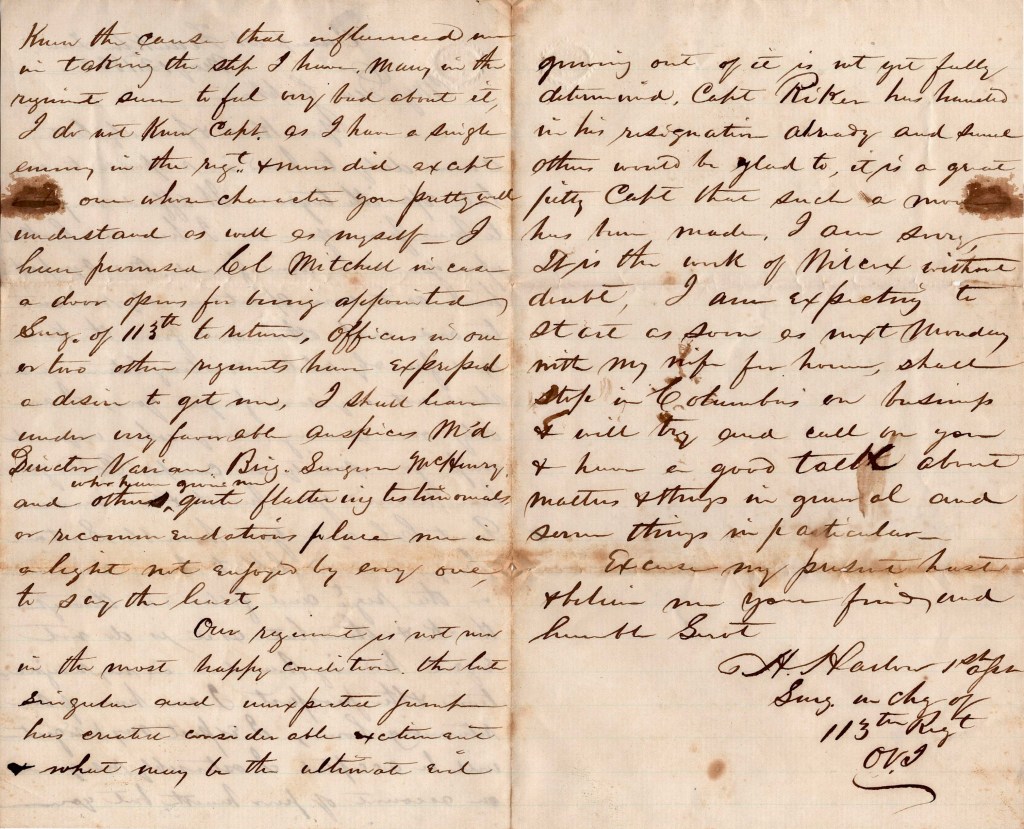
Your kind & friendly letter came duly to hand in response to my late epistle [ ]. It affords me pleasure to hear from you as I have ever looked upon you as a kind friend. Our sympathies have as it were spontaneously run out toward each other adn from the kind and friendly relation existing between us, shall not very soon forget you. I am only one among many who very much miss your society in camp. Could you have recovered your health & been made Lieut. Colonel and your humble servant Surgeon would like to have remained in the regiment and followed it through thick and thin, but as it is, do not regret having handed in my resignation & the prospect I now have of soon returning home. I expect my resignation will be accepted. I ostensibly resigned on account of poor health, but you know the cause that influenced me in taking the step I have. Many in the regiment seem to feel bad about it.
I do not know, Captain, as I have a single enemy in the regiment & never did except one whose character you pretty well understand as well as myself. I have promised Col. Mitchell in case a door opens for being appointed Surgeon of the 113th to return. Officers in one or two other regiments have expressed a desire to get me. I shall leave under very favorable auspices. Medical Director Varian Brig. Surgeon McHenry and others who have given me quite flattering testimonials or recommendations place me in a light not enjoyed by everyone to say the least.
Our regiment is not now in the most happy condition. The late singular and unexpected jump has created considerable excitement. What may be the ultimate evil out of it is not yet fully determined. Capt. Riker has handed in his resignation already and several others would be glad to do it. It is a great pity, Captain, that such a move has been made. I am sorry. It is the work of Wilcox without doubt.
I am expecting to start as soon as next Monday with my wife for home. Shall stop in Columbus on business & will try and call on you & have a good talk about matters and things in general and some things in particular.
Excuse my present haste and believe me your friend and humble servant. —A. Harlow, Asst. Surgeon in charge of 113th Regt. O. V. I.
Letter 2
Chagrin Falls, [Ohio] July 21, 1863
Dear Capt.
After waiting some little time, will attempt to respond to yours of 2nd instant hoping these few hasty lines may find you in the enjoyment of improved health and strength preparatory to the girding on the sword and entering the field to meet the foe of our land. Things look much brighter and more prosperous than when I last wrote you and the prospect is certainly quite flattering for a speedy termination of this rebellion.
We can now rejoice over and celebrate the capture of Vicksburg and many other places in reality. Would it not been quite a glorious achievement if Meade had taken old Lee’s army as there was once a good prospect? It seems that Morgan is completely routed and scattered with his force and one thousand of them at least taken prisoners. It certainly is to be hoped that he & the balance may never be permitted to get over the Ohio River again.
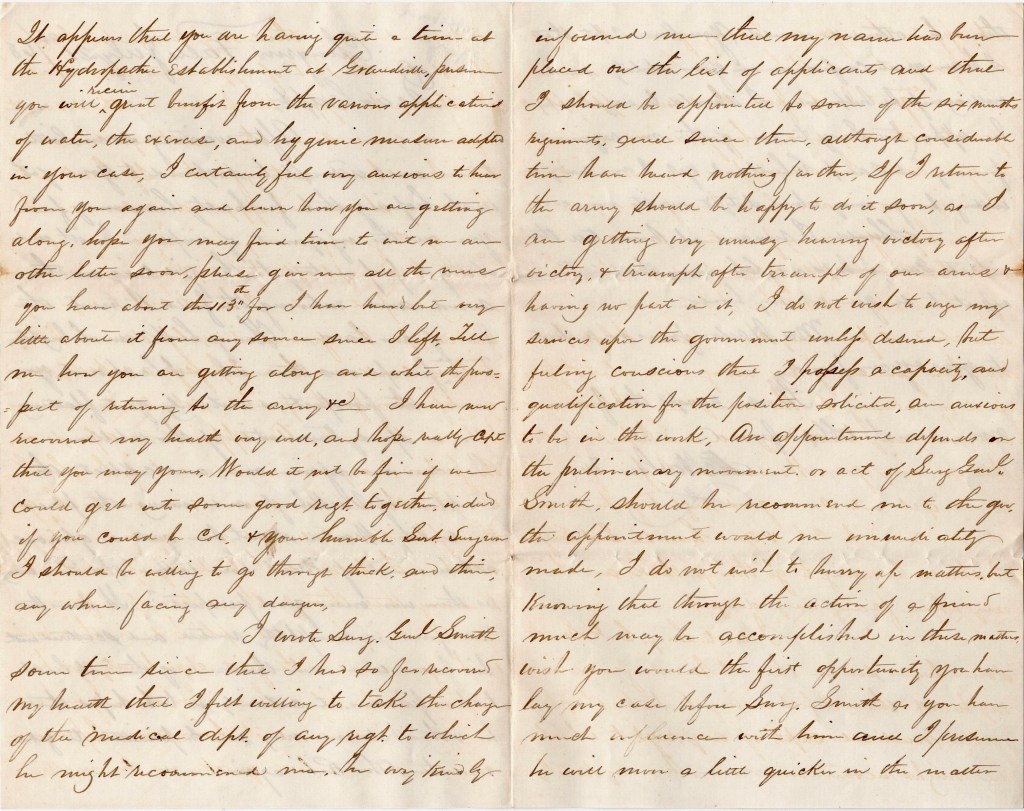
It appears that you are having quite a time at the Hydropathic Establishment at Granville. Presume you will receive great benefit from the various applications of water, the exercise, and hygienic measure adopted in your case.
I certainly feel very anxious to hear from you again and learn how you are getting along. Hope you find time to write me another letter soon. Please give me al lthe news you have about the 113th OVI for I have heard but very little about it from any since I left. Tell me how you are getting along and what the prospect of returning to the army, &c. I have now recovered my health very well and hope, really Captain, that you may yours. Would it not be fine if we could get into some good regiment together. Indeed, if you could be Colonel & your humble servant Surgeon, I should be willing to go through thick and thin, anywhere, facing any danger.
I write Surgeon General Smith some time since that I had so far recovered my health that I felt willing to take charge of the Medical Department of any regiment to which he might recommend me. He very kindly informed me that my name had been placed on the list of applications and that I should be appointed to some of the six-month’s regiments, and since then, although considerable time have heard nothing further. If I return to the army, should be happy to do it soon as I am getting very uneasy hearing victory after victory, and triumph after triumph of our arms & having no part in it. I do not wish to urge my services upon the government unless desired, but feeling conscious that I possess a capacity and qualification for the position solicited, am anxious to be in the work.
An appointment depends on the preliminary movement or act of Surgeon General Smith. Should he recommend me to the Governor, the appointment would be immediately made. I do not wish to hurry up matters but knowing that through the action of a friend much may be accomplished in these matters, which you would the first opportunity you have, lay my case before Surgeon Smith as you have much influence with him and I presume he will move a little quicker in the matter than he otherwise would. You know, Captain, that I have great confidence in your ability and willingness to help me. I should be very happy to be appointed Surgeon to one of the new regiments forming at Camp Cleveland yet I am ready & willing to go anywhere duty and necessity may call.
Should I remain at home till the State Fair is held in Cleveland, shall certainly expect to see you at my house. Mrs. Harlan joins in respects to you and your family. Please accept this from you much obliged friend, — A. Harlow, M. D.
Letter 3
Detroit [Michigan] May 23, 1864
My dear Captain & Friend,
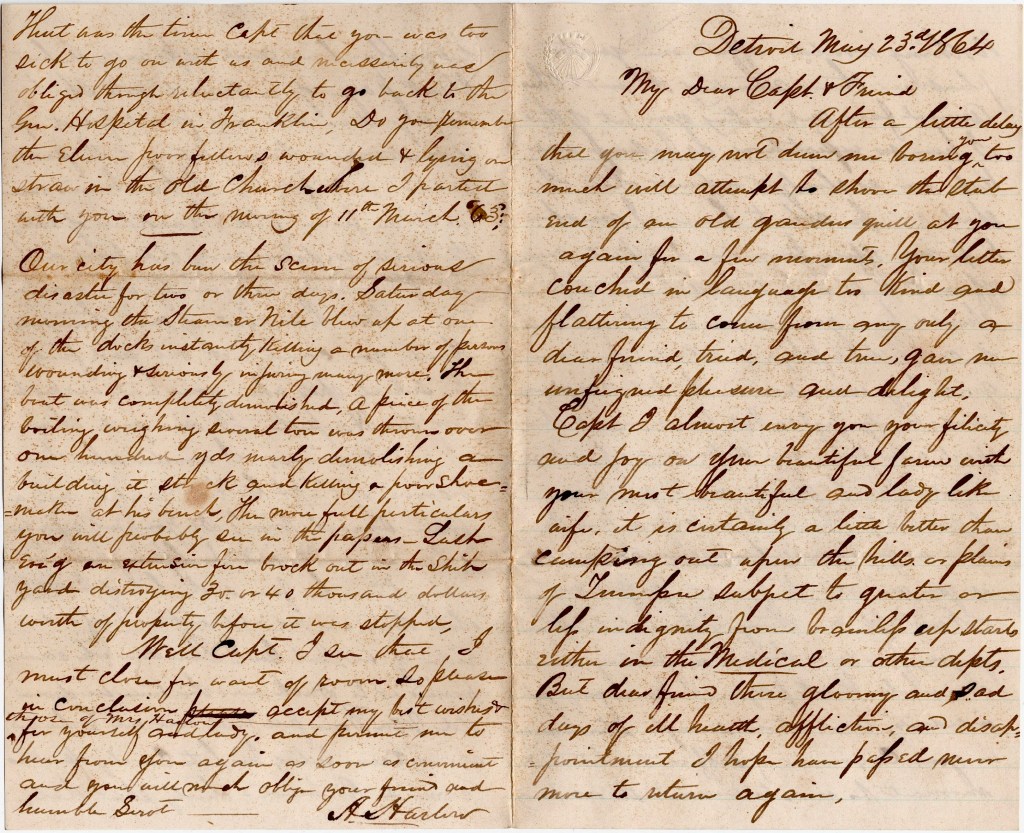
After a little delay that you may not deem me boring you too much, will attempt to show the stub end of an old gander’s quill at you again for a few moments. Your letter couched in language too kind and flattering to come from any only a dear friend, tried and true, gave me unfeigned pleasure and delight. Captain, I almost envy your felicity and joy on your beautiful and lady-like wife. It is certainly a little better than camping out upon the hills or plains of Tennessee subject to greater or less indignity from brainless up starts either in the Medical or other departments. But dear friend, these gloomy and sad days of ill health, affliction, and disappointment I hope have passed never more to return again.
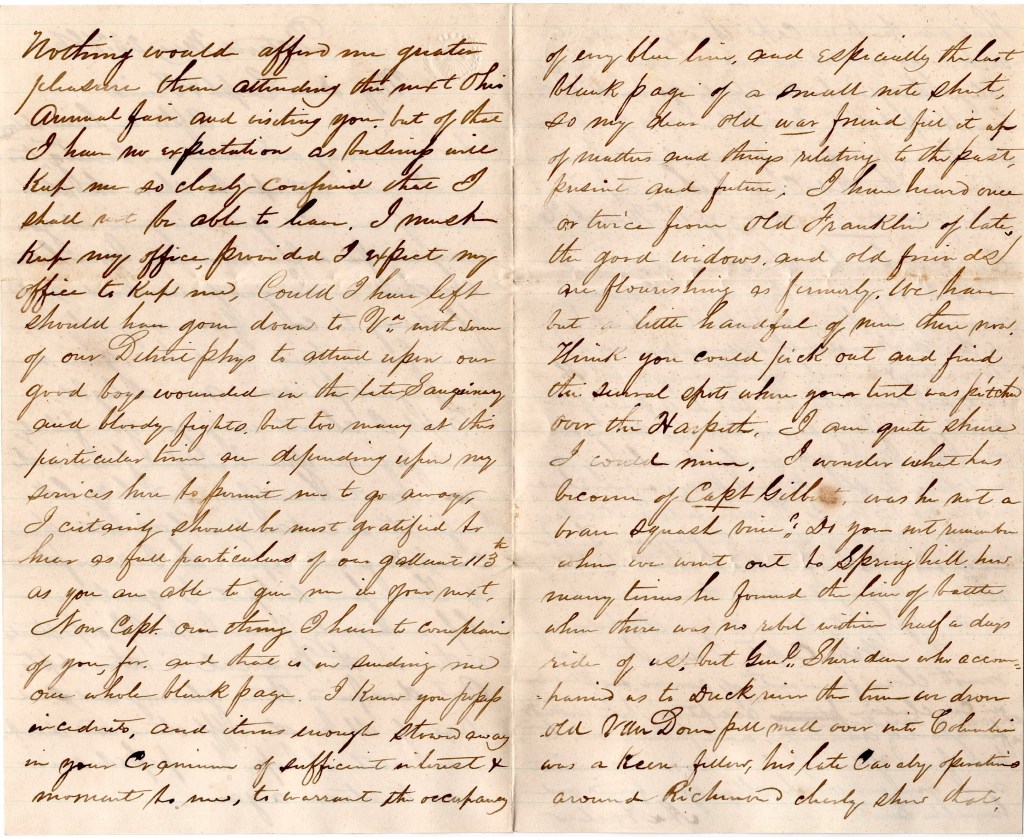
Nothing would afford me greater pleasure than attending the next Ohio Annual Fair and visiting you but of this I have no expectation as business will keep me so closely confined that I shall not be able to leave. I must keep my office, provided I expect my office to keep me. Could I have left, should have gone down to Virginia with some of our Detroit physicians to attend upon our good boys wounded in the late sanguinary and bloody fights but too many at this particular time are depending upon my services here to permit me to go away. I certainly should be most gratified to hear as full particulars of our gallant 113th as you are able to give me in your next.
Now Captain, one thing I have to complain of you for and that is in sending me one whole blank page. I know you possess incidents and items enough stowed away in your cranium of sufficient interest & moment to me, to warrant the occupancy of every blue line and especially the last blank page of a small note sheet. So my dear old war friend, fill it up of matters and things relating to the past, present, and future. I have heard once or twice from Old Franklin [Tennessee] of late, the good widows and old friends are flourishing as formerly. We have but a little handful of men there now. Think you could pick out and find the several spots where your tent was pitched over the Harpeth. I am quite sure I could mine.
I wonder what has become of Capt. [Charles Champion] Gilbert? Was he not a brain squash vine? Do you not remember when we went out to Spring Hill how many times he found the line of battle when there was no rebel within half a day’s ride of us? But General Sheridan who accompanied us to Duck River the time we drove old Van Dorn pell mell over into Columbia was a keen fellow. His late cavalry operations around Richmond clearly shows that. That was the time, Captain, that you was too sick to go out with us and necessarily was obliged though reluctantly to go back to the General Hospital in Franklin. Do you remember the eleven poor fellows wounded and lying on straw in the Old Church where I parted with you on the morning of the 11th March ’63.
N. Y. Evening Post, 23 May 1864
Our city has been the scene of serious disaster for two or three days. Saturday morning the steamer Nile blew up at one of the docks, instantly killing a number of persons, wounding and seriously injuring many more. The boat was completely demolished. A piece of the boiler weighing several ton was thrown over one hundred yards nearly demolishing a building it struck and killing a poor shoemaker at his bench. The more full particulars you will probably see in the papers. 1
Last evening an extensive fire broke out in the ship yard destroying 30 or 40 thousand dollars worth of property before it was stopped.
Well, Captain, I see that I must close for want of room so please, in conclusion, accept my best wishes & those of Mrs. Harlow for yourself and lady, and permit me to hear from you again as soon as convenient and you will much oblige your friend and humble servant, — A. Harlow
1 The wooden, 650-ton screw steamer Nile was destroyed when her boiler exploded while docked in Detroit, Michigan, on 21 May 1864. She was carrying passengers, household goods and livestock. Eight crew members were killed along with a handful of passengers. Most of the shore damage was to houses on the Canadian side of the Detroit River in Windsor, Ontario.
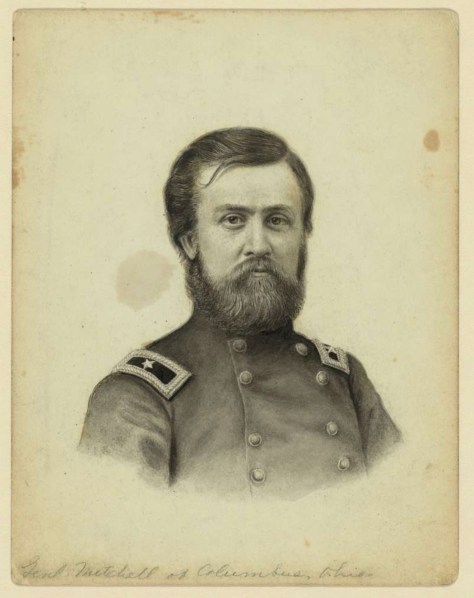
The following letters were written by John Grant Mitchell (1838-1894), a graduate of Kenyon College who was preparing for a career in law when the Civil War broke out. He enlisted in the 3rd Ohio Volunteer Infantry, helped raise and became the Colonel of the 113th Ohio Infantry, and became a brigade commander in XIV Corps where he played a major part in the Atlanta Campaign. He was promoted to brigadier general, the youngest civilian-soldier to attain that rank without benefit of preparative military training. He was brevetted major general after the war. Mitchell resumed his legal career and married Laura Platt, niece of President Rutherford B. Hayes. Mitchell was president the Columbus City Council and an Ohio pension commissioner.
He addressed the letters to Capt. David Taylor who was commissioned a 1st Lieutenant in Co. C, 1st O.V.I., April 15, 1861, and Captain of Co. B, 113th Regiment, O.V.I., August 12, 1862. Muster Rolls indicate that he resigned on 10 June 1863, not long after this letter was written. The following explanation for his resignation comes from his Find-A-Grave obituary:
“In 1863, Mr. Taylor organized the negro slaves as contraband of the war, and pressed them into service in building the fort at Franklin, Tenn., and gave each of the contrabands papers freeing them from slavery, for which Gen. W. S. Rosecrans highly commended him.
Early in February, 1863, Captain Taylor arrived at Franklin, Tenn., after a rough campaign through Kentucky’s mud, snow and rain, and immediately, with his comrades, was placed on steamboats, when down the Ohio River, and up the Cumberland River, retaking the forts from Donaldson to Nashville, then south to Franklin, a tired but victorious army. At once, Gen. C. C. Gilbert put the tired soldiers to work clearing the ground and building a fort. In this work David Taylor pressed all the slaves into the work of building.
On the evening of February 22, 1863, David Taylor was severely injured, causing paralysis of his left side. When it became apparent that his recovery was extremely doubtful, Gen. W. S. Rosecrans caused a detail of the chaplain of the 78th Illinois and another soldier to accompany him to Columbus, Ohio, where he was treated by Doctor Smith, the Surgeon General of Ohio, but he never fully recovered from his injury. General Rosecrans highly complimented David Taylor for his care of the soldiers who were benefited by the rest they received while the slaves built the fort, and after the war visited him at his home.”
Letter 1
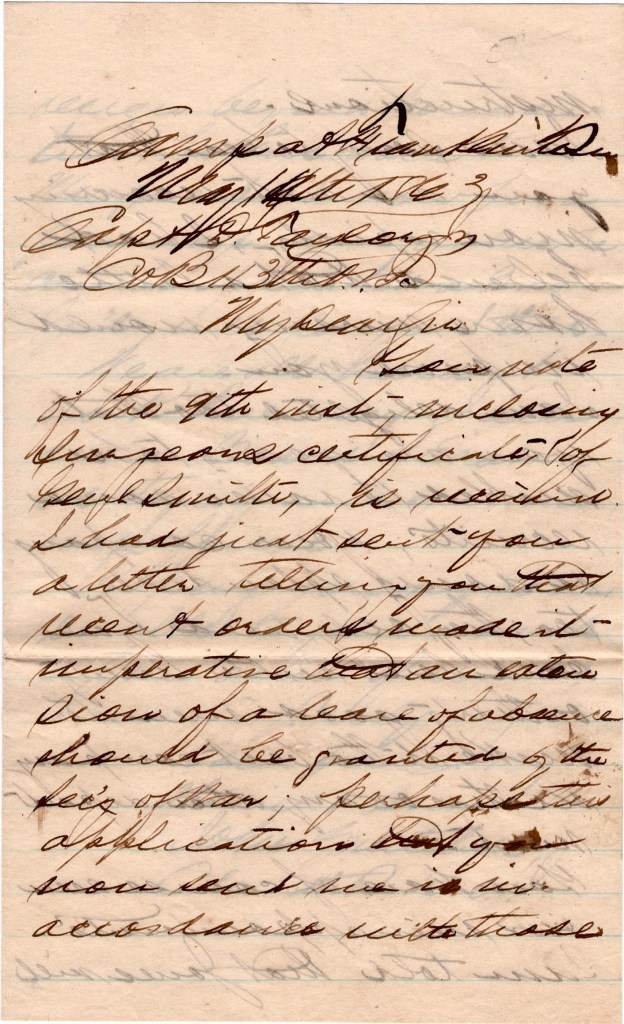
Camp at Franklin, Tennessee May 19th 1863
Capt. D. Taylor, Co. B, 113th OVI
My dear sir, your note of the 9th installment enclosing surgeon’s certificate of General Smith [Surgeon General of Ohio] is received. I had just sent you a letter telling you that recent orders made it imperative that an extension of a leave of absence should be granted to the Secretary of War. Perhaps this application that you now send me is in accordance with those instructions.
I am sorry to hear that you are not recovering more rapidly. I had believed that a little home nursing would improve you.
I am delighted too that you are going to be enabled to raise some recruits; your company is doing splendidly too; they only need you back here with twenty or thirty good men to make it the best company in this or any other department.
You have of course seen our new appointments. I am told that Jones will resign beyond [ ]; he has gone to Murfreesboro now for a few days and unless he can be appointed a Brigadier General, will resign, I think.
We are all hard at work here now. I am on a Board of Examiners trying and examining officers. Hoping you may soon be able to join us with a fine batch of recruits, I am very truly your friend & obedient servant, — John Mitchell, Col. 113th Regt. O. V. I.
Letter 2
Camp at Franklin, Tennessee May 30th 1863
Capt. D. Taylor, Jr., Co. B, 113th Ohio Vol.
My dear sir, your letter of a recent day is just received. I very much regret to learn that you are still unfit for duty. You remember that my constant hope was that twenty or thirty days at home would entirely restore your health.
It would be impossible for me to advise you in regard to offering a resignation. Dr. Smith’s opinion in the case I should trust implicitly. He knows much better than I could whether you will soon be ready for service. Your paralysis alarms me lest you may never be able for foot service in the field again. But you can tell about these things yourself, Captain, much better than anyone can for you.
If you are not able to return when the present leave of absence expires, if I were in your place, I should make no further attempt but would resign at once. You have done your whole duty faithfully and nothing more could be asked of you. All I wanted was a fair trial and I must ask more than that.
I am sorry that you have been unable to fill up your company to the maximum number. It is a splendid company—nothing like it in this regiment.
Your ordnance account is all square, I presume. I have just been looking over it for the quarter ending March 31st and if I remember correctly, it is all straight. About your other papers, I know nothing but judging from this they must be in prime condition.
In case you determine to resign, you have the necessary forms, I think. It would be useless for me to tell you how much I regret your talking about a resignation—all that you know already. Still, feelings have nothing to do with a soldier’s duty, and hence I can say nothing knowing that what you do will be done conscientiously. I hope you still find time to call upon my wife. She is happy at all times to see you.
I am, Captain, very truly your friend, — John G. Mitchell
The following manuscript was written by Reuben C. Norton of Co. G, 44th Illinois Infantry. It’s not dated but I think it was probably penned at the end of the Atlanta campaign or in the winter of 1864-65. This manuscript is from the personal collection of Allen Cebula and was made available for transcription and publication on Spared & Shared by express consent.
A Partial History of the Part Acted by Co. G in the Campaign commencing May 4th and ending September 8th 1864.
Lt. Reuben C. Norton, Co. G, 44th Illinois Infantry (1862)
Broke camp at Cleveland, Tennessee and marched a distance of 23 miles and joined the Brigade which had marched the day previous. Laid in this camp until the 7th when we marched about two miles and formed line of battle. Heavy skirmishing in front but no general engagement. Went into camp for the night near Tunnel Hill. 8th, moved to the left and formed line to support 3rd Brigade of our Division who threw out a heavy line of skirmishers and advanced up the slope of Rocky Face Ridge. They met with considerable opposition but gallantly carried the ridge losing 3 men killed and 13 wounded. 9th, 3rd Brigade charged the Rebel works on the ridge. Our regiment was ordered to support the charging party but before the lines could be formed 9owing to the roughness of the ground), the charge was repulsed with heavy loss to our side. The project was then abandoned and we fell back to our old position. Remained in this position until the 11th when the Regiment went on the skirmish line. Considerable firing during the day and a greater portion of the night. 12th, during the night the Rebs evacuated their position on the ridge and fell back into their works at Resaca. 13th, marched through Dalton and took our position before Resaca. Laid on our arms all night.
14th, Ball opened in earnest. Our regiment went in about noon, fired 200 rounds to the man when we were relieved by the 36th Illinois. Fell back under the brow of a hill out of range and again filled our cartridge boxes. At night went on picket line. Some firing but no damage done. Threw up light works. Rebs opened early on the morning of the 15th. Were under fire until 10 o’clock when we were relieved by the 40th Indiana of the 2nd Brigade. Fell back and rested for the night. Rebs evacuated during the night. Fell back across the river. Regiment lost in the engagement 26 men, Co. G lost mortally wounded Thomas Willie, Almond Gifford, and T. F. Collins, slightly wounded. 16th, Rebs in full retreat. Our Division close on their rear. Heavy skirmishing during the day ending in the occupation of Calhoun by our forces.
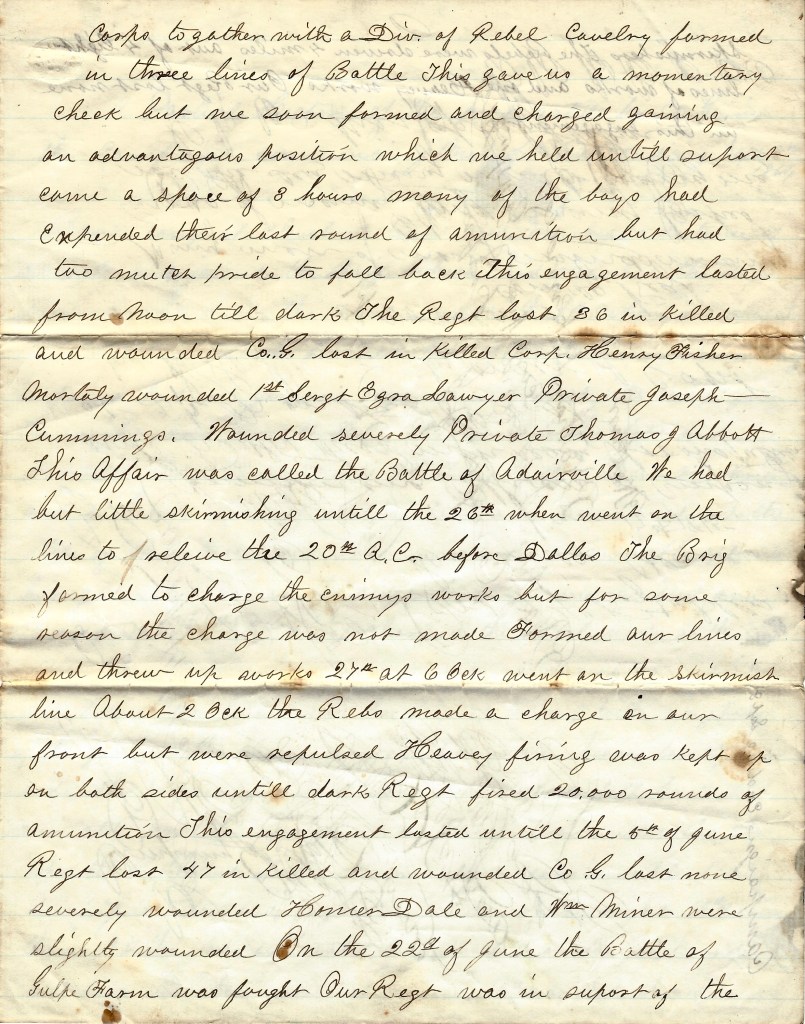
17th, Our Brigade in advance, skirmishing commenced early and continued light until about noon when the enemy having secured a strong position seemed determined to check our advance. This they succeeded in doing until the 44th Illinois was put forward on the line. The Boys were in good spirits and went forward on the double quick, routing the Johnnies without firing a shot. We continued the pursuit until we were close on the enemy’s train. Here we found Hardee’s whole Corps together with a Division of the Rebel Cavalry formed in three lines of battle. This gave us a momentary check but we soon formed and charged, gaining an advantageous position which we held until support came—a space of three hours. Many of the Boys had expended their last round of ammunition but had too much pride to fall back. This engagement lasted from noon till dark. The Regiment lost 36 in killed and wounded. Co. G lost in killed Corp. Henry Fisher, mortally wounded 1st Sergt. Ezra Sawyer, Private Josepg Cummings. Wounded severely Private Thomas J. Abbott. This affair was called the Battle of Adairville.
We had but little skirmishing until the 26th when we went on the line to relieve the 20th Army Corps before Dallas. The Brigade formed to charge the enemy’s works but for some reason the charge was not made. Formed our lines and threw up works. 27th, at 6 o’clock, went on the skirmish line. About 2 o’clock the Rebs made a charge onour front but were repulsed. Heavy firing was kept up on both sides until dark. Regiment fired 20,000 rounds of ammunition. This engagement lasted until the 5th of June. Regiment lost 47 in killed and wounded. Co. G lost none severely wounded, Homer Dale and William Miner were slightly wounded. On the 22nd of June, the Battle of Gulpe Farm was fought. Our Regiment was in support of the skirmishers. The Rebels were driven 4 miles out of 4 light lines of works and heavy works. Our Regiment lost none in this engagement.
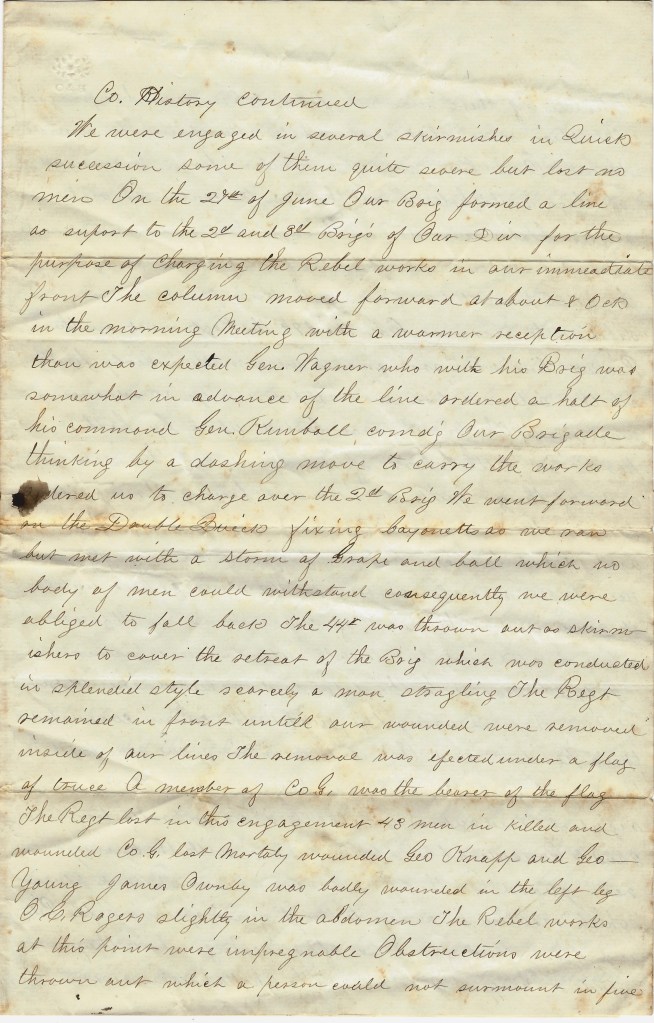
We were engaged in several skirmishes in quick succession—some of them quite severe but lost no men. On the 27th of June, our Brigade formed a line as support to the 2nd and 3rd Brigades of our Division for the purpose of charging the Rebel works in outr immediate front. The column moved forward at about 8 o’clock in the morning meeting with a warmer reception than was expected. Gen. Wagner who with his Brigade was somewhat in advance of the line ordered a halt of his command. Gen.. Kimball, commanding our Brigade, thinking by a dashing move to carry the works, ordered us to charge over the 2nd Brigade. We went forward on the double quick fixing bayonets as we ran but met with a storm of grape and ball which no body of men could withstand. Consequently we were obliged to fall back. The 44th Was thrown out as skirmishers to cover the retreat of the Brigade which was conducted in splendid style. Scarcely a man straggling. The Regiment remained in front until our wounded were removed inside of our lines. The removal was effected under a flag of truce. A member of Co. G was the bearer of the flag. The Regiment lost in this engagement 43 men in killed and wounded. Co. G lost mortally wounded George Knapp and George Young. James Ownby was badly wounded in the left leg. O. C. Rogers slightly in the abdomen.
The Rebel works at this point were impregnable. Obstructions were thrown out which a person could not surmount in five minutes if there was no force to impede his progress. Numbers were shot down while attempting to remove them. One line was a peculiar form. It consisted of logs with holes bored through the center at right angles. Stakes were driven through the holes and made sharp at the ends so that roll them as you might, they still presented a row of bristling points, very difficult to overcome.
On the 29th, the Regiment went on the picket line when arrangements were made whereby firing on the advance line was stopped unless an advance was made. The practice was looked upon by both parties as little short of murder. Under the new order of things, quite a friendly feeling sprange up between the two armies. Exchange of Yankee coffee and Rebel tobacco became frequent. Exchange of newspapers was also carried on to some extent until it came under the notice of the Commanding Officers when a stop was put to all intercourse whatever.
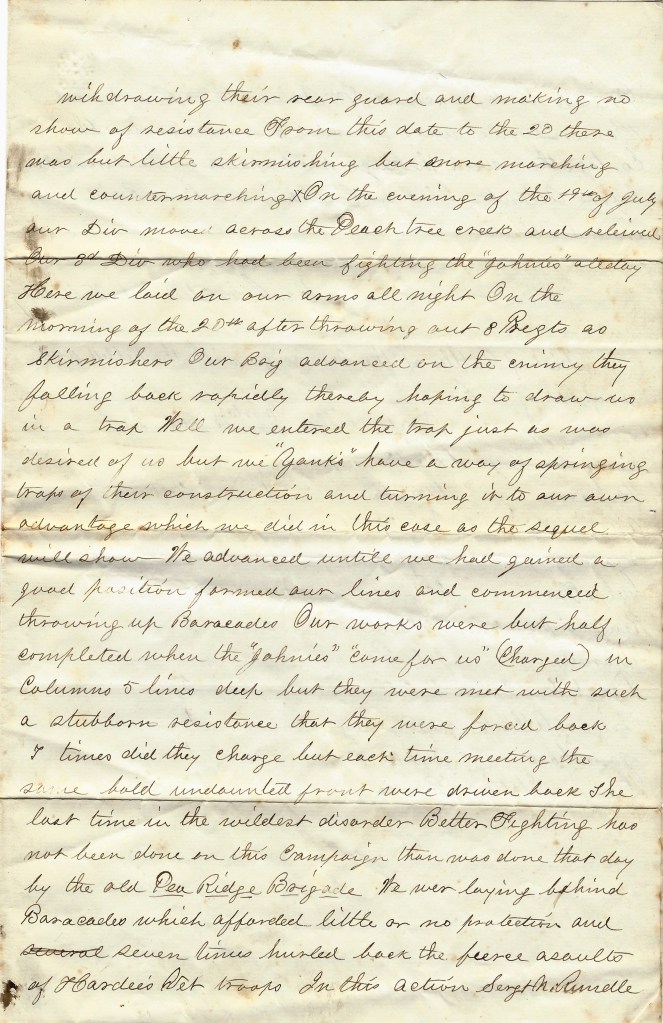
July 2nd, moved to the left and relieved the 1st Division of our Corps. During the night the enemy evacuated their position and the next morning we occupied the City of Marietta. This is a place of some 10,000 inhabitants regularly laid out and withal a very pretty town. 3rd and 4th, a severe skirmish took place which resulted in a loss to the Johnnies of their rifle pits and first line of works, after losing which they made a hasty retreat across the Chattahoochee river, withdrawing their rear guard and making no show of resistance. From this date to the 20th there was but little skirmishing but more marching and counter marching. On the evening of the 19th of July, our Divsion moved across the Peach Tree Creek and relieved our 3rd Division who had been fighting the Johnnies all day. Here we laid on our arms all night. On the morning of the 20th, after throwing out 8 regiments as skirmishers, our Brigade advanced on the enemy, they falling back rapidly, thereby hoping to draw us in a trap. Well we entered the trap just as was desired of us but we Yanks have a way of springing traps of their construction and turning it to our own advantage which we did in this case as the sequel will show.
We advanced until we had gained a good position, formed our lines and commenced throwing up barricades. Our works were but half completed when the Johnnies came for us (charged) in columns 5 lines deep, but they were met with such stubborn resistance that they were forced back. Seven times did they charge but each time meeting the same bold, undaunted front [and] were driven back the last time in the wildest disorder. Better fighting has not been done on the campaign than was done that day by the old Pea Ridge Brigade. We were laying behind barricades which afforded little or no protection and seven times hurled back the fierce assaults of Hardee’s veteran troops. In this action, Sergt. N. Rundle, Private Arlo Merchant, William Miner, William Hart, and Homer Dale were wounded, none severely. The company together with the regiment participated in the skirmishes before Atlanta. Also in Gen. Sherman’s great raid around Atlanta. — Rube Norton, Co. G, 44th Illinois Vet. Vol. Infantry
List of Battles of the Campaign with the killed and wounded of Co. G [Table]
























 Spared & Shared 23