This letter was written by 47 year-old Earl Bill (1813-1885) of Tiffin, Seneca county, Ohio. Earl’s first wife was Roxy Ann Allen (1820-1847); his second wife was Susan Eliza Johnson (1820-1899). Though Earl made his living as a commission merchant, he was also active in politics. Previous to the date of January 1860 letter, he had served one term (1850-1851) in the Ohio Senate and he would afterward, in May 1860, serve as a delegate to the Chicago convention that emerged with the ticket of Lincoln and Hamlin. In the 1850s he partnered with another to publish the Sandusky Register which became the mouthpiece of the rising Republican Party in northwestern Ohio.
Earl wrote the letter to his representative in Congress, the 67 year-old John Carey, a War of 1812 veteran whose career included serving as a judge, an Indian agent, a member of the Ohio legislature, and an elected Republican to the 36th US Congress (1859-1861). He died in the town he founded, Cary, Wyandot county, Ohio, in March 1875.
[Note: This letter is from the personal collection of Richard Weiner and is published on Spared & Shared by express consent.]
The cartoon reflects the considerable bitterness among New York Republicans at the party’s surprising failure to nominate New York senator William H. Seward for president at its May 1860 national convention. The print was probably issued soon after the convention’s nomination of Abraham Lincoln. (LOC)
Transcription
Tiffin, Ohio January 24, 1860
Hon. John Carey, House of Representatives, Washington
Dear Sir—Permit me to obtrude a few words upon you on political matters. At the moment I write, we have no information of the organization of the House, and we must understand probably the true causes. It is doubtless from a determination on the part of the “Democratic Party” never to let go of the hold on the public teat except when grim death summons the from all things sublunary. Thus far they have cloaked their purpose under a thin veil of pretended solicitude for the peace of Southern society, which is of course a mere show. Thus far, our Republican friends have nobly stood by their chosen leader of whom they are justly proud. Do they or do you doubt whether their constituents approve? Perhaps some shade of doubt sometimes crosses their minds; but sir, as for your District, I do not believe there can be found a single man who voted for you who would ever do so again if you should be driven by Southern bluster or Northern bluster to desert the standard bearer of the present contest so long as he maintains his present firm, self-respecting, and dignified attitude. I say this with entire respect, and not for a moment believing your firmness will be insufficient. But it may prove some satisfaction to yourself to know that your views of duty are concurred in at home.
US Congressman John Carey of Ohio
The truth is, there seems to be a number of Representatives from the Slave-holding States who are willing to destroy the Union and set up a Negro-Confederacy of their own; and in my judgment, they have initiated the matter already and intend never to cease their treasonable plans unless they can bully the North into a surrender of everything (including Northern manhood) into their hands. This should never be done. Let us know, now—and now is a good time to come at it—whether the North is to be a mere hewer of wood for Negro-drivers, and not to be allowed to have any opinions of its own on Governmental questions. The people of the Free States never boasted of superiority over their brethren of the South; but they do claim and will maintain (I hope) to be the peers of any people. If the maintenance of their just rights in the Confederacy produces the “Irrepressible Conflict,” 1 then let it come, but only their assailants must be held responsible for the consequences.
Truly yours, — Earl Bill
1 “The term “irrepressible conflict” originated with William H. Seward in an 1858 speech predicting the collision of the socioeconomic institutions of the North and the South. Seward maintained this collision would determine whether the nation would be dominated by a system of free labor or slave labor. In 1858 Abraham Lincoln proposed the same idea in his “House Divided” speech. At the time, the use of the phrase did not include the assumption that the “irrepressible conflict” would necessarily find expression in violence or armed conflict.” [Assessible Archives]
These letters were written by Charles Trowbridge Dwight (1842-1884), the son of William Dwight (1805-1880) and Elizabeth Amelia Wilder (1809-1883). Charles was a student at Harvard when the war erupted and he dropped out of school to accept a commission as 2nd Lieutenant in Co. B, 70th New York Infantry. He was mustered in on 1 November 1861 and discharged from the service on 30 June 1864. Charles’ brother, William Dwight, Jr., mustered in as Lt. Colonel of the same regiment and was promoted to Colonel on 30 November 1862 when the regiment’s first Colonel, Dan Sickles, was promoted to Brigadier General.
Charles wrote these letters during the Peninsula Campaign in the summer of 1862. In the battle of Williamsburg, the first battle of consequence in which the 70th took part it met with the heaviest loss of its service. Out of 700 engaged the loss was 330 killed, wounded or missing. At Fair Oaks and in the Seven Days’ battles the regiment was also active. In the letter datelined “In the Field before Richmond” on 15 June 1862, Charles reassures his mother that he is yet alive and informs her that, “McClellan is moving slowly along in his plans as usual and we are undergoing the tedium of another siege instead of ending it by a good, smart fight.”
Letter 1
In the field before Richmond June 15th 1862
My dearest Mother,
Although I wrote a letter last night, still as I have just received yours of the 10th in which you express so much anxiety on my account, I feel that it is to say the least my duty to do all I can to relieve your fears. To begin them, I am in splendid health except thin from the excessive heat from which we are now suffering. A thunderstorm has just cooled the atmosphere somewhat.
McClellan is moving slowly along in his plans as usual and we are undergoing the tedium of another siege instead of ending it by a good, smart fight. Every third day we either go out on picket or into the trenches. Our pickets are so close that we can hear them talk but we have orders positive not to fire unless they advance. We daily have skirmishes between the pickets and now and then (as for instance, today) they throw a few shell at us. Some came into our camp doing no injury to us although they wounded two or three in the trenches in front.
The army awaits with impatience the order to move. Sickness is prevalent. How I should like to have an opportunity to be at class day but it is not my good fortune.
There is nothing new. I am sorry Chip is so anxious to come out and I wrote him so. There are enough here now. If you wish me to write, you must send me postage stamps.
Give my love to Eliza Chapman, father & Wilaver.
With much [love] to you. Every your affectionate son, — Charley
Letter 2
Headquarters Excelsior Brigade Harrison’s Landing James River, Va. July 14th 1862
My dear Mother,
I received this a.m. your letter oof the 10th which while I was glad to have it, still I felt sorry to think that you should be in a state of useless anxiety for so long a time. To show you whether I am busy or not, I commenced this letter day before yesterday morning at about 9 a.m. but when I had got as far as the word “anxiety” the General called me to go out with him, and I was kept out until 2 p.m. while the inspection of the Division was made by him with Heintzelman & Hooker. The day was very hot, but after dinner I had to go to Headquarters, Army of the Potomac, to get a requisition for ordnance approved., since I am acting as Brigade Ordnance Officer, and did not get home till 8 p.m. and I was too tired to write.
The next morning, yesterday, I started at 5 a.m. with two wagons to draw my ordnance and was kept trotting around all day until 4 p.m. with nothing to eat before I could get my requisition filled out, there being but two men to issue to all the army. It was the hottest day we have had and I suffered more than I have any time except during the retreat and was tired out when I came back. We had a tremendous thunder storm which cooled the air temporarily but today it is hot again.
I received last night William’s letter and although I am glad that you are all pleased with my conduct, still I do not think I have done anything more than my duty and nothing remarkable. But there are many officers, I am sorry to say, who have disgraced themselves and their uniform—some in our regiment, but I won’t mention names as they will be sent in by the general to be dishonorably discharged. Everything is quiet here now and if anything does occur, I shall try to do my best and not disgrace myself.
How are enlistments going on? I do think the lack of patriotism is disgraceful to the North. Everyone but Chap or any more from our family ought to come out now, first making up their minds to be prepared to endure hardships and to stick it out.
We may be relieved to garrison some place soon. We ought to be and the General wants and is working for it. If so, I may get a furlough but if William gets his position, I want to go with him in some staff capacity. I wish I had a photograph of you, father—–Chap & Dan to see how you look.
Love to all at home, with much to yourself, dear Mother. Ever your most affectionate son, — Charley
These letters were written by George Josiah Sager (1840-1914) who served with the 149th New York Volunteers. George first enlisted in August 1862 as a sergeant in Co. D. He later received a commission as 2nd Lieutenant in Co. I. He mustered out of the service in June 1865.
George’s parents were Jacob Sager (b. 1807), and Rebecca Smith Groot (b. 1812) of Syracuse, New York. Many of George’s letters have been published on the internet which may be found at 149th monument at Gettysburg. George apparently often included sketches in his letters to his family. He is credited for having originated the idea for a bronze statue on the regimental monument on Culp’s Hill at Gettysburg (and also at Syracuse) which depicts Sergt. Lilly of the 149th New York “Mending the Flag.”
The brass relief depiction of Sgt. Lilly mending the flag on Culp’s Hill and the actual flagstaff, still bound together with ammo box slats and Lilly’s knapsack strap.
George’s original sketch, “Mending the Flag.”
Letter 1
[Note: This letter is from the personal collection of Don Andrew and was made available for transcription and publication on Spared & Shared by express consent.]
Aquia Creek Landing January 28, 1863
Dear Mother,
I received your kind letter last night with the $2 which I did not expect. I was very sorry to hear of your suffering but was again made glad by the tidings that you were recovering. We are at last settled again in winter quarters where we will stay for some time I am quite sure as our regiment is detailed to work at the landing. Our camp is in a pleasant place about half a mile from the landing.
Mort [Mortimer] Birdseye, Lisher [Elisha] George & I have got a nice little log house with a good fireplace and bunkhouse just built by some old soldiers who had to leave here and although it is a cold, snowy, rainy, and disagreeable day out doors, we are comfortable within. Mort is washing dishes and preparing a beef stew. Lisher is reading a book and I am writing of course. I wish you could lift up the canvas we have for a door and look in on us. You would be satisfied.
But is not always so. We have just completed six days as hard marching as soldiers ever see. The 2nd day of our march we traveled 18 miles with three days rations in our haversacks, 60 rounds of ammunition in our [cartridge] boxes and heavy blankets & so that is what I call hard marching. The 3rd, 4th, & 5th day it rained all the while and we could make but 3 or 4 miles a day and that by hard marching. The 4th day we had to go back two or three miles after rations cold and wet and our blankets and things soaked made them a great deal heavier. But it is all over now and my health and spirits are as good and better than ever.
George’s sketch of his old boots and his new boots.
And to top all, yesterday we got our first two months pay and all is joy in camp. I bought me a good pair of boots and you will see why in the picture, and a good knife. And we now have a good coffee pot and [are] very well rigged all round. But I should like a box from home first rate and it will come direct to us. Please send me a good 3 quarts pail for boiling in as we cannot find anything of the kind here. Anything in the way of dried fruit or preserves would be acceptable. Anything will be thankfully received from home.
But I must now close as it is near mail time. Give my love to all. Tell Emmy I have just read her letter and I will soon write her one with a picture in it. Goodbye for the present. From your affectionate son, — George
P. S. Mother, let me know if you get your allotment money. You should get $20. [sketch of boots]
Letter 2
[Note: This letter is from the personal collection of Don Andrew and was made available for transcription and publication on Spared & Shared by express consent.]
Aquia Landing, Virginia January 29th 1863
Dear Sister,
George Collins handed me your letter some three or four days ago but I have not had any good opportunity till the present. Today I am all alone in our little log shanty. Mort Birdseye has gone to Falmouth some 10 miles from here on the railroad to see his brother. The old 12th and the 122nd are near them and I think I shall go down and the boys in a few days. We can get a pass from the Colonel and ride on the cars for nothing. Lisher George is down on the landing looking for a “shoe tinker” to get his boots mended. I have just come up from the landing and my haversack hangs just back of me on a peg filled with cookies & cheese. That is high living here but I am getting so that I can eat my 10 hard tacks a day and salt pork and like it where at home it would have made me sick as a dog.
Last night we had 7 or 8 inches of snow fall. It has rained and snowed for the last four or five days but this morning it cleared up and the sun came out quite warm and now very little of the snow is left. We have a snug little shanty and did not mind the weather much. I will try to give you a picture of our shanty on the other side.
Mort being away, I am acting Orderly. It will soon be time to get the party out for night work on the landing so I must close. Give my love to Mother and all at home. I am not at all home sick and am very well contented but do not love the dear ones at home any the less but more than ever. Remember me to all. From your brother, — George
Tell them to direct my box to Sergt. George J. Sager, Care of Lieut. Collins, Co. I, 149 Regt. N. Y. S. Vols., Aquia Creek Landing, Va.
Letter 3
[Editor’s note: The date and location of this letter is not identified but my hunch is that it was written when Sager was a lieutenant and had the freedom to ride around.]
Dear Sister,
I received your kind letter last night about your visit and Aunt Amy. I am very glad to hear you enjoyed yourself so well. Am always glad to hear from you and shall feel it no bother to answer all the letters you may write.
Enclosed find a ring which I made myself. I shall feel quite proud to hear that you wear it. There are a great many made here by the boys and sent home. You will also find enclosed two pictures—one of “Bob,” a genuine “niger,” and one of our cook “Nat,” a good-looking mulatto. He made a dumpling for us today of raisins. Of course it was good but nothing like “Mother’s.”
I have not seen a little girl nor a big one either for as much as three months. They are quite a curiosity about here. Once in a while in my riding about I come across a nest of “nigers.” The other day I saw a lot of “Red Headed” little darkies. They were very black with sandy wool—quite red. They looked very cunning. I have some very good times riding about.
But it is near mail time and I shall have to close. Goodbye for the present. Write soon.
I could not find an image of James but here is a CDV of John H. Tuttle of Co. C, 176th New York Vols. who later rose in rank to sergeant(Photo Sleuth)
The 176th New York Infantry was recruited in the fall of 1862 with the intent of forming a three years regiment. However, failing to get enough soldiers willing to serve three years, they opted to fill out the regiment with men who would sign on for 9 months. It was finally placed into service early in 1863 and was mustered out in November 1863. The regiment spent their term of enlistment in Louisiana where, in June, various detachments participated in skirmishes at Pattersonville, La Fourche crossing, Thibodeaux, Fort Buchanan, Bayou Boeuff and Brashier City. In the action at La Fourche crossing, the regiment was commanded by Maj. Morgan and behaved most gallantly; in the actions at Fort Buchanan, on the Atchafalaya, and at Brashear City, the regiment met with serious disaster, over 400 men being captured. This disaster was not due to lack of bravery on the part of the men. There was no one in command, but the men fought with all the bravery that could be expected. The loss of the regiment in the above actions amounted to 464 killed, wounded and captured or missing.
Given the number of Union soldiers captured and paroled by the Confederates at Brashear City, there were undoubtedly a considerable number of these “Parole of Honor” certificates that were issued but this is the only one that I have seen. It appears to have been folded and carried in the soldier’s wallet for quite some time. The soldier’s name was given as Private James Chambers of Co. C, 176th New York Volunteers—apparently illiterate as he signed it with his mark on 25 June 1863—two days after his capture. By signing the paper, the soldier was released from captivity but pledged not to fight against the Confederacy until “regularly and duly exchanged.” In the regimental roster, James is described:
CHAMBERS, JAMES H.—Age, 43 years. Enlisted, October 30, 1862, at Wallkill, to serve nine months; mustered in as private, One Hundred and Sixty-sixth Infantry, October 31, 1862; transferred to Co. C, this regiment, November 13, 1862; captured in action, June 23, 1863, at Brashear City, La.; paroled and returned to duty, August 17, 1863; mustered out with company, November 16, 1863, at New York City.
The Parole of Honor was attested by Capt. J. B. Whittington, 2nd Louisiana Cavalry—a regiment of mounted volunteers who served for the entire war west of the Mississippi River in the Trans-Mississippi Department. The regiment fought at Georgia Landing, Fort Bisland, Irish Bend, and Brashear City in 1863 and Henderson’s Hill and Mansfield in 1864. Afterward, the regiment fought in minor skirmishes before the Trans-Mississippi’s final surrender on 26 May 1865.
These pre-war letters were written by Francis Henry West (1825-1896), an American businessman, politician, and Wisconsin pioneer. He was a member of the Wisconsin Legislature for three years, and served as a Union Army officer during the American Civil War, earning an honorary brevet to brigadier general.
West was born in Charlestown, New Hampshire. He moved to the Wisconsin Territory in 1845, eventually settling in Monroe, in Green County, in 1846. In Green County, he worked in the lumber industry. In 1853, he was elected as a Democrat to represent Green County in the Wisconsin State Senate for the 1854 and 1855 sessions. In 1855, he was the Republican nominee for Bank Comptroller, but was not successful. In 1859 and 1860, West led two parties of migrants to California as part of a speculative venture to make money selling eastern horses to the California market. His first trip to California in 1859 was a complete bust, losing most of his livestock to anthrax enroute. His second trip was more successful but hardly worth the risk of the journey and the time away from his family. Among the 180 horses driven to California in 1860 were several blooded race horses he hoped to get top dollar for but they did not handle the trip very well and were impossible to sell.
We arrived here all right yesterday morning and I was greatly disappointed in not getting a letter from you—especially as most of my boys got letters from home. I am getting very anxious to hear from you and the “varnish Lads & Lasses.”
The trip so far agrees with me first rate. I had the sick headache two days the first of the week since which I have never been better in my life (except the poison I wrote you about). I have slept in camp all but two nights since I started. I am now, however, stopping at a first class hotel by way of a slight change. I sold my land warrant yesterday to Mr. [Dexter Chamberlain] Bloomer, husband of the celebrated Mrs. [Amelia Jenks] Bloomer who resides here. I am getting along with my matters on the trip first rate. If you was a little better provided for at home, I should feel fine. You must rely upon your friends. You can get anything you want at Mr. Chinoweth’s store if George has not got it. You must apply to Fred for money.
I have written Fred a long letter containing all the news. He will show it to you. So. I shall write you no more. Call Lutie and Carry and Eddy and Billy and little sharp-nosed, bright-eyed George up to you and tell them about their Papa.
Affectionately yours, — Frank
Letter 2
Fort Laramie June 10, 1859
My Dear Wife,
We arrived here last night after tramping up the monotonous Platte Valley for nearly four weeks without the slightest variation in scenery. I have been very anxious to reach here for some time in hopes of hearing from home. I paid a dollar to cross the river on a raft last night and run a great risk of being drowned to get to the Post Office and then found neither letter or paper since which I have felt like crying and swearing alternately. I see no way of hearing from you until next fall. If you receive this by the Fourth of July, write immediately and direct to Placerville (Hangtown) and the letter will get there by the time I do. If you do not receive it so soon, direct to Marysville.
My company are all in first rate health. If you see any of Mr. Shrake’s folks, tell them he is enjoying himself finely. He is out after antelope today. We have scarcely seen an Indian yet. They keep entirely away from the road. Game is also very scarce. I have had but one good says hunt which I will tell you about. Seeing some buffalo on the sand hills about six miles from the road, one morning just as the train was starting out, I sent the train on and with Mr. Shrake and two others and two horses, we started after them expecting to overtake the train at noon. We followed the buffalo back for about ten miles when we cane in sight of an immense herd of at least one thousand. We partly surrounded them and made a charge, shooting in every direction and wounding many but did not succeed in bringing down but one—an immense fellow that would weight two thousand pounds. We then dressed him and loaded our horses with meat and started for the road. By the time we got back to the road, it was nearly night and our train was twenty-five miles ahead. We were hungry and very thirsty—the day being warm and not a drop of water had we seen. We went to the river, took a good drink, and “pulled foot” for camp which we reached at daylight next morning, pretty well used up. You may be assured I have had very little disposition to hunt since.
It seems as though the whole world was on the way to California. There is no end to the big droves of cattle that are going across and three-fourths of all the Pike’s Peak people are going through.
These plains are subject to the most violent storms of any part of the world. We have frequently had to rope down our loaded wagons to keep them from blowing over. We are now in sight of the snow capped peaks of the Rocky Mountains and the remainder of the way I hope there will be diversity of scenery enough to make up for the monotony of the plains. I shall have to go by way of Salt Lake to get provisions. I want to get there the Fourth of July, if possible. We now lack about one hundred miles of being half way from Monroe [Wisconsin] to Hangtown.
I just took a look at my cake for the first time and finding it all right, I put it away again. I shall keep it until I get past Salt Lake. If I could see you and the “Kinder” one in the while, I should enjoy myself first rate. Mrs. Ball get along with her children first rate. You may depend upon it that I shall hurry back as fast as my legs will carry me after I get. through.
Your affectionate, — Frank
Letter 3
Sink of Humboldt 1 Wednesday morn, August 3rd 1859
My Dear Wife,
My company are still all well. Since I wrote you before, we have traveled two hundred miles down the dubious, devious, Humboldt [river] and are now at the sink. On account of heat, mosquitoes, and sick horses, we have traveled it entirely in the night. I have traveled nights and doctored sick horses daytimes until I am so tired out that I sometimes drop asleep as I am walking along the road.
We are now at the commencement of the Big Desert and shall start on to it at noon, expecting to be across to Carson River tomorrow morning when the main part of the journey will be over as it is settled much of the way from there to Placerville. I have lost one horse since I wrote you. It died this morning. This is the hardest year ever known on stock on account of the disease before spoken of. Mr. Ball had to leave his best wagon and nearly all his traps yesterday—his horses giving out. I have to buy everything we use at an enormous price. Yesterday I paid ten dollars for two pounds of horse shoe nails. Three days ago I paid fifty dollars for a barrel of flour and it is now all gone. The great mistake I made was in loading my teams with such a good number of men. I never ought to have taken more than ten men. Then I should not have lugged my horses to death and could have gone right along with one tenth the expense I now incur.
I have bought four horses since I started so that I still have thirty-one left. On arriving at Carson river, I shall put four of my strongest horses onto the cook wagon and rush it through to Hangtown with twenty of the men who will go on foot. I shall remain in Carson Valley with the remainder of the men and horses for a couple of weeks and recruit up before going in. I have now made up my mind to go to Sacramento City in place of Marysville to which place you will please direct your letters in future.
Last week Horace Greeley passed us in the stage. We have seen but few Indians until we arrived here where the country seems to swarm with them. They are very friendly. We have about twenty of them employed at present in cutting grass and bringing it out from the sloughs for our horses. I am so afraid that I shall not get any letters from you when I get to Hangtown that I do not know what to do. I do not think I shall write again until I get to Sacramento.
Your loving husband, — Frank
P. S. Thursday noon on Carson River across the long dreaded, much thought of, long to be remembered desert all right.
Sunday, August 7th. Dear wife, I had sealed up this letter but laying here and having no chance to send it, and having the blues pretty bad, and not being able to think of anything but you and home, I have torn it open again.
We are now on Carson River, one hundred and fifty miles from Hangtown. My horses are too weak to go on and it is death to them to stay here. The disease spoke of before (called “swelled neck”) 2 rages terribly all the way from here to California. It is a blue time for emigrants, Some have lost all of their teams and all have lost more or less. On an average fully one half of all the animals on the road have died. Mr. Ball has lost one half of his horses (five). Last night one of the sorrels that I have had so long died in ten minutes after he was taken sick. I have still got thirty horses but everyone says I will lose half of them before I get through. I can only hope that I will not. I am taking every precaution possible to save them. Mr. Shrake with seventeen of the men have gone on while nine remain with me. We shall probably stay here a week or two. My expenses are enormous at present and will. be for a long time until I can get through and get my horses fit for work and earn something.
My bright and cherished vision of being able to get out of debt once more (and for which I was willing to endure everything) has nearly vanished. Still I may not come out so bad after all. I try and keep up good courage.
Genoa. August 11th. Ninety miles from Placerville. Three more of the largest and best horses dead. I shall go on through in the next four days. I don’t expect to have money enough to get home on.
1 The Humboldt Sink marks the beginning of a very difficult part of the California Trail: the Forty-Mile Desert. During the California Trail’s 1800s heyday, over a quarter of a million emigrants traveling west through the land faced extremely challenging, dry terrain in this area.
2 The highly infectious disease was probably anthrax which can present with a swelling of the neck, chest and abdomen in horses. Death can incur with 24 to 48 hours.
1860
Letter 4
Fort Des Moines Saturday, April 21, 1860
My Dear Wife,
We arrived here yesterday morning and have concluded to remain for a few days as there is no prospect of grass and hay & corn is very cheap here. We are now five or six days drive from the Bluffs. There is quite a large emigration for California and about half of Iowa is going to Pike’s Peak.
The weather is very dry and it blows a gale all the time. We may stay here a week yet. We can get corn for from 15 to 18 cents and hay for two dollars per ton. We have got along first rate so far and I think we shall make a very quick trip. We had a little bit of a horse race today and got cleaned out of twenty-five dollars.
I find your likeness a great consolation. I wish I had one of all the children. I find it much harder to be separated from you than I had expected—much harder than last year. I hope you are feeling well and will get along all right until fall when I hope to be with you.
Be sure and write as often as possible. Give my love to all the children. Very affectionately yours, — F. H. West
Letter 5
Council Bluffs May 1, 1860
My Dear Wife,
We arrived here this morning and I was greatly delighted to receive your kind letter of the 15th ult. informing me that you were all well. I have been very well and have not been in a wagon since we started. We have got along very finely so far and have had no inconvenience except from wind and dust which has been bad enough.
The men are all in fine spirits and everything seems to bid fair for a quick and prosperous trip. We have twenty men besides ourselves—fifteen Americans, three Norwegians, and two Dutchmen, and take them on an average. They are a first rate set of men. The grass owing to the dry weather is very poor but I think we shall move on slowly day after tomorrow which will be just two weeks earlier than I left here last year. There has not been any rain here for nearly a year and we have forded all the rivers so far except the Mississippi which has saved us from paying a good deal of toll.
The emigration to Pike’s Peak is nearly as great as it was last year and there is also a very large California emigration. I hear of quite a good many large droves of horses on their way and I am afraid it will ruin the market. The wagons that I got of George prove to be poor things and I am afraid we shake have much trouble with them.
My precious little wife, I hope it will not seem very long until we meet again and I am sure I hope it may never be necessary fr us to part again. Not a day has passed but what I have taken a good look at your portrait and felt how much I worshipped the original. I hope you will try and get along this summer as pleasantly as possible and concur with you in not desiring to cultivate the Kleckner acquaintance. I suppose I shall not hear from you again until I get to Salt Lake which seems a long time.
Tell Louey to see if she cannot improve so much in music as to astonish me when I come home. Write me how you get along about money matters. Give my love to Louey and Carrie and Edith and Willie and George and Susan. And my respects to all enquiring friends. Very affectionately yours, — Francis Henry West
Letter 6
Loup Fork [Platte river] Sunday eve. May 5, 1860
My Dear Wife,
I write you a single line to let you know that we are getting along finely. We have had two fine showers since we left Omaha and the grass is growing finely. I think we shall be able to go right ahead now. We are now half way from the Bluffs to Ft. Kearney.
We took in another passenger at the Bluffs—a young man that I was acquainted with in Madison. He paid us one hundred dollars fare and works the same as the rest. We could have had plenty of passengers if we could have taken them. We have had a fine time so far on account of weather and roads, The journey so far is nothing to what it was last year.
I hope my dear little wife that you will not neglect to write every week. Give my love to the children. Affectionately yours, — F. H. West
I do not expect to write again for some time. Be sure to write all the business items on news as well as about everything else.
Letter 7
[Within 150 miles of Fort Laramie] Saturday eve, May 19, 1860
My Dear Wife,
We are all well and getting along finely, considering how poor and backward the grass is. We are now within a week’s drive of Fort Laramie (150 miles). Our horses are looking very well and we feel in good spirits thinking we shall have a easy and quick trip. We are pretty much ahead of all the emigration and have the road all to ourselves. There are a good many large droves of horses on the way which will somewhat effect the California market when they get in.
I do not expect to get a chance to mail this letter until we get to Laramie and perhaps not then, but I could not help writing to you. If I could only hear from you often, how much it would relieve the tediousness of the trip. I want you to write previous to June 15th and direct to Placerville. All after that, direct to Sacramento.
My dear wife, you. do not know how much my mind and heart and very soul is filled with you and I hope if I ever get home again with you, I shall be able to stay there.
Write very often to your affectionate husband, — F. H. West
Letter 8
Ft. Laramie Friday, May 25, 1860
My Dear Wife,
We arrived here today all right except a smashed wagon wheel. We are now making a raft to float over to Laramie on to get it mended. Am in hopes to get it done so as to leave here tomorrow afternoon.
We have got a first rate lot of men and are getting along finely. Be sure and write very often, my dear, dear wife, and give me every scrap of news—both business and political. Also all the gossip of the day. Tell me what everyone is doing and what all the children say, &c. &c. Also what you learn from Charlestown. You need not expect another letter for some time. I have read your kind letter sent to the Bluffs for the tenth time and kissed your dear sweet likeness for the hundredth time since I started.
You need not be afraid that I shall be drowned in crossing the river for the simple reason that I shall not cross.
I wish you had written me a letter to this place. — Frank
Letter 9
[150 west of Salt Lake City] June 28th 1860
My Dear Wife,
We are now about one hundred and fifty miles west of Salt Lake City and getting on finely. We are on what is called the central route—a much shorter road that the Old Humboldt Road—and through a much more desert country. We do not strike the Humboldt at all but keep farther south. For the last seventy miles we have found water but once and then only a little brackish stuff in holes. We have in company fifty-six men, two women, and one hundred and fifty horses. We have not arrived in the country where the Indian troubles are yet but are getting very near it. We expect to go through without much trouble. We shall choose officers and effect a sort of military organization tonight.
The Indians burned a stage station a short distance ahead of us yesterday. While a portion of our company were camped within four miles of Great Salt Lake City, an Indian crept up near the guard that was watching the horses and fired at him with a rifle but fortunately missed him. The guard saw him as he raised his gun and fired with his revolver nearly at the same instant, shooting the Indian through and killing him. We suppose he intended to kill the guard, jump onto a horse and escape but he paid dear for his temerity.
I have had a slight attack of mountain fever for the past week but have got about over it at present. We took in another passenger at Camp Floyd—a Dr. Green. He is said to be a first rate physician. We shall probably arrive at Carson Valley in three weeks. I hope my dear one that you are getting along finely and enjoying yourself as well as possible under the circumstances. Devotedly yours, — F H West
29th. While traveling on the desert last night, I strained my instep so that I am unable to touch my foot to the ground. It is very painful. I presume it will be well in a few days. There was a little fight here a few days ago between some Indians and the mail boys. Three Indians were killed. We are so strong, we do not fear them although we keep a good lookout. Loved one, how I wish I could hear from you. — Frank
Letter 10
Deep Creek Station July 4, 1860
Sweet one,
I write you a single line on this dirty scrap of paper (which is the last paper we have in camp) to let you know that I am still in the land of the living. I am sorry to inform you that we have made but fifty miles headway since I last wrote you. We have been laying over to recruit sick and tired out animals belonging to different members of my company. We are going on today and I am in hopes we will not have to stop again. We have not lost any of our horses yet.
I have under my command sixty-six men with one hundred and eighty horses and seventeen wagons and feel no fear of Indians. The Goshute Indians came down near here yesterday and shot twelve mules & horses and drove off twelve more belonging to the stage company and some other parties but they were not properly guarded at the time.
Everyone about the camp is enjoying perfect health. Do not expect, dear one, to hear from me again for three weeks, but do not let a week pass without writing and be sure and “gossip round” and get every item of news there is and send me. Your loving husband, — Frank
Give my love to the children.
Letter 11
Roberts Creek [present day Nevada] 1 July 12, 1860
My Dear Wife,
I keep violating my promise not to write again until we get to Carson Valley but as we are “laying over” today, I write a line to let you know that we are “all right” although we are not getting along very fast. We have not lost any animals yet and they are looking very well.
The mail came through yesterday from California for the first time for a long while and I will send this hoping it will come through again soon when I can send it on. The stations are all burned down along here but we have had no serious difficulty yet with the Indians. One hundred and fifty miles more will. take us through the country where the warfare exists. We are now four hundred miles from Sacramento (at which place we shall be the first day of August) and two hundred and fifty from Carson Valley.
We had a tremendous stampede a few nights since. The horses (180 in number) dashed through camp tearing up all their fastenings and running over one of our wagons and smashing it up so that we had to leave it. Many of us came near being trampled to death. Many of the boys were much frightened thinking it was an Indian attack. The horses ran up into the mountains and it took us all the next day to recover them.
Be of good cheer, my dear one. I shall be with you again soon. — Frank
1 The Roberts Creek Pony Express Station was built in the spring of 1860. It seems that the station was still intact around May, 1860. After this time it is thought that the station was destroyed by Indians and Bolivar Roberts set out to rebuild destroyed stations and restock them. This time the buildings were better constructed and men left to occupy each one until the Indian troubles were over. On June 16 they met Howard Egan at Robert’s Creek. Robert’s Creek Station was a telegraph station as well as an Overland Stage Station. It was an Overland stop until 1869. The site of the station is now on the Robert’s Creek Ranch owned by Filbert Etcheverry of Bakersfield, California. Peter Damele noted the old Pony Express station, a log structure, has long since been obliterated by the owners. There is a log dugout very near the Express site he described, but no one knows if it is part of the original station or not. Robert’s Creek is 15 miles north of Highway 50.
Letter 12
Sierra Nevada Mountains July 27, 1860
My Dear Wife,
I was much pleased when at Genoa to receive your affectionate letter of May 27th. we are now one hundred and thirty miles from Sacramento and have camped expecting to remain three or four weeks and recruit up our horses when we shall take them down for sale. There is no post office near here but Mr. Carpenter is going down to Marysville tomorrow where he will buy a small draft of twenty-five dollars and enclose this and forward to you. You can take the check to the bank and get it cashed and it will answer you until you hear from me again.
I shall go down to the City myself in about two weeks. We employ six men to take care of the stock. We have sold one pair of our smallest horses for $450.00.
I am very anxious to get my Sacramento letters and hope to hear no bad news from home. Continue to write very often to your affectionate husband, — F, H. West
Letter 13
Sierra Nevada Mountains August 12, 1860
My Dear Sweet Wife,
Mr. Carpenter returned yesterday from the lower country bringing me three kind letters from you—one from Placerville dated June 9th, and two from Sacramento, one of June 10th and the other June 16th. You write as though you had sent others to Placerville but they have not arrived. I am very much pained to learn that our pet and pride, Louey, is not well. I do not think you ought to let her go to school. I am afraid you have suffered for want of money this summer. I hope you will have received the little draft of twenty-five dollars that I sent two weeks ago ere this reaches you, I will try and send you more soon. We have no paper in camp. This scrap I tore from one of your sweet letters so you must excuse its appearance. I know, dear one, that you will be very glad to receive even this scrap from your devoted husband.
We have moved our camp since I wrote you last. We are now twenty miles from any house and seventy from any post office and I do not expect to be able to send this until I go myself to Sacramento which I think will be in a few days. We are now located in a beautiful little circular valley near the summit of the mountains. There is plenty of snow within a mile of us in any direction—plenty of strawberries in the valley which is fringed with heavy pine timber and any amount of speckled trout in the cold streams that leap down the mountains. The weather delightful through the day but a little too cold at night. But notwithstanding all the beauties of nature that surround us, the days drag slowly and wearily along with me. I have nothing to occupy my mind and can think of nothing but the best & kindest, dearest woman in the world—your own sweet self—the whole time. I really believe it would be a relief (do not be offended) if I could forget you for awhile.
Shortly after I wrote you before, I was taken very sick and was sick for a week suffering very much. But I have got very well again.
The day after tomorrow I shall take ten horses and start for Sacramento to try the market. Mr. Carpenter is going with ten more too Stockton. The balance we shall leave here in charge of three men. From what we can learn, we are afraid we shall be unable to sell this fall and will have to keep them until next spring.
Harry Carson [Corson?] is with us taking one of the race stock.
My dear wife, I wish you would review your letters after writing them so as to fill up the omissions. You leave out many words and some times whole sentences so that it is impossible to make out your meaning. You told me in one letter that Charlie was married. What Charlie is it or who he is married to is more than I can imagine. Who did Lucretia Deniston marry? What did you hear from Charlestown? What do you hear about Hogans getting along at the mill? Tell me all the news generally. How is Harriet’s health now> I will not write any more, dear one, until I see some chance to mail it. — Frank
Letter 14
Sacramento [California] September 9th [1860]
My Dear Wife,
I have just received two long expected and very welcome letters from you. It is the first news I have had from home. They came down from Placerville. One was dated June 26th, the other July 5th. I have not received the one from Fred. I ought to receive some of much later date from you by this time.
I wrote you a few days since requesting you to write me at San Francisco. I shall probably leave there for New York before the letter reaches there. The steamers sail on the 5th and 20th of each month. I intend if possible to sell out my horses so as to take the steamer on the 5th of October and I want you to write immediately on receipt of this and direct to New York, Care of Mr. Briggs of the “Brandreth House.” I shall probably go up to Charlestown before going home and I want to be sure and hear from you as soon as I arrive.
My horses have come down from the mountains and looking much better than when I left them. I have fourteen yet to sell which it may take me some time to dispose of as times are very hard here as well as in Wisconsin and all. kinds of property very low. “Emigrant horses” are the only thing in fact that will sell at all. I have sold twelve for twenty-six hundred and ten dollars. My expenses are very heavy necessarily. The horses that I lost would have brought me three thousand dollars.
The State Fair commences next Tuesday and judging from the preparations that are being made, is to be a grand affair. I am very anxious to hear how George is doing. Write me in your New York letter.
I do not think I can take time to go and see any of my cousins in this country. Give my love to all the little ones. My respects to my friends and try and get along the best you can, my dear little wife, until I get home which will be in a very short time if I have no bad luck.
Your very affectionate husband, — Francis H. West
Letter 15
Confidential
Sacramento [California] September 10th 1860
My Dear Wife,
I have just received your letter of August 6th. I have received none between that date and June 19th. I cannot think it possible that you have neglected to write to me for so long a time. I am very glad to hear that you are getting along so well. I have been very busy since my stock came down from the mountains and it keeps me all the time showing customers horses. I am selling them off very rapidly but at low prices. I have already sold over forty at an an average of $260 per head. If I can sell the balance as well, we shall make about eight thousand dollars clear. Could I have the whole of this as I should have had if I had had any capital to have gone on, it would have paid me first rate, but come to divide it, it don’t amount too much. I have the whole business here to see to.
Mr. Carpenter, on account of some pecuniary difficulty that his brother here has got them into, has had to make his property over to me and keep himself out of sight. I suppose he will sail for home on the steamer tomorrow. This is strictly confidential and must not be mentioned to anyone. Neither must any part of this letter as to when I am coming home or how poor getting along selling horses. I have some little matters that I wish to arrange at home before it is known when I am coming home or that I have got any money, so keep mum.
I expect the balance of my horses will sell very slow, but the State Fair commences here next week when I am in hopes to close out most of them in which case I shall start for home in four or five weeks. In any case, I think I shall force sales so as to start by the first of November. I am the worst troubled to know what to do with the race horses. They are unfit to sell or do anything else with this fall. I guess I shall leave them.
My sweet wife, if I have good luck, it will be but a short time until I shall be with you.
The weather is cool and delightful. I hope I shall receive several letters from you before I start home. I am glad Louise is getting along so well with her music. Tell al the children that I am very anxious to see them.
I sent a business letter to Mr. Ludlow by Pony Express today. Affectionately yours, — F. H. West
Letter 16
Sacramento [California] September 23, 1860
My Dear Wife,
I have received but one letter from you since June 19th and must conclude that you are either sick or very negligent. I hope the latter, But my dear one, I hope that in a very few days after you receive this you will have a chance to explain the matter to me in person. I expect to sail on the next steamer which goes out on the first day of October and shall probably reach home between the 25th and 28th. I shall have to stop a day at Rochester, New York, to settle with Mr. Carpenter. The very moment you read this, write me at New York, care of J. G. Briggs, Brandreth House.
I have sold out all. but my race stock and shall leave them if I do not sell this week. The State Fair is now in successful operation here. I shall send the second bills of exchange to you by Overland Mail when I start.
I am still in hopes of hearing from you before I start. Say nothing about it. Affectionately yours, — F. H. West
Eve. 23rd. The steamer and Overland Mails are just in but nothing from you. I learn from Dr. Young whose wife thinks enough of her husband to write to him once in awhile, that you were all well on the 21st of last month. You will not receive this in time to write me at New York. I hope the children have not forgotten me if someone else has, — Frank
Images of William Chapin Harris and his wife, Sophia Morton Williams—the author of this letter datelined from Hamburg, Erie county, New York, just after the Lincoln Assassination.
This letter was written by Sophia Morton (Williams) Harris (1804-1880), the wife of William Chapin Harris (1797-1885) of Hamburg, Erie county, New York. Sophia was the daughter of Richard Williams (1773-1822) and Sophia Morton (1776-1854).
Sophia wrote the letter to her younger sister, Mary (Williams) Brayman (1816-1886), the wife of Mason Brayman (1813-1895) of Springfield, Sangamon county, Illinois. Mason Brayman began his career as an attorney in New York State but relocated his practice to Michigan in the late 1830s. In 1842, he again relocated his practice to Illinois and while there, in 1845, he compiled the Illinois Revised Statutes, and was also appointed by Governor Thomas Ford to investigate the difficulties between Mormons in Nauvoo, Illinois and their hostile neighbors. When Abraham Lincoln was elected to Congress in 1848, Brayman rented Lincoln’s home while Lincoln lived in Washington. Brayman served as general solicitor for the Illinois Central Railroad from 1851 to 1855.
With the outbreak of the American Civil War, Brayman joined with other railroad executives and secured a military commission. Initially serving as a major with the 29th Illinois Volunteer Infantry Regiment under General McClernand, he was promoted to colonel on April 15, 1862 and command of his regiment. Following the Battle of Fort Donelson, Brayman stopped shaving and grew a beard that would eventually reach his belt. He also had his horse shot out from under him twice. At Shiloh he became a minor hero, rallying his troops by charging between the Union and Confederate lines. During the Siege of Vicksburg he suffered a bout of heatstroke that forced him into garrison duty. By the end of the war he had achieved the rank of Major General and was serving as head of a claims commission in New Orleans. Major General Mason Brayman was the highest ranking Civil War officer to have lived in the Lincoln’s neighborhood. Mason Brayman – 42 years old, served as a Major General with the 29th IL Volunteer Infantry. He lived in the neighborhood two times—once as a renter in the Lincoln Home and once as a renter in what is now called the Shutt House.
After the war, Brayman became the editor of the Illinois State Journal and held that position until 1873 when he moved to Wisconsin. Brayman continued newspaper work until President Ulysses S. Grant appointed him Governor of the Idaho Territory in 1876. After the expiration of his term, Brayman moved to Wisconsin and then later to Missouri.
Transcription
Hamburg [Erie county, New York] April 18, 1865
My Dear Sister,
I received your welcome and long wished-for letter last evening and now take my pen to answer it. But dear Sister, how can I write or what shall I say? My heart is nigh to bursting and my eyes are swimming in tears. Our Country’s Protector and best friend is no more. Murdered by a Fiend, a Devil. Was there every anything so horrid before? But I cannot write about it for you know it all as well as we. And as he was your neighbor and friend, I know you will mourn in sadness at his great loss. But sister, his work is done and our Heavenly Father has taken him home, and when I read the piece you sent in your letter about his needing rest, I thought now he has rest eternal. No more cares—no more anxiety—no more sorrow or pain; all is over and he is at rest.
But Sister, I must tell you how I have felt for the past year about him. I have seen such a true semblance between him and Moses and have been so afraid he would not be permitted to see the Canaan—for you know Moses got in sight of the promised land but was not permitted to enter it, that I felt afraid our President would be murdered at or about the time of his second Inauguration, and when he went to Richmond I was very anxious about him. But when he returned safely to Washington and Lee’s Army had gone home and everyone seemed so happy in the near approach of Peace, that I had thought all danger was past. But now I can see he had got to the place Moses had when God took him. He came to the place where God said I have caused thee to see it with thine eyes, but thou shall not go over to possess it. And now I feel to say, O My Father, President Lincoln is dead, and send us a Joshua to lead the people and endow him with wisdom and knowledge that he may lead them as faithfully as Joshua of old.
Oh Mary! what fearful, what responsible times we are living in, and it becomes us all to daily pray, “Lord, what wilt thou have me to do.” But I must change my theme or I shall fill my sheet with this sad subject, and in fact I can hardly think on anything else. I could tell you how our City is draped in mourning and all business is suspended, and the mourners go about the streets, and next Thursday was set apart for our Great Jubilee, and now it is to be observed as a day of fasting and prayer.
Dr. Velona Roundy Hotchkiss (1815-1882)
You ask who is our Pastor. Dr. [Velona Roundy] Hodgkiss is again our Pastor, and there is none better. His only son [Albert]—a noble young man of 22—died in the Andersonville Prison the past winter from suffering and starvation. 1 It was a great affliction, almost insupportable. Last Sabbath our Church was draped in mourning too when our Pastor Dr. Hodgkiss arose to open the meeting, and when he announced his text, ‘All these are the beginnings of sorrow’, he proceeded but a few minutes before he buried his face in his pocket handkerchief and sobbed aloud, and for, I should think, five minutes, there was nothing heard but sobs. It was truly a mourning congregation, and Sister, if these are the beginnings of sorrow, what will the end be? Oh God, have mercy on us.
Well, I must change my theme and tell you of the sickness and death of Mother Brayman. She was taken with a pain in her stomach but did not think it serious and you know Father Brayman does not like doctors. He have her such medicine as they though best but she died. They had a doctor but it was too late. It was inflammation in her stomach and mortification set in ad relieved her of her sufferings. She was sick only a few days and none thought her dangerous till the day she died. Mell’s wife told me she died happy and said death had no terrors. Mell’s wife said she asked her a short time before she died what message she would send to Mason. She said, tell him I should have been glad to see him once more, but I hope to meet him in heaven. The Old Gentleman felt very bad. Mrs. Emerson was with her when she died and stayed with him a week after. They tried to persuade him to sell his farm (as he had an offer of $55 dollars an acre) and go and live with Mrs. Emerson, but he would not sell or leave his home. He got a woman to keep his house for awhile till Mr. Emerson could get ready and move there. I do not know what bargain they have made but Mr. Emerson has moved there to take care of him. Mrs. Emerson thought it her duty to do so, and besides, Mr. Emerson was thrown out of his business by the bridge being broke down and probably there will not be another built before fall. So the Old Gentleman is very comfortable with Mrs. Emerson.
Four weeks after Mother Brayman died, Deacon Foster died. They were two of the oldest inhabitants. Marion Bird was here to the funeral. She spent three days with me and a week with her Aunt Foster. She says her mother enjoys good health and is very pleasantly situated. Jane and Ada are with me. Ada says I must tell Nell not to forget her amid all the wonderful scenes she is passing through. Abell’s folks are still on the Starring farm and they have reported that Mason gave it to Mason for his name (or Mrs. Brayman has). I visited with her two weeks ago to Joshua Smith’s and I told her the farm was for sale. She did not tell me that Mason gave it to them but said if it was sold they should buy it. Dwight is living to home but Asher is married to a Miss Bruce and lives on his wife’s father’s farm and Mason is going to the Oil regions. You ask if the farm would sell well this Spring. It depends on circumstances. They are boring for oil about two miles from there and if they succeed, the farm will fetch a good price. A company have been on from the East and tried to leave all the land where they thought there was a prospect of getting oil. They think there is no better prospect than in the Gulf on the Staring farm. Mr. Beach came to see me about it and I told him I did not think it could be leased but it was for sale.
I am glad to hear from Fred and of his prosperity. I wish he would write to us. Jane has written him two letters but received no answer to them. She has a letter from Will a short time ago. He was well and happy in the prospect of so soon seeing his friends once more. He says he shall leave there “Number One.” Sister Morgan’s family are well. Albert’s wife has a son six weeks old, both doing well. Sister Hannah and family are well. She was at Sylvina’s a short time ago and Sylvina says she never saw her look so well. She is most as large as I am. Dora is a young woman. She is with her Mother. Theodore is in the City in a store. Helen is still in New York. She has a son.
My own family are well. [My husband] William’s health has not been better for many years. [Our son] Richard [Williams Harris, (1822-1890)] has been very unfortunate. He was bitten by a dog the day before New Years on the first finger on his right hand and the inflammation set in and four weeks after he had to have his finger cut off. For a long time we were afraid it would cost him his life. He lost 30 pounds in three seeks, so you may judge how bad off he was, but he is getting better now and his finger is healing. [Our daughter Sarah] Sylvina [Harris Peek]’s husband, [Harvey Peek] is quite unwell. His health has been poor the past year and I sometimes fear he is going into consumption. [Our son Cyrenus] Chapin [Harris (1835-1899)] and family are well. He has three nice children. Willie, his only son, has been with us the past two years. He is six years old and says he is Grandpa’s farmer boy. The two girls, Hannah and Sophie, are nice children. We had a letter from [our son William] Hamilton [Harris (1830-1899) four weeks ago. He and family were well. They live in Warsaw, Benton county, Missouri. He is still working for the government.
Mary, I told you I would let you know when [sister] Eliza [Williams Morgan (1806-1886)] made me that visit and I will if you keep me posted of your whereabouts. But she has not been here yet. She says if it did not cost her any more to come and see me than it did you, she would come. It only cost her four shillings to visit you and she says it will cost her three dollars for a horse and buggy to come and visit me.
I suppose you have heard of the death of Cousin Julius Morton? He died in Detroit some three months ago—sick one week. I hope you will excuse all mistakes and poor writing for I cannot hold a pen very well. I see by your letter you have heard of my misfortune and so I will explain. Last November I went to the City of Friday to be to our Covenant Meeting in the evening and was going to stay till Sunday to communion. Well I went to Meeting Friday night and Saturday I called on some old friends and in the evening Sylvina came up to Mrs. Booth’s after me. She lives near Sister Morgan’s. We were walking along and had got most to her house when she saw the first thing she see, I was going head first onto the pavement, I do not recollect anything—only I was walking by her side. I struck my face so hard that I broke my nose apart where the gristle joins the bone and cut it open lengthwise and the blood streamed out and I suppose that was what brought me to. Probably I should never come to if the blood had not flown so freely. Two men see me fall and run to me and when they got me up the blood was running off the bottom of my dress. The Dr. said it was a sudden rush of blood to the head in my fall. I hurt my right hand severely. My little finger and the one next to it were put out of joint and the little one is broke apart from the rest and the cord that holds it in the joint is broke so it will never stay in its place. It is stiff. I cannot bend it and the swelling has never left it. I have sometimes wished I had had it taken off but I think now that I will take it to my grave with me.
I shall be so glad to have you and Mason come and see us this Spring. A few more meetings and we shall be gone. Earth is not our home. I feel that my work is nearly done. Did you think our good President was murdered on our dear Mother’s dying day? Our dear good Mother died eleven years ago last Friday, and all that day I had felt gloomy and my mind had run back over the past, and the scenes of my childhood had passed before me, and the image of my loved Mother was with me all that day. I thought of our dear departed Father, of our brothers and sisters dear, and of our children’s home, and I thought of the contrast of the then ad now, and I said surely, this is a changing world. Surely this is not our home. Surely we are only pilgrims and strangers. Our home is beyond this changing world, beyond the narrow bounds of time.
Sister, I don’t know what you will think of my letter or whether you can read it or not. I am not fit to write for I can think of nothing but the scenes at Washington. But I will try to tell you about [brother] Oliver [Hazard Perry Williams] and then will close this. He sold out all he had at North Evans and has bought him a tannery and house and lot at Pontiac some six miles from North Evans and three miles from Angola Station. He thinks he has bettered himself materially and shall do well there. [His wife, Emma [Parthenia (Lake) Williams] has been very sick. We received a note a week ago last Saturday night that she was not expected to live through the night and Sunday [my daughter] Jane and I went to see her. We found her very low and the Dr. said if he could get her through that night, he should have hopes of her. She was better in the morning and for the first time since she was taken the pain subsided in her head. She is now slowly recovering but it will take her a long time to regain hers strength. Jane says I must tell you that she and Abell’s wife had a political battle a short time since. She was denouncing the Administration and Old Abe Lincoln in bitter terms and Jane replied to it. She is a perfect secesh or Copperhead as they are called here, and Mary, all such are now rejoicing at the Assassination of our good President. Now dear sister, farewell. May the best of heavens blessings rest on you and yours is my sincere wish and prayer. Your sister, — Sophia
Mary, do write often to me. I should have written to you long ago if I had known where to direct. Jane wrote to Ada [Sarah Adaline Brayman] Bailhatche but she did not answer her letter. Thanks to Nell [Ella Sophia Brayman] for the bakery. We had crocuses in blossom the 21st of last month and now our garden is beautiful with daffodils, hyacinths, purple, white , pink and straw colored. Violets sweet scented and the Polyanthus. Do write soon, — Sophia Harris
1 Albert G. Hotchkiss was 19 years old when he enlisted in the 8th New York Cavalry. He was taken prisoner on 29 June 1864 and died of starvation in Andersonville Prison two months later.
These two letters were written by Charles E. Ruch (1840-1865), the son of Samuel Ruch (1797-1875) and Sarah Rehrig (1807-1847) of Carbon County, Pennsylvania. Charles’ older sister, Hannah Ruch (1825-1899) was married in the 1840s to Gideon Peter (1823-1883) whose younger brothers are mentioned in these letters.
I could not find an image of Charles but here is William Lomison of Co. G, 81st Pennsylvania wearing an early war uniform of the regiment. William was killed in action at Antietam. This image was posted on CW Faces by Ronn Palm from his museum in Gettysburg.
According to muster records, Charles enlisted on 15 October 1861 and was mustered into Co. I, 81st Pennsylvania Volunteers 9the “Fighting Chippewas”) to serve three years. He was described as standing 5′ 8″ tall, with light hair and hazel eyes—a carpenter by trade and undoubtedly with a limited education based on his letter writing skills. Charles was taken prisoner at Reams’ Station in Virginia on 25 August 1864 and was sent to the prison at Andersonville in Georgia. He appears to have been among the prisoners relocated to Salisbury Prison in North Carolina where he died on 17 January 1865. [Another source says he died at Andersonville.]
The 81st Pennsylvania Regiment was recruited under the direction of James Miller, a soldier of the Mexican War, in obedience to an order of the War Department. Six companies were from the city of Philadelphia, and four from the counties of Carbon and Luzerne. Recruiting commenced early in August, and the men reported by squads and companies at the general camp of rendezvous near Easton. On the 10th of October 1861 the regiment proceeded to Washington, and went into camp at Kendall Green. Two weeks later it moved to a camp overlooking the East Branch of the Potomac and the Navy Yard. It was here assigned to a brigade commanded by General Casey, subsequently by General Howard, and known as the First Brigade, First Division, of the Second Corps. With the exception of an expedition to Marlborough, Maryland, as a police force for the preservation of order at the general elections, where the peace was threatened, it was engaged in no active duty until the beginning of December.
[Note: These letters are from the personal collection of William Clemens and are published on Spared & Shared by express consent.]
Letter 1
Washington City [no date given]
Dear Sir,
I took the opportunity to inform a dew lines unto you that we are all well at present time and in hoping this few lines will find you in the same state of good health & humor. And further, I received your letter on the twelfth of this month and was glad to hear from you. I would have written to you long before but I have no time. I am on duty pretty near every day now. I will write to you every week.
Mr. Alfred, excuse me for this time. I will satisfy you now from this time. I wish I can talk to you about one day. I would tell you much news. I have seen many things. I have seen more since I left that I ever saw in my life.
We have all our clothing and blanket. We have one [pair of] pants and two drawers and two shirts & three coats and one pair of shoes and two pair of summer stockings and one cap. Now I will tell you a statement about bedding. I and Charles Peter and Joseph Peter, & Edwin Rehrin, & William Rernig, and William Hunsicker [are] sleeping together in one tent. The tent is about eight feet long and six feet broad and so on.
Mr. Al H., I wish I can see you or I hope we come back before long. Then I will speak to you. I and Charles Peter [will] come up on your house on purpose for to talk with you. This is all for this time. Excuse me for that poor writing. I have no place for to write nice. Write to me soon. Then I will answer you right away.
If any of you want to write to me, direct your letter to Mr. C. E. Ruch, Washington City D. C., 36th Regiment, Company I, Pennsylvania Volunteers, Col. [James] Miller in care of Captain [William J.] Conner.
So much of your good friend, — C. E. Ruch & C. E. Peter.
Al H. I think Anna Miller and Martha Bernhard is all right. Alfred, I wish you good luck.
Letter 2
Alexandria, Virginia December 16, 1861
Dear Friend Alfred Hander,
I took the opportunity to inform a few lines unto you that I am well at present and in hoping this few lines will find you in the same state of good health & further I let you know that I received your kind letter the fifteenth day of this month and I was very glad to read it and I found that you was up in Rockport.
Further I let you know that our regiment was on picket guard last week. We was in Munson’s Hill. It is about two miles from our camp[ing] place. I and Joseph Peter and Owen Buck from Lehighton and Israel Youse 1 and William Keck—we five—have got one post. We have got the worst place in the whole lot. Our post was the nearest to the rebels [but] I am not afraid for a rebel.
We are in a brigade now. Our brigade has five regiments—about five thousand men. The name from our camp is Camp California. I must stop writing. It is time to get ready for tresperate [dress parade].
Don’t forget to write and write all the news that you know. Write soon. Write soon. So much from your friend, good friend, — C. E. Ruch
Direction: C. E. Ruch, Alexandria, Va. 81st Regiment P. V., Col. Miller, Company I in care of Capt. [William J.] Conner.
Our regiment has lost the number. It is the 81st Regiment now.
This letter was written by William (“Will”) Monroe Pinckard (1837-18xx), the son of Dr. Thomas Butler Pinckard (1793-1860) and his first wife, Catherine Lawrence Vance (1804-1839) of Lexington, Kentucky.
During the Civil War, Will volunteered as a cannoneer in the Washington Artillery of New Orleans. His muster records indicate that he was present for all of the battles of the unit in 1864 and 1865. He mustered out of the service in April 1865.
Will’s letter includes a description of his efforts to sell a slave named Bob in 1856.
Transcription
Addressed to Dr. T. B. Pinckard, Lexington, Kentucky
New Orleans [Louisiana] March 10th 1856
My Dear Father,
I received your affectionate letter a few days since and did not intend to answer it until I could inform you of the sale of Bob. But it is rather doubtful when he will be sold. I thought I would just write you a few lines now. Since you left, I have tried constantly to sell Bob, have taken several persons round to look at him, but none would offer anything for him. I have taken him to [Joseph A.] Beard when he was selling fifty or more slaves at auction, but he finally said he could get nothing for him. So last Saturday as I saw L. Carman & Co. was going to sell a lot of slaves, I took Bob around to him, limiting him to $600.
After the sale was over, I found he had sold Bob for exactly $600 but the man who bought him was to have him examined and said he would let me know this morning whether he would take him. So this morning I went round and found he would not take him as he said Bob was a “dirt eater” 1 and there was a malformation in his ribs—one leg was larger than the other, &c. So he is still on hand but I will continue to do my best to dispose of him. He is still at “Payne, Steele & Co.” who find employment for & board him.
Joseph A. Beard, Auctioneer, kept his office at 45 Magazine Street in New Orleans
I saw Dr. Smith a few days ago since. He said all were well at the “Pass” [Pass Christian, Harrison county, Miss.], & asked to be remembered to you. He thinks Mr. Toulement will still give the $4,000 and Uncle Ferd & Mr. Harrison say they would by all means advise you to sell immediately. Uncle Ferd says Mr. Harrison is of opinion that it is the best offer you will ever get and told him moreover you had better not delay longer but write to Mr. Sturges and advise him to sell while he can or it might prove to be like Bob—rather hard to get rid of. Most persons seem to be of the same opinion.
In your letter you ask “whether I get any salary?” Yes sir, it amounts to fifty or sixty dollars per month. I always draw money when I want. So far my board has cost me nothing as Aunt Sue would not let me pay. But I don’t intend to stand this any longer as I like to feel independent and I feel able to pay. They have all been very kind to me and I am very much pleased with my situation. I have been invited to some very pleasant parties and have made some very pleasant acquaintances.
I expect you will be surprised to learn Miss Mary Creath is to be married on the 15th of March to a Mr. Wassielle who is a cotton planter on Joe’s Bayou. He has been courting her for the last two or three years and was refused last winter. But there is nothing like perseverance. Dr. Follaine arrived here on Tuesday last and delivered his letter of introduction to Uncle Ferd. In the evening we called on him but he was out. Only saw his lady. He thinks I believe of spending his summer at the pass. Uncle Ferd is very well and as busy as can be. He comes to Uncle Munroe’s about once or twice a month—is doing a large business. I was very sorry indeed to hear of Uncle Philip’s ill fortune. Hope they will not have to give up their house. It seems so hard at this time of life to have to struggle for a living after toiling for so many years. Did Uncle Philip have to give up his tan yard & place in Lincoln?
I have a long letter from Tom today. It contained no news but said they were all well. We have quite a severe winter here but for the past two or three weeks we have had some real spring weather. I think there were a great many orange trees destroyed by the cold. Don’t know how ours have fared.
I believe Maj. Garland was an acquaintance of yours. I sent you the newspapers giving an account of his defaulting the New Orleans Treasury and trying to make his escape. He is now in the Paris Prison awaiting his trial. It is wonderful what men will do for money.
[William Makepeace] Thackeray—the great English author—is now among us delivering a course of lectures. Subject—the “four Georges of England, their courts, &c.” I will go tomorrow evening. The city is full with strangers and has been all winter. 2
I have been very well. Please remember me to Mam Uncle Philip, Aunt Armenia and all relations & write soon to your devoted son, — Will
P. S. Have you seen any of Mr. Christian’s family? I would like to hear from them.
1 “Dirt eating” or “geophagia” was a practice brought to the US by African slaves. I’ll refer readers to a sounder head than mine (see Geophagia) but suffice it to say that many slave owners avoided purchasing slaves known to eat dirt because they believed it made them more vulnerable to disease.
2 Thackeray’s lectures across the south from Savannah to New Orleans were not particularly lucrative. “I wish I had gone to Havana instead of peddling about the petty town in Georgia &c. where I did little more than pay my expenses,” he wrote a friend.[From Augusta to Columbus: Thackeray’s Experiences in Georgia, 1853 ad 1856, by Jane Lightcap Brown.]
How Kate and her husband Alvin might have looked at the time of their wedding in 1855.
This letter was written by Katherine (“Kate”) Pinckard (1835-1905), the daughter of Dr. Thomas Butler Pinckard (1793-1860)—a grandnephew of President James Monroe—and his first wife, Catherine Lawrence Vance (1804-1839) of Lexington, Kentucky. After Kate’s mother died, her father married Mary Rothram Harper (1810-1900). Kate was married to Alvin Choate Greenleaf (1829-1866) in January 1855. By 1861 when this letter was written, the couple had one child, Katherine St. Clair Greenleaf (1856-1923). Alvin was the son of Edward Greenleaf (1802-1873) and Mary Jane Allen (1808-1887) who lived near Indianapolis in Marion county, Indiana, where this letter was penned in April 1861.
Kate wrote the letter to her sister, Margaret St. Clair Pinckard (1832-1919) who married James Granville Cecil (1808-1881) in Jefferson county, Kentucky in February 1868.
Transcription
Out at Mrs. Greenleaf’s April 23, [1861]
My Darling Sister,
I received your most anxiously looked for letter today. Oh how thankful I am you are not here. Never in my life put together did I ever suffer such exquisite torture as I have since the news from Fort Sumter came; for I am living among a set of hungry wolves—I can call them nothing better, who are actually thirsting for the blood of those who are dearer to me than all the world beside, and they all take the greatest delight in letting me know the state of their feelings and insulting me in every possible way. I have prayed most earnestly that Christian forbearance and fortitude might be given me to endure in silence, and feel it was my my Heavenly Father who. was trying me for my good, and so far He has mercifully vouchsafed to hear me and I have with His gracious help been enabled to bear them. But I feel as if it will kill me to have to live so much longer—flesh and bloodcan’t bear it.
The people have gone perfectly mad. I never imagined savages could be so blood thirsty—Cousin Annie and Will as bad, if not worse than any. All our relations and all the Greenleafs and Espys. So you see, I am in the midst of a hornet’s nest and the worst of it is, here I have to stay, maybe all summer, though I would far rather die this minute if it is God’s will. I am afraid [my husband] Alvin is not doing much in Memphis. I have almost given up all hope of ever having a home anyplace in this world. I would not have one here for I can never live among my enemies and be happy of course, and all whom I once caed for here have taken every means to let me know they stood in that position.
I wrote you and Will not long since and told you Mr. Stringfellow was going as Chaplain with the Greys from here. Cousin Annie told me so. But I am happy to say there was no truth in it. I was there Saturday. He said he expected they would have to leave here, as anyone would be in danger of their life who was known to have any sympathy with the South and he is a true Southerner in every feeling. Oh! it would make the blood boil in your very veins to hear some of them talk. Others are so deplorably ignorant, it only awakens a feeling of perfect contempt. No one is allowed to even wish for peace without danger of being mobbed and if we dare say a word in favor of the South, we are to be hung. There are said to be 9,000 men (I cannot call them soldiers) here now encamped on the fairgrounds and I have heard several say they never in their lives saw such a Godless set of men congregated together. You know they ran the first battle in the Mexican War, but they can bluster and braggard. That is about as much as the people here know about bravery. They have no idea of true, manly courage. The Southerners have that yet to teach them. May the lesson be one they will never forget.
I feel when the struggle comes, I must be with you all down there for if you suffer, I must suffer. And if needs be, die with you. The South has many warm hearts here beating with love and sympathy for her, but they can do nothing but offer up their prayers which in this time of trouble, is our only resource—and a dear one it is.
I went to Mrs. Stewart’s the other day and had a good talk. I just feel like going right to see everyone I hear favors the South, for my heart goes right out to them. Someone gave Katie a Union flag the other day and I told her at first she should not have it, but she begged so hard and I could not explain to her then why I did not wish her to carry it, so I let her have it. As we were going home, she was running along before me and I stopped to speak to Nettie Stewart. I noticed some lady stop Katie and talk to her for some time and when I came up with her, I asked her what the lady said to her. She says, “So little girl, you are for the Union, are you?” “No ma’am,” says Katie, “I am for Bell. My mamma said I should not carry this flag at first, but a little girl gave it to me and I begged her to let me keep it, but I am a Southerner.” “I ain’t for Lincoln,” she always says whenever she hears his name mentioned.
I wrote Uncle Ferd and Will on the 14th and you and Will again on the 18th. I hope dear Will and all I love so dearly will belong to the Home Guard. I have written this in such haste and such a miserable pen, I am afraid you can’t read it, but I am almost crazy so you must make allowances. Katie is very well. I am afraid you will never get it, but hope you may. I shall try and get away from here if I have to walk. With a heart full of love to all you dear ones. I am your loving sister, — Kate
This letter was written by John Pittenger, Jr. (1838-1923) of Wayne county, Ohio. He came to Delaware county, Indiana, with his family in the 1850s. He wrote the letter to 19 year-old Mary E. Shafer, the daughter of German emigrants Adam and Eleanor Shafer of Muncie, Delaware county, Indiana. She married George N. Barrow in 1886.
John enlisted in Co. D, 84th Indiana Infantry on 13 August 1862, entering the service as a corporal. He was mustered out on 14 June 1865 at Nashville, Tennessee. According to the Indiana CW Database, John (or Jonathan) was taken prisoner at Chickamauga on 20 September 1863.
After the war he moved to Wayne, Kosciusko county, Indiana, and married Clarissa E. Jones in December 1868. There is another Pittenger to Shafer letter dated 28 January 1863 housed in the William Henry Smith Memorial Library in Indianapolis.
To read other letters I have transcribed by members of the 84th Indiana Infantry, see:
[This letter is from the personal collection of Rich Condon and is published on Spared & Shared by express consent.]
Transcription
Franklin, Tennessee May 20th 1863
Dear Miss,
I embrace this privilege of dropping you a few lines in reply to your kind letter of the 7th [which] was duly received and its contents perused with pleasure and I now sit myself with delight to try to drop a few lines in reply which may be of interest to you.
Things is extremely quiet here at present. There has been no picket fighting done amongst the pickets nor any Rebels seen for some time and consequently there is no news of importance and we have been here so long it is getting to be one constant routine of camp scenery every day and nothing new so I hardly know what to write.
You said there was a very fine prospect for fruit. I hope it will do well and I get home to help eat some of it. I think I could enjoy myself very well.
You said you wished I had of been there to of took dinner with you. Well I wish so too but I am too far off to accept of the invitation. I would like to have one dinner like I use to have for a soldier’s fare is not very good sometimes and but few varieties.
I hope this war will soon be over and then I will come down and take tea with you. We will have a good time generally, don’t you think so?
Now it is pretty near night and I will have to close. You must excuse a short and poorly written letter for I have to sit down in my bunk and write on my knee and so you must look over all bad writing. This leaves me well and I hope it may find you the same for health is the greatest blessing the Lord can bestow in us. The other boys is all well. Rueben Pittenger 1 has got with us at last and he looks tolerable well.
Mr. Myers was down to try to get Jacob home and he thought he would when he was here. You had better bet we was all glad to see him. Excuse all mistakes and write soon. Believe me to be your true friend, — John Pittenger
Goodbye.
1 Reuben Pittinger (1838-1864) also served in Co. D, 84th Indiana Infantry but died in the service at the Battle of Kennesaw Mountain in Cobb county, Georgia.He may have been John’s cousin.



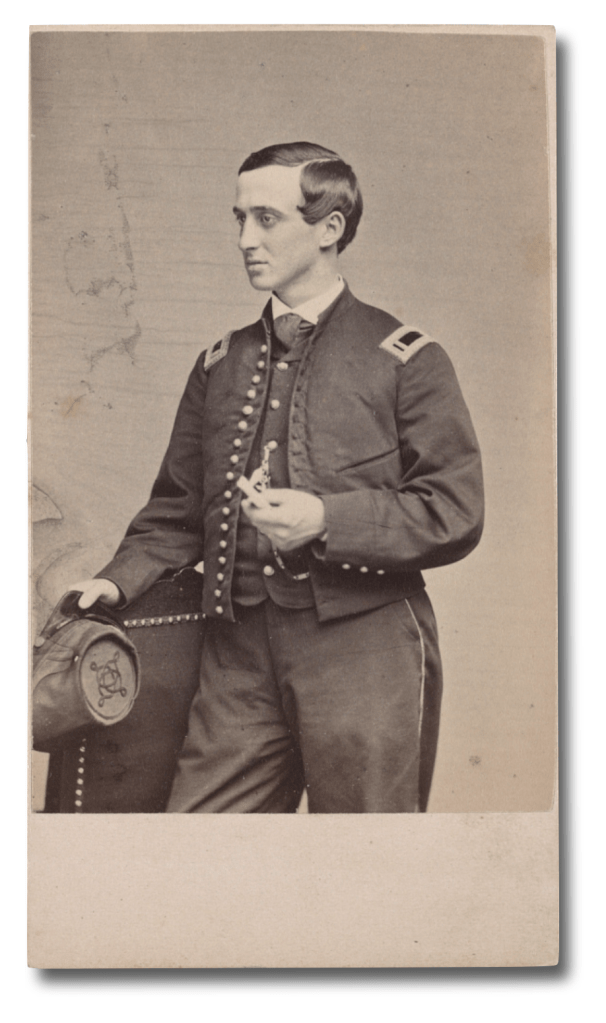


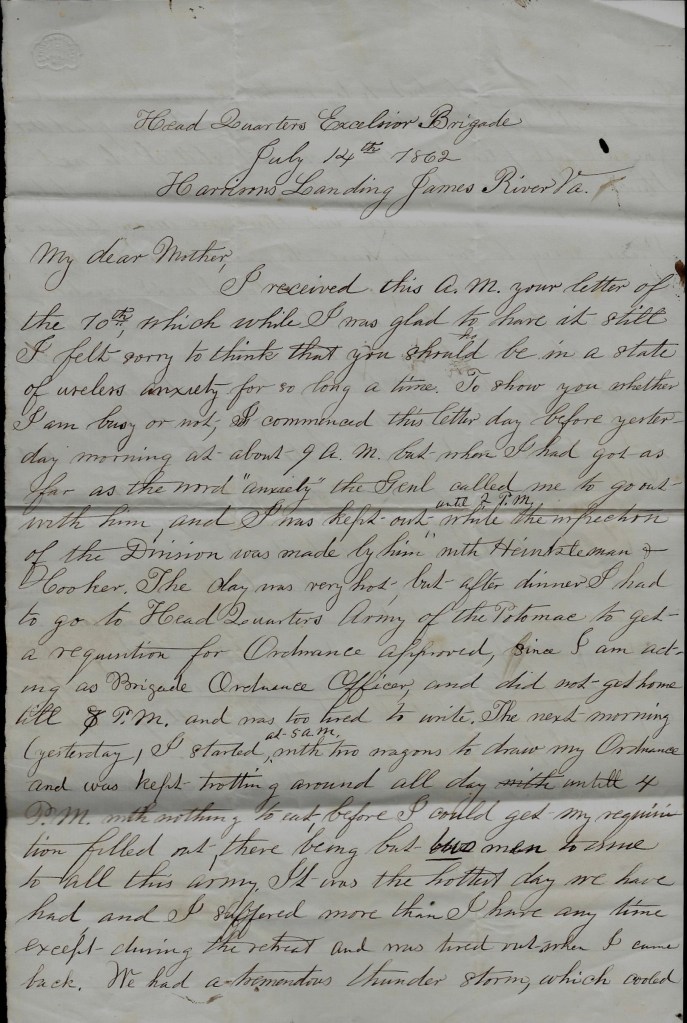
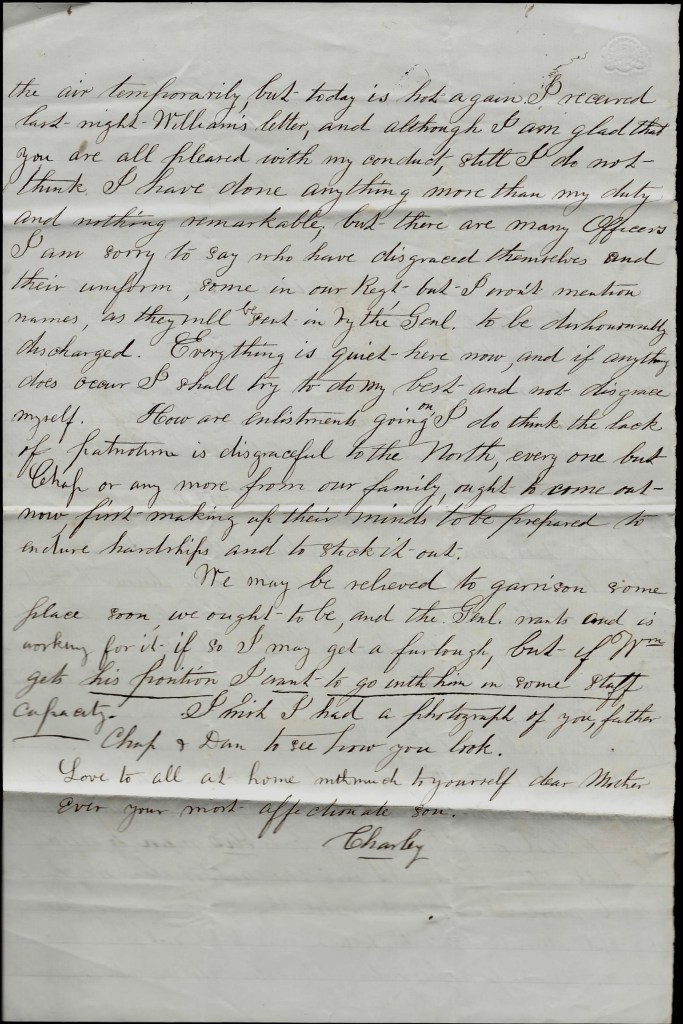
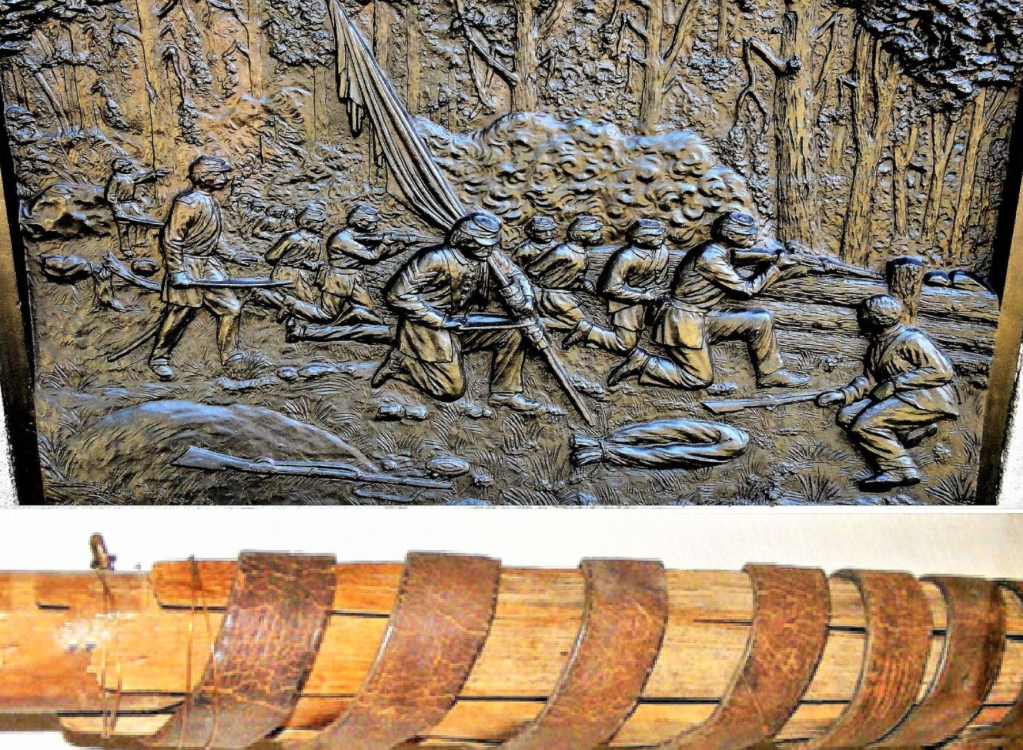
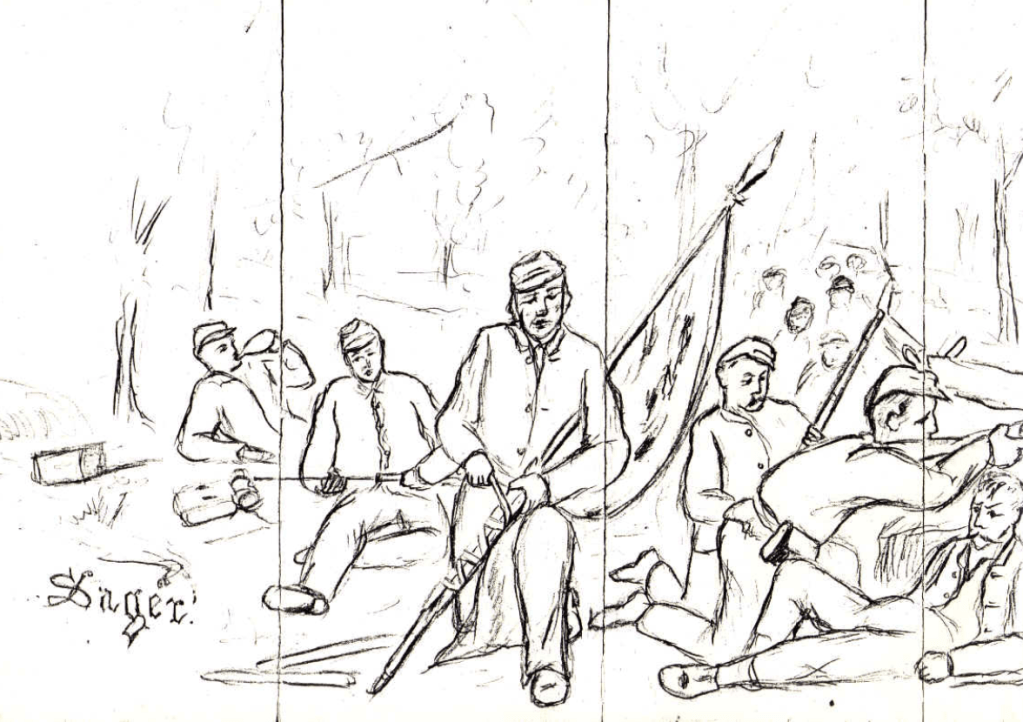

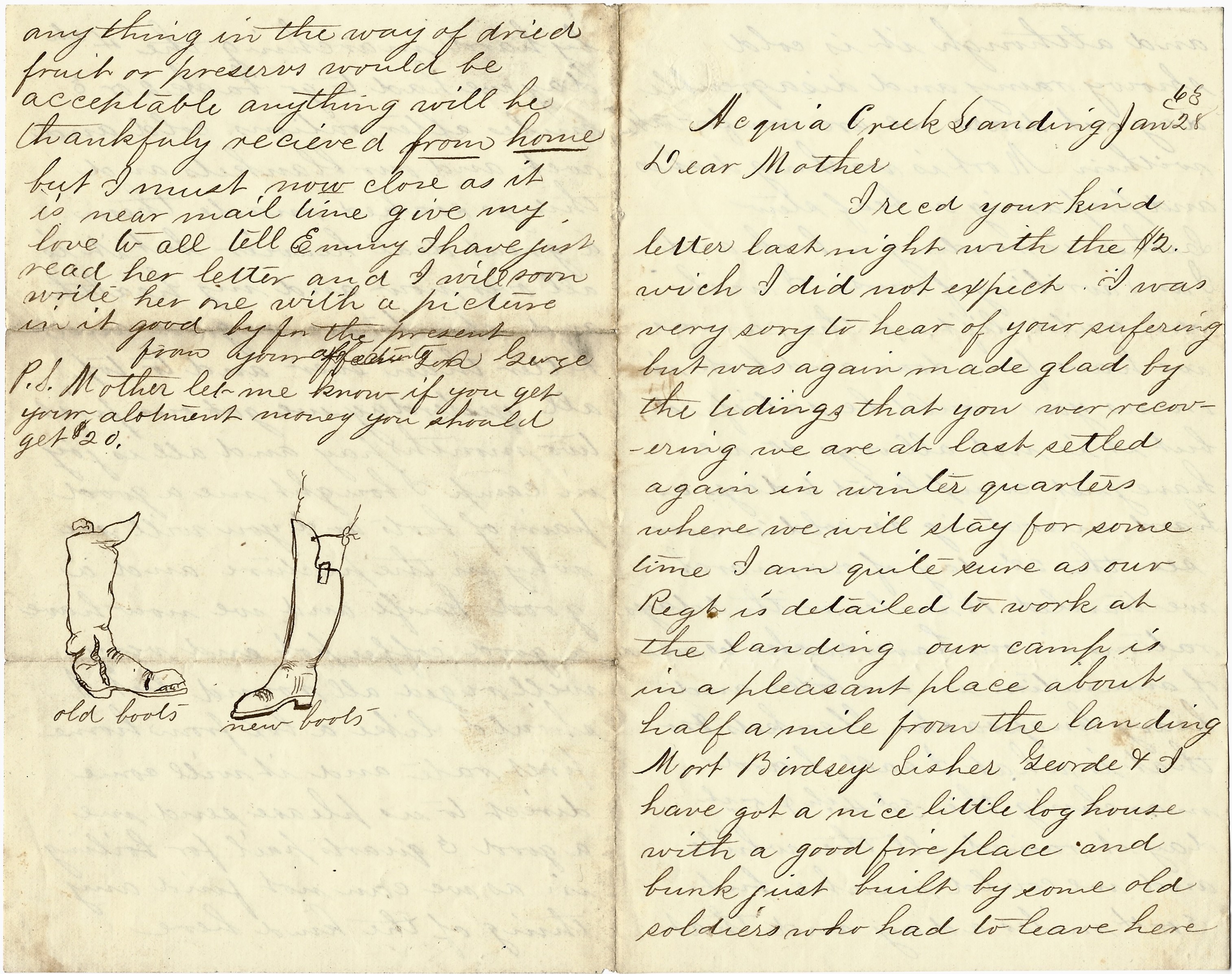

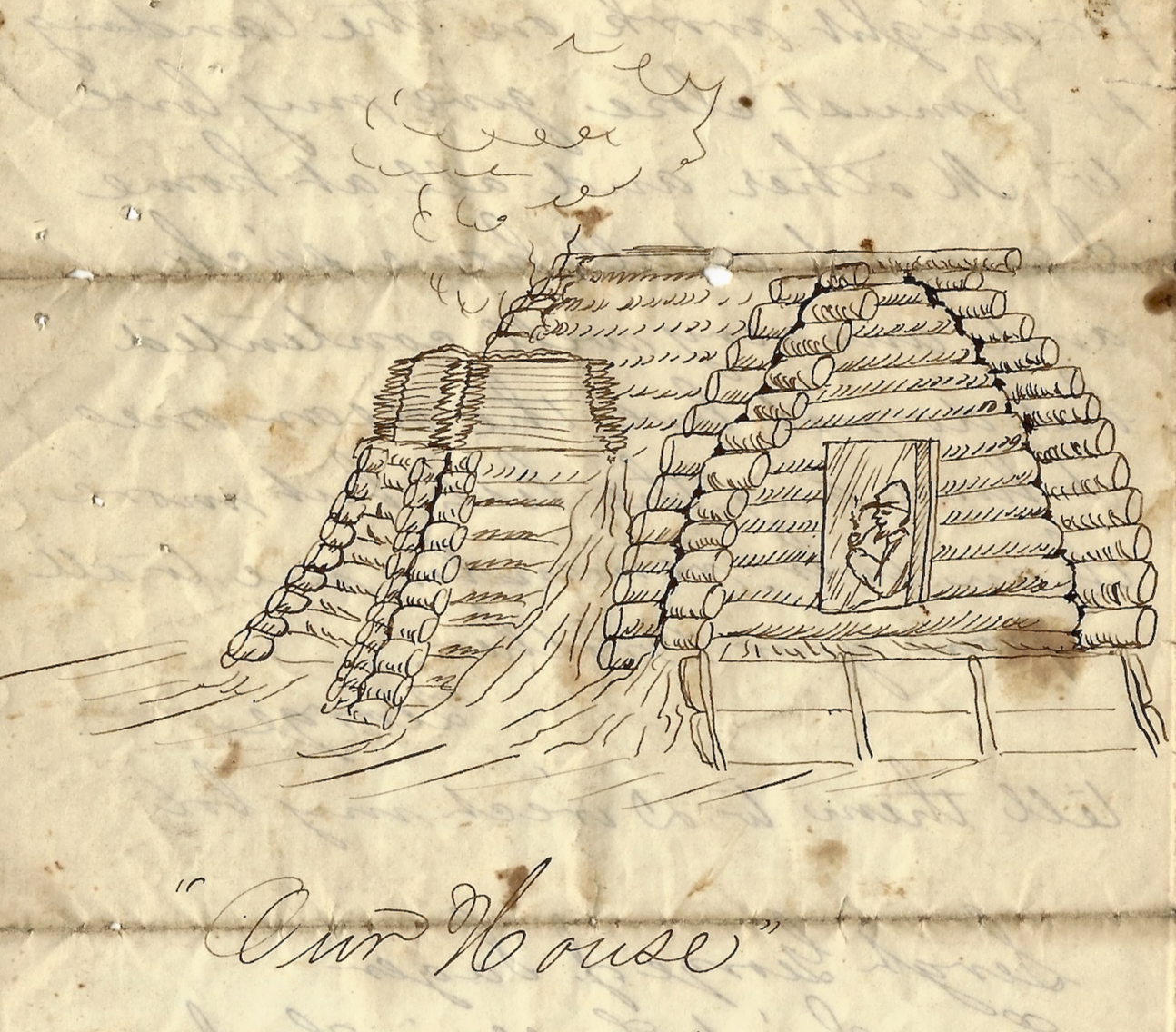

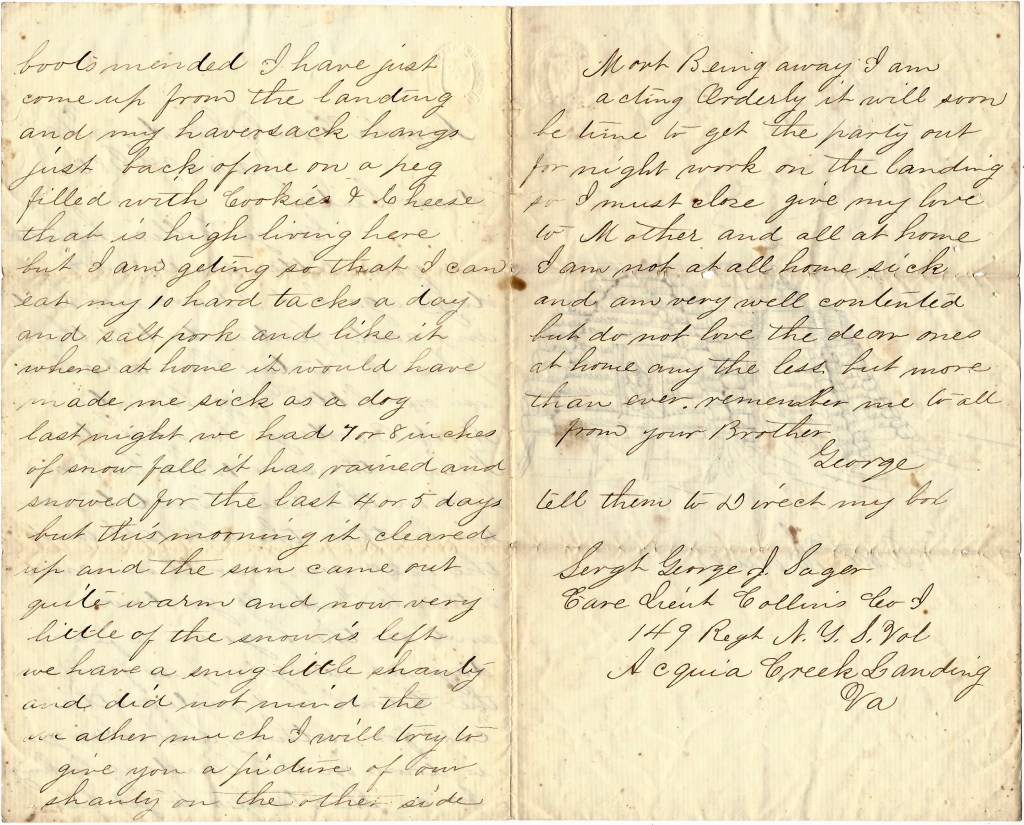
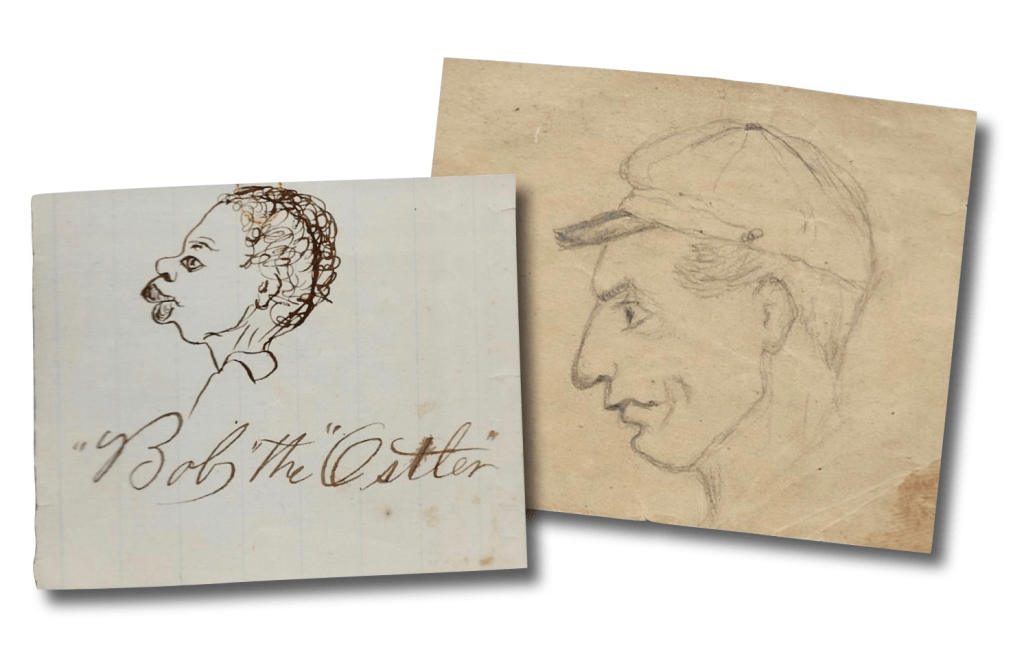


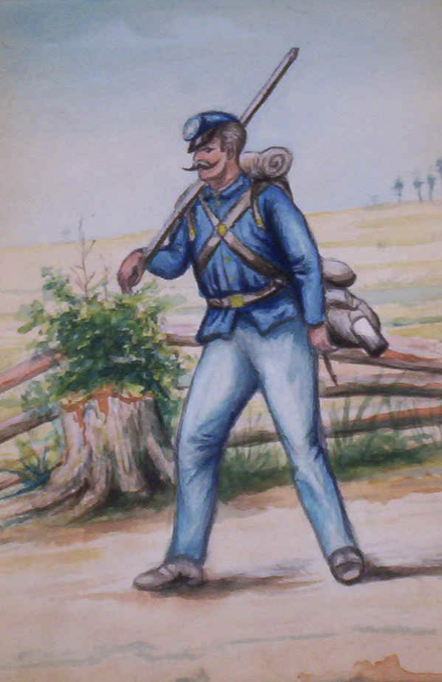


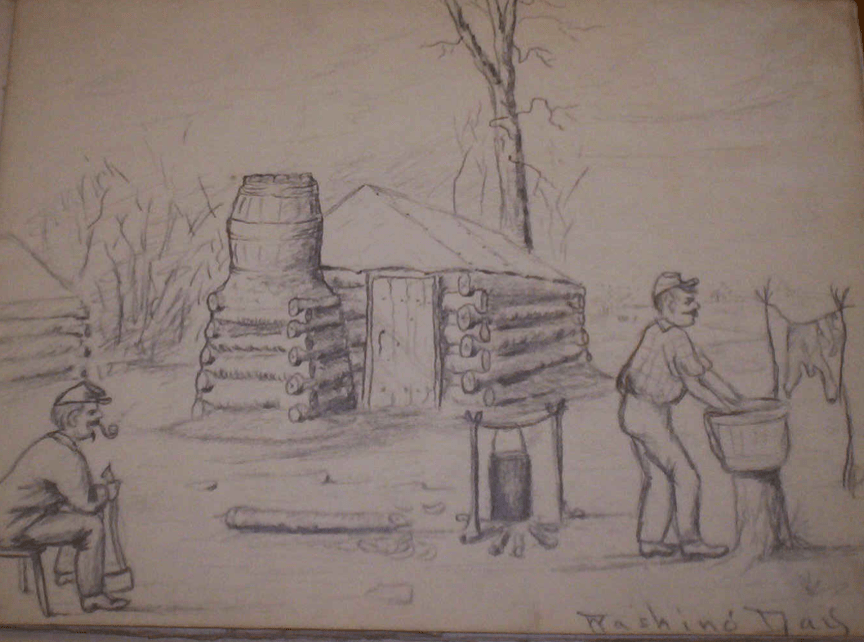
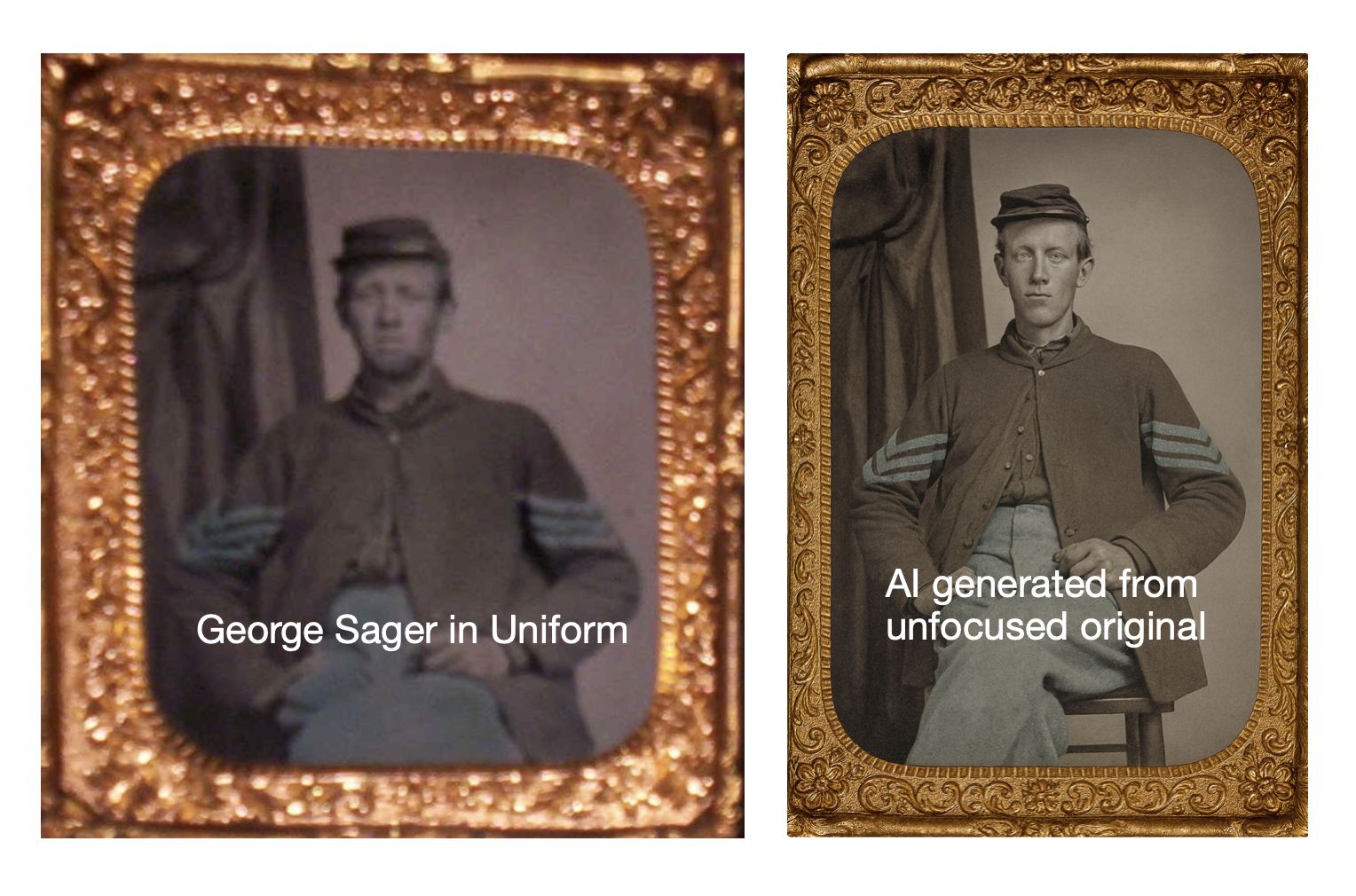
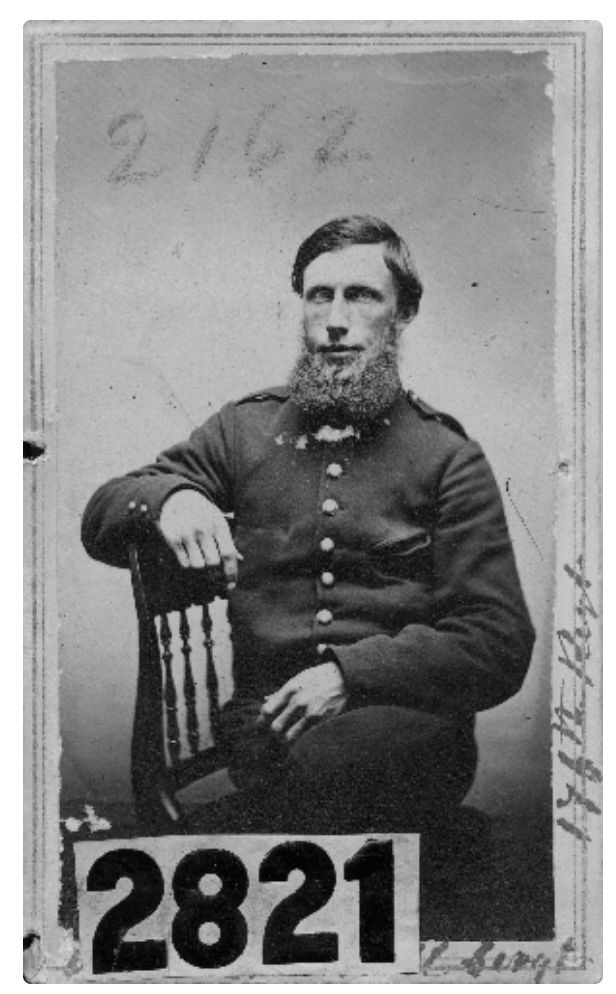


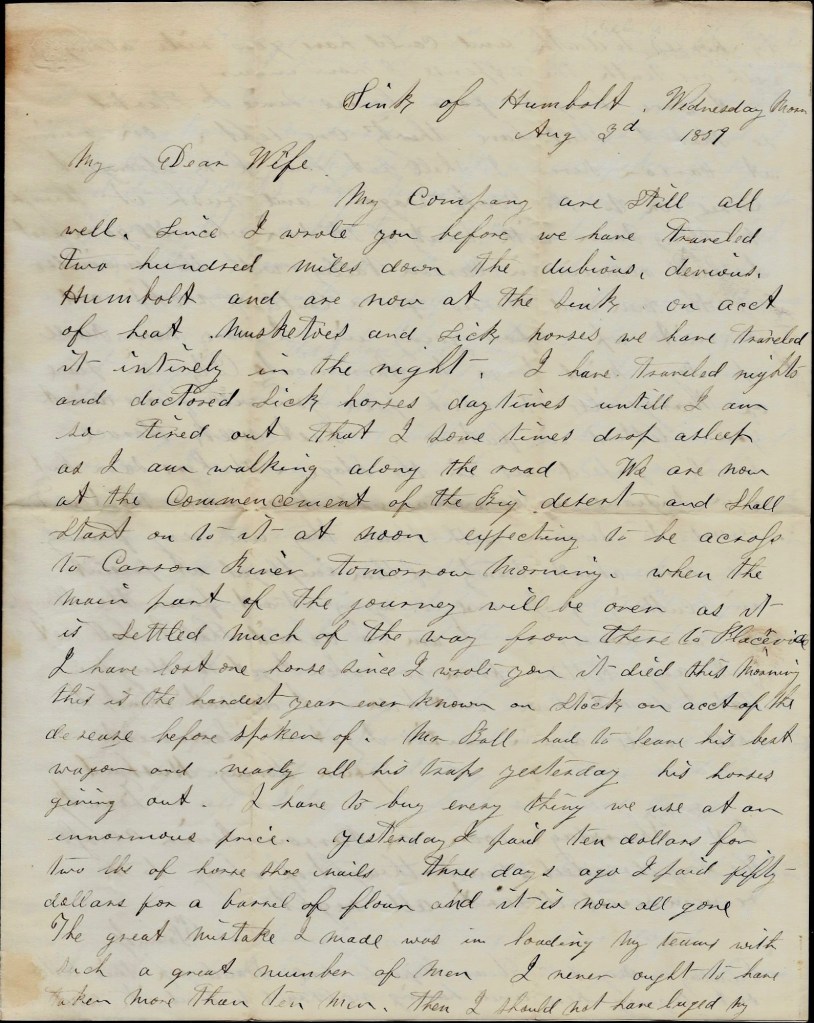


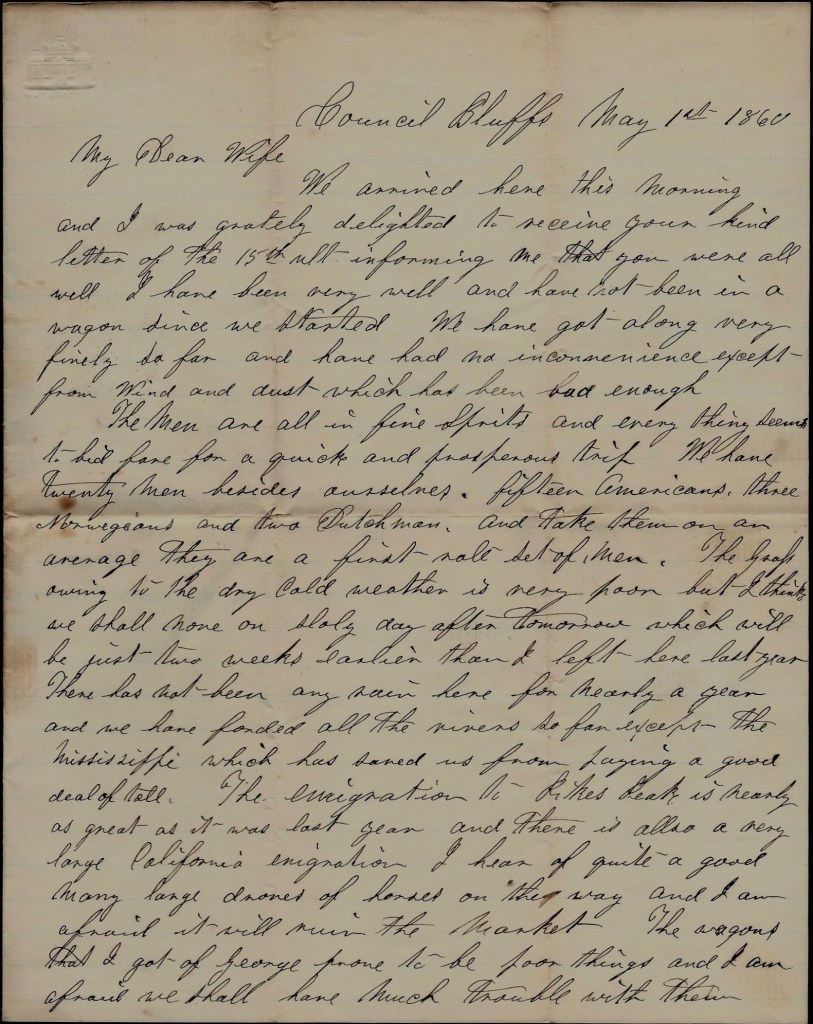

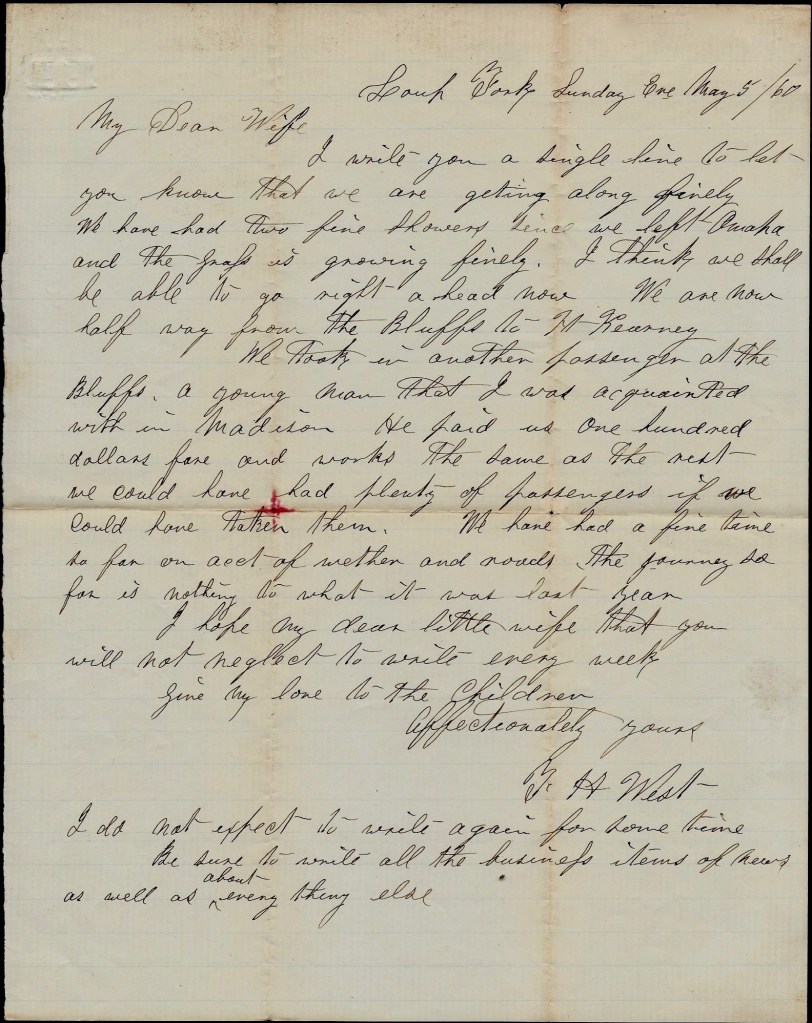


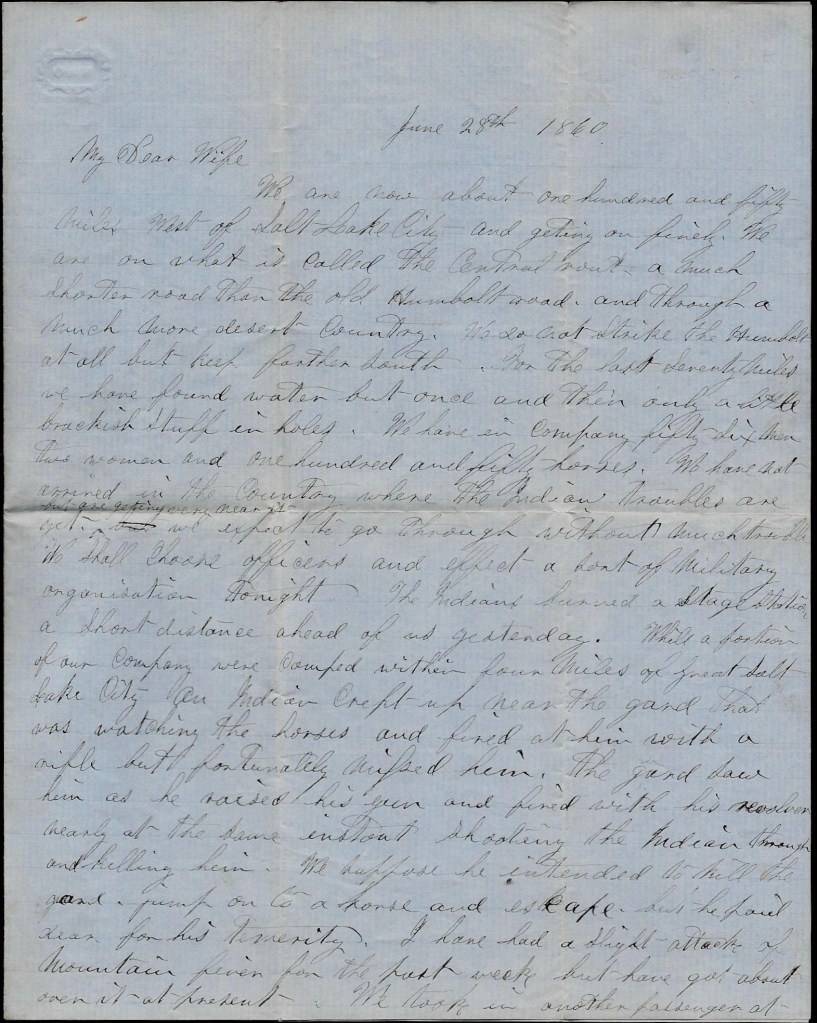
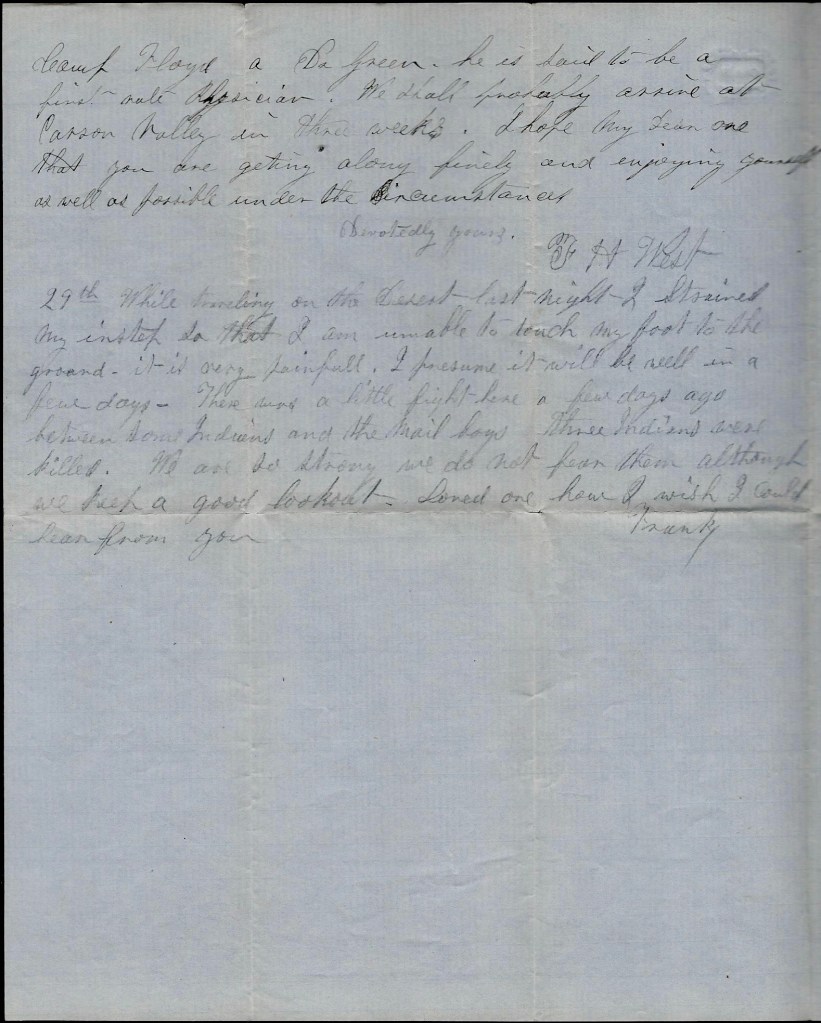
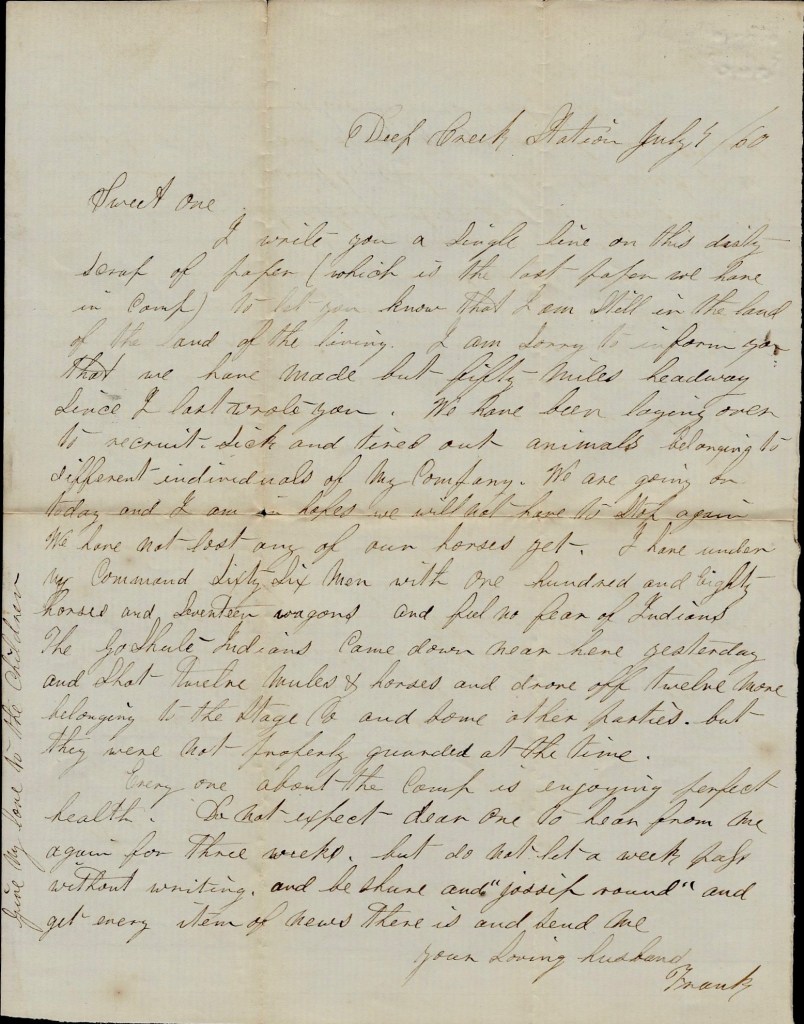
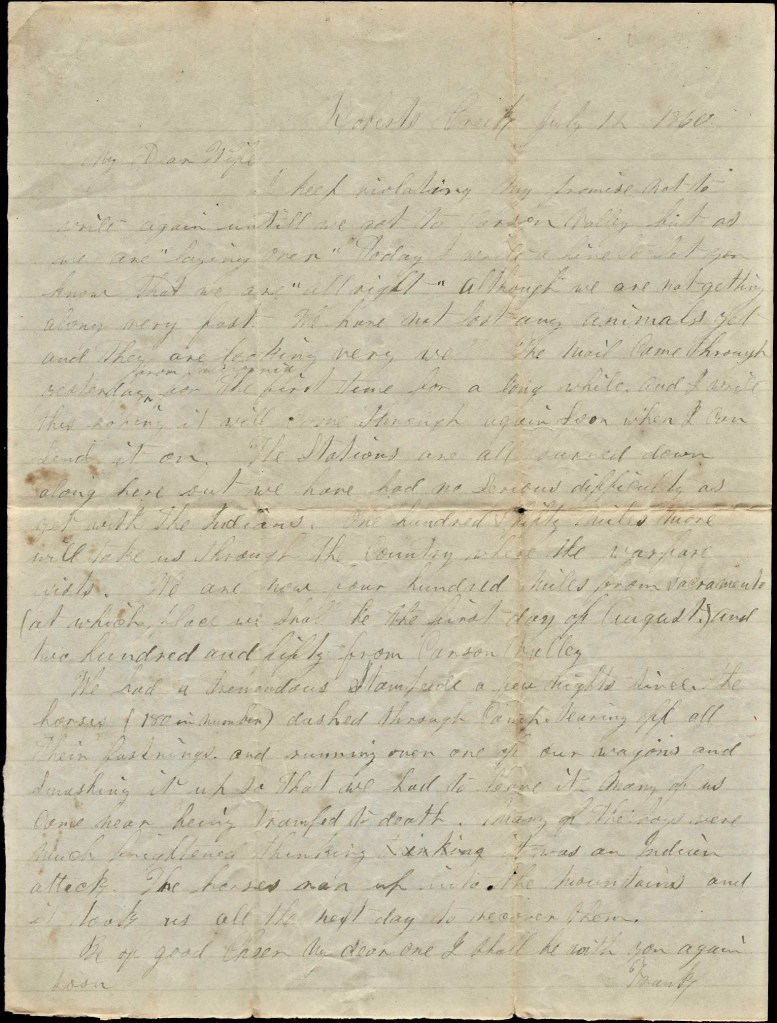
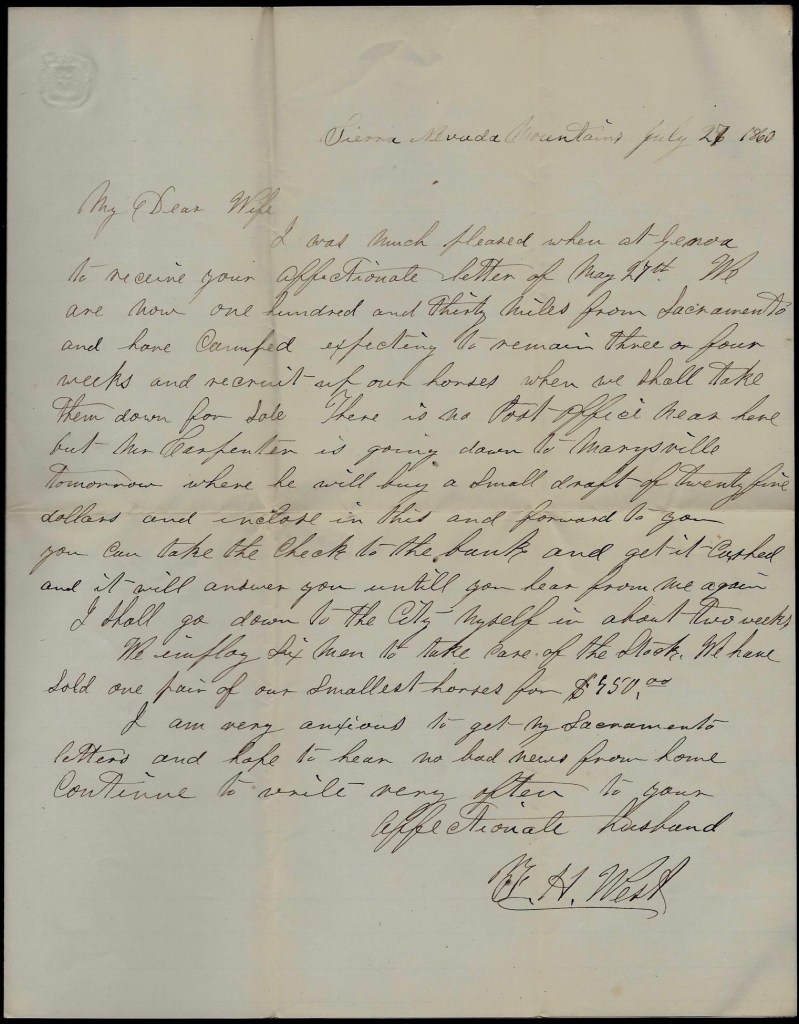
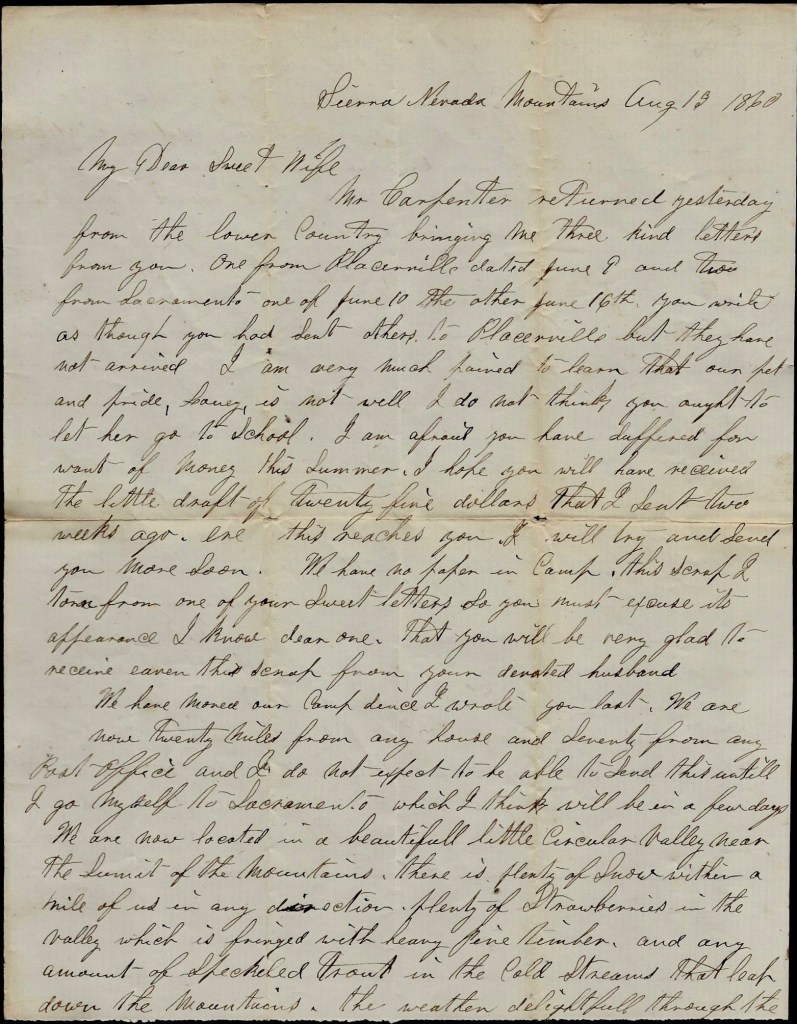
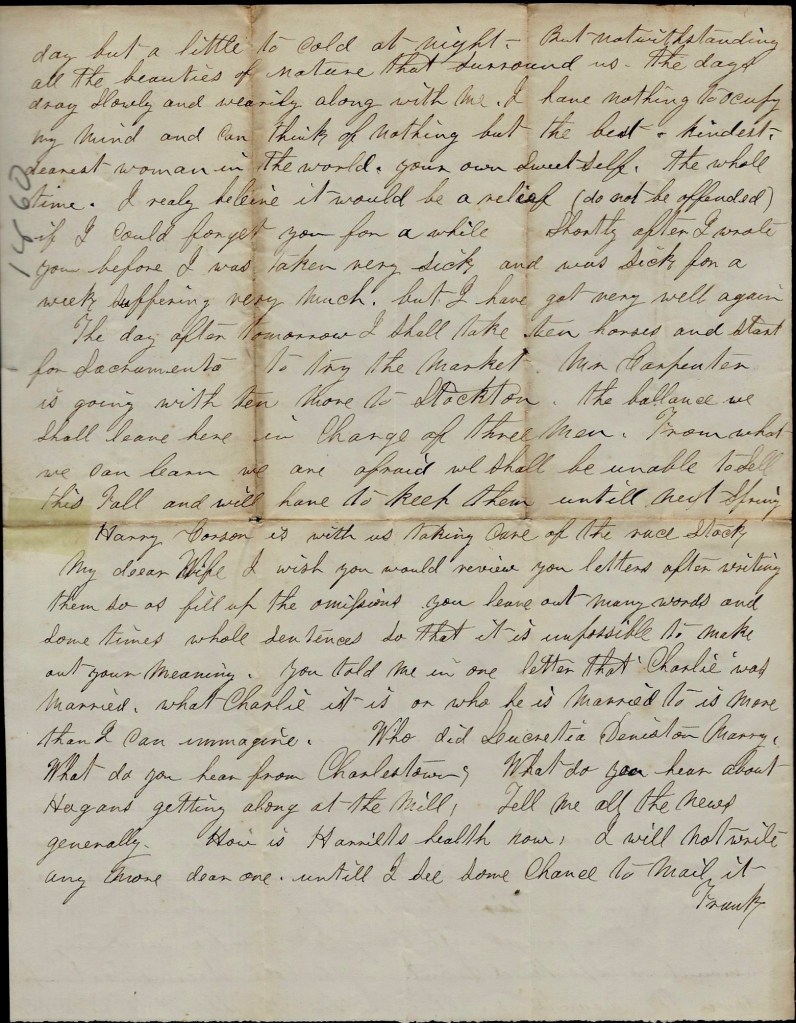


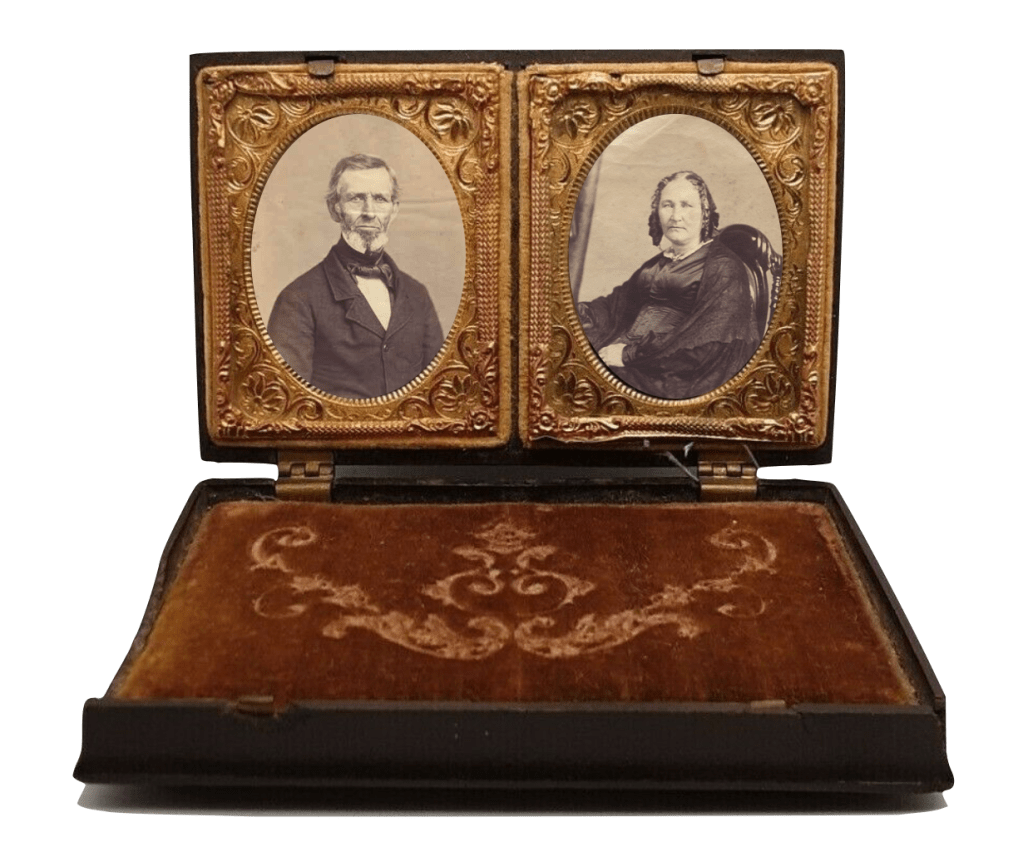
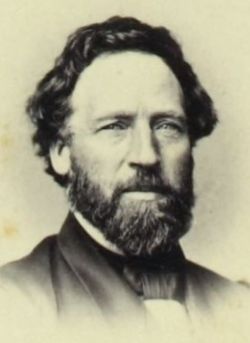

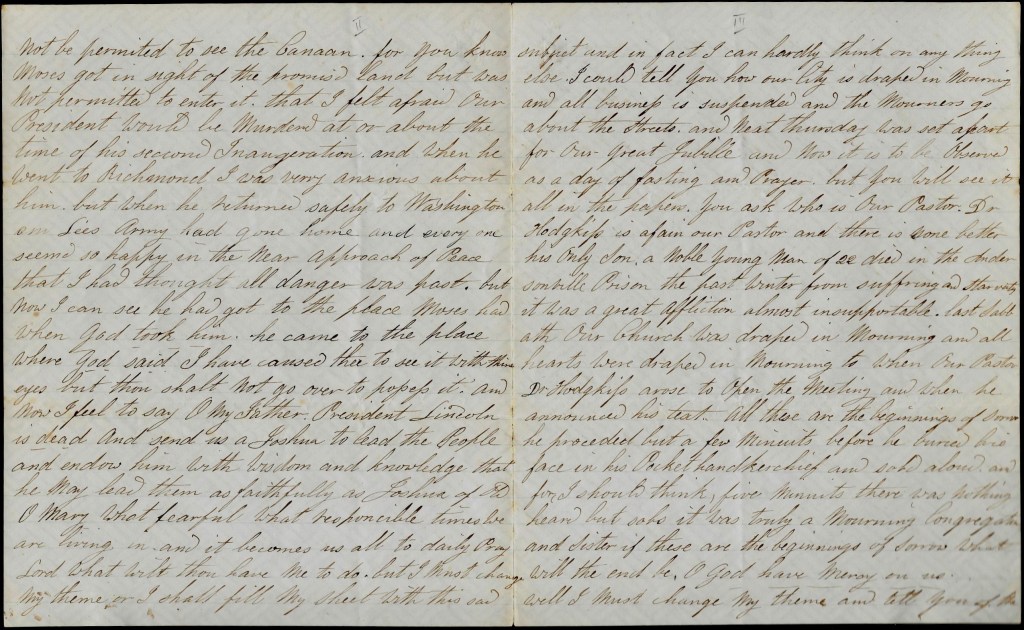


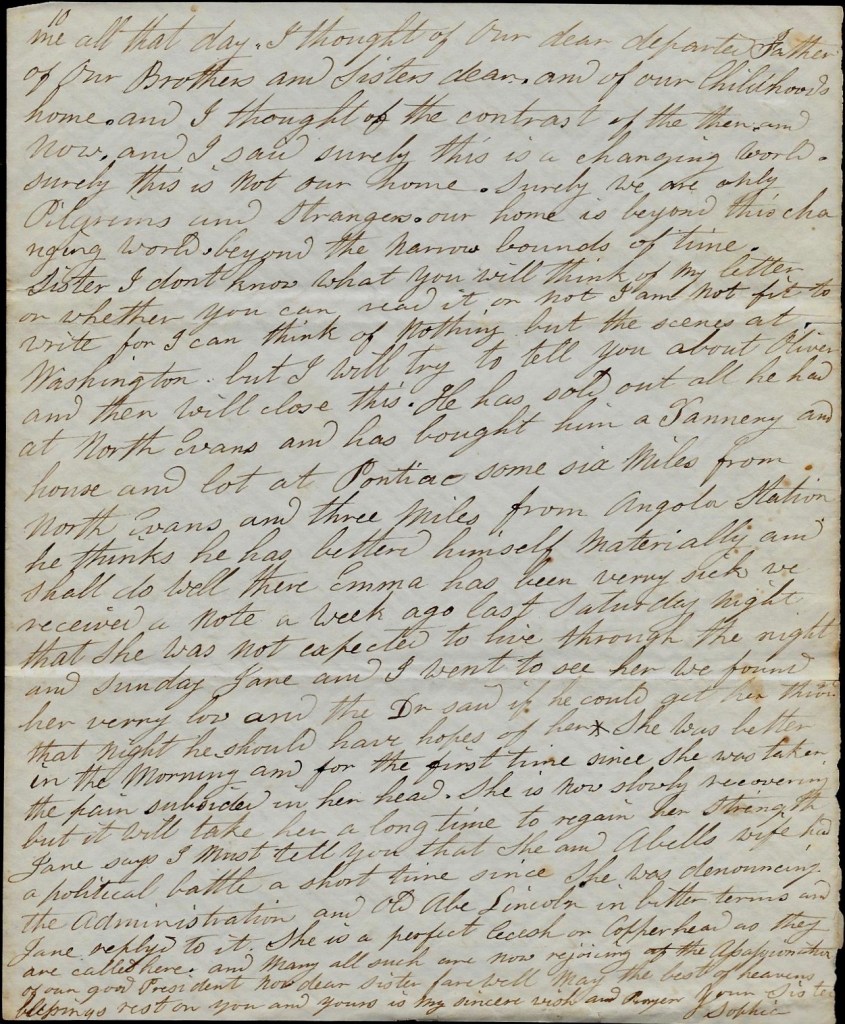


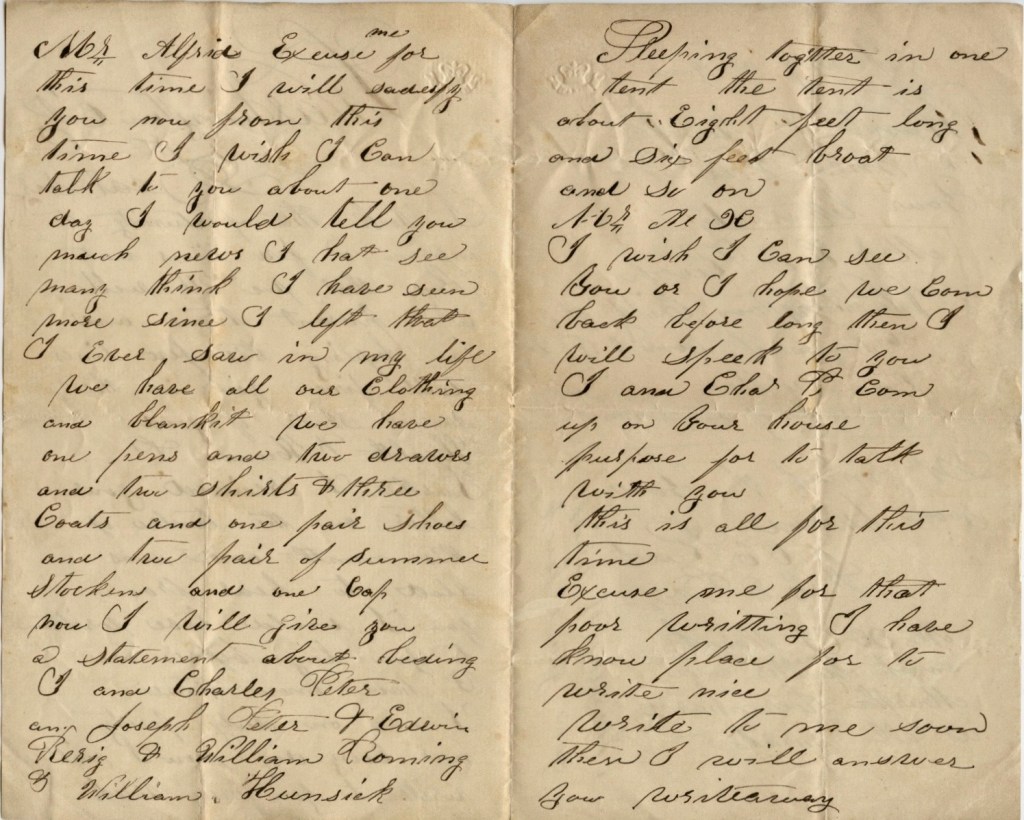

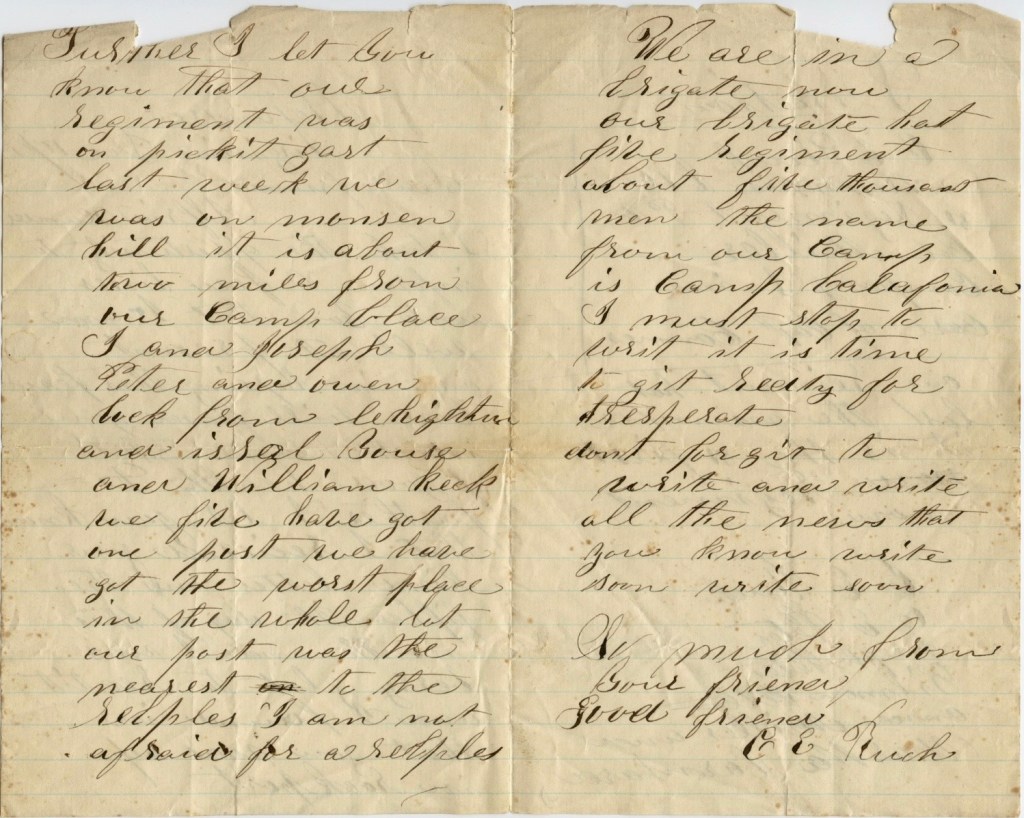
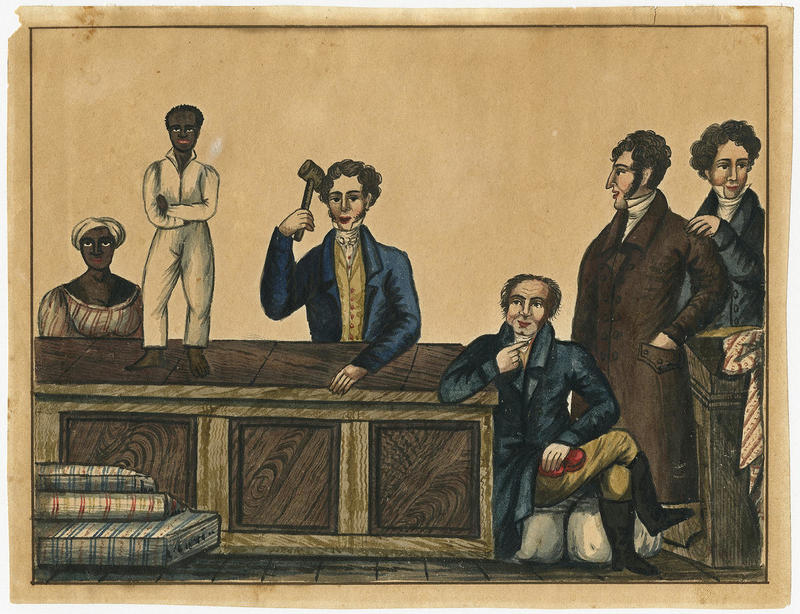

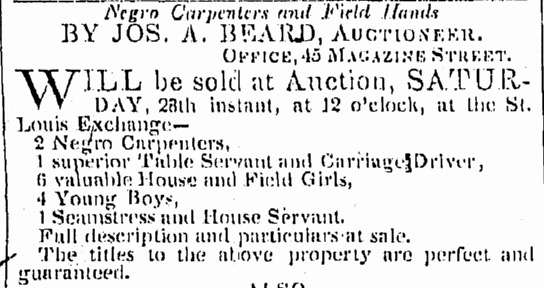

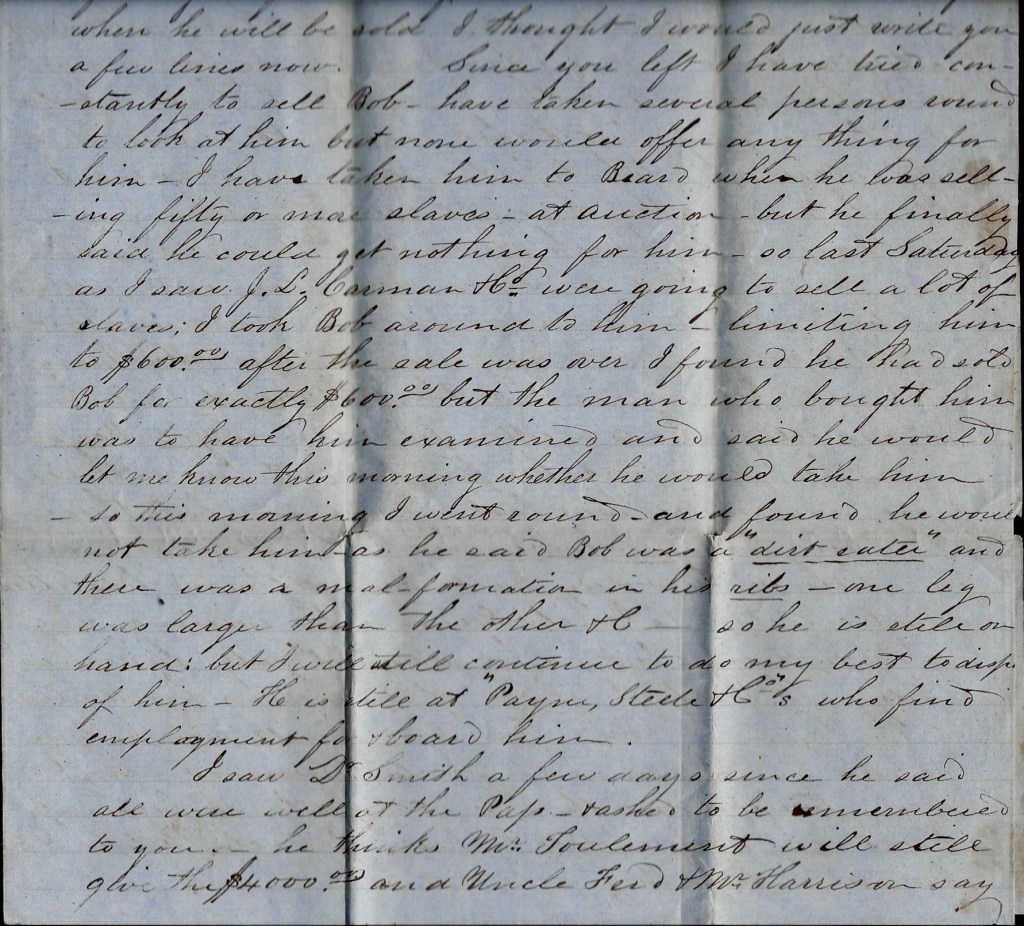
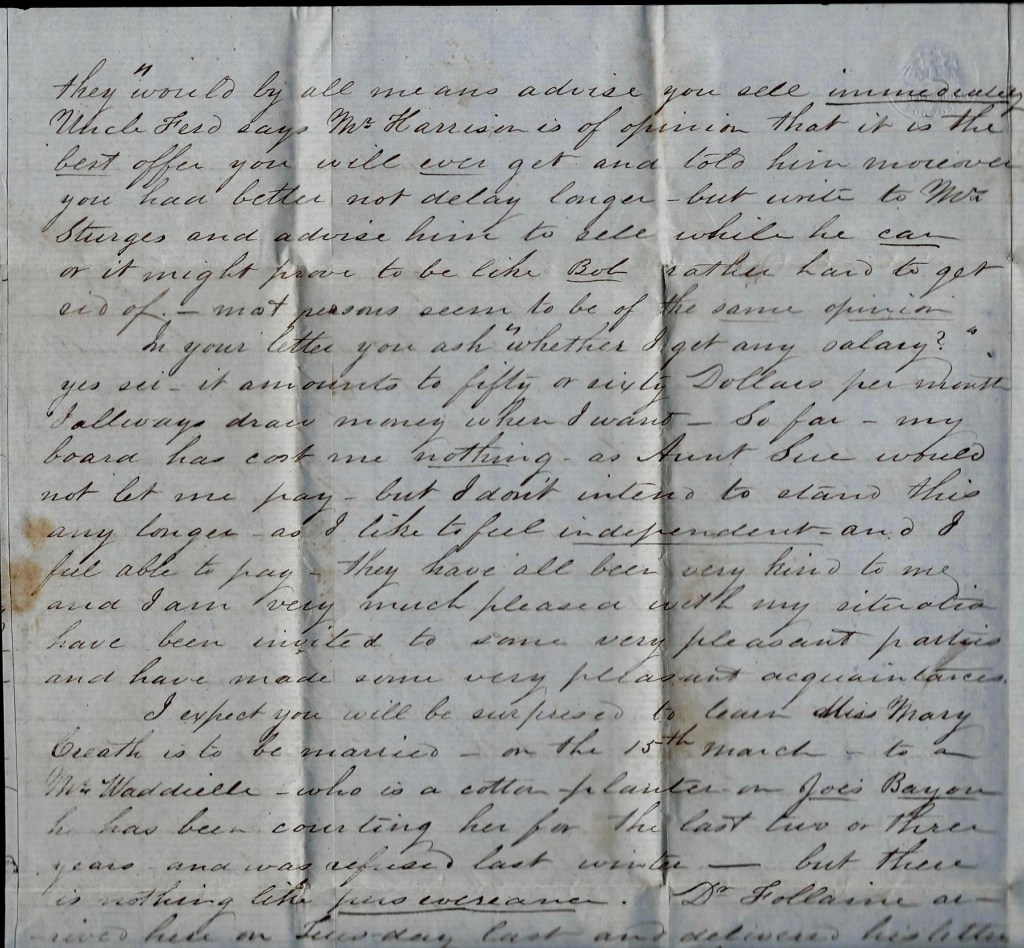

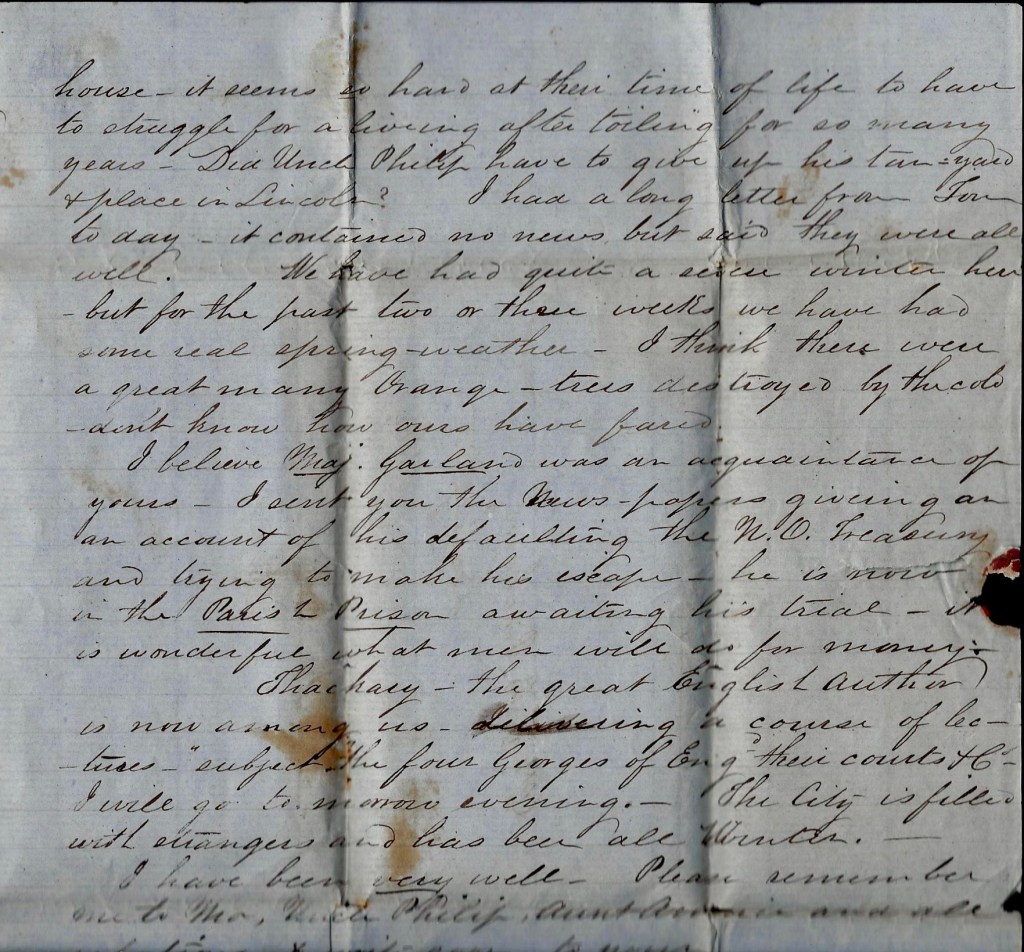
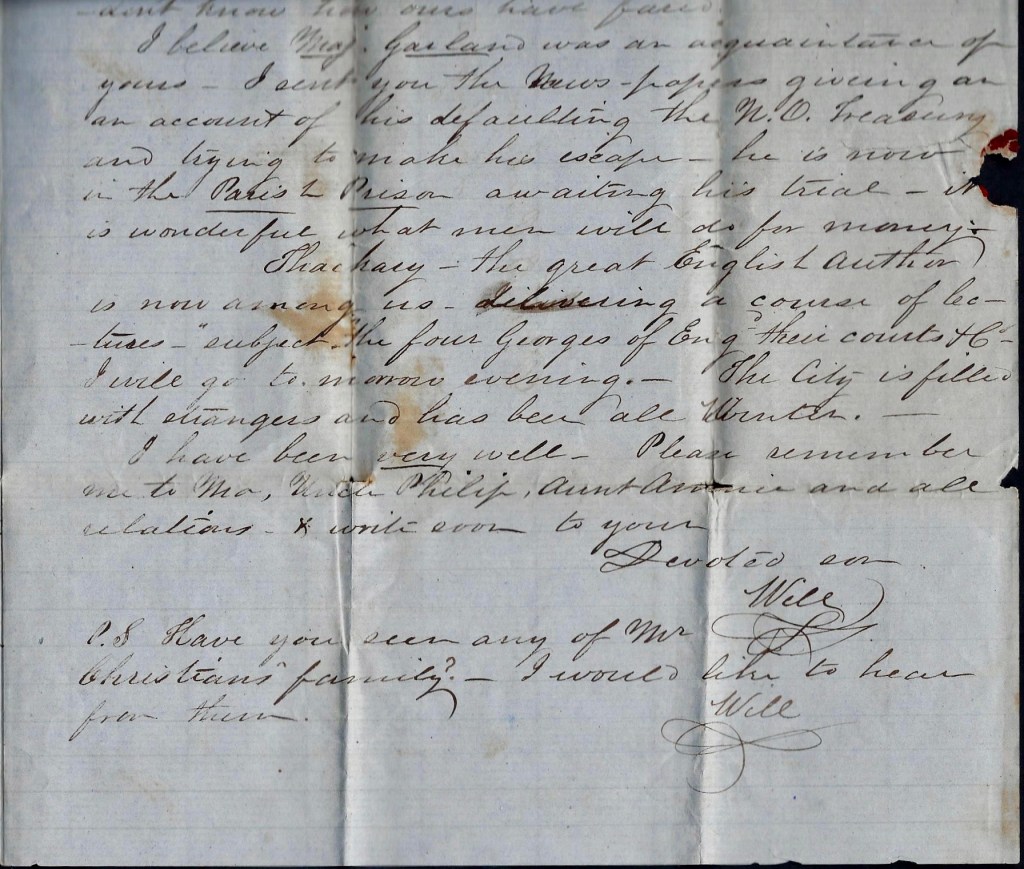
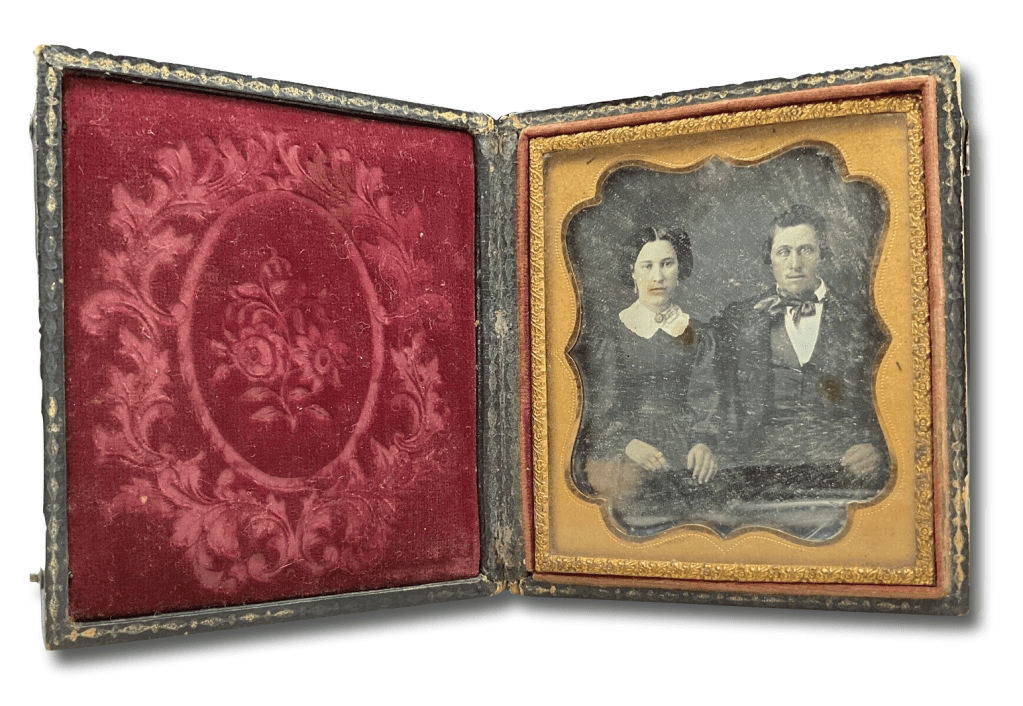


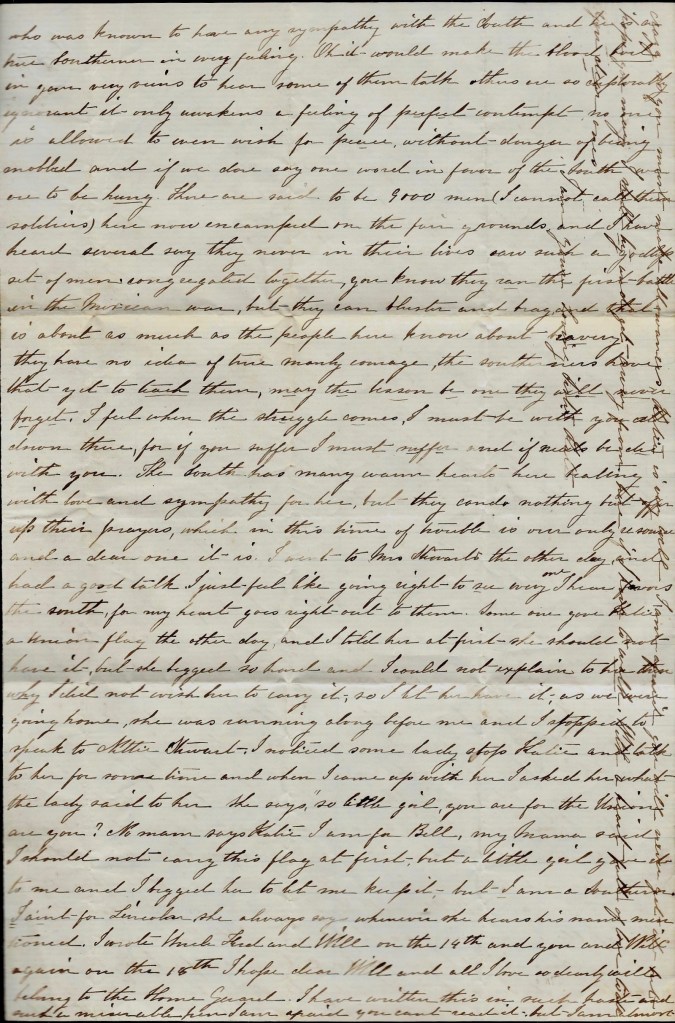
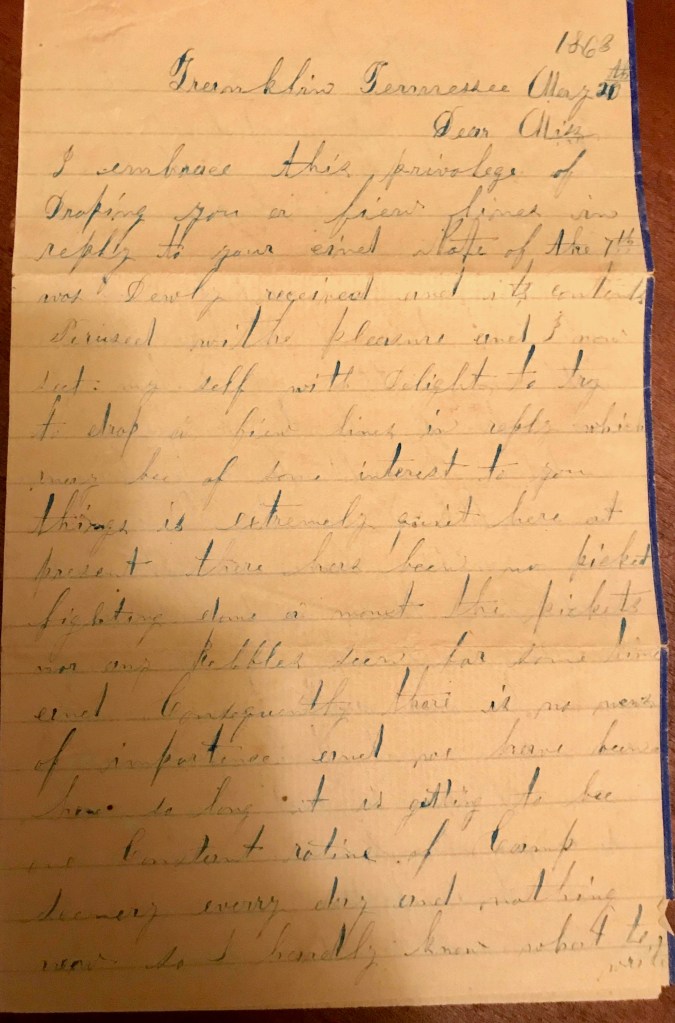
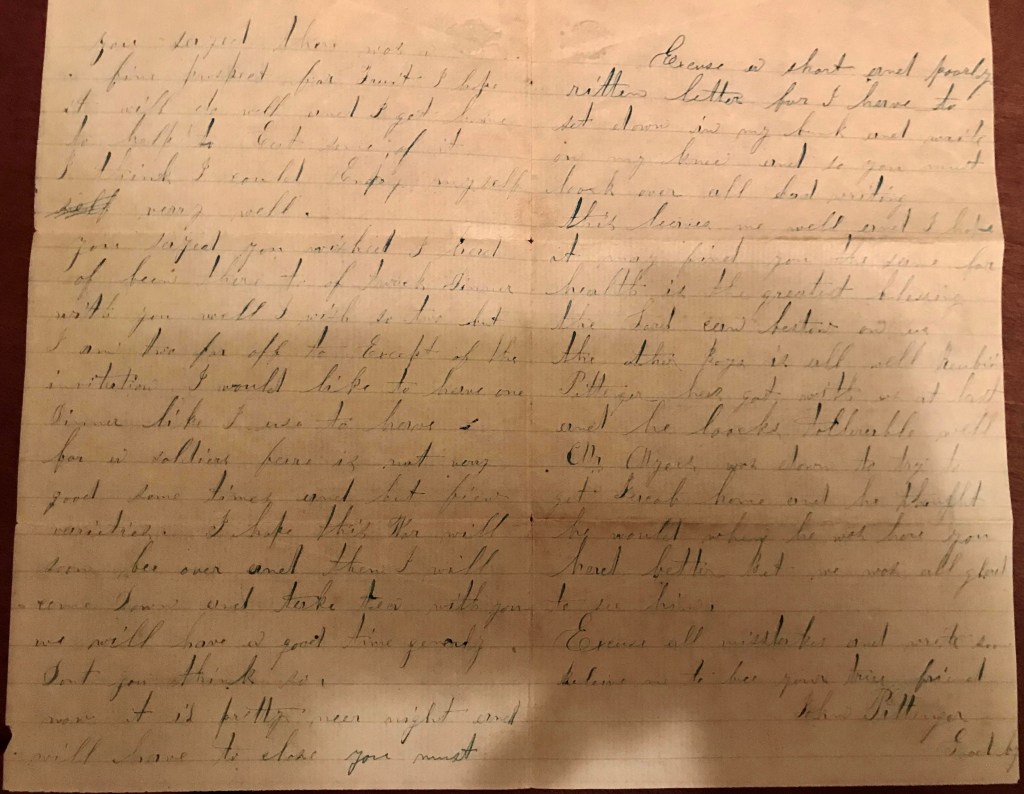
 Spared & Shared 23