This incredible letter was written by Lyman Redfield (1821-1847), the son of Pardon Stevens Redfield (1779-1856) and Achsah Evans (1787-1862) of Bainbridge, Chenango county, New York. Lyman was a lawyer by profession and was 24 years old in April 1846 when the hostilities broke out on the US border with Mexico in a dispute over disputed territory. Lyman joined Co. H as a private in the 1st Kentucky Cavalry that served as Gen. Wool’s body guard in the war. He died at Metamoras on 16 January 1847, most likely from disease.
“The 1st Kentucky Mounted Volunteers traveled by steamboat from Louisville to Memphis, Tennessee, and then cross-country to San Antonio, Texas. Like many units, the regiment suffered various illnesses on its journey to the seat of war. Although the Kentuckians missed out on many of the early battles, they fought in what was probably the most dramatic battle of the war, Buena Vista.
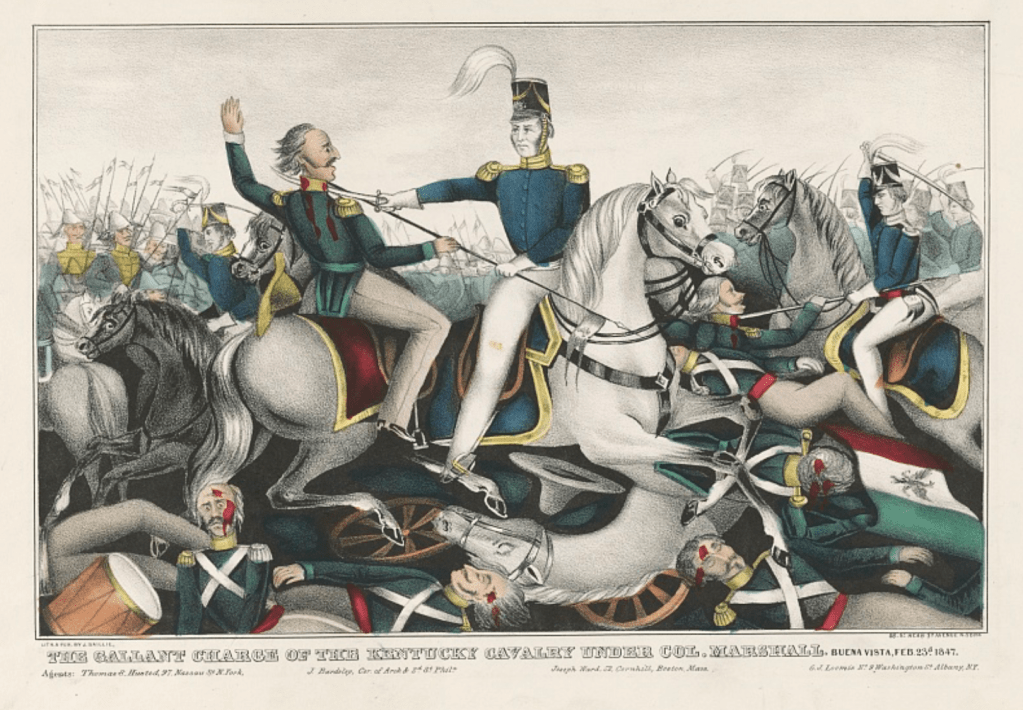
“During the second day of the Battle of Buena Vista, Mexican Gen. Santa Anna attacked, forcing U.S. troops to fall back in disorder. During the Mexican offensive, the 1st Kentucky Mounted Volunteers – fighting on foot – became isolated and was forced to retreat. During the withdrawal, John’s uncle, Alexander Morgan, was killed. The Kentuckians regrouped, mounted their horses, and charged the attacking Mexican force, and, with the support of infantry, drove the enemy back. During the battle the 1st Kentucky Mounted lost 27 dead and 34 wounded. Gen. Zachary Taylor extolled the regiment, noting that “The Kentucky Cavalry, under Colonel Marshall, rendered good service dismounted, acting as light troops on our left, and afterwards, with a portion of the Arkansas Regiment, in meeting and dispersing the column of cavalry at Buena Vista.”
“The 1st Kentucky Mounted Volunteers would not see combat again in the Mexican American War. Their year-long enlistment ended and they were mustered out in New Orleans in June 1847.” [John Hunt Morgan, by Tim Talbott]
In this letter to his older brother Pardon Redfield (b. 1816), a tinner by trade, Lyman shares his impressions of Little Rock, Arkansas, while enroute to San Antonio, Texas. “Horse thieves, robbers, gamblers, and loafers of every description form the majority of the inhabitants,” he believed.
The 1st Kentucky Cavalry in the Battle of Buena Vista, 23 February 1847
Transcription
Little Rock, Pulaski county [Arkansas] July 28, 1846
Dear Brother,
While the sun is shining with a heat which you in New York can scarcely form an idea, I will try to give you a glimpse of myself and things around me. We are now encamped on an eminence back of the town 1 of Little Rock, Capitol of Arkansas, and 150 miles from Memphis where I wrote to you about two weeks ago. Our march from that place to this has been extremely slow. The country intervening is swampy, abounding in bear of the largest size, at least I should think so if their track, which were seen in great numbers on each side of the road, could at all indicate the size of the animal. We saw several hogs that bore evident marks of having narrowly escaped bruins pork barrel and the inhabitants complained that his bearship was making such havoc among their swine as to deprive them of pork.
The rattlesnake, cotton mouth, copperhead, viper, and others—the names of which I cannot remember—infest the country and render high topped boots quite convenient to the pedestrian.
Little Rock is a mean place for the capitol of a state. As I approached the town, I was astonished at the wildness of the country. Indeed, the wild beast howls up to the very steps of the State House. Business, education, and morals are in a low state. The villain holds up his head unabashed and lust and debauchery holds their revels unawed by law or publick opinion. The grog shop with its never failing attendants is found on every corner. Horse thieves, robbers, gamblers, and loafers of every description form the majority of the inhabitants.
“Little Rock is a mean place for the capitol of a state. As I approached the town, I was astonished at the wildness of the country. Indeed, the wild beast howls up to the very steps of the State House.”
—Lyman Redfield, 1st Kentucky Cavalry, 28 July 1846
We are now on the border of a wild country. Our march to San Antonio will occupy I suppose about six weeks. I shall not be able to write you another letter until we reach San Antonio. If you will write to San Antonio, I shall probably receive the letter on my arrival there.
I am in excellent health and my little war steed in good condition for fighting or traveling. Give my respects to all my friends. Tell Father and Mother that I am getting quite fat and rosy cheeked and that when I return next spring to see them, I suppose they will not know me. The southern climate agrees with my constitution.
With fraternal regards, I remain your brother, — L. Redfield
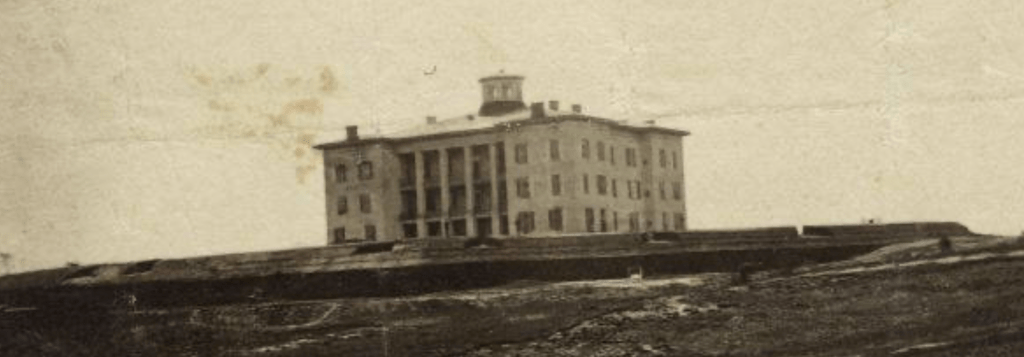
1 Most likely the troops were encamped on the ridge south of Little Rock where the Federal government had recently completed the construction of the Little Rock arsenal.The arsenal was constructed at the request of Governor James S. Conway in response to the perceived dangers of frontier life and fears of the many Native Americans who were passing through the state on their way to the newly established Indian Territory.
This letter was written by John Fulkerson Tyler (1838-1911), the son of Henry C. Tyler (1807-1850) and Jane E. Fulkerson (1813-1850) of Jonesville, Lee county, Virginia. When his parents died in 1850 within days of each other, 12 year-old Tyler went to live with his Uncle Fulkerson in the same county. After graduating from the Virginia Military Institute (VMI) in 1859, Tyler relocated to Lexington, Missouri, where he studied law.
When the Civil War began in 1861, Tyler enlisted as a private in the 14th Missouri Infantry but, due to his prior military training, he was rapidly promoted to Major of his regiment and appointed as the aide-de-camp to Brig. Gen. John McAllister Schofield, a West Pointer who commanded the Missouri State Militia and was state adjutant general. When he was only twenty-five years old, Missouri Governor Hamilton R. Gamble selected Tyler to be Lieutenant-Colonel of the First Regiment Infantry, Missouri State Militia, with date of rank in mid-June 1862.
“For most of the next year, Tyler was on detached service away from the regiment. One assignment in August 1862 was to take command of the gunboat John Warner on the Missouri River. His orders were to ‘seize or destroy all ferry boats, skiffs, rafts or other means of crossing the river, which are in position to be used by the rebels.’ In October he was assigned as commanding officer of the post at Pilot Knob on the Southwest Branch, Pacific Railroad, in charge of about 85 officers and fifteen hundred men, and he had other assignments. On 18 March 1863, he was promoted to colonel of his regiment, replacing Col. John B. Gray.” [VMI Alumni Review]
From the time of his promotion to Colonel until the end of the war, however, things did not go well for Tyler. He was plagued with criticisms of his performance and threatened with a court martial which was finally ordered in January 1865. He did not return to Lexington, Missouri, after the war but settled in St. Joseph instead where he practiced law and traded in real estate.
Tyler wrote the letter to his cousin Samuel Vance Fulkerson (1822-1862). According to the book, History of Southwest Virginia 1746-1786 and Washington County 1777-1870 by Lewis Preston Summers, Samuel was born on his father’s farm in the southern part of Washington County, Virginia, but he was principally raised in Grainger county, Tennessee. He enlisted as a private in Colonel McClelland’s regiment during the Mexican war, and served throughout the war. He studied law and began a law practice in Estillville, in 1846. He was elected to the Constitutional Convention of 1850, and then elected judge in 1856. He served as judge until the spring of 1861, when he was elected and commissioned colonel of the 37th Virginia Regiment of Infantry, and commanded that regiment until June 27, 1862, when he was mortally wounded while leading the 3rd Brigade in a charge against a strong Northern position on the Chickahominy. He died the following day, and was interred in the Sinking Spring Cemetery, Abingdon, Virginia. Of his death, Stonewall Jackson wrote, “Col. S. V. Fulkerson was an officer of distinguished worth. I deeply felt his death. He rendered valuable service to his country, and had he lived, would probably have been recommended by me before this time for a brigadier generalcy. So far as my knowledge extends, he enjoyed the confidence of his regiment and all who knew him. I am, Sir, your obdt. servt, T. J. Jackson”
The letter is particularly interesting because the third paragraph refers to what has come to be called, “The Morgan Walker Raid.” It was this raid that took place on 10 December 1860 that marked the turning point in William Clarke Quantrill’s life when he chose to side with the pro-slavery forces in Missouri rather than remain with his anti-slavery friends in Kansas Territory. The following article by Ted W. Stillwell summarizes the incident:
“William Quantrill, being from Kansas, was an abolitionist prior to becoming the leader of “The Bushwhackers” of Jackson County, Missouri. December 10,1860 was the turning point in his politics. On this date he joined five young Quaker abolitionists from Lawrence on a slave-stealing raid into Jackson County, Missouri, where they planned to “steal” the slaves of Morgan Walker, who lived near Blue Springs. The 1900 acre Walker farm was located where Pink Hill Park is today just west of Highway 7. It was daylight when they arrived in the neighborhood. Quantrill left his boys hidden in the bush while he rode on into the Walker farm to survey the situation. At this point he became a turncoat and sold out his “friends.” He informed Morgan Walker’s son, young Andrew, what was about to take place, and that they should be prepared. Quantrill returned to his troop to await nightfall to begin the raid. The Walkers rounded up a few neighbors to assist them and setup an ambush as the abolitionists came riding in that evening. One Quaker was killed on the spot, two were wounded and ran for cover and two more escaped back to Lawrence, Quantrill hung back out of harms way during the ambush. The neighbors tracked down the two wounded men and shot them on the spot.“
A sketch depicting Antislavery guerrillas or “Jawhawkers” attacking civilians in Missouri (LOC)
[This letter is from the personal collection of my friend Rob Morgan and has been published on Spared & Shared by express consent.]
Transcription
Napoleon City [Missouri] December 23rd 1860
Dear Cousin,
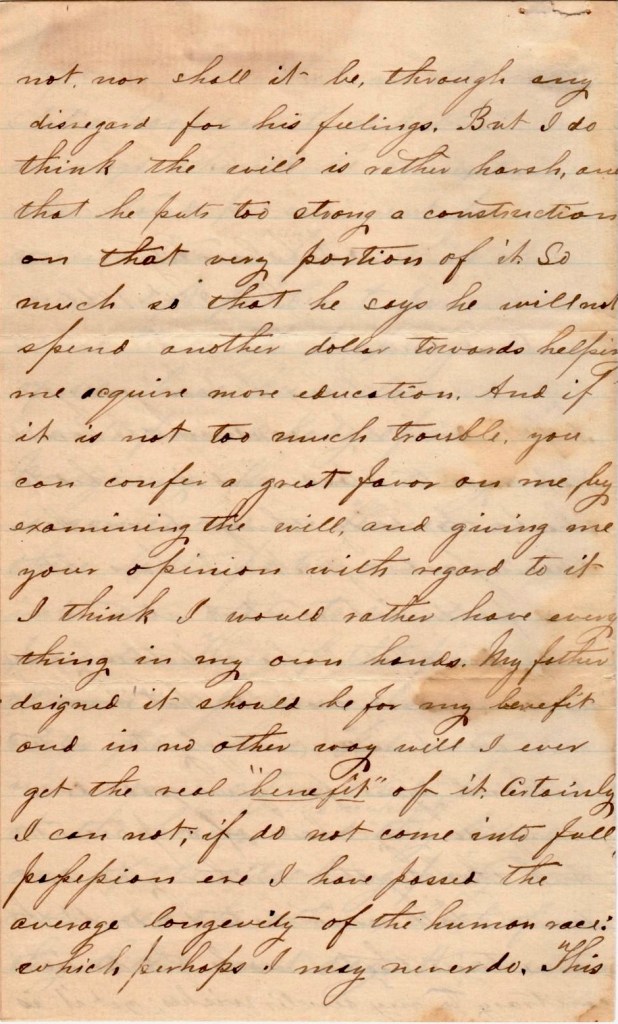
When I was younger I felt like the sands in the hour glass ran too slow, and I wished to shake the tardy thing to make them faster go. Now I have let this feeble but constant stream run on, and I have listlessly gazed until I am warned that I must act ere it everlastingly too late. I thank you for your good advice as regards my choice of a pursuit. And this together with my own desire shall cause me to decide. At the same time that I make this decision contrary to my Uncle’s wishes; yet it is not, nor shall it be, through any disregard for his feelings. But I do think the will is rather harsh, and that he puts too strong a construction on that very portion of it—so much so that he says he will not spend another dollar towards helping me acquire more education. And if it is not too much trouble, you can confer a great favor on me by examining the will and giving me your opinion with regard to it. I think I would rather have everything in my own hands. My father designed it should be for my benefit and in no other way will I ever get the real “benefit” of it. Certainly I can not; if do not come into full possession ere I have passed the average longevity of the human race, which perhaps I may never do. This is the only restriction in the will from which I at present wish to be relieved, and by this being removed whatever beside I wish removed is immediately done also.
What are you going to do in Virginia when South Carolina shall have seceded? Will Old Virginia go too? God grant that she may not. May she, as she has ever done, in times of trouble furnish from her own prolific womb, some compromising genius who may induce even the Palmetto State to retrace her steps and take more solemnly her vow in the sight of heaven and at the alter of our country to support the Constitution and the Union, thus making us more truly one people engaged in the grand work of disseminating the great principles of freedom among the human family.
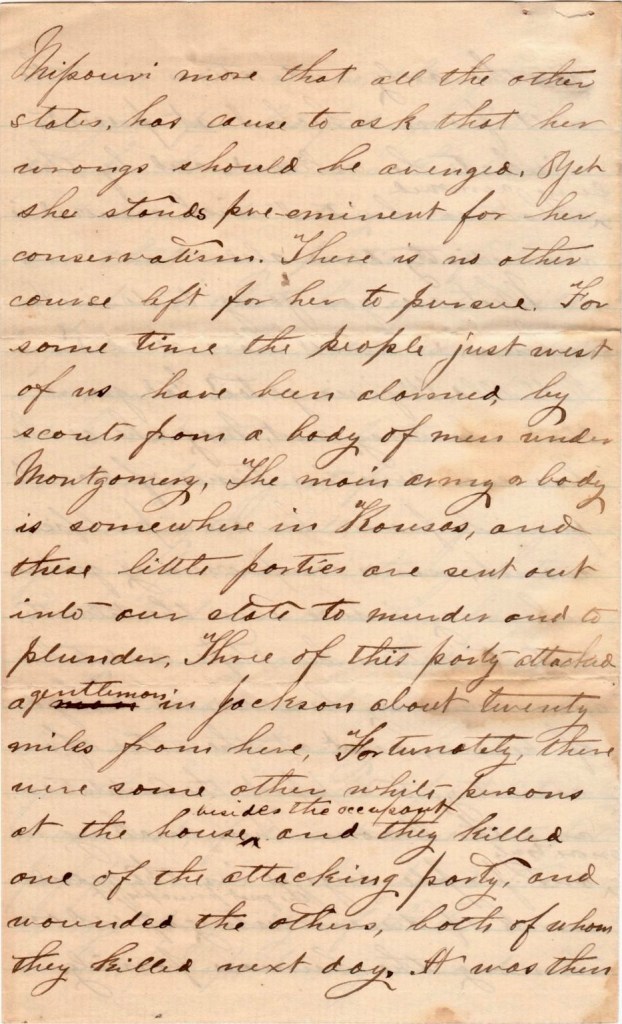
Missouri more than all the other states has cause to ask that her wrongs should be avenged. Yet she stands preeminent for her conservatism. There is no other cause left for her to pursue. For some time, the people just west of us have been alarmed by scouts from a body of men under [James] Montgomery. The main army or body is somewhere in Kansas and these little parties are sent out into our state to murder and to plunder. Three of this party attacked a gentleman in Jackson about twenty miles from here. Fortunately there were some other white persons at the house besides the occupant and they killed one of the attacking party and wounded the others, both of whom they killed next day. It was then rumored that “Mont” had come to this place for vengeance. We immediately made up a company to go and drive him back or take him right there. We went within two or three miles of where the main army was said to be encamped when messengers told us that the report was a mistake. Then of course we could but return in peace.
James Montgomery or “Mont” (1814-1871). Montgomery came to Linn County, Kansas Territory, early in the territorial period after living in Ohio, Kentucky and Missouri. He was active in the free state cause and was involved in most of the conflicts between pro-slavery and free state forces in that area. He raised a militia troop that was active in 1857.[Kansas Memory]
Notwithstanding all this trouble, Missouri is still for the Union. But whenever the constitutional rights of the South are trampled upon by Federal officers or with the sanctions of Federal Authorities, then will her voice be heard for redress. And if civil war should follow her just demands, then will her sons be found flocking to the standard of southern rights under which, if need be, they will,
“Strike for their altars & their fires, For the green graves of their sires, For God & their native land.” 1
If our rights are touched, I know what course you will pursue. I remember well when you told my mother and me farewell, and started by yourself from Jonesville for Mexico. The others mustered around & Old Dr. Stubblefield made speeches considerably for show, [yet] they remained at home and you went to do the work it required. The case is now different. The battle has not begun.
Do Virginians believe a state has the right to secede when she thinks proper? Has the President a right to force a state [back into the Union] when she does secede? And will Virginia uphold Lincoln if he administers the laws with equal justice to all parties?
I went to Lexington [Mo.] a few days ago to see cousin Ellen. She enjoyed her trip very much and speaks very highly of you all of which I was very proud. I had given her a glowing description of you all before and am glad she found you as I had said. I did not have time to hear much from her but am going again soon when I shall endeavor to hear all about her trip. All our relations are well and doing well. Give my love to Aunt & Cousin Kate. Tell cousin Kate I am looking for a letter from her every mail. If I do not get one soon, I will not look any longer.
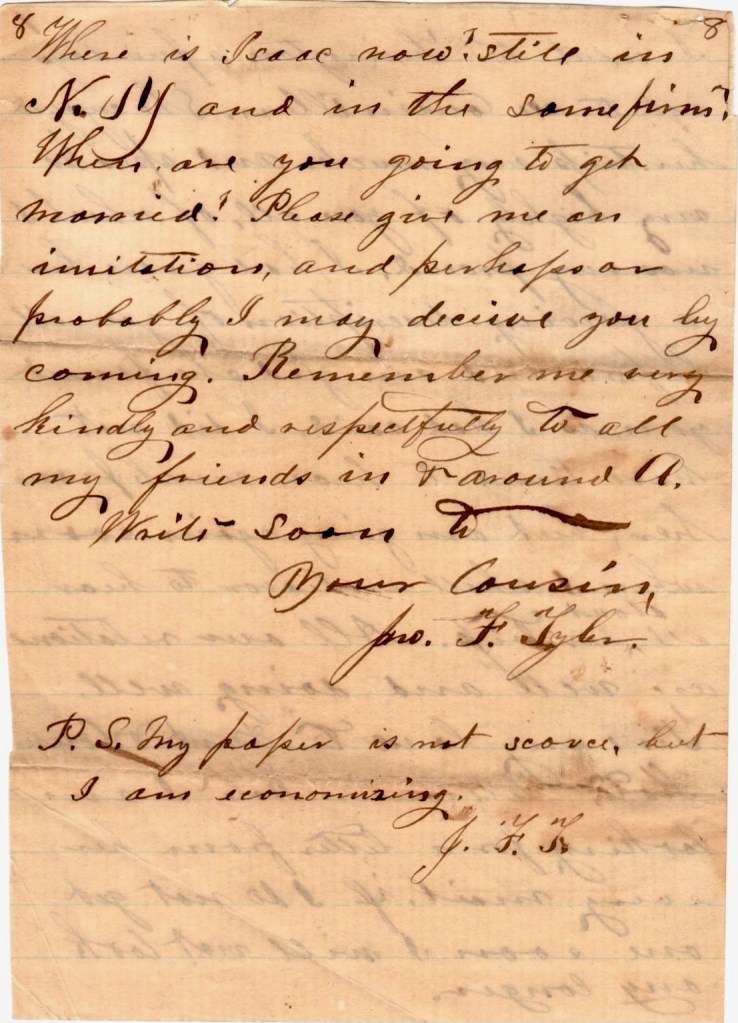
Where is Isaac now? Still in N. Y. and in the same firm? When are you going to get married? Please give me an invitation and perhaps or probably I may deceive you by coming. Remember me very kindly and respectfully to all my friends in and around A[bingdon]. Write soon to your cousin, — Jno. F. Taylor
P. S. My paper is not scarce but I am economizing. — J. F. T.
1 These lines are from a poem authored by Fitz-Greene Halleck entitled, “Marco Bozzaris” (a Greek chieftain).
This letter was written by Andrew R. Yoder (1836-1895) of Co. D, Mallett’s Battalion (Camp Guard), North Carolina. Muster rolls indicate that he served as a musician in the Camp Holmes Battalion. Whether Andrew remained at Camp Holmes as he hoped is unknown. Nothing further was found in his muster roll records after the summer of 1863. Most likely he was a conscript like the others who reported to Camp Holmes which was a camp of instruction near Raleigh, North Carolina. Typically, after being uniformed, equipped and drilled, the conscripts were sent on to fill the vacancies of regiments in the field. It may be that because Andrew was a musician (presumably a drummer), he was allowed to remain because he was not deemed to be fit for the field and/or because a drummer was needed at the camp for daily drills.
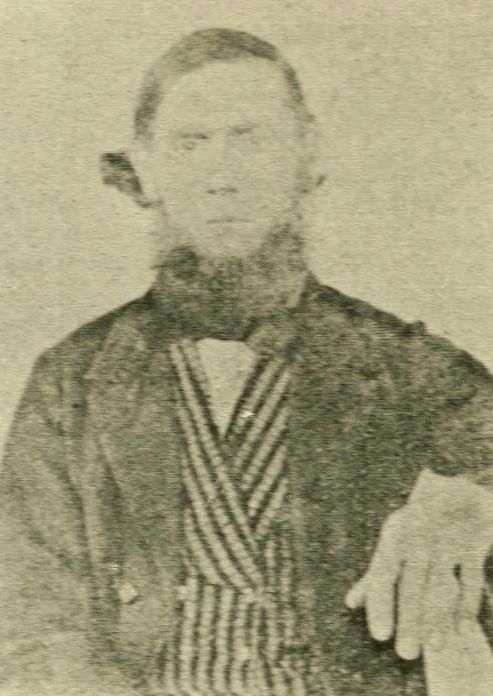
Amzi Alexander (“A. A”) Hawn who was killed on 17 June 1864 at Petersburg
Andrew was the son of John Abel Yoder (1795-1870) and Sallie Whitener (1793-1869) of Jacob’s Fork, Catawba county, North Carolina. He wrote the letter to his olde sister, Mary M. (“Mollie” Yoder) Hawn (1833-Aft1870), the wife of Amzi Alexander (“A. A.”) Hawn (1833-1864) who is mentioned in the April 1863 letter as having just been sent to Co. K, 35th North Carolina Infantry. Amzi is reported to have been killed and left on the battlefield at Petersburg on 17 June 1864.
Andrew and Mollie had an older brother, John Abel Yoder, III (1820-1864) who served the Confederacy in Co. F, 23rd North Carolina Infantry. He was killed in action at Spotsylvania Court House on 10 May 1864.
Andrew married Sarah Catherine Hawn (1838-1885) in the late late 1850s and had one child when he was drafted into service. He survived the war and lived out his days in Catawba county.
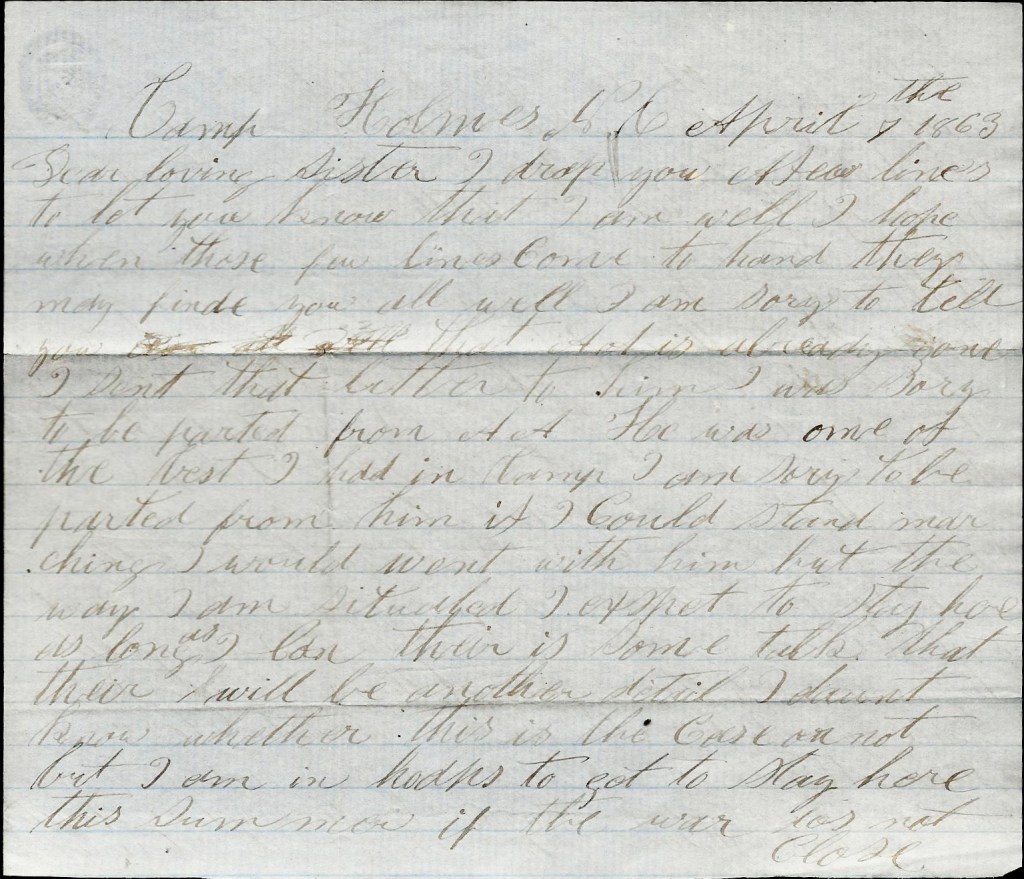
Transcription
Camp Holmes, North Carolina April 7th 1863
Dear loving sister,
I drop you a few lines to let you know that I am well. I hope when these few lines come to hand, they may find you all well. I am sorry to tell you that A. A. is already gone. I sent that letter to him. I was sorry to be parted from A. A. He was one of the best [friends] I had in camp. I am sorry to be parted from him. If I could stand marching, I would [have] went with him but the way I am situated, I expect to stay here as long as I can.
There is some talk that there will be another detail. I don’t know whether this is the case or not but I am in hopes to get to stay here this summer if the war does not close.
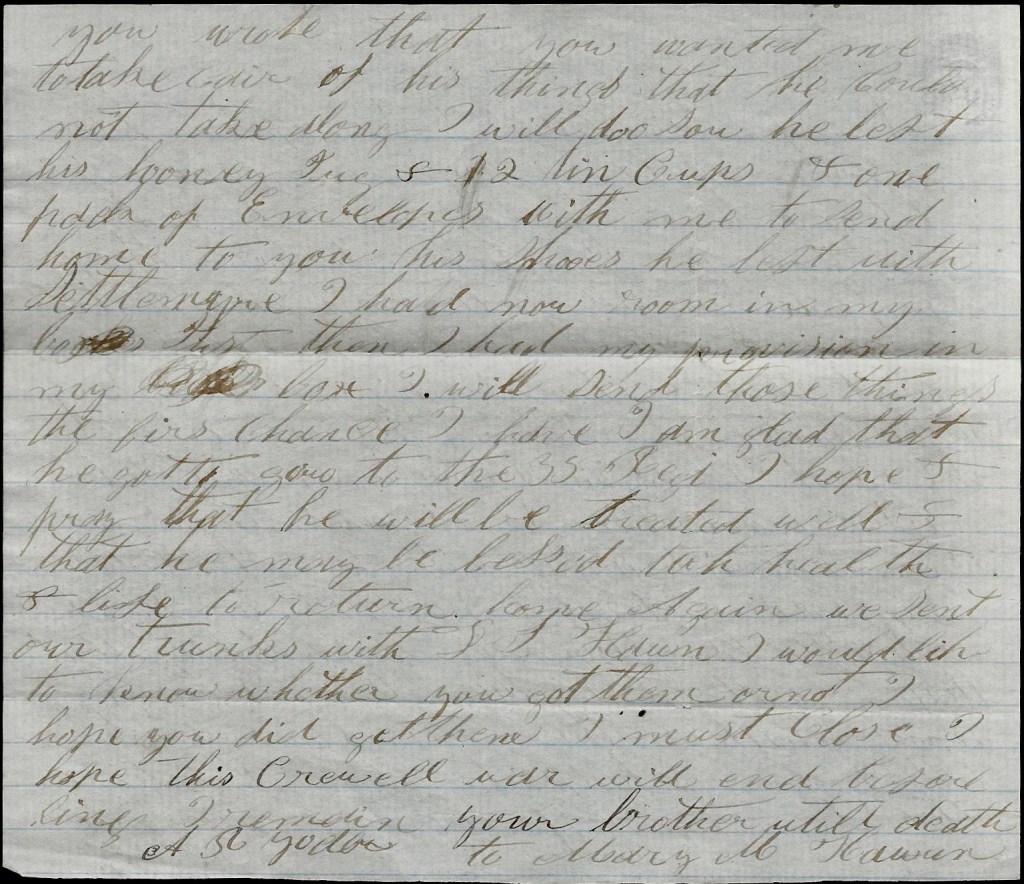
You wrote that you wanted me to take care of his things that he could not take along. I will do so. He left his honey jug & two tin cups & one pack of envelopes with me to send home to you. His shoes he left with Saddlemire. I had no room in my bag just then. I had my provisions in my box. I will send those things the first chance I have.
I am glad that he got to go to the 35th Regiment. I hope and pray that he will be treated well & that he may be blessed with health & life to return home again. We sent our trunks with T. S. Hawn. I would like to know whether you got them and I hope you did get them. I must close. I hope this cruel war will end before long.
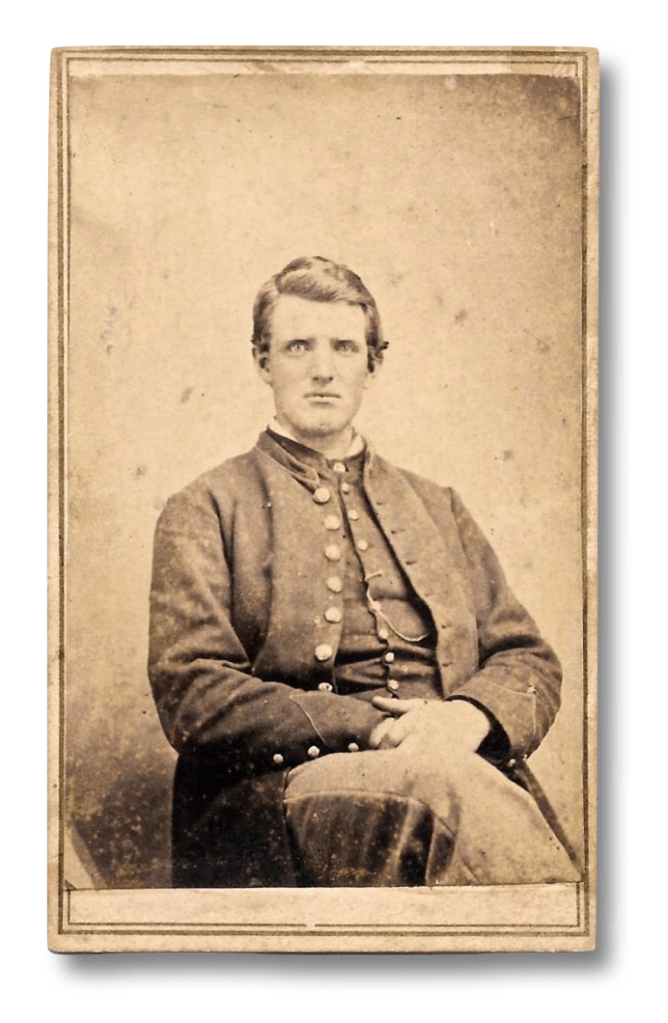
This letter was written by Ralph Carlton (1827-1862) of New Durham, Strafford county, New Hampshire. Ralph served as the Captain of Co. I, 3rd New Hampshire Infantry during the Civil War but was did not survive the Battle of Secessionville on James Island in South Carolina—where the regiment saw its first action on 16 June 1862. During that engagement, the regiment loss was 105 killed, wounded or missing. Capt. Carlton was shot in the left leg, which had to be amputated, but he died of his wound later the same day.
Ralph Carlton’s Gravestone in New Durham, N. H.
Ralph’s biological parents were John Folsom Cloutman (1804-1854) and Patience Tash Edgerly (1803-1894) of Strafford county. Ralph’s birth name was actually Erastus F. Cloutman and he served under that name in the 3rd Infantry during the Mexican-American War, and was married under that name in 1849 to Amanda M. Pearl (1832-1903), but sometime during the 1850’s he had his name legally changed to Ralph Carlton. Amanda gave birth to as many as seven children by the time Ralph entered the service in 1861 though they did not all survive infancy. In the 1860 US Census, Ralph was enumerated with his family of wife and four children in Farmington, New Hampshire, where he earned his living as a shoe cutter—a somewhat surprising occupation of menial labor given Ralph’s excellent penmanship and vocabulary which suggests a better than average education.
In the regimental history (p. 703), Ralph was described as a “fine-looking fellow, with flowing black beard, clear, black eyes and black hair.” He stood 5′ 11″ tall and had a commanding presence. “He was a popular man, not only at home, but in the regiment as well. He was the leader of the Farmington Cornet Band when he left for the war….In March 1862, Capt. Carlton having become sick, obtained a 60 days’ leave,” and returned home where he “somewhat” regained his health. On returning to his regiment, the steamboat (Oriental) he was on was shipwrecked off Hatteras and he and the other passengers had to be rescued by another steamer, resulting in a relapse of his health and he returned home once more. He did not return to the regiment until early June, just in time to participate in the Battle of Secessionville where he lost his life. One soldier who saw Ralph being removed from the battlefield wrote, “He was conveyed past us on an old door, mangled and dying. We had never seen such before. His white face contrasted strangely with his jet black hair and flowing beard.”
Ralph’s body was taken to Hilton Head and buried but soon after exhumed and placed in a metallic casket and sent North in charge of Musician Flanders of the Band. “Sad and solemn were the funeral services which took place at Farmington on 6 July 1862. The ceremonies were held in the Freewill Baptist Church.”
The letter reveals that Ralph wrote letters to the Boston Journal under the pseudonym “Santiago.” Unfortunately I have not been able to find any of these articles.
Ralph wrote the letter to Alonzo Havington Sawyer (b. 1827) who was appointed the postmaster of Alton during Lincoln’s Administration. He held the post for 22 years.
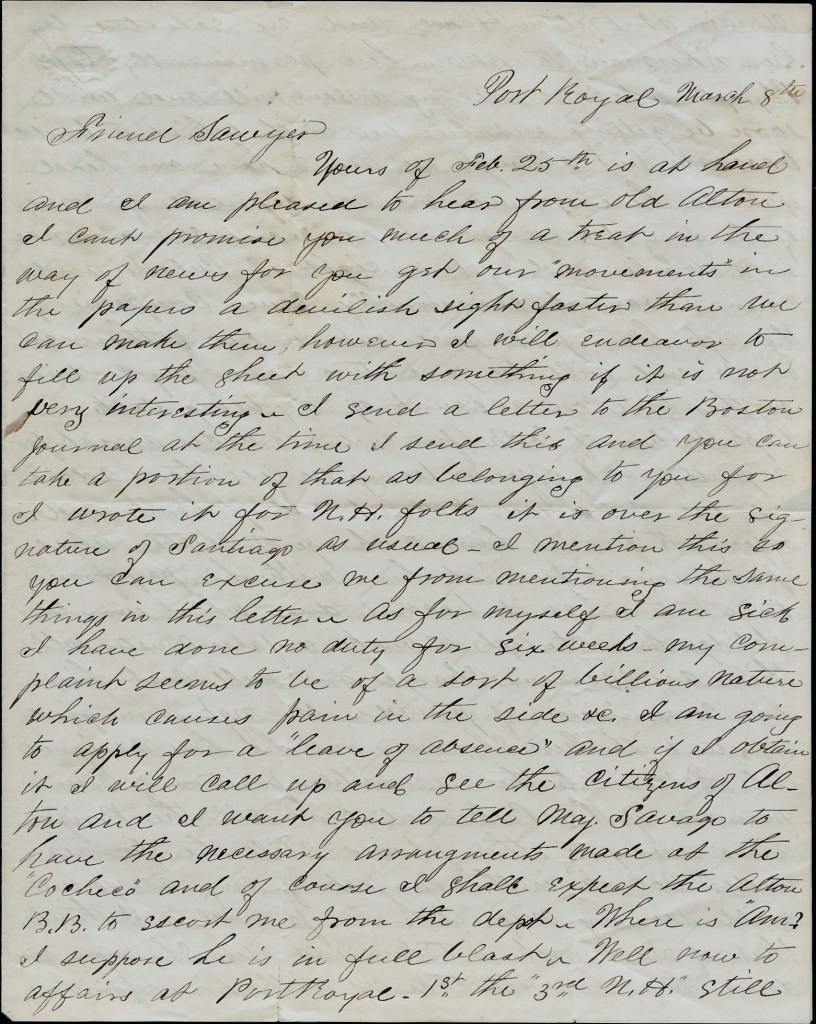
Transcription
Addressed to A. H. Sawyer, Esq., Post Master, Alton, New Hampshire
Port Royal [South Carolina] March 8th [1862]
Friend Sawyer,
Yours of February 25th is at hand and I am pleased to hear from old Alton. I can’t promise you much of a treat in the way of news for you get our “movements” in the papers a devilish sight faster that we can make them, however I will endeavor to fill up the sheet with something if it is not very interesting. I send a letter to the Boston Journal at the time I send this and you can take a portion of that as belonging to you for I wrote it for N. H. folks. It is over the signature of Santiago as usual. I mention this so you can excuse me from mentioning the same things in this letter.
As for myself, I am sick. I have done no duty for six weeks. My complaint seems to be of a sort of billious nature which causes pain in the side, &c. I am going to apply for a “leave of absence” and if I obtain it I will call up and see the citizens of Alton and I want you to tell Maj. Savage to have the necessary arrangements made at the “Cocheco” [Engine Company] and of course I shall expect the Alton B[rass] B[and] to escort me from the depot. Where is “Am? I suppose he is in full blast.
Josiah Ingals Plimpton, 3rd N. H. Vols. (Dave Morin Collection)
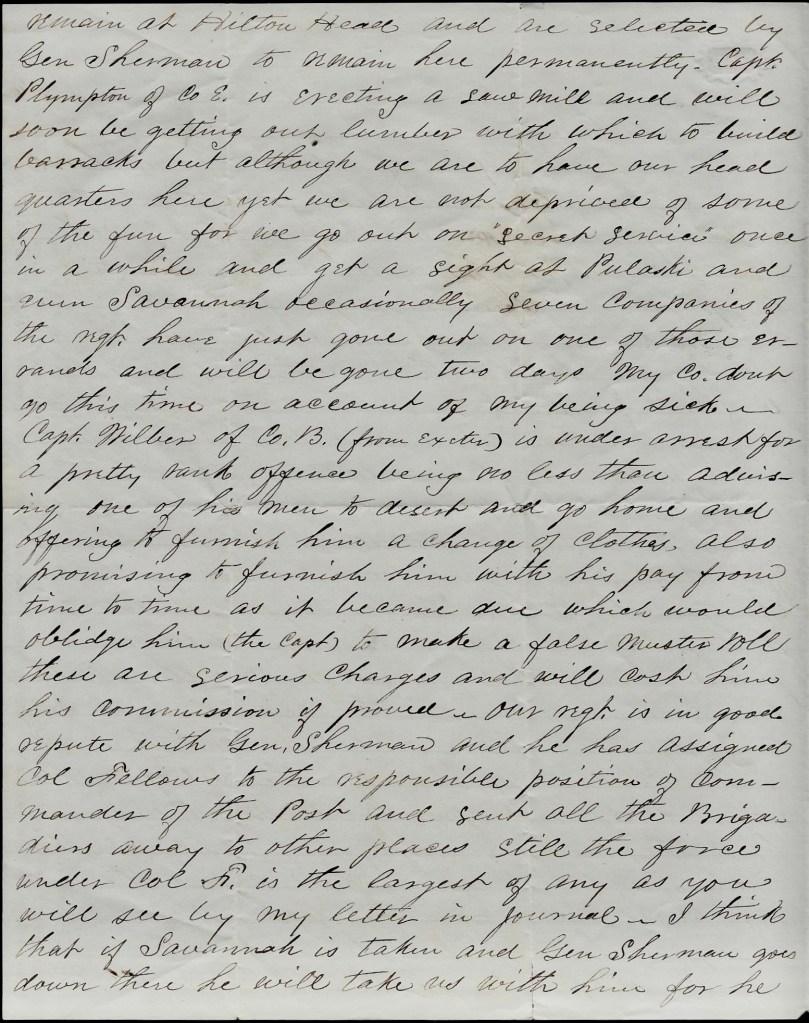
Well now, to affairs at Port Royal. 1st the “3rd New Hampshire” still remain at Hilton Head and are selected by Gen. [Thomas W.] Sherman to remain here permanently. Capt. [Josiah Ingals] Plimpton of Co. E is erecting a sawmill and will soon be getting out lumber with which to build barracks 1 but although we are to have our headquarters here yet, we are not deprived of some of the fun for we go out on “secret service” once in awhile and get a sight of Pulaski and even Savannah occasionally. Seven companies of the regiment have just gone out on one of those errands and will be gone two days. My company don’t go this time on account of my being sick.
Capt. Miller of Co. B (from Exeter) is under arrest for a pretty rank offense, being no less than advising one of his men to desert and go home and offering to furnish him a change of clothes; also promising to furnish him with his pay from time to time as it became due which would oblige him (the captain) to make a false muster roll. These are serious charges and will cost him his commission if proved.
Our regiment is in good repute with Gen. Sherman and he has assigned Col. [Enoch Q.] Fellows to the responsible position of Commander of the Post and sent all the Brigadiers away to other places. Still the force under Col. Fellows is the largest of any as you will see by my letter in Journal. I think that if Savannah is taken and Gen. Sherman goes down there, he will take us with him for he seems to have a partiality for the 3rd [New Hampshire]. You will remember that when the latter named place is taken, it will be mostly accomplished with the Navy unless the present program is changed. but I have no idea that it will be attempted at present for we have not sufficient force to hold it provided the rebels should be driven down en masse into the Gulf States which seems probable no and we can take it from a large force about as easy as from a small one. But you may soon look for the fall of “Pulaski” for that little pile is doomed.
We have two drills per day—one a battalion drill, and one a company drill. Col. Jackson is now in command and is an excellent man.
In regard to contrabands, see my letter in Journal.
James W. Parker of Lisbon, N. H. served in Roger Carlton’s Co. I, 3rd N. H. Vols. (Dave Morin Collection)
The weather is tip top part of the time but I tell you we have to catch it sometimes for we have a real “simoon” occasionally—the wind blowing a perfect gale and the sand flying like snow in winter. Then, tis now the rainy season and when it does rain, it pours.
We don’t get any of the luxuries you mention unless we purchase them of the sutlers put up in tin cans! Please tell Miss Young is she is at your place now that her brother has got well and returned to duty. Our regiment have lost by death in all 17 men. My company has lost two—one from Wakefield and one from Winchester. There are many more things I might mention but as I intend to go up to New Hampshire soon, I will wait and give you a verbal account of affairs. Remember me to Maj. S.; also to Hon. Daniel and Charles Mooney and in fact to everybody who loves the Stars and Stripes.
If I go home I shall arrive not far from the first of April. The 4th New Hampshire are with Gen. Wright but are doing nothing that I can hear of. Yours truly, — Ralph Carlton
[to] A. H. Sawyer, Esq.
“Organized at Concord, N.H., and mustered-in for three years on Aug. 23, 1861, the 3rd New Hampshire Infantry was uniformed in “New Hampshire cloth,” considered to be of “a better shade [of grey] than that of the other regiments.” The frock coats and pants were of gray doeskin made by the Harris Mill at Harrisville, Cheshire County, and supplied by Lincoln & Shaw, of Concord, at a total cost of $9,505. The frock coats issued to the 3rd New Hampshire Infantry were patterned after the 1854 U.S. Army frock coat with 9-button front, 2-button cuff, and rear skirts with two buttons at waist level. Collar and pointed cuffs were plain. Pants were also plain for all enlisted ranks. Non-commissioned officers’ sleeve stripes were a light color, likely sky-blue. Havelock caps issued to this regiment were described as “of dark brown mixed stuff, with a stiff visor and cape.” Brass company cap letters cost a total of $62. This corporal has a spear-pointed knife and Model 1849 Pocket Colt revolver tucked into his waist belt. He holds one of the Pattern 1853 Enfield rifled muskets, with fixed bayonet, supplied to the regiment by jeweler George W. Drew of Concord, N.H.“ Sixth-plate ruby ambrotype by an unidentified photographer. Ron Field Collection. [See Military Images Digital]
[It should be noted that by the time this letter was written in March 1862, the 3rd New Hampshire Infantry were no longer wearing their state-issued grey uniforms. They did, apparently, wear their old grey uniforms when on fatigue duty. See 1862: Arthur Sidney Newsmith to Annie Nesmith, letter dated 22 March 1862 from Port Royal, S. C.]
1 In February, 1862, Capt. Plimpton was detailed at Hilton Head to build a saw-mill, and had several men assigned to him as carpenters for that purpose. The spot chosen was near Drayton’s Plantation, not far from camp and close to the river (Broad). This service continued several weeks. There were several men from the Third New Hampshire detailed to work at this saw-mill.
This letter was written by Kenzie Allen Lovell (1841-1923), the son of Amon Lovell (1802-1850) and Wealthy Houck Baird (1816-1907) of Huntingdon county, Pennsylvania. Mentioned in the letter is his brother Albert G. Lovell (1839-1934).
At the time that Kenzie wrote this letter in 1861, he was employed as a school teacher but the following year he enlisted in August to serve 9 months as a first sergeant in Co. E, 122nd Pennsylvania Infantry. In 1870, he was still living in Huntingdon, Pennsylvania, earning his living as a lawyer. He was married in 1865 to Mary G. Lease (1845-1928).
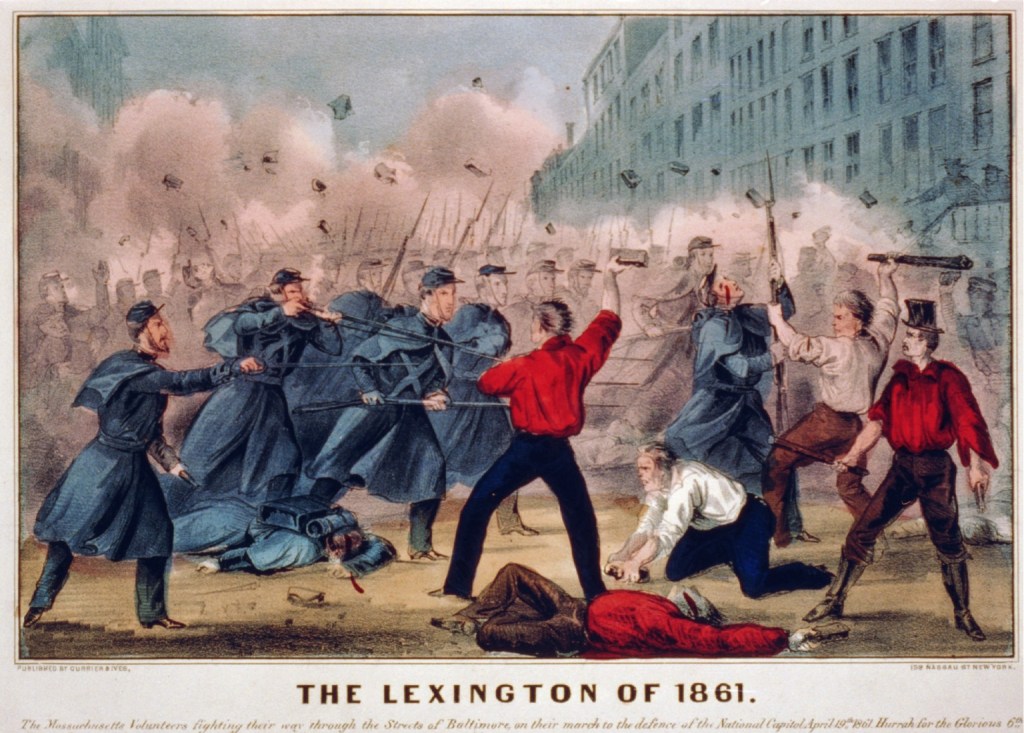
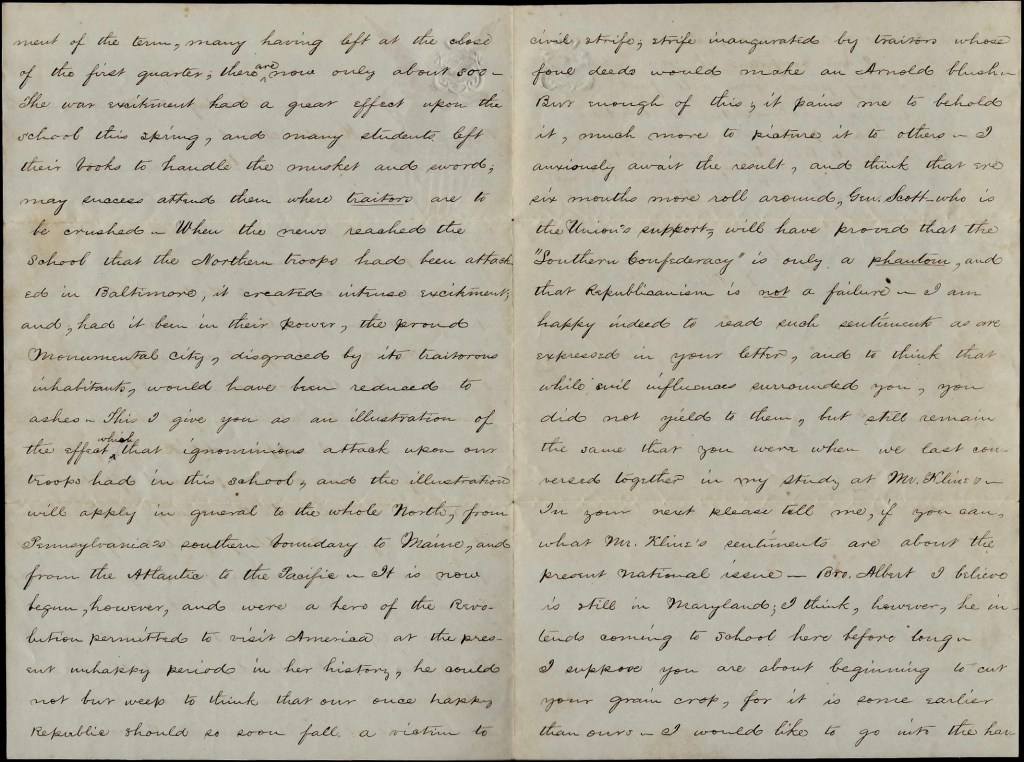
Kenzie’s letter speaks of the outrage exhibited by the Northern populace—particularly by the students in his school—when the Massachusetts Militia were attacked by southern sympathizers as they attempted to pass through Baltimore on 19 April 1861.
Massachusetts Militia attacked while passing through the streets of Baltimore (Monument City).
Transcription
Tuesday, 3 p.m., June 25, 1861
My dear friends,
Your most welcome epistle reached its destination a few evenings since and to all such, I respond with the greatest pleasure. I am sorry to hear that you do not intend coming to the Normal [school] till next spring, but am glad that you have not abandoned the idea entirely. I can’t say whether I will be here then or not but I want to remain next winter at least. If I am, you will not see me.
I suppose old “Harmony Hill” Seminary is now closed up and left to commune in silence with those large oaks around it, or, mayhap ’tis still frequented by a group of “little ones,” more eager for play than study. In your next, please let me know when my successor closed and how he succeeded. Let me know also where Mr. Solliday is; whether he has left Maryland or not.
The school here is not now as large as it was at the commencement of the term, many having left at the close of the first quarter. There are now only about 300. The war excitement had a great effect upon the school this spring, and many students left their books to handle the musket and sword. May success attend them where traitors are to be crushed.
When the news reached the school that the Northern troops had been attacked in Baltimore, it created intense excitement, and had it it been in their power, the proud Monumental City, disgraced by its treasonous inhabitants, would have been reduced to ashes. This I give you as an illustration of the effect which that ignominious attack upon our troops had in the school, and the illustration will apply in general to the whole North, from Pennsylvania’s southern boundary to Maine, and from the Atlantic to the Pacific.
It is now begun, however, and were a hero of the Revolution permitted to visit America at the present unhappy period in her history, he could not but weep to think that our once happy Republic should so soon fall a victim to civil strife—strife inaugurated by traitors whose foul deeds would make an Arnold blush. But enough of this; it pains me to behold it, much more to picture it to others. I anxiously await the result, and think that ere six months more roll around, Gen. Scott—who is the Union’s support—will have proved that the “Southern Confederacy” is only a phantom and that Republicanism is not a failure.
I am happy indeed to read such sentiments as are expressed in your letter, and to think that while evil influences surrounded you, you did not yield to them, but still remain the same that you were when we last conversed together in my study at Mr. Kline’s. In your next, please tell me if you can what Mr. Kline’s sentiments are about the present national issue.
Brother Albert, I believe, is still in Maryland, I think, however, he intends coming to school here before long. I suppose you are about beginning to cut your grain crop, for it is some earlier than ours. I would like to go into the harvest fields about two weeks if I thought I could endure it. I am confident if you intend going to school any place, you will find it vastly to your benefit to attend the institution because it has been prepared and is now endowed by the State to train teachers.
I believe I have written all of importance and shall close. Please write soon. You will see this letter has been written in haste. Direct as before. Sincerely yours, — K. Allen Lovell
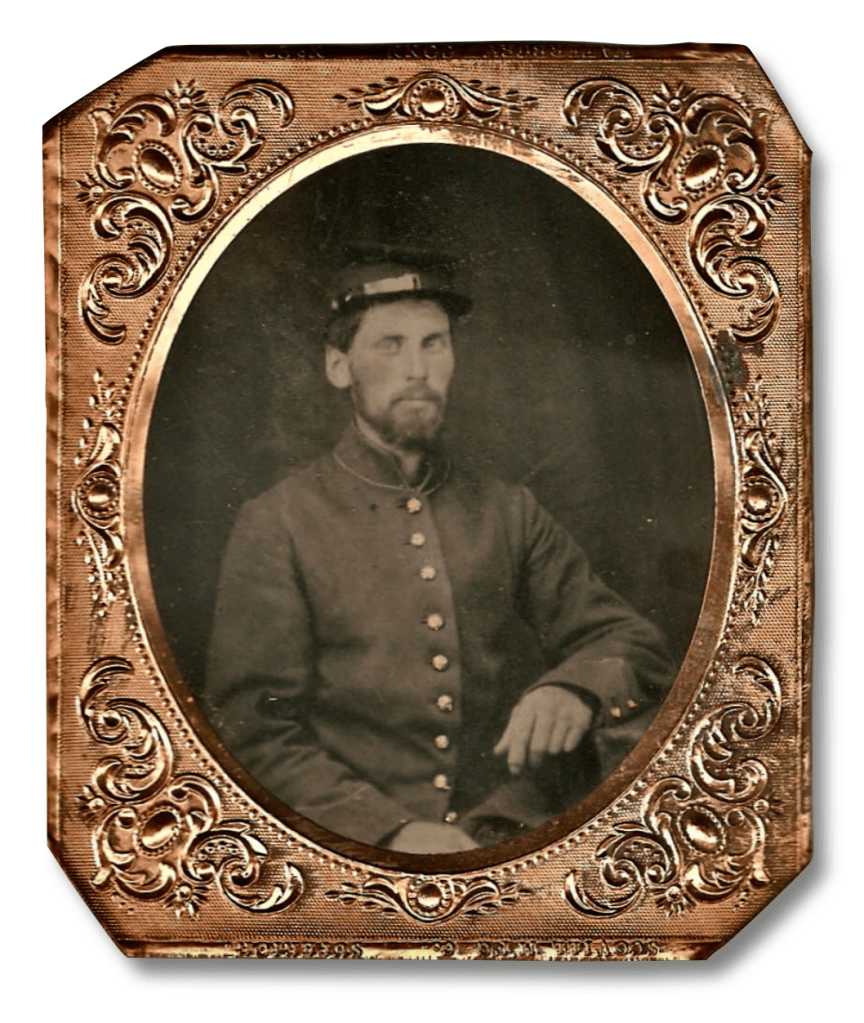
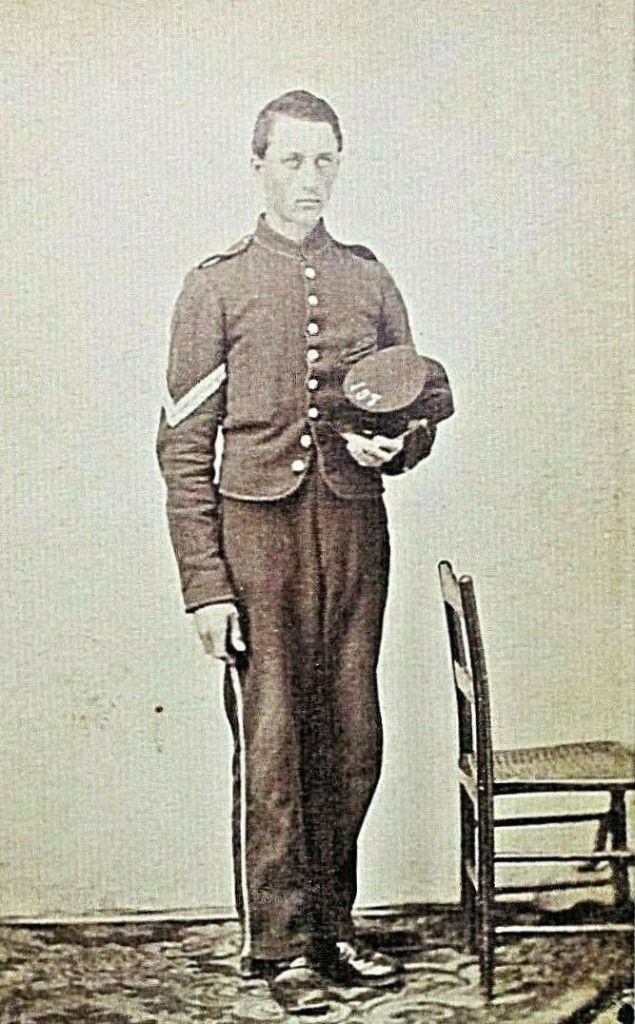
This partial letter was written by Edward Alexander McConnell (1844-1867), the son of emigrants Edward McConnell (1805-1878) and Charlotte McGlashan (1813-1889) of Chicago, Cook county, Illinois. At the time of the 1860 US Census, 16 year-old Edward was working as a clerk in Chicago. After the war, Edward married Susannah Richards Colehour, who gave birth to their only child four months after Edward’s death in February 1867.
I could not find an image of Edward but here is Azel D. Hayward who also served in Co. B, 72nd Illinois Infantry(Randy Hayward Collection)
During the Civil War, Edward enlisted as a private in Co. B, 72nd Illinois Infantry (the “First Chicago Board of Trade Regiment”) in August 1862. He was promoted to corporal in June 1863 and to sergeant in September 1863.
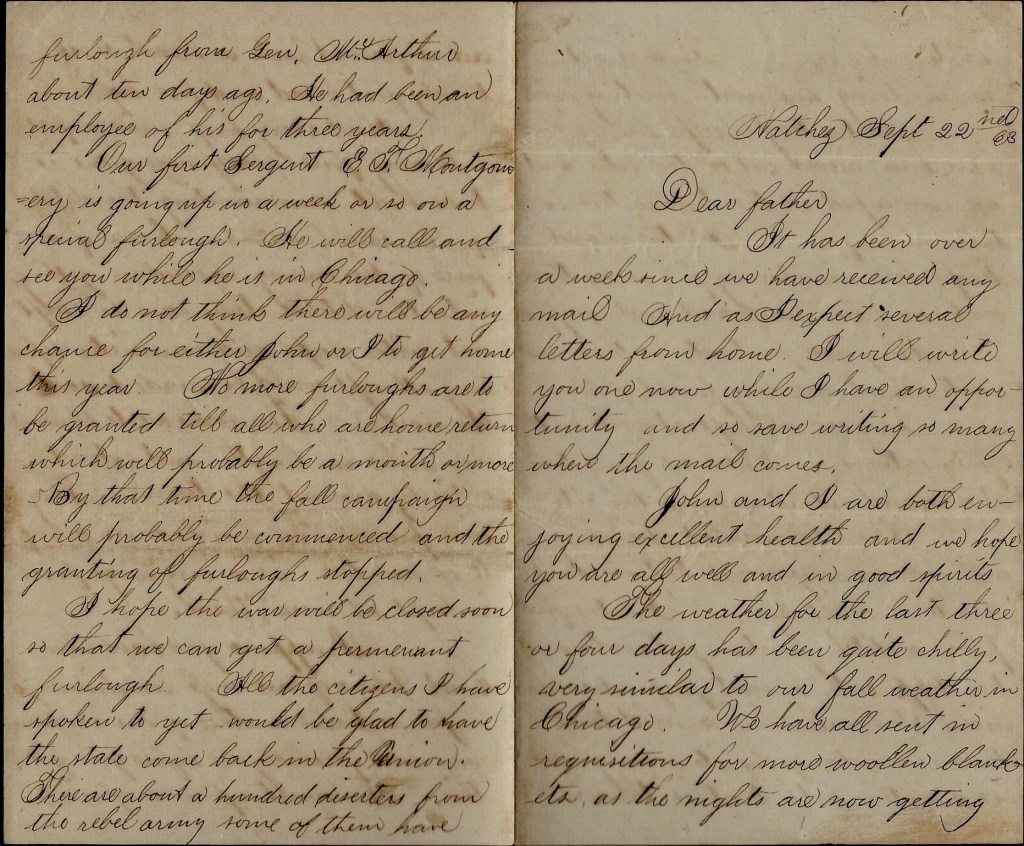
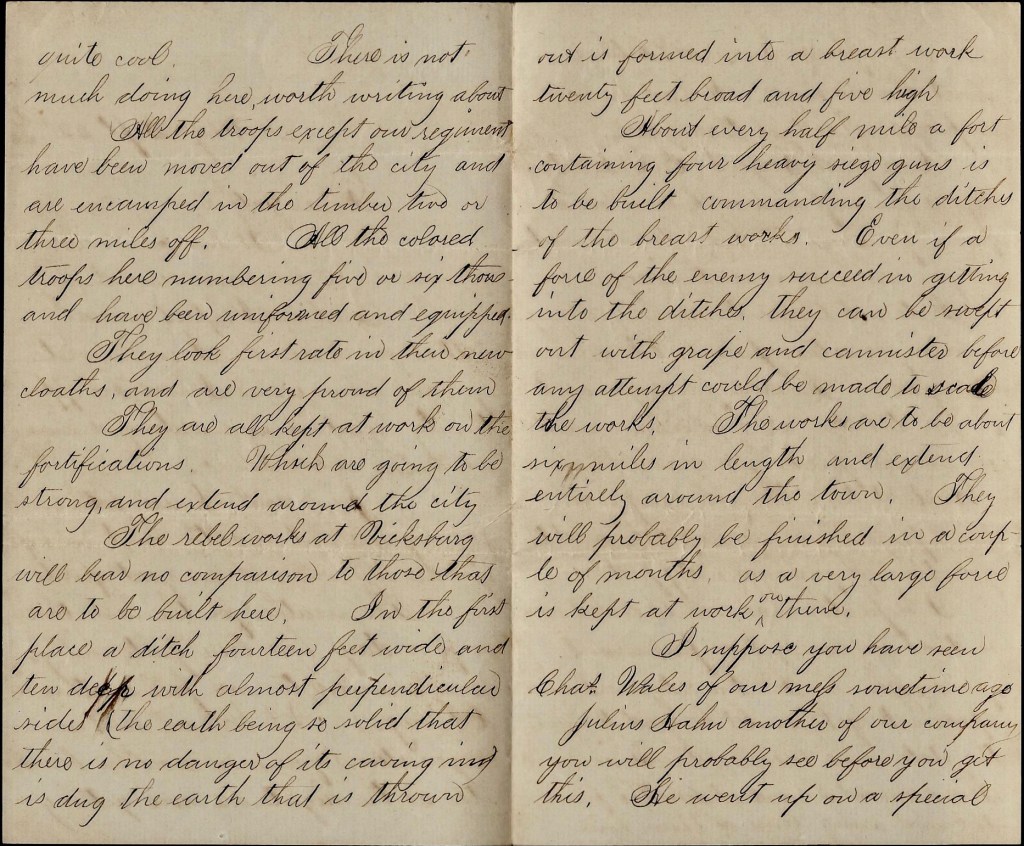
In his letter, Edward writes a paragraph on the Black troops in Natchez in September 1863 and of the construction of a new fortification there on the north side of town. On July 13, 1863, Union troops arrived in Natchez and “established the Union Army headquarters at the Rosalie Mansion. By August of 1863, more U.S. Colored Troops began residing in Natchez. A large number of black men that enlisted were from Natchez or had left plantations in surrounding areas such as Franklin County, Jefferson County, Wilkinson County, etc. During the Fall of 1863, the soldiers began working on the construction of a fortification named for General James Birdseye McPherson. There were over 3,000 colored troop soldiers who served in the six regiments at Fort McPherson. These regiments included the sixth U.S. Colored Heavy Artillery, 58th U.S. Colored Infantry, 70th U.S. Colored Infantry, 71st U.S. Colored Infantry, 63rd U.S. Colored Infantry, and the 64th U.S. Colored Infantry.” [The Story of the Natchez US Colored Troops by Inesha Jackson]
The Union Battlements of Fort McPherson, encompassed the United States Marine Hospital
Transcription
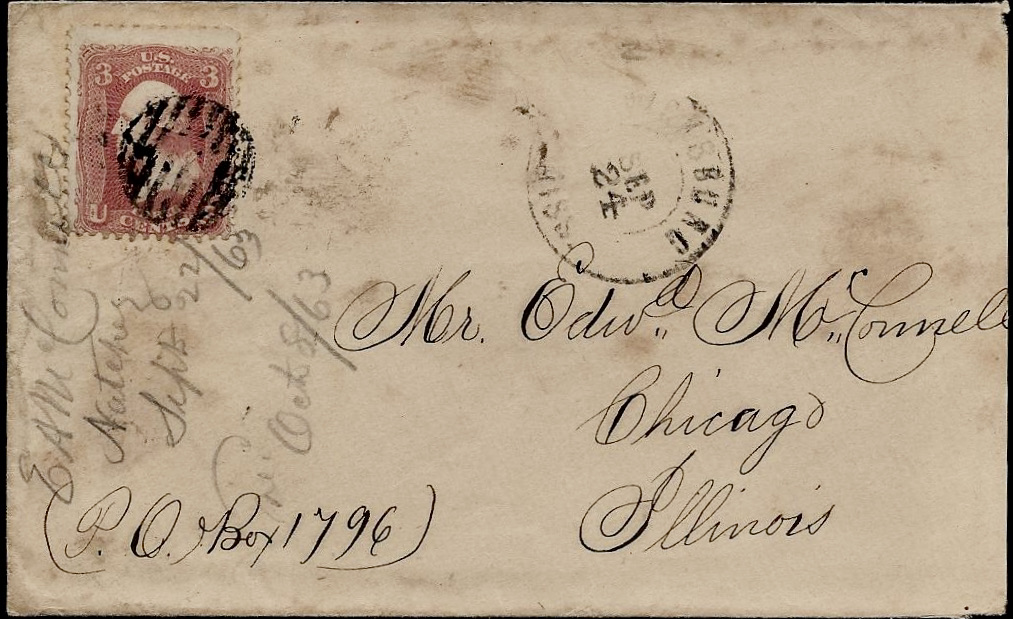
Addressed to Mr. Edward McConnell, Chicago, Illinois
Natchez [Mississippi] September 22, 1863
Dear father,
It has been over a week since we have received any mail and as I expect several letters from home, I will write you one now while I have an opportunity and so save writing so many when the mail comes.
John and I are both enjoying excellent health and we hope you are all well and in good spirits. The weather for the last three or four days has been quite chilly—very similar to our fall weather in Chicago. We have all sent in requisitions for more woolen blankets as the nights are now getting quite cool. There is not much doing here worth writing about.
All the troops except our regiment have been moved out of the city and are encamped in the timber two or three miles off. All the colored troops here numbering five or six thousand have been uniformed and equipped. They look first rate in their new clothes and are very proud of them. They are all kept at work on the fortifications which are going to be strong and extend around the city.
The rebel works at Vicksburg will bear no comparison to those that are to be built here. In the first place a ditch fourteen feet wide and ten feet deep with almost perpendicular sides (the earth being so solid that there is no danger of its caving in) is dug. The earth that is thrown out is formed into a breastwork twenty feet broad and five high. About every half mile a fort containing four heavy siege guns is to be built commanding the ditches of the breastworks. Even if a force of the enemy succeeds in getting into the ditches, they can be swept out with grape and canister before any attempt could be made to scale the works. The works are to be about six miles in length and extend entirely around the town. They will probably be finished in a couple of months as a very large force is kept at work on them.
I suppose you have seen Charles Wales of our mess sometime ago. Julius Hahn another of our company you will probably see before you get this. He went up on a special furlough from Gen. McArthur about ten days ago. He had been an employee of his for three years.
Our First Sergeant E[than] T. Montgomery is going up in a week or so on a special furlough. He will call and see you while he is in Chicago. I do not think there will be any chance for either John or I to get home this year. No more furloughs are to be granted till all who are home return which will probably be a month or more. By that time the fall campaign will probably be commenced and the granting of furloughs stopped.
I hope the war will be closed soon so that we can get a permanent furlough. All the citizens I have spoken to yet would be glad to have the state come back in the Union. There are about a hundred deserters from the rebel army. Some of them have [rest of letter missing].
Though unsigned, I feel confident this partial letter was written by James Stoddard Hyde (1844-1864), the son of George Hyde (1808-1890) and Susan Beach (1821-1898) of Hyde Settlement, Broome county, New York. According to the Hyde Genealogy, George and Susan (Beach) Hyde had five children: John C. (b. 1841), James S. (b. 1844), Mary F., (b. 1846), Lucy C. (b. 1848), and George H. (b. 1850). James was a grandson of Major Chauncey Hyde—a Revolutionary War veteran and a major of militia—who settled near Lisle (Hyde’s Settlement), Broome county, New York, in the late 1790s.
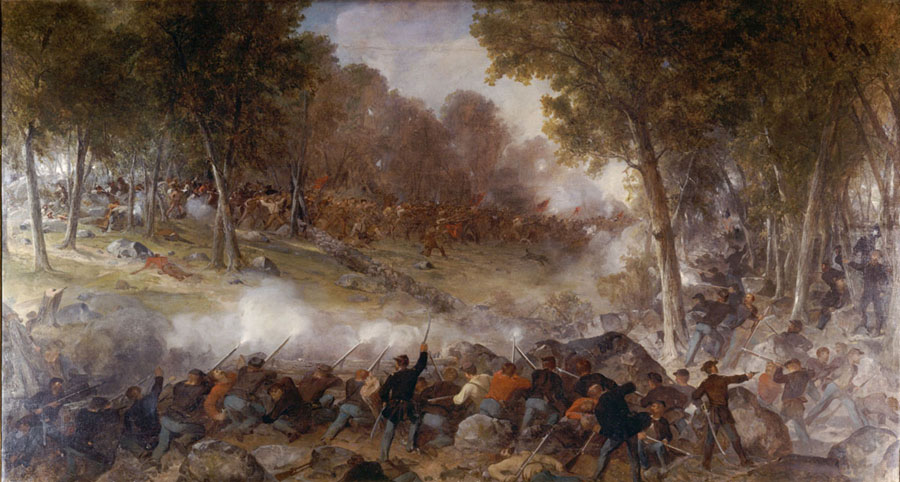
James was 18 years old when he enlisted at Binghamton to serve three years in Co. E, 137th New York Infantry. He mustered in as a corporal but was returned to the ranks prior to June 1863. Throughout most of the war, the 137th New York Infantry served in Gen. Geary’s “White Star” Division. James was known to be with his regiment at Gettysburg when they played a pivotal role on the night of 2 July 1863 in repulsing the Confederate attack on the previously abandoned works on Culp’s Hill. They were on the extreme right flank of the Union lines that night. Stretched at double interval, there were times when they were taking fire from three sides. [see James S. Hyde Diary, 3 July 1863, NCWRTC]
Falling ill on the Atlanta Campaign, James was sent to a hospital in Nashville where he died of disease on 17 August 1864. He was buried at Nashville.
Repulse of General Johnson’s Division by General Geary’s White Star Division, by Peter Frederick Rothermel, 1870.
Transcription
Aquia Creek Landing, Va. Co. E, 137th N. Y. S. V. February 11th 1863
Dear Mother,
I have got a tent again now. It is raining out of doors but is very comfortable in here. Mr. [Clarendon B.] Taft 1 & Mr. [Levi] Perce 2 are both sick. Taft has the rheumatism very bad and Perce is completely worn out. He (there is considerable going on here) has had several fits. His discharge papers are being made out. Taft will probably be discharged. They have been with the drum corps for some time. Frank Rulison 3 & Albert Spafard 4—they are both good, honest, steady men. We built our tent about four feet high with logs and dug into the ground one foot and covered it with our shelter tents. We have a good fireplace and stick chimney. There is no stones in the ground here so that it makes good plaster to stop the cracks.
You say you do not see how the deserters get by the guard, Well there is a great many things that you will never know nothing about unless you come down here. Camp guard is completely played out with us. We have not had any camp guard since we left Bolivar that amounted to anything. There is a guard around our camp sitting on the stumps but they have not got any orders. The guard is kept so as to have one in case of a fight among the boys, or anything like that. Then after they get by the picket, which is not a very hard job, they are free to go whichsoever way they may choose, unless they should happen to run onto patrol guard. It is a very easy matter to desert if anyone wants to do so.
At Bolivar we used to run the guard anywhere we chose. We would go past his beat when he was not looking at you. There has not any deserted from this regiment for some time.
We moved our camp a few days ago from one hill to another. Before we had a splendid view of the river but now we have a “splendiferous” view for many miles each way. The river is said to be five miles wide here. There are about 100 boats in sight all the time. There is a round knoll about 80 feet high between us and the river where the Rebs had two pivot guns planted which blockaded the river.
I was mistaken about the 27th & 12th Regt. being in the 9th Army Corps. It took four days for them all to get started. I noticed one man standing on the boat (I did not see the 89th until they had got on board) and someone told me it was Capt. Brown. I did not know him. I did not see him but a few moments. They had a very nice steamboat to go out on.
31st. You must excuse my writing so much with a pencil. We are practicing now all our spare time. We do not have to go on fatigue duty so the Colonel has ordered us to practice 8 hours each day since we got our tents built. We had not practiced at all before since we have been here. We go out of camp, build a good fire, sit around it and tell stories.
Lieut. [Frederick M.] Halleck 5 returned home (we call this home) a few days ago. He said he saw my father, brother, & sister. Said that you were all alive and well so far as he could see. I received a good long letter from [sister] Mary (No. 18) last night. I am very glad to learn that you received the check all right and hope you will get the money on it. But we hear here that they will not cash them at Bright’s.
The 12th Army Corps is only a short distance from us up Aquia Creek a mile or two. I saw Gen. Slocum & Geary a few days ago. There were up here to see the elephant. If there is anyone in Hyde Settlement that would like to know something about war, just send them down here with a pass. You can go anywhere from Washington free. It is only a few miles from here out to the front where Hooker’s Army is. There you will see some soldiers. This place, four months ago….[rest of letter missing]
1 Clarenden B. Taft was 37 years old when he enlisted as a musician in Co. A, 137th New York Infantry on 16 August 1862. He was discharged for disability on 14 March 1863 at Acquia Creek Landing, Va.
2 Levi Perce was 43 years old when he enlisted on 16 July 1862 as a musician in Co. A, 137th New York Infantry. He mustered out with a disability on 14 March 1863 at Acquia Creek Landing, Va.
3 Frank Rulison was 33 years old when he enlisted on 16 July 1862 at Conklin to serve as a musician in Co. B, 137th New York Infantry. He was wounded in action at the Battle of Chancellorsville on 3 May 1863.
4 Albert Spafard was 37 years old when he enlisted on 16 July 1862 at Conklin to serve as a musician in Co. B, 137th New York Infantry.
5 Lieut. Frederick M. Halleck was 22 years old when he mustered in as a 2nd Lieutenant at Binghamton on 19 August 1862. He was promoted to 1st Lieut. of Co. E on 18 April 1863 and discharged in June 1865.
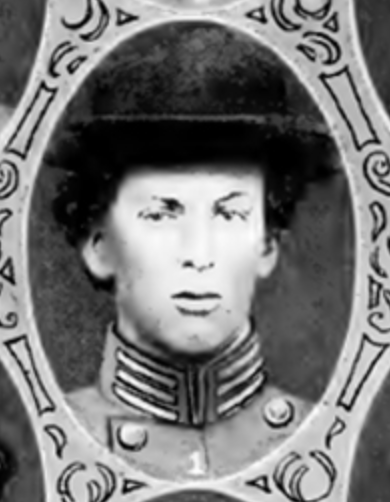
This letter was written by John D. Fain (1841-1865) who enlisted on 1 June 1861 as a private in Co. C (“Warren Rifles”), 12th North Carolina Infantry. He was wounded on 28 June 1862 during the Seven Days Battle and hospitalized in Richmond for a time. He was detailed by General Iverson as a clerk for Maj. Payne, Quartermaster, in the spring of 1863. On 23 November 1863, just a couple of weeks after this letter was written, he was transferred out of the 12th North Carolina and commissioned a 2nd Lieutenant in Co. C, 33rd North Carolina Infantry. He received a gunshot wound again, this time in the left thigh/hip, on 6 May 1864 in the Wilderness and returned to his regiment near Petersburg on 31 August 1864. Sometime early in 1865 he was made Captain of his company, his rank backdated to July 1864.
Capt. John D. Fain
Capt. Fain served the entire war, rising in rank from private to captain, but he did not live to see the end of the conflict and return home to his mother. On 1 April 1865, the brigade in which the 33rd North Carolina was attached fell under a continual bombardment. Early the next morning, Grant launched his attack on the thinly manned North Carolina regiments and though they fought desperately, they were compelled to fall back until they broke. In the same fight that resulted in the death of Lt. Gen. A. P. Hill, Capt. Fain was mortally wounded. He was standing with a group with other officers when “that unmistakeable thud” was heard and Capt, Fain “fell heavily forward…He begged us to take him off the field, but it was impossible to do so at that time. In five minutes he was dead. I never knew a purer man. He was the soul of honor—so gentle, so manly, so heroic that no one could help loving him. We held the inner line of works until night, when Petersburg was evacuated, and we began our last retreat.”
John was the son of John Fain (@1800-1856) and Susan Martin Hair (1804-1881) of Island Creek, Granville county, North Carolina. John was an 1860 graduate of the University of North Carolina. In the 1860 US Slave Schedule, John’s widowed mother was listed among the slaveholders in Granville county and she owned 52 slaves.
Transcription
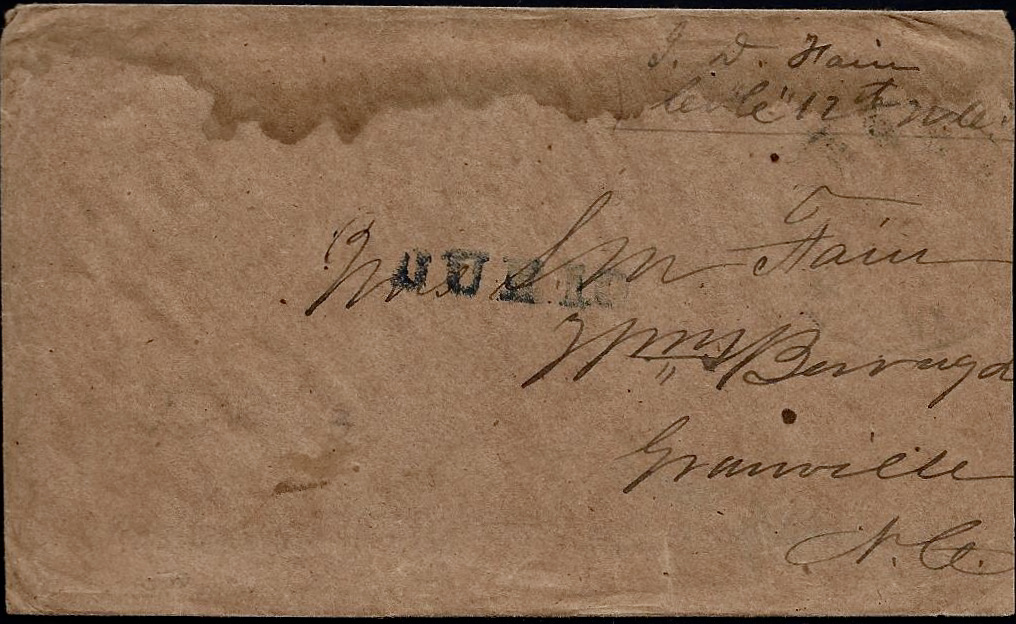
Addressed to Mrs. S. M. Fain, Wm. Buruga, Granville, North Carolina
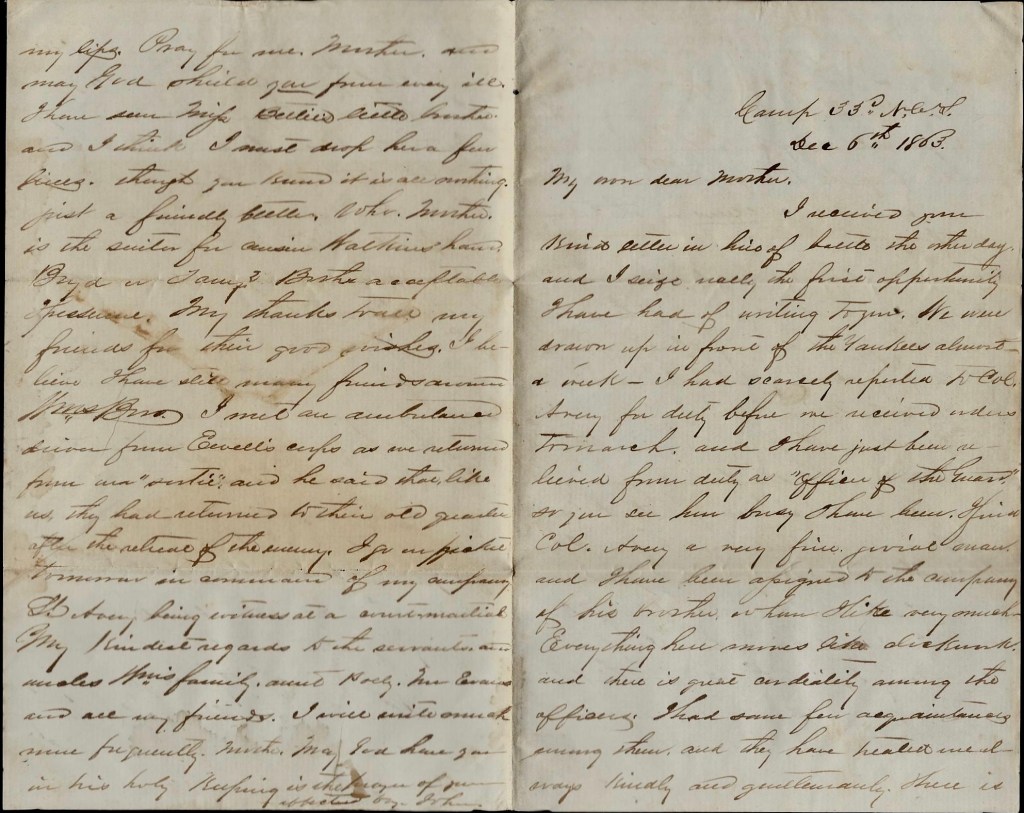
Camp 33rd N. C. S. December 6th 1863
My own dear mother,
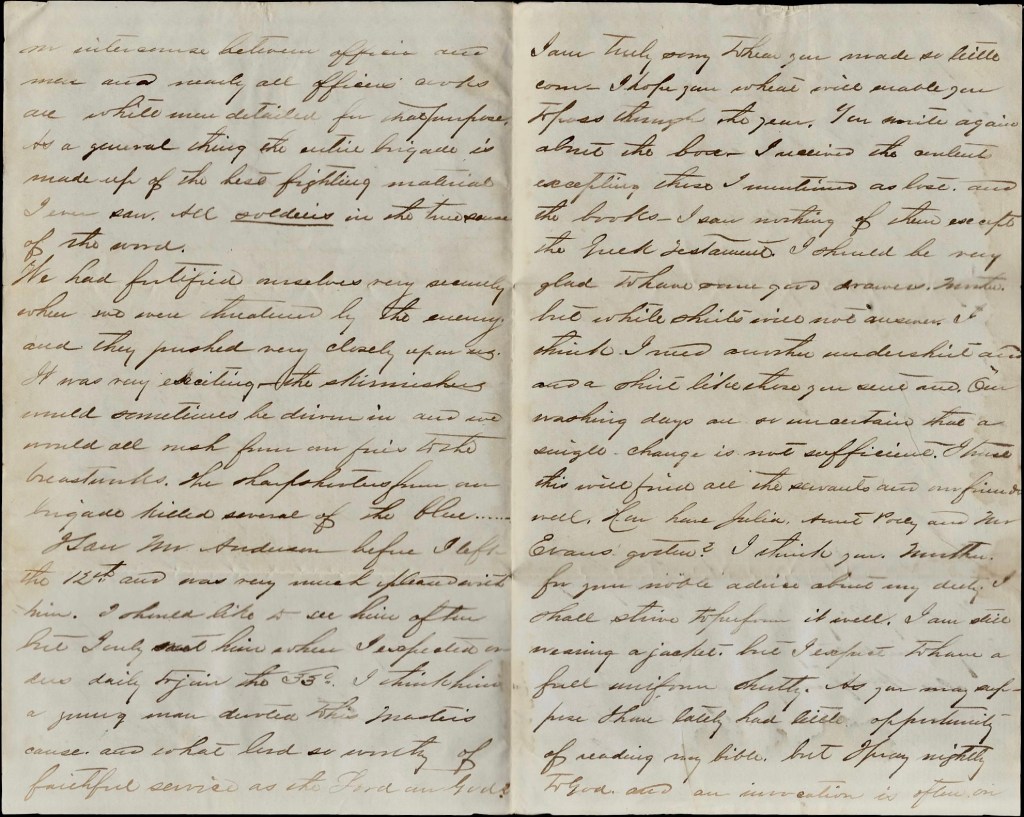
I received your kind letter in line of battle the other day and I seize really the first opportunity I have had of writing to you. We were drawn up in front of the Yankees almost a week. I had scarcely reported to Col. [Clark Moulton] Avery for duty before we received orders to march and I have just been relieved from duty as “Officer of the Guard,” so you see how busy I have ben. I find Col. Avery a very fine, genial man and I have been assigned to the company of his brother whom I like very much. Everything here moves like clockwork and there is a great cordiality among the officers. I had some few acquaintances among them, and they have treated me always very kindly and gentlemanly. There is no intercourse between officers and men and nearly all officers cooks are white men detailed for that purpose. As a general thing, the entire brigade is made up of the best fighting material I ever saw. All soldiers in the true sense of the word.
We had fortified ourselves very securely when we were threatened by the enemy and they pushed very closely upon us. It was very exciting—the skirmishers would sometimes be driven in and we would all rush from our fires to the breastworks. The sharpshooters from our brigade killed several of the blue….
I saw Mr. Anderson before I left the 12th [Regiment] and was very much pleased with him. I should like to see him often but I only [ ] him when I expected orders daily to join the 33rd. I think him a young man devoted to his Master’s cause and what [ ] so worthy of faithful service as the Lord our God?
I am truly sorry that you made so little corn. I hope your wheat will enable you to pass through the year. You write again about the box. I received the contents excepting these I mentioned as lost and the books. I saw nothing of them except the Greek Testament. I should be very glad to have some good drawers [this] winter but white shirts will not answer. I think I need another undershirt and a shirt like those you sent me. Our washing days are so uncertain that a single change is not sufficient.
I trust this will find you all the servants and our friends well. How have Julia, Aunt Polly, and Mr. Evans gotten [along]? I thank you, mother, for your noble advice about my duty. I shall strive to perform it well. I am still wearing a jacket but I expect to have a full uniform shortly. As you may suppose, I have lately had little opportunity of reading my bible but I pray nightly to God and an invocation is often on my lips. Pray for me, mother, and may God shield you from every ill.
I have seen Miss Bettie’s little brother and I think I must drop her a few lines though you know it is all nothing—just a friendly letter. Who, mother, is the suitor for cousin Watkin’s hand? Boyd or Tany? Both acceptable I presume. My thanks to all my friends for their good wishes. I believe I have still many friends around Waynesboro.
I met an ambulance driven from Ewell’s Corps as we returned from our sortie and he said that like us, they had returned to their old quarters after the retreat of the enemy. I go on picket tomorrow in command of my company, Lt. [Willoughby F.] Avery being witness as a court martial. My kindest regards to the servants and Uncle William’s family, Aunt Holly, Mr. Evans, and all my friends. I will write much more frequently this winter. My God have you in his holy keeping is the prayer of your affectionate boy, — John
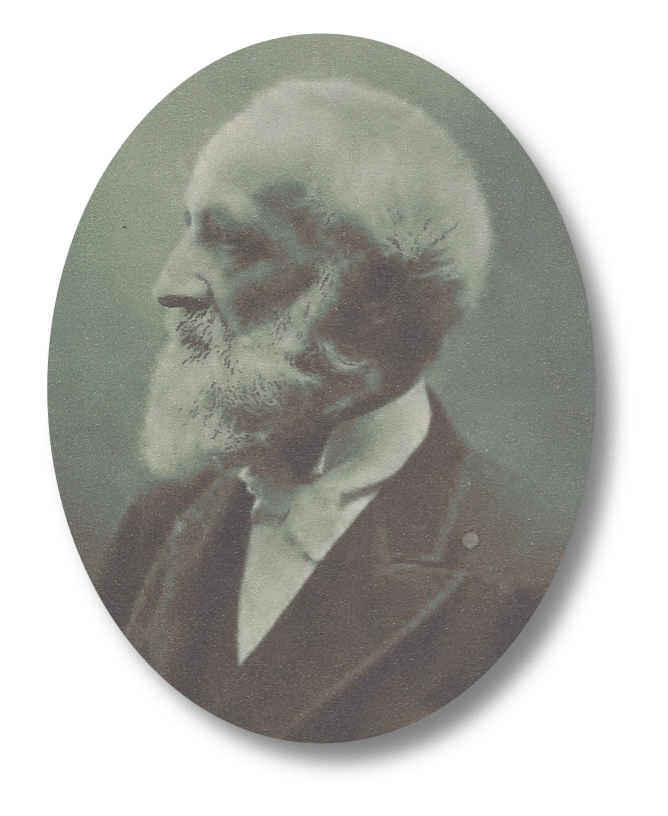
This letter was written by Rev. Romulus Barnes (1800-1846), the son of Daniel Giles Barnes (1752-1814) and Sarah Webster (1767-1830). Romulus was married to Olivia Denham (1807-1887).
Romulus was born in Bristol, Connecticut, and graduated from Yale College in 1828. After graduating from the Yale Theological Seminary in 1831, he moved to Illinois where he began to preach. His wife was from Conway, Massachusetts, and she attended Holyoke Seminary under the tutelage of Mary Lyons.
Olivia (Denham) Barnes in later years
Romulus and Olivia were partners in their ministry on the Illinois frontier. Under the auspices of the American Home Missionary Society, the couple faced danger together as they carried the message of anti-slavery into a land that was largely inhabited by pro-slavery (or at least anti-Black) settlers. They were ostracized by neighbors and by many of the churches. On one occasion Olivia was severely wounded by a stone thrown at her by a pro-slavery mob while her husband delivered an anti-slavery sermon. After the death of her husband in 1846 leaving her with eight children, Olivia carried on her work alone.
Romulus wrote the letter to his brother-in-law, Rev. Lucien Farnham (1799-1874), the first pastor of the Congregational Church in Batavia, Illinois, who was married to Louisa Denham (1804-1833). Louisa’s brother, Butler Denham (1805-1841) was married to a woman named Eunice Storrs (1809-1899). When Butler died in 1841, Eunice took Owen Lovejoy (1811-1864) as her second husband.
[Note: This letter is from the personal collection of Roy Gallup and is published on Spared & Shared by express consent.]
Transcription
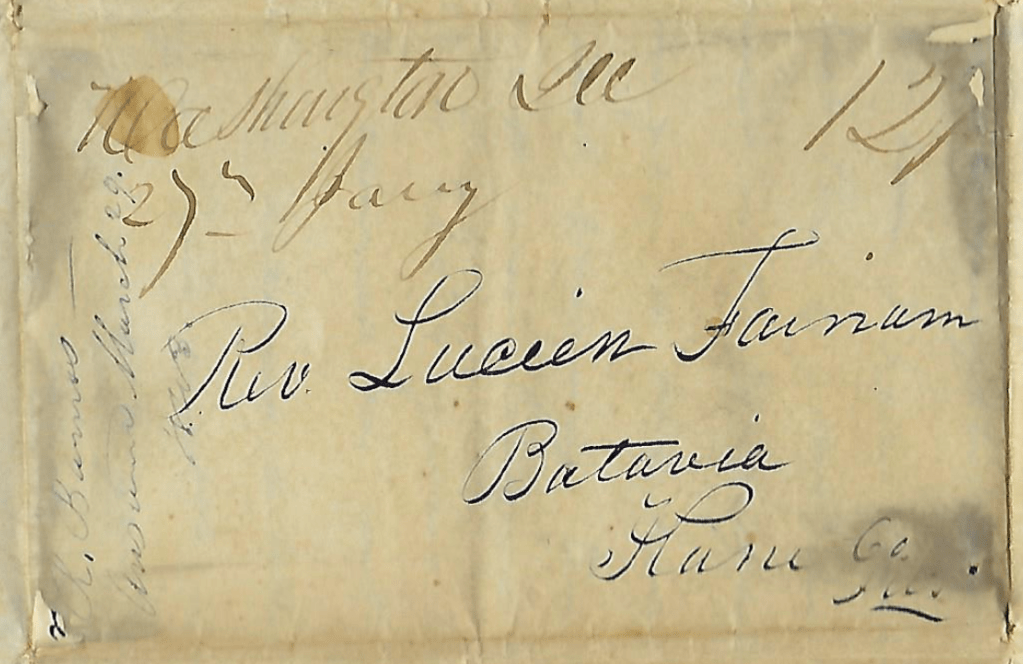
Addressed to Rev. Lucien Farnum, Batavia, Kane county, Illinois
Washington, Tazewell county, Illinois January 23, 1843
Dear Bro. Farnum,
Not long after you was here I made up my mind to leave this place. The church generally appear friendly to me & the Elders have frequently expressed the opinion that no more can be raised in this community without the sacrifice of principle, for any man that can be obtained, than for me. However this may be, one thing is certain—they do not do enough for me to justify me in continuing my labors under such a variety of discouragements.
What will be my duty, I know not. I cannot feel it to be my duty to go into a log cabin with my family as we did when our family was small. I cannot consider it to be duty to place my wife where her labors will be greater than they are at present. If you know of any place where we could be useful, please inform me. We should be glad to move early in the spring.
I am happy to inform you that we are at present in the midst of a very inter-revival in the neighborhood of Mr. [Moses] Morse‘s. For several weeks past, I have preached there every Sabbath & for the last three of four weeks. The presence of the Holy Spirit in the congregation has been very manifest. Some five or six have expressed hope in Christ & last evening ten or twelve new cases of seriousness were manifest—all youth from the age 12 to 23 or 24 years. Our prayer is may the work be carried on with great power.
Last week we received a letter from our friend in Conway [Mass.]. Their health was good as usual. They said that they wrote to you some time last summer but had received no answer. They were anxious to hear from you. My wife unites with me in love to you & yours. The children also wished to be remembered to their cousin Louisa. Please write soon.
These two letters were written by Dwight Whitney Marsh (1823-1896), the son of Henry Marsh (1797-1852) and Sarah Whitney (1796-1883) of St. Louis, Missouri. Dwight had several siblings; those mentioned in these letters include, Calvin “Waldo” Marsh (1825-1873), Elizabeth (“Lizzie”) Willard Marsh (1829-1882), and Clarissa (“Clara”) Dwight Marsh (1834-1899) who married Samuel Watkins Eager, Jr. (1827-1903). Dwight’s father was an attorney in St. Louis at the time of his death in 1852 at the age of 53.
Dwight was born in Berkshire county, Massachusetts, and graduated from Williams College in 1842. He studied theology at Andover Theological Seminary in 1842-3, and then taught school in St. Louis, Mo., from 1843 to 1847. He continued his theological training at Union Theological Seminary and graduated in 1849, after which he was ordained and sailed in December 1849 from Boston to Mosul, Turkey, as a missionary for the A. B. C. F. M. In 1852 he returned to the U.S. and married 19 October 1852 to Julia White Peck of New York City. He then returned to Mosul where his wife died in August 1859. He finally returned to the U.S. in 1860 and began a lecture tour on missionary life. He was married on 21 August, 1862, to Elizabeth L. Barron in Rochester and then accepted charge of the Rochester Young Ladies’ Female Seminary where he remained five years. While there, he also preached for the Wester House of Refuge. He then went on to serve in the pulpit of various churches in the midwest before his death in 1896.
Letter 1
Osburn House Rochester, New York Thursday, August 21, 1862
My own ever dear sister Lizzie,
I am very sorry that our marriage comes off so suddenly that you & Mother could not be present. I think of you all much. It is now about noon & we are to be married at 3:30 & at 9 shall be at the [Niagara] Falls if all goes well. We have a charming day & I wish you were here to share in our delight. How often in this life our affairs move differently from our anticipations. I think we are about to be happy; but only our Maker knows what trials of sickness or partings are in store.
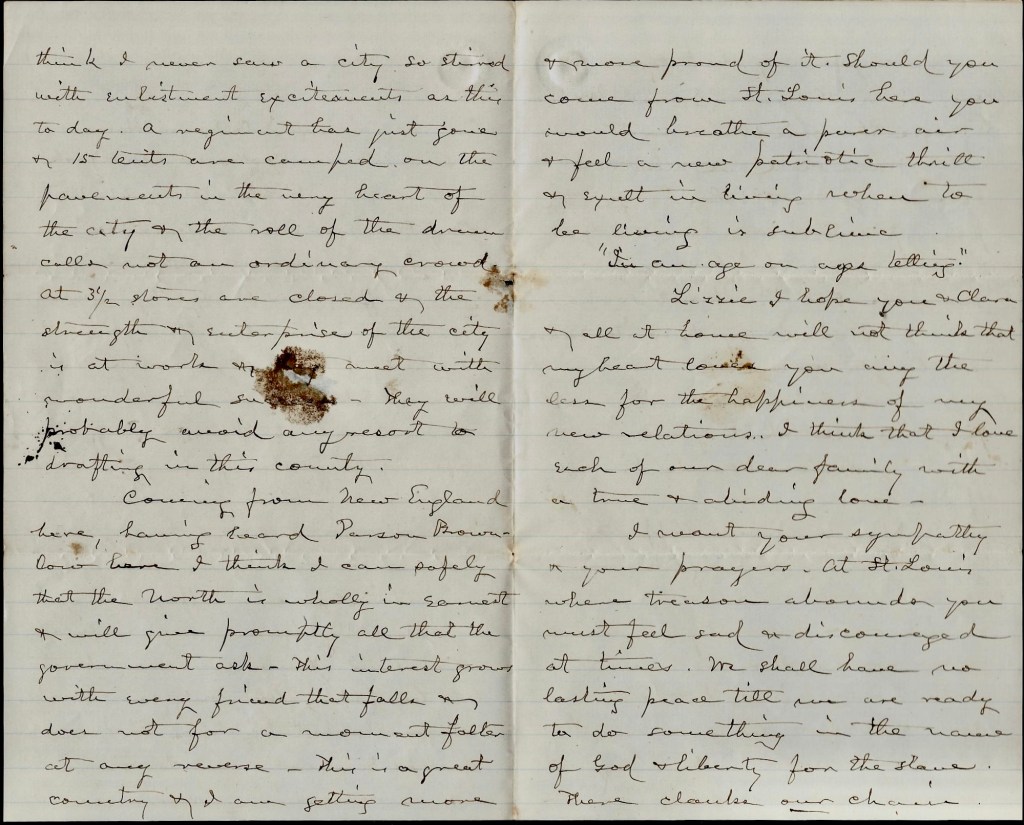
We are in war times. I think I never saw a city so stirred with enlistment excitements as this day. A regiment has just gone & 15 tents are camped on the pavements in the very heart of the city & the roll of the drum calls not an ordinary crowd. At 3:30 stores are closed & the strength & enterprise of the city is at work & will meet with wonderful success. They will probably avoid any resort to drafting in this county.
Coming from New England here, having heard Parson Brownlow 1 here, I think I can safely [say] that the North is wholly in earnest & will give promptly all that the government asks. This interest grows with every friend that falls & does not for a moment falter at any reverse. This is a great country & I am getting more & more proud of it. Should you come from St. Louis here, you would breathe a purer air & feel a new patriotic thrill & exult in living where to be living is sublime. “In an age on ages telling.”
“We shall have no lasting peace till we are ready to do something in the name of God & liberty for the slave. There clanks our chain.”
Rev. Dwight Whitney Marsh, 21 August 1862
Lizzie, I hope you & Clara all all at home will not think that my heart loved you any the less for the happiness of my new relations. I think that I love each of our dear family with a true & abiding love. I want your sympathy & your prayers. At St. Louis, where tiresome abounds, you must feel sad & discouraged at times. We shall have no lasting peace till we are ready to do something in the name of God & liberty for the slave. There clanks our chain.
Do give my best love to Anna & Clara & Sam & Waldo & kiss the children. When shall we meet? I cannot go to St. Louis for the present. I shall have to go look after Charlie again, as soon as October 1st, if not sooner. I shall try to write more at length soon. I hope Katy will not forget “Uncle Dwight.” Remembrance to all friends.
Your ever affectionate brother, — Dwight
1 William Gannaway Brownlow (1805-1877) was a preacher in the Methodist Church and a Tennessee newspaper editor. A Unionist despite owning slaves himself, Brownlow criticized the Confederacy even after Tennessee seceded. He was briefly imprisoned by the Confederacy at the beginning of the war. After leaving the state, he began a lucrative lecture tour in the North.
Letter 2
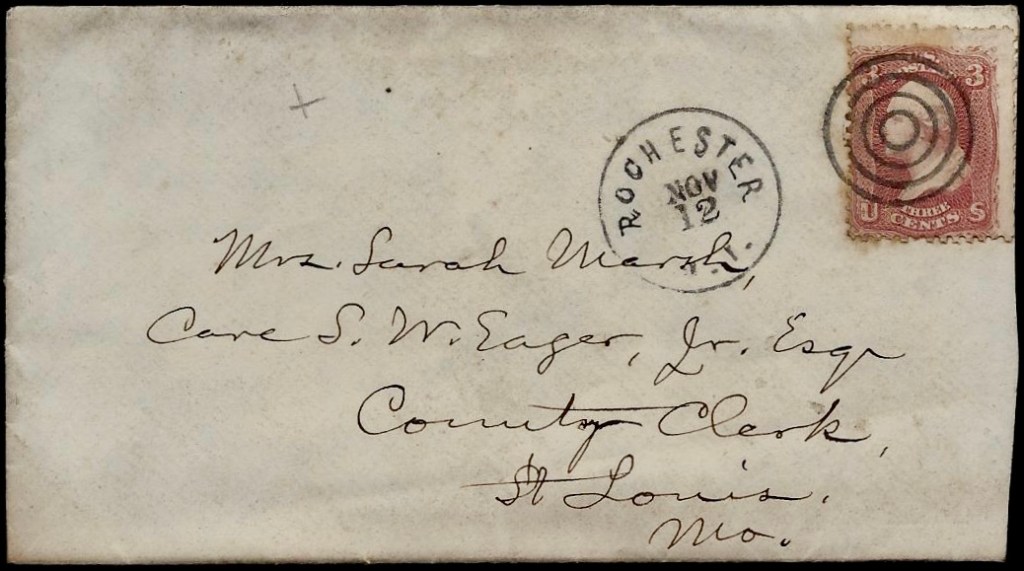
Addressed to Mrs. Sarah Marsh, Care of S. W. Eager, Jr., Esqr., County Clerk, St. Louis, Mo.
Rochester, New York Saturday, November 12th 1864
My own dearest Mother,
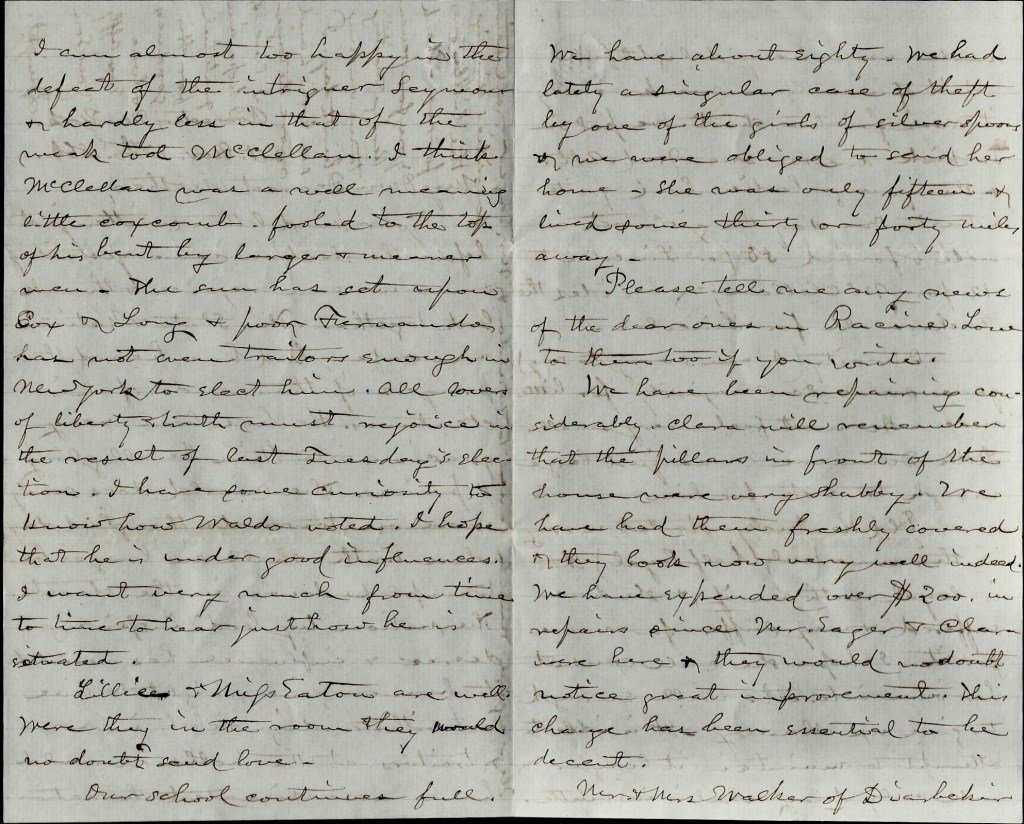
Your kind letter written just before election came yesterday & now we can rejoice & thank God together. This state and Nation are safe. God has heard the prayer of thousands of His creatures. He has been very gracious & to Him be all glory & praise. The world does surely move on towards the glad day when truth shall no longer be trampled down in the streets. The Nation, by God’s inspiring decree & influence, has asserted the heaven given rights to live notwithstanding rebels in arms & traitors at the polls would have assassinated the nation.
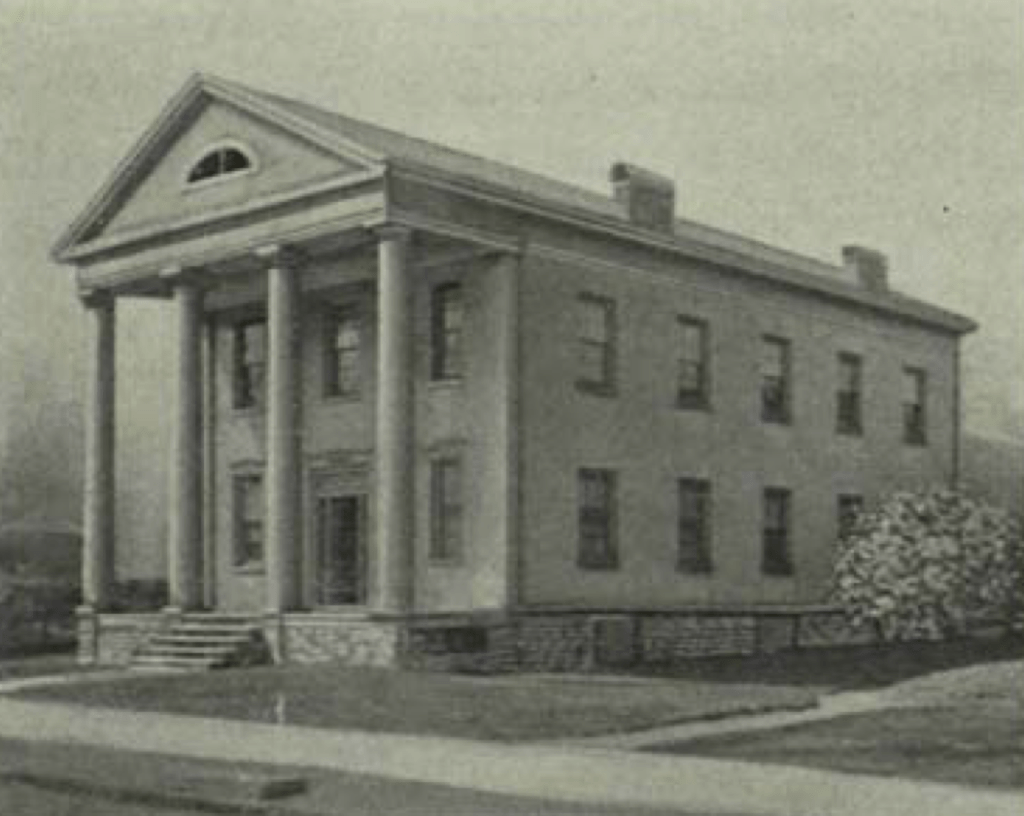
Rochester Female Seminary—pillars repaired in 1864
I am almost too happy in the defeat of the intriguer [Horatio] Seymour & hardly less in that of the weak tool McClellan. I think McClellan was a well-meaning little coxcomb—fooled to the top of his bent by larger and meaner men. The sun has set upon [Samuel S.] Cox & [Alexander] Long & poor Fernando [Wood] has not even traitors enough in New York [City] to elect him. All lovers of liberty & truth must rejoice in the result of last Tuesday’s election. I have some curiosity to know how [brother] Waldo voted. I hope that he is under good influences. I want very much from time to time to hear just how he is situated.
Lillie & Miss Eaton are well. Were they in the room, he would no doubt send love.
Our school continues full. We have about eighty. We had lately a singular case of theft by one of the girls of silver spoons & we were obliged to send her home. She was only fifteen & lived some thirty or forty miles away.
Please tell me any news of the dear ones in Racine. Love to them too if you write.
We have been repairing considerably. Clara will remember that the pillars in front of the house were very shabby. We have had them freshly covered and they look now very well indeed. We have expended over $200 in repairs since Mr. Eager & Clara were here & they would no doubt notice great improvement, This change has been essential to be decent.
Rev. Augustus Walker and his bride, Eliza Mercy Harding—Congregational missionaries to Turkey
Mr. & Mrs. [Augustus] Walker 1 of Diarbekir made us a very delightful visit of nearly a week—only it was too short. We put on Turkish dresses on Wednesday afternoon & the young ladies had quite a treat. One day the girls took a vote & found 58 for Lincoln to 12 for McClellan, & besides the teachers all for Lincoln.
Our city (I am sorry to say) gave some 80 majority for Little Mac. He must feel very small. Little Delaware was just large enough to vote for him.
Old Kentucky started wrong in this war (only half loyal)—that is, loyal with an if—and she has suffered & may suffer far more for it. I hope she will consult her own interests well enough to give up slavery. It is idle to attempt to maintain it longer & will only delay what is inevitable.
Please give much love to Waldo & Mr. Eager & all their families, kissing the little ones for me. Thank you for remembering & writing to me on my birthday. I see God’s hand more the longer I live & I hope am grateful for His goodness & love. Every affectionately your son, — Dwight
1 Rev. Augustus Walker and his wife, Eliza Mercy Harding, were missionaries to Diarbekir, Turkey, where they spent 13 years. They had six children, two of whom died in Turkey. Only one child, Harriet, was born in America during a furlough. In 1866 the Reverend Augustus Walker died of cholera in Turkey, and Mrs. Walker returned to America with their four children.




















 Spared & Shared 23