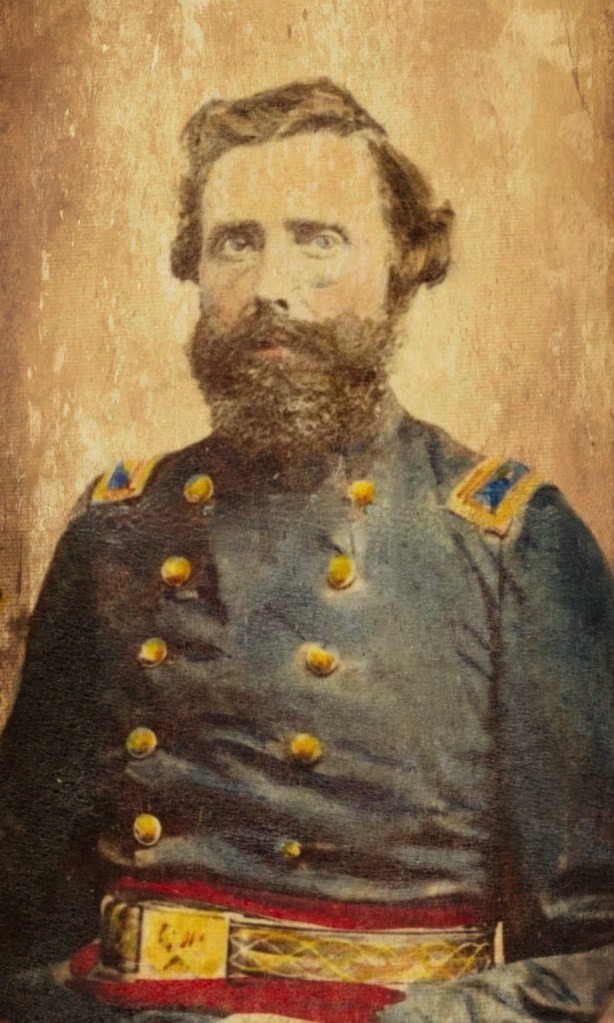
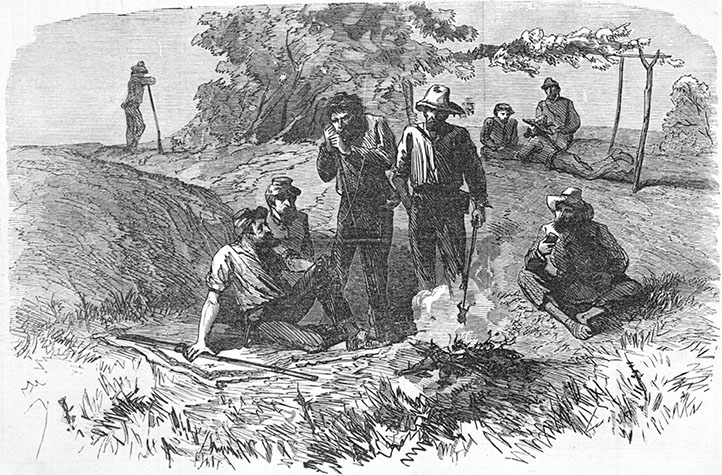
An unidentified Confederate believed to be South Carolina (Adam Ochs Fleischer Collection)
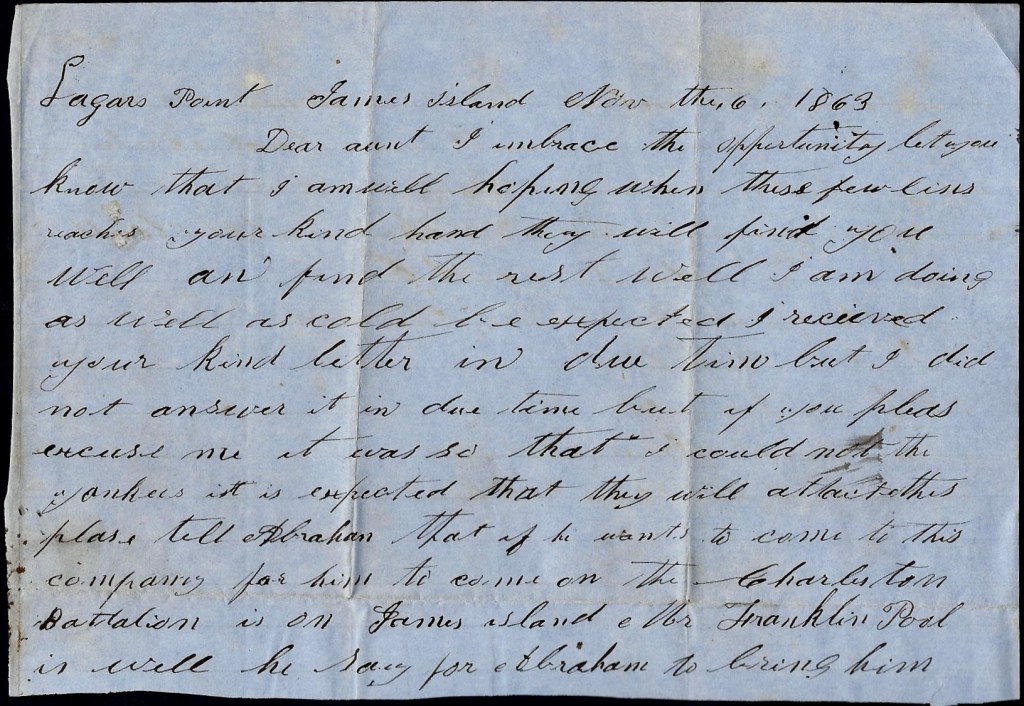
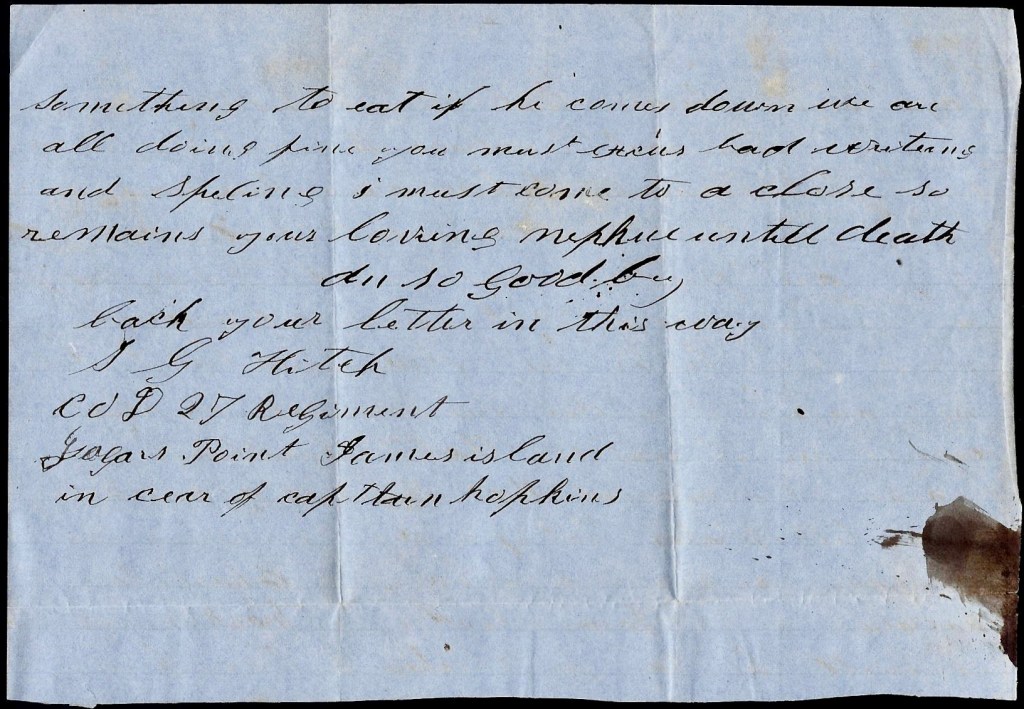
The following letter was written by Pvt. Silas “Green” Hitch (1847-1871) who served in Co. D (Sumter Guards), 27th South Carolina Infantry (formed in 1863 by merging the Charleston Battalion Infantry and 1st S. C. Sharpshooter Battalion). Green survived the war, despite suffering from chronic diarrhea for much of his service, married Elizabeth Pinson in 1866, and died five years later at the age of 24. He was the son of Joseph Allen Hitch (1822-1896) and Elizabeth Caroline Motes (1821-1900) of Laurens, Laurens county, South Carolina.
Green wrote his letter from Legare’s Point on the Stono River where Confederate troops were placed to guard the river approach to Charleston.
Transcription
Legare’s Point, James Island November 6, 1863
Dear Aunt,
I embrace the opportunity [to] let you know that I am well, hoping when these few lines reaches your kind hand, they will find you well and find the rest well. I am doing as well as could be expected. I received your kind letter in due time but I did not answer it in due time. But if you please excuse me, it was so that I could not. The Yankees, it is expected that they will attack this place.
Tell Abraham that if he wants to come to this company for him to come on. The Charleston Battalion is on James Island. Mr. Franklin Pool is well. He says for Abraham to bring him something to eat if he comes down. We are all doing fine. You must excuse bad writing and spelling. I must come to a close so i remain your loving nephew until death.
So goodbye. Back your letter in this way:
S. G. Hitch Co. D, 27th Regiment Legare’s Point, James Island In care of Captain [J. W.] Hopkins
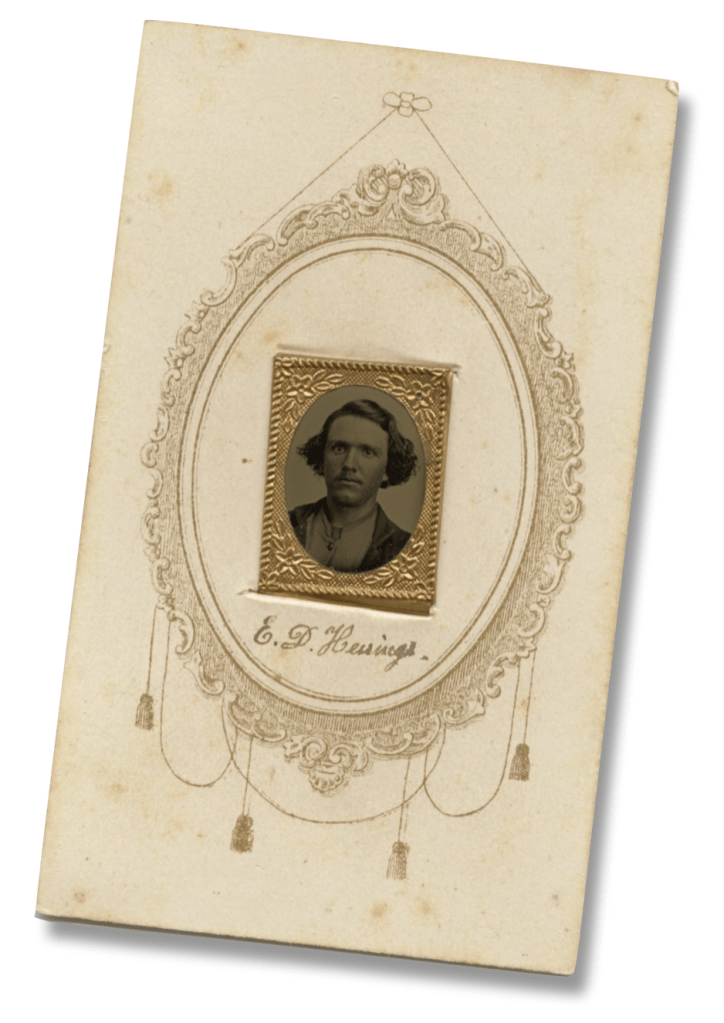
I could not find an image of Edward but here is a gemtype of Eber D. Herrings who began his service in the 10th Kansas Infantry(Kansas Historical Society)
The following letters were written by Sgt. Edward Williams of Co. E, 10th Kansas Infantry. Edward had enlisted in Co. E, 3rd Kansas Infantry under the command of the notorious jayhawker Col. James Montgomery, but when the regiment failed to raise the required number of men to form a regiment, they were combined with the 4th Kansas Infantry (also short recruits) and the consolidated unit was named the 10th Kansas Infantry and mustered in for three years service under Col. William F. Cloud.
These three letters describe in some detail the movements of the regiment as it saw its first action in company with the 2nd Ohio Cavalry on what has been called the Indian Expedition.
According to muster records, Edward enlisted on 23 July 1861 but he did not survive the war. He died of disease on 6 March 1864 at Alton, Illinois. At the time of his enlistment, he gave his residence as Mound City, Linn county, Kansas.
Companies A, B, C, D, E and F of the 3rd Kansas Infantry retained their original designation until the date of the consolidation. The members of the Third and Fourth Kansas Volunteers were accounted for in the new organizations to which they were transferred as though they had served with the last organization from the beginning of their original term of service, no reference being given to the fact that the first part of their service had been rendered as members of the Third and Fourth Kansas regiments, or that such regiments ever existed.
Edward wrote the letters to his sister Mary J. and her husband, Charles Payson or Paxson—I can’t be certain. More research would be required to identify this couple and their residence at the time. There are no accompanying envelopes.
[The following letters are from the private collection of Rob Morgan and were transcribed and published on Spared & Shared by express consent.]
Letter 1
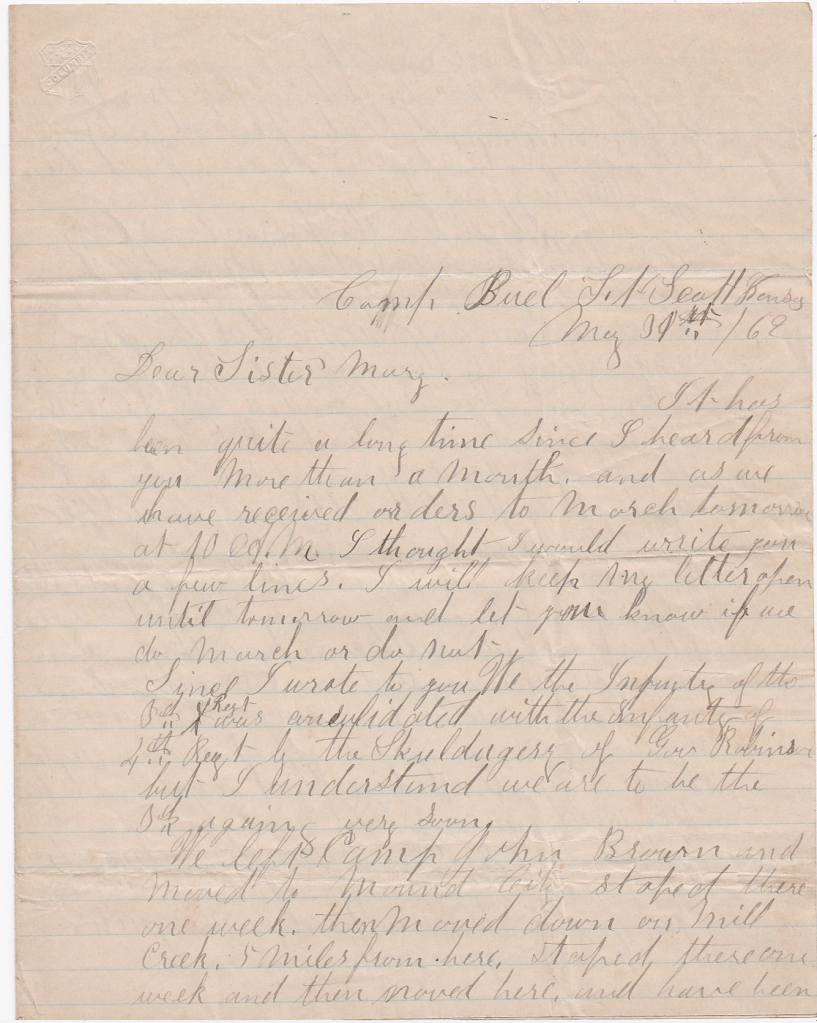
Camp Buel Ft. Scott, Kansas May 31st 1862
Dear sister Mary,
It has been quite a long time since I heard from you—more than a month, and as we have received orders to march tomorrow at 10 a.m., I thought I would write you a few lines. I will keep my letter open until tomorrow and let you know if we do march or do not.
Since I wrote to you, we, the infantry the 3rd Regiment, was consolidated with the infantry of 4th Regiment by the skullduggery of Gov. Robinson. But I understand we are to be the 3rd again very soon. 1
We left Camp John Brown and moved to Mound City. Stopped there one week, then moved down on Mill Creek, 5 miles from here. Stopped there one week, and then moved here, and have been here since—a little over 3 weeks.
James Montgomery was commissioned Colonel of the 3rd Kansas Infantry (New Hampshire Historical Society)
The boys are now hurrahing for Montgomery as they have heard that he had orders from the War Department to take his regiment wherever he can find them. I say three cheers for him.
You will address me for the present as Co. E, 10th Kansas Regiment via Mound City in care of Captain [John F.] Broadhead. If it’s sent in his care, there will be no danger of miscarrying if they change regiments every day.
Enclosed you will find a silver ring which I made. I send it to you not for the worth of the ring, but because I made it and I thought you would like it better on that account. I have worn it for more than a month on my right little finger and I have one on the left very near like it and we will compare them when you see me so that you may know me.
I had a letter from Mary Tucker a few days ago and in it was a note from Lizzie stating that she was to be married in about a week.
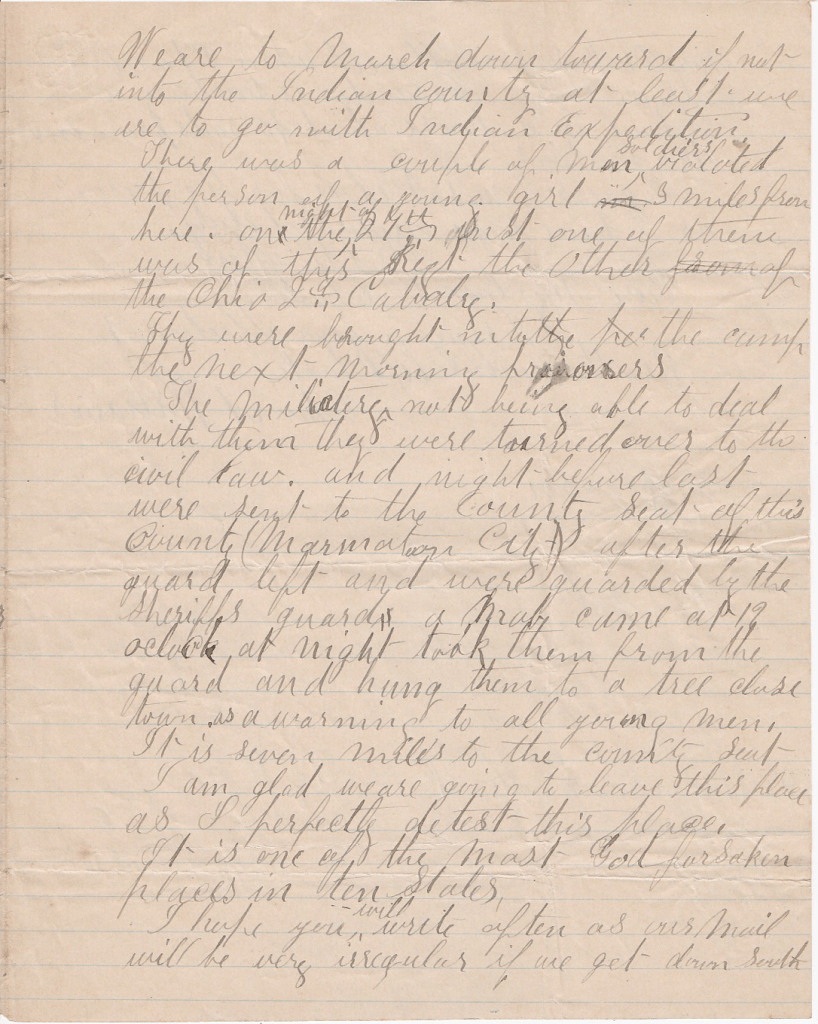
There is four companies ordered to march tomorrow—the four companies of the old 3rd. That looks to our speedy recognition as the 3rd regiment again. We are to march down toward—if not into—the Indian country. At least we are to go with [the] Indian Expedition.
There was a couple of soldiers violated the person of a young girl 3 miles from here on the night of the 27th instant. One of them was of this regiment; the other of the Ohio 2nd Cavalry. They were brought into the camp the next morning prisoners. The military not being able to deal with them, they were turned over to the civil law and night before last, were sent to the county seat of this county (Marmaton City). After the guard left and [they] were guarded by the sheriff’s guard, a mob came at 12 o’clock at night [and] took them from the guard and hung them to a tree close [to] town as a warning to all young men. It is seven miles to the county seat. 2
I am glad we are going to leave this place as I perfectly detest this place. It is one of the most God forsaken places in ten states.
Mr. Durbin’s were all well when I heard from them. Casandra is teaching a school in a house about 40 rods from Mr. Durbin’s.
I guess I must close for the present as I have to go on guard duty. Write often. Give my love to Charles. I remain your affectionate brother while life lasts. — Edward Williams
[To] Mary Paxson
June 1st. I understand it is to be a general move south from here of all the troops going from Kansas. We will have a train of over 100 wagons besides the company & regiment wagons. 9 a.m. Tents are struck ready to march. Hurrah for the Cherokee Country. — Ed Williams
1 The following article on the origins of the 3rd & 4th Kansas Regiments explains: “The Third and Fourth Kansas volunteer regiments were neither at any time complete organizations, and after the danger of an invasion by Price had passed recruiting for these organizations became very slow; the regiments being organized under state authority were securing most of the new enlistments. The new organizations presented more promising possibilities for position or promotion, and, beside, were cavalry regiments, and the experienced horseman of the West preferred to ride when an opportunity to do so was at hand. In the spring of 1862 the War Department ordered the reorganization and consolidation of the Third and Fourth Kansas regiments. This was done, the infantry companies forming a new regiment, thereafter known as the Tenth Kansas Volunteer Infantry. It would have been very proper to have designated the new consolidation as either the Third or Fourth Kansas Volunteers, instead of the Tenth, but both regiments thought their regimental designation the one to adopt, and to settle the contention, the next vacant number was assigned to the reorganization. The cavalry companies were transferred to the Fifth, Sixth and Ninth Kansas Cavalry regiments, and the artillery companies were consolidated into the First Kansas Battery.” For excellent full article, see The 3rd & 4th Kansas Vol. Infantry Regiments.
2 Under the title of History of Lynchings in Kansas, the lynchings of the two soldiers is listed as having taken place on 9 June 1862. They were identified only by their units: “2nd Ohio Cavalry and 10th Kansas.” Their crime: “Rape.”Almost all of the other lynchings in Kansas during those years were for stealing cattle or horses.
Letter 2
Camp Spring River on the Government Strip 1 mile south of the Kansas line June 26th 1862
Dear Bro & Sister,
I received your most welcome letter some 10 days since and should have answered it sooner but we marched from Ft. Scott the next [day] after receiving it and have been on the march since except two days, and as I am cooking for the mess, I got but very little time.
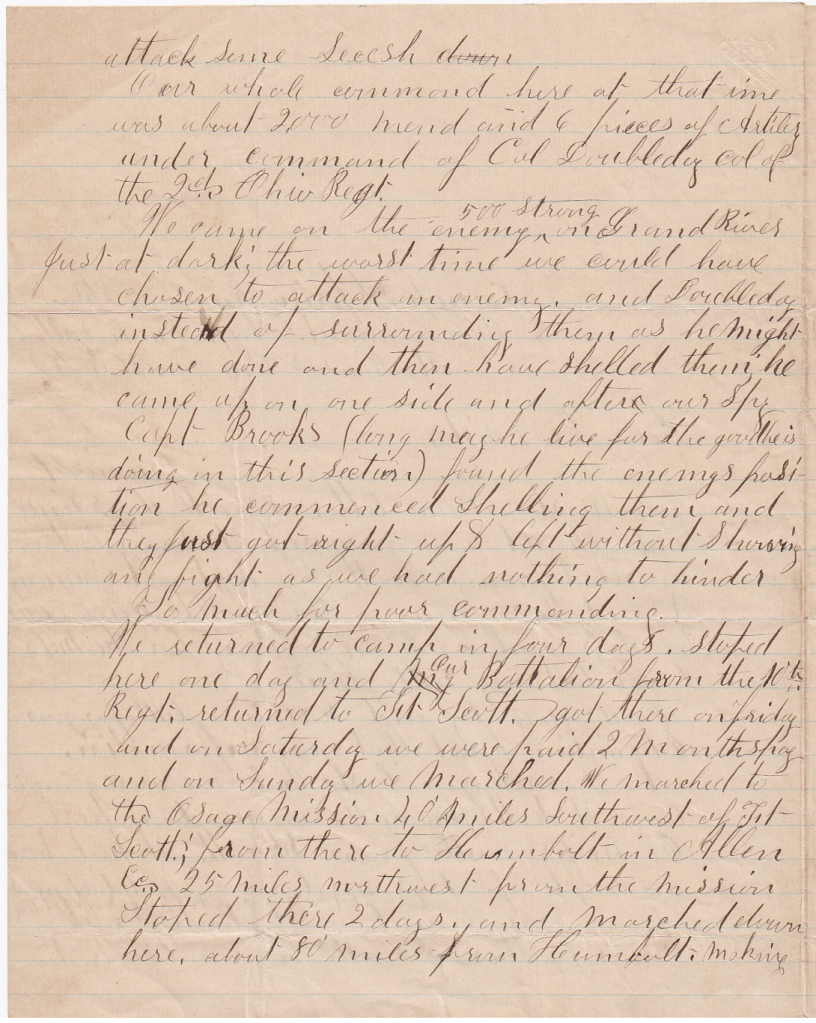
I will now try and scribble a little for your edification. If not that, them for] your information. As I wrote you last that we were going to leave Ft. Scott, we came down here 60 miles south from Ft. Scott, stopped here a couple of days, and then a detachment of our command, about 1000 men & 4 pieces of artillery, went down some 40 miles farther south on Grand River to attack some secesh. Our whole command here at that time was about 2000 men and 6 pieces of artillery under command of Col. Doubleday, Colonel of the 2nd Ohio Regiment.
We came on the enemy 500 strong, on Grand River just at dark—the worst time we could have chosen to attack an enemy, and Doubleday, instead of surrounding them as he might have done, and then have shelled them, he came up on one side and after our spy Capt. Brooks (long may he live for the good he is doing in this section) found the enemy’s position, he commenced shelling them, and they just got right up & left without showing any fight as we had nothing to hinder [his escape]. So much for poor commanding. 1
We returned to camp in four days. Stopped here one day and our battalion from the 10th Regiment returned to Ft. Scott. Got there on Friday, and on Saturday we were paid 2 months pay, and on Sunday we marched. We marched to the Osage Mission 40 miles southwest of Ft. Scott. From there to Humboldt in Allen Co., 25 miles northwest from the mission. Stopped there 2 days and marched down here about 80 miles from Humboldt, making all some 300 miles since the 1st of of June. We have here forces as follows: 2 batteries 6 pieces each, the 9th Wisconsin Infantry, 2 the 2nd Ohio Regt. (Cavalry), 4 companies of the 9th Kansas Regt. (Cavalry), the 10th Kansas Regt. Infantry, and 2 Regts. of Indians—one cavalry & the other infantry. In all, 2000 Indians & near 3000 white soldiers. We are in what is termed the Indian Expedition. There has gone out 300 infantry and the same of cavalry and 2 pieces artillery to have a little skirmish. I hardly think they will get any.
When we move from here or how long we stop here, I cannot say but I think when you hear from me next I will be under my old Col. (Col. Montgomery). Things are working in that direction. You will direct to me for the present in Co. E, 10th Kansas Regt. via Mound City, in care of Capt. Broadhead.
We are having a very dry time—almost bordering on a drought—and if we do not have rain soon, crops will be injured. We had a nice shower last evening but the ground was so dry that it done but very little good. Wheat is quite good and is being harvested.
Capt. Young Black Dog of the Osage Battalion who fought with the 10th Kansas Vols.
The Indians have given us a couple of war dances since we have been with them. The Osage Mission is a little village made the headquarters of the Osage Indian Nation. It is on the Neosha River. There is about 500 of the Osage Indians in our Indian Regiment. I must close for the present as I have to help get dinner and then go out on guard.
Excuse my hurried epistle as I look over all mistakes. I will quit cooking in 5 days more and then I will have more time to write. I remain as ever your brother—Edward Williams
Charles Paxson
Mary J Paxson
1 This expedition was described in The 10th Kansas Volunteer Infantry as follows: “The first action noted is the attachment of four companies of the 10th being assigned to the 2d Ohio Cavalry. This expedition formed for the purpose of attacking a force under the notorious Col. Waitie, of the 1st Cherokee Rebel Regiment. The command was all cavalry and artillery. The men of the 10th were compelled to keep pace with the cavalry in the burning sun keeping 30 miles a day and marching 120 miles to be before the rebels camp ready and willing to attack the enemy. Another testament to the “true metal” of the 10th. Marching from Fort Scott to the Osage Mission, and from the Mission to Humboldt, and then with 4 companies of the 9th, the Indian Regiments, and the 1st Kansas Battery marched to the Neosho River and thence to Baxter’s Springs. From Baxter’s Springs, now also with Solomon’s Brigade, marched to Cowskin Prairie. With the purpose of engaging the forces of Waitie, the advanced Brigade skirmished with the rebels. This failed to bring on a general engagement with the badly frightened rebels who fled in great confusion to the south.”
2 The 9th Wisconsin Infantry was raised in Milwaukee in the fall of 1861. It consisted predominantly of recent immigrants from German-speaking countries. An article appearing in the Muscatine weekly Journal on 23 May 1862 described the camp of the 9th Wisconsin at Fort Scott as “beautiful…in the streets of which are to be seen beautifully arranged flower beds, planted with a variety of early flowers and their tents variously and beautifully decorated…From the pains taken by the German to beautify and adorn their homes, it is evident they expect to rremain here for a time. Acting Brigadier General Doubleday is in command of the post. The forces there are the Wisconsin 9th, Ohio 2nd Cavalry, and Rabb’s Indiana Battery. Camp Marmaton is five miles northwest of the Fort, on the south side of Mill Creek, in a beautiful and healthy situation.”
Letter 3
Camp on Horse Creek 1 mile west of Grand River Cherokee Country July 3d 1862
Dear Sister Mary,
Your letter of the 13th of June was gladly received by me day before yesterday and I was very glad to hear from you and to hear that you were well. I thank you very much for that likeness. I will have to say for your encouragement that you have got a very good looking man for a husband—much better than I had expected you had got.
Since I wrote to you, I think we were at Humboldt. At the time of writing we came down from Humboldt to the Osage Mission, from there to the camp on Spring River, from Spring River down to Grand River, 40 miles farther south, and our present camp is 25 miles down the Grand River. Our yesterday’s march, my company and two other companies of the 10th Regiment remain here today. As an expedition went out yesterday or last night and 7 wagons went out from our regt. to carry the infantry that went with the expedition. The expedition was to take in some secesh 15 miles from here. I have not heard from them.
Since we left Ft. Scott the 1st of June, we have marched over 400 miles. We have four regiments of white men and two regiments of Indians & 12 pieces of artillery. Will have in a little more time 4000 men more & 12 more pieces of artillery. We will go down as far as Ft. Gibson & Ft. Smith and I do not know how much farther. Ft. Gibson is 35 miles from here in the Indian Country & Ft. Smith is about 80 miles in the edge of Arkansas. We can hear of secesh and see the signs of camping but to get a fight seems almost impossible.
Old [James Spencer] Rains is said to be figuring here and in the western border of Arkansas and the corner of Missouri 5000 or 6000 strong but we do not get a fight with him yet.
We are having quite a dry time but not as dry as it was. The dry year crops will be very good. I have seen some nice pieces of wheat. I saw some of the handsomest county yesterday and night before last that I have seen in a long time. It was really beautiful and then the soil was deep, would compare with any country. Plenty of good timber and good water but it is Cherokee Country.
Do not worry about me for I never enjoyed myself any better in my life but still I should like to be out so as to visit some of my friends, but while on a march I see new scenery enough to interest me so do not worry for me but remember me.
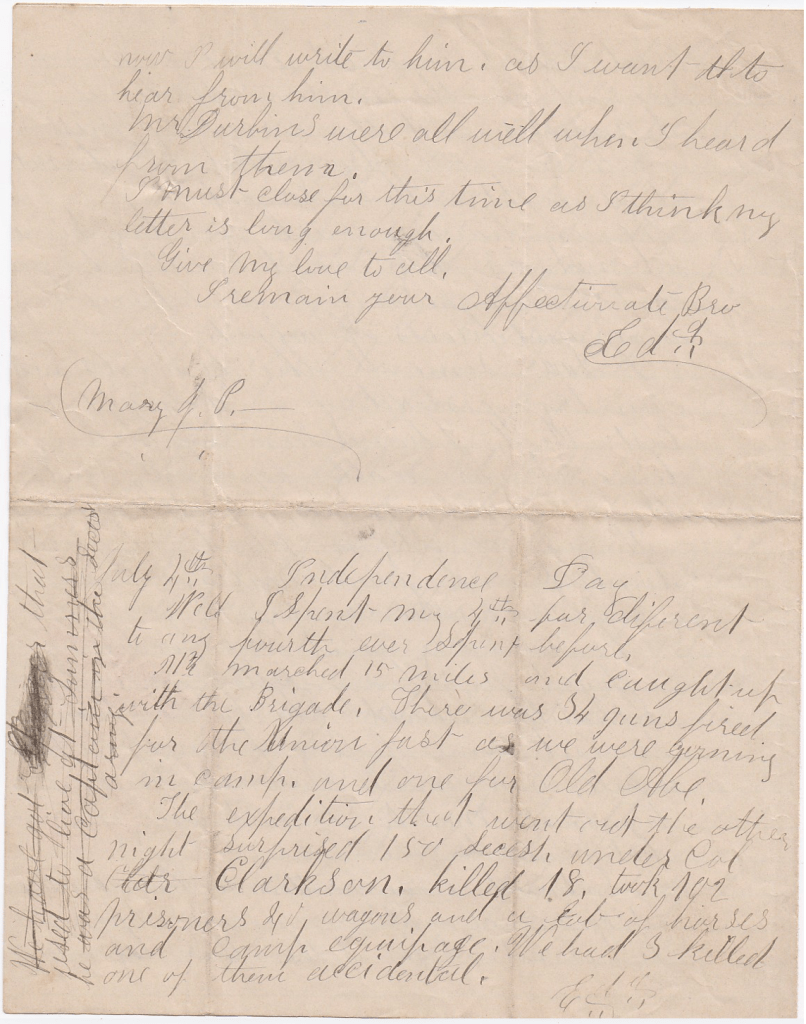
I should have written to Henry on this but he said he would give me his address which he has not. I got it the other day and now I will write to him as I want to hear from him. Mr. Durbins were all well when I heard from them. I must close for this time as I think my letter is long enough.
Give my love to all. I remain your affectionate bro—Ed’d
Mary J. P.—
July 4th Independence Day
Well I spent my 4th far different to any fourth ever spent before. We marched 15 miles and caught up with the brigade. There was 34 guns fired for the Union just as we were coming in camp and one for Old Abe. The expedition that went out the other night surprised 150 secesh under Col. Clarkson. Killed 18, took 102 prisoners & 40 wagons and a lot of horses and camp equipage. We had 3 killed, one of them accidental. 1
Ed’d
1 From the regimental history: “After a couple of days they marched south with Weer’s Division in the direction of the rebel Clarkson’s camp, hoping to surprise that precious cut-throat and his ragamuffins. A detail was formed and marched all night arriving before the rebel camp about sunrise on the morning of July 3d, 1862. The enemy was situated on a hill, the ascent being steep and rocky, and the only practicable road being a narrow track leading up on the south side. Weer, however, determined to throw his forces around the hill in order to capture the enemy if possible. The two companies of the 9th were moved to the northeast side, the 1st Indian Home Guard to the south and southeast, and the infantry of the 10th, supporting the 1st Kansas Battery, was ordered, after the artillery was found not to be of much service, owing to the abrupt rising of the ground, to fix bayonets and charge upon the enemy’s camp from the west. The attacking column coming from the west, the 9th and Indians being mounted, swept around on each side of the hill, driving the pickets, and then charged up the heights, while the command of the 10th, leaving a few Indians to support the artillery, charged up the western side of the heights, almost completely enveloping the enemy’s camp. Had it not been for the extremely rugged condition of the ground, and the density of the woods on two sides, the whole rebel command, amounting to about seven hundred, would have been captured. At the first dash, the enemy fired one round, and then broke in hopeless confusion over the two rough sides of the hill. Sixty or seventy of the rebels were killed or wounded, mostly killed, for the loyal Indians having but little quarter for their rebel brethren, and one hundred and fifty-five, including Col. Clarkson, their leader, taken prisoners, besides a large amount of camp and garrison equipage. The 10th’s loses were light with only a few men wounded.”
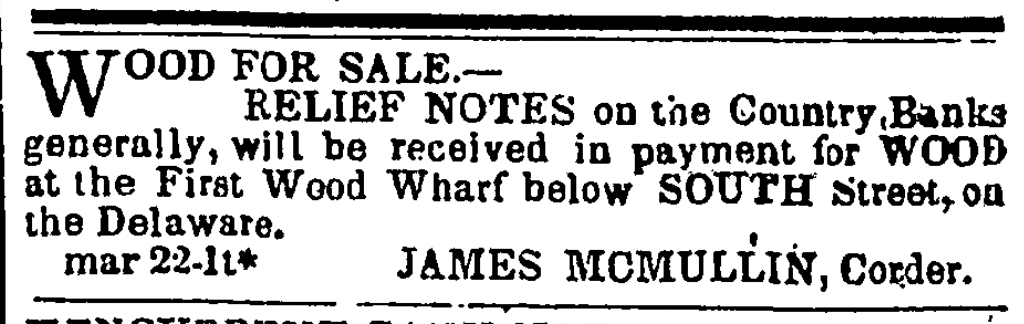
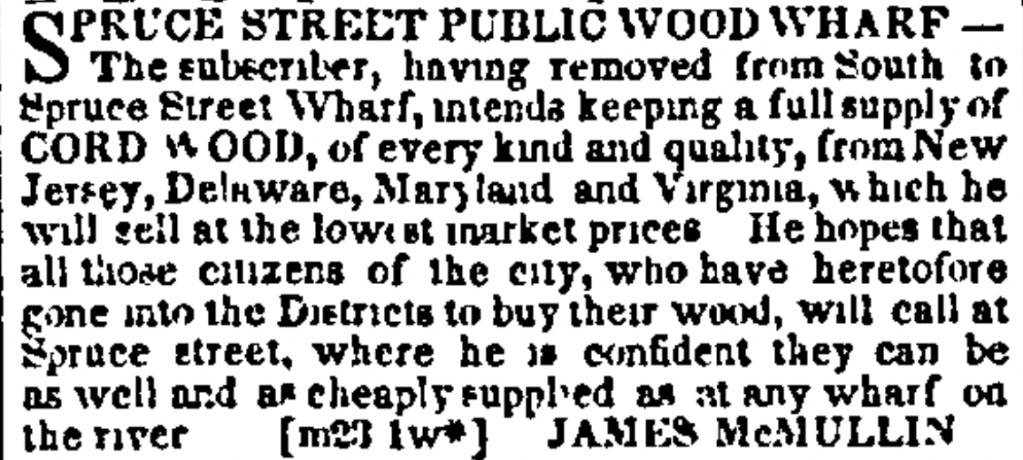
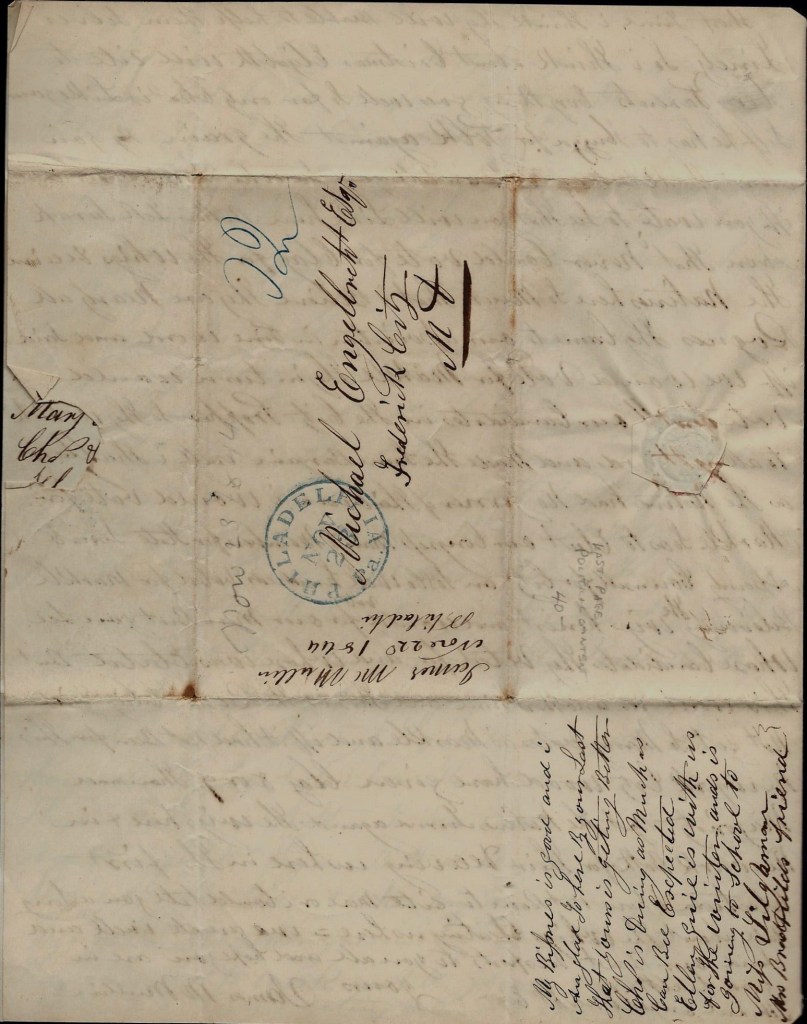
The following 1844 letter was written by James McMullin (1810-Aft1853)—a wood corder and local politician of Philadelphia, Pennsylvania. He wrote the letter to his sister Rebecca (McMullin) Engelbrecht (1802-1847) and her husband Michael Engelbrecht (1792-1886) in Frederick, Maryland. Rebecca and Michael were married in Philadelphia in August 1838.
James’ advertisement for the sale of cordwood, The Daily Chronicle, 22 March 1842
James’ advertisement in the Public Ledger, 29 March 1844
This letter was written during the “Native American” Movement of 1844 which culminated in riots in Philadelphia. Those born in American, who referred to themselves as “Nativists” were generally opposed to foreign emigration, particular the Irish Catholics.
Transcription
Stampless cover addressed to Michael Engelbrecht, Frederick City, Maryland Postmarked Philadelphia, PA
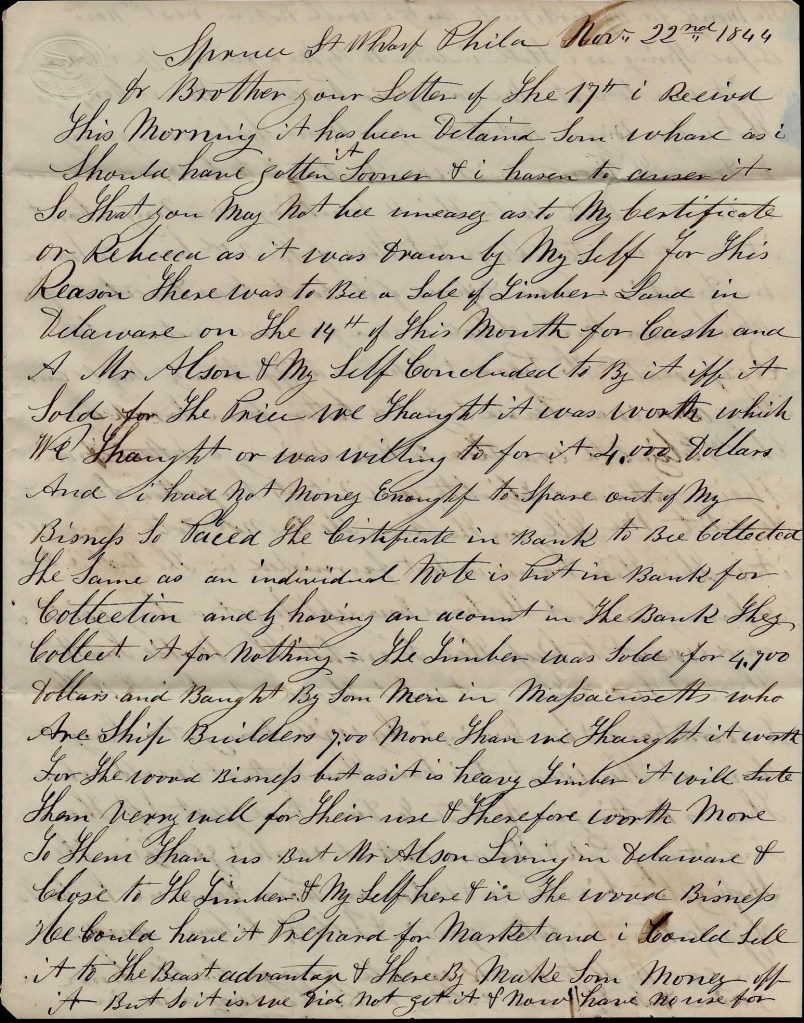
Spruce Street Wharf Philadelphia, Pennsylvania November 22nd 1844
Dear Brother,
Your letter of the 17th I received this morning. It has been detained somewhere as I should have gotten it sooner & I have to answer it so that you may not be uneasy as to my Certificate or Rebecca as it was drawn by myself for this reason. There was to be a sale of timber land in Delaware on the 14th of this month for cash and a Mr. Alson & myself concluded to buy it if it sold for the price we thought it was worth which we thought, or was willing to [pay] for it 4000 dollars. And I had not money enough to spare out of my business so asked for the Certificate in Bank to be collected, the same that an individual Note is put in bank for collection, and I having an account in the bank, they collect it for nothing. The timber was sold for $4,700 dollars and bought by some men in Massachusetts who are ship builders—700 more than we thought it worth for the wood business, but as it is heavy timber, it will suit them very well for their use & therefore worth more to them than us.
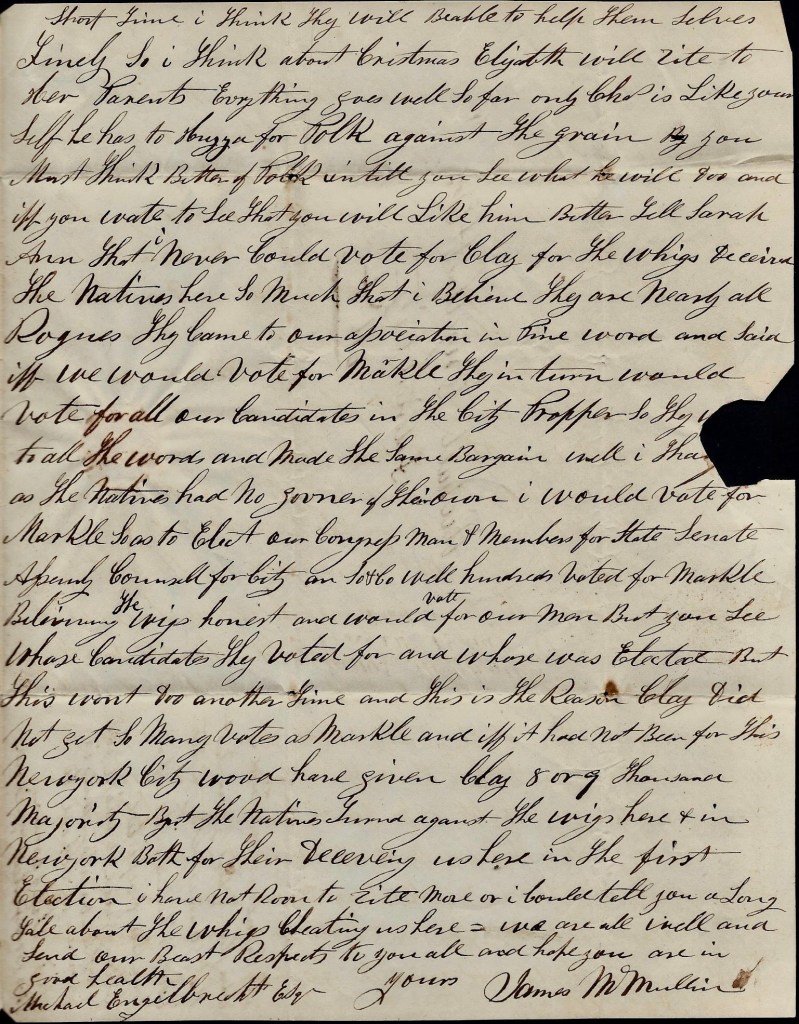
But Mr. Alson, living in Delaware and close to the timber & myself here & in the wood business, he could have it prepared for market and I could sell it to the best advantage & thereby make some money off it. But so it is, we did not get it and now I have no use for the money for my Certificate, but I will not invest it now before spring as I still intend to buy me a farm if I can get one to suit me for a fair price. I must confess that I done wrong in not telling you that I was going to draw the money as it was natural to suppose you or Rebecca or both might think something was wrong about it. Your package and letter of the 3rd came to hand in due time and I disposed of its contents as directed for which I am much obliged to you for I intend to reciprocate the present so soon as an opportunity may occur. Mary Ann was pleased to get a letter from Sarah Ann. Charles & Elizabeth was pleased to their receiving a letter from their father and Elizabeth will write to her father soon. And here let me tell you the reason she has not wrote long ago. It is this. Their house is not furnished in the best, I do assure you, but they have enough to get along with and I want to keep them so until they make something themselves & then get what they want. So I tell them to work hard and be saving & they will soon get along & have all they want. So I have them both at work when there is nothing in the store to do. I have just left there and it is 7 p.m. and they are both at work & George is in the shop getting his lesson & when any person comes in, he calls his father, goes in and sells if he can. Then goes back to work until George calls him again & so they are getting along in this way and in a short time I think they will be able to help themselves finely. So I think about Christmas Elizabeth will write to her parents.
James’ name appears among those accused of being foreigners and Catholics, which he was not. “Nativists” at the time meant, those born in America.The Pennsylvanian, 11 October 1853
Everything goes well so far—only Charles is like yourself, he has to Huzza for Polk against the grain. You must think better of Polk until you see what he will do and if you wait to see that, you will like him better. Tell Sarah Ann that I never could vote for Clay for the Whigs deceived the Natives here so much that I believe they are nearly all rogues. They came to our association in Pine Wood and said if we would vote for Markle, they in turn would vote for all our candidates in the city proper. So they went to all the wards and made the same bargain. Well, I thought as the Natives had no Governor of their own, I would vote for Markle so as to elect our Congressman & members for State Senate Assembly Council for City and &c. Well hundreds voted for Markle believing the Whigs honest and would vote for our man but you see whose candidates they voted for and whose was elected. But this won’t do another time and this is the reason Clay did not get so many votes as Markle and if I had not been for this New York City, would have given Clay 8 or 9 thousand majority. But the Natives turned against the Whigs here and in New York both for their deceiving us here in the first election.
I have not room to write more or I could tell you a long tale about the Whigs cheating us here. We are all well and send our best respects to you all and hope you are in good health. Yours, — James McMullin
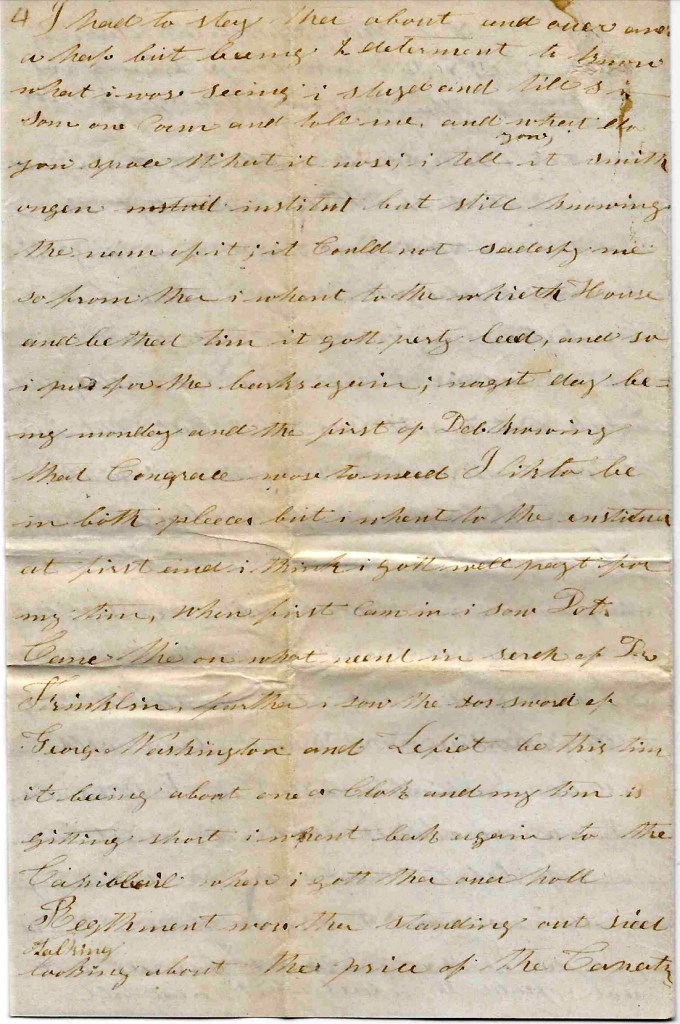
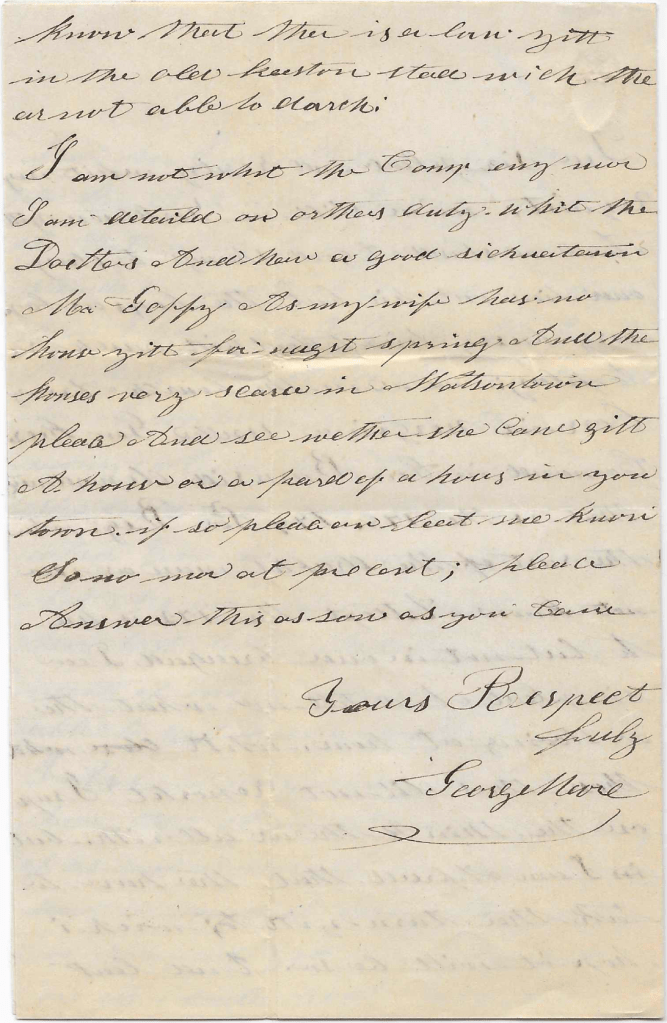
The following letters were written by George More (1827-1922), a native of Denmark, who was living in Danville, Montour county, Pennsylvania, when he was drafted as a private on 4 November 1862 in Co. G, 178th Pennsylvania Infantry. This regiment was recruited in the counties of Columbia, Lancaster, Montour and Luzerne and rendezvoused at Camp Curtin, Harrisburg, in the autumn of 1862, where it was organized and mustered into the U. S. service for a term of nine months. On Dec. 5, it left camp for Washington, was ordered to Newport News and thence to Yorktown, where it was posted during the winter. In April, 1863, the regiment went to the relief of the troops at Fort Magruder, who were attacked by Gen. Wise, and in June joined in an expedition to Providence ferry and the movement toward Richmond, which skirmished with the enemy at Bottom’s bridge on July 2. After returning to Washington its term of service expired and it was mustered out at Harrisburg on July 27, 1863.
From the letters we learn that George was married at the time he entered the service. His wife’s maiden name was Sarah Snyder. After the war he relocated to Oregon. He was buried in Roseburg, Oregon.
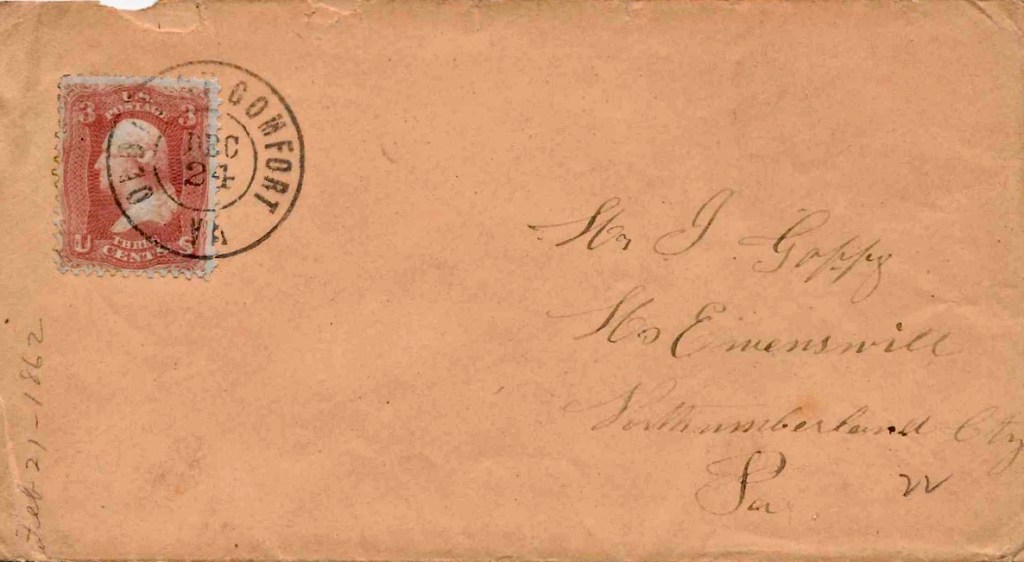
I can’t be certain of the addressee though I’m confident it was mailed to McEwensville, Northumberland county, Pennsylvania.
It should be noted that George’s command of the English language was poor and the handwriting was very difficult to decipher. I’ve done the best I could.
To read letters by two others members of the 178th Pennsylvania that I previously transcribed and posted on Spared & Shared, see: Charles Fraser, Co. B, 178th Pennsylvania (Union/7 Letters) Edwin Musser, Co. B, 178th Pennsylvania (Union/4 Letters)
[Note: These letters are from the personal collection of Greg Herr and were transcribed and published on Spared & Shared by express consent.]
Letter 1
Addressed to Mr. J. Goppy, McEwensville, Northumberland county, Pennsylvania
Yorktown [Virginia] December 21, 1862
Mr. Goppy Dear Sir,
As it is Sunday today and not much going on in camp, I take the opportunity to pen you these few lines for I know that you folks at home are always glad to hear from the seat of war, or rather from Dixie Land as you folks calls it. So I will tell you a little something of what I have seen in my short time.
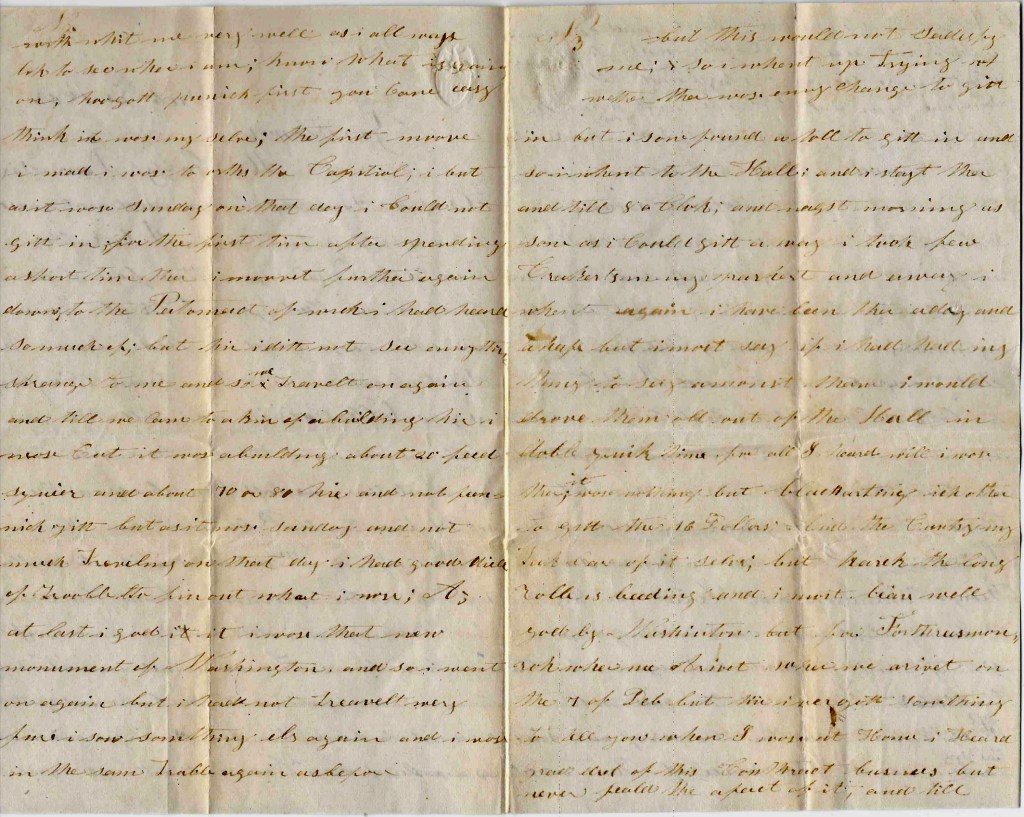
We left Harrisburg on the 4th of December, from there to Baltimore, from there to Washington where we arrived on the 7th of December in the afternoon. From Harrisburg to Washington, I still dis not see much of importance to me. As we arrived in Washington we were put into the barracks and [then] got orders not to be in them by a severe punishment. As a matter of course it dod not agree with me very well as I always look to see where I am; know what is going on, have got punished first. You can easy think it was myself.
The first move I made I was towards the Capitol, but as it was Sunday on that day, I could not get in for the first time. After spending a short time there, I moved further again down to the Potomac of works I had heard so much of, but here I did not see anything strange to me and so we traveled on again until we came to a kind of a building. It was a building about 20 feet square and about 70 or 80 high and not finished yet. But as it was Sunday and not much traveling on that day, I had a good deal of trouble to find out what it was. At last I got it. It was that new monument of Washington and so I went on again. But I had not traveled very far [when] I saw something else again and I was in the same trouble again as before. But this would not satisfy me so I went up trying whether there was any change to get in, but I soon found a toll to get in and so I went to the Hall and I stopped there until 8 o’clock, and next morning as soon as I could get away, I took a few crackers in my pocket and away I went again. I have been there all day and a half but I must say if I had anything to say amongst them, I would drove them all out of the Hall in double quick time for all I heard. Well, I wrote that it were nothing but blackguarding in order to get the 16 dollars and the country may take care of itself.
But hark! the long roll is beating and I must be on. Well goodbye Washington for Fortress Monroe where we arrived on the 7th of December but I never got something to tell you when I was at hoe. I heard a great deal of this contract business but never felt the affect of it until I had to stay there about [ ] but being determined to know what I was seeing I stayed until someone came and told me, and what do you suppose what it was? I’ll tell you. It was the Smithsonian Institute. But still knowing the name of it, it couldn’t satisfy me, so from there I went to the White House and by that time, it got pretty late and so I put for the barracks again. Next day, being Monday and the first of December, knowing that Congress was to meet, I like to be in both placed but I went to the Institute at first and I think I got well paid for my time.
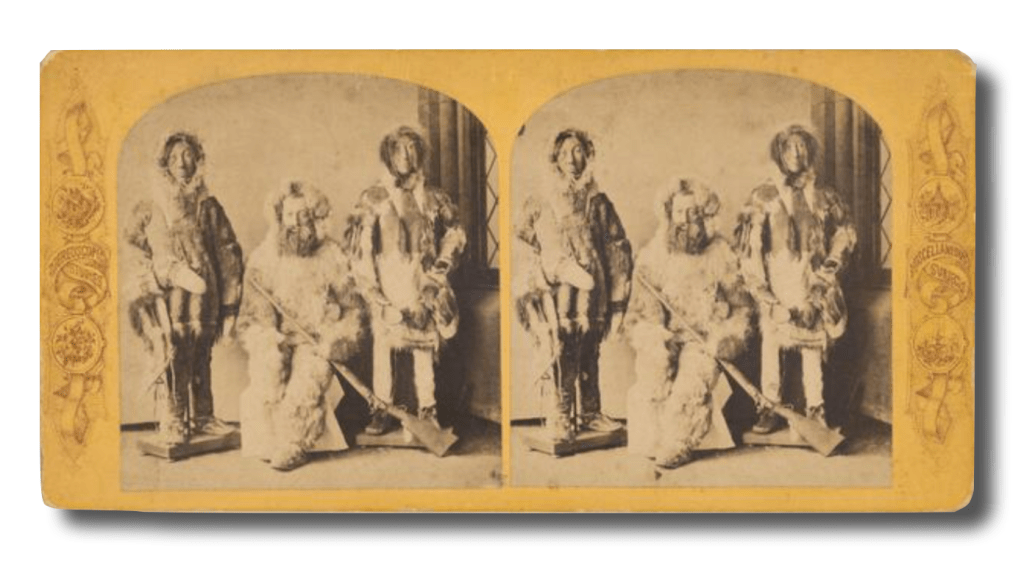
The Smithsonian’s Exhibit on Dr. Kane
When first I came in, I saw Dr. [Elisha Kent] Kane, the one who went in search of [polar explorer] Dr. [John] Franklin. Further I saw the sword of George Washington and Lafayette. By this time, it being about one o’clock and my time is getting short, I went back again to the Capitol. When I got there their regiment was there standing outside talking about the price of the [ ].
I got to Washington. When we got here we had to board in the barracks boarding house where a whole regiment eat at one time. Now we all know the government allows us 40 cents per day but all we got was about 5 ounces of bread and a cup of coffee 3 times a day which did not cost them over 20 cents a day, so I think I felt this contracting business is pretty hard. But we must leave it now as it is and leave Washington behind us and look for the better to come. I didn’t see much in importance to me—only a few ironclad steamers and a few gunboats, that is all. From here we went to Newport News. The first thing I saw it was the little Monitor, or Cheesebox as they call it here, and I counted 8 ironclads more and something like 30 to 35 gunboats.
Newport News is a town of about 8 or 10 dwelling houses but the inhabitants have all left for Dixie Land and all you can find here are their darkies. The land here is very [poor even] if they would take care of it. It is all sandy soil, just like your river bottom and there is about a thousand soldiers in the field where our camp…We stayed here only 5 days and went to Yorktown where we are now. I tell you, when we got to Newport News, it was very warm—so warm that we had to take off our over coats by drilling and a good many of our men got sick, they not being use to the weather…
I am informed by my wife that Mr. C. Wagner did not do as he agreed to. What the cause may be of this, I do not know…Mr. Goppy, you would like to know what to do. I want you to take charge of the 750 dollars which belongs to my wife and I leave the whole matter to you, hoping that you will do the same for my wife as if you was doing it for yourself, and I shall be satisfied….
So no more at present. Please answer this as soon as you can.
Direct your letter to George More, 178th Pennsylvania Regiment, Company G, in care of Capt. Adams, Washington D. C.
Letter 2
Yorktown [Virginia] January 14, 1862
Mr Goppy, dear sir,
I duly received your letter [and was] glad to hear that you are all well and happy at home. For my part, I must say that I am well and hearty. Again, as ever, I was surprised to see in your letter that Charley Wagner had come at last to pay that money. I for myself had given up the sheep for that purpose, but still I am surprised as it is and leave the whole matter with you knowing that you will attend to it as well and better than what I could. You told me in your letter that you would invest it for my wife. Please do so…
We are still in Yorktown yet and we stand a good chance to stay our time out here. But the boys are keeping very busy here and don’t get much time to play. We are in the Fourth Army Corps in Virginia under Gen. Keyes’ command in Gen. Burnside’s Department—that is, the 178th, 179th Pa. Regt. Where the rest of the drafted men are, I do not know, except the 172nd is here too but not in our Brigade.
Dear sir, please tell me what they are doing at home with those that did not report. I suppose they think they are all right but I am afraid that they have to take their turn yet, which I hope it will be so, and that there is a law yet in the Old Keystone State which they are not able to dodge.
I am not with the company anymore. I am detailed on other duty with the doctors and have a good situation. Mr. Goppy, as my wife has no house yet for next spring, and the houses very scarce in Watsontown, please see whether she can get a house or a part of a house in your town. If so, please let me know. So no more at present, please answer this as soon as you can.
Unidentified Lt. in Confederate Cavalry Uniform (Alabama Digital Collections)
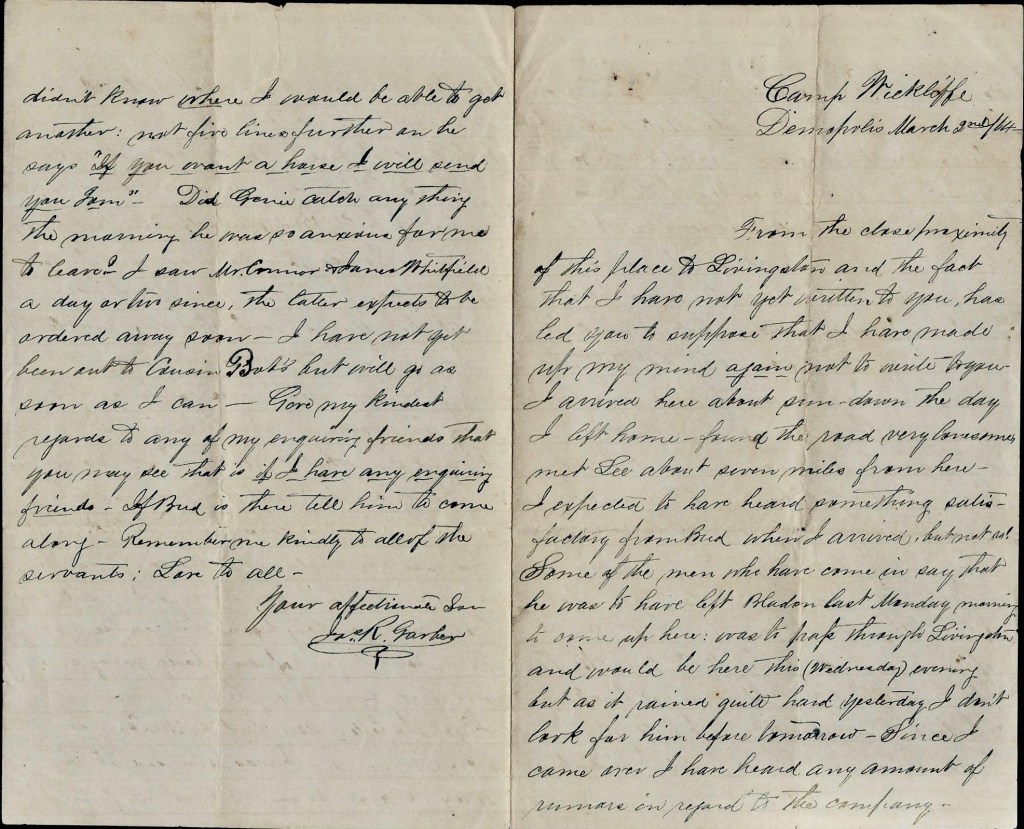
The following letter was written by 2Lt. James Rhodes Garber (1847-1896) of Co. G, 8th (Hatch’s) Alabama Cavalry. James was elected to his position on 17 February 1864—an election of which he speaks of in his letter. The regiment was organized in late April 1864 by adding one company to the nine of Hatch’s Battalion that had entered Confederate service the previous winter. They served until the date of surrender on 14 May 1865 at Gainesville, Alabama.
James was the son of Alexander Menzies Garber (1815-1891) and Anna Maria Rhodes (1825-1911) of Livingston, Sumter county, Alabama. After the war he attended the University of Louisiana and graduated in 1867. Like his father, he too entered the medical profession and practiced in Georgetown, South Carolina, and later in Birmingham, Alabama.
The note added at the end of the letter is conjectured to be a request for a slave boy to be sent to the regiment to perform camp duties in exchange for room & board.
Transcription
Camp Wickliff Demopolis [Alabama] March 3rd 1864
From the close proximity of this place to Livingston and the fact that I have not yet written to you, has led you to suppose that I have made up my mind again not to write to you. I arrived here about sun down the day I left home—found the road very lonesome. Met Lee about seven miles from here. I expect to have heard something satisfactory from Bud when I arrived, but not so! Some of the men who have come in say that he was to have left Bladon last Monday morning to come up here. Was to pass through Livingston and would be here this (Wednesday) evening but as it rained quite hard yesterday, I don’t look for him before tomorrow.
Since I came over, I have heard any amount of rumors in regard to the company. Some say that an order has been issued from Richmond dismounting the whole regiment: that the Conscript Office are trying and are going to conscript all the members of the conscript age and to send all over seventeen and under eighteen into camps of instruction. Others say that Col. [Nathaniel] Wickliffe is not pleased with our election returns, that we shall reorganize, and some say that Bud told them that he was going to have another election. There are some in the other squad who are now sorry that they formed the junction with us and would get out if they could, and if Bud goes to reorganizing, they may take that as an opportunity & leave us.
I don’t see what right Bud has to call for a reelection of officers nor do I think Col. Wickliffe has the power to do so. If we do not break up (and I don’t think we will) and I hold my present position, I will be able (I understand) to buy a saddle & blanket at government price for $100. I don’t know what the bridal and other trappings will cost. There are no pistols to be had up here.
For the last night or two, I have slept “quite cool.” I made a bunk large enough to hold Bud & myself and fortunately a man who has gone home on a sick furlough left his bedding which I have appropriated until he returns. With that & my own blanket, I have managed to make out pretty well though I have slept “more comfortably.”
Everything looks dark and uncertain to me. I can’t say what I really think. Sometimes I think one thing and then again another. But I do wish we could get to the regiment until this fuss about relieving men doing post duty is all other with. I suppose Bud will have been with you long before this reaches you and don’t know of anybody going over nor do I know when the mail goes. I got the letter you sent by Mr. Connor some time ago. I was amused at the way Pa wrote. He said if I lost my horse, he didn’t know where I would be able to get another. Not five lines further on he says, “If you want a horse, I will send you Tom.”
Did Gerrie catch anything the morning he was so anxious for me to leave? I saw Mr. Connor & James Whitfield a day or two since. The latter expects to be ordered away soon. I have not yet been out to Cousin Bob’s but will go as soon as I can. Give my kindest regards to any of my enquiring friends that you may see—that is, if I have any enquiring friends. If Bud is there, tell him to come along. Remember me kindly to all of the servants. Love to all.
Your affectionate son, — James R. Garber
Tell Uncle George that there are four reliable men in the company who will take a boy upon the conditions that he [is] named to me—viz: that if the boy ran away or died, it should be no loss to them and that they are to have the use of him for keeping him. Any other conditions that he may wish to impose upon them, let me know them so that I may inform them of it. If he wants them to have the boy, he had better send him over at once. The names of the men are, viz: Burroughs, [M.] Sellers, [J. C.] Pugh, (and [A. K.] Martin, I believe). Bud knows them all. All men of some property. Let me hear from it in your next. — J. R. G.
Only a year apart in age, Alexander Little may have borne a strong resemblance to his brother, John Peyton Little, shown here in his Asst. Surgeon’s uniform.
The following letter was written by Archibald Alexander (“Sandy”) Little (1824-1877) of Fredericksburg, Virginia, who was assigned duty as a civilian to serve as special agent traveling in charge of quartermaster stores from Richmond, Virginia, to Columbus, Mississippi, that was consigned to Major L. F. Johnson, Quartermaster. A receipt for his services consisting of 45 days at $4/day ($180) was submitted to Maj. J. B. McClelland, Quartermaster, C. S. Army, on the 18th of June 1862.
Sandy became the editor of the Fredericksburg News in 1853 where he “wielded a most graceful and facile pen, and illustrated a thorough knowledge of his profession with a rare culture and kindly humor.” (The Virginian Pilot, 19 July 1877) His pre-war editorials no doubt promoted secession and influenced a large number of readers. Though he had to vacate his office in Fredericksburg during the war which was ransacked by Union soldiers, he returned to his profession after the war until his death in 1877.
Sandy had an older brother named John Peyton Little (1823-1874) who was a physician and served as an Asst. Surgeon in the Provisional Army of the Confederate States of America.
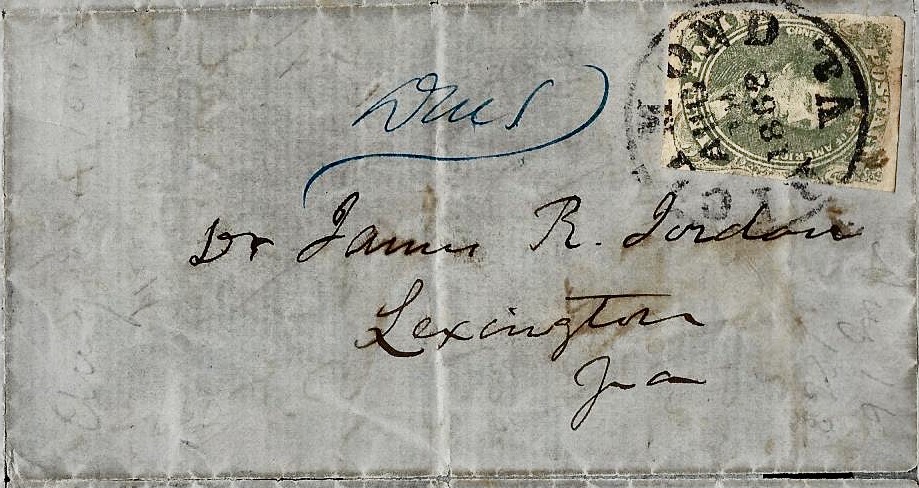
The letter was addressed to Dr. James R. Jordan (1801-1862)—a physician who resided and practiced in Lexington, Virginia. He died on 26 December 1862. I can only speculate on the nature of the correspondence. Perhaps Dr. Jordan was dying and he was concerned about the validity of an insurance policy he held with a U. S. company.
A “Major Lacy” is mentioned in the letter. Could this have been Major James Horace Lacy of Fredericksburg and the owner of Chatham Manor? He was only a Lieutenant at the time but was often referred to as “Major” prior to his promotion. He was taken prisoner in June 1862 and was widely reported to have been released in October. Perhaps he was released earlier than thought.
Transcription
Richmond, Virginia August 16, 1862
Dr. J. R. Jordan My dear Dr.,
Yours of 3 May has just been handed me by Maj. Lacy. He received it after I had gone to Corinth & before he was taken prisoner. On his return he mentioned he had received a letter for me and found it today. I can only repeat what I said a year ago—especially as I have heard nothing from the company. It will be the interest of the company to keep their promise to make all right after the war is over. They insure in France, England & Canada—foreign counties as the South will be. I will keep your note & advise you as soon as I hear from the company.
The following letters were written by James “Henderson” Rutledge (1839-1863), one of fourteen children to James Madison Rutledge (1813-1863) and his wife, Susannah (Ziglar) Rutledge (b. 1815) of Meadows of Dan, Patrick county, Virginia, North Carolina.
Cap work by Pvt. Allen L. Hash of Co. C, 50th Virginia
In the 1850 US Census, James Rutledge was enumerated as a carpenter and he and his family were living in the southern part of Patrick County. Rutledge also served the community as a Primitive Baptist Minister. By 1860, he had taken his family to Meadows of Dan to serve as the miller at the Langhorne Mill. The Steptoe Langhorne Mill was located at the intersection of Helms Road and Langhorne Mill Road.
Henderson Rutledge was 22 years old when he enlisted with the 50th Virginia Infantry, Co. K in 1861 at Wythe county, Virginia. He entered the service as a private but was promoted to corporal on 20 September 1861. A month later he was hospitalized at White Sulphur Springs when he became ill and we learn from his letters that he did not regain his health until sometime in December when he caught up with the regiment in Tennessee and Kentucky. He was promoted once again to 1st Sergeant of his company before entering the Battle of Chancellorsville where he was killed in action on 3 May 1863.
“In the same year that Henderson enlisted, the diphtheria epidemic struck his siblings at home. Seven-year-old Martha died on October 28th, two-year-old Irvin passed on November 1st, sixteen-year-old Sarah on November 4th, eighteen-year-old Susan on November the 9th, and eleven-year-old William on November the 13th. Five children lay dead in the house at the same time. Coffins could not be made quick enough for all of them, so some of the children were carefully wrapped in sheets and all were buried at Meadows of Dan Baptist Church cemetery. This horrible, deadly infection was not done with the Rutledge children. Four-year-old Peter died on November the 29th, six-year-old John on the 2nd of December, and five-year-old George on the 30th of December. These three little boys (ages 4, 5, and 6) were buried with their siblings at the cemetery. Henderson was away with the 50th Virginia Infantry while this horrible tragedy happened, and you can tell by his correspondence that he was trying very hard to put on a brave face for his parents and remaining siblings.” [Beverly Belcher Woody, The Enterprise, January 2023]
Henderson’s letters also inform us that his father, at age 48, also entered the service as a substitute for James A. Taylor in January 1863. He initially served in the 51st Virginia Infantry until he could be transferred to his son’s unit, Co. K, 50th Virginia. But sadly, after losing so many of his young children to diphtheria and losing his son at Chancellorsville, James lost his life too—killed in action on 2 July 1863 at Gettysburg. In the only extant letter written by James to his “companion,” datelined on 27 March 1863 from Camp Narrows, he wrote, “I hope to see the war end and get home and live at home. I feel myself in God’s hands and God may be my keeper. He will deliver me from evil.” Poor Susannah.
Letter 1
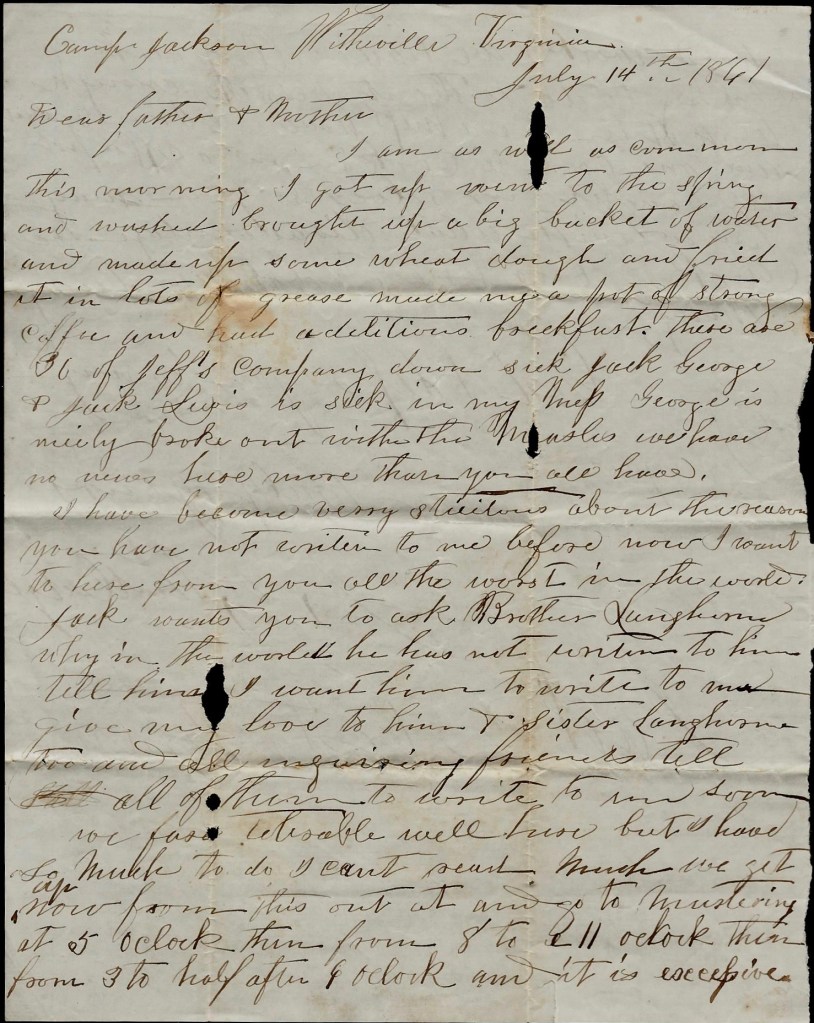
Camp Jackson Wytheville, Virginia July 14, 1861
Dear Father and Mother,
I am as well as common this morning. I got up, went to the spring and washed, brought up a big basket of water and made up some wheat dough and fried it in lots of grease. Made me a pot of strong coffee and had a delicious breakfast. There are 30 of Jeff’s Company down sick. [Andrew] Jack George & [Andrew] Jack Lewis is sick in my mess. George is nicely broke out with the measles.
We have no news here more than you all have. I have become very anxious about the reason you have not written to me before now. I want to hear from you all the worst in the world. Jack wants you to ask Brother Langhorne why in the world he has not written to him. Tell him I want him to write to me. Give my love to him & Sister Langhorne too and all enquiring friends. Tell all of them to write to us soon.
We fare tolerable well here but I have so much to do I can’t read much. We get up now and go to mustering at 5 o’clock. Then from 8 to 11 o’clock, then from 3 to half after 4 o’clock and it is excessive hard work. We have all our cooking to do without vessels enough to do it in. All a mess have [is] one iron bucket and one oven to cook in and a coffee pot we bought ourselves so you may know with what disadvantage we cook our bread to bake and everything.
God bless you is my prayer. Very truly yours, — J. H. Rutledge.
I ask best wishes.
Letter 2
White Sulphur Springs Greenbrier County, Virginia 22 October 1861
Fear Father and Mother,
I again take occasion to write you a few lines to inform you that I am still improving. I wrote you a letter Sunday informing you that I received your letter of 22 September and was very glad to hear that there was nothing more the matter than common, notwithstanding you wrote that you were not all well. But I supposed nothing worse than was the matter or you would have more definitely mentioned it.
When I received your letter I was then on my way to the hospital so sick that I could not read the letter so as to elicit any sense from it at all. A few days ago I read it and learned its contents. I was glad to hear that Father was done at Clark’s Mill and that it did good business. I suppose Clark was pleased with it. I was glad to hear that you were done sowing your fodder and that your corn is good but I was sorry to hear that your buckwheat is not very good. You wrote that you were not done sowing rye. That was not satisfactory. You ought to have written how much you had sowed, or how much land you had sowed, &c. Then I would have known something about it.
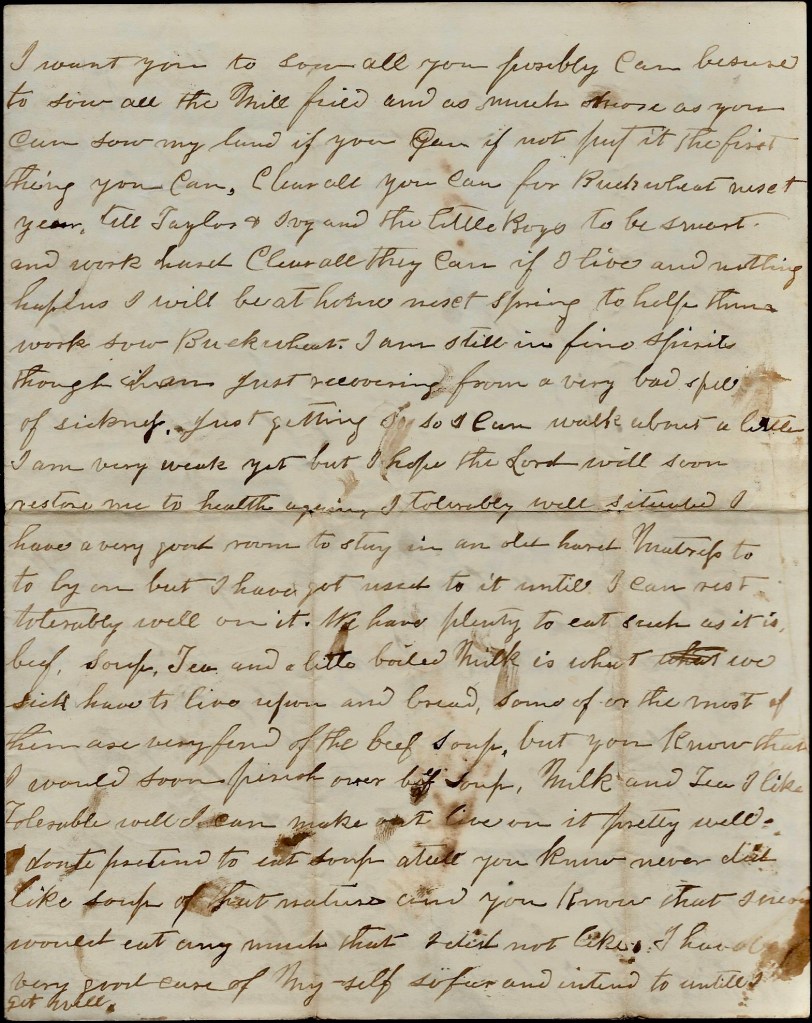
I want you to sow all you possibly can. Be sure to sow all the Mill Field and as much [ ] as you. can. Sow my land if you can. If not, put it the first thing you can. Clear all you can for buckwheat next year. Tell Taylor & Ivy and the little boys to be smart and work hard. Clear all they can. If I live and nothing happens, I will be at home next spring to help them sow buckwheat.
I am still in fine spirits though I am just recovering from a very bad spell of sickness. Just getting so I can walk about a little. I am very weak yet but I hope the Lord will soon restore me to health again. I am tolerably well situated. I have a very good room to stay in and an old hard ,mattress to lie on but I have got used to it until I can rest tolerably well on it. We have plenty to eat—such as it is. Beef, soup, tea, and a little boiled milk is what we sick have to live upon, and bread. Some of, or the most of them are very fond of the beef soup but you know that I would soon pinch over beef soup. Milk and tea I like tolerable well. I can make out to live on it pretty well. I don’t pretend to eat soup atall. You know I never did like soup of that nature and you know that I never would eat any much that I did not like. I have very good care of myself so far and intend to until I get well.
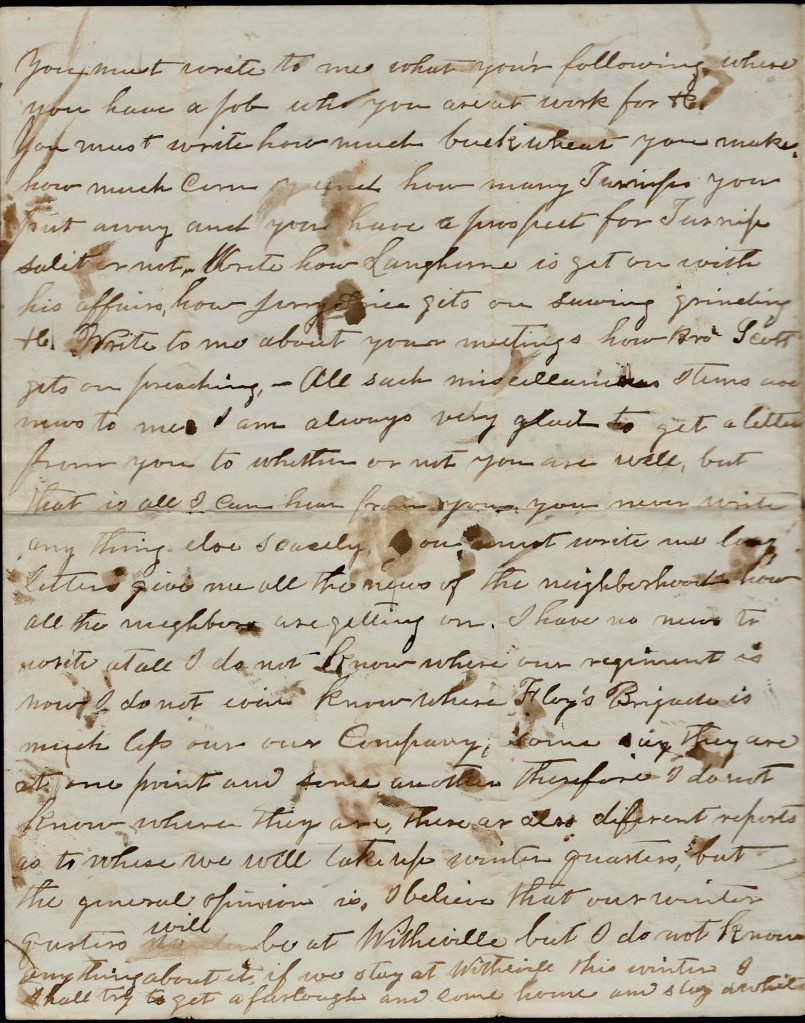
You must write to me what you’re following, where you have a job, who you are at work for, &c. You must write how much buckwheat you make, how much corn, how many turnips you put away and you have a prospect for turnip salad or not….All such miscellaneous items are news to me. I am always very glad to get a letter from you…
I have no news to write at all. I do not know where our regiment is now. I do not even know where Floyd’s Brigade is much less our company. There are different reports as t where we will take up winter quarters but the general opinion is, I believe, that our winter quarters will be at Wytheville. But I do not know anything about it. If we stay ay Wytheville this winter, I shall try to get a furlough and come home and stay awhile. I do not expect to go into camp anymore until I get thoroughly well, if it is the Lord’s will for me to get well. I do not expect to go into camp anymore before winter [quarters] are taken up. I do not want to go into camp half well and get sick right off again and thus be puny and weak all the. time. I have gone through all the hardships of camp and stood it fine until I was taken sick.
The night before I was taken sick, I was out on guard duty and it rained and I had been marching hard all day which was pretty hard on a fellow. But I do not know whether that was the cause of my sickness or not. I do not know but what the fever has been working on me for some time. I am broke down sitting up. I shall have to quit. I am I think mending very fast now.
You must write to me just as soon as you get this. Do not wait a day. You have better chances than I have. You must back your letters just this way.
J. H. Rutledge of Co. K, 50th Regt. Floyd’s Brigade, White Sulphur Springs, Greenbrier county, Va.
I have done. Respectfully your son until death, — J. H. Rutledge
To James & Susan Rutledge
Letter 3
Knoxville, Tennessee December 30, 1861
Dear Father & Mother,
I am well. In fact, I weighed more today than ever I did. I weighed 146 lbs. I went to the tavern this morning and have 50 cents for my breakfast and ten cents for a drink of rum and ten for a glass of wine, fifty cents for a pair of suspenders, and eight dollars for a pair of boots. I have not spent anything much for something to drink in a good while before.
Since we started last Friday from ____ Springs, I have seen more than I ever saw before in my life. A part of East Tennessee is a noble country. It’s spacious, productive, and almost perfectly plain. Farms are beautiful to behold. But the machinery at Knoxville is the grandest curiosity yet. They manufacture all kinds of castings here. Also car coaches and engines. In fact, almost anything is manufactured here by machinery.
I have seen the lonesome pylons from which the bridge across the Houston River was burned. Old [Parson] Brownlow is in prison at this place.
We expect to leave here in the morning for Nashville at which place we will arrive Wednesday night, Providence permitting. I had a fine ride of 220 miles to this place. No more.
Truly your son, — J. H. Rutledge
Letter 4
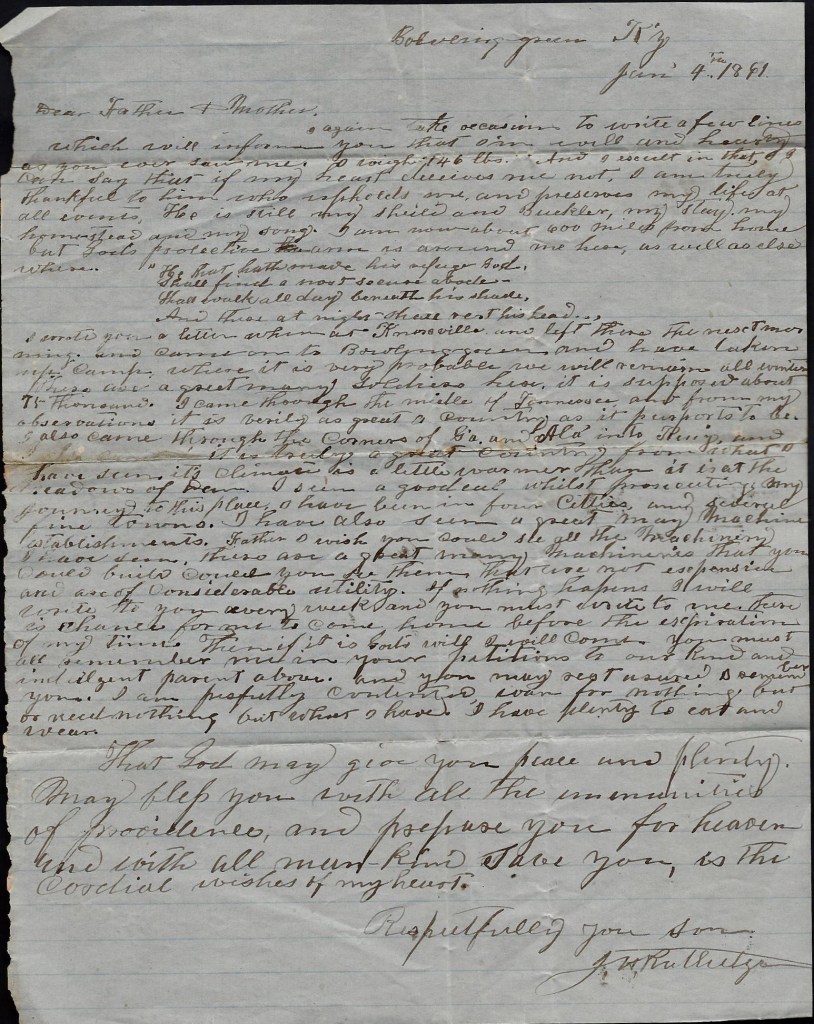
Bowling Green, Kentucky January 4, 1861 [should be 1862]
Dear Father and Mother,
I again take occasion to write a few lines which will inform you that I am well and hearty as you ever saw me. I weight 146 lbs. and I exult in that. I can say that if my heart deceives me not, I am truly thankful to Him who upholds me and preserves my life at all events. He is still my shield and Buckler, my stay, my homestead and my song.
I am now about 600 miles from home but God’s protective army is around me here as well as elsewhere.
He that hath made his refuge God Shall find a most secure abode Shall walk all day beneath His shade And these at night shall rest his head.
I wrote you a letter when at Knoxville and left there the next morning and came on to Bowling Green and have taken up camp where it is very probable we will remain all winter. There are a great many soldiers here. It is supposed about 75 thousand.
I came through the middle of Tennessee and from my observations, it is verily as great a country as it purports to be. I also came through the corners of Georgia and Alabama into Tennessee and it is truly a great country from what I have seen. Its climate is a little warmer than it is at the Meadows of Dan. I seen a good deal whilst prosecuting my journey to this place, have been in four cities and several fine towns. I have also seen a great many machine establishments. Father, I wish you could see all the machinery I have seen. There are a great many machines that you could build could you see them that are not expensive and are of considerable utility. If nothing happens, I will write to you every week and you must write to me. There is [no] chance for me to come home before the expiration of my time. Then if it is God’s will, I will come. You must all remember me in your petitions to our kind and indulgent parent above. And you may rest assured I remember you. I am perfectly contented—want for nothing and need nothing but what I have. I have plenty to eat and wear.
That God may give you peace and plenty. May bless you with all the immunities of Providence, and prepare you for heaven and with all mankind save you, is the cordial wishes of my heart. Respectfully your son, — J. H. Rutledge
Letter 5
Wytheville, Virginia 2nd May 1862
Dear Father and Mother,
I am well this evening and do hope you are likewise. I came here yesterday morning with my feet considerably affected by the tramp, but they are getting better. I came two miles past Hillsville the first day. we have a pretty large company and they are pretty rough fellows too.
There is a great stir up among the aspirants for office—more candidates than you ever saw. I think there will be more low privates in our company than any ever I saw for they all can’t be elected.
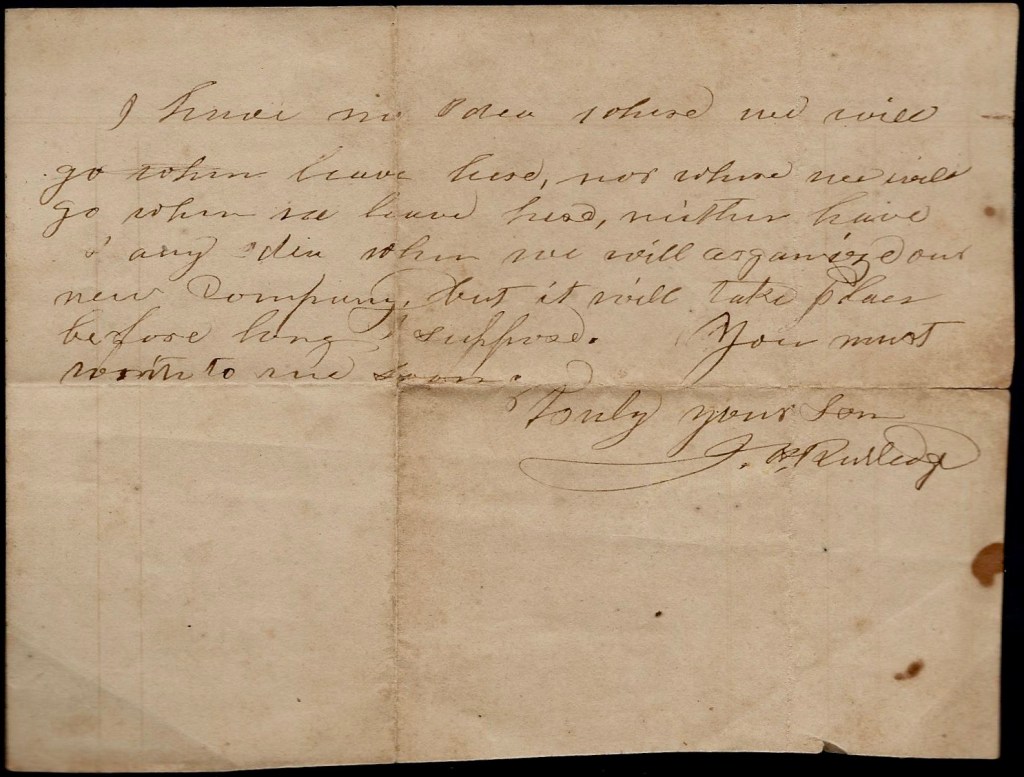
I have no idea where we will go when [we] leave here, nor when we leave here. Neither have I any idea when we will organize our new company but it will take place before long I suppose.
You must write to me soon. Truly your son, — J. H. Rutledge
Letter 6
Narrows, New River Giles County August 13, 1862
Dear Father and Mother,
I take occasion to write you a few lines which will inform you that I am well so far as health is concerned but have been for the last week so afflicted with boils that I have been unable for duty. The most of my time I could not walk scarcely atall. But I’m getting so that I can walk about right smartly now. If I have no more, I will be able for duty again in a week from now. I can’t sit up to write this letter. I have to lay down. I can lay or stand but can’t sit.
I have no news. There [are] no Yankees near here. We are doing finely getting a plenty to eat of well kept bacon, flour, rye, coffee some sugar, some molasses, dried beans and peas—lots of them. If I had opportunity I would send some money home. Perhaps I may have within a few days.
Oh! Mother, I want you to make me cloth enough as we spoke about to make a coat, 2 pair pants, and prepare me a lot of socks by fall. I want you to do this if I can get wool at any price without disfurnishing yourself. I don’t want you to disfurnish yourself. I had rather pay any price almost for wool and have you to make my clothing than to draw them because Confederate clothing is no con____ and the ugliest stuff you ever saw. I want mine nicely mixed black and white.
Give Sister and Brother Langhorne my love. Tell Sister Langhorne I will write to her as soon as I can sit up [and] write with any impunity. I must quit.
Oh! I will complain at Bro. Lewellen some for not writing to me. I wrote to him a long time ago and he got my letter and has not answered it yet. I hope you [have] the enjoyment of all the immunities of Providence. Your most affectionate son, — J. H. Rutledge
Letter 7
Narrows, Giles County, Va. August 21, 1862
Dear Father & Mother,
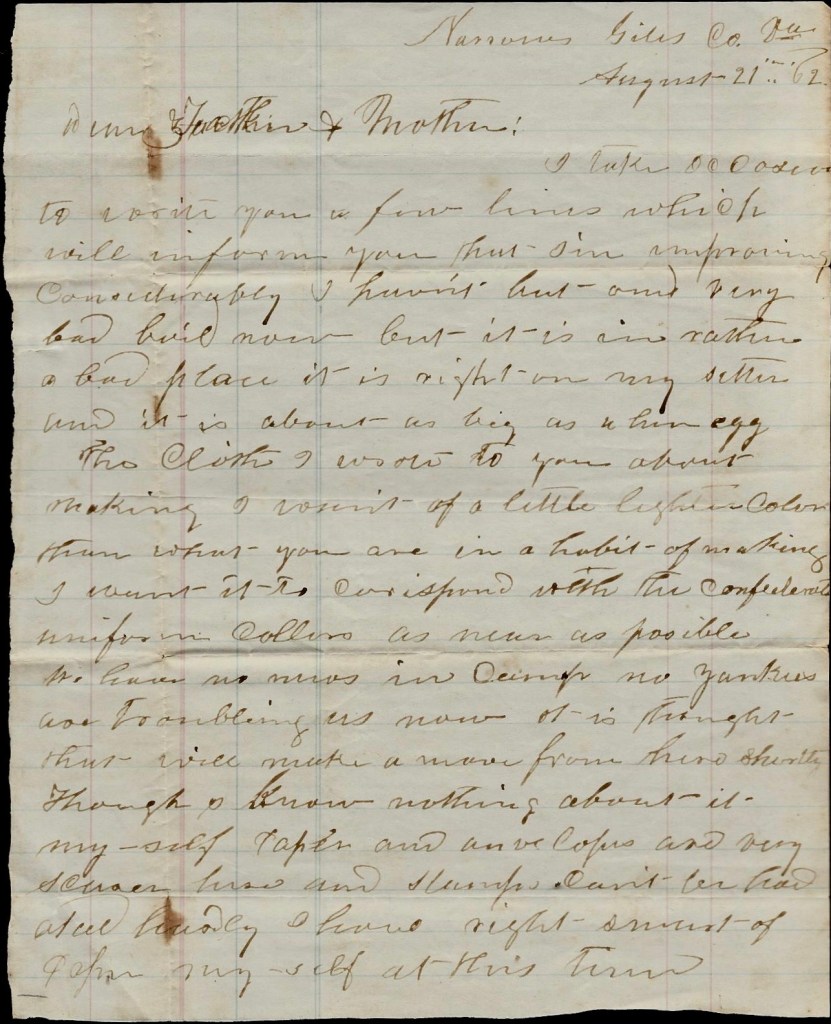
I take occasion to write you a few lines which will inform you that I’m improving considerably. I haven’t [anything] but a very bad boil now but it is in rather a bad place. It is right on my sitter and it is about as big as a hen egg.
The cloth I wrote to you about making I want of a lighter color than what you are in the habit of making. I want it to correspond with the Confederate uniform colors as near as possible.
We have no news in camp. No Yankees are troubling us now. It is thought that [we] will make a move from here shortly though I know nothing about it myself. Paper and envelopes are very scarce here and stamps don’t be had atall hardly. I have right smart of paper myself at this time.
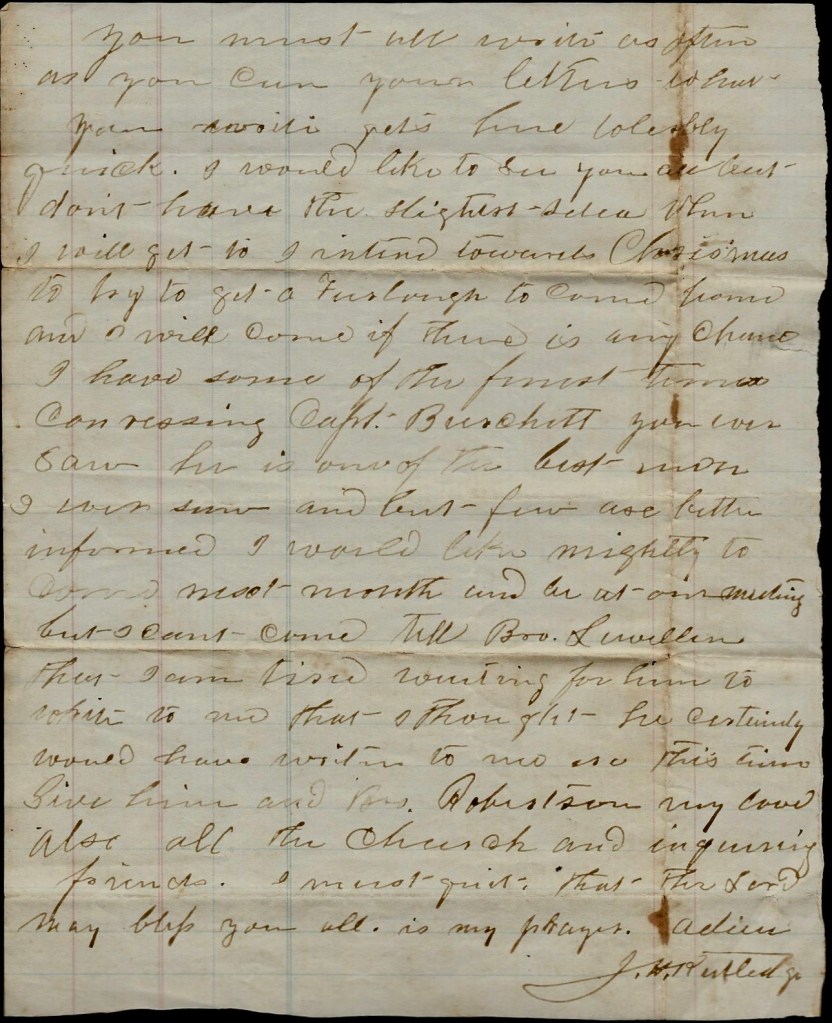
You must all write as often as you can. Your letters—what you write—gets here tolerably quick. I would like to see you all but don’t have the slightest idea when I will get to. I intend towards Christmas to try to get a furlough to come home and I will come if there is any chance.
I have some of the finest times conversing with Capt. [Elisha Clark] Burchett you ever saw. He is one of the finest men I ever saw and but few are better informed. 1
I would like mightily to come next month and be at our meeting but I can’t come. Tell Bro. Lewellen that I am tired waiting for him to write to me [and] that I thought he certainly would have written to me by this time. Give him and Mrs. Robertson my love. Also all the church and inquiring friends. I must quit.
That the Lord may bless you all is my prayer. Adieu. — J. H. Rutledge
1 BURCHETT, ELISHA CLARK: Capt., Co. B. B. Lee Co. 10/11/36. 1860: farmer, age 23, Lee Co. Enl., pvt.. Wytheville, Wythe Co., 7/17/61. Hosp., sick, White Sulphur Springs by 11/1/61. Elected capt. 5/8/62. Present in unit 5/26/62. Present comdg. co. 6/9/62 through 6/28/62, 11/30/62 through 12/17/62. and 3/21/63 through 4/22/63. Charged with cowardice for actions Chancellorsville 5/2/63-5/3/63. Deserts 7/1/63 “on the march to Gettysburg…just before reaching the Battlefield and did not come near the Enemy during the fight.” Absent through 11/10/63 when bde. cdr. recommends he be dropped from rolls and arrested, “if he can be found.” “He returned home to —Jonesville, Lee Co. and has disappeared from that vicinity. It is believed he has escaped to Indiana.” Dropped from rolls for prolonged AWOL, ceases to be an officer 11/24/63. Died Vancouver, British Columbia. 2/3/1913. Bd. there. South Vancouver Cemetery.
Letter 8
Narrows, New River Giles County, Virginia November 12, 1862
Dear Father & Mother,
I have written you several letters and have not received a line from you in answer to them. I am therefore uneasy about you all, and am very anxious to hear from you. The last news I have is from a letter David Harrell 1 got from home about two weeks ago, and some two of you were then dead from dypyheria. I did not learn which two of you had died. I am expecting every day to hear that some more of you are gone.
I was much mortified to hear that that awful disease had gotten into your family but I am happy that I have long since learned not to find fault of Providence. I am thankful to tell you that I feel resigned to the will of my Lord and console myself with the thought that all of you who have attained to years of accountability are prepared for the solemn event of death, and those who have not—all will be well wit them if they die. I wish I could come home and see you all now, but there is no chance. You must all do the best you can. Take care of yourselves.
May the good Lord bless, provide form and uphold you is the prayer of your son, — Henderson
Please write to me soon. Direct to Dublin.
Yours very truly, — J. H. Rutledge
1 HARRELL. DAVID KENT: Pvt.. Co. K. B. 1/25/42. 1860: laborer, age 18. Patrick Co. Enl. Wytheville. Wythe Co., 6/22/61. Detail, nurse, Wytheville 7/31/61 through 8/2/61. Hosp. sent sick to White Sulphur Springs, 10/1/61 through 11/1/61. WIA, right arm. Wilderness 5/5/64. Hosp.. wound. Danville 6/15/64 to 6/21/64 when transferred to unspecified location. Enroute with CS personnel to rejoin commands by 4/12/65 when, at Big Springs [Elliston, Montgomery Co.], learns of Lee’s surrender and Gen. Echols’ order to disband and returns home. Living, age 61, Patrick Co., 4/2/1903. Died there, “branchy pneumonia,” 11/23/1921. Bd. Harrell-Robertson Cemetery, Patrick Co.
Letter 9
Camp near Richmond December 21, 1862
Dear Mother and Father,
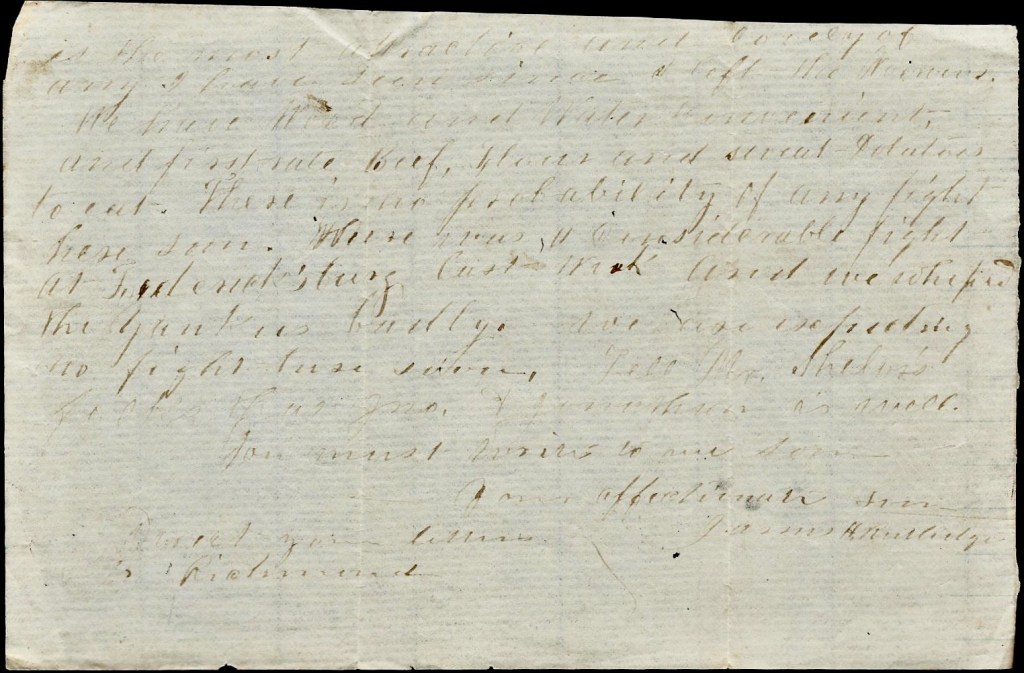
I started from the Narrows, harassed considerably with tooth and jaw ache or rather neuralgia, and I broke down the first day, but after that, I commenced improving and have arrived here (five miles southeast of Richmond) in fine health and spirits, and did enjoy my trip very well. I have seen the magnificent City of Richmond and the elegant Lynchburg and various places of minor importance, but the site on which we are encamped is the most attractive and lovely of any I have seen since I left the Narrows. We have wood and water convenient and first rate beef, flour, and sweet potatoes to eat. There is no probability of any fight here soon. There was a considerable fight at Fredericksburg last week and we whipped the Yankees badly. We are expecting no fight here soon. Tell Mr. Shelor’s folks that Jno. and Jonathan is well. 1 You must write to me. Your affectionate son, — James H. Rutledge.
Direct your letters to Richmond.
1 SHELOR. JOHN B.: Pvt.. Co. K. 1860: farmer, age 31, Patrick Co. Enl. by 4/28/62 when en route to unit. Joined unit in field 5/2/62. Present in unit 7/17/62. WIA by 7/15/63 when hosp, Richmond. There to 7/26/63 when furloughed 35-day sick leave. Captured Spotsylvania C.H. 5/12/64. POW Pt. Lookout 5/1 8/64 to 7/30/64. POW Elmira 8/2/64 to 2/16/65 when died, anasarca, “exposure and starvation.” Bd. grave 2181, Woodlawn Cemetery.
SHELOR, JOHN: Sgt.. Co. K. 1860: laborer, age 20. Patrick Co. Enl.. pvt., Wytheville, Wythe Co., 6/22/61. Present in unit 11/1/61. Promoted sgt. by 5/12/64 when captured Spotsylvania C.H. POW Pt. Lookout 5/18/64 to 7/30/64. POW Elmira 8/2/64 to 1/28/65 when he died, variola. Bd. grave 1810. Woodlawn Cemetery.
Letter 10
Camp Medicine January 6, 1863
Dear Father and Mother,
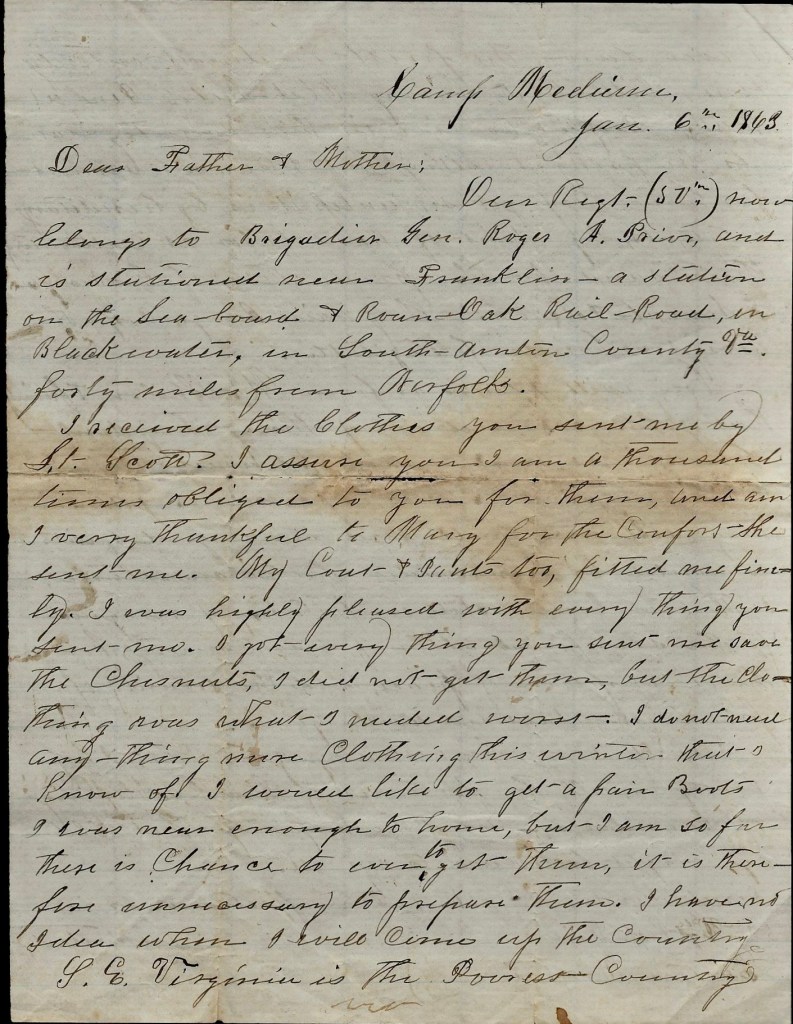
Our regiment (50th) now belongs to Brigadier Gen. Roger A. Prior, and is stationed near Franklin—a station on the Seaboard & Roanoke Railroad in Blackwater, in Southampton county, Virginia, forty miles from Norfolk.
I received the clothes you sent me by Lt. [Asa B.] Scott. 1 I assure you, I am a thousand times obliged to you for them, and am very thankful to Mary for the comfort she sent me. My coat and pants too, fitted me finely. I was highly pleased with everything you sent me. I got everything you sent me save the chestnuts. I did not get them but the clothing was what I needed worst. I do not need anything more clothing this winter that I know of. I would like to get a pair of boots. I was near enough to home, but I am so far there is chance ever to get them. It is therefore unnecessary to prepare them. I have no idea when I will come up the country.
Southeast Virginia is the poorest country I ever saw. The forest is almost entirely pine—little old sorry old-field pine at that. People who live in this country seem to be pretty wealthy but I cannot account for how they get so unless it is by hereditary estate, or by dint of hand labor at cultivating their sand, for the production of goober-peas & sweet potatoes. They raise large crops of those two kinds of vegetables.
You will please inform Mr. Shelor & family that John received everything they sent him, and was much pleased with his clothing for it was splendid. John and myself are well and in good spirits as could be expected under the circumstances with our bodies still unfalteringly resigned to the sacrificial altar of our country for the redemption of peace, and the security of freedom due us and you.
I will close by assuring you that I hope for you all the fortunes of health, blessings of Providence, and the happiness that old age ought to secure to us all. Your affectionate son, — J. H. Rutledge
Direct lettres to Co. K, 50th Va. Regt. Prior’s Eastern Virginia
1 SCOTT, ASA B.: 2Lt.. Co. K. 1860: carpenter, age 25, Patrick Co. Enl., sgt., Wytheville, Wythe Co., 6/22/61. Hosp., sick, and later detail nurse. White Sulphur Springs 10/1/61 through 11/1/61. Elected 2Lt 5/12/62. Present in unit 5/26/62 and 6/24/62 when comdg. co. Present comdg. co. 9/30/62 and 3/31/63. Court-martialed and acquitted 1/27/64 of neglect of duty and “suffering persons committed to his charge to escape.” Present comdg. co. 3/25/64. Captured Spotsylvania C.H. 5/1 2/64.. POW Pt. Lookout 5/14/64 to 6/23/64. POW Ft. Delaware 6/25/64 to 6/1 6/65 when released on oath. 71″, light complexion, light hair, gray eyes in 1865. Bd. Bowman-Jessup-Rorrer-Smith Cemetery, Patrick Co.
Letter 11
Camp near Franklin, Southampton county, Va. [Probably mid-January 1863]
Dear Father and Mother,
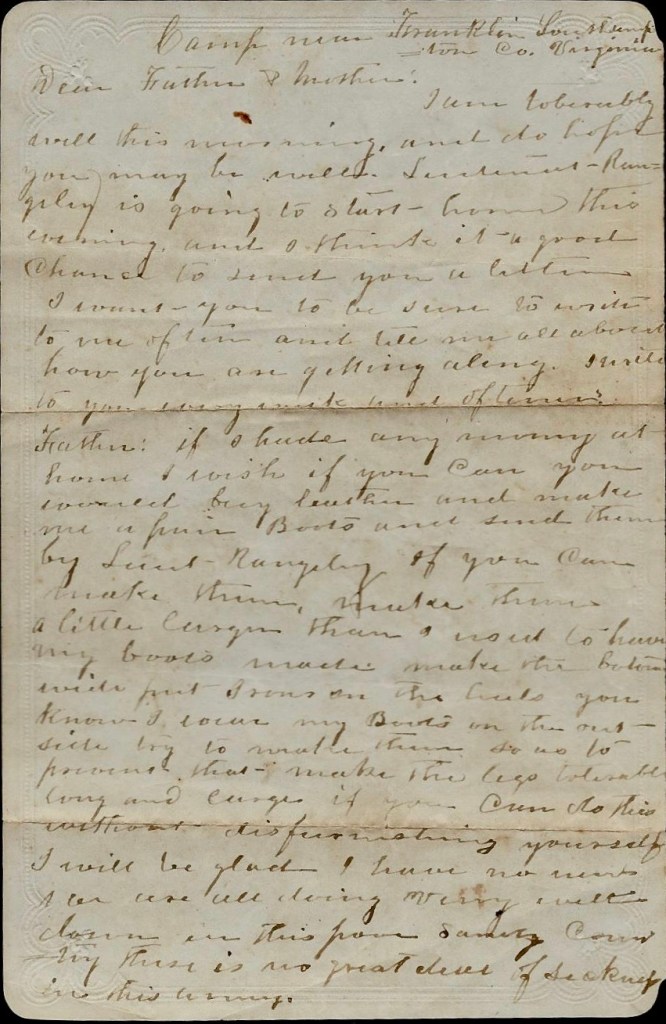
I am tolerably well this morning and do hope you may be well. Lieutenant Rangeley is going to start home this evening and I think it a good chance to send you a letter. I want you to be sure and write to me often and tell me all about how you are getting along. I write to you ever week and oftener.
Father, if I had any money at home, I wish if you can, you would buy leather and make me a pair of boots and send them by Lt. [James Henry] Rangeley. 1 If you can make them, make them a little larger than I used to have my boots made. Make the bottom wide. Put irons on the heels. You know I wear my boots on the outside. Try to make the legs tolerable long and large. If you can do this without disfurnishing yourself, I will be glad.
I have no news. We are all doing very well down in this poor, sandy country. There is no great deal of sickness in this army. There is one case of chills and fever. I expect all of us will have it here in the spring. We are expecting no fighting here soon.
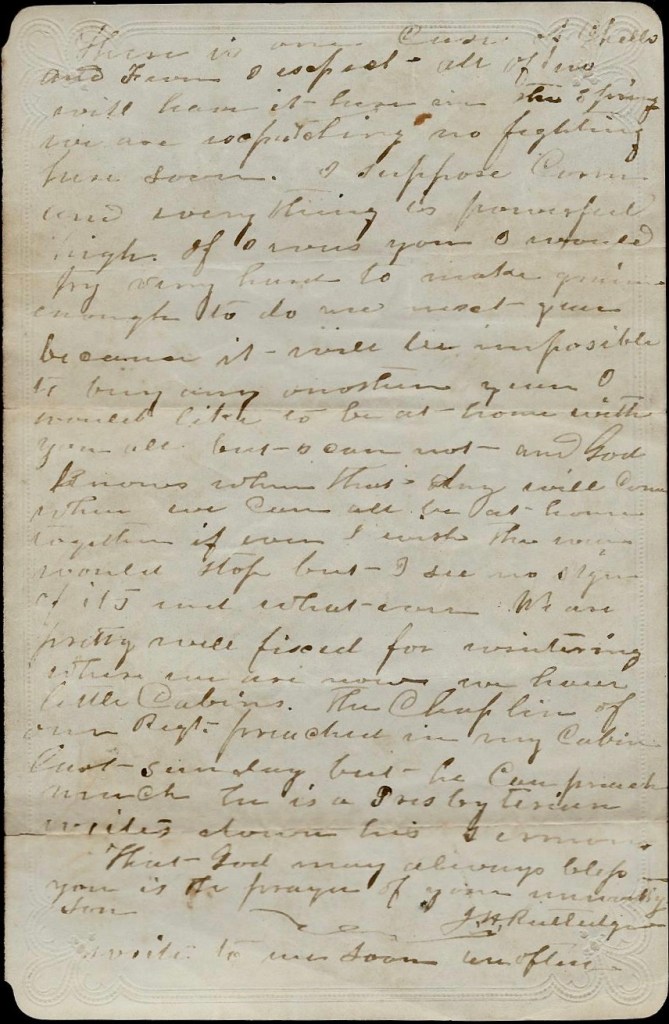
I suppose corn [prices] and everything is powerful high. If I was you, I would try very hard to make grain enough to do you next year because it will be impossible to buy any another year.
I would like to be at home with you all but I cannot. And God knows when that day will come when we can all be at home together—if ever. I wish the war would stop but I see no signs of its end whatever. We are pretty well fixed for wintering where we are now. We have little cabins. The chaplain of our regiment preached in my cabin last Sunday but he can’t preach much. He is a Presbyterian. Writes down his sermons.
That God may always bless you is the prayer of your unworthy son, — J. H. Rutledge
Write to me soon and often.
1 RANGELEY, JAMES HENRY: Lt.. Co. K. B. 1/26/43. Patrick Co. Enl.. pvt., Wytheville, Wythe Co., 6/22/61. Promoted 5Sgt by 9/15/61 when detailed, nurse, Raleigh C.H. Absent from unit through 11/01/61. Elected 2Lt. 5/12/62. Present comdg co.. Camp Narrows, 12/14/62. At home on leave by 2/10/63. Present comdg co. 9/5/63. Captured Wilderness 5/5/64. POW Ft. Delaware 5/1 7/64 to 6/6/65 when released oath. 67″, light complexion, dark hair, blue eyes in 1865. Postwar owner dry goods store, Stuart, Patrick Co., and by 1915 had also “taken front rank among the fruit farmers” of Patrick Co. Died 1919. Bd., Stuart Cemetery, Patrick Co.
Letter 12
Camp near Franklin Southampton County, Virginia February 4, 1863
Dear Sister,
I am well this morning and do hope you are well. I got a letter from home last week but it had been on the way nearly three weeks. I sent an answer to it and thought I would write again that you might hear from me in case my other should fail to go to hand.
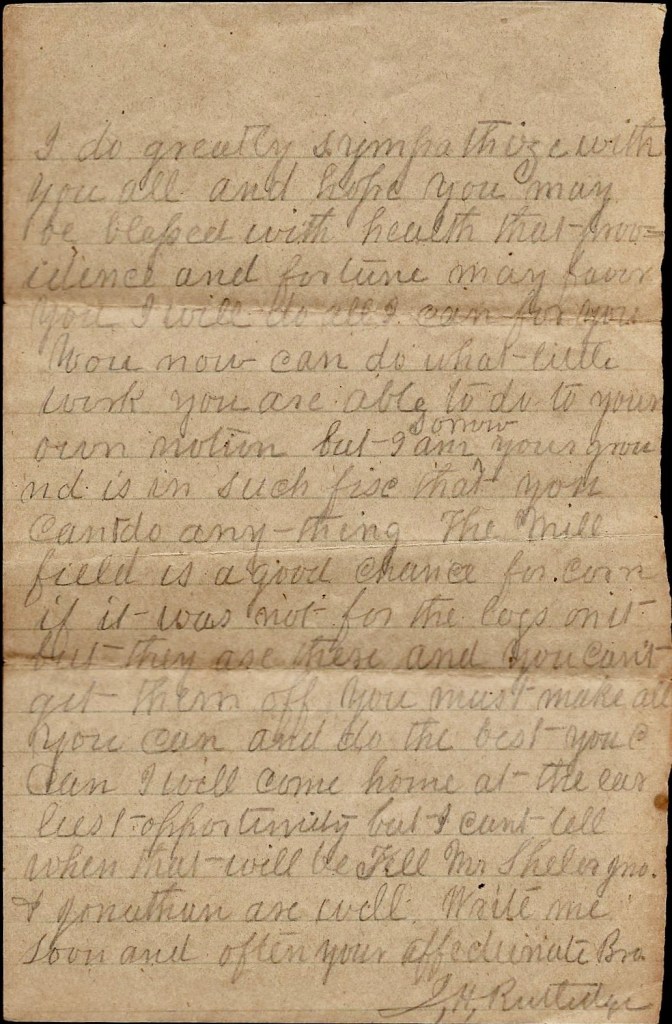
To my astonishment and extreme regret I heard that Father had substituted for Taylor. I would not have had that to have taken place for any amount. All the money in the Confederacy would not have been any inducement to me to have come into the army. I do greatly sympathize with your all and hope you may be blessed with health that Providence and fortune may favor you. I will do all I can for you. You now can do what little work you are able to do to your own notion. But I am sorry your ground is in such a fix that you can’t do anything. The mill field is a good chance for corn if it was not for the logs on it. But they are there and you can’t get them off.
You must make all you can and do the best you can, I will come home at the earliest opportunity but I can’t tell when that will be. Tell Mr. Shelor Jno. and Jonathan are well. Write me soon and often. Your affectionate brother, — J. H. Rutledge
Letter 13
Camp near Franklin Southampton, Virginia February 26, 1863
Dear Mother,
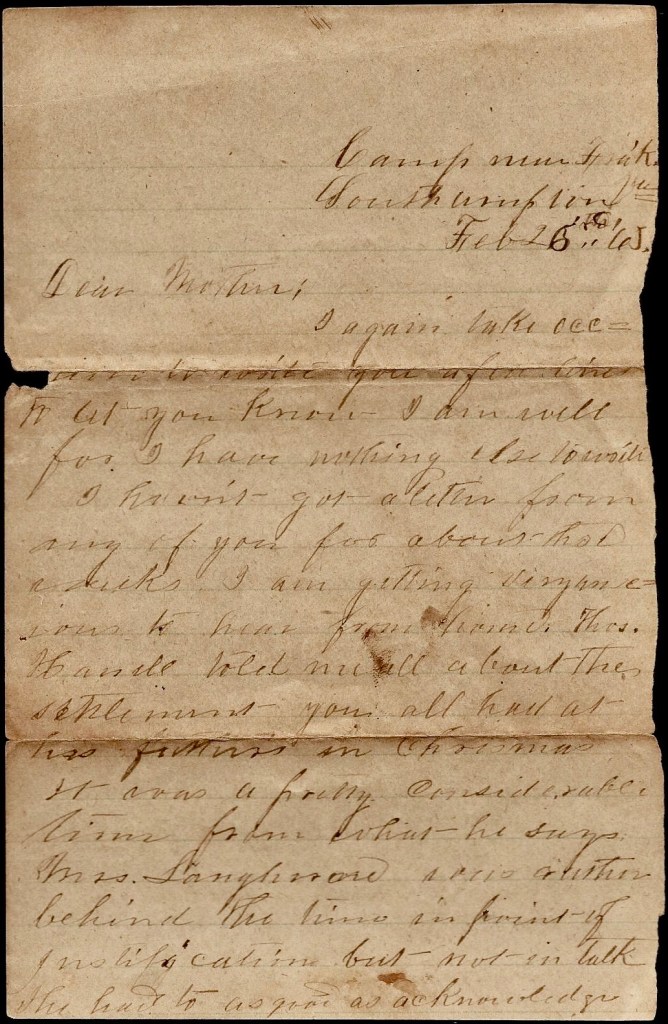
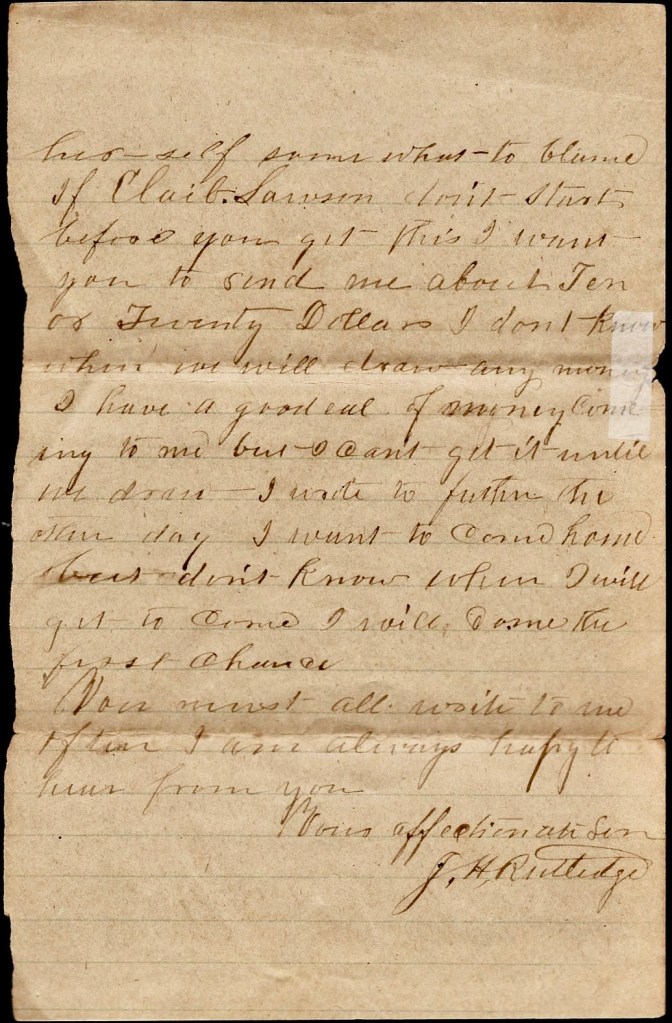
I again take occasion to write you a few lines to let you know I am well for I have nothing else to write. I haven’t got a letter from any of you for about [ ] weeks. I am getting very anxious to hear from home. Thomas Hamill told me all about the settlement you all had at his father’s I Christmas. It was a pretty considerable time from what he says. Mrs. Langhorne was rather behind the time in point of justification but not in talk. She had to as good as acknowledge her self somewhat to blame.
If Claib. Lawson 1 don’t start before you get this, I want you to send me about ten or twenty dollars. I don’t know when we will draw any money. I have a good deal of money coming to me but I can’t get it until we draw. I wrote to Father the other day. I want to come home but don’t know when I will get to come. I will come the first chance.
You must all write to me often. I am always happy to hear from you. Yours affectionately, — J. H. Rutledge
1 LAWSON, CLAIBORNE T.: 1Sgt., Co. K. 1860: farmer, age 26. Patrick Co. Enl. Wytheville, Wythe Co., 6/22/61. Detail, to go to Patrick Co. to apprehend deserters, 7/23/61 to 8/4/61. Present in unit 9/6/61 when ruptured by falling limb while building fortifications near Gauley River. Present in unit 9/28/61 and 11/1/61. Detail, arresting deserters, 7/10/62 to 9/7/62. Present in unit 11/14/62. Detail, detached service, by 4/6/64 when WIA, lost two fingers left hand. Living, age 54, Patrick Co. 1/29/89 and 6/1/1907. Bd. Meadows of Dan Cemetery, Patrick Co.
Letter 14
Camp Corbin’s Neck, Virginia April 11, 1863
Dear Mother,
I again take occasion to write you a few lines, which will inform you that Father and myself are well. He has been transferred to our company and getting on finely.
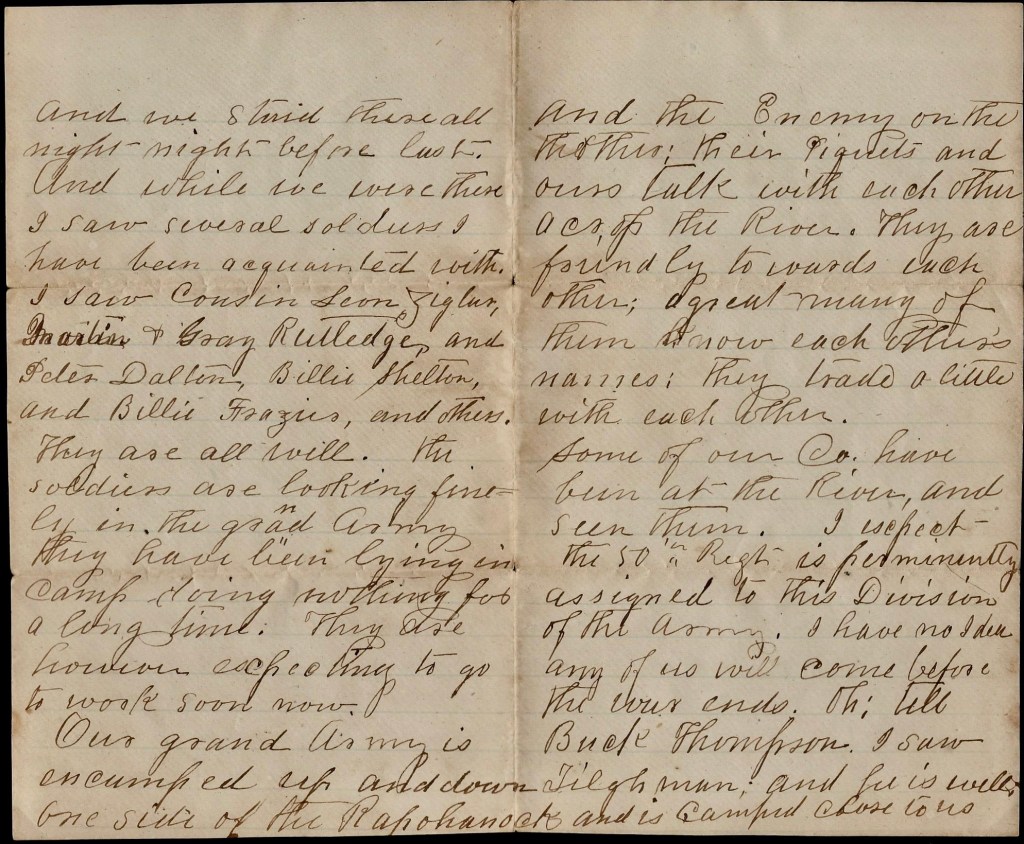
When I got to my regiment last Tuesday, it was ready to start to Fredericksburg, Virginia. We started about dark and arrived at Lynchburg next morning and about 12 o’clock we left there and come, and kept coming, until we got to Hamilton’s Crossing, 4 miles from Fredericksburg, day before yesterday. And we staid there all night before last. And while we were there, I saw several soldiers I have been acquainted with. I saw Cousin Leon Ziglar, Martin and Gray Rutledge, Peter Dalton, Billy Shelton, and Billy Frazier and others. They are all well. The soldiers are looking finely in the Grand Army. They have been lying in camp, doing nothing for a long time. They are, however, expecting to go to work soon now.
“Our Grand Army is encamped up and down one side of the Rappahannock and the enemy on the other. Their pickets and ours talk with each other across the river. They are friendly towards each other. A great many of them know each other’s names. They trade a little with each other.”
J. Hamilton Rutledge, Co. K, 50th Virginia, 11 April 1863
Our Grand Army is encamped up and down one side of the Rappahannock and the enemy on the other. Their pickets and ours talk with each other across the river. They are friendly towards each other. A great many of them know each other’s names. They trade a little with each other. Some of our company have been at the river and seen them. I expect the 50th regiment is permanently assigned to this Division of the Army. I have no idea any of us will come [home] before the war ends.
Oh! tell Buck Thompson I saw Tilghman and he is well and is camped close to us. Your neighbor boys are all well. You must all do the best you can. Make all the grain you can. Thomas Omohundri [?] said you found my cow.
You must write soon and often. Your affectionate son, —J. H[enderson] Rutledge
Direct to: Co. K, 50th Virginia Regiment, Second Brigade, Trimble’s Division, Jackson’s Corp.
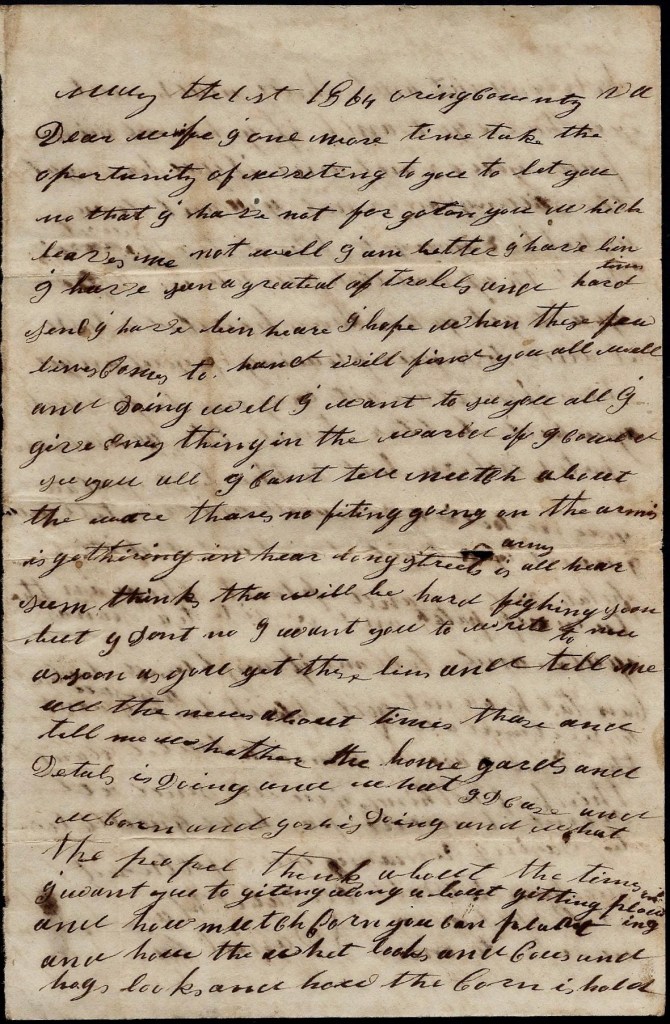
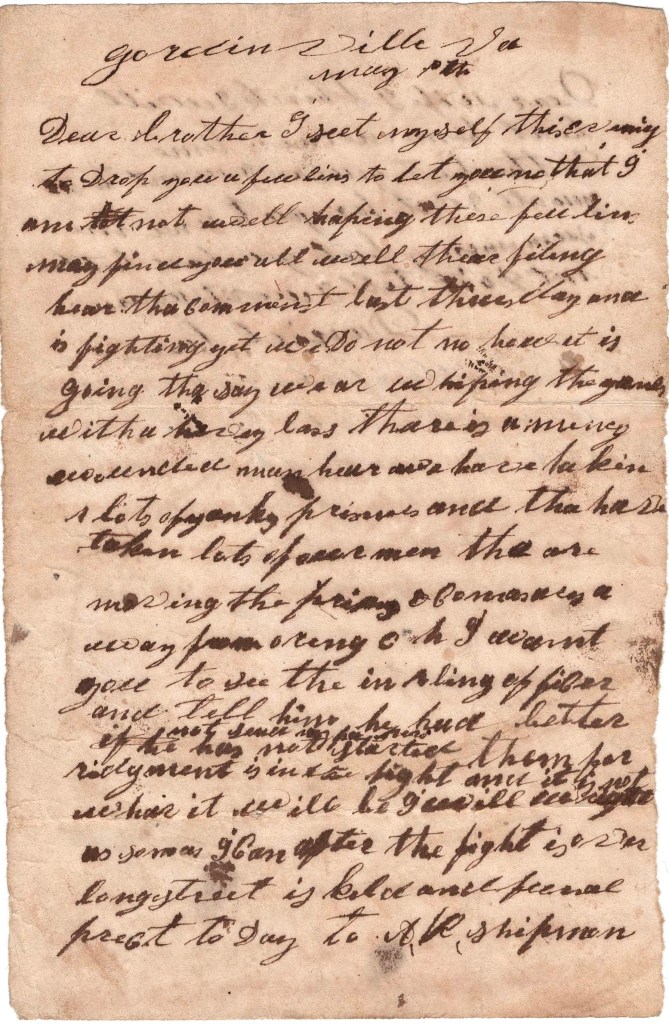
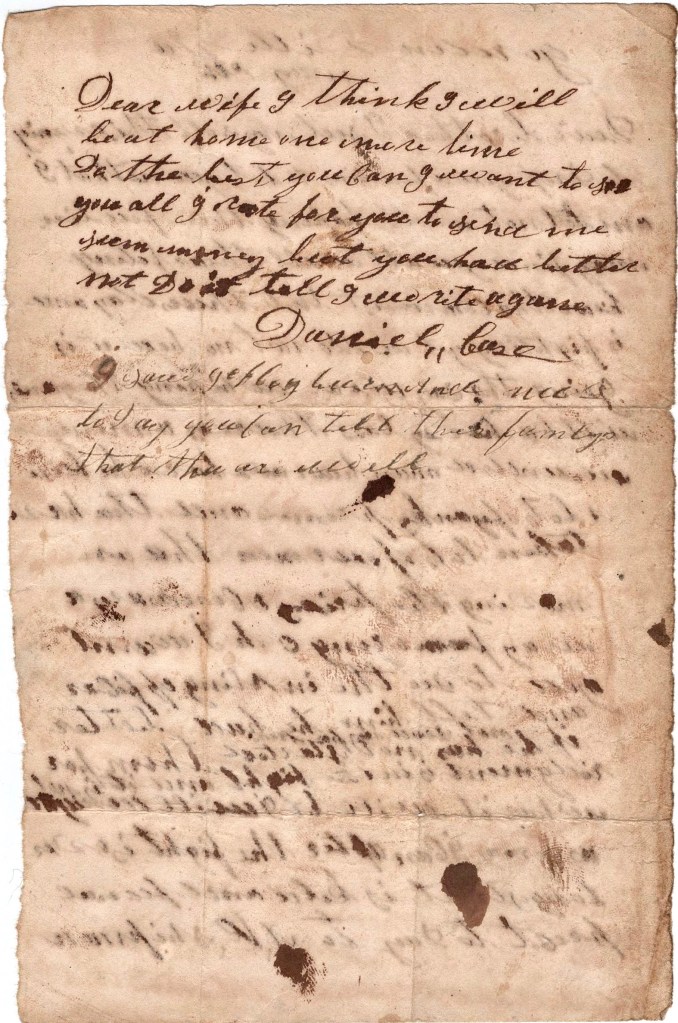
The following letters were written by Daniel Case, a private in Co. B, 4th Virginia Infantry. According to his muster records, Daniel did not enlist until 15 February 1864—most likely conscripted into the service. He deserted on 8 April 1864 a month before this letter was written and was subsequently arrested and returned to Gordonsville where he was assigned duty, under guard, at the commissary and ordnance stores. There is nothing more in his muster records to indicate whether he served out the remainder of his time with the remnants of the Stonewall Brigade which was only a shadow of its former self by this stage in the war.
Nothing more could be found regarding Daniel and Elizabeth and their “little blue-eyed babe” though his muster records indicate that he “enlisted” at Dublin, Pulaski county, Virginia.
Letter 1
Orange County, Virginia May 1st 1864
Dear wife,
I one more time take the opportunity of writing to you to let you know that I have not forgotten you which leaves me not well. I am better [than] I have been. I have done a great deal of travels and [seen] hard times since I have been here. I hope when these few lines comes to hand, [they] will find you all well and doing well.
I want to see you all. I can’t tell much about the war. There’s no fighting going on. The armies is gathering in here. Longstreet’s army is all here. They seem to think there will be hard fighting soon but I don’t know. I want you to write to me as soon as you get these lines and tell me all the news about times there and tell me whether the home guard and details is doing and what our corn and [ ] is doing and what the people think about the times.
I want you to be getting along about getting it plowed and how much corn you can plant, and how the wheat looks, and cows and hogs looks, and how the corn is holding out. And how much meat you have yet and if Johnny Winn paid you or not. And if you have got the stilling done or not. I want to know whether you got the letter I wrote the 15th of March. I wrote in it for you to get John Kendall to do it and to do your plowing if you can get him. If you can get anyone to plow, you had better tend the corn patch, but do the best you can. You know how to do it as well as I can tell you. I want you to get two bushels of Irish potatoes, red ones, and plant them in the turnip patch.
And write to us soon as you can and tell me if my blue-eyed babe can talk or not. God bless its heart. I want to see it and all the rest. I am in so much trouble, I can’t think of nothing. I will send all 25 cents. It won’t pay here. I will close by saying I remain your affectionate husband to death. — Daniel Case
to Elizabeth Case.
Letter 2
Gordonsville, Virginia May 7, [1864]
Dear Brother,
I seat myself this evening to drop you a few lines to let you know that I am not well, hoping these few lines may find you all well.
The fighting here they commenced the last three days and [there] is fighting yet. We do not know how it is going. They say we are whipping the Yanks with a heavy loss. There is many wounded man here and [we] hve taken a lot of Yanky prisoners and they have taken lots of our men. They are moving the prison and commissary away from Orange Court House.
I want you to see the [ ] of [ ] and tell him he had better not send my [ ] now if he has not started them for [our] regiment is in the fight and it is not where it will be. I will write as soon as I can after the fight is over. Longstreet is killed and [ ] today
to A. R. Shipman.
Dear wife, I think I will be at home one more time. Do the best you can. I want to see you all. I wrote for you to send me some money but you had better not do it till I write again. — Daniel Case
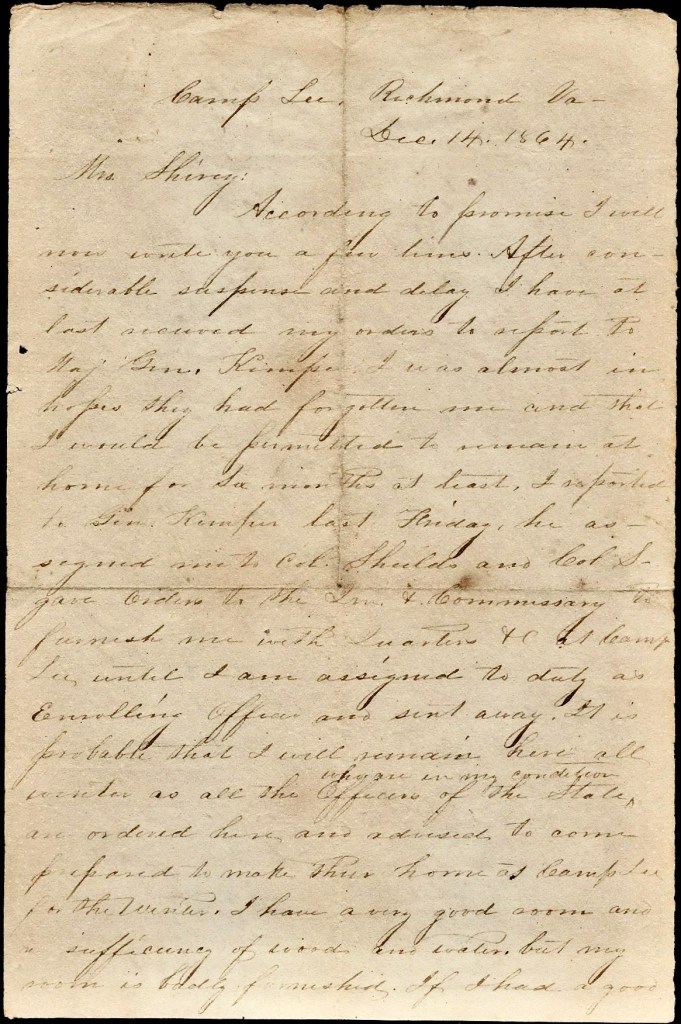
The following letter was written by Lt. Alexander H. Hoge of Co. I, 28th Virginia Infantry. Hoge enlisted at Salem, Roanoke county, Virginia, on 13 May 1861 as a private in Co. K originally but was transferred to Co. I by September. He was made 4th Sergeant on 12 December 1861 and commissioned a 2nd Lieutenant of Co. I on 28 April 1862. He was wounded on 27 June at Gaines’ Mill but returned to his regiment in time to be wounded again at Boonsboro on 14 September 1862, shot through both hips and left on the field where he was taken prisoner. He was exchanged by mid-December 1862 from Fort McHenry, and then furloughed for recovery. By the time this letter was written in mid-December 1864, Alexander had not been with his regiment for over two years and was only now being returned to duty as an invalid, having been promoted to 1st Lieut. on 5 November 1864.
From this letter we learn that Alexander anticipated being assigned duty as an enrolling officer.
Alexander was the son of James Hoge (1807-1885) and Juliett Howard (1809-1859). The brother he had not heard from for “so long a time” was Sergt. John Milton Hoge (1844-1913) who served in Co. F, 8th Virginia Cavalry. Alexander was married in 1867 to Sallie E. Whitesett and later lived in Kentucky and Missouri.
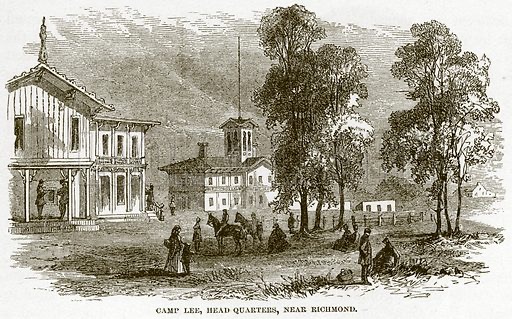
Camp Lee, Head Quarters, near Richmond. Illustration for Harper’s Pictorial History of the Civil War (McDonnell Bros, 1886).
Transcription
Camp Lee Richmond, Virginia December 14, 1864
Mrs. Shirey,
According to promise, I will now write you a few lines. After considerable suspense and delay, I have at last received my orders to report to Maj. Gen. [James (“Jimmy”) Lawson] Kemper. I was almost in hopes they had forgotten me and that I would be permitted to remain at home for six months at least. I reported to Gen. Kemper last Friday. He assigned me to Col. Shields and Col. Shields gave orders to the Quartermaster & Commissary to furnish me with quarters &c. at Camp Lee until I am assigned to duty as enrolling officer and sent away. It is probable that I will remain here all winter as all the officers of the state who are in my condition are ordered here and advised to come prepared to make their home at Camp Lee for the winter.
I have a very good room and a sufficiency of wood and water but my room is badly furnished. If I had a good bed, I would be very happily situated. Mr. Harlowe is here endeavoring to be placed on light duty. He has been sleeping in my room as his quarters are very bad. Mr. Page is said to be here but I have not seen him. I saw two of the Reserve boys in town last night—Stephens & Whitsett.
We hear cannonading almost every day. It is said that a general engagement is imminent but it has been too cold for the last few days. Mr. Hammond is in camp with the Cadets not very far from the city but I have not seen him yet. I was to Edward McCauley last night. He is improving slowly. Mrs. McCauley expected to start home today. Edward will get a furlough as soon as the Dr. thinks he is able to travel. 1
I have not heard from my Bro. for so long a time that I am becoming uneasy for his safety. If any more letters come for me to Salem, forward them to Camp Lee, Richmond, Va. Give my kindest regards to my friends in Salem, especially to Mr. Shirey, Miss Maggie, and Katie.
I am ever yours, very truly, — A. H. Hoge
1 Believe this to be the same Edward McCauley who served as a private in the 1st. Co., Milligan’s Independent Signal Corps.
I could not find an image of George but here in an unidentified Union trooper who looks to be about George’s age (Fred Taylor Collection)
The following letter was written by George W. Rice (1842-Aft1915), the son of Horace Rice (1804-1853) and Mindwell Bemus (1812-1865). George wrote the letter to his older brother Horatio Seymour Rice (1835-1901) of Harmony, Chautauqua county, New York.
George was 21 years old when he enlisted on 22 August 1864 as a private in Co. G, 9th New York Cavalry. At the time of his enlistment, he was described as a 5 and a half foot, hazel-eyed, brown-haired jeweler. He was mustered out of the regiment at Clouds Mills, Virginia on 30 June 1865.
Upon his return home from the war, in late December 1865, he married Melvina Burt (1848-1925) and settled down in Harmony to resume his career as a jeweler.
Transcription
Addressed to Mr. Seymour Rice, Harmony P.O., Chautauqua county, New York
Camp of the 9th New York Cavalry Near Lovettsville, Virginia February 6, 1865
Dear Brother,
I received your letter last Friday & was very glad to hear that you were well but sorry to say that it did not find me very well. I have been sick for two or three weeks with the chill fever but am getting a good deal better now. This is the first letter I have written since I wrote to you. I was sorry that I could not come and see you again but it was impossible on the account of my being sick. But there is some hopes of peace prevailing here at present & we are all in hopes of having peace soon and very soon.
You have of course heard of the three peace commissioners, rebel [Alexander] Stephens, [Robert] Hunter and [John A.] Campbell, coming into our lines & William H. Seward and the President have gone o meet them at City Point. And it is said that Jeff Davis is to be there too. And I hope that they will bring this cruel war to a close soon. I understand that recruiting has stopped for the present. Some of the men here are almost sure of peace this time & others doubt it, but I think peace will come soon. [See—The Fox and the Hedgehog: The Hampton Roads Conference]
Now in regard to my bounty, it is all left in black and white for one year, & in regard to your pay, I should [have] settled that up before I came away but you know that I did not get my money until I was mustered in for good & then I could not go & attend to things myself & so I had to leave without fixing your matter & mine individually. But it is left so that if I don’t never come back, that you will get your pay. But the idea of $75 for that gold watch that never could be fixed without costing as much as it was worth & the other one half to be galvanized every day to keep it looking anyhow. I don’t know but the folks think beings a person goes to war and gets 4 or 5 hundred dollars that he is made of money. But if a soldier don’t earn his money, I don’t know who does. If I had known you had wanted to borrowed some money before the papers were al made out, I would just as leave let you had one or two hundred dollars as anybody else. But it is all let out now & the papers all made out & left with a good man.
You may think I mean Henry but I do not. He has not got them & it would be useless for me to give you my note for it left all safe as it is now and I don’t feel disposed to ever sign my name to another note as long as I have got means to pay all I owe & have a few cents left.
I guess you will please excuse this poor writing for I am rather nervous. I will close by bidding you good day. — George W. Rice