1859: Charles E. Bowers to Minerva D. (Linsday) Bowers

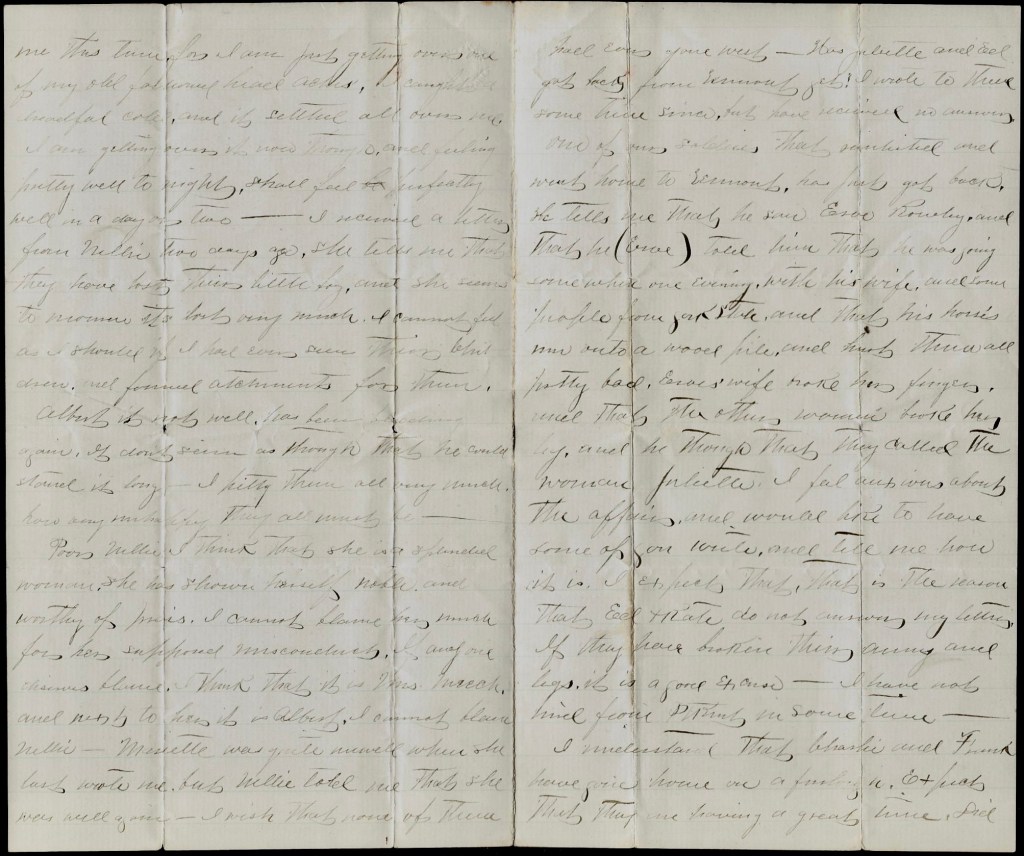
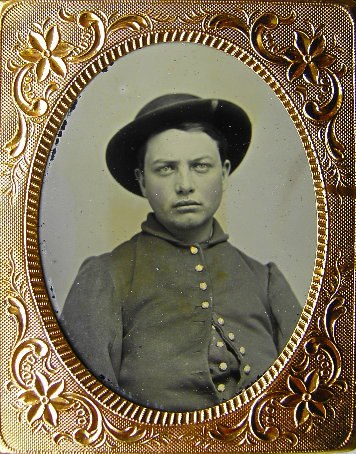
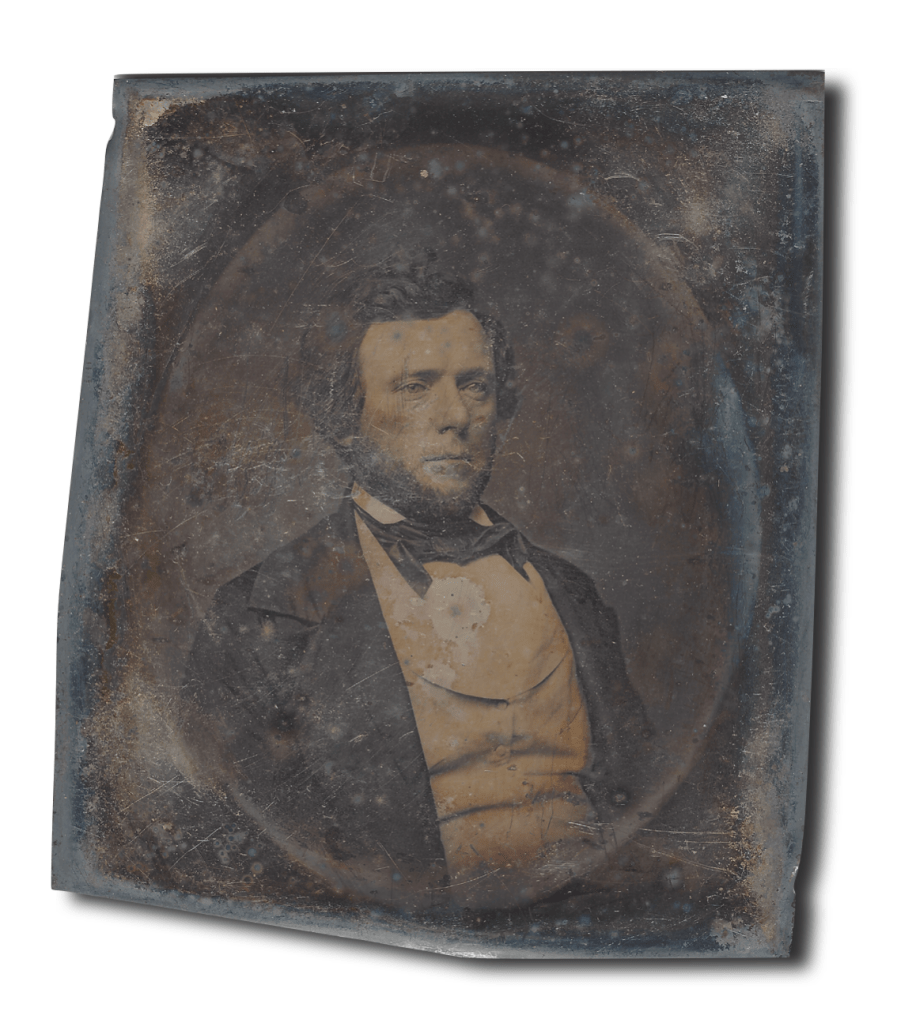
These letters were written by 33 year-old Charles E. Bowers (1826-1864) , the son of Henry and Jane L. Bowers, and the husband of Minerva D. Linsday (1831-1908) of Branch county, Michigan. Charles and Minerva were married in Branch County on 1 January 1852.

The following biographical sketch of Charles E. Bowers was published in the History of Branch County, page 307, published in 1879. Curiously, there is no mention of the gold seeking sojourn to California during which time he wrote the transcribed letters appearing below. Perhaps it was not a proud moment for the family that Charles should leave his wife and child on a wanderlust adventure of such danger and risk.

“His boyhood was spent in obtaining a fair education and in farm labor. In after-years he was engaged in teaching district school in the winter season, and in working at farming in the summer. 

He taught several terms in Washtenaw Co. and afterwards in Branch Co. In 1847 he settled on 80 acres of wild land in the township of Butler. He erected a small frame house, and improved his lands during the summer and taught school in the winter for a number of years. He became attached to one of his pupils, Miss Minerva D. Linsday, daughter of Pioneer Preacher Rev. David Linsday of Butler Co., MI. 

In 1864 Charles was drafted into the army [as a private in Co. B, 14th Michigan Infantry,] and, on the “March to the Sea,” strayed from his command, and for eleven long years his fate was unknown by his sorrowing widow and friends at home. But, after years of uncertainty, the full history of his sad death was revealed. He became sick and exhausted on the march through Georgia, and, delirious with fever, wandered away from his comrades. He was found by some people in almost a dying condition, and was taken to the house of Mrs. Bryson, the wife of a Confederate soldier. 

This kind lady procured a doctor and nursed him until his death, which occurred in Nov 1864. He gave Mrs. Bryson the address of his family in Michigan, but, owing to some mistake in the name, the several letters she wrote to Mrs. Bowers never came to hand, and in after-years, by advertising in the Detroit papers, the whole sad story came to light. He was buried in the cemetery at Conyers, Georgia, but afterwards removed to the National Soldiers Cemetery at Marietta, Georgia. 

At the time he entered the army he left his wife and one son, Don Juan. Two weeks after his departure for the war his wife gave birth to a daughter, to whom she named Jane L. At the age of 7 months the babe died, leaving the mother and little boy alone in the world.

Because of the nature of Charles’ disappearance and death while in the service of his country, his widow had difficulty obtaining a widow’s pension. The official report from the Assistant Adjutant General was that Charles was “Missing from the Ambulance train of the 1st Brigade, 2nd Division, 14th Army Corps on 19 November 1864 on the march from Atlanta to Savannah, Ga., while in a deranged condition resulting from sickness—supposed to be dead.” Minerva’s claim appears to have been initially denied—“Deserted December 1864 in the field. No evidence of death.” The pension record reveals she was still seeking a pension years later.

These eight letters are part of several letters written by Charles Bowers on his overland journey to California by way of Salt Lake City. “In crossing the plains when we got to Salt Lake,” he wrote his wife from California, “we sold our wagon and packed our things on the horses, sold our tent and slept on the ground in the open air the rest of the way to California without inconvenience of any sort.” Before winter 1859, his party made it to California where they began their search for gold in Genesee Valley in Plumas county, California. By February 1860, after digging for three months, Charles was not very sanguine as to his chances of great fortune: “I hope to make enough to pay a little towards the expenses of my journey. I do not expect to make much, and I should not probably have made a great deal if I had stayed in Michigan. I shall have a chance to satisfy myself about this about this western country and I think a man can gain more information by making the trip than by any other way.” By June 1860, he informed his wife that he intended to return home in the fall.

Charles wrote each of the following letters to his wife, Minerva, in 1859

Letter 1

Council Bluffs
May 9, 1859


Minerva,

I embrace this chance to inform you of my whereabouts. We arrived at Council Bluffs on Saturday, May 7th, all well. We are so at present. The boys have gone down to the city to buy our stock of provisions and have left me here to watch the tents. I forgot to tell you in my former letters that we got in company with four men from Genesee County, Michigan. We met them at Michigan City, the next day after we left home and have traveled with them to this place and shall most likely go through with them. They appear to be first rate fellows. 

I was a good deal disappointed on not finding a letter from you at the Bluff. I had made a good deal of calculation on hearing from you there but presume I shall not. A letter now from you now would be one of the bright spots in everyday life. Alonzo and Daniel were also disappointed. We shall leave orders with the postmaster at the Bluff to send them on if they arrive soon. If you do not have a letter already sent when you get this, you need not send any till you hear from me again and then I will tell you where to direct one. We shall start from here in two or three days.

We are encamped about ¼ of a mile from the Missouri River. I went over on Saturday after we arrived and took a look at it. Well, how do you think I found it. I will tell you. I found it to be a mudhole about 4000 miles long and a little less than a mile wide. It is very muddy and runs very swift. The cause of the water looking so is because the sides and bottom are quicksand. I saw about a half dozen steamboats passing up and down the river yesterday. There was a very nice boat stopped to take on freight on this side of the river and I went over and made her a visit. We use the water from the river for cooking and drinking. We have to bring it and let it stand over night and settle, then it is very good. The inhabitants here use it altogether but there is no need of it as good water can be got by digging. The water in Iowa where we have passed though is generally the best I ever saw. It is first rate. There can be no better.

There is plenty of Indians here and they come to the tents and want to eat, eat off the trim. They are a hard-looking set—poor and dirty. The squaws in particular—a degraded and abandoned set. They do all the work, carry all the burdens, bear all the drudgery and ____ hard. The Indians march along by their side carrying their rifle perhaps and fixed off as grand as coffee. 

Council Bluffs as a village is perhaps as large as Coldwater, situated on the river bottoms, three miles and a half from the river on the East side. There is a good deal of business done here, most of the emigrants fitting out here. Omaha City is situated in Nebraska Territory on the West side of the river. It is the capitol of the Territory and a very fine place, nearly as large as the Bluff to judge of its appearance from the east side of the river. The capitol stands on the elevation west of the town and is a fine-looking building.

Our company have been well since we left, with the exception of Len, he had the Ague every other day for a week but he is healthy now.
We sleep on the ground on a blanket, cook our own grub and fare first rate. I have washed once since I left and did it first rate. We get along better by a good deal than I expected we should.
We shall probably cross the river this afternoon. We are camped near the ferry and it is three miles back to town. As soon as the boys get back, we shall go across the river. 


And now about the [Pike’s] Peak. I cannot tell you much—only that there is an immense emigration that way. It is estimated that fifty wagons per day have crossed the ferry here for sixty days. There is all sorts of news but on the whole they are favorable. If I could hear from you and know that you and Juan was well, I should be better satisfied but I shall wait patiently till the time comes. Give my respects to all friends. Hug Dick for me a little and remember me.

Ever yours, truly, Chas. E. Bowers


Letter 2

Council Bluff
May 11, 1859


Minerva,

I did not think when I wrote to you a day two ago that I should write to you so soon again, but having a little spare time this morning, I think perhaps that I cannot spend it in a manner more agreeable to myself or to you. When I wrote last, I had not got your letter, but the boys had gone to the village and when they returned, they brought me your letter. I need not tell you how well I was pleased to hear from you, and to hear that you and Juan were well as also all the friends.
I wrote to Lewis and Uncle Thomas at the same time that I did to you last.


We did not go over the [Missouri] river on Monday as we intended but we shall go today, for all I know now. We had a terrible thunderstorm last night—rain in torrents and wind in abundance. But we dug a ditch around our tent and got in and covered up and let it storm. This morning it is again fair and warm. Dan and Lon have not got any letter yet, but Dan is going to town this morning, perhaps he may find one. In my last letter to you I told you that you need not write to me again till I got established or wrote to you where to write. I cannot tell when I shall be where. I should be apt to get a letter from you with regard to the mines. I do not know anymore that I can depend upon than I did when I started from home.

There is some going home that have been three hundred miles west of here. They say that the whole matter is a humbug—that there is no gold there at all or none of any amount—that mining there cannot make 50 cents per day. In fact, we hear all sorts of stories and cannot tell anything about it. Some are going one way, some another. Some say one thing, some another, and that is all you can tell about the matter. Keep up good grit as I know you will, and all will come out right whether there is any gold anywhere or not. 

I will tell you how much it has cost me up to this time. We have got all our provisions that we can draw and all our equipage with the exception of a very little and it has cost me a little over fifty dollars or will when we get everything complete. That will include what I have spent and all. 

This Iowa that we have passed through is a good country, but I do not think I should like it well enough to settle in it. The prairies are too large and there is but very little timber on the route we passed through. There is thousands of acres that there is not a thing upon the grass. We did intend to go to Samuel Nicholls but did not go that route, so we did not see him. 

Sometimes I get to thinking of home and of you and Dick and then I wish I could be there for a little while, but I do not get homesick. I only think of the enjoyment we have had at home and hope we shall have again. You wanted me to write good, long letters and I do as long as I can and what I do not make in length, I try to in number. I believe this makes six that I have written to you.

We intend to cross the Missouri this afternoon and go on slowly at first as our load is heavy. We have to carry some feed from here for the horses and that makes the load a good deal heavier. You need not look for another letter till we get to Fort Kearney, which is one hundred and eighty miles, but I will write if I have an opportunity to send back. We have a first rate time full well and enjoy ourselves as well as we can. We hunt some but there has not been much game so far. We expect more ahead. We are all well and hearty, have good fare but rough, as all do on this journey. 

Tell your mother that the frying pan does the best kind of service and we keep it quite busy. I shall write to all the friends as fast as I can, but when we travel, we have to work hard. We get up in the morning, get our breakfast, pack up and move on. At night we camp, unpack, get our supper, go to bed and so it goes. There is a good many women going west with the emigrants, but it must be a hard journey and it certainly is a rough place. I saw one woman that was going through dressed in men’s clothes. She was not smart. 

And now, Minerva, take good care of Juan. Make a hero of him if you can by making him do his duty and your own heart will reward you. We start in a short time, so good-bye now.

Yours truly, Chas. E. Bowers to M. D. Bowers


Letter 3

Fremont, Nebraska Territory
May 14, 1859


Minerva,

When I wrote to you last, I thought that it would be some time before I wrote again but today it is very rainy and we are laying over and I thought I would like to write a few lines to you as that it is the most agreeable occupation I can engage in. When last I wrote to you I believe the mines were as favorable as common but now they are of the worst possible kind. The talk is that it is all a humbug and thousands of men are coming back. I do not know anything about it. I cannot tell anymore about it than I could before I started, but I must tell you the truth—the matter looks very dull. But I am going through if possible and then I shall know for myself certain. 

I want you to write to me and tell me what the news are from the boys that went from Butler and what they write back. And now Minerva, I shall write this to you as a private letter. You must not let anyone see this at present but write me a letter and direct it to Denver City, Kansas Territory, and I think I shall get it by the time I get there.

And now Minerva, if this matter is a humbug, what do you think or what would you think if I should tell you that I think of going through to California. The company that we are with are going through and I do not know but that may be the best way. I think so. When I get to Cherry Creek, I can go to California just as cheap as I can come home, and I think I would like to go. The news from the Kansas mines are very discouraging but I can’t tell you any more now till I get there and know for myself and I shall write to you as often as I can.
I think of you and Juan often and would like to see you, but I am not homesick and do not expect to be.

This is a splendid looking country but there is no timber and it is not near as ___ as Michigan. I went down to the Platt River this morning with Dan and took the first look at it. We are 40 miles west of the Bluffs. I cannot write much as we shall leave here this afternoon I suppose. Think the matter over and write me a letter directed as above and there I will have more chance to know. If you want any money, tell Lew so and he will get it for you. Take good care of yourself and Juan and then I shall be satisfied. I am healthy and feel first rate as far as health is concerned. Do not say anything to anyone of this matter.

Remember me and I shall remember you. God Bless you, — Chas. E. Bowers  to  M.D. Bowers


Letter 4

Shinn’s Ferry, Platte River
Nebraska Territory
May 18, 1859


Minerva,

Again, I embrace the opportunity of writing to you. I think I do my only towards you in that respect but it may be that I shall not be able to write so often by and by so I will write while I can. We are camped on the bank of the Platte River. Have been here two days [and] expect to go on tomorrow.

Minerva, in my last letter I told you that the news from the mines were very discouraging. They are so still and a great many men are coming back from the mines. Yes, thousands of them who say they cannot make their board by digging gold. But we are going on and if the mines at the Peak do not pay, we are going on to California. We can do just as well by going through as to come home and go just as cheap from there as to come home. You can just not say anything to anyone about our going to California till I write to you whether we are going or not. I don’t think I can afford to come so far and not make it pay. The man that come with us from ‘Homer’ leaves us here. Thinks it will not pay to go farther. Perhaps he will call and see you if he comes home but I do not know whether he will or not.

Be of good cheer. Take good care of Dick and yourself and have no fears for me. I am health us and feel better drinking river water and sleeping on the ground than before in two years. I feel as well as I ever did. Remember me to all to the old folks especially, and believe me ever yours, yours, yours, — Chas. E. Bowers

I will write as often as I can to you and to all, but I shall write to you first. We shall not cross the ferry here but go up on the north side of the Platte—a river that is of no account at all to the country. C.E.B to M.D.B. Did not I write this side.


Letter 5

Fort Kearny, Nebraska Territory
May 25, 1859


Minerva,

This will tell you that we are all well and will also inform you where we are. We arrived here last night. We are not at the fort, but on the north side of the river. We are going on again shortly. I hope you will write me a letter and direct it to Salt Lake City, Utah Territory, as I requested in my last letter. I sometimes long to hear from home but think I can wait a little while. I shall not write again till I get to Fort Laramie which is 300 miles, or I don’t expect to but if there is a post office between here and there, I will write if I can.

We had a snow storm last night and it is cold this morning. We are camped with a company that are going over the river and I can send this over to the fort, so I thought I would write. I hope you are comfortable and enjoy yourself well. Keep up good courage and I will see you again as soon as possible. We are in the buffalo range and expect to have some fun soon. We came across a dead Indian last night before we got to camping plane. He lay wrapped in his blanket. He had laid there a good while. How he came there, no one knows. I have no news to write. I knew you would like to hear how we were getting along.

Give Dick a good hug for me and consider yourself hugged a little if you are a mind to. Yours truly, — Chas. E. Bowers


Letter 6

Nebraska Territory
June 10, 1859


Minerva,

We are now within 15 miles of Fort Laramie, all well. We have had a lame horse the past week which has delayed us some but he is better now. We are camped now on the Platte River in a nice grove—the first almost that we have seen for two hundred miles. Lon is cooking dinner. We shall be at the fort tomorrow if nothing happens to hinder us. We have had some sandy roads but they are better now. Yesterday we came in sight of the Black Hills and soon shall be among them. From here it is 500 miles to Salt Lake. We can make that I suppose in about a month. We met a train of Mormons going east a few days ago. They stated the roads to be good but some snow on the mountains. There were some women with them—fine looking ones too. One in particular dressed in good style and wore kid gloves but when I saw her, she was cooking over a fire of buffalo chips. But one needs gloves to fuel the fire with such fuel.

I must tell you something of the kinds of winds they sometimes have on these plains. A company of emigrants going to California had stopped for the night about 200 miles east of here when a tornado struck them, upset their wagons and blew them upwards of 80 rods, broke their wagons to pieces and scattered their effects in every direction. We were some 40 miles east of them at the time. It blew terribly where we were but did no damage. We stopped and saw the wreck. When we came up on the wheels of their wagons, seven wheels were torn to pieces. Some of their things were blown 5 miles. One spoke of a wheel was broken in two pieces. It broke open trunks and satchels and scattered the contents on the ground. One woman had her arm broke and two men were hurt but not seriously. It is a wonder some were not killed. I would not have believed it if I had not seen it myself.

A young man in a company near us met with an accident a few days ago. One of the company was taking a gun out of the wagon when it went off and lodged a ball in his back or struck him in the shoulder blade and lodged in the bones of his breast, going nearly through his body. It did not kill him and he may get well. They have taken him to the fort to be attended to by the United States surgeon there. We have got mostly out of the region of storms of rain. I suppose that it rains here very seldom. We have traveled on the bank of the Platte so long that it looks like an old friend. 

I hope you are well and enjoy yourself, will try to do so as well as you can.
Take good care of my boy (I might say your boy). Train him up in the way he should go but allow him to act like a child while he is a child for Saint Paul done that you know. I would like much to see him. I would give money now, as little as I have got to hug the little fellow. Perhaps I shall have the chance some time. I shall write you from Salt Lake again and I want you to write and direct your letters to Placerville, California so I can hear from you as soon as I get there.


I do not know that I shall write any more this time. If I get time when we get to the fort I will. And now good-bye, — Chas. E. Bowers to M.D. Bowers


Letter 7

Fort Laramie, Nebraska Territory
June 11, 1859


Minerva,

We are at the fort as you will see. I did not think yesterday that I would have any more to write in this letter, but I think I like to write to you best of anyone. I shall send some though besides this to others. I have not had time to write to my folks yet. I suppose you do not think of going to see them. If you should, you can tell them the news and I shall write to them as soon as I can. Keep up your courage and do not get downhearted.

I wish you was here this morning to see the Indians with their ponies and packs. We see lots of them now.

Enclosed I send you the seed of a small prickly pear that grows on the prairies here. We shall go on from here soon. As soon as I can I am going over the river to the fort which is on the point between Platte and Laramie Rivers.

I must say good-bye, which I very seldom say to anyone but will as it you. Hoping to see you at the earliest possible time, I remain your affectionate — Charlie

Chas. E. Bowers to M.D. Bowers


Letter 8

Nebraska Territory
June 19, 1859


Minerva,

Today is to us as to all & should be a day of rest. We are laying over and shall start from here in the morning. We are well as common. We are camped on the bank of Platte River. I hope we shall see the last of this river soon. We have followed on its track about 700 miles. We are about 125 miles from Fort Laramie. The mountains on each side of the river begin to look up some. From where I am writing I can see snow on their tops in lots of places and yet it is 140 miles to the summit of the Rocky Mountains yet. This country has every evidence of having been formed as it now is by the force of volcanos or earthquakes. Of that I will tell you more when we meet.

We are in company with a company of seven wagons going to California by the way of Salt Lake. We expect to get there in about three weeks if nothing happens to hinder us. I shall mail this letter there. I thought I would commence to write you now and would have it ready when I get there. I am expecting a letter from you at Salt Lake and hope to get it too but if I do not, I shall be much disappointed. I shall have to wait, in that case, till I get to California which will seem like a long time.
I sometimes fancy that something is the matter at home, that you or Juan is sick or worse and often blame myself for not staying with you but perhaps this is not the case and I fondly hope that it is not. Of one thing you may be assured, I shall return as soon as I can, and I shall probably think the time as long as you. Take good care of Dick and yourself and the time will not seem long. I wrote you a letter from Fort Laramie which I sent one week ago yesterday. In that I told you all the news up to that time and I shall write this letter at intervals between this and the time we get to Salt Lake. I want you to be sure and write to Placerville, California and have the friends write that wish to and I shall get there sooner than if you waited longer.

We have got out of the region of rain I think as we do not have any more though we have some heavy thunder very. The feed that we find here in the mountains is as dry as hay but is very good. Sometimes it is plenty, sometimes none at all. Then we have to take our horses off two or three miles to where we can find grass, take our blanket along and lay down by them and sleep on the ground through the night. There is no dew of any account, so it is good sleeping. The weather here is very warm in the middle of the day when there is no wind but the nights are cool. I have not had better health in a long time than on this journey except a very sore mouth and lips. It seems that they cannot be cured. Everyone almost has them. I shall write enough before I send this to you to make out a good long letter, so I shall not write any more at present except to say that if I go to California and like the country as well as I expect to, I want to know if you will go there to live. When you write after you get this, let me know what you think of it. For the present I must close but you will hear more from me soon again if nothing happens. Till then Adieu, From your Charlie

Devils Gate, Nebraska Territory
June 27, 1859

Minerva, 

When I commenced this letter, I expected to mail it at Salt Lake but conclude to send the some now, as I have a good chance and you will get it sooner. We are 200 miles from Fort Laramie. Expect to go on from here in the morning. We are now about 300 miles from Salt Lake. We are camped on the Sweet Water River at the Devil’s Gate—a passage of the river through a spur of the Rocky Mountains. It is a frightful looking place. The river passes through a narrow cut in the rocks which rise about 400 feet from the water, perpendicular on each side. It looks frightful to go down into the gap and look up, but nothing to be compared to the looking down from the top. I went up to the top, had to lay down and crawl up to the edge and look over. I am not nervous, but it made me have a horrid feeling to look down on the river, tumbling over the rocks below.

We have plenty of game here. Dan has gone out hunting. We are staying in camp today, so we have a little leisure. I hope you are well, but you cannot tell how much I would like to hear from home and from you all. I shall write from Salt Lake, most likely, if not before. Keep up up the best kind of courage and all will be well. I am not homesick but would like to see you and Juan the best kind. I shall write to you as often as I can and to all the rest, but you will get letters ahead of the rest of course. Be brave and strong and we will meet again soon,
From your Charlie truly

1862: Charles Henry Irvin to Isabella Anne (Harradin) Irvin

This letter was written by Charles Henry Irvin (1832-1906), a native of England, who enlisted as a 1st Lieutenant & Quartermaster of the 9th Michigan Infantry on 12 October 1861. At the time of his enlistment, Charles was working as a civil engineer in Detroit and residing in the 9th Ward with his wife Isabella Anne (Harradin) Irvin (1835-1909) and daughter Fanny Marie Irvin (1854-1929).

An obituary for Charles posted in the Idaho Daily Statesman (Boise, Idaho) on 23 November 1906 says of him:

Colonel Irvin holds a wonderful record both as a military man and in his chosen profession, that of civil engineer. He was born in Thornton, parish of Pickering, county of York, England, in 1832…He was a graduate of King’s college, London, afterwards studying engineering under the most famous of the English engineers of that period.

He came to America in 1860, locating at New York. One of his first positions was that of consulting engineer of the New York Central road. His career as an engineer has been most remarkable. He was one of the inspecting engineers with E. R. Blackwell and Albert C. Tracy during the building of the Niagara suspension bridge. He was assistant chief engineer for the Denver & Rio Grande at the time of the building of the famous hanging bridge over the Royal Gorge and he also ran the line for the Toltec tunnel in the Toltec Gorge. He made the survey of the Canadian government for the improvement of the Ottawa river 50 years ago. This survey was not used until five years ago, when it was remarked by the press of that date that the survey was used without a single deviation from the original survey. He was also city engineer of Buffalo.

In ’61 he enlisted in the Ninth Michigan as first lieutenant of the army. Within three months he was made brigade quartermaster with General Swords [?] under General Buell, and later was made United States quartermaster with the rank of captain on General Thomas’ staff. Owing to the illness of General Morton, he was given entire charge of the fortifications before Nashville, arranging for this besides attending to his regular duties as quartermaster. For this work he was made a colonel. At the close of the war he was chief quartermaster of the transportation and his duties did not cease until three years after the close of the war.

He went to Colorado in 1879 where he was engaged in very important engineering work and in 1890 came to Idaho to represent the interests of W. C. Bradbury in the New York canal. In ’92 he built the Payette canal and later was manager and engineer of the Phyllis canal. In 1898 he was stricken with paralysis and while he recovered very quickly, he never enjoyed perfect health afterwards.

He was city engineer for a number of years and the last assistance which he renedered the city was in preparing the report of engineers on the gravity water system, which was presented to the council a few meetings since.

Colonel Irvin was a man of broad education who had traveled almost all over the world. When but a boy of 14 his grandfather took him to Algiers and on a long voyage to other foreign countries. He was a natural linguist and spoke and read seven languages. His mind, up to th very last was very clear and it was only the day before his death that he was telling his children his impressions on witnessing the coronation of Queen Victoria, when, as a boy, he was taken to parliament by this father on that occasion. He was a delightful racanteur, a man of the courtly manners of the early days, with a heart as simple as a child’s. He was liberal to a fault and literally gave a way a fortune to friends in need. 

Nashville, Tennessee, in 1862 (Harper’s Weekly)

Transcription

A. A. Quarter Master’s Office
Nashville, Tennessee
November 9, 1862

To Mrs. Isabella A. Irvin
My dearest Bell,

At last I have a chance of writing to you without fear of my communication to you being intercepted. This letter will be sent by a special messenger who will be accompanied by a sufficiently heavy escort to make sure that my letter will not be read by the Confederates and stopped for containing information contraband of war.

The first news I have heard of you since the 22nd of July I got today by Lt. H. C. Gilson who said he had seen Henry who told him to tell me not to get the Blues as you were all right and even this small piece of information has relieved my mind immensely. I made five attempts to get money to you send my you 4 times fifty dollars each time all of which I am informed was captured by the enemy but the last. I sent $200 I have no doubt will arrive to you before this letter.

We have since the middle of August been completely hemmed in by the enemy so that we have had no communication with the outer world and for some weeks have been in daily expectation of an attack by an overpowering force of the enemy but thank God they have put off the attack too long for them to succeed. I have no idea when you heard from me last but I suppose from what I heard the other day it must be a long time for I met a gentleman a day or two ago with whom I was slightly acquainted in Michigan who seemed as much astonished to see me as though he had seen a ghost and told me he had understood that I was killed at Clarksville. 1 Fortunately for me I left Clarksville about hours before it was attacked with a large boatload of horses and got away clear with the clothes I stood up in and positively nothing more—not even an extra pocket handkerchief. I did not intend to come up the river from Clarksville more than thirty miles but hearing the fury at Clarksville and having no other way of getting back except on horseback through woods infested with guerrillas, I thought it prudent to come to Nashville and did so and on arriving at Nashville almost the first news I heard was that Clarksville had been captured and sent up congratulations on what they learned my good luck.

I laid round Nashville for about two weeks waiting for orders & was ordered to take charge of the government manufacturing establishment at this point and was attending to that when Captain R. Stevenson was taken sick and at his request I took charge of his business for him and at his death [on 3 October 1862], I was detailed to take his place and am now at the head of one of the largest Quartermaster establishments in the U. S. I have been fortunately called upon to act here at a time when my knowledge of engineering was of particular value to the government and have succeeded in getting quite a reputation as an office as the old woman says, “although I say it as I oughn’tnoto.”

We expect to have railroad communication here in about fifteen days & then you shall hear regularly from me and as soon as possible I will have you here. You have no idea what straits we have been put here for weeks past. No tea, sugar or coffee & nothing but bread and fresh beef, often not having enough beef even to supply the hospitals which you know are always supplied first. We have not received a mail from the North since the 16th of August & I have paid as high as one dollar for a Louisville paper and never during this time less than twenty-five cents and mighty scarce at that.

I am still wearing my summer clothes from the very fact that there is not blue cloth enough in town to make a suit of clothes & I assume am beginning to look magnificently shabby. The ladies in town are about as strong secesh as ever and I have not the pleasure of making the acquaintance of any of them except officially when they come in to get paid for something that the army has taken from them. We have living by taking whatever we could find within twenty miles of this place without having any reference to whether the original owners thereof wished us to take it or not. The beautiful groves round Nashville are rapidly disappearing under our axes so s to give free sweep to our artillery and many fine residences are sharing the same fate.

You have no idea with what joy we greeted the appearance of the advance guard of General [William S.] Rosecrans’ Army. Only one thousand men arrived on Thursday but it provides the assurance that more were coming & that at least we were safe. On Wednesday the enemy had attacked the town at three different points and though none of the attacks were very heavy, nevertheless created quite an excitement among us. Captain [Charles M.] Lum is here in command of the 10th Michigan Regiment and is well.

I don’t know what to tell you about myself that is interesting except that as usual I work early and late and take but little rest and that I think when you come here you will find me decidedly both much fatter and much grayer than when we last saw each other which will form an admirable excuse for your being disgusted with my personal appearance and falling in love with someone else for I suppose you feel as young as ever. I do not even know where you are. Till I hear from you, shall continue to direct my letters to you to the care of Col. W[illiam] W[ard] Duffield as usual. The last money I sent to you I sent to the care of D. Bethune Duffield fearing that the Colonel might be in the field & some delay be occasioned thereby in the arrival of the money to you.

Now do write to me as soon as you can, enclosing letter to me to Capt. W. F. Harris and write to him requesting him to send it to me by private hand. Read this letter to Fanny. Tell her how dearly I love her & let her know that I expect soon to see her & miss her again & kiss her ten thousand times for me. When you see Father & Mother or write to them, give them my love. Ask George if he wants to come and work for me as copying clerk. If he does, as soon as communication is open, I will give him a good chance.

When you come here we will go to housekeeping taking the house and furniture of someone who has gone away down in Dixie land. Now my dearest little wife that I now and always shall be yours, most loving husband, — Charles H. Irvin

Address:

Lt. Charles H. Irvin
A. A. Quartermaster
Nashville, Tennessee


1 The Union-occupied garrison came under attack on 18 August 1862. See Recapture of Clarksville.

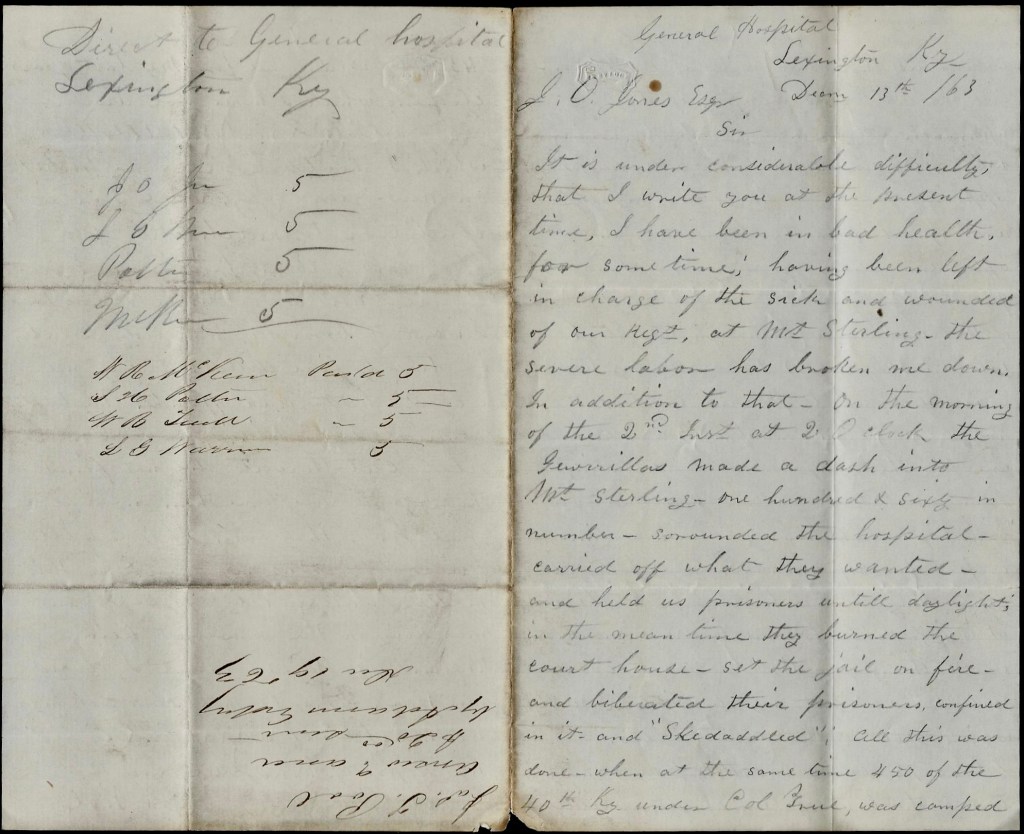
1863: William Graham Hazelrigg to J. O. Jones

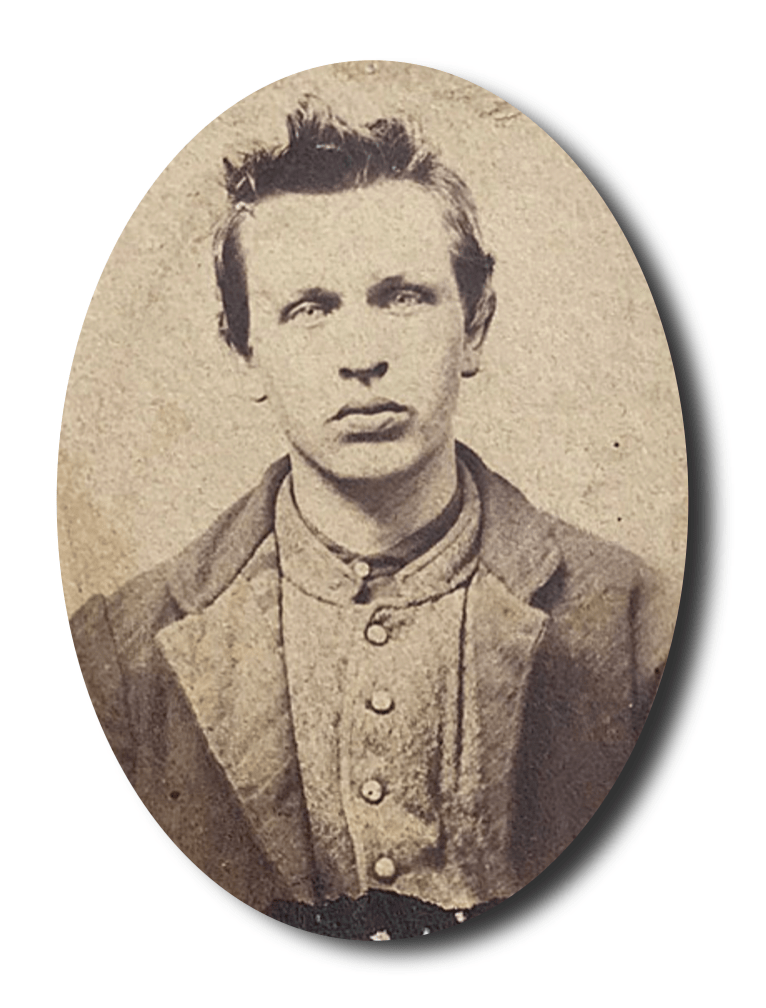
For many Civil War soldiers, life’s greatest challenges only began when they left the army. This image is of Pvt. George W. Lemon who also lost his left leg.

This letter was written by William Graham Hazelrigg (1834-1896) who served as a private in Co. A, 19th Regiment US Infantry until he was wounded on 7 April 1862 in the Battle of Shiloh. Military records indicate that he received a severe wound in the left leg that required amputation to save his life.

William was the son of William Hazelrigg (1794-1853) and Elizabeth Wall (1795-1867) of Sullivan county, Indiana. He was married to Cecelia Morgan Scranton (1843-1915) in 1864. After the war, he found in employment as a sewing machine salesman, and as a commercial grocer. In 1880, he was residing in Evansville, Indiana.

William wrote this letter to J. O. Jones, the postmaster at Terre Haute, Indiana, on the very next day after filing for an invalid’s pension.

Transcription

Terre Haute
April 29, 1863

Mr. Jones, P. M., Sir,

I was wounded at the Battle of Shiloh 7th of April ’63 [1862], disabling me for life and there is nothing that I can do to make a living at—only writing. I wish to know if you will give me employment in the [post] office. I have a slight knowledge of the business. I can give you good references. If you can give me employment, I will call and see you soon. Hoping to receive a reply soon, I remain yours truly, — Wm. G. Hazelrigg

P. S. Please address me through the P. O. — W. G. H.

1863: Jacob W. Strawyick to Andrew Strawyick

Capt. John G. Parr of Co. C, 139th Pennsylvania (Lewis Bechtold Collection)

This letter was written by 19 year-old Jacob W. Strawyick (1843-1863), the son of Andrew Strawyick (1808-Aft1880) and Susannah Martin (1807-Aft1880) of Butler, Butler county, Pennsylvania. Jacob’s father was a German emigrant who made his living as a gunsmith.

Jacob enlisted with his older brother, Hugh M. Strawyick (1840-Aft1900)—a gunsmith like his father—into Co. C, 139th Pennsylvania Infantry in early September 1862.

In his letter, written from the battle line on 1 May, 1863, Jacob attempts to reassure his father and sister that he expects to survive the battle of Chancellorsville but there is a subtle foreboding in the letter that seems to betray his true feelings. Two days later, Jacob was killed in the Battle of Salem Church (a.k.a. “Battle of Bank’s Ford”) while fighting with Sedgwick’s VI Corps. In that battle alone, the 139th Pennsylvania lost 123 men killed and wounded. Jacob was originally buried on Thomas Morrison’s Lot, Fredericksburg, Va., but was later moved to the National Cemetery.

Jacob’s letter was found in the Pension Office Records.

Some of the boys of the 139th Pennsylvania Infantry

Transcription

Line of Battle near the Rappahannock
May 1st 1863

Dear Father,

I take my pen in hand to let you know that we are both well at present and I hope these few lines will find you all enjoying the same blessing at present and I hope that it may continue so till we come home that if we live to get safe out of this battle now, if we have as good luck as we had when we was across the [river the] other time—and I pray that we will. Now don’t be any uneasy about us. If it is your time to die, it will come, and if it ain’t, we will come out safe.

Now father, I sent forty dollars home with Harvey Parks to you and I want you to let me know if he gave it to you so that you can spend it for what you want and not be in need of anything that you stand in need of. Now father, I have nothing more to say this time. [That is] all at present but still remain your son till death.

— J. W. Strawyick

Write soon.

Dear sister, I received your letter of the 22nd and was glad to hear from you and was also glad to hear that you were all well and I hope they may continue so till we all meet again—if we live, ad I pray that God will spared your life to meet again. Now dear sister, I have not much to tell you this time but if I live to get out safe out of this battle, I will tell you more for I will get a furlough and come home and then I will tell you all about the times I have had since I left home. Nothing more at present but still remain your brother till death. Write soon. — J. W. Strawyick

Let Lizzy read this too…for it may be the last letter that you might get from me. But do not be uneasy till you hear from me. Goodbye, — J. W. S.

Jacob’s headstone with surname misspelled.

1862: Theodore H. Parsons to Sarah (Christine) Brown

Capt. Theodore H. Parsons, Co. C, 91st P. V.

In response to her husband’s reported death in the Battle of Fredericksburg, Capt. Theodore H. Parsons (1834-1863) wrote Sarah Brown the following letter. The letter was short and direct though not very sensitive to the no doubt shattered life of the fallen soldier’s widow.

Theodore volunteered as the 2nd Lieutenant of Co. C, 91st Pennsylvania Infantry on 21 September 1861. In less than five weeks he was promoted to the Captain of his company whom he led until he was wounded at the Battle of Chancellorsville on 3 May, 1863. He died of his wounds on 26 June 1863.

Capt. Parsons wrote the letter to Sarah (Christine) Brown, the widow of Sergeant William Henry Brown (1835-1862)—a wheelwright residing in Philadelphia’s 2nd Ward before the Civil War. Clearly she had heard of or read the account of her husband’s death that appeared in the Philadelphia Inquirer on 19 December 1862:

On Monday last [15 December], as Hon. John Covode, in company with a number of officers, was passing over the battle-field beyond Fredericksburg, their attention was called to a small dog lying by a corpse. Mr. Covode halted a few minutes to see if life was extinct. Raising the coat from the man’s face, he found him dead. The dog, looking wistfully up, ran to the dead man’s face and kissed his silent lips. Such devotion in a small dog was so singular that Mr. Covode examined some papers upon the body, and found it to be that of Sergeant W. H. Brown, Company C, Ninety-first Pennsylvania.

The dog was shivering with the cold, but refused to leave his master’s body, and as the coat was thrown over his face again he seemed very uneasy, and tried to get under it to the man’s face. He had, it seems, followed the regiment into battle, and stuck to his master, and when he fell remained with him, refusing to leave him or to eat anything. As the party returned an ambulance was carrying the corpse to a little grove of trees for interment, and the little dog following, the only mourner at that funeral, as the hero’s comrades had been called to some other point.

Illustration of a Faithful Dog Watching Over His Wounded Master (Frank Leslie’s Illustrated)

It’s difficult to reconcile John Covode’s account of Sergt. Brown’s death with that offered by Brown’s captain. There was a flag of truce on 15 December—the day Covode claims to have visited the battlefield with some Union officers—in order for Union troops to bury the Union dead remaining on the field. But perhaps the Congressman misinterpreted the notes he kept that day. If Capt. Parson’s account is to be believed, Sgt. Brown was still very much alive on the15th of December, though writhing in agony from his mortal wounds.

Serving with Sergt. Brown was his younger brother, Pvt. Conrad R. B. Brown (b. 1838) who enlisted on 2 November 1861. Conrad was wounded at Petersburg on 18 June 1864 and discharged on Surgeon’s Certificate on 29 December 1864 as a veteran.

Capt. Parson’s letter can be found in the Pension Office records (WC4959). It was offered as an exhibit to prove the death of her husband in order to merit a widow’s pension.

Transcription

Camp near Fredericksburg, Virginia
December 23rd 1862

Mrs. Sarah Brown, Madam,

I received your letter of inquiry in regard to your husband William Henry [Brown] and I am sorry to inform you that he was mortally wounded on the 13th inst. and died from the effects of his wounds on the morning of the 16th. He was brought to this side of the river and had his leg amputated and had attention paid him until he was buried. I was present with him when he died and I think that death relieved him of a great deal of pain for he suffered untold agony from the time he was wounded.

He was struck by a shell which injured both legs and tore off part of his thigh. The account of his burial by the Hon. John Covode 1 is very near correct with the difference that it was not on the battlefield but three miles away that he died and I left Conrad and John Wright to bury him as I was ordered away with the company. His body can be sent home but we are all out of money. He will have to be embalmed and I would like to know whether you would like to have his body remain where it is until some of his relatives come for it or whether you will wait until the regiment is paid off when Conrad proposes to send him home. It will cost about $50 to get his body to Philadelphia. Conrad is safe. So is Harry McKane. 2

I remain yours &C., — Capt. T. H. Parsons, Co. C, 91st P. V.


1 Hon. John Covode was a member of Congress from Pennsylvania.

2 Henry (“Harry”) McKane (1824-1894) was a member of Co C, 91st Pennsylvania. He was wounded between the eyes at the Battle of Fredericksburg though Capt. Parson reports he was “safe.” Later in the war, Harry was detailed as a hospital nurse. He was discharged in August 1864.

1862: William Gover Gilpin to Rachel (Gover) Gilpin

I could not find an image of William but here is one of James F. Wilson who also served as a Quartermaster Sergeant in the 2nd Illinois Cavalry. James was in Co. G. (Photo Sleuth)

This letter was written by William Gover Gilpin (1836-1862) who enlisted on 5 August 1861 at Quincy, Illinois, to serve in Co. L, 2nd Illinois Cavalry. William was the quartermaster sergeant of his company. He died of “Camp Fever” on 29 September 1861 at Island No. 10. The following letter written to his mother was found in the the Pension’s Office Records. It was penned less than three weeks before his death.

William was the son of Samuel P. Gilpin (1801-1849) and Rachel Gover (1803-1871) of Baltimore, Maryland. William’s father died of cholera at Quincy, Illinois, in May 1849. The Gilpin were Quakers and members of the Baltimore Monthly Meeting of Friends (Stony Brook). Samuel and Rachel’s children included: James S. Gilpin, b. 1822, Joseph Bernard Gilpin (1825-1878); Edward Canby Gilpin (1829-1908); Thomas Harris Gilpin, b. 1831; William Gover Gilpin, b. 1836; and Albert Gallatin Gilpin (1838-1893). In the 1860 US Census, William was enumerated in Ellington, Adams county, Illinois, where he earned his living as a florist. Ten years earlier, the family was enumerated in Baltimore’s 16th Ward, Rachel being the head of the household, her husband having died the year previous.

William mentions his older brother, Joseph B. Gilpin who enlisted in April 1862 to serve as a Captain in the U. S. Commissary Department (Paymaster). He remained in the service until 13 March 1866. In the 1860 US Census, Joe was enumerated in Quincy, Illinois, where he was employed as a land agent. William also mentions his older brother Edward and a younger brother—Albert—who apparently threatened to join the Confederate army. If he did, I can find no record of it.

Rachel filed for a mother’s pension from her home in Sandy Springs, Montgomery county, Maryland. She offered this letter to the Pension’s Office as evidence that her son sent her money and that she relied on it to sustain her.

Transcription

Island No. 10, Tennessee
September 10, 1862

Dear Mother,

It has been some time since I heard from you & cannot imagine why some of you don’t write oftener. We have no news worthy of note transpiring around here save the chasing & bagging of guerrilla bands.

We see with regret that our army has retreated to where they were just a year ago and are followed by the Rebels. There is no doubt that by removing McClellan, Pope has been outgeneraled, hence our defeat. But this yet will prove a good move for the North for it will cause them to stir & be active & prove to the idle thousands that there really is a war going on. Baltimore, Frederick, & perhaps Philadelphia may be taken before our army is filled up sufficient to overthrow this rebellion. But the day is not far distant when our army will be swelled to such a number that there will be no resisting it. Just when the North stopped recruiting, the South commenced the same, by which means they have probably two to our one man in the field. But this new levy will bring our Army up to its standard.

There is no fighting very near us, Bolivar being the nearest some 60 miles east of here. [Brother] Joe is at Jackson some twenty miles from Bolivar. Guerrillas are around Jackson but not in force to take the place. Matters are quiet generally on the river. The health of our camp is very good. My health still continues good, or better than ever in fact. The weather is splendid.

Our folks in Louden are again feeling the terrors of war, & those in Sandy Spring will no doubt feel the same.

You must remain perfectly quiet where you are for this will be but a raid in Maryland that cannot last but a few days & they will again be driven South. Stay where you are & take it as cool as you can. 1

I suppose ere this Albert has joined the Southern Army. Let him go if he wants but I assure you he will yet regret leaving this—the best government that ever existed—to join the Negro Government of a day.

Have not heard from Quincy for some time but all were well when last heard from. Ed’s folks were also well. Hope you will write often. I enclose you $15 all I can spared now. will send more soon. With much love in haste, I close and remain your son, — Wm.


1 William is referring, of course, to Lee’s Maryland Campaign that culminated in the Battle of Antietam.

1863: Edward D. A. Williams to Minnie Blackwell

This letter was written by Capt. Edward D. A. Williams (1839-1920) of Co. I, 38th Ohio Volunteer Infantry (OVI). Edward enlisted on 28 August 1861 at Delta, Ohio. He began his term of service as 1st Lieutenant and was Captain of his company when he resigned his commission on 15 April 1864. His pension file indicates that prior to joining the 38th OVI, he served 3 months in Co. A, 14th OVI.

The 1920 US Census informs us that Edward was born in Ohio in 1839 adn that his parents were natives of Vermont. His death record gives his father’s name as David Williams and his mother’s maiden name as Seeley. His pension record give’s his wife’s name as “Phileta” or “Philda E.”

Maybe Edward marched in this 38th OVI reunion parade in Melrose, Ohio, in 1889

Transcription

Headquarters Co. I, 38th Regiment Ohio Volunteers
Camp near Winchester, Tennessee
July 20th 1863

Dear Minnie,

How have you passed the time since the last time I saw you some two years ago? I have thought that perhaps I might be so fortunate as to get a furlough during my term of enlistment but so far have only succeeded in obtaining permission to remain in camp and be a good “Boy” and I might go home when my time was out. A great consolation isn’t it?

We are now almost as far south as we were about a year ago but prospects are brighter than then, and we hope not to be compelled to retrace our steps back to the desolate hills of Kentucky. Rather than do this, I would go on until we are arrested by the Gulf of Mexico, carrying all before us. We are confident of success so long as Rosecrans leads the Army of the Cumberland and if nothing interposes more than Bragg’s army to dispute the possession of the country, we shall soon be masters of the Southern Confederacy.

Today we are cheered with good news from guerrilla Morgan’s command, stating that our forces have succeeded in bringing him to an engagement in which the Rebels lost severely and were routed with prospects fair for the capture of himself and entire force. His artillery is in our possession.

Do you anticipate a “Mob” in Toledo soon? One must be gotten up or you will be behind most of the Northern cities. A firm resistance to the Draft seems to be the order of the day and perhaps it is better to lose one’s life in resisting the demands of the government for support than to yield obedience to its mandates and lose it in defense of his country. In resisting the draft, he is certain to lose it, and on the other hand he stands as fair a chance as those who are already in the field.

But perhaps I shall fail to interest you and will cease for this time hoping you will respond at your earliest convenience if consistent with your idea of propriety.

With best wishes for your future happiness, I am, dear Minnie, your humble servant, “Edward”, Capt. Co. I, 38th Ohio Vols.

To Miss Minnie Blackwell

Capt. Williams’ headstone

1862: John Newton Silverthorn to J. O. Jones

This letter was written by John Newton Silverthorn (1821-1883) of Brooke, Virginia (now West Virginia), the son of Henry and Hannah (McCracken) Silverthorn. At age 15, John learned the millwrighting and carpentry trade, then went steamboating on the Ohio river. In 1845 he attended Florence Academy in Pennsylvania and then taught school at the J. B. Anderson’s Collegiate Institute at New Albany. In 1849 he married Harriet J. Dinwiddie of Hanover, Indiana, and then took charge of the Ripley County Seminary. His next job was editor of the American published in Terre Haute. After a number of other jobs he finally became editor of the Journal in Evansville, Indiana.

Also adding a note to the letter was James H. McNeely (182801902) who was a printer and newspaper publisher in Lawrenceburg, Dearborn county, Indiana. In 1859, McNeely purchased the Evansville Daily Journal.

The letter was directed to J. O. Jones, the postmaster at Terre Haute, Indiana. There is a reference to the wounded soldiers from the Battle of Shiloh arriving at the hospitals in Evansville.

Masthead of Silverthorn’s letter

Transcription

Evansville, Indiana
April 11, 1862

Mr. J. O. Jones, Terre Haute, Dear Sir,

At request of Mr. J. H. McNeely, I have made diligent inquiry at the hospitals & found there are but three (3) soldiers from your city or vicinity now in this city & they are convalescent & need nothing. The balance have all been furloughed or having regained their health have returned to their regiments.

We expect some of the wounded from Pittsburg Landing tonight or tomorrow for whom the kind offices of your loyal-hearted citizens are invoked. Prepare such things as you know will be needed & have them ready to send when required. Our people here are alive to the work.

Yours for the glorious old flag, — Silverthorn

[in a different hand]

Friend Jones,

I handed your letter over to Silverthorn, he having more time to spare than I have and a better opportunity. I hope his letter is satisfactory.

The “Commodore Perry” has just arrived with about 250 of the wounded from Pittsburg, Tennessee. Major [Frederick] Arn and Capt. [George] Harvey of the 31st [Indiana] are killed. 1

Yours respectfully, — James H. McNeely

1 The after action report written by Col. Charles Cruft of the 31st Indiana Infantry mentions the deaths of Arn and Harvey: “It grieves me to report the loss of two gallant officers. During the first charge of the enemy on the morning of the 6th Maj. Fred. Arn fell mortally wounded. He was a true soldier and accomplished gentleman. No more gallant soul ever “took wing” from a battle-field. Capt. George Harvey, one of the best officers of the regiment, was killed upon the field while bravely leading his company in the afternoon advance.

1864: James Ebenezer Cornelius to J. O. Jones

James Ebenezer Cornelius

This letter was written by James Ebenezer Cornelius (1832-1881), a carpenter from Muddy Creek, Butler county, Pennsylvania, who served as the Captain of Co, C, 100th Pennsylvania Infantry (the “Roundheads”) from August 1861 until he was wounded at the Battle of Chantilly on 1 September 1862 and discharged from the regiment on 4 March 1863. He led the regiment in the Battle of 2nd Bull Run. After he was discharged, he was transferred to the 15th Veteran Reserve Corps where he was breveted a Major for his bravery.

Major Cornelius wrote the letter to J. O. Jones, the post master at Terre Haute, Indiana, informing him that the body of Capt. Jeremiah Mewhinney (1825-1864) was sent to Terre Haute under the charge of Capt. Hastings. Capt. Mewhinney was a successful farmer in Vigo county, Indiana, when he volunteered to serve as the Capt. of Co. C (the “Noble Guards”), 31st Indiana Infantry. He died of disease in Chicago on 24 June 1864.

Transcription

Camp Douglas
Chicago, Illinois
June 29th 1864

J. O. Jones, Esq.
Dear Sir,

Yours of the 27th inst. has just come to hand. Your telegram of the 24th (Friday) never reached me. Your dispatch of Monday morning reached me about 4 o’clock p.m. Monday and I returned an answer with the messenger who brought the dispatch. I sent the body under charge of Capt. Hastings yesterday.

I am sorry that we did not get your first dispatch as it would have prevented so long delay. Yours respectfully, — J. E. Cornelius, Major, 15th Regt. V. R. C.

P. S. Will you please send the enclosed resolutions to Mrs. Mewhinney. The Captain was very highly respected by the officers here. — J. E. Cornelius

1864: Carey Campbell Wright to William C. Wright

Carey C. Wright, Co. B, 47th Illinois Infantry

This letter was written by Carey C. Wright (1834-1913) who enlisted as a corporal in Co. B, 47th Illinois Infantry at Peoria, Illinois, on 16 August 1861. At the time of his enlistment he was described as a 27 year-old, six foot tall farmer with auburn hair and auburn eyes. He gave his birthplace as Brown county, Ohio. When he mustered out of the service on 11 October 1864 as the 1st Sergeant of Co. B, he gave his residence as Tazewell county, Ohio.

Carey was the son of James R. Wright (1807-1883) and Melinda Bayne (1813-1886) of Decatur, Brown county, Ohio. In 1860, the Wright family was living near Washington, Tazewell county, Illinois. They later moved to McLean county, Illinois, then to Appanoose County, Iowa, and finally Franklin county, Kansas. Carey was married to Persis Catharine Muzzy (1847-1920) and together they had at least three children.

Transcription

Memphis, Tennessee
September 15, 1864

Dear Brother,

As I have not much to do this morning, I thought I would write you a few lines though I do not know what to write. We have so little news. The most important just now is the duty we have to perform is quite heavy, and the boys are complaining very much about it. Since the 1st & 3rd Divisions have left, it takes all the troops to do the necessary guard and fatigue duty in and around the city. The detail from our company this morning called for 16 privates & 3 non com officers. I could not fill the detail for privates & use those men I had on fatigue duty yesterday by 5 men, the balance of our men all being on duty. Several of the boys are complaining of being unwell and I am afraid we will have the shakes again if we stay here. Whether we will get off from here about the 20th is a question. Col. McClure says General Washburn told him he would give him 5 days to go from here and be mustered out at Springfield. The Colonel says he is going to try him again on the 19th to let us off the 20th. But how he will succeed, time alone will tell.

For the last 4 or 5 days the weather has been hot in the daytime & almost cold enough for the frost—last night the coldest, and I expect you have had some frost up in Illinois.

We have not heard anything from General Mower & his command except there was a prospect of a march ahead of them but we cannot tell anything about it.

21 September 1864, Times-Picayune (New Orleans) account of explosion at Fort Pickering gives rather gruesome particulars.

We had quite an explosion here a few mornings since in Fort Pickering. A pile of shell laying somewhere inside the fort exploded. A negro was fooling around somewhere near smoking when they exploded with a terrific noise, killing 4 or 5 persons who were somewhere near at the time. 1

I have not received any letter yet & there is no mail today for our regiment. There is a rumor that Mobile has been captured. We got a Chicago Tribune this morning of the 12th. The draft does not yet seem to have taken effect.

The Major has been back since I wrote you last. He is busy fixing up his matters & the officers are all expecting to get out of service soon. Most of the 100 days men have gone home from here but they must keep us who have served three years two months over our time. For my part, I do not say anything but think it is a piece of great injustice. But we must take it quietly. Nothing more at present but remain your affectionate brother, — Carey C. Wright


1 The New York Times reported on 18 September 1864: “About nine o’clock on Tuesday morning last, the citizens of Memphis were startled by one of the most terrific explosions ever heard there; a shell house under the banks, in Fort Pickering, containing some two hundred and fifty shells, exploded killing two men, one a negro soldier and the other an Irish laborer, and wounding several negro soldiers. One died during the day of his wounds. It was found upon examination that 110 shells had exploded. The explosion was occasioned by sparks from the steamer Neill.Actually, the cause of the accident was unknown.