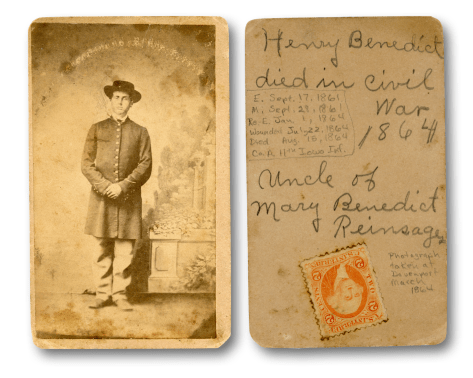
This letter was written by Henry Benedict (1842-1864) who enlisted on 17 September 1861 as a private in Co. A, 11th Iowa Infantry. Henry did not survive the war. He suffered a severe wound in the right arm on 22 July 1864 in front of Atlanta and died three weeks later at Marietta.
By the time Henry wrote this letter, he had seen the elephant a time or two and passed through some long marches in Mississippi. He datelined his letter from Memphis but erred in giving the date as 1862. It should have been 1863—a very common mistake. The regiment moved to Memphis on January 12th, four days prior this letter, and soon afterward went to Lake Providence where they remained until the Vicksburg Campaign. During the war, the regiment lost 5 officers and 86 enlisted men who were killed in action or who died of their wounds and 2 officers and 166 enlisted men who died of disease, for a total of 259 fatalities.
This letter and the image of Henry Benedict is from the private collection of Mike Huston and is published on Spared & Shared by express consent.
Transcription
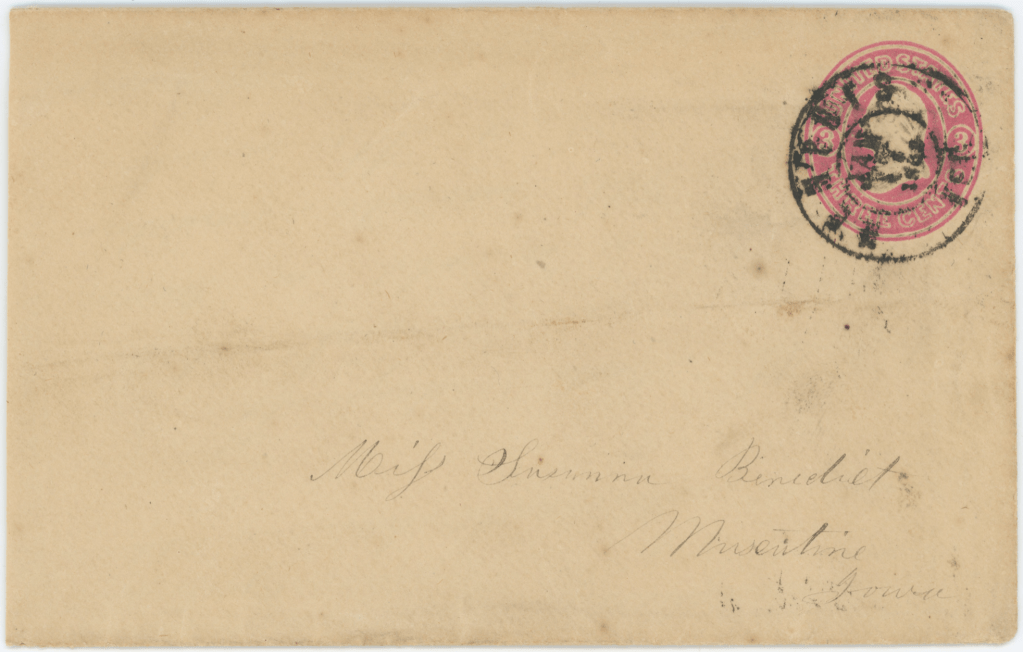
Addressed to Miss Susanna Benedict, Muscatine, Iowa
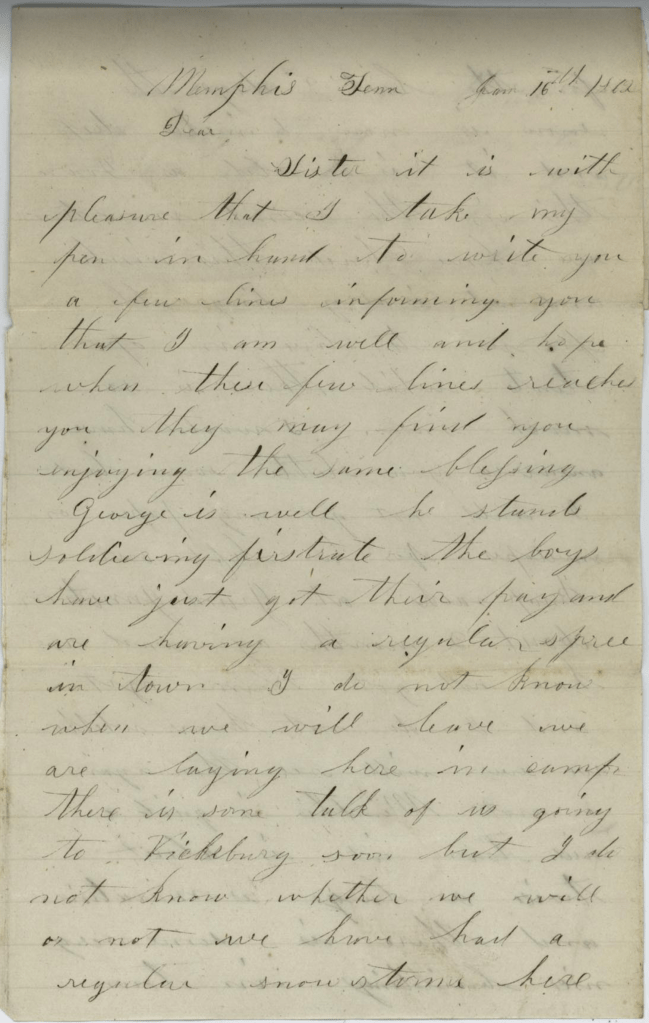
Memphis, Tennessee January 16, 1862 [should be 1863]
Dear Sister,
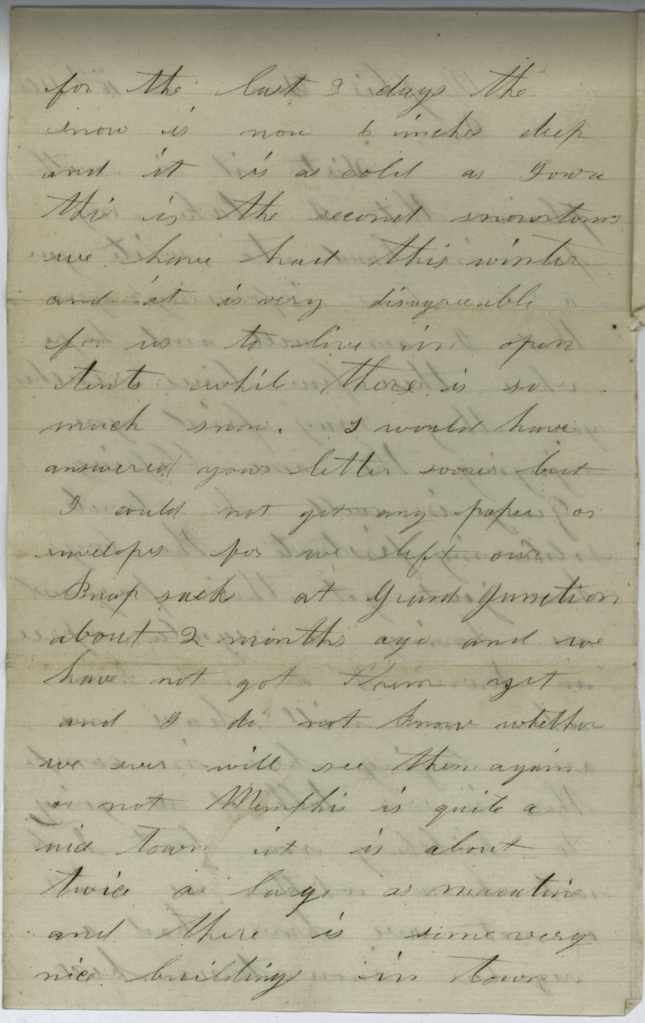
It is with pleasure that I take my pen in hand to write you a few lines informing you that I am well and hope when these few lines reaches you, they may find you enjoying the same blessing. George is well. He stands soldiering first rate. The boys have just got their pay and are having a regular spree in town. I do not know when we will leave. We are laying here in camp. There is some talk of us going to Vicksburg soon but I do not know whether we will or not. We have had a regular snowstorm here for the last 3 days. The snow is now 6 inches deep and it is as cold as Iowa. This is the second snowstorm we have had this winter and it is very disagreeable for us to live in open tents while there is so much snow.
I would have answered your letter sooner but I could not get any paper or envelopes for we left our knapsacks at Grand Junction about two months ago and we have not got them yet and I do not know whether we ever will see them again or not.
Memphis is quite a nice town. It is about twice as large as Muscatine and there is some very nice buildings in town.
Well, I cannot think of anything more to write at present so I will close. No more but I remain your affectionate brother—Henry Benedict
Augustus Oswald McDonell (1839-1912), Image found on Richard Ferry Military Antiques.
This letter was written by Pvt. Augustus Oswald McDonell (1839-1912), the son of Alexander Harrison MacDonell (1809-1871) and Ann Elizabeth Nowland (1808-1880). Augustus was born in Savannah, Georgia, and came to Florida in 1854 where he was educated and working as a merchant in the gulfport city of Alachua when the Civil War started. He joined the Gainesville Minute Men (militia) in 1860 and then enlisted at Gainesville, Florida on 5 April 1861 in Co. H, 1st Florida Infantry. In mid-April 1862 he was commissioned a 2nd Lieutenant in Co. K. He was wounded at the Battle of Perryville in October 1862 and promoted to the Captain of his company sometime early in 1864. He was taken prisoner by the 23rd Army Corps before Atlanta on 7 August 1864 and was not released from Johnson’s Island Prison until taking the oath on 16 June 1865.
In the 1860 US Census, “A. O. McDonell” was enumerated as a “merchant” in Alachua, Florida. His father was enumerated at that time in Marion county, Florida, and owned 25 slaves ranging in ages from 1 to 73. In the 1850 US Census, 8 year-old “Augustus” was enumerated in his father’s residence in Early County, Georgia. Others in the household included his siblings, George (age 19), Roselin (age 17), Hannah (age 8), and James (age 4).
In researching the identity of this author of this letter, I discovered that his diary was housed in the P. K. Yonge Library at the University of Florida enabling me to compare and confirm the handwriting [see Augustus O. McDonell Papers, Diary, 1862-1864, to Download]. This diary would be incredible to transcribe. An entry from Murfreesboro on January 1, 1863 gives a hint of his composition:
There has been little fighting today. At intervals artillery and musketry have been heard in blended tones, plainly telling that our skirmishers were contesting gallantly the ground they occupied. The battlefield is still strewn with the enemy’s dead—their bland eyes & distorted features show in wht agony they died. Our wounded with the enemy’s have all been cared for and our dead buried. The battlefield is one vast grove of cedars and thousands of these beautiful evergreens are wrent in shivers by the bursting shell and lightning grape shot. Among this beautiful forest wreck are the graves of the noble dead, the newly turned sod silently says, “Here sleep the Masters of Liberty.”
In this letter, datelined from Camp Magnolia near Pensacola, Florida on 19 May 1861, Augustus informs his mother that all new recruits must enlist for the duration of the war, not just for one year. He also informs her that “it is almost impossible for us to get along without a servant of some kind” and asks his Father to send a family slave named “Nero” to the camp to cook and wash his clothes for him.
Transcription
Camp Magnolia [west of Fort Barrancas] May 19, 1861
My Dear Mother,
Both of your kind and affectionate letters were received last week—the one by mail and the other by Harry. I did not get the letter written by him until several days after his arrival here. He left his saddle bags over at Pensacola and they contained our letters. I also received one from Hannah and Grandfather all of which I prized very highly. It makes me feel much happier & contented with my lot when I receive letters often from home.
I commenced this letter yesterday which was Sunday but did not get through with it. Since then an order has been issued from General Bragg to the effect that all visitors here must enlist or leave the army encampment within three days. Harry prefers doing the latter and will leave here in the morning and take this letter to you. We all tried to persuade Harry to enlist and stay with us but it was no go. An easy life at home seem to be the height of his ambition. He says he wants to join a company and go to Virginia but the misfortune now is the President has issued an order not receiving any more companies or men in the C. S. service unless they enlist for the term of the war which I think an excellent idea because troops who have been in service 12 months will be much more effectual than raw recruits. I have made up my mind that if the war is not ended at the expiration of the term for which I joined—and I live—that I will enlist again and that for the whole war, but I hope I will not always serve as a private.
Uncle Thaddeus 1 has written by Harry for Aunt Janie to come on to Pensacola. He will board her at some private house in that place. I want you, dear Mother, to tell Father to send Nero to me as soon as you get this by Harry. Start him off to Fernandina and he can come in company with Aunt Janie and take care of the baggage for her.
The Major [Thaddeus McDonald] was disappointed in getting his boy Grand Fernandina and it is almost impossible for us to get along without a servant of some kind and in case I get sick, dear Mother, I will have him to attend to and nurse me. I have to pay $1 per dozen for all of my washing and if I had Nero here, he could do it for me. I hope he will not object to coming. He told me before I left that he wanted to come with me. He will be kindly treated and well cared for. Uncle Thaddeus will gone one half his hire and expense. Let him get a trunk out of the store to put his clothes in and tell him not to bring any more than he can feasibly help as much baggage is unhandy to move about in case we are sent from this to some other point. Do, Mother dear, send by Nero a pair of sheets for me. The weather is getting so warm that a blanket to sleep on is not so comfortable. also a couple pillow cases and two pair of my summer pants. And tell Father to look in the store among the clothing and if he has not sold them, to send me a pair of black Cap—pants marked $9. I got them in Savannah but concluded I would not need them here so I put them in the store to sell. Once in awhile I get a chance to visit Pensacola and then I like to look a little decent. If you have any little nice thing to send, it will not be at all objectionable, I assure you.
Be sure to write me. I don’t believe there is anything else that I want now. If you can think of any little thing I will need, send it along. Tell dear Father to shut down the credit business and sell for cash only. Goods are just like so much money now for they can’t be had anywhere hardly except for cash and that at the highest prices. If they do not sell now, they will before the war closes. I will write him soon more definitely with regard to it. I got a letter from cousin Gertie today. She mentions Camilla [Saussy] and Mr. Thomas H.] Jordan’s marriage and departure for the war. All were well in Savannah. I am going to write her a long letter soon as she was so kind to write me first. I hope his will find you all enjoying good health.
Laura Dunn is stopping in Warrington at a private house there. I went to call on her yesterday but she was not at home. She had gone to the camp. She sent us word that she was very anxious to see me and that I must certainly call on her before she returns home. Give much love to all relatives and friends and keep a sharp look out for John Brown parties. I believe the South is full of subversives and we should be vigilant at home and see that they do not step in upon us unawares.
I must now close. write me soon, dear Mother. Harry will tell you the news.
Your absent and affectionate child, — Augustus
1 Thaddeus A McDonald [McDonnell] was the Major of the 1st Florida Infantry. He was later promted Lt. Colonel of the regiment. He was wounded at the Battle of Shiloh on 6 April 1862.
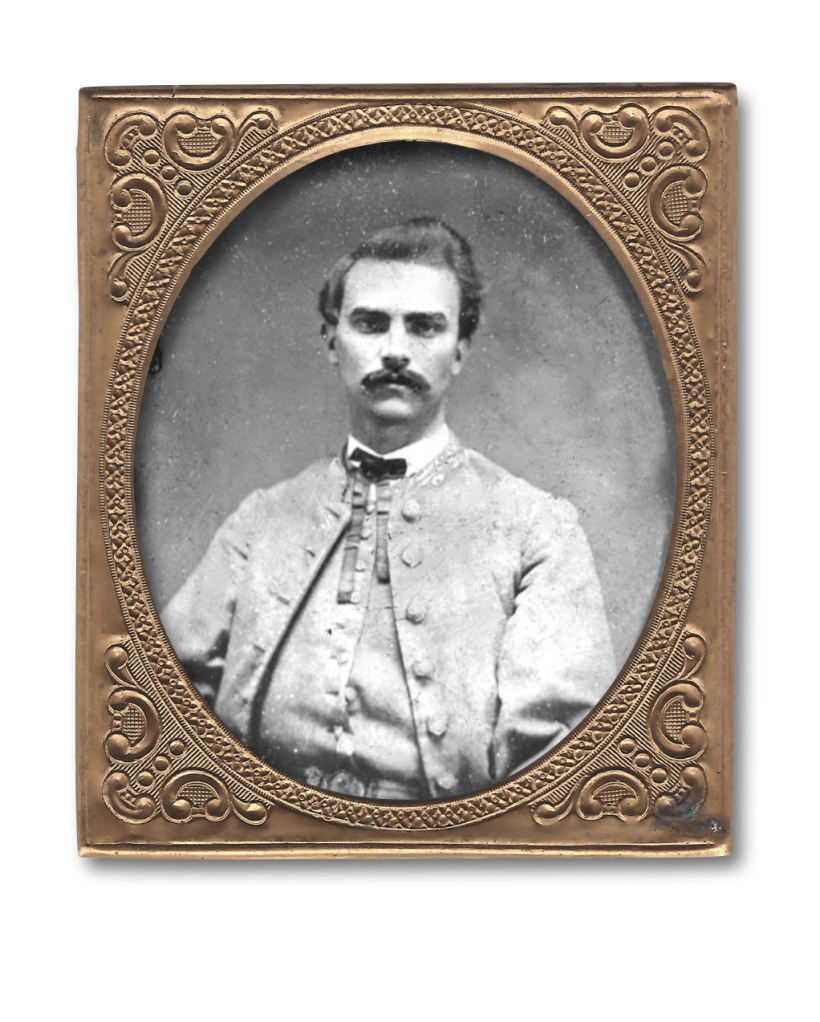
This early-war tintype of an unidentified soldier was probably a member of Kane’s Rifle Regiment. Note the bucktail on the side of his cap. ( Dale Niesen Collection)
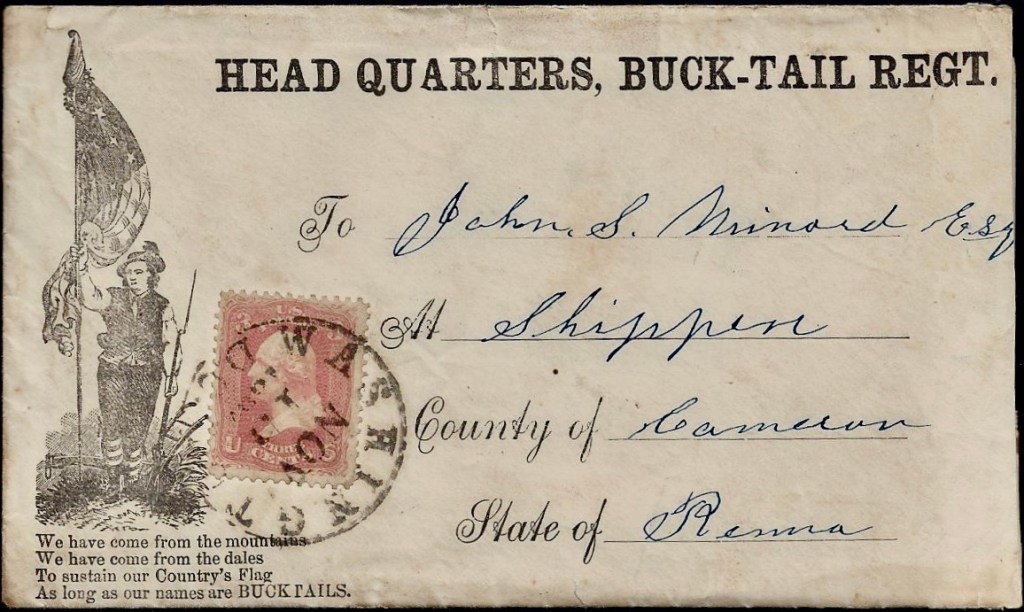
This letter was written by Seneca Freeman Minard (1837-1914) of Shippen, Cameron county, Pennsylvania, who mustered into the Kane Rifle Regiment of the Pennsylvania Reserve Corps (13th Pennsylvania Reserves, 42nd Pennsylvania Infantry)—better known as the “Bucktail Regiment”—on 1 June 1861 as a private in Co. C. At the time of his enrollment he was described as standing 5′ 9.5″ tall, with black hair, and blue eyes. He gave his occupation just prior to his enlistment as “lumberman.”
At some point Seneca appears to have been promoted to a corporal but there are no muster-out records for him and a note in the regimental history indicates that Seneca deserted his regiment though no date was given. The 1890 Veteran Schedule records him as a resident of Milton, Rock county, Wisconsin and states that he served 2.5 years.
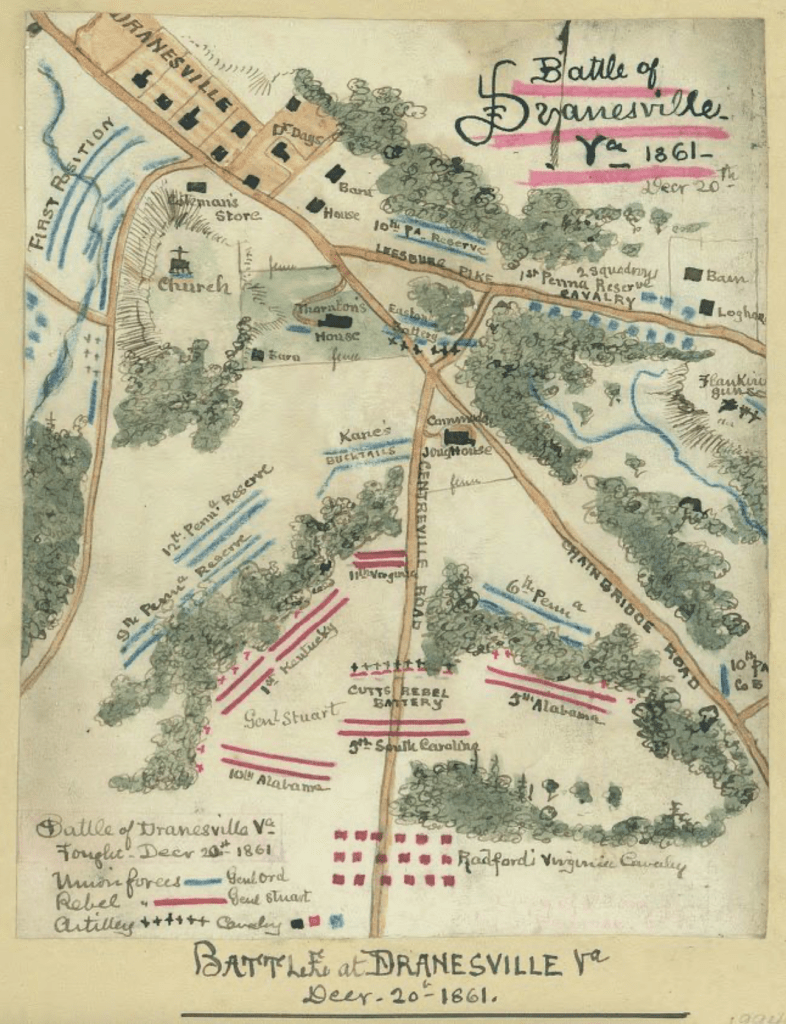
Seneca’s letter describes the Battle of Dranesville that took place between Confederate forces under Brig. General J. E. B. Stuart and Union forces under Brig. Gen. Edward O. C. Ord on 20 December 1861 in Fairfax county, Virginia.
Transcription
Addressed to John S. Minard, Esq., at Shippen, Camden county, Penna.
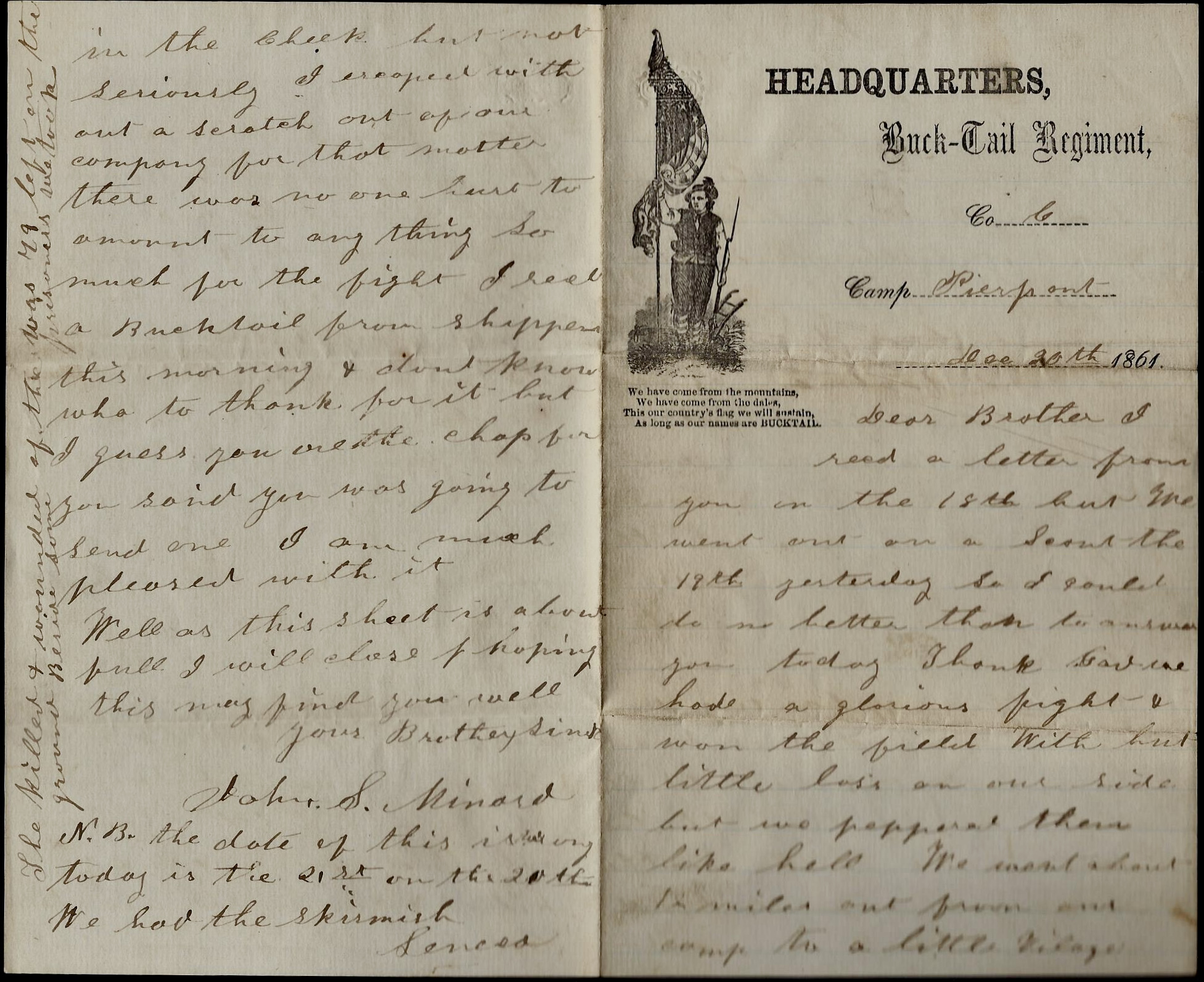
Headquarters, Bucktail Regiment Co. C, Camp Pierpont December 20th 1861
Dear Brother,
I read a letter from you on the 18th but we went out on a scout the 19th yesterday so I could do no better than to answer you today, thank God. We had a glorious fight & won the field with but little loss on our side but we peppered them like hell. We went about two miles out from our camp [on the Leesburg pike] to a little village called Dranesville. After scouting around there for about an hour we run into a nest of them stationed in a thick grove of little pines. They had four pieces of artillery and about four or five thousand footmen as near as we could find out.
The Bucktails were on the ground first and consequently were in the hottest of the fight. We were coming along the road & one of our [men] saw them planting a cannon in a crossroad to our left and he told the Colonel of it. Then the Colonel took us in behind a large brick house for shelter. we had hardly taken our position when they opened fire on us. The grapeshot and bomb shells flew like hail among us but we laid down as close to the ground as we could hug and they couldn’t do us much harm. But we did not have to stay here long until our big guns got on the ground and then we went in on our shape & within half an hour from the time our cannons got there, we were masters of the field.
Our loss was about ten killed and fifteen wounded—the most of them slightly. There was only three of our regiment killed and five or six wounded. [Lt.-]Col. [Thomas Leiper] Kane was wounded in the cheek but not seriously. 1 I escaped without a scratch. Out of our company, for that matter, there was no one hurt to amount to anything. So much for the fight.
I received a Bucktail from Shippen this morning & don’t know who to thank for it but I guess you are the chap for you said you was going to send one. I am much pleased with it.
Well as this sheet is about full, I will close hoping this may find you well.
Your brother, — Seneca
to John S. Minard
N. B. The date of this is wrong. Today is the 21st. On the 20th we had the skirmish. — Seneca
The killed and wounded of the [Rebs] was 79 left on the ground besides some prisoners we took.
1 Lt. Col. Kane was struck in the face by a ball that pierced his upper jaw. He halted just long enough to tie a bandage and resumed his position at he lead of his men.
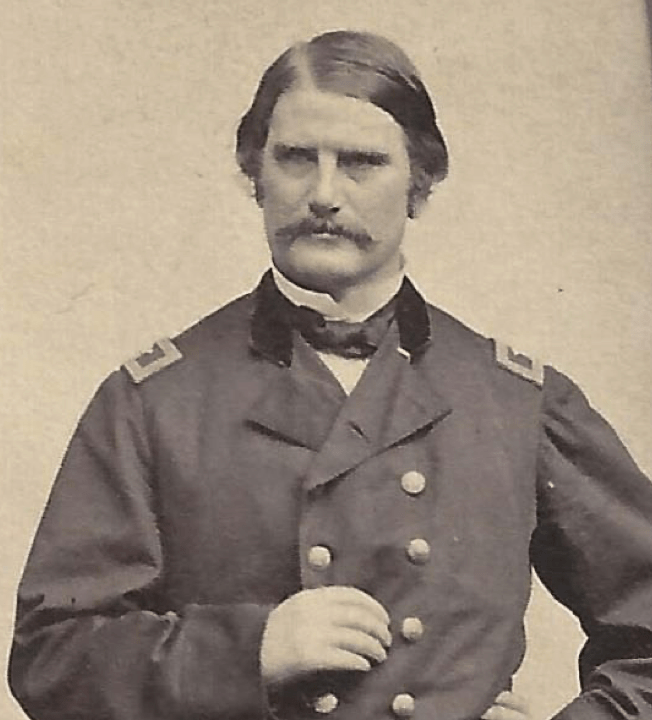
Capt. Harry Platt, Co. B, 4th Vermont(John Gibson Collection)
This letter was written by James Henry Platt, Jr. (1837-1894), who was raised in Burlington, Vermont. He completed preparatory studies and graduated from the medical department of the University of Vermont at Burlington in 1859 when he was 23. On 23 February 1859 he married Sarah Caroline Foster in Rutland, Vermont. He later married the suffragist and widow Sarah Sophia Chase Decker (1856–1912), who survived him.
“Harry” (as he preferred to be called) enlisted in August 1861 as a Captain in Co. B, 4th Vermont Volunteers. The 4th Vermont was organized at Brattleboro under the young Colonel Edwin Henry Stoughton and spent its first autumn in Virginia with Brooks’ Brigade, primarily tasked with the defense of Washington, DC at Camp Griffin.
While at Camp Griffin, the 4th Vermont was brigaded with several other Vermont regiments and was, therefore, often referred to as the “Vermont Brigade.” The brigade had a storied career and played a part in many important battles of the Army of the Potomac, including the Peninsula Campaign, Antietam, Fredericksburg, Second Battle of Fredericksburg, Gettysburg, Wilderness, Spotsylvania, Cold Harbor, Petersburg, Ft. Stevens, and Winchester.
This incredible letter pertains to the first real test of the regiment which took place during McClellan’s Peninsula Campaign. After landing his troops on the tip of the peninsula formed by the James and York rivers, McClellan sent them towards Yorktown. Long before arriving there, however, he found that the Confederates had established a line of defense across the entire peninsula on or near the Warwick river—a formidable barrier by itself but also heavily fortified. On the morning of the 16th of April 1862, Brig. Gen. Baldy Smith sent two Vermont regiments from his 2nd Brigade towards the Confederate position near Lee’s Mill with orders to open fire on any working parties. Though the infantry opened the engagement, it devolved into an artillery duel with both sides suffering losses. No advance was accomplished and McClellan settled on the strategy of a siege. The engagement of 16 April 1862 has been referred to by various names, including the Battle of Lee’s Mill, the Battle of Burnt Chimneys, or the Battle of Dam No. 1.
As a counterpoint to this letter, I have placed a transcript in the footnotes of a letter written by 2Lt Cadmus M. Amoss of Cobb’s Legion who described the assault of the Vermont Brigade from the Confederate perspective.
[This letter is from the private collection of Richard Weiner and is published on Spared & Shared by express consent.]
Transcription
Camp near Yorktown, Virginia April 20th 1862
My Darling Wife,
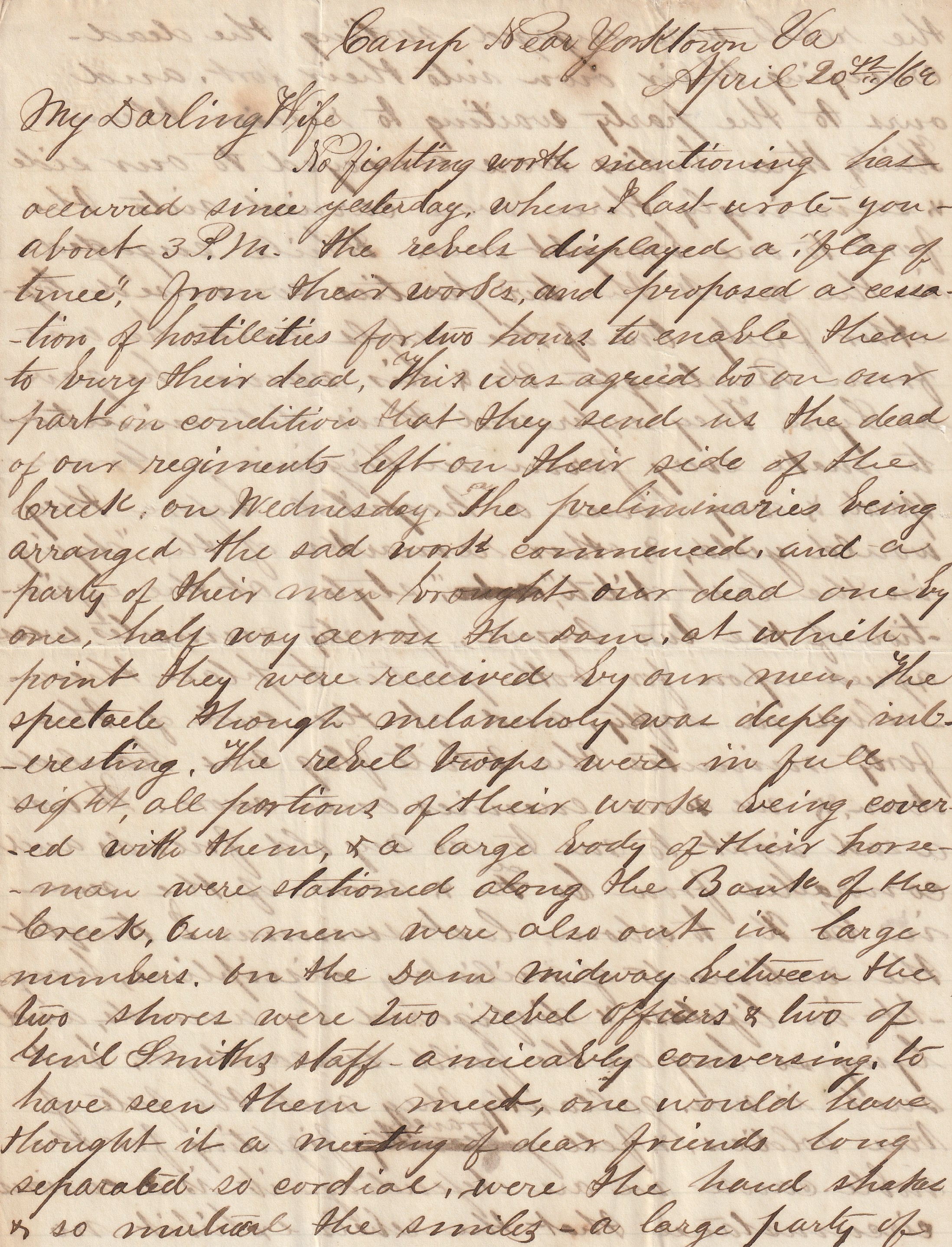
No fighting worth mentioning has occurred since yesterday when I last wrote you. About 3 p.m., the rebels displayed a “flag of truce” from their works, and proposed a cessation of hostilities for two hours to enable them to bury their dead. This was agreed to on our part on condition that they send us the dead of our regiments left on their side of the creek on Wednesday. The preliminaries being arranged, the sad work commenced and a party of their men brought our dead, one by one, half-way across the dam at which point they were received by our men. The spectacle—though melancholy—was deeply interesting. The rebel troops were in full sight, all portions of their works being covered with them, and a large body of their horsemen were stationed along the bank of the creek. Our men were also out in large numbers. On the dam midway between the two shores were two rebel officers and two of Gen. Smith’s staff amiably conversing. To have seen them meet, one would have thought it a meeting of dear friends long separated so cordial were the handshakes & so mutual the smiles.
“They expressed their determination to make every farm in Virginia a graveyard and every house a hospital before they would yield…”
Capt. Harry Platt, Co. B, 4th Vermont, 20 April 1862
A large party of the rebels were engaged sorting the dead, conveying their own into their fort, and ours to the party waiting to receive them. Thirty-three bodies were conveyed to our side, and seemingly three were carried into the fort to [every] one brought over [to ours]. While engaged in the work, the two parties conversed together freely. One of the rebels said he was from Burlington, Vermont, and his name he gave as Lyon. They expressed their determination to make every farm in Virginia a graveyard and every house a hospital before they would yield and other remarks of the “dying in the last ditch” style.
At the expiration of the two hours, forty minutes was agreed upon for both parties to place themselves in safety and at the end of forty minutes the white flag was hauled down and we were enemies once more. It was a sad sight to me to see my old friends and comrades from Co. F and some of the men in Co. K to whom last summer I taught the rudiments of military discipline, brought in lifeless & disfigured by wounds and lying so long on the field uncared for. But such is war. Gallantly they met the fate of true soldiers & fell bravely fighting for the noble cause we are defending.
It is a curious circumstance that rebels exhibit no flag. The white flag is the only emblem we have seen.
Our dead were buried carefully and tenderly amid the groups of sorrowing comrades who witnessed this last sad office. 1
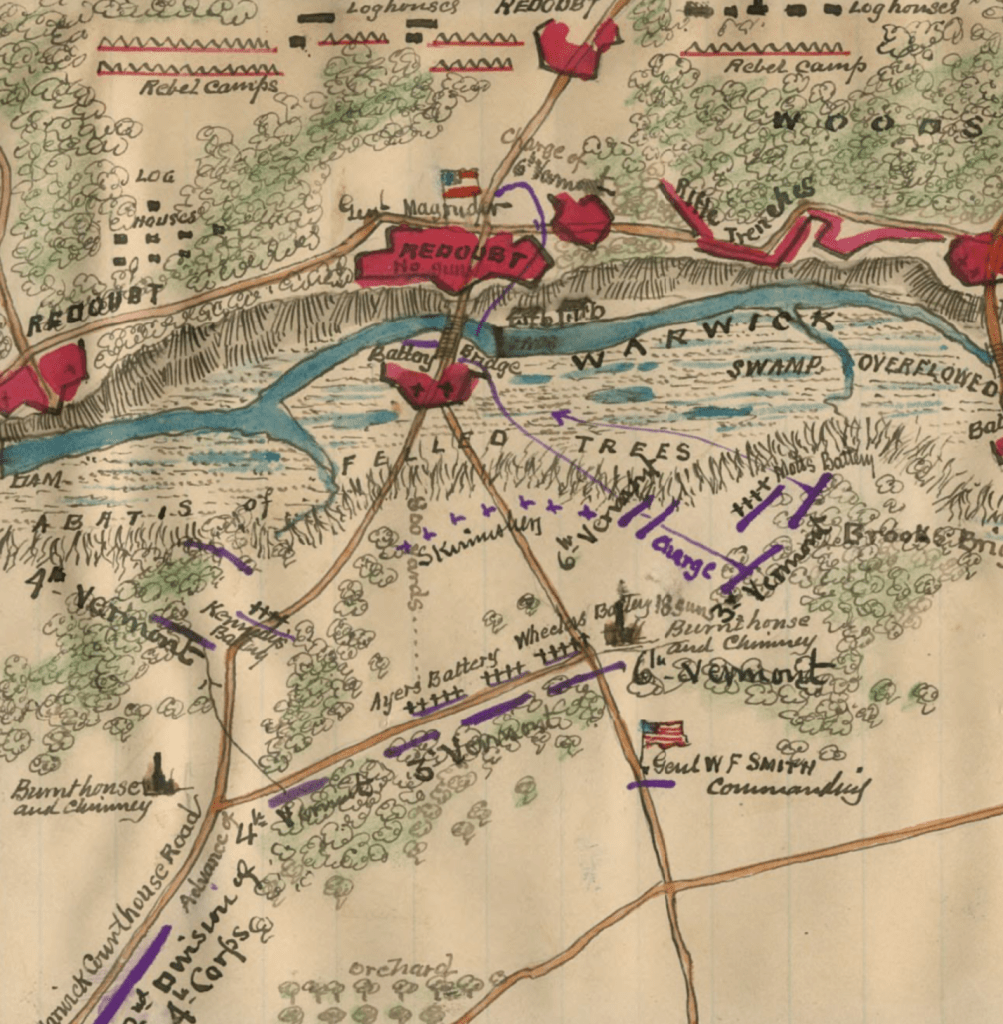
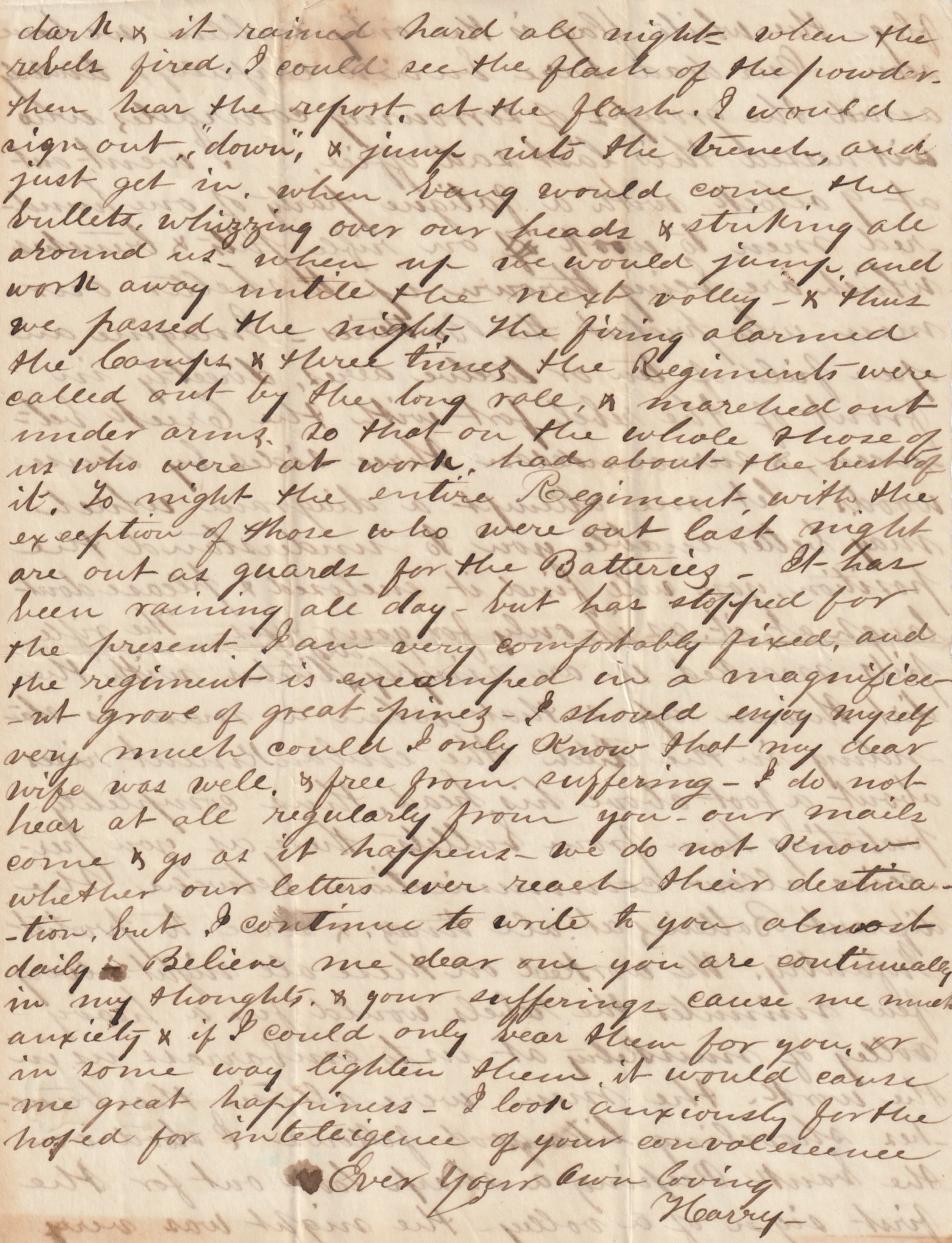
I went out at 9 o’clock with a fatigue party of one hundred men to work on rifle pits & trenches which are being thrown up to shelter our men who protect the batteries. Imagine an open field of ten or twelve acres directly in front of the rebel fort with the creek between and surrounded on three sides by dense woods. Let me attempt a diagram which may better enable you to understand the position. You will find it enclosed & please don’t laugh at it as it’s only for your eyes. The rifle pits marked 10 are simply dry ditches with the dirt thrown up so that when a man is standing in the ditch, the embankment rises about a foot above his head thus completely protecting him from bullets. These, as you perceive, allow communication between the different batteries at all times & serve to protect infantry. We worked on these all night. Every few minutes the rebels would fire a heavy volley of musketry at us to embarrass us in the work. The men were all in the trenches shoveling like good fellows. I stood on the bank keeping a sharp look out for the first sign of a volley. The night was very dark & it rained hard all night. When the rebels fired, I could see the flash of the powder, then hear the report. At the flash, I would sign out “Down!” and jump into the trench and just get in when bang would come the bullets whizzing over our heads & striking all around us, when we would jump and work away until the next volley, & thus we passed the night.
The firing alarmed the camps and three times the regiments were called out by the long roll and marched out under arms so that on the whole, those of us who were at work had about the best of it. Tonight the entire regiment with the exception of those who were out last night are out as guards for the batteries. It has been raining all day but has stopped for the present.
I am very comfortably fixed and the regiment is encamped in a magnificent grove of great pines. I should enjoy myself very much could I only know that my dear wife was well and free from suffering. I do not hear at all regularly from you. Our mails come and go as it happens. We do not know whether our letters ever reach their destination but I continue to write to you almost daily. Believe me dear one, you are continually in my thoughts and your suffering causes me much anxiety and if I could only bear them for you or in some way lighten them, it would cause me great happiness. I look anxiously for the hoped for intelligence of your convalescence.
Ever your own loving, — Harry
Map showing the placement and lines of attack by the Vermont Brigade on 16 April 1862
1 The Union dead came from four companies (totaling 192 men) of the 3rd Vermont Infantry who advanced from the woods toward the Confederate position across the Warwick river. “Wading through the waist-deep river channel below the dam, the ‘Green Mountain Boys’ drove the surprised Confederates from the first line of rifle pits along the water’s edge. The Confederate unit at the center of the attack and taking the brunt of this vigorous attack was the 15th North Carolina whose Colonel William McKinney, was killed while rallying his soldiers. The death of Col. McKinney and an unauthorized order to fall back caused confusion all along the entire line. General Howell Cobb, Commander of the 2nd Brigade, 2nd Division, immediately reorganized and stabilized the line as he rode among the soldiers on horseback. General Cobb then proceeded to launch a brigade-sized counterattack against the four Vermont companies…As the Confederates regrouped and reinforced their line, the Vermonters with their backs to the river were in a desperate situation. They were running out of ammunition and taking severe casualties. With no hope of reinforcements coming, the Vermonters reluctantly withdrew back across the river after holding their position for one hour. A second attack later in the day by the 4th and 6th Vermont was even less successful…Confederate casualties for the day were approximately 75 killed and wounded. Union casualties at Dam No. 1 were 35 dead and 121 wounded. Of this number the 3rd Vermont lost 23 killed and 51 wounded.” [Newport News Park Brochure]
It should be noted that it was generally conceded by most accounts that the Warwick River was between two to four feet deep and 150-200 yards wide at the location of the attack made by the Vermonters on 16 April 1862.It is estimated that the combined force of the second attack composed of men from the 4th and 6th Vermonts could not have exceeded 750 men. It was the 6th Vermont that led the second assault. Four companies of the 4th Vermont were used only to create a diversion which was doomed by Rebel gunfire almost before it began.
It should also be noted that Capt. Platt’s inference that the cessation of hostilities was called by the Confederates is most assuredly false. Not only does the literature support the argument that the union forces called for it, but logic tells us that retrieving bodies from the other side of the Warwick River would be much more difficult for the Union army than the Confederate army, let alone the number of casualties which was tipped in favor of the Federals.
The following letter was written by 2Lt. Cadmus M. Amoss of Cobb’s Legion who described the Battle of Lee’s Mills (Dam No. 1) from the Confederate perspective. The letter was sold recently by Iron Horse Military Antiques. Amoss wrote the letter home to his wife on April 21, 1862, during the federal siege of Yorktown during the Peninsula Campaign. In the letter Amoss discusses the “stirring times we have had,” including the April 16 skirmish at Dam No. 1 on the Warwick River. The dam was one of three ordered built by Confederate General John Magruder in order to create lakes to obstruct the Union Army’s advance. The men of General Howell Cobb’s Brigade had been improving the defenses around Dam No. 1 on April 16 when Union troops of General William F. “Baldy” Smith’s division launched a probing attack.
Camp Near Lee’s Mills, York Co. Virginia April 21st 1862
My Dear Georgia,
This is the only opportunity I have had of writing to you since my last letter and I am glad to have a few moments leisure in which to give you an account of the stirring times we have had. Last Wednesday the enemy commenced shelling our batteries placed at Dam No. 1 about a quarter of a mile above us. The shelling continued without intermission all the morning, doing little or no damage. Our company was stationed behind a breastwork at Dam No. 2. At three o’clock in the afternoon the Yankees sent over three picked companies to charge one of the rifle pits a little below Dam No. 1 at which the 15th N.C. Regiment was at work. This regiment—having no guns to fight with—were driven from the pits by the yankees, who charged over them. The Seventh Georgia was then ordered to charge the Yankees, which they did with a loud shout. The Yankees could not stand before them, but fell precipitously into the pond through which they had waded. Twenty or thirty were killed and a great number wounded. The enemy attacked us at two or three other points, but were repulsed with considerable loss every time. The regiments that bore the brunt of the battle that day was the Seventh, Eighth, and Sixteenth Georgia and Second Louisiana. Our regiment was situated at different points. Our company was fired on several times across the pond about two hundred yards by Yankees behind trees. No one hurt in the Legion. The enemy dismounted one of our largest guns that day. Our entire loss was sixteen killed and about sixty wounded. The enemy’s loss in killed and wounded is estimated at three hundred.
I was perfectly surprised at the noise and uproar made on that day. The whole world would tremble with the roar of artillery and musketry.
Our regiment remained in the breastworks day and night for four days after the battle. We were relieved yesterday morning by another regiment. I am perfectly worn out with loss of rest. I forgot to tell you that the enjoyment lasted four hours. Nearly all the troops that were at Manassas are here. I have seen a great many acquaintances recently. Gus Bacon and John McLendon are here. Reuben Jordan is also here. Yesterday evening I met up with Guss Bull. He is Lieut Col of the 35 Georgia. Virgil Hopson is in the same regiment.
Yesterday evening Gus Bacon and John McLendon came down to see me. They were nearly perished and are here without overcoats or blankets. I gave them plenty of ham and biscuits which they relished amazingly. There is at least twenty thousand Georgians here and if the yankees come over they will meet with a warm reception from them. The yankees sent over a flag of truce to bury their dead day before yesterday. I was up there at the time and saw about thirty of them carried over. They were all well uniformed and had the minnie musket. Nearly all of them were shot through the head. Several letters were found about the persons of the yankees, one of which was from a brother of the one killed who lived at Quebec, Canada. The writer was of the opinion that the South could not be conquered and wished the war would come to a close. The regiment that charged our breastworks was the Third Vermont and the company of which nearly all were killed was [of] the Vermont volunteers. I have no idea when they will attack us again. They are here in great force, but I think we will whip them every time they attempt to cross over the creek.
We hear their brass bands and drums every night. I never heard sweeter music than they have over the creek from us about a half mile.
If they intend doing anything I wish they would commence at once so that we may fight it out and quit. I am exceedingly anxious to hear from you but am afraid your letters cannot reach me. If anyone should come to this point from Atlanta I will try to let you know in time. One of your letters directed to Suffolk was handed me about the first of last week. I was truly glad to learn that you were well up to that time. Since I have been thinking about it there is a chance of getting a letter from you. It may be lost on the way but rather than not hear from you at all I think it would be well to risk writing. At all events write to me and direct your letter to Yorktown as before.
I will write again as soon as an opportunity presents itself. Give my love to all the family and kiss Henry for me.
This letter was written by Dr. William Johnson Dale. Born in 1815, he was sent to North Andover, Massachusetts—his mother’s ancestral home—for schooling at Franklin Academy. He later went to Andover and graduated from Harvard in 1837 and then Harvard Medical School. He married Sarah Frances Adams. A physician in Boston, he was significantly wealthy by 1860 when he was practicing medicine in Boston. During the Civil War, he joined the service, rising to the rank of Brigadier General where he served as Asst. Surgeon General of the US, and following the War, became Surgeon General of Massachusetts. For these services he held the title of General for his lifetime. After the war, he returned to his ancestral roots of North Andover, purchasing the old Johnson farm, which had been in his family since 1637. Here he developed a model farm specializing in milk production.
William Johnson Dale
Dr. Dale wrote the letter to Dr. Albert H. Blanchard of Sherborn, Massachusetts.
The letter pertains to an apparent attempt by Abbie M. (Leland) Taber (1839-1926) of Sherborn, Massachusetts, to obtain a widow’s pension for the service of her husband, Thomas Taber (1835-1864), a corporal in Co. E, 16th Massachusetts Infantry when he was taken a prisoner-of-war on 26 November 1863 during the Battle of Mine Run. . The pension file shows evidence that Thomas enlisted as a private on 13 July 1861 and that he died at Andersonville Prison on or about the 9th of October, 1864 from “scurvey and want of food and proper treatment” while in the hands of the Rebels. Abie was married to Thomas on 18 October 1858 at Sherborn and together they had two children, Frank (b. 1859) and Willie (b. 1861).
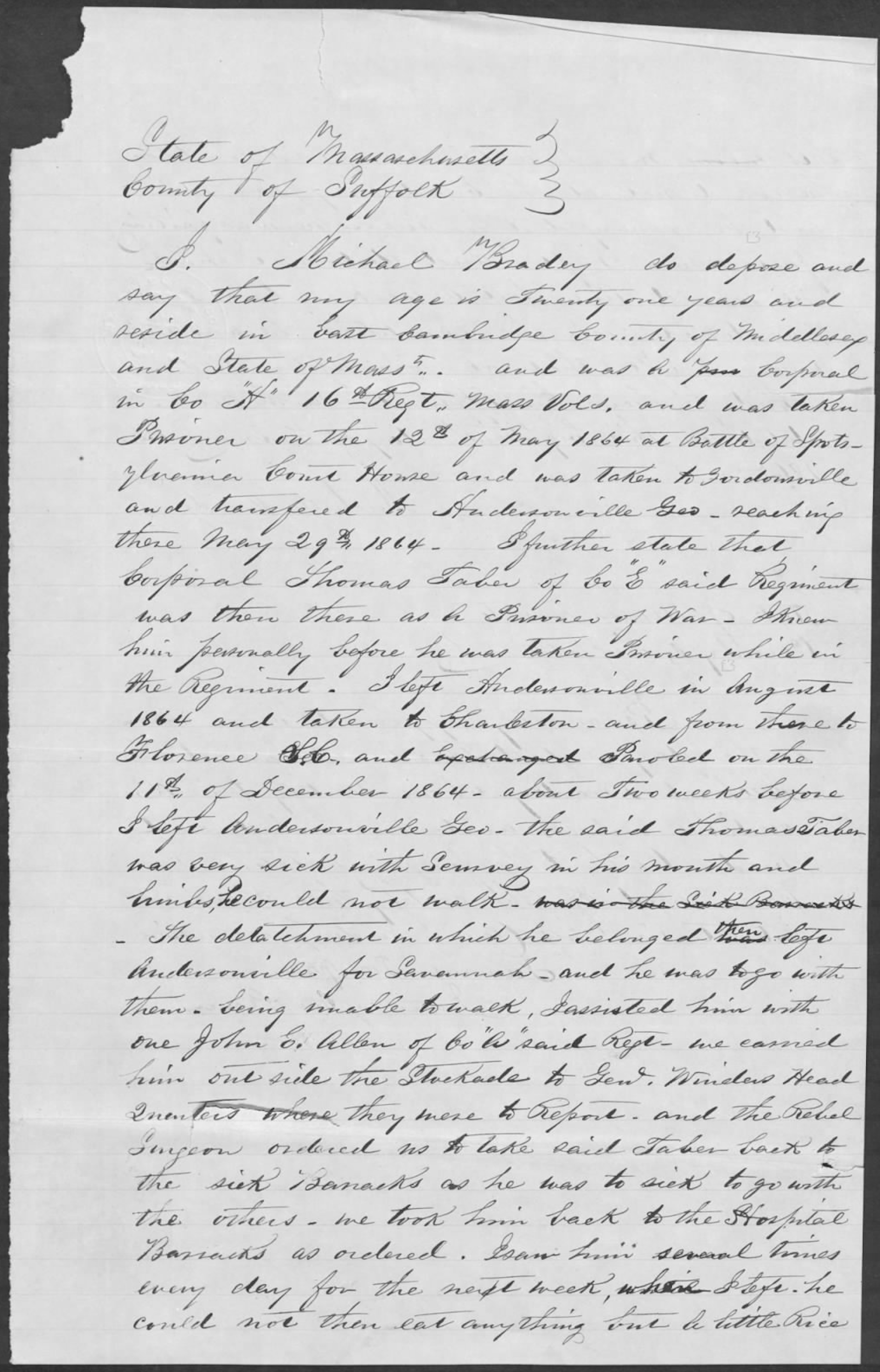
Thomas’s death seems to have been confirmed by a statement given by a comrade who was confined in Andersonville Prison named Michael Brady. His sworn testimony is presented beneath the transcribed letter in the event anyone is interested in the details of Thomas’s death.
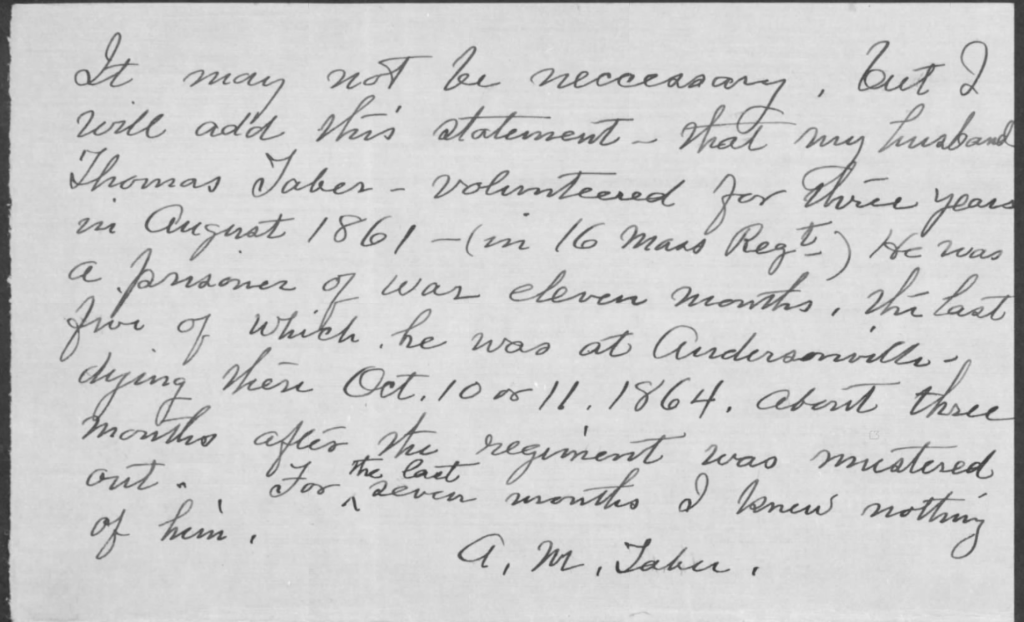
This short note to the Pension Office which was included in Abbie’s application hints at the frustration, anxiety and anguish she must have experienced in the long silence from her husband: “It may not be necessary but I will add this statement—that my husband Thomas Taber volunteered for three years in August 1861 (in 16th Mass. Regt). He was a prisoner of war eleven months—the last five of which he was at Andersonville, dying there October 10 or 11, 1864, about three months after the regiment was mustered out. For the last seven months, I knew nothing of him.” [Widows Pension File]
Transcription
Commonwealth of Massachusetts Office of Surgeon General, Boston January 7, 1865
A. H. Blanchard, Esq. Sherborn, Massachusetts Dear Sir,
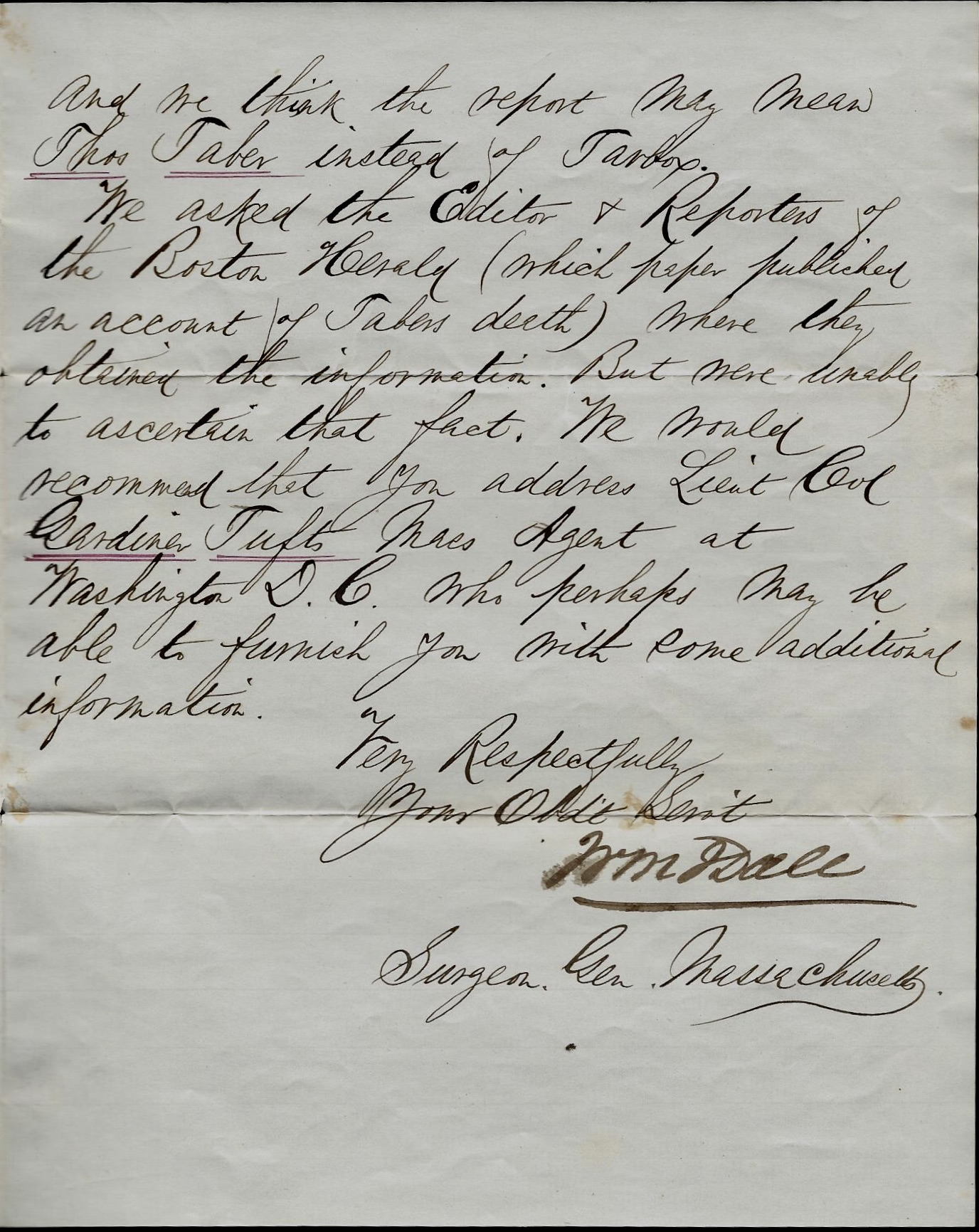
I have the honor to inform you in answer to your communication of December 14, 1864, a memo of which we put on file, that we have a report of the death in Rebel Prison at Andersonville, George, of Thomas Tarbox, Co. E, 16th Mass. Vols. October 19, 1864. We have examined the muster in rolls of Co. E, 16th Regiment on file in the Adjutant General’s Office and find that there is no such name as Tarbox on those rolls. we regret to inform you that in our opinion this name is wrongly reported by the exchanged prisoners who furnished our agents with the information and we think the report may mean Thomas Taber instead of Tarbox.
we asked the Editor & Reporters of the Boston Herald (which paper published an account of Taber’s death) where they obtained the information but were unable to ascertain that fact. We would recommend that you address Lieut. Col. Gardiner Tufts, Mass. Agent at Washington D. C. who perhaps mat be able to furnish you with some additional information.
Very respectfully your obedient servant, — Wm. J. Dale, Surgeon Gen. Massachusetts
I could not find an image of John but here is one of Jacob Fitzgerald Goltry of Co. C, 37th Indiana Infantry (Photo Sleuth)
This letter was written by John E. Kennedy (1841-1916) who mustered originally into Co. I, 37th Indiana Infantry on 26 October 1861 and then when the regiment was reorganized, he reenlisted as a veteran corporal on 2 January 1864 in Co. A of the same regiment. Battles in which various companies of the Thirty-Seventh Regiment camped or fought included: Elizabethtown, KY., Bacon Creek, Bowling Green, Nashville, Huntsville, Shelbyville (Tenn), Athens, Fayetteville, Chattanooga, Stones River, Tullahoma, Chickamauga, Sand Mountain, Lookout Mountain, Pigeon Mountain, Atlanta, Buzzard Roost, Rocky Face, Resaca, Pumpkinvine Creek, Jonesboro, and the March to the Sea.
John was the son of Samuel Kennedy (1795-1875) and Polly Sargent (1799-1878) of Putnam county, Indiana.
Transcription
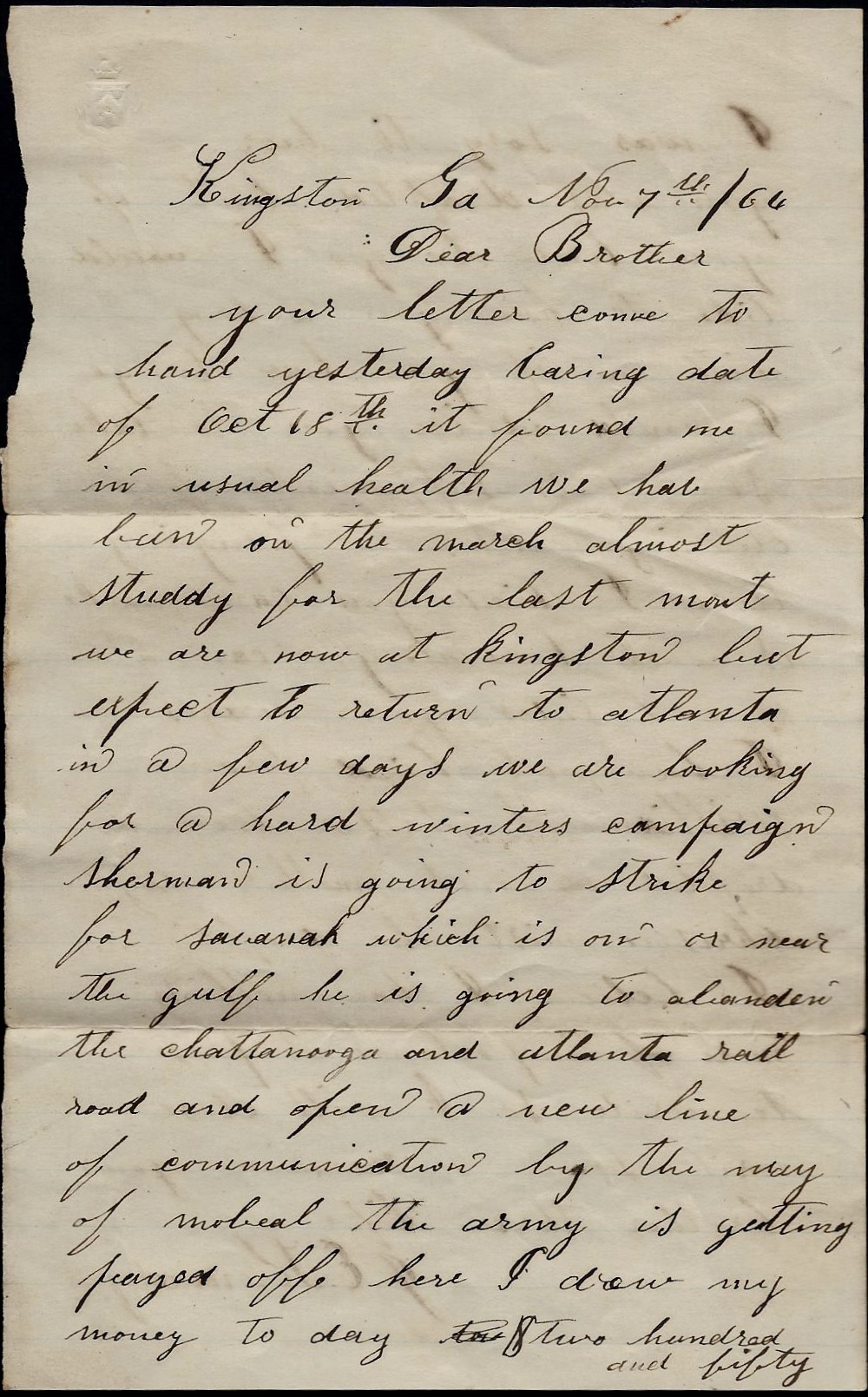
Kingston, Georgia November 7, 1864
Dear Brother,
Your letter came to hand yesterday bearing date of October 18. It found me in usual health. We have been on the march almost steady for the last month. We are now at Kingston but expect to return to Atlanta in a few days. We are looking for a hard winter’s campaign. Sherman is going to strike for Savannah which is on or near the Gulf. He is going to abandon the Chattanooga and Atlanta railroad and open a new line of communication by the way of Mobile.
The army is getting paid off here. I drew my money today—two hundred and fifty.
I was sorry to hear you was drafted but if you have to go, I would like to have you along with me. If you have to go, I would advise you to take some tools sufficient for cleaning watches and plugging teeth. I think you can make as much here as you can at home, besides your wages.
I have not heard from William whether he was drafted or not. Mother says Christie missed the draft. I believe I have nothing more of significance at present to write so I will close. Write soon. I remain your brother through life.
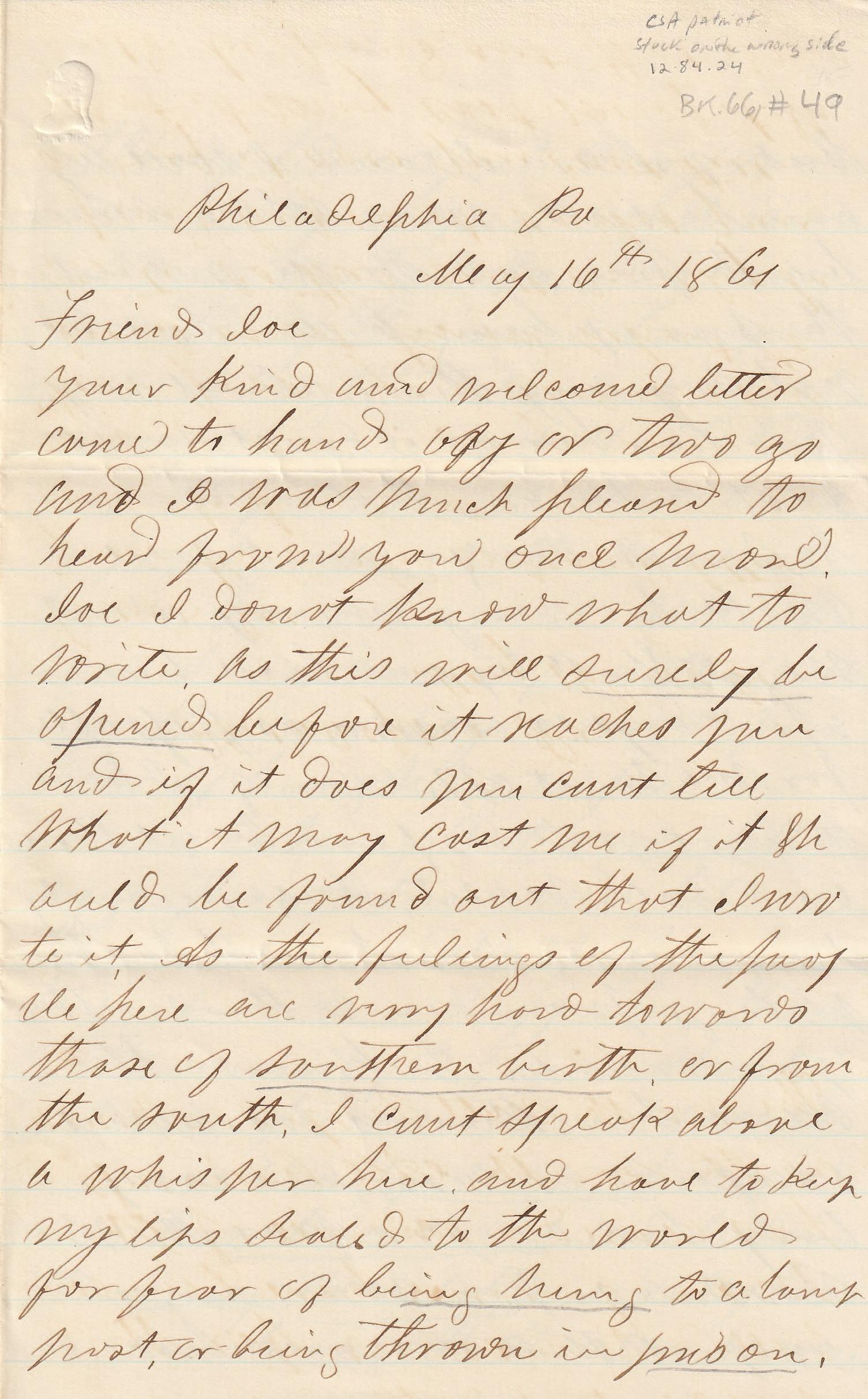
The identity of the author of this letter was intentionally concealed by the writer claiming that he feared for his life. The author datelined his letter from Philadelphia where we learn that he was a Southerner by birth and awaiting an opportunity to flee the city and return to the South before he might be “hung to a lamp post” or “thrown in prison.” He datelined his letter on 16 May 1861, over a month after the firing on Fort Sumter, but before all mail service to, from, and within the Confederate States was suspended on 31 May 1861 by US Postmaster General, Montgomery Blair.
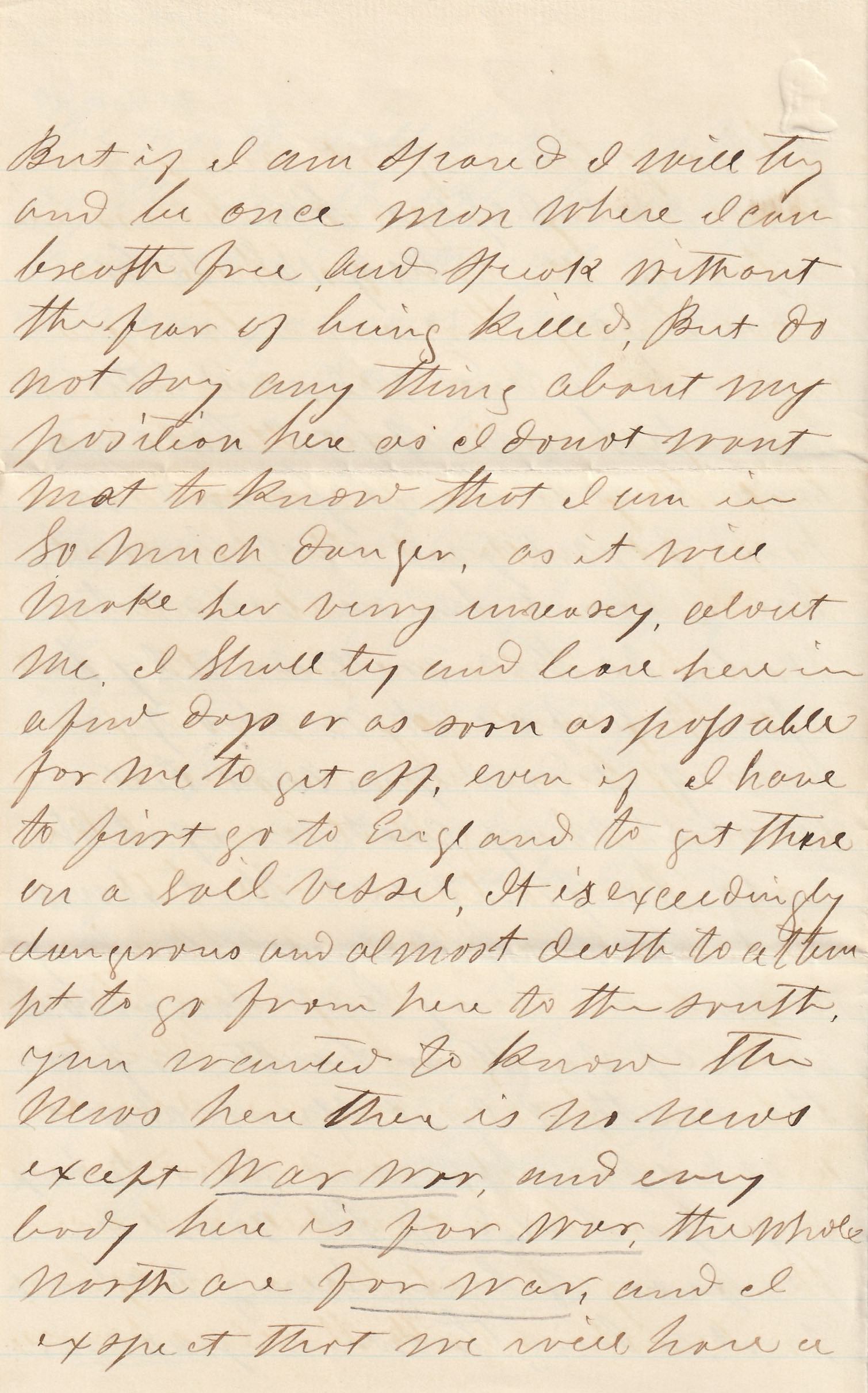
“If I am spared, I will try and be once more where I can breath free and speak without the fear of being killed.”
It is my personal opinion that in concealing his identity, the author has conveniently also avoided the necessity of ever proving the extreme danger he was in. While it is true that many southern sympathizers were rounded up and thrown into prison for a period of time in the weeks and months after the fall of Fort Sumter, I have not found any reports of mob hangings though it was occasionally threatened by blowhard politicians. His representations of the impact on Northern businesses and the sufferings of the Northern populace were also grossly overstated in my opinion—perhaps intentionally. One gets the impression that he wrote this letter with the idea that it would be published in some Southern newspaper just to arouse popular opinion against the North—a common tactic in an age when news could not be easily or readily fact-checked.
[Note: This letter is from the personal collection of Richard Weiner and is published on Spared & Shared by express consent.]
Transcription
Philadelphia, Pennsylvania May 16th 1861
Friend Joe,
Your kind and welcome letter came to hand a day or two ago and I was much pleased to hear from you once more. Joe, I do not know what to write as this will surely be opened before it reaches you and if it does, you can’t tell what it may cost me if it should be found out that I wrote it as the feelings of the people here are very hard towards those of southern birth or from the South. I can’t speak above a whisper here and have to keep my lips sealed to the world for fear of being hung to a lamp post, or being thrown in prison. But if I am spared, I will try and be once more where I can breath free and speak without the fear of being killed.
But do not say anything about my position here as I don’t want Mat to know that I am in so much danger as it will make her very uneasy about me. I shall try and leave here in a few days or as soon as possible for me to get off, even if I have to first go to England to get there on a sail vessel. It is exceedingly dangerous and almost death to attempt to go from here to the South.
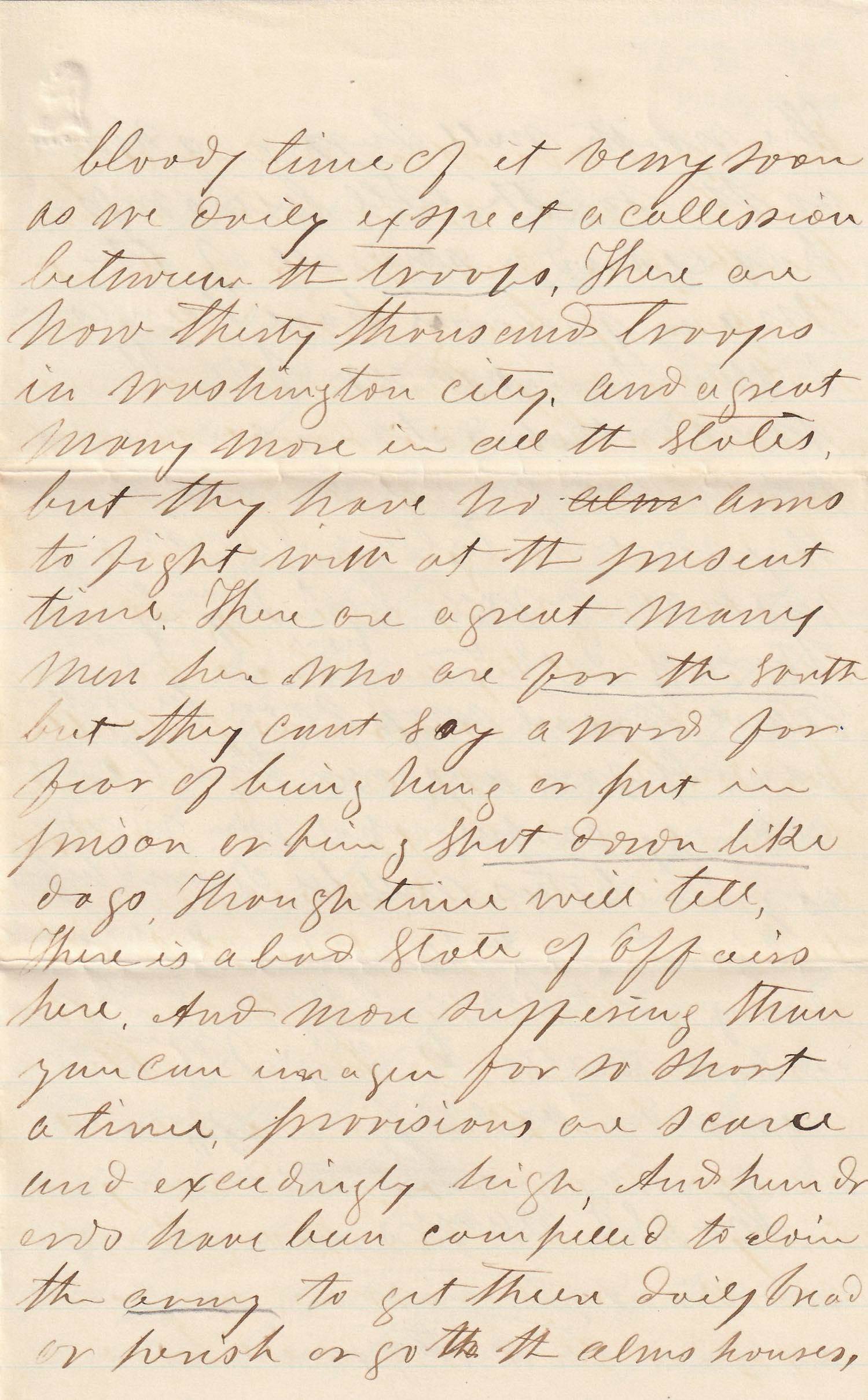
You wanted to know the news here. There is no news except war, war, and everybody here is for war. The whole North are for war and I expect that we will have a bloody time of it very soon as we daily expect a collision between the troops. There are now thirty thousand troops in Washington City and a great many more in all the States but they have no arms to fight with at the present time.
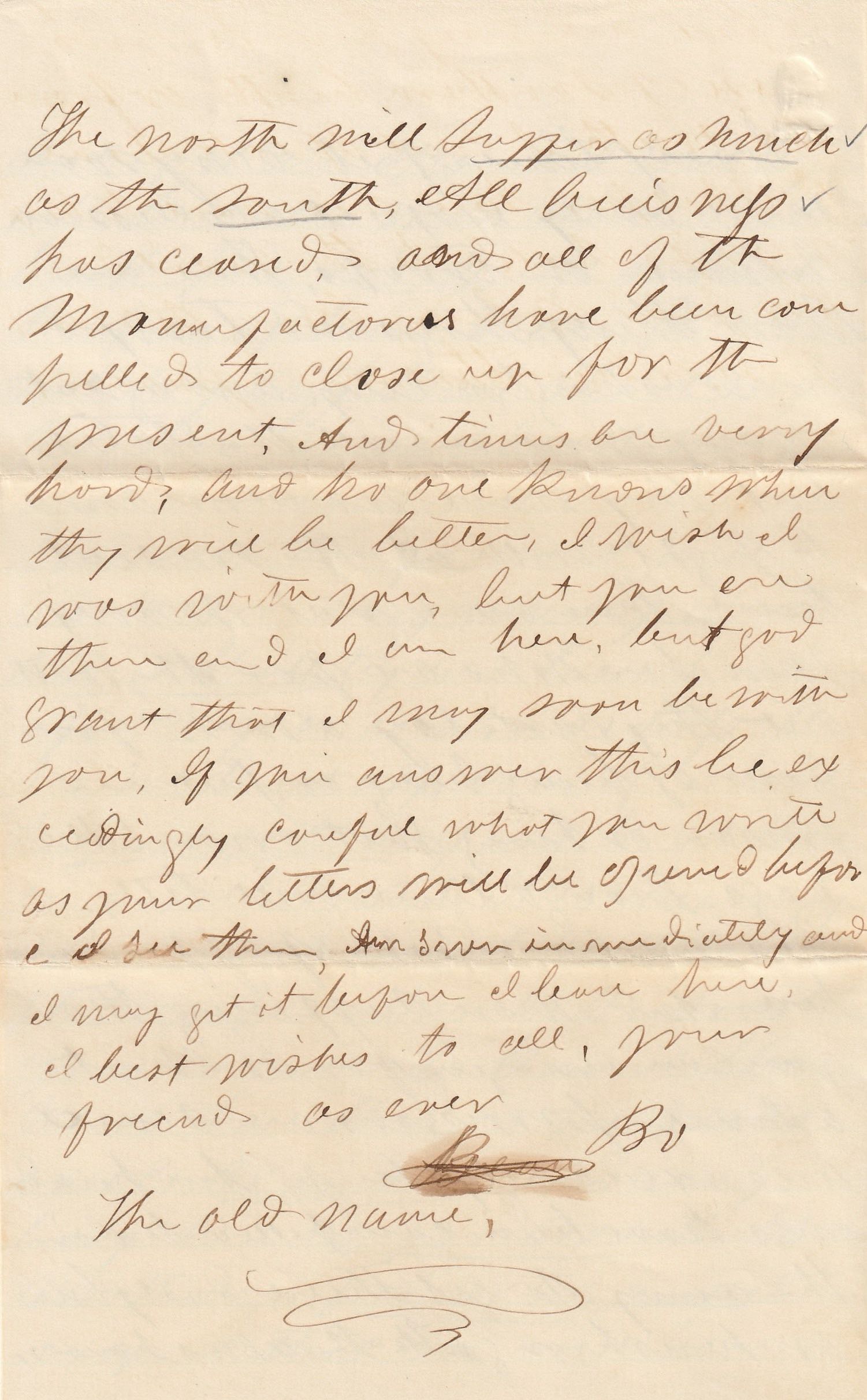
There are a great many men here who are for the South but they cannot say a word for fear of being hung or put in prison or being shot down like dogs. Though time will tell, there is a bad state of affairs here and more suffering than you can imagine for so short a time. Provisions are scarce and exceedingly high. And hundreds have been compelled to join the army to get their daily bread or perish or go to the alms houses. The North will suffer as much as the South. All business has ceased and all of the manufacturers have been compelled to close up for the present. And times are very hard and no one knows when they will be better.
I wish I was with you but you are there and I am here. but God grant that I may soon be with you. If you answer this, be exceedingly careful what you write as your letters will be opened before i see them. Answer immediately and I may get it before I leave here. Best wishes to all. Your friends as ever, — Bo The old name
This letter was written by Pvt. John M. Ford (1843-1908) of Co. E, 7th Massachusetts Infantry. John gave his residence as Marshfield and his occupation as farmer when he enlisted as a recruit on 11 February 1862. He was wounded on 3 May 1863 during the Battle of Chancellorsville but recovered and presumably was with his regiment at the Battle of Gettysburg which was fought just one month previous to this letter.
I could not find an image of John, but here is one of James Lycett of the 7th Massachusetts Infantry. James was wounded at the Battle of Fredericksburg (Al Niemiec Collection)
In June 1864, as the term of the initial enlistees of the 7th Massachusetts soldiers had expired, he was transferred to Co. A, 37th Massachusetts Infantry where he finished his term of service, mustering out in February 1865.
John was the son of William Ford (1799-1861) and Clarissa Packard (1813-1907) of Marshfield, Plymouth county, Massachusetts. John survived the war and married Sarah Dingley Sherman (b. 1844) in November 1869. He wrote the letter to his older brother, William Henry Ford (1841-1907) who gave his occupation as “Housewright” in the 1860 US Census. William was working at the time in Fairmount, Massachusetts.
I have not found the details of John’s death on 16 May 1908 but his death certificate suggests that he was accidentally killed near the Allston Station, B&A Railroad tracks. A physician recorded that he had a compound fracture of the skull and other injuries (no autopsy performed). The railroad was identified as a contributing cause. I suspect that he may have committed suicide as no report of accidental death appeared in the papers and in his hometown paper, his obituary simply reported his “sudden death.”
To read other letters by members of the 7th Massachusetts Infantry I’ve transcribed and posted on Spared & Shared, see: Thomas Denton Johns, F&S, 7th Massachusetts (1 Letter) Oziel Ames Ramsdell, Co. K, 7th Massachusetts (7 Letters) Rufus Robbins, Co. K, 7th Massachusetts (2 Letters)
[Transcribed by Jeannette Ann Vannan; edited & researched by Griff.]
Transcription
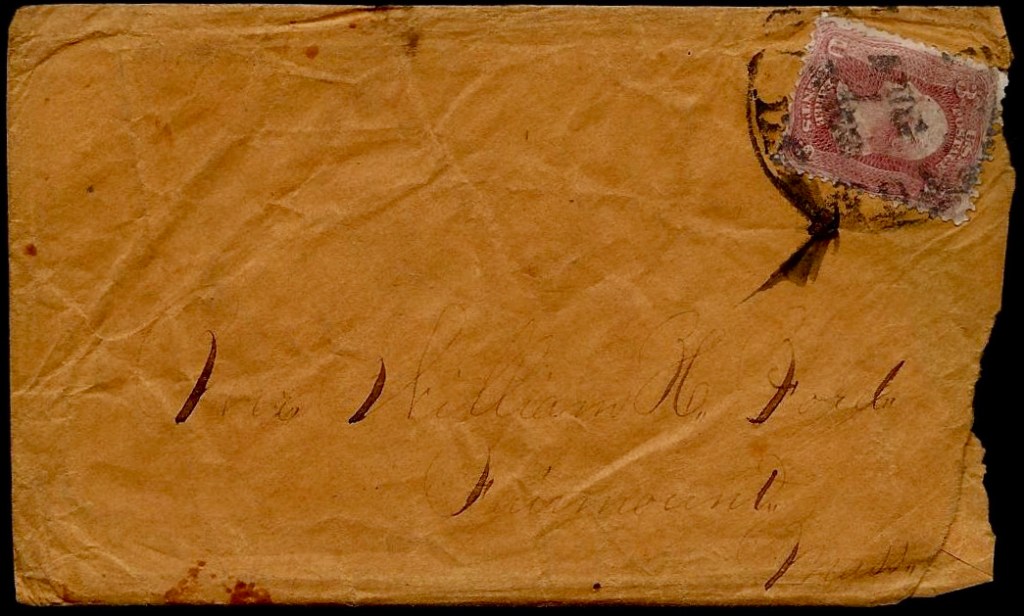
Addressed to Mr. William H. Ford, Fairmount, Massachusetts
Camp Warrenton August 3, 1863
Brother W. H.,
Taking it for granted that ‘ere this you have received the letters which I wrote you while laying on the banks of the Potomac, I will now proceed to answer your kind letter which was received in due season, giving me a list of the drafted in Marshfield. I had a day or two before seen a list of the drafted. It was taken from a paper and sent out in a letter.
I had no sooner finished that letter than we had orders to fall in. We did and marched along in rear of the teams. We marched about 9 hours and got into camp about 9 o’clock in the evening. We had some pretty tough marching in getting where we now lay. In two days we made 60 miles—pretty tall marching that. We have now been laying in this camp 8 days. The first four my time was wholly taken up in hunting sheep and hogs on the mountain.
The third day, myself with 4 others went out (with guns & ammunition) for a grand excursion. On reaching the mountain, we deployed out as skirmishers. On reaching the summit of the mountain, I emerged into a densely wooded part of the mountain [and] had not proceeded far before to my utter astonishment, what should greet my ear but the whickering of horses. As you may suppose I made immediate tracks for the horses. On arriving on the spot, I ascertained that there were 6 horses part with bridles and part with halters. I immediately commenced inspecting the animals and used the best of my judgement in picking out the best one. My choice was a beautiful iron-grey horse of certainly not more that five years of age. I led him from his concealment, and getting into the lane, I hopped upon his back and to my great surprise he struck off into a rapid pace. I soon found the others and we succeeded in securing 5 sheep. I informed the gang of the concealed horses, and we concluded to go back and select the best ones out and take them to camp. We took 3 more of them, slung our mutton to them and started for camp.
On passing a negro house we were saluted by a wench, “Where de get them horses? On de mountain?” We informed them that we did. “Them am secesh horses. There be gariless in de mountain.” I asked her if she ever saw the horses before. She informed me that she had. Well I guess she had the right of it, for we were about 5 miles out from camp and some of our fellows have been fired on out there. Capt. Young on Col. [Henry L.] Eustis’s staff (the colonel commanding our brigade), was fired on. He being a brave and desperate fellow (and as fine a little fellow as ever stood) came into camp, got a squad, and went out (armed squad) but no guerrillas were to be found.
Well on getting into camp I sold my horse (worth $150) for $3. This I did to prevent him from being taken away from me and then I should have derived no advantage from him. He was the prettiest riding horse I ever saw and a handsome one too. If I had him at home, I would have sold him for any price. I should have liked to come across Crossley with his spirited nag. I should not be much afraid of his getting the best of me. These posers will go terribly as Chas. Eustis would say.
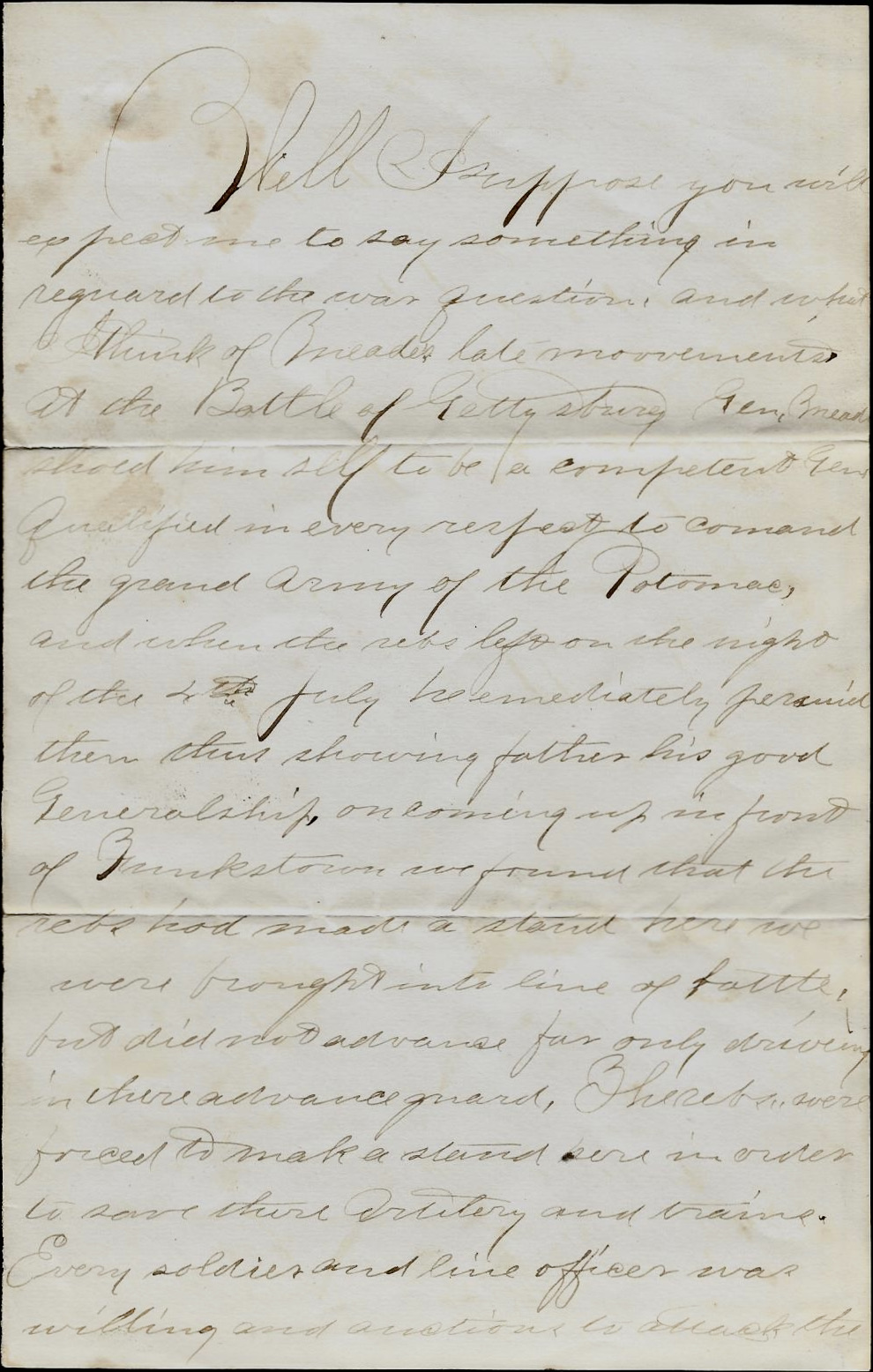
Well, I suppose you will expect me to say something in regard to the war question and what I think of Meade’s late movements at the Battle of Gettysburg. Gen. Meade showed himself to be a competent general—qualified in every respect to command the Grand Army of the Potomac. And when the Rebs left on the night of the 4th of July, he immediately pursued them, thus showing further his good generalship. On coming up in front of Funkstown, we found that the Rebs had made a stand here. We were brought into line of battle but did not advance far—only driving in their advance guard. The Rebs were forced to make a stand here in order to save their artillery and trains. Every soldier and line office was willing and anxious to attack the Rebs. It might applicably been said of the Army of the Potomac that it was anxious for a fight but it could never have been said before and I think never again.
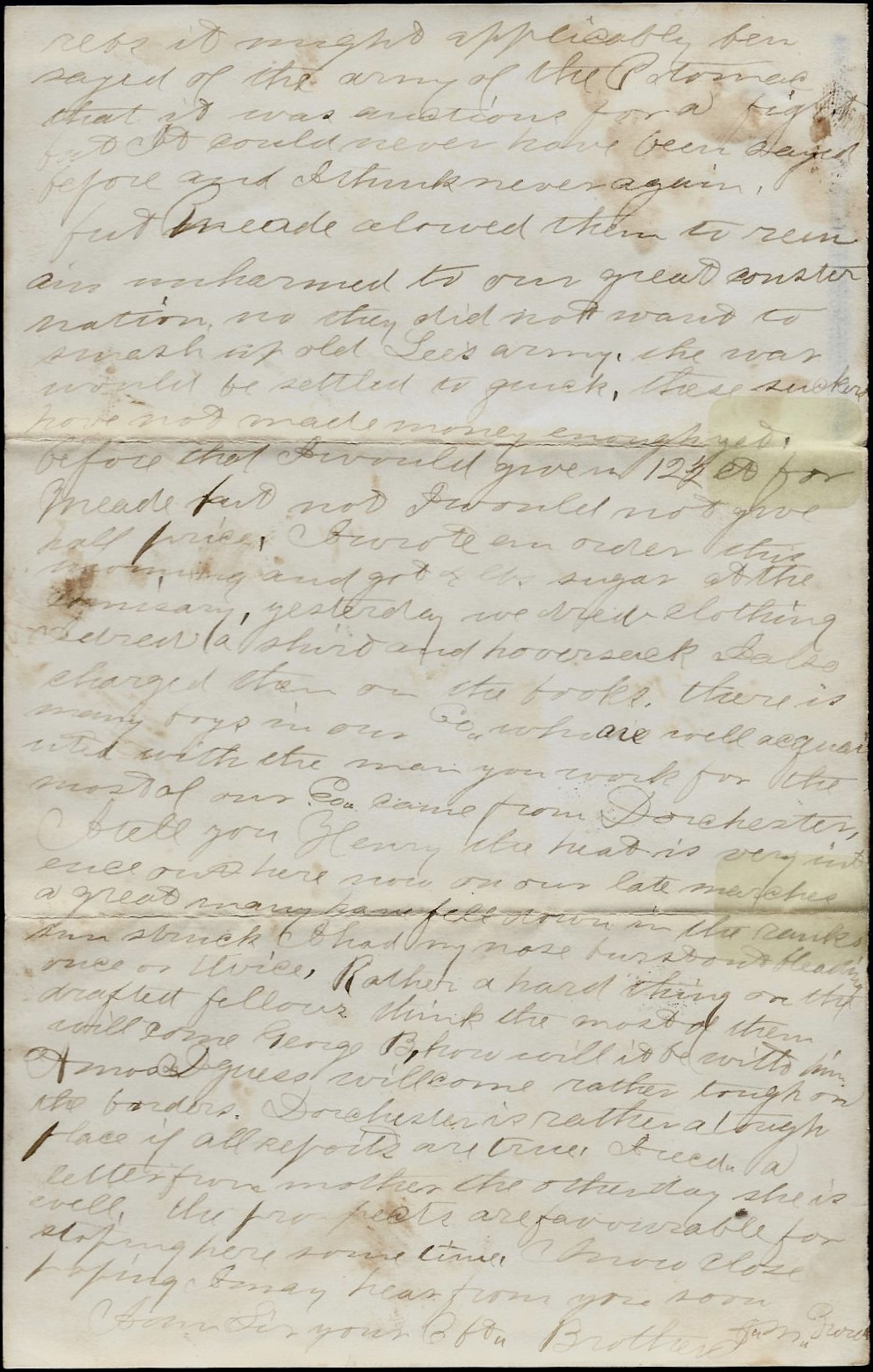
But Meade allowed them to run on unharmed to our great consternation. No, they did not want to smash up Old Lee’s army. The war would be settled too quick. These suckers have not made money enough yet. Before that I would given 12 ½ cents for Meade, but now I would not give half price.
I wrote an order this morning and got 4 lbs. sugar at the commissary. Yesterday we drew clothing. I drew a shirt and haversack. I also charged them on the books. There is many boys in our company who are well acquainted with the man you work for. The most of our company came from Dorchester. I tell you Henry, the heat is very intense out here now. On our late marches, a great many have fell down in the ranks sun struck. I had my nose burst out bleeding once or twice.
Rather a hard thing on the drafted fellows. Think the most of them will come? George B.—how will it be with him? Amos I guess will come. Rather tough on the boarders. Dorchester is rather a tough place if all reports are true. I received a letter from mother the other day. She is well. The prospects are favorable for the stopping here some time. I now close hoping I may hear from you soon. I am sir, your affectionate brother, — J. M. Ford
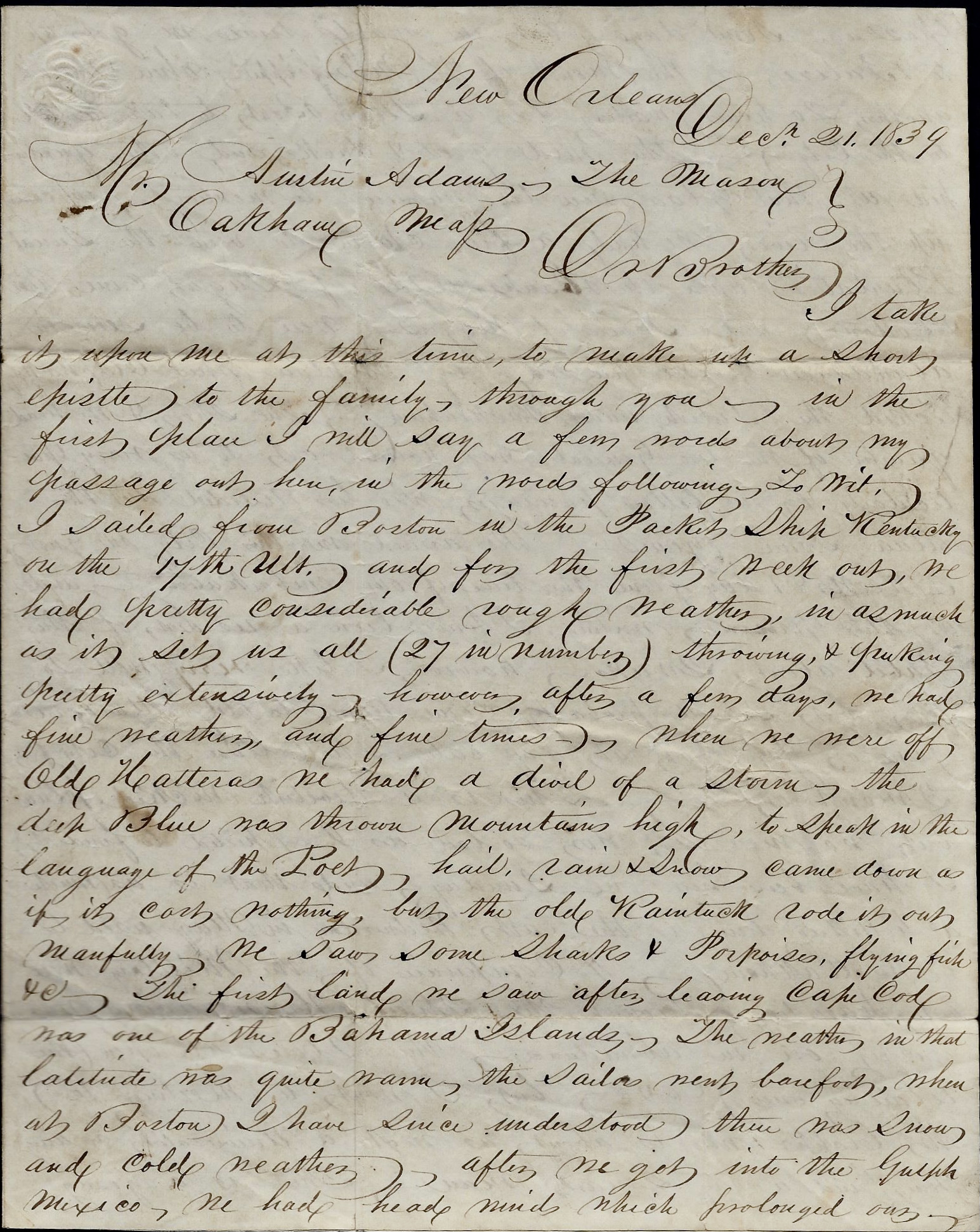
This letter was written by Lyman Adams (1815-1859), the son of Dr. Charles Adams and Sarah McAllister (17901868) of Oakham, Massachusetts. The letter was datelined from New Orleans in late December 1839, less than two weeks after his arrival in the Crescent City and captures his first impressions of the city and its inhabitants.
From the content of the letter we can deduce that he traveled to New Orleans to enter into employment with the firm Layton & Co. I cannot find that firm listed in New Orleans; it may have been a firm based in New England and Lyman was merely their New Orleans agent. Later he would establish his own business, partnering with Frederick Brand in the firm, Brand, Adams & Co., their ship chandlery and hardware store located at 53 Old Levee and No. 16 and 18 Conti Street. The partnership was dissolved in 1852 and Lyman died at the age of 1843 on 19 March 1849 in New Orleans but not before he married Sarah Brown and had a child named Urgust Lee Adams.
Lyman wrote the letter to his younger brother, Austin Adams (b. 1811).
New Orleans in the mid 1840s.
Transcription
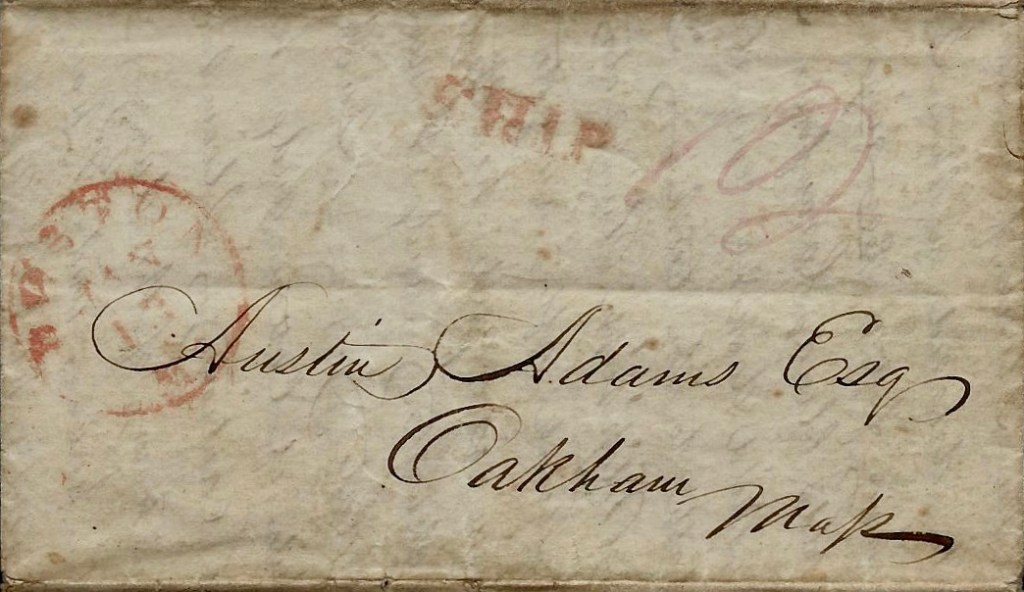
Addressed to Austin Adams, Esq., Oakham, Massachusetts
New Orleans [Louisiana] December 21, 1839
Mr. Austin Adams, the Mason Oakham, Massachusetts
Dear Brother,
I take it upon me at this time to make up a short epistle to the family through you. In the first place I will say a few words about my passage out here, in the words following, to wit: I sailed from Boston in the Packet Ship Kentucky on the 17th ult. and for the final week out, we had pretty considerable rough weather, inasmuch as it set us all (27 in number) throwing & puking pretty extensively. However, after a few days, we had fine weather and fine times. When we were off Old Hatteras, we had a devil of a storm. The deep blue was thrown mountains high, to speak in the language of the poet, hail, rain & snow came down as if it cost nothing, but the OldKaintuck rode it out manfully. We saw some sharks & porpoises, flying fish, &c. The first land we saw after leaving Cape Cod was one of the Bahama Islands. The weather in that latitude was quite warm. The sailors went barefoot, When at Boston I have since understood there was snow and cold weather.
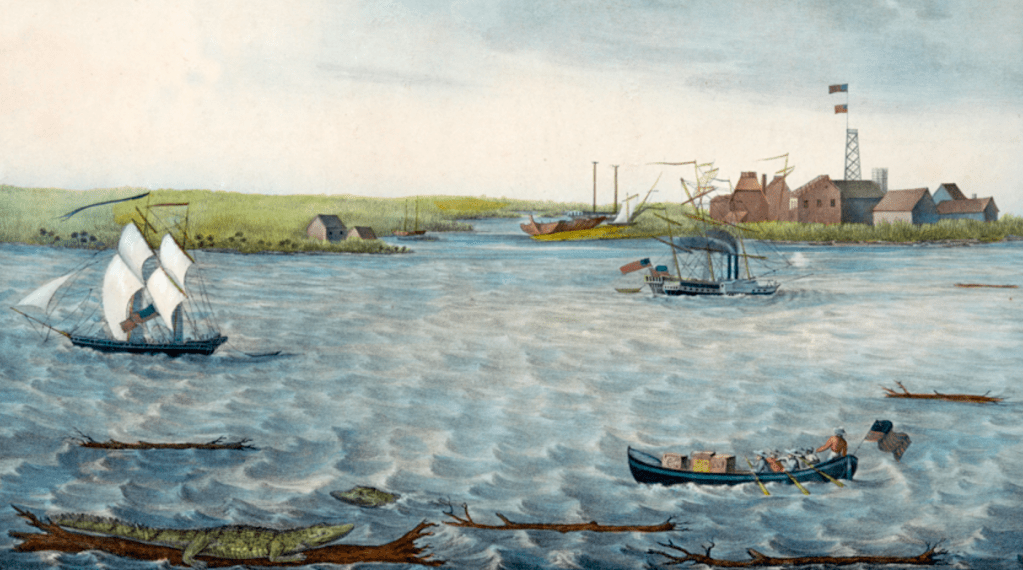
After we got into the Gulf of Mexico, we had head winds which prolonged our passage some days but in good time we got to [La] Balize or the mouth of the Mississippi where we laid another 20 hours waiting for a steamboat to take us up to the city. The wild geese and ducks and other quadrupeds at that place were too numerous to mention. In coming up the river, we had a fine chance to view the several plantations upon the banks, fields of sugar cane, rice and cotton, and scores of niggers were to be seen in abundance. We passed by the place where Old Hickory licked the British under Packenham. The spot and the headquarters of the two generals was pointed out to us very particularly by a fellow passenger who has resided in this place some years.
La Belize was a French fort and settlement near the mouth of the Mississippi. This painting is circa 1828.
We arrived in the city in just 3 weeks & 1 say from the time of our embarkation and at this present writing, I have been a resident of this Babel about 2 weeks. However, I like it very well so far, but shall probably come home to Old Mass. in June or July or at any rate shall leave the city for 3 months or so.
Parson Theodore Clapp
This is a devilish, wicked place but no more so nor so bad as I expected to find it. I have been here one Sunday and that is as much a holiday here as the last Wednesday in May used to be in Oakham. Four companies of the military were out parading through the streets, horse racing was going on in abundance, the stores [were] all open (the retailing ones), &c. &c. but I went to meeting to Mr. [Theodore] Clapp’s 1 who is about as nigh a Universalist as anything, and a very smart man. There is a young man here by the name of Battles who I used to board and room with in Boston and we are together here which makes things very pleasant. There are lots of other Boston people here that I am acquainted with.
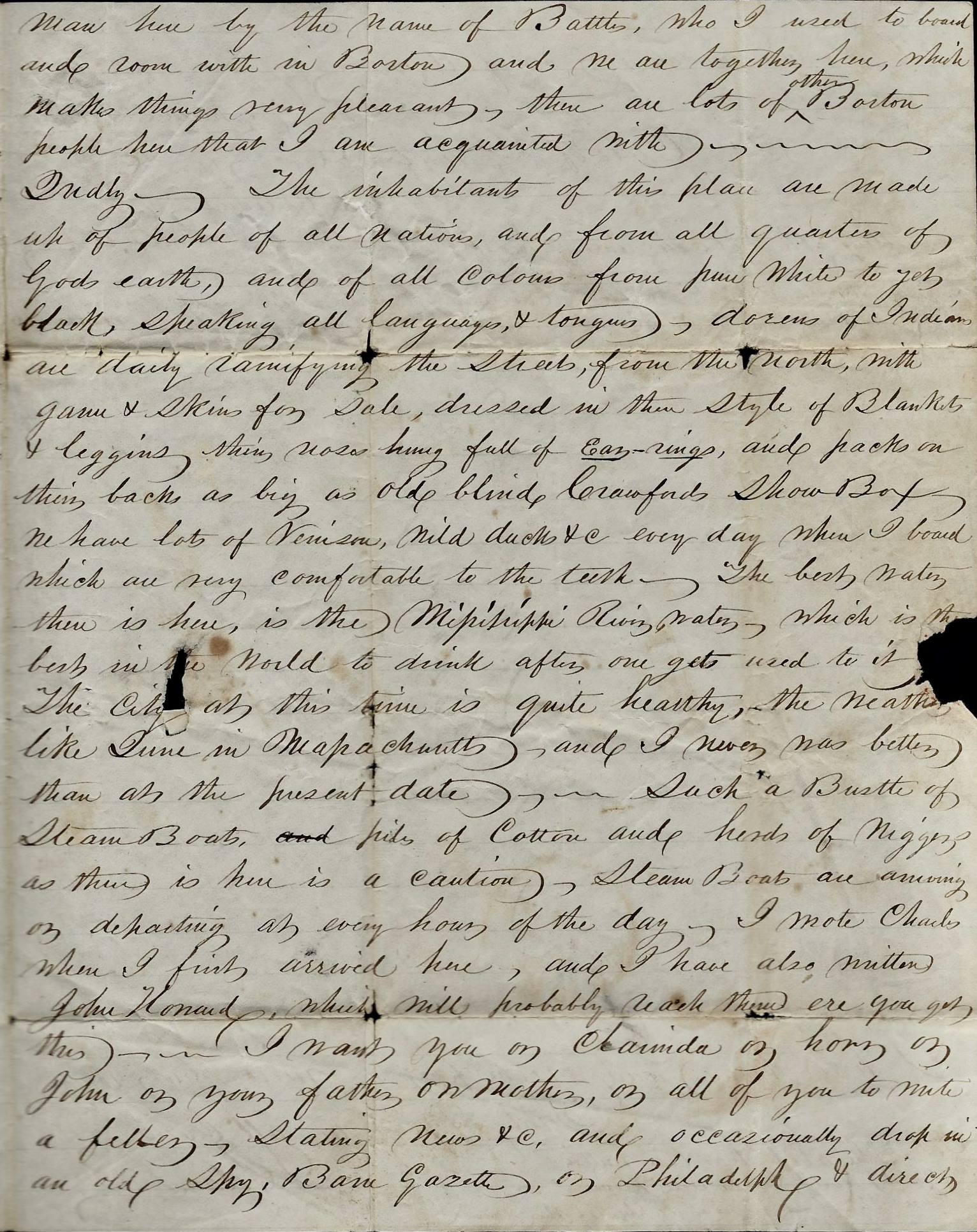
Secondly, the inhabitants of this place are made up of people of all Nations, and from all quarters of God’s earth, and of all colours from White to jet black, speaking all languages & tongues, dozens of Indians are daily ramifying the streets from the north with game and skins for sale, dressed in the style of blankets & leggins, thin noses hung full of ear-rings, and packs on their backs as big as old blind Crawford’s Show Box. We have lots of venison, wild ducks &c. every day where I board which are very comfortable to the teeth. The best water there is here is the Mississippi River water which is the best in the world to drink after one gets used to it. The city at this time is quite healthy. The weather like June in Massachusetts and I never was better than at the present date.
Such a bustle of steamboats, piles of cotton and herds of niggers as there is here is a caution. Steamboats are arriving or departing at every hour of the day.
I wrote Charles when I first arrived here and I have also written John Howard which will probably reach them ere you get this. I want you or Clarinda or Horr or John or your father or mother or all of you to write a feller, stating news, &c., and occasionally drop in and Old Spy, Barre Gazette, or Philadelph & direct all communications as follows.
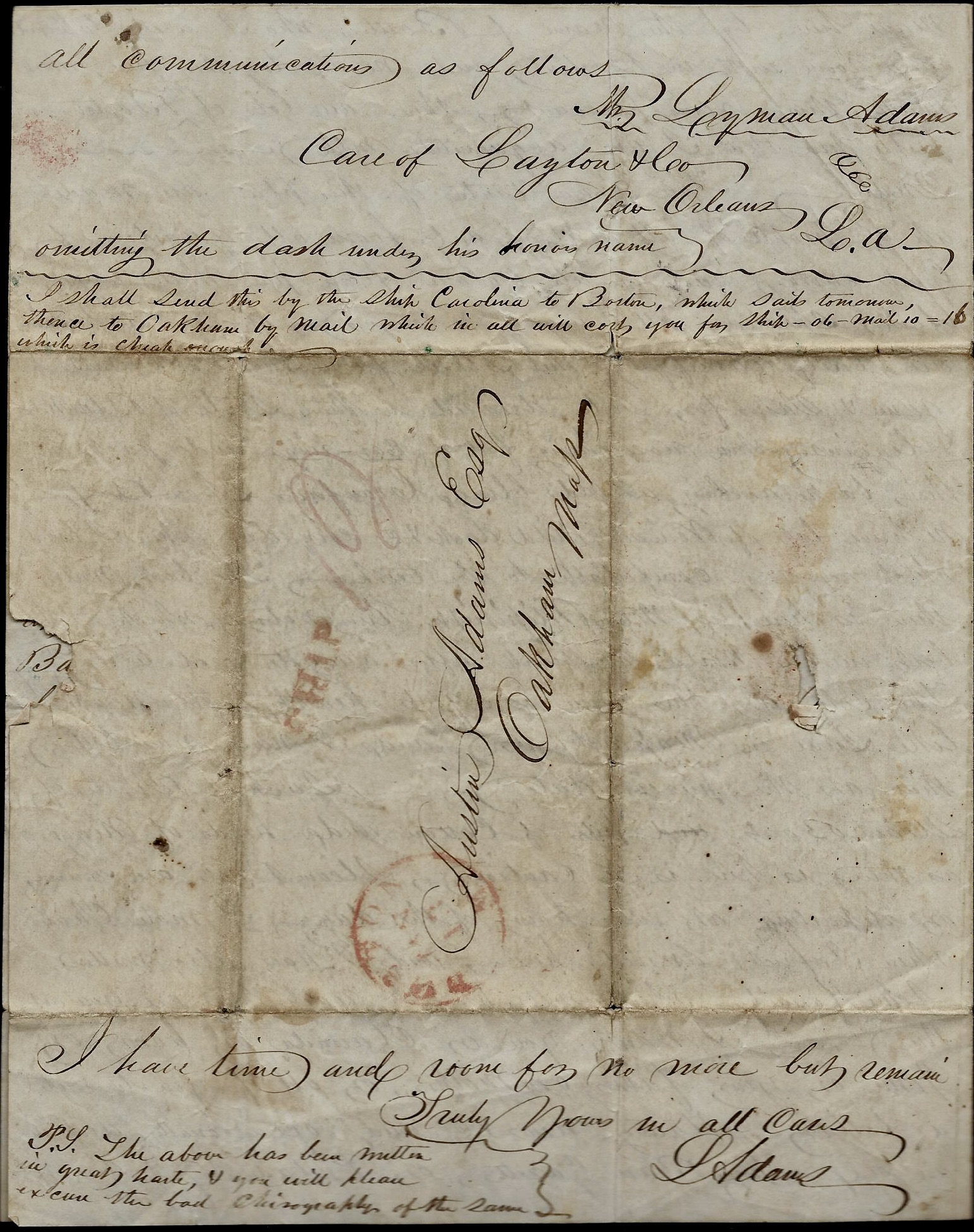
Mr. Lyman Adams, Care of Layton & Co., New Orleans, La.
Omitting the dash line under his honor’s name.
I shall send this by the ship Carolina to Boston, which sails tomorrow, thence to Oakham by mail which is all will cost you for ship 06, mail 10 = 16 which is cheap enough.
I have time and rom for no more but remain truly yours in all cases, — L. Adams
P. S. The above has been written in great haste and you will please excuse the bad chirography of the same.
1 “Unitarianism in antebellum New Orleans was among the most distinctive religious forces in the Old South. The church was founded and shepherded by parson Theodore Clapp, a New England native and former Presbyterian divine who continually challenged the sacred dictums of Christian orthodoxy. As New Orlean’s celebrated iconoclast, Clapp voiced strong opposition to revivalism, as well as theological concepts involving the Trinity, everlasting punishment, and predestination. His only concession to an overarching Southern culture was his quixotic defense of slavery.”[Parson Clapp of new Orleans: Antebellum Social Critic, Religious Radical, and Member of the Establishment, by Timothy F. Reilly]
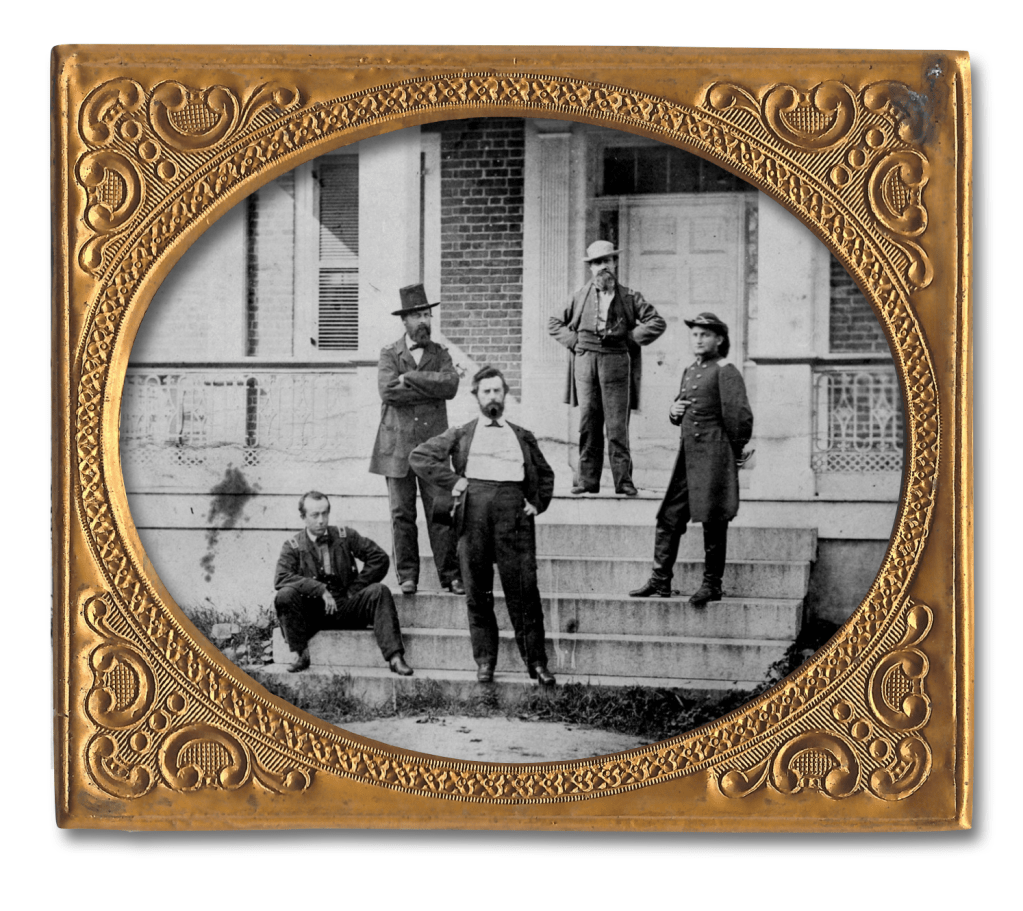
This letter was written by John Livingston Hathaway (1830-1891), the son of Erastus Hathaway (1796-1854) and Lydia Dunning (1796-1861) of Milwaukee, Wisconsin. John was married to Hannah Moyston Kellogg (1831-1867) in October 1852 and had three children by the time he accepted a commission in September 1861 to serve as a Captain of Commissary on the staff of Brig. Gen. Rufus King.
Union troops occupied Chatham for the first time in April 1862, when General Irvin McDowell set up headquarters at the house. McDowell brought a corps of 30,000 men to Fredericksburg. He halted his command at Fredericksburg for a month in order to bring up supplies, after which he planned to march on Richmond. President Abraham Lincoln journeyed to Fredericksburg to confer with McDowell about the proposed movement and on May 23 dined with him at Chatham. That very day, Stonewall Jackson’s Confederates attacked Union troops in the Shenandoah Valley and briefly threatened Washington, D.C. As a result of Jackson’s success, Lincoln ordered McDowell to forgo his march on Richmond and take a portion of his command to the Valley instead. General Rufus King took over command at Fredericksburg in McDowell’s absence and moved into Chatham.
Prior to his accepting a commission, John was working as a land agent in Milwaukee, having previously worked as a surveying engineer. After the war he returned to Milwaukee and earned a living as an insurance agent.
On the porch at Chatham are from left to right, Capt. John L. Hathaway (Com. of Subsistence), Capt. Robert Chandler (A.A.G.), Brig. Gen. Rufus King, Lieut. Albert A. Pitcher, 35th NYV, and Lt. Col. Kilpatrick. The 2nd & 7th Wisconsin Regiments of the Iron Brigade were encamped in the fields beyond the home.
Transcription
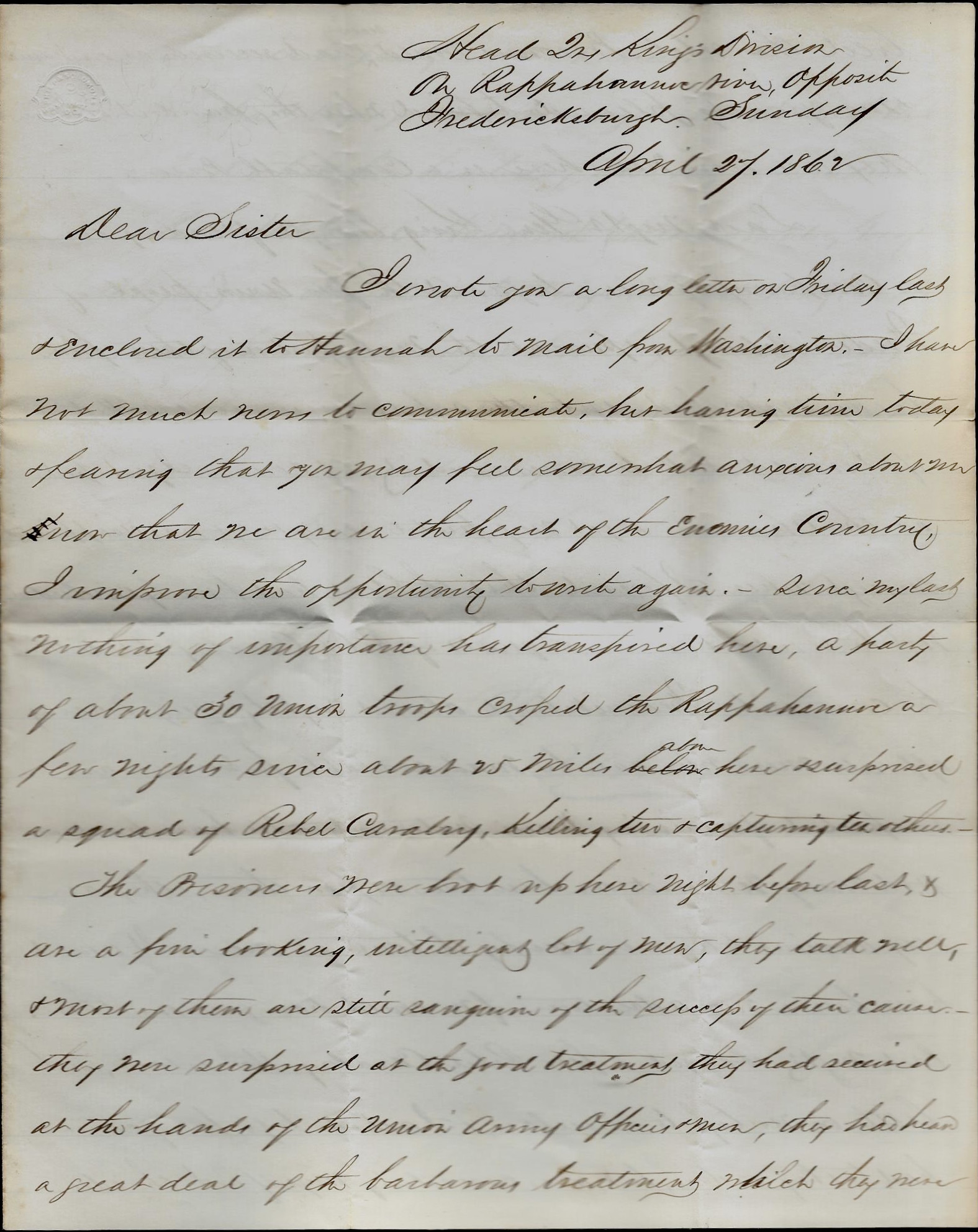
Headquarters King’s Division On Rappahannock River opposite Fredericksburg, [Virginia] Sunday, April 27, 1862
Dear Sister,
I wrote you a long letter on Friday last & enclosed it to Hannah to mail from Washington. I have not much news to communicate, but having time today in fearing that you may feel somewhat anxious about me now that we are in the heart of the enemy’s country. I improve the opportunity to write again. Since my last, nothing of importance has transpired here. A party of about 30 union troops crossed the Rappahannock a few nights since about 25 miles above here & surprised a squad of rebel calvary, killing two & capturing ten others. The prisoners were brought up here night before last, and are a fine looking, intelligent lot of men. They talk well & most of them are still sanguine of the success of their cause. They were surprised at the good treatment they had received at the hands of the Union army officers & men. They had heard a great deal of the barbarous treatment which they were told the rebel prisoners would receive & had received at our hands & were greatly pleased when they found it otherwise. They are now near here in a comfortable prison.
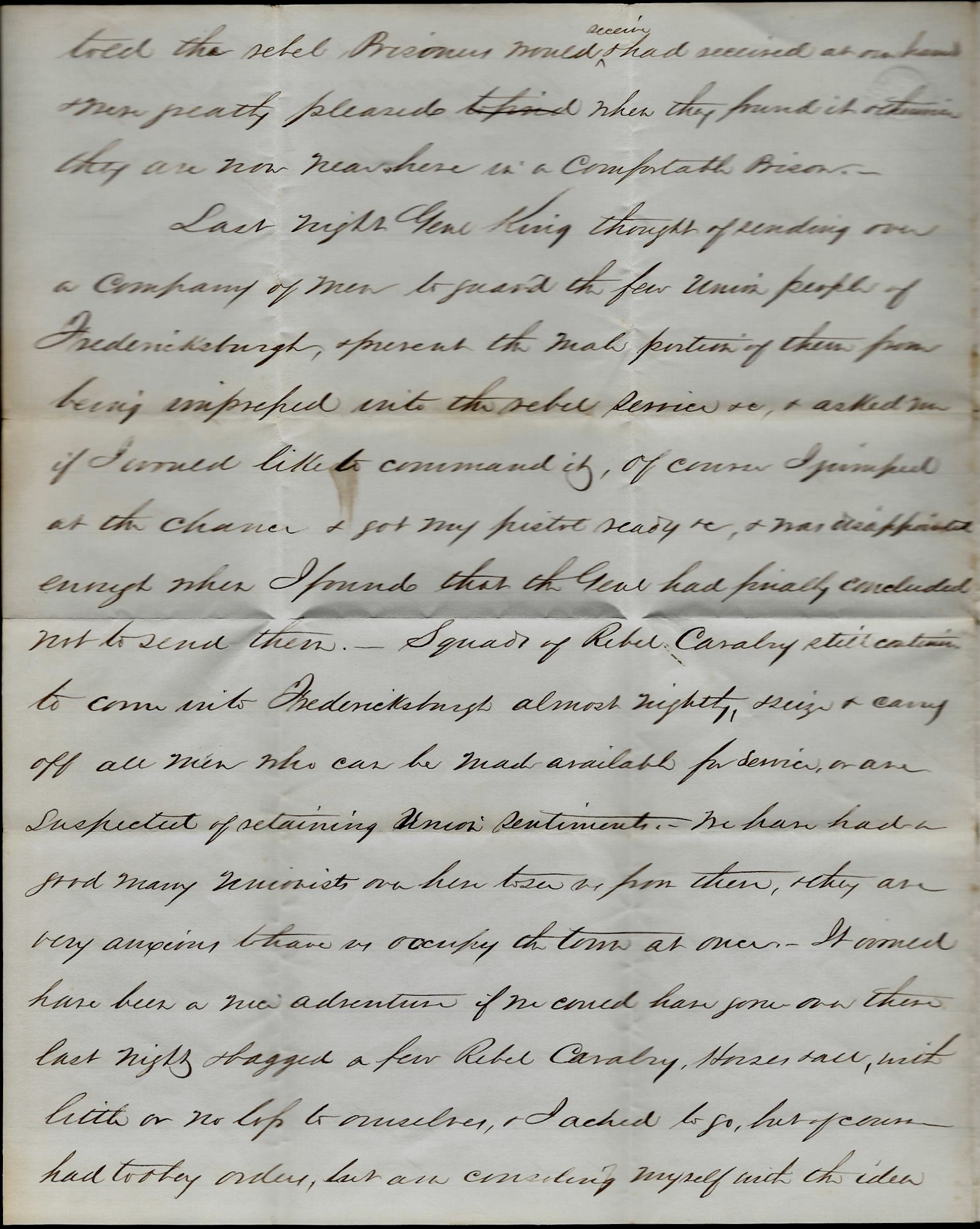
Last night General King thought of sending over a company of men to guard the few union people of Fredericksburg, & prevent the male portion of them from being impressed into the rebel service, &c. & asked me if I would like to command it. Of course I jumped at the chance & got my pistol ready &c., & was disappointed enough when I found that the General had finally concluded not to send them. Squads of rebel calvary still continue to come into Fredericksburg almost nightly & seize & carry off all men who can be made available for service, or are suspected of retaining union sentiments. We have had a good many Unionists over here to see us from there, & they are very anxious to have us occupy the town at once. It would have been a nice adventure if we could have gone over there last night & bagged a few Rebel Cavalry, horses & all, with little or no loss to ourselves, & I ached to go, but of course had to obey orders, but am consoling myself with the idea that there will be plenty more chances.
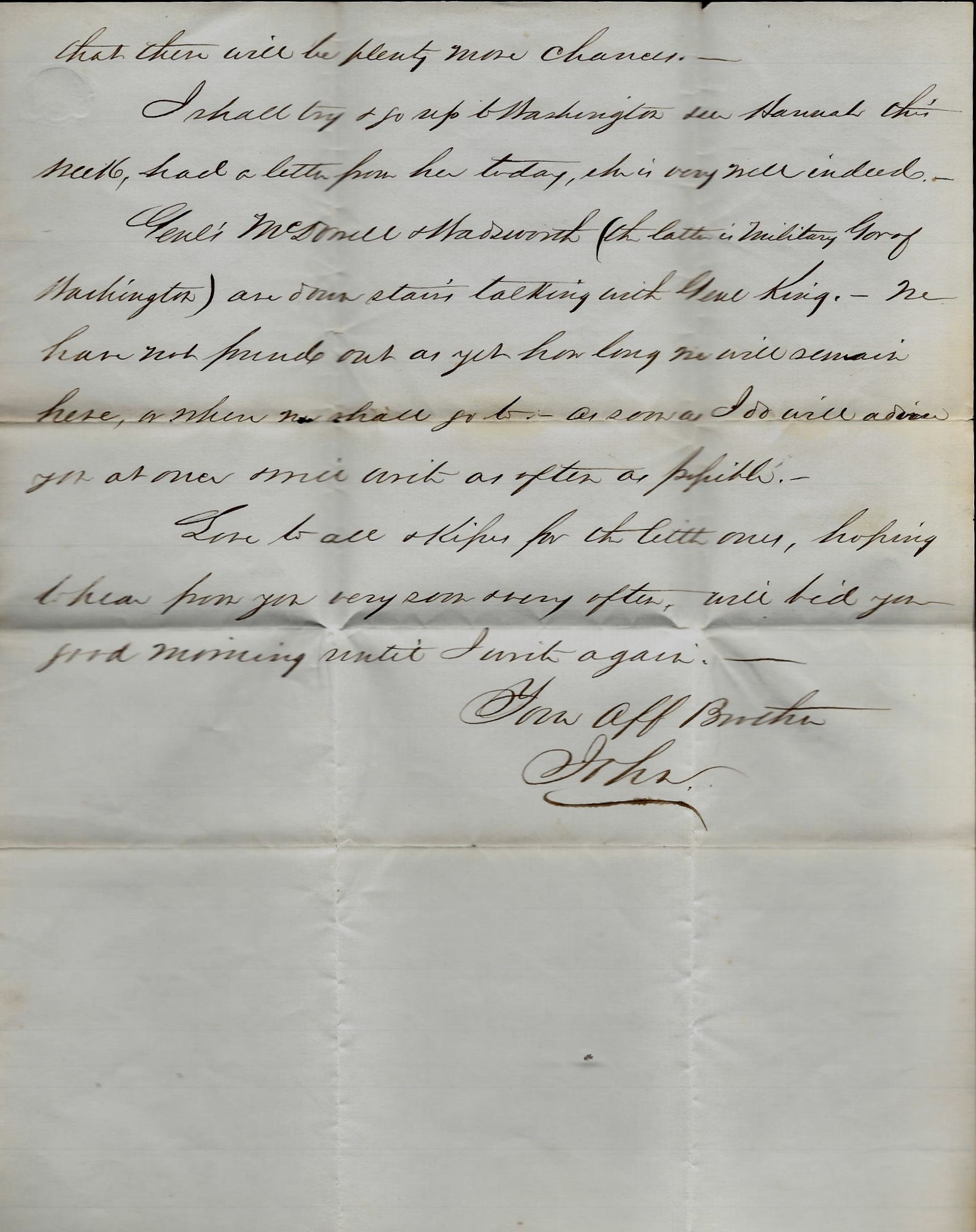
I shall try & go up to Washington to see Hannah this week. Had a letter from her today. She is very well indeed. Generals McDowell & Wadsworth (the latter is Military Governor of Washington) are downstairs talking with General King. We have not found out as yet how long we will remain here, or where we shall go to. As soon as I do, will advise you at once & will write as often as possible.
Love to all & kisses for the little ones. Hoping to hear from you very soon & very often, will bid you good morning until I write again. Your affectionate brother, — John




















 Spared & Shared 23