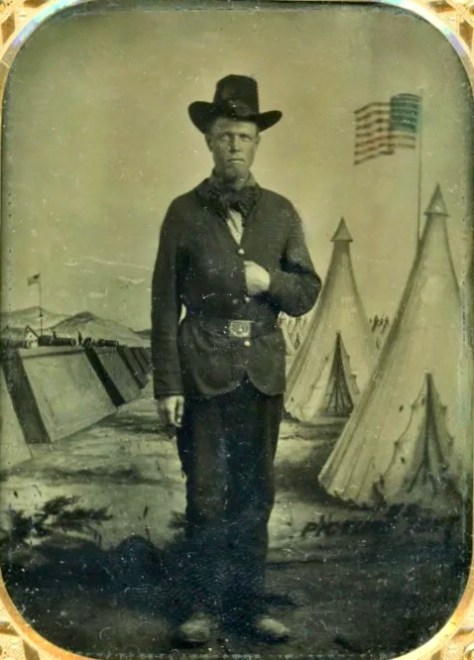
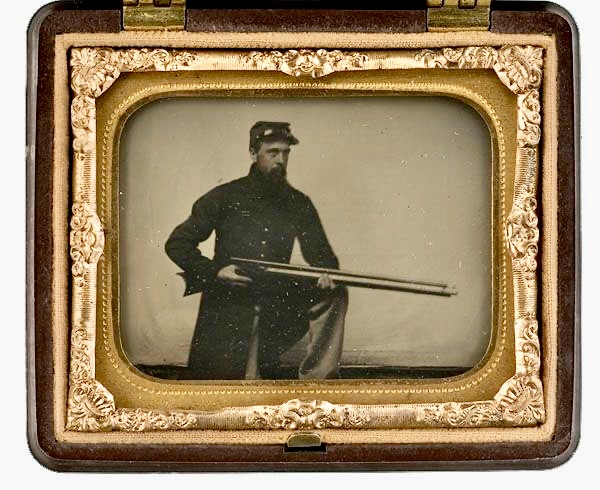
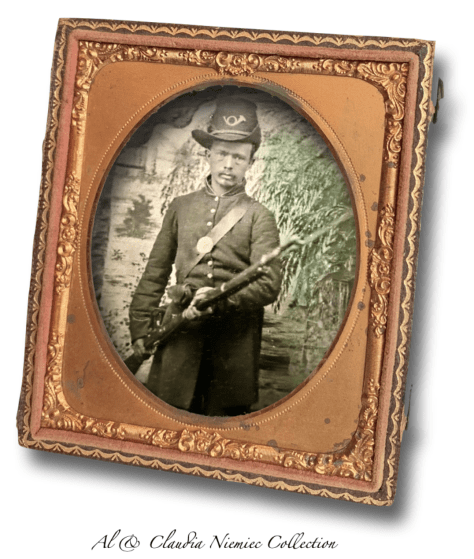
I could not find a war-time image of Samuel but located this tintype of his older brother Thomas Rees who served in the same company. (Brian White Collection)
This letter was written by Samuel Borrowe Rees (1844-1932) who served with his older brother, Thomas M. Rees (1837-1888) in Co. A, 2nd U. S. Sharpshooters. Company A was raised in Minnesota on October 5, 1861. He was born at Sodus Point, Wayne county New York, and moved with his family first to Bersheba Springs, Tennessee in the late 1840s, and then to Leech Lake, Minnesota in 1857. His father was Charles Williamson Rees (1807-1870) and his mother was Catherine Hallett (1810-1893).
Samuel and Thomas were part of the famous Berdan’s Sharpshooters. Thomas served with the Sharpshooters until his discharge on September 22, 1864. Samuel was wounded in the Battle of Antietam on 17 September 1862 and was discharged on 26 November 1862.
T R A N S C R I P T I O N
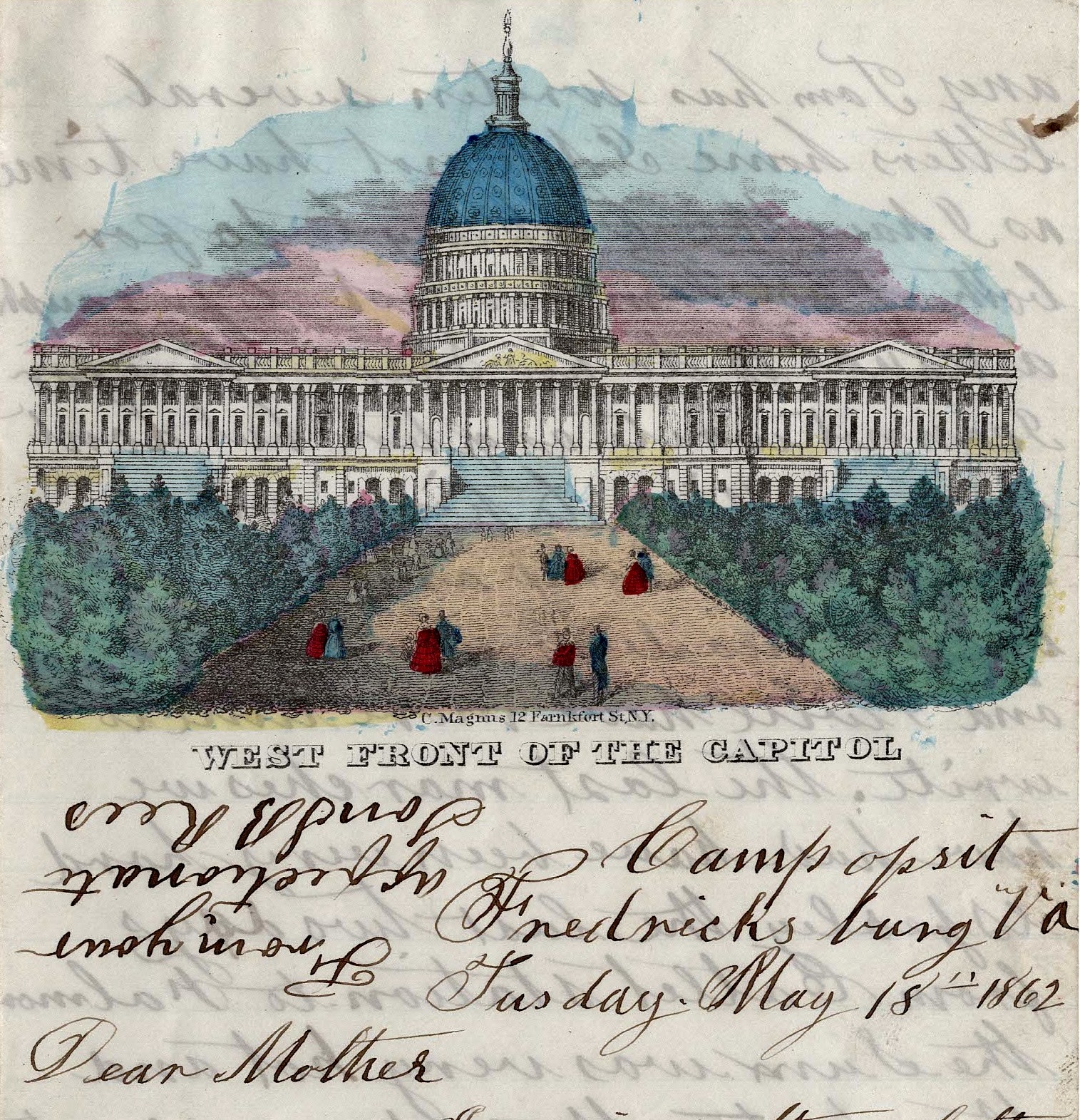
Samuel’s letter was written on stationery featuring a colored lithograph of the “West Front of the Capitol” by C. Magnus.
Camp opposite Fredericksburg, Va. Tuesday, May 18, 1862
Dear Mother,
I received three letters from home the other day, the first mail that we have had in our Brigade for three weeks. We have been on the march for the last three weeks; therefore not having a chance either to get our mail or send any. Tom has written several letters home. I did not have time as I have the cooking to do for both of us. Tom has not life enough as usual to do his share. Therefore I cannot write as often but don’t say anything to him.
We are in our old camp as you will see by the heading of my letter and I will have more time to write. The last marches we have had have been very hard—especially the last two days from Catlett’s Station to Falmouth. The sun was very hot and they put us through in a forced march, notwithstanding that three men and three mules dropped dead by the road side for the want of rest and the sun so hot that they were sun struck. And a good many are still suffering from its effects.
Col. Henry Alberton Van Zo Post commanded the 2nd US Sharpshooters in 1862.
Notwithstanding all this, after a short rest, when the regiment was ordered to fall in to continue the march, one man who happened to be at a short distance eating a few cherries did not fall in quick enough to suit the Colonel [Henry Alberton Van Zo Post] and he tore down to where the man was and, riding his horse behind the man, made him run to the front of the regiment where he had four men with fixed bayonets to make him march at the point of the bayonet. This he laughed at.
The same day he kicked Capt. [Henry M.] Caldwell [of Co. F] in the back and ordered him to the rear of the regiment under arrest because he told a tired man to fall out of the ranks and rest. The Colonel has since offered said Captain his sword if he would let it pass. The Captain said to him he did not wish his sword but that he would have him put through to the extent of the law. Peleter is also under arrest because the Colonel took a Sharps rifle and beat his with Colts. Peleter is fighting mad because we have got that cause of so much trouble.
The Sharps rifle is a splendid gun, set lock and bronze barrel. We have just been paid off, dear mother, and I will send twenty-five dollars to you to use. I do not wish you to save any for me. I would rather you would use it and get all you want. Give my love to all and tell them I will write soon. It is getting time for dress parade and I must stop. From your affectionate son, — S. B. Rees
The following letter was written by 18 year-old George W. Ball (1843-1923) of Ottawa county, Michigan, while serving in Co. B, 3rd Michigan Infantry. George enlisted on 13 May 1861 at Grand Rapids and was discharged from the regiment in June 1863.
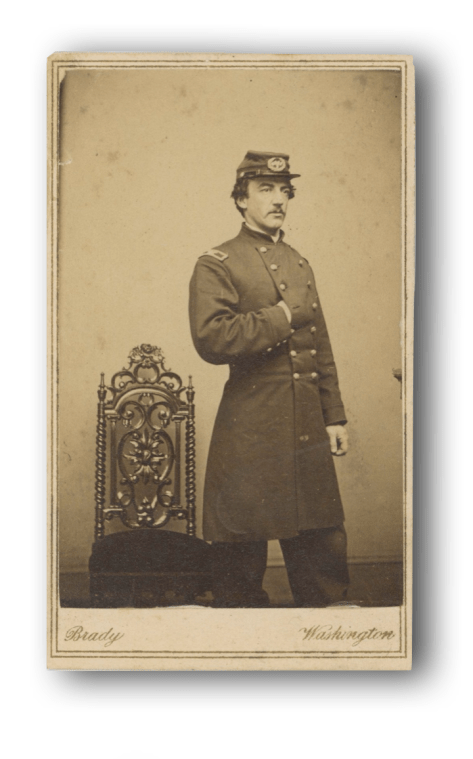
I could not find an image of George but here is one of Edward C. Brown of Co. E, 3rd Michigan Infantry
George’s letter offers a detailed first-hand account of the First Battle of Bull Run, during which the 3rd Michigan was engaged when the conflict erupted at Blackburn’s Ford on July 18, 1861. This event unfolded near the center of the Confederate line, held by General James Longstreet’s Virginians, along the brush-lined banks of Bull Run. The approach down the wooded slope to the Ford, executed by Richardson’s Brigade, was initiated by the gray-clad 1st Massachusetts, which valiantly contested the Confederates for the first hour. Eventually, the other three regiments—the 2nd and 3rd Michigan and the 12th New York—were called into action, with the 3rd Michigan positioned on the extreme right of the line, while Ayres’ artillery from the ridge adjacent to the farm path that led to the ford engaged the enemy. Remarkably, the 3rd Michigan found themselves relatively secure during the engagement, to the point where some members were reported to be picking berries until they became aware that their brigade was in full retreat. Understandably, George’s letter to his mother portrays the role of the 3rd Michigan in a slightly different light.
The 3rd Michigan Infantry were initially issued gray uniforms but by the Battle of Bull Run, the consensus of opinion is that they wore a mix of uniforms colors, including blue or black trousers, and both blue and gray coats.
A great reference book by my friend, John Hennessy—“The First Battle of Manassas, An End to Innocence, July 18-21, 1861,” 1989.
T R A N S C R I P T I O N
Washington August 2, 1861
Dear Mother,
I now sit down to write you a few lines to let you know how I was getting along. I am well off at present and I hope these few lines will find you the same.
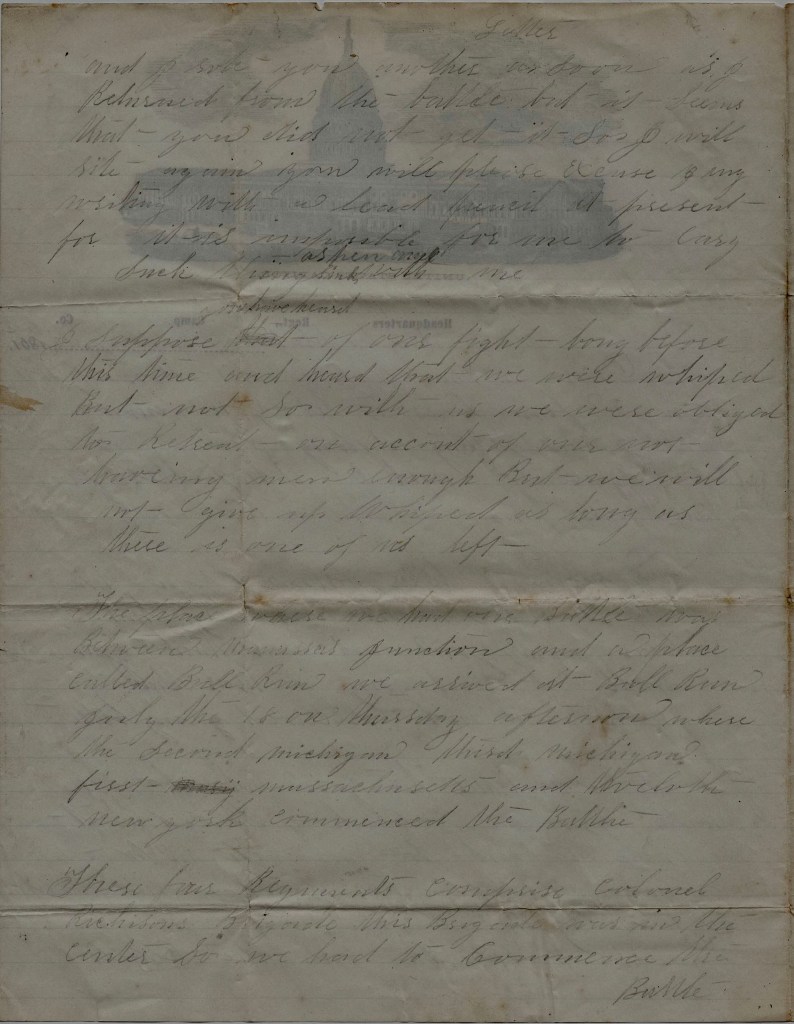
I received a letter from you dated July the 29th and was very glad to hear from you and hear that you were well but was sorry to hear that you had not received my letter. I wrote one letter to you about one month ago in which I stated that we were about to march into Virginia. We left our camp and went into Virginia about 25 or 30 miles where we had a battle with the Rebels. And I wrote you another letter as soon as I returned from the battle but it seems that you did not get it so I will write again. You will please excuse my writing with a lead pencil at present for it is impossible for me to carry such things as pen and ink with me.
I suppose you have heard of our fight long before this time and heard that we were whipped but not so with us. We were obliged to retreat on account of our not having men enough but we will not give up whipped as long as there is one of us left.
The place where we had our battle was between Manassas Junction and a place called Bull Run. We arrived at Bull Run July the 18th on Thursday afternoon where the 2nd Michigan, 3rd Michigan, 1st Massachusetts, and 12th New York commenced the battle. The four regiments comprise Colonel [Israel B.] Richardson’s Brigade. This brigade was in the center so we had to commence the battle.
The battle commenced a short time after noon and lasted till about seven when we commenced our retreat and went back as far as Centerville where we camped for the night and the next morning before daylight, our 3 o’clock, our picket guard was fired upon and drove in to the camp and we were waked up and got ready for a march and as soon as we could, we were divided into three divisions and went back within half a mile of the rebels and waited for our right and left divisions to come up but they did not get their position till Sunday morning when we commenced at them again.
We commenced fire upon them at 7 o’clock and fought till four in the afternoon. But they had too many men for us and we were obliged to retreat back within two miles of Washington where we shall stay till we get a large force. There was a great many of the Rebels killed as near us. We can’t ascertain how many but the report that they lost about three times the number killed that we had. One of their Generals was shot through the head with a cannon ball and Gen. Beauregard’s horse was shot from under him. We took twelve Secesh prisoners back with us to Washington…
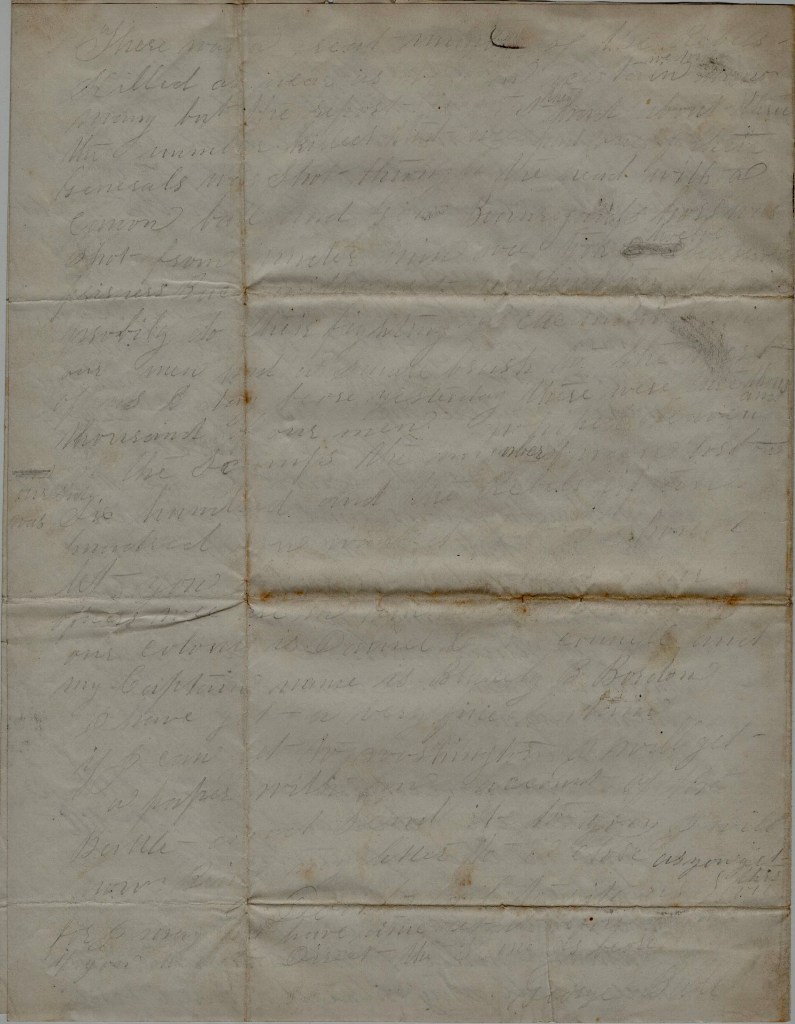
Our men had a small brush to the west of us day before yesterday. There were three thousand of our men whipped cavalry of the Scamps. The number of men lost on our side was six hundred and the Rebels fifteen hundred…Our colonel is Daniel McConnell and my captain’s name is Blakely B. Borden. I have got a very fine position. If I can get to Washington, I will get a paper with an account of the battle and I will send it to you.
I will now bring my letter to a close. As soon as you get this, don’t fail to write me for I may not have time… Direct the same as before, — George Ball
Ninth Plate Ambrotype of Cpl. Abner Colby, Co. G., USSS A horizontal view of Colby uniformed in ubiquitous green frock coat kneeling with an early civilian target rifle with telescopic sight adopted for use by Berdan’s famous Sharpshooters.
The following letter was written by George E. Mead (1837-1862) who enlisted on 11 September 1861 as a private in Co. F, 1st U. S. Sharpshooters. Prior to his enlistment, George was living in Rutland, Vermont, with his wife of four years, Katherine (Hackett) Mead, and working as a railroad hand. When he enlisted, George and the other recruits were promised breech-loading Sharps rifles, known for their accuracy and high rate of fire. Some recruits brought their own rifles and were told the government would reimburse them $60 if the rifle proved suitable. That promise was never kept.
We learn from the letter that after being in the service for four months, the sharpshooters had not been issued their rifles yet and were still laying in the camp of instruction near Washington D. C. As men were dying off rapidly due to disease without seeing any battlefield, George vented his frustration, “As for my part, if I have got to die in this country, I had rather die on the battlefield with powder and ball, then lay down and die with diseases that prevail amongst our soldiers here in camp, such as measles, small pox, diphtheria fevers, and everything that can be thought of.”
Unfortunately for George, his wish for ending the war and returning home safely was never realized. He died of disease on 9 September 1862 at Alexandria, Virginia, presumably after having been with his comrades in the Peninsula Campaign earlier in the summer.
T R A N S C R I P T I O N
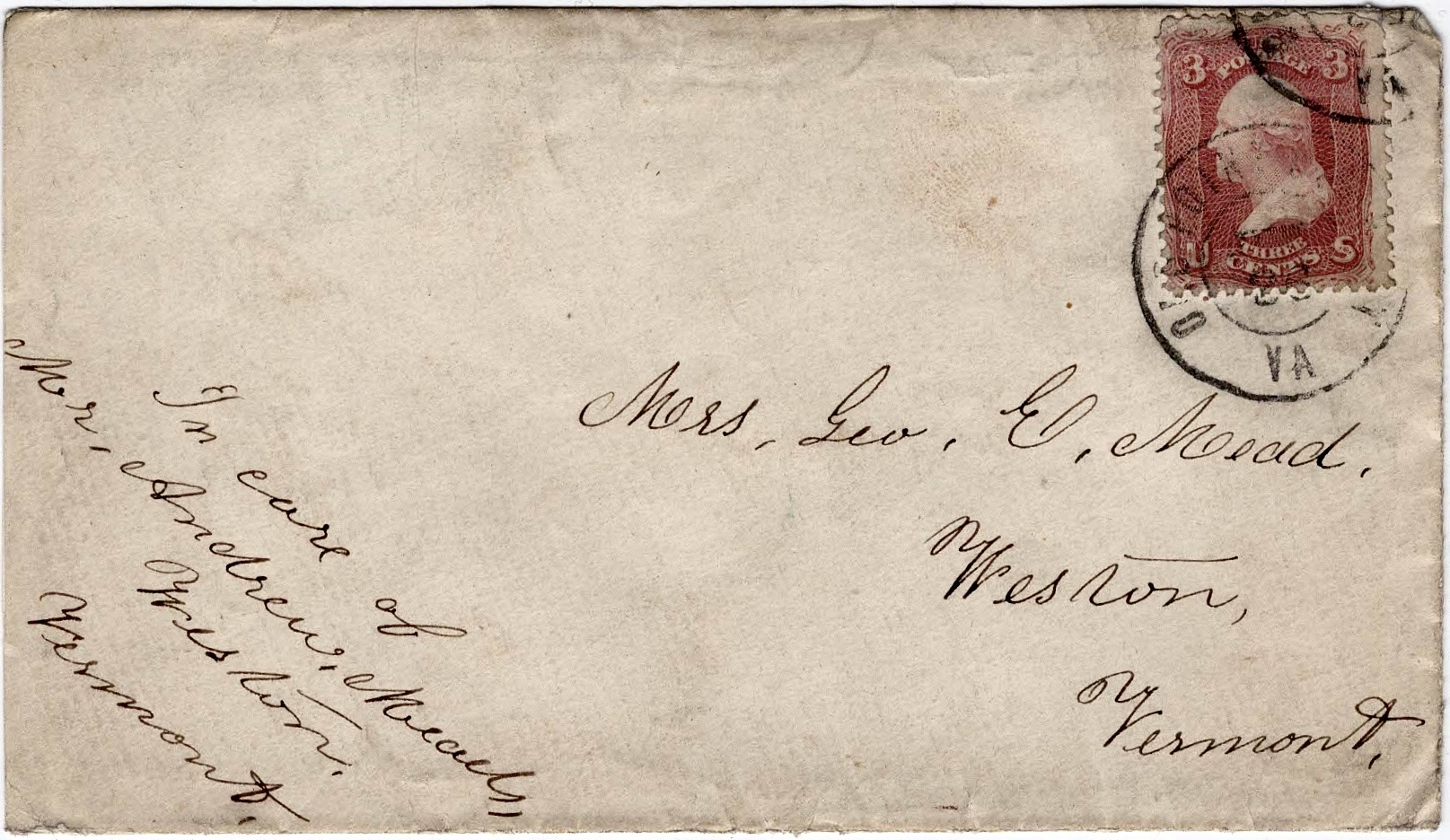
Addressed to Mrs. George E. Mead, Weston, Vermont
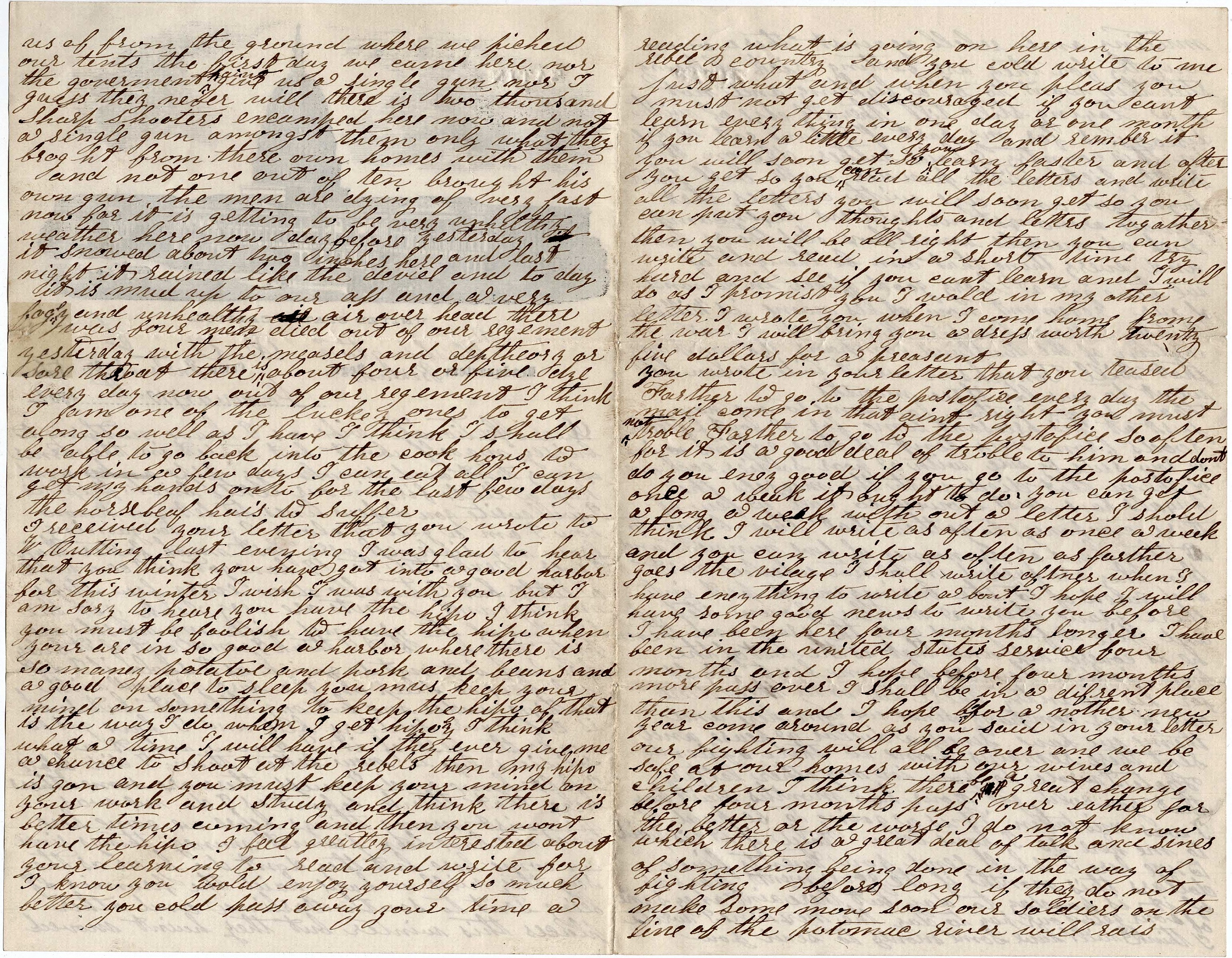
Camp of Instruction, Washington D. C. Co. F, Berdan’s Regiment January 10, 1862
Dear affectionate wife,
As I have nothing to busy myself about but to sit in the corner of my tent and smoke my pipe and keep a little fire in our little brick fireplace, I will write you a few lines to let you know how I am a getting along. I am a gaining from my sickness very fast—much faster than I ever expected to. I have got so I can walk a little but I tumble down every few steps. My legs and joints are very weak yet. The steam of the ground with my measles are pretty tough but I think I come out of it bully before long, but not so quick as I should if I did not have to sleep on the bare ground with nothing under me but my blanket. But such is the poor soldier’s bed and I have got to make the best of it.
I know what a soldier’s life is now better than I did before I left home and I guess there are some others here that think about as I do. We was promised many things before we come here and we have been promised many things since we came here, but they don’t do by us as they say. They will have had the promise of being sent to South Carolina and other places this winter but they hain’t moved us from the ground where we pitched our tents the first day we came here, not the government hain’t give us a single gun nor I guess they never will. There is two thousand sharp shooters encamped here now and not a single gun amongst them—only what they brought from their own homes with them. And not one out of ten brought his own gun.
The men are dying off very fast now for it is getting to be very unhealthy weather here now. Day before yesterday, it snowed about two inches here and last night it rained like the devil and today it is mud up to our ass, and a very foggy and unhealthy air is over head. There was four men died out of our regiment yesterday with the measles and diphtheria or sore throat. There is about four or five die every day now out of our regiment. I think I am one of the lucky ones to get along so well as I have. I think I shall be able to go back into the cook house to work in a few days. I can eat all I can get my hands onto for the last few days. The horse beef has to suffer.
I received your letter that you wrote to W. Cutting last evening. I was glad to hear that you think you have got into a good harbor for this winter. I wish I was with you but I am sorry to hear you have the hypo. 1 I think you must be foolish to have the hypo when you are in so good a harbor where there is so many potato and pork and beans and a good place to sleep. You must keep your mind on something to keep the hypo off. That is the way I do when I get hypoey. I think what a time I will have if they ever give me a chance to shoot at the rebels, Then my hypo is gone. And you must keep your mind on your work and study and think there is better times coming and then you won’t have the hypo.
I feel greatly interested about your learning to read and write for I know you would enjoy yourself so much better. You could pass away your time a reading what is going on here in the rebel country and you could write to me just what and when you please. You must not get discouraged if you can’t learn everything in one day or one month. If you learn a little every day and remember it, you will soon get so you learn faster. And after you get so you can read all the letters and write all the letters, you will soon get so you can put your thoughts and letters together. Then you will be all right. Then you can write and read in a short time. Try hard and see if you can’t learn and I will do as I promised you I would in my other letter. I wrote you when I come home from the war, I will bring you a dress worth twenty-five dollars for a present.
You wrote in your letter that you teased Father to go to the post office every day the mail came in. That ain’t right. You must not trouble Father to go to the post office so often for it is a good deal of trouble to him and don’t do you any good. If you got to the post office once a week, it ought to do. You can get along a week. It ought to do. You can get along a week without a letter, I should think. I will write as often as once a week and you can write as often as Father goes to the village. I shall write oftener when I have anything to write about. I hope I will have some good news to write you before I have been here four months longer.
I have been in the United States service four months and I hope before four more months pass, I shall be in a different place than this. And I hope before another new year comes around, as you said in your letter, our fighting will all be over and we be safe at our homes with our wives and children. I think there will be a great change before four months pass over, either for the better or the worse, I do not know which. There is a great deal of talk and signs of something being done in the way of fighting before long. If they do not make some move soon, our soldiers on the line of the Potomac river will raise mutiny and rebel against their own country for they are getting sick of lying still. They want to be a fighting and not be a laying still. They all die off with diseases.
As for my part, if I have got to die in this country, I had rather die on the battlefield with powder and ball, then lay down and die with diseases that prevail amongst our soldiers here in camp, such as measles, small pox, diphtheria fevers, and everything that can be thought of. We have got a very good officer in command of our regiment now. His name is William Ripley for Center Rutland. He wsa captain of the Rutland company—the company that Bill Thompson went with when he went to war for three months.
Kate, [it] seems rather lonesome to me now just at this present time for about fifteen rods from my tent is three coffins in a row, side by side, with a poor soldier in each one of them that died with the measles. The bugles have just blowed to call a few of their companies together that they belonged to. They have a ceremony of five minutes and then they are packed in a two-wheeled cart and carried off to the burying ground, put into their grave, [and] then a number of men step up and fire a few guns over the grave adn then he is covered up, and that is the last of the poor soldier who has come here to fight for his country. There has only three died out of our company since we came here and them we have signed a dollar apiece and sent their remains home to their friends.
Kate, I wrote to you in my other letter that you could get your two months State pay. I was mistaken. It is a going to be paid to me here so I have been told. If it is paid to me here, I shall send you twenty-five dollars this month if the government pays us off. It is payday today but there ain’t any sign of our getting our pay today. The next time I write, I think I will have some money to send you.
1 “Hypo” was the term often used to refer to depression. Abraham Lincoln often said he suffered from hypo, but this is the first time I have seen the term used in the thousands of letters I’ve transcribed.
I could not find an image of Miner but here is one of Hector W. Storrs who served in Co. E, 22nd Connecticut Infantry.
The following letter was written by Pvt. Miner Healy Corbin (1840-1919) of Union, Tolland county, Connecticut who enlisted when he was 21 years old into Co. G, 22nd Connecticut Infantry on 5 September 1862 and was honorably discharged 7 July 1863 at Hartford. Miner was the son of Healy Corbin (1799-1878) and Nancy Coye (1803-1878). Miner was a teacher before the war and afterwards he farmed in Brimfield.
The 22nd Connecticut was the first nine-month infantry unit to be mustered into federal service and they saw little action. Most of the time was spent in the defenses of Washington D. C. though they were in Suffolk, Virginia, for a time. They lost 20 men during the war, all due to disease.
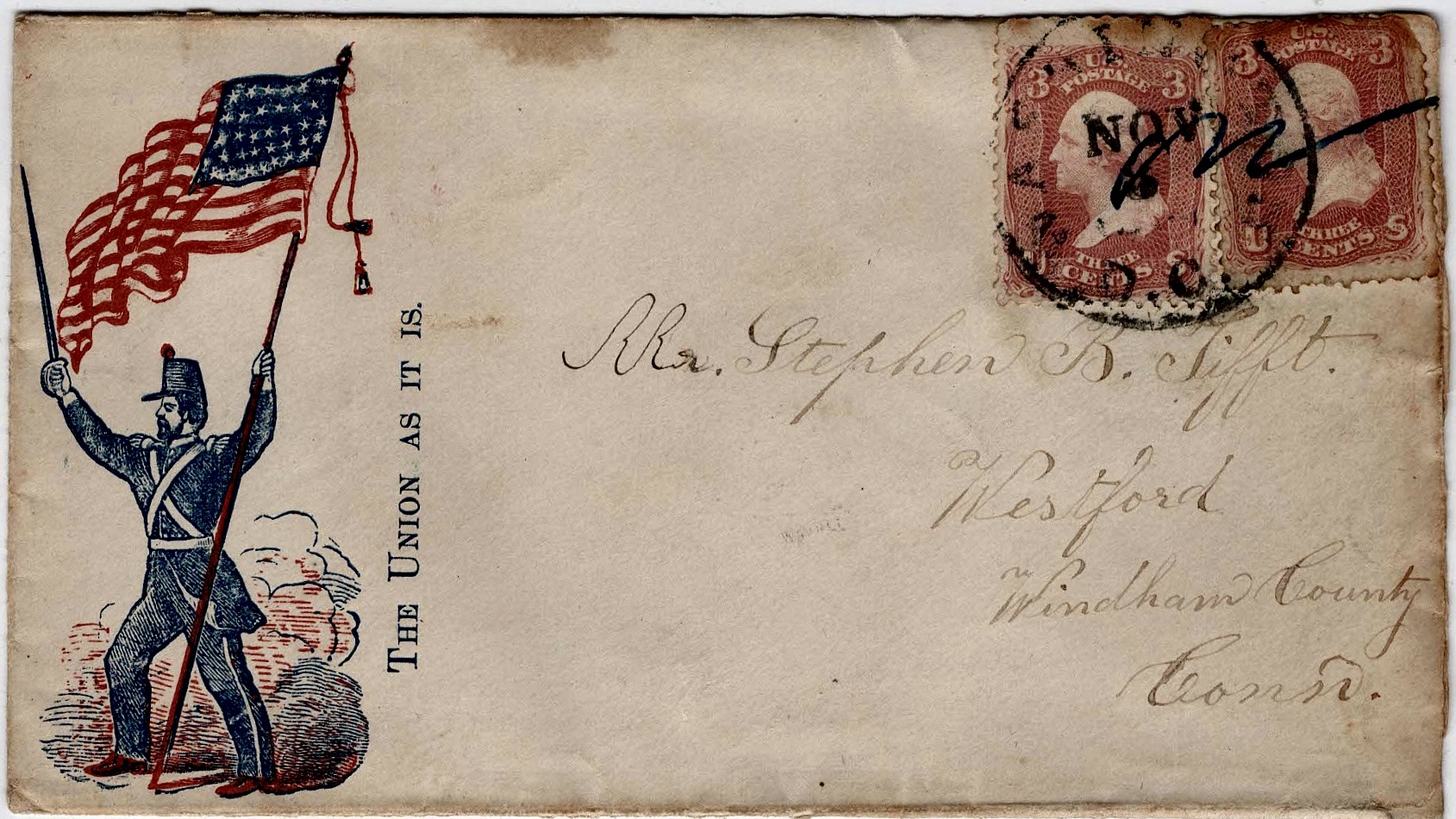
Miner wrote the letter to his cousin, Stephen B. Tifft (b. 1837) of Westford, Windham county, Connecticut.
T R A N S C R I P T I O N
Addressed to Mr. Stephen B. Tifft, Westford, Windham county, Connecticut
22nd Regiment Conn. Vols., Co. G Headquarters of pickets, Fairfax county October 16, 1862
Dear cousin Stephen B. Tifft,
As I am on picket today, I will take the opportunity to write a few lines to you. This morning, Thursday October 16th, we (our company) had to roll our blankets (rubber on outside) with two days rations in our haversacks, our canteens filled with water, forty rounds of cartridges & overcoats on and ready to start at half past 8 o’clock which we did & started for we knew not where. A company from the 133rd New York, one from the 11th Rhode Island, & one other I believe, went with us. We marched up to Fort Ethan Allen about a mile from our camp & there a colonel (I have forgotten his name) took us up to where we are now stationed. One company was stationed on the right and one on the left with our company in the center. We are on the turnpike between Leesburg and Fairfax about 15 miles from Leesburg & 8 from Fairfax and we are about 10 miles from Washington City & between 3 & 4 miles from our camp which we marched with all our luggage. And I was almost sick this morning. It was a pretty hard march for me. I had to step out of the ranks & shack for myself. But I was not but a little behind the rest. Quite a number fell out as well as me. I had had the bowel complaint for a few days and had got some cold & was quite weak so that it was hard to march with our load under such circumstances. But I have got considerably rested and feel better and if I could rest for a day or two, I should be all right again.
The pickets are thrown out three or four in a place at equal distances from each other and some one of them have to be on guard during the day & two during the night. About half of our company are on such duty under Lieut. Corbin & a squad of 6 or 7 under Lieut. [Thomas F.] McMain are stationed down at the road a few rods from here & we are stationed (with the Captain) at a house fronting the south which looks to me to be west. I get turned round marching in all directions but I know the directions most of the time.
You will want to know what we have to do. Just nothing at all as I may say for only one has to stand guard before the house & is on only one hour (we are the relief guard) and as there is 30 or more of us, it will not come very often. So we can be as lazy as need be with plenty of sweet potatoes at 30 cents per pound, eggs, pies, chickens, &c. &c. You may expect I shall try and live while we stay here which is 48 hours. When an officer comes around, we have to fall into line and present arms. Then stack arms again and are at liberty them until another comes along which is not very often. Melvin, John, Byron, Frank, Walker & Horton are with us which makes it very pleasant to be together.
Yesterday forenoon our regiment was called out to go up to Fort Ethan Allen. We marched up there & had places picked out for us where we were to be stationed & each one knew his place. Then we marched outside of the fort, formed into line, and marched in double quick to our position which made us puff some. Those that were in there were moving out and they said we were coming in but I think we shall stay in our camp and if the enemy should happen to come, we should have to run for that fort to man it.
The most of our company are stationed on the south side which the officer said was the most exposed but less firing to be done & I think that looks as though we might winter here. I hope we may. I shall not have time to write more now. Give my love to Juliet, your father and mother, Mrs. Carpenter, and all enquiring friends. Write soon all the news, what you are up to, &c. &c. From your affectionate friend and cousin, — M. H. Corbin
Melvin says to tell you he is well and sends love to you all. He had a letter from Sandford last night. A welcome one too. Direct to Miner H. Corbin, Co. G, 22nd Regt. Conn. Vols. Washington D. C. (Our chaplain is post master. We have the mail every day.)
I could not find an image of Leonard but here is one of Wesley T. Hull of Co. C, 16th New York Infantry.
The following letter was written by Leonard Barnes Perkins (1840-1914) who was 21 years old when he enlisted on 27 April 1861 at Potsdam to serve two years in Co. B, 16th New York Infantry. He mustered out with his company at Albany on 22 May 1863. This letter was written in the days leading up to the Battle of Bull Run in which the regiment was lightly engaged.
Leonard was the son of Cyrus Perkins (1812-1880) and Martha Angeline Barnes (1812-18xx) of Parishville, Saint Lawrence county, New York. He wrote the letter to his sister Wealthia (“Welthy”) Perkins (1837-1907).
T R A N S C R I P T I O N
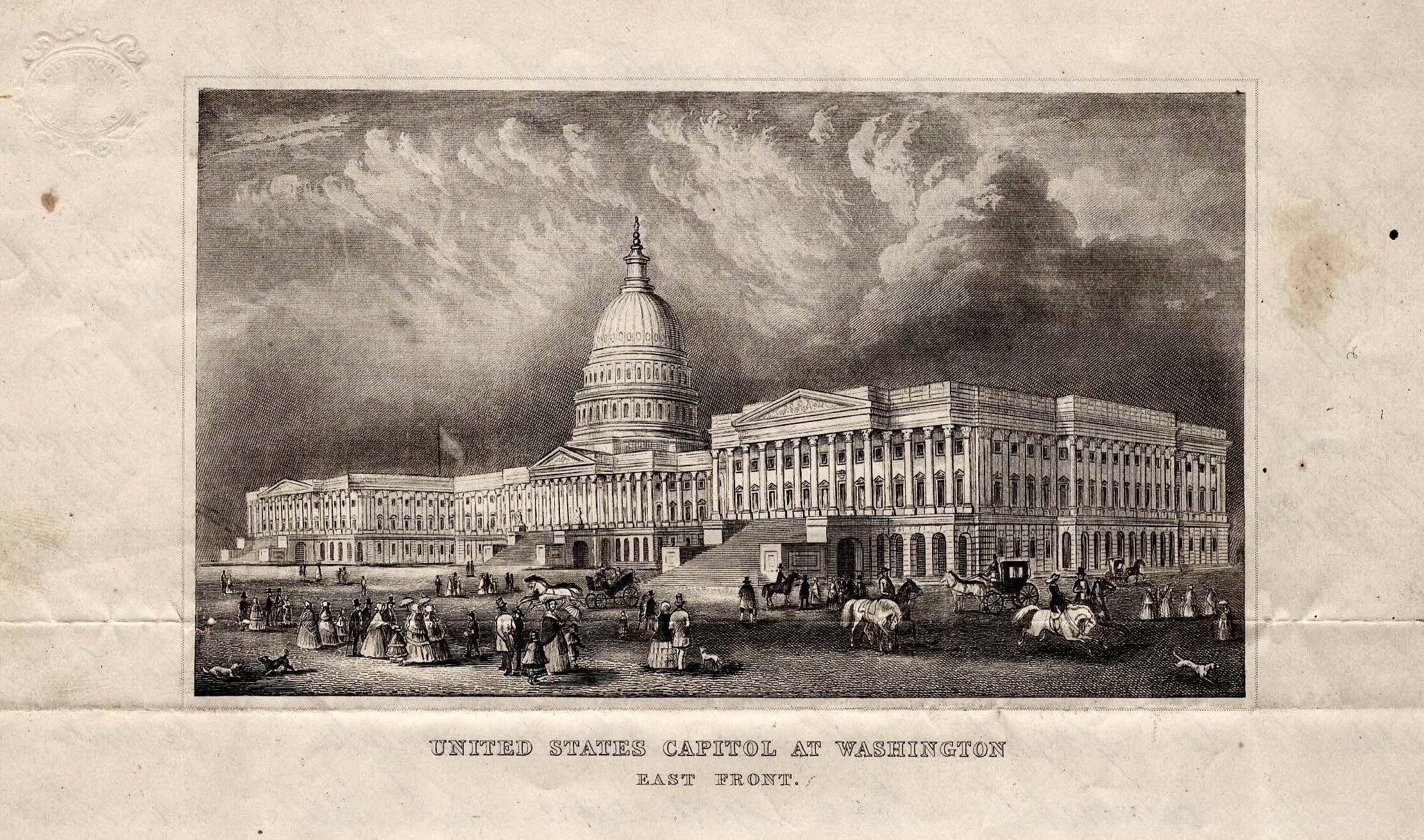
Leonard wrote his letter on rare stationery featuring a lithograph of the United States Capitol, East Front).
Alexandria, Virginia July 12th 1861
Dear sister Wealthia,
Yours at hand, July 10th. I was glad to hear from you and hear you was all well. I am well and as tough as a knot. We left Washington yesterday and marched two miles which was down to the lower end of the City and went aboard of a steamer and sailed down the river to Alexandria and then marched from this city two miles out into the country and are now in camp here. But we don’t expect to stay here long.
We marched in sight of [the Marshall House] where Colonel Ellsworth was shot. We are in camp within half mile of that regiment [11th New York Fire Zouaves] that was Colonel Ellsworth’s. They are a hard set of looking boys, I think, and they look so that they might fight smart. We are in a brigade now and our colonel [Thomas A. Davies] has been promoted to colonel of the brigade.
Wealthia, we are right among the enemy now. They are all around us and as soon as the rest of our brigade arrives here, we shall march on and expect to fight. And we shall make a clean sweep amongst them, you can bet safe on that.
Wealthia, we had got rid of our old Captain [James M. Pomeroy] at last and you can bet we are glad too. We have got a nice fellow for our Captain now. He does look after us and sees we have our rights. His name is Frederick [C.] Tapley. He is about 32 years of age. He has been through one campaign. He served two years in th Mexican War and he knows what belongs to us and he is the best drilled captain in our regiment and we all like him very much.
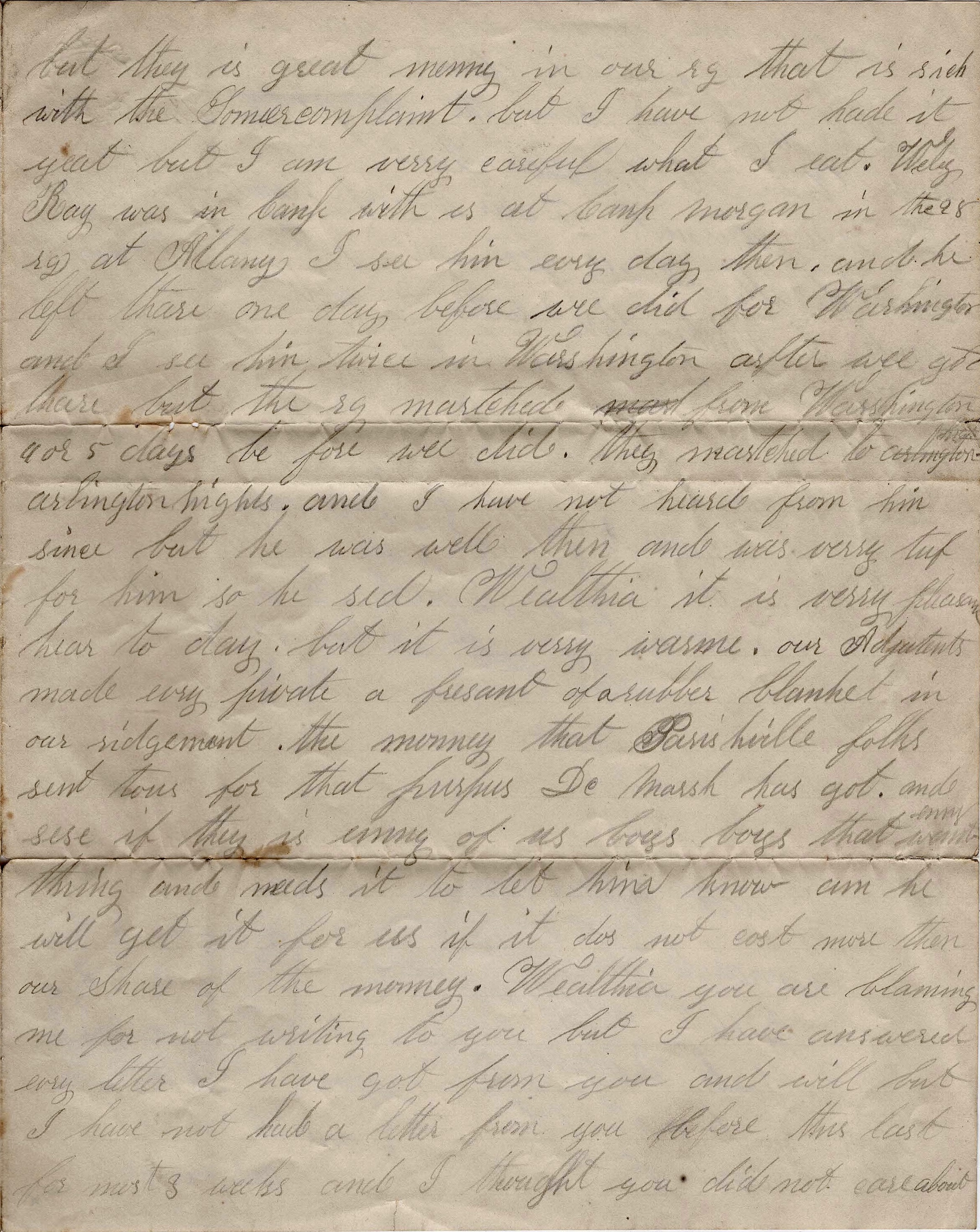
I tent with Warsh. He is well and sends his best respects to you and Ed does too. And he says [to] tell you that he stands it very well. The boys that came from Parishville is all well but there is a great many in our regiment that is sick with the summer complaint. I have not had it yet but I am very careful what I eat. Wesley Ray was in camp with us at Camp Morgan in the 28th Regiment at Albany. I seen him every day then and he left there one day before we did for Washington and I seen him twice in Washington after we got there, but the regiment marched from Washington four or five days before we did. They marched to Arlington Heights and I have not heard from him since. But he was well then and was very tough for him—so he said.
Wealthia, it is very pleasant here today but it is very warm. Our Adjutant made every private a present of a rubber blanket in our regiment. The money that Parishville folks sent to us for that purpose, Dr. [S.] Marsh has got and says if there is any of us boys that want anything and needs it, to let him know and he will get it for us if it does not cost more than our share of the money.
Wealthia, you are blaming me for not writing to you but I have answered every letter I have got from you and will. But I have not had a letter from you before this last for most three weeks and I thought you did not care about hearing from me. If you did, you would write.
On th 4th of July we marched down through the City of Washington and saw thePresident and Wm. H. Seward. General Scott, 1 and then we returned to our camp and our Colonel treated all of us to one gill of whiskey and I think this was a hell of a celebration, don’t you?
Tell Mr. Wakefield I send him my best respects and tell Lucy Howe I send her my best respects. Uncle James and wife, I send my best respects to them, and I will write to him. And give my best respects to all inquiring friends. I will not write anymore this time. So goodbye.
Direct your letter to Leonard B. Perkins, Co. B, 16th Regiment New York Volunteers. You must not put on no place and it will follow me then. I sent home 5 books to father. When you write, please let me know if he has got them. This is from your affectionate brother, — Leonard
1 For one hour and forty minutes from a pavilion in front of the Excutive Mansion, President Lincoln, with General Scott and cabinet, reviewed more than 20,000 men of the 23 New York Regiments.
Captain Thomas Norfleet Jordan, Co. F, 5th North Carolina Infantry
The following letter was written by Thomas Norfleet Jordan (1842-1903) who entered the Confederate service as a private in Co. B, 5th North Carolina Infantry in mid June 1861 at Weldon. He was described in muster rolls at the time as a 19 year-old, 5 foot 10 inch, blue-eyed, dark-haired clerk from Gates county, North Carolina. He was soon promoted to corporal and then to sergeant prior to the evacuation of Yorktown. In September 1862, he was commissioned 1st Lieutenant of Co. F. He was taken prisoner at Plymouth, North Carolina, in December 1862 and then paroled. Early in 1863, he was promoted to Captain of Co. F. He was still the captain of his company on 12 May 1864 when he was wounded in the right arm so severely that it required amputation to save is life. After recuperating in a hospital at Gordonsville, he returned to service in Petrie’s Invalid Corps in January 1865.
Thomas N. Jordan, whose beautiful penmanship gained him a position as a clerk before the Civil War, had to learn to write with his left hand following the amputation of his right arm in mid-May 1864. Here is his signature on a document from later in the war.
Thomas was the son of Thomas A. and Nancy (Norfleet) Jordan of Gates county, North Carolina—some 40 or 50 miles from Norfolk, Virginia and 20 south of Suffolk. One source on Ancestry.com gives “Desdemonia” as the plantation name of the house owned by Thomas and Nancy (Norfleet) Jordan, pictured below.
North Carolina home of Thomas’s parents.
Note: This letter is from the private collection of Chase Rhodes and was made available for transcription and publication on Spared & Shared by express consent.
T R A N S C R I P T I O N
In the woods near Richmond, Va. May 25th 1862
My dear Father,
Onceagain another glorious privilege has presented itself to me of writing you & one indeed which I can by no means slide & let pass unnoticed. Yeas, a privilege which I thought would never, at least for some time present itself. But I am proud that such an opportunity should present itself. Mr. Hays’ (William) heard of the sickness of his son Tom and came up to Richmond to see him. I learn he leaves tomorrow. There is nothing that I hear of interesting about here. All of our troops are concentrated here and around here. Everything seems favorable for a fight very soon. The enemy, I hear, are close at hand.
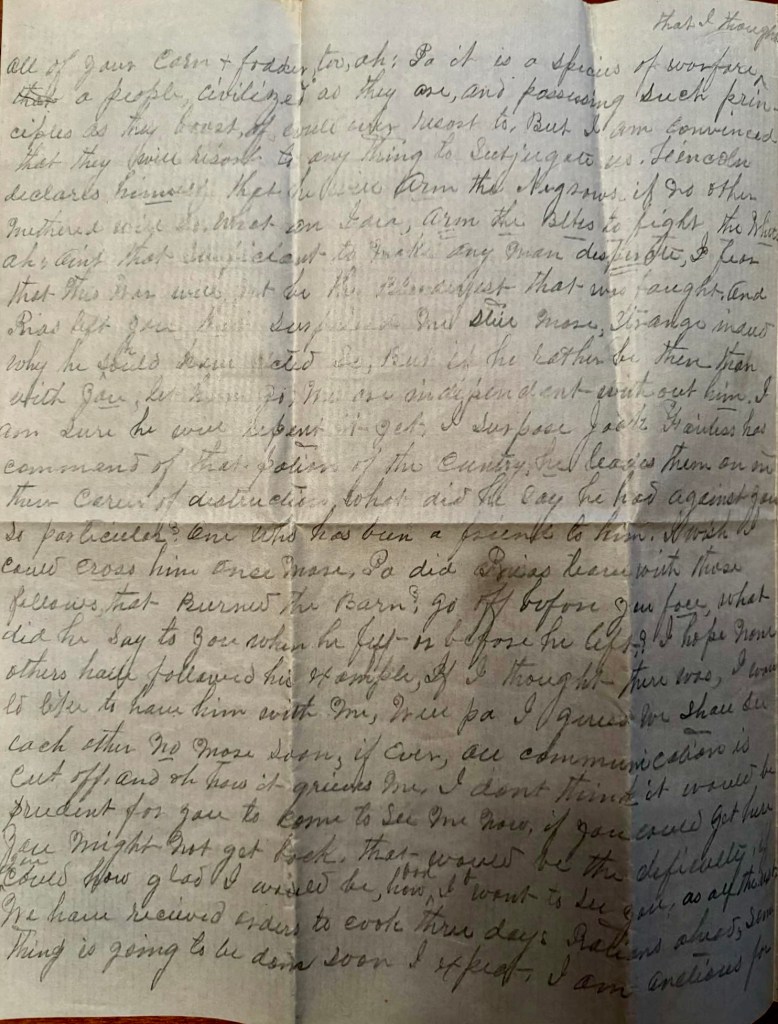
Oh Pa! how it pained me to hear of the evacuation of Norfolk. I suppose all that part of the country is now overrun with Yankees destroying everything as they go. All kinds of depredations will no doubt be resorted to, and not one hand of resistance can be raised. But I am fully of the opinion that there is a brighter day not far in the future when those vile hoods will have to pay for all their meanness. What a low, contemptible, mean piece of business in them—a people boasting of possessing principles of humanity, to stoop to such acts as have been resorted to by the Yankees. Burning and destroying personal property, not even allowing you to retain a small quantity upon which to subsist. I suppose they destroyed barn, warehouse and stables. All of your corn & fodder too? Oh Pa, it is a species of warfare that I thought a people, civilized as they are, and possessing such principles as they boast of, could ever resort to. But I am convinced that that they will resort to anything to subjugate us.
Lincoln declares himself that he will arm the Negroes if no other method will do. What an idea! Arm the Blacks to fight the Whites! Oh! ain’t that sufficient to make any man desperate? I fear that this war will not be the [ ] that was fought.
And Rios 1 left you? That surprised me still more. Strange indeed why he should have acted so. But if he’s rather be there than with you, let him go. We are independent without him. I am sure he will repent it yet. I suppose Jack Fairless [?] has command of that portion of the country. He leads them on in their career of destruction. What did he say he had against you so particular? One who has been a friend to him. I wish I could cross him once more. Pa, did Rios leave with those fellows that burned the barn? Go off before your face? What did he say to you when he left, or before he left? I hope none others have followed his example. If I thought there was, I would like to have him with me.
Well, Pa, I guess we shall see each other no more soon—if ever. All communication is cut off and oh! how it grieves me. I don’t think it would be prudent for you to come to see me now. [Even] if you could get here, you might not get back. That would be the difficulty. If you could, how glad I would be. How bad I want to see you, as all the rest.
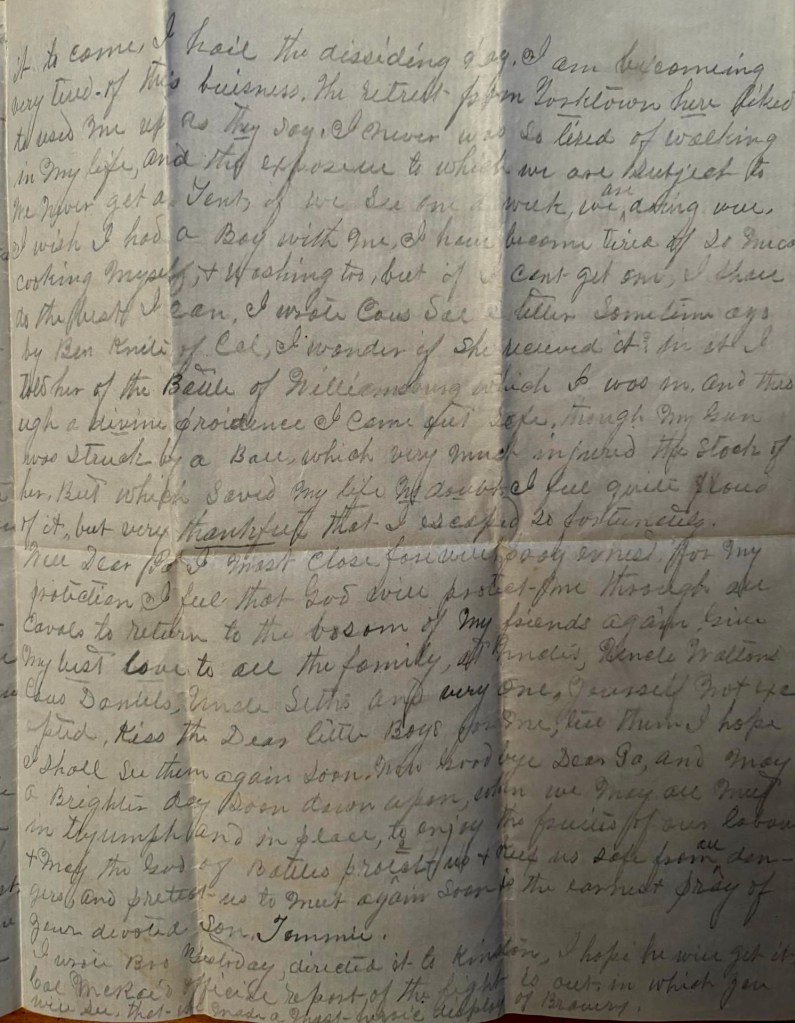
We have received orders to cook three days rations. Something is going to be done soon, I expect. I am anxious for it to come. I hail the deciding day. I am becoming very tired of this business. The retreat from Yorktown here liked to used me up, as they say. I never was so tired of walking in my life and the exposure to which we are subject to. We never get a tent. If we see one a week, we are doing well. I wish I had a boy with me. I have become tired of so much cooking myself, & washing too. But if I can’t get one, I shall do the best I can.
I wrote Cousin Sal a letter some time go by Ben Knite of Cal. I wonder if she received it? In it I told her of the Battle of Williamsburg which I was in. And through a Divine Providence, I came out safe, though my gun was struck by a ball which very much injured the stock of her but which saved my life, no doubt. I feel quite proud of it, but very thankful that I escaped so fortuitously.
Well, dear Pa, I must close. Farewell. Pray earnestly for my protection. I feel that God will protect me through all evils to return to the bosom of my friends again. Give my best love to all the family at Uncle’s—Uncle Walton, Cousin Daniels, Uncle Seth’s and everyone, yourself not excepted. Kiss the dear little boys for me. Tell them I hope I shall see them again soon. Now goodbye dear Pa, and may a brighter day soon dawn upon, when we may all meet in triumph in peace, to enjoy the fruits of our labors. And may the God of Battles protect us and keep us safe from all dangers and protect us to meet again soon is the earnest prayer of your devoted son, — Tommie
I wrote Brother [John B. Jordan] yesterday, directed it to Kinston. I hope he will get it. Col. [Duncan Kirkland] McRae’s official report of the fight is out in which you will see that we made a most heroic display of bravery. The gallant charge of the 5th North Carolina 2 is in the mouth of everybody most. We have immortalized ourself. Tha Yankees give us the praise. Say it was the most brilliant charge ever made. We are praised by everyone who meet us. We can hear the people talking of us wherever we go—that is, the 5th North Carolina who fought so desperately in that last battle. And so we did. Never did men fight with more courage and bravery than we did.
Goodbye Pa. Your true son, — Tommie
T. N. Jordan
P. S. I am very well. My health was never better. It has been nearly all the time. I have not time to read my letter so excuse all mistakes.
1 Rios was probably the name of a family slavebelonging to the Jordans.Once Union troops began to infiltrate inland from Norfolk, a number of slaves were enticed to run away from their masters, seeking the protection of Federal army.
2 The 5th North Carolina was commanded by Colonel D.R. McRae. It was ordered to Williamsburg and marched to the Campus of the College of William and Mary in a light rain. Moved around 3 p.m. to the left flank of Longstreet’s line. Moved into the open into heavty artillery fire and attacked Hancock’s Union brigade along with the 24th Virginia. The attack came within 20 yards of the Federal line before it was forced to withdraw due to heavy casualties. Lieutenant Colonel Badham was killed, Major Sinclair was wounded and Captains Thomas Garrett and John W. Lea were wounded and captured.
The following letter was written by Samuel Norcross but which one? There were several soldiers by that name. Based on the location and date, I think it likely to be either Samuel Norcross of Co. G, 22nd New York Infantry, or Samuel Norcross of Co. E, 5th Vermont. The 22nd New York was encamped near Upton’s Hill at the time and the 5th Vermont was encamped near McLean, Virginia (Camp Griffin), some five miles further northwest. Balloon ascensions were being conducted regularly from Upton’s Hill to Vienna at the time. The camp of the 22nd New York was some five miles closer to Freestone Point where the firing on Union Vessels described occurred on 8 December 1861.
I note that the letter was addressed to his “father and mother” and since the soldier from Vermont lost his mother a couple years before the war, I’m going to attribute this letter to the soldier from the 22nd New York but without a high degree of confidence.
T R A N S C R I P T I O N
December 9, 1861
Dear father and mother,
I take my pen in hand to let you know that I am well at present and I hope that these few lines may find you the same.
We are in sight of the rebels and our fellows took a battery last night. How the cannon did roar and they throwed bombs at our vessel but it didn’t do any damage. 1 I wish I had a finger in the pie too.
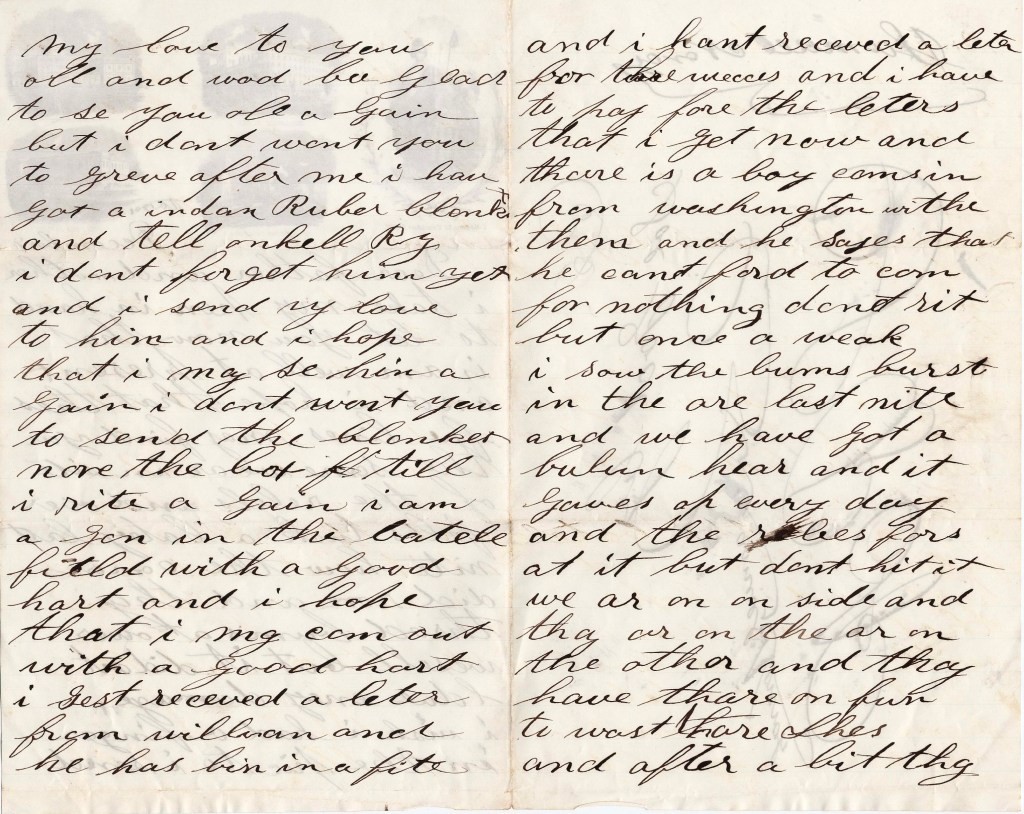
I send my love to you all and would be glad to see you all again but I don’t want you to grieve after me. I have got a Indian Rubber Blanket and tell Uncle Ry I don’t forget him yet and I send my love to him and I hope that I may see him again. I don’t want you to send the blanket nor the box till I write again. I am a going in the battlefield with a good heart and I hope that I may come out with a good heart.
I just received a letter from William and he has been in a fight and I han’t received a letter for three weeks and I have to pay for the letters that I get now. And there is a boy comes in from Washington with them and he says that he can’t afford to come for nothing. Don’t write but once a week.
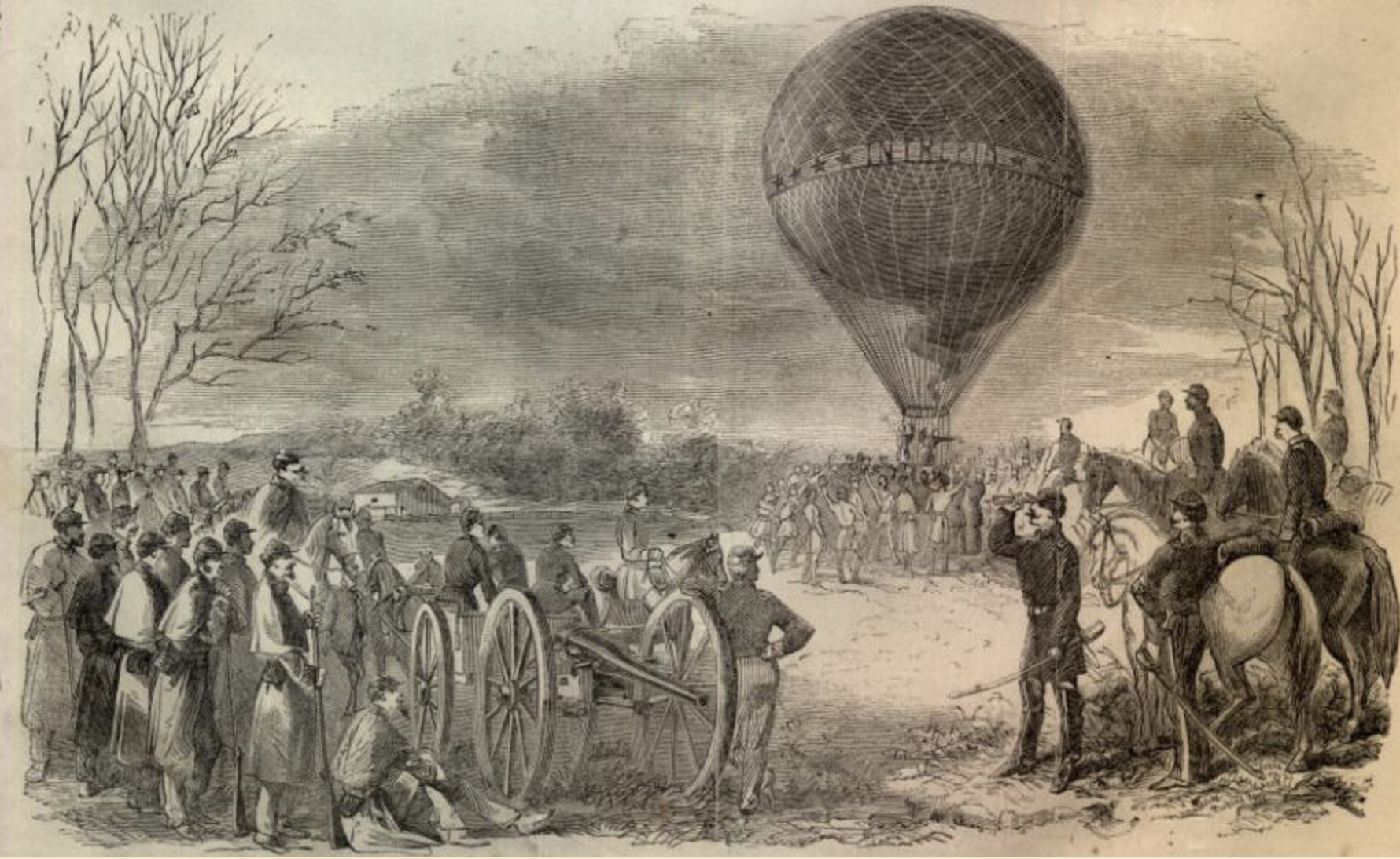
PROFESSOR LOWE MAKING A BALLOON ASCENSION ON A RECONNOITERING EXPEDITION TO VIENNA. Harper’s weekly, 14 December 1861
I saw the bombs burst in the air last night and we have got a balloon here and it goes up every day and the Rebels fire at it but don’t hit it. We are on one side and they are on the other and they have their own fun to waste theirselves, and after a bit they [rest of letter missing]
So goodbye, — Samuel Norcross
1 The Confederate firing on Union vessels may have been from Freestone Point, the northern most point of the Confederate blockade on the Potomac river. On December 8, 1861, The USS Anacostia and the USS Jacob Bell fired on Confederate troops near Freestone Point and they may have returned fire.
The following letter was written by Edmond Quincy Marion Leach (1847-1917) of Plympton, Plymouth county, Massachusetts who served in Co. A, 3rd Massachusetts Heavy Artillery. He began his service in December 1862 as a private and mustered out as a sergeant in January 1863. After he returned home to Plympton, Edmond remained very active in the GAR.
Edmond was the son of Erastus & Maria B. Leach. He was married in 1876 to Sarah Elizabeth Weston (1848-1923). He died in 1917 and was buried in Vine Hills Cemetery.
T R A N S C R I P T I O N
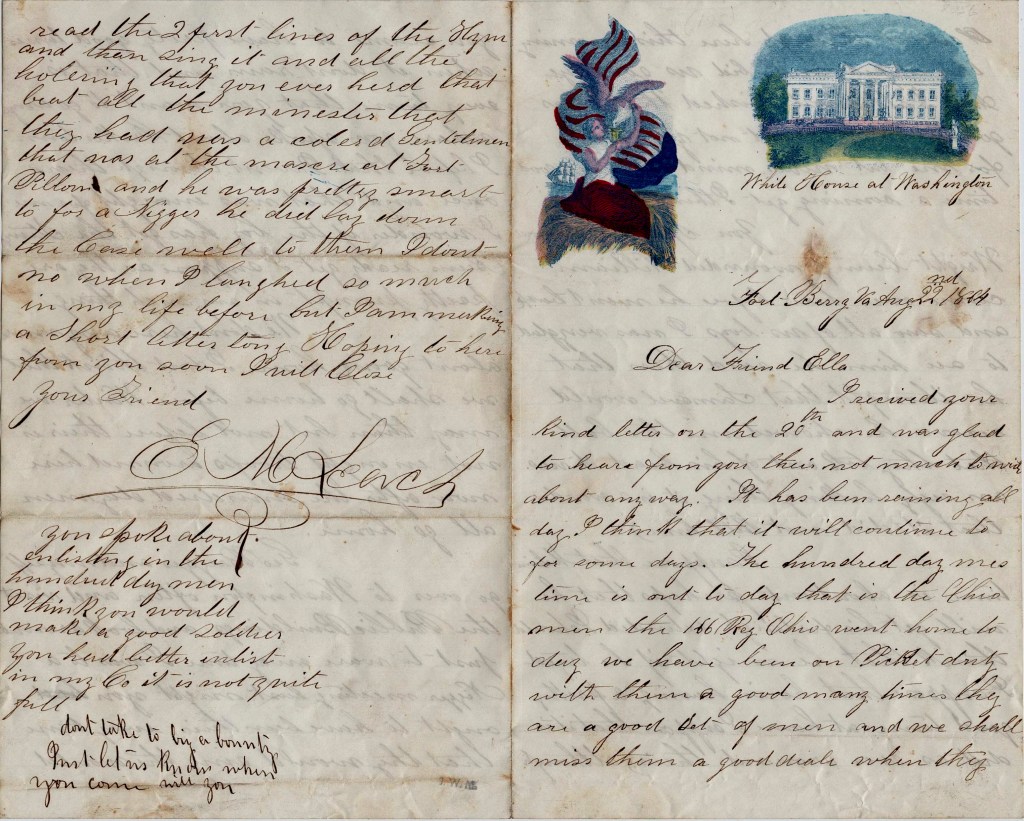
Fort Berry, Va. August 22nd 1864
Dear Friend Ella,
I received your kind letter on the 20th and was glad to hear from you. There’s not much to write about anyway. It has been raining all day. I think that it will continue to [rain] for some days.
The Hundred Day Men’s time is out today—that is, the Ohio men. The 166th Reg. Ohio went home today. We have been on picket duty with them a good many times. They are a good set of men and we shall miss them a good deal. When they went through here this morning, they stopped and bid us goodbye and I almost wished that I was going home too but not yet a while for me. But never mind. There is a good time a coming yet.
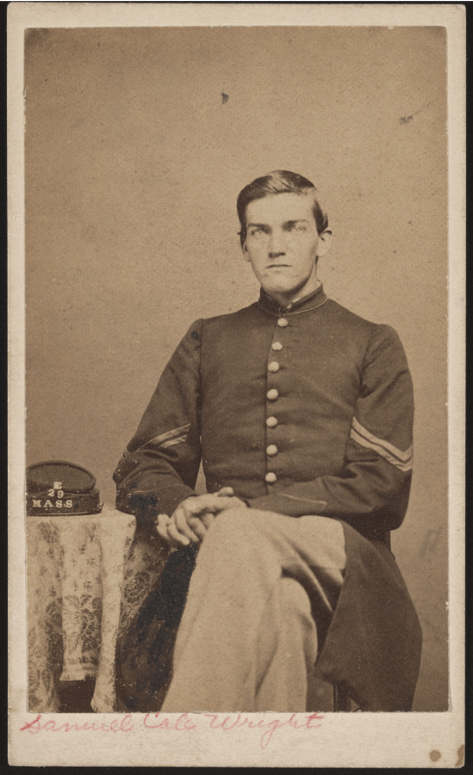
Samuel Cole Wright (1842-1906) of Co. E, 29th Massachusetts Infantry. At the Battle of the Crater, a bullet destroyed his right eye and lodged in the back of his skull.
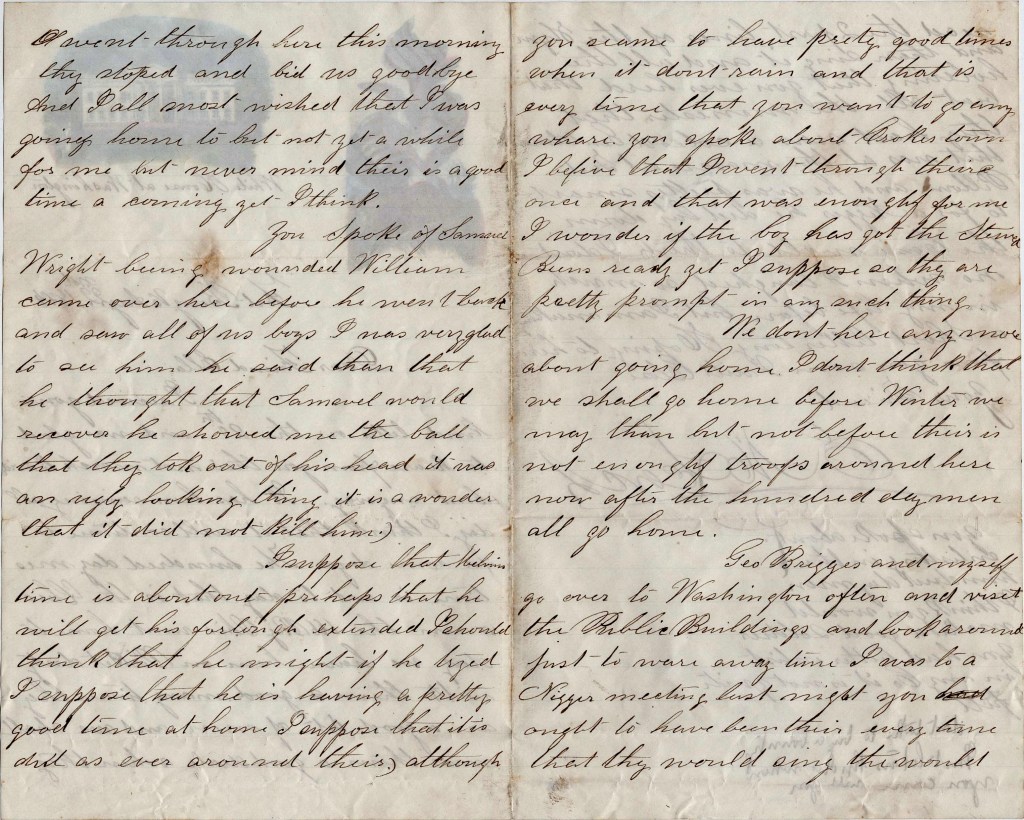
You spoke of Samuel [Cole] Wright 1 being wounded. [His older brother] William came over here before he went back [to Plymouth] and saw all of us boys. I was very glad to see him. He said then that he thought that Samuel would recover. He showed me the ball that they took out of his head. It was an ugly looking thing. It is a wonder that it did not kill him.
I suppose that Melvin’s time is about out. Perhaps that he will get his furlough extended. I should think that he might if he tried. I suppose that he is having a pretty good time at home. I suppose that it is dull as ever around there although you seem to have pretty good times when it don’t rain and that is every time that you want to go anywhere. You spoke about Crokestown. I believe that I went through there once and that was enough for me. I wonder if the boy has got the stewed buns ready yet? I suppose so. They are pretty prompt in any such thing.
We don’t hear any more about going home. I don’t think that we shall go home before winter. We may then but not before. There is not enough troops around here now after the Hundred Days Men all go home.
George Briggs and myself go over to Washington often and visit the public buildings and look around just to wear away time. I was to a Nigger meeting last night. You ought to have been there. Every time that they would sing, they would read the two first lines of the hymn and then sing it. And all the hollering that you ever heard! That beat all. The minister that they had was a colored gentleman 2 that was at the massacre at Ft. Pillow [April 1864] and he was pretty smart too for a Nigger. He did lay down the case well to them. I don’t know when I laughed so much in my life before. But I am making a short letter long.
Hoping to hear from you soon, I will close. Your friend, — E. M. Leach
You spoke about enlisting in the Hundred Days Men. I think you would make a good soldier. You had better enlist in my company. It is not quite full. Don’t take too big a bounty. Just let us know when you come, will you?
1 According to a great article by my friend, Ron Coddington, entitled, “Samuel Cole Wright: The Talisman,” Samuel Wright of Plympton, Plymouth county, Massachusetts, had a combat record that left one with the impression that he was indestructible. “He refused to leave his comrades after a shell fragment struck him in the head during the Battle of White Oak Swamp, part of the Peninsula Campaign, in June 1862. A few months later at Antietam, he led a force of 75 men to pull down a fence at the Bloody Lane under heavy fire and suffered gunshot wounds through both legs at the end of the successful mission. A six-mule team trampled over him during the autumn of 1863, and the wagon to which the animals were tethered narrowly missed killing him.5 A musket ball ripped into his left arm at the Battle of Cold Harbor on June 3, 1864. The following month at the Battle of the Crater, he suffered his fifth and final wound of the war when a bullet destroyed his right eye and lodged in the back of his skull. Medical personnel dug the 1.25 ounce lead slug out and upon examination determined it to be from a Belgian-made gun.” Samuel had the bullet encased in gold and carried with him as a remembrance of his service. In February 1865 he received a disability discharge and returned to Massachusetts.Samuel’s letters can be found here: Letters Home.
2 There were churches for Black congregations in the District of Columbia prior to 1864 but White pastors had always been appointed to lead them. It wasn’t until 1864 that the first Black pastor was appointed at the Mt. Zion Church in Washington D. C.
The following letters were written by Thomas Eli Allison Daniels (1830-1918), a native of Harpers Ferry, West Virginia, who came to Leavenworth county, Kansas in 1852—even before it was a territory—making him one of the first white settlers in the area. He arrived on 10 May 1852 at Kickapoo Island and set himself up as a ferry operator on the Missouri river between Kickapoo Island and Weston, Missouri. He later established a small brick plant with sufficient production to supply settlers with enough bricks to build a chimney. His principal livelihood was his farm of 700 acres in Kickapoo Township where he raised wheat and various subsistence crops. Thomas was married to Catherine Esther Swarts [or Schwartz] (1839-1931) in 1856.
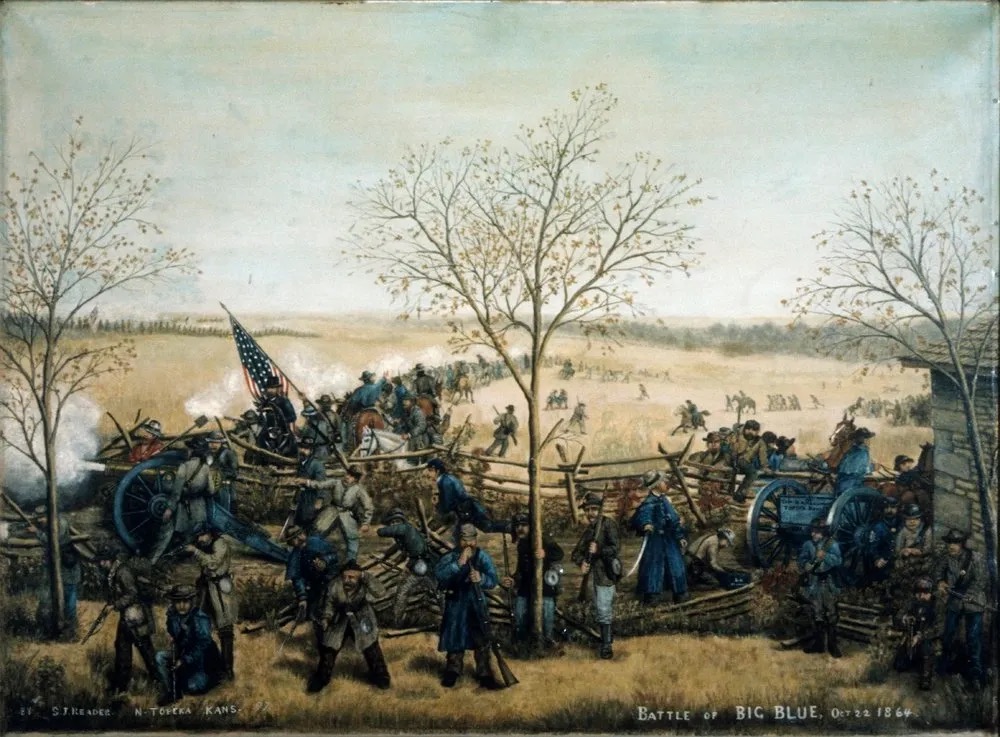
From these letters we learn that Thomas enrolled himself in Co. B of the 19th Kansas Militia which was called into service on 9 October 1864 to defend Kansas against Price’s Raid. The regiment saw action at Byram’s Ford, Big Blue on 22 October and again at Westport on 23 October 1864. They were disbanded on 29 October 1864.
Note: Though he appears to have signed his surname “Daniel,” civil records and his headstone spell his name as “Daniels” so that is how I’ve recorded it here.
These letters are from the private collection of Rob Morgan and were made available for transcription and publication on Spared & Shared by express consent.
Letter 1
[On Big Blue River] October 21, [1864]
Dear Catherine,
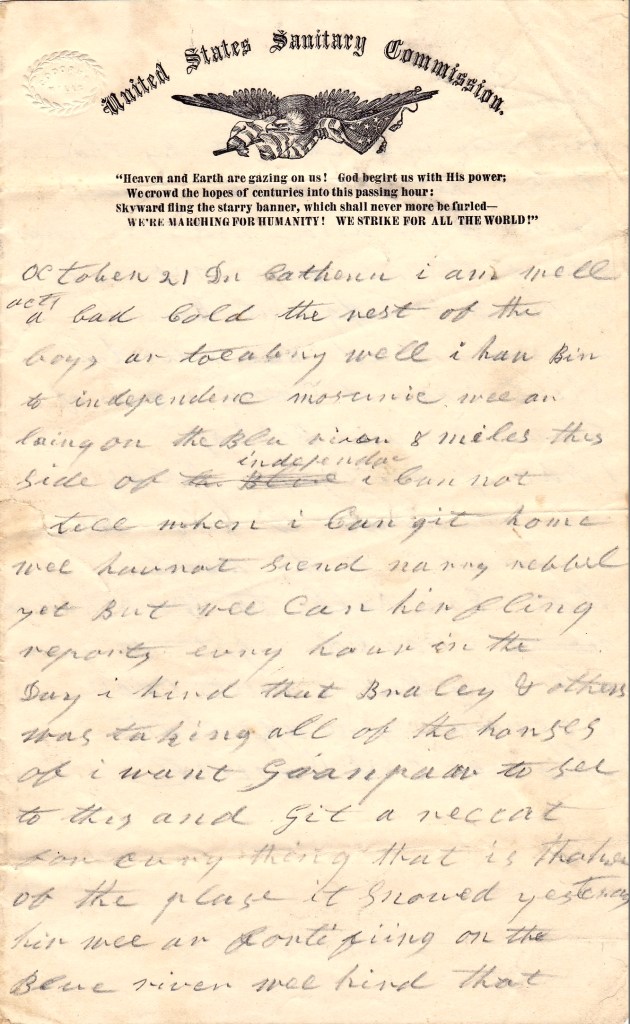
I am well. A bad cold. The rest of the boys are tolerably well. I have been to Independence, Missouri. We are lying on the Blue River, 8 miles this side of Independence. I cannot tell when I can get home. We have not seen nary rebel, but we can hear flying reports every hour in the day.
I heard that Braley and others was taking all of the horses off. I want grandpa to see to this and get a receipt for everything that is taken off the place.
It snowed yesterday here. We are fortifying on the Blue River. We heard that Price was at Lexington yesterday. You can see by these letters that we will all need some soap and water when we get home.
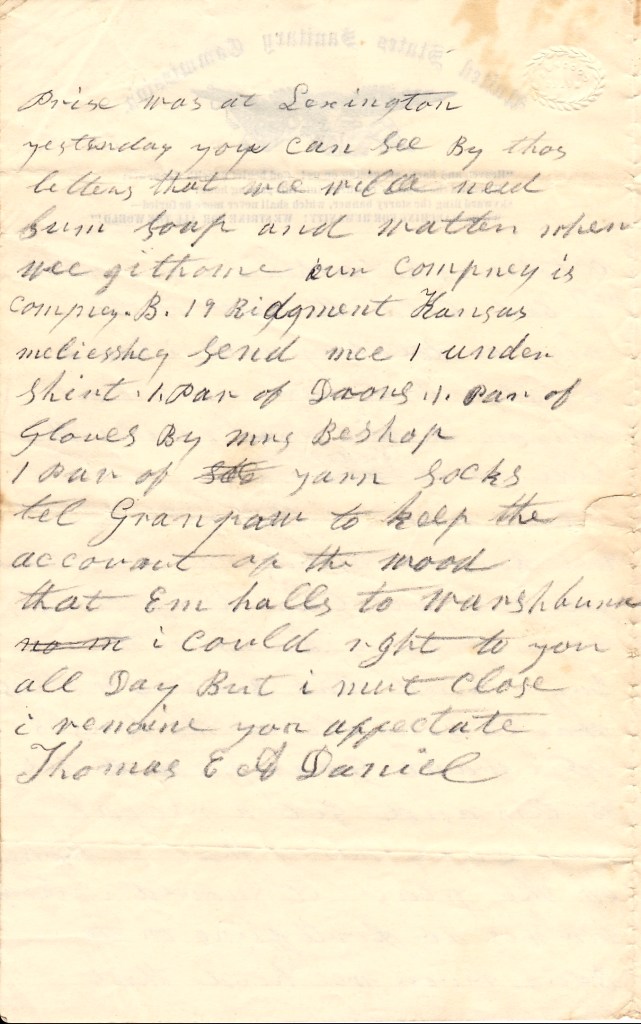
Our company is company B, 19th regiment Kansas Militia. Send me one undershirt, one pair of drawers, one pair of gloves by Mrs. Bishop, one pair of yarn socks. Tell grandpa to keep the account of the wood that Em hauls to Washburn. I could write to you all day but I must close.
I remain your affectionate, — Thomas E. A. Daniel
The Battle of Big Blue, October 22, 1864
Letter 2
Wyandotte, Kansas Sunday 24th [23 October 1864]
Dear Catherine,
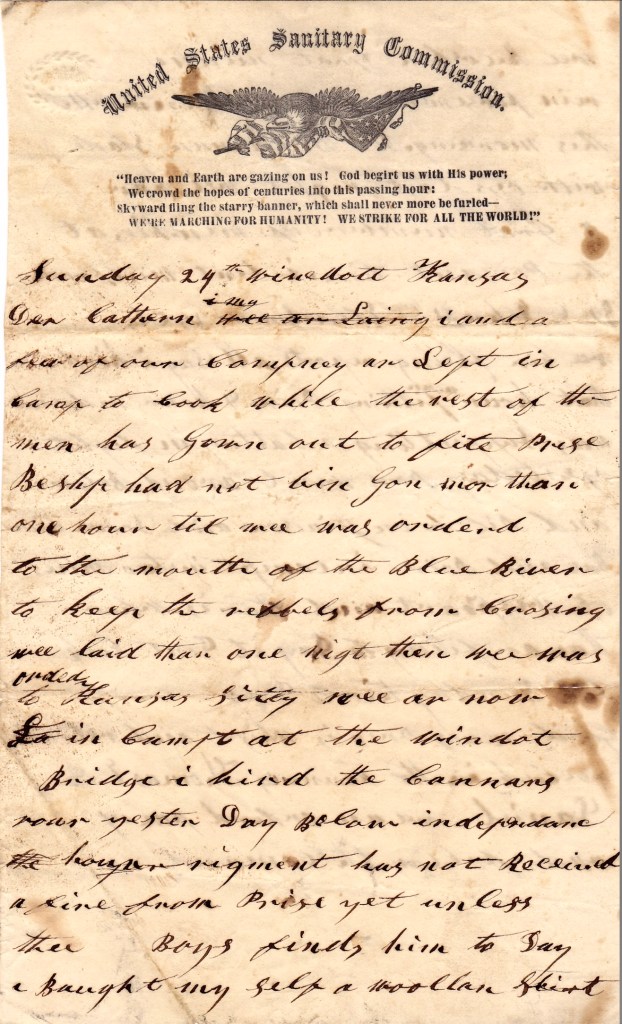
I and a few of our company are left in camp to cook while the rest of the men has gone out to fight Price. Bishop had not been gone more than one hour till we was ordered to the mouth of the Blue River to keep the rebels from crossing. We laid there one night. Then we was ordered to Kansas City.
We are now encamped at the Wyandotte Bridge. I heard the cannons roar yesterday below Independence. Our regiment has not received a fire from Price yet unless the boys find him today. I bought myself a woolen shirt. We received a great many reinforcements from Leavenworth this morning.
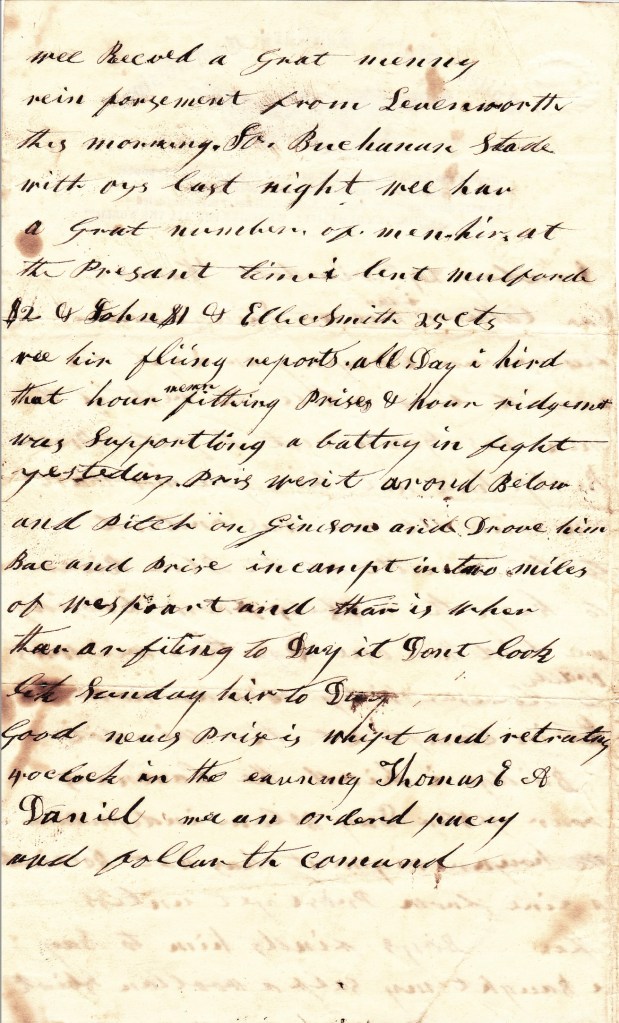
Jo. Buchanan stayed with our boys last night. We have a great number of men here at the present time. I lent Mulford $2 and John $1 and Ellie Smith 25 cts.
We hear flying reports all day. I heard that our men were fighting Price and our regiment was supporting a battery in fight yesterday. Price went around below and pitched on Jennison and drove him back and Price encamped [with]in two miles of Westport and that is where they are fighting today. It don’t look like Sunday here today.
Good news! Price is whipped and retreating. 4 o’clock in the evening. –Thomas E.A. Daniel.
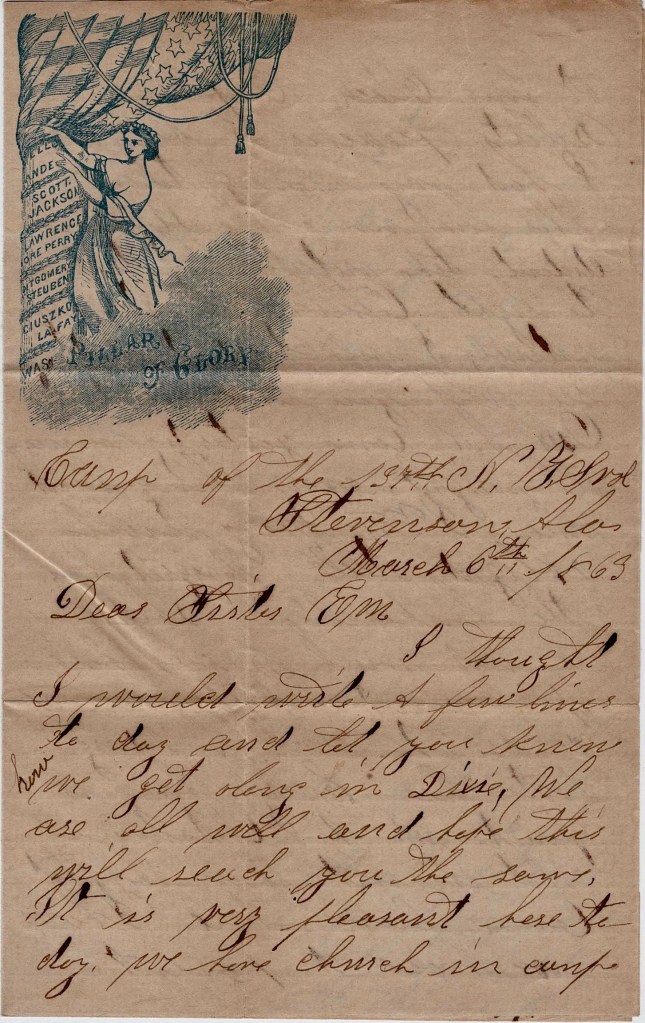
This letter was written by Abram Coursen (1843-1864) of Candor, Tioga county, New York, who enlisted in Co. H, 137th New York Infantry on 21 August 1862. He did not survive the war. He was mortally wounded in the Battle of Peach Tree Creek on 20 July 1864 and died six days later at Vining’s Station, Cobb county, Georgia.
Abram was the son of John Marvin Coursen (1808-1891) and Margaret Ann Van Leuven (1818-1887) of Tioga county, New York.
T R A N S C R I P T I O N
Addressed to Miss Emeline Coursen, Candor, Tioga county, New York
Camp of the 137th New York Vols. Stevenson, Alabama March 6th 1863
Dear Sister Em,
I thought I would write a few lines today and let you know how we get along in Dixie. We are all well and hope this will reach you the same. It is very pleasant here today. We have church in camp at four o’clock, Chaplain Roberts preaches, I believe.
I had my likeness taken this forenoon. My clothes didn’t take natural. They took too light. Otherwise, it’s very natural. I will send it and see what you think about it.
Our box come yesterday morning all right. Everything saved nice. I am very much obliged. Tell Margaret [thanks] for the handkerchief.
There is not much news here at present as I know of. We are to work building forts here. Everything is quiet up to Chattanooga. That is what they say that come from there. I have no more at present. Excuse poor writing and blunders. Write soon and all the particulars of home. This from your brother, — Abram Coursen

















 Spared & Shared 23