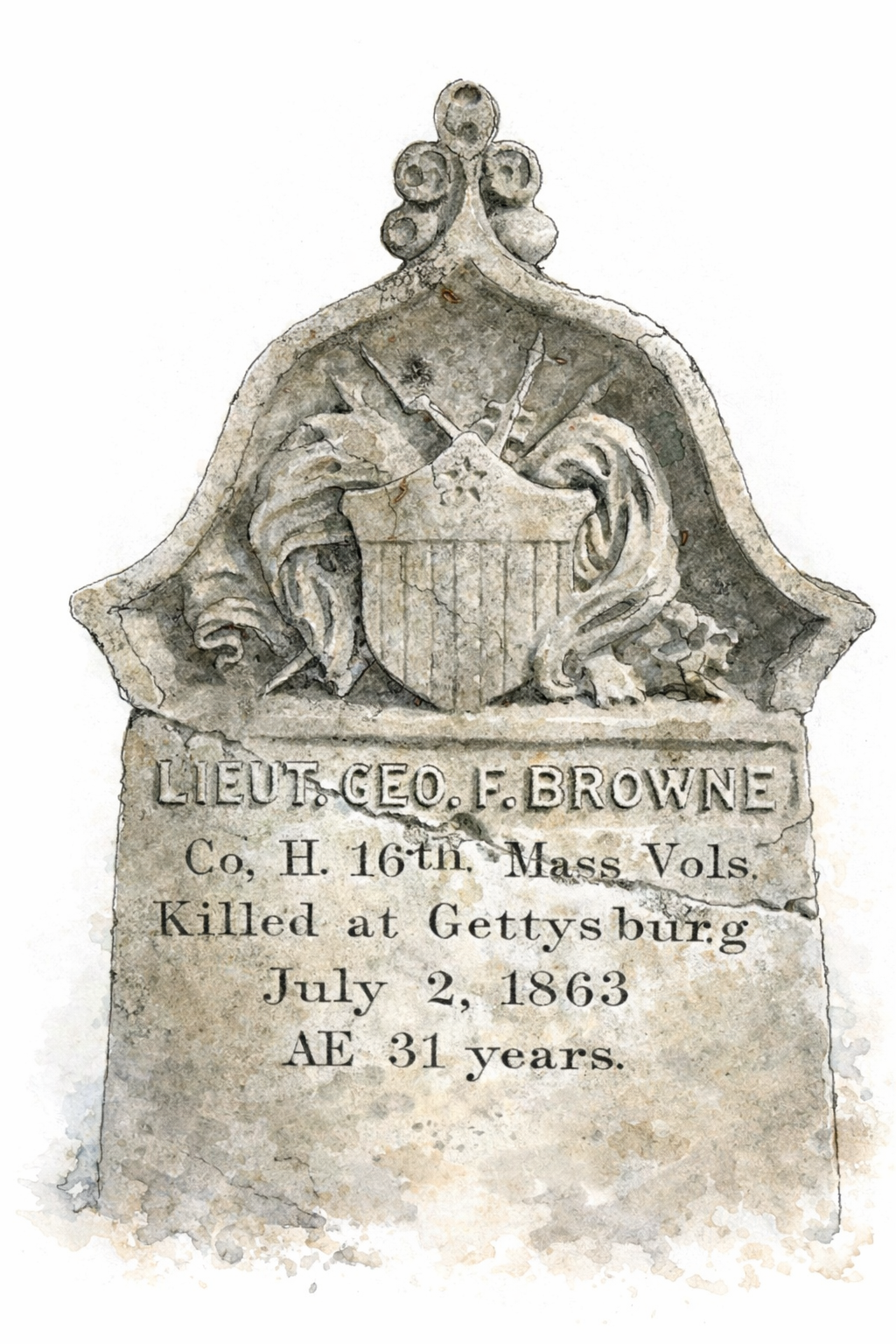
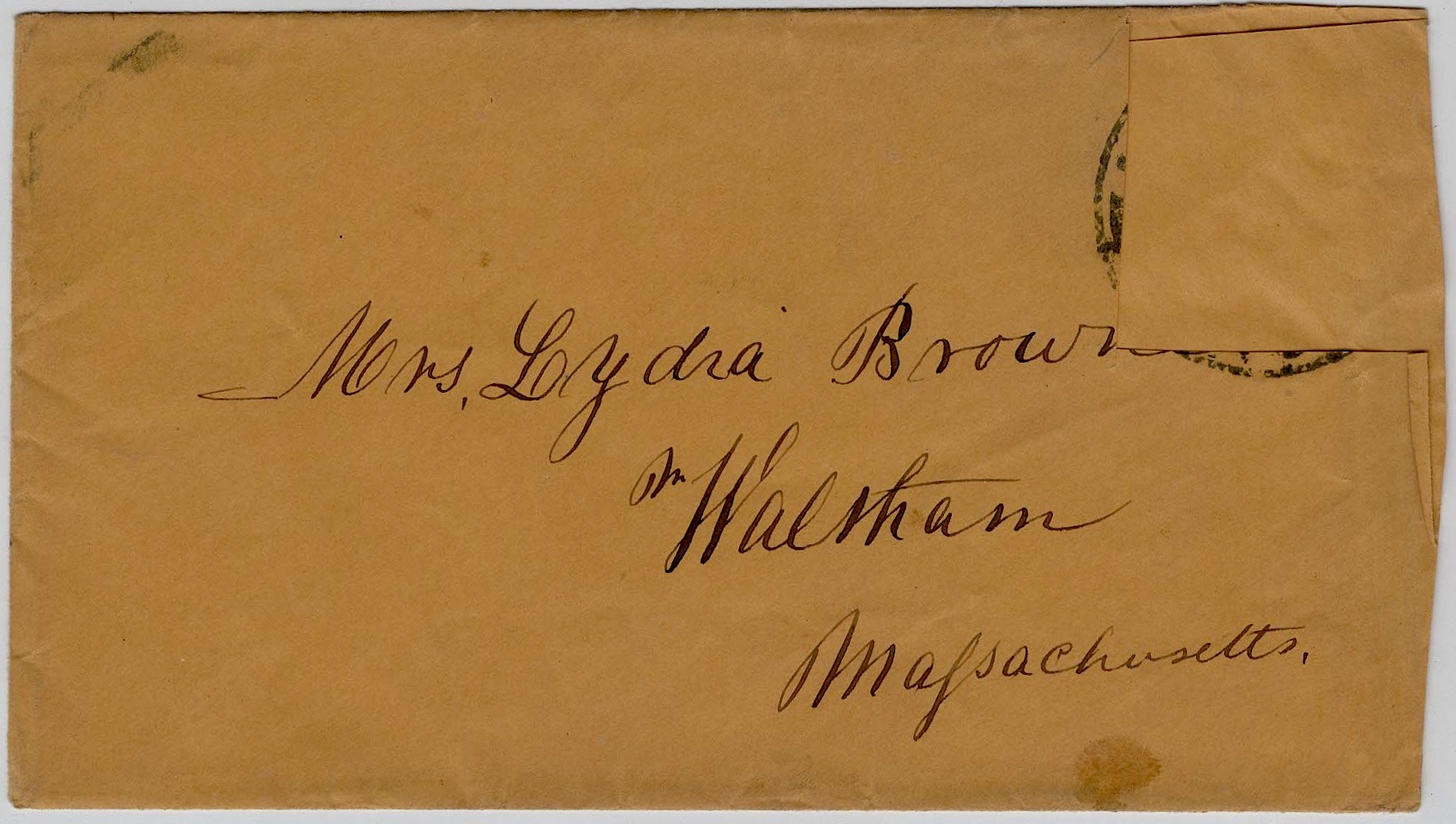
The following letter was written by George Foster Brown (1833-1863) who on 29 June 1861 mustered into Co. H, 16 Massachusetts Infantry, and was KIA on 2 July 1863 at Gettysburg, Pennsylvania. He wrote the letter to his widowed mother, Lydia (Sawtelle) Brown (1797-1885) of Waltham, Massachusetts. His father, Aaron Brown, died in 1853. Serving with George in the same company was his brother, CharlesL. Brown (1840-1863).
The Massachusetts brothers, George and Charles Brown, were both mortally wounded at Gettysburg, July 2, 1863. “On July 21, 1863, residents of the town of Waltham, Massachusetts gathered at the First Methodist Society to comfort a widowed mother of two local young men who had perished on a distant battlefield in Pennsylvania. It was an impressive and touching service, conducted by members of the Masonic order, augmented by a solemn organ and choir. George F. Brown had enlisted at the same time with his brother, and was also mustered into Company H, but at the rank of sergeant. It was something of a miracle that the body of Lieutenant George F. Brown had been found. Lieutenant George F. Brown of Company B, had been shot through the brain and foot. Charles found himself posted at the Daniel Klingle place on the Emmitsburg road. It was nearly 7 p.m. on July 2, 1863 and the enemy was closing in from two directions at once, the 18th Mississippi approaching from the south, and the 10th and 11th Alabama from the west. In the merciless crossfire Charles was struck in the shoulder and in two other unspecified spots. While Mr. Greene was busy making arrangements for the recovery of George’s body, Charles unexpectedly took a sudden turn for the worse. He succumbed on the morning of July 11. Now Mr. Greene stayed on to ensure both men were embalmed and transported to Waltham, where they could be properly honored and mourned. Both local heroes had rendered their “last full measure of devotion” to their country.” [Sources: Waltham Sentinel, July 24 and 31, 1863; Diary of Charles L. Brown, Massachusetts Historical Society, uncovered by author Greg Coco, whose collection resides at the Gettysburg National Military Park, Box B-10.]
T R A N S C R I P T I O N
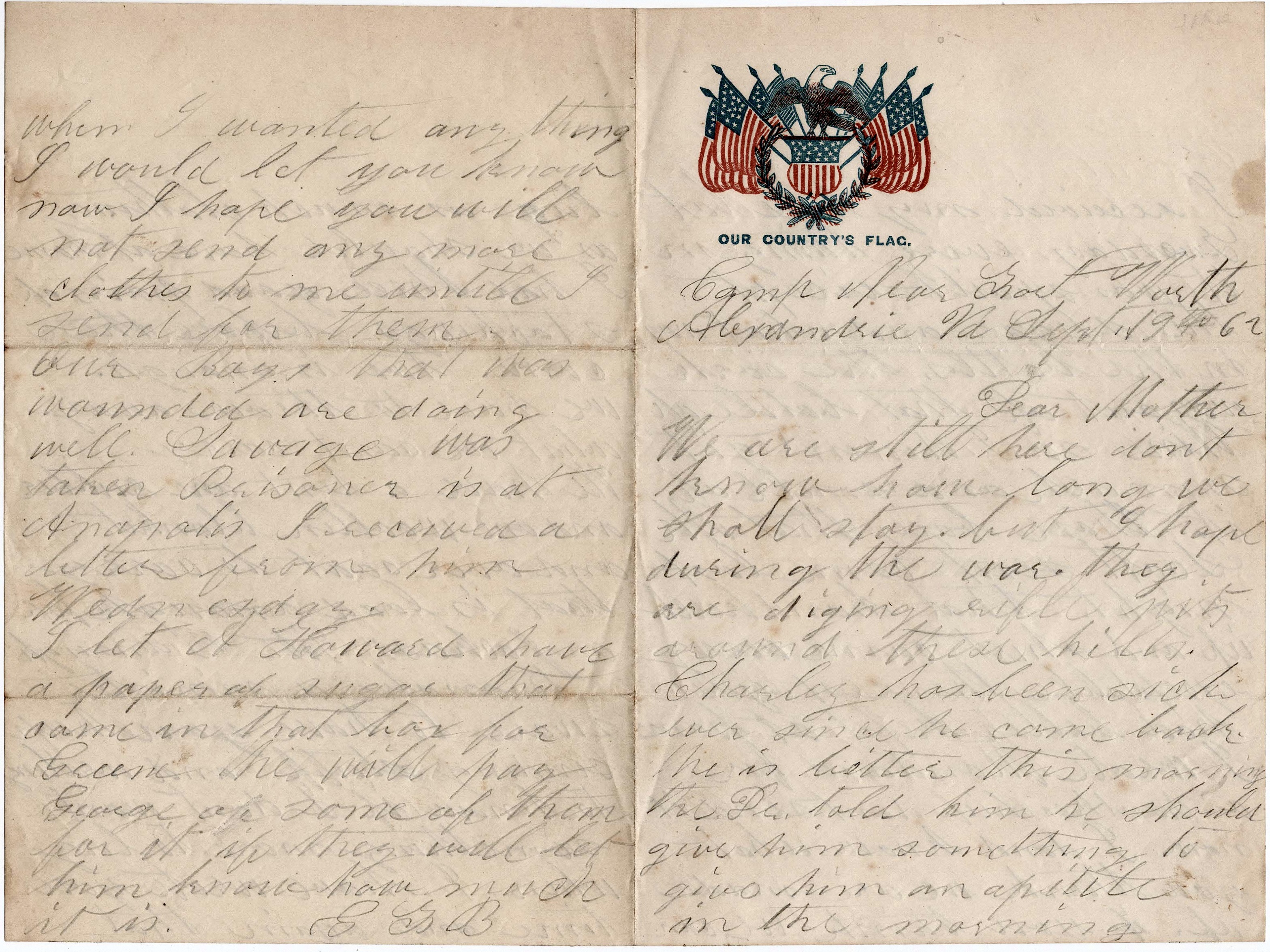
Camp near Fort Worth Alexandria, Virginia September 19, 1862
Dear Mother,
We are still here. Don’t know how long we shall stay but I hope during the war. They are digging rifle pits around these hills. Charley has been sick ever since he come back. He is better this morning. The Dr. told him he should give him something to give him an appetite in the morning.
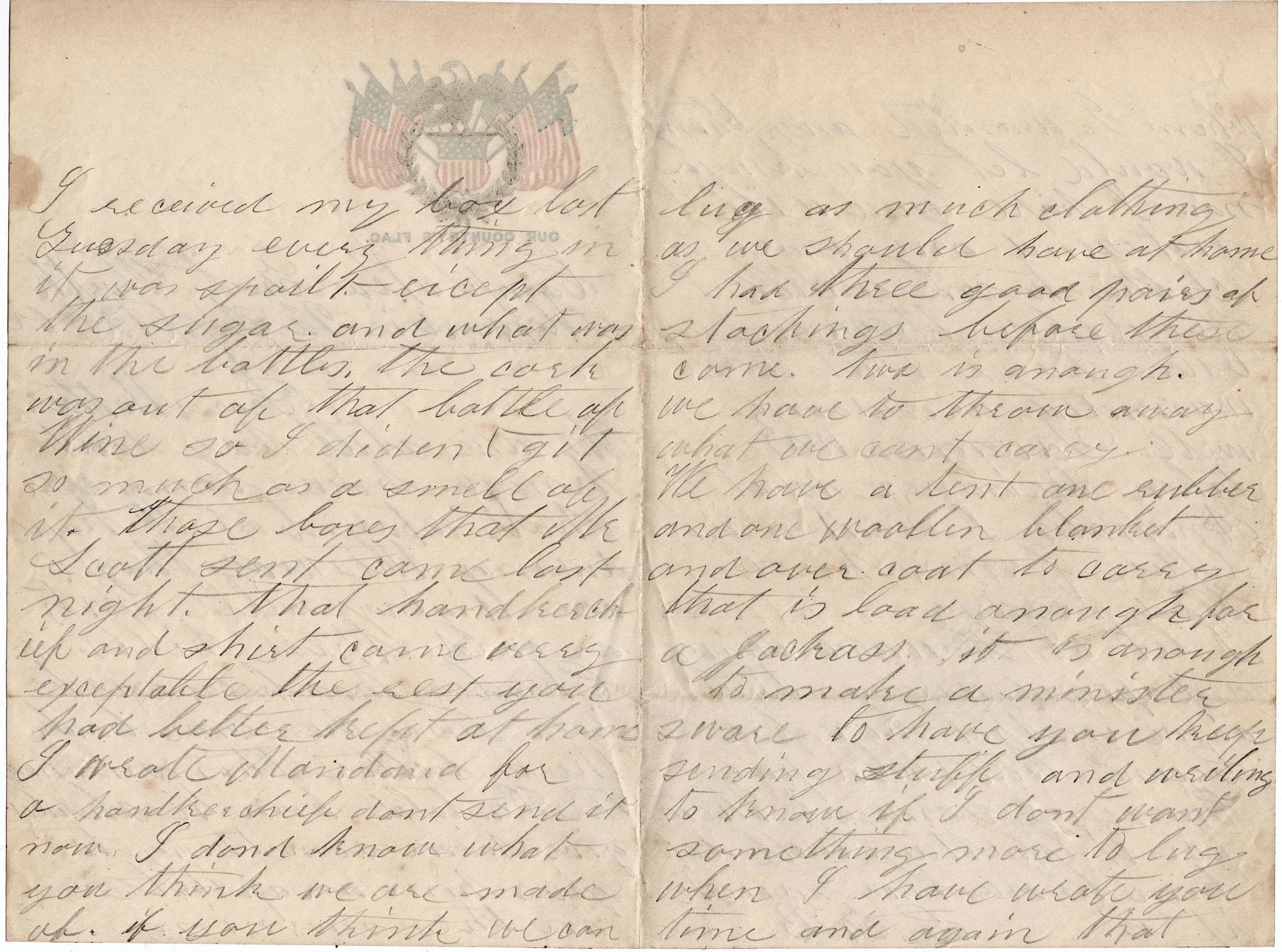
I received my box last Tuesday. Everything in it was spoilt except the sugar and what was in the bottles. The cork was out of that bottle of wine so I didn’t get so much as a smell of it. Those boxes that Mr. Scott sent came last night. That handkerchief and shirt came very acceptable. The rest you had better kept at home.
I wrote [sister] Mandana for a handkerchief. Don’t send it now. I don’t know what you think we are made of if you think we can lug as much clothing as we should have at home. I had three good pairs of stockings before these came. Two is enough. We have to throw away what we can’t carry.
We have a tent, one rubber and one woolen blanket and overcoat to carry. That is load enough fora jackass. It is enough to make a minister swear to have you keep sending stuff and writing to know if I don’t want something more to lug when I have wrote you time and again that when I wanted anything, I would let you know. Now I hope you will not send anymore clothes to me until I send for them.
Our boys that was wounded are doing well. Savage was taken prisoner [and[ is at Annapolis. I received a letter from him Wednesday. I let Howard have a paper of sugar that came in that box for Greene. He will pay George off some of them for it if they will let him know how much it is. — G. F. B.
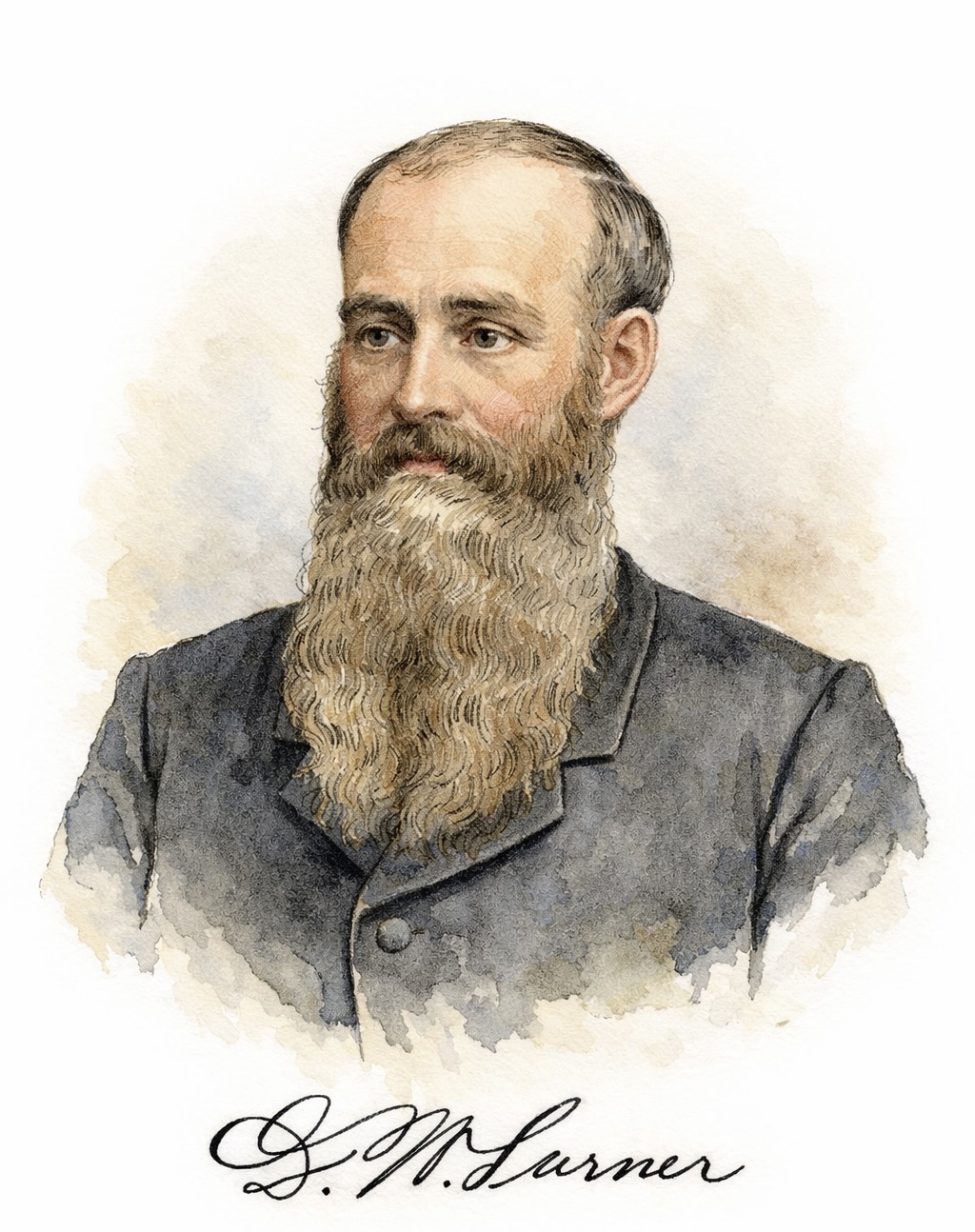
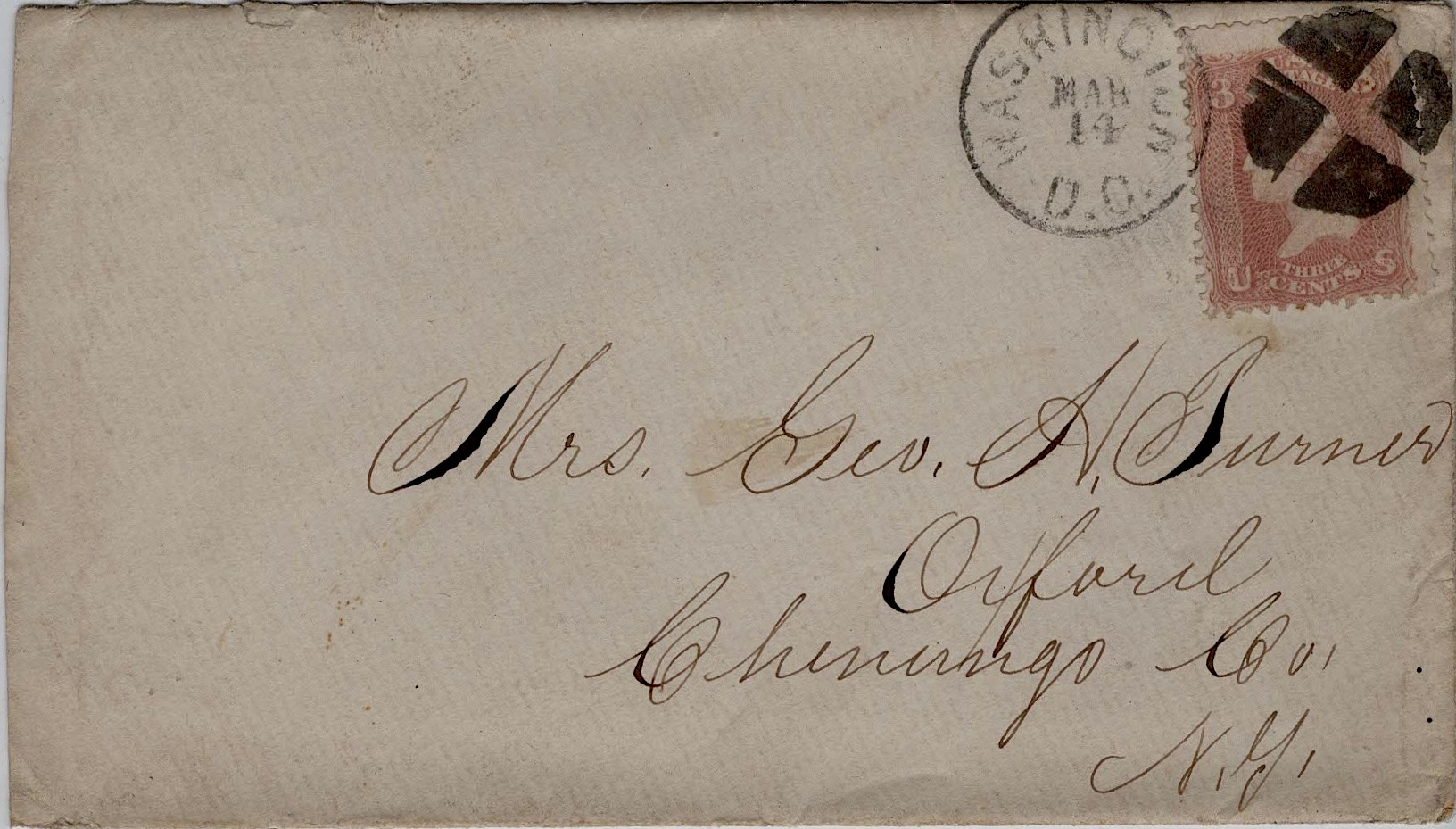
The following letters were written by Daniel Webster Turner (1837-1932), the son of Samuel and Amanda (Wells) Turner of Oxford, Chenango county, New York. Daniel enlisted at age 25 on 23 July 1862 to serve three years in Co. A, 114th New York Infantry. He was quickly promoted to first sergeant and later commissioned a second lieutenant. He was named Captain of his company on 20 June 1863 and wounded in action on 19 September 1864, at Winchester, Virginia. He mustered out with his company on 8 June 1865 at Washington, D. C.
Daniel wrote the letters to his younger sister Vesta Turner.
To read letters by other members of the 114th New York Infantry published on Spared & Shared, see: Asa Holmes, Co. A, 114th New York (10 Letters) Erastus R. Gregory, Co. C, 114th New York (1 Letter) Elbridge LaMunion, Co. G, 114th New York (1 Letter) Charles E. Thompson, Co. G, 114th New York (1 Letter)
Letter 1
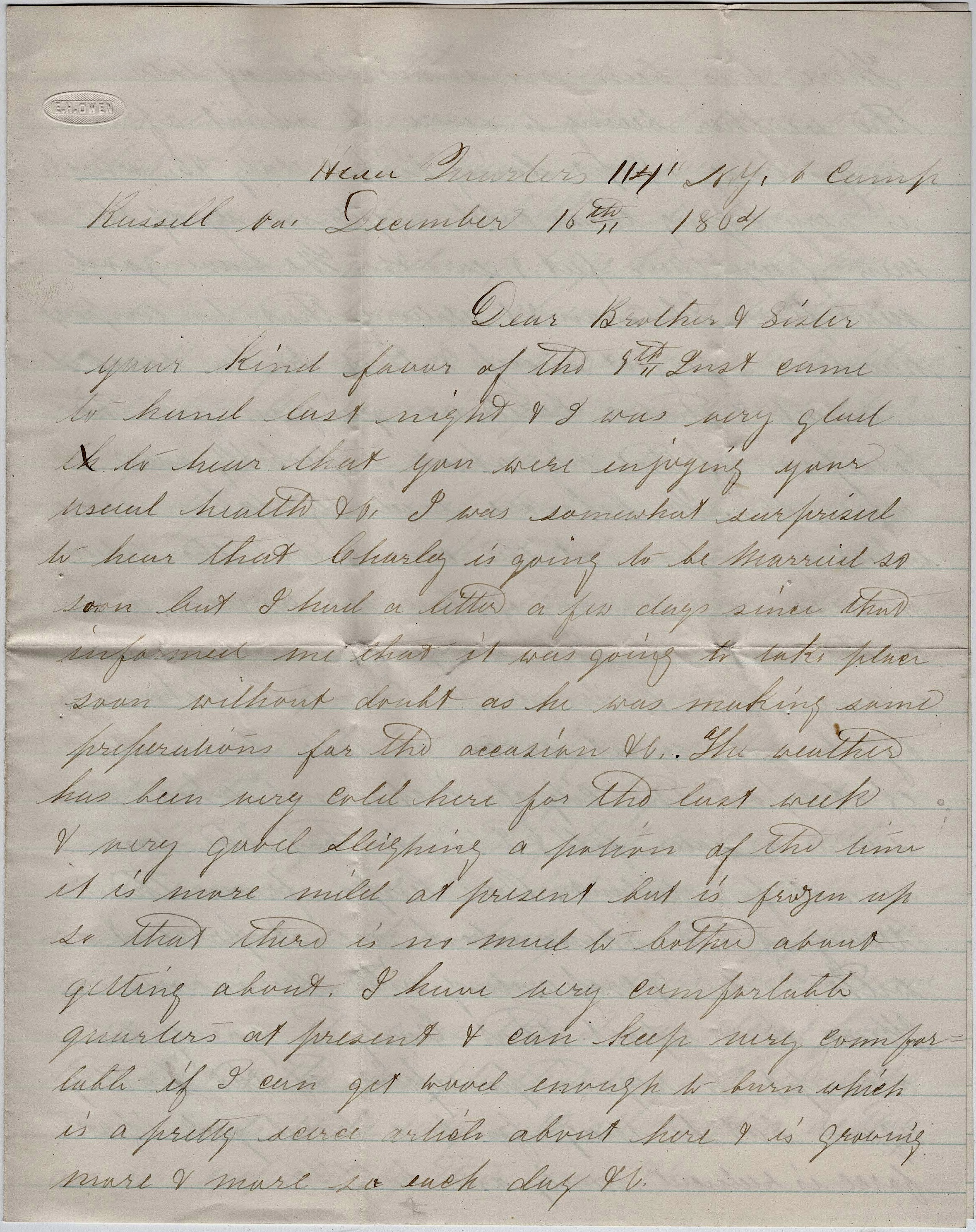
Headquarters 114th New York Camp Russell, Virginia December 16th 1864
Dear Brother & Sister,
Your kind favor of the 9th inst. came to hand last night & I was very glad to hear that you were enjoying your usual health &c. I was somewhat surprised to hear that Charley is going to be married so soon but I had a letter a few days since that informed me that it was going to take place soon without doubt as he was making some preparations for the occasion, &c.
The weather has been very cold here for the last week and very good sleighing a portion of the time. It is more mild at present but is frozen up so that there is no mud to bother about getting about. I have very comfortable quarters at present & can keep very comfortable if I can get wood enough to burn which is a pretty scarce article about here & is growing more & more so each day, &c.
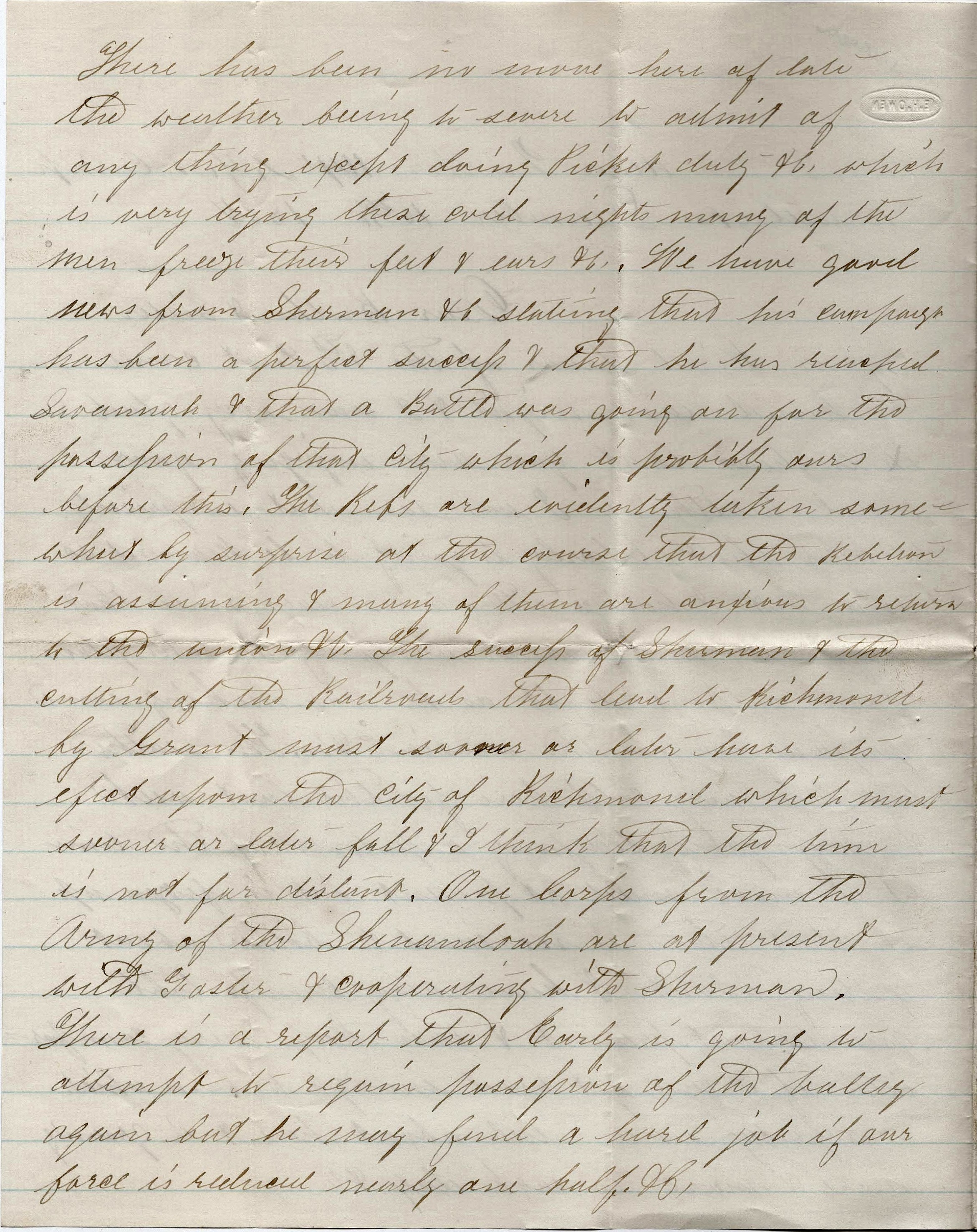
There has been no move here of late, the weather being too severe to admit of anything except doing picket duty, &c. which is very trying these cold nights. Many of the men freeze their feet & ears &c.
We have good news from Sherman &c. stating that his campaign has been a perfect success & that he has reached Savannah and that a battle was going on for the possession of that city which is probably ours before this. The Rebs are evidently taken somewhat by surprise at the course that the Rebellion is assuming & many of them are anxious to return to the Union, &c. The success of Sherman & the cutting of the railroads that lead to Richmond which must sooner or later fall & I think that the time is not far distant. Our Corps from the Army of the Shenandoah are at present with Foster & cooperating with Sherman. There is a report that Early is going to attempt to regain possession of the Valley again but he may find a hard job if our force is reduced nearly one half, &c.
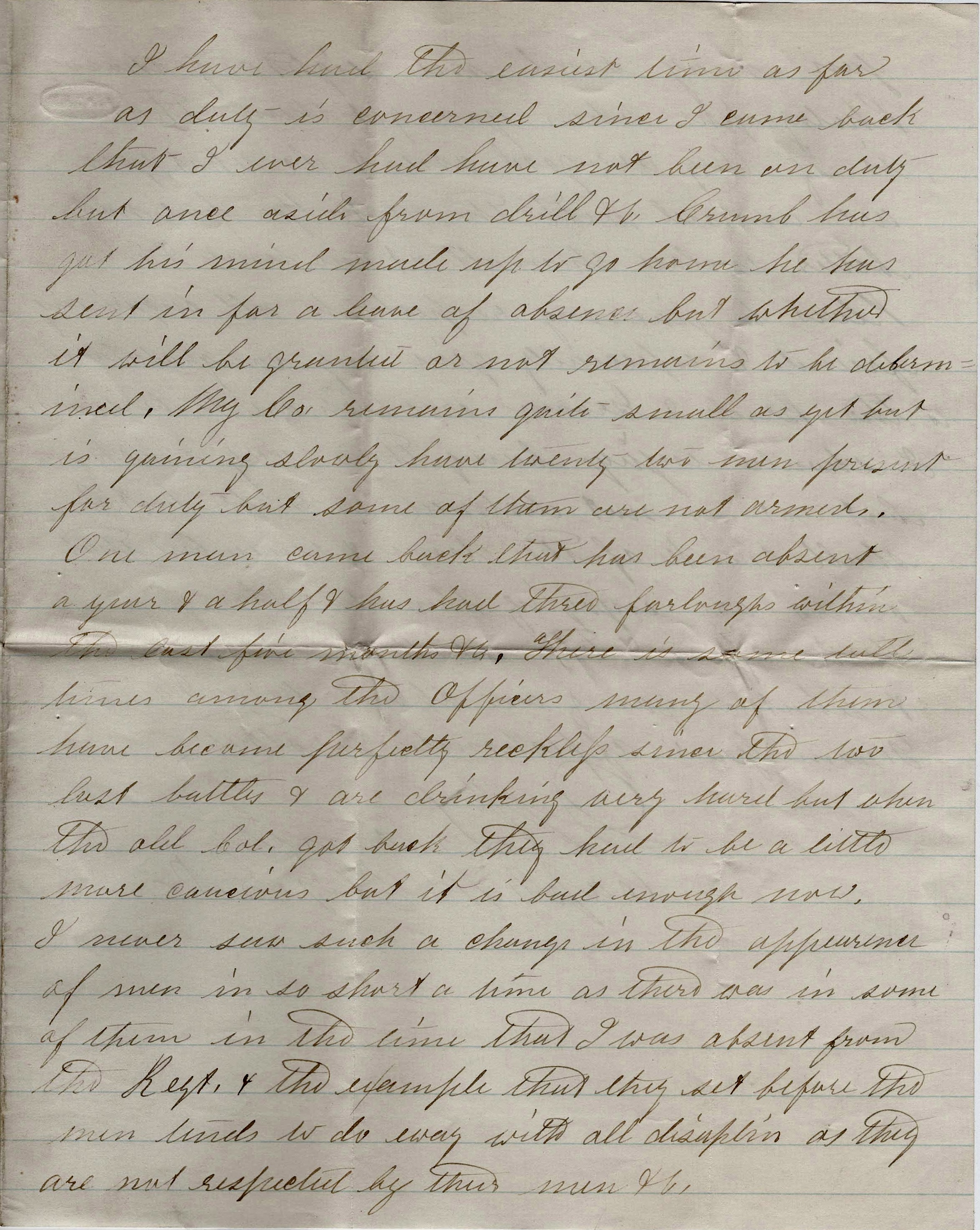
I have had the easiest time as far as duty is concerned since I came back that I ever had. Have not been on duty but once aside from drill &c. Crumb has got his mind made up to go home. He has sent in for a leave of absence but whether it will be granted or not remains to be determined. My company remains quite small as yet but is gaining slowly. Have 22 men present for duty but some of them are not armed. One man came back that has been absent a year and a half & has had three furloughs within the last five months.
There is some dull times among the officers. Many of them have become perfectly reckless since the two last battles & are drinking very hard. But when the Old Colonel got back they had to be a little more cautious. But it is bad enough now. I never saw such a change in the appearance of men in so short a time as there was in some of them in the time that I was absent from the regiment & the example that they set before the men tends to do away with all dissipation as they are not respected by their men, &c.
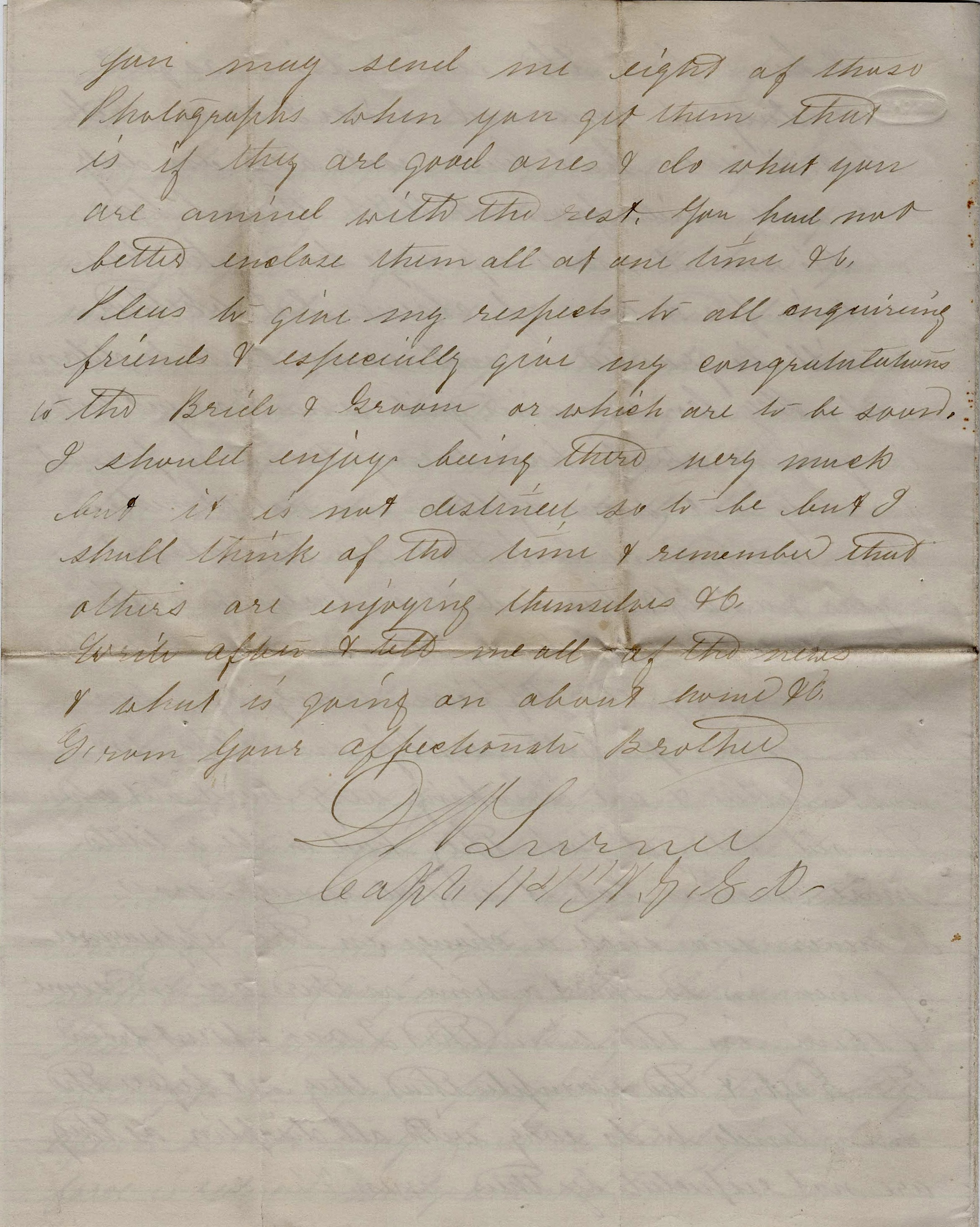
You may send me eight of those photographs when you get them—that is if they are good ones & do what you are a mind to with the rest. You had not better enclose them all at one time &c. Please to give my respects to all enquiring friends & especially give my congratulations to the Bride & Groom or which are to be soon. I should enjoy being there very much but it is not destined so to be but I shall think of the time & remember that others are enjoying themselves, &c. Write often & tell me all of the news & what is going on about home &c. From your affectionate brother, — D. W. Turner, Capt., 114th N. Y. S. V.
Letter 2
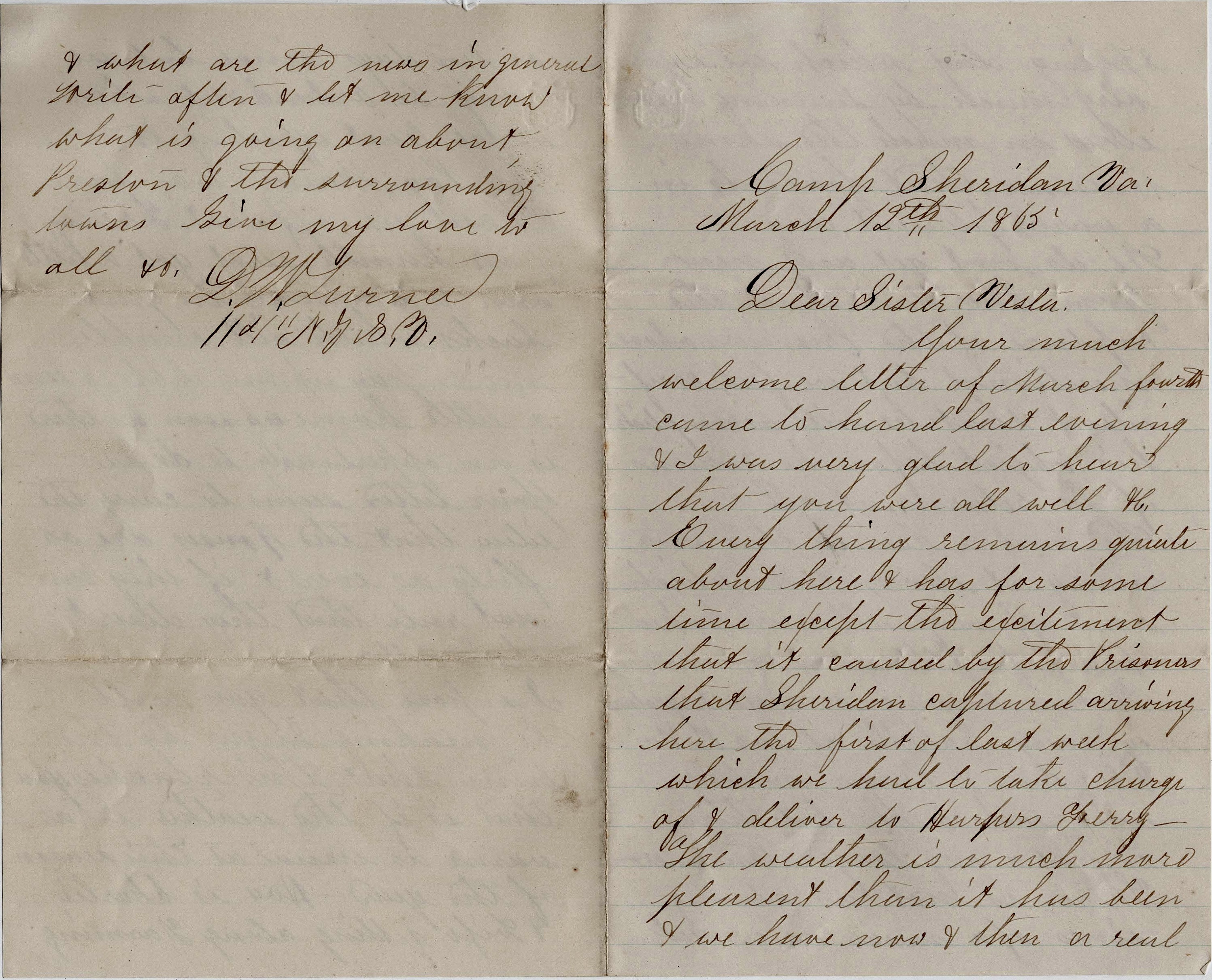
Camp Sheridan, Virginia March 12th 1865
Dear Sister Vesta,
Your much welcome letter of March 4th came to hand last evening & I was very glad to hear that you were all well &c. Everything remains quiet about here & has for some time except the excitement that it caused by the prisoners that Sheridan captured arriving here the first of last week which we had to take charge of and delivered to Harpers Ferry.
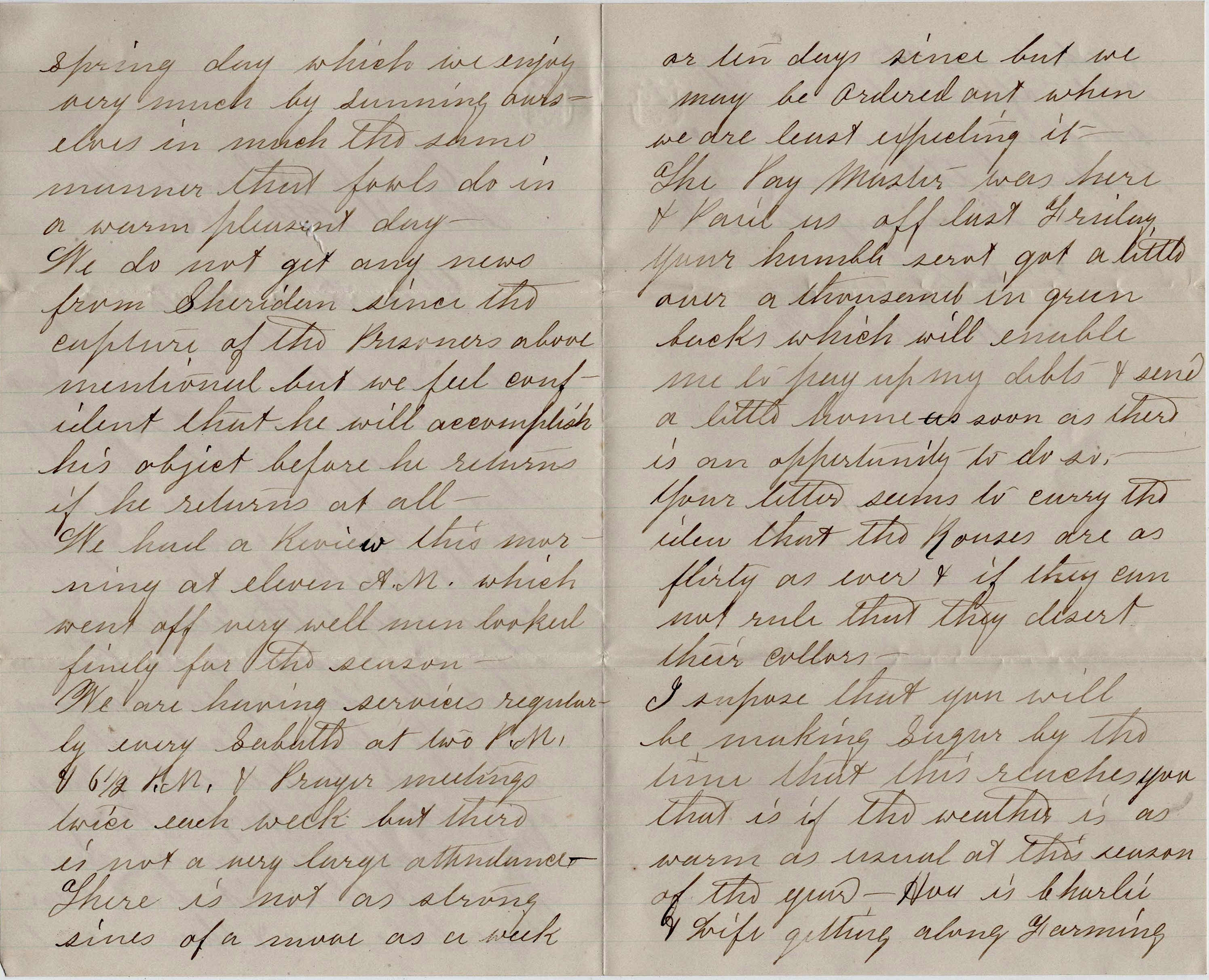
The weather is much more pleasant than it has been & we have now & then a real spring day which we enjoy very much by sunning ourselves in much the same manner that fools do in a warm pleasant day.
We do not get any news from Sheridan since the capture of the prisoners above mentioned but we feel confident that he will accomplish his object before he returns if he returns at all.
We had a Review this morning at eleven a.m. which went off very well. Men looked finely for the season. We are having services regularly for the Sabbath at two p.m. and 6.30 p.m. & prayer meetings twice each week, but there is not a very large attendance.
There is not as strong signs of a move as a week or ten days since but we may be ordered out when we are least expecting it. The Pay Master was here & paid us off last Friday. Your humble servant got a little over a thousand in green backs which will enable me to pay up my debts & send a little home as soon as there is an opportunity to do so.
Your letter seems to carry the idea that the Rouses are as flirty as ever & if they cannot rule, that they desert their collars.
I suppose that you will be making sugar by the time that this reaches you—that is, if the weather is as warm as usual at this season of the year. How is Charlie & wife getting along farming? and what are the news in general? Write often and let me know what is going on about Preston & the surrounding towns. Give my love to all, &c. — D. W. Turner
114th N. Y. S. Vols.
Letter 3
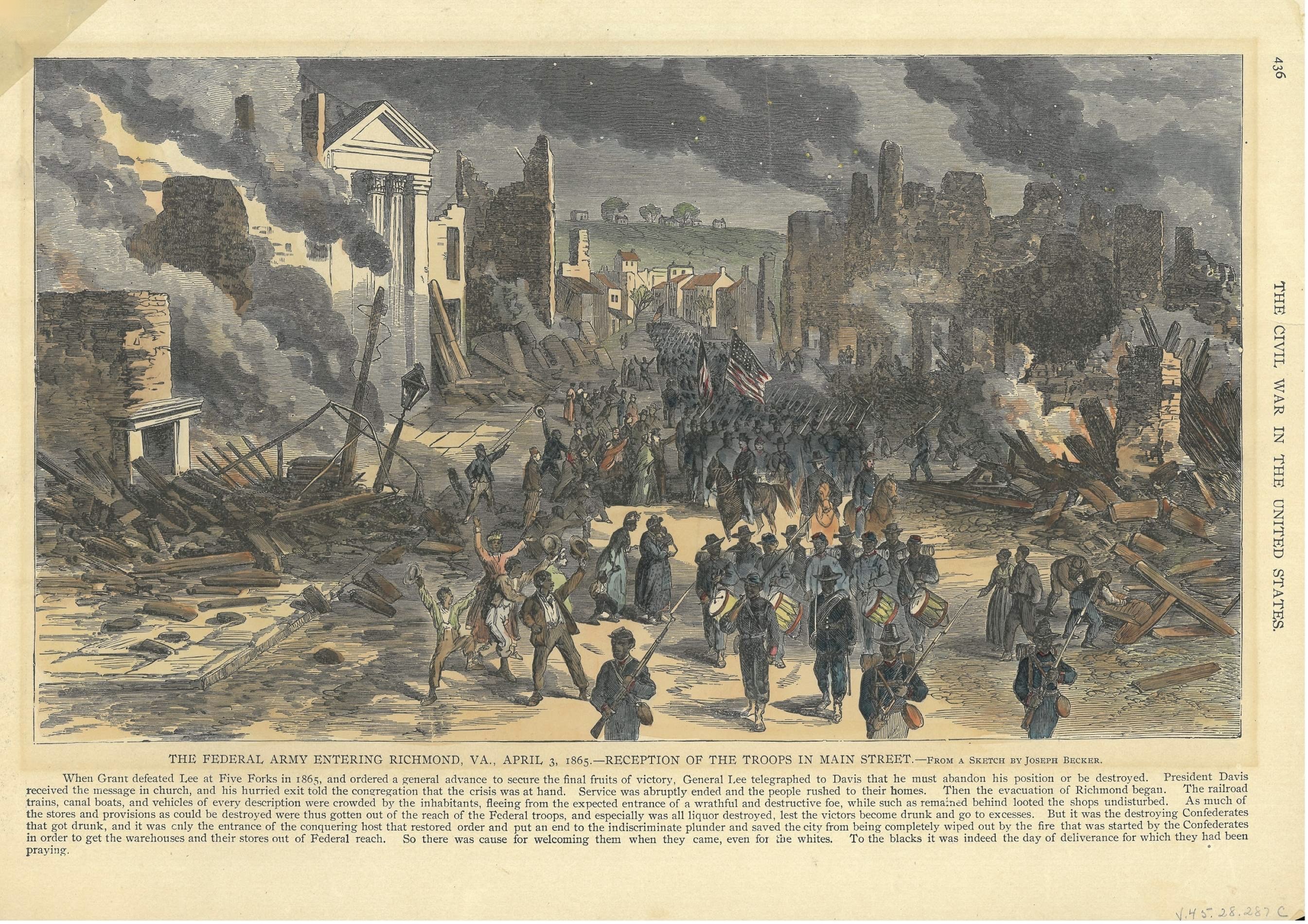
Gen. Gofrey Weitzel leads his Black troops into Richmond on 3 April 1865.
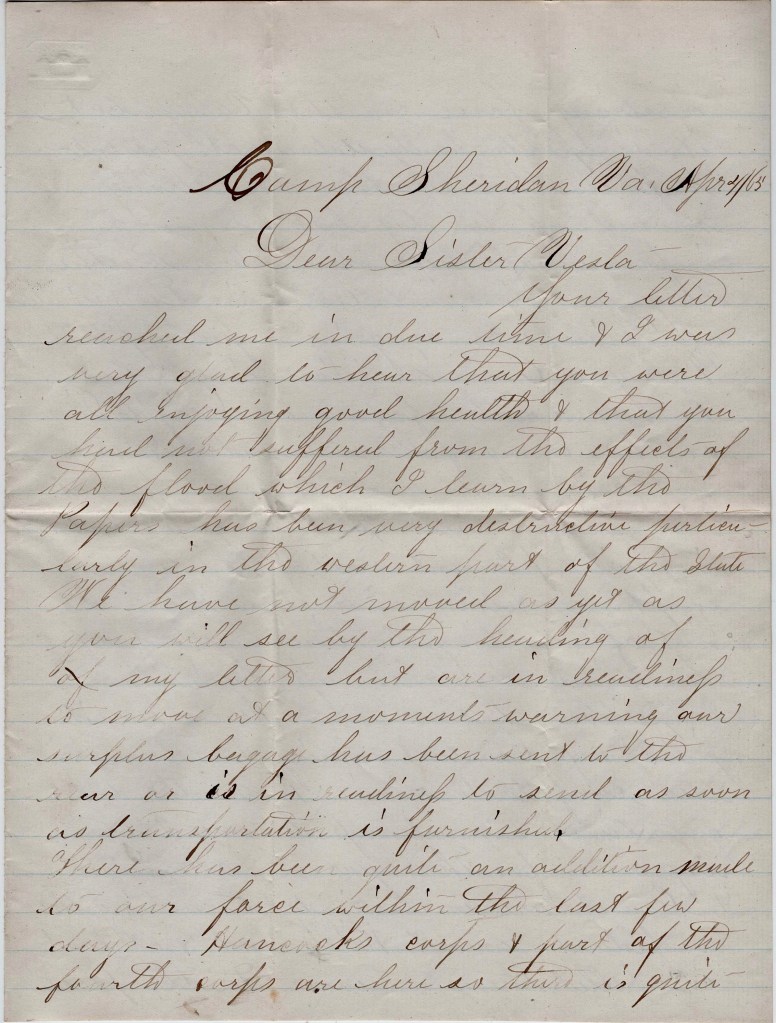
Camp Sheridan, Virginia April 4, 1865
Dear Sister Vesta,
Your letter reached me in due time & I was very glad to hear that you were all enjoying good health & that you had not suffered from the effects of the flood which I learn by the papers has been very destructive, particularly in the western part of the State.
We have not moved as yet as you will see by the heading of my letter but are in readiness to move at a moment’s warning. Our surplus baggage has been sent to the rear or is in readiness to send as soon as transportation is furnished.
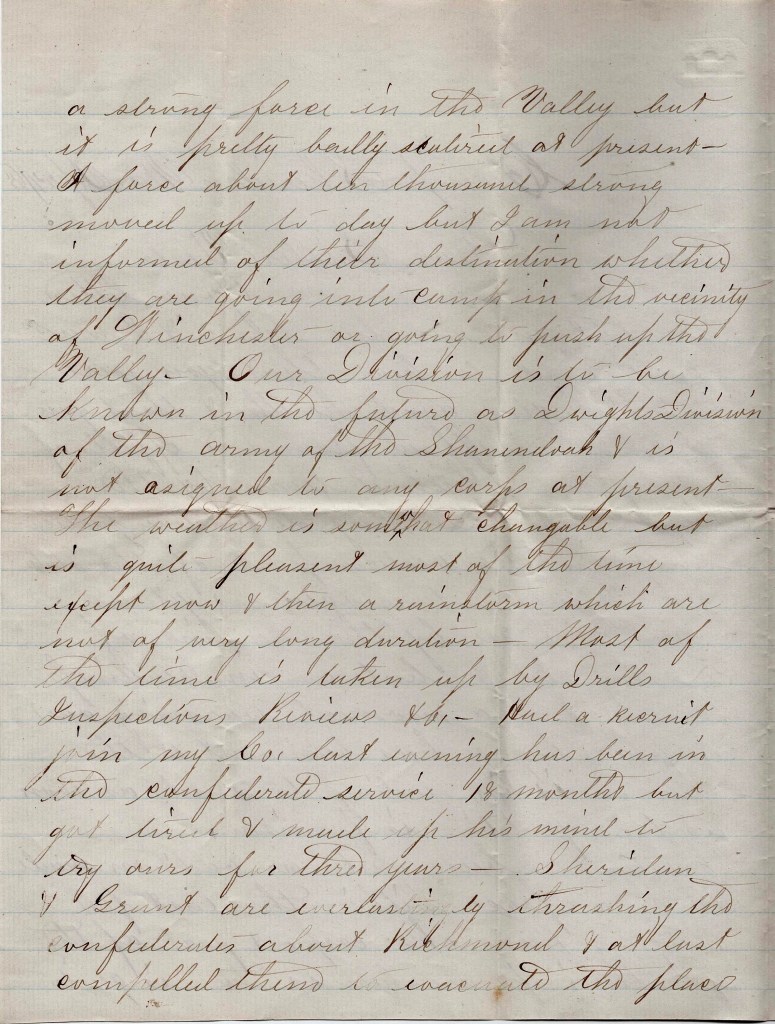
There has been quite an addition made to our force within the last few days. Hancock’s Corps & part of the Fourth Crops are here so there is quite a strong force in the Valley but it is pretty badly scattered at present. A force about ten thousand strong moved up today but I am not informed of their destination—whether they are going into camp in the vicinity of Winchester or going to push up the Valley. Our Division is to be known in the future as Dwight’s Division of the Army of the Shenandoah & is not assigned to any Corps at present.
The weather is somewhat changeable but is quite pleasant most of the time except now and then a rainstorm which are not of very long duration. Most of the time is taken up by drills, inspections, reviews, &c. Had a recruit in my company last evening [who] has ben in the Confederate service 18 months but got tired & made up his mind to try ours for three years.
Sheridan & Grant are everlastingly thrashing the confederates about Richmond & at last compelled them to evacuate the place & to seek some other place of defense, but if they cannot hold Richmond after expending three years on its defenses, how can they expect to cope with our army in the open field & no defensive works?
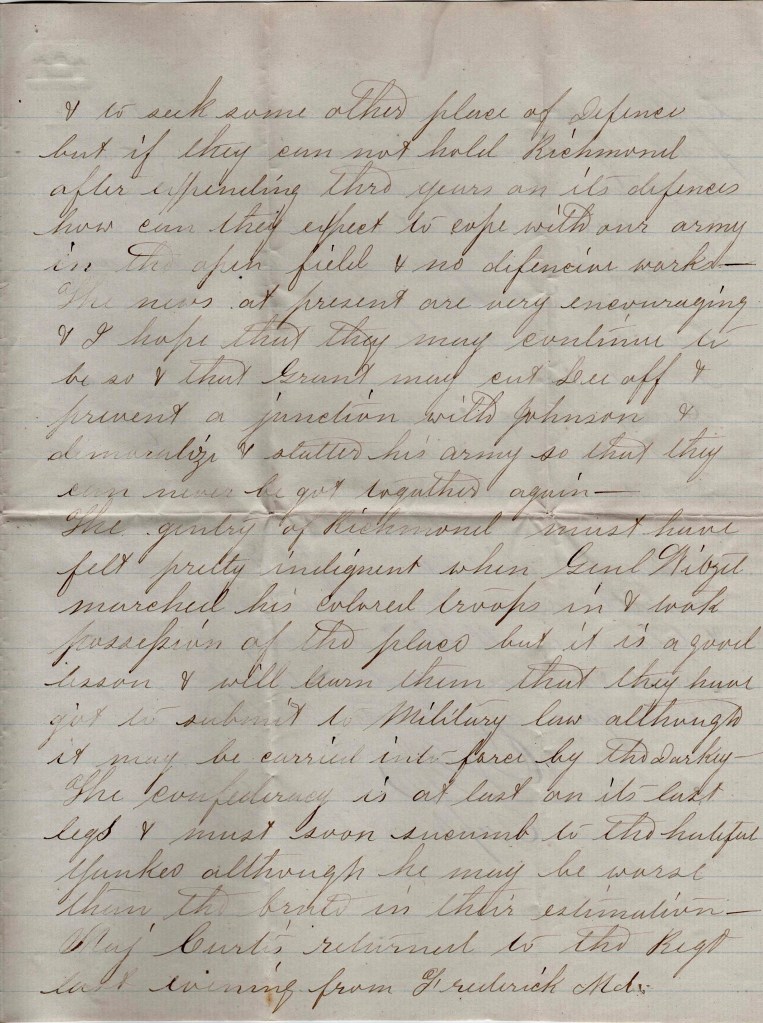
The news at present are very encouraging & I hope that they may continue to be so & that Grant may cut Lee off & prevent a junction with Johns[t]on & demoralize & shatter his army so that they can never be got together again. The gentry of Richmond must have felt pretty indignant when Gen. [Godfrey] Weitzel marched his colored troops in & took possession of the place. But it is a good lesson & will learn them that they have got to submit to military law although it may be carried into force by the darkey. The Confederacy is at last on its last legs & must soon succumb to the hateful Yanks although he may be worse than the brute in their estimation.
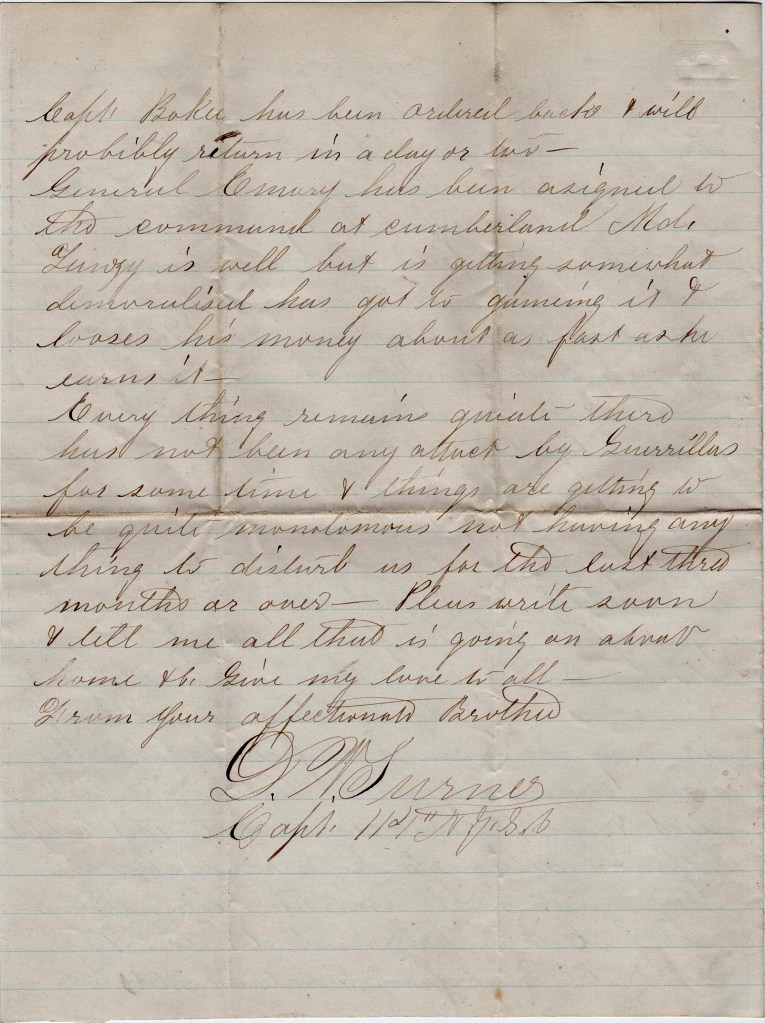
Maj. Curtis returned to the regiment last evening from Frederick, Maryland. Capt. Baker has been ordered back & will probably return in a day or two. General Emory has been assigned to the command at Cumberland, Maryland.
Yunxy [?] is well but is getting somewhat demoralized. Has got to gumming it & loses his money about as fast as he earns it. Everything remains quiet. There has not been any attack by guerrillas for some time & things are getting to be quite monotonous, not having anything to disturb us for the last three months or over. Please write soon & tell me all that is going on about home &c. Give my love to all. From your affectionate brother, — D. W. Turner, Capt., 114th N. Y. Infantry Vol.
Without investing more time, I’m unable to attribute this letter to any specific family. The author was “Sam” and his wife was “Julia.” He wrote the letter from Reading—probably Massachusetts—and his mother lived far away—possibly in or near Rockford, Illinois. We know that Sam raised sheep and sold his wool to market. We also know that Sam did not share the Antislavery views of his Governor nor of the Lincoln Administration. There are other names mentioned in his letter that may be clues to the identity of his siblings.
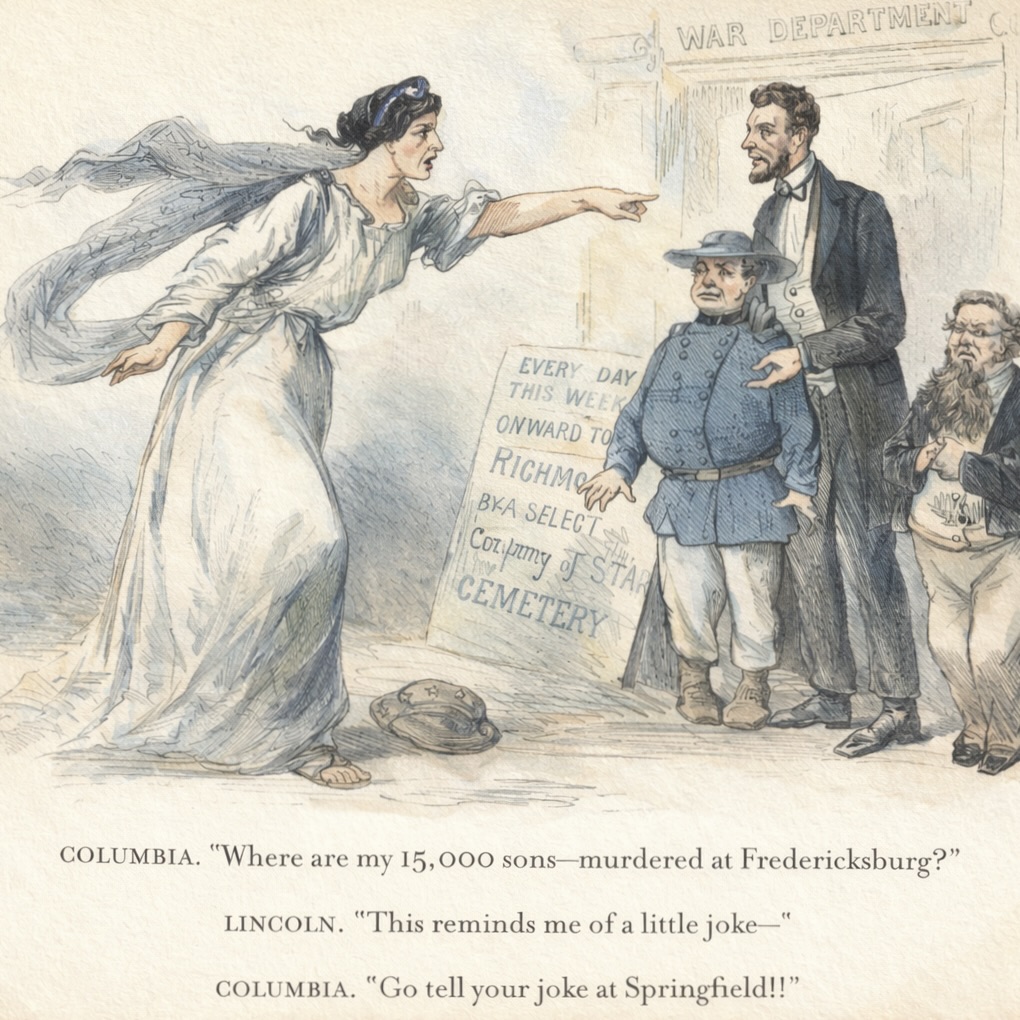
The letter provides us with a viewpoint that was not particularly unusual among the northern population during the American Civil War. Clearly Sam would have voted for the Democratic Ticket advocating for peace on any terms—the Constitution as it was; the Union as it was. In other words, in 1864 he probably voted for George McClellan. Many began to believe that Lincoln was unequal to the task at hand. Sam most likely would have been a conscientious objector based on his religious beliefs though this did not exempt him from federal draft laws and he would have been compelled to pay for a substitute or face imprisonment.
This cartoon appeared in Harper’s Magazine in January 1863. It captures the mood of a significant segment of the northern population.
T R A N S C R I P T I O N
Reading [Middlesex county, Massachusetts?] March 1st 1863
Dear Mother,
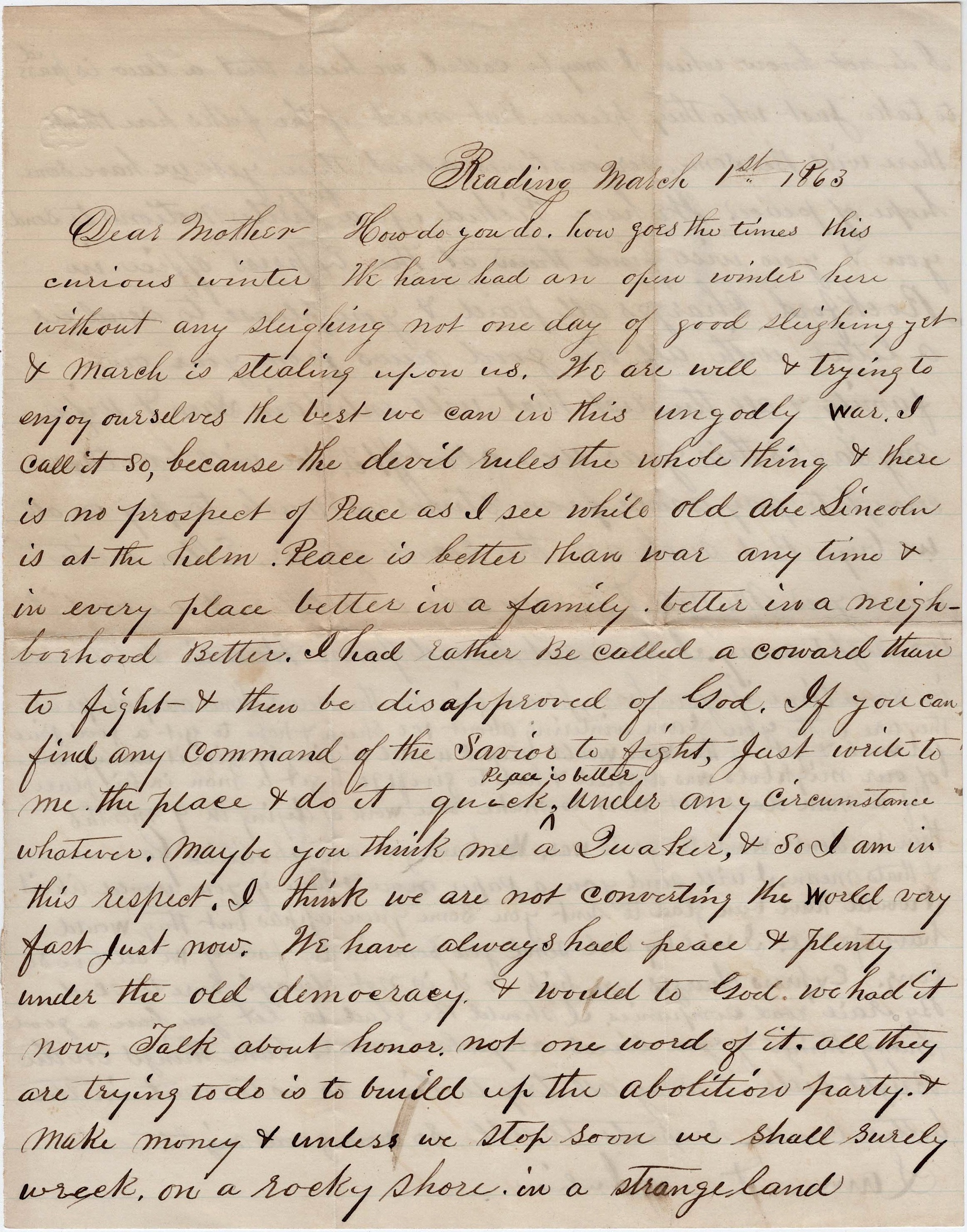
How do you do? How goes the times this curious winter? We have had an open winter here without any sleighing—not one good day of sleighing yet & March is stealing upon us. We are well and trying to enjoy ourselves the best we can in this ungodly war. I call it so because the devil rules the whole thing & there is no prospect of peace as I see while Old Abe Lincoln is at the helm.
Peace is better than war anytime & in every place better in a family—better in a neighborhood. I had rather be called a coward than to fight & then be disapproved of God. If you can find any command of the Savior to fight, just write to me, the place, and do it quick. Peace is better under any circumstance whatever. Maybe you think me a Quaker & so I am in this respect. I think we are not converting the world very fast just now. We have always had peace & plenty under the old democracy & would to God we had it now.
Talk about honor—not one word of it. All they are trying to do is to build up the Abolition party & make money, and unless we stop soon we shall surely wreck on a rocky shore in a strange land. I do not know when I may be called. We hear that a law is passed to take just who they please. But most of the folks here think there will be some serious times about then. Yet we have some hope of peace.
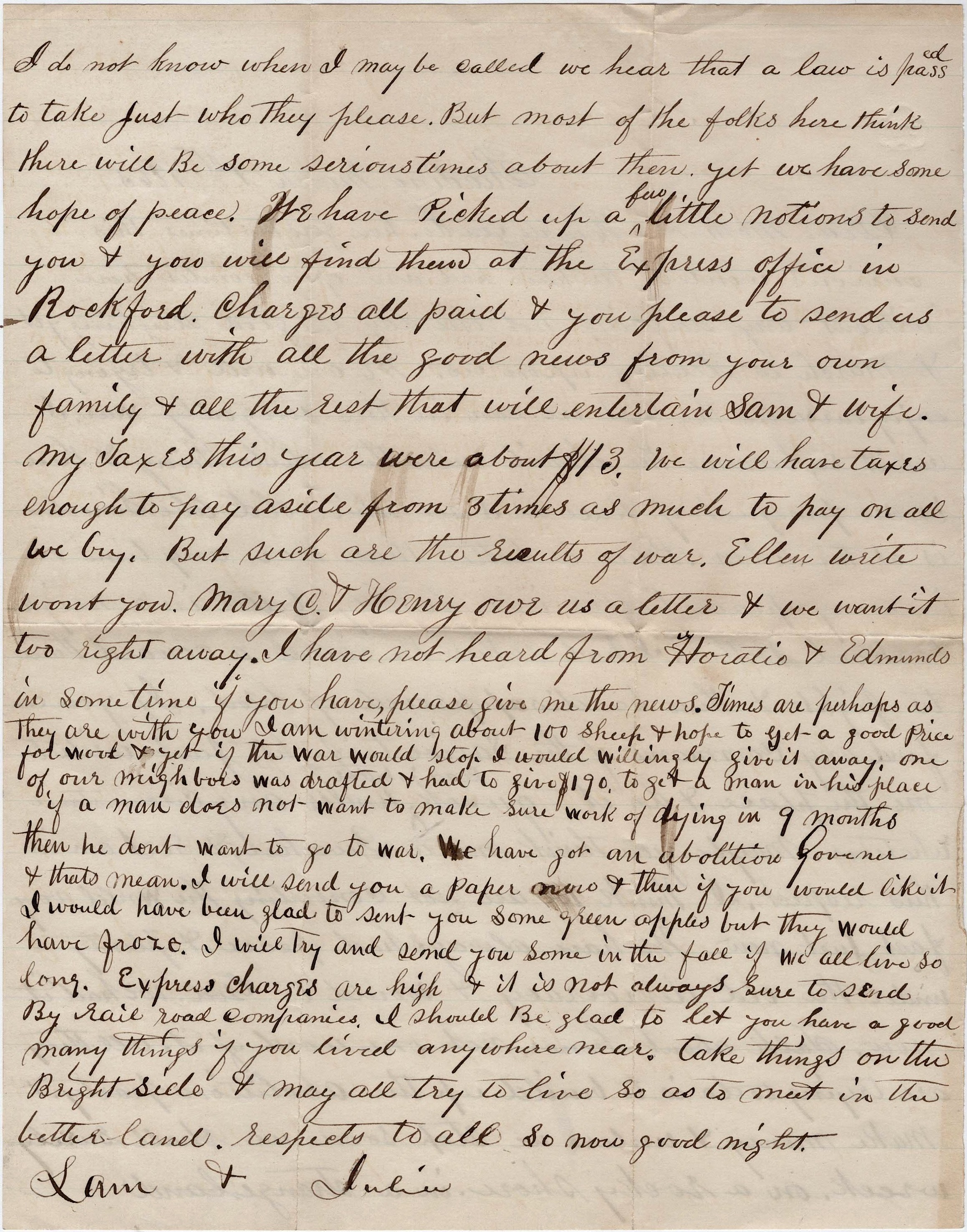
We have picked up a few little notions to send you & you will find them at the Express Office in Rockford. Charges are all paid & you please to send us a letter with all the good news from your own family & all the rest that will entertain Sam & wife. My taxes this year were bout $13. We will have taxes enough to pay aside from three times as much to pay on all we buy. But such are the results of war.
Ellen, write won’t you? Mary C. & Henry owe us a letter & we want it too right away. I have not heard from Horatio & Edmunds in some time. If you have, please give me the news. Times are perhaps as they are with you. I am wintering about 100 sheep and hope to get a good price for wool & yet if the war would stop, I would willingly give it away. One of our neighbors was drafted & had to give $190 to get a man in his place. If a man does not want to make sure work of dying in 9 months, then he don’t want to go to war.
We have got an abolition Governor & that’s mean. I will send you a paper now and then if you would like it. I would have been glad to sent you some green apples but they would have froze. I will try and send you some in the fall if we all live so long. Express charges are high & it is not always sure to send by railroad companies. I should be glad to let you have a good many things if you lived anywhere near. Take things on th bright side & may all try to live so as to meet in the better land. Respects to all. So now good night. — Sam & Julia
The following letter was written by John Alexander Swetnam (1824-1867) to his younger brother, Thomas Levi Swetnam (1830-1898). They were two of at least nine children born to Levi S. Swetnam (1785-1838) and Frances Buckner Roane (1792-1858) of Hartwood, Stafford county, Virginia. John was married to Elizabeth (Bettie”) Keith Ford (1824-1882) and had four children—Addie (b. 1846), Charles (b. 1849), Thomas (b. 1854) and Mary (b. 1858). Thomas married Keturah Marie White (1837-1917) in 1857 and was living in Florence (near Cincinnati), Boone county, Kentucky during the Civil War. Clearly their residencies prior to and during the war prevented the two brothers from seeing each other.
“In April 1865, Stafford’s Civil War soldiers returned to a desolated and defeated land. Destruction had been nearly complete and Stafford’s recovery would take a century. About 1,000 Stafford men had fought in the Confederate forces – mostly in the 47th, 30th, 40th and 55th Virginia Infantry Regiments, the 9th Virginia Cavalry Regiment, and the Stafford Light Artillery. Those Staffordians who remained notoriously remained loyal to the Confederate cause, assisting cavalry reconnaissance, spying and refusing to trade with the occupying Federal forces. There were exceptions – a number of citizens were deemed sufficiently loyal to receive postwar compensation from the Southern Claims Commission. Several actively spied for the Union at great personal risk. A number of former Union soldiers returned and became Staffordians themselves.” [see Civil War in Stafford—Overview]
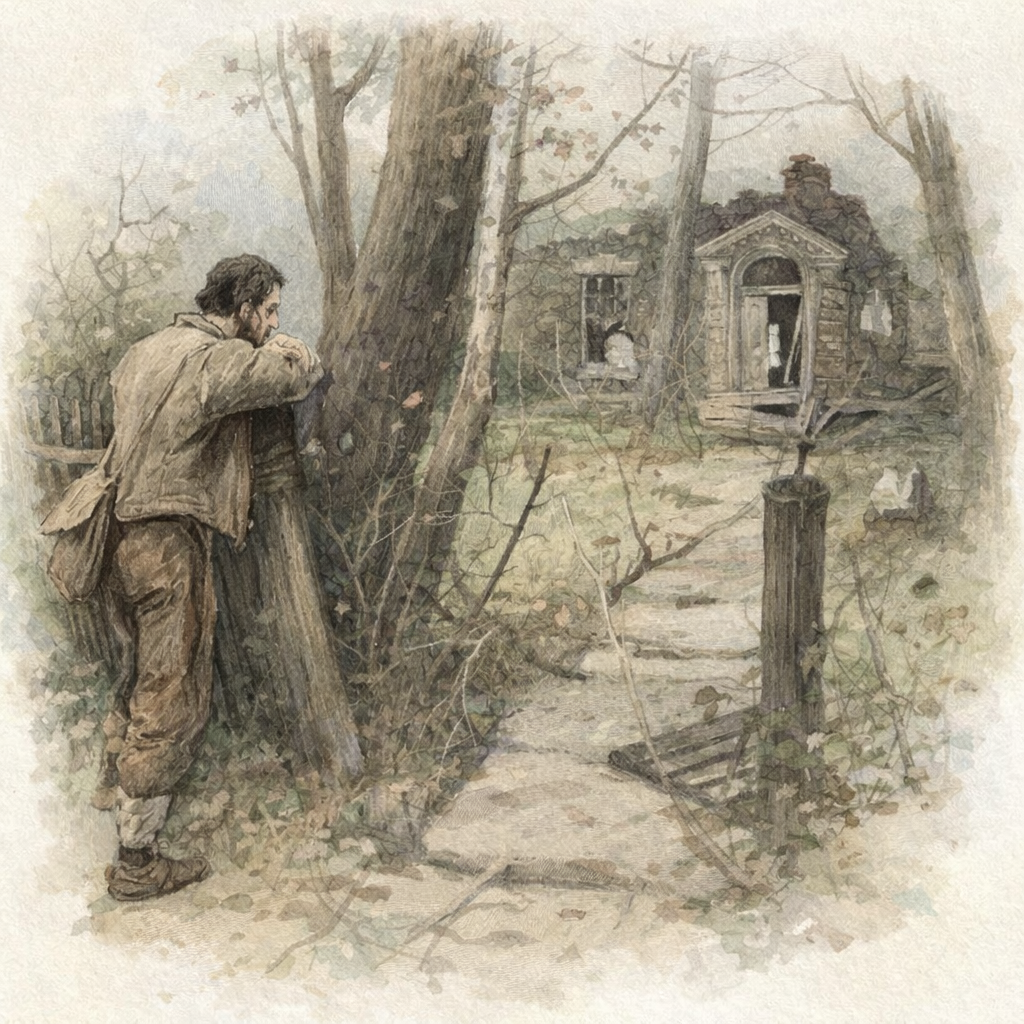
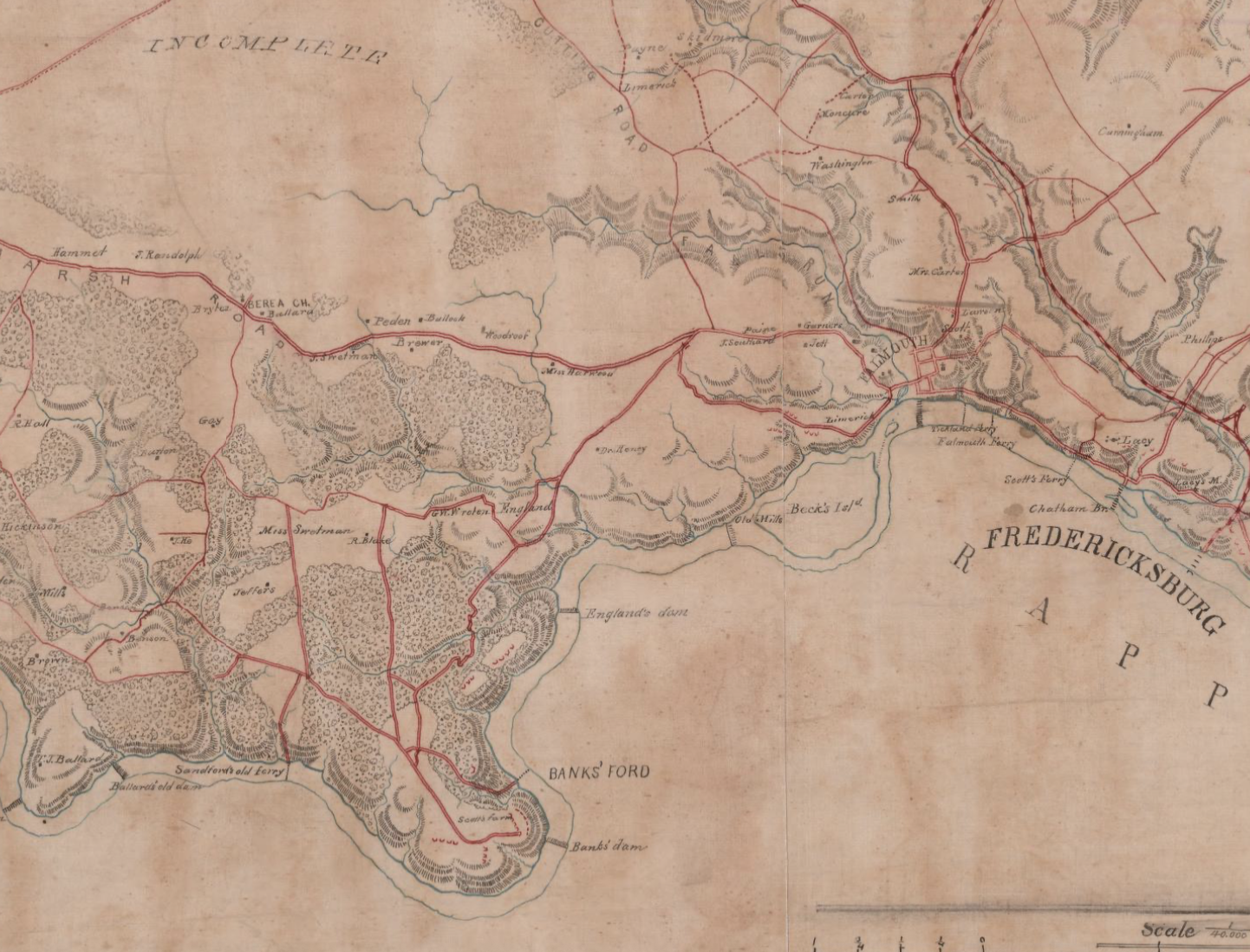
I believe the Swetnam family lived in the area west of Falmouth, north of Banks Ford. There are some Swetnam’s marked on the map but its spelled “Swetman” instead.
T R A N S C R I P T I O N
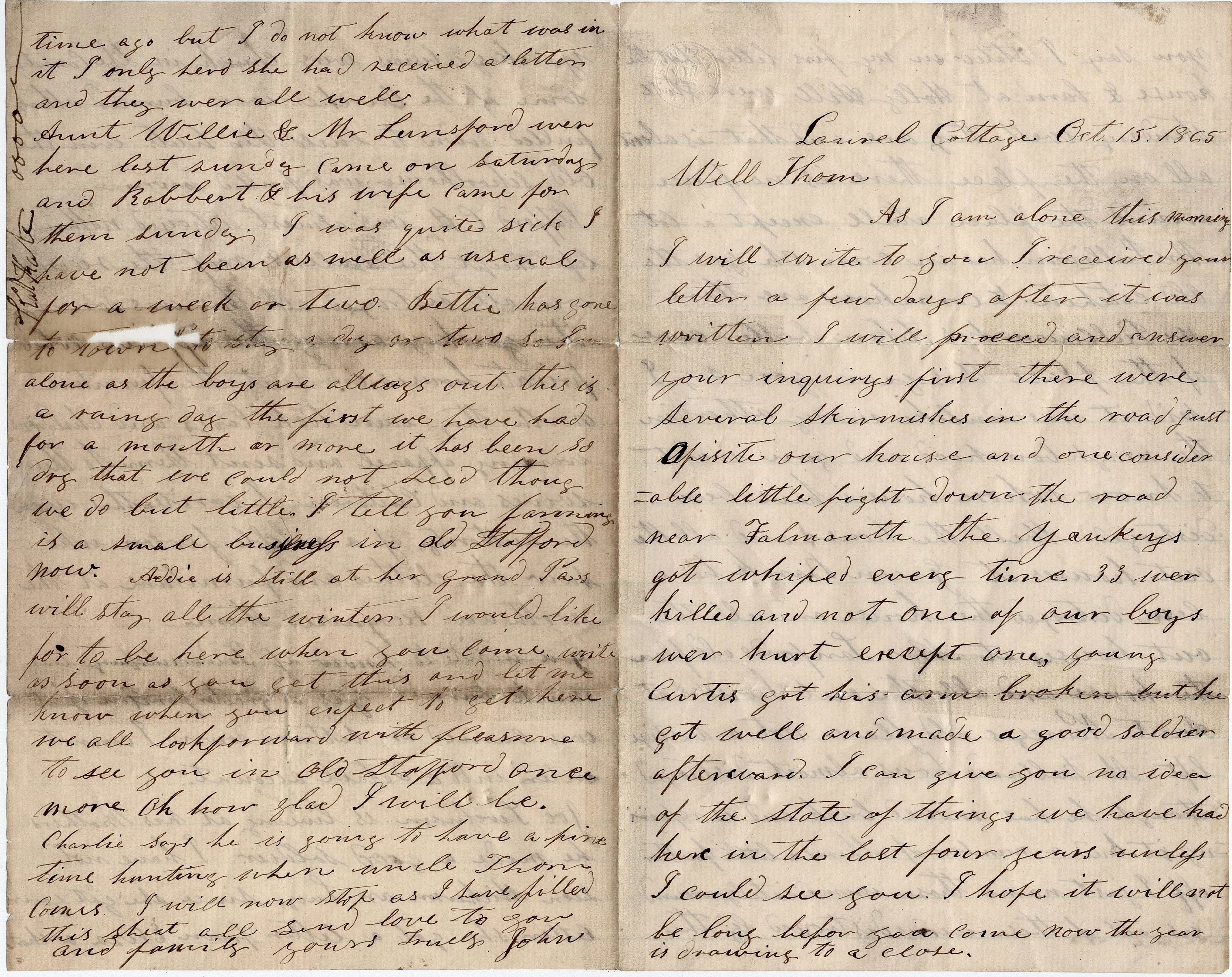
Laurel Cottage October 15, 1865
Well Thom,
As I am alone this morning I will write to you. I received your letter a few days after it was written. I will proceed and answer your inquiries first. There were several skirmishes in the road just opposite our house and one considerable little fight down the road near Falmouth. The Yankees got whipped every time. 33 were killed and not one of our boys were hurt except one. Young Curtis got his arm broken but he got well and made a good soldier afterward.
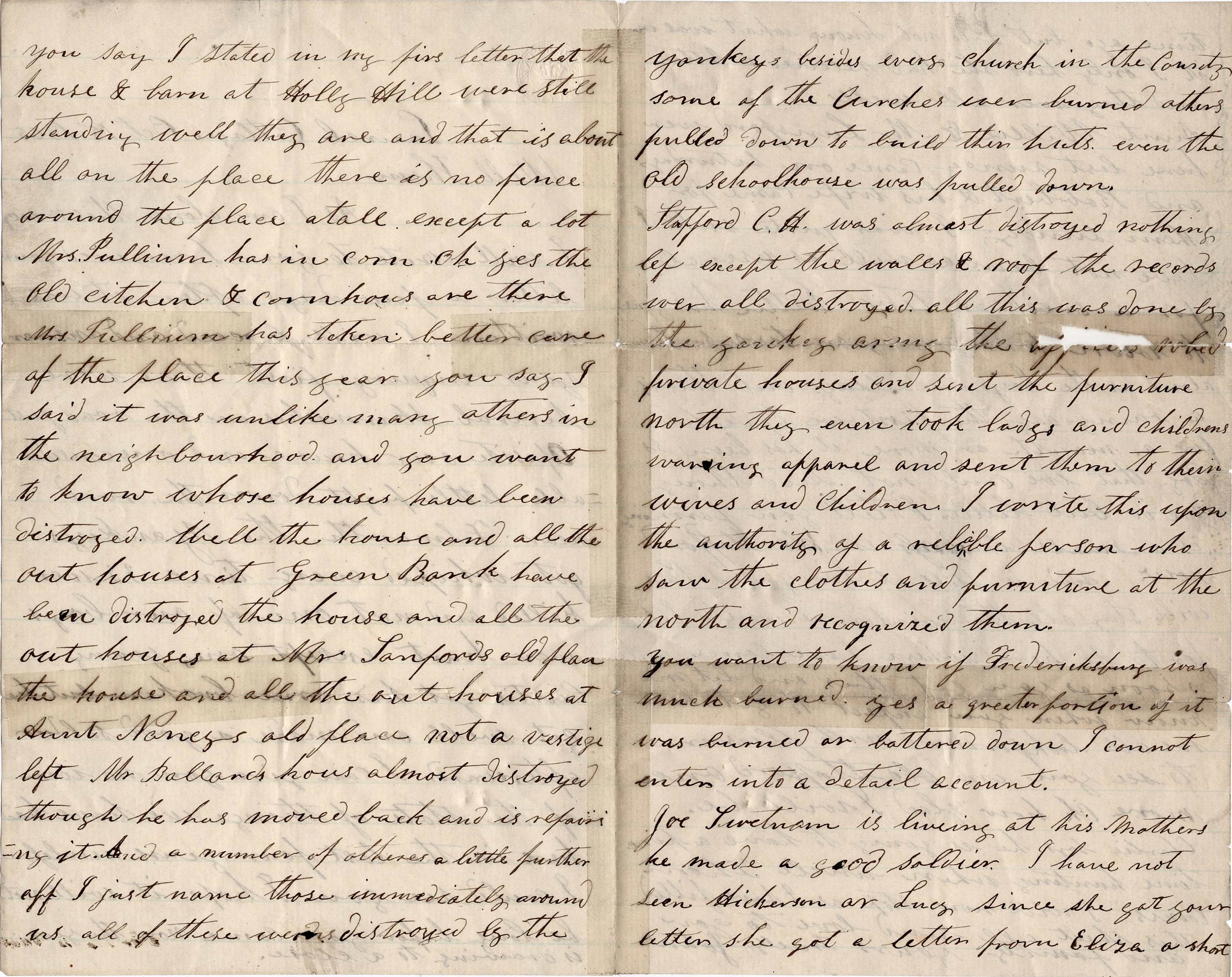
I can give you no idea of the state of things we have had here in the last four years unless I could see you. I hope it will not be long before you come now the year is drawing to a close. You say I stated in my first letter that the house and barn at Holly Hill were still standing. Well they are and that is about all on the place. There is no fence around the place at all except a lot Mrs. Pulliam has in corn. Oh yes, the old kitchen and cornhouse are there. Mrs. Pulliam has taken better care of the place this year. You say I said it was unlike many others in the neighborhood and you want to know whose houses have been destroyed. Well the house and all the out houses at Green Bank have been destroyed. The house and all the out houses at Mr. Sanford’s old place. The house and all the out houses at Aunt Nancy’s old place—not a vestige left. Mr. Ballard’s house almost destroyed though he has moved back and is repairing it. I just name those immediately around us. All of these were destroyed by the Yankees, besides every church in the county. Some of the churches were burned, others pulled down to build the huts. Even the old school house was pulled down.
Stafford Court House was almost destroyed—nothing left except the walls and roof. The records were all destroyed. All this was done by the Yankee army. The oficers robbed private houses and sent the furniture North. They even took ladies and children’s wearing apparel and sent them to their wives and children. I write this upon the authority of a reliable person who saw the clothes and furniture at the North and recognized them.
You want to know if Fredericksburg was much burned. Yes, a greater portion of it was burned or battered down. I cannot enter into a detail account.
Joe Swetnam is living at his mother’s. He made a good soldier. 1 I have not seen Hickerson or Lucy since she got your letter. 2 She got a letter from Eliza a short time ago but I don’t know what was in it. I only heard she had received a letter and they were all well. Aunt Willie and Mr. Lunsford were home last Sunday and came on Saturday and Robert and his wife came for them Sunday. I was quite sick. I have not been as well as usual for a week or two. Bettie has gone to town to stay a day or two so I am alone as the boys are always out. This is a rainy day—the first we have had for a month or more. It has been so dry that we could not seed though we do but little. I tell you, farming is a small business in Old Stafford now.
Addie is still at her grandpa’s. Will stay all the winter. I would like for to be here when you come. Write as soon as you get this and let me know when you expect to get here. We all look forward with pleasure to see you in Old Stafford once more. Oh how glad I will be. Charlie says he is going to have a fine time hunting when Uncle Thom comes. I will now stop as I have filled this sheet. All send love to you and family. Yours truly, — John
1 Joseph F. Swetnam (1835-1892) served in Co. A, 9th Virginia Cavalry. He was from Stafford county, Virginia. In 1870, he lived in Hartwood, Stafford county.
2 John Hore Hickerson (1818-1875) and his wife, Lucy Frances Buckner Swetnam (1824-1878). Hickerson was a farmer in Hartwood, Stafford county, Virginia.
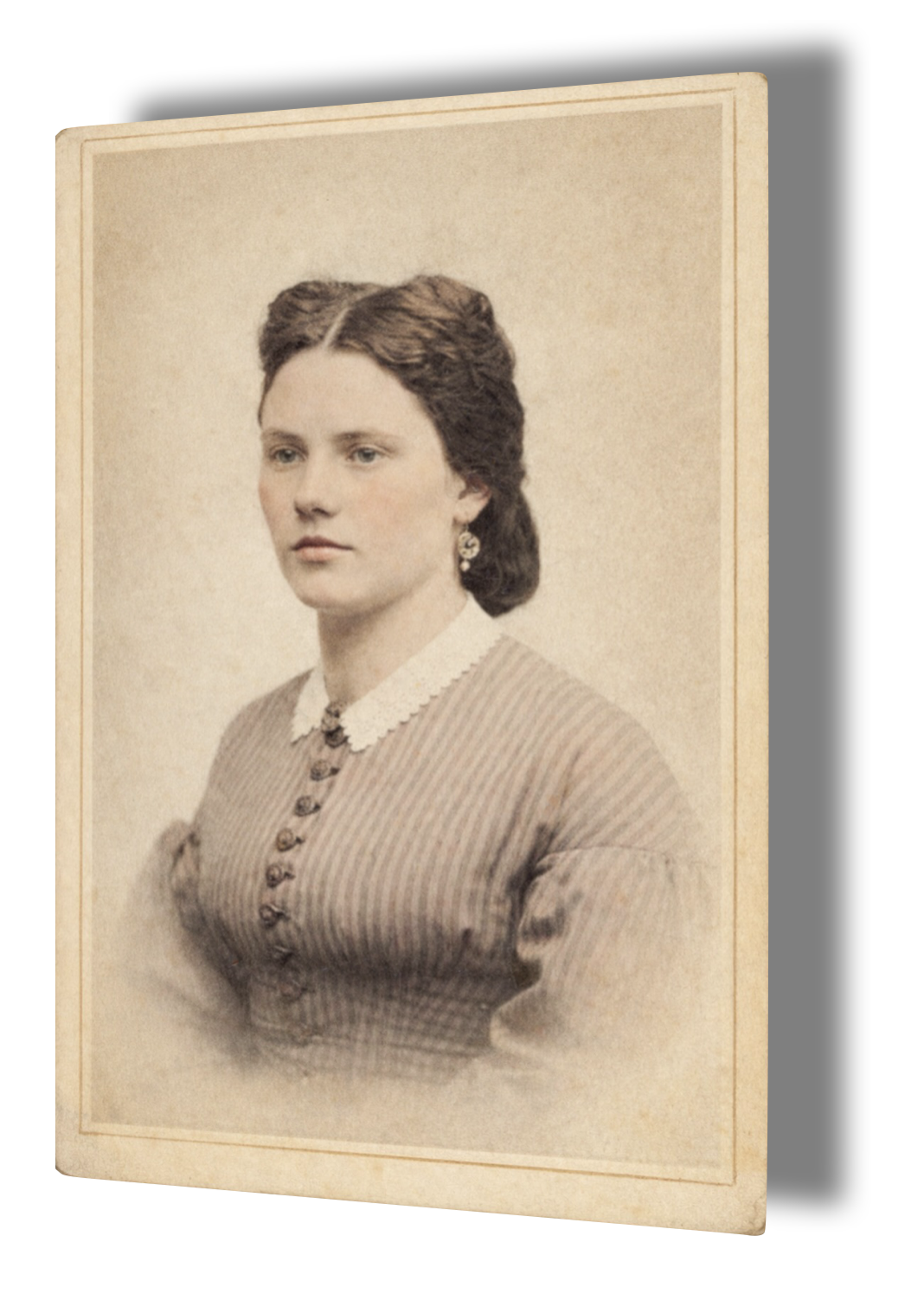
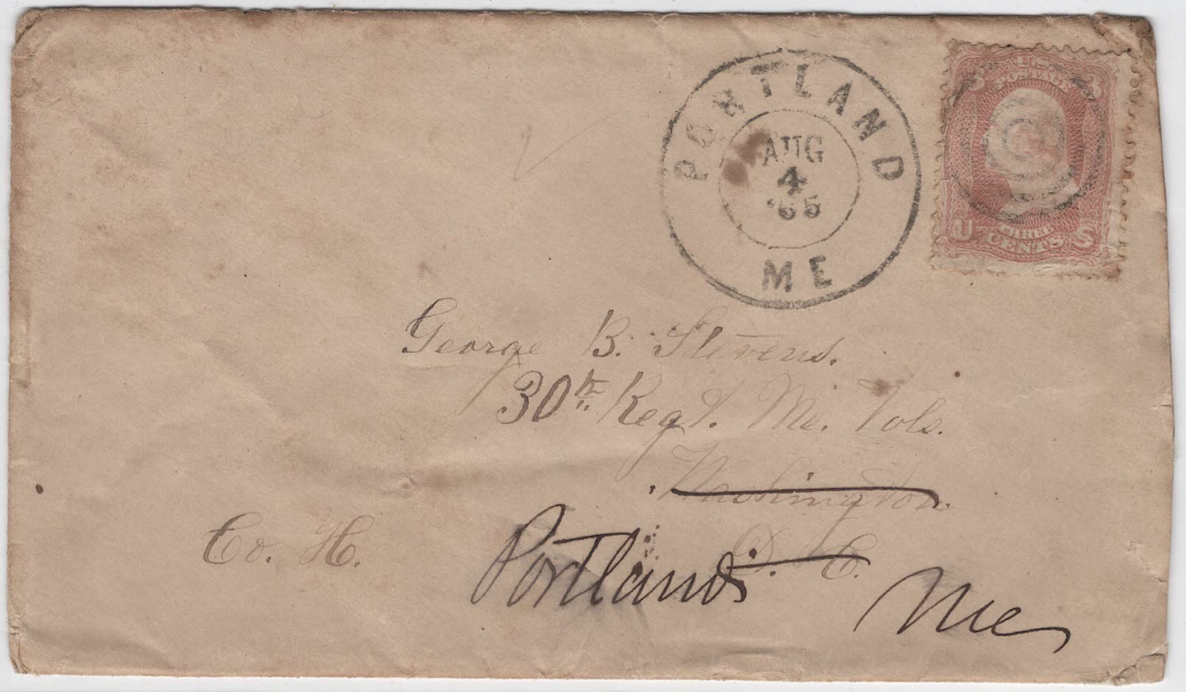
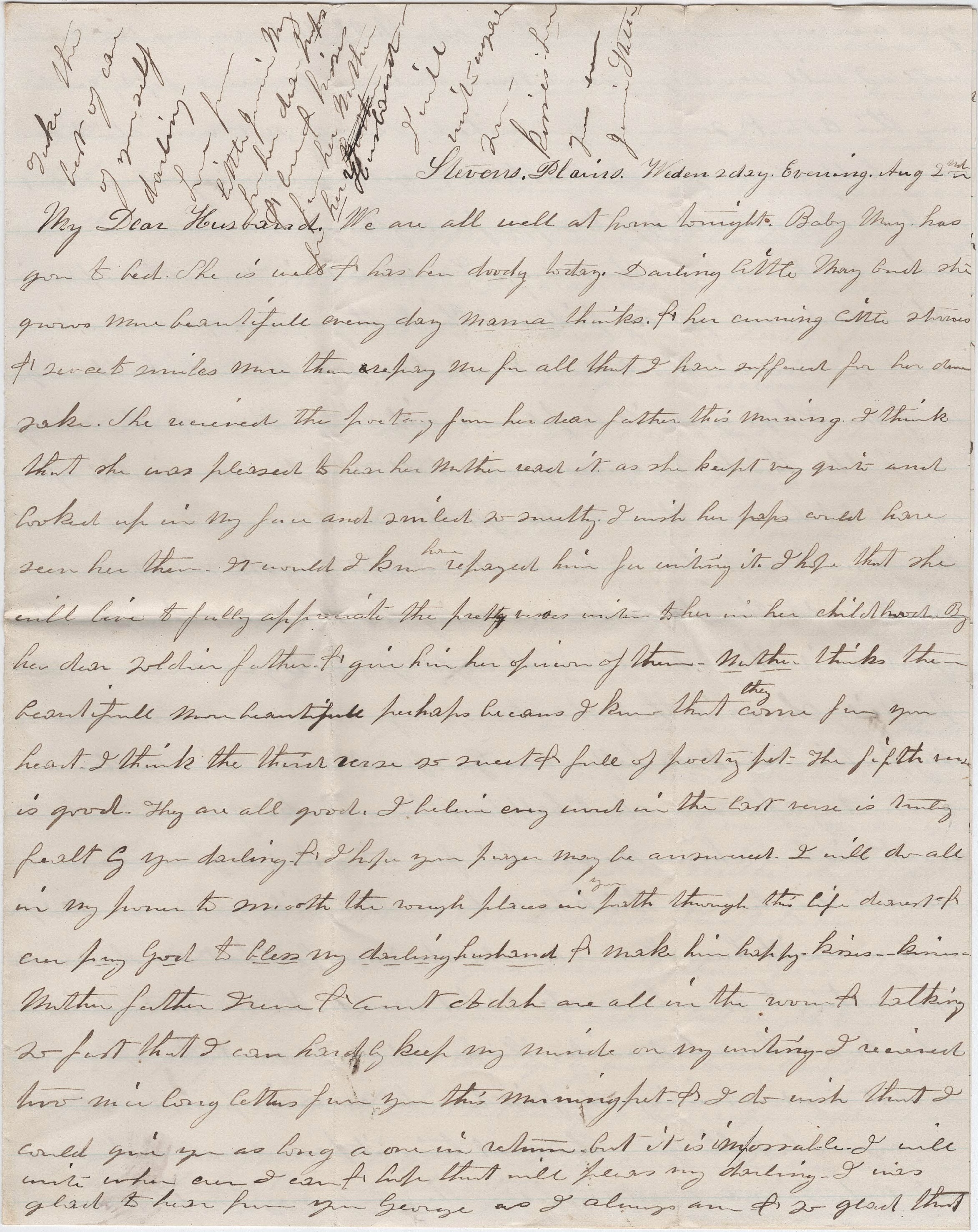
The following letter was written by Jean (“Jennie”) S. Graham (1843-1921), the wife of George Byron Stevens (1839-1926). Jennie was the daughter of William Graham (1812-1866) and Ann Creighton (1812-1856), emigrants from Perth, Scotland. Her brother was Capt. Charles Creighton Graham of Co. E, 29th Maine Infantry.
Jennie wrote the letter to her husband who served as a 1st Lieutenant in Co. E, 25th Maine Infantry but then reenlisted again as a private in February 1865 in Co. H, 30th Maine Infantry. Much of the beginning of the letter is doting on their young child, Jean Mae (“May”) Stevens, which is understandable given that their first two children, both boys, died as infants in 1862 and 1864. Jennie’s husband, George, was a teacher in Stevens Plains when he enlisted in Co. E of the 25th Maine Infantry on September 29, 1862 and was soon promoted to 1st Lieutenant. He and Jennie were married on Dec. 1, 1861.
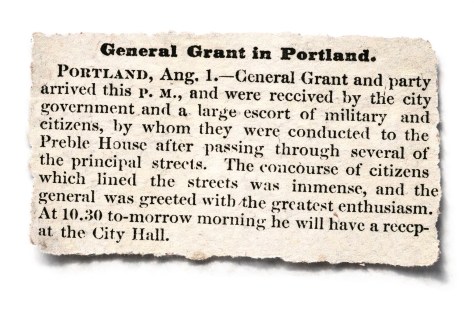
There is a lengthy description of Gen. Grant’s visit to Portland, Maine, with his wife Julia in August 1865.
T R A N S C R I P T I O N
Stevens Plains [Maine] Wednesday evening, August 2nd, 1865
My dear husband,
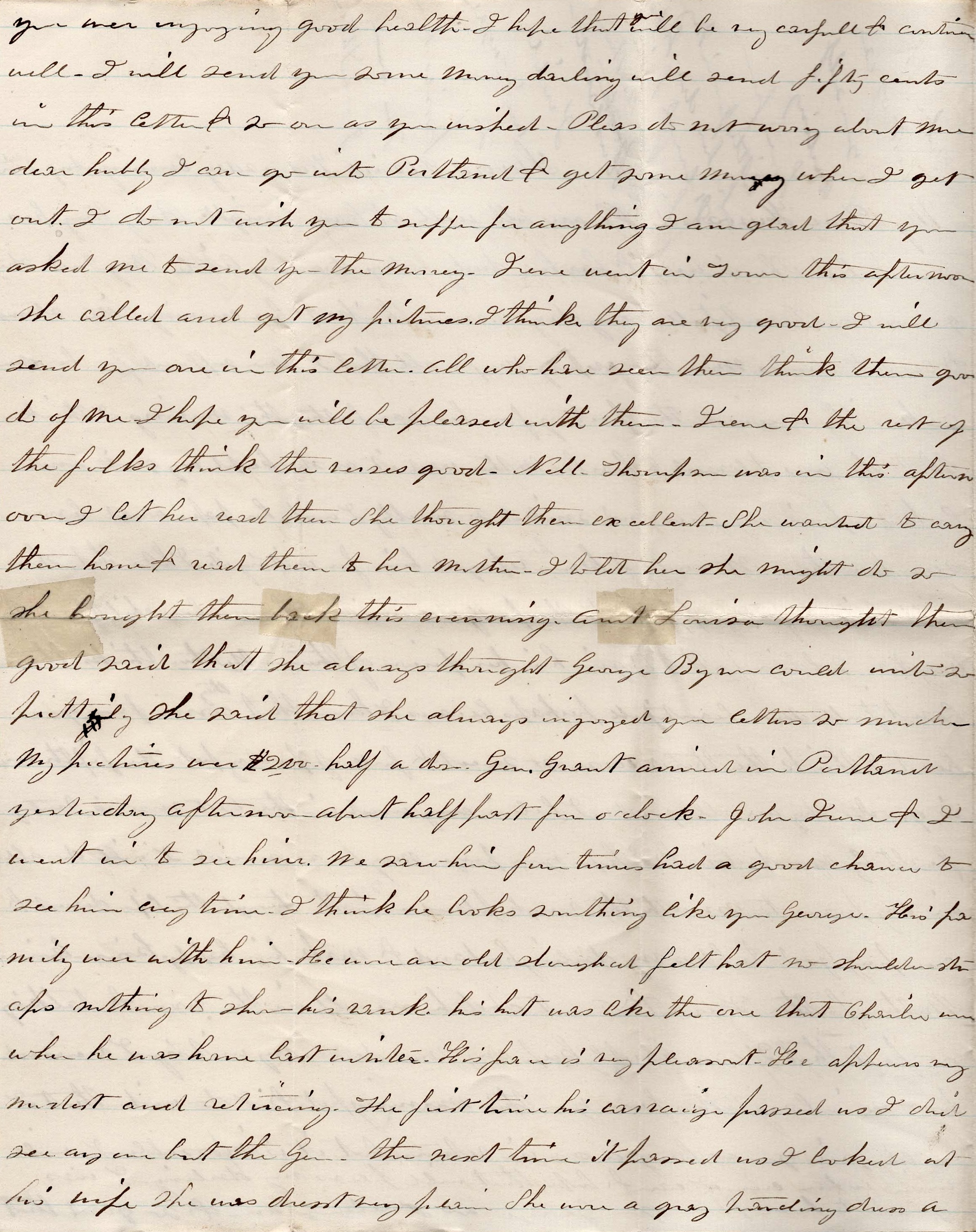
We are all well at home tonight. Baby May has gone to bed. She is well & has her doody today. Darling little May and she grows more beautiful every day, Mama thinks. Her cunning little [ ] and sweet smiles more than repay me for all that I have suffered for her dear sake. She received the poetry from her dear father this morning. I think that she was pleased to hear her Mother read it as she kept very quiet and looked up in my face and smiled so sweetly. I wish her papa could haveseen her then. It would I know have repaid him for writing it. I hope that she will live to fully appreciate the pretty lines written to her childhood by her dear soldier father & give him her opinion of them. Mother thinks them beautiful—more beautiful perhaps because I know that they come from your heart. I think the third verse so sweet & full of poetry pet. The fifth verse is good. They are all good. I believe every word in the last verse is truly heartfelt by you, darling, & I hope your prayer may be answered. I will do all in my power to smooth the rouygh places in your path through life, dearest, and ever pray God to bless my darling husband & make him happy…
Aunt Ada said that she saw by the Argus yesterday the 30th [Maine] Regiment were expected home soon. I have seen nothing of it in the press. I do not put much confidence in anything that I hear. When I see anything official, I will believe it….
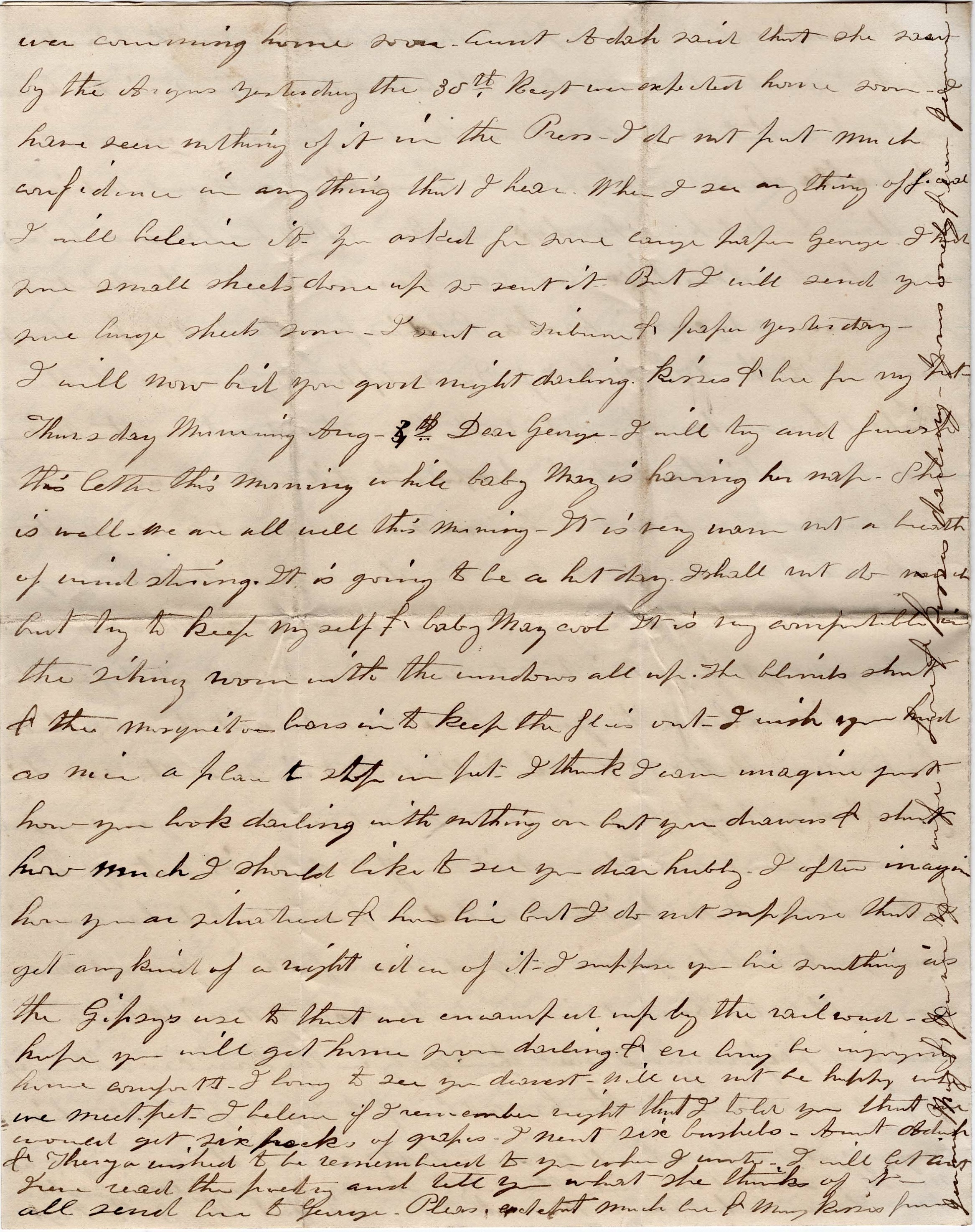
Thursday morning, August 3rd. Dear George, I will try and finish this letter this morning…Itis very warm. Not a breath of wind stirring. It is going to be a hot day. I shall not do much but try to keep myself and baby May cool. It is very comfortable in the sitting room with the windows all up, the blinds shut & the mosquito bars in to keep the flies out. I wish you had a mind to stop in but I thinnk I can imagine just how you look, darling, with nothing on but your drawers & shirt. How much I would like to see you dear hubby. I often imagine how you are situated and how live, but I do not suppose that I get any kind of a right idea of it. I suppose you live something as the gypsies use to that were encamped up by the railroad. I hope you will get home soon darling…
Massachusetts Weekly Spy, 4 August 1865
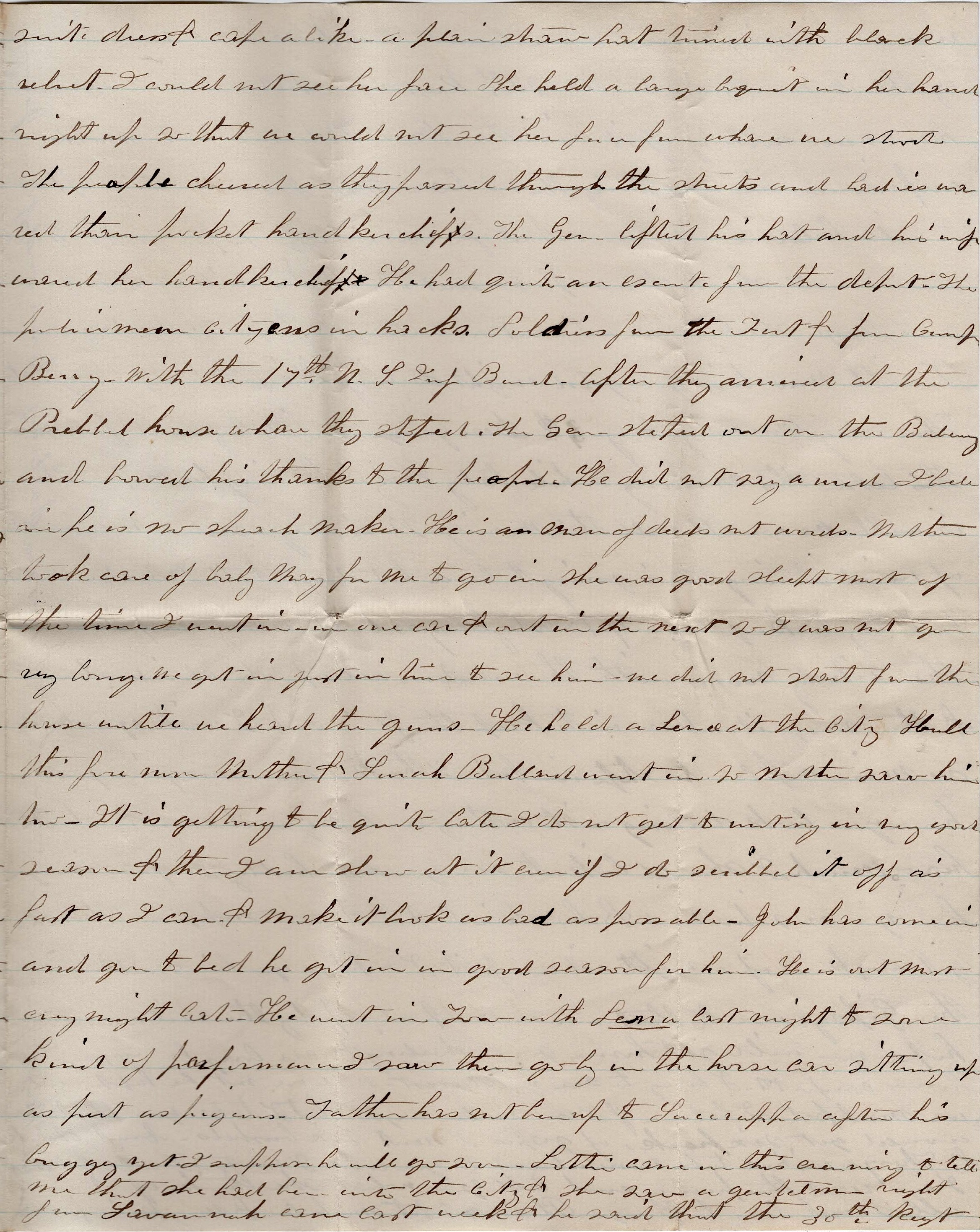
Gen. Grant arrived in Portland yesterday afternoon at half past four o’clock. John, Irene, & I went in to see him. We saw him four times. had a good chance to see him every time. I think he looks something like you George. His family were with him. He wore an old slouched felt hat, no shoulder straps—nothing to show his rank. His hat was like the one that [brother] Charlie wore when he was home last winter. His face is very pleasant. He appears very modest and retiring. The first time his carriage passed us I didn’t see anyone but the General. The next time it passed us I looked at his wife. She was dressed very plain. She wore a gray traveling dress suit, dress & cape alike, a plain straw hat trimmed with black velvet. I could not see her face. She held a large bouquet in her hand right up so that we could not see her face from where we stood.
The people cheered as they passed through the streets and ladies waved their pocket handkerchiefs. The General lifted his hat and his wife waved her handkerchief. He had quite an escort from the depot. The policemen, citizens in hacks, soldiers from the fort & from Camp Berry with the 17th U. S. Infantry Band.
After they arrived at the Preble House where they stopped, the General stepped out on the balcony and showed his thanks to the people. He did not say much. I believe he is no speech maker. He is a man of deeds, not words. Mother took care of baby May for me to go in. She was good—slept most of the time I went in… I was not gone very long. We got in just in time to see him. We did not start for the house until we heard the guns. He held a reception at the City Hall. This forenoon, Mother & Sarah Ballard went in to so Mother saw him too. It is getting to be quite late. I do not get to writing in very good season & then I am slow at it even if I do scribble it off as fast as I can & make it look as bad as possible… Yours only, from Jennie
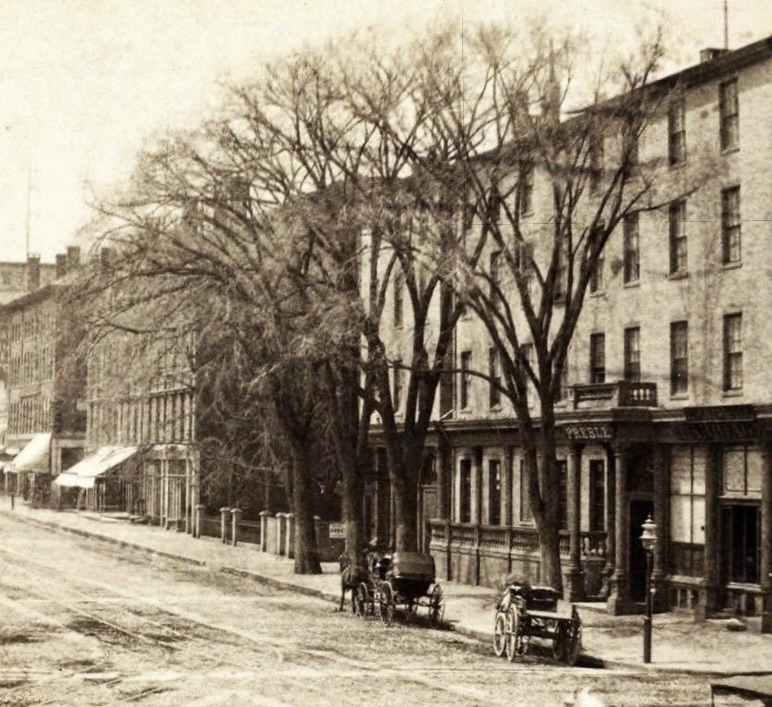
The Preble House at right on Congress Street in Portland.
This beautifully written letter was penned by Cardella E. Brown (1841-1896) who was a clerk at the Connecticut Mutual Insurance Company in Hartford, Connecticut in 1860. His parents were divorced and he lived with his mother in Hartford while his father lived in New York City with his second wife and Cardella’s brother Gerald and sister Lulette, while Brown’s other brother Henry was employed as a printer in Boston.
In September, 1861, Brown was mustered in as a Corporal in Co. B of the 6th Connecticut Regiment. He served three years and muster rolls record that he was discharged in September 1864 as a Sergeant. It’s presumed that Cardella elected to stay with the army following his discharge to serve as a civilian in the commissary. Suffering from depression, Cardella shot himself in 1896 at the age of fifty-five, leaving a widow and three sons—one of whom was named Cardella Drake Brown (the “Drake,” no doubt, from his “Uncle Drake” who is mentioned in this letter.)
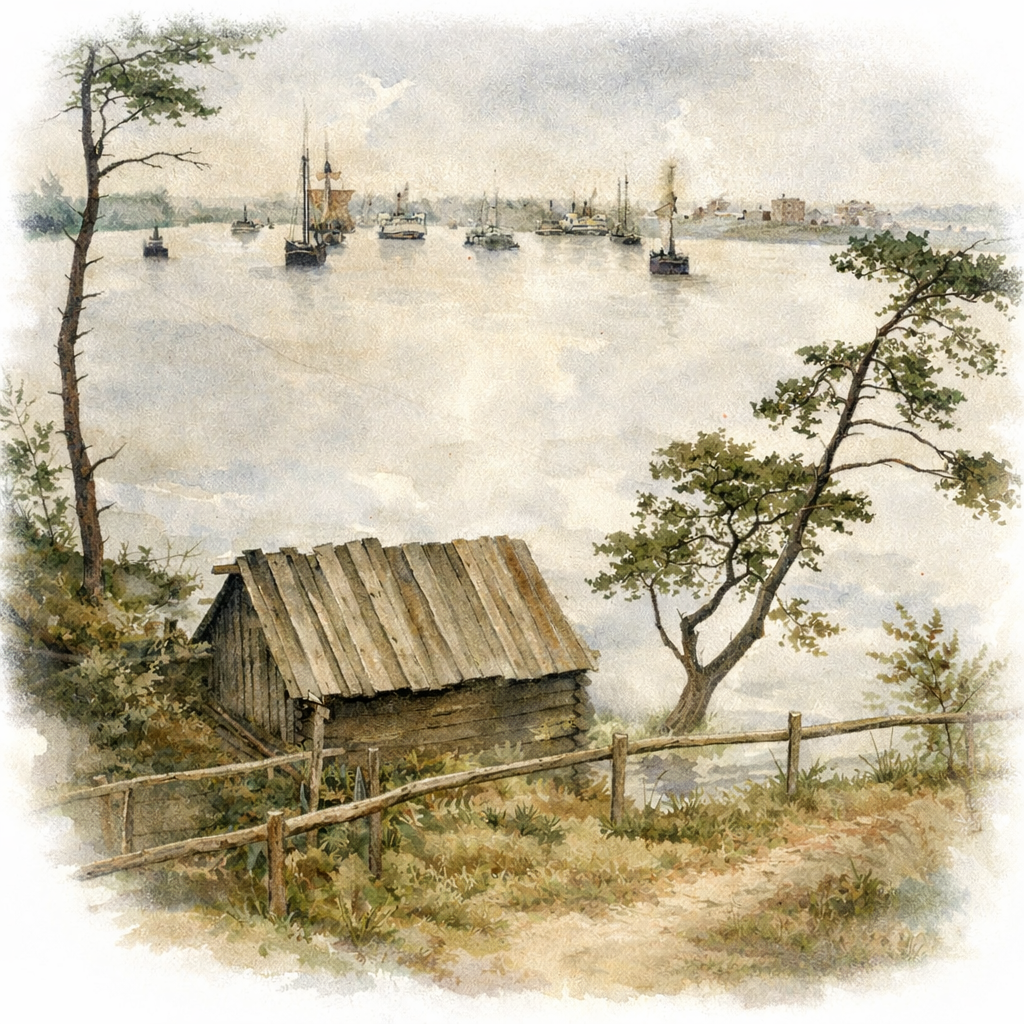
James’ Landing, Virginia in 1864
The Huntington library holds three volumes belonging to Cardella E. Brown. The first is a letterpress copybook containing approximately 100 outgoing personal letters Brown wrote from 1859 to 1861 while he was living in Hartford, Connecticut and working as a clerk at Connecticut Mutual Insurance Company. The letters are addressed to Brown’s parents, siblings, a cousin, and other family members and friends. The detailed and candid letters are written in a conversational tone devoid of usual epistolary formalities. The letters comment on a wide range of topics, including Brown’s personal life and sexuality, goings on in Hartford, and state and national politics of the 1860 election year. He talks in detail about Stephen A. Douglass, the anticipated secession of South Carolina, the Buchanan administration, and the hanging of John Brown. [Archived @ The Huntington]
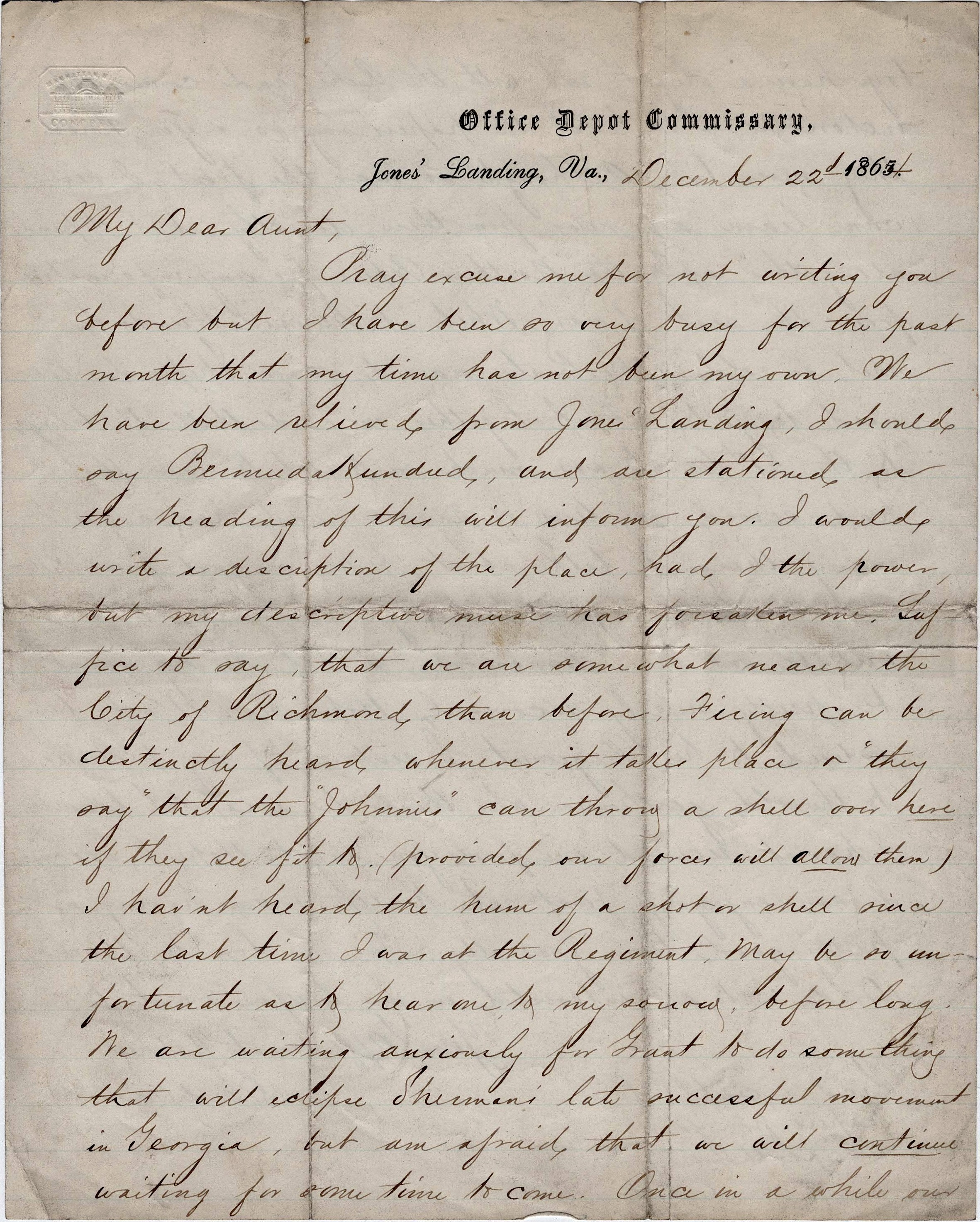
T R A N S C R I P T I O N
Office Depot Commissary Jones’ Landing, Va. December 22d 1864
My dear Aunt,
Pray excuse me for not writing you before but I have been so very busy for the last month that my time has not been my own. We have been relieved from Jones’ Landing—I should say Bermuda Hundred—and are stationed as the heading of this will inform you. I would write a desription of the place had I the power but my descriptive muse has forsaken me. Suffice to say that we are somewhat nearer the City of Richmond than before. Firing can be distinctly heard whenever it takes place & “they say” that the “Johnnies” can throw a shell over here if they see fit to (provided our forces will allow them). I haven’t heard the hum of a shot or shell since the last time I was at the Regiment. May be so unfortunate as to hear one to my sorrow before long.
We are waiting anxiously for Grant to do something that will eclipse Sherman’s late successful movement in Georgia, but I am afraid that we will continue waiting for some time to come. Once in a while our boys have a slight rub with the Rebs and come off victorious—at least the papers say so, & you know they never lie. Although so near the front, I never can learn any news from there directly, but depend altogether upon the Northern papers for any information from the “seat of war.”
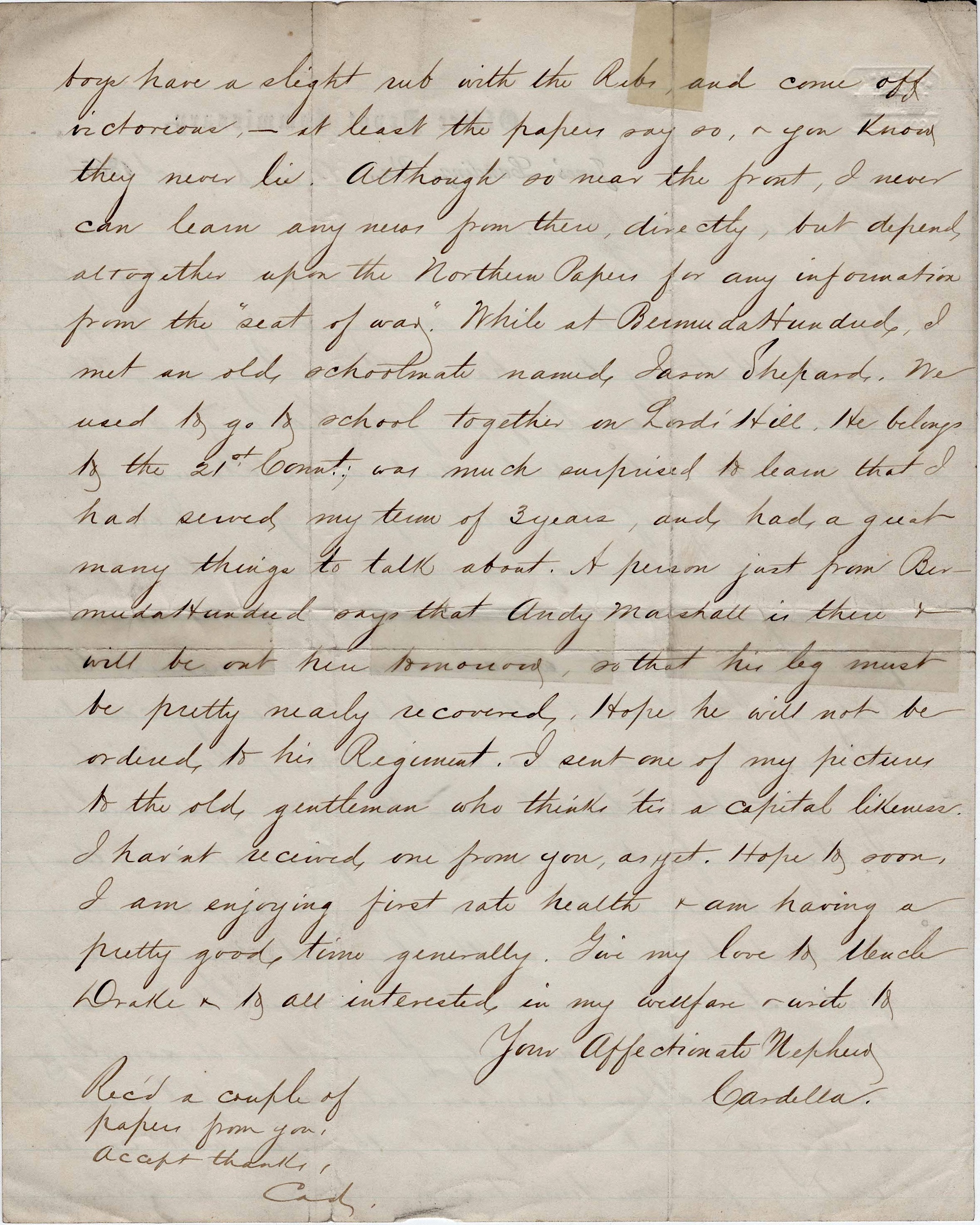
While at Bermuda Hundred, I met an old schoolmate named Jason Shepard. We used to go to school together on Lord’s Hill [in Hartford]. He belongs to the 21st Connecticut. Was much surprised to learn that I had served my term of three years and had a great many things to talk about. 1
A person just from Bermuda Hundred says that Andy Marshall is there & will be out here tomorrow, so that his leg must be pretty nearly recovered. Hope he will not be ordered to his Regiment. 2
I sent one of my pictures to the old gentleman who thinks tis a capital likeness. I haven’t received one from you as yet. Hope to soon. I am enjoying first rate health & am having a pretty good time generally. Give my love to Uncle Drake & to all interested in my welfare or write to your affectionate nephew, – Cardella
Received a couple of papers from you. Accept thanks, — Card.
1 Jason J. Shepard (1841-1916) served in Co. A of the 21st Connecticut Infantry from 5 September 1862 until 22 November 1863 when he was transferred to the US Signal Corps. He was discharged from th service in June 1865.He was born in western Massachusetts but in 1860 was residing in Hartford, Connecticut. After the war he married and settled in Hartford until late in life when he moved to California.
2 Andrew Marshall was the 2nd Lieutenant of Co. B, 6th Connecticut Infantry.
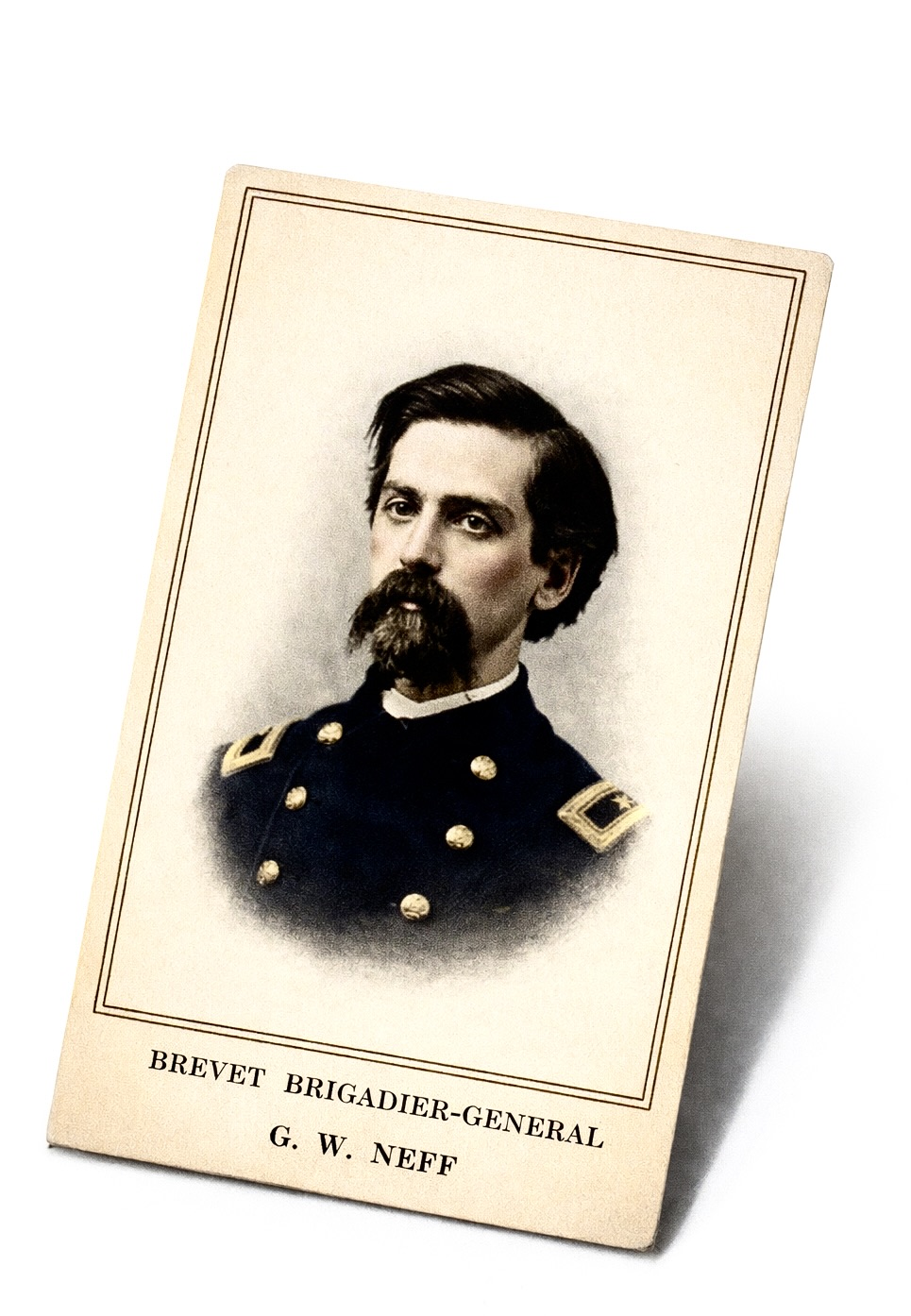
The following letter was written by George Washington Neff (1833-1892), the son of George Washington Neff (1800-1850) and Maria White (1802-1871). It was penned less than a week following the firing on Fort Sumter in April 1861.
A biographical sketch of the author can be found on Find-A-Grave which reads: “Union Civil War Officer, Brevet Brigadier General. A native of Cincinnati, Ohio, he attended Woodward College and worked as a shoe merchant and an insurance agent.
Before the Civil War, he served with the Rover Guards, a detachment of local militia. In 1861, he was appointed to organize the 2nd Kentucky Infantry, comprised mostly of Ohio soldiers, at Camp Harrison in Hamilton County, Ohio. He led the regiment into western Virginia where he was captured by Confederate forces during a skirmish at Scary Creek on July 17, 1861, and held as a prisoner of war for thirteen months.
After he was paroled, he returned to Cincinnati and commanded Camp Dennison when the camp was threatened by Confederate General John Hunt Morgan’s raid into Ohio. He then served briefly on the staff of Major General Lew Wallace in Cincinnati. He was commissioned as a Colonel in 1863 and assigned to organize the 88th Ohio Volunteer Infantry, also known as the “Governor’s Guard,” at Camp Chase in Columbus, Ohio. He was the regiment’s commanding officer during guard duty at the camp’s prison. He received a brevet promotion from Colonel to Brigadier General on March 13, 1865. Bio by: K Guy”
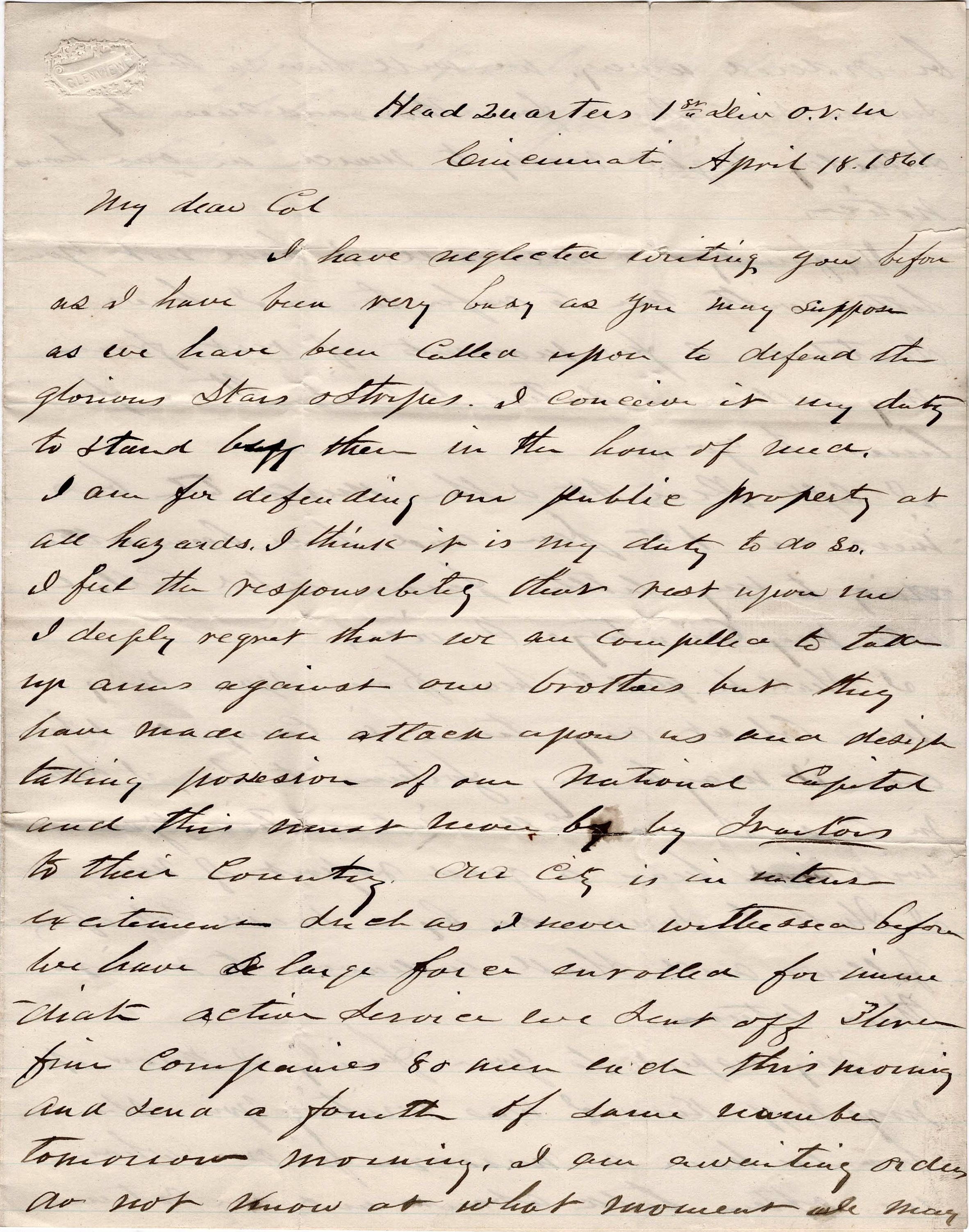
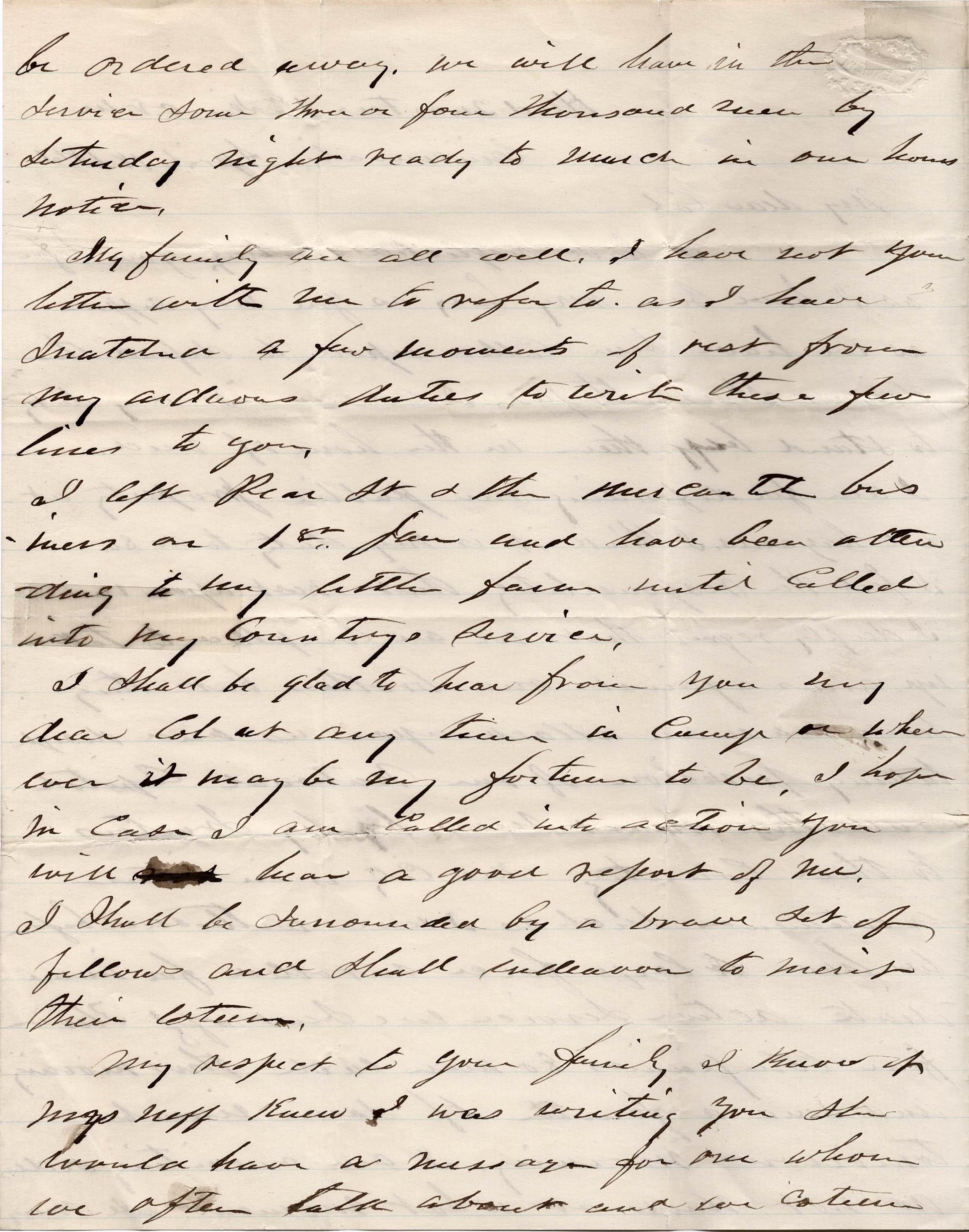
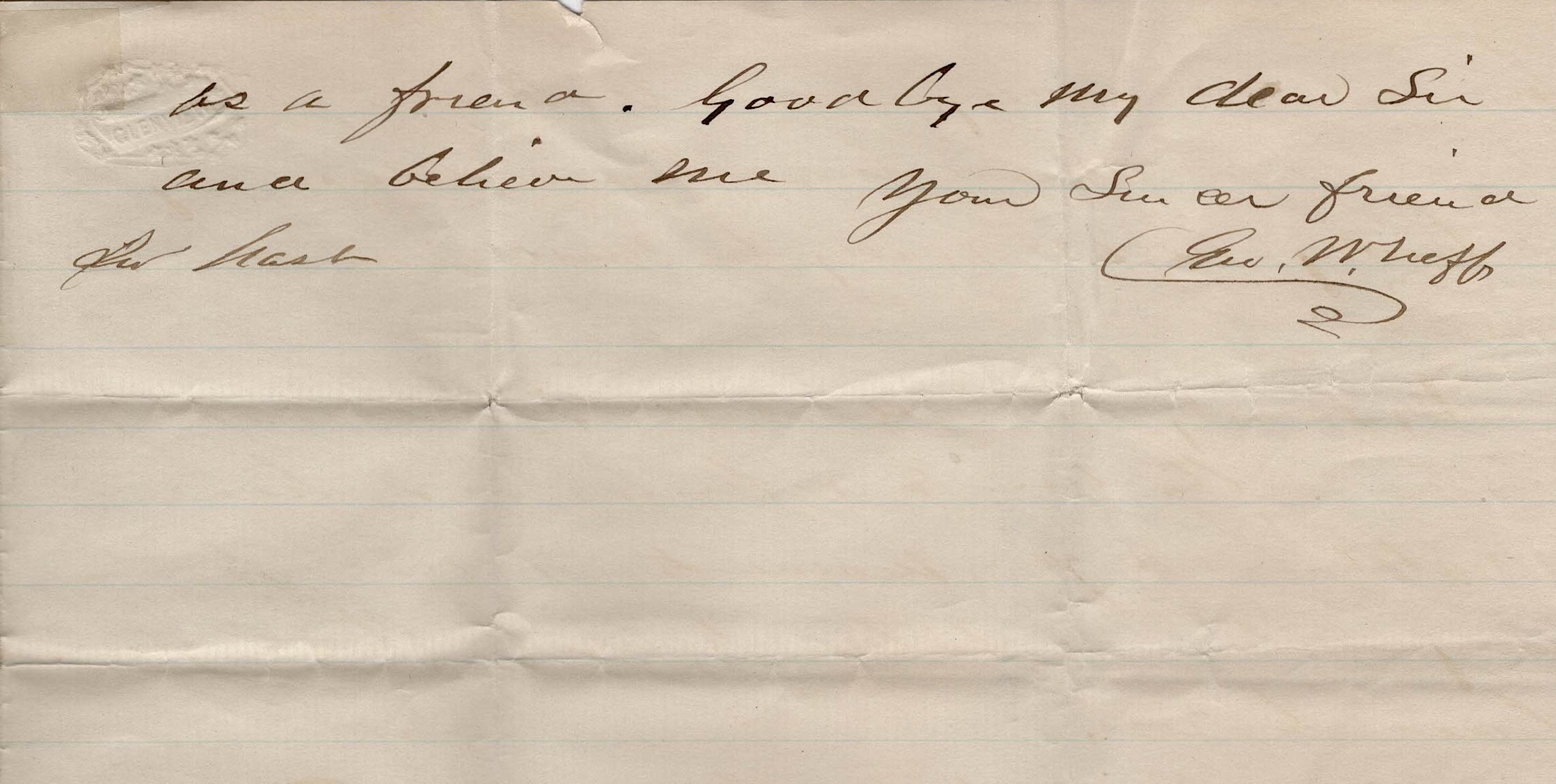
I have neglected writing you before as I have been very busy as you may suppose as we have been called upon to defend the glorious Stars & Stripes. I conceive it my duty to stand busy then in the hour of need. I am for defending our public property at all hazards. I think it is my duty to do so. I feel the responsibility that rests upon me. I deeply regret that we are compelled to take up arms against our brothers but they have made an attack upon us and design taking possession of our National Capitol and this must never be by traitors to their country.
Our city is in intense excitement such as I never witnesses before. We have a large force enrolled for immediate action service. We sent off three fine companies, 80 men each this morning, and sent a fourth off, same number tomorrow. I am awaiting orders [and] do not know what moment I may be ordered away. We will have in the service some three or four thousand more by Saturday night ready to march in an hour’s notice.
My family are all well. I have not your letter with me to refer to as I have snatched a few moments of rest from my arduous duties to write these few lines to you.
I left Pear Street and the mercantile business on 1st January and have been attending to my little farm until called into my country’s service. I shall be glad to hear from you, my dear Colonel, at any time in camp or wherever it may be my fortune to be. I hope in case I am called into action you will hear a good report of me. I shall be surrounded by a brave set of fellows and shall endeavor to merit their esteem.
My respect to your family. I know if Mrs. Neff knew I was writing you she would have a message for one whom we often talk about and we [ ] as a friend. Goodbye my dear sir, and believe me your sincere friend, — Geo. W. Neff
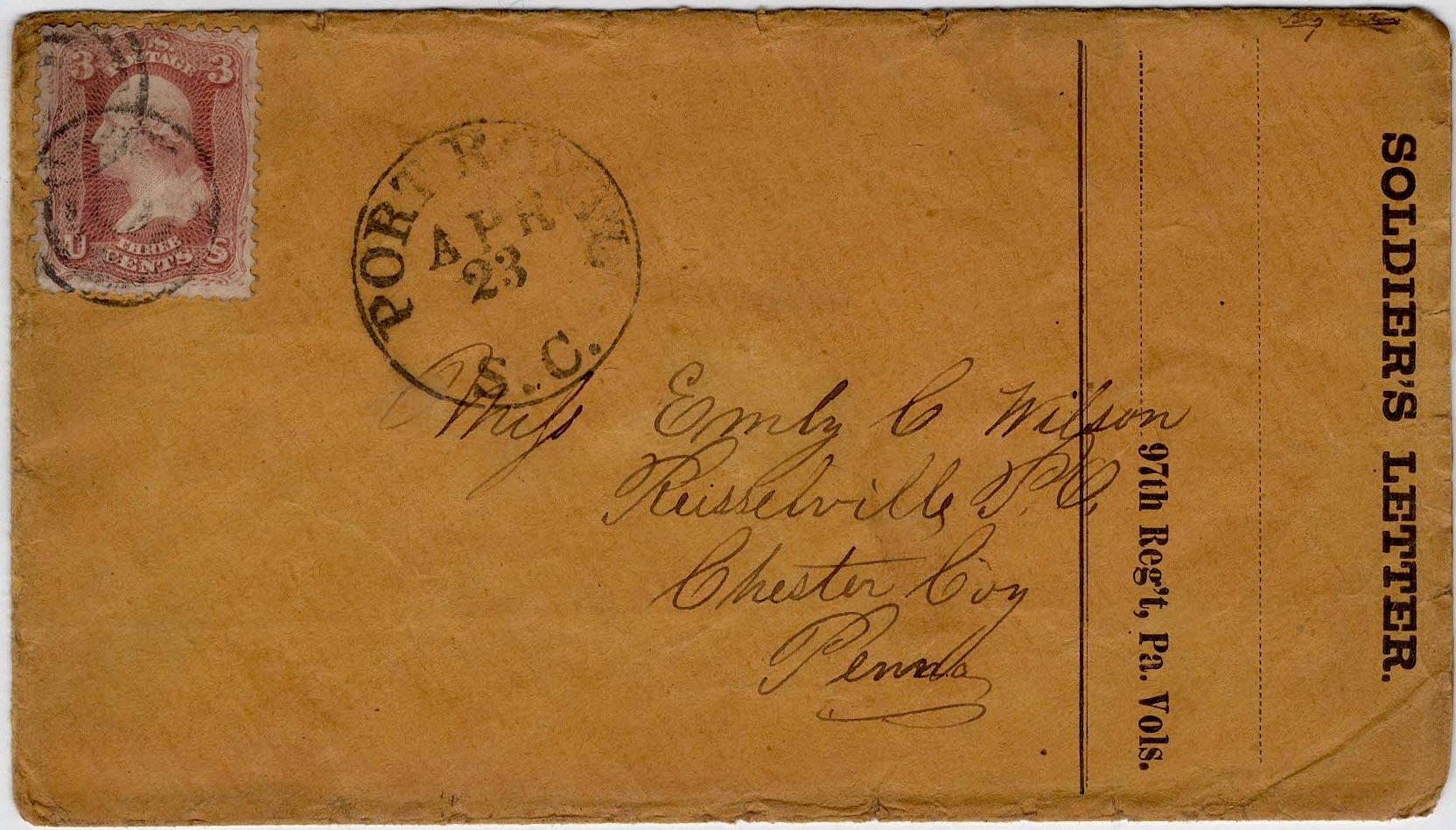
The following letter was written by Benjamin Linton (1841-1903), the son Hezekiah Linton (1789-1858) and Elizabeth Hibbard Davis (1805-1886) of West Fallowfield, Chester county, Pennsylvania. Benjamin was working as a school teacher in Cochranville, Pennsylvania, where, at age 20, he enlisted in Co. B, 97th Pennsylvania Infantry. He reenlisted as a veteran at Fernandina, Florida on Mar. 15, 1864, to date Jan 1, 1864 and was wounded in the left hip during the action at Petersburg Mine (Battle of the Crater) on July 30, 1864. He was absent at muster out on account of wounds while in the U. S. Hospital at Hampton, Virginia, and was discharged at the hospital to date August 28, 1865.
He was working as a clerk in Philadelphia when he died of Brights disease in 1903. His widow was Rebecca (Roberts) Linton (1842-1933).
To read other letters by member of the 97th Pennsylvania Infantry, see: John L. Hosmer, F&S, 97th Pennsylvania (1 Letter) Harvey Kauffman, Co. C, 97th Pennsylvania (1 Letter) Isaac Smedley, Co. C, 97th Pennsylvania (1 Letter)
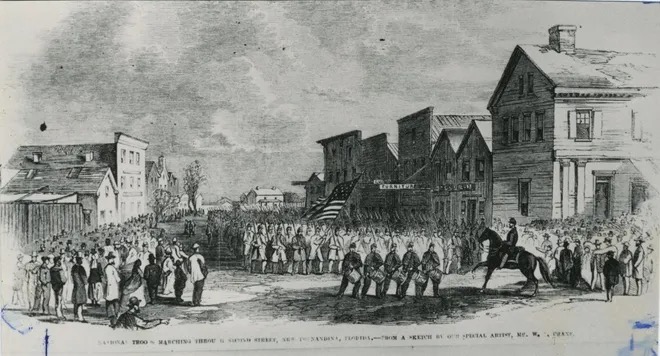
This image showing Union troops marching down Second Street in Fernandina, was published on March 4, 1862.
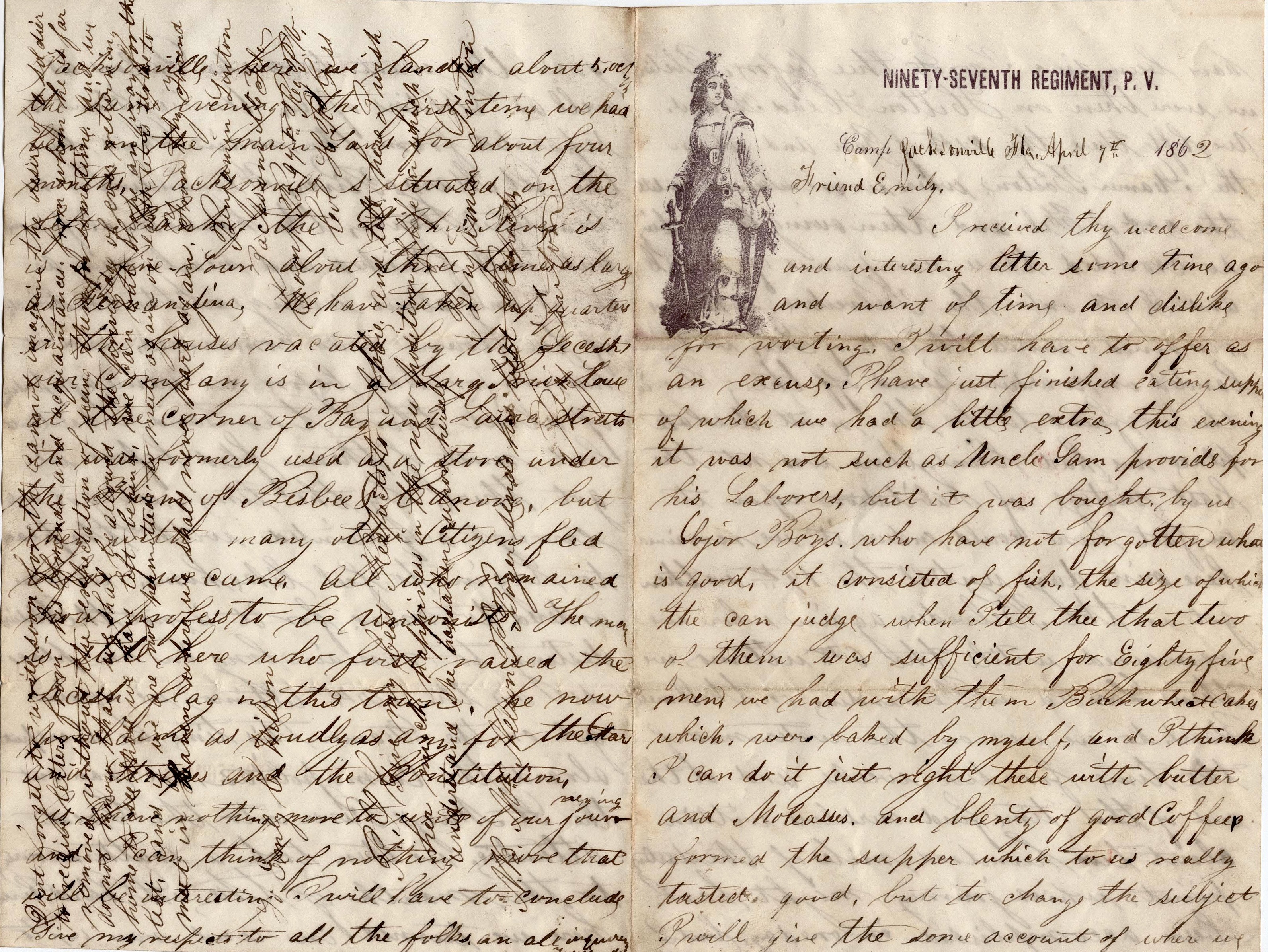
T R A N S C R I P T I O N
Jacksonville, Florida April 7th 1862
Friend Emily,
I received thy welcome and interesting letter some time ago and want of time and dislike for writing I will have to offer as an excuse. I have just finished eating supper of which we had a little extra this evening. It was not such as Uncle Sam provides for his labors, but it was bought by us Soger Boys who have not forgotten what is good. It consisted of fish the size of which thee can judge when I tell thee that two of them was sufficient for 85 men. We had with them buckwheat cakes which were baked by myself and I think I can do it just right. These with butter and molasses and plenty of good coffee formed the supper which to us really tasted good. But to change the subject I will give the same account of where we have been since I wrote before.
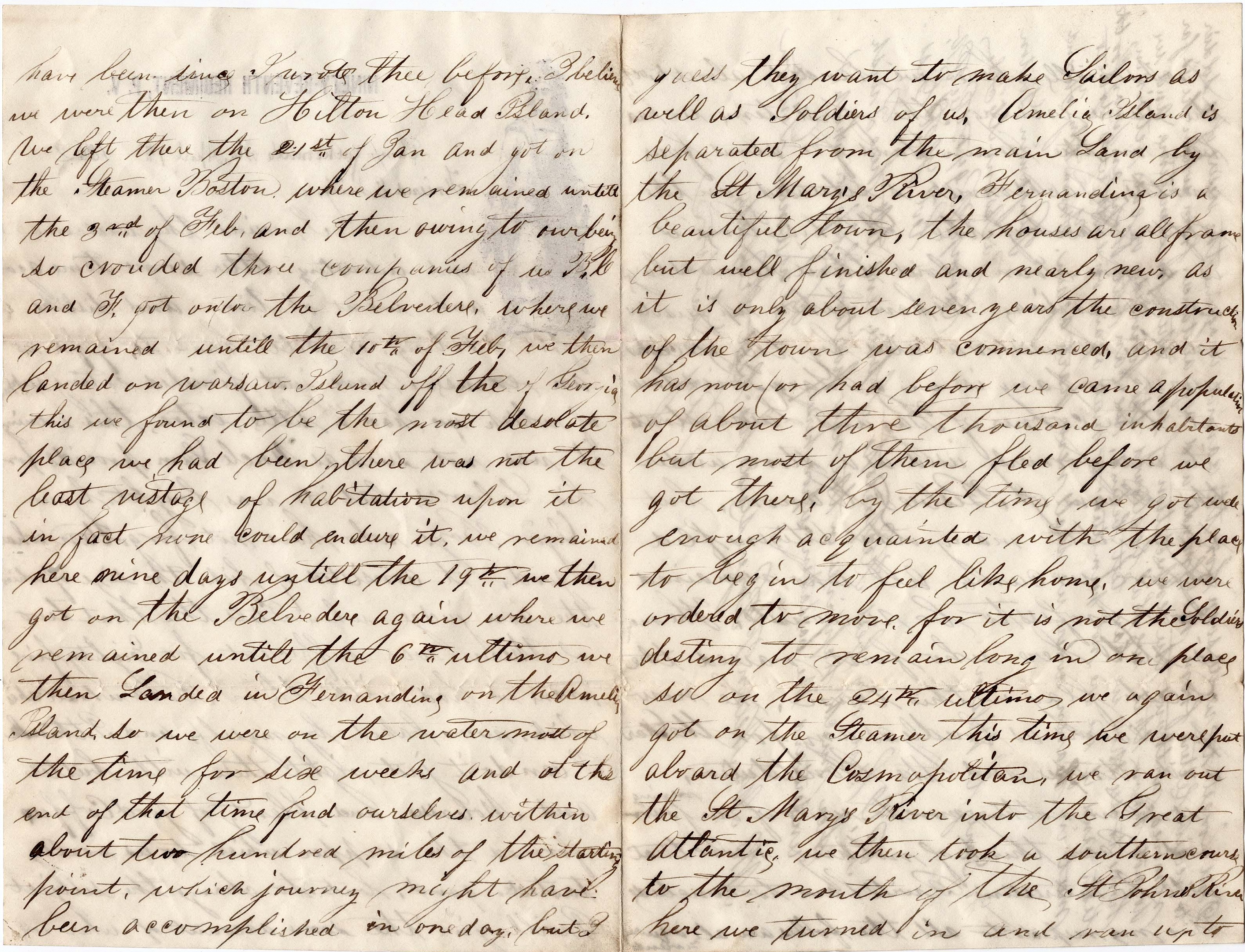
I believe we were then on Hilton Head Island. We left there the 21st of January and got on the Steamer Boston where we remained until the 3rd of February, and then owing to our being so crowded, three companies of us, B, C, &F, got onto the Belvedere where we remained until the 10th of February. We then landed on Warsaw Island off the Georgia [coast]. This we found to be the most desolate place we had been. There was not the least vestige of habitation upon it. In fact, none could endure it. We remained here nine days until the 19th. We then got on the Belvedere again where we remained until the 6th ultimo. We then landed in Fernandina on the Amelia Island, so we were on the water most of the time for six weeks and at the end of that time find ourselves within aboyut two hundred miles of the starting point, which journey might have been accomplished in one day. But I guess they want to make sailors as well as soldiers of us.
Amelia Island is separated from the mainland by the St. Mary’s River. Fermandina is a beautiful town. The houses are all frame but well finished and nearly new, as it is only about seven years [since] the construction of the town commenced and it has now (or had before we came) a population of about three thousand inhabitants. But most of them fled before we got there. By the time we got well enough acquainted with the place to begin to feel like home, we were ordered to move for it is not the soldier’s destiny to remain long in one place. So on the 24th ultimo, we again got on the Steamer. This time we were put aboard the Cosmopolitan. We ran out the St. Mary’s River into the great Atlantic. We then took a southern course to the mouth of the St. John’s River. Here we turned in and ran up to Jacksonville. Her we landed about 5 o’clock the same evening—the first time we had been on the mainland for about four months.
Jacksonville is situated on the left bank of the St. John’s River. It is a fine town—about three times as large as Fernandina. We have taken up quarters in the houses vacated by the Secesh. Our company is in a large brick house at the corner of Bay and Laura Streets. It was formerly used as a store under the firm of Bisbee & Canove, but they with many other citizens fled before we came. All who remained now profess to be Unionists. The man is still here who first raised the Secesh flag in this town. He now proclaims as loudly as any for the Stars & Stripes and the Constitution. As I have nothing more to write of our journeying and I can think of nothing more that will be interesting, I will have to conclude. Give my respects to all the folks and all inquiring friends.
Don’t forget to write soon for thee cannot imagine the desire of a soldier to receive letters from his friends and acquaintances from whom he is so far ermoved without the expectation of seeing them for some time. And we do not know that we shall be allowed the privilege of ever returning home to see those we have left behind. We can but hope and pray for the best. And if we are not permitted to meet again on earth, let us meet in heaven where we shall never part again. From your friend, — Benjamin Linton
Camp 97th Reg. P. V. Col. H[enry] R. Guss
P. S. Give my best respects to Abbie and tell her I wish her much happiness in the new position of life in which I understand she has taken upon herself. — Benjamin Linton
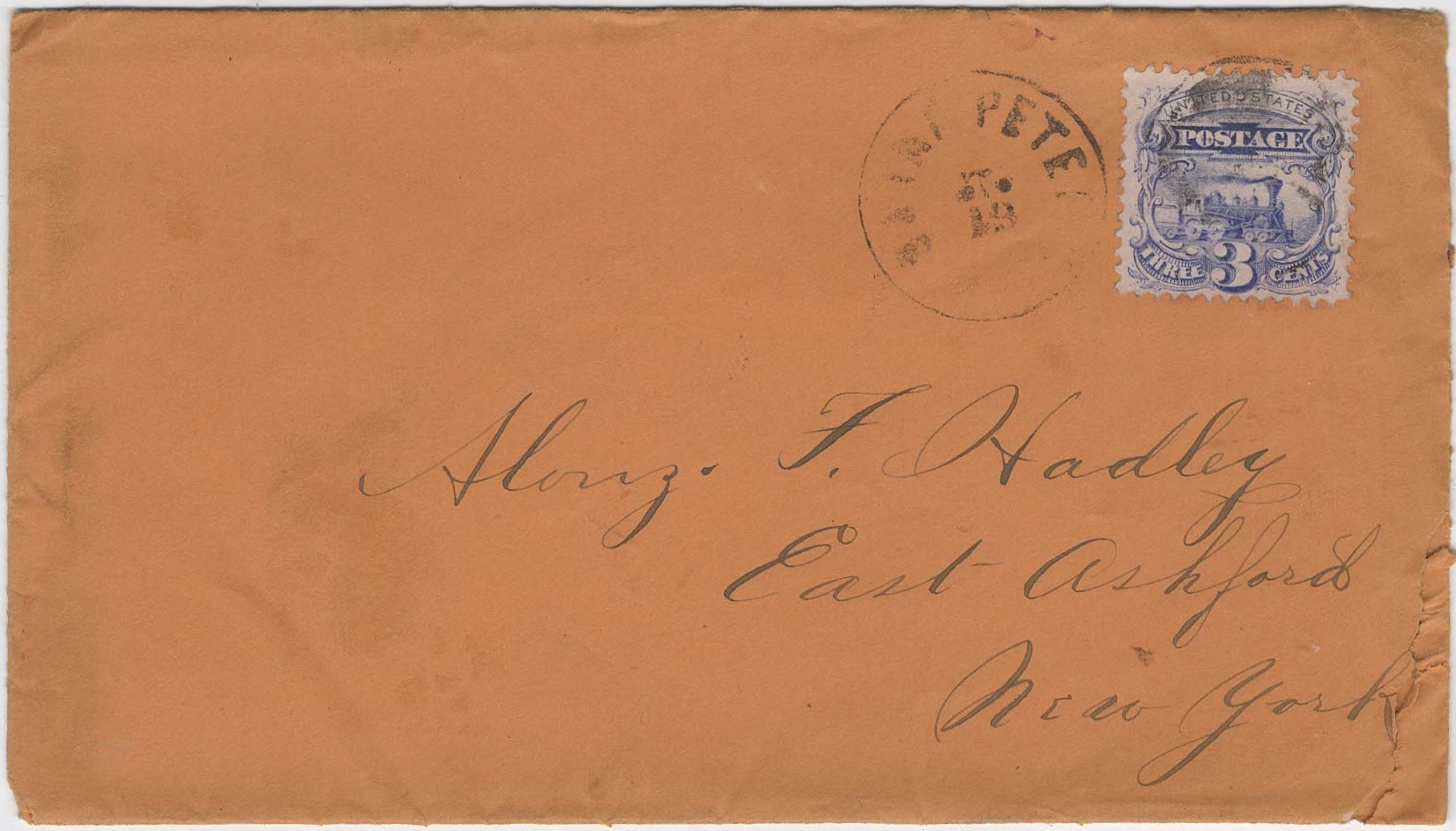
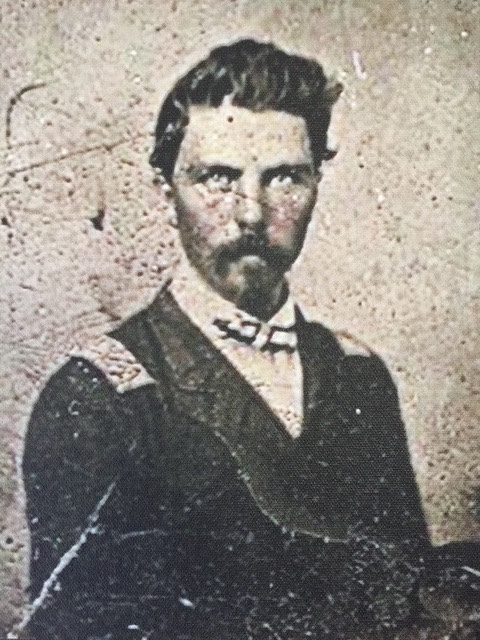
I believe this letter was likely written by John Warren Fletcher (1819-1895), the son of Adolphus Fletcher (1796-1866) and Sarah Stow (d. 1836). He wrote the letter to his cousin, Alonzo Fletcher Hadley (1817-1897) of Ashford, Cattaraugus county, New York. Alozo’s parents were Jesse Hadley (1781-1840) and Abigail Fletcher (1781-1860).
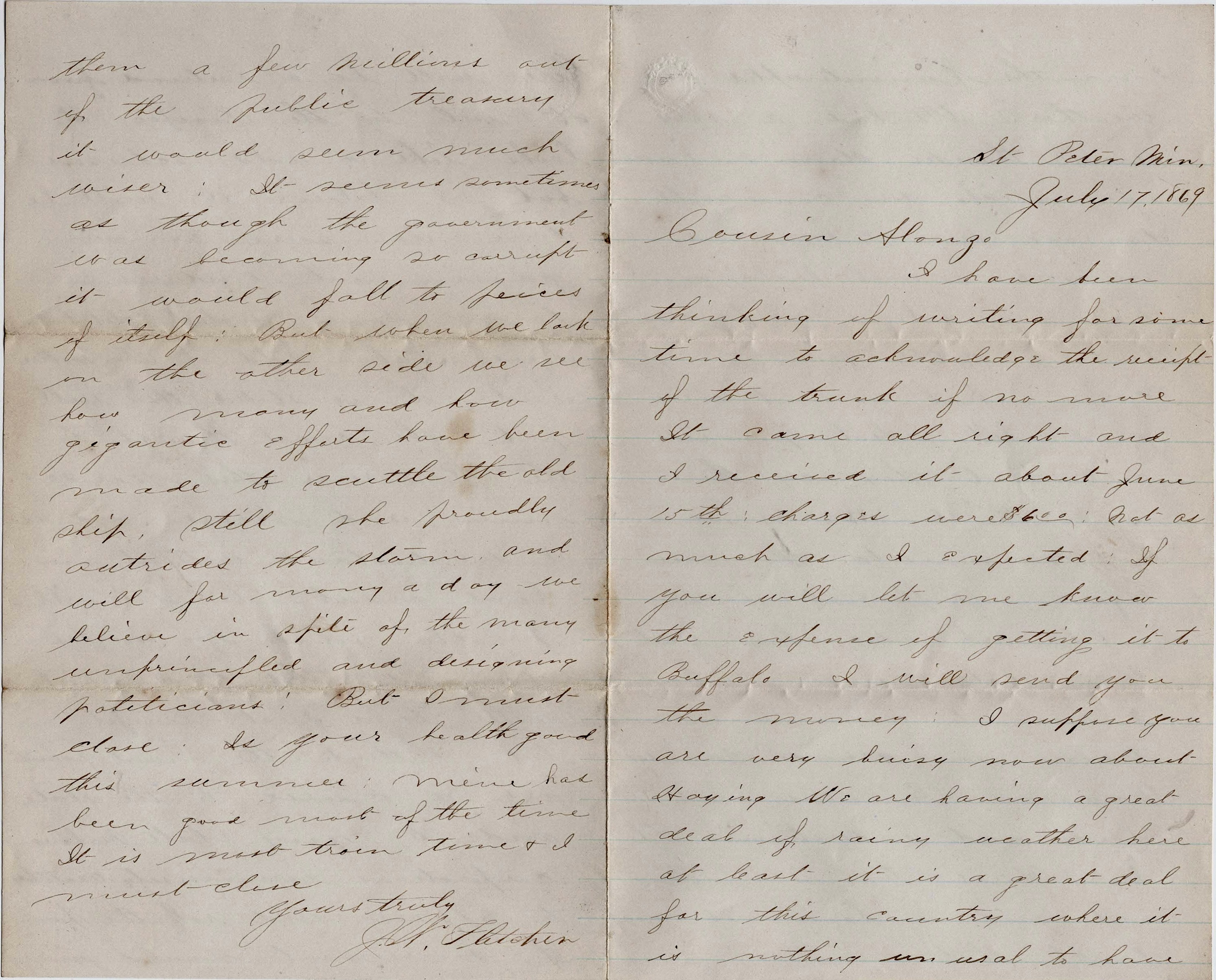
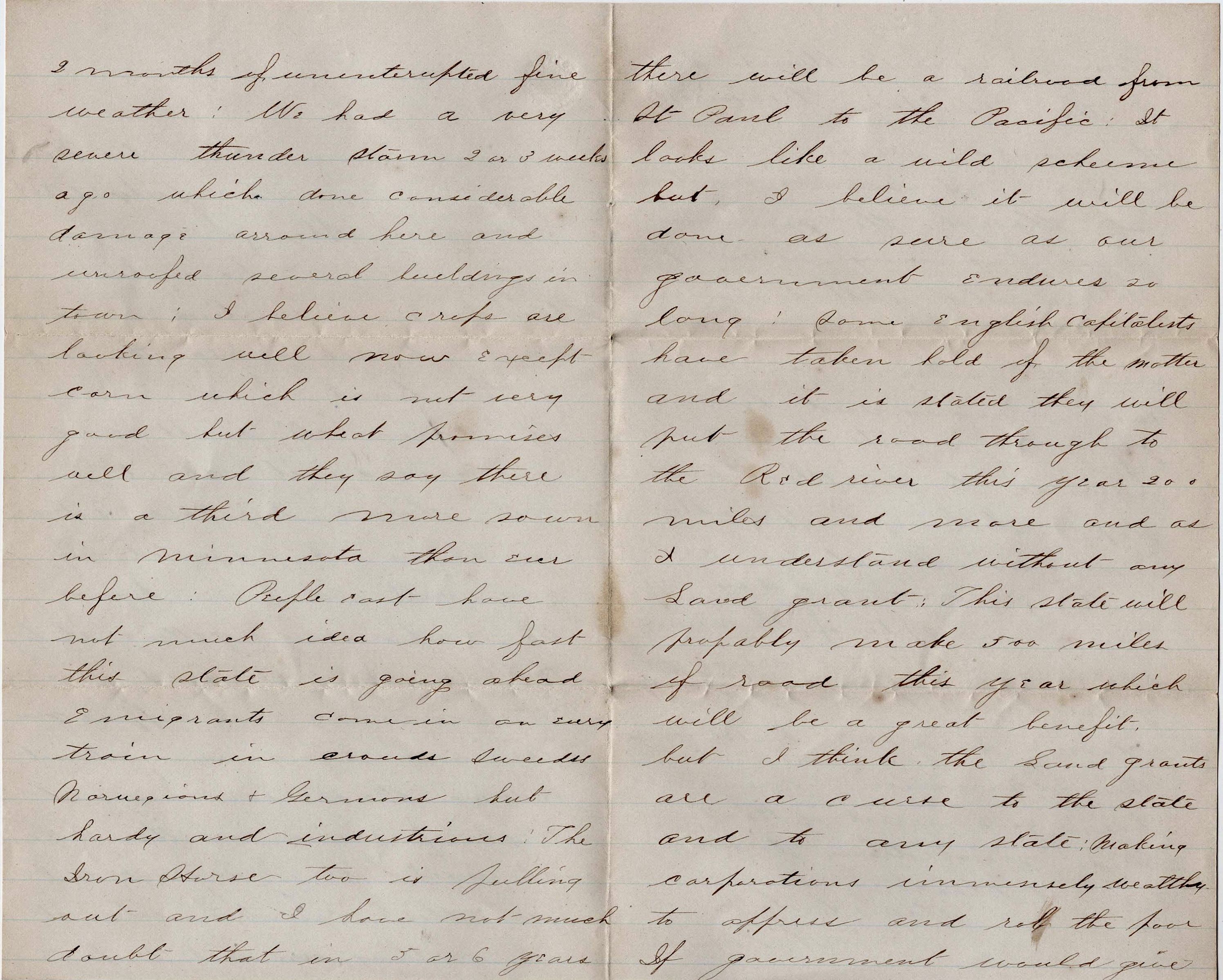
The letter conveys news of the rapid development of Minnesota by the influx of emigrants from Sweden, Norway, and Germany—all “hardy and industrious.” He also speaks of the laying of railroad tracks not only in Minnesota, but of the venture to complete a line all the way to the Pacific Ocean. Finally he speaks of the corruption of politicians.
T R A N S C R I P T I O N
Addressed to Alonzo F. Hadley, East Ashford, New York
St. Peter, [Nicollet county,] Minnesota July 17, 1869
Cousin Alonzo,
I have been thinking of writing for some time to acknowledge the receipt of the trunk if no more. It came all right and I received it about June 15th. Charge were $6—not so much as I expected. If you will let me know the expense of getting it to Buffalo, I will send you the money.
I suppose you are very busy now about haying. We are having a great deal of rainy weather here at last. It is a great deal for this country where it is nothing unusual to have two months of uninterrupted fine weather. We had a very severe thunder storm two or three weeks ago which done considerable damage around here and unroofed several buildings in town. I believe crops are looking well now except corn which is not very good but wheat promises well and they say there is a third more sown in Minneapolis than ever before.
People East have not much idea how fast this state is going ahead. Emigrants come in on every train in crowds—Swedes, Norwegians, and Germans—but hardy and industrious. The Iron Horse too is pulling out and I have not much doubt that in 5 or 6 years there will be a railroad from St. Paul to the Pacific. It looks like a wild scheme but I believe it will be done as sure as our government endures so long. Some Englist capitalists have taken hold of the matter and it is started. They will put the road through to the Red River this year 200 miles and more and as I understand without any Land Grant. This state will probably make 500 miles of road this year which will be a great benefit. But I think the Land Grants are a curse to the state and to any state making corporations immensely whether to oppress and rob the poor. If government would give them a few millions out of the public treasury, it would seem much wiser.
It seems sometimes as though the government was becoming so corrupt it would fall to pieces of itself. But when we look on the other side, we see how many and how gigantic efforts have been made to scuttle the old ship. Still she proudly outrides the storm and will for many a day, we believe, in spite of the many unprincipled and designing politicians.
But I must close. Is your health good this summer? Mine had been good most of the time. It is most train time and I must close. Yours truly, — J. W. Fletcher
The following letter was written by Uriah “Jasper” VanPelt (1846-1864), the son of Uriah VanPelt (1802-1846) and Elmira Daugherty (1809-1899) of Anderson, Madison county, Indiana. Jasper wrote the letter to his older brother, Francis (“Frank”) Marion VanPelt (1838-1930) who served as a sergeant, later a 2nd Lieutenant, in Co. G, 17th Indiana Infantry. In his letter, Jasper mentions two siblings, Mathilda (“Tillie”) VanPelt (b. 1842), and William (“Bill”) Parker VanPelt (1844-1931) who joined Co. H of the 142nd Indiana Infantry in October 1864 as a fife and drum musician.
Jasper later enlisted in the Co. F, 137th Indiana Infantry—a unit organized in May 1864 to serve 100 days guarding Sherman’s supply line through Tennessee & Alabama during his Atlanta Campaign. Jasper died of disease at Tullahoma, Tennessee, on 24 August 1864 and his body was taken home by his brother Frank to be buried in the family plot in Maplewood Cemetery.
Lt. Frank VanPelt, Co. G, 17th Indiana Infantry
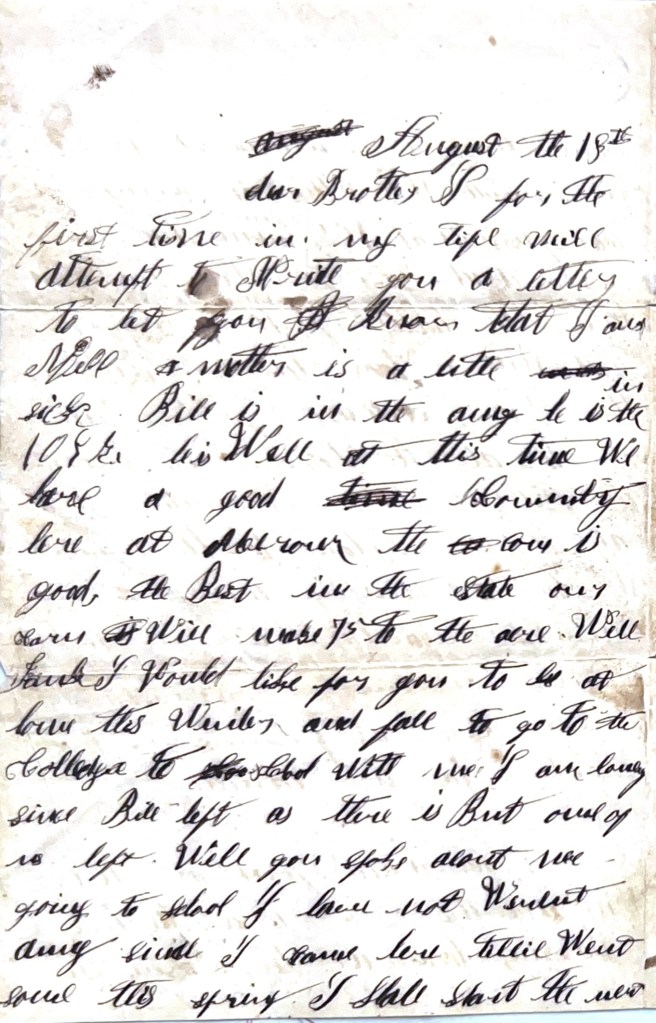
I was requested to transcribe this letter by Bradford Douglas, a descendant of the VanPelt family, who wrote me the following: “I have a letter not year dated from my 2nd great grandfather’s brother [Jasper]. He would die from disease in Tullahoma, TN on Aug. 24, 1864. My 2nd great grandfather [Frank] was with Wilders Brigade 17th Ind Co. G as a 1st Lieutenant and had received leave to see his dying brother. He was with him when he died and was granted leave to take him back to Anderson, Indiana, where he is buried in the family plot. This letter was written to my great grandfather while he was in service during the civil war. Some I can read but in full is really hard. He signs it Jasper as their father’s name was Uriah as well.” — Bradford Douglas
T R A N S C R I P T I O N
[Anderson, Indiana] August 18th [1863]
Dear Brother,
I for the first time in my life will attempt to write you a letter to let you know that I am well & Mother is a little sick. Bill is in the army. He is in the 109th. 1 He is well at this time. We have a good country [?] here at [ ]. The corn is good—the best in the State. Our corn will make 75 to the acre. Well, Frank, I would like for you to be at home this winter and fall to go to the College to school with me. I am lonely since Bill left.
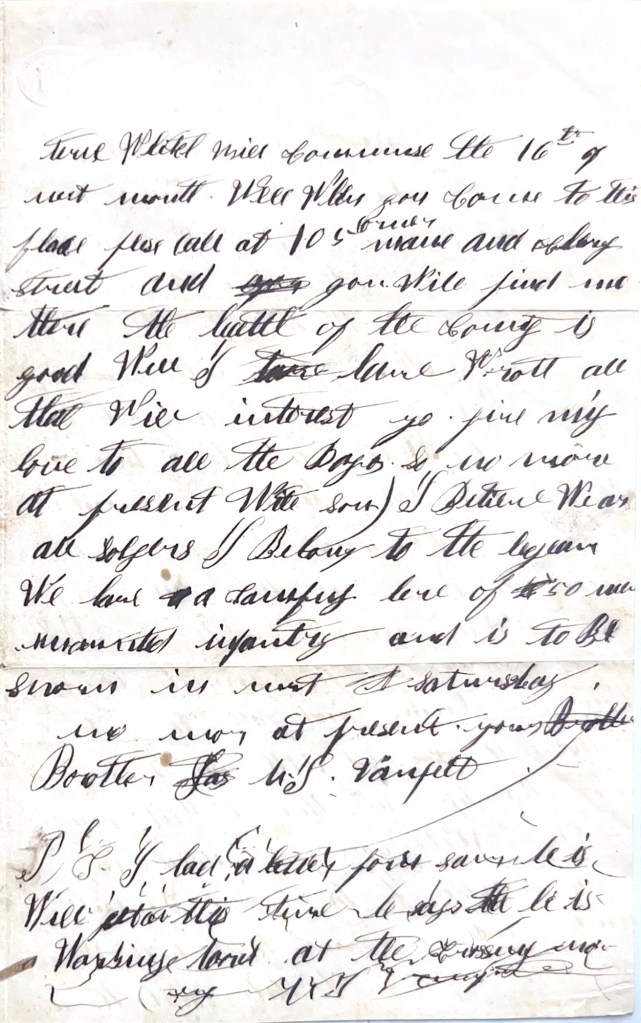
Well, you spoke about going to school. I have not went any since I came here. Tillie went some this spring. I shall start the next term. Winter [term] will commence the 16th of next month. Well, when you come to this place. please call at 105, corner of Main and College Street and you will find me there.
The cattle of the county is good. Well, I have wrote all that will interest you. Give my love to all the Boys. So no more at present. Write soon.
I believe we are all soldiers. I belong to the Legion. We have a company here of 50 men—mounted infantry—and is to be sworn in next Saturday. No more at present. Your brother, — Jas U. J. VanPelt
P. S. I had a letter from S___. He is well just at this time. He says he is W_____ at the [ ].
1 The only service record I can find for William P. VanPelt is the 142nd Indiana Infantry which he did not join until October 1864. His obituary claims that he served as a musician “throughout the war” as a member of the 115th Indiana Infantry. This regiment served for only 6 months beginning with the threat of Morgan’s Raiders, from August 1863 to February 1864. Though I don’t find him on the roster, my hunch is that he was with this regiment when the letter was written and that the letter was therefore written in August 1863 when Jasper was 17.