Warren Smith Leslie was born on 14 December 1841, the oldest son of Cyrus Leslie (1812-1848) and Elvira Smith (1809-1894). Following his father’s death in 1848, he was placed in the home of a farmer in Plymouth, Vermont, and remained involved in agriculture throughout his life. He served in Co. I of the 2nd Vermont Infantry during the Civil War, enlisting in 1861. He was honorably discharged in mid-February 1863 after many months in the hospital. His military records indicate he received a gunshot wound to his left chest though it doesn’t say when. Presumably it occurred in the Peninsula Campaign. He married Alice D. Newman (1847-1914) of Woodstock, Vermont, in 1866 and the couple moved to Kansas. He died in Osawatomie, Kansas, on 16 December 1913.
In this letter to his mother, Warren expresses disenchantment with the war and its officers from his bed in the Haddington General Hospital at Philadelphia.
Haddington Hospital in Philadelphia, PA.
T R A N S C R I P T I O N
Haddington Hospital [Philadelphia, Pa.] December 25th 1862
Dear Mother,
I received two letters from you and one from Henry yesterday. I was glad to hear from all of you once more. I don’t know as I am any better than I was when I wrote before and I have got so far from Washington now that I don’t know as I can get my discharge or a furlough either but I don’t know but they will send me to a hospital in Vermont by and by. I have got so that I don’t care much which way the world goes. They have kept me six months without pay and there isn’t any prospects of getting it for six to come.
I have written to the Captain for my Descriptive List so that I could draw my money and some clothes but he hadn’t never answered it nor sent the list either. The officers if our army are nothing but a set of rascals and thieves. They are making money out of it and that is all they care for. The rebels are bad enough but if they are traitors, they are honest men. What the most of our officers are and unless we have different leaders, the rebellion never will be put down. Now you see if my words don’t prove true. I have spoiled my health and constitution fighting for these money eaters but if I live to get out of this, they won’t catch me again.
You wrote that Warren Walker has got home. I never knew before that he had enlisted. What regiment was he in? An Iowa [regiment], I suppose, for I believe that is where he was when the war broke out. I must close for it is growing dark. Give my respects to all the brothers and sisters and to grandfather’s folks.
The following letter was written by William Paine Green (1838-1872), the son of Kendall Greene (1812-1841 and Mary Paine (1816-1898) of Foster, Providence county, Rhode Island. William enlisted in Co. K, 11th Rhode Island Infantry and survived the war to marry in 1865 with Miranda E. Tracy (1841-1905) but died in December 1872 leaving three children.
In the 1860 US Census, 22 year-old William was enumerated as boarders in the household of Providence jeweler Henry Anthony. Sharing a bed with him was Vincent Bowen, as 22 years old, both of them employed as carpenters. Vincent would marry William’s cousin, Julia E. Green (1840-1872) in 1863.
William’s letter was written on 19-20 April 1863 during the Siege of Suffolk by Longstreet’s Confederates.
T R A N S C R I P T I O N
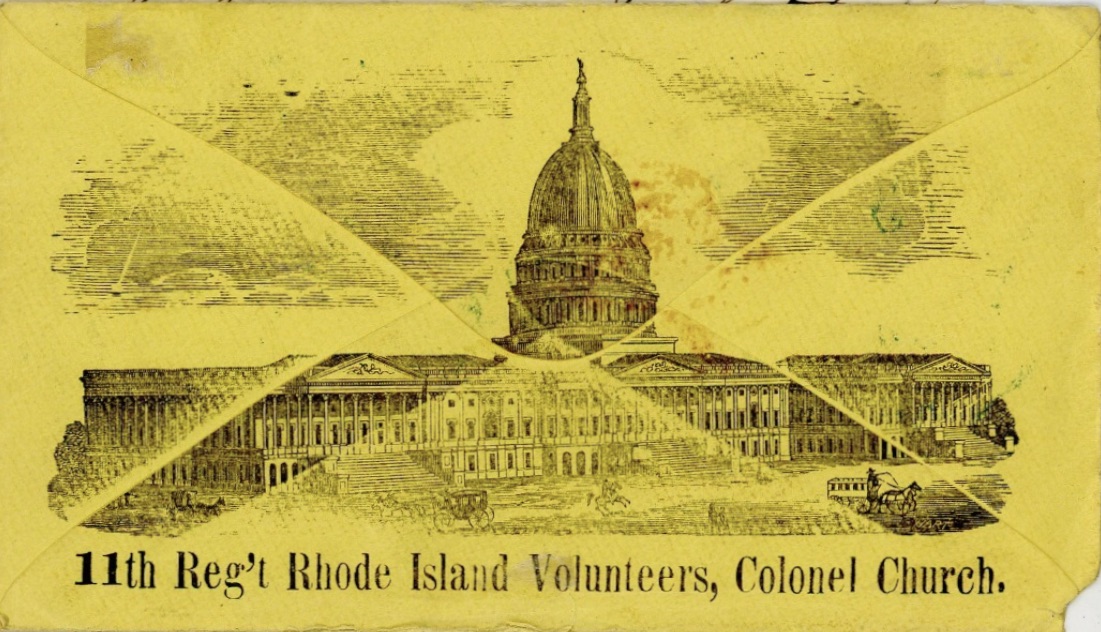
The back side of the envelope used to carry the letter to Providence, Rhode Island.
11th Regiment Rhode Island Volunteers, Co. K Camp near Suffolk, Va. April 19, 1863
Hello Julia,
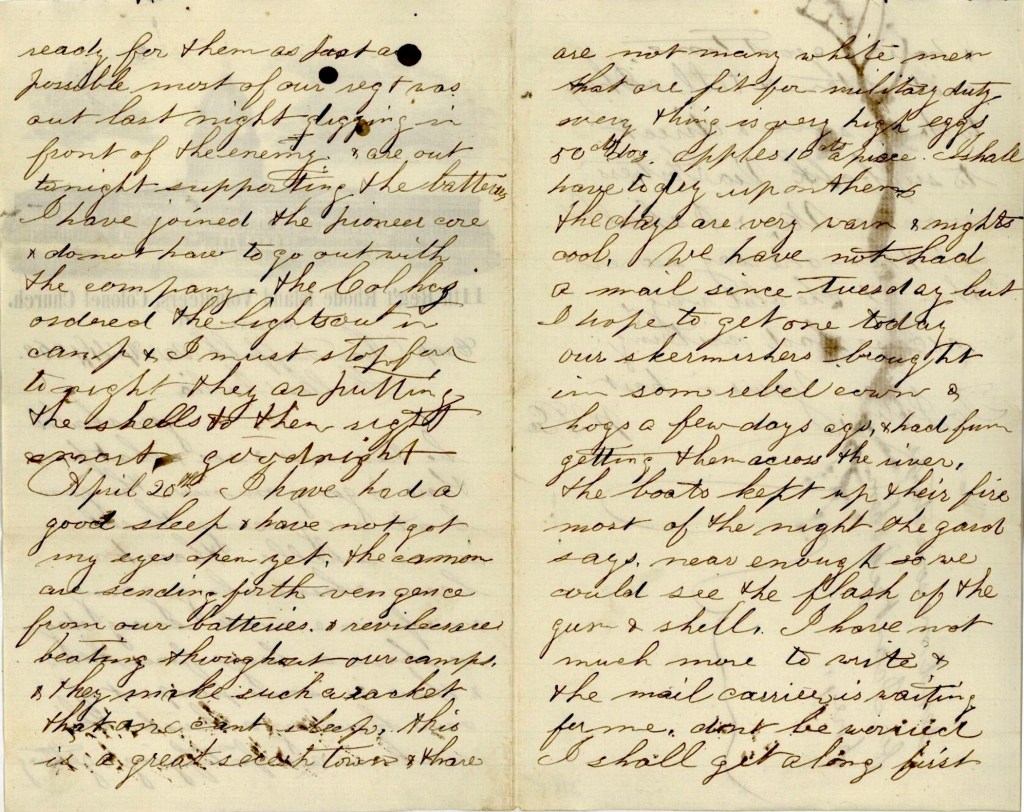
You should be here now & see what fun there is going on now. The gunboats are giving the rebs some shells. There has been skirmishing going on for one week everyday We have a large force here and there is some prospect of our having a brush this week. We are fortifying & getting ready for them as fast as possible. Most of our regiment was out last night digging in front of the enemy & are out tonight supporting the batteries. I have joined the Pioneer Corps and do not have to go out with the company. The Colonel has ordered the lights out in camp & I must stop for tonight. They are putting the shells to them right smart. Good night.
April 20th. I have not got my eyes open yet. The cannon are sending forth vengeance from our batteries & reveille’s are beating throughout our camps & they make such a racket that one can’t sleep. This is a great secesh town & there are not many white men that are fit for military duty. Everything is very high—eggs 50 cents a dozen, apples 10 cents apiece. I shall have to dry up on them.
The days are very warm & nights cool. We have not had a mail since Tuesday but I hope to get one today. Our skirmishers brought in some rebel cows and hogs a few days ago & had fun getting them across the river. The boats kept up their fire most of the night, the guards say near enough so we could see the flash of the gun and shells. I have not much more to write & the mail carrier is waiting for me. Don’t be worried. I shall get along first rate and have a good time. Write often and tell others to so the same & direct to Suffolk via Fortress Monroe, Va. & I shall get them. one day sooner than if the old way. Excuse bad writing. Yours in haste. — W. P. G.
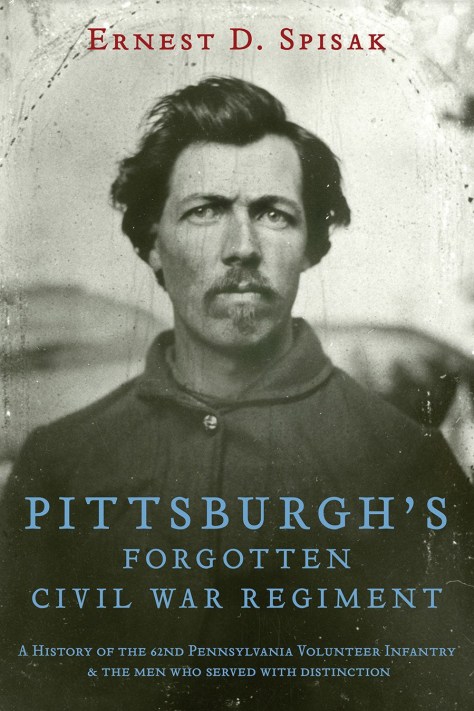
Jacket cover of Spisak’s book on the 62nd Pennsylvania Infantry.
The following letter was written by Alexander Mony (1836-1924), the son of Archibald Mohney (1809-1886) and Mary Catherine Heckman (1814-1884) of Clarion county, Pennsylvania. He wrote the letter to his brother-in-law, William J. Ditty, the wife of his older sister, Nancy Jane Mohney (1834-1907). After the war, Alexander would marry William Ditty’ younger sister, Sarah Jane Ditty (1840-1921).
Alexander enlisted in Co. E called “the Rimersburg Guards” in the summer of 1861, recruited by Thomas Kerr who would lead the company as part of the “33rd Independent Pennsylvania.” The regiment was organized at Pittsburg and left for Washington, D. C. on August 31, 1861. Their unit designation was changed, however, to the 62nd Pennsylvania Volunteers on November 18, 1861, just days before this letter was written. The 62nd Pennsylvania Infantry Regiment was stationed on Minor’s Hill in November 1861 after crossing the Potomac River and being assigned to the Second Brigade of General Porter’s Division.
In his book, “Pittsburgh’s Forgotten Civil War Regiment,” published in 2013, author Ernest Spisak informs us that he pulled the history of the 62nd Pennsylvania from 347 letters and diaries of the veterans of the regiment. I’m unaware if any of Mony’s letters were included in the history. This letter remains in private hands. The only other letters I have transcribed (to date) by a member of this regiment were those written by Will Dunn of Co. F (25 Letters), pictured below, courtesy of my friend Charles T. Joyce.
T R A N S C R I P T I O N
Headquarters 62nd [Pennsylvania] Regiment, Co. E Camp Minor’s Hill, Virginia November 24, 1861
Dear Brother in law,
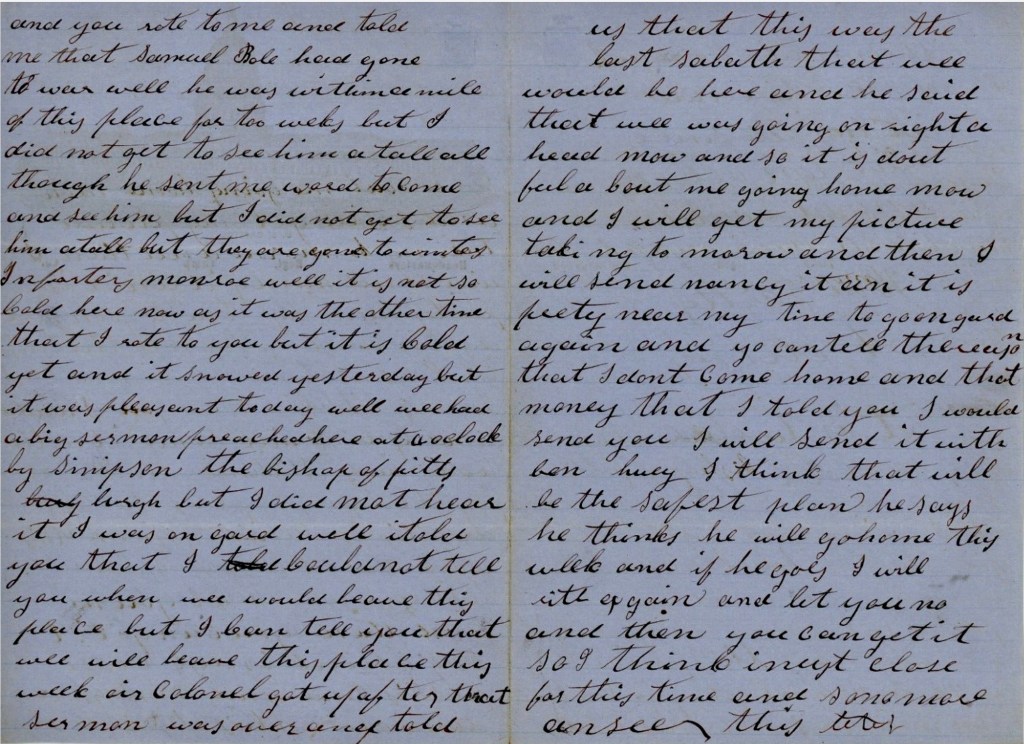
It is with the greatest of pleasure that I take my pen in hand to inform you that I am well at present and hoping that these few lines may find you all enjoying the same blessings & well. I heard from Mr. Cocren [Cochran] this morning and he is uneasy about me coming home again the next court and I guess there is no chance to go home ow at this time. We are expecting a fight before long and there will be no chance to go home at this time. If it was the next time the court comes, when then I could go home in spite of the devil. Then I would be in the army six months and then I would go home on furlough. There has a great many has tried to get a pass home and they could not get off. But I will do all that I can and if I can’t get off, why then I suppose they will in tait [?] and I can’t help it at all no how. And if I could be put off till the next court, I will. be home without doubt.
I went over to the Colonel this morning to see him but he was not at home and so then I went to General Morell and he said that he would not sign no furlough at this time. He said that if I was in the service six months, that there would be a chance to get off. That is about all that I can tell you about going home. And if you can do anything in that case, do so and that is all that I can ask of you. And I have got twenty dollars that I will send you.
Well, we are in Virginia yet and I can’t tell you when we will leave this place. I thought that we would a left this place a good while ago. The news was still that we was going to South Carolina on one of them big fleets but that has all fell through I guess and so I don’t care now where we go or when.
Well we had a big review last Wednesday [November 20] 1 and there was the small sum of seventy thousand—that is, of soldiers of course. There was a great many spectators that did not drill at all and it was the prettiest sight that I’ve seen in my life. There was a great many girl and a great many women and there was a good many old men and a great many that was not so old. Well we had that review handy [to] the rebels and they hoped for a fight and so we took twenty rounds of cartridges and our knapsacks and our overcoats and our haversacks and one day’s provision and so then we was prepared for the lads but they did not bother us at all. We got home safe and we did not see a rebel at all. But they still get some of our men and they will. get more of them for they do not care if they can get out. They run any place at all.
Well, this is the day that they call. Sunday in this place but it does not seem so to me at all for they are chopping wood and hauling and I am on guard today and there was a call made for six companies to go on picket guard and so they went and they seen a lot of the rebels working toward them and so they sent for the balance of the regiment and they are getting ready to go. And that leaves only us, about one hundred in the camp at this time.
You wrote to me and told me that Samuel Bole had gone to war. Well he was within a mile of this place for two weeks but I did not get to see him at all although he sent me word to come and see him. But I did not get to see him at all. But they are gone to winter in Fortress Monroe.
Well, it is not so cold here now as it was the other time that I wrote to you but it is cold yet and it snowed yesterday. But it was pleasant today. We had a big sermon preached here at 4 o’clock by [Matthew] Simpson, the Bishop of Pittsburgh, but I did not hear it. I was on guard. I told you that I could not tell you when we would leave this place but I can tell you that we will leave this place this week. Our colonel got up after that sermon was over and told us that this was the last Sabbath that we would be here and he said that we was going on right ahead now and so it is doubtful about me going. home now.
I will get my picture taken tomorrow and then I will send Nancy it. It is pretty near my time to g on guard again and you can tell the reason that I don’t come home and that money that I told you I would send you, I will send it with Ben Huey. I think that will be the safest plan. He says he thinks he will go home this week and if he goes, I will write again and let you know and then you can get it. So I think I must close for this time and so no more. Answer this. There is about one inch of snow here now. It has fell since about ten o’clock tonight and is still snowing yet. [To] William J. Ditty
[From] A. Mony
It is twelve o’clock now.
1 The Grand Review of the Army of the Potomac was held at Bailey’s Crossroads, Virginia, in eastern Fairfax County on 20 November 1861. Among those in attendance was President Abraham Lincoln.
I could not find an image of Charles but here is one of Perry Coleman of Co. C, 10th Massachusetts Infantry. He was killed at Fair Oaks in May 1862. (Doc Krausz Collection)
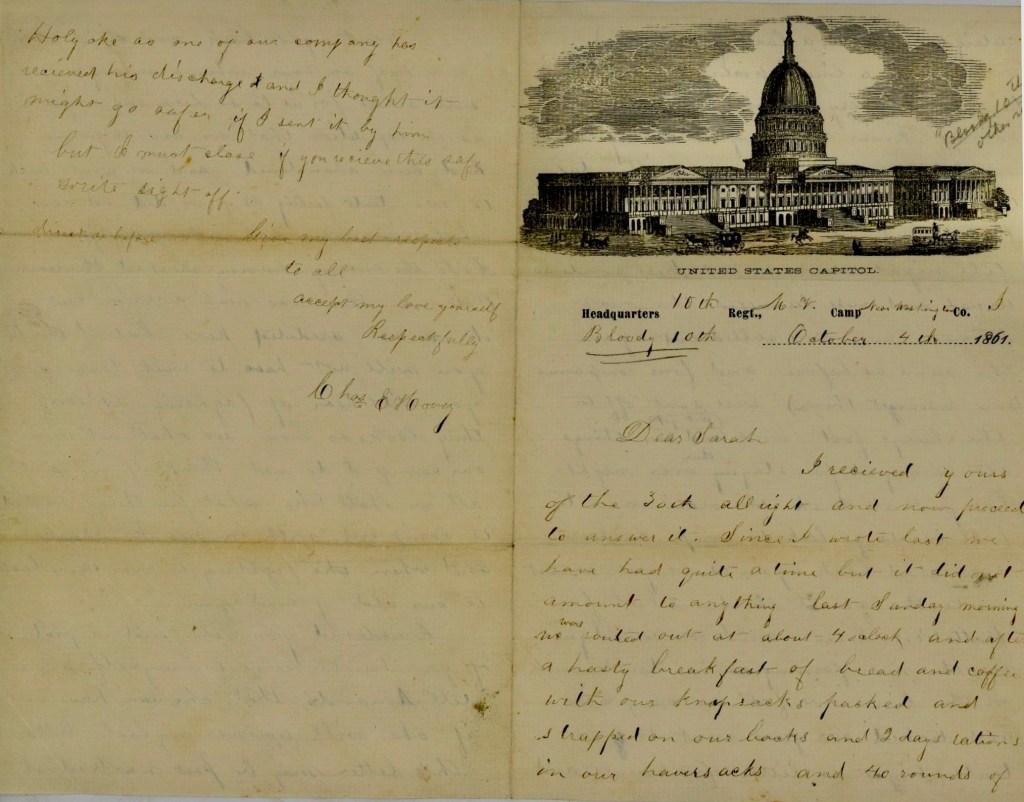
This letter was written by Charles E. Hovey (1843-1863) who enlisted on 21 June 1861 to serve three years in Co. I, 10th Massachusetts Infantry. He was with his regiment until the Battle of Chancellorsville where he was mortally wounded and died on 3 May 1863. Before his enlistment, Charles was employed making envelopes in a factory at Holyoke, Massachusetts.
Charles was the orphaned son of Ezekiel Hovey (1818-1859) and Mary M. Janes (1820-1854) of West Boyleston, Worcester county, Massachusetts.
T R A N S C R I P T I O N
Headquarters 10th Regiment Mass. Volunteers, Co. I Camp near Washington D. C. October 4th 1861
Dear Sarah,
I received yours of the 30th all right and now proceed to answer it.
Since I wrote last, we have had quite a time but it did not amount to anything. Last Sunday morning we were routed out at about 4 o’clock and after a hasty breakfast of bread and coffee, with out knapsacks packed and strapped on our backs and two days rations in our haversacks and 40 rounds cartridges (quite a load for 1 horse) we formed a line expecting to have to march every minute somewhere but no one knew where. After waiting about an hour, we broke ranks with orders to be ready to fall in at the sound of the drum but the drum did not sound till night and we had Dress Parade as usual and were dismissed.
The next forenoon we were called out again the same as before and four companies (ours amongst them) were sent off to the large fort and had just got our things all arranged for staying there over night but just at dusk the order came to fall in to go back to camp and we marched back again. As we got almost onto the ground, the drums beat for Battalion line and we could just see the men forming in double quick on the line. We fell in our places and stacked our guns, went to our tents to get a little refreshment, and went right back and stayed about half an hour when a messenger came with orders for us to be dismissed again as the expedition that we were to go on had been abandoned and we went back to our tents feeling as if we did not care whether we ever had a chance to fight.
As to the enemy’s having crossed the river Potomac, there was such a rumor but it is not credited here but I think you. will not have to wait long before you will hear of fighting as everything looks so now. We shall not move our camp. I do not think if we go at all we shall take what few things we need to camp out with in our knapsacks and when the fighting is over, come back to our old ground again.
Enclosed you will find a picture of your humble servant myself and tell Amanda that she can have one if she will answer my last letter. This letter may be post marked at Holyoke as one of our company has received his discharge and I thought it might go safer if I sent it by him. But I must close. If you receive this safe, write right off. Give my best respects to all. Accept my love yourself. Respectfully, — Charles E. Hovey
I could not find an image of Jacob but here is Dennis LaGrave who also served in the 92nd New York Infantry (Photo Sleuth)
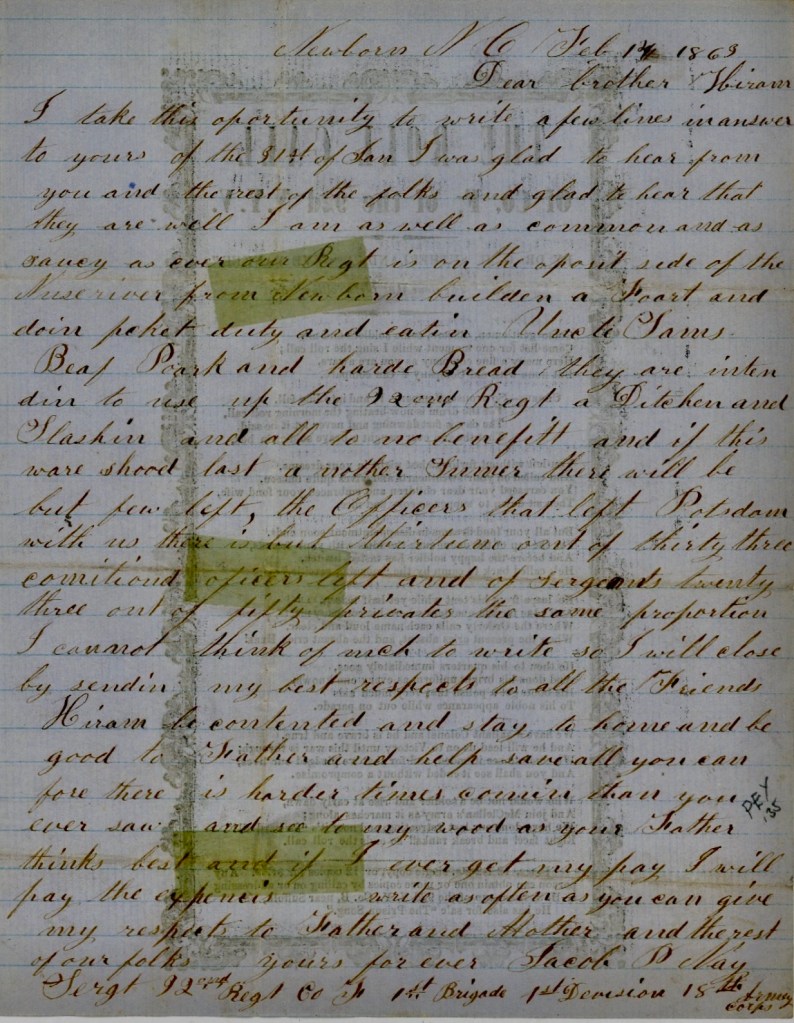
The following letter was written by Jacob Phelps Nay (1831-1908) who enlisted at Potsdam on 15 October 1861 when he was 30 years old to serve 3 years in Co. F, 92nd New York Infantry. He mustered in as a sergeant and was transferred to Co. H on 11 June 1863. He was discharged from the regiment on 16 June 1863.
Jacob was the son of Benjamin Franklin Nay (1804-1873) and Lucy W. Phelps (1807-1857). His letter is addressed to “brother Hiram” which is odd because I don’t see him listed among his siblings unless perhaps he was a brother-in-law. It should be noted that the family surname is occasionally spelled Ney.
The letter is written on the back side of a poem composed by 48 year-old Dr. German Haight Sutherland (1814-1867), a physician from Hermon, St. Lawrence county, who served in Co. B of the 92nd New York Infantry. He wrote several poems during his time in the service including such titles as “Prison song”, “T’was on the thirty-first of May”, Father Abraham”, and others.
The fort being built by “ditchin’ and slashin’ on the north bank opposite New Bern by the 92nd New York was Fort Anderson. It would come into play a month after this letter was penned during D. H. Hill’s campaign to recapture New Bern.
T R A N S C R I P T I O N
Newbern, North Carolina February 14, 1863
Dear brother Hiram,
I take this opportunity to write a few lines in answer to yours of the 31st of January, I was glad to hear from you and the rest of the folks and glad to hear that they are well. I am as well as common and as saucy as ever. Our regiment is on the opposite side of the Neuse river from Newbern building a fort and doing picket duty and eating Uncle Sam’s beef, pork, and hard bread. They are intending to use up the 92nd Regiment a ditching and slashing and all to no benefit and if this war should last another summer, there will be but few left. The officers that left Potsdam with us, there is but thirteen out of thirty-three commissioned officers left, and of sergeants, twenty-three out of fifty. Privates the same proportion. I cannot think of much to write so I will close by sending my best respects to all the friends.
Hiram, be contented and stay to home and be good to Father and help save all you can for there is harder times coming than you ever saw and see to my wood as your Father thinks best. And if I ever get my pay, I will pay the expenses. Write as often as you can. Give my respects to Father and Mother and the rest of our folks. Yours forever, — Jacob P. Nay, Sergeant 92nd Regiment, Co. F, 1st Brigade, 1st Division, 18th Corps.
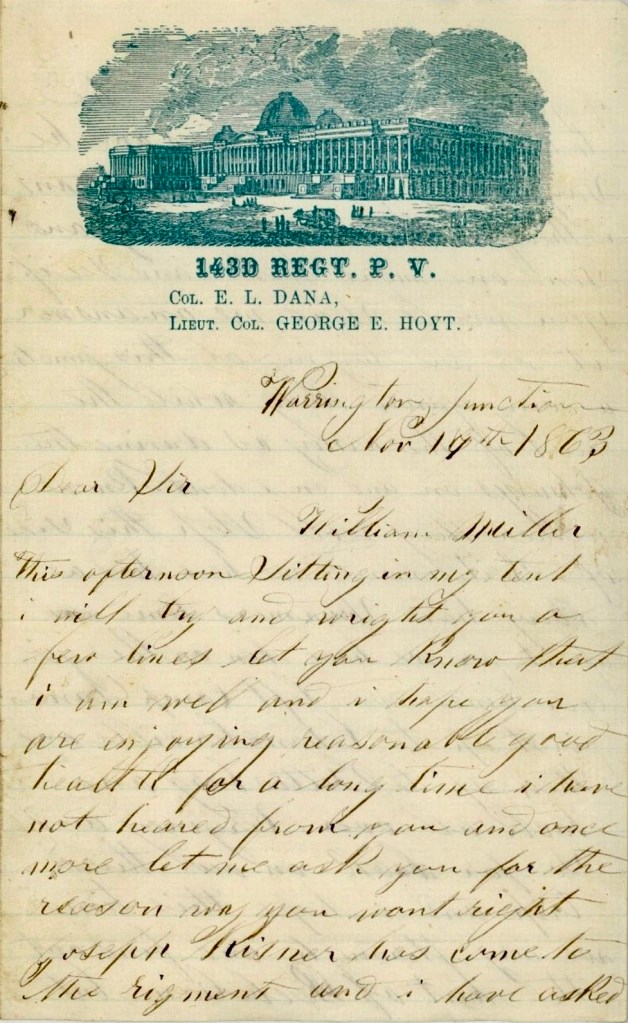
The following letter was written by Walters (“Walt”) Hufman who enlisted in Co. F, 143rd Pennsylvania Infantry on 8 September 1862 and died at Alexandria, Virginia, on 19 June 1864 of a gunshot wound to his right ankle [another source says abdomen] received in action two days earlier. Walter was a blacksmith in Harveyville, Luzerne county, Pennsylvania before he enlisted. He was married to Albina (Downing) Hufman (1835-1881) in 1858.
T R A N S C R I P T I O N
Warrington Junction November 17th 1863
Dear sir—William Miller,
This afternoon sitting in my tent I will try and write you a few lines [to] let you know that I am well and I hope you are enjoying reasonably good health. For a long time I have not heard from you and once more let me ask you for the reason you won’t write. Rosner has come to the regiment and I have asked if you was there yet and he told me that you was and he says that you have wrote and I thought that I would try and send one more letter and see if you would send me an answer.
We are lying at this junction a doing guard duty while the rest of the army is driving the Johnnies on and on. I don’t know whether they will stop this side of Richmond. We have had a very hard summer’s time of it for we have been on the go ever since we left Camp Dana. First up to Chancellorsville, and then up to Gettysburg, and back all over Virginia and far back on our third trip and I hope this time we may [get] through and find out the heart of Rebellion but that is to be left for the future.
Now, friend William, I have it to say with sorrow that I have not had but two letters from George Rood since you left the company and I feel hard on account of it for if I have done any[thing] or said anything to affront you or him, and it may be that you and they think that I have not taken as good care of you as I ought. For my part, I think I done as much as I could and if I have not done as I ought in every point, just please tell me.
I heard that you was at home and gave [Gov.] A. G. Curtain a hoist. That is right. But I want you to, if you please, to write and tell me all the particulars and oblige me. Your unworthy friend, — Walt Hufman
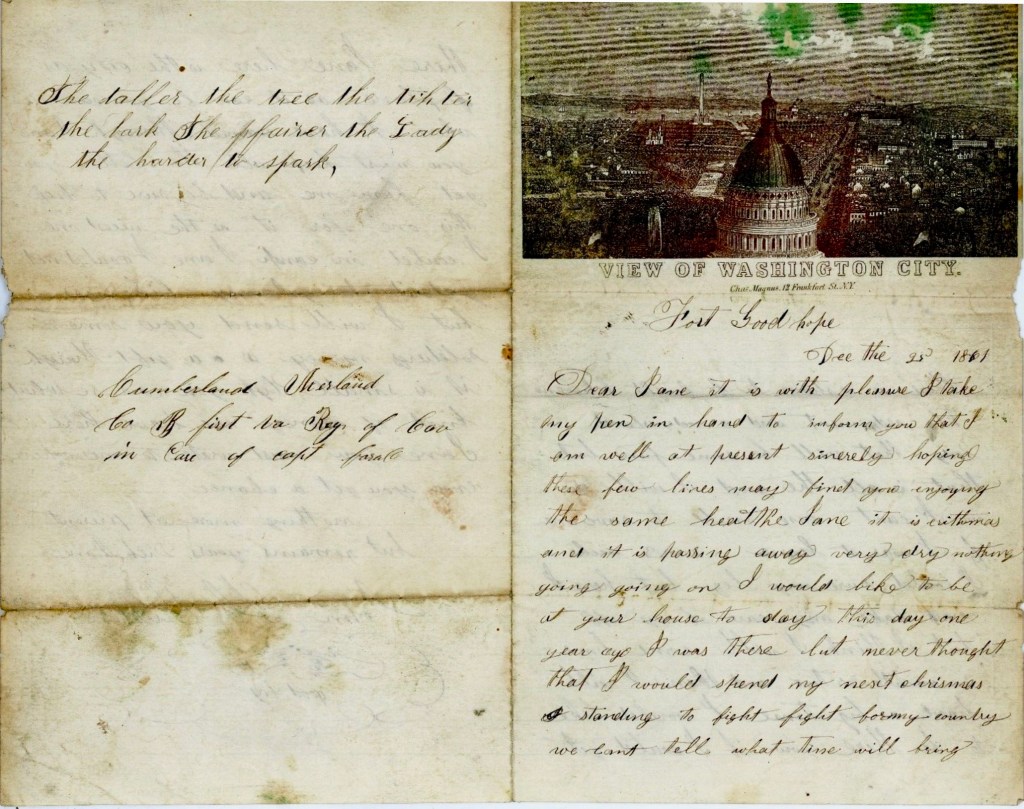
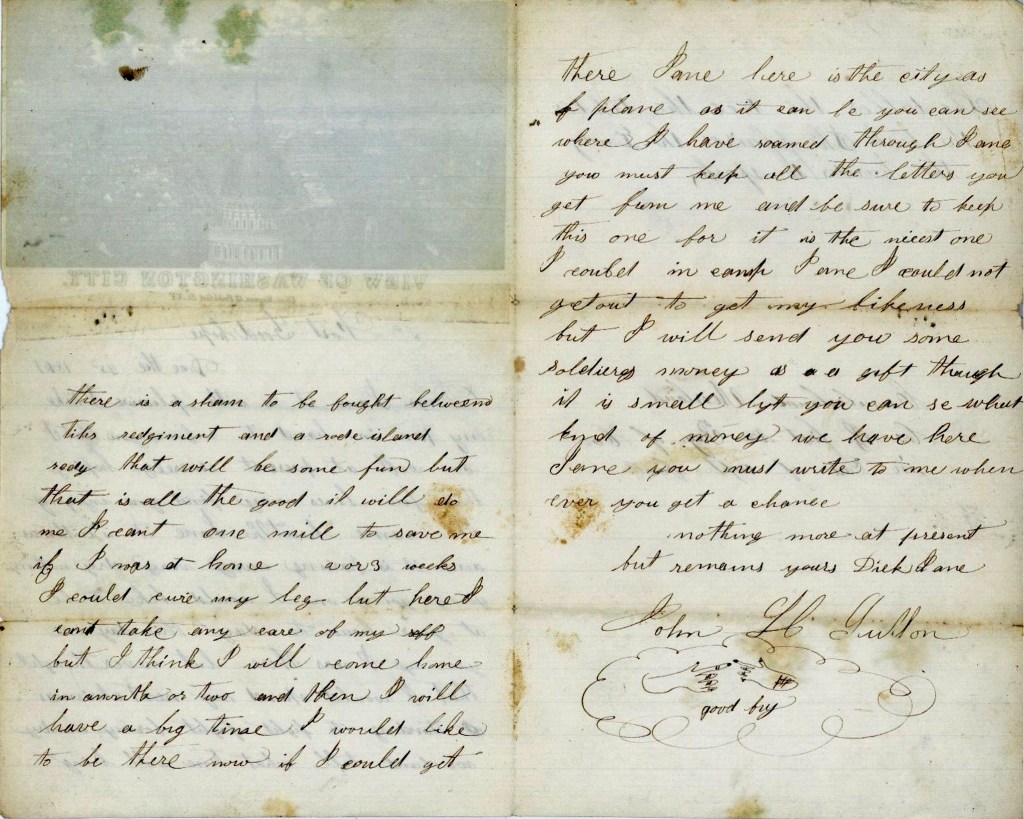
The signature on this letter is baffling. It seems clear that he belonged to Co. B, 1st Virginia [later designated West Virginia] Cavalry. His name looks like John H. Gullon but there is no one on the roster by that name. There is a John Gibbon, however, and there is also a letter I transcribed some time ago by John P. Allen who wrote to Rebecca Jane Carroll. He was also in the same company and his handwriting is very similar. There are sketches in both letters as well, but the signatures appear different.
T R A N S C R I P T I O N
Fort Good Hope 1 December 25, 1861
Dear Jane,
It is with pleasure I take my pen in hand to inform you that I am well at present, sincerely hoping these few lines may find you enjoying the same health.
Jane, it is Christmas and it is passing away very dry. Nothing going n. I would like to be at your house today. This day one year ago I was there but never thought that I would spend my next Christmas standing to fight for my country. We can’t tell what time will bring.
There is a sham [battle] to be fought between this regiment and a Rhode Island regiment. That will be some fun but that is all the good it will do me. I can’t [walk] one mile to save me. If I was at home two or three weeks, I could cure my leg but here I can’t take any care of myself. But I think I will come home in a month or two and then I will have a big time. I would like to be there now if I could get there.
Jane, here is the city as plain as it can be seen where I have roamed through. Jane you must keep all the letters you get from me and be sure to keep this one for it is the nicest one I could [get] in camp.
Jane, I could not get out to get my likeness but I will send you some soldiers money as a gift though it is small but you can see what kind of money we have here. Jane, you must write to me whenever you get a chance. Nothing more at present but remain yours, Dick Jane
— John H. Gibbon [?]
The taller the tree, the tighter the bark The fairer the Lady, the harder to spark
Cumberland Moreland Co. B, 1st Va. Regt of Cavalry In care of Capt. Farabee
1 Fort Wagner also known as “Fort Good Hope” ( 1861-1865) was a Union fort established in 1861 in Southeast Washington DC. It was an earthen fort with a perimeter of 166 yards and emplacements for five guns. The gun placements were intended to sweep the valley through which the road leads up the heights.
I could not find an image of Charles but here is one of William H. Bishop who served in Co. A, 32nd New York Infantry (Photo Sleuth)
The following letter was written by Charles W. Darling (1843-1922), the son of Artemus Darling (1798-1884) and Lydia Phillips (1801-1868) of Virgil, Cortland county, New York. He was a school teacher prior to his enlistment on 14 May 1861 at age 18 to serve two years in the Co. E, 32nd New York Infantry, sometimes called the First California Volunteers. Charles served his entire two years, mustering out with the company on June 9, 1863, at New York City.
The 32nd New York left the state for Washington on June 29; was quartered there for a week and then encamped near Alexandria, where it was assigned to the 2nd brigade, 5th division, Army of Northeastern Virginia; was engaged at Fairfax Court House, Bull Run, and at Munson’s hill, and spent the winter at Fort Ward, in Newton’s brigade of Franklin’s division. In March, 1862, with the 3d brigade, 1st division, 1st corps, Army of the Potomac, the regiment moved to Manassas; returned to Alexandria and embarked for the Peninsula; was engaged at West Point, with a loss of 67 killed, wounded or missing, and soon after was assigned to the 3d brigade, 1st division, 6th corps, with which it engaged in the Seven Days’ battles; then went into camp at Harrison’s Landing until Aug. 16, when it returned to Alexandria. The regiment participated in the battles of Crampton’s gap, Antietam and Fredericksburg; went into winter quarters at Belle Plain; participated in the Mud March, and on April 28, 1863, broke camp and joined the light brigade of the 6th corps for the Chancellorsville campaign, in which the 32nd lost 43 members killed, wounded or missing. It returned on May 8 to the camp at Belle Plain and on the 25th the three years’ men were transferred to the 121st N. Y. infantry. The two years men were mustered out at New York City on June 9, 1863. The total strength of the regiment up to Jan., 1863, was 1,040 members and it lost during its term of service 45 by death from wounds and 54 by death from other causes.
The letter may have been written to Edson F. Quinn of Marathon, Cortland county, New York. Edson later enlisted in Co. B, 1oth New York Cavalry. He was taken prisoner at Hawes’ Shop. on 28 May 1864 and died a prisoner at Andersonville on 27 September 1864.
T R A N S C R I P T I O N
Headquarters 1st California, 32nd New York, Co. E. Camp Corwin, Washington D. C. November 3, 1861
Dear friend Edson,
I received your letter of the 31st of October this morning. But for all your long neglect, it was full of good news. Edson, I had made up my mind that you had entirely forgotten me or wished to put an end to such an unprofitable communication but if you don’t want to hear from me, I do from you. Ed, it does me more good to hear from you than you have any idea of. If you had, you would have written to me before this. But I shall have to excuse you if you will try and do better next time. Ed, you must not consider this as a sermon for I did not intend it as such. But you have excused yourself so admirably well and had such good reasons that it is all right.
You wrote me about the boys that had enlisted in the Cortland Regiment. May success attend them in all cases. I should like to be there to enlist with them but Ed, I am glad to hear that V__ A. Johnson are not permitted to go for they are no needed at present and more than that, it is no place to improve oneself. Edson, I suppose you have heard all about the fight at and on the Upper Potomac on the 14th. 1 It was a failure quite serious. It will learn them not to be in quite such a hurry for as the old saying is, the more haste, the less speed. Edson, such disasters make me feel very lonely and sad. Edson, if we succeed, we must work and in order to make our work effectual, we must be united. If so, we cannot fail. If not, Edson, we must fail. God protect the right.
Ed, I am very glad to hear that you are well and enjoying yourself so well. you must not allow yourself to be lonely and sad for you are amongst kind and affectionate friends who will always welcome you to their pleasant firesides.
Dear Edson, you well know a little Brown Cottage where you would always be a welcome guest. Edson, if no pleasure to yourself, visit them for my sake. Anyone that ever knew me will always be welcome to their humble roof. Ed, I should like to see you very much and have a good long talk with you. I suppose you have nice times with the young ladies of your town. Well, I can’t blame you for I don’t know but I should do the same if I could. If I was in Old Virgil, I think I should try and dig up some fun with some of them. But never mind the girls in war times.
You write to me that Artemus is [at]tending the institution at Cortland with W. Miller. Sir, I have the pleasure of knowing Mr. Miller of Marathon and a very nice young man he is too. I should say very much enjoying self there if permitted not to take an active part but to be a patient listener to more capable heads. Dear Edson, when you see Art, tell him for me to kiss my —- I have written to him a long time ago and he has never answered it. But I don’t care of he don’t wish to write me. He is welcome to stop. I can get along awhile yet, I guess. Tell Peter & Lucino to write to me if possible.
Edson, you spoke of my writing that I was hard up for I was. You write that you. hear that I have got my pay from Uncle Sam. Please tell them that informed you that it is a mistake. I have not received a single cent from the gentleman. I should very much [like] to see some of his Yellow Boys. I think it would do my eyes good to look upon them. I hope to have the pleasure before long. How soon, I can’t tell. But never mind that or any other man or horse. You write about Artemus damaging crinolines. Pshaw! There is no danger of that. He is too slow on track of shakes. Edson, please give my love to all the folks and all. enquiring friends. If you see Miller, tell him to write to me and I will answer. It is getting late and shall have to close. I sign myself as ever your sincere and affectionate friend, — C. D.
P. S. Write soon.
1 I believe Charles meant October 21st, not October 15th. That would have been the Battle of Ball’s Bluff in which Senator-Colonel Edward D. Baker was killed.
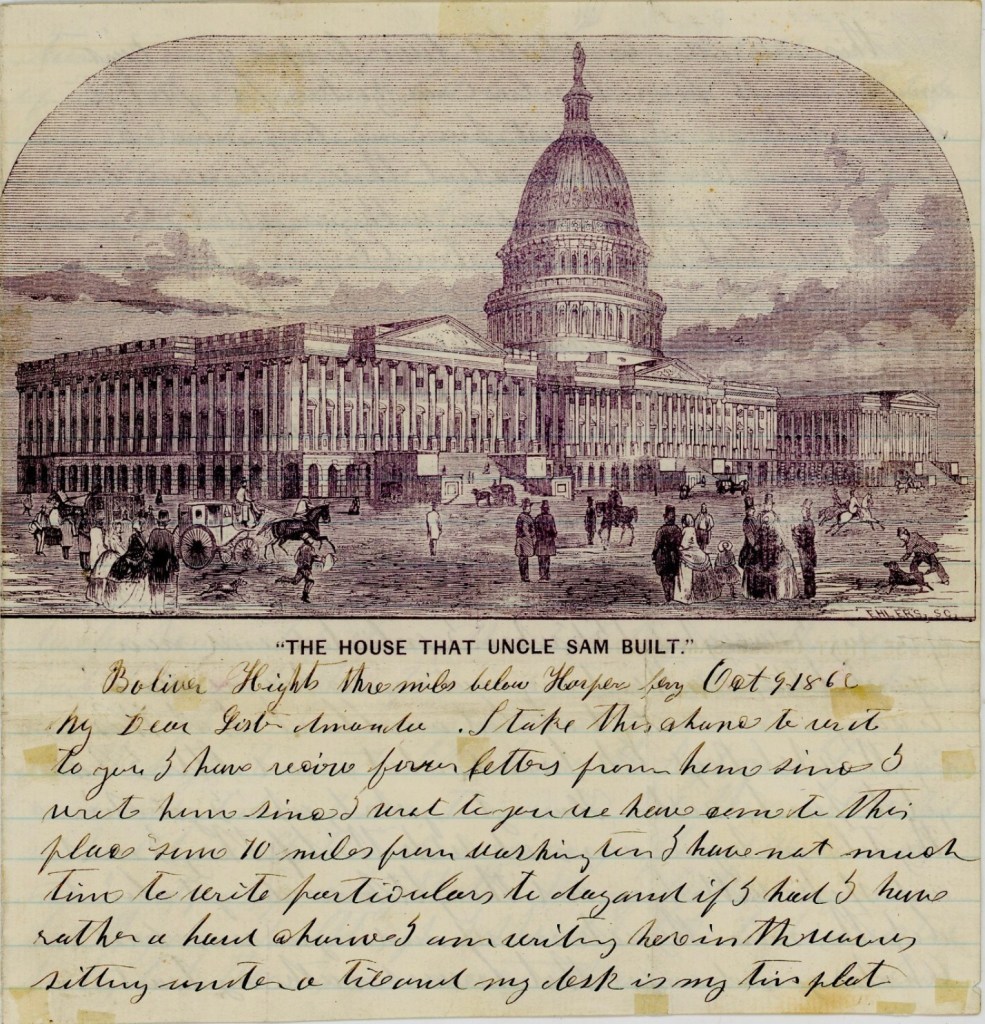
This letter was written by George Lincoln Dow (1836-1892) of Co. G, 19th Maine Infantry. George enlisted in August 1862 when he was 26 years old and was discharged for disability in February 1863. George was the son of Benjamin Dow (1810-1895) and Eliza A. Lincoln (1812-1888) of China, Kennebec county, Maine. He addressed the letter to his sister, Amanda Jane Dow (1839-1903) and mentions other siblings, Charles (b. 1832), William (b. 1834), Everett (b. 1842) and Roscoe (b. 1846) which helped to confirm his identity given that the signature was cryptic.
Bolivar Heights Three miles below Harpers Ferry October 9, 1862
My dear sister Amanda,
I take this chance to write to you. I have received four letters from home since I wrote home. Since I wrote to you, we have come to this place some 70 miles from Washington. I have not much time to write particulars today and if I had, I have rather a hard chance. I am writing here in the woods sitting under a tree and my desk is my tin plate turned sunny side up in my lap.
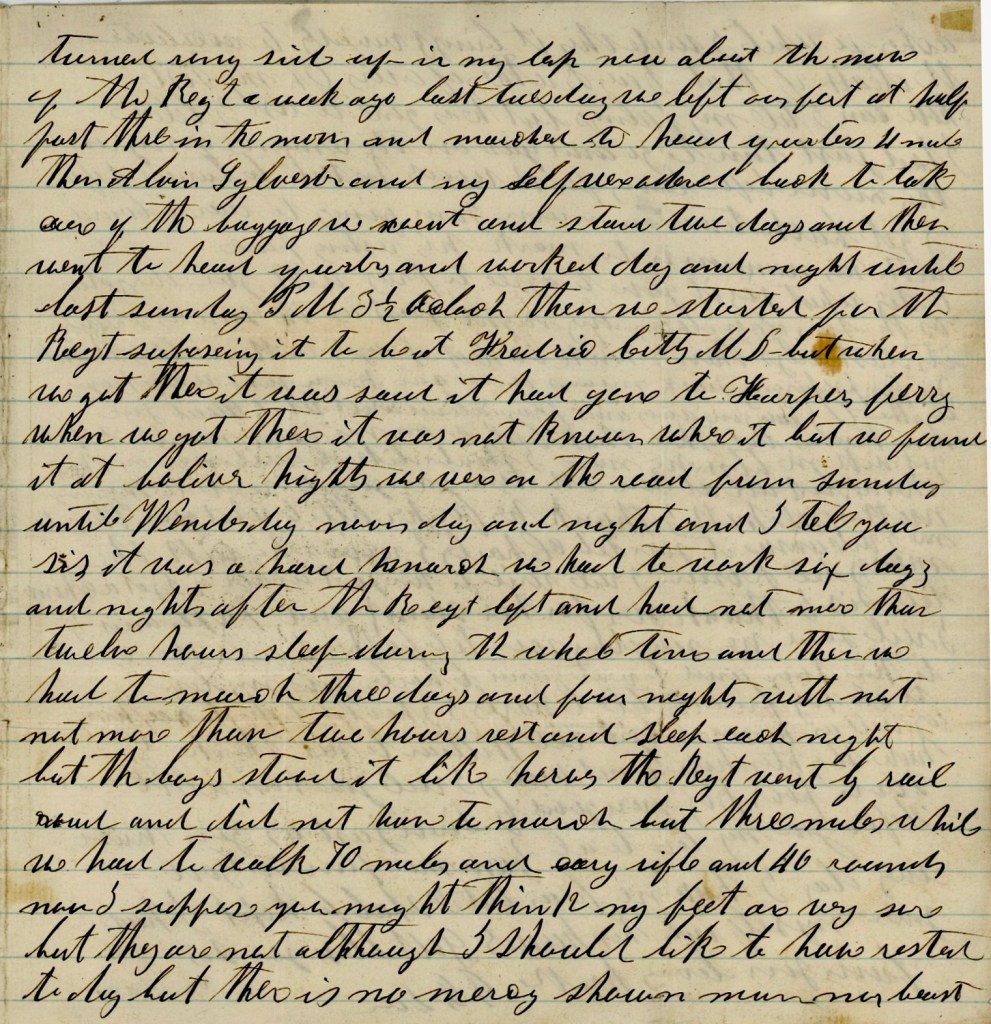
Now about the men of the regiment, a week ago last Tuesday we left our fort at half past three in the morn and marched to headquarters 4 miles. Then Alvin Sylvester 1 and myself were ordered back to take care of the baggage. Went and stayed two days and then went to headquarters and worked day and night until last Sunday p.m. 3.30 o’clock. Then we started for the regiment, supposing it to be at Frederick City, Maryland. But when we got there, it was said it had gone to Harpers Ferry. When we got there, it was not known where it was but we found it at Bolivar Heights. We were on the road from Sunday until Wednesday noon, day and night, and I tell you, Sis, it was a hard march. We had to work six days and nights after the regiment left and had not more than twelve hours sleep during the whole time and then we had to march three days and four nights with not more than two hours rest and sleep each night. But the boys stood it like heroes.
The regiment went by railroad and did not have to march but three miles while we had to walk 70 miles and carry rifle and 40 rounds. Now I suppose you. might think my feet are very sore but they are not although I should like to have rested today. But there is no mercy shown man nor beast here. This morn we was detailed to camp [ ] regiment connected with four hundred New Yorkers for picket duty so after one night’s rest from my long march, I had to come here this morn about three miles. Near here in the woods six hundred of us within a short distance of the Rebs but have fears of trouble from them. The prospect is they say we are to hold this place—that is, where the brigade is. We have 46 thousand men here, most old regiments. This is to be our position. We’re on the old battlefield where Col. Miles surrendered to the Rebs. I will give you all the minute moves when I have a chance. Suffice now for me to say that I am first best [ ] if you can english such language.
I have gained 16.5 pounds since I came into this show as they say. I weighed 155 when I enlisted and now I weigh 171.5 without any coat on. We have loads to carry now. We left all but our blankets at Washington—the whole regiment.
Oh, Amanda, what a sad letter I have got to pen to sister Harrington. Yesterday when I got here, they told me Myron was sick with the diphthey. I went and spoke with him and thought he get over it but this morning they woke me up and Myron was dead. Oh sis, go and comfort that [ ] Mother. My heart aches so while I write this. It brings vividly to recollection the death of that dear brother of ours. Oh my sister, how can I tell my feelings. But he is gone to rest. I believe I have just time to go and gaze on the remains of Myron this morn before leaving for the woods. He will be buried before I get back tomorrow morn. I am going to [ ] a board with his name on it to mark his resting place. 2
Oh sis, what joy it gives to agree to pray with you every day as the sun goes down every night just as the sun is shedding its last rays, then I sink in deep prayer with you. Oh, I thank you for prosing such means to see to our [ ] sake by praying together…I should like to write more on this theme but will at some other time. I am going to write to Mryon’s mother.
Tell Mother I thank her for her letter. Oh what good they do me. I will answer it soon. Tell Charley I received his with the money. Tell Roscoe I will write to him just as soon as I get a chance. Tell Sis I thank her for her stamp and paper and I will send her something soon. Tell Father I will write to him soon and Everett and Charles. Give my love to all the family. Tell Charles I should like to see him as well as he would me. Tell William to not think I have slighted him by not writing. I will give him a letter soon, poor boy. Now goodbye. Direct just as you have before. Give my love to all. I am more form in God every day. I have no fear but I shall be kept. I have given myself into his hands. God bless you, Sis. From your loving brother, — G. L. Dow
1 Alvin Sylvester was 39 years old when he enlisted in Co. G, 19th Maine Infantry. He was hospitalized in mid-June 1863 and transferred to Co. F, 24th Veteran Reserve Corps, He mustered out of the service on 23 April 1864. He was also from China, Maine.
2 Myron Clarke Harrington (1844-1862) of Co. C, 19th Maine Infantry was the son of Brazilla Harrington (1819-1885) and Lucy Ann Adams Bean (1823-1906) of China, Kennebec county, Maine. He died of diphtheria on 9 October 1862 on Bolivar Heights, [West] Virginia.
I could not find an image of George but here is one of Pvt. William W. Lamb of Co. E, 109th New York Infantry.
The following letters were written by Pvt. George W. Roe (1831-1864) of Co. A, 109th New York Infantry. That company was recruited principally at Newfield, Caroline and Danby in Tompkins county. I was able to find him buried in Roe Cemetery which is located in Caroline. His parents were Phillips Roe (1801-1885) and Mary Jones (1804-1873). George was married to Sarah Adeline (“Ada”) McPherson (1838-1915). George’s headstone is smashed but it is possible to see the 109th Regiment on it and the cemetery register gives his death date as 27 June 1864.
The regiment was transported from Binghamton to Annapolis Junction, Md., where it was placed on guard duty along the line of railroad to Washington, a few of the companies being stationed at Laurel, Md. It remained there the rest of the year and during all of 1863. In the spring of 1864, the regiment was ordered to join the 9th corps, then assembling at Annapolis, and participated in the Overland Campaign. During the final eleven months of service, the regiment lost 614 men in killed and wounded, aside from the missing or prisoners. Its loss by death during service was 5 officers and 160 men; by disease and other causes, 164 men—total deaths, 329. The percentage of killed, 165 to the total enrollment, 1.353. was 12.1. It was mustered out of service June 4, 1865, at Delaney house, D. C.
Annapolis Junction was located about midway between Baltimore and Washington cities, on the Washington Branch of the Baltimore and Ohio Railroad. It is about equidistant, say nineteen miles from each of the cities of Baltimore, Washington and Annapolis.
Letter 1
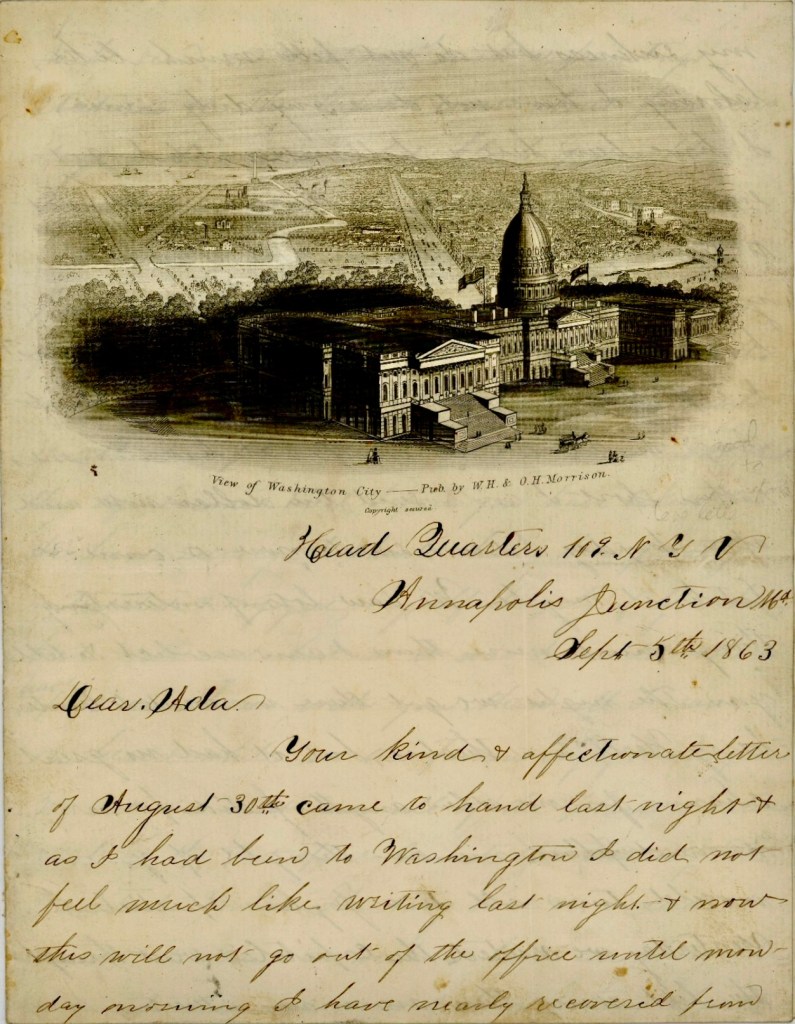
Headquarters 109th N. Y. V. Annapolis Junction, Maryland September 5th 1863
Dear Ada,
Your kind & affectionate letter of August 30th came to hand last night and as I had been to Washington I did not feel much like writing last night & now this will not go out of the office until Monday morning. I have nearly recovered from my sickness but do not feel much like laboring. I have not done any duty since I have been here & shall not until I get entirely over the sickness.
Harrison & I went to Washington Thursday night & returned yesterday. I got my bounty but shall not be able to send as much to you at present as I expected to as we bought quite a lot of things to sell out in camp and it has run me rather short. I will send ten dollars now and after payday I can send more or & fetch it maybe.
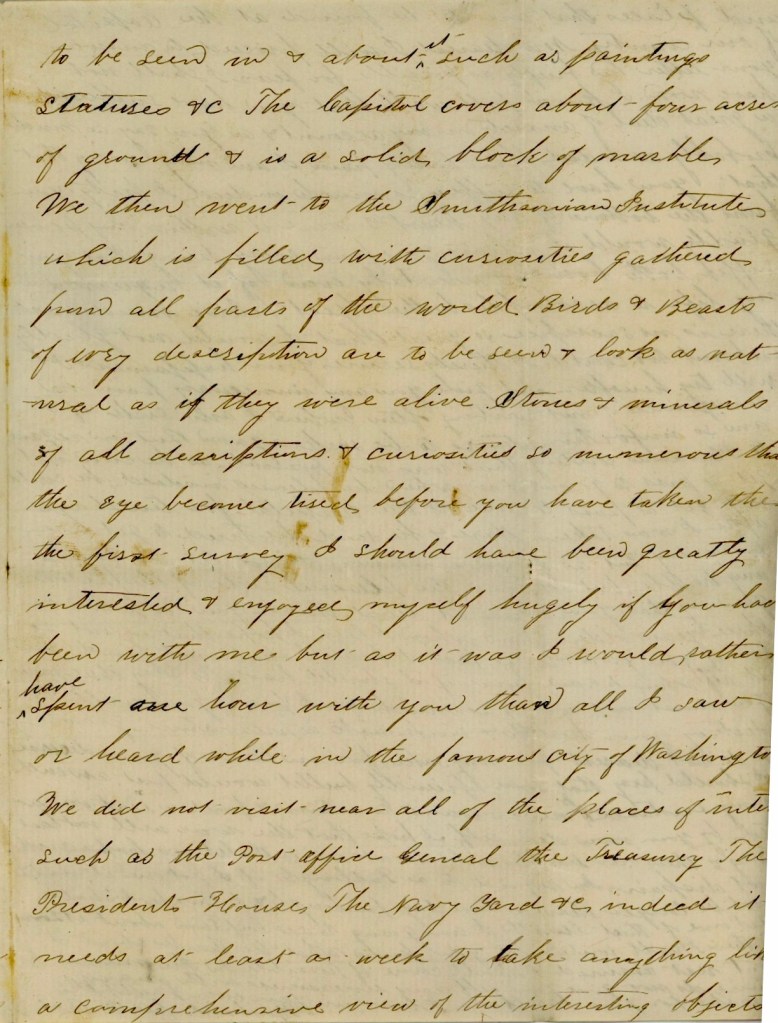
We saw lots of interesting things—much more than I can recollect to tell you. The night we got there we went to Canterberry Hall to a theatre but it had no great charms for me. When anything did for a moment please me, one thought of you would turn all to a joyless spectacle. Yesterday we visited the Capitol and went through the left wing. There are many interesting things to be seen in and about it such as paintings, statues, &c. the Capitol covers about four acres of ground and is a solid block of marble. We then went to the Smithsonian Institute which is filled with curiosities gathered from all parts of the world—birds and beasts of every description are to be seen & look as natural as if they were alive. Stones & minerals of all descriptions & curiosities so numerous that the eye becomes tired before you have taken the first survey. I should have been greatly interested & enjoyed myself hugely if you had been with me but as it was, I would rather have spent one hour with you than all I saw or heard while in the famous City of Washington.
We did not visit all of the places on interest such as the Post Office General, the Treasury, the President’s House, the Navy Yard, &c. Indeed, it needs at least a week to take everything like a comprehensive view of the interesting objects and places that are to be found at the Capitol of our country.
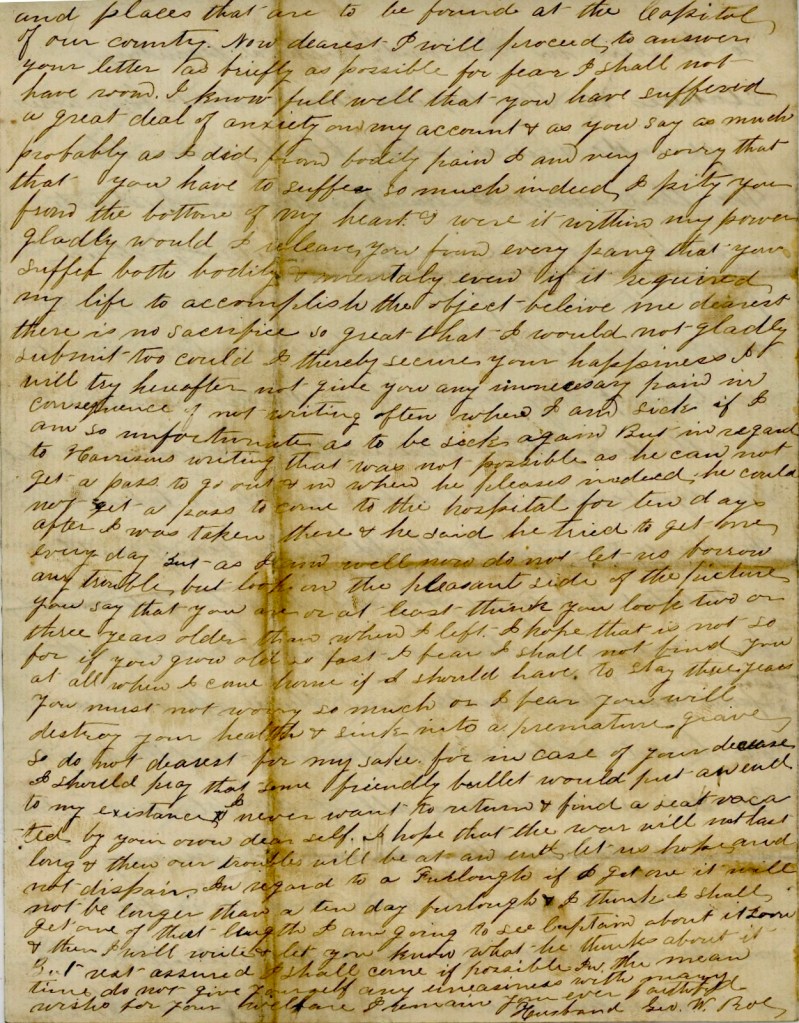
Now dearest, I will proceed to answer your letter as briefly as possible for fear I shall not have room. I know full well that you have suffered a great deal of anxiety on my account & as you say as much probably as I did from bodily pain. I am very sorry that you have to suffer so much, Indeed, I pity you from the bottom of my heart & were it within my power, gladly would I relieve you from every pang that you suffer—both bodily and mentally—even if it required my life to accomplish the object. Believe me, dearest, there is no sacrifice so great that I would not gladly submit to could I thereby secure your happiness. I will try hereafter to not give you any unnecssary pain in consequence of not writing often when I am sick if I am so unfortunate as to be sick again.
But in regard to Harrison [Tompkins] writing, that was not possible as he cannot get a pass to go out & in when he pleases. Indeed, he could not get a pass to come to the hospital for ten days after I was taken there & he said he tried to get one every day. But as I am well now, do not let us borrow any trouble but look on the pleasant side of the picture. You say that you are or at least think you look two or three years older than when I left. I hope that is not so for if you grow old so fast I fear I shall not find you at all when I come home if I should have to stay three years. You must not worry so much or I fear you will destroy your health & sink into a premature grave. So do not, dearest, for my sake, for in case of your decease, I should pray that some friendly bullet would put an end to my existence. I never want to return & find a seat vacated by your own dear self. I hope that the war will not last long & then our troubles will be at an end. Let us hope and not despair.
In regard to furloughs, if I got one it will not be longer than a ten day furlough and I think I shall get one of that length. I am going to see Captain about it & then I will write and let you know what he thinks about it. But rest assured I shall come if possible. In the meantime, do not give yourself any uneasiness. With many wishes for your welfare, I remain your ever faithful husband, — George W. Roe
Letter 2
The letterhead of George’s letter with lithograph of Smithsonian Institution
Annapolis Junction, Maryland September 9th 1863
Dear Ada,
Yours of September 6th I received about four o’clock and hasten to reply. I did not expect that my presence would be required at home quite so soon. But as you think it best I shall try & get a furlough immediately. I went and saw the Colonel this forenoon & he said that he would try to & get me a furlough for fifteen days & Captain said that he would have an application made out tomorrow & Lieut. Meed promised me some days ago that he would go to Washington and put it through if I wanted him to. I expect Meed will be in camp tomorrow morning & I shall try and have him go down tomorrow if possible. If nothing happens to delay & everything works well, I think I shall get started this week & will be home by Monday or Tuesday. But do not look for me until I come as there is nothing certain in military matters.
You say that John Maltly is there and that he is drafted. Give him my best respects & tell him to come and enlist in the 109th Regiment. If he gets here & gets mustered in, there is no earthly power that can hurt him for it & he will get $75 bounty from the State. If he is not already examined and mustered into the service, I should like very much to have him come & join our company. He can come here and be examined & mustered in & the authorities of Pennsylvania will not affect him unless he has already been examined.
On the first page of this sheet, you will see is a picture of the Smithsonian Institution which I told you contains a collection of curiosities from all parts of the world. I mean if it ever happens so that I can have you go with me & visit that as well as many other places of interest in the City of Washington.
Reuben Youngs 1 got his face severely burned this afternoon. It happened in this way. William Debell 2—-one of our tent mates—got a cannon cartridge while on patrol down to Savage & brought it to camp & hung it up in the tent. While he was out, Harrison [Tompkins] 3 and Reuben thought they would come a joke on Bill so Rube took the powder & some matches & went out back to explode it. He placed a piece of paper on the powder & placed fire at the other end. He thought it was not going & so he moved the paper so that the wind would blow it towards the powder [and] at that instant, sparks blew into the powder & it exploded & burned his face quite badly. I think, however, he will get along without much trouble as it is not burned very deep.
There is nothing of importance transpiring here but the same hum drum routine of camp life is all that comes under our observation. I do not think of anything more at present. You can answer this in a day or two after you get it if I do not come by that time. With many wishes for your welfare & remain as ever your affectionate husband, — Geo. W. Roe
To his beloved wife Ada Roe
1 Reuben Youngs of Caroline was 21 years old when he enlisted in Co. A on 12 August 1862. He died of disease on 5 September 1864 at City Point, Va.
2William H. Debell of Danby was 18 years old when he enlisted as a private in Co. A on 12 August 1862. He was killed in action on 19 August 1864 at Weldon Railroad.
3 Harrison Tompkins of Newfield was 22 years old when he enlisted in Co. A on 12 August 1862. He mustered out with his company on 4 June 1865.
Letter 3
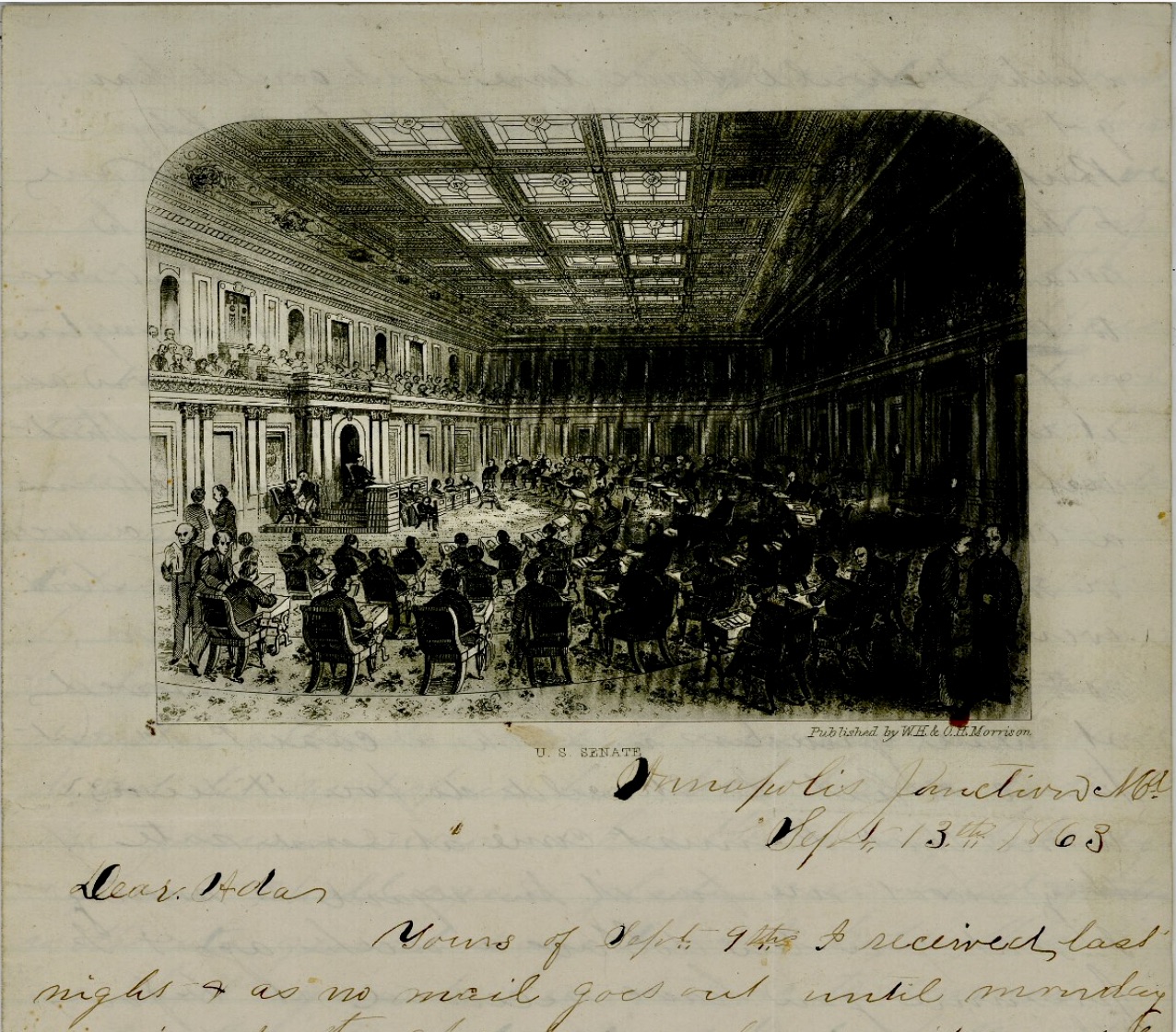
Letterhead lithograph of “U S Senate” appearing on stationery George used.
Annapolis Junction, Maryland September 13th, 1863
Dear Ada,
Yours of September 9th I received last night & as no mail goes out until Monday morning, I thought I would wait until today to answer it. I am very sorry to learn that you are afflicted with such poor health. I have felt better for a few days back than I have since I went to the hospital. Indeed, I feel about as well as ever except that I am rather weak. I told you in my last that I should be home Monday or Tuesday which I should have done if I could have got a furlough without any difficulty but everything has worked against me. I have at last, however, got a furlough made out & tomorrow I shall take it over to the Colonel & he will send it to Washington & if approved there, I shall start as soon as it is returned. I cannot tell how soon that will be. Sometimes it will come back in a day or two and at others, it will be a week or more before it gets around. I think however I shall get it as soon as to start by the 20th if not before unless it is disapproved at headquarters. In such a case, I do not know what I should do for it seems to me that I must come at some rate if they shoot me for it.
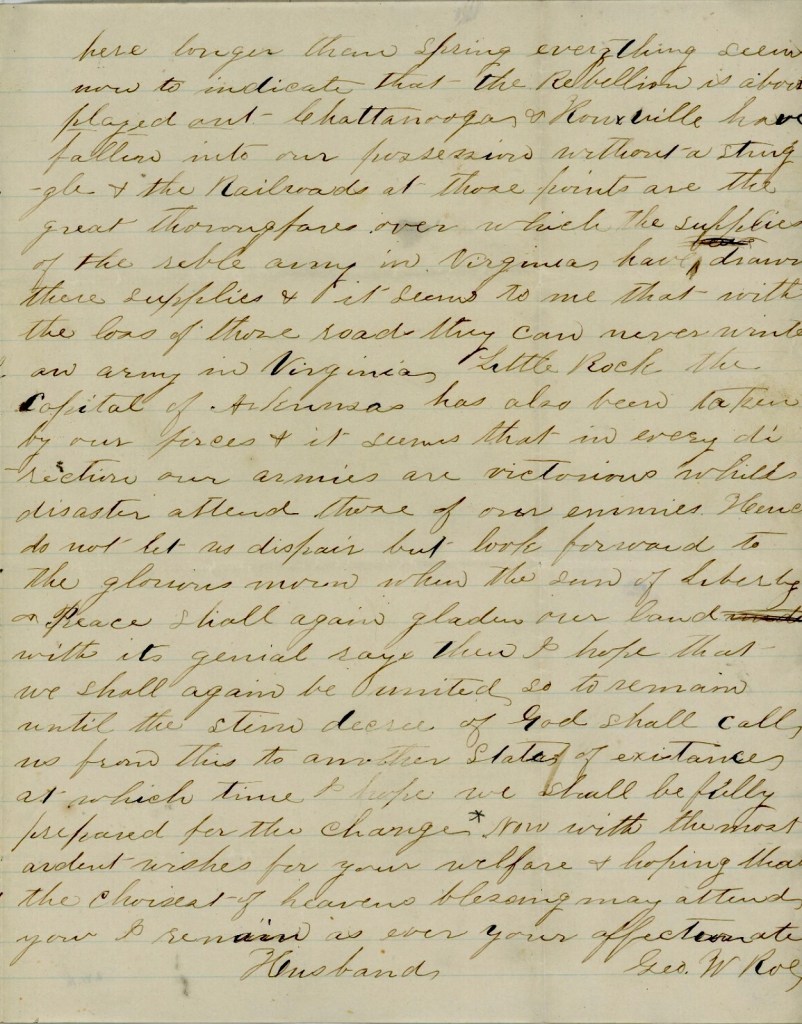
In regard to money, I sent you ten dollars as week ago & I presume you have received it before this time. You say that you are about discouraged. You must not give way to such feelings but hope for the best. I shall be home in a week or so now & then I will try to have things fixed more comfortable for you & we will also discuss the question about you coming down here. I hope that I shall not have to stay here longer than spring. Everything seems to indicate the Rebellion is about played out. Chattanooga & Knoxville have fallen into our possessions without a struggle and the railroads at those points are the great thoroughfares over which the supplies of the rebel army in Virginia have drawn their supplies & it seems to me that with the loss of those roads, they can never winter an army in Virginia.
Little Rock, the Capitol of Arkansas, has also been taken by our forces & it seems that in every direction our armies are victorious while disaster attends those of our enemies. Hence, do not despair but look forward to the glorious morn when the sun of Liberty & Peace shall again gladden our land with its genial rays. Then I hope that we shall again be united so to remain until the stern decree of God shall call us from this to another state of existence at which time I hope we shall be fully prepared for the change.
Now, with the utmost ardent wishes for your welfare and hoping that the choicest of heaven’s blessing mat attend you, I remain as ever your affectionate husband, — Geo. W. Roe




















 Spared & Shared 23