I could not find an image of Judson but here is one of his younger brother Pasqua who served in the same company. Pasqua was killed at Thompson’s Station in March 1863.
The following letters were written by Judson Lloyd Austin (1836-1924, the son of Isaac G. Austin (1812-1882) and Susan Ann Van Winkle (1812-1867) of Allegan county, Michigan. Judson wrote the letters to his wife, Sarah Elizabeth (Colburn) Austin (1843-1908).
Judson volunteered as a private in Co. B, 19th Michigan Infantry on 13 August 1862 and mustered out of the service on 26 May 1865. Enlisting at the same time and serving in the same company was his younger brother, Pasqua L. Austin (1839-1863) who did not survive the war. Pasqua was killed at Thompson’s Station, Tennessee on 4 March 1863.
The 19th Michigan was organized at Dowagiac and left for Cincinnati in mid-September 1862. After duty at Covington, they made the overland trip to Nicholasville by mid-November and remained there until moving on to Danville, Kentucky.
Letter 1
[Dowagiac, Michigan] September 5th 1862
Dear wife,
I improve this opportunity to let you know how we are getting along. We are well. at present. May these few lines find you the same. There has one man gone to his long home out of this regiment without hearing the sound of a cannon it was the one that had the chill when you was here. He died the day you left. We are going to be mustered in this afternoon at four o’clock. I shall come home then if I can get a chance. Our paymaster is also here so we shall get our pay as soon as we are mustered. You must not look for me until you see me coming.
The news is very exciting here. Yesterday the papers stated that our forces had been driven back within seven miles of Washington. If that is the case, we shall not stay here long. I hope it is not so but I feel afraid it is too true. The next thing I expect to hear the orders to march. Then every man that is able to go will start at the word. If I do not come home, I will write as soon as I find out how it is. Maybe I will get home before you get this. If I do, so much the better. The whole regiment drilled together yesterday & today it is something like work you may as well think. Two men out of our company fainted away in the ground & was carried off the ground. I don’t know how the weather is there but it is war, enough here to roast eggs.
The men that went on furlough the other day have all got back but one. He has lost one of his family—a little girl—and the rest of them are sick. We think it is doubtful whether he comes back just now or not. Our Lieutenant has just come. The war news is better today. It is bad enough yet. We shall have to fight, our captain says before many days. I suppose he knows just about as much about it as I do. There is no doubt in my mind but what we shall have to fight soon enough. But I guess we will have something to do it with fists. They say our arms are here now but we have not seen one of them. We must have them to see how many there is who knows how to load and shoot before we go into battle. For my part, I think I can do that part well enough now. The command would be the only thing that would bother me. I think that I could shoot a secesh just as well as I could a porcy hog. I can fetch me one of them every time or used to with my old gun. I guess I have written enough for this time. I will wait a little and see what is going on.
There is lots of talk among he soldiers today about the furlough. The most of them think they will have one at any rate. I don’t know how it will come out yet. I feel in hopes we all will have one. The Colonel has sent two men to the Governor of this state to see if he would consent to give all the soldiers that had not been home a chance to go. They have not got back yet so we know just as much about it as we did before.
It is four o’clock and the mustering officer is not here yet/ I don’t know what it means any more than you. do. I am inclined to think the old chap wants to keep us waiting here until it is too late for us to go home. If that is the case & we find it out to be a fact, I guess there will be some kind of a row kicked up among some of us so we will get a chance to go home. As a general thing we soldiers don’t think much of these big men. Our big men are the cause of all this trouble or have been & seem yet to be by the way things work. They don’t seem to care anymore about a soldier’s life than we do of a mosquitoes. They have got the thing to going & all they want us just to have us boys fight it out on our own expense. If we do not fight it out, who will? Somebody has got it to do. We all feel assured of that fact. If it is not whipped out, what will?
Letter 2
Nicholasville, Ky. Co. B, 19th Michigan Infantry December 1st 1862
Nicholasville Ky
Dear Wife,
I am on guard today & am in a hurry. I received your letter dated November 16th. I was glad to hear you was all well. May these few lines find you the same. I am well except my throat is getting sore again. I have been sucking camphor gum all day. Pack is pretty well at present. Elder & Tom is grunting with a cold. Their throats are sore too. Norm has gone to be examined over to see if he can get his discharge. You spoke about the box I sent for. I was not disappointed very much when I saw & read the letter that you did not want to send it for fear we would not get it. Elder says I will send home for a box I and Ben & God damn them if they don’t send it. There will (be) young hell raised. I think there is plenty of that here now.
You said Mr. Watson Brown started a box. The Boys here have had a letter telling them about their starting one for Kalamazoo. They look for it about the middle of the week. I told you in a letter the other day about tent No 9 getting a box. The regiment right across the street from ours got three boxes one week ago tonight. Capt. Lincoln’s company have had boxes since we have been here.
I cant tell you how long we will stay here any more than you do but the only thing we hear is we will winter here. The officer of the guard told me today that we would end our war business here in Nicholasville. I hope we will. You wanted me to send me a measure of my foot. I dont think there is any use in that. If any of you think you can send me a good pair of boots, you can get no. 8 or 9 for I had rather have them too large than to small. You say if I want some socks, I must say so & you will knit me some. I want some, but by the time you could knit them & get them here, the war might be over. I don’t know as I deserve any for losing or being so careless with the ones I had, but then I don’t know as I could help it. The game here is if a man loses anything, he must make it good the first chance he gets. I don’t approve of this plan, but don’t know but I will have to come to it yet.
You can direct to Nicholasville just the same as I told you but be careful & put the no. of the reg & letter of the company on. It don’t make any difference about the division. You can direct your letters the same if you want to. It makes no difference where you direct if you only put the company and regiment on, it will come.
The drum beats & I must stop. Sam Hewett wants you to give Mack the note or line that you find in this letter he writes to him & does not get any answer. He is out of money & wants a pair of boots the same as I do. Goodbye for this time. Your most affectionate husband, — J. L. Austin
The following letters were written by John W. McClain (1834-1863), a barely literate private in Co. E, 2nd Ohio Cavalry. He was the son of Edward McClain (1792-1857) and Flora Fish (1812-1887) of Trumbull county, Ohio. According to Find-A-Grave, John died of “sunstroke” on 9 August 1863 at Fort Scott, Kansas. John had two other brothers who died in the Civil War, Robert T. McClain (1841-1864) and Richard H. McClain (1843-1864).
I could not find an image of John but here is one of Isaac L. Peirce of Co. B, 2nd Ohio Cavalry. (ancestry.com)
The soldiers of the 2nd Ohio Volunteer Cavalry Regiment came from Ashtabula, Columbiana, Cuyahoga, Geauga, Hamilton, Lake, Loraine, Mahoning, Medina, Portage, Richland (and neighboring counties), Summit, and Trumbull Counties. The 2nd O.V.C. was organized for three years’ service under Colonel Charles Doubleday, and afterwards commanded by Colonels Kautz, Nettleton, and Seward. Soldiers were mustered in from August to September of 1861 and trained at Camp Wade near Cleveland and Camp Dennison near Cincinnati. Nicknamed the “Wade and Hutchins Regiment” after Ohio Senators Ben Wade and John Hutchins who instigated the formation of the regiment, the 2nd O.V.C. moved to Missouri, scouting on the borders of Kansas, and in February 1862, drove the infamous bandit William Quantrill and his raiders from Independence, Missouri. In the summer, the 2nd O.V.C. served in Indian Territory, and in the fall joined General Blunt’s campaign in Arkansas and Missouri, fighting at Pea Ridge, Carthage, and other points. It moved to Kentucky, and four companies raided East Tennessee. It joined in the pursuit of Confederate General John Hunt Morgan and followed him twelve hundred miles until captured. In September, the Regiment again raided East Tennessee and operated on Longstreet’s flank at Knoxville, fighting continuously with severe loss. In April 1864, it was transferred to the Army of the Potomac with Ulysses S. Grant, and moved with Grant’s army towards Richmond, fighting with Sheridan’s Cavalry Corps around the flanks of the army. In August the Regiment moved to the Shenandoah Valley and engaged Early, fighting at Opequan, Front Royal, and Cedar Creek. In March 1865, it joined in the pursuit of Confederate General Robert E. Lee, and after the surrender was reviewed at Washington and mustered out September 11, 1865. The 2nd Ohio Volunteer Cavalry Regiment made one of the most brilliant records of any regiment in the service.
Letter 1
Patriotic stationery “Pillar of Glory”
Fort Leavenworth February 19, 1862
Dear brother,
I take this opportunity to inform you that I received your letter yesterday and was pleased to hear that you was all well and doing well for that is all that can be expected for that is my style every time. As I have wrote to you but a few days ago, I have but very little to write this time. All I have to write is that we are all well and doing well as we can. We arrived here last Saturday about three o’clock in the afternoon and found good quarters for our horses but none for ourselves until dark when we found a mess room where a company of Hunter’s bodyguards messed which was very comfortable for us. But perhaps it would not appear to be so to everyone as it would to us but we are now tented out in tents which are as handy as a pocket in a shirt. We have a stove in each tent which will keep them as warm as there is a need for. This is the coldest place ever I stuck my head in. The wind will cut a fellow’s throat if he should be compelled to face it.
We are waiting to get the orders to march but we know not where. We have been told by our officers that we was to move on to Fort Scott but we know not where we have to go but direct to this place and it will be all right. — J. W. McClain
Letter 2
Fort Leavenworth, [Kansas] March 2, 1862
Dear friends,
I take the opportunity to inform you that I am well and doing the best I can for the chance I have. I have changed my position since I last wrote to you. I suppose you have seen a detail made in the regiment to form a battery. There are twelve men taken from each company. We have the privilege to volunteer and if they couldn’t get volunteers in the Co., they should half to detail them. So rather than be detailed, I volunteered and we are quartered in nice barracks and are having a good time. But how long it will last is more than I [am] able to say. Our horses and horse equipments have been taken off our hands so it leaves some of us free from care, such as cannoneers, but teamsters have it pretty tough. They have three horses to water, clean and feed three times a day, attend roll three times a day, and dress parade once a day so that will keep some of the boys to their trumps to get around in time. They are mighty particular here. Every man has to come out with his boots black and everything in shape or the guard house is their fate.
The are now the same as regulars for our captain is a regular and is so strict as any regular that ever had command. Everything has got to shine or they will get the chance to see the hardest looking hole that any white man ever stuck their head in. They have about 50 rebel prisoners in the guard house. It is the dirtiest and strongest smellin’ place that ever I saw without any mistake. Many of them have the ball and chain on them and those that haven’t got it on has to work with a guard over them with a loaded gun and if they offer to runaway, his orders are to bore him through.
The regiment is now on the march to Fort Scott. We heard from them yesterday that they were in Kansas City last Thursday. This is all at present. I will send you a paper. Perhaps you would like to read one of the Kansas papers. When you write, direct to John W. McClain, Hollister Battery, Fort Leavenworth, Kansas
An unidentified member of the 44th New York Infantry (“Peoples Ellsworth Regiment), LOC
The following letter was written by William Eckerson, Jr. (1835-1864), the son of William Eckerson (1803-Aft1860) and Jeanette Miller (1818-1891) of Seward, Schoharie county, New York.
William enlisted as a private in Co. I, 44th New York Infantry in October 1861. During the 2nd Battle of Bull Run, William was taken prisoner on 30 August 1862. The date of his exchange is not given but later, during Grant’s Overland Campaign in 1864, after fighting at Cold Harbor, William was posted on picket on the night of 3 June and was killed instantly by a sniper’s bullet about 9 o’clock. He was buried on the battlefield by his comrades.
To read other letters I’ve transcribed by members of 44th New York Infantry and published on Spared & Shared, see:
Addressed to Miss Catharine Shaffer, Gardnersville, Schoharie county, New York
44th New York Volunteers Camp before Yorktown, Va. April 26th 1862
Dear Cousin,
With pleasure I avail myself of the present opportunity of addressing a few lines to you, this being the third letter that I have written this morning. It is raining now quite fast and the wind is east and cold and very disagreeable. Yet for the most part, we have had beautiful weather here, much of which has been very sultry and hot. The apple and peach orchards long since have been in blossom and the trees of the forrest now present a beautiful appearance, clothed with their new and green foliage. The earth too is clothed in her beautiful green drapery of grass where the soil is not marred by the heavy march of artillery or made as hard as a brick bat by the repeated tread of infantry. But what a gloom is spread over this beautiful region of country which might be a home for the oppressed and the scene of enjoyment. Nature hath made it the most beautiful and attracting of any land that I have yet seen, and a place where I would delight to make my earthly home where the land is rich and beautiful. No rocks are lifting their heads above the surface of the soil or hill towering up high into the sky, but in many places the soil is slightly rolling and the York and James rivers present a beautiful scene as they empty themselves into the bays and winter is scarcely known in any part of iy—a place that might be desirable upon earth and where one might enjoy sweet fellowship with another.
But how different is the spectacle that it now presents. A raging disease has fastened upon it, more to be dreaded than small pox; and desolation is the fruit that it leaves behind for an inheritance. Its groves and orchards are cut down and destroyed, it cities and fences are burned up and laid waste; and its soil is either tread as hard as a bake oven by the foot of the soldier or dug full of entrenchments and rifle pits, where brother against brother have deluged the ground with their blood. Day after day the booming cannon is sending its deadly messengers back and forth through the air, and the shrieks and groans of the maimed and dying show forth their work of destruction. These are the wages of war, and the fruits that its victories receive.
I have looked upon the distorted and mangled face of the dead and turned away with a sickening awe, contemplating on the cruelty of war. Yet I have took deadly aim at a fellow man and sent the leaden messenger forth with as little feeling on the subject as one would have to shoot a squirrel. I have stood before the rattle of an enemy’s musketry and faced the mouth of the blazing cannon, when the bombs have burst and the pieces flew all around me, and the bullets whizzed past my head like hail, yet I felt nearly as secure from their harms as you do perhaps in your own peaceful dwellings. Yet when I have been alone and though on these things, I have wondered how it could be that one should be so fearless in the face of danger, and composed as it were right in the arms of the Angel of Death. Yet when I remember that God takes care of his creatures and that those that put trust in Him shall not be confounded, then I see how it is that a man can be fearless in the midst of danger, when the shafts of death are thrown around him.
I learned a few days ago that Emory A. Shaffer was dead! You can imagine the shock when the words fell on my ear. Thinks I, how can that be? Emra dead?! When we left Albany, none bid more fair to go through the war than he & I trusted that we should share the perils of war together, and one at least be left to tell the story over when the war should come to a close. Yet he has gone and that by the hand of disease, before he had a chance to fight his country’s battles, and I am left to go without him. He was a soldier beloved and respected as a man, and we trust that he has found a home in heaven—that land of peace where the weary are at rest. So dry your tears and live to meet him & dear old Aunt Rebecca in that better and heavenly land. We too must pass the chilling river, and perhaps it will be my lot very soon. Yet I shall rejoice in the hope of the glory of God. Be of good cheer for heavenly mansions await those that love our Lord, and He will comfort those that put their trust in Him. Were it not for this consolation, my life would be a dreary one, exposed daily to the shafts of the enemy.
I have seen many rough and tedious marches since we left Halls Hill and traveled many a day like this in the rain and mud. I have traveled over the fields of Centerville & Bulls Run, saw the smoke of Manassas as the rebels retreated from it and many other things which it would take me too long to narrate at this time, or merely hint at, for it would fill many sheets of paper. But I must skip over a long train of events till I come to the siege of Yorktown and then bring my letter to a close as I have already written more than I intended to when I commenced my first sheet. Yet I must write about a few things that happened though I shall have o commence on another sheet to get it all on.
While walking about the forts at Centerville, I saw a big log in one of the holes pointing to the place in which we came in, and made to represent a large cannon at a distance. Supposing perhaps that our artillery would fire at it and so waste their shots for naught before finding out the mistake. But it so happened that they marched right up into Centerville without firing a gun, and took some secesh prisoners who were unable to escape. They left us good quarters to go into which they in their haste to evacuate did not have time to destroy. The most sickening scene that I saw there was human skulls laying ever since the Bulls Run battle.
We then went back to Fairfax and then to Arlington Heights and then to Alexandria where Ellsworth was shot. From there we went on board of transports and traveled down the Potomac and then into the Chesapeake to Fortress Monroe & Hampton. When we passed Mount Vernon, I thought of the immortal Washington and the bells jingled a merry tone from his spacious dwelling. Salutes were also made at Fort Washington. We stayed about Hampton a few days, made reconnoissance’s to Great Bethel, and drove the rebels from that place, killing some as they tried to escape, and took some prisoners. And then we commenced our march to this place and encamped before the rebel works at Yorktown.
Two weeks ago last Saturday, or will be three weeks ago tomorrow afternoon, we volunteered to go on picket duty that same night and were placed in a most daring position, right in front of the rebel works and within rifle shot of them. They fired a few rounds of musketry at us during the night. It being quite dark, we did not return the fire and they ceased. The next morning (Sunday) they drew their pickets into the forts and commenced a brisk fire of infantry on us from them but we was not slow to answer them in their own coin. Their bullets whizzed around us like hail, yet none of our regiment got killed though some of them got wounded. We were permitted, however, to see some of the secesh carried in on stretchers as the result of the firing. At one time our boys and the secesh commenced blackguarding each other and in one instance when one of our boys shot and missed his game, a secessionist jumped up on the fort and said try that over again, but he fell, jumped and fell again. A second shot fetched him down to rise no more.
During this day, a bomb shell burst close where I was stationed and its missiles flew in every direction around me without hurting anybody. On Saturday all day a heavy cannonading was kept up, one rebel battery captured and several pieces of artillery with the loss of considerable many men. We had some ten men killed and about forty wounded. More or less skirmishing is going on every day and more or less men killed while we have been building breastworks and planting siege guns. And a grand attack is now expected in a few days. Last night the 5th Massachusetts Regt. took another rebel battery, captured some 40 prisoners with a large number of stands of arms, with a loss of about 50 killed and wounded. The rebels at this place are about 100,000 strong while we have nearly 180,000 men at different points around htem so we think they cannot escape being captured.
But I now have filled another sheet more than full and must bring my letter to a close. Remember me to the rest of the family & all enquiring friends and write to me immediately. Your cousin, –Wm. Eckerson, Jr. to C. Sheffer.
Direct your letters to William Eckerson, Jr., Co. I, 44th Regt. N. Y. V., Porter’s Division, Washington D. C.
The following letter was written by Evelina Margaret Harris (1820-1897), the daughter of Henry Tate Harris (1787-1845) and Mary Woods (1788-1875). She married her cousin Albert Wagstaff Harris (1814-1880) in October 1851 and was living in Roberts Mill, Nelson county, Virginia, when she wrote this letter in June 1862.
Evelina addressed her letter to her older brother, Henry St. George Harris (1816-Aft1880). In the 1860 US Census, Henry was enumerated near New Caton, Buckingham county, Virginia, where he had a large plantation and owned 54 slaves. After the war, Henry applied for a Presidential Pardon claiming that he was always a Union man at heart and would have gladly accepted Lincoln’s proposal for a gradual emancipation as a “basis for compromise.”
Transcription
Robert’s [Mills] June 24, 1862
My dear Brother,
I received your kind letter a few days ago and was glad to hear that you and family were well. I heard from Mama yesterday by Mr. Wailes who was at court and said he stopped Sunday night at Dr. Watson’s and Mama was there and very well. She attended preaching the same day. Mary has just returned from her Papa’s. She spent a week with them. I have not seen her since she returned. It is now difficult to get horses to go visiting much. I have postponed my visit to Covesville [Albemarle county] much longer than I intended but I still hope to go in a few days.
We have had very severe rains in this neighborhood. The water courses higher than they have been for twelve years and doing some damage to the crops. Some persons in this neighborhood have commenced harvest. It is thought the wheat crop is very indifferent. Mr. Wheeler was at court yesterday getting corn for the soldiers.
You have no doubt heard of the unfortunate difficulty between Capt. John Harris’s son Henry and Dr. Horton ending in the death of the latter. I am sorry Henry Harris did not make his escape and join the Yankees. His trial is put off until next court on account of the absence of Dr. Forbes who is an important witness. He has employed Mr. Coghill & Col. Fitzpatrick. I feel truly sorry for Addison Roberts. His wife is in bad health—thought to have the consumption, not expected to live long—and Mrs. Horton very feeble and greatly distressed.
Mrs. William Henry Harris died very suddenly about ten days ago at Cousin William B. Harris’ where she had gone I suppose to stay a month or two. She was taken after breakfast and died at nine o’clock. Dr. B__ was called in to see her. I expect she was a very delicate lady and the fatigue was too great & learned she went down on [ ] the next day she come up to the depot and on Sabbath attended church. Mrs. Ames spent Monday with her and she was very well Tuesday morning after breakfast.
I heard Aunt Rebecca’s son Henry was quite sick with the measles. Cousin George’s health has improved some. He still thinks he has dropsy but I hope he will recover. He is a [ ] manager. He is having all his servant’s clothes spun & [ ] at home with Mrs. Woody’s [ ]. Our overseer, Mr. Hamill, has left for C___ Shepherd’s. We are without any at this time. Albert has employed a Mr. Nash for next year at $175 dollars. He says he is afraid he will not hold out to [ ] to business and thinks it best to employ one. Col. [Alexander] Fitzpatrick is busy collecting suitable things to send the sick and wounded soldiers in Charlottesville. It is the first call that has been made on this neighborhood for assistance for them. Some of neighbors were killed in the late battles near Richmond. I expect the next battle will be an awful one.
I must conclude my letter by sending my love to Lide, Mary, and Ada, and the little children. You must come over. You ought to have time by when you were in the court was too near not to come. Your affectionate sister, — Evaline M. Harris
We are all well.
Albert says horses are very high and scarce in this country. The most indifferent looking horse sells at two hundred dollars. He says he needs horses but it is almost useless to buy as they will be pressed into service. I think the country will be ruined if this is a long war.
The following letter was written by Oliva C. (Jordan) Davidson (b. 1831), the oldest child of James Casey Jordan (1794-1855) and Adelaide Taylor Johnson (1811-1865) of Isle of Wight County, Virginia. Olivia (or “Livie”) had several siblings she mentions in her letter: James “Casey” Jordan, Jr. (b. 1836), Adelaide (“Addie”) C. Jordan (b. 1840), Susan (“Sue”) C. Jordan (b. 1842), Rufus T. Jordan (b. 1849), and Robert (b. 1849). The Jordan family went back several generations in that county and were prominent Quakers. In the 1850 US Census, the last one taken before her father’s death and before her marriage in 1852, Livie was enumerated with her parents in Smithfield, Virginia.
Livie was married to a Baptist minister named Andrew T. Davidson (b. 1832) in Isle of Wight county on 27 October 1852. In the 1860 US Census, the couple were enumerated in Clarksville, Mecklenburg county, Virginia. It appears that when this letter was written in April 1863, Livie and her husband were still living in Mechlenburg county and that Livie’s younger siblings and mother were living with them, perhaps having abandoned their home in Isle of Wight county during the war.
Livie wrote the letter to her cousin, Mary Ann Jordan (1828-1915), the daughter of John Alexander Jordan (b. 1809-Aft1863) and Keturah G. Firth (1812-1873) of Smithfield, Isle of Wight county, Virginia. Mary Ann married William Thomas Buxton (1825-1891) in February 1864 in Northampton, North Carolina.
Transcription
Addressed to Miss Mary A. Jordan, Portsmouth, Va.
Oakwood April 28th 1863
My loved cousin,
Your last letter was received little more than a week ago most gladly, I do assure you, for I had been extremely anxious to hear from you—particularly after hearing you had accepted a situation in Carolina. The seal was very eagerly broken and its contents perused but I was disappointed in finding no description of your new home—not even the name of the family in which you reside. You must write more fully and give me a minute account of everything connected with yourself & believe I am deeply interested. I do hope you may be happy where you are & that you may succeed in getting Lucy a situation for as you say it will be much more pleasant for you both. You did not say whether you were teaching in a private family as governess or had charge of a school.
Your letter was mailed from Pleasant Hill. Uncle James Johnson lived there for several years—during the whole of his first wife’s life & several years after he was married the second time. I was never there but have frequently passed it on the cars. Do you live there or near there? You said you lived 10 miles from Weldon. Uncle James now lives three & you must try and go to see them. They will be very glad indeed to see you. When I find out with what family you reside, I will write to Aunt Hattie & Jimmie and they will go to see you.
We haven’t heard from Smithfield in nearly three weeks except a short business letter to Mr. D[avidson] from Uncle William [Jordan] 1 received a few days ago. At the close of that, he said that Longstreet with 30,000 men had surrounded Suffolk—had demanded of Peck a surrender but he had refused. Longstreet then demanded that the women & children be allowed to leave the place. This too was refused and Uncle William said he was hourly expecting to hear of dreadful slaughter. We have watched the papers anxiously but no account is given of anything but skirmishing & I don’t suppose anything like a general engagement has taken place.
I was glad to hear that Elfrida Brewer 2 was not allowed to proceed in her visit to her brother for since her extensive intimacy with the Yankees, I do not think she ought to be countenanced by any southern [family]. It is shameful indeed & I blush for her & her mother for I suppose one is as bad as the other.
I suppose you hear quite regularly from your family at home. We are glad to hear that Uncle John is improving. They were all well when we last heard but him & he was better. I don’t know why they don’t write to us from S[mithfield]; they have been writing pretty regularly once a week until recently. Uncle William wrote that Charlie had been ordered back to his company & as he did not think he could stand the service, he was about to put him in a substitute. It would cost him $2500—quite a sum.
Casey has been to see us recently. He was quite thin & looked badly. Said he didn’t enjoy much health in Richmond. He had only 20 days furlough & so couldn’t stay with us long. We hated very much to see him go away again. It had been so long since any of us had seen him that a few days seemed nothing. I hope he will be able to get another furlough during the summer.
The young folks in this neighborhood have been quite gay all winter. Lidia & Sue & Bob have been to several dinings and parties and weddings. Bob is so large for his age that he almost passes for a man & is invited about with the grown folks & escorts ladies & Sue all about. You would be surprised to see him in size. He looks several years older than Casey. Rufus too has grown considerably but not as much as Bob. They are not at school. Unfortunately there is no school in the neighborhood & Ma is not able to board them out. We try to get them to study at home but it’s almost a thing impossible—there is so much to take their attention on the farm. Ma has been quite sick with a cold & cough but is up & nearly well again.
Mr. D[avidson] too has had a terrible cold for two weeks—great [ ] with pain in his chest & lungs & it makes me miserable whenever this is the case. You know the predisposition of the family to consumption. He sends his best love to you & wishes you much happiness in your new situation. Says he has always regarded you as quite an intelligent lady, but if you become a Baptist from principle, he will think it is the smartest thing you ever done. He is a warm conscientious Baptist himself.
Ma, Addie, Sue & the boys all send best love to you and ,any wishes for your happiness & we all say we wish you would come to see us in your vacation. Now don’t this is mere invitation of favor. We all want very much to see you & wish you would come. Write to me often. I prize your letters very much & am always glad to receive them. Accept my sincere love and believe me now & ever your friend & cousin, — Livie D[avidson].
1 Livie’s uncle, William Henry Jordan (1807-1865), was a merchant in Smithfield, Isle of Wight county, Virginia.
2 Before the Civil War, Elfrida Charlotte Holland (1837-1925) of Suffolk married Capt. Jesse B. Brewer (1825-1862) of the 13th Virginia Cavalry. He died early in 1862 and Elfrida lived with her mother Catherine B. Holland in Suffolk which became a Union occupied city early in 1862. Near the end of the Civil War, on 19 March 1865, Elfrida (Holland) Brewer remarried Capt. George W. Lewis, 3rd New York Cavalry.
The following letter was written by John S. Sankey (Unk-1837), the son of John Thompson Sankey (1745-1819) and Ann Linton Thompson Daniel (1746-1810). He was married in Lowndes county to Patience Stephens on 27 December 1832. He was appointed Justice of the Peace in 1835 but he died on 10 May 1837 in Montgomery county, Alabama.
The letter describes the commercial business prospects for central Alabama in the mid 1830’s in response to an enquiry. Why Abijah Catlin, a prominent Litchfield, Connecticut, lawyer would have been enquiring remains a mystery.
Transcription
Lowndes County [Alabama] August 29th, 1834
Dear Sir,
By some bad management in our post master or mail carriers, I did not receive your letter until two days since. I do not live in Hayneville at this time owing to bad health and but for bad health at this time, I could give you correct information—at least correct information to most of the questions you have asked in yours of the 28th of July. I am unable to visit the tax collector of the county, and any other source of information as to the quantity of goods sold in the county would be mere conjecture. And as it is upon my guess that you must form your opinion, I will endeavor to be as near the truth as possible.
The population of Lowndes County is, I judge, about twelve thousand including freemen and slaves. The greater part, however, are whites. The county joins Montgomery County and is situated immediately west and below on the Alabama River. Hayneville is about twelve miles from the river. There are several little villages in the county at all of which there are several stores besides several stands of single stores, dispersed throughout the county. There are six stores in Hayneville at this time, but one of them I think will not continue long in business in that place. The stocks of goods are generally small. I cannot speak positively on this head, but I suppose they do not exceed eight or ten thousand dollars each. Of the two stores that sell the most goods, I can tell you what I have heard the owners say about their sales this year. One of them commenced business in January last and has sold twenty-one or two hundred dollars per month. The other has perhaps exceeded these sales by two or three hundred dollars per month. Goods are mostly sold at fifty per cent above cost, often much higher, but seldom under. These two stores sell more than the other four individually. I should guess that sixty-five or seventy thousand dollars worth of goods will be sold in Hayneville this year, and three times that much sold in the county at the villages and country stands. I think that another store would do a better business in Hayneville than in any other village or stand in the county, and from what I have stated above, I think you will be able to come to as correct a conclusion as to the propriety of opening goods there. I can inform you of one fact, however,—viz, there is at this time but little clanishness amongst the customers to stores, and a purchaser will trade with the men that will give him the best bargain.
The Alabama river is a noble stream for navigation by steamers, but fruit is generally high. Sometimes competition brings it down until the passion is over and the combination formed by the owners. Montgomery on the Coosa river (the west branch of the Alabama) is the head of steamboat navigation and there is a little town about twelve or eighteen months old which is increasing in size and trade with almost unprecedented rapidity and many suppose it will equal Montgomery in a few years and surpass it much in time. I was once at that place and judge if proper enterprise is exerted by the people of the village for several years particularly by having good roads on the east side of the Coosa River, it will secure an immense trade to their little town. Much the largest portions of the Creek Lands (about which there has been so much row) lies nearer to that point and must get their supplies through that place from Mobile. The people of this part of Alabama, rich and poor, depend almost entirely for their clothing and provisions upon the merchants compared to that part of Georgia that you are best acquainted with. There is not half so much consumed of some products here as there. The northern and southern portions have little dealings.
The produce of the northern part of the state is carried down the Tennessee River then to New Orleans by the Mississippi. I am sorry that my situation is such at this time that I cannot give you a more exact statement in answer to several questions which might have been done if I was able to ride ten or fifteen miles. You must, however, excuse me as this is the best I can do at this time. I must stop as my paper is nearly out. I should like to hear what you conclude and when you design locating. If you should settle in another place than Hayneville, inform us.
These letters were written by Charles D. Wilson (1846-1916), the son of Robert Wilson and Sarah Ward of Constantia, Oswego county, New York. Charles volunteered to serve in Co. K. , 81st New York Infantry. Charles claimed to have been born in 1843 when he enlisted in December 1861 but census records reveal that he was actually born in 1846 so he was probably only 15 or 16. He reenlisted as a veteran in 1864 and was wounded before Petersburg on 15 August 1864 and mustered out of the service on account of his wounds on 8 September 1865.
In 1880, Charles was a laborer in Oil City, Venango county, Pennsylvania, where he resided with his wife Libby Ryan (1855-1936). He later relocated to Jamestown, Chautauqua county, New York, where he died in 1916.
I couldn’t find an image of Charles but here is one of Pvt. Edward Fallen wearing the uniform of the 81st New York Infantry. Ed served in Co. C. (Al & Claudia Niemiec Collection)
Letter 1
April 4, 1862
Dear Sister,
I thought I would write a few lines to let you know that I got your letter while on the Potomac just after leaving Alexandria, or the mail was put on board just as we left. We left Washington and then went to Alexandria by land and stayed to Alexandria one day and then left for Fortress Monroe by the Potomac and steamboat and was on board of her two days. As we was coming down the Potomac, we seen a great many Rebel batteries along the river and when we got to Fortress Monroe, it was a grand sight. The fort covers one hundred acres of ground. It is of solid stone and some thirty feet from the top down to the water. It is straight up and down and all around the fort is a ditch like the canal and the water is very deep so that it is impossible for to get in or out except in one place where there is a drawbridge. We are about 11 miles from the fort right among the Rebels. We are the advance regiment. The Rebels are not two miles from us. Our pickets saw them last night. It is my turn to go on picket tomorrow and then we have our guns loaded all the time, ready for an attack any time. We are close to the James river where the Rebel ship Merrimack is now. Yesterday we heard their guns all day. She had a fight with one of our ships.
It is nice and warm down here. The grass has started and the trees are all green. It is a very wild country. It is all woods but in little spots. They are all secesh here. Every house has a secesh in it. So I must close now for it is supper time. You must write soon. From your brother as ever, — Charles Wilson
Direct as follows: Charles Wilson, 81st Regt. Co. K, N. Y. S. Infantry, Fortress Monroe, Va., in care of Col. Rose.
Letter 2
Headquarters, Co. K, 81st [New York] Regiment [At Harrison’s Landing on the James River] August 2, 1862
Dear Mother,
I received your letter last night but was sorry to hear you say that you had not got a letter for I wrote two since I got your letter. I had not had a letter from you in most 5 weeks and so I wrote again. As for that letter, I had not got it but I got the paper but no letter so I was not to blame. Tell Henry I sent him three letters and as you think I have seen enough of the war to be satisfied but I have not for I learn some things every day and you know that if I was there that I would be on the canal and that that would be worse and I can do better here than there.
As you wanted to know how we fared, I will tell you. We get potatoes and onions, beets and pork bacon, fresh beef, beans, rice, sugar, coffee, tea, and molasses and desecrated vegetable for soup. We live good now—better than we ever did before. We get hard bread—that is the worst of it. And as for clothing, we can get that whenever we want it. Every week if one liked to get it. So often they will not let a man go dirty and ragged. We are inspected every week by the general and we have got to be clean when we come out, as well as our guns.
I wish you would send me some postage stamps if you can for I cannot buy them for any price but I can get paper and envelopes as cheap here as there. I got them postage stamps that you sent in your last letter before this. I sent you some more money. I sent it with Robert Todd by Express. So write soon and all about the money. How much you get and how much you have to pay for it and I would like it if you could sed me some stamps.
We are in the same spot that we was before—close to the river. It is a nice scene to look off on the river and see all of the gunboats and transports lie at anchor. The river is full of gunboats. The Monitor lies off opposite us. So I will close now. Write often for I do. From your most affectionate son, — C. Wilson
This letter was written by Oliver Burchfield (b. 1845), the son of Reuben Milton Burchfield (1808-1896) of Salem, Jefferson county, Ohio who enlisted on 1 November 1861 in Co. L, 1st West Virginia Cavalry. Oliver died of disease on 10 May 1862 near McDowell, Virginia.
I could not find an image of Oliver but here is Leonidas Hollenback who served in the 1st West Virginia Cavalry
Transcription
Patriotic stationery used by Oliver with slogan, “A vigorous prosecution of the war and no compromise under the guns of rebels.”
Clarksburg [Virginia] February 19, 1862
Dear Father,
I take my pen in hand to write to you a few lines for to let you know that I am well at present and hope that these few lines may reach you and all the rest enjoy the same state of health, We still remain in Clarksburg but we do not know how long we may remain here for we do not know when we may get a call to go somewhere else but I am enjoying myself very well at present and in all probability the longer we stay the better I like it. We drill every few days which I like very well. We have not done any scouting for some time but we are getting our horses in good plite [?]. We are lookin’ with patience for our pay but do not know at what time we will get it but news at present that this bill that was before the House for one hundred and fifty millions of Treasury Notes has passed Congress and I am in hopes that we will get our pay soon.
Our men has been successful in Kentucky. It appears they have been successful in all points. It appears that the secesh have left Romney and retreated to Winchester where we expect a big fight there some time soon. I think the fighting is pretty well over in Western Virginia. Nothing more at present but remain your affectionate son until death. Yours truly, –Oliver Burchfield
[to] Reuben Burchfield
Write soon. Direct your letter as usual. Give the news in general.
Camp Chase, Ohio
Miss Burchfield,
Yours of September 28, [1861] is at hand though I must apologize for not replying sooner. I should have written long ere this had I been permitted. You will have to take the will for the deed. I will have to promise to do better the next time. Don’t know that I need make any apologies as it seems that I was about as prompt as yourself. However, we will not quarrel about that. I have been on detached service for some time nor do I know when I will get back…[end of letter missing]
William John Hurst, Co. K, 3rd Ohio Infantry, (photo courtesy: broost-53, Boston, MA)
This letter was written by English emigrant William John Hurst (1837-1897) of Eat Liverpool, Columbiana county, Ohio, who enlisted in Co. K, 3rd Ohio Volunteer Infantry (OVI). He enlisted as a corporal in late April 1861 and mustered out as a corporal in May 1864. He later served as a Color Sergeant in Co. I, 191 Ohio Infantry for 3 months in 1865.
William wrote the letter to his younger sister, Mary E. Hurst (1841-1918) who later became the wife of Major J. B. Mills of Co. I, 78th OVI.
Transcription
Elizabethtown, [Kentucky] December 12th 1861
Dear Sister,
I received two letters from you today, one dated December 4th and the other December the 8th and was happy to hear that you was all well and I am happy to hear that you received that box as I did not want to lose it. I believe I am unlucky. I have lost one of them blue shirts which you sent me which I would not have took $4 for it. I also lost them bullets and one of my gloves and if I keep on I will lose my head, and then poor Bub will be gone up.
Well, laying all jokes aside, we will have a fight before long if Johnson and Buckner will only stand, and some say it will be the bloodiest battle that ever was if they will stand, as they have a large force there and are getting reinforcements every day. But I think we will be able to tackle with them and to clean them out like a shot gun.
It has been warm here in the middle of the days and cold in the night time. The regiment arrived here today and I have received five letters with them, two from you, two from Richard, and one from Alf Needs at Washington. And from what he says, they are going to fight pretty soon. But from what the papers say, that all the forces on the Potomac and in Missouri will be stopped and inactive until we have our fight out here and that that is all that they are waiting for. And I hope we will give the world satisfaction when we fo have it. The people place great confidence in our troops but they say that if we was to fall back, that their town and their lives would not be worth anything, and I do not suppose they would. This place is about as big as Wellsville and not a bad looking place. The Court House is here of this county.
I wrote a letter to you on the 10th of this month from here and sent another likeness in it which I hope you will receive it all safe. Direct to Elizabethtown, Hardin county, Kentucky. Write soon and oblige your brother, — W. J. Hurst
Give my love to Mother, Father, and George and tell Clara I will fetch Jeff Davis’s head for her to play with.
It is reported that we go back to Louisville for provost guards but I doubt it.
I could not find an image of George, but here is one of John Irby (1840-1871) who served with him in Co. C, 3rd Indiana Cavalry. He suffered an injury to his left hand from a canister shot at Brandy Station, Virginia, on 4 August 1864. This photograph taken shortly after that. (Eldon Irby Collection)
These letters were written by George Washington Martin (1843-1864), the son of John Martin (1792-1861) and Frances (“Fanny”) Horton (1818-1899) of Craig township, Switzerland county, Indiana.
George enlisted on 22 August 1861 as a private in Co. C, 3rd Indiana Cavalry. According to his pension record, George was taken prisoner while on a scout 29 January 1864 near James City, Virginia. He was initially confined at Richmond and then sent to Andersonville, Georgia, on 4 March 1864. He was admitted to the hospital at Andersonville on 29 May and died two days later on 31 May 1864.
In the affidavits filed by acquaintances of the Martin family, Ostrum Bowright, a neighbor and comrade of George’s in the 3rd Indiana Cavalry, attested under oath that George’s father, John Martin, was poor, was an inebriate, and finally became insane and died at the poor house in the fall of 1861, leaving his family no property whatsoever ever and apparently a lot of debt. Fanny lived, according to Ostrum, in a run down 4-room shack that she rented from Jonathan Fromand on the outskirts of Mount Sterling.
In George’s letters, there are frequent reference to his younger brother, Edward M. Martin (1843-1926). Ed enlisted as a private in Co. H, 6th Indiana Infantry. He mustered into the regiment in September 1861 and mustered out in September 1864. He survived the war, married Ella Corns (1852-1915) and settled in Vevay, Indiana. Another brother, Joseph H. Martin (1845-1911) later served in Co. H, 10th Indiana Cavalry.
[Note: These letters were found in the Pension Records in Washington D. C. and made available to me for transcription and publication of Spared & Shared by Bradley Quinlin of Suwanee, Georgia. It’s rather unusual to find this many letters in the pension files.]
Letter 1
August 6th 1861
My dear Mother and sisters,
I received your letter this morning and was glad to hear from you. I was glad to hear that you was well and I hope those few lines will find you in the same health when you get this letter…This has been three letters that I have wrote to you and only got one. I think you ought to write me a letter every week. I want you to send me my brass pen holder and a good pen in your next letter for I can’t get one when I want it to write you a letter when I want to. Now be sure to send it to me if you please and write to me how you all are and how you are doing at home.
Pvt. William H. Sheets served with George in Co. C, 3rd Indiana Cavalry. (Daniel N. Thompson Collection)
I am Police of the Guard today. I feel pretty big to day. I am well and hearty. I weigh 185 pounds and I feel like fighting. You needn’t feel bad about me for t’other night when I was laying down, I said to myself, if I ever got home, I wanted to dream of you and I dreamed that I come home and you all was so glad to see me and Mother, you know that my dreams always come to pass. You know that I always believe in dreams.
When you get this letter, write when you got it.
We get plenty to eat here now but no whiskey to drink. We are all out of money here now but we expect to get some next week and when I get some, I will send it home to you all as soon as I get it. We are all well here except a few and they ain’t very well. Thomas Smelly is getting about well.
Here is my best respects to you all at present time and I hope those few lines will find you all in the same health. Here is a few lines to Miss Corit. We heard that Mary was very sick and he wanted them to write how they all were and write soon. Ossie [Ostrum Bowright] is well and hearty and full of fun. Tell them as soon as you get it. — G. W. Martin
Letter 2
September 26th 1861
My dear Sister and Mother,
I take my pen in hand to let you know that I am well at the present time and I hope these few lines will find you in the same health. I received your first letter on the 19th of September. Was glad to hear from you all and I received your last letter on the 15th and I was glad to hear that you was getting along so well at this time. Tell Andy he must not cry when you call my name. Tell him to be a soldier and not cry about me for when I get some money, I will send him a present and I will send you all a present.
My best friend is P[aul] Clark here but all are good to me. There is no sickness here now nor hain’t been. We are a brave set of boys. We care for nothing. We are the boys that fear no noise when we are far from home.
“We hain’t got our arms yet but we can kill a regiment of Rebels with clubs. We are men here. I can kill six secession men and not half try.”
— George W. Martin, Co. C, 3rd Indiana Cavalry, 26 September 1861
You may sell my scythe and cradle to Cotton Bonty [Bonta?] but he aught to give you three dollars and a half for it. Mother, you are just as [ ] to me as Mary Ann, but you know id she didn’t get my ring, she would cry all the time about it. We don’t know when we will be paid. You know just as much about it as we do. I thought I would have some money by this time but we will have some soon. Tell all of my friends to be good to you all while I am fighting for their country. They say here that if they don’t arm us here pretty soon, they will send us home and arm us and send us to Kentucky. We hain’t got our arms yet but we can kill a regiment of Rebels with clubs. We are men here. I can kill six secession men and not half try. We heard that Kentucky had took Vevay.
If I have anything at home, sell it if it will do you any good. Tell Cuney and Dosh to save all the fodder they can for the cow this winter. Oh dear Mother, and brother and sisters, I am a great ways from you now. Don’t you grieve about me for I am a coming back to Old Indiana again. They can’t kill me. You all know that, and if Joseph can’t get him no coat, make him one out of mine. I would just like to see you all just as well as you would me. When I get some money, I will send you my money.
Dear sister, tell Miss Dow [?] that Thomas Smelly has got so that he can walk and he has changed his looks so that you would not know him. But he is getting better every day. Tell Doll [Dewell C.] McMackin to write me and Thomas Smelly a letter and tell Ike Freeman to write me a letter.
Letter 3
October 6th 1861
My dear friends,
I take my pen in hand to let you know that I am well at present time and I hope these few lines will find you in the same health. I made a mistake in my letter. I dated it in the wrong month and I wrote this. I thought I would right another to you. We are well here at present time. I am well and hearty adn weigh 185 pounds and I see the pleasure of my life here and plenty of fun in our old camp ground.
Dear mother and sister, I wrote this letter today because it was Sunday. I wrote you a letter on Saturday. That is the one I made the mistake on. Then I wrote this one. You must send me my brass pen holder and a good pen.
A soldier’s life is a dreary one. I would like to see you all very well and you would like to see me I expect at home once more. Don’t grieve about me Mother for I am coming back home when war is over. They can’t kill me, you know that. And you must do the best you can till I get some money. I expect to get some next week and if I do, I will send it to you and I will send you all a present. Here is my letter to you all at home.
Dear mother and sisters and brothers, you must think of me but not cry. Here is my love to all in Mt. Sterling and I want all of them to write and be good to you and I will not forget them.. Be sure to tell them to write me a letter and sign all their names. Here is the paper I have got and you must send me some to write to you for I don’t get more here that is fit to write on now. When you get this letter, you must write when you got it. I write to you twice a week. You must write how you are doing and how you are getting along at home.
I am dirty and sassy as a hog. And write to me if you got that letter that I wrote to you when I told you might sell my scythe and cradle to Cotton Bonty. You must write whether you got it or not.
I am your dear son, Mother, far from home in a secession country and I want you to write to me where Edward is if you can. And write soon. I received your letter this 5th of October and was glad to hear from you all. I can’t get paper enough to write to you. — G. W. Martin
Letter 4
[Letter from George’s brother]
October 17, 1861
[Dear] George Washington Martin,
I take the opportunity of writing you a few lines to let you know that we are all well at present time and when you receive these lines, I hope they will find you in the same health. And when you get it—the letter—you must not let it hurt your feelings what I write, for dear brother, you know that I would not lie to you and I want you to believe what this letter tells you.
We saved over half of your fodder at John Nash [Mosher?] and he come over here and dared Mother or me or anybody else to come inside of the fence. He said you give him your corn and we should not have it. He told Mother and me if we come in the field again, that he would shoot us and George, if we don’t get it—your corn—to live on, what do you think we will live on. And he came over here in the house and abused Mother to all you ever heard in your life, and it has grieved Mother almost to death because you let him have your corn and would not let us have it and you ought to know what a good boy Joseph is and when he went over to save the rest of your fodder, John Nash run him off and threatened to take his wagon whip and whip him all the way home if he went in the field again. And now George, we want you to send us word who is to have your corn—us or Mr. John Nash?
And we received your letter the 15th of October and you named Mother’s name so many times in your letter that she cried all day after we got the letter. She says you are her one dear son and she says that she will always remember you and we would give our right hand to see you come home once more to let people know who they are a running over. And now, dear brother, we want you and Paul Clark to write Harvey Bonty and Mr. Brown an order to have your corn gathered in their care for us. Mr. Bonty told us to write to you for an order for the corn in his care and he would gather it and haul it home for us. If you and Paul Clark would send him an order on the field which John Nash rented from Nathan Waldron and you bought it from John Nash and we have got a very long well ever since you have been gone and everybody has been good to us—all but old Parker and John Nash.
And dear brother, there is a long farewell for Mother to you for she thinks that she will never see you anymore for she thinks you are gone forever more to stay. She hain’t got anything to do now but grieve about her two boys in the army for when we lay down at night on our good, warm beds, our thoughts is on you and Edward in the army for you both have to take your beds on the ground in strange lands—where? we know not. And dear brother, don’t never forget your God that rules the Heaven and Earth. And now, dear brother, if you get sick while you are there, you must pray to our blessed God to spare you to come back home once more and your best friend here, Doll [Dewell C.] McMackin, he was here yesterday and told me to send you and Thomas Smelly [ ]. Write him a letter and send him both of your respects. And George, when we could not get any wood, Doll [Dewell] hauled us a load of wood and he said that we should not suffer for wood this week. And George, you may write back on the same paper and you must write to me when you get it. — your brother
Bladensburg, Maryland October 28, 1861
Friend Martin, as your kind letter has just come to hand and George is unwell and desires me to write something concerning his corn at John Marsh’s, he says that John in the first was to find the team and feed and he was to do the work and have one third and then him and Ed and Joseph bought John’s third for ten dollars and paid him six dollars in money and four dollars in work and John was to find the team. Together their two-thirds and would done one third. This he says he can prove by Mr. Waldon and you and Marian. He says to tell Mr. Banta and Brown to tent that for him and he will pay them for it. Yours respectfully, —Paul Clark. (for George Martin)
I would say not to be uneasy about George for he is not dangerous.
Letter 5
Washington D. C. October 20, 1861
My dear Mother,
I take my pen in hand to let you know that I am well today and I hope those few lines will find you in the same health. My dear Mother, I ain’t very well at the present time but I hope these few lines will find you all well today. It is Sunday and I thought I would write you a good letter. You sent me word I must write you a good letter and dear Mother, I thought I would write one to you today. I received your letter on Saturday the 19th day of October and was glad to hear from you all. I have a bad cold and don’t feel much like writing today but I like camp life very well and I see plenty of fun here but has got no money yet.
Dear Mother, I was glad to hear where Edward was and I want you to write to him and tell him to write to me how he likes to be a soldier and how he likes his company and then you get an answer from him and write it to me, And dear Mother, you must write how the children is and tell them to send me some word about them in the next letter you send to me. I would like to see little Darly very well and all of you but I could not leave Washington and come home at all. There is nothing here but soldiers and music and I never will leave here as long as they can beat a drum and play a fife. Mother, you know I like to hear music.
This paper was sent to us from Vevay and I thought I would write to you all. Now Mother and Mary Ann, I want you to write as soon as you get this letter and tell all in Mt. Sterling to send me their best respects…I hope you will not forget to write to me….— George W. Martin
Letter 6
[Approximately 1 November 1861]
Dear Mother,
I received your letter the 23rd day of October in the evening and was glad to hear from you all but, dear Mother, I am sorry to hear that you was used so bad at home. Now dear Mother, if I had thought that you would of been served so mean, I never would left you in my life at home to be run over by such a mean son-of-a-bitch John Nash. Mother, it hurt my feelings to read your letter and to think how you was used. I always was so glad to get a letter from you till now. You wrote so nice to me and how well you was a getting along.
Dear Mother, you must not think I never will come home again for I am a coming back when this war is over with plenty of money. Dear Mother, I have dreamed of you and the children every night for a week and thought that there was something the matter. They told me that you should not be run over if I left home but I imagine they don’t care now. Dear Mother, when you get this letter, take it to Mr. Brown and tell him to see about my corn and get it for you and I will pay him for it as soon as I get some money and I will be much obliged to him.
Mother, write as soon as you get this and tell me how you are getting along. — George W. Martin
Letter 7
November 25, 1861
Dear Mother,
I received your letter this morning and I was glad to hear from you and hear that you was well and was doing well at the present time. Dear Mother, I was glad to hear from Edward. I would like to see him but I can’t and I would like to see you all. You wanted to know how many letters I had received from you. I have got ten letters from you since I left Madison [Indiana] and when you get this letter, write to me how many you have got from me since I left Madison. Mother, you wanted me to get my miniature [photograph] for you but I can’t get any place to get it taken. But when I get where they taken them, I will get mine and send it to you.
Dear Mother and brothers and sisters, here is my best respects to you.
Dear Mother, I have sent you twenty dollars by Express and when you get it you must be saving with it and buy good clothes for the children and for you and Mary Ann. And if you ain’t got enough, write to me and I will send you some more. I wrote a letter last week to you. When I got my pay and I wrote this one, I received your letter this morning that had three stamps on it and I thought I would answer it….
Letter 8
December 1, 1861
Dear Mother,
I received your letter this evening on Sunday and I was glad to hear from you and hear that you all was well and hearty. This is three letters that I have wrote to you and I have got two. And you say that you don’t get any from me. I write once a week to you and you say you don’t get any letters from me. Dear Mother, we have got paid off and I have sent you 35 dollars to buy your winter cloth. I was glad to hear from Ed. I shall write to him soon.
Dear Mother, I have been sick for some time. When you get htis letter, don’t write till I do again for you say you don’t get any letters from me. Dear Mother, I am well and hearty now. I ain’t got anything to write to you. I have got to wash and clean my things to go on fress parade and I ain’t got time to write any more.
We are all well but a few and they have got bad colds. Sickness is pretty bad here now. I hope that when you get this letter it will find you all well and hearty. Mother, just let that 230 cent [?] alone till I write again. Mother, I want you to write to me if you got that corn at John Mash and write too if it was good and where you put it. And write to me if you have got it gathered or not. And write how you all are i nMt. Sterling. And tell them all to write to me. And Mary Ann, you must write to me how all the children is. I will have to close my letter now.
Dear Mother, here is my love to you in this letter and all the children. — George W. Martin
To his beloved Mother, fifteen hundred miles from home.
Letter 9
December 10, 1861
Dear Mother,
I received your letter last night on the 9th of December. I was glad to hear from you and hear that you was getting along so well at home. I received your letter and Ike [Snow’s?] letter and the paper, two sheets, and three stamps and I was glad to get them. Dear Mother, I am well and hearty now. I have got well and I see a heap of fun in the company. You want me to come home but I wouldn’t leave my company and come home for no price at all.
We are in sight of the Rebels. We can hear the cannon balls whizz when they fire and see the bomb shells burst. Our gunboats went down yesterday and fired on the Rebels and routed them and burnt three fine houses—our men did. And we expect a big fight in a few days now and I hope that we will for we all want to whip the black sons-of-bitches so bad that we don’t know what to do. We are all hankerin’ for a fight.
We have plenty to eat and plenty to wear. We have fresh beef every other day and hog most every day and good coffee and rice and beans and potatoes and sugar and molasses. Don’t you think we can stand it on that grub? We was out on a scout a few days ago and took five mules from the Rebels and has got a team out of them to haul our things and we are right in the Rebel’s country now.
I write Ed a letter t’other day and I hope when I get an answer from him he will be well and hearty. Mary Ann, I want you to write to me if you got the corn over to John Mash or not. And write too if you have got enough to do you this winter. And write to me how you get your milling done and write to me who hauls your wood and how you pay for it. And write how the children is and Joseph and Andy. You must write to me in the next letter how you are. Mary Ann, you wanted to know when I settled with Mr. Froman. I paid him the rent up to the first day of August. You hunt my papers and you will see when we settled on. Then you will know all about it. Mother, I sent you 20 dollars by Dan Glade. When you get it, you must write to me and be sure to do it.
Dear Mother, you don’t know what a soldier your son George is. I can whip Jeff Davis or any other old woman.
Letter 10
January 25, 1862
Dear Mother,
I received your kind letter today and I was glad to hear from you and hear that you all were well and hearty at this time. This is three letters I have wrote to you this week and I have got one today. You said you wanted me to tell you the story about the old sow. Well, don’t you know the old sow that father bought from old Billy Mitchell when we lived in Point [?] Run—that is the sow? Don’t you know when I was eating a piece of her, I got a piece of her in my teeth and I said, “God damn the old sow. I wish she was in old Mitchell and he was in Ireland.” I meant Maryland and said Ireland. That is the joke.
You said you wanted me to write you the news. Well there is none here. It is a dry place here. The mud is three feet deep here and still raining. We see a good time here. We have plenty to eat and wear and don’t do anything adn we have plenty of horse feed. Our horses all is fat now.
Well, you said you wanted to know how I built my house. Well, I cut the log and put them on my back and built my house and I built my chimbley [chimney] with rocks and sticks and mud and covered it with my tent and it is just as good a house as anybody’s house, I can build a big fire in it and sweat.
Well, you wanted to know who stayed in it with me. James Pollison and Charles Johnson—that young man that went with Bordman and me a squirrel hunting when we killed three [ ] three owl. I have got three men in my house—the best men in the company with me. I have got paid off and sent you 25 dollars by Mr. Danglade. When you get it, you should spend it for something to eat and ear. You said I must write to Ed on that paper. Well, Mother, I have wrote to Ed two or three times but go no answer. I won’t write to him till I get an answer from him. Here is my love to you all. From G. W. Martin
Letter 11
Camp at Budd’s Ferry, Maryland February 11th 1862
It is with great pleasure that I take my pen in hand to let you know that I received your letter that you sent by. Mr. Clark. I was glad to hear from you once more. That is the first letter I have got from you for three weeks and I was so glad to get a letter from you that I didn’t know what to do. I think you have forgot me or you would write more than you do. I have wrote six letters to you and only got one letter from you—[the one] Clark fetched me. You must write to me more than you do…
Well, dear Mother, I got the can of peaches that you sent to me by Clark and I was glad to get them. I ain’t eat them yet. When I write again, I will tell you how I liked them. Mother, I got a letter from Edward yesterday and he said he was well and hearty. I am well and hearty today and see plenty of fun. Mr. Wilcox is here now and he looks better than he ever did….It has been raining for two months here.
Mother, when you get this letter, you must write to me, I can’t think of any [more] to write till I get a letter from you. I want you to write how all of hte children is in your next letter and write me a good letter. No more at present but still remain yours, — G. W. Martin
Letter 12
May 21, 1862
Dear Mother,
I take the time to let you know that I am well at this present time and hope these few lines will find you all well and enjoying the same good health.
Well, Mother, we have got paid and Captain Lemon is coming home on a furlough and I will send you fifty dollars by him to you and when you get it, you must buy some things to eat and wear and do the best you can until I come home. I think we will be home before long. Well, I got a letter from Ed since he has been in the fight and he was well and is doing well. Well, we have got back to washing right in the city and I see the best time in the world. Well, Mother, you wanted to know where [ ] Reed was. He is here with us and he is the best friend I have got. He is well and hearty and he has got the best name of any of us. Tell Mrs. Reed that he is all right.
Well, Mother, I have wrote all I know this time. I will close. Write as soon as you get this and write and tell me how you are getting along at home and write [more] often than you do. From G. W. M.
To his dear Mother
Letter 13
May 25, 1862
Dear Mother,
I sit down to let you know that I am well at the present time and hope these few lines will find you in the same good health. Well, dear Mother, I have sent you thirty dollars by Capt. Lemon and I thought I would send more but I bought me a fine watch. I thought I ought to buy me something for I think I ought to have something to make me look like a man, don’t youy? Well, Mother, I have wrote this much, I will write something else. When you get the money, you must buy something to eat and wear and do the best you can with it and when you get this you must write and tell me if you got it.
Well, Mother, I would [have] sent more but I thought I would buy me something to wear and to look like somebody. And it won’t be long till we are paid off again and then I will send you some more. Well, I have wrote all I know this time. Write as soon as you get this and tell me how you are getting along at home. Abraham Plew is coming home and will tell you all about me. And Mother, I want you to send me two shirts by Capt. Lemon and I don’t want you to send me white shirts. Send me some checked ones and I will thank be thankful to you to get them. From G. W. M.
To his dear Mother at home.
Letter 14
May 31st, 1862
Dear Mother,
I take my pencil in hand to let you know that I am well and hearty. Well, I will tell you where we are now. We are in Virginia out ion the Rebel’s country, and they are all around us and we look every night for them to come on us. But we are all right for them and we expect to have a big fight tomorrow and we expect to go it into them like lions.
Well, Mother, I ain’t got much to write this time. I thought I would write and tell you where we was so you would bot be uneasy about me. Write as soon as you get this and when I write again, I will have something to write. And tell O[ssie] Bowright to write and tell me if he got home and if he gave you the money I sent to you. Write as soon as you get this. From G. W. M. to his Mother
Letter 15
June 5th 1862
Dear Mother,
I take the time to let you know that I am well at present and hope these few lines will find you in the same good health. I received your letter this morning and was glad to hear that you was well and hearty. Well, Mother, I will tell you where we have been. We left Washington and went into Virginia and we have traveled all over the mountains. We have been all through Virginia and now we are on the railroad at [ ] about 25 miles from Harper’s Ferry and we seen good times here.
Well, Mother, I have wrote all I know. I will close. When you get this, write and tell me if [you got the] 35 dollars that I sent to you. I would send $5 but I bought me something to wear and to look like somebody and I only sent you 35 dollars and you must not think hard of it for me not sending you more.
Well, I will close. write as soon as you get this. from G. W. M. to his dear Ma in Mt. Sterling. Goodbye till I hear from you.
Letter 16
June 28th 1862
Dear Sister,
I take the present opportunity to let you know that your dear brother, G. W. M., is well and hearty this morning and I hope these few lines will find you in the same good health.
Well, dear sister, I can’t much to write this time. I thought I would write this to you and I want you to do just what this says. When I send you some money again when Father’s old debts come, I don’t want you to pay them anymore. I wanted you to pay S.S. S. Cofield for he is all of gentleman. I think that is in Mt. Sterling. I owed him about three dollars and 90 cents I think. When you get this letter, give my best respects to Mr. Cofield and when I send you money again, I want to spend it for you and the children. Everybody that Father owed said that you paid Symes. That rotten rascal knowed you would pay them. Now if anybody else come for debts, tell them that you have quit being banker for everybody.
Dear sister, I am out here soldiering for your living and now when you get any money from me, you buy something to eat and wear for you and Mother and the children and tell the next rascal that comes to you for debts that you ain’t around. Dear sister, it hurt my feelings to hear that you had to pay every little debt that I owed and father’s too. If you ever see Walter Lock, tell him that I think he just went and stole that money as to make you pay it. When I read it, it made me so mad I could just [have] bit steel. Dear sister, don’t think hard of this. Write soon as you get this and tell me how you all are. From your dear brother, — G. W. M.
To Mary Ann
June 28, 1862
Dear Mother,
I take this time to let you know that I received your letter last night and was glad to hear from you all once more. That was the first letter I have got from you for one month and you don’t know how glad I was to hear from you all at home. Your letter found me well and hearty and enjoying myself very well and I have been all of the time. Well, dear Mother, you said you wanted to know where we was. We are in Virginia at the Junction. We have been all over Virginia. We have been over the Rappahannock River three times and have been to Harper’s Ferry once and have been to Front Royal and now we don’t know where we will go next and we have had the best time in the world. We ain’t been in a fight yet nor I don’t think we will for some time yet. We was called out in a line of battle one night and we thought that we was going to have some fun, but the rebels didn’t come and you never seen anybody so keen for a fight as the Bloody Third Indiana Cavalry was. We just think we can clean Virginia out if they will let us into them. It is given up that Capt. Lemon has the best company in the regiment. We are all brave and hearty men and don’t care for nothing. If we get hungry, we just go in a house and get something to eat. And if one of our horses gives out, we will go in someone’s stables and get the finest horse that we can find and then we are all right again.
Well, Mother, I have wrote all I know this time. I think when you get this letter, write and tell me how you all are at home. I think this war will be over before long and then I will come home. Don’t be uneasy about me for I am all right on the goose. And if you get a letter from Ed, write and tell me how he is. From your dear son, — G. W. Martin
To his dear Mother. Goodbye till I hear from you.
Letter 17
July 23, 1862
Dear Mother,
I received your letter today and I was so glad to hear from you once more. This is the first letter I have received from you for one month. I thought that you had forgot me. Your letter found me in good health and in fine spirits and enjoying myself better than I ever did in my life.
We are in Virginia yet and I expect we will stay here for some time yet—at least I think we will. Well, Mother, you wanted to know what Paul Clark come home for. Well, I don’t know. Mother, I sent you five dollars by Paul Clark when he left and you never sent me word whether he give it to you or not and when you write to me, write and tell me if he give it to you. Well, dear Mother, I got a letter from Edward t’other day and he was well and hearty. And he said the fighting was played out where he was and he said when [ ] he thought they would go to Richmond. Well, I think the fighting is about played out myself.
Well, dear Mother, when you get this letter, you must write and tell me how you all are getting along at home and tell Joseph to tell me how he is doing at home by himself. And tell Old Andy to tell me how he is and tell Darly to tell me how he is and tell all of the children to tell me how they are and you must do the best you can until I come home….— George W. Martin
Washington City, D. C. in care of Capt. Lemon, 3rd Indiana Cavalry, Co. C.
Letter 18
August 8, 1862
Dear Mother,
I received your letter last night and was glad to hear from you all. your letter found me in good health and in fine spirits.
Well. dear Mother, I will tell you what we have been doing for two weeks. We have been scouting around in Virginia for two weeks and we have been in two pretty hard fights. We was in a fight day before yesterday off and on all day. We got one man killed and several took prisoner but we held out until we shipped them out and they took three of our teams in the fight.
Well, Mother, I have told you all I know about the fight. I will tell you what I have sent to you. I have sent you forty dollars and here is an order to get the money. You take this order and go to Vevay and give it to Mr. Brimstrong and you will get the money and when you get it, you must write and tell me if you got it.
And Mother, I was glad to hear from Ed. I will write to him as soon as I can and if I hear from him before you do, I will write and tell you how he is. Well, dear Mother, I have wrote all I know this time. I will bring my letter to a close. Write as soon as you get this and tell me how you all are at home. So no more at present but still remain your dear son, — G. W. Martin
Letter 19
[Sharpsburg, Maryland] October 4, 1862
Dear Mother,
I take my pen in hand to let you know that I am well at the present time and hope these few lines will find you all in the same good health ad enjoying yourselves as well as ever.
It has been a long time since I heard from you and I thought I would write you a letter today as I have nothing to do and it is a fine day. We had a nice drill this morning and a bully time last night and cut up the Devil. We charges on the Major’s tent and tore it down. We are in camp now and we are going to rest for thirty days and by that time I think we will be all right.
We have had a very hard time all summer and fall. Had no rest until now. We are in Maryland at a town called Sharpsburg about ten miles from Harpers Ferry. We have got all the rebels out of Maryland and run them to Virginia again. But now I think the rebels is about played out here and I hope everywhere else. I wish this cursed rebellion was scratch [?] for I a getting tired of it.
Well, I have wrote all I know about the war. I will write something else. When you get this letter, I want you to write me a good letter and tell me all of the news that you have at home and if you hear from Edward. You must write ad tell me how he is and Mother, we ain’t got paid off yet but will be next month and then I will send you some money and you must do the best you can until I get paid off. Write as soon as you get this. From G. W. Martin
To his dear Mother at home in Mount Sterling
Letter 20
[Falmouth, Virginia] November 24th 1862
Dear Mother,
I sit down to write you a few lines to let you know that I received your letter last night and I was so glad to hear from you and this is four letters I have received from you and I had no chance to write you until now for we have been going for one month day and night until now and we have stopped for one day or two. Your letter found me in good health and in fine spirits for a soldier and when you get this, I hope it will find you all in the same good health.
Well, dear Mother, I will tell you what we have been doing for some time. We fought the Rebels out of Maryland into Virginia and fought them from Sharpsburg to Fredericksburg in Virginia and that is about 50 miles. We fought them fifteen days right straight along and we had it up and under with them. Sometimes we would run them and sometimes they would run us but we never lost a man. We only got one wounded but we just slayed the Rebels. We killed and wounded I don’t know how many.
Pvt. William T. Holmes of Co. A 3rd Indiana Cavalry.
And now we are in camp in sight of them. They are on one side of the [Rappahannock] river and we are on the other side. We are waiting for them to fire on us and then we are going to cross the river and run them to Richmond. The talk is here now that we will go to Richmond or to Texas and we don’t know which place we will go yet. Gen. Burnside’s whole army is here and he says he will go to Richmond or lose every man he has got with him and it is a going to be a very hard time on us this winter for it is very cold here now and it is getting colder every day.
Well, Mother, I have wrote all I know about the war. I will write something else. We ain’t got paid off yet and we don’t know when we will be paid off but when we get paid, I will send you some money for I expect, dear Mother, you need some money now. And tell my friend P. Clark to let you have things and when I send you some money, you must pay him. And if you hear from Ed, you must write and tell me how he is for I ain’t heard from him for four months and I would like to hear from him.
Well, dear Mother, I have wrote all I know. I will bring my letter to a close. Write soon as you get this. From your dear son, — G. W. Martin
to his dear Mother
Letter 21
On picket on the Rappahannock River February 5, 1863
Dear Mother,
I received your letter last night and I was glad to hear from you and to hear that you all was well and hearty at present. Your letter found me in good health and in fine spirits for a soldier.
Well, Mother, I have got some good news to tell you this time. We got paid off yesterday and I am going to send you fifty dollars and dear Mother, I wish I could send you some more but I had to pay for my clothes this time and some more that I owed and I sent you all that I could. Cpt. Lemon is coming home and I am going to send it by him to you and when you get it, I want you to spend it for something to eat and to wear. And Mother, Charley Johnson is coming home with the captain and I want you to send me some shirts by C. Johnson. I told him to fetch them to me and if Ralph Cotton has got them boots done, tell him to send them to me by C. Johnson. And Mother, I would send you something but I am on picket and I can’t leave to get anything to send to you.
C. Johnson will tell you all about me. Well, dear Mother, I have wrote all I know this time. When you get this letter, I want you to send me some postage stamps. Send me twenty. That will cost 63 cents and when you get this, tell P. Clark that I received his letter and I can’t get anything to answer it. I can’t get no stamps, nor paper to write. Tell P. Clark to send me some stamps and then I will write him a good letter. We can’t get them for the money and you must send me some and then I will write to you until you get tired of it.
Well, Mother, I have wrote all I know. Write as soon as you get this. And when I get paper and stamps, I will write to Edward and if you hear from him, write and tell me how he is. From G. W. Martin
Goodbye until I hear from you.
Letter 22
On picket at Port Conway, Virginia February 9, 1863
Dear Mother,
I sit down to let you know that I am well at present and I hope this letter will find you in good health and in fine spirits at home when it comes to hand. Well, dear Mother, I wrote a letter t’other day and I thought I would write you another today, being I could do nothing else. Well, dear Mother, we have got paid off and I am going to send you fifty dollars by Capt. Lemon and when you get it I want you to get something to eat and to wear. And dear Mother, you must do the best you can until I come home. And Mother, I want you to send me twenty stamps in your next letter for I can’t get none here. And tell P. Clark to send me some stamps. Tell Paul that there is no stamps in Virginia and tell Paul if he will send me some stamps that I will be under obligation to him. And tell him to tell me who that gal is that thinks so much of me.
Mother, you must pay Paul what you owe him and then you can get things from him again. And when Capt. Lemon comes back, I want you to send me some shirts and if Ralph Cotts has got them boots done, tell him to send them to me by Capt. Lemon and that will be all right. Well, dear Mother, I have wrote all I know this time. write as soon as you get this letter and tell me the news and tell me how you all are. From G. W. Martin
Letter 23
On picket at Port Conway, [Virginia] February 14, 1863
Dear Sister,
I take mt pen in [hand] to let you know that I am well at present and enjoying myself very well for a soldier and I hope when you get this, it will find you enjoying yourself as well as I am.
Dear sister, I received your letter this morning and was glad to hear from you all and hear that you was doing so well. I have not much to write you this time. You wanted to know if I had heard from Edward. Well, I have not heard from him yet and I wrote to him two letters and got no answer yet and if you hear from him, write and tell me where he is and if I hear from him, I will write and tell you how he is.
Dear sister, if you know anything about Borden Wilcox, write and tell me for I would like to hear from him and if you know where he is, write and tell me…. Send me some stamps for I can get any here and I had to send a letter without a stamp on it and I send you this letter and mother one in this envelope… From G. W. Martin
Letter 24
Camp 15 miles from the Knowledge of God March 2, 1863
Dear Mother,
I received your letter today and it was read with great pleasure. Your letter found me in good health and in fine spirits for a soldier. I have wrote you four letters and this is the first one I have received from you and I was glad to get a letter from you and I got a letter from Edward this morning and he was well and hearty.
Well, Mother, I have not much to write this time. I will tell you what a hard march we had t’other day after Old Stewart’s Cavalry. They came over the river and took some of our pickets and we was called out at three o’clock in the morning to catch him and it was raining and the snow was about one foot deep and we was gone two days and nights and it rained all of the time we was gone and we didn’t see a rebel while we was gone and we had all of our hard march for nothing. And the roads was belly deep to our horses all of the way there and back. And now we are are in camp and all of the boys in good health and in fine spirits.
Well Mother, I have wrote all I know. I will write something else. Mother, Charles Johnson is coming home on a furlough and I want you to send me some shirts by him to me and be sure and do it. And Mother, I have got fifty dollars to send you the first chance I get. I would a sent it by Johnson but the Captain had it and he was not here and the first chance I get I will send it to you… Tell Josepg I would like to get a letter from him and when you get this, tell Mr. Cotton to send me a pair of boots by Johnson and when I get there, I will send him the money for them…
Well, dear Mother, I will close this short letter. Write as soon as you get it. From G. W. Martin to Mother and children at home
Letter 25
Camp near Stafford Court House in Virginia April 18, 1863
Dear Mother,
I received your kind and welcome [letter] this evening and it was read with great pleasure and I was so glad to hear from you for this is the only letter I have got from you for 10 days and I was glad to hear that you all was well. Your letter found me in good health and enjoying myself. We have been on picket for ten days and we had everything that we wanted. We had chickens, eggs, and cornbread and ham, and everything that we wanted. We had a fine time and now we are back in our old camp and we will see a good time, I think.
Well, Mother, we are going to leave this place in the morning and cross the Rappahannock River and go it right into the rebels and I think the hair will slip for there is a big force over the river of them. All of the army here is going. I think we will see Richmond this summer if we have the good luck to live and I hope we will. This summer is the time to whip them out or we never will in this world. I am willing to risk my life with them once more and don’t think there is a man in the Army of the Potomac but what is ready to fight for their country at any time.
Well, Mother, I have wrote all I know this time. It may be some ime before I hear from you again but write often and tell me how you all are at home. We was going to be paid this week but now I don’t know when we will be paid. Tell Paul C. to let you have what you want and when I get paid, I will send him the money.
But it is getting late and I am sleepy and I will have to close. Write as soon as you get this and tell me all of the news. From G. W. Martin
to dear Mother and children at home in Mt. Sterling
Letter 26
Camp near Rappahannock Station in old Virginia August 19, 1863
Dear Mother,
I received your kind and interesting letter today and was glad to hear from you. Your letter found me in good health and in fine spirits for the times here. Well, dear Mother, I have nothing to write that would interest you. You say that Edward is well and hearty. Well I am glad to hear that for I thought he was dead for I have not got a letter from him for three months and I had just give him up. And you say you want me to send you some money to buy you a stove. Well, I will send you some money to buy you a stove before the cold weather sets in and we are going to be paid in a few days and I will send you some money to buyt your winter clothes ad it won’t be long until I will be at home and then I will know what to do. I wish this war was over so I could come home and stay with you all of the time.
Well, dear Mother, I have wrote all I know. I will close. Write soon and tell me all of the news. From — G. W. Martin
To dear Mother at home. Goodbye until I hear from you.
Letter 27
[Editor’s note: The following letter was written by Ed Kelso at the request of George Martin. George’s muster rolls indicate he was ill in December 1863 and he may have not been up to writing but didn’t want his mother to worry about him. Edward Kelso later died in Andersonville Prison as well.]
Camp 3rd Indiana Cavalry Culpeper C. H., Va. December 21st 1863
Dear Mother,
I received a letter from you on the 19th inst. and was truly glad to hear from you. In answer I hardly know what to write. No news here of any interest. Our regiment are putting up “log shanties” for the winter. Our only duty is picket and camp guard. We are four days on picket and 8 days in camp. In this way we expect to pass the winter. The rebs are picketing on the south side of the Rapidan River and only six hundred yards from our picket line.
The health of the regiment is good. I sent you $20 by Abe Plew. He started home day before yesterday. It is very cold here now and getting colder. Was paid off day before Abe Plew started home. I can’t think of anything more to write just now. My health continues good and I hope these lines ,ay find you the same. Remember me to all enquiring friends. Please write again soon and give me the news generally. Ed Kelso (the writer) send his compliments and best respects to all. No more. Your affectionate son, &c. — George
To Mrs. Frances Martin
Letter 28
Camp near Culpeper, Va. January 18, 1863 [should be 1864]
Dear Mother,
I sit down to let you know that I am well and hearty and hope these few lines will find you enjoying the same good health. It has been a long time since I heard from you and that I thought it was would write and see what is the reason you don’t write to me. Two letters is all I have got from you this winter and I would like to know the reason you don’t write to me more than you do. Dear Mother, you have no idea how glad I am to get a letter from any of the family. I have been from home two long years and a half in this tarnation rebellion and it is not settled yet and if our men don’t turn out this spring and help us, we are gone forever and ever. I have been in the service long enough to have my eyes opened and before I will see the Rebels gain their independence and see all of the niggers freed, I will see the last drop of my blood fall from my body. I am a true Union man and will die in the cause before I will suffer to see those things come to pass.
Dear Mother, I dreamed of being at home last night and we all had a gay time. I think it won’t be long until I will come home and Mother, you must not think hard of this letter for every word in it is so and when you get it, I want you to write and tell me how Joseph is and if you hear from Edward. Write and tell me how he is getting along and tell me what is the reason they don’t write to me. And write and tell me how Andy and William is for I dreamed of them last night and I believe they saw something the matter with you all or you would write more than you do. Well, dear Mother, I have wrote all I know. I will close by saying you must write as soon as you get this. From your son, — George W. Martin



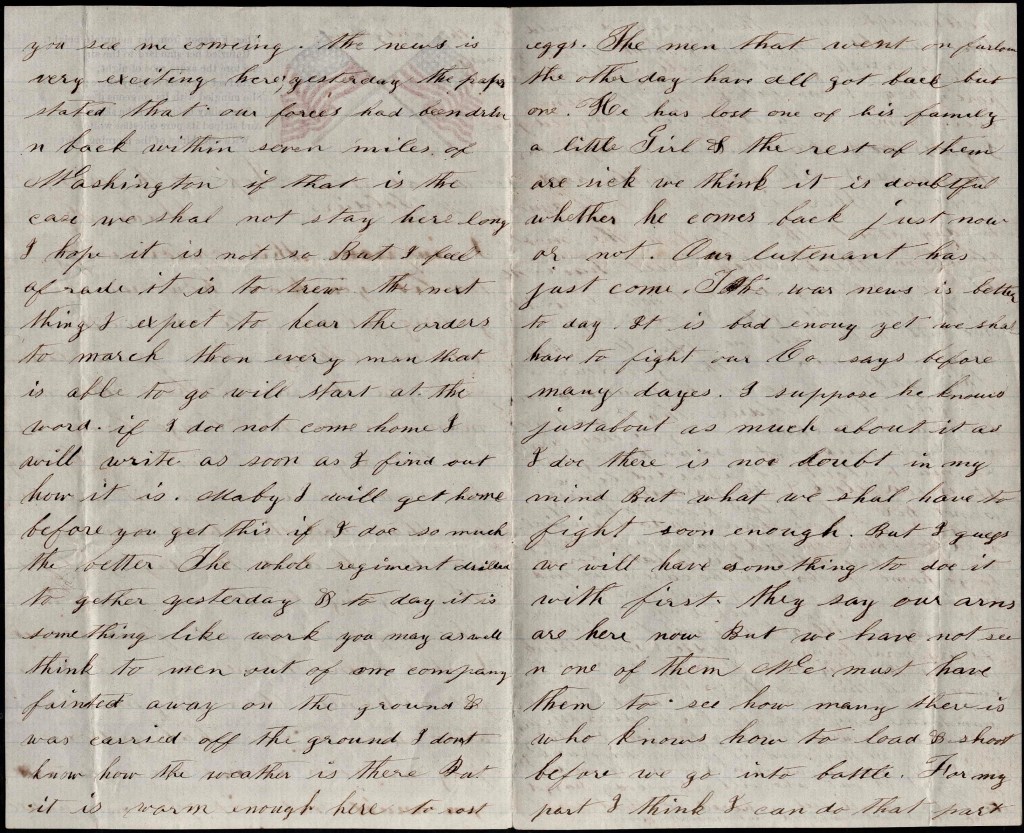
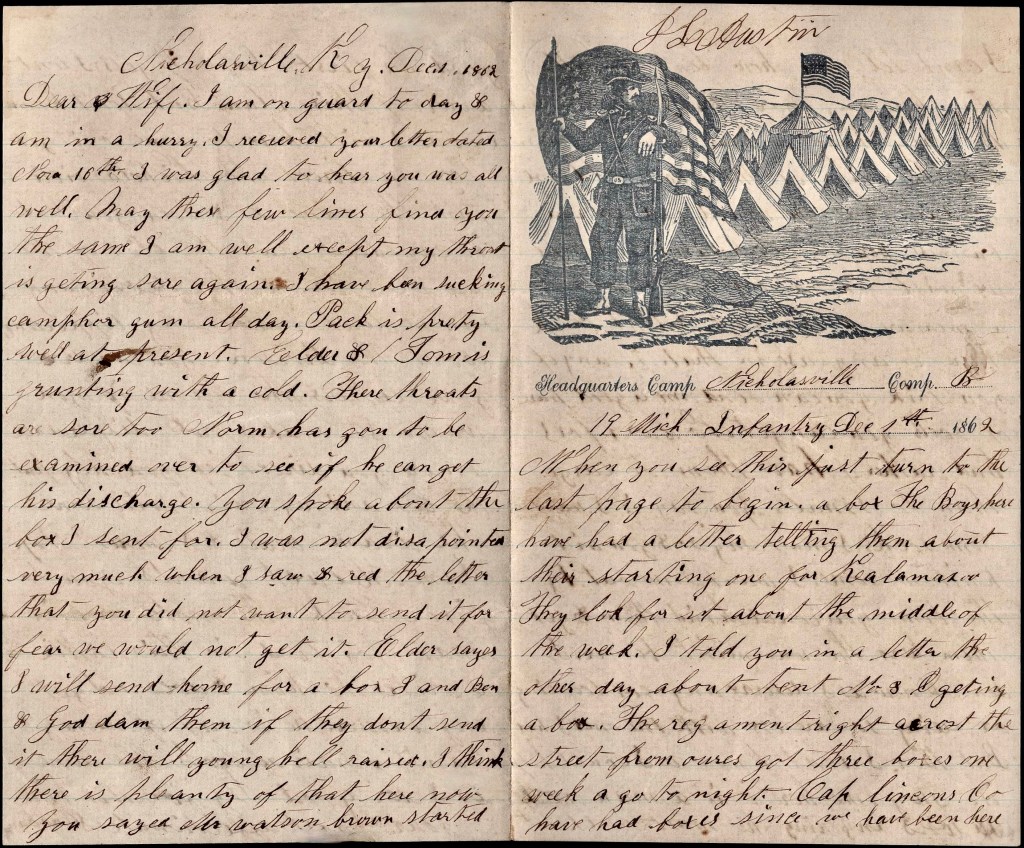

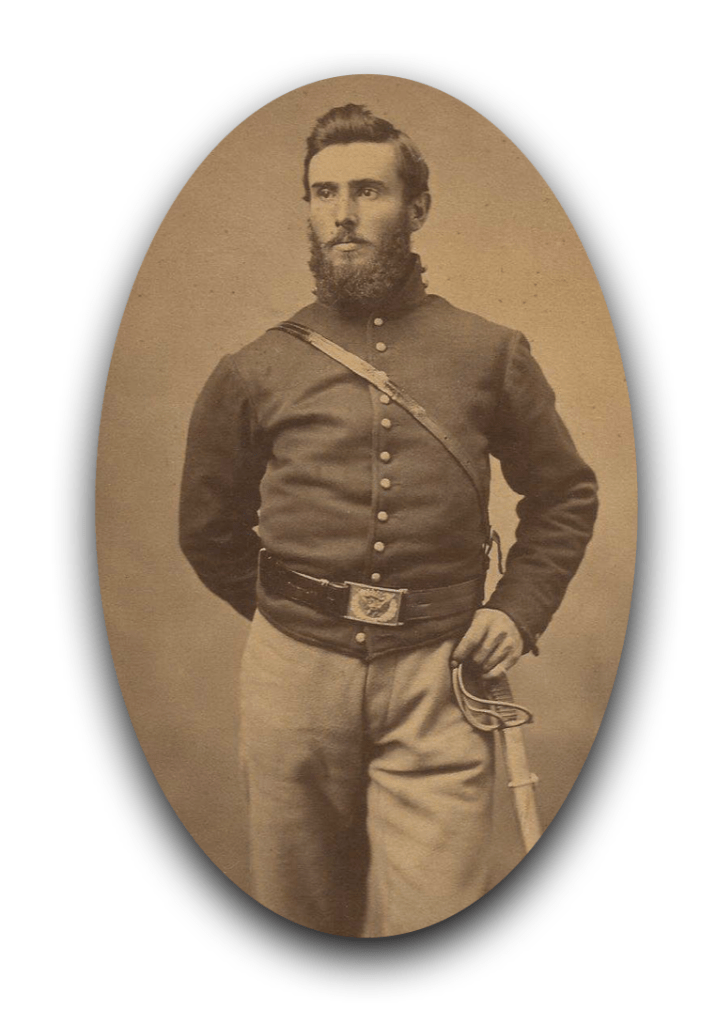


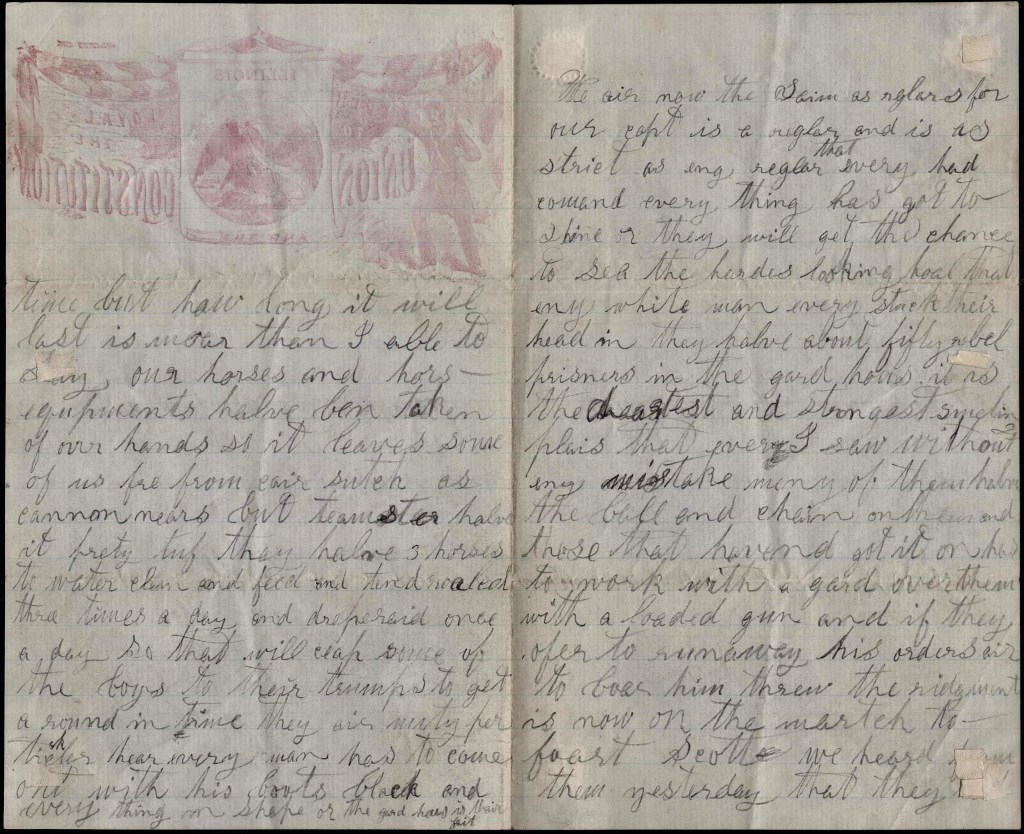
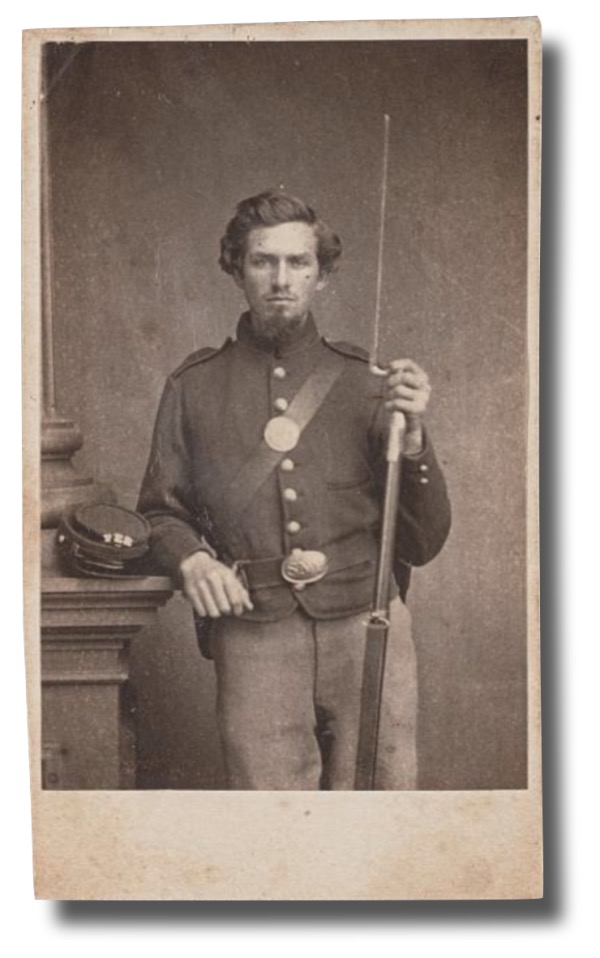


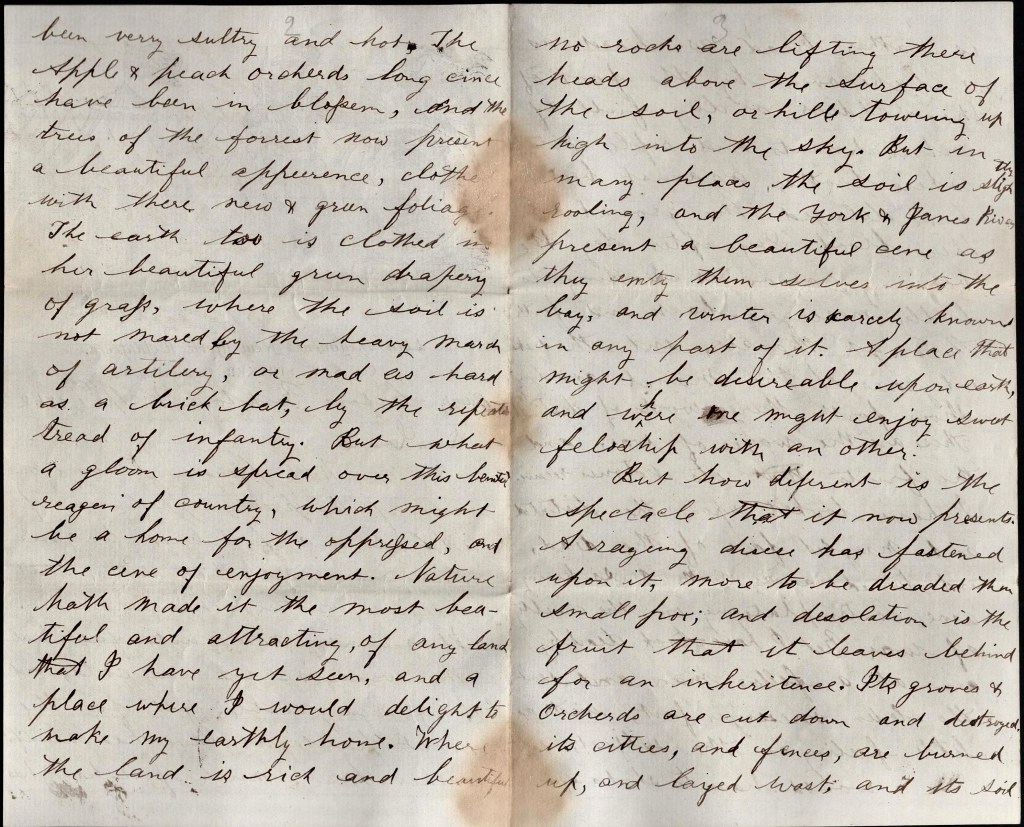


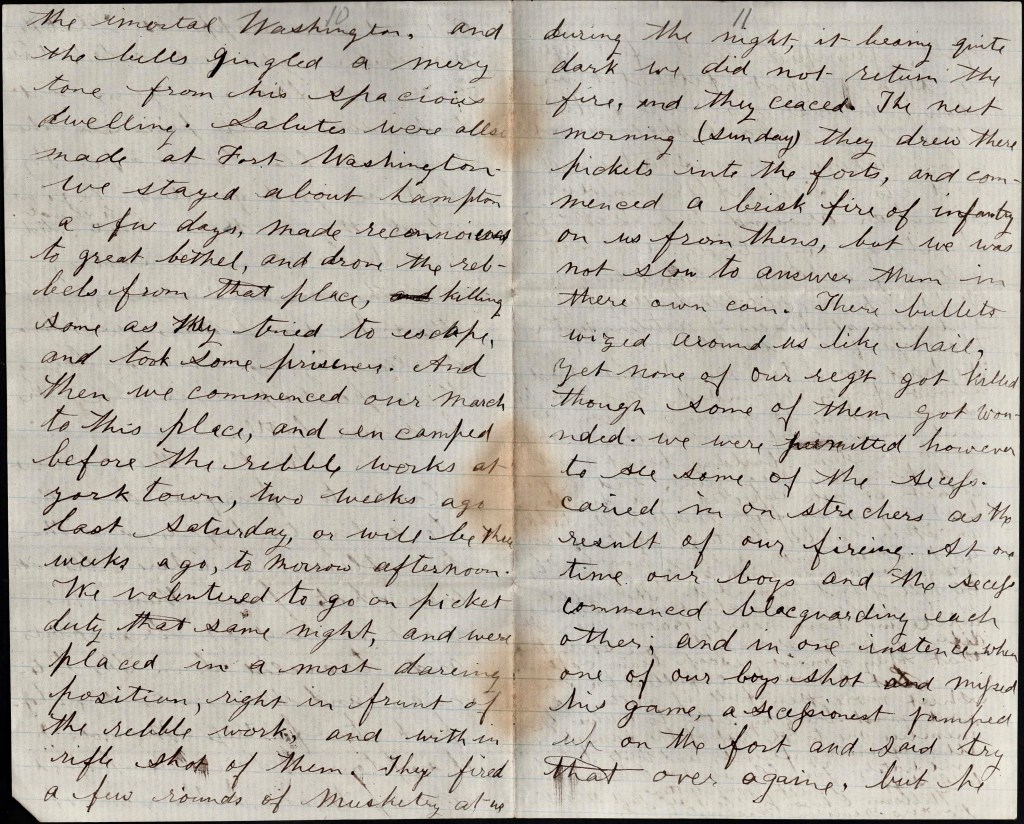

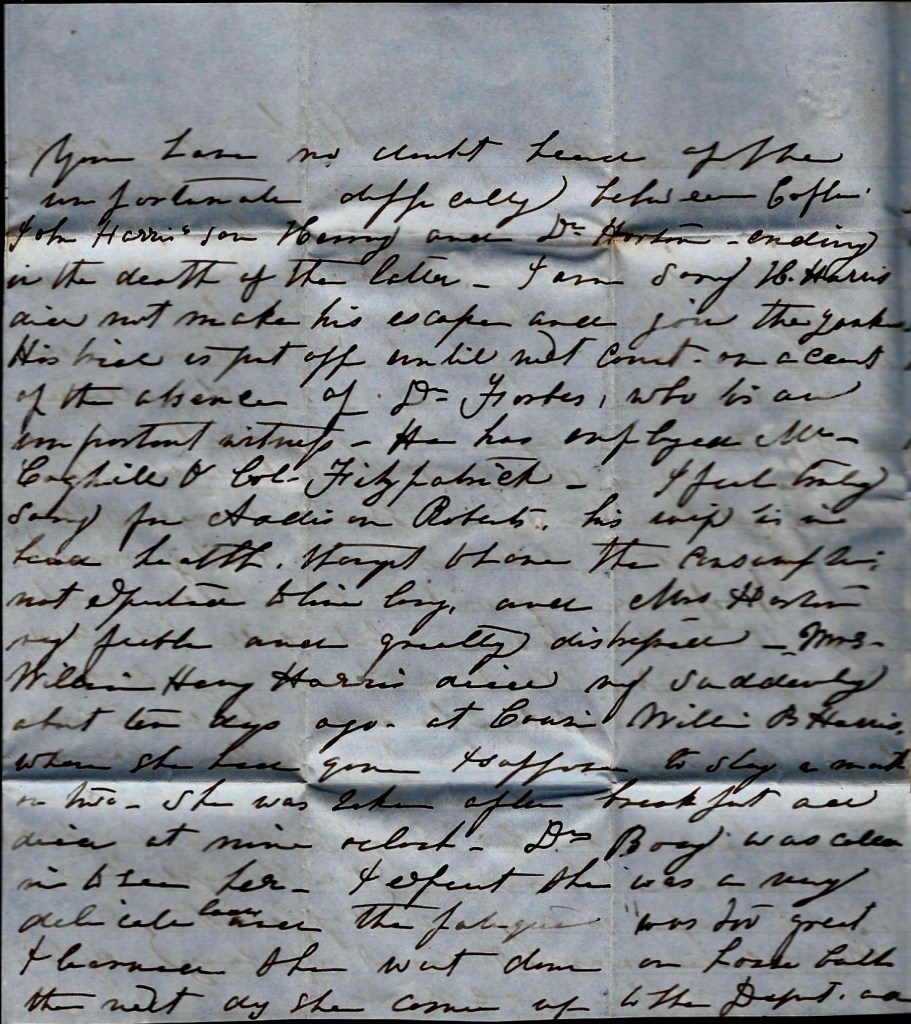


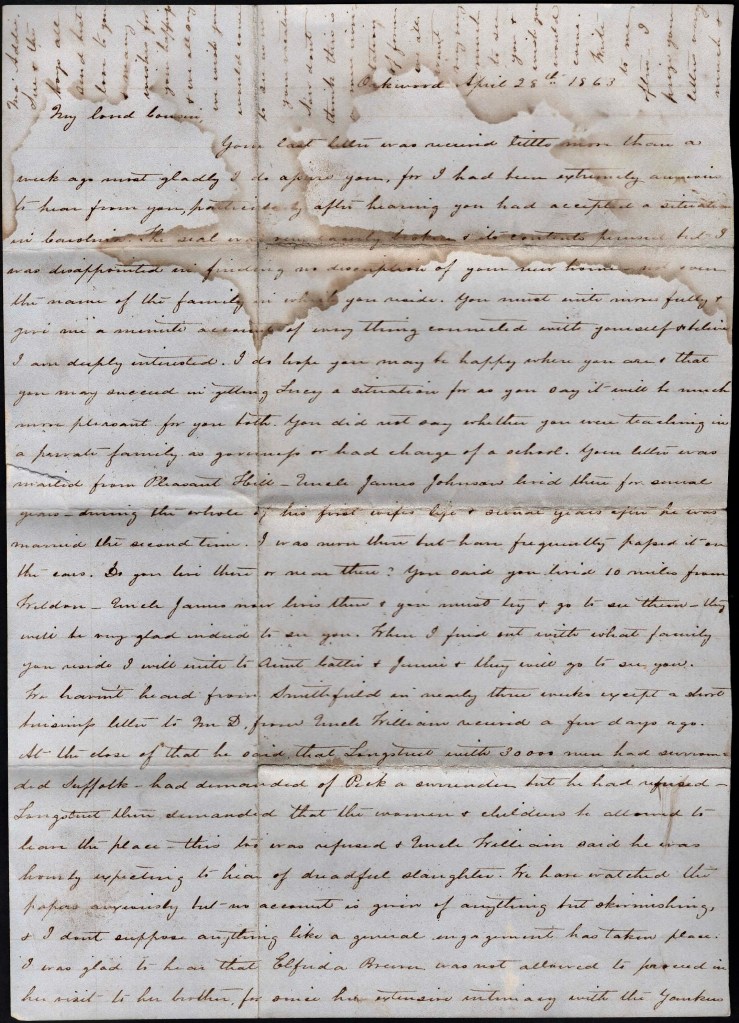

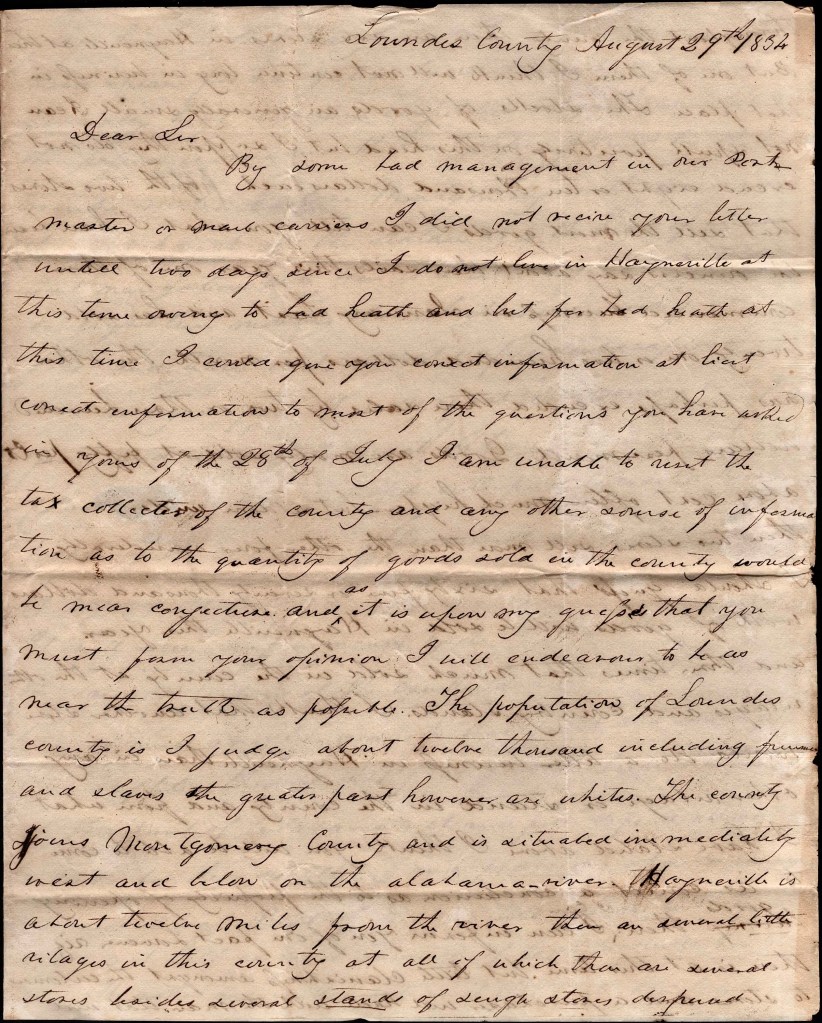


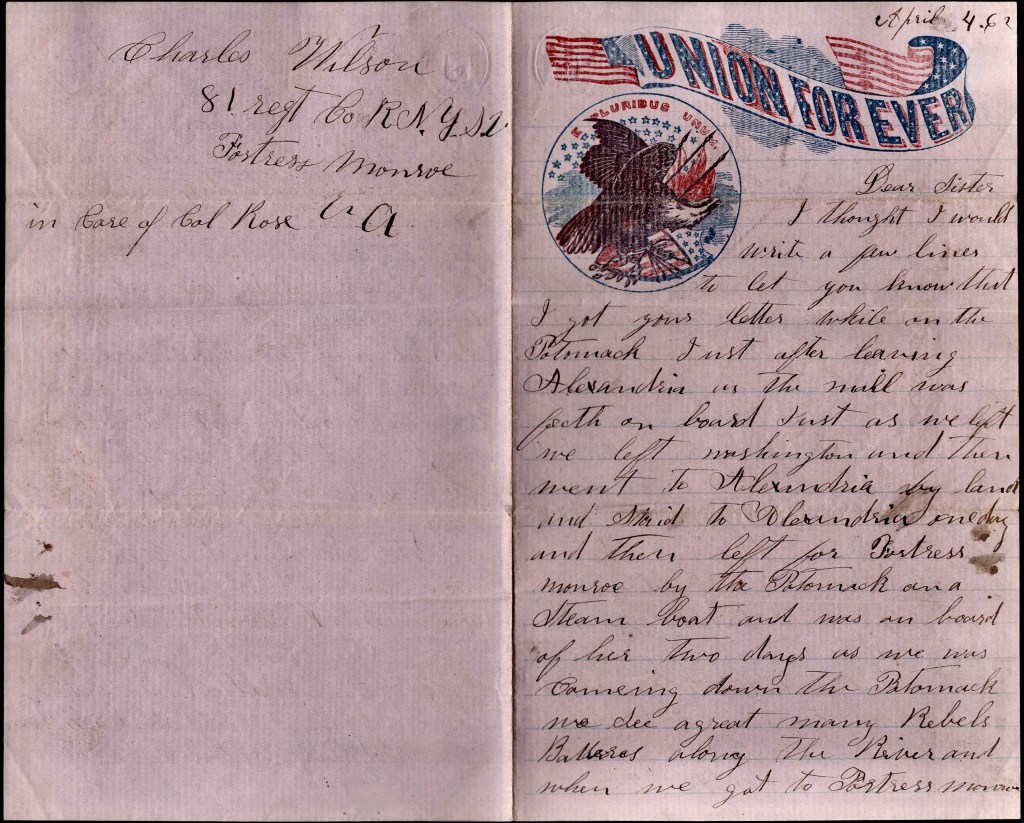

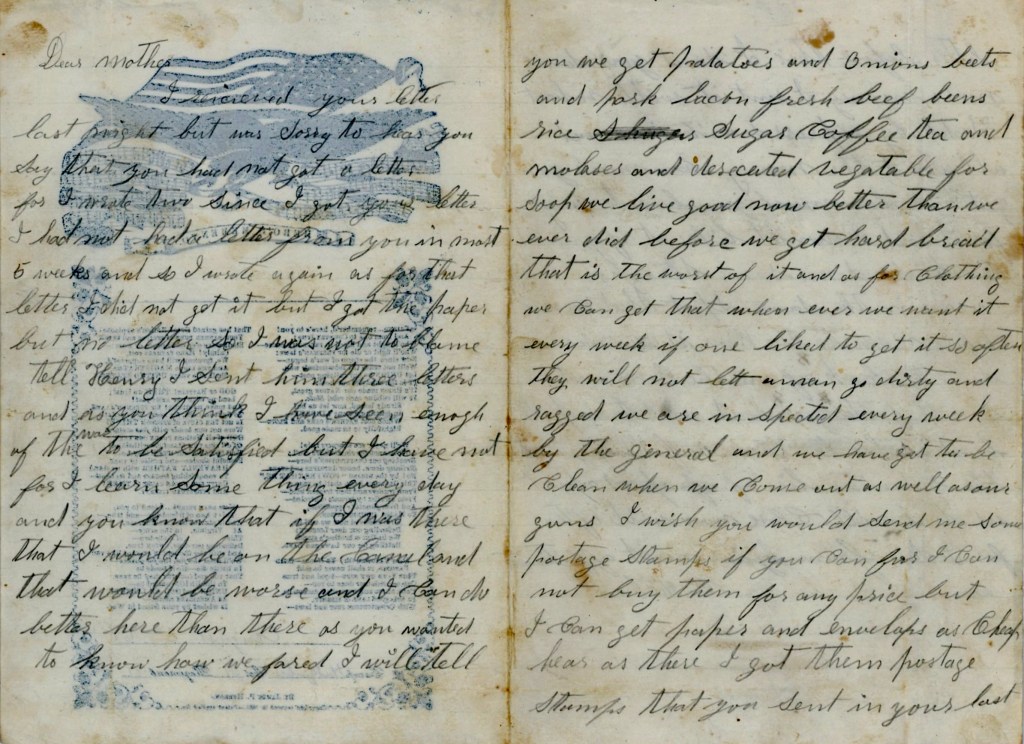


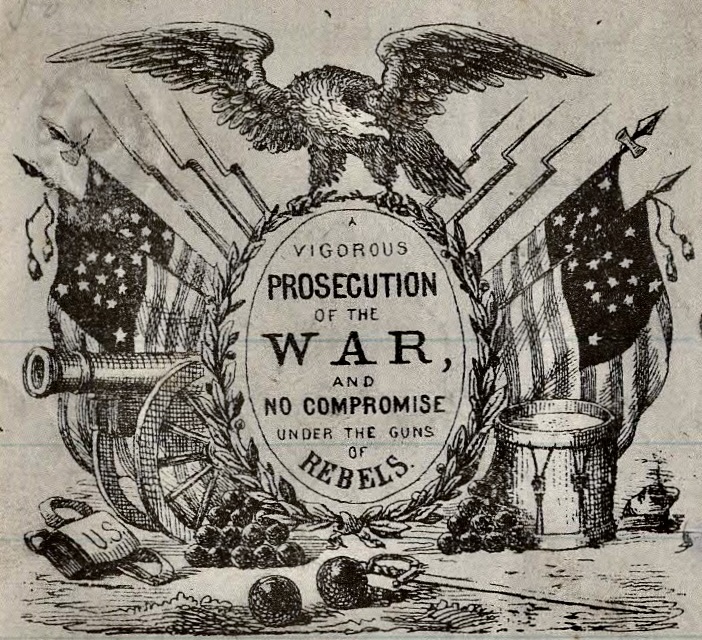
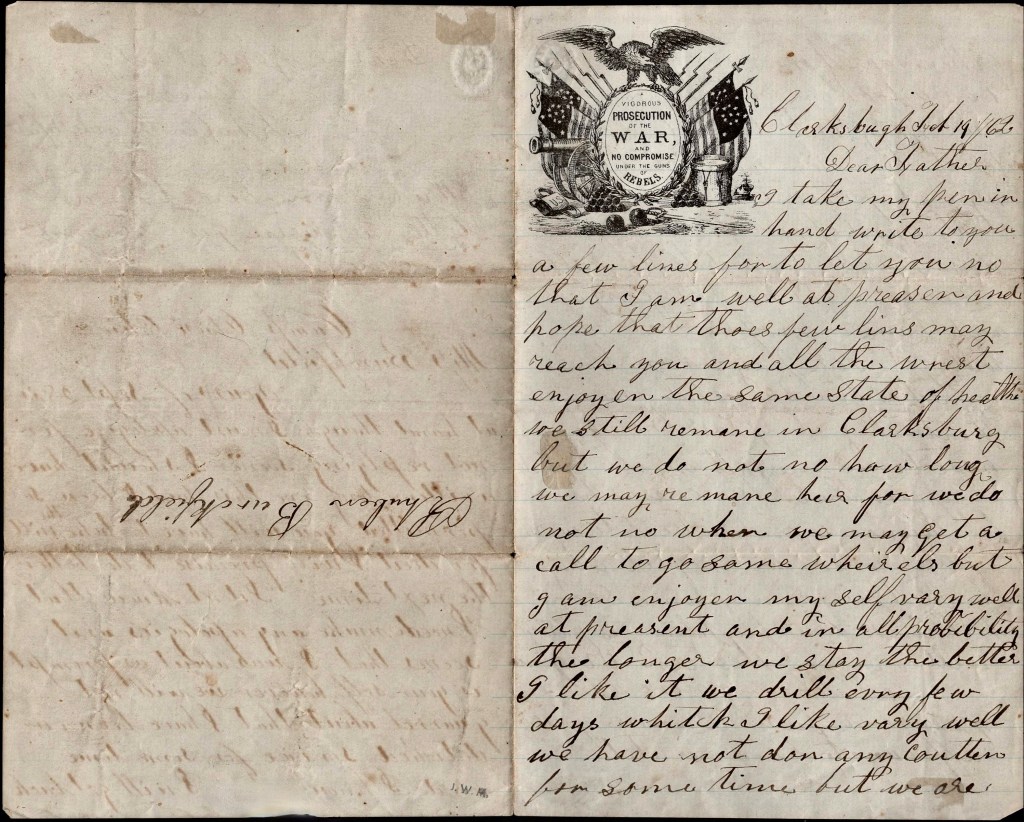
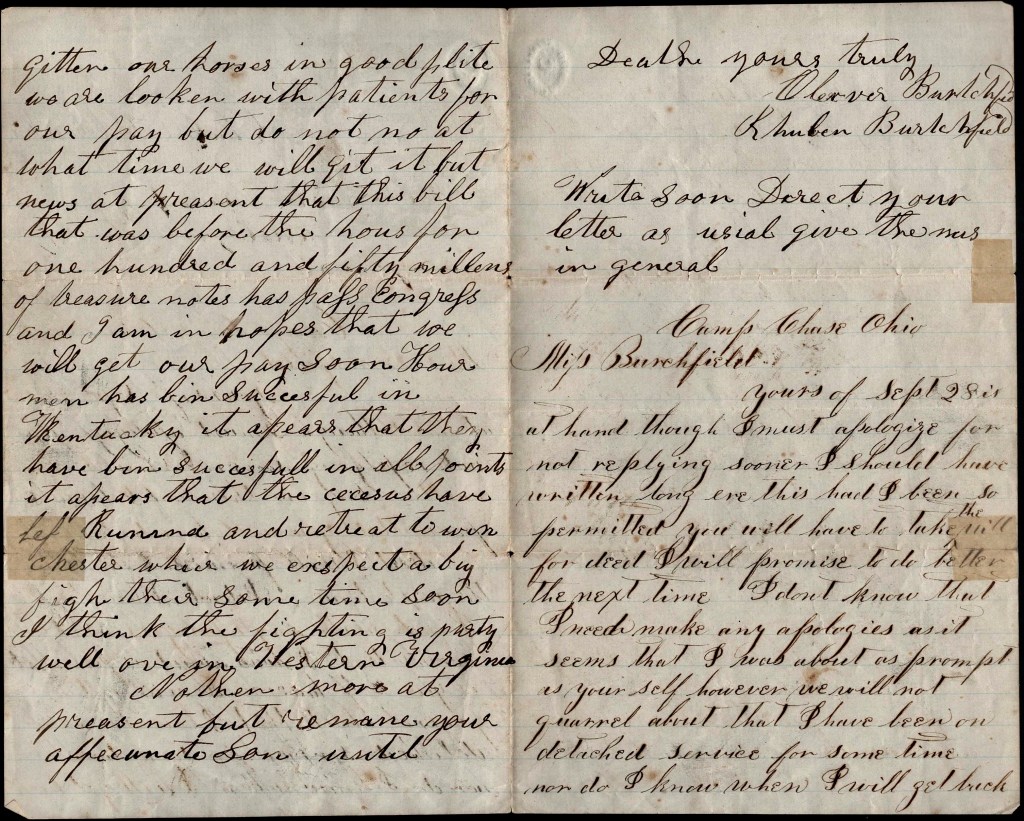
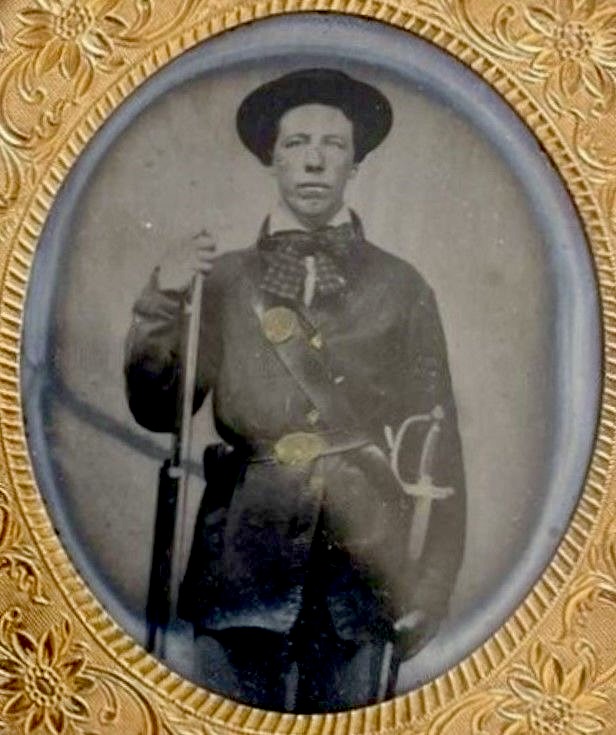


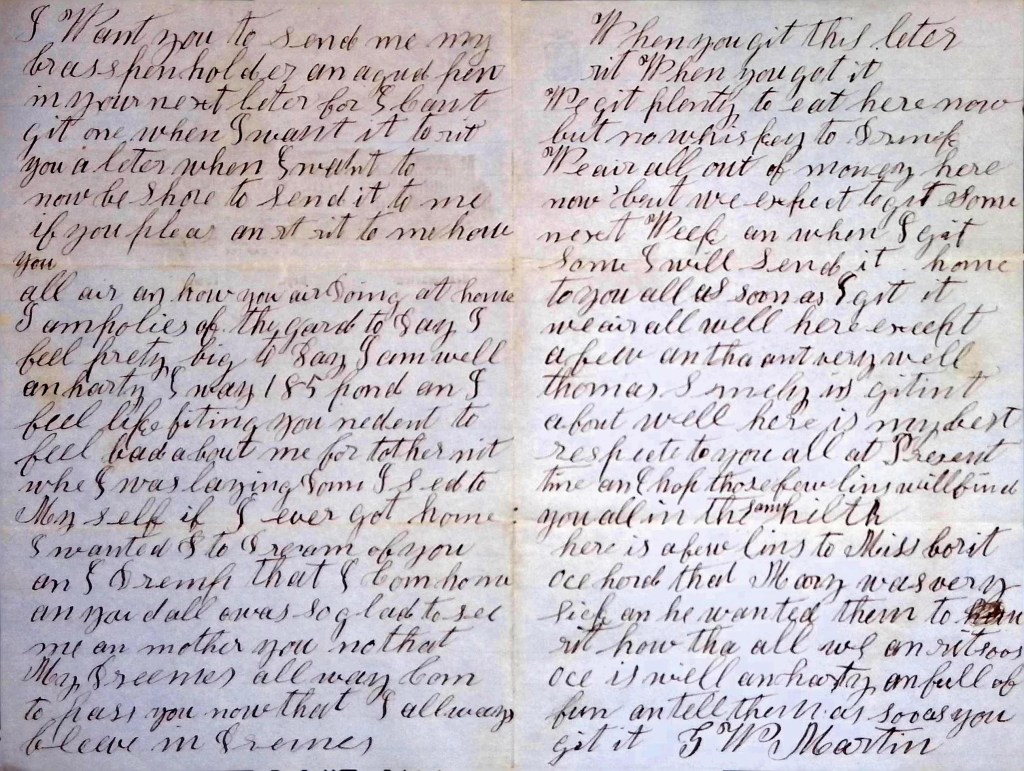
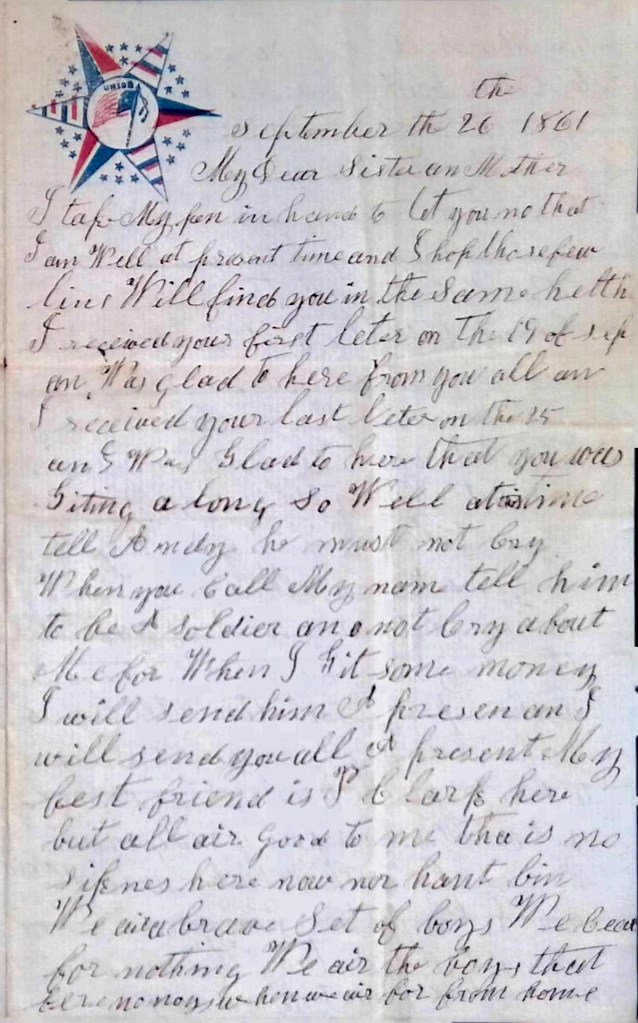


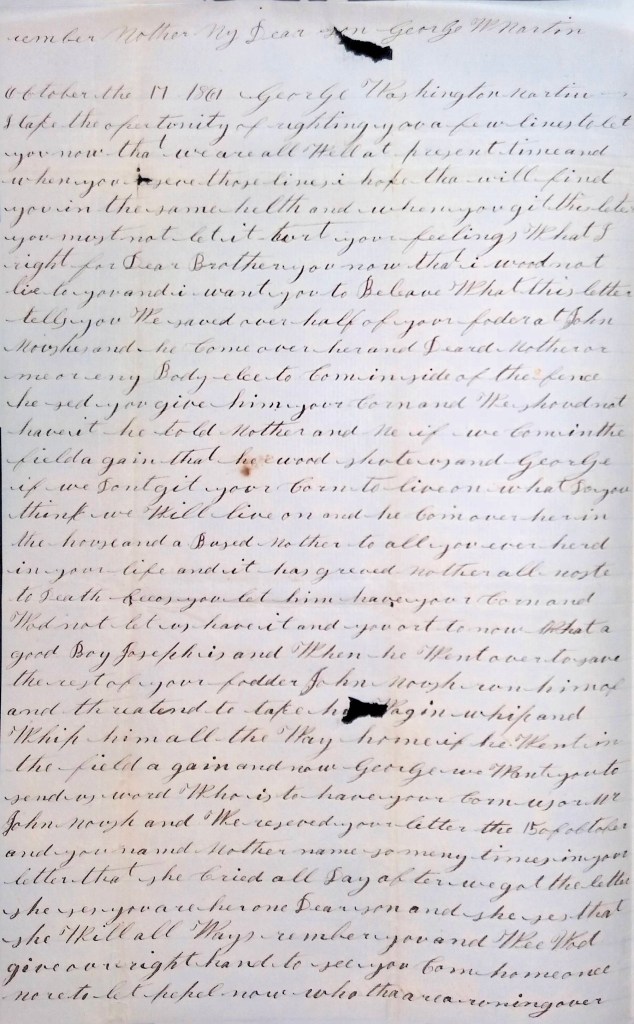


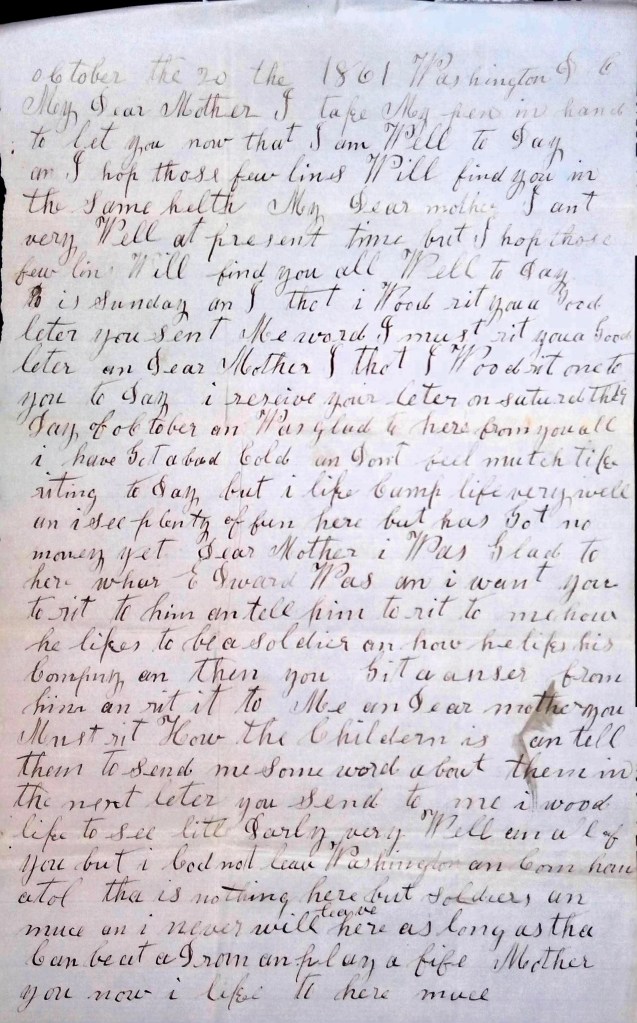
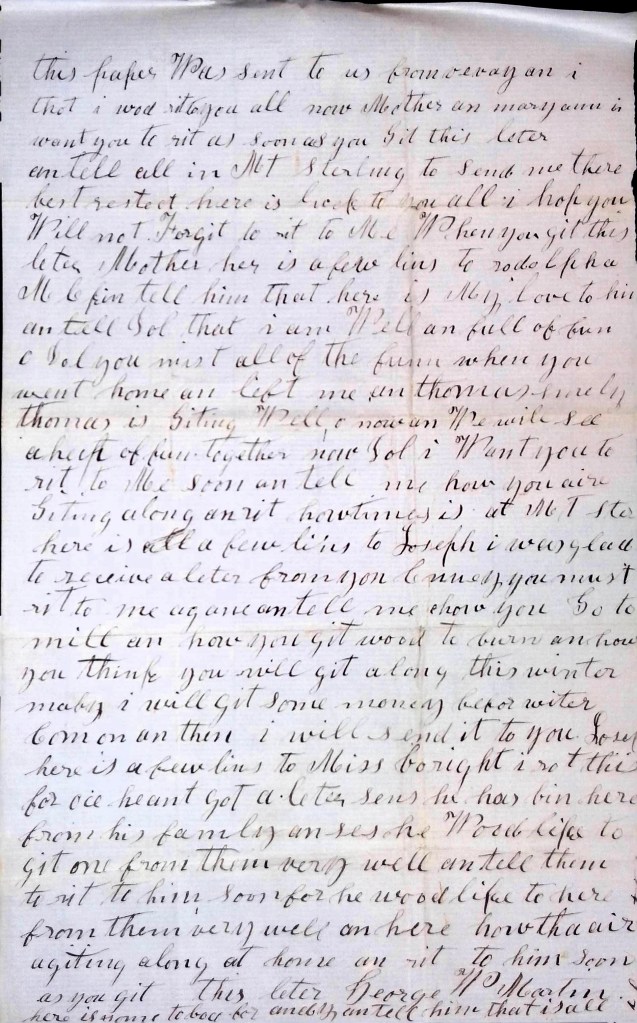

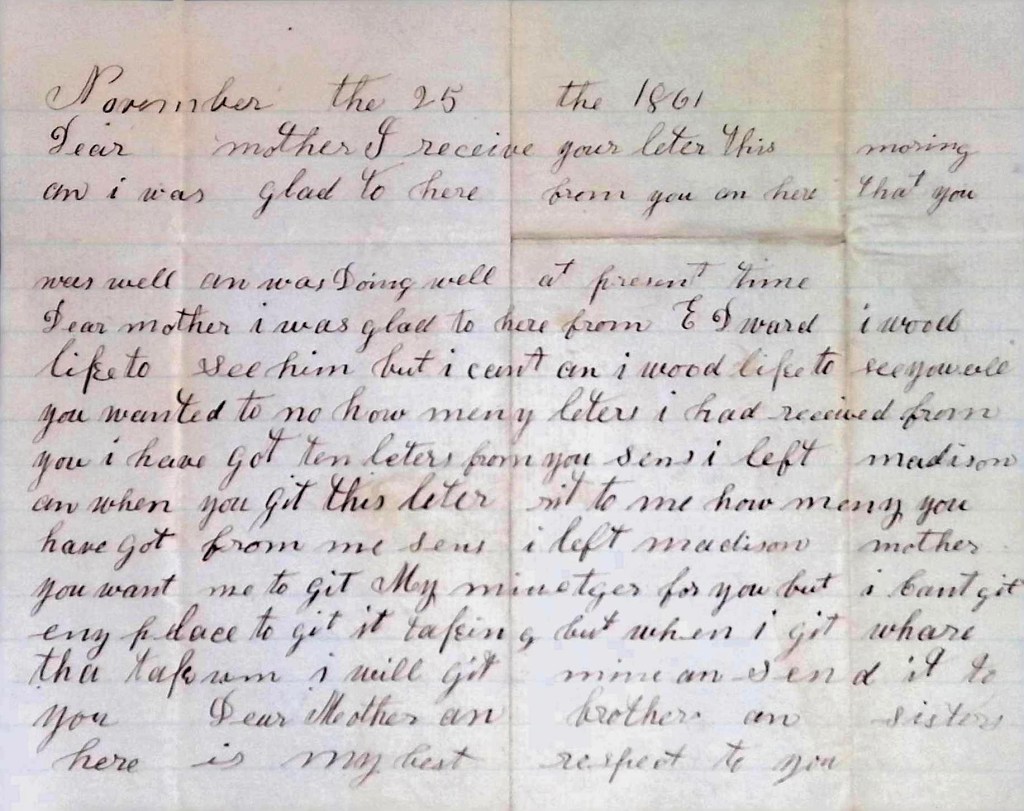


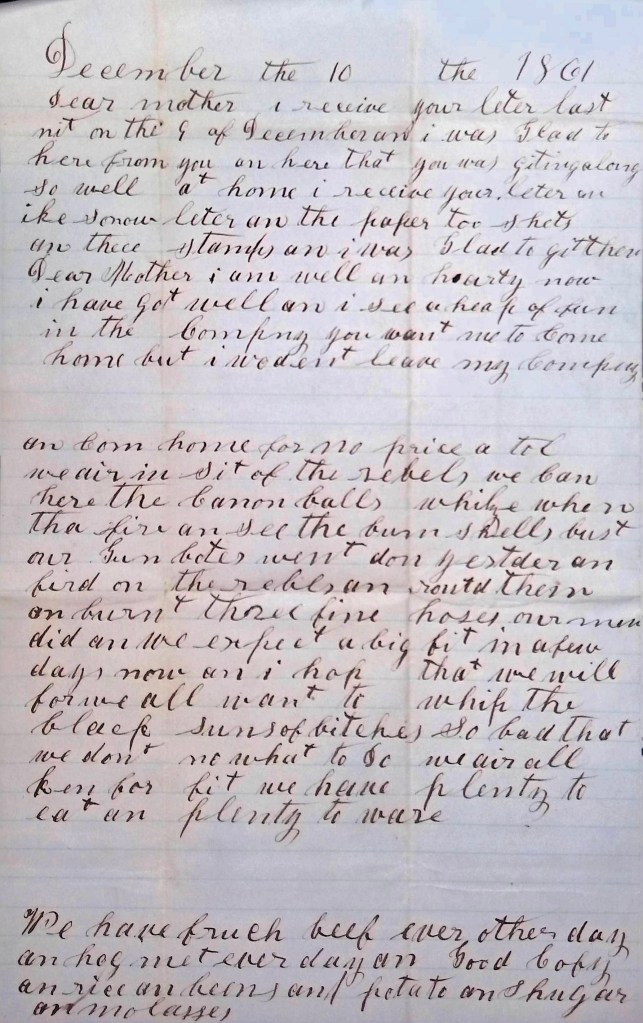

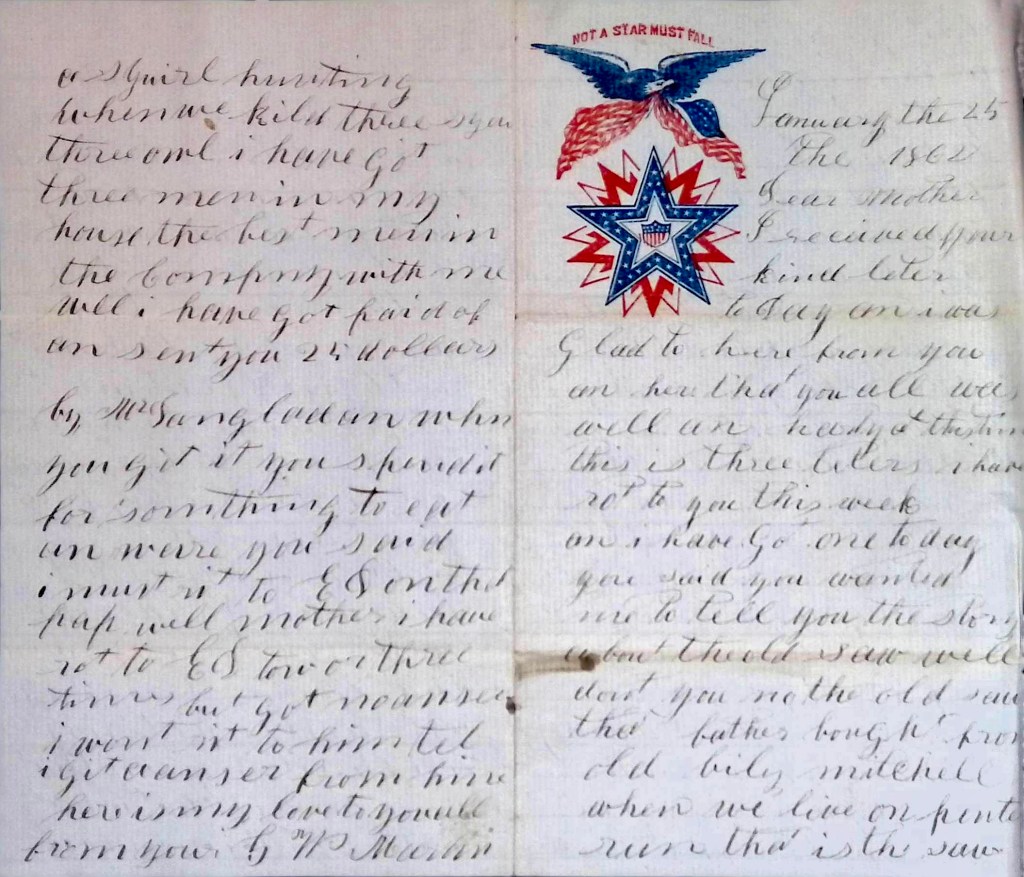


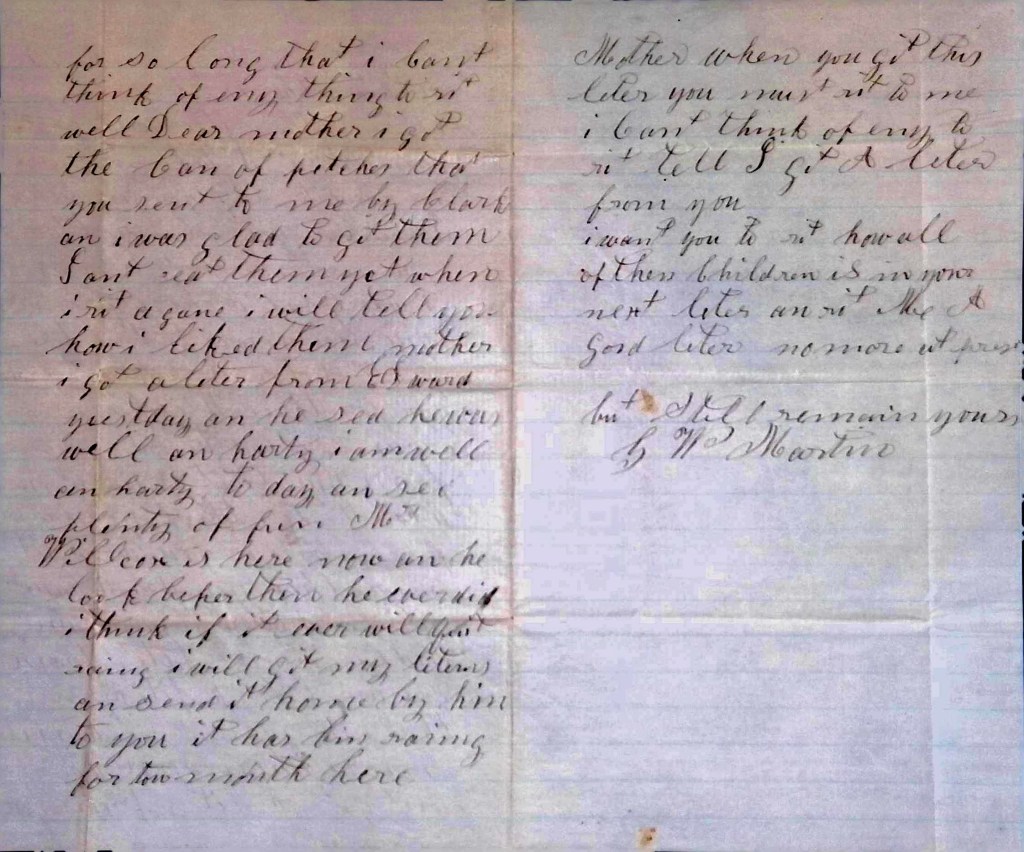

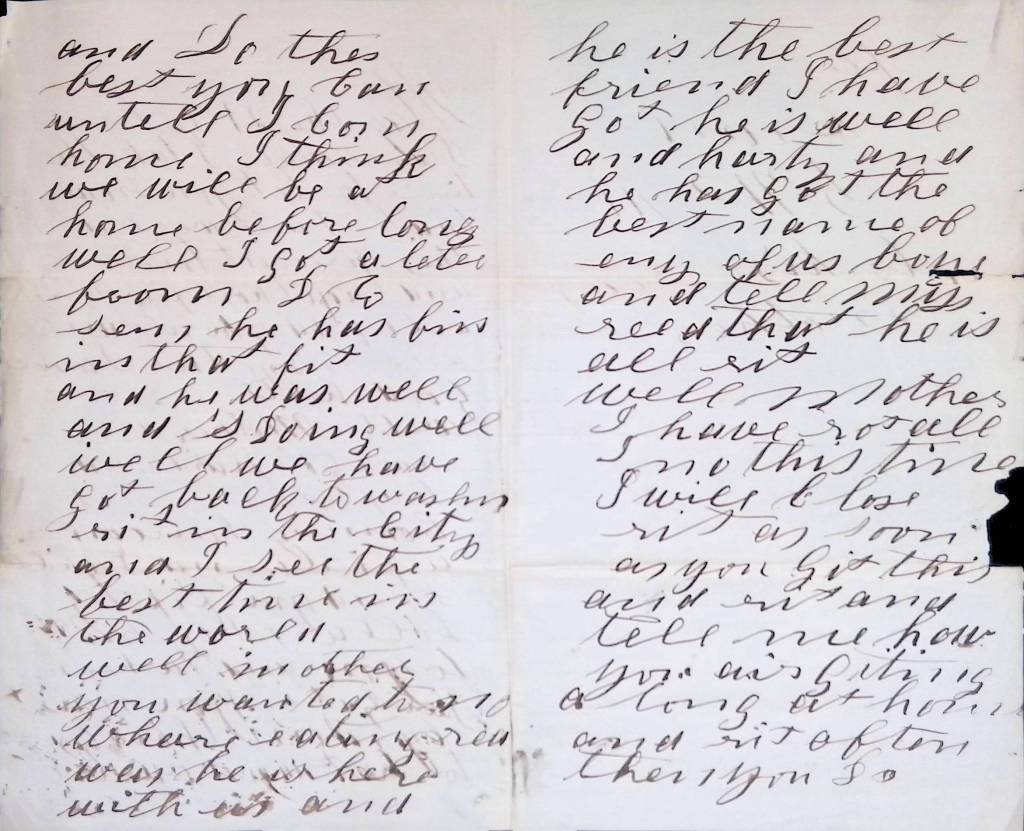
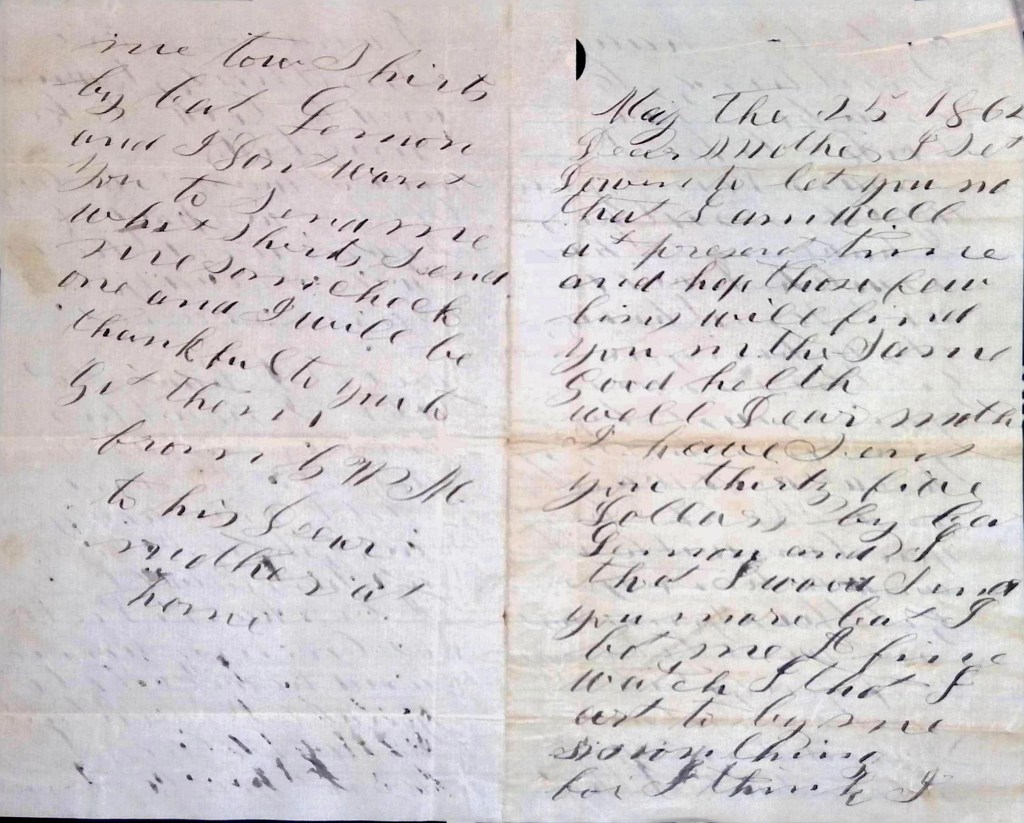


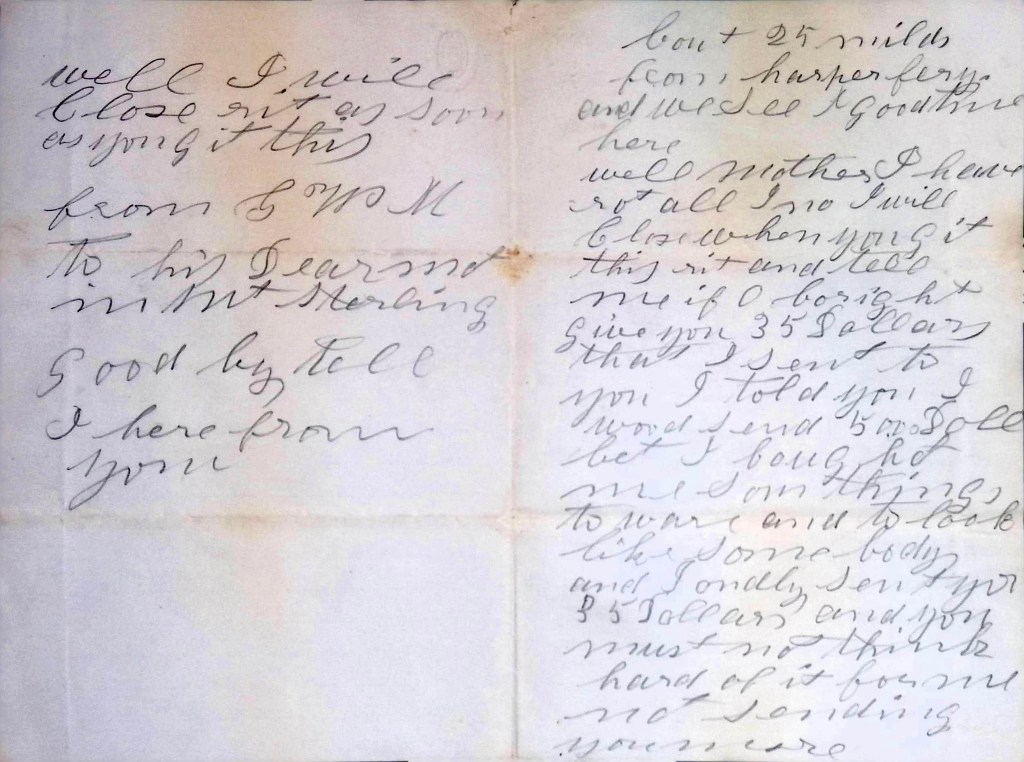
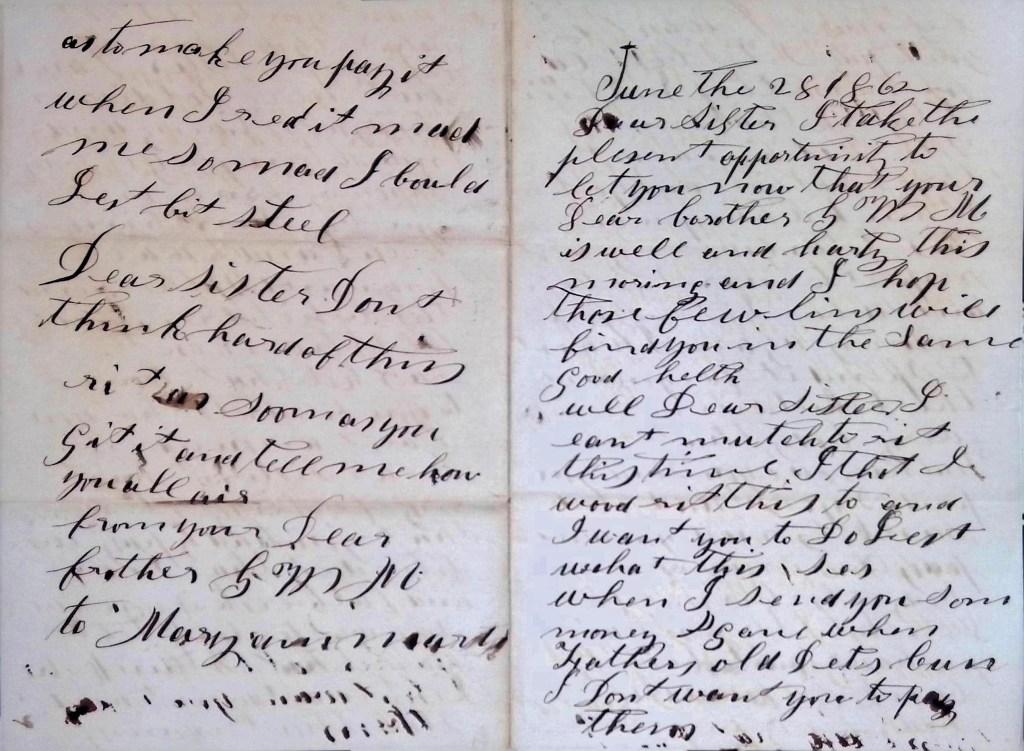


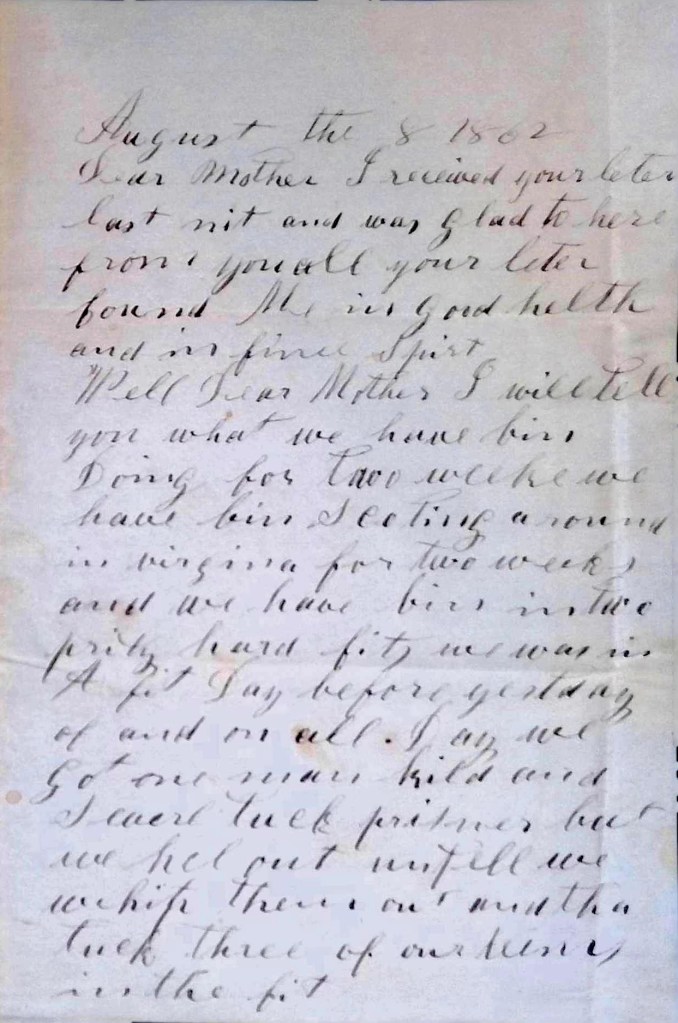
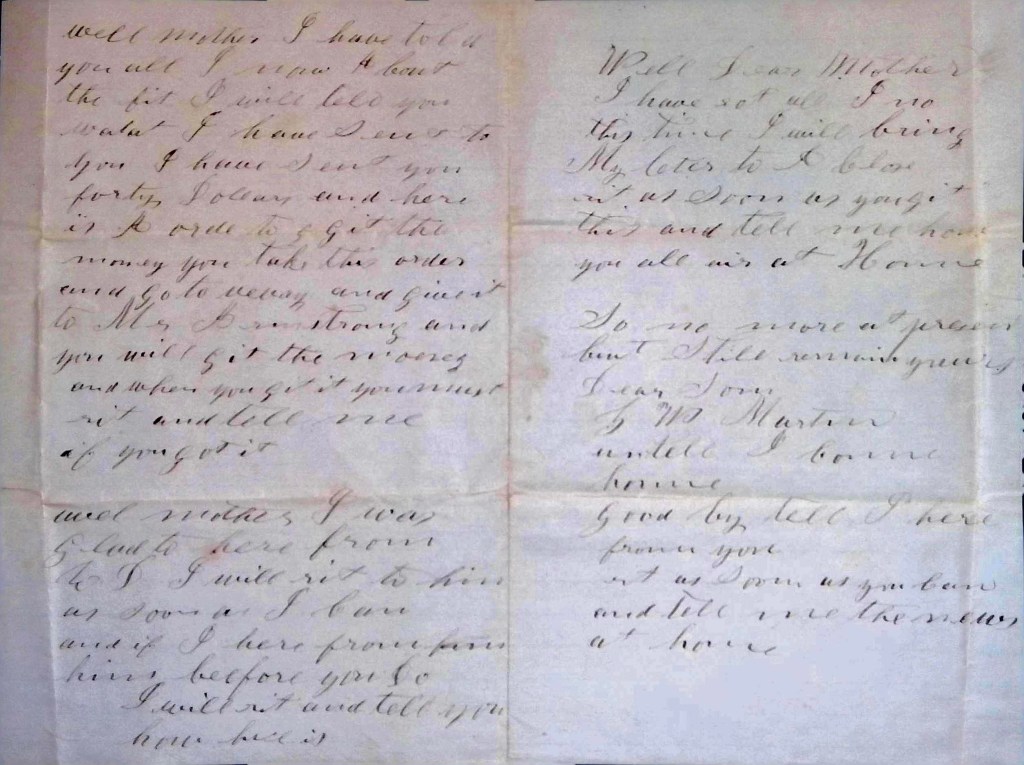


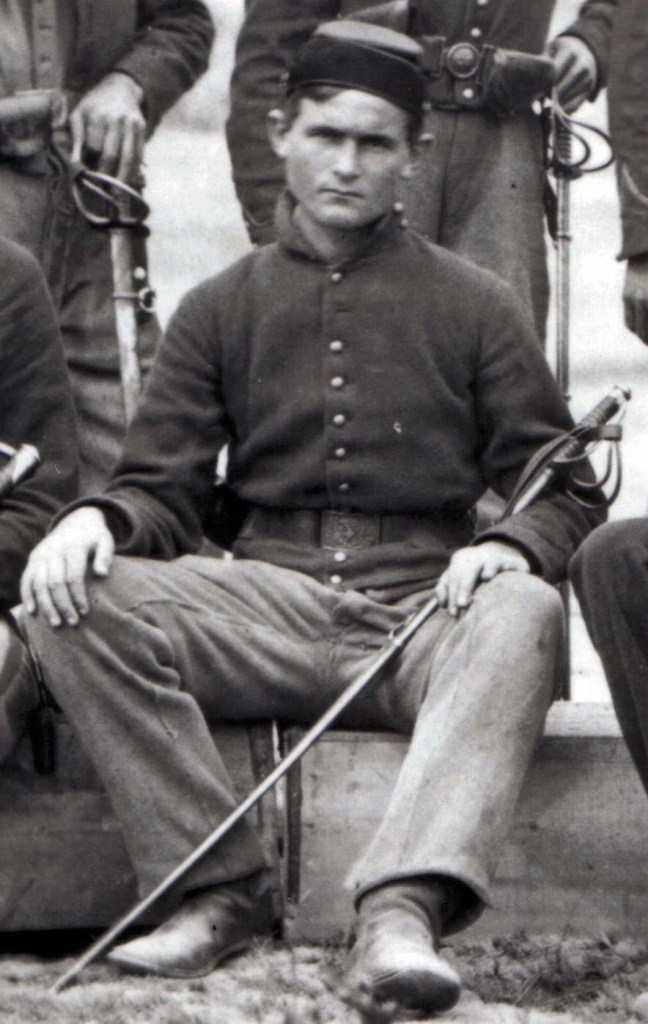


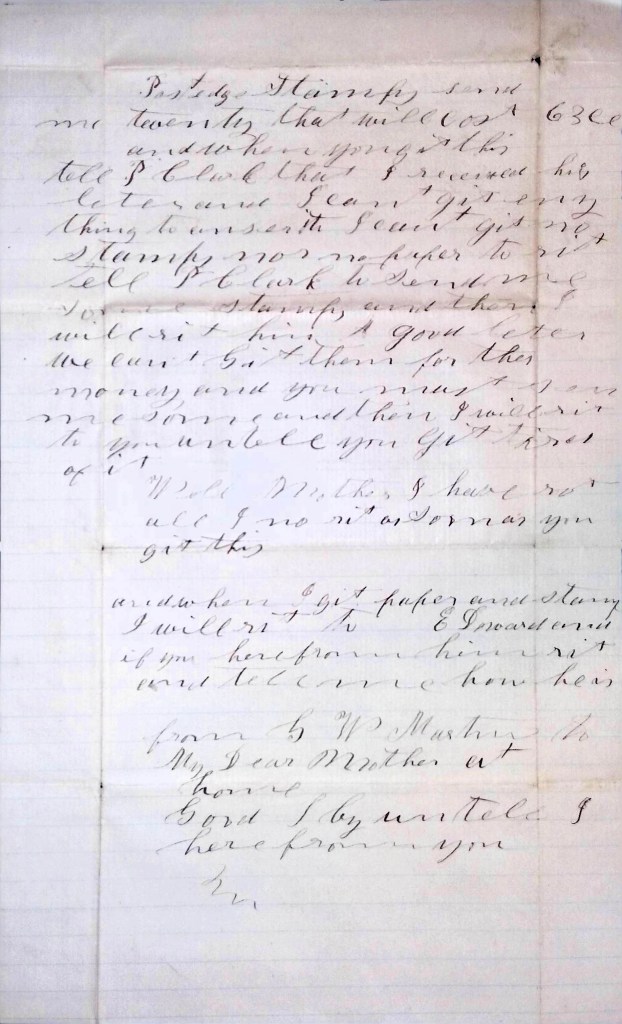
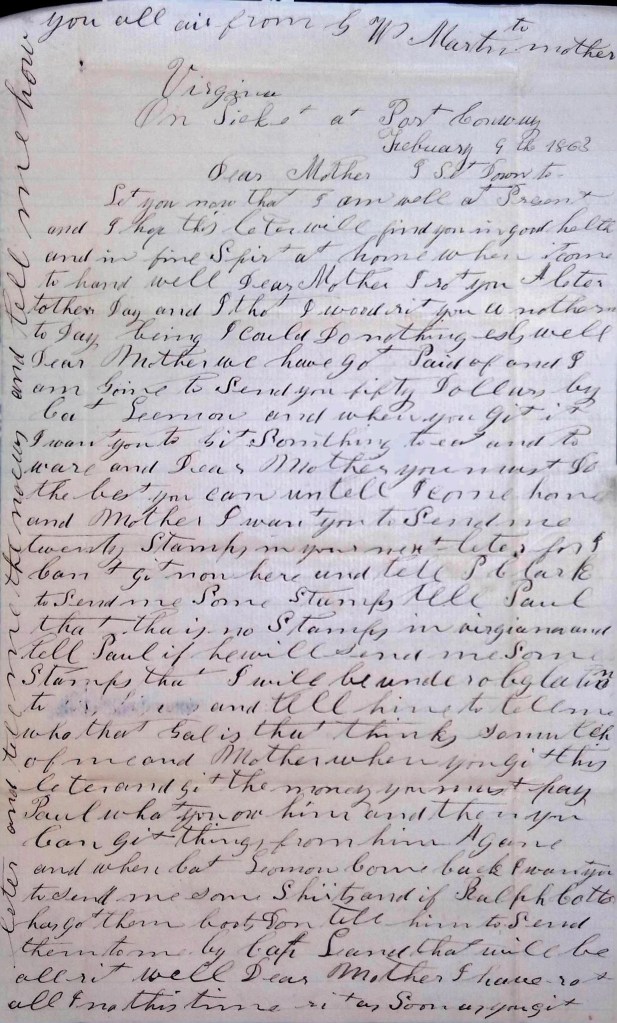

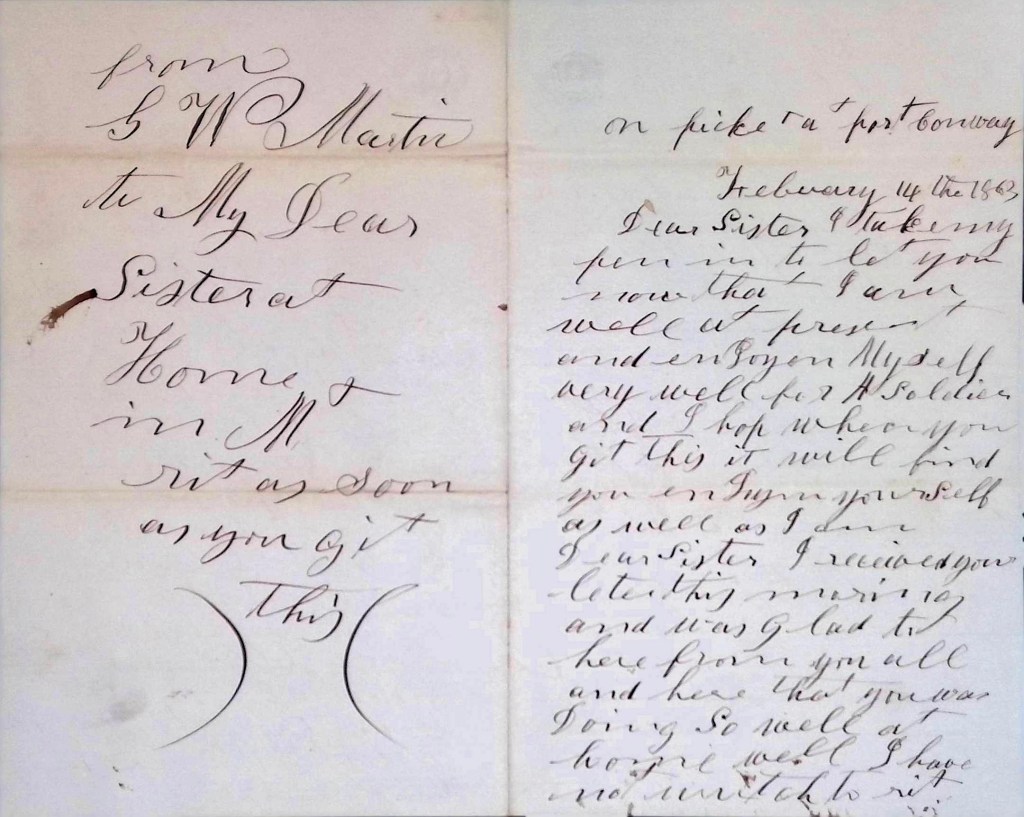


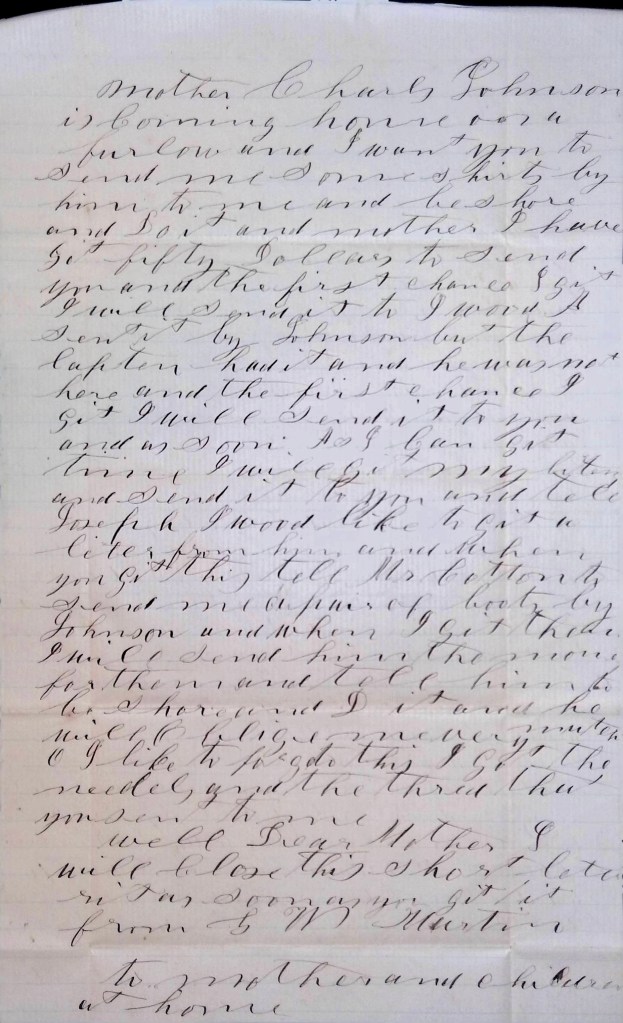
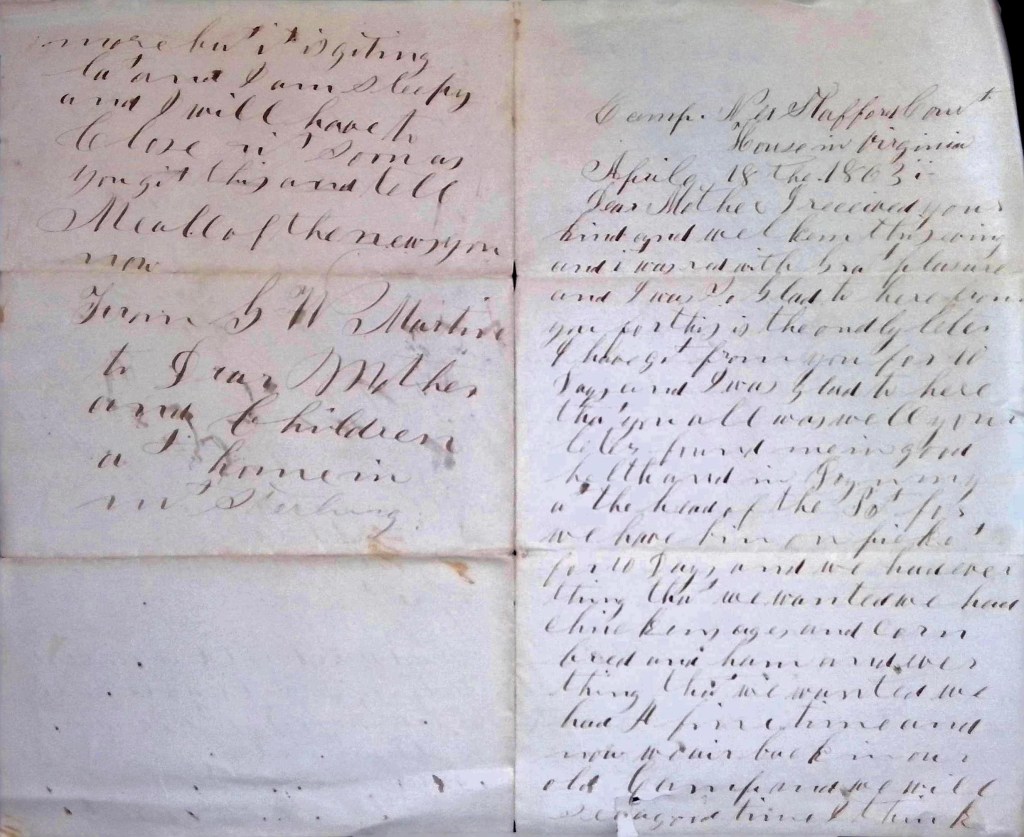
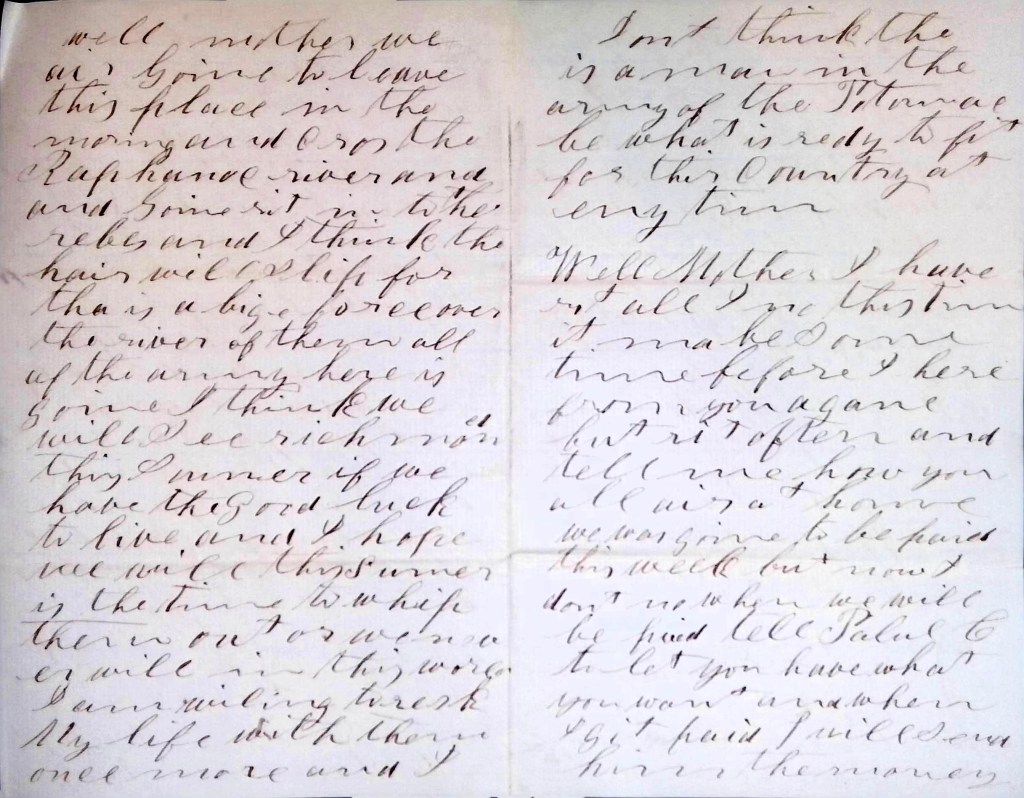
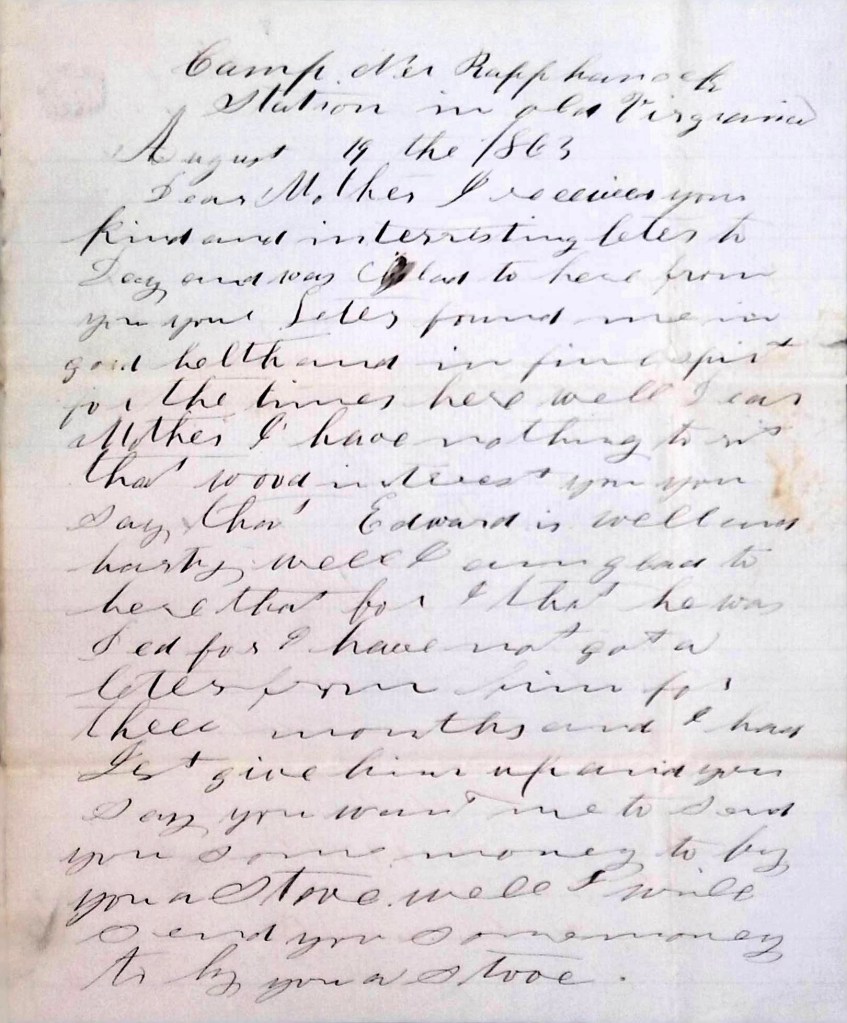
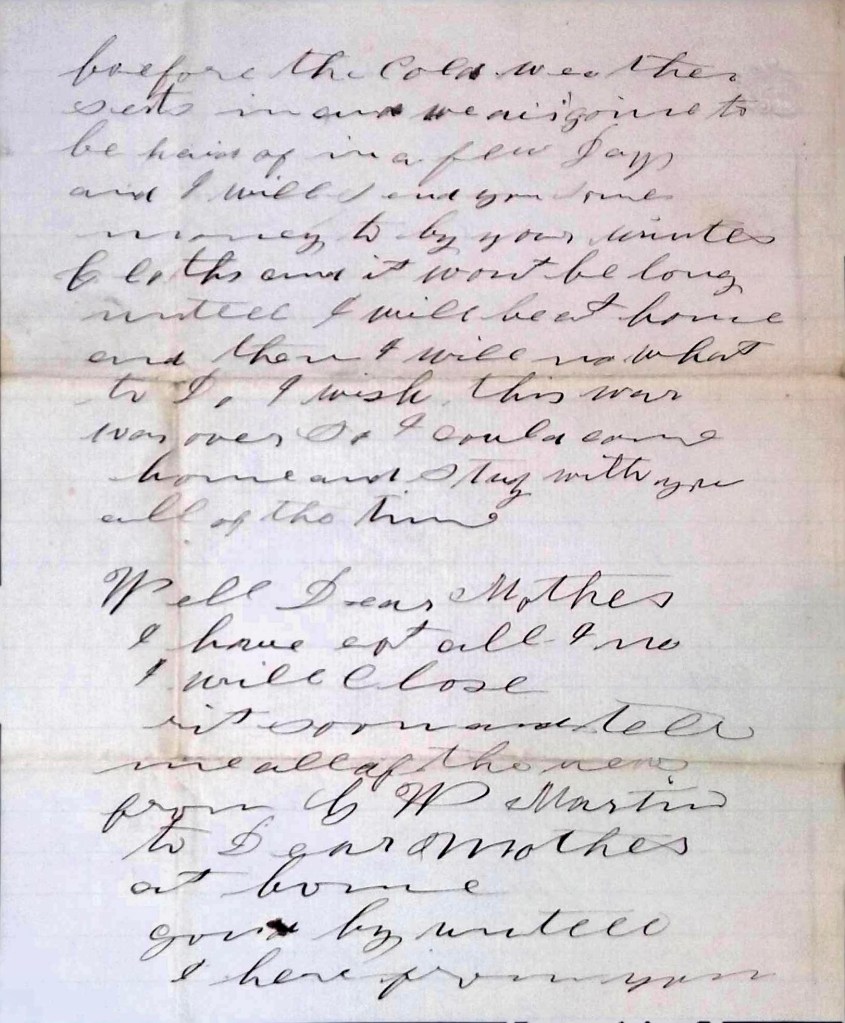
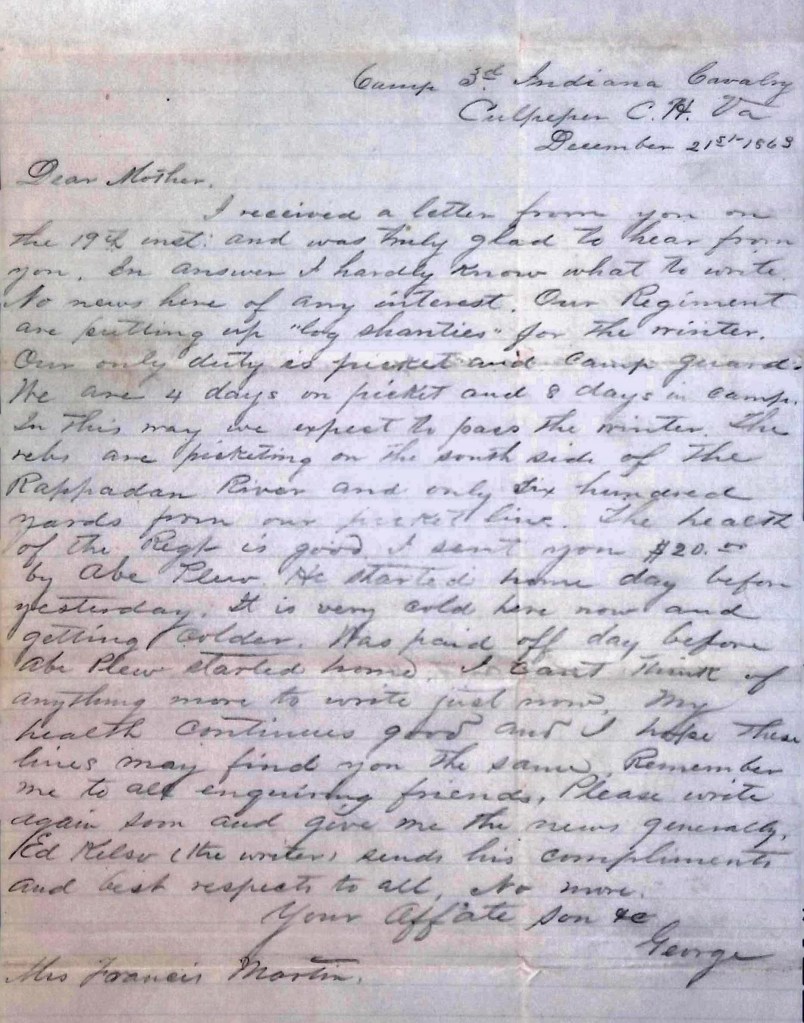

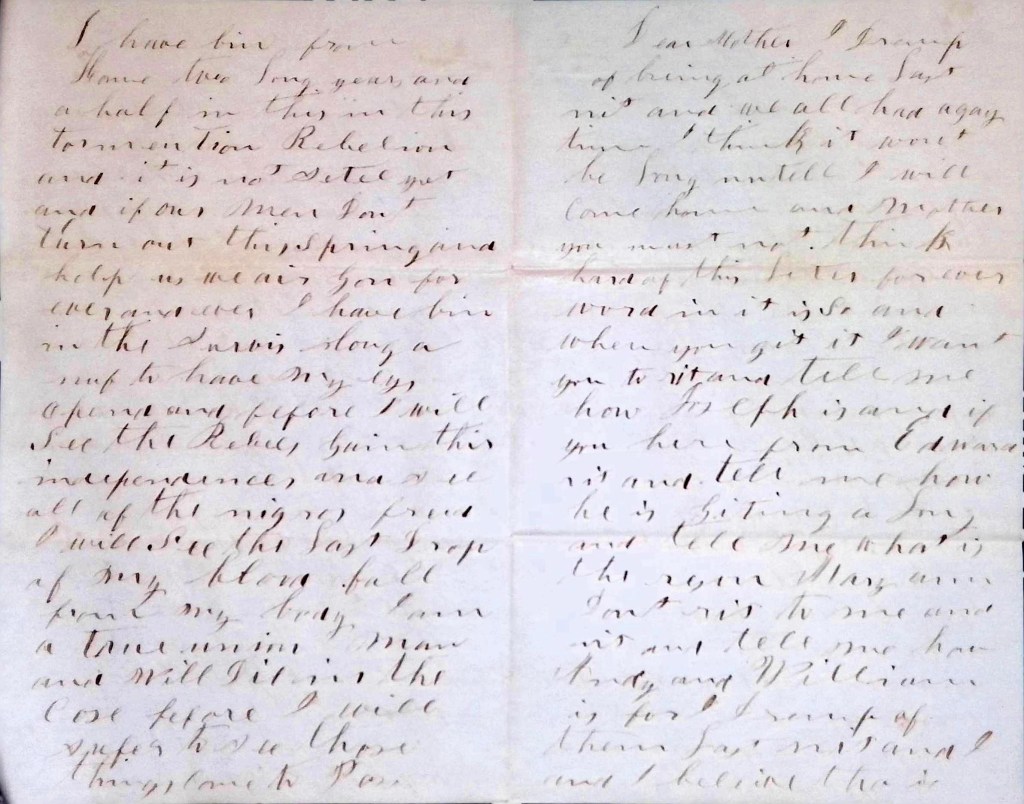
 Spared & Shared 23