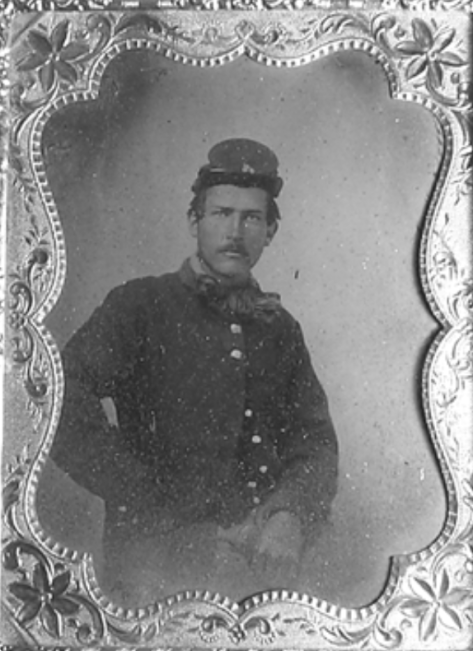
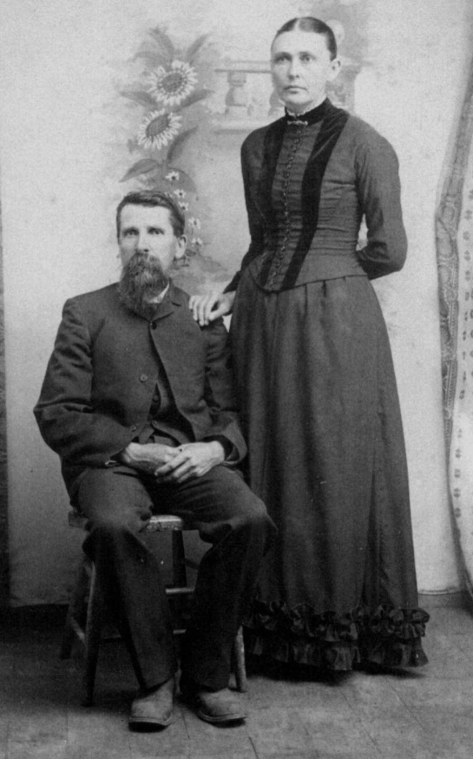
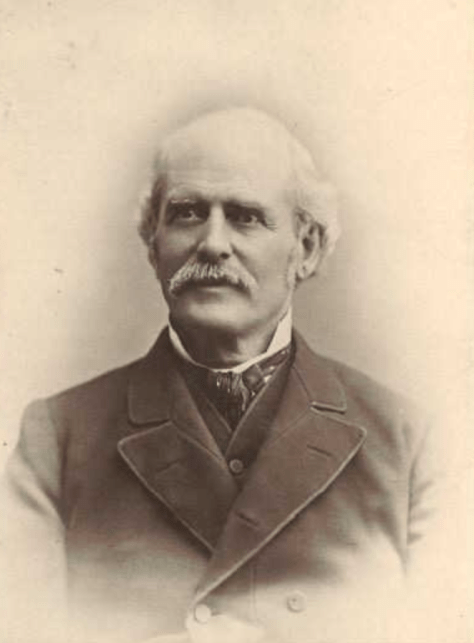
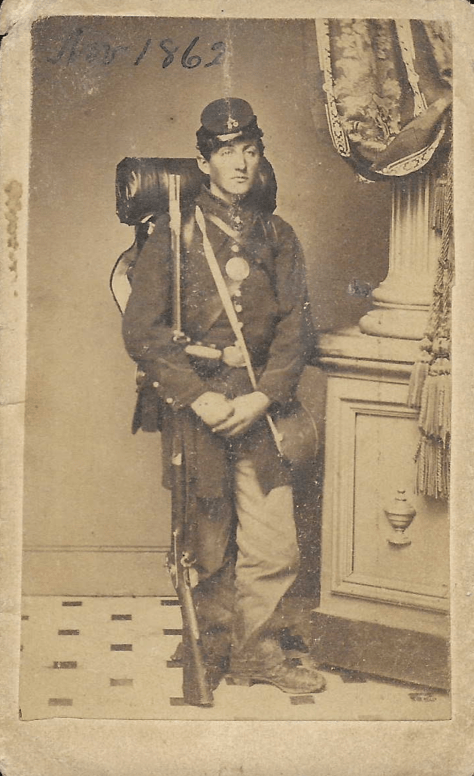
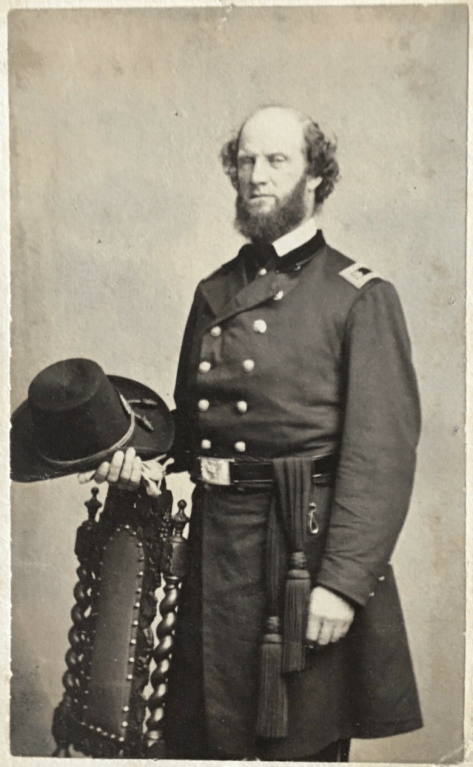
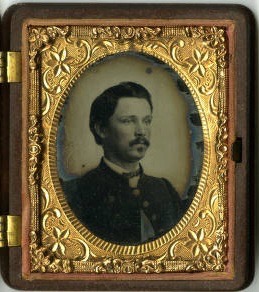
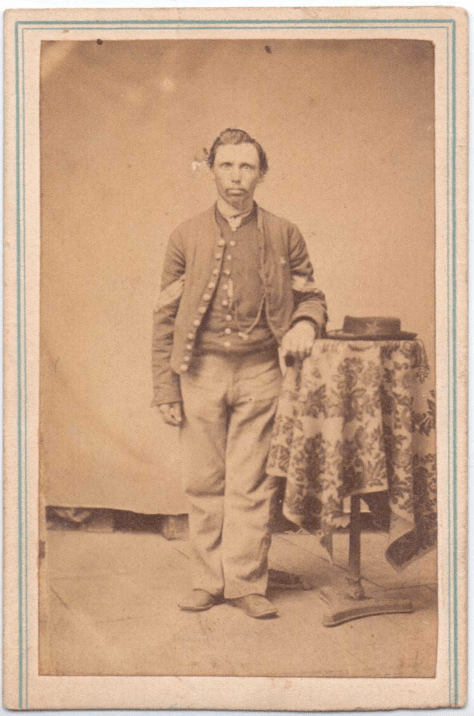
I could not find an image of William but here is one of Joseph H. Snyder who served in Co. I, 58th Pennsylvania Infantry (Photo Sleuth)
This letter was written by William Almon Wilmarth (1838-1914) of Co. H, 58th Pennsylvania Infantry. William enlisted in December 1861 and mustered out of the service in December 1864. An obituary informs us that during “the winter of 1863 at Little Washington, N.C., he was detailed as guard on a government transport about three months and in the spring of 1863 he was attached to Co. M, 4th US Art., about two months. On June 4, 1864, at Cold Water, Va., he received a gunshot wound in right leg and was in a hospital at Point Lookout, Md., about four weeks with fever and ague. He took part in the battles of Norfolk, Gum Swamp, Sandy Ridge, Drewry’s Bluff, Cold Harbor and Fort Harrison, Va.”
William was the son of Nelson Wilmarth (1812-1847) and Matilda Morris (1816-1838) of McKean county, Pennsylvania. When William’s mother died in childbirth, William was raised by William Lamphier and Calista Hazen.
T R A N S C R I P T I O N
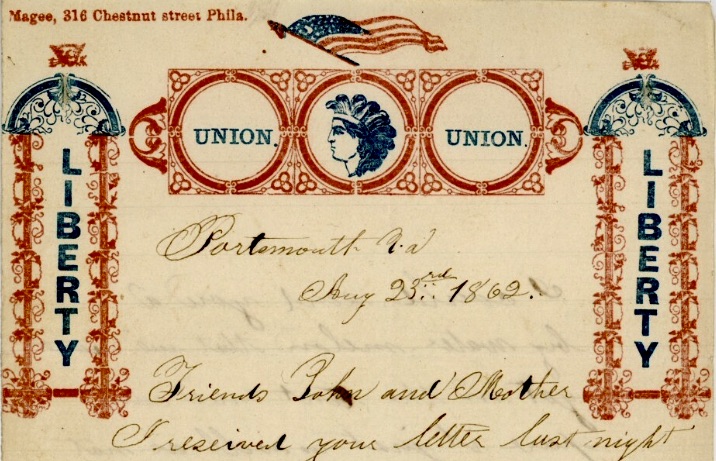
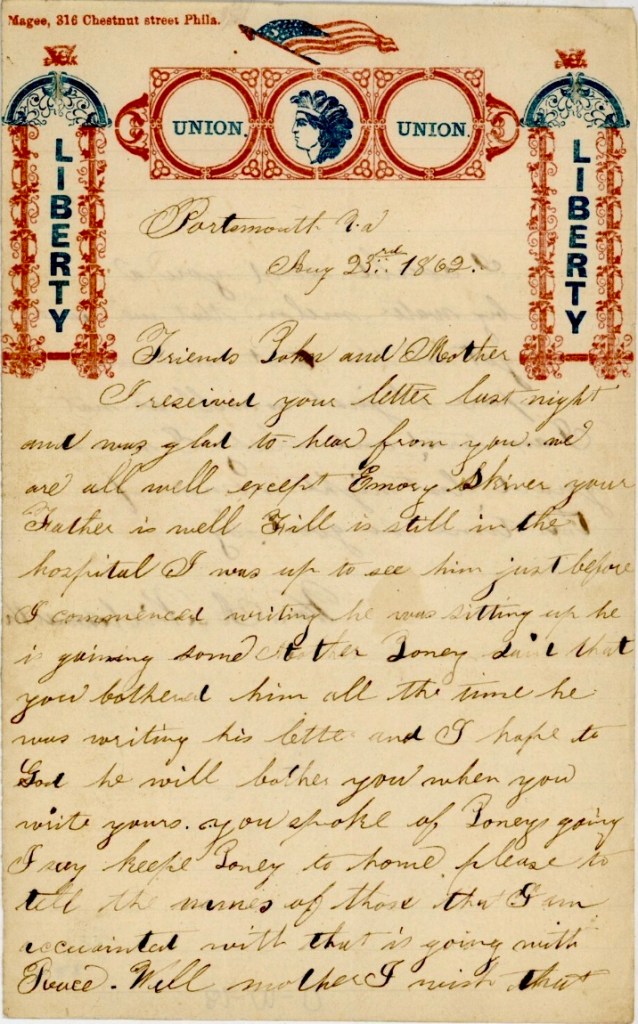
Patriotic Letterhead on William’s stationery.
Portsmouth, Va. August 25th 1862
Friends John and Mother,
I received your letter last night and was glad to hear from you. We are all well except Emory Skiver. Your father is well. Fill is still in the hospital. I was up to see him just before I commenced writing. He was sitting up. He is gaining some. Mother, Toney said that you bothered him all the time he was writing his letter and I hope to God he will bother you when you write yours. You spoke of Toney’s going. I say keep Toney to home. Please to tell the names of those that I am acquainted with that is going with Pence.
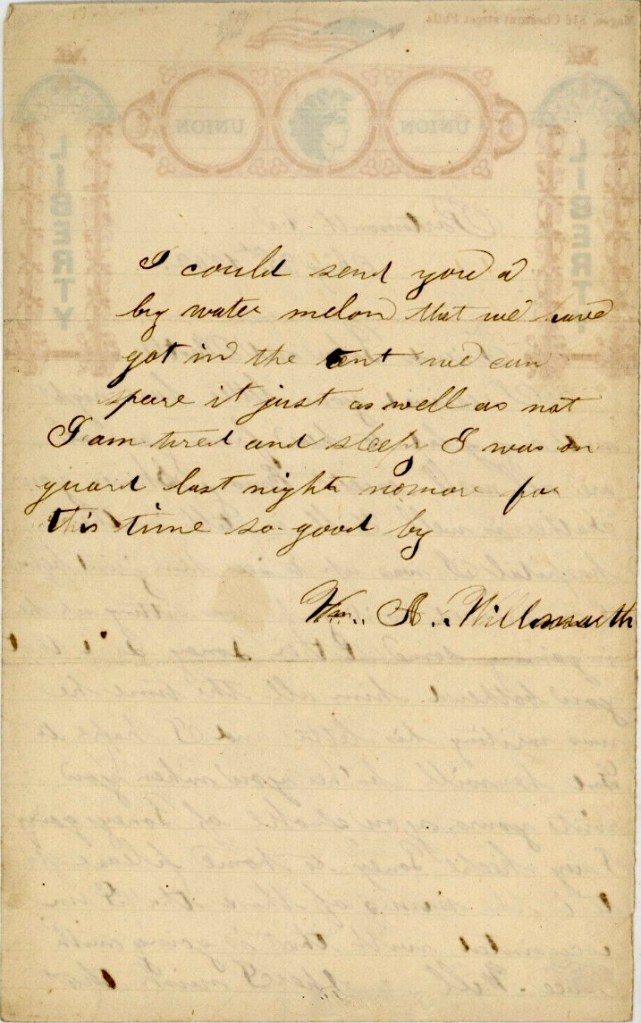
Well, Mother, I wish that I cuold send you a big water melon tat we have got in the tent. We can spare it just as well as not. I am tired and sleepy. I was on guard last night. No more for this time. So goodbye. — Wm. A. Willmarth
The following letter was written by Gilbert Hamilton Mitchell (1842-1908) of Co. A, 57th Pennsylvania Infantry. Gilbert was the son of Henry Horatio Mitchell (1816-1896) and Alsina Darrow (1811-1887) of Lemon, Wyoming county, Pennsylvania. He wrote this letter to his sister Amanda Mitchell (b. 1845).
Gilbert enlisted as a private in October 1861 and mustered out as a corporal in June 1865 after serving 3 years and 8 months. The 1890 Veterans Schedule and an obituary inform us that he spent six months in the prison at Andersonville, “coming home a mere shadow of himself after his exchange, and weighing but about 75 pounds, so reduced was he by starvation and disease.”
After he returned home from the war, he married Mary Ann Ace and moved to Kansas, then Nebraska, and finally Oregon.
T R A N S C R I P T I O N
Washington D. C. February 9th 1862
Dear Sister Amanda,
I will now write you a short bit of a letter to let you know how I am getting along. I am well and hope you are the same. There is no news here except that our troops have taken Fort Henry. That is a bully operation. We would like to hear of more such. Our Colonel said last night that McClellan expected an attack by the 10th of this month. If so, we will no doubt leave here in a short time. All that prevents an onward movement is mud. You have no idea how muddy it is here. It takes 4 horses to draw an empty wagon almost.
I actually believe that the war will be over by the first of May if nothing happens more than we know now. The prospect grows brighter and brighter every day. Hiram says he can see through the whole concern and see just how it is going to end. Our boys are all in first rate spirits. They all think the war is about over but we would like to have a squirmish as Mr. Mead says before we come back. Ervin says before we will see our captain slain, we will fight till we perish. He makes lots of fun. He is a first rate soldier. We call him Daniel S. Dickinson. He says he won’t take any office short of General.
You say you hope I won’t be in a battle. You are a pretty girl. I should think after I have been down here living on uncle Sam so long to want me to come home without doing him any good. I would like to pop over one secesh before I come back.
I have just been to meeting and heard a good but short sermon. I think our chaplain [William T. McAdam] is a good Christian. He takes our mail out and fetches it in every day. Our old Colonel [William Maxwell] is very particular about our going to meeting. If we don’t go, he will put us on guard next day. But we all like to go to meeting so he has no trouble to punish us. I would like to see how he would act in a battle. He has got a savage look but I don’t know whether he is very courageous or not.
I got a letter from Joseph a few days ago. He said he did not know but he should enlist but he is only talking. He is too much of a secessionist, I think. Jerry is a perfect fool to put a letter in a girls that she is sending to a young chap to save paying postage but I expect he wanted to show me that he was over to Mr. Mallison’s to see Louesa. I don’t know whether I shall ever write him another letter or not but I think it is a doubtful case.
Ledyard Avery, George Earll, George Amey, myself, and two or three others in our tent have sent for the Wyoming Republican. We wanted to know what was going on at home. Several copies of that miserable thing, the M. B. Democrat, finds its way down here weekly. The prospect is good for having fair weather now and I hope we may. I think this will answer for the present. You must excuse poor writing for I have a poor place to write. George Earll sends his best respects. We are all writing home today. This is 5 letters that I have wrote home in a little over a week and have got one. We have the name of being the best regiment around here that has been here yet. You must write soon. You must not feel uneasy about me at home for I am determined to see Gib safe through this scrape and fetch him back again. I seen two letters in the Wyoming Republican from S. H. Mitchell in Capt. [Peter] Sides company. I have been thinking to find him but I don’t think he is here. They are [ ]. Give my best respects to the girls. From your brother — Gilbert H. Mitchell
The following letters were written by Capt. Calvin Rogers Johnson (1822-1897), Co. I, 14th Wisconsin Volunteer Infantry, to his wife, Lucy Abigail (Marsh) Johnson Mississippi in 1862 and 1863. The couple were married in 1852 and they had six children. Calvin was a native of Holliston, Massachusetts; his parents were Calvin John son (1793-1826) and Nancy Rogers (1790-1861).
Calvin Rogers Johnson (ca. 1890)
Calvin’s 2nd letter tells of the arrival of the regiment at Natchez with a nice description of the location and citizens. Following the surrender of Vicksburg on July 4th, 1863, the regiment embarked with the rest of the brigade of General Ransom and proceeded to Natchez of which place they took possession on the 14th. They remained at Natchez until the 9th of October. There is a nice railroad embossment on upper left corner of the sheet.
[Note: This letter is from the collection of Greg Herr and was offered for transcription and publication on Spared & Shared by express consent.]
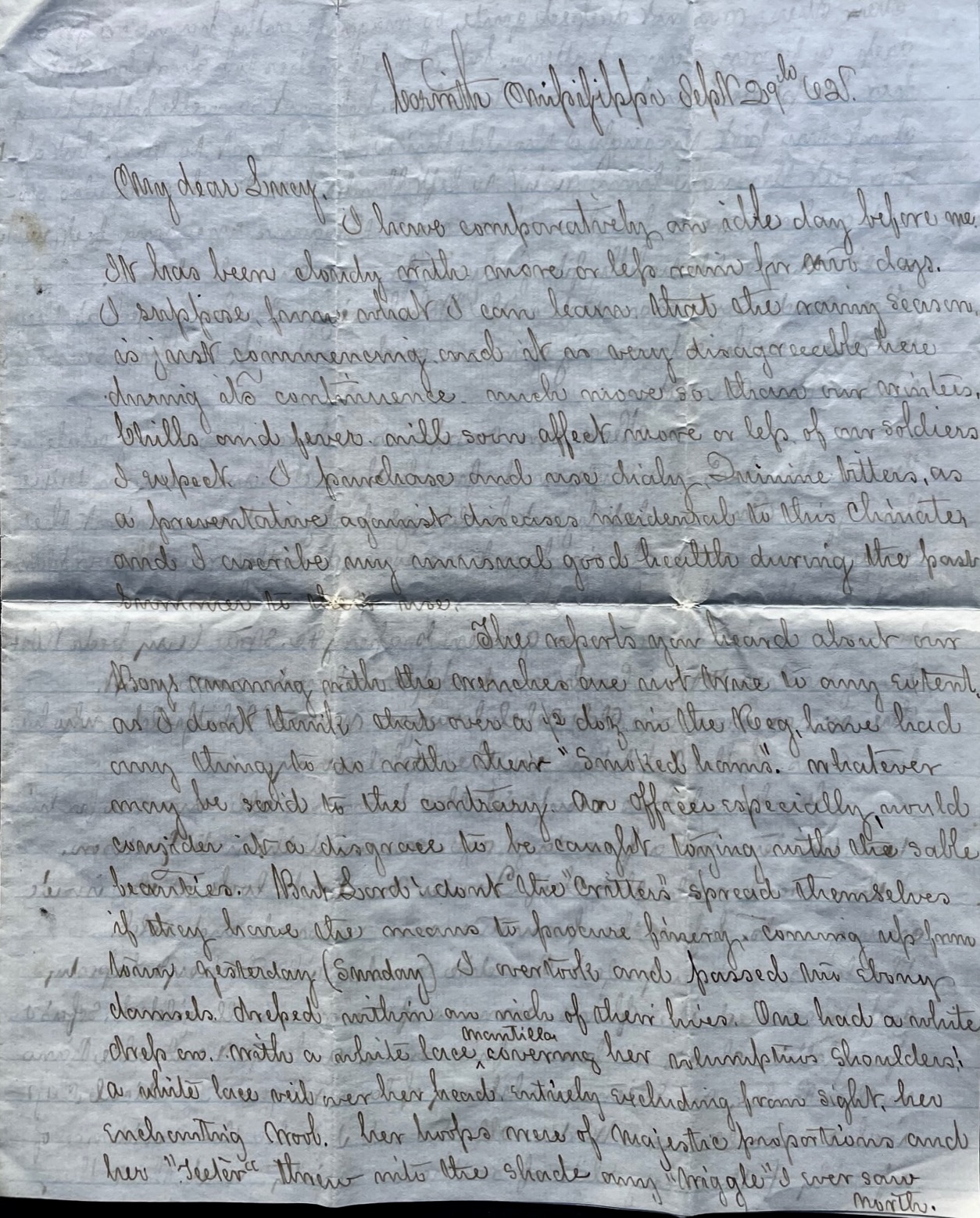
Corinth, Mississippi September 29, 1862
My dear Lucy
I have comparatively an idle day before me. It has been cloudy with more or less rain for two days. I suppose from what I can learn that the rainy season is just commencing and it is very disagreeable here during its continuance, much more so than our winters. Chills and fever will soon affect ,ore or less of our soldiers, I expect. I purchase and use daily quinine bitters as a preventative against diseases incidental to this climate and I ascribe my unusual good health during the past summer to this use.
The reports you heard about our Boys running with the wenches are not true to any extent as I don’t think that over half a dozen in the regiment have had anything to do with their “smoked hams,” whatever may be said to the contrary. An officer especially would consider it a disgrace to be caught toying with the sable beauties. But Lord! don’t the “critters” spread themselves if they have the means to procure finery.
Coming up from town yesterday (Sunday), I overtook and passed two ebony damsels dressed within an inch of their lives. One had a white dress on with a white lace mantilla covering her voluptuous shoulders; a white lace veil over her head entirely excluding from sight her enchanting wool. Her hoops were of majestic proportions and her “Teeter” threw into the shade any “wiggle” I ever saw North. The other was not dressed quite so magnificently, having on for a dress a fancy lawn pattern, but about 6 inches too short for style. Her hoops were as large as the others but not so well fitted, being about two foot through I should think from front to rear, but about four feet through from right to left flank. Her head was also covered with a lace veil but her shoes were brogans encasing feet which a No. 11 would tightly fit, judging from a casual glance.
The road was crowded with “Black niggers” who gazed at the beauties with admiring glances and no doubt tingling sensations under the waistcoat.
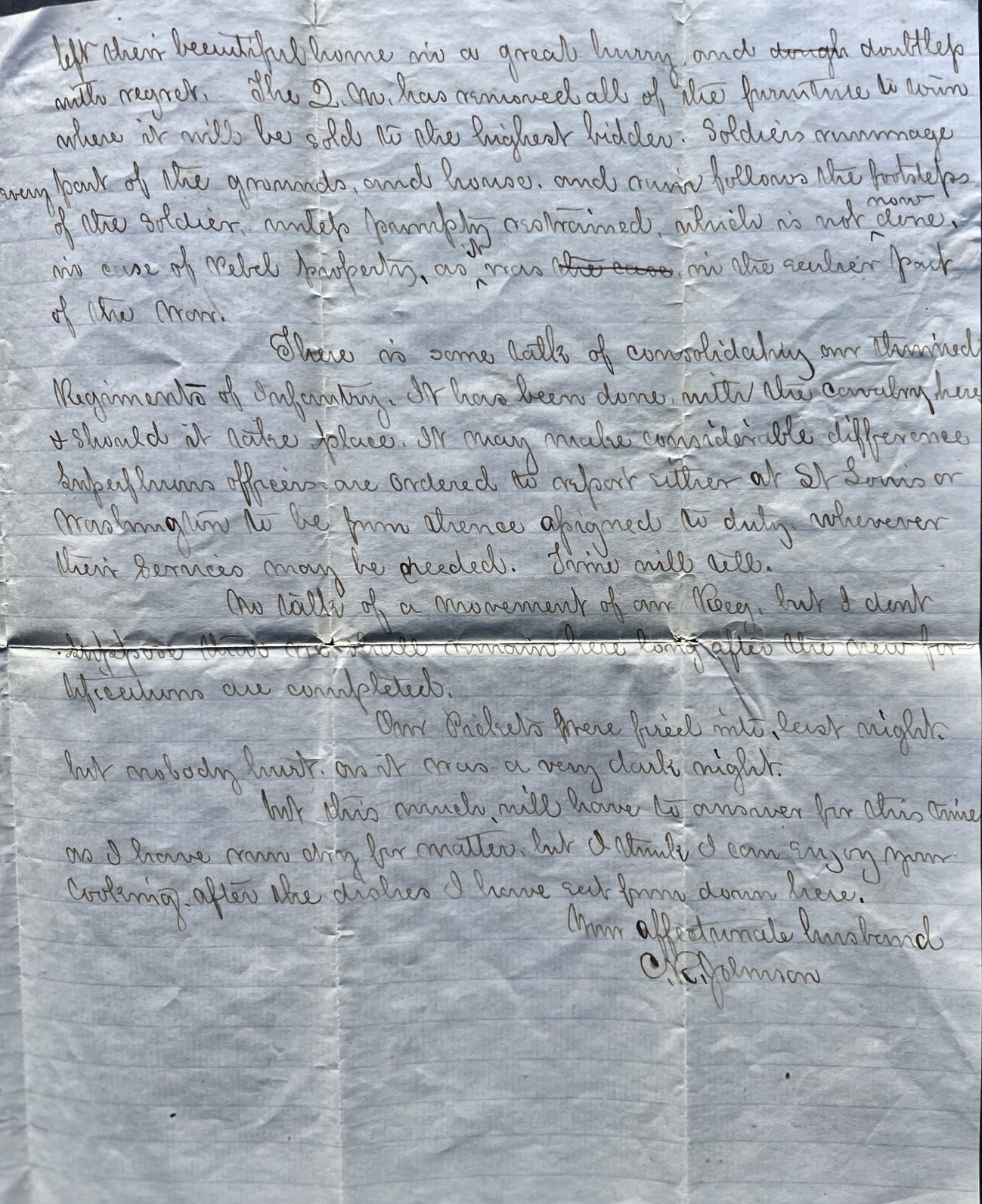
Near our camp is a large two story white house—the best in style and finish that I have seen in “Dixie” thus far. Surrounded by outbuildings, tasty and convenient, the large lawn or yard in front is covered with rare flower plants and shrubbery through which is a grove and walk to the front entrance. In the rear is a garden, grapery, &c. strawberry beds, raspberry bushes, &c. Peach and apple orchards come next. The owner was an old Rebel lawyer name Whitfield who has two sons, both captains in the Rebel army. Gen. Grant has occupied the premises all summer for his headquarters but a few days ago removed them to Jackson. I then went with the Chief Quartermaster to look at the inside arrangements before the furniture was removed and sold. The house was a perfect paradise inside—rich Turkey & Tapestry carpets covered the floors, cornices of the room all gilded, sofa’s and spring bottom chairs in four or five rooms. A large and valuable piano in the parlor. An extensive library of law, religious, medical, classical and miscellaneous works. All showed it to be the residence of a family of the very elite of Southern society and that they left their beautiful home in a great hurry and doubtless with regret.
The quartermaster has removed all of the furniture to town where it will be sold to the highest bidder. Soldiers rummage every part of the grounds and house and ruin follows the footsteps of the soldier unless promptly restrained, which is not now done in case of Rebel property, as it was in the earlier part of the war.
There is some talk of consolidating our thinned regiments of infantry. It has been done with the cavalry here and should it take place, it may make considerable difference. Superfluous officers are ordered to report either at St. Louis or Washington to be from thence assigned to duty wherever their services may be needed. Time will tell.
No talk of a movement of our regiment but I don’t suppose that we will remain here long after the new fortifications are completed. Our pickets were fired into last night but nobody hurt, as it was a very dark night.
But this much will have to answer for this time as I have run dry for matter, but I think I can enjoy your cooking after the dishes I have eat from down here. Your affectionate husband, — C. R. Johnson
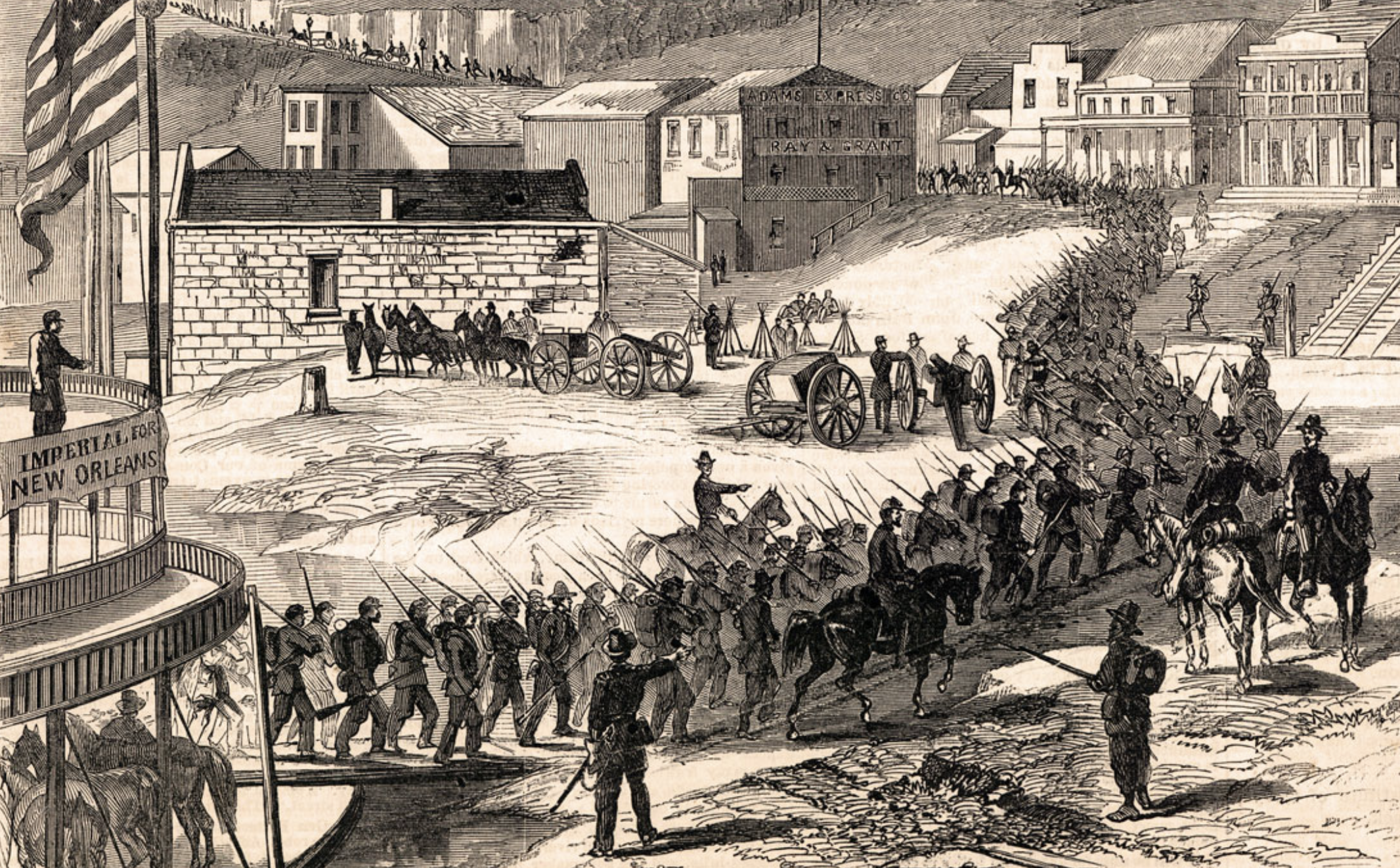
Union troops arrive at the Natchez landing in mid-July 1863. Depicted at right is the lower town at the landing. Calvin’s description of Natchez refers to that part of the city up the road to the left in the picture high atop the bluff overlooking the Mississippi River.
Letter 2
Natchez, Mississippi July 23d 1863
My dear Lucy,
Well, here I am with the Regiment again in the prettiest place I have been in South. Natchez on the bluff is about 100 feet above the river and if there is any air stirring, we catch some of it here. The streets are laid out at right angles with each other and on each side are beautiful shade trees, The houses display great wealth and taste. There never having ben a Rebel garrison here, the city is clean and must be comparatively healthy. Vicksburg fairly reeked in filth and I am glad to be away from it.
Thirteen Rebel companies have been raised here so of course the sympathies of the citizens are with the South and they are rebels of course, but different in many respects from the citizens of almost any place we have been in.
Within three days after our Brigade got here the stores were opened and although the merchants haven’t much to sell yet, they showed their disposition. The market too was opened and now all sorts of vegetables can be procured. Some mammoth water and mush melons a yard long, $3 in rebel money or 50 cents in ours. That’s what they begin to think of their own money. I notice cabbage, cucumber, tomatoes, figs, new potatoes, mutton, pork and beef are plenty. We have captured 6,000 beef cattle and large flocks of sheep.
The Boys are living like fighting cocks, the best pleased set I ever see. Some say that its a good thing the war commenced or they wouldn’t have been here!
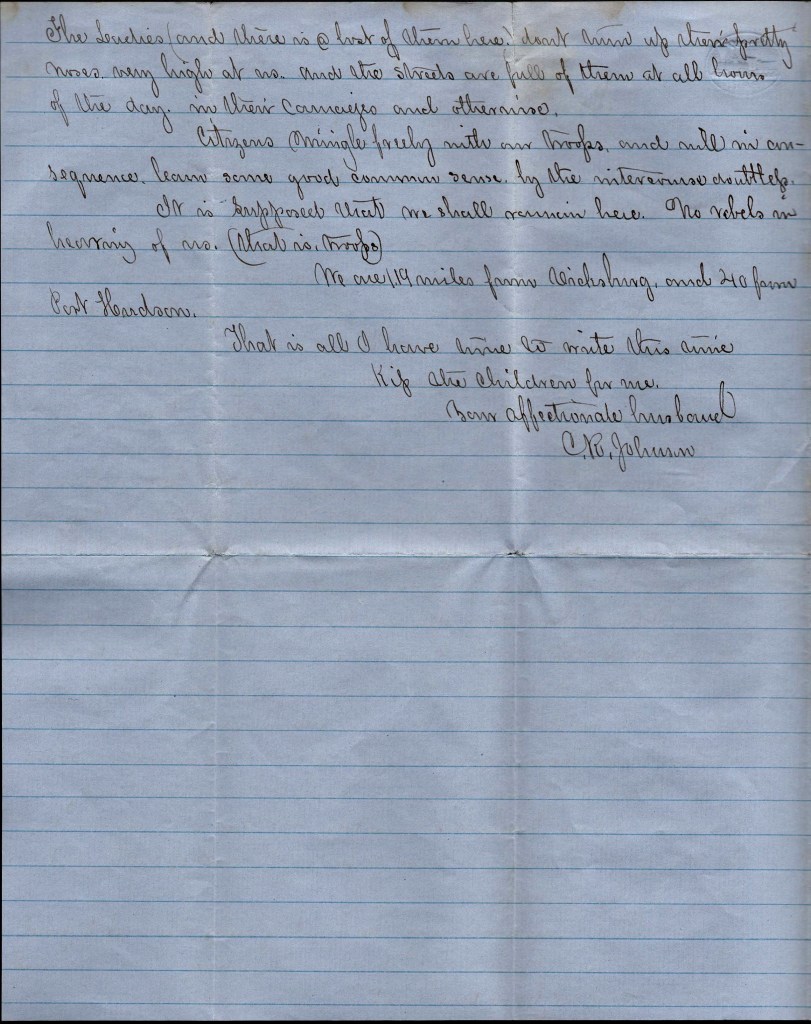
The Ladies (and there is a lot of them here) don’t turn up their pretty noses very high at us and the streets are full of them at all hours of the day, in their carriages and otherwise. Citizens mingle freely with our troops and will in consequence learn some good common sense by the intercourse doubtless. It is supposed that we shall remain here. No rebels in hearing of us (that is, troops). We are 119 miles from Vicksburg and 40 from Port Hudson.
That is all I have tome to write this time. Kiss the children for me. Your affectionate husband, — C. R. Johnson
I could not find an image of George but here is one of James E. Trask of Co. A, 50th Massachusetts. James was one of the lucky ones who made it back home from Louisiana. (Ancestry.com)
The following letters were written by George Newell Boynton (1846-1863), the son of George Washington Boynton (1820-1877) and Abby N. Stocker (1819-1898) of Georgetown, Essex county, Massachusetts. George was only 16 years old when he enlisted on 16 August 1862 as a private in Co. K, 50th Massachusetts Infantry. He died of disease at Baton Rouge on 3 July 1863. Burial records of the Harmony Cemetery in his hometown inform us that George’s body was exhumed in Louisiana by his father and returned to Georgetown along with those of Richmond D. Merrill (died 28 June 1863) and Amos Spofford (died 4 June 1863), all three in Co. K, 50th Massachusetts.
Despite the high mortality rate, I have transcribed a considerable number of letters by members of the 50th Massachusetts Infantry to date. They include:
I arrived here yesterday morning at 9 o’clock after having a rough passage. I has rained ever since we left Camp Stanton and is raining now and the Boys are all scattered over the city and are now jumping out of the windows and every other place. We started from Boston about 3 o’clock, arrived in Worcester about 7 o’clock and stopped about a half an hour and then we started for Norwich, Ct., and arrived there about 12 o’clock at night. Then we took the boat and piled in four deep. Some were sound asleep, others dancing and raising a ruckus. After we had been on board about an hour, I went up on deck to report for guard duty and stopped up there all night and finally we came in sight of New York City and landed and came into line, marched up Broadway about a mile, and stopped at Park Barracks in front of City Hall until 4 o’clock. And next we marched into an old stone house now used as barracks. It is the place where Billy Wilson’s regiment stopped. The Orderly is round after the letters and I must draw mine to a close. I am well, fat & saucy. Give my respects to all the folks but [illegible]
P. S. Tell mother that her Chicken Pie went good.
Don’t write until you hear from me again for I can’t tell where to direct it.
Yours, — G. N. Boynton
Letter 2
New York [City] December 8 [1862]
Dear Father,
Having a few spare moments I thought I would write you a few lines to let you know that we are a going to embark today on the Propellor Jersey City for Fortress Monroe. I got that box that mother and Mrs. Pickett sent last Thursday. Tell Mrs. Pickett that Frank has lost his knapsack and all his clothes. I have got my vest and it fits me first rate and I am very much obliged to you for it.
By the way, I have enjoyed myself first rate. I have been to Barnum’s Museum and Niblo’s Garden 1 and heard Ed[win] Forrest play and it was splendid. Last Monday I went up to Central Park and was was magnificent.
I must dry up for the orders are to fall in and be ready in five minutes. Yours, — G. N. B.
P. S. This makes 4 letters that I have wrote and I haven’t received only two.
1 Niblo’s Garden was a theater on Broadway and Crosby Street. At the time, Edwin Forrest was performing in either Metamora or “The Broker of Bogota” depending on the evening George attended.
Letter 3
On board the Barque Guerrilla January 18 [1863]
Dear Father,
Having some spare time, I thought that I would write you a few lines to let you know that I am in good health and I hope that you are the same. We left Hilton Head January 1st and arrived at Ship Island on the 15th and stopped there three days and we are now on our way up the Mississippi to New Orleans. I have had a pretty good time since I left Camp Stanton and I have seen a good many sights. While we was at Hilton Head, I saw George Hunkins, Ed Hazen, and Dennis Adams [of 1st Massachusetts Cavalry]. George Hunkins is awful sick of the army, I tell you.
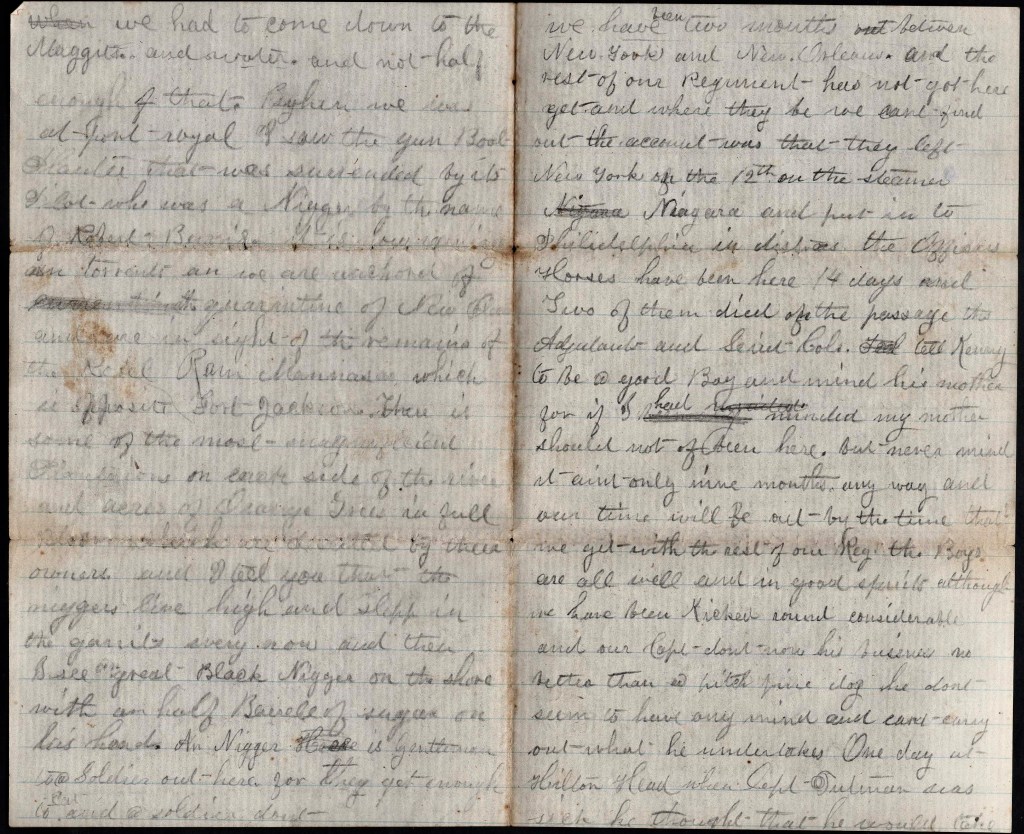
Since we left Hilton Head I have had nothing to eat but hard bread with maggots and salt horse and a quart of water. I tell you it makes me think of home—especially when we had to come down to the maggots and water, and not half enough of that. When we was at Port Royal, I saw the gunboat Planter that was surrendered by its pilot who was a Nigger by the name of Robert Smalls.
It is now raining in torrents and we are anchored off Quarantine of New Orleans in sight of the remains of the Rebel Ram Manassas which is opposite Fort Jackson. There is some of the most magnificent plantations on each side of the river and acres of orange trees in full bloom which are [ ] by their owners. And I tell you that the niggers live high and sleep in the garrets every now and then. I seen a great Black Nigger on the shore with a half barrel of sugar on his head. A Nigger is gentleman to a soldier out here for they get enough to. east and a soldier don’t.
We have been two months between New York and New Orleans and the rest of the regiment has not got here yet and where they be, we can’t find out. The account was that they left New York on the 12th on the steamer Niagara and put in to Philadelphia in distress. The oficers’ horses have been here 14 days and two of them died on the passage—the Adjutant’s and Lieutenant-Colonel’s.
Tell Kenny to be a good boy and mind his mother for if I had minded my mother, should not of been here. But never mind. It ain’t only nine months anyway and our time will be out by the time that we get with the rest of our regiment. The Boys are all well and in good spirits although we have been kicked round considerable and our Captain [John G. Barnes] don’t know his business no better than a pitch pine dog. He don’t seem to have any mind and can’t carry out what he undertakes. One day at Hilton Head when Capt. [George D.] Putnam [of Co. A] was sick, he thought that he would take us out on Battalion Drill and he could not form us in a hollow square and it tickled the Boys, I tell you, for he thinks he [is] capable of bring a Brig. General. We have got orders [to] leave here for Carrollton which is six miles above New Orleans.
They do their teaming here with four mules. The driver rides the right ordered mule and drives with one reign which is attached to nigh leader. 1
Some evil-minded whelp stole my writing base at Hilton Head and I borrowed this. I wrote one letter while I was at Hilton Head. I have just received a letter from you stating that [you] did not receive any word [from] me and that you sent me some money by Charles Tenney. The rest of the regiment has not arrived here yet. It is about dinner time and I guess that I will dry up now so goodbye. Yours, — George N. Boynton
1 Four-mule teams, driven by a rider on one of the mules, were common in the South, particularly for transporting supplies and equipment. Mules were preferred over horses due to their strength, stamina, and ability to navigate difficult terrain. The driver, known as a mule skinner, would ride the lead mule and guide the team using a single rein and voice commands.
Letter 4
Camp Parapet Carrollton, Louisiana January 23rd 1863
Dear Father,
I received a letter from mother this morning dated January 5th stating that she had not received any letter from me since I left Mew York and I did not know hardly what to make of it for I have wrote four letters since we left New York.
We are encamped 8 miles above New Orleans to a place by the name of Carrollton on the banks of the Mississippi River and I am enjoying myself first rate. I have been to work all day making a floor to our tent and it is as warm here as it is in Massachusetts in June. You spoke about giving my love to Mr. F in your letter. He has not got here yet nor he ain’t likely to get here for a month.
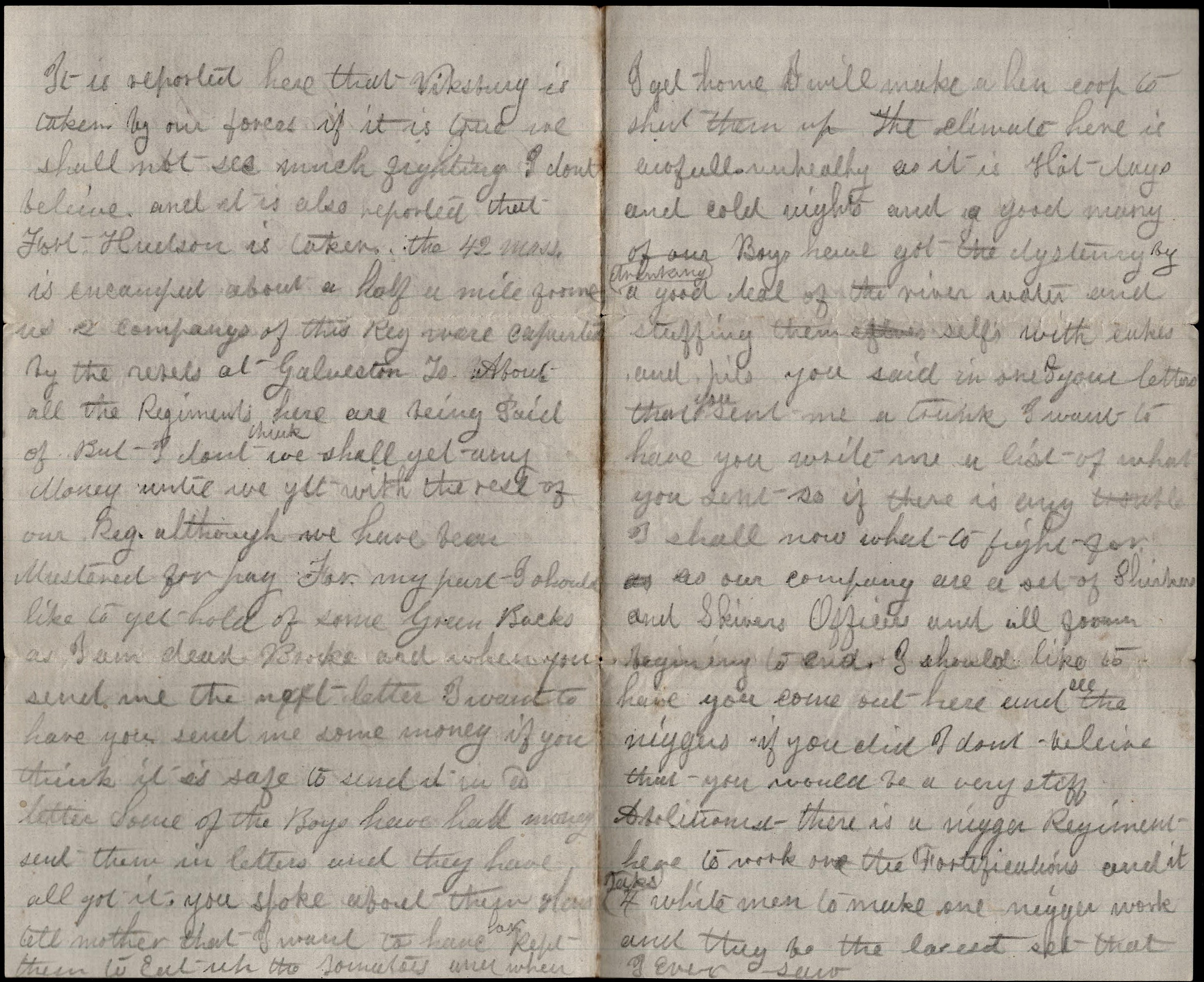
It is reported here that Vicksburg is taken by our forces. If it is true, we shall not see much fighting, I don’t believe. And it is also reported that Port Hudson is taken.
The 42nd Massachusetts is encamped about a galf a mile from us. A company of this regiment were captured by the Rebels at Galveston Texas. About all the regiments here are being paid off but I don’t think we shall get any money until we get with the rest of our regiment although we hsave been mustered for pay. For my part, I shoiuld like to get hold of some green backs as I am dead broke and when you send me the next letter, I want you to send me some money if you think it is safe to send it in a letter. Some of the Boys have had money sent them in letters and they have all got it.
“…Our company are a set of shirkers and skinners—officers and all from beginning to end.”
— George N. Boynton, Co. K, 50th Massachusetts Infantry
You spoke about them hens. Tell mother that I want to have her kept them to eat up the tomatoes and when I get home I will make a hen coop to shut them up. The climate here is awful unhealthy as it is hot days and cold nights and a good many of our Boys have got the dysentery by drinking a good deal of the river water and stuffing themselves with cakes and pies. You said in one of your letters that you sent me a trunk. I want to have you write me a list of what you. sent so if there is any trouble, I shall know what to fight for as our company are a set of shirkers and skinners—officers and all from beginning to end.
I should like to have you come out here and see the niggers. If you did, I don’t believe that you would be a very stiff Abolitionist. There is a nigger regiment here to work on the fortifications and it takes four white men to make one nigger work and they he the laziest set that I ever saw. 1
We have just heard from the rest of our regiment. They left Philadelphia on the 5th of January. I guess that I will dry up as it is about time for roll call. you must [excuse] this writing as it is the best that I can do, but I guess that you can pick it out. I am well and I have not been sick a day since I left Boxford. From your son, — George N. Boynton
P. S. Tell Jericho not to let Old Hutch lick him.
1 The Black regiment must have been members of the 1st Louisiana Native Guards.
Letter 5
Baton Rouge February 21st 1863
Dear Parents,
I received a letter from you this morning dated February 2nd and was glad. to hear from you. We are encamped in the City of Baton Rouge close to the Louisiana State Prison. We are in Gen. Dudley’s [3rd] Brigade [of the 1st Division] with the 30th Massachusetts, 174th and 61st New York and 2nd Louisiana. Daniel R. Kenny is a Captain [of Co. C] in the 2nd Louisiana. I suppose that you. know him. I believe that you took a watch from him two or three times for board bills. About all of the Boys have been sick with the dysentery and diarrhea but I have been well so far. Frank Pickett is sick and in the hospital, Three companies of our regiment arrived here last Saturday and all the officers except the Lieutenant-Colonel [John. W. Locke].
All I got out of that stuff that you sent was a pound of tobacco and a towel and one letter. But no money. We have been paid off and I sent $30 to you. by Adams Express. We have a pretty hard time here for our General is a Tiger. He gives us a Brigade Drill of four hours every afternoon and go on guard every other day. I have just got in from picket guard. It is fun, I tell you, but rather hard work—especially marching out and coming in. 1
When I was at Carrollton, I saw a lieutenant that was at Robert Boyes’ last summer from N. H. He is overseer on a sugar plantation.
I suppose that Father has as much as he can tend to this winter collecting taxes and sheriffing and is as cross sometimes as usual but if I was at home I should not mind it but I expect that when I get home it will become, “George, it is 9 o’clock, go to bed.” But I guess that I shall be glad to get into a good bed.
Capt. [John G.] Barnes is about played out with the dysentery and I should not winder if he had to come home on account of it. It is reported that our Brigade is a going to stay here in the city. The 40th and 49th Massachusetts came here about a week ago and I found a good many Boys that I am acquainted with. One of them is John Holley. He is a corporal in Co. D. He looks as rugged as a bear. Tell Kenny to be a good boy for brother George is a coming home next June.
When I was on picket about a week ago, I and a fellow in Co. I fired at a Rebel cavalryman but he was a little too smart for us. But finally [James M] Magee’s Cavalry captured him and I [had] the pleasure of seeing the gentleman that I fired at.
It is about time for roll call and I must bring my letter to a close and bid you goodbye. Yours truly, — George N. Boynton
P. S. When you write me a letter, write me a list of what you sent by Charles Tenney. Give my love to Esther and all the rest. Postage stamps are played out with us.
1 In the regimental history published in 1907, the author informs us that “A soldier’s life at Baton Rouge was no holiday. It was one continuous round from sunrise to sunset, with some hours interspersed for rest and recreation, and then occasionally with passes in our pockets, we were allowed to roam about the streets and down to the river, but taken all in all the most agreeable duty was that out the outer reserve or picket guard. The detail, made up about nine a.m. took with them one day’s rations and blankets, and marched out about two miles to relieve the guard of the day, remaining in turn 24 hours, each man being two hours on duty and four hours off…When the weather was pleasant, to go on picket duty seemed a good deal like going on a picnic, the noys frying their rations of pork and potatoes….and making coffee about an open fire, and the enjoyment was made a little keener by occasional glimpses of a rebel vidette making his appearance beyond the lines…”
Letter 6
Baton Rouge March 2nd 1863
Dear Mother,
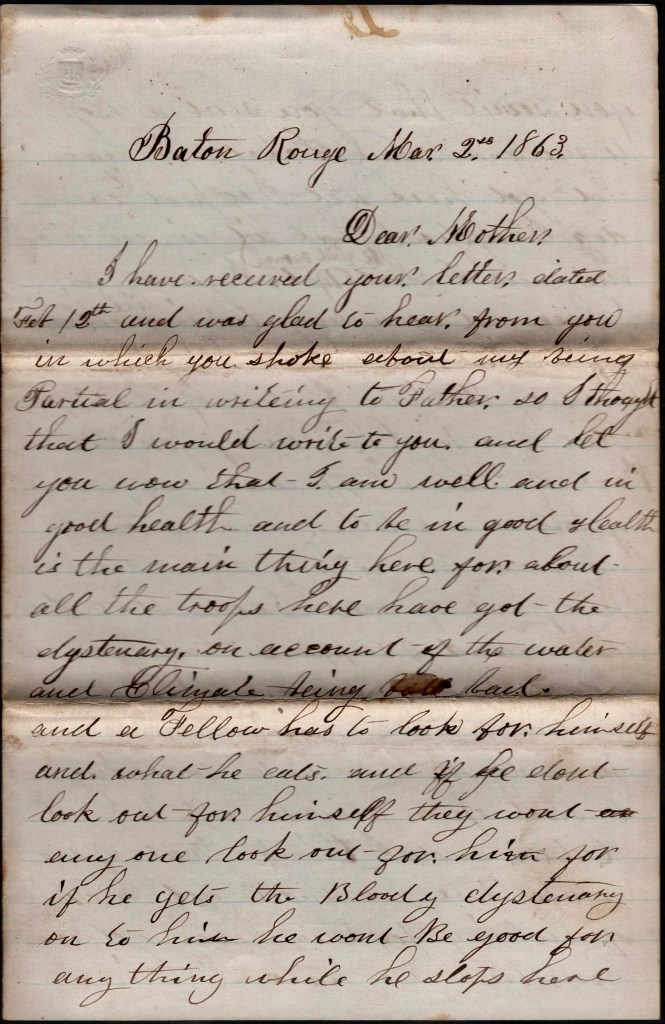
I have received your letter dated February 12th and was glad to hear from you in which you spoke about my being partial in writing to Father so I thought that I would write to you and let you know that I am well and in good health—and to be in good health is the main thing here for about all the troops here have got the dysentery on account of the water and climate being bad. A feller has to look out for himself and what he eats and if he don’t look out for himself, they won’t anyone look out for him for if he gets the bloody dysentery on to him, he won’t be good for anything while he stops here.
You said that you sent a box to me and Frank Pickett. It has not got here yet. I expect it every day. I suppose that it is a nice one and I shall be glad enough to get it I guess for I have not seen any cooking like Marms since I left home and I hope that I shall get more of it than I did of that you sent me [by] Charles Tenney for all I got out of that stuff was one pound of tobacco, one letter, and a towel. No money or nothing else. We have been paid off and I sent $30 to you and I suppose that you have got it by this time.
We have had orders to pack our knapsacks and be ready at a minute’s warning to start on a march up to Port Hudson and I think that if we go up there we shall get a devil of a licking for they have got more troops than we have, I think.
I received a letter from Esther and was much pleased to hear from her and I shall write to her tomorrow. I wrote a letter to you and sent it on the 17th. There is not any news here special and it is getting about time for Dress Parade and I must draw my letter to a close and bid you goodbye. Yours truly, — George N. Boynton
Letter 7
Baton Rouge March 6th 1863
Dear Father,
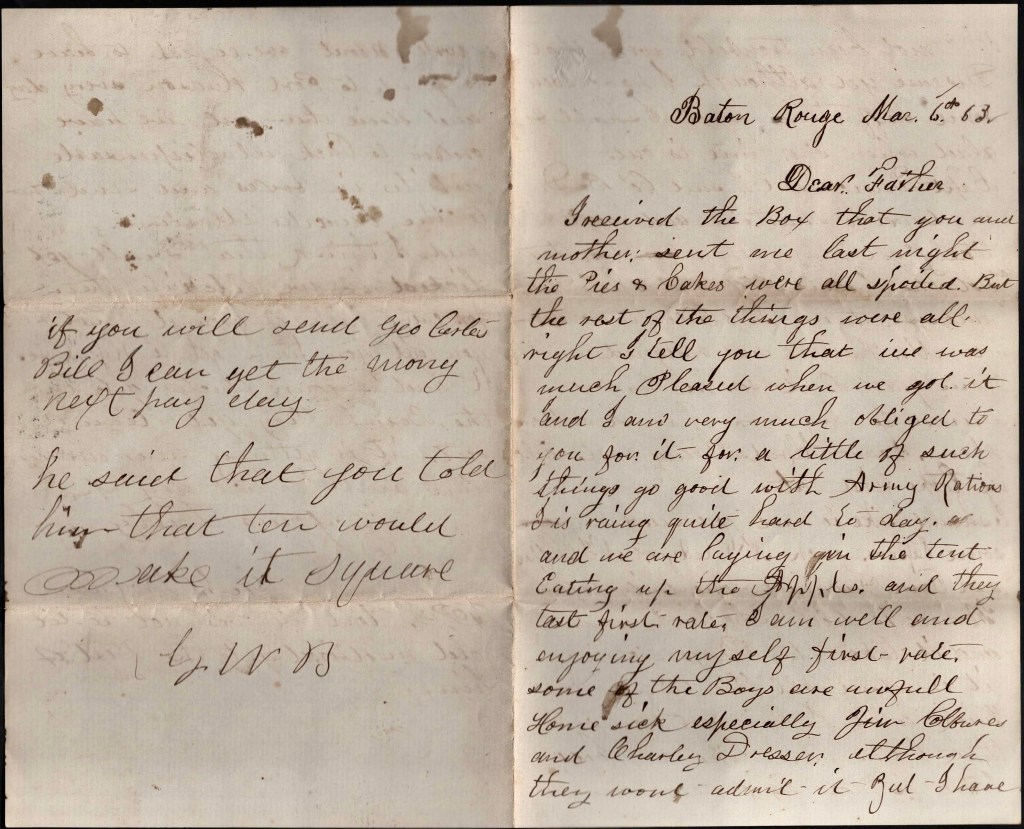
I received the box that you and mother send me last night. The pies and cakes were all spoiled but the rest of the things were all. right. I tell you that we was much pleased when we got it and I am very much obliged to you. for it for a little of such things go good with army rations. It is raining quite hard today and we are laying in the tent eating up the apples and they taste first rate. I am well and enjoying myself first rate. Some of the Boys are awful home sick—especially Jim Colburn and Charley Dresser although they won’t admit it but I have not been troubled with that disease yet although I have seen some rough times and I shall be glad when our time is out.
Capt. Duncan’s company and companies B & D are down to [the] quarantine [station] and won’t be likely to get any further [up the Mississippi] for they have got the Small Pox and ship fever amongst them. Mrs. Pickett’s wonderful Mr. [Robert] Hassall [the Chaplain] has resigned and I am glad of it for he don’t amount to any more than a sitting hen. I saw Alfred Cheeny last night. He looks first rate.
I should like to have you send me some papers such as New York Ledger, New York Clipper, and True Flag and some daily papers.
We have to drill very hard now and it takes the Boys down. It is about all the time double quick and I have got so now that I can run like a horse. There is not any news here to write about. We expect to have to go up to Port Hudson every day and drive them out. We have orders to pack all indispensable articles in boxes and send them to the Quartermasters. And I think that we shall get licked if we pitch into them for every inch of ground that you get, you have to fight for it. And if your Uncle gets in the brush, they get cleaned out. It is getting near dinner time and I must dry up. Yours truly, — G. N. Boynton
P. S. Tell Lewis not to let Old Medford get the best of him.
Letter 8
Baton Rouge March 9, 1863
Dear Mother,
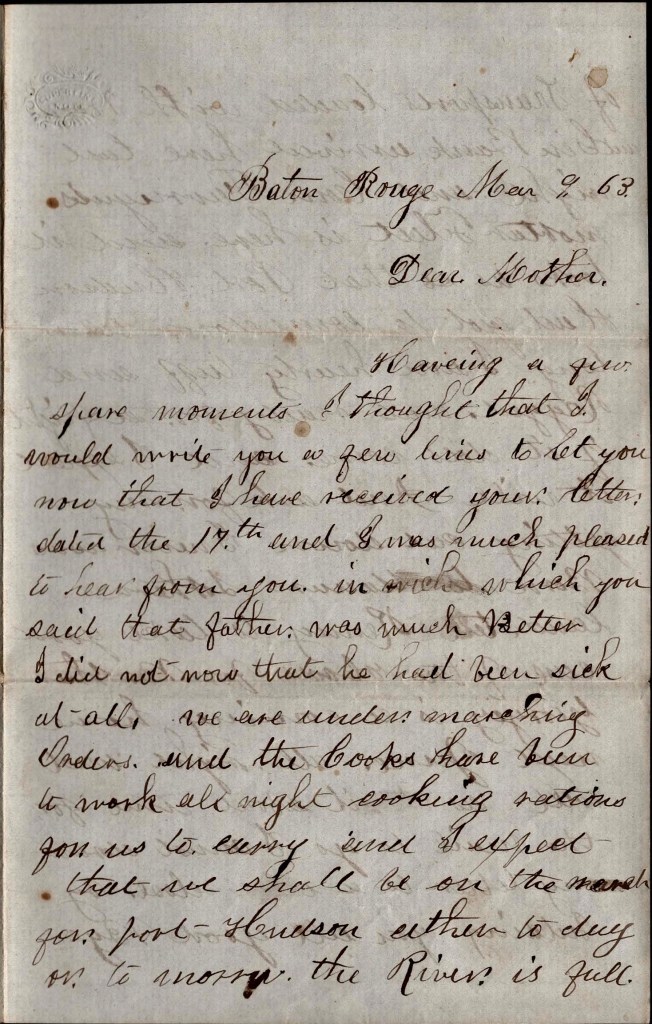
Having a few spare moments I thought that I would write you a few lines to let you know that I have received your letter dated the 17th and I was much pleased to hear from you in which you said that father was much better. I did not know that he had been sick at all.
We are under marching orders and the cooks have been to work all night cooking rations for us to carry and I expect that we shall be on the march for Port Hudson either today or tomorrow. The river is full of transports loaded with troops and Gen. Banks arrived here last night and Commodore Farragut’s mortar fleet is here and it looks [to] us that Port Hudson had got to come down before long.
I am hearty, tough, and rugged and ready for a fight if it does come and I expect it will. And as for my getting cut down, I never was born to manure southern land. Tell Kenny to take good care of the hens for brother Georgey is a coming home next June all right and well. As it’s about time for the mail to go, I must draw my letter to a close by bidding you all goodbye. From your son, — George N. Boynton
P. S. I have wrote to Eben and Esther.
The company that the Hawkes boys are in is down to Quarantine sick with the small pox and ship fever. I saw A. P. Cheney yesterday. He looked as rough as ever.
Letter 9
Baton Rouge March 13, 1863
Dear Parents,
Having a few spare moments I thought that I would write you a few lines to let you know that we have not gone yet although we are under marching orders and expect to go every day. The river is full of gunboats and mortar boats and today four regiments & three companies of cavalry and four batteries have gone by our camp en route for Port Hudson. The 48th Mass. left here last night at 2 o’clock, the 41st Mass. have been under fire three times. Lieut. Runlet and the Signal Corps have gone out today to reconnoiter. Charles W. Tenney is detailed on the Signal Corps as sharp shooter.
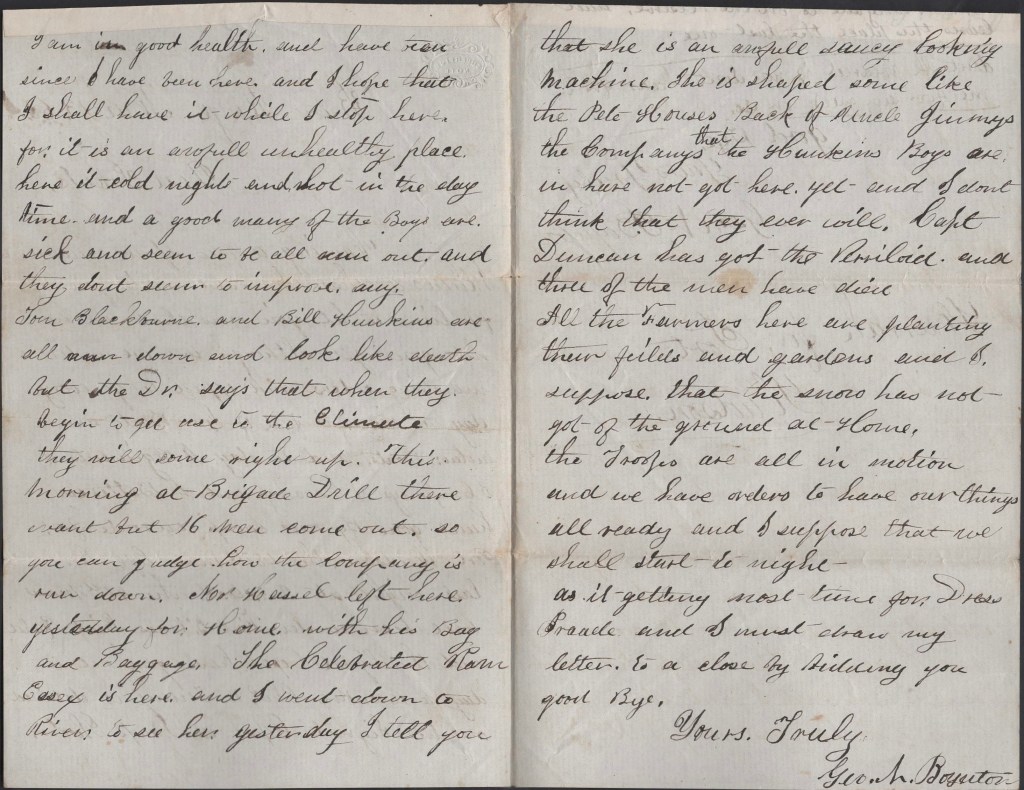
I am in good health and have been since I have been here and I hope that I shall have it while I stop here for it is an awful unhealthy place here. It’s cold nights and hot in the day time and a good many of the Boys are sick and seem to be all run out and they don’t seem to improve any. Tom Blackburn and Bill Hunkins are all run down and lok like death but the Dr. says that when they begin to get use to the climate, they will come right up.
This morning at Brigade Drill there wasn’t but 16 men out so you can judge how the company is run down. Mr. [Robert] Hassall [chaplain] left here yesterday for home with his bag and baggage. The celebrated Ram Essex is here and I went down to the river to see her yesterday. I tell you, she is an awful saucy looking machine. She is shaped some like the peat houses back of Uncle Jimmy’s.
The Ram Essex at Baton Rouge in 1862 (courtesy of the Wilson’s Creek National Battlefield)
The company that the Hawkins Boys are in have not got here yet and I don’t think they ever will. Captain Duncan has got the varioloid and three of the men have died.
All the farmers here are planting their fields and gardens and I suppose that the snow has not yet got off the ground at home. The troops are all in motion and we have orders to have out things all ready and I suppose that we shall start tonight. As it is getting most time for Dress Parade and I must draw my letter to a close by bidding you goodbye. Yours truly, — George N. Boynton
Don’t be worried if you don’t hear from me for a week or so. Goodbye. Yours truly, — G. N. Boynton
Hurrah for Port Hudson!
Letter 10
Baton Rouge March 26th 1863
Dear Father,
Having a few spare moments I though I would write you a few lines to let you know that I am well and as tough as a knot, although we have seen a rough time since I wrote you last. We left Baton Rouge on the 14th en route for Port Hudson. The first day we marched 15 miles and camped for the night and I had just got to sleep when orders came for us to report to Gen. Banks’ Headquarters which was about five miles so we formed in line and arched up there and as soon as we got there we had to go on guard that night, and the next morning we marched back to the regiment and stayed all day and that night I never see it rain so hard in my life. And [then] orders came for us to come into the pickets with an ambulance train which was about 4 miles and where we had to walk was in the gutter and mud and water up to your knees. And we marched to pickets and stopped for the night. I laid down and went to sleep and when I woke up, I was laying in two or three inches of mud and water. And just about that time, I thought I should like to be in Marm’s feather bed. It was awful hard work but I had a first rate time—especially when we halted.
The inhabitants were all secesh and the General told us that we could take anything that we could get our hands hold of and I tell you that we improved our chances by killing calves and sheep and I tell you that we lived high on fresh beef, pork, chickens, turkeys, eggs, milk, honey, and everything else that we could get our hands hold of. I went in one house that we came past and they had the table all ready for dinner and I sat down and eat what I wanted and when I got up to come off, the women that lived there gave me my canteen full of milk and a jar of honey.
There was one house that we passed that the man that owned it was a secesh and he stood in the door with his pistol in his hand and said that the first damned Yankee soldier that touched any of his things, he would shoot down and it wasn’t five minutes before we stole everything that he had and burned his house down on his head.
The next day we had orders to march back to Baton Rouge and take the boat there, go up the river 15 miles, and as there is not room on this paper to write our adventure, I will tell you about it in my next letter. So I will draw my letter to a close by bidding you goodbye. Yours truly, — G. N. Boynton
P. S. Don’t be worried if you see an account of a battle because our Brigade is a going to stop there.
Letter 11
Addressed to Mr. George Washington Boynton, Georgetown, Massachusetts
Baton Rouge March 30th, 1863
Dear Parents,
I have just received a letter from you dated the 9th and was very much pleased to hear from you in which you said that you wanted me to let you know how that I stood the guard duty and I am very happy to let you know that I stand it first rate and I am as tough and hearty as a boiled owl.
I wrote you last stating the trip that we had when we marched up to Port Hudson by land and ow I will give you an account of the trip up [by] river. We left Baton Rouge on the 14th [should be 18th] at about three o’clock in the afternoon on the steamboat Morning Light and we all thought that we had to see some fighting but as luck would have it the next morning we found ourselves in middle of a Rebel Colonel’s plantation stuck fast in the mud where the levy had been cut away and river flowed [over] the land. We stopped in this place until 12 o’clock the next day when we got off and continued our course up the river and landed on the Rebel General Winter’s plantation [four miles below and] in sight of Port Hudson on the opposite side and the Rebels found out what we was up to so they cut the levee above us and drowned us out.
While we stopped, we lived high [and] slept in the nigger huts. The sugar house on this place was six times as large as the Old South Meeting House and the store house full of sugar and molasses and we dived into. it and got all. we wanted. This plantation was the nicest place that I ever saw when we went to it, and when we left, it didn’t look quite so slick. We took all copper and the engine out of the sugar house and tore the old planter’s house all to pieces. The papers talk about the Rebels being in a starving condition when they are better off than we be for a regiment went out a foraging every day and they got just as many cattle, mules, horses, sheep, hogs, as they could drive in.
As it is about time for supper, I will draw my letter to a close. Yours, — G. N. Boynton
P. S. Our Division is a going to stop here and defend the place so you need not worry about my being shot if you hear of a battle.
Letter 12
Baton Rouge April 6th 1863
Dear Parents,
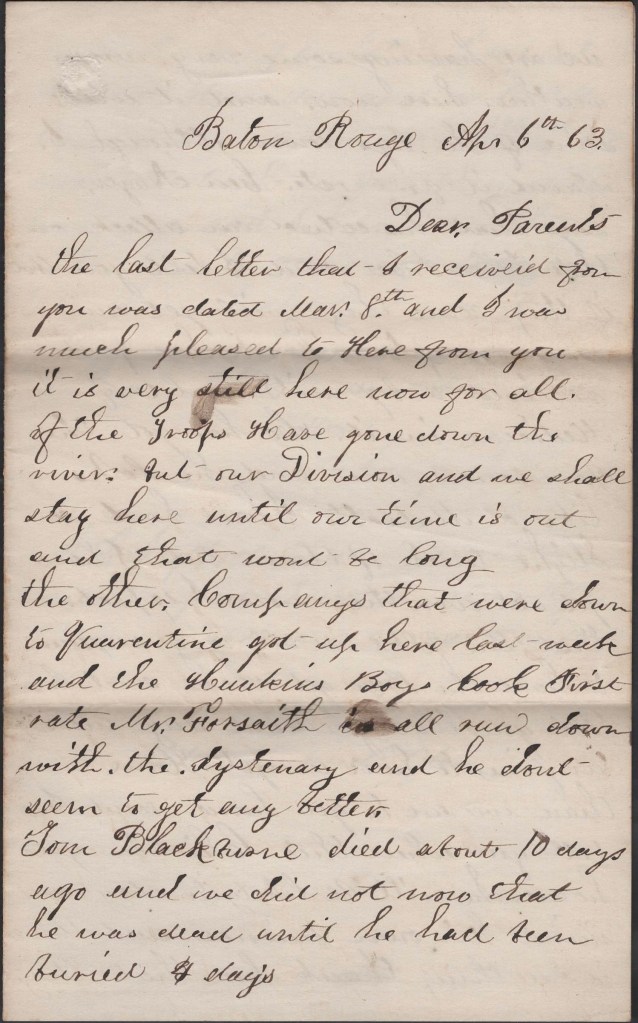
The last letter that I received from you was dated March 8th and I was much pleased to hear from you. It is very still here now for all of the troops have gone down the river but our Division and we shall stay here until our time is out and that won’t be long. The other companies that were down to Quarantine got up here last week and the Hawkins boys look first rate. Mr. Forsaith is all run down with the dysentery and he don’t seem to get any better. Tom Blackburn died about 10 days ago and we did not know that he was dead until he had been buried four days.
We are having some very warm weather here now and it wilts some of the boys down although I stand it first rate. Gen. Auger says that he expects an attack on this place and I tell you that if they come, they will get a warm reception. Frank has just received a box with a lot of medicine in it. He has got the jaundice now and he looks like a mulatto. I have had a slight touch of them but I have got all over them now.
I expect that the folks are all very anxious to have the Boys get home and I. tell you that they ain’t any more anxious to have us get home than we are to get home. And I tell you, when this chicken gets home, he will be likely to stay and mind his own business. And there is one thing, thank God that they can’t conscript him.
I expect that George Harnden and a lot of cowards around home are scared almost to death for fear they will have to go and I hope that they will have to come out here and take their whack at it.
As it is getting most dinner time, I must draw my letter to a close. Yours, — George N. Boynton
P. S. I expect that the women are in great demand about this time on account of the conscript act. Write soon and often.
Letter 13
Baton Rouge April 10th 1863
Dear Parents,
I have just received a letter and two papers from you and I was much pleased to hear from you, it being a month since I heard from you before. We are having an easy time here now and the time slips away very fast. I am sorry to say that two of our company have died since I wrote you last. Mr. [William] Sides of Groveland and Milton Jewett [of Georgetown] died last night. He had a fever in the first place and it turned into a disease something like the Glanders.
Dr. William B. Cogswell (1821-1891)—“the Boys all hate Dr. Cogswell the way [he] delivers out medicine. He has a plate of Opium pills and he gives every man no matter what the disease is three of these pills.”
I suppose that you are planting the garden about this time but out here the potatoes are in blossom and the corn is up about 20 inches. Lieut. Stowe of Co. G has broke his shoulder and Lieut. Bradstreet is all run down with the diarrhea. He looks like a skeleton. The Boys all hate Dr. [William] Cogswell the way that [he] delivers out medicine. He has a plate of Opium pills and he gives every man—no matter what the disease is—three of these pills. One morning when I went down there to get some medicine for a cold, he gave me pills and the next man came in and he asked him what ailed him and he said diarrhea and sick to his stomach and so he gave him 3 pills.
I am glad that I came out here for nine months for I never has so good a lesson in my life and when I get home, I can give you a good repensation of this war and the damned contractors for we have not had anything to eat but salt pork, bacon sides, and hard tack. But never mind. I shall be at home before a great while where I can get something decent to eat.
Tell Kenny to be a good boy for brother Georgey is coming home in 6 or 7 weeks. Amos Dole is sick and in the hospital and I should not think strange if we had to leave him out here under the sod for when these surgeons get hold of a fellow, he stands a poor sight to get out of it alive. And I tell you that they won’t get me into them hospitals if I can help myself.
As it is getting most dinner time, I will draw my letter to a close. Yours, — G. N. Boynton
P. S. I expect that Mrs. Marshall will have somebody on a string on account of this Conscription.
Letter 14
Baton Rouge April 12, 1863
Dear Parents,
I received two letters from you last night and was glad to hear from you. Everything remains about the same as when I wrote you last. Our Brigade is a going to stay here. There [are] a lot of steamers down to New Orleans putting in bunks and provisions to carry the nine-month’s troops home. We shall probably start for home in 6 or 7 weeks as we have yet to be at home by the 15th of June and it will be the happiest day that I ever passed when I land in Old Georgetown and when it comes night crawl into Marm’s bed.
I suppose that the folks will have a great time when the Boys get home. Henry Butler’s the sutler plays it on the Boys like the Old Boy. I suppose that Father has as much business as he can tend to now—especially on the mail to Lawrence, and it will be a good job for me when I get home. Tell Kenny to be a good boy and keep his nose clean.
Capt. John G. Barnes of Co. K, 50th Massachusetts Infantry. “The Boys all hate him worst than they do the Devil.”
Mr. Forsaith is improving and he is on duty. His company is doing Provost Duty in the City and he has charge of a slaughter house. Lyman Floyd is a going to have his discharge and probably will start for home inside of a week. Lieut. Bradstreet has gone to the hospital and we are all trying to have [him] resign and go home. But he says that [he] won’t go. until the company does. The company has been under the Sol ever since we have been here.
Capt. Barnes has all flushed out and he don’t amount to Hannah Cook and the Boys all hate him worst than they do the Devil.
We don’t have to drill only two hours and when we go on guard, we have sentry boxes to stand in and they keep the sun off of you first rate.
I had a letter from Uncle Kendall and he said that Jenny had left you in an awful rush and I want you to write me the reason that she had to leave. As it is getting most time for drill, I must draw my letter to a close. I am well and in good health. Yours truly, — George N. Boynton
Letter 15
Baton Rouge April 22, 1863
Dear Parents,
Yours of the 2nd is received in which you sent them bills on George Curtis and John Perry. We shall probably get paid off in course of a fortnight. Dr. French, our Asst. Surgeon, died this morning and all of our officers are sick and the company is in charge of the 3rd Sergeant but I am fat and saucy and I never was so fleshy in my life. Our regiment has got straw hats and mosquito bars. The report is here that the Government is a going to keep us until August 11th but our officers do not believe it. But if they do try it, there will be a general howl in the regiment.
I wrote to Esther and Uncle Eben a month ago. It is awful weather here now, but we don’t have to drill only an hour a day. But we have poor grub. It consists of ham and bacon sides, or hogs smoked. Rather than to eat the nasty stuff, I have bought the most of my grub. I think that we shall start for home by the last of next month and you can make up your mind to see me by the middle of June. Bill Hankins has just got out of the hospital and he looks rather slim but is gaining fast. Capt. Barnes and Lieut. Bradstreet are in the hospital. When we get into Boston and get mustered out of the service, I guess that he won’t have many followers.
I wrote a letter to Uncle Kendall about two weeks ago and I suppose that he has got it by this time.
I suppose that the Hot Abolitionists are in an awful panic for fear that they will be drafted and I hope that they will have to come out here and take a hack at it. Frank has to toe the mark. They only had him on knapsack drill of 2 [ ] for skipping drill and [ ] and his folks sent him some medicines and he has sold it all. I don’t want [you] to say anything to his folks about it.
As it is getting most dinner time and we are a going to have baked beans for dinner, I must draw my letter to a close. Yours, — G. N. Boynton
Letter 16
Baton Rouge June 12, 1863
Dear Mother,
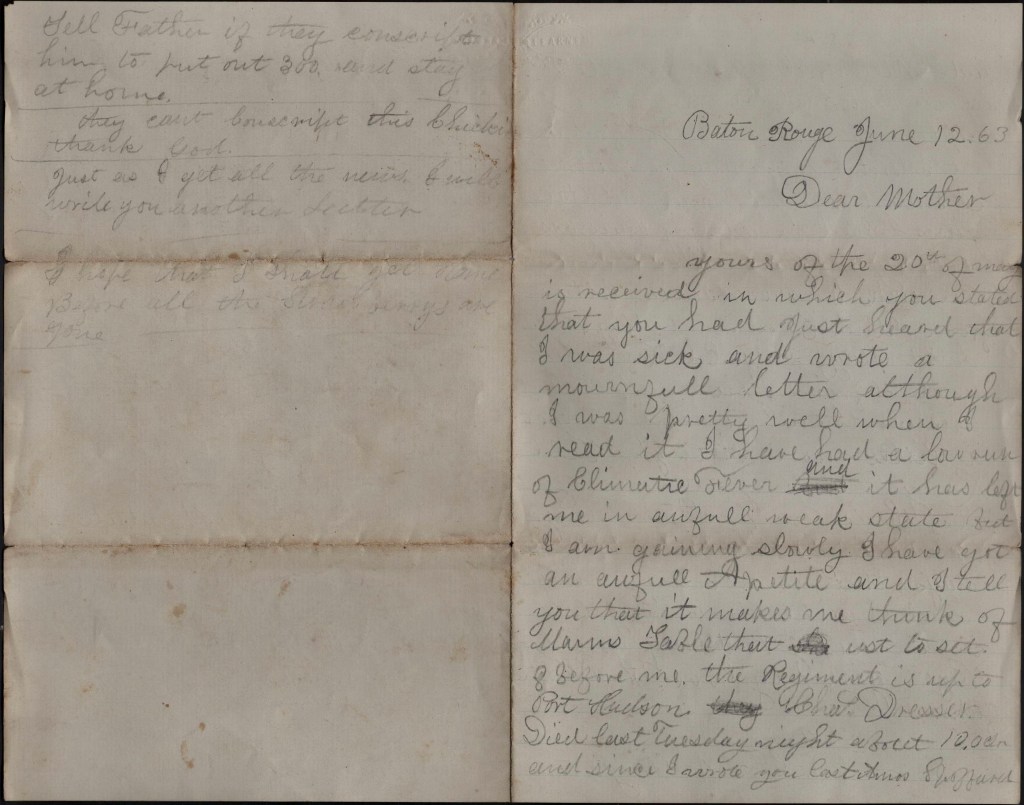
Yours of the 20th of May is received in which you stated that you had just heard that I was sick and wrote a mournful letter although I was pretty well when I read it. I have had a low run of climatic fever and it has left me in awful weak state but I am gaining slowly. I have got an awful appetite and I tell you that it makes me think of Marm’s table that used to sit before me.
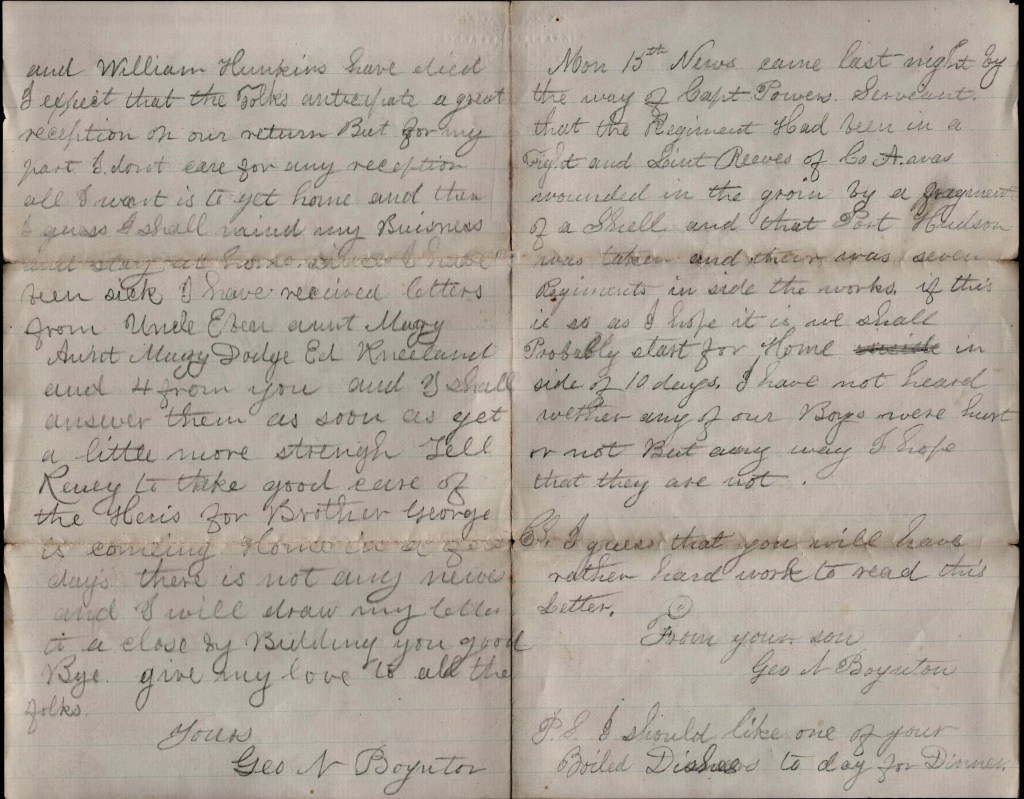
The regiment is up to Port Hudson. Charles Dresser died last Tuesday night about 10 o’clock and since I wrote you last, Amos Spofford and William Hunkins have died. I expect that the folks anticipate a great reception. All I want is to get home and then I guess I shall mind my business and stay at home. Since I have been sick, I have received letters from Uncle Eben, Aunt Maggy, Aunt Maggy Dodge, Ed Kneeland, and four from you and I shall answer them as soon as I get a little more strength. Tell Kenney to take good care of the hens for brother George is coming home in a few days.
There is not any news and I will draw my letter to a close by bidding you goodbye. Give my love to all the folks. Yours, — George N. Boynton
Monday, 15th. News came last night by the way of Capt. Powers’ servant that the regiment had been in a fight and Lieut. Reeves of Co. A was wounded in the groin by a fragment of a shell and that Port Hudson was taken and there was seven regiments inside the works. If this is so, as I hope it is, we shall probably start for home inside of ten days. I have not heard whether any of our Boys were hurt or not but anyway, I hope that they are not.
P. S. I guess that you will have rather hard work to read this letter. From your son, — George N. Boynton
P. S. I should like one of your boiled dishes today for dinner. Tell Father if they conscript him to put out $300 and stay at home. They can’t conscript this chicken, thank God. I hope that I should get home before all the strawberries are gone.
Letter 17
Note: The following letter was written by Edward T. Crosby of Co. K, 50th Massachusetts Infantry. He died of disease a month later, 4 August 1863, onboard a steamer on the Mississippi River.
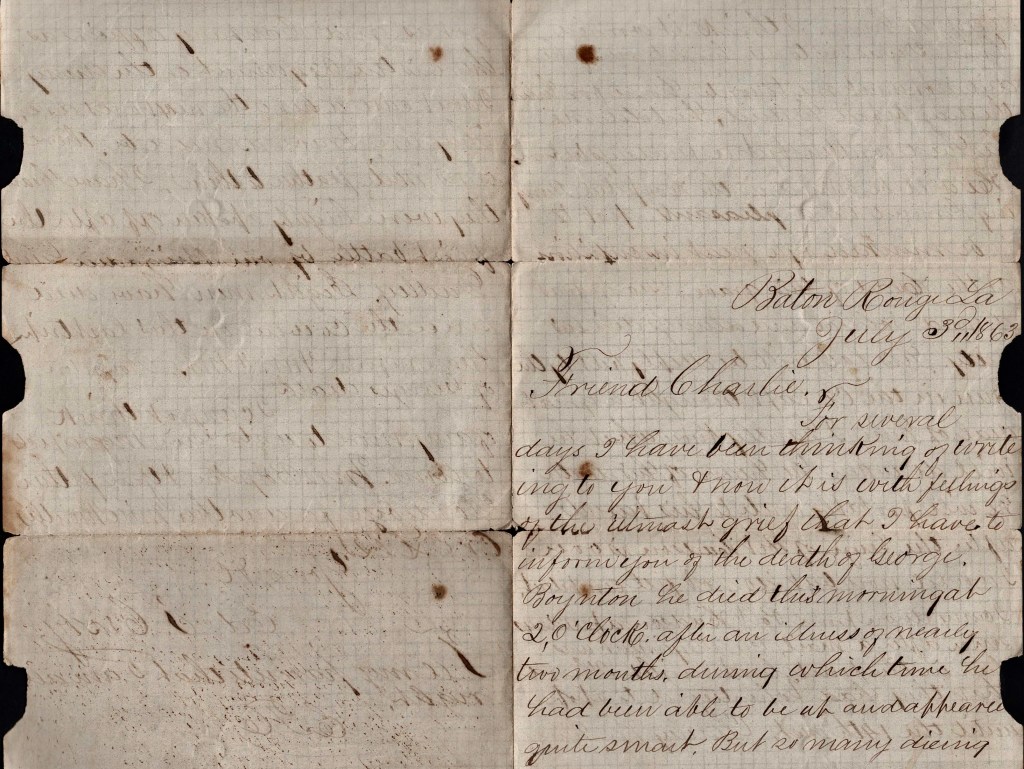
Baton Rouge, La. July 3, 1863
Friend Charlie,
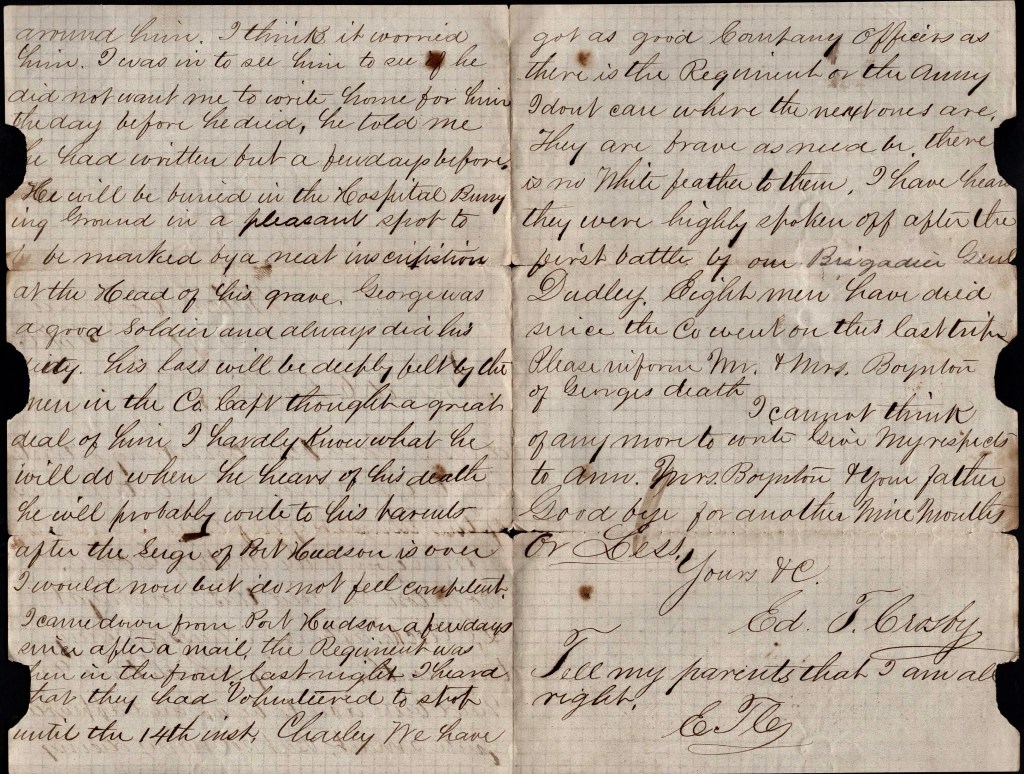
For several days I have been thinking of writing to you & now it is with feelings of the utmost grief that I have to inform you of the death of George Boynton. He died this morning at 2 o’clock after an illness of nearly two months during which time he had been able to be up and appeared quite smart. But so many dying around him, I think it worried him. I was in to see him to see if he did not want me to write home for him the day before he died. He told me he had written but a few days before.
He will be buried in the Hospital Burying Ground in a pleasant spot to be marked by a neat inscription at the head of his grave. George was a good soldier and always did his duty. His loss will be deeply felt by the men in the company. Captain [Barnes] thought a great deal of him. I hardly know what he will do when he hears of his death. He will probably write to his parents after the siege of Port Hudson is over. I would now but do not feel competent.
I came down from Port Hudson a few days since after a mail. The regiment was then in the front. Last night I heard that they had volunteered to stop until the 14th inst.
Charley, we have got as good company officers as there is [in] the regiment or the Army. I don’t care where the next ones are. They are brave as need be. There is no white feather to them. I have heard they were highly spoken of after the first battle by our Brigadier General Dudley. Eight men have died since the convention on this last trip. Please inform Mr. & Mrs. Boynton of George’s death.
I cannot think of any more to write. Give my respects to Ann, Mrs. Boynton, & your father. Goodbye for another none months or less. Yours, &c. — Ed T. Crosby
I could find no image of David but here is an Ambrotype thought to be John Cramer of Co, A, 20th OVI. (Ohio Memory)
These letters were written by David Harrison Thomas of Co. D, 20th Ohio Infantry. The regimental roster informs us that David enlisted on 3 October 1861 when he was 23 years old. He was promoted to corporal in February 1863 and he died on 25 May 1863 from wounds received in the siege of Vicksburg.
David was the son of Welsh emigrants Owen (1800-1868) and Mary (1813-1893) Thomas of Radnor, Delaware county, Ohio. David mentions two of his siblings in the letter, Margaret (b. 1833) and Joseph (b. 1840).
At the time that David wrote these letters in July 1863, the regiment had participated in the Battle of Fort Donelson and at Shiloh where they had considerable losses.
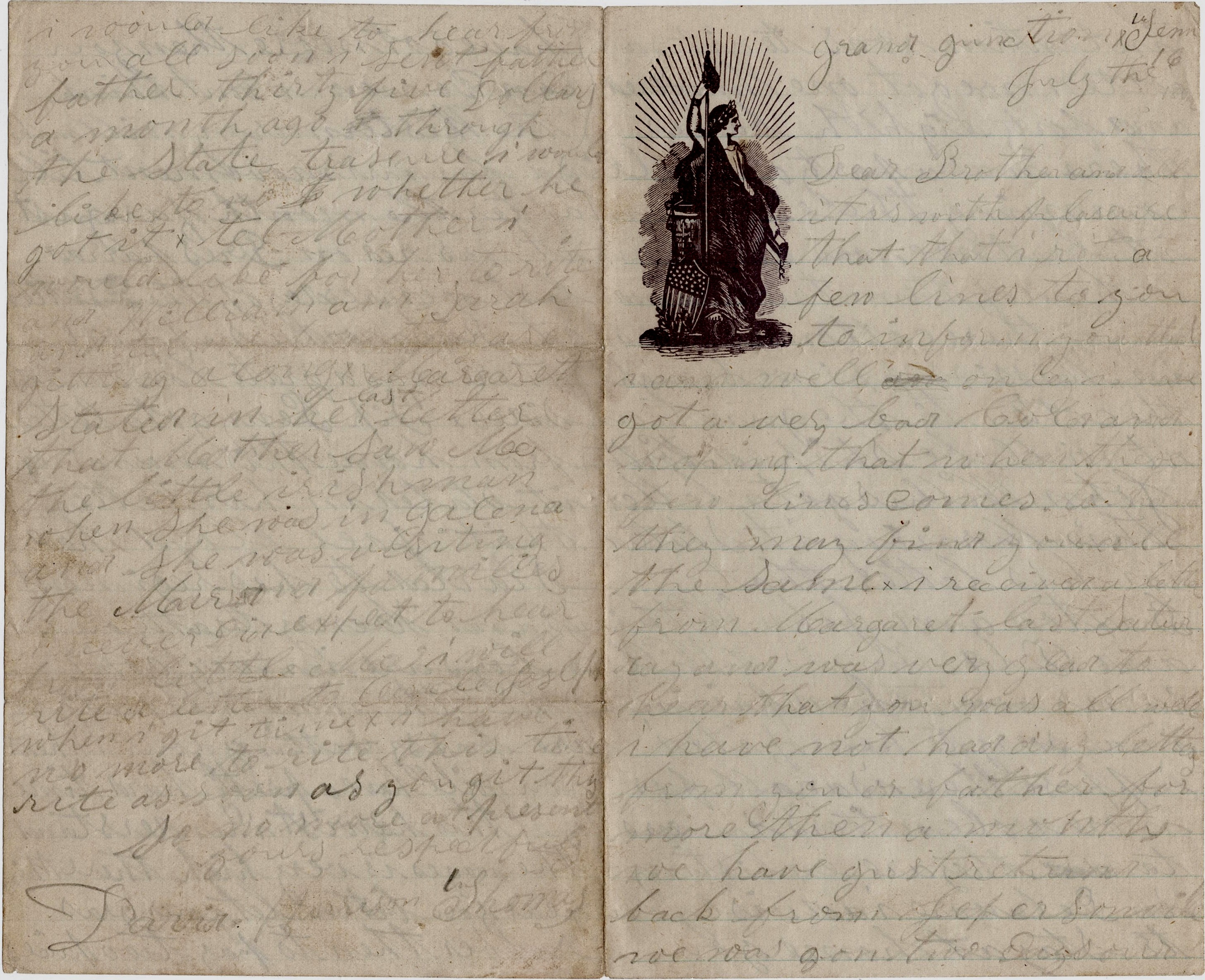
Letter 1
Grand Junction, Tennessee July 16 [1862]
Dear Brother and all,
I thought that I [would] write a few lines to you to inform you that I was well, only I have got a very bad cold, and hoping that when these few lines come to hand they may find you all the same. I received a letter from Margaret last Saturday and was very glad to hear that you was all well. I have not had any letter from you or father for more than a month.
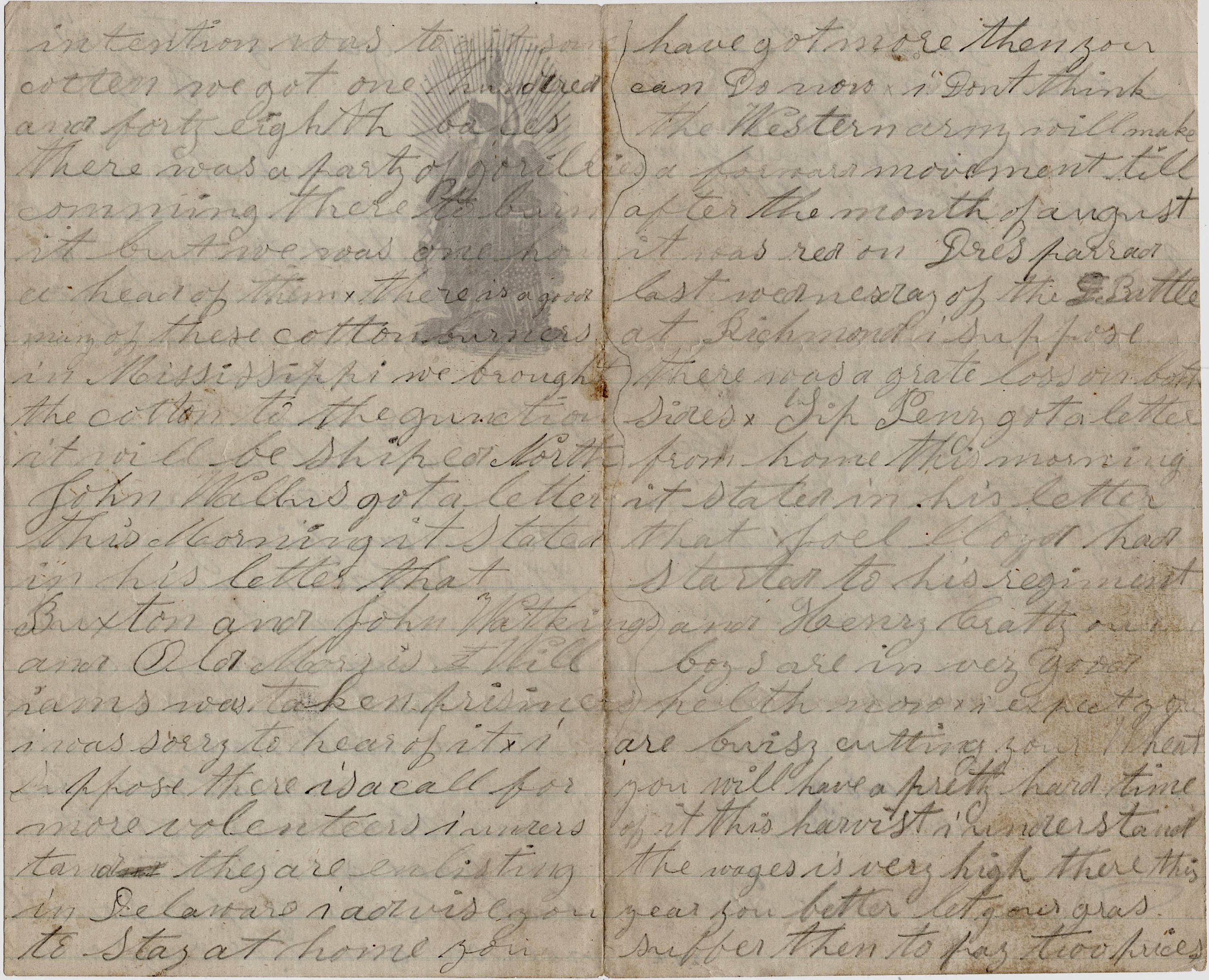
We have just returned back from Jeffersonville. We was gone two days. Our intention was to get some cotton. We got one hundred and forty-eight bales. There was a party of guerrillas coming there to burn it but we was one hour ahead of them. There is a good many of these cotton burners in Mississippi. We brought the cotton to the Junction. It will be shipped North.
John Walbus [?] got a letter this morning. It stated in his letter that Buxton and John Watkins and Old Morris Williams was taken prisoners. I was sorry to hear of it. I suppose there is a call for more volunteers. I understand they are enlisting in Delaware. I advise you to stay at home. You have got more than you can do now. I don’t think the Western Army will make a forward movement till after the month of August. It was read on Dress parade last Wednesday of the Battle at Richmond. I suppose there was a great loss on both sides.
Tip Penry got a letter from home this morning. It stated in his letter that Joel Lloyd had started to his regiment and Henry Cratz and his boys are in very good health now. I expect you are busy cutting your wheat. You will have a pretty hard time of it this harvest. I understand the wages is very high there this year. You better let your grass suffer than to pay two prices.
I would like to hear from you all soon. I sent father thirty-five dollars a month ago through the State Treasurer. I would like to know whether he got it. Tell Mother I would like for her to write and William and Sarah and tell me how they are getting along. Margaret stated in her last letter that Mother saw Me, the little Irishman in Galena and she was visiting the Morrison & Pa. Mills [?] I never did expect to hear from little Me. I will write a letter to Uncle Joseph when I get time. I have no more to write this time. Write as soon as you get this. So no more at present. Yours respectfully, — David Harrison Thomas
Letter 2
Grand Junction, Tennessee July 20th 1862
Dear father and mother,
I take the pleasure this Sunday morning to write a few lines to you to inform you that I am able to walk around. I had a hard spell of the chills and fever for three days. I thought it was going to turn to some other fever but I got it broken. I got Amos [C.] Mounts to write a few lines to you to let you know. I did not then know what I would go to the hospital but I have been so lucky so far as to keep out of there.
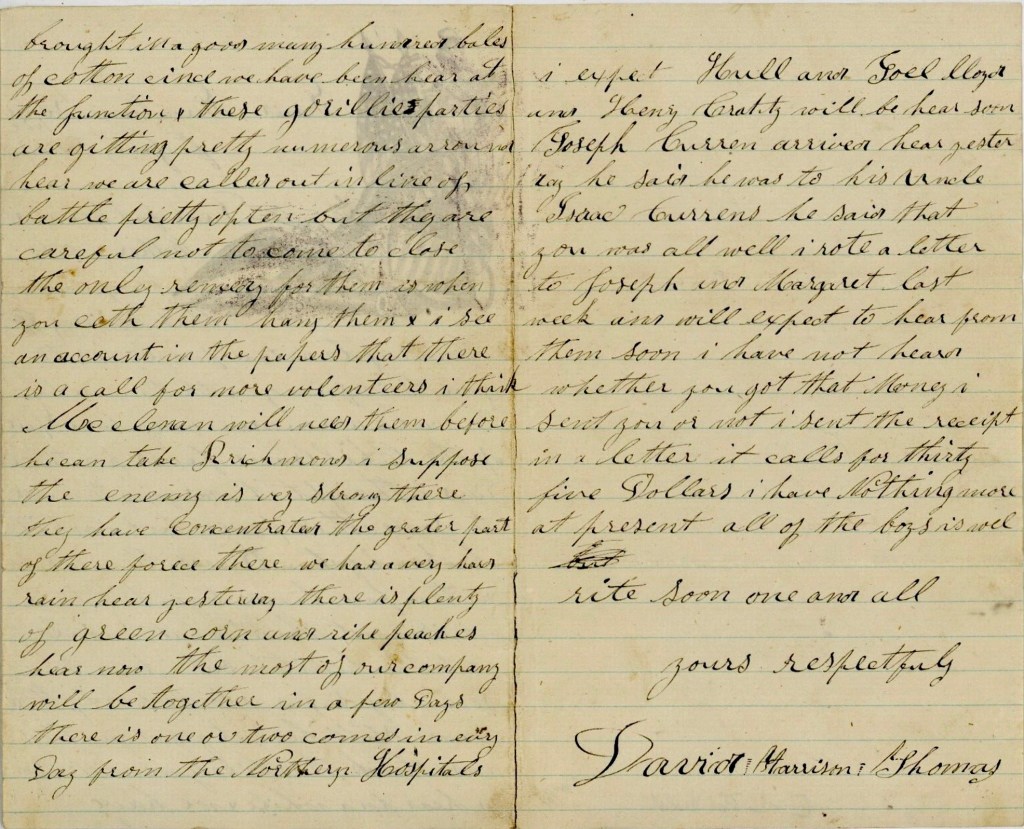
We are still here at Grand Junction and I think it is likely we will remain in here for a while & we have brought in a good many hundred bales of cotton since we have been here at the Junction. These guerrilla parties are getting pretty numerous around here. We are called out in line of battle pretty often but they are careful not to come too close. The only remedy for them is when [we] catch them, hang them.
And I see an account in the papers that there is a call for more volunteers. I think McClellan will need them before he can take Richmond. I suppose the enemy is very strong there. They have concentrated the greater part of their forces there.
We had a very hard rain here yesterday. There is plenty of green corn and ripe peaches here now. The most of our company will be together in a few days. There is one or two comes in every day from the Northern hospitals. I expect [Cornelius] Hull and Joel Lloyd and [James] Henry Cratz will be here soon. [1st Sgt.] Joseph Curren arrived here yesterday. He says he that you was all well. I wrote a letter to Joseph and Margaret last week and will expect to hear from them soon. I have not heard whether you got that money I sent you or not. I sent the receipt in a letter. It calls for thirty-five dollars. I have nothing more at present. All of the boys is well.
Write soon, one and all. Yours respectfully, — David Harrison Thomas
I could not find an image of Charles but here is a cdv of 1st Lt. Benjamin Jay Cushing of Co. G, 53rd Pennsylvania Infantry (Photo Sleuth)
The following letter was written by Charles F. Smith (1836-1928) who was enumerated in 1860 in the household of his brother George Smith (1828-1919) who had a farm near Unity, Westmoreland, Pennsylvania. George was married to Maggie M. Orr (1830-Aft1900) of Limestone, Clarion county, Pennsylvania, in 1851.
A 1902 committee on pensions Senate Report claims that Charles entered the service on 9 September 1861 as 1st Sergeant of Co. K, 53rd Pennsylvania. He was subsequently promoted to 2nd Lieutenant and 1st Lieutenant. He mustered out in June 1865. He was wounded in the neck at Fredericksburg on 13 December 1862, and again in the lower jaw at Gettysburg on 2 July 1863.
Readers are referred to the following articles pertaining to the 53rd Pennsylvania Infantry at Fredericksburg and at Gettysburg:
This letter is from the personal collection of Greg Herr who made it available for transcription and publication on Spared & Shared by express consent.
T R A N S C R I P T I O N
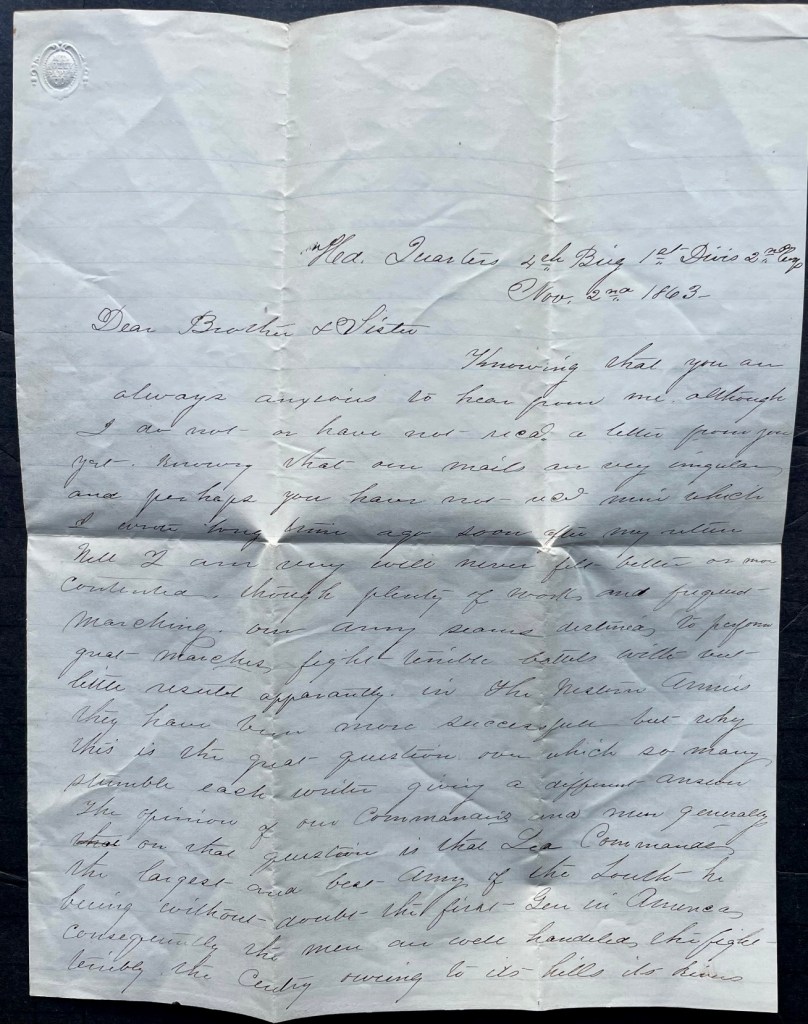
Headquarters 4th Brigade, 1st Division, 2nd Corps [Warrenton Junction, Va.] November 2nd 1863
Dear Brother & Sister,
Knowing that you are always anxious to hear from me although I do not or have not received a letter from you yet, knowing that our mails are very irregular and perhaps you have not received mine which I wrote long time ago soon after my return. Well, I am very well. Never felt better or more contented though plenty of work and frequent marching.
Our army seems destined to perform great marches, fight terrible battles with but little results apparently. In the Western Armies they have been more successful but why this is [is] the great question over which so many stumble, each writer giving a different answer. The opinion of our commanders and men generally on that question is that Lee commands the largest and best army of the South. He being without doubt the first General in America. Consequently the men are well handled, the fight terrible, the country—owing to its hills, its river, and natural fortifications to which is added all that modern engineering can produce, great minds are opposed to us. Generals of skill and energy which were they commanding our armies would make this war easy and soon closed.
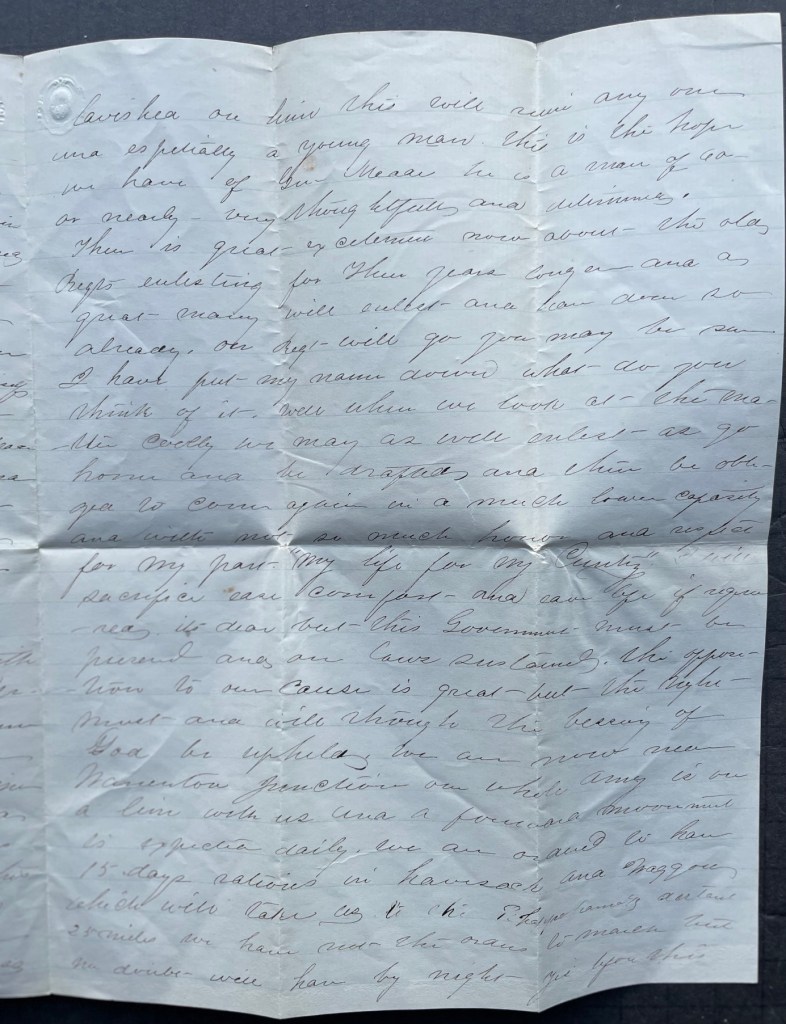
But we are confident that we have right on our side. Hence our confidence and determination. We all think that our General (Meade) will do wonders. He has proven himself to be a man for. the times. Since the organization of the Army of the Potomac, Gen. McClellan has been identified with it. As a Corps Commander, he [Meade] had no equals. And as for Gen. McClellan, I am done with him as far as Politics is concerned. The letter he wrote some time before the Pennsylvania Election will satisfy all men on the subject of right and wrong. He said he agreed with Mr. Woodward in every particular. Well now, Mr. Woodward is undoubtedly a Copperhead and the same conclusion we may make about our once favorite general. This is a hard pull for me, you know. The love I had for him as a man, not saying anything about him as a general for as the latter all the generals in this army think there is none better. His skill was unequal, we all firmly believe. But he was a young man and too much praise was lavished on him. This will ruin anyone and especially a young man. This is the hope we have of Gen. Meade. He is a man of 60, or nearly, very thoughtful and determined.
There is great excitement now about the old regiments enlisting for three years longer and as great many will enlist and have done so already, our regiment will go, you may be sure. I have put my name down. What do you think of it? Well, when we look at the matter cooly, we may as well enlist as go home and be drafted and then be obligated to come again in a much lower capacity and with not so much honor and respect. For my part, “My life for my country.” I will sacrifice ease comfort and [ ] life if required. It’s dear but this government must be preserved and ourlaws sustained. The opposition to our cause is great but the right must and will through the blessing of God be upheld.
We are now near Warrenton Junction. Our whole army is on a line with us and a forward movement is expected daily. We are ordered to have 15 days rations in haversack and wagon which will take us to the Rappahannock distance 25 miles. We have not the orders to march but no doubt will have by night. Yes, before this reaches you, we will be marching on the enemy but the probabilities of a battle is rather small from the fact that the Rebels will fall back as we approach and only attempt to defend their Capitol which they will succeed in doing for a time at least.
I have a good little horse—one that can jump anything in the shape of a fence and stone walls and such. You ought to see him. Then we have a roomy tent, only two of us. Capt. [Henry J.] Smith of our regiment is Act. A. D. C. at present. We live finely, have chicken, fresh pork, beef, mutton, &c. So you need not be anxious to our comfort in that respect. I must tell you that if our regiment enlists for three years longer, we will get home for 90 days to recruit to the number of 1,000 and if we do go, will start soon—say in two weeks or so.
I must close. Love to all the dear, cute children. Kiss them for me. How I do love them. How sorry I was to hear of the death of little Maggie. I hope your health and lives may be spared. Have you your corn husked yet? I know it must be good. Well, much love to all the friends. I am your brother, — Charles
Remember me to Mr. and Mrs. Elan Nelson. B. is well and in fine spirits.
Address Lt. C. F. Smith, A. D. C., Col. [John R.] Brooke, Commanding 4th Brigade, 1st Division, 2nd Corps, Washington City, D. C.
These letters were written by Western Berkley Thomas, Jr. (1835-1863), the son of Western Berkley Thomas (1799-1836) and Emmeline Few Thomas (1807-1882) of Augusta, Richmond county, Georgia. In 1859 and 1860 he is enumerated among the students at Cambridge in the Harvard Law School. In the 1860 US Census, he is identified as a lawyer working in Augusta.
Western served the Confederacy as 1st Lieutenant in Co. K (“Davis Musketeers”), 10th Georgia Regiment. He enlisted at Richmond, Virginia, on July 7, 1861. In March 1862, Co. K of the 10th Regiment was transferred into artillery. Three months later, Lt. Thomas was suffering so severely from the “stricture of urethra & unstable condition of the bladder” that surgeons judged him unfit for duty. On June 6th, 1862, Western submitted his resignation from the service to Hon. George W. Randolph, Secretary of War. Western died on 14 February 1863 at Chickamauga, Walker county, Georgia.
Western wrote these letters early in 1862 while the Davis Musketeers were manning a battery at Pig Point in Suffolk county near the mouth of the Nansemond river overlooking Hampton Roads.
Map of Hampton Roads showing Pig Point fortifications at left.
Letter 1
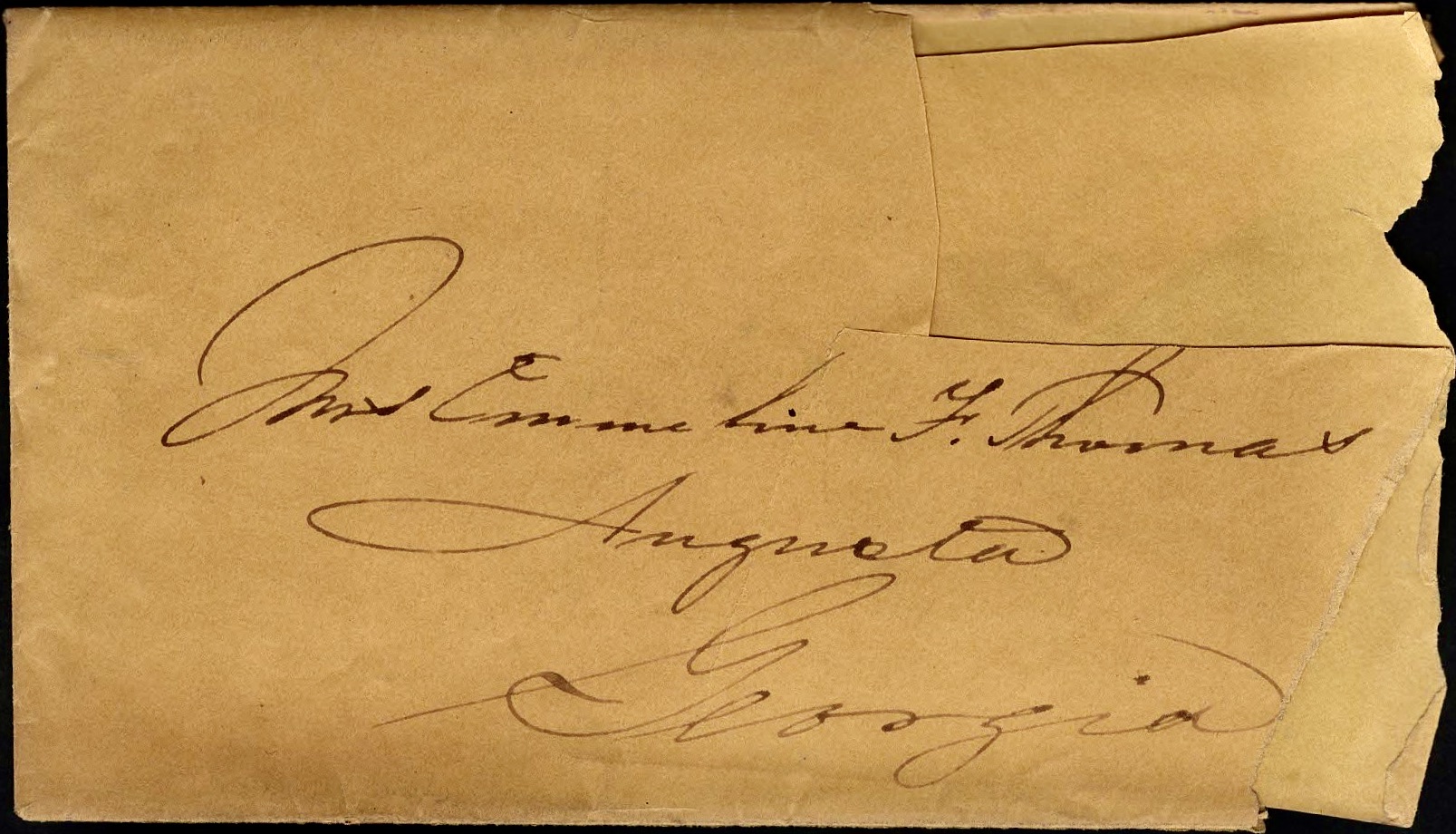
Addressed to Mrs. Emeline F. Thomas, Augusta, Georgia
Pig Point 1 January 13, 1862
Dear Mother,
I should have answered your letter long ago but the chills have had me again. I cannot write on my chill day and the intervening day I feel worn out and weary. I hope by the use of quinine to escape tomorrow. It is certainly strange that we should be afflicted with the disease at this season of the year but I suppose it is the same attack I had before as it has been about twenty days since my last. I will watch this time and take quinine as you directed at each period but. so long as we have nothing worse, I shall be satisfied for we have been very fortunate. Other corps are suffering around us with typhoid fever, pneumonia, and other fatal diseases while we have not yet lost a man. I believe I am the only man in the company who has chills now. 2
The box arrived about three days since and we eat one side of the breast of the turkey before it advanced too far. The ham was fine but it is all gone as we are great ham eaters here. The men will be very thankful for the comforters. I have not yet given them out as it is very warm and I will wait till I get the others which are in my other box with the overcoat at the express Office in Norfolk.
I have nothing to write you about as it is very stupid here. We have been watching for the Burnside Expedition here for a long time but it has not come and from the changes in the fleet off Fortress Monroe, I think it has gone further south. If this is so, we shall soon hear of it. As I write, I hear very heavy guns up the James river for which I cannot account as it is too rough for practice—probably some little skirmish.
I see no prospect of peace at present and no hope of anything but Pig Point and chills until the war closes. Has Aunty heard anything from sister or from Kentucky? I fear poor Aunt Luesa’s nerves will be sadly shocked by the presence of the Federal and Confederate forces in the blue grass country. I feel very sorry for the people of Kentucky. It is bad enough. to have a friendly army in the country but it must be very sad to have two hostile forces and the people divided too.
I said we had no sick in the company but while I write, William D’Antonac has been attacked by his chill and is now shaking the whole house and we have four men with chills.
I hope I shall hear from you soon. We have three men at home now on leave of absence. I told them to go to the house thinking you might like to hear something of how we get on. There is nothing I want now so you can send me nothing. I wish you would find my bank book in the drawer of the wardrobe (I think) and send it to the bank to be balanced. If you cannot find it, you can find out at the bank how much I have there and let me know too how much interest is now due me on my bonds as I may take that money with what I have here and buy Confederate bonds. They are as good as anything else now and will be better after the war. Write soon. Affectionately, — your son.
January 15th 1862
I succeeded in breaking the chill yesterday and hope to avoid them in future. your letter came last night and I will send you the money to invest if you think the State Bonds are better than Confederate. The latter are free you know from the war tax which is half percent and unless the State Bonds are free from state tax (in which case they are better), they are worth less than Confederates since the former will bring only 7.5 percent after deducting the war tax while the latter which are not subject to it are at 8 percent. I shall not be able to send you more than $800 from here as I can not collect all that is owing me and as I shall need something to live on till next payday which will be March 1st. I think there are, however, coupons enough due on my bonds to make up the sum of $1000. If not, let me know how much I have in deposit at the bank and I will send you a check.
That old German told a falsehood. He has made nearly $70 out of the Confederacy with his clothes adn food six months and has done only one or two days duty since he was enlisted. He is mad because we would not let him swindle the government out of commutation money for clothing. You have doubtless by this time seen three or one of the two men now at home on leave and you will find no better clothed troops in the service. You can send the dog by one of these. John Rodle whom I told to go and see you is the safest to send him by unless you see Booker. But whomever you give him to, tell the others if you see them. If none of them come to the house, Dr. Steiner (to whom remember me the most sincerely) can tell you where John Rodle, formerly Marcellus Hammond’s cook, lives. Send the dog to Bowen (gunsmith) and tell him to fit it a nice collar on him with the enclosed information on the plate and send the key with the dog. Pay for the collar or tell. Bowen to charge it to me. I will pay when we meet. I am sorry my dear Mother to give you so much trouble. Adieu. Your affectionate son, — W. B. T.
1When secessionists seized the Gosport Navy Yard, they obtained more than 1200 heavy guns and 300,000 pounds of gunpowder at Fortress Norfolk. Several of these large guns were deployed at Pig Point. The shoreline was indeed formidable but Confederates had to withdraw from these fortifications to defend Richmond when McClellan threatened in the spring of 1862.
2 Thomas was obviously suffering from malaria based not only only symptoms but his treatment with quinine. It was often refered to a Ague or “the shakes” because of paroxysmal attacks.
Letter 2
Addressed to Mrs. E. F. Thomas, Augusta, Georgia
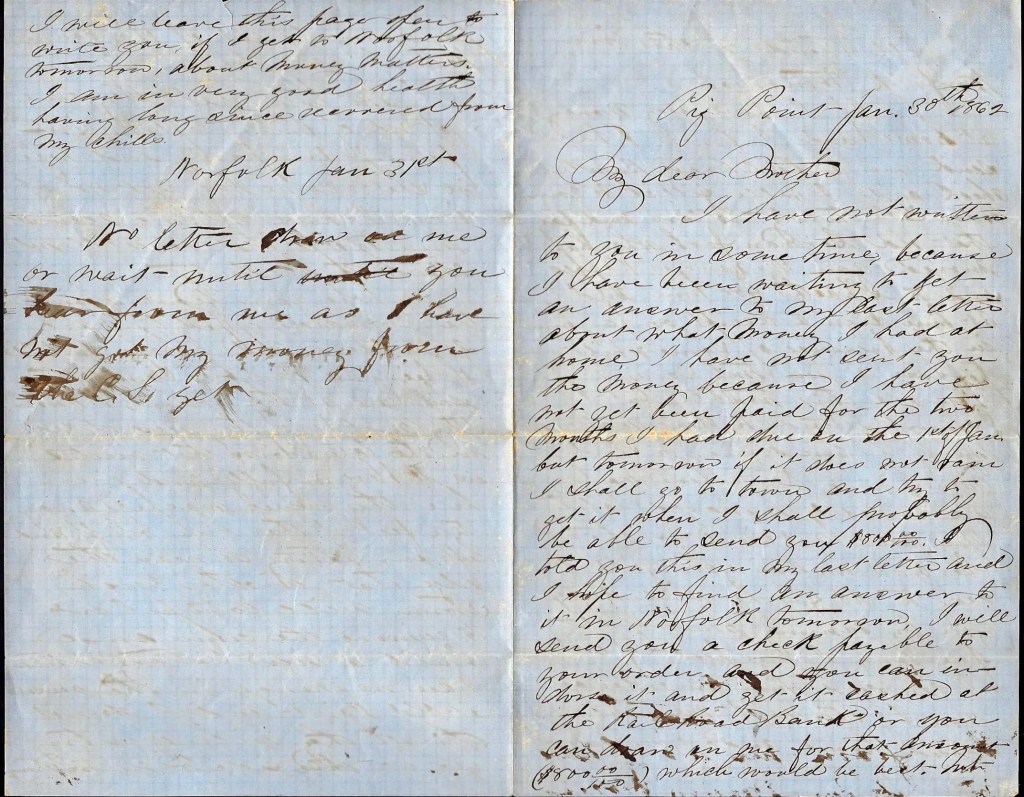
Pig Point January 30th 1862
My Dear Mother,
I have not written to you in some time because I have been waiting to get an answer to my last letter about what money I had at home. I have not sent you the money because I have not yet been paid for the two months I had due me on the 1st of January. But tomorrow, if it does not rain, I shall go to town and try to get it when I shall probably be able to send you $800.00. I told you this in my last letter and I hope to find an answer to it in Norfolk tomorrow. I will send you a check payable to your order and you can endorse it and get it cashed at the Railroad Bank or you can draw on me for that amount ($800) which would be best. I will attend to this in Norfolk tomorrow.
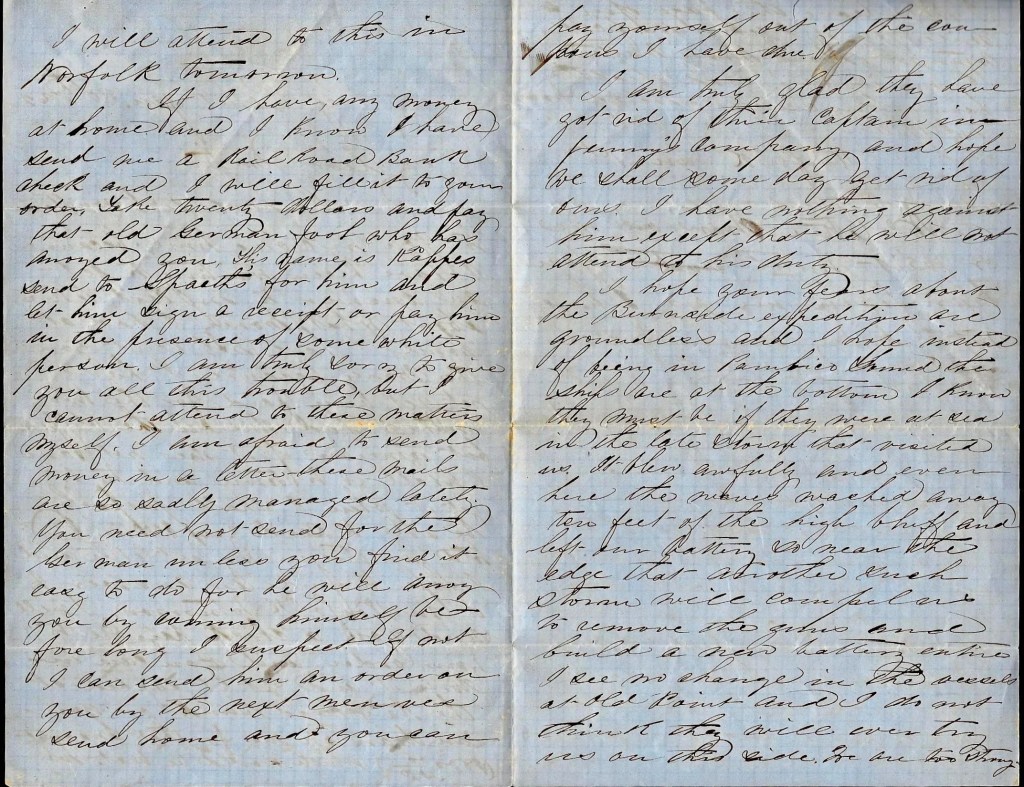
If I have any money at home and I know I have, send me a Railroad Bank check and I will fill it to your order. Take twenty dollars and pay that old German fool who has annoyed you. His name is Rappes. Send to Spaeth’s 1 for him and let him sign a receipt or pay him in the presence of some white person. I am truly sorry to give you all this trouble but I cannot attend to these matters myself. I am afraid to send money in a letter. These mails are so sadly managed lately. You need not send for the German unless you find it easy to do for he will annoy you by coming himself before long I suspect. If not, I can send him an order on you by the next man we send home and you can pay yourself out of th coupons I have due.
I am truly glad they have got rid of their captain in Jimmy’s Company and hope we shall some day get rid of ours [Theodore C. Cone]. I have nothing against him except that he will not attend to his duty.
I hope your fears about the Burnside Expedition are groundless and I hope instead of being in Pamlico Sound, the ships are at the bottom. I know they must be if they were at sea in the late storm that visited us. It blew awfully and even here the waves washed away ten feet of the high bluff and left our battery so near the edge that another such storm will compel us to remove the guns and build a new battery entire[ly]. I see no change in the vessels at Old Point and I do not think they will ever try us on this side. We are too strong.
I will leave this page open to write you if I get to Norfolk tomorrow, about money matters. I am in very good health having long since recovered from my chills.
Norfolk, January 31st
No letter for me or visit until you hear from me as I have not got my money from the C[onfederate] S[tates] yet.
1 Charles Spaeth (b. 1829 in Germany) kept a grocery in Augusta.
Letter 3
Pig Point [on Nansemond River opposite Newport News, Va.] February 25th 1862
My dear Mother,
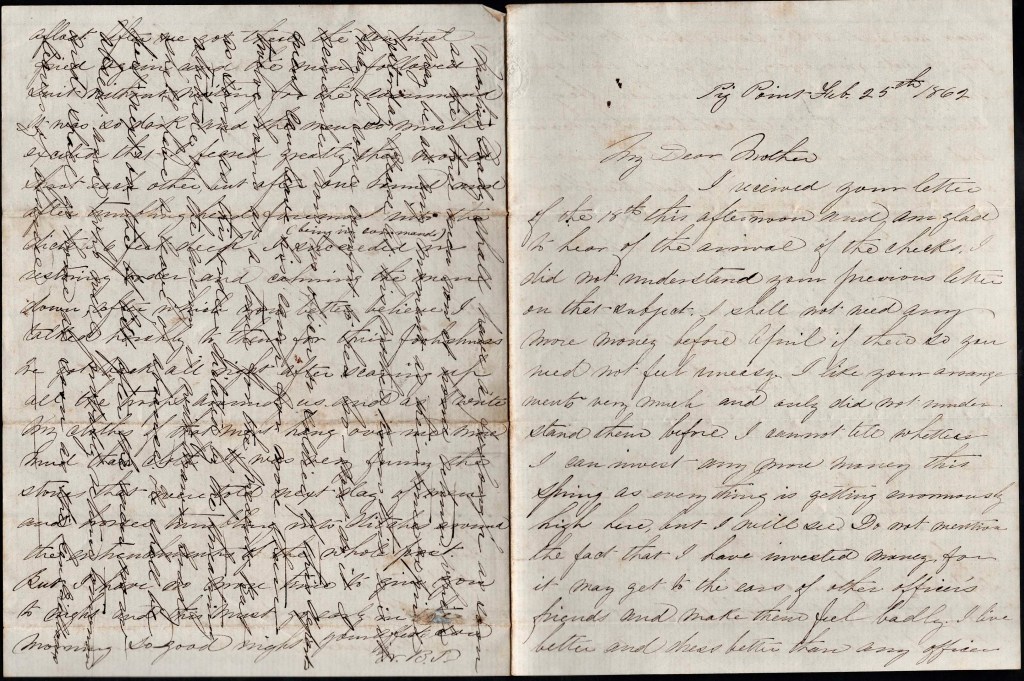
I received your letter of the 18th this afternoon and am glad to hear of the arrival of the checks. I did not understand your previous letter on that subject. I shall not need any more money before April, if then, so you need not feel uneasy. I like your arrangements very much and only did not understand them before. I cannot tell whether I can invest any more money this spring as everything is getting enormously high here but I will see. Do not mention the fact that I have invested money for it may get to the ears of the officer’s friends and make them feel badly. I live better and Mess better than any officer near me, and at the same time do what they do not=give away. And yet I live on my pay and owe no debts which they cannot say. This is the solution. Bar rooms and gambling houses or parties never see my face or my money. Both the officers of this company owe me money and this is what induced me to invest when I had the money. It was hard to refuse, and as long as I had it, I was a dependence. What matter how much was lost or wasted, there was Thomas always to fall back on.
So when I came from home in November having $400 in my pocket, I put it in the Bank of Norfolk, came to camp, and gave it out that I wished to raise a thousand dollars by January 1st and how much do you think I got after relying on promise that I should have the whole—sixty dollars from one party and nothing from the other. I did this because I saw these debts were increasing and would never be paid if allowed to become large. I have men owing me $98 from one party and $60 from the other. This last is Cane’s debt who let me say, for he needs a good word on that score, has always been strictly honorable in his dealings with me; borrowing but seldom and never disappointing me when I have needed pay. But enough. We can talk these things over when we meet,
The enemy have made no new demonstrations in this quarter lately and that is about the only subject of interest here at present. A few night since we had a grand alarm. The sentinel on our battery fired at what he supposed to be a man approaching the magazine who would not halt at his challenge and so into the battery we went. It was the darkest night I ever saw—foggy too, and raining. The battery was like a fish pond all afloat. After we got there the sentinel fired again and the men followed suit without waiting for the command. It was so dark and the men so much excite that I feared greatly they would shoot each other, but after one round and after tumbling head forward into the ditch 6 feet deep, I (being in command) succeeded in restoring order and calming the men down, after which you better believe I talked harshly to them for this foolishness.
We got back all right after scaring up all the troops around us and as I write, my clothes of that night hang over me more mud than cloth. It was very funny the stories that were told next day of men and horses tumbling into ditches around the entrenchments of the whole post. But I have no more time to give you tonight and this must go early in the morning so good night. Your affectionate son, — W. B. T.
Martin Grady shall have a furlough as soon as the three men now at home return which may be at any moment as their time expired yesterday. Please let his mother know this as it may be some comfort to her. No, don’t do it. I remember now. No officer or soldier of this department can leave his camp for more than twelve hours at a time for the present. But as soon as this order dictated by the threatening attitude of the enemy is withdrawn, Grady shall have a leave of absence. He shall be kept next on the list after the men now absent and who will probably return tomorrow and shall go home as soon as the General allows leaves of absence.
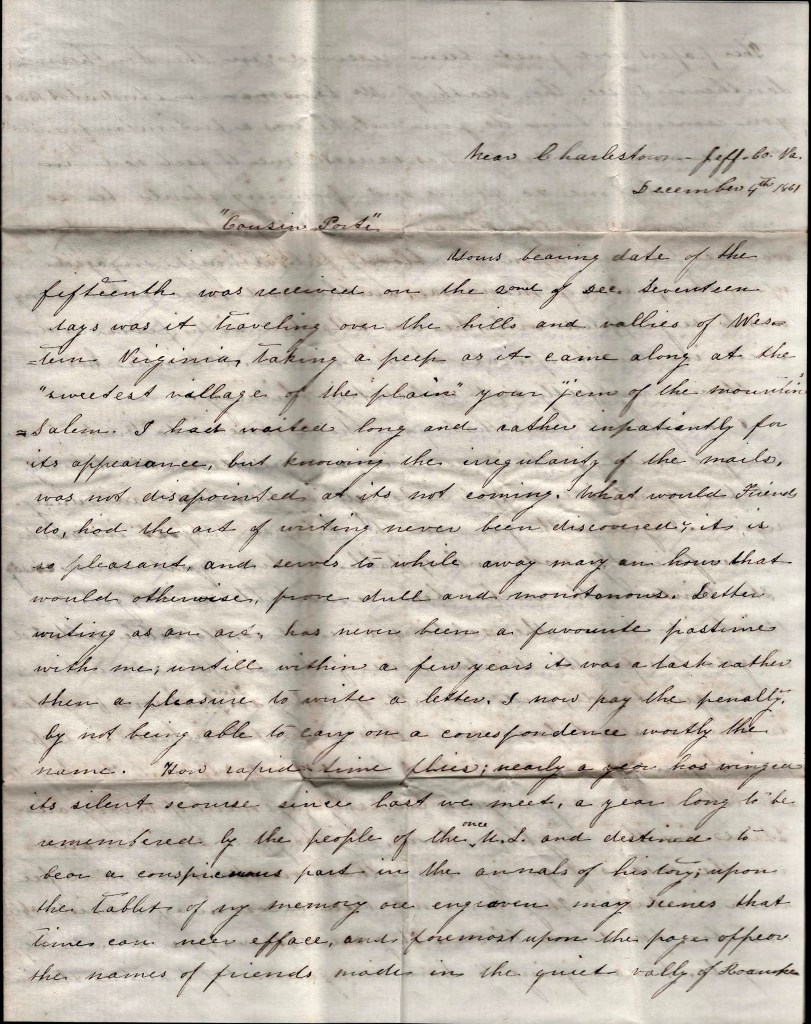
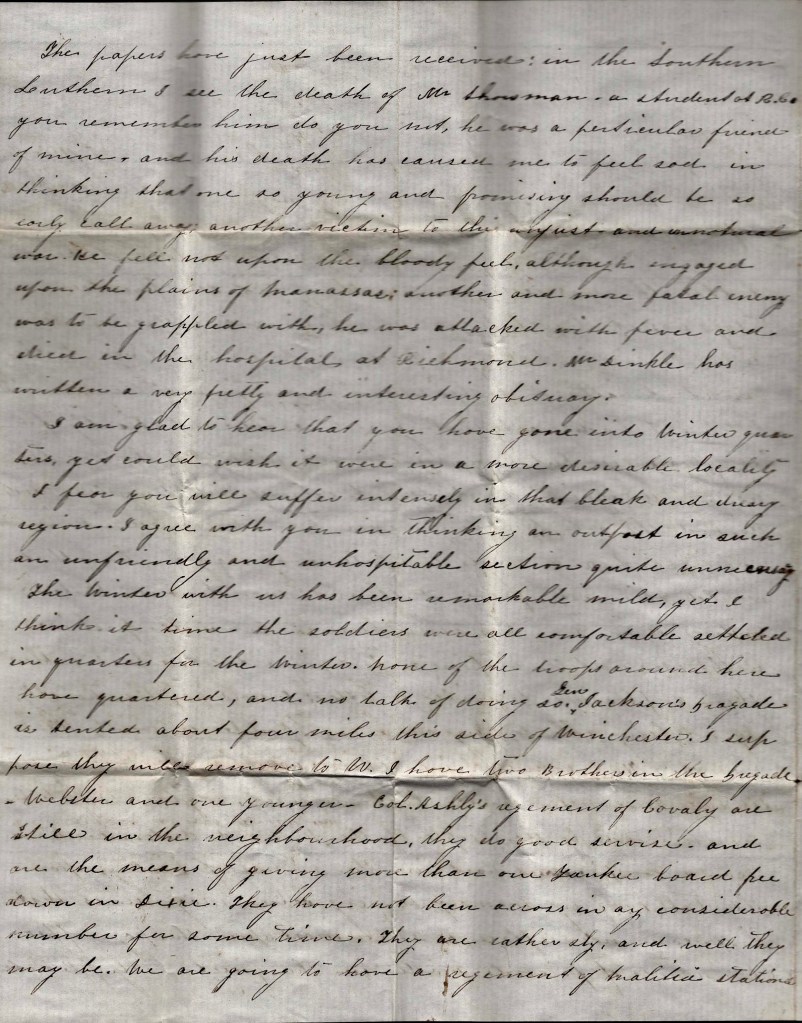
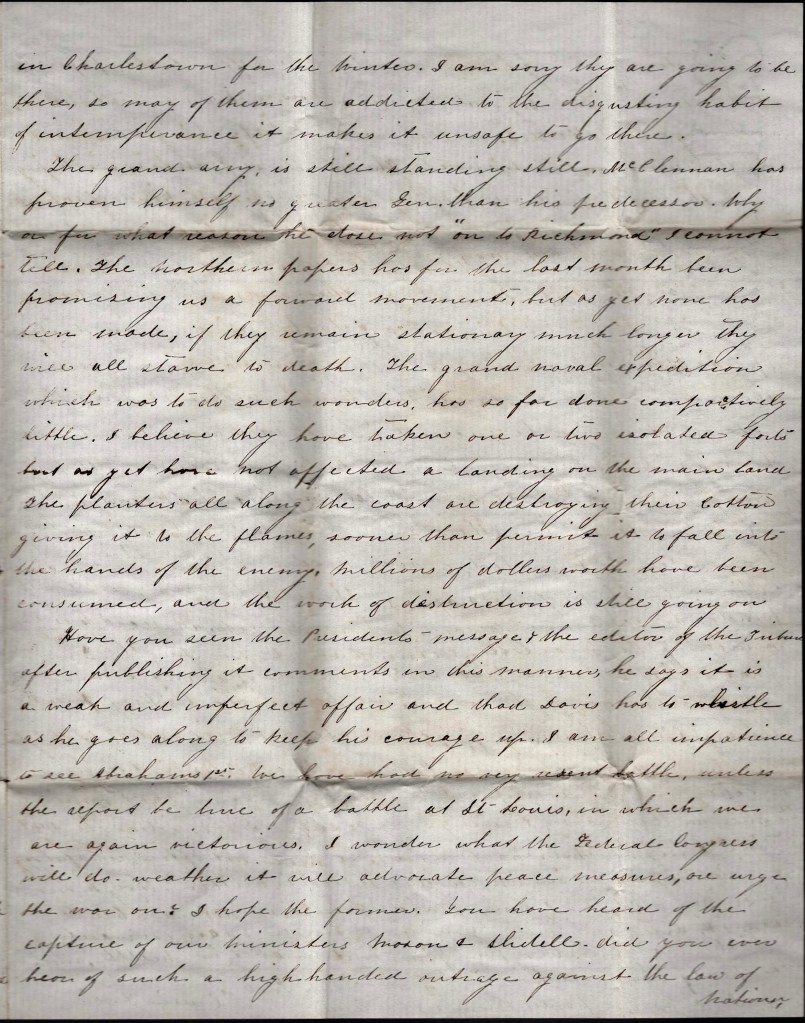
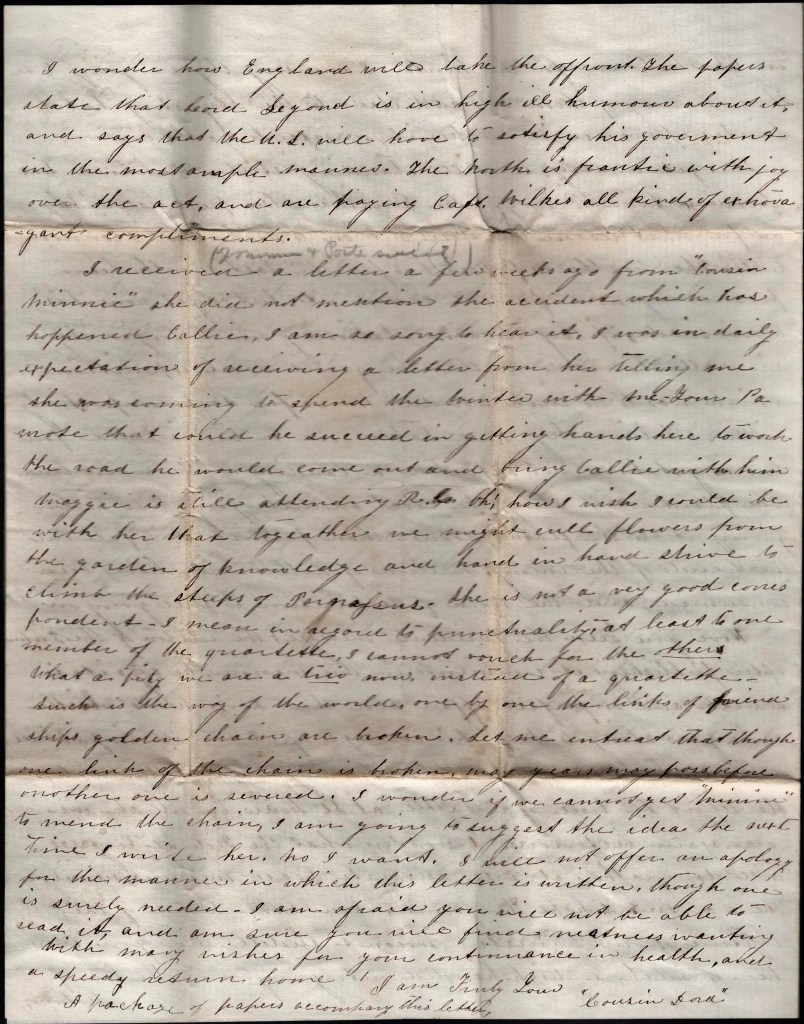
This letter was written by “Dora” who was probably a daughter of Martin Luther Eichelberger (1797-1855) and Maria Catherine Zimmerman (1804-1865). The family lived in Frederick county, Maryland, before moving to Jefferson county, Virginia. Dora’s brother Webster Eichelberger (1835-1886) attended the Academy of Charleston before graduating from Gettysburg College in 1856. He afterwards taught the Preparatory Department at Roanoke College in Salem, Virginia, until the start of the Civil War when he enlisted in Co. G, 2nd Virginia Infantry. He served with the regiment from 21 June 1861 to 21 July 1862. He was then ordained a minister and served the last year of the war as the chaplain of the 20th South Carolina Infantry. Dora’s other brother George F. Eichelberger (1843-1910) also served in Stonewall’s Brigade as a sergeant in Co. G, 2nd Virginia Infantry. He was wounded on 12 May 1864 but survived the war. Dora may have been a nickname for she does not show up in census records.
Dora wrote her letter to “Cousin Porte” with whom she must have spent some time with while attending Roanoke College in Salem, Virginia. He may have been a student there or lived in Salem. My hunch is that “Porte” was a nickname for Porter. It’s clear that he was serving in the Confederate army and that he likely had a sister named Minnie and possible another named Callie.
Despite the absence of confirmed identities, the letter offers valuable insights from December 1861, presented from the perspective of a young woman living in the Confederate States of America.
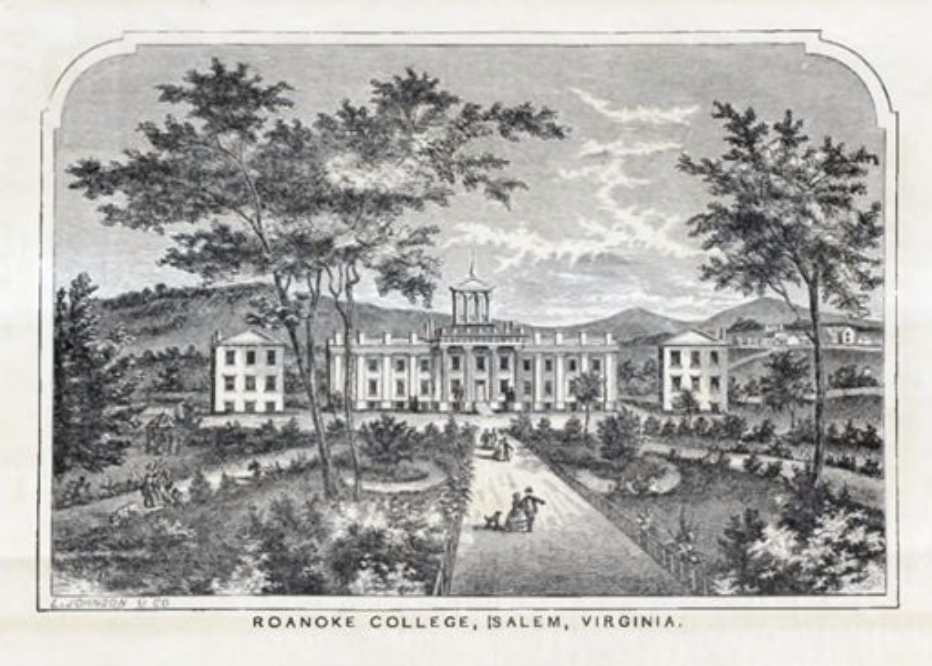
Roanoke College in Salem, Virginia, was established in 1842 as a coeducational school for higher learning.Affiliated with he Lutherans.
T R A N S C R I P T I O N
Near Charlestown, Jefferson county, Va. December 4th 1861
“Cousin Porte”
Yours bearing date of the fifteenth was received on the 2nd of December. Seventeen days was it traveling over the hills and valleys of Western Virginia, taking a peep as it came along at the “sweetest village of the plain” your “gem of the mountain” = Salem. I had waited long and rather impatiently for its appearance, but knowing the irregularity of the mails, was not disappointed at its not coming. What would friends do had the art of waiting never been discovered? It is so pleasant and serves to wile away many an hour that would otherwise prove dull and monotonous. Letter writing as an art has never been a favorite pastime with me until within a few years it was a task rather than a pleasure to write a letter. I now pay the penalty by not being able to carry on a correspondence worthy the name. How rapid time flies; nearly a year has winged its silent course since last we met—a year long to be remembered by the people of the once United States and destined to bear a conspicuous part in the annals of history; upon the tablet of my memory are engraven many scenes that times can ne’er efface, and foremost upon the pages appear the names of friends made in the quiet valley of Roanoke.
The papers have just been received: in The Southern Luther[a]n I see the death of Mr. [Otho J.] Showman 1 [of Washington county, Maryland]—a student at Roanoke College. You remember him, do you not? He was a particular friend of mine and his death has caused me to feel sad in thinking that one as young and promising should be so early call[ed] away; another victim to this unjust and unnatural war. He fell not upon the bloody field, although engaged upon the plains of Manassas; another and more fatal enemy was to be grappled with. He was attacked with fever and died in the hospital at Richmond. Mr. [W. H.] Dinkle [of Rockingham county] has written a very pretty and interesting obituary.
I am glad to hear that you have gone into winter quarters, yet could wish it were in a more desirable locality. I fear you will suffer intensely in that black and dreary region. I agree with you in thinking an outpost in such an unfriendly and unhospitable section quite unnecessary. The winter with us has been remarkable mild, yet I think it time the soldiers were all comfortable settled in quarters for the winter. None of the troops around here have quartered and no talk of doing so. Gen. [Stonewall] Jackson’s Brigade is tented about four miles this side of Winchester. I suppose they will remove to Winchester. I have two brothers in the Brigade—Webster and one younger. Col. [Turner] Ashby’s regiment of cavalry are still in the neighborhood. They do good service and are the means of giving more than one Yankee [his] board free down [here] in Dixie. They have not been across in any considerable number for some time. They are rather sly and well they may be. We are going to have a regiment of militia stationed in Charlestown for the winter. I am sorry they are going to be in there, so many of them are addicted to the disgusting habit of intemperance it makes it unsafe to go there.
The grand army is still standing still. McClellan has proven himself no greater general than his predecessor. Why or for what reason he does not “On to Richmond” I cannot tell. The Northern papers has for the last month been promising us a forward movement but as yet none has been made. If they remain stationary much longer, they will starve to death. The grand naval expedition which was to do such wonders has so far done comparatively little. I believe they have taken one or two isolated forts but as yet have not effected a landing on the main land. The planters all along the coast are destroying their cotton, giving it to the flames, sooner than permit it to fall into the hands of the enemy. Millions of dollars worth have been consumed and the work of destruction is still going on.
Have you seen the President’s message to the editor of the Tribune after publishing it comments in this manner, he says it is a weak and imperfect affair and that Davis has to whistle as he goes along to keep his courage up. I am all impatience to see Abraham’s 1st [Message].
We have had no very recent battle unless the report be true of a battle at St. Louis in which we are again victorious. I wonder what the Federal Congress will do? Whether it will advocate peace measures or urge the war on? I hope the former. You have heard of the capture of our [Foreign] Ministers Mason & Slidell. Did you ever hear of such a high-handed outrage against the law of Nations? I wonder how England will take the affront. The papers state that Lord [Richard] Lyons is in high ill humor about it and says that the U. S. will have to satisfy his government in the most ample manner. The North is frantic with joy over the act and are paying Capt. Wilkes all kind of extravagant compliments.
I received a letter a few weeks ago from “Cousin Minnie.” She did not mention the accident which has happened [to] Callie. I am so sorry to hear it. I was in daily expectation of receiving a letter from her telling me she was coming to spend the winter with me. Your Pa wrote that could he succeed in getting hands here to work the road, he would come out and bring Callie with him. Maggie is still attending the Roanoke College. Oh! how I wish I could be with her that together we might cull flowers from the garden of knowledge and hand in hand strive to climb the steeps of Parnassus. She is not a very good correspondent—I mean in regard to punctuality, at least to one member of the quartet. I cannot vouch for the others. What a pity we are a trio now instead of a quartet. Such is the way of the world. One by one the links of friendships golden chain are broken. Let me entrust that though one link of the chain is broken, may years pass before another one is severed. I wonder if we cannot get “Minnie” to mend the chain? I am going to suggest the idea the next time I write her.
No, I won’t. I will not offer an apology for the manner in which this letter is writen, though wone is surely needed. I am afraid you will not be able to read it and am sure you. will find neatness wanting. With many wishes for your continuance in health and a speedy return home. I am truly your “Cousin Dora”
A package of papers accompany this letter.
1 Otho J. Showman (1839-1861) served in Co. I, 28th Virginia Infantry. He was the son of Peter Showman and Catherine Snavely who lived some six miles from Hagerstown in Washington county, Maryland.
The following letter was written by Bailey Martin (1805-1868) who was employed as the overseer of a plantation owned by Mrs. Emma Hopkins. Bailey was raised in Kershaw county, South Carolina, the son of Samuel and Mary (Bailey) Martin, but appears to have been a resident of Mississippi prior to 1840 and possibly an overseer for the Hopkins family even at that time. The Hopkins plantation was located along the Natchez Trace east of present day Canton, Madison county, Mississippi. The slave population in Madison county just prior to the Civil War exceeded 18,000 which placed it as the third highest county in Mississippi and the 16th highest in the U. S. The plantation was sited in one of the richest farming sections of antebellum Mississippi and ideally located near the Pearl River and later near the terminus of the New Orleans, Jackson, and Great Northern Railroad, providing a means for transporting cotton from the interior of the state.
Bailey wrote the letter to Emma Goodwyn Hopkins (1808-1868) who married her cousin William Hopkins (1805-1863) in 1833 and bore him at least nine children before his death in 1863. William was the grandson of John Hopkins—a delegate to the First Provincial Congress in South Carolina in 1775. Emma was the daughter of Lieut. Governor John Hopkins. William served in the South Carolina Militia and rose to the rank of Brigadier General. General Hopkins was a delegate to the Secession Convention on December 17th 1860, which convened in the Baptist Church in Columbia. Most likely the Hopkins family never took up residence in Mississippi but managed their plantation in absentia by hiring an overseer to management investments and interests. According to a list of Madison county slaveholders in 1860, Gen. William Hopkins owned 73 slaves in Mississippi.
In his letter, Bailey mentions three slaves by name—Pender, Sas, and Ellen. I was able to find both Pender and Ellen in a post-war Freedman’s Bureau listing on the Hopkins plantation where Bailey Martin was still identified as managing the property. That list gives Pender’s age as 30 and Ellen’s as 28.
Freedman’s Bureau Records
Note: This letter is from the private collection of Rob Morgan and was offered for transcription and publication on Spared & Shared by express consent.
T R A N S C R I P T I O N
Addressed to Mrs. E. T. Hopkins, Hopkins Turnout, Richland District, South Carolina
[Madison County, Mississippi] May 15, 1864
Mrs. Hopkins—dear madam,
Have just received yours of April the 4th. I had written three letters to you. I sent them to Alabama to be mailed as there was no mail that came this far for some time. The Yankees was above us and below us. Three miles below us at Mr. [Hugh Washington] Hayes’ [plantation] 1; above us at Mrs. Carson’s about two miles and a half from us. The people from Mr. Hays’ to Canton have lost nearly all they possess—their negroes, horses, cattle, hogs, and some their house and kitchen furniture.
I had yours back in Pearl River swamp but there is danger. Below this they hunted the swamp but the negroes generally run off to the Yankees [who] carried them to their masters’ camp. I have known the negroes to use so much deception with their masters that I have no confidence in one at all. Your negroes made no attempt to betray me but I fear them. I shall try to keep the Yankees [from] getting anything that I have in charge. I shall [try] to keep the negroes from seeing the Yankees if I can.
The negroes is all well at present and working very well but we are too near the Yankees to do well. We are too often alarmed. Often reports that the Yankees is coming when it is false. The owners of the few negroes that is left in this section, their masters indulge them too much and those so indulged was the first to go to the Yankees when they did come. I would be glad if Pender and Sas and Ellen and their children was with you. They are valuable. Your negroes and I should hate to see them go with the Yankees and I fear for I have no confidence in none. A gentleman agreed last winter to take them to you. I consulted Gage Bailey about it [but] the negroes refused to go unless I would go with them. I was sick at the time and was not able to go with.
We have a large stock of hogs and about sixty head of cattle, two or three thousand bushels of corn to sell yet. The wheat crop will be sorry. The cold winter destroyed that stand and killed the stand of oats in till. I have two hundred acres of corn—it’s late but looks well.
We are now looking for Yankees out on us every day. Report says there is tolerable large forces on Big Black [river] a trying to cross opposed by a small force of our men. I fear they will come this time. It bothers me about work but it cannot be helped. I am trying to make clothes for the negroes, We will get them clothed after awhile if the Yankees will let us alone a little while. Yours with [ ] respect, — Bailey Martin
To Mrs. Emma E. Hopkins
P. S. Paper [is] one dollar per sheet.
1 The plantation owned by Hugh Washington Hayes (1812-1873) was near unincorporated Farmhaven and we learn from Bailey’s letter that it was located “three miles below” the Hopkins Plantation. In 1860, Hayes had 60 slaves on his plantation.
I could not find an image of Bruce but here is a cdv of Sgt. Robert Cantrell of Co. B, 143rd New York Infantry (Ancestry.com)
The following letter was written by Bruce Elmore (1835-1876), the son of Alexander and Mary (Divine) Elmore of Fallsburg, Sullivan county, New York. He wrote the letter to his wife, Ann Elizabeth (Hill) Elmore, in July 1864 while serving as a sergeant in Co. C, 143rd New York Infantry. He enlisted in August 1862 and mustered out on 20 July 1865. Auburn University Digital Library has Bruce’s Civil War Diary on-line. The “Willard” he mentions in his letter was his younger brother, born in 1838.
The 143rd New York had a distinguished service record, particularly while participating in the 20th Army Corps under General William Sherman They saw action in major battles and campaigns from Chattanooga to Raleigh, including the Atlanta Campaign. The regiment also suffered significant casualties, with heavy losses at Kennesaw Mountain and Peachtree Creek.
T R A N S C R I P T I O N
Addressed to Mrs. Bruce Elmore, Fallsburg, Sullivan county, New York
Camp 143 Regt. N. Y. V. near Peach Creek, Ga. July 21st 1864
My Own Dear Libbie,
Your welcome letter of July 10th was received yesterday and read with pleasure. I always feel thankful when I receive a letter from you and read that you are well.
We had a pretty warm time here yesterday. A pretty severe battle was fought here. [See Battle of Peach Tree Creek] Our loss is quite heavy. I think the Rebels also lost heavy. They charged us and tried to drive us back but failed. Some of their dead and wounded fell into our hands.
We marched from the camp where I last wrote July 17th and crossed the River Chattahoochie since which time the army has been getting its position. We are now about 4 miles from Atlanta, although some of our line is closer, being within two miles.
Our regiment lost forty-five killed and wounded—7 or 8 killed, 2 of our own company were wounded—Gilbert B. Lawrence severely. The doctor says he thinks he may get well. I hope he may and Sergt. McKendree N. Dodge (of Rockland) quite severely wounded, though not dangerously—a flesh wound in the leg. Lieut. Wm. M. Ratcliff, Adjutant, is also killed and Lieut. Waterbury of our regiment also killed. I am well, have not received a scratch, and I feel to fervently thank my Heavenly Father for mercifully sparing me amid peril and danger so imminent.
[My brother] Willard is to the field hospital. He is not well enough to be on the march. W. H. Newman has returned to the company. Also James W. Stewart.
You say you think J. V. B. Reynolds would like to buy the farm and would give 1200. I think I would sell for that if I could get no more. Maybe he would give more. Get all you can. It almost ought to fetch more according to the price of other things, but if this war settles, everything falls again, and then I think land will be as low as ever again. As to the money, I think probably we would not want to pay it near all. Would probably as leave let you have some mortgage that is perfectly safe, and it would draw interest. I would not sell any of the crops but keep them all. If you would sell before they are gathered but you must use your own judgment. Can inquire of father but do it slyly—that is, don’t let Jim know you’re anxious.
I will write more particular when I have time if I am spared. If not you know what you can do best. Good bye. God bless us all and spare us to meet again. As ever your affectionate husband, — B. Elmore
All well at half past 12. Have heard a little cannonading. Hard to tell whether there will be any hard fighting in any part of the line today or not. Lieut. Waterbury is not yet dead.