1862: Member of Co. D, 72nd Illinois Infantry to Rocelia Lucretia (Hemingway) Stoughton

This partial letter was written by a member of Co. D, 72nd Illinois Infantry—the “First Chicago Board of Trade Regiment.” Raised in Cook county. The letter was addressed to his friend Rocelia Lucretia Hemingway (1808-1886), the daughter of Allen Hemingway (1808-1886) and Marietta Linsley (1808-1842) of Leydon, Cook county, Illinois. Mentioned in the letter are Rocelia’s two brothers, Rodney A. Hemingway (1835-1863) and (her half-brother) Anson Tyler Hemingway (1844-1926) who also served in Co. D. Rocelia was married to George Andrew Stoughton (1834-1914) in March 1855.

The letter pertains to the scouting expedition made by four companies in the 72 Illinois Infantry (240 men) from Columbus, Kentucky, to Covington, Durhamville, & Fort Radolph, Tennessee to rout out rebel guerrillas. For a full description of the orders and actions taken on this scout, see September 18, 1862-October 5, 1862, Anti-guerrillas expedition.
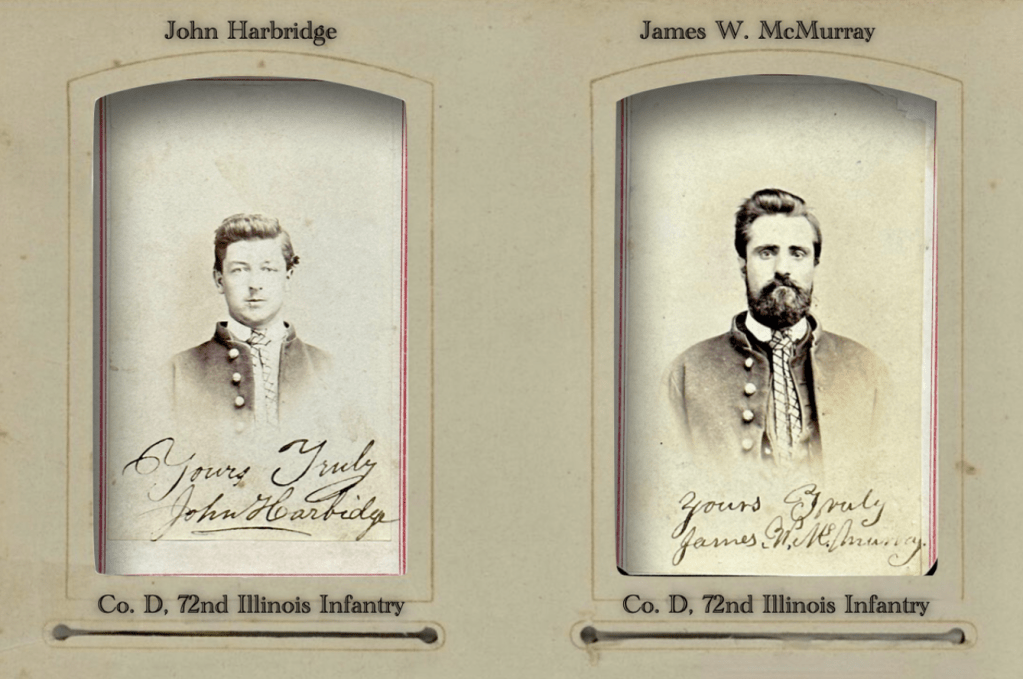
Harbridge & McMurray, two members of Co. D, 72nd Illinois (Al & Claudia Niemiec Collection)

Transcription

Columbus [Kentucky]
Wednesday, October 9, 1862

Rocelia, dear friend,

You must excuse me for not writing to you sooner but if you would only stop to think of the conveniences that soldiers have to write, you would wait patiently for one to come if not oftener than twice a year. When we sit down to write we are sometimes called away three or four times before we get it wrote. But I suppose you won’t believe that I am writing the truth. But never mind. If you was a soldier you would find it out.

It is raining now almost as fast as it did the night that we was at your house when [your husband] George was home and there is a little river running through our tent. If it keeps on, we may make a small boat to keep us from getting drowned.

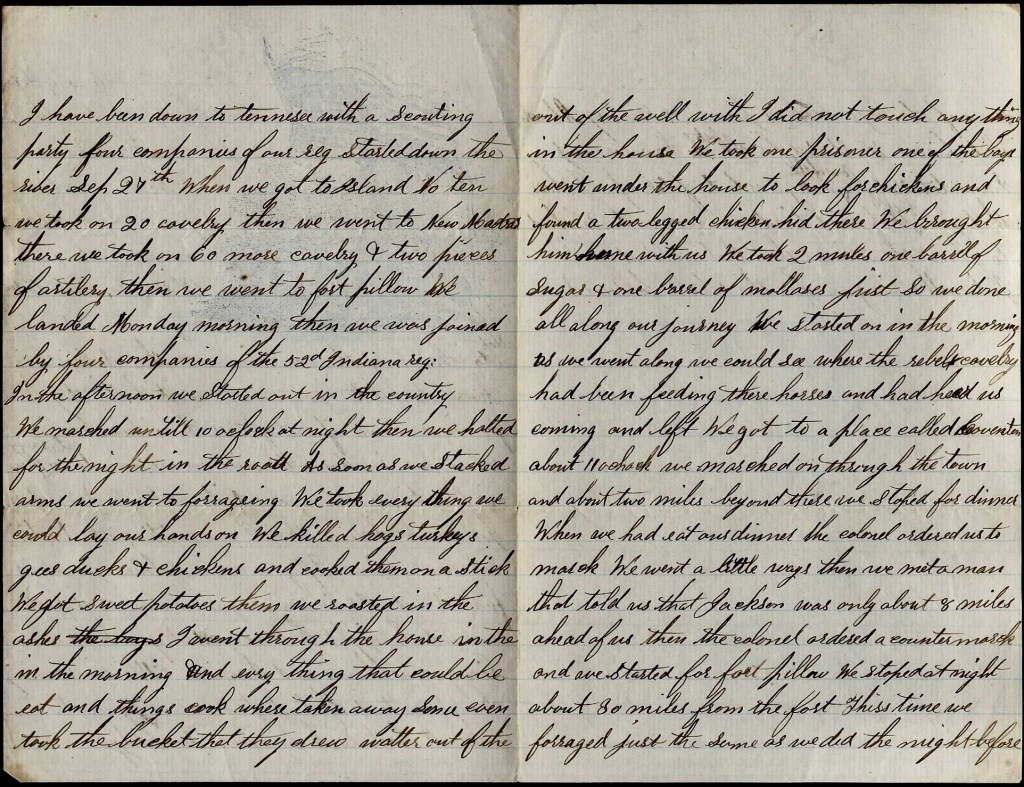
I have been down to Tennessee with a scouting party. Four companies of our regiment started down the river September 27th. When we got to Island No. 10, we took on 20 [from Co. L, 2nd Illinois] cavalry. Then we went to New Madras. There we took on 60 more [from Co. D, 2nd Illinois] cavalry & two pieces of artillery [from Capt. De Golyer’s Batter]. Then we went to Fort Pillow. We landed Monday morning [29 September]. Then we was joined by four companies of the 52nd Indiana Regiment. In the afternoon we started out in the country. We marched until 10 o’clock at night. Then we halted for the night in the road. 1 As soon as we stacked arms, we went to foraging. We took everything we could lay our hands on. We killed hogs turkeys, geese, ducks, & chickens and cooked them on a stick. We got sweet potatoes. Them we roasted in the ashes. I went through the house in the morning and everything that could be eat and things cooked were taken away. Someone even took the bucket that they drew water out of the well with. I did not touch anything in the house.

We took one prisoner. One of the boys went under the house to look for chickens and found a two legged chicken hid there. We brought him home with us. We took two mules, one barrel of sugar, and one barrel of molasses just so we done all along our journey.

We started on in the morning. As we went along, we could see where the rebel cavalry had been feeding their horses and had heard us coming and left. We got to a place called Covington about 11 o’clock. We marched on through the town and about two miles beyond there we stopped for dinner. When we had eat our dinner, the colonel ordered us to march. We went a little ways, then we met a man that told us that Jackson was only about 8 miles ahead of us. Then the colonel ordered a countermarch and we started for Fort Pillow. We stopped at night about 30 miles from the fort. This time we foraged just the same as we did the night before. Some of the boys broke a piano and sewing machine all to pieces.

We started for the fort in the morning. I was detailed for one of the rear guard to fetch up all those that fell back that was tired and worn out. We had to force them on and them that couldn’t walk put on the wagons for the rebels followed to pick up all the stragglers. We got to the Fort 10 o’clock at night. As soon as the regiment at the fort heard that we were coming, they sent out wagons to meet us & get the sick. When we got to the fort, we was all pretty tired. I stood the march as well as anyone in the regiment. We took on the march 42 mules and horses, 5 wagons, 4 or 5 barrels of sugar and molasses, two wagon loads of cotton, and about 12 prisoners, 1 rebel captain and one we shot dead. I had a pretty mule but it was so wild I could not ride him so I let him go. We slept 8 nights in the open air with half of our blanket under and half over us. We didn’t take our knapsack or dress coat or overcoat with us; just our blouse and blanket. Anson and Rodney [Hemingway] did not go with us for they were sick. [unsigned]


1 The party bivouacked for the night at the plantation of a notorious and avowed secessionist named Overall.

1862: Orlando S. Edwards to dear Friends

An unidentified soldier in Co. K, 127th New York Infantry (Facebook)

The following letter was written by Orlando S. Edward (1844-1863) who enlisted on 25 August 1862 in Co. K, 127th New York Infantry—a regiment known as the National Volunteers or Monitors that was raised on Long Island and in New York city. He was transferred to Veteran Reserve Corps, November 28, 1863 and died on 27 December 1863 at the age of 19. His parents were Abraham Edwards (1795-1858) and Lucy A. Downs (1819-1878).

Transcription

Addressed to Wm. C. Hemongway, McLean, Tompkins county, New York

Camp Bliss [Upton’s Hill, Virginia]
November 13th 1862

Dear Friends,

I received a letter from you Tuesday night which was received as all others are, with a rush who has got a letter? I have got a letter! Until I get one, they may go to thunder with their letters. This is the way the soldiers are excited when the mail comes (I tell you they are God senders). There is not much excitement in camp at present. There was a death in the 127th [New York] last Tuesday. I attended the burial. It was a still time amongst the brigade, it being the first death that has been in. They took him to Falls Church and buried him about one mile west. There is a number of New York boys buried here that died last winter from this hill.

We fixed up our tents yesterday and you would have laughed to have seen us perform. In the first place, we went to the woods (Ha! I lied there for there hain’t any woods in sight). It was merely an old clearing and there we found some chestnut sticks. We found them that were about afoot through and split them in two and then flattened the other side and we had what we called a plank. We backed twelve of these to camp and staked out our ground which was 14 foot long and 8 wide and set our planks up edge ways, three on a side, and staked them to their place. We then put up two crotches in the center and put a ridge pole across and spread our canvas and then down to the sides. We then took some Virginia soil and made some mortar (which by the way is most grand on the account of its sticking qualities) and plastered up the holes and our shanty was finished and a nice one it was—the best one on the ground. Don’t we feel proud over it. We slept like pigs in the clover last night.

We are drilling pretty thorough about this time. We drill in company drill about two hours in the forenoon and two hours battalion drill in the p.m. We have brigade drill twice a week—four regiments drill together then. We had a severe snow storm here last week which lasted two days. The snow fell five inches deep. This is a splendid warm country.

If you are a mind to, you may send a pair of woolen stockings and a good pair of good buckskin gloves lined for it is most thundering cold down in Dixie. I must go to roost for it is 9 o’clock and the lights have been ordered out. So goodbye, — Orlando

Bully for the dry camp. We had election in our company. It went 22 majority Wadworth.

1862: Member of 105th New York Infantry to his Sister

The following letter was written by a Union soldier named “Bob” who indicated that he had recently participated in the Battle of Fredericksburg. He also suggested that he was a part of “King’s Division” but of course King had resigned his commission in October 1862 and elements of his command were reassigned, some placed under the command of John Gibbon and some under Abner Doubleday—both of whom fought at Fredericksburg in William B. Franklin’s Left Grand Division.

James Newton served in the 105th New York Infantry and was wounded at Fredericksburg on 13 December 1863 (Robert May Collection)

Since the author asked about the 130th Regiment, he must have known soldiers who served in that regiment. But was it the 130th Pennsylvania or the 130th New York Infantry? I was able to rule out the 130th Pennsylvania Infantry because none of the few Pennsylvania regiment in either Doubleday’s or Gibbon’s Divisions were raised in Cumberland and York counties where the 130th Pennsylvania was raised. So where was the 130th New York Infantry raised? Most of the members were recruited in Wyoming county, a relatively low populated region in western, upstate New York. I could find only one other regiment raised in this region which was the 105th New York Infantry—a regiment that figured prominently at Fredericksburg in Gibbons Division of Gen. Reynolds 1st Corps. Here the 105th New York lost 78 killed, wounded and missing. After assailing the Confederate right at the point of bayonet and overrunning the Confederates position, when they were not reinforced, they were counterattacked and grappled in hand-to-hand combat before yielding the hard-earned ground. The “gallant old 105th New York was annihilated,” according to their commander Isaac S. Tichenor. “Captain Abraham Moore [Co. F] tried to rally the surviving members of the regiment. He failed. One soldier explained, “The 105th New York Volunteers was literally killed in action.” [See “The Fredericksburg Campaign: Winter War on the Rappahannock” by Francis A. O’Reilly, page 241] A great number of the surviving members of the 105th New York were taken prisoner.

One possibly is that the letter was written by Robert Lutze (1844-1907) who had a sister named Elizabeth (b. 1850). Robert served in Co. K, 105th New York Infantry, mustering in at LeRoy, New York. He was transferred to the 94th New York when the 105th was disbanded after Fredericksburg. I am unwilling to attribute this letter to him without reservation, however.

Transcription

December 26th 1862

My dear sister,

I received your welcome letter today and I was very glad to hear that you all keep well. Yes, Beckie, we were in [the fight] of course. They do not know how to fight without King’s Division to hold the flank. We came out alright. I wish you would in your next letter let me know what Brigade, Division and Corps the 130th Regiment is in—that is, if you know.

Well, we have 170 men in our regiment. When the regiment came out, it numbered 870 men. Well, Beckie, I spent my Christmas on picket and had for dinner hard tack and coffee. Today I had some hoecake for dinner and for supper I boiled some mush. I bought the corn meal from a darkey.

I shall not write anything about the battle as I wrote to Father a few days ago and told him enough about it. The next time you see Abe and Cal, give them my best wishes for their future happiness. I think writing is about played out for this time. So is the northern army if I know anything about it. When they put Mac [McClellan] out, then they ought to have sent the army home and saved those 20,000 men that Burnside killed.

We are both well and send our love. Your affectionate brother, — Bob

1861: Sarah Gorham to Henry White Gorham

This letter was written to Henry White Gorham (1838-1876) who enlisted in April 1861 to serve three months in Co. F, 13th Regiment, New York State Militia. They were placed on railroad guard duty till June at Annapolis, Maryland, and then at Baltimore until August 1861. They mustered out on 6 August 1861. It was penned by his sister, datelined from Williamsburgh, Kings county, New York.

Transcription

Addressed to Mr. H. W. Gorham, 13th Regiment Company F, N. Y. V. M., Annapolis, Maryland; “Give them a little more grape boys. Let that be our Compromise.” Postmarked Williamsburgh, N. Y.

Williamsburgh [New York]
June 29, 1861

Dear Brother Henry,

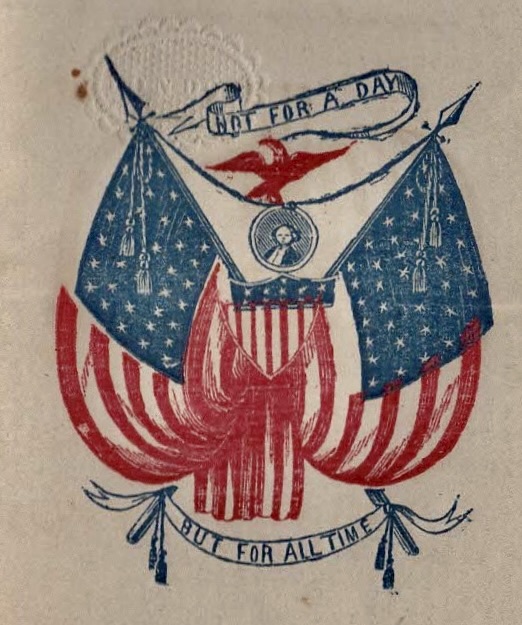
Patriotic Letterhead

It is two weeks today since I got a letter from you. I had written & I suppose you got one from me the same day. I mailed another one week ago yesterday & have been looking & hoping to get one from you every day this week but have been disappointed. I have thought you might be in an engagement but the papers have not given any account of one. Then I thought you might be out of paper, so I thought I would not wait longer but write you again.

We are all as well as usual but feeling rather stale as yesterday was our excursion. We had a very pleasant day, a good company, and a nice grove. Everything so far as I know went off pleasantly. Mr. McGonor went with us. He sang the pieces he used to sing at the hall last winter, besides others. It is a treat to hear him sing, you know. The girls were in there & I suppose wished you were there too. I for one did. I thought of you many times during the day. John & Isaiah are very lame today from running, chasing one another & the girls. They were playing war. I believe the girls thought they were so tired they could not go to the temple in the evening, but did go as we got home early enough for them to rest some first.

Yesterday while we were gone, Mr. Wilber came in with a man from your regiment that had come home sick. He said he knew you & I was in hopes he would have been in today so I could have asked him about you. Mr. Wilber said he would come with him but perhaps he is not able to come. John & Isaiah have both gone over to see Oli Briggs this afternoon. Allen was home Saturday. Went away again Monday, I believe. He is doing very well. Chrit is peddling paper, envelopes and segars I guess—a Yankee notion pedlar. He told Oli he was agoing to Albany today. Last Tuesday, Johnnie, Isiah, and myself went over to Maria’s & spent the day. Went to the Elysian Fields [in Hoboken, New Jersey]. It is very pleasant there now. Isaiah and I went to Flushing last week to the hot house. 1 Saw some of the handsomest plants I ever saw in my life. It does not seem possible such plants grow but nature is much more beautiful than anything man can make. I expect if you are spared to come home, Isiah will want you to go with him to see them. He wants to get some to put in your garden. It looks very pretty. He had a bouquet from it yesterday. The girls said they did not believe it came from his garden so he called on me to vouch for it.

The [Brooklyn] Industrial School held a fair Wednesday evening—or Strawberry Festival as they call it. Cherries are getting plenty. Wish you were here to have some. Expect you will be here before they are gone. We had some yesterday from Annie Cook’s garden. Perhaps she will save some for you. I dare say you will get some if you come before they are all gone. You say my pies will suffer when you get home. I shall be only too happy to see you eat them. You shall have as much as you want of everything I can cook for you. I always think of you when we have anything that I know you love.

13th Regiment, New York State Militia

There is a great deal said in the papers of the way the 13th [Regiment] are treated & of their clothes and their fare. We do not know how much of it to believe. Now I want you to write in your next if you are treated as the papers say, and tell us if there is anything we can do for your comfort we are willing and desire to do if we knew what you need. It is hard for the soldiers if they have all it is possible, for them to have for their comfort. I think the people at home ought to sacrifice some of the luxuries for their sake if they cannot be made comfortable without. If they are treated as the papers state, it is ridiculous, but we do not know what to believe.

Williard has not gone yet but he thinks they are going soon. John Dean is in and out as usual. He is not able to work, he says. He thinks his lungs are affected. He is spleeny still, I think. He is not long lived. He will probably go as Frank did. He seems some as he used to. I had a letter from [ ] the other day. She says she is not agoing to take no for an answer to come there this summer. I must, it is so lonesome. I do not know as I shall go. I think I will wait until you come. I suppose you will want to go east on a visit. What do you think? I know I have written all the news I know so will stop writing. Hope I shall get one from you soon. A good long one. Your sister, — Sarah


1 Possibly the Linnaean Botanic Garden or Prince’s Nursery in Flushing, Queens, New York. It was started in the mid-18th Century.

1861: Fitzhugh Ithamar Dibble to Julina Josephine Dibble

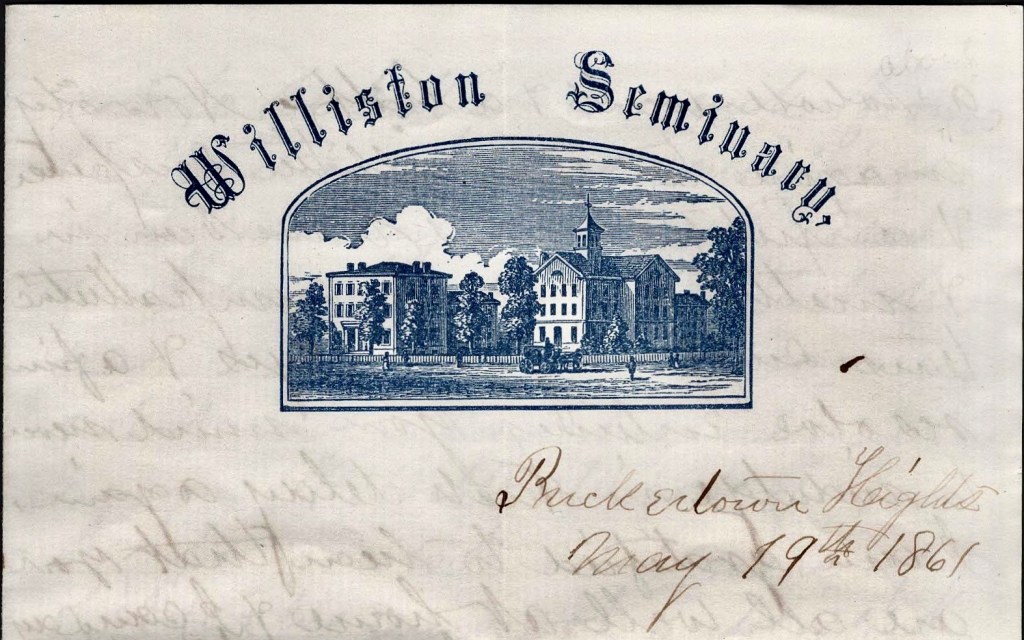
Letterhead of stationery used by Dibble with engraving of Williston Seminary

The following letter was written by Fitzhugh Ithamar Dibble (1840-1918), the son of George Dibble (1805-1881) and Betsy Whittlesey Underhill (1807-1902) of Old Saybrook, Middlesex county, Connecticut. Fitzhugh wrote the letter in May 1861 while attending Williston Seminary. He later attended and graduated (1863) with a law degree from Yale College. Fitzhugh had two older brothers who served in the Civil War. George Eugene Dibble (1830-1863) in Co. F, 12th Connecticut Infantry and died on a Mississippi transport on 24 May 1863. Also serving was Augustus Llewelyn Dibble (1831-1878) in Co. G, 14th Connecticut Infantry, who was wounded at Antietam and shot in the foot in a later engagement but recovered.

Curiously, census records in 1850 and 1860 reveal that Fitzhugh was born in 1839 or 1840; yet subsequent census records report his having been born in 1845 or even 1846, leading one to question whether he misreported his age in order to avoid the draft.

Fitzhugh wrote the letter to his older sister, Juline Josephine (“Jose”) Dibble (1834-1924) who was employed as a school teacher in the common schools of Old Saybrook. In 1867, she married Henry H. Buell (1837-1927).

Transcription

Addressed to Miss J. Josephine Dibble, Old Saybrook, Connecticut

Puckertown Heights
May 19th 1861

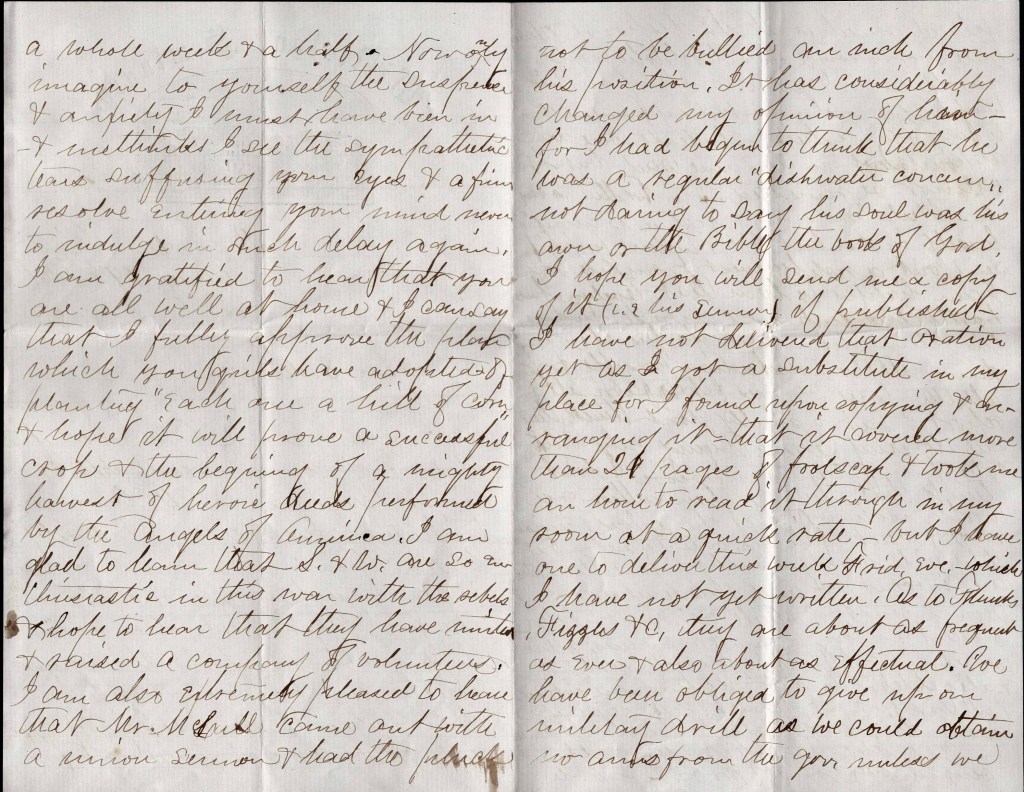
Dear Sister Jose,

Yours of May 12th was received four days after date & of course read with extreme pleasure as all long anticipated epistles are. I nearly began to think that you had likely forgotten me or that in the fire of your patriotic ardor, had concluded that all minor objects must give way before that. Previous to receiving your letter I had not received one for a whole week & a half. Now only imagine to yourself the distress & anxiety I must have been in & methinks I see the sympathetic tears suffusing your eyes & a firm resolve entering your mind never to indulge in such delay again.

I am gratified to hear that you are all well at home & I can say that I fully approve the plan which you girls have adopted of planting “each one a hill of corn” & hope it will prove a successful crop & the beginning of a mighty harvest of heroic deeds performed by the Angels of America. I am glad to learn that S. & W. [Saybrook & Westbrook] are so enthusiastic in this war with the rebels & hope to hear that they have united and raised a company of volunteers. I am also extremely pleased to hear that Mr. [Salmon] McCall 1 came out with a Union sermon & had the pluck not to be bullied an inch from his position. It has considerably changed my opinion of him, for I had begun to think that he was a regular “dishwater concern”—not daring to say his soul was his own or the Bible the book of God. I hope you will send me a copy of it (i. e., his sermon) if published.

I have not delivered that oration yet as I got a substitute in my place for I found upon copying & arranging it that it covered more than 21 pages of foolscap & took me an hour to read it through in my room at a quick rate. But I have one to deliver this week Friday eve which I have not yet written. As to Flunks Fizzles, &c. they are about as frequent as ever & also about effectual. We have been obliged to give up our military drill as we could obtain no arms from the government unless we placed ourselves at its disposal & there were not enough in school who would enroll in a regular company in this way. This was a great disappointment to us. The Amherst students were disappointed in th same way—but it cannot be remedied.

The weather is very beautiful here now & nature is arranging herself in her best “bib & tucker” 2 —preparing to send out a rich harvest from red bosoms [?]. I am happy to hear that Evelyn’s health has improved enough to ensure his return home & hope his wife may derive all the satisfaction possible from all the stories she sees fit to fabricate & report—but I really don’t think they will do any serious injury only to those who frame them & moreover I don’t think that they or their [ ] are worth noticing. Let the jealous & [ ] rage and vent their discontentment, but they will never seriously injure those who are innocent of any misdemeanor.

Now I trust I shall not be compelled to wait so long again for an answer to this as before, but that you will write soon & also Adell & the rest, keeping me informed of all the news at home. Please remember me to all friends & all the family at home & God bless & protect you all. Very sincerely, your affectionate brother, — F. I. Dibble

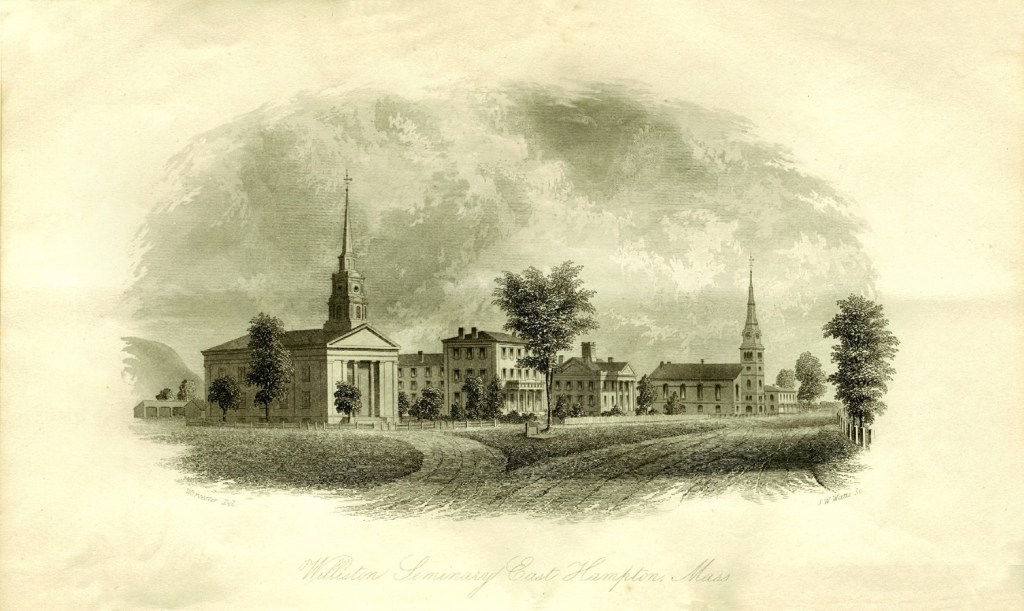
Williston Seminary, East Hampton, Massachusetts

1 Salmon McCall was the pastor of the First Church of Christ in Saybrook from 1853 to 1871. He was 27 years old when he first occupied the pulpit in Saybrook. He was described as “a studious and learned man.” He was an 1851 graduate of Yale College.

2 “bib and tucker” used to mean the most lavish attire a gentleman possessed.

1861: Hiram B. Gray to Samuel J. Kirkwood

The following affidavit addressed to Iowa Gov. Samuel J. Kirkwood was penned by 29 year-old Hiram B. Gray (1832-1863) of Mason City, Cerro Gordo county, Iowa. Hiram was the orphaned son of James L. Gray (1792-1857) and Zillah Beulah [unknown] (1796-1856) or Oberlin, Lorain county, Ohio. In October 1861, Hiram recorded his Last Will & Testament in Iowa, indicating his intention of enlisting in the service of his country but I have not found any record of his service. He willed his property to his only surviving sibling, Hester Ann Gray of Oberlin, Ohio. Hiram died on 1 July 1863 and his sister died a few years later.

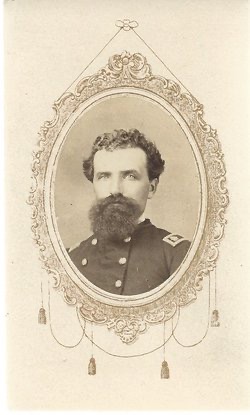
Datus Ensign Coon (1832-1893)

In his affidavit, Hiram solemnly attests to the reprehensible actions of Datus E. Coon (1831-1893), who allegedly appropriated the company roll book of the Cerro Gordo Guards and falsely presented himself as the individual responsible for mustering a sufficient body of men to secure a Captain’s commission from the Governor of Iowa. A biography of Coon reveals that he served as the publisher of the Cerro Gordo Press in Mason City “until the war broke out in 1861. Upon receiving the news of the fall of Fort Sumter, he made the resolute decision to enlist in the army as a cavalry man and obtained a captain’s commission from Governor Kirkwood of Iowa, tasked with raising a company within three weeks. The company was successfully assembled, proceeded to Davenport, Iowa, and was subsequently assigned to the Second Iowa Cavalry [Co. I].”

[Source: An Illustrated History of Southern California: Embracing the Counties of San Diego, San Bernardino, Los Angeles and Orange, and the Peninsula of Lower California; Chicago: The Lewis Publishing Company, 1890. p.- 291-292]

Transcription

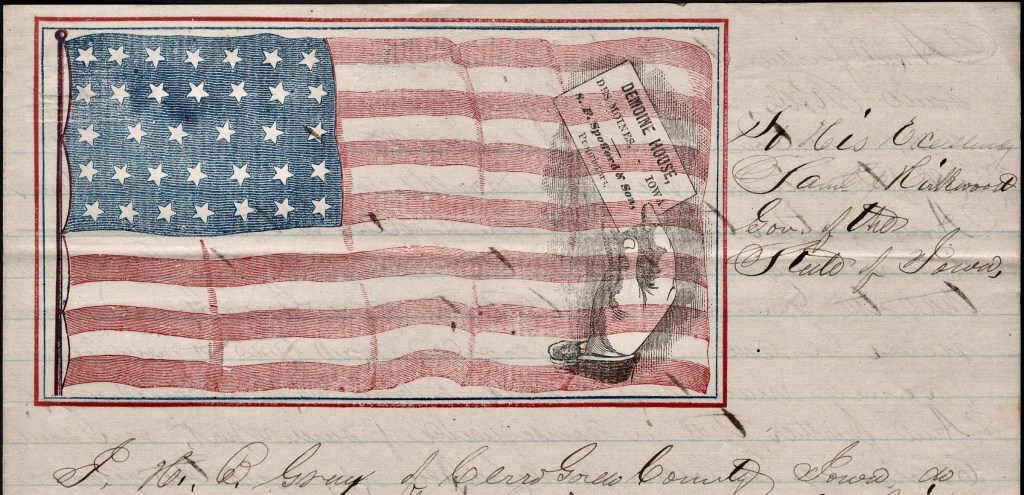
Patriotic stationery letterhead

To His Excellency, Samuel J. Kirkwood, Governor of the State of Iowa

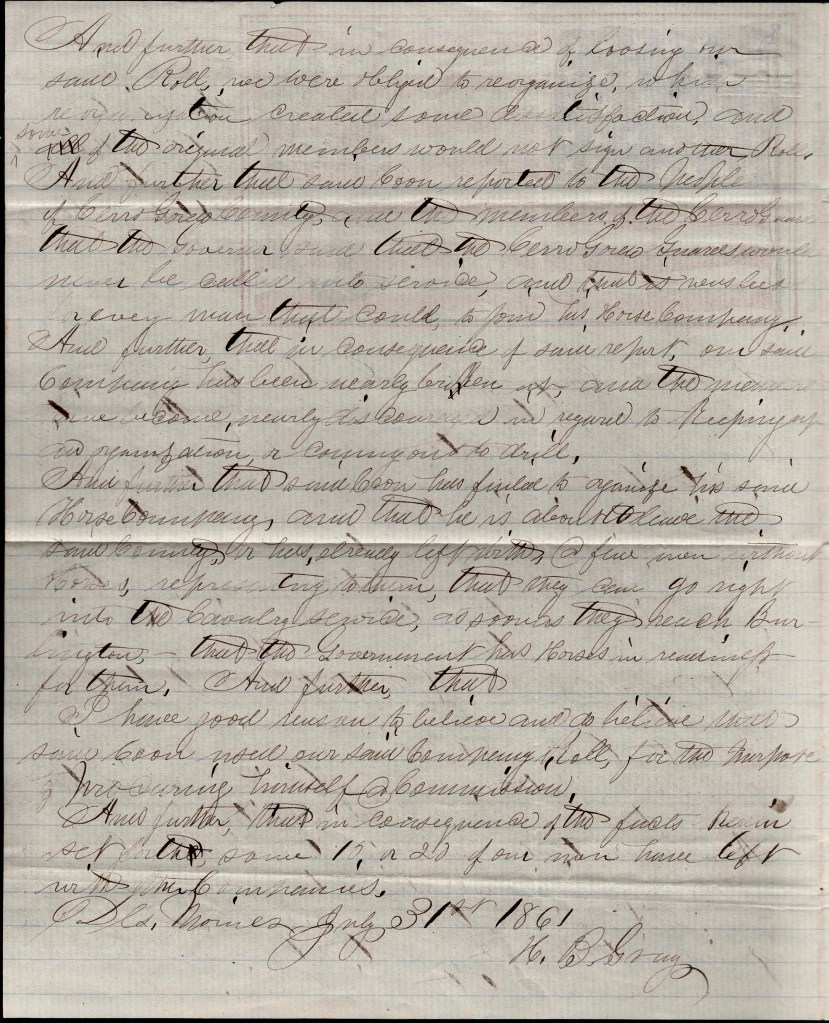
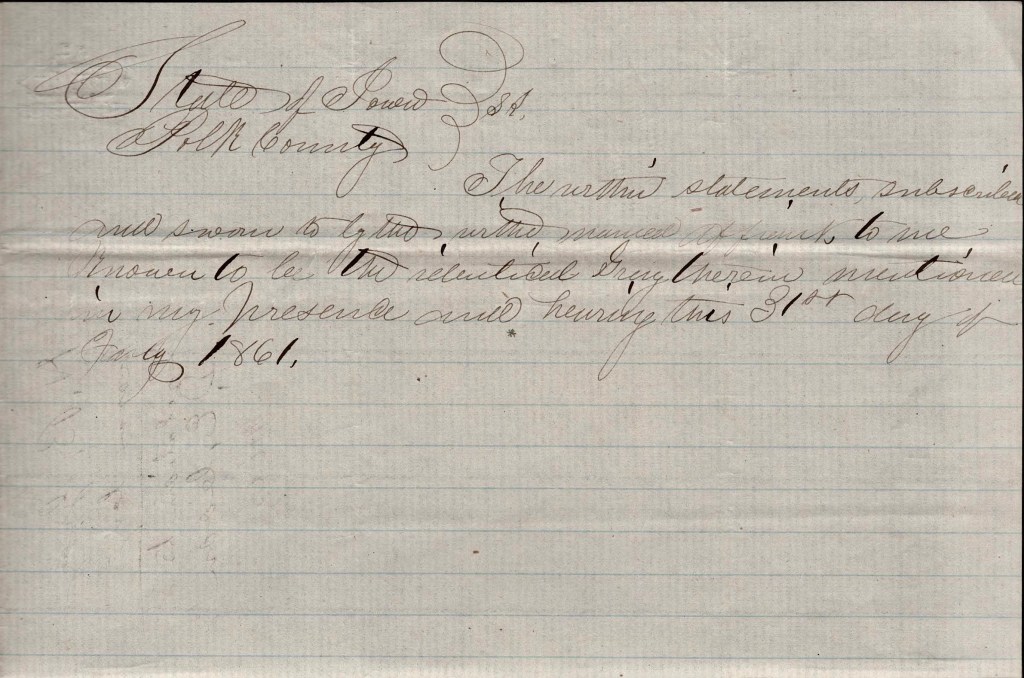
I, H[iram] B. Gray of Cerro Gordo county, Iowa, do solemnly swear that I am a member of the Military Company known as the Cerro Gordo Guards, of said county, that I have been a member of the same since its first organization, that I was duly elected corresponding secretary for the company, and that no business has been done for the company or by the same, with any of the State authorities, except as it has been through me. That sometime in the month of June (prior to the 15) Datus E[nsign] Coon who was then one of our corporals borrowed our company roll of the Orderly Sergeant and without the knowledge or consent of the company or officers, carried the same to Des Moines & Iowa City.

And further, that said Coon, returned to Cerro Gordo county with a commission as Captain of the Cerro Gordo Horse Guards. And further, that no such company had been organized in the county, and that the said Coon had never been elected to the said office.

And further, that in consequence of losing our said Roll, we were obliged to reorganize, which reorganization created some dissatisfaction, and some of the original members would not sign another Roll. And further true, said Coon reported to the people of Cerro Gordo county, and the Cerro Gordo Guards, that the Governor said that the Cerro Gordo Guards would never be called into service, and that it was his [request] for every man that could to join his Horse Company. And further, that in consequence of said report, our said company has been nearly broken up, and the members have become nearly discouraged in regard to keeping up an organization or carrying out to drill.
And further, that said Coon has failed to organize his said Horse Company, and that he is about to leave the said county, or has already left with a few men without horses, representing to them that they can go right into the cavalry service as soon as they reach Burlington—that the government has horses in readiness for them. And further, that I have good reason to believe and do believe that Sam Coon used our said company roll for the purpose of procuring himself a commission. And further, that in consequence of the facts herein set forth, some 15 or 20 of our men have left with other companies.

Des Moines, July 31, 1861
— H. B. Gray


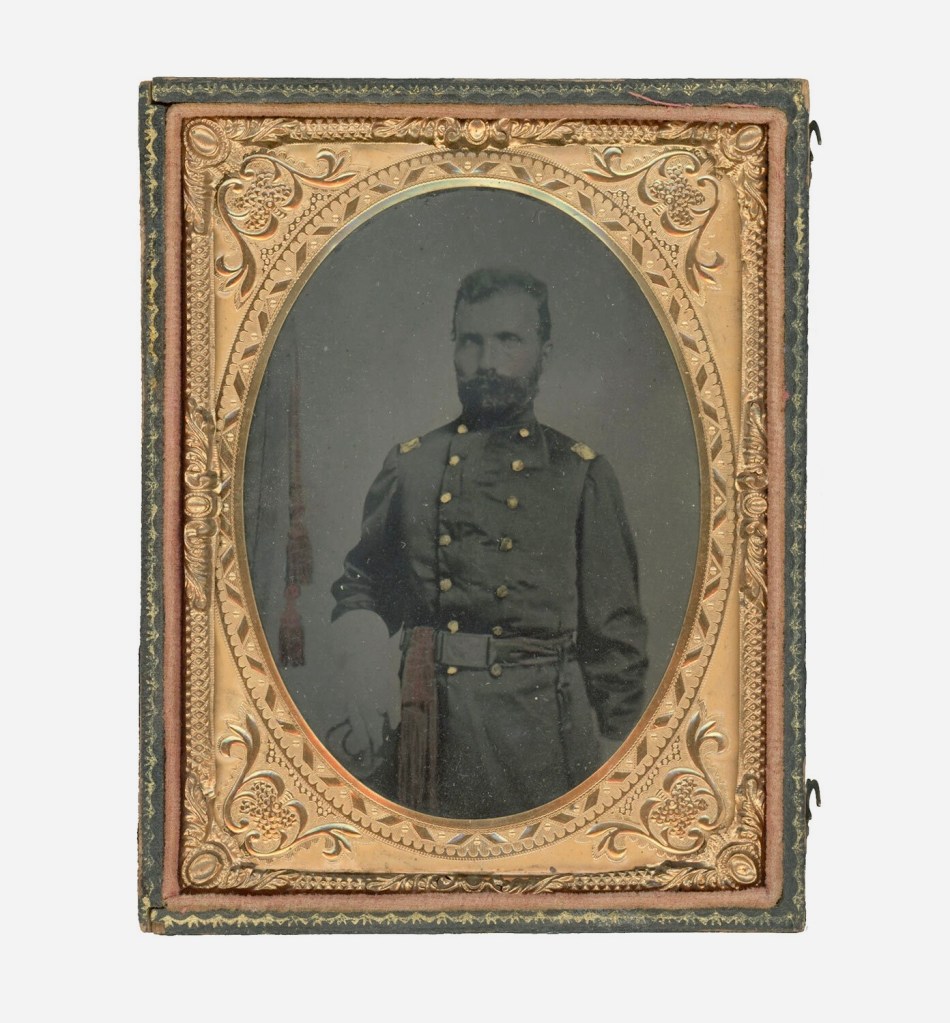
In the tintype, Coon is posed in a photographer’s studio. He wears a double-breasted frock, a sword belt with pattern 1851 buckle, sash, and heavy gauntlets, one of which rests upon the hilt of his sword. The photographer applied gold tint to the buttons and shoulder boards (filled all the way in, indicative of cavalry). Red tint was applied to the sash and the decorative cord to Coon’s side. (Iron Horse Military Antiques)

1861: Mary Bethune (Craig) Hunt to Annie Dunkin Adams

The following incredible letter was written by Mary Bethune (Craig) Hunt (1836-1911), the second wife of (then) Major Henry Jackson Hunt (1819-1889). Hunt’s first wife, Emily C. De Russy, died at Fortress Monroe in 1857 and he took 19 year-old Mary as his second wife in December 1860—just a little over four months before this letter was penned. Mary was the daughter of Henry Knox Craig (1791-1869), the Chief of the US Army Ordnance Bureau. Mary’s mother came from Massachusetts, and had strong ties to the Boston area. She was pregnant with her first child at the time.

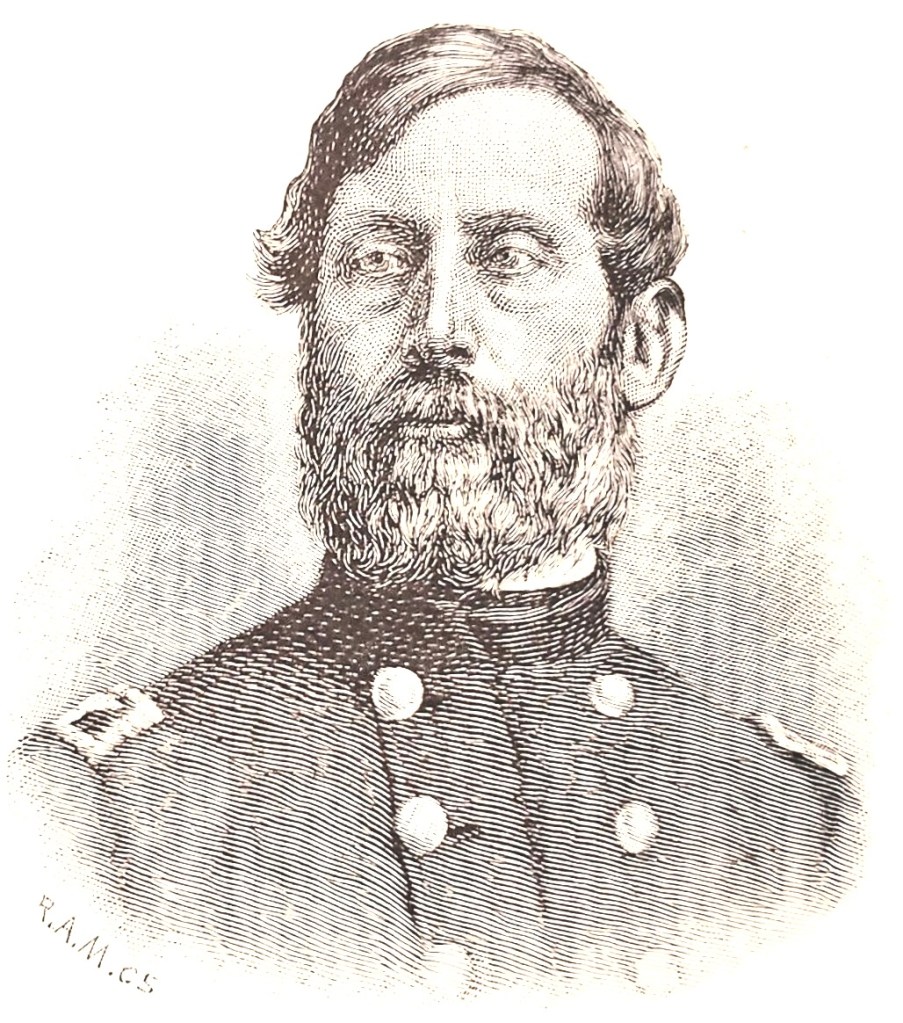
Mary’s husband, Henry Jackson Hunt

Henry Jackson Hunt was a dedicated military officer, graduating from the US Military Academy in 1839. He is predominantly recognized for his role as the Chief of Artillery in the Army of the Potomac during the American Civil War, where he earned acclaim from his contemporaries as one of the war’s most formidable tacticians and strategists. When the conflict commenced in 1861, Hunt was stationed at Fortress Monroe commanding his artillery battery.

Mary wrote the letter to her cousin Annie Dunkin Adams (1834-1910), the daughter of Dr. Horatio Adams (1801-1861) and Ann Bethune Dunkin (1797-1889) of Waltham, Massachusetts. In her correspondence, Mary mentions Annie’s siblings, “Mollie”—Mary Faneuil Adams (1836-1912)—and “Faneuil”—Benjamin Faneuil Dunkin Adams (1839-1895). Annie was a pivotal force behind the Waltham training school for nurses and she devoted her life to a number of charitable causes. What’s more, Annie apparently had a friendship with the Lees of Arlington House, Robert and Mary (Custis) Lee, who are mentioned in the closing lines of this letter. How little did Mary know at the time that Mr. “Lee” would eventually emerge as the Army of the Potomac’s fiercest adversary in the turbulent years to follow.

For a good summary of the Lee’s departure, see The Lee’s Leave Arlington by the National Park Service. I note some discrepancies in the dates between that article and this letter, however.

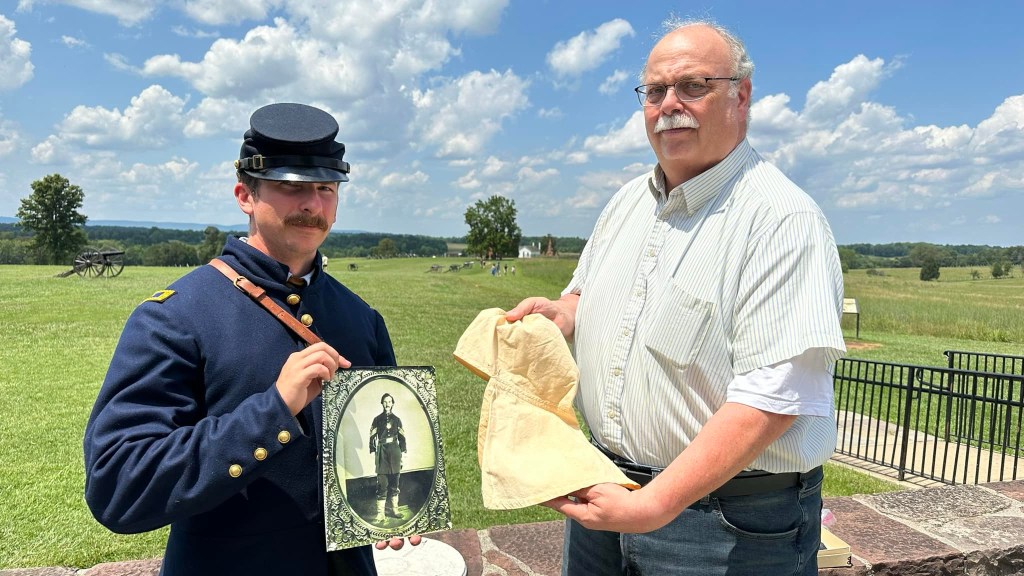
From Mary’s letter we learn that she and her mother were the individuals responsible for making the havelocks distributed to the members of Col. Samuel Lawrence’s 5th Massachusetts Volunteer Infantry. Perhaps she made the very havelock worn by Sergeant Edward Bracket featured in the picture below.

For the first time in 162 years, the havelock of Sergeant Edward Brackett, 5th Massachusetts Infantry, returned to Henry Hill on the Bull Run battlefield where the regiment fought on 21 July 1861. (Manassas National Battlefield Park Facebook Page).

Transcription

Addressed to Miss Annie D. Adams, Waltham, Massachusetts

Washington [D. C.]
May 6th 1861

My dear Annie,

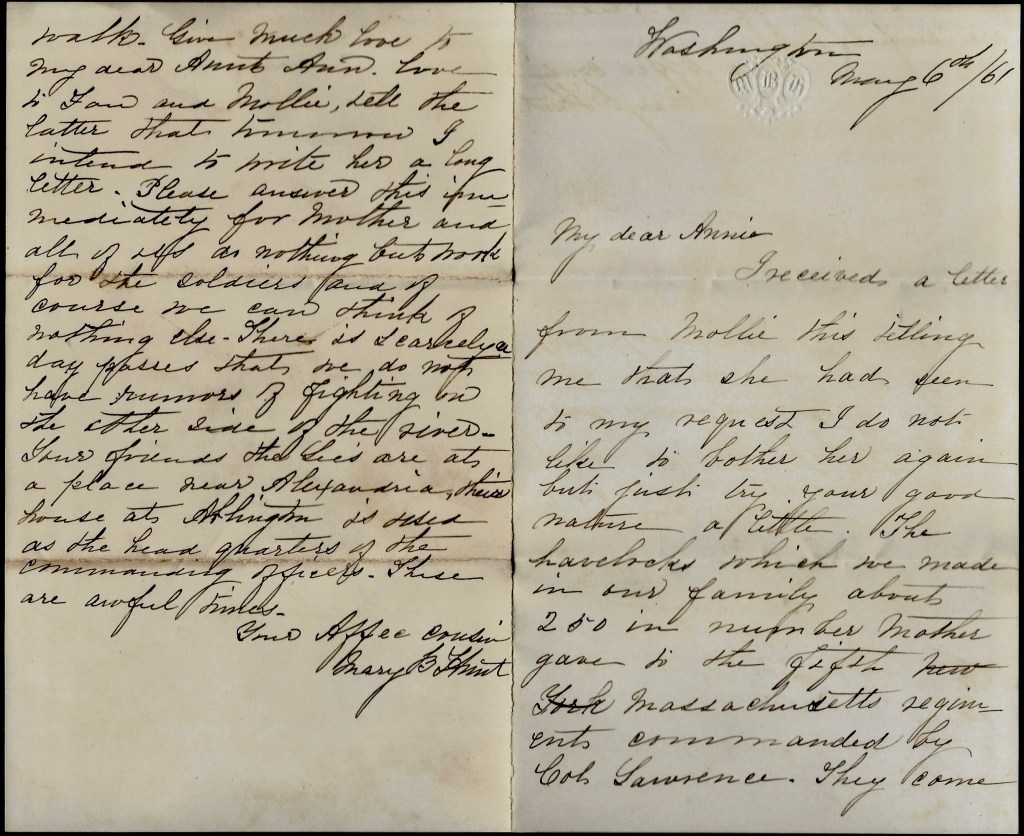
I received a letter from Mollie this [morning] telling me that she had seen to my request. I do not like to bother her again but just try your good nature a little. The havelocks which we made in our family—about 250 in number—Mother gave to the Fifth Massachusetts Regiment, commanded by Col. [Samuel C.] Lawrence. They come from Charlestown and the vicinity of Boston. Mother thinks that it would be a good plan to send them enough to finish supplying that regiment as they are hard at work at Fortress Monroe. There are about a thousand in the regiment. It is much easier to have them sent from Boston to Fortress Monroe than from here. Please ask Faneuil to mention this to someone in authority for if they are sent here, it may be two weeks before they can be sent to Fortress Monroe.

I received a letter from Major Hunt this morning. It came in a round about way. I do not know exactly how it got here. Of course I was glad to get it but my anxiety is none the less for at the time he was writing, they were in hourly anticipation of an attack. He feels very confident of the success of the United States troops. However that may be, I scarcely dare think of it in any way. There is an order out for Major Hunt’s Battery to be brought to Washington. Even that seems impossible to be true.

We are all well. Presley’s foot is much better and he thinks that he will soon be able to walk. Give much love to my dear Aunt Ann. Love to Fan and Mollie. Tell the latter that tomorrow I intend to write her a long letter. Please answer this immediately for Mother as all of us do nothing but work for the soldiers and of course we can think of nothing else. There is scarcely a day passes that we do not have rumors of fighting on the other side of the river.

Your friends, the Lee’s, are at a place near Alexandria. Their house at Arlington is used as the headquarters of the commanding officers. These are awful times. Your affectionate cousin, — Mary B. Hunt

1861: Unidentified Civilian to Friend Mary

How the author might have looked

Unfortunately this partial and unsigned letter provides us with few clues to the author’s identity. I’m inclined to believe it was a young female between the age of 15 and 20 who lived in Fremont, Sandusky county, Ohio. She writes of receiving a Christmas gift of “a very nice tooth brush and a cake of tooth soap and a comb”—a practical and coveted luxury at the time. She also writes of visiting the camp of the 72nd Ohio Regiment at nearby Camp Chrogan in company with the handsome Capt. Samuel A. J. Snyder. “What didn’t I have a good time!” she wrote her friend Mary.

Transcription

Fremont [Ohio]
December 30th, 1861

Friend Mary,

Your letter was most gladly received and came in time to stop my letter which I was about sending, and which contained something like a scolding. I began to think you weren’t going to write to me any more or something dreadful had happened, but when your good letter came and set my fears at rest, you can imagine how welcomed it was.

I haven’t written to you so long that I hardly now how to converse with you. The first thing I will try to do will be to imagine how the house looked after you and Frank had done up the work. Probably the first thing Frank does to bother Mary is to go at the caller [?] and [ ] them a pail of water and is sent off in a hurry. [ ] straight for the corn crib and begins to shell corn while Mary puts the caller to bed and returns to her work, gets the work done up and commences to write to you know. We were but your humble servant. [ ] is much obliged to you for it, but enough of this nonsense.

I spent my Christmas very pleasant here. Went down town in the morning and called at Mrs. Beans, got an invitation to dinner the next day (which was the day after Christmas). Got home and found Brother and his wife here and spent a pleasant afternoon and evening. The next day had a present of a very nice tooth brush and a cake of tooth soap and a comb. I think I have told you all that I did on Christmas as nearly as I can think.

There is a regiment of soldiers stationed here now which makes the realities of war come closer home than ever. The camp is called Camp Chrogan (72nd [Ohio] Regiment). I went over last week with one of the officers, Captain [Samuel A. J.] Snyder 1 (he is handsome as he can be I tell you). What didn’t I have a good time. It looks so funny to see them was dishes and cook and their tents are so funny. But enough of this.

Who do you think Dillie is going to be married to? If you know, tell in your next letter. I have been interrupted in my pleasant talk with you by a caller from the town Miss Smith. They staid so long that it drove everything out of my head that I was a going to say to you. You spoke about Sis Whiskers staying here in Fremont over night. I don’t believe it for I don’t believe the place could hold him, much more that he would come here without seeing me. It is perfectly shocking. It almost made me cry. Don’t he look as though he had lost something since I came away. I don’t believe his whiskers have grown a bit since he see me. I bet the sight of me made them strike in. If so, please console him as well as you can and give him my prescription, that is some of Mrs. Winslow’s soothing syrup. Now mind you, don’t… [partial letter]

1 Capt. Samuel A. J. Snyder’s name comes up in the history of the 72nd Ohio Regiment in connection with the regiment’s flag and the Battle of Shiloh. To wit: “This flag was presented to the regiment by the mayor of Fremont in January 1862 as the regiment was leaving Camp Croghan to head south to war. It was entrusted to Sergeant Gustavus H. Gessner of Co. H. During the skirmish at Crump’s Landing on April 4, 1862, Gessner received a neck wound and went into the hospital; the flag was left furled in his tent. At the outset of the Battle of Shiloh two days later, Co. H was on picket duty and the company commander Captain Samuel A.J. Snyder (who under arrest for shooting a squirrel in camp and consequently left in camp while Co. H was on picket) noticed that the flag was in Gessner’s tent. Snyder took the flag and placed it in a regimental wagon behind the lines, then offered his services to Col. Buckland, thinking that he had placed the flag in a safe place. After a hard fight of two hours, the 72nd Ohio retreated from their position west of Shiloh Church and in the course of the retreat, the wagon and flag were captured. The flag was quickly discovered and presented to Confederate General Pierre G.T, Beauregard who kept the flag for many years.” See “72nd Ohio Infantry Flag Captured at the Battle of Shiloh”; Dan Masters’ Civil War Chronicles, June 4, 2017.

1862: Jacob Fisher to George Hall

I feel pretty confident this letter was written by Jacob Fisher (1823-1905) who was born in Germany in 1823 and came to Buffalo, New York in 1833 with his parents, and then came to Racine, Wisconsin about 1845. According to his obituary, he worked for many years for the Case T. M. Co. as a machinist. He did serve in the Civil War but did not enter the service until September 1864 as a recruit in Co. D, 16th Wisconsin Infantry. In this letter he claims to have enlisted in the 22nd Wisconsin but says he was “sorry” he enlisted and given that the regiment was urgently mustered in and moved out to Kentucky just a couple days after he wrote this letter, my hunch is that he was never mustered in. At least there is no one by that name appearing in the regimental roster. At the age of 36, Jacob married his first wife, Anna Stecher (1836-1911) in 1859.

Transcription

September 12, 1862

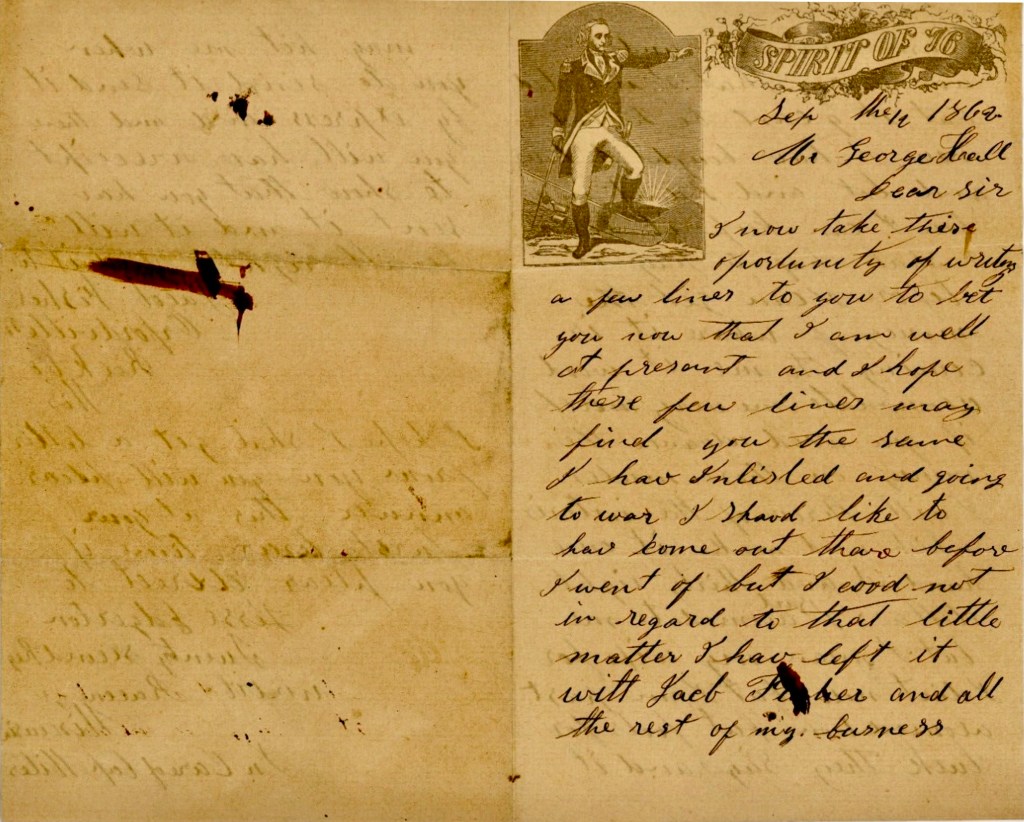
Mr. George Hall, dear sir, I now take this opportunity of writing a few lines to you to let you know that I am well at present and I hope these few lines may find you the same. I have enlisted and going to war. I should like to have come out there before I went off but I could not.

In regard to that little matter I have left it with Joeb Fisher and all the rest of my business. I am married and I am sorry that I enlisted but it can’t be helped now. I have bought a house and lot and I don’t know how I can keep it for I shall have to pay it before I can get the money, were it is coming to me. It would accommodate me very much if you would advance the money on those mules. I will throw off the interest which would make it one hundred and thirty-eight dollars. I said accommodate me but I mean my wife for I don’t know but I am past accommodation. But fools for luck, they say, and it may hit me. When you do send it, send it by express and then you will have a receipt to show that you have sent it and it will be all right. Send it to Jacob Fisher, Orfordville T., Rock county, Wisconsin

I hope I shall get a letter from you. You will please answer this at your first leisure time if you please. Direct to Jesse Edgerton, 22nd Regiment Wisconsin Vols. Racine, Wisconsin, in care of Capt. Miles

1864: William Eugene Ruggles to his Parents

This letter was written by William Eugene Ruggles (1846-1907), the son of Noble O. Ruggles (1807-1892) and Sarah Shoens (1824-1890) of Syracuse, Onondaga county, New York. Nothing is known of William life until he enlisted with Co. B, 122 Regiment of New York Volunteers in 1862, at which time he described himself as a carpenter. He was clearly unhappy in the army, however, and deserted several times. In 1865, after one such desertion, he was court martialled and dishonourably discharged, after which he returned to Syracuse where he remained until his death. There he married Alida Alexander a year or two after his discharge, with whom he had one daughter, Reba. During his time in the army Ruggles had contracted chronic diarrhea which left him permanently weakened. After the war he worked in a meat market, and when this became too much for him, as a cigar maker. He died in 1907, after which his wife and daughter moved to Prescott Ontario. Some time after her mother’s death in 1927, Reba moved to Scotland. She died in Angus in 1958.

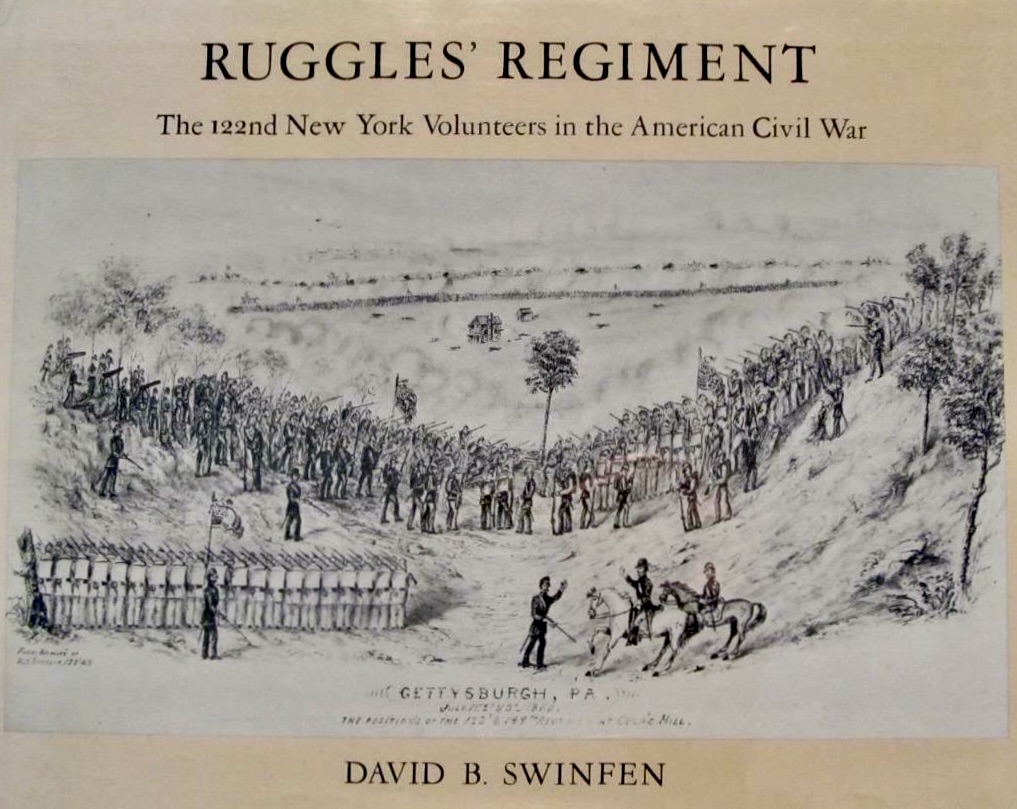
William is credited with a series of drawing depicting the regiment that were bequeathed to the University of Dundee in 1958 by Ruggles’ daughter. All the drawings, however, at some time appear to have had a different signature, in the right hand corner, which has been erased. This name in most cases is illegible apart from a few letters, but the drawings are in fact believed to be that of Phillip M. Ostrander, 149th Regiment. Several of the drawings, however, depict scenes at which Ostrander could not have been present. It is likely that the later and perhaps even all the drawings are based on original photographs or other pictures. [see Ruggles Bequest]

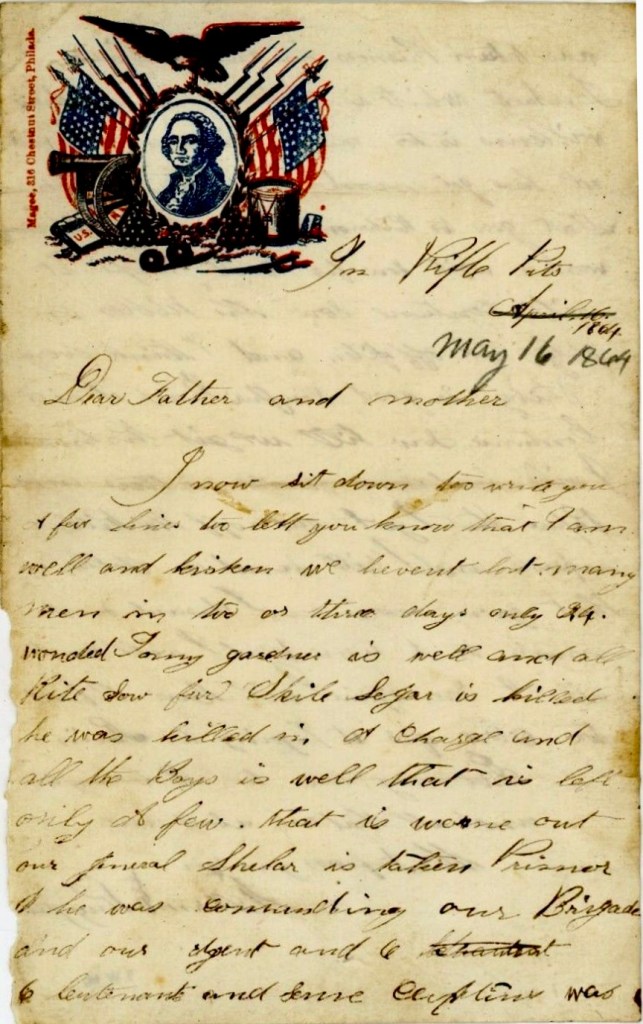
Transcription

In rifle pits
May 16, 1864

Dear father and mother,

I now sit down to write you a few lines to let you know that I am well and kicking. We haven’t lost many men in two or three days—only 24 wounded. Tommy Gardner is well and all right so far. Skile Segor is killed. He was killed in a charge and all the boys is well that is left—only a few that worne out. Our [Brig.] General [Alexander[ Shaler is taken prisoner. He was commanding our Brigade and our adjutant and six lieutenants and some captains was taken prisoner in our Brigade. Lieutenant White is safe and Andrew Wilkins is too. And Lieut. Col. [Augustus W.] Dwight.

We have got most to the railroad that goes to Richmond. Many things is working right so far and I hope it will continue so. The Rebels is pretty sick of fighting and I think everything is good so far, I hope it will continue so till we get to Richmond.

I will send some more letters and papers that I got out of the Rebels knapsack and I will send a dollar that you may use. I doesn’t send much at a time but I will send you all I can spare. I have to close for it is going to rain. Give my love to all—Charley too, and all that ask about me.

From your son, — William E. Rugggles