I could not find an image of Ed but here is one believed to be Virgil Mortimer Hamilton of Co. K, 3rd Michigan Infantry. His brother Emmet served with Ed in Co. E. (Doug Sagrillo Collection/CW Faces)
The following letters were written by Edward Townsend Webster (1841-1864), the son of Roswell Webster, Jr. (1815-1864) and Harriet Townsend (1822-1896) of Leighton township, Allegan county, Michigan. Ed enlisted on 10 June 1861 to serve three years in Co. E, 3rd Michigan Infantry. He was killed in action 5 May 1864 on the opening day’s fight in the Battle of the Wilderness. A memorial marker in Hooker Cemetery in Wayland, Michigan, states that Ed’s brother, Henry W. Webster (1846-1864) died in Andersonville Prison on 24 August 1864. Henry served with Emma’s brother, Isaac Clinton Wade.
The 3rd Michigan’s baptism of fire took place at Blackburn’s Ford on July 18, 1861—a prelude to the first battle of Bull Run on July 21. The Third suffered its first wartime casualty early on Saturday morning, July 20, 1861, when Homer Morgan of Company B allegedly took his own life. The regiment covered the retreat of the federal troops from Bull Run on July 21, and subsequently went into a succession of camps around Washington throughout the fall and winter of 1861-62. The regiment participated in McClellan’s Peninsular campaign of 1862 and suffered its worst casualties to date at the Battle of Seven Oaks, Virginia on May 31, 1862 and at Groveton (or Second Bull Run) on August 29, 1862.
Ed addressed the letters to his cousin, Emma Frances Wade (b. 1846), who became the wife of John A. Holliday (1843-1913) in 1862. Nothing more could be found regarding her. It’s believed she died in the mid-1860s. Emma’s parents were Thaddeus Wade and Mary J. Townsend of Leighton township, Allegan county, Michigan.
[Note: The following letters are from the collection of Greg Herr and were offered for transcription and publication on Spared & Shared by express consent.]
Letter 1
Eagle Hill, Virginia Monday, November 4th 1861
Dear Cousin Emma,
It was with great pleasure that I received and read your welcome favor of the 27th ult. and I will attempt to answer the same although I do not think of much to write this morning. Everything goes on about as usual here. Nothing new turning up to interest or excite a person.
The weather is fine this morning and so it was yesterday but the day before was about the worst day I ever saw in my life. It rained and blew all day like a perfect hurricane. I did not get out my tent but once all day and that was to get wood to burn. There was a good many of th tents blew down and tore to pieces and I expected that every moment we should be without a shelter to cover our heads, but our old tents stood the test nobly. We are to have new tents soon. we expect to get them now every day. I understand that we are to get small tents for four or six persons. I hope we shall for it would be a great deal more comfortable than to have large tents with sixteen in them. When we get the new ones, we have got new bed ticks to put into them. They will not let us put them into these old ones and we do not want to for they would get spoilt before we get the new ones.
There is a good many things that looks as if we were going to quarter here for the winter but I do not know what may turn up or what we shall do, anything about it, ad I have given up guessing, or trying to.
I am glad to hear that the singing school is going on finely. I hope that it will continue to prosper. I hope that all of the folks there will take hold and have a good school there this winter. I will help pay a god teacher. I cannot be there probably but will do my share for the sake of keeping up a school there this winter. There was a movement among a few of us yesterday to start one here in camp. There is a man by the name of Mead in George’s company that has taught singing school a good deal and is a good singer. He says he will take hold and we will get a lot of books—some glee books or some kind, and I believe that we can have a good singing school. We shall have to dispense with the ladies company to be sure, but they never do help a great deal you know, and I guess we can get along without them if we try to.
You must write often to me, Emma, and I will be sure to do the same. I had to make a bonfire of my letters yesterday. I had over a hundred and could not keep them so I had to burn them up. I hated to do it but it could not be helped. Give my love to all the friends and be sure, I remain forever, affectionately, your cousin, — Ed
Letter 2
Addressed to Miss Emma Wade, Middleville, Barry county, Michigan; envelope signed by Major Byron Root Pierce, 3rd Michigan Infantry
In Camp before Yorktown Wednesday, April 23rd 1862
Dear Cousin Em,
Yours of the 13th ult. is just received and I thank you for it even if it a short one. I have had no letters for a long time until yours today. I do not know without my friends are forgetting me. What is the reason. But that cannot be the cause. It is true that I am a good distance from home, but still it cannot be that I am forgotten for I do not forget my friends who are so far away. But they are often present to my mind and whether lying in my tent, or whether on picket guard before and in sight of the enemy, wherever I am, my mind reverts to home and friends and the pleasing associations that my memory connects therewith. And I am unwilling to believe that I am not often in the thoughts of those dear to me. I hope that they will all prove that they think of me by writing often good long letters which do much to encourage ad lighten the dreary life of the soldier in the field.
I do not like to write very often and do not write as many letters lately as I would like to because I am out of postage money and even if I had the money, it would be impossible to procure the stamps. And I dislike to write for my friends to pay the postage but I feel as if I must write occasionally to let the friends know of my welfare. So please excuse this for this time and I hope to be able to do better when I want to write the next time.
My health still remains excellent. All of the Leighton Boys are well with the exception of George Joslin who is in the hospital. He went there about one week ago. Mr. Paine told me this morning that he saw George yesterday and he was much better and would probably be able to return to the regiment in the course of a few days. I hope he will for it is somewhat lonesome without him here. I mention his being sick as his folks not getting letters as usual from him would be more uneasy than if they knew the truth, but I assure them that he is not dangerously ill and hope they will not be troubled upon his account.
The weather is splendid for the most part although for two or three days it has been quite rainy but today it is beautiful. Last Sunday night we were ordered to be ready to go on picket the next morning at 4 o’clock. So at the time, we started through the dark and a drizzly rain. We got to the line and posted about daylight. Our company was just back of the line in the woods while we threw out three men in front of us behind a fence just in the edge of the woods. The morning was so foggy that we could obtain but an imperfect view of Rebeldom, but as the fog cleared off, we saw them in plain view. There being a fort a little to our left, we could distinguish no guns on their walls although there were embrasures for them and piles of sand bags to protect their gunners. There were no troops to be seen around them except a scattering squad here and there, but I doubt not that they have men there or near at hand but they are afraid to show themselves for we keep a battery of artillery along the line that play “the deuce” with them whenever htey venture to show themselves in any considerable numbers.
Our artillery “spoke” to them occasionally through the day. Some of our shells scattered their sand bags in all directions but go no answer at all. To the right of their fort and along in front of us was a field of some 80 rods [440 yards] wide and on the other side of it was woods along the edge of which their pickets were posted, and right in frint of us within easy rifle shot was an embankment thrown up that looked as if they had begun to build a fort and had not time to complete it before the “Yankees” came upon them. They now use it to protect their pickets and there seemed to be quite a number of them behind it from the smoke which came from it. But they were very careful to show themselves up in sight. There was one fellow that I noticed particularly as he would show himself above the works to the waist. He had on an old black hat and white or grey coat, I actually believe that he was a “Nigger.” He would crawl along until he got a good chance when he would “pop away” in our direction several times through the day. His bullets flew through the trees above our heads. We are not allowed to fire a shot and I never before had any inclination to shoot at pickets but I did ache to send him the contents of my rifle. I could hardly contain myself. I do not know as I could have hit him but I believe I could have given them a pretty good “scare.” At all events, I should liked to have tried some of them on.
Here in the woods where we are, we would not think that much is being done to ensure the success of the siege and a person has to look sharp to see what is being done. But I have seen enough to satisfy me that the thing is being rapidly pushed forward. Everyone here has the utmost faith in Gen. McClellan and believe him to be the one to lead on to certain victory. I am sure that he will do it.
There is continually the boom of cannon to be heard more or less at all hours of the day and night. It is probably done to prevent the “Secesh” from working on their defenses and often the sharp crack of a rifle of the sharpshooter in front is to be heard, which is almost a sure sign that one more rebel is defunct. By the way, these same Berden’s Sharpshooters are a terrible “eyesore” to these doers of iniquity and and it is very seldom that they venture to expose their precious persons to the range of one of those telescopic rifles.
Remember me to all of the friends. Write often and as ever, I remain your affectionate cousin, — Ed
Isaac Clinton Wade enlisted when he was 15 years old in the 22nd New York Cavalry, Co. M (Ancestry.com)
The following letter was written by Isaac Clinton Wade (1848-1923) who enlisted on 23 February 1864 when he was 15 years old (claimed to be 18) to serve in Co. M, 22nd New York Cavalry. He mustered out with his company on 1 August 1865 at Winchester, Virginia. Isaac was the son of Thaddeus Wade and Mary J. Townsend of Leighton, Allegan county, Michigan.
The regiment left the state in March, 1864, and, considering the short time in the field, saw much hard fighting and sustained heavy losses. Its first service was with the 9th corps, after which it joined the 2nd brigade, 3d cavalry division. Army of the Potomac, for the Wilderness campaign. After Oct., 1864, it served with the Army of the Shenandoah in the campaigns in that valley, and from Feb., 1865, with the cavalry division. Army of West Virginia. It lost heavily at Spottsylvania, Cold Harbor, on Wilson’s raid to the South Side and Danville railroads, and at the battle of Nineveh. It fought its final engagements at Fort Holly, New Market and Rude’s hill, Va.
Isaac addressed the letter to his sister, Emma Frances (Wade) Holliday (b. 1846), the wife of John A. Holliday (1843-1913) with whom she married in 1862. Nothing more could be found regarding her. It’s believed she died in the mid-1860s.
[Note: This letter is from the personal collection of Greg Herr and was offered for transcription and publication on Spared & Shared by express consent.]
Transcription
Addressed to Mrs. Emma F. Hol_____, Middleville, Barry county, Michigan
Camp 22nd New York Cavalry Near Winchester, Virginia July 2nd [1865]
Dear Sister,
I received your welcome letter of the 24th inst. Then you was out to Mr. Webster’s. I am well but George has left me. He has gone to the hospital. Frank needn’t be surprised if she don’t receive letters regular from him for a spell for he will be changed around so much that he can’t write as frequently as he would wish. She need not worry on his account for he has not got anything dangerous, I think. It makes me so lonesome here now. I am the last of the three. I don’t think George will ever come back to the regiment again for he will get his discharge.
Today is the Sabbath day. How different than two years ago and still a year ago for we had just coming off the [Wilson-Kautz] raid. But bygone is bygone. Day after tomorrow is the 4th. You must enjoy yourself as much as you can for you and me both.
The news is that the Middle Department is to be broken up. If it is so, we will soon get out of here. A good many of the New York Regiments are being mustered out and I don’t see why we should not as well as they.
I have got my money spent again and shall have to make another draft for five dollars. It is almost impossible to live here without some money. I spent some for George. He could not eat army rations while he was sick here and I bought milk and vegetables. I have over 200 dollars due me but I can’t get it so that is all the good it does me. But Pa will send me the five and that will stand me I think till I can get some.
But I shall have to close. I will direct this home instead of to Concord as I was calculating to. My love to all of the friends. Your brother, — Isaac C. Wade
I don’t remember of everything of any papers of Seth’s. If I did they are destroyed.
The following letter was written by Samuel S. Smith who registered for the draft in June 1863 by identifying himself as a single, 21 year-old carpenter in Hartleton, Union county, Pennsylvania. In doing so, he indicated that he had served 9-months earlier in the war though he did not provide the name of the regiment. Most likely it was the 131st Pennsylvania Volunteers who served from August 1862 to May 1863 and took part in the battles of Fredericksburg and Chancellorsville. There was a corporal in Co. A of that regiment with that name and most of the company’s members were recruited from Union county.
From his letter, we learn that Smith landed a carpenter’s job in the Quartermaster Repair Shops located at City Point. Captain Edward J. Strang was in charge of the shops that employed more than 1,600 civilians were employed as blacksmiths, wheelwrights, carpenters, saddlers, teamsters, laborers, and clerks. The shops were located below what is now the intersection of Pecan Avenue and Water Street on the James river.
A scene at City Point, Virginia
Transcription
Addressed to W. E. Smith, Esq., Hartleton, Union county, Pennsylvania
City Point [Virginia] November 15, 1864
Friend Will,
I just finished my supper and I thought I would drop you a few lines so that you know where I am and what I am doing. We left Lewisburg last Wednesday at 10 o’clock and arrived in Washington that evening at 10 o’clock. The next day we were in Washington looking out for employment. We were over a good part of the town but did not succeed in getting employment. They boys were determined to go home but I swore that I would not go. So we stayed that night and the next morning I went down to Capt. [Edward J.] Strang’s office and tried again, and it happened that a call was made for 40 carpenters (se we were all hunk).
On last Friday at 3 o’clock we went on board of the Dictator and run down the Potomac to Fortress Monroe. There we run up the James River to City Point. We seen the ruins of Jamestown and the place where Pocahontas saved Capt. Smith. We seen the rebel Florida; we seen four river monitors and a great many other ironsides. City Point is formed by the Appomattox river emptying into the James. We have heard cannonading every day but not so heavy until today. It was pretty heavy I think you will hear of a heavy battle before long. There was a train of artillery passed out by our place about half mile long.
We all like it well. I never had it easier than I have it now. We get $70 a month. All that—I am sorry that I did not start for this place one year ago. We have plenty to eat. You may think how we work when 10 of us work with three and a half axes and that is all the tools we have got so far. We are about a quarter mile from Grant’s Headquarters. Ten of us have commenced winter quarters. The distance from Washington to this place is 350 miles so we are about 500 miles from home.
I must now come to a close. Give my best wishes to my friends. Answer soon and tell us all the particulars. From your friend, S. S. S.
Direct [to] Samuel S. Smith in care of Capt. E. J. Strang, Quartermaster, City Point, Va., Carpenter’s Department
The following letter was written by Loyal Barber Wort (1830-1893), the son of Israel Brown Wort (1804-1840) and Susan B. Dubbs Miller (1808-18xx). Loyal was married in January 1853 to Susan Gardiner Hendershot (1834-1914) and was living in Hicksville, Definance county, Ohio, where he was employed as a shoemaker just before the Civil War.
According to muster rolls records, Loyal enlisted as a musician in Co. E, 21st Ohio Volunteer Infantry (OVI) on 27 August 1861 and he served a little over three years, mustering out in September 1864 as a private.
Patriotic stationery used by Loyal Barber. “Gen. McClellan’s Right Bower.”
Loyal’s Find-A-Grave biography includes the following entry includes the transcription of a letter he wrote following the Battle of Chickamauga where the regiment carried Colt Revolving Rifles that fired so rapidly they ran out of ammunition and had to make three bayonet charges. The letter read in part: “Our line of battle is formed at this place and whilst I write this our men are a skirmishing with the enemy and I think there will be a great battle fought at this place….We had a battle with them on last Sunday and it was a very hard one. All of our regiment was killed or wounded or taken prisoner except one hundred and eighty. Solomon Smith [Co. E.] was killed dead and John Kauffman [Co. E is wounded in the arm. There is but one Captain left in our regt. and five Lieutenants. Our Colonel is badly wounded…Our regiment got out of ammunition made three bayonet charges after all the ammunition was all gone and drove the Rebels and then they had to surrender, but some of the men would not stand it and they cut their way out and ran away….I think Dunafin is taken prisoner [He was and when released was killed in the explosion of the steamer ‘Sultana’ 4/27/65], there is only 15 men in our company. I tell you it makes me cry to think of it….I tell you, this battle beats Stone River. This was the hardest fighting ever known and it is not over yet. The Rebels throwed shells in our camp yesterday but they done no damage. The Rebs have a much larger force than we have. The prisoners say they have one hundred and fifty thousand. A part of their Richmond army is here….Through the providence of God I am still spared and I hope he will still continue his goodness to me….We were forced to fall back and leave the field so we did not get a chance to bury the dead and a great many of our wounded fell in the hands of the Rebs. It is heartrending to behold a battle scene.”
The 21st Ohio Infantry, equipped with colt revolving rifles, fends off confederate troops during the Battle of Chickamauga, 20 September 1863. “To the Last Round” by Keith Rocco.
Transcription
Camp Jefferson January 15, 1862
Dear Wife,
It is with much pleasure that I again take my pencil in hand to inform you that I am well and hope these few lines will find you and the children the same. I received your letter dated January the 5th and was glad to hear you are all well with the exceptions of a bad cold and headache. Well, it makes me feel very bad to learn that any of you are sick for it makes me feel very uneasy about you.
We are still at Bacon Creek and I do not know how long we will remain here. There is about 120,000 troops between Louisville and Bowling Green and there is nothing a doing and the papers say that Old Jeff and his Vice President is willing to settle the war and I hope that they will settle it for I have got enough of it, for they ain’t doing anything any place that I can learn by the papers. And you know that when I go to do anything, that I want to put it through.
You said if I would tell the truth, that I would say that I was a fool to enlist. Well, I can say that if I had have known as much then as I do now, I would have stayed at home. It makes me mad when I think that the government has got so many men a laying around and a doing nothing and keeping married men away from home and from the society of their families. I should like to be at home with you and the children. There is nothing in the world would do me so much good as that would. The Lieutenant told me he would give me a furlough when we were paid off, but then I will have to get the Colonel to sign it and the General and it will cost me 10 dollars to come. But if you say come, I will if I can get the furlough signed.
The weather here today is cold and rainy and the ground is very muddy and that makes it very disagreeable in camp. You know it is very disagreeable at home and much more so in camp. We just got our blankets and comforters yesterday and I slept under the comforter that you sent me and it looked natural. But I thought how pleasant it would be if I was a sleeping in your bed. You said that you thought I got good bread in Kentucky but you’re mistaken. I often think that I would like to get some of your bread and would not grumble at it being sour. I think this will cure me of that.
This letter was written by Lewis W. Frank who enlisted in Co. B, 18th Missouri Infantry on 14 November 1861. He wrote the letter to John H. Morgan of Saint John, Putnam county, Missouri.
John Hargus Morgan
Lewis wrote the letter to John H. Morgan (1820-1904), a blacksmith in Saint John, Putnam county, Missouri, who served at one time as a Lieutenant in Co. B, 18th Missouri, but left the regiment when he became ill and never returned to the regiment. According to his obituary, John was born in Kentucky but moved to Illinois in his youth and married Mary Young in Shelby county, Illinois, in 1846. He moved to St. John, Missouri, in 1854.
Transcription
Camp near Atlanta July 26, 1864
Dear friend,
I seat myself to write you a few lines this morning to let you know that I received your kind and welcome letter which came to hand the other day. I was glad to hear that you was well and doing well. I am well, I believe—as well as common.
John, the Boys was all glad to hear from you. They say that they don’t get any letters from you. You said that you wanted to know about Warren Howard. He is not dead. If you know what you are doing, turn [the page] over. Warren was wounded but is doing well as far as I know.
John, we had a damn big fight the other day. Only two killed and nineteen wounded in our regiment. The next day two more killed and two taken prisoner. I will give you the names of Co. B. 18 more wounded and killed.
George F. Wilder, wounded John A. Drake, wounded Ed Davis, wounded John Watkins, wounded Andrew Morgan, wounded Chesley [N.] Wall, was killed
We are looking for a fight every minute. The rebels is about one mile from us now. Our advance are fighting wit hthem all the time. The cannons are barking all the time, day and night, killing and dragging out there. Some rebels lying on the field yet—all rotten.
John, I have to quit writing and go to draw beef. So no more this time. Goodbye. Write soon. From, — L. W. Frank
This letter was written by Amy A. Rice (1845-1895) to her brother George F. Rice (b. 1840). Their parents were Luke Rice, Jr. (1800-1877) and Arvilla Shatton (1818-1899) of Elizabethtown, Essex county, New York.
Amy’s letter contains the bitter news that their friend, James Alva Coburn (1836-1899) of Co. K, 39th New York Infantry, had been wounded in the right hip during the Battle of Bull Run and had been taken prisoner to Richmond, Virginia. Muster Rolls show that he was returned to his regiment on 15 January 1862 and finally discharged for disability on 22 April 1862. He and Laura B. Reed (1841-1906) had been married in 1860
Transcription
Addressed to Mr. George F. Rice, Portage Du Fort, Canada East, Postmarked Ogdensburg, N. Y.
October 9th 1861
Brother George,
I received your kind letter today and was much pleased to hear from you but sorry to hear you have a cold and I know how to sympathize with you for I have not been free from one in a long while, but have been well otherwise. The rest are well as usual. Oh George, how I do want to see you. I am real lonesome lately. I suppose you are not aware that you have a new brother [in-law]. Minerva was married the 3rd of October to Mr. Harlow R[eeve] Peck, Esqr, of West Cornwall, Vermont—and I expect to hear of yours next. But I want you to keep Bachelor’s Hall awhile so I can come and stay with youand keep house. Oh, I wish you would come and see us and I will go back with you perhaps.
You wanted to know how I would like to come and go to school and learn Music. Nothing would suit me better if you was willing for I do love music so well and I am very much obliged for your kind invitation. But I rather mistrust there will be some one else to share with you before long (by that new house of yours). But then I should enjoy myself with you as much as I ever did. You must be sure and come and see us this fall and we will go and make Minerva and her man a visit and have a nice time.
Alver Coburn is a prisoner in Richmond. Was taken there by the Rebels after the Battle of Bull Run. He was wounded in his hip. You cannot imagine how Laura feels about it. She had a letter from him a few days ago (by the way of a deserter) that come from there. Alver says he don’t know when he shall enjoy home again. Oh! how I should feel if I had a man away there a prisoner or a brother either. I never should expect to meet them here on earth again, but should hope to in Heaven. And [just] think of the men that has been slain lately (or during the past year) and I am afraid we have not seen the worst of this war yet.
I attended the Fair the other day at the Village. It was the best one I ever attended. The Ticonderoga Cornet Band was there (also 3 Melodeons). Everything went on nice (until about noon on the second day when it commenced raining very hard which was not very pleasant for the D___).
Now George, please write to me often and how you get along as it pleases me much to hear from you and I will answer them all. Father has to defer writing on account of his having so much work to do but they all send their best regards and hope to see you this fall. I must now close my letter and go to work. Remember this is from your sister, — Amy A. Rice
P. S. Minerva says she would be pleased to have you write to her and that if you do, direct your letter to Mrs. Minerva Peck, Schroon River, New York.
The following letter was written by William (“Will”) N. Horton (1842-1864) who enlisted at Elmira on 11 August 1862 to serve three years as a private in Co. K, 107th New York Infantry. He was promoted to a corporal in October 1863 and was killed in action on 25 May 1864 near Dallas, Georgia.
I could not find an image of Will but here is a cdv of Allen N. Sill who served as Captain of Co. K. (Photo Sleuth)
The 107th New York was recruited in the counties of Chemung, Schuyler and Steuben, New York. It was noted for its efficiency and discipline, for being the first regiment from the North organized under the second call, and the first to arrive at Washington, in acknowledgment of which it received a banner from the state and a personal visit from the president. The regiment was stationed for a month in Washington D. C.—when this letter was written—before it was sent with Mansfield’s 12th Corps to Sharpsburg, Maryland, where its members tasted gunpowder for the first time. They later participated at Chancellorsville and Gettysburg before being sent to Tennessee to reinforce Rosecrans’ army and become a part of Sherman’s Atlanta Campaign.
Will was the oldest son of Dr. Thomas Hyatt Horton (b. 1819) and Laura Ann Torrance (b. 1819) of Addison, Steuben county, New York.
Transcription
Patriotic stationery used by Will Horton
Camp Seward, Virginia August 31st 1862
Much respected friend,
I thought I would write again and see if you would answer this letter. I have written quite a number of letters and I have not received a letter yet but I live in hopes that you have not forgotten me yet.
We are encamped at Arlington where we was when I first wrote. We have been encamped at Fort Lyons near Alexandria but they thought that the rebels was liked to come there so we had orders to march back in the rear. But they did not come for they had all they could tend to at Manassas and a little more. There was a great battle at Bull Run yesterday. Pope took 16,000 men prisoners. I have not heard what their loss was in killed and wounded. Our loss in killed and wounded was 8,000. They brought 12,000 prisoners in[to] Washington yesterday. We could hear the roar of the cannons very plain here. The orders was last night was that every man must have forty rounds of cartridges and be ready to march at a moment’s warning.
I have not been homesick but once and then I was sick. Time flies away very fast. I cannot hardly tell when Sunday comes but it seems quite a while since I parted with you. I would like to come up there tonight and see you but that is out of the question for I am down here in Dixie Land. But I hope that it won’t be many months before I shall be with you.
Chloe, you must excuse my bad writing for I have not got a very convenient place to write on. I have got an old box to write on, but soldiers have to take up with soldier’s fare. Chloe, write as soon as you get this and I will do the same. No more at present. So goodbye. From your Will
P. S. I will give you the direction again so if you do not get them you will know where to direct to.
William N. Horton Co. K, 107th New York State Volunteers Capt. [Allen N.] Sill
All our joys my soul remembered How like quivering flames they start When I feel the living embers On the hearthstone of my heart 1
1 These lines are from a poem written by Henry Wadsworth Longfellow called “To the River Charles.” It wasn’t published in his “Complete Works” until 1866.
An unidentified member of the 76th Ohio Volunteer Infantry (W. Griffing Collection)
The following letter was written by Frank W. Streeper (1844-1864) who enlisted in Co. A, 76th Ohio Volunteer Infantry (OVI) on 5 October 1861 when he was only 17 years old. Frank rose in rank from private to corporal during his time in the service but never returned home. He was accidentally killed on 6 March 1865 at Cheraw, South Carolina. It seems he was guarding a cache of ammunition (3600 barrels of gunpowder) that had been sent to Cheraw from Charleston, South Carolina, when that city was evacuated as Sherman’s army approached. By the carelessness of a soldier—possibly Frank for all we know, the immense pile of gunpowder was exploded.
Frank wrote the letter to his uncle, Cecil Acil Denman (1826-1915), of Phillip Denman (1787-1868) and Amelia Fox (1785-1852) of Licking county, Ohio.
Transcription
Addressed to Acil Denman, Hanover, Licking county, Ohio
Camp near Pittsburgh [Pittsburg Landing, Tennessee] May 20th [1862]
Dear Uncle,
The sutler having just received some paper, I dit down to write to you. There is no news of importance here. We are within five miles of Corinth and still advancing. I am in very good health. I am almost a man in stature. Am five foot five inches in height.
You wanted to know in your last letter what you should so with the money I send home. Now you know that I always loved you [and] if it will help you along at all, you may use it and I will send home forty dollars more when we get paid again.
Give my love to Aunt Mary and the children. Tell Aunt Mary to write to me. Write soon yourself. Your affectionate nephew, — F. Streeper
The following letter was penned by someone who signed their name and called themselves a “brother” to John Lowe Smith (1837-1917), a native of Scotland, of Essex county, Massachusetts. I was able to find John but his ancestral record is slim and if he had a brother named David, I could not find him. Likewise, I did not find a brother of John’s wife, Mary Elizabeth Barker (1841-1890), who was named David. John and Mary were married in Lawrence, Massachusetts in October 1859 and named their first-born child David so I think it’s likely he was an older brother of John’s.
I also have not been able to determine whether the author was a citizen traveling to California or whether he was in the Navy.
At the time of the 1860 US Census, John was enumerated in Andover, Essex county, Massachusetts, employed as an “ink maker.” In 1870, he was still in Andover and identified as a “merchant.” During the Civil War, John enlisted in Co. I, 35th Massachusetts Infantry. He wrote hundreds of letters to Mary from 1862-1865, during the Civil War. In one of his posts, he included a letter to his son Davy, along with burned fragments from the American flag which he had clipped away while repairing the colors. He asked his son to keep the clippings in a safe place because they were “part of the flag I’m fighting for.” One letter is preserved in the Library of Congress, dated 29 December 1864 from Petersburg, Virginia.
Transcription
U.S. Steamer Lancaster Panama Bay November 14, 1861
Dear Brother,
Your very kind favor of the 20th ult. was duly received. It was the first word I have heard from you since leaving home—just three months and six days ago. I hope you will [not] delay so long again. I was was very sorry that little David had been so sick. I am glad he is well again. Iwrote to you a short time ago giving you a blowing up. I thought you needed it. I hope its effect will not be lost.
You say the company business has not been arranged. Perhaps it’s better as it is. You can do well where you are. Stick to it. Be economical, and you will succeed. How is George getting along? I have not heard from him yet.
I expect to be in California in a month. We will sail in three or four days. We are to put in a new section of shaft, our old one having cracked. It will be quite an undertaking but we can do it. I find it easier [to] tell a man what to do than to do it myself. I know a great many people at San Francisco. It will be very pleasant to meet them. I made quite a number of new acquaintance coming from New York on the boat. Many of them were very anxious to have me call on them if ever I come to San Francisco. I will comply with their request.
Edward D. Baker (1811-1861)
How unfortunate that affair at Edwards Ferry. Gen. [Edward D.] Baker that was killed there I met in New York before leaving for here. His wife was a passenger with us. His body came here by the same steamer that your letter come. It is now on its way to San Francisco. 1
I wonder if our army is ever going to do anything. We get worsted every time. Sometimes I almost despair of our cause—we blunder so. Though possessing greater resources and greater number of men, we allow the enemy to meet us with superior numbers and either rout us or compel us to fall back. I am living in hope that the Naval Expedition will be successful. It will distract the enemy. I must confess the Navy as well as the Army are not up to the times. What is the state of feeling at home? Are the people becoming at all discouraged? I sometimes fear it.
There is nothing of interest in this place to communicate. It is one of the dullest places that I’ve ever been in. There is a circus here at present. It is a God-send on this benighted place. We have an invitation to go whenever we please. I have been twice. The tickets are a dollar-so much saved by belonging to the Navy. We have a free ticket over the Aspinwall & Panama Railroad. The regular ticket is twenty-five dollars for forty miles—quite reasonable. Everything is very dear except imported manufactured goods as there is no duty on them, but all eatibles are very high, as things will not keep in this climate. Potatoes are 10 cts per pound, butter .35, eggs 40 to 80 cts per doz. Washing $2.50 per doz. It costs us about one dollar a day to live. It is very hot and close here. We wear white clothing altogether.
Mary (Barker) Smith, and her two boys, David and John (1863)
How is it with you? Direct your letters to Panama or to San Francisco until I tell you different. If the letter comes to this place, it will be forwarded to me. Give my respects to the Morrel’s. Remember me to Mary. Tell her I am real good.
Does the youngster remember me? I cannot be expected. Write soon. Send me some papers. Your brother, — David
[to] John L. Smith, S. Dedham, Massachusetts.
P. S. I will write to Mother by this mail. It is quite healthy here now.
1 Edward Dickinson Baker (1811-1861), a personal friend of Abraham Lincoln and a former Representative from Illinois, was killed at the Battle of Ball’s Bluff near Edwards Ferry on 21 October 1861 while serving as Colonel of the 71st Pennsylvania Infantry. Following his death, his body was taken to California where he had superintended the construction of the Panama Railroad and where he had practiced law for 8 years just before the Civil War. He is buried in the San Francisco National Cemetery.He was married to Mary Ann Lee in 1831 in Carrollton, Illinois.
The following letters were written by Abram Rowell (1835-1899), the son of Jacob Rowell, Jr., (1793-1879) and Mary Frances Craige (1795-1866). They were all written to Abram’s wife, Adaline (“Addie”) Way (1842-1898) to their home in Andover, Windsor county, Vermont, while he served in the American Civil War as a Union private in Co. C, 16th Vermont Infantry. The couple were married on 13 March 1860 and their first child, Alice A. Rowell (1861-1896) was born prior to Abram’s enlistment.
Abram Rowell of Windsor county, VT. ca. 1890
The 16th Vermont was an integral part of the Second Vermont Brigade, which consisted of five regiments from the state, specifically the 12th through the 16th, totaling nearly 5,000 soldiers who had enlisted for nine months of service in the fall of 1862. As their enlistments were nearing expiration, the brigade was assigned to the First Corps, which was the leading element of Meade’s forces already positioned further north. Tasked with securing a relatively quiet sector of Virginia along the rivers and railroads, these Vermont units faced only sporadic skirmishes with rebel cavalry, as they had yet to engage in significant battle. The 16th received orders to join the Army of the Potomac on June 25th, arriving in Gettysburg on the evening of July 1st after a grueling forced march in sweltering summer heat. The regiment exhibited commendable performance in countering the Confederate assault on the afternoon of July 2nd, but its most distinguished action occurred during Pickett’s Charge on July 3rd. As Kemper’s Virginians advanced northward toward the Copse of Trees, the 16th maneuvered from its position on Cemetery Ridge to strike at their flank. Subsequently, the regiment shifted focus to assault the flank of Perry’s Florida Brigade, which had been dispatched to bolster Pickett’s forces. Of the 661 soldiers the 16th Vermont brought to Gettysburg, they sustained 16 killed, 102 wounded, and 1 missing in action.
Like the rest of the Second Vermont Brigade, the 16th was back in Vermont and mustered out to civilian life within a few weeks at the end of their nine months enlistments.
Other Abram Rowell Letters:
University of Vermont Libraries Rowell, Abram Andover Sixteenth Vermont Infantry, Co. C, Private 1862 October 24-1853 June 10 14 items Fourteen letters of Private Abram Rowell to his wife Addie concerning food, camp life, and leisure activities in Co. C of the Sixteenth Vermont. Location: Manuscript files
I now sit down to pen you a few lines so you may know how I do. I am well and hope these few lines may find you all the same. We sleep in tents the first two nights. Last night we sleep in our barracks and most of the Boys had a hard night’s rest. We liked the ground better than we did hard board to sleep on. Most of the Boys caught cold. They were single boarded and the wind blew onto every one of us. There was some 15 or 20 Boys sick as a horse last night. They were spewing and having the back door trot from dark till sunrise this morning. The Boys laid it to our coffee we had to drink. They say the doctor had put a lot of salts in it but I did not drink enough to hurt me. But I was about froze up this morning but I went to work this morning and fixed up the northwest corner where I sleep so I shall get along very well.
We had a good time coming. The Boys felt rather down when they bid the Ludlow girls goodbye but they had not much more than got out of their sight before they were alright [and] felt like going to Dixie.
I saw Brother Dexter to Chester as we came down and a number of Andover girls. A Mr. McIntyre handed me the letter Orlando sent me. I suppose you would like to know what we had to eat. It has been wheat bread, meat, and coffee. Potatoes once. I can tell what I should call it if I were at home and had it by myself—I should call it tough. But we all have it to east so I have no reason to complain.
The 13th Regiment went yesterday. We shall go in two weeks or sooner. They say some of the 13th said their time commenced the time they were organized and some say they did not know but I think it has commenced. I do not think I shall come home again but still i may. Write soon. Give my love to all the folks and accept a greater share to yourself. Kiss Alice for me. Write soon. — Abram
Direct your letter in care of Lieutenant Foster, Co. C, 16th Regiment, Brattleboro, Vt.
Letter 2
Fairfax [Virginia] December 21, 1862
Dear Wife,
It is Sunday today—not much to do, so I thought I would write. The Weston Boys got their box last night. It all came through nice, mine with the rest. I have not much news to write. We are still at Fairfax but I do not think we shall stop here long. They say we are going to move again tomorrow but I do not know where.
Addy, they say our time did commence as soon as the third day of September. If it does, we have worked out 4 months of it [and only] 5 more to stay. The Colonel says he will want us back in nine months from time we enlisted. I hope it will for I want to see you, Addie, and Alice, and all the rest of the folks.
This war is a terrible thing, killing off so many stout hearted men right in the prime of life and in one sense, it amounts to just nothing at all. We may fight till doomsday and they never will whip them by fighting, I think. I saw one Illinois regiment the other day and they said they had been in over 20 different fights, skirmishes, and battles. They were one of the first regiments that came out and they have lost all their men but 120. They have filled their company up now so they have 600 men from other companies in their state and in all the battles they have been in, they have drove every time but once and then it was a draw game. They say they don’t know any regiment to run.
Addy, do you have any cold weather now-a-days? It is about as cold here as I care about seeing. Our stoves all came to us the other day so we have them to sit by. If they had not been sent to us, I guess we should all froze to death this cold weather. I think the regiment is more healthy than it was when we laid in Camp Vermont.
Tell mother her butter is sweet and nice and it will last me a good while. I shall keep that till the rest is gone for I can carry it right in my knapsack. Tell my Mother I will write to her in a few days. A kiss for you. Write, Addy. — Abram
Letter 3
Fairfax [Virginia] December 26, 1862
Dear Addie,
Your letter came to hand the 22nd and I am ever glad to hear from you. Addie, we still remain at Fairfax. You wrote that you was having cold weather in Vermont. We are having fine weather here now as you ever see at this season of the year.
Addy, I should be at home to keep you warm this winter and had the same rations that I now have. I could hug you all night and not turn my back to you once. I think when I come home I had better bring a box of hardtack with me so when I hug you too hard, just put me onto hard crackers and then I shall be all right. That butter and cheese you sent me makes me think of home more than once.
Robert H. Johnson of Co. H wearing the uniform of the 16th Vermont Infantry (Photo Sleuth)
Christopher Hall, one of my tent mates, had a letter from his brother that was in the Battle at Fredericksburg. He went out in the 2nd Vermont. He wrote that they lost 20 out of their regiment—3 killed and 17 wounded. Among the wounded was Sergeant [Albert D.] Beckwith and Byron [E.] Butterfield. He lived in Andover—the north part of the town. There is [also] James Hastings, one of our company, [who] had a brother [Joseph Hastings of Co. I] killed in the fight from Ludlow. We have got about ready to move again for we have got things fixed up and quite comfortable. We have built us some more barracks and had our stove sent to us so we can keep our tent warm. The talk is now we shall go to Washington before long but I imagine it’s nothing more than a camp story.
If you have a paper that has the Battle of Fredericksburg that has the list of the killed and wounded, I would like to have you send it to me if you will. One of the boys has just come into the tent and says we are going to be paid off the 10th day of January. Hope we shall be so the boys can pay me what they owe me.
Addy, how much did the hogs weigh? I believe you did not write me how much they did. Does Mother make the hens lay this winter and how many are you wintering? How does the colts grow? How do you suppose my whiskers look bout this time? I guess you would say Abe, why don’t you shave you? But I guess if I should step in this evening you would let me sleep with you tonight if I would agree to shave tomorrow. I have got over my cold and am feeling well but I should enjoy myself better if I could be with you, Addie. You can’t know how bad I want to see you and Alice. I could talk you blind, seems so to me. I have so much to tell you. Are you as afraid to ride as you was last summer? I hope you are not. I would like to be there at New Years. We would take a sleigh ride. I guess.
Well, Ad, it is getting to be bed time and I wish I could just crawl in with you. I should think old times are new. Tell Hannah that Put is getting to be quite smart so he begins to look like himself. Warren Foster is to Alexander in the hospital. He has been in the hospital ever since we came out here. I think he will get his discharge so he can go home when he gets able. Write often. Write all the news. Love and kisses to you, Addie and little Alice. Goodbye, —Abram
Letter 4
Fairfax [Virginia] January 16, 1862
Dear Adaline,
I received your letter last night. Was glad to hear from you. My cold is some better. There were two days I could not speak aloud but I have a good appetite so I guess I shall come out all right one of these days. There is a good many about down sick with colds now. We had a fine rain here last night. It has cleared off pleasant now and warm. It is very sickly here now. Eight have died out of Co. F and there is three more they don’t expect will live but a few days. There is 3 very sick boys in our company—think two of them will not live but a short time. Hope I may not be sick here for it is no place to be sick. Hope I may see the day when I can reach you a friendly hand, that we may live with much joy and happiness.
Addy, we get news from war now in camp. There is news boys that brings the news most every day. I had a daily yesterday that stated they [the Rebels] were starving for provisions. We have cut their supplies off so now they will have to do something before long. England and France talk so they should not wait much longer for this thing to be settled before they should help settle it. I am afraid all Nations will have a hand in it before this thing is ended.
Lt. Harland Orlando Peabody (1838-1905)
The paper states that they are preparing for another battle at Fredericksburg. Hope we may whip them right smart this time—whip them as they do out West. I tell you what, Ad, our captain you cannot begin to think how he has grown. If he lives to come to Vermont, Capt. Foster will be a big man. In his opinion, the Boys are getting out with him a good deal, for he gives the Weston Boys much the best chance. If they feel unwell, he will excuse them from drill when the sergeant will not. We have lost our best officer. That is Lieutenant [Harland Orlando] Peabody. He has been promoted to First Lieutenant in Co. H. We miss him very much. The boys all wish he might be our captain, most all instead the one we now have.
Oh, Addy, how I wish I could see you. How do you suppose you would like the looks of my mustache? I have my whiskers all shaved off but them. If you have a chance, I wish you would send me some thurowort [?]. You could send me some in a newspaper, I guess. I had a letter from Marthey a few days ago. I must write to her Sunday, I guess.
I believe I wrote you in my last letter who our brigadier general was. His name is Stoughton.
Hope this letter may find you all well. Give my love to all inquiring friends. Tell Leonard Tomson to write me for he gets more time than I do. Write soon. — Abram
Letter 5
Fairfax Station February 8th, 1863
Dear Wife,
I received letter Friday, the 6th of Jan. It was written the 25th. It was a good while coming. Perhaps we do not get the mail we write to each other. You wrote me if I knew Morgan and Ward in our company. I do know them right well. Morgan tents with me and a good boy he is too. He goes by the name of Quartermaster for he carries the biggest pack of any in the regiment. When we were at Ludlow, he only weighed one hundred and fifty pounds. Now he weighs two hundred and 10 lbs. That is doing pretty well.
It is right spring weather here today. The mud is knee deep. When I wrote you last time, it was snowing fast and it turned round and rained the same night, and the next morning it was all gone.
We are still in [Brig. Gen. Silas] Casey’s Division. We are still held as in the defenses of Washington but one more move will carry us into another division. It will be Thacker [?] Division, they say.
I would like to see Slyman and Sidney. Perhaps I shall have a chance to see them about April out near Richmond. Hope we shall have a good time whipping the rebs—if we have a chance to fight them.
Addy, I tell you what—my health is improving every day. There was one while I felt rather homesick, but we all have to have our turn being sick. Hope I shall be well all the rest of the time I am here. There is a great many sick now with the measles in our regiment. Co. F. have lost two that was sick with them. Ward is sick with them now in my tent. Our tent is more comfortable than his so we took him in with us till he gets better. [Sylvanus] Winship had them and got well. There are sixteen sick now in our company with the measles. I am glad for once that I have had them.
You wrote about sending a box if it would not cost so much. You may send me what you wish in it. Well, Morgan has just come in and says he has sent for a box. He is going to have a cheese and some butter and a box of honey. He says to me not to send now for he wants I should help him eat it for he helped eat mine. So I guess you had better not send more. You may have a chance to send me some socks. If you do not, I can draw them but they are not very good. Direct their box the same as you do a letter. Hope I shall hear from you next that you got the money I sent you.
How does Gr. Ball do? Has he got better? Ash__ wrote me that he was very sick. That was some time ago. Addy, I have not much news to write. May have more next time. Tell Father I am coming home to help weed the corn. Kiss Alice for me. Write. — Abram
Letter 6
Fairfax Station February 16, 1663
Dear Wife,
I received a letter from you on the 14th and one the 15th. The one I received last night was one that had the thurawort. Addie, it is too bad that Olin Pettingill could not live to come home. His folks must feel bad enough. I am glad Mother has heard from Henry for we never expected to hear that he was alive. Hope he may live to come and see us all fine and find us all well.
Addy, I am as tough now as I have been since I came out here. Hope I shall continue so till I come to Vermont and cannot help feeling pretty well for the weather is so fine. It is warm and pleasant most of the time. They will commence their plowing now before long by the first of March.
I went to Alexandria last Wednesday. One can go a day out of each company by getting a pass, but in order to get one you have got to have a good excuse for going. It has to be signed by the Colonel and then by the General. My excuse was to see a sick friend. It does not cost anything to go for the government owns the railroad. It is 18 miles. I bought four dollars worth of candy and sold it for seven and one half. Bought one gallon and a half of oysters, paid a dollar and a half. Them we ate—four of us—which was about forty cents each. We had a gaily time eating them. They was taken right out of the shell. I saw them dig them and I am going to send you five dollars in this. As long as the other went safe, I guess this will.
Joel Spalding and Dodge are out to one of the farmers about one mile from camp. He is seeing to put Spalding who has not done any duty for a long while but he is as fat as a hog. He pretends to have a lame arm. It is so lame he cannot carry a gun. I think he is working for a discharge so to come home with Dodge if he makes out to get one—which I think he will. I think he ought to have one. There is one in our company which is sick with the measles—Gould from Andover. He lived way to the south part of the town. The doctor don’t much expect he will live. Andy West is very sick with them. Ward has got well. Tell Mr. Pratt, Morgan and Ward says tell Aunt Celia it is either a bad place to get religion out here for hard tacks wont admit of it.
If the weather holds fine and as soon as the mud gets dried up a little more, we shall be on the move no doubt. If you have not sent the box, you had better not send it. Morgan is looking for his every day. It has been nine days now on the road. I think it will last while we stay here. I will write in a few days. Write often, — Abram
Letter 7
Fairfax Station as it looked in 1863
Camp near Fairfax Station February 24, 1863
Dear Adaline,
I now write you a few lines this evening. I have been to work to the Station today to help build a storehouse there as there is some detailed out of our company every day to help unload cars, hay, grain and barrels of hard tack and soft bread which we get from Alexandria. The boys are all in good spirits. They allow us to enjoy themselves first rate nowadays. Those that have got the measles now and have had them are all doing well.
Captain Foster got back yesterday. His trunk has not got along yet. He says that he has got a pair of socks for me that you sent by him.
We had had a very cold snap for this country. There was one good plump foot of snow last Sunday. It has been warm and pleasant today. It has been good making snowballs. Co. F and Co. C fought a great battle this evening with snow balls. It was about a draw game. Captain Foster got taken prisoner but we soon got him away. There was a pulling and hauling for some time before we got him away. We had some 3 foot of snow here this winter but it does not stay long when it comes as it does in Vermont.
Dodge will start for home next week. I guess he is running down fast. They will have to send him home before long or they will not send him alive.
Addie, I shall want some maple sugar this spring if I am where you can send it to me. If my boots do not wear well, it will not be watering in the snow. I guess they will last me 9 months. The Captain says they think in Vermont that we are merely staying our time and that we are not working for the good of our country but we can not do no faster than those which have power over us see fit to have us do. It is necessary that some one of the brigade should be here to guard the railroad and the station and the provisions that stopped here for all the brigades around. If our brigade should leave this place, the Rebs would be here less than no time. As long as we are held for the defense of Washington, we shall not go much further south while we are in Casey’s Division and he says the Vermont Regiment is the only one he can rely on and he is going to keep them their time out, if there is any such thing. But our general wants to get to the front. He wants to show them what his Brigade can do.
Addie, I will spare you some more money if you need it. If not, I will keep it a while so if anything should happen, I should have some with me. If we are not paid off till our time is out, I shall need it. I shan’t fool it away as some do. There is some that spend it faster than they earn it and borrow all they can besides. But those boys don’t get much sympathy from me. Addy, I am growing tough to speak it just as it is. I have not been very tough this winter, not near as well as I used to be at home, but I am coming out alright. The boys have all gone to bed and I must go, so goodbye. — Abram
Letter 8
Mort Kunstler’s painting “The Fairfax Raid,” depicting John S. Moby’s raiders taking Union prisoners on 9 March 1863, including Gen. Edwin H. Stoughton, who foolishly kept his quarters at Fairfax Court House several miles from his brigade.
Camp Near Fairfax [Station], March 9, 1863
Dear Wife,
I received your letter yesterday. Was very glad to hear from you for it had been some time since I have heard from home. Was sorry to hear that Father’s leg was so bad. Hope he will soon get well of the rheumatism for it will make it so bad for him to be alone and be sick. He will have to hire someone to help him, let it cost what it may, for he cannot do alone. I will save all of my pay so to help pay all I can. Wish I could be at home to make sugar and help you eat it.
We are having a good deal of rain now-a-days. It rains half of the time. We had a terrible shower last night but the sun shines warm and pleasant today.
Our Colonel has come into camp this minute and brought sad news. He says that our General and his aides was taken prisoners last night by the Rebs over to the Courthouse. He made it his quarters over there. It is three miles from our campground. The boys do not feel very bad about it for he had no business to camp so far from his brigade. We do not see him [but] once a month. He has not been to our brigade since we came to this camp. He was out to the dance the other night. Some of the boys say they wish they had got him that night. We have so many camp stories, perhaps this is one, but I am afraid it is not. Hope it is. I think we shall have some fun with them before long. Hope they will not get us as they did our General. I think they will have something to do. They will have to work smart to get our Colonel for he is on the watch for them all the while.
Oh Adaline, how pleasant it is. The birds are singing all around us and the buds are getting out so they show very plain. But would it not be pleasanter to be with my Addie. I think it would be much more pleasant.
[Asa P.] Blunt will take the place of [Gen. Edwin H.] Stoughton now probably [that] he has gone to Richmond. Maybe took about one hundred along with him. That does not sound well in Vermont Brigade, does it? That is what I call a snatch game and they play at it pretty smart, don’t they. He has been working for some time to be transferred for to go on to the front. The boys think he has got his wish now sure enough.
I have just received a letter from Silas. He writes me he’s about to come back. He thinks if he ever gets out of this scrape alive, he never will be caught again. I think it will be a good lesson to him. He won’t be so old maidish, will he. Thinks he cannot find fault of his victuals now. If he does, it’s all the same. Take it or go without just as you please.
Addie, you do not write about receiving any more money from me. I have sent you twenty dollars in all. I sent five dollars in each letter. You write me as soon as you receive this. This is from your dear husband. Write. Kiss Alice for me.
Letter 9
Camp near Fairfax Station March 15, 1863
Dear Wife,
I received a letter from you this afternoon. Was very glad to hear you was all so well. I never felt better in my life than I do at the present time. My appetite is very good and I am fattening up again—all that I lost when I was sick.
We are preparing for the Rebs now every day. We are throwing up rifle pits or breastworks as you might call it all along in front of our Brigade. We hope if they make attack on us, we may give them all they can stand and a little to boot. We have one of the best of Colonels to fight under. He knows his business as well as the next. Every one of his soldiers will fight the best they know for him.
I saw a young man today that come in on the cars just from Richmond. There was one carload of them going to Washington that would not fight for them and was bound to get away. This one I had the conversation with said they was about starved down there. He said they could not get shoes to wear at no price. They was not to be had. They looked like a picture of hard times, for sure. I asked him if they had plenty of money. He said they had—such as it was, but our money (one dollar) would buy three of their money. But whether he told the truth or not, that is more than I know. He said he saw our General [Stoughton]. They thought they had got a big prize. I told him they could not made a better pick for our side. He was the very one we should have picked out for them, if one they must have.
Dodge starts for home tomorrow morning. I am going to send a box of caps to Father by him. Where is Hannah now-a-days? Hope he will be able to go to see her for I think he wants to see her very much. Think she can cure him if anybody can. I am going to have my picture taken to send to you before long. Think you would like to see how I look just now. Oh, Addie, you don’t know how much I want to see you. When I get home, I shall want to stay with you for I shall have lots of news to tell you. This is from your dear husband, –Abram
You have received all the money I have sent to you.
Letter 10
Fairfax Station [Virginia] March 20 [1863]
Dear Wife,
I received your kind letter this afternoon. Was happy to know you was all so well. My health was never better. Ed Carlton has been sick with the diphtheria but is better now. There is quite a number sick with the mumps but I believe I have had them when I was little.
It is raining here tonight. It has been a rather uncomfortable month so far. We have had the most bad stormy weather this month than we have had any one month since I came to Virginia. We are going to be paid soon for four months pay. I shall have fifty dollars to send home. I am going to have my picture taken before long—that is, if I can have one that looks like myself. Our picture man does not take very good ones and so he does not get much custom.
Oh Addy, I suppose you will look for me at home about next June. Hope I shall be there. We know our time is out at that time but whether the Government will think so, that is more than I know. Addie, be a good girl. Be good to Alice and Abram will be good for you. I have read my Bible most through. I had a letter from Martha the other day. She said she had not seen you for some time but she was going there before long, she said.
We have been digging rifle pits for some time. The talk is now that we shall stay here our time out. We are getting pretty well prepared for them and let them come. We shall be happy to greet them. Hope we shall be able to give them a struggle such as no other brigade ever accomplished. We are getting tired laying in camp. We feel it our duty to have one fight with the Rebs. If they give us a chance, we will show them how it is done. Those that have gone before us have had a hard struggle with them. We stand ready and willing to do our part when called for.
Have you made any maple sugar yet? I shall look for a box then. Send me one more pair of socks and a generous lump of butter. I am not particular about much cheese. Sugar is what I like, you know. How I wish I could be there to help you make it. I am glad Father has got someone to help him and I guess he will find him rather slow too. What Abe is wont to think.
The drum is now beating for roll call and I must hurry out of my tent to answer to my name. So good bye for now. Love and many kisses for you and Alice. — Abram
Letter 11
Fairfax Station, Va. [March] 23 [1863]
Dear Adaline,
I take my pen in hand to write you a few lines so you may know what we are up to. We are going to move tomorrow down to Union Mills, six miles from where we now encamp. That is as far as the cars run. We shall do gown on the rail. I am glad we are going now for we have stood in one camp long enough for the regiment is getting pretty lousy, but I will risk them carrying me off for I wash & change my clothes every week & all the rest of my tent mates do the same.
Addie, I had my profile taken but it is not a very one for he does not take any very good ones. If it had not taken so black, it would look more like me. I will send Alice a ring. You may send me a box any time now. If you send me one, send it the fore part of the week & then I shall get it Saturday, for they get them once a week every Saturday. You send it Monday & I shall get it the first week. Has Father got his caps off Dodge yet? I do not suppose they will fit his gun but they did not cost me anything. I gave him [only] one box so he would be willing to carry one for me.
Addie, when do they think we shall be at home or don’t they talk anything about our time? We have not but four months longer to stay anyway, but if they let us go home the first of June, they will get half of the Brigade back again, which if they keep us till July, they won’t get any of them back. So I think they will do well to let them go in June. I have just got the paper you sent the jam in today. The jam all came safe but it was a good while coming.
I am well except a sore throat [but] that is nothing strange you know for me to have, so I guess I shall get over it in a few days. I have got one tooth that I shall have to have yanked out for it pains me a good deal. It is my eye tooth.
I must draw my letter to a close and pack a knapsack ready for tomorrow. I will write again in a few days. Tell the folks not to worry about me & don’t worry yourself, Addie, for I left you for a good cause and hope my life may be spared to see this wicked war all in one union again and I can return to my dear family. Love and many kisses to you from your dear husband, Addie. Write soon — Abram.
Letter 12
The railroad bridge at Union Mills, crossing a creek that flowed into Bull Run. It was destroyed by Confederates in 1862 but was temporarily repaired with timbers (seen here) in 1863.
Union Mills, VA March 29, 1863
Dear Wife,
It is with pleasure I set myself down this evening to answer your kind letter which I received yesterday after coming in from picket. We have to go on picket every four days some three miles from our campground. We are stationed on Bull Run stream. I was stationed right in sight of the first Bull Run fight where the black horse cavalry made a charge just opposite of where I was stationed on the other side of the river. We have had a big rain storm. It has cleared off cold. I like to go on picket the best of anything I do when it is pleasant weather.
I would like [to] have been at home right well when Orlando’s folks was over but if my life is spared to me to return, I can feel proud over the rest of my brothers for it appears they have not spunk enough to come & fight for their country. Well, Addie, which has the prettiest baby allowing you to be a judge. Orlando said when he was over last, it looked like him. Ashel’s folks are rather unfortunate raising children, ain’t they? Hope our little Alice won’t be sick for she must be a great comfort to you now I am gone & in fact, she is to me to know she is well for I can look at her picture every day. She looks so healthy and common, I can almost see her trotting around the hens. Oh, it will not be long before I shall see you both. I hope & hope I shall come home well and find you the same. I am sorry my Mother is so slim. Tell her I am well and enjoy myself first rate. tell her I am coming home to see her before long and then she can feel proud of her son. Tell her not to worry about me for that would be useless.
Well, mother, how do you like the hired man? I suppose he is so spry he will jump over a cow turd where I shan’t. He is likely to take part long with me but keeping house out here so long, I shall get so neat [but] perhaps I shall learn to dodge them when I get home. Have you made any sugar yet? Hope you will make a good lot of it and I shall look for some one of these days. I do not know what I am writing, for the boys are all singing all sorts of songs that aren’t fit to be heard but it will cause one to laugh to hear the songs and stories they get up in camp. You know I am pretty apt to learn that which is not much account. I don’t expect our Captain will stay with us long for he had made a breech that pains him very much. He says it was done one day when we made a bayonet charge. Think I could make his place good, don’t you? Write, — Abram
Letter 13
Union Mills, VA April 2, 1863
Dear Addie,
I received your kind letter of March the 24th. Was glad to hear from you again so soon and hear you was all well. Your letter found me all right. We have not had much pleasant weather here of late. It has been cold, windy weather. Last Tuesday it snowed most all day & I was on picket, but they let us keep a fire so we had a good time.
They have not paid us off yet but I expect they will before long—as soon as next week. Cap[tain Asa G.] Foster is not very well but I think he will stay with us for our time out. We have 10 weeks longer to stay or 16 and I do not know which. Hope it is not but ten.
Peabody is our adjutant. You ask why I don’t get promoted. I could be corporal if I wish but if I can’t have something better, I won’t have anything. We have got jobs enough now without having any more. If Peabody had been our captain, then I should have been all right. Foster knows I did not vote for him. The Weston boys are the ones for all any other. But if I do say it [myself], I can drill the manual of arms as well as the next one. That is what they all say so I can feel just as independent as any of them.
Addie, did you get my picture that I sent to you? If you did, I guess it got pretty much scratched up before you got it, for it was a pretty hard looking customer when it started. It will come my turn to go on picket Saturday so I shall get ready for inspection and smile.
The boys dread Sunday the worst of any day for they have to come out looking pretty slick on that day. They have to come out with their boots black and their clothes packed in perfect order in their knapsacks, and if there is a speck of rust to be found about your gun, you are sent back to your tent to clean it & then go before the Colonel with it, but I have never had to be sent back yet.
You wrote about the apples. We have all the apples we want here by buying them and paying a good price to the sutler but I think they would taste better if I could sit down at home and eat them with you.
Well, Addie, I guess you will have to get Leland to make the turkeys next this spring I would like to make one for you pretty well today but then I should want to cover it after I got it made. I suppose the time seems a good deal longer to you than it does to me for there is something going on that takes up the time when it does not storm. When we are not out on picket, we play ball after dress parade. I heard today that of our Lake’s folks was going into the tavern to Proctorsville.
I shall have to get me a new pen as well as you before I write again. Abram to my wife, Addie, love and many kisses to you.
Letter 14
Union Mills, Va. Sunday, April 11th [1863]
Dear Wife,
I hasten to pen you a few lines. The order came to us this afternoon to march tomorrow morning at half past seven. We have orders to take a seven days ration and sixty rounds of cartridges. I do not know where we are going but probably on towards the front. I think without doubt we shall do some fighting before long. I am sorry we have got to move just now for I expect the box tomorrow or the day after noon train. I hope I shall get it yet but not for a number of days.
We have not been paid off yet. It has been talked about so long I begin to think they won’t pay until we get back to Brattleboro. If you can get along without the money I had just as soon they would not. The Weston boys are going to send a box home. Send some of their clothes. I sent my overcoat with them. I shan’t need it any longer. I thought it would pay for sending home to go a fishing if nothing more.
Addie, I have not time to write any more now for I am on guard today to the station. I stole away to write what I have. I will write again in a few days. Hope I may see the day when I can be with you. —Abram
Write soon, many kisses to you, Addie, & Alice. I will write the first opportunity.
Letter 15
Union Mills, VA April 16th [1863]
Dear Addie,
In my last letter I wrote we were going to move the next morning but that night and the next day it rained hard all the while so we did not move. The stream was so high it carried away the railroad bridge across Bull Run stream. They had some fifty hands to work repairing it. They had just got it finished so we were going to cross the next morning if it had not rained. We were going to Washington or somewhere.
I have not got the box yet. I am looking for it every day. I ought to have got it before now but I shall look for it till it comes. The boys, half of them, are expecting a box. We may be disappointed in getting them.
There is one boy in our company that has had some sent to him and he has not got any of them. We have nothing but fly tents to sleep under now. We have turned all our others over. They have been sent back to Washington. The soldier straps [officers] have to come under shelter tents as well as we. The sick have all been sent back to Alexandria. We are under marching orders now. When we get the word march, we can form a line in fifteen minutes anytime now when they say the word. Our knapsacks are all packed. All we have to do is roll up our blankets and fly. I think now if we go home the first of June, we won’t go out front much further than we are. There is a rumor that we are going back to Washington to do parole duty the rest of our time [but] I don’t see it. That is too good news to believe.
Addie, I have not seen the time as yet that I was sorry I enlisted as a soldier but I don’t want I may before I get out of the scrape. I wanted to come this time but I shan’t come again till I am obliged. To come home is preferable to this place—especially to those that have families. If they care for them, they won’t want to come the second time.
While I was on guard to the station yesterday, there was a young married lady come in on the cars. She had a telegram dispatch that her husband of the 15th [Vermont] Regiment was very sick & he wished to see her but she was too late. He was dead and buried. When they told her, she says, “Oh, what shall I do?” I felt bad for her, she took on so bad. He was embalmed. They are digging him up today. His body will be sent home when she goes.
Dinner is ready and I must eat and then go to the station to see if the box hasn’t come. Hope it has. Are you making much sugar this spring? And how much is it there, &c.? Write. — Abram
Letter 16
Union Mills, Va. April 18th [1863]
Dear Wife,
I now take my pen to write you a few lines. I am well. Hope you are the same. The weather still holds cold and wet—much colder than I expected to find it at this season a year down in Virginia.
Last Saturday, April the 11th, and Sunday night there fell over one foot of snow and it has not all gone off yet. We had a pretty serious time of it, I tell you. We came into camp the next morning wet & cold as might be expected for we had nothing but our fly tents to shelter us.
There is more than one half of the regiment that is pretty confident that we shall go home by the first of June—as soon as the 10th. I know our time ought then be out, but if we go then it will be a happy disappointment to me. Our officers tell us that we should have to stay till the 29th day of July but we don’t know any more about it. What they say for a private is not allowed to be more than a mule for that would not be military.
Addie, if you send me a box & if you have not sent it, send me a bit of green tea.
I tell you what we have had a great time hunting for—lice. We call them sea buzzards. We have had a few of them in our tent. We have a good many visitors from other tents and they brought them on their clothes, no doubt. We got up a terrible scratching the other night and we found some on every one of us. We must have got them in that way for we take a good deal of pains to keep clean—every one of us. We examine our clothes every night and I guess we must have got rid of them for there is none to be found now, for they are afraid of a chap that lets us know when they make us a call so we may know they have come.
Have you made much sugar yet? I am afraid it will keep cold till warm weather comes on all at once, so you won’t make much.
Addie, you ask if we should have to fight. I do not hardly think we shall see any unless it is some skirmish with the rebel cavalry. They may make a dash—it would be nothing strange if they did. As for infantry, I don’t think we shall unless ordered to some other place. I thought the last letter I wrote you I would write better next time, but I have not, only far worse. I don’t have any board to write on now, so I have to use my knee. Write soon. Abram
Letter 17
Union Mills, Va. April 20th (1863)
Dear Wite,
It is with pleasure I write you this morning. I had to go out on picket this morning so I took my writing materials long with me. The box you sent me I received on Sunday the 19th safe & sound. The pie and cake was a very little moldy but not enough to hurt it a bit. They boys said the bread was as good as they ever [ate]. I think you were very liberal. The box was beyond my expectation. I was not ashamed to show boxes with any of them. I let the Captain have one cake of sugar & the O. D. [officer of the day] a half of the cake and the Colonel the other half & keep the other stuff for my own special benefit. I sold those two cakes for two dollars. The money will be very useful to me if we should not be paid off till we get back to Brattleboro. I don’t much think we will.
Addie, you would not feel bad if you should hear of us back to Brattleboro in the course of six weeks, would you? In that time will tell the story. We shall go then or stay six weeks more. Yesterday on inspection the Quartermaster was round taking names of those that wanted clothing, for it would be the last chance they would have. I have drawn my second pair of pants & have just put them on. I think they lasted pretty well don’t you? But those we now draw won’t last as they did for they are not made so well.
There were orders read on Dress Parade the other night to give the nine-months men a chance to enlist again. All wish to enlist immediately. After they enlist they can have thirty days furlough, 50 dollars bounty—25 dollars down & the remainder at the end of the year. They will have to serve eleven months after they come back. But I think I will serve my time out first this time & then take a furlough as long as I please. There is a good many that would enlist if the Colonel was to enlist & the rest of the officers but they know if they should reenlist they could not all hold their station and that would make them feel bad.
We have nothing but our flys to sleep under now. We have to go out doors to dress every morning. We are having very pleasant weather now. The peach trees are just in blossom. They say it is all of a month later this year than usual.
The order we had to move has been countermanded. we do not know have long we shall stay here now. We may think we shall stay here some time & perhaps we shall have orders tomorrow to move. It is good we did not move before for if we had, I should not probably got the box ever. There is a good many of the boys have them on the road now. The sugar you sent me was the first that came into camp. I never was more healthy in my life than now. –Abram
I have not got a letter from you for some time. Hope I shall get one soon. Love and thanks to you all for the box. Addie, I shall not be sick now for just the looks of that th___wort will cure me anytime. Every company has a ball to be play every day when in camp.
Letter 18
Number One letter April 23 [1863]
It is raining hard today & I might as well keep writing as any way. It was lucky we came back last night. If not, we should have got nicely wet down. I like to have the march when it is good weather. I hope we shall stay here a while longer as I am getting low on the victuals you sent me.
Oh how glad I be I am not on picket for it rains dreadful hard or fast, just as you have a mind to call it. How is [ ] getting along? It is not yet time for the husking. Do you suppose you will get an invitation? Ed is pretty tough now. If I get home safe and sound, we will go to York State next fall, won’t we Addie. Write me whether you can read my letters. If you cannot, write me in your next if you cannot. I will write better next time for I think I can do better if I should try. Now don’t you?
What is butter worth. Write me all you are up to this spring, for it is a lot of comfort to me to hear from you & to know what you are up to. This is from your ever true husband, — Abram.
Letter 19
Union Mills, Va. April 23, 1863
Dear Wife,
In my last letter to you I wrote while on picket April 19th. We got back to camp the next morning. At noon we found the boys had gone, what did not go out on picket with us. They had orders to march in this morning down to the Rappahannock. We left camp at two o’clock. Those that went in the morning went by rail. We was ordered out to guard the road while the workmen were repairing it. They did not dare to go unless the regiment went to guard them.
The first day we went six miles beyond Manassas. We met those that went in the morning coming back so we got on board & came back to Manassas and there we picked our tents for the night. The train took us out the next morning after they ran out as far as they did the first day, then we had to move slow so the workmen could fix up the telegraph. There was good many of the posts cut down. We went [with]in two miles of the Rappahannock in sight of the rebel pickets. There we met Stoneman’s Cavalry & a big one it was too. There was fifteen thousand strong. They said we had better not venture any further for the Rebs might shell us if we went any farther. They repaired the road so they could get provisions to him. They ran us back to camp last night. I think we shall have a chance to go once more & stay a while just as soon as there is infantry enough comes so we can make an advance.
We had just the nicest time one could have. It was a very fine day so we could ride on top of the cars and have a fine view of the country. It was the most delightful country I ever saw or ever expected to see. The roads for twenty miles are as straight as you could draw a string. The houses was few and far between. They were nice dwellings once but they look hard now. The [ ] is pretty much all broke out. There was not a house that anyone lived in from Union Mills to the Rappahannock. The farms looked too good for the Rebs to own—they was all big plantations. There was from three nigger huts to a dozen to every plantation. No one could know the exact amount of property was burned up the time Pope retreated—the time Jackson drove him back. Whether we burnt it all or the Rebs part of it is more than I know. I could not give any idea the amount of property was destroyed. There were some six miles both sides of the road with cars, wheels & the frames of good many of the cars. There was buttons you could scrape up by the bushel where clothing was burnt. Crockery, knives & forks, cavalry equipment, guns, any amount of plates. I should think there might have been a thousand cars burnt at that time. That is most too many, I believe. Ain’t it, Addie?
I guess you will have to learn me how to spell when I get home, won’t you? Tell Mother if she makes all as good cheese as that she sent me, I shall want her to make some this summer so I can have some when I get home. The boys say it is the best cheese they ever ate. We have some very nice apple sauce. — Abram
It is just 6 months today since we were mustered. We have three more to stay. I guess this is the 4th letter I have wrote you since I have heard from you.
Letter 20
Union Mills, Va. April 27, 1863
Dear Wife,
I received a letter from you last Saturday. Was glad to hear from you & to know you were well. I have just this minute come in from picket. We were paid off Saturday four months pay which was 52 dollars & am going to send $55 dollars to you. I will send a check in this letter & Father can take it & go to Asa B. Paster [?] and draw it to my order by signing his name. I should have sent it with some of the rest of the boys by express if I had known of their send[ing] it but I was out on picket & did not know it. But this is just as good a way to send it & does not cost anything this way.
There is a man appointed for that purpose to see their money sent home free but you won’t probably get the green backs for it will be exchanged to the bank, but it will be just as good for all that. Tell Father to pay Peter Fagan the interest on that note. Pay it to his wife & the rest he can pay to who he wishes to. When you get this it will make 80 dollars I have sent home & we have been paid 79 Dollars & 35 cts. I have four dollars left. That will last me till I come home. We have two months pay due us next Thursday. If I get out, I can send home for a little rather than to keep any more by me. Addie, I am just as content as one needs to be but I am looking for the time when I can be with you.
I hope we shall have occasion to go down to Richmond before our time is up for I want to see all Virginia I can before I come home. I do not want to go the way our General [Stoughton] went, for I do not think they would give me a chance to see so much as I should to go on my own hook. The box you sent me came just the right time after all. It will last me some time & it will be a treat to you to know I got it.
Addie, it does not take a great while to write a letter what it did when I first came out here. I have got so I can make scratches in a hurry. I hope you will not take pattern after my spelling. If you do, you will be a very poor speller by time I get home. If I write so poor you cannot read it, I will try and read them when I get home.
Addie, you say Alice has got my teasing propensity. Hope I have not got any left. It will not make so much difference as long as you are not going to have any more babies, will it Ad?
Well I must draw my letter to a close hoping I may be with you when a few more weeks is passed. I have not had but one letter from you for some time. Write often & I will do the same. Kiss Alice for me, — Abram
Letter 21
Union Mills, Va. April 28, 1863
Dear Wife,
As it is raining today and not much to do, I thought I would write a few lines to you in regard to that check I sent in my last letter. Our captain got the check for me and it was wrote Fredrick R & he will have to sign the same name that is written on the check. I am not positive about Fathers middle name but I should have made it an A. I believe that is what he put on the butter tubs.
Well, Addie, I have not much news to write. Hope you will get the check all right and the money. The check was fifty-five dollars. Write me as soon as you get this so I may know whether you get it or not.
We have two drills a day now. One from 8 o’clock till 10, & the other from four til half-past five—only three hours and a half a day. That is not very bad, is it? We have 6 hours & a half in the middle of the day to ourselves. Has the snow all gone or most of it yet? I guess there is now & then a snow bank left yet for you to run sugar on. How does my mother do now? I must write her a letter so to cheer her up, I guess. Lucy sent her picture to Ed the other day and he showed it to me today. It looks very much like her I think, but I do not think I would care about swapping with him for I feel proud of the one I now have. Have you had Alice’s picture taken since I left home? I hope I shall not lose yours I now have for I want to see how you & Alice look when I get home so if she looks any as her picture looks now.
There have been a number of our boys detailed to build barracks along by the railroad so they each have something to live in & to guard the road. It makes our company so small, I have to go on guard or picket every other day till they come back.
Addie, you need not think I deprive myself of anything I need because I send my money home. We have plenty to eat and that is as good as could be expected out here. I am better off than those that buy so much pie & sweet cake to the Sutler. There was some of the boys owed him from 10 to thirty dollars when we were paid off. I buy some apples of him and that is all I want to buy.
How many calves have we now? Do you learn any of them to drink or do you let Leland do that part? It is quite a saving for you to have his washing done to home. What would it be if I were there? But I dare say, Addie, you would choose to wash mine if I could be there. I shall run the risk of it, I think, when my time is up. If they are too dirty, I have learned to wash out here so I can help you.
As I am all out of news. I will draw my letter to a close. When you are sitting all alone and when these few lines you see, think of me. Write all the news. This from your husband. Kiss Alice. Many kisses to you, Adaline. — Abram Rowell.
Well, Ad, I suppose you are looking very anxiously for the day to come when I shall be with you. I am looking for that day, too. Hope I shall not be disappointed. I am afraid that some of the boys I have got among are laid up against the Capt. So they will black his eye for him when we get back to Brattleboro & mustered out.
You recollect how Joel Spaulding flourish after he enlisted. Anyone would a thought he could handle one squad of the Rebs, but he does not blow much out here. He is the biggest shirk there is in the company and the biggest coward. He has not earned the salt he has eaten since he has been out here. He has not done any duty since last fall till lately. He has played off good for a well man—one who pretends to be sick. When we were out to Bristoe [Station] before, one night our pickets was fired on. As soon as the alarm was given, we all run out and formed a line of battle except poor Joel. He was taken with a terrible bellyache about that time so he did not come out. I don’t know as I ought to say so much about him as long as he treats me well, but you won’t be obliged to tell any one of his bravery. He has been hog fat ever since he came out here so I think he is not sick. I would rather do his duty and mine, too, than to have the boys blow me as they do him. I will give in on one thing, he writes the most letters of anyone in the company. He writes to his Sally every day, so he says. 1
I had a letter from Orlando last week. He writes they are all well. Wants we should come a good long visit next fall. This weather takes my fat off fast. I weigh one hundred sixty-five lbs. with my boots, pants and shirt so you see I am not very poor now. My boots are pretty good now. I do not suffer, Addie. — Abram
1 Joel R. Spaulding (1837-1863) of Andover, Vermont, enlisted on 29 August 1862 as a private in Co. C, 16th Vermont Infantry. He was the eldest child of Rodney Spaulding (b. 1809) and Catherine Tenney (1818-1850). He was married to Sarah (“Sally”) Catherine Putnam (b. 1837) in January 1859 and had two young boys when he left to join the 16th Vermont. He was killed at Gettysburg on July 3, 1863.
Letter 22
Union Mills, Va. May 2, 1863
Dear Addie,
I received your letter the last day of April. Was glad to hear from you. Addie, you must of heard from me before now that I received the box all right. We are having some very hot weather here now-a-days. The apple trees are just blooming out. The boys don’t give up yet but what they are going home the first of June, but I am not going to be disappointed if we have to stay till July. I would like to come home right well in June if I could come home. Then I think I should be worth something for haying.
I had another nice ride the other day on the cars. Went most out to the Rappahannock. This is the second time I have been. We go out as guard. I would like to go every day if I could.
I guess it must be pleasant now-a-days. The boys will begin to lose some of their flesh now coming hot weather. I am not so fleshy as I was a while ago but I am fat enough now for comfort. We have been practicing at target firing this morning. This afternoon we have to clean up for inspection for tomorrow. It takes us one half day good to clean everything up for Sunday inspection for the Colonel is mighty particular how his regiment looks. His regiment is said to be the best in the brigade and he intends to keep it so. And it ought to be for we drill as much again as any other one.
Write me all the news. I have none to write and not much time to write now for I have got an old rusty gun to clean. Hope these lines will find you all well. Hope Alice has got well of her cold. I am going to write tomorrow afternoon to Mother if we don’t have to move & I do not think we will. Goodbye for this time. Respects to all inquiring friends. — Abram
Letter 23
Camp near Bristoe Station, Va. May 7, 1863
Dear Addie,
It’s now on the third week since I have heard from you. I have been looking very anxiously every night for the last week but I think I should have one before long for I do not think you have forgot me yet. I am well. Hope these few lines may find you all enjoying good health. We are going to be paid off in a few days two month’s pay so they tell and the last of this week we are going back to Union Mills Thursday.
We have more duty to do than I expected. We have to go on picket every other night but we have no drilling to do while we are doing this. We shall have to go at it again when we get back to the Mills. We have got to stay our time out of mustering in. Some of the boys are pretty mad about it, but I am not disappointed at all. But I think some are.
It has been quite cool here for a few days but we do not get any rain. It is very dry. Give me the summer season for camp life for all the work. I enjoy it much better than I did last winter and my health is much better than I can say the grass looks. Is there going to be a good crop? I would like to be there right well at the first of haying. I shall have a chance to do something at it, I guess, if they let any go home by the first days of August. If they let us to our homes by the last day of July, I will be satisfied. I think we will be as soon as that unless case of emergency. Then I suppose they would hold us a while longer. Because it’s only six more Sundays after today before the twenty-third, I suppose you count the days when you will see your Abe.
I hope you will not be disappointed. Hope I won’t be also. I shall expect some of Mother’s butter in about six weeks from this time. There is many things I will think of won’t come in miss, I reckon. What are you up to today? Writing to me I guess. The news is very favorable we get in the dailies. The cavalry are having good success of late. There is a peck of cavalry only a little way from us that I see riding off every little while.
How does Alice do? Is she pretty well? You wrote me that she had not been very well. I hope she is better now. The peaches have got to be as large as plums. The red cherries are getting to be ripe. There is any quantity of them here. We shall probably leave Virginia before the peaches are ripe. Write all the news. Hope I shall hear from you soon from your own hand. Love and respect to you all who enquire after me. — Abram
Letter 24
Bristoe Station, Va. May 28th [1863]
Dear wife,
I now pen you a few lines. We moved to Bristoe yesterday the 27th. I went on guard as soon as I got there & have just been relieved. It will come my turn once in five days. We shall have an easy time to what we had in camp for we shall not have to drill out here. The 12th regiment have gone back to our old campground to drill awhile before they go to Brattleboro. Their regiment has been scattered about so much doing guard duty they have not had a good chance to drill as we have.
Addie, it will not be long now before we can say next month our time is out. Anyway, it will break up the brigade when the 12th & 13th go home so I think they will let us go before the 29th July. Seems very long to you but I can’t say that it does to me. You know we are up to something new most every day and amongst so many boys some up to one thing & some another. We don’t have a chance to think of our time, it goes so fast. Your business is the same thing from day to day so the time seems long to you but keep up good courage & in a little while I shall be with you. We are going to stay here two weeks so the Colonel says. All we have to do is guard the railroad. He says he is a going to have a good time and if we don’t, it will be our own fault. I would not wonder if we had a few more secesh come to call while we are out here. Where we go next is more than I know. Hope it will be towards Vermont, don’t you? I guess it was a lucky strike that Father hired a man for the season for help must be awful scarce in haying.
If they call for another draft, I guess we shall have a chance to help some if we feel like doing it. But I guess I shall not be so lazy but what I shall make a good boy to spread & rake, get the oxen such like you have.
Joel Spaulding has just got a letter from home. His wife writes him that their little boy is very sick with a fever. Hope Alice won’t be sick. I dream of seeing you & Alice every little while but I dream of being to home on a furlough and visiting as fast as possible for I am coming right back. I do not know what makes me dream so, I’m sure, for I think they won’t get me unless they draft me & that they can’t do till some of the rest have come. Addie, after the rest have taken their turn, then if I am needed I will come willingly but not until then. Seems so the South must give in before long. They have lost one of their best Generals. They had old Stonewall. General Grant if he has taken Vicksburg, that will hurt the rebs more than anything else for some time.
How does Merritt get along? Does he feel rather stretched? Think he will have to go to war? They would rather we won’t come home & take their places, would not they think? They don’t know what good times we are having out here. They will not know till they come & try it. Then they can strike their teeth against much hardtack and then he is satisfied.
I have heard folks tell about taking up their bed & walking but I never knew them to take their house till I come out here. How does the grass look this spring? The clover has pretty much all bloomed out here. I think we should be as much profit to Samuel if he should set us to cutting it. He owns a mighty farm out here. It is all in one lot for I have not seen any fences since I come to Virginia. The army has burnt the fences all up so it is all common whereever they go.
I guess I had better stop writing and wait till I get a new pen so I can read what I write as well as you do. Alice looks just as she used to look. I dreamt of coming home last night. Thought I came round by the old house. Thought Alice saw me. She was in the door yard and ran to tell you Papa coming, Papa coming. I thought I was terrible pleased about it to think she knew me. Your letters have come very regular lately. Hope you get all of mine. Write. — Abram
Letter 25
Camp Near Bristoe Station, [Va.] June 1, [1863]
Dear Wife,
It is now on the first day of June that I write. We are having a very dry time here now. How is it in Vermon? Has father planted any yet? The corn is big enough to weed here now.
Saturday [30 May] morning Mosby’s [guerrilla] band made a dash on the train [near Catlett’s Station] that was carrying forage through to the cavalry, burning the whole train of course, and damaged the engine some but not very bad. 1 The 75th Regiment was guarding the train. There were some forty guards. As soon as the first gun was fired on them, they was scared out their senses. Some run one way & some another. They had been through so many times & had not been disturbed, I suppose they thought there was no danger. Some had their guns loaded & some did not but every man is supposed to have his gun loaded & capped. But they were concealed in the bush and fired on by surprise. The Lieutenant of the guard was a young fellow—just been promoted. He was scared & told the boys to run and they did so. Then they [Mosby’s men] rushed out of the woods & set fire to the train. They might have saved the train., there is no doubt, if they had only someone to take command, for the [5th] New York [cavalry] and the [1st] Vermont cavalry was in camp but a short distance and was there to relieve them in fifteen minutes but they had relieved themselves running in every direction.
The capture of Federal supply trains, as shown here at Catlett’s Station, Va., was a key aspect of Colonel Mosby’s stealth guerrilla tactics, but it was not the only way his Rangers terrified the area’s Union forces. (Painting by Dale Gallon)
The Rebs had met with their success and were on the retreat but our cavalry soon on their track & overtook them. The New York [cavalry] charged on their battery twice & was defeated. Then the Vermont [cavalry] made a charge. Co. H—Kentland Co.—took the battery and six prisoners. I’ll see them today. John Buffam was to our camp today. He had his horse shot from under him when making their charge.
Is Mother making lots of butter this spring & what is it worth a pound? Do you send it to Calvin? Does Mother’s goslings all live? Write all the news. From your husband. Many good wishes to you, — Abram
Oh, well, Addie, I may as well finish out the whole sheet while I am writing. Who has William got to work for him this summer? Does Maria have a hired girl? How is her health this spring? You do not write anything lately about Father’s lame leg. Has it got well? Hope it has.
Well, Ad, there is not but seven more Sundays before the 23rd of July. Hope I can go home feeling as well as I now do & find you all well at home. I have got so used to sleeping on a hard board, don’t know as I can sleep with you but I can sleep in the same room so that will be some consolation to you, won’t it? But I guess you think it would be satisfactory to me to sleep in the bed with you. I guess I will not condemn the bed till I tried anyway. How does Lucy’s baby grow? I suppose she thinks it is about as cute as the next one, don’t she Addie? — Abram
1 The howitzer Mosby’s men used to disable the engine was described as “too big to fit in a holster, but too small to be a cannon.”
Letter 26
Union Mills [Virginia] June 14, 1863
Dear Wife,
It is now one week ago today since I wrote you last & have received two from you. We left Bristoe [Station] on Thursday for Union Mills. Friday morning we were paid two months pay and went right out on picket and have just now been relieved. The letter I received yesterday from you, our Lieutenant brought it to me last evening on the picket line. The 12th [Vermont] Regiment relieved us this morning. They start for home in two weeks. In five weeks more we will be on our way to Vermont—so the colonel says. He thinks we will be mustered out & get home by the 25th of July. Hope we may.
You write father has swap the colt. I have no objection to it, not in the least, if he thought it best & he is satisfied with a trade. I am, if he is not so now I have got him.
I am having a very good time now-a-days. The boys are all in good spirits but they will be feeling better when they get started for home, I imagine.
How old a beast is it Father swaps for? I suppose you dare not drive her, had you? I am glad Lucy is better. Hope she will continue so. Ed is enjoying himself first rate to all appearances. Addie, I have two pair of socks yet. The last pair you sent to me I have not worn yet. I’m going to keep them til I get started for home. Thourawort is not gone get. It will last me through, I guess. There is plenty of it grows here. Now I can get if I should need any more.
I will enclose 5 dollars in this letter and 5 in the next one. That will be number one. The next number two and so on. When is Leland going to take possession of his place & when is Merrett going to move to Springfield? I guess I should think there had been a good deal trading going on in Andover by your say—buying and selling. Mother had made a fine lot of butter this spring, I think, & got a good price. How do Father’s calves look this spring? Has he got some milk cans? What kind of a one has the old brown cow raised?
The butter they make in Virginia is not fit for a dog to eat. It tastes so of garlic. It is wild onion is what you call them. It is one half the food they have here We do not have any rain here yet. Hope it is not so dry in Vermont for everything would dry up. There is going to be any quantity of Blackberries. If they could have some rain, they will soon be ripe. There is not many strawberries. They are ripe but we do not find many to pick. You won’t need to send me any more postage stamps for I can get all I need now. Write often & I will do the same. Tell my mother I am well. I hope she will be smart when I get home. Tell Alice papa is coming home to see her before long. — Abram
Letter 27
Camp Near Union Mills, Virginia June 21, 1863
Dear Adaline,
I now take pen in hand to write you a few lines, hoping when a few more weeks have passed I may be with you.
Hooker’s army is all in the rear of us now. The 1st Vermont Brigade is to the courthouse now—six miles from us. I am going to try to get a pass to go and see them but do not know as I will get one. There has been a number of the Andover boys over to see us. There will be more of them over to see us if they do not move right away. The Rebs are only a few miles from us now. They are moving into action & by what we can learn, they endeavor to make a raid into Maryland. Hooker has quite a large force of his troops to Centerville. They are expecting to fight them somewhere in that vicinity. The Vermont troops look the best of any I have seen. They are tough and healthy—all I have seen—and in good spirits.
There was troops pass through our camp three days & three nights in succession. The road was full all the time. It was a hard march for them. It was so terrible that there was a good many of them sun struck & drop down dead only a little way from our camp. But it commenced raining Friday morning & it has rained more or less since. It is right cool now. Hope it will hold so for several days—especially if we have to march.
I have been out of camp today & had a nice meal of cherries. This rain will ripen the blackberries in a few days. I wish the peaches would get ripe so I could send a box home when I come.
They tell me that Silas Pease is to Washington to the hospital.
Where are you going to celebrate the fourth? If I could happen in the night before, we would have as pleasant time as anywhere at home. I was out to one of the farmers yesterday where they were haying. I took the scythe and mowed five rods, I guess. I blistered my hands so you may guess they will have to take up whoever follows me for a while after I get home.
Coolidge had a letter from his folks today. Says they have sold the old Meeting house & are building a town house to Peaseville. I think they are doing good business in Andover this spring. They did not consider the old meeting house worth much to sell it for thirty dollars, did they? It is mighty sickly in camp now with the summer complaint. This warm weather is more than some of them can stand. I am all right as yet. Hope I shall come home tough as I now am. Then I should be all right.
I will send five dollars in this letter This will be Number Two letter. Makes 10 dollars. I have 10 more to send. Write, — Abram
Letter 28
Union Mills, Virginia June 25, 1863
Dear Wife,
I now hasten to write you a few lines. We have just had orders to be ready to march by twelve o’clock today. They say we are going to Leesburg. As near as we can find out, there is where we are going. The Brigade has been ordered to Union Mills to be here by eleven o’clock, ready to march with us.
Addie, we have had a very easy time so far to what the old troops have seen. We have seen the soft side of the mission. Now I expect we have got to look at the other side. Some may think their time is so near out if they are called upon to go into battle they will shirk, but hope there is not one but what will do his duty & be true to his country. There is no brigade in the field that is more able to meet the enemy than ours. The old regiments say we have more men in one regiment than they have in a whole brigade. Perhaps we shall not see any fighting, but if we do, hope we shall gain a good victory. That will be an honor to this brigade.
Addie, did I send you in my last letter five Dollars or do I think two bills might have stuck together, for there is five dollars I can’t account for. Hope it will prove I did. I will send five in this one. I have not time to write much more this time.
Oh, Addie, I hope the time is not far off before I shall be with you. I know I am far from you now, but I am just as near and dear to you as though I was with you. You know I am surrounded with many temptations to lead me stray but I have endeavored to live a true husband for you and little Alice’s sake & for your good name. I am not to be reckoned among those that go to the city so often to visit some fancy house. Many of them have disgraced themselves by this means. They have got so badly fired up they have not been able to do duty for a long, long while. There is a number I’m sorry to say in my own company that is not able to march with us and have got to go to Alexandria by doing so and I presume to say there is some will and would be glad to go to get rid of the march.
I will write when I have another opportunity. Write often. This is from our true friend love & many kisses to you and Alice.


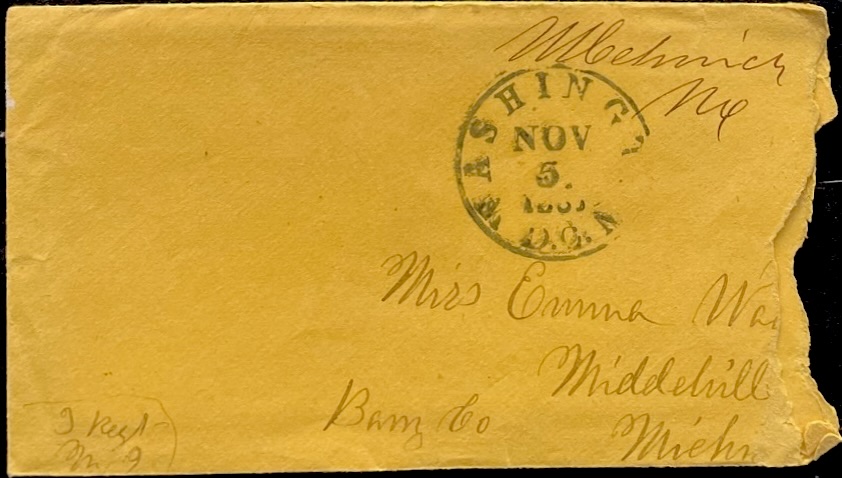


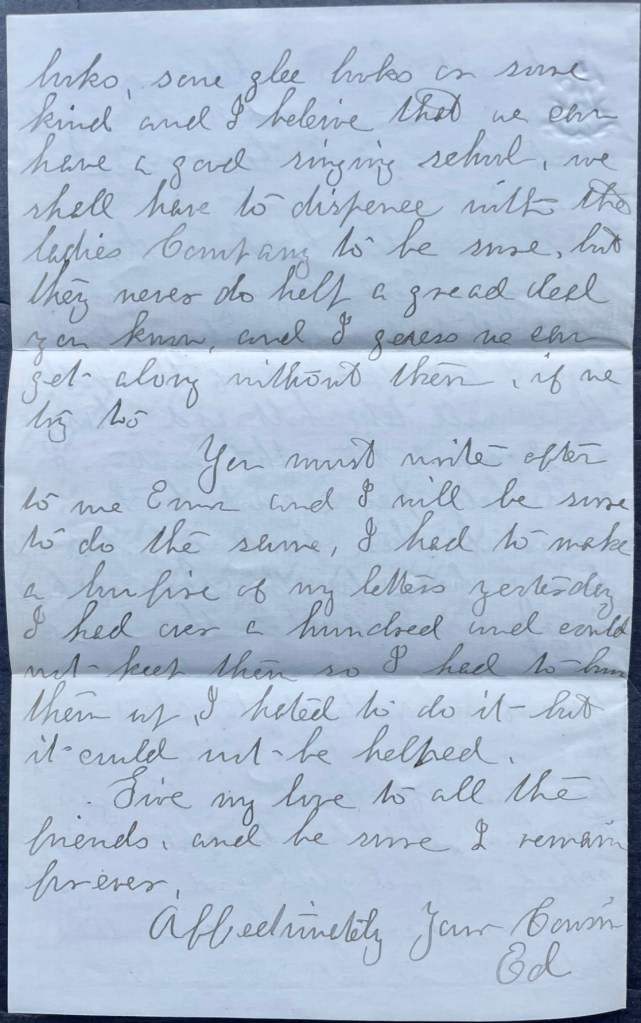


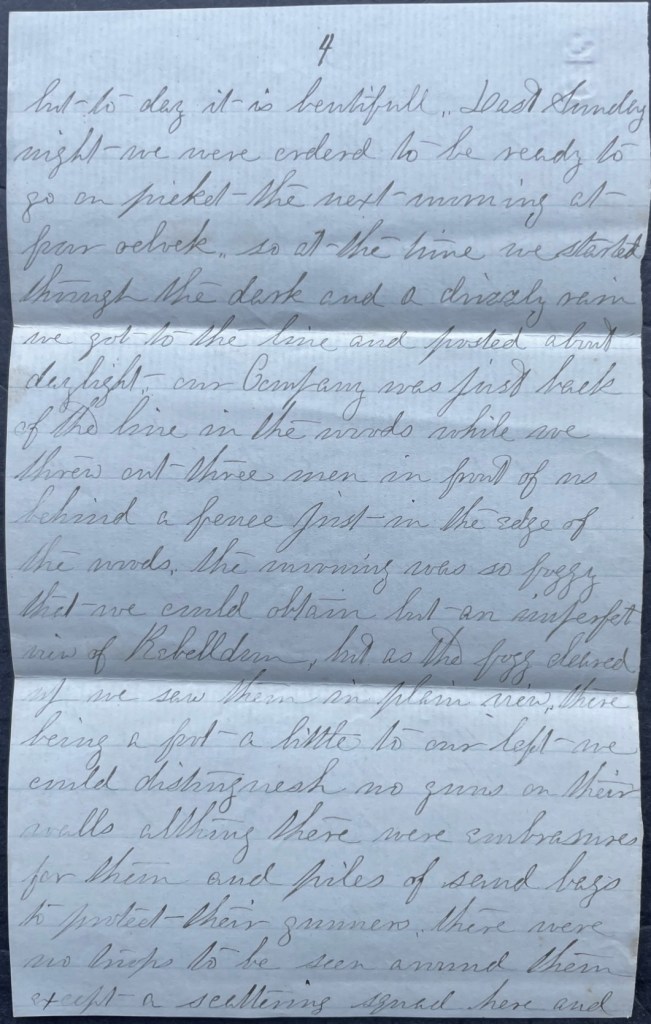


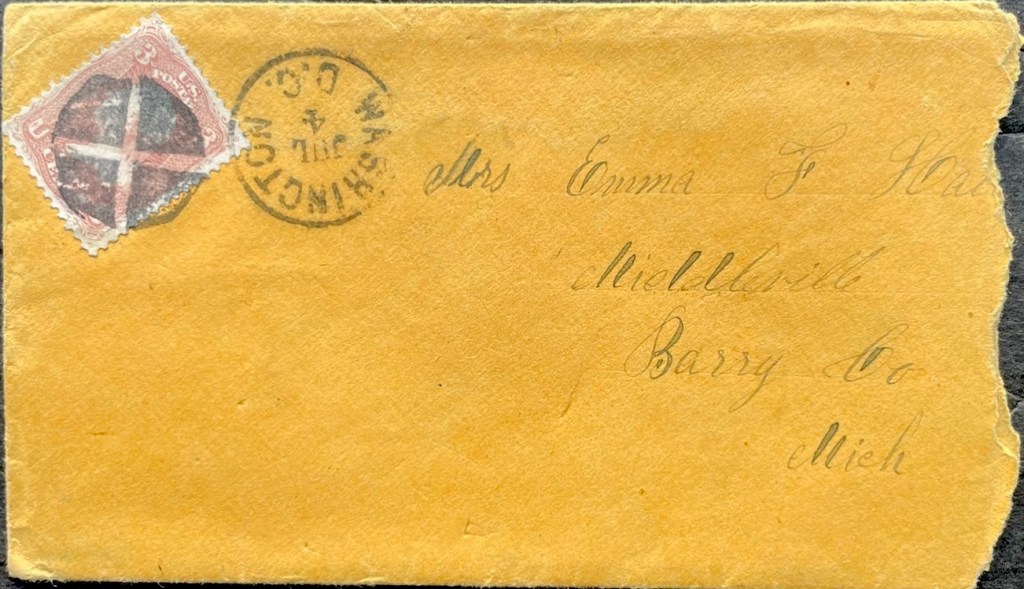
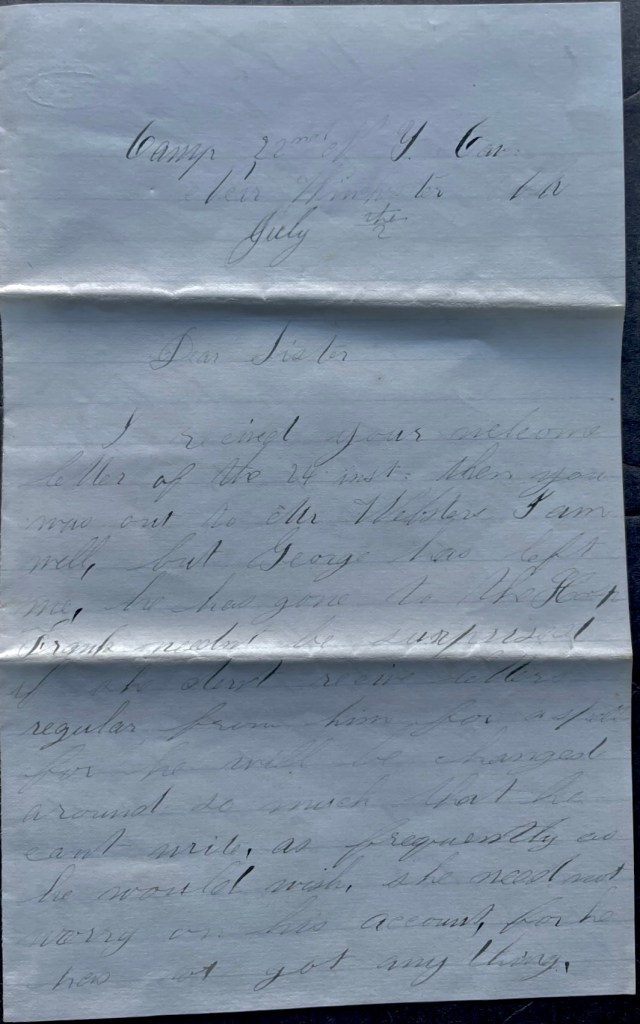
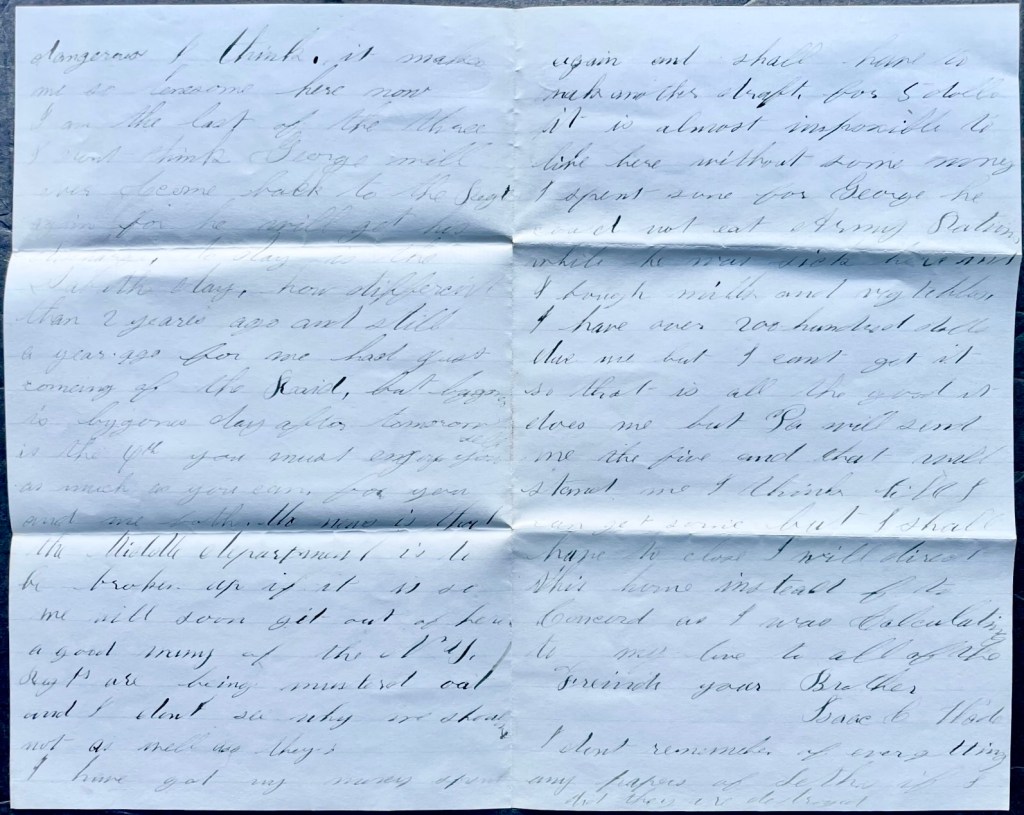
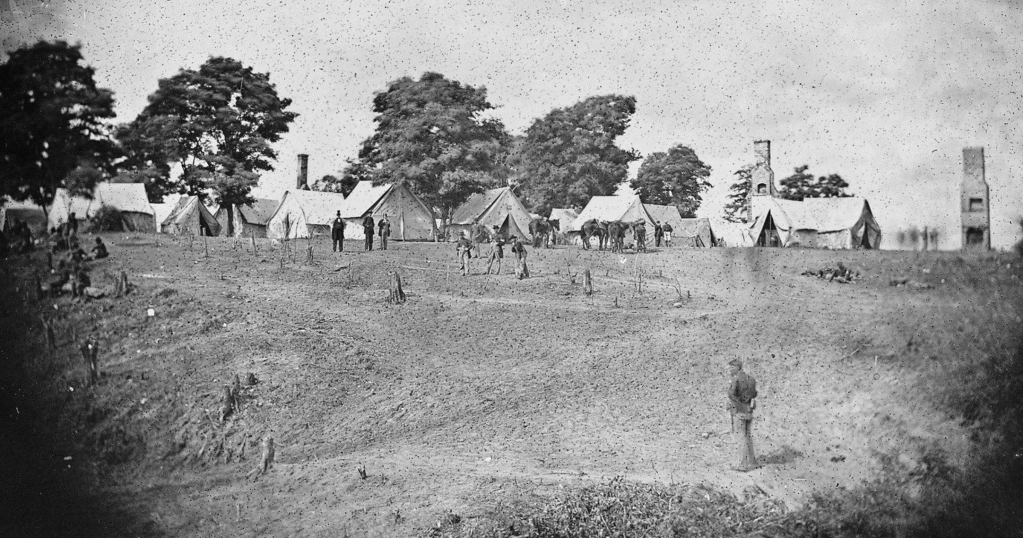
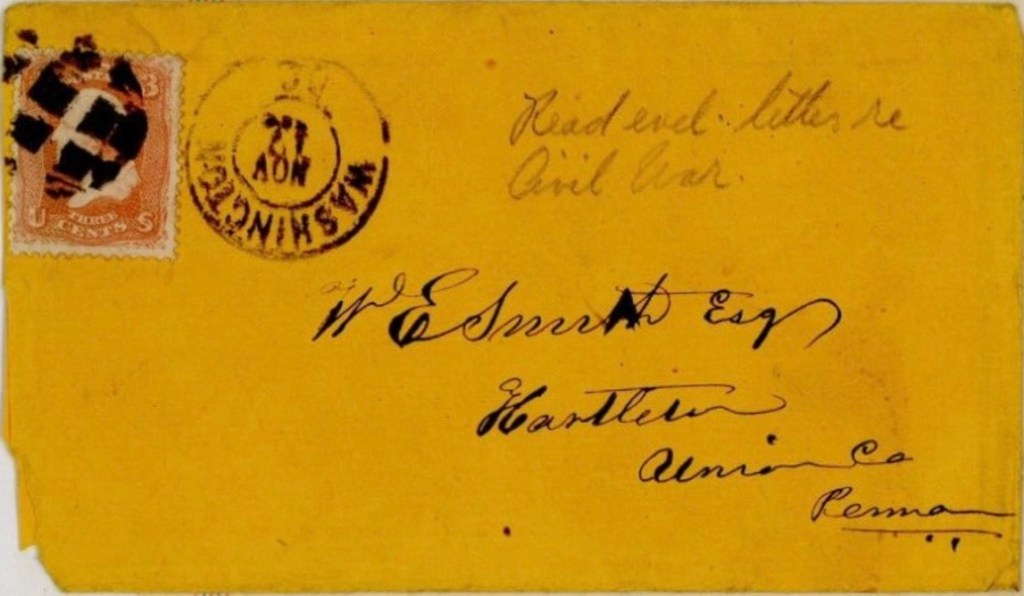


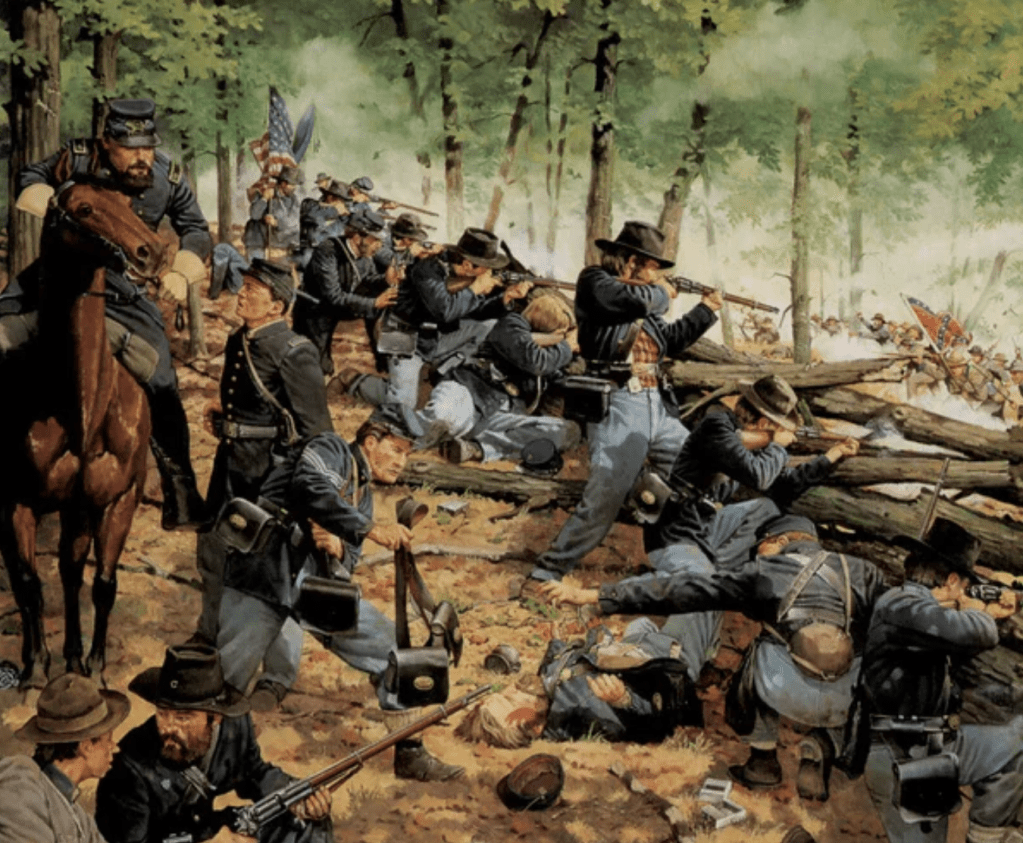
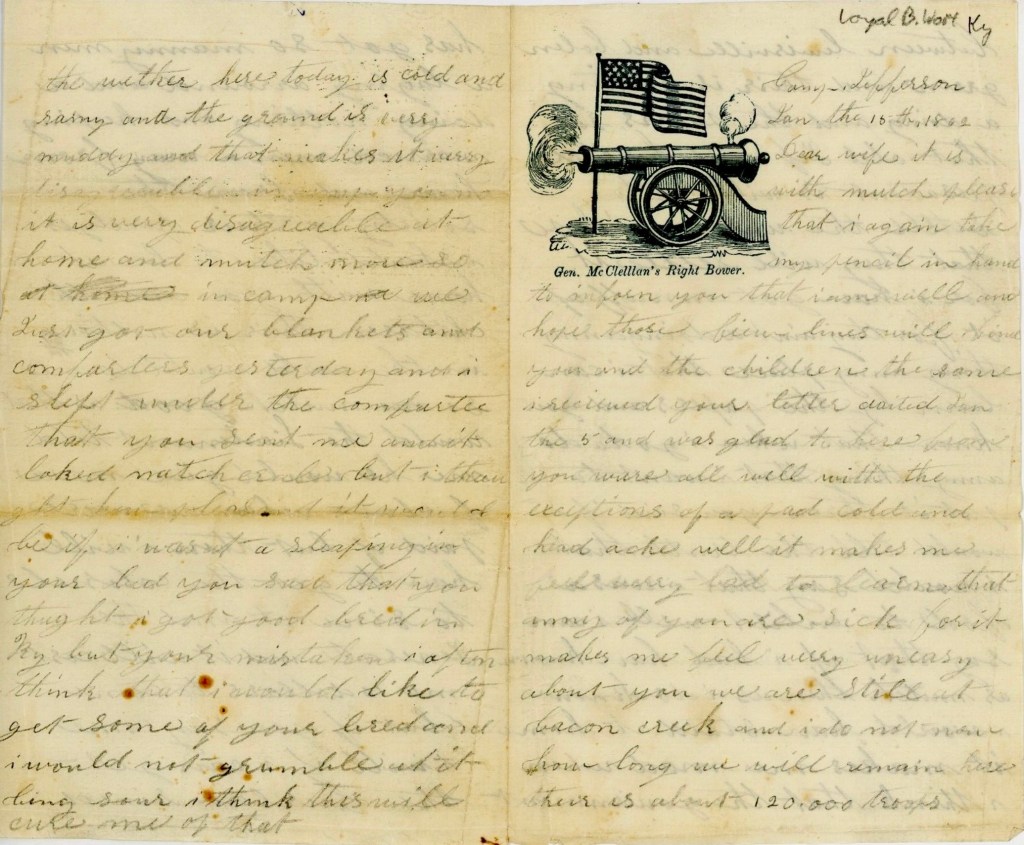


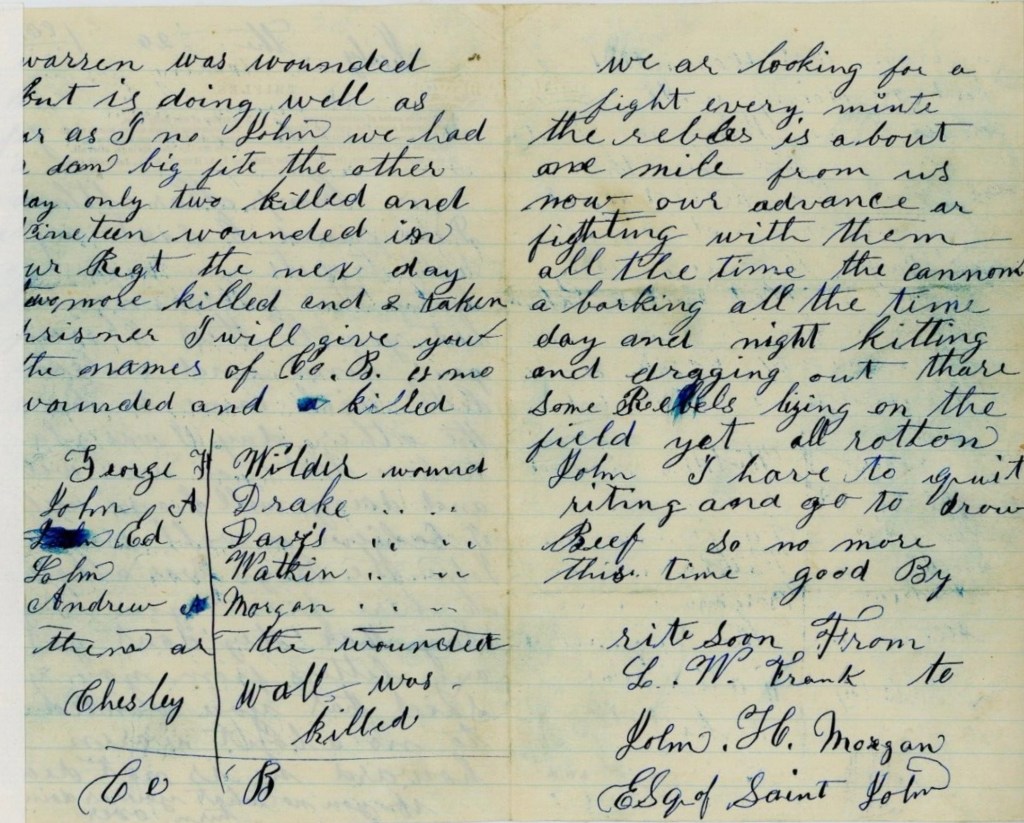
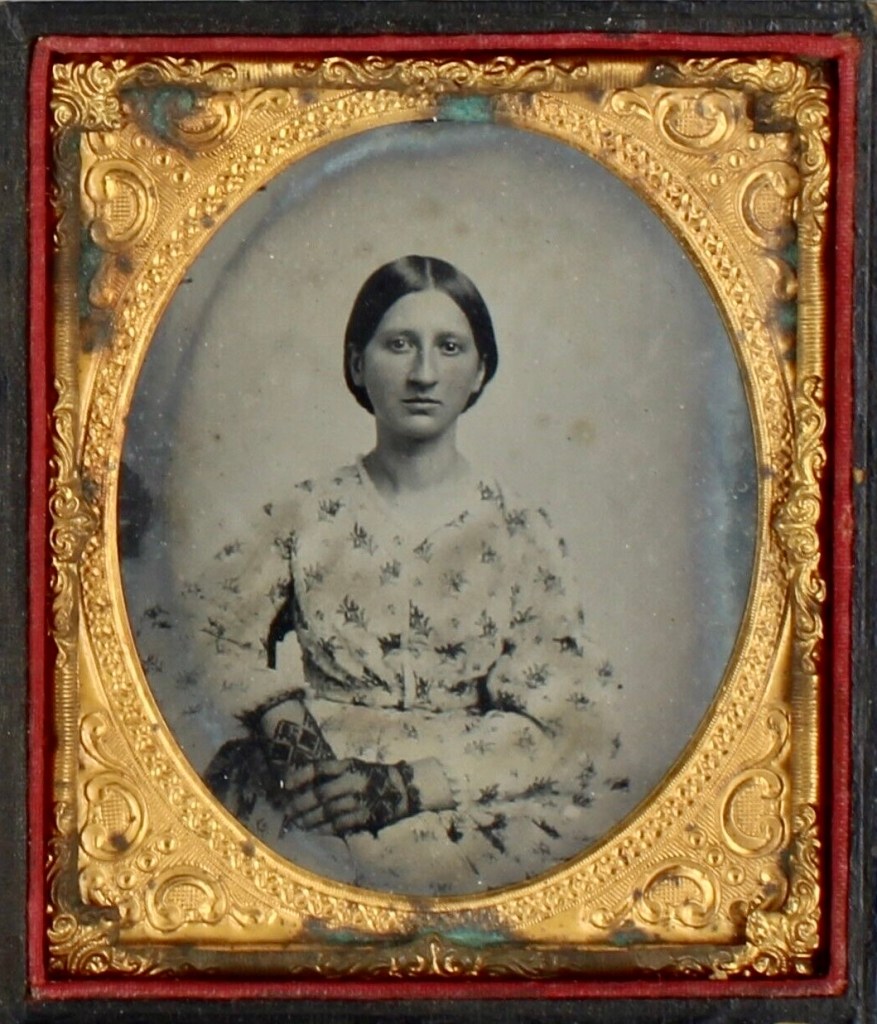

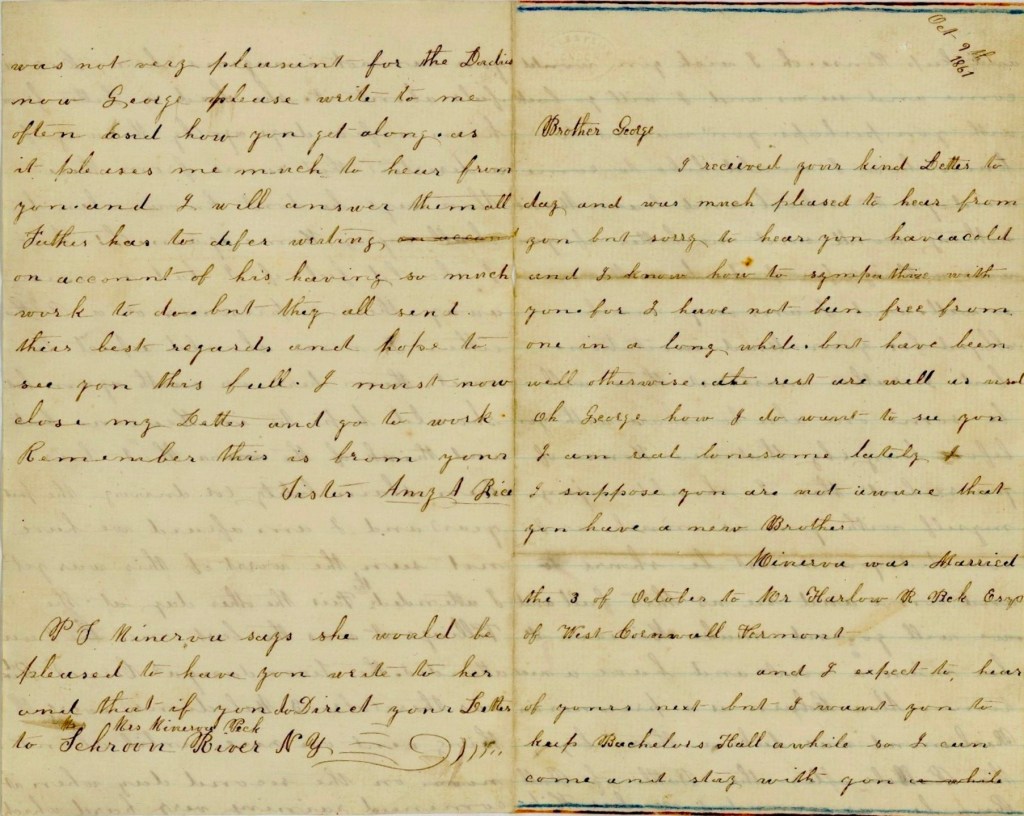

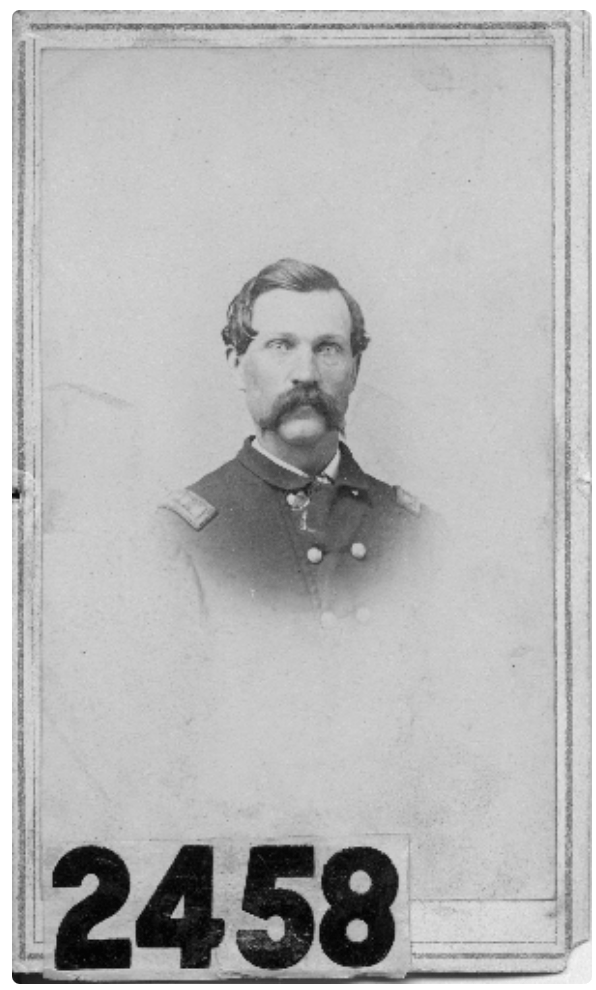


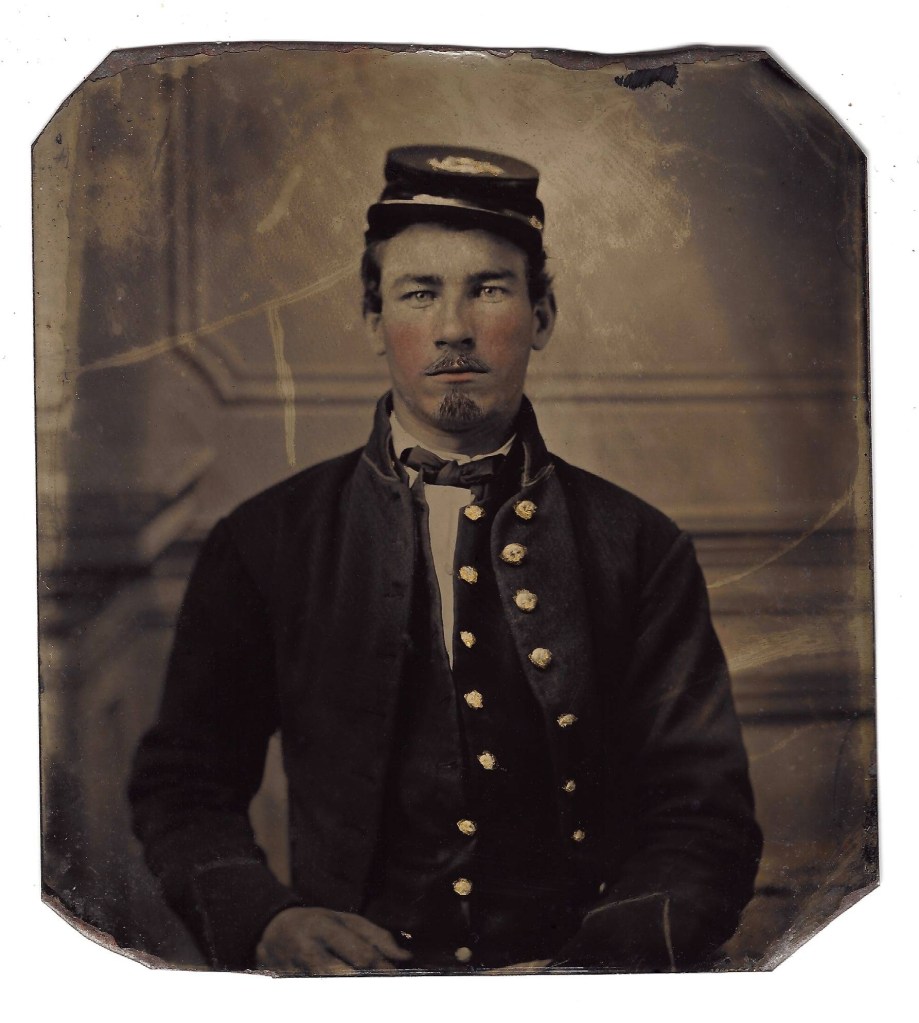
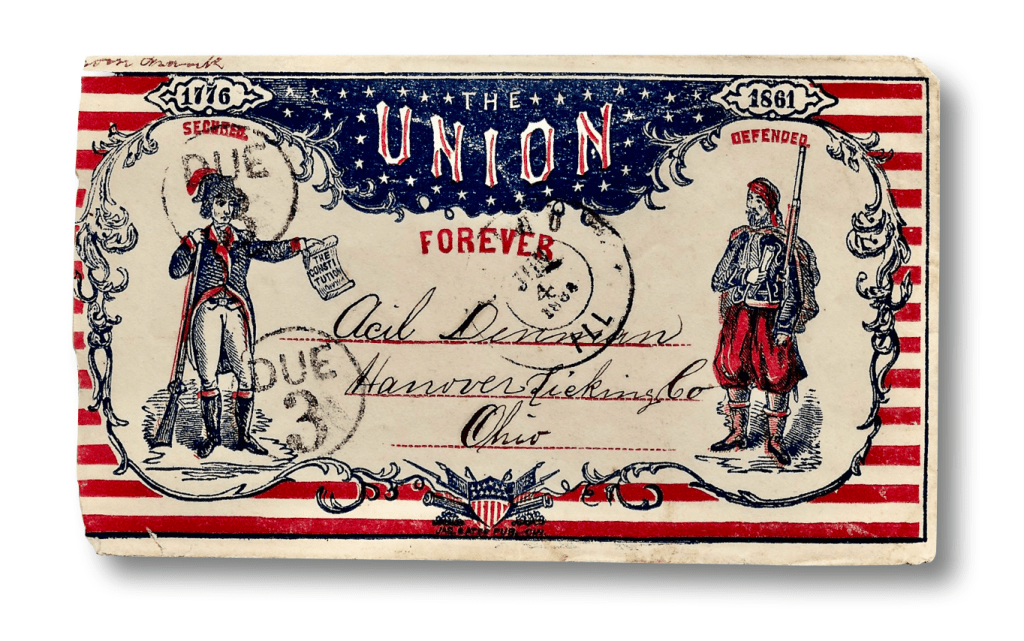
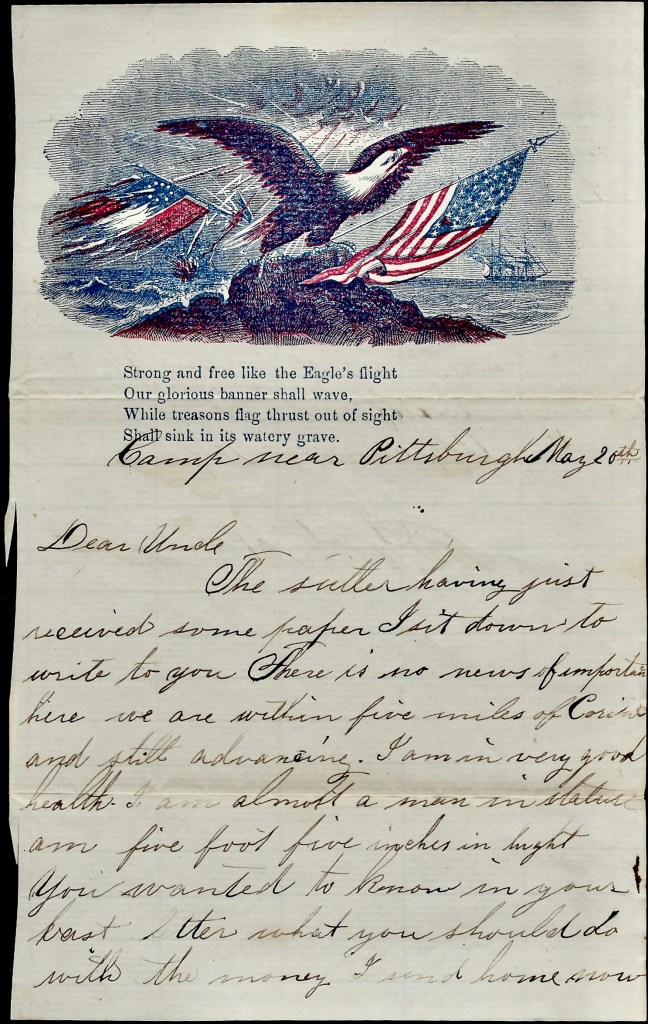
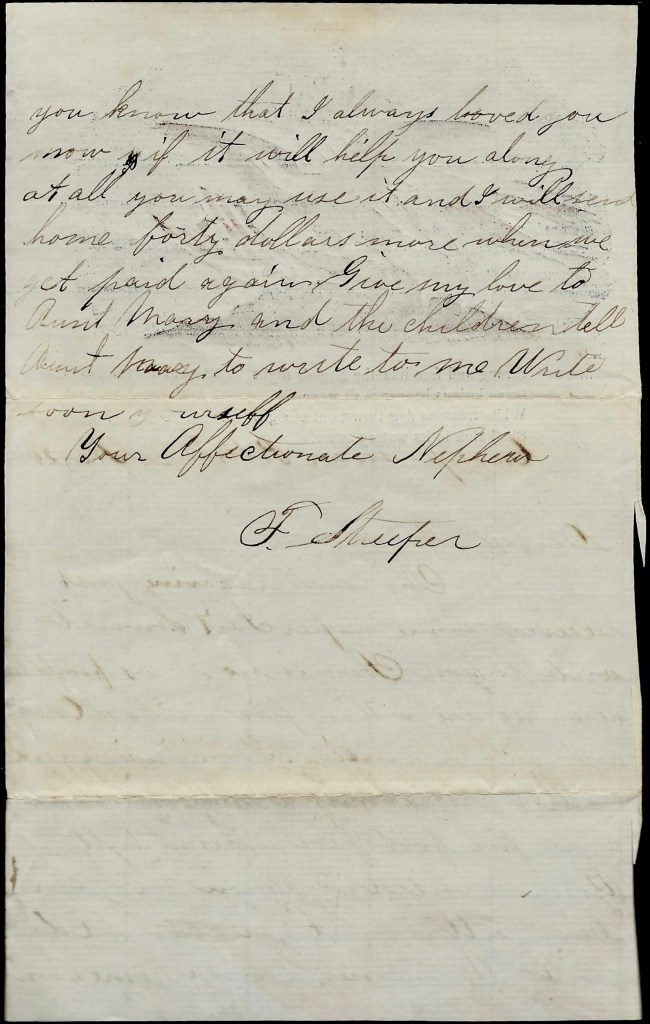
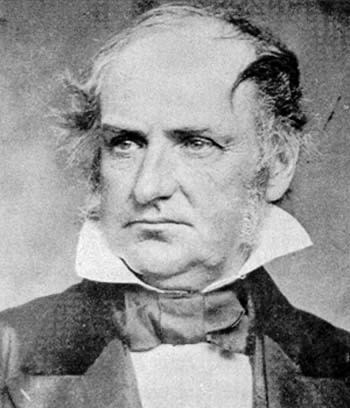
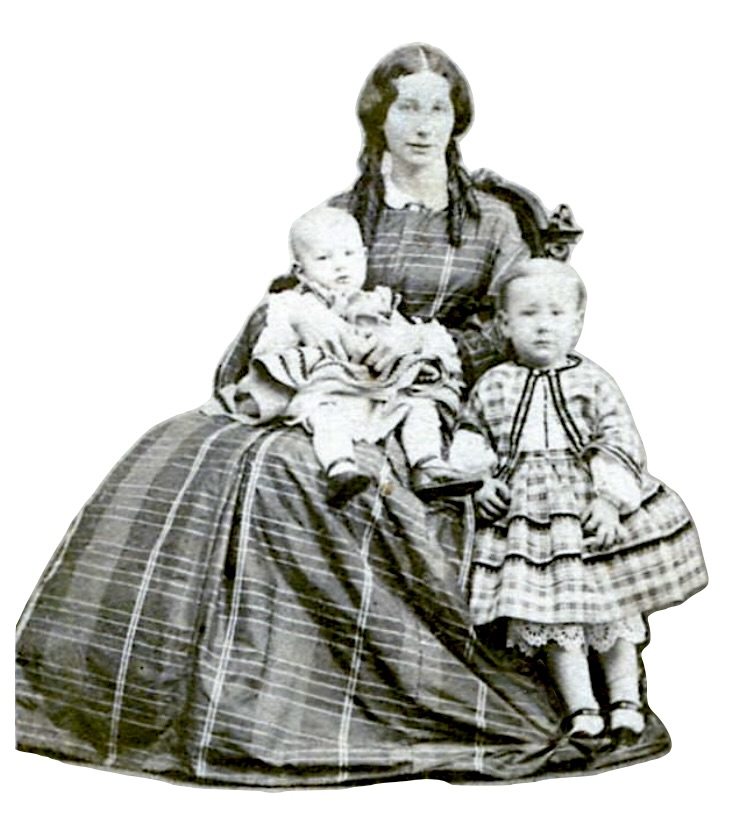
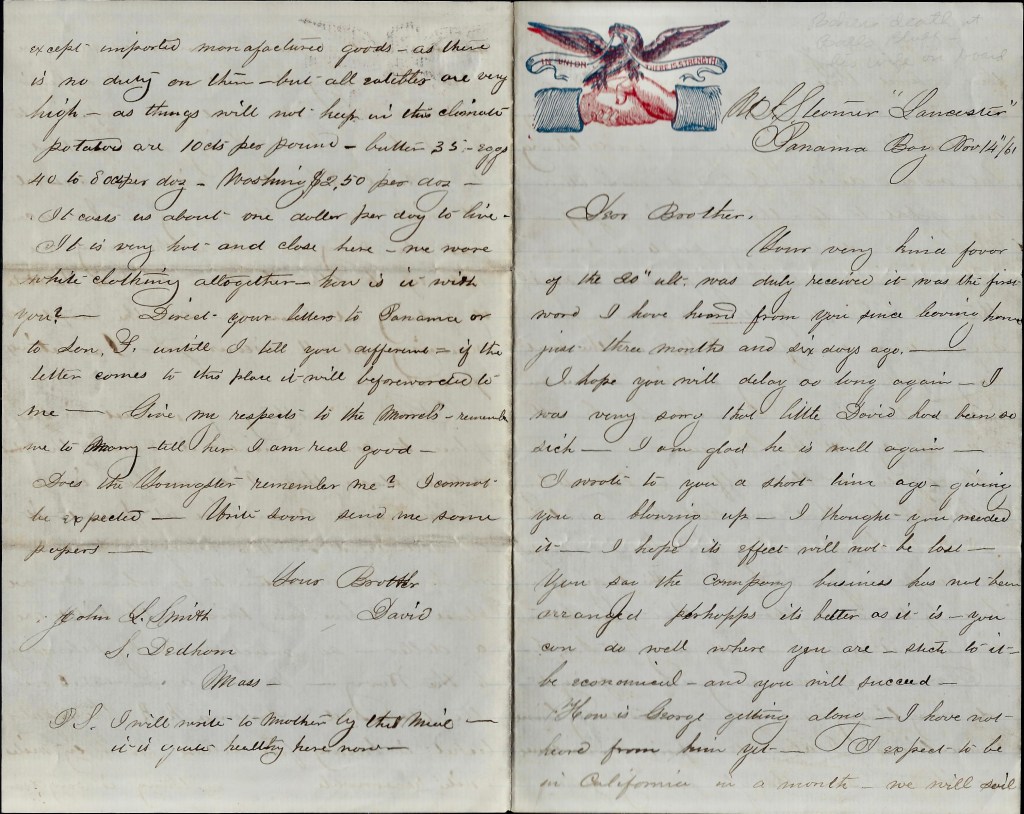
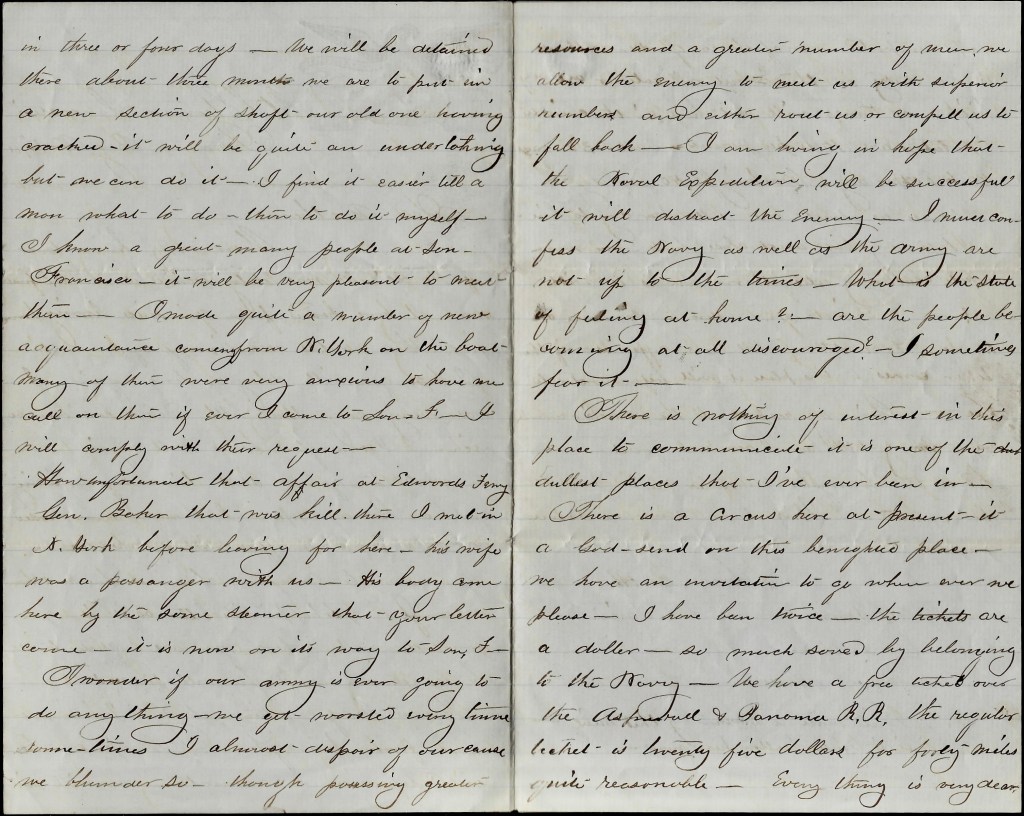
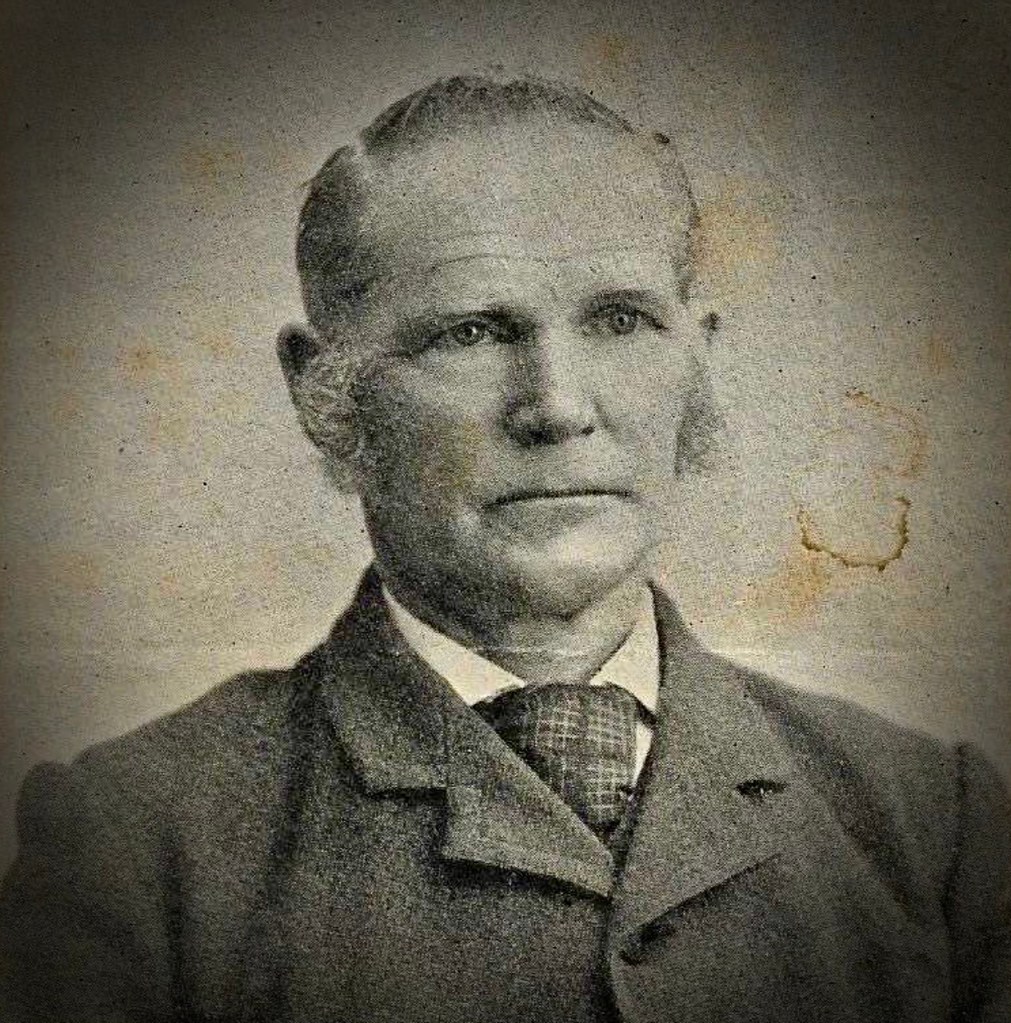
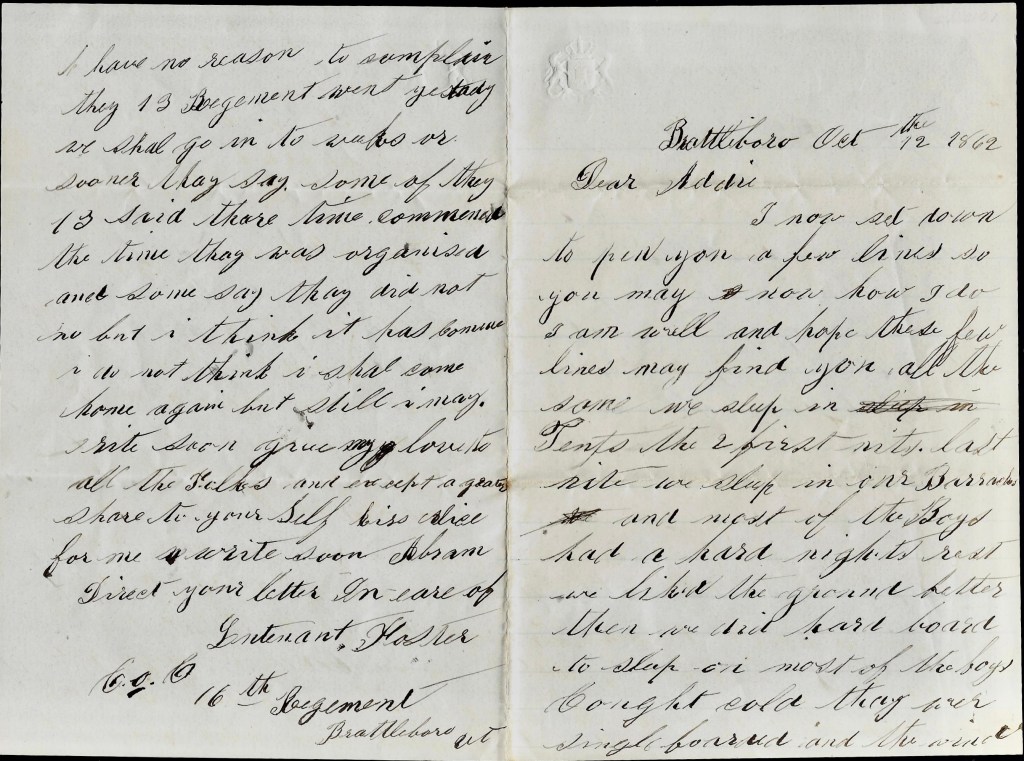
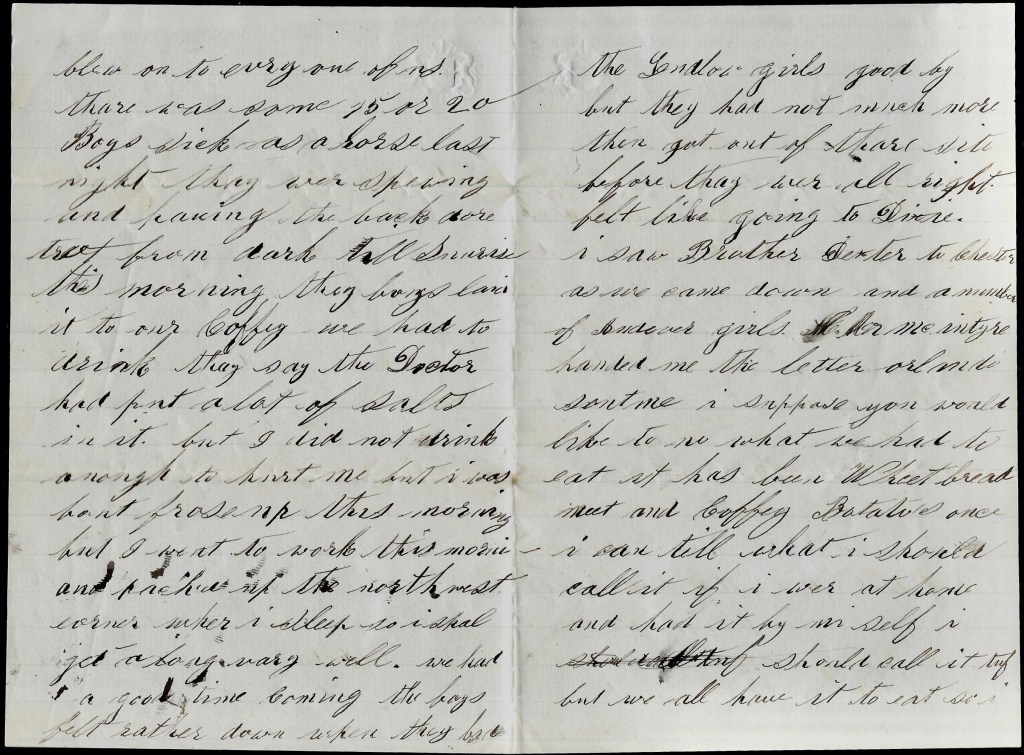
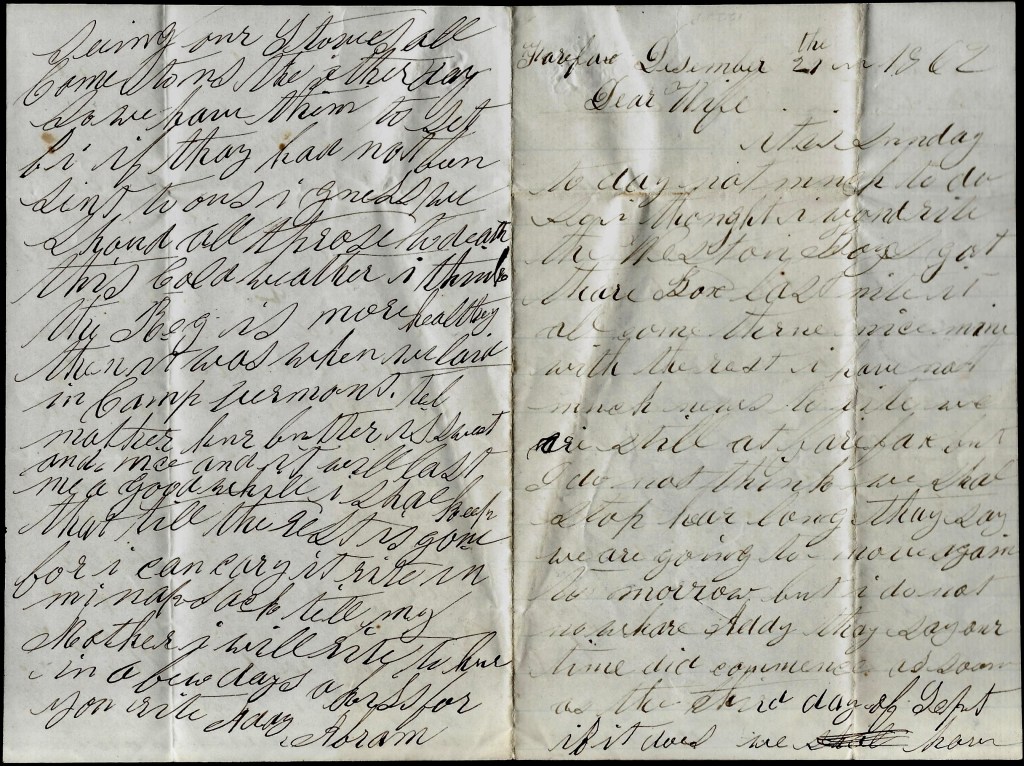
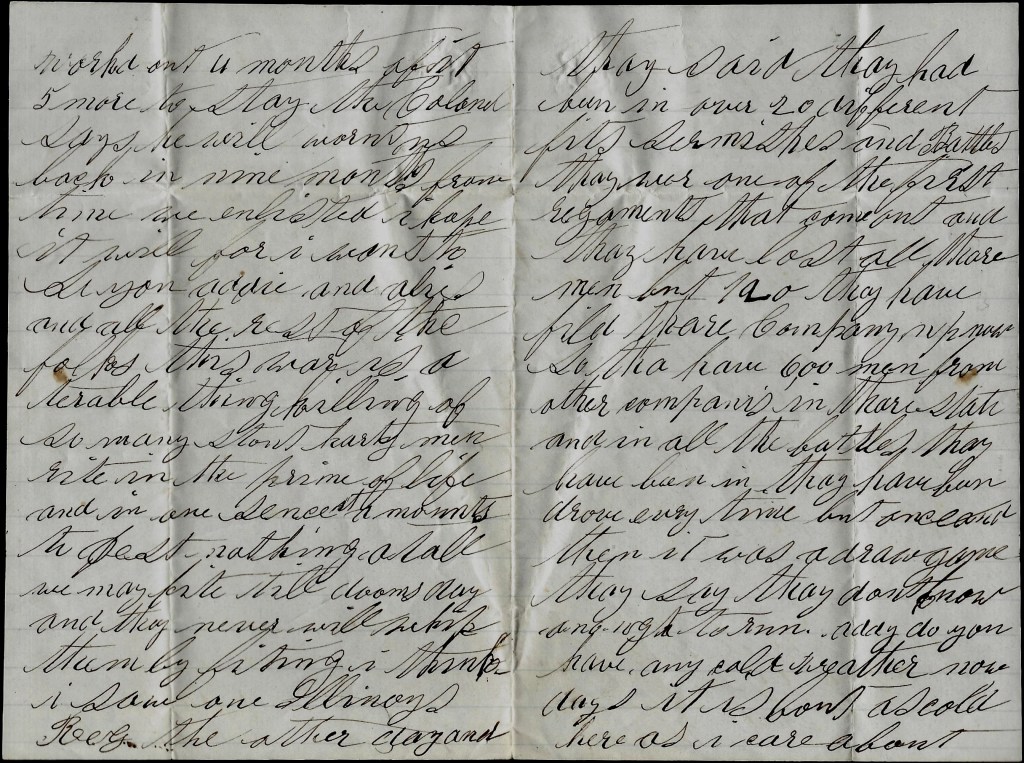

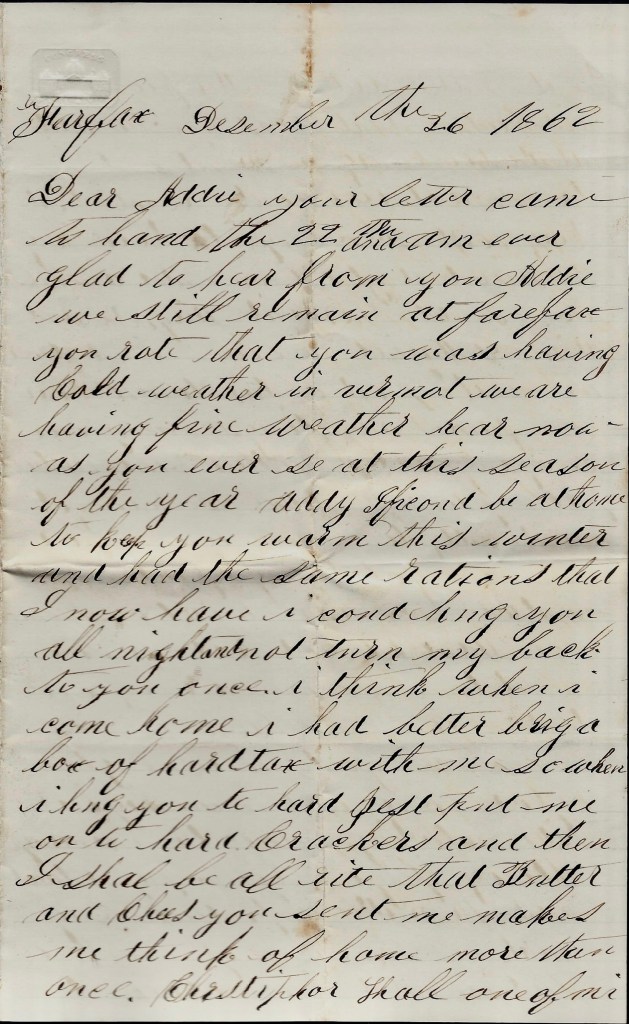
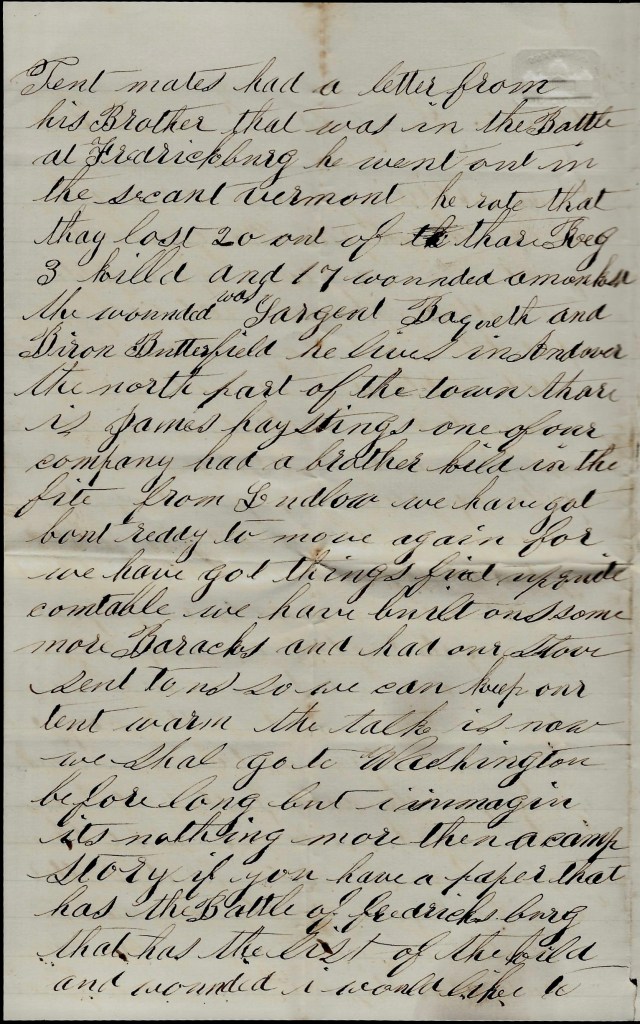
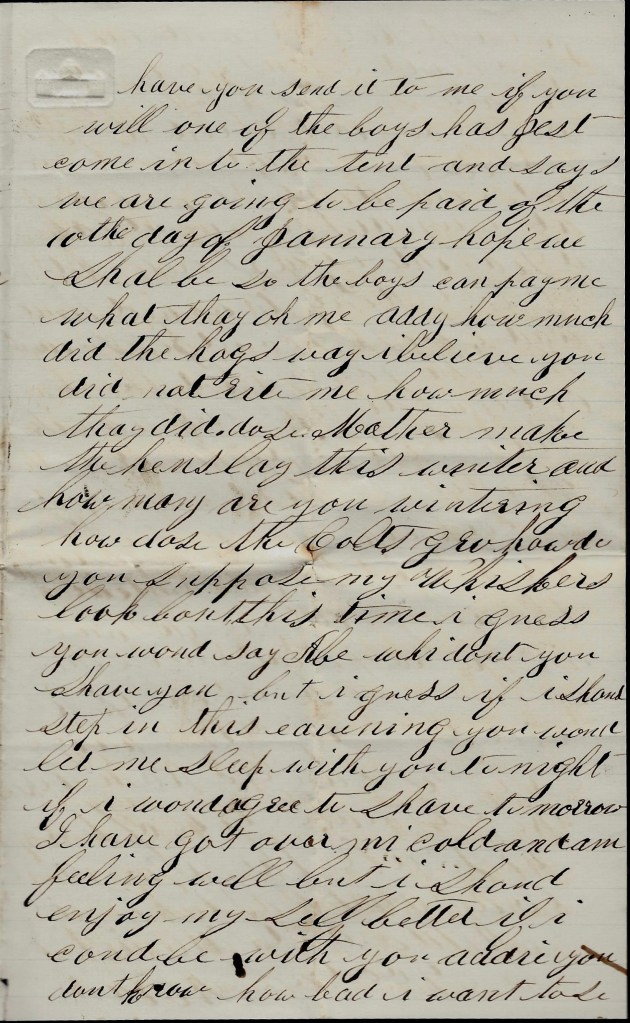
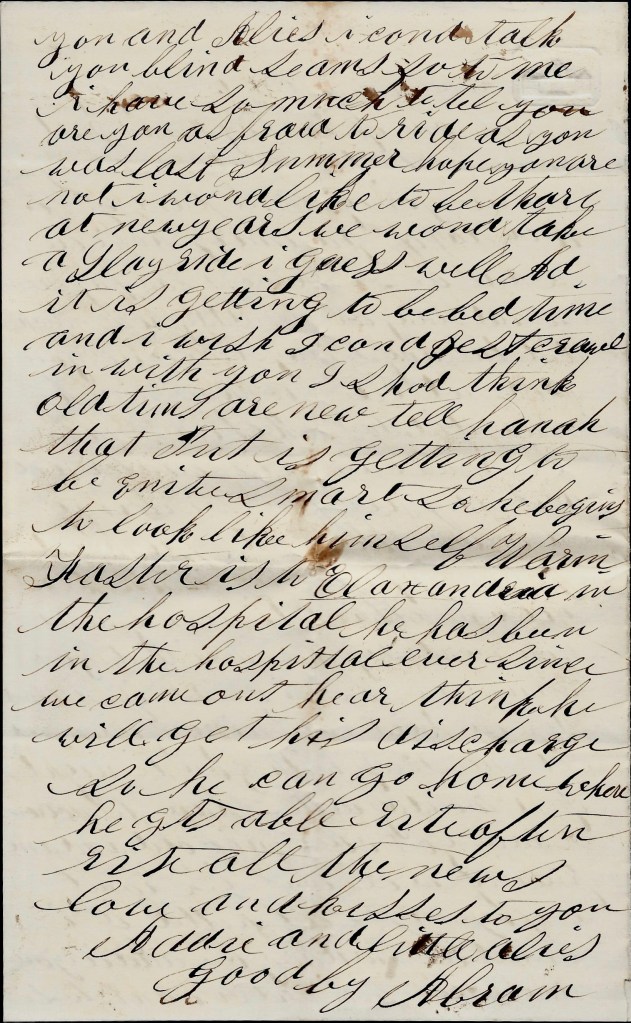
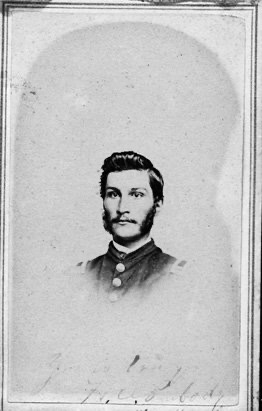
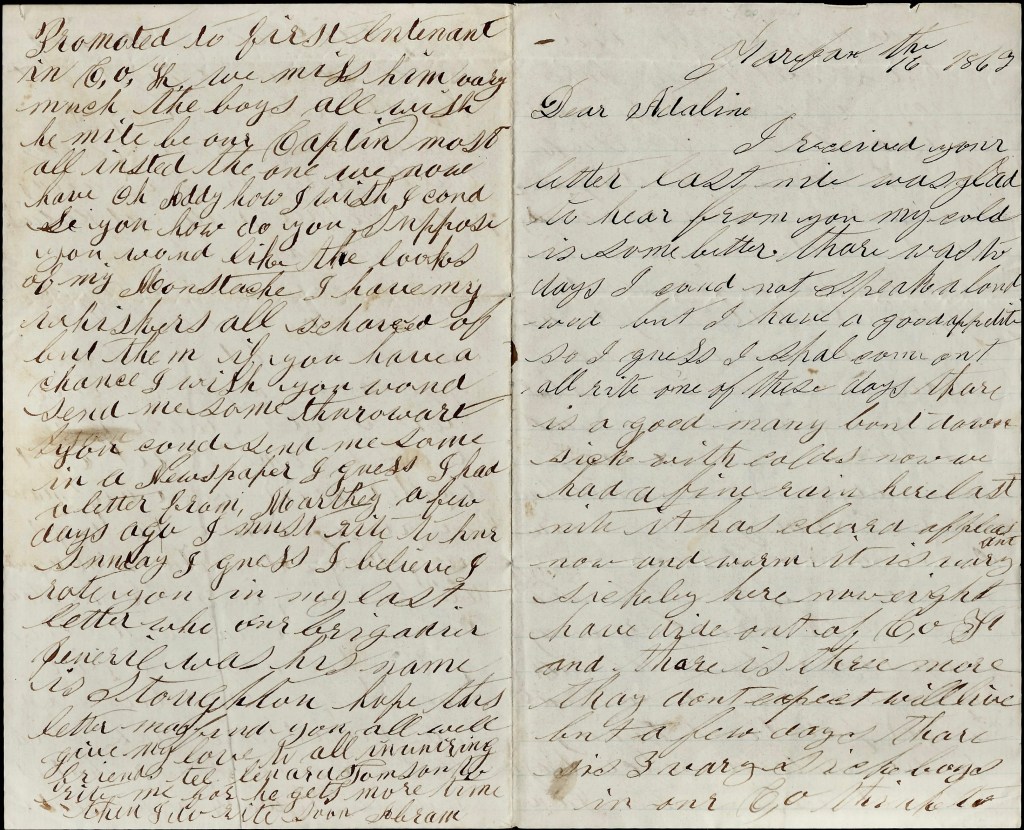
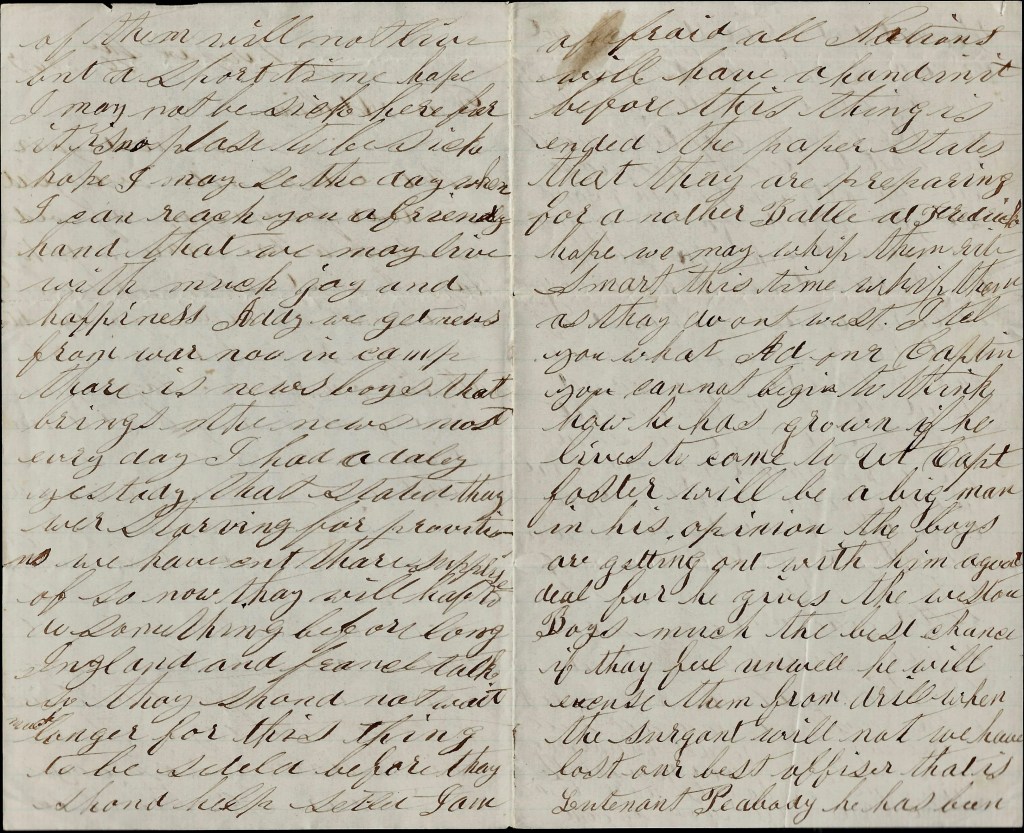
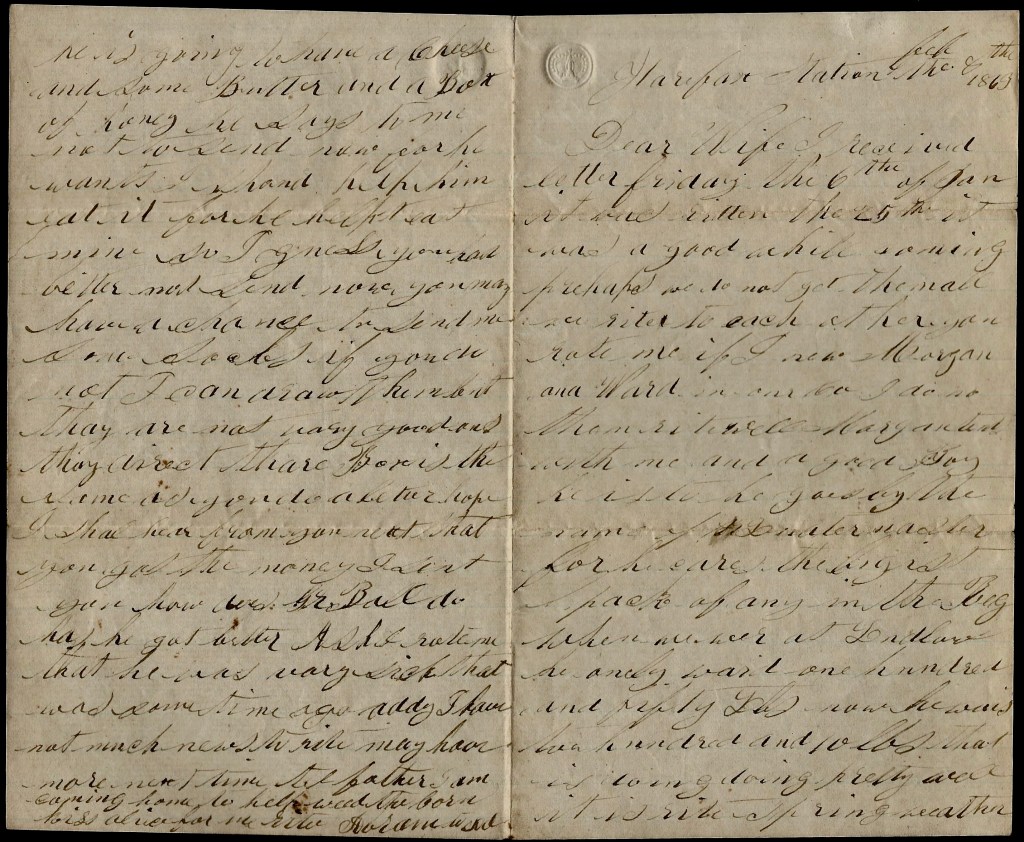
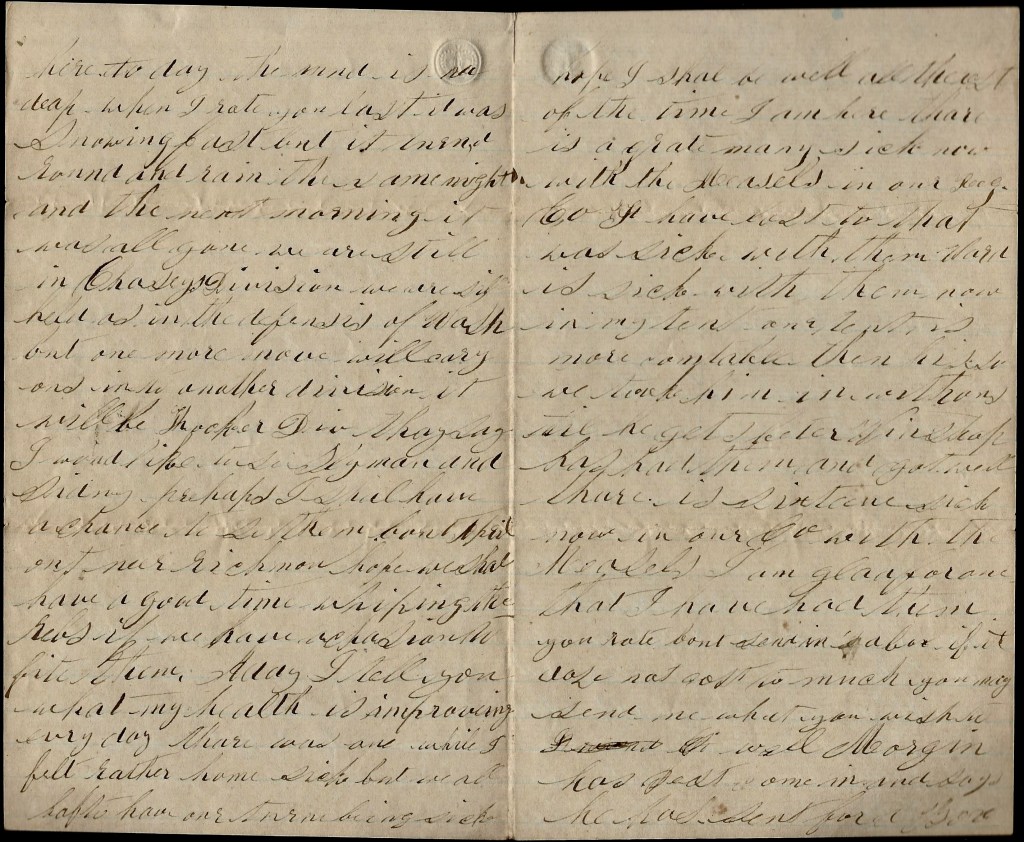
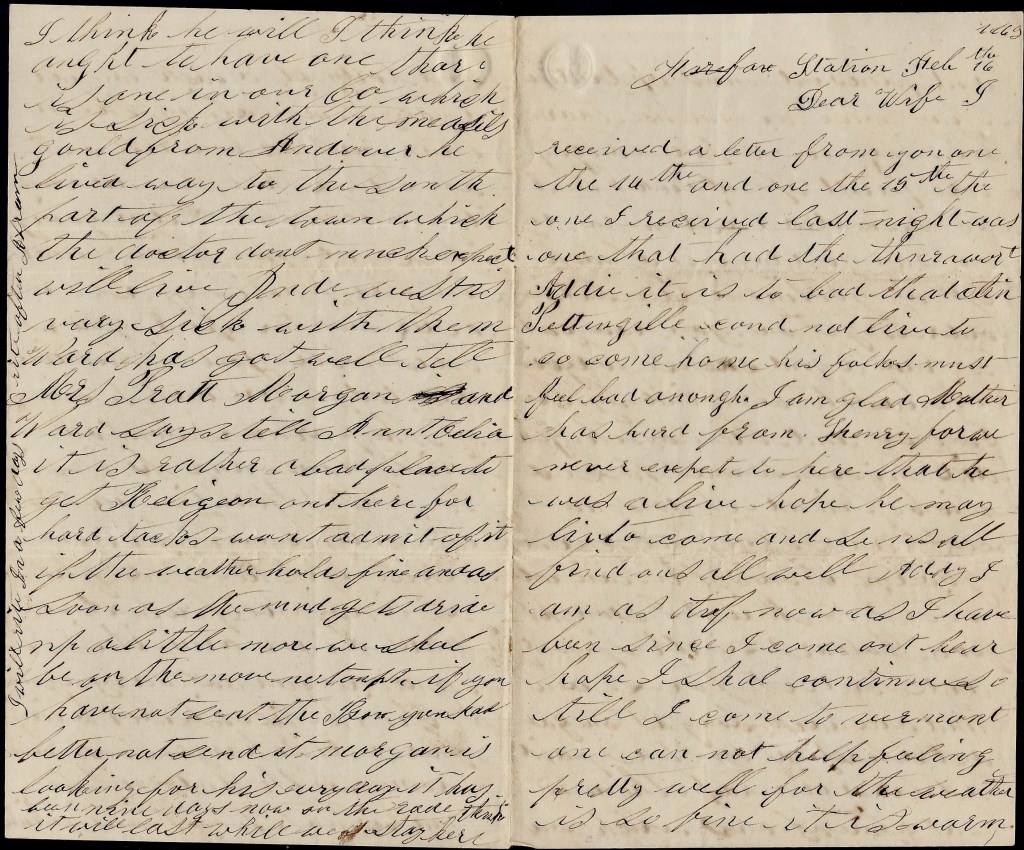
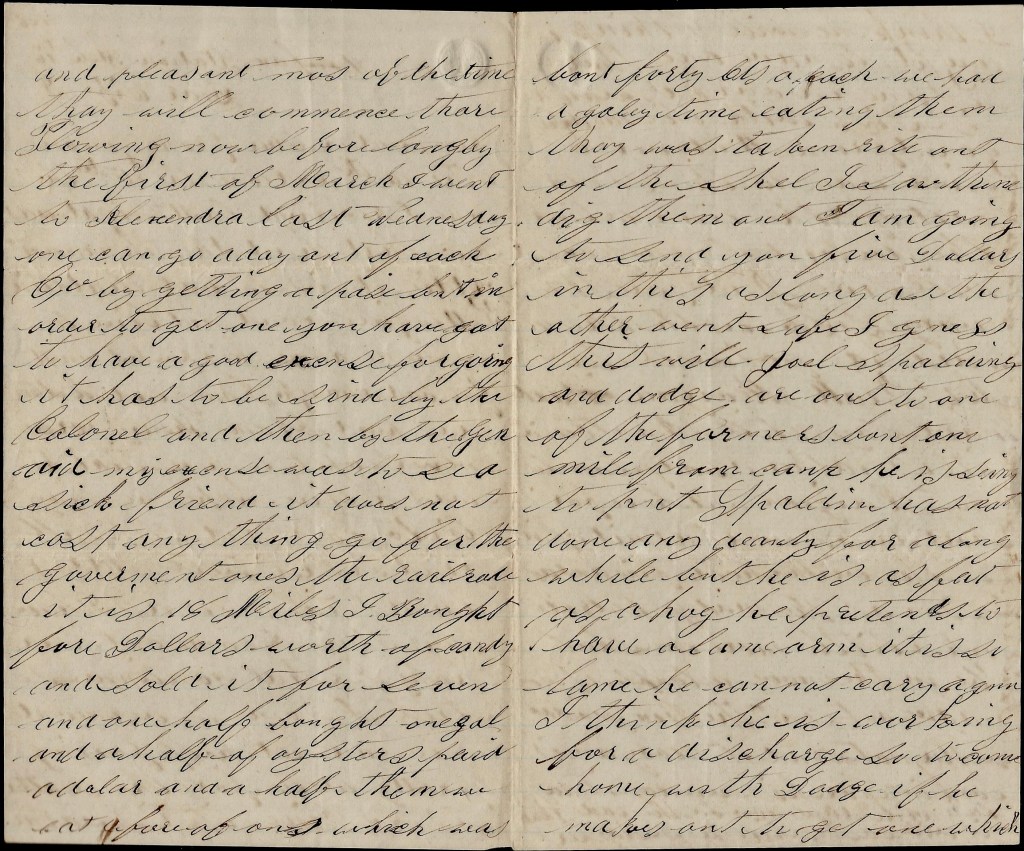
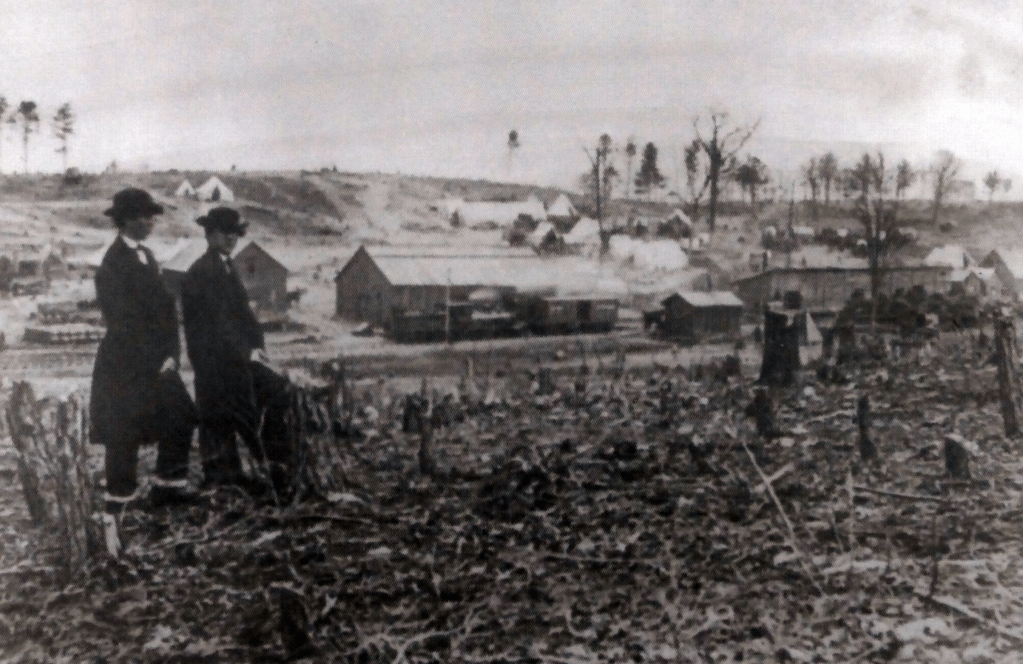
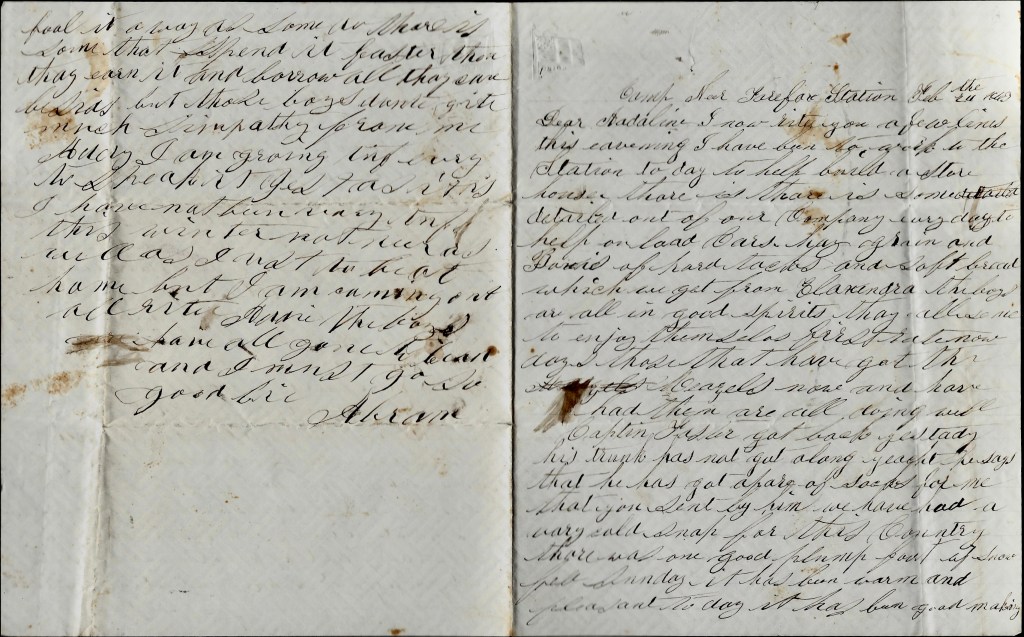

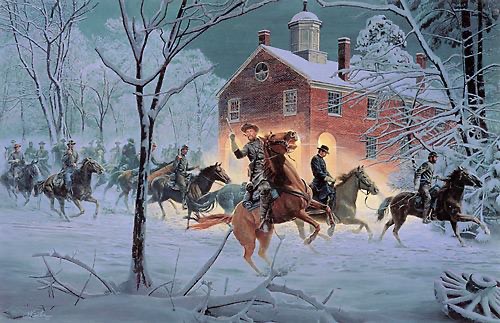
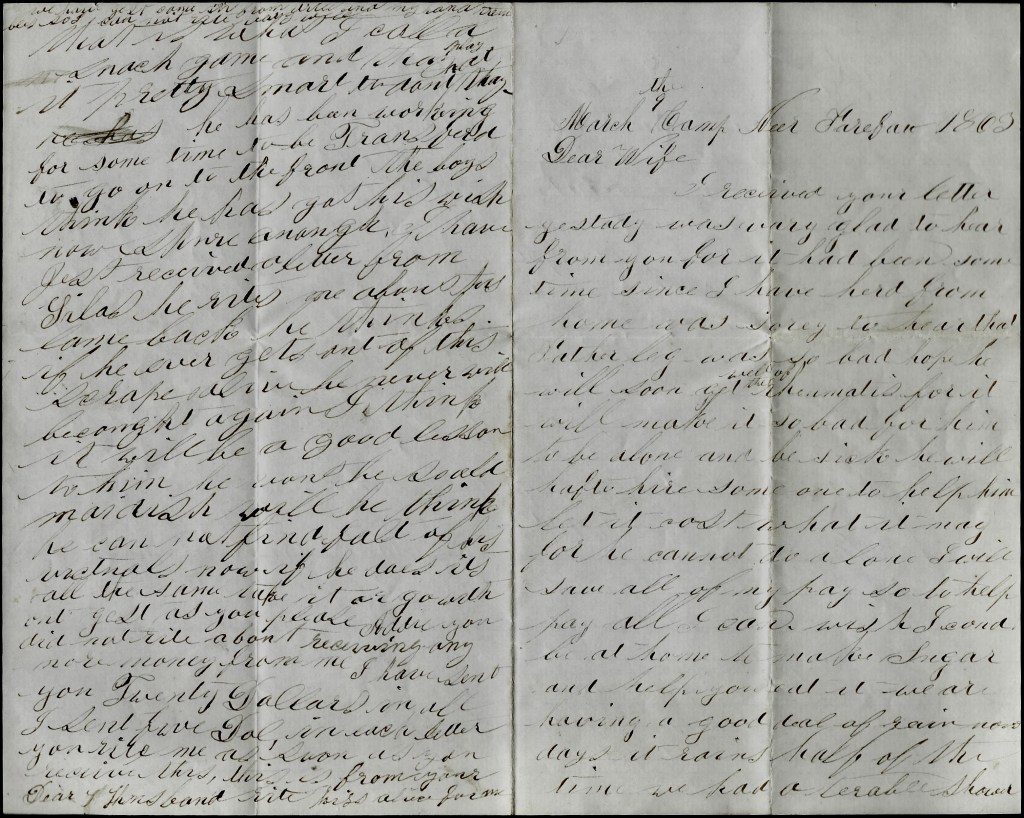
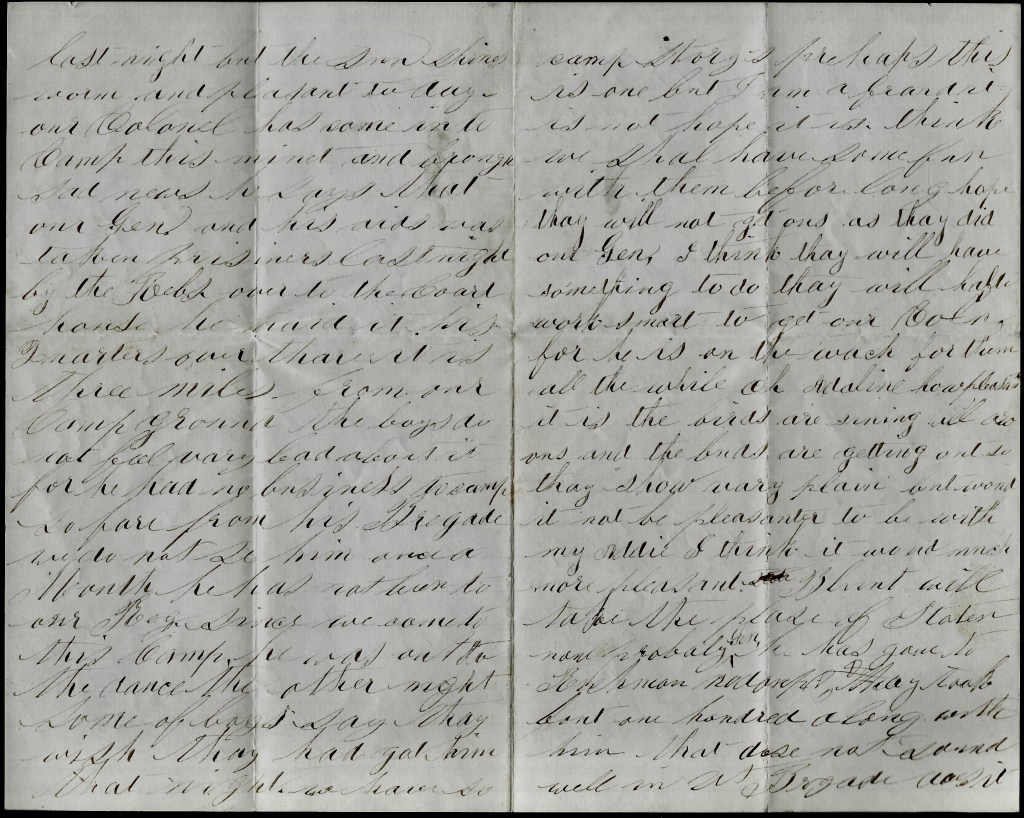
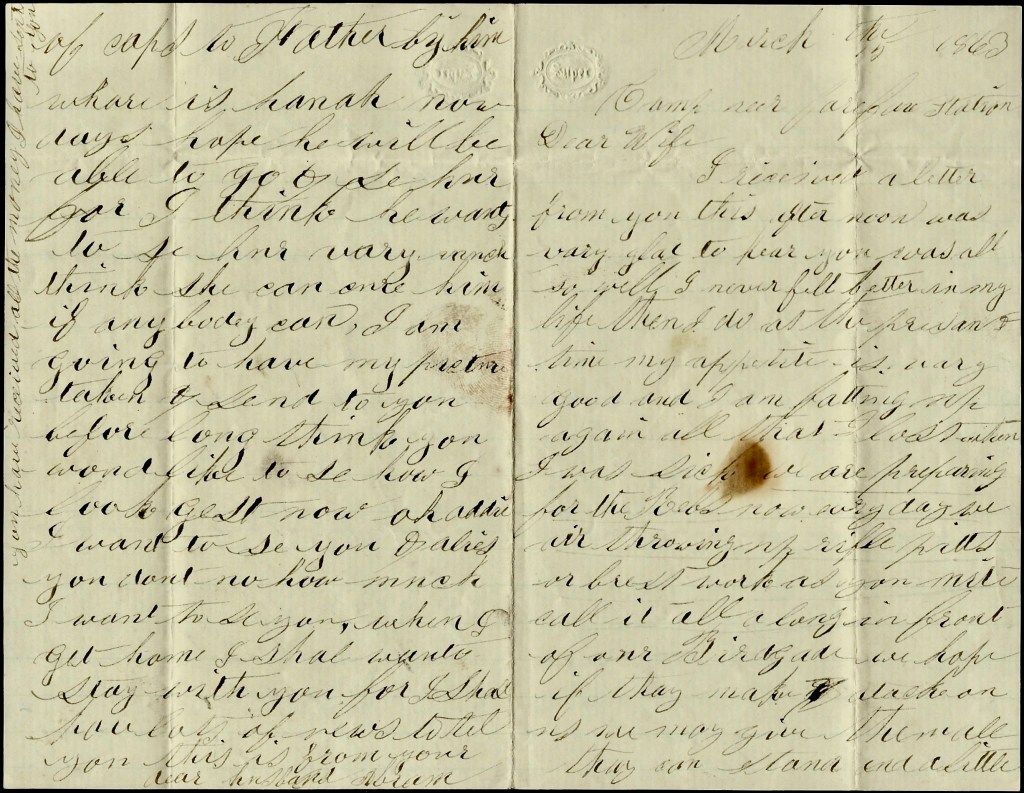
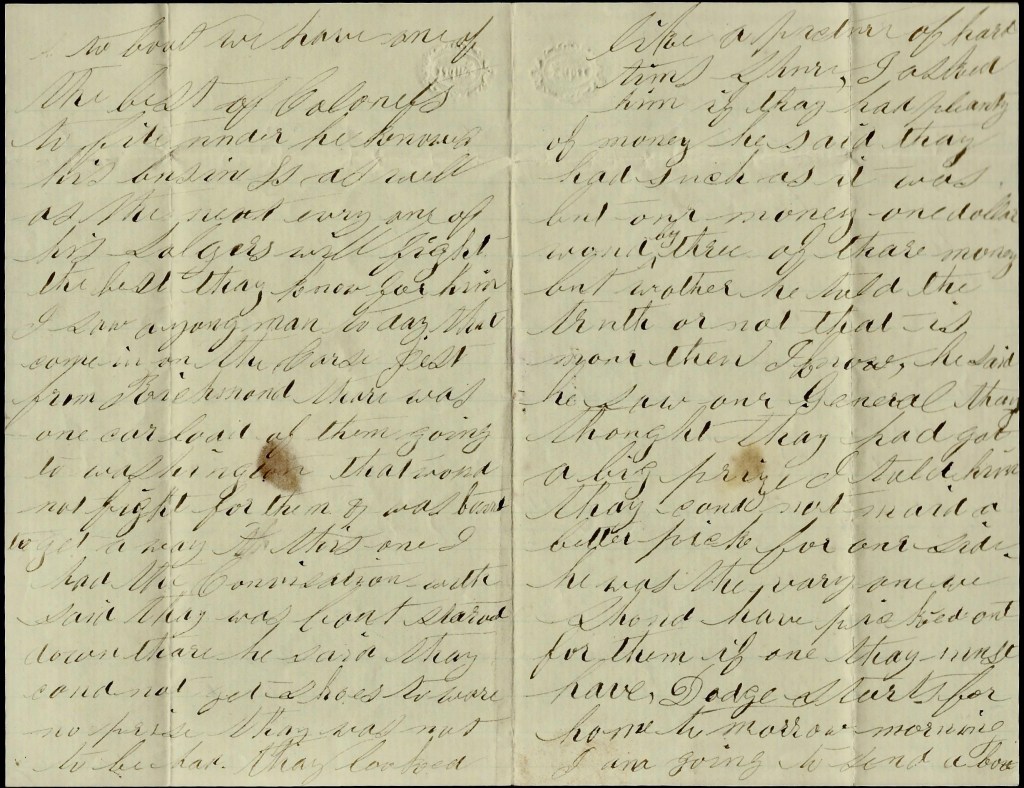
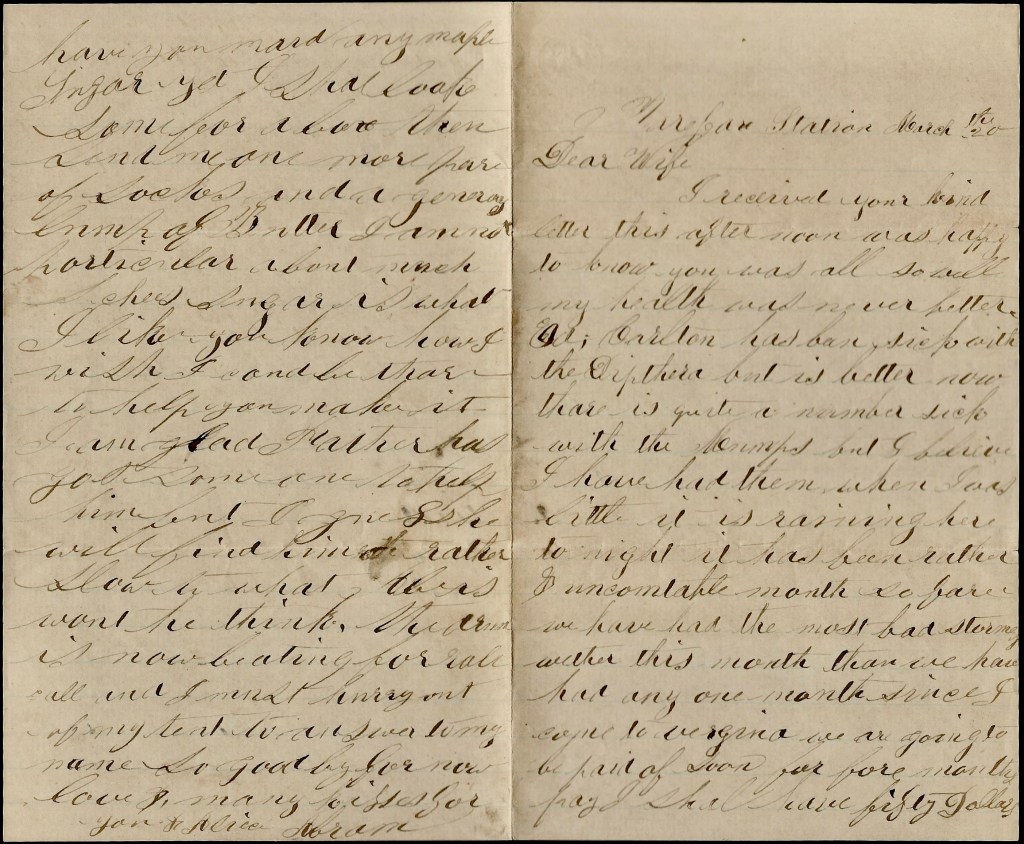
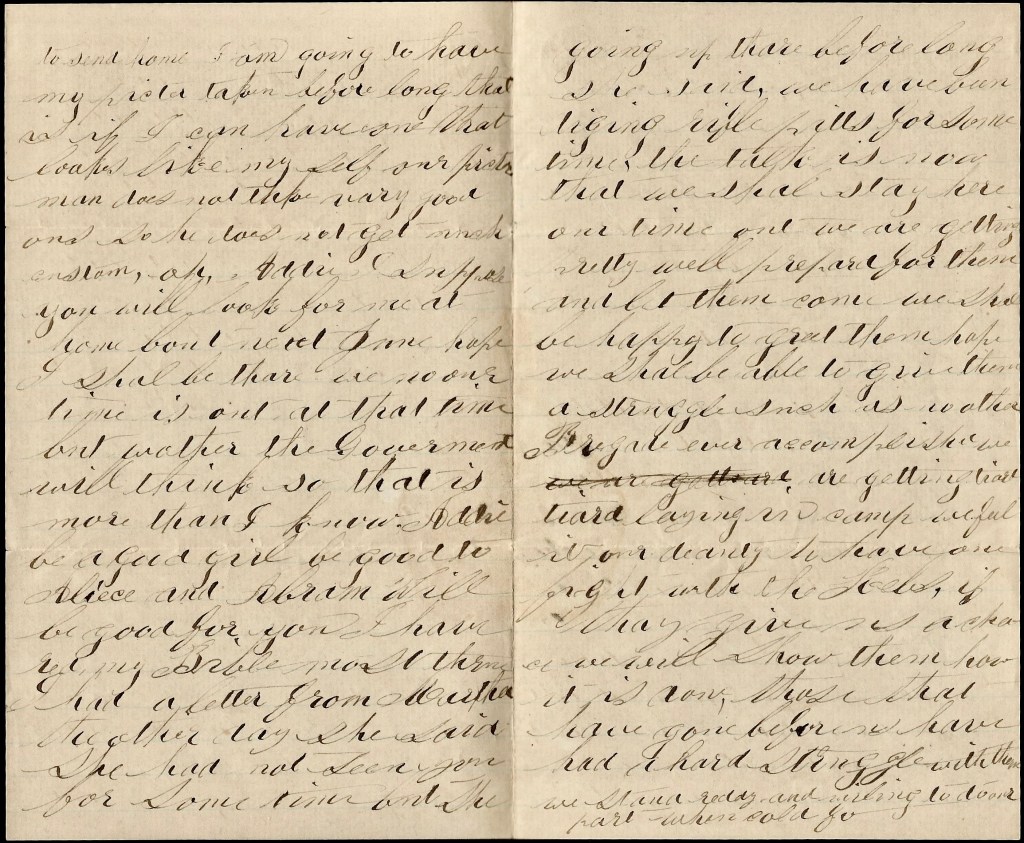

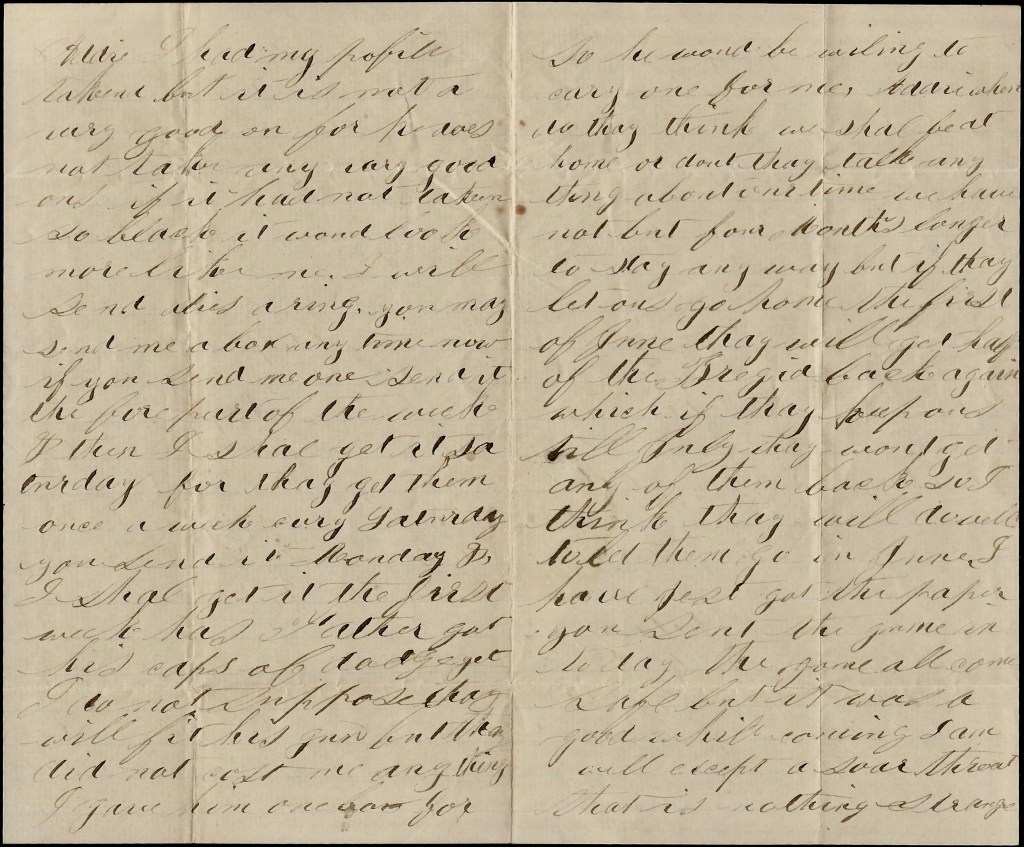
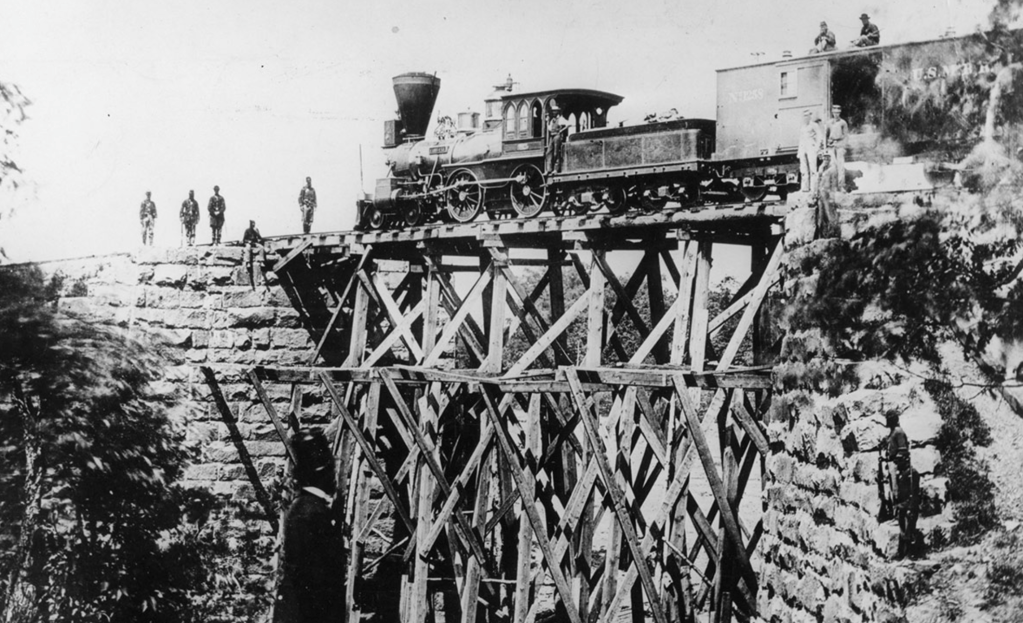
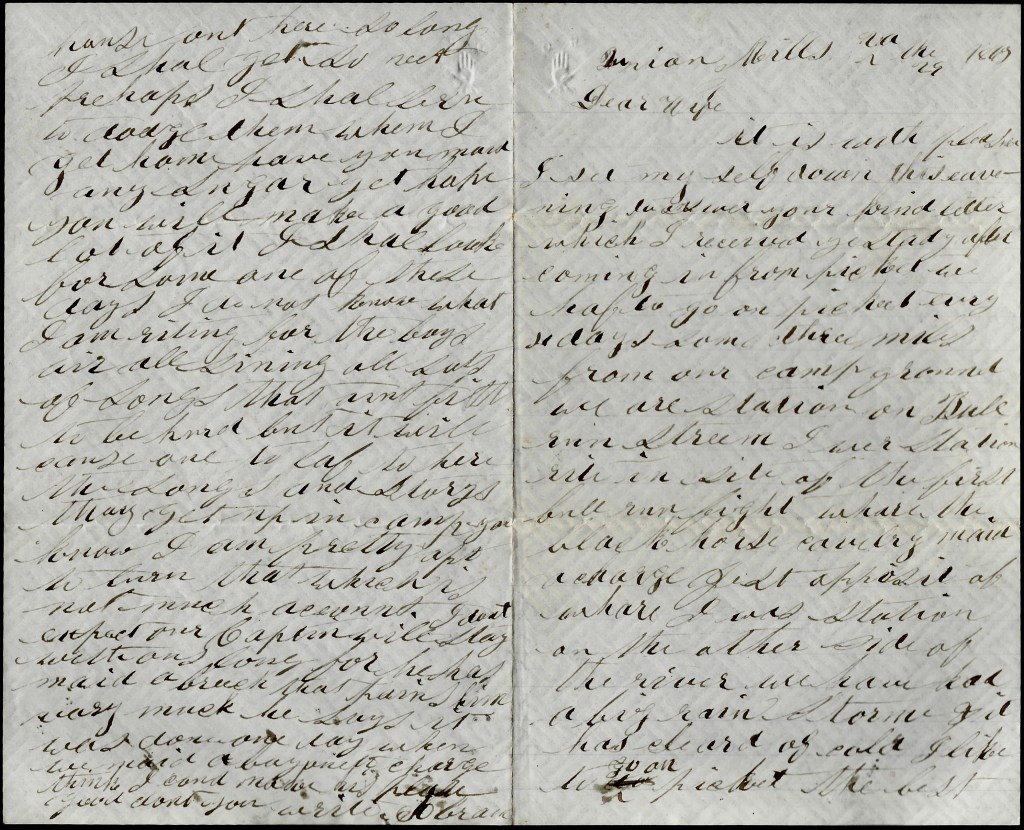
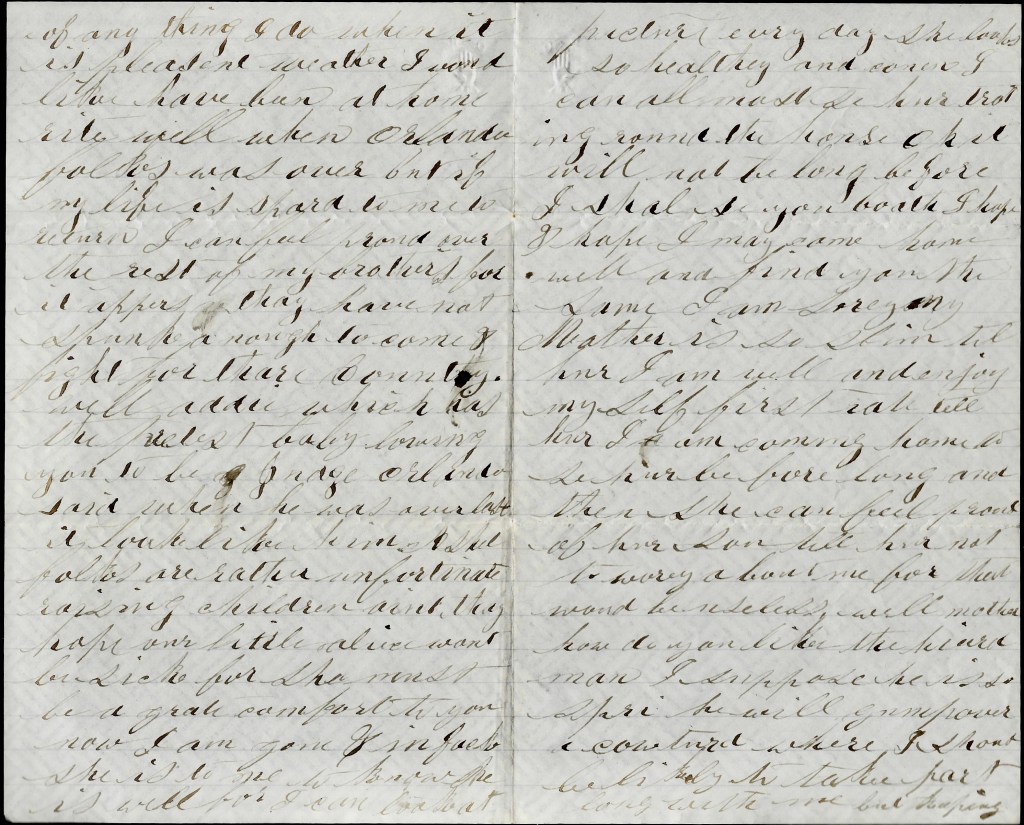
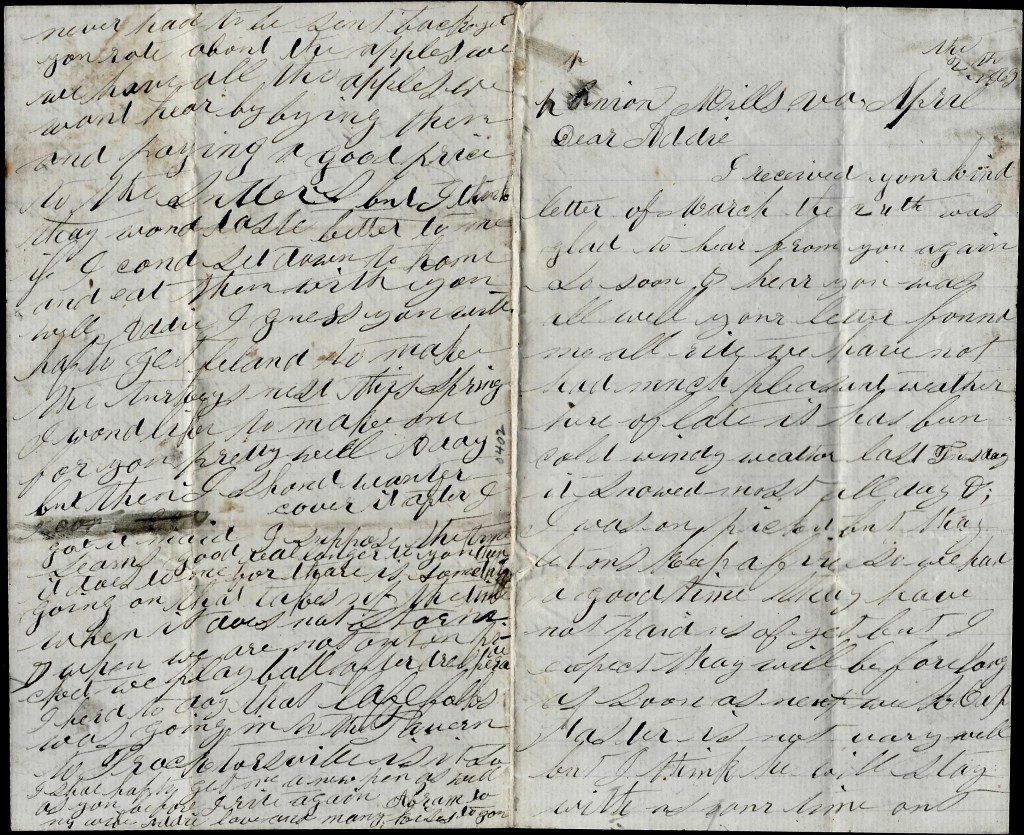
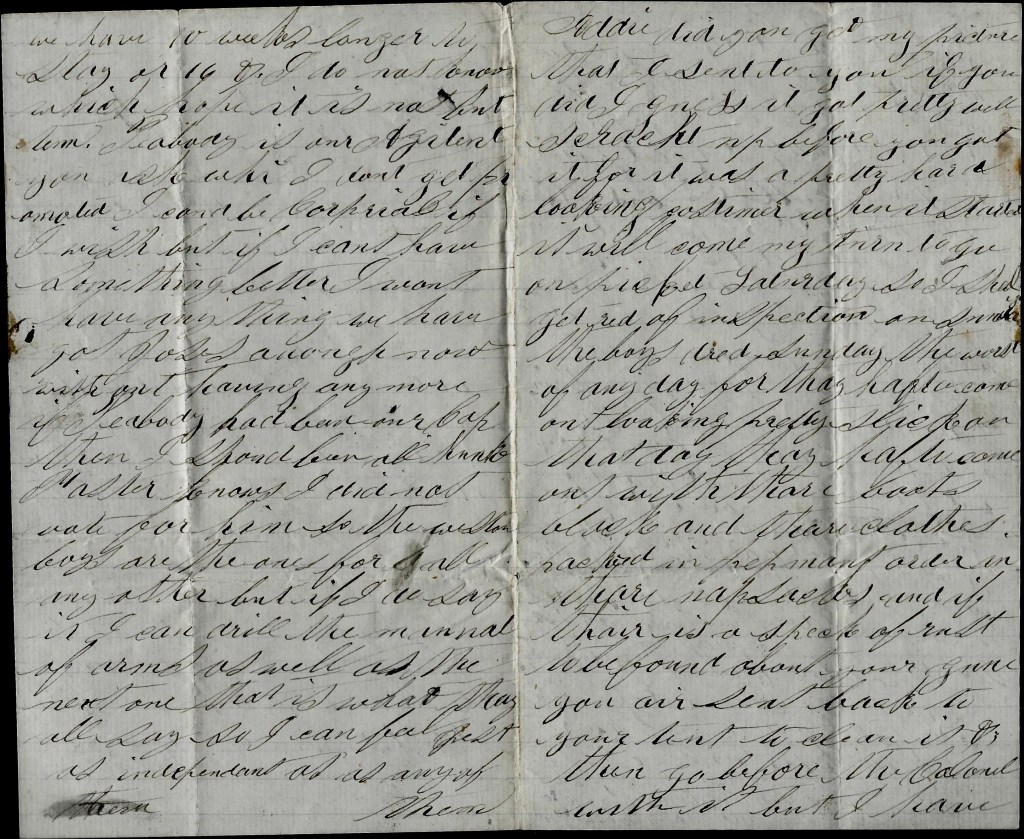
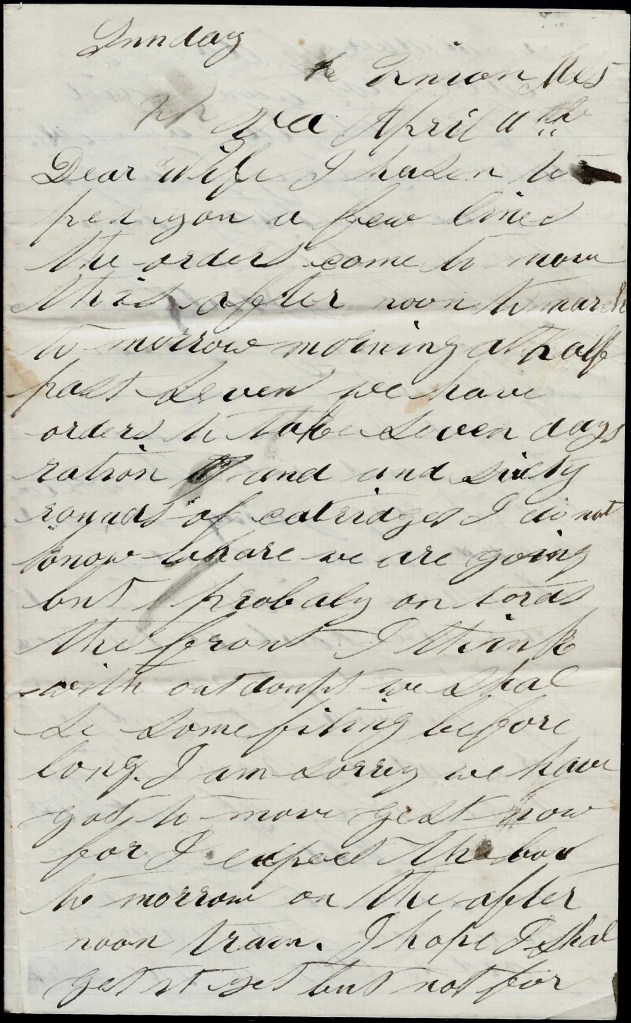
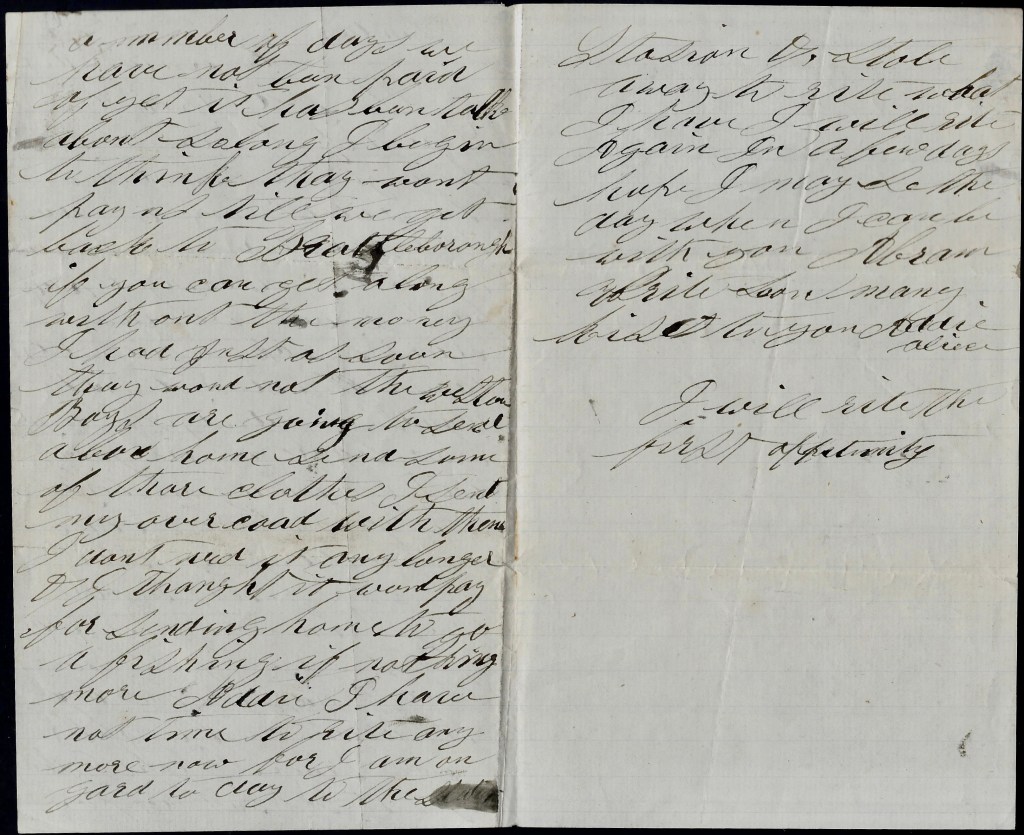
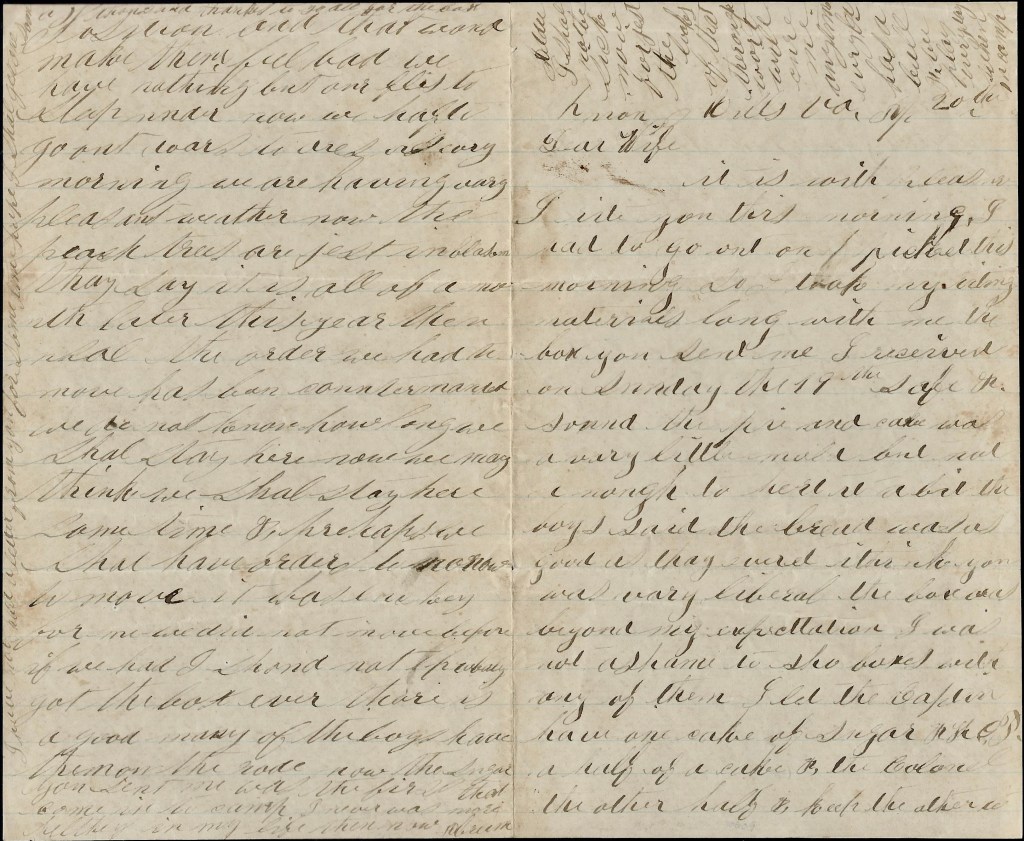
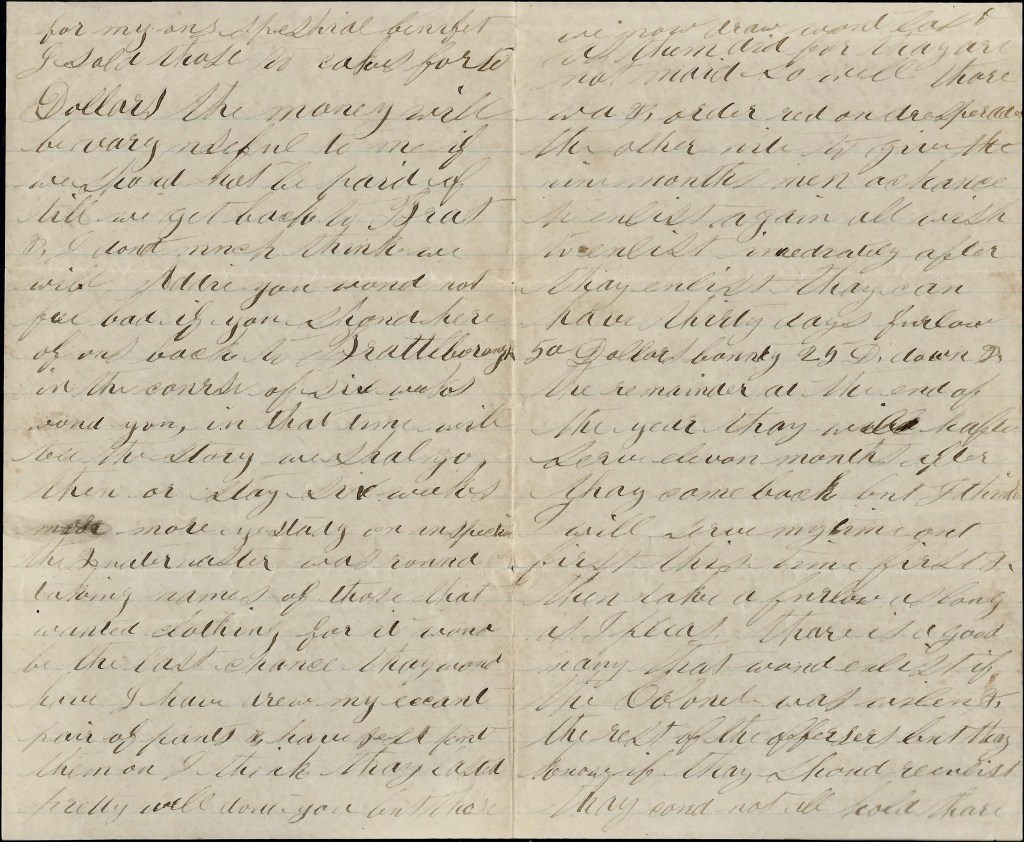

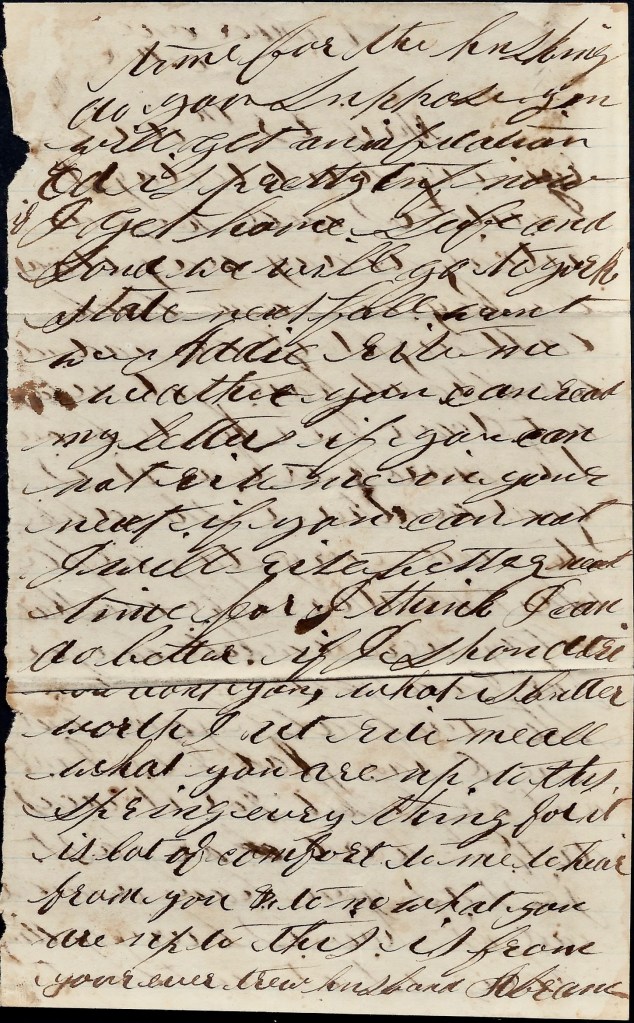
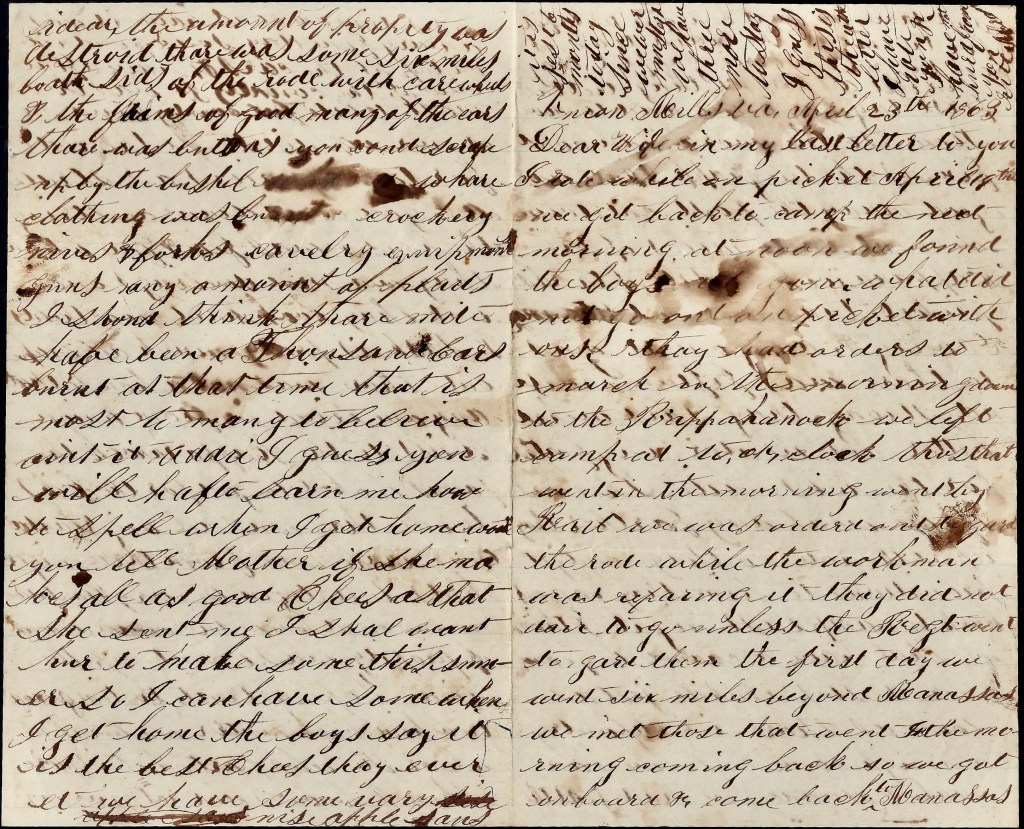
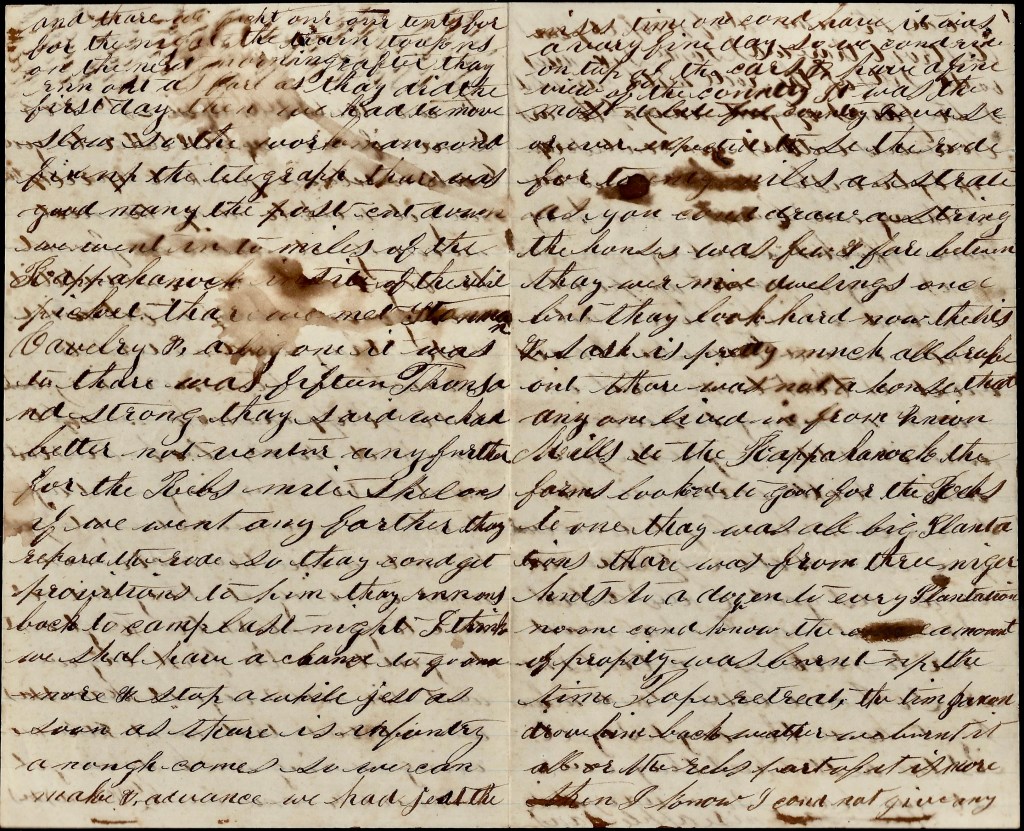
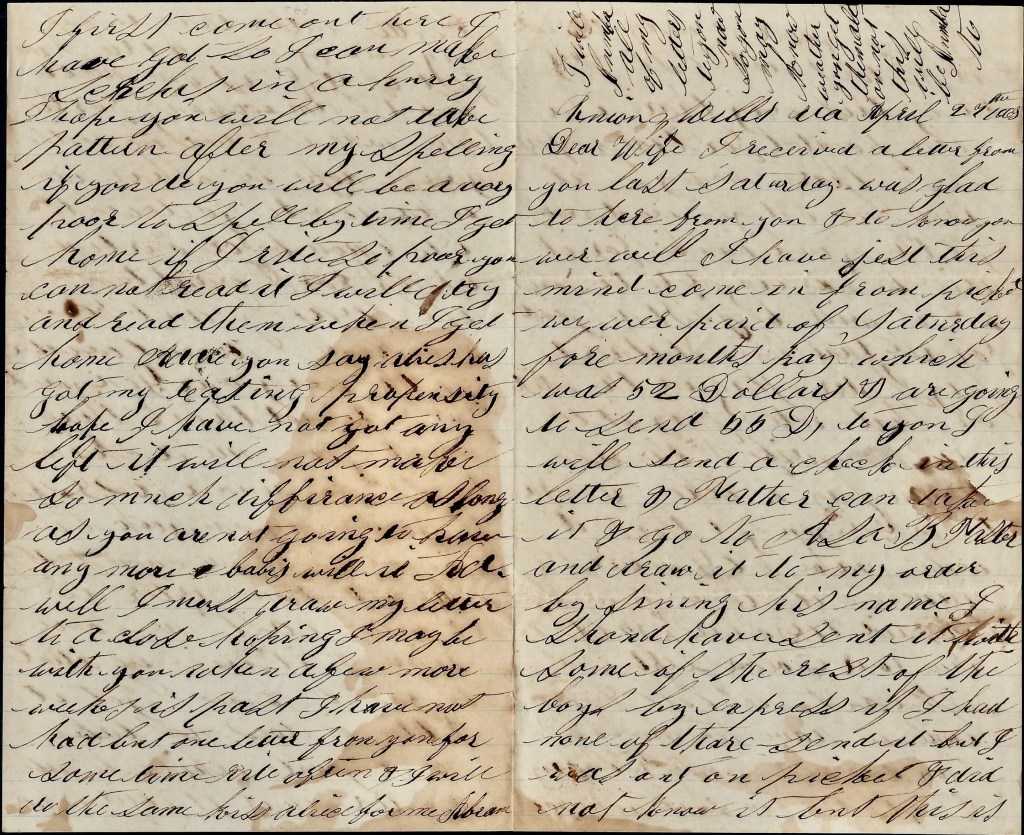
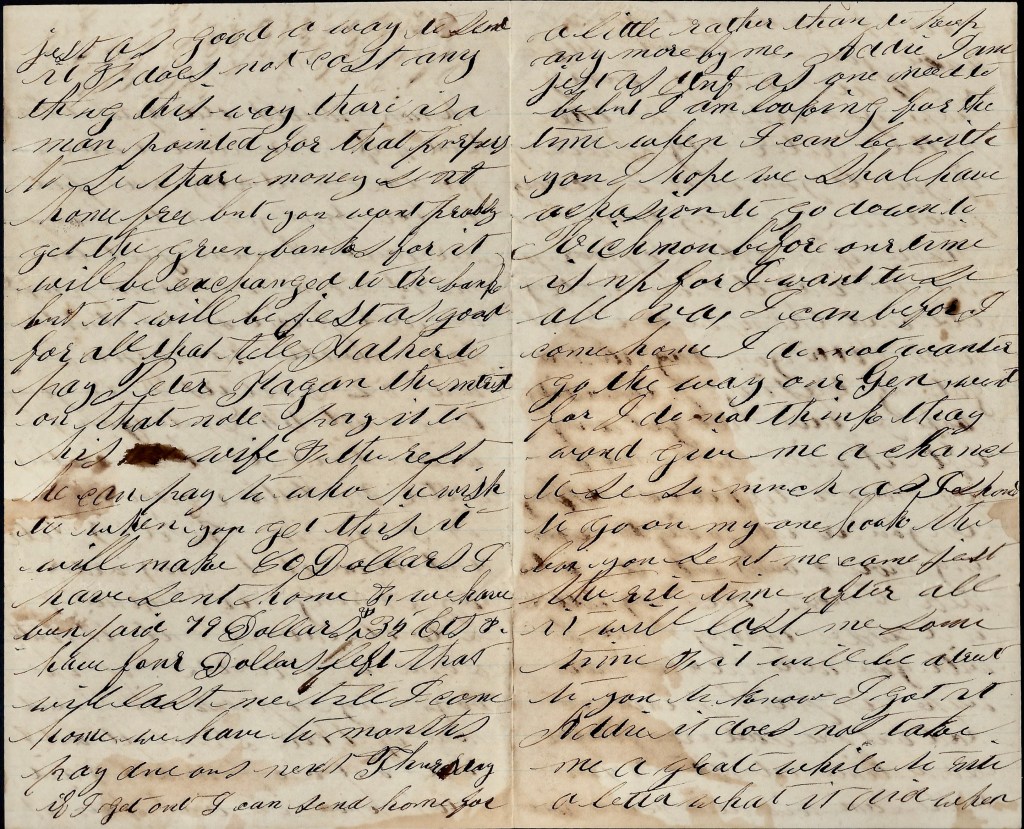

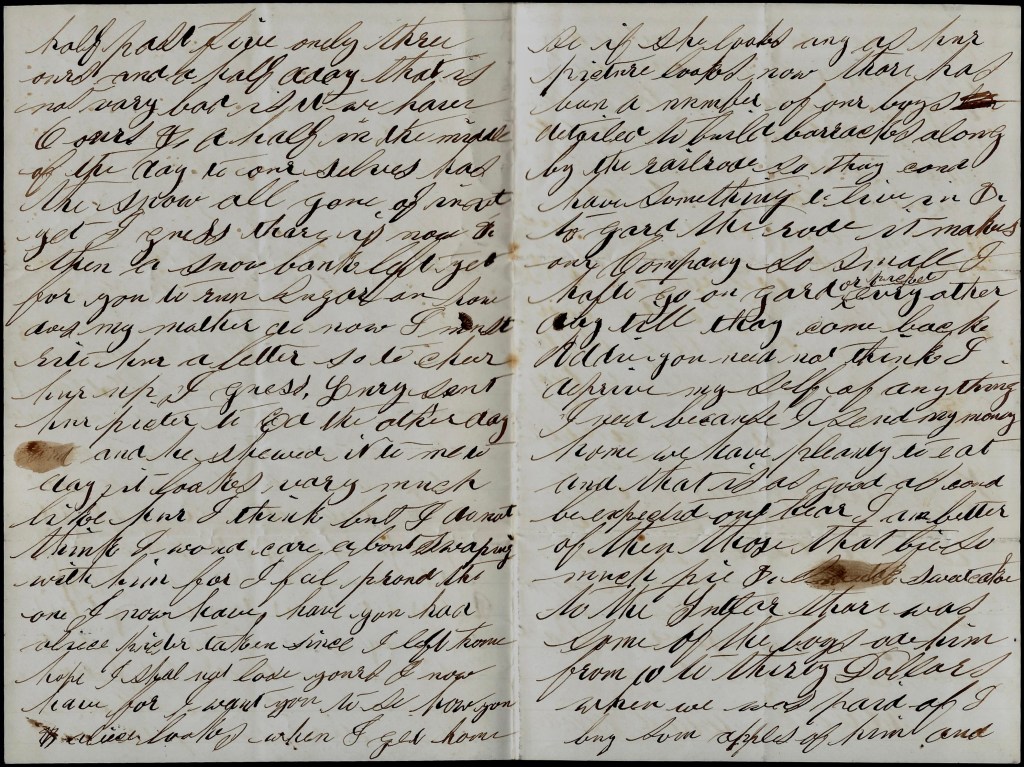
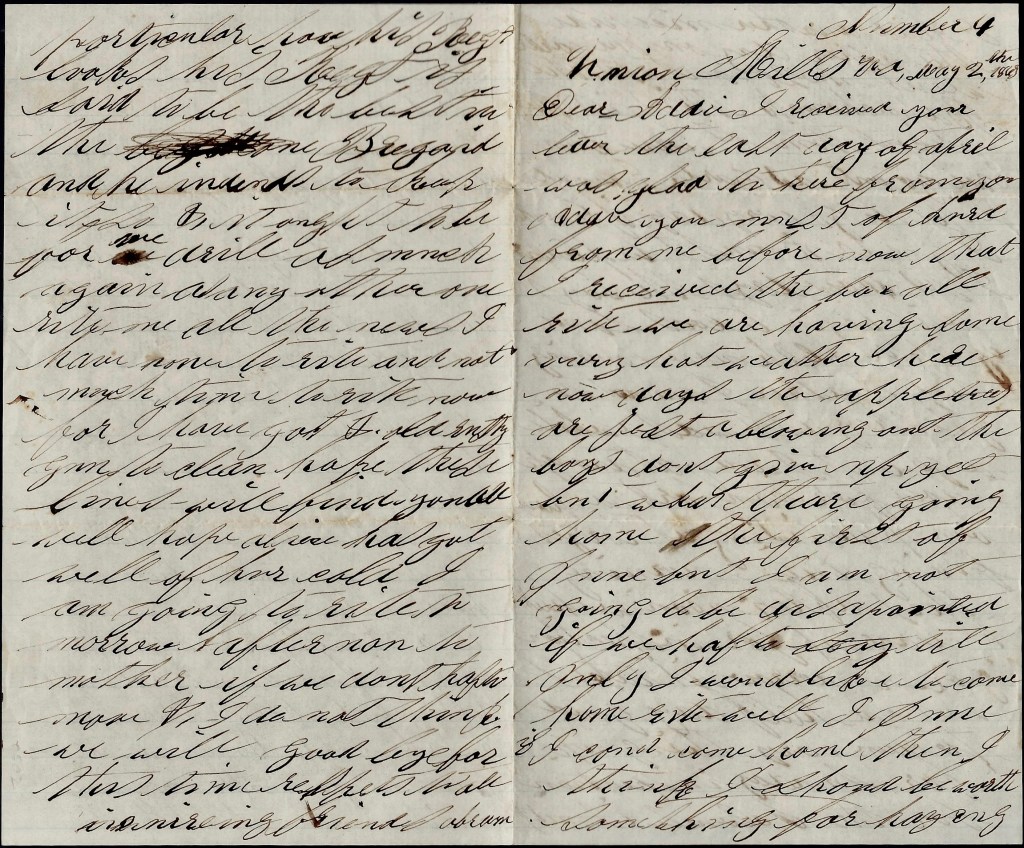
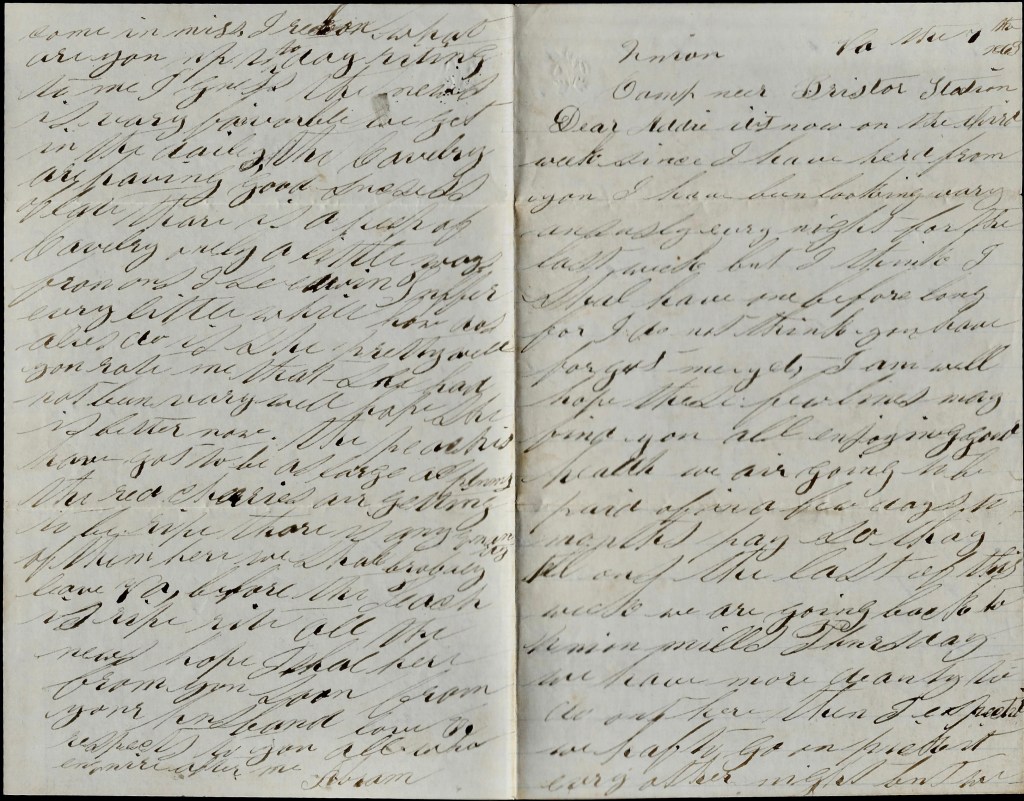
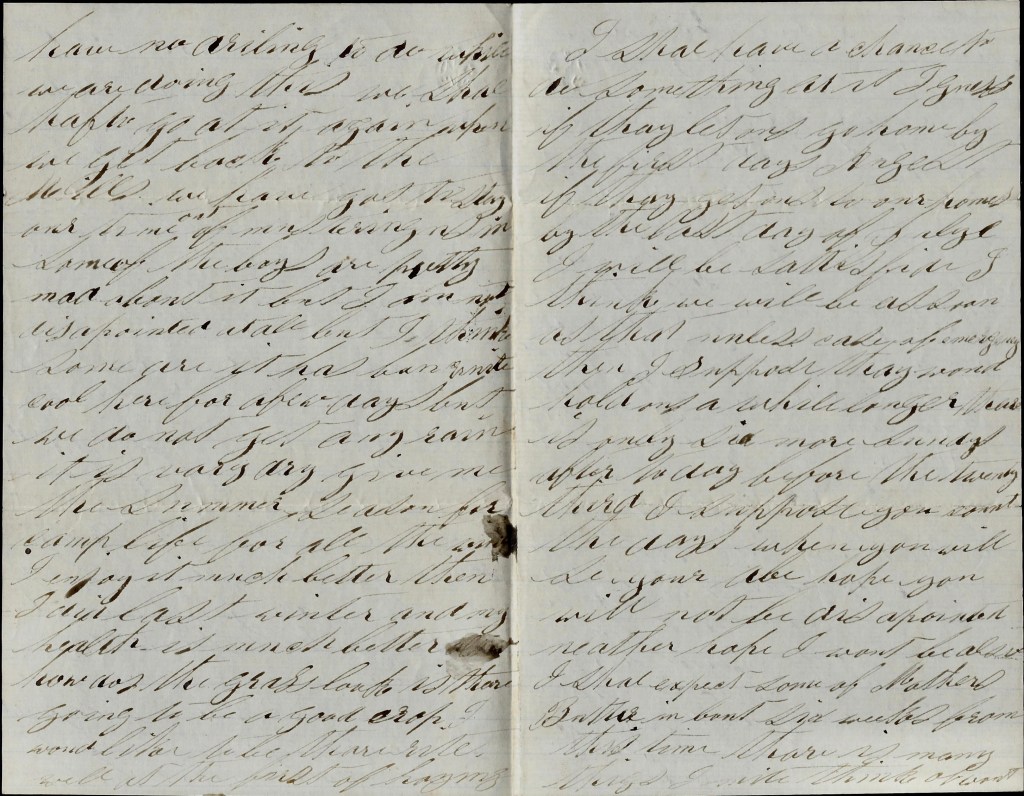


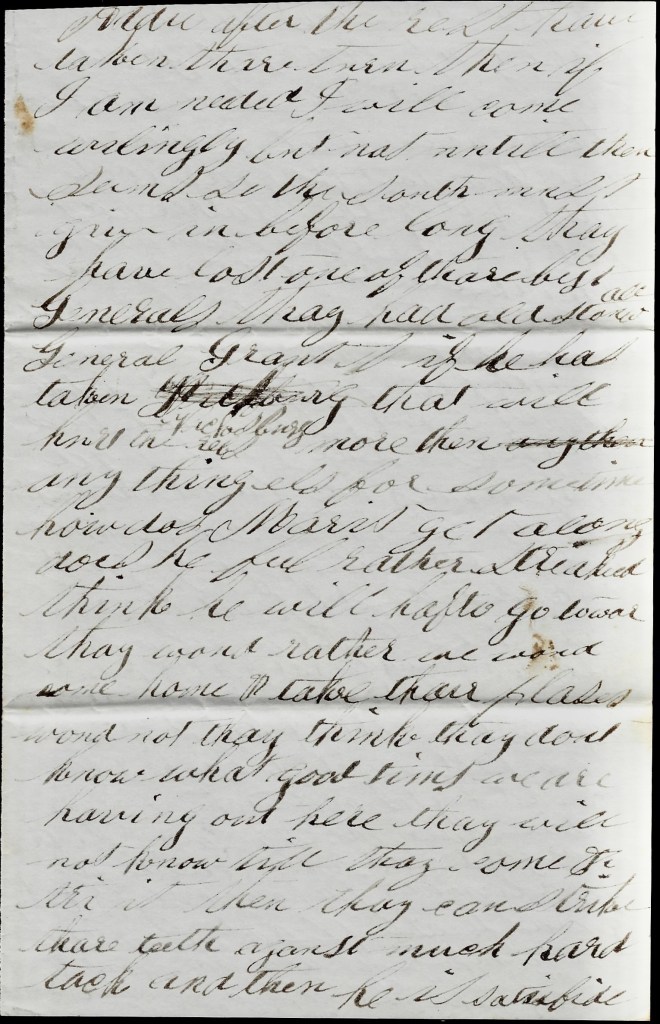
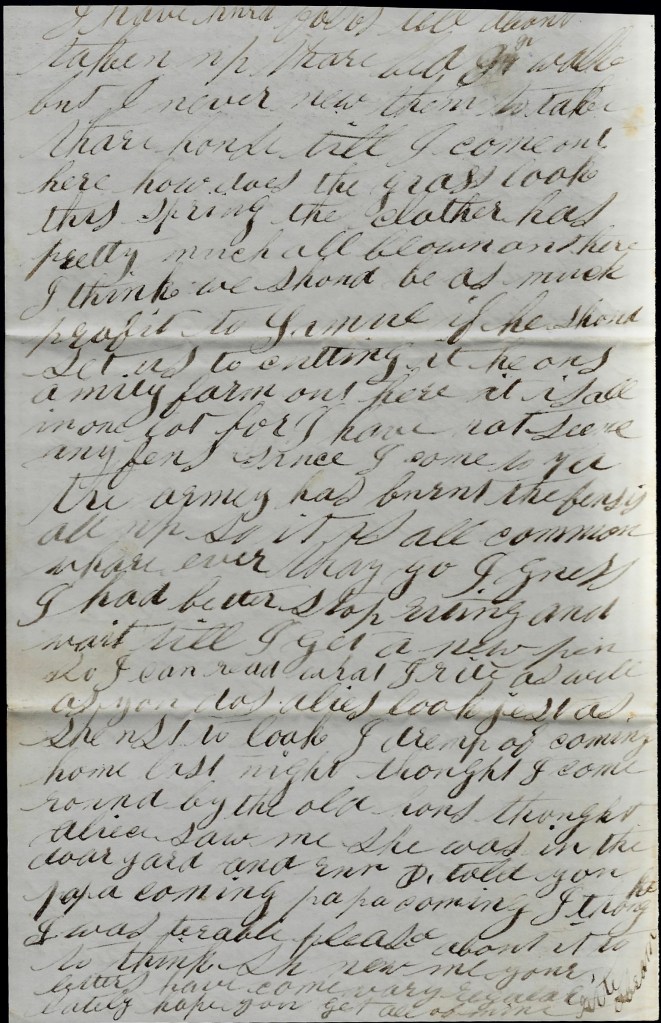

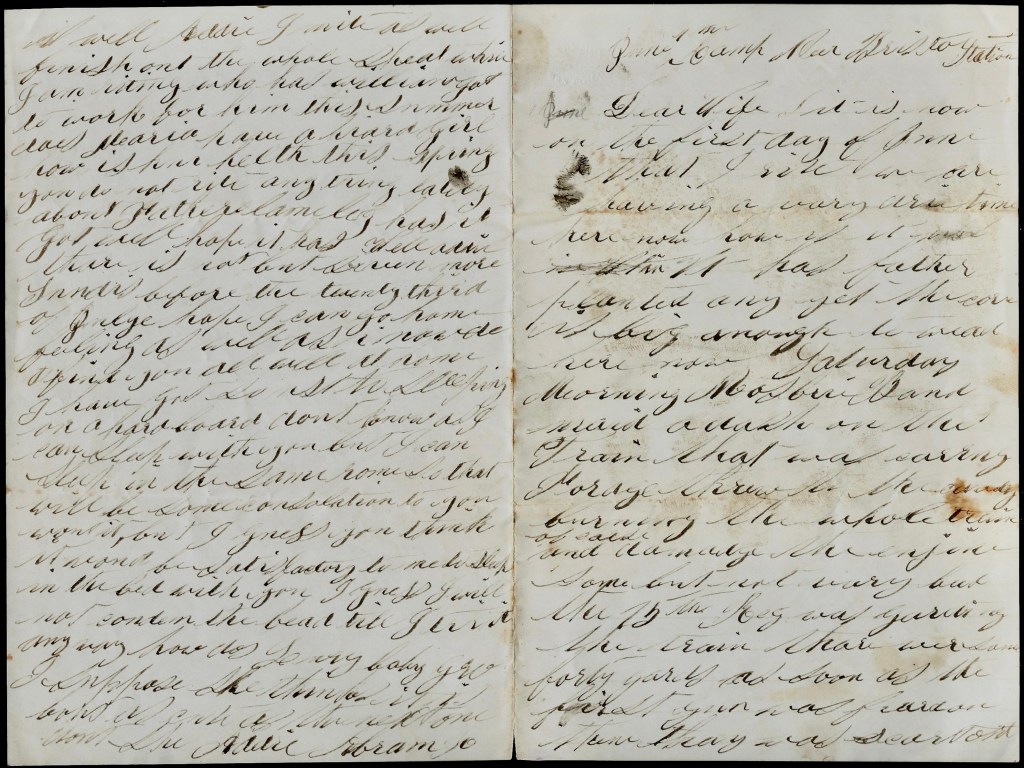
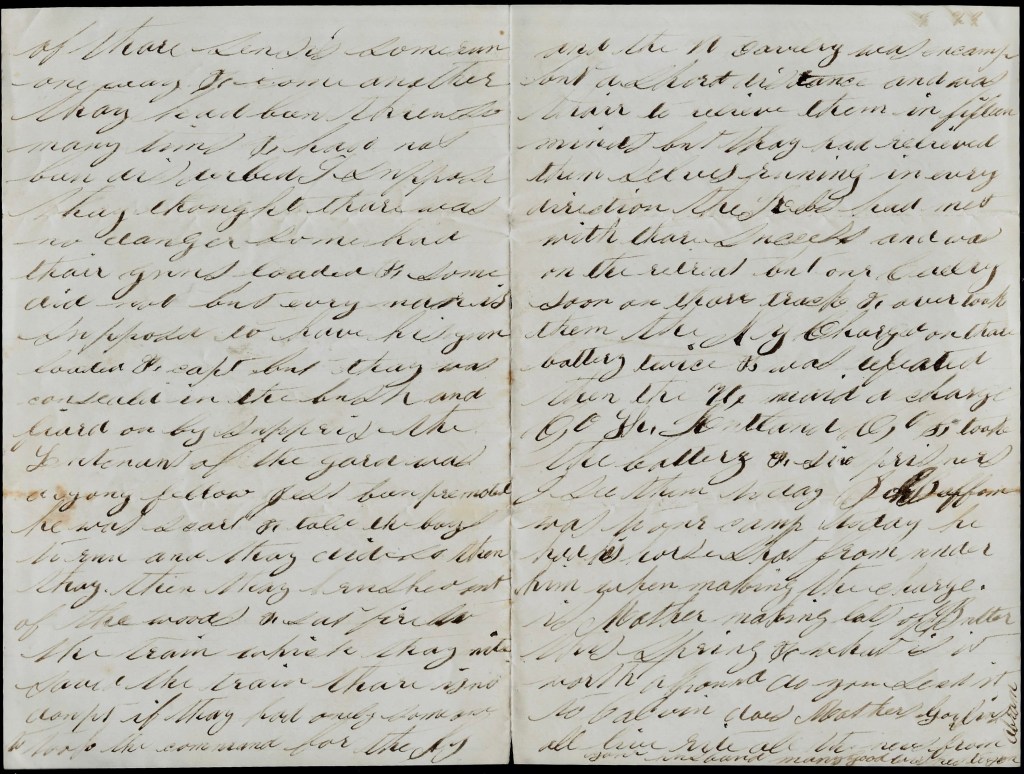

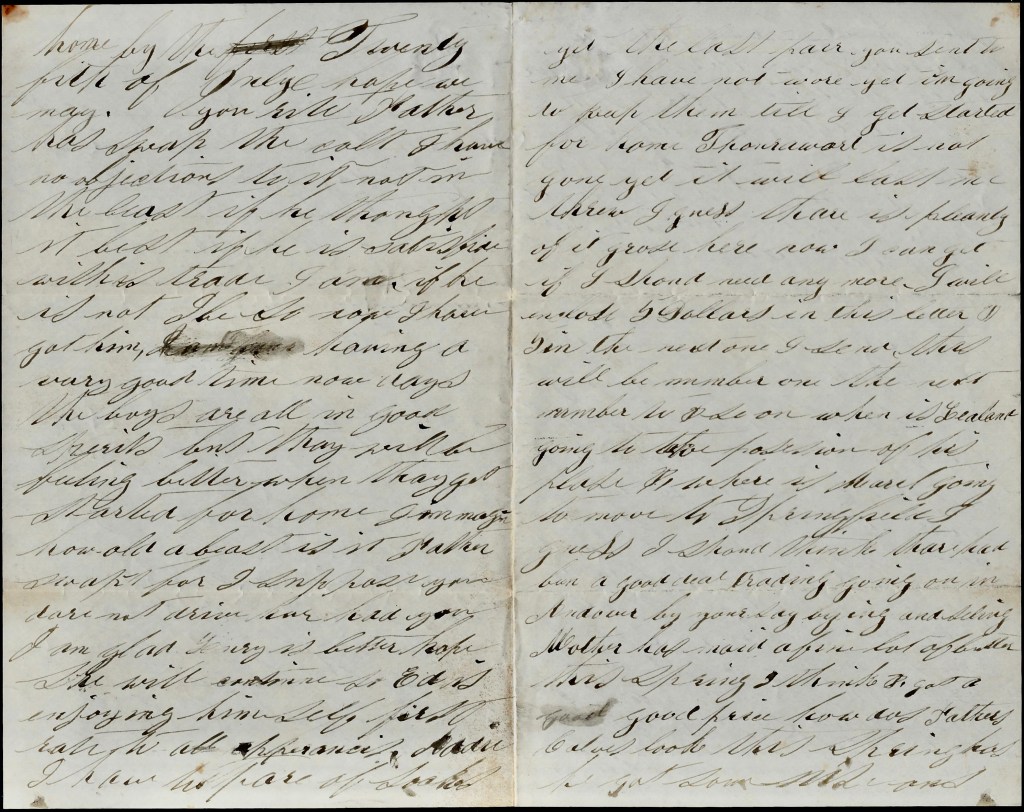
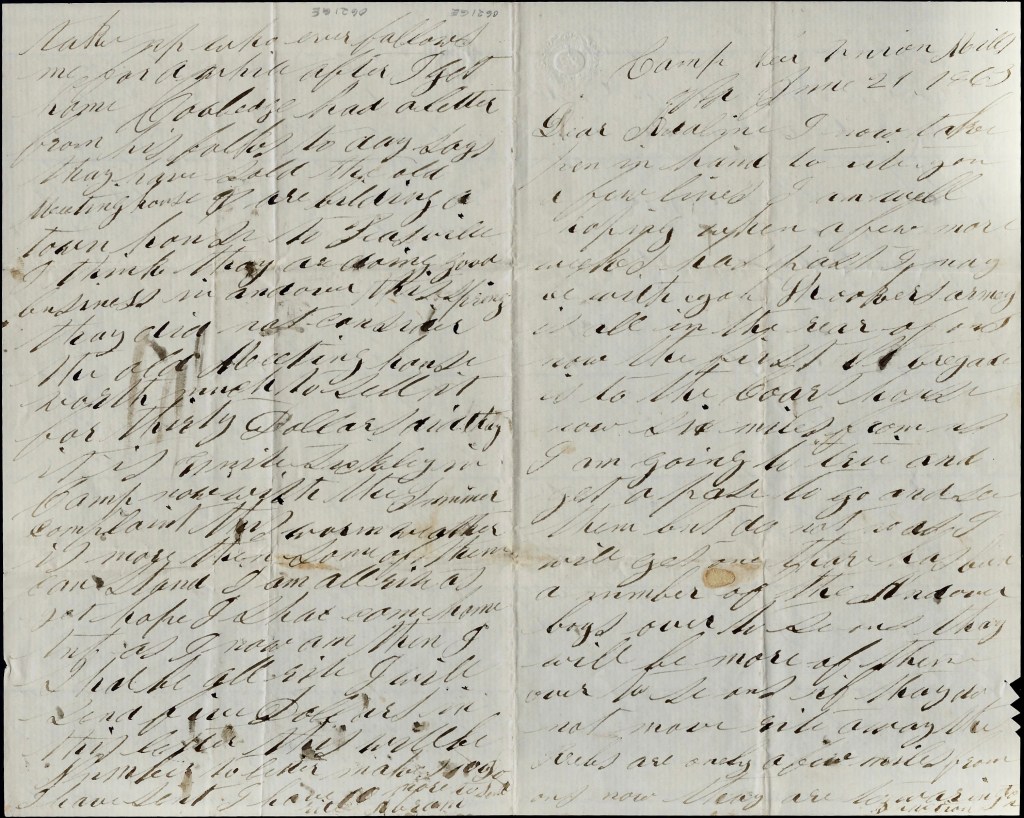

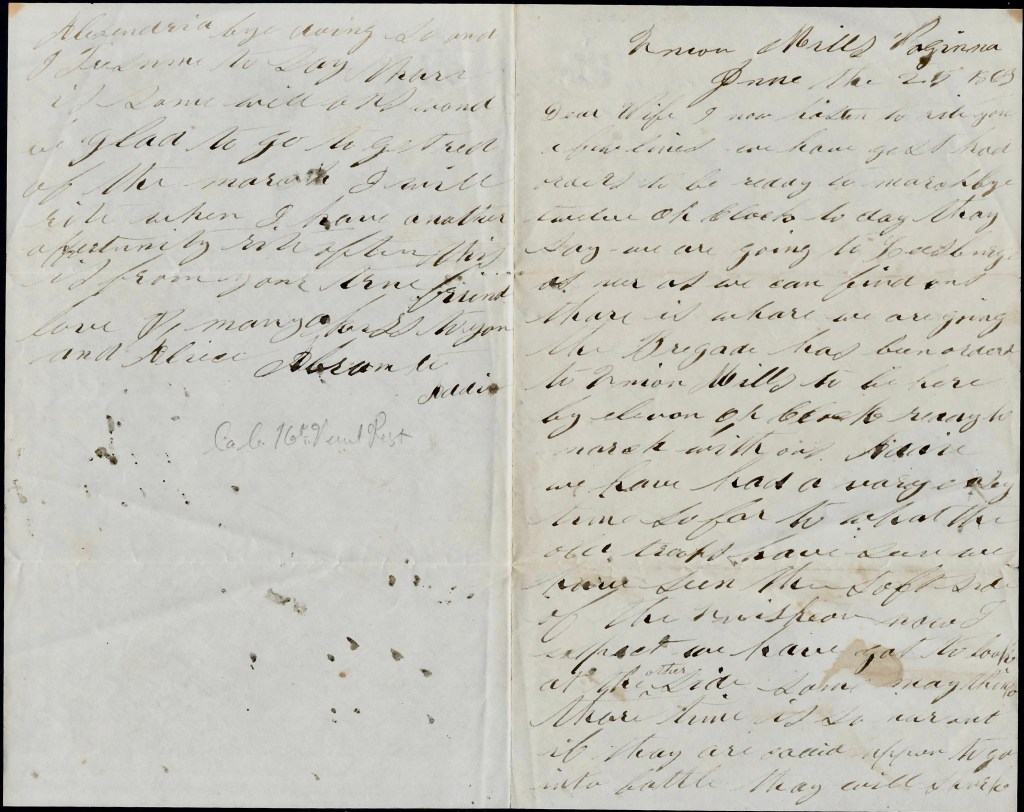
 Spared & Shared 23