The following letter was written by James Paltridge (1839-1927) of Ulster county, New York, who enlisted on 2 September 1862 when he was 25 years old to serve three years in Co. E, 156th New York Infantry. He mustered in as a private and was promoted to Corporal on 14 June 1865, and to Sergeant on 1 May 1865.
James’ younger brothers, Edmund (1842-1926) and Samuel (1844-1924) also served in the same company. They were the three of at least eight sons and one daughter born to Richard O. Paltridge (1812-1881) and Hannah D. Elmendorf (1813-1880) of Moderna, Ulster county, New York.
James survived the war and returned to Modena where he married Josephine Babcock (1847-1922) in 1867 and labored as a carpenter.
James’ letter was addressed to his captain, Matthias S. Euen, Co. E, 156th New York Volunteers. Captain Euen had been wounded at Port Hudson in June 1863 but was sent East in the winter of 1863-64 to gather conscripts for the regiment.
Transcription
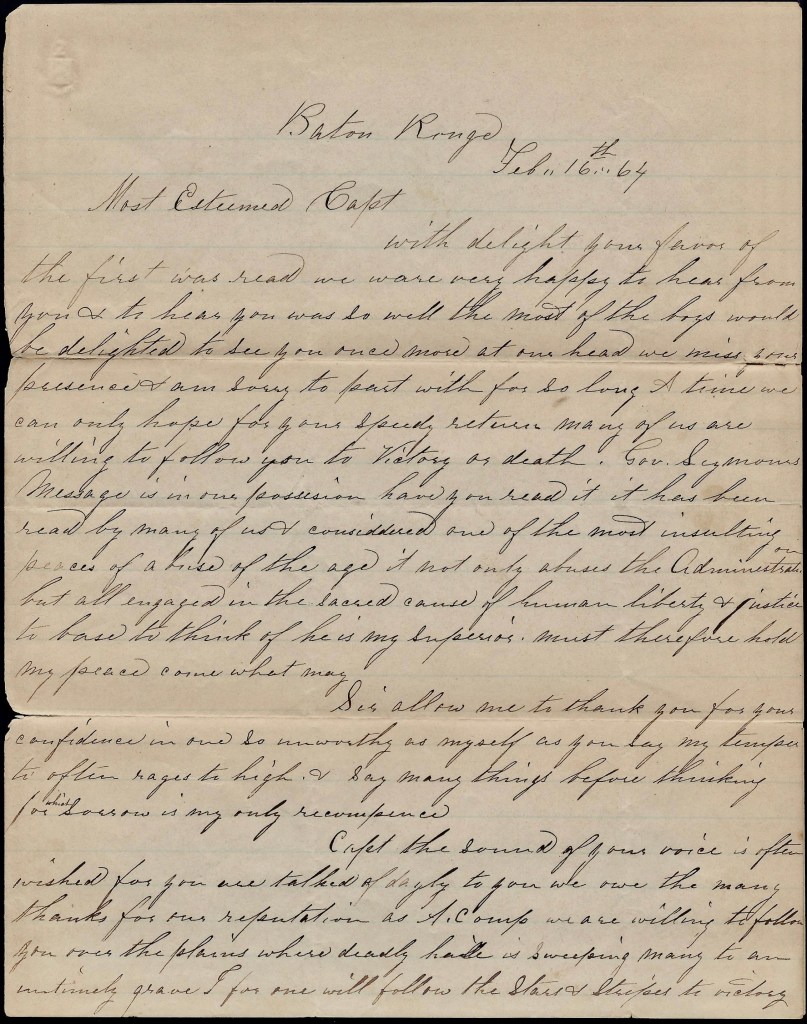
Baton Rouge [Louisiana] February 16th 1864
Most Esteemed Captain,
With delight your favor of the first was read. We were very happy to hear from you & to hear you was so well. The most of the boys would be delighted to see you once more at our head. We miss your presence & am sorry to part with for so long a time. We can only hope for your speedy return. Many of us are willing to follow you to victory or death.
Gov. Seymour’s message is in our possession. Have you read it? It has been read by many of us & considered one of the most insulting pieces of abuse of the age. It not only abuses the Administration but all engaged in the sacred cause of human liberty & justice—too base to think of. [But as] he is my superior, must therefore hold my peace come what may. 1
Sir, allow me to thank you for your confidence in one so unworthy as myself as you say my temper too often rages too high & say many things before thinking for which sorrow is my only recompense. Captain, the sound of your voice is often wished for. You are talked of daily. To you we owe the many thanks for our reputation as a company. We are willing to follow you over the plains where deadly hail is sweeping many to an untimely grave. I for one will follow the Stars & Stripes to victory or beneath its ample folds fill the rude grave of a soldier. Down with treason—North or South; a crime abhorred by God & true men.
The appearance of the company is as usual. We have clothes & food plenty, are doing Provost Duty, and having good times. James Jansen & [Jabez H.] Crookston started for home today on a furlough. We have no others sick in E Company.
You will please pardon my other note for I had many things on my mind. If I have caused any trouble, am sorry for it and hope you will forgive me with very many wishes for your speedy return. Will close. If you deem this worthy of answer, your letters will be gladly received. The boys, one & all, send their compliments. You may think mine included for they are. Believe me, Sir, to be your subordinate and friend, — James Paltridge
P. S. Shall be very happy to receive your carte-de-visite. There was a mass meeting here yesterday. It was listened to by many of the people of this State. [They] hold their election on the 22nd. The meeting was addressed by Mr. [Michael] Hahn of this state, & a gentleman from Massachusetts.
1 New York Governor Horatio Seymour’s speech was critical of the Lincoln Administration’s prosecution of the war and strongly aligned with the Copperheads in the North who opposed the continuation of the war.
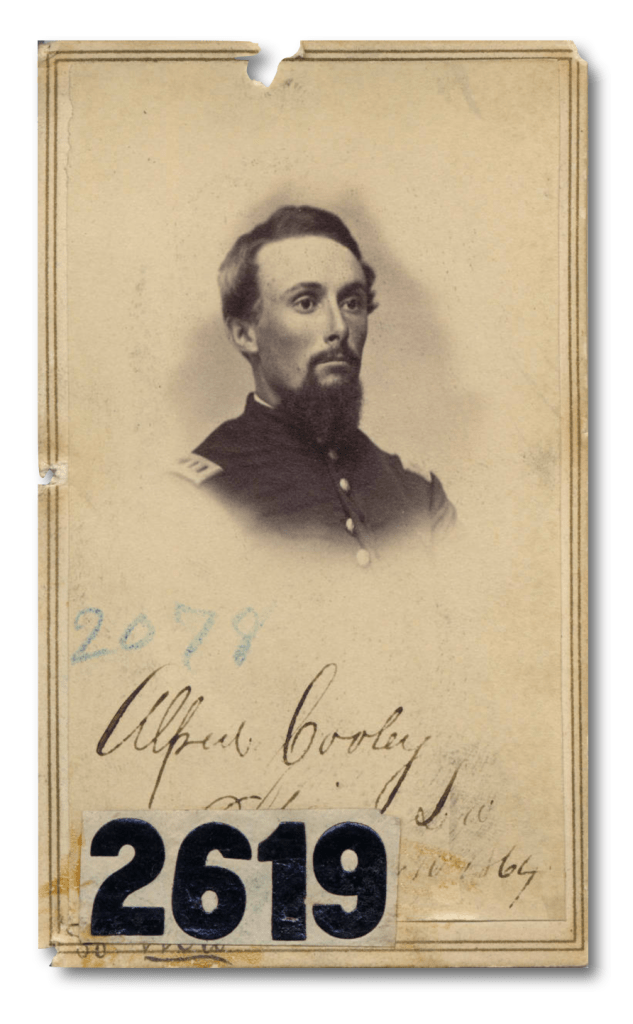
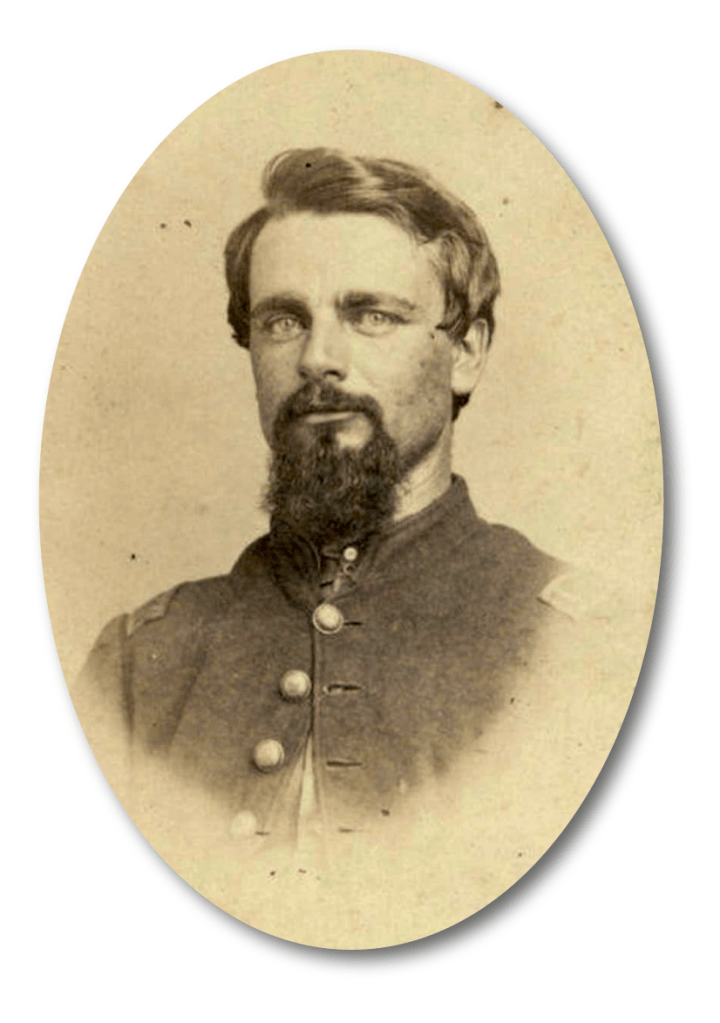
Alfred Cooley after his promotion to Captain of Co. G, 156th New York Infantry
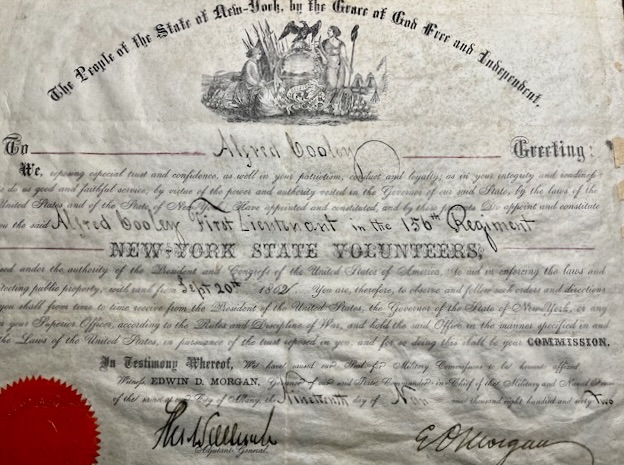
The following letters were written by Alfred Cooley (1839-1899) of Ulster county, New York, who was 28 years old when he enlisted to serve three years in the 156th New York Infantry. He was mustered in as 1st Lieutenant of Co. E on 20 September 1862 and was promoted to Captain of Co. G on 26 January 1864, replacing Capt. John Donaldson who died of disease in September 1863. Alfred survived the war and mustered out with his company at Augusta, Georgia, in October 1865.
Cooley commanded his company in the fight at Cedar Creek where the regiment lost 92 killed, wounded and missing. It was in this engagement, after several of the color-guard had fallen, that the regimental colors were narrowly saved from capture by the bravery of Capt. Alfred Cooley, who stripped the colors from the staff and brought them safely off the field.
Alfred was the son of Charles E. Cooley (1808-1860) and Margaret Ann Esterly (1811-1882) of Modena, Ulster county, New York.
Both letters were addressed to his captain, Matthias S. Euen, Co. E, 156th New York Volunteers. Captain Euen had been wounded at Port Hudson in June 1863 but was sent East in the fall of 1863 to gather conscripts for the regiment.
Letter 1
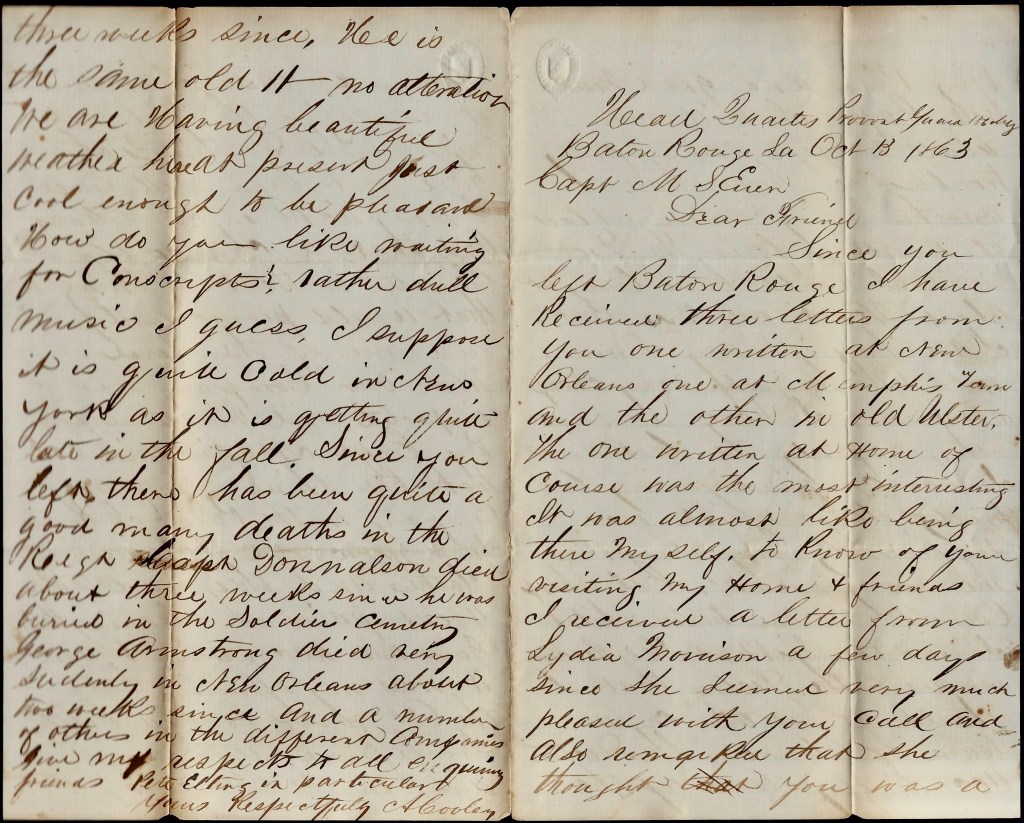
Headquarters Provost Guard 156th NY Baton Rouge, La. October 13, 1863
Capt. M. S. Euen Dear friend,
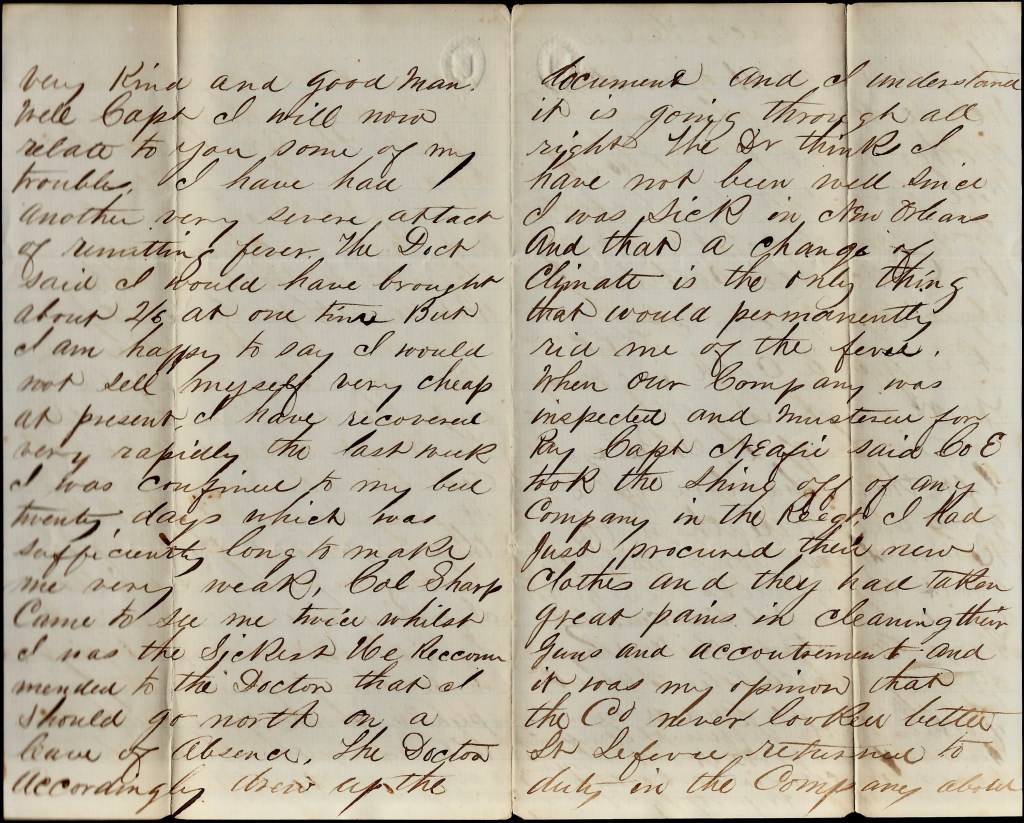
Since you left Baton Rouge, I have received three letters from you—one written at New Orleans, one at Memphis, Tenn., and the other in old Ulster. The one written at home of course was the most interesting. It was almost like being there myself to know of your visiting my home & friends. I received a letter from Lydia Morrison a few days since. She seemed very much pleased with your call and also remarked that she thought you was a very kind and good man.
Well, Capt., I will now relate to you some of my troubles. I have had another very severe attack of remittent fever. The doctor said I would have brought about 2/6 at one time. But I am happy to say I would not sell myself very cheap at present. I have recovered very rapidly the last week. I was confined to my bed twenty days which was sufficiently long to make me very weak. Col. Sharpe came to see me twice whilst I was the sickest. He recommended to the doctor that I should go North on a leave of absence. The doctor accordingly drew up the documents and I understand it is going through all right. The doctor thinks I have not been well since I was sick in New Orleans and that a change of climate is the only thing that would permanently rid me of the fever.
When our company was inspected and mustered for pay, Capt. [Alfred] Neafie said Co. E too the shine off of any company in the regiment. I had just procured then new clothes and they had taken great pains in cleaning their guns and accoutrements and it was my opinion that the company never looked better.
Lt. [Johannes] Lefevre returned to duty in the company about three weeks since. He is the same old Lt.—no alteration.
We are having beautiful weather here at present—just cool enough to be pleasant. How do you like waiting for conscripts? Rather dull music I guess. I suppose it is quite cold in New York as it is getting quite late in the fall. Since you left there has been quite a good many deaths in the regiment. Capt. [John] Donaldson died about three weeks since. He was buried in the Soldier’s Cemetery. George Armstrong died very suddenly in New Orleans about two weeks since and a number of others in the different companies.
Give my respects to all enquiring friends—Pete Elting in particular. Yours respectfully, — A. Cooley
Letter 2
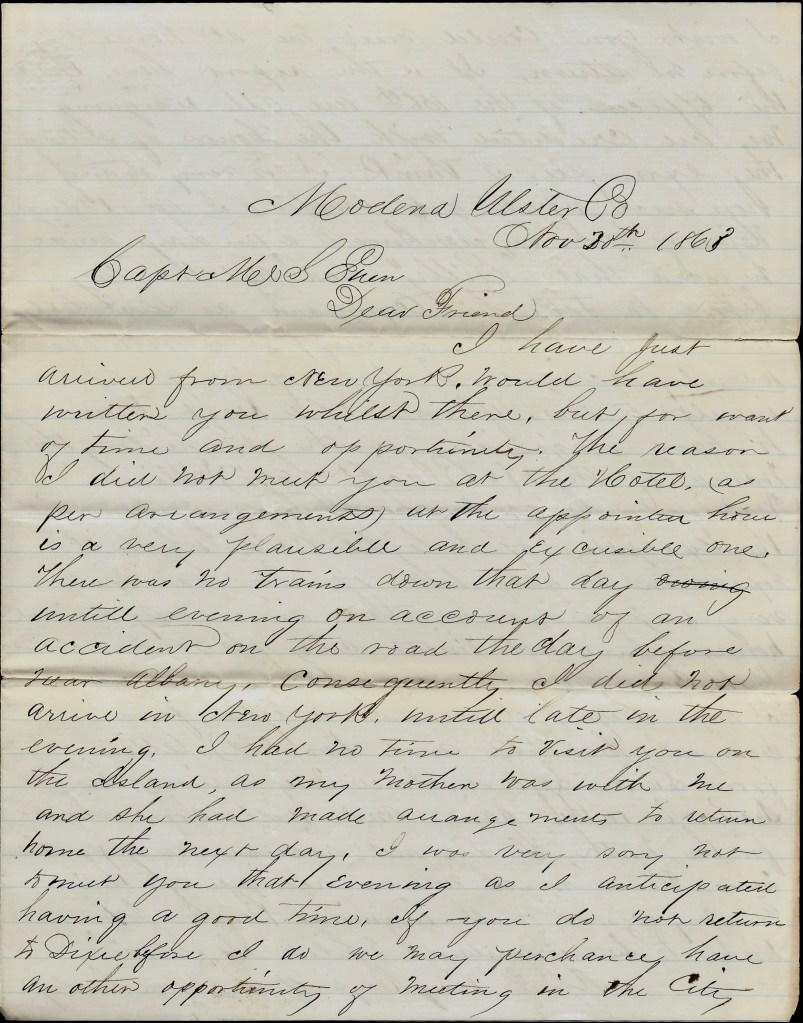
Modena, Ulster county [New York] November 20, 1863
Capt. M. S. Euen Dear friend,
I have just arrived from New York. Would have written you whilst there but for want of time and opportunity. The reason I did not meet you at the Hotel (as per arrangements) at the appointed hour is a very plausible and excusable one. There was no trains down that day until evening on account of an accident on the road the day before near Albany. Consequently, I did not arrive in New York until late in the evening. I had not time to visit you on the Island as my Mother was with me and she had made arrangements to return home the next day. I was very sorry not to meet you that evening as I anticipated having a good time. If you do not return to Dixie before I do, we may perchance have another opportunity of meeting in the City. I wish you could visit me at home before we return.
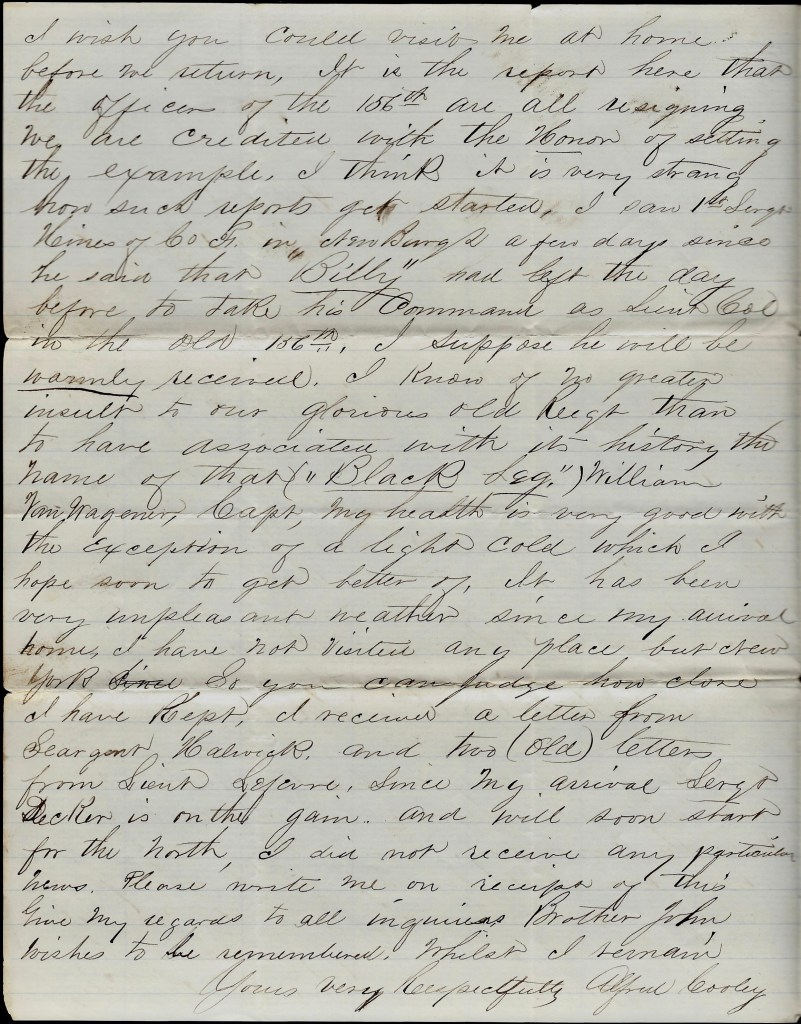
It is the report here that the officers of the 156th are all resigning. We are credited with the Honor of setting an example. I think it is very strange how such reports get started. I saw 1st Sergeant Hines of Co. F in Newburgh a few days since. He said that “Billy” had left the day before to take his command as Lieut. Colonel in the old 156th. I suppose he will be warmly received. I know of no greater insult to our glorious old regiment than to have associated with its history the name of that (“Black Leg”) William Van Wagenen. 1
Capt., my health is very good with the exception of a light cold which I hope soon to get better of. It has been very unpleasant weather since my arrival home. I have not visited any place but New York so you can judge how close I have kept.
I received a letter from Sergeant [Peter M.] Halwick and two (old) letters from Lieut. [Johannes] Lefevre since my arrival. Sergt. [Philip T.] Decker is on the gain and will soon start for the North. I did not receive any particular news. Please write me on receipt of this. Give my regards to all inquiries. Brother John wishes to be remembered. Whilst I remain yours very respectfully, — Alfred Cooley
1 William Van Wagenen was 40 years old when he was mustered into the 156th New York Infantry as captain of Co. C. He was courtmartialed in March 1863, found guilty of numerous charges and fellow officers resisted efforts by Van Wagenen to be reinstated by his political allies. Later in the year he was found guilty of making false statements under oath connected with “a false muster” of himself as Major of the 156th Regiment. He was even arrested and thrown in jail for defrauding recruits from their bounty. See 1863: Evert D. Keator’s Deposition.
Alfred Cooley’s Commission as 1st Lieutenant in Co. E, 156th New York Volunteers
Lt. Johannes Lefevre of Co. E, 156th New York Infantry. He was later seriously wounded in the battle of Cedar Creek and died three weeks later. [Historic Hugenot Street]
The following letters were written by Johannes Lefevre (1837-1864) who enlisted at the age of 26 in Ulster county to serve three years in Co. E, 156th New York Volunteers. He was mustered in as second lieutenant on September 20, 1802; as first lieutenant of Co. B on October 31, 1863; and as captain of Co. E, December 19, 1863. He was wounded in action on October 19,1864, at Cedar Creek, Virginia, and died of his wounds on November 9, 1864, at Winchester, Virginia.
Johannes was the son of Josiah P. Lefevre (1811-1893) and Elizabeth Lefevre (1815-1899) of New Paltz, Ulster county, New York. Johannes attended the New Paltz Academy and then graduated from Claverack Academy in 1860. He followed this with scientific and engineering studies at Union College before entering the service.
All four letters were addressed to his captain, Matthias S. Euen, Co. E, 156th New York Volunteers. Captain Euen had been wounded at Port Hudson in June 1863.
To read other letters by members of the 156th New York Infantry I’ve transcribed and published on Spared & Shared, see: John Stamford Thompson, Co. G, 156 New York (1 Letter) Phillip J. Miller, Co. I, 156th New York (21 Letters)
Letter 1
Headquarters Provost Guard from 156th Regt. N. Y. Infantry November 2, 1863
Dear Captain,
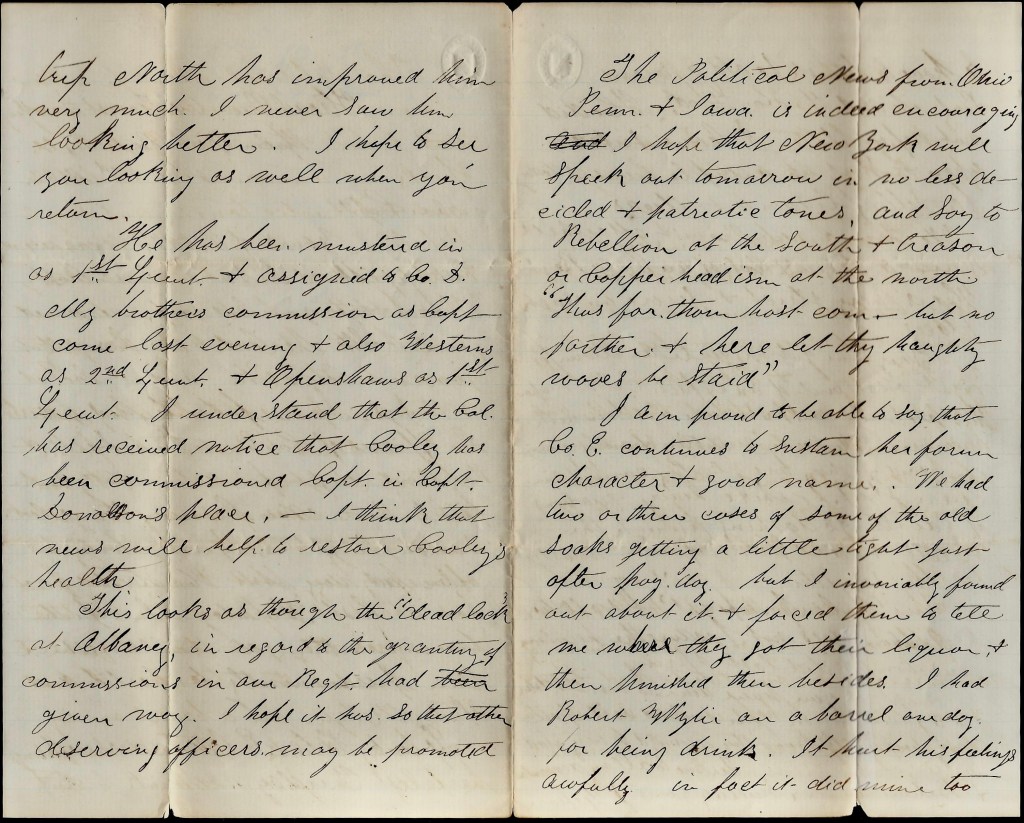
Yours of October 18th was received last night. I was most happy to hear that you had so far recovered your health. I had once heard that you was very sick and it looked as though some fatality had possessed the officers of Co. E—two sick and the third unfit for active duty in the field. Now, however, things look much brighter, Lieut. [Alfred] Cooley has recovered very fast. He started for home last Thursday. I hope the bracing northern air will restore him permanently to health and strength.
Lieut. Peter Eltinge [Co. D] arrived here last Friday. I think his trip North has improved him very much. I never saw him looking better. I hope to see you looking well when you return. He has been mustered in as 1st Lieutenant & assigned to Co. D. My brother [Peter]’s commission as captain [of Co. H] came last evening and also [Charles B.] Western’s as 2nd Lieutenant [in Co. K] & [Edward Openshaw’s as 1st Lieutenant [of Co. E]. I understand that the Colonel has received notice that Cooley has been commissioned Capt. in Capt. [John] Donaldson’s place [in Co. G]. I think that news will help to restore Cooley’s health.
This looks as though the “deadlock” at Albany in regard to the granting of commissions in our regiment had given way. I hope it has so that other deserving officers may be promoted. The political news from Ohio, Pennsylvania, and Iowa is indeed encouraging. I hope that New York will speak out tomorrow in no less decided and patriotic tones, and say to rebellion of the South & treason or Copperheadism at the North, “Thus far thou hast come, but no farther & here let thy haughty waves be staid.”
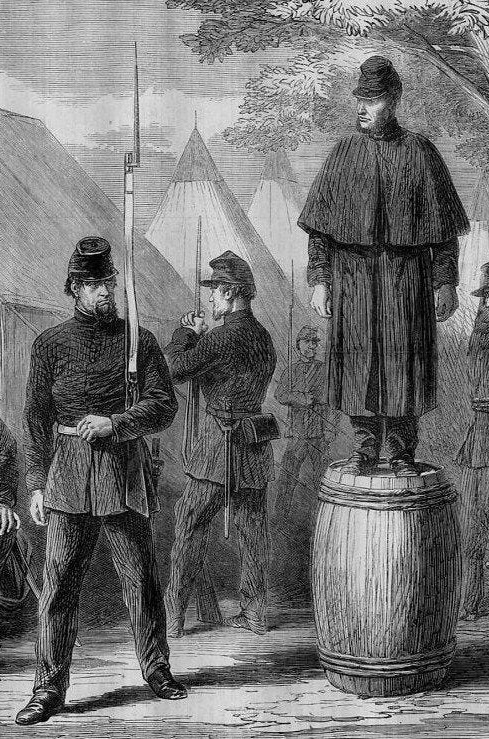
Standing on a barrel for a length of time was one form of punishment during the Civil War.
I am proud to be able to say that Co. E continues to sustain her former character and good name. We had two or three cases of some of the old soaks getting a little tight just after payday but I invariably found out about it and forced them to tell me where they got their liquor & then punished them besides. I had [44 year-old] Robert Wylie on a barrel one day for being drunk. It hurt his feelings awfully. In fact, it did mine too to have to punish so old a man. But it did the company good. He did not repeat it. I have seized upon & shut up a couple houses for selling liquor to soldiers. We have a new Provost Marshall here—a Lieutenant Colonel of an Ohio Regiment. He is very strict and severe on such places.
They have got up quite an alarm tonight on account of an expected attack upon this post. The outposts have all been withdrawn. The heavy rumbling of artillery wagons is heard and they are planting cannon in every street while heavy squadrons of cavalry go dashing through the streets. All this preparation must mean something. I can’t say that we are “Spilin’ for a fight,” but all this preparation does not produce the peculiar sensation it did last spring.
Captain, if you have time to visit Ulster county again, I wish you would call upon my people. I know they would be very glad to see you. Remember me to all my acquaintances & believe me ever sincerely yours, — J. Lefevre
Letter 2
Quarters Co. E, 156th Regt. N. Y. Vols. Baston Rouge, La. November 8th, 1863
Dear Captain,
It is only a few days since I wrote last but Sergt. [Philip T.] Decker wishes me to write to you again to account for his not writing. Sergt. Decker has been very sick for the last two months. At one time we did not expect him to recover. He is gaining quite fast now though he has a furlough and will go home [to Shawangunk] as soon as he gets a little stronger. He received your letter of September 29th a few days ago. He wanted to write to you very much but was not able yet. I am afraid he will never do much duty as a soldier again.
Jimmy Jansen is sick yet too. I have not heard from him lately. I learn Sparks has died on his way home. [Fred] Latting has been discharged [for disability] and the two drummer boys [James A Ferguson and John H. Moe] are about being discharged. [George N.] Bedford is in New Orleans yet. [Samuel] Kimbark we have lost track of. [James] Flanegan and [Henry] Bunton are quite sick in their quarters. The rest of the company are present and doing well. They speak of you often & wish that you were back again. I have just drawn forty-five dress coats for those who are fit for duty. They look splendid with them on. I wish you could see them.
I am expecting to be superseded shortly in the command of the company as I understand that Openshaw has been promoted to 1st Lieutenant in this company, vice Cooley promoted to Captaincy of Co. G. Openshaw is not mustered, however, and can’t be till Cooley is mustered out, so he can’t take the command over me unless I have a mind to yield it to him till Colley comes back.
Had I known last fall when I was in New Orleans that I was going to be “jumped” quite so soon, I don’t think I would have taken as much trouble as I did to get relieved & be ordered back to my regiment. I thought then that perhaps I would be sorry afterwards for doing it, but my pride in the company connected with your expressed wish overcame my better judgement. And now I see that I was a damed fool for doing it. I thought then that I would rather be a 2nd Lieutenant in Co. E than to have a much higher position elsewhere & I am prouder of the company today than ever. But I will never again decline a good offer.
Is there any likelihood of your being ordered to recruit if you can’t get conscripts? I should think that the prospect of another draft under the recent proclamation of the President would make recruiting quite brisk again. We would like to see you bring some recruits for our regiment but we would be glad to see you back even if you had to come alone.
Hoping to hear from you soon, I remain yours truly, — J. Lefevre
to Capt. M. S. Euen
Letter 3
Quarters, Co. E, 156th N. Y. Vols. Baton Rouge, La. January 10th 1864
I see by my memorandum that it is over a month since I wrote to you last. I did not intend that it should be so long between my letters but then it is very dull & monotonous in camp and with the exceptions of the recent promotions, there is very little to write about.
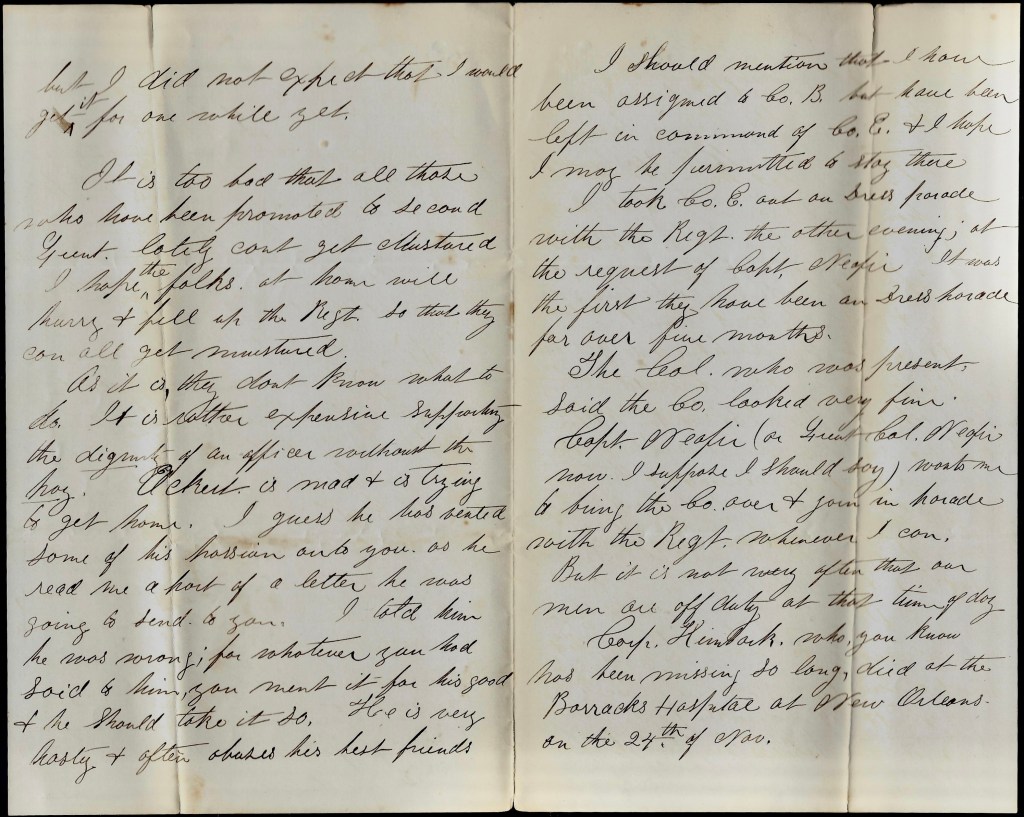
You seem to think that I was disappointed. I don’t think I said I was. I did not expect any promotion—at least till you got yours—and therefore I was not disappointed much at not getting it then. But I was surprised at least when I was told that there was a commission in the camp for me. True, Col. [Jacob] Sharpe had told me that he had recommended me but I did not expect that I would get it for a while yet.
It is too bad that all those who have been promoted to 2nd Lieutenant lately can’t get mustered. I hope the folks at home will hurry and fill up the regiment so that they can all get mustered. As it is, I don’t know what to do. It is rather expensive supporting the dignity of an officer without the pay. [Jacob S.] Eckert is mad and is trying to get home. I guess he has vented some of his passion onto you as he read me a part of a letter he was going to send to you. I told him he was wrong, for whatever you had said to him, you meant it for his good and he should take it so. He is very hasty and often abuses his best friends.
I should mention that I have been assigned to Co. B but have been left in command of Co. E & I hope I may be permitted to stay there. I took Co. E out on dress parade with the regiment the other evening at the request of Capt. [Alfred] Neafie (or Lieut. Colonel Neafie. It was the first they have been on dress parade for over five months. The Colonel who was present said the company looked very fine. Capt. Neafie (or Lieut. Colonel Neafie now, I suppose, I should say) wants me to bring the company over & join in parade with the regiment whenever I can. But it is not very often that our men are off duty at that time of day.
Corp. [Samuel] Kimbark who you know has been missing so long, died at the Barracks Hospital at New Orleans on the 24th of November.
When do you think you will get back here? The returns of the company are getting very much behind hand. I believe Mat. Hasbrouck has been doing something at the Clothing returns for last summer but they are still nearly six months behind & the ordnance returns are nearly a year behind hand.
If you are not likely to get back in some months, would it not be better to have an inventory taken ad have the things turned over to me, or whoever is put in command of the company? I have a list of what property there was on hand when Cooley left. I expect that Cooley will be back shortly and don’t know whether he will take command of this company again or not. But I hardly think he will. They will want him in Co. G as [William J.] Purdy has resigned. We have scarcely as many officers as companies in the regiment now. Only one captain present and he has offered his resignation. Write often and believe me ever yours truly, — J. Lefevre
Letter 4
Headquarters Co. E, 156th N. Y. V. Baton Rouge, La. March 1, 1864
Captain, dear sir,
Your favor of February 1st was received some days ago just before I was ordered to proceed to New Orleans in charge of about fifty Confederate prisoners so my answer has been delayed longer than it would have been otherwise. And since returning from New Orleans I have had the pay rolls & other matters which come at the end of the month to attend to.
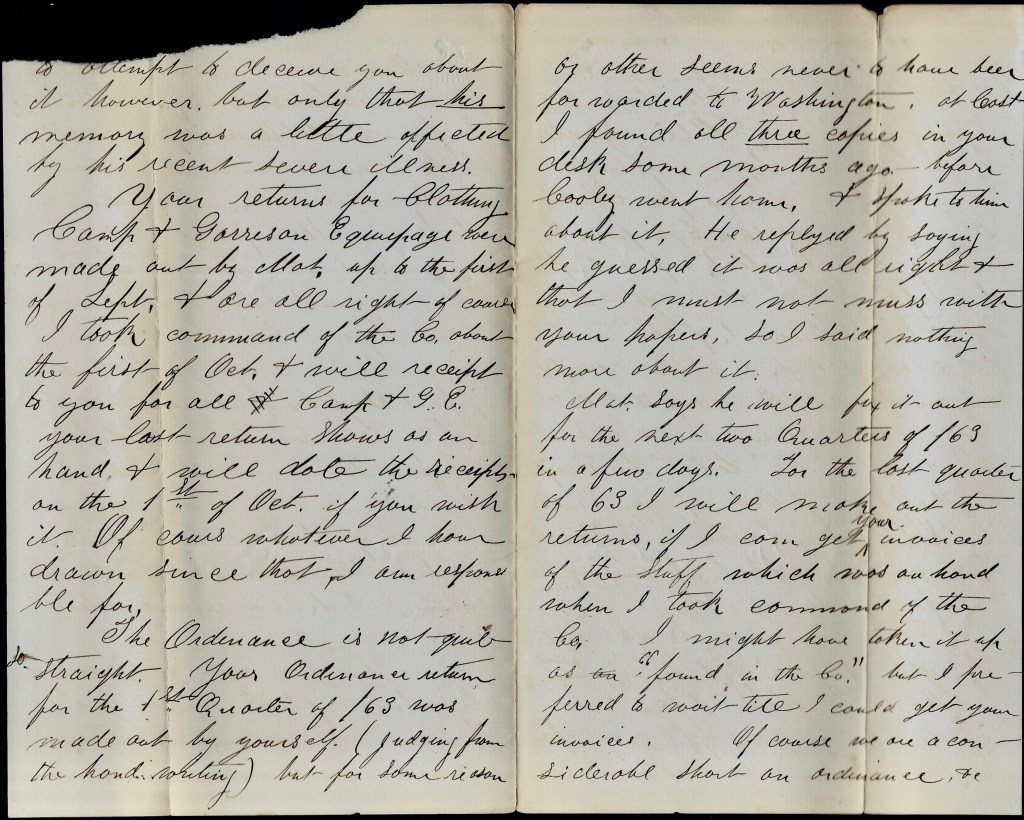
You were not quite correctly informed about returns by Capt. Cooley. I don’t think it was intentional, however, on his part to deceive you about it, but only that his memory was a little affected by his recent severe illness. Your returns for clothing, camp & garrison equipage, were made out by Mat [Hasbrouck] up to the first of September & are all right of course. I took command of the company about the first of October & will receipt to you for all camp and garrison equipage your last return shows as on hand, & will date the receipts of the 1st of October if you wish it. Of course whatever I have drawn since that, I am responsible for.
The Ordnance is not quite straight. Your ordnance return for the 1st Quarter of ’63 was made out by yourself (judging from the handwriting) but for some reason or other seems never to have been forwarded to Washington—at least I found all three copies in your desk some months ago, before Cooley went home & spoke to him about it. He replied by saying he guessed it was all right & that I must not muss with your papers so I said nothing more about it.
Mat. [Hasbrouck] says he will fix it out for the next two quarters of ’63 in a few days. For the last quarter of ’63, I will make out the returns, if I can get you invoices of the stuff which was on hand when I took command of the company. I might have taken it up as “found in the company.” but I preferred to wait till I could get your invoices. Of course we are a considerable short on ordnance, &c., but I don’t think it will be very difficult to account for that that as lost during the summer campaign which was actually the case as none of the guns which were taken to the hospitals by those men who died or were discharged there ever came back to the company except six which I got a couple months ago form the hospitals in this town & then some of the plates and small equipments were gone.
Those guns which Holwick tells me were delivered to the Quartermaster of Port Hudson never came back either. I heard once that Co. F got some.
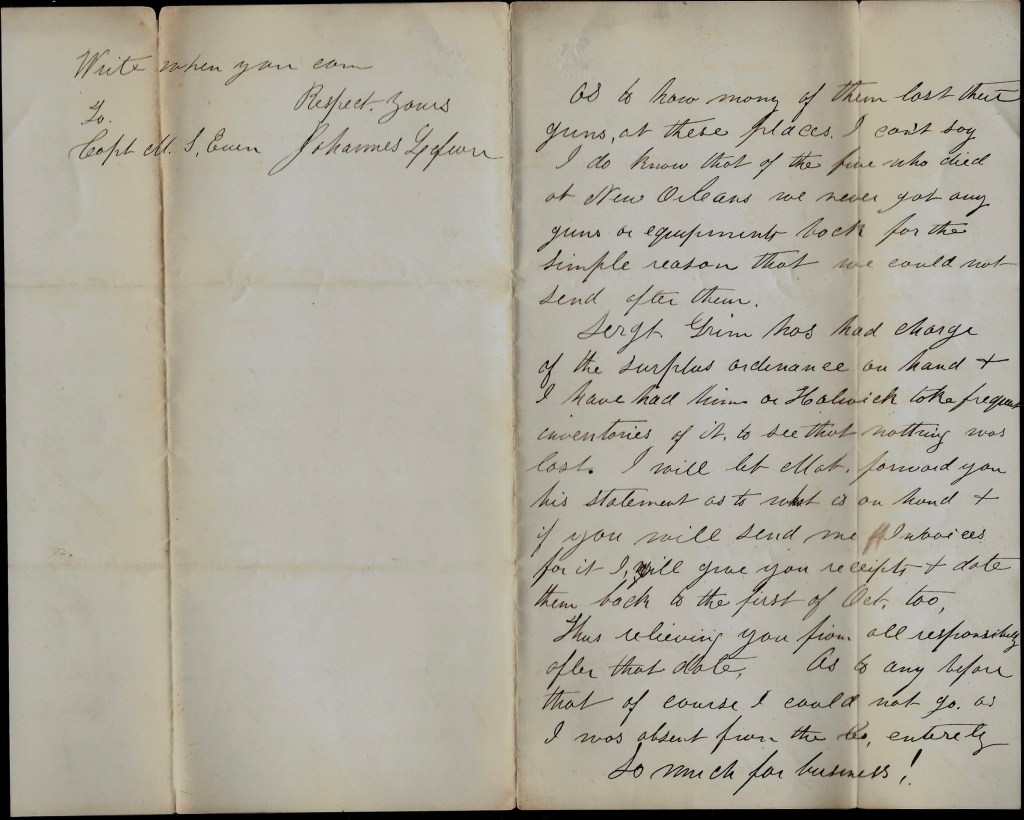
We have now within twelve guns as many as your return of March 31st shows on hand & about the same as to bayonets and cartridge boxes & a few more wanting of belts and plates. I have written out for Mat. [Hasbrouck] a short statement as to where I thought the losses had occurred but I suppose you can tell him better about that than I can. You remember four men of our company were taken prisoners at Brashear City, La. There were wounded on the battlefield of Port Hudson & a great number were sent to hospitals from the march. As to how many of thm lost their guns at these places, I can’t say. I do know that the five who died at New Orleans, we never got any guns or equipments back for the simple reason that we could not send after them.
An 1864 image of Capt. Johannes Lefevre
Sergt. [George] Grim has had charge of the surplus ordnance on hand & I have had him or Holwick take frequent inventories of it to see that nothing was lost. I will let Mat. forward to you his statement as to what is on hand & if you will send me invoices for it, I will give you receipts & date them back to the first of October too, thus relieving you from all responsibility after that date. As to any before that, of course I could not go as I was absent from the company entirely. So much for business!
I am very much obliged to you, Captain, for your suggestion that I be retained in Co. E! for although it is not exactly my company any longer, still I prefer it to any other. Col. Sharpe told me that I should reain here till you come back at least, and perhaps longer.
The spring campaign is opening with very little probability of our being moved from here. We hear of Sherman’s operations about Mobile but as yet have nothing definite. The health of the company and of the regiment is very good. Have got all of sick Shawangunkites home on furloughs. I don’t know whether they will ever come back or not. I have sent to have [George] Crans arrested. I expect his folks will pitch into me for it but I can’t help it & what is more, I don’t care much if they do. I shall recommend his being reduced to the ranks the moment he gets back here.
I suppose you have heard that Corp. [Longinus] Bates has gone home on recruiting service with Capt. [Orville D.] Jewett [of Co. I] & several noncoms. I have two sergeants and two corporals for duty with the company. The rest are all detailed away or sick. Corp. Bates, I believe, is to be appointed Commissary Sergeant, vice [Samuel H. B.] Schoonmaker who has just received a commission as 1st Lieutenant in an artillery regiment [15th Artillery] of the Army of the Potomac.
Henry Hess has been transferred to the Invalid Corps. Robert Terwilliger is detailed in charge of the guard at the government sawmill in town. Write when you can. Respectfully yours, — Johannes Lefevre
The following letters were written by Lydia Elizabeth Morrison (1832-1904), the daughter of John Bush Morrison (1793-1853) and Sarah Dougherty (1796-1872) of Plattekill, Ulster county, New York. In the 1860 US Census, 25 year-old Lydia was residing in Plattekill with her 64 year-old widowed mother and 21 year-old brother Charles Drake Morrison.
1st Sergeant Charles D. Morrison
The letters pertain to the illness and death of her brother Charles who enlisted as a private in Co. E, 156th New York Infantry in August 1862 and rose in rank to 1st Sergeant before he died of typhoid fever on 18 May 1863 at the Soldiers Hospital in Baton Rouge, Louisiana. He lies buried in Grave No. 2179 of Section 33 at the Baton Rouge National Cemetery. When he enlisted, Charlie was described as a 24 year-old farmer with brown hair and blue eyes who stood 5 feet 10 inches tall.
Lydia wrote the letters to Capt. Matthias S. Euen (1833-1898) of Co. E, 156th New York Infantry. He was wounded at Port Hudson on 14 June 1863 (shortly after the 2nd letter was written) and was later promoted to Major and Colonel of the 156th New York.
Letter 1
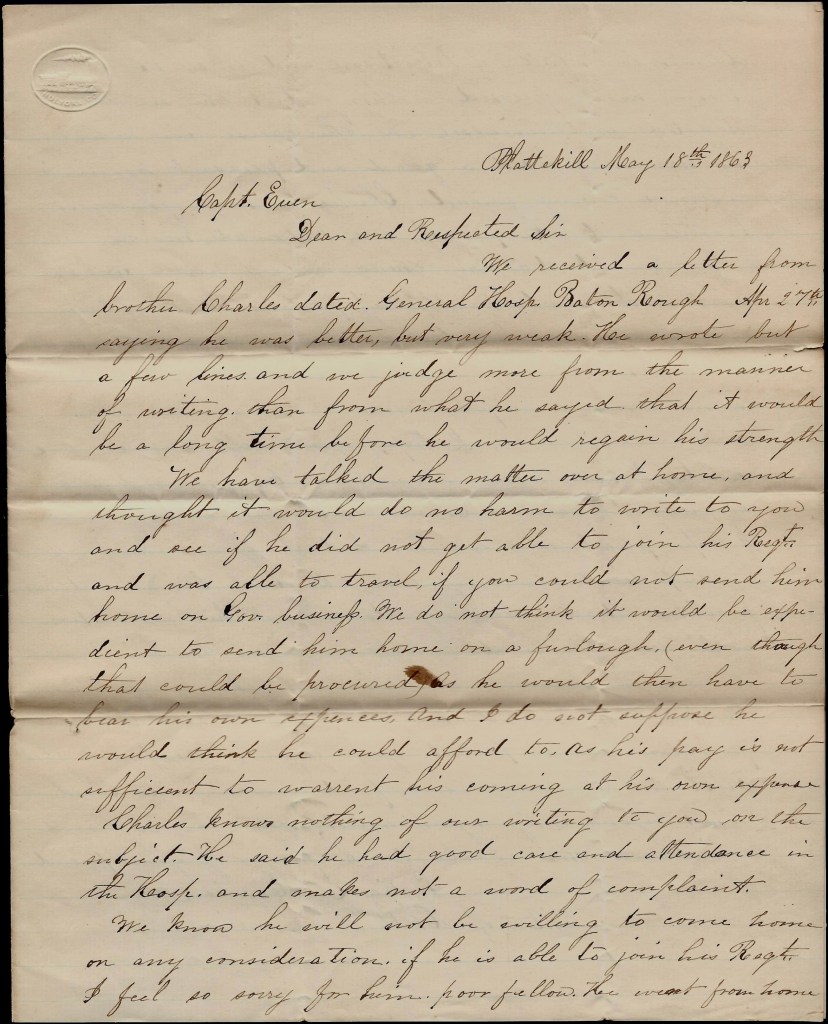
Plattekill [Ulster county, New York] May 18th 1863
Capt. Euen Dear and respected sir,
We received a letter from brother Charles dated General Hospital, Baton Rouge, April 27th, saying he was better but very weak. He wrote but a few lines and we judge more from the manner of writing than from what he said that it would be a long time before he would regain his strength.
We have talked the matter over at home and thought it would do no harm to write to you and see if he did not get able to join his regiment and was able to travel, if you could not send him home on Gov. business. We do not think it would be expedient to send him home on a furlough (even though that could be procured) as he would then have to bear his own expenses and I do not suppose he would think he could afford to as his pay is not sufficient to warrant his coming at his own expense. Charles knows nothing of our writing to you on the subject. He said he had good care and attendance in the hospital and makes not a word of complaint.
We know he will not be willing to come home on any consideration if he is able to join his regiment. I feel so sorry for him—poor fellow. He went from home brimming full of patriotism and in all his letters home has expressed nothing but the most devoted enthusiasm in the cause in which he has sacrificed a good and pleasant home and warm and loving friends. Charlie is my youngest brother and the pet of my widowed mother. We would do anything in our power to have him restored to health if possible. He complains that he has not heard from home since the first of March although we have written to him some seven or eight times.
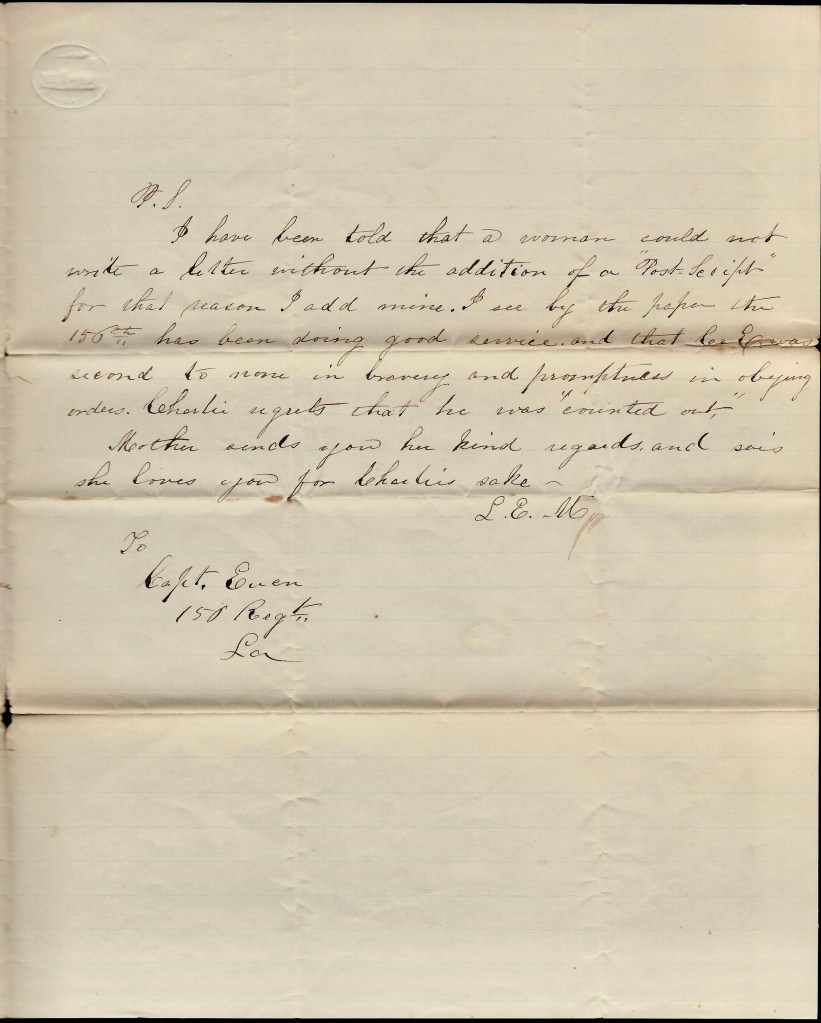
I hope you will excuse the liberty I have taken in writing to you and our anxiety to secure Charlie’s return to health will I hope please my excuse. And if you can find it expedient in any way to have him sent home provided it is necessary to ensure his restoration, will you please do what you can for him, and in return receive the warmest thanks of his mother and friends. That an all-wise and kind Providence will protect you from sickness and that Rebel bullets may never find your hearts blood, that you may again meet your family and friends in this world is the prayer of your friend, — Lydia E. Morrison, sister of Charles D. Morrison
P. S. I have been told that a woman could not write a letter without the addition of a “post script.” For that reason I add mine. I see by the paper the 156th has been doing good service and that Co. E was second to none in bravery and promtness in obeying orders. Charlie regrets that he was “counted out.” Mother sends you her kind regards and says she loves you for Charlie’s sake. — L. E. M.
To Capt. Euen, 156th Regt., Louisiana.
Letter 2
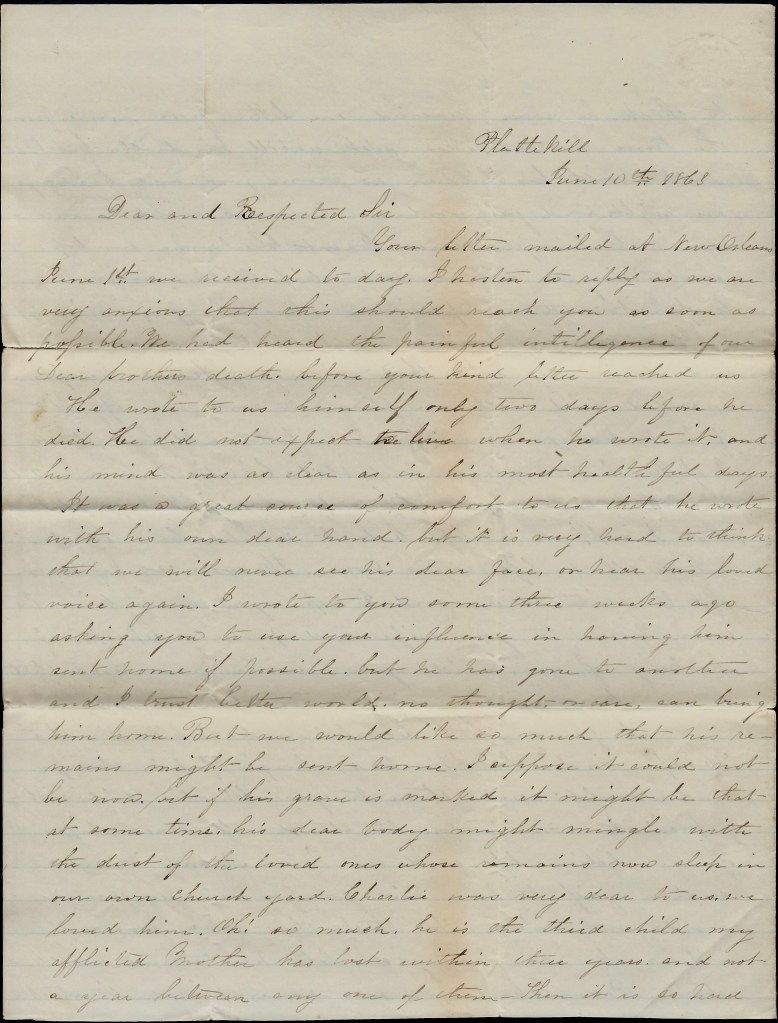
Plattekill, [New York] June 10th 1863
Dear and respected sir,
Your letter mailed at New Orleans June 1st we received today. I hasten to reply as we are very anxious that this should reach you as soon as possible. We had heard of the painful intelligence of our dear brother’s death before your kind letter reached us. He wrote to us himself only two days before he died. He did not expect to live when he wrote it and his mind was as clear as in his most healthful days. It was a great source of comfort to us that he wrote with his own dear hand but it is very hard to think that we will never see his dear face or hear his loved voice again.
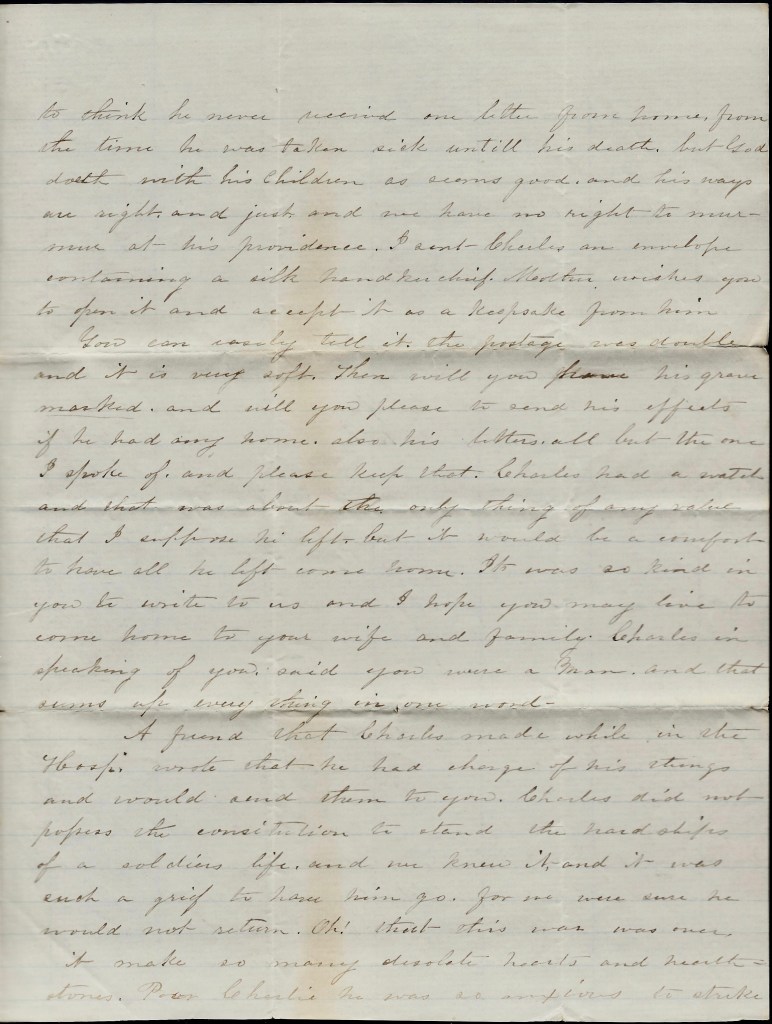
I wrote to you some three weeks ago asking you to use your influence un having him sent home of possible but he has gone to another and I trust better world. No thought or care can bring him home. But we would like so much that his remains might be sent home. I suppose it could not be now but if his grave is marked, it might be that at some time his dear body might mingle with the dust of his loved ones whose remains now sleep in our own church yard. Charlie was very dear to us. We loved him. Oh! so much. He is the third child my afflicted mother has lost within three years and not a year between any of them. 1 Then it is so hard to think he never received one letter from home, from the time he was taken sick until his death. But God doeth with His children as seems good and His ways are right and just, and we have no right to murmur at His providence.
I sent Charles an envelope containing a silk handkerchief. Mother wishes you to open it and accept it as a keepsake from him. You can easily tell it. The postage was double and it is very soft. Then will you have his grave marked and will you please to send his effects if he had any home. Also his letters—all but the one I spoke of and please keep that. Charles had a watch and that was about the only thing of any value that I suppose he left but it would be a comfort to have all he left come home.
It was so kind in you to write to us and I hope you may live to come home to your wife and family. Charles in speaking of you said you were a man and that sums up everything in one word.
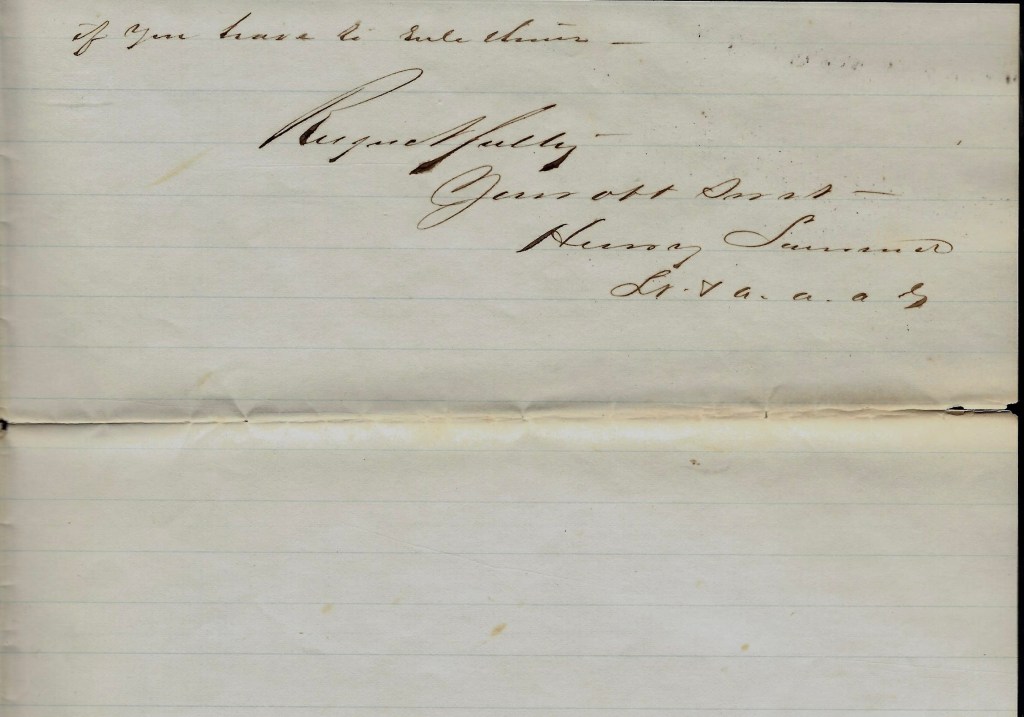
A friend that Charles made wile in the hospital wrote that he had charge of his things and would send them to you. Charles did not possess the constitution to stand the hardships of a soldier’s life and we knew it, and it was such a grief to have him go for we were sure he would not return. Oh! that this was was over. It makes so many desolate hearts and hearthstones. Poor Charlie, he was so anxious to strike a blow for his country, but it was not to be.
I will not intrude further on your time—only to say that though you are a stranger to us, yet we are your warm friends. And our best wishes and earnest prayer will follow you that you may come home when your duty as a soldier is performed. And may God bless you is our earnest desire. I am respectfully your friend, — Lydia E. Morrison
Plattekill, New York
1 The other siblings were Isabella H. Morrison (1825-1862) and Mary Caroline Morrison (1838-1861).
I believe the following message was penned by Lt. Henry Laurence but I was unable to identify him more specifically. It was written to Major Matthias S. Euen of the 156th New York Infantry which was assigned to duty in the Department of Georgia until mustered out of service in late October 1865 at Augusta.
Transcription
Headquarters District Northern Georgia Augusta, Georgia July 3rd 1864
Maj. M. S. Ewen [Euen] Commanding 156th N. Y. V. Athens, Georgia
I have the honor to acknowledge the receipt of yours of 30th installment. The General Commanding directs me to say that you be very careful in the handling of Colored people. The action taken by you is approved. Let the Grist Mill run on such terms as you deem best.
Blanks will be furnished you as soon as we get them from Headquarters Department of the South. Have none at present. Do the best you can. Try and have your returns in on the days named tri-monthlies on 5th, 15th, and 26th of each month & monthly returns on 26th of each month if you have to rule them.
Respectfully your obedient servant, — Henry Laurence, Lt. & A. A. A. G.
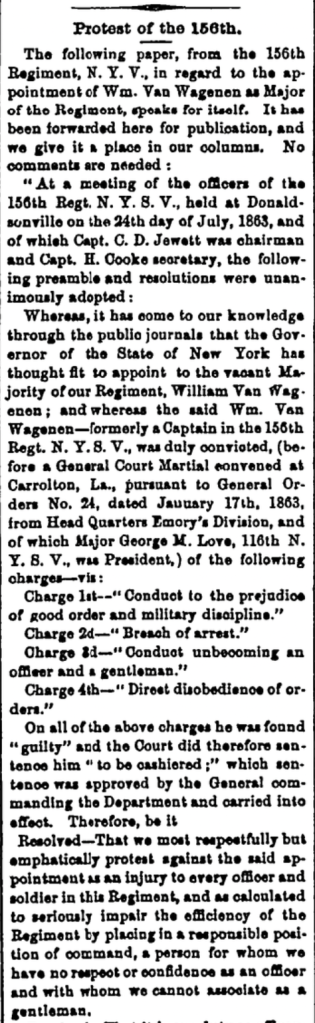
Though I personally have found few examples of White soldiers defrauding Black recruits of the bounties promised them in return for their enlistment during the American Civil War, it was apparently a common practice. The following deposition is one such example. It was made by Evert D. Keator, a 20 year-old illiterate Black man of Marbletown, Ulster county, New York. Evert (or Everett) was eventually placed in Co. C, 20th U. S. Colored Troops (USCT), but his deposition—recorded by Lt. William H. Folk of the 173rd New York—tells a tale of deception and fraud committed by a former captain of the 156th New York Infantry named William H. Van Wagenen, who had been previously cashiered in January 1863 on the finding of a court martial who found him guilty of multiple charges. These included:
Charge 1st—”Conduct to the prejudice of good order and military discipline.” Charge 2d–“Breach of arrest.” Charge 3d–“Conduct unbecoming an officer and a gentleman.” Charge 4th—” Direct disobedience of orders.”
Evert’s deposition states that he was accompanied by two others from Ulster county named George W. Ellsworth and John J. Ellsworth. I initially assumed they were also Black but I could not find any enlistments for them among the Black regiments. However, I did find a George W. Ellsworth and a John E. Ellsworth of Hurley, Ulster county, both 18 years of age, who enlisted on 30 November 1863 (the same day as Keator) in New York City and were taken into Co. K, 158th New York Infantry. Both enlisted for two years and served out their time in the 158th and in the last couple months of the war in the 100th New York—both of them obviously illiterate White soldiers who also signed (with their marks) a similar deposition (see below) with the same story. Their deposition demonstrates that illiterate Whites were as vulnerable to these fraudulent practices as illiterate Blacks.
To learn more of the foul business of the so called “bounty brokers,” see an excellent article entitled, “Honoring Pvt. William H. Halsey, 20th USCT” that appears on The Washingtonville Cemetery website.
The Twentieth United States colored troops receiving their colors on Union Square, March 5, 1864
Transcription
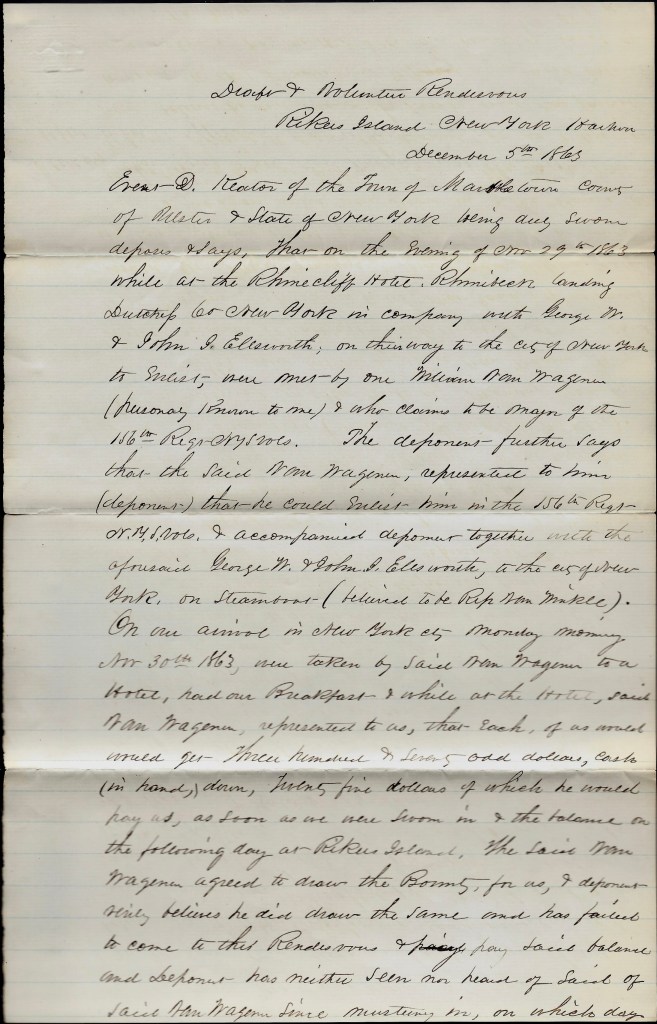
Draft & Volunteer Rendezvous Riker’s Island, New York Harbor December 5th 1863
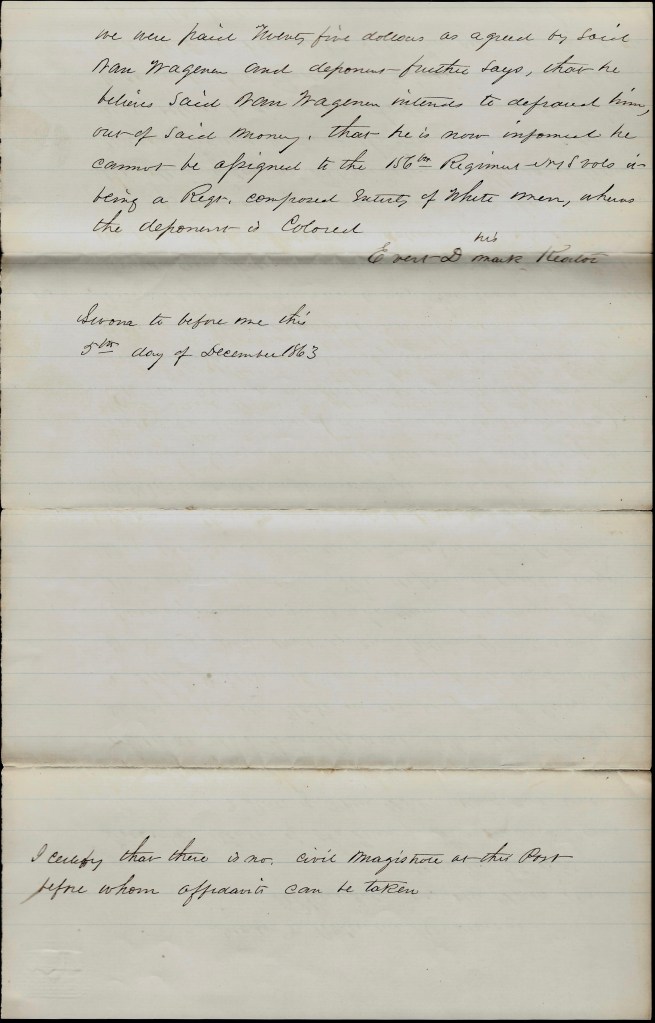
Evert D. Keator of the town of Marbletown, County of Ulster, & State of New York, being duly sworn, deposes and says, that on the evening of November 29th 1863 while at Rhinecliff Hotel, Rhinebeck Landing, Dutchess County, New York, in company with George W. and John J. Ellsworth, on their way to the City of New York to enlist, were met by one William Van Wagenen (personally know to me) & who claims to be the Major of the 156th Regt. N. Y. Vols. The deponent further says that the said Van Wagenen represented to him (deponent) that he could enlist him in the 156th Regt. N. Y. State Vols. & accompanied deponent together with the aforesaid George W. and John I. Ellsworth to the City of New York on steamboat (believed to be Rip Van Winkle). On our arrival in New York City, Monday morning November 30th 1863, were taken by said Van Wagenen to a hotel, had our breakfast & while at the hotel, said would get three hundred and seventy off dollars cash (in hand) down, twenty-five dollars of which he would pay us as soon as we were sworn in and the balance on the following day at Riker’s Island. The said Van Wagenen agreed to draw the Bounty for us & deponent verily believes he did draw the same and has failed to come to this Rendezvous & pay said balance and deponent has neither seen nor heard of said Van Wagenen since mustering in, on which day we were paid twenty-five dollars as agreed by said Van Wagenen. And deponent further says that he believes said Van Wagenen intends to defraud him out of said money, that he is now informed he cannot be assigned to the 156th Regiment N. Y. State Vols, it being a regiment composed entirely of white men whereas the deponent is colored.
Evert D. Keator (his mark)
Sworn to before me this 5th day of December 1863
I certify that there is no civil magistrate at this post before whom affidavits can be taken.
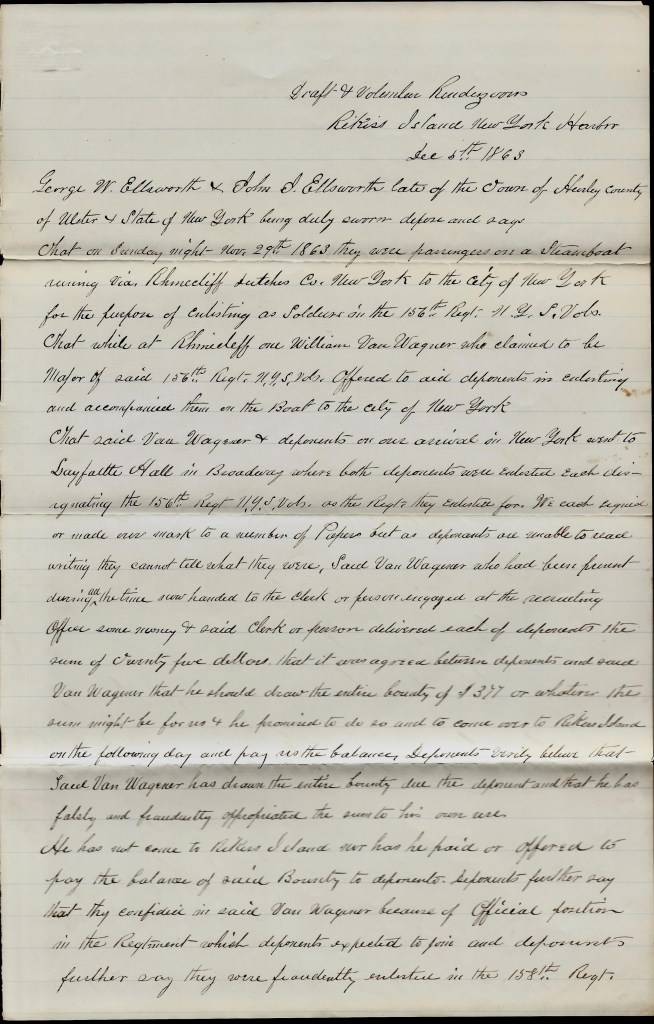
Draft Volunteer Rendezvous Riker’s Island, Harbor of New York December 5th 1863
Evert D. Keator of the town of Marbletown, County of Ulster, & State of New York, being duly sworn, deposes and says, that on the evening of Nov. 29th, 1863, while at the Rhinecliff House, Rhinecliff, Dutchess county, New York,in company with George W. & John J. Ellsworth, on the way to the City of New York to enlist, they were met by one William Van Wagenen (personally known to deponent) & claims to be Major of the 156th N. Y. S. Vols. The deponent further says that the said Van Wagenen represented to him he could enlist him in the 156th N. Y. S. Vols. and accompanied deponent & the aforesaid George W. & John I. Ellsworth to the City of New York on steamboat believed to be the Rip Van Winkle. On our arrival in the City of New York, Monday morning, November 30th 1863, were taken to a hotel by said Van Wagenen, had our breakfast and while at the hotel, said Van Wagenen represented to us that each of us would get three hundred and seventy odd dollars cash down, twenty-five of which he would pay as soon as we were mustered or sworn in & the balance on the following day at Riker’s Island. That said Van Wagenen, the two Ellsworths & myself, then went to Lafayette Hall in Broadway, New York, where the Ellsworths & myself enlisted, each of us designating the 156th Regiment as the regiment we enlisted for. We each signed or made our marks to a number of papers but as deponent cannot read writing, he cannot tell what they were. Said Van Wagenen, who had been present during all the time, now handed to a clerk, a person engaged at the recruiting office, some money and said clerk or person immediately handed to each of the two Ellsworths and myself the sum of twenty-five dollars. That it was agreed between us and aforesaid Van Wagenen that he should draw the entire bounty of $377 or whatever the sum might be for us, & promised to do so and come to Riker’s Island on the following day & pay us the balance. Deponent verily believes that the said Van Wagenen has drawn the entire bounty due the deponent and that he has falsely and fraudulently appropriated the same to his own use. He has not come to Riker’s Island nor has he paid or offered to pay the balance of said bounty to deponent. Deponent further says that he confided in said Van Wagenen because of his official position in the regiment which deponent expected to join. Deponent further says he is now informed he cannot be assigned to the 156th Regiment, that being composed entirely of White men whereas the deponent is Colored.
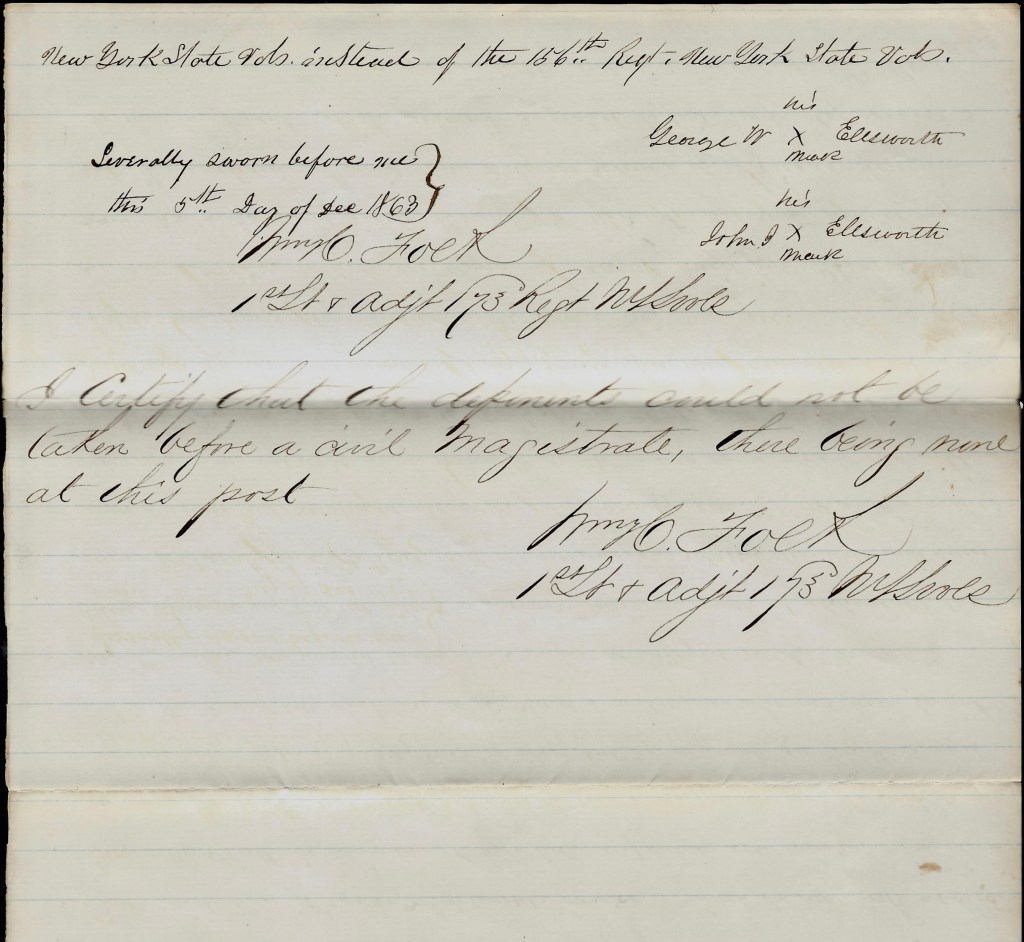
Evert D. Keator (his mark)
5th day of December 1863
Wm. H. Folk, 1st Lt & Adjt. of 173rd Regt. N. Y. S. Vols.
I certify that the deponent could not be taken before a civil magistrate, there being none at this post. – Wm. H. Folk, 1st Lt. & Adjt. 173rd N. Y. S. Vols.
Deposition of George W. Ellsworth and John J. Ellsworth:
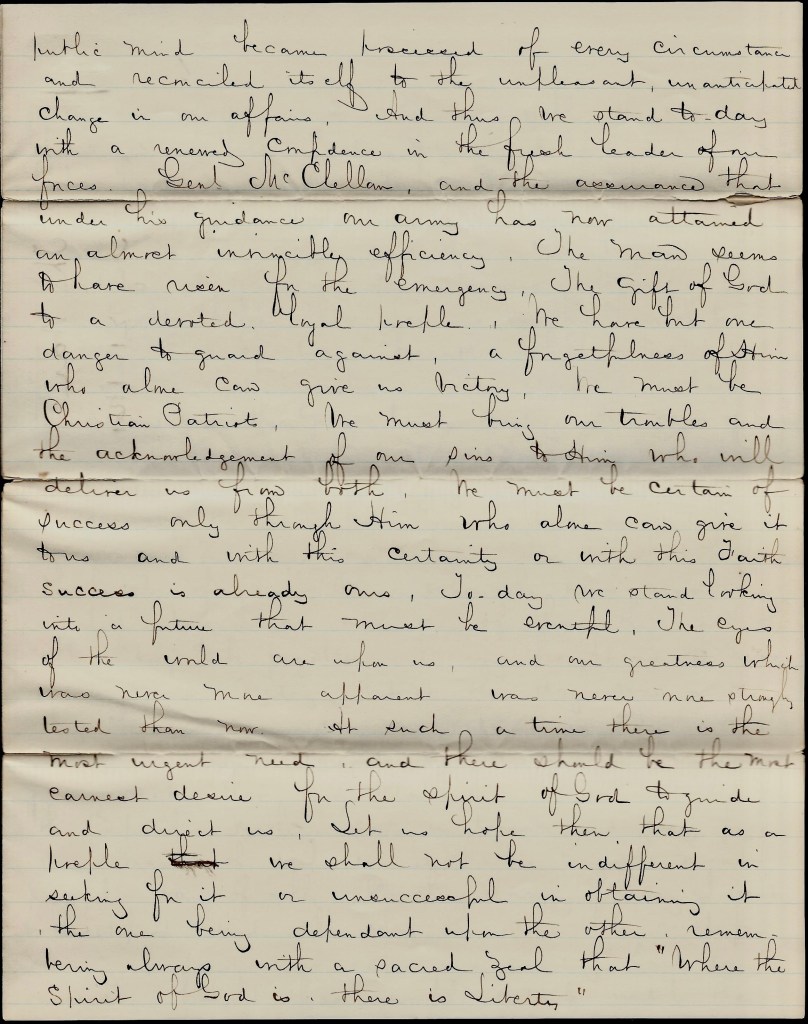
Regrettably, the author’s identity of this unsigned essay remains a tantalizing mystery, with scant clues to piece together even a fleeting guess at authorship. If I had to wager, I’d propose it was penned by a young man from New York City—perhaps in his late teens—who harbored lofty theological ambitions and possibly attending classes in Litchfield, Connecticut. Despite my internet sleuthing, I’ve come up empty-handed; no evidence suggests this piece was ever published in a book or newspaper. My gut tells me it was likely a personal draft, perhaps intended for publication, yet its final resting place remains unknown.
Though it can’t be pinned to a specific hand, this essay vividly encapsulates the turmoil rippling through the Northern states from the moment the shots rang out over Fort Sumter until the rise of Gen. McClellan—who is described as “the gift of God to a devoted, loyal people.” Such language perfectly encapsulates the anxiety and fervor of the times, and invokes the belief that calamity will only befall a Nation that does not place its trust in God.
Transcription
New York [City] August 21, 1861
One month ago today occurred the battle and the panic of Bull’s Run and in that month thus following so great a national disaster, there has been time and cause for many hours of bitter thoughtfulness. We entered upon this serious crisis in our history with such a confidence in the right of our cause and the stability of our government that the determined effort to crush rebellion and annihilate that treasonable spirit which had been growing in our midst for years did not appear at the outset a formidable work to accomplish. But today, with no less confidence in our ultimate success and no less faith in Him who gave us the precious government for which we are contending, we are awake to the consciousness that God has given us a task to accomplish which we must perform in sorrow and the seed of which we must sow in tears. We know that we are not just passing beneath a cloud the end of which we cannot see, that in its deepest darkness there must be privations, sufferings and painful sacrifices, but we also feel with a conviction the intensity of which is sublimely prophetic that He who gave us so miraculously our existence as a Nation will never desert us in our terrible struggle to preserve that existence and that nationality under the government which He has always blessed to us.
The month just passed has seemed a breathing space in the commencement of a weary struggle. The mind has availed itself of a relief from immediate excitement to review the past few months of our eventful history and call up one by one the incidents that here give it so great an interest.
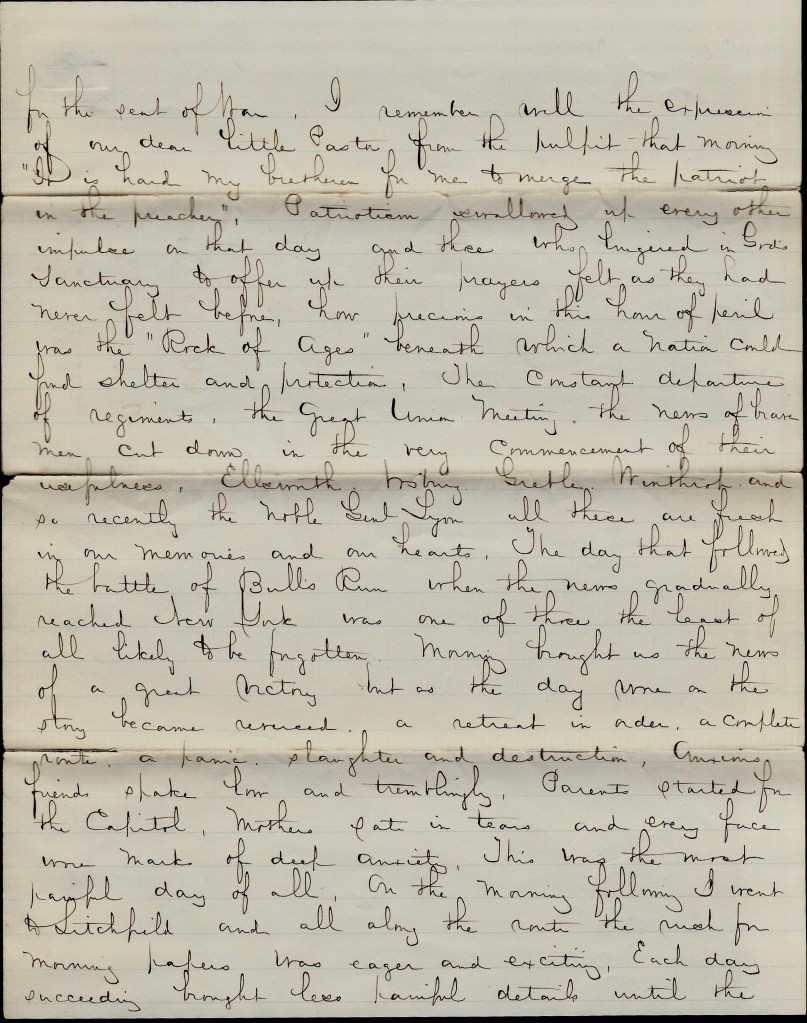
First came that Friday night on the 12th of April last when the scarcely credited intelligence fell on the ear that the bombardment of Fort Sumpter ad commenced. I went down to the news offices between 8 and 9 o’clock in the evening and read the announcement on the different bulletins with feelings strange and new. On the cars in the street, in every place of business, the expression passed from mouth to mouth, “The war has actually begun.” A nation went to a troubled slumber on that Friday night. Then followed the day of wild excitement when almost every home brought some fresh account of the disastrous and uneven siege until night closed in upon the week with the news that the gallant little garrison had been overpowered by besieging thousand and Sumpter had fallen into rebel hands. What a day was that Sabbath which followed the intense excitement of a few preceding hours. What a week did it open to an aroused and patriotic people. What a springing to arms. What an impetus towards Washington and the following Sabbath. Who ever saw a Sabbath like it in the City of New York? When the usual quietude of Sunday was broken by strains of martial music and churches were almost deserted in the eagerness to bid farewell to thousands who embarked that morning for the seat of war. I remember well the expression of our dear little pastor from the pulpit that morning: “It is hard, my brethren, for me to merge the patriot in the preacher.”
Patriotism swallowed up every other impulse on that day and those who lingered in God’s sanctuary to offer up their prayers felt as they had never felt before. How precious in the hour of peril was the “Rock of Ages” beneath which a Nation could find shelter and protection. The constant departure of regiments, the Great Union Meeting, the news of brave men cut down in the very commencement of their usefulness—Ellsworth, [ ], Greble, Withrop, and so recently, the noble Gen. Lyon. All these are fresh in our memories and our hearts.
The day that followed the battle of Bull’s Run when the news gradually reached New York was one of those the least of all likely to be forgotten. Morning brought us the news of a great victory but as the day come on, the story became reversed, a retreat in order, a complete rout, a panic, slaughter and destruction, anxious friends spoke low and tremblingly. Parents started for the Capitol. Mothers sat in tears and every face wore marks of deep anxiety. This was the most painful day of all. On the morning following I went to Litchfield and all along the route the sush for morning papers was eager and exciting. Each day succeeding brought less painful details until the public mind became possessed of every circumstance and reconciled itself to the unpleasant, unanticipated change in our affairs. And thus we stand today with a renewed confidence in the fresh leader of our forces, General McClellan, and the assurance that under his guidance, our army has now attained an almost invincible efficiency. The man seems to have risen for the emergency—the gift of God to a devoted, loyal people.
We have but one danger to guard against, a forgetfulness ofHim who alone can give us a victory. We must be Christian Patriots. We must bring our troubles and the acknowledgment of our sins to Him who will deliver us from both. We must be certain of success only through Him who alone can give it to us and with this certainty or with this Faith success is already ours. Today we stand looking into a future that must be eventful. The eyes of the world are upon us and our greatness which was never more apparent was never more strongly tested than now. At such a time there is the most urgent need and there should be the most earnest desire for the spirit of God to guide and direct us. Let us hope then that as a people we shall not be indifferent in seeking for it, or unsuccessful in obtaining it—the one being dependent upon the other, remembering always with a sacred zeal that “where the Spirit of God is, there is Liberty.” 1
1 “Where the Spirit of God is, there is Liberty.” 2 Corinthians 3:17.
The following letters were written by William Elmer Thorp (1841-1912), the son of Alfred Thorp (1815-1895) and Frances Relf (1817-1903) of Sherman, Chautauqua, New York. According to muster rolls, William enlisted in May 1861 at Elmira in Co. D, 21st New York Infantry. He was wounded in action at the Battle of Antietam on 17 September 1862 but survived and mustered out with his company in May 1863 after two years service.
[Note: These letters are housed in the Special Collection of the University of Iowa Library and have been digitized but have not been transcribed and made available on the internet.]
To read other letters by members of the 21st New York Infantry that have been transcribed and published on Spared & Shared, see: William Fox, Co. C, 21st New York (1 Letter) Peter Cozzens Doyle, Co. H, 21st New York (13 Letters) Ansel W. Dumphrey, Co. H, 21st New York (2 Letters)
Letter 1
Addressed to A. Thorp, Mina, New York
Elmira, New York May 12th 1861
Dear Parents,
You are no doubt expecting a letter from me and I take this opportunity of writing to you. I am now in Elmira as you see by the heading of this letter. The morning after I left you, I went to Mr. Sheldon’s and found were gone to Buffalo to enlist and that George Patterson was giving passes to volunteers so I went down to Westfield, got a pass, went to Buffalo & found the boys there. We looked all around town and looked at all the companies and finally joined Co. D—called so at present, but the name will probably be changed. We call it so because almost all the men are what used to form Co. D, 74th Regiment. It is called one of the best companies in Buffalo.
We had orders to march yesterday and started about 5 o’clock p.m. The whole of the old military companies and Fire Department of Buffalo turned out to escort us down to the depot but you will see the account in the Express probably. I will only say Main Street was decorated in splendid style, flags flying from every window, handkerchiefs waving, cannon roaring, bells ringing, and bands playing, making one of the grandest sights I ever beheld.
We arrived at Elmira at about 7 o’clock this morning and were greeted at every station and house along the road with tremendous cheers and waving flags or handkerchiefs and sometimes with cannon. People were in crowds at every place along the roads where we stopped. We are quartered for the present at a hall in this place and the other companies in different parts of the town.
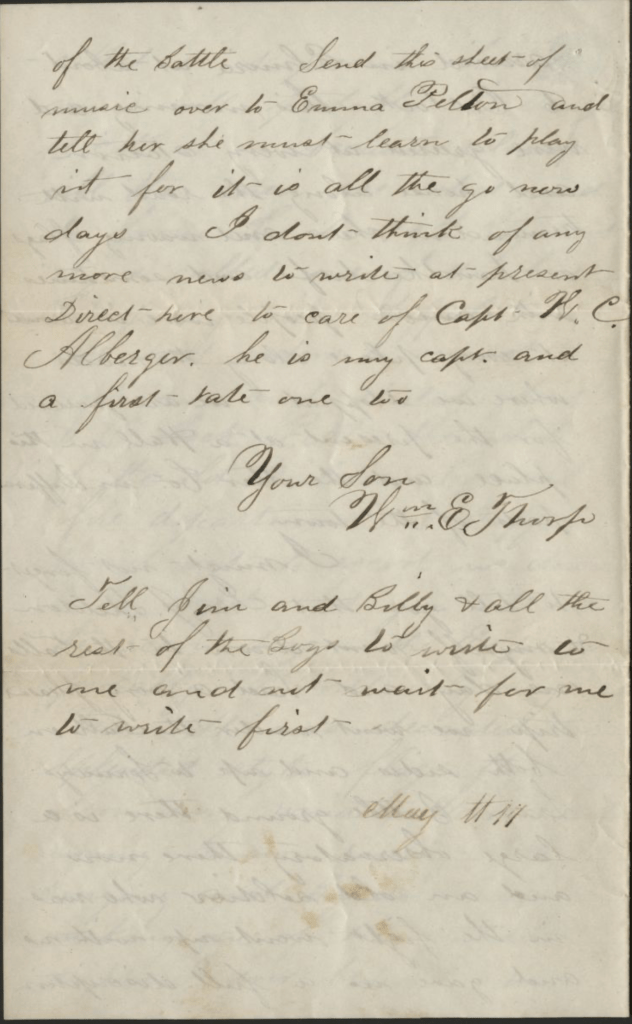
I must not forget to tell you that Ira J. Sheldon and myself went down to the [Niagara] Falls one day and had a very pleasant trip. We went under the Falls on both sides and up to Lundy’s Lane Battleground. There is a large observatory there now and an old soldier who was in the fight went up with us and gave us a full description of the battle. Send this sheet of music over to Emma Pelton and tell her she must learn to play it for it is all the go now-a-days. I don’t think of any more news to write at present. Direct here to care of Capt. Wm. C. Alberger. He is my captain and a first rate one too.
Your son, — Wm. E. Thorp
Tell Jim and Billy and all the rest of the Boys to write to me and not wait for me to write first.
Letter 2
Camp Kalorama Washington D. C. July 12, 1861
Dear Parents,
As you wished me to write often, I am now seated to drop a few lines to you although I do not know as there is any more news in particular for me to tell you and I write this time with ink although it is sometimes very hard to get it when we are on the march. But as we have now been in camp here some time, we can get it but do not know whether we can fix it so that we can carry it but we shall try to do so.
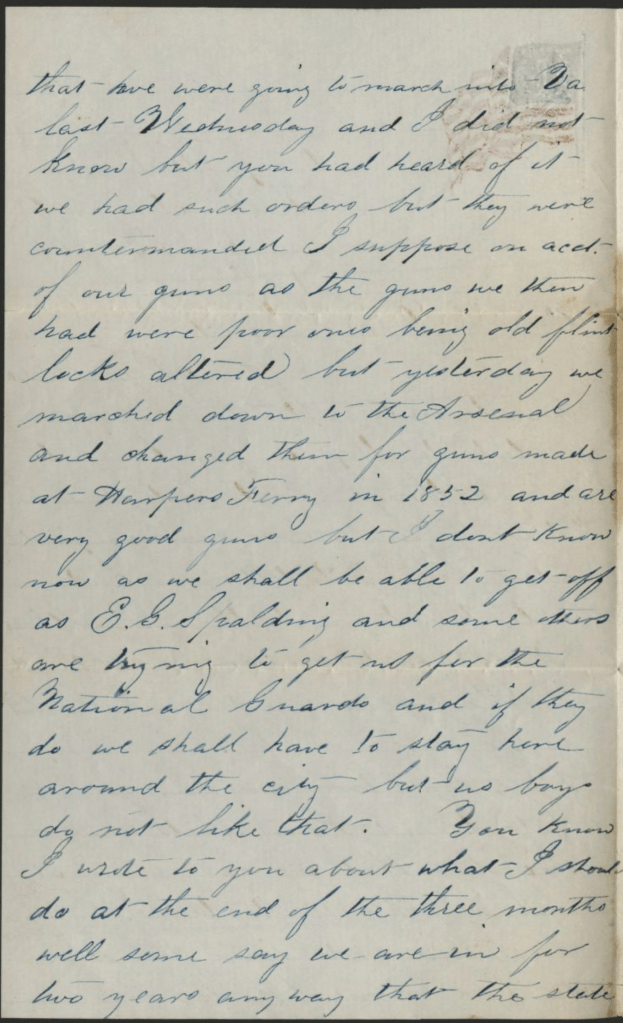
Lewis wrote home the other day (he is one of the boys from Sherman) that we were going to march into Virginia last Wednesday and I did not know but you had heard of it. We had such orders but they were countermanded I suppose on account of our guns as the guns we then had were poor ones being old flint locks altered. But yesterday we marched down to the Arsenal and changed them for guns made at Harpers Ferry in 1852 and are very good guns but I don’t know now as we shall be able to get off as E. G. Spalding and some others are trying to get us for the National Guards and if they do, we shall have to stay here around the cuty. But us boys do not like that.
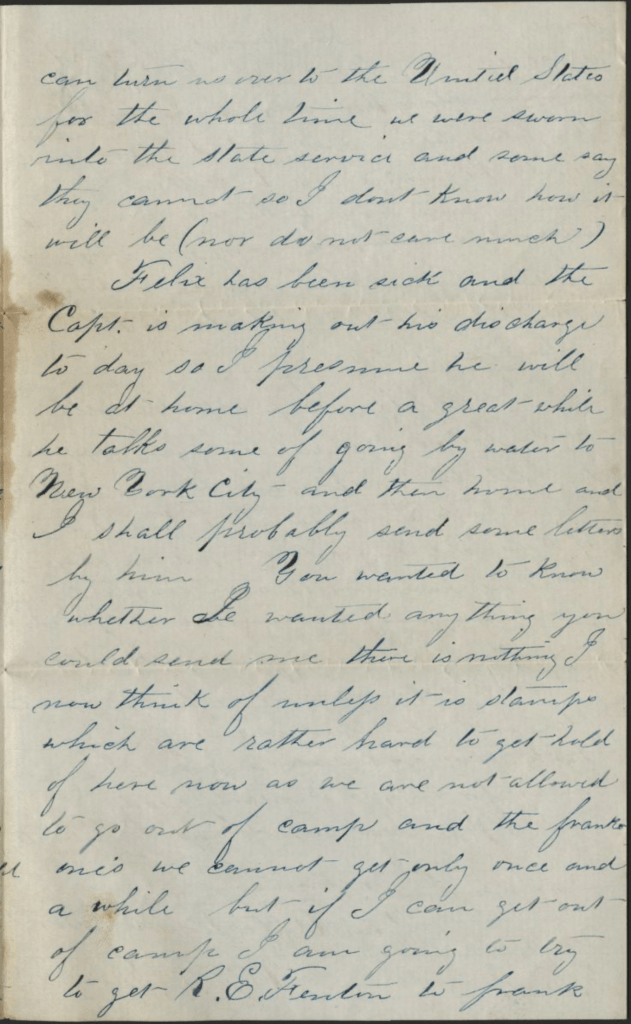
You know I wrote to you about what I should do at the end of the three months. Well some say we are in for two years anyway—that the state can turn us over to the United States for the whole time. We were sworn into the state service and some say they cannot so I don’t know how it will be (nor do not care much).
Felix [Mayburn] has been sick and the Captain is making out his discharge today so I presume he will be at home before a great while. He talks some of going by water to New York City and then home and I shall probably send some letters by him.
You wanted to know whether I wanted anything you could send me. There is nothing I now think of unless it is stamps which are rather hard to get hold of here now as we are not allowed to go out of camp and the franked ones we cannot get only once and a while. But if I can get out of camp, I am going to try to get R. E. Fenton to frank some for me.
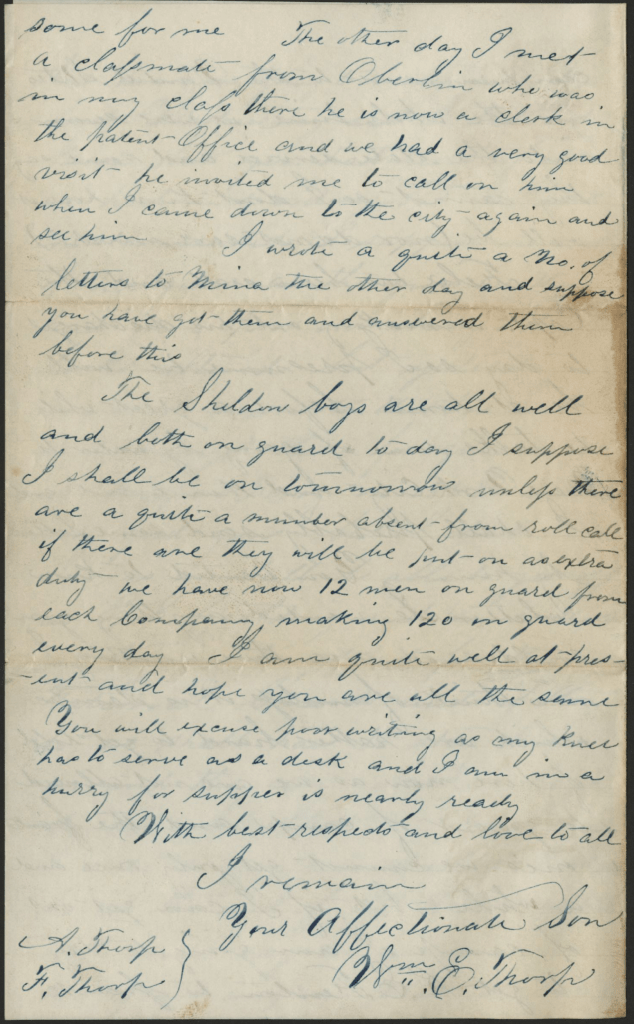
The othre day I met a classmate from Oberlin who was in my class three. He is now a clerk in the patent office and we had a very good visit. He invited me to call on him when I come down to the city again and see him. I wrote a quite a number of letters to Mina the other day and suppose you have got them and answered them before this.
The Sheldon boys are all well and both on guard today. I suppose I shall be on tomorrow unless there are a quite a number absent from roll call. If there are, they will be put on as extra duty. We have now 12 men on guard from each company making 120 on guard every day. I am quite well at presemt and hope you are all the same.
You will excuse poor writing as my knee has to serve as a desk and I am in a hurry for supper is nearly ready. With best respects and love to all. I remain your affectionate son, — Wm. E. Thorp
A. Thorp F. Thorp
Letter 3
Fort Runyon Washington D. C. July 15th 1861
Dear Parents,
I wrote a letter to you day before yesterday but forgot to put it in the post office so of course it has not gone but I will write this and put it in with it and send it now. Since writing the other there has been a little change in our camp. Yesterday we got orders to start and come to this fort which is just at the end of the Long Bridge and is nothing but an earthwork but it is a good one and well laid out.
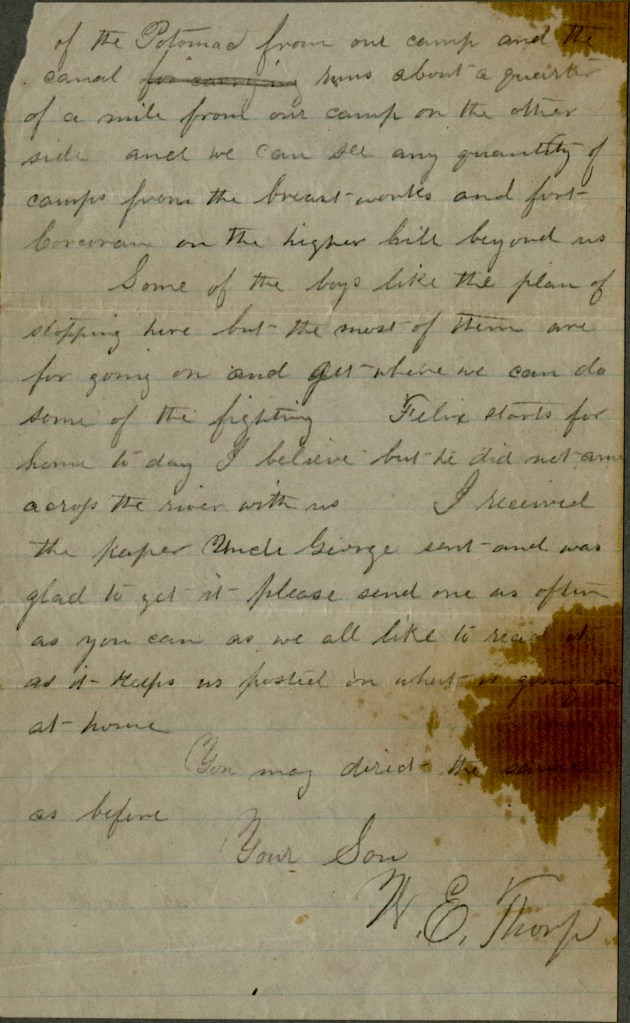
I think we shall probably stay here until our time is up to guard this fort and finish the rest of it as it is not yet quite finished on the side next to the river. We have a fine view of the Potomac from our camp and the canal runs about a quarter of a mile from our camp on the other side and we can see any quantity of camps from the breastworks and Fort Corcoran on the higher hill beyond us.
Some of the boys like the plan of stopping here but the most of them are for going on and get where we can do some of the fighting. Felix starts for home today. I believe he did not come across the river with us.
I received the paper Uncle George sent and was glad to get it. Please send one as often as you can as we all like to read it as it keeps us posted on what is going on at home.
You may direct the same as before. Yours on, — W. E. Thorp
Letter 4
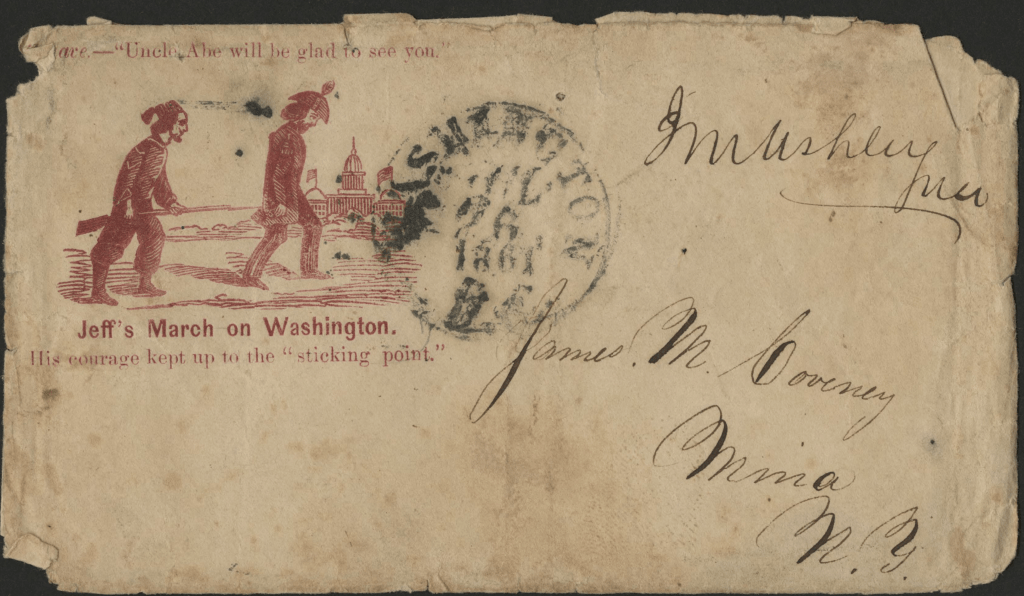
Addressed to James M. Coveny, Mima, New York
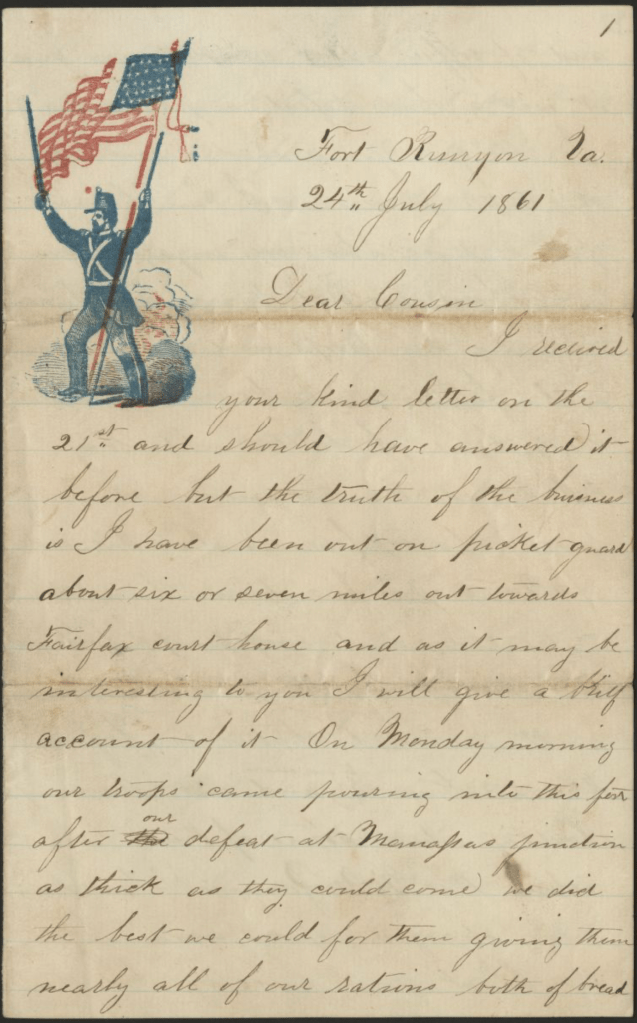
Fort Runyon, Virginia 24th July 1861
Dear Cousin,
I received your kind letter on the 21st and should have answered it before but the truth of the business is I have been out on picket guard about six or seven miles out towards Fairfax Court House and as it may be interesting to you, I will give you a brief account of it. On Monday morning our troops came pouring into this fort after our defeat at Manassas Junction as thick as they could come. We did the best we could for them, giving them all of our rations both of bread and of coffee and I can tell you, Jim, it was a bad defeat—a perfect rout.
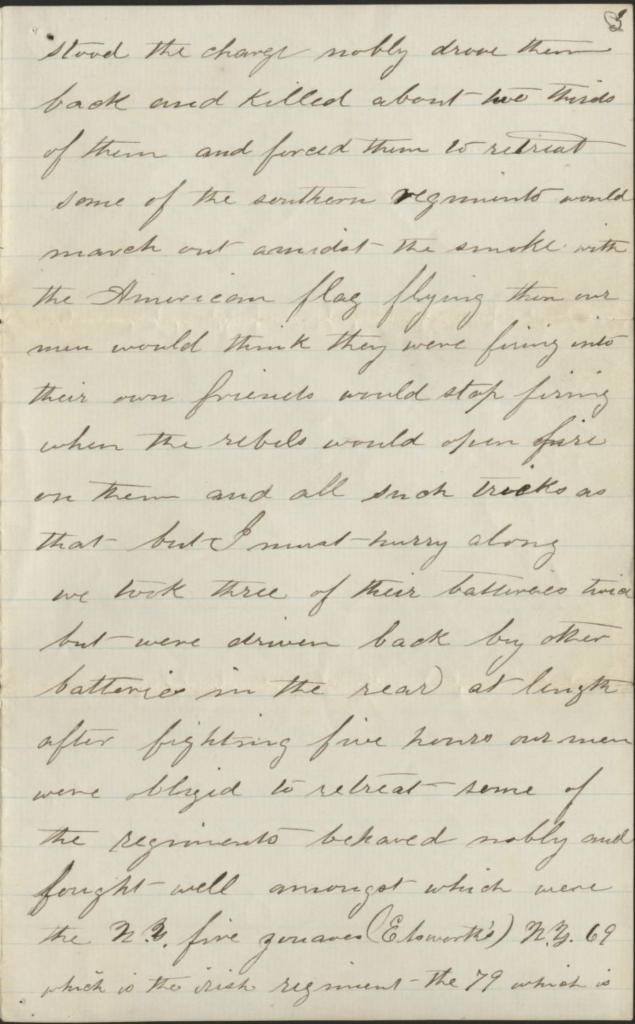
I will give you a short account of the battle as near as I can learn from those who were engaged in it. About two o’clock on last Sunday morning, our troops were called up and fell into ranks and formed their line of battle when they advanced on the enemy at Bulls Run about four miles this side of Manassas Junction. The rebels retreated and our troops followed on when the rebels opened on them with masked batteries, before this unknown to our men, and cut them up badly when some of them run when the New York Zouaves (Ellsworth’s) were charged upon by the Black Horse Cavalry but they stood the charge nobly, drove them back, and killed about two-thirds of them and forced them to retreat. Some of the southern regiments would march out amidst the smoke with the American flag flying, then our men would think they were firing into their own friends, would stop firing, when the rebels would open fire on them and all such tricks as that. But I must hurry along.
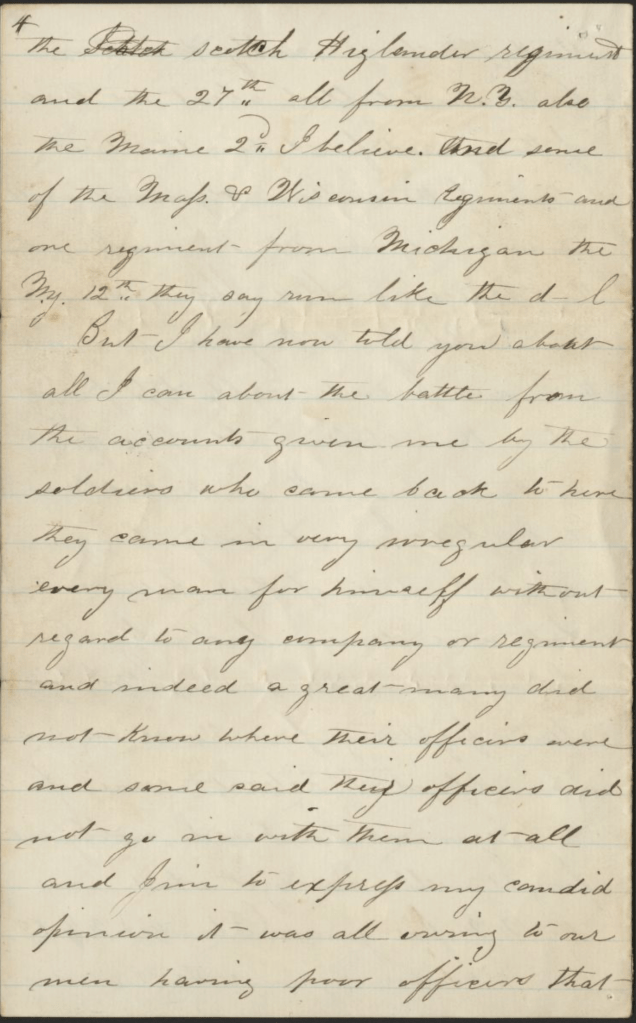
We took three of their batteries twice but were driven back by other batteries in the rear. At length, after fighting five hours, our men were obliged to retreat. Some of the regiments behaved nobly and fought well amongst which were the New York Fire Zouaves (Ellsworth’s), New York 69th which is the Irish regiment, the 79th which is the Scotch Highlander Regiment, and the 27th—all from New York. Also the Maine 2nd, I believe, and some of the Massachusetts & Wisconsin regiments and one regiment from Michigan. The New York 12th, they say, run like the devil.
But I have now told you about all I can about the battle from the accounts given me by the soldiers who came back to here. They came in very irregular, every man for himself without regard to any company or regiment and indeed a great many did not know where their officers were and some said their officers did not go in with them at all. And Jim, to express my candid opinion, it was all owing to our men having poor officers that we got licked so bad although we only had 45,000 men according to the best accounts I can get while the enemy had about 80,000 at the least.
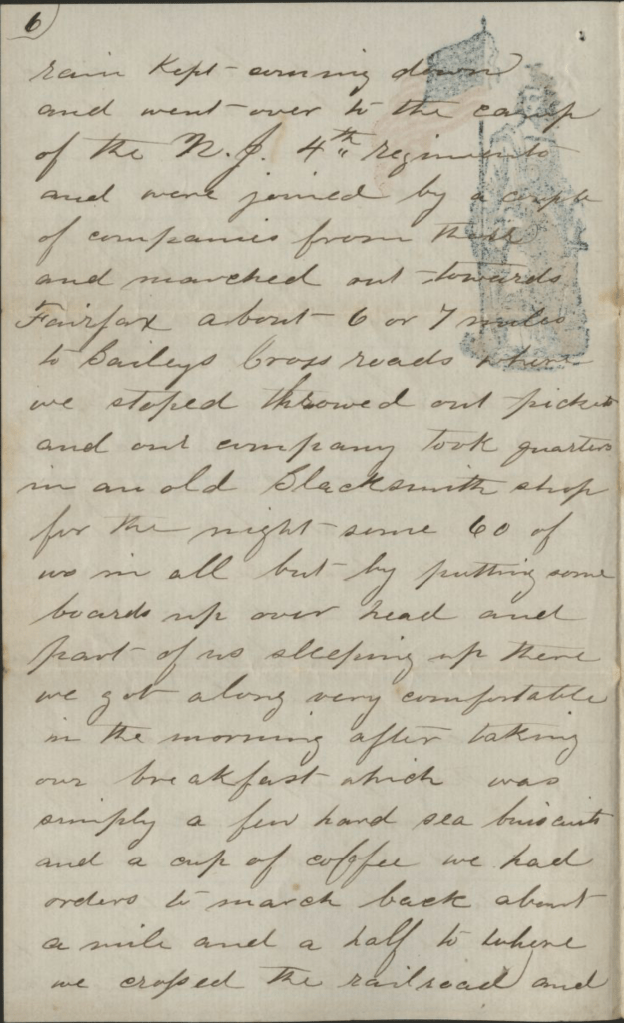
But I will return to my going out on the picket guard. About 8 o’clock on Monday it commenced to rain and it kept raining until about midnight on Monday night, but about 11 or half past eleven, we got orders for our regiment to send out two companies of picket guards and companies C and D were chosen by the colonel for that purpose. So we got ready, each man taking his overcoat, blanket, haversack, canteen, two days rations, &c. of course his gun, cartridge box, &c. and started although the rain kept coming down and went over to the camp of the New Jersey 4th regiment and were joined by a couple of companies from there and marched out towards Fairfax about 6 or 7 miles to Bailey’s Crossroads where we stoped, throwed out pickets and our company took quarters in an old blacksmith shop for the night, some 60 of us in all. But by putting some boards up overhead and part of us sleeping up there, we got along very comfortable.
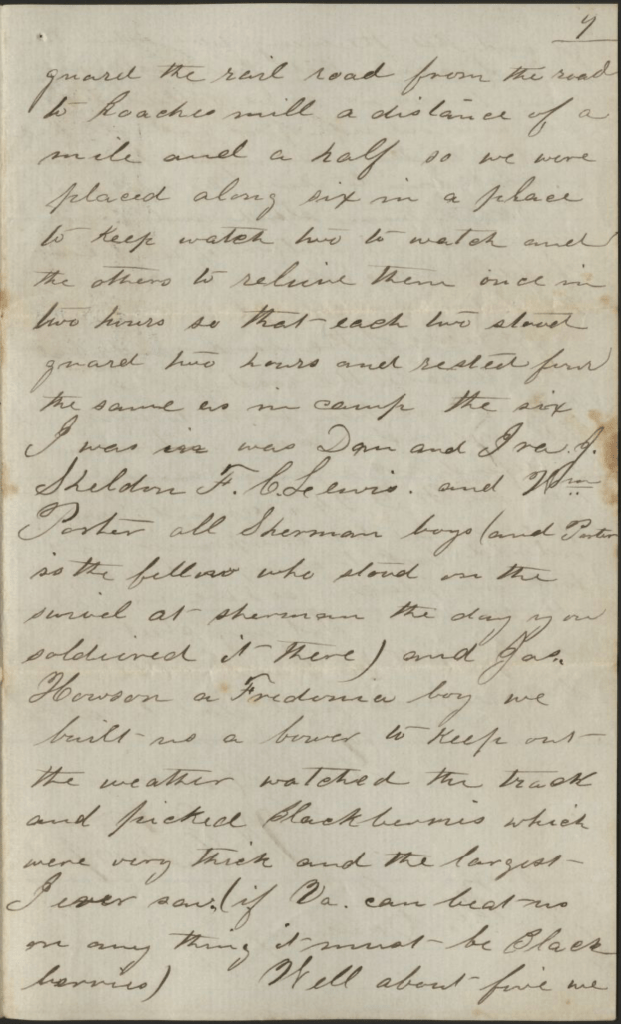
In the morning after taking our breakfast which was simply a few hard sea biscuits and a cup of coffee, we had orders to march back about a mile and a half to where we crossed the railroad and guard the railroad from the road to Roaches Mill-a distance of a mile and a half. So we were placed along six in a place to keep watch, two to watch and the others to relieve them once in two hours so that each two stood guard two hours and rested four—the same as in camp. The six I was in was Dan and Ira J. Sheldon, F. C. Lewis, and Wm. Porter, all Sherman boys (and Porter is the fellow who stood on the swivel at Sherman the day you soldiered it there) and Jas. Howson, a Fredonia boy. We built us a bower to keep out the weather, watched the track, and picked blackberries which were very thick and the largest I ever saw (if Virginia can beat us on anything, it must be blackberries).
Well, about five we got word that the enemy were within ten miles of us and that their cavalry were coming towards us so we rallied those who were outside of us and all had to stay together that last night. This morning we went down to where the captain and the rest of them staid and found them with one section of a battery of field pieces (which is two cannon). The battery was covered with bushes right side of the road and put so as to rake the road for some distance. We then went to work and fell trees and made a breastwork to defend us against cavalry and then the New York 24th Regiment came up and our two companies were ordered back to camp while they took our place. So here we are all sound.
But my sheet is nearly full so I will close with best respects and love to all. Your cousin, — W. E. Thorp
The following letter was written by Nelson A. Daines [or Danes] who enlisted as an artificer in Battery E, 1st New York Light Artillery on 12 September 1861. He reenlisted on 28 December 1863 and transferred to Battery L. He mustered out of the battery on 17 June 1865 at Elmira, New York.
According to on-line genealogical records, Nelson was the son of Simeon Daines and Catherine Boulongee. He was married to Rebecca Torrence. He died in Towlesville, Steuben county, New York in 1875.
According to his enlistment record, Nelson was born in Yates county, New York, and was a 42 year-old blacksmith when he entered the service in 1861. He had dark eyes, dark hair, a dark complexion, and stood 6 foot 2 inches.
Nelson’s service record indicates that he was present with his battery at the following engagements: Lee’s Mills, Yorktown, Williamsburg, Fair Oaks, Seven Days, 2nd Bull Run, South Mountain, Antietam, Fredericksburg, Chancellorsville, Gettysburg, Thoroughfare Gap, Mine Run, Wilderness, Laurel Hill, Spottsylvania, North Anna, Cold Harbor, Petersburg, Weldon Railroad. He claimed he “was never sick one hour” and that he never spent any time in a hospital unless it was “to look after sick & wounded boys.”
I was waiting very patiently to get your letter. I received it last week—your letter dated the 9th—and was very [glad] to hear from you. The most of the camp sent by express the 1st of January. I shall send more. It relieves my mind very much. It would be the great pleasure to me to see you & Emery. My health is very good. We have enough to eat. You wanted to know my business. We have 94 horses. I am artificer in our battery. I boss blacksmith & boss of the battery wagon. Charles [B.] Mills is my helper in sharing. My first helper [Simeon] Kring died. 1 Charles’ health is good & Richard Williams is good. It would please me very much to be at Towlesville.
I don’t think we shall move from here very soon. We have some fighting but our arms are successful. Some of our regiment has moved. My shop is outdoors. We drawed with teams over brush [ ] feet high [and ] made a shop one and a half mile east of the hospital. I have no one to order me but I have a right to order. I am my own boss.
Direct your letters as before. I did not get your letter in time to write last week. When you get this, write immediately. In January I shall send more money than I did before but keep it & use as you want. I feel sorry for Mrs. Bauter but she don’t stand so high with me as she once did. She is now left a widow and that is bad. If she had been to home about her own business, I would probably have been to home about mine. I may yet see home & I may not. War is dangerous to all that’s in it. But remember if I fall, I shall sell my life as dear as possible. I will stand by the old flag. She shall not trail in the dust though Devils try to do it.
No more at present. Goodbye. Your husband, — Nelson Daines
Give my respects to my friends.
1 Simeon Kring was 24 years old when he enlisted at Bath, New York, to served in Battery E, 1st New York Light Artillery. He died of disease on 22 November 1861 at United States General Hospital in Elmira, New York.
An unknown soldier in the 7th Company, 79th New York Highlanders
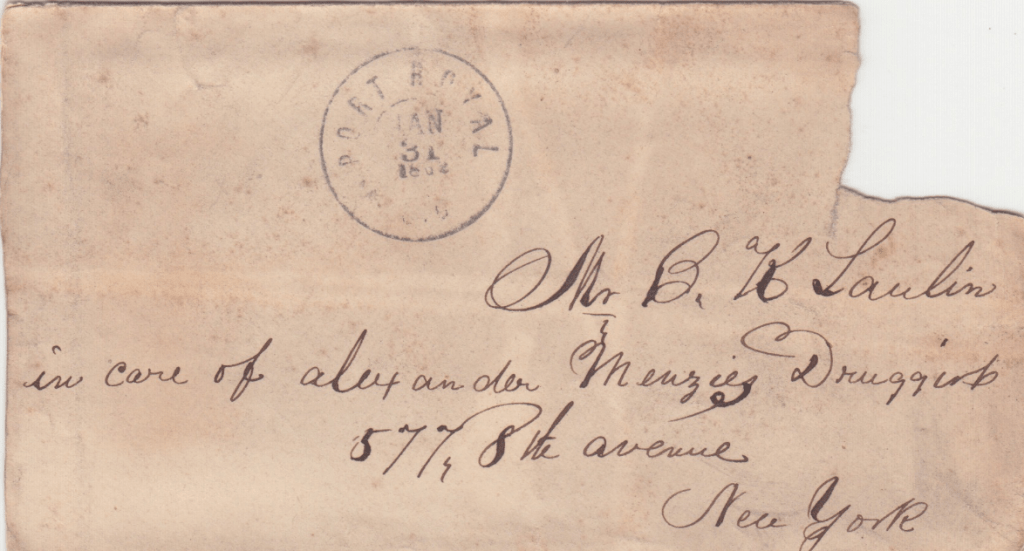
The following letter is from a cache of letters found in an antique store by Cianna Lee who made them available for transcription and publication on Spared & Shared by express consent. This particular letter was written by George Menzies (1841-1862) to his friend Burritt K. Lawlin of New York City. George wrote the letter from Beaufort, South Carolina, in January 1862 while serving in Co. C (“Third Co.”), 79th New York Highlanders. George enlisted on 27 May 1861 but died on 1 September 1862 from wounds received in action at Chantilly, Virginia.
George’s parents were John Menzies (103-1870) and Jane Ferris (1807-1884), natives of Scotland, who emigrated to the United States aboard the vessel Glasgow in October 1856. The “Alex” referred to in this letter was most likely George’s older brother, Alexander Menzies (1830-1886) who was a druggist in New York City.
George wrote the letter to his friend, Burritt Keeler Lawlin (1843-1916), the son of sea captain Richard Edmonston Lawlin (1808-1861) and Maria Keeler (1816-1896) of New York City. He graduated in 1858 from the New York City Free Academy. It appears that Burritt lived with his widowed mother at their home at 180 W. 21st Street in New York City at the time these letters were addressed to him. Burritt was married in January 1864 to Louise Johnson Orrell (1843-1931). In the 1880 US Census, Burritt was enumerated in Brooklyn where he superintended a chemical works.
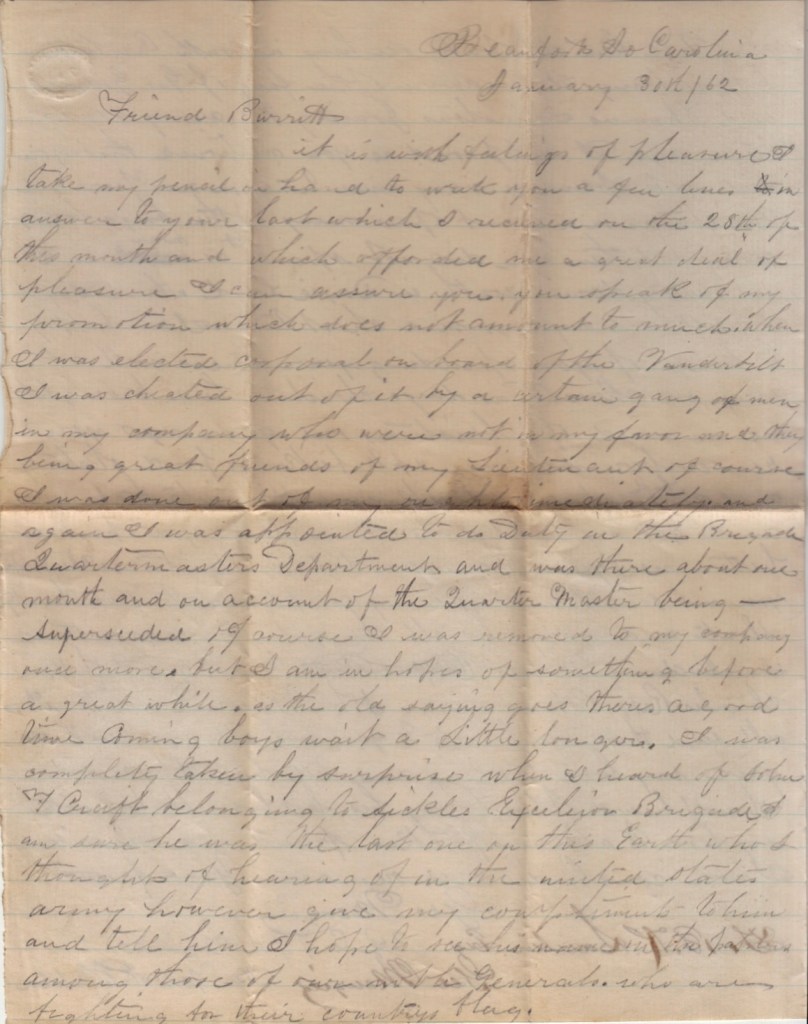
Transcription
Beaufort, South Carolina January 30th 1862
Friend Burritt,
It is with feelings of pleasure I take my pencil in hand to write you a few lines in answer to your last which I received on the 28th of the month and which afforded me a great deal of pleasure, I can assure you. You speak of my promotion which does not amount to much. When I was elected corporal on board of the Vanderbelt, I was cheated out of it by a certain gang of men in my company who were not in my favor and they being great friends of my Lieutenant, of course I was done out of my rights immediately and again I was appointed to do duty in the Brigade Quartermaster’s Department and was there about one month. And on account of the Quarter Master being superseded, of course I was removed to my company once more. But I am in hopes of something before a great while. As the old saying goes, “there’s a good time coming boys, wait a Little longer.”
I was completely taken by surprise when I heard of John F. Craft belonging to Sickles’ Excelsior Brigade and am sure he was the last one on this Earth who I thought of hearing of in the united states army. However, give my compliments to him and tell him I hope to see his name in the papers among those of our noble Generals who are fighting for their country’s flag. And tell him I hope to see him in South Carolina before long.
I am aware of the fact of Geo. Gunn’s and Thomas Johnston’s joining the army some time ago. I supposed as you mentioned that you did not spend a very nice time on New Years and Christmas on account of so many of the boys being away but then you did not spend it as mean as I did away down south in Dixie land where I expect I will end my days in a short time. I am happy to hear of you spending your time so well at Alex’s on Christmas day. Christmas here brought me in mind of Christmas one year ago. You remember we were up to Beekman’s Pond skating and I had such good luck in getting into that mure (?) and got my head cut. I am glad you spent a better New Years than you did on Christmas. I expect you and John F. Craft give my compliments to Miss Charity Sloate and Mary. Also all the girls of my acquaintance including Misses Craft and Tuthill. Charles Rapp, Robert Armour, John Monroe, [and] David Tennett all send their compliments to you and all acquaintances. Give my love to Alex and tell him I was sad when I heard of his losing his last born child. With my love to all my folks, friends, and acquaintances, I now conclude and remain your friend, Geo. Menzier



























 Spared & Shared 23